EP1744516A1 - Verfahren zur Entschärfung einer Dienstverweigerungs-Attacke mittels selektiver Verkehrsumleitung in IP Netzen - Google Patents
Verfahren zur Entschärfung einer Dienstverweigerungs-Attacke mittels selektiver Verkehrsumleitung in IP Netzen Download PDFInfo
- Publication number
- EP1744516A1 EP1744516A1 EP05106534A EP05106534A EP1744516A1 EP 1744516 A1 EP1744516 A1 EP 1744516A1 EP 05106534 A EP05106534 A EP 05106534A EP 05106534 A EP05106534 A EP 05106534A EP 1744516 A1 EP1744516 A1 EP 1744516A1
- Authority
- EP
- European Patent Office
- Prior art keywords
- black
- router
- routers
- address
- traffic
- Prior art date
- Legal status (The legal status is an assumption and is not a legal conclusion. Google has not performed a legal analysis and makes no representation as to the accuracy of the status listed.)
- Withdrawn
Links
- 230000000116 mitigating effect Effects 0.000 title description 2
- 238000000034 method Methods 0.000 claims description 21
- 238000004891 communication Methods 0.000 claims description 9
- 238000001914 filtration Methods 0.000 description 3
- 230000004044 response Effects 0.000 description 3
- 230000000694 effects Effects 0.000 description 2
- 238000012986 modification Methods 0.000 description 2
- 230000004048 modification Effects 0.000 description 2
- 230000000644 propagated effect Effects 0.000 description 2
- 230000004913 activation Effects 0.000 description 1
- 230000005540 biological transmission Effects 0.000 description 1
- 230000003247 decreasing effect Effects 0.000 description 1
- 230000007123 defense Effects 0.000 description 1
- 230000001627 detrimental effect Effects 0.000 description 1
- 230000005055 memory storage Effects 0.000 description 1
Images

Classifications
-
- H—ELECTRICITY
- H04—ELECTRIC COMMUNICATION TECHNIQUE
- H04L—TRANSMISSION OF DIGITAL INFORMATION, e.g. TELEGRAPHIC COMMUNICATION
- H04L63/00—Network architectures or network communication protocols for network security
- H04L63/14—Network architectures or network communication protocols for network security for detecting or protecting against malicious traffic
- H04L63/1408—Network architectures or network communication protocols for network security for detecting or protecting against malicious traffic by monitoring network traffic
- H04L63/1416—Event detection, e.g. attack signature detection
-
- H—ELECTRICITY
- H04—ELECTRIC COMMUNICATION TECHNIQUE
- H04L—TRANSMISSION OF DIGITAL INFORMATION, e.g. TELEGRAPHIC COMMUNICATION
- H04L63/00—Network architectures or network communication protocols for network security
- H04L63/14—Network architectures or network communication protocols for network security for detecting or protecting against malicious traffic
- H04L63/1441—Countermeasures against malicious traffic
- H04L63/1458—Denial of Service
Definitions
- the present invention relates generally to Internet Protocol (IP) networks, and more particularly to redirecting or rerouting attack traffic in response to a Distributed Denial of Service (DDOS) attack caused by an attacker flooding a victim's host system with one or more of several types of attack traffic.
- IP Internet Protocol
- DDOS Distributed Denial of Service
- DDoS Distributed Denial of Service
- an attacker takes control of one or more hosts (daemons) and uses the daemons to send an enormous amount of attack traffic to, for example, a web site so that no other traffic can get through to the website. In essence, the website is clogged or jammed with attack traffic.
- the frequency of DDoS attacks in the Internet has grown in the past several years.
- the type of attack traffic used by an attacking host (master) is usually TCP SYN or PING type messages.
- the flooding of a victim's host system with attack traffic causes legitimate users of the victim's host system to be denied access to applications running on the System Under Attack (SUA).
- SUA System Under Attack
- the application can be a web server, a file server, a Domain Name System (DNS) server, or other Internet related service or device.
- DNS Domain Name System
- the legitimate users cannot access the application due to Central Processing Unit (CPU) and/or bandwidth exhaustion on the system under attack.
- An attack may have a distributed nature due to the attack traffic being from random, usually spoofed, source IP addresses and originating from many daemon hosts. Also, the attack traffic may enter the victim's Internet Service Provider (ISP) network from various entry points.
- ISP Internet Service Provider
- DDoS attacks are among the most difficult types of attacks to defend against.
- a system is vulnerable to a DDoS attack simply by being connected to the Internet.
- the federal government is increasingly aware of DDoS attacks and may propose that federal agencies only utilize ISPs that have DDoS protection in their networks.
- An exemplary embodiment of the present invention provides an ISP the ability to selectively black-hole specific traffic, rather than all traffic, that is addressed to a particular IP address.
- traffic destined to the SUA and routed through specific routers within an ISP network can be black-holed while traffic destined to the SUA and routed through other routers in the ISP network may continue toward its original address.
- An embodiment of the invention provides an ISP more alternatives than to only be able to black-hole all traffic addressed to an application-under-DDoS attack. Instead, traffic destined to the SUA entering the ISP network through selected routers may be able to continue to the application-under-DDoS attack, while similar traffic entering the ISP network through other selected routers are black-holed. Furthermore, such a selection of ISP entry point routers can be changed in real time so that the origin of or other information about the DDoS attack can be more easily determined.
- a general ISP network 10 comprising routers 1 through 7.
- Routers 1 through 7 can be substantially any ISP network.
- Destination 12 has an internet protocol address.
- Destination 12 may be a website, a server, a router, and an internet subsystem such as a printer, modem bank, memory storage network, etc.
- destination 12 is a website called website X.
- the customer's traffic is routed from router 5 to router 1 in at least one of various different routes.
- the customer can become in communication with website X 12.
- Website X has a specific address to which the customer's traffic is directed.
- the customer's traffic can be routed substantially in any direction through the routers 2, 3, 4, 6 and 7 so long as it ends up at website X 12.
- the routers through which the customer's traffic travels between router 5 and router 1 are called intermediate routers.
- one of the techniques for thwarting an attack is for the ISP to introduce a bogus route for traffic to take to the website.
- a black-hole router 14 is introduced to the ISP's network.
- the black-hole router 14 advertises the bogus address to the website under attack.
- the bogus address and the website under attack each have the same addresses except the bogus address has a higher priority or preference.
- the higher priority requires that all traffic going to the website-under-attack's address will be diverted or black-holed to the black-hole router 14.
- the traffic flow arrows 16 indicate the direction of all traffic addressed to the website-under-attack 12 that is redirected to the black-hole router 14 via the bogus address having a higher priority than the website address.
- the bogus address is the same address as the address for the website-under-attack, the bogus address has a higher priority.
- the ISP analyzes the redirected traffic being received at the black-hole router 14 in order to trace where the attack traffic is coming from so that a better defense to the attack can be established. Meanwhile, legitimate users of the system are denied access to the website-under-attack because their traffic is also being black-holed.
- attack traffic There are a couple of popular types of attack traffic used by attackers.
- One type of attack traffic uses SYN attacks.
- Another type of attack traffic uses ICMP attacks.
- the SYN attack traffic is used as part of a message sent using Transmission Control Protocol (TCP).
- TCP Transmission Control Protocol
- An attacker sends many, many SYN packets to the website-under-attack.
- the website-under-attack responds by attempting to create a TCP connection to all the incoming SYN packets.
- the proper response by a website is to reply to each SYN packet with another SYN packet and then wait for the user to send another type of packet called an ACK packet to acknowledge the website's SYN packet and to complete the "TCP Handshake" and establish a TCP connection between the website and the user.
- the ACK In a SYN attack, the ACK is never sent. Thus, the website-under-attack is bombarded with SYN packets. The website-under-attack replies thereto with SYN packets and waits for an ACK for each reply, but never gets one. The website under attack receives millions of SYN packets, but never receives an ACK. The website-under-attack is trying to set up all the potential TCP connections, but the TCP handshakes are never completed. The website-under-attack's bandwidth is consumed by the incomplete TCP handshakes and is in effect shut down to any valid traffic.
- a PING attack the attacker utilizes the "PING" utility of ICMP.
- the PING utility is used to determine whether a specific IP address is accessible. A PING packet is sent to a specified address and a reply is then sent by the specified address.
- millions of PINGs are sent to the website-under-attack and the CPU becomes overwhelmed by attempting to respond to all the PINGs. In effect, the bandwidth of both the website's CPU(s) and communication channels is used up so that valid traffic to the website-under-attack is blocked.
- An exemplary method of selective black-holing uses Boarder Gateway Protocol (BGP) as an underlying protocol. It is understood by one of ordinary skill in the art that an exemplary method or system can be applied to other dynamic routing protocols that allow route filtering.
- BGP Boarder Gateway Protocol
- BGP for selective black-hole route propagation allows an ISP to set up a black-holing strategy before an attack on any ISP customers is present.
- an exemplary method for selective black-hole route propagation provides a means for black-holing traffic destined to the system-under-attack only at predetermined routers by injecting the black-hole route into the BGP with pre-selected community values.
- an exemplary selective black-holing method allows less than all the routers or hosts in an ISP's system to be used to analyze and determine the attack originating points in the network. In other words, black-holing of attack traffic can be limited to attack traffic traveling through a subset (one or more) of the ISP's routers.
- a basic rule of consistent routing ensures that the BGP next-hop of a destination is the same at every router in the ISP network.
- this basic rule is broken for the IP address of the system-under-attack (and only for this IP address).
- this rule requiring the BGP next-hop of a destination to be the same at every router in the ISP network is broken in an exemplary selective black-holing scheme, the routing is set up so that there are no routing loops in the network. That is, routing to the black-hole router 22 and the system-under-attack 24 must be "consistent" in a more general sense as described below.
- Breaking the basic rule of consistent routing, discussed above, is not detrimental to the ISP network since it is done during a DDoS attack, and then, only for the IP destination of the system-under-attack 24.
- the BGP next-hop of the destination under attack will either be the black-hole router (or host) 22 or the router 1 which is directly connected to the system-under-attack 24.
- One of these routers (router 1 or the black-hole router 22) will be the BGP next-hop for the destination at each of the routers in the ISP's network.
- a couple of examples will help clarify the exemplary selective black-holing method and system.
- the network shown 20 like network 10 (in FIGURE 1) is an exemplary ISP network, namely, no customers are shown to connect directly to these routers (although they could).
- iBGP BGP
- the system-under-attack is connected to router 1.
- a back-hole router or host 22 is attached to another router 7.
- An Interior Gateway Protocol (IGP) such as Open Short Path First (OSPF) is running in the network 20.
- the IP address of the system-under-attack 24 is known by all the routers 1-7 via BGP.
- IGP Interior Gateway Protocol
- OSPF Open Short Path First
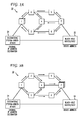
- a black-hole IP address which is the same as the system-under-attack's IP address, is injected into the BGP with a higher local preference than the system-under-attack's local preference. So far, this discussion of FIGURE 2 has substantially described the system of FIGURE 1 that utilizes total or non-selective black-holing.
- selective black-holing is what results when a preferred route 26 from the black-hole router 22 is selectively filtered out from the iBGP updates going to a predetermined subset of the routers 1-7.
- selective black-holing is depicted wherein the black-hole route is not propagated to routers 1, 2, 3, and 4.
- the black-hole route 26 is propagated only to routers 5, 6, and 7.
- injecting the black-hole route 26 to only routers 5, 6, and 7 can be achieved dynamically by injecting the black-hole route 26 with a predetermined set of community values, for example, with community values 5, 6, and 7.
- the set of community values will enable the iBGP sessions, between router 7 and the other routers in the ISP system, to filter out the black-hole route except in routers 5, 6, and 7.
- Such a scheme will allow all traffic, addressed for the system-under-attack 24, in routers 1, 2, 3, and 4 to continue to flow toward the system-under-attack 24.
- the scheme will also selectively black-hole all traffic, in routers 5, 6, and 7, addressed for the system-under attack 24 to the black-hole router 22.
- Such a selective black-holing scheme can be set up in a variety of ways for a variety of predetermined routers.
- Various selective black-holing schemes can be planned and pre-programmed for activation in anticipation of a DDoS attack's mitigation. By changing the community value of the black-hole route 26, more or less routers will receive the black-hole route 26.
- the IGP next-hop i.e., traffic movement to a next router
- the IGP next-hop of each router designated to send traffic toward the system-under-attack must point to another router that will send the designated traffic to the system-under-attack.
- the consistency condition of routing for an exemplary embodiment requires that the IGP next-hop at each non-black-holing router point to another non-black-holing router and the IGP next-hop of each black-holing router point to another black-holing router.
- a black-holing router is a router that installs the black-hole route to router 22 into its routing table and a non-black-holing router is a router that installs the original route to the system-under-attack's IP address into its routing table. Any router that receives both routes will always install the black-hole route into its routing table because the black-hole route has the higher local preference.
- the IGP next-hop for the system-under-attack at a black-holing router points to another black-holing router and the IGP next-hop for the system-under-attack at a non-black-holing router points to another non black-holing router.
- the router looks up the BGP next-hop for the destination. Typically, to reach the BGP next-hop, the router has to send the traffic to some other directly connected intermediate router. This directly connected intermediate router is determined by the IGP next-hop to the BGP next-hop.
- An exemplary selective-black-holing method and system comprises a division of all the routers in an ISP network.
- the routers are divided into two sets; being black-holing routers and non-black-holing routers. Every such division will not result in consistent routing for the system-under-attack.
- OSPF OSPF with a metric set to 1 on each link of the network between each router.
- OSPF routes to routers 1 and 7 are as shown in Table 1.
- Table 1 and FIGURES 4A and 4B various different black-holing strategies can be devised such that routing to the system-under-attack 24 and the black-hole router 22 (having the same address as the system-under-attack, but with a higher preference) is consistent using the OSPF, or other type of IGP, next-hop information.
- Table 2 provides schemes that are consistent routing in accordance with an embodiment of the invention. Table 2 is not an exhaustive list of consistent black-holing schemes for this example. TABLE 2: Selective Black-Holing Schemes with Consistent Routing SELECTIVE BLACK-HOLING SCHEME NO.
- a selective black-holing scheme can be selected and implemented in real-time during a DDoS attack.
- the selective black-holing method or system is selected by injecting the IP address of the system-under-attack with a community value that establishes a predetermined division of all ISP routers into black-hole routers and non-black-hole routers.
- the community-based filtering of routes to the system-under-attack via the community values can be set up for use prior to and implemented during a DDoS attack.
- the response time to a DDoS attack can be decreased using selective black-holing when compared to non-selective-black-holing: Since various selective black-holing strategies are preconfigured, one can be selected and implemented as soon as a DDoS attack is underway using BGP routing and community-based route filtering.
- the selective black-holing scheme can be initiated by announcing the IP address of the system under attack with a selected or predefined community value so that each router in the ISP system becomes either a black-holing router or a non-black-holing router.
- Embodiments of the invention provide an adjustable and selective black-holing strategy that can be modified in real-time during a DDoS attack in order to black-hole more or less traffic addressed to the system-under-attack. This results in allowing some traffic, that may be valid traffic, to proceed to its original destination being the system-under-attack.
Landscapes
- Engineering & Computer Science (AREA)
- Computer Security & Cryptography (AREA)
- Computer Hardware Design (AREA)
- Computing Systems (AREA)
- General Engineering & Computer Science (AREA)
- Computer Networks & Wireless Communication (AREA)
- Signal Processing (AREA)
- Data Exchanges In Wide-Area Networks (AREA)
Priority Applications (1)
| Application Number | Priority Date | Filing Date | Title |
|---|---|---|---|
| EP05106534A EP1744516A1 (de) | 2005-07-15 | 2005-07-15 | Verfahren zur Entschärfung einer Dienstverweigerungs-Attacke mittels selektiver Verkehrsumleitung in IP Netzen |
Applications Claiming Priority (1)
| Application Number | Priority Date | Filing Date | Title |
|---|---|---|---|
| EP05106534A EP1744516A1 (de) | 2005-07-15 | 2005-07-15 | Verfahren zur Entschärfung einer Dienstverweigerungs-Attacke mittels selektiver Verkehrsumleitung in IP Netzen |
Publications (1)
| Publication Number | Publication Date |
|---|---|
| EP1744516A1 true EP1744516A1 (de) | 2007-01-17 |
Family
ID=35445885
Family Applications (1)
| Application Number | Title | Priority Date | Filing Date |
|---|---|---|---|
| EP05106534A Withdrawn EP1744516A1 (de) | 2005-07-15 | 2005-07-15 | Verfahren zur Entschärfung einer Dienstverweigerungs-Attacke mittels selektiver Verkehrsumleitung in IP Netzen |
Country Status (1)
| Country | Link |
|---|---|
| EP (1) | EP1744516A1 (de) |
Cited By (2)
| Publication number | Priority date | Publication date | Assignee | Title |
|---|---|---|---|---|
| CN102404774A (zh) * | 2010-09-09 | 2012-04-04 | 中国移动通信集团上海有限公司 | 一种检测网络黑洞的方法及装置 |
| CN113660199A (zh) * | 2021-07-06 | 2021-11-16 | 网宿科技股份有限公司 | 流量攻击的防护方法、装置、设备及可读存储介质 |
Citations (4)
| Publication number | Priority date | Publication date | Assignee | Title |
|---|---|---|---|---|
| WO2001046807A1 (en) * | 1999-12-22 | 2001-06-28 | Mci Worldcom, Inc. | An overlay network for tracking denial-of-service floods in unreliable datagram delivery networks |
| WO2002025402A2 (en) * | 2000-09-20 | 2002-03-28 | Bbnt Solutions Llc | Systems and methods that protect networks and devices against denial of service attacks |
| WO2004070535A2 (en) * | 2003-01-29 | 2004-08-19 | Telcordia Technologies, Inc. | Mitigating denial of service attacks |
| EP1566947A1 (de) * | 2004-02-18 | 2005-08-24 | AT&T Corp. | Verfahren zur Entschärfung einer Dienstverweigerungs-Attacke mittels selektiver Verkehrsumleitung in einem MPLS-VPN |
-
2005
- 2005-07-15 EP EP05106534A patent/EP1744516A1/de not_active Withdrawn
Patent Citations (4)
| Publication number | Priority date | Publication date | Assignee | Title |
|---|---|---|---|---|
| WO2001046807A1 (en) * | 1999-12-22 | 2001-06-28 | Mci Worldcom, Inc. | An overlay network for tracking denial-of-service floods in unreliable datagram delivery networks |
| WO2002025402A2 (en) * | 2000-09-20 | 2002-03-28 | Bbnt Solutions Llc | Systems and methods that protect networks and devices against denial of service attacks |
| WO2004070535A2 (en) * | 2003-01-29 | 2004-08-19 | Telcordia Technologies, Inc. | Mitigating denial of service attacks |
| EP1566947A1 (de) * | 2004-02-18 | 2005-08-24 | AT&T Corp. | Verfahren zur Entschärfung einer Dienstverweigerungs-Attacke mittels selektiver Verkehrsumleitung in einem MPLS-VPN |
Cited By (4)
| Publication number | Priority date | Publication date | Assignee | Title |
|---|---|---|---|---|
| CN102404774A (zh) * | 2010-09-09 | 2012-04-04 | 中国移动通信集团上海有限公司 | 一种检测网络黑洞的方法及装置 |
| CN102404774B (zh) * | 2010-09-09 | 2014-05-07 | 中国移动通信集团上海有限公司 | 一种检测网络黑洞的方法及装置 |
| CN113660199A (zh) * | 2021-07-06 | 2021-11-16 | 网宿科技股份有限公司 | 流量攻击的防护方法、装置、设备及可读存储介质 |
| CN113660199B (zh) * | 2021-07-06 | 2023-01-17 | 网宿科技股份有限公司 | 流量攻击的防护方法、装置、设备及可读存储介质 |
Similar Documents
| Publication | Publication Date | Title |
|---|---|---|
| US7444417B2 (en) | Distributed denial-of-service attack mitigation by selective black-holing in IP networks | |
| US7925766B2 (en) | Method for distributed denial-of-service attack mitigation by selective black-holing in MPLS VPNS | |
| US8484372B1 (en) | Distributed filtering for networks | |
| Ferguson et al. | Network ingress filtering: Defeating denial of service attacks which employ IP source address spoofing | |
| Gu et al. | Denial of service attacks | |
| Bremler-Barr et al. | Spoofing prevention method | |
| Nordström et al. | Beware of BGP attacks | |
| Argyraki et al. | Active internet traffic filtering: Real-time response to denial-of-service attacks. | |
| Abliz | Internet denial of service attacks and defense mechanisms | |
| US7207062B2 (en) | Method and apparatus for protecting web sites from distributed denial-of-service attacks | |
| Wendlandt et al. | Don't Secure Routing Protocols, Secure Data Delivery. | |
| EP1284558B1 (de) | Verfahren und Vorrichtung zum Schutz von E-Commerce-Site gegen Distributed-Denial-of-Service Angriffen | |
| Huici et al. | An edge-to-edge filtering architecture against DoS | |
| EP1744516A1 (de) | Verfahren zur Entschärfung einer Dienstverweigerungs-Attacke mittels selektiver Verkehrsumleitung in IP Netzen | |
| Fallah et al. | TDPF: a traceback‐based distributed packet filter to mitigate spoofed DDoS attacks | |
| CA2511854A1 (en) | Distributed denial-of-service attack mitigation by selective black-holing in ip networks | |
| Patil et al. | A rate limiting mechanism for defending against flooding based distributed denial of service attack | |
| Shue et al. | Packet forwarding with source verification | |
| Israr et al. | Mitigating IP spoofing by validating BGP routes updates | |
| Floyd et al. | Aggregate-Based Congestion Control and Pushback | |
| Wade et al. | A cross-layer approach for mitigating denial of service attacks: Device-driver packet filter and remote firewalling | |
| Koutepas et al. | Detection and Reaction to Denial of Service Attacks | |
| Hofer et al. | IP Spoofing | |
| Suh et al. | A Practical Defense Against SYN Denial-of-Service Attacks | |
| Farhat | An Effective Defense Against Spoofed IP Traffic |
Legal Events
| Date | Code | Title | Description |
|---|---|---|---|
| PUAI | Public reference made under article 153(3) epc to a published international application that has entered the european phase |
Free format text: ORIGINAL CODE: 0009012 |
|
| AK | Designated contracting states |
Kind code of ref document: A1 Designated state(s): AT BE BG CH CY CZ DE DK EE ES FI FR GB GR HU IE IS IT LI LT LU LV MC NL PL PT RO SE SI SK TR |
|
| AX | Request for extension of the european patent |
Extension state: AL BA HR MK YU |
|
| 17P | Request for examination filed |
Effective date: 20070504 |
|
| 17Q | First examination report despatched |
Effective date: 20070604 |
|
| AKX | Designation fees paid |
Designated state(s): DE FR GB |
|
| STAA | Information on the status of an ep patent application or granted ep patent |
Free format text: STATUS: THE APPLICATION IS DEEMED TO BE WITHDRAWN |
|
| 18D | Application deemed to be withdrawn |
Effective date: 20110201 |