EP1742134A1 - Information management device and information management method - Google Patents
Information management device and information management method Download PDFInfo
- Publication number
- EP1742134A1 EP1742134A1 EP04730652A EP04730652A EP1742134A1 EP 1742134 A1 EP1742134 A1 EP 1742134A1 EP 04730652 A EP04730652 A EP 04730652A EP 04730652 A EP04730652 A EP 04730652A EP 1742134 A1 EP1742134 A1 EP 1742134A1
- Authority
- EP
- European Patent Office
- Prior art keywords
- data
- hardware
- program
- provider
- processing apparatus
- Prior art date
- Legal status (The legal status is an assumption and is not a legal conclusion. Google has not performed a legal analysis and makes no representation as to the accuracy of the status listed.)
- Withdrawn
Links
Images









Classifications
-
- G—PHYSICS
- G06—COMPUTING OR CALCULATING; COUNTING
- G06F—ELECTRIC DIGITAL DATA PROCESSING
- G06F21/00—Security arrangements for protecting computers, components thereof, programs or data against unauthorised activity
- G06F21/30—Authentication, i.e. establishing the identity or authorisation of security principals
- G06F21/31—User authentication
- G06F21/32—User authentication using biometric data, e.g. fingerprints, iris scans or voiceprints
-
- G—PHYSICS
- G06—COMPUTING OR CALCULATING; COUNTING
- G06F—ELECTRIC DIGITAL DATA PROCESSING
- G06F21/00—Security arrangements for protecting computers, components thereof, programs or data against unauthorised activity
- G06F21/30—Authentication, i.e. establishing the identity or authorisation of security principals
- G06F21/31—User authentication
- G06F21/33—User authentication using certificates
-
- G—PHYSICS
- G06—COMPUTING OR CALCULATING; COUNTING
- G06F—ELECTRIC DIGITAL DATA PROCESSING
- G06F21/00—Security arrangements for protecting computers, components thereof, programs or data against unauthorised activity
- G06F21/50—Monitoring users, programs or devices to maintain the integrity of platforms, e.g. of processors, firmware or operating systems
- G06F21/57—Certifying or maintaining trusted computer platforms, e.g. secure boots or power-downs, version controls, system software checks, secure updates or assessing vulnerabilities
Definitions
- the present invention relates to a data managing device and a data managing method for managing data in a data processing apparatus.
- IPv6 internet protocol version 6
- a personal computer not only a personal computer, a server computer, and a cellular phone, but also household electrical appliance (such as a refrigerator, a microwave, an air conditioner, a television (TV), and a digital versatile disc (DVD) drive), a copy machine, and a robot, etc.
- household electrical appliance such as a refrigerator, a microwave, an air conditioner, a television (TV), and a digital versatile disc (DVD) drive
- TV television
- DVD digital versatile disc
- the security Before performing an electronic commerce using such a data processing apparatus, it is preferable to ensure the security by checking whether a user of the apparatus is a proper owner, whether the apparatus that performs the electronic commerce is an apparatus of the proper owner, and whether the apparatus is connected with other apparatuses or installed with software (such as an operating system (OS), a browser, plug-in software, etc.) that degrade the security of the apparatus.
- OS operating system
- plug-in software plug-in software
- the frequency, the amount, and the method of updating a program (such as firmware) or data are different for each authentication because the biometrics, the user authentication, and the environment authentication are authentication functions used for different purposes.
- each authentication function should be timely updated to achieve its original purpose of authentication. Therefore, it is meaningless to perform authentication with an authentication function which is not updated until other authentication function is updated (in other words, which is updated at the same time of the update of other authentication function).
- the present invention is made in view of the above problems in the conventional technologies, and an object of the present invention is to provide a data managing device and a data managing method with which security can be improved by flexibly and accurately updating a program and data for biometrics, user authentication (PKI authentication), and environment authentication.
- PKI authentication user authentication
- environment authentication environment authentication
- a data managing device that is installed in a data processing apparatus that includes a single chip with communication authentication hardware and processing hardware, wherein the communication authentication hardware authenticates security of communication between the data processing apparatus and an external apparatus, and the processing hardware performs predetermined processing that is different from processing performed by the communication authentication hardware
- the data managing device comprising: an input unit that receives from a provider that provides arbitrary execution program installed in the single chip, when security of communication,between the provider and the data processing apparatus is authenticated by the communication authentication hardware, input of an update program that updates the execution program and of an electronic signature generated from the update program using a secret key of the provider; a program determining unit that determines whether the execution program is installed in the communication authentication hardware or the processing hardware; a validity verifying unit that verifies whether it is valid to update, by the update program, an execution program determined by the program determining unit, based on a message digest of the update program, the electronic signature, and a public key of the provider; and an updating unit that updates, by
- an authentication for ensuring the security of communication line to receive an update program can be performed by a single chip.
- FIG. 1 is a diagram of a configuration of a data managing system according to an embodiment of the present invention.
- a data managing system 100 shown in Fig. 1 includes a user's data processing apparatus 101, a data providing apparatus 102 that provides an execution program or data in the data processing apparatus 101, and an authentication apparatus 103 in a certificate authority.
- the apparatuses 101 to 103 are connected via a network 104 such as the Internet.
- the data processing apparatus 101 is, for example, a cellular phone, a personal computer, a server computer, an electrical appliance (such as a refrigerator, a microwave, an air conditioner, a TV, a DVD, etc.), a copy machine, a robot, etc.
- a security chip is installed in the data processing apparatus 101.
- the data providing apparatus 102 is managed by a vender or a maker that develops or sells an execution program and various data, or by a trader that manufactures or sells the data processing apparatus 101.
- the data providing apparatus 102 stores therein, or uploads to the network 104, an update program for the execution program and various data.
- the data providing apparatus 102 also generates an electronic signature of the execution program and various data.
- the authentication apparatus 103 issues and manages electronic certificates of a user, a maker, a vendor, a distributor, etc.
- the authentication apparatus 103 also generates an electronic signature of the issued electronic certificate.
- Fig. 2 is a block diagram of a hardware configuration of the data processing apparatus 101.
- the data processing apparatus 101 includes a central processing unit (CPU) 201, a read only memory (ROM) 202, a random access memory (RAM) 203, a hard disk drive (HDD) 204, a hard disk (HD) 205, a flexible disk drive (FDD) 206, a flexible disk (FD) 207 as an example of a removable recording medium, a display 208, a communication interface (I/F) 209, an input key 210 (such as a keyboard and a mouse), a biological sensor 211, and a security chip 215. These units are connected via a bus 200.
- CPU central processing unit
- ROM read only memory
- RAM random access memory
- HDD hard disk drive
- HD hard disk
- FDD flexible disk drive
- FD flexible disk
- I/F input key
- an input key 210 such as a keyboard and a mouse
- a biological sensor 211 such as a keyboard
- the CPU 201 controls the entire data processing apparatus 101.
- the ROM 202 stores a program such as a boot program.
- the RAM 203 is used as a work area of the CPU 201.
- the HDD 204 controls reading/writing of data from/to the HD 205 based on control of the CPU 201.
- the HD 205 stores data written in accordance with control of the HDD 204.
- the FDD 206 controls reading/writing of data from/to the FD 207 based on control of the CPU 201.
- the FD 207 stores data written in accordance with control of the FDD 206, and causes the data processing apparatus 101 to read data stored in the FD 207.
- a compact-disc read-only memory (CD-ROM), a compact-disc recordable (CD-R), a compact-disc rewritable (CD-RW), a magneto optical (MO) disc, a digital versatile disc (DVD), and a memory card may be used as a removable recording medium besides the FD 207.
- the display 208 displays not only a cursor, an icon, and a tool box, but also data such as documents, images, information of functions, etc.
- a cathode-ray tube (CRT), a thin-film transistor (TFT) display, a plasma display can be employed as the display 208.
- the communication I/F 209 is connected to the network 104 such as the Internet via communication lines, and connected to other devices via the communication lines.
- the communication I/F 209 is an interface between the network 104 and the data processing apparatus 101, and controls input/output from/to an external apparatus.
- a modem and a local area network (LAN) adapter can be employed as the communication I/F 209.
- the input key 210 includes plural keys to input characters, numbers, various instructions, etc.
- An input pad with a touch panel and a numeric key pad can be employed as the input key 210.
- the biological sensor 211 is, for example, a fingerprint sensor 212, a camera 213, or a microphone 214.
- the fingerprint sensor 212 is a device that detects asperities of a fingerprint at approximately 50 micrometer ( ⁇ m) interval, and converts the detected asperities into an electric signal.
- a semiconductor method an optical method, a pressure-sensitive method, and a thermal method as a method of scanning a fingerprint.
- the camera 213 is a device that takes a picture of an iris and a retina of an eye.
- the microphone 214 is a device that detects voice pattern that indicates vocal characteristics.
- the security chip 215 is called a trusted platform module (TPM), and installed on a main board of the data processing apparatus 101.
- the security chip 215 is a dedicated chip that provides a basic function for security and privacy.
- the security chip 215 is defined in the specification of trusted computing group (TCG).
- TCG trusted computing group
- a TPM installed in the data processing apparatus 101 cannot be installed in other data processing apparatus. If the TPM is removed from the data processing apparatus 101, the data processing apparatus 101 cannot run.
- the security chip 215 is a data managing device according to an embodiment of the present invention.
- Fig. 3 is a block diagram of a hardware configuration of the security chip 215.
- the security chip 215 shown in Fig. 3 is connected to the communication I/F 209, the biological sensor 211, the CPU 201, and a memory/storage 300 via a bus.
- the security chip 215 can obtain data of various software 301 installed in the data processing apparatus 101, and data of a peripheral device 302 connected to the data processing apparatus 101.
- the memory/storage 300 is provided either inside the security chip 215 or outside the security chip 215, as long as the memory/storage 300 is inside the data processing apparatus 101. If the memory/storage 300 is provided inside the security chip 215, it is possible to prevent removal of the memory/storage 300 and falsification of data.
- the security chip 215 includes communication authentication hardware 311, biometrics hardware 312, internal-data authentication hardware 313, monitoring hardware 314, and verifying hardware 315.
- the communication authentication hardware 311 ensures the security of communication between the data processing apparatus 101 and an external apparatus (for example, the data providing apparatus 102 or the authentication apparatus 103 shown in Fig. 1). For example, the communication authentication hardware 311 determines whether a user of an external apparatus is an authorized person authenticated by a certificate authority, by performing public key infrastructure (PKI) authentication using an electronic certificate issued by the certificate authority.
- PKI public key infrastructure
- a communication authentication program 321 for communication authentication is installed in the communication authentication hardware 311.
- the biometrics hardware 312 determines whether a user of the data processing apparatus 101 is an authorized user by determining whether biological data detected by the biological sensor 211 matches user's biological data registered in the data processing apparatus 101.
- a biometrics program 322 for biometrics is installed in the biometrics hardware 312.
- the internal data authentication hardware 313 authenticates data (internal data) in the data processing apparatus 101 or the single chip.
- the internal data is called environment data, therefore the internal data authentication hardware 313 is also called environment authentication hardware.
- the environment data is data of the peripheral device 302 (for example, a name of the device, version data) obtained from the peripheral device 302 connected to the data processing apparatus 101, data of the software 301 (for example, a name of the software, version data) installed in the data processing apparatus 101, or various data (for example, an electronic certificate) stored in the memory/storage 300.
- the internal data authentication hardware 313 keeps data stored in the memory/storage 300 secret. For example, the internal data authentication hardware 313 encrypts obtained data using a unique encryption key, and stores the encrypted data in the memory/storage 300. When requested from other hardware, the internal data authentication hardware 313 decrypts the encrypted data stored in the memory/storage 300 using a unique decryption key that is a pair of the encryption key. The internal data authentication hardware 313 can confirm that internal data is not falsified in the data processing apparatus 101 by the encryption and the decryption.
- the internal data authentication program 323 for the processing described above is installed in the internal data authentication hardware 313.
- a resident program 324 is installed in the monitoring hardware 314.
- the monitoring hardware 314 monitors transfer of data in the data managing device. Details of the monitoring processing will be explained later.
- a verifying program 325 is installed in the verifying hardware 315.
- the verifying hardware 315 verifies validity of data input into the security chip 215 from an external apparatus, when security of communication between the data processing apparatus and the external apparatus is ensured by the communication authentication hardware 311. Details of the verifying processing will be explained later.
- FIG. 4 is a block diagram of a configuration of each of the hardware 311 to 315 shown in Fig. 3.
- Each of the hardware 311 to 315 shown in Fig. 4 includes a processor 401, a ROM 402, a RAM 403, an electronically erasable and programmable read only memory (EEPROM) 404, an input I/F 405, and an encryptor/decryptor 406.
- the units 401 to 406 are connected via a bus 400.
- the processor 401 controls the entire hardware 311 to 315.
- the ROM 402 stores a program such as a boot program.
- the RAM 403 is used as a work area of the processor 401.
- the EEPROM404 stores a program performed by each of the hardware 311 to 315.
- the encryptor/decryptor 406 performs generation of an asymmetric encryption key, encryption, decryption, generation of a message digest (a hash value), and generation of an electronic signature.
- Fig. 5 is a diagram of electronic certificates stored in the memory/storage 300.
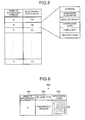
- Fig. 6 is a diagram of biological data stored in the memory/storage 300.
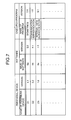
- Fig. 7 is a diagram of internal data stored in the memory/storage 300.
- each of electronic certificates Ca to Cz is stored corresponding to each authorized person.
- "An authorized person” means a person authenticated by each of the electronic certificates Ca to Cz, for example, a user, a maker, a vendor, and a certificate authority.
- Each of the electronic certificates Ca to Cz includes version data, a signature algorithm, a name of an issuer, an expiration date, a public key, and related information.
- Each of the electronic certificates Ca to Cz is encrypted by the internal data authentication hardware 313.
- registration data 600 includes a name of a registrant 601, a sensor type 602, and a biological data 603.
- Fig. 6 is an example of the registration data 600, when a registrant "X" that is a user of the data processing apparatus 101 registers, as the biological data 603, image data "Xa" of a fingerprint of the registrant "X” detected by "a fingerprint sensor”.
- the registration data 600 is also encrypted by the internal data authentication hardware 313.
- the peripheral device 302 As shown in Fig. 7, the peripheral device 302, the software 301, a name and a version of an execution program such as a communication authentication program 321 installed in each hardware, are stored as the internal data.
- FIG. 8 is a flowchart of a procedure of communication authentication performed by a data managing device according to an embodiment of the present invention.
- Step S801 whether the communication I/F 209 receives update information is determined.
- the update information will be explained here.
- Fig. 9 is a diagram of the update information.
- update information 900 includes data type 901, update data 902, an electronic signature 903 of a provider, an electronic certificate 904 of the provider (an electronic certificate of a certificate authority when the provider is the certificate authority), and an electronic signature 905 of the certificate authority.
- the data type 901 is data that indicates contents of the update data 902.
- the update data 902 is "a patch for the communication authentication program 321.
- the update data 902 is "a patch for the internal data authentication program 323.
- the update data 902 is "a patch for the biometrics program 322.
- the update data 902 is "a user's new electronic certificate”.
- the update data 902 is a patch or an electronic certificate.
- the electronic signature 903 of the provider is attached to the update data 902.
- the electronic signature 903 of the provider is a hash value 911 of the update data 902 encrypted at the provider using a secret key of the provider.
- the electronic certificate 904 is a certificate issued by an arbitrary certificate authority.
- the electronic signature 905 of a certificate authority is attached to the electronic certificate 904.
- the electronic signature 905 of a certificate authority is a hash value 912 of the electronic certificate 904 encrypted at the provider using a secret key of the certificate authority.
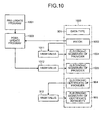
- Fig. 10 is a diagram of update information when the data type is any one of A to C.
- a pre-update program 1001 and a patch 1002 are programs generated by a provider such as a maker and a vendor.
- a post-update program 1003 is also a program generated by the provider such as a maker and a vendor, that is the pre-update program 1001 updated (modified) by the patch 1002.
- the electronic signature 1004 of a provider is a hash value 1011 of the patch 1002 encrypted by a secret key of the provider.
- Update information 1000 may include an electronic signature 1005 besides the electronic signature 1004.
- the electronic signature 1005 is a hash value 1012 of the post-update program 1003 encrypted by the secret key of the provider.
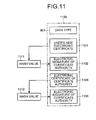
- Fig. 11 is a diagram of update information when the data type is D.
- the update information 1100 includes a user's new electronic certificate 1101 issued by a certificate authority.
- the update data 1101 is update data issued by the authentication apparatus 103 of the certificate authority right after an expiration date of a current user is expired.
- the update data 1101 may be an electronic certificate newly issued to the user.
- An electronic signature 1102 of the certificate authority is a hash value 1111 of the user's new electronic certificate 1101 encrypted by the secret key of the certificate authority.
- An electronic certificate 1104 is issued by the certificate authority or another certificate authority.
- An electronic signature 1105 of a certificate authority is a hash value 1112 of the electronic certificate 1104 encrypted by the secret key of the certificate authority that issues the electronic certificate 1104.
- Step S801 when the update information 900 (or 1000, 1100) is received (Step S801: YES), the electronic certificate 904 of the provider (or the electronic certificate 1104 of the certificate authority) and the electronic signature 905 (or 1105) of the certificate authority are input into the communication authentication hardware 311 via the communication I/F 209 (Step S802).
- the communication I/F 209 may communicate with the certificate authority that issues the electronic certificate 904 (or the electronic certificate 1104) and verify whether the electronic certificate 904 (or the electronic certificate 1104) is currently valid. Thus, it is possible to improve security of the communication.
- the communication authentication hardware 311 extracts a name of the certificate authority included in the input electronic certificate 904 of the provider (or the electronic certificate 1104 of the certificate authority), to specify the certificate authority that has issued the electronic certificate 904 (or 1104) (Step S803).
- the communication authentication hardware 311 outputs the specified certificate authority to the internal data authentication hardware 313.
- the internal data authentication hardware 313 extracts an electronic certificate of the certificate authority specified by the communication authentication hardware 311 from electronic certificates that are encrypted and stored in the memory/storage 300. Then, the internal data authentication hardware 313 decrypts the extracted electronic certificate by a decryption key of the internal data authentication hardware 313, and obtains a public key of the specified certificate authority (Step S804). A successful decryption of the public key indicates that data in the memory/storage 300 is not falsified, and that security is ensured.
- the obtained public key of the certificate authority is output to the communication authentication hardware 311.
- the communication authentication hardware 311 generates a hash value by decrypting the electronic signature 905 (or 1105) of the certificate authority using the obtained public key of the certificate authority (Step S805).
- the communication authentication hardware 311 also generates a message digest (a hash value) of the input electronic certificate of the provider (the electronic certificate of the certificate authority) (Step S806).
- the communication authentication hardware 311 determines whether the hash value generated at Step S805 matches the message digest generated at Step S806 (Step S807).
- the hash value matches the message digest (Step S807: YES)
- security of the communication with the provider (or the certificate authority) is ensured (Step S808), and a communication line with high security is established.
- the hash value does not match the message digest (Step S807: NO)
- the communication with the provider (or the certificate authority) is prohibited because the security of the communication cannot be ensured.
- FIG. 12 is a flowchart of a procedure of updating the security chip when the security of communication is ensured by the communication authentication hardware 311.
- Step S1201 when security of communication is ensured (Step S1201: YES), the data type 901, the update data 902, and the electronic signature 903 of the update data 902 received by the communication I/F 209 are input into the monitoring hardware 314 (Step S1202).
- the monitoring hardware 314 refers to the input data type 901.
- the data type 901 is "A" (Step S1203: A)
- Step S1204 the update data 902 is determined to be the patch 1002 for the communication authentication program 321, an update of the communication authentication program 321 is performed (Step S1204).
- Step S1203: B when the update data 902 is determined to be the patch 1002 for the internal data authentication program 323, an update of the internal data authentication program 323 is performed (Step S1205).
- Step S1203 C
- the update data 902 is determined to be the patch 1002 for the biometrics program 322
- an update of the biometrics program 322 is performed (Step S1206).
- Step S1203 D
- the update data 902 is determined to be the user's new electronic certificate 1101
- an update of the user's electronic certificate is performed (Step S1207).
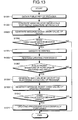
- FIG. 13 is a flowchart of a procedure of updating the communication authentication program 321 or the internal data authentication program 323.
- the monitoring hardware 314 obtains a public key of the provider that has provided the patch (Step S1301). For example, the monitoring hardware 314 orders the internal data authentication hardware 313 to obtain the public key of the provider.
- the internal data authentication hardware 313 extracts an electronic certificate of the provider from electronic certificates that are encrypted and stored in the memory/storage 300.
- the internal data authentication hardware 313 decrypts the extracted electronic certificate by the decryption key of the internal data authentication hardware 313, and extracts the public key from the decrypted electronic certificate.
- the internal data authentication hardware 313 outputs the extracted public key to the monitoring hardware 314.
- the monitoring hardware 314 generates a hash value by decrypting an electronic signature of the provider using the obtained public key of the provider (Step S1302).
- the monitoring hardware 314 also generates a message digest (a hash value) of the patch (Step S1303).
- the monitoring hardware 314 outputs to the verifying hardware 315, the hash value generated at Step S1302 and the message digest generated at Step S1303.
- the verifying hardware 315 determines whether the hash value generated at Step S1302 matches the message digest generated at Step S1303 (Step S1304). When the hash value does not match the message digest (Step S1304: NO), a series of the processing ends there without performing the updating processing, because the patch might be falsified.
- Step S1304 when the hash value matches the message digest (Step S1304: YES), the patch is verified to be valid (in other words, not to be falsified) (Step S1305). Then, the update of the communication authentication program 321 or the internal data authentication program 323 using the verified patch is performed (Step S1306).
- the monitoring hardware 314 determines whether the electronic signature 1005 of the post-update program 1003 is included in the input update information (Step S1307). When the electronic signature 1005 of the post-update program 1003 is not included (Step S1307: NO), a series of the processing ends there.
- Step S1307 when the electronic signature 1005 of the post-update program 1003 is included (Step S1307: YES), the monitoring hardware 314 generates a hash value by decrypting the electronic signature 1005 using the public key obtained at Step S1301 (Step S1308).
- the monitoring hardware 314 also generates a message digest (a hash value) of the communication authentication program 321 or the internal data authentication program 323 updated by the updating processing at Step S1307 (Step S1309). Then, the monitoring hardware 314 outputs to the verifying hardware 315, the hash value generated at Step S1308 and the message digest generated at Step S1309.
- a message digest (a hash value) of the communication authentication program 321 or the internal data authentication program 323 updated by the updating processing at Step S1307 (Step S1309). Then, the monitoring hardware 314 outputs to the verifying hardware 315, the hash value generated at Step S1308 and the message digest generated at Step S1309.
- the verifying hardware 315 determines whether the hash value generated at Step S1308 matches the message digest generated at Step S1309 (Step S1310). When the hash value does not match the message digest (Step S1310: NO), a series of the processing ends there because the program is not successfully updated. On the other hand, when the hash value matches the message digest (Step S1310: YES), it is verified that the updated communication authentication program 321 or the updated internal data authentication program 323 is equal to the post-update program 1003 of the provider, and therefore the program is successfully updated (Step S1311).
- Fig. 14 is a flowchart of a procedure of updating the biometrics program 322.
- the internal data authentication hardware 313 obtains a sensor type of the biological sensor 211 designated by a user (Step S1401), and notifies the monitoring hardware 314 of the obtained sensor type.
- the monitoring hardware 314 determines whether a sensor type of the biometrics program 322 to be updated by the patch in the input update information matches the sensor type notified by the internal data authentication hardware 313 (Step S1402).
- Step S1402 When the former sensor type does not match the later sensor type (Step S1402: NO), a series of the processing ends there because the latter sensor type does not correspond to the biometrics designated by the user.
- the monitoring hardware 314 obtains a public key of a provider that has provided the patch (Step S1403). For example, the monitoring hardware 314 orders the internal data authentication hardware 313 to obtain the public key of the provider.
- the internal data authentication hardware 313 extracts an electronic certificate of the provider from electronic certificates that are encrypted and stored in the memory/storage 300.
- the internal data authentication hardware 313 decrypts the extracted electronic certificate by the decryption key of the internal data authentication hardware 313, and extracts the public key from the decrypted electronic certificate.
- the internal data authentication hardware 313 outputs the extracted public key to the monitoring hardware 314.
- the monitoring hardware 314 generates a hash value by decrypting the electronic signature of the provider using the obtained public key of the provider (Step S1414).
- the monitoring hardware 314 also generates a message digest (a hash value) of the patch (Step S1405).
- the monitoring hardware 314 outputs to the verifying hardware 315, the hash value generated at Step S1404 and the message digest generated at Step S1405.
- the verifying hardware 315 determines whether the hash value generated at Step S1404 matches the message digest generated at Step S1405 (Step S1406). When the hash value does not match the message digest (Step S1406: NO), a series of the processing ends there without performing the updating processing, because the patch might be falsified.
- Step S1406 YES
- the patch is verified to be valid (in other words, not to be falsified) (Step S1407). Then, the update of the biometrics program 322 using the verified patch is performed (Step S1408).
- the monitoring hardware 314 determines whether the electronic signature 1005 of the post-update program 1003 is included in the input update information (Step S1409). When the electronic signature 1005 of the post-update program 1003 is not included (Step S1409: NO), a series of the processing ends there.
- Step S1409 when the electronic signature 1005 of the post-update program 1003 is included (Step S1409: YES), the monitoring hardware 314 generates a hash value by decrypting the electronic signature 1005 using the public key obtained at Step S1403 (Step S1410).
- the monitoring hardware 314 generates a message digest (a hash value) of the biometrics program 321 updated by the updating processing at Step S1409 (Step S1411). Then, the monitoring hardware 314 outputs to the verifying hardware 315, the hash value generated at Step S1410 and the message digest generated at Step S1411.
- the verifying hardware 315 determines whether the hash value generated at Step S1410 matches the message digest generated at Step S1411 (Step S1412). When the hash value matches the message digest (Step S1412: YES), it is verified that the updated biometrics program 322 is equal to the post-update program 1003 of the provider, and therefore the biometrics program 322 is successfully updated (Step S1413). On the other hand, when the hash value does not match the message digest (Step S1412: NO), a series of the processing ends there because the biometrics program 322 is not successfully updated.
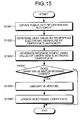
- Fig. 15 is a flowchart of a procedure of updating the user's electronic certificate.
- the monitoring hardware 314 obtains a public key of a certificate authority that has issued the user's new electronic certificate 1101 (Step S1501).
- the monitoring hardware 314 extracts, from the electronic certificate 1101, a name of the certificate authority that has issued the electronic certificate 1101, to specify the certificate authority.
- the monitoring hardware 314 orders the internal data authentication hardware 313 to obtain a public key of the specified certificate authority.
- the internal data authentication hardware 313 extracts an electronic certificate of the specified certificate authority from electronic certificates that are encrypted and stored in the memory/storage 300.
- the internal data authentication hardware 313 decrypts the extracted electronic certificate by the decryption key of the internal data authentication hardware 313, and extracts the public key from the decrypted electronic certificate.
- the internal data authentication hardware 313 outputs the extracted public key to the monitoring hardware 314.
- the monitoring hardware 314 generates a hash value by decrypting the electronic signature 1102 of the certificate authority using the obtained public key of the certificate authority (Step S1502).
- the monitoring hardware 314 also generates a message digest (a hash value) of the electronic certificate 1101 (Step S1503).
- the monitoring hardware 314 outputs to the verifying hardware 315, the hash value generated at Step S1502 and the message digest generated at Step S1503.
- the verifying hardware 315 determines whether the hash value generated at Step S1502 matches the message digest generated at Step S1503 (Step S1504). When the hash value does not match the message digest (Step S1504: NO), a series of the processing ends there without performing the updating processing, because the electronic certificate 1101 might be falsified.
- Step S1504 when the hash value matches the message digest (Step S1504: YES), the electronic certificate 1101 is verified to be valid (in other words, not to be falsified) (Step S1505). Then, the user's current electronic certificate is updated to the verified electronic certificate (Step S1506).
- the user's electronic certificate an expiration date of which is expired, can be safely and speedily updated.
- FIG. 16 is a flowchart of a procedure of communication authentication performed before the registration of biological data.
- the communication authentication hardware 311 receives, via the communication I/F 209, an electronic certificate of a provider that has provided an electronic registration instruction, and an electronic signature of the electronic certificate generated by a certificate authority that has authenticated the electronic certificate (Step S1601).
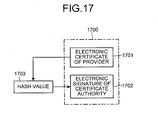
- Fig. 17 is a diagram of input data input at Step S1601.
- Input data 1700 shown in Fig. 17 includes an electronic certificate 1701 of a provider that has provided an electronic registration instruction, and an electronic signature 1702 of a certificate authority that has authenticated the electronic certificate 1701.
- the electronic signature 1702 is a hash value 1703 of the electronic certificate 1701 encrypted by a secret key of the provider that has provided the electronic registration instruction.
- the communication authentication hardware 311 extracts a name of the certificate authority from the electronic certificate 1701, to specify the certificate authority that has issued the electronic certificate 1701 (Step S1602).
- the communication authentication hardware 311 outputs the specified certificate authority to the internal data authentication hardware 313.
- the internal data authentication hardware 313 extracts an electronic certificate of the certificate authority specified by the communication authentication hardware 311 from electronic certificates that are encrypted and stored in the memory/storage 300. Then, the internal data authentication hardware 313 decrypts the extracted electronic certificate by the decryption key of the internal data authentication hardware 313, and obtains a public key of the specified certificate authority (Step S1603). A successful decryption of the public key indicates that data in the memory/storage 300 is not falsified, and that security is ensured.
- the obtained public key of the certificate authority is output to the communication authentication hardware 311.
- the communication authentication hardware 311 generates a hash value by decrypting the electronic signature of the certificate authority 1702 using the obtained public key of the certificate authority (Step S1604).
- the communication authentication hardware 311 also generates a message digest (a hash value) of the input electronic certificate 1701 of the provider (Step S1605).
- the communication authentication hardware 311 determines whether the hash value generated at Step S1604 matches the message digest generated at Step S1605 (Step S1606).
- Step S1606 YES
- security of the communication with the certificate authority is ensured (Step S1607), and a communication line with high security is established.
- Step S1606 NO
- the communication with the certificate authority is prohibited because the security of the communication cannot be ensured.
- Fig. 18 is a flowchart of a procedure of registering biological data.
- a sensor type of the biological sensor 211 designated by a user is obtained (Step S1801).
- Step S1802: YES registration instruction information is input into the monitoring hardware 314 via the communication I/F 209 (Step S1803).
- Fig. 19 is a diagram of registration instruction information.
- Registration instruction information 1900 shown in Fig. 19 includes an electronic registration instruction 1901, and an electronic signature of a provider 1902 that has provided the electronic certificate 1701.
- the electronic registration instruction 1901 is an instruction to register biological data detected by the biological sensor 211 designated by the user, and includes a name of the provider and a sensor type of the biological sensor 211 that can be available in the user's data processing apparatus 101.
- the electronic signature of the provider 1902 is a hash value of the electronic registration instruction 1901 encrypted by the secret key of the provider.
- the monitoring hardware 314 determines whether the sensor type obtained at Step S1801 is included in the electronic registration instruction 1901 (Step S1804).
- Step S1804 NO
- a series of the processing ends there because the biological sensor 211 that the user wants to use is not available.
- the monitoring hardware 314 obtains a public key of the provider that has provided the electronic registration instruction 1901 (Step S1805). For example, the monitoring hardware 314 orders the internal data authentication hardware 313 to obtain the public key of the provider. The internal data authentication hardware 313 extracts an electronic certificate of the provider from electronic certificates that are encrypted and stored in the memory/storage 300.
- the internal data authentication hardware 313 decrypts the extracted electronic certificate by the decryption key of the internal data authentication hardware 313, and extracts the public key from the decrypted electronic certificate.
- the internal data authentication hardware 313 outputs the extracted public key to the monitoring hardware 314.
- the monitoring hardware 314 generates a hash value by decrypting the electronic signature of the provider using the obtained public key of the provider (Step S1806).
- the monitoring hardware 314 also generates a message digest (a hash value) of the electronic registration instruction 1901 (Step S1807).
- the monitoring hardware 314 outputs to the verifying hardware 315, the hash value generated at Step S1806 and the message digest generated at Step S1807.
- the verifying hardware 315 determines whether the hash value generated at Step S1806 matches the message digest generated at Step S1807 (Step S1808). When the hash value does not match the message digest (Step S1808: NO), a series of the processing ends there because the electronic registration instruction 1901 might be falsified.
- Step S1808 YES
- the verifying hardware 315 orders the biometrics hardware 312 to perform the registering processing of biological data (Step S1809). At this time, the data processing apparatus 101 is ready to receive input of biological data.
- Step S1810 when biological data from the biological sensor 211 designated by the user is received (Step S1810: YES), registration data that includes a name of the user (a name of the registrant), a sensor type (for example, a fingerprint sensor, etc.), and biological data (for example, image data of a user's fingerprint) is written in the memory/storage 300 (Step S1811).
- the internal data authentication hardware 313 encrypts and stores the registration data in the memory/storage 300 via the biometrics hardware 312. Thus, it is possible to safely and speedily register user's registration data.
- Fig. 20 is a flowchart of a procedure of a normal operation of the security chip 215.
- Step S2001: YES biological data detected by the biological sensor 211 is input
- Step S2002 decrypts the extracted registration data by the decryption key
- the biometrics hardware 312 compares the input biological data with the decrypted biological data.
- the input biological data does not match the decrypted biological data (Step S2003: NO)
- a series of the processing ends there for the prohibition of unauthorized access.
- the communication authentication hardware 311 performs communication authentication on the communication between the data processing apparatus 101 and a destination to which an environment report is to be sent (Step S2004).
- Step S2005 NO
- Step S2005: YES the internal data authentication hardware 313 gathers internal data of the peripheral device 302, the software 301, and an execution program of each hardware (Step S2006), to generate the environment report (Step S2007).
- the internal data authentication hardware 313 encrypts the environment report (Step S2008), and sends the encrypted environment report with an electronic signature to the destination (Step S2009).
- the destination can receive and decrypt the environment report to use the report for environment authentication.
- the frequency, the amount, and the method of updating a program or data for the communication authentication hardware 311, the biometrics hardware 312, and the internal data authentication hardware 313 are different, reflecting their different purposes.
- the communication authentication hardware 311, the biometrics hardware 312, and the internal data authentication hardware 313 are installed in the single security chip 215. Furthermore, update information and registration instruction information are encrypted and input through a single safe line established by the communication authentication hardware 311. Furthermore, hardware to be updated is classified by the monitoring hardware 314 (the resident program 324).
- the communication authentication hardware 311, the biometrics hardware 312, and the internal data authentication hardware 313 are installed in the single security chip 215, the security chip 215 need not to be remade to update a program. Therefore, it is possible to improve user's convenience.
- cost can be decreased because an amount of data processed by the monitoring hardware 314 and the verifying hardware 315 (such as the patch, the electronic certificate, the electronic registration instruction, and the electronic signature) is relatively small, and the processing performed by the monitoring hardware 314 and the verifying hardware 315 (such as the decryption of the electronic signature, the comparison of hash values) is relatively simple.
- security can be improved by flexibly and accurately updating a program and data of biometrics, communication authentication (user (PKI) authentication), and internal data authentication (environment authentication).
- the present invention is preferable to be installed in not only a personal computer, a server computer, and a cellular phone, but also household electrical appliance (such as a refrigerator, a microwave, an air conditioner, a TV, and a DVD), a copy machine, and a robot.
- household electrical appliance such as a refrigerator, a microwave, an air conditioner, a TV, and a DVD
- a copy machine and a robot.
Landscapes
- Engineering & Computer Science (AREA)
- Computer Security & Cryptography (AREA)
- Theoretical Computer Science (AREA)
- Computer Hardware Design (AREA)
- Software Systems (AREA)
- General Engineering & Computer Science (AREA)
- Physics & Mathematics (AREA)
- General Physics & Mathematics (AREA)
- Storage Device Security (AREA)
- Debugging And Monitoring (AREA)
Abstract
Description
- The present invention relates to a data managing device and a data managing method for managing data in a data processing apparatus.
- Recently, due to the introduction of internet protocol version 6 (IPv6), not only a personal computer, a server computer, and a cellular phone, but also household electrical appliance (such as a refrigerator, a microwave, an air conditioner, a television (TV), and a digital versatile disc (DVD) drive), a copy machine, and a robot, etc. have been connected to a network such as the Internet to perform data communication. However, an increased number of data processing apparatuses connected to a network leads to weaker security.
- As a result of its poor security, the household electrical appliance is likely to receive a program preventing its normal operation from an external source, or to be abused for a distributed denial of service (DDoS) attack. For the enhancement of security, a data processing apparatus with a function of biometric authentication using a fingerprint has been suggested (see, for example, Patent Document 1).
- Before performing an electronic commerce using such a data processing apparatus, it is preferable to ensure the security by checking whether a user of the apparatus is a proper owner, whether the apparatus that performs the electronic commerce is an apparatus of the proper owner, and whether the apparatus is connected with other apparatuses or installed with software (such as an operating system (OS), a browser, plug-in software, etc.) that degrade the security of the apparatus.
- Furthermore, biometrics using biological data, user authentication (public key infrastructure (PKI) authentication) using an electronic certificate issued by a certificate authority, and environment authentication for the secrecy of data on the data processing apparatus have been suggested. A recording medium driver that can take various security measures without increasing manufacturing cost has also been suggested (see, for example, Patent Document 2).
- Patent Document 1:
Japanese Patent Laid-Open No. H3-58174 - Patent Document 2:
Japanese Patent Laid-Open No. H10-283190 - However, according to the conventional technology described above, it is difficult to achieve high security solely with the biometrics authentication because fingerprint data for the authentication might be leaked.
- Furthermore, when a software patch, a firmware patch, etc. is provided for those data processing apparatuses, it is necessary to ensure sufficient security between an apparatus of a provider and the data processing apparatuses so that the software is not falsified by a third party during the transmission of the software. However, a too-high security level can prevent smooth data communication.
- When a single data processing apparatus individually performs various authentication such as biometrics, user authentication, environment authentication, etc., mutual authentication is required when data is exchanged among those authentication. Therefore, besides each authentication function, another authentication function is required to exchange data among those authentication functions, thereby increasing cost of manufacturing and time for authentication.
- Furthermore, the frequency, the amount, and the method of updating a program (such as firmware) or data are different for each authentication because the biometrics, the user authentication, and the environment authentication are authentication functions used for different purposes.
- As a result, when those authentication functions are mounted on a single chip, it is usually necessary to update (remake in many cases) the entire chip every time the program or the data is updated, which is actually impractical from the standpoint of cost. If the chip is remade every time the program or the data is updated, it is inconvenient for a user because the user cannot use the apparatus while the program or the data is being updated.
- Furthermore, each authentication function should be timely updated to achieve its original purpose of authentication. Therefore, it is meaningless to perform authentication with an authentication function which is not updated until other authentication function is updated (in other words, which is updated at the same time of the update of other authentication function).
- The present invention is made in view of the above problems in the conventional technologies, and an object of the present invention is to provide a data managing device and a data managing method with which security can be improved by flexibly and accurately updating a program and data for biometrics, user authentication (PKI authentication), and environment authentication.
- To solve the above problems and achieve the object, a data managing device according to the present invention that is installed in a data processing apparatus that includes a single chip with communication authentication hardware and processing hardware, wherein the communication authentication hardware authenticates security of communication between the data processing apparatus and an external apparatus, and the processing hardware performs predetermined processing that is different from processing performed by the communication authentication hardware, the data managing device comprising: an input unit that receives from a provider that provides arbitrary execution program installed in the single chip, when security of communication,between the provider and the data processing apparatus is authenticated by the communication authentication hardware, input of an update program that updates the execution program and of an electronic signature generated from the update program using a secret key of the provider; a program determining unit that determines whether the execution program is installed in the communication authentication hardware or the processing hardware; a validity verifying unit that verifies whether it is valid to update, by the update program, an execution program determined by the program determining unit, based on a message digest of the update program, the electronic signature, and a public key of the provider; and an updating unit that updates, by the update program, the execution program determined by the program determining unit, based on a result of the validity verifying unit.
- According to the present invention, not only an authentication for ensuring the security of communication line to receive an update program, but also an authentication for determining the validity of an update of a program using the received update program, can be performed by a single chip.
-
- Fig. 1 is a diagram of a configuration of a data managing system according to an embodiment of the present invention;
- Fig. 2 is a block diagram of a hardware configuration of a data processing apparatus;
- Fig. 3 is a block diagram of a hardware configuration of a security chip;
- Fig. 4 is a block diagram of a configuration of each hardware shown in Fig. 3;
- Fig. 5 is a diagram of electronic certificates stored in a memory/storage;
- Fig. 6 is a diagram of biological data stored in a memory/storage;
- Fig. 7 is a diagram of internal data stored in a memory/storage;
- Fig. 8 is a flowchart of a procedure of communication authentication performed by a data managing device;
- Fig. 9 is a diagram of update information;
- Fig. 10 is a diagram of update information when the data type is any one of A to C;
- Fig. 11 is a diagram of update information when the data type is D;
- Fig. 12 is a flowchart of a procedure of updating a security chip when the security of communication is ensured by communication authentication hardware;
- Fig. 13 is a flowchart of a procedure of updating a communication authentication program or an internal data authentication program;
- Fig. 14 is a flowchart of a procedure of updating a biometrics program;
- Fig. 15 is a flowchart of a procedure of updating a user's electronic certificate;
- Fig. 16 is a flowchart of a procedure of communication authentication performed before the registration of biological data to a data processing apparatus;
- Fig. 17 is a diagram of input data;
- Fig. 18 is a flowchart of a procedure of registering biological data;
- Fig. 19 is a diagram of registration instruction information; and
- Fig. 20 is a flowchart of a procedure of normal operation of the security chip.
- Exemplary embodiments of the present invention will be explained in detail with reference to the accompanying drawings.
- Fig. 1 is a diagram of a configuration of a data managing system according to an embodiment of the present invention. A
data managing system 100 shown in Fig. 1 includes a user'sdata processing apparatus 101, adata providing apparatus 102 that provides an execution program or data in thedata processing apparatus 101, and anauthentication apparatus 103 in a certificate authority. Theapparatuses 101 to 103 are connected via anetwork 104 such as the Internet. - The
data processing apparatus 101 is, for example, a cellular phone, a personal computer, a server computer, an electrical appliance (such as a refrigerator, a microwave, an air conditioner, a TV, a DVD, etc.), a copy machine, a robot, etc. A security chip is installed in thedata processing apparatus 101. - The
data providing apparatus 102 is managed by a vender or a maker that develops or sells an execution program and various data, or by a trader that manufactures or sells thedata processing apparatus 101. Thedata providing apparatus 102 stores therein, or uploads to thenetwork 104, an update program for the execution program and various data. Thedata providing apparatus 102 also generates an electronic signature of the execution program and various data. Theauthentication apparatus 103 issues and manages electronic certificates of a user, a maker, a vendor, a distributor, etc. Theauthentication apparatus 103 also generates an electronic signature of the issued electronic certificate. - A hardware configuration of the data processing apparatus will be explained. Fig. 2 is a block diagram of a hardware configuration of the
data processing apparatus 101. As shown in Fig. 2, thedata processing apparatus 101 includes a central processing unit (CPU) 201, a read only memory (ROM) 202, a random access memory (RAM) 203, a hard disk drive (HDD) 204, a hard disk (HD) 205, a flexible disk drive (FDD) 206, a flexible disk (FD) 207 as an example of a removable recording medium, adisplay 208, a communication interface (I/F) 209, an input key 210 (such as a keyboard and a mouse), abiological sensor 211, and asecurity chip 215. These units are connected via abus 200. - The
CPU 201 controls the entiredata processing apparatus 101. TheROM 202 stores a program such as a boot program. TheRAM 203 is used as a work area of theCPU 201. TheHDD 204 controls reading/writing of data from/to theHD 205 based on control of theCPU 201. TheHD 205 stores data written in accordance with control of theHDD 204. - The
FDD 206 controls reading/writing of data from/to theFD 207 based on control of theCPU 201. TheFD 207 stores data written in accordance with control of theFDD 206, and causes thedata processing apparatus 101 to read data stored in theFD 207. - A compact-disc read-only memory (CD-ROM), a compact-disc recordable (CD-R), a compact-disc rewritable (CD-RW), a magneto optical (MO) disc, a digital versatile disc (DVD), and a memory card may be used as a removable recording medium besides the
FD 207. Thedisplay 208 displays not only a cursor, an icon, and a tool box, but also data such as documents, images, information of functions, etc. For example, a cathode-ray tube (CRT), a thin-film transistor (TFT) display, a plasma display can be employed as thedisplay 208. - The communication I/
F 209 is connected to thenetwork 104 such as the Internet via communication lines, and connected to other devices via the communication lines. The communication I/F 209 is an interface between thenetwork 104 and thedata processing apparatus 101, and controls input/output from/to an external apparatus. For example, a modem and a local area network (LAN) adapter can be employed as the communication I/F 209. - The
input key 210 includes plural keys to input characters, numbers, various instructions, etc. An input pad with a touch panel and a numeric key pad can be employed as theinput key 210. - The
biological sensor 211 is, for example, afingerprint sensor 212, acamera 213, or amicrophone 214. Thefingerprint sensor 212 is a device that detects asperities of a fingerprint at approximately 50 micrometer (µm) interval, and converts the detected asperities into an electric signal. There has been suggested a semiconductor method, an optical method, a pressure-sensitive method, and a thermal method as a method of scanning a fingerprint. Thecamera 213 is a device that takes a picture of an iris and a retina of an eye. Themicrophone 214 is a device that detects voice pattern that indicates vocal characteristics. - The
security chip 215 is called a trusted platform module (TPM), and installed on a main board of thedata processing apparatus 101. Thesecurity chip 215 is a dedicated chip that provides a basic function for security and privacy. Thesecurity chip 215 is defined in the specification of trusted computing group (TCG). A TPM installed in thedata processing apparatus 101 cannot be installed in other data processing apparatus. If the TPM is removed from thedata processing apparatus 101, thedata processing apparatus 101 cannot run. Thesecurity chip 215 is a data managing device according to an embodiment of the present invention. - A hardware configuration of the
security chip 215 described above will be explained. Fig. 3 is a block diagram of a hardware configuration of thesecurity chip 215. Thesecurity chip 215 shown in Fig. 3 is connected to the communication I/F 209, thebiological sensor 211, theCPU 201, and a memory/storage 300 via a bus. Thesecurity chip 215 can obtain data ofvarious software 301 installed in thedata processing apparatus 101, and data of aperipheral device 302 connected to thedata processing apparatus 101. - The memory/
storage 300 is provided either inside thesecurity chip 215 or outside thesecurity chip 215, as long as the memory/storage 300 is inside thedata processing apparatus 101. If the memory/storage 300 is provided inside thesecurity chip 215, it is possible to prevent removal of the memory/storage 300 and falsification of data. - The
security chip 215 includescommunication authentication hardware 311,biometrics hardware 312, internal-data authentication hardware 313,monitoring hardware 314, and verifyinghardware 315. - The
communication authentication hardware 311 ensures the security of communication between thedata processing apparatus 101 and an external apparatus (for example, thedata providing apparatus 102 or theauthentication apparatus 103 shown in Fig. 1). For example, thecommunication authentication hardware 311 determines whether a user of an external apparatus is an authorized person authenticated by a certificate authority, by performing public key infrastructure (PKI) authentication using an electronic certificate issued by the certificate authority. Acommunication authentication program 321 for communication authentication is installed in thecommunication authentication hardware 311. - The
biometrics hardware 312 determines whether a user of thedata processing apparatus 101 is an authorized user by determining whether biological data detected by thebiological sensor 211 matches user's biological data registered in thedata processing apparatus 101. Abiometrics program 322 for biometrics is installed in thebiometrics hardware 312. - The internal
data authentication hardware 313 authenticates data (internal data) in thedata processing apparatus 101 or the single chip. The internal data is called environment data, therefore the internaldata authentication hardware 313 is also called environment authentication hardware. The environment data is data of the peripheral device 302 (for example, a name of the device, version data) obtained from theperipheral device 302 connected to thedata processing apparatus 101, data of the software 301 (for example, a name of the software, version data) installed in thedata processing apparatus 101, or various data (for example, an electronic certificate) stored in the memory/storage 300. - The internal
data authentication hardware 313 keeps data stored in the memory/storage 300 secret. For example, the internaldata authentication hardware 313 encrypts obtained data using a unique encryption key, and stores the encrypted data in the memory/storage 300. When requested from other hardware, the internaldata authentication hardware 313 decrypts the encrypted data stored in the memory/storage 300 using a unique decryption key that is a pair of the encryption key. The internaldata authentication hardware 313 can confirm that internal data is not falsified in thedata processing apparatus 101 by the encryption and the decryption. The internaldata authentication program 323 for the processing described above is installed in the internaldata authentication hardware 313. - A
resident program 324 is installed in themonitoring hardware 314. Themonitoring hardware 314 monitors transfer of data in the data managing device. Details of the monitoring processing will be explained later. - A verifying program 325 is installed in the verifying
hardware 315. The verifyinghardware 315 verifies validity of data input into thesecurity chip 215 from an external apparatus, when security of communication between the data processing apparatus and the external apparatus is ensured by thecommunication authentication hardware 311. Details of the verifying processing will be explained later. - A configuration of each of the
hardware 311 to 315 shown in Fig. 3 will be explained. Fig. 4 is a block diagram of a configuration of each of thehardware 311 to 315 shown in Fig. 3. Each of thehardware 311 to 315 shown in Fig. 4 includes aprocessor 401, aROM 402, aRAM 403, an electronically erasable and programmable read only memory (EEPROM) 404, an input I/F 405, and an encryptor/decryptor 406. Theunits 401 to 406 are connected via abus 400. - The
processor 401 controls theentire hardware 311 to 315. TheROM 402 stores a program such as a boot program. TheRAM 403 is used as a work area of theprocessor 401. The EEPROM404 stores a program performed by each of thehardware 311 to 315. The encryptor/decryptor 406 performs generation of an asymmetric encryption key, encryption, decryption, generation of a message digest (a hash value), and generation of an electronic signature. - Contents of the memory/
storage 300 shown in Fig. 3 will be explained. Fig. 5 is a diagram of electronic certificates stored in the memory/storage 300. Fig. 6 is a diagram of biological data stored in the memory/storage 300. Fig. 7 is a diagram of internal data stored in the memory/storage 300. - As shown in Fig. 5, each of electronic certificates Ca to Cz is stored corresponding to each authorized person. "An authorized person" means a person authenticated by each of the electronic certificates Ca to Cz, for example, a user, a maker, a vendor, and a certificate authority. Each of the electronic certificates Ca to Cz includes version data, a signature algorithm, a name of an issuer, an expiration date, a public key, and related information. Each of the electronic certificates Ca to Cz is encrypted by the internal
data authentication hardware 313. - As shown in Fig. 6,
registration data 600 includes a name of aregistrant 601, asensor type 602, and abiological data 603. Fig. 6 is an example of theregistration data 600, when a registrant "X" that is a user of thedata processing apparatus 101 registers, as thebiological data 603, image data "Xa" of a fingerprint of the registrant "X" detected by "a fingerprint sensor". Theregistration data 600 is also encrypted by the internaldata authentication hardware 313. - As shown in Fig. 7, the
peripheral device 302, thesoftware 301, a name and a version of an execution program such as acommunication authentication program 321 installed in each hardware, are stored as the internal data. - A procedure of communication authentication performed by the data managing device (the security chip 215) according to an embodiment of the present invention will be explained. Fig. 8 is a flowchart of a procedure of communication authentication performed by a data managing device according to an embodiment of the present invention.
- At first, whether the communication I/
F 209 receives update information is determined (Step S801). The update information will be explained here. Fig. 9 is a diagram of the update information. - As shown in Fig. 9, update
information 900 includesdata type 901,update data 902, anelectronic signature 903 of a provider, anelectronic certificate 904 of the provider (an electronic certificate of a certificate authority when the provider is the certificate authority), and anelectronic signature 905 of the certificate authority. Thedata type 901 is data that indicates contents of theupdate data 902. - For example, when the
data type 901 is "A", theupdate data 902 is "a patch for thecommunication authentication program 321". When thedata type 901 is "B", theupdate data 902 is "a patch for the internaldata authentication program 323". When thedata type 901 is "C", theupdate data 902 is "a patch for thebiometrics program 322". When thedata type 901 is "D", theupdate data 902 is "a user's new electronic certificate". - Thus, the
update data 902 is a patch or an electronic certificate. Theelectronic signature 903 of the provider is attached to theupdate data 902. Theelectronic signature 903 of the provider is ahash value 911 of theupdate data 902 encrypted at the provider using a secret key of the provider. - The
electronic certificate 904 is a certificate issued by an arbitrary certificate authority. Theelectronic signature 905 of a certificate authority is attached to theelectronic certificate 904. Theelectronic signature 905 of a certificate authority is ahash value 912 of theelectronic certificate 904 encrypted at the provider using a secret key of the certificate authority. - Update information when the
data type 901 is any one of A to C will be explained. Fig. 10 is a diagram of update information when the data type is any one of A to C. - As shown in Fig. 10, a
pre-update program 1001 and apatch 1002 are programs generated by a provider such as a maker and a vendor. Apost-update program 1003 is also a program generated by the provider such as a maker and a vendor, that is thepre-update program 1001 updated (modified) by thepatch 1002. - The
electronic signature 1004 of a provider is ahash value 1011 of thepatch 1002 encrypted by a secret key of the provider.Update information 1000 may include anelectronic signature 1005 besides theelectronic signature 1004. Theelectronic signature 1005 is ahash value 1012 of thepost-update program 1003 encrypted by the secret key of the provider. - Update information when the
data type 901 is D will be explained. Fig. 11 is a diagram of update information when the data type is D. Theupdate information 1100 includes a user's newelectronic certificate 1101 issued by a certificate authority. For example, theupdate data 1101 is update data issued by theauthentication apparatus 103 of the certificate authority right after an expiration date of a current user is expired. Theupdate data 1101 may be an electronic certificate newly issued to the user. - An
electronic signature 1102 of the certificate authority is ahash value 1111 of the user's newelectronic certificate 1101 encrypted by the secret key of the certificate authority. Anelectronic certificate 1104 is issued by the certificate authority or another certificate authority. Anelectronic signature 1105 of a certificate authority is ahash value 1112 of theelectronic certificate 1104 encrypted by the secret key of the certificate authority that issues theelectronic certificate 1104. - As shown in Fig. 8, when the update information 900 (or 1000, 1100) is received (Step S801: YES), the
electronic certificate 904 of the provider (or theelectronic certificate 1104 of the certificate authority) and the electronic signature 905 (or 1105) of the certificate authority are input into thecommunication authentication hardware 311 via the communication I/F 209 (Step S802). Note that the communication I/F 209 may communicate with the certificate authority that issues the electronic certificate 904 (or the electronic certificate 1104) and verify whether the electronic certificate 904 (or the electronic certificate 1104) is currently valid. Thus, it is possible to improve security of the communication. - Then, the
communication authentication hardware 311 extracts a name of the certificate authority included in the inputelectronic certificate 904 of the provider (or theelectronic certificate 1104 of the certificate authority), to specify the certificate authority that has issued the electronic certificate 904 (or 1104) (Step S803). - The
communication authentication hardware 311 outputs the specified certificate authority to the internaldata authentication hardware 313. The internaldata authentication hardware 313 extracts an electronic certificate of the certificate authority specified by thecommunication authentication hardware 311 from electronic certificates that are encrypted and stored in the memory/storage 300. Then, the internaldata authentication hardware 313 decrypts the extracted electronic certificate by a decryption key of the internaldata authentication hardware 313, and obtains a public key of the specified certificate authority (Step S804). A successful decryption of the public key indicates that data in the memory/storage 300 is not falsified, and that security is ensured. - The obtained public key of the certificate authority is output to the
communication authentication hardware 311. Thecommunication authentication hardware 311 generates a hash value by decrypting the electronic signature 905 (or 1105) of the certificate authority using the obtained public key of the certificate authority (Step S805). Thecommunication authentication hardware 311 also generates a message digest (a hash value) of the input electronic certificate of the provider (the electronic certificate of the certificate authority) (Step S806). - Then, the
communication authentication hardware 311 determines whether the hash value generated at Step S805 matches the message digest generated at Step S806 (Step S807). When the hash value matches the message digest (Step S807: YES), security of the communication with the provider (or the certificate authority) is ensured (Step S808), and a communication line with high security is established. On the other hand, when the hash value does not match the message digest (Step S807: NO), the communication with the provider (or the certificate authority) is prohibited because the security of the communication cannot be ensured. - A procedure of updating the
security chip 215 when the security of communication is ensured by thecommunication authentication hardware 311 will be explained. Fig. 12 is a flowchart of a procedure of updating the security chip when the security of communication is ensured by thecommunication authentication hardware 311. - As shown in Fig. 12, when security of communication is ensured (Step S1201: YES), the
data type 901, theupdate data 902, and theelectronic signature 903 of theupdate data 902 received by the communication I/F 209 are input into the monitoring hardware 314 (Step S1202). - Then, the
monitoring hardware 314 refers to theinput data type 901. When thedata type 901 is "A" (Step S1203: A), in other words, when theupdate data 902 is determined to be thepatch 1002 for thecommunication authentication program 321, an update of thecommunication authentication program 321 is performed (Step S1204). - When the
data type 901 is "B" (Step S1203: B), in other words, when theupdate data 902 is determined to be thepatch 1002 for the internaldata authentication program 323, an update of the internaldata authentication program 323 is performed (Step S1205). - When the
data type 901 is "C" (Step S1203: C), in other words, when theupdate data 902 is determined to be thepatch 1002 for thebiometrics program 322, an update of thebiometrics program 322 is performed (Step S1206). - When the
data type 901 is "D" (Step S1203: D), in other words, when theupdate data 902 is determined to be the user's newelectronic certificate 1101, an update of the user's electronic certificate is performed (Step S1207). - A procedure of updating the
communication authentication program 321 or the internaldata authentication program 323 will be explained. Fig. 13 is a flowchart of a procedure of updating thecommunication authentication program 321 or the internaldata authentication program 323. - As shown in Fig. 13, the
monitoring hardware 314 obtains a public key of the provider that has provided the patch (Step S1301). For example, themonitoring hardware 314 orders the internaldata authentication hardware 313 to obtain the public key of the provider. The internaldata authentication hardware 313 extracts an electronic certificate of the provider from electronic certificates that are encrypted and stored in the memory/storage 300. - Then, the internal
data authentication hardware 313 decrypts the extracted electronic certificate by the decryption key of the internaldata authentication hardware 313, and extracts the public key from the decrypted electronic certificate. The internaldata authentication hardware 313 outputs the extracted public key to themonitoring hardware 314. - Then, the
monitoring hardware 314 generates a hash value by decrypting an electronic signature of the provider using the obtained public key of the provider (Step S1302). Themonitoring hardware 314 also generates a message digest (a hash value) of the patch (Step S1303). Then, themonitoring hardware 314 outputs to the verifyinghardware 315, the hash value generated at Step S1302 and the message digest generated at Step S1303. - The verifying
hardware 315 determines whether the hash value generated at Step S1302 matches the message digest generated at Step S1303 (Step S1304). When the hash value does not match the message digest (Step S1304: NO), a series of the processing ends there without performing the updating processing, because the patch might be falsified. - On the other hand, when the hash value matches the message digest (Step S1304: YES), the patch is verified to be valid (in other words, not to be falsified) (Step S1305). Then, the update of the
communication authentication program 321 or the internaldata authentication program 323 using the verified patch is performed (Step S1306). - The
monitoring hardware 314 determines whether theelectronic signature 1005 of thepost-update program 1003 is included in the input update information (Step S1307). When theelectronic signature 1005 of thepost-update program 1003 is not included (Step S1307: NO), a series of the processing ends there. - On the other hand, when the
electronic signature 1005 of thepost-update program 1003 is included (Step S1307: YES), themonitoring hardware 314 generates a hash value by decrypting theelectronic signature 1005 using the public key obtained at Step S1301 (Step S1308). - The
monitoring hardware 314 also generates a message digest (a hash value) of thecommunication authentication program 321 or the internaldata authentication program 323 updated by the updating processing at Step S1307 (Step S1309). Then, themonitoring hardware 314 outputs to the verifyinghardware 315, the hash value generated at Step S1308 and the message digest generated at Step S1309. - The verifying
hardware 315 determines whether the hash value generated at Step S1308 matches the message digest generated at Step S1309 (Step S1310). When the hash value does not match the message digest (Step S1310: NO), a series of the processing ends there because the program is not successfully updated. On the other hand, when the hash value matches the message digest (Step S1310: YES), it is verified that the updatedcommunication authentication program 321 or the updated internaldata authentication program 323 is equal to thepost-update program 1003 of the provider, and therefore the program is successfully updated (Step S1311). - Thus, with the patch and the electronic signature and without downloading the entire, bulky
post-update program 1003 from the provider, it can be confirmed whether the program is successfully updated, thereby enabling a safe and speedy authentication. - A procedure of updating the
biometrics program 322 will be explained. Fig. 14 is a flowchart of a procedure of updating thebiometrics program 322. As shown in Fig. 14, the internaldata authentication hardware 313 obtains a sensor type of thebiological sensor 211 designated by a user (Step S1401), and notifies themonitoring hardware 314 of the obtained sensor type. - The
monitoring hardware 314 determines whether a sensor type of thebiometrics program 322 to be updated by the patch in the input update information matches the sensor type notified by the internal data authentication hardware 313 (Step S1402). - When the former sensor type does not match the later sensor type (Step S1402: NO), a series of the processing ends there because the latter sensor type does not correspond to the biometrics designated by the user. On the other hand, when the former sensor type matches the latter sensor type (Step S1402: YES), the
monitoring hardware 314 obtains a public key of a provider that has provided the patch (Step S1403). For example, themonitoring hardware 314 orders the internaldata authentication hardware 313 to obtain the public key of the provider. The internaldata authentication hardware 313 extracts an electronic certificate of the provider from electronic certificates that are encrypted and stored in the memory/storage 300. - Then, the internal
data authentication hardware 313 decrypts the extracted electronic certificate by the decryption key of the internaldata authentication hardware 313, and extracts the public key from the decrypted electronic certificate. The internaldata authentication hardware 313 outputs the extracted public key to themonitoring hardware 314. - Then, the
monitoring hardware 314 generates a hash value by decrypting the electronic signature of the provider using the obtained public key of the provider (Step S1414). Themonitoring hardware 314 also generates a message digest (a hash value) of the patch (Step S1405). Then, themonitoring hardware 314 outputs to the verifyinghardware 315, the hash value generated at Step S1404 and the message digest generated at Step S1405. - The verifying
hardware 315 determines whether the hash value generated at Step S1404 matches the message digest generated at Step S1405 (Step S1406). When the hash value does not match the message digest (Step S1406: NO), a series of the processing ends there without performing the updating processing, because the patch might be falsified. - On the other hand, when the hash value matches the message digest (Step S1406: YES), the patch is verified to be valid (in other words, not to be falsified) (Step S1407). Then, the update of the
biometrics program 322 using the verified patch is performed (Step S1408). - The
monitoring hardware 314 determines whether theelectronic signature 1005 of thepost-update program 1003 is included in the input update information (Step S1409). When theelectronic signature 1005 of thepost-update program 1003 is not included (Step S1409: NO), a series of the processing ends there. - On the other hand, when the
electronic signature 1005 of thepost-update program 1003 is included (Step S1409: YES), themonitoring hardware 314 generates a hash value by decrypting theelectronic signature 1005 using the public key obtained at Step S1403 (Step S1410). - The
monitoring hardware 314 generates a message digest (a hash value) of thebiometrics program 321 updated by the updating processing at Step S1409 (Step S1411). Then, themonitoring hardware 314 outputs to the verifyinghardware 315, the hash value generated at Step S1410 and the message digest generated at Step S1411. - The verifying
hardware 315 determines whether the hash value generated at Step S1410 matches the message digest generated at Step S1411 (Step S1412). When the hash value matches the message digest (Step S1412: YES), it is verified that the updatedbiometrics program 322 is equal to thepost-update program 1003 of the provider, and therefore thebiometrics program 322 is successfully updated (Step S1413). On the other hand, when the hash value does not match the message digest (Step S1412: NO), a series of the processing ends there because thebiometrics program 322 is not successfully updated. - A procedure of updating the user's electronic certificate will be explained. Fig. 15 is a flowchart of a procedure of updating the user's electronic certificate. As shown in Fig. 15, the
monitoring hardware 314 obtains a public key of a certificate authority that has issued the user's new electronic certificate 1101 (Step S1501). For example, themonitoring hardware 314 extracts, from theelectronic certificate 1101, a name of the certificate authority that has issued theelectronic certificate 1101, to specify the certificate authority. Themonitoring hardware 314 orders the internaldata authentication hardware 313 to obtain a public key of the specified certificate authority. The internaldata authentication hardware 313 extracts an electronic certificate of the specified certificate authority from electronic certificates that are encrypted and stored in the memory/storage 300. - Then, the internal
data authentication hardware 313 decrypts the extracted electronic certificate by the decryption key of the internaldata authentication hardware 313, and extracts the public key from the decrypted electronic certificate. The internaldata authentication hardware 313 outputs the extracted public key to themonitoring hardware 314. - Then, the
monitoring hardware 314 generates a hash value by decrypting theelectronic signature 1102 of the certificate authority using the obtained public key of the certificate authority (Step S1502). Themonitoring hardware 314 also generates a message digest (a hash value) of the electronic certificate 1101 (Step S1503). Then, themonitoring hardware 314 outputs to the verifyinghardware 315, the hash value generated at Step S1502 and the message digest generated at Step S1503. - The verifying
hardware 315 determines whether the hash value generated at Step S1502 matches the message digest generated at Step S1503 (Step S1504). When the hash value does not match the message digest (Step S1504: NO), a series of the processing ends there without performing the updating processing, because theelectronic certificate 1101 might be falsified. - On the other hand, when the hash value matches the message digest (Step S1504: YES), the
electronic certificate 1101 is verified to be valid (in other words, not to be falsified) (Step S1505). Then, the user's current electronic certificate is updated to the verified electronic certificate (Step S1506). - Thus, the user's electronic certificate, an expiration date of which is expired, can be safely and speedily updated.
- A procedure of communication authentication performed before the registration of biological data will be explained. Fig. 16 is a flowchart of a procedure of communication authentication performed before the registration of biological data.
- As shown in Fig. 16, the
communication authentication hardware 311 receives, via the communication I/F 209, an electronic certificate of a provider that has provided an electronic registration instruction, and an electronic signature of the electronic certificate generated by a certificate authority that has authenticated the electronic certificate (Step S1601). Fig. 17 is a diagram of input data input at Step S1601.Input data 1700 shown in Fig. 17 includes anelectronic certificate 1701 of a provider that has provided an electronic registration instruction, and anelectronic signature 1702 of a certificate authority that has authenticated theelectronic certificate 1701. Theelectronic signature 1702 is ahash value 1703 of theelectronic certificate 1701 encrypted by a secret key of the provider that has provided the electronic registration instruction. - As shown in Fig. 16, the
communication authentication hardware 311 extracts a name of the certificate authority from theelectronic certificate 1701, to specify the certificate authority that has issued the electronic certificate 1701 (Step S1602). - The
communication authentication hardware 311 outputs the specified certificate authority to the internaldata authentication hardware 313. The internaldata authentication hardware 313 extracts an electronic certificate of the certificate authority specified by thecommunication authentication hardware 311 from electronic certificates that are encrypted and stored in the memory/storage 300. Then, the internaldata authentication hardware 313 decrypts the extracted electronic certificate by the decryption key of the internaldata authentication hardware 313, and obtains a public key of the specified certificate authority (Step S1603). A successful decryption of the public key indicates that data in the memory/storage 300 is not falsified, and that security is ensured. - The obtained public key of the certificate authority is output to the
communication authentication hardware 311. Thecommunication authentication hardware 311 generates a hash value by decrypting the electronic signature of thecertificate authority 1702 using the obtained public key of the certificate authority (Step S1604). Thecommunication authentication hardware 311 also generates a message digest (a hash value) of the inputelectronic certificate 1701 of the provider (Step S1605). - Then, the
communication authentication hardware 311 determines whether the hash value generated at Step S1604 matches the message digest generated at Step S1605 (Step S1606). When the hash value matches the message digest (Step S1606: YES), security of the communication with the certificate authority is ensured (Step S1607), and a communication line with high security is established. On the other hand, when the hash value does not match the message digest (Step S1606: NO), the communication with the certificate authority is prohibited because the security of the communication cannot be ensured. - A procedure of registering biological data will be explained. Fig. 18 is a flowchart of a procedure of registering biological data. As shown in Fig. 18, at first, a sensor type of the
biological sensor 211 designated by a user is obtained (Step S1801). When security of the communication has been ensured at the communication authentication shown in Fig. 16 (Step S1802: YES), registration instruction information is input into themonitoring hardware 314 via the communication I/F 209 (Step S1803). - The registration instruction information will be explained. Fig. 19 is a diagram of registration instruction information.
Registration instruction information 1900 shown in Fig. 19 includes anelectronic registration instruction 1901, and an electronic signature of aprovider 1902 that has provided theelectronic certificate 1701. - The
electronic registration instruction 1901 is an instruction to register biological data detected by thebiological sensor 211 designated by the user, and includes a name of the provider and a sensor type of thebiological sensor 211 that can be available in the user'sdata processing apparatus 101. The electronic signature of theprovider 1902 is a hash value of theelectronic registration instruction 1901 encrypted by the secret key of the provider. - As shown in Fig. 18, the
monitoring hardware 314 determines whether the sensor type obtained at Step S1801 is included in the electronic registration instruction 1901 (Step S1804). When the obtained sensor type is not included (Step S1804: NO), a series of the processing ends there because thebiological sensor 211 that the user wants to use is not available. - On the other hand, when the obtained sensor type is included (Step S1804: YES), the
monitoring hardware 314 obtains a public key of the provider that has provided the electronic registration instruction 1901 (Step S1805). For example, themonitoring hardware 314 orders the internaldata authentication hardware 313 to obtain the public key of the provider. The internaldata authentication hardware 313 extracts an electronic certificate of the provider from electronic certificates that are encrypted and stored in the memory/storage 300. - Then, the internal
data authentication hardware 313 decrypts the extracted electronic certificate by the decryption key of the internaldata authentication hardware 313, and extracts the public key from the decrypted electronic certificate. The internaldata authentication hardware 313 outputs the extracted public key to themonitoring hardware 314. - Then, the
monitoring hardware 314 generates a hash value by decrypting the electronic signature of the provider using the obtained public key of the provider (Step S1806). Themonitoring hardware 314 also generates a message digest (a hash value) of the electronic registration instruction 1901 (Step S1807). Then, themonitoring hardware 314 outputs to the verifyinghardware 315, the hash value generated at Step S1806 and the message digest generated at Step S1807. - The verifying
hardware 315 determines whether the hash value generated at Step S1806 matches the message digest generated at Step S1807 (Step S1808). When the hash value does not match the message digest (Step S1808: NO), a series of the processing ends there because theelectronic registration instruction 1901 might be falsified. - On the other hand, when the hash value matches the message digest (Step S1808: YES), the verifying
hardware 315 orders thebiometrics hardware 312 to perform the registering processing of biological data (Step S1809). At this time, thedata processing apparatus 101 is ready to receive input of biological data. - Then, when biological data from the
biological sensor 211 designated by the user is received (Step S1810: YES), registration data that includes a name of the user (a name of the registrant), a sensor type (for example, a fingerprint sensor, etc.), and biological data (for example, image data of a user's fingerprint) is written in the memory/storage 300 (Step S1811). For example, the internaldata authentication hardware 313 encrypts and stores the registration data in the memory/storage 300 via thebiometrics hardware 312. Thus, it is possible to safely and speedily register user's registration data. - A procedure of a normal operation of the
security chip 215 will be explained. Fig. 20 is a flowchart of a procedure of a normal operation of thesecurity chip 215. As shown in Fig. 20, when biological data detected by thebiological sensor 211 is input (Step S2001: YES), the internaldata authentication hardware 313 extracts the encrypted registration data from the memory/storage 300, and decrypts the extracted registration data by the decryption key (Step S2002). - Then, the
biometrics hardware 312 compares the input biological data with the decrypted biological data. When the input biological data does not match the decrypted biological data (Step S2003: NO), a series of the processing ends there for the prohibition of unauthorized access. On the other hand, when the input biological data matches the decrypted biological data (Step S2003: YES), thecommunication authentication hardware 311 performs communication authentication on the communication between thedata processing apparatus 101 and a destination to which an environment report is to be sent (Step S2004). - When security of the communication is not ensured (Step S2005: NO), a series of the processing ends there because the biological data might be falsified. On the other hand, when security of the communication is ensured (Step S2005: YES), the internal
data authentication hardware 313 gathers internal data of theperipheral device 302, thesoftware 301, and an execution program of each hardware (Step S2006), to generate the environment report (Step S2007). - Then, the internal
data authentication hardware 313 encrypts the environment report (Step S2008), and sends the encrypted environment report with an electronic signature to the destination (Step S2009). The destination can receive and decrypt the environment report to use the report for environment authentication. - As described above, the frequency, the amount, and the method of updating a program or data for the
communication authentication hardware 311, thebiometrics hardware 312, and the internaldata authentication hardware 313 are different, reflecting their different purposes. - However, according to the present invention, the
communication authentication hardware 311, thebiometrics hardware 312, and the internaldata authentication hardware 313 are installed in thesingle security chip 215. Furthermore, update information and registration instruction information are encrypted and input through a single safe line established by thecommunication authentication hardware 311. Furthermore, hardware to be updated is classified by the monitoring hardware 314 (the resident program 324). - Therefore, mutual authentication among those hardware is not necessary, and safe and speedy update processing can be performed. Furthermore, even when the
communication authentication hardware 311, thebiometrics hardware 312, and the internaldata authentication hardware 313 are installed in thesingle security chip 215, thesecurity chip 215 need not to be remade to update a program. Therefore, it is possible to improve user's convenience. - Furthermore, cost can be decreased because an amount of data processed by the
monitoring hardware 314 and the verifying hardware 315 (such as the patch, the electronic certificate, the electronic registration instruction, and the electronic signature) is relatively small, and the processing performed by themonitoring hardware 314 and the verifying hardware 315 (such as the decryption of the electronic signature, the comparison of hash values) is relatively simple. - According to the present invention as explained above, security can be improved by flexibly and accurately updating a program and data of biometrics, communication authentication (user (PKI) authentication), and internal data authentication (environment authentication).
- As explained above, the present invention is preferable to be installed in not only a personal computer, a server computer, and a cellular phone, but also household electrical appliance (such as a refrigerator, a microwave, an air conditioner, a TV, and a DVD), a copy machine, and a robot.
Claims (18)
- A data managing device that is installed in a data processing apparatus that includes a single chip with communication authentication hardware and processing hardware, wherein the communication authentication hardware authenticates security of communication between the data processing apparatus and an external apparatus, and the processing hardware performs predetermined processing that is different from processing performed by the communication authentication hardware, the data managing device comprising:an input unit that receives from a provider that provides arbitrary execution program installed in the single chip, when security of communication between the provider and the data processing apparatus is authenticated by the communication authentication hardware, input of an update program that updates the execution program and of an electronic signature generated from the update program using a secret key of the provider;a program determining unit that determines whether the execution program updated by the update program is installed in the communication authentication hardware or the processing hardware;a validity verifying unit that verifies whether it is valid to update, by the update program, an execution program determined by the program determining unit, based on a message digest of the update program, the electronic signature, and a public key of the provider; andan updating unit that updates, by the update program, the execution program determined by the program determining unit, based on a result of the validity verifying unit.
- The data managing device according to claim 1, wherein the processing hardware includes internal data authentication hardware that authenticates data in the data processing apparatus or the single chip.
- The data managing device according to claim 2, wherein the processing hardware includes biometrics hardware that authenticates whether biological data detected by a biological sensor matches registered biological data of a user of the data processing apparatus.
- The data managing device according to claim 3, further comprising:a sensor type input unit that receives input of sensor type that indicates a type of the biological sensor; anda sensor type determining unit that determines whether a sensor type that indicates a type of a biological sensor used for authentication performed by the biometrics hardware matches the sensor type input by the sensor type input unit, whereinthe validity verifying unit verifies whether it is valid to update, by the update program, the execution program determined by the program determining unit.
- The data managing device according to any one of claims 2 to 4, wherein:the input unit further receives from a provider that provides the execution program, input of an electronic certificate of the provider and a second electronic signature generated from the electronic certificate using a secret key of a certificate authority;the internal data authentication hardware decrypts a public key of the certificate authority that is encrypted and stored in the data processing apparatus, when the electronic certificate of the provider is received by the input unit; andthe communication authentication hardware authenticates security of communication between the provider and the data processing apparatus, based on a message digest of the electronic certificate of the provider, the second electronic signature, and the public key of the certificate authority.
- The data managing device according to claim 5, wherein:the internal data authentication hardware decrypts, based on a result of the program determining unit, a public key of the provider that is encrypted and stored in the data processing apparatus; andthe validity verifying unit verifies whether it is valid to update, by the update program, the execution program, based on a message digest of the update program, the electronic signature, and the public key of the provider.
- The data managing device according to any one of claims 1 to 4, wherein:the input unit further receives input of a third electronic signature generated from an updated program that is updated from the execution program by the update program and the secret key of the provider; andthe data managing device further comprising a verifying unit that verifies whether a program obtained by the updating unit matches the updated program, based on the third electronic signature, a message digest of the program obtained by the updating unit, and the public key of the provider.
- The data managing device according to claim 7, wherein:the internal data authentication hardware decrypts the public key of the provider that is encrypted and stored in the data processing apparatus, based on a result of the validity verifying unit;the verifying unit verifies whether the program obtained by the updating unit matches the updated program, based on the third electronic certificate, a message digest of the program obtained by the updating unit, and the public key of the provider.
- A data managing device that is installed in a data processing apparatus that includes a single chip with communication authentication hardware, internal data authentication hardware, and biometrics hardware, wherein the communication authentication hardware authenticates security of communication between the data processing apparatus and an external apparatus, the internal data authentication hardware authenticates data in the data processing apparatus and the single chip, and the biometrics hardware authenticates whether biological data detected by a biological sensor matches a biological data of a user registered in the data processing apparatus, the data managing device comprising:a sensor type input unit that receives input of sensor type that indicates a type of the biological sensor;an input unit that receives, when security of communication between a provider of an electronic registration instruction that indicates a registration instruction of the biological data and the data processing apparatus is authenticated by the communication authentication hardware, input of the electronic registration instruction and an electronic signature generated from the electronic registration instruction using a secret key of the provider;a sensor type determining unit that determines whether the sensor type matches a sensor type included in the electronic registration instruction; anda validity verifying unit that verifies whether the electronic registration instruction is valid, based on a message digest of the electronic registration instruction, the electronic signature, and a public key of the provider, when it is determined by the sensor type determining unit that the former sensor type matches the latter sensor type, whereinthe biometrics hardware receives input of biological data detected by the biological sensor corresponding to the former sensor type, when it is determined by the validity verifying unit that the electronic registration instruction is valid, andthe internal data authentication hardware registers the biological data input by the biometrics hardware.
- The data managing device according to claim 9, wherein:the internal data authentication hardware decrypts the public key of the provider that is encrypted and stored in the data processing apparatus, when it is determined by the sensor type determining unit that the former sensor type matches the latter sensor type; andthe validity verifying unit verifies whether the electronic registration instruction is valid, based on a message digest of the electronic registration instruction, the electronic signature, and the public key of the provider decrypted by the internal data authentication hardware, when it is determined by the sensor type determining unit that the former sensor type matches the latter sensor type.
- The data managing device according to claim 9 or 10, wherein the internal data authentication hardware decrypts the public key of the provider that is encrypted and stored in the data processing apparatus, when it is determined by the sensor type determining unit that the former sensor type matches the latter sensor, and encrypts the biological data by using the decrypted public key of the provider, then registers the biological data as the registered biological data.
- A data managing device that includes a single chip installed in a data processing apparatus, the data managing device comprising:a communication authentication hardware that authenticates security of communication between a certificate authority that issues a current certificate of a user of the data processing apparatus and the data processing apparatus;an input unit that receives, when the security is authenticated by the communication authentication hardware, input of a new electronic certificate of the user issued by the certificate authority and an electronic signature generated from the electronic certificate using a secret key of the certificate authority;a validity verifying unit that verifies whether it is valid to update from the current electronic certificate to the new electronic certificate, based on a message digest of the new electronic certificate, the electronic signature, and the public key of the certificate authority;an updating unit that updates from the current electronic certificate to the new electronic certificate, based on a result of the validity verifying unit.
- The data managing device according to claim 12, further comprising internal data authentication hardware that is installed in the single chip and authenticates data in the data processing apparatus or the single chip, wherein:the internal data authentication hardware decrypts, when input is received by the input unit, the public key of the certificate authority that is encrypted and stored in the data processing apparatus; andthe validity verifying unit verifies whether it is valid to update from the current electronic certificate to the new electronic certificate, based on a message digest of the new electronic certificate, the electronic certificate, and the public key of the certificate authority decrypted by the internal data authentication hardware.
- The data managing device according to claim 12 further comprising an internal data authentication hardware that is installed in the single chip and authenticates data in the data processing apparatus or the single chip, wherein
the internal data authentication hardware decrypts, when the current electronic certificate is updated to a new electronic certificate by the updating unit, the public key of the certificate authority that is encrypted and stored in the data processing apparatus, and encrypts and stores, by using the decrypted public key of the certificate authority, the new electronic certificate updated by the updating unit. - A data managing device that includes a single chip that authenticates security of data by communication authentication and environment authentication, the data managing device comprising:communication authentication hardware and a communication authentication program that perform the communication authentication;environment authentication hardware and an environment authentication program that perform the environment authentication;an updating unit that receives, when the communication authentication program or the environment authentication program requires an update, an update program after verifying validity of a provider that provides the update program, and causes the environment authentication hardware to obtain key data, then performs updating processing after verifying validity of the updating processing by the update program.
- A data managing method for managing data using communication authentication hardware and processing hardware that are installed in a single chip in a data processing apparatus, wherein the communication authentication hardware authenticates security of communication between the data processing apparatus and an external apparatus, and the processing hardware performs predetermined processing that is different from processing performed by the communication authentication hardware, the data managing method comprising:authenticating security of communication between a provider that provides arbitrary execution program installed in the single chip and the data processing apparatus;receiving, from the provider, input of an update program that updates the execution program and of an electronic signature generated from the update program using a secret key of the provider, when the security of the communication is authenticated at the authenticating;determining whether the execution program updated by the update program is installed in the communication authentication hardware or the processing hardware;verifying whether it is valid to update, by the update program, an execution program determined at the determining, based on a message digest of the update program, the electronic signature, and a public key of the provider; andupdating, by the update program, the execution program determined at the determining, based on a result of the verifying.
- A data managing method for managing data using communication authentication hardware, internal data authentication hardware, and biometrics hardware that are installed in single chip in a data processing apparatus, wherein the communication authentication hardware authenticates security of communication between the data processing apparatus and an external apparatus, the internal data authentication hardware authenticates data in the data processing apparatus and the single chip, and the biometrics hardware authenticates whether biological data detected by a biological sensor matches a biological data of a user registered in the data processing apparatus, the data managing method comprising:receiving input of sensor type that indicates a type of the biological sensor;authenticating security of communication between a provider that provides an electronic registration instruction that indicates a registration instruction of the biological data and the data processing apparatus;receiving, from the provider, input of the electronic registration instruction and an electronic signature generated from the electronic registration instruction using a secret key of the provider, when the security of the communication is authenticated at the authenticating;determining whether the sensor type matches a sensor type included in the electronic registration instruction;verifying whether the electronic registration instruction is valid, based on a message digest of the electronic registration instruction, the electronic signature, and a public key of the provider, when it is determined at the determining that the former sensor type matches the latter sensor type;receiving input of biological data detected by the biological sensor corresponding to the former sensor type, when it is determined at the verifying that the electronic registration instruction is valid; andregistering the biological data received at the receiving.
- A data managing method for managing data using communication authentication hardware installed in a single chip in a data processing apparatus, the data managing method comprising:authenticating security of communication between a certificate authority that issues a current certificate of a user of the data processing apparatus and the data processing apparatus;receiving, from the provider, input of a new electronic certificate of the user issued by the certificate authority and an electronic signature generated from the electronic certificate using a secret key of the certificate authority, when the security is authenticated at the authenticating;verifying whether it is valid to update from the current electronic certificate to the new electronic certificate, based on a message digest of the new electronic certificate, the electronic signature, and the public key of the certificate authority;updating from the current electronic certificate to the new electronic certificate, based on a result of the verifying.
Applications Claiming Priority (1)
| Application Number | Priority Date | Filing Date | Title |
|---|---|---|---|
| PCT/JP2004/006268 WO2005106620A1 (en) | 2004-04-30 | 2004-04-30 | Information management device and information management method |
Publications (2)
| Publication Number | Publication Date |
|---|---|
| EP1742134A1 true EP1742134A1 (en) | 2007-01-10 |
| EP1742134A4 EP1742134A4 (en) | 2008-12-24 |
Family
ID=35241835
Family Applications (1)
| Application Number | Title | Priority Date | Filing Date |
|---|---|---|---|
| EP04730652A Withdrawn EP1742134A4 (en) | 2004-04-30 | 2004-04-30 | INFORMATION MANAGEMENT DEVICE AND INFORMATION MANAGEMENT METHOD |
Country Status (5)
| Country | Link |
|---|---|
| US (1) | US8272050B2 (en) |
| EP (1) | EP1742134A4 (en) |
| JP (1) | JP4724655B2 (en) |
| CN (1) | CN1918526B (en) |
| WO (1) | WO2005106620A1 (en) |
Cited By (3)
| Publication number | Priority date | Publication date | Assignee | Title |
|---|---|---|---|---|
| WO2009033139A1 (en) * | 2007-09-07 | 2009-03-12 | Authentec, Inc. | Finger sensing apparatus with credential release and associated methods |
| EP2128783A4 (en) * | 2007-03-19 | 2011-08-31 | Fujitsu Ltd | SERVICE CONTROL SYSTEM, SERVICE CONTROL METHOD, AND SERVICE CONTROL PROGRAM |
| WO2013121309A1 (en) * | 2012-02-17 | 2013-08-22 | International Business Machines Corporation | Encrypted biometric data management and retrieval |
Families Citing this family (31)
| Publication number | Priority date | Publication date | Assignee | Title |
|---|---|---|---|---|
| US8667106B2 (en) * | 2005-05-20 | 2014-03-04 | At&T Intellectual Property Ii, L.P. | Apparatus for blocking malware originating inside and outside an operating system |
| CN100533457C (en) * | 2006-01-18 | 2009-08-26 | 株式会社Pfu | Target device, method and system for managing device, and external device |
| JP5074709B2 (en) * | 2006-01-18 | 2012-11-14 | 株式会社Pfu | Target device, device management system, device management method, and external device |
| JP4960023B2 (en) | 2006-01-18 | 2012-06-27 | 株式会社Pfu | Image reading apparatus, authentication method, evaluation system, evaluation method, and program |
| US8125667B2 (en) | 2006-09-15 | 2012-02-28 | Avery Levy | System and method for enabling transactions by means of print media that incorporate electronic recording and transmission means |
| EP2065831A4 (en) | 2006-09-20 | 2011-11-23 | Fujitsu Ltd | INFORMATION PROCESSOR AND STARTING METHOD |
| US20090249079A1 (en) * | 2006-09-20 | 2009-10-01 | Fujitsu Limited | Information processing apparatus and start-up method |
| KR101043306B1 (en) | 2006-09-20 | 2011-06-22 | 후지쯔 가부시끼가이샤 | Computer-readable storage medium storing an information processing apparatus, an information management method, and an information management program |
| JP4958537B2 (en) * | 2006-12-22 | 2012-06-20 | パナソニック株式会社 | Authentication device and authentication system |
| JP2009054064A (en) * | 2007-08-29 | 2009-03-12 | Hitachi Ltd | Digital signal reproducing apparatus and digital signal reproducing method |
| US9165175B2 (en) * | 2007-09-07 | 2015-10-20 | Apple Inc. | Finger sensing apparatus performing secure software update and associated methods |
| US8908870B2 (en) | 2007-11-01 | 2014-12-09 | Infineon Technologies Ag | Method and system for transferring information to a device |
| US8065517B2 (en) * | 2007-11-01 | 2011-11-22 | Infineon Technologies Ag | Method and system for transferring information to a device |
| US8627079B2 (en) | 2007-11-01 | 2014-01-07 | Infineon Technologies Ag | Method and system for controlling a device |
| US8438385B2 (en) | 2008-03-13 | 2013-05-07 | Fujitsu Limited | Method and apparatus for identity verification |
| EP2151795A1 (en) * | 2008-08-08 | 2010-02-10 | France Telecom | Secure electronic coupon delivery to mobile device |
| JP5429278B2 (en) * | 2009-02-26 | 2014-02-26 | オムロンヘルスケア株式会社 | Biological information management system and biological information management method |
| US8700893B2 (en) * | 2009-10-28 | 2014-04-15 | Microsoft Corporation | Key certification in one round trip |
| JP5493946B2 (en) | 2010-02-08 | 2014-05-14 | 株式会社リコー | Complex system, security method, security program, and recording medium |
| US9286485B2 (en) * | 2010-03-23 | 2016-03-15 | Fujitsu Limited | Using trust points to provide services |
| US20110238980A1 (en) | 2010-03-23 | 2011-09-29 | Fujitsu Limited | System and methods for remote maintenance in an electronic network with multiple clients |
| US8832461B2 (en) | 2010-06-25 | 2014-09-09 | Microsoft Corporation | Trusted sensors |
| EP2702479A4 (en) * | 2011-04-29 | 2014-10-29 | Hewlett Packard Development Co | Computer system firmware update |
| JP5999256B2 (en) * | 2013-03-28 | 2016-09-28 | 富士通株式会社 | Information management apparatus, information management system, information management method, and information management program |
| CN103684786A (en) * | 2013-12-10 | 2014-03-26 | 北京天威诚信电子商务服务有限公司 | Method and system for storing digital certificate and binding digital certificate to hardware carrier |
| US9621547B2 (en) * | 2014-12-22 | 2017-04-11 | Mcafee, Inc. | Trust establishment between a trusted execution environment and peripheral devices |
| WO2017142799A2 (en) * | 2016-02-15 | 2017-08-24 | Michael Wood | System and method for blocking persistent malware |
| US10719593B2 (en) * | 2016-06-23 | 2020-07-21 | Hitachi, Ltd. | Biometric signature system and biometric certificate registration method |
| JP6535042B2 (en) * | 2017-03-03 | 2019-06-26 | 日本電信電話株式会社 | Sensor network system and data collection method |
| US10747185B2 (en) * | 2017-07-24 | 2020-08-18 | Tyco Safety Products Canada Ltd. | System and method for performing encryption between alarm panel and monitoring station |
| JP7119660B2 (en) * | 2018-07-05 | 2022-08-17 | 大日本印刷株式会社 | Smart speakers, secure elements and programs |
Family Cites Families (21)
| Publication number | Priority date | Publication date | Assignee | Title |
|---|---|---|---|---|
| JPH0358174A (en) | 1989-07-26 | 1991-03-13 | Nec Software Kansai Ltd | Personal identification system for window terminal user |
| US5844986A (en) | 1996-09-30 | 1998-12-01 | Intel Corporation | Secure BIOS |
| JPH10145354A (en) * | 1996-11-14 | 1998-05-29 | Nippon Telegr & Teleph Corp <Ntt> | Function remote change method |
| JPH10283190A (en) | 1997-04-09 | 1998-10-23 | Fujitsu Ltd | Storage medium drive, storage medium, and data protection method |
| US6564232B1 (en) * | 1999-06-30 | 2003-05-13 | International Business Machines Corporation | Method and apparatus for managing distribution of change-controlled data items in a distributed data processing system |
| US6826581B2 (en) * | 2000-12-06 | 2004-11-30 | Intel Corporation | Upgrading a device over a network by downloading results of command execution from script file |
| EP1271875A1 (en) * | 2001-06-21 | 2003-01-02 | Koninklijke Philips Electronics N.V. | Device arranged for exchanging data, and method of manufacturing |
| US20030023770A1 (en) * | 2001-07-26 | 2003-01-30 | Barmettler James W. | Automated software driver installation |
| US7484105B2 (en) * | 2001-08-16 | 2009-01-27 | Lenovo (Singapore) Ptd. Ltd. | Flash update using a trusted platform module |
| CN1403941A (en) * | 2001-09-03 | 2003-03-19 | 王柏东 | A method of combining password and biometric technology for security authentication |
| US7174463B2 (en) * | 2001-10-04 | 2007-02-06 | Lenovo (Singapore) Pte. Ltd. | Method and system for preboot user authentication |
| JP3863401B2 (en) * | 2001-10-12 | 2006-12-27 | 株式会社東芝 | Software processing device |
| JP2003140761A (en) | 2001-10-31 | 2003-05-16 | Nec Infrontia Corp | Information terminal and settlement terminal |
| JP2003168006A (en) * | 2001-11-29 | 2003-06-13 | Hitachi Ltd | Record keeping system for vehicle status and driving status at the time of accident |
| EP1523705A2 (en) * | 2002-03-13 | 2005-04-20 | Matsushita Electric Industrial Co., Ltd. | Secure device for preventing unauthorised use of distributed content |
| JP4350962B2 (en) * | 2002-03-13 | 2009-10-28 | パナソニック株式会社 | Secure device |
| JP4187451B2 (en) * | 2002-03-15 | 2008-11-26 | 松下電器産業株式会社 | Personal authentication device and mobile terminal |
| US7366906B2 (en) * | 2003-03-19 | 2008-04-29 | Ricoh Company, Ltd. | Digital certificate management system, digital certificate management apparatus, digital certificate management method, program and computer readable information recording medium |
| GB2399906B (en) * | 2003-03-22 | 2006-10-04 | Hewlett Packard Development Co | Method and system for delegating authority and access control methods based on delegated authority |
| JP2005010826A (en) * | 2003-06-16 | 2005-01-13 | Fujitsu Ltd | Authentication terminal device, biometric information authentication system, and biometric information acquisition system |
| US7620179B2 (en) * | 2004-01-29 | 2009-11-17 | Comcast Cable Holdings, Llc | System and method for security processing media streams |
-
2004
- 2004-04-30 JP JP2006512704A patent/JP4724655B2/en not_active Expired - Fee Related
- 2004-04-30 EP EP04730652A patent/EP1742134A4/en not_active Withdrawn
- 2004-04-30 WO PCT/JP2004/006268 patent/WO2005106620A1/en not_active Ceased
- 2004-04-30 CN CN2004800416825A patent/CN1918526B/en not_active Expired - Fee Related
-
2006
- 2006-08-08 US US11/500,419 patent/US8272050B2/en not_active Expired - Fee Related
Cited By (6)
| Publication number | Priority date | Publication date | Assignee | Title |
|---|---|---|---|---|
| EP2128783A4 (en) * | 2007-03-19 | 2011-08-31 | Fujitsu Ltd | SERVICE CONTROL SYSTEM, SERVICE CONTROL METHOD, AND SERVICE CONTROL PROGRAM |
| WO2009033139A1 (en) * | 2007-09-07 | 2009-03-12 | Authentec, Inc. | Finger sensing apparatus with credential release and associated methods |
| WO2013121309A1 (en) * | 2012-02-17 | 2013-08-22 | International Business Machines Corporation | Encrypted biometric data management and retrieval |
| GB2512803A (en) * | 2012-02-17 | 2014-10-08 | Ibm | Encrypted biometric data management and retrieval |
| GB2512803B (en) * | 2012-02-17 | 2015-03-25 | Ibm | Encrypted biometric data management and retrieval |
| US8996886B2 (en) | 2012-02-17 | 2015-03-31 | International Business Machines Corporation | Encrypted biometric data management and retrieval |
Also Published As
| Publication number | Publication date |
|---|---|
| US20060277414A1 (en) | 2006-12-07 |
| JP4724655B2 (en) | 2011-07-13 |
| WO2005106620A1 (en) | 2005-11-10 |
| US8272050B2 (en) | 2012-09-18 |
| CN1918526B (en) | 2012-03-14 |
| WO2005106620A8 (en) | 2006-07-27 |
| CN1918526A (en) | 2007-02-21 |
| JPWO2005106620A1 (en) | 2008-03-21 |
| EP1742134A4 (en) | 2008-12-24 |
Similar Documents
| Publication | Publication Date | Title |
|---|---|---|
| US8272050B2 (en) | Data managing device equipped with various authentication functions | |
| CN100403209C (en) | Method and apparatus for authorizing content operations | |
| CN100447764C (en) | Memory card, data exchange system and data exchange method | |
| KR20010052104A (en) | Method for using fingerprints to distribute information over a network | |
| US8538890B2 (en) | Encrypting a unique cryptographic entity | |
| KR20190122655A (en) | Update of Biometric Data Template | |
| KR101496318B1 (en) | Apparatus and method for providing security in remote digital forensics | |
| CN107408185A (en) | Output device, program, output system and output intent | |
| JPH09282155A (en) | How to equip cryptographic authentication function | |
| JP2003051816A (en) | Content distribution system, content distribution method, data processing device, data processing method, and computer program | |
| CN101399663B (en) | A digital content authorization method, system and device | |
| US20060002564A1 (en) | Information processing system, information processing apparatus, information processing method, recording medium and program | |
| JP2005149341A (en) | Authentication method and apparatus, service providing method and apparatus, information input apparatus, management apparatus, authentication guarantee apparatus, and program | |
| US20040255136A1 (en) | Method and device for protecting information against unauthorised use | |
| KR101711024B1 (en) | Method for accessing temper-proof device and apparatus enabling of the method | |
| JP2004297550A (en) | Content management system and content distribution system | |
| Xue et al. | DataSafe: Copyright Protection with PUF Watermarking and Blockchain Tracing | |
| JP3788572B2 (en) | Rental content distribution system and method | |
| JP2014052843A (en) | Information processing system, information processing method, image input device, information processing device, and program | |
| JP2000339153A (en) | Program verification method and apparatus, and storage medium storing program verification program | |
| JP2008191851A (en) | Electronic device and information processing method | |
| JP3791169B2 (en) | Authentication apparatus and method | |
| JP4673150B2 (en) | Digital content distribution system and token device | |
| JP2001339543A (en) | Image information input processing system | |
| JP2001147899A (en) | Content distribution system |
Legal Events
| Date | Code | Title | Description |
|---|---|---|---|
| PUAI | Public reference made under article 153(3) epc to a published international application that has entered the european phase |
Free format text: ORIGINAL CODE: 0009012 |
|
| 17P | Request for examination filed |
Effective date: 20060821 |
|
| AK | Designated contracting states |
Kind code of ref document: A1 Designated state(s): DE FR GB IT |
|
| DAX | Request for extension of the european patent (deleted) | ||
| RBV | Designated contracting states (corrected) |
Designated state(s): DE FR GB IT |
|
| A4 | Supplementary search report drawn up and despatched |
Effective date: 20081121 |
|
| RAP1 | Party data changed (applicant data changed or rights of an application transferred) |
Owner name: FUJITSU MICROELECTRONICS LIMITED |
|
| 17Q | First examination report despatched |
Effective date: 20090702 |
|
| RAP1 | Party data changed (applicant data changed or rights of an application transferred) |
Owner name: FUJITSU SEMICONDUCTOR LIMITED |
|
| RAP1 | Party data changed (applicant data changed or rights of an application transferred) |
Owner name: SOCIONEXT INC. |
|
| STAA | Information on the status of an ep patent application or granted ep patent |
Free format text: STATUS: EXAMINATION IS IN PROGRESS |
|
| GRAP | Despatch of communication of intention to grant a patent |
Free format text: ORIGINAL CODE: EPIDOSNIGR1 |
|
| STAA | Information on the status of an ep patent application or granted ep patent |
Free format text: STATUS: GRANT OF PATENT IS INTENDED |
|
| RIC1 | Information provided on ipc code assigned before grant |
Ipc: G06F 21/32 20130101ALN20180605BHEP Ipc: G06F 21/57 20130101AFI20180605BHEP Ipc: G06F 21/33 20130101ALN20180605BHEP |
|
| INTG | Intention to grant announced |
Effective date: 20180626 |
|
| RIN1 | Information on inventor provided before grant (corrected) |
Inventor name: BABA, SHIGENORI, Inventor name: KOTANI, SEIGO, |
|
| STAA | Information on the status of an ep patent application or granted ep patent |
Free format text: STATUS: THE APPLICATION IS DEEMED TO BE WITHDRAWN |
|
| 18D | Application deemed to be withdrawn |
Effective date: 20181107 |