EP1741694A1 - Method for producing cycloalkanol and/or cycloalkanone - Google Patents
Method for producing cycloalkanol and/or cycloalkanone Download PDFInfo
- Publication number
- EP1741694A1 EP1741694A1 EP05736827A EP05736827A EP1741694A1 EP 1741694 A1 EP1741694 A1 EP 1741694A1 EP 05736827 A EP05736827 A EP 05736827A EP 05736827 A EP05736827 A EP 05736827A EP 1741694 A1 EP1741694 A1 EP 1741694A1
- Authority
- EP
- European Patent Office
- Prior art keywords
- group
- hydrocarbon group
- cycloalkane
- selectivity
- cycloalkanone
- Prior art date
- Legal status (The legal status is an assumption and is not a legal conclusion. Google has not performed a legal analysis and makes no representation as to the accuracy of the status listed.)
- Withdrawn
Links
Classifications
-
- C—CHEMISTRY; METALLURGY
- C07—ORGANIC CHEMISTRY
- C07C—ACYCLIC OR CARBOCYCLIC COMPOUNDS
- C07C409/00—Peroxy compounds
- C07C409/02—Peroxy compounds the —O—O— group being bound between a carbon atom, not further substituted by oxygen atoms, and hydrogen, i.e. hydroperoxides
- C07C409/14—Peroxy compounds the —O—O— group being bound between a carbon atom, not further substituted by oxygen atoms, and hydrogen, i.e. hydroperoxides the carbon atom belonging to a ring other than a six-membered aromatic ring
-
- C—CHEMISTRY; METALLURGY
- C07—ORGANIC CHEMISTRY
- C07C—ACYCLIC OR CARBOCYCLIC COMPOUNDS
- C07C29/00—Preparation of compounds having hydroxy or O-metal groups bound to a carbon atom not belonging to a six-membered aromatic ring
- C07C29/48—Preparation of compounds having hydroxy or O-metal groups bound to a carbon atom not belonging to a six-membered aromatic ring by oxidation reactions with formation of hydroxy groups
- C07C29/50—Preparation of compounds having hydroxy or O-metal groups bound to a carbon atom not belonging to a six-membered aromatic ring by oxidation reactions with formation of hydroxy groups with molecular oxygen only
-
- C—CHEMISTRY; METALLURGY
- C07—ORGANIC CHEMISTRY
- C07C—ACYCLIC OR CARBOCYCLIC COMPOUNDS
- C07C407/00—Preparation of peroxy compounds
-
- C—CHEMISTRY; METALLURGY
- C07—ORGANIC CHEMISTRY
- C07C—ACYCLIC OR CARBOCYCLIC COMPOUNDS
- C07C45/00—Preparation of compounds having >C = O groups bound only to carbon or hydrogen atoms; Preparation of chelates of such compounds
- C07C45/27—Preparation of compounds having >C = O groups bound only to carbon or hydrogen atoms; Preparation of chelates of such compounds by oxidation
- C07C45/32—Preparation of compounds having >C = O groups bound only to carbon or hydrogen atoms; Preparation of chelates of such compounds by oxidation with molecular oxygen
- C07C45/33—Preparation of compounds having >C = O groups bound only to carbon or hydrogen atoms; Preparation of chelates of such compounds by oxidation with molecular oxygen of CHx-moieties
-
- C—CHEMISTRY; METALLURGY
- C07—ORGANIC CHEMISTRY
- C07C—ACYCLIC OR CARBOCYCLIC COMPOUNDS
- C07C2601/00—Systems containing only non-condensed rings
- C07C2601/12—Systems containing only non-condensed rings with a six-membered ring
- C07C2601/14—The ring being saturated
Definitions
- the invention relates to a process for producing cycloalkanol and/or cycloalkanone by oxidizing cycloalkane with molecular oxygen.
- the resulting cycloalkanol can be easily converted into cycloalkanone by a known method, and cycloalkanone is used as the starting material for producing oxime or lactam.
- JP-A 5-138037 discloses a complex of iron, chromium, manganese, ruthenium or copper with perhalogenated porphyrin as a ligand
- JP-A 5-200302 discloses a complex of iron, chromium, manganese, ruthenium, cobalt or copper with porphyrin cyanide as a ligand.
- JP-A 5-262684 discloses a complex of iron, chromium, manganese, ruthenium, cobalt or copper with nitrated porphyrin as a ligand
- JP-A 8-104658 discloses a complex of iron with halogenated porphyrin as a ligand.
- an object of the present invention is to provide a process for producing cycloalkanol and/or cycloalkanone in high selectivity by oxidizing cycloalkane with molecular oxygen at a high conversion rate.
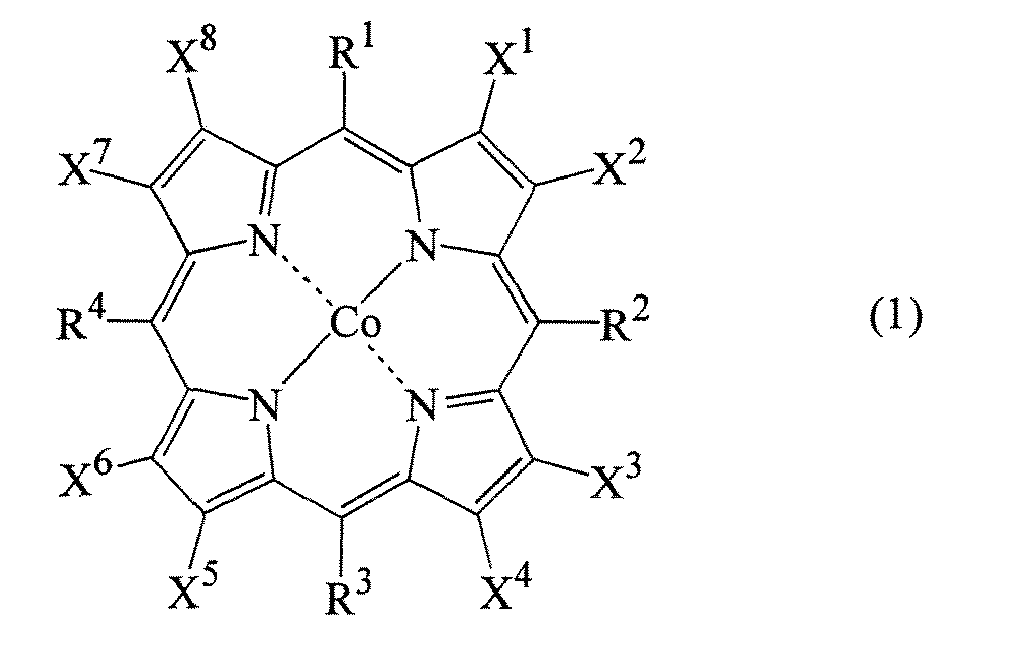
- the present invention provides a process for producing cycloalkanol and/or cycloalkanone, which comprises oxidizing cycloalkane with molecular oxygen in the presence of a compound represented by the formula (1): wherein X 1 to X 8 independently represent a hydrogen atom, a halogen atom, a nitro group, a cyano group, a hydrocarbon group, a halogenated hydrocarbon group or a sulfonyl group, provided that at least one of X 1 to X 8 is a halogen atom, and R 1 to R 4 independently represent a hydrogen atom, a nitro group, a cyano group, a hydrocarbon group or a halogenated hydrocarbon group.
- cycloalkane can be oxidized at a high conversion rate to produce cycloalkanol and/or cycloalkanone in high selectivity.
- cycloalkane is used as the starting material, which is oxidized with molecular oxygen in the presence of a catalyst to produce the corresponding cycloalkanol and/or cycloalkanone.
- cycloalkane examples include monocyclic cycloalkane having no substituent on the ring, such as cyclopropane, cyclobutane, cyclopentane, cyclohexane, cycloheptane, cyclooctane, cyclodecane, and cyclooctadecane; polycyclic cycloalkane such as norbornane, decalin, and adamantane; and cycloalkane having a substituent on the ring, such as methylcyclopentane and methylcyclohexane.
- the cycloalkane usually has about 3 to 20 carbon atoms. Two or more cycloalkane may be used, if necessary.
- oxygen-containing gas is usually used as a source of molecular oxygen.
- the oxygen-containing gas may be air, pure oxygen, or air or pure oxygen diluted with inert gas such as nitrogen, argon or helium.
- oxygen-enriched air which is obtained by adding pure oxygen to air can be used.
- a compound represented by the above formula (1) (hereinafter, referred to as "compound (1)”) is used as a catalyst for oxidizing cycloalkane with molecular oxygen.
- compound (1) a compound represented by the above formula (1)
- the oxidation of cycloalkane can be smoothly progressed to produce cycloalkanol and/or cycloalkanone in high selectivity.
- the hydrocarbon group can be an aliphatic hydrocarbon group, an alicyclic hydrocarbon group or an aromatic hydrocarbon group.
- the aliphatic hydrocarbon group when used herein, is a residue obtained by removing a hydrogen atom from aliphatic hydrocarbon and usually has about 1 to 20 carbon atoms.
- Specific examples of the aliphatic hydrocarbon groups include alkyl groups such as a methyl group, an ethyl group, a n-propyl group, an iso-propyl group, a n-butyl group, an isobutyl group, a s-butyl group and a t-butyl group; alkenyl groups such as a vinyl group, an allyl group and a methallyl group; and alkynyl groups such an ethynyl group and a propargyl group.
- the alicyclic hydrocarbon group is a residue obtained by removing a hydrogen atom from alicyclic hydrocarbon and usually has about 3 to 20 carbon atoms.
- the alicyclic hydrocarbon group may be a residue obtained by removing a hydrogen atom from the aliphatic ring of alicyclic hydrocarbon, or a residue obtained by removing a hydrogen atom from the aliphatic chain of aliphatic chain-containing alicyclic hydrocarbon.
- alicyclic hydrocarbon group examples include cycloalkyl groups such as a cyclopropyl group, a cyclobutyl group, a cyclopentyl group and a cyclohexyl group; and cycloalkylalkyl groups such as a cyclopentylmethyl group and a cyclohexylmethyl group.
- the aromatic hydrocarbon group is a residue obtained by removing a hydrogen atom from aromatic hydrocarbon and usually has about 6 to 20 carbon atoms.
- the aromatic hydrocarbon group may be a residue obtained by removing a hydrogen atom from the aromatic ring of aromatic hydrocarbon, a residue obtained by removing a hydrogen atom from the aliphatic chain of aliphatic chain-containing aromatic hydrocarbon, or a residue obtained by removing a hydrogen atom from the aliphatic ring of aliphatic ring-containing aromatic hydrocarbon.
- aromatic hydrocarbon group examples include aryl groups such as a phenyl group, a tolyl group and a naphthyl group; and arylalkyl groups (aralkyl groups) such as a benzyl group and a phenethyl group.
- the halogenated hydrocarbon group can be a group obtained by substituting at least one hydrogen atom of a hydrocarbon group with a fluorine atom, a chlorine atom, a bromine atom or an iodine atom.
- the sulfonyl group can be a group obtained by bonding a hydrocarbon group to a unsubstituted sulfonyl group (-SO 2 -).
- the hydrocarbon group for the halogenated hydrocarbon group and the sulfonyl group can be an aliphatic hydrocarbon group, an alicyclic hydrocarbon group or an aromatic hydrocarbon group, as described above for a hydrocarbon group represented by X 1 to X 8 , and examples thereof are also the same as the examples of a hydrocarbon group represented by X 1 to X 8 .
- the hydrocarbon group can be an aliphatic hydrocarbon group, an alicyclic hydrocarbon group or an aromatic hydrocarbon group, as described above for a hydrocarbon group represented by X 1 to X 8 , and examples thereof are also the same as the examples of a hydrocarbon group represented by X 1 to X 8 .
- the halogenated hydrocarbon group can be a group obtained by substituting at least one hydrogen atom of a hydrocarbon group with a fluorine atom, a chlorine atom, a bromine atom or an iodine atom, as described above for a halogenated hydrocarbon group represented by X 1 to X 8 .
- the hydrocarbon group for the halogenated hydrocarbon group can be an aliphatic hydrocarbon group, an alicyclic hydrocarbon group or an aromatic hydrocarbon group, as described above for a hydrocarbon group represented by X 1 to X 8 , and examples thereof are also the same as the examples of a hydrocarbon group represented by X 1 to X 8 .
- At least one of X 1 to X 8 is a halogen atom.
- the others are preferably independently a hydrogen atom, a hydrocarbon group or a halogenated hydrocarbon group. More preferably, all of X 1 to X 8 are halogen atoms.
- R 1 to R 4 are preferably independently a hydrogen atom, a hydrocarbon group or a halogenated hydrocarbon group.
- Compound (1) can be prepared by a known method, for instance, a method described in Journal of Organic Chemistry, volume 32, p.476 (1967 ), or a method described in Inorganic Chemistry, volume 31, p.2044 (1992 ).
- Compound (1) may be used in the supported form on a carrier such as silica, alumina, titania, montmorillonite, zeolite or hydrotalcite.
- the oxidation reaction of cycloalkane in the present invention can be conducted by contacting cycloalkane with molecular oxygen in the presence of compound (1).
- the amount of compound (1) to be used is usually 0.01 to 100 ppm by weight, preferably 0.1 to 50 ppm by weight, based on the amount of cycloalkane.
- the reaction temperature is usually 0 to 200°C, preferably 100 to 180°C.
- the reaction pressure is usually 0.01 to 10 MPa, preferably 0.1 to 2 MPa.
- a solvent may be used in the reaction, if necessary. Examples of the solvent include nitrile solvents such as acetonitrile and benzonitrile; and carboxylic acid solvents such as acetic acid and propionic acid.
- Post-treatment of the oxidation reaction includes, but not particularly limited to, washing of the reaction mixture with water to separate compound (1), followed by distillation.
- the reaction mixture contains cycloalkylhydroperoxide corresponding to the starting material cycloalkane
- the cycloalkylhydroperoxide can be converted into the aimed products, cycloalkanol or cycloalkanone, by alkali treatment, reduction processing or the like.
- Cobalt(II) 5,10,15,20-tetrakis (pentafluorophenyl)-2,3,7,8,12,13,17,18-octabromoporphyrin [a compound (1) wherein X 1 to X 8 are bromine atoms and R 1 to R 4 are pentafluorophenyl groups] (0.0548 g, 3.3 ⁇ 10 -5 mol) as a catalyst was dissolved in cyclohexane (2221.8 g, 26.4 mol) to prepare a supply solution (catalyst/ starting material solution).
- the autoclave was pressurized to 0.6 MPa with nitrogen and then heated to 125°C while passing nitrogen.
- the supply solution was further supplied at a rate of 4.6 g/minute, while air was passed so that the oxygen concentration in exhaust gas was 1-5% by volume.
- Continuous reaction was performed for 4 hours under the reaction temperature of 125°C and the residence time of 1 hour. Then, the resulting reaction mixture was analyzed.
- the conversion rate of cyclohexane was 2.3%
- the cyclohexanone-selectivity was 33.5%
- the cyclohexanol-selectivity was 50.3%
- the cyclohexylhydroperoxide-selectivity was 3.9%.
- Example 2 The same procedure as Example 1 was performed except that 0.0222 g (3.3x10 -5 mol) of cobalt (II) 5,10,15,20-tetraphenylporphyrin [a compound (1) wherein X 1 to X 8 are hydrogen atoms and R 1 to R 4 are phenyl groups] was used as a catalyst.
- the conversion rate of cyclohexane was 0.8%, the cyclohexanone-selectivity was 26.1%, the cyclohexanol-selectivity was 39.0%, and the cyclohexylhydroperoxide-selectivity was 24.1%.
- Example 2 The same procedure as Example 1 was performed except that 0.0261 g (3.3 ⁇ 10 -5 mol) of cobalt(II) 5,10,15,20-tetrakis(p-methoxyphenyl)porphyrin [a compound (1) wherein X 1 to X 8 are hydrogen atoms and R 1 to R 4 are p-methoxyphenyl groups] was used as a catalyst.
- the conversion rate of cyclohexane was 0.9%, the cyclohexanone-selectivity was 31.2%, the cyclohexanol-selectivity was 32.1%, and the cyclohexylhydroperoxide-selectivity was 27.8%.
- Example 2 The same procedure as Example 1 was performed except that 0.0633 g (3.7 ⁇ 10 -5 mol) of iron(III) 5,10,15,20-tetrakis-2,3,7,8,12,13,17,18-(pentafluorophenyl)octabromoporphyrin chloride [a compound (1) wherein X 1 to X 8 are bromine atoms, R 1 to R 4 are pentafluorophenyl groups, and Fe-Cl was substituted for Co] as a catalyst was dissolved in 2499.6 g (29.7 mol) of cyclohexane to prepare a supply solution.
- the conversion rate of cyclohexane was 0.9%, the cyclohexanone-selectivity was 25.4%, the cyclohexanol-selectivity was 32.0%, and the cyclohexylhydroperoxide-selectivity was 20.8%.
- Example 2 the same procedure as Example 1 was performed except that 0.0070 g (4.2 ⁇ 10 -6 mol) of cobalt(II) 5,10,15,20-tetrakis-2,3,7,8,12,13,17,18-(pentafluorophenyl)octabromoporphyrin as a catalyst was dissolved in 2499.6 g (29.7 mol) of cyclohexane to prepare a supply solution and the reaction was conducted under the reaction temperature and the residence time shown in Table 1.
Landscapes
- Chemical & Material Sciences (AREA)
- Organic Chemistry (AREA)
- Chemical Kinetics & Catalysis (AREA)
- Organic Low-Molecular-Weight Compounds And Preparation Thereof (AREA)
- Low-Molecular Organic Synthesis Reactions Using Catalysts (AREA)
Abstract

Description
- The invention relates to a process for producing cycloalkanol and/or cycloalkanone by oxidizing cycloalkane with molecular oxygen. The resulting cycloalkanol can be easily converted into cycloalkanone by a known method, and cycloalkanone is used as the starting material for producing oxime or lactam.
- It is known that a porphyrin complex is used as a catalyst in a method of oxidizing hydrocarbon such as alkane, cycloalkane or alkene with molecular oxygen. As such a catalyst, for instance,
JP-A 5-138037 JP-A 5-200302 JP-A 5-262684 JP-A 8-104658 - The above-described conventional methods, however, did not always provide sufficient activity of a catalyst and sufficient selectivity to the aimed product, in particular, in producing cycloalkanol and/or cycloalkanone by oxidizing cycloalkane with molecular oxygen. Therefore, an object of the present invention is to provide a process for producing cycloalkanol and/or cycloalkanone in high selectivity by oxidizing cycloalkane with molecular oxygen at a high conversion rate.
- That is, the present invention provides a process for producing cycloalkanol and/or cycloalkanone, which comprises oxidizing cycloalkane with molecular oxygen in the presence of a compound represented by the formula (1):
- According to the present invention, cycloalkane can be oxidized at a high conversion rate to produce cycloalkanol and/or cycloalkanone in high selectivity.
- The present invention will be described in detail hereinafter. In the present invention, cycloalkane is used as the starting material, which is oxidized with molecular oxygen in the presence of a catalyst to produce the corresponding cycloalkanol and/or cycloalkanone.
- Examples of cycloalkane as the starting material include monocyclic cycloalkane having no substituent on the ring, such as cyclopropane, cyclobutane, cyclopentane, cyclohexane, cycloheptane, cyclooctane, cyclodecane, and cyclooctadecane; polycyclic cycloalkane such as norbornane, decalin, and adamantane; and cycloalkane having a substituent on the ring, such as methylcyclopentane and methylcyclohexane. The cycloalkane usually has about 3 to 20 carbon atoms. Two or more cycloalkane may be used, if necessary.
- An oxygen-containing gas is usually used as a source of molecular oxygen. For instance, the oxygen-containing gas may be air, pure oxygen, or air or pure oxygen diluted with inert gas such as nitrogen, argon or helium. Alternatively, oxygen-enriched air which is obtained by adding pure oxygen to air can be used.
- In the present invention, a compound represented by the above formula (1) (hereinafter, referred to as "compound (1)") is used as a catalyst for oxidizing cycloalkane with molecular oxygen. By using such a cobalt porphyrin complex as a catalyst, the oxidation of cycloalkane can be smoothly progressed to produce cycloalkanol and/or cycloalkanone in high selectivity.
- When at least one of X1 to X8 present on pyrrole rings in the formula (1) is a hydrocarbon group, the hydrocarbon group can be an aliphatic hydrocarbon group, an alicyclic hydrocarbon group or an aromatic hydrocarbon group.
- The aliphatic hydrocarbon group, when used herein, is a residue obtained by removing a hydrogen atom from aliphatic hydrocarbon and usually has about 1 to 20 carbon atoms. Specific examples of the aliphatic hydrocarbon groups include alkyl groups such as a methyl group, an ethyl group, a n-propyl group, an iso-propyl group, a n-butyl group, an isobutyl group, a s-butyl group and a t-butyl group; alkenyl groups such as a vinyl group, an allyl group and a methallyl group; and alkynyl groups such an ethynyl group and a propargyl group.
- The alicyclic hydrocarbon group is a residue obtained by removing a hydrogen atom from alicyclic hydrocarbon and usually has about 3 to 20 carbon atoms. The alicyclic hydrocarbon group may be a residue obtained by removing a hydrogen atom from the aliphatic ring of alicyclic hydrocarbon, or a residue obtained by removing a hydrogen atom from the aliphatic chain of aliphatic chain-containing alicyclic hydrocarbon. Specific examples of the alicyclic hydrocarbon group include cycloalkyl groups such as a cyclopropyl group, a cyclobutyl group, a cyclopentyl group and a cyclohexyl group; and cycloalkylalkyl groups such as a cyclopentylmethyl group and a cyclohexylmethyl group.
- The aromatic hydrocarbon group is a residue obtained by removing a hydrogen atom from aromatic hydrocarbon and usually has about 6 to 20 carbon atoms. The aromatic hydrocarbon group may be a residue obtained by removing a hydrogen atom from the aromatic ring of aromatic hydrocarbon, a residue obtained by removing a hydrogen atom from the aliphatic chain of aliphatic chain-containing aromatic hydrocarbon, or a residue obtained by removing a hydrogen atom from the aliphatic ring of aliphatic ring-containing aromatic hydrocarbon. Specific examples of the aromatic hydrocarbon group include aryl groups such as a phenyl group, a tolyl group and a naphthyl group; and arylalkyl groups (aralkyl groups) such as a benzyl group and a phenethyl group.
- When at least one of X1 to X8 is a halogenated hydrocarbon group, the halogenated hydrocarbon group can be a group obtained by substituting at least one hydrogen atom of a hydrocarbon group with a fluorine atom, a chlorine atom, a bromine atom or an iodine atom. When at least one of X1 to X8 is a sulfonyl group, the sulfonyl group can be a group obtained by bonding a hydrocarbon group to a unsubstituted sulfonyl group (-SO2-). The hydrocarbon group for the halogenated hydrocarbon group and the sulfonyl group can be an aliphatic hydrocarbon group, an alicyclic hydrocarbon group or an aromatic hydrocarbon group, as described above for a hydrocarbon group represented by X1 to X8, and examples thereof are also the same as the examples of a hydrocarbon group represented by X1 to X8.
- When at least one of R1 to R4 present on carbon atoms connecting pyrrole rings in the formula (1) is a hydrocarbon group, the hydrocarbon group can be an aliphatic hydrocarbon group, an alicyclic hydrocarbon group or an aromatic hydrocarbon group, as described above for a hydrocarbon group represented by X1 to X8, and examples thereof are also the same as the examples of a hydrocarbon group represented by X1 to X8.
- When at least one of R1 to R4 is a halogenated hydrocarbon group, the halogenated hydrocarbon group can be a group obtained by substituting at least one hydrogen atom of a hydrocarbon group with a fluorine atom, a chlorine atom, a bromine atom or an iodine atom, as described above for a halogenated hydrocarbon group represented by X1 to X8. The hydrocarbon group for the halogenated hydrocarbon group can be an aliphatic hydrocarbon group, an alicyclic hydrocarbon group or an aromatic hydrocarbon group, as described above for a hydrocarbon group represented by X1 to X8, and examples thereof are also the same as the examples of a hydrocarbon group represented by X1 to X8.
- As described above, at least one of X1 to X8 is a halogen atom. The others are preferably independently a hydrogen atom, a hydrocarbon group or a halogenated hydrocarbon group. More preferably, all of X1 to X8 are halogen atoms. R1 to R4 are preferably independently a hydrogen atom, a hydrocarbon group or a halogenated hydrocarbon group.
- Compound (1) can be prepared by a known method, for instance, a method described in Journal of Organic Chemistry, volume 32, p.476 (1967), or a method described in Inorganic Chemistry, volume 31, p.2044 (1992). Compound (1) may be used in the supported form on a carrier such as silica, alumina, titania, montmorillonite, zeolite or hydrotalcite.
- The oxidation reaction of cycloalkane in the present invention can be conducted by contacting cycloalkane with molecular oxygen in the presence of compound (1). The amount of compound (1) to be used is usually 0.01 to 100 ppm by weight, preferably 0.1 to 50 ppm by weight, based on the amount of cycloalkane. The reaction temperature is usually 0 to 200°C, preferably 100 to 180°C. The reaction pressure is usually 0.01 to 10 MPa, preferably 0.1 to 2 MPa. A solvent may be used in the reaction, if necessary. Examples of the solvent include nitrile solvents such as acetonitrile and benzonitrile; and carboxylic acid solvents such as acetic acid and propionic acid.
- Post-treatment of the oxidation reaction includes, but not particularly limited to, washing of the reaction mixture with water to separate compound (1), followed by distillation. When the reaction mixture contains cycloalkylhydroperoxide corresponding to the starting material cycloalkane, the cycloalkylhydroperoxide can be converted into the aimed products, cycloalkanol or cycloalkanone, by alkali treatment, reduction processing or the like.
- Hereinafter, the present invention will be illustrated by referring to Examples which the present invention is not limited to. Cyclohexane, cyclohexanone, cyclohexanol and cyclohexylhydroperoxide in a reaction mixture were analyzed by gas chromatography. Based on the analysis results, the conversion rate of cyclohexane, and selectivity to cyclohexanone, cyclohexanol and cyclohexylhydroperoxide were calculated.
- Cobalt(II) 5,10,15,20-tetrakis (pentafluorophenyl)-2,3,7,8,12,13,17,18-octabromoporphyrin [a compound (1) wherein X1 to X8 are bromine atoms and R1 to R4 are pentafluorophenyl groups] (0.0548 g, 3.3×10⁻⁵ mol) as a catalyst was dissolved in cyclohexane (2221.8 g, 26.4 mol) to prepare a supply solution (catalyst/ starting material solution). After 278 g of the supply solution was put in a 1 L autoclave, the autoclave was pressurized to 0.6 MPa with nitrogen and then heated to 125°C while passing nitrogen. Into the autoclave, the supply solution was further supplied at a rate of 4.6 g/minute, while air was passed so that the oxygen concentration in exhaust gas was 1-5% by volume. Continuous reaction was performed for 4 hours under the reaction temperature of 125°C and the residence time of 1 hour. Then, the resulting reaction mixture was analyzed. As a result, the conversion rate of cyclohexane was 2.3%, the cyclohexanone-selectivity was 33.5%, the cyclohexanol-selectivity was 50.3%, and the cyclohexylhydroperoxide-selectivity was 3.9%.
- The same procedure as Example 1 was performed except that 0.0222 g (3.3x10⁻⁵ mol) of cobalt (II) 5,10,15,20-tetraphenylporphyrin [a compound (1) wherein X1 to X8 are hydrogen atoms and R1 to R4 are phenyl groups] was used as a catalyst. The conversion rate of cyclohexane was 0.8%, the cyclohexanone-selectivity was 26.1%, the cyclohexanol-selectivity was 39.0%, and the cyclohexylhydroperoxide-selectivity was 24.1%.
- The same procedure as Example 1 was performed except that 0.0261 g (3.3×10⁻⁵ mol) of cobalt(II) 5,10,15,20-tetrakis(p-methoxyphenyl)porphyrin [a compound (1) wherein X1 to X8 are hydrogen atoms and R1 to R4 are p-methoxyphenyl groups] was used as a catalyst. The conversion rate of cyclohexane was 0.9%, the cyclohexanone-selectivity was 31.2%, the cyclohexanol-selectivity was 32.1%, and the cyclohexylhydroperoxide-selectivity was 27.8%.
- The same procedure as Example 1 was performed except that 0.0633 g (3.7×10⁻⁵ mol) of iron(III) 5,10,15,20-tetrakis-2,3,7,8,12,13,17,18-(pentafluorophenyl)octabromoporphyrin chloride [a compound (1) wherein X1 to X8 are bromine atoms, R1 to R4 are pentafluorophenyl groups, and Fe-Cl was substituted for Co] as a catalyst was dissolved in 2499.6 g (29.7 mol) of cyclohexane to prepare a supply solution. The conversion rate of cyclohexane was 0.9%, the cyclohexanone-selectivity was 25.4%, the cyclohexanol-selectivity was 32.0%, and the cyclohexylhydroperoxide-selectivity was 20.8%.
- In each Example, the same procedure as Example 1 was performed except that 0.0070 g (4.2×10⁻⁶ mol) of cobalt(II) 5,10,15,20-tetrakis-2,3,7,8,12,13,17,18-(pentafluorophenyl)octabromoporphyrin as a catalyst was dissolved in 2499.6 g (29.7 mol) of cyclohexane to prepare a supply solution and the reaction was conducted under the reaction temperature and the residence time shown in Table 1. The results, that is, the conversion rate of cyclohexane, the cyclohexanone-selectivity, the cyclohexanol-selectivity and the cyclohexylhydroperoxide-selectivity are shown in Table 1.
Table 1 Example No. Reaction Temperature (°C) Residence Time (min) Conversion Rate of Cyclohexane (%) Cycloheanone-Selectivity (%) Cyclohexanol-Selectivity (%) Cyclohexylhydroperoxide-Selectivity (%) 2 125 60 0.7 17.5 36.3 29.7 3 130 60 0.9 16.6 40.8 29.8 4 135 60 2.1 23.2 44.1 20.4 5 135 90 3.7 31.4 43.9 10.9 6 135 120 4.4 36.6 33.2 7.3 7 140 60 3.3 27.6 40.0 18.9 8 140 75 5.3 31.6 40.9 10.4 9 140 90 6.5 31.7 36.4 13.7 10 145 60 5.5 29.4 38.3 15.7 11 145 75 7.5 31.7 35.7 10.7
Claims (3)
- A process for producing cycloalkanol and/or cycloalkanone, which comprises oxidizing cycloalkane with molecular oxygen in the presence of a compound represented by the formula (1):

- The process according to claim 1, wherein X1 to X8 in the formula (1) are halogen atoms.
- The process according to claim 1 or 2, wherein the cycloalkane is cyclohexane.
Applications Claiming Priority (2)
| Application Number | Priority Date | Filing Date | Title |
|---|---|---|---|
| JP2004135495 | 2004-04-30 | ||
| PCT/JP2005/007871 WO2005105716A1 (en) | 2004-04-30 | 2005-04-26 | Method for producing cycloalkanol and/or cycloalkanone |
Publications (2)
| Publication Number | Publication Date |
|---|---|
| EP1741694A1 true EP1741694A1 (en) | 2007-01-10 |
| EP1741694A4 EP1741694A4 (en) | 2008-04-16 |
Family
ID=35241599
Family Applications (1)
| Application Number | Title | Priority Date | Filing Date |
|---|---|---|---|
| EP05736827A Withdrawn EP1741694A4 (en) | 2004-04-30 | 2005-04-26 | PROCESS FOR PRODUCING CYCLOALCANOL AND / OR CYCLOALCANONE |
Country Status (5)
| Country | Link |
|---|---|
| EP (1) | EP1741694A4 (en) |
| JP (1) | JPWO2005105716A1 (en) |
| CN (1) | CN1946662A (en) |
| TW (1) | TW200604151A (en) |
| WO (1) | WO2005105716A1 (en) |
Cited By (1)
| Publication number | Priority date | Publication date | Assignee | Title |
|---|---|---|---|---|
| EP1980549A1 (en) * | 2007-04-13 | 2008-10-15 | Sumitomo Chemical Company, Limited | Process for producing cycloalkanol and/or cycloalkanone |
Families Citing this family (2)
| Publication number | Priority date | Publication date | Assignee | Title |
|---|---|---|---|---|
| JP4736368B2 (en) * | 2004-07-22 | 2011-07-27 | 住友化学株式会社 | Process for producing cycloalkanol and / or cycloalkanone |
| CN111018673A (en) * | 2019-11-25 | 2020-04-17 | 浙江工业大学 | A kind of method for confined porphyrin Co(II) catalytic oxidation of cycloalkane |
Citations (2)
| Publication number | Priority date | Publication date | Assignee | Title |
|---|---|---|---|---|
| EP0532327A2 (en) | 1991-09-12 | 1993-03-17 | SUN COMPANY, INC. (R&M) | Cyano- and polycyanometalloporphyrins as catalysts for alkane oxidation |
| US6124452A (en) | 1997-12-19 | 2000-09-26 | University Of Nebraska-Lincoln | Octafluoro-meso-tetraarylporphyrins and methods for making these compounds |
Family Cites Families (6)
| Publication number | Priority date | Publication date | Assignee | Title |
|---|---|---|---|---|
| AU617670B2 (en) * | 1987-04-17 | 1991-12-05 | David H. Dolphin | Porphyrins, their syntheses and uses thereof |
| NL8802592A (en) * | 1988-10-21 | 1990-05-16 | Stamicarbon | METHOD FOR PREPARING A K / A MIXTURE |
| US5280115A (en) * | 1991-09-12 | 1994-01-18 | Sun Company, Inc. (R&M) | Nitrated metalloporphyrins as catalysts for alkane oxidation |
| US5379948A (en) * | 1994-01-06 | 1995-01-10 | American Colloid Company | Method for milling clay without substantial generation of powder |
| JPH0987216A (en) * | 1995-09-21 | 1997-03-31 | Sumitomo Chem Co Ltd | Method for producing alcohols and ketones |
| IN192732B (en) * | 1995-09-29 | 2004-05-15 | Council Scient Ind Res |
-
2005
- 2005-04-22 TW TW094112891A patent/TW200604151A/en unknown
- 2005-04-26 WO PCT/JP2005/007871 patent/WO2005105716A1/en not_active Ceased
- 2005-04-26 JP JP2006512782A patent/JPWO2005105716A1/en active Pending
- 2005-04-26 CN CNA2005800133604A patent/CN1946662A/en active Pending
- 2005-04-26 EP EP05736827A patent/EP1741694A4/en not_active Withdrawn
Patent Citations (2)
| Publication number | Priority date | Publication date | Assignee | Title |
|---|---|---|---|---|
| EP0532327A2 (en) | 1991-09-12 | 1993-03-17 | SUN COMPANY, INC. (R&M) | Cyano- and polycyanometalloporphyrins as catalysts for alkane oxidation |
| US6124452A (en) | 1997-12-19 | 2000-09-26 | University Of Nebraska-Lincoln | Octafluoro-meso-tetraarylporphyrins and methods for making these compounds |
Non-Patent Citations (1)
| Title |
|---|
| See also references of WO2005105716A1 |
Cited By (2)
| Publication number | Priority date | Publication date | Assignee | Title |
|---|---|---|---|---|
| EP1980549A1 (en) * | 2007-04-13 | 2008-10-15 | Sumitomo Chemical Company, Limited | Process for producing cycloalkanol and/or cycloalkanone |
| US7622615B2 (en) | 2007-04-13 | 2009-11-24 | Sumitomo Chemical Company, Limited | Process for producing cycloalkanol and/or cycloalkanone |
Also Published As
| Publication number | Publication date |
|---|---|
| CN1946662A (en) | 2007-04-11 |
| JPWO2005105716A1 (en) | 2008-03-13 |
| WO2005105716A1 (en) | 2005-11-10 |
| TW200604151A (en) | 2006-02-01 |
| EP1741694A4 (en) | 2008-04-16 |
Similar Documents
| Publication | Publication Date | Title |
|---|---|---|
| EP1074536B1 (en) | Oxidation method | |
| EP1663932B1 (en) | Method for producing cyclododecanone | |
| US7449606B2 (en) | Method for producing a ketone | |
| EP1619176B1 (en) | Process for producing cycloalkanol and/or cycloalkanone | |
| KR20010057566A (en) | Process for preparing ketone, alcohol and hydroperoxide | |
| CN109456175A (en) | A new method for the catalytic oxidation of cycloalkanes promoted by zinc porphyrin | |
| CN1174952C (en) | Process for oxidation of hydrocarbons, alcohols and/or ketones | |
| CN110560169A (en) | A kind of iron porphyrin-promoted cycloalkane catalytic oxidation method | |
| KR20090052807A (en) | Process for preparing cycloalkanol and / or cycloalkanone | |
| US6482989B2 (en) | Method for oxidizing alkanes and cycloalkanes with aldehydes in the presence of copper-based catalysts and nitrogen-containing compounds | |
| JP5524861B2 (en) | Method for producing ketone | |
| JP4167310B2 (en) | Regeneration method of imide catalyst and production process using imide catalyst | |
| US7166751B2 (en) | Method for manufacturing cycloalkanol and/or cycloalkanone | |
| CN1946662A (en) | Method for producing cycloalkanol and/or cycloalkanone | |
| CN1549805A (en) | Process for Oxidation of Hydrocarbons to Acids | |
| US20020065436A1 (en) | Process for preparing cyclohexanone, cyclohexanol and cyclohexyl hydroperoxide | |
| JP5124959B2 (en) | Process for producing cycloalkanol and / or cycloalkanone | |
| EP1350783B1 (en) | Method for oxidizing cyclohexane | |
| JP2004002327A (en) | Method for oxidizing cycloalkane | |
| JPH043369B2 (en) | ||
| WO2010113877A1 (en) | Method for producing ketone | |
| WO2011125541A1 (en) | Immobilized palladium catalyst and method for producing ketone using the same | |
| KR20070063429A (en) | Process for the preparation of ethylcyclohexane by selective hydrogenation of 4-vinylcyclohexene | |
| JPS62249941A (en) | Production of cyclic ketone | |
| JPH0796516B2 (en) | Method for producing cycloalkanone |
Legal Events
| Date | Code | Title | Description |
|---|---|---|---|
| PUAI | Public reference made under article 153(3) epc to a published international application that has entered the european phase |
Free format text: ORIGINAL CODE: 0009012 |
|
| 17P | Request for examination filed |
Effective date: 20061030 |
|
| AK | Designated contracting states |
Kind code of ref document: A1 Designated state(s): FR |
|
| DAX | Request for extension of the european patent (deleted) | ||
| RBV | Designated contracting states (corrected) |
Designated state(s): FR |
|
| A4 | Supplementary search report drawn up and despatched |
Effective date: 20080319 |
|
| RIC1 | Information provided on ipc code assigned before grant |
Ipc: C07C 35/08 20060101ALI20080313BHEP Ipc: C07C 29/50 20060101AFI20051117BHEP Ipc: C07B 61/00 20060101ALI20080313BHEP |
|
| TPAC | Observations by third parties |
Free format text: ORIGINAL CODE: EPIDOSNTIPA |
|
| 17Q | First examination report despatched |
Effective date: 20090928 |
|
| STAA | Information on the status of an ep patent application or granted ep patent |
Free format text: STATUS: THE APPLICATION IS DEEMED TO BE WITHDRAWN |
|
| 18D | Application deemed to be withdrawn |
Effective date: 20100810 |