EP1739074A1 - Nouvelles para-phénylènediamines doubles reliées par un groupe aliphatique ramifié et utilisation en coloration - Google Patents
Nouvelles para-phénylènediamines doubles reliées par un groupe aliphatique ramifié et utilisation en coloration Download PDFInfo
- Publication number
- EP1739074A1 EP1739074A1 EP06116072A EP06116072A EP1739074A1 EP 1739074 A1 EP1739074 A1 EP 1739074A1 EP 06116072 A EP06116072 A EP 06116072A EP 06116072 A EP06116072 A EP 06116072A EP 1739074 A1 EP1739074 A1 EP 1739074A1
- Authority
- EP
- European Patent Office
- Prior art keywords
- para
- acid
- formula
- phenylenediamine
- phenylenediamines
- Prior art date
- Legal status (The legal status is an assumption and is not a legal conclusion. Google has not performed a legal analysis and makes no representation as to the accuracy of the status listed.)
- Granted
Links
- GWUDXDKDARWUGX-UHFFFAOYSA-N CC(C)(CNc(c(C)c1)ccc1N)CNc(cc1)c(C)cc1N Chemical compound CC(C)(CNc(c(C)c1)ccc1N)CNc(cc1)c(C)cc1N GWUDXDKDARWUGX-UHFFFAOYSA-N 0.000 description 1
Classifications
-
- C—CHEMISTRY; METALLURGY
- C07—ORGANIC CHEMISTRY
- C07C—ACYCLIC OR CARBOCYCLIC COMPOUNDS
- C07C211/00—Compounds containing amino groups bound to a carbon skeleton
- C07C211/43—Compounds containing amino groups bound to a carbon skeleton having amino groups bound to carbon atoms of six-membered aromatic rings of the carbon skeleton
- C07C211/44—Compounds containing amino groups bound to a carbon skeleton having amino groups bound to carbon atoms of six-membered aromatic rings of the carbon skeleton having amino groups bound to only one six-membered aromatic ring
- C07C211/53—Compounds containing amino groups bound to a carbon skeleton having amino groups bound to carbon atoms of six-membered aromatic rings of the carbon skeleton having amino groups bound to only one six-membered aromatic ring having the nitrogen atom of at least one of the amino groups further bound to a hydrocarbon radical substituted by amino groups
Definitions
- the present application relates to a novel family of double para-phenylenediamines linked by a branched aliphatic linker and their use for dyeing keratinous fibers.
- oxidation bases such as ortho- or para-phenylenediamines, ortho- or para-phenylenediamines, aminophenols and heterocyclic compounds.
- oxidation bases are colorless or weakly colored compounds which, when combined with oxidizing products, can give rise to colored compounds by a process of oxidative condensation.
- couplers or color modifiers the latter being chosen in particular from aromatic meta-diaminobenzenes, meta-aminophenols, meta-aminophenols and diphenols and certain heterocyclic compounds such as indole and pyridine compounds.
- the dyes must also make it possible to cover the white hair, and finally be the least selective possible, that is to say, to obtain the lowest possible color differences throughout the same keratin fiber, which is in general differently sensitized (ie damaged) between its tip and its root.
- the object of the present invention is to provide new oxidation bases capable of coloring the keratinous fibers with varied, powerful, aesthetic and low-selective shades as well as colorings resistant to the various attacks that can undergo the fibers such as light, sweat and shampoos.
- the para-phenylenediamines of formula (I) make it possible in particular to obtain a keratinous fiber coloration which is very powerful, not very selective and tenacious, in particular to light.
- compositions for dyeing keratinous fibers in particular human keratinous fibers such as the hair, comprising at least one para-phenylenediamine of formula (I).
- the subject of the invention is also a dyeing method using this composition, the use of the composition according to the present invention for dyeing keratinous fibers, in particular human keratin fibers such as the hair and a multi-compartment device. or "kit" of dyeing.
- para-phenylenediamines of formula (I) mention may be made of the following para-phenylenediamines:
- the para-phenylenediamines of formula (I) are such that R is a branched C 4 -C 11 alkylene radical.
- R 1 and R 2 independently represent a hydrogen atom or a C 1 -C 4 alkyl group which may be substituted.
- n and m are preferably 0 or 1.
- addition salts that may be used are chosen from acid addition salts, such as hydrochloric acid, hydrobromic acid, sulfuric acid, citric acid, and acid.
- succinic acid tartaric acid, lactic acid, para-toluenesulfonic acid, benzenesulphonic acid, phosphoric acid and acetic acid.
- solvates for example a hydrate or a linear or branched alcohol solvate such as ethanol or isopropanol.
- the para-phenylenediamines of formula (I) according to the present application can be prepared according to a conventional synthesis method.
- a conventional synthesis method For example, one can refer to the patent application DE10144226A .
- para-phenylenediamines of formula (I) can be synthesized according to the following reaction scheme:
- the first step of the synthesis is a nucleophilic substitution of a diamine on a para-fluoro-nitrobenzene derivative, a step inspired by the publications Synthesis 1990 (12), 1147-1148 and Synth. Common. 1990, 20 (22), 3537-3545 .
- the second step is a conventional reduction step, which may for example be a hydrogenation reaction by heterogeneous catalysis in the presence of Pd / C, Pd (II) / C, Raney Ni or a metal reduction reaction, by example by zinc, iron, tin ... ( Advanced Organic Chemistry, 4th Edition, 1992, J. MARCH, WILEY Interscience ; Reduction in Organic Chemistry, M. Hudlicky, 1983, Ellis Honwood Chemical Science Series ).
- the present application also relates to the following nitrated compounds of formula (II) which can be used for obtaining para-phenylenediamines of formula (I): wherein R 1 , R 2 , R, R ', R ", n, m are as defined above with the exception of 1,2-propanediamine N, N'-bis (4-nitrophenyl).
- the subject of the invention is also a dyeing composition
- a dyeing composition comprising, in a medium suitable for dyeing, at least one para-phenylenediamine type oxidation base of formula (I) as defined above.
- the amount of para-phenylenediamine of formula (I) in the dyeing composition is generally between 0.0001% and 20% by weight relative to the total weight of the composition, preferably between 0.01% and 10%.
- composition according to the invention preferably contains at least one oxidation coupler.
- oxidation couplers there may be mentioned meta-phenylenediamines, meta-aminophenols, meta-diphenols, naphthalenic couplers and heterocyclic couplers and their addition salts.
- the amount of the oxidation coupler (s) is between 0.0001 and 20%, preferably between 0.005 and 6% by weight relative to the total weight of the composition.
- composition according to the invention may also contain at least one additional oxidation base different from the oxidation bases of formula (I).
- the oxidation bases may especially be chosen from para-phenylenediamines, bis-phenylalkylenediamines, para-aminophenols, ortho-aminophenols and heterocyclic bases and their addition salts.
- para-phenylenediamines para-phenylenediamine, para-toluenediamine, 2-chloro-para-phenylenediamine, 2,3-dimethyl-para-phenylenediamine, 2,6-dimethylphenylenediamine and dimethyl para-phenylenediamine, 2,6-diethyl para-phenylenediamine, 2,5-dimethyl-para-phenylenediamine, N, N-dimethyl-para-phenylenediamine, N, N-diethyl-para-phenylenediamine, N, N- dipropyl para-phenylenediamine, 4-amino N, N-diethyl-3-methylaniline, N, N-bis- ( ⁇ -hydroxyethyl) para-phenylenediamine, 4-N, N-bis- ( ⁇ -hydroxyethyl) amino 2-methylaniline, 4-N, N-bis- ( ⁇ -hydroxyethyl) amino-2-chloro
- para-phenylenediamine para-toluenediamine, 2-isopropyl para-phenylenediamine, 2- ⁇ -hydroxyethyl para-phenylenediamine, 2- ⁇ -hydroxyethyloxy para-phenylenediamine, 2 , 6-dimethyl-para-phenylenediamine, 2,6-diethyl-para-phenylenediamine, 2,3-dimethyl-para-phenylenediamine, N, N-bis- ( ⁇ -hydroxyethyl) para-phenylenediamine, 2-chloro-para-phenylenediamine, phenylenediamine, 2- ⁇ -acetylaminoethyloxy para-phenylenediamine, 6- (4-aminophenylamino) hexan-1-ol and acid addition salts thereof are particularly preferred.
- bis-phenylalkylenediamines mention may be made, by way of example, of N, N'-bis- ( ⁇ -hydroxyethyl) N, N'-bis- (4'-aminophenyl) 1,3-diamino propanol, N , N'-bis- ( ⁇ -hydroxyethyl) N, N'-bis (4'-aminophenyl) ethylenediamine, N, N'-bis- (4'-aminophenyl) tetramethylenediamine, N, N'-bis ( ⁇ -hydroxyethyl) N, N'-bis (4-Aminophenyl) tetramethylenediamine, N, N'-bis (4-amino-3'-methylphenyl) tetramethylenediamine, N, N'-bis (ethyl) N, N'-bis (4'-amino) , 3'-methylphenyl) ethylenediamine, 1,8-bis- (2,5-bis- (2
- para-aminophenol para-aminophenol, 4-amino-3-methylphenol, 4-amino-3-fluoro phenol, 4-amino-2-chlorophenol, 4- amino 3-chloro phenol, 4-amino-3-hydroxymethylphenol, 4-amino-2-methylphenol, 4-amino-2-hydroxymethylphenol, 4-amino-2-methoxymethylphenol, 4-amino-2-aminomethylphenol , 4-amino-2- ( ⁇ -hydroxyethylaminomethyl) phenol, 4-amino-2-fluoro phenol, 4-amino-2,6-dichlorophenol, 4-amino-6 [((5'-amino-2 3-hydroxy (3'-methyl) phenyl) methyl] -2-methylphenol, bis (5'-amino-2'-hydroxy) phenylmethane and their addition salts with an acid.
- ortho-aminophenols 2-amino phenol, 2-amino-5-methylphenol, 2-amino-6-methylphenol, 5-acetamido-2-aminophenol, 5-amino-phenol, 2-amino-phenol, - [(2-hydroxyethyl) amino] -2-methylphenol and their addition salts with an acid.
- heterocyclic bases that may be mentioned by way of example are pyridine derivatives, pyrimidine derivatives and pyrazole derivatives.
- pyridine derivatives mention may be made of the compounds described, for example, in the patents GB 1,026,978 and GB 1 153 196 such as 2,5-diamino pyridine, 2- (4-methoxyphenyl) amino-3-amino pyridine, 3,4-diamino pyridine, and their addition salts with an acid.
- pyridinic oxidation bases useful in the present invention are the 3-amino pyrazolo [1,5-a] pyridines oxidation bases or their addition salts described for example in the patent application. FR 2801308 .
- pyrazolo [1,5-a] pyridin-3-ylamine 2-acetylamino pyrazolo [1,5-a] pyridin-3-ylamine; 2-morpholin-4-yl-pyrazolo [1,5-a] pyridin-3-ylamine; 3-amino-pyrazolo [1,5-a] pyridin-2-carboxylic acid; 2-methoxy-pyrazolo [1,5-a] pyridin-3-ylamino; (3-amino-pyrazolo [1,5-a] pyridin-7-yl) -methanol; 2- (3-Amino-pyrazolo [1,5-a] pyridin-5-y
- pyrimidine derivatives mention may be made of the compounds described, for example, in the patents DE 2359399 ; JP 88-169571 ; JP 05-63124 ; EP 0770375 or patent application WO 96/15765 such as 2,4,5,6-tetraaminopyrimidine, 4-hydroxy 2,5,6-triaminopyrimidine, 2-hydroxy 4,5,6-triaminopyrimidine, 2,4-dihydroxy-5,6-diaminopyrimidine, 2,5,6-triaminopyrimidine and their addition salts and tautomeric forms, when there is a tautomeric equilibrium.
- 2,4,5,6-tetraaminopyrimidine 4-hydroxy 2,5,6-triaminopyrimidine, 2-hydroxy 4,5,6-triaminopyrimidine, 2,4-dihydroxy-5,6-diaminopyrimidine, 2,5,6-triaminopyrimidine and their addition salts and tautomeric forms, when there is a t
- pyrazole derivatives mention may be made of the compounds described in the patents DE 3843892 , DE 4133957 and patent applications WO 94/08969 , WO 94/08970 , FR-A-2733749 and DE 19543988 such as 4,5-diamino-1-methyl pyrazole, 4,5-diamino-1- ( ⁇ -hydroxyethyl) pyrazole, 3,4-diamino pyrazole, 4,5-diamino-1- (4'-chlorobenzyl) pyrazole , 4,5-diamino 1,3-dimethyl pyrazole, 4,5-diamino-3-methyl-1-phenylpyrazole, 4,5-diamino-1-methyl-3-phenylpyrazole, 4-amino-1,3 dimethyl 5-hydrazino pyrazole, 1-benzyl 4,5-diamino-3-methyl pyrazole, 4,5-dia
- the concentration of the additional oxidation base or bases is between 0.0001 and 20%, preferably between 0.005 to 6% by weight relative to the total weight of the composition.
- the dyeing composition in accordance with the invention may also contain one or more direct dyes which may be chosen in particular from nitro dyes of the benzene series, neutral, acidic or cationic, neutral azo direct dyes, acidic or cationic dyes, quinone direct dyes and in particular neutral, acidic or cationic anthraquinones, direct azine dyes, methine direct dyes, azomethines, triarylmethanics, indoamines and natural direct dyes.
- the composition according to the invention comprises at least one dye chosen from cationic direct dyes and natural direct dyes.
- the direct dye (s) preferably represent from 0.001 to 20% by weight approximately of the total weight of the ready-to-use composition and even more preferentially from 0.005 to 10% by weight approximately.
- the medium suitable for dyeing is advantageously constituted by water or a mixture of water and at least one organic solvent such as, for example, C 1 -C 4 lower alcohols, branched or unbranched, such as ethanol and isopropanol; polyols and polyol ethers such as 2-butoxyethanol, propylene glycol, propylene glycol monomethyl ether, diethylene glycol monoethyl ether and monomethyl ether, glycerol as well as aromatic alcohols such as benzyl alcohol or phenoxyethanol, and mixtures thereof.
- organic solvent such as, for example, C 1 -C 4 lower alcohols, branched or unbranched, such as ethanol and isopropanol; polyols and polyol ethers such as 2-butoxyethanol, propylene glycol, propylene glycol monomethyl ether, diethylene glycol monoethyl ether and monomethyl ether, glycerol as well as aromatic alcohols such as benzyl alcohol or phenoxy
- the solvents are preferably present in proportions preferably of between 1 and 40% by weight approximately relative to the total weight of the dye composition, and even more preferably between 5 and 30% by weight approximately.
- the dyeing composition comprises at least one cosmetic adjuvant chosen from antioxidants, penetration agents, sequestering agents, perfumes, buffers, dispersing agents, surfactants, conditioning agents, film-forming agents, polymers, ceramides, preservatives, pearlescent or opacifying agents, vitamins or provitamins.
- cosmetic adjuvant chosen from antioxidants, penetration agents, sequestering agents, perfumes, buffers, dispersing agents, surfactants, conditioning agents, film-forming agents, polymers, ceramides, preservatives, pearlescent or opacifying agents, vitamins or provitamins.
- the adjuvants above are generally present in an amount for each of them between 0.01 and 20% by weight relative to the weight of the composition.
- the pH of the composition according to the invention is generally between 3 and 12 approximately, and preferably between 5 and 11 approximately. It can be adjusted to the desired value by means of acidifying or alkalizing agents usually used for dyeing keratin fibers or else using conventional buffer systems.
- acidifying agents mention may be made, by way of example, of mineral or organic acids other than dicarboxylic acids such as hydrochloric acid, orthophosphoric acid, sulfuric acid, carboxylic acids such as acetic acid, tartaric acid, citric acid, lactic acid, sulphonic acids.
- mineral or organic acids other than dicarboxylic acids such as hydrochloric acid, orthophosphoric acid, sulfuric acid, carboxylic acids such as acetic acid, tartaric acid, citric acid, lactic acid, sulphonic acids.
- alkalinizing agents that may be mentioned, by way of example, are ammonia, alkaline carbonates, alkanolamines such as mono-, di- and triethanolamines and their derivatives, sodium or potassium hydroxides and formula : wherein W is a propylene residue optionally substituted by a hydroxyl group or a C 1 -C 4 alkyl radical; R a, R b, R c and R d, identical or different, represent a hydrogen atom, an alkyl radical in C 1 -C 4 hydroxyalkyl or C 1 -C 4.
- the dye composition according to the invention may be in various forms, such as in the form of liquids, creams, gels, or in any other form suitable for dyeing keratinous fibers, and especially human hair.
- Another object of the present application relates to a process for dyeing keratin fibers in which the composition of the invention as defined above is applied to the fibers, and the color is revealed using an oxidizing agent.
- the color can be revealed at acidic, neutral or alkaline pH.
- the oxidizing agent can be added to the composition of the invention just at the time of use. It can be implemented from a composition oxidizing the container, applied simultaneously or sequentially to the composition of the invention.
- Oxidizing agents that may be mentioned include hydrogen peroxide, urea peroxide, alkali metal bromates, persalts such as perborates and persulfates, peracids and oxidase enzymes, among which may be mentioned peroxidases. , 2-electron oxidoreductases such as uricases and 4-electron oxygenases such as laccases, hydrogen peroxide being particularly preferred.
- the composition according to the present invention is mixed, preferably at the time of use, with a composition containing, in a medium suitable for dyeing, at least one oxidizing agent, this oxidizing agent being present in an amount sufficient to develop a coloration.
- the mixture obtained is then applied to the keratinous fibers. After a residence time of about 3 to 50 minutes, preferably about 5 to 30 minutes, the keratinous fibers are rinsed, washed with shampoo, rinsed again and then dried.
- the oxidizing composition may contain various adjuvants conventionally used in compositions for dyeing hair and as defined above.
- the pH of the oxidizing composition containing the oxidizing agent is such that, after mixing with the dyeing composition, the pH of the resulting composition applied to the keratinous fibers preferably varies between 3 and 12 approximately, and even more preferably between 5 and 11. It can be adjusted to the desired value by means of acidifying or basifying agents usually used for dyeing keratinous fibers and as defined above.
- the ready-to-use composition which is finally applied to the keratinous fibers may be in various forms, such as in the form of liquids, creams, gels or in any other form suitable for dyeing keratinous fibers, in particular human beings and in particular human hair.
- the present application also relates to the use of the cosmetic composition according to the invention comprising, in a medium suitable for dyeing, at least one para-phenylenediamine of formula (I) for dyeing keratin fibers, preferably human keratinous fibers. such as hair.
- the invention also relates to a multi-compartment device or "kit" of dyeing in which a first compartment contains a dye composition containing at least one para-phenylenediamine of formula (I) defined above and a second compartment contains a composition oxidizing.
- This device can be equipped with a means allowing the desired mixture to be delivered to the hair, such as the devices described in the patent FR-2586913 .
- the 2,2-dimethyl-N, N'-bis (4-nitrophenyl) propane-1,3-diamine (1) obtained in the previous step is reduced with a zinc / ammonium chloride / water / ethanol mixture boiling.
- the corresponding amine is isolated as tetrachlorhydrate.
- the 2,2-dimethyl-N, N'-bis (3-methyl-4-nitrophenyl) propane-1,3-diamine (3) obtained in the previous step is reduced with a zinc / ammonium chloride mixture. / boiling water / ethanol.
- the corresponding amine is isolated as tetrachlorhydrate.
- the 2,2-dimethyl-N, N'-bis (2-methyl-4-nitrophenyl) propane-1,3-diamine (5) obtained in the previous step is reduced with a zinc / ammonium chloride mixture. / boiling water / ethanol. The corresponding amine is isolated as tetrachlorhydrate.
- N, N'-bis (4-nitrophenyl) pentane-1,3-diamine (7) obtained in the previous step is reduced with a zinc / ammonium chloride / water / boiling ethanol mixture.
- the corresponding amine is isolated as tetrachlorhydrate.
- Examples 1 to 14 Dyeing composition from 2,2-dimethyl-N, N'-bis (4-aminophenyl) propane-1,3-diamine tetrachloride (2)
- each composition is mixed with an equal weight of hydrogen peroxide at 20 volumes (6% by weight). A final pH of 7 is obtained. Each mixture obtained is applied to locks of gray hair at 90% white. After 30 minutes of exposure, the locks are rinsed, washed with a standard shampoo, rinsed again and then dried.
- each composition is mixed with an equal weight of hydrogen peroxide at 20 volumes (6% by weight). A final pH of 9.5 is obtained.
- Examples 15 to 25 Dyeing composition from 2,2-dimethyl-N, N'-bis (3-methyl-4-aminophenyl) propane-1,3-diamine tetrahydrochloride (4)
- each composition is mixed with an equal weight of hydrogen peroxide at 20 volumes (6% by weight). A final pH of 7 is obtained.
- Examples 20 to 25 dyeing in a basic medium
- each composition is mixed with an equal weight of hydrogen peroxide at 20 volumes (6% by weight). A final pH of 9.5 is obtained.
- Examples 26 to 36 Dyeing composition from 2,2-dimethyl-N, N'-bis (2-methyl-4-aminophenyl) propane-1,3-diamine tetrachloride (6)
- each composition is mixed with an equal weight of hydrogen peroxide at 20 volumes (6% by weight). A final pH of 7 is obtained.
- Examples 31 to 35 dyeing in a basic medium
- each composition is mixed with an equal weight of hydrogen peroxide at 20 volumes (6% by weight). A final pH of 9.5 is obtained.
Landscapes
- Chemical & Material Sciences (AREA)
- Organic Chemistry (AREA)
- Cosmetics (AREA)
- Compositions Of Macromolecular Compounds (AREA)
- Organic Low-Molecular-Weight Compounds And Preparation Thereof (AREA)
- Coloring (AREA)
Abstract
Description
- La présente demande concerne une nouvelle famille de para-phénylènediamines doubles reliées par un bras de liaison aliphatique ramifié et leur utilisation pour la coloration des fibres kératiniques.
- Il est connu de teindre les fibres kératiniques et en particulier les cheveux humains avec des compositions tinctoriales contenant des précurseurs de colorant d'oxydation, appelés généralement bases d'oxydation, tels que des ortho- ou para-phénylènediamines, des ortho- ou para-aminophénols et des composés hétérocycliques. Ces bases d'oxydation sont des composés incolores ou faiblement colorés qui, associés à des produits oxydants, peuvent donner naissance par un processus de condensation oxydative à des composés colorés.
- On sait également que l'on peut faire varier les nuances obtenues avec ces bases d'oxydation en les associant à des coupleurs ou modificateurs de coloration, ces derniers étant choisis notamment parmi les méta-diaminobenzènes aromatiques, les méta-aminophénols, les méta-diphénols et certains composés hétérocycliques tels que des composés indoliques et pyridiniques.
- La variété des molécules mises en jeu au niveau des bases d'oxydation et des coupleurs, permet l'obtention d'une riche palette de couleurs.
- La coloration dite "permanente" obtenue grâce à ces colorants d'oxydation, doit par ailleurs satisfaire un certain nombre d'exigences. Ainsi, elle doit être sans inconvénient sur le plan toxicologique, elle doit permettre d'obtenir des nuances dans l'intensité souhaitée et présenter une bonne tenue face aux agents extérieurs tels que la lumière, les intempéries, le lavage, les ondulations permanentes, la transpiration et les frottements.
- Les colorants doivent également permettre de couvrir les cheveux blancs, et être enfin les moins sélectifs possibles, c'est-à-dire permettre d'obtenir des écarts de coloration les plus faibles possibles tout au long d'une même fibre kératinique, qui est en général différemment sensibilisée (c'est-à-dire abîmée) entre sa pointe et sa racine.
- Le but de la présente invention est de fournir de nouvelles bases d'oxydation capables de colorer les fibres kératiniques avec des nuances variées, puissantes, esthétiques et peu sélectives ainsi que des colorations résistantes aux diverses agressions que peuvent subir les fibres telles que la lumière, la sueur et les shampoings.
- Ce but est atteint avec la présente invention qui a pour objet une nouvelle famille de paraphénylènediamine double de formule (I) suivante ainsi que les sels d'addition correspondants:

- R représente un radical alkylène en C3-C15 ramifié,
- R1 et R2 représentent, indépendamment l'un de l'autre,
- un atome d'hydrogène
- un radical alkyle en C1-C6 linéaire ou ramifié,
- un radical alkyle en C1-C6 linéaire ou ramifié substitué par un ou plusieurs radicaux hydroxy, alkoxy en C1-C4, amino, monoalkyl amino en C1-C4, dialkylamino en C1-C4,
- R' et R" représentent, indépendamment l'un de l'autre,
- un radical alkyle en C1-C6,
- un radical alcoxy en C1-C6,
- un radical hydroxy-alcoxy en C1-C6,
- un radical alcoxy(C1-C6)alkyle en C1-C6,
- un radical mono ou poly-hydroxy alkyle en C1-C6,
- n et m représentent, indépendamment l'un de l'autre, un entier compris entre 0 et 4.
- Les para-phénylènediamines de formule (I) permettent en particulier d'obtenir une coloration de fibres kératiniques très puissante, peu sélective et tenace, en particulier à la lumière.
- Un autre objet de l'invention concerne des compositions pour la coloration des fibres kératiniques, en particulier des fibres kératiniques humaines telles que les cheveux, comprenant au moins une para-phénylènediamine de formule (I).
- L'invention a aussi pour objet un procédé de coloration mettant en oeuvre cette composition, l'utilisation de la composition selon la présente invention pour la coloration des fibres kératiniques, en particulier les fibres kératiniques humaines telles que les cheveux et un dispositif à plusieurs compartiments ou "kit" de teinture.
- A titre d'exemple de para-phénylènediamines de formule (I), on peut citer les para-phénylènediamines suivantes :


- Selon un mode de réalisation particulier, les para-phénylènediamines de formule (I) sont telles que R est un radical alkylène ramifié en C4-C11. R1 et R2 représentent indépendamment un atome d'hydrogène ou un groupe alkyle en C1-C4 pouvant être substitué. n et m sont de préférence égal à 0 ou 1.
- D'une manière générale, les sels d'addition utilisables sont notamment choisis parmi les sels d'addition avec un acide, tels que l'acide chlorhydrique, l'acide bromhydrique, l'acide sulfurique, l'acide citrique,l'acide succinique, l'acide tartrique, l'acide lactique, l'acide para-toluènesulfonique, l'acide benzènesulfonique, l'acide phosphorique et l'acide acétique.
- Ils peuvent aussi être sous forme de solvates par exemple un hydrate ou un solvate d'alcool linéaire ou ramifié tel que l'éthanol ou l'isopropanol.
- Les para-phénylènediamines de formule (I) selon la présente demande peuvent être préparés suivant une méthode de synthèse classique. On pourra par exemple se reporter à la demande de brevet
DE10144226A . - A titre d'illustration, les para-phénylènediamines de formule (I) peuvent être synthétisés selon le schéma réactionnel suivant :

- La première étape de la synthèse est une substitution nucléophile d'une diamine sur un dérivé de para-fluoro-nitrobenzène, étape inspirée des publications Synthesis 1990 (12), 1147-1148 et Synth. Commun. 1990, 20 (22), 3537-3545. La deuxième étape est une étape de réduction classique, pouvant être par exemple une réaction d'hydrogénation par catalyse hétérogène en présence de Pd/C, Pd(II)/C, Ni de Raney ou encore une réaction de réduction par un métal, par exemple par du zinc, fer, étain... (Advanced Organic Chemistry, 4th edition, 1992, J. MARCH, WILEY Interscience ; Reduction in Organic Chemistry, M. Hudlicky, 1983, Ellis Honwood series Chemical Science).
- La présente demande concerne aussi les composés nitrés de formule (II) suivante qui peuvent être utilisés pour l'obtention des para-phénylènediamines de formule (I) :

- L'invention a aussi pour objet une composition de teinture comprenant dans un milieu approprié à la teinture au moins une base d'oxydation du type para-phénylènediamine de formule (I) telle que définie précédemment.
- La quantité en para-phénylènediamine de formule (I) dans la composition de teinture est en général comprise entre 0,0001% et 20% en poids par rapport au poids total de la composition, de préférence entre 0,01% et 10%.
- La composition selon l'invention contient de préférence au moins un coupleur d'oxydation.
- Parmi les coupleurs d'oxydation, on peut notamment citer les méta-phénylènediamines, les méta-aminophénols, les méta-diphénols, les coupleurs naphtaléniques et les coupleurs hétérocycliques ainsi que leurs sels d'addition.
- A titre d'exemple, on peut citer le 2-méthyl 5-aminophénol, le 5-N-(β-hydroxyéthyl)amino 2-méthyl phénol, le 6-chloro-2-méthyl-5-aminophénol, le 3-amino phénol, le 1,3-dihydroxy benzène (ou résorcinol), le 1,3-dihydroxy 2-méthyl benzène, le 4-chloro 1,3-dihydroxy benzène, le 2,4-diamino 1-(β-hydroxyéthyloxy) benzène, le 2-amino 4-(β-hydroxyéthylamino) 1-méthoxybenzène, le 1,3-diamino benzène, le 1,3-bis-(2,4-diaminophénoxy) propane, la 3-uréido aniline, le 3-uréido 1-diméthylamino benzène, le sésamol, le 1-β-hydroxyéthylamino-3,4-méthylènedioxybenzène, l'α-naphtol, le 2 méthyl-1-naphtol, le 6-hydroxy indole, le 4-hydroxy indole, le 4-hydroxy N-méthyl indole, la 2-amino-3-hydroxy pyridine, la 6- hydroxy benzomorpholine, la 3,5-diamino-2,6-diméthoxypyridine, le 1-N-(β-hydroxyéthyl)amino-3,4-méthylène dioxybenzène, le 2,6-bis-(β-hydroxyéthylamino)toluène et leurs sels d'addition.
- Généralement, la quantité du ou des coupleurs d'oxydation est comprise entre 0,0001 et 20%, de préférence entre 0,005 à 6% en poids par rapport au poids total de la composition.
- La composition selon l'invention peut également contenir au moins une base d'oxydation additionnelle différente des bases d'oxydation de formule (I).
- Les bases d'oxydation peuvent notamment être choisies parmi les para-phénylènediamines, les bis-phénylalkylènediamines, les para--aminophénols, les ortho-aminophénols et les bases hétérocycliques et leurs sels d'addition.
- Parmi les para-phénylènediamines, on peut plus particulièrement citer à titre d'exemple, la para-phénylènediamine, la para-toluènediamine, la 2-chloro para-phénylènediamine, la 2,3-diméthyl para-phénylènediamine, la 2,6-diméthyl para-phénylènediamine, la 2,6-diéthyl para-phénylènediamine, la 2,5-diméthyl para-phénylènediamine, la N,N-diméthyl para-phénylènediamine, la N,N-diéthyl para-phénylènediamine, la N,N-dipropyl para-phénylènediamine, la 4-amino N,N-diéthyl 3-méthyl aniline, la N,N-bis-(β-hydroxyéthyl) para-phénylènediamine, la 4-N,N-bis-(β-hydroxyéthyl)amino 2-méthyl aniline, la 4-N,N-bis-(β-hydroxyéthyl)amino 2-chloro aniline, la 2-β-hydroxyéthyl para-phénylènediamine, la 2-fluoro para-phénylènediamine, la 2-isopropyl para-phénylènediamine, la N-(β-hydroxypropyl) para-phénylènediamine, la 2-hydroxyméthyl para-phénylènediamine, la N,N-diméthyl 3-méthyl para-phénylènediamine, la N,N-(éthyl, β-hydroxyéthyl) para-phénylènediamine, la N-(β,γ-dihydroxypropyl) para-phénylènediamine, la N-(4'-aminophényl) para-phénylènediamine, la N-phényl para-phénylènediamine, la 2-β-hydroxyéthyloxy para-phénylènediamine, la 2-β-acétylaminoéthyloxy para-phénylènediamine, la N-(β-méthoxyéthyl) para-phénylènediamine, le 2 thiényl para-phénylène diamine, le 2-β hydroxyéthylamino 5-amino toluène, la 3-hydroxy 1-(4' aminophenyl)pyrrolidine, la 6-(4-Amino-phenylamino)-hexan-1-ol et leurs sels d'addition avec un acide.
- Parmi les para-phénylènediamines citées ci-dessus, la para-phénylènediamine, la para-toluènediamine, la 2-isopropyl para-phénylènediamine, la 2-β-hydroxyéthyl para-phénylènediamine, la 2-β-hydroxyéthyloxy para-phénylènediamine, la 2,6-diméthyl para-phénylènediamine, la 2,6-diéthyl para-phénylènediamine, la 2,3-diméthyl para-phénylènediamine, la N,N-bis-(β-hydroxyéthyl) para-phénylènediamine, la 2-chloro para-phénylènediamine, la 2-β-acétylaminoéthyloxy para-phénylènediamine, la 6-(4-Amino-phenylamino)-hexan-1-ol et leurs sels d'addition avec un acide sont particulièrement préférées.
- Parmi les bis-phénylalkylènediamines, on peut citer à titre d'exemple, le N,N'-bis-(β-hydroxyéthyl) N,N'-bis-(4'-aminophényl) 1,3-diamino propanol, la N,N'-bis-(β-hydroxyéthyl) N,N'-bis-(4'-aminophényl) éthylènediamine, la N,N'-bis-(4'-aminophényl) tétraméthylènediamine, la N,N'-bis-(β-hydroxyéthyl) N,N'-bis-(4-aminophényl) tétraméthylènediamine, la N,N'-bis-(4-amino 3'-methylphényl) tétraméthylènediamine, la N,N'-bis-(éthyl) N,N'-bis-(4'-amino, 3'-méthylphényl) éthylènediamine, le 1,8-bis-(2,5-diamino phénoxy)-3,6-dioxaoctane, et leurs sels d'addition avec un acide.
- Parmi les para-aminophénols, on peut citer à titre d'exemple, le para-aminophénol, le 4-amino 3-méthyl phénol, le 4-amino 3-fluoro phénol, le 4-amino 2-chloro phénol, le 4-amino 3-chloro phénol, le 4-amino 3-hydroxyméthyl phénol, le 4-amino 2-méthyl phénol, le 4-amino 2-hydroxyméthyl phénol, le 4-amino 2-méthoxyméthyl phénol, le 4-amino 2-aminométhyl phénol, le 4-amino 2-(β-hydroxyéthyl aminométhyl) phénol, le 4-amino 2-fluoro phénol, le 4-amino-2,6-dichlorophénol, le 4-amino-6[((5'-amino-2'-hydroxy-3'-méthyl)phényl)méthyl]-2-méthylphénol, le bis(5'-amino-2'-hydroxy)phénylméthane et leurs sels d'addition avec un acide.
- Parmi les ortho-aminophénols, on peut citer à titre d'exemple, le 2-amino phénol, le 2-amino 5-méthyl phénol, le 2-amino 6-méthyl phénol, le 5-acétamido 2-amino phénol, le 5-[(2-hydroxyethyl)amino]-2-methylphenol et leurs sels d'addition avec un acide.
- Parmi les bases hétérocycliques, on peut citer à titre d'exemple, les dérivés pyridiniques, les dérivés pyrimidiniques et les dérivés pyrazoliques.
- Parmi les dérivés pyridiniques, on peut citer les composés décrits par exemple dans les brevets
GB 1 026 978 GB 1 153 196 - D'autres bases d'oxydation pyridiniques utiles dans la présente invention sont les bases d'oxydation 3-amino pyrazolo-[1,5-a]-pyridines ou leurs sels d'addition décrits par exemple dans la demande de brevet
FR 2801308 - Parmi les dérivés pyrimidiniques, on peut citer les composés décrits par exemple dans les brevets
DE 2359399 ;JP 88-169571 JP 05-63124 EP 0770375 ou demande de brevetWO 96/15765 - Parmi les dérivés pyrazoliques, on peut citer les composés décrits dans les brevets
DE 3843892 ,DE 4133957 et demandes de brevetWO 94/08969 WO 94/08970 FR-A-2733749 DE 19543988 comme le 4,5-diamino 1-méthyl pyrazole, le 4,5-diamino 1-(β-hydroxyéthyl) pyrazole, le 3,4-diamino pyrazole, le 4,5-diamino 1-(4'-chlorobenzyl) pyrazole, le 4,5-diamino 1,3-diméthyl pyrazole, le 4,5-diamino 3-méthyl 1-phényl pyrazole, le 4,5-diamino 1-méthyl 3-phényl pyrazole, le 4-amino 1,3-diméthyl 5-hydrazino pyrazole, le 1-benzyl 4,5-diamino 3-méthyl pyrazole, le 4,5-diamino 3-tert-butyl 1-méthyl pyrazole, le 4,5-diamino 1-tert-butyl 3-méthyl pyrazole, le 4,5-diamino 1-(β-hydroxyéthyl) 3-méthyl pyrazole, le 4,5-diamino 1-éthyl 3-méthyl pyrazole, le 4,5-diamino 1-éthyl 3-(4'-méthoxyphényl) pyrazole, le 4,5-diamino 1-éthyl 3-hydroxyméthyl pyrazole, le 4,5-diamino 3-hydroxyméthyl 1-méthyl pyrazole, le 4,5-diamino 3-hydroxyméthyl 1-isopropyl pyrazole, le 4,5-diamino 3-méthyl 1-isopropyl pyrazole, le 4-amino 5-(2'-aminoéthyl)amino 1,3-diméthyl pyrazole, le 3,4,5-triamino pyrazole, le 1-méthyl 3,4,5-triamino pyrazole, le 3,5-diamino 1-méthyl 4-méthylamino pyrazole, le 3,5-diamino 4-(β-hydroxyéthyl)amino 1-méthyl pyrazole, et leurs sels d'addition. - Généralement la concentration de la ou des bases d'oxydation additionnelle est comprise entre 0,0001 et 20%, de préférence entre 0,005 à 6% en poids par rapport au poids total de la composition.
- La composition tinctoriale conforme à l'invention peut en outre contenir un ou plusieurs colorants directs pouvant notamment être choisi parmi les colorants nitrés de la série benzénique, neutres, acides ou cationiques, les colorants directs azoïques neutres, acides ou cationiques, les colorants directs quinoniques et en particulier anthraquinoniques neutres, acides ou cationiques, les colorants directs aziniques, les colorants directs méthiniques, azométhiniques, triarylméthaniques, indoaminiques et les colorants directs naturels. De préférence, la composition selon l'invention comprend au moins un colorant choisi parmi les colorants directs cationiques et les colorants directs naturels.
- Parmi les colorants directs cationiques utilisables selon l'invention, on peut citer les colorants directs azoïques cationiques décrits dans les demandes de brevets
WO 95/15144 WO-95/01772 EP-714954 - Parmi ces composés, on peut tout particulièrement citer les colorants suivants :
- chlorure de 1,3-diméthyl-2-[[4-(diméthylamino)phényl]azo]-1H-Imidazolium,
- chlorure de 1,3-diméthyl-2-[(4-aminophényl)azo]-1H-Imidazolium,
- méthylsulfate de 1-méthyl-4-[(méthylphénylhydrazono) méthyl]-pyridinium.
- Parmi les colorants directs naturels utilisables selon l'invention, on peut citer la lawsone, la juglone, l'alizarine, la purpurine, l'acide carminique, l'acide kermésique, la purpurogalline, le protocatéchaldéhyde, l'indigo, l'isatine, la curcumine, la spinulosine, l'apigénidine. On peut également utiliser les extraits ou décoctions contenant ces colorants naturels et notamment les cataplasmes ou extraits à base de henné.
- Le ou les colorants directs représentent de préférence de 0,001 à 20% en poids environ du poids total de la composition prête à l'emploi et encore plus préférentiellement de 0,005 à 10% en poids environ.
- Le milieu approprié pour la teinture est avantageusement constitué par de l'eau ou par un mélange d'eau et d'au moins un solvant organique tel que, par exemple, les alcools inférieurs en C1-C4, ramifiés ou non, tels que l'éthanol et l'isopropanol ; les polyols et éthers de polyols comme le 2-butoxyéthanol, le propylèneglycol, le monométhyléther de propylèneglycol, le monoéthyléther et le monométhyléther du diéthylèneglycol, le glycérol ainsi que les alcools aromatiques comme l'alcool benzylique ou le phénoxyéthanol, et leurs mélanges.
- Les solvants sont, de préférence, présents dans des proportions de préférence comprises entre 1 et 40% en poids environ par rapport au poids total de la composition tinctoriale, et encore plus préférentiellement entre 5 et 30% en poids environ.
- Avantageusement, la composition de teinture comprend au moins un adjuvant cosmétique choisi parmi les agents anti-oxydants, les agents de pénétration, les agents séquestrants, les parfums, les tampons, les agents dispersants, les tensioactifs, les agents conditionneurs, les agents filmogènes, les polymères, les céramides, les agents conservateurs, les agents nacrants ou opacifiants, les vitamines ou provitamines.
- Les adjuvants ci-dessus sont en général présents en quantité comprise pour chacun d'eux entre 0,01 et 20% en poids par rapport au poids de la composition.
- Le pH de la composition conforme à l'invention est généralement compris entre 3 et 12 environ, et de préférence entre 5 et 11 environ. Il peut être ajusté à la valeur désirée au moyen d'agents acidifiants ou alcalinisants habituellement utilisés en teinture des fibres kératiniques ou bien encore à l'aide de systèmes tampons classiques.
- Parmi les agents acidifiants, on peut citer, à titre d'exemple, les acides minéraux ou organiques autres que les diacides carboxyliques comme l'acide chlorhydrique, l'acide orthophosphorique, l'acide sulfurique, les acides carboxyliques comme l'acide acétique, l'acide tartrique, l'acide citrique, l'acide lactique, les acides sulfoniques.
- Parmi les agents alcalinisants on peut citer, à titre d'exemple, l'ammoniaque, les carbonates alcalins, les alcanolamines telles que les mono-, di- et triéthanolamines ainsi que leurs dérivés, les hydroxydes de sodium ou de potassium et les composés de formule :

- Bien entendu, l'homme de l'art veillera à choisir le ou les adjuvants, précurseurs de colorants d'oxydations additionnels, coupleurs d'oxydation, colorants directs de manière telle que les propriétés avantageuses attachées intrinsèquement à la composition de teinture d'oxydation conforme à l'invention ne soient pas, ou substantiellement pas, altérées par la ou les adjonctions envisagées.
- La composition tinctoriale selon l'invention peut se présenter sous des formes diverses, telles que sous forme de liquides, de crèmes, de gels, ou sous toute autre forme appropriée pour réaliser une teinture des fibres kératiniques, et notamment des cheveux humains.
- Un autre objet de la présente demande concerne un procédé de teinture des fibres kératiniques dans lequel on applique sur les fibres la composition de l'invention telle que définie précédemment, et on révèle la couleur à l'aide d'un agent oxydant. La couleur peut être révélée à pH acide, neutre ou alcalin. L'agent oxydant peut être ajouté à la composition de l'invention juste au moment de l'emploi. Il peut être mis en oeuvre à partir d'une composition oxydante le contenant, appliquée simultanément ou séquentiellement à la composition de l'invention.
- A titre d'agents oxydants, on peut citer le peroxyde d'hydrogène, le peroxyde d'urée, les bromates de métaux alcalins, les persels tels que les perborates et persulfates, les peracides et les enzymes oxydases parmi lesquelles on peut citer les peroxydases, les oxydo-réductases à 2 électrons telles que les uricases et les oxygénases à 4 électrons comme les laccases, le peroxyde d'hydrogène étant particulièrement préféré.
- Selon un mode de réalisation particulier, la composition selon la présente invention est mélangée, de préférence au moment de l'emploi, à une composition contenant, dans un milieu approprié pour la teinture, au moins un agent oxydant, cet agent oxydant étant présent en une quantité suffisante pour développer une coloration. Le mélange obtenu est ensuite appliqué sur les fibres kératiniques. Après un temps de pose de 3 à 50 minutes environ, de préférence 5 à 30 minutes environ, les fibres kératiniques sont rincées, lavées au shampooing, rincées à nouveau puis séchées.
- La composition oxydante peut renfermer divers adjuvants utilisés classiquement dans les compositions pour la teinture des cheveux et tels que définis précédemment.
- Le pH de la composition oxydante renfermant l'agent oxydant est tel qu'après mélange avec la composition tinctoriale, le pH de la composition résultante appliquée sur les fibres kératiniques varie de préférence entre 3 et 12 environ, et encore plus préférentiellement entre 5 et 11. Il peut être ajusté à la valeur désirée au moyen d'agents acidifiants ou alcalinisants habituellement utilisés en teinture des fibres kératiniques et tels que définis précédemment.
- La composition prête à l'emploi qui est finalement appliquée sur les fibres kératiniques peut se présenter sous des formes diverses, telles que sous forme de liquides, de crèmes, de gels ou sous toute autre forme appropriée pour réaliser une teinture des fibres kératiniques, notamment humaines et en particulier les cheveux humains.
- La présente demande concerne également l'utilisation de la composition cosmétique selon l'invention comprenant, dans un milieu approprié pour la teinture, au moins une para-phénylènediamine de formule (I) pour la teinture des fibres kératiniques, de préférence les fibres kératiniques humaines telles que les cheveux.
- L'invention a aussi pour objet un dispositif à plusieurs compartiments ou "kit" de teinture dans lequel un premier compartiment renferme une composition tinctoriale contenant au moins une para-phénylènediamine de formule (I) définie ci-dessus et un deuxième compartiment renferme une composition oxydante. Ce dispositif peut être équipé d'un moyen permettant de délivrer sur les cheveux le mélange souhaité, tel que les dispositifs décrits dans le brevet
FR-2586913 -

- 2,3 g de 4-fluoronitrobenzène (2 éq.) sont dissous dans 10 ml de DMSO. 1,2 équivalent de 2,2-diméthyl-1,3-propanediamine et 4 équivalents de triéthylamine sont ajoutés à la solution. Le milieu réactionnel est porté à 60°C pendant 20 heures. Le mélange est ensuite versé sur de la glace pilée, un précipité se forme. Ce dernier est filtré, lavé à l'eau, puis séché.
- La 2,2-dimethyl-N,N'-bis(4-nitrophényl)propane-1,3-diamine (1) obtenue lors de l'étape précédente est réduite avec un mélange zinc/chlorure d'ammonium/eau/éthanol bouillant. L'amine correspondante est isolée sous forme de tétrachlorhydrate.
- Les spectres RMN du proton et de masse sont conformes à la structure attendue du produit.
-

- 1,5 g de 5-fluoro-2-nitrotoluène (2 éq.) sont dissous dans 10 ml de DMSO. 1,2 équivalent de 2,2-diméthyl-1,3-propanediamine et 1,2 équivalents de triéthylamine sont ajoutés à la solution. Le milieu réactionnel est porté à 80°C pendant 24 heures. Le mélange est ensuite versé sur de la glace pilée, un précipité se forme. Ce dernier est filtré, lavé à l'eau, puis séché.
- La 2,2-diméthyl-N,N'-bis(3-méthyl-4-nitrophényl) propane-1,3-diamine (3) obtenue lors de l'étape précédente est réduite avec un mélange zinc/chlorure d'ammonium/eau/éthanol bouillant. L'amine correspondante est isolée sous forme de tétrachlorhydrate.
- Les spectres RMN du proton et de masse sont conformes à la structure attendue du produit.
-

- 1,5 g de 2-fluoro-5-nitrotoluène (2 éq.) sont dissous dans 10 ml de DMSO. 1,2 équivalent de 2,2-diméthyl-1,3-propanediamine et 1,2 équivalents de triéthylamine sont ajoutés à la solution. Le milieu réactionnel est porté à 80°C pendant 24 heures. Le mélange est ensuite versé sur de la glace pilée, un précipité se forme. Ce dernier est filtré, lavé à l'eau, puis séché.
- La 2,2-diméthyl-N,N'-bis(2-méthyl-4-nitrophényl)propane-1,3-diamine (5) obtenue lors de l'étape précédente est réduite avec un mélange zinc/chlorure d'ammonium/eau/éthanol bouillant. L'amine correspondante est isolée sous forme de tétrachlorhydrate.
- Les spectres RMN du proton et de masse sont conformes à la structure attendue du produit.
-
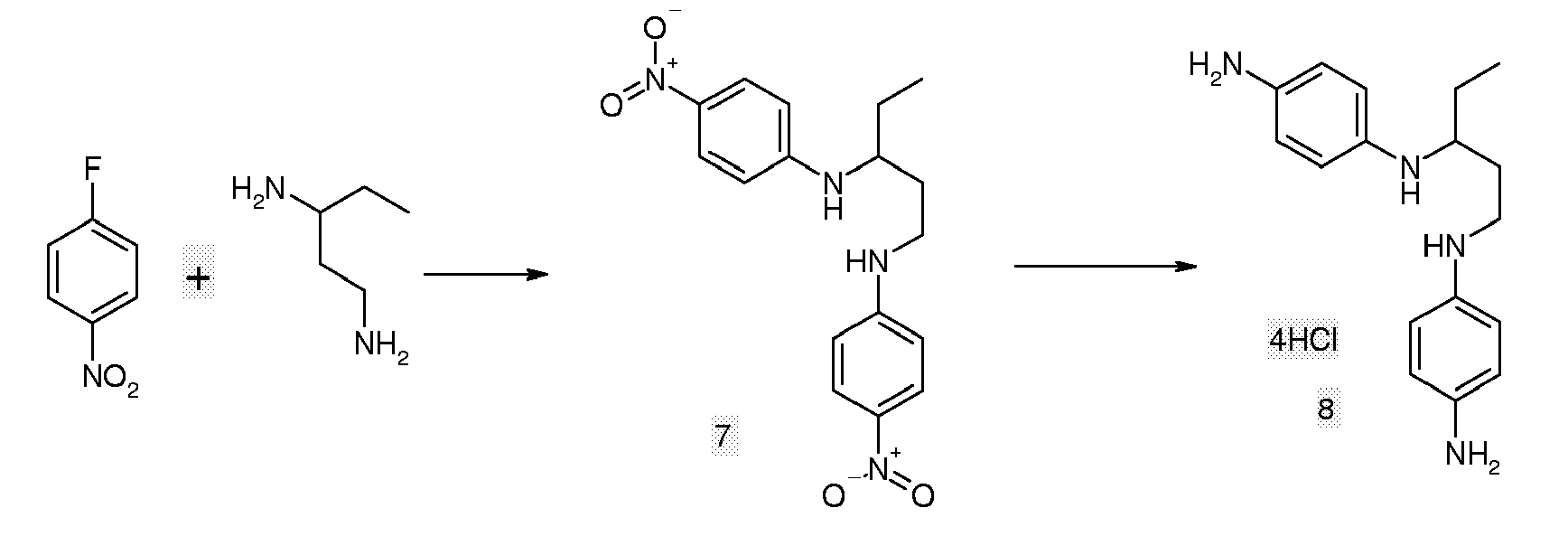
- 2,3 g de 4-fluoronitrobenzène (2 éq.) sont dissous dans 10 ml de DMSO. 1,2 équivalents de 3-amino-1-éthylpropylamine et 4 équivalents de triéthylamine sont ajoutés à la solution. Le milieu réactionnel est porté à 60°C pendant 16 heures. Le mélange est ensuite versé sur de la glace pilée, un précipité se forme. Ce dernier est filtré, lavé à l'eau, puis séché.
- La N,N'-bis(4-nitrophényl)pentane-1,3-diamine (7) obtenue lors de l'étape précédente est réduite avec un mélange zinc / chlorure d'ammonium / eau/ éthanol bouillant. L'amine correspondante est isolée sous forme de tétrachlorhydrate.
- Les spectres RMN du proton et de masse sont conformes à la structure attendue du produit.
-

- 2,3 g de 4-fluoronitrobenzène (2 éq.) sont dissous dans 10 ml de DMSO. 1,2 équivalent de 2-méthylpentane-1,5-diamine et 4 équivalents de triéthylamine sont ajoutés à la solution. Le milieu réactionnel est porté à 60°C pendant 20 heures. Le mélange est ensuite versé sur de la glace pilée, un précipité se forme. Ce dernier est filtré, lavé à l'eau, puis séché.
- La N-{2-méthyl-5-[(4-nitrophényl)amino]pentyl}-N-(4-nitrophényl) amine obtenue lors de l'étape précédente est réduite avec un mélange zinc / chlorure d'ammonium / eau/éthanol bouillant. L'amine correspondante est isolée sous forme de tétrachlorhydrate.
- Les spectres RMN du proton et de masse sont conformes à la structure attendue du produit.
- Les compositions tinctoriales suivantes sont préparées :


Chaque mélange obtenu est appliqué sur des mèches de cheveux gris à 90 % de blancs. Après 30 minutes de pose, les mèches sont rincées, lavées avec un shampooing standard, rincées à nouveau puis séchées. - Les nuances obtenues figurent dans le tableau ci-dessous :
Exemple 1 2 3 4 5 6 7 Nuance observée brun gris violet- rouge intense brun intense brun rouge intense brun rouge bleu intense violet intense - Les compositions tinctoriales suivantes sont préparées :

- Au moment de l'emploi, chaque composition est mélangée avec un poids égal d'eau oxygénée à 20 volumes (6% en poids). On obtient un pH final de 9,5.
- Chaque mélange obtenu est appliqué sur des mèches de cheveux gris à 90 % de blancs. Après 30 minutes de pose, les mèches sont rincées, lavées avec un shampooing standard, rincées à nouveau puis séchées.
- Les nuances obtenues figurent dans le tableau ci-dessous :
Exemple 8 9 40 11 12 13 14 Nuance observée brun gris violet intense rouge intense brun rouge intense violet-rouge intense bleu intense violet intense - Les compositions tinctoriales suivantes sont préparées :
Exemple 15 16 17 18 19 tétrachlorhydrate de la 2,2-diméthyl-N,N'-bis(3-méthyl-4-aminophényl)propane-1,3-diamine (4) 10-3 mole 10-3 mole 10-3 mole 10-3 mole 10-3 mole 5-Amino-2-méthyl-phénol 10-3 mole 1H-Indol-6-ol 10-3 mole 2-Amino-pyridin-3-ol 10-3 mole chlorhydrate du 2-(2,4-Diaminophénoxy)-éthanol 10-3 mole chlorhydrate du 3-Amino-2-chloro-6-méthyl-phénol 10-3 mole Support de teinture (1) (*) (*) (*) (*) (*) Eau déminéralisée q.s.p. 100g 100g 100g 100g 100g (*) : support de teinture (1) tel que défini précédemment - Au moment de l'emploi, chaque composition est mélangée avec un poids égal d'eau oxygénée à 20 volumes (6% en poids). On obtient un pH final de 7.
- Chaque mélange obtenu est appliqué sur des mèches de cheveux gris à 90 % de blancs. Après 30 minutes de pose, les mèches sont rincées, lavées avec un shampooing standard, rincées à nouveau puis séchées.
- Les nuances obtenues figurent dans le tableau ci-dessous :
Exemple 15 16 17 18 19 Nuance observée gris violet brun jaune bleu intense violet-bleu intense - Les compositions tinctoriales suivantes sont préparées :
Exemple 20 21 22 23 24 25 tétrachlorhydrate de la 2,2-diméthyl-N,N'-bis(3-métyl-4-aminophényl)propane-1,3-diamine(4) 10-3 mole 10-3 mole 10-3 mole 10-3 mole 10-3 mole 10-3 mole 5-Amino-2-méthyl-phenol 10-3 mole 1H-Indol-6-ol 10-3 mole 2-Amino-pyridin-3-ol 10-3 mole 3,6-Diméthyl-1H-pyrazolo[5,1-c][1,2,4]triazole 10-3 mole chlorhydrate du 2-(2,4-Diamino-phénoxy)- éthanol 10-3 mole chlorhydrate du 3-Amino- 2-chloro-6-methyl-phénol 10-3 mole Support de teinture (2) (*) (*) (*) (*) (*) (*) Eau déminéralisée q.s.p. 100g 100g 100g 100g 100g 100g (*) : support de teinture (2) tel que défini précédemment - Au moment de l'emploi, chaque composition est mélangée avec un poids égal d'eau oxygénée à 20 volumes (6% en poids). On obtient un pH final de 9,5.
- Chaque mélange obtenu est appliqué sur des mèches de cheveux gris à 90 % de blancs. Après 30 minutes de pose, les mèches sont rincées, lavées avec un shampooing standard, rincées à nouveau puis séchées.
- Les nuances obtenues figurent dans le tableau ci-dessous :
Exemple 20 21 22 23 24 25 Nuance observée violet intense rouge orange rouge bleu intense gris violet-bleu - Les compositions tinctoriales suivantes sont préparées :
Exemple 26 27 28 29 30 tétrachlorhydrate de la 2,2-diméthyl-N,N'-bis(2-méthyl-4- aminophényl)propane-1,3-diamine (6) 10-3 mole 10-3 mole 10-3 mole 10-3 mole 10-3 mole 5-Amino-2-méthyl-phénol 10-3 mole 1H-Indol-6-ol 10-3 mole 2-Amino-pyridin-3-ol 10-3 mole chlorhydrate du 2-(2,4-Diamino phénoxy)-éthanol 10-3 mole chlorhydrate du 3-Amino-2- chloro-6-méthyl-phénol 10-3 mole Support de teinture (1) (*) (*) (*) (*) (*) Eau déminéralisée q.s.p. 100g 100g 100g 100g 100g (*) : support de teinture (1) tel que défini précédemment - Au moment de l'emploi, chaque composition est mélangée avec un poids égal d'eau oxygénée à 20 volumes (6% en poids). On obtient un pH final de 7.
- Chaque mélange obtenu est appliqué sur des mèches de cheveux gris à 90 % de blancs. Après 30 minutes de pose, les mèches sont rincées, lavées avec un shampooing standard, rincées à nouveau puis séchées.
- Les nuances obtenues figurent dans le tableau ci-dessous :
Exemple 26 27 28 29 30 Nuance observée gris violet- rouge gris intense brun orangé bleu intense violet intense - Les compositions tinctoriales suivantes sont préparées :
Exemple 31 32 33 34 35 tétrachlorhydrate de 2,2-diméthyl-N,N'-bis(2-méthyl-4- aminophényl)propane-1,3-diamine (6) 10-3 mole 10-3 mole 10-3 mole 10-3 mole 10-3 mole 5-Amino-2-méthyl-phénol 10-3 mole 1H-Indol-6-ol 10-3 mole 2-Amino-pyridin-3-ol 10-3 mole chlorhydrate du 2-(2,4-Diaminophénoxy)-éthanol 10-3 Mole chlorhydrate du 3-Amino-2-chloro-6- méthyl-phénol 10-3 mole Support de teinture (2) (*) (*) (*) (*) (*) Eau déminéralisée q.s.p. 100g 100g 100g 100g 100g (*) : support de teinture (2) tel que défini précédemment - Au moment de l'emploi, chaque composition est mélangée avec un poids égal d'eau oxygénée à 20 volumes (6% en poids). On obtient un pH final de 9,5.
- Chaque mélange obtenu est appliqué sur des mèches de cheveux gris à 90% de blancs. Après 30 minutes de pose, les mèches sont rincées, lavées avec un shampooing standard, rincées à nouveau puis séchées.
- Les nuances obtenues figurent dans le tableau ci-dessous :
Exemple 31 32 33 34 35 Nuance observée violet-rouge brun rouge orangé bleu intense gris violet
Claims (21)
- Para-phénylènediamine de formule (I) suivante et ses sels d'addition correspondant :
 • R représente
un radical alkylène en C3-C15 ramifié,• R1 et R2 représentent, indépendamment l'un de l'autre,- un atome d'hydrogène,- un radical alkyle en C1-C6 linéaire ou ramifié,- un radical alkyle en C1-C6 linéaire ou ramifié substitué par un ou plusieurs radicaux hydroxy, alkoxy en C1-C4, amino, monoalkyl amino en C1-C4, dialkylamino en C1-C4,• R' et R" représentent, indépendamment l'un de l'autre,- un radical alkyle en C1-C6,- un radical alcoxy en C1-C6,- un radical hydroxy-alcoxy en C1-C6,- un radical alcoxy(C1-C6)alkyle en C1-C6,- un radical mono ou poly-hydroxy alkyle en C1-C6,• n et m représentent, indépendamment l'un de l'autre, un entier compris entre 0 et 4. - Para-phénylènediamine selon la revendication 1 dans laquelle les para-phénylènediamines de formule (I) sont telles que R est un radical alkylène ramifié en C4-C11.
- Para-phénylènediamine selon la revendication 1 ou 2 dans laquelle les para-phénylènediamines de formule (I) sont telles R1 et R2 représentent indépendamment un atome d'hydrogène ou un groupe alkyle en C1-C4 pouvant être substitué.
- Para-phénylènediamine selon l'une quelconque des revendications 1 à 3 dans laquelle les para-phénylènediamines de formule (I) sont choisies parmi :


- Para-phénylènediamine selon l'une quelconque des revendications 1 à 4, caractérisé en ce que les sels d'addition avec un acide des para-phénylènediamines de formule générale (I) sont choisis parmi l'acide chlorhydrique, l'acide bromhydrique, l'acide sulfurique, l'acide citrique, l'acide succinique, l'acide tartrique, l'acide lactique, l'acide para-toluènesulfonique, l'acide benzènesulfoniques, l'acide phosphorique et l'acide acétique , ces composés pouvant éventuellement être sous forme de solvates.
- Composition de coloration comprenant dans un milieu approprié à la teinture au moins une base d'oxydation du type para-phénylènediamine de formule (I) telle que définie à l'une quelconque des revendications 1 à 5.
- Composition selon la revendication 6 dans laquelle la quantité en para-phénylènediamine de formule (I) est comprise entre 0,0001 % et 20 % en poids par rapport au poids total de la composition, de préférence entre 0,01 % et 10 %.
- Composition selon la revendication 5, 6 ou 7 comprenant de plus au moins un coupleur d'oxydation.
- Composition selon la revendication 8 dans laquelle le coupleur d'oxydation est choisi parmi les méta-phénylènediamines, les méta-aminophénols, les méta-diphénols, les coupleurs naphtaléniques et les coupleurs hétérocycliques ainsi que leurs sels d'addition.
- Composition selon l'une quelconque des revendications 6 à 9 comprenant de plus au moins une base d'oxydation additionnelle différente des bases d'oxydation de formule (I).
- Composition selon la revendication 10 dans laquelle les bases d'oxydation peuvent être choisies parmi les para-phénylènediamines, les bis-phénylalkylènediamines, les para-aminophénols, les ortho-aminophénols et les bases hétérocycliques et leurs sels d'addition.
- Composition selon l'une quelconque des revendications 6 à 11 comprenant au moins un colorant direct.
- Composition selon l'une quelconque des revendications 6 à 12 dans laquelle le milieu approprié pour la teinture est constitué par de l'eau contenant éventuellement au moins un solvant organique.
- Composition selon la revendication 13 dans laquelle le solvant organique est choisi parmi les alcools inférieurs en C1-C4, ramifiés ou non, ainsi que les alcools aromatiques et leurs mélanges.
- Composition selon l'une quelconque des revendications 6 à 14 comprenant au moins un adjuvant cosmétique choisi parmi les agents anti-oxydants, les agents de pénétration, les agents séquestrants, les parfums, les tampons, les agents dispersants, les tensioactifs, les agents conditionneurs, les agents filmogènes, les polymères, les céramides, les agents conservateurs, les agents nacrants ou opacifiants, les vitamines ou provitamines.
- Composition selon la revendication 15 caractérisée en ce que la quantité en adjuvant cosmétique est comprise pour chacun d'eux entre 0,01 et 20% en poids par rapport au poids total de la composition.
- Composition selon l'une quelconque des revendications précédentes comprenant un agent oxydant.
- Procédé de teinture des fibres kératiniques caractérisée par le fait qu'on applique sur les fibres au moins une composition selon l'une quelconque des revendications 6 à 16 pendant une durée suffisante pour développer la coloration désirée en présence d'un agent oxydant.
- Dispositif à plusieurs compartiments dans lequel le premier compartiment contient une composition tinctoriale pour la coloration des fibres kératiniques telle que définie à l'une quelconque des revendications 6 à 18 et un deuxième compartiment contient un agent oxydant.
- Procédé de préparation des para-phénylènediamines de formule (I) par réduction des composés nitrés de formule (II) :

- Composé nitré de formule (II)

Applications Claiming Priority (1)
| Application Number | Priority Date | Filing Date | Title |
|---|---|---|---|
| FR0551807A FR2887874A1 (fr) | 2005-06-29 | 2005-06-29 | Nouvelles para-phenylenediamines doubles reliees par un groupe aliphatique ramifie et utilisation en coloration |
Publications (2)
| Publication Number | Publication Date |
|---|---|
| EP1739074A1 true EP1739074A1 (fr) | 2007-01-03 |
| EP1739074B1 EP1739074B1 (fr) | 2008-03-12 |
Family
ID=36218406
Family Applications (1)
| Application Number | Title | Priority Date | Filing Date |
|---|---|---|---|
| EP06116072A Expired - Lifetime EP1739074B1 (fr) | 2005-06-29 | 2006-06-26 | Nouvelles para-phénylènediamines doubles reliées par un groupe aliphatique ramifié et utilisation en coloration |
Country Status (6)
| Country | Link |
|---|---|
| EP (1) | EP1739074B1 (fr) |
| JP (1) | JP2007008942A (fr) |
| AT (1) | ATE388934T1 (fr) |
| DE (1) | DE602006000686T2 (fr) |
| ES (1) | ES2303718T3 (fr) |
| FR (1) | FR2887874A1 (fr) |
Citations (3)
| Publication number | Priority date | Publication date | Assignee | Title |
|---|---|---|---|---|
| FR2016123A1 (fr) * | 1968-08-02 | 1970-05-08 | Oreal | |
| WO2001072686A1 (fr) * | 2000-03-24 | 2001-10-04 | Wella Aktiengesellschaft | Derives de p-diaminobenzol et colorants contenant ces composes |
| WO2002006207A2 (fr) * | 2000-07-18 | 2002-01-24 | Henkel Kommanditgesellschaft Auf Aktien | Nouveaux copulants pour colorants d'oxydation |
Family Cites Families (1)
| Publication number | Priority date | Publication date | Assignee | Title |
|---|---|---|---|---|
| JPH0841329A (ja) * | 1994-07-27 | 1996-02-13 | Hitachi Chem Co Ltd | アクティブ光導波路用組成物、これを用いたアクティブ光導波路の製造法及びアクティブ光導波路 |
-
2005
- 2005-06-29 FR FR0551807A patent/FR2887874A1/fr active Pending
-
2006
- 2006-06-26 ES ES06116072T patent/ES2303718T3/es not_active Expired - Lifetime
- 2006-06-26 DE DE602006000686T patent/DE602006000686T2/de not_active Expired - Fee Related
- 2006-06-26 EP EP06116072A patent/EP1739074B1/fr not_active Expired - Lifetime
- 2006-06-26 AT AT06116072T patent/ATE388934T1/de not_active IP Right Cessation
- 2006-06-28 JP JP2006178546A patent/JP2007008942A/ja active Pending
Patent Citations (3)
| Publication number | Priority date | Publication date | Assignee | Title |
|---|---|---|---|---|
| FR2016123A1 (fr) * | 1968-08-02 | 1970-05-08 | Oreal | |
| WO2001072686A1 (fr) * | 2000-03-24 | 2001-10-04 | Wella Aktiengesellschaft | Derives de p-diaminobenzol et colorants contenant ces composes |
| WO2002006207A2 (fr) * | 2000-07-18 | 2002-01-24 | Henkel Kommanditgesellschaft Auf Aktien | Nouveaux copulants pour colorants d'oxydation |
Non-Patent Citations (1)
| Title |
|---|
| DATABASE CA [online] CHEMICAL ABSTRACTS SERVICE, COLUMBUS, OHIO, US; HAYASHIDA, SHIGERU ET AL: "heat-resistant active waveguide composition, its active waveguide, and its manufacture", XP002379768, retrieved from STN Database accession no. 1996:379311 * |
Also Published As
| Publication number | Publication date |
|---|---|
| ATE388934T1 (de) | 2008-03-15 |
| ES2303718T3 (es) | 2008-08-16 |
| DE602006000686D1 (de) | 2008-04-24 |
| JP2007008942A (ja) | 2007-01-18 |
| FR2887874A1 (fr) | 2007-01-05 |
| EP1739074B1 (fr) | 2008-03-12 |
| DE602006000686T2 (de) | 2009-03-19 |
Similar Documents
| Publication | Publication Date | Title |
|---|---|---|
| FR2866876A1 (fr) | Para-phenylenediamines secondaires n-alkylpolyhydroxylees, composition tinctoriales les comprenant, procedes et utilisations | |
| EP1488783B1 (fr) | Composition tinctoriale comprenant le 4,5-diamino-1-(bêta-hydroxyéthyl)-1H-pyrazole ou le 4,5-diamino-1-(bêta-méthoxyéthyl)-1H-pyrazole à titre de base d'oxydation et la 2,6-dihydroxy-3,4-diméthyl pyridine à titre de coupleur | |
| EP1739084B1 (fr) | Para-phénylènediamines doubles reliées par un bras de liaison comportant un radical cyclique saturé et utilisation en coloration | |
| EP2093226A1 (fr) | Nouvelles aminoindolizines, composition tinctoriale comprenant une aminoindolizine, procedes et utilisations | |
| EP1739074B1 (fr) | Nouvelles para-phénylènediamines doubles reliées par un groupe aliphatique ramifié et utilisation en coloration | |
| EP1568683B1 (fr) | Para-phenylenediamine secondaire n-alkylaminée, composition de teinture des fibres kératiniques contenant une tell paraphenylenediamine, procédé mettant en oeuvre cette composition et utilisations | |
| EP1550650A1 (fr) | P-phénylènediamine secondaire double particulière, composition tinctoriale la comprenant et procédé de coloration mettant en oeuvre la composition | |
| EP1739079A1 (fr) | Nouvelles para-phénylènediamines doubles reliées par un bras de liaison comportant un atome de soufre ou d'azote et utilisation en coloration | |
| US7422609B2 (en) | Double para-phenylenediamines joined by an aromatic group for dyeing keratin fibers | |
| FR2866874A1 (fr) | Para-phenylenediamine secondaire n-alkylhydroxylee, composition de teinture des fibres keratiniques contenant une telle para-phenylenediamine, procedes mettant en oeuvre cette composition et utilisations | |
| EP1618865A1 (fr) | Utilisation de composés polycationiques en teinture des fibres kératiniques | |
| EP1739085A1 (fr) | Compositions cosmétique contenant une para-phénylènediamines doubles reliées par un groupe aromatique et utilisation en coloration | |
| EP1589012A2 (fr) | Para-phénylènediamine secondaire N-alkylhétéroarylée, composition tinctoriale comprenant une telle para-phénylènediamine, procédé mettant en ouvre cette composition et utilisation | |
| EP1568694A1 (fr) | Para-phénylènediamines N-heteroarylées pour coloration de cheveux | |
| EP1568682A1 (fr) | Para-phénylènediamines secondaires N-alkylfluorées, composition tinctoriale les comprenant, procédés et utilisations | |
| EP1739076A1 (fr) | Nouvelles para-phénylènediamines doubles reliées par un bras de liaison substitué par un ou plusieurs radicaux carboxyliques et/ou dérivés et utilisation en coloration | |
| EP1739075A1 (fr) | Nouvelles para-phénylènediamines doubles reliées par un bras de liaison substitué par un ou plusieurs groupes hydroxy, alcoxy et/ou amino et utilisation en coloration | |
| FR2866878A1 (fr) | Para-phenylenediamines secondaires portant un groupement carboxy, composition tinctoriale les comprenant, procedes et utilisations | |
| EP1568684A1 (fr) | Para-phénylènediamines secondaires portant un groupe alcoxy, composition tinctoriale les comprenant, procédés et utilisations | |
| CA2486825A1 (fr) | P-phenylenediamine tertiaire particuliere, composition tinctoriale la comprenant et procede de coloration mettant en oeuvre la composition | |
| EP1568686A1 (fr) | Para-phénylénediamine secondaire n-alkylaminée ortho- et/ou méta-substituée, composition de teinture des fibres kératiniques contenant une telle paraphénylènediamine, procédés mettant en oeuvre cette composition et utilisations | |
| FR2831057A1 (fr) | Composition tintoriale comprenant une paraphenylenediamine, une paraaminophenol, le 1-n(b-hydroxyethyl) 4-hydroxy indole et un metaaminophenol ; procedes de teinture | |
| FR2860149A1 (fr) | Composition tinctoriale comprenant au moins une base paraphenylenediamine secondaire hydroxyalkylee, un coupleur et au moins un colorant direct particulier | |
| FR2913015A1 (fr) | Paraphenulenes diamines secondaires aliphatiques en coloration capillaire | |
| EP1568355A1 (fr) | Para-phénylènediamine secondaire n-alkylhydroxylée ortho- et/ou méta-substituée, composition de teinture des fibres kératiniques contenant une telle para-phénylènediamine, procédés mettant en oeuvre cette composition et utilisations |
Legal Events
| Date | Code | Title | Description |
|---|---|---|---|
| PUAI | Public reference made under article 153(3) epc to a published international application that has entered the european phase |
Free format text: ORIGINAL CODE: 0009012 |
|
| AK | Designated contracting states |
Kind code of ref document: A1 Designated state(s): AT BE BG CH CY CZ DE DK EE ES FI FR GB GR HU IE IS IT LI LT LU LV MC NL PL PT RO SE SI SK TR |
|
| AX | Request for extension of the european patent |
Extension state: AL BA HR MK YU |
|
| 17P | Request for examination filed |
Effective date: 20070703 |
|
| AKX | Designation fees paid |
Designated state(s): AT BE BG CH CY CZ DE DK EE ES FI FR GB GR HU IE IS IT LI LT LU LV MC NL PL PT RO SE SI SK TR |
|
| GRAP | Despatch of communication of intention to grant a patent |
Free format text: ORIGINAL CODE: EPIDOSNIGR1 |
|
| GRAS | Grant fee paid |
Free format text: ORIGINAL CODE: EPIDOSNIGR3 |
|
| GRAA | (expected) grant |
Free format text: ORIGINAL CODE: 0009210 |
|
| AK | Designated contracting states |
Kind code of ref document: B1 Designated state(s): AT BE BG CH CY CZ DE DK EE ES FI FR GB GR HU IE IS IT LI LT LU LV MC NL PL PT RO SE SI SK TR |
|
| REG | Reference to a national code |
Ref country code: GB Ref legal event code: FG4D Free format text: NOT ENGLISH |
|
| REG | Reference to a national code |
Ref country code: CH Ref legal event code: EP |
|
| REG | Reference to a national code |
Ref country code: IE Ref legal event code: FG4D Free format text: LANGUAGE OF EP DOCUMENT: FRENCH |
|
| REF | Corresponds to: |
Ref document number: 602006000686 Country of ref document: DE Date of ref document: 20080424 Kind code of ref document: P |
|
| PG25 | Lapsed in a contracting state [announced via postgrant information from national office to epo] |
Ref country code: FI Free format text: LAPSE BECAUSE OF FAILURE TO SUBMIT A TRANSLATION OF THE DESCRIPTION OR TO PAY THE FEE WITHIN THE PRESCRIBED TIME-LIMIT Effective date: 20080312 Ref country code: LT Free format text: LAPSE BECAUSE OF FAILURE TO SUBMIT A TRANSLATION OF THE DESCRIPTION OR TO PAY THE FEE WITHIN THE PRESCRIBED TIME-LIMIT Effective date: 20080312 |
|
| REG | Reference to a national code |
Ref country code: ES Ref legal event code: FG2A Ref document number: 2303718 Country of ref document: ES Kind code of ref document: T3 |
|
| PG25 | Lapsed in a contracting state [announced via postgrant information from national office to epo] |
Ref country code: AT Free format text: LAPSE BECAUSE OF FAILURE TO SUBMIT A TRANSLATION OF THE DESCRIPTION OR TO PAY THE FEE WITHIN THE PRESCRIBED TIME-LIMIT Effective date: 20080312 |
|
| NLV1 | Nl: lapsed or annulled due to failure to fulfill the requirements of art. 29p and 29m of the patents act | ||
| PG25 | Lapsed in a contracting state [announced via postgrant information from national office to epo] |
Ref country code: LV Free format text: LAPSE BECAUSE OF FAILURE TO SUBMIT A TRANSLATION OF THE DESCRIPTION OR TO PAY THE FEE WITHIN THE PRESCRIBED TIME-LIMIT Effective date: 20080312 Ref country code: PL Free format text: LAPSE BECAUSE OF FAILURE TO SUBMIT A TRANSLATION OF THE DESCRIPTION OR TO PAY THE FEE WITHIN THE PRESCRIBED TIME-LIMIT Effective date: 20080312 Ref country code: SI Free format text: LAPSE BECAUSE OF FAILURE TO SUBMIT A TRANSLATION OF THE DESCRIPTION OR TO PAY THE FEE WITHIN THE PRESCRIBED TIME-LIMIT Effective date: 20080312 |
|
| REG | Reference to a national code |
Ref country code: IE Ref legal event code: FD4D |
|
| PG25 | Lapsed in a contracting state [announced via postgrant information from national office to epo] |
Ref country code: CZ Free format text: LAPSE BECAUSE OF FAILURE TO SUBMIT A TRANSLATION OF THE DESCRIPTION OR TO PAY THE FEE WITHIN THE PRESCRIBED TIME-LIMIT Effective date: 20080312 Ref country code: SE Free format text: LAPSE BECAUSE OF FAILURE TO SUBMIT A TRANSLATION OF THE DESCRIPTION OR TO PAY THE FEE WITHIN THE PRESCRIBED TIME-LIMIT Effective date: 20080612 Ref country code: PT Free format text: LAPSE BECAUSE OF FAILURE TO SUBMIT A TRANSLATION OF THE DESCRIPTION OR TO PAY THE FEE WITHIN THE PRESCRIBED TIME-LIMIT Effective date: 20080818 Ref country code: SK Free format text: LAPSE BECAUSE OF FAILURE TO SUBMIT A TRANSLATION OF THE DESCRIPTION OR TO PAY THE FEE WITHIN THE PRESCRIBED TIME-LIMIT Effective date: 20080312 |
|
| PGFP | Annual fee paid to national office [announced via postgrant information from national office to epo] |
Ref country code: DE Payment date: 20080703 Year of fee payment: 3 Ref country code: ES Payment date: 20080717 Year of fee payment: 3 |
|
| PG25 | Lapsed in a contracting state [announced via postgrant information from national office to epo] |
Ref country code: NL Free format text: LAPSE BECAUSE OF FAILURE TO SUBMIT A TRANSLATION OF THE DESCRIPTION OR TO PAY THE FEE WITHIN THE PRESCRIBED TIME-LIMIT Effective date: 20080312 Ref country code: RO Free format text: LAPSE BECAUSE OF FAILURE TO SUBMIT A TRANSLATION OF THE DESCRIPTION OR TO PAY THE FEE WITHIN THE PRESCRIBED TIME-LIMIT Effective date: 20080312 |
|
| PGFP | Annual fee paid to national office [announced via postgrant information from national office to epo] |
Ref country code: FR Payment date: 20080617 Year of fee payment: 3 |
|
| BERE | Be: lapsed |
Owner name: L'OREAL Effective date: 20080630 |
|
| PG25 | Lapsed in a contracting state [announced via postgrant information from national office to epo] |
Ref country code: IS Free format text: LAPSE BECAUSE OF FAILURE TO SUBMIT A TRANSLATION OF THE DESCRIPTION OR TO PAY THE FEE WITHIN THE PRESCRIBED TIME-LIMIT Effective date: 20080712 |
|
| PLBE | No opposition filed within time limit |
Free format text: ORIGINAL CODE: 0009261 |
|
| STAA | Information on the status of an ep patent application or granted ep patent |
Free format text: STATUS: NO OPPOSITION FILED WITHIN TIME LIMIT |
|
| PG25 | Lapsed in a contracting state [announced via postgrant information from national office to epo] |
Ref country code: DK Free format text: LAPSE BECAUSE OF FAILURE TO SUBMIT A TRANSLATION OF THE DESCRIPTION OR TO PAY THE FEE WITHIN THE PRESCRIBED TIME-LIMIT Effective date: 20080312 Ref country code: MC Free format text: LAPSE BECAUSE OF NON-PAYMENT OF DUE FEES Effective date: 20080630 Ref country code: IE Free format text: LAPSE BECAUSE OF FAILURE TO SUBMIT A TRANSLATION OF THE DESCRIPTION OR TO PAY THE FEE WITHIN THE PRESCRIBED TIME-LIMIT Effective date: 20080312 |
|
| 26N | No opposition filed |
Effective date: 20081215 |
|
| PG25 | Lapsed in a contracting state [announced via postgrant information from national office to epo] |
Ref country code: BE Free format text: LAPSE BECAUSE OF NON-PAYMENT OF DUE FEES Effective date: 20080630 |
|
| PG25 | Lapsed in a contracting state [announced via postgrant information from national office to epo] |
Ref country code: BG Free format text: LAPSE BECAUSE OF FAILURE TO SUBMIT A TRANSLATION OF THE DESCRIPTION OR TO PAY THE FEE WITHIN THE PRESCRIBED TIME-LIMIT Effective date: 20080612 Ref country code: EE Free format text: LAPSE BECAUSE OF FAILURE TO SUBMIT A TRANSLATION OF THE DESCRIPTION OR TO PAY THE FEE WITHIN THE PRESCRIBED TIME-LIMIT Effective date: 20080312 |
|
| PG25 | Lapsed in a contracting state [announced via postgrant information from national office to epo] |
Ref country code: CY Free format text: LAPSE BECAUSE OF FAILURE TO SUBMIT A TRANSLATION OF THE DESCRIPTION OR TO PAY THE FEE WITHIN THE PRESCRIBED TIME-LIMIT Effective date: 20080312 |
|
| REG | Reference to a national code |
Ref country code: FR Ref legal event code: ST Effective date: 20100226 |
|
| PG25 | Lapsed in a contracting state [announced via postgrant information from national office to epo] |
Ref country code: FR Free format text: LAPSE BECAUSE OF NON-PAYMENT OF DUE FEES Effective date: 20090630 |
|
| PG25 | Lapsed in a contracting state [announced via postgrant information from national office to epo] |
Ref country code: DE Free format text: LAPSE BECAUSE OF NON-PAYMENT OF DUE FEES Effective date: 20100101 |
|
| PG25 | Lapsed in a contracting state [announced via postgrant information from national office to epo] |
Ref country code: LU Free format text: LAPSE BECAUSE OF NON-PAYMENT OF DUE FEES Effective date: 20080626 Ref country code: HU Free format text: LAPSE BECAUSE OF FAILURE TO SUBMIT A TRANSLATION OF THE DESCRIPTION OR TO PAY THE FEE WITHIN THE PRESCRIBED TIME-LIMIT Effective date: 20080913 |
|
| REG | Reference to a national code |
Ref country code: ES Ref legal event code: FD2A Effective date: 20090627 |
|
| PG25 | Lapsed in a contracting state [announced via postgrant information from national office to epo] |
Ref country code: TR Free format text: LAPSE BECAUSE OF FAILURE TO SUBMIT A TRANSLATION OF THE DESCRIPTION OR TO PAY THE FEE WITHIN THE PRESCRIBED TIME-LIMIT Effective date: 20080312 |
|
| PG25 | Lapsed in a contracting state [announced via postgrant information from national office to epo] |
Ref country code: ES Free format text: LAPSE BECAUSE OF NON-PAYMENT OF DUE FEES Effective date: 20090627 Ref country code: GR Free format text: LAPSE BECAUSE OF FAILURE TO SUBMIT A TRANSLATION OF THE DESCRIPTION OR TO PAY THE FEE WITHIN THE PRESCRIBED TIME-LIMIT Effective date: 20080613 |
|
| REG | Reference to a national code |
Ref country code: CH Ref legal event code: PL |
|
| GBPC | Gb: european patent ceased through non-payment of renewal fee |
Effective date: 20100626 |
|
| PG25 | Lapsed in a contracting state [announced via postgrant information from national office to epo] |
Ref country code: CH Free format text: LAPSE BECAUSE OF NON-PAYMENT OF DUE FEES Effective date: 20080630 Ref country code: LI Free format text: LAPSE BECAUSE OF NON-PAYMENT OF DUE FEES Effective date: 20080630 |
|
| PG25 | Lapsed in a contracting state [announced via postgrant information from national office to epo] |
Ref country code: CH Free format text: LAPSE BECAUSE OF NON-PAYMENT OF DUE FEES Effective date: 20100630 Ref country code: LI Free format text: LAPSE BECAUSE OF NON-PAYMENT OF DUE FEES Effective date: 20100630 |
|
| PG25 | Lapsed in a contracting state [announced via postgrant information from national office to epo] |
Ref country code: GB Free format text: LAPSE BECAUSE OF NON-PAYMENT OF DUE FEES Effective date: 20100626 |
|
| PGFP | Annual fee paid to national office [announced via postgrant information from national office to epo] |
Ref country code: IT Payment date: 20090630 Year of fee payment: 4 |