EP1736510A1 - Polylactic acid resin composition - Google Patents
Polylactic acid resin composition Download PDFInfo
- Publication number
- EP1736510A1 EP1736510A1 EP05721500A EP05721500A EP1736510A1 EP 1736510 A1 EP1736510 A1 EP 1736510A1 EP 05721500 A EP05721500 A EP 05721500A EP 05721500 A EP05721500 A EP 05721500A EP 1736510 A1 EP1736510 A1 EP 1736510A1
- Authority
- EP
- European Patent Office
- Prior art keywords
- polylactic acid
- acid resin
- salt
- resin composition
- metal salt
- Prior art date
- Legal status (The legal status is an assumption and is not a legal conclusion. Google has not performed a legal analysis and makes no representation as to the accuracy of the status listed.)
- Granted
Links
Images

Classifications
-
- C—CHEMISTRY; METALLURGY
- C08—ORGANIC MACROMOLECULAR COMPOUNDS; THEIR PREPARATION OR CHEMICAL WORKING-UP; COMPOSITIONS BASED THEREON
- C08L—COMPOSITIONS OF MACROMOLECULAR COMPOUNDS
- C08L67/00—Compositions of polyesters obtained by reactions forming a carboxylic ester link in the main chain; Compositions of derivatives of such polymers
- C08L67/04—Polyesters derived from hydroxycarboxylic acids, e.g. lactones
-
- C—CHEMISTRY; METALLURGY
- C08—ORGANIC MACROMOLECULAR COMPOUNDS; THEIR PREPARATION OR CHEMICAL WORKING-UP; COMPOSITIONS BASED THEREON
- C08K—Use of inorganic or non-macromolecular organic substances as compounding ingredients
- C08K5/00—Use of organic ingredients
- C08K5/49—Phosphorus-containing compounds
- C08K5/51—Phosphorus bound to oxygen
- C08K5/53—Phosphorus bound to oxygen bound to oxygen and to carbon only
-
- C—CHEMISTRY; METALLURGY
- C08—ORGANIC MACROMOLECULAR COMPOUNDS; THEIR PREPARATION OR CHEMICAL WORKING-UP; COMPOSITIONS BASED THEREON
- C08K—Use of inorganic or non-macromolecular organic substances as compounding ingredients
- C08K5/00—Use of organic ingredients
- C08K5/49—Phosphorus-containing compounds
- C08K5/51—Phosphorus bound to oxygen
- C08K5/53—Phosphorus bound to oxygen bound to oxygen and to carbon only
- C08K5/5313—Phosphinic compounds, e.g. R2=P(:O)OR'
-
- C—CHEMISTRY; METALLURGY
- C08—ORGANIC MACROMOLECULAR COMPOUNDS; THEIR PREPARATION OR CHEMICAL WORKING-UP; COMPOSITIONS BASED THEREON
- C08K—Use of inorganic or non-macromolecular organic substances as compounding ingredients
- C08K5/00—Use of organic ingredients
- C08K5/49—Phosphorus-containing compounds
- C08K5/51—Phosphorus bound to oxygen
- C08K5/53—Phosphorus bound to oxygen bound to oxygen and to carbon only
- C08K5/5317—Phosphonic compounds, e.g. R—P(:O)(OR')2
Definitions
- the present invention relates to a polylactic acid resin composition. More specifically, the present invention relates to a polylactic acid resin composition that has a high crystallization rate and is excellent in heat resistance and forming processability.
- polylactic acid is expected as molding materials, for example for packaging materials such as container, film or the like, fabric materials such as clothing, floor mat, interior material for automobile or the like, covers or parts of electric or electronic products, and the like, as it has a high melting point of 160 to 180°C, and is excellent in transparency.
- polylactic acid has a low crystallization rate, thus particularly in case where it is produced by injection molding in which orientation is not carried out, there are problems that the molded products are liable to have a low degree of crystallinity and deform at a temperature over glass transition temperature of about 60°C.
- the disclosed crystal nucleators for polylactic acid resins include inorganic particles composed of talc and/or boron nitride having a particle diameter of a specific level or less (see, Patent Document 1), amide compounds of a specific formula (see, Patent Document 2), sorbitol derivatives of specific formula (see, Patent Document 3), phosphoric acid ester metal salts and/or basic inorganic aluminum compounds (see, Patent Document 4), and the like.
- an object of the present invention is to provide a polylactic acid resin composition in which a crystal nucleator appropriate for accelerating crystallization of polylactic acid rein is added.
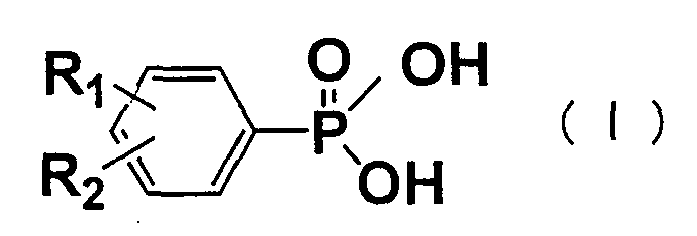
- a first aspect of the present invention is a polylactic acid resin composition comprising a polylactic acid resin, and a metal salt of a phosphorus compound of formula (I) wherein R 1 and R 2 may be the same or different and are hydrogen atom, C 1-10 alkyl or C 1-10 alkoxycarbonyl.
- R 1 and R 2 may be the same or different and are hydrogen atom, C 1-10 alkyl or C 1-10 alkoxycarbonyl.
- the addition of the metal salt of specific phosphorus compound as a crystal nucleator in a polylactic acid resin makes possible to improve the crystallization rate of the polylactic acid resin and to provide a polylactic acid resin composition excellent in heat resistance and forming processability.
- the polylactic acid resin in the present invention includes homopolymers or copolymers of polylactic acid. In addition, it may be blend polymers comprising homopolymers or copolymers of polylactic acid as a main component with other resins.
- the other resins include biodegradable resins other than polylactic acid, universally applicable synthetic resins, universally applicable synthetic engineering plastics, and the like.
- the arrangement style of the copolymer may be that in random copolymer, alternating copolymer, block copolymer or graft copolymer.
- the polylactic acid is not specifically limited, and includes for example one obtained by subjecting lactide to ring opening polymerization, or one obtained by directly subjecting D-form, L-form, racemate or the like of lactic acid to polycondensation.
- the number average molecular weight of polylactic acid is generally about 10,000 to 500,000.
- polylactic acid resins crosslinked with a crosslinking agent by use of heat, light, radiation or the like can be used.
- R 1 and R 2 in formula (I) in the phosphorus compound of the formula of the present invention include hydrogen atom, C 1-10 alkyl such as methyl, ethyl, n-propyl, i-propyl, n-butyl, i-butyl, t-butyl or the like, C 1-10 alkoxycarbonyl such as methoxycarbonyl, ethoxycarbonyl or the like. These substituents may be the same or different.
- phenyl phosphonic acid 4-methylphenyl phosphonic acid, 4-ethylphenyl phosphonic acid, 4-n-propylphenyl phosphonic acid, 4-i-propylphenyl phosphonic acid, 4-n-butylphenyl phosphonic acid, 4-i-butylphenyl phosphonic acid, 4-t-butylphenyl phosphonic acid, 3,5-dimethoxycarbonylphenyl phosphonic acid, 3,5-diethoxycarbonylphenyl phosphonic acid, 2,5-dimethoxycarbonylphenyl phosphonic acid, 2,5-diethoxycarbonylphenyl phosphonic acid, or the like.
- the substituents shown by R 3 , R 4 , R 5 and R 6 in formula (II) in the phosphorus compound of the formula of the present invention include hydrogen atom, C 1-10 alkyl such as methyl, ethyl, n-propyl, i-propyl, n-butyl, i-butyl, t-butyl or the like, C 1-10 alkoxycarbonyl such as methoxycarbonyl, ethoxycarbonyl or the like. These substituents may be the same or different.
- diphenyl phosphinic acid di-4-methylphenyl phosphinic acid, di-4-ethylphenyl phosphinic acid, di-4-t-butylphenyl phosphinic acid, di-3,5-dimethoxycarbonylphenyl phosphonic acid, di-3,5-diethoxycarbonylphenyl phosphinic acid, or the like.
- metal salts of the phosphorus compound of formula (I) or (II) of the present invention mono-, di- and tri-valent metals can be used. Two or more metals together can be used in these metal salts. Concrete examples of the metals include lithium, sodium, magnesium, aluminum, potassium, calcium, barium, copper, zinc, cobalt, nickel, or the like.
- the molar ratio between phosphorus compound of formula (I) or (II) and metal is not specifically limited and generally the molar ratio of phosphorus compound/metal preferably ranges from 1/2 to 2/1.
- the salt compound contains no free phosphorus compound or metal that does not form salt.
- the process for producing the metal salts of the phosphorus compound of formula (I) or (II) is not specifically limited, and generally the metal salts can be obtained by mixing a phosphorus compound and an oxide, a hydroxide or an organic acid salt of a metal in water or an organic solvent, and reacting them, then filtering off or distilling off water or the organic solvent, and drying as a crystalline powder. Also, the metal salts can be obtained by mixing a phosphorus compound, a chloride of a metal and sodium hydroxide in water, and reacting them to make a metal salt of the phosphorus compound precipitate, then filtering and drying. When these compounds are commercially available, the commercially available ones can be used.
- the added amount of the metal salt of the phosphorus compound of formula (I) or (II) is 0.01 to 10.0 mass parts, preferably 0.02 to 5.0 mass parts, further preferably 0.03 to 2.0 mass parts based on 100 mass parts of polylactic acid resin.
- the added amount is less than 0.01 mass part, it becomes difficult to fully improve the crystallization rate of polylactic acid resin.
- the crystallization rate is not further improved.
- the average particle diameter of the metal salt of the phosphorus compound of formula (I) or (II) is preferably 10 ⁇ m or less, more preferably 5 ⁇ m or less.
- the average particle diameter ( ⁇ m) is 50% volume diameter (median diameter) determined by measuring by laser diffraction and scattering method based on Mie Theory. The smaller the average particle diameter is, the better it is as the crystallization rate tends to be improved.
- the crystalline powder obtained according to the above-mentioned method can be subjected to a process with a mixing machine having shear force, such as a homomixer, Henschel mixer, Loedige mixer or the like, or a dry-type mill, such as a ball mill, a pindisc mill, a pulverizer, Inomizer, a counterjet mill or the like to obtain a fine powder, if necessary.
- a mixing machine having shear force such as a homomixer, Henschel mixer, Loedige mixer or the like
- a dry-type mill such as a ball mill, a pindisc mill, a pulverizer, Inomizer, a counterjet mill or the like to obtain a fine powder, if necessary.
- the crystalline powder can be subjected to a process with a wet-type mill such as a ball mill, a bead mill, a sand grinder, an attritor or the like by use of water, an organic solvent that can be mixed with water and a mixed solution thereof to obtain a fine powder.
- a wet-type mill such as a ball mill, a bead mill, a sand grinder, an attritor or the like by use of water, an organic solvent that can be mixed with water and a mixed solution thereof to obtain a fine powder.
- the lower limit of size of milled powder is 0.05 ⁇ m. Therefore, the average particle diameter of the metal salt of the phosphorus compound of formula (I) or (II) is preferably 0.05 to 10 ⁇ m, more preferably 0.05 to 5 ⁇ m.
- the method for adding the metal salt of the phosphorus compound of formula (I) or (II) in the polylactic acid resin in not specifically limited, and can be carried out by any known methods.
- the polylactic acid resin and each component may be individually mixed in several mixers, and kneaded with a single- or double- screw extruder, or the like. The kneading is generally carried out at a temperature of about 150 to 220°C.
- another process can be carried out in which a master batch containing each component in a high concentration is produced and added in the polylactic acid resin.
- the metal salt of the phosphorus compound of formula (I) or (II) can be added in the polymerization step of the polylactic acid resin.
- the polylactic acid resin composition of the present invention may contain any known inorganic fillers.
- the inorganic fillers include for example glass fiber, carbon fiber, talc, silica, kaolin, clay, wollastonite, glass bead, glass flake, potassium titanate, calcium carbonate, magnesium sulfate, titanium oxide or the like.
- the form of these inorganic fillers may be fibrous, granular, plate-like, needle-like, spherical or powdery.
- the inorganic filler can be used in an amount of 300 mass parts or less based on 100 mass parts of the polylactic acid resin.
- the polylactic acid resin composition of the present invention may contain any known flame retardants.
- the flame retardants include for example halogen-type flame retardants such as bromine- or chlorine-type flame retardants, etc., antimony-type flame retardants such as antimony trioxide, antimony pentaoxide or the like, inorganic flame retardants such as aluminum hydroxide or magnesium hydroxide, silicone-type compounds, etc., phosphorus-type flame retardants such as red phosphorus, phosphoric acid esters, ammonium polyphosphate, phosphazene or the like, melamine-type flame retardants such as melamine, melam, melem, melon, melamine cyanurate, melamine phosphate, melamine pyrophosphate, melamine polyphosphate, melamine melam melem polyphosphate double salt, melamine alkylphosphonate, melamine phenylphosphonate, melamine sulfate, melam methanesulfonate or
- the flame retardant can be used in an amount of 200 mass parts or less based on 100 mass parts of the polylactic acid resin.
- additives that are generally used in the production of general synthetic resins, for example heat stabilizers, light stabilizers, ultraviolet light absorbers, antioxidants, impact improvers, antistatic agents, pigments, colorants, die lubricants, lubricants, plasticizers, compatibilizing agents, blowing agents, perfumes, anti-bacterial and anti-fungus agents, several coupling agents such as silane-type, titanium-type, aluminum-type coupling agents, etc., and other crystal nucleators, and the like.
- the polylactic acid resin composition of the present invention is used for molding, several molded products can be easily produced by use of common molding process such as injection molding, blow molding, vacuum molding, compression molding or the like.
- a calorific value ⁇ H was determined from the area of calorific peak arising from crystallization of polylactic acid observed on cooling, and crystallization temperature T c was determined from the temperature of calorific peak apex.
- DSC measurement data is shown in Fig.1, and the results are shown in Table 1. Examples according to the present invention showed an increased calorific value accompanied with crystallization and an elevated crystallization temperature compared with Comparative Examples. Therefore, it is concluded that the composition of the present invention has an increased crystallization rate.
- Example 1 The procedures were carried out similarly to Example 1 except that talc (average particle diameter 3.5 ⁇ m) was used instead of magnesium phenylphosphonate synthesized in Synthetic Example 1. The results are shown in Table 1.
- Table 1 Crystal Nucleator ⁇ H(J/g) T c (°C)
- Example 1 Magnesium phenylphosphonate 41.6 128
- Example 2 Sodium phenylphosphonate 40.3 122
- Example 3 Zinc phenylphosphonate 42.1 131
- Example 4 Disodium 4-t-butylphenylphosphonate 42.2 128
- Example 5 Sodium diphenylphosphinate 37.7 113 Comparative Example 1 None No peak No peak Comparative Example 2 Talc 33.9 112
- the addition of the metal salt of specific phosphorus compound as a crystal nucleator in a polylactic acid resin makes possible to improve the crystallization rate of the polylactic acid resin and to provide a polylactic acid resin composition excellent in heat resistance and forming processability.
- Fig. 1 is DSC measurement data of Example 1.
- DSC [Differential scanning calorie] (mW) and TEMP [temperature] (°C) are shown on the ordinate, and time [Time] (min) is shown on the abscissa.
- 1 shows differential scanning calorie curve (DSC vs. Time)
- 2 shows temperature curve (TEMP vs. Time).
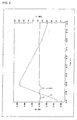
- Fig. 2 is DSC measurement data of Comparative Example 1.
- DSC [Differential scanning calorie] (mW) and TEMP [temperature] (°C) are shown on the ordinate, and time [Time] (min) is shown on the abscissa.
- 1 shows differential scanning calorie curve (DSC vs. Time)
- 2 shows temperature curve (TEMP vs. Time).
Landscapes
- Chemical & Material Sciences (AREA)
- Health & Medical Sciences (AREA)
- Chemical Kinetics & Catalysis (AREA)
- Medicinal Chemistry (AREA)
- Polymers & Plastics (AREA)
- Organic Chemistry (AREA)
- Compositions Of Macromolecular Compounds (AREA)
- Biological Depolymerization Polymers (AREA)
Abstract

Description
- The present invention relates to a polylactic acid resin composition. More specifically, the present invention relates to a polylactic acid resin composition that has a high crystallization rate and is excellent in heat resistance and forming processability.
- From the viewpoint of the conservation of natural environment, researches on aliphatic polyesters biodegradable in natural environment have been eagerly undertaken. Among them, polylactic acid is expected as molding materials, for example for packaging materials such as container, film or the like, fabric materials such as clothing, floor mat, interior material for automobile or the like, covers or parts of electric or electronic products, and the like, as it has a high melting point of 160 to 180°C, and is excellent in transparency. However, polylactic acid has a low crystallization rate, thus particularly in case where it is produced by injection molding in which orientation is not carried out, there are problems that the molded products are liable to have a low degree of crystallinity and deform at a temperature over glass transition temperature of about 60°C. In order to improve the degree of crystallinity, a process in which the mold temperature on injection molding is increased and the cooling time in the mold is elongated is attempted, but the process has a problem in productivity as a molding cycle is elongated. In order to produce polylactic acid resin compositions in a high productivity and use it for broad purpose, it is tried to increase crystallization rate and degree of crystallinity and improve forming processability and heat resistance.
- As a method for increasing the crystallization rate of polylactic acid resin, for example a process in which a crystal nucleator is added is known. The crystal nucleator accelerates crystal growth by becoming a primary crystal nucleus of crystalline polymer and lower the crystal size, and improves the crystallization rate at the same time. The disclosed crystal nucleators for polylactic acid resins include inorganic particles composed of talc and/or boron nitride having a particle diameter of a specific level or less (see, Patent Document 1), amide compounds of a specific formula (see, Patent Document 2), sorbitol derivatives of specific formula (see, Patent Document 3), phosphoric acid ester metal salts and/or basic inorganic aluminum compounds (see, Patent Document 4), and the like. These methods can improve the crystallization rate and the degree of crystallinity. However, in recent years, for the accomplishment of higher forming processability and heat resistance, it is desired to develop further effective crystal nuleators. In addition, it is known that metal salts of phosphonic acid, phosphonous acid or the like are effective as a crystal nucleator for block copolymeric poly(ether ester) (see, Patent Document 5).
- Patent Document 1:
JP-A-8-3432 (1996 - Patent Document 2:
JP-A-10-87975 (1998 - Patent Document 3:
JP-A-10-158369 (1998 - Patent Document 4:
JP-A-2003-192883 (2003 - Patent Document 5:
JP-A-58-108249 (1983 - As mentioned above, it is desired to develop crystal nucleators effective for improving forming processability and heat resistance for the production of polylactic acid resin compositions in a high productivity and the utilization for broad purpose. Therefore, an object of the present invention is to provide a polylactic acid resin composition in which a crystal nucleator appropriate for accelerating crystallization of polylactic acid rein is added.
- The object of the present invention is accomplished by the following means. A first aspect of the present invention is a polylactic acid resin composition comprising a polylactic acid resin, and a metal salt of a phosphorus compound of formula (I)

Now, preferred embodiments of the first aspect are as follows. - the metal salt is one or more selected from the group consisting of lithium salt, sodium salt, potassium salt, calcium salt, magnesium salt and zinc salt;
- the metal salt of the phosphorus compound of formula (I) is contained in an amount of 0.01 to 10.0 mass parts based on 100 mass parts of the polylactic acid resin; and
- the average particle diameter of the metal salt is 0.05 to 10 µm, preferably 0.05 to 5 µm.
- the metal salt is one or more selected from the group consisting of lithium salt, sodium salt, potassium salt, calcium salt, magnesium salt and zinc salt;
- the metal salt of the phosphorus compound of formula (II) is contained in an amount of 0.01 to 10.0 mass parts based on 100 mass parts of the polylactic acid resin; and
- the average particle diameter of the metal salt is 0.05 to 10 µm, preferably 0.05 to 5 µm.
- The addition of the metal salt of specific phosphorus compound as a crystal nucleator in a polylactic acid resin makes possible to improve the crystallization rate of the polylactic acid resin and to provide a polylactic acid resin composition excellent in heat resistance and forming processability.
- The polylactic acid resin in the present invention includes homopolymers or copolymers of polylactic acid. In addition, it may be blend polymers comprising homopolymers or copolymers of polylactic acid as a main component with other resins. The other resins include biodegradable resins other than polylactic acid, universally applicable synthetic resins, universally applicable synthetic engineering plastics, and the like. In case where the polylactic acid resin is a copolymer, the arrangement style of the copolymer may be that in random copolymer, alternating copolymer, block copolymer or graft copolymer.
- The polylactic acid is not specifically limited, and includes for example one obtained by subjecting lactide to ring opening polymerization, or one obtained by directly subjecting D-form, L-form, racemate or the like of lactic acid to polycondensation. The number average molecular weight of polylactic acid is generally about 10,000 to 500,000. Also, polylactic acid resins crosslinked with a crosslinking agent by use of heat, light, radiation or the like can be used.
- The substituents shown by R1 and R2 in formula (I) in the phosphorus compound of the formula of the present invention include hydrogen atom, C1-10alkyl such as methyl, ethyl, n-propyl, i-propyl, n-butyl, i-butyl, t-butyl or the like, C1-10alkoxycarbonyl such as methoxycarbonyl, ethoxycarbonyl or the like. These substituents may be the same or different. Concrete examples are phenyl phosphonic acid, 4-methylphenyl phosphonic acid, 4-ethylphenyl phosphonic acid, 4-n-propylphenyl phosphonic acid, 4-i-propylphenyl phosphonic acid, 4-n-butylphenyl phosphonic acid, 4-i-butylphenyl phosphonic acid, 4-t-butylphenyl phosphonic acid, 3,5-dimethoxycarbonylphenyl phosphonic acid, 3,5-diethoxycarbonylphenyl phosphonic acid, 2,5-dimethoxycarbonylphenyl phosphonic acid, 2,5-diethoxycarbonylphenyl phosphonic acid, or the like.
- The substituents shown by R3, R4, R5 and R6 in formula (II) in the phosphorus compound of the formula of the present invention include hydrogen atom, C1-10alkyl such as methyl, ethyl, n-propyl, i-propyl, n-butyl, i-butyl, t-butyl or the like, C1-10alkoxycarbonyl such as methoxycarbonyl, ethoxycarbonyl or the like. These substituents may be the same or different. Concrete examples are diphenyl phosphinic acid, di-4-methylphenyl phosphinic acid, di-4-ethylphenyl phosphinic acid, di-4-t-butylphenyl phosphinic acid, di-3,5-dimethoxycarbonylphenyl phosphonic acid, di-3,5-diethoxycarbonylphenyl phosphinic acid, or the like.
- For the metal salts of the phosphorus compound of formula (I) or (II) of the present invention, mono-, di- and tri-valent metals can be used. Two or more metals together can be used in these metal salts. Concrete examples of the metals include lithium, sodium, magnesium, aluminum, potassium, calcium, barium, copper, zinc, cobalt, nickel, or the like.
The molar ratio between phosphorus compound of formula (I) or (II) and metal is not specifically limited and generally the molar ratio of phosphorus compound/metal preferably ranges from 1/2 to 2/1. In addition, it is preferable that the salt compound contains no free phosphorus compound or metal that does not form salt. - The process for producing the metal salts of the phosphorus compound of formula (I) or (II) is not specifically limited, and generally the metal salts can be obtained by mixing a phosphorus compound and an oxide, a hydroxide or an organic acid salt of a metal in water or an organic solvent, and reacting them, then filtering off or distilling off water or the organic solvent, and drying as a crystalline powder. Also, the metal salts can be obtained by mixing a phosphorus compound, a chloride of a metal and sodium hydroxide in water, and reacting them to make a metal salt of the phosphorus compound precipitate, then filtering and drying. When these compounds are commercially available, the commercially available ones can be used.
- The added amount of the metal salt of the phosphorus compound of formula (I) or (II) is 0.01 to 10.0 mass parts, preferably 0.02 to 5.0 mass parts, further preferably 0.03 to 2.0 mass parts based on 100 mass parts of polylactic acid resin. When the added amount is less than 0.01 mass part, it becomes difficult to fully improve the crystallization rate of polylactic acid resin. On the other hand, even when the added amount is more than 10 mass parts, the crystallization rate is not further improved.
- The average particle diameter of the metal salt of the phosphorus compound of formula (I) or (II) is preferably 10 µm or less, more preferably 5 µm or less. In this specification, the average particle diameter (µm) is 50% volume diameter (median diameter) determined by measuring by laser diffraction and scattering method based on Mie Theory. The smaller the average particle diameter is, the better it is as the crystallization rate tends to be improved.
- In order to obtain the metal salt of the phosphorus compound of formula (I) or (II) having an average particle diameter of 10 µm or less, the crystalline powder obtained according to the above-mentioned method can be subjected to a process with a mixing machine having shear force, such as a homomixer, Henschel mixer, Loedige mixer or the like, or a dry-type mill, such as a ball mill, a pindisc mill, a pulverizer, Inomizer, a counterjet mill or the like to obtain a fine powder, if necessary. Also, the crystalline powder can be subjected to a process with a wet-type mill such as a ball mill, a bead mill, a sand grinder, an attritor or the like by use of water, an organic solvent that can be mixed with water and a mixed solution thereof to obtain a fine powder. The lower limit of size of milled powder is 0.05 µm. Therefore, the average particle diameter of the metal salt of the phosphorus compound of formula (I) or (II) is preferably 0.05 to 10 µm, more preferably 0.05 to 5 µm.
- In the present invention, the method for adding the metal salt of the phosphorus compound of formula (I) or (II) in the polylactic acid resin in not specifically limited, and can be carried out by any known methods. For example, the polylactic acid resin and each component may be individually mixed in several mixers, and kneaded with a single- or double- screw extruder, or the like. The kneading is generally carried out at a temperature of about 150 to 220°C. Also, another process can be carried out in which a master batch containing each component in a high concentration is produced and added in the polylactic acid resin. Further, the metal salt of the phosphorus compound of formula (I) or (II) can be added in the polymerization step of the polylactic acid resin.
- The polylactic acid resin composition of the present invention may contain any known inorganic fillers. The inorganic fillers include for example glass fiber, carbon fiber, talc, silica, kaolin, clay, wollastonite, glass bead, glass flake, potassium titanate, calcium carbonate, magnesium sulfate, titanium oxide or the like. The form of these inorganic fillers may be fibrous, granular, plate-like, needle-like, spherical or powdery. The inorganic filler can be used in an amount of 300 mass parts or less based on 100 mass parts of the polylactic acid resin.
- The polylactic acid resin composition of the present invention may contain any known flame retardants. The flame retardants include for example halogen-type flame retardants such as bromine- or chlorine-type flame retardants, etc., antimony-type flame retardants such as antimony trioxide, antimony pentaoxide or the like, inorganic flame retardants such as aluminum hydroxide or magnesium hydroxide, silicone-type compounds, etc., phosphorus-type flame retardants such as red phosphorus, phosphoric acid esters, ammonium polyphosphate, phosphazene or the like, melamine-type flame retardants such as melamine, melam, melem, melon, melamine cyanurate, melamine phosphate, melamine pyrophosphate, melamine polyphosphate, melamine melam melem polyphosphate double salt, melamine alkylphosphonate, melamine phenylphosphonate, melamine sulfate, melam methanesulfonate or the like, fluororesin such as PTFE or the like. The flame retardant can be used in an amount of 200 mass parts or less based on 100 mass parts of the polylactic acid resin.
In addition to the above-mentioned components, there can be used together several additives that are generally used in the production of general synthetic resins, for example heat stabilizers, light stabilizers, ultraviolet light absorbers, antioxidants, impact improvers, antistatic agents, pigments, colorants, die lubricants, lubricants, plasticizers, compatibilizing agents, blowing agents, perfumes, anti-bacterial and anti-fungus agents, several coupling agents such as silane-type, titanium-type, aluminum-type coupling agents, etc., and other crystal nucleators, and the like.
When the polylactic acid resin composition of the present invention is used for molding, several molded products can be easily produced by use of common molding process such as injection molding, blow molding, vacuum molding, compression molding or the like. - Hereinafter, the present invention is described in more detail according to examples and comparative examples.
- 1.58 g (10.0 mmol) of phenylphosphonic acid (manufactured by Nissan Chemical industries, Ltd.), 0.583 g (10.0 mmol) of magnesium hydroxide and 41 g of water were mixed, stirred at 80°C for 3 hours, then water was distilled off under reduced pressure and dried at 200°C to obtain 1.78 g (yield 99%) of the aimed product as white crystal. Decomposition temperature: 524°C.
- In 1.58 g (10.0 mmol) of phenylphosphonic acid (manufactured by Nissan Chemical industries, Ltd.), 20 mL (10.0 mmol) of 0.5 N sodium hydroxide was added, stirred at room temperature for 10 minutes, then water was distilled off under reduced pressure and dried to obtain 1.78 g (yield 99%) of the aimed product as white crystal. Decomposition temperature: 480°C.
- 1.58 g (10.0 mmol) of phenylphosphonic acid (manufactured by Nissan Chemical industries, Ltd.), 2.20 g (10.0 mmol) of zinc acetate dihydrate and 72 g of water were mixed, stirred at 80°C for 3 hours, then the resulting slurry was filtered, acetic acid in the wet cake was fully washed away with water, and thereafter, dried at 150°C to obtain 2.17 g (yield 98%) of the aimed product as white crystal. Decomposition temperature: 541°C. The average particle diameter was 4.4 µm with a laser diffraction type particle size distribution meter (manufactured by Seishin Enterprise Co., Ltd., PRO-7000S).
- In a flask, 50.0 g (234 mmol) of 1-bromo-4-t-butylbenzene (manufactured by Tokyo Kasei Kogyo Co., Ltd., product number B1727), 77.6 g (468 mmol) of triethyl phosphonate and 3.3 g (19 mmol) of palladium chloride were placed, and the reaction solution was refluxed at 150°C. After 7 hours, heating was stopped, cooled to room temperature, then extracted with 1,2-dichloroethane, thereafter the extract was washed with water, the organic phase was concentrated to obtain crude diethyl 4-t-butylphenyl phosphonate.
Next, 220 g (2.1 mol) of concentrated hydrochloric acid was added in the obtained crude diethyl 4-t-butylphenyl phosphonate mixture, and heated at 110°C. After 12 hours, heating was stopped, cooled to room temperature. The reaction mixture was dissolved in ethanol, filtered, thereby palladium compounds were removed. The filtrate was concentrated as such and dried under vacuum to obtain 18.7 g of 4-t-butylphenyl phosphophonic acid being the aimed compound (melting point 193-194°C, white solid, yield 37% (yield from 1-bromo-4-t-butylbenzene).
8.50 g (39.7 mmol) of the obtained 4-t-butylphenyl phosphonic acid was added and dissolved in a mixed solution of 150 mL of water and 50 mL of methanol. In the resulting solution, an aqueous solution of 3.18 g (79.4 mmol) of sodium hydroxide in 50 mL of water was added dropwise, and stirred at room temperature for 2 hours. Thereafter the solvent was distilled off under reduced pressure and dried to obtain 10.3 g (yield 100%) of the aimed product as white crystal. Decomposition temperature: 484°C. - In 2.18 g (10.0 mmol) of diphenylphosphinic acid (manufactured by Aldrich Inc., Product No. 10, 852-9), 20 mL (10.0 mmol) of 0.5 N sodium hydroxide was added, stirred at room temperature for 10 minutes, then water was distilled off under reduced pressure. The obtained solid was washed with a small amount of methanol and dried to obtain 2.35 g (yield 98%) of the aimed product as white crystal. Decomposition temperature: 469°C.
- In a glass ball mill container having a volume of 900 mL, 1000 g of 1 mmφ zirconia beads were charged, further 17.0 g (108 mmol) of phenylphosphonic acid (manufactured by Nissan Chemical industries, Ltd.), 8.78 g (108 mmol) of zinc oxide and 231 g of water were mixed, stirred at 170 rpm for 20 hours at room temperature. Then the slurry was separated from zirconia beads, and the separated slurry was filtered, and the wet cake was fully washed with water. Thereafter, the slurry was dried at 150°C to obtain 23.4 g (yield 98%) of the aimed product as white crystal.
The average particle diameter was 1.1 µm with a laser diffraction type particle size distribution meter (manufactured by Seishin Enterprise Co., Ltd., PRO-7000S). - In 5 mass% solution of polylactic acid (number average molecular weight 72,000, melting point 164°C) in chloroform, magnesium phenylphosphonate synthesized in Synthetic Example 1 was added in an amount of 1 mass% based on the amount of polylactic acid, and dispersed homogeneously. Then, from the resulting solution, chloroform was vaporized at 50°C on a petri dish to obtain a sample in a form of film. The sample was cut into small pieces, the temperature was raised to 200°C at 10°C/min., and kept at the status for 5 minutes, and then DSC measurement (manufactured by Seiko Instruments Inc:, DSC-200) was carried out by cooling at 2°C/min. A calorific value ΔH was determined from the area of calorific peak arising from crystallization of polylactic acid observed on cooling, and crystallization temperature Tc was determined from the temperature of calorific peak apex. DSC measurement data is shown in Fig.1, and the results are shown in Table 1. Examples according to the present invention showed an increased calorific value accompanied with crystallization and an elevated crystallization temperature compared with Comparative Examples. Therefore, it is concluded that the composition of the present invention has an increased crystallization rate.
- The procedures were carried out similarly to Example 1 except that sodium phenylphosphonate synthesized in Synthetic Example 2 was used instead of magnesium phenylphosphonate synthesized in Synthetic Example 1. The results are shown in Table 1.
- The procedures were carried out similarly to Example 1 except that zinc phenylphosphonate synthesized in Synthetic Example 3 was used instead of magnesium phenylphosphonate synthesized in Synthetic Example 1. The results are shown in Table 1.
- The procedures were carried out similarly to Example 1 except that disodium 4-t-butylphenylphosphonate synthesized in Synthetic Example 4 was used instead of magnesium phenylphosphonate synthesized in Synthetic Example 1. The results are shown in Table 1.
- The procedures were carried out similarly to Example 1 except that sodium diphenylphosphinate synthesized in Synthetic Example 5 was used instead of magnesium phenylphosphonate synthesized in Synthetic Example 1. The results are shown in Table 1.
- The procedures were carried out similarly to Example 1 except that zinc phenylphosphonate synthesized in Synthetic Example 6 was used instead of magnesium phenylphosphonate synthesized in Synthetic Example 1. The calorific value ΔH was 43.7 (J/g) and the crystallization temperature Tc was 133°C.
- The procedures were carried out similarly to Example 1 except that magnesium phenylphosphonate synthesized in Synthetic Example 1 was not used. DSC measurement data is shown in Fig. 2. The results are shown in Table 1.
- The procedures were carried out similarly to Example 1 except that talc (average particle diameter 3.5 µm) was used instead of magnesium phenylphosphonate synthesized in Synthetic Example 1. The results are shown in Table 1.
Table 1 Crystal Nucleator ΔH(J/g) Tc(°C) Example 1 Magnesium phenylphosphonate 41.6 128 Example 2 Sodium phenylphosphonate 40.3 122 Example 3 Zinc phenylphosphonate 42.1 131 Example 4 Disodium 4-t-butylphenylphosphonate 42.2 128 Example 5 Sodium diphenylphosphinate 37.7 113 Comparative Example 1 None No peak No peak Comparative Example 2 Talc 33.9 112 - The addition of the metal salt of specific phosphorus compound as a crystal nucleator in a polylactic acid resin makes possible to improve the crystallization rate of the polylactic acid resin and to provide a polylactic acid resin composition excellent in heat resistance and forming processability.
- Fig. 1 is DSC measurement data of Example 1. DSC [Differential scanning calorie] (mW) and TEMP [temperature] (°C) are shown on the ordinate, and time [Time] (min) is shown on the abscissa. In addition, 1 shows differential scanning calorie curve (DSC vs. Time), and 2 shows temperature curve (TEMP vs. Time). Fig. 2 is DSC measurement data of Comparative Example 1. DSC [Differential scanning calorie] (mW) and TEMP [temperature] (°C) are shown on the ordinate, and time [Time] (min) is shown on the abscissa. In addition, 1 shows differential scanning calorie curve (DSC vs. Time), and 2 shows temperature curve (TEMP vs. Time).

Now, preferred embodiments of the second aspect are as follows.
Claims (8)
- A polylactic acid resin composition comprising a polylactic acid resin, and a metal salt of a phosphorus compound of formula (I)

- The polylactic acid resin composition according to claim 1, wherein the metal salt is one or more selected from the group consisting of lithium salt, sodium salt, potassium salt, calcium salt, magnesium salt and zinc salt.
- The polylactic acid resin composition according to claim 1, wherein the metal salt of the phosphorus compound of formula (I) is contained in an amount of 0.01 to 10.0 mass parts based on 100 mass parts of the polylactic acid resin.
- The polylactic acid resin composition according to claim 1, wherein the average particle diameter of the metal salt is 0.05 to 10 µm.
- A polylactic acid resin composition comprising a polylactic acid resin, and a metal salt of a phosphorus compound of formula (II)

- The polylactic acid resin composition according to claim 5, wherein the metal salt is one or more selected from the group consisting of lithium salt, sodium salt, potassium salt, calcium salt, magnesium salt and zinc salt.
- The polylactic acid resin composition according to claim 5, wherein the metal salt of the phosphorus compound of formula (II) is contained in an amount of 0.01 to 10.0 mass parts based on 100 mass parts of the polylactic acid resin.
- The polylactic acid resin composition according to claim 5, wherein the average particle diameter of the metal salt is 0.05 to 10 µm.
Priority Applications (1)
| Application Number | Priority Date | Filing Date | Title |
|---|---|---|---|
| PL05721500T PL1736510T3 (en) | 2004-03-30 | 2005-03-25 | Polylactic acid resin composition |
Applications Claiming Priority (2)
| Application Number | Priority Date | Filing Date | Title |
|---|---|---|---|
| JP2004097361 | 2004-03-30 | ||
| PCT/JP2005/005573 WO2005097894A1 (en) | 2004-03-30 | 2005-03-25 | Polylactic acid resin composition |
Publications (3)
| Publication Number | Publication Date |
|---|---|
| EP1736510A1 true EP1736510A1 (en) | 2006-12-27 |
| EP1736510A4 EP1736510A4 (en) | 2008-05-21 |
| EP1736510B1 EP1736510B1 (en) | 2011-12-21 |
Family
ID=35125027
Family Applications (1)
| Application Number | Title | Priority Date | Filing Date |
|---|---|---|---|
| EP05721500A Expired - Lifetime EP1736510B1 (en) | 2004-03-30 | 2005-03-25 | Polylactic acid resin composition |
Country Status (10)
| Country | Link |
|---|---|
| US (1) | US7531585B2 (en) |
| EP (1) | EP1736510B1 (en) |
| JP (1) | JP4973848B2 (en) |
| KR (1) | KR101152973B1 (en) |
| CN (1) | CN100384937C (en) |
| AT (1) | ATE538176T1 (en) |
| ES (1) | ES2379361T3 (en) |
| PL (1) | PL1736510T3 (en) |
| TW (1) | TWI382056B (en) |
| WO (1) | WO2005097894A1 (en) |
Cited By (3)
| Publication number | Priority date | Publication date | Assignee | Title |
|---|---|---|---|---|
| EP2006331A4 (en) * | 2006-03-31 | 2010-08-04 | Teijin Ltd | POLYLACTIC ACID COMPOSITION |
| EP2479181A4 (en) * | 2009-09-09 | 2014-01-15 | Nissan Chemical Ind Ltd | Method for producing phosphonic acid metal salt and thermoplastic resin composition containing phosphonic acid metal salt |
| US8835542B2 (en) | 2009-04-30 | 2014-09-16 | Milliken & Company | Nucleating agent and thermoplastic compositions comprising the same |
Families Citing this family (49)
| Publication number | Priority date | Publication date | Assignee | Title |
|---|---|---|---|---|
| JP2006089587A (en) * | 2004-09-24 | 2006-04-06 | Toyo Ink Mfg Co Ltd | Resin composition for lactic acid resin and use thereof |
| BRPI0717280A2 (en) | 2006-10-11 | 2013-10-22 | Kao Corp | BIODEGRADABLE RESIN COMPOSITION |
| CN101522800B (en) * | 2006-10-11 | 2012-05-30 | 花王株式会社 | Biodegradable resin composition |
| JP2008143989A (en) * | 2006-12-07 | 2008-06-26 | Kisco Ltd | Polylactic acid composition having excellent heat resistance and molding cycle property |
| JP4130696B2 (en) * | 2006-12-19 | 2008-08-06 | 花王株式会社 | Biodegradable resin composition |
| US8030382B2 (en) * | 2007-02-23 | 2011-10-04 | Teijin Limited | Polylactic acid composition |
| FR2919823B1 (en) * | 2007-08-10 | 2010-03-19 | Oblique L | SUSPENDED BACKREST LABEL HOLDER AND SUSPENDED BACKREST EQUIPPED WITH SUCH A LABEL HOLDER |
| US8926876B2 (en) | 2007-08-15 | 2015-01-06 | University Of Washington Through Its Center For Commercialization | Method for making shapeable microcellular poly lactic acid articles |
| CN101801636B (en) | 2007-09-12 | 2013-01-09 | 花王株式会社 | Process for production of injection-molded article of polylactic acid resin |
| JP4530426B2 (en) * | 2007-09-12 | 2010-08-25 | 花王株式会社 | Method for producing polylactic acid resin injection molded body |
| JP4530427B2 (en) * | 2007-09-12 | 2010-08-25 | 花王株式会社 | Method for producing polylactic acid resin injection molded body |
| JP5254632B2 (en) * | 2008-02-07 | 2013-08-07 | 富士フイルム株式会社 | Ink composition, inkjet recording method, printed matter, and molded printed matter |
| JP5009218B2 (en) * | 2008-04-08 | 2012-08-22 | 花王株式会社 | Polylactic acid resin composition |
| JP5435977B2 (en) * | 2008-04-08 | 2014-03-05 | 花王株式会社 | Polylactic acid resin composition |
| JP5583912B2 (en) * | 2008-04-28 | 2014-09-03 | 花王株式会社 | Method for producing polylactic acid resin composition |
| JP5495722B2 (en) * | 2008-11-07 | 2014-05-21 | 孝一郎 米竹 | Method for producing oriented polylactic acid resin material |
| JP5375046B2 (en) * | 2008-11-25 | 2013-12-25 | 東レ株式会社 | Manufacturing method of fiber board |
| CN101423625B (en) * | 2008-12-03 | 2011-05-04 | 浙江海正生物材料股份有限公司 | Rapid nucleating agent of polylactic resin |
| WO2010108076A2 (en) | 2009-03-19 | 2010-09-23 | Jeffrey Jacob Cernohous | Biobased polymer compositions |
| KR101778587B1 (en) | 2009-05-12 | 2017-09-14 | 닛산 가가쿠 고교 가부시키 가이샤 | Method for producing phosphonic acid metal salt fine particles |
| US20110196077A1 (en) * | 2009-09-09 | 2011-08-11 | Nissan Chemical Industries, Ltd. | Production process of phosphonic acid metal salt and thermoplastic resin composition containing phosphonic acid metal salt |
| JP5477567B2 (en) * | 2009-11-06 | 2014-04-23 | 日産化学工業株式会社 | Polylactic acid resin composition |
| CN102753621A (en) * | 2010-02-02 | 2012-10-24 | 花王株式会社 | Process for production of polylactic acid resin composition |
| US9403955B2 (en) * | 2010-03-30 | 2016-08-02 | Nitto Denko Corporation | Poly lactic acid-containing film or sheet, and method for manufacturing thereof |
| WO2011162354A1 (en) * | 2010-06-24 | 2011-12-29 | 日産化学工業株式会社 | Nucleating agent for resins, and resin composition |
| TWI413659B (en) * | 2010-10-05 | 2013-11-01 | Ind Tech Res Inst | Bio-based material composition and optical device employing the same |
| KR20130133808A (en) * | 2010-12-14 | 2013-12-09 | 카오카부시키가이샤 | Polylactic acid resin composition |
| CA2823569A1 (en) * | 2011-01-14 | 2012-07-19 | Cerestech, Inc. | Poly (lactic-acid) resin compositions |
| JP5854199B2 (en) * | 2011-09-15 | 2016-02-09 | 日産化学工業株式会社 | Polylactic acid resin composition |
| US9637605B2 (en) | 2011-11-10 | 2017-05-02 | Toray Plastics (America), Inc. | Biaxially oriented cavitated polylactic acid film |
| JP5910815B2 (en) * | 2011-12-27 | 2016-04-27 | 日産化学工業株式会社 | Resin composition containing phenylphosphonic acid metal salt |
| CN103804855A (en) * | 2012-11-08 | 2014-05-21 | 上海杰事杰新材料(集团)股份有限公司 | High-strength copolyester and preparation method thereof |
| CN105073887B (en) | 2013-03-22 | 2017-03-22 | 日产化学工业株式会社 | Polyester resin composition containing amino-triazine derivative |
| US9752011B2 (en) | 2013-07-24 | 2017-09-05 | Lanxess Solutions Us Inc. | Phosphorus containing flame retardants |
| US9765204B2 (en) | 2013-07-24 | 2017-09-19 | Lanxess Solutions Us Inc. | Halogen free high temperature polyamide compositions comprising phosphorus containing flame retardants |
| US9745449B2 (en) * | 2013-07-24 | 2017-08-29 | Lanxess Solutions Us Inc. | Phosphorus containing flame retardants |
| US9228044B2 (en) | 2014-04-02 | 2016-01-05 | International Business Machines Corporation | Versatile, facile and scalable route to polylactic acid-backbone graft and bottlebrush copolymers |
| US9458268B2 (en) | 2014-04-02 | 2016-10-04 | International Business Machines Corporation | Lactide-functionalized polymer |
| JP6771380B2 (en) * | 2014-07-04 | 2020-10-21 | 帝人株式会社 | Polylactic acid composition, molded article obtained from polylactic acid composition, and method for producing polylactic acid composition. |
| CN105452264B (en) * | 2014-07-22 | 2020-02-07 | 科聚亚公司 | Flame retardants containing phosphorus |
| CN104262917A (en) * | 2014-09-18 | 2015-01-07 | 浙江大学 | Preparation method of high-molecular polylactic acid (PLA) three-dimensional composite material capable of being crystallized rapidly |
| US9187597B1 (en) | 2014-10-21 | 2015-11-17 | International Business Machines Corporation | Flame-retardant polylactic acid (PLA) by grafting through of phosphorus-containing polymers directly to PLA backbone |
| US9505858B2 (en) | 2014-10-21 | 2016-11-29 | International Business Machines Corporation | Polylactic acid (PLA) with low moisture vapor transmission rates by grafting through of hydrophobic polymers directly to PLA backbone |
| US9193818B1 (en) | 2014-10-29 | 2015-11-24 | International Business Machines Corporation | Toughened polylactic acid (PLA) by grafting through of impact-modifying polymers directly to PLA backbone |
| ES2845930T3 (en) * | 2015-01-09 | 2021-07-28 | Lanxess Corp | Process stabilization of polymer compositions comprising phosphorous-containing flame retardants |
| US9752009B2 (en) | 2015-01-26 | 2017-09-05 | Lanxess Solutions Us Inc. | Flame retardant polymer compositions comprising heat treated phosphorus compounds and melam |
| US9534108B2 (en) | 2015-03-13 | 2017-01-03 | Chemtura Corporation | Flame retardant epoxy resins comprising phosphorus containing flame retardants |
| JP6722427B2 (en) * | 2015-05-29 | 2020-07-15 | 東洋スチレン株式会社 | Resin composition and injection molded article comprising the same |
| JP7639994B2 (en) * | 2022-09-15 | 2025-03-05 | Dic株式会社 | Method for producing zinc phenylphosphonate complex, powder of zinc phenylphosphonate complex, use of the same as a crystal nucleating agent, and moisture-curable hot-melt urethane resin adhesive |
Family Cites Families (18)
| Publication number | Priority date | Publication date | Assignee | Title |
|---|---|---|---|---|
| JPS58108249A (en) | 1981-12-21 | 1983-06-28 | Toyobo Co Ltd | Block copolymeric poly(ether ester) composition |
| JPH05323484A (en) * | 1991-01-21 | 1993-12-07 | Fuji Photo Film Co Ltd | Silver halide photographic sensitive material having magnetic recording element |
| US5138022A (en) * | 1991-08-01 | 1992-08-11 | The Dow Chemical Company | Thermoplastic polyesters containing biphenylene linkages |
| JP3334338B2 (en) | 1994-06-21 | 2002-10-15 | 三菱化学株式会社 | Polylactic acid based resin composition |
| JP3487388B2 (en) * | 1995-10-11 | 2004-01-19 | 大日本インキ化学工業株式会社 | Method for producing lactic acid-based polyester composition |
| JPH09208812A (en) * | 1996-02-05 | 1997-08-12 | Sekisui Chem Co Ltd | Flame retardant polyester resin composition |
| JP3671547B2 (en) | 1996-09-13 | 2005-07-13 | 新日本理化株式会社 | Polylactic acid resin composition |
| JPH10158369A (en) | 1996-11-29 | 1998-06-16 | Mitsui Chem Inc | Resin composition and molding product therefrom |
| JPH10259083A (en) * | 1997-03-17 | 1998-09-29 | Dainippon Ink & Chem Inc | Manufacturing method of slow release capsule fertilizer |
| DE69834726T2 (en) * | 1997-07-25 | 2007-06-06 | Metabolix, Inc., Cambridge | PHA COMPOSITIONS AND THEIR USE FOR THE PREPARATION OF PHA FILMS |
| DE19857530C2 (en) * | 1998-12-14 | 2001-11-15 | Bayer Ag | Sizing composition for glass fibers |
| US7268190B2 (en) * | 2001-08-03 | 2007-09-11 | Toray Industries, Inc. | Resin composition comprising polylactic acid and polyacetal and a molded article, film, and fiber each comprising the same |
| JP4445181B2 (en) * | 2001-10-15 | 2010-04-07 | ソニー株式会社 | Flame retardant composite composition having biodegradability and method for producing the same |
| JP2003192883A (en) | 2001-12-28 | 2003-07-09 | Asahi Denka Kogyo Kk | Polylactic acid-based resin composition, molded article and method for producing the same |
| KR100643250B1 (en) | 2001-12-28 | 2006-11-10 | 가부시키가이샤 아데카 | Polylactic Acid-Based Resin Compositions, Molded Products and Manufacturing Method Thereof |
| JP3980446B2 (en) * | 2002-08-13 | 2007-09-26 | 富士通株式会社 | Biodegradable resin composition, and filler and molded article for biodegradable resin composition |
| US7205352B2 (en) * | 2003-12-17 | 2007-04-17 | Ethox Chemicals, Llc | Dispersions containing fatty acid esters of styrenated phenol alkoxylates |
| JP4479888B2 (en) * | 2004-03-25 | 2010-06-09 | 日産化学工業株式会社 | Crystal nucleating agent for polylactic acid resin and method for producing crystallized polylactic acid resin |
-
2005
- 2005-03-25 CN CNB2005800106344A patent/CN100384937C/en not_active Expired - Lifetime
- 2005-03-25 AT AT05721500T patent/ATE538176T1/en active
- 2005-03-25 JP JP2006512036A patent/JP4973848B2/en not_active Expired - Lifetime
- 2005-03-25 ES ES05721500T patent/ES2379361T3/en not_active Expired - Lifetime
- 2005-03-25 US US10/593,626 patent/US7531585B2/en not_active Expired - Lifetime
- 2005-03-25 WO PCT/JP2005/005573 patent/WO2005097894A1/en not_active Ceased
- 2005-03-25 EP EP05721500A patent/EP1736510B1/en not_active Expired - Lifetime
- 2005-03-25 KR KR1020067018806A patent/KR101152973B1/en not_active Expired - Lifetime
- 2005-03-25 PL PL05721500T patent/PL1736510T3/en unknown
- 2005-03-29 TW TW094109825A patent/TWI382056B/en not_active IP Right Cessation
Cited By (3)
| Publication number | Priority date | Publication date | Assignee | Title |
|---|---|---|---|---|
| EP2006331A4 (en) * | 2006-03-31 | 2010-08-04 | Teijin Ltd | POLYLACTIC ACID COMPOSITION |
| US8835542B2 (en) | 2009-04-30 | 2014-09-16 | Milliken & Company | Nucleating agent and thermoplastic compositions comprising the same |
| EP2479181A4 (en) * | 2009-09-09 | 2014-01-15 | Nissan Chemical Ind Ltd | Method for producing phosphonic acid metal salt and thermoplastic resin composition containing phosphonic acid metal salt |
Also Published As
| Publication number | Publication date |
|---|---|
| PL1736510T3 (en) | 2012-05-31 |
| WO2005097894A1 (en) | 2005-10-20 |
| TW200540223A (en) | 2005-12-16 |
| KR20070009584A (en) | 2007-01-18 |
| JPWO2005097894A1 (en) | 2008-02-28 |
| ES2379361T3 (en) | 2012-04-25 |
| TWI382056B (en) | 2013-01-11 |
| EP1736510B1 (en) | 2011-12-21 |
| EP1736510A4 (en) | 2008-05-21 |
| KR101152973B1 (en) | 2012-06-11 |
| US7531585B2 (en) | 2009-05-12 |
| ATE538176T1 (en) | 2012-01-15 |
| US20070299170A1 (en) | 2007-12-27 |
| CN1938378A (en) | 2007-03-28 |
| JP4973848B2 (en) | 2012-07-11 |
| CN100384937C (en) | 2008-04-30 |
Similar Documents
| Publication | Publication Date | Title |
|---|---|---|
| EP1736510B1 (en) | Polylactic acid resin composition | |
| JP5761519B2 (en) | Method for producing phosphonic acid metal salt and thermoplastic resin composition containing phosphonic acid metal salt | |
| JP5958713B2 (en) | Poly (3-hydroxyalkanoate) resin composition | |
| EP3172217B1 (en) | Phosphorus containing flame retardants | |
| JP5846389B2 (en) | Crystalline resin composition | |
| EP4028406A1 (en) | Metal complexes, manufacturing method thereof, flame-retardant polymer composition comprising the same and their use | |
| CN114364729B (en) | Flame retardant composition, polymer molding composition comprising the same and use thereof | |
| TW201912771A (en) | Synergistic flame retardant combinations for polymer compositions and the use thereof | |
| CA2898796A1 (en) | Duromer, production method, use and compositions | |
| US7094819B2 (en) | Flame-retardant polytrimethylene terephthalate resin composition | |
| JPH09241395A (en) | Molded item from low frame-retardant polyester molding material | |
| US9035100B2 (en) | Method for producing phenylphosphonic acid metal salt composition, and crystal nucleating agent therefrom | |
| JP5477567B2 (en) | Polylactic acid resin composition | |
| JP4479888B2 (en) | Crystal nucleating agent for polylactic acid resin and method for producing crystallized polylactic acid resin | |
| US20250034355A1 (en) | Flame retardant and synergist combined for use with thermoplastics | |
| JP3804096B2 (en) | Ethylenediamine-phenylphosphonate, process for producing the same, and flame-retardant resin composition comprising the same |
Legal Events
| Date | Code | Title | Description |
|---|---|---|---|
| PUAI | Public reference made under article 153(3) epc to a published international application that has entered the european phase |
Free format text: ORIGINAL CODE: 0009012 |
|
| 17P | Request for examination filed |
Effective date: 20061018 |
|
| AK | Designated contracting states |
Kind code of ref document: A1 Designated state(s): AT BE BG CH CY CZ DE DK EE ES FI FR GB GR HU IE IS IT LI LT LU MC NL PL PT RO SE SI SK TR |
|
| DAX | Request for extension of the european patent (deleted) | ||
| A4 | Supplementary search report drawn up and despatched |
Effective date: 20080423 |
|
| GRAP | Despatch of communication of intention to grant a patent |
Free format text: ORIGINAL CODE: EPIDOSNIGR1 |
|
| GRAS | Grant fee paid |
Free format text: ORIGINAL CODE: EPIDOSNIGR3 |
|
| GRAA | (expected) grant |
Free format text: ORIGINAL CODE: 0009210 |
|
| AK | Designated contracting states |
Kind code of ref document: B1 Designated state(s): AT BE BG CH CY CZ DE DK EE ES FI FR GB GR HU IE IS IT LI LT LU MC NL PL PT RO SE SI SK TR |
|
| REG | Reference to a national code |
Ref country code: GB Ref legal event code: FG4D |
|
| RIN1 | Information on inventor provided before grant (corrected) |
Inventor name: KASAI, MIKIO Inventor name: KAWAMURA, YASUO Inventor name: OZAWA, MASAAKIC/O NISSAN CHEMICAL IND., LTD. |
|
| REG | Reference to a national code |
Ref country code: CH Ref legal event code: EP |
|
| REG | Reference to a national code |
Ref country code: AT Ref legal event code: REF Ref document number: 538176 Country of ref document: AT Kind code of ref document: T Effective date: 20120115 |
|
| REG | Reference to a national code |
Ref country code: IE Ref legal event code: FG4D |
|
| REG | Reference to a national code |
Ref country code: NL Ref legal event code: T3 |
|
| REG | Reference to a national code |
Ref country code: DE Ref legal event code: R096 Ref document number: 602005031748 Country of ref document: DE Effective date: 20120301 |
|
| REG | Reference to a national code |
Ref country code: ES Ref legal event code: FG2A Ref document number: 2379361 Country of ref document: ES Kind code of ref document: T3 Effective date: 20120425 |
|
| PG25 | Lapsed in a contracting state [announced via postgrant information from national office to epo] |
Ref country code: LT Free format text: LAPSE BECAUSE OF FAILURE TO SUBMIT A TRANSLATION OF THE DESCRIPTION OR TO PAY THE FEE WITHIN THE PRESCRIBED TIME-LIMIT Effective date: 20111221 |
|
| LTIE | Lt: invalidation of european patent or patent extension |
Effective date: 20111221 |
|
| PG25 | Lapsed in a contracting state [announced via postgrant information from national office to epo] |
Ref country code: SE Free format text: LAPSE BECAUSE OF FAILURE TO SUBMIT A TRANSLATION OF THE DESCRIPTION OR TO PAY THE FEE WITHIN THE PRESCRIBED TIME-LIMIT Effective date: 20111221 Ref country code: GR Free format text: LAPSE BECAUSE OF FAILURE TO SUBMIT A TRANSLATION OF THE DESCRIPTION OR TO PAY THE FEE WITHIN THE PRESCRIBED TIME-LIMIT Effective date: 20120322 Ref country code: SI Free format text: LAPSE BECAUSE OF FAILURE TO SUBMIT A TRANSLATION OF THE DESCRIPTION OR TO PAY THE FEE WITHIN THE PRESCRIBED TIME-LIMIT Effective date: 20111221 |
|
| PGFP | Annual fee paid to national office [announced via postgrant information from national office to epo] |
Ref country code: TR Payment date: 20120301 Year of fee payment: 8 |
|
| REG | Reference to a national code |
Ref country code: PL Ref legal event code: T3 |
|
| PG25 | Lapsed in a contracting state [announced via postgrant information from national office to epo] |
Ref country code: CY Free format text: LAPSE BECAUSE OF FAILURE TO SUBMIT A TRANSLATION OF THE DESCRIPTION OR TO PAY THE FEE WITHIN THE PRESCRIBED TIME-LIMIT Effective date: 20111221 |
|
| PG25 | Lapsed in a contracting state [announced via postgrant information from national office to epo] |
Ref country code: EE Free format text: LAPSE BECAUSE OF FAILURE TO SUBMIT A TRANSLATION OF THE DESCRIPTION OR TO PAY THE FEE WITHIN THE PRESCRIBED TIME-LIMIT Effective date: 20111221 Ref country code: CZ Free format text: LAPSE BECAUSE OF FAILURE TO SUBMIT A TRANSLATION OF THE DESCRIPTION OR TO PAY THE FEE WITHIN THE PRESCRIBED TIME-LIMIT Effective date: 20111221 Ref country code: SK Free format text: LAPSE BECAUSE OF FAILURE TO SUBMIT A TRANSLATION OF THE DESCRIPTION OR TO PAY THE FEE WITHIN THE PRESCRIBED TIME-LIMIT Effective date: 20111221 Ref country code: IS Free format text: LAPSE BECAUSE OF FAILURE TO SUBMIT A TRANSLATION OF THE DESCRIPTION OR TO PAY THE FEE WITHIN THE PRESCRIBED TIME-LIMIT Effective date: 20120421 Ref country code: BG Free format text: LAPSE BECAUSE OF FAILURE TO SUBMIT A TRANSLATION OF THE DESCRIPTION OR TO PAY THE FEE WITHIN THE PRESCRIBED TIME-LIMIT Effective date: 20120321 |
|
| PG25 | Lapsed in a contracting state [announced via postgrant information from national office to epo] |
Ref country code: PT Free format text: LAPSE BECAUSE OF FAILURE TO SUBMIT A TRANSLATION OF THE DESCRIPTION OR TO PAY THE FEE WITHIN THE PRESCRIBED TIME-LIMIT Effective date: 20120423 Ref country code: RO Free format text: LAPSE BECAUSE OF FAILURE TO SUBMIT A TRANSLATION OF THE DESCRIPTION OR TO PAY THE FEE WITHIN THE PRESCRIBED TIME-LIMIT Effective date: 20111221 |
|
| REG | Reference to a national code |
Ref country code: AT Ref legal event code: MK05 Ref document number: 538176 Country of ref document: AT Kind code of ref document: T Effective date: 20111221 |
|
| PGFP | Annual fee paid to national office [announced via postgrant information from national office to epo] |
Ref country code: IT Payment date: 20120309 Year of fee payment: 8 |
|
| PLBE | No opposition filed within time limit |
Free format text: ORIGINAL CODE: 0009261 |
|
| STAA | Information on the status of an ep patent application or granted ep patent |
Free format text: STATUS: NO OPPOSITION FILED WITHIN TIME LIMIT |
|
| PG25 | Lapsed in a contracting state [announced via postgrant information from national office to epo] |
Ref country code: DK Free format text: LAPSE BECAUSE OF FAILURE TO SUBMIT A TRANSLATION OF THE DESCRIPTION OR TO PAY THE FEE WITHIN THE PRESCRIBED TIME-LIMIT Effective date: 20111221 Ref country code: MC Free format text: LAPSE BECAUSE OF NON-PAYMENT OF DUE FEES Effective date: 20120331 |
|
| REG | Reference to a national code |
Ref country code: CH Ref legal event code: PL |
|
| 26N | No opposition filed |
Effective date: 20120924 |
|
| REG | Reference to a national code |
Ref country code: IE Ref legal event code: MM4A |
|
| REG | Reference to a national code |
Ref country code: DE Ref legal event code: R097 Ref document number: 602005031748 Country of ref document: DE Effective date: 20120924 |
|
| PG25 | Lapsed in a contracting state [announced via postgrant information from national office to epo] |
Ref country code: CH Free format text: LAPSE BECAUSE OF NON-PAYMENT OF DUE FEES Effective date: 20120331 Ref country code: AT Free format text: LAPSE BECAUSE OF FAILURE TO SUBMIT A TRANSLATION OF THE DESCRIPTION OR TO PAY THE FEE WITHIN THE PRESCRIBED TIME-LIMIT Effective date: 20111221 Ref country code: LI Free format text: LAPSE BECAUSE OF NON-PAYMENT OF DUE FEES Effective date: 20120331 Ref country code: IE Free format text: LAPSE BECAUSE OF NON-PAYMENT OF DUE FEES Effective date: 20120325 |
|
| PGFP | Annual fee paid to national office [announced via postgrant information from national office to epo] |
Ref country code: GB Payment date: 20130320 Year of fee payment: 9 Ref country code: FI Payment date: 20130312 Year of fee payment: 9 |
|
| PGFP | Annual fee paid to national office [announced via postgrant information from national office to epo] |
Ref country code: ES Payment date: 20120305 Year of fee payment: 8 |
|
| PG25 | Lapsed in a contracting state [announced via postgrant information from national office to epo] |
Ref country code: PL Free format text: LAPSE BECAUSE OF NON-PAYMENT OF DUE FEES Effective date: 20130325 Ref country code: LU Free format text: LAPSE BECAUSE OF NON-PAYMENT OF DUE FEES Effective date: 20120325 |
|
| REG | Reference to a national code |
Ref country code: ES Ref legal event code: FD2A Effective date: 20140613 |
|
| REG | Reference to a national code |
Ref country code: PL Ref legal event code: LAPE |
|
| PG25 | Lapsed in a contracting state [announced via postgrant information from national office to epo] |
Ref country code: HU Free format text: LAPSE BECAUSE OF FAILURE TO SUBMIT A TRANSLATION OF THE DESCRIPTION OR TO PAY THE FEE WITHIN THE PRESCRIBED TIME-LIMIT Effective date: 20050325 |
|
| PG25 | Lapsed in a contracting state [announced via postgrant information from national office to epo] |
Ref country code: ES Free format text: LAPSE BECAUSE OF NON-PAYMENT OF DUE FEES Effective date: 20130326 |
|
| PG25 | Lapsed in a contracting state [announced via postgrant information from national office to epo] |
Ref country code: FI Free format text: LAPSE BECAUSE OF NON-PAYMENT OF DUE FEES Effective date: 20140325 |
|
| GBPC | Gb: european patent ceased through non-payment of renewal fee |
Effective date: 20140325 |
|
| PG25 | Lapsed in a contracting state [announced via postgrant information from national office to epo] |
Ref country code: GB Free format text: LAPSE BECAUSE OF NON-PAYMENT OF DUE FEES Effective date: 20140325 |
|
| PG25 | Lapsed in a contracting state [announced via postgrant information from national office to epo] |
Ref country code: IT Free format text: LAPSE BECAUSE OF NON-PAYMENT OF DUE FEES Effective date: 20140325 |
|
| REG | Reference to a national code |
Ref country code: FR Ref legal event code: PLFP Year of fee payment: 12 |
|
| REG | Reference to a national code |
Ref country code: FR Ref legal event code: PLFP Year of fee payment: 13 |
|
| PG25 | Lapsed in a contracting state [announced via postgrant information from national office to epo] |
Ref country code: TR Free format text: LAPSE BECAUSE OF NON-PAYMENT OF DUE FEES Effective date: 20140325 |
|
| REG | Reference to a national code |
Ref country code: FR Ref legal event code: PLFP Year of fee payment: 14 |
|
| PGFP | Annual fee paid to national office [announced via postgrant information from national office to epo] |
Ref country code: NL Payment date: 20240214 Year of fee payment: 20 |
|
| PGFP | Annual fee paid to national office [announced via postgrant information from national office to epo] |
Ref country code: DE Payment date: 20240130 Year of fee payment: 20 |
|
| PGFP | Annual fee paid to national office [announced via postgrant information from national office to epo] |
Ref country code: FR Payment date: 20240213 Year of fee payment: 20 Ref country code: BE Payment date: 20240216 Year of fee payment: 20 |
|
| REG | Reference to a national code |
Ref country code: DE Ref legal event code: R071 Ref document number: 602005031748 Country of ref document: DE |
|
| REG | Reference to a national code |
Ref country code: NL Ref legal event code: MK Effective date: 20250324 |
|
| REG | Reference to a national code |
Ref country code: BE Ref legal event code: MK Effective date: 20250325 |