EP1736378B1 - Sealing and reinforcing strips principally for airbag assembly joints - Google Patents
Sealing and reinforcing strips principally for airbag assembly joints Download PDFInfo
- Publication number
- EP1736378B1 EP1736378B1 EP20060115789 EP06115789A EP1736378B1 EP 1736378 B1 EP1736378 B1 EP 1736378B1 EP 20060115789 EP20060115789 EP 20060115789 EP 06115789 A EP06115789 A EP 06115789A EP 1736378 B1 EP1736378 B1 EP 1736378B1
- Authority
- EP
- European Patent Office
- Prior art keywords
- strip
- airbag
- silicone elastomer
- panels
- sides
- Prior art date
- Legal status (The legal status is an assumption and is not a legal conclusion. Google has not performed a legal analysis and makes no representation as to the accuracy of the status listed.)
- Not-in-force
Links
- 238000007789 sealing Methods 0.000 title claims description 5
- 230000003014 reinforcing effect Effects 0.000 title claims description 3
- 238000000034 method Methods 0.000 claims description 14
- 239000000463 material Substances 0.000 claims description 10
- 239000011248 coating agent Substances 0.000 claims description 8
- 238000000576 coating method Methods 0.000 claims description 8
- 238000004073 vulcanization Methods 0.000 claims description 7
- 238000009940 knitting Methods 0.000 claims description 4
- 238000006243 chemical reaction Methods 0.000 claims description 3
- 238000009954 braiding Methods 0.000 claims description 2
- 238000005520 cutting process Methods 0.000 claims description 2
- 238000004519 manufacturing process Methods 0.000 claims description 2
- 238000009941 weaving Methods 0.000 claims description 2
- 229920002379 silicone rubber Polymers 0.000 claims 11
- 238000005304 joining Methods 0.000 claims 1
- 239000000853 adhesive Substances 0.000 description 12
- 230000001070 adhesive effect Effects 0.000 description 12
- 239000004744 fabric Substances 0.000 description 9
- 230000002787 reinforcement Effects 0.000 description 7
- 239000013464 silicone adhesive Substances 0.000 description 4
- 239000004753 textile Substances 0.000 description 4
- 239000002131 composite material Substances 0.000 description 3
- 230000035699 permeability Effects 0.000 description 3
- 230000000712 assembly Effects 0.000 description 2
- 238000000429 assembly Methods 0.000 description 2
- 238000010276 construction Methods 0.000 description 2
- 238000001125 extrusion Methods 0.000 description 2
- 230000035515 penetration Effects 0.000 description 2
- BASFCYQUMIYNBI-UHFFFAOYSA-N platinum Chemical compound [Pt] BASFCYQUMIYNBI-UHFFFAOYSA-N 0.000 description 2
- 238000009958 sewing Methods 0.000 description 2
- 229910052710 silicon Inorganic materials 0.000 description 2
- 239000010703 silicon Substances 0.000 description 2
- 239000004604 Blowing Agent Substances 0.000 description 1
- RTAQQCXQSZGOHL-UHFFFAOYSA-N Titanium Chemical compound [Ti] RTAQQCXQSZGOHL-UHFFFAOYSA-N 0.000 description 1
- 230000005856 abnormality Effects 0.000 description 1
- 230000003197 catalytic effect Effects 0.000 description 1
- 238000006555 catalytic reaction Methods 0.000 description 1
- 210000003850 cellular structure Anatomy 0.000 description 1
- 238000012412 chemical coupling Methods 0.000 description 1
- 150000001875 compounds Chemical class 0.000 description 1
- 239000007822 coupling agent Substances 0.000 description 1
- 229920001971 elastomer Polymers 0.000 description 1
- 239000000806 elastomer Substances 0.000 description 1
- 239000000835 fiber Substances 0.000 description 1
- 239000003205 fragrance Substances 0.000 description 1
- 238000003475 lamination Methods 0.000 description 1
- 239000007788 liquid Substances 0.000 description 1
- 229910052751 metal Inorganic materials 0.000 description 1
- 239000002184 metal Substances 0.000 description 1
- 150000002739 metals Chemical class 0.000 description 1
- 230000001473 noxious effect Effects 0.000 description 1
- 235000019645 odor Nutrition 0.000 description 1
- 150000002894 organic compounds Chemical class 0.000 description 1
- 229910052697 platinum Inorganic materials 0.000 description 1
- 229920001296 polysiloxane Polymers 0.000 description 1
- 150000004756 silanes Chemical class 0.000 description 1
- 229920005573 silicon-containing polymer Polymers 0.000 description 1
- 239000000126 substance Substances 0.000 description 1
- 230000002459 sustained effect Effects 0.000 description 1
- 239000010936 titanium Substances 0.000 description 1
- 229910052719 titanium Inorganic materials 0.000 description 1
- 239000003053 toxin Substances 0.000 description 1
- 231100000765 toxin Toxicity 0.000 description 1
- 108700012359 toxins Proteins 0.000 description 1
- 238000003466 welding Methods 0.000 description 1
Images


Classifications
-
- B—PERFORMING OPERATIONS; TRANSPORTING
- B60—VEHICLES IN GENERAL
- B60R—VEHICLES, VEHICLE FITTINGS, OR VEHICLE PARTS, NOT OTHERWISE PROVIDED FOR
- B60R21/00—Arrangements or fittings on vehicles for protecting or preventing injuries to occupants or pedestrians in case of accidents or other traffic risks
- B60R21/02—Occupant safety arrangements or fittings, e.g. crash pads
- B60R21/16—Inflatable occupant restraints or confinements designed to inflate upon impact or impending impact, e.g. air bags
- B60R21/23—Inflatable members
- B60R21/235—Inflatable members characterised by their material
-
- B—PERFORMING OPERATIONS; TRANSPORTING
- B32—LAYERED PRODUCTS
- B32B—LAYERED PRODUCTS, i.e. PRODUCTS BUILT-UP OF STRATA OF FLAT OR NON-FLAT, e.g. CELLULAR OR HONEYCOMB, FORM
- B32B5/00—Layered products characterised by the non- homogeneity or physical structure, i.e. comprising a fibrous, filamentary, particulate or foam layer; Layered products characterised by having a layer differing constitutionally or physically in different parts
- B32B5/02—Layered products characterised by the non- homogeneity or physical structure, i.e. comprising a fibrous, filamentary, particulate or foam layer; Layered products characterised by having a layer differing constitutionally or physically in different parts characterised by structural features of a fibrous or filamentary layer
-
- C—CHEMISTRY; METALLURGY
- C09—DYES; PAINTS; POLISHES; NATURAL RESINS; ADHESIVES; COMPOSITIONS NOT OTHERWISE PROVIDED FOR; APPLICATIONS OF MATERIALS NOT OTHERWISE PROVIDED FOR
- C09J—ADHESIVES; NON-MECHANICAL ASPECTS OF ADHESIVE PROCESSES IN GENERAL; ADHESIVE PROCESSES NOT PROVIDED FOR ELSEWHERE; USE OF MATERIALS AS ADHESIVES
- C09J7/00—Adhesives in the form of films or foils
- C09J7/20—Adhesives in the form of films or foils characterised by their carriers
- C09J7/21—Paper; Textile fabrics
-
- C—CHEMISTRY; METALLURGY
- C09—DYES; PAINTS; POLISHES; NATURAL RESINS; ADHESIVES; COMPOSITIONS NOT OTHERWISE PROVIDED FOR; APPLICATIONS OF MATERIALS NOT OTHERWISE PROVIDED FOR
- C09J—ADHESIVES; NON-MECHANICAL ASPECTS OF ADHESIVE PROCESSES IN GENERAL; ADHESIVE PROCESSES NOT PROVIDED FOR ELSEWHERE; USE OF MATERIALS AS ADHESIVES
- C09J7/00—Adhesives in the form of films or foils
- C09J7/30—Adhesives in the form of films or foils characterised by the adhesive composition
- C09J7/35—Heat-activated
-
- B—PERFORMING OPERATIONS; TRANSPORTING
- B60—VEHICLES IN GENERAL
- B60R—VEHICLES, VEHICLE FITTINGS, OR VEHICLE PARTS, NOT OTHERWISE PROVIDED FOR
- B60R21/00—Arrangements or fittings on vehicles for protecting or preventing injuries to occupants or pedestrians in case of accidents or other traffic risks
- B60R21/02—Occupant safety arrangements or fittings, e.g. crash pads
- B60R21/16—Inflatable occupant restraints or confinements designed to inflate upon impact or impending impact, e.g. air bags
- B60R21/23—Inflatable members
- B60R21/235—Inflatable members characterised by their material
- B60R2021/23571—Inflatable members characterised by their material characterised by connections between panels
- B60R2021/23585—Vulcanisation
-
- B—PERFORMING OPERATIONS; TRANSPORTING
- B60—VEHICLES IN GENERAL
- B60R—VEHICLES, VEHICLE FITTINGS, OR VEHICLE PARTS, NOT OTHERWISE PROVIDED FOR
- B60R21/00—Arrangements or fittings on vehicles for protecting or preventing injuries to occupants or pedestrians in case of accidents or other traffic risks
- B60R21/02—Occupant safety arrangements or fittings, e.g. crash pads
- B60R21/16—Inflatable occupant restraints or confinements designed to inflate upon impact or impending impact, e.g. air bags
- B60R21/23—Inflatable members
- B60R21/235—Inflatable members characterised by their material
- B60R2021/23571—Inflatable members characterised by their material characterised by connections between panels
- B60R2021/23595—Sealing
-
- C—CHEMISTRY; METALLURGY
- C09—DYES; PAINTS; POLISHES; NATURAL RESINS; ADHESIVES; COMPOSITIONS NOT OTHERWISE PROVIDED FOR; APPLICATIONS OF MATERIALS NOT OTHERWISE PROVIDED FOR
- C09J—ADHESIVES; NON-MECHANICAL ASPECTS OF ADHESIVE PROCESSES IN GENERAL; ADHESIVE PROCESSES NOT PROVIDED FOR ELSEWHERE; USE OF MATERIALS AS ADHESIVES
- C09J2400/00—Presence of inorganic and organic materials
- C09J2400/20—Presence of organic materials
- C09J2400/26—Presence of textile or fabric
- C09J2400/263—Presence of textile or fabric in the substrate
-
- C—CHEMISTRY; METALLURGY
- C09—DYES; PAINTS; POLISHES; NATURAL RESINS; ADHESIVES; COMPOSITIONS NOT OTHERWISE PROVIDED FOR; APPLICATIONS OF MATERIALS NOT OTHERWISE PROVIDED FOR
- C09J—ADHESIVES; NON-MECHANICAL ASPECTS OF ADHESIVE PROCESSES IN GENERAL; ADHESIVE PROCESSES NOT PROVIDED FOR ELSEWHERE; USE OF MATERIALS AS ADHESIVES
- C09J2483/00—Presence of polysiloxane
-
- Y—GENERAL TAGGING OF NEW TECHNOLOGICAL DEVELOPMENTS; GENERAL TAGGING OF CROSS-SECTIONAL TECHNOLOGIES SPANNING OVER SEVERAL SECTIONS OF THE IPC; TECHNICAL SUBJECTS COVERED BY FORMER USPC CROSS-REFERENCE ART COLLECTIONS [XRACs] AND DIGESTS
- Y10—TECHNICAL SUBJECTS COVERED BY FORMER USPC
- Y10T—TECHNICAL SUBJECTS COVERED BY FORMER US CLASSIFICATION
- Y10T442/00—Fabric [woven, knitted, or nonwoven textile or cloth, etc.]
- Y10T442/20—Coated or impregnated woven, knit, or nonwoven fabric which is not [a] associated with another preformed layer or fiber layer or, [b] with respect to woven and knit, characterized, respectively, by a particular or differential weave or knit, wherein the coating or impregnation is neither a foamed material nor a free metal or alloy layer
-
- Y—GENERAL TAGGING OF NEW TECHNOLOGICAL DEVELOPMENTS; GENERAL TAGGING OF CROSS-SECTIONAL TECHNOLOGIES SPANNING OVER SEVERAL SECTIONS OF THE IPC; TECHNICAL SUBJECTS COVERED BY FORMER USPC CROSS-REFERENCE ART COLLECTIONS [XRACs] AND DIGESTS
- Y10—TECHNICAL SUBJECTS COVERED BY FORMER USPC
- Y10T—TECHNICAL SUBJECTS COVERED BY FORMER US CLASSIFICATION
- Y10T442/00—Fabric [woven, knitted, or nonwoven textile or cloth, etc.]
- Y10T442/30—Woven fabric [i.e., woven strand or strip material]
- Y10T442/3854—Woven fabric with a preformed polymeric film or sheet
- Y10T442/3911—Natural or synthetic rubber sheet or film
Definitions
- This invention relates to materials for sealing and reinforcing other materials and particularly, although not necessarily exclusively, to highly-deformable strips adapted to seal and reinforce seams and peripheries of vehicle airbags.
- Conventional airbags frequently comprise multiple panels of fabric cut to particular patterns and assembled at their peripheries by seams. Some such fabric panels are uncoated. Others, including versions provided by the assignee of this application, may be coated with highly-impermeable silicone to reduce leakage of inflation gas through the panels. Reducing gas leakage from an airbag greatly enhances its performance, as pressure within the bag from the gas-generation event may be sustained for longer periods.
- WO 02/066297 describes a strip according to the preamble of claim 1.
- U.S. Patent No. 6,364,356 to Keshavaraj details methods of forming an exemplary inflatable airbag. Panels may be adhered together by welded seams, with the welding purportedly "reducing air or gas permeability.” See Keshavaraj, Abstract, II. 5-6. As described in the Keshavaraj patent, "a single stitched (sewn) seam located adjacent" two welded seams may "provide increased tear strength" for the combined seam structure. See id ., col. 6, II. 8-9 (numeral omitted).
- the present invention supplies such materials.
- the invention provides highly-deformable sealing strips integrating with fabric assemblies to reduce gas leakage from occurring.
- the strips also function as mechanical reinforcements of the assemblies.
- Different aspects of the invention are set forth in claims 1, 7 and 11, and in the other claims referring to these.
- FIG. 1 Depicted in FIG. 1 is an exemplary sealing strip 10 of the type currently used in textile constructions of airbags.
- Strip 10 typically is woven and advantageously may resist processing tension in the warp direction.
- strip 10 often is not highly deformable in the weft direction and thus is unable to conform optimally to geometrically-complex assembly joints.
- strip 20 ( FIG. 2 ) sometimes is used instead.
- Strip 20 may be cut along the fabric bias to improve deformability in the weft direction. Doing so increases extensibility in the warp direction, however, increasing difficulties when strip 20 is sewn in place. In particular, use of strip 20 at times may cause needle jamming, folds, puckers, or other abnormalities in the associated airbag.
- FIG. 3 shows strip 30 of the present invention.
- Strip 30 supplies high deformability in the weft direction without significantly increasing extensibility in the warp direction.
- Strip 30 preferably is comprised of textile structures made by knitting, warp knitting, braiding, or weaving, although other construction processes may be employed instead.
- strips 30 also may be composites whose length is inextensible so as to limit deformation in the assembly process. Strips 30 additionally may be cut from a sheet 40, as shown in FIG. 4 . Regardless, however, strips 30 may be configured and structured (including via the nature of the threads or fibers employed and the density of the weave, for example) as appropriate for the type of assembly joint to be sealed and to facilitate penetration of adhesives.
- liquid curable silicone polymers sometimes are applied to seams to provide seals.
- hot (EVC) or cold (EVF) curable elastomeric silicone adhesives may be employed in conventional designs.
- the former provides no mechanical reinforcement of the sealed joint, while the latter may tend to release toxins, volatile compounds, or odorants over time. As a consequence, the latter may be incompatible for use within, for example, passenger compartments of motor vehicles.
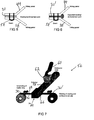
- FIG. 5 illustrates strip 20 intended to seal a joint comprising airbag panels 44 and 48 assembled by seam 52.
- FIG. 6 by contrast, details strip 30' as coated by silicone adhesives of the present invention. Such adhesives enhance bonding of strip 30' and panels 44 and 48 and decrease gas-permeability of the joint.
- Silicone adhesives of the present invention may be curable (vulcanizable) by polyaddition reactions (catalysis by platinum or other catalytic metals) so as to permit strong bonding and avoid noxious chemical emissions or odors.
- Blowing agents may be utilized in formulating the adhesives so as to create a cellular structure (such as that shown in FIG. 6 ) that expands the area occupied by strip 30' during vulcanization of the joint.
- Chemical coupling agents or adherence accelerants in the form of organic compounds of titanium or silanes, for example, may also be included.
- FIG. 7 depicts machinery 56, which comprises extruder 58 into which silicone adhesive 60 of the present invention may be input via feeder 62.
- Machinery 56 also may comprise die 64 including slot 66.
- adhesive 60 may be extruded into strips having width essentially identical to that of strip 30. Meanwhile, strip 30 may be unwound from a roll or otherwise fed into slot 66 through die 64. Within die 64, extruded adhesive 60 is applied to both upper side 68 and lower side 70 of strip 30 to form composite strip 30'. If desired, strip 30' may then be wound into rolls as shown in FIG. 7 . This process allows for simultaneous coating of both upper and lower sides 68 and 70 of strip 30 but does not permit simultaneous processing of multiple strips 30.
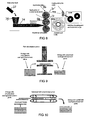
- FIG. 8 illustrates an alternative process for creating strips 30'.
- Extruder 74 receives adhesive 60 through feeder 78 and extrudes sheets of adhesive 60 onto roller 82, where it may be applied to one side of a sheet of strips 30 being unwound from a roll. Pressure from rollers 82 and 86 cause the application, with regulation of the gap between rollers 82 and 86 and pressure applied by roller 86 helping control thickness of the result and penetration of adhesive 60 into the textile structure of strip 30. Coating of the other side of the sheets of strip 30 may occur in a second pass. Thereafter, the sheet may be cut continuously in the warp direction into strips 30', each of which may be wound onto a spool for use directly in an industrial process of airbag wall joint assembly. Either process of FIG. 7 or FIG. 8 may permit application of adhesive 60 to reach a thickness of approximately 100 ⁇ m with precision of approximately 10 ⁇ m onto strips 30 with individual widths of a few millimeters to a few centimeters.
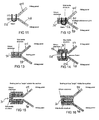
- FIGS. 12-17 illustrate various placements of strip 30'. If, for example, reinforcement within an airbag is important, strip 30' may be applied between airbag panels 44 and 48 prior to sewing of seam 52. Such placement is shown in FIGS. 12-13 . By contrast, external reinforcement of an airbag may occur by attaching strips 30' during or after sewing of seam 52 into panels 44 and 48 (as depicted in FIG. 14 ). When assembling a cushion, strip 30' may be applied in an angular fashion (as shown in FIGS. 15-17 ) either within ( FIGS. 16-17 ) or outside ( FIG. 15 ) the cushion. In each of these cases, vulcanization of adhesive 60, and thereby bonding of strip 30' to panels 44 and 48, may be achieved through action of temperature and pressure via either or both processes illustrated in FIGS. 9-10 .
- FIG. 11 illustrates conventional attachment of panels 44 and 48 by seam 52 (i.e. without strip 30').
- strip 30' may provide mechanical reinforcement of the airbag by the strength of the bonds between adhesive 60 and respective interior surfaces 90 and 94 of panels 44 and 48. Mechanical resistance of the structure of strip 30 from which composite strip 30' is formed additionally may provide reinforcement to the airbag.
- FIGS. 13 and 15-17 In each of FIGS. 13 and 15-17 is depicted an assembly lacking any seam 52. In these joints, strip 30' itself adequately attaches panels 44 and 48 so that no seam 52 is necessary. Of course, such a seam 52 may be added if desired, however.
- FIG. 14 details strip 30' straddling seam 52 and bonded both to the seam 52 and external surfaces 98 and 102 of respective panels 44 and 48. In this configuration, strip 30' well limits gas leaks when the airbag is pressurized.
Landscapes
- Chemical & Material Sciences (AREA)
- Organic Chemistry (AREA)
- Engineering & Computer Science (AREA)
- Mechanical Engineering (AREA)
- Air Bags (AREA)
Description
- This invention relates to materials for sealing and reinforcing other materials and particularly, although not necessarily exclusively, to highly-deformable strips adapted to seal and reinforce seams and peripheries of vehicle airbags.
- Conventional airbags frequently comprise multiple panels of fabric cut to particular patterns and assembled at their peripheries by seams. Some such fabric panels are uncoated. Others, including versions provided by the assignee of this application, may be coated with highly-impermeable silicone to reduce leakage of inflation gas through the panels. Reducing gas leakage from an airbag greatly enhances its performance, as pressure within the bag from the gas-generation event may be sustained for longer periods.
-
WO 02/066297 claim 1. -
U.S. Patent No. 6,364,356 to Keshavaraj details methods of forming an exemplary inflatable airbag. Panels may be adhered together by welded seams, with the welding purportedly "reducing air or gas permeability." See Keshavaraj, Abstract, II. 5-6. As described in the Keshavaraj patent, "a single stitched (sewn) seam located adjacent" two welded seams may "provide increased tear strength" for the combined seam structure. See id., col. 6, II. 8-9 (numeral omitted). - Although utilizing multiple seams for inflatable fabrics may reduce gas permeability of the panels, significant gas leakage may continue to occur. Likewise, although employing multiple seams may provide greater tear strength, as indicated in the Keshavaraj patent, substantial reinforcement of seams may continue to be required. Accordingly, need exists for materials adapted to provide reduced permeability of, and greater strength to, seams of fabric panels.
- The present invention supplies such materials. In particular, the invention provides highly-deformable sealing strips integrating with fabric assemblies to reduce gas leakage from occurring. The strips also function as mechanical reinforcements of the assemblies. Different aspects of the invention are set forth in
claims 1, 7 and 11, and in the other claims referring to these. -
-
FIG. 1 illustrates a fabric strip with straight gain. -
FIG. 2 illustrates a bias strip of fabric. -
FIG. 3 illustrates a textile structure having low extensibility in the warp direction and high deformation in the weft direction. -
FIG. 4 illustrates a sheet of strips. -
FIG. 5 illustrates positioning of a strip between two panels of an airbag. -
FIG. 6 illustrates positioning of a strip of the invention between two panels of an airbag. -
FIG. 7 illustrates an exemplary process for directly extruding a strip of the invention (with silicon on both sides of the strip). -
FIG. 8 illustrates an exemplary process for extrusion lamination of a sheet of strips of the invention and cutting the sheet into strips (with silicon on one side). -
FIG. 9 illustrates a discontinuous (batch) vulcanization process using a flat press. -
FIG. 10 illustrates a continuous vulcanization process using a conveyor belt. -
FIG. 11 illustrates a standard assembly of airbag panels by a seam. -
FIG. 12 illustrates positioning a strip of the invention internal to the airbag, with a seam. -
FIG. 13 illustrates positioning a strip of the invention internal to the airbag, without a seam. -
FIG. 14 illustrates positioning a strip of the invention external to the airbag, straddling a seam. -
FIG. 15 illustrates positioning a strip of the invention external to the cushion, without a seam. -
FIGS. 16-17 illustrate positioning strips of the invention internal to the cushion, without seams. - Depicted in
FIG. 1 is an exemplary sealing strip 10 of the type currently used in textile constructions of airbags. Strip 10 typically is woven and advantageously may resist processing tension in the warp direction. However, strip 10 often is not highly deformable in the weft direction and thus is unable to conform optimally to geometrically-complex assembly joints. - Presently, therefore, when assembly joints are complex geometrically, strip 20 (
FIG. 2 ) sometimes is used instead.Strip 20 may be cut along the fabric bias to improve deformability in the weft direction. Doing so increases extensibility in the warp direction, however, increasing difficulties whenstrip 20 is sewn in place. In particular, use ofstrip 20 at times may cause needle jamming, folds, puckers, or other abnormalities in the associated airbag. -
FIG. 3 shows strip 30 of the present invention.Strip 30 supplies high deformability in the weft direction without significantly increasing extensibility in the warp direction.Strip 30 preferably is comprised of textile structures made by knitting, warp knitting, braiding, or weaving, although other construction processes may be employed instead. - Structures of
strip 30 also may be composites whose length is inextensible so as to limit deformation in the assembly process.Strips 30 additionally may be cut from asheet 40, as shown inFIG. 4 . Regardless, however,strips 30 may be configured and structured (including via the nature of the threads or fibers employed and the density of the weave, for example) as appropriate for the type of assembly joint to be sealed and to facilitate penetration of adhesives. - Currently, liquid curable silicone polymers sometimes are applied to seams to provide seals. Alternatively, hot (EVC) or cold (EVF) curable elastomeric silicone adhesives may be employed in conventional designs. The former provides no mechanical reinforcement of the sealed joint, while the latter may tend to release toxins, volatile compounds, or odorants over time. As a consequence, the latter may be incompatible for use within, for example, passenger compartments of motor vehicles.
-
FIG. 5 illustratesstrip 20 intended to seal a joint comprisingairbag panels seam 52.FIG. 6 , by contrast, details strip 30' as coated by silicone adhesives of the present invention. Such adhesives enhance bonding of strip 30' andpanels - Silicone adhesives of the present invention may be curable (vulcanizable) by polyaddition reactions (catalysis by platinum or other catalytic metals) so as to permit strong bonding and avoid noxious chemical emissions or odors. Blowing agents may be utilized in formulating the adhesives so as to create a cellular structure (such as that shown in
FIG. 6 ) that expands the area occupied by strip 30' during vulcanization of the joint. Chemical coupling agents or adherence accelerants in the form of organic compounds of titanium or silanes, for example, may also be included. - To counteract existing limitations in coating base fabrics with elastomer adhesives, the direct extrusion process depicted in
FIG. 7 may be used.FIG. 7 depictsmachinery 56, which comprises extruder 58 into whichsilicone adhesive 60 of the present invention may be input viafeeder 62.Machinery 56 also may comprise die 64 includingslot 66. - When
machinery 56 operates, adhesive 60 may be extruded into strips having width essentially identical to that ofstrip 30. Meanwhile,strip 30 may be unwound from a roll or otherwise fed intoslot 66 throughdie 64. Within die 64, extruded adhesive 60 is applied to bothupper side 68 andlower side 70 ofstrip 30 to form composite strip 30'. If desired, strip 30' may then be wound into rolls as shown inFIG. 7 . This process allows for simultaneous coating of both upper andlower sides strip 30 but does not permit simultaneous processing ofmultiple strips 30. -
FIG. 8 illustrates an alternative process for creating strips 30'.Extruder 74 receives adhesive 60 throughfeeder 78 and extrudes sheets of adhesive 60 ontoroller 82, where it may be applied to one side of a sheet ofstrips 30 being unwound from a roll. Pressure fromrollers rollers roller 86 helping control thickness of the result and penetration of adhesive 60 into the textile structure ofstrip 30. Coating of the other side of the sheets ofstrip 30 may occur in a second pass. Thereafter, the sheet may be cut continuously in the warp direction into strips 30', each of which may be wound onto a spool for use directly in an industrial process of airbag wall joint assembly. Either process ofFIG. 7 orFIG. 8 may permit application of adhesive 60 to reach a thickness of approximately 100 µm with precision of approximately 10 µm ontostrips 30 with individual widths of a few millimeters to a few centimeters. -
FIGS. 12-17 illustrate various placements of strip 30'. If, for example, reinforcement within an airbag is important, strip 30' may be applied betweenairbag panels seam 52. Such placement is shown inFIGS. 12-13 . By contrast, external reinforcement of an airbag may occur by attaching strips 30' during or after sewing ofseam 52 intopanels 44 and 48 (as depicted inFIG. 14 ). When assembling a cushion, strip 30' may be applied in an angular fashion (as shown inFIGS. 15-17 ) either within (FIGS. 16-17 ) or outside (FIG. 15 ) the cushion. In each of these cases, vulcanization of adhesive 60, and thereby bonding of strip 30' topanels FIGS. 9-10 . -
FIG. 11 illustrates conventional attachment ofpanels FIG. 12 , strip 30' may provide mechanical reinforcement of the airbag by the strength of the bonds between adhesive 60 and respectiveinterior surfaces panels strip 30 from which composite strip 30' is formed additionally may provide reinforcement to the airbag. - In each of
FIGS. 13 and15-17 is depicted an assembly lacking anyseam 52. In these joints, strip 30' itself adequately attachespanels seam 52 is necessary. Of course, such aseam 52 may be added if desired, however.FIG. 14 , finally, details strip 30' straddling seam 52 and bonded both to theseam 52 andexternal surfaces 98 and 102 ofrespective panels
Claims (15)
- A strip for sealing and reinforcing a joint of an airbag comprising:a. a material having first and second sides; andb. silicone elastomer coated onto at least one of the first and second sides, characterized in that the material is highly deformable in the weft direction, not substantially deformable in the warp direction.
- A strip according to claim 1 in which the silicone elastomer is curable through vulcanization.
- A strip according to claim 2 vulcanized by polyaddition reaction.
- A strip according to claim 1 in which the silicone elastomer is extruded onto the first side of the material.
- A strip according to claim 4 in which the silicone elastomer is extruded onto the second side of the material.
- A strip according to claim 1 in which the material is formed by knitting, warp knitting, braiding, or weaving.
- An airbag comprising:a. a first panel;b. a second panel; andc. a strip according to claim 1 and joining the first and second panels.
- An airbag according to claim 7 further comprising a seam sewn into the first and second panels.
- An airbag according to claim 7 in which each of the first and second panels has an interior surface and the strip joins the interior surfaces of the first and second panels.
- An airbag according to claim 7 in which each of the first and second panels has an exterior surface and the strip joins the exterior surfaces of the first and second panels.
- A method of making an airbag comprising:a. forming a strip comprising a material highly deformable in the weft direction, not substantially deformable in the warp direction, and having first and second sides;b. coating silicone elastomer onto at least one of the first and second sides;c. placing the strip in contact with an airbag panel; andd. bonding the strip to the panel by vulcanization.
- A method according to claim 11 in which the action of bonding the strip to the panel by vulcanization cures the silicone elastomer by polyaddition reaction.
- A method according to claim 11 in which the action of forming a strip comprises forming a sheet of strips and cutting the sheet into strips either before or after they are coated with silicone elastomer.
- A method according to claim 11 in which the action of coating silicone elastomer comprises coating silicone elastomer onto both of the first and second sides.
- A method according to claim 14 in which the action of coating silicone elastomer comprises coating silicone elastomer simultaneously onto both of the first and second sides.
Applications Claiming Priority (1)
| Application Number | Priority Date | Filing Date | Title |
|---|---|---|---|
| US69372505P | 2005-06-24 | 2005-06-24 |
Publications (2)
| Publication Number | Publication Date |
|---|---|
| EP1736378A1 EP1736378A1 (en) | 2006-12-27 |
| EP1736378B1 true EP1736378B1 (en) | 2008-04-23 |
Family
ID=37057222
Family Applications (1)
| Application Number | Title | Priority Date | Filing Date |
|---|---|---|---|
| EP20060115789 Not-in-force EP1736378B1 (en) | 2005-06-24 | 2006-06-21 | Sealing and reinforcing strips principally for airbag assembly joints |
Country Status (3)
| Country | Link |
|---|---|
| US (1) | US7681917B2 (en) |
| EP (1) | EP1736378B1 (en) |
| DE (1) | DE602006000977T2 (en) |
Cited By (4)
| Publication number | Priority date | Publication date | Assignee | Title |
|---|---|---|---|---|
| US8132826B2 (en) | 2008-01-14 | 2012-03-13 | Highland Industries, Inc. | Airbag |
| US8287685B2 (en) | 2006-12-06 | 2012-10-16 | Dow Corning Corporation | Airbag and process for its assembly |
| US8376401B2 (en) | 2010-01-27 | 2013-02-19 | Tk Holdings Inc. | Airbag |
| US10604259B2 (en) | 2016-01-20 | 2020-03-31 | Amsafe, Inc. | Occupant restraint systems having extending restraints, and associated systems and methods |
Families Citing this family (24)
| Publication number | Priority date | Publication date | Assignee | Title |
|---|---|---|---|---|
| DE60221704T2 (en) * | 2001-12-18 | 2008-04-30 | Autoliv Development Ab | AIR BAG |
| US20090179409A1 (en) * | 2008-01-16 | 2009-07-16 | Trw Vehicle Safety Systems Inc. | Cut, sewn, and laminated inflatable vehicle occupant protection device construction |
| US8960714B2 (en) | 2008-03-26 | 2015-02-24 | Kolon Industries, Inc. | Side curtain airbag and airbag system comprising the same |
| KR101103804B1 (en) * | 2008-03-26 | 2012-01-06 | 코오롱인더스트리 주식회사 | Side curtain airbags and airbag systems including the same |
| US8862836B2 (en) * | 2011-06-14 | 2014-10-14 | Texas Instruments Incorporated | Multi-port register file with an input pipelined architecture with asynchronous reads and localized feedback |
| DE102012019945B4 (en) * | 2011-10-13 | 2017-11-16 | Autoliv Development Ab | Airbag unit with a masking tape covering an edge seam |
| DE102012004796A1 (en) | 2012-03-08 | 2013-09-12 | GM Global Technology Operations LLC (n. d. Ges. d. Staates Delaware) | Protective device for a motor vehicle |
| US9511866B2 (en) | 2012-03-19 | 2016-12-06 | Amsafe, Inc. | Structure mounted airbag assemblies and associated systems and methods |
| US8523220B1 (en) | 2012-03-19 | 2013-09-03 | Amsafe, Inc. | Structure mounted airbag assemblies and associated systems and methods |
| US8662533B2 (en) | 2012-05-03 | 2014-03-04 | Tk Holdings Inc. | Airbag module with light weight airbag cushion |
| CN105593077A (en) * | 2013-09-30 | 2016-05-18 | 关键安全体系股份有限公司 | Airbag with sealed seam |
| US9221415B2 (en) | 2014-02-19 | 2015-12-29 | Ford Global Technologies, Llc | Method of assembling and packing an automotive airbag |
| US9352839B2 (en) | 2014-10-02 | 2016-05-31 | Amsafe, Inc. | Active positioning airbag assembly and associated systems and methods |
| US9944245B2 (en) | 2015-03-28 | 2018-04-17 | Amsafe, Inc. | Extending pass-through airbag occupant restraint systems, and associated systems and methods |
| SG11201708221UA (en) | 2015-04-11 | 2017-11-29 | Amsafe Inc | Active airbag vent system |
| DE102015005579A1 (en) * | 2015-05-04 | 2016-11-10 | Autoliv Development Ab | Airbag with an edge seam and a cover element |
| CA3004064C (en) | 2015-11-06 | 2025-02-04 | Invista Textiles (U.K.) Limited | Low permeability and high strength fabric and methods of making the same |
| US11001222B2 (en) | 2016-04-05 | 2021-05-11 | Felters Of South Carolina, Llc | Vehicle safety devices, seam tapes for use in airbag and related methods |
| PH12019502262B1 (en) | 2017-05-02 | 2023-07-26 | Invista Textiles Uk Ltd | Low permeability and high strength woven fabric and methods of making the same |
| EP3687867B1 (en) | 2017-09-29 | 2022-01-05 | INVISTA Textiles (U.K.) Limited | Airbags and methods for production of airbags |
| CN112292289B (en) * | 2018-06-28 | 2023-04-14 | 上海延锋金桥汽车饰件系统有限公司 | vehicle trim parts |
| US11840188B2 (en) * | 2018-06-28 | 2023-12-12 | Shanghai Yanfeng Jinqiao Automotive Trim Systems Co. Ltd. | Vehicle interior component |
| KR102699200B1 (en) * | 2022-06-22 | 2024-08-27 | 현대모비스 주식회사 | Airbag cushion |
| US12384322B2 (en) * | 2022-08-03 | 2025-08-12 | Atieva, Inc. | Airbag with sacrificial elastomer line |
Family Cites Families (7)
| Publication number | Priority date | Publication date | Assignee | Title |
|---|---|---|---|---|
| WO1999014082A1 (en) | 1996-09-18 | 1999-03-25 | Minnesota Mining And Manufacturing Company | Adhesively-bonded inflatable restraint and method of making |
| US6113141A (en) * | 1998-07-06 | 2000-09-05 | American Components, Inc. | Roll-over air bag |
| US6355123B1 (en) * | 1998-07-06 | 2002-03-12 | Methode Electronics, Inc. | Roll-over air bag having a reinforced perimeter seal and associated method for producing a flat reinforced seal in a roll-over air bag |
| DE29908210U1 (en) | 1999-05-07 | 1999-09-16 | Trw Repa Gmbh | Gas bag |
| US6364356B1 (en) * | 1999-09-24 | 2002-04-02 | Milliken & Company | Airbag cushion comprising sewn reinforcement seams |
| US6435553B1 (en) | 2000-03-20 | 2002-08-20 | Breed Automotive Technology, Inc. | Air bag and method of seam assembly for minimizing gas leakage |
| US6749220B1 (en) | 2001-02-16 | 2004-06-15 | Key Safety Systems, Inc. | Air bag and method of construction |
-
2006
- 2006-06-20 US US11/471,157 patent/US7681917B2/en not_active Expired - Fee Related
- 2006-06-21 EP EP20060115789 patent/EP1736378B1/en not_active Not-in-force
- 2006-06-21 DE DE200660000977 patent/DE602006000977T2/en active Active
Cited By (5)
| Publication number | Priority date | Publication date | Assignee | Title |
|---|---|---|---|---|
| US8287685B2 (en) | 2006-12-06 | 2012-10-16 | Dow Corning Corporation | Airbag and process for its assembly |
| US8132826B2 (en) | 2008-01-14 | 2012-03-13 | Highland Industries, Inc. | Airbag |
| US8778130B2 (en) | 2008-01-14 | 2014-07-15 | Highland Industries, Inc. | Airbag |
| US8376401B2 (en) | 2010-01-27 | 2013-02-19 | Tk Holdings Inc. | Airbag |
| US10604259B2 (en) | 2016-01-20 | 2020-03-31 | Amsafe, Inc. | Occupant restraint systems having extending restraints, and associated systems and methods |
Also Published As
| Publication number | Publication date |
|---|---|
| EP1736378A1 (en) | 2006-12-27 |
| DE602006000977T2 (en) | 2009-05-28 |
| DE602006000977D1 (en) | 2008-06-05 |
| US7681917B2 (en) | 2010-03-23 |
| US20060292949A1 (en) | 2006-12-28 |
Similar Documents
| Publication | Publication Date | Title |
|---|---|---|
| US7681917B2 (en) | Sealing and reinforcing strips principally for airbag assembly joints | |
| US6630220B1 (en) | Sewn fusion seal process for producing air-holding vehicle restraint systems | |
| EP1161361B1 (en) | Inflatable cushion | |
| US6645565B2 (en) | Heat sealable coated textile fabric for inflatable vehicle restraint systems and method for producing same | |
| US6607797B1 (en) | Textile gas bag material, a protective cushion for an occupant restraint system and a method for producing the textile gas bag material | |
| US6435553B1 (en) | Air bag and method of seam assembly for minimizing gas leakage | |
| US8485550B2 (en) | Airbag | |
| EP0962363B1 (en) | Airbag | |
| US5909895A (en) | Thermoplastic resin film air bag | |
| JP3731266B2 (en) | Method for manufacturing side airbag | |
| US20100129575A1 (en) | Polyvinyl chloride coated fabrics for use in air bags | |
| JP2013067385A (en) | Thermoplastic coated, heat-sealed airbag | |
| US6971674B2 (en) | Inflatable air-bag and method for manufacturing the same | |
| US20060237957A1 (en) | Sealed cushion | |
| EP0485599A1 (en) | Air bag in air bag unit | |
| KR20200060403A (en) | Airbags and methods for the production of airbags | |
| JP2009056830A (en) | Manufacturing method of air bag, air bag and air bag device | |
| JPH02162134A (en) | Air bag for air bag installation | |
| EP1652737B1 (en) | Airbag and airbag apparatus | |
| JP7860265B2 (en) | Airbag manufacturing method with improved internal pressure retention performance | |
| JP7846250B2 (en) | Airbag with enhanced internal pressure retention performance and its manufacturing method | |
| JP3705542B2 (en) | Airbag manufacturing method | |
| WO2024117138A1 (en) | Production method for airbag having enhanced internal-pressure retaining performance | |
| WO2020209197A1 (en) | Pneumatic tire | |
| JP2007038693A (en) | Manufacturing method of highly airtight airbag |
Legal Events
| Date | Code | Title | Description |
|---|---|---|---|
| PUAI | Public reference made under article 153(3) epc to a published international application that has entered the european phase |
Free format text: ORIGINAL CODE: 0009012 |
|
| AK | Designated contracting states |
Kind code of ref document: A1 Designated state(s): AT BE BG CH CY CZ DE DK EE ES FI FR GB GR HU IE IS IT LI LT LU LV MC NL PL PT RO SE SI SK TR |
|
| AX | Request for extension of the european patent |
Extension state: AL BA HR MK YU |
|
| 17P | Request for examination filed |
Effective date: 20070215 |
|
| AKX | Designation fees paid |
Designated state(s): DE ES FR GB IT SE |
|
| GRAP | Despatch of communication of intention to grant a patent |
Free format text: ORIGINAL CODE: EPIDOSNIGR1 |
|
| GRAS | Grant fee paid |
Free format text: ORIGINAL CODE: EPIDOSNIGR3 |
|
| GRAA | (expected) grant |
Free format text: ORIGINAL CODE: 0009210 |
|
| AK | Designated contracting states |
Kind code of ref document: B1 Designated state(s): DE ES FR GB IT SE |
|
| REG | Reference to a national code |
Ref country code: GB Ref legal event code: FG4D |
|
| REF | Corresponds to: |
Ref document number: 602006000977 Country of ref document: DE Date of ref document: 20080605 Kind code of ref document: P |
|
| PG25 | Lapsed in a contracting state [announced via postgrant information from national office to epo] |
Ref country code: ES Free format text: LAPSE BECAUSE OF FAILURE TO SUBMIT A TRANSLATION OF THE DESCRIPTION OR TO PAY THE FEE WITHIN THE PRESCRIBED TIME-LIMIT Effective date: 20080803 |
|
| ET | Fr: translation filed | ||
| PG25 | Lapsed in a contracting state [announced via postgrant information from national office to epo] |
Ref country code: SE Free format text: LAPSE BECAUSE OF FAILURE TO SUBMIT A TRANSLATION OF THE DESCRIPTION OR TO PAY THE FEE WITHIN THE PRESCRIBED TIME-LIMIT Effective date: 20080723 |
|
| PLBE | No opposition filed within time limit |
Free format text: ORIGINAL CODE: 0009261 |
|
| STAA | Information on the status of an ep patent application or granted ep patent |
Free format text: STATUS: NO OPPOSITION FILED WITHIN TIME LIMIT |
|
| 26N | No opposition filed |
Effective date: 20090126 |
|
| GBPC | Gb: european patent ceased through non-payment of renewal fee |
Effective date: 20100621 |
|
| PG25 | Lapsed in a contracting state [announced via postgrant information from national office to epo] |
Ref country code: GB Free format text: LAPSE BECAUSE OF NON-PAYMENT OF DUE FEES Effective date: 20100621 |
|
| REG | Reference to a national code |
Ref country code: FR Ref legal event code: PLFP Year of fee payment: 10 |
|
| PGFP | Annual fee paid to national office [announced via postgrant information from national office to epo] |
Ref country code: DE Payment date: 20150624 Year of fee payment: 10 |
|
| PGFP | Annual fee paid to national office [announced via postgrant information from national office to epo] |
Ref country code: FR Payment date: 20150624 Year of fee payment: 10 |
|
| PGFP | Annual fee paid to national office [announced via postgrant information from national office to epo] |
Ref country code: IT Payment date: 20150625 Year of fee payment: 10 |
|
| REG | Reference to a national code |
Ref country code: DE Ref legal event code: R119 Ref document number: 602006000977 Country of ref document: DE |
|
| REG | Reference to a national code |
Ref country code: FR Ref legal event code: ST Effective date: 20170228 |
|
| PG25 | Lapsed in a contracting state [announced via postgrant information from national office to epo] |
Ref country code: DE Free format text: LAPSE BECAUSE OF NON-PAYMENT OF DUE FEES Effective date: 20170103 Ref country code: FR Free format text: LAPSE BECAUSE OF NON-PAYMENT OF DUE FEES Effective date: 20160630 |
|
| PG25 | Lapsed in a contracting state [announced via postgrant information from national office to epo] |
Ref country code: IT Free format text: LAPSE BECAUSE OF NON-PAYMENT OF DUE FEES Effective date: 20160621 |