EP1736070A1 - Pseudo cufflink for articles of clothing - Google Patents
Pseudo cufflink for articles of clothing Download PDFInfo
- Publication number
- EP1736070A1 EP1736070A1 EP06380176A EP06380176A EP1736070A1 EP 1736070 A1 EP1736070 A1 EP 1736070A1 EP 06380176 A EP06380176 A EP 06380176A EP 06380176 A EP06380176 A EP 06380176A EP 1736070 A1 EP1736070 A1 EP 1736070A1
- Authority
- EP
- European Patent Office
- Prior art keywords
- button
- accessory according
- accessory
- buttonhole
- fastening element
- Prior art date
- Legal status (The legal status is an assumption and is not a legal conclusion. Google has not performed a legal analysis and makes no representation as to the accuracy of the status listed.)
- Withdrawn
Links
- 229910052751 metal Inorganic materials 0.000 claims description 5
- 239000002184 metal Substances 0.000 claims description 5
- 239000000463 material Substances 0.000 claims description 4
- 229910000906 Bronze Inorganic materials 0.000 claims description 3
- RYGMFSIKBFXOCR-UHFFFAOYSA-N Copper Chemical compound [Cu] RYGMFSIKBFXOCR-UHFFFAOYSA-N 0.000 claims description 3
- BQCADISMDOOEFD-UHFFFAOYSA-N Silver Chemical compound [Ag] BQCADISMDOOEFD-UHFFFAOYSA-N 0.000 claims description 3
- 239000010974 bronze Substances 0.000 claims description 3
- 239000010949 copper Substances 0.000 claims description 3
- 229910052802 copper Inorganic materials 0.000 claims description 3
- KUNSUQLRTQLHQQ-UHFFFAOYSA-N copper tin Chemical compound [Cu].[Sn] KUNSUQLRTQLHQQ-UHFFFAOYSA-N 0.000 claims description 3
- 229920002457 flexible plastic Polymers 0.000 claims description 3
- PCHJSUWPFVWCPO-UHFFFAOYSA-N gold Chemical compound [Au] PCHJSUWPFVWCPO-UHFFFAOYSA-N 0.000 claims description 3
- 239000010931 gold Substances 0.000 claims description 3
- 229910052737 gold Inorganic materials 0.000 claims description 3
- 239000004332 silver Substances 0.000 claims description 3
- 229910052709 silver Inorganic materials 0.000 claims description 3
- 229910045601 alloy Inorganic materials 0.000 claims description 2
- 239000000956 alloy Substances 0.000 claims description 2
- 239000004411 aluminium Substances 0.000 description 2
- 229910052782 aluminium Inorganic materials 0.000 description 2
- XAGFODPZIPBFFR-UHFFFAOYSA-N aluminium Chemical compound [Al] XAGFODPZIPBFFR-UHFFFAOYSA-N 0.000 description 2
- 238000005452 bending Methods 0.000 description 2
- 230000006870 function Effects 0.000 description 2
- -1 etc. Substances 0.000 description 1
- 238000003780 insertion Methods 0.000 description 1
- 230000037431 insertion Effects 0.000 description 1
- 150000002739 metals Chemical class 0.000 description 1
- 229910001285 shape-memory alloy Inorganic materials 0.000 description 1
- 239000004753 textile Substances 0.000 description 1
Images

Classifications
-
- A—HUMAN NECESSITIES
- A44—HABERDASHERY; JEWELLERY
- A44B—BUTTONS, PINS, BUCKLES, SLIDE FASTENERS, OR THE LIKE
- A44B5/00—Sleeve-links
- A44B5/007—Sleeve-links concealing a sewed-on button
-
- Y—GENERAL TAGGING OF NEW TECHNOLOGICAL DEVELOPMENTS; GENERAL TAGGING OF CROSS-SECTIONAL TECHNOLOGIES SPANNING OVER SEVERAL SECTIONS OF THE IPC; TECHNICAL SUBJECTS COVERED BY FORMER USPC CROSS-REFERENCE ART COLLECTIONS [XRACs] AND DIGESTS
- Y10—TECHNICAL SUBJECTS COVERED BY FORMER USPC
- Y10T—TECHNICAL SUBJECTS COVERED BY FORMER US CLASSIFICATION
- Y10T24/00—Buckles, buttons, clasps, etc.
- Y10T24/36—Button with fastener
Definitions
- the present invention is of application to ladies' and men's clothing, especially in garments that use button fastenings such as dress shirts, in particular for people or occasions that require the use of cufflinks.
- the invention is herein developed with reference to the use of the accessory on the cuffs of shirts and blouses as a cufflink to decorate buttonholes, it can be applied to any part of the garment that requires a fastening between a button and buttonhole.
- the button and buttonhole fastening is the most widely used system on shirts and other articles of clothing. It is easy, economical and forms part of the garment. However, it is a common element that does not generally attract any attention and is used for its fastening function rather than for providing the clothing with any ornamentation.
- Cufflinks have been on the market for a long time. They can be considered a decorative feature that fulfils a fastening function, specifically on cuffs, which require a special design with buttonholes at both ends of the cuff and do not require buttons. Garments specifically designed for cufflinks tend to be more formal and expensive, as the use of decorative features and accessories is not always suitable on all occasions. Their cuffs are prepared with a second buttonhole instead of the button and their ends come together to face one another so that the two buttonholes are aligned, unlike the buttonhole and button system in which the end with the buttonhole overlaps the end that carries the button in order to fasten it.
- US patent No. 6,618,908 relates to a cufflink for a casual shirt that is actually used as a button cover.
- the button cover is not the same as a cufflink, not even fulfilling the task of fastening, which is fulfilled by the button; it is merely a decorative element that is attached to the button once the buttonhole and button have been joined, hiding the button under the box or case in which the decorative element is set.
- the objective of the present invention is to fulfil the functional needs of fastening the cuff and making the economic advantages of buttons compatible with the aesthetic and formal benefits of cufflinks in a practical and ingenious way.
- an accessory for articles of clothing that have a button and buttonhole and that have a decorative element in the form of a cufflink joined to a fastening element that is passed through the buttonhole and is then attached to the button, with the particularity that the button is unbuttoned.
- Figures 1A and 1B show an imitation cufflink piece 11A of the hook or clip type, made from a wire material that has a decorative portion 13A measuring 12 mm long, the free end of which is finished with an ornamental protuberance 15A.
- the other end of the decorative wire portion 13A has a vertical section 17A measuring 4 mm long, which is designed to pass through the buttonhole and which continues in a joint 19 with a fastening portion 21A formed as a wire clip with a hook 23 measuring 14 mm long on one end that is attached to the other end of the same wire 21A of the clip, which ends in a second protuberance 25.
- This fastening portion 19A forms an attachment underneath the button 27 in the manner shown in figure 1B.
- the wire material can be a 09 mm rod of some type of memory metal, such as gold, silver, bronze, copper, aluminium, etc., or an alloy containing at least one of these metals, or some type of resistant flexible plastic.
- the embodiment shown in figures 2A to 2E relates to an imitation cufflink 11 B in the form of a bent rod, which can be made from the same type and size of rod as that of the embodiment described above. It is a single piece of rod bent first in its middle section almost 360° around a circular form 13B to hold a decorative element 15B that can be round, square or any decorative shape, as is shown in these drawings.
- the rod continues in two adjacent parallel sections that are bent together at 90° to form the vertical section 17B measuring 4 mm long that passes through the buttonhole prior to bending 90° again to form a fork 21 B measuring 14 mm long, which ends in a pair of protuberances 25 and is fastened by simply slipping it under the button 27, the protuberances 25 helping to prevent it from becoming caught on the thread with which the button 27 is sewn.
- the piece 11C can be moulded in a resistant flexible plastic.
- the pseudo cufflink accessory 11C has a tab 13C on which to mount an imitation cufflink decorative piece, a perpendicular section 17C that passes through the buttonhole and a fork 21C that is designed for easy insertion under the button 27 without becoming caught in the thread with which it is sewn to the cuff of the shirt or blouse.
- the accessory of the invention can be made from a textile or similar material, e.g. thread, cord, elastic or mixed, as shown in figures 4A, 4B and 4C.
- This piece 11D has a bow shape with a circumference of 28 mm, which passes through an eye 33 provided in the underside of an imitation cufflink decorative element 15D.
- a 10 mm longitudinal slit 21 D is made in one segment of the bow 11D to emulate a buttonhole through which the button 27 of the shirt or blouse passes.
Landscapes
- Details Of Garments (AREA)
- Adornments (AREA)
Abstract
An accessory in the form of a cufflink for an article of clothing that has a button and buttonhole, being the decorative element joined to a fastening element which can keep said decorative element fixed approximately level to the garment; characterised in that said fastening element consists of an attachment on said button and an intermediate portion between its joint with said decorative element and said attachment, which passes through said buttonhole.
Description
- The present invention is of application to ladies' and men's clothing, especially in garments that use button fastenings such as dress shirts, in particular for people or occasions that require the use of cufflinks. Although the invention is herein developed with reference to the use of the accessory on the cuffs of shirts and blouses as a cufflink to decorate buttonholes, it can be applied to any part of the garment that requires a fastening between a button and buttonhole.
- The button and buttonhole fastening is the most widely used system on shirts and other articles of clothing. It is easy, economical and forms part of the garment. However, it is a common element that does not generally attract any attention and is used for its fastening function rather than for providing the clothing with any ornamentation.
- Cufflinks, on the other hand, have been on the market for a long time. They can be considered a decorative feature that fulfils a fastening function, specifically on cuffs, which require a special design with buttonholes at both ends of the cuff and do not require buttons. Garments specifically designed for cufflinks tend to be more formal and expensive, as the use of decorative features and accessories is not always suitable on all occasions. Their cuffs are prepared with a second buttonhole instead of the button and their ends come together to face one another so that the two buttonholes are aligned, unlike the buttonhole and button system in which the end with the buttonhole overlaps the end that carries the button in order to fasten it.
- In between these two fastening and ornamentation systems the idea also exists of disguising common buttons with detachable elements designed to imitate cufflinks. Several types of such button covers have been devised, as is the case of
US patent No. 3,343,250 , which discloses a button cover with a clip on its back to be attached underneath a button that has been previously passed through a buttonhole, orUS patents No. 4,539,731 andNo. 4,817,249 , which relate to button covers wherein the back is formed as a box or case in which to house the button that has been previously inserted into the buttonhole. Likewise,US patent No. 5,161,285 relates to a button cover that includes a safety feature to prevent it from being inadvertently dropped and lost. - Lastly,
US patent No. 6,618,908 relates to a cufflink for a casual shirt that is actually used as a button cover. However, the button cover is not the same as a cufflink, not even fulfilling the task of fastening, which is fulfilled by the button; it is merely a decorative element that is attached to the button once the buttonhole and button have been joined, hiding the button under the box or case in which the decorative element is set. There are also noticeable aesthetic differences between cufflinks and button covers, the former usually being more attractive as the decorative element is level with the garment, whilst button covers are inevitably raised due to the height of the button. - The objective of the present invention is to fulfil the functional needs of fastening the cuff and making the economic advantages of buttons compatible with the aesthetic and formal benefits of cufflinks in a practical and ingenious way.
- According to the present invention, this and other objectives and advantages are achieved with an accessory for articles of clothing that have a button and buttonhole and that have a decorative element in the form of a cufflink joined to a fastening element that is passed through the buttonhole and is then attached to the button, with the particularity that the button is unbuttoned. This makes it possible to keep the decorative element fixed almost level with the garment and closed, giving it the appearance and impression that it is a cufflink, except for the fact, in the case of the cuff, that the ends of this overlap one another rather than facing one another.
- The manner in which these and other objectives and advantages of the invention are achieved in practice will be more clearly shown with reference to the detailed description provided below as a partially limiting example of preferred embodiments of the invention and the drawings that accompany it, in which:
- Figure 1A is a perspective view of a pseudo cufflink accessory according to a first embodiment of the invention, in an open position. Figure 1 B is a perspective view, similar to that of figure 1A, of the same accessory but showing how it is attached to a button.
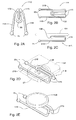
- Figures 2A, 2B and 2C are perspective, plan and elevation views, respectively, of a pseudo cufflink accessory according to a second embodiment of the invention, in an open position. Figure 2D is a perspective side view of the accessory shown in figure 2a, attached to a button, and figure 2E is a perspective view of the finished accessory with the decorative piece.
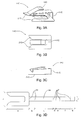
- Figure 3A is a perspective side view of a pseudo cufflink accessory according to a third embodiment of the invention, attached to a button. Figures 3B and 3C are plan and elevation views, respectively, of the accessory shown in figure 3A, attached to a button. Figure 3D is a plan view of a flat cut-out piece, showing the sections to be bent to form the accessory shown in figures 3A, 3B and 3C.
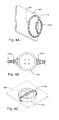
- Lastly, figure 4A is a lower perspective view of the pseudo cufflink accessory according to a fourth embodiment of the present invention. Figures 4B and 3C are lower plan and perspective views, respectively, of the accessory shown in figure 4A, attached to a button.
- Given the nature of the present invention, the drawings are sufficiently graphic to show all the innovative characteristics that combine to give true structural and functional significance to the aforementioned pseudo cufflink accessory for the cuffs of a shirt or blouse. However, regardless of this, they are accompanied by the explanatory notes provided below.
- Figures 1A and 1B show an
imitation cufflink piece 11A of the hook or clip type, made from a wire material that has adecorative portion 13A measuring 12 mm long, the free end of which is finished with anornamental protuberance 15A. The other end of thedecorative wire portion 13A has avertical section 17A measuring 4 mm long, which is designed to pass through the buttonhole and which continues in ajoint 19 with a fasteningportion 21A formed as a wire clip with ahook 23 measuring 14 mm long on one end that is attached to the other end of thesame wire 21A of the clip, which ends in asecond protuberance 25. This fastening portion 19A forms an attachment underneath thebutton 27 in the manner shown in figure 1B. - The wire material can be a 09 mm rod of some type of memory metal, such as gold, silver, bronze, copper, aluminium, etc., or an alloy containing at least one of these metals, or some type of resistant flexible plastic.
- The embodiment shown in figures 2A to 2E relates to an
imitation cufflink 11 B in the form of a bent rod, which can be made from the same type and size of rod as that of the embodiment described above. It is a single piece of rod bent first in its middle section almost 360° around acircular form 13B to hold adecorative element 15B that can be round, square or any decorative shape, as is shown in these drawings. After thecircular portion 13B, the rod continues in two adjacent parallel sections that are bent together at 90° to form thevertical section 17B measuring 4 mm long that passes through the buttonhole prior to bending 90° again to form afork 21 B measuring 14 mm long, which ends in a pair ofprotuberances 25 and is fastened by simply slipping it under thebutton 27, theprotuberances 25 helping to prevent it from becoming caught on the thread with which thebutton 27 is sewn. - Figures 3A, 3B and 3C show another embodiment of the accessory obtained by bending a
flat sheet 29 made from a metal such as gold, silver, bronze, copper, aluminium, etc. or from a shape memory alloy, preferably laminated and previously cut in the manner shown in figure 3D, which also shows thesections 31 that are bent, the measures being as follows: a = 16 mm, b = 4 mm, c = 13 mm, d = 2 mm, e = 2.5 mm, f = 7.5 mm, g = 3 mm, h = 10 mm e i = 3 mm. Alternatively, thepiece 11C can be moulded in a resistant flexible plastic. - As in the other embodiments, the
pseudo cufflink accessory 11C has atab 13C on which to mount an imitation cufflink decorative piece, aperpendicular section 17C that passes through the buttonhole and afork 21C that is designed for easy insertion under thebutton 27 without becoming caught in the thread with which it is sewn to the cuff of the shirt or blouse. - Lastly, the accessory of the invention can be made from a textile or similar material, e.g. thread, cord, elastic or mixed, as shown in figures 4A, 4B and 4C. This
piece 11D has a bow shape with a circumference of 28 mm, which passes through aneye 33 provided in the underside of an imitation cufflinkdecorative element 15D. A 10 mmlongitudinal slit 21 D is made in one segment of thebow 11D to emulate a buttonhole through which thebutton 27 of the shirt or blouse passes. - Several embodiments of the invention have been described by way of an illustrative example, clearly showing the innovative combination of characteristics such as the attachment fixed to the button, the attachment passing through the buttonhole rather than the button, which remains unbuttoned, whilst the decorative element rests level to the other side of the buttonhole, as in the cufflink, hence the term "pseudo cufflink" or "imitation cufflink", which is used to describe the accessory of the present invention. It is envisaged that persons skilled in the art may possibly think of changes and variations in the described forms whilst adhering to the spirit and scope of the invention.
Claims (17)
- A pseudo cufflink accessory for an article of clothing that has a button and buttonhole, the pseudo cufflink accessory including a decorative element and a fastening element joined to the decorative element, which can keep said decorative element fixed approximately level to the garment; characterised in that said fastening element consists of an attachment on said button and an intermediate portion between its joint with said decorative element and said attachment, which passes through said buttonhole.
- An accessory according to claim 1, characterised in that said attachment comprises a fork that is inserted under said button.
- An accessory according to claim 2, characterised in that it is a single piece with multiple folds that define said decorative and fastening elements.
- An accessory according to claim 3, characterised in that said piece is a rod or pin.
- An accessory according to claim 2, 3 or 4, characterised in that said fork comprises two sections of rod of a length that corresponds with the diameter of a button, ending in respective protuberances.
- An accessory according to claim 2, 3 or 4, characterised in that said fork comprises two sections of rod of a length that exceeds the diameter of a button, ending in a hook that closes them around the button.
- An accessory according to claim 3, characterised in that said piece is a flat cut-out piece.
- An accessory according to any of claims 2 to 7, characterised in that said fork ends in two rounded points (to help it slide under the button and prevent it from becoming caught in the thread thereof).
- An accessory according to claim 1, characterised in that said attachment comprises a hook or clip that can be closed under said button.
- An accessory according to claim 2 or 9, characterised in that said fastening element is welded to said decorative element.
- An accessory according to claim 2 or 9, characterised in that said fastening element is moulded in a single piece with said decorative element.
- An accessory according to any of the previous claims, characterised in that said fastening element is made from a memory metal.
- An accessory according to claim 12, characterised in that said metal is one chosen from the group consisting of gold, silver, bronze, copper and their alloys.
- An accessory according to any of claims 1 to 12, characterised in that said fastening element is made from a resistant flexible plastic.
- An accessory according to claim 1, characterised in that said fastening element is a ribbon bow with a longitudinal slit in one segment thereof that can be attached to said button, imitating a buttonhole.
- An accessory according to claim 15, characterised in that said ribbon bow is made from a material chosen from the group consisting of thread, cord, elastic or any combination thereof.
- An accessory according to any of the previous claims, characterised in that said attachment is fastened to an unbuttoned button after passing it through the buttonhole that overlaps the button.
Applications Claiming Priority (1)
| Application Number | Priority Date | Filing Date | Title |
|---|---|---|---|
| ARP050102593A AR049409A1 (en) | 2005-06-24 | 2005-06-24 | PEDOGOGEL ACCESSORY FOR INDUMENTARY PRESS |
Publications (1)
| Publication Number | Publication Date |
|---|---|
| EP1736070A1 true EP1736070A1 (en) | 2006-12-27 |
Family
ID=36838632
Family Applications (1)
| Application Number | Title | Priority Date | Filing Date |
|---|---|---|---|
| EP06380176A Withdrawn EP1736070A1 (en) | 2005-06-24 | 2006-06-19 | Pseudo cufflink for articles of clothing |
Country Status (4)
| Country | Link |
|---|---|
| US (1) | US20060288541A1 (en) |
| EP (1) | EP1736070A1 (en) |
| CN (1) | CN1883328A (en) |
| AR (1) | AR049409A1 (en) |
Families Citing this family (2)
| Publication number | Priority date | Publication date | Assignee | Title |
|---|---|---|---|---|
| DE102010008690A1 (en) * | 2010-02-19 | 2011-08-25 | Kaiser, Jörg, 76476 | Jewelry-cuff link for shirt, has base part surrounding cuff edge in area closed to shirt button and jewelry button element for guiding through button hole |
| CN106666944A (en) * | 2017-01-20 | 2017-05-17 | 深圳技师学院 | Jewelry worn on button |
Citations (7)
| Publication number | Priority date | Publication date | Assignee | Title |
|---|---|---|---|---|
| US2490383A (en) * | 1947-12-10 | 1949-12-06 | Ballou & Co B A | Cuff button for sewed-on button type of cuff |
| US2585181A (en) * | 1949-09-15 | 1952-02-12 | Gus G Stavropoulos | Clasp for cuffs and the like |
| US2658249A (en) * | 1952-10-28 | 1953-11-10 | Robert O Wilson | Cuff link |
| US2847744A (en) * | 1953-06-22 | 1958-08-19 | Jr Frank V Benton | Cuff link |
| FR2041994A5 (en) * | 1969-06-27 | 1971-02-05 | Stahl Friedrich Kg | |
| BE895389A (en) * | 1982-12-17 | 1983-04-15 | Eszed | Secured ornamental cuff or shirt-tab button - has L=shaped component joining stirrup to ornamental part |
| FR2567005A1 (en) * | 1984-07-04 | 1986-01-10 | Ponthieu Jean P | Decorative fasteners, cufflinks |
-
2005
- 2005-06-24 AR ARP050102593A patent/AR049409A1/en unknown
-
2006
- 2006-06-19 EP EP06380176A patent/EP1736070A1/en not_active Withdrawn
- 2006-06-23 US US11/426,169 patent/US20060288541A1/en not_active Abandoned
- 2006-06-26 CN CNA200610092602XA patent/CN1883328A/en active Pending
Patent Citations (7)
| Publication number | Priority date | Publication date | Assignee | Title |
|---|---|---|---|---|
| US2490383A (en) * | 1947-12-10 | 1949-12-06 | Ballou & Co B A | Cuff button for sewed-on button type of cuff |
| US2585181A (en) * | 1949-09-15 | 1952-02-12 | Gus G Stavropoulos | Clasp for cuffs and the like |
| US2658249A (en) * | 1952-10-28 | 1953-11-10 | Robert O Wilson | Cuff link |
| US2847744A (en) * | 1953-06-22 | 1958-08-19 | Jr Frank V Benton | Cuff link |
| FR2041994A5 (en) * | 1969-06-27 | 1971-02-05 | Stahl Friedrich Kg | |
| BE895389A (en) * | 1982-12-17 | 1983-04-15 | Eszed | Secured ornamental cuff or shirt-tab button - has L=shaped component joining stirrup to ornamental part |
| FR2567005A1 (en) * | 1984-07-04 | 1986-01-10 | Ponthieu Jean P | Decorative fasteners, cufflinks |
Also Published As
| Publication number | Publication date |
|---|---|
| AR049409A1 (en) | 2006-07-26 |
| CN1883328A (en) | 2006-12-27 |
| US20060288541A1 (en) | 2006-12-28 |
Similar Documents
| Publication | Publication Date | Title |
|---|---|---|
| US20080313864A1 (en) | Button cover adapter for jeans | |
| US6748602B1 (en) | Decorative magnetic collar stay | |
| US2845297A (en) | Zipper actuating device | |
| US20120005862A1 (en) | Custom Made Cuff LInks and Method for Making the Same | |
| US20060265841A1 (en) | Magnetic closure | |
| US20180055120A1 (en) | Functional Decorative Brooch Skirt Weights | |
| US20120266364A1 (en) | Clothing accessory and method of use | |
| US7065794B2 (en) | Secure necktie | |
| US7219405B1 (en) | Fabric attaching clip | |
| US9489873B2 (en) | Textile fastener with cover | |
| US8713713B2 (en) | Necktie assembly | |
| US5438850A (en) | Button jewelry device | |
| US4184231A (en) | Four in hand necktie with integral clasp | |
| US2228379A (en) | Buckle | |
| US20060288541A1 (en) | Pseudo-cufflink accessory for garment | |
| US7370371B2 (en) | Ultra-low profile tie holder | |
| US4052771A (en) | Cuff linking device | |
| CN214283498U (en) | Decorative neckline clamp | |
| JP2005253761A (en) | Neck accessory | |
| US20070151001A1 (en) | Gift wrap lingerie | |
| JP6418588B1 (en) | Combination of clothes and clothing accessories | |
| US7143482B2 (en) | Necktie button for a necktie | |
| US2240097A (en) | Garment supporting loop | |
| JPH079929U (en) | tie | |
| JP3088263U (en) | Button fastener |
Legal Events
| Date | Code | Title | Description |
|---|---|---|---|
| PUAI | Public reference made under article 153(3) epc to a published international application that has entered the european phase |
Free format text: ORIGINAL CODE: 0009012 |
|
| AK | Designated contracting states |
Kind code of ref document: A1 Designated state(s): AT BE BG CH CY CZ DE DK EE ES FI FR GB GR HU IE IS IT LI LT LU LV MC NL PL PT RO SE SI SK TR |
|
| AX | Request for extension of the european patent |
Extension state: AL BA HR MK YU |
|
| AKX | Designation fees paid | ||
| REG | Reference to a national code |
Ref country code: DE Ref legal event code: 8566 |
|
| STAA | Information on the status of an ep patent application or granted ep patent |
Free format text: STATUS: THE APPLICATION IS DEEMED TO BE WITHDRAWN |
|
| 18D | Application deemed to be withdrawn |
Effective date: 20070628 |