EP1732238A1 - Rf id tag device - Google Patents
Rf id tag device Download PDFInfo
- Publication number
- EP1732238A1 EP1732238A1 EP05719365A EP05719365A EP1732238A1 EP 1732238 A1 EP1732238 A1 EP 1732238A1 EP 05719365 A EP05719365 A EP 05719365A EP 05719365 A EP05719365 A EP 05719365A EP 1732238 A1 EP1732238 A1 EP 1732238A1
- Authority
- EP
- European Patent Office
- Prior art keywords
- rfid tag
- tag device
- circuit
- impedance
- modulation
- Prior art date
- Legal status (The legal status is an assumption and is not a legal conclusion. Google has not performed a legal analysis and makes no representation as to the accuracy of the status listed.)
- Granted
Links
Images












Classifications
-
- H—ELECTRICITY
- H04—ELECTRIC COMMUNICATION TECHNIQUE
- H04B—TRANSMISSION
- H04B1/00—Details of transmission systems, not covered by a single one of groups H04B3/00 - H04B13/00; Details of transmission systems not characterised by the medium used for transmission
- H04B1/59—Responders; Transponders
-
- G—PHYSICS
- G01—MEASURING; TESTING
- G01S—RADIO DIRECTION-FINDING; RADIO NAVIGATION; DETERMINING DISTANCE OR VELOCITY BY USE OF RADIO WAVES; LOCATING OR PRESENCE-DETECTING BY USE OF THE REFLECTION OR RERADIATION OF RADIO WAVES; ANALOGOUS ARRANGEMENTS USING OTHER WAVES
- G01S13/00—Systems using the reflection or reradiation of radio waves, e.g. radar systems; Analogous systems using reflection or reradiation of waves whose nature or wavelength is irrelevant or unspecified
- G01S13/74—Systems using reradiation of radio waves, e.g. secondary radar systems; Analogous systems
- G01S13/76—Systems using reradiation of radio waves, e.g. secondary radar systems; Analogous systems wherein pulse-type signals are transmitted
- G01S13/765—Systems using reradiation of radio waves, e.g. secondary radar systems; Analogous systems wherein pulse-type signals are transmitted with exchange of information between interrogator and responder
-
- G—PHYSICS
- G01—MEASURING; TESTING
- G01S—RADIO DIRECTION-FINDING; RADIO NAVIGATION; DETERMINING DISTANCE OR VELOCITY BY USE OF RADIO WAVES; LOCATING OR PRESENCE-DETECTING BY USE OF THE REFLECTION OR RERADIATION OF RADIO WAVES; ANALOGOUS ARRANGEMENTS USING OTHER WAVES
- G01S13/00—Systems using the reflection or reradiation of radio waves, e.g. radar systems; Analogous systems using reflection or reradiation of waves whose nature or wavelength is irrelevant or unspecified
- G01S13/74—Systems using reradiation of radio waves, e.g. secondary radar systems; Analogous systems
- G01S13/79—Systems using random coded signals or random pulse repetition frequencies, e.g. "Separation and Control of Aircraft using Non synchronous Techniques" [SECANT]
-
- G—PHYSICS
- G06—COMPUTING OR CALCULATING; COUNTING
- G06K—GRAPHICAL DATA READING; PRESENTATION OF DATA; RECORD CARRIERS; HANDLING RECORD CARRIERS
- G06K19/00—Record carriers for use with machines and with at least a part designed to carry digital markings
- G06K19/06—Record carriers for use with machines and with at least a part designed to carry digital markings characterised by the kind of the digital marking, e.g. shape, nature, code
- G06K19/067—Record carriers with conductive marks, printed circuits or semiconductor circuit elements, e.g. credit or identity cards also with resonating or responding marks without active components
- G06K19/07—Record carriers with conductive marks, printed circuits or semiconductor circuit elements, e.g. credit or identity cards also with resonating or responding marks without active components with integrated circuit chips
- G06K19/0723—Record carriers with conductive marks, printed circuits or semiconductor circuit elements, e.g. credit or identity cards also with resonating or responding marks without active components with integrated circuit chips the record carrier comprising an arrangement for non-contact communication, e.g. wireless communication circuits on transponder cards, non-contact smart cards or RFIDs
-
- G—PHYSICS
- G06—COMPUTING OR CALCULATING; COUNTING
- G06K—GRAPHICAL DATA READING; PRESENTATION OF DATA; RECORD CARRIERS; HANDLING RECORD CARRIERS
- G06K19/00—Record carriers for use with machines and with at least a part designed to carry digital markings
- G06K19/06—Record carriers for use with machines and with at least a part designed to carry digital markings characterised by the kind of the digital marking, e.g. shape, nature, code
- G06K19/067—Record carriers with conductive marks, printed circuits or semiconductor circuit elements, e.g. credit or identity cards also with resonating or responding marks without active components
- G06K19/07—Record carriers with conductive marks, printed circuits or semiconductor circuit elements, e.g. credit or identity cards also with resonating or responding marks without active components with integrated circuit chips
- G06K19/077—Constructional details, e.g. mounting of circuits in the carrier
- G06K19/07749—Constructional details, e.g. mounting of circuits in the carrier the record carrier being capable of non-contact communication, e.g. constructional details of the antenna of a non-contact smart card
-
- G—PHYSICS
- G06—COMPUTING OR CALCULATING; COUNTING
- G06K—GRAPHICAL DATA READING; PRESENTATION OF DATA; RECORD CARRIERS; HANDLING RECORD CARRIERS
- G06K19/00—Record carriers for use with machines and with at least a part designed to carry digital markings
- G06K19/06—Record carriers for use with machines and with at least a part designed to carry digital markings characterised by the kind of the digital marking, e.g. shape, nature, code
- G06K19/067—Record carriers with conductive marks, printed circuits or semiconductor circuit elements, e.g. credit or identity cards also with resonating or responding marks without active components
- G06K19/07—Record carriers with conductive marks, printed circuits or semiconductor circuit elements, e.g. credit or identity cards also with resonating or responding marks without active components with integrated circuit chips
- G06K19/077—Constructional details, e.g. mounting of circuits in the carrier
- G06K19/07749—Constructional details, e.g. mounting of circuits in the carrier the record carrier being capable of non-contact communication, e.g. constructional details of the antenna of a non-contact smart card
- G06K19/07773—Antenna details
- G06K19/07786—Antenna details the antenna being of the HF type, such as a dipole
-
- H—ELECTRICITY
- H01—ELECTRIC ELEMENTS
- H01Q—ANTENNAS, i.e. RADIO AERIALS
- H01Q1/00—Details of, or arrangements associated with, antennas
- H01Q1/12—Supports; Mounting means
- H01Q1/22—Supports; Mounting means by structural association with other equipment or articles
- H01Q1/2208—Supports; Mounting means by structural association with other equipment or articles associated with components used in interrogation type services, i.e. in systems for information exchange between an interrogator/reader and a tag/transponder, e.g. in Radio Frequency Identification [RFID] systems
-
- H—ELECTRICITY
- H01—ELECTRIC ELEMENTS
- H01Q—ANTENNAS, i.e. RADIO AERIALS
- H01Q1/00—Details of, or arrangements associated with, antennas
- H01Q1/12—Supports; Mounting means
- H01Q1/22—Supports; Mounting means by structural association with other equipment or articles
- H01Q1/24—Supports; Mounting means by structural association with other equipment or articles with receiving set
- H01Q1/248—Supports; Mounting means by structural association with other equipment or articles with receiving set provided with an AC/DC converting device, e.g. rectennas
-
- H—ELECTRICITY
- H01—ELECTRIC ELEMENTS
- H01Q—ANTENNAS, i.e. RADIO AERIALS
- H01Q1/00—Details of, or arrangements associated with, antennas
- H01Q1/36—Structural form of radiating elements, e.g. cone, spiral, umbrella; Particular materials used therewith
- H01Q1/38—Structural form of radiating elements, e.g. cone, spiral, umbrella; Particular materials used therewith formed by a conductive layer on an insulating support
-
- H—ELECTRICITY
- H01—ELECTRIC ELEMENTS
- H01Q—ANTENNAS, i.e. RADIO AERIALS
- H01Q23/00—Antennas with active circuits or circuit elements integrated within them or attached to them
-
- H—ELECTRICITY
- H01—ELECTRIC ELEMENTS
- H01Q—ANTENNAS, i.e. RADIO AERIALS
- H01Q9/00—Electrically-short antennas having dimensions not more than twice the operating wavelength and consisting of conductive active radiating elements
- H01Q9/04—Resonant antennas
- H01Q9/06—Details
- H01Q9/065—Microstrip dipole antennas
-
- H—ELECTRICITY
- H01—ELECTRIC ELEMENTS
- H01Q—ANTENNAS, i.e. RADIO AERIALS
- H01Q9/00—Electrically-short antennas having dimensions not more than twice the operating wavelength and consisting of conductive active radiating elements
- H01Q9/04—Resonant antennas
- H01Q9/16—Resonant antennas with feed intermediate between the extremities of the antenna, e.g. centre-fed dipole
-
- H—ELECTRICITY
- H02—GENERATION; CONVERSION OR DISTRIBUTION OF ELECTRIC POWER
- H02J—ELECTRIC POWER NETWORKS; CIRCUIT ARRANGEMENTS OR SYSTEMS FOR SUPPLYING OR DISTRIBUTING ELECTRIC POWER; SYSTEMS FOR STORING ELECTRIC ENERGY
- H02J50/00—Circuit arrangements or systems for wireless supply or distribution of electric power
- H02J50/005—Mechanical details of housing or structure aiming to accommodate the power transfer means, e.g. mechanical integration of coils, antennas or transducers into emitting or receiving devices
-
- H—ELECTRICITY
- H02—GENERATION; CONVERSION OR DISTRIBUTION OF ELECTRIC POWER
- H02J—ELECTRIC POWER NETWORKS; CIRCUIT ARRANGEMENTS OR SYSTEMS FOR SUPPLYING OR DISTRIBUTING ELECTRIC POWER; SYSTEMS FOR STORING ELECTRIC ENERGY
- H02J50/00—Circuit arrangements or systems for wireless supply or distribution of electric power
- H02J50/20—Circuit arrangements or systems for wireless supply or distribution of electric power using microwaves or radio frequency waves
-
- H—ELECTRICITY
- H02—GENERATION; CONVERSION OR DISTRIBUTION OF ELECTRIC POWER
- H02J—ELECTRIC POWER NETWORKS; CIRCUIT ARRANGEMENTS OR SYSTEMS FOR SUPPLYING OR DISTRIBUTING ELECTRIC POWER; SYSTEMS FOR STORING ELECTRIC ENERGY
- H02J50/00—Circuit arrangements or systems for wireless supply or distribution of electric power
- H02J50/20—Circuit arrangements or systems for wireless supply or distribution of electric power using microwaves or radio frequency waves
- H02J50/27—Circuit arrangements or systems for wireless supply or distribution of electric power using microwaves or radio frequency waves characterised by the type of receiving antennas, e.g. rectennas
-
- H—ELECTRICITY
- H02—GENERATION; CONVERSION OR DISTRIBUTION OF ELECTRIC POWER
- H02J—ELECTRIC POWER NETWORKS; CIRCUIT ARRANGEMENTS OR SYSTEMS FOR SUPPLYING OR DISTRIBUTING ELECTRIC POWER; SYSTEMS FOR STORING ELECTRIC ENERGY
- H02J50/00—Circuit arrangements or systems for wireless supply or distribution of electric power
- H02J50/40—Circuit arrangements or systems for wireless supply or distribution of electric power using two or more transmitting or receiving devices
-
- H—ELECTRICITY
- H02—GENERATION; CONVERSION OR DISTRIBUTION OF ELECTRIC POWER
- H02J—ELECTRIC POWER NETWORKS; CIRCUIT ARRANGEMENTS OR SYSTEMS FOR SUPPLYING OR DISTRIBUTING ELECTRIC POWER; SYSTEMS FOR STORING ELECTRIC ENERGY
- H02J50/00—Circuit arrangements or systems for wireless supply or distribution of electric power
- H02J50/60—Circuit arrangements or systems for wireless supply or distribution of electric power responsive to the presence of foreign objects, e.g. detection of living beings
-
- H—ELECTRICITY
- H02—GENERATION; CONVERSION OR DISTRIBUTION OF ELECTRIC POWER
- H02J—ELECTRIC POWER NETWORKS; CIRCUIT ARRANGEMENTS OR SYSTEMS FOR SUPPLYING OR DISTRIBUTING ELECTRIC POWER; SYSTEMS FOR STORING ELECTRIC ENERGY
- H02J50/00—Circuit arrangements or systems for wireless supply or distribution of electric power
- H02J50/90—Circuit arrangements or systems for wireless supply or distribution of electric power involving detection or optimisation of position, e.g. alignment
-
- G—PHYSICS
- G01—MEASURING; TESTING
- G01S—RADIO DIRECTION-FINDING; RADIO NAVIGATION; DETERMINING DISTANCE OR VELOCITY BY USE OF RADIO WAVES; LOCATING OR PRESENCE-DETECTING BY USE OF THE REFLECTION OR RERADIATION OF RADIO WAVES; ANALOGOUS ARRANGEMENTS USING OTHER WAVES
- G01S7/00—Details of systems according to groups G01S13/00, G01S15/00, G01S17/00
- G01S7/02—Details of systems according to groups G01S13/00, G01S15/00, G01S17/00 of systems according to group G01S13/00
- G01S7/023—Interference mitigation, e.g. reducing or avoiding non-intentional interference with other HF-transmitters, base station transmitters for mobile communication or other radar systems, e.g. using electro-magnetic interference [EMI] reduction techniques
Definitions
- the present invention relates to RFID tag devices, and specifically to an RFID tag device based on passive modulation, but capable of performing, for example, QPSK modulation for wireless communication by using a loop antenna or a dipole antenna.
- Patent Document 1 Japanese Laid-Open Patent Publication No. 10-224262
- RFID is wireless equipment for identifying mobile objects, which is attached to or held by a commodity, a person, a car, a road sign, etc., and in response to a radio wave from an interrogator (a reader/writer), notifies individual information and position information to the interrogator.
- the RFID is considered not only as an alternative to the barcode, but also as elemental technology for implementing an entirely new infrastructure for a future network community.
- the research and development of RFID currently underway mainly concentrates on communication within a relatively short range of several tens of centimeters, but if it is possible to realize low-cost small RFID tags capable of communication from relatively afar, such as from about 10 meters away, the application range will be conceivably further extended.
- the above Patent Document 1 describes a conventional passive RFID tag device.
- the conventional passive RFID tag device is basically configured as shown in FIG. 1, and therefore has a problem that its possible communication range is short for the following reasons.
- the present invention aims to overcome the drawback with the above conventional technology by the configuration shown in FIG. 2, and expand the communication range to several times or more that in the conventional scheme.
- the conventional scheme is based on equilibrium feeding/equilibrium modulation (a two-terminal circuit for antenna operation), whereas a method of the present invention is based on disequilibrium feeding/equilibrium modulation (a three-terminal circuit for antenna operation).
- the conventional scheme is based on simple rectification of received RF signals, whereas the present invention employs a circuit based on a combination of a stub resonance-based, impedance transformation boosting scheme and a ladder boosting scheme.
- the conventional scheme is based on ASK or BPSK modulation, whereas the present invention is based on passive modulation, but can employ a QPSK modulation circuit.
- an RFID tag device of the present invention includes a divided microstrip antenna, a power receiving circuit based on a combination of a stub resonance-based, impedance transformation RF boosting scheme and a ladder boosting/rectifying scheme, and a local oscillator circuit for generating a response subcarrier signal, and a dividing position of the divided microstrip antenna is slightly deviated from a longitudinal center point across strip conductors.
- a passive QPSK modulation scheme is usable as a modulation method.
- impedance modulation elements of the divided microstrip antenna are respectively connected to opposite ends in a strip conductor width direction so as to connect divided conductors.
- the impedance modulation elements are preferably PIN diodes or varactor diodes.
- a voltage or current controlled three-terminal element using a transistor, rather than a diode, is preferable.
- an extremely small capacitance (1 pF/GHz or less) is preferably used for connecting the power receiving circuit and an antenna feeding point to perform high-impedance capacitive feeding.
- the antenna feeding point may be positioned so as not to correspond to a dividing point of the divided microstrip antenna.
- capacitive load impedances in a stub resonator and a ladder boost rectifier circuit of the power receiving circuit are parallel resonant, and further, the capacitive feeding impedance are series resonant.
- capacitor capacitance of the receiving-side rail is smaller than that of the GND-side rail, a first diode between GND and a receiving point is eliminated, and a high-frequency and high-impedance input is receivable by a DC short.
- a logic circuit including a 1/4 frequency divider, a shift register and a data selector is preferably used in the passive QPSK modulation method, and MPSK modulation is preferably applied by using a 1/M frequency divider, an M-stage shift register and an M-input data selector.
- information is preferably recorded to a memory in units of two bits in accordance with the passive QPSK modulation method.
- the RFID tag device of the present invention preferably includes an timing generator circuit for obtaining an output enable signal in the passive QPSK modulation method, and the output timing generator circuit preferably generates a train of pulses with a random delay time having a fixed width and a fixed frame cycle, based on a source voltage size and a clock signal.
- the RFID tag device of the present invention it is preferred that by using a transducer such as a temperature sensor quartz resonator as the local oscillator circuit for generating the response subcarrier signal, a sensor function capable of allowing its oscillating frequency to be read by an external unit is additionally used.
- a position detecting method for a mobile object having no RFID tag of the present invention in a system composed of the RFID device and one or more master devices (interrogators), whether or not an obstacle is present in a radio wave propagation path extending between each RFID tag device and each interrogator is determined based on the presence or absence of communication between the RFID tag and the interrogator.
- a plurality of radio wave propagation paths present between each RFID tag and each interrogator are preferably distinguished based on a combination of a local oscillating frequency for generating a response subcarrier of each RFID tag, a response timing and a frequency of an interrogation radio wave outputted from the interrogator and timing of generating the interrogation radio wave.
- radio waves at two or more frequencies are transmitted to an RFID tag device from an interrogator having two or more antennas dedicated for reception or used for transmission and reception, and based on a difference in phase (a difference in delay time) between receiving antennas in a signal for response thereto, maximum likelihood determination of a position of the RFID tag is performed.
- the position detecting method for a mobile object having an RFID tag in the case where in order to enable a three-dimensional RFID tag position determination, an interrogation device having four or more antennas dedicated for reception or used for transmission and reception is used, it is preferred to eliminate a commonly measured distance offset by obtaining a group delay time in each radio wave propagation path based on four or more sets of frequency responses measured for the two or more frequencies, and obtaining a difference in delay time with reference to at least one of the sets. It is preferred that the RFID tag device of the present invention includes two or more tag antennas in order to expand its possible communication range.
- the RFID tag device periodically changes directionality of an intense response subcarrier radio wave, which is synthesized by periodically changing a phase of a local oscillating signal provided to each tag antenna for generating a response subcarrier signal, thereby returning an intense response radio wave toward an interrogator in a wide area.
- Disequilibrium feeding and equilibrium modulation (a three-terminal circuit for antenna operation) are employed, and therefore it is possible to achieve the effect of maximizing the reception efficiency of an antenna.
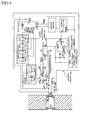
- FIG. 1 is a schematic diagram illustrating a conventional RFID tag device
- the dividing position of a divided microstrip antenna is slightly deviated from the longitudinal center point across strip conductors. Now, assuming that the center point lies at the 50% position with respect to the length of the strip conductor, the dividing position is preferably 55% to 80%.
- the modulation efficiency (the level of a reply signal) is maximized.
- the resistive influence of a variable impedance element that is exerted on the receiving efficiency is increased.
- the resistive influence of the variable impedance element that is exerted on the receiving efficiency is small, though the modulation efficiency is decreased.
- the dividing position is approximately 55%, and when the resistance of the variable impedance element is relatively large, the dividing position is considerably further deviated from the center.
- FIG. 3 illustrates the basic configuration of an RFID tag device of the present invention.
- the antenna of the RFID tag device includes a ground plane conductor, an insulating layer and a divided strip conductor.
- the RFID tag device shown in this figure is for use in the 2.45 GHz band, and all specified dimensions are in units of mm. Also, the dividing point of the divided strip conductor is deviated slightly more than equal division in the longitudinal direction, and this feature achieves the effect of maximizing the reception efficiency of the antenna.
- FIG. 4 illustrates the details of the control circuit chip shown in FIG. 3 and connections between the divided strip conductor and the control circuit.
- the control circuit chip and the antenna are connected at six points A, B, C, D, E and F.
- PIN diodes D7 and D8 for impedance modulation are connected between A and B and between D and E, respectively, and a feeding point of the antenna lies between C and F.
- the point C is slightly deviated from the center point of the strip conductor width, and this feature achieves the effect of maximizing the reception efficiency of the antenna.
- the point F is connected to the ground plane conductor via a through-hole.
- FIG. 5(a) is a boost rectifier circuit called "Cockcroft-Walton circuit", in which a plurality of rectifier diodes and capacitors are connected in a ladder configuration, so that a sine value signal with an amplitude of V i can be output after being rectified to a DC voltage of K(V i -l j ) greater than V i [K is the number of ladder steps; l j is a forward drop voltage of a diode].
- this circuit has a drawback in that when it is used in a high frequency band (e.g., 2.45 GHz), the junction capacitance of each diode becomes input load and therefore input impedance becomes extremely low, which lowers the output voltage.
- a high frequency band e.g., 2.45 GHz
- FIG. 5(b) is an operational principle diagram of the boost rectifier circuit of the present invention.
- An N ⁇ g/4 short stub ( ⁇ g is an effective wavelength of the transmission path; N is an odd number being 1 or 3) exhibits an equivalent impedance of an inductance having a high Q-value in a high frequency range with respect to an input signal in the vicinity of ⁇ g.
- ⁇ g is an effective wavelength of the transmission path; N is an odd number being 1 or 3
- ⁇ g is an effective wavelength of the transmission path; N is an odd number being 1 or 3
- FIG. 17 is a behavioral analysis result of the boost rectifier circuit of the present invention, from which it is appreciated how an input voltage of 50 ⁇ /-10 dBm (0.07 V) is boosted and rectified to 1 V or more at 2.45 GHz.
- control circuit chip of FIG. 4 is described in detail.
- an oscillator circuit When V DD is applied, an oscillator circuit generates a clock signal of f s .
- an output timing circuit When V DD and the clock signal are applied, an output timing circuit generates a timing signal (an output enable signal) for anticollision as shown in FIGS. 12 and 13.
- an address counter When the output enable signal and the clock signal are applied, an address counter outputs memory read addresses one after another for each clock "L" pulse. Note that the data transmission rate in this case is 2f s / L (bit/sec).
- the memory sequentially outputs 2-bit information recorded at addresses designated by the address counter.
- a 1/4 frequency divider outputs a signal corresponding to 1/4 of f s .
- a shift register operates in accordance with the clock f s , and phase-shifts the output of the 1/4 frequency divider in units of 90°.
- a data selector selects and outputs one of four phase outputs (0° to 270°) of the shift register in accordance with a 2-bit memory output.
- the output of the data selector changes the amplitude of current flowing through resistances to the PIN diodes D7 and D8 with a cycle of f s / 4, thereby modulating a connection impedance between the divided strip conductors.
- the change of the impedance changes a mutual coupling impedance between an antenna of an interrogator and the antenna of the RFID tag, so that a reflection coefficient ⁇ of the antenna of the interrogator is changed with a cycle of f s / 4.
- FIG. 15 is an example of a signal measured with a spectrum analyzer.
- the microstrip antenna used for the RFID tag device of the present invention is explained with respect to its property.
- the microstrip antenna is configured simply by providing a ground plane close to a plate-like dipole antenna, and therefore might be considered as if it is an antenna that behaves as a dipole, but in fact, its behavioral principle is considerably different from that of the dipole antenna.
- the dipole antenna is an electric current antenna
- the strip antenna is a magnetic current antenna.
- two PIN diodes for impedance modulation are provided at opposite ends of the microstrip conductor in the width direction is that electric current flowing through the strip conductors is concentrated at the opposite ends in the width direction.
- FIG. 16 is an example of analyzing the level of a response signal that can be received by an interrogator by using antenna length L as a parameter in the evaluation system of FIG. 14, with respect to the case where a conventional dipole antenna having no ground plate is used in an RFID tag and the case where the divided microstrip antenna of the present invention is used in an RFID tag.
- the method of the present invention is capable of receiving the response signal with a level greater by about 10 dB (10 times greater power) compared to the conventional method.
- FIG. 20 is a result of analyzing influences of a series resistance in PIN diodes for impedance modulation that are exerted on the receiver level with respect to the cases of making adaptation to lower and higher frequencies with the same size.
- a series resistance in PIN diodes for impedance modulation that are exerted on the receiver level with respect to the cases of making adaptation to lower and higher frequencies with the same size.
- considerable influences are exerted by the series resistance of the PIN diodes, and therefore it is necessary to reduce the resistance in order to obtain a high response receiver level.
- In order to allow the PIN diodes to operate with low resistance there is no choice but to apply a large current or increase junction capacitance (large area, short junction). The large current increases power consumption of the RFID tag device, and therefore is undesirable.
- FIG. 21 is a result of analyzing a maximum response receiver level in the evaluation system of FIG. 14 by using the series resistance and junction capacitance of the PIN diodes as parameters. As can be seen from this figure, the response receiver level does not change substantially when the junction capacitance of the PIN diodes is increased, and therefore it is possible to obtain a high response receiver level even by using relatively low-cost PIN diodes.
- varactor diodes instead of the PIN diodes, it is possible to use varactor diodes, and transistors such as MOSFET may also be used. In such a case, it is possible to further reduce the power consumption.
- the feature of the RFID tag of the present invention that is capable of relatively long range communication in spite of having no power supply is utilized.
- a system may be configured such that f m1 ⁇ f m2 , f s1 , f s2 , f s3 and f s4 are all different frequencies, and the interrogators successively provide CW outputs.
- the feature of the RFID tag of the present invention that is capable of relatively long range communication in spite of having no power supply is utilized.
- a plurality of receiving antennas are used at the master device, and CW signals are transmitted at two or more frequencies to detect differences in phase between response signals from RFID tags, making it possible to estimate three-dimensional locations of the RFID tags.
- FIG. 7 illustrates the configuration of a master device.
- a Fourier transform section performs time-series Fourier integration on Re and Im data of antennas #1 through #4 to calculate a spectrum phase at a frequency ⁇ .
- phase differences due to each antenna cable and down converter and a time delay in operations of a selecting switch are calibrated for the compensation.
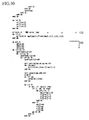
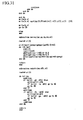
- FIGS. 29 to 31 present an example of an algorithm implemented in FORTRAN language for estimating three-dimensional locations of RFID tags in the configuration of FIG. 7, and FIG. 30 is an example of the program.
- the analysis of RMS error in estimation of three-dimensional locations of the RFID tags in FIG. 23 is a result of computer simulation by the program of FIGS. 29 to 31 using the number of receiving antennas and error in distance measurement as parameters. Note that in the program shown in FIGS. 29 to 31, the simulation for estimating the three-dimensional locations of the RFID tags is carried out in the following procedure.
- the RFID tag of the present invention can perform communication within a relatively long range of about 10 m. However, if it is used for a sign on an expressway and so on, the communication range of about 10 m is highly unlikely to be sufficient. Accordingly, RFID tags of the present invention are arranged in an array to add a phase difference to a response signal from each tag, so that the response signal can be returned with high sensitivity to interrogators in a wide area, thereby making it possible to perform communication within a range of about 100 m. An example thereof is shown in FIGS. 24 through 28.
- the method described herein controls directionality by the arrangement of the RFID tags and combinations of response signal phases at 0°/180° for each tag, however, it is also possible to more strictly control the directionality by assigning more fragmented phase differences as shown in FIG. 8.
- a reader owned by the user incorporates, as a part of ID, a code that represents a color corresponding to visual information of a poster or attached tag or a relatively simple symbol/mark to facilitate selection of an Internet link, avoid displaying identical addresses and present displays in order of address hierarchy.
- the reader owned by the user incorporates, as a part of ID, a code that represents a color corresponding to visual information of a product or attached tag or a relatively simple symbol/mark to facilitate selection of a preferred product, avoid displaying identical ID codes or symbols and provide displays in order of ID code hierarchy.
- the RFID tag device of the present invention not only information recorded in a memory but also information regarding a selected voting switch or the like can be returned as a response signal and readily read from relatively afar, and therefore it is possible to construct an instant voting/ballot counting system at an event site or the like.
- the RFID tag of the present invention has no power supply and a thin and relatively simple structure, and therefore the cost for mass production is conceivably about several tens of yen. Accordingly, it can be left uncollected after used as an invitation or ticket for an event, or it can be collected and repeatedly used.
- the RFID tag of the present invention not only information recorded in a memory but also information measured by various transducers can be returned as a response signal and read from relatively afar, and therefore it is possible to construct a system that uses a relatively small number of interrogators to continuously monitor physical condition information such as an ill-conditioned person's heartbeat from afar without imposing a burden on that person.
- the RFID tag of the present invention not only information recorded in a memory but also information measured by various transducers can be returned as a response signal and read from relatively afar, and therefore it is possible to construct a system that continuously monitors a device, such as high-voltage power transmission and distribution equipment, which is difficult to connect to a sensor and cannot be readily suspended for maintenance because it is dangerous to gain access thereto.
- a device such as high-voltage power transmission and distribution equipment
- the stub resonance boost rectifier circuit and the control circuit in FIG. 2 illustrating the configuration of the RFID tag device of the present invention are integrated as a control circuit chip.
- a highly-versatile, low power consumption microprocessor e.g., PIC16F684 manufactured by Microchip Technology Inc.
- PIC16F684 manufactured by Microchip Technology Inc.
- it can be used for remote control reception with a home appliance or the like, but also it is possible to read a variety of types of information with no power being supplied. For example, with a reader (a remote controller), it is possible to check information such as:
- the RFID tag device of the present invention can be operated to the same standard as a 2.45 GHz wireless LAN, and therefore it is possible to use, as an interrogator, a wireless LAN base station or a wireless LAN terminal.
- a 2.45 GHz carrier signal needs to be transmitted from the wireless LAN to provide operating power for the RFID tag device, but it may be a radio wave of an FHSS or OFDM scheme, which is a wireless LAN standard.
- the RFID tag device returns reply information on a subcarrier signal offset by an oscillating frequency of a local transmitter in the tag, and therefore the reply information from the RFID tag can be read at the wireless LAN by demodulating a subcarrier signal synchronously detected with a transmission carrier.
Landscapes
- Engineering & Computer Science (AREA)
- Computer Networks & Wireless Communication (AREA)
- Remote Sensing (AREA)
- Radar, Positioning & Navigation (AREA)
- General Physics & Mathematics (AREA)
- Physics & Mathematics (AREA)
- Microelectronics & Electronic Packaging (AREA)
- Theoretical Computer Science (AREA)
- Computer Hardware Design (AREA)
- Power Engineering (AREA)
- Signal Processing (AREA)
- Aviation & Aerospace Engineering (AREA)
- Near-Field Transmission Systems (AREA)
- Waveguide Aerials (AREA)
- Digital Transmission Methods That Use Modulated Carrier Waves (AREA)
- Radar Systems Or Details Thereof (AREA)
Abstract
Description
- The present invention relates to RFID tag devices, and specifically to an RFID tag device based on passive modulation, but capable of performing, for example, QPSK modulation for wireless communication by using a loop antenna or a dipole antenna.
- Patent Document 1:
Japanese Laid-Open Patent Publication No. 10-224262 - (Tags for radio frequency identification communication systems)
RFID is wireless equipment for identifying mobile objects, which is attached to or held by a commodity, a person, a car, a road sign, etc., and in response to a radio wave from an interrogator (a reader/writer), notifies individual information and position information to the interrogator. - The RFID is considered not only as an alternative to the barcode, but also as elemental technology for implementing an entirely new infrastructure for a future network community. The research and development of RFID currently underway mainly concentrates on communication within a relatively short range of several tens of centimeters, but if it is possible to realize low-cost small RFID tags capable of communication from relatively afar, such as from about 10 meters away, the application range will be conceivably further extended.
- When such is attached to a commodity, a person, a car or a road sign, for example, its individual information and position information are read by a mobile object from 10 m away, making it possible to readily enjoy safety and convenience.
- The
above Patent Document 1 describes a conventional passive RFID tag device. According to this, the conventional passive RFID tag device is basically configured as shown in FIG. 1, and therefore has a problem that its possible communication range is short for the following reasons. - (1) A response signal is created by regularly changing impedance Zv between an antenna feeding point and GND to repeat reflection and absorption of incident radio waves, so that the transmission output (conversion efficiency) is low, and the load impedance Zv is applied between the feeding point and GND, resulting in considerable loss of received power.
- (2) The source voltage for a control circuit is created by directly diode-rectifying an RF signal received at the antenna feeding point, and therefore the output voltage is low.
- (3) ASK or BPSK is used as a subcarrier modulation scheme, and therefore the amount of information that can be transmitted per transmission power is small.
- The present invention aims to overcome the drawback with the above conventional technology by the configuration shown in FIG. 2, and expand the communication range to several times or more that in the conventional scheme.
- The main points of the present invention for solving the above problems are as shown below.
- The conventional scheme is based on equilibrium feeding/equilibrium modulation (a two-terminal circuit for antenna operation), whereas a method of the present invention is based on disequilibrium feeding/equilibrium modulation (a three-terminal circuit for antenna operation). The conventional scheme is based on simple rectification of received RF signals, whereas the present invention employs a circuit based on a combination of a stub resonance-based, impedance transformation boosting scheme and a ladder boosting scheme. The conventional scheme is based on ASK or BPSK modulation, whereas the present invention is based on passive modulation, but can employ a QPSK modulation circuit.
- Specifically, an RFID tag device of the present invention includes a divided microstrip antenna, a power receiving circuit based on a combination of a stub resonance-based, impedance transformation RF boosting scheme and a ladder boosting/rectifying scheme, and a local oscillator circuit for generating a response subcarrier signal, and a dividing position of the divided microstrip antenna is slightly deviated from a longitudinal center point across strip conductors. In the present invention, a passive QPSK modulation scheme is usable as a modulation method.
- Also, according to the RFID tag device of the present invention, it is preferred that impedance modulation elements of the divided microstrip antenna are respectively connected to opposite ends in a strip conductor width direction so as to connect divided conductors.
The impedance modulation elements are preferably PIN diodes or varactor diodes. Also, a voltage or current controlled three-terminal element using a transistor, rather than a diode, is preferable. - Further, according to the RFID tag device of the present invention, an extremely small capacitance (1 pF/GHz or less) is preferably used for connecting the power receiving circuit and an antenna feeding point to perform high-impedance capacitive feeding. Note that in order to maximize the receiving efficiency of the antenna, the antenna feeding point may be positioned so as not to correspond to a dividing point of the divided microstrip antenna.
- Also, according to the RFID tag device of the present invention, it is preferred that capacitive load impedances in a stub resonator and a ladder boost rectifier circuit of the power receiving circuit are parallel resonant, and further, the capacitive feeding impedance are series resonant.
- Further, according to the RFID tag device of the present invention, it is preferred that when considering longitudinal connections of capacitors in the ladder boost rectifier circuit of the power receiving circuit as GND- and receiving-side rails, capacitor capacitance of the receiving-side rail is smaller than that of the GND-side rail, a first diode between GND and a receiving point is eliminated, and a high-frequency and high-impedance input is receivable by a DC short.
- Also, according to the RFID tag device of the present invention, a logic circuit including a 1/4 frequency divider, a shift register and a data selector is preferably used in the passive QPSK modulation method, and MPSK modulation is preferably applied by using a 1/M frequency divider, an M-stage shift register and an M-input data selector.
- Further, according to the RFID tag device of the present invention, information is preferably recorded to a memory in units of two bits in accordance with the passive QPSK modulation method.
- Also, the RFID tag device of the present invention preferably includes an timing generator circuit for obtaining an output enable signal in the passive QPSK modulation method, and the output timing generator circuit preferably generates a train of pulses with a random delay time having a fixed width and a fixed frame cycle, based on a source voltage size and a clock signal.
- According to the RFID tag device of the present invention, it is preferred that by using a transducer such as a temperature sensor quartz resonator as the local oscillator circuit for generating the response subcarrier signal, a sensor function capable of allowing its oscillating frequency to be read by an external unit is additionally used.
According to a position detecting method for a mobile object having no RFID tag of the present invention, in a system composed of the RFID device and one or more master devices (interrogators), whether or not an obstacle is present in a radio wave propagation path extending between each RFID tag device and each interrogator is determined based on the presence or absence of communication between the RFID tag and the interrogator. - In the position detecting method for a mobile object having no RFID tag, a plurality of radio wave propagation paths present between each RFID tag and each interrogator are preferably distinguished based on a combination of a local oscillating frequency for generating a response subcarrier of each RFID tag, a response timing and a frequency of an interrogation radio wave outputted from the interrogator and timing of generating the interrogation radio wave.
According to a position detecting method for a mobile object having an RFID tag of the present invention, radio waves at two or more frequencies are transmitted to an RFID tag device from an interrogator having two or more antennas dedicated for reception or used for transmission and reception, and based on a difference in phase (a difference in delay time) between receiving antennas in a signal for response thereto, maximum likelihood determination of a position of the RFID tag is performed. - According to the position detecting method for a mobile object having an RFID tag, in the case where in order to enable a three-dimensional RFID tag position determination, an interrogation device having four or more antennas dedicated for reception or used for transmission and reception is used, it is preferred to eliminate a commonly measured distance offset by obtaining a group delay time in each radio wave propagation path based on four or more sets of frequency responses measured for the two or more frequencies, and obtaining a difference in delay time with reference to at least one of the sets.
It is preferred that the RFID tag device of the present invention includes two or more tag antennas in order to expand its possible communication range. - According to a communication method of the present invention, the RFID tag device periodically changes directionality of an intense response subcarrier radio wave, which is synthesized by periodically changing a phase of a local oscillating signal provided to each tag antenna for generating a response subcarrier signal, thereby returning an intense response radio wave toward an interrogator in a wide area.
- By employing these configurations, it is made possible to achieve considerable effects as below.
- Disequilibrium feeding and equilibrium modulation (a three-terminal circuit for antenna operation) are employed, and therefore it is possible to achieve the effect of maximizing the reception efficiency of an antenna.
- Also, by employing a circuit based on a combination of a stub resonance-based, impedance transformation boosting scheme and a ladder boosting scheme, it is possible to obtain a reception voltage of five times or more that of conventional schemes.
- Further, by employing a QPSK modulation circuit, but based on passive modulation, it is made possible to transmit information in an amount twice that of the conventional method per unit of transmitting power.
- FIG. 1 is a schematic diagram illustrating a conventional RFID tag device;
- FIG. 2 is a schematic diagram illustrating an RFID tag device of the present invention;
- FIG. 3 is a perspective view illustrating Example 1 of the present invention;
- FIG. 4 is a top view illustrating a control circuit chip of the present invention;
- FIG. 5 is a diagram illustrating an example of an impedance modulation element of the present invention;
- FIG. 6 is a diagram illustrating Example 2 of the present invention;
- FIG. 7 is a diagram illustrating Example 3 of the present invention;
- FIG. 8 is a diagram illustrating Example 4 of the present invention;
- FIG. 9 is a diagram illustrating Example 4 of the present invention;
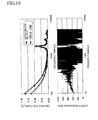
- FIG. 10 is a graph showing frequency response characteristics of a 10-stage Cockcroft-Walton circuit (-3 dBm input, HRU0302A, CO = 70 pF);
- FIG. 11 is a graph showing frequency response characteristics of a 10-stage Cockcroft-Walton circuit (-3 dBm input, HSB226, CO = 2.4 pF);
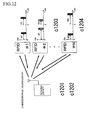
- FIG. 12 is a diagram showing a batch reading (Anticollision) method for a plurality of RFIDs;
- FIG. 13 is a graph showing a batch reading simulation for a plurality of RFIDs, "packet transmission at a random time within a 1-second frame", packet duration /simultaneously readable number.
- FIG. 14 is a diagram illustrating a planar antenna structure for RFID and a simulation model.
- FIG. 15 is a graph showing an RFID response receiver frequency spectrum (obtained by HP83620A, Synthesized Sweeper);
- FIG. 16 is a comparison graph of receiver gain for modulated waves from RFID (transmission/reception λ/2 dipole, distance z = 5λ);
- FIG. 17 a graph showing frequency response characteristics of a stub resonance boost rectifier circuit (-10 dBm input, RL = 33 kΩ by SPICE simulation);
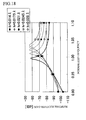
- FIG. 18 is a graph for a comparison of RFID response receiver sensitivity frequency characteristics by changing a height between a microstrip line and GND (distance z = 5λ, w = 0.0525λ, R = 0Ω, CO = 1 pF);
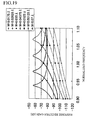
- FIG. 19 is a graph for a comparison of RFID response receiver sensitivity frequency characteristics by changing the width of a microstrip line (distance z = 5λ, h = 0.021λ, R = 0Ω, CO = 1 pF);
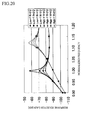
- FIG. 20 is a graph for a comparison of RFID response receiver sensitivity frequency characteristics with respect to resistance by changing a short resistance R of a PIN diode (C-open = 1 pf, Low-f: h = 0.014λ, w = 0.0525λ, High-f: h = 0.028λ, w = 0.035λ);
- FIG. 21 is a graph showing receiver gain for modulated waves from microstrip RFID (transmission/reception λ/2 dipole, distance z = 5λ);
- FIG. 22 is a diagram showing three-dimensional location estimation based on a difference in reception phase of an RFID response signal by FMCW carrier transmission according to Example 3 of the present invention;
- FIG. 23 is a graph showing a simulation estimating a three-dimensional location of an RFID according to Example 3 of the present invention (average in 100 rounds, RFID positional range 6 m × 6m × 6m, intervals between receiving
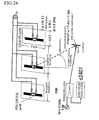
antennas 50 cm); - FIG. 24 is a diagram showing an example of expanding a communication range (in-phase modulation) by forming an array of RFID microstrip elements according to Example 4 of the present invention;
- FIG. 25 is a graph showing RFID response receiver sensitivity/directionality (transmission dipole distance 20λ, microstrip element: 0.364 × 0.0525λ)× three-element array according to Example 4 of the present invention;
- FIG. 26 is a diagram showing an example of expanding a communication range (reversed-phase modulation) by forming an array of RFID microstrip elements according to Example 4 of the present invention;
- FIG. 27 is a graph showing phase difference modulation of an RFID response receiver sensitivity directional 3-element array according to Example 4 of the present invention (transmission dipole distance 20λ, intervals between elements 0.7λ);
- FIG. 28 is a graph showing phase difference modulation of an RFID response receiver sensitivity directional 3-element array according to Example 4 of the present invention (transmission dipole distance 20λ, intervals between elements 0.5λ);
- FIG. 29 is an exemplary FORTRAN program for estimating the three-dimensional location of an RFID tag;
- FIG. 30 is an exemplary FORTRAN program for estimating the three-dimensional location of an RFID tag;
- FIG. 31 is an exemplary FORTRAN program for estimating the three-dimensional location of an RFID tag; and
- FIG. 32 is an example of a FORTRAN program for estimating the three-dimensional location of an RFID tag.
-
- c1201 In the case of single reading (packets cannot be multiplexed at the same time), semi-synchronous delay detection is performed.
- c1202 In the case of double reading (two packets can be multiplexed at the same time), carrier phase split synchronous detection is performed.
- c1203 A received carrier is modulated and ID codes are transmitted in packets.
- c1204 tmn is determined for each RFID by generating random numbers
- c1401, c2401, c2601 A receiver signal level of f0+fL0 is read.
- c2201 Synchronous detection of ωn+Δ is performed for each antenna reception signal.
- c2202 A three-dimensional location is estimated based on at least three parameters; in practice, a reflected wave is present, and therefore time-delay measurements are performed using the MUSIC algorithm based on differences between multi-frequency response phases.
-
c2801 - c28O2 High sensitivity is realized in a wide range by successively switching between modulation phases.
- c2803 Modulation phase of each element
- D1, D2, D3, D4, D5, D6
- Schottky-barrier diode
- D7, D8
- PIN diode
- D9
- Zener diode
- An embodiment of the present invention will now be described.
In the present invention, the dividing position of a divided microstrip antenna is slightly deviated from the longitudinal center point across strip conductors.
Now, assuming that the center point lies at the 50% position with respect to the length of the strip conductor, the dividing position is preferably 55% to 80%. - When the dividing position is 55%, the modulation efficiency (the level of a reply signal) is maximized. However, the resistive influence of a variable impedance element that is exerted on the receiving efficiency is increased.
Also, when the dividing position is 80%, the resistive influence of the variable impedance element that is exerted on the receiving efficiency is small, though the modulation efficiency is decreased. - Thus, it is preferred that, when the resistance of the variable impedance element is small, the dividing position is approximately 55%, and when the resistance of the variable impedance element is relatively large, the dividing position is considerably further deviated from the center.
- FIG. 3 illustrates the basic configuration of an RFID tag device of the present invention. In this figure, the antenna of the RFID tag device includes a ground plane conductor, an insulating layer and a divided strip conductor. The RFID tag device shown in this figure is for use in the 2.45 GHz band, and all specified dimensions are in units of mm. Also, the dividing point of the divided strip conductor is deviated slightly more than equal division in the longitudinal direction, and this feature achieves the effect of maximizing the reception efficiency of the antenna.
- FIG. 4 illustrates the details of the control circuit chip shown in FIG. 3 and connections between the divided strip conductor and the control circuit.
- In FIG. 4, the control circuit chip and the antenna are connected at six points A, B, C, D, E and F. PIN diodes D7 and D8 for impedance modulation are connected between A and B and between D and E, respectively, and a feeding point of the antenna lies between C and F. Here, the point C is slightly deviated from the center point of the strip conductor width, and this feature achieves the effect of maximizing the reception efficiency of the antenna. Also, the point F is connected to the ground plane conductor via a through-hole.
- The operation principle of the power supply circuit in FIG. 4 is shown in FIG. 5. FIG. 5(a) is a boost rectifier circuit called "Cockcroft-Walton circuit", in which a plurality of rectifier diodes and capacitors are connected in a ladder configuration, so that a sine value signal with an amplitude of Vi can be output after being rectified to a DC voltage of K(Vi-lj) greater than Vi [K is the number of ladder steps; lj is a forward drop voltage of a diode]. However, as shown in FIGS. 10 and 11, this circuit has a drawback in that when it is used in a high frequency band (e.g., 2.45 GHz), the junction capacitance of each diode becomes input load and therefore input impedance becomes extremely low, which lowers the output voltage.
- FIG. 5(b) is an operational principle diagram of the boost rectifier circuit of the present invention. An Nλg/4 short stub (λg is an effective wavelength of the transmission path; N is an odd number being 1 or 3) exhibits an equivalent impedance of an inductance having a high Q-value in a high frequency range with respect to an input signal in the vicinity of λg. Even if a ladder boost section of FIG. 5(b) is a capacitive load, an inductive impedance can be maintained by a parallel resonance operation. On the other hand, in a tank circuit boost section of FIG. 5(b), the inductive impedance and a capacitive feed impedance generate an RF signal, which has a large amplitude of VL = Vi / (RL · wc) > > Vi, between G and F by a series resonance operation, so that the circuit of FIG. 5(b) can obtain a DC output voltage of 20Vi or more.
- FIG. 17 is a behavioral analysis result of the boost rectifier circuit of the present invention, from which it is appreciated how an input voltage of 50 Ω /-10 dBm (0.07 V) is boosted and rectified to 1 V or more at 2.45 GHz.
- Next, the control circuit chip of FIG. 4 is described in detail.
- When VDD is applied, an oscillator circuit generates a clock signal of fs. When VDD and the clock signal are applied, an output timing circuit generates a timing signal (an output enable signal) for anticollision as shown in FIGS. 12 and 13. When the output enable signal and the clock signal are applied, an address counter outputs memory read addresses one after another for each clock "L" pulse. Note that the data transmission rate in this case is 2fs / L (bit/sec). The memory sequentially outputs 2-bit information recorded at addresses designated by the address counter. A 1/4 frequency divider outputs a signal corresponding to 1/4 of fs. A shift register operates in accordance with the clock fs, and phase-shifts the output of the 1/4 frequency divider in units of 90°. When the output enable signal is applied, a data selector selects and outputs one of four phase outputs (0° to 270°) of the shift register in accordance with a 2-bit memory output.
- However, it is possible to apply MPSK modulation by using a 1/M frequency divider, an M-stage shift register and an M-input data selector. In this case, it is possible to achieve the effect of increasing the amount of information that is transmitted per unit transmission power.
- The output of the data selector changes the amplitude of current flowing through resistances to the PIN diodes D7 and D8 with a cycle of fs / 4, thereby modulating a connection impedance between the divided strip conductors. As shown in FIG. 14, the change of the impedance changes a mutual coupling impedance between an antenna of an interrogator and the antenna of the RFID tag, so that a reflection coefficient Γ of the antenna of the interrogator is changed with a cycle of fs / 4.
FIG. 15 is an example of a signal measured with a spectrum analyzer. That is, from which it is possible to identify signal components (fO + fLO, fO + 3fLO, etc.), which are generated as a result of an incident wave of fO having been modulated by the change of Γ with a cycle of fLO. In this case, fLO = fs / 4, and because the interrogator can accurately determine fO, it is possible to readily evaluate the oscillating frequency fs of the oscillator circuit at the tag based on the measured spectrum (fO + fLO, fO + 3fLO, etc.). Specifically, by using, for example, a quartz resonator temperature sensor as the oscillator circuit at the tag, it is also possible for the interrogator to monitor the ambient temperature at the tag. - Incidentally, the microstrip antenna used for the RFID tag device of the present invention is explained with respect to its property. The microstrip antenna is configured simply by providing a ground plane close to a plate-like dipole antenna, and therefore might be considered as if it is an antenna that behaves as a dipole, but in fact, its behavioral principle is considerably different from that of the dipole antenna. Specifically, the dipole antenna is an electric current antenna, and the strip antenna is a magnetic current antenna. The reason why in the present invention, two PIN diodes for impedance modulation are provided at opposite ends of the microstrip conductor in the width direction is that electric current flowing through the strip conductors is concentrated at the opposite ends in the width direction.
- FIG. 16 is an example of analyzing the level of a response signal that can be received by an interrogator by using antenna length L as a parameter in the evaluation system of FIG. 14, with respect to the case where a conventional dipole antenna having no ground plate is used in an RFID tag and the case where the divided microstrip antenna of the present invention is used in an RFID tag. As can be seen from this figure, the method of the present invention is capable of receiving the response signal with a level greater by about 10 dB (10 times greater power) compared to the conventional method.
- FIGS. 18 through 20 show changes in frequency at response receiver levels in the evaluation system of FIG. 14 with respect to design parameters w and h of the microstrip antenna (it is assumed that L = 0.36 λ is fixed). It can be appreciated from FIG. 18 that by reducing h (the thickness of an insulator), it is possible to make adaptation to lower frequencies with the same size (size reduction with the same frequency), but an available frequency bandwidth becomes narrow.
- Also, it can be appreciated from FIG. 19 that by increasing w (the strip conductor width), it is possible to make adaptation to lower frequencies with the same size, but an available frequency bandwidth becomes narrow.
- FIG. 20 is a result of analyzing influences of a series resistance in PIN diodes for impedance modulation that are exerted on the receiver level with respect to the cases of making adaptation to lower and higher frequencies with the same size. As can be seen from this figure, in the case of size reduction with the same frequency (reduction in h, increase in w), considerable influences are exerted by the series resistance of the PIN diodes, and therefore it is necessary to reduce the resistance in order to obtain a high response receiver level. In order to allow the PIN diodes to operate with low resistance, there is no choice but to apply a large current or increase junction capacitance (large area, short junction). The large current increases power consumption of the RFID tag device, and therefore is undesirable.
- FIG. 21 is a result of analyzing a maximum response receiver level in the evaluation system of FIG. 14 by using the series resistance and junction capacitance of the PIN diodes as parameters. As can be seen from this figure, the response receiver level does not change substantially when the junction capacitance of the PIN diodes is increased, and therefore it is possible to obtain a high response receiver level even by using relatively low-cost PIN diodes.
- Also, instead of the PIN diodes, it is possible to use varactor diodes, and transistors such as MOSFET may also be used. In such a case, it is possible to further reduce the power consumption.
- Also, when considering longitudinal connections of capacitors in a ladder boost rectifier circuit of a power receiving circuit as GND- and receiving-side rails, it is possible to consider diodes as rungs that join them. Capacitances of all the capacitors are normally equalized to maximize the booster efficiency, but in the present invention, the capacitor capacitance of the receiving-side rail is made smaller by one digit compared to that of the GND-side rail (specifically, GND-side rail: receiving-side rail = 1 : 0.05), and the first diode (between the GND and the receiving point) is eliminated, whereby it is possible to reduce input load capacity and receive a high-frequency and high-impedance input with a DC short.
- The feature of the RFID tag of the present invention that is capable of relatively long range communication in spite of having no power supply is utilized.
- Assuming that the positions of
tags # 1 through #4 andinterrogators # 1 and #2 are known as shown in FIG. 6, it is possible to estimate the position of a mobile object based on information concerning paths obstructed by the moving object. - In this case, a system may be configured such that fm1 = fm2, fs1 = fs2 = fs3 = fs4, the interrogators provide CW outputs in a time-division system, and the tags respond by an anticollision method.
- Further, a system may be configured such that fm1 # fm2, fs1 = fs2 = fs3 = fs4, the interrogators successively provide CW outputs, and the tags respond by an anticollision method.
- Furthermore, a system may be configured such that fm1 ≠ fm2, fs1, fs2, fs3 and fs4 are all different frequencies, and the interrogators successively provide CW outputs.
- The feature of the RFID tag of the present invention that is capable of relatively long range communication in spite of having no power supply is utilized.
- As shown in FIGS. 22 and 23, a plurality of receiving antennas are used at the master device, and CW signals are transmitted at two or more frequencies to detect differences in phase between response signals from RFID tags, making it possible to estimate three-dimensional locations of the RFID tags.
- FIG. 7 illustrates the configuration of a master device. A Fourier transform section performs time-series Fourier integration on Re and Im data of
antennas # 1 through #4 to calculate a spectrum phase at a frequency Δ. In this case, it is assumed that phase differences due to each antenna cable and down converter and a time delay in operations of a selecting switch are calibrated for the compensation. - Note that FIGS. 29 to 31 present an example of an algorithm implemented in FORTRAN language for estimating three-dimensional locations of RFID tags in the configuration of FIG. 7, and FIG. 30 is an example of the program. Also, the analysis of RMS error in estimation of three-dimensional locations of the RFID tags in FIG. 23 is a result of computer simulation by the program of FIGS. 29 to 31 using the number of receiving antennas and error in distance measurement as parameters.
Note that in the program shown in FIGS. 29 to 31, the simulation for estimating the three-dimensional locations of the RFID tags is carried out in the following procedure. - (1) Assuming that radio wave frequencies output from interrogators are f1 = 2.000 GHZ, f2 = 2.025 GHZ and f0 = 2 (f2-f1) = 0.05 GHZ and λ0 = 15 cm, the delay evaluation cycle length is taken as dlh = λ0 / f0 (cm) and the number of receiving antennas is taken as na = 16.
- (2) The three-dimensional locations of the RFID tags are entered.
- (3) Distances D are obtained based on phases at which response signals from the RFIDs are received by receiving antennas. In this case, spacing between the receiving antennas are taken as 50 cm.

- (4) Noise is added to the distances D obtained based on the phases of reception by the receiving antennas, and differences in distance to a reference antenna are calculated. Here, in common with all the distances D obtained at the above step (3), offsets such as distances DX from transmitting antennas of interrogators to the RFID tags and differences in response phase of the RFID tags are included, and therefore the reason why the differences to the reference antenna are calculated is to achieve the effect of eliminating influences of Dx and so on.
- (5) The differences in distance between the receiving antennas are compensated for the delay evaluation cycle length dlh.
- (6) Three-dimensional locations XP, YP, ZP of the RFID tags are assumed.
- (7) Distances to the assumed tag locations XP, YP, ZP are obtained based on the phases of reception by the receiving antennas.
- (8) The differences in distance between the antennas, which are actually received at the above step (5), are compared with differences between the distances to the assumed tag locations that are obtained at the above step (7) based on the phases of reception by the receiving antennas.
- (9) The distance differences compared above are compensated for the delay evaluation cycle length dlh.
- (10) Error energies are obtained with respect to the compared distance differences between the receiving antennas that have been subjected to the above cycle compensation.
- (11) After repeating the processes of the above steps (6) through (10), three-dimensional locations of five positions of the tag are listed in ascending order of error energy.
- (12) Approximate results for estimating the three-dimensional locations of the listed five positions of the tag and the error RMS values are displayed.
- (13) An assumed tag location that provides a minimum error energy is obtained in three dimensions by repeating the above processes in (6) through (10) with more fragmented steps focusing on each of the three-dimensional locations of the listed five positions of the tag.
- (14) The three-dimensional assumed tag location that provides the minimum error energy is displayed as a finally estimated RFID tag location.
- The RFID tag of the present invention, even by itself, can perform communication within a relatively long range of about 10 m. However, if it is used for a sign on an expressway and so on, the communication range of about 10 m is highly unlikely to be sufficient. Accordingly, RFID tags of the present invention are arranged in an array to add a phase difference to a response signal from each tag, so that the response signal can be returned with high sensitivity to interrogators in a wide area, thereby making it possible to perform communication within a range of about 100 m. An example thereof is shown in FIGS. 24 through 28.
- The method described herein controls directionality by the arrangement of the RFID tags and combinations of response signal phases at 0°/180° for each tag, however, it is also possible to more strictly control the directionality by assigning more fragmented phase differences as shown in FIG. 8.
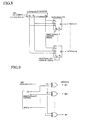
- Note that the combinations of phases at 0°/180° in FIG. 24 through 28 can be readily realized by using an EXOR as shown in FIG. 9.
Also, it is made possible to communicate with interrogators in a wide area by periodically changing the combinations of phases provided herein to perform scanning with a beam of intense response radio waves that can be returned only within a narrow area. - Common features of being inexpensive, having no power supply, requiring no maintenance and being capable of long range communication (up to about 100 m) are used as the means of implementation.
- (1) Because of the ease of attachment to a road sign, etc., and the fact that information can be read by an interrogator from relatively afar and, if radio wave diffraction is utilized, even from a position behind another vehicle, it is possible to construct an intelligent navigation system notifying information concerning the speed limit, indication of a curve/fork, etc., to the driver and an automatic operation or safety support device of the vehicle.
- (2) Because of the ease of attachment to an advertisement material such as a poster and the fact that information can be read by an interrogator from relatively afar, it is possible to realize an applied device for reading an Internet home page address on a posted advertisement from a distance and construct a product advertising system. In this case, it is conceivable to simultaneously read a plurality of posters having the same address or simultaneously read a plurality of posters having a different address. A reader (an interrogator) owned by the user incorporates, as a part of ID, a code that represents a color corresponding to visual information of a poster or attached tag or a relatively simple symbol/mark to facilitate selection of an Internet link, avoid displaying identical addresses and present displays in order of address hierarchy.
- (3) Because of the ease of attachment to a sample or product such as an exhibit and the fact that information can be read from relatively afar, it is possible to construct a reservation and market research system that, without necessitating approaching the exhibit, transmits a product reservation and information added with preferences regarding the size and color to the seller of the product (a reader is additionally provided with a wireless LAN function or a cell phone function, or the reader accumulates information and returns it to the seller). In this case, it is conceivable to simultaneously read information concerning a plurality of products having the same ID from a display shelf or a showcase or simultaneously read a plurality of pieces of information concerning products having a different ID. The reader owned by the user incorporates, as a part of ID, a code that represents a color corresponding to visual information of a product or attached tag or a relatively simple symbol/mark to facilitate selection of a preferred product, avoid displaying identical ID codes or symbols and provide displays in order of ID code hierarchy.
- (4) Because of easy incorporation into cars, home appliances, etc., and the feasibility of being read from relatively afar, it is possible to construct a system for performing classification for recycling or deterring illegal waste dumping, stealing for resale, etc. Specifically, by recording, together with an ID code, not only information at the time of production but also information concerning the owner or information concerning the presence or absence of hazardous substances, it is made possible to allow a relatively simple reader to perform concurrent identification from afar.
- (5) According to the RFID tag device of the present invention, not only information recorded in a memory but also information regarding a selected voting switch or the like can be returned as a response signal and readily read from relatively afar, and therefore it is possible to construct an instant voting/ballot counting system at an event site or the like. The RFID tag of the present invention has no power supply and a thin and relatively simple structure, and therefore the cost for mass production is conceivably about several tens of yen. Accordingly, it can be left uncollected after used as an invitation or ticket for an event, or it can be collected and repeatedly used.
- (6) According to the RFID tag of the present invention, not only information recorded in a memory but also information measured by various transducers can be returned as a response signal and read from relatively afar, and therefore it is possible to construct a system that uses a relatively small number of interrogators to continuously monitor physical condition information such as an ill-conditioned person's heartbeat from afar without imposing a burden on that person.
- (7) According to the RFID tag of the present invention, not only information recorded in a memory but also information measured by various transducers can be returned as a response signal and read from relatively afar, and therefore it is possible to construct a system that continuously monitors a device, such as high-voltage power transmission and distribution equipment, which is difficult to connect to a sensor and cannot be readily suspended for maintenance because it is dangerous to gain access thereto.
- (8) In the example of FIG. 4, the stub resonance boost rectifier circuit and the control circuit in FIG. 2 illustrating the configuration of the RFID tag device of the present invention are integrated as a control circuit chip. However, a highly-versatile, low power consumption microprocessor (e.g., PIC16F684 manufactured by Microchip Technology Inc.) can be used as the control circuit and combined with the stub resonance boost rectifier circuit. By configuring as such, it is made possible to input analog data or digital data, so that such data can be temporarily stored in the RFID tag or can be stored in an EEPROM for a long period of time. Further, it can be used for remote control reception with a home appliance or the like, but also it is possible to read a variety of types of information with no power being supplied. For example, with a reader (a remote controller), it is possible to check information such as:
- Power is not being supplied;
- xxx is out of order;
- yyy is still inside xxx;
- yyy is reserved for xxx;
- yyy was last used on x month, x day at x o'clock, x minutes.
- (9) The RFID tag device of the present invention can be operated to the same standard as a 2.45 GHz wireless LAN, and therefore it is possible to use, as an interrogator, a wireless LAN base station or a wireless LAN terminal. In this case, a 2.45 GHz carrier signal needs to be transmitted from the wireless LAN to provide operating power for the RFID tag device, but it may be a radio wave of an FHSS or OFDM scheme, which is a wireless LAN standard. The RFID tag device returns reply information on a subcarrier signal offset by an oscillating frequency of a local transmitter in the tag, and therefore the reply information from the RFID tag can be read at the wireless LAN by demodulating a subcarrier signal synchronously detected with a transmission carrier.
Claims (20)
- An RFID tag device comprising a divided microstrip antenna, a power receiving circuit based on a combination of a stub resonance-based, impedance transformation RF boosting scheme and a ladder boosting/rectifying scheme, and a local oscillator circuit for generating a response subcarrier signal,
wherein a dividing position of the divided microstrip antenna is slightly deviated from a longitudinal center point across strip conductors. - The RFID tag device according to claim 1 being an RFID tag as a modulation scheme of which a passive QPSK modulation method is usable.
- The RFID tag device according to claim 1 or 2, wherein impedance modulation elements of the divided microstrip antenna are respectively connected to opposite ends in a strip conductor width direction so as to connect divided conductors.
- The RFID tag device according to claim 3, wherein the impedance modulation elements are PIN diodes or varactor diodes.
- The RFID tag device according to claim 3, wherein the impedance modulation elements constitute a voltage or current controlled three-terminal element using a transistor, rather than a diode.
- The RFID tag device according to any one of claims 1 to 5, wherein an extremely small capacitance of 1 pF/GHz or less is used for connecting the power receiving circuit and an antenna feeding point to perform high-impedance capacitive feeding.
- The RFID tag device according to any one of claims 1 to 6, wherein capacitive load impedances in a stub resonator and a ladder boost rectifier circuit of the power receiving circuit are parallel resonant, and further, the capacitive feeding impedance are series resonant.
- The RFID tag device according to any one of claims 1 to 7, wherein when considering longitudinal connections of capacitors in the ladder boost rectifier circuit of the power receiving circuit as GND- and receiving-side rails, capacitor capacitance of the receiving-side rail is smaller than that of the GND-side rail, a first diode between GND and a receiving point is eliminated, and a high-frequency and high-impedance input is receivable by a DC short.
- The RFID tag device according to any one of claims 2 to 8, wherein a logic circuit including a 1/4 frequency divider, a shift register and a data selector is used in the passive QPSK modulation method.
- The RFID tag device according to claim 9, wherein MPSK modulation is applied by using a 1/M frequency divider, an M-stage shift register and an M-input data selector.
- The RFID tag device according to any one of claims 2 to 9, wherein information is recorded to a memory in units of two bits in accordance with the passive QPSK modulation method.
- The RFID tag device according to any one of claims 2 to 9 and claim 11, including an output timing generator circuit for obtaining an output enable signal in the passive QPSK modulation method.
- The RFID tag device according to claim 12, wherein the output timing generator circuit generates a train of pulses with a random delay time having a fixed width and a fixed frame cycle, based on a source voltage size and a clock signal.
- The RFID tag device according to any one of claims 1 to 13, wherein by using a transducer such as a temperature sensor quartz resonator as the local oscillator circuit for generating the response subcarrier signal, a sensor function capable of allowing its oscillating frequency to be read by an external unit is additionally used.
- A position detecting method for a mobile object having no RFID tag, wherein in a system composed of an RFID device as claimed in any one of claims 1 to 14 and one or more master devices (interrogators), whether or not an obstacle is present in a radio wave propagation path extending between each RFID tag device and each interrogator is determined based on the presence or absence of communication between the RFID tag and the interrogator.
- The position detecting method for a mobile object having no RFID tag according to claim 15, wherein in the position detecting method for a mobile object having no RFID tag, a plurality of radio wave propagation paths present between each RFID tag and each interrogator are distinguished based on a combination of a local oscillating frequency for generating a response subcarrier of each RFID tag, a response timing, a frequency of an interrogation radio wave outputted from the interrogator and timing of generating the interrogation radio wave.
- A position detecting method for a mobile object having an RFID tag, wherein radio waves at two or more frequencies are transmitted to an RFID tag device as claimed in any one of claims 1 to 14 from an interrogator having two or more antennas dedicated for reception or used for transmission and reception, and based on a difference in phase (a difference in delay time) between receiving antennas in a signal for response thereto, maximum likelihood determination of a position of the RFID tag is performed.
- The position detecting method for a mobile object having an RFID tag according to claim 17, wherein in order to enable a three-dimensional RFID tag position determination, an interrogation device having four or more antennas dedicated for reception or used for transmission and reception is used to eliminate a commonly measured distance offset by obtaining a group delay time in each radio wave propagation path based on four or more sets of frequency responses measured for the two or more frequencies, and obtaining a difference in delay time with reference to at least one of the sets.
- The RFID tag device according to any one of claims 1 to 14, including two or more tag antennas in order to expand its possible communication range.
- A communication method, wherein an RFID tag device as claimed in claim 19 periodically changes directionality of an intense response subcarrier radio wave, which is synthesized by periodically changing a phase of a local oscillating signal provided to each tag antenna for generating a response subcarrier signal, thereby returning an intense response radio wave toward an interrogator in a wide area.
Applications Claiming Priority (3)
| Application Number | Priority Date | Filing Date | Title |
|---|---|---|---|
| JP2004054933 | 2004-02-27 | ||
| JP2004304876A JP4328705B2 (en) | 2004-02-27 | 2004-10-19 | RFID tag device |
| PCT/JP2005/002746 WO2005083895A1 (en) | 2004-02-27 | 2005-02-21 | Rf id tag device |
Publications (3)
| Publication Number | Publication Date |
|---|---|
| EP1732238A1 true EP1732238A1 (en) | 2006-12-13 |
| EP1732238A4 EP1732238A4 (en) | 2014-08-20 |
| EP1732238B1 EP1732238B1 (en) | 2018-08-29 |
Family
ID=34914462
Family Applications (1)
| Application Number | Title | Priority Date | Filing Date |
|---|---|---|---|
| EP05719365.8A Expired - Lifetime EP1732238B1 (en) | 2004-02-27 | 2005-02-21 | Rf id tag device |
Country Status (7)
| Country | Link |
|---|---|
| US (1) | US8179263B2 (en) |
| EP (1) | EP1732238B1 (en) |
| JP (1) | JP4328705B2 (en) |
| KR (1) | KR101083614B1 (en) |
| CN (1) | CN1943126B (en) |
| NO (1) | NO341680B1 (en) |
| WO (1) | WO2005083895A1 (en) |
Cited By (8)
| Publication number | Priority date | Publication date | Assignee | Title |
|---|---|---|---|---|
| WO2007085517A1 (en) * | 2006-01-27 | 2007-08-02 | Siemens Aktiengesellschaft | Device and method for multi-dimensional location of target objects, in particular rfid transponders |
| FR2910746A1 (en) * | 2006-12-20 | 2008-06-27 | Smart Packaging Solutions Sps | Local radio-frequency communication interface for e.g. mobile telephone, has antenna connected to another set of antennas to allow smart card communicating with non-contact reader without using wireless telecommunication network |
| EP2267835A1 (en) * | 2009-06-09 | 2010-12-29 | Broadcom Corporation | Method and system for converting RF power to DC power utilizing a leaky wave antenna |
| US9121771B2 (en) | 2010-03-16 | 2015-09-01 | The Penn State Research Foundation | Methods and apparatus for ultra-sensitive temperature detection using resonant devices |
| EP2124348A4 (en) * | 2007-03-06 | 2016-06-22 | Hitoshi Kitayoshi | Radio tag, radio tag reader, pulse encoding key detection circuit, and radio tag system using them |
| CN106031049A (en) * | 2013-12-30 | 2016-10-12 | 美卓流体控制有限公司 | Passive wireless sensor |
| US9570420B2 (en) | 2011-09-29 | 2017-02-14 | Broadcom Corporation | Wireless communicating among vertically arranged integrated circuits (ICs) in a semiconductor package |
| EP2661040A4 (en) * | 2010-12-28 | 2018-03-07 | Tohoku University | Microwave band booster rectifier circuit, and wireless tag device and wireless tag system employing same |
Families Citing this family (37)
| Publication number | Priority date | Publication date | Assignee | Title |
|---|---|---|---|---|
| US8107446B2 (en) * | 2005-11-07 | 2012-01-31 | Radiofy Llc | Wireless RFID networking systems and methods |
| JP2007259213A (en) * | 2006-03-24 | 2007-10-04 | Hitoshi Kitayoshi | Wireless tag device, wireless tag antenna, power receiving circuit, and wireless tag reading method |
| US20080068132A1 (en) * | 2006-05-16 | 2008-03-20 | Georges Kayanakis | Contactless radiofrequency device featuring several antennas and related antenna selection circuit |
| US20080030324A1 (en) * | 2006-07-31 | 2008-02-07 | Symbol Technologies, Inc. | Data communication with sensors using a radio frequency identification (RFID) protocol |
| CH705647B1 (en) * | 2006-10-13 | 2013-04-30 | Ferag Ag | RFID printing product identification. |
| US8344949B2 (en) * | 2008-03-31 | 2013-01-01 | Golba Llc | Wireless positioning approach using time-delay of signals with a known transmission pattern |
| US20080143584A1 (en) * | 2006-12-18 | 2008-06-19 | Radiofy Llc, A California Limited Liability Company | Method and system for determining the distance between an RFID reader and an RFID tag using phase |
| US8294554B2 (en) | 2006-12-18 | 2012-10-23 | Radiofy Llc | RFID location systems and methods |
| US8314736B2 (en) | 2008-03-31 | 2012-11-20 | Golba Llc | Determining the position of a mobile device using the characteristics of received signals and a reference database |
| CN101295368B (en) * | 2007-04-25 | 2011-03-23 | 周必友 | Semi-passive active electronic label |
| US8583065B2 (en) * | 2007-06-07 | 2013-11-12 | Vishay Intertechnology, Inc. | Digitally controlled antenna tuning circuit for radio frequency receivers |
| JP5355936B2 (en) * | 2007-06-28 | 2013-11-27 | 日本信号株式会社 | Reader / writer and article sorting system |
| KR100932064B1 (en) * | 2007-09-04 | 2009-12-15 | 한국전자통신연구원 | RDF tag and its control method |
| US9829560B2 (en) | 2008-03-31 | 2017-11-28 | Golba Llc | Determining the position of a mobile device using the characteristics of received signals and a reference database |
| US7800541B2 (en) * | 2008-03-31 | 2010-09-21 | Golba Llc | Methods and systems for determining the location of an electronic device |
| WO2009151778A2 (en) * | 2008-04-14 | 2009-12-17 | Mojix, Inc. | Radio frequency identification tag location estimation and tracking system and method |
| JP2010157862A (en) | 2008-12-26 | 2010-07-15 | Fujifilm Corp | Communication antenna, rfid tag, contactless communication device, and contactless communication method |
| JP5563356B2 (en) * | 2010-04-12 | 2014-07-30 | キヤノン株式会社 | Electromagnetic wave detection element |
| JP5751327B2 (en) * | 2011-06-17 | 2015-07-22 | 株式会社豊田自動織機 | Resonant contactless power supply system |
| US9179492B2 (en) * | 2011-10-26 | 2015-11-03 | Texas Instruments Deutschland Gmbh | Electronic device, method and system for half duplex data transmission |
| US20150222497A1 (en) * | 2012-08-07 | 2015-08-06 | Panasonic Intellectual Property Management Co., Ltd. | Information terminal, information display method, control program and server |
| CN103812226A (en) * | 2012-11-13 | 2014-05-21 | 集美大学 | Radio frequency energy collecting device applied to wireless mobile terminal |
| US9008230B2 (en) * | 2013-01-08 | 2015-04-14 | Nxp B.V. | Receiver and method for near field communication |
| KR102055866B1 (en) | 2013-05-03 | 2019-12-13 | 삼성전자주식회사 | Wireless power transmitter, wireless power receiver and method for controlling each thereof |
| CN103646225B (en) * | 2013-12-03 | 2017-01-11 | 北京中电华大电子设计有限责任公司 | Method and circuit for ultrahigh frequency radio frequency identification tag reverse communication speed |
| US9426003B2 (en) | 2013-12-18 | 2016-08-23 | Nxp B.V. | Proximity integrated circuit card bias adjustment |
| US9798338B2 (en) | 2014-08-04 | 2017-10-24 | Nxp B.V. | Digitally controllable power source |
| US9323966B2 (en) | 2014-09-30 | 2016-04-26 | Google Inc. | Device for backscatter communication |
| US9357341B2 (en) | 2014-09-30 | 2016-05-31 | Google Inc. | Receiver for backscatter communication |
| CN107430182A (en) * | 2015-02-09 | 2017-12-01 | 同心真时公司 | For determining the radio receiver of source location |
| US9883337B2 (en) | 2015-04-24 | 2018-01-30 | Mijix, Inc. | Location based services for RFID and sensor networks |
| EP3101596B1 (en) | 2015-06-03 | 2018-04-25 | Nxp B.V. | Adaptive bias tuning |
| JP2017156281A (en) * | 2016-03-03 | 2017-09-07 | キヤノン株式会社 | Device and method |
| JP7040897B2 (en) * | 2017-03-30 | 2022-03-23 | ラピスセミコンダクタ株式会社 | Semiconductor devices, non-contact electronic devices, and period detection methods |
| EP3502604B1 (en) * | 2017-12-21 | 2023-07-12 | Martin Christ Gefriertrocknungsanlagen GmbH | Use of a product sensor, use of a set of product sensors, drying vessel and method for operating a product sensor |
| CN111344596B (en) * | 2018-03-24 | 2023-06-06 | 布莱登·李 | RFID tag positioning and RFID tag association |
| CN112633022B (en) * | 2020-12-04 | 2023-06-27 | 北京信息科技大学 | Radio frequency label security inspection machine |
Family Cites Families (33)
| Publication number | Priority date | Publication date | Assignee | Title |
|---|---|---|---|---|
| US3761934A (en) * | 1972-05-08 | 1973-09-25 | Dx Antenna | Two-element receiving antenna with critically spaced end sections |
| US3761943A (en) * | 1972-07-21 | 1973-09-25 | Us Navy | Dual-band array antenna |
| JPS5248416A (en) * | 1975-07-23 | 1977-04-18 | Johnson Controls Inc | Data communication system |
| CH650122GA3 (en) * | 1981-12-17 | 1985-07-15 | ||
| US4942393A (en) * | 1988-05-27 | 1990-07-17 | Lectron Products, Inc. | Passive keyless entry system |
| US5987058A (en) * | 1988-11-02 | 1999-11-16 | Axonn Corporation | Wireless alarm system |
| NZ314270A (en) * | 1992-11-18 | 1998-06-26 | British Tech Group | Transponder identification system: interrogator transmits inhibiting signal to disable transponders |
| US5572190A (en) * | 1995-03-22 | 1996-11-05 | Anro Engineering, Inc. | Batteryless sensor used in security applications |
| NL1001840C2 (en) * | 1995-12-07 | 1997-06-10 | Nederland Ptt | Label. |
| US6466131B1 (en) * | 1996-07-30 | 2002-10-15 | Micron Technology, Inc. | Radio frequency data communications device with adjustable receiver sensitivity and method |
| US5777561A (en) * | 1996-09-30 | 1998-07-07 | International Business Machines Corporation | Method of grouping RF transponders |
| KR20000049066A (en) * | 1996-10-17 | 2000-07-25 | 핀포인트 코포레이션 | Article tracking system |
| US6107910A (en) * | 1996-11-29 | 2000-08-22 | X-Cyte, Inc. | Dual mode transmitter/receiver and decoder for RF transponder tags |
| US6243012B1 (en) * | 1996-12-31 | 2001-06-05 | Lucent Technologies Inc. | Inexpensive modulated backscatter reflector |
| ES2207833T3 (en) * | 1997-05-14 | 2004-06-01 | Btg International Limited | IMPROVED IDENTIFICATION SYSTEM. |
| US5986570A (en) * | 1997-09-03 | 1999-11-16 | Micron Communications, Inc. | Method for resolving signal collisions between multiple RFID transponders in a field |
| DE19750047A1 (en) * | 1997-11-12 | 1999-05-20 | Bosch Gmbh Robert | Directional short-range communication method (DSRC) and transponder therefor |
| GB9724183D0 (en) * | 1997-11-14 | 1998-01-14 | British Tech Group | Identification system |
| JP3991424B2 (en) * | 1998-03-10 | 2007-10-17 | 株式会社日立製作所 | Non-contact type IC card modulation signal input circuit |
| EP1026627A1 (en) * | 1999-01-29 | 2000-08-09 | Siemens Aktiengesellschaft | Contactless data communication system and method |
| US6137422A (en) * | 1999-05-21 | 2000-10-24 | Micron Technology, Inc. | Communications system and method with D/A converter |
| US6236314B1 (en) * | 1999-09-02 | 2001-05-22 | Micron Technology, Inc. | Transponder modules, RF tagging system, method of operating a transponder module and methods of tagging an object having a conductive surface |
| US7006014B1 (en) * | 2000-10-17 | 2006-02-28 | Henty David L | Computer system with passive wireless keyboard |
| US6942155B1 (en) * | 2001-05-31 | 2005-09-13 | Alien Technology Corporation | Integrated circuits with persistent data storage |
| JP3702823B2 (en) * | 2001-08-23 | 2005-10-05 | セイコーエプソン株式会社 | Liquid crystal display device and electronic device |
| JP2003069447A (en) | 2001-08-29 | 2003-03-07 | Hitachi Ltd | Mobile body identification device |
| GB0122163D0 (en) * | 2001-09-13 | 2001-10-31 | Tagtec Ltd | Wireless communication system |
| EP1470613A4 (en) * | 2002-01-09 | 2005-10-05 | Meadwestvaco Corp | INTELLIGENT STATION WITH MULTIPLE RF ANTENNAS AND INVENTORY CONTROL SYSTEM AND METHOD THEREFORE |
| US7071043B2 (en) * | 2002-08-15 | 2006-07-04 | Micron Technology, Inc. | Methods of forming a field effect transistor having source/drain material over insulative material |
| DE10301451A1 (en) * | 2003-01-10 | 2004-07-22 | Atmel Germany Gmbh | Wireless data transmission method between base station and transponder, by modulating electromagnet waves at receiver using modulation technique based on received field strength |
| US20060132302A1 (en) * | 2003-02-03 | 2006-06-22 | Stilp Louis A | Power management of transponders and sensors in an RFID security network |
| US7612652B2 (en) * | 2003-12-09 | 2009-11-03 | Intelleflex Corporation | Battery activation circuit |
| US7616113B2 (en) * | 2007-01-04 | 2009-11-10 | International Business Machines Corporation | Spatially locating RFID tags using multiple readers and correction factors |
-
2004
- 2004-10-19 JP JP2004304876A patent/JP4328705B2/en not_active Expired - Fee Related
-
2005
- 2005-02-21 EP EP05719365.8A patent/EP1732238B1/en not_active Expired - Lifetime
- 2005-02-21 CN CN200580006315.6A patent/CN1943126B/en not_active Expired - Fee Related
- 2005-02-21 KR KR1020067018237A patent/KR101083614B1/en not_active Expired - Fee Related
- 2005-02-21 WO PCT/JP2005/002746 patent/WO2005083895A1/en not_active Ceased
- 2005-02-21 US US10/590,882 patent/US8179263B2/en not_active Expired - Fee Related
-
2006
- 2006-09-26 NO NO20064350A patent/NO341680B1/en not_active IP Right Cessation
Cited By (14)
| Publication number | Priority date | Publication date | Assignee | Title |
|---|---|---|---|---|
| WO2007085517A1 (en) * | 2006-01-27 | 2007-08-02 | Siemens Aktiengesellschaft | Device and method for multi-dimensional location of target objects, in particular rfid transponders |
| FR2910746A1 (en) * | 2006-12-20 | 2008-06-27 | Smart Packaging Solutions Sps | Local radio-frequency communication interface for e.g. mobile telephone, has antenna connected to another set of antennas to allow smart card communicating with non-contact reader without using wireless telecommunication network |
| WO2008096059A1 (en) * | 2006-12-20 | 2008-08-14 | Smart Packaging Solutions (Sps) | Radiofrequency local communication interface between a mobile phone and a contactless reader |
| US8644880B2 (en) | 2006-12-20 | 2014-02-04 | Smart Packaging Solutions (Sps) | Radiofrequency local communication interface between a mobile phone and a contactless reader |
| EP2124348A4 (en) * | 2007-03-06 | 2016-06-22 | Hitoshi Kitayoshi | Radio tag, radio tag reader, pulse encoding key detection circuit, and radio tag system using them |
| EP2267835A1 (en) * | 2009-06-09 | 2010-12-29 | Broadcom Corporation | Method and system for converting RF power to DC power utilizing a leaky wave antenna |
| US8508422B2 (en) | 2009-06-09 | 2013-08-13 | Broadcom Corporation | Method and system for converting RF power to DC power utilizing a leaky wave antenna |
| US9121771B2 (en) | 2010-03-16 | 2015-09-01 | The Penn State Research Foundation | Methods and apparatus for ultra-sensitive temperature detection using resonant devices |
| US10184845B2 (en) | 2010-03-16 | 2019-01-22 | The Penn State Research Foundation | Methods and apparatus for ultra-sensitive temperature detection using resonant devices |
| EP2661040A4 (en) * | 2010-12-28 | 2018-03-07 | Tohoku University | Microwave band booster rectifier circuit, and wireless tag device and wireless tag system employing same |
| US9570420B2 (en) | 2011-09-29 | 2017-02-14 | Broadcom Corporation | Wireless communicating among vertically arranged integrated circuits (ICs) in a semiconductor package |
| CN106031049A (en) * | 2013-12-30 | 2016-10-12 | 美卓流体控制有限公司 | Passive wireless sensor |
| EP3090490A4 (en) * | 2013-12-30 | 2017-08-23 | Metso Flow Control Oy | Passive wireless sensor |
| US10140566B2 (en) | 2013-12-30 | 2018-11-27 | Metso Oyj | Passive wireless sensor |
Also Published As
| Publication number | Publication date |
|---|---|
| WO2005083895A1 (en) | 2005-09-09 |
| NO20064350L (en) | 2006-09-26 |
| NO341680B1 (en) | 2017-12-18 |
| CN1943126A (en) | 2007-04-04 |
| KR20070029142A (en) | 2007-03-13 |
| US8179263B2 (en) | 2012-05-15 |
| CN1943126B (en) | 2014-07-23 |
| US20090033462A1 (en) | 2009-02-05 |
| JP4328705B2 (en) | 2009-09-09 |
| JP2005278139A (en) | 2005-10-06 |
| EP1732238A4 (en) | 2014-08-20 |
| EP1732238B1 (en) | 2018-08-29 |
| KR101083614B1 (en) | 2011-11-16 |
Similar Documents
| Publication | Publication Date | Title |
|---|---|---|
| EP1732238B1 (en) | Rf id tag device | |
| Rida et al. | RFID-enabled sensor design and applications | |
| Landt | The history of RFID | |
| Vannucci et al. | A software-defined radio system for backscatter sensor networks | |
| CA2519621C (en) | Improved advertising compliance monitoring system | |
| US6951305B2 (en) | Advertising compliance monitoring system | |
| US6959862B2 (en) | Inventory control and identification method | |
| US7173519B2 (en) | Circuit arrangement with simplified input circuit for phase modulation in a backscattering transponder | |
| RU2371734C2 (en) | Marker of radio frequency identification of object and system and method for detection of coordinates and control of objects | |
| EP0409016A2 (en) | System and method for locating labelled objects | |
| US20060220794A1 (en) | Phase modulation for backscatter transponders | |
| CN101784750A (en) | High Gain RFID Tag Antenna | |
| KR100603763B1 (en) | Apparatus for sensing temperature using RF signal with different frequency and method thereof | |
| US6650230B1 (en) | Modulated backscatter wireless communication system having an extended range | |
| CN100447811C (en) | Improved advertising compliance monitoring system and method | |
| US8855568B2 (en) | Arrangement for reducing the effect of spurious signals in telecommunications at radio frequencies | |
| RU71449U1 (en) | LABEL FOR RADIO FREQUENCY IDENTIFICATION OF THE OBJECT AND SYSTEM FOR DETERMINING COORDINATES AND CONTROL OF OBJECTS | |
| CN117974018B (en) | Goods shelf checking system, method and device | |
| EP1946147B1 (en) | Short-distance ranging system | |
| CN100524378C (en) | System and method for detecting EAS and RFID tags using step listen | |
| Nasri et al. | Radio Frequency IDentification (RFID) working, design considerations and modelling of antenna | |
| RU2497147C2 (en) | Method for detection and identification of desired transponders from plurality of passive transponders and system for implementing said method | |
| CN210402359U (en) | Anti-counterfeiting device | |
| Lynch | Scalable 60 GHz MmID High Fidelity Localization System for Digital Twinning Applications | |
| KR20070092547A (en) | License plate type RF transceiver |
Legal Events
| Date | Code | Title | Description |
|---|---|---|---|
| PUAI | Public reference made under article 153(3) epc to a published international application that has entered the european phase |
Free format text: ORIGINAL CODE: 0009012 |
|
| 17P | Request for examination filed |
Effective date: 20060927 |
|
| AK | Designated contracting states |
Kind code of ref document: A1 Designated state(s): AT BE BG CH CY CZ DE DK EE ES FI FR GB GR HU IE IS IT LI LT LU MC NL PL PT RO SE SI SK TR |
|
| DAX | Request for extension of the european patent (deleted) | ||
| RAP1 | Party data changed (applicant data changed or rights of an application transferred) |
Owner name: KITAYOSHI, HITOSHI |
|
| A4 | Supplementary search report drawn up and despatched |
Effective date: 20140718 |
|
| RIC1 | Information provided on ipc code assigned before grant |
Ipc: H04B 5/02 20060101ALI20140714BHEP Ipc: G01S 13/75 20060101ALI20140714BHEP Ipc: H04B 1/59 20060101AFI20140714BHEP Ipc: G06K 19/077 20060101ALI20140714BHEP Ipc: H02J 17/00 20060101ALI20140714BHEP Ipc: H01Q 13/08 20060101ALI20140714BHEP Ipc: H01Q 9/16 20060101ALI20140714BHEP |
|
| 17Q | First examination report despatched |
Effective date: 20160202 |
|
| RIC1 | Information provided on ipc code assigned before grant |
Ipc: H01Q 13/08 20060101ALI20180329BHEP Ipc: H04B 5/02 20060101ALI20180329BHEP Ipc: G01S 13/75 20060101ALI20180329BHEP Ipc: G06K 19/077 20060101ALI20180329BHEP Ipc: H04B 1/59 20060101AFI20180329BHEP Ipc: H01Q 9/16 20060101ALI20180329BHEP |
|
| GRAJ | Information related to disapproval of communication of intention to grant by the applicant or resumption of examination proceedings by the epo deleted |
Free format text: ORIGINAL CODE: EPIDOSDIGR1 |
|
| GRAP | Despatch of communication of intention to grant a patent |
Free format text: ORIGINAL CODE: EPIDOSNIGR1 |
|
| STAA | Information on the status of an ep patent application or granted ep patent |
Free format text: STATUS: EXAMINATION IS IN PROGRESS |
|
| GRAJ | Information related to disapproval of communication of intention to grant by the applicant or resumption of examination proceedings by the epo deleted |
Free format text: ORIGINAL CODE: EPIDOSDIGR1 |
|
| GRAP | Despatch of communication of intention to grant a patent |
Free format text: ORIGINAL CODE: EPIDOSNIGR1 |
|
| REG | Reference to a national code |
Ref country code: DE Ref legal event code: R079 Ref document number: 602005054503 Country of ref document: DE Free format text: PREVIOUS MAIN CLASS: H04B0001590000 Ipc: H01Q0001220000 |
|
| GRAP | Despatch of communication of intention to grant a patent |
Free format text: ORIGINAL CODE: EPIDOSNIGR1 |
|
| STAA | Information on the status of an ep patent application or granted ep patent |
Free format text: STATUS: GRANT OF PATENT IS INTENDED |
|
| INTG | Intention to grant announced |
Effective date: 20180621 |
|
| RIC1 | Information provided on ipc code assigned before grant |
Ipc: G06K 19/07 20060101ALI20180612BHEP Ipc: H01Q 1/22 20060101AFI20180612BHEP |
|
| GRAS | Grant fee paid |
Free format text: ORIGINAL CODE: EPIDOSNIGR3 |
|
| GRAA | (expected) grant |
Free format text: ORIGINAL CODE: 0009210 |
|
| STAA | Information on the status of an ep patent application or granted ep patent |
Free format text: STATUS: THE PATENT HAS BEEN GRANTED |
|
| AK | Designated contracting states |
Kind code of ref document: B1 Designated state(s): AT BE BG CH CY CZ DE DK EE ES FI FR GB GR HU IE IS IT LI LT LU MC NL PL PT RO SE SI SK TR |
|
| REG | Reference to a national code |
Ref country code: GB Ref legal event code: FG4D |
|
| REG | Reference to a national code |
Ref country code: CH Ref legal event code: EP |
|
| REG | Reference to a national code |
Ref country code: AT Ref legal event code: REF Ref document number: 1036239 Country of ref document: AT Kind code of ref document: T Effective date: 20180915 |
|
| REG | Reference to a national code |
Ref country code: IE Ref legal event code: FG4D |
|
| REG | Reference to a national code |
Ref country code: DE Ref legal event code: R096 Ref document number: 602005054503 Country of ref document: DE |
|
| REG | Reference to a national code |
Ref country code: SE Ref legal event code: TRGR |
|
| REG | Reference to a national code |
Ref country code: NL Ref legal event code: MP Effective date: 20180829 |
|
| REG | Reference to a national code |
Ref country code: LT Ref legal event code: MG4D |
|
| PG25 | Lapsed in a contracting state [announced via postgrant information from national office to epo] |
Ref country code: FI Free format text: LAPSE BECAUSE OF FAILURE TO SUBMIT A TRANSLATION OF THE DESCRIPTION OR TO PAY THE FEE WITHIN THE PRESCRIBED TIME-LIMIT Effective date: 20180829 Ref country code: IS Free format text: LAPSE BECAUSE OF FAILURE TO SUBMIT A TRANSLATION OF THE DESCRIPTION OR TO PAY THE FEE WITHIN THE PRESCRIBED TIME-LIMIT Effective date: 20181229 Ref country code: BG Free format text: LAPSE BECAUSE OF FAILURE TO SUBMIT A TRANSLATION OF THE DESCRIPTION OR TO PAY THE FEE WITHIN THE PRESCRIBED TIME-LIMIT Effective date: 20181129 Ref country code: GR Free format text: LAPSE BECAUSE OF FAILURE TO SUBMIT A TRANSLATION OF THE DESCRIPTION OR TO PAY THE FEE WITHIN THE PRESCRIBED TIME-LIMIT Effective date: 20181130 Ref country code: NL Free format text: LAPSE BECAUSE OF FAILURE TO SUBMIT A TRANSLATION OF THE DESCRIPTION OR TO PAY THE FEE WITHIN THE PRESCRIBED TIME-LIMIT Effective date: 20180829 Ref country code: LT Free format text: LAPSE BECAUSE OF FAILURE TO SUBMIT A TRANSLATION OF THE DESCRIPTION OR TO PAY THE FEE WITHIN THE PRESCRIBED TIME-LIMIT Effective date: 20180829 |
|
| REG | Reference to a national code |
Ref country code: AT Ref legal event code: MK05 Ref document number: 1036239 Country of ref document: AT Kind code of ref document: T Effective date: 20180829 |
|
| PG25 | Lapsed in a contracting state [announced via postgrant information from national office to epo] |
Ref country code: ES Free format text: LAPSE BECAUSE OF FAILURE TO SUBMIT A TRANSLATION OF THE DESCRIPTION OR TO PAY THE FEE WITHIN THE PRESCRIBED TIME-LIMIT Effective date: 20180829 |
|
| PG25 | Lapsed in a contracting state [announced via postgrant information from national office to epo] |
Ref country code: PL Free format text: LAPSE BECAUSE OF FAILURE TO SUBMIT A TRANSLATION OF THE DESCRIPTION OR TO PAY THE FEE WITHIN THE PRESCRIBED TIME-LIMIT Effective date: 20180829 Ref country code: CZ Free format text: LAPSE BECAUSE OF FAILURE TO SUBMIT A TRANSLATION OF THE DESCRIPTION OR TO PAY THE FEE WITHIN THE PRESCRIBED TIME-LIMIT Effective date: 20180829 Ref country code: RO Free format text: LAPSE BECAUSE OF FAILURE TO SUBMIT A TRANSLATION OF THE DESCRIPTION OR TO PAY THE FEE WITHIN THE PRESCRIBED TIME-LIMIT Effective date: 20180829 Ref country code: IT Free format text: LAPSE BECAUSE OF FAILURE TO SUBMIT A TRANSLATION OF THE DESCRIPTION OR TO PAY THE FEE WITHIN THE PRESCRIBED TIME-LIMIT Effective date: 20180829 Ref country code: EE Free format text: LAPSE BECAUSE OF FAILURE TO SUBMIT A TRANSLATION OF THE DESCRIPTION OR TO PAY THE FEE WITHIN THE PRESCRIBED TIME-LIMIT Effective date: 20180829 Ref country code: AT Free format text: LAPSE BECAUSE OF FAILURE TO SUBMIT A TRANSLATION OF THE DESCRIPTION OR TO PAY THE FEE WITHIN THE PRESCRIBED TIME-LIMIT Effective date: 20180829 |
|
| PGFP | Annual fee paid to national office [announced via postgrant information from national office to epo] |
Ref country code: DE Payment date: 20190311 Year of fee payment: 15 |
|
| PG25 | Lapsed in a contracting state [announced via postgrant information from national office to epo] |
Ref country code: SK Free format text: LAPSE BECAUSE OF FAILURE TO SUBMIT A TRANSLATION OF THE DESCRIPTION OR TO PAY THE FEE WITHIN THE PRESCRIBED TIME-LIMIT Effective date: 20180829 Ref country code: DK Free format text: LAPSE BECAUSE OF FAILURE TO SUBMIT A TRANSLATION OF THE DESCRIPTION OR TO PAY THE FEE WITHIN THE PRESCRIBED TIME-LIMIT Effective date: 20180829 |
|
| REG | Reference to a national code |
Ref country code: DE Ref legal event code: R097 Ref document number: 602005054503 Country of ref document: DE |
|
| PLBE | No opposition filed within time limit |
Free format text: ORIGINAL CODE: 0009261 |
|
| STAA | Information on the status of an ep patent application or granted ep patent |
Free format text: STATUS: NO OPPOSITION FILED WITHIN TIME LIMIT |
|
| 26N | No opposition filed |
Effective date: 20190531 |
|
| PG25 | Lapsed in a contracting state [announced via postgrant information from national office to epo] |
Ref country code: SI Free format text: LAPSE BECAUSE OF FAILURE TO SUBMIT A TRANSLATION OF THE DESCRIPTION OR TO PAY THE FEE WITHIN THE PRESCRIBED TIME-LIMIT Effective date: 20180829 |
|
| REG | Reference to a national code |
Ref country code: CH Ref legal event code: PL |
|
| PG25 | Lapsed in a contracting state [announced via postgrant information from national office to epo] |
Ref country code: LU Free format text: LAPSE BECAUSE OF NON-PAYMENT OF DUE FEES Effective date: 20190221 Ref country code: MC Free format text: LAPSE BECAUSE OF FAILURE TO SUBMIT A TRANSLATION OF THE DESCRIPTION OR TO PAY THE FEE WITHIN THE PRESCRIBED TIME-LIMIT Effective date: 20180829 |
|
| REG | Reference to a national code |
Ref country code: BE Ref legal event code: MM Effective date: 20190228 |
|
| REG | Reference to a national code |
Ref country code: IE Ref legal event code: MM4A |
|
| PG25 | Lapsed in a contracting state [announced via postgrant information from national office to epo] |
Ref country code: LI Free format text: LAPSE BECAUSE OF NON-PAYMENT OF DUE FEES Effective date: 20190228 Ref country code: CH Free format text: LAPSE BECAUSE OF NON-PAYMENT OF DUE FEES Effective date: 20190228 |
|
| PG25 | Lapsed in a contracting state [announced via postgrant information from national office to epo] |
Ref country code: IE Free format text: LAPSE BECAUSE OF NON-PAYMENT OF DUE FEES Effective date: 20190221 |
|
| PG25 | Lapsed in a contracting state [announced via postgrant information from national office to epo] |
Ref country code: BE Free format text: LAPSE BECAUSE OF NON-PAYMENT OF DUE FEES Effective date: 20190228 |
|
| PG25 | Lapsed in a contracting state [announced via postgrant information from national office to epo] |
Ref country code: TR Free format text: LAPSE BECAUSE OF FAILURE TO SUBMIT A TRANSLATION OF THE DESCRIPTION OR TO PAY THE FEE WITHIN THE PRESCRIBED TIME-LIMIT Effective date: 20180829 |
|
| PGFP | Annual fee paid to national office [announced via postgrant information from national office to epo] |
Ref country code: SE Payment date: 20200219 Year of fee payment: 16 Ref country code: GB Payment date: 20200219 Year of fee payment: 16 |
|
| PG25 | Lapsed in a contracting state [announced via postgrant information from national office to epo] |
Ref country code: PT Free format text: LAPSE BECAUSE OF FAILURE TO SUBMIT A TRANSLATION OF THE DESCRIPTION OR TO PAY THE FEE WITHIN THE PRESCRIBED TIME-LIMIT Effective date: 20181229 |
|
| PGFP | Annual fee paid to national office [announced via postgrant information from national office to epo] |
Ref country code: FR Payment date: 20200219 Year of fee payment: 16 |
|
| REG | Reference to a national code |
Ref country code: DE Ref legal event code: R119 Ref document number: 602005054503 Country of ref document: DE |
|
| PG25 | Lapsed in a contracting state [announced via postgrant information from national office to epo] |
Ref country code: DE Free format text: LAPSE BECAUSE OF NON-PAYMENT OF DUE FEES Effective date: 20200901 |
|
| PG25 | Lapsed in a contracting state [announced via postgrant information from national office to epo] |
Ref country code: CY Free format text: LAPSE BECAUSE OF FAILURE TO SUBMIT A TRANSLATION OF THE DESCRIPTION OR TO PAY THE FEE WITHIN THE PRESCRIBED TIME-LIMIT Effective date: 20180829 |
|
| PG25 | Lapsed in a contracting state [announced via postgrant information from national office to epo] |
Ref country code: HU Free format text: LAPSE BECAUSE OF FAILURE TO SUBMIT A TRANSLATION OF THE DESCRIPTION OR TO PAY THE FEE WITHIN THE PRESCRIBED TIME-LIMIT; INVALID AB INITIO Effective date: 20050221 |
|
| REG | Reference to a national code |
Ref country code: SE Ref legal event code: EUG |
|
| GBPC | Gb: european patent ceased through non-payment of renewal fee |
Effective date: 20210221 |
|
| PG25 | Lapsed in a contracting state [announced via postgrant information from national office to epo] |
Ref country code: SE Free format text: LAPSE BECAUSE OF NON-PAYMENT OF DUE FEES Effective date: 20210222 |
|
| PG25 | Lapsed in a contracting state [announced via postgrant information from national office to epo] |
Ref country code: FR Free format text: LAPSE BECAUSE OF NON-PAYMENT OF DUE FEES Effective date: 20210228 Ref country code: GB Free format text: LAPSE BECAUSE OF NON-PAYMENT OF DUE FEES Effective date: 20210221 |