EP1732014A1 - Berechnung von bestimmten Matrizen - Google Patents
Berechnung von bestimmten Matrizen Download PDFInfo
- Publication number
- EP1732014A1 EP1732014A1 EP20050012313 EP05012313A EP1732014A1 EP 1732014 A1 EP1732014 A1 EP 1732014A1 EP 20050012313 EP20050012313 EP 20050012313 EP 05012313 A EP05012313 A EP 05012313A EP 1732014 A1 EP1732014 A1 EP 1732014A1
- Authority
- EP
- European Patent Office
- Prior art keywords
- data
- computer
- matrices
- key figures
- predetermined
- Prior art date
- Legal status (The legal status is an assumption and is not a legal conclusion. Google has not performed a legal analysis and makes no representation as to the accuracy of the status listed.)
- Ceased
Links
Images
Classifications
-
- G—PHYSICS
- G06—COMPUTING OR CALCULATING; COUNTING
- G06Q—INFORMATION AND COMMUNICATION TECHNOLOGY [ICT] SPECIALLY ADAPTED FOR ADMINISTRATIVE, COMMERCIAL, FINANCIAL, MANAGERIAL OR SUPERVISORY PURPOSES; SYSTEMS OR METHODS SPECIALLY ADAPTED FOR ADMINISTRATIVE, COMMERCIAL, FINANCIAL, MANAGERIAL OR SUPERVISORY PURPOSES, NOT OTHERWISE PROVIDED FOR
- G06Q40/00—Finance; Insurance; Tax strategies; Processing of corporate or income taxes
- G06Q40/03—Credit; Loans; Processing thereof
-
- G—PHYSICS
- G06—COMPUTING OR CALCULATING; COUNTING
- G06Q—INFORMATION AND COMMUNICATION TECHNOLOGY [ICT] SPECIALLY ADAPTED FOR ADMINISTRATIVE, COMMERCIAL, FINANCIAL, MANAGERIAL OR SUPERVISORY PURPOSES; SYSTEMS OR METHODS SPECIALLY ADAPTED FOR ADMINISTRATIVE, COMMERCIAL, FINANCIAL, MANAGERIAL OR SUPERVISORY PURPOSES, NOT OTHERWISE PROVIDED FOR
- G06Q10/00—Administration; Management
- G06Q10/06—Resources, workflows, human or project management; Enterprise or organisation planning; Enterprise or organisation modelling
- G06Q10/063—Operations research, analysis or management
-
- G—PHYSICS
- G06—COMPUTING OR CALCULATING; COUNTING
- G06Q—INFORMATION AND COMMUNICATION TECHNOLOGY [ICT] SPECIALLY ADAPTED FOR ADMINISTRATIVE, COMMERCIAL, FINANCIAL, MANAGERIAL OR SUPERVISORY PURPOSES; SYSTEMS OR METHODS SPECIALLY ADAPTED FOR ADMINISTRATIVE, COMMERCIAL, FINANCIAL, MANAGERIAL OR SUPERVISORY PURPOSES, NOT OTHERWISE PROVIDED FOR
- G06Q40/00—Finance; Insurance; Tax strategies; Processing of corporate or income taxes
-
- G—PHYSICS
- G06—COMPUTING OR CALCULATING; COUNTING
- G06Q—INFORMATION AND COMMUNICATION TECHNOLOGY [ICT] SPECIALLY ADAPTED FOR ADMINISTRATIVE, COMMERCIAL, FINANCIAL, MANAGERIAL OR SUPERVISORY PURPOSES; SYSTEMS OR METHODS SPECIALLY ADAPTED FOR ADMINISTRATIVE, COMMERCIAL, FINANCIAL, MANAGERIAL OR SUPERVISORY PURPOSES, NOT OTHERWISE PROVIDED FOR
- G06Q40/00—Finance; Insurance; Tax strategies; Processing of corporate or income taxes
- G06Q40/02—Banking, e.g. interest calculation or account maintenance
Definitions
- the present invention generally relates to electronic data processing and in particular, to a computer implemented method, computer system and computer program products for determining specified matrices, particularly associated with financial institutions and with financial affairs in banking practise.
- SAP proprietary software tool solutions in banking e.g. the SAP solution for the new Basel Capital Accord (Basel II) that builds on the proven capabilities of the SAP for Banking solution portfolio, that enable to pursue said requirements.
- Basel II Basel Capital Accord
- the SAP solution for the new Basel Capital Accord represents a risk-sensitive framework that provides capabilities for calculating risk exposure and capital, for managing market risk, interest risk, or liquidity risk, and for calculating and managing all areas of credit risk, helping to facilitate the handling of mass data, particularly being of specific economic interest and associated with financial institutions and with financial affairs in banking practice.
- the problem is to calculate the rating portfolio and migration matrices efficiently.
- the underlying mass data may not allow a simple computer based main memory processing since the large amount of data may exceed the memory limits of the computer. Therefore, it is an object of the present invention to provide a method reducing the processing time needed to calculate data necessary to assess the risks according to Basel II as mentioned above.
- the present invention meets the above-identified need by providing a method for determining specified matrices, particularly associated with financial institutions and with financial affairs and banking practice, that can be easily integrated into existing credit risk platforms as, for example, the above-mentioned SAP solution for Basel II.
- a further object of the present invention is to provide a computer implemented method that can optionally perform an automated generic aggregation of data either in a linear or a parallel processing mode, thereby noticeably improving the computer power of software, as preferably in the case of mass data depending on the capacity utilization of a data processing system.
- a computer-implemented method for determining specified matrices for determining specified matrices, particularly associated with financial institutions and financial affairs in banking practice, the method comprising the following steps:
- the aggregation is computed on predetermined key figures using predetermined aggregation operations selected from a function pool and / or customer defined aggregation operations to be defined by input means using said predetermined aggregation operations.
- the aggregation is computed on customer defined key figures to be defined by input means using said predetermined aggregation operations selected from a function pool and using said predetermined aggregation operations and / or said customer defined aggregation operations.
- the present invention does not only refer to a computer-implemented method for determining specified matrices, particularly associated with financial institutions and with financial affairs and banking practice, but also to a data processing system, a computer program product that can be stored on a computer readable data carrier, and a data carrier.
- the data processing system may comprise a single data processor or a plurality of data processors via inter-computer network, each data processor including processing means (processor), storage means (memory), bus means (bus), network means (network), interface means, input means and output means (input and output devices).
- the computer system may also be simply a server.
- the data processor is, for example, a conventional desktop Computer, a multiprocessor computer, or the like.
- the Processor is, for example, a Central Processing Unit (CPU), a Micro Controller Unit (MCU), Digital Signal Processor (DSP), or the like.
- Storage means are in particular provided for storing said specified mass data. Storage means symbolizes any memory means for temporarily or permanently storing data and instructions. Although memory is conveniently illustrated as part of computer, memory function may also be implemented in network, in computers and in processor itself, e.g. cache, register, or elsewhere. Memory can be, for example, a Read Only Memory (ROM), Random Access Memory (RAM), or a memory with other access options. Memory is physically implemented by computer-readable media, for example: (a) magnetic media, such as hard disk, floppy disk or other magnetic disk, tape or cassette tape; (b) optical media, such as optical disk (CD-ROM, DVD); (c) semiconductor media, like DRAM, SRAM, EPROM, EEPROM, or the like.
- ROM Read Only Memory
- RAM Random Access Memory
- Memory is physically implemented by computer-readable media, for example: (a) magnetic media, such as hard disk, floppy disk or other magnetic disk, tape or cassette tape; (b) optical media, such as optical disk (CD-ROM, DVD); (c) semiconductor media,
- Memory means may further store support modules, for example, a Basic Input Output System (BIOS), an Operating system (OS), a program library, a compiler or interpreter, and a text processing tool.
- BIOS Basic Input Output System
- OS Operating system
- program library a program library
- compiler or interpreter a program library
- text processing tool a text processing tool
- Input means symbolizes any device for providing data and instructions for processing by computer, for example, a keyboard or pointing device such as a mouse, trackball or cursor direction key.
- Output means symbolizes any device for presenting results of aggregated data packages, for example, a monitor or a display, for example, a Cathode Ray Tube (CRT), Flat Panel Display, Liquid Crystal Display (LCD), or printer.
- CTR Cathode Ray Tube
- LCD Liquid Crystal Display
- Bus and network provide logical and physical connections by conveying data and instruction signals. While connections inside computer are conveniently referred to as “bus”, connections between computers are referred to as “inter-computer network”.
- network comprises gateways being devices (computers) that specialize in data transmission and protocol conversion, allowing users working in one network to access another network.
- Networking environments are commonplace in offices, enterprise-wide computer networks, intranets and the internet (i.e. world wide web).
- Network can be a wired or wireless network.
- network is, for example, a local area network (LAN), a wide area network (WAN), a public switched telephone network (PSTN), an Integrated Services Network (ISDN), an infra-red (IR) link, a radio link, like Universal Mobile Tele-communications System (UMTS), Global System for Mobile Communication (GSM), Code Division Multiple Access (CDMA), or satellite link.
- LAN local area network
- WAN wide area network
- PSTN public switched telephone network
- ISDN Integrated Services Network
- IR infra-red
- radio link like Universal Mobile Tele-communications System (UMTS), Global System for Mobile Communication (GSM), Code Division Multiple Access (CDMA), or satellite link.
- UMTS Universal Mobile Tele-communications System
- GSM Global System for Mobile Communication
- CDMA Code Division Multiple Access
- Transmission protocols and data formats are known as, for example, transmission control protocol/internet protocol (TCP/IP), hyper text transfer protocol (HTTP), secure HTTP, wireless application protocol, unique resource locator (URL), unique resource identifier (URI), hyper text markup language HTML, extensible markup language XML, extensible hyper text markup language XHTML, wireless application markup language (WML), etc.
- TCP/IP transmission control protocol/internet protocol
- HTTP hyper text transfer protocol
- HTTP secure HTTP
- wireless application protocol unique resource locator
- URL unique resource locator
- URI unique resource identifier
- HTML extensible markup language
- XML extensible hyper text markup language
- WML wireless application markup language
- Interface means for linking together the data processing units of a data processing system are well known in the art.
- An interface can be, for example, a serial port interface, a parallel port interface, a universal serial bus (USB) interface, an internal or external modem.
- USB universal serial bus
- the computer program product comprises a plurality of instructions for causing the processing means of a computer system to execute the method steps of the invention specified hereinafter with more detail.
- computer program product defines the operation of computer and its interaction in inter-computer network.
- computer program product may be available as source code in any programming language, and as object code (binary code) in a compiled form.
- object code binary code
- Persons skilled in the art can use computer program product in connection with any of support modules (e.g. compiler, interpreter, operating system).
- the computer program product is stored in memory hereinafter referred to as data carrier.
- Data carrier is conveniently inserted into input device.
- Data carrier is implemented as any computer readable medium.
- carrier is an article of manufacture comprising a computer readable medium having readable program code means embodied therein for executing the method steps of the present invention.
- program signal can also embody computer program. Program signal is transmitted via inter-computer network to data processor.
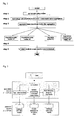
- Fig. 1 illustrates a schematic view of a preferred computer-implemented method for determining specified matrices in particular being associated with financial institutions and with financial affairs in banking practice.
- step 1 a list with the rated entities is provided. According to that list, in step 2 ratings and utilizations for T0 and T1 are read from the historical database. A base matrix before aggregation is achieved by reading the mass data as a selection according to the rating entities.
- the mass data is aggregated and a base matrix after aggregation is obtained.
- Exemplified result matrices are TO-portfolio matrix, T1-portfolio matrix, a migration matrix and a combined matrix comprising acquisition and migration data (acquisition and migration matrix).
- mass data are used which are stored in a historical database comprising for example millions of records.
- the mass data (“input data”) includes a plurality of M data records, wherein M represents a large amount of data records to be selected and aggregated that can not be handled in the main memory of a data processor.
- the mass data (“input data”) may further consist of packetized blocks of data provided by different databases of different accessible data sources, including sets of rows and sets of columns, each row corresponding to a record, and the columns including fields of predetermined granularity characteristics and fields of predetermined key figures.
- the generic aggregation of characteristics and key figures aims at the reduction of said mass data according to a given customized granularity. Due to the plurality of M data records, said mass data are usually customized as packages including M p ⁇ M data records.
- the computer-implemented method begins with a selection of investigated mass data ("input data") including said plurality of M data records to be aggregated, said mass data being provided by different accessible primary databases of different accessible data sources. Having finished the selection of mass data due to selection criteria, the variously selected blocks of packetized mass data are assigned among each other and the result of assignment is stored to a global database.
- input data investigated mass data
- the variously selected blocks of packetized mass data are assigned among each other and the result of assignment is stored to a global database.
- the granularity characteristics and predetermined key figures include usual data regarding the financial sector, like rating methods, rating classes and rating class dates, identifier for in- and outflows, utilization, e.g. like drawing of a loan (monetary amount), utilization dates, and segment identifier.
- the selected mass data can be prepared as data packages according to a customer defined package size including Mp ⁇ M data records in a pre-processing step before reading said mass data into the processing means of a data processing system.
- the packaged data can be additionally enriched in a parallel pre-processing with data from an accessible single secondary database or from accessible secondary databases, subsequently saving the results of enrichment to those local databases of the respective data processors where the data are to be processed.
- the selected data records may be stored on a database (base matrix before aggregation) or may be directly aggregated into a base matrix after aggregation.
- the selection and/or aggregation can be performed as jobs.
- a job or a plurality of jobs can be processed in a parallel processing mode, thereby noticeably improving the computing power and run time performance of software, respectively, either using a single data processor or a network of data processors.
- the processing of aggregation algorithm can optionally run in a linear processing mode, thereby aggregating and merging packages within a job sequentially.
- the base matrix after aggregation can be stored on a database.
- the base matrix after aggregation usually contains all the data necessary to calculate migration matrices for a credit risk analysis and reporting according to the Basel II Capital Accord.
- the base matrix after aggregation usually contains significant less data than the originally used mass data.
- the base matrix after aggregation contains at most a few thousands data depending on the predetermined granularity characteristics, e.g. the rating method used.
- the base matrix after aggregation includes 1000 records or less, more preferably 500 records or less.
- the base matrix after aggregation comprises 100 columns or less, preferably 20 columns or less, wherein the columns including fields of predetermined granularity characteristics and fields of predetermined key figures.
- the different aggregated base matrices may have varying granularity characteristics and / or costumer defined key figures, such like segment identifier, rating method, business partner identifier, rating given by the rating method, rating date, identifier for in- and outflows, utilization (e.g. drawing of a credit loan), currency of the utilization.
- the obtained base matrix after aggregation is processed into the specified matrices. Based on the low amount of data, the processing of the base matrix after aggregation can usually be performed in the main memory of a computer.
- the specified matrices means matrices which are customized by the users and/or prescribed by other institutions or requirements, e.g. Basel II as mentioned above.
- the specified matrices are also called result matrices and include, e.g., portfolio matrices at specified times, migration matrices, acquisition matrices, matrices concerning in and out flows, matrices concerning changes of volume and/or combinations of two or more of these matrices, like a acquisition and migration matrix.
- the calculation of the specified result matrices can also be done in batch modes (background processing) with storage of the results to a database.
- the results can be stored in a database or alternatively displayed in a screen reporting as mentioned in step 5 of figure 1.
- the data of the aggregated base matrix and/or the result matrices can be additionally enriched in a post-processing step with data from an accessible secondary database or from accessible secondary databases. Subsequently, the results of the enrichment can be stored in a database.
- Figure 2 illustrates at a block diagram the configuration of application servers and database servers.
- the mass data is stored in a database with rated entities. These rated entities are read by an application server and, preferably in a processing processed in a parallel mode in order to calculate the base matrix.
- the base matrix may be stored in a database for temporary data.
- the base matrix is read into the main memory to calculate the result matrices.
- the results can be stored in an additional database as shown in Figure 2.
- a bank has usually either business partner ratings modules of its own, or it gets external ratings. These ratings are stored in a database for time series of the bank analyzer component called historical database. The time series can be assumed to contain mass data (millions of business partner ratings).
- Table 1 some entities of the database are shown. Usually, not all of the business partners are rated with all rating methods. Furthermore, the business partners may obtain more than one rating a year. Therefore, the present working example is very simple.
- the granularity level of Table 1 comprises the fields SID, RM, BUPA and RDAT.
- Step 1 List with rating entities
- the first step of the calculation is to read the database with the time series of ratings. Usually, only the granularity fields SID (Segment Identifier), RM (Rating method) and BUPA (business partner identifier) are retrieved. In the working example the Table 2 is obtained. Table 2 Segment ID SID Rating Method RM Business Partner BUPA 1 INTERNAL BUPA_01 1 INTERNAL BUPA_02 1 INTERNAL BURA_03 1 INTERNAL BUPA_04 1 INTERNAL BUPA_05 1 INTERNAL BUPA_06 1 INTERNAL BUPA_07
- Step 2 Basic matrix before aggregation
- the time series with rating data are preferably transformed into a new list where rating at t0 and rating at t1 are given in one row of the table.
- the transformation can be done by the following operations:
- the step 2 is preferably done by the software using efficient parallel processing algorithms.
- Table 3 The granularity level of Table 3 comprises the fields SID, RM, BUPA. In this example all values for FX are 0 because the initial currency and the evaluation currency are identical.
- Table 3 SID RM BUPA RT0 RT1 UT0 UT1 FX CURR IO 1 INTERNAL BUPA_01 A A 100.000,00 80.000,00 0 USD 1 INTERNAL BUPA_02 B C 100.000,00 50.000,00 0 USD 1 INTERNAL BUPA_03 A 50.000,00 0 USD 2 1 INTERNAL BUPA_04 C C 200.000,00 150.000.00 0 USD 1 INTERNAL BUPA_05 D 100.000,00 0 USD 1 1 INTERNAL BUPA_06 B A 150.000,00 200.000,00 0 USD 1 INTERNAL BUPA_07 B B 50.000,00 30.000,00 0 USD
- Step 3 Basic matrix after aggregation
- the matrix obtained in step 2 is aggregated to a so called “basic matrix after aggregation".
- the other lists described before like “time series with rating data” and “basic matrix before aggregation" are used only once in the process.
- the "basic matrix after aggregation” is the starting point for several additional matrices, i.e. it is re-used several times.
- step 2 In order to aggregate the matrix of step 2, the following operations are performed.
- the business partners (belonging to the same SID and RM) having the same ratings RT0 and RT1 are counted and the fields UT0 and UT1 are summed up for the business partners having the same ratings RT0 and RT1.
- the granularity level of Table 4 comprises the fields SID, RM, RT0, RT1, IO.
- the number of ratings is 1 for each granularity, i.e. for each combination of the values SID, RM, RT0, RT1 and IO.
- Step 4 Calculation of result matrices
- the structure is given by rating categories.
- Key measure is the "key date utilization" (here: monetary amount of a loan UT0 and UT1, respectively).
- the granularity level of Table 5 comprises the fields SID, RM, RT0. Granularities RT1 and IO are eliminated.
- the granularity level of Table 6 comprises the fields SID, RM, RT1. Granularities RT0 and IO are eliminated.
- the migration matrix comprises information about a change of ratings and concerns the question: Given a specific rating at the beginning of the period, in which rating categories do the customers show up at the end of the period?
- the key figures CNT and UT0 (UT1) can further on be used to calculate rating transitions (weighted or unweighted frequencies or probabilities).
- the first matrix concerns the question: Given a specific rating at the beginning of the period, in which rating category does a customer show up at the end of the period.
- the granularity level of Table 7 comprises the fields SID, RM, RT0, RT1.
- the acquisition and migration matrix is assembled by the single matrices described before. Furthermore, the m acquisition and migration matrix can contain further data based on the base matrix as mentioned above, e.g. data of in and out flows of customers, customer acquisitions, changes in volume, acquisition performance and the portfolio after migrations.
- the data of in and out flows of customers are calculated by applying a appropriate filter based on the base matrix as mentioned above.
- the customer acquisition arises from the total of customer wins and customer losses.
- the calculation of the portfolio after migration to t1 is also based on the already determined data, the portfolio at t0 as well as the migration matrix.
- the concrete calculation step is:
- the changed volume manifests itself as volume of the portfolio at t1 minus volume of theportfolio after migration to t1 minus customer acquisition".
- the acquisition performance manifests itself as the total of customer acquisition and changed volume.
- Table 8 SID RM KEY DESCRIPTION RTNG RT0 RT1 CNT UTLZ UT0 UT1 FX CURR 1 INTERNAL 1 01 portfolio at t0 A 2 150000 80000 0 USD 1 INTERNAL 1 01 portfolio at t0 B 3 300000 280000 0 USD 1 INTERNAL 1 01 portfolio at t0 C 200000 150000 0 USD 1 INTERNAL 2 02 portfolio at t1 A 2 250000 280000 0 USD 1 INTERNAL 2 02 portfolio at t1 B 1 50000 30000 0 USD 1 INTERNAL 2 02 portfolio at t1 C 2 300000 200000 0 USD 1 INTERNAL 2 02 portfolio at t1 D 1 0 100000 0 USD 1 INTERNAL 3 03 in-migrations from ...
- B A 1 150000 200000 0 USD 1 INTERNAL 3 03 in-migrations from ... to ... B C 1 100000 50000 0 USD 1 INTERNAL 4 04 out-migrations to ... from ... A B 1 150.000- 200.000- 0 USD 1 INTERNAL 4 04 out-migrations to ... from ...
Landscapes
- Business, Economics & Management (AREA)
- Engineering & Computer Science (AREA)
- Accounting & Taxation (AREA)
- Finance (AREA)
- Strategic Management (AREA)
- Economics (AREA)
- General Business, Economics & Management (AREA)
- Theoretical Computer Science (AREA)
- Marketing (AREA)
- Physics & Mathematics (AREA)
- Development Economics (AREA)
- General Physics & Mathematics (AREA)
- Human Resources & Organizations (AREA)
- Technology Law (AREA)
- Entrepreneurship & Innovation (AREA)
- Educational Administration (AREA)
- Game Theory and Decision Science (AREA)
- Operations Research (AREA)
- Quality & Reliability (AREA)
- Tourism & Hospitality (AREA)
- Financial Or Insurance-Related Operations Such As Payment And Settlement (AREA)
Priority Applications (6)
| Application Number | Priority Date | Filing Date | Title |
|---|---|---|---|
| EP20050012313 EP1732014A1 (de) | 2005-06-08 | 2005-06-08 | Berechnung von bestimmten Matrizen |
| US11/191,985 US8200557B2 (en) | 2005-06-08 | 2005-07-29 | Systems and methods for providing migration and performance matrices |
| US11/443,096 US8095442B2 (en) | 2005-06-08 | 2006-05-31 | Systems and methods for calculating specified matrices |
| US13/345,216 US8311918B2 (en) | 2005-06-08 | 2012-01-06 | Systems and methods for calculating specified matrices |
| US13/475,410 US8498917B2 (en) | 2005-06-08 | 2012-05-18 | Systems and methods for providing migration and performance matrices |
| US13/928,417 US20130290168A1 (en) | 2005-06-08 | 2013-06-27 | Systems and methods for providing migration and performance matrices |
Applications Claiming Priority (1)
| Application Number | Priority Date | Filing Date | Title |
|---|---|---|---|
| EP20050012313 EP1732014A1 (de) | 2005-06-08 | 2005-06-08 | Berechnung von bestimmten Matrizen |
Publications (1)
| Publication Number | Publication Date |
|---|---|
| EP1732014A1 true EP1732014A1 (de) | 2006-12-13 |
Family
ID=35985453
Family Applications (1)
| Application Number | Title | Priority Date | Filing Date |
|---|---|---|---|
| EP20050012313 Ceased EP1732014A1 (de) | 2005-06-08 | 2005-06-08 | Berechnung von bestimmten Matrizen |
Country Status (2)
| Country | Link |
|---|---|
| US (5) | US8200557B2 (de) |
| EP (1) | EP1732014A1 (de) |
Families Citing this family (84)
| Publication number | Priority date | Publication date | Assignee | Title |
|---|---|---|---|---|
| US7739203B2 (en) | 2004-03-08 | 2010-06-15 | Sap Aktiengesellschaft | Method and system for classifying retail products and services using price band categories |
| US8788372B2 (en) * | 2004-03-08 | 2014-07-22 | Sap Aktiengesellschaft | Method and system for classifying retail products and services using characteristic-based grouping structures |
| US8655697B2 (en) | 2004-04-16 | 2014-02-18 | Sap Aktiengesellschaft | Allocation table generation from assortment planning |
| US8606723B2 (en) | 2004-06-04 | 2013-12-10 | Sap Ag | Consistent set of interfaces derived from a business object model |
| US8655756B2 (en) | 2004-06-04 | 2014-02-18 | Sap Ag | Consistent set of interfaces derived from a business object model |
| EP1915726A4 (de) | 2004-06-18 | 2009-10-28 | Sap Ag | Von einem geschäftsobjektmodell abgeleiteter konsistenter satz von schnittstellen |
| US7617501B2 (en) | 2004-07-09 | 2009-11-10 | Quest Software, Inc. | Apparatus, system, and method for managing policies on a computer having a foreign operating system |
| US8744937B2 (en) | 2005-02-25 | 2014-06-03 | Sap Ag | Consistent set of interfaces derived from a business object model |
| EP1732014A1 (de) | 2005-06-08 | 2006-12-13 | Sap Ag | Berechnung von bestimmten Matrizen |
| US7724890B1 (en) | 2005-09-07 | 2010-05-25 | Sap Ag | Focused retrieval of selected data in a call center environment |
| US7904949B2 (en) | 2005-12-19 | 2011-03-08 | Quest Software, Inc. | Apparatus, systems and methods to provide authentication services to a legacy application |
| US8087075B2 (en) | 2006-02-13 | 2011-12-27 | Quest Software, Inc. | Disconnected credential validation using pre-fetched service tickets |
| US7853945B2 (en) | 2006-02-22 | 2010-12-14 | Michael Kramer | Integrated computer server imaging |
| US20070234345A1 (en) * | 2006-02-22 | 2007-10-04 | Microsoft Corporation | Integrated multi-server installation |
| US8374931B2 (en) | 2006-03-31 | 2013-02-12 | Sap Ag | Consistent set of interfaces derived from a business object model |
| WO2008005102A2 (en) | 2006-05-13 | 2008-01-10 | Sap Ag | Consistent set of interfaces derived from a business object model |
| US8429712B2 (en) | 2006-06-08 | 2013-04-23 | Quest Software, Inc. | Centralized user authentication system apparatus and method |
| US8392364B2 (en) | 2006-07-10 | 2013-03-05 | Sap Ag | Consistent set of interfaces derived from a business object model |
| US8566193B2 (en) | 2006-08-11 | 2013-10-22 | Sap Ag | Consistent set of interfaces derived from a business object model |
| US8468544B1 (en) | 2006-09-28 | 2013-06-18 | Sap Ag | Managing consistent interfaces for demand planning business objects across heterogeneous systems |
| US7895332B2 (en) | 2006-10-30 | 2011-02-22 | Quest Software, Inc. | Identity migration system apparatus and method |
| US8086710B2 (en) * | 2006-10-30 | 2011-12-27 | Quest Software, Inc. | Identity migration apparatus and method |
| US8099337B2 (en) * | 2007-06-19 | 2012-01-17 | Sap Ag | Replenishment planning management |
| US9690820B1 (en) * | 2007-09-27 | 2017-06-27 | Experian Information Solutions, Inc. | Database system for triggering event notifications based on updates to database records |
| US8417593B2 (en) | 2008-02-28 | 2013-04-09 | Sap Ag | System and computer-readable medium for managing consistent interfaces for business objects across heterogeneous systems |
| US8589263B2 (en) | 2008-03-31 | 2013-11-19 | Sap Ag | Managing consistent interfaces for retail business objects across heterogeneous systems |
| US8433585B2 (en) | 2008-03-31 | 2013-04-30 | Sap Ag | Managing consistent interfaces for business objects across heterogeneous systems |
| US8370233B2 (en) | 2008-03-31 | 2013-02-05 | Sap Ag | Managing consistent interfaces for business objects across heterogeneous systems |
| US8577991B2 (en) | 2008-03-31 | 2013-11-05 | Sap Ag | Managing consistent interfaces for internal service request business objects across heterogeneous systems |
| US8423418B2 (en) | 2008-03-31 | 2013-04-16 | Sap Ag | Managing consistent interfaces for business objects across heterogeneous systems |
| US8413165B2 (en) | 2008-03-31 | 2013-04-02 | Sap Ag | Managing consistent interfaces for maintenance order business objects across heterogeneous systems |
| US8930248B2 (en) | 2008-03-31 | 2015-01-06 | Sap Se | Managing consistent interfaces for supply network business objects across heterogeneous systems |
| US8364715B2 (en) | 2008-03-31 | 2013-01-29 | Sap Ag | Managing consistent interfaces for automatic identification label business objects across heterogeneous systems |
| US8473317B2 (en) | 2008-03-31 | 2013-06-25 | Sap Ag | Managing consistent interfaces for service part business objects across heterogeneous systems |
| US20090326988A1 (en) | 2008-06-26 | 2009-12-31 | Robert Barth | Managing consistent interfaces for business objects across heterogeneous systems |
| US8645228B2 (en) | 2008-06-26 | 2014-02-04 | Sap Ag | Managing consistent interfaces for business objects across heterogeneous systems |
| US8566185B2 (en) | 2008-06-26 | 2013-10-22 | Sap Ag | Managing consistent interfaces for financial instrument business objects across heterogeneous systems |
| US8671064B2 (en) | 2008-06-26 | 2014-03-11 | Sap Ag | Managing consistent interfaces for supply chain management business objects across heterogeneous systems |
| US8463666B2 (en) | 2008-11-25 | 2013-06-11 | Sap Ag | Managing consistent interfaces for merchandise and assortment planning business objects across heterogeneous systems |
| US8577760B2 (en) | 2008-11-25 | 2013-11-05 | Sap Ag | Managing consistent interfaces for tax authority business objects across heterogeneous systems |
| US20100153297A1 (en) | 2008-12-12 | 2010-06-17 | Sap Ag | Managing Consistent Interfaces for Credit Portfolio Business Objects Across Heterogeneous Systems |
| US8452681B2 (en) * | 2009-02-13 | 2013-05-28 | Thomson Financial, LLC | System and method for improved rating and modeling of asset backed securities |
| US8255984B1 (en) | 2009-07-01 | 2012-08-28 | Quest Software, Inc. | Single sign-on system for shared resource environments |
| CN101604437A (zh) * | 2009-07-22 | 2009-12-16 | 阿里巴巴集团控股有限公司 | 账户批量实时处理系统及账户批量实时处理方法 |
| US8396751B2 (en) | 2009-09-30 | 2013-03-12 | Sap Ag | Managing consistent interfaces for merchandising business objects across heterogeneous systems |
| US8412603B2 (en) | 2010-06-15 | 2013-04-02 | Sap Ag | Managing consistent interfaces for currency conversion and date and time business objects across heterogeneous systems |
| US8370272B2 (en) | 2010-06-15 | 2013-02-05 | Sap Ag | Managing consistent interfaces for business document message monitoring view, customs arrangement, and freight list business objects across heterogeneous systems |
| US8515794B2 (en) | 2010-06-15 | 2013-08-20 | Sap Ag | Managing consistent interfaces for employee time event and human capital management view of payroll process business objects across heterogeneous systems |
| US8732083B2 (en) | 2010-06-15 | 2014-05-20 | Sap Ag | Managing consistent interfaces for number range, number range profile, payment card payment authorisation, and product template template business objects across heterogeneous systems |
| US8364608B2 (en) | 2010-06-15 | 2013-01-29 | Sap Ag | Managing consistent interfaces for export declaration and export declaration request business objects across heterogeneous systems |
| US8417588B2 (en) | 2010-06-15 | 2013-04-09 | Sap Ag | Managing consistent interfaces for goods tag, production bill of material hierarchy, and release order template business objects across heterogeneous systems |
| US9135585B2 (en) | 2010-06-15 | 2015-09-15 | Sap Se | Managing consistent interfaces for property library, property list template, quantity conversion virtual object, and supplier property specification business objects across heterogeneous systems |
| US8775280B2 (en) | 2011-07-28 | 2014-07-08 | Sap Ag | Managing consistent interfaces for financial business objects across heterogeneous systems |
| US8601490B2 (en) | 2011-07-28 | 2013-12-03 | Sap Ag | Managing consistent interfaces for business rule business object across heterogeneous systems |
| US8666845B2 (en) | 2011-07-28 | 2014-03-04 | Sap Ag | Managing consistent interfaces for a customer requirement business object across heterogeneous systems |
| US8725654B2 (en) | 2011-07-28 | 2014-05-13 | Sap Ag | Managing consistent interfaces for employee data replication business objects across heterogeneous systems |
| US8560392B2 (en) | 2011-07-28 | 2013-10-15 | Sap Ag | Managing consistent interfaces for a point of sale transaction business object across heterogeneous systems |
| US8521838B2 (en) | 2011-07-28 | 2013-08-27 | Sap Ag | Managing consistent interfaces for communication system and object identifier mapping business objects across heterogeneous systems |
| US9232368B2 (en) | 2012-02-16 | 2016-01-05 | Sap Se | Consistent interface for user feed administrator, user feed event link and user feed settings |
| US8762454B2 (en) | 2012-02-16 | 2014-06-24 | Sap Ag | Consistent interface for flag and tag |
| US8984050B2 (en) | 2012-02-16 | 2015-03-17 | Sap Se | Consistent interface for sales territory message type set 2 |
| US8756274B2 (en) | 2012-02-16 | 2014-06-17 | Sap Ag | Consistent interface for sales territory message type set 1 |
| US8762453B2 (en) | 2012-02-16 | 2014-06-24 | Sap Ag | Consistent interface for feed collaboration group and feed event subscription |
| US9237425B2 (en) | 2012-02-16 | 2016-01-12 | Sap Se | Consistent interface for feed event, feed event document and feed event type |
| US20130304671A1 (en) * | 2012-05-11 | 2013-11-14 | Axioma, Inc. | Factor Risk Models with Multiple Specific Risk Estimates |
| US9367826B2 (en) | 2012-06-28 | 2016-06-14 | Sap Se | Consistent interface for entitlement product |
| US8521621B1 (en) | 2012-06-28 | 2013-08-27 | Sap Ag | Consistent interface for inbound delivery request |
| US9400998B2 (en) | 2012-06-28 | 2016-07-26 | Sap Se | Consistent interface for message-based communication arrangement, organisational centre replication request, and payment schedule |
| US9246869B2 (en) | 2012-06-28 | 2016-01-26 | Sap Se | Consistent interface for opportunity |
| US8756135B2 (en) | 2012-06-28 | 2014-06-17 | Sap Ag | Consistent interface for product valuation data and product valuation level |
| US8949855B2 (en) | 2012-06-28 | 2015-02-03 | Sap Se | Consistent interface for address snapshot and approval process definition |
| WO2014000200A1 (en) | 2012-06-28 | 2014-01-03 | Sap Ag | Consistent interface for document output request |
| US8615451B1 (en) | 2012-06-28 | 2013-12-24 | Sap Ag | Consistent interface for goods and activity confirmation |
| US9076112B2 (en) | 2012-08-22 | 2015-07-07 | Sap Se | Consistent interface for financial instrument impairment expected cash flow analytical result |
| US9547833B2 (en) | 2012-08-22 | 2017-01-17 | Sap Se | Consistent interface for financial instrument impairment calculation |
| US9043236B2 (en) | 2012-08-22 | 2015-05-26 | Sap Se | Consistent interface for financial instrument impairment attribute values analytical result |
| US9191357B2 (en) | 2013-03-15 | 2015-11-17 | Sap Se | Consistent interface for email activity business object |
| US9191343B2 (en) | 2013-03-15 | 2015-11-17 | Sap Se | Consistent interface for appointment activity business object |
| DE102013007769A1 (de) * | 2013-05-04 | 2014-11-06 | Till Förstemann | Verfahren zur portfolioorientierten Erfassung von Kreditrisiken |
| US10467207B2 (en) | 2013-05-24 | 2019-11-05 | Sap Se | Handling changes in automatic sort |
| US9311124B2 (en) | 2013-11-07 | 2016-04-12 | Sap Se | Integrated deployment of centrally modified software systems |
| US12271365B2 (en) | 2017-03-17 | 2025-04-08 | Sap Se | Table schema providing improved database system performance |
| US11036471B2 (en) | 2018-06-06 | 2021-06-15 | Sap Se | Data grouping for efficient parallel processing |
| US12135824B2 (en) * | 2022-04-01 | 2024-11-05 | Hong Kong Applied Science And Technology Research Institute Co., Ltd. | System and methods for auditable data management |
Family Cites Families (30)
| Publication number | Priority date | Publication date | Assignee | Title |
|---|---|---|---|---|
| US5884287A (en) * | 1996-04-12 | 1999-03-16 | Lfg, Inc. | System and method for generating and displaying risk and return in an investment portfolio |
| US5893069A (en) * | 1997-01-31 | 1999-04-06 | Quantmetrics R&D Associates, Llc | System and method for testing prediction model |
| US6078904A (en) * | 1998-03-16 | 2000-06-20 | Saddle Peak Systems | Risk direct asset allocation and risk resolved CAPM for optimally allocating investment assets in an investment portfolio |
| US7539637B2 (en) * | 1998-04-24 | 2009-05-26 | Starmine Corporation | Security analyst estimates performance viewing system and method |
| WO2000038094A2 (en) * | 1998-12-22 | 2000-06-29 | Bios Group Lp | A system and method for the analysis and prediction of economic markets |
| US6484152B1 (en) * | 1999-12-29 | 2002-11-19 | Optimumportfolio.Com, Llc | Automated portfolio selection system |
| WO2001052173A1 (en) * | 2000-01-13 | 2001-07-19 | Erinmedia, Inc. | Privacy compliant multiple dataset correlation system |
| US7469227B2 (en) * | 2000-02-22 | 2008-12-23 | Strategic Analytics, Inc. | Retail lending risk related scenario generation |
| US7571130B2 (en) * | 2002-06-17 | 2009-08-04 | Nyse Alternext Us Llc | Hedging exchange traded mutual funds or other portfolio basket products |
| US7383219B1 (en) * | 2000-07-13 | 2008-06-03 | C4Cast.Com, Inc. | Asset portfolio tracking |
| US20090018891A1 (en) * | 2003-12-30 | 2009-01-15 | Jeff Scott Eder | Market value matrix |
| US20040215551A1 (en) * | 2001-11-28 | 2004-10-28 | Eder Jeff S. | Value and risk management system for multi-enterprise organization |
| CA2403300A1 (en) * | 2002-09-12 | 2004-03-12 | Pranil Ram | A method of buying or selling items and a user interface to facilitate the same |
| US20030023539A1 (en) * | 2001-07-27 | 2003-01-30 | Wilce Scot D. | Systems and methods for facilitating agreement definition via an agreement modeling system |
| US7472084B2 (en) * | 2001-08-16 | 2008-12-30 | Gravity Investments, Llc | Method and apparatus for creating and managing a visual representation of a portfolio and determining an efficient allocation |
| US20050262013A1 (en) * | 2001-10-16 | 2005-11-24 | Guthner Mark W | System and method for analyzing risk and profitability of non-recourse loans |
| CA2367091A1 (en) * | 2002-01-10 | 2003-07-10 | Algorithmics International Corp. | System and methods for valuing and managing the risk of credit instrument portfolios |
| US7606755B2 (en) * | 2002-01-31 | 2009-10-20 | General Electric Capital Corporation | Systems and methods to automatically generate a return target for a potential real estate deal based on supplemental deal information |
| US20050027645A1 (en) * | 2002-01-31 | 2005-02-03 | Wai Shing Lui William | Business enterprise risk model and method |
| US7587352B2 (en) * | 2002-04-10 | 2009-09-08 | Research Affiliates, Llc | Method and apparatus for managing a virtual portfolio of investment objects |
| US7702556B2 (en) * | 2002-08-14 | 2010-04-20 | Water Street Advisers, Inc. | Process for the selection and evaluation of investment portfolio asset allocation strategies |
| US20040059589A1 (en) * | 2002-09-19 | 2004-03-25 | Moore Richard N. | Method of managing risk |
| US7530490B1 (en) * | 2003-11-12 | 2009-05-12 | Goldman Sachs & Co | Systems and methods to perform credit valuation adjustment analyses |
| US7366653B2 (en) * | 2003-12-22 | 2008-04-29 | Siebel Systems, Inc. | Methods and apparatuses for string translation |
| US7672889B2 (en) * | 2004-07-15 | 2010-03-02 | Brooks Kent F | System and method for providing customizable investment tools |
| US20060173772A1 (en) * | 2005-02-02 | 2006-08-03 | Hayes John B | Systems and methods for automated processing, handling, and facilitating a trade credit transaction |
| US20060229963A1 (en) * | 2005-04-11 | 2006-10-12 | Jennifer Creager | Portfolio performance tracking |
| EP1732014A1 (de) | 2005-06-08 | 2006-12-13 | Sap Ag | Berechnung von bestimmten Matrizen |
| US20080065522A1 (en) * | 2005-09-28 | 2008-03-13 | Keith Bayley Diffenderffer | Low volatility asset allocation strategy for income and method |
| US7761354B2 (en) * | 2006-06-13 | 2010-07-20 | Sap Ag | Banking software design generator |
-
2005
- 2005-06-08 EP EP20050012313 patent/EP1732014A1/de not_active Ceased
- 2005-07-29 US US11/191,985 patent/US8200557B2/en active Active
-
2006
- 2006-05-31 US US11/443,096 patent/US8095442B2/en active Active
-
2012
- 2012-01-06 US US13/345,216 patent/US8311918B2/en not_active Expired - Fee Related
- 2012-05-18 US US13/475,410 patent/US8498917B2/en not_active Expired - Fee Related
-
2013
- 2013-06-27 US US13/928,417 patent/US20130290168A1/en not_active Abandoned
Non-Patent Citations (2)
| Title |
|---|
| HAN J ET AL: "Data Mining: Concepts and Techniques", 2001, ACADEMIC PRESS, XP002373304 * |
| PONNIAH P: "Data Warehousing Fundamentals", 2001, JOHN WILEY & SONS, INC., XP002373305 * |
Also Published As
| Publication number | Publication date |
|---|---|
| US8095442B2 (en) | 2012-01-10 |
| US8311918B2 (en) | 2012-11-13 |
| US8200557B2 (en) | 2012-06-12 |
| US20060280302A1 (en) | 2006-12-14 |
| US20120110034A1 (en) | 2012-05-03 |
| US8498917B2 (en) | 2013-07-30 |
| US20060282360A1 (en) | 2006-12-14 |
| US20130290168A1 (en) | 2013-10-31 |
| US20120233091A1 (en) | 2012-09-13 |
Similar Documents
| Publication | Publication Date | Title |
|---|---|---|
| EP1732014A1 (de) | Berechnung von bestimmten Matrizen | |
| US8150749B2 (en) | Systems and methods for general aggregation of characteristics and key figures | |
| US7797213B2 (en) | Cash flow aggregation system and method | |
| US7856397B2 (en) | System and method for creating financial assets | |
| US8626702B2 (en) | Method and system for validation of data extraction | |
| US8255311B2 (en) | Methods and systems for risk evaluation | |
| US20020138376A1 (en) | Multi-processing financial transaction processing system | |
| US7599848B2 (en) | System and methods and risk evaluation using an object measure-value in strategic planning | |
| US20020178035A1 (en) | Performance management system and method | |
| US20040128228A1 (en) | Servicer compensation system and method | |
| US7627554B2 (en) | Uniform financial reporting system interface utilizing staging tables having a standardized structure | |
| WO2004061555A2 (en) | Configuring cash flow | |
| WO2003105046A1 (en) | Automated online underwriting | |
| CN111506876B (zh) | 一种数据预测分析方法、系统、设备及可读存储介质 | |
| EP1669919A1 (de) | Ein Datenverarbeitungssystem und eine datenverarbeitende Methode | |
| CN119558984B (zh) | 数据处理方法、装置、设备和介质 | |
| CN117331983B (zh) | 贷款逾期数据的查找方法、装置、设备以及介质 | |
| US20240411735A1 (en) | System, apparatus, and method for automatically maintaining dataquality by calibrating a threshold for a defined metric accordingto a convoluted moving average model | |
| AU2003200483B2 (en) | Method and system for risk evaluation | |
| US20240095598A1 (en) | Data processing methods and computer systems for wavelakes signal intelligence | |
| CN119624665A (zh) | 一种基于多源异构数据的保险理算方法及系统 | |
| CN118551898A (zh) | 业务数据处理方法、装置、计算机设备和存储介质 | |
| CN121119506A (zh) | 一种数据处理方法、装置及电子设备 | |
| CN120162363A (zh) | 业务数据处理方法、装置、计算机设备及存储介质 | |
| CN120125182A (zh) | 基于项目管理的数据处理方法、装置、设备及存储介质 |
Legal Events
| Date | Code | Title | Description |
|---|---|---|---|
| PUAI | Public reference made under article 153(3) epc to a published international application that has entered the european phase |
Free format text: ORIGINAL CODE: 0009012 |
|
| AK | Designated contracting states |
Kind code of ref document: A1 Designated state(s): AT BE BG CH CY CZ DE DK EE ES FI FR GB GR HU IE IS IT LI LT LU MC NL PL PT RO SE SI SK TR |
|
| AX | Request for extension of the european patent |
Extension state: AL BA HR LV MK YU |
|
| 17P | Request for examination filed |
Effective date: 20070117 |
|
| 17Q | First examination report despatched |
Effective date: 20070404 |
|
| AKX | Designation fees paid |
Designated state(s): AT BE BG CH CY CZ DE DK EE ES FI FR GB GR HU IE IS IT LI LT LU MC NL PL PT RO SE SI SK TR |
|
| APBK | Appeal reference recorded |
Free format text: ORIGINAL CODE: EPIDOSNREFNE |
|
| APBN | Date of receipt of notice of appeal recorded |
Free format text: ORIGINAL CODE: EPIDOSNNOA2E |
|
| APBR | Date of receipt of statement of grounds of appeal recorded |
Free format text: ORIGINAL CODE: EPIDOSNNOA3E |
|
| APAF | Appeal reference modified |
Free format text: ORIGINAL CODE: EPIDOSCREFNE |
|
| RTI1 | Title (correction) |
Free format text: CALCULATION OF SPECIFIED MATRICES |
|
| APAF | Appeal reference modified |
Free format text: ORIGINAL CODE: EPIDOSCREFNE |
|
| RAP1 | Party data changed (applicant data changed or rights of an application transferred) |
Owner name: SAP SE |
|
| APBT | Appeal procedure closed |
Free format text: ORIGINAL CODE: EPIDOSNNOA9E |
|
| STAA | Information on the status of an ep patent application or granted ep patent |
Free format text: STATUS: THE APPLICATION HAS BEEN REFUSED |
|
| 18R | Application refused |
Effective date: 20150120 |