EP1731995A2 - Portable terminal having motion detection function and motion detection method therefor - Google Patents
Portable terminal having motion detection function and motion detection method therefor Download PDFInfo
- Publication number
- EP1731995A2 EP1731995A2 EP06002383A EP06002383A EP1731995A2 EP 1731995 A2 EP1731995 A2 EP 1731995A2 EP 06002383 A EP06002383 A EP 06002383A EP 06002383 A EP06002383 A EP 06002383A EP 1731995 A2 EP1731995 A2 EP 1731995A2
- Authority
- EP
- European Patent Office
- Prior art keywords
- axes
- along
- portable terminal
- posture
- axis
- Prior art date
- Legal status (The legal status is an assumption and is not a legal conclusion. Google has not performed a legal analysis and makes no representation as to the accuracy of the status listed.)
- Granted
Links
Images


Classifications
-
- H—ELECTRICITY
- H04—ELECTRIC COMMUNICATION TECHNIQUE
- H04B—TRANSMISSION
- H04B1/00—Details of transmission systems, not covered by a single one of groups H04B3/00 - H04B13/00; Details of transmission systems not characterised by the medium used for transmission
- H04B1/38—Transceivers, i.e. devices in which transmitter and receiver form a structural unit and in which at least one part is used for functions of transmitting and receiving
- H04B1/40—Circuits
-
- G—PHYSICS
- G06—COMPUTING OR CALCULATING; COUNTING
- G06F—ELECTRIC DIGITAL DATA PROCESSING
- G06F3/00—Input arrangements for transferring data to be processed into a form capable of being handled by the computer; Output arrangements for transferring data from processing unit to output unit, e.g. interface arrangements
- G06F3/01—Input arrangements or combined input and output arrangements for interaction between user and computer
- G06F3/017—Gesture based interaction, e.g. based on a set of recognized hand gestures
-
- G—PHYSICS
- G06—COMPUTING OR CALCULATING; COUNTING
- G06F—ELECTRIC DIGITAL DATA PROCESSING
- G06F1/00—Details not covered by groups G06F3/00 - G06F13/00 and G06F21/00
- G06F1/16—Constructional details or arrangements
- G06F1/1613—Constructional details or arrangements for portable computers
- G06F1/1633—Constructional details or arrangements of portable computers not specific to the type of enclosures covered by groups G06F1/1615 - G06F1/1626
- G06F1/1684—Constructional details or arrangements related to integrated I/O peripherals not covered by groups G06F1/1635 - G06F1/1675
- G06F1/1694—Constructional details or arrangements related to integrated I/O peripherals not covered by groups G06F1/1635 - G06F1/1675 the I/O peripheral being a single or a set of motion sensors for pointer control or gesture input obtained by sensing movements of the portable computer
-
- G—PHYSICS
- G06—COMPUTING OR CALCULATING; COUNTING
- G06F—ELECTRIC DIGITAL DATA PROCESSING
- G06F3/00—Input arrangements for transferring data to be processed into a form capable of being handled by the computer; Output arrangements for transferring data from processing unit to output unit, e.g. interface arrangements
- G06F3/01—Input arrangements or combined input and output arrangements for interaction between user and computer
- G06F3/03—Arrangements for converting the position or the displacement of a member into a coded form
- G06F3/033—Pointing devices displaced or positioned by the user, e.g. mice, trackballs, pens or joysticks; Accessories therefor
- G06F3/0346—Pointing devices displaced or positioned by the user, e.g. mice, trackballs, pens or joysticks; Accessories therefor with detection of the device orientation or free movement in a three-dimensional [3D] space, e.g. 3D mice, 6-DOF [six degrees of freedom] pointers using gyroscopes, accelerometers or tilt-sensors
Definitions
- the present invention relates generally to a portable terminal having a motion detection function and a motion detection method therefor, and in particular, to a portable terminal having a motion detector for measuring accelerations of the portable terminal along its' X-, Y- and Z- axes, and a controller for calculating rotation angles of the portable terminal along the X-and Z- axes in a current posture of the portable terminal with respect to the X-and Z- axes in a basic posture of the portable terminal using the acceleration measurements, converting the accelerations along each axis to basic-posture accelerations along each axis using the rotation angles, and recognizing the motion of the portable terminal based on the basic-posture accelerations along each axis, and a motion detection method for the portable terminal.
- Such portable terminals have been made to include a motion detector so that the motion or inclination of a handset itself can be used as a form of manipulation, instead of pressing a keypad with buttons or touching a touch screen.
- a call can be placed by making a motion with the portable terminal.
- a spam call or a spam message may be deleted by shaking the portable terminal with a motion detector twice up and down.
- a call may be placed by short dialing using a digit if a user draws the digit with the portable terminal.
- the user can play a percussion instrument like a tambourine or can create a variety of beatbox effects by shaking the portable terminal.
- drawing '0' or '1' with the portable terminal can invoke an utterance such as "oh yes" or "oh no" in on-line games or in using emoticons.
- songs can be selected by means of a simple up and down motion of the portable terminal during use of an MP3 function.
- the user makes an intended motion with the portable terminal, while maintaining the portable terminal in a basic posture, for motion detection.
- This conventional motion detection method neglects the fact that the portable terminal takes a different posture in a three-dimensional space depending on the user's holding the portable terminal in his hand.
- the basic posture refers to a posture in which the user is supposed to maintain the portable terminal when making a motion with the portable terminal, for motion detection in the portable terminal.
- the above motion detection method neglects other postures of the portable terminal, increases user inconvenience and decreases a motion detection rate.
- an object of the present invention is to substantially solve at least the above problems and/or disadvantages and to provide at least the advantages below. Accordingly, an object of the present invention is to provide a portable terminal for detecting a motion made not only in a predetermined basic posture but in any other input posture, and a motion detection method therefor.
- An aspect of the present invention is to provide a portable terminal for detecting a motion made not only in a predetermined basic posture but in any other input posture by calculating rotation angles of the portable terminal.
- a further aspect of the present invention is to provide a motion detection method for a portable terminal, in which a motion made not only in a predetermined basic posture but in any other input posture can be detected by calculating rotation angles of the portable terminal.
- the above object and aspects are achieved by providing a portable terminal having a motion detection function and a motion detection method therefor.
- a motion detector measures an acceleration along each axis of the portable terminal.
- a controller calculates rotation angles along the X- and Z- axes in a current posture of the portable terminal with respect to the X- and Z- axes in a basic posture using the acceleration along each axis, converts the acceleration along each axis to an equivalent basic-posture acceleration along each axis using the rotation angles, and recognizes a motion of the portable terminal using the basic-posture acceleration along each axis.
- a motion of the portable terminal is input by measuring an acceleration along each axis of the portable terminal.
- a current posture of the portable terminal is calculated by calculating rotation angles along the X- and Z- axes with respect to the X- and Z- axes in a basic posture using the acceleration along each axis.
- the acceleration along each axis is converted to an equivalent basic-posture acceleration along each axis using the rotation angles.
- the motion of the portable terminal is recognized using the basic-posture acceleration along each axis.
- three axes are mutually orthogonal X-, Y- and Z- axes and three-axis accelerations refer to accelerations along the respective three axes.
- FIG 1 is a block diagram of a portable terminal capable of improved motion input according to an embodiment of the present invention.
- the portable terminal includes a controller 100, a display 102, a keypad 104, a memory 106, a motion detector 108, a transmitter/receiver 110, an antenna 112, a CODEC (Coder-Decoder) 114, a microphone 116, and a speaker 118.
- the controller 100 provides overall control to the operations of the portable terminal. For example, the controller 100 processes and controls voice call and data communication. In addition to its typical functionality, the controller 100 converts a motion in an arbitrary posture of the portable terminal to that in a basic posture in a motion detection using the motion detector 108 according to the present invention.
- the controller 100 calculates rotation angles along the X- and Z-axes in a current posture of the portable terminal with respect to the X- and Z-axes in a basic posture of the portable terminal using the acceleration along the X-, Y- and Z- axes when the acceleration is lower than a threshold acceleration just after the motion key is pressed. It converts the accelerations along the X-, Y- and Z- axes measured between the time the accelerations are higher than the threshold acceleration and a motion completion time to equivalent basic-posture accelerations along the X-, Y- and Z- axes using the rotation angles. And it recognizes a motion of the portable terminal by identifying a corresponding motion in the motion database having accelerations which correspond to the basic-posture accelerations along the X-, Y- and Z- axes.
- the controller 100 converts the acceleration along the X-, Y and Z- axes to an equivalent basic-posture acceleration along the X-, Y- and Z- axes by conversion for Z axis :
- a x 1 A y 1 A z 1 cos ⁇ ⁇ sin ⁇ 0 sin ⁇ cos ⁇ 0 0 0 1 A x A y A z conversion for X axis :
- a x 1 A y 1 A z 1 1 0 0 0 cos ⁇ ⁇ sin ⁇ 0 sin ⁇ cos ⁇ A x A y A z
- ⁇ is the rotation angle along the Z-axis
- ⁇ is the rotation angle along the X-axis
- a x , A y and A z are the accelerations along the X-, Y- and Z- axes
- a x1 , A y1 and A z1 are basic-posture accelerations along the X-, Y- and
- the display 102 displays status information (or indicators) generated during the operations of the portable terminal, limited digits and characters, moving pictures, still images, etc.
- a color LCD Liquid Crystal Display
- a color LCD Liquid Crystal Display
- the keypad 104 includes digit keys 0 through 9 and function keys such as a Menu key, a Cancel (Clear) key, an OK key, a Talk key, an End key, an Internet key, and navigation keys ( ⁇ / ⁇ / ⁇ / ⁇ ).
- the keypad 104 further has a motion key designated to indicate the start and end of a motion of the portable terminal and provides key input data corresponding to a key pressed by a user to the controller 100. The motion key starts a motion recognition of the portable terminal.
- the memory 106 stores programs for controlling the overall operations of the portable terminal, temporarily stores data generated during the operations of the portable terminal, and stores data to be kept (e.g. phone numbers, SMS messages, image data, etc.).
- the memory 106 stores a motion database having motion information in relation to motions of the portable terminal.
- the motion database stores information of motions having corresponding accelerations which correspond to the basic-posture accelerations along the X-, Y- and Z- axes.
- the motion detector 108 measures the motion status of the portable terminal.
- motion detector 108 is a type of acceleration measurer that measures accelerations along the three X-, Y- and Z- axes and senses the inclination and motion of the portable terminal based on a change in accelerations.
- the transmitter/receiver 110 downconverts an RF (Radio Frequency) signal received through the antenna 112 and despreads and channel-decodes the downconverted signal during reception. For transmission, the transmitter/receiver 110 channel-encodes and spreads transmission data, upconverts the spread signal to an RF signal, and transmits the RF signal through the antenna 112. It also receives a base station ID (Identifier) on a pilot channel.
- RF Radio Frequency
- the CODEC 114 converts PCM (Pulse Code Modulation) data received from the controller 100 to an analog voice signal and outputs the voice signal through the speaker 118. It also converts a voice signal received from the microphone 116 to PCM data and provides the PCM data to the controller 100.
- PCM Pulse Code Modulation
- a motion detection method for the portable terminal described above according to the present invention will be described with reference to FIG. 2.
- FIG. 2 is a flowchart illustrating an operation for detecting a motion that the portable terminal makes in an arbitrary posture according to the embodiment of the present invention.
- the portable terminal (the controller 100) compares a basic posture with an input posture of the portable terminal and calculates the rotation status of the portable terminal in the input posture . Or it calculates rotation angles along the X- and Z- axes in a current posture of the portable terminal with respect to the X- and Z- axes in a basic posture of the portable terminal using the acceleration along the X-, Y- and Z- axes when the acceleration is lower than a threshold acceleration just after the motion key is enacted. The calculation is performed using the following Equation (3). This will be described with reference to FIGs. 3A and 3B.
- FIG 3A illustrates axes in a basic posture of the portable terminal, along which accelerations of the portable terminal are measured according to the embodiment of the present invention
- FIG 3B illustrates axial directions in the state where the portable terminal is rotated at -90° with respect to the Z-axis in the basic posture according to the embodiment of the present invention.
- the three-axis accelerations in the rotation status are converted to three-axis basic-posture accelerations in step 204 by Equation (4). Or converting the accelerations along the X-, Y- and Z- axes measured between the time the accelerations are higher than the threshold acceleration and a motion completion time to equivalent basic-posture accelerations along the X-, Y- and Z-axes using the rotation angles is performed.
- the three-axis basic-posture accelerations refer to accelerations along the three axes in an arbitrary posture converted to equivalent three-axis accelerations in the basic posture by Equation (4).
- ⁇ is the rotation angle along the Z-axis
- ⁇ is the rotation angle along the X-axis
- a x , A y and A z are the accelerations along the X-, Y- and Z- axes
- a x1 , A y1 and A z1 are basic-posture accelerations along the X-, Y- and Z-
- a motion is detected and recognized from the motion data-base according to the three-axis basic-posture accelerations. Or recognizing a motion of the portable terminal by identifying a corresponding motion in the motion database having accelerations which correspond to the basic-posture accelerations along the X-, Y- and Z- axes is performed.
- FIG. 4A is a graph illustrating accelerations measured along the three axes in the state where the portable terminal is rotated at -90° with respect to the Z-axis
- FIG 4B is a graph illustrating equivalent three-axis basic-posture accelerations converted from the three-axis accelerations measured in the state where the portable terminal is rotated at -90° with respect to the Z-axis.
- the graph shown in FIG. 4A illustrates three-axis accelerations for a specific motion made in the state illustrated in FIG 3B and the graph shown in FIG 4B illustrates three-axis accelerations in the basic posture equivalent to the acceleration measurements of FIG 4A, i.e. the three-axis accelerations for the specific motion made in the state illustrated in FIG 3A.
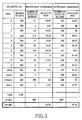
- FIG. 5 is a list comparing posture conversion to the basic posture with non-posture conversion to the basic posture according to the embodiment of the present invention.
- the table lists the results of 299 or 300 tests (number of data in collected DB) for 14 motion classes in the state where the portable terminal is rotated -90°along the Z-axis.
- a motion detection rate is different depending on whether the present invention is applied or not.
- An average motion detection rate is only 23.36% before applying the present invention, but it is 94.35% after applying the present invention. This is about a 71% increase.
- the posture conversion can be carried out for any posture resulting in rotating the portable terminal at a specific angle along the X- and Z- axes in the basic posture of FIG 3A as well as for a posture resulting in rotating the portable terminal at -90°along the Z-axis as illustrated in FIG. 3B, that is, for a posture resulting in rotating the portable terminal along only one axis.
- the present invention provides a portable terminal capable of motion detection and a motion detection method for the portable terminal.
- a motion detector measures the three-axis accelerations of the portable terminal
- a controller calculates the rotation angle along the X- and Z- axes in a current posture of the portable terminal with respect to the X- and Z- axes in a basic posture, converts the three-axis acceleration measurements to equivalent three-axis basic-posture accelerations using the rotation angles, and recognizes the motion of the portable terminal using the three-axis basic-posture accelerations.
- a motion detection rate is increased and user convenience is improved.
Landscapes
- Engineering & Computer Science (AREA)
- Theoretical Computer Science (AREA)
- General Engineering & Computer Science (AREA)
- Computer Hardware Design (AREA)
- Human Computer Interaction (AREA)
- Physics & Mathematics (AREA)
- General Physics & Mathematics (AREA)
- Computer Networks & Wireless Communication (AREA)
- Signal Processing (AREA)
- Telephone Function (AREA)
- Mobile Radio Communication Systems (AREA)
- Measurement Of The Respiration, Hearing Ability, Form, And Blood Characteristics Of Living Organisms (AREA)
Abstract
Description
- The present invention relates generally to a portable terminal having a motion detection function and a motion detection method therefor, and in particular, to a portable terminal having a motion detector for measuring accelerations of the portable terminal along its' X-, Y- and Z- axes, and a controller for calculating rotation angles of the portable terminal along the X-and Z- axes in a current posture of the portable terminal with respect to the X-and Z- axes in a basic posture of the portable terminal using the acceleration measurements, converting the accelerations along each axis to basic-posture accelerations along each axis using the rotation angles, and recognizing the motion of the portable terminal based on the basic-posture accelerations along each axis, and a motion detection method for the portable terminal.
- In recent years the use of mobile phones and PDAs (Personal Digital Assistants) have increased dramatically. These portable terminals find their use in increasing applications including image capturing with an equipped digital camera, satellite broadcasting reception, and games, beyond basic phone calls or scheduling.
- In addition, such portable terminals have been made to include a motion detector so that the motion or inclination of a handset itself can be used as a form of manipulation, instead of pressing a keypad with buttons or touching a touch screen.
- Hence, without pressing the digits of a phone number one by one on the keypad, a call can be placed by making a motion with the portable terminal.
- For instance, a spam call or a spam message may be deleted by shaking the portable terminal with a motion detector twice up and down. A call may be placed by short dialing using a digit if a user draws the digit with the portable terminal. In addition, the user can play a percussion instrument like a tambourine or can create a variety of beatbox effects by shaking the portable terminal. Particularly, drawing '0' or '1' with the portable terminal can invoke an utterance such as "oh yes" or "oh no" in on-line games or in using emoticons. Furthermore, songs can be selected by means of a simple up and down motion of the portable terminal during use of an MP3 function.
- Conventionally, the user makes an intended motion with the portable terminal, while maintaining the portable terminal in a basic posture, for motion detection. This conventional motion detection method neglects the fact that the portable terminal takes a different posture in a three-dimensional space depending on the user's holding the portable terminal in his hand.
- The basic posture refers to a posture in which the user is supposed to maintain the portable terminal when making a motion with the portable terminal, for motion detection in the portable terminal.
- The above motion detection method neglects other postures of the portable terminal, increases user inconvenience and decreases a motion detection rate.
- The object of the present invention is to substantially solve at least the above problems and/or disadvantages and to provide at least the advantages below. Accordingly, an object of the present invention is to provide a portable terminal for detecting a motion made not only in a predetermined basic posture but in any other input posture, and a motion detection method therefor.
- This object is solved by the invention as claimed in the independent claims.
- Preferred embodiments are specified in the dependent claims.
- An aspect of the present invention is to provide a portable terminal for detecting a motion made not only in a predetermined basic posture but in any other input posture by calculating rotation angles of the portable terminal.
- A further aspect of the present invention is to provide a motion detection method for a portable terminal, in which a motion made not only in a predetermined basic posture but in any other input posture can be detected by calculating rotation angles of the portable terminal.
- The above object and aspects are achieved by providing a portable terminal having a motion detection function and a motion detection method therefor.
- According to one aspect of the present invention, in a portable terminal having a motion detection function, a motion detector measures an acceleration along each axis of the portable terminal. A controller calculates rotation angles along the X- and Z- axes in a current posture of the portable terminal with respect to the X- and Z- axes in a basic posture using the acceleration along each axis, converts the acceleration along each axis to an equivalent basic-posture acceleration along each axis using the rotation angles, and recognizes a motion of the portable terminal using the basic-posture acceleration along each axis.
- According to another aspect of the present invention, in a motion detection method for a portable terminal, a motion of the portable terminal is input by measuring an acceleration along each axis of the portable terminal. A current posture of the portable terminal is calculated by calculating rotation angles along the X- and Z- axes with respect to the X- and Z- axes in a basic posture using the acceleration along each axis. The acceleration along each axis is converted to an equivalent basic-posture acceleration along each axis using the rotation angles. The motion of the portable terminal is recognized using the basic-posture acceleration along each axis.
- The above and other objects, features and advantages of the present invention will become more apparent from the following detailed description when taken in conjunction with the accompanying drawings in which:
- FIG 1 is a block diagram of a portable terminal capable of improved motion input according to an embodiment of the present invention;
- FIG 2 is a flowchart illustrating an operation for detecting a motion that the portable terminal makes in an arbitrary posture according to the embodiment of the present invention;
- FIG 3A illustrates axes in a basic posture of the portable terminal, along which accelerations of the portable terminal are measured according to the embodiment of the present invention;
- FIG 3B illustrates axial directions in the state where the portable terminal is rotated at -90° with respect to a Z-axis in the basic posture according to the embodiment of the present invention;
- FIG. 4A is a graph illustrating accelerations measured along three axes in the state where the portable terminal is rotated at -90° with respect to the Z-axis according to the embodiment of the present invention;
- FIG. 4B is a graph illustrating three-axis accelerations in the basic posture converted from the three-axis accelerations measured in the state where the portable terminal is rotated at -90° with respect to the Z-axis according to the embodiment of the present invention; and
- FIG 5 is a list comparing posture conversion to the basic posture with non-posture conversion to the basic posture according to the embodiment of the present invention.
- A preferred embodiment of the present invention will be described herein below with reference to the accompanying drawings. In the following description, well-known functions or constructions are not described in detail since they would obscure the invention in unnecessary detail.
- In the following description, three axes are mutually orthogonal X-, Y- and Z- axes and three-axis accelerations refer to accelerations along the respective three axes.
- FIG 1 is a block diagram of a portable terminal capable of improved motion input according to an embodiment of the present invention.
- Referring to FIG 1, the portable terminal includes a
controller 100, adisplay 102, akeypad 104, amemory 106, amotion detector 108, a transmitter/receiver 110, anantenna 112, a CODEC (Coder-Decoder) 114, amicrophone 116, and aspeaker 118. - The
controller 100 provides overall control to the operations of the portable terminal. For example, thecontroller 100 processes and controls voice call and data communication. In addition to its typical functionality, thecontroller 100 converts a motion in an arbitrary posture of the portable terminal to that in a basic posture in a motion detection using themotion detector 108 according to the present invention. - Also, the
controller 100 calculates rotation angles along the X- and Z-axes in a current posture of the portable terminal with respect to the X- and Z-axes in a basic posture of the portable terminal using the acceleration along the X-, Y- and Z- axes when the acceleration is lower than a threshold acceleration just after the motion key is pressed. It converts the accelerations along the X-, Y- and Z- axes measured between the time the accelerations are higher than the threshold acceleration and a motion completion time to equivalent basic-posture accelerations along the X-, Y- and Z- axes using the rotation angles. And it recognizes a motion of the portable terminal by identifying a corresponding motion in the motion database having accelerations which correspond to the basic-posture accelerations along the X-, Y- and Z- axes. - The
controller 100 calculates the rotation angles along the X- and Z- axes in the current posture of the portable terminal by
where A̅ x , A̅ y and A̅ z are averages of accelerations Ax, Ay and Az along the X-, Y- and Z- axes, respectively when the accelerations are lower than a threshold acceleration. - The
controller 100 converts the acceleration along the X-, Y and Z- axes to an equivalent basic-posture acceleration along the X-, Y- and Z- axes by
where ϕ is the rotation angle along the Z-axis, φ is the rotation angle along the X-axis, Ax, Ay and Az are the accelerations along the X-, Y- and Z- axes and Ax1, Ay1 and Az1 are basic-posture accelerations along the X-, Y- and Z- axes. - A description of the typical processing and control operation of the
controller 100 will not be provided herein. - The
display 102 displays status information (or indicators) generated during the operations of the portable terminal, limited digits and characters, moving pictures, still images, etc. A color LCD (Liquid Crystal Display) can be used as thedisplay 102. - The
keypad 104 includesdigit keys 0 through 9 and function keys such as a Menu key, a Cancel (Clear) key, an OK key, a Talk key, an End key, an Internet key, and navigation keys (▲/▼/◄/►). In addition to its typical functions, thekeypad 104 further has a motion key designated to indicate the start and end of a motion of the portable terminal and provides key input data corresponding to a key pressed by a user to thecontroller 100. The motion key starts a motion recognition of the portable terminal. - The
memory 106 stores programs for controlling the overall operations of the portable terminal, temporarily stores data generated during the operations of the portable terminal, and stores data to be kept (e.g. phone numbers, SMS messages, image data, etc.). According to the present invention, thememory 106 stores a motion database having motion information in relation to motions of the portable terminal. The motion database stores information of motions having corresponding accelerations which correspond to the basic-posture accelerations along the X-, Y- and Z- axes. - The
motion detector 108 measures the motion status of the portable terminal. Preferably,motion detector 108 is a type of acceleration measurer that measures accelerations along the three X-, Y- and Z- axes and senses the inclination and motion of the portable terminal based on a change in accelerations. - The transmitter/
receiver 110 downconverts an RF (Radio Frequency) signal received through theantenna 112 and despreads and channel-decodes the downconverted signal during reception. For transmission, the transmitter/receiver 110 channel-encodes and spreads transmission data, upconverts the spread signal to an RF signal, and transmits the RF signal through theantenna 112. It also receives a base station ID (Identifier) on a pilot channel. - The
CODEC 114 connected to thecontroller 100, and themicrophone 116 and thespeaker 118 connected to theCODEC 114, collectively form a voice input/output block for a voice call. TheCODEC 114 converts PCM (Pulse Code Modulation) data received from thecontroller 100 to an analog voice signal and outputs the voice signal through thespeaker 118. It also converts a voice signal received from themicrophone 116 to PCM data and provides the PCM data to thecontroller 100. - A motion detection method for the portable terminal described above according to the present invention will be described with reference to FIG. 2.
- FIG. 2 is a flowchart illustrating an operation for detecting a motion that the portable terminal makes in an arbitrary posture according to the embodiment of the present invention.
- Referring to FIG 2, the user makes a motion with the portable terminal in step 200.with enacting a motion key to recognize a motion start. In
step 202, the portable terminal(the controller 100) compares a basic posture with an input posture of the portable terminal and calculates the rotation status of the portable terminal in the input posture . Or it calculates rotation angles along the X- and Z- axes in a current posture of the portable terminal with respect to the X- and Z- axes in a basic posture of the portable terminal using the acceleration along the X-, Y- and Z- axes when the acceleration is lower than a threshold acceleration just after the motion key is enacted. The calculation is performed using the following Equation (3). This will be described with reference to FIGs. 3A and 3B. - FIG 3A illustrates axes in a basic posture of the portable terminal, along which accelerations of the portable terminal are measured according to the embodiment of the present invention, and FIG 3B illustrates axial directions in the state where the portable terminal is rotated at -90° with respect to the Z-axis in the basic posture according to the embodiment of the present invention.

where A̅ x , A̅ y and A̅ z are the averages of accelerations Ax, Ay and Az along the X-, Y- and Z- axes, respectively. The Y-axis coincides with a gravity direction and rotation along the Y-axis leads to no change in the accelerations of the other axes. Therefore, the Y-axis rotation is meaningless. - After measuring the rotation status of the portable terminal(the controller 100) in
step 202, the three-axis accelerations in the rotation status are converted to three-axis basic-posture accelerations instep 204 by Equation (4). Or converting the accelerations along the X-, Y- and Z- axes measured between the time the accelerations are higher than the threshold acceleration and a motion completion time to equivalent basic-posture accelerations along the X-, Y- and Z-axes using the rotation angles is performed. - In the present invention, the three-axis basic-posture accelerations refer to accelerations along the three axes in an arbitrary posture converted to equivalent three-axis accelerations in the basic posture by Equation (4).

where ϕ is the rotation angle along the Z-axis, φ is the rotation angle along the X-axis, Ax, Ay and Az are the accelerations along the X-, Y- and Z- axes, and Ax1, Ay1 and Az1 are basic-posture accelerations along the X-, Y- and Z- axes. - In
step 206, a motion is detected and recognized from the motion data-base according to the three-axis basic-posture accelerations. Or recognizing a motion of the portable terminal by identifying a corresponding motion in the motion database having accelerations which correspond to the basic-posture accelerations along the X-, Y- and Z- axes is performed. - FIG. 4A is a graph illustrating accelerations measured along the three axes in the state where the portable terminal is rotated at -90° with respect to the Z-axis, and FIG 4B is a graph illustrating equivalent three-axis basic-posture accelerations converted from the three-axis accelerations measured in the state where the portable terminal is rotated at -90° with respect to the Z-axis.
- That is, the graph shown in FIG. 4A illustrates three-axis accelerations for a specific motion made in the state illustrated in FIG 3B and the graph shown in FIG 4B illustrates three-axis accelerations in the basic posture equivalent to the acceleration measurements of FIG 4A, i.e. the three-axis accelerations for the specific motion made in the state illustrated in FIG 3A.
- FIG. 5 is a list comparing posture conversion to the basic posture with non-posture conversion to the basic posture according to the embodiment of the present invention. The table lists the results of 299 or 300 tests (number of data in collected DB) for 14 motion classes in the state where the portable terminal is rotated -90°along the Z-axis. A motion detection rate is different depending on whether the present invention is applied or not. An average motion detection rate is only 23.36% before applying the present invention, but it is 94.35% after applying the present invention. This is about a 71% increase.
- The posture conversion can be carried out for any posture resulting in rotating the portable terminal at a specific angle along the X- and Z- axes in the basic posture of FIG 3A as well as for a posture resulting in rotating the portable terminal at -90°along the Z-axis as illustrated in FIG. 3B, that is, for a posture resulting in rotating the portable terminal along only one axis.
- As described above, the present invention provides a portable terminal capable of motion detection and a motion detection method for the portable terminal. In the portable terminal, a motion detector measures the three-axis accelerations of the portable terminal, and a controller calculates the rotation angle along the X- and Z- axes in a current posture of the portable terminal with respect to the X- and Z- axes in a basic posture, converts the three-axis acceleration measurements to equivalent three-axis basic-posture accelerations using the rotation angles, and recognizes the motion of the portable terminal using the three-axis basic-posture accelerations. Thus, a motion detection rate is increased and user convenience is improved.
- While the invention has been shown and described with reference to a certain preferred embodiment thereof, it will be understood by those skilled in the art that various changes in form and details may be made therein without departing from the scope of the invention as defined by the appended claims.
Claims (12)
- A portable terminal having a motion detection function, comprising:a motion detector for measuring an acceleration along an X-, Y- and Z-axis of the portable terminal; anda controller for calculating rotation angles along the X- and Z- axes in a current posture of the portable terminal with respect to the X- and Z- axes in a basic posture of the portable terminal using the acceleration alongthe X-, Y- and Z- axes, converting the acceleration along the X-, Y- and Z- axes to an equivalent basic-posture acceleration along the X-, Y- and Z- axes using the rotation angles, and recognizing a motion of the portable terminal using the basic-posture acceleration along the X-, Y- and Z- axes.
- The portable terminal of claim 1, wherein the controller calculates the rotation angles along the X- and Z- axes in the current posture of the portable terminal by


where A̅ x , A̅ y and A̅ z are averages of accelerations Ax, Ay and Az along the X-, Y- and Z- axes, respectively. - The portable terminal of claim 1 or 2, wherein the controller converts the acceleration along the X-, Y- and Z- axes to an equivalent basic-posture acceleration along the X-, Y- and Z- axes by


where ϕ is the rotation angle along the Z-axis, φ is the rotation angle along the X-axis, Ax, Ay and Az are the accelerations along the X-, Y- and Z- axes and Ax1, Ay1 and Az1 are basic-posture accelerations along the X-, Y- and Z- axes. - A motion detection method for a portable terminal, comprising the steps of:inputting a motion of the portable terminal by measuring an acceleration along an X-, Y- and Z- axis of the portable terminal;calculating a current posture of the portable terminal by calculating rotation angles along the X- and Z- axes with respect to the X- and Z- axes in a basic posture of the portable terminal using the acceleration along the X-, Y- and Z- axes;converting the acceleration along the X-, Y- and Z- axes to an equivalent basic-posture acceleration along the X-, Y- and Z- axes using the rotation angles; andrecognizing a detected motion of the portable terminal using the basic-posture acceleration along the X-, Y- and Z- axes.
- The motion detection method of claim 4, wherein the posture calculation step comprises a step of calculating the rotation angle along the X- and Z- axes by


where A̅ x , A̅ y and A̅ z are averages of accelerations Ax, Ay and Az along the X-, Y- and Z- axes, respectively. - The motion detection method of claim 4 or 5, wherein the conversion step comprises a step of converting the acceleration along the X-, Y- and Z- axes to an equivalent basic-posture acceleration along the X-, Y- and Z-axes by


where ϕ is the rotation angle along the Z-axis, φ is the rotation angle along the X-axis, Ax, Ay and Az are the accelerations along the X-, Y- and Z- axes and Ax1, Ay1 and Az1 are the basic-posture accelerations along the X-, Y- and Z- axes. - A portable terminal having a motion detection function, comprising:a motion detector for measuring an acceleration along an X-, Y- and Z-axis of the portable terminal;a motion key for starting a motion recognition of the portable terminal;a motion database for storing information of motions; anda controller for calculating rotation angles along the X- and Z- axes in a current posture of the portable terminal with respect to the X- and Z- axes in a basic posture of the portable terminal using the acceleration along the X-, Y- and Z- axes when the acceleration is lower than a threshold acceleration just after the motion key is pressed, converting the accelerations along the X-, Y- and Z- axes measured between the time the accelerations are higher than the threshold acceleration and a motion completion time to equivalent basic-posture accelerations along the X-, Y- and Z- axes using the rotation angles, and recognizing a motion of the portable terminal by identifying a corresponding motion in the motion database having accelerations which correspond to the basic-posture accelerations along the X-, Y- and Z- axes.
- The portable terminal of claim 7, wherein the controller calculates the rotation angles along the X- and Z- axes in the current posture of the portable terminal by


where A̅ x , A̅ y and A̅ z are averages of accelerations Ax, Ay and Az along the X-, Y- and Z- axes, respectively when the accelerations are lower than a threshold acceleration. - The portable terminal of claim 7 or 8, wherein the controller converts the acceleration along the X-, Y- and Z- axes to an equivalent basic-posture acceleration along the X-, Y- and Z- axes by


where ϕ is the rotation angle along the Z-axis, φ is the rotation angle along the X-axis, Ax, Ay and Az are the accelerations along the X-, Y- and Z- axes and Ax1, Ay1 and Az1 are basic-posture accelerations along the X-, Y- and Z- axes. - A motion detection method for a portable terminal, comprising the steps of:enacting a motion key to start a motion recognition of the portable terminal;calculating rotation angles along the X- and Z- axes in a current posture of the portable terminal with respect to the X- and Z- axes in a basic posture of the portable terminal using the acceleration along the X-, Y- and Z- axes when the acceleration is lower than a threshold acceleration just after the motion key is enacted;converting the accelerations along the X-, Y- and Z- axes measured between the time the accelerations are higher than the threshold acceleration and a motion completion time to equivalent basic-posture accelerations along the X-, Y- and Z- axes using the rotation angles; andrecognizing a motion of the portable terminal by identifying a corresponding motion in the motion database having accelerations which correspond to the basic-posture accelerations along the X-, Y- and Z- axes.
- The motion detection method of claim 10, wherein the calculating the rotation angles along the X- and Z- axes in the current posture of the portable terminal is performed by


where A̅ x , A̅ y and A̅ z are averages of accelerations Ax, Ay and Az along the X-, Y- and Z- axes, respectively. - The motion detection method of claim 10 or 11, wherein the converting the accelerations along the X-, Y- and Z- axes measured between the time the accelerations are higher than the threshold acceleration and a motion completion time to equivalent basic-posture accelerations along the X-, Y- and Z-axes using the rotation angles is performed by


where ϕ is the rotation angle along the Z-axis, φ is the rotation angle along the X-axis, Ax, Ay and Az are the accelerations along the X-, Y- and Z- axes and Ax1, Ay1 and Az1 are the basic-posture accelerations along the X-, Y- and Z- axes.
Applications Claiming Priority (1)
| Application Number | Priority Date | Filing Date | Title |
|---|---|---|---|
| KR1020050039910A KR100554484B1 (en) | 2005-05-12 | 2005-05-12 | Portable terminal capable of gesture recognition and gesture recognition method |
Publications (3)
| Publication Number | Publication Date |
|---|---|
| EP1731995A2 true EP1731995A2 (en) | 2006-12-13 |
| EP1731995A3 EP1731995A3 (en) | 2012-11-07 |
| EP1731995B1 EP1731995B1 (en) | 2017-08-23 |
Family
ID=35998512
Family Applications (1)
| Application Number | Title | Priority Date | Filing Date |
|---|---|---|---|
| EP06002383.5A Expired - Lifetime EP1731995B1 (en) | 2005-05-12 | 2006-02-06 | Portable terminal having motion detection function and motion detection method therefor |
Country Status (4)
| Country | Link |
|---|---|
| US (1) | US7424385B2 (en) |
| EP (1) | EP1731995B1 (en) |
| KR (1) | KR100554484B1 (en) |
| CN (1) | CN1863225B (en) |
Cited By (8)
| Publication number | Priority date | Publication date | Assignee | Title |
|---|---|---|---|---|
| US7424385B2 (en) * | 2005-05-12 | 2008-09-09 | Samsung Electronics Co., Ltd. | Portable terminal having motion detection function and motion detection method therefor |
| WO2009006173A3 (en) * | 2007-07-02 | 2009-03-05 | Cisco Tech Inc | Use of human gestures by a mobile phone for generating responses to a communication party |
| US8243895B2 (en) | 2005-12-13 | 2012-08-14 | Cisco Technology, Inc. | Communication system with configurable shared line privacy feature |
| WO2012131166A1 (en) * | 2011-03-31 | 2012-10-04 | Nokia Corporation | Method and apparatus for motion gesture recognition |
| WO2013022273A3 (en) * | 2011-08-09 | 2013-03-14 | Lg Innotek Co., Ltd. | Portable terminal and method for detecting posture of the same |
| US8687785B2 (en) | 2006-11-16 | 2014-04-01 | Cisco Technology, Inc. | Authorization to place calls by remote users |
| US8873841B2 (en) | 2011-04-21 | 2014-10-28 | Nokia Corporation | Methods and apparatuses for facilitating gesture recognition |
| US10732718B2 (en) | 2009-06-12 | 2020-08-04 | Samsung Electronics Co., Ltd. | Apparatus and method for motion detection in portable terminal |
Families Citing this family (17)
| Publication number | Priority date | Publication date | Assignee | Title |
|---|---|---|---|---|
| US6831632B2 (en) * | 2001-04-09 | 2004-12-14 | I. C. + Technologies Ltd. | Apparatus and methods for hand motion tracking and handwriting recognition |
| KR100666048B1 (en) * | 2005-05-20 | 2007-01-10 | 삼성전자주식회사 | Portable terminal measuring reference slope and measuring method of reference slope using same |
| US20080214160A1 (en) * | 2007-03-01 | 2008-09-04 | Sony Ericsson Mobile Communications Ab | Motion-controlled audio output |
| US8478348B2 (en) * | 2007-07-25 | 2013-07-02 | Nokia Corporation | Deferring alerts |
| US8996332B2 (en) | 2008-06-24 | 2015-03-31 | Dp Technologies, Inc. | Program setting adjustments based on activity identification |
| CN101498621B (en) * | 2009-02-24 | 2011-01-05 | 华南理工大学 | Wheel motion attitude monitoring method based on wheel-loaded intelligent sensor |
| CN101719942B (en) * | 2009-11-30 | 2012-04-25 | 华为终端有限公司 | Mobile terminal and method for recognizing rotation of mobile terminal |
| US9990009B2 (en) * | 2009-12-22 | 2018-06-05 | Nokia Technologies Oy | Output control using gesture input |
| CN101976330B (en) * | 2010-09-26 | 2013-08-07 | 中国科学院深圳先进技术研究院 | Gesture recognition method and system |
| US9141194B1 (en) * | 2012-01-04 | 2015-09-22 | Google Inc. | Magnetometer-based gesture sensing with a wearable device |
| CN103000161B (en) * | 2012-12-14 | 2015-08-12 | 小米科技有限责任公司 | A kind of method for displaying image, device and a kind of intelligent hand-held terminal |
| KR101380590B1 (en) * | 2012-12-26 | 2014-04-02 | 정기현 | Mobile terminal with motion sensor |
| CN104639727A (en) * | 2013-11-12 | 2015-05-20 | 英业达科技有限公司 | Phone call answering system and method |
| EP3273331A4 (en) * | 2015-03-20 | 2018-04-18 | Ricoh Company, Ltd. | Display apparatus, display control method, display control program, and display system |
| CN106547340B (en) * | 2015-09-23 | 2019-11-15 | 广州市动景计算机科技有限公司 | Method, device and intelligent terminal for quickly hiding webpage elements based on gravity sensing |
| CN109163723A (en) * | 2018-08-16 | 2019-01-08 | 东南大学 | A method of measuring the angle of a mobile phone when it swings in a pocket |
| US11325000B2 (en) * | 2019-05-03 | 2022-05-10 | Xperience Robotics, Inc. | Wearable device systems and methods for guiding physical movements |
Citations (3)
| Publication number | Priority date | Publication date | Assignee | Title |
|---|---|---|---|---|
| US6369794B1 (en) | 1998-09-09 | 2002-04-09 | Matsushita Electric Industrial Co., Ltd. | Operation indication outputting device for giving operation indication according to type of user's action |
| US20040130524A1 (en) | 2002-10-30 | 2004-07-08 | Gantetsu Matsui | Operation instructing device, operation instructing method, and operation instructing program |
| EP1460382A2 (en) | 2003-03-18 | 2004-09-22 | Samsung Electronics Co., Ltd. | Input system based on a three-dimensional inertial navigation system |
Family Cites Families (13)
| Publication number | Priority date | Publication date | Assignee | Title |
|---|---|---|---|---|
| JPH1049290A (en) * | 1996-08-05 | 1998-02-20 | Sony Corp | Information processing apparatus and method |
| JP2000214988A (en) * | 1999-01-06 | 2000-08-04 | Motorola Inc | Method for inputting information to radio communication device by using operation pattern |
| US6201554B1 (en) * | 1999-01-12 | 2001-03-13 | Ericsson Inc. | Device control apparatus for hand-held data processing device |
| KR20010110487A (en) * | 2000-01-31 | 2001-12-13 | 다니엘 태그리아페리, 라이조 캐르키, 모링 헬레나 | Accelerometer and selection key(s) used as input devices for mobile radiotelephone |
| JP4095231B2 (en) * | 2000-03-27 | 2008-06-04 | マイクロストーン株式会社 | Mobile phone with motion sensor |
| WO2001086920A2 (en) * | 2000-05-12 | 2001-11-15 | Zvi Lapidot | Apparatus and method for the kinematic control of hand-held devices |
| US6798429B2 (en) * | 2001-03-29 | 2004-09-28 | Intel Corporation | Intuitive mobile device interface to virtual spaces |
| KR100585499B1 (en) | 2003-09-04 | 2006-06-07 | 주식회사 유유 | Azimuth measuring device and measuring method using 2-axis geomagnetic sensor and 2-axis acceleration sensor |
| US20060060068A1 (en) * | 2004-08-27 | 2006-03-23 | Samsung Electronics Co., Ltd. | Apparatus and method for controlling music play in mobile communication terminal |
| KR100554484B1 (en) * | 2005-05-12 | 2006-03-03 | 삼성전자주식회사 | Portable terminal capable of gesture recognition and gesture recognition method |
| KR100537279B1 (en) * | 2005-05-12 | 2005-12-16 | 삼성전자주식회사 | Portable terminal with motion detecting function and method of motion detecting thereof |
| KR100597798B1 (en) * | 2005-05-12 | 2006-07-10 | 삼성전자주식회사 | How to provide the user with information for gesture recognition in the portable terminal |
| KR100666048B1 (en) * | 2005-05-20 | 2007-01-10 | 삼성전자주식회사 | Portable terminal measuring reference slope and measuring method of reference slope using same |
-
2005
- 2005-05-12 KR KR1020050039910A patent/KR100554484B1/en not_active Expired - Fee Related
- 2005-12-27 US US11/318,753 patent/US7424385B2/en active Active
-
2006
- 2006-01-13 CN CN200610001145.9A patent/CN1863225B/en not_active Expired - Fee Related
- 2006-02-06 EP EP06002383.5A patent/EP1731995B1/en not_active Expired - Lifetime
Patent Citations (3)
| Publication number | Priority date | Publication date | Assignee | Title |
|---|---|---|---|---|
| US6369794B1 (en) | 1998-09-09 | 2002-04-09 | Matsushita Electric Industrial Co., Ltd. | Operation indication outputting device for giving operation indication according to type of user's action |
| US20040130524A1 (en) | 2002-10-30 | 2004-07-08 | Gantetsu Matsui | Operation instructing device, operation instructing method, and operation instructing program |
| EP1460382A2 (en) | 2003-03-18 | 2004-09-22 | Samsung Electronics Co., Ltd. | Input system based on a three-dimensional inertial navigation system |
Cited By (10)
| Publication number | Priority date | Publication date | Assignee | Title |
|---|---|---|---|---|
| US7424385B2 (en) * | 2005-05-12 | 2008-09-09 | Samsung Electronics Co., Ltd. | Portable terminal having motion detection function and motion detection method therefor |
| US8243895B2 (en) | 2005-12-13 | 2012-08-14 | Cisco Technology, Inc. | Communication system with configurable shared line privacy feature |
| US8687785B2 (en) | 2006-11-16 | 2014-04-01 | Cisco Technology, Inc. | Authorization to place calls by remote users |
| WO2009006173A3 (en) * | 2007-07-02 | 2009-03-05 | Cisco Tech Inc | Use of human gestures by a mobile phone for generating responses to a communication party |
| US8817061B2 (en) | 2007-07-02 | 2014-08-26 | Cisco Technology, Inc. | Recognition of human gestures by a mobile phone |
| US10732718B2 (en) | 2009-06-12 | 2020-08-04 | Samsung Electronics Co., Ltd. | Apparatus and method for motion detection in portable terminal |
| WO2012131166A1 (en) * | 2011-03-31 | 2012-10-04 | Nokia Corporation | Method and apparatus for motion gesture recognition |
| US8873841B2 (en) | 2011-04-21 | 2014-10-28 | Nokia Corporation | Methods and apparatuses for facilitating gesture recognition |
| WO2013022273A3 (en) * | 2011-08-09 | 2013-03-14 | Lg Innotek Co., Ltd. | Portable terminal and method for detecting posture of the same |
| US9325887B2 (en) | 2011-08-09 | 2016-04-26 | Lg Innotek Co., Ltd. | Portable terminal and method for detecting posture of the same |
Also Published As
| Publication number | Publication date |
|---|---|
| CN1863225B (en) | 2015-04-01 |
| KR100554484B1 (en) | 2006-03-03 |
| EP1731995B1 (en) | 2017-08-23 |
| US20060258194A1 (en) | 2006-11-16 |
| CN1863225A (en) | 2006-11-15 |
| US7424385B2 (en) | 2008-09-09 |
| EP1731995A3 (en) | 2012-11-07 |
Similar Documents
| Publication | Publication Date | Title |
|---|---|---|
| EP1731995A2 (en) | Portable terminal having motion detection function and motion detection method therefor | |
| EP1722296B1 (en) | Portable terminal having motion-recognition capability and motion recognition method therefor | |
| US20060256082A1 (en) | Method of providing motion recognition information in portable terminal | |
| CN100394813C (en) | Method of inputting information to wireless communication device by motion | |
| EP2161645B1 (en) | Portable terminal and driving method of the same | |
| KR101572847B1 (en) | Method and apparatus for motion detecting in portable terminal | |
| EP2290922A1 (en) | Method of providing user interface for a portable terminal | |
| US9305232B2 (en) | Display orientation change for wireless devices | |
| CN114594751B (en) | Method, device and equipment for testing vehicle functions and computer readable storage medium | |
| US20100164909A1 (en) | Information processing apparatus | |
| US20100009667A1 (en) | Mobile terminal device and data transfer control program | |
| EP1806908A2 (en) | Apparatus and method for sensing folder rotation status in a portable terminal | |
| KR20100133538A (en) | Apparatus and method for motion recognition in portable terminal | |
| CA2709559C (en) | Display orientation change for wireless devices | |
| US7890289B2 (en) | Portable terminal for measuring reference tilt and method of measuring reference tilt using the same | |
| US20070243886A1 (en) | Communication apparatus | |
| US7522031B2 (en) | Apparatus and method for controlling alarm by motion recognition in a portable terminal | |
| WO2006043581A1 (en) | Function control method, and terminal device | |
| JP2000078262A (en) | Mobile phone terminal | |
| KR100618265B1 (en) | Wireless communication terminal having visual inspection function and method thereof | |
| EP1733547B1 (en) | Movement activated key guard | |
| KR100639384B1 (en) | Mobile communication terminal with ruler function and its control method | |
| KR20060062120A (en) | Mobile information provision method of mobile communication terminal | |
| JP2007005967A (en) | Communication apparatus and communication system |
Legal Events
| Date | Code | Title | Description |
|---|---|---|---|
| PUAI | Public reference made under article 153(3) epc to a published international application that has entered the european phase |
Free format text: ORIGINAL CODE: 0009012 |
|
| 17P | Request for examination filed |
Effective date: 20060728 |
|
| AK | Designated contracting states |
Kind code of ref document: A2 Designated state(s): AT BE BG CH CY CZ DE DK EE ES FI FR GB GR HU IE IS IT LI LT LU LV MC NL PL PT RO SE SI SK TR |
|
| AX | Request for extension of the european patent |
Extension state: AL BA HR MK YU |
|
| RAP1 | Party data changed (applicant data changed or rights of an application transferred) |
Owner name: SAMSUNG ELECTRONICS CO., LTD. |
|
| PUAL | Search report despatched |
Free format text: ORIGINAL CODE: 0009013 |
|
| AK | Designated contracting states |
Kind code of ref document: A3 Designated state(s): AT BE BG CH CY CZ DE DK EE ES FI FR GB GR HU IE IS IT LI LT LU LV MC NL PL PT RO SE SI SK TR |
|
| AX | Request for extension of the european patent |
Extension state: AL BA HR MK YU |
|
| RIC1 | Information provided on ipc code assigned before grant |
Ipc: G06F 3/033 20060101AFI20121004BHEP Ipc: G06F 1/16 20060101ALI20121004BHEP Ipc: G06F 3/01 20060101ALI20121004BHEP |
|
| AKX | Designation fees paid |
Designated state(s): DE FR GB |
|
| REG | Reference to a national code |
Ref country code: DE Ref legal event code: R079 Ref document number: 602006053374 Country of ref document: DE Free format text: PREVIOUS MAIN CLASS: G06F0003033000 Ipc: G06F0001160000 |
|
| GRAP | Despatch of communication of intention to grant a patent |
Free format text: ORIGINAL CODE: EPIDOSNIGR1 |
|
| RIC1 | Information provided on ipc code assigned before grant |
Ipc: G06F 1/16 20060101AFI20170215BHEP Ipc: G06F 3/0346 20130101ALI20170215BHEP Ipc: G06F 3/01 20060101ALI20170215BHEP |
|
| INTG | Intention to grant announced |
Effective date: 20170314 |
|
| GRAS | Grant fee paid |
Free format text: ORIGINAL CODE: EPIDOSNIGR3 |
|
| GRAA | (expected) grant |
Free format text: ORIGINAL CODE: 0009210 |
|
| AK | Designated contracting states |
Kind code of ref document: B1 Designated state(s): DE FR GB |
|
| REG | Reference to a national code |
Ref country code: GB Ref legal event code: FG4D |
|
| REG | Reference to a national code |
Ref country code: DE Ref legal event code: R096 Ref document number: 602006053374 Country of ref document: DE |
|
| REG | Reference to a national code |
Ref country code: DE Ref legal event code: R097 Ref document number: 602006053374 Country of ref document: DE |
|
| PLBE | No opposition filed within time limit |
Free format text: ORIGINAL CODE: 0009261 |
|
| STAA | Information on the status of an ep patent application or granted ep patent |
Free format text: STATUS: NO OPPOSITION FILED WITHIN TIME LIMIT |
|
| 26N | No opposition filed |
Effective date: 20180524 |
|
| REG | Reference to a national code |
Ref country code: FR Ref legal event code: ST Effective date: 20181031 |
|
| PG25 | Lapsed in a contracting state [announced via postgrant information from national office to epo] |
Ref country code: FR Free format text: LAPSE BECAUSE OF NON-PAYMENT OF DUE FEES Effective date: 20180228 |
|
| PGFP | Annual fee paid to national office [announced via postgrant information from national office to epo] |
Ref country code: DE Payment date: 20240122 Year of fee payment: 19 Ref country code: GB Payment date: 20240122 Year of fee payment: 19 |
|
| REG | Reference to a national code |
Ref country code: DE Ref legal event code: R119 Ref document number: 602006053374 Country of ref document: DE |
|
| GBPC | Gb: european patent ceased through non-payment of renewal fee |
Effective date: 20250206 |
|
| PG25 | Lapsed in a contracting state [announced via postgrant information from national office to epo] |
Ref country code: DE Free format text: LAPSE BECAUSE OF NON-PAYMENT OF DUE FEES Effective date: 20250902 |
|
| PG25 | Lapsed in a contracting state [announced via postgrant information from national office to epo] |
Ref country code: GB Free format text: LAPSE BECAUSE OF NON-PAYMENT OF DUE FEES Effective date: 20250206 |