EP1729783B2 - Biodegradable polyurethane and polyurethane ureas - Google Patents
Biodegradable polyurethane and polyurethane ureas Download PDFInfo
- Publication number
- EP1729783B2 EP1729783B2 EP05714307.5A EP05714307A EP1729783B2 EP 1729783 B2 EP1729783 B2 EP 1729783B2 EP 05714307 A EP05714307 A EP 05714307A EP 1729783 B2 EP1729783 B2 EP 1729783B2
- Authority
- EP
- European Patent Office
- Prior art keywords
- polyurethane
- diol
- group
- polymer
- ethylene glycol
- Prior art date
- Legal status (The legal status is an assumption and is not a legal conclusion. Google has not performed a legal analysis and makes no representation as to the accuracy of the status listed.)
- Expired - Lifetime
Links
Images



Classifications
-
- C—CHEMISTRY; METALLURGY
- C08—ORGANIC MACROMOLECULAR COMPOUNDS; THEIR PREPARATION OR CHEMICAL WORKING-UP; COMPOSITIONS BASED THEREON
- C08G—MACROMOLECULAR COMPOUNDS OBTAINED OTHERWISE THAN BY REACTIONS ONLY INVOLVING UNSATURATED CARBON-TO-CARBON BONDS
- C08G18/00—Polymeric products of isocyanates or isothiocyanates
- C08G18/06—Polymeric products of isocyanates or isothiocyanates with compounds having active hydrogen
- C08G18/28—Polymeric products of isocyanates or isothiocyanates with compounds having active hydrogen characterised by the compounds used containing active hydrogen
- C08G18/30—Low-molecular-weight compounds
- C08G18/34—Carboxylic acids; Esters thereof with monohydroxyl compounds
- C08G18/348—Hydroxycarboxylic acids
-
- A—HUMAN NECESSITIES
- A61—MEDICAL OR VETERINARY SCIENCE; HYGIENE
- A61K—PREPARATIONS FOR MEDICAL, DENTAL OR TOILETRY PURPOSES
- A61K31/00—Medicinal preparations containing organic active ingredients
- A61K31/74—Synthetic polymeric materials
- A61K31/785—Polymers containing nitrogen
-
- A—HUMAN NECESSITIES
- A61—MEDICAL OR VETERINARY SCIENCE; HYGIENE
- A61L—METHODS OR APPARATUS FOR STERILISING MATERIALS OR OBJECTS IN GENERAL; DISINFECTION, STERILISATION OR DEODORISATION OF AIR; CHEMICAL ASPECTS OF BANDAGES, DRESSINGS, ABSORBENT PADS OR SURGICAL ARTICLES; MATERIALS FOR BANDAGES, DRESSINGS, ABSORBENT PADS OR SURGICAL ARTICLES
- A61L27/00—Materials for grafts or prostheses or for coating grafts or prostheses
- A61L27/14—Macromolecular materials
- A61L27/18—Macromolecular materials obtained otherwise than by reactions only involving carbon-to-carbon unsaturated bonds
-
- A—HUMAN NECESSITIES
- A61—MEDICAL OR VETERINARY SCIENCE; HYGIENE
- A61L—METHODS OR APPARATUS FOR STERILISING MATERIALS OR OBJECTS IN GENERAL; DISINFECTION, STERILISATION OR DEODORISATION OF AIR; CHEMICAL ASPECTS OF BANDAGES, DRESSINGS, ABSORBENT PADS OR SURGICAL ARTICLES; MATERIALS FOR BANDAGES, DRESSINGS, ABSORBENT PADS OR SURGICAL ARTICLES
- A61L27/00—Materials for grafts or prostheses or for coating grafts or prostheses
- A61L27/36—Materials for grafts or prostheses or for coating grafts or prostheses containing ingredients of undetermined constitution or reaction products thereof, e.g. transplant tissue, natural bone, extracellular matrix
- A61L27/38—Materials for grafts or prostheses or for coating grafts or prostheses containing ingredients of undetermined constitution or reaction products thereof, e.g. transplant tissue, natural bone, extracellular matrix containing added animal cells
- A61L27/3804—Materials for grafts or prostheses or for coating grafts or prostheses containing ingredients of undetermined constitution or reaction products thereof, e.g. transplant tissue, natural bone, extracellular matrix containing added animal cells characterised by specific cells or progenitors thereof, e.g. fibroblasts, connective tissue cells, kidney cells
-
- A—HUMAN NECESSITIES
- A61—MEDICAL OR VETERINARY SCIENCE; HYGIENE
- A61L—METHODS OR APPARATUS FOR STERILISING MATERIALS OR OBJECTS IN GENERAL; DISINFECTION, STERILISATION OR DEODORISATION OF AIR; CHEMICAL ASPECTS OF BANDAGES, DRESSINGS, ABSORBENT PADS OR SURGICAL ARTICLES; MATERIALS FOR BANDAGES, DRESSINGS, ABSORBENT PADS OR SURGICAL ARTICLES
- A61L27/00—Materials for grafts or prostheses or for coating grafts or prostheses
- A61L27/50—Materials characterised by their function or physical properties, e.g. injectable or lubricating compositions, shape-memory materials, surface modified materials
- A61L27/54—Biologically active materials, e.g. therapeutic substances
-
- A—HUMAN NECESSITIES
- A61—MEDICAL OR VETERINARY SCIENCE; HYGIENE
- A61L—METHODS OR APPARATUS FOR STERILISING MATERIALS OR OBJECTS IN GENERAL; DISINFECTION, STERILISATION OR DEODORISATION OF AIR; CHEMICAL ASPECTS OF BANDAGES, DRESSINGS, ABSORBENT PADS OR SURGICAL ARTICLES; MATERIALS FOR BANDAGES, DRESSINGS, ABSORBENT PADS OR SURGICAL ARTICLES
- A61L31/00—Materials for other surgical articles, e.g. stents, stent-grafts, shunts, surgical drapes, guide wires, materials for adhesion prevention, occluding devices, surgical gloves, tissue fixation devices
- A61L31/08—Materials for coatings
- A61L31/10—Macromolecular materials
-
- C—CHEMISTRY; METALLURGY
- C08—ORGANIC MACROMOLECULAR COMPOUNDS; THEIR PREPARATION OR CHEMICAL WORKING-UP; COMPOSITIONS BASED THEREON
- C08G—MACROMOLECULAR COMPOUNDS OBTAINED OTHERWISE THAN BY REACTIONS ONLY INVOLVING UNSATURATED CARBON-TO-CARBON BONDS
- C08G18/00—Polymeric products of isocyanates or isothiocyanates
- C08G18/06—Polymeric products of isocyanates or isothiocyanates with compounds having active hydrogen
- C08G18/28—Polymeric products of isocyanates or isothiocyanates with compounds having active hydrogen characterised by the compounds used containing active hydrogen
- C08G18/30—Low-molecular-weight compounds
- C08G18/32—Polyhydroxy compounds; Polyamines; Hydroxyamines
- C08G18/3203—Polyhydroxy compounds
- C08G18/3206—Polyhydroxy compounds aliphatic
-
- C—CHEMISTRY; METALLURGY
- C08—ORGANIC MACROMOLECULAR COMPOUNDS; THEIR PREPARATION OR CHEMICAL WORKING-UP; COMPOSITIONS BASED THEREON
- C08G—MACROMOLECULAR COMPOUNDS OBTAINED OTHERWISE THAN BY REACTIONS ONLY INVOLVING UNSATURATED CARBON-TO-CARBON BONDS
- C08G18/00—Polymeric products of isocyanates or isothiocyanates
- C08G18/06—Polymeric products of isocyanates or isothiocyanates with compounds having active hydrogen
- C08G18/28—Polymeric products of isocyanates or isothiocyanates with compounds having active hydrogen characterised by the compounds used containing active hydrogen
- C08G18/30—Low-molecular-weight compounds
- C08G18/32—Polyhydroxy compounds; Polyamines; Hydroxyamines
- C08G18/3203—Polyhydroxy compounds
- C08G18/3221—Polyhydroxy compounds hydroxylated esters of carboxylic acids other than higher fatty acids
-
- C—CHEMISTRY; METALLURGY
- C08—ORGANIC MACROMOLECULAR COMPOUNDS; THEIR PREPARATION OR CHEMICAL WORKING-UP; COMPOSITIONS BASED THEREON
- C08G—MACROMOLECULAR COMPOUNDS OBTAINED OTHERWISE THAN BY REACTIONS ONLY INVOLVING UNSATURATED CARBON-TO-CARBON BONDS
- C08G18/00—Polymeric products of isocyanates or isothiocyanates
- C08G18/06—Polymeric products of isocyanates or isothiocyanates with compounds having active hydrogen
- C08G18/28—Polymeric products of isocyanates or isothiocyanates with compounds having active hydrogen characterised by the compounds used containing active hydrogen
- C08G18/40—High-molecular-weight compounds
- C08G18/42—Polycondensates having carboxylic or carbonic ester groups in the main chain
- C08G18/4266—Polycondensates having carboxylic or carbonic ester groups in the main chain prepared from hydroxycarboxylic acids and/or lactones
- C08G18/4269—Lactones
- C08G18/4277—Caprolactone and/or substituted caprolactone
-
- C—CHEMISTRY; METALLURGY
- C08—ORGANIC MACROMOLECULAR COMPOUNDS; THEIR PREPARATION OR CHEMICAL WORKING-UP; COMPOSITIONS BASED THEREON
- C08G—MACROMOLECULAR COMPOUNDS OBTAINED OTHERWISE THAN BY REACTIONS ONLY INVOLVING UNSATURATED CARBON-TO-CARBON BONDS
- C08G18/00—Polymeric products of isocyanates or isothiocyanates
- C08G18/06—Polymeric products of isocyanates or isothiocyanates with compounds having active hydrogen
- C08G18/28—Polymeric products of isocyanates or isothiocyanates with compounds having active hydrogen characterised by the compounds used containing active hydrogen
- C08G18/65—Low-molecular-weight compounds having active hydrogen with high-molecular-weight compounds having active hydrogen
- C08G18/66—Compounds of groups C08G18/42, C08G18/48, or C08G18/52
- C08G18/6603—Compounds of groups C08G18/42, C08G18/48, or C08G18/52 with compounds of group C08G18/32 or polyamines of C08G18/38
- C08G18/6607—Compounds of groups C08G18/42, C08G18/48, or C08G18/52 with compounds of group C08G18/32 or polyamines of C08G18/38 with compounds of group C08G18/3203
-
- C—CHEMISTRY; METALLURGY
- C08—ORGANIC MACROMOLECULAR COMPOUNDS; THEIR PREPARATION OR CHEMICAL WORKING-UP; COMPOSITIONS BASED THEREON
- C08G—MACROMOLECULAR COMPOUNDS OBTAINED OTHERWISE THAN BY REACTIONS ONLY INVOLVING UNSATURATED CARBON-TO-CARBON BONDS
- C08G18/00—Polymeric products of isocyanates or isothiocyanates
- C08G18/06—Polymeric products of isocyanates or isothiocyanates with compounds having active hydrogen
- C08G18/70—Polymeric products of isocyanates or isothiocyanates with compounds having active hydrogen characterised by the isocyanates or isothiocyanates used
- C08G18/72—Polyisocyanates or polyisothiocyanates
- C08G18/77—Polyisocyanates or polyisothiocyanates having heteroatoms in addition to the isocyanate or isothiocyanate nitrogen and oxygen or sulfur
- C08G18/771—Polyisocyanates or polyisothiocyanates having heteroatoms in addition to the isocyanate or isothiocyanate nitrogen and oxygen or sulfur oxygen
-
- C—CHEMISTRY; METALLURGY
- C09—DYES; PAINTS; POLISHES; NATURAL RESINS; ADHESIVES; COMPOSITIONS NOT OTHERWISE PROVIDED FOR; APPLICATIONS OF MATERIALS NOT OTHERWISE PROVIDED FOR
- C09D—COATING COMPOSITIONS, e.g. PAINTS, VARNISHES OR LACQUERS; FILLING PASTES; CHEMICAL PAINT OR INK REMOVERS; INKS; CORRECTING FLUIDS; WOODSTAINS; PASTES OR SOLIDS FOR COLOURING OR PRINTING; USE OF MATERIALS THEREFOR
- C09D175/00—Coating compositions based on polyureas or polyurethanes; Coating compositions based on derivatives of such polymers
- C09D175/04—Polyurethanes
- C09D175/06—Polyurethanes from polyesters
-
- A—HUMAN NECESSITIES
- A61—MEDICAL OR VETERINARY SCIENCE; HYGIENE
- A61L—METHODS OR APPARATUS FOR STERILISING MATERIALS OR OBJECTS IN GENERAL; DISINFECTION, STERILISATION OR DEODORISATION OF AIR; CHEMICAL ASPECTS OF BANDAGES, DRESSINGS, ABSORBENT PADS OR SURGICAL ARTICLES; MATERIALS FOR BANDAGES, DRESSINGS, ABSORBENT PADS OR SURGICAL ARTICLES
- A61L2300/00—Biologically active materials used in bandages, wound dressings, absorbent pads or medical devices
- A61L2300/40—Biologically active materials used in bandages, wound dressings, absorbent pads or medical devices characterised by a specific therapeutic activity or mode of action
- A61L2300/412—Tissue-regenerating or healing or proliferative agents
-
- A—HUMAN NECESSITIES
- A61—MEDICAL OR VETERINARY SCIENCE; HYGIENE
- A61L—METHODS OR APPARATUS FOR STERILISING MATERIALS OR OBJECTS IN GENERAL; DISINFECTION, STERILISATION OR DEODORISATION OF AIR; CHEMICAL ASPECTS OF BANDAGES, DRESSINGS, ABSORBENT PADS OR SURGICAL ARTICLES; MATERIALS FOR BANDAGES, DRESSINGS, ABSORBENT PADS OR SURGICAL ARTICLES
- A61L2300/00—Biologically active materials used in bandages, wound dressings, absorbent pads or medical devices
- A61L2300/40—Biologically active materials used in bandages, wound dressings, absorbent pads or medical devices characterised by a specific therapeutic activity or mode of action
- A61L2300/412—Tissue-regenerating or healing or proliferative agents
- A61L2300/414—Growth factors
-
- C—CHEMISTRY; METALLURGY
- C08—ORGANIC MACROMOLECULAR COMPOUNDS; THEIR PREPARATION OR CHEMICAL WORKING-UP; COMPOSITIONS BASED THEREON
- C08G—MACROMOLECULAR COMPOUNDS OBTAINED OTHERWISE THAN BY REACTIONS ONLY INVOLVING UNSATURATED CARBON-TO-CARBON BONDS
- C08G2230/00—Compositions for preparing biodegradable polymers
Definitions
- the present invention relates to biodegradable processable and preferably thermoplastic polyurethanes or polyurethane/ureas and processes for their preparation.
- the polymers are biodegradable, processable and preferably thermoplastic which makes them useful in biomedical applications including, for example, in the fabrication of scaffolds for tissue engineering applications.
- the invention particularly relates to the use of such polyurethanes and polyurethane/ureas in fabricating scaffolds using rapid prototyping techniques.
- Biodegradable synthetic polymers offer a number of advantages over other materials in various biological applications including tissue repair.
- the key advantages include the ability to tailor mechanical properties and degradation kinetics to suit various applications.
- the simple and routine fabrication of scaffolds with a size and shape similar to organs or parts of organs would, for example, help tissue engineering technology to develop such organs in vivo or in vitro using bioreactors.
- scaffolds with appropriate mechanical properties can be fabricated and implanted in the body to help repair damaged tissues such as those in coronary arteries and other blood vessels.
- biodegradable scaffolds fabricated as coronary stents can support the vessel during the healing process and degrade and be released from the body after the vessel is repaired.
- Synthetic polymers are also attractive in tissue engineering applications because they can be fabricated into various shapes with desired pore morphologic features conducive to tissue in-growth. Furthermore, polymers can be designed with chemical functional groups that can, for example, induce tissue in-growth, or be utilised to adapt the polymers to the application in question.
- poly( ⁇ -hydroxy acids) such as poly(glycolic acid), poly(lactic acid) and a range of their copolymers have historically comprised the bulk of published material on biodegradable polyesters and have a long history of use as synthetic biodegradable materials in a number of clinical applications.
- Poly(glycolic acid), poly(lactic acid) and their copolymers, poly-p-dioxanone, and copolymers of trimethylene carbonate and glycolide have been the most widely used as scaffolds.
- Their major applications include as resorbable sutures, drug delivery systems and orthopaedic fixation devices such as pins, rods and screws.
- polyesters have been attractive for these applications because of (i) their ease of degradation by hydrolysis of the ester linkage, (ii) degradation products are resorbed through the metabolic pathways in some cases and (iii) the potential to tailor the structure to alter degradation rates.
- biodegradable synthetic polymers with appropriate mechanical properties are sought after for the development of biodegradable stents and stent coatings for the treatment of coronary artery disease by percutaneous intervention.
- Stents provide mechanical support for the vessel and keep the lumen open to its normal diameter while tissue growth takes place to repair the affected vessel wall.
- Current stents are fabricated using metals such as stainless steel or nickel-titanium alloys, and once deployed these stents remain permanently within the vessel.
- Biodegradable polymers have the advantage of being removable from the vessel through polymer degradation and resorption once the vessel is repaired. This leaves the repaired vessel free of foreign material and allows re-stenting if needed in the future.
- Biodegradable polymers can also be useful in delivering drugs such as sirolimus, everolimus and paclitaxel D-actinomycin, all of which help to inhibit the formation of neointimal hyperplasia by suppression of platelet activation, suppression of inflammatory response, and promotion of the healing.
- drugs such as sirolimus, everolimus and paclitaxel D-actinomycin, all of which help to inhibit the formation of neointimal hyperplasia by suppression of platelet activation, suppression of inflammatory response, and promotion of the healing.
- scaffolds made from synthetic and natural polymers, and ceramics have been investigated extensively for orthopaedic repair.
- the use of scaffolds has advantages such as the ability to generate desired pore structures and the ability to match size, shape and mechanical properties to suit a variety of applications.
- shaping these scaffolds to fit cavities or defects with complicated geometries, to bond to bone tissue, and to incorporate cells, drugs and growth factors, and the requirements of open surgery are a few major disadvantages of the use of known scaffold materials.
- polyester family The most common synthetic polymers used in fabricating scaffolds for growing cells and for biodegradable stents and stent coatings belong to the polyester family.
- poly(glycolic acid) and poly(lactic acid) have been the most commonly used polymers because of their relative ease of degradation under hydrolytic conditions and the resorption of the degradation products into the body.
- these polymers have a number of disadvantages, including rapid loss of mechanical properties, long degradation times, difficulty in processing, and the acidity of degradation products resulting in tissue necrosis.
- These polymers, when used in biodegradable stents, have to be heated during the deployment process to temperatures as high as 70°C which can cause cell damage.
- a controlled rapid prototyping method can address these problems.
- the shape of the mould can be quickly altered by computer design, the direction and degree of porosity can be specified to exact levels, a polymer skin is not formed in production, and the process is solvent free.
- the process can be modified to deposit a grid like layout with polymer strands to dimensions and patterns specific to the stent design.
- the grid structure can then be used to fabricate the stent.
- the grid structure could be deposited on a rotating mandrel to fabricate the stent in one operation.
- Synthetic polymers that can be used in such rapid prototyping apparatus need to meet specific property requirements which include melt processing characteristics, mechanical properties and other properties.
- specific property requirements which include melt processing characteristics, mechanical properties and other properties.
- FDM fused deposition modelling
- biocompatible and biodegradable polymers that can be processed using methods including rapid prototyping as well as thermal and solvent based methods to fabricate scaffolds and coatings for various biomedical applications including tissue engineering.
- biocompatible biodegradable polyurethane or polyurethane/urea according to claim 1.
- the biocompatible, biodegradable polyurethanes or polyurethane/ureas of the invention are of the general formula where R 1 is from the isocyanate, R 2 is from the chain extender and R 3 is from the soft segment polyol.
- the pronumeral 'n' represents the average number of repeat units in the hard segment.
- the pronumeral 'p' is proportional to the molecular weight of the polymer and includes both the hard segment repeat units and the soft segment
- polyol generally means a molecule which has at least two or more functional hydroxyl groups that can react with isocyanate groups to form urethane groups.
- examples of polyols include but are not limited to diols, triols, and polyols such as macrodiols.
- the polyol has a molecular weight of 200-1000, more preferably 200-600, and even more preferably 200-400.
- the polyol may be terminated by, for example, a hydroxyl, thiol or carboxylic acid group.
- Isocyanates suitable for preparation of the polyurethanes or polyurethane/ureas of the invention are those which are selected from the group consisting of optionally substituted aliphatic, aromatic and hindered isocyanates.
- chain extender should be taken to mean a low molecular weight compound having two or more functional groups that are reactive towards isocyanate and having a molecular weight of less than 350.
- Chain extenders include functional monomers with degradable arms.
- the chain extender may be employed to introduce easily degradable hard segment components into the polyurethane or polyurethane/urea structure. Incorporating such chain extenders allows preparation of easily degradable polyurethanes with fewer degradation products. For example, polyurethane based on ethyl-lysine diisocyanate and glycolic acid based polyol and chain extender degrades to bioresorbable glycolic acid, lysine, ethylene glycol and ethanol.
- Degradable arms are any molecular moiety which may be part of the chain extenders and the molecular moiety structure is preferably biocompatible and bioresorbable on in vivo degradation of the biocompatible, biodegradable polyurethanes or polyurethane/ureas.
- a "hard segment” polymer according to the invention is one which imbues the copolymer with its physical strength which arises from the nature of the chain extender and the isocyanate selected.
- the hard segment represents 20 to 100% by weight of the polyurethane or polyurethane/urea.
- the chain extender has a dual functionality of being both a conventional chain extender and a polyol.
- the polyurethanes and polyurethane/ureas according to the invention form porous or non-porous cross-linked or linear polymers which can be used as tissue engineering scaffolds, and may be used in rapid prototyping techniques including FDM. It has also been found that certain of the biodegradable polyurethanes according to the invention exhibit a glass transition between room temperature and 37°C. This property can be used to extrude hard materials on FDM apparatus (going in at 20°C) which will soften and even become elastomeric in vivo or while growing cells on scaffolds in a bioreactor at physiological temperatures of 37°C. This is also a very useful property for soft tissue applications.
- the polyurethanes and polyurethane/ureas can be sterilized without risk to their physical and chemical characteristics, preferably using gamma radiation to ensure sterility.
- the polyurethanes and polyurethane/ureas may incorporate biological and inorganic components selected for their ability to aid tissue repair in vivo, or to create certain physical characteristics for rapid prototyping purposes.
- the polyurethanes and polyurethane/ureas according to the invention form a biodegradable biocompatible scaffold which may be porous and contain interpenetrating polymer networks so as to enable the inclusion of biological and inorganic components.
- biological and inorganic components which are preferably selected from the group consisting of cells, progenitor cells, growth factors, other components for supporting cell growth, drugs, calcium phosphate, hydroxyapatite, hyaluronic acid, nanoparticulate tricalcium phosphate and hydroxyapatite type fillers, adhesives including fibrin, collagen and transglutaminase systems, surfactants including siloxane surfactants, silica particles, powdered silica, hollow fibres which may be used to seed cells in the polyurethanes, and other porogens including, for example, gelatin beads.
- the biological and inorganic components may be present in quantities according to need, especially in the case of the living additives such as cells and progenitor cells. Amounts of up to at least 20% w/w may be acceptable.
- the invention also provides a biodegradable, biocompatible polymeric scaffold according to claim 5.
- the isocyanates are preferably diisocyanates.
- the isocyanate is selected from the group consisting of optionally substituted aliphatic, aromatic and hindered isocyanates.
- the scaffolds may preferably incorporate biological and inorganic components which are desirably selected from the group consisting of cells, progenitor cells, growth factors, other components for supporting cell growth, drugs, calcium phosphate, hydroxyapatite, hyaluronic acid, nanoparticulate tricalcium phosphate and hydroxyapatite type fillers, adhesives including fibrin, collagen and transglutaminase systems, surfactants including siloxane surfactants, silica particles, powdered silica, hollow fibres which may be used to seed cells in the polyurethanes, and other porogens including, for example, gelatin beads.
- the biological and inorganic components may be present in quantities according to need, especially in the case of the living additives such as cells and progenitor cells. Amounts of up to at least 20% w/w may be acceptable.
- the cured scaffolds according to this aspect of the invention have a compressive strength in the range of 0.05-100 MPa.
- the compressive strength of the scaffold will vary according to its porosity and according to the biological components added.
- the scaffolds have pores in the size range of 100-500 micron, more preferably 150-300 micron.
- the porous scaffolds are seeded with living biological components or drugs selected so as to aid the tissue repair process in the patient being treated.
- the biological components so selected may be cells, progenitor cells, growth factors and other components for supporting cell growth.
- Suitable cells may include osteoblasts, chondrocytes, fibroblasts or other precursor cells.
- Suitable drugs are any which assist in the tissue engineering application of interest.
- the scaffold is a biodegradable stent useful in treatment of coronary heart disease.
- biodegradable biocompatible polyurethanes or polyurethane/ureas of the invention are utilized as stent coatings in the treatment of coronary heart disease.
- polyurethanes and polyurethane/ureas according to the invention in rapid prototyping techniques such as fused deposition modeling.
- polyurethanes and polyurethane/ureas according to the invention in tissue repair or engineering in a patient requiring such treatment the use comprising inserting in said patient a scaffold which is the cured end product of said biocompatible, biodegradable polyurethane or polyurethane/urea according to the invention prepared by rapid prototyping techniques such as, but not limited to, fused deposition modelling.
- the polyurethane or polyurethane/urea may preferably include additives or drugs to assist for example in the repair of the damaged bone or cartilage such as cells, progenitor cells, growth factors, or other suitable materials or other additives, such as pharmaceuticals for use in drug delivery.
- Biological additives used may preferably include osteoblasts, chondrocytes, fibroblasts, fibrin, collagen, transglutaminase systems and the like.
- the invention also provides for the use of biocompatible, biodegradable polyurethanes and polyurethane/ureas according to the invention as a tissue engineering scaffold for assistance in tissue engineering applications such as bone and cartilage repair.
- the present invention provides polyurethanes and polyurethane/ureas which are particularly suited to rapid prototyping techniques such as fused deposition modelling and therefore have specific characteristics as described in the preamble of this specification.
- this invention provides a biocompatible biodegradable polyurethane or polyurethane/urea comprising diisocyanates, polyol of molecular weight 200-600 and a chain extender having a hydrolysable linking group.
- Isocyanates suitable for preparing polyurethanes and polyurethane/ureas according to the invention include but are not limited to the following: MLDI - lysine diisocyanate methyl ester ELDI - lysine diisocyanate ethyl ester BDI - Butane diisocyanate HDI - hexamethylene diisocyanate H 12 MDI - 4,4'-methylene-bis(cyclohexyl isocyanate)
- Polyols or "soft segments" which may be used to prepare the polyurethanes and polyurethane/ureas of the invention are most preferably those having a molecular weight of 200-400.
- the molecular weight of the entire structure is more preferably 120 to 400. Less preferably the molecular weight can be up to 2000 and much less preferably above 2000.
- suitable soft segments are as follows:
- Suitable compounds include the following polyester polyols: PGA - Poly-(glycolic acid) diol, where R is typically -(CH 2 CH 2 )- PLA - Poly-(lactic acid) diol, where R is typically -(CH 2 CH 2 )- PCL - Pofy-( ⁇ -caprolactone) diol, where R is typically -(CH 2 CH 2 )- PEG - Poly-(ethylene glycol).
- Chain extenders according to the invention are low molecular weight molecules having two functional groups which when reacted with diisocyanates form a urethane linkage.
- Diols are also relatively non-toxic and can be resorbed or excreted from the body upon degradation. Incorporated into the hard segment, these chain extenders increase degradation. Esters in the hard segment degrade much faster than urethane linkages.
- the following chain extenders are illustrated: A degradable diol chain extender EG-GA diol, MW ⁇ 120 A degradable chain extender EG-LA diol, MW ⁇ 134
- Preferred polyurethane and polyurethane/ureas prepared according to the invention may utilise PCL diol, PGA diol, PLA diol or PEG diol and HDI/EG as the hard segment.
- the monomeric units of the polyurethanes or polyurethane/ureas of the invention are preferably reacted by bulk polymerisation to form a straight-chain poly-(ester-urethane) block copolymer.
- Catalysts such as titanium butoxide, Tyzor-LA, stannous octoate, ferric acetyl acetonate, magnesium methoxide, zinc octoate, manganese 2-ethyl hexanoate, amine catalyst may, if desired, be used in such polymerisation.
- the general form of the repeat units in the polymer after polymerisation is: Where R 1 is from the diisocyanate e.g.
- R 2 is from a low molecular weight diol chain extender.
- R 3 is from a soft segment diol e.g. PCL diol (MW 400).
- the pronumeral'n' represents the average number of repeat units in the hard segment.
- the pronumeral 'p' is proportional to the molecular weight of the polymer and includes both the hard segment repeat units and the soft segment.
- the hard segment represents 20 to 100% by weight of the polyurethane / polyurethane/urea. More preferably the hard segment represents 60 to 70% by weight.
- the polyol and chain extender may be the same compound and this corresponds to the embodiment where the hard segment corresponds to 100% by weight of the polyurethane / polyurethane/urea. It has been found that there must be a reasonably high proportion of hard segment for the materials to have adequate properties to extrude through FDM as well as a reasonably high melt flow index.
- Example 1 (comparative) - Preparation of 12TM4 (65% Hard Segment, 35% PCL DIOL 400).
- PCL diol molecular weight 402.1
- Ethylene glycol Aldrich
- HDI Aldrich
- a polyurethane composition based on a mixture of PCL diol, EG and HDI was prepared by a one-step bulk polymerisation procedure.
- Stannous octoate was kept moisture-free and used as received.
- a sample of the polymer after curing was compression moulded at 175°C to a 1 mm thick flat sheet for tensile testing. Dumbbells punched from the sheet were tensile tested using an Instron Model 5568 Universal Testing Machine.
- the solid polymer sheet was chopped into about 1 cm 3 pieces with clean tin-snips, cooled in liquid nitrogen and ground into a powder using a cryogrinder. The polymer powder was then dried at 100°C under vacuum overnight. The polymer was extruded on a mini-extruder equipped with a 1.7 mm die at 180°C and 40 rpm. The polymer was taken off by a belt conveyor and cooled at ambient temperature in air without water bath. The filament was spooled and kept under nitrogen in a moisture-free environment for at least one week prior to use.
- the polymer filament was fed though the FDM apparatus and a small lattice was made to show that the material was suitable for FDM.
- the scaffolds were characterised by light microscopy and SEM and were shown to have very good precision and weld. It has been shown to work with a number of commercially available nozzle diameters.
- the operating envelope temperature inside the machine was 25°C and the heating zone was set at 168°C.
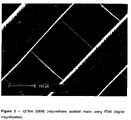
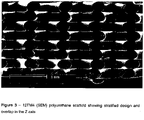
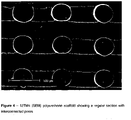
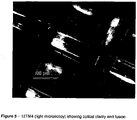
- SEM micrographs and optical microscopy of FDM scaffolds are shown in Figures 1-6 .
- Example 2 (comparative) - Preparation of 12TM1 (A softer material than Example 1, 60% HARD SEGMENT, 40% PCL DIOL 400)
- PCL diol molecular weight 402.1
- Ethylene glycol Aldrich
- HDI Aldrich
- a polyurethane composition based on a mixture of PCL diol, EG and HDI was prepared by a one-step bulk polymerisation procedure.
- Stannous octoate was kept moisture-free and used as received.
- a sample of the polymer after curing was compression moulded at 170°C to a 1 mm thick flat sheet for tensile testing. Dumbbells punched from the sheet were tensile tested using an Instron Model 5568 Universal Testing Machine.
- the solid polymer sheet was chopped into about 1 cm 3 pieces with clean tin-snips, cooled in liquid nitrogen and ground into powder using a cryogrinder. The polymer powder was then dried at 70°C under vacuum overnight. The polymer was extruded on the mini-extruder equipped with a 1.7 mm die at 175°C and 35-40 rpm. The polymer was taken off on a rotating shaft and cooled at ambient temperature in air without water bath. The filament was spooled and kept under nitrogen in a moisture-free environment for at least one week prior to use.
- the polymer filament was fed though the FDM apparatus and a small lattice was made to show that the material was suitable for FDM.
- Example 3 (comparative) - Preparation of 12TM6 (A harder material than Example 1, 70% HARD SEGMENT, 30% PCL DIOL 400)
- PCL diol molecular weight 402.1
- Ethylene glycol Aldrich
- HDL Aldrich
- a polyurethane composition based on a mixture of PCL diol, EG and HDI was prepared by a one-step bulk polymerisation procedure.
- Stannous octoate was kept moisture-free and used as received.
- a sample of the polymer after curing was compression moulded at 175°C to a 1 mm thick flat sheet for tensile testing. Dumbbells punched from the sheet were tensile tested using an Instron Model 5568 Universal Testing Machine.
- the solid polymer sheet was chopped into about 1 cm 3 pieces with clean tin-snips, cooled in liquid nitrogen and ground into powder using a cryogrinder. The polymer powder was then dried at 70°C under vacuum overnight. The polymer was extruded on the mini-extruder equipped with a 1.7 mm die at 175°C and 40 rpm. The polymer was taken off on a rotating shaft and cooled at ambient temperature in air without water bath. The filament was spooled and kept under nitrogen in a moisture-free environment for at least one week prior to use.
- the polymer filament was fed though the FDM apparatus and a small lattice was made to show that the material was suitable for FDM.
- a mixture of PEG (20.000 g) and EG (7.715 g) and stannous octoate (0.0571 g) was placed in a 100 ml predried polypropylene beaker, covered with aluminium foil and heated to 70°C under nitrogen in a laboratory oven.
- HDI 29.428 g
- the resulting polymer was clear, colourless and tough.
- a sample of the polymer after curing was compression moulded at 150°C to a 1 mm thick flat sheet for tensile testing. Dumbbells punched from the sheet were tensile tested using an Instron Model 4032 Universal Testing Machine.
- the solid polymer sheet was chopped into about 1 cm 3 pieces with clean tin-snips, cooled in liquid nitrogen and ground into powder using a cryogrinder. The polymer powder was then dried at 100°C under vacuum overnight. The polymer was extruded on the mini-extruder equipped with a 1.7 mm die at 150°C and 40 rpm. The polymer was taken off by a belt conveyor and cooled at ambient temperature in air without water bath. The filament was spooled and kept under nitrogen in a moisture-free environment for at least one week prior to use.
- the polymer filament was fed though the FDM apparatus and a small lattice was made to show that the material was suitable for FDM.
- the scaffolds were characterised by light microscopy and SEM and were shown to have very good precision and weld. It has been shown to work with a number of commercially available nozzle diameters.
- the operating envelope temperature inside the machine was 25°C and the heating zone was set at 168°C.
- a mixture of PEG (12.814 g) and EG (16.380 g) and stannous octoate (0.0992 g) was placed in a 100 ml predried polypropylene beaker, covered with aluminium foil and heated to 70°C under nitrogen in a laboratory oven.
- MLDI (70.00 g) was measured in a separate predried polypropylene beaker and added to the beaker containing mixture of PEG/EG/stannous octoate and stirred until gelation occurred ( ⁇ 300 seconds), at which time the viscous mixture was poured onto a Teflon coated metal tray to cure at 70°C for a period of about 18 hours.
- the resulting polymer was clear, slightly golden in colour and tough.
- a sample of the polymer after curing was compression moulded at 175°C to a 1 mm thick flat sheet for tensile testing.
- EG (22.000 g) and stannous octoate (0.0972 g) were weighed into a 100 ml predried polypropylene beaker, covered with aluminium foil and heated to 70°C under nitrogen in a laboratory oven.
- MLDI 75.214 g was measured in a separate predried polypropylene beaker, covered with aluminium foil and also heated under nitrogen at 70°C before being added to the EG/stannous octoate and stirred until gelation occurred ( ⁇ 700 sec), at which time the viscous mixture was poured onto a Teflon coated metal tray to cure at 70°C overnight for a period of about 18 hours.
- the resulting polymer was clear, golden in colour, very hard and brittle.
- the melt flow index of the material prepared was measured to be 136 g/10 min with a 2.16 kg load.
- 2-ethyl-1,3-hexanediol (8.269 g) and stannous octoate (0.021 g) were weighed into a 100 ml predried polypropylene beaker, covered with aluminium foil and heated to 70°C under nitrogen in a laboratory oven.
- MLDI (12.000 g) was measured in a separate predried polypropylene beaker, covered with aluminium foil and also heated under nitrogen at 70°C before being added to the 2-ethyl-1,3-hexanediol /stannous octoate and stirred until gelation occurred ( ⁇ 30 min), at which time the viscous mixture was poured onto a Teflon coated metal tray to cure at 70°C overnight for a period of about 18 hours. The resulting polymer was clear, golden in colour, very hard and brittle.
- glycolic acid (GA) (Sigma) was heated at 200°C under nitrogen outgassing in a round bottomed flask equipped with a stillhead sidearm and condenser to collect the water runoff. After 18 hours the nitrogen was stopped and vacuum applied (0.1 torr), by which stage the GA had polymerised to a white solid (PGA). Dry ethylene glycol (EG) (Aldrich) (106 g) was added to the PGA in an approximate ratio of 5:1 in order to transesterify the polymer. This was refluxed for a period of 8 hours in total and was followed by GPC until there were three major products: EG, EG-GA and some EG-GA-GA. The EG was removed under vacuum and heat and the resulting chain extender was used to make a polyurethane (16TM7).
- GPC glycolic acid
- Example 8a Preparation of a polyurethane using a hydrolysable chain extender (16TM7 from Example 8)
- the 15TM7 (GA-EG diol chain extender) was degassed at 90°C /0.1 torr for three hours, as was the PCL diol (MW400).
- HDI Aldrich
- a polyurethane composition based on an 80% hard segment composition was prepared by a one-step bulk polymerisation procedure.
- Stannous octoate (Aldrich) was kept moisture free and used as received.
- the Melt Flow Index of various materials according to the present invention was calculated, along with the readily available commercial materials: acrylonitrile butadiene styrene (ABS), polyamide and investment casting wax (ICW).
- ABS acrylonitrile butadiene styrene
- ICW investment casting wax
- the materials of the present invention preferably should have a MFI which is similar or higher than that of the commercial samples, without significant degradation of the material.
- Material Temperature (oC) MFI (g/10min) 2.16kg weight ABS 270 8.5
- Polyamide 140 75 ICW 73 9.5 14TM3-1 160 7.64 12TM4-6 165 10.43 16TM9 160 136
- This example illustrates the cell compatibility of scaffolds fabricated using polymers prepared according to the invention.
- Polymers were prepared according to the procedure disclosed in Example 1 and 3D scaffolds were fabricated using the procedure described in EXAMPLE 1 A.
- Three dimensional scaffolds similar to those shown in Figures 1 to 3 were seeded with primary ovine fibroblasts explanted from the aortic heart-valve leaflet.
- the cells were grown in Dulbecco's Modified Eagle's Medium (DMEM) in static culture for a period of nine weeks.
- the temperature was 37oC and incubator contained 5% CO 2 (g).
- the DMEM was replaced every five days.
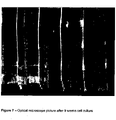
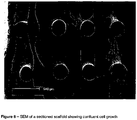
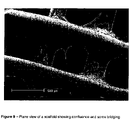
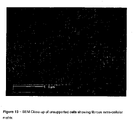
- the scaffolds were cross linked using glutaraldehyde and then dehydrated progressively through ethanol and dried. SEM micrographs and optical microscopy of the cell-seeded FDM scaffolds are shown in Figures 7-11 .
- This example illustrates the preparation of polyurethanes by varying the weight percentage of hard segment, the molecular weight of the soft segment polyol and the type of polyol.
- the quantities of the diisocyanate, polyol and the chain extender used are summarised in Table 3.
- the following example illustrates the procedure used in making sample with code TM1-9 in Table 3.
- Other materials in the Table were prepared accruing the same one-step polymerisation procedure.
- PCL dial (20.000g) and EG (3.336g) and stannous octoate (0.040g) were placed in a 100ml predried glass beaker, covered with aluminium foil and heated to 70°C under nitrogen in a laboratory oven.
- ELDI (16.665g) was weighed in a separate wet-tared predried polypropylene beaker and added to the PCL/EG/stannous octoate beaker, covered with aluminium foil and heated to 70°C under nitrogen in a laboratory oven.
- ELDI ELDI was then added to the PCL/EG/stannous octoate beaker and stirred manually until gelation occurred at which time the viscous mixture was poured onto Teflon coated metal tray to cure at 100°C for a period of about 18 hours.
- the resulting polymer was clear, colourless and rubbery.
- the molecular weight of the polymer was determined by gel permeation chromatography and the results reported in Table 3 are relative to polystyrene standards. Table 3. Formulation details of various polyurethanes prepared.
- the polymers TM 1-9 (comparative), TM 1-11 (comparative), TM 1-14 (comparative), TM 1-15 and TM 1-16 (comparative) were dissolved separately in tetrahydrofuran to make 5%, 10% and 20% solutions.
- the solutions were used to coat stainless steel coupons by dip-coating and by spin coating (Spin coater: Model WS-400B-6NPP/Lite, Laurell Technologies Corporation). The coatings adhered well to the stainless steel showing their suitability for coating metallic surfaces.
- These polymers were also soluble in solvents such as chloroform, dichloromethane, dimethyl formamide and dimethyl acetamide.
- Methyl ester Lysine diisocyanate (m-LDI), polycaprolactone diol GMW ⁇ 426 ( ERA 2043), chain extender ethylene glycol, and catalyst stannous 2 ethyl hexanoate were used as reagents to prepare polyurethanes with hard segment weight percentage of 65 and 95%.
- the ratio of isocyanate to hydroxyl was kept at 1:1 and the catalyst loading was 0.1 wt%.
- the throughput rate was ⁇ 2g/min and the reaction was controlled via extruder screw speed (for mixing control) and via the temperature settings across the 6 individual barrel sections and the dies.
- Materials based on 95 and 65% hard segment produced good tubes and filaments.
- a cross-linked polyurethane was produced using this technique by replacing 40 % of the ethylene glycol with trimethylol propane in the 65% hard segment polyurethane formulation.
- Example 13 (comparative) -15RA40: ELDI/PEG/EG/TMP -80% HS:
- a cross linked polyurethane material was produced following a one-step procedure as described below.
- a mixture of pre-dried (degassed) macrodiol PEG (2.5 g, MW 394.75), Ethylene glycol (18.77 g), Trimethylol propane (1.50 g, 40 mol% of EG) and catalyst Dibutyltin dilaurate (0.1 wt%) were weighed in a polypropylene beaker. The polymer mixture was then degassed at 70°C for about an hour under a vacuum of 1 torr at 70°C.
- ELDI (7.10 g) was weighed in a syringe and added to the polyol mixture and stirred rapidly for about 3 minutes and then poured into a Teflon-coated metal pan and pressed under a nominal load of 8 tonn for 2 hours at 100°C followed by further curing in a nitrogen-circulating oven 16 hours.
- the polymer showed maximum tensile stress (34 ⁇ 3 MPa), Youngs Modulus (1.0 +0.2 MPa) and elongation at break 156 ⁇ 32 %).
- ELDI 32.82 g was weighed in a syringe and added to the polyol mixture and stirred rapidly for about 3 minutes and then poured into a Teflon-coated metal pan and pressed under a nominal load of 8 tonne for 2 hours at 100°C followed by further curing in a nitrogen-circulating oven 16 hours.
- GPC showed molecular weight (MP) 112,000 and had maximum tensile stress (10 ⁇ 0.5 MPa), Young's Modulus (3.7 +0.4 MPa) and elongation at break 301 ⁇ 6 %).
Landscapes
- Health & Medical Sciences (AREA)
- Chemical & Material Sciences (AREA)
- Medicinal Chemistry (AREA)
- Chemical Kinetics & Catalysis (AREA)
- Life Sciences & Earth Sciences (AREA)
- Organic Chemistry (AREA)
- Polymers & Plastics (AREA)
- Veterinary Medicine (AREA)
- Public Health (AREA)
- General Health & Medical Sciences (AREA)
- Animal Behavior & Ethology (AREA)
- Epidemiology (AREA)
- Engineering & Computer Science (AREA)
- Biomedical Technology (AREA)
- Transplantation (AREA)
- Dermatology (AREA)
- Oral & Maxillofacial Surgery (AREA)
- Heart & Thoracic Surgery (AREA)
- Vascular Medicine (AREA)
- Surgery (AREA)
- Emergency Medicine (AREA)
- Pharmacology & Pharmacy (AREA)
- Urology & Nephrology (AREA)
- Materials Engineering (AREA)
- Wood Science & Technology (AREA)
- Molecular Biology (AREA)
- Botany (AREA)
- Zoology (AREA)
- Cell Biology (AREA)
- Polyurethanes Or Polyureas (AREA)
- Materials For Medical Uses (AREA)
- Biological Depolymerization Polymers (AREA)
Description
- The present invention relates to biodegradable processable and preferably thermoplastic polyurethanes or polyurethane/ureas and processes for their preparation. The polymers are biodegradable, processable and preferably thermoplastic which makes them useful in biomedical applications including, for example, in the fabrication of scaffolds for tissue engineering applications. The invention particularly relates to the use of such polyurethanes and polyurethane/ureas in fabricating scaffolds using rapid prototyping techniques.
- Biodegradable synthetic polymers offer a number of advantages over other materials in various biological applications including tissue repair. For example, in relation to the development of scaffolds in tissue engineering, the key advantages include the ability to tailor mechanical properties and degradation kinetics to suit various applications. The simple and routine fabrication of scaffolds with a size and shape similar to organs or parts of organs would, for example, help tissue engineering technology to develop such organs in vivo or in vitro using bioreactors. Likewise, scaffolds with appropriate mechanical properties can be fabricated and implanted in the body to help repair damaged tissues such as those in coronary arteries and other blood vessels. For example, biodegradable scaffolds fabricated as coronary stents can support the vessel during the healing process and degrade and be released from the body after the vessel is repaired.
- Synthetic polymers are also attractive in tissue engineering applications because they can be fabricated into various shapes with desired pore morphologic features conducive to tissue in-growth. Furthermore, polymers can be designed with chemical functional groups that can, for example, induce tissue in-growth, or be utilised to adapt the polymers to the application in question.
- A vast majority of biodegradable polymers studied in these fields belong to the polyester family. Among these, poly(α-hydroxy acids) such as poly(glycolic acid), poly(lactic acid) and a range of their copolymers have historically comprised the bulk of published material on biodegradable polyesters and have a long history of use as synthetic biodegradable materials in a number of clinical applications. Poly(glycolic acid), poly(lactic acid) and their copolymers, poly-p-dioxanone, and copolymers of trimethylene carbonate and glycolide have been the most widely used as scaffolds. Their major applications include as resorbable sutures, drug delivery systems and orthopaedic fixation devices such as pins, rods and screws. Among the families of synthetic polymers, the polyesters have been attractive for these applications because of (i) their ease of degradation by hydrolysis of the ester linkage, (ii) degradation products are resorbed through the metabolic pathways in some cases and (iii) the potential to tailor the structure to alter degradation rates.
- The recent interest in finding tissue-engineered solutions to repair damaged tissues and organs due to injury/disease has led to the development of new degradable polymers that meet a number of demanding requirements. These requirements range from the ability of the polymer scaffold to provide mechanical support during tissue growth and gradual degradation to biocompatible products, to more demanding requirements such as the ability to incorporate drugs, cells and growth factors, for example, and provide cell-conductive and inductive environments as well as promotion of the healing process. Drugs to suppress inflammatory response and promote the healing process can be incorporated within the biodegradable polymer scaffold or as a drug-eluting coating on the surface of the scaffold. Many of the currently available degradable polymers do not meet all of the requirements to be used in such applications. Most biodegradable polymers in the polyester and ester family, for example, are hydrophobic in nature and as such, only a limited number of drugs can be incorporated into such polymers.
- In particular, biodegradable synthetic polymers with appropriate mechanical properties are sought after for the development of biodegradable stents and stent coatings for the treatment of coronary artery disease by percutaneous intervention. Stents provide mechanical support for the vessel and keep the lumen open to its normal diameter while tissue growth takes place to repair the affected vessel wall. Current stents are fabricated using metals such as stainless steel or nickel-titanium alloys, and once deployed these stents remain permanently within the vessel. Biodegradable polymers have the advantage of being removable from the vessel through polymer degradation and resorption once the vessel is repaired. This leaves the repaired vessel free of foreign material and allows re-stenting if needed in the future. Biodegradable polymers can also be useful in delivering drugs such as sirolimus, everolimus and paclitaxel D-actinomycin, all of which help to inhibit the formation of neointimal hyperplasia by suppression of platelet activation, suppression of inflammatory response, and promotion of the healing.
- Scaffolds made from synthetic and natural polymers, and ceramics have been investigated extensively for orthopaedic repair. The use of scaffolds has advantages such as the ability to generate desired pore structures and the ability to match size, shape and mechanical properties to suit a variety of applications. However, shaping these scaffolds to fit cavities or defects with complicated geometries, to bond to bone tissue, and to incorporate cells, drugs and growth factors, and the requirements of open surgery are a few major disadvantages of the use of known scaffold materials.
- The most common synthetic polymers used in fabricating scaffolds for growing cells and for biodegradable stents and stent coatings belong to the polyester family. For example, poly(glycolic acid) and poly(lactic acid) have been the most commonly used polymers because of their relative ease of degradation under hydrolytic conditions and the resorption of the degradation products into the body. However, these polymers have a number of disadvantages, including rapid loss of mechanical properties, long degradation times, difficulty in processing, and the acidity of degradation products resulting in tissue necrosis. These polymers, when used in biodegradable stents, have to be heated during the deployment process to temperatures as high as 70°C which can cause cell damage.
- Common methods that are currently employed for the synthesis of three dimensional biodegradable tissue engineering scaffolds include: porogen leaching, gas foaming, phase separation and the use of non-woven mesh. All of these methods have disadvantages including that:
- they require a mould to shape the scaffold - this is costly and can only produce a single shape;
- these methods offer little or no control over the orientation of the pores and degree of interconnectivity;
- usually a polymer skin forms on a moulded scaffold (even if it is porous) which can require extensive post-synthesis treatment; and
- some of the methods of scaffold fabrication such as phase separation and porogen leaching often involve the use of toxic organic solvents which is undesirable.
- A controlled rapid prototyping method can address these problems. The shape of the mould can be quickly altered by computer design, the direction and degree of porosity can be specified to exact levels, a polymer skin is not formed in production, and the process is solvent free. When fabricating scaffolds such as stents for example, the process can be modified to deposit a grid like layout with polymer strands to dimensions and patterns specific to the stent design. The grid structure can then be used to fabricate the stent. Alternatively, the grid structure could be deposited on a rotating mandrel to fabricate the stent in one operation.
- There are a number of different rapid prototyping machines available in the marketplace.
- Synthetic polymers that can be used in such rapid prototyping apparatus need to meet specific property requirements which include melt processing characteristics, mechanical properties and other properties. For example, in fused deposition modelling (FDM) applications, the polymer must be able to be melt-processed into a filament of appropriate diameter for the rate of extrusion of the particular FDM apparatus.
- Most synthetic biodegradable polymers do not meet the requisite property requirements. A review of the literature indicates that among the biodegradable polymers only poly-(ε-caprolactone) meets some of the requirements. Hutmacher et al at the National University of Singapore (Biomaterials, 24: 4445-4448, 2003) have reported the use of poly-(ε-caprolactone) (PCL) (MW 80,000) to fabricate tissue engineering scaffolds. They have also reported the use of hydroxyapatite as a filler (Schantz et al, Materials Science and Engineering 20: 9-17, 2002) in PCL to fabricate 3D constructs for bone tissue applications. A report by a group from the University of Nottingham (Christian et al, Composites: Part A, 32: 969-976, 2001), discusses PCL impregnated with long glass fibre in a MDM (Material Deposition Modelling) process to fabricate scaffolds. Commercially the market for biodegradable structures with interconnected pores is very large and growing rapidly. One product available is Degrapole foam which is based on polyurethanes but they have much less control of the degree of porosity, orientation of pores and pore morphology, and it is available only as small foam discs (except on special order).
- Polymers that can be used to fabricate biodegradable scaffolds using rapid prototyping techniques such as FDM need to meet a set of criteria including that:
- the polymer must be thermoplastic;
- the polymer must be extrudable;
- the filament must be mechanically stiff and have a low melt viscosity (a high Melt Flow Index); and
- the polymer must be biodegradable and biocompatible (eg. contain groups that are liable to hydrolyse and have degradation products that are non-toxic).
- In short, the use of rapid prototyping machines to make porous, highly controlled and interconnected tissue engineering structures requires a complex combination of various techniques including polymer chemistry, polymer processing, rapid prototyping and tissue engineering and, accordingly, is particularly complex.
- Accordingly, there is a need for biocompatible and biodegradable polymers that can be processed using methods including rapid prototyping as well as thermal and solvent based methods to fabricate scaffolds and coatings for various biomedical applications including tissue engineering.
- It is thus one object of this invention to develop polymers with properties suited to use in rapid prototyping techniques which will, in turn, enable the fabrication of three dimensional scaffolds with complicated structures for use in tissue growth and repair therapies and technologies, including the fabrication of stents, and coatings for stents useful in drug delivery.
- To this end, there is provided a biocompatible biodegradable polyurethane or polyurethane/urea according to
claim 1. - Preferably the biocompatible, biodegradable polyurethanes or polyurethane/ureas of the invention are of the general formula

- The term "polyol" generally means a molecule which has at least two or more functional hydroxyl groups that can react with isocyanate groups to form urethane groups. Examples of polyols include but are not limited to diols, triols, and polyols such as macrodiols. Preferably the polyol has a molecular weight of 200-1000, more preferably 200-600, and even more preferably 200-400. The polyol may be terminated by, for example, a hydroxyl, thiol or carboxylic acid group.
- Isocyanates suitable for preparation of the polyurethanes or polyurethane/ureas of the invention are those which are selected from the group consisting of optionally substituted aliphatic, aromatic and hindered isocyanates.
- Throughout this specification, the term "chain extender" should be taken to mean a low molecular weight compound having two or more functional groups that are reactive towards isocyanate and having a molecular weight of less than 350. Chain extenders include functional monomers with degradable arms. The chain extender may be employed to introduce easily degradable hard segment components into the polyurethane or polyurethane/urea structure. Incorporating such chain extenders allows preparation of easily degradable polyurethanes with fewer degradation products. For example, polyurethane based on ethyl-lysine diisocyanate and glycolic acid based polyol and chain extender degrades to bioresorbable glycolic acid, lysine, ethylene glycol and ethanol.
- "Degradable arms" according to the invention are any molecular moiety which may be part of the chain extenders and the molecular moiety structure is preferably biocompatible and bioresorbable on in vivo degradation of the biocompatible, biodegradable polyurethanes or polyurethane/ureas.
- A "hard segment" polymer according to the invention is one which imbues the copolymer with its physical strength which arises from the nature of the chain extender and the isocyanate selected.
- According to a preferred embodiment of the invention, the hard segment represents 20 to 100% by weight of the polyurethane or polyurethane/urea. Where the hard segment represents 100% by weight, the chain extender has a dual functionality of being both a conventional chain extender and a polyol.
- Throughout this specification the term "comprises/comprising" when used is taken to specify the presence of stated features, integers, steps or components but does not preclude the presence or addition of one or more other features, integers, steps, components or groups thereof.
- It has been found that the polyurethanes and polyurethane/ureas according to the invention form porous or non-porous cross-linked or linear polymers which can be used as tissue engineering scaffolds, and may be used in rapid prototyping techniques including FDM. It has also been found that certain of the biodegradable polyurethanes according to the invention exhibit a glass transition between room temperature and 37°C. This property can be used to extrude hard materials on FDM apparatus (going in at 20°C) which will soften and even become elastomeric in vivo or while growing cells on scaffolds in a bioreactor at physiological temperatures of 37°C. This is also a very useful property for soft tissue applications.
- The polyurethanes and polyurethane/ureas can be sterilized without risk to their physical and chemical characteristics, preferably using gamma radiation to ensure sterility.
- The polyurethanes and polyurethane/ureas may incorporate biological and inorganic components selected for their ability to aid tissue repair in vivo, or to create certain physical characteristics for rapid prototyping purposes. When cured, the polyurethanes and polyurethane/ureas according to the invention form a biodegradable biocompatible scaffold which may be porous and contain interpenetrating polymer networks so as to enable the inclusion of biological and inorganic components. These biological and inorganic components which are preferably selected from the group consisting of cells, progenitor cells, growth factors, other components for supporting cell growth, drugs, calcium phosphate, hydroxyapatite, hyaluronic acid, nanoparticulate tricalcium phosphate and hydroxyapatite type fillers, adhesives including fibrin, collagen and transglutaminase systems, surfactants including siloxane surfactants, silica particles, powdered silica, hollow fibres which may be used to seed cells in the polyurethanes, and other porogens including, for example, gelatin beads. The biological and inorganic components may be present in quantities according to need, especially in the case of the living additives such as cells and progenitor cells. Amounts of up to at least 20% w/w may be acceptable.
- The invention also provides a biodegradable, biocompatible polymeric scaffold according to claim 5.
- In the biodegradable, biocompatible polymeric scaffolds according to this aspect of the invention the isocyanates are preferably diisocyanates. Preferably the isocyanate is selected from the group consisting of optionally substituted aliphatic, aromatic and hindered isocyanates.
- The scaffolds may preferably incorporate biological and inorganic components which are desirably selected from the group consisting of cells, progenitor cells, growth factors, other components for supporting cell growth, drugs, calcium phosphate, hydroxyapatite, hyaluronic acid, nanoparticulate tricalcium phosphate and hydroxyapatite type fillers, adhesives including fibrin, collagen and transglutaminase systems, surfactants including siloxane surfactants, silica particles, powdered silica, hollow fibres which may be used to seed cells in the polyurethanes, and other porogens including, for example, gelatin beads. The biological and inorganic components may be present in quantities according to need, especially in the case of the living additives such as cells and progenitor cells. Amounts of up to at least 20% w/w may be acceptable.
- Preferably the cured scaffolds according to this aspect of the invention have a compressive strength in the range of 0.05-100 MPa. The compressive strength of the scaffold will vary according to its porosity and according to the biological components added. Preferably the scaffolds have pores in the size range of 100-500 micron, more preferably 150-300 micron.
- More preferably the porous scaffolds are seeded with living biological components or drugs selected so as to aid the tissue repair process in the patient being treated. The biological components so selected may be cells, progenitor cells, growth factors and other components for supporting cell growth. Suitable cells may include osteoblasts, chondrocytes, fibroblasts or other precursor cells. Suitable drugs are any which assist in the tissue engineering application of interest.
- In one preferred embodiment of the invention, the scaffold is a biodegradable stent useful in treatment of coronary heart disease.
- In another aspect of the invention, the biodegradable biocompatible polyurethanes or polyurethane/ureas of the invention are utilized as stent coatings in the treatment of coronary heart disease.
- In another aspect of the invention, there is provided a use of polyurethanes and polyurethane/ureas according to the invention in rapid prototyping techniques such as fused deposition modeling.
- In another aspect of the invention, there is provided a use of polyurethanes and polyurethane/ureas according to the invention in tissue repair or engineering in a patient requiring such treatment the use comprising inserting in said patient a scaffold which is the cured end product of said biocompatible, biodegradable polyurethane or polyurethane/urea according to the invention prepared by rapid prototyping techniques such as, but not limited to, fused deposition modelling. The polyurethane or polyurethane/urea may preferably include additives or drugs to assist for example in the repair of the damaged bone or cartilage such as cells, progenitor cells, growth factors, or other suitable materials or other additives, such as pharmaceuticals for use in drug delivery. Biological additives used may preferably include osteoblasts, chondrocytes, fibroblasts, fibrin, collagen, transglutaminase systems and the like.
- The invention also provides for the use of biocompatible, biodegradable polyurethanes and polyurethane/ureas according to the invention as a tissue engineering scaffold for assistance in tissue engineering applications such as bone and cartilage repair.
- Other embodiments of the invention will be evident from the following detailed description of various aspects of the invention.
-
- FIGURE 1
- shows the SEM of a polyurethane scaffold made according to Example 1, which is a comparative example.
- FIGURE 2
- shows the SEM of a polyurethane scaffold made according to Example 1 but under higher magnification.
- FIGURE 3
- shows the scaffold of Example 1 and demonstrates stratified design and overlap in the z axis.
- FIGURE 4
- shows the scaffold of Example 1 showing the interconnected pores in a regular section.
- FIGURE 5
- shows the scaffold of Example 1 under light microscopy and demonstrates optical clarity and fusion.
- FIGURE 6
- shows the scaffold of Example 1 under light microscopy and demonstrates the proliferation of primary ovine fibroblast therein.
- FIGURE 7
- shows the scaffold of Example 9 under optical microscopy after 9 weeks cell culture. Example 9 is also a comparative example.
- FIGURE 8
- shows the scaffold of Example 9 under scanning electron microscopy and demonstrates confluent cell growth.
- FIGURE 9
- shows the scaffold of Example 9 under scanning electron microscopy and demonstrates confluence and some bridging.
- FIGURE 10
- shows the scaffold of Example 9 under scanning electron microscopy and demonstrates the bridging of a corner of the scaffold by cell growth.
- FIGURE 11
- shows the scaffold of Example 9 under scanning electron microscopy and shows a dose up of unsupported cells demonstrating a fibrous extra-cellular matrix.
- The present invention provides polyurethanes and polyurethane/ureas which are particularly suited to rapid prototyping techniques such as fused deposition modelling and therefore have specific characteristics as described in the preamble of this specification.
- In a preferred form, this invention provides a biocompatible biodegradable polyurethane or polyurethane/urea comprising diisocyanates, polyol of molecular weight 200-600 and a chain extender having a hydrolysable linking group.
- Isocyanates suitable for preparing polyurethanes and polyurethane/ureas according to the invention include but are not limited to the following:


- Polyols or "soft segments" which may be used to prepare the polyurethanes and polyurethane/ureas of the invention are most preferably those having a molecular weight of 200-400. The molecular weight of the entire structure is more preferably 120 to 400. Less preferably the molecular weight can be up to 2000 and much less preferably above 2000. Four examples of suitable soft segments are as follows:
- Poly(ε-caprolactone) diol, MW 400 (from Example 1): where R is (CH2-CH2), R' is (CH2)5, R" and R"' are both H, and j = 1 and (h + k) = 2.96
- (Glycolic acid - ethylene glycol) dimer (from Example 8): where R is (CH2-CH2), R' is (CH2), R" and R'" are both H, j = 1 and (h + k) = 1
- Poly(ethylene glycol), MW 400 (from Example 4): h = 0, k = 0, j = ∼13, R is (CH2-CH2), and R" and R"' are both H
- Poly(ethyleneglycol) bis(3-aminopropyl) terminated (Aldrich): where R is (CH2-CH2), R" and R‴ are both -(CH2)3NH2, j = 34 and (h + k) = 0
- Suitable compounds include the following polyester polyols:


- Chain extenders according to the invention are low molecular weight molecules having two functional groups which when reacted with diisocyanates form a urethane linkage. Diols are also relatively non-toxic and can be resorbed or excreted from the body upon degradation. Incorporated into the hard segment, these chain extenders increase degradation. Esters in the hard segment degrade much faster than urethane linkages. The following chain extenders are illustrated:


- Preferred polyurethane and polyurethane/ureas prepared according to the invention may utilise PCL diol, PGA diol, PLA diol or PEG diol and HDI/EG as the hard segment.
- According to the present invention, the monomeric units of the polyurethanes or polyurethane/ureas of the invention are preferably reacted by bulk polymerisation to form a straight-chain poly-(ester-urethane) block copolymer. Catalysts such as titanium butoxide, Tyzor-LA, stannous octoate, ferric acetyl acetonate, magnesium methoxide, zinc octoate, manganese 2-ethyl hexanoate, amine catalyst may, if desired, be used in such polymerisation. The general form of the repeat units in the polymer after polymerisation is:

- In a preferred embodiment of the invention, the hard segment represents 20 to 100% by weight of the polyurethane / polyurethane/urea. More preferably the hard segment represents 60 to 70% by weight. The polyol and chain extender may be the same compound and this corresponds to the embodiment where the hard segment corresponds to 100% by weight of the polyurethane / polyurethane/urea. It has been found that there must be a reasonably high proportion of hard segment for the materials to have adequate properties to extrude through FDM as well as a reasonably high melt flow index.
- The following examples are not intended to limit the invention but rather illustrate the nature of the broad invention and its applicability.
- Materials: The PCL diol (molecular weight 402.1) from ERA Polymer Pty was dried at 90°C for 4 hours under vacuum (0.1 torr). Ethylene glycol (Aldrich) was degassed at 90°C under vacuum (0.1 torr) for three hours and HDI (Aldrich) was used as received. A polyurethane composition based on a mixture of PCL diol, EG and HDI was prepared by a one-step bulk polymerisation procedure. Stannous octoate (Aldrich) was kept moisture-free and used as received.
- A mixture of PCL (25.000 g) and EG (9.696 g) and stannous octoate (0.0714 g) was placed in a 100 ml predried polypropylene beaker, covered with aluminium foil and heated to 70°C under nitrogen in a laboratory oven. HDI (36.732 g) was weighed in a separate wet-tared predried polypropylene beaker and added to the PCL/EG/stannous octoate beaker and stirred manually until gelation occurred (90 seconds), at which time the viscous mixture was poured onto a Teflon coated metal tray to cure at 100°C for a period of about 18 hours. The resulting polymer was clear, colourless and tough.
- A sample of the polymer after curing was compression moulded at 175°C to a 1 mm thick flat sheet for tensile testing. Dumbbells punched from the sheet were tensile tested using an Instron Model 5568 Universal Testing Machine.
- The mechanical properties of the materials prepared in EXAMPLE 1 were examined and the results are shown in Table 1.
- The solid polymer sheet was chopped into about 1 cm3 pieces with clean tin-snips, cooled in liquid nitrogen and ground into a powder using a cryogrinder. The polymer powder was then dried at 100°C under vacuum overnight. The polymer was extruded on a mini-extruder equipped with a 1.7 mm die at 180°C and 40 rpm. The polymer was taken off by a belt conveyor and cooled at ambient temperature in air without water bath. The filament was spooled and kept under nitrogen in a moisture-free environment for at least one week prior to use.
- The polymer filament was fed though the FDM apparatus and a small lattice was made to show that the material was suitable for FDM. The scaffolds were characterised by light microscopy and SEM and were shown to have very good precision and weld. It has been shown to work with a number of commercially available nozzle diameters.
- The operating envelope temperature inside the machine was 25°C and the heating zone was set at 168°C. SEM micrographs and optical microscopy of FDM scaffolds are shown in
Figures 1-6 . - Materials: The PCL diol (molecular weight 402.1) from ERA Polymer Pty was dried at 90°C for 4 hours under vacuum (0.1 torr). Ethylene glycol (Aldrich) was degassed at 90°C /0.1 torr for 3 hours and HDI (Aldrich) was used as received. A polyurethane composition based on a mixture of PCL diol, EG and HDI was prepared by a one-step bulk polymerisation procedure. Stannous octoate (Aldrich) was kept moisture-free and used as received.
- A mixture of PCL (40.0 g) and EG (11.663 g) and stannous octoate (0.100 g) was placed in a 100ml predried polypropylene beaker, covered with aluminium foil and heated to 70°C under nitrogen in a laboratory oven. HDI (48.337 g) was weighed in a separate wet-tared predried polypropylene beaker, covered and then added to the PCL/EG/stannous octoate beaker and stirred manually until gelation occurred (90 seconds). The viscous mixture was poured onto a Teflon coated metal tray to cure at 70°C for a period of about 18 hours. The resulting polymer was clear, colourless and tough.
- A sample of the polymer after curing was compression moulded at 170°C to a 1 mm thick flat sheet for tensile testing. Dumbbells punched from the sheet were tensile tested using an Instron Model 5568 Universal Testing Machine.
- The mechanical properties of the materials prepared in EXAMPLE 2 were examined and the results are shown in Table 1.
- The solid polymer sheet was chopped into about 1 cm3 pieces with clean tin-snips, cooled in liquid nitrogen and ground into powder using a cryogrinder. The polymer powder was then dried at 70°C under vacuum overnight. The polymer was extruded on the mini-extruder equipped with a 1.7 mm die at 175°C and 35-40 rpm. The polymer was taken off on a rotating shaft and cooled at ambient temperature in air without water bath. The filament was spooled and kept under nitrogen in a moisture-free environment for at least one week prior to use.
- The polymer filament was fed though the FDM apparatus and a small lattice was made to show that the material was suitable for FDM.
- Materials: The PCL diol (molecular weight 402.1) from ERA Polymer Pty was dried at 90°C for 4 hours under vacuum (0.1 torr). Ethylene glycol (Aldrich) was degassed at 90°C/0.1 torr for 3 hours and HDL (Aldrich) was used as received. A polyurethane composition based on a mixture of PCL diol, EG and HDI was prepared by a one-step bulk polymerisation procedure. Stannous octoate (Aldrich) was kept moisture-free and used as received.
- A mixture of PCL (21.0 g) and EG (10.840 g) and stannous octoate (0.070 g) was placed in a 100ml predried polypropylene beaker, covered with aluminium foil and heated to 70°C under nitrogen in a laboratory oven. HDI (38.160 g) was weighed in a separate predried polypropylene beaker and added to the PCL/EG/stannous octoate beaker and stirred until gelation occurred (60 seconds), at which time the viscous mixture was poured onto a Teflon coated metal tray to cure at 100°C for a period of about 18 hours. The resulting polymer was clear, colourless and tough.
- A sample of the polymer after curing was compression moulded at 175°C to a 1 mm thick flat sheet for tensile testing. Dumbbells punched from the sheet were tensile tested using an Instron Model 5568 Universal Testing Machine.
- The mechanical properties of the materials prepared in EXAMPLE 3 were examined and the results are shown in Table 1.
- The solid polymer sheet was chopped into about 1 cm3 pieces with clean tin-snips, cooled in liquid nitrogen and ground into powder using a cryogrinder. The polymer powder was then dried at 70°C under vacuum overnight. The polymer was extruded on the mini-extruder equipped with a 1.7 mm die at 175°C and 40 rpm. The polymer was taken off on a rotating shaft and cooled at ambient temperature in air without water bath. The filament was spooled and kept under nitrogen in a moisture-free environment for at least one week prior to use.
- The polymer filament was fed though the FDM apparatus and a small lattice was made to show that the material was suitable for FDM.
- Materials: The PEG diol (molecular weight 394.7) from Aldrich was dried at 90°C for 4 hours under vacuum (0.1 torr). Ethylene glycol (Aldrich) was degassed at 90°C/0.1 torr for three hours and HDI (Aldrich) was used as received. A polyurethane composition based on a mixture of PCL diol, EG and HDI was prepared by a one-step bulk polymerisation procedure. Stannous octoate (Aldrich) was kept moisture-free and used as received.
- A mixture of PEG (20.000 g) and EG (7.715 g) and stannous octoate (0.0571 g) was placed in a 100 ml predried polypropylene beaker, covered with aluminium foil and heated to 70°C under nitrogen in a laboratory oven. HDI (29.428 g) was weighed in a separate predried polypropylene beaker, and added to the PEG/EG/stannous octoate beaker and stirred until gelation occurred (150 seconds), when the viscous mixture was poured onto a Teflon coated metal tray to cure at 70°C for a period of about 18 hours. The resulting polymer was clear, colourless and tough.
- A sample of the polymer after curing was compression moulded at 150°C to a 1 mm thick flat sheet for tensile testing. Dumbbells punched from the sheet were tensile tested using an Instron Model 4032 Universal Testing Machine.
- The solid polymer sheet was chopped into about 1 cm3 pieces with clean tin-snips, cooled in liquid nitrogen and ground into powder using a cryogrinder. The polymer powder was then dried at 100°C under vacuum overnight. The polymer was extruded on the mini-extruder equipped with a 1.7 mm die at 150°C and 40 rpm. The polymer was taken off by a belt conveyor and cooled at ambient temperature in air without water bath. The filament was spooled and kept under nitrogen in a moisture-free environment for at least one week prior to use.
- The polymer filament was fed though the FDM apparatus and a small lattice was made to show that the material was suitable for FDM. The scaffolds were characterised by light microscopy and SEM and were shown to have very good precision and weld. It has been shown to work with a number of commercially available nozzle diameters.
- The operating envelope temperature inside the machine was 25°C and the heating zone was set at 168°C.
- Materials: The PEG diol (molecular weight 394.7) from Aldrich was dried at 90°C for 4 hours under vacuum (0.1 torr). Ethylene glycol (Aldrich) was degassed at 90°C / 0.1 torr for 3 hours. Methyl ester of Lysine diisocyanate MLDI (Kyowa Hakko Kogyo CO. Ltd) was used as received. A polyurethane composition based on a mixture of PCL diol, EG and HDI was prepared by a one-step bulk polymerisation procedure. Stannous octoate (Aldrich) was kept moisture-free and used as received.
- A mixture of PEG (12.814 g) and EG (16.380 g) and stannous octoate (0.0992 g) was placed in a 100 ml predried polypropylene beaker, covered with aluminium foil and heated to 70°C under nitrogen in a laboratory oven. MLDI (70.00 g) was measured in a separate predried polypropylene beaker and added to the beaker containing mixture of PEG/EG/stannous octoate and stirred until gelation occurred (∼300 seconds), at which time the viscous mixture was poured onto a Teflon coated metal tray to cure at 70°C for a period of about 18 hours. The resulting polymer was clear, slightly golden in colour and tough.
- A sample of the polymer after curing was compression moulded at 175°C to a 1 mm thick flat sheet for tensile testing.
- Materials: The EG (Aldrich) was degassed at 90°C/0.1 torr for three hours. MLDI (Kyowa Hakko Kogyo CO. Ltd) was used as received. A polyurethane composition based on a 1 to 1 ratio of MLDI and EG was prepared by a one-step bulk polymerisation procedure. Stannous octoate (Aldrich) was kept moisture free and used as received.
- EG (22.000 g) and stannous octoate (0.0972 g) were weighed into a 100 ml predried polypropylene beaker, covered with aluminium foil and heated to 70°C under nitrogen in a laboratory oven. MLDI (75.214 g) was measured in a separate predried polypropylene beaker, covered with aluminium foil and also heated under nitrogen at 70°C before being added to the EG/stannous octoate and stirred until gelation occurred (~700 sec), at which time the viscous mixture was poured onto a Teflon coated metal tray to cure at 70°C overnight for a period of about 18 hours. The resulting polymer was clear, golden in colour, very hard and brittle.
- The melt flow index of the material prepared was measured to be 136 g/10 min with a 2.16 kg load.
- Materials: The 2-ethyl-1,3-hexanediol (Fluka) was degassed at 90°C /0.1 torr for 3 hours. MLDI (Kyowa Hakko Kogyo CO. Ltd) was used as received. A polyurethane composition based on a 1 to 1 ratio of MLDI and 2-ethyl-1,3-hexanediol was prepared by a one-step bulk polymerisation procedure. Stannous octoate (Aldrich) was kept moisture free and used as received.
- 2-ethyl-1,3-hexanediol (8.269 g) and stannous octoate (0.021 g) were weighed into a 100 ml predried polypropylene beaker, covered with aluminium foil and heated to 70°C under nitrogen in a laboratory oven. MLDI (12.000 g) was measured in a separate predried polypropylene beaker, covered with aluminium foil and also heated under nitrogen at 70°C before being added to the 2-ethyl-1,3-hexanediol /stannous octoate and stirred until gelation occurred (~30 min), at which time the viscous mixture was poured onto a Teflon coated metal tray to cure at 70°C overnight for a period of about 18 hours. The resulting polymer was clear, golden in colour, very hard and brittle.
- DSC was taken on a Mettler DSC 30 and showed the Tg to be ∼ 30°C. When left at room temperature it was hard and brittle but it reversibly softened in the hand and became elastic.
- 22.19 g of glycolic acid (GA) (Sigma) was heated at 200°C under nitrogen outgassing in a round bottomed flask equipped with a stillhead sidearm and condenser to collect the water runoff. After 18 hours the nitrogen was stopped and vacuum applied (0.1 torr), by which stage the GA had polymerised to a white solid (PGA). Dry ethylene glycol (EG) (Aldrich) (106 g) was added to the PGA in an approximate ratio of 5:1 in order to transesterify the polymer. This was refluxed for a period of 8 hours in total and was followed by GPC until there were three major products: EG, EG-GA and some EG-GA-GA. The EG was removed under vacuum and heat and the resulting chain extender was used to make a polyurethane (16TM7).
- Materials: The 15TM7 (GA-EG diol chain extender) was degassed at 90°C /0.1 torr for three hours, as was the PCL diol (MW400). HDI (Aldrich) was used as received. A polyurethane composition based on an 80% hard segment composition was prepared by a one-step bulk polymerisation procedure. Stannous octoate (Aldrich) was kept moisture free and used as received.
- 15TM7 (30.73 g) and PCL diol (MW402.099) (20.05 g) and stannous octoate (0.100 g) were weighed into a 100 ml predried polypropylene beaker, covered with aluminium foil and heated to 70°C under nitrogen in a laboratory oven. HDI (49.47 g) was measured in a separate predried polypropylene beaker, covered with aluminium foil and also heated under nitrogen at 70°C before being added to the PCL diol / 15TM7 /stannous octoate mixture and stirred until gelation occurred when the viscous mixture was poured onto a Teflon coated metal tray to cure at 70°C overnight for a period of about 18 hours. The resulting polymer was slightly cloudy, hard but flexible.
Table 1 - Mechanical properties of some PCL-based polyurethanes with different hard segment percentages Code Hard segment Elong (%) Y. Mod UTS Shore (Wt %) (MPa) (MPa) (D) 12TM1 60 899±189 103±5 41 ±1 44 12TM4 65 1300±42 112±3 54±5 52 12TM6 70 1537±141 143±7 56±6 57 - The Melt Flow Index of various materials according to the present invention was calculated, along with the readily available commercial materials: acrylonitrile butadiene styrene (ABS), polyamide and investment casting wax (ICW). In order to be suitable for FDM, the materials of the present invention preferably should have a MFI which is similar or higher than that of the commercial samples, without significant degradation of the material.
Material Temperature (ºC) MFI (g/10min), 2.16kg weight ABS 270 8.5 Polyamide 140 75 ICW 73 9.5 14TM3-1 160 7.64 12TM4-6 165 10.43 16TM9 160 136 - It will be appreciated that the scope of the invention is not limited to the specific examples described herein but extends to the general inventive concepts defined. None of the examples should be considered limiting.
- This example illustrates the cell compatibility of scaffolds fabricated using polymers prepared according to the invention.
- Polymers were prepared according to the procedure disclosed in Example 1 and 3D scaffolds were fabricated using the procedure described in EXAMPLE 1 A.
- Three dimensional scaffolds similar to those shown in
Figures 1 to 3 were seeded with primary ovine fibroblasts explanted from the aortic heart-valve leaflet. The cells were grown in Dulbecco's Modified Eagle's Medium (DMEM) in static culture for a period of nine weeks. The temperature was 37ºC and incubator contained 5% CO2(g). The DMEM was replaced every five days. At the end of the nine weeks the scaffolds were cross linked using glutaraldehyde and then dehydrated progressively through ethanol and dried.
SEM micrographs and optical microscopy of the cell-seeded FDM scaffolds are shown inFigures 7-11 . - This example illustrates the preparation of polyurethanes by varying the weight percentage of hard segment, the molecular weight of the soft segment polyol and the type of polyol. The quantities of the diisocyanate, polyol and the chain extender used are summarised in Table 3. The following example illustrates the procedure used in making sample with code TM1-9 in Table 3. Other materials in the Table were prepared accruing the same one-step polymerisation procedure.
- Materials: The PCL diol (molecular weight 1000) from ERA polymer Pty Ltd was dried at 90ºC for four hours under vacuum (0.1 torr). Ethylene glycol (Aldrich) was distilled and degassed at 90ºC under vacuum (0.1 torr) for three hours. Ethyl-LDI was distilled before use. Stannous octoate (Aldrich) was used as received. A polyurethane composition based on a mixture of PCL diol, EG and eLDI was prepared by a one-step bulk polymerisation procedure.
- A mixture of PCL dial (20.000g) and EG (3.336g) and stannous octoate (0.040g) were placed in a 100ml predried glass beaker, covered with aluminium foil and heated to 70°C under nitrogen in a laboratory oven. ELDI (16.665g) was weighed in a separate wet-tared predried polypropylene beaker and added to the PCL/EG/stannous octoate beaker, covered with aluminium foil and heated to 70°C under nitrogen in a laboratory oven. ELDI was then added to the PCL/EG/stannous octoate beaker and stirred manually until gelation occurred at which time the viscous mixture was poured onto Teflon coated metal tray to cure at 100°C for a period of about 18 hours. The resulting polymer was clear, colourless and rubbery. The molecular weight of the polymer was determined by gel permeation chromatography and the results reported in Table 3 are relative to polystyrene standards.
Table 3. Formulation details of various polyurethanes prepared. Diisocyanate Chain Extenders Soft Segments GPC Results (in THF) Code Hard Segment eLDI HDI EG EG-LA TETEG PCL 1000 PCL 2000 PEG 1000 Mn Mw PD (%) (g) (g) (g) (g) (g) (g) (g) (g) TM1-11* 30 10.778 - 1.222 - - 28.000 - - 58,758 97,196 1.65 TM1-9* 50 16.665 - 3.336 - - 20.000 - - 94,673 172,649 1.82 TM1-14* 70 22.551 - 5.449 - - 12.000 - - 55,398 92,696 1.67 TM1-15 70 18.587 - - 9.413 - 12.000 - - 57,847 115,357 1.99 TM1-16* 100 25.111 - - 14.889 - - - - 28,242 51,038 1.81 TM1-22* 50 15.305 1.266 3.429 - - 20.000 - - 56,742 94,031 1.66 TM1-23* 50 13.889 2.584 3.527 - - 20.000 - - 39,369 73,452 1.87 TM1-24* 50 12.846 - - - 7.154 20.000 - - 53,266 96,737 1.82 TM1-25* 70 16.313 - - - 11.687 12.000 - - 50,059 89,809 1.79 TM1-27* 33.33 11.759 - 1.574 - - 13.333 - 13.333 55,398 97,045 1.75 TM1-28 33.33 - 9.410 - 3.923 - 13.333 - 13.333 47,625 63,464 1.33 TM1-30* 50 16.665 - 3.335 - - 10.000 - 10.000 43,770 72,845 1.66 TM1-31 50 14.238 - - 5.762 - 10.000 - 10.000 30,631 50,196 1.64 TM1-29* 50 16.178 - 3.822 - - - 20.000 - 59,057 101,750 1.72 TM1-32 50 13.397 - - 6.603 - - 20.000 - 36,466 61,103 1.68 Abbreviations: eLDI: lysine diisocyanate ethyl ester, HDI: hexamethylene diisocyanate, EG-LA: ethylene glycol-lactic acid ester diol: TETEG: tetraethylene glycol, PCL: polycaprolactone diol, PEG: poly(ethylene glycol), PD: polydispersity. *: comparative example - This example illustrates that the polymers could be easily dissolved in solvents such as tetrahydrofuran and coated on stainless steel surfaces.
- The polymers TM 1-9 (comparative), TM 1-11 (comparative), TM 1-14 (comparative), TM 1-15 and TM 1-16 (comparative) were dissolved separately in tetrahydrofuran to make 5%, 10% and 20% solutions. The solutions were used to coat stainless steel coupons by dip-coating and by spin coating (Spin coater: Model WS-400B-6NPP/Lite, Laurell Technologies Corporation). The coatings adhered well to the stainless steel showing their suitability for coating metallic surfaces. These polymers were also soluble in solvents such as chloroform, dichloromethane, dimethyl formamide and dimethyl acetamide.
- The following example illustrates the preparation of strands, fibres and tubes using a reactive extruder (Prism Model)
Polyurethanes were produced on a Prism 16mm twin screw extruder of L/D = 26:1 via liquid feed of the diisocyanate, polyester polyol, ethylene glycol and catalyst. - Methyl ester Lysine diisocyanate (m-LDI), polycaprolactone diol GMW ~ 426 ( ERA 2043), chain extender ethylene glycol, and catalyst stannous 2 ethyl hexanoate were used as reagents to prepare polyurethanes with hard segment weight percentage of 65 and 95%.
- The ratio of isocyanate to hydroxyl was kept at 1:1 and the catalyst loading was 0.1 wt%. The throughput rate was ∼ 2g/min and the reaction was controlled via extruder screw speed (for mixing control) and via the temperature settings across the 6 individual barrel sections and the dies. Materials based on 95 and 65% hard segment produced good tubes and filaments. A cross-linked polyurethane was produced using this technique by replacing 40 % of the ethylene glycol with trimethylol propane in the 65% hard segment polyurethane formulation.
- A cross linked polyurethane material was produced following a one-step procedure as described below.
- A mixture of pre-dried (degassed) macrodiol PEG (2.5 g, MW 394.75), Ethylene glycol (18.77 g), Trimethylol propane (1.50 g, 40 mol% of EG) and catalyst Dibutyltin dilaurate (0.1 wt%) were weighed in a polypropylene beaker. The polymer mixture was then degassed at 70°C for about an hour under a vacuum of 1 torr at 70°C. ELDI (7.10 g) was weighed in a syringe and added to the polyol mixture and stirred rapidly for about 3 minutes and then poured into a Teflon-coated metal pan and pressed under a nominal load of 8 tonn for 2 hours at 100°C followed by further curing in a nitrogen-circulating oven 16 hours. The polymer showed maximum tensile stress (34 ±3 MPa), Youngs Modulus (1.0 +0.2 MPa) and elongation at break 156±32 %).
- A mixture of pre-dried (degassed) macrodiol PEG (10.0 g, MW 394.75), Ethylene glycol (7.17 g) and catalyst Dibutyltin dilaurate (0.1 wt%) was weighed in a polypropylene beaker. The polymer mixture was then degassed at 70°C for about an hour under a vacuum of 1 torr at 70°C. ELDI (32.82 g) was weighed in a syringe and added to the polyol mixture and stirred rapidly for about 3 minutes and then poured into a Teflon-coated metal pan and pressed under a nominal load of 8 tonne for 2 hours at 100°C followed by further curing in a nitrogen-circulating oven 16 hours. GPC showed molecular weight (MP) 112,000 and had maximum tensile stress (10 ±0.5 MPa), Young's Modulus (3.7 +0.4 MPa) and elongation at break 301 ±6 %).
Claims (12)
- A biocompatible biodegradable thermoplastic polyurethane or polyurethane/urea comprising isocyanate, polyol, and a chain extender having a hydrolysable ester linking group, wherein said chain extender having said hydrolysable ester linking group is a compound having molecular weight of less than 350 selected from the group consisting of diols, and wherein said polyol is selected from the group consisting of polyglycolic acid, poly(lactic acid) diol, poly(ε - caprolactone) diol and polyethylene glycol, and wherein said chain extender having a hydrolysable ester linking group is selected from the group consisting of glycolic acid-ethylene glycol dimer, lactic acid-ethylene glycol dimer, and trimers including a combination of lactic acid and/or glycolic acid and ethylene glycol.
- A polyurethane or polyurethane/urea according to claim 1 wherein said isocyanate is diisocyanate and said polyol is of molecular weight 200 - 1000.
- A polyurethane or polyurethane/urea according to claim 1 wherein said isocyanate is selected from the group consisting of lysine diisocyanate methyl ester, lysine diisocyanate ethyl ester, butane diisocyanate, hexamethylene diisocyanate and 4,4'-methylene-bis(cyclohexyl isocyanate).

- A polyurethane or polyurethane/urea according to claim 1 wherein said isocyanate is selected from the group consisting of lysine diisocyanate ethyl ester and hexamethylene diisocyanate; the chain extender having a hydrolysable ester linking group is ethylene glycol - lactic acid diol and said polyol is selected from the group consisting of polo(ε - caprolactone) diol and polyethylene glycol.
- A biocompatible biodegradable polymeric scaffold comprising a cured polyurethane or polyurethane /urea according to any one of claims 1 - 4.
- A polymeric scaffold according to claim 5 which has a compressive strength of 0.05 - 100 MPa.
- A polymeric scaffold according to claim 5 or 6 which has pores in a size range of 100 - 500 micron.
- A polymeric scaffold according to claim 5, 6 or 7 further comprising biological and/or inorganic components.
- A polymeric scaffold according to claim 8 further comprising a drug.
- A polymeric scaffold according to any one of claims 5 - 9 which is a stent for use in the treatment of coronary heart disease.
- A polyurethane or polyurethane/urea according to claims 1 - 4 which is a stent coating.
- A use of polyurethanes or polyurethane/ureas according to any one of claims 1 - 4 in rapid prototyping techniques such as fused deposition modelling.
Applications Claiming Priority (2)
| Application Number | Priority Date | Filing Date | Title |
|---|---|---|---|
| AU2004901576A AU2004901576A0 (en) | 2004-03-24 | Biodegradable polyurethane and polyurethane ureas | |
| PCT/AU2005/000436 WO2005089778A1 (en) | 2004-03-24 | 2005-03-24 | Biodegradable polyurethane and polyurethane ureas |
Publications (5)
| Publication Number | Publication Date |
|---|---|
| EP1729783A1 EP1729783A1 (en) | 2006-12-13 |
| EP1729783A4 EP1729783A4 (en) | 2011-07-20 |
| EP1729783B1 EP1729783B1 (en) | 2016-09-07 |
| EP1729783B8 EP1729783B8 (en) | 2016-10-12 |
| EP1729783B2 true EP1729783B2 (en) | 2023-01-18 |
Family
ID=34993437
Family Applications (1)
| Application Number | Title | Priority Date | Filing Date |
|---|---|---|---|
| EP05714307.5A Expired - Lifetime EP1729783B2 (en) | 2004-03-24 | 2005-03-24 | Biodegradable polyurethane and polyurethane ureas |
Country Status (7)
| Country | Link |
|---|---|
| US (2) | US9034378B2 (en) |
| EP (1) | EP1729783B2 (en) |
| JP (1) | JP5496457B2 (en) |
| CN (1) | CN1950098B (en) |
| MY (1) | MY146259A (en) |
| TW (1) | TW200604249A (en) |
| WO (1) | WO2005089778A1 (en) |
Families Citing this family (102)
| Publication number | Priority date | Publication date | Assignee | Title |
|---|---|---|---|---|
| JP2002505592A (en) * | 1996-11-15 | 2002-02-19 | アドバンスト バイオ サーフェイシズ,インコーポレイティド | Biomaterial systems used to repair tissue in situ |
| US7763769B2 (en) | 2001-02-16 | 2010-07-27 | Kci Licensing, Inc. | Biocompatible wound dressing |
| US7700819B2 (en) | 2001-02-16 | 2010-04-20 | Kci Licensing, Inc. | Biocompatible wound dressing |
| AU2002950340A0 (en) * | 2002-07-23 | 2002-09-12 | Commonwealth Scientific And Industrial Research Organisation | Biodegradable polyurethane/urea compositions |
| GB0222522D0 (en) | 2002-09-27 | 2002-11-06 | Controlled Therapeutics Sct | Water-swellable polymers |
| CN100558321C (en) * | 2003-06-16 | 2009-11-11 | 南洋理工大学 | Polymer stents and methods of making the same |
| GB0329654D0 (en) * | 2003-12-23 | 2004-01-28 | Smith & Nephew | Tunable segmented polyacetal |
| MY144221A (en) | 2004-03-03 | 2011-08-15 | Polynovo Biomaterials Pty Ltd | Biocompatible polymer compositions for dual or multistaged curing. |
| TW200604249A (en) | 2004-03-24 | 2006-02-01 | Commw Scient Ind Res Org | Biodegradable polyurethane and polyurethane ureas |
| GB0417401D0 (en) | 2004-08-05 | 2004-09-08 | Controlled Therapeutics Sct | Stabilised prostaglandin composition |
| WO2007019461A2 (en) * | 2005-08-08 | 2007-02-15 | Angstrom Medica, Inc. | Cement products and methods of making and using the same |
| WO2007033418A1 (en) * | 2005-09-20 | 2007-03-29 | Polynovo Biomaterials Pty Limited | Chain extenders |
| WO2007046746A1 (en) * | 2005-10-21 | 2007-04-26 | Artimplant Ab | Biodegradable osteochondral implant |
| DE102006021734A1 (en) | 2006-05-09 | 2007-11-15 | Bayer Materialscience Ag | Aliphatic, sinterable, thermoplastic polyurethane molding compounds with improved bloom behavior |
| US20090131939A1 (en) | 2006-05-24 | 2009-05-21 | Disc Dynamics, Inc. | Inflatable mold for maintaining posterior spinal elements in a desired alignment |
| US20070276491A1 (en) * | 2006-05-24 | 2007-11-29 | Disc Dynamics, Inc. | Mold assembly for intervertebral prosthesis |
| US8092536B2 (en) * | 2006-05-24 | 2012-01-10 | Disc Dynamics, Inc. | Retention structure for in situ formation of an intervertebral prosthesis |
| US20080097620A1 (en) * | 2006-05-26 | 2008-04-24 | Nanyang Technological University | Implantable article, method of forming same and method for reducing thrombogenicity |
| GB0613333D0 (en) | 2006-07-05 | 2006-08-16 | Controlled Therapeutics Sct | Hydrophilic polyurethane compositions |
| GB0613638D0 (en) | 2006-07-08 | 2006-08-16 | Controlled Therapeutics Sct | Polyurethane elastomers |
| AU2007281035A1 (en) | 2006-08-02 | 2008-02-07 | Polynovo Biomaterials Pty Ltd | Biocompatible polymer compositions |
| ES2727010T3 (en) * | 2006-09-29 | 2019-10-11 | Total Research & Tech Feluy Sa | Polylactide-urethane copolymers |
| GB0620685D0 (en) * | 2006-10-18 | 2006-11-29 | Controlled Therapeutics Sct | Bioresorbable polymers |
| CN101583637B (en) * | 2006-11-07 | 2012-08-08 | 帝斯曼知识产权资产管理有限公司 | Carbamate, thiocarbamate, or urea containing biomolecular fragments |
| ATE493081T1 (en) * | 2006-11-30 | 2011-01-15 | Smith & Nephew Inc | FIBER REINFORCED COMPOSITE MATERIAL |
| WO2008098220A1 (en) * | 2007-02-08 | 2008-08-14 | University Of Washington | Biocompatile amino acid anhydride polymers |
| CA2678422A1 (en) * | 2007-02-14 | 2008-08-21 | Mount Sinai Hospital | Fibrous scaffold for use in soft tissue engineering |
| EP2142353A1 (en) | 2007-04-18 | 2010-01-13 | Smith & Nephew PLC | Expansion moulding of shape memory polymers |
| ATE547129T1 (en) | 2007-04-19 | 2012-03-15 | Smith & Nephew Inc | MULTIMODAL SHAPE MEMORY POLYMERS |
| EP2150288B1 (en) | 2007-04-19 | 2011-04-13 | Smith & Nephew, Inc. | Graft fixation |
| US20090035350A1 (en) * | 2007-08-03 | 2009-02-05 | John Stankus | Polymers for implantable devices exhibiting shape-memory effects |
| WO2009026387A1 (en) * | 2007-08-20 | 2009-02-26 | Vanderbilt University | Poly(ester urethane) urea foams with enhanced mechanical and biological properties |
| WO2009029734A2 (en) | 2007-08-28 | 2009-03-05 | Pioneer Surgical Technology, Inc. | Cement products and methods of making and using the same |
| US8357767B2 (en) | 2007-10-03 | 2013-01-22 | Polynovo Biomaterials Limited | High modulus polyurethane and polyurethane/urea compositions |
| US8501290B2 (en) | 2008-01-15 | 2013-08-06 | Abbott Cardiovascular Systems Inc. | Implantable medical devices fabricated from polyurethanes with biodegradable hard and soft blocks and blends thereof |
| US20090192554A1 (en) * | 2008-01-29 | 2009-07-30 | Confluent Surgical, Inc. | Bioabsorbable block copolymer |
| US9259515B2 (en) * | 2008-04-10 | 2016-02-16 | Abbott Cardiovascular Systems Inc. | Implantable medical devices fabricated from polyurethanes with grafted radiopaque groups |
| US10898620B2 (en) | 2008-06-20 | 2021-01-26 | Razmodics Llc | Composite stent having multi-axial flexibility and method of manufacture thereof |
| US8206635B2 (en) | 2008-06-20 | 2012-06-26 | Amaranth Medical Pte. | Stent fabrication via tubular casting processes |
| US8206636B2 (en) | 2008-06-20 | 2012-06-26 | Amaranth Medical Pte. | Stent fabrication via tubular casting processes |
| GB0813659D0 (en) * | 2008-07-25 | 2008-09-03 | Smith & Nephew | Fracture putty |
| ES2380783T3 (en) * | 2008-09-04 | 2012-05-18 | Bayer Materialscience Ag | Dispersions of hydrophilic polyurethanes based on TCD |
| US8535655B2 (en) * | 2008-10-10 | 2013-09-17 | Polyactiva Pty Ltd. | Biodegradable polymer—bioactive moiety conjugates |
| SI2340271T1 (en) * | 2008-10-10 | 2019-08-30 | Polyactiva Pty Ltd. | Polymer-bioactive agent conjugates |
| US20100318108A1 (en) * | 2009-02-02 | 2010-12-16 | Biomerix Corporation | Composite mesh devices and methods for soft tissue repair |
| CN101845207B (en) * | 2009-03-23 | 2012-04-04 | 伟盟工业股份有限公司 | Biodegradable two-liquid foaming composition |
| AU2010310208A1 (en) * | 2009-10-21 | 2012-05-10 | Bayer Materialscience Ag | Biodegradable hydrogel |
| US11202853B2 (en) * | 2010-05-11 | 2021-12-21 | Allergan, Inc. | Porogen compositions, methods of making and uses |
| RU2012157130A (en) | 2010-06-08 | 2014-07-20 | Смит Энд Нефью, Инк. | IMPLANT AND METHOD OF ITS INSTALLATION |
| KR20130138218A (en) | 2010-08-26 | 2013-12-18 | 스미스 앤드 네퓨, 인크. | Implants, surgical methods, and instrumentation for use in femoroacetabular impingement surgeries |
| JP5629538B2 (en) * | 2010-09-14 | 2014-11-19 | 株式会社ブリヂストン | Biodegradable polyurethane for nonwovens |
| NZ611998A (en) * | 2010-11-15 | 2014-11-28 | Cohera Medical Inc | Biodegradable compositions having pressure sensitive adhesive properties |
| WO2013036525A2 (en) * | 2011-09-09 | 2013-03-14 | Orthocon, Inc. | Absorbable multi-putty bone cements and hemostatic compositions and methods of use |
| EP2573215A1 (en) * | 2011-09-20 | 2013-03-27 | Mölnlycke Health Care AB | Polymer fibers |
| TWI641396B (en) | 2011-09-23 | 2018-11-21 | Bvw控股公司 | Medical copolymer |
| CN102731745A (en) * | 2012-06-29 | 2012-10-17 | 华南理工大学 | Degradation type marine anti-fouling material, preparation method and application thereof |
| ITTO20120669A1 (en) | 2012-07-27 | 2012-10-26 | Torino Politecnico | THERMOSENSITIVE AMPHIFILIAN POLYURETHANE AND AQUEOUS SOLUTION INJECTABLE TO THE BASIS OF SUCH MATERIAL. |
| KR20150090110A (en) * | 2012-11-14 | 2015-08-05 | 오토피딕 이노베이션 센터 인코포레이티드 | Antimicrobial articles produced by additive manufacturing |
| CN103495203B (en) * | 2013-09-09 | 2014-11-05 | 西安交通大学 | Reductively biodegradable type honeycomb polyurethane support, and preparation method and application thereof |
| CN103571020B (en) * | 2013-11-18 | 2016-02-03 | 广东树业环保科技股份有限公司 | A kind of environmentally-friendly plastic and preparation method thereof |
| US9827349B1 (en) | 2013-11-26 | 2017-11-28 | Abyrx Inc. | Settable surgical implants and their packaging |
| US9266824B2 (en) | 2014-01-13 | 2016-02-23 | Warsaw Orthopedic, Inc. | Methods and compositions for making an amino acid triisocyanate |
| HUE069958T2 (en) * | 2014-01-17 | 2025-04-28 | Lubrizol Advanced Mat Inc | Methods of using thermoplastic polyurethanes in fused deposition modeling and systems and articles thereof |
| CN114773559A (en) * | 2014-03-25 | 2022-07-22 | 巴斯夫欧洲公司 | TPU pneumatic hose |
| US10293044B2 (en) | 2014-04-18 | 2019-05-21 | Auburn University | Particulate formulations for improving feed conversion rate in a subject |
| ES2782428T3 (en) | 2014-04-18 | 2020-09-15 | Univ Auburn | Particle Vaccine Formulations for Induction of Innate and Adaptive Immunity |
| AU2015280283B2 (en) | 2014-06-23 | 2019-05-02 | Carbon, Inc. | Methods of producing three-dimensional objects from materials having multiple mechanisms of hardening |
| KR102149304B1 (en) | 2014-09-17 | 2020-08-28 | 에스케이케미칼 주식회사 | Polylactic acid resin composition for 3d printing |
| US10888442B2 (en) | 2014-11-11 | 2021-01-12 | University of Pittsburgh—of the Commonwealth System of Higher Education | Super elastic, bioabsorbable endovascular devices |
| EP3224024A1 (en) | 2014-11-24 | 2017-10-04 | PPG Industries Ohio, Inc. | Coreactive materials and methods for three-dimensional printing |
| CN104744661A (en) * | 2015-03-03 | 2015-07-01 | 宁波市医疗中心李惠利医院 | Hydrophilic degradable segmented polyurethane as well as preparation method and application thereof |
| EP3325530A1 (en) * | 2015-07-17 | 2018-05-30 | Lubrizol Advanced Materials, Inc. | Thermoplastic polyurethane compositions for solid freeform fabrication |
| MX2018000578A (en) * | 2015-07-17 | 2018-05-07 | Lubrizol Advanced Mat Inc | Thermoplastic polyurethane compositions for solid freeform fabrication. |
| US11400185B2 (en) * | 2015-08-26 | 2022-08-02 | The George Washington University a Congressionally Chartered Not-for-Profit Corporation | Biocompatible smart biomaterials with tunable shape changing and enhanced cytocompatibility properties |
| US11168175B2 (en) | 2015-09-24 | 2021-11-09 | Basf Se | TPU pneumatic tubes made with mono ethyleneglycol as chain extender for high temperature use |
| WO2017054433A1 (en) * | 2015-09-30 | 2017-04-06 | 圆容生物医药无锡有限公司 | Elastic modulus adjustable polyurethane composition, scaffold composite and preparation method thereof |
| CN106674471B (en) | 2015-11-11 | 2019-09-03 | 万华化学集团股份有限公司 | A kind of thermoplastic polyurethane elastomer and its preparation method, use and product |
| CN106046309A (en) * | 2015-11-20 | 2016-10-26 | 徐永祥 | Completely-biodegradable cross-linked polyurethane and preparation method thereof, and porous sponge prepared from completely-biodegradable cross-linked polyurethane |
| HUE056292T2 (en) * | 2016-03-31 | 2022-02-28 | Lubrizol Advanced Mat Inc | Thermoplastic polyurethane compositions for solid freeform fabrication of oral care and medical devices and components |
| US10583199B2 (en) | 2016-04-26 | 2020-03-10 | Northwestern University | Nanocarriers having surface conjugated peptides and uses thereof for sustained local release of drugs |
| KR102448320B1 (en) * | 2016-09-30 | 2022-09-30 | 나노시타 가부시키가이샤 | anti-adhesion material |
| LT3413941T (en) | 2016-10-19 | 2020-10-26 | Beta Cell Technologies Pty Ltd | SOWING THE CELL POPULATION INTO THE SKIN MATRIX FOR THE CONTROL OF ENDOCRAL SYSTEM DISORDERS |
| WO2018140912A1 (en) * | 2017-01-30 | 2018-08-02 | Lubrizol Advanced Materials, Inc. | Biodegradable and/or bioabsorbable thermoplastic polyurethanes |
| US10316213B1 (en) | 2017-05-01 | 2019-06-11 | Formlabs, Inc. | Dual-cure resins and related methods |
| NZ765659A (en) | 2017-12-22 | 2023-03-31 | Polynovo Biomaterials Pty Ltd | Tissue repair laminates |
| CN110832000B (en) * | 2018-03-22 | 2020-06-19 | 南京邦鼎生物科技有限公司 | Compositions and methods for making films and uses thereof |
| US11407168B2 (en) * | 2018-06-11 | 2022-08-09 | Tepha, Inc. | Methods for 3D printing of poly-4-hydroxybutyrate and copolymers |
| CN110680960A (en) | 2018-07-04 | 2020-01-14 | 苏州纳晶医药技术有限公司 | A controllable gradient degradable helical covered stent, its preparation method and use |
| JP7669266B2 (en) * | 2018-08-31 | 2025-04-28 | ウィスコンシン アラムニ リサーチ ファンデーション | Generation of vascular grafts seeded with arterial endothelial cells |
| AU2018403989B1 (en) * | 2018-12-21 | 2019-12-05 | Polynovo Biomaterials Pty Limited | Oriented biodegradable polyurethanes |
| CN110124112B (en) * | 2019-04-02 | 2021-11-23 | 华南理工大学 | Halloysite and arginine-based modified polyester urea-urethane composite material and preparation and application thereof |
| CN110025831A (en) * | 2019-04-11 | 2019-07-19 | 香港理工大学深圳研究院 | A kind of shape memory bone repairing support and preparation method thereof |
| WO2021067685A1 (en) * | 2019-10-02 | 2021-04-08 | Rutgers, The State University Of New Jersey | Composition and method for a root canal filling |
| WO2021119501A1 (en) * | 2019-12-12 | 2021-06-17 | Massachusetts Eye And Ear Infirmary | Melt-extrudable 3d printing inks |
| EP3932967A1 (en) * | 2020-07-03 | 2022-01-05 | Technische Universität Wien | Thermoplastic polyurethane urea polyadducts |
| CN112080133B (en) * | 2020-09-21 | 2022-05-17 | 苏州大学 | 3D printable and transparent conductive ionic gel and its preparation and application |
| EP4036136A1 (en) * | 2021-01-28 | 2022-08-03 | Medizinische Universität Wien | Method for the preparation of vascular prostheses |
| JP2024510182A (en) | 2021-03-11 | 2024-03-06 | テファ, インコーポレイテッド | breast reconstruction implant |
| CN115181232B (en) * | 2022-08-11 | 2023-11-07 | 中国科学院赣江创新研究院 | Polyurethane material and preparation method and application thereof |
| CN115487349A (en) * | 2022-09-30 | 2022-12-20 | 珠海奥华复维医疗技术有限公司 | Porous microsphere composition for soft tissue repair and application thereof |
| CN115433322B (en) * | 2022-10-12 | 2025-05-27 | 青海师范大学 | A biodegradable polyurethane elastomer and its preparation method and application |
| FR3162221A1 (en) * | 2024-05-16 | 2025-11-21 | Arthrocart Biotech | Biocompatible and bioresorbable porous solid for the fabrication of surgical implants |
Citations (4)
| Publication number | Priority date | Publication date | Assignee | Title |
|---|---|---|---|---|
| EP0634432A2 (en) † | 1993-06-11 | 1995-01-18 | Firma Carl Freudenberg | Polyurethane moulding material and the biodegradable filaments prepared therefrom |
| EP1138336A1 (en) † | 2000-03-31 | 2001-10-04 | Polyganics B.V. | Biomedical polyurethane-amide, its preparation and use |
| US6372876B1 (en) † | 1992-07-29 | 2002-04-16 | Basf Aktiengesellschaft | Use of polyurethanes which are soluble or dispersible in water as aids in cosmetic and pharmaceutical compositions, and polyurethanes which contain polylactic acid polyols as copolymerized units |
| WO2005089778A1 (en) † | 2004-03-24 | 2005-09-29 | Commonwealth Scientific And Industrial Research Organisation | Biodegradable polyurethane and polyurethane ureas |
Family Cites Families (18)
| Publication number | Priority date | Publication date | Assignee | Title |
|---|---|---|---|---|
| NL8703115A (en) * | 1987-12-23 | 1989-07-17 | Groningen Science Park | BIODEGRADABLE POLYURETHANS, PREPARATIONS BASED ON THESE, AND POLYESTER POLYOL PREPOLYMERS. |
| AU3149389A (en) * | 1988-03-28 | 1989-09-28 | Dow Chemical Company, The | Modulus modified aliphatic thermoplastic polyurethanes |
| EP0637323B1 (en) * | 1992-04-24 | 1998-08-19 | The Polymer Technology Group, Inc. | Copolymers and non-porous, semi-permeable membrane thereof and its use for permeating molecules of predetermined molecular weight range |
| JPH0827256A (en) * | 1994-07-15 | 1996-01-30 | Japan Steel Works Ltd:The | High molecular weight polylactic acid copolymer and method for producing the same |
| JPH08280790A (en) * | 1995-04-17 | 1996-10-29 | Otsuka Pharmaceut Factory Inc | Medical material and manufacturing method thereof |
| US6221997B1 (en) * | 1997-04-28 | 2001-04-24 | Kimberly Ann Woodhouse | Biodegradable polyurethanes |
| CA2219545A1 (en) * | 1997-10-28 | 1999-04-28 | Kimberly Woodhouse | Biodegradable materials for wound dressing |
| CA2235907A1 (en) * | 1997-04-28 | 1998-10-28 | Kimberly Woodhouse | Biodegradable polyurethanes |
| US20020115814A1 (en) * | 1997-04-28 | 2002-08-22 | Woodhouse Kimberly Ann | Incorporation by reference of co-pending application |
| US6100310A (en) * | 1998-09-25 | 2000-08-08 | Bayer Antwerp N.V. | Process for making microcellular polyurethane elastomers |
| SE514064C2 (en) * | 1999-02-02 | 2000-12-18 | Artimplant Dev Artdev Ab | Film for medical use consisting of linear block polymers of polyurethanes and method of making such a film |
| US6376742B1 (en) * | 1999-02-17 | 2002-04-23 | Richard J. Zdrahala | In vivo tissue engineering with biodegradable polymers |
| AU3844699A (en) * | 1999-05-07 | 2000-11-21 | Salviac Limited | Biostability of polymeric structures |
| EP2275468A1 (en) * | 2000-07-14 | 2011-01-19 | Metabolix, Inc. | Polyurethanes obtained from hydroxyalkanoates and isocyanates |
| JP2003335837A (en) * | 2002-05-22 | 2003-11-28 | Ube Ind Ltd | Polyester urethane |
| AU2002950340A0 (en) | 2002-07-23 | 2002-09-12 | Commonwealth Scientific And Industrial Research Organisation | Biodegradable polyurethane/urea compositions |
| DE10243965A1 (en) * | 2002-09-20 | 2004-04-01 | Adiam Life Science Ag | Process for the production of biocompatible polyurethanes |
| DE10254600B4 (en) * | 2002-11-22 | 2007-12-27 | Bayer Materialscience Ag | Process for the preparation of thermoplastic, non-adhesive polyurethanes |
-
2005
- 2005-03-24 TW TW094109090A patent/TW200604249A/en unknown
- 2005-03-24 US US11/087,561 patent/US9034378B2/en active Active
- 2005-03-24 CN CN2005800140010A patent/CN1950098B/en not_active Expired - Lifetime
- 2005-03-24 WO PCT/AU2005/000436 patent/WO2005089778A1/en not_active Ceased
- 2005-03-24 JP JP2007504216A patent/JP5496457B2/en not_active Expired - Lifetime
- 2005-03-24 EP EP05714307.5A patent/EP1729783B2/en not_active Expired - Lifetime
- 2005-03-24 MY MYPI20051289A patent/MY146259A/en unknown
-
2015
- 2015-04-14 US US14/685,837 patent/US9540478B2/en not_active Expired - Lifetime
Patent Citations (4)
| Publication number | Priority date | Publication date | Assignee | Title |
|---|---|---|---|---|
| US6372876B1 (en) † | 1992-07-29 | 2002-04-16 | Basf Aktiengesellschaft | Use of polyurethanes which are soluble or dispersible in water as aids in cosmetic and pharmaceutical compositions, and polyurethanes which contain polylactic acid polyols as copolymerized units |
| EP0634432A2 (en) † | 1993-06-11 | 1995-01-18 | Firma Carl Freudenberg | Polyurethane moulding material and the biodegradable filaments prepared therefrom |
| EP1138336A1 (en) † | 2000-03-31 | 2001-10-04 | Polyganics B.V. | Biomedical polyurethane-amide, its preparation and use |
| WO2005089778A1 (en) † | 2004-03-24 | 2005-09-29 | Commonwealth Scientific And Industrial Research Organisation | Biodegradable polyurethane and polyurethane ureas |
Also Published As
| Publication number | Publication date |
|---|---|
| EP1729783A4 (en) | 2011-07-20 |
| JP2007530101A (en) | 2007-11-01 |
| US20070275033A9 (en) | 2007-11-29 |
| US20150246994A1 (en) | 2015-09-03 |
| US20090081270A9 (en) | 2009-03-26 |
| US9540478B2 (en) | 2017-01-10 |
| CN1950098A (en) | 2007-04-18 |
| EP1729783B8 (en) | 2016-10-12 |
| US9034378B2 (en) | 2015-05-19 |
| EP1729783B1 (en) | 2016-09-07 |
| WO2005089778A1 (en) | 2005-09-29 |
| TW200604249A (en) | 2006-02-01 |
| CN1950098B (en) | 2013-02-27 |
| US20060051394A1 (en) | 2006-03-09 |
| EP1729783A1 (en) | 2006-12-13 |
| JP5496457B2 (en) | 2014-05-21 |
| MY146259A (en) | 2012-07-31 |
Similar Documents
| Publication | Publication Date | Title |
|---|---|---|
| EP1729783B1 (en) | Biodegradable polyurethane and polyurethane ureas | |
| US5665831A (en) | Biocompatible block copolymer | |
| EP2195361B1 (en) | High modulus polyurethane and polyurethane/urea compositions | |
| US8362159B2 (en) | Degradable biocompatible block copolymer | |
| CN101296958B (en) | Chain extenders | |
| Godinho et al. | Different methods of synthesizing poly (glycerol sebacate)(PGS): A review | |
| US20070237803A1 (en) | Biodegradable Biocompatible Amphiphilic Copolymers for Coating and Manufacturing Medical Devices | |
| Park et al. | Catalyst-free synthesis of high elongation degradable polyurethanes containing varying ratios of isosorbide and polycaprolactone: physical properties and biocompatibility | |
| JPH04226119A (en) | Polyurethane stable in vivo and manufacture thereof | |
| CN103705986A (en) | Degradable vascular stent, and manufacturing method thereof | |
| HILL | Biomedical polymers | |
| Gunatillake et al. | Biodegradable polyurethanes: design, synthesis, properties and potential applications | |
| AU2005223917B2 (en) | Biodegradable polyurethane and polyurethane ureas | |
| EP2014695B1 (en) | Aliphatic polyester polymer compositions and preparation method thereof | |
| US20150080301A1 (en) | Absorbable polyurethanes and methods of use thereof | |
| Ajiro et al. | Molecular Technology for Degradable Synthetic Hydrogels for Biomaterials | |
| JP2008120888A (en) | Biodegradable copolymer and method for producing the same |
Legal Events
| Date | Code | Title | Description |
|---|---|---|---|
| PUAI | Public reference made under article 153(3) epc to a published international application that has entered the european phase |
Free format text: ORIGINAL CODE: 0009012 |
|
| 17P | Request for examination filed |
Effective date: 20061019 |
|
| AK | Designated contracting states |
Kind code of ref document: A1 Designated state(s): AT BE BG CH CY CZ DE DK EE ES FI FR GB GR HU IE IS IT LI LT LU MC NL PL PT RO SE SI SK TR |
|
| DAX | Request for extension of the european patent (deleted) | ||
| RAP1 | Party data changed (applicant data changed or rights of an application transferred) |
Owner name: POLYNOVO BIOMATERIALS PTY LIMITED |
|
| A4 | Supplementary search report drawn up and despatched |
Effective date: 20110621 |
|
| 17Q | First examination report despatched |
Effective date: 20120919 |
|
| GRAP | Despatch of communication of intention to grant a patent |
Free format text: ORIGINAL CODE: EPIDOSNIGR1 |
|
| INTG | Intention to grant announced |
Effective date: 20160615 |
|
| GRAS | Grant fee paid |
Free format text: ORIGINAL CODE: EPIDOSNIGR3 |
|
| GRAA | (expected) grant |
Free format text: ORIGINAL CODE: 0009210 |
|
| AK | Designated contracting states |
Kind code of ref document: B1 Designated state(s): AT BE BG CH CY CZ DE DK EE ES FI FR GB GR HU IE IS IT LI LT LU MC NL PL PT RO SE SI SK TR |
|
| REG | Reference to a national code |
Ref country code: GB Ref legal event code: FG4D |
|
| REG | Reference to a national code |
Ref country code: DE Ref legal event code: R081 Ref document number: 602005050177 Country of ref document: DE Owner name: POLYNOVO BIOMATERIALS PTY LIMITED, PORT MELBOU, AU Free format text: FORMER OWNER: COMMONWEALTH SCIENTIFIC AND INDUSTRIAL RESEARCH ORGANIZATION (CSIRO), CAMPBELL, AUSTRALIAN CAPITAL TERRITORY, AU |
|
| RAP2 | Party data changed (patent owner data changed or rights of a patent transferred) |
Owner name: POLYNOVO BIOMATERIALS PTY LIMITED |
|
| REG | Reference to a national code |
Ref country code: CH Ref legal event code: EP |
|
| REG | Reference to a national code |
Ref country code: IE Ref legal event code: FG4D |
|
| REG | Reference to a national code |
Ref country code: DE Ref legal event code: R096 Ref document number: 602005050177 Country of ref document: DE |
|
| REG | Reference to a national code |
Ref country code: AT Ref legal event code: REF Ref document number: 826218 Country of ref document: AT Kind code of ref document: T Effective date: 20161015 |
|
| REG | Reference to a national code |
Ref country code: NL Ref legal event code: FP |
|
| REG | Reference to a national code |
Ref country code: LT Ref legal event code: MG4D |
|
| REG | Reference to a national code |
Ref country code: DE Ref legal event code: R081 Ref document number: 602005050177 Country of ref document: DE Owner name: POLYNOVO BIOMATERIALS PTY LIMITED, PORT MELBOU, AU Free format text: FORMER OWNER: POLYNOVO BIOMATERIALS PTY LTD., CLAYTON, VICTORIA, AU |
|
| PG25 | Lapsed in a contracting state [announced via postgrant information from national office to epo] |
Ref country code: FI Free format text: LAPSE BECAUSE OF FAILURE TO SUBMIT A TRANSLATION OF THE DESCRIPTION OR TO PAY THE FEE WITHIN THE PRESCRIBED TIME-LIMIT Effective date: 20160907 Ref country code: LT Free format text: LAPSE BECAUSE OF FAILURE TO SUBMIT A TRANSLATION OF THE DESCRIPTION OR TO PAY THE FEE WITHIN THE PRESCRIBED TIME-LIMIT Effective date: 20160907 |
|
| REG | Reference to a national code |
Ref country code: FR Ref legal event code: PLFP Year of fee payment: 13 |
|
| REG | Reference to a national code |
Ref country code: AT Ref legal event code: MK05 Ref document number: 826218 Country of ref document: AT Kind code of ref document: T Effective date: 20160907 |
|
| PG25 | Lapsed in a contracting state [announced via postgrant information from national office to epo] |
Ref country code: ES Free format text: LAPSE BECAUSE OF FAILURE TO SUBMIT A TRANSLATION OF THE DESCRIPTION OR TO PAY THE FEE WITHIN THE PRESCRIBED TIME-LIMIT Effective date: 20160907 Ref country code: SE Free format text: LAPSE BECAUSE OF FAILURE TO SUBMIT A TRANSLATION OF THE DESCRIPTION OR TO PAY THE FEE WITHIN THE PRESCRIBED TIME-LIMIT Effective date: 20160907 Ref country code: GR Free format text: LAPSE BECAUSE OF FAILURE TO SUBMIT A TRANSLATION OF THE DESCRIPTION OR TO PAY THE FEE WITHIN THE PRESCRIBED TIME-LIMIT Effective date: 20161208 |
|
| PG25 | Lapsed in a contracting state [announced via postgrant information from national office to epo] |
Ref country code: EE Free format text: LAPSE BECAUSE OF FAILURE TO SUBMIT A TRANSLATION OF THE DESCRIPTION OR TO PAY THE FEE WITHIN THE PRESCRIBED TIME-LIMIT Effective date: 20160907 Ref country code: RO Free format text: LAPSE BECAUSE OF FAILURE TO SUBMIT A TRANSLATION OF THE DESCRIPTION OR TO PAY THE FEE WITHIN THE PRESCRIBED TIME-LIMIT Effective date: 20160907 |
|
| PG25 | Lapsed in a contracting state [announced via postgrant information from national office to epo] |
Ref country code: SK Free format text: LAPSE BECAUSE OF FAILURE TO SUBMIT A TRANSLATION OF THE DESCRIPTION OR TO PAY THE FEE WITHIN THE PRESCRIBED TIME-LIMIT Effective date: 20160907 Ref country code: PL Free format text: LAPSE BECAUSE OF FAILURE TO SUBMIT A TRANSLATION OF THE DESCRIPTION OR TO PAY THE FEE WITHIN THE PRESCRIBED TIME-LIMIT Effective date: 20160907 Ref country code: AT Free format text: LAPSE BECAUSE OF FAILURE TO SUBMIT A TRANSLATION OF THE DESCRIPTION OR TO PAY THE FEE WITHIN THE PRESCRIBED TIME-LIMIT Effective date: 20160907 Ref country code: PT Free format text: LAPSE BECAUSE OF FAILURE TO SUBMIT A TRANSLATION OF THE DESCRIPTION OR TO PAY THE FEE WITHIN THE PRESCRIBED TIME-LIMIT Effective date: 20170109 Ref country code: CZ Free format text: LAPSE BECAUSE OF FAILURE TO SUBMIT A TRANSLATION OF THE DESCRIPTION OR TO PAY THE FEE WITHIN THE PRESCRIBED TIME-LIMIT Effective date: 20160907 Ref country code: BG Free format text: LAPSE BECAUSE OF FAILURE TO SUBMIT A TRANSLATION OF THE DESCRIPTION OR TO PAY THE FEE WITHIN THE PRESCRIBED TIME-LIMIT Effective date: 20161207 Ref country code: IS Free format text: LAPSE BECAUSE OF FAILURE TO SUBMIT A TRANSLATION OF THE DESCRIPTION OR TO PAY THE FEE WITHIN THE PRESCRIBED TIME-LIMIT Effective date: 20170107 Ref country code: BE Free format text: LAPSE BECAUSE OF FAILURE TO SUBMIT A TRANSLATION OF THE DESCRIPTION OR TO PAY THE FEE WITHIN THE PRESCRIBED TIME-LIMIT Effective date: 20160907 |
|
| REG | Reference to a national code |
Ref country code: DE Ref legal event code: R026 Ref document number: 602005050177 Country of ref document: DE |
|
| PLBI | Opposition filed |
Free format text: ORIGINAL CODE: 0009260 |
|
| PG25 | Lapsed in a contracting state [announced via postgrant information from national office to epo] |
Ref country code: IT Free format text: LAPSE BECAUSE OF FAILURE TO SUBMIT A TRANSLATION OF THE DESCRIPTION OR TO PAY THE FEE WITHIN THE PRESCRIBED TIME-LIMIT Effective date: 20160907 |
|
| PLAX | Notice of opposition and request to file observation + time limit sent |
Free format text: ORIGINAL CODE: EPIDOSNOBS2 |
|
| 26 | Opposition filed |
Opponent name: DANNENBERGER, OLIVER ANDRE Effective date: 20170607 |
|
| PG25 | Lapsed in a contracting state [announced via postgrant information from national office to epo] |
Ref country code: DK Free format text: LAPSE BECAUSE OF FAILURE TO SUBMIT A TRANSLATION OF THE DESCRIPTION OR TO PAY THE FEE WITHIN THE PRESCRIBED TIME-LIMIT Effective date: 20160907 |
|
| PG25 | Lapsed in a contracting state [announced via postgrant information from national office to epo] |
Ref country code: SI Free format text: LAPSE BECAUSE OF FAILURE TO SUBMIT A TRANSLATION OF THE DESCRIPTION OR TO PAY THE FEE WITHIN THE PRESCRIBED TIME-LIMIT Effective date: 20160907 |
|
| REG | Reference to a national code |
Ref country code: CH Ref legal event code: PL |
|
| PLBB | Reply of patent proprietor to notice(s) of opposition received |
Free format text: ORIGINAL CODE: EPIDOSNOBS3 |
|
| PG25 | Lapsed in a contracting state [announced via postgrant information from national office to epo] |
Ref country code: MC Free format text: LAPSE BECAUSE OF FAILURE TO SUBMIT A TRANSLATION OF THE DESCRIPTION OR TO PAY THE FEE WITHIN THE PRESCRIBED TIME-LIMIT Effective date: 20160907 |
|
| REG | Reference to a national code |
Ref country code: IE Ref legal event code: MM4A |
|
| PG25 | Lapsed in a contracting state [announced via postgrant information from national office to epo] |
Ref country code: LU Free format text: LAPSE BECAUSE OF NON-PAYMENT OF DUE FEES Effective date: 20170324 |
|
| REG | Reference to a national code |
Ref country code: FR Ref legal event code: PLFP Year of fee payment: 14 |
|
| PG25 | Lapsed in a contracting state [announced via postgrant information from national office to epo] |
Ref country code: IE Free format text: LAPSE BECAUSE OF NON-PAYMENT OF DUE FEES Effective date: 20170324 Ref country code: CH Free format text: LAPSE BECAUSE OF NON-PAYMENT OF DUE FEES Effective date: 20170331 Ref country code: LI Free format text: LAPSE BECAUSE OF NON-PAYMENT OF DUE FEES Effective date: 20170331 |
|
| APBM | Appeal reference recorded |
Free format text: ORIGINAL CODE: EPIDOSNREFNO |
|
| APBP | Date of receipt of notice of appeal recorded |
Free format text: ORIGINAL CODE: EPIDOSNNOA2O |
|
| APAH | Appeal reference modified |
Free format text: ORIGINAL CODE: EPIDOSCREFNO |
|
| PG25 | Lapsed in a contracting state [announced via postgrant information from national office to epo] |
Ref country code: HU Free format text: LAPSE BECAUSE OF FAILURE TO SUBMIT A TRANSLATION OF THE DESCRIPTION OR TO PAY THE FEE WITHIN THE PRESCRIBED TIME-LIMIT; INVALID AB INITIO Effective date: 20050324 |
|
| APBQ | Date of receipt of statement of grounds of appeal recorded |
Free format text: ORIGINAL CODE: EPIDOSNNOA3O |
|
| PG25 | Lapsed in a contracting state [announced via postgrant information from national office to epo] |
Ref country code: CY Free format text: LAPSE BECAUSE OF NON-PAYMENT OF DUE FEES Effective date: 20160907 |
|
| PLAB | Opposition data, opponent's data or that of the opponent's representative modified |
Free format text: ORIGINAL CODE: 0009299OPPO |
|
| PG25 | Lapsed in a contracting state [announced via postgrant information from national office to epo] |
Ref country code: TR Free format text: LAPSE BECAUSE OF FAILURE TO SUBMIT A TRANSLATION OF THE DESCRIPTION OR TO PAY THE FEE WITHIN THE PRESCRIBED TIME-LIMIT Effective date: 20160907 |
|
| R26 | Opposition filed (corrected) |
Opponent name: DANNENBERGER, OLIVER ANDRE Effective date: 20170607 |
|
| APAH | Appeal reference modified |
Free format text: ORIGINAL CODE: EPIDOSCREFNO |
|
| APBU | Appeal procedure closed |
Free format text: ORIGINAL CODE: EPIDOSNNOA9O |
|
| PUAH | Patent maintained in amended form |
Free format text: ORIGINAL CODE: 0009272 |
|
| STAA | Information on the status of an ep patent application or granted ep patent |
Free format text: STATUS: PATENT MAINTAINED AS AMENDED |
|
| 27A | Patent maintained in amended form |
Effective date: 20230118 |
|
| AK | Designated contracting states |
Kind code of ref document: B2 Designated state(s): AT BE BG CH CY CZ DE DK EE ES FI FR GB GR HU IE IS IT LI LT LU MC NL PL PT RO SE SI SK TR |
|
| REG | Reference to a national code |
Ref country code: DE Ref legal event code: R102 Ref document number: 602005050177 Country of ref document: DE |
|
| REG | Reference to a national code |
Ref country code: NL Ref legal event code: FP |
|
| P01 | Opt-out of the competence of the unified patent court (upc) registered |
Effective date: 20230508 |
|
| PGFP | Annual fee paid to national office [announced via postgrant information from national office to epo] |
Ref country code: FR Payment date: 20231229 Year of fee payment: 20 |
|
| PGFP | Annual fee paid to national office [announced via postgrant information from national office to epo] |
Ref country code: NL Payment date: 20240108 Year of fee payment: 20 |
|
| PGFP | Annual fee paid to national office [announced via postgrant information from national office to epo] |
Ref country code: DE Payment date: 20231229 Year of fee payment: 20 Ref country code: GB Payment date: 20240108 Year of fee payment: 20 |
|
| REG | Reference to a national code |
Ref country code: DE Ref legal event code: R071 Ref document number: 602005050177 Country of ref document: DE |
|
| REG | Reference to a national code |
Ref country code: NL Ref legal event code: MK Effective date: 20250323 |
|
| REG | Reference to a national code |
Ref country code: GB Ref legal event code: PE20 Expiry date: 20250323 |
|
| PG25 | Lapsed in a contracting state [announced via postgrant information from national office to epo] |
Ref country code: GB Free format text: LAPSE BECAUSE OF EXPIRATION OF PROTECTION Effective date: 20250323 |