EP1729468A2 - Architektur eines on chip Hyper-Ring - Google Patents
Architektur eines on chip Hyper-Ring Download PDFInfo
- Publication number
- EP1729468A2 EP1729468A2 EP06252724A EP06252724A EP1729468A2 EP 1729468 A2 EP1729468 A2 EP 1729468A2 EP 06252724 A EP06252724 A EP 06252724A EP 06252724 A EP06252724 A EP 06252724A EP 1729468 A2 EP1729468 A2 EP 1729468A2
- Authority
- EP
- European Patent Office
- Prior art keywords
- ring
- communications
- network
- array
- resource
- Prior art date
- Legal status (The legal status is an assumption and is not a legal conclusion. Google has not performed a legal analysis and makes no representation as to the accuracy of the status listed.)
- Granted
Links
Images

Classifications
-
- H—ELECTRICITY
- H04—ELECTRIC COMMUNICATION TECHNIQUE
- H04L—TRANSMISSION OF DIGITAL INFORMATION, e.g. TELEGRAPHIC COMMUNICATION
- H04L49/00—Packet switching elements
- H04L49/15—Interconnection of switching modules
-
- H—ELECTRICITY
- H04—ELECTRIC COMMUNICATION TECHNIQUE
- H04L—TRANSMISSION OF DIGITAL INFORMATION, e.g. TELEGRAPHIC COMMUNICATION
- H04L49/00—Packet switching elements
- H04L49/20—Support for services
- H04L49/205—Quality of Service based
-
- H—ELECTRICITY
- H04—ELECTRIC COMMUNICATION TECHNIQUE
- H04L—TRANSMISSION OF DIGITAL INFORMATION, e.g. TELEGRAPHIC COMMUNICATION
- H04L49/00—Packet switching elements
- H04L49/50—Overload detection or protection within a single switching element
- H04L49/505—Corrective measures
- H04L49/506—Backpressure
Definitions
- the present invention relates to a Network-on Chip (NoC) for use in connecting different subsystems of a System-on-Chip (SoC) using a rotation principle with an extension of a basic ring architecture.
- NoC Network-on Chip
- a Network-on-Chip is a System-on-Chip (SoC) component used to connect different sub-systems of the SoC.
- SoC System-on-Chip
- an NoC can be used to connect a set of embedded processors and other processing components with a set of memories and Input/Output (I/O).
- I/O Input/Output
- a bus can be considered as a low-cost, low-bandwidth NoC, while a full cross-bar can be considered a high-cost, high-bandwidth NoC.
- a 2D Torus architecture is disclosed in W. J. Dally and B. Towles, "Route Packets, Not Wires: On-Chip Interconnection Networks", Design Automation Conference (DAC), June 18-22, 2001, Las Vegas, Nevada, USA, pp. 684-689 .
- the architecture is a variant of a 2D Mesh topology, and uses a switch at each resource, where the switches are connected to form a ring topology in each direction.
- Each switch is composed of a four output buffer, one output for each direction, where traffic can be routed in any direction, without following a particular routing scheme.
- the present invention comprises a Hyper-Ring-on-Chip (HyRoC) architecture that is based on generally the same topology as the 2D Torus.
- HyRoC Hyper-Ring-on-Chip
- one difference between the two architectures is that the switching at each hop in the HyRoC Architecture is configured as add-drop multiplexing in each direction. This results in a different scheduling scheme than is present with the 2D Torus implementation of the prior art.
- the use of multiple parallel channels is proposed in the HyRoC Architecture of the present invention to minimize internal blocking (internal blocking occurs when traffic for a given source-destination path on a ring is blocking traffic for an independent source-destination path).
- the basic principle of the single ring with multiple parallel channels is derived from the rotator-switch architecture disclosed by M. E. Beshai and E. A. Munter, "Rotating-Access ATM-STM Packet Switch, US patent 5,168,492 .
- This architecture target telecommunication application based on multi-chip implementation, and is using a complex scheduler to maximize resource utilization, resulting in a relatively large routing latency.
- a prior art ClearConnect architecture (ClearSpeed Technology ClearConnect Bus, www.clearspeed.com) discloses a basic multiplexer block which can be connected to form a chain topology, but not a ring topology. Although bidirectional chains are supported, there is no support for multiple channels, nor is there support for multiple dimensions, such as a 2D dimension. As will be described in more detail herein, the scheduling and routing mechanism of the HyRoC Architecture is very different from the ClearConnect Bus as well.
- the Hyper-Ring-on-Chip (HyRoC) of the present invention is a Network-on-Chip (NoC) architecture wherein the transfer of information follows a rotation principle as in the case of a basic ring.
- NoC Network-on-Chip
- the HyRoC architecture is an extension of the basic ring architecture and includes features such as:
- a two dimension HyRoC in accordance with an embodiment of present invention can be implemented naturally as a 2D layout of cells. Furthermore, the implementation can include features such as:
- a network-on-chip for interconnecting an array of resources comprises at least one vertical communications ring per column of the array, at least one horizontal communications ring per row of the array, a network interface associated with each resource of the array for interfacing the communications rings with each other and the resource with the communications rings, and a ring hop at each network interface and for each communications ring thereat, each ring hop functioning as an add/drop multiplexer with respect to inserting packets onto the associated communications ring and extracting packets from the associated communications ring.
- a network-on-chip for interconnecting an array of resources comprises a least one vertical communications ring per column of the array, a least one horizontal communications ring per row of the array, wherein each communications ring cycles at least one logical transport channel for carrying packets, and a ring interface at each resource of the array and for each communications ring thereat that functions as an add/drop multiplexer so as to insert packets into the cycling logical transport channel of the communications ring and extract packets from the cycling logical transport channel of the communications ring.
- a method for controlling access to a network-on-chip which interconnects an array of resources and includes a least one vertical communications ring per column of the array and a least one horizontal communications ring per row of the array.
- the presented method comprises, at each resource location in the array, and for each communications ring thereat, performing add/drop multiplexing to insert packets for transport by the communications ring to other resource locations in the array and extract packets transported by the communications ring from other resource locations in the array.
- FIGURE 1 is topology diagram illustrating the Hyper-Ring-on-Chip (HyRoC) architecture in accordance with an embodiment of the present invention for connecting NxM resources R (and in particular shows a HyRoC topology example composed of 16 resources, 8 horizontal rings and 8 vertical rings);
- HyRoC Hyper-Ring-on-Chip
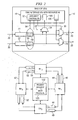
- FIGURE 2 shows an example of a four-hop ring composed of two physical channels, where each physical channel is supporting two transport channels, and each transport channel is composed of two segments, thus spreading two hops;
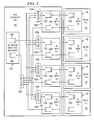
- FIGURE 3 shows a possible implementation of the NoC Interface component connecting the resource with four rings.
- the HyRoC architecture in accordance with embodiments of the present invention merges the advantage of a cell-based 2D layout implementation (such as with a 2D Torus of the prior art) with the advantage of a simple routing and control flow of a basic ring in which higher-bandwidth can be provided by combining parallel rings.
- FIGURE 1 The architecture of the HyRoC will now be described beginning with a high level view.
- the topology of the HyRoC architecture for connecting NxM resources R is shown in FIGURE 1, where resources R are distributed as an array of N rows and M columns.
- Each resource R is connected with the Network-on-Chip (NoC) via an NoC Interface (NI) 90 which behaves as a multiplexer selectively connecting the resource R with four independent rings, via a corresponding ring hop (RH) 10; comprising: two rings oriented in: the horizontal direction, H0 and H1, and two rings oriented in the vertical direction, V0 and V1.
- the ring paths are shown schematically in FIGURE 1 as arrows circulating vertically/horizontally and interfaced with the array of resources R through the NoC interfaces NI.
- the physical layout of a single ring is shown in exemplary fashion in the bottom of FIGURE 2.
- the HyRoC architecture provides the NoC for an integrated circuit, or perhaps for some other type of system, wherein plural circuit resources R need to be interconnected for data communication.
- Each horizontal ring is composed of M hops, while each vertical ring is composed of N hops.
- the rotation mechanism with respect to ring communication can be physically implemented using either shift-registers or commutators and an exemplary physical interconnection of the NI's/RH's for a single ring is shown in FIGURE 2.
- each switch is a 5x5 cross-bar (between east port, west port, north port, south port and resource port), while for the HyRoC Architecture, each switch is composed of four ring hops (RHs) relating to the four independent rings accessible at that location in the array. This difference is significant, and results in differences over the prior art with respect to how routing decisions are performed and how packets flow through the NoC.
- a ring-hop (RH) 10 as shown in FIGURE 1 controls the insertion and extraction of data traffic flowing on the corresponding ring.
- FIGURE 2 illustrates, at the top of the figure, a block diagram of a single ring hop (RH) 10 for one physical ring available at a given array location.
- RH 10 includes a Ring Interface (RI) 18 to connect with the resource NI 90 (FIGURE 1). Through this interface, data (such as packets) is passed to the RH from the resource NI or received from the resource NI for delivery to the RH.
- FIFOs 100 are used to store packets between the NI and RH, in both the input and output directions.
- the RH illustrates the presence of two physical channels 20 which form a given ring, which in this case could comprise either a vertical or horizontal ring.
- a segment buffer 22 is associated with each physical channel 20 at the input to the RH.
- An extraction (or drop) multiplexer 24 is coupled to the physical channels 20. Responsive to a control signal 26, the multiplexer 24 can remove data from either of the physical channels 20 and pass that data to the RI 18 with the resource NI.
- An insertion (or add) multiplexer 28 is provided for each physical channel 20. Responsive to a control signal 30, each multiplexer 28 can insert data from the RI 18 with the resource NI to its associated physical channel 20.
- An add/drop controller 32 functions to issue the control signals 26 and 30 as needed to control the data add/drop operations performed by the multiplexers 24 and 28; the decision is performed from the value of the packet segment header 50 part of the packet segment buffer 22 extracted using connection 34.
- Each resource NI one RH is needed for each connected ring.
- four RH's, one for each included ring (H0, H1, V0, V1), are provided at each resource NI (i.e., at each array location) in order to support data/packet add/drop operations for each ring.
- FIGURE 2 further illustrates a single four hop ring.
- This illustrated ring is exemplary in nature and can include more or less hops as desired and depending on the size of the array. Additionally, it will be noted that the ring can either be a vertical ring or a horizontal ring. Duplexing of the ring is further a possibility.
- HyRoC Architecture A discussion of packet flow within the HyRoC Architecture is now provided. Information is transferred between two resources R through a logical channel, which characterizes the type of traffic it is carrying. Characteristics considered in the HyRoC architecture include:
- the information is transferred as fixed-size packets.
- the resource forwards to the rings, and retrieves from the rings, packets using its own NoC Interface (NI) and the associated ring hops RHs for the rings passing through that array location.
- NI NoC Interface
- the NI operates to forward the packet to the Ring Interface.(RI) 18 (at the ring hop RH, see FIGURE 3) of one of the 4 rings associated with the resource.
- the packet will be added by controller 32 and multiplexer 28 to a ring and will travel inside one or two rings before reaching its destination resource. In this context, it will be recognized that four patterns for packet travel between resources are possible:
- the NI is also responsible for retrieving the packet which arrives at a RI 18 with a resource NI, and to forward that packet to the resource R, or to another RI 18 (at another ring hop RH at that same array location, see FIGURE 3), in case the packet has not yet reached its intended destination. In the latter case, the NI behaves as a bridge between two rings using two associated ring hops (RHs). In support of this operation, the packet is removed from the ring by controller 32 and multiplexer 24 of one ring hop RH. In the event transport in another ring is needed, for the bridging operation mentioned above, the controller 32 and multiplexer 28 (in a different ring hop RH also associated with the NI at the array location) will add the packet to a different ring.
- Buffering is used inside the NI (to interface with the resource) and RI 18 of the RH to control the flow of packets.
- a single first-in-first-out (FIFO) buffer can be used, or multiple FIFO buffers can be used. This choice is dynamically and/or architecturally selectable based on traffic-type and potentially on target destination.
- Each ring transports the fixed size packets using a transport channel 40.
- a transport channel is a logical entity rotating inside the ring, from ring-hop to ring-hop in a hop by hop fashion.
- the logical transport channel 40 content starts with a header 50 containing information as control status, hop-target tag, priority and traffic-type of a packet.
- the header 50 is followed by a fixed-size payload 52 that can contain user data, depending on the status.
- the transport channel 40 flows in a cyclic manner through the ring, without interruption.
- RH location associated with an NI and resource R At each hop (RH location associated with an NI and resource R) of the transport channel 40:
- the transport channel 40 is transferred over a fixed number of physical connections 42 between hops, thus forming a physical channel 20 for the ring. As shown in FIGURE 2, each ring may include more than one physical channel 20.
- the transport channel can be composed of multiple segments 44, each of the same size.
- the transport channel 40 is likely to be spread over (or otherwise cover) multiple hops at one time (as is shown in FIGURE 2 where each transport channel 40 includes two segments 44, with the first segment including the header 50 and a first part of the payload 52, and the second segment including a second part of the payload 52).
- transport channels 40 There could be many distinct transport channels 40 circulating back-to-back on the physical channel 20, and they can potentially be of different size.
- the preferred embodiment assumes the transport channels 40 are all of the same size.
- the ring can be configured with either:
- a kind of worm hole transfer mechanism is used to transport a packet inside a transport channel 40 composed of multiple segments 44. It will be noticed, however, that the packet (worm) cannot be stopped once the transfer through the ring is started. That is, when a ring hop (RH) is adding the first segment of a packet in the first segment 44 of a transport channel 40, which includes the header 50, it must insert the remaining segments of the packet in the following segments 44 of the transport channel 40.
- RH ring hop
- the same mechanism is used when dropping a packet from a transport channel 40 (i.e., when a ring hop is dropping the first segment of a packet from the first segment 44 of a transport channel, based on the header 50 value, it must retrieve the remaining segments of the packet from the following segments 44 of the transport channel 40).
- the ring hop can start adding a packet in this transport channel 40.
- the transport channel 40 can potentially be composed, within its segments 44, of multiple segments from different packets.
- a ring can be composed of multiple parallel physical-channels 20. This is illustrated in an exemplary manner in FIGURE 2 which shows a ring comprising two parallel physical channels. To allow simple add/drop decisions to be performed at each hop, the following constraints are assumed:
- FIGURE 2 shows an example of a four-hop ring composed of two physical channels, where each physical channel is supporting two transport channels 40, and each transport channel is composed of two segments 44, thus having a spread over two hops (RHs).
- the packet scheduling and control flow is distributed between the NoC interface (NI) and the Ring Hop (RH).
- NI NoC Interface
- Buffer FIFOs 140 are used to store packets at the interface 102 between the resource R and the NI.
- Buffer FIFOs 150 are also provided to store packets at the interface 108 between the NI and the ring hops RH 10 associated with each of the four rings H0, H1, V0 and V1.
- a selector 104 is used to select a packet from three sources, depending on what is the target ring:
- a selector 106 is used to select a packet from one of the four rings H0, H1, V0 or V1 to be returned to the resource R.
- FIFOs 140 and 150 can be restricted to a size of one, with possible impact on the NoC performance. Furthermore, a FIFO 100, 140 or 150 can be logically composed of multiple FIFOs, these can be associated with Quality of Service (QoS), or ring target. Lastly, it will be noted that the FIFO 150 is completely optional (it can be omitted, or controlled to be of size 0).
- QoS Quality of Service
- the routing operation is based on the routing-scheme associated with the packet. If out-of-order handling is supported, the packet could be routed to the less congested path.
- RH Ring Hop
- FIGURE 2 shows a possible implementation of the RH.
- FIFOs 100 are used to store packets between the NI and RH.
- the add/drop functionality is based on the packet headers 50 flowing in the transport channel 40.
- the header 50 corresponds to a packet having reached its RH target
- the packet from the corresponding transport channel is extracted by controller 32 and multiplexer 24 and stored in the FIFO 100 to be sent back to the NI. In that case, the header status becomes free.
- the controller 32 and multiplexer(s) 28 of the RH can insert a packet for a destination X if there is a free channel, and if there is no channel already transporting a packet for the destination X. The decision is again performed from the header 50 value.
- the RH must store the current value of the channel header 50, incoming and outgoing, in order to extract and insert accordingly the packet.
- a back-pressure mechanism 120 can be used to avoid overflow of FIFOs 100.
- Each RH can signal to the other RH of the same ring that its outgoing FIFO is almost full. Thus, a ring hop cannot insert a packet for a destination X if the corresponding signal is raised.
- the size of the FIFO and threshold value to raise the signal is dependant on the maximal number of in flight packets in the transport channel 40.
- a request mechanism 122 can be used to support high-priority traffic.
- Each RH can signal to the other RHs of the same ring that a high-priority packet must be sent.
- a ring hop cannot insert a low-priority packet if one of the request signals of the other RH is raised.
- the request should be raised only after a number of unsuccessful insertions of a high-priority packet.
- a modification or enhancement of the request mechanism could further implement and support a reservation mechanism with respect to different traffic types.
- the Packet Header contains the following fields: 1) Status: free, busy; 2) Priority: high/low; 3) Routing scheme: horizontal first, vertical-first, etc.; 4) Target hop: for current ring; 5) Source resource: global; and 6) Destination resource: global.
- the packet payload contains the following user data: 1) Command: Read, Write, others; 2) Address: for read/write command; and 3) Data: for write command.
- the packet size can be in the range of 96 bits.
- bit width 8 transport channels, each of 1 segment, per physical channel
- 48 bit (4 transport channels, each of 2 segment, per physical channel)
- 24 bit (2 transport channels, each of 4 segments, per physical channel)
- 12 bit (1 transport channel of 8 segments, per physical channel).
- Each ring is preferably composed of two physical channels.
- each Ring Hop and NoC Interface can be implemented in the manner generally shown in FIGURES 2 and 3, respectively, where one FIFO 100 per priority can be used.
- the Ring Interface (RI) 18 includes two FIFOs 100 in the input direction as well as two FIFOs 100 in the output direction.
- two FIFOs 140 and 150 for each of the input and output direction can be used at the interface with each of the four rings 108, as well as with the resource 102.
- the size of the FIFOs 140 and 150 can be restricted to a size of one packet.
- one back-pressure signal (using mechanism 120) per priority can be used per resource per direction to inform other resource to avoid sending packet of the given priority to the given resource. Assuming four transport channels per physical channel, and using a threshold of four packets, the size of the FIFO 100 can be limited to 8.
Landscapes
- Engineering & Computer Science (AREA)
- Computer Networks & Wireless Communication (AREA)
- Signal Processing (AREA)
- Small-Scale Networks (AREA)
Applications Claiming Priority (2)
| Application Number | Priority Date | Filing Date | Title |
|---|---|---|---|
| US68596205P | 2005-05-31 | 2005-05-31 | |
| US11/370,325 US7965725B2 (en) | 2005-05-31 | 2006-03-08 | Hyper-ring-on-chip (HyRoC) architecture |
Publications (3)
| Publication Number | Publication Date |
|---|---|
| EP1729468A2 true EP1729468A2 (de) | 2006-12-06 |
| EP1729468A3 EP1729468A3 (de) | 2007-07-04 |
| EP1729468B1 EP1729468B1 (de) | 2009-07-22 |
Family
ID=36968943
Family Applications (1)
| Application Number | Title | Priority Date | Filing Date |
|---|---|---|---|
| EP06252724A Active EP1729468B1 (de) | 2005-05-31 | 2006-05-25 | Architektur eines on chip Hyper-Ring |
Country Status (3)
| Country | Link |
|---|---|
| US (1) | US7965725B2 (de) |
| EP (1) | EP1729468B1 (de) |
| DE (1) | DE602006007911D1 (de) |
Families Citing this family (57)
| Publication number | Priority date | Publication date | Assignee | Title |
|---|---|---|---|---|
| KR100624641B1 (ko) * | 2004-10-07 | 2006-09-15 | 삼성전자주식회사 | 기능 블록 코어-스위치 포인트 다중 매핑 온 칩 버스 구조및 이를 이용한 반도체 장치 |
| US20080005402A1 (en) * | 2006-04-25 | 2008-01-03 | Samsung Electronics Co., Ltd. | Gals-based network-on-chip and data transfer method thereof |
| KR100785472B1 (ko) * | 2006-09-19 | 2007-12-13 | 삼성전자주식회사 | 긴급 NoC 패킷 대기시간 관리 장치 및 그 방법 |
| US7786757B2 (en) * | 2008-03-21 | 2010-08-31 | Agate Logic, Inc. | Integrated circuits with hybrid planer hierarchical architecture and methods for interconnecting their resources |
| US20120195321A1 (en) * | 2011-02-02 | 2012-08-02 | Futurewei Technologies, Inc. | Method and Apparatus for Low-Latency Interconnection Networks Using Hierarchical Rings |
| US8897173B2 (en) * | 2011-04-29 | 2014-11-25 | T-Mobile Usa, Inc. | Microwave backhaul arrangements |
| FR2979444A1 (fr) * | 2011-08-23 | 2013-03-01 | Kalray | Reseau sur puce extensible |
| US9626306B2 (en) * | 2012-02-17 | 2017-04-18 | Netronome Systems, Inc. | Global event chain in an island-based network flow processor |
| EP2693769B1 (de) * | 2012-07-30 | 2014-10-08 | Alcatel Lucent | Netzwerknoten mit hoher Kapazität |
| US8982695B2 (en) | 2012-09-29 | 2015-03-17 | Intel Corporation | Anti-starvation and bounce-reduction mechanism for a two-dimensional bufferless interconnect |
| US8885510B2 (en) | 2012-10-09 | 2014-11-11 | Netspeed Systems | Heterogeneous channel capacities in an interconnect |
| US8934377B2 (en) | 2013-03-11 | 2015-01-13 | Netspeed Systems | Reconfigurable NoC for customizing traffic and optimizing performance after NoC synthesis |
| US9471726B2 (en) | 2013-07-25 | 2016-10-18 | Netspeed Systems | System level simulation in network on chip architecture |
| US9054977B2 (en) | 2013-08-05 | 2015-06-09 | Netspeed Systems | Automatic NoC topology generation |
| US9699079B2 (en) | 2013-12-30 | 2017-07-04 | Netspeed Systems | Streaming bridge design with host interfaces and network on chip (NoC) layers |
| US9473415B2 (en) | 2014-02-20 | 2016-10-18 | Netspeed Systems | QoS in a system with end-to-end flow control and QoS aware buffer allocation |
| US10110700B2 (en) | 2014-03-31 | 2018-10-23 | Oracle International Corporation | Multiple on-die communication networks |
| US10528682B2 (en) | 2014-09-04 | 2020-01-07 | Netspeed Systems | Automatic performance characterization of a network-on-chip (NOC) interconnect |
| US9742630B2 (en) | 2014-09-22 | 2017-08-22 | Netspeed Systems | Configurable router for a network on chip (NoC) |
| US9477280B1 (en) | 2014-09-24 | 2016-10-25 | Netspeed Systems | Specification for automatic power management of network-on-chip and system-on-chip |
| US10042404B2 (en) | 2014-09-26 | 2018-08-07 | Netspeed Systems | Automatic generation of power management sequence in a SoC or NoC |
| US9571341B1 (en) | 2014-10-01 | 2017-02-14 | Netspeed Systems | Clock gating for system-on-chip elements |
| US9529400B1 (en) | 2014-10-29 | 2016-12-27 | Netspeed Systems | Automatic power domain and voltage domain assignment to system-on-chip agents and network-on-chip elements |
| US9660942B2 (en) | 2015-02-03 | 2017-05-23 | Netspeed Systems | Automatic buffer sizing for optimal network-on-chip design |
| US9444702B1 (en) | 2015-02-06 | 2016-09-13 | Netspeed Systems | System and method for visualization of NoC performance based on simulation output |
| US10009135B2 (en) * | 2015-02-06 | 2018-06-26 | The Trustees Of Princeton University | System and method for photonic processing |
| US9568970B1 (en) | 2015-02-12 | 2017-02-14 | Netspeed Systems, Inc. | Hardware and software enabled implementation of power profile management instructions in system on chip |
| US9928204B2 (en) | 2015-02-12 | 2018-03-27 | Netspeed Systems, Inc. | Transaction expansion for NoC simulation and NoC design |
| US10348563B2 (en) | 2015-02-18 | 2019-07-09 | Netspeed Systems, Inc. | System-on-chip (SoC) optimization through transformation and generation of a network-on-chip (NoC) topology |
| US10050843B2 (en) | 2015-02-18 | 2018-08-14 | Netspeed Systems | Generation of network-on-chip layout based on user specified topological constraints |
| US9864728B2 (en) | 2015-05-29 | 2018-01-09 | Netspeed Systems, Inc. | Automatic generation of physically aware aggregation/distribution networks |
| US9825809B2 (en) | 2015-05-29 | 2017-11-21 | Netspeed Systems | Dynamically configuring store-and-forward channels and cut-through channels in a network-on-chip |
| US10218580B2 (en) | 2015-06-18 | 2019-02-26 | Netspeed Systems | Generating physically aware network-on-chip design from a physical system-on-chip specification |
| US10846591B2 (en) * | 2015-12-29 | 2020-11-24 | Synopsys, Inc. | Configurable and programmable multi-core architecture with a specialized instruction set for embedded application based on neural networks |
| US10452124B2 (en) | 2016-09-12 | 2019-10-22 | Netspeed Systems, Inc. | Systems and methods for facilitating low power on a network-on-chip |
| US20180159786A1 (en) | 2016-12-02 | 2018-06-07 | Netspeed Systems, Inc. | Interface virtualization and fast path for network on chip |
| US10313269B2 (en) | 2016-12-26 | 2019-06-04 | Netspeed Systems, Inc. | System and method for network on chip construction through machine learning |
| US10063496B2 (en) | 2017-01-10 | 2018-08-28 | Netspeed Systems Inc. | Buffer sizing of a NoC through machine learning |
| US10084725B2 (en) | 2017-01-11 | 2018-09-25 | Netspeed Systems, Inc. | Extracting features from a NoC for machine learning construction |
| US10469337B2 (en) | 2017-02-01 | 2019-11-05 | Netspeed Systems, Inc. | Cost management against requirements for the generation of a NoC |
| US10298485B2 (en) | 2017-02-06 | 2019-05-21 | Netspeed Systems, Inc. | Systems and methods for NoC construction |
| US11868804B1 (en) | 2019-11-18 | 2024-01-09 | Groq, Inc. | Processor instruction dispatch configuration |
| US11360934B1 (en) | 2017-09-15 | 2022-06-14 | Groq, Inc. | Tensor streaming processor architecture |
| US11243880B1 (en) | 2017-09-15 | 2022-02-08 | Groq, Inc. | Processor architecture |
| US11114138B2 (en) | 2017-09-15 | 2021-09-07 | Groq, Inc. | Data structures with multiple read ports |
| US11170307B1 (en) | 2017-09-21 | 2021-11-09 | Groq, Inc. | Predictive model compiler for generating a statically scheduled binary with known resource constraints |
| US11144457B2 (en) | 2018-02-22 | 2021-10-12 | Netspeed Systems, Inc. | Enhanced page locality in network-on-chip (NoC) architectures |
| US10983910B2 (en) | 2018-02-22 | 2021-04-20 | Netspeed Systems, Inc. | Bandwidth weighting mechanism based network-on-chip (NoC) configuration |
| US10896476B2 (en) | 2018-02-22 | 2021-01-19 | Netspeed Systems, Inc. | Repository of integration description of hardware intellectual property for NoC construction and SoC integration |
| US10547514B2 (en) | 2018-02-22 | 2020-01-28 | Netspeed Systems, Inc. | Automatic crossbar generation and router connections for network-on-chip (NOC) topology generation |
| US11176302B2 (en) | 2018-02-23 | 2021-11-16 | Netspeed Systems, Inc. | System on chip (SoC) builder |
| US11023377B2 (en) | 2018-02-23 | 2021-06-01 | Netspeed Systems, Inc. | Application mapping on hardened network-on-chip (NoC) of field-programmable gate array (FPGA) |
| CN109189720B (zh) * | 2018-08-22 | 2022-11-25 | 曙光信息产业(北京)有限公司 | 层次化片上网络拓扑结构及其路由方法 |
| US11204976B2 (en) | 2018-11-19 | 2021-12-21 | Groq, Inc. | Expanded kernel generation |
| US11115147B2 (en) * | 2019-01-09 | 2021-09-07 | Groq, Inc. | Multichip fault management |
| US12340300B1 (en) | 2018-09-14 | 2025-06-24 | Groq, Inc. | Streaming processor architecture |
| US10860762B2 (en) | 2019-07-11 | 2020-12-08 | Intel Corpration | Subsystem-based SoC integration |
Citations (1)
| Publication number | Priority date | Publication date | Assignee | Title |
|---|---|---|---|---|
| US20050114565A1 (en) | 2003-03-31 | 2005-05-26 | Stretch, Inc. | Systems and methods for selecting input/output configuration in an integrated circuit |
Family Cites Families (10)
| Publication number | Priority date | Publication date | Assignee | Title |
|---|---|---|---|---|
| US4742511A (en) * | 1985-06-13 | 1988-05-03 | Texas Instruments Incorporated | Method and apparatus for routing packets in a multinode computer interconnect network |
| US4933933A (en) * | 1986-12-19 | 1990-06-12 | The California Institute Of Technology | Torus routing chip |
| US4872159A (en) * | 1988-03-31 | 1989-10-03 | American Telephone And Telegraph Company At&T Bell Laboratories | Packet network architecture for providing rapid response time |
| JP3072646B2 (ja) * | 1989-03-20 | 2000-07-31 | 富士通株式会社 | 並列計算機間通信制御方式 |
| US5168492A (en) * | 1991-04-11 | 1992-12-01 | Northern Telecom Limited | Rotating-access ATM-STM packet switch |
| GB9618131D0 (en) * | 1996-08-30 | 1996-10-09 | Sgs Thomson Microelectronics | Improvements in or relating to an ATM switch |
| US6563790B1 (en) * | 1999-05-21 | 2003-05-13 | Advanced Micro Devices, Inc. | Apparatus and method for modifying a limit of a retry counter in a network switch port in response to exerting backpressure |
| US7058070B2 (en) * | 2001-05-01 | 2006-06-06 | Integrated Device Technology, Inc. | Back pressure control system for network switch port |
| US7581081B2 (en) * | 2003-03-31 | 2009-08-25 | Stretch, Inc. | Systems and methods for software extensible multi-processing |
| US7633940B1 (en) * | 2005-06-27 | 2009-12-15 | The Board Of Trustees Of The Leland Stanford Junior University | Load-balanced routing |
-
2006
- 2006-03-08 US US11/370,325 patent/US7965725B2/en active Active
- 2006-05-25 EP EP06252724A patent/EP1729468B1/de active Active
- 2006-05-25 DE DE602006007911T patent/DE602006007911D1/de not_active Expired - Fee Related
Patent Citations (1)
| Publication number | Priority date | Publication date | Assignee | Title |
|---|---|---|---|---|
| US20050114565A1 (en) | 2003-03-31 | 2005-05-26 | Stretch, Inc. | Systems and methods for selecting input/output configuration in an integrated circuit |
Non-Patent Citations (2)
| Title |
|---|
| DAILY WJ ET AL.: "Route packets, not wires: on chip interconnection networks", PROCEEDINGS OF THE 38TH CONFERENCE ON DESIGN AUTOMATION, 18 June 2001 (2001-06-18), pages 684 - 689, XP010552473 |
| HSIN-CHOU CHI ET AL.: "Design and implementation of a routing switch for on-chip interconnection networks", ADVANCED SYSTEM INTEGRATED CIRCUITS 2004, PROCEEDINGS OF 2004 IEEE ASIA-PACIFIC CONFERENCE, NJ, USA, IEEE, 4 August 2004 (2004-08-04), pages 392 - 295 |
Also Published As
| Publication number | Publication date |
|---|---|
| EP1729468B1 (de) | 2009-07-22 |
| US20060268909A1 (en) | 2006-11-30 |
| US7965725B2 (en) | 2011-06-21 |
| EP1729468A3 (de) | 2007-07-04 |
| DE602006007911D1 (de) | 2009-09-03 |
Similar Documents
| Publication | Publication Date | Title |
|---|---|---|
| EP1729468B1 (de) | Architektur eines on chip Hyper-Ring | |
| US7433363B2 (en) | Low latency switch architecture for high-performance packet-switched networks | |
| CN100405344C (zh) | 用于在交换结构中分发缓冲区状态信息的装置和方法 | |
| EP1489796B1 (de) | Integrierter Schaltkreis für eine Zugangsknotenstruktur zur Begrenzung der Zellsortierungspuffertiefe | |
| US7940786B2 (en) | System and method for communicating data using a common switch fabric | |
| US7046681B2 (en) | Network switch for routing network traffic | |
| US7464180B1 (en) | Prioritization and preemption of data frames over a switching fabric | |
| US20020141427A1 (en) | Method and apparatus for a traffic optimizing multi-stage switch fabric network | |
| EP1875681A1 (de) | Elektronische vorrichtung und verfahren zur durchflussregelung | |
| JPH10285187A (ja) | Atmスイッチ用の分散形バッファリング・システム | |
| US7016363B1 (en) | Scaleable interconnect structure utilizing quality-of-service handling | |
| US6046982A (en) | Method and apparatus for reducing data loss in data transfer devices | |
| EP1891778B1 (de) | Elektronische vorrichtung und verfahren zur kommunikationsressourcenzuteilung | |
| US20020064172A1 (en) | Programmable integrated circuit for use in a network switch | |
| US7965705B2 (en) | Fast and fair arbitration on a data link | |
| CN100397373C (zh) | 可伸缩蠕虫洞路由选择集中器 | |
| US9954797B2 (en) | Parallel data switch | |
| WO2006017158A2 (en) | Self-regulating interconnect structure | |
| KR100903130B1 (ko) | 메쉬 타입 온 칩 네트워크의 스위치 및 스위칭 방법 | |
| US9479458B2 (en) | Parallel data switch | |
| KR20000074194A (ko) | 대용량화가 가능한 다중 경로 비동기 전송 모드 스위치 및 셀구조 | |
| JPH07264197A (ja) | セル交換装置 |
Legal Events
| Date | Code | Title | Description |
|---|---|---|---|
| PUAI | Public reference made under article 153(3) epc to a published international application that has entered the european phase |
Free format text: ORIGINAL CODE: 0009012 |
|
| AK | Designated contracting states |
Kind code of ref document: A2 Designated state(s): AT BE BG CH CY CZ DE DK EE ES FI FR GB GR HU IE IS IT LI LT LU LV MC NL PL PT RO SE SI SK TR |
|
| AX | Request for extension of the european patent |
Extension state: AL BA HR MK YU |
|
| PUAL | Search report despatched |
Free format text: ORIGINAL CODE: 0009013 |
|
| AK | Designated contracting states |
Kind code of ref document: A3 Designated state(s): AT BE BG CH CY CZ DE DK EE ES FI FR GB GR HU IE IS IT LI LT LU LV MC NL PL PT RO SE SI SK TR |
|
| AX | Request for extension of the european patent |
Extension state: AL BA HR MK YU |
|
| RIC1 | Information provided on ipc code assigned before grant |
Ipc: G06F 15/173 20060101AFI20070525BHEP Ipc: H04L 12/56 20060101ALI20070525BHEP |
|
| 17P | Request for examination filed |
Effective date: 20080102 |
|
| 17Q | First examination report despatched |
Effective date: 20080131 |
|
| AKX | Designation fees paid |
Designated state(s): DE FR GB IT |
|
| GRAP | Despatch of communication of intention to grant a patent |
Free format text: ORIGINAL CODE: EPIDOSNIGR1 |
|
| GRAS | Grant fee paid |
Free format text: ORIGINAL CODE: EPIDOSNIGR3 |
|
| GRAA | (expected) grant |
Free format text: ORIGINAL CODE: 0009210 |
|
| AK | Designated contracting states |
Kind code of ref document: B1 Designated state(s): DE FR GB IT |
|
| REG | Reference to a national code |
Ref country code: GB Ref legal event code: FG4D |
|
| REF | Corresponds to: |
Ref document number: 602006007911 Country of ref document: DE Date of ref document: 20090903 Kind code of ref document: P |
|
| PLBE | No opposition filed within time limit |
Free format text: ORIGINAL CODE: 0009261 |
|
| STAA | Information on the status of an ep patent application or granted ep patent |
Free format text: STATUS: NO OPPOSITION FILED WITHIN TIME LIMIT |
|
| 26N | No opposition filed |
Effective date: 20100423 |
|
| PG25 | Lapsed in a contracting state [announced via postgrant information from national office to epo] |
Ref country code: IT Free format text: LAPSE BECAUSE OF FAILURE TO SUBMIT A TRANSLATION OF THE DESCRIPTION OR TO PAY THE FEE WITHIN THE PRESCRIBED TIME-LIMIT Effective date: 20090722 |
|
| PG25 | Lapsed in a contracting state [announced via postgrant information from national office to epo] |
Ref country code: DE Free format text: LAPSE BECAUSE OF NON-PAYMENT OF DUE FEES Effective date: 20101201 |
|
| REG | Reference to a national code |
Ref country code: FR Ref legal event code: PLFP Year of fee payment: 11 |
|
| REG | Reference to a national code |
Ref country code: FR Ref legal event code: PLFP Year of fee payment: 12 |
|
| REG | Reference to a national code |
Ref country code: FR Ref legal event code: PLFP Year of fee payment: 13 |
|
| PGFP | Annual fee paid to national office [announced via postgrant information from national office to epo] |
Ref country code: FR Payment date: 20200422 Year of fee payment: 15 |
|
| PG25 | Lapsed in a contracting state [announced via postgrant information from national office to epo] |
Ref country code: FR Free format text: LAPSE BECAUSE OF NON-PAYMENT OF DUE FEES Effective date: 20210531 |
|
| REG | Reference to a national code |
Ref country code: GB Ref legal event code: 732E Free format text: REGISTERED BETWEEN 20240829 AND 20240904 |
|
| PGFP | Annual fee paid to national office [announced via postgrant information from national office to epo] |
Ref country code: GB Payment date: 20250423 Year of fee payment: 20 |