EP1728811B1 - "Branched biodegradable polymers, a macromonomer, processes for the preparation of same, and their use" - Google Patents
"Branched biodegradable polymers, a macromonomer, processes for the preparation of same, and their use" Download PDFInfo
- Publication number
- EP1728811B1 EP1728811B1 EP05076302A EP05076302A EP1728811B1 EP 1728811 B1 EP1728811 B1 EP 1728811B1 EP 05076302 A EP05076302 A EP 05076302A EP 05076302 A EP05076302 A EP 05076302A EP 1728811 B1 EP1728811 B1 EP 1728811B1
- Authority
- EP
- European Patent Office
- Prior art keywords
- process according
- macromonomer
- cyclic
- polycondensation
- ring
- Prior art date
- Legal status (The legal status is an assumption and is not a legal conclusion. Google has not performed a legal analysis and makes no representation as to the accuracy of the status listed.)
- Expired - Lifetime
Links
- 0 COC(c1cc(*)cc(*)c1)=O Chemical compound COC(c1cc(*)cc(*)c1)=O 0.000 description 1
Classifications
-
- C—CHEMISTRY; METALLURGY
- C08—ORGANIC MACROMOLECULAR COMPOUNDS; THEIR PREPARATION OR CHEMICAL WORKING-UP; COMPOSITIONS BASED THEREON
- C08G—MACROMOLECULAR COMPOUNDS OBTAINED OTHERWISE THAN BY REACTIONS ONLY INVOLVING UNSATURATED CARBON-TO-CARBON BONDS
- C08G63/00—Macromolecular compounds obtained by reactions forming a carboxylic ester link in the main chain of the macromolecule
- C08G63/78—Preparation processes
-
- C—CHEMISTRY; METALLURGY
- C08—ORGANIC MACROMOLECULAR COMPOUNDS; THEIR PREPARATION OR CHEMICAL WORKING-UP; COMPOSITIONS BASED THEREON
- C08G—MACROMOLECULAR COMPOUNDS OBTAINED OTHERWISE THAN BY REACTIONS ONLY INVOLVING UNSATURATED CARBON-TO-CARBON BONDS
- C08G63/00—Macromolecular compounds obtained by reactions forming a carboxylic ester link in the main chain of the macromolecule
- C08G63/02—Polyesters derived from hydroxycarboxylic acids or from polycarboxylic acids and polyhydroxy compounds
- C08G63/06—Polyesters derived from hydroxycarboxylic acids or from polycarboxylic acids and polyhydroxy compounds derived from hydroxycarboxylic acids
- C08G63/08—Lactones or lactides
-
- C—CHEMISTRY; METALLURGY
- C08—ORGANIC MACROMOLECULAR COMPOUNDS; THEIR PREPARATION OR CHEMICAL WORKING-UP; COMPOSITIONS BASED THEREON
- C08G—MACROMOLECULAR COMPOUNDS OBTAINED OTHERWISE THAN BY REACTIONS ONLY INVOLVING UNSATURATED CARBON-TO-CARBON BONDS
- C08G63/00—Macromolecular compounds obtained by reactions forming a carboxylic ester link in the main chain of the macromolecule
- C08G63/66—Polyesters containing oxygen in the form of ether groups
- C08G63/664—Polyesters containing oxygen in the form of ether groups derived from hydroxy carboxylic acids
-
- C—CHEMISTRY; METALLURGY
- C08—ORGANIC MACROMOLECULAR COMPOUNDS; THEIR PREPARATION OR CHEMICAL WORKING-UP; COMPOSITIONS BASED THEREON
- C08G—MACROMOLECULAR COMPOUNDS OBTAINED OTHERWISE THAN BY REACTIONS ONLY INVOLVING UNSATURATED CARBON-TO-CARBON BONDS
- C08G64/00—Macromolecular compounds obtained by reactions forming a carbonic ester link in the main chain of the macromolecule
- C08G64/20—General preparatory processes
- C08G64/30—General preparatory processes using carbonates
Definitions
- the present invention relates to branched biodegradable polymers, to a process for the preparation of branched biodegradable polymers, to their use for medical and non-medical applications, to a process for the preparation of a macromonomer, and to the use of the macromonomer in the preparation of the branched biodegradable polymers.
- S. Skaria et al discloses an enzyme-catalyzed synthesis of hyperbranched aliphatic polyesters. These copolyesters are prepared by copolymerization of ⁇ -caprolactone with 2,2-bis(hydroxymethyl)butyric acid. This copolymerization is catalyzed by immobilized lipase B from Candida antarctica under mild conditions.
- bisMPA 2,2-bis-(hydroxymethyl) propionic acid
- 2,2-bis(phenyldioxymethyl)propionic acid or benzylidene-protected 2,2-bis-(hydroxymethyl) propionic acid is synthesized and used to prepare a protected AB 2 -type functional ( ⁇ -carboxylic- ⁇ -dihydroxy poly( ⁇ -caprolactone) macromonomer.
- the protected macromonomer is subsequently deprotected via hydrogenolysis to yield ⁇ -carboxylic- ⁇ -dihydroxy poly( ⁇ -caprolactone).
- This AB 2 macromonomer is then condensed into hyperbranched polymers via a room temperature esterification synthesis using 1,3-dicyclohexylcarbodiimide (DCC) and 4-(dimethylamino)pyridinium 4-toluenesulfonate (DPTS).
- DCC 1,3-dicyclohexylcarbodiimide
- DPTS 4-(dimethylamino)pyridinium 4-toluenesulfonate
- Liu et al (Macromolecules, 1999, 32, 6881-6884 ) and Trolls ⁇ s et al (Macromolecules, 1999, 32, 9062-9066 ) separately report the synthesis of hyperbranched poly( ⁇ -caprolactone)s by so-called "self-condensing ring-opening polymerization" of 4-(2-hydroxyethyl)- ⁇ -caprolactone and bis(hydroxymethyl)-substituted ⁇ -caprolactone, respectively.
- the self-condensing polymerization is performed in bulk at 110°C in the presence of a catalytic amount of stannous octoate.
- Fumitaka et al (Macromol. Rapid Commun. 2001, 22, 820-824 ) reports the synthesis of branched polylactide by bulk copolymerization of lactide with mevalonolactone using stannous octoate or distannoxane as a catalyst.
- the present invention has for its object to provide various types of branched biodegradable polymers via a novel process for their preparation.
- This process comprises a first step of ring-opening polymerization in the presence of a branching agent and a catalyst thereby forming a macromonomer, and a second step comprising a polycondensation of the macromonomer.
- This macromonomer is such that it is directly used in the subsequent polycondensation step.
- the process of present invention is thus characterized in that it does not comprise an intermediate deprotection step.
- This process is simple and can readily be scaled up.
- This two step process may be carried out in two pots but a one pot process is preferred. Furthermore, the process may be carried out in bulk or in solution.
- branched polymers have relatively low viscosity, good solubility, and abundant reactive groups at the periphery.
- monomers, branching agents, and monomer-to-branching agent ratios By varying monomers, branching agents, and monomer-to-branching agent ratios, branched biodegradable polymers with vastly different properties including hydrophilicity, thermal and mechanical properties, and degradation profiles can be obtained.
- the cyclic esters and cyclic carbonates used in the first step of the process of the present invention preferably have the following general structure in which h is from 2 to 16, i is from 1 to 4, j is from 0 to 4, and R 1 , R 2 , R 3 , R' 1 and R' 2 are the same or different and represent a hydrogen, or hydrocarbyl or substituted hydrocarbyl with protected O, N, and/or S functionality with a maximum of 30 carbon atoms.
- R 1 , R 2 , R 3 , R' 1 and R' 2 may have the same or different meaning. Each may represent hydrogen, or hydrocarbyl, such as methyl, ethyl, and propyl. Hydrogen and methyl are preferred.
- the substituted hydrocarbyl with protected O, N, and/or S functionality is preferably CH 2 O-Bz, (CH 2 ) 4 -NH-Z 1 , and CH 2 -S-MBz wherein Bz is benzyl, Z 1 is benzyloxycarbonyl, and MBz is p-methoxybenzyl.
- the total number of carbon atoms is at maximum 30 because larger monomers are difficult to polymerize.
- the number of carbon atoms is less than 20, such as less than 15.
- Preferred cyclic esters are ⁇ -propiolactone, ⁇ -butyrolactone, ⁇ -valerolactone, alkyl- ⁇ -valerolactone, ⁇ -caprolactone, alkyl- ⁇ -caprolactone, ⁇ -pentadecalactone, dioxanone, lactide and glycolide.
- Preferred cyclic carbonates are trimethylene carbonate or 2,2-dimethyl trimethylene carbonate, and mixtures thereof. It is considered within the scope of protection of the present invention that mixtures of different cyclic esters and/or cyclic carbonates are used dependent on the desired properties of the branched biodegradable polymers according to the present invention.
- the branching agent has the following formula (Z) x -R 1 -(COOR 2 ) y wherein Z is a hydroxyl, thiol, primary or secondary amine group, (x + y) ⁇ 3, R 1 is an aliphatic or aromatic moiety with or without ester, ether, amide, and/or ketone functionality, R 2 is a hydrogen, (C 1 -C 6 )-alkyl optionally substituted with halogen, or aryl such as phenyl optionally substituted with halogen or (C 1 -C 6 )-alkyl.
- Z is hydroxyl
- (x + y) is 3 or 4 and x or y is 1
- R 2 is a hydrogen, methyl or ethyl optionally substituted with halogen, or phenyl optionally substituted with methyl or halogen.
- the cyclic N- carboxyanhydride has the following general structure in which R represents a hydrogen, or hydrocarbyl, or hydrocarbyl with (protected) O, N, and/or S functionality, or hydrocarbyl with protected carboxylic acid, or aromatic group such as -CH 2 Ph, and the branching agent has the following formula: (Z) x -R 1 -(COOR 2 )y wherein Z is a primary amine group, (x + y) ⁇ 3, R 1 is an aliphatic or aromatic moiety with or without ester, ether, amide, and/or ketone functionality, R 2 is (C 1 -C 6 )-alkyl optionally substituted with halogen, or aryl, such as phenyl, optionally substituted with halogen or (C 1 -C 6 )-alkyl.
- R represents a hydrogen, or hydrocarbyl, or hydrocarbyl with (protected) O, N, and/or S functionality, or hydrocarbyl
- R represents methyl, isopropyl, isobutyl, -CH 2 CH 2 SCH 3 , -(CH 2 ) 4 NHCO 2 C(CH 3 ) 3 , -CH 2 OCH 2 Ph, -CH 2 COOCH 2 Ph, -CH 2 CH 2 COOCH 2 Ph, or -CH 2 Ph, wherein Ph means phenyl.
- branching agents are wherein
- the ring-opening polymerization of the cyclic ester and/or cyclic carbonate is carried out in the presence of the branching agent and of a catalyst.
- the catalyst is a traditional catalyst for ring-opening polymerization and may be selected from alkyls, oxides, alkoxides, halides, and carboxylates of metals such as tin, titanium, aluminum, zirconium, antimony, yttrium, lanthanide, iron, manganese, calcium, magnesium, and zinc.
- the cyclic NCA When the cyclic NCA is used the reaction does not require the use of a catalyst.
- a macromonomer or a mixture of macromonomers may be used.
- This mixture of macromonomers may be obtained in one step a) of ring-opening polymerization or by mixing macromonomers obtained in different ring-opening polymerizations.
- the polycondensation may be carried out without or with a catalyst. If a catalyst is used a traditional catalyst for polycondensation may be used and may be selected from alkyls, oxides, alkoxides, halides, and carboxylates of metals such as tin, titanium, aluminum, zirconium, antimony, yttrium, lanthanide, iron, manganese, calcium, magnesium, and zinc.
- a catalyst a traditional catalyst for polycondensation may be used and may be selected from alkyls, oxides, alkoxides, halides, and carboxylates of metals such as tin, titanium, aluminum, zirconium, antimony, yttrium, lanthanide, iron, manganese, calcium, magnesium, and zinc.
- catalysts which are effective for esterification reactions like Lewis acids, protonic acids, or catalysts which include sulfuric acids, phosphoric acids, p-toluenesulfonic acid, and metal oxides, alkoxides, carbonates, halides and carboxylates wherein the metals are tin, titanium, aluminum, zirconium, antimony, yttrium, lanthanide, iron, manganese, calcium, magnesium, and zinc.
- the catalyst for the ring-opening polymerization and for the polycondensation may be the same.
- the catalyst for the ring opening and/or for the poly condensation is selected from stannous octoate, dialkyltin oxide, stannous chloride, dialkyltin diacetate, zinc acetate, zinc lactate, and titanium alkoxides. It is noted that the polycondensation may be carried out under reduced pressure.
- the ring-opening polymerization is generally performed in bulk at a temperature from 60 to 220 °C or in solution at a temperature from 10 to 200 °C, over a period of a few minutes up to 72 hours.
- the molar ratio of cyclic monomer and branching agent ranges from 1:1 to 100:1.
- the polycondensation reaction may be performed in solution preferably at a temperature from 0 to 140 °C, although more preferably carried out in the bulk under reduced pressure preferably at a temperature from 110 to 240 °C and over a period of time of 4 up to 72 hours.
- the first step of the process of the invention for the preparation of branched biodegradable polymers results in the preparation of a macromonomer.
- This macromonomer as an intermediate compound is subsequently used in the second step of polycondensation.
- polycondensation of the macromonomer in step b) is carried out in the presence of a core molecule selected from a polyol, polyamine, polycarboxylic acid and/or polycarboxylic ester.
- the core molecule may be a polyol such as glycerol, polyglycerol, tris(methylol)propane, di(trimethylolpropane), pentaerythritol, ethoxylated pentaerythritol, sorbitol, mannitol, sucrose, and star-shaped poly(ethylene glycol), a polyamine such as poly(L-lysine), spermidine and trimethylene tetramine, and a polycarboxylic acid or ester such as 1,2,3-butanetricarboxylic acid, trimesic acid, pyromellitic acid, and mellitic acid.
- a polyol such as glycerol, polyglycerol, tris(methylol)propane, di(trimethylolpropane), pentaerythritol, ethoxylated pentaerythritol, sorbitol, mannitol, suc
- the branched biodegradable polymers according to the present invention have broad applications in biomedical and pharmaceutical areas. Particularly, the presence of many functional hydroxyl or carboxyl groups makes these polymers ideal for further modifications. For example, different biomolecules such as peptides and drugs can be covalently attached to these biodegradable polymers, to yield functional scaffolds for tissue engineering and controlled drug release systems.
- the attachment of hydrophilic polymers, such as polysaccharides and poly(ethylene glycol), will lead to a novel type of amphiphilic copolymers.
- the lower specific viscosity of branched polymers as compared to linear ones allows for easier melt fabrication of devices.
- Branched biodegradable polymers also have the advantage that the degradation and release kinetics can be adjusted without significantly changing the physical properties of the polymers relative to the corresponding linear polymers. Furthermore, these branched polymers are also useful as coatings for medical implants.
- the branched polymers of this invention are also useful as processing aids for conventional biodegradable polymers, due to their low melt viscosity.
- the 1 H NMR (300 MHz, CDCl 3 ) of a crude reaction mixture showed a 100 % monomer conversion.
- the reaction product was dissolved in CH 2 Cl 2 and the macromonomer was precipitated from an excess of cold diethyl ether. Filtration followed by drying at 40 °C in vacuo yielded a white crystalline material. Yield: 15.1 g (90.1 %).
- the 1 H NMR (300 MHz, CDCl 3 ) of a crude reaction mixture showed a 98 % monomer conversion.
- the reaction product was dissolved in CH 2 Cl 2 and the macromonomer was precipitated from an excess of cold diethyl ether. Filtration followed by drying at 40 °C in vacuo yielded an amorphous material. Yield: 14.9 g (92.6 %).
- ⁇ -Caprolactone (15.0 g), bis-MPA (1.76 g) and stannous octoate (60 mg) were charged into a reactor.
- the first step was ring-opening polymerization of ⁇ -caprolactone. This step was carried out with mechanical stirring at 110 °C under argon atmosphere for 6 hours. As shown in example 1, this first step yielded an ⁇ -carboxylic- ⁇ -dihydroxy poly( ⁇ -caprolactone) macromonomer.
- the reactor was subsequently switched to vacuum and in the mean time the polymerization temperature was raised to 130°C.
- the second step polycondensation of poly( ⁇ -caprolactone) macromonomer, started.
- the polycondensation was allowed to proceed with mechanical stirring at 130 °C under reduced pressure. An increase in viscosity was observed during the process of polycondensation.
- the reaction was terminated by rapid cooling to room temperature.
- the 1 H NMR (300 MHz, CDCl 3 ) of a crude reaction mixture showed a 100 % monomer conversion.
- the reaction product was dissolved in CH 2 Cl 2 and the branched poly( ⁇ -caprolactone) was precipitated from an excess of cold diethyl ether. Filtration followed by drying at 40 °C in vacuo yielded a white crystalline material. Yield: 13.5 g (80.5 %).
- Mn (GPC) 27900 g/mol.
Landscapes
- Chemical & Material Sciences (AREA)
- Health & Medical Sciences (AREA)
- Chemical Kinetics & Catalysis (AREA)
- Medicinal Chemistry (AREA)
- Polymers & Plastics (AREA)
- Organic Chemistry (AREA)
- Polyesters Or Polycarbonates (AREA)
- Macromonomer-Based Addition Polymer (AREA)
Abstract
Description
- The present invention relates to branched biodegradable polymers, to a process for the preparation of branched biodegradable polymers, to their use for medical and non-medical applications, to a process for the preparation of a macromonomer, and to the use of the macromonomer in the preparation of the branched biodegradable polymers.
- S. Skaria et al (Macromol. Rapid Commun. 2002, 23, 292-296) discloses an enzyme-catalyzed synthesis of hyperbranched aliphatic polyesters. These copolyesters are prepared by copolymerization of ε-caprolactone with 2,2-bis(hydroxymethyl)butyric acid. This copolymerization is catalyzed by immobilized lipase B from Candida antarctica under mild conditions.
- Trollsås et al (Macromolecules 1998,31, 3439-3445; 1998,31, 4390-4395; J. Am. Chem. Soc. 1998, 120,4644-4651, J. Polym. Sci.: Part A: Polym. Chem., 1998, 36, 3187-3192) discloses several different processes for the preparation of hyperbranched POly(ε-caprolactone)s. In all cases, firstly protected 2,2-bis-(hydroxymethyl) propionic acid (bisMPA), 2,2-bis(phenyldioxymethyl)propionic acid or benzylidene-protected 2,2-bis-(hydroxymethyl) propionic acid, is synthesized and used to prepare a protected AB2-type functional (α-carboxylic-ω-dihydroxy poly(ε-caprolactone) macromonomer. The protected macromonomer is subsequently deprotected via hydrogenolysis to yield α-carboxylic-ω-dihydroxy poly(ε-caprolactone). This AB2 macromonomer is then condensed into hyperbranched polymers via a room temperature esterification synthesis using 1,3-dicyclohexylcarbodiimide (DCC) and 4-(dimethylamino)pyridinium 4-toluenesulfonate (DPTS). The polymerization is carried out in CH2Cl2 over a period of 48 hours.
- Choi and Kwak (Macromolecules, 2003, 36, 8630-8637) disclose the preparation of hyperbranched poly(ε-caprolactone)s via a modified procedure of Trollsås et al. Similar to Trollsås et al, a AB2-type functional α-carboxylic-ω-dihydroxy poly(ε-caprolactone) macromonomer is firstly synthesized through steps of protection of bis-MPA, ring-opening polymerization of ε-caprolactone, and deprotection. Hyperbranched poly(ε-caprolactone)s are made by polyesterification of AB2 macromonomer using p-toluenesulfonic acid (TSA) as a catalyst at 110 °C with continuous water removal.
- Liu et al (Macromolecules, 1999, 32, 6881-6884) and Trollsås et al (Macromolecules, 1999, 32, 9062-9066) separately report the synthesis of hyperbranched poly(ε-caprolactone)s by so-called "self-condensing ring-opening polymerization" of 4-(2-hydroxyethyl)-ε-caprolactone and bis(hydroxymethyl)-substituted ε-caprolactone, respectively. The self-condensing polymerization is performed in bulk at 110°C in the presence of a catalytic amount of stannous octoate.
- Fumitaka et al (Macromol. Rapid Commun. 2001, 22, 820-824) reports the synthesis of branched polylactide by bulk copolymerization of lactide with mevalonolactone using stannous octoate or distannoxane as a catalyst.
- The present invention has for its object to provide various types of branched biodegradable polymers via a novel process for their preparation. This process comprises a first step of ring-opening polymerization in the presence of a branching agent and a catalyst thereby forming a macromonomer, and a second step comprising a polycondensation of the macromonomer. This macromonomer is such that it is directly used in the subsequent polycondensation step. The process of present invention is thus characterized in that it does not comprise an intermediate deprotection step. This process is simple and can readily be scaled up. This two step process may be carried out in two pots but a one pot process is preferred. Furthermore, the process may be carried out in bulk or in solution. These branched polymers have relatively low viscosity, good solubility, and abundant reactive groups at the periphery. By varying monomers, branching agents, and monomer-to-branching agent ratios, branched biodegradable polymers with vastly different properties including hydrophilicity, thermal and mechanical properties, and degradation profiles can be obtained.
The cyclic esters and cyclic carbonates used in the first step of the process of the present invention preferably have the following general structure
- R1, R2, R3, R'1 and R'2 may have the same or different meaning. Each may represent hydrogen, or hydrocarbyl, such as methyl, ethyl, and propyl. Hydrogen and methyl are preferred. The substituted hydrocarbyl with protected O, N, and/or S functionality, is preferably CH2O-Bz, (CH2)4-NH-Z1, and CH2-S-MBz wherein Bz is benzyl, Z1 is benzyloxycarbonyl, and MBz is p-methoxybenzyl. The total number of carbon atoms is at maximum 30 because larger monomers are difficult to polymerize. Preferably, the number of carbon atoms is less than 20, such as less than 15.
- Examples of suitable cyclic esters are


- Examples of suitable cyclic carbonates are

- Preferred cyclic esters are β-propiolactone, β-butyrolactone, δ-valerolactone, alkyl-δ-valerolactone, ε-caprolactone, alkyl-ε-caprolactone, ω-pentadecalactone, dioxanone, lactide and glycolide. Preferred cyclic carbonates are trimethylene carbonate or 2,2-dimethyl trimethylene carbonate, and mixtures thereof. It is considered within the scope of protection of the present invention that mixtures of different cyclic esters and/or cyclic carbonates are used dependent on the desired properties of the branched biodegradable polymers according to the present invention.
The branching agent has the following formula
(Z)x-R1-(COOR2)y
wherein Z is a hydroxyl, thiol, primary or secondary amine group, (x + y) ≥ 3, R1 is an aliphatic or aromatic moiety with or without ester, ether, amide, and/or ketone functionality, R2 is a hydrogen, (C1 -C6)-alkyl optionally substituted with halogen, or aryl such as phenyl optionally substituted with halogen or (C1 -C6)-alkyl. - Preferably, Z is hydroxyl, (x + y) is 3 or 4 and x or y is 1, R2 is a hydrogen, methyl or ethyl optionally substituted with halogen, or phenyl optionally substituted with methyl or halogen.
- When the ring-opening polymerization comprises the ring-opening of the cyclic N-carboxyanhydride then it is preferred that the cyclic N-carboxyanhydride (NCA) has the following general structure

(Z)x-R1-(COOR2)y
wherein Z is a primary amine group, (x + y) ≥ 3, R1 is an aliphatic or aromatic moiety with or without ester, ether, amide, and/or ketone functionality, R2 is (C1 -C6)-alkyl optionally substituted with halogen, or aryl, such as phenyl, optionally substituted with halogen or (C1 -C6)-alkyl. The NCA is preferably an alpha-amino acid N-carboxyanhydride. - Preferably for the N-carboxyanhydride R represents methyl, isopropyl, isobutyl, -CH2CH2SCH3, -(CH2)4NHCO2C(CH3)3, -CH2OCH2Ph, -CH2COOCH2Ph, -CH2CH2COOCH2Ph, or -CH2Ph, wherein Ph means phenyl.
- Examples of branching agents are


- m = 2, 3, 4 ...
- n=1,2,3,4,5,6,7,8....
- R2 = H, CH3, CH2CH3, CH2CF3, Ph
- R3 = CH3, CH2CH3, ...
- Z = OH, SH, NHR', or NH2
- The ring-opening polymerization of the cyclic ester and/or cyclic carbonate is carried out in the presence of the branching agent and of a catalyst. The catalyst is a traditional catalyst for ring-opening polymerization and may be selected from alkyls, oxides, alkoxides, halides, and carboxylates of metals such as tin, titanium, aluminum, zirconium, antimony, yttrium, lanthanide, iron, manganese, calcium, magnesium, and zinc. When the cyclic NCA is used the reaction does not require the use of a catalyst.
- In the polycondensation step b) a macromonomer or a mixture of macromonomers may be used. This mixture of macromonomers may be obtained in one step a) of ring-opening polymerization or by mixing macromonomers obtained in different ring-opening polymerizations.
- The polycondensation may be carried out without or with a catalyst. If a catalyst is used a traditional catalyst for polycondensation may be used and may be selected from alkyls, oxides, alkoxides, halides, and carboxylates of metals such as tin, titanium, aluminum, zirconium, antimony, yttrium, lanthanide, iron, manganese, calcium, magnesium, and zinc. Other suitable catalysts are catalysts which are effective for esterification reactions like Lewis acids, protonic acids, or catalysts which include sulfuric acids, phosphoric acids, p-toluenesulfonic acid, and metal oxides, alkoxides, carbonates, halides and carboxylates wherein the metals are tin, titanium, aluminum, zirconium, antimony, yttrium, lanthanide, iron, manganese, calcium, magnesium, and zinc. The catalyst for the ring-opening polymerization and for the polycondensation may be the same. Preferably, the catalyst for the ring opening and/or for the poly condensation is selected from stannous octoate, dialkyltin oxide, stannous chloride, dialkyltin diacetate, zinc acetate, zinc lactate, and titanium alkoxides. It is noted that the polycondensation may be carried out under reduced pressure.
- The ring-opening polymerization is generally performed in bulk at a temperature from 60 to 220 °C or in solution at a temperature from 10 to 200 °C, over a period of a few minutes up to 72 hours. The molar ratio of cyclic monomer and branching agent ranges from 1:1 to 100:1. The polycondensation reaction may be performed in solution preferably at a temperature from 0 to 140 °C, although more preferably carried out in the bulk under reduced pressure preferably at a temperature from 110 to 240 °C and over a period of time of 4 up to 72 hours.
- The first step of the process of the invention for the preparation of branched biodegradable polymers results in the preparation of a macromonomer. This macromonomer as an intermediate compound is subsequently used in the second step of polycondensation.
- At the beginning or during the polycondensation reaction may be present a bi- or more functional core molecule. This will further modify the structure and properties of the end product. Accordingly, it is preferred that polycondensation of the macromonomer in step b) is carried out in the presence of a core molecule selected from a polyol, polyamine, polycarboxylic acid and/or polycarboxylic ester. The core molecule may be a polyol such as glycerol, polyglycerol, tris(methylol)propane, di(trimethylolpropane), pentaerythritol, ethoxylated pentaerythritol, sorbitol, mannitol, sucrose, and star-shaped poly(ethylene glycol), a polyamine such as poly(L-lysine), spermidine and trimethylene tetramine, and a polycarboxylic acid or ester such as 1,2,3-butanetricarboxylic acid, trimesic acid, pyromellitic acid, and mellitic acid.
-


- The branched biodegradable polymers according to the present invention have broad applications in biomedical and pharmaceutical areas. Particularly, the presence of many functional hydroxyl or carboxyl groups makes these polymers ideal for further modifications. For example, different biomolecules such as peptides and drugs can be covalently attached to these biodegradable polymers, to yield functional scaffolds for tissue engineering and controlled drug release systems. The attachment of hydrophilic polymers, such as polysaccharides and poly(ethylene glycol), will lead to a novel type of amphiphilic copolymers. The lower specific viscosity of branched polymers as compared to linear ones allows for easier melt fabrication of devices. Branched biodegradable polymers also have the advantage that the degradation and release kinetics can be adjusted without significantly changing the physical properties of the polymers relative to the corresponding linear polymers. Furthermore, these branched polymers are also useful as coatings for medical implants.
- The branched polymers of this invention are also useful as processing aids for conventional biodegradable polymers, due to their low melt viscosity.
- The process of the present invention will be further illustrated by way of an example which is used to illustrate the present invention and is to be considered not to limit the present invention in any respect.
- Preparation of α-carboxylic-ω-dihydroxy poly(ε-caprolactone) macromonomer via ring-opening polymerization of ε-caprolactone in the presence of (2,2-bis-(hydroxymethyl) propionic acid (bis-MPA) and stannous octoate in bulk. ε-Caprolactone (15.0 g), bis-MPA (1.76 g), and stannous octoate (60 mg) were charged into a reactor. The ring-opening polymerization was carried out with mechanical stirring at 110°C under argon atmosphere. After 6 hours, the polymerization was terminated by rapid cooling to room temperature. The 1H NMR (300 MHz, CDCl3) of a crude reaction mixture showed a 100 % monomer conversion. The reaction product was dissolved in CH2Cl2 and the macromonomer was precipitated from an excess of cold diethyl ether. Filtration followed by drying at 40 °C in vacuo yielded a white crystalline material. Yield: 15.1 g (90.1 %). The 1H NMR of macromonomer confirmed that α-carboxylic-ω-dihydroxy poly(ε-caprolactone) with an Mn = 1300 was synthesized.
- Preparation of α-carboxylic-ω-dihydroxy poly(L-lactide) macromonomer via ring-opening polymerization of L-lactide in the presence of bis-MPA and stannous octoate in bulk. L-lactide (15.0 g), bis-MPA (0.349 g), and stannous octoate (60 mg) were charged into a reactor. The ring-opening polymerization was carried out with mechanical stirring at 130 °C under argon atmosphere. After 8 hours, the polymerization was terminated by rapid cooling to room temperature. The 1H NMR (300 MHz, CDCl3) of a crude reaction mixture showed a 99 % monomer conversion. The reaction mixture was dissolved in CH2Cl2 and the macromonomer was precipitated from an excess of cold diethyl ether. Filtration followed by drying at 40 °C in vacuo yielded a white crystalline material. Yield: 14.6 g (95.1 %). The 1H NMR of macromonomer confirmed that α-carboxylic-ω-dihydroxy poly(L-lactide) with an Mn = 6100 was synthesized.
- Preparation of α-dicarboxylic-ω-hydroxy poly(DL-lactide) macromonomer via ring-opening polymerization of DL-lactide in the presence of malic acid and stannous octoate in bulk. DL-lactide (15.0 g), malic acid (0.465 g), and stannous octoate (60 mg) were charged into a reactor. The ring-opening polymerization was carried out with mechanical stirring at 130°C under argon atmosphere. After 10 hours, the polymerization was terminated by rapid cooling to room temperature. The 1H NMR (300 MHz, CDCl3) of a crude reaction mixture showed a 99 % monomer conversion. The reaction mixture was dissolved in CH2Cl2 and the macromonomer was precipitated from an excess of cold diethyl ether. Filtration followed by drying at 40 °C in vacuo yielded an amorphous material. Yield: 14.1 g (91.2 %). The 1H NMR of macromonomer confirmed that α-dicarboxylic-ω-hydroxy poly(DL-lactide) with an Mn = 4400 was synthesized.
- Preparation of α-carboxylic-ω-dihydroxy poly(trimethylene carbonate) macromonomer via ring-opening polymerization of trimethylene carbonate in the presence of (2,2-bis-(hydroxymethyl)butyric acid (bis-MBA) and stannous octoate in bulk. Trimethylene carbonate (15.0 g), bis-MBA (1.09 g), and stannous octoate (40 mg) were charged into a reactor. The ring-opening polymerization was carried out with mechanical stirring at 110 °C under argon atmosphere. After 6 hours, the polymerization was terminated by rapid cooling to room temperature. The 1H NMR (300 MHz, CDCl3) of a crude reaction mixture showed a 98 % monomer conversion. The reaction product was dissolved in CH2Cl2 and the macromonomer was precipitated from an excess of cold diethyl ether. Filtration followed by drying at 40 °C in vacuo yielded an amorphous material. Yield: 14.9 g (92.6 %). The 1H NMR of macromonomer confirmed that α-carboxylic-ω-dihydroxy poly(trimethylene carbonate) with an Mn = 2100 was synthesized.
- Preparation of α-methyl ester-ω-dihydroxy poly(glycolide-co-L-lactide) macromonomer via ring-opening polymerization of glycolide and L-lactide in the presence of methyl 3,5-bis(tri(ethylene glycol)) benzoate, and stannous octoate in bulk. Glycolide (5.25 g), L-lactide (9.75 g), methyl 3,5-bis(tri(ethylene glycol)) benzoate (1.22 g), and stannous octoate (60 mg) were charged into a reactor. The ring-opening polymerization was carried out with mechanical stirring at 130 °C under argon atmosphere. After 8 hours, the polymerization was terminated by rapid cooling to room temperature. The 1H NMR (300 MHz, CDCl3) of a crude reaction mixture showed a 98 % monomer conversion. The reaction product was dissolved in CHCl3 and the macromonomer was precipitated from an excess of cold diethyl ether. Filtration followed by drying at 40 °C in vacuo yielded an amorphous material. Yield: 15.3 g (94.3 %). The 1H NMR of macromonomer confirmed that α-methyl ester-ω-dihydroxy poly(glycolide-co-L-lactide) with an Mn = 5500 was synthesized.
- Preparation of branched poly(ε-caprolactone) with bis-MPA as a branching agent via a one-pot two-step procedure. ε-Caprolactone (15.0 g), bis-MPA (1.76 g) and stannous octoate (60 mg) were charged into a reactor. The first step was ring-opening polymerization of ε-caprolactone. This step was carried out with mechanical stirring at 110 °C under argon atmosphere for 6 hours. As shown in example 1, this first step yielded an α-carboxylic-ω-dihydroxy poly(ε-caprolactone) macromonomer. The reactor was subsequently switched to vacuum and in the mean time the polymerization temperature was raised to 130°C. The second step, polycondensation of poly(ε-caprolactone) macromonomer, started. The polycondensation was allowed to proceed with mechanical stirring at 130 °C under reduced pressure. An increase in viscosity was observed during the process of polycondensation. After 16 hours polycondensation, the reaction was terminated by rapid cooling to room temperature. The 1H NMR (300 MHz, CDCl3) of a crude reaction mixture showed a 100 % monomer conversion. The reaction product was dissolved in CH2Cl2 and the branched poly(ε-caprolactone) was precipitated from an excess of cold diethyl ether. Filtration followed by drying at 40 °C in vacuo yielded a white crystalline material. Yield: 13.5 g (80.5 %). Mn (GPC) = 27900 g/mol.
- Preparation of branched poly(trimethylene carbonate) by esterification of α-carboxylic-ω-dihydroxy poly(trimethylene carbonate) macromonomer in solution using 1,3-dicyclohexylcarbodiimide (DCC) and 4-(dimethylamino)pyridinium 4-toluenesulfonate (DPTS). Firstly, α-carboxylic-ω-dihydroxy poly(trimethylene carbonate) macromonomer (Mn = 2100, 4.0 g, 1.9 mmol) was dissolved in 10 mL of CH2Cl2. Then, a THF solution of DPTS (0.090 g) and DCC (0.55 g), were introduced. The reaction was allowed to proceed for two days. Branched poly(trimethylene carbonate) was precipitated from an excess of methanol. Filtration followed by drying at 40 °C in vacuo yielded an amorphous material. Yield: 3.4 g (85 %). Mn (GPC) = 19500 g/mol.
- Preparation of branched poly(ε-caprolactone) with bis-MPA as a branching agent and pentaerythritol as a core molecule. ε-Caprolactone (15.0 g), bis-MPA (1.76 g) and stannous octoate (60 mg) were charged into a reactor. The first step was ring-opening polymerization of ε-caprolactone. This step was carried out with mechanical stirring at 110 °C under argon atmosphere for 6 hours. As shown in example 1, this first step yielded an α-carboxylic-ω-dihydroxy poly(ε-caprolactone) macromonomer. Under an argon flow, pentaerythritol (90 mg) was added, the reactor was switched to vacuum and in the mean time the polymerization temperature was raised to 130 °C. The second step, polycondensation of poly(ε-caprolactone) macromonomer in the presence of a core molecule, started. The polycondensation was allowed to proceed with mechanical stirring at 130 °C under reduced pressure. An increase in viscosity was observed during the process of polycondensation. After 16 hours polycondensation, the reaction was terminated by rapid cooling to room temperature. The 1H NMR (300 MHz, CDCl3) of a crude reaction mixture showed a 100 % monomer conversion. The reaction product was dissolved in CH2Cl2 and the branched poly(ε-caprolactone) was precipitated from an excess of cold diethyl ether. Filtration followed by drying at 40 °C in vacuo yielded a white crystalline material. Yield: 13.8 g (81.9 %). Mn (GPC) = 35600 g/mol.
- Preparation of branched poly(L-alanine) using L-lysine methyl ester as a branching agent. Firstly, L-alanine-NCA (200 mmol) was dissolved in 200 mL of dichloromethane. Then a solution of L-lysine methyl ester (20 mmol) in dichloromethane was added via a syringe under an argon atmosphere. After 2 days, the polymer was precipitated from ethyl acetate. Filtration followed by drying at 40 °C in vacuo yielded α-methyl ester-ω-diamino poly(L-alanine) macromonomer. Yield: 13.4 g (77 %). Mn (GPC) = 900 g/mol.
- The polycondensation of poly(L-alanine) macromonomer was carried out in methanol at 60°C in the presence of a base catalyst triethylamine. Firstly, α-methyl ester-ω-diamino poly(L-alanine) macromonomer (5.0 g, 5.56 mmol) was dissolved in 30 mL methanol, then triethylamine (0.11 g) was added. Under stirring the reaction mixture was heated to 60 °C and the polycondensation reaction was allowed to proceed at 60 °C for 16 hours. Then, the polymerization mixture was cooled down, concentrated, and precipitated from ethyl acetate. Filtration followed by drying at 40°C in vacuo yielded branched poly(L-alanine). Yield: 3.4 g (68 %). Mn (GPC) = 21400 g/mol.
Claims (16)
- A process for the preparation of branched biodegradable polymers comprising of the steps of:(a) preparing a macromonomer by ring-opening polymerization of at least one cyclic ester, cyclic carbonate and/or cyclic N-carboxyanhydride in the presence of a branching agent an optionally a catalyst; and(b) the subsequent polycondensation of the macromonomer without an intermediate deprotection step.
- The process of claim 1 wherein the cyclic esters and carbonates have the following general structure:
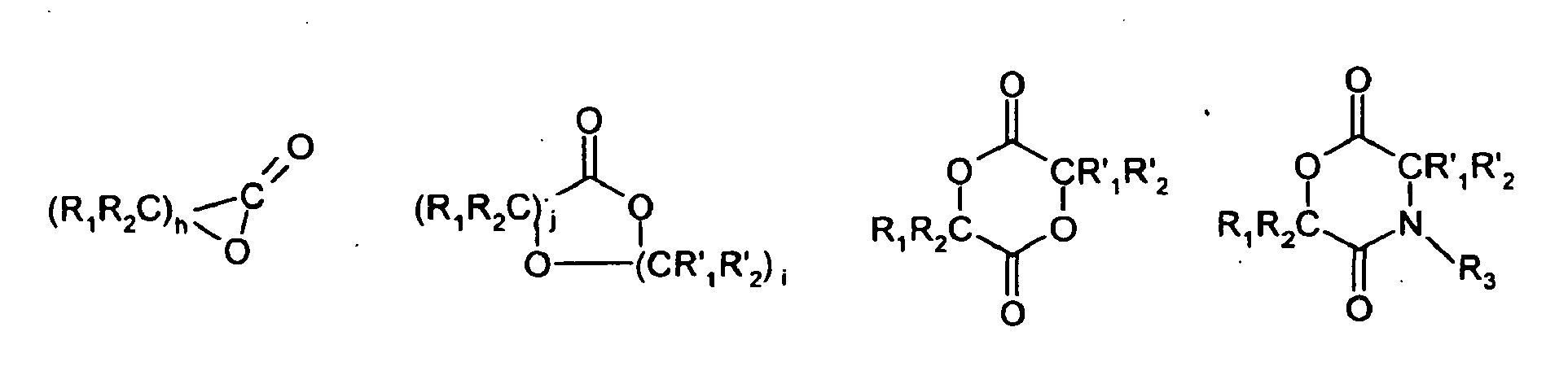
- The process according to claim 1 or 2, wherein the cyclic ester and cyclic carbonate are those in which R1, R2, R3, R'1 and R'2 are independently a hydrogen or methyl.
- The process according to claim 1-3, wherein the substituted hydrocarbyl with protected O, N and/or S functionality in CH2O-Bz (CH2)4-NH-Z1, and CH2-S-MBz wherein Bz is benzyl, Z1 is benzyloxycarbonyl, and MBz is p-methoxybenzyl.
- The process according to claim 3 or 4, wherein the cyclic ester is β-propiolactone, β-butyrolactone, δ-valerolactone, alkyl-δ-valerolactone, ε-caprolactone, alkyl-ε-caprolactone, ω-pentadecalactone, dioxanone, lacide and glycolide and the cyclic carbonate is trimethylene carbonate and 2,2-dimethyl trimethlene carbonate, and mixtures thereof.
- The process according to claim 1-5, wherein the branching agent has the following formula:
(Z)x-R1-(COOR2)y
wherein Z is a hydroxyl, thiol, primary or secondary amine group, (x+y) ≥ 3, R1 is an aliphatic or aromatic moiety with or without ester, ether, amide and/or ketone functionality, R2 is a hydrogen, (C1-C6)-alkyl optionally substituted with halogen, or aryl, such as phenyl, optionally substituted with halogen or (C1-C6)-alkyl. - The process according to claim 6, wherein Z is hydroxyl, (x+y) is 3 or 4 and x or y is 1, R2 is a hydrogen, methyl or ethyl optionally substituted with halogen, or phenyl optionally substituted with methyl or halogen.
- The process according to claim 1-7, wherein the catalyst for the ring-opening polymerization is selected from alkyls, oxides, alkoxides, halides and carboxylates of metals such as tin, titanium, aluminum, zirconium, antimony, yttrium, lanthanide, iron, manganese, calcium, magnesium, and zinc, and wherein the catalysts which include sulfonic acids, phosphoric acids, and metal oxides, alkoxides, carbonates, halides and carboxylates wherein the metals are tin, titanium, aluminum, zirconium, antimony, yttrium, lanthanide, iron, manganese, calcium, magnesium, and zinc.
- The process according to claim 1-8, wherein the catalyst for the ring opening and/or for the polycondensation is selected from stannous octoate, dialkyltine oxide, stannous chloride, dialkyltin diacetate, zinc acetate, zinc lactate, and titanium alkoxides.
- The process according to claim 1, wherein the cyclic N-carboxyanhydride (NCA) has the following general structure:

(Z)x-R1-(COOR2)y
wherein Z is a primary amine group, (x+y)≥3, R1 is an aliphatic or aromatic moiety with or without ester, ether, amide and/or ketone functionality, R2 is (C1-C6)-alkyl optionally substituted with halogen, or aryl, such as phenyl, optionally substituted with halogen or (C1-C6)-alkyl. - The process according to claim 10 wherein R represents methyl, isopropyl, isobytyl, -CH2CH2SCH3, - (CH2)4NHCO2C(CH3)3, -CH2COOCH2Ph, -CH2CH2COOCH2Ph, or -CH2Ph, wherein Ph means phenyl.
- The process according to claim 1-11, wherein the ring-opening polymerization is performed in bulk at a temperature from 60 to 220°C or in solution at a temperature from 10 to 200 °C, over a period of a few minutes up to 72 hours.
- The process according to claim 1-12, wherein in step b), the polycondensation is carried out on a mixture of macromonomers, such as obtainable in different ring-opening polymerizations of step a).
- The process according to claim 1-13, wherein the polycondensation reaction is carried out under a reduced pressure, preferably at a temperature from 110 to 240 °C and over a period of time or 4 up to 72 hours.
- The process according to claim 1-13, wherein the polycondensation step b is carried out in a solvent.
- The process according to claim 1-15, wherein the polycondensation of the macromonomer in step b) is carried out in the presence of a bi- or more functional core molecule selected from a polyol, polyamine, polycarboxylic acid, polycarboxylic ester, dextrin and/or dextran.
Priority Applications (5)
| Application Number | Priority Date | Filing Date | Title |
|---|---|---|---|
| EP05076302A EP1728811B1 (en) | 2005-06-03 | 2005-06-03 | "Branched biodegradable polymers, a macromonomer, processes for the preparation of same, and their use" |
| DE602005019546T DE602005019546D1 (en) | 2005-06-03 | 2005-06-03 | Branched polymers, a macromonomer, process for their preparation and their uses |
| AT05076302T ATE458771T1 (en) | 2005-06-03 | 2005-06-03 | BRANCHED POLYMERS, A MACROMONOMER, METHOD FOR THE PRODUCTION THEREOF AND THEIR USES |
| US11/916,261 US8492505B2 (en) | 2005-06-03 | 2006-05-31 | Branched biodegradable polymers, a macromonomer, processes for the preparation of same, and their use |
| PCT/EP2006/005235 WO2006128704A1 (en) | 2005-06-03 | 2006-05-31 | Branched biodegradable polymers, a macromonomer, processes for the preparation of same, and their use |
Applications Claiming Priority (1)
| Application Number | Priority Date | Filing Date | Title |
|---|---|---|---|
| EP05076302A EP1728811B1 (en) | 2005-06-03 | 2005-06-03 | "Branched biodegradable polymers, a macromonomer, processes for the preparation of same, and their use" |
Publications (2)
| Publication Number | Publication Date |
|---|---|
| EP1728811A1 EP1728811A1 (en) | 2006-12-06 |
| EP1728811B1 true EP1728811B1 (en) | 2010-02-24 |
Family
ID=34938325
Family Applications (1)
| Application Number | Title | Priority Date | Filing Date |
|---|---|---|---|
| EP05076302A Expired - Lifetime EP1728811B1 (en) | 2005-06-03 | 2005-06-03 | "Branched biodegradable polymers, a macromonomer, processes for the preparation of same, and their use" |
Country Status (5)
| Country | Link |
|---|---|
| US (1) | US8492505B2 (en) |
| EP (1) | EP1728811B1 (en) |
| AT (1) | ATE458771T1 (en) |
| DE (1) | DE602005019546D1 (en) |
| WO (1) | WO2006128704A1 (en) |
Families Citing this family (9)
| Publication number | Priority date | Publication date | Assignee | Title |
|---|---|---|---|---|
| WO2008011615A2 (en) | 2006-07-20 | 2008-01-24 | Orbusneich Medical, Inc. | Bioabsorbable polymeric composition for a medical device |
| CN101631513B (en) | 2006-10-20 | 2013-06-05 | 奥巴斯尼茨医学公司 | Bioabsorbable polymer composition and medical device |
| US7959942B2 (en) | 2006-10-20 | 2011-06-14 | Orbusneich Medical, Inc. | Bioabsorbable medical device with coating |
| BR112012015184B1 (en) * | 2009-12-21 | 2021-11-23 | Evonik Corporation | PROCESS FOR PREPARING A CYCLIC ESTER AND AN OLIGOMERIC ALPHA HYDROXYACID |
| US8709466B2 (en) | 2011-03-31 | 2014-04-29 | International Business Machines Corporation | Cationic polymers for antimicrobial applications and delivery of bioactive materials |
| CN104114600B (en) * | 2011-12-15 | 2016-03-02 | 道达尔研究技术弗吕公司 | For the preparation of the method for the functionality lactic acid oligomer limited |
| US20140275467A1 (en) * | 2013-03-15 | 2014-09-18 | Ethicon, Inc. | Polylactone Polymers Prepared from Monol and Diol Polymerization Initiators Processing Two or More Carboxylic Acid Groups |
| CN110483753B (en) * | 2019-05-20 | 2020-07-24 | 北京化工大学 | L ewis acid-base system controllable catalysis O-carboxylic anhydride monomer ring-opening polymerization method based on metal salt and organic base |
| CN117467103A (en) * | 2023-11-10 | 2024-01-30 | 万华化学集团股份有限公司 | An elastic polyurethane resin raw material, elastic polyurethane resin |
Family Cites Families (4)
| Publication number | Priority date | Publication date | Assignee | Title |
|---|---|---|---|---|
| GB9518950D0 (en) * | 1995-09-15 | 1995-11-15 | Solvay Interox Ltd | Polymers having improved processability |
| MY118128A (en) * | 1996-03-01 | 2004-09-30 | Basf Ag | The preparation of 1, 6-hexanediol and caprolactone |
| US7049373B2 (en) * | 1999-08-06 | 2006-05-23 | Carnegie Mellon University | Process for preparation of graft polymers |
| US7261875B2 (en) * | 2001-12-21 | 2007-08-28 | Board Of Regents, The University Of Texas System | Dendritic poly (amino acid) carriers and methods of use |
-
2005
- 2005-06-03 EP EP05076302A patent/EP1728811B1/en not_active Expired - Lifetime
- 2005-06-03 DE DE602005019546T patent/DE602005019546D1/en not_active Expired - Lifetime
- 2005-06-03 AT AT05076302T patent/ATE458771T1/en not_active IP Right Cessation
-
2006
- 2006-05-31 WO PCT/EP2006/005235 patent/WO2006128704A1/en not_active Ceased
- 2006-05-31 US US11/916,261 patent/US8492505B2/en not_active Expired - Fee Related
Also Published As
| Publication number | Publication date |
|---|---|
| US8492505B2 (en) | 2013-07-23 |
| EP1728811A1 (en) | 2006-12-06 |
| WO2006128704A1 (en) | 2006-12-07 |
| DE602005019546D1 (en) | 2010-04-08 |
| ATE458771T1 (en) | 2010-03-15 |
| US20090118459A1 (en) | 2009-05-07 |
Similar Documents
| Publication | Publication Date | Title |
|---|---|---|
| Singh et al. | Structure‐processing‐property relationship of poly (glycolic acid) for drug delivery systems 1: synthesis and catalysis | |
| Hartmann | High molecular weight polylactic acid polymers | |
| Ren | Biodegradable poly (lactic acid): synthesis, modification, processing and applications | |
| Albertsson et al. | Aliphatic polyesters: Synthesis, properties and applications | |
| JP3263710B2 (en) | Biodegradable optically active polymer and method for producing the same | |
| Lecomte et al. | Recent developments in ring-opening polymerization of lactones | |
| EP0693294B1 (en) | Bioabsorbable branched polymers containing units derived from dioxanone and medical/surgical devices manufactured therefrom | |
| CN102245673B (en) | Prepare the method for diblock and segmented copolymer | |
| Jaffredo et al. | Benzyl β-malolactonate polymers: a long story with recent advances | |
| CN109851764B (en) | A kind of preparation method of polylactone | |
| Yamaoka et al. | Synthesis and properties of multiblock copolymers consisting of poly (L‐lactic acid) and poly (oxypropylene‐co‐oxyethylene) prepared by direct polycondensation | |
| US8492505B2 (en) | Branched biodegradable polymers, a macromonomer, processes for the preparation of same, and their use | |
| Ferruti et al. | Synthesis and properties of novel block copolymers containing poly (lactic-glycolic acid) and poly (ethyleneglycol) segments | |
| CN109096478A (en) | A kind of Aliphatic Polycarbonate Copolymers and preparation method thereof | |
| CN101891881A (en) | Biodegradable polymer additive and its preparation method and application | |
| JP3408347B2 (en) | Optically active block copolymerized polyester and method for producing the same | |
| CN115260460B (en) | Copolyester and preparation method thereof | |
| GB2277324A (en) | Polyactide having a broadened molecular weight distribution | |
| Yuan et al. | Synthesis and characterization of star polylactide by ring-opening polymerization of L-lactic acid O-carboxyanhydride | |
| CN105073025B (en) | By the polylactone polymer of single methanol and the preparation of glycol polymerization initiator with two or more carboxylic acid groups | |
| JPWO2019244875A1 (en) | Lactic acid-glycolic acid copolymer and its production method | |
| ES3027957T3 (en) | A triblock copolymer, a process for obtaining thereof and uses thereof | |
| Sisson et al. | Polyesters | |
| CN107641195A (en) | The method for preparing star polymer | |
| CN101899146B (en) | Hydroxyl telechelic polyester material based on piperazine block and preparation method thereof |
Legal Events
| Date | Code | Title | Description |
|---|---|---|---|
| PUAI | Public reference made under article 153(3) epc to a published international application that has entered the european phase |
Free format text: ORIGINAL CODE: 0009012 |
|
| AK | Designated contracting states |
Kind code of ref document: A1 Designated state(s): AT BE BG CH CY CZ DE DK EE ES FI FR GB GR HU IE IS IT LI LT LU MC NL PL PT RO SE SI SK TR |
|
| AX | Request for extension of the european patent |
Extension state: AL BA HR LV MK YU |
|
| 17P | Request for examination filed |
Effective date: 20070529 |
|
| AKX | Designation fees paid |
Designated state(s): AT BE BG CH CY CZ DE DK EE ES FI FR GB GR HU IE IS IT LI LT LU MC NL PL PT RO SE SI SK TR |
|
| 17Q | First examination report despatched |
Effective date: 20071018 |
|
| GRAP | Despatch of communication of intention to grant a patent |
Free format text: ORIGINAL CODE: EPIDOSNIGR1 |
|
| GRAS | Grant fee paid |
Free format text: ORIGINAL CODE: EPIDOSNIGR3 |
|
| GRAA | (expected) grant |
Free format text: ORIGINAL CODE: 0009210 |
|
| AK | Designated contracting states |
Kind code of ref document: B1 Designated state(s): AT BE BG CH CY CZ DE DK EE ES FI FR GB GR HU IE IS IT LI LT LU MC NL PL PT RO SE SI SK TR |
|
| REG | Reference to a national code |
Ref country code: GB Ref legal event code: FG4D |
|
| REG | Reference to a national code |
Ref country code: CH Ref legal event code: EP |
|
| REG | Reference to a national code |
Ref country code: IE Ref legal event code: FG4D |
|
| REF | Corresponds to: |
Ref document number: 602005019546 Country of ref document: DE Date of ref document: 20100408 Kind code of ref document: P |
|
| REG | Reference to a national code |
Ref country code: NL Ref legal event code: T3 |
|
| LTIE | Lt: invalidation of european patent or patent extension |
Effective date: 20100224 |
|
| PG25 | Lapsed in a contracting state [announced via postgrant information from national office to epo] |
Ref country code: PT Free format text: LAPSE BECAUSE OF FAILURE TO SUBMIT A TRANSLATION OF THE DESCRIPTION OR TO PAY THE FEE WITHIN THE PRESCRIBED TIME-LIMIT Effective date: 20100625 Ref country code: IS Free format text: LAPSE BECAUSE OF FAILURE TO SUBMIT A TRANSLATION OF THE DESCRIPTION OR TO PAY THE FEE WITHIN THE PRESCRIBED TIME-LIMIT Effective date: 20100624 Ref country code: LT Free format text: LAPSE BECAUSE OF FAILURE TO SUBMIT A TRANSLATION OF THE DESCRIPTION OR TO PAY THE FEE WITHIN THE PRESCRIBED TIME-LIMIT Effective date: 20100224 |
|
| PG25 | Lapsed in a contracting state [announced via postgrant information from national office to epo] |
Ref country code: SI Free format text: LAPSE BECAUSE OF FAILURE TO SUBMIT A TRANSLATION OF THE DESCRIPTION OR TO PAY THE FEE WITHIN THE PRESCRIBED TIME-LIMIT Effective date: 20100224 Ref country code: AT Free format text: LAPSE BECAUSE OF FAILURE TO SUBMIT A TRANSLATION OF THE DESCRIPTION OR TO PAY THE FEE WITHIN THE PRESCRIBED TIME-LIMIT Effective date: 20100224 Ref country code: FI Free format text: LAPSE BECAUSE OF FAILURE TO SUBMIT A TRANSLATION OF THE DESCRIPTION OR TO PAY THE FEE WITHIN THE PRESCRIBED TIME-LIMIT Effective date: 20100224 Ref country code: PL Free format text: LAPSE BECAUSE OF FAILURE TO SUBMIT A TRANSLATION OF THE DESCRIPTION OR TO PAY THE FEE WITHIN THE PRESCRIBED TIME-LIMIT Effective date: 20100224 |
|
| PG25 | Lapsed in a contracting state [announced via postgrant information from national office to epo] |
Ref country code: EE Free format text: LAPSE BECAUSE OF FAILURE TO SUBMIT A TRANSLATION OF THE DESCRIPTION OR TO PAY THE FEE WITHIN THE PRESCRIBED TIME-LIMIT Effective date: 20100224 Ref country code: ES Free format text: LAPSE BECAUSE OF FAILURE TO SUBMIT A TRANSLATION OF THE DESCRIPTION OR TO PAY THE FEE WITHIN THE PRESCRIBED TIME-LIMIT Effective date: 20100604 Ref country code: GR Free format text: LAPSE BECAUSE OF FAILURE TO SUBMIT A TRANSLATION OF THE DESCRIPTION OR TO PAY THE FEE WITHIN THE PRESCRIBED TIME-LIMIT Effective date: 20100525 Ref country code: RO Free format text: LAPSE BECAUSE OF FAILURE TO SUBMIT A TRANSLATION OF THE DESCRIPTION OR TO PAY THE FEE WITHIN THE PRESCRIBED TIME-LIMIT Effective date: 20100224 Ref country code: SE Free format text: LAPSE BECAUSE OF FAILURE TO SUBMIT A TRANSLATION OF THE DESCRIPTION OR TO PAY THE FEE WITHIN THE PRESCRIBED TIME-LIMIT Effective date: 20100224 Ref country code: BE Free format text: LAPSE BECAUSE OF FAILURE TO SUBMIT A TRANSLATION OF THE DESCRIPTION OR TO PAY THE FEE WITHIN THE PRESCRIBED TIME-LIMIT Effective date: 20100224 Ref country code: CY Free format text: LAPSE BECAUSE OF FAILURE TO SUBMIT A TRANSLATION OF THE DESCRIPTION OR TO PAY THE FEE WITHIN THE PRESCRIBED TIME-LIMIT Effective date: 20100224 |
|
| PG25 | Lapsed in a contracting state [announced via postgrant information from national office to epo] |
Ref country code: SK Free format text: LAPSE BECAUSE OF FAILURE TO SUBMIT A TRANSLATION OF THE DESCRIPTION OR TO PAY THE FEE WITHIN THE PRESCRIBED TIME-LIMIT Effective date: 20100224 Ref country code: CZ Free format text: LAPSE BECAUSE OF FAILURE TO SUBMIT A TRANSLATION OF THE DESCRIPTION OR TO PAY THE FEE WITHIN THE PRESCRIBED TIME-LIMIT Effective date: 20100224 Ref country code: BG Free format text: LAPSE BECAUSE OF FAILURE TO SUBMIT A TRANSLATION OF THE DESCRIPTION OR TO PAY THE FEE WITHIN THE PRESCRIBED TIME-LIMIT Effective date: 20100524 |
|
| PLBE | No opposition filed within time limit |
Free format text: ORIGINAL CODE: 0009261 |
|
| STAA | Information on the status of an ep patent application or granted ep patent |
Free format text: STATUS: NO OPPOSITION FILED WITHIN TIME LIMIT |
|
| PG25 | Lapsed in a contracting state [announced via postgrant information from national office to epo] |
Ref country code: DK Free format text: LAPSE BECAUSE OF FAILURE TO SUBMIT A TRANSLATION OF THE DESCRIPTION OR TO PAY THE FEE WITHIN THE PRESCRIBED TIME-LIMIT Effective date: 20100224 Ref country code: MC Free format text: LAPSE BECAUSE OF NON-PAYMENT OF DUE FEES Effective date: 20100630 |
|
| REG | Reference to a national code |
Ref country code: CH Ref legal event code: PL |
|
| 26N | No opposition filed |
Effective date: 20101125 |
|
| PG25 | Lapsed in a contracting state [announced via postgrant information from national office to epo] |
Ref country code: LI Free format text: LAPSE BECAUSE OF NON-PAYMENT OF DUE FEES Effective date: 20100630 Ref country code: CH Free format text: LAPSE BECAUSE OF NON-PAYMENT OF DUE FEES Effective date: 20100630 Ref country code: IE Free format text: LAPSE BECAUSE OF NON-PAYMENT OF DUE FEES Effective date: 20100603 |
|
| PG25 | Lapsed in a contracting state [announced via postgrant information from national office to epo] |
Ref country code: HU Free format text: LAPSE BECAUSE OF FAILURE TO SUBMIT A TRANSLATION OF THE DESCRIPTION OR TO PAY THE FEE WITHIN THE PRESCRIBED TIME-LIMIT Effective date: 20100825 Ref country code: LU Free format text: LAPSE BECAUSE OF NON-PAYMENT OF DUE FEES Effective date: 20100603 |
|
| PG25 | Lapsed in a contracting state [announced via postgrant information from national office to epo] |
Ref country code: TR Free format text: LAPSE BECAUSE OF FAILURE TO SUBMIT A TRANSLATION OF THE DESCRIPTION OR TO PAY THE FEE WITHIN THE PRESCRIBED TIME-LIMIT Effective date: 20100224 |
|
| REG | Reference to a national code |
Ref country code: FR Ref legal event code: PLFP Year of fee payment: 11 |
|
| PG25 | Lapsed in a contracting state [announced via postgrant information from national office to epo] |
Ref country code: IT Free format text: LAPSE BECAUSE OF NON-PAYMENT OF DUE FEES Effective date: 20150603 |
|
| REG | Reference to a national code |
Ref country code: FR Ref legal event code: PLFP Year of fee payment: 12 |
|
| PGRI | Patent reinstated in contracting state [announced from national office to epo] |
Ref country code: IT Effective date: 20160711 |
|
| REG | Reference to a national code |
Ref country code: FR Ref legal event code: PLFP Year of fee payment: 13 |
|
| REG | Reference to a national code |
Ref country code: FR Ref legal event code: PLFP Year of fee payment: 14 |
|
| PGFP | Annual fee paid to national office [announced via postgrant information from national office to epo] |
Ref country code: NL Payment date: 20180626 Year of fee payment: 14 |
|
| PGFP | Annual fee paid to national office [announced via postgrant information from national office to epo] |
Ref country code: FR Payment date: 20180626 Year of fee payment: 14 |
|
| PGFP | Annual fee paid to national office [announced via postgrant information from national office to epo] |
Ref country code: DE Payment date: 20180627 Year of fee payment: 14 Ref country code: IT Payment date: 20180621 Year of fee payment: 14 Ref country code: GB Payment date: 20180627 Year of fee payment: 14 |
|
| REG | Reference to a national code |
Ref country code: DE Ref legal event code: R119 Ref document number: 602005019546 Country of ref document: DE |
|
| REG | Reference to a national code |
Ref country code: NL Ref legal event code: MM Effective date: 20190701 |
|
| GBPC | Gb: european patent ceased through non-payment of renewal fee |
Effective date: 20190603 |
|
| PG25 | Lapsed in a contracting state [announced via postgrant information from national office to epo] |
Ref country code: IT Free format text: LAPSE BECAUSE OF NON-PAYMENT OF DUE FEES Effective date: 20190603 Ref country code: DE Free format text: LAPSE BECAUSE OF NON-PAYMENT OF DUE FEES Effective date: 20200101 Ref country code: NL Free format text: LAPSE BECAUSE OF NON-PAYMENT OF DUE FEES Effective date: 20190701 Ref country code: GB Free format text: LAPSE BECAUSE OF NON-PAYMENT OF DUE FEES Effective date: 20190603 |
|
| PG25 | Lapsed in a contracting state [announced via postgrant information from national office to epo] |
Ref country code: FR Free format text: LAPSE BECAUSE OF NON-PAYMENT OF DUE FEES Effective date: 20190630 |