EP1727786B1 - Acid addition salts of 5-aminolevulinic acid or its derivatives - Google Patents
Acid addition salts of 5-aminolevulinic acid or its derivatives Download PDFInfo
- Publication number
- EP1727786B1 EP1727786B1 EP05732530A EP05732530A EP1727786B1 EP 1727786 B1 EP1727786 B1 EP 1727786B1 EP 05732530 A EP05732530 A EP 05732530A EP 05732530 A EP05732530 A EP 05732530A EP 1727786 B1 EP1727786 B1 EP 1727786B1
- Authority
- EP
- European Patent Office
- Prior art keywords
- acid
- addition salt
- acid addition
- ala
- formula
- Prior art date
- Legal status (The legal status is an assumption and is not a legal conclusion. Google has not performed a legal analysis and makes no representation as to the accuracy of the status listed.)
- Expired - Lifetime
Links
Images


Classifications
-
- A—HUMAN NECESSITIES
- A61—MEDICAL OR VETERINARY SCIENCE; HYGIENE
- A61K—PREPARATIONS FOR MEDICAL, DENTAL OR TOILETRY PURPOSES
- A61K41/00—Medicinal preparations obtained by treating materials with wave energy or particle radiation ; Therapies using these preparations
- A61K41/0057—Photodynamic therapy with a photosensitizer, i.e. agent able to produce reactive oxygen species upon exposure to light or radiation, e.g. UV or visible light; photocleavage of nucleic acids with an agent
- A61K41/0061—5-aminolevulinic acid-based PDT: 5-ALA-PDT involving porphyrins or precursors of protoporphyrins generated in vivo from 5-ALA
-
- A—HUMAN NECESSITIES
- A61—MEDICAL OR VETERINARY SCIENCE; HYGIENE
- A61P—SPECIFIC THERAPEUTIC ACTIVITY OF CHEMICAL COMPOUNDS OR MEDICINAL PREPARATIONS
- A61P31/00—Antiinfectives, i.e. antibiotics, antiseptics, chemotherapeutics
-
- A—HUMAN NECESSITIES
- A61—MEDICAL OR VETERINARY SCIENCE; HYGIENE
- A61P—SPECIFIC THERAPEUTIC ACTIVITY OF CHEMICAL COMPOUNDS OR MEDICINAL PREPARATIONS
- A61P35/00—Antineoplastic agents
-
- A—HUMAN NECESSITIES
- A61—MEDICAL OR VETERINARY SCIENCE; HYGIENE
- A61P—SPECIFIC THERAPEUTIC ACTIVITY OF CHEMICAL COMPOUNDS OR MEDICINAL PREPARATIONS
- A61P43/00—Drugs for specific purposes, not provided for in groups A61P1/00-A61P41/00
-
- C—CHEMISTRY; METALLURGY
- C07—ORGANIC CHEMISTRY
- C07C—ACYCLIC OR CARBOCYCLIC COMPOUNDS
- C07C229/00—Compounds containing amino and carboxyl groups bound to the same carbon skeleton
- C07C229/02—Compounds containing amino and carboxyl groups bound to the same carbon skeleton having amino and carboxyl groups bound to acyclic carbon atoms of the same carbon skeleton
- C07C229/04—Compounds containing amino and carboxyl groups bound to the same carbon skeleton having amino and carboxyl groups bound to acyclic carbon atoms of the same carbon skeleton the carbon skeleton being acyclic and saturated
- C07C229/22—Compounds containing amino and carboxyl groups bound to the same carbon skeleton having amino and carboxyl groups bound to acyclic carbon atoms of the same carbon skeleton the carbon skeleton being acyclic and saturated the carbon skeleton being further substituted by oxygen atoms
Definitions
- the present invention relates to certain salts of 5-aminolevulinic acid esters (5-ALA esters), their preparation and their use, in particular as photosensitizing agents in photochemotherapy or diagnosis.
- the invention particularly relates to new salts of 5-ALA esters.
- 5-aminolevulinic acid and its derivatives for example esters such as 5-ALA esters.
- esters such as 5-ALA esters.
- esters such as 5-ALA esters.
- esters such as 5-ALA esters.
- WO91/01727 WO96/28412 and WO02/10120 .
- such compounds have only been proposed for clinical use in the form of their hydrochloride salts, for example as ALA-HCl in Levulan® (available from Dusa Pharmaceuticals Inc., Wilmington, US), as ALA methyl ester HCl in Metvix® (PhotoCure ASA, Oslo, Norway) and as ALA hexyl ester HCl in Hexvix® (also PhotoCure ASA).
- photochemotherapy with ALA and ALA derivatives is clinically useful in the treatment of a wide range of pre-cancerous and cancerous diseases and other conditions, such compounds nevertheless exhibit some limitations when formulated for use as pharmaceuticals, e.g. in PDT.
- these compounds in particular, ALA and its hydrochloride salt
- such compounds may also be associated with problems relating to their physicochemical properties, for example their crystalline properties, solubility or hygroscopic properties.
- the invention provides an acid addition salt of a 5-aminolevulinic acid ester (5-ALA ester) with an acid which is a sulfonic acid or a sulfonic acid derivative, wherein said 5-ALA ester is a compound of formula X: R 2 2 N-CH 2 COCH 2 -CH 2 CO-OR 1 (X) (wherein R 1 represents an unsubstituted straight-chained C 1-6 alkyl group; R 2 each independently represents a hydrogen atom or an optionally substituted straight-chained, branched or cyclic alkyl group containing up to 20 carbon atoms which may optionally be interrupted by one or more -O-, -NR 3 -, -S- or -PR 3 - groups; and R 3 is a hydrogen atom or a C 1-6 alkyl group).
- the acid addition salts in accordance with the invention are pharmaceutically acceptable.
- the acid from which the salts of the invention are derived should themselves be pharmaceutically acceptable.
- the invention also provides such compounds (i.e. acid addition salts) for use as pharmaceuticals, e.g. pharmaceuticals for use in photochemotherapy or diagnosis.
- sulfonic acid is intended to include any organic compound containing at least one -SO 3 H group. Preferably, this may comprise 1, 2 or 3 -SO 3 H groups, most preferably 1 or 2, e.g. 1.
- derivatives is intended to encompass any such compounds containing at least one (preferably 1, 2 or 3, most preferably 1 or 2, e.g. 1) -SO 3 X group (where X is a physiologically tolerable cation, such as a sodium, calcium, potassium, magnesium or meglumine cation).
- Salts according to the invention will typically be derived from the ALA ester and a mono-protic acid, e.g. a sulfonic acid such as methanesulfonic acid, thereby forming a 1:1 salt.
- a mono-protic acid e.g. a sulfonic acid such as methanesulfonic acid
- salts may be formed between the ALA ester and a di- or tri-protic acid, e.g. a sulfonic acid such as ethane-1,2-disulfonic acid.
- the resulting compound may have a stoichiometric ratio other than 1:1, for example 2:1 (ALA ester:acid) or 3:1 (ALA ester:acid), or may comprise a mixture of salts having varying levels of stoichiometry.
- Polyprotic acids are also capable of forming other salts with the ALA ester.
- polyprotic acids can also form other salts, e.g. 1:1 salts, with the ALA esters in the form of salts with other physiologically acceptable bases, such as sodium hydroxide, calcium hydroxide, potassium hydroxide and meglumine.
- the present invention provides compounds of formula I: (wherein R is a hydrogen atom or an optionally substituted C 1-20 alkyl group or an aryl group of up to 20 carbon atoms; and R 1 and R 2 are as hereinbefore defined.
- salts according to the invention that are formed between the ALA ester and a sulfonic acid compound comprise a single sulfonic acid moiety, i.e. a mono-protic acid.
- compounds having more than one sulfonic acid moiety e.g. 2 or 3 such groups
- substituents which may be present in group R therefore include one or more, preferably one, - SO 2 OH, -SO 2 OX (where X is as hereinbefore defined) or - SO 2 O ⁇ group.
- Representative examples of disulfonic acids which may be used to prepare the salts according to the invention include ethane-1,2-disulfonic acid and napthalene-1,5-disulfonic acid.
- alkyl groups contain up to 20, but preferably up to 15, e.g. up to 12 carbon atoms. However, alkyl groups containing up to 10, e.g. up to 5, more preferably 1, 2 or 3 carbon atoms are preferred. In particular, linear alkyl groups having up to 10 carbon atoms are preferred, e.g. methyl, ethyl or propyl groups. Although these groups may be substituted or unsubstituted, preferably these will be unsubstituted.
- alkyl groups are those containing up to 20, e.g. up to 10 carbon atoms. In particular, saturated hydrocarbons having up to 10 carbon atoms are preferred, e.g. hexyl, heptyl or octyl groups. Lower alkyls such as methyl, ethyl and propyl may, however, alternatively be used.
- Suitable alkyl groups may be linear or branched. Representative examples of suitable branched alkyl groups include 2-methylpentyl and 4-methylpentyl. Generally linear, non-branched alkyl groups are preferred.
- substituted alkyl groups may be mono or poly-substituted.
- suitable groups R 2 include, for example, unsubstituted alkyl, alkoxyalkyl, hydroxyalkoxyalkyl, polyhydroxyalkyl, hydroxy poly alkyleneoxyalkyl, oxaalkyl, polyoxaalkyl and the like.
- Representative substituted alkyl groups R 2 include alkoxymethyl, alkoxyethyl and alkoxypropyl groups or acyloxymethyl, acyloxyethyl and acyloxypropyl groups, e.g. pivaloyloxymethyl.
- Preferred compounds according to the invention include those of formula I wherein R 2 represents an unsubstituted alkyl group or an aryl substituted alkyl group (e.g. a benzyl group), in which the aryl group itself may also be substituted as described herein.
- R 1 is a C 1 or C 6 alkyl group.
- Particularly preferably such compounds are salts of ALA esters, i.e. R 1 is as described above, and at the N-terminal both R 2 groups are hydrogen atoms.
- Most preferred compounds in accordance with the invention are the sulfonic acid salts or sulfonic acid derivative salts of methyl ALA ester and hexyl ALA ester.
- Especially preferred compounds of the invention include the acid addition salts of the ALA esters with a sulfonic acid selected from the following:
- the invention can thus be seen to provide a process for preparing the compounds of the invention, said process comprising reacting an ALA ester with a sulfonic acid or sulfonic acid derivative.
- a one-pot reaction may be used which involves reaction of 5-aminolevulinic acid, or an esterifiable derivative thereof, with an alkanol or an ester-forming derivative thereof (e.g. with an alkanol) in the presence of a sulfonic acid or sulfonic acid derivative.
- an alkanol or an ester-forming derivative thereof e.g. with an alkanol
- this aspect of the invention provides a process for the preparation of an acid addition salt as hereinbefore described (e.g. a compound of formula I), said process comprising the step of reacting a compound of formula II: R 2 2 N-CH 2 COCH 2 -CH 2 COY (II) (wherein
- Such reactions may conveniently be carried out in a solvent or mixture of solvents such as water, acetone, methanol, ethanol or tetrahydrofuran etc., preferably water at temperatures up to 100°C, preferably at ambient temperature.
- solvents such as water, acetone, methanol, ethanol or tetrahydrofuran etc.
- the conditions for the reactions will depend on the reagents used and the conditions may be chosen such that maximum yield of the salt is obtained.
- the ion-exchange method typically involves a first step of passing a solution containing a hydrochloride salt of the ALA ester through an ion-exchange column and a second step of adding the eluate from the column into a solution of an acid (e.g. a sulfonic acid).
- Any ion exchange resin capable of exchanging C1 - for a basic anion e.g. a hydroxide ion
- Suitable ion-exchangers include strongly basic anion exchange resins (e.g. Dowex® 11, Amberlyst® A26(OH) and the like).
- the chloride ions of the hydrochloride salt of the ALA ester are exchanged for basic (e.g. hydroxide) ions during passage through the column. This provides the free base which is then neutralised with a sulfonic acid or sulfonic acid derivative, thereby simultaneously forming the corresponding sulfonic acid addition salt of the ALA ester.
- the invention provides a process for the preparation of an acid addition salt in accordance with the invention (e.g. a compound of formula I), said process comprising:
- a hydrochloride salt of the ALA ester is reacted with the silver salt of a sulfonic acid or a sulfonic acid derivative in a solvent in which AgCl is insoluble (e.g. water).
- suitable silver salts include silver methanesulfonate, silver p-toluenesulfonate, silver benzenesulfonate, etc.
- silver may be replaced by any other cation which forms an insoluble compound with chloride ions in a solvent in which the hydrochloride salt of the ALA ester and the appropriate acid addition salt (e.g. sulfonic acid salt) are at least partially (e.g. substantially) soluble.
- ALA for example, is available from Sigma. Methods for the preparation of ALA esters are described for example in WO96/28412 and WO02/10120 , the contents of which are incorporated herein by reference.
- the compounds of the invention and for use according to the invention have valuable pharmacological properties, namely as inducers of intracellular porphyrins with photosensitizing properties which renders them useful as photochemotherapeutic agents.
- the compounds of the invention have a number of advantages over known salts of ALA and ALA esters, e.g. the hydrochloride salts.
- the compounds of the invention are generally more stable and less hygroscopic; this has the advantage of long term storage of pharmaceutical preparations without any significant degradation of the active substance which could lead to loss of efficacy.
- the acid addition salts of the invention have surprisingly been found to have improved photosensitizing properties; fluorescence levels following administration of the sulfonic acid salts are higher than with the corresponding hydrochloride salts.
- an acid addition salt of the invention for the preparation of a therapeutic agent for use in photochemotherapy, and especially for the treatment of disorders or abnormalities of external or internal surfaces of the body which are responsive to photochemotherapy.
- the internal and external body surfaces which may be treated according to the invention include the skin and all other epithelial and serosal surfaces, including for example mucosa, the linings of organs eg. the respiratory, gastro-intestinal and genito-urinary tracts, and glands with ducts which empty onto such surfaces (e.g. liver, hair follicles with sebaceous glands, mammary glands, salivary glands and seminal vesicles).
- such surfaces include for example the lining of the vagina, the endometrium and the urothelium.
- Such surfaces may also include cavities formed in the body following excision of diseased or cancerous tissue eg. brain cavities following the excision of tumours such as gliomas.
- Exemplary surfaces thus include: (i) skin and conjunctiva; (ii) the lining of the mouth, pharynx, oesophagus, stomach, intestines and intestinal appendages, rectum, and anal canal; (iii) the lining of the nasal passages, nasal sinuses, nasopharynx, trachea, bronchi, and bronchioles; (iv) the lining of the ureters, urinary bladder, and urethra; (v) the lining of the vagina, uterine cervix, and uterus; (vi) the parietal and visceral pleura; (vii) the lining of the peritoneal and pelvic cavities, and the surface of the organs contained within those cavities; (viii) the dura mater and meninges; (ix) any tumors in solid tissues that can be made accessible to photoactivating light e.g. either directly, at time of surgery, or via an optical fibre inserted
- Ointments, gels and creams may, for example, be formulated with an aqueous or oily base with the addition of suitable thickening and/or gelling agents.
- Lotions may be formulated with an aqueous or oily base and will, in general, also contain one or more emulsifying, dispersing, suspending, thickening or colouring agents.
- Powders may be formed with the aid of any suitable powder base.
- Drops and solutions may be formulated with an aqueous or non-aqueous base also comprising one or more dispersing, solubilising or suspending agents. Aerosol sprays are conveniently delivered from pressurised packs, with the use of a suitable propellant.
- compositions may be provided in a form adapted for oral or parenteral administration, for example by intradermal, subcutaneous, intraperitoneal or intravenous injection.
- Alternative pharmaceutical forms thus include plain or coated tablets, capsules, suspensions and solutions containing the active component optionally together with one or more inert conventional carriers and/or diluents, e.g.
- compositions may additionally include lubricating agents, wetting agents, emulsifying agents, suspending agents, preserving agents, sweetening agents, flavouring agents, adsorption enhancers, e.g. surface penetrating agents as mentioned below, and the like.
- the compositions of the invention may be formulated so as to provide quick, sustained or delayed release of the active ingredient after administration to the patient by employing procedures well known in the art. Solubilizing and/or stabilizing agents may also be used, e.g. cyclodextrins (CD) ⁇ , ⁇ , ⁇ and HP- ⁇ cyclodextrin.
- CD cyclodextrins
- compositions may be in any appropriate dosage form, for example as an emulsion or in liposomes, niosomes, microspheres, nanoparticles or the like.
- the compound of the invention may then be absorbed to, incorporated in or bound to these forms.
- concentration of the compounds of the invention in the compositions depends upon the nature of the compound, the composition, mode of administration, the condition to be treated and the patient and may be varied or adjusted according to choice. Generally however, concentration ranges of 0.01 to 50%, e.g. 0.05 to 20%, e.g. 1-10% (w/w) are suitable. For therapeutic applications concentration ranges of 0.1 to 50% have been found to be suitable, e.g. 0.2 to 30% (w/w). Lower doses may be used when the compounds are highly lipophilic, e.g. in a concentration range of 0.01 to 10%, e.g. 0.02 to 1% (w/w).
- Topical administration to inaccessible sites may be achieved by techniques known in the art, e.g. by the use of catheters or other appropriate drug delivery systems.
- the area treated is exposed to light to achieve the photochemotherapeutic effect.
- the length of time following administration, at which the light exposure takes place will depend on the nature of the composition, the condition to be treated and the form of administration. This can generally be in the order of 0.5 to 48 hours, e.g. 1 to 10 hours.
- the acid addition salts of the invention can be used in a method of photochemotherapeutic treatment of disorders or abnormalities of external or internal surfaces of the body, comprising administering to the affected surfaces, an acid addition salt or composition as hereinbefore defined, and exposing said surfaces to light (e.g. white light), preferably to light in the wavelength region 300-800 nm (e.g. blue light in the wavelength region 380-440 nm). Alternatively, light in the wavelength region 500-700 nm may be used.
- light e.g. white light
- the wavelength region 300-800 nm e.g. blue light in the wavelength region 380-440 nm
- light in the wavelength region 500-700 nm may be used.
- the compounds of the invention may be formulated and/or administered with other photosensitizing agents, for example Photofrin®, or with other active components which may enhance the photochemotherapeutic effect.
- photosensitizing agents for example Photofrin®
- chelating agents may beneficially be included in order to enhance accumulation of the potent photosensitizer protoporphyrin IX (Pp); the chelation of iron by the chelating agents prevents its incorporation into Pp to form haem by the action of the enzyme ferrochelatase, thereby leading to a build-up of Pp. In this way, the photosensitizing effect is enhanced.
- Aminopolycarboxylic acid chelating agents are particularly suitable for use in this regard, including any of the chelants described in the literature for metal detoxification or for the chelation of paramagnetic metal ions in magnetic resonance imaging contrast agents. Particular mention may be made of EDTA, CDTA (cyclohexane diamine tetraacetic acid), DTPA and DOTA and well known derivatives/analogues thereof. EDTA is preferred. To achieve the iron-chelating effect, desferrioxamine and other siderophores may also be used, e.g. in conjunction with aminopolycarboxylic acid chelating agents such as EDTA.
- the chelating agent may conveniently be used at a concentration of 0.05 to 20% e.g. 0.1 to 10% (w/w).
- surface-penetration assisting agents and especially dialkylsuphoxides such as dimethylsulphoxide (DMSO) may have a beneficial effect in enhancing the photochemotherapeutic effect.
- Surface-penetration assisting agents for use in the invention may be any of the skin-penetration assisting agents described in the pharmaceutical literature e.g. chelators (e.g. EDTA), surfactants (e.g. sodium dodecyl sulphate), non-surfactants, bile salts (e.g. sodium deoxycholate) and fatty acids (e.g. oleic acid).
- Suitable surface penetrating assisting agents include HPE -101 (available from Hisamitsu), DMSO and other dialkylsulphoxides, in particular n-decylmethyl-sulphoxide (NDMS), dimethylsulphacetamide, dimethylformamide (DMFA), dimethylacetamide, glycols, various pyrrolidone derivatives ( Woodford et al., J. Toxicol. Cut. & Ocular Toxicology, 1986, 5: 167-177 ), and Azone® ( Stoughton et al., Drug Dpv. Ind. Pharm. 1983, 9: 725-744 ), or mixtures thereof.
- the surface penetration agent may conveniently be provided in a concentration range of 0.2 to 50% (w/w), e.g. about 10% (w/w).
- compositions of the invention may additionally be formulated and/or administered with other agents, to improve the efficacy of PDT.
- angiogenesis inhibitors anti-angiogenic drugs
- compositions of the invention in PDT may be used together with compositions of the invention in PDT to further damage the vascular system of the tumour.
- Angiogenesis inhibitors which may be used include TNP-470 (AGM-1470, a synthetic analogue of a fungal secretion product called fumagillin; Takeda Chemical Industries Ltd., Osaka, Japan), angiostatin (Surgical Research Lab. at Children's Hospital Medical Center of Harvard Medical School) and integrin ⁇ v ⁇ 3 antagonists (e.g. monoclonal antibody to integrin ⁇ v ⁇ 3 , The Scripps Research Institute, LaJolla, CA).
- TNP-470 AGM-1470, a synthetic analogue of a fungal secretion product called fumagillin
- angiostatin Surgical Research Lab. at Children's Hospital Medical Center of Harvard Medical School
- integrin ⁇ v ⁇ 3 antagonists e.g. monoclonal antibody to integrin ⁇ v ⁇ 3 , The Scripps Research Institute, LaJolla, CA).
- Glucose has also been found to assist PDT when applied either topically or systemically.
- the formulation e.g. a cream, may contain 0.01% to 10% glucose (w/w).
- the compounds for use in the invention may be co-administered with such other optional agents, for example in a single composition or they may be administered sequentially or separately.
- a particularly beneficial photochemotherapeutic effect may be obtained by pre-treatment with the surface-penetration assisting agent in a separate step, prior to administration of the compounds of the invention.
- a pre-treatment with the surface-penetration assisting agent, followed by administration of the photochemotherapeutic agent in conjunction with the surface-penetration assisting agent may be beneficial.
- a surface-penetration assisting agent is used in pre-treatment this may be used at high concentrations, e.g. up to 100% (w/w). If such a pre-treatment step is employed, the photochemotherapeutic agent may subsequently be administered up to several hours following pre-treatment e.g. at an interval of 5-60 minutes following pre-treatment.
- the invention thus provides a product comprising an acid addition salt of the invention, together with at least one surface-penetration assisting agent, and optionally one or more chelating agents as a combined preparation for simultaneous, separate or sequential use in treating disorders or abnormalities of external or internal surfaces of the body which are responsive to photochemotherapy.
- this aspect of the invention also provides a kit for use in photochemotherapy of disorders or abnormalities of external or internal surfaces of the body comprising:
- the method of therapy using compounds as described hereinbefore inevitably involves the provision of intracellular porphyrins which fluoresce at the site of the disorder or abnormality to be treated. Whilst the intensity of this fluorescence may be used to eliminate abnormal cells, the localization of the fluorescence may be used to visualize the size, extent and situation of the abnormality or disorder. Fluorescence may be generated by excitation with blue light (e.g. light in the wavelength region 350-440 nm) and measured in the wavelength region 550-750 nm.
- blue light e.g. light in the wavelength region 350-440 nm
- the abnormality or disorder thus identified or confirmed at the site of investigation may then be treated through alternative therapeutic techniques e.g. surgical or chemical treatment, or by the method of therapy of the invention by continued build up of fluorescence or through further application of compounds of the invention at the appropriate site.
- diagnostic techniques may require lower levels of fluorescence for visualization than used in therapeutic treatments.
- concentration ranges of 0.2 to 30% e.g. 1-5% (w/w) are suitable.
- the compounds of the invention may also be used for in vitro diagnostic techniques, for example for examination of the cells contained in body fluids.
- the higher fluorescence associated with non-normal tissue may conveniently be indicative of an abnormality or disorder.
- This method is highly sensitive and may be used for early detection of abnormalities or disorders, for example bladder or lung carcinoma by examination of the epithelial cells in urine or sputum samples, respectively.
- Other useful body fluids which may be used for diagnosis in addition to urine and sputum include blood, semen, tears, spinal fluid etc.
- Tissue samples or preparations may also be evaluated, for example biopsy tissue or bone marrow samples.
- the present invention thus extends to the use of compounds of the invention for diagnosis according to the aforementioned methods for photochemotherapy, and products and kits for performing said diagnosis.
- Example 3 does not form part of the invention, but illustrates the silver salt method which is used in other examples to prepare compounds which are in accordance with the invention.
- Example 8 Preparation of formulations is described in Example 8. The same experimental system as in Example 9 was used, and the results are shown in Figure 2 .
- Example 11 Hygroscopicity of hexyl 5-amino-4-oxopentanoate hydrochloride, methanesulfonate, and toluenesulfonate
- Example 13 Hygroscopicity of hexyl 5-amino-4-oxopentanoate hydrochloride, methanesulfonate, and toluenesulfonate
Landscapes
- Health & Medical Sciences (AREA)
- Chemical & Material Sciences (AREA)
- Organic Chemistry (AREA)
- Life Sciences & Earth Sciences (AREA)
- Veterinary Medicine (AREA)
- Medicinal Chemistry (AREA)
- Pharmacology & Pharmacy (AREA)
- Animal Behavior & Ethology (AREA)
- General Health & Medical Sciences (AREA)
- Public Health (AREA)
- General Chemical & Material Sciences (AREA)
- Chemical Kinetics & Catalysis (AREA)
- Nuclear Medicine, Radiotherapy & Molecular Imaging (AREA)
- Biochemistry (AREA)
- Epidemiology (AREA)
- Molecular Biology (AREA)
- Communicable Diseases (AREA)
- Oncology (AREA)
- Bioinformatics & Cheminformatics (AREA)
- Engineering & Computer Science (AREA)
- Acyclic And Carbocyclic Compounds In Medicinal Compositions (AREA)
- Organic Low-Molecular-Weight Compounds And Preparation Thereof (AREA)
- Pharmaceuticals Containing Other Organic And Inorganic Compounds (AREA)
- Medicines That Contain Protein Lipid Enzymes And Other Medicines (AREA)
- Medicines Containing Antibodies Or Antigens For Use As Internal Diagnostic Agents (AREA)
Abstract
Description
- The present invention relates to certain salts of 5-aminolevulinic acid esters (5-ALA esters), their preparation and their use, in particular as photosensitizing agents in photochemotherapy or diagnosis. The invention particularly relates to new salts of 5-ALA esters.
- Photochemotherapy, or photodynamic therapy (PDT) as it is also known, is a technique for the treatment of various abnormalities or disorders of the skin or other epithelial organs or mucosa, especially cancers or pre-cancerous lesions, as well as certain non-malignant lesions, for example skin complaints such as psoriasis. Photochemotherapy involves the application of photosensitizing (photochemotherapeutic) agents to the affected area of the body, followed by exposure to photoactivating light in order to activate the photosensitizing agents and convert them into cytotoxic form, whereby the affected cells are killed or their proliferative potential diminished.
- A range of photosensitizing agents are known, including notably the psoralens, the porphyrins (e.g. Photofrin®), the chlorins and the phthalocyanins. Such drugs become toxic when exposed to light.
- Amongst the most clinically useful photosensitizing agents known in the art are 5-aminolevulinic acid and its derivatives, for example esters such as 5-ALA esters. These are described, for example, in
WO91/01727 WO96/28412 WO02/10120 - Although photochemotherapy with ALA and ALA derivatives is clinically useful in the treatment of a wide range of pre-cancerous and cancerous diseases and other conditions, such compounds nevertheless exhibit some limitations when formulated for use as pharmaceuticals, e.g. in PDT. For example, these compounds (in particular, ALA and its hydrochloride salt) tend to be unstable in pharmaceutical formulations. In some cases, such compounds may also be associated with problems relating to their physicochemical properties, for example their crystalline properties, solubility or hygroscopic properties.
- Thus, a need therefore exists for alternative photochemotherapeutic agents. In particular, a need exists for such agents which are better pharmaceuticals, for example photochemotherapeutic agents which have improved physicochemical properties (e.g. which are more stable, less hygroscopic, etc.) compared to those known in the art. It is also desirable that such agents should exhibit equivalent, or preferably, improved efficacy (i.e. an equivalent or enhanced photochemotherapeutic effect) over known photosensitizers when used in PDT.
- Surprisingly, it has now been found that certain salts of 5-aminolevulinic acid esters possess desirable properties for use in pharmaceutical formulations (e.g. formulations for use in photochemotherapy) and that a number of such salts have improved properties relative to ALA compounds known and used in the art. Specifically, it has been found that acid addition salts of certain ALA esters with an acid which is a sulfonic acid or a sulfonic acid derivative are particularly suitable for use in pharmaceutical formulations, e.g. formulations for use in photochemotherapy. For example, such compounds have now been found to possess improved physicochemical properties, such as enhanced stability (e.g. lower hygroscopicity), compared to known ALA compounds. Certain such compounds have also been found to exhibit improved efficacy (i.e. an enhanced photochemotherapeutic effect) over ALA compounds which are presently in clinical use, for example relative to the corresponding hydrochloride salts of ALA and of ALA esters.
- Thus, viewed from one aspect the invention provides an acid addition salt of a 5-aminolevulinic acid ester (5-ALA ester) with an acid which is a sulfonic acid or a sulfonic acid derivative, wherein said 5-ALA ester is a compound of formula X:
R2 2N-CH2COCH2-CH2CO-OR1 (X)
(wherein R1 represents an unsubstituted straight-chained C1-6 alkyl group;
R2 each independently represents a hydrogen atom or an optionally substituted straight-chained, branched or cyclic alkyl group containing up to 20 carbon atoms which may optionally be interrupted by one or more -O-, -NR3-, -S- or -PR3- groups; and R3 is a hydrogen atom or a C1-6 alkyl group). - Preferably, the acid addition salts in accordance with the invention are pharmaceutically acceptable. Thus, it is preferred that the acid from which the salts of the invention are derived should themselves be pharmaceutically acceptable.
- In a further aspect the invention also provides such compounds (i.e. acid addition salts) for use as pharmaceuticals, e.g. pharmaceuticals for use in photochemotherapy or diagnosis.
- As used herein, the terms "5-aminolevulinic acid", "ALA" and "5-ALA" are used interchangeably and encompass 5-amino-4-oxopentanoic acid. Esters of 5-ALA are generally known and described in the prior art, e.g. in
WO96/28412 WO02/10120 - As used herein, the term "sulfonic acid" is intended to include any organic compound containing at least one -SO3H group. Preferably, this may comprise 1, 2 or 3 -SO3H groups, most preferably 1 or 2, e.g. 1. When used in relation to sulfonic acid, the term "derivatives" is intended to encompass any such compounds containing at least one (preferably 1, 2 or 3, most preferably 1 or 2, e.g. 1) -SO3X group (where X is a physiologically tolerable cation, such as a sodium, calcium, potassium, magnesium or meglumine cation).
- Salts according to the invention will typically be derived from the ALA ester and a mono-protic acid, e.g. a sulfonic acid such as methanesulfonic acid, thereby forming a 1:1 salt. Alternatively, salts may be formed between the ALA ester and a di- or tri-protic acid, e.g. a sulfonic acid such as ethane-1,2-disulfonic acid. In the case where an acid having more than one acidic proton is used, the resulting compound may have a stoichiometric ratio other than 1:1, for example 2:1 (ALA ester:acid) or 3:1 (ALA ester:acid), or may comprise a mixture of salts having varying levels of stoichiometry. Polyprotic acids are also capable of forming other salts with the ALA ester. Moreover, polyprotic acids can also form other salts, e.g. 1:1 salts, with the ALA esters in the form of salts with other physiologically acceptable bases, such as sodium hydroxide, calcium hydroxide, potassium hydroxide and meglumine.
- More preferably, the present invention provides compounds of formula I:

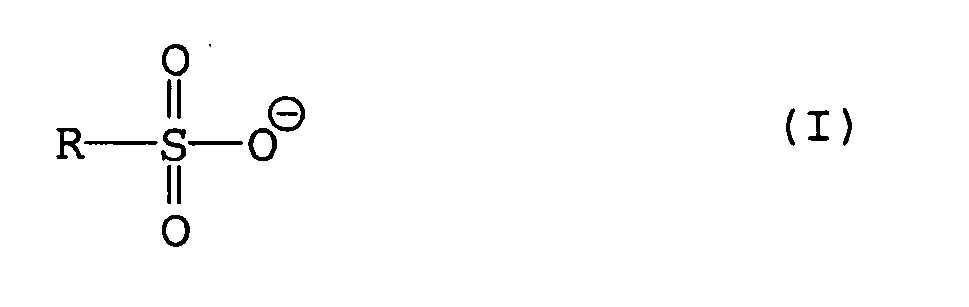
R is a hydrogen atom or an optionally substituted C1-20 alkyl group or an aryl group of up to 20 carbon atoms; and R1 and R2 are as hereinbefore defined. - As used herein, unless specifically stated otherwise, the term "alkyl" includes any long or short chain, straight-chained, branched or cyclic aliphatic, saturated or unsaturated hydrocarbon group. Optionally, this group may be substituted (e.g. mono- or poly-substituted), for example by hydroxy, alkoxy, acyloxy, nitro, alkoxycarbonyloxy, amino, aryl, oxo, halo (e.g. fluoro or chloro) groups, -SR3, -NR3 2, or -PR3 2 groups (in which R3 is as hereinbefore defined). The unsaturated alkyl groups may be mono- or polyunsaturated and include both alkenyl and alkynyl groups.
- Preferred compounds in accordance with the invention are those of formula I in which R is an optionally substituted (i.e. mono- or poly-substituted), linear, branched or cyclic (e.g. mono- or bicyclic, bridged or non-bridged) alkyl group which may contain up to 20 carbon atoms, or an optionally substituted (i.e. mono- or poly-substituted) aryl group, which preferably contains up to 20 carbon atoms. Preferred substituents which may be present in group R include C1-6alkyl (e.g. methyl), hydroxy, alkoxy, acyloxy, nitro, alkoxycarbonyloxy, amino, aryl, oxo and halo (e.g. fluoro or chloro).
- In general, salts according to the invention that are formed between the ALA ester and a sulfonic acid compound comprise a single sulfonic acid moiety, i.e. a mono-protic acid. However, as noted above, compounds having more than one sulfonic acid moiety (e.g. 2 or 3 such groups) are contemplated within the scope of the invention. Other substituents which may be present in group R therefore include one or more, preferably one, - SO2OH, -SO2OX (where X is as hereinbefore defined) or - SO2Oσ group. Representative examples of disulfonic acids which may be used to prepare the salts according to the invention include ethane-1,2-disulfonic acid and napthalene-1,5-disulfonic acid.
- In the case of group R, alkyl groups contain up to 20, but preferably up to 15, e.g. up to 12 carbon atoms. However, alkyl groups containing up to 10, e.g. up to 5, more preferably 1, 2 or 3 carbon atoms are preferred.
In particular, linear alkyl groups having up to 10 carbon atoms are preferred, e.g. methyl, ethyl or propyl groups. Although these groups may be substituted or unsubstituted, preferably these will be unsubstituted. - In the case of group R, preferred aryl groups include optionally substituted phenyl or napthyl groups. Preferably the aryl group is substituted, for example by one or more (e.g. by one, two or three) substituents which may include C1-6 alkyl groups (preferably C1-4 alkyl, e.g. methyl), alkoxy (e.g. methoxy), nitro, halo (e.g. fluoro or chloro), -SO3H, -SO3X (where X is as hereinbefore defined), -SO2O- or trifluoromethyl groups. Representative examples of aryl groups include toluene (e.g. p-toluene), benzene, napthalene and napthalene sulfonate (e.g. 2-napthalenesulfonate).
- In the case of R2, alkyl groups are those containing up to 20, e.g. up to 10 carbon atoms. In particular, saturated hydrocarbons having up to 10 carbon atoms are preferred, e.g. hexyl, heptyl or octyl groups. Lower alkyls such as methyl, ethyl and propyl may, however, alternatively be used. Suitable alkyl groups may be linear or branched. Representative examples of suitable branched alkyl groups include 2-methylpentyl and 4-methylpentyl. Generally linear, non-branched alkyl groups are preferred.
- The substituted alkyl groups may be mono or poly-substituted. Thus suitable groups R2 include, for example, unsubstituted alkyl, alkoxyalkyl, hydroxyalkoxyalkyl, polyhydroxyalkyl, hydroxy poly alkyleneoxyalkyl, oxaalkyl, polyoxaalkyl and the like.
- Representative substituted alkyl groups R2 include alkoxymethyl, alkoxyethyl and alkoxypropyl groups or acyloxymethyl, acyloxyethyl and acyloxypropyl groups, e.g. pivaloyloxymethyl.
- Preferred compounds according to the invention include those of formula I wherein R2 represents an unsubstituted alkyl group or an aryl substituted alkyl group (e.g. a benzyl group), in which the aryl group itself may also be substituted as described herein. Especially, R1 is a C1 or C6 alkyl group. Particularly preferably such compounds are salts of ALA esters, i.e. R1 is as described above, and at the N-terminal both R2 groups are hydrogen atoms.
- Particularly preferred compounds in accordance with the invention are those compounds of formula I in which R1 represents an unsubstituted C1-6 alkyl group and/or each R2 represents a hydrogen atom.
- Most preferred compounds in accordance with the invention are the sulfonic acid salts or sulfonic acid derivative salts of methyl ALA ester and hexyl ALA ester.
- Especially preferred compounds of the invention include the acid addition salts of the ALA esters with a sulfonic acid selected from the following:
- napthalene-1,5-disulfonic acid,
- ethane-1,2-disulfonic acid,
- cyclamic acid
- p-toluenesulfonic acid,
- methanesulfonic acid,
- dodecylsulfonic acid,
- napthalene-2-sulfonic acid,
- benzenesulfonic acid,
- 2-hydroxy-ethanesulfonic acid,
- ethanesulfonic acid, and
- (+)-camphor-10-sulfonic acid.
- Salts derived from methanesulfonic acid, benzenesulfonic acid and p-toluenesulfonic acid are especially preferred.
- Examples of particularly preferred compounds include:
- hexyl 5-amino-4-oxopentanoate toluene sulfonate;
- methyl 5-amino-4-oxopentanoate toluene sulfonate;
- hexyl 5-amino-4-oxopentanoate methanesulfonate; and
- methyl 5-amino-4-oxopentanoate methanesulfonate.
- The compounds of the invention or for use in the invention may be prepared using standard processes and procedures well-known in the art for salt formation.
- Starting materials for preparation of salts according to the invention include ALA esters which can be reacted with an acid such as a sulfonic acid, e.g. p-toluenesulfonic acid, methanesulfonic acid, etc.
- The invention can thus be seen to provide a process for preparing the compounds of the invention, said process comprising reacting an ALA ester with a sulfonic acid or sulfonic acid derivative.
- Alternatively, in order to prepare a salt of an ALA ester in accordance with the invention, a one-pot reaction may be used which involves reaction of 5-aminolevulinic acid, or an esterifiable derivative thereof, with an alkanol or an ester-forming derivative thereof (e.g. with an alkanol) in the presence of a sulfonic acid or sulfonic acid derivative. Such a process forms a further aspect of the invention.
- More particularly, this aspect of the invention provides a process for the preparation of an acid addition salt as hereinbefore described (e.g. a compound of formula I), said process comprising the step of reacting a compound of formula II:
R2 2N-CH2COCH2-CH2COY (II)
(wherein - Y represents a leaving group, for example a hydroxyl group, a halogen atom or alkoxy group, or COY represents an acid anhydride group, and R2 is as hereinbefore defined) with a compound of formula III:
R1-OH (III)
(wherein R1 is as hereinbefore defined) in the presence of an acid as hereinbefore defined, e.g. a sulfonic acid of formula IV:
R-SO2OH (IV)
(wherein R is as hereinbefore defined). - Such reactions may conveniently be carried out in a solvent or mixture of solvents such as water, acetone, methanol, ethanol or tetrahydrofuran etc., preferably water at temperatures up to 100°C, preferably at ambient temperature. The conditions for the reactions will depend on the reagents used and the conditions may be chosen such that maximum yield of the salt is obtained.
- The compounds of the invention may also be prepared from the corresponding hydrochloride salts, for example using ion-exchange methods or by a "silver-salt" method as outlined below. These methods form further aspects of the present invention.
- The ion-exchange method typically involves a first step of passing a solution containing a hydrochloride salt of the ALA ester through an ion-exchange column and a second step of adding the eluate from the column into a solution of an acid (e.g. a sulfonic acid). Any ion exchange resin capable of exchanging C1- for a basic anion (e.g. a hydroxide ion) may be used. Suitable ion-exchangers include strongly basic anion exchange resins (e.g. Dowex® 11, Amberlyst® A26(OH) and the like). In this method the chloride ions of the hydrochloride salt of the ALA ester are exchanged for basic (e.g. hydroxide) ions during passage through the column. This provides the free base which is then neutralised with a sulfonic acid or sulfonic acid derivative, thereby simultaneously forming the corresponding sulfonic acid addition salt of the ALA ester.
- Thus, viewed from a further aspect, the invention provides a process for the preparation of an acid addition salt in accordance with the invention (e.g. a compound of formula I), said process comprising:
- (i) contacting a solution comprising a compound of the formula Cl- R2 2N+H-CH2COCH2CH2CO2R1 wherein R1 and R2 are as hereinbefore defined with a basic anion exchange resin;
- (ii) optionally removing said resin; and
- (iii) mixing the resulting solution with a solution comprising a sulfonic acid or a sulfonic acid derivative (e.g. a compound of the formula RSO3H or RSO3X wherein R and X are as hereinbefore defined).
- In the silver salt method a hydrochloride salt of the ALA ester is reacted with the silver salt of a sulfonic acid or a sulfonic acid derivative in a solvent in which AgCl is insoluble (e.g. water). Examples of suitable silver salts include silver methanesulfonate, silver p-toluenesulfonate, silver benzenesulfonate, etc.
In this method, silver may be replaced by any other cation which forms an insoluble compound with chloride ions in a solvent in which the hydrochloride salt of the ALA ester and the appropriate acid addition salt (e.g. sulfonic acid salt) are at least partially (e.g. substantially) soluble. For example, a hydrochloride salt of the ALA ester may be reacted with the sodium, potassium, calcium or magnesium salt of a sulfonic acid in a solvent in which NaCl/KCl/CaCl2/MgCl2 is insoluble (e.g. non-aqueous organic solvents). - Thus viewed from a further aspect the invention provides a process for the preparation of a compound in accordance with the invention (e.g. a compound of formula I), said process comprising:
- (i) reacting a compound of the formula Cl- R2 2N+H-CH2COCH2CH2CO2R1 wherein R1 and R2 are as hereinbefore defined with a silver salt of a sulfonic acid or a sulfonic acid derivative (e.g. a compound of the formula RSO3Ag wherein R is as hereinbefore defined) in a solvent in which AgCl is substantially insoluble; and
- (ii) optionally separating AgCl from the resulting salt (e.g. sulfonic acid salt).
- Compounds used as starting materials are known from the literature, and in many cases are commercially available, or may be obtained using methods known per se. ALA, for example, is available from Sigma. Methods for the preparation of ALA esters are described for example in
WO96/28412 WO02/10120 - Some examples of hydrochloride salts well known in the prior art and suitable for use as starting materials for synthesis of sulfonic acid salts according to the present invention include: methyl ALA ester HCl, hexyl ALA ester HCl, etc.
- As mentioned above, the compounds of the invention and for use according to the invention have valuable pharmacological properties, namely as inducers of intracellular porphyrins with photosensitizing properties which renders them useful as photochemotherapeutic agents. However, the compounds of the invention have a number of advantages over known salts of ALA and ALA esters, e.g. the hydrochloride salts. Firstly, the compounds of the invention are generally more stable and less hygroscopic; this has the advantage of long term storage of pharmaceutical preparations without any significant degradation of the active substance which could lead to loss of efficacy. Secondly, the acid addition salts of the invention have surprisingly been found to have improved photosensitizing properties; fluorescence levels following administration of the sulfonic acid salts are higher than with the corresponding hydrochloride salts.
- A further aspect of the present invention accordingly provides a pharmaceutical composition comprising an acid addition salt of the invention, together with at least one pharmaceutical carrier or excipient.
- In a further aspect, there is provided a pharmaceutical composition, as described hereinbefore, for use as a medicament, e.g. in photochemotherapy or diagnosis.
- In a still further aspect, there is also provided the use of an acid addition salt of the invention for the preparation of a therapeutic agent for use in photochemotherapy, and especially for the treatment of disorders or abnormalities of external or internal surfaces of the body which are responsive to photochemotherapy.
- The abnormalities and disorders which may be treated according to the present invention include any malignant, pre-malignant and non-malignant abnormalities or disorders responsive to photochemotherapy e.g. basal cell carcinoma (bcc), tumours or other growths, skin disorders such as psoriasis or actinic keratoses and acne, skin abrasions, and other diseases or infections e.g. bacterial, viral or fungal infections, for example Herpes virus infections. The invention is particularly suited to the treatment of diseases, disorders or abnormalities where discrete lesions are formed to which the compositions may be directly applied (lesions is used here in a broad sense to include tumours and the like).
- The internal and external body surfaces which may be treated according to the invention include the skin and all other epithelial and serosal surfaces, including for example mucosa, the linings of organs eg. the respiratory, gastro-intestinal and genito-urinary tracts, and glands with ducts which empty onto such surfaces (e.g. liver, hair follicles with sebaceous glands, mammary glands, salivary glands and seminal vesicles). In addition to the skin, such surfaces include for example the lining of the vagina, the endometrium and the urothelium. Such surfaces may also include cavities formed in the body following excision of diseased or cancerous tissue eg. brain cavities following the excision of tumours such as gliomas.
- Exemplary surfaces thus include: (i) skin and conjunctiva; (ii) the lining of the mouth, pharynx, oesophagus, stomach, intestines and intestinal appendages, rectum, and anal canal; (iii) the lining of the nasal passages, nasal sinuses, nasopharynx, trachea, bronchi, and bronchioles; (iv) the lining of the ureters, urinary bladder, and urethra; (v) the lining of the vagina, uterine cervix, and uterus; (vi) the parietal and visceral pleura; (vii) the lining of the peritoneal and pelvic cavities, and the surface of the organs contained within those cavities; (viii) the dura mater and meninges; (ix) any tumors in solid tissues that can be made accessible to photoactivating light e.g. either directly, at time of surgery, or via an optical fibre inserted through a needle.
- The compositions of the invention may be formulated in any conventional manner with one or more physiologically acceptable carriers or excipients, according to techniques well known in the art. Where appropriate, compounds or compositions according to the invention are sterilized, e.g. by γ-irradiation, autoclaving or heat sterilization, before or after the addition of a carrier or excipient where that is present, to provide sterile formulations.
- Compositions may be administered topically, orally or systemically. Topical compositions are preferred, and include gels, creams, ointments, sprays, lotions, salves, sticks, soaps, powders, pessaries, aerosols, drops, solutions and any of the other conventional pharmaceutical forms in the art.
- Ointments, gels and creams may, for example, be formulated with an aqueous or oily base with the addition of suitable thickening and/or gelling agents. Lotions may be formulated with an aqueous or oily base and will, in general, also contain one or more emulsifying, dispersing, suspending, thickening or colouring agents. Powders may be formed with the aid of any suitable powder base. Drops and solutions may be formulated with an aqueous or non-aqueous base also comprising one or more dispersing, solubilising or suspending agents. Aerosol sprays are conveniently delivered from pressurised packs, with the use of a suitable propellant.
- Alternatively, the compositions may be provided in a form adapted for oral or parenteral administration, for example by intradermal, subcutaneous, intraperitoneal or intravenous injection. Alternative pharmaceutical forms thus include plain or coated tablets, capsules, suspensions and solutions containing the active component optionally together with one or more inert conventional carriers and/or diluents, e.g. with corn starch, lactose, sucrose, microcrystalline cellulose, magnesium stearate, polyvinylpyrrolidone, citric acid, tartaric acid, water, water/ethanol, water/glycerol, water/sorbitol, water/polyethyleneglycol, propyleneglycol, stearylalcohol, carboxymethylcellulose or fatty substances such as hard fat or suitable mixtures thereof.
- The compositions may additionally include lubricating agents, wetting agents, emulsifying agents, suspending agents, preserving agents, sweetening agents, flavouring agents, adsorption enhancers, e.g. surface penetrating agents as mentioned below, and the like. The compositions of the invention may be formulated so as to provide quick, sustained or delayed release of the active ingredient after administration to the patient by employing procedures well known in the art. Solubilizing and/or stabilizing agents may also be used, e.g. cyclodextrins (CD) α, β, γ and HP-β cyclodextrin. Compositions may be in any appropriate dosage form, for example as an emulsion or in liposomes, niosomes, microspheres, nanoparticles or the like. The compound of the invention may then be absorbed to, incorporated in or bound to these forms.
- The concentration of the compounds of the invention in the compositions, depends upon the nature of the compound, the composition, mode of administration, the condition to be treated and the patient and may be varied or adjusted according to choice. Generally however, concentration ranges of 0.01 to 50%, e.g. 0.05 to 20%, e.g. 1-10% (w/w) are suitable. For therapeutic applications concentration ranges of 0.1 to 50% have been found to be suitable, e.g. 0.2 to 30% (w/w). Lower doses may be used when the compounds are highly lipophilic, e.g. in a concentration range of 0.01 to 10%, e.g. 0.02 to 1% (w/w).
- Topical administration to inaccessible sites may be achieved by techniques known in the art, e.g. by the use of catheters or other appropriate drug delivery systems.
- Following administration to the surface, the area treated is exposed to light to achieve the photochemotherapeutic effect. The length of time following administration, at which the light exposure takes place will depend on the nature of the composition, the condition to be treated and the form of administration. This can generally be in the order of 0.5 to 48 hours, e.g. 1 to 10 hours.
- The irradiation will in general be applied at a dose level of 40 to 200 Joules/cm2, for example at 100 Joules / cm2.
- The wavelength of light used for irradiation may be selected to achieve an efficacious photochemotherapeutic effect. Irradiation with white light, particularly light having wavelengths in the range 300-800 nm, for example, in the range 500-700 nm has been found to be effective. It may be particularly important to include the wavelengths 630 and 690 nm.
- The acid addition salts of the invention can be used in a method of photochemotherapeutic treatment of disorders or abnormalities of external or internal surfaces of the body, comprising administering to the affected surfaces, an acid addition salt or composition as hereinbefore defined, and exposing said surfaces to light (e.g. white light), preferably to light in the wavelength region 300-800 nm (e.g. blue light in the wavelength region 380-440 nm). Alternatively, light in the wavelength region 500-700 nm may be used.
- Methods for irradiation of different areas of the body, e.g. by lamps or lasers are well known in the art (see for example Van den Bergh, Chemistry in Britain, May 1986 p. 430-439). For inaccessible regions this may conveniently be achieved using optical fibres.
- The compounds of the invention may be formulated and/or administered with other photosensitizing agents, for example Photofrin®, or with other active components which may enhance the photochemotherapeutic effect. For example, chelating agents may beneficially be included in order to enhance accumulation of the potent photosensitizer protoporphyrin IX (Pp); the chelation of iron by the chelating agents prevents its incorporation into Pp to form haem by the action of the enzyme ferrochelatase, thereby leading to a build-up of Pp. In this way, the photosensitizing effect is enhanced.
- Aminopolycarboxylic acid chelating agents are particularly suitable for use in this regard, including any of the chelants described in the literature for metal detoxification or for the chelation of paramagnetic metal ions in magnetic resonance imaging contrast agents. Particular mention may be made of EDTA, CDTA (cyclohexane diamine tetraacetic acid), DTPA and DOTA and well known derivatives/analogues thereof. EDTA is preferred. To achieve the iron-chelating effect, desferrioxamine and other siderophores may also be used, e.g. in conjunction with aminopolycarboxylic acid chelating agents such as EDTA. The chelating agent may conveniently be used at a concentration of 0.05 to 20% e.g. 0.1 to 10% (w/w).
- As described in
WO95/07077 - DMSO is however preferred due to its anti-histamine and anti-inflammatory activities and its stimulatory effect on the activity of the enzymes ALA-synthase and ALA-dehydrogenase (the enzymes which, respectively, form and condense ALA to porphobilinogen) thereby enhancing the formation of the active form, Pp.
- The surface penetration agent may conveniently be provided in a concentration range of 0.2 to 50% (w/w), e.g. about 10% (w/w).
- The compositions of the invention may additionally be formulated and/or administered with other agents, to improve the efficacy of PDT. Furthermore, when treating tumours for example, angiogenesis inhibitors (anti-angiogenic drugs) which have been found to be useful for treating tumours (O'Reilly et al., Nature Medicine, 2, p689-692, 1996; Yamamoto et al., Anticancer Research, 14, p1-4, 1994; and Brooks et al., J. Clin. Invest., 96, p1815-1822, 1995) may be used together with compositions of the invention in PDT to further damage the vascular system of the tumour. Angiogenesis inhibitors which may be used include TNP-470 (AGM-1470, a synthetic analogue of a fungal secretion product called fumagillin; Takeda Chemical Industries Ltd., Osaka, Japan), angiostatin (Surgical Research Lab. at Children's Hospital Medical Center of Harvard Medical School) and integrin αvβ3 antagonists (e.g. monoclonal antibody to integrin αvβ3, The Scripps Research Institute, LaJolla, CA).
- Alternatively, or additionally, immunotherapy agents (e.g. antibodies or effectors such as macrophage activating factor) or chemotherapy agents may be used to improve PDT according to the invention. Administration of these supplementary agents should be performed in terms of route, concentration and formulation, according to known methods for using these agents. These additional agents may be administered before, after or during PDT, depending on their function. For example, angiogenesis inhibitors may be added 5 to 10 days after PDT to prevent tumour regrowth.
- Other anti-cancer agents may similarly be used in combination with a composition of the invention, either as part of the formulation or as a separate treatment to be administered simultaneously, separately or sequentially.
- Glucose has also been found to assist PDT when applied either topically or systemically. When topical administration is contemplated, conveniently the formulation, e.g. a cream, may contain 0.01% to 10% glucose (w/w).
- According to the condition being treated, and the nature of the composition, the compounds for use in the invention may be co-administered with such other optional agents, for example in a single composition or they may be administered sequentially or separately. Indeed, in many cases a particularly beneficial photochemotherapeutic effect may be obtained by pre-treatment with the surface-penetration assisting agent in a separate step, prior to administration of the compounds of the invention. Furthermore, in some situations a pre-treatment with the surface-penetration assisting agent, followed by administration of the photochemotherapeutic agent in conjunction with the surface-penetration assisting agent may be beneficial. When a surface-penetration assisting agent is used in pre-treatment this may be used at high concentrations, e.g. up to 100% (w/w). If such a pre-treatment step is employed, the photochemotherapeutic agent may subsequently be administered up to several hours following pre-treatment e.g. at an interval of 5-60 minutes following pre-treatment.
- Viewed from a further aspect, the invention thus provides a product comprising an acid addition salt of the invention, together with at least one surface-penetration assisting agent, and optionally one or more chelating agents as a combined preparation for simultaneous, separate or sequential use in treating disorders or abnormalities of external or internal surfaces of the body which are responsive to photochemotherapy.
- Alternatively viewed, this aspect of the invention also provides a kit for use in photochemotherapy of disorders or abnormalities of external or internal surfaces of the body comprising:
- a) a first container containing an acid addition salt of the invention,
- b) a second container containing at least one surface penetration assisting agent; and optionally
- c) one or more chelating agents contained either within said first container or in a third container.
- It will be appreciated that the method of therapy using compounds as described hereinbefore inevitably involves the provision of intracellular porphyrins which fluoresce at the site of the disorder or abnormality to be treated. Whilst the intensity of this fluorescence may be used to eliminate abnormal cells, the localization of the fluorescence may be used to visualize the size, extent and situation of the abnormality or disorder. Fluorescence may be generated by excitation with blue light (e.g. light in the wavelength region 350-440 nm) and measured in the wavelength region 550-750 nm.
- The abnormality or disorder thus identified or confirmed at the site of investigation may then be treated through alternative therapeutic techniques e.g. surgical or chemical treatment, or by the method of therapy of the invention by continued build up of fluorescence or through further application of compounds of the invention at the appropriate site. It will be appreciated that diagnostic techniques may require lower levels of fluorescence for visualization than used in therapeutic treatments. Thus, generally, concentration ranges of 0.2 to 30% e.g. 1-5% (w/w) are suitable. Sites, methods and modes of administration have been considered before with regard to the therapeutic uses and are applicable also to diagnostic uses described here.
- The compounds of the invention may also be used for in vitro diagnostic techniques, for example for examination of the cells contained in body fluids. The higher fluorescence associated with non-normal tissue may conveniently be indicative of an abnormality or disorder. This method is highly sensitive and may be used for early detection of abnormalities or disorders, for example bladder or lung carcinoma by examination of the epithelial cells in urine or sputum samples, respectively. Other useful body fluids which may be used for diagnosis in addition to urine and sputum include blood, semen, tears, spinal fluid etc. Tissue samples or preparations may also be evaluated, for example biopsy tissue or bone marrow samples. The present invention thus extends to the use of compounds of the invention for diagnosis according to the aforementioned methods for photochemotherapy, and products and kits for performing said diagnosis.
- A further aspect of the invention relates to a method of in vitro diagnosis, of abnormalities or disorders by assaying a sample of body fluid or tissue of a patient, said method comprising at least the following steps:
- i) admixing said body fluid or tissue with an acid addition salt according to the invention,
- ii) exposing said mixture to light,
- iii) ascertaining the level of fluorescence, and
- iv) comparing the level of fluorescence to control levels.
- The invention will now be described in more detail in the following non-limiting Examples, with reference to the drawings in which:
-
Figure 1 shows skin fluorescence following topical application of cream formulations containing hydrochloride and methanesulfonate salts of methyl 5-amino-4-oxopentanoate, bars indicate standard deviation; -
Figure 2 shows skin fluorescence following topical application of cream formulations containing hydrochloride, methanesulfonate and toluenesulfonate salts of hexyl 5-amino-4-oxopentanoate, bars indicate standard deviation; -
Figure 3 shows the hygroscopicity of hydrochloride, methanesulfonate and toluenesulfonate salts of methyl 5-amino-4-oxopentanoic acid; -
Figure 4 shows the hygroscopicity of hydrochloride, methanesulfonate and toluenesulfonate salts of hexyl 5-amino-4-oxopentanoic acid. - Example 3 does not form part of the invention, but illustrates the silver salt method which is used in other examples to prepare compounds which are in accordance with the invention.
- Sodium hydrogen carbonate (0.42 g; 5.0 mmol) was added to a solution of hexyl 5-amino-4-oxopentanoate hydrochloride (0.5 g; 2.0 mmol) in water (10 ml) and dichloromethane (5 ml). The mixture was shaken thoroughly and allowed to separate. The organic layer was pipetted off and added to p-toluenesulfonic acid (0.38 g; 2.0 mmol). The aqueous portion was extracted with dichloromethane (1 x 1 ml). The combined organic solutions were evaporated, leaving a yellow oil that solidified on overnight storage in a freezer. The residue was purified by flash chromatography on a 170 x 25
mm silica gel 60 column eluted with acetonitrile (150 ml), 5% methanol in acetonitrile (500 ml), and 10% methanol in acetonitrile (250 ml), collecting 15 x 50 ml fractions. Fractions containing the product were evaporated, leaving 0.31 g (40%) residue.
1H NMR: (200 MHz; DMSO-d6 ) : δ 0.87 (3H, t, J = 7 Hz), 1.26 (6H, br s), 1.56 (2H, m), 2.29 (3H, s), 2.54 (2H, t, J = 7 Hz), 2.79 (2H, t, J = 6 Hz), 4.0 (4H, m), 7.12 (2H, d, J = 8 Hz), 7.48 (2H, d, J = 8 Hz), 8.04 (3H, br s). - A solution of hexyl 5-amino-4-oxopentanoate hydrochloride (1.0 g; 4.0 mmol) in water (5 ml) and 96% ethanol (5 ml) was passed through a column of Amberlyst A-26(OH) (2.1 g; 8.8 meq) into a solution of methanesulfonic acid (0.38 g; 4.0 mmol) in water (3 ml). The resin column was washed with 50% aq. ethanol (10 ml) and the combined eluents were evaporated to dryness. After drying overnight, the residue was purified by flash chromatography on a 170 × 25
mm silica gel 60 column eluted with acetonitrile (200 ml), 5% methanol in acetonitrile (500 ml), 7.5% methanol in acetonitrile (500 ml) and 10% methanol in acetonitrile (750 ml), collecting 27 × 50 ml fractions. Evaporation of fractions containing product gave 0.77 g (62%) residue, mp 132-134°C.
1H NMR: (200 MHz; DMSO-d6 ) : δ 0.87 (3H, t, J = 6 Hz), 1.27 (6H, br s), 1.56 (2H, m, J = 6 Hz), 2.35 (3H, s), 2.55 (2H, t, J = 6 Hz), 2.80 (2H, t, J = 6 Hz), 4.00 (4H, m), 8.08 (3H, br s).
13C NMR: (50 MHz; DMSO-d6 ): δ 13.8, 21.8, 24.9,27.0, 30.8, 34.1, 39.5, 46.6, 64.0, 171.8, 202.4. - A solution of 5-amino-4-oxopentanoic acid hydrochloride (1.0 g; 6.0 mmol) in water (5 ml) was added to a stirred solution of silver methanesulfonate (1.22 g; 6.0 mmol) in water (10 ml) in a stoppered erlenmeyer flask wrapped with aluminum foil. The mixture was stirred overnight and transfered to centrifuge tubes. The mixture was centrifuged and decanted. The residue was washed with water (2 x 1 ml). After centrifuging, the combined aqueous solutions were freeze-dried overnight to give 5-amino-4-oxopentanoic acid methanesulfonate (1.3 g; 96% yield), mp 153.5-154.5°C.
1H NMR: (200 MHz; DMSO-d6 ): δ 2.39 (3H, s), 2.50 (2H, t, J = 6 Hz), 2.72 (2H, t, J = 4 Hz), 3.97 (2H, s), 8.08 (3H, br s).
13C NMR: (50 MHz; DMSO-d6 ): δ 27.2, 34.2, 39.5, 46.6, 173.2, 202.6 - Prepared from methyl 5-amino-4-oxopentanoate hydrochloride and silver methanesulfonate using the silver salt method, mp 135-137°C.
1H NMR: (200 MHz; DMSO-d6 ) : δ 2.29 (3H, s), 2.54 (2H, t, J = 8 Hz), 2.79 (2H, t, J = 6 Hz), 3.59 3H, s), 3.98 (2H, s), 7.13 (2H, d, J = 8 Hz), 7.50 (2H, d, J = 8 Hz), 8.07 (3H, br s).
13C NMR: (50 MHz; DMSO-d6 ): δ 20.7, 26.8, 34.1, 46.6, 51.4, 125.3, 127.9, 137.7, 145.1, 172.2, 202.4. - Prepared from methyl 5-amino-4-oxopentanoate hydrochloride and silver p-toluenesulfonate using the silver salt method, mp 138-140°C.
1H NMR: (200 MHz; DMSO-d6 ) : δ 2.29 (3H, s), 2.54 (2H, t, J = 8 Hz), 2.79 (2H, t, J = 6 Hz), 3.59 3H, s), 3.98 (2H, s), 7.13 (2H, d, J = 8 Hz), 7.50 (2H, d, J = 8 Hz), 8.07 (3H, br s).
13C NMR: (50 MHz; DMSO-d6 ): δ 20.7, 26.8, 34.1, 46.6, 51.4, 125.3, 127.9, 137.7, 145.1, 172.2, 202.4. - Prepared from hexyl 5-amino-4-oxopentanoate hydrochloride and silver methanesulfonate using the silver salt method, mp 125°C and 134-136°C (different crystalline forms).
1H NMR: (200 MHz; DMSO-d6 ): δ 0.87 (3H, t, J = 6 Hz), 1.27 (6H, br s), 1.56 (2H, m, J = 6 Hz), 2.35 (3H, s), 2.55 (2H, t, J = 6 Hz), 2.80 (2H, t, J = 6 Hz), 4.00 (4H, m), 8.08 (3H, br s).
13C NMR: (50 MHz; DMSO-d6 ): δ 13.8, 21.8, 24.9,27.0, 30.8, 34.1, 39.5, 46.6, 64.0, 171.8, 202.4. - Prepared from hexyl 5-amino-4-oxopentanoate hydrochloride and silver p-toluenesulfonate using the silver salt method, mp 116-118°C.
1H NMR: (200 MHz; DMSO-d6 ) : δ 0.86 (3H, t, J = 6 Hz), 1.26 (6H, br s), 1.53 (2H, m), 2.29 (3H, s), 2.53 (2H, t, J = 6 Hz), 2.78 (2H, t, J = 6 Hz), 4.0 (4H, m), 7.12 (2H, d, J = 8 Hz), 7.50 (2H, d, J = 8 Hz), 8.06 (3H, br s).
13C NMR: (50 MHz; DMSO-d6 ): δ 13.8, 20.7, 21.9, 24.9, 27.0, 28.0, 30.8, 34.1, 46.6, 64.0, 125.3, 127.9, 137.6, 145.2, 171.8, 202.4. - Different salts of 5-amino-4-oxopentanoic esters were formulated in Unguentum Merck for dermal studies. All cream formulations contained 0.5 mmol of substance per 10 g cream to ensure the same molar concentration (assuming that 10 g cream equals 10 ml, the approx. molar concentration is 0.5 mmol/10 ml or 50 mM). Preparation of the formulations is outlined in Table 1 below.
Table 1 - Dermal formulations Substance-salt* Mol. wt. Formulation** (mg/10g cream) hexyl 5-amino-4-oxopentanoate-HCl 251 125 hexyl 5-amino-4-oxopentanoate-methanesulfonate 294 150 hexyl 5-amino-4-oxopentanoate-toluenesulfonate 372 190 methyl 5-amino-4-oxopentanoate-HCl 181 100 methyl 5-amino-4-oxopentanoate-methanesulfonate 224 125 methyl 5-amino-4-oxopentanoate -toluenesulfonate 302 170 *All salts were prepared by the silver salt method
**All formulations contained 0.5 mmol salt per 10 g cream - Method: Female Balb/c athymic nude mice, weighing about 22 g, obtained from the Department of Laboratory Animals, The Norwegian Radium Hospital, Oslo, Norway, were used in the study. Each group consisted of three mice.
Each mouse received 0.05-0.1 g of formulation (see Example 8) topically applied at the right flank of the body, evenly distributed and covered with a dressing (Opsite Flexigrid; Smith and Nephew Medical Ltd., Hull, England).
The fiber point measuring device used consisted of a bundle of optical fibers connected to a spectrofluorimeter which produced the excitation light of 407 nm. The excitation light, which is capable of penetrating 0.1 - 0.5 mm into the tissue, was led through half of the fibers to the mouse skin. The resulting emission fluorescence spectrum (550-750)nm was collected and led through the remaining fibers into a photomultiplier for quantification. The fluorescence spectrum from the skin was measured at 0, 2, 4, 6, 8, 10, 12 and 24 hours after administration and plotted against time. - It can be seen from
Figure 1 that the methanesulfonate-salt of methyl 5-aminolevulinate gave a considerable increase in skin fluorescence as compared to the hydrochloride salt. - Preparation of formulations is described in Example 8. The same experimental system as in Example 9 was used, and the results are shown in
Figure 2 . - It can be seen from
Figure 2 that the methanesulfonate- and toluenesulfonate salts of hexyl 5-aminolevulinate gave approx. the same skin fluorescence as the hydrochloride salt. - Samples (2 mg) of the hydrochloride, methanesulfonate, and toluenesulfonate of hexyl 5-amino-4-oxopentanoate were kept at ambient temperature and ambient humidity for 4 days. No observable change.
- Samples (2 mg) of the hydrochloride, methanesulfonate, and toluenesulfonate of hexyl 5-amino-4-oxopentanoate were kept at ambient temperature and 100% humidity. The hydrochloride had deliquesced after standing overnight. The methanesulfonate had deliquesced after two days, while the toluenesulfonate had deliquesced after four days.
- Samples of methyl 5-amino-4-oxopentanoate hydrochloride, methanesulfonate, and toluenesulfonate were weighed and kept in 30 ml plastic cups in a closed chamber at 75-84 % relative humidity over saturated ammonium sulfate solution at ambient temperature (ca. 25°C). The samples were then weighed after different intervals of time to monitor water uptake. The appearance of the samples was also checked at the same time to determine the onset of deliquescence. The results are shown in
Figure 3 . - It can be seen from
Figure 3 that both the hydrochloride and mesylate salts took up water to a considerable extent as monitored by weight and that the onset of deliquescence occurred after 22 hrs (as indicated by asterisks in the figure). In contrast, the tosylate salt of methyl 5-amino-4-oxopentanoate did not pick up water and did not change appearance during the test period. - Samples of hexyl 5-amino-4-oxopentanoate hydrochloride and toluenesulfonate were weighed and kept in 30 ml plastic cups in a closed chamber at 75-84% relative humidity over saturated ammonium sulfate solution at ambient temperature (ca. 25°C). The samples were then weighed after different intervals of time to monitor water uptake. The appearance of the samples was also checked at the same time to determine the onset of deliquescence. The results are shown in
Figure 4 . - It can be seen in
Figure 4 that the hydrochloride salt of hexyl 5-amino-4-oxopentanoate did not pick up water to a considerable extent as monitored by weight, but the onset of deliquescence occurred after only 5.0 hrs (as indicated by an asterisk in the figure). The mesylate salt took up water to some extent, but deliquescence did not occur. The tosylate salt of hexyl 5-amino-4-oxolevulinate did not pick up water and did not change appearance during the test period.
Claims (26)
- An acid addition salt of a 5-aminolewlinic acid ester (5-ALA ester) with an acid which is a sulfonic acid or a sulfonic acid derivative, wherein said 5-ALA ester is a compound of formula X:
R2 2N-CH2COCH2-CH2CO-OR1 (X)
wherein R1 represents an unsubstituted straight-chained C1-6 alkyl group;
R2 each independently represents a hydrogen atom or an optionally substituted straight-chained, branched or cyclic alkyl group containing up to 20 carbon atoms which may optionally be interrupted by one or more -O-, -NR3-, -S- or -PR3- groups; and
R3 is a hydrogen atom or a C1-6 alkyl group. - An acid addition salt as claimed in claim 1, wherein in formula X, each R2 represents a hydrogen atom.
- An acid addition salt as claimed in claim 1, wherein said compound of formula X is 5-ALA methyl ester or 5-ALA hexyl ester.
- An acid addition salt as claimed in claim 1 of formula I:
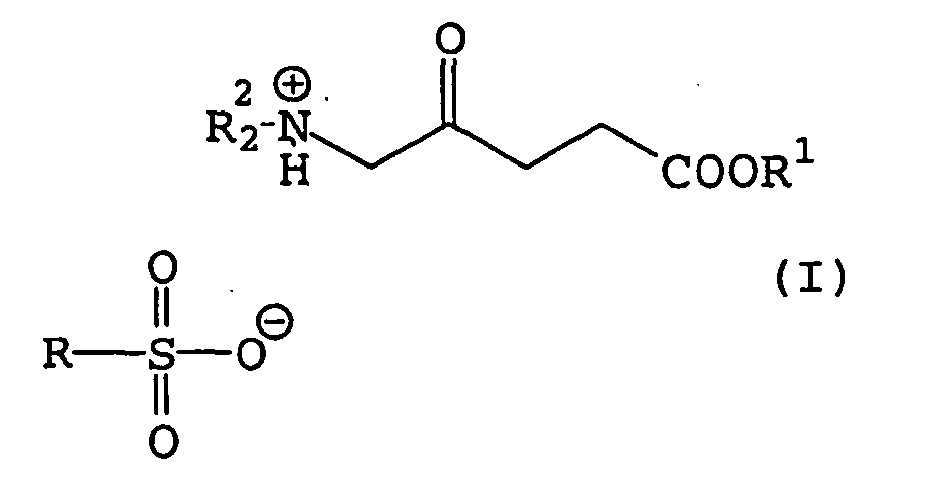
R is a hydrogen atom or an optionally substituted C1-20 alkyl group or an aryl group of up to 20 carbon atoms; and
R1 and R2 are as defined in claim 1. - An acid addition salt as claimed in claim 4, wherein R is an optionally substituted alkyl or aryl group.
- An acid addition salt as claimed in claim 4, wherein R is optionally substituted phenyl or methyl.
- An acid addition salt as claimed in any one of claims 4 to 6, wherein in formula I, each R2 represents a hydrogen atom.
- An acid addition salt as claimed in claim 4 which is a sulfonic acid addition salt of 5-ALA methyl ester or 5-ALA hexyl ester.
- An acid addition salt as claimed in claim 1 or claim 8, wherein said acid is napthalene-1,5-disulfonic acid, ethane-1,2-disulfonic acid, p-toluenesulfonic acid, methanesulfonic acid, dodecylsulfonic acid, napthalene-2-sulfonic acid, benzenesulfonic acid, 2-hydroxy-ethanesulfonic acid, ethanesulfonic acid, or (+)-camphor-10-sulfonic acid.
- An acid addition salt as claimed in any preceding claim, wherein said acid is pharmaceutically acceptable.
- A process for preparing an acid addition salt as claimed in any one of claims 1 to 10, said process comprising reacting a 5-aminolevulinic acid ester with an acid as defined in claim 1.
- A process for the preparation of an acid addition salt as claimed in any one of claims 1 to 10, said process comprising the reaction of 5-aminolevulinic acid, or an esterifiable derivative thereof, with an alkanol or an ester-forming derivative thereof in the presence of an acid as defined in claim 1.
- A process as claimed in claim 12 which comprises the reaction of 5-aminolevulinic acid, or an esterifiable derivative thereof, with an alkanol.
- A process for the preparation of an acid addition salt as claimed in any one of claims 1 to 10, said process comprising:(i) contacting a solution comprising a compound of the formula Cl- R2 2N+H-CH2COCH2CH2CO2R1, wherein R1 and R2 are as defined in claim 1, with a basic anion exchange resin;(ii) optionally removing said resin; and(iii) mixing the resulting solution with a solution comprising a sulfonic acid or a sulfonic acid derivative.
- A process as claimed in claim 14 wherein said acid addition salt is a compound of formula I as defined in claim 4.
- A process for the preparation of an acid addition salt as claimed in any one of claims 1 to 10, said process comprising:(i) reacting a compound of the formula Cl- R2 2N+H-CH2COCH2CH2CO2R1, wherein R1 and R2 are as defined in claim 1, with a silver salt of a sulfonic acid or a sulfonic acid derivative, in a solvent in which AgCl is substantially insoluble; and(ii) optionally separating AgCl from the resulting salt.
- A process as claimed in claim 16 wherein said acid addition salt is a compound of formula I as defined in claim 4.
- A pharmaceutical composition comprising an acid addition salt as claimed in any one of claims 1 to 10, together with at least one pharmaceutical carrier or excipient.
- An acid addition salt or composition as claimed in any one of claims 1 to 10 and 18 for use as a medicament.
- An acid addition salt as claimed in claim 19 for use in photodynamic therapy.
- An acid addition salt as claimed in claim 19 for use in photochemotherapy.
- An acid addition salt as claimed in claim 21 for the treatment of disorders or abnormalities of external or internal surfaces of the body which are responsive to photochemotherapy.
- Use of an acid addition salt as claimed in any one of claims 1 to 10 and 18 for the preparation of a therapeutic agent for use in photochemotherapy.
- A product comprising an acid addition salt as claimed in any one of claims 1 to 10 and 18, together with at least one surface-penetration assisting agent, and optionally one or more chelating agents as a combined preparation for simultaneous, separate or sequential use in treating disorders or abnormalities of external or internal surfaces of the body which are responsive to photochemotherapy.
- A kit for use in photochemotherapy of disorders or abnormalities of external or internal surfaces of the body comprising:a) a first container containing an acid addition salt as claimed in any one of claims 1 to 10 and 18,b) a second container containing at least one surface penetration assisting agent; and optionallyc) one or more chelating agents contained either within said first container or in a third container.
- A method of in vitro diagnosis of abnormalities or disorders by assaying a sample of body fluid or tissue of a patient, said method comprising at least the following steps:i) admixing said body fluid or tissue with an acid addition salt as claimed in any one of claims 1 to 10 and 18,ii) exposing said mixture to light,iii) ascertaining the level of fluorescence, andiv) comparing the level of fluorescence to control levels.
Priority Applications (3)
| Application Number | Priority Date | Filing Date | Title |
|---|---|---|---|
| PL05732530T PL1727786T3 (en) | 2004-03-26 | 2005-03-29 | Acid addition salts of 5-aminolevulinic acid or its derivatives |
| EP10011759.7A EP2308830B1 (en) | 2004-03-26 | 2005-03-29 | Acid addition salts of 5-aminolevulinic acid or its derivatives |
| SI200531338T SI1727786T1 (en) | 2004-03-26 | 2005-03-29 | Acid addition salts of 5-aminolevulinic acid or its derivatives |
Applications Claiming Priority (2)
| Application Number | Priority Date | Filing Date | Title |
|---|---|---|---|
| GBGB0406917.5A GB0406917D0 (en) | 2004-03-26 | 2004-03-26 | Compounds |
| PCT/GB2005/001236 WO2005092838A1 (en) | 2004-03-26 | 2005-03-29 | Acid addition salts of 5-aminolevulinic acid or its derivatives |
Related Child Applications (2)
| Application Number | Title | Priority Date | Filing Date |
|---|---|---|---|
| EP10011759.7A Division EP2308830B1 (en) | 2004-03-26 | 2005-03-29 | Acid addition salts of 5-aminolevulinic acid or its derivatives |
| EP10011759.7 Division-Into | 2010-09-29 |
Publications (2)
| Publication Number | Publication Date |
|---|---|
| EP1727786A1 EP1727786A1 (en) | 2006-12-06 |
| EP1727786B1 true EP1727786B1 (en) | 2011-06-29 |
Family
ID=32188818
Family Applications (2)
| Application Number | Title | Priority Date | Filing Date |
|---|---|---|---|
| EP10011759.7A Expired - Lifetime EP2308830B1 (en) | 2004-03-26 | 2005-03-29 | Acid addition salts of 5-aminolevulinic acid or its derivatives |
| EP05732530A Expired - Lifetime EP1727786B1 (en) | 2004-03-26 | 2005-03-29 | Acid addition salts of 5-aminolevulinic acid or its derivatives |
Family Applications Before (1)
| Application Number | Title | Priority Date | Filing Date |
|---|---|---|---|
| EP10011759.7A Expired - Lifetime EP2308830B1 (en) | 2004-03-26 | 2005-03-29 | Acid addition salts of 5-aminolevulinic acid or its derivatives |
Country Status (15)
| Country | Link |
|---|---|
| US (2) | US7888526B2 (en) |
| EP (2) | EP2308830B1 (en) |
| JP (1) | JP5164565B2 (en) |
| CN (1) | CN1938264B (en) |
| AT (1) | ATE514672T1 (en) |
| AU (1) | AU2005225616B2 (en) |
| CA (1) | CA2561050C (en) |
| DK (1) | DK1727786T3 (en) |
| ES (2) | ES2367789T3 (en) |
| GB (1) | GB0406917D0 (en) |
| PL (1) | PL1727786T3 (en) |
| PT (1) | PT1727786E (en) |
| RU (1) | RU2392266C2 (en) |
| SI (1) | SI1727786T1 (en) |
| WO (1) | WO2005092838A1 (en) |
Families Citing this family (43)
| Publication number | Priority date | Publication date | Assignee | Title |
|---|---|---|---|---|
| JP4719483B2 (en) * | 2004-03-30 | 2011-07-06 | コスモ石油株式会社 | Process for producing 5-aminolevulinic acid sulfonate |
| KR101225462B1 (en) * | 2004-03-30 | 2013-01-24 | 코스모세키유 가부시키가이샤 | 5-Aminolevulinic acid salt, process for producing the same and use thereof |
| GB0424833D0 (en) | 2004-11-10 | 2004-12-15 | Photocure Asa | Method |
| JP4934293B2 (en) * | 2005-07-05 | 2012-05-16 | コスモ石油株式会社 | Plant vitality composition |
| JP4934292B2 (en) * | 2005-07-05 | 2012-05-16 | コスモ石油株式会社 | 5-Aminolevulinic acid ester phosphoric acid salts, method for producing the same, and use thereof |
| US20070225518A1 (en) * | 2006-03-22 | 2007-09-27 | Zvi Malik | 5-Aminolevulinic acid salts and their use |
| KR100796450B1 (en) * | 2006-06-29 | 2008-01-22 | 전남대학교산학협력단 | Unsaturated alkyl esters of 5-aminolevulinic acid and pharmaceutically acceptable salts thereof, preparation methods thereof and uses thereof |
| JP4989153B2 (en) | 2006-08-15 | 2012-08-01 | コスモ石油株式会社 | Novel crystals of 5-aminolevulinic acid phosphate and method for producing the same |
| GB0700580D0 (en) | 2007-01-11 | 2007-02-21 | Photocure Asa | Use |
| WO2008106966A1 (en) * | 2007-03-06 | 2008-09-12 | Christiansen Kaare | A method for non-therapeutic or therapeutic photodynamic skin treatment |
| ES2566649T3 (en) * | 2008-10-30 | 2016-04-14 | Archer Daniels Midland Company | Reduction of HMF ethers with a metal catalyst |
| GB0823472D0 (en) | 2008-12-23 | 2009-01-28 | Photocure Asa | Product |
| GB0900461D0 (en) | 2009-01-12 | 2009-02-11 | Photocure Asa | Photodynamic therapy device |
| KR101797780B1 (en) | 2009-06-11 | 2017-11-14 | 포토큐어 에이에스에이 | Semi-solid composition and pharmaceutical products |
| WO2011107478A1 (en) | 2010-03-01 | 2011-09-09 | Photocure Asa | Cosmetic compositions |
| EP2394642A1 (en) | 2010-06-10 | 2011-12-14 | Universite De Geneve | 5-ALA ester formulations and use thereof |
| WO2011161220A1 (en) | 2010-06-23 | 2011-12-29 | Photocure Asa | Hyperosmotic preparations comprising 5 -amino levulinic acid or derivative as photosensitizing agent |
| AU2011275695B2 (en) | 2010-07-09 | 2014-07-31 | Photocure Asa | Dry compositions and devices containing such dry compositions for use in photodynamic therapy or photodynamic diagnosis |
| EP2657346B1 (en) | 2010-12-24 | 2017-08-23 | ARKRAY, Inc. | Method for detecting cancer cell |
| US20140316534A1 (en) | 2011-10-14 | 2014-10-23 | Photocure Asa | Stent |
| EP2766049A1 (en) | 2011-10-14 | 2014-08-20 | Photocure ASA | Photodynamic diagnosis of abnormalities of the epithelial lining of the oesophagus with the means of a 5-ala ester |
| RU2615870C2 (en) | 2011-12-19 | 2017-04-11 | ФотоКьюэр АСА | Emitter |
| RU2635563C2 (en) | 2012-08-03 | 2017-11-14 | ФотоКьюэр АСА | Compounds |
| AU2013299487B2 (en) | 2012-08-10 | 2017-02-02 | Sun Pharmaceutical Industries, Inc. | Method for the treatment of acne |
| US20140067024A1 (en) | 2012-08-30 | 2014-03-06 | Photocure Asa | Dual panel photodynamic therapy lamp |
| GB201221123D0 (en) | 2012-11-23 | 2013-01-09 | Photocure As | Device for photodynamic treatment |
| GB201306369D0 (en) | 2013-04-09 | 2013-05-22 | Photocure As | Irradiation device |
| EP3082787B1 (en) | 2013-12-20 | 2020-11-25 | Galderma Research & Development | Pulse photodynamic treatment of photodamaged skin |
| EP3095464A1 (en) | 2015-05-19 | 2016-11-23 | Universite De Geneve | 5-ala derivatives and use thereof |
| GB201522309D0 (en) | 2015-12-17 | 2016-02-03 | Photocure Asa | Use |
| GB201522311D0 (en) | 2015-12-17 | 2016-02-03 | Photocure Asa | Use |
| CA3008552C (en) | 2015-12-17 | 2024-01-02 | Photocure Asa | Method of photodynamic therapy (pdt) for bladder cancer |
| GB201522398D0 (en) | 2015-12-18 | 2016-02-03 | Photocure As | Device for photodynamic therapy |
| CN112010772A (en) * | 2016-01-26 | 2020-12-01 | 赵鸣 | Salt compound of 5-aminolevulinic acid and derivative thereof and application |
| RU2611441C2 (en) * | 2016-04-28 | 2017-02-22 | Федеральное государственное бюджетное учреждение "Национальный медицинский исследовательский радиологический центр" Министерства здравоохранения Российской Федерации (ФГБУ "НМИРЦ" Минздрава России) | Method for producing of 5-aminolevulinic acid methyl ester hydrochloride |
| US20200100997A1 (en) | 2017-02-06 | 2020-04-02 | 3Skin As | Sunscreen Composition |
| CN108088838A (en) * | 2017-12-13 | 2018-05-29 | 西南大学 | Application and method of double [2,4,6- trichlorophenyls] oxalates in the mould toxin of rod method is measured |
| CN108440319B (en) * | 2018-04-26 | 2021-05-18 | 爱斯特(成都)生物制药股份有限公司 | Method for preparing aminolevulinic acid hydrochloride |
| EP3868372A1 (en) | 2020-02-19 | 2021-08-25 | JLP Health GmbH | A pharmaceutical combination of an artemisinin compound and a heme synthesis modulator for treating cancer |
| CN116162038A (en) * | 2023-01-06 | 2023-05-26 | 河南省精细化工研究院有限公司 | Environment-friendly production process of 5-aminolevulinic acid hydrochloride |
| EP4676462A1 (en) | 2023-03-07 | 2026-01-14 | Photocure ASA | Therapy for bladder cancer |
| WO2026052815A1 (en) | 2024-09-05 | 2026-03-12 | Photocure Asa | Use of hal in a method for predicting bladder cancer immunotherapy response |
| WO2026084589A1 (en) | 2024-10-14 | 2026-04-23 | Universiteit Van Amsterdam | G4-destabiling small molecules for the treatment of x-linked dystonia-parkinsonism. |
Family Cites Families (21)
| Publication number | Priority date | Publication date | Assignee | Title |
|---|---|---|---|---|
| US5079262A (en) | 1989-07-28 | 1992-01-07 | Queen's University At Kingston | Method of detection and treatment of malignant and non-malignant lesions utilizing 5-aminolevulinic acid |
| JP2767318B2 (en) | 1990-04-11 | 1998-06-18 | 株式会社コスモ総合研究所 | 5-Aminolevulinic acid alkyl ester or salt thereof, process for producing the same, and herbicide containing the same as active ingredient |
| DE69109444T2 (en) * | 1990-10-29 | 1995-09-28 | Japan Tobacco Inc | A method of making an acid supplemental salt of delta aminolevulinic acid. |
| US5284973A (en) * | 1990-10-29 | 1994-02-08 | Japan Tobacco Inc. | Method of preparing an acid additional salt of delta-aminolevulinic acid |
| JP2613136B2 (en) * | 1991-05-14 | 1997-05-21 | 株式会社コスモ総合研究所 | Plant growth promoter |
| JP2997979B2 (en) * | 1993-01-20 | 2000-01-11 | 株式会社コスモ総合研究所 | Method for producing 5-aminolevulinic acid |
| US5489572A (en) | 1993-08-19 | 1996-02-06 | Cosmo Research Institue | Methods for reducing nitrate nitrogen and oxalic acids contents nin plants |
| JP2887554B2 (en) * | 1993-08-19 | 1999-04-26 | 株式会社コスモ総合研究所 | Oxalic acid content reducing agent for plants |
| GB9318841D0 (en) | 1993-09-10 | 1993-10-27 | Res Foundation Of The Norwegia | Composition |
| JPH07238063A (en) | 1994-02-25 | 1995-09-12 | Cosmo Sogo Kenkyusho:Kk | Method for recovering and purifying 5-aminolevulinic acid |
| JP2896963B2 (en) * | 1994-11-28 | 1999-05-31 | 株式会社コスモ総合研究所 | Plant salt tolerance improver |
| GB9504948D0 (en) * | 1995-03-10 | 1995-04-26 | Norwegian Radium Hospital Rese | Compounds |
| NZ303251A (en) * | 1995-03-10 | 2000-10-27 | Photocure Asa | Use of esters of 5-aminolevulinic acid as photosensitising agents in photochemotherapy |
| US6992107B1 (en) * | 1995-03-10 | 2006-01-31 | Photocure Asa | Esters of 5-aminolevulinic acid and their use as photosensitizing compounds in photochemotherapy |
| JPH1112197A (en) | 1997-06-18 | 1999-01-19 | Cosmo Sogo Kenkyusho:Kk | Malignant tumor diagnostics and therapeutics |
| CN1183134C (en) | 1997-07-30 | 2005-01-05 | 惠氏公司 | Tricyclic vasopressin agonists |
| US5907058A (en) * | 1998-07-29 | 1999-05-25 | Midwest Research Institute | Synthesis of an acid addition salt of delta-aminolevulinic acid from 5-bromo levulinic acid esters |
| GB0018528D0 (en) * | 2000-07-27 | 2000-09-13 | Photocure Asa | Compounds |
| GB0018527D0 (en) | 2000-07-27 | 2000-09-13 | Photocure Asa | Composition |
| GB0118251D0 (en) | 2001-07-26 | 2001-09-19 | Photocure Asa | Method |
| KR101225462B1 (en) * | 2004-03-30 | 2013-01-24 | 코스모세키유 가부시키가이샤 | 5-Aminolevulinic acid salt, process for producing the same and use thereof |
-
2004
- 2004-03-26 GB GBGB0406917.5A patent/GB0406917D0/en not_active Ceased
-
2005
- 2005-03-29 JP JP2007504487A patent/JP5164565B2/en not_active Expired - Lifetime
- 2005-03-29 EP EP10011759.7A patent/EP2308830B1/en not_active Expired - Lifetime
- 2005-03-29 AT AT05732530T patent/ATE514672T1/en active
- 2005-03-29 EP EP05732530A patent/EP1727786B1/en not_active Expired - Lifetime
- 2005-03-29 DK DK05732530.0T patent/DK1727786T3/en active
- 2005-03-29 ES ES05732530T patent/ES2367789T3/en not_active Expired - Lifetime
- 2005-03-29 CA CA2561050A patent/CA2561050C/en not_active Expired - Fee Related
- 2005-03-29 CN CN2005800098456A patent/CN1938264B/en not_active Expired - Fee Related
- 2005-03-29 SI SI200531338T patent/SI1727786T1/en unknown
- 2005-03-29 US US10/594,361 patent/US7888526B2/en not_active Expired - Lifetime
- 2005-03-29 RU RU2006135487/04A patent/RU2392266C2/en not_active IP Right Cessation
- 2005-03-29 ES ES10011759.7T patent/ES2639021T3/en not_active Expired - Lifetime
- 2005-03-29 AU AU2005225616A patent/AU2005225616B2/en not_active Ceased
- 2005-03-29 WO PCT/GB2005/001236 patent/WO2005092838A1/en not_active Ceased
- 2005-03-29 PT PT05732530T patent/PT1727786E/en unknown
- 2005-03-29 PL PL05732530T patent/PL1727786T3/en unknown
-
2010
- 2010-10-29 US US12/916,326 patent/US8692014B2/en active Active
Also Published As
| Publication number | Publication date |
|---|---|
| JP5164565B2 (en) | 2013-03-21 |
| ES2639021T3 (en) | 2017-10-25 |
| ATE514672T1 (en) | 2011-07-15 |
| AU2005225616B2 (en) | 2011-08-18 |
| US20080064752A1 (en) | 2008-03-13 |
| ES2367789T3 (en) | 2011-11-08 |
| CN1938264A (en) | 2007-03-28 |
| AU2005225616A1 (en) | 2005-10-06 |
| WO2005092838A1 (en) | 2005-10-06 |
| EP2308830B1 (en) | 2017-06-14 |
| SI1727786T1 (en) | 2011-09-30 |
| EP1727786A1 (en) | 2006-12-06 |
| US7888526B2 (en) | 2011-02-15 |
| US20110125012A1 (en) | 2011-05-26 |
| PL1727786T3 (en) | 2011-11-30 |
| DK1727786T3 (en) | 2011-08-29 |
| EP2308830A1 (en) | 2011-04-13 |
| RU2006135487A (en) | 2008-05-10 |
| CA2561050C (en) | 2012-05-08 |
| CN1938264B (en) | 2012-05-23 |
| PT1727786E (en) | 2011-07-08 |
| CA2561050A1 (en) | 2005-10-06 |
| US8692014B2 (en) | 2014-04-08 |
| GB0406917D0 (en) | 2004-04-28 |
| JP2007530523A (en) | 2007-11-01 |
| RU2392266C2 (en) | 2010-06-20 |
Similar Documents
| Publication | Publication Date | Title |
|---|---|---|
| US7888526B2 (en) | Acid addition salts of 5-aminolevulinic acid or its derivatives | |
| EP1313695B1 (en) | Esters of 5-aminolevulinic acid as photosensitizing agents in photochemotherapy | |
| US6034267A (en) | Esters of 5-aminolevulinic acid as photosensitizing agents in photochemotherapy | |
| US7335684B2 (en) | Esters of 5-aminolevulinic acid as photosensitizing agents in photochemotherapy | |
| US7287646B2 (en) | Esters of 5-aminolevulinic acid and their use as photosensitizing compounds in photochemotherapy | |
| AU2002227495A1 (en) | Esters of 5-aminolevulinic acid as photosensitizing agents in photochemotherapy |
Legal Events
| Date | Code | Title | Description |
|---|---|---|---|
| PUAI | Public reference made under article 153(3) epc to a published international application that has entered the european phase |
Free format text: ORIGINAL CODE: 0009012 |
|
| 17P | Request for examination filed |
Effective date: 20060914 |
|
| AK | Designated contracting states |
Kind code of ref document: A1 Designated state(s): AT BE BG CH CY CZ DE DK EE ES FI FR GB GR HU IE IS IT LI LT LU MC NL PL PT RO SE SI SK TR |
|
| TPAC | Observations filed by third parties |
Free format text: ORIGINAL CODE: EPIDOSNTIPA |
|
| DAX | Request for extension of the european patent (deleted) | ||
| 17Q | First examination report despatched |
Effective date: 20080116 |
|
| GRAC | Information related to communication of intention to grant a patent modified |
Free format text: ORIGINAL CODE: EPIDOSCIGR1 |
|
| GRAP | Despatch of communication of intention to grant a patent |
Free format text: ORIGINAL CODE: EPIDOSNIGR1 |
|
| RIN1 | Information on inventor provided before grant (corrected) |
Inventor name: NILSEN, NILS, OLAV Inventor name: GODAL, ASLAK Inventor name: BRAENDEN, JON, ERIK Inventor name: KLAVENESS, JO |
|
| GRAS | Grant fee paid |
Free format text: ORIGINAL CODE: EPIDOSNIGR3 |
|
| GRAA | (expected) grant |
Free format text: ORIGINAL CODE: 0009210 |
|
| RAP1 | Party data changed (applicant data changed or rights of an application transferred) |
Owner name: PHOTOCURE ASA |
|
| AK | Designated contracting states |
Kind code of ref document: B1 Designated state(s): AT BE BG CH CY CZ DE DK EE ES FI FR GB GR HU IE IS IT LI LT LU MC NL PL PT RO SE SI SK TR |
|
| REG | Reference to a national code |
Ref country code: GB Ref legal event code: FG4D |
|
| REG | Reference to a national code |
Ref country code: CH Ref legal event code: EP |
|
| REG | Reference to a national code |
Ref country code: PT Ref legal event code: SC4A Free format text: AVAILABILITY OF NATIONAL TRANSLATION Effective date: 20110630 |
|
| REG | Reference to a national code |
Ref country code: CH Ref legal event code: NV Representative=s name: BOHEST AG |
|
| REG | Reference to a national code |
Ref country code: IE Ref legal event code: FG4D |
|
| REG | Reference to a national code |
Ref country code: NL Ref legal event code: T3 |
|
| REG | Reference to a national code |
Ref country code: DE Ref legal event code: R096 Ref document number: 602005028751 Country of ref document: DE Effective date: 20110818 |
|
| REG | Reference to a national code |
Ref country code: DK Ref legal event code: T3 |
|
| REG | Reference to a national code |
Ref country code: SE Ref legal event code: TRGR |
|
| REG | Reference to a national code |
Ref country code: GR Ref legal event code: EP Ref document number: 20110401895 Country of ref document: GR Effective date: 20110916 |
|
| REG | Reference to a national code |
Ref country code: SK Ref legal event code: T3 Ref document number: E 9881 Country of ref document: SK |
|
| REG | Reference to a national code |
Ref country code: ES Ref legal event code: FG2A Ref document number: 2367789 Country of ref document: ES Kind code of ref document: T3 Effective date: 20111108 |
|
| REG | Reference to a national code |
Ref country code: PL Ref legal event code: T3 |
|
| REG | Reference to a national code |
Ref country code: EE Ref legal event code: FG4A Ref document number: E005876 Country of ref document: EE Effective date: 20110928 |
|
| PG25 | Lapsed in a contracting state [announced via postgrant information from national office to epo] |
Ref country code: RO Free format text: LAPSE BECAUSE OF FAILURE TO SUBMIT A TRANSLATION OF THE DESCRIPTION OR TO PAY THE FEE WITHIN THE PRESCRIBED TIME-LIMIT Effective date: 20110629 Ref country code: CY Free format text: LAPSE BECAUSE OF FAILURE TO SUBMIT A TRANSLATION OF THE DESCRIPTION OR TO PAY THE FEE WITHIN THE PRESCRIBED TIME-LIMIT Effective date: 20110629 |
|
| REG | Reference to a national code |
Ref country code: HU Ref legal event code: AG4A Ref document number: E012545 Country of ref document: HU |
|
| PLBE | No opposition filed within time limit |
Free format text: ORIGINAL CODE: 0009261 |
|
| STAA | Information on the status of an ep patent application or granted ep patent |
Free format text: STATUS: NO OPPOSITION FILED WITHIN TIME LIMIT |
|
| 26N | No opposition filed |
Effective date: 20120330 |
|
| REG | Reference to a national code |
Ref country code: DE Ref legal event code: R097 Ref document number: 602005028751 Country of ref document: DE Effective date: 20120330 |
|
| PG25 | Lapsed in a contracting state [announced via postgrant information from national office to epo] |
Ref country code: BG Free format text: LAPSE BECAUSE OF FAILURE TO SUBMIT A TRANSLATION OF THE DESCRIPTION OR TO PAY THE FEE WITHIN THE PRESCRIBED TIME-LIMIT Effective date: 20110929 |
|
| PGFP | Annual fee paid to national office [announced via postgrant information from national office to epo] |
Ref country code: CZ Payment date: 20140311 Year of fee payment: 10 Ref country code: SK Payment date: 20140305 Year of fee payment: 10 Ref country code: EE Payment date: 20140306 Year of fee payment: 10 Ref country code: SE Payment date: 20140327 Year of fee payment: 10 Ref country code: NL Payment date: 20140326 Year of fee payment: 10 Ref country code: MC Payment date: 20140304 Year of fee payment: 10 Ref country code: IS Payment date: 20140304 Year of fee payment: 10 Ref country code: LT Payment date: 20140304 Year of fee payment: 10 Ref country code: FI Payment date: 20140327 Year of fee payment: 10 Ref country code: IE Payment date: 20140327 Year of fee payment: 10 Ref country code: CH Payment date: 20140327 Year of fee payment: 10 Ref country code: DK Payment date: 20140325 Year of fee payment: 10 |
|
| PGFP | Annual fee paid to national office [announced via postgrant information from national office to epo] |
Ref country code: GR Payment date: 20140327 Year of fee payment: 10 Ref country code: HU Payment date: 20140311 Year of fee payment: 10 Ref country code: PL Payment date: 20140305 Year of fee payment: 10 Ref country code: LU Payment date: 20140407 Year of fee payment: 10 Ref country code: AT Payment date: 20140305 Year of fee payment: 10 Ref country code: SI Payment date: 20140314 Year of fee payment: 10 Ref country code: TR Payment date: 20140310 Year of fee payment: 10 |
|
| PGFP | Annual fee paid to national office [announced via postgrant information from national office to epo] |
Ref country code: PT Payment date: 20140310 Year of fee payment: 10 |
|
| REG | Reference to a national code |
Ref country code: CH Ref legal event code: PCAR Free format text: NEW ADDRESS: HOLBEINSTRASSE 36-38, 4051 BASEL (CH) |
|
| PGFP | Annual fee paid to national office [announced via postgrant information from national office to epo] |
Ref country code: BE Payment date: 20140328 Year of fee payment: 10 |
|
| REG | Reference to a national code |
Ref country code: PT Ref legal event code: MM4A Free format text: LAPSE DUE TO NON-PAYMENT OF FEES Effective date: 20150929 |
|
| REG | Reference to a national code |
Ref country code: DK Ref legal event code: EBP Effective date: 20150331 |
|
| PG25 | Lapsed in a contracting state [announced via postgrant information from national office to epo] |
Ref country code: MC Free format text: LAPSE BECAUSE OF NON-PAYMENT OF DUE FEES Effective date: 20150331 Ref country code: LU Free format text: LAPSE BECAUSE OF NON-PAYMENT OF DUE FEES Effective date: 20150329 Ref country code: FI Free format text: LAPSE BECAUSE OF NON-PAYMENT OF DUE FEES Effective date: 20150329 Ref country code: CZ Free format text: LAPSE BECAUSE OF NON-PAYMENT OF DUE FEES Effective date: 20150329 Ref country code: PT Free format text: LAPSE BECAUSE OF NON-PAYMENT OF DUE FEES Effective date: 20150929 |
|
| REG | Reference to a national code |
Ref country code: CH Ref legal event code: PL |
|
| REG | Reference to a national code |
Ref country code: AT Ref legal event code: MM01 Ref document number: 514672 Country of ref document: AT Kind code of ref document: T Effective date: 20150329 |
|
| REG | Reference to a national code |
Ref country code: EE Ref legal event code: MM4A Ref document number: E005876 Country of ref document: EE Effective date: 20150331 |
|
| REG | Reference to a national code |
Ref country code: LT Ref legal event code: MM4D Effective date: 20150329 |
|
| PG25 | Lapsed in a contracting state [announced via postgrant information from national office to epo] |
Ref country code: SE Free format text: LAPSE BECAUSE OF NON-PAYMENT OF DUE FEES Effective date: 20150330 |
|
| REG | Reference to a national code |
Ref country code: SE Ref legal event code: EUG |
|
| REG | Reference to a national code |
Ref country code: NL Ref legal event code: MM Effective date: 20150401 |
|
| REG | Reference to a national code |
Ref country code: SK Ref legal event code: MM4A Ref document number: E 9881 Country of ref document: SK Effective date: 20150329 |
|
| REG | Reference to a national code |
Ref country code: GR Ref legal event code: ML Ref document number: 20110401895 Country of ref document: GR Effective date: 20151002 |
|
| REG | Reference to a national code |
Ref country code: SI Ref legal event code: KO00 Effective date: 20151117 |
|
| REG | Reference to a national code |
Ref country code: IE Ref legal event code: MM4A |
|
| PG25 | Lapsed in a contracting state [announced via postgrant information from national office to epo] |
Ref country code: LI Free format text: LAPSE BECAUSE OF NON-PAYMENT OF DUE FEES Effective date: 20150331 Ref country code: CH Free format text: LAPSE BECAUSE OF NON-PAYMENT OF DUE FEES Effective date: 20150331 Ref country code: EE Free format text: LAPSE BECAUSE OF NON-PAYMENT OF DUE FEES Effective date: 20150331 Ref country code: IE Free format text: LAPSE BECAUSE OF NON-PAYMENT OF DUE FEES Effective date: 20150329 Ref country code: LT Free format text: LAPSE BECAUSE OF NON-PAYMENT OF DUE FEES Effective date: 20150329 Ref country code: GR Free format text: LAPSE BECAUSE OF NON-PAYMENT OF DUE FEES Effective date: 20151002 |
|
| PG25 | Lapsed in a contracting state [announced via postgrant information from national office to epo] |
Ref country code: SK Free format text: LAPSE BECAUSE OF NON-PAYMENT OF DUE FEES Effective date: 20150329 Ref country code: SI Free format text: LAPSE BECAUSE OF NON-PAYMENT OF DUE FEES Effective date: 20150330 Ref country code: AT Free format text: LAPSE BECAUSE OF NON-PAYMENT OF DUE FEES Effective date: 20150329 Ref country code: IS Free format text: LAPSE BECAUSE OF FAILURE TO SUBMIT A TRANSLATION OF THE DESCRIPTION OR TO PAY THE FEE WITHIN THE PRESCRIBED TIME-LIMIT Effective date: 20151001 Ref country code: HU Free format text: LAPSE BECAUSE OF NON-PAYMENT OF DUE FEES Effective date: 20150330 |
|
| REG | Reference to a national code |
Ref country code: FR Ref legal event code: PLFP Year of fee payment: 12 |
|
| PG25 | Lapsed in a contracting state [announced via postgrant information from national office to epo] |
Ref country code: DK Free format text: LAPSE BECAUSE OF NON-PAYMENT OF DUE FEES Effective date: 20150331 |
|
| PG25 | Lapsed in a contracting state [announced via postgrant information from national office to epo] |
Ref country code: PL Free format text: LAPSE BECAUSE OF NON-PAYMENT OF DUE FEES Effective date: 20150329 |
|
| REG | Reference to a national code |
Ref country code: FR Ref legal event code: PLFP Year of fee payment: 13 |
|
| PG25 | Lapsed in a contracting state [announced via postgrant information from national office to epo] |
Ref country code: NL Free format text: LAPSE BECAUSE OF NON-PAYMENT OF DUE FEES Effective date: 20150401 |
|
| PG25 | Lapsed in a contracting state [announced via postgrant information from national office to epo] |
Ref country code: BE Free format text: LAPSE BECAUSE OF NON-PAYMENT OF DUE FEES Effective date: 20150331 |
|
| PG25 | Lapsed in a contracting state [announced via postgrant information from national office to epo] |
Ref country code: TR Free format text: LAPSE BECAUSE OF NON-PAYMENT OF DUE FEES Effective date: 20150329 |
|
| REG | Reference to a national code |
Ref country code: FR Ref legal event code: PLFP Year of fee payment: 14 |
|
| REG | Reference to a national code |
Ref country code: DE Ref legal event code: R082 Ref document number: 602005028751 Country of ref document: DE Representative=s name: DEHNSGERMANY PARTNERSCHAFT VON PATENTANWAELTEN, DE |
|
| PGFP | Annual fee paid to national office [announced via postgrant information from national office to epo] |
Ref country code: GB Payment date: 20220328 Year of fee payment: 18 Ref country code: DE Payment date: 20220329 Year of fee payment: 18 |
|
| PGFP | Annual fee paid to national office [announced via postgrant information from national office to epo] |
Ref country code: IT Payment date: 20220322 Year of fee payment: 18 Ref country code: FR Payment date: 20220325 Year of fee payment: 18 |
|
| PGFP | Annual fee paid to national office [announced via postgrant information from national office to epo] |
Ref country code: ES Payment date: 20220401 Year of fee payment: 18 |
|
| P01 | Opt-out of the competence of the unified patent court (upc) registered |
Effective date: 20230524 |
|
| REG | Reference to a national code |
Ref country code: DE Ref legal event code: R119 Ref document number: 602005028751 Country of ref document: DE |
|
| GBPC | Gb: european patent ceased through non-payment of renewal fee |
Effective date: 20230329 |
|
| PG25 | Lapsed in a contracting state [announced via postgrant information from national office to epo] |
Ref country code: GB Free format text: LAPSE BECAUSE OF NON-PAYMENT OF DUE FEES Effective date: 20230329 |
|
| PG25 | Lapsed in a contracting state [announced via postgrant information from national office to epo] |
Ref country code: GB Free format text: LAPSE BECAUSE OF NON-PAYMENT OF DUE FEES Effective date: 20230329 Ref country code: FR Free format text: LAPSE BECAUSE OF NON-PAYMENT OF DUE FEES Effective date: 20230331 Ref country code: DE Free format text: LAPSE BECAUSE OF NON-PAYMENT OF DUE FEES Effective date: 20231003 |
|
| PG25 | Lapsed in a contracting state [announced via postgrant information from national office to epo] |
Ref country code: IT Free format text: LAPSE BECAUSE OF NON-PAYMENT OF DUE FEES Effective date: 20230329 |
|
| REG | Reference to a national code |
Ref country code: ES Ref legal event code: FD2A Effective date: 20240507 |
|
| PG25 | Lapsed in a contracting state [announced via postgrant information from national office to epo] |
Ref country code: ES Free format text: LAPSE BECAUSE OF NON-PAYMENT OF DUE FEES Effective date: 20230330 |
|
| PG25 | Lapsed in a contracting state [announced via postgrant information from national office to epo] |
Ref country code: ES Free format text: LAPSE BECAUSE OF NON-PAYMENT OF DUE FEES Effective date: 20230330 |