EP1727383A1 - Mobile communications - Google Patents
Mobile communications Download PDFInfo
- Publication number
- EP1727383A1 EP1727383A1 EP05253273A EP05253273A EP1727383A1 EP 1727383 A1 EP1727383 A1 EP 1727383A1 EP 05253273 A EP05253273 A EP 05253273A EP 05253273 A EP05253273 A EP 05253273A EP 1727383 A1 EP1727383 A1 EP 1727383A1
- Authority
- EP
- European Patent Office
- Prior art keywords
- network
- server
- subscription
- mobile
- terminal
- Prior art date
- Legal status (The legal status is an assumption and is not a legal conclusion. Google has not performed a legal analysis and makes no representation as to the accuracy of the status listed.)
- Withdrawn
Links
Images


Classifications
-
- H—ELECTRICITY
- H04—ELECTRIC COMMUNICATION TECHNIQUE
- H04W—WIRELESS COMMUNICATION NETWORKS
- H04W8/00—Network data management
- H04W8/18—Processing of user or subscriber data, e.g. subscribed services, user preferences or user profiles; Transfer of user or subscriber data
Definitions
- This invention relates to mobile communications, and in particular to extending the geographical coverage offered to users subscribing to a first network, such that they may use their terminals in a second network.
- Certain call-control functions, in particular verification that the user is authorised to make outgoing calls, are performed by a Home Location Register (HLR) associated with the user's home network. This adds to the signalling overhead and delay in setting up a call.
- HLR Home Location Register
- the signalling overhead required to make a local call from a "roaming" terminal is considerably greater than would be required to make a similar call when operating on the home network.
- Another difficulty is that the user and service provider have little control over selection of the network to which the terminal is to roam.
- a mobile terminal when a mobile terminal is switched on and fails to detect its own home network, it connects to a local network with which the service provider has a roaming agreement, usually the one having the strongest signal. The user will remain with that network until it loses contact, either because the handset is switched off or because it has gone out of range.
- the network selected will not necessarily be the same throughout the user's foreign visit. The user may be given the choice to over-ride this selection, but it is inconvenient to do this manually and requires some knowledge of the available networks if an informed selection is to be made.
- SIM subscriber identity module
- the present invention provides a mobile communications terminal having means for establishing initial communication with a first mobile network, means for accessing a server, means for obtaining from the server, over the established initial connection, data relating to a subscription optimised for the current location of the terminal, and means for loading the new subscription details such that the terminal becomes a mobile station user for the selected mobile network.
- the new subscription details (IMSI, MSISDN, etc) sent to the terminal are preferably protected by encryption of some form. It should be noted that the subscription that is obtained may be for a network other than the one with which communication has been established, if for example the server determines that another network is more suitable.
- the invention also provides a subscription provision server for provision of mobile communications service comprising means for receiving access requests from a mobile terminal, means to select subscription data relating to a mobile communications network from a store of such data, and means to transmit to the mobile terminal the selected subscription data.
- the network to which the subscription relates may pass any call charge information on to the operator of the server, who in turn can bill the user. This allows a service provider, whether or not it operates its own network, to select which operators its customers are to be connected to in any given territory.
- the invention also extends to a method for establishing an initial connection between a mobile terminal and a first network and accessing a server over that connection, wherein the server selects a network on which the mobile terminal is to operate, the server selects subscription details relating to the selected network from a store of such details, and transmits to the mobile terminal the selected subscription details, and the mobile terminal loads the new subscription details such that the terminal becomes a home Mobile Station user for the selected mobile network.
- This invention allows the user to make calls without roaming in the conventional sense.
- Existing number-translation on calling line identity (CLI) facilities may be used to allow a number other than that of the subscriber line to be displayed to a party called by the user, and for this purpose outgoing calls may be routed to an in-country Point of Presence (switch) for addition of the end-user CLI.
- CLI calling line identity
- Call forwarding can be activated in the home network so that incoming calls, initially directed to the home mobile network, dial a number at the POP. The POP then translates and forwards the call to the directory number relating to the temporary subscription currently used by the end-user.
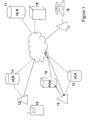
- Figure 1 illustrates schematically a simplified arrangement of several cooperating networks, and the relevant components of those networks.
- the user's mobile handset 10 has the capability to establish radio communication with fixed base stations 12, 13 in order to convey voice calls, text messages etc and a signalling overhead.
- HLR Home Location Register
- VLRs Visitor Location Registers
- Each VLR 14,15 stores details of any mobile subscriber currently associated with its respective network, downloaded from the HLR 11 of the user's home network when the user handset 10 first makes contact with the visited network.
- the VLR 14, 15 also identifies itself to the HLR 11 so that the HLR can store details of the visited network.
- this arrangement allows calls to be made between the handset 10 and any other telephone terminal 16, shown illustratively as connected to a fourth network 17.
- the present invention makes use of a server 18 associated with the Home Location Register 11. Certain auxiliary features also require a POP server 19 associated with the visited network 13,15.
- a mobile communications terminal is a powerful radio measurement device. It is the prime source for the mobile network to give information on the radio environment at its location. Therefore, it is also the Mobile Station that takes the initiative to start roaming on another network and will try, upon loss of radio signal with its home network, to "camp" on the radio beacon of one of the GSM networks that it finds around it. Until the Mobile Station 10 successfully camps on the network 12, 14 that it has detected, it has no communication possibility. As soon as the Mobile station successfully logs on to the visited network, it can communicate again.
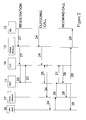
- FIG. 2 illustrates the conventional roaming process. Steps 21-23 illustrate initial registration, Steps 24-27 illustrate how outgoing calls from the mobile unit 10 are handled, and steps 28,29 illustrate how incoming calls to the mobile unit 10 are handled.
- a mobile station 10 When a mobile station 10 loses connection with its home network, it listens out for radio transmissions on all GSM frequencies and captures one or more beacon frequencies from nearby base stations 12, 13 (see Figure 1). The mobile unit 10 will normally select the strongest of these signals 12 and transmits a request 21 to the network to register it as a visitor (roamer) on that network's VLR 14. The Mobile Station 10 thus logs-on to the Visited Network (12) using the identity (IMSI) it was allocated by its home network 11.
- IMSI identity
- the VLR 14 now transmits a request 22 incorporating the user's IMSI to the HLR 11 of the home network to check the user's credentials (e.g. to determine if the subscriber is allowed to "roam" to the visited network). If appropriate, the HLR 11 next transmits a confirmation 23 authorising the visited network to provide service to the handset 10.
- the HLR 11 in the home network also stores the identity of the VLR 14 against the record for the IMSI of the handset 10. This allows an incoming call from a caller 16 to retrieve from the home network (to which any incoming call to the user's directory number will initially be routed) the identity of the network 12 through which the user 10 may be called, and to be routed accordingly.
- Outgoing calls can be handled in a straightforward manner once the mobile unit 10 is registered with a network 12,14.
- the visited network receives the outgoing call request 24 from the mobile station 10 and allows the call to take place. If necessary, the VLR 14 may exchange information 25 with the HLR 11 in the user's home network to check whether that individual call 24 is permitted.
- An incoming call operates as follows.
- a call request 26 is made from a terminal 16 _by dialling the MSISDN (Directory Number).
- the network 17 to which the originating terminal 16 is currently operating may be the home network 11 of the destination terminal 10, or the network 12 to which it has roamed, but in general will be neither of these, and in any case the operation is essentially the same in each case.
- the network 17 forwards the call request 26 on to the network 11 associated with the target user's MSISDN.
- HLR Home Location Register
- the VLR 14 so identified is that of another network 12.
- the HLR 11 of the home network transmits a request 27 to the VLR 14 of the visited network 12 to receive a temporary telephone number.
- This is known as the MSRN ⁇ Mobile Station Routing Number.
- Each MSRN is similar to a public MSISDN, but it is in a separate range that can only be dialled between networks, and not by individual end-users.
- the VLR 14 in the visited network initiates some further steps to pinpoint the exact location of the Mobile station 10 and attributes to the specific incoming communication a temporary MSRN. That MSRN 28 is then communicated to the HLR 11 so that in the home network the call 29 can be routed to the network 12 in which the mobile unit 10 is currently roaming.
- Figure 3 illustrates schematically a process according to the invention.
- Figures 4 and 5 illustrate schematically the components, respectively, of a mobile telephone handset and a server, applicable to this invention.
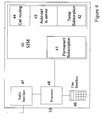
- FIG 4 is a schematic diagram of a mobile terminal 10 incorporating a Subscriber Identity Module (SIM) 40.
- SIM Subscriber Identity Module
- the relevant components are stored on the Subscriber Identity Module (SIM), 40.
- SIM Subscriber Identity Module
- the data relevant to the user's permanent subscription are held in a store 41.
- the terminal 10 comprises a user interface 49 by which the user may enter instructions and receive information, and a radio interface 47 by which the terminal interacts with the network.
- the necessary coding and decoding, handover, and other processes are performed by a processor 48, which can retrieve data specific to the user, such as the user's network identity, and pre-set programmes, from a SIM (subscriber identity module) 40.
- SIM subscriber identity module
- the handset 10, and more specifically the SIM 40 incorporated therein also includes a component 43 programmed such that on recognising that the handset has registered with a visited network 12, 14, it signals a request 34 to a server 18 associated with its home network 11 to obtain a local subscription.
- the home network 11 may maintain a single server 18 with which a terminal 10 may communicate from any remote network 12, 14, or it may maintain a number of servers each associated with a given territory. In the latter case, the mobile station 10 would store contact information 43 for a set of servers, such that it can contact the server 18 appropriate to the territory in which it is roaming.
- the Mobile station 10 establishes contact with a first visited network 12, 14 as in conventional roaming (steps 21-23).
- the Mobile Station 10 initiates a data call 34 to the server 18, giving it the information it needs to initiate the transfer.
- this information would include the identity of the network 12,14 on which is it currently roaming.
- this call 34 is set up in the same manner as a conventional outgoing call 24 as already described.
- the Server 18 therefore receives from the Mobile station 10 a data message 34, with the identification of the terminal 10 and the information as to its general location.
- This may take any suitable form, such as in SMS format or an in-band data communication.
- networks tend to have similar territorial coverage areas, defined by national boundaries. It is therefore a simple matter to deduce, from the identity of the network to which the handset is attached, which other networks are available.
- the Server 18, as illustrated schematically in Figure 5, has available to it a set of subscriptions 51, 52, 53 for each territory in which the service is offered. It also has call handling means 50 for receiving requests from handsets and returning subscription details, and processing means 54.
- the call-handling means 50 receives a request for service from a mobile device 10 in a specified territory
- the processor 54 selects a subscription from the store 51 appropriate to the location of the user 10, allocates it to the requesting Mobile Station 10, and generates a message 35 containing all the identification details necessary for the handset 10 to reprogram its SIM card to reconfigure it as a local subscriber 51 on the selected network 13, 15.
- the selected subscription 51 then ceases to be available until the server 18 identifies that the mobile unit 10 has moved back to its home network or to a third network.
- the data for the subscription 51 includes a directory number (V-CLI) and a SIM identification code (V-IMSI).
- V-CLI directory number
- V-IMSI SIM identification code
- the server 18 also transmits a data message 36 to the user's home HLR 11 containing the same data.
- the Mobile station 10 now loads all this information in its SIM, stored in a store 43.
- This data is used in preference to the original subscription data 41. (The original data may be retained on the SIM, or it may be stored in the home network 11 and downloaded again when the user returns to his home network 11).
- the Mobile station 10 next reboots. This initiates a cascade 37 of messages (IMSI-detach) that cause it to disappear from the first Visited Network 12, 14, by removing from the VLR 14, and subsequently from the HLR 11, the information that the Mobile station 10 was roaming.
- IMSI-detach a cascade 37 of messages that cause it to disappear from the first Visited Network 12, 14, by removing from the VLR 14, and subsequently from the HLR 11, the information that the Mobile station 10 was roaming.
- the instructions 35 from the server 18 also include a routine 44 to cause the mobile station 10 to send all outgoing calls (fixed or mobile) to a point-of-presence (POP) server 19 associated with the visited network 13.
- POP point-of-presence
- the mobile station After rebooting 38, the mobile station now behaves as if it has a local subscription to the visited network 13.
- the visited network 13 registers location information in its own HLR and VLR 15 (step 39).
- the handset 10 now appears to the host network 13 as a normal subscriber of that network 13.
- the call-routing programme 44 configures the mobile station 10 to route outgoing call requests to the POP server 19.
- These call requests include the user's permanent (original) directory number (CLI).
- CLI permanent (original) directory number
- the POP server 19 On receiving such a request, the POP server 19 generates a call request to the directory number 16 dialled on the handset. The user is then put in contact with the final destination. However, whilst forwarding the call, the POP server 19 will overwrite the CLI of the caller 10 with the directory number associated with its original subscription, thereby allowing a called party 16 ( Figure 1) to identify the caller by his usual directory number.
- the information 36 sent to the home HLR 11 links the original CLI of the Mobile Station with the temporary CLI currently allocated to it. Any incoming call to the user's usual directory number can then be handled by diversion to the number provided by the Server 18. The call is thus forwarded by the original network 11 to the number given to it by the server, which would be in most cases the visited-MSISDN number.
- the number supplied to the HLR 11 could be a number in the POP server 19, which it then translates to the visited MSISDN number.
- the server 19 retrieves details of the temporary subscription used by the handset 10, and forwards the call to the appropriate network 13, 15. Since the subscription is one of the destination network's own subscriptions, the call will be completed as if the user 10 is not roaming.
- the Home server 18 may obtain either a new temporary subscription, or if it moves back to its home network, it may regain its original subscription, in either case cancelling the association between the handset identity and the temporary subscription, to allow it to be used again.
Landscapes
- Engineering & Computer Science (AREA)
- Databases & Information Systems (AREA)
- Computer Networks & Wireless Communication (AREA)
- Signal Processing (AREA)
- Mobile Radio Communication Systems (AREA)
Abstract
A mobile communications service provider 18 stores a number of datasets relating to subscriptions for use in a network 13 other than the provider's own. When a mobile unit 10 identifies that it has "roamed" to a network 13 other than its home network 11 it sends a call 34 for to its own provider requesting one of the datasets, which it then uses as a temporary subscription on the visited network 13. Thus the roaming handset 10 can operate as a local subscriber, avoiding the cost and complexity of roaming.
Description
- This invention relates to mobile communications, and in particular to extending the geographical coverage offered to users subscribing to a first network, such that they may use their terminals in a second network.
- Arrangements exist between network operators to allow a subscriber to a first network to make and receive calls using the infrastructure of a second network. This is known as "roaming". Certain call-control functions, in particular verification that the user is authorised to make outgoing calls, are performed by a Home Location Register (HLR) associated with the user's home network. This adds to the signalling overhead and delay in setting up a call. In particular, the signalling overhead required to make a local call from a "roaming" terminal is considerably greater than would be required to make a similar call when operating on the home network. This can be inconvenient, for example when several people are travelling together their mobile terminals may all have roamed to the same local network, but call connection still needs to be made through the home location registers back in their home country. Consequently, mobile phone calls made or received when roaming are very costly and not in line with costs of retail subscriptions in the country in which a mobile phone is roaming.
- Another difficulty is that the user and service provider have little control over selection of the network to which the terminal is to roam. In general, when a mobile terminal is switched on and fails to detect its own home network, it connects to a local network with which the service provider has a roaming agreement, usually the one having the strongest signal. The user will remain with that network until it loses contact, either because the handset is switched off or because it has gone out of range. However, it will be apparent that the network selected will not necessarily be the same throughout the user's foreign visit. The user may be given the choice to over-ride this selection, but it is inconvenient to do this manually and requires some knowledge of the available networks if an informed selection is to be made.
- It would be possible to provide a terminal, or more usually a subscriber identity module (SIM) for a terminal, that carries a plurality of subscriber details, in order to provide a local subscription in each of several territories. However, this has the drawback of providing to each subscriber a whole raft of telephone numbers, one for each country, many of which will see little, if any, use. It is also inflexible, as the subscriptions have to be programmed into the SIM in advance. There are usually set-up costs and standing charges for mobile telephone subscriptions, so it would be inconvenient and expensive to program them into a SIM just in case they might be needed.
- The present invention provides a mobile communications terminal having means for establishing initial communication with a first mobile network, means for accessing a server, means for obtaining from the server, over the established initial connection, data relating to a subscription optimised for the current location of the terminal, and means for loading the new subscription details such that the terminal becomes a mobile station user for the selected mobile network. The new subscription details (IMSI, MSISDN, etc) sent to the terminal are preferably protected by encryption of some form. It should be noted that the subscription that is obtained may be for a network other than the one with which communication has been established, if for example the server determines that another network is more suitable.
- The invention also provides a subscription provision server for provision of mobile communications service comprising means for receiving access requests from a mobile terminal, means to select subscription data relating to a mobile communications network from a store of such data, and means to transmit to the mobile terminal the selected subscription data. The network to which the subscription relates may pass any call charge information on to the operator of the server, who in turn can bill the user. This allows a service provider, whether or not it operates its own network, to select which operators its customers are to be connected to in any given territory.
- The invention also extends to a method for establishing an initial connection between a mobile terminal and a first network and accessing a server over that connection, wherein the server selects a network on which the mobile terminal is to operate, the server selects subscription details relating to the selected network from a store of such details, and transmits to the mobile terminal the selected subscription details, and the mobile terminal loads the new subscription details such that the terminal becomes a home Mobile Station user for the selected mobile network.
- This invention allows the user to make calls without roaming in the conventional sense. Existing number-translation on calling line identity (CLI) facilities may be used to allow a number other than that of the subscriber line to be displayed to a party called by the user, and for this purpose outgoing calls may be routed to an in-country Point of Presence (switch) for addition of the end-user CLI.
- Call forwarding can be activated in the home network so that incoming calls, initially directed to the home mobile network, dial a number at the POP. The POP then translates and forwards the call to the directory number relating to the temporary subscription currently used by the end-user.
- An embodiment of the invention will now be described by way of example, with reference to the drawings, in which:
- Figure 1 is a schematic general arrangement diagram illustrating the associations between the various elements that co-operate to perform the invention
- Figure 2 illustrates a conventional roaming process
- Figure 3 illustrates a process according to the invention
- Figure 4 is a schematic representation of part of a mobile terminal configured according to the invention
- Figure 5 is a schematic representation of a server according to the invention
- Figure 1 illustrates schematically a simplified arrangement of several cooperating networks, and the relevant components of those networks. The user's
mobile handset 10 has the capability to establish radio communication withfixed base stations - The user's "home" network, to which the user subscribes, is represented by that network's Home Location Register (HLR) 11. This stores subscription details, including permanent number translation details such as the concordance between the user's SIM (subscriber identity model) and MSISDN (directory number) and whether the user is permitted to roam to other networks. It also stores details relating to the identity of the network with which the user's handset is currently working.
- Two mobile networks are represented in Figure 1 by
respective base stations VLR HLR 11 of the user's home network when theuser handset 10 first makes contact with the visited network. TheVLR HLR 11 so that the HLR can store details of the visited network. - As will be described, this arrangement allows calls to be made between the
handset 10 and anyother telephone terminal 16, shown illustratively as connected to afourth network 17. - The present invention makes use of a
server 18 associated with the Home Location Register 11. Certain auxiliary features also require aPOP server 19 associated with the visitednetwork - A mobile communications terminal is a powerful radio measurement device. It is the prime source for the mobile network to give information on the radio environment at its location. Therefore, it is also the Mobile Station that takes the initiative to start roaming on another network and will try, upon loss of radio signal with its home network, to "camp" on the radio beacon of one of the GSM networks that it finds around it. Until the Mobile Station 10 successfully camps on the
network - Figure 2 illustrates the conventional roaming process. Steps 21-23 illustrate initial registration, Steps 24-27 illustrate how outgoing calls from the
mobile unit 10 are handled, andsteps mobile unit 10 are handled. - When a
mobile station 10 loses connection with its home network, it listens out for radio transmissions on all GSM frequencies and captures one or more beacon frequencies fromnearby base stations 12, 13 (see Figure 1). Themobile unit 10 will normally select the strongest of thesesignals 12 and transmits arequest 21 to the network to register it as a visitor (roamer) on that network'sVLR 14. The MobileStation 10 thus logs-on to the Visited Network (12) using the identity (IMSI) it was allocated by itshome network 11. - The VLR 14 now transmits a
request 22 incorporating the user's IMSI to theHLR 11 of the home network to check the user's credentials (e.g. to determine if the subscriber is allowed to "roam" to the visited network). If appropriate, theHLR 11 next transmits aconfirmation 23 authorising the visited network to provide service to thehandset 10. - The HLR 11 in the home network also stores the identity of the
VLR 14 against the record for the IMSI of thehandset 10. This allows an incoming call from acaller 16 to retrieve from the home network (to which any incoming call to the user's directory number will initially be routed) the identity of thenetwork 12 through which theuser 10 may be called, and to be routed accordingly. - Outgoing calls can be handled in a straightforward manner once the
mobile unit 10 is registered with anetwork outgoing call request 24 from themobile station 10 and allows the call to take place. If necessary, theVLR 14 may exchangeinformation 25 with theHLR 11 in the user's home network to check whether thatindividual call 24 is permitted. - An incoming call operates as follows. A
call request 26 is made from aterminal 16 _by dialling the MSISDN (Directory Number). Thenetwork 17 to which theoriginating terminal 16 is currently operating may be thehome network 11 of thedestination terminal 10, or thenetwork 12 to which it has roamed, but in general will be neither of these, and in any case the operation is essentially the same in each case. Thenetwork 17 forwards thecall request 26 on to thenetwork 11 associated with the target user's MSISDN. Upon reception of the call by the home network, it consults its HLR (Home Location Register) 11 to identify the network with which thesubscriber 10 is currently registered. In the present example, theVLR 14 so identified is that of anothernetwork 12. - At this point, the
HLR 11 of the home network transmits arequest 27 to theVLR 14 of the visitednetwork 12 to receive a temporary telephone number. This is known as the MSRN ― Mobile Station Routing Number. Each MSRN is similar to a public MSISDN, but it is in a separate range that can only be dialled between networks, and not by individual end-users. - The
VLR 14 in the visited network initiates some further steps to pinpoint the exact location of theMobile station 10 and attributes to the specific incoming communication a temporary MSRN. ThatMSRN 28 is then communicated to theHLR 11 so that in the home network thecall 29 can be routed to thenetwork 12 in which themobile unit 10 is currently roaming. - Figure 3 illustrates schematically a process according to the invention. Figures 4 and 5 illustrate schematically the components, respectively, of a mobile telephone handset and a server, applicable to this invention.
- Figure 4 is a schematic diagram of a
mobile terminal 10 incorporating a Subscriber Identity Module (SIM) 40. In this embodiment the relevant components are stored on the Subscriber Identity Module (SIM), 40. The data relevant to the user's permanent subscription are held in astore 41. - As is conventional, the terminal 10 comprises a
user interface 49 by which the user may enter instructions and receive information, and aradio interface 47 by which the terminal interacts with the network. The necessary coding and decoding, handover, and other processes are performed by aprocessor 48, which can retrieve data specific to the user, such as the user's network identity, and pre-set programmes, from a SIM (subscriber identity module) 40. - According to the present invention the
handset 10, and more specifically theSIM 40 incorporated therein, also includes acomponent 43 programmed such that on recognising that the handset has registered with a visitednetwork request 34 to aserver 18 associated with itshome network 11 to obtain a local subscription. - The
home network 11 may maintain asingle server 18 with which a terminal 10 may communicate from anyremote network mobile station 10 would storecontact information 43 for a set of servers, such that it can contact theserver 18 appropriate to the territory in which it is roaming. - In the process according to the invention illustrated in Figure 3, the
Mobile station 10 establishes contact with a first visitednetwork Mobile Station 10 is successfully established in roaming mode, it initiates adata call 34 to theserver 18, giving it the information it needs to initiate the transfer. If asingle server 18 covers a number of different territories, this information would include the identity of thenetwork call 34 is set up in the same manner as a conventionaloutgoing call 24 as already described. - The
Server 18 therefore receives from the Mobile station 10 adata message 34, with the identification of the terminal 10 and the information as to its general location. This may take any suitable form, such as in SMS format or an in-band data communication. In general, networks tend to have similar territorial coverage areas, defined by national boundaries. It is therefore a simple matter to deduce, from the identity of the network to which the handset is attached, which other networks are available. - The
Server 18, as illustrated schematically in Figure 5, has available to it a set ofsubscriptions mobile device 10 in a specified territory, theprocessor 54 selects a subscription from thestore 51 appropriate to the location of theuser 10, allocates it to the requestingMobile Station 10, and generates amessage 35 containing all the identification details necessary for thehandset 10 to reprogram its SIM card to reconfigure it as alocal subscriber 51 on the selectednetwork subscription 51 then ceases to be available until theserver 18 identifies that themobile unit 10 has moved back to its home network or to a third network. The data for thesubscription 51 includes a directory number (V-CLI) and a SIM identification code (V-IMSI). Theserver 18 also transmits adata message 36 to the user'shome HLR 11 containing the same data. - The
Mobile station 10 now loads all this information in its SIM, stored in astore 43. This data is used in preference to theoriginal subscription data 41. (The original data may be retained on the SIM, or it may be stored in thehome network 11 and downloaded again when the user returns to his home network 11). - The
Mobile station 10 next reboots. This initiates acascade 37 of messages (IMSI-detach) that cause it to disappear from the first VisitedNetwork VLR 14, and subsequently from theHLR 11, the information that theMobile station 10 was roaming. - The
instructions 35 from theserver 18 also include a routine 44 to cause themobile station 10 to send all outgoing calls (fixed or mobile) to a point-of-presence (POP)server 19 associated with the visitednetwork 13. - After rebooting 38, the mobile station now behaves as if it has a local subscription to the visited
network 13. The visitednetwork 13 registers location information in its own HLR and VLR 15 (step 39). Thehandset 10 now appears to thehost network 13 as a normal subscriber of thatnetwork 13. - The call-routing
programme 44 configures themobile station 10 to route outgoing call requests to thePOP server 19. These call requests include the user's permanent (original) directory number (CLI). On receiving such a request, thePOP server 19 generates a call request to thedirectory number 16 dialled on the handset. The user is then put in contact with the final destination. However, whilst forwarding the call, thePOP server 19 will overwrite the CLI of thecaller 10 with the directory number associated with its original subscription, thereby allowing a called party 16 (Figure 1) to identify the caller by his usual directory number. - The
information 36 sent to thehome HLR 11 links the original CLI of the Mobile Station with the temporary CLI currently allocated to it. Any incoming call to the user's usual directory number can then be handled by diversion to the number provided by theServer 18. The call is thus forwarded by theoriginal network 11 to the number given to it by the server, which would be in most cases the visited-MSISDN number. - Alternatively, the number supplied to the
HLR 11 could be a number in thePOP server 19, which it then translates to the visited MSISDN number. Theserver 19 retrieves details of the temporary subscription used by thehandset 10, and forwards the call to theappropriate network user 10 is not roaming. - If the
Mobile Station 10 roams further, for example to another country, the Mobile station can repeat the above process. Thehome server 18 may obtain either a new temporary subscription, or if it moves back to its home network, it may regain its original subscription, in either case cancelling the association between the handset identity and the temporary subscription, to allow it to be used again.
Claims (9)
- A mobile communications terminal having means for establishing initial communication with a first mobile network, means for accessing a server, means for obtaining from the server, over the established initial connection, data relating to a subscription optimised for the current location of the terminal, and means for loading the new subscription details such that the terminal becomes a Mobile Station user for the selected mobile network.
- A mobile communications terminal according to claim 1, having means for accessing any one of a plurality of servers, means for determining its location, and selecting a server for accession on the basis of its location.
- A subscription provision server for provision of mobile communications service comprising means for receiving access requests from a mobile terminal, means to select subscription data relating to a mobile communications network from a store of such data, and means to transmit to the mobile terminal the selected subscription data.
- A subscription provision server according to claim 3, comprising means for determining the location of the mobile terminal, means for selecting the network on which the mobile terminal is to operate, the means, for selecting subscription data being arranged to select data for a subscription to the selected network.
- A server according to claim 3 or 4, further comprising means for encrypting the subscription details sent to the terminal.
- A method for establishing an initial connection between a mobile terminal and a first network and accessing a server over that connection, wherein the server selects a network on which the mobile terminal is to operate, the server selects subscription details relating to the selected network from a store of such details, and transmits to the mobile terminal the selected subscription details, and the mobile terminal loads the new subscription details such that the terminal becomes a home Mobile Station user for the selected mobile network.
- A method according to claim 6, wherein the subscription details sent to the terminal are encrypted.
- A method according to claim 6 or 7, wherein the server determines the location of the mobile terminal and selects a network accordingly
- A method according to claim 6 or 7, wherein the mobile terminal determines its location, and selects a server for accession according to that location.
Priority Applications (1)
| Application Number | Priority Date | Filing Date | Title |
|---|---|---|---|
| EP05253273A EP1727383A1 (en) | 2005-05-27 | 2005-05-27 | Mobile communications |
Applications Claiming Priority (1)
| Application Number | Priority Date | Filing Date | Title |
|---|---|---|---|
| EP05253273A EP1727383A1 (en) | 2005-05-27 | 2005-05-27 | Mobile communications |
Publications (1)
| Publication Number | Publication Date |
|---|---|
| EP1727383A1 true EP1727383A1 (en) | 2006-11-29 |
Family
ID=34941482
Family Applications (1)
| Application Number | Title | Priority Date | Filing Date |
|---|---|---|---|
| EP05253273A Withdrawn EP1727383A1 (en) | 2005-05-27 | 2005-05-27 | Mobile communications |
Country Status (1)
| Country | Link |
|---|---|
| EP (1) | EP1727383A1 (en) |
Cited By (26)
| Publication number | Priority date | Publication date | Assignee | Title |
|---|---|---|---|---|
| WO2008066439A3 (en) * | 2006-11-30 | 2008-07-31 | Teliasonera Ab | Seamless configuration of mobile equipment with virtual subscription in wireless networks outside the home network |
| EP2106168A1 (en) * | 2008-03-25 | 2009-09-30 | NTT DoCoMo, Inc. | Mobile communication system and subscriber identity code notification apparatus |
| EP2190246A1 (en) * | 2008-11-20 | 2010-05-26 | Koninklijke KPN N.V. | Method for location dependent downloading |
| WO2010144470A3 (en) * | 2009-06-08 | 2011-02-03 | Qualcomm Incorporated | Method and apparatus for switching virtual sim service contracts when roaming |
| GB2473753A (en) * | 2009-09-25 | 2011-03-23 | Truphone Ltd | Automatic provision of a subscriber network identifier (e.g. IMSI) from a central network server to a roaming mobile device. |
| WO2011036484A3 (en) * | 2009-09-22 | 2011-06-16 | Truphone Limited | Subscriber identification management broker for fixed/mobile networks |
| WO2011136764A1 (en) * | 2010-04-28 | 2011-11-03 | Mino Wireless Usa, Inc. | System and method for dynamically providing communication profiles for mobile devices |
| US20110269461A1 (en) * | 2010-04-28 | 2011-11-03 | Xu Richard H | System and Method for Dynamically Providing Communication Profiles for Mobile Devices |
| US20120108206A1 (en) * | 2010-10-28 | 2012-05-03 | Haggerty David T | Methods and apparatus for access control client assisted roaming |
| US8200736B2 (en) | 2007-12-24 | 2012-06-12 | Qualcomm Incorporated | Virtual SIM card for mobile handsets |
| GB2491392A (en) * | 2011-06-02 | 2012-12-05 | Truphone Ltd | Identity management for roaming mobile devices |
| US8514825B1 (en) | 2011-01-14 | 2013-08-20 | Cisco Technology, Inc. | System and method for enabling a vehicular access network in a vehicular environment |
| EP2672744A1 (en) * | 2012-06-08 | 2013-12-11 | BlackBerry Limited | Methods and systems for subscriber identity management in a mobile device |
| US8634828B2 (en) | 2009-06-08 | 2014-01-21 | Qualcomm Incorporated | Method and apparatus for switching virtual SIM service contracts based upon a user profile |
| US8639245B2 (en) | 2009-06-08 | 2014-01-28 | Qualcomm Incorporated | Method and apparatus for updating rules governing the switching of virtual SIM service contracts |
| WO2014020237A1 (en) * | 2012-08-01 | 2014-02-06 | Ukko Mobile Oy | Method and system for communication in different networks |
| US8676180B2 (en) | 2009-07-29 | 2014-03-18 | Qualcomm Incorporated | Virtual SIM monitoring mode for mobile handsets |
| US20140128034A1 (en) * | 2010-04-28 | 2014-05-08 | 7-Tel, Inc. | System and Method for Adding Funds to a Prepaid Account for a Mobile Device Associated with Multiple Communication Profiles |
| US8811969B2 (en) | 2009-06-08 | 2014-08-19 | Qualcomm Incorporated | Virtual SIM card for mobile handsets |
| US9100803B2 (en) | 2012-06-08 | 2015-08-04 | Blackberry Limited | Methods and systems for subscriber identity management in a mobile device |
| EP2871904A4 (en) * | 2012-07-06 | 2016-07-20 | China Academy Of Telecomm Tech | UE CONFIGURATION METHOD, NETWORK SIDE DEVICE, AND PROXIMITY DETERMINATION SYSTEM |
| US9450759B2 (en) | 2011-04-05 | 2016-09-20 | Apple Inc. | Apparatus and methods for controlling distribution of electronic access clients |
| AU2014227509B2 (en) * | 2009-09-22 | 2016-09-29 | Truphone Limited | Subscriber Identification Management Broker for Fixed/Mobile Networks |
| US9603006B2 (en) | 2011-09-19 | 2017-03-21 | Truphone Limited | Managing mobile device identities |
| US9712994B2 (en) | 2011-06-02 | 2017-07-18 | Truphone Limited | Identity management for mobile devices |
| CN107105399A (en) * | 2016-02-23 | 2017-08-29 | 中国移动通信集团公司 | A kind of data processing method and server, network element |
Citations (2)
| Publication number | Priority date | Publication date | Assignee | Title |
|---|---|---|---|---|
| US6002930A (en) * | 1997-02-28 | 1999-12-14 | Ericsson Inc. | Method and apparatus for assigning personality information to roaming mobile radios |
| WO2003009623A1 (en) * | 2001-07-18 | 2003-01-30 | Togewa Holding Ag | Method for telecommunication, identification module and computerised service unit |
-
2005
- 2005-05-27 EP EP05253273A patent/EP1727383A1/en not_active Withdrawn
Patent Citations (2)
| Publication number | Priority date | Publication date | Assignee | Title |
|---|---|---|---|---|
| US6002930A (en) * | 1997-02-28 | 1999-12-14 | Ericsson Inc. | Method and apparatus for assigning personality information to roaming mobile radios |
| WO2003009623A1 (en) * | 2001-07-18 | 2003-01-30 | Togewa Holding Ag | Method for telecommunication, identification module and computerised service unit |
Non-Patent Citations (1)
| Title |
|---|
| AL-TAWIL K ET AL: "A new authentication protocol for roaming users in GSM networks", COMPUTERS AND COMMUNICATIONS, 1999. PROCEEDINGS. IEEE INTERNATIONAL SYMPOSIUM ON RED SEA, EGYPT 6-8 JULY 1999, LOS ALAMITOS, CA, USA,IEEE COMPUT. SOC, US, 6 July 1999 (1999-07-06), pages 93 - 99, XP010555022, ISBN: 0-7695-0250-4 * |
Cited By (59)
| Publication number | Priority date | Publication date | Assignee | Title |
|---|---|---|---|---|
| WO2008066439A3 (en) * | 2006-11-30 | 2008-07-31 | Teliasonera Ab | Seamless configuration of mobile equipment with virtual subscription in wireless networks outside the home network |
| US8200736B2 (en) | 2007-12-24 | 2012-06-12 | Qualcomm Incorporated | Virtual SIM card for mobile handsets |
| EP2106168A1 (en) * | 2008-03-25 | 2009-09-30 | NTT DoCoMo, Inc. | Mobile communication system and subscriber identity code notification apparatus |
| US8170542B2 (en) | 2008-03-25 | 2012-05-01 | Ntt Docomo, Inc. | Mobile communication system for notifying subscriber identity identity code notification apparatus |
| EP2190246A1 (en) * | 2008-11-20 | 2010-05-26 | Koninklijke KPN N.V. | Method for location dependent downloading |
| US8811969B2 (en) | 2009-06-08 | 2014-08-19 | Qualcomm Incorporated | Virtual SIM card for mobile handsets |
| WO2010144470A3 (en) * | 2009-06-08 | 2011-02-03 | Qualcomm Incorporated | Method and apparatus for switching virtual sim service contracts when roaming |
| US8639245B2 (en) | 2009-06-08 | 2014-01-28 | Qualcomm Incorporated | Method and apparatus for updating rules governing the switching of virtual SIM service contracts |
| US8649789B2 (en) | 2009-06-08 | 2014-02-11 | Qualcomm Incorporated | Method and apparatus for switching virtual SIM service contracts when roaming |
| US8634828B2 (en) | 2009-06-08 | 2014-01-21 | Qualcomm Incorporated | Method and apparatus for switching virtual SIM service contracts based upon a user profile |
| US8676180B2 (en) | 2009-07-29 | 2014-03-18 | Qualcomm Incorporated | Virtual SIM monitoring mode for mobile handsets |
| WO2011036484A3 (en) * | 2009-09-22 | 2011-06-16 | Truphone Limited | Subscriber identification management broker for fixed/mobile networks |
| EP2793493A3 (en) * | 2009-09-22 | 2015-02-18 | Truphone Limited | Subscriber identification management broker for fixed/mobile networks |
| CN102640526A (en) * | 2009-09-22 | 2012-08-15 | 特瑞芬恩有限公司 | Subscriber identification management broker for fixed/mobile networks |
| AU2014227509B2 (en) * | 2009-09-22 | 2016-09-29 | Truphone Limited | Subscriber Identification Management Broker for Fixed/Mobile Networks |
| US8406758B2 (en) | 2009-09-22 | 2013-03-26 | James Peter Tagg | Subscriber identification management broker for fixed/mobile networks |
| AU2010299670B2 (en) * | 2009-09-22 | 2014-06-19 | Truphone Limited | Subscriber identification management broker for fixed/mobile networks |
| CN102640526B (en) * | 2009-09-22 | 2016-12-21 | 特瑞芬恩有限公司 | For fixing/the ID administration agent of mobile network |
| US9603000B2 (en) | 2009-09-22 | 2017-03-21 | Truphone Limited | Subscriber identification management broker for fixed/mobile networks |
| EP2481227B2 (en) † | 2009-09-22 | 2021-06-30 | Truphone Limited | Subscriber identification management broker for fixed/mobile networks |
| GB2473753B (en) * | 2009-09-25 | 2013-03-06 | Truphone Ltd | Subscriber Identification Management Broker for fixed/mobile networks |
| GB2473753A (en) * | 2009-09-25 | 2011-03-23 | Truphone Ltd | Automatic provision of a subscriber network identifier (e.g. IMSI) from a central network server to a roaming mobile device. |
| US12069059B2 (en) * | 2010-04-28 | 2024-08-20 | 7-Tel, Inc. | System and method for dynamically providing communication profiles for mobile devices |
| US10965681B2 (en) * | 2010-04-28 | 2021-03-30 | 7-Tel, Inc. | System and method for dynamically providing communication profiles for mobile devices |
| US20140128034A1 (en) * | 2010-04-28 | 2014-05-08 | 7-Tel, Inc. | System and Method for Adding Funds to a Prepaid Account for a Mobile Device Associated with Multiple Communication Profiles |
| US20200336491A1 (en) * | 2010-04-28 | 2020-10-22 | 7-Tel, Inc. | System and Method for Dynamically Providing Communication Profiles for Mobile Devices |
| WO2011136764A1 (en) * | 2010-04-28 | 2011-11-03 | Mino Wireless Usa, Inc. | System and method for dynamically providing communication profiles for mobile devices |
| US20110269461A1 (en) * | 2010-04-28 | 2011-11-03 | Xu Richard H | System and Method for Dynamically Providing Communication Profiles for Mobile Devices |
| US20120108206A1 (en) * | 2010-10-28 | 2012-05-03 | Haggerty David T | Methods and apparatus for access control client assisted roaming |
| RU2524368C2 (en) * | 2010-10-28 | 2014-07-27 | Эппл Инк. | Wireless communication device, method of providing access to wireless communication, base station and method of providing crossover to wireless communication network |
| US9277370B2 (en) | 2011-01-14 | 2016-03-01 | Cisco Technology, Inc. | System and method for internal networking, data optimization and dynamic frequency selection in a vehicular environment |
| US9888363B2 (en) | 2011-01-14 | 2018-02-06 | Cisco Technology, Inc. | System and method for applications management in a networked vehicular environment |
| US8989954B1 (en) | 2011-01-14 | 2015-03-24 | Cisco Technology, Inc. | System and method for applications management in a networked vehicular environment |
| US9036509B1 (en) | 2011-01-14 | 2015-05-19 | Cisco Technology, Inc. | System and method for routing, mobility, application services, discovery, and sensing in a vehicular network environment |
| US8705527B1 (en) | 2011-01-14 | 2014-04-22 | Cisco Technology, Inc. | System and method for internal networking, data optimization and dynamic frequency selection in a vehicular environment |
| US9083581B1 (en) | 2011-01-14 | 2015-07-14 | Cisco Technology, Inc. | System and method for providing resource sharing, synchronizing, media coordination, transcoding, and traffic management in a vehicular environment |
| US8718797B1 (en) | 2011-01-14 | 2014-05-06 | Cisco Technology, Inc. | System and method for establishing communication channels between on-board unit of vehicle and plurality of nodes |
| US9154900B1 (en) | 2011-01-14 | 2015-10-06 | Cisco Technology, Inc. | System and method for transport, network, translation, and adaptive coding in a vehicular network environment |
| US9225782B2 (en) | 2011-01-14 | 2015-12-29 | Cisco Technology, Inc. | System and method for enabling a vehicular access network in a vehicular environment |
| US8514825B1 (en) | 2011-01-14 | 2013-08-20 | Cisco Technology, Inc. | System and method for enabling a vehicular access network in a vehicular environment |
| US10117066B2 (en) | 2011-01-14 | 2018-10-30 | Cisco Technology, Inc. | System and method for wireless interface selection and for communication and access control of subsystems, devices, and data in a vehicular environment |
| US9860709B2 (en) | 2011-01-14 | 2018-01-02 | Cisco Technology, Inc. | System and method for real-time synthesis and performance enhancement of audio/video data, noise cancellation, and gesture based user interfaces in a vehicular environment |
| US8903593B1 (en) | 2011-01-14 | 2014-12-02 | Cisco Technology, Inc. | System and method for analyzing vehicular behavior in a network environment |
| US8863256B1 (en) | 2011-01-14 | 2014-10-14 | Cisco Technology, Inc. | System and method for enabling secure transactions using flexible identity management in a vehicular environment |
| US9654937B2 (en) | 2011-01-14 | 2017-05-16 | Cisco Technology, Inc. | System and method for routing, mobility, application services, discovery, and sensing in a vehicular network environment |
| US9788209B2 (en) | 2011-04-05 | 2017-10-10 | Apple Inc. | Apparatus and methods for controlling distribution of electronic access clients |
| US9450759B2 (en) | 2011-04-05 | 2016-09-20 | Apple Inc. | Apparatus and methods for controlling distribution of electronic access clients |
| US9712994B2 (en) | 2011-06-02 | 2017-07-18 | Truphone Limited | Identity management for mobile devices |
| WO2012164287A1 (en) * | 2011-06-02 | 2012-12-06 | Truphone Limited | Identity management for mobile devices |
| GB2491392A (en) * | 2011-06-02 | 2012-12-05 | Truphone Ltd | Identity management for roaming mobile devices |
| GB2491392B (en) * | 2011-06-02 | 2015-06-24 | Truphone Ltd | Identity management for mobile devices |
| US9603006B2 (en) | 2011-09-19 | 2017-03-21 | Truphone Limited | Managing mobile device identities |
| US9100803B2 (en) | 2012-06-08 | 2015-08-04 | Blackberry Limited | Methods and systems for subscriber identity management in a mobile device |
| EP2672744A1 (en) * | 2012-06-08 | 2013-12-11 | BlackBerry Limited | Methods and systems for subscriber identity management in a mobile device |
| US9723478B2 (en) | 2012-07-06 | 2017-08-01 | China Academy Of Telecommunications Technology | UE configuration method, network side device and system for proximity awareness |
| EP2871904A4 (en) * | 2012-07-06 | 2016-07-20 | China Academy Of Telecomm Tech | UE CONFIGURATION METHOD, NETWORK SIDE DEVICE, AND PROXIMITY DETERMINATION SYSTEM |
| WO2014020237A1 (en) * | 2012-08-01 | 2014-02-06 | Ukko Mobile Oy | Method and system for communication in different networks |
| CN107105399B (en) * | 2016-02-23 | 2020-03-17 | 中国移动通信集团公司 | Data processing method, server and network element |
| CN107105399A (en) * | 2016-02-23 | 2017-08-29 | 中国移动通信集团公司 | A kind of data processing method and server, network element |
Similar Documents
| Publication | Publication Date | Title |
|---|---|---|
| US6556823B2 (en) | Location dependent service for mobile telephones | |
| JP4202599B2 (en) | Changing the mobile subscriber service profile | |
| US6556831B1 (en) | Telecommunication system | |
| US5987318A (en) | Call conference within a home zone | |
| US8195136B2 (en) | Methods of providing caller identification information and related registries and radiotelephone networks | |
| EP2481227B1 (en) | Subscriber identification management broker for fixed/mobile networks | |
| JP3514458B2 (en) | How to make a call | |
| KR100960248B1 (en) | Method and apparatus for supporting enhanced international dialing in cellular communication systems | |
| JP5671552B2 (en) | Missed call notification for roaming subscribers | |
| EP0888025A2 (en) | Method and apparatus for providing partitioned telecommunication service | |
| JP3955331B2 (en) | Method and apparatus for providing different incoming call processing based on service area | |
| EP0985309A2 (en) | Delivery of announcements to a user of a communications system when roaming in a network away from the user's home network | |
| NO336691B1 (en) | Method of Serving Visitor Subscribers in a Mobile Communications System | |
| WO2006055629A2 (en) | Border roaming gateway | |
| JP3529141B2 (en) | Call control method | |
| WO1996034503A1 (en) | Dual mode mobile telecommunications system | |
| WO2001065884A1 (en) | Optimised routing of mobile calls | |
| GB2366947A (en) | Time information on callee | |
| JP4056971B2 (en) | Interconnection contract determination system, interconnection contract determination apparatus, and interconnection contract determination method | |
| CA2330075C (en) | Provision of cellular wire-line service | |
| KR100964246B1 (en) | Mobile communication terminal loss management system and its management method during outbound roaming | |
| EP2005779A1 (en) | System and method for controlling registration on a mobile telecommunications network | |
| EP3552413B1 (en) | System for accessing heterogeneous radio access networks | |
| JPH11317812A (en) | Apparatus for identifying a called terminal from among a plurality of user terminals connected to a telephone exchange connected to at least one fixed wireless telephone terminal | |
| US20080153519A1 (en) | Conducting sessions initiated from non-mobile terminals |
Legal Events
| Date | Code | Title | Description |
|---|---|---|---|
| PUAI | Public reference made under article 153(3) epc to a published international application that has entered the european phase |
Free format text: ORIGINAL CODE: 0009012 |
|
| AK | Designated contracting states |
Kind code of ref document: A1 Designated state(s): AT BE BG CH CY CZ DE DK EE ES FI FR GB GR HU IE IS IT LI LT LU MC NL PL PT RO SE SI SK TR |
|
| AX | Request for extension of the european patent |
Extension state: AL BA HR LV MK YU |
|
| AKX | Designation fees paid | ||
| REG | Reference to a national code |
Ref country code: DE Ref legal event code: 8566 |
|
| STAA | Information on the status of an ep patent application or granted ep patent |
Free format text: STATUS: THE APPLICATION IS DEEMED TO BE WITHDRAWN |
|
| 18D | Application deemed to be withdrawn |
Effective date: 20070530 |