EP1722532A2 - System zur sicheren Zustellung elektronischer Nachrichten auf Aufforderung - Google Patents
System zur sicheren Zustellung elektronischer Nachrichten auf Aufforderung Download PDFInfo
- Publication number
- EP1722532A2 EP1722532A2 EP06007993A EP06007993A EP1722532A2 EP 1722532 A2 EP1722532 A2 EP 1722532A2 EP 06007993 A EP06007993 A EP 06007993A EP 06007993 A EP06007993 A EP 06007993A EP 1722532 A2 EP1722532 A2 EP 1722532A2
- Authority
- EP
- European Patent Office
- Prior art keywords
- user
- public key
- public
- host computer
- message
- Prior art date
- Legal status (The legal status is an assumption and is not a legal conclusion. Google has not performed a legal analysis and makes no representation as to the accuracy of the status listed.)
- Granted
Links
Images




Classifications
-
- G—PHYSICS
- G06—COMPUTING OR CALCULATING; COUNTING
- G06F—ELECTRIC DIGITAL DATA PROCESSING
- G06F15/00—Digital computers in general; Data processing equipment in general
-
- H—ELECTRICITY
- H04—ELECTRIC COMMUNICATION TECHNIQUE
- H04L—TRANSMISSION OF DIGITAL INFORMATION, e.g. TELEGRAPHIC COMMUNICATION
- H04L63/00—Network architectures or network communication protocols for network security
- H04L63/04—Network architectures or network communication protocols for network security for providing a confidential data exchange among entities communicating through data packet networks
- H04L63/0428—Network architectures or network communication protocols for network security for providing a confidential data exchange among entities communicating through data packet networks wherein the data content is protected, e.g. by encrypting or encapsulating the payload
- H04L63/0442—Network architectures or network communication protocols for network security for providing a confidential data exchange among entities communicating through data packet networks wherein the data content is protected, e.g. by encrypting or encapsulating the payload wherein the sending and receiving network entities apply asymmetric encryption, i.e. different keys for encryption and decryption
-
- H—ELECTRICITY
- H04—ELECTRIC COMMUNICATION TECHNIQUE
- H04L—TRANSMISSION OF DIGITAL INFORMATION, e.g. TELEGRAPHIC COMMUNICATION
- H04L51/00—User-to-user messaging in packet-switching networks, transmitted according to store-and-forward or real-time protocols, e.g. e-mail
-
- H—ELECTRICITY
- H04—ELECTRIC COMMUNICATION TECHNIQUE
- H04L—TRANSMISSION OF DIGITAL INFORMATION, e.g. TELEGRAPHIC COMMUNICATION
- H04L63/00—Network architectures or network communication protocols for network security
- H04L63/08—Network architectures or network communication protocols for network security for authentication of entities
- H04L63/0823—Network architectures or network communication protocols for network security for authentication of entities using certificates
Definitions
- the present invention relates to electronic message systems, and more specifically relates to an electronic message system and method allowing an intended recipient to determine whether or not to collect the full content of an electronic mail message from the source of the electronic message before it is delivered to the recipient's electronic mailbox, and managing public-secret key pairs of public key cryptography for implementing authentication, certification, and privacy of communication.
- Term Definition Electronic Message A message may contain text, images, audio, voice, video, or their combinations) processed on computer systems and delivered over communication networks.
- Host Computer A computer system comprising hardware and software that its users access over communication networks.
- Local Computer A computer system comprising hardware and software that a user works on locally.
- Communication Apparatus An electronic apparatus capable of sending and receiving Electronic Messages as a Local Computer but with less computing power or storage capacity, preferably a mobile device that can be connected to communication networks.
- Sender A human user or a software agent that uses a Local Computer or Communication Apparatus to send an outgoing Electronic Mail Message or to initiate an interactive communication over communication networks.
- Recipient A human user or a software agent that uses a Local Computer or Communication Apparatus to access an incoming Electronic Mail Message or to respond to an interactive communication over communication networks.
- Sending Party A Sender, a Local Computer or Communication Apparatus that a Sender uses, or a Host Computer that administrates the Sender's account.
- Electronic Mail Systems are implemented for delivering Electronic Mail Messages as long as the Recipients' Electronic Mail Addresses are known. Any Sender can send any Electronic Mail Message, even if undesired, to any Recipient's Electronic Mailbox and consumes the Recipient's available resources.
- the sending party only leaves some uncertified information about the sending party in the Electronic Mail Message. If the sending party forges information, the true source of the Electronic Mail Message may not be revealed. As a result, SPAM and Electronic Mail Messages carrying computer viruses or malicious programs can widely spread without an easy way to be tracked down.
- One of the key factors of the problems is due to the send-and-walk-away manner for delivering Electronic Mail Messages.
- Electronic Interactive Communication Systems such as Microsoft Instant Messenger or the like only allow people to communicate with each other via a common service provider. In order to communicate with someone, the initiator has to ensure that the respondent already registered with the identical service provider. People cannot communicate as freely as using Electronic Mail System between different service providers.
- Some Electronic Message Systems even do not have any capabilities of authentication. Using a credit card for paying for merchandise on the Internet is one example. There is no way for a merchant to know whether or not a buyer is really the credit account holder or just a person knowing someone else's credit card number.
- the present invention provides an electronic message system and method allowing an intended recipient to determine whether or not to collect the full content of an electronic mail message from the source of the electronic message before it is delivered to the recipient's electronic mailbox, and managing public-secret key pairs of public key cryptography for implementing authentication, certification, and privacy of communication.
- the present invention allows an intended Recipient to view some basic information of an Electronic Mail Message and determine whether or not to receive the full content of the Electronic Mail Message before it is delivered to the Recipient's Electronic Mailbox. Therefore, the Recipient's resources won't be consumed by undesired Electronic Mail Messages.
- the Electronic Mail Message will be collected from the sending party.
- the Host Computer that originates the delivery of the Electronic Mail Message must be always reachable and await the response from the intended Recipient.
- the source of the Electronic Mail Message can be identified and the Sender's identity might be more traceable.
- This feature will eliminate the possibilities of hiding the origins of SPAM and Electronic Mail Messages carrying computer viruses and malicious programs. Spammers and hackers, who take the advantages of Electronic Mail Systems to spread commercial information or destructive effects, have to reveal their identities, or at least, their Host Computers' identities. And most likely, revealing the true identity would scare annoying or malicious convicts away, especially if they have to face penalties by laws.
- the present invention may release users from the hassles of distributing, certifying, and maintaining other peoples' Public Keys. It allows the users, from the application point of view without involving in the processes, to simply enable functions such as "sign the message”, “seal the message”, etc.
- the present invention allows the Sender, without being concerned about the issues of Security Keys, to simply decide whether or not to add his or her Electronic Signature to an outgoing Electronic Message, whether or not to keep an Electronic Message private during delivery, and to ensure that only the intended Recipient can interpret the Electronic Message in an understandable format.
- the present invention allows the Recipient, without being concerned about the issues of Security Keys, to protect the content of an Electronic Message from others, to authenticate the Sender's identity, to ensure that the received Electronic Message hasn't been tampered, and to obtain a certification of the Electronic Mail Message that the Sender cannot deny later.
- the present invention allows the Recipient to choose keeping the Electronic Message private during delivery, even if the Sender didn't do so, without requiring the Sender to rework on the Electronic Mail Message.
- the present invention also allows the user to regenerate Public-Secret Key Pairs as often as needed. The corresponding changes will be updated automatically by the system without user intervention, and the new Public-Secret Key Pair will become effective immediately.
- the present invention allows people to interactively communicate with each other without the necessity of agreeing on a common service provider.
- the initiator of an interactive communication does not need to be concerned about whether the respondent has an account with the same service provider. People may establish an interactive communication as long as the respondent's Electronic Mail Address is known to the initiator.
- the present invention provides a method of authenticating the users' identities and certifying the contents of Electronic Messages over communication networks such as electronic banking, electronic payment for shopping, electronic signature on an agreement, etc.
- the present invention provides a method of certification to ensure that computer software is not tampered. It also provides a method for tracking down the licensee who illegally distributes computer software by revealing a Secret key that is only known to the licensee.
- Another advantage of the present invention is that the sending parties will be responsible for maintaining and delivering the full contents of Electronic Mail Messages that they initiate. And therefore, the receiving parties won't be burdened by unexpected workload.
- the present invention restricts that only one single copy of each Electronic Mail Message will be collected by each Recipient one by one if there are multiple Recipients. As a result, Electronic Mail Messages that carry computer viruses and malicious programs cannot spread or be forwarded automatically.
- the traffic on communication networks may be improved as well.
- FIG. 1 shows an exemplary embodiment of the present invention for delivering an Electronic Mail Message.
- the Source Message Client 11, the Source Message Server 12, the Destination Message Server 14, and the Destination Message Client 15 are connected to communication networks.
- Each of the Source Message Server 12 and the Destination Message Server 14 is assigned with a unique name such as Domain Name that is registered with authoritative organizations and can be used for establishing a connection to.
- Domain Name that is registered with authoritative organizations and can be used for establishing a connection to.
- the Source Message Client 11, the Source Message Server 12, the Destination Message Server 14, and the Destination Message Client 15 all have capabilities of generating Public-Secret Key Pairs, encrypting and decrypting Electronic Messages using Public Key Cryptography.
- both the Source Message Client 11 and the Destination Message Client 15 have capabilities of encrypting and decrypting Electronic Messages using Private Key Cryptography, and creating Message Digests of Electronic Messages using a hash-function algorithm.
- the Source Message Server 12 (or Destination Message Server 14 ) generates an initial Public-Secret Key Pair when it is set up to provide services of cryptography, and regenerates a new Public-Secret Key Pair later whenever needed.
- the Source Message Server 12 (or Destination Message Server 14) maintains a Public-Secret Key Set containing a Public-Secret Key Pair and a Key Generating Time, which is the Greenwich Time when the Public-Secret Key Pair is generated, of all versions. All the Secret Keys are kept private by the Source Message Server 12 (or Destination Message Server 14).
- the Source Message Server 12 (or Destination Message Server 14) provides its Public Key Set, which contains the Public Key and the Key Generating Time, to its account holders and other parties as described in the following paragraphs. Further more, the Source Message Server 12 (or Destination Message Server 14) provides a mechanism, such as using File Transfer Protocol (ftp) for exchanging files over the Internet, for the public to download its most updated Public Key Set.
- ftp File Transfer Protocol
- Public-Secret Key Pair only needs to be generated once rather than twice as a Source Message Server and as a Destination Message Server separately.
- Typical steps of obtaining the Public Key Set of the Source Message Server 12 (or Destination Message Server 14 ) by the Source Message Client 11 (or Destination Message Client 15 ) for the first time are as follows:
- Source Message Client 11 or Destination Message Client 15
- Source Message Server 12 or Destination Message Server 14
- typical steps to update the Public Key Set are as follows:
- Each of the Source Message Server 12 and the Destination Message Server 14 maintains a Server Database that contains records of information of other Destination Message Servers or Source Message Servers such as Registered Domain Names, Public Keys, Key Generating Times, etc.
- the initiating party When a Destination Message Server 14 (or Source Message Server 12), called “the initiating party” in the following description, establishes a connection to a Source Message Server 12 (or Destination Message Server 14), called “the responding party” in the following description, using a Registered Domain Name of the responding party, if the initiating party does not have any Public Key Set of the responding party, the initiating party will request the responding party to provide its Public Key Set. Typical steps are as follows:
- a Recipient's (or Sender's) Destination Message Client 15 (or Source Message Client 11) initially generates or regenerates a Public-Secret Key Pair
- the Public-Secret Key Pair will be maintained on the Destination Message Client 15 (or Source Message Client 11)
- the Public Key must be reported to and maintained on the Destination Message Server 14 (or Source Message Server 12) that the Recipient (or Sender) has an account with.
- the Destination Message Server 14 (or Source Message Server 12) maintains a Client Database that contains records of its user accounts' information such as Electronic Mail Addresses, Public Keys, Key Generating Times, etc.
- the user usually works on a single Local Computer or Communication Apparatus, which performs as a Source Message Client for outgoing Electronic Messages and as a Destination Message Client for incoming Electronic Mail Messages of a user's account, to communicate with a single Host Computer, which performs as a Source Message Server for outgoing Electronic Mail Messages and as a Destination Message Server for incoming Electronic Mail Messages of its user accounts. Therefore, the above steps (1) to (9) only need to be executed once for an account as a user rather than twice as a Sender and a Recipient separately.
- the Source Message Server 12 and the Destination Message Server 14 maintain its account holder's Public Key Set; the user's Source Message Client 11 and Destination Message Client 15 maintain the Public Key Set of the Source Message Server 12 and the Destination Message Server 14 that administrate the user's account; and the Source Message Server 12 and the Destination Message Server 14 maintain each other's Public Key Set as long as a connection has been made; the maintained Public Key Sets are needed for delivering an Electronic Mail Message securely.
- Typical steps of delivering an Electronic Mail Message from a Sender to an intended Recipient are as follows:
- the Destination Message Client 15 sends a Request-For-Mail-Content, even if the Sender didn't encrypt the Electronic Mail Message, the Recipient may instruct (an Information Flow 27) the Source Message Server 12 to do so. Typical steps are as follows:
- the Recipient may provide a list of Electronic Mail Addresses to the Destination Message Server 14 and authorize the Destination Message Server 14 to automatically collect all Electronic Mail Messages sent from the listed Electronic Mail Addresses. Typical steps are as follows:
- the basic steps of delivery are similar to those as described in the above but with some differences in packing the outgoing Electronic Mail Message on the Source Message Client 11 and unpacking the incoming Electronic Mail Message on the Destination Message Client 15.
- the Sender's Source Message Client 11 Before encrypting an Electronic Mail Message so that only the intended Recipient can decrypt it, the Sender's Source Message Client 11 must have the Recipient's Public Key that may be obtained from the Recipient's Destination Message Server 14.
- the Source Message Server 12 can have the Registered Domain Name and Public Key Set of the Destination Message Server 14 when the Destination Message Server 14 responds to the Intend-To-Deliver.
- the Source Message Server 12 can write the Registered Domain Name and the Public Key Set to the delivery status of the outgoing Electronic Mail Message so that the Source Message Client 11 can obtain from.
- the Destination Message Client 15 can also provide the Registered Domain Name and the Public Key Set of the Destination Message Server 14 when sending a Request-For-Mail-Content to the Source Message Server 12. Therefore, for each transmission of an Electronic Mail Message to an Electronic Mail Address, the Source Message Client 11 can obtain and maintain the Registered Domain Name and the Public Key Set of the Destination Message Server 14 that administrates the Electronic Mail Address.
- Source Message Client 11 does not have the Registered Domain Name and the Public Key set of the Destination Message Server 14 associated with an Electronic Mail Address, typical steps for obtaining the information are as follows:
- the Source Message Client 11 can have the Registered Domain Name and Public Key Set of the Destination Message Server 14 before packing an outgoing Electronic Mail Message.
- Typical steps of packing an outgoing Electronic Message for the purpose of authenticating the Sender's identity, certifying the message content, and protection from snoopers are as follows:
- the Source Message Client 11 will provide one encrypted Session Key for each Recipient to the Source Message Server 12. And the Source Message Server 12 will provide the corresponding encrypted Session Key to each Recipient that sends a Request-For-Mail-Content.
- Typical steps of unpacking the encrypted and signed Electronic Mail Message on the Destination Message Client 15 are as follows:
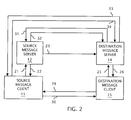
- FIG. 2 shows another application of the embodiment in FIG. 1 for an interactive communication.
- the methods of managing Public-Secret Key Pairs including initial generating, regenerating, maintaining, updating, providing, obtaining, and certifying the Public Keys are identical to those in the description of FIG. 1.
- Typical steps of establishing an interactive communication such as voice conversation over communication networks are as follows:
- the sending party may encrypt an Electronic Interactive Message with the receiving party's Public Key, and the receiving party may decrypt the encrypted Electronic Interactive Message with the receiving party's Secret Key.
- the interactive communication can be kept private.
- FIG. 3 shows a special case of FIG. 1, in which Source And Destination Message Server 326 is a single Host Computer that performs the functions of a Sender's Source Message Server and a Recipient's Destination Message Server for delivering an Electronic Mail Message.
- the execution steps are as same as those explained in the description of FIG.1 with the exception that the processes between the Source Message Server and the Destination Message Server are carried out internally or omitted.
- the Source Message Server and the Destination Message Server do not need to authenticate the other party's identity. Both the Sender and the Recipient can obtain the other party's Public Key Set easily via the Source And Destination Message Server 326.
- FIG. 4 shows a special case of FIG. 2, in which Source And Destination Message Server 326 is a single Host Computer that performs the functions of a Sender's Source Message Server and a Recipient's Destination Message Server for establishing an interactive communication.
- the execution steps are as same as those explained in the description of FIG. 2 with the exception that the processes between the Source Message Server and the Destination Message Server are carried out internally or omitted.
- the Source Message Server and the Destination Message Server do not need to authenticate the other party's identity, and the delivery of Intend-To-Communicate, Online-Notice, Offline-Notice, etc. will be faster. Both the Sender and the Recipient can obtain the other party's Public Key Set easily via the Source And Destination Message Server 326.
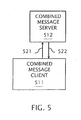
- FIG. 5 shows an alternative embodiment of the present invention in terms of the management of Security Keys.
- Combined Message Server 512 is a Host Computer performing functions of both a Source Message Server and a Destination Message Server, and is capable of automatic responding to incoming Electronic Messages instantly and initiating outgoing Electronic Messages.
- Combined Message Client 511 is a Local Computer or Communication Apparatus that a user uses to communicate with the Combined Message Server 512.
- the Combined Message Client 511 performs functions of a Source Message Client and a Destination Message Client.
- the Combined Message Server 512 encrypts its Public Key Set with its Secret Key and provides (an Information Flow 522) the encrypted Public Key Set to the Combined Message Client 511.
- the Combined Message Server 512 also provides a mechanism for the Combined Message Client 511 to download the Public Key Set of the Combined Message Server 512.
- the Combined Message Client 511 decrypts the encrypted Public Key Set with the downloaded Public Key to obtain the received Public Key Set, certifying the received Public Key Set by comparing it to the downloaded Public Key Set.
- the Combined Message Client 511 encrypts the user's account password and the user's Public Key Set with the Public Key of the Combined Message Server 512, reports (an Information Flow 521) the encrypted password and Public Key Set to the Combined Message Server 512.
- the Combined Message Server 512 decrypts the encrypted password and Public Key Set with the Secret Key of the Combined Message Server 512, and certifies the received Public Key Set by checking the received password. Therefore, both the user and the Combined Message Server 512 have the other party's Public key Set.
- Both the user and the Combined Message Server 512 may generate a new Public-Secret Key Pair whenever needed.
- the Combined Message Client 511 Whenever the user uses the Combined Message Client 511 to log on the Combined Message Server 512, the Combined Message Client 511 provides (an Information Flow 521) the last received Key Generating Time of the Combined Message Server 512 to the Combined Message Server 512.
- the Combined Message Server 512 identifies its Secret Key associated with the received Key Generating Time, encrypts its most updated Public Key Set with the identified Secret Key, and provides (an Information Flow 522) the encrypted Public Key Set to the Combined Message Client 511.
- the Combined Message Client 511 decrypts the encrypted Public Key Set with the last received Public Key of the Combined Message Server 512 to authenticate the identity of the Combined Message Server 512 and obtain the most updated Public Key Set of the Combined Message Server 512.
- the Combined Message Client 511 Whenever the user uses the Combined Message Client 511 to generate a new Public-Secret Key Pair, the Combined Message Client 511 will establish a connection to the Combined Message Server 512, encrypt the new Public Key Set with the last user's Secret Key, reports (an Information Flow 521) the encrypted new Public Key Set to the Combined Message Server 512.
- the Combined Message Server 512 decrypts the encrypted new Public Key Set with the last user's Public Key to authenticate the user's identity and obtain the new user's Public Key Set.
- both the user and the Combined Message Server 512 can maintain the most updated version of the other party's Public Key Set and perform a secure communication with authentication of identities and certification of message contents.
- FIG. 5 One exemplary application of FIG. 5 is transferring banking funds over communication networks.
- typical further steps are as follows:
- FIG. 5 Another exemplary application of FIG. 5 is licensing computer software on an Electronic Message System.
- typical further steps for such an application are as follows:
- FIG. 6 shows another alternative embodiment of the present invention in terms of the management of Security Keys involving a third-party server.
- Combined Message Server 512 is a Host Computer providing services of electronic paying account.
- Service Message Server 614 is a Host Computer providing services of electronic shopping to the public.
- Combined Message Client 511 is a Local Computer or Communication Apparatus that a user uses to communicate with the Combined Message Server 512 which the user has an account with. The user also uses the Combined Message Client 511 to communicate with the Service Message Server 614 for purchasing merchandises.
- the methods of managing Public-Secret Key Pairs including initial generating, regenerating, maintaining, updating, providing, obtaining, and certifying the Public Keys are identical to those explained in the description of FIG. 1. More specifically, the management of Public-Secret Key Pairs between the Combined Message Client 511 and the Combined Message Server 512 is identical to the case as explained in the description of FIG. 5. And the management of Public Key Pairs between the Combined Message Server 512 and the Service Message Server 614 is identical to the case between a Source Message Server and a Destination Message Server whenever a connection is made as explained in description of FIG. 1.
- the present invention provides a system and method for delivering Electronic Mail Message in a deliver-upon-request manner and an improved management of Security Keys of cryptography. While the above description contains many specifications, these should not be construed as limitations on the scope of the invention, but rather as an exemplification of preferred embodiments thereof. Many other variations are possible. For example, if necessary and with sufficient power of computer system, the present invention may be used for the implementation of a video conference for multiple attendees with encrypted Electronic Interactive Messages containing text, images, audio, voice and video that only the individual Recipient can decrypt the encrypted Electronic Interactive Messages with each Secret Key separately.
Landscapes
- Engineering & Computer Science (AREA)
- Computer Networks & Wireless Communication (AREA)
- Signal Processing (AREA)
- Computer Security & Cryptography (AREA)
- General Engineering & Computer Science (AREA)
- Computer Hardware Design (AREA)
- Computing Systems (AREA)
- Theoretical Computer Science (AREA)
- Physics & Mathematics (AREA)
- General Physics & Mathematics (AREA)
- Data Exchanges In Wide-Area Networks (AREA)
- Information Transfer Between Computers (AREA)
- Computer And Data Communications (AREA)
Applications Claiming Priority (2)
| Application Number | Priority Date | Filing Date | Title |
|---|---|---|---|
| US67349005P | 2005-04-22 | 2005-04-22 | |
| US11/231,855 US8151112B2 (en) | 2005-04-22 | 2005-09-22 | Deliver-upon-request secure electronic message system |
Publications (3)
| Publication Number | Publication Date |
|---|---|
| EP1722532A2 true EP1722532A2 (de) | 2006-11-15 |
| EP1722532A3 EP1722532A3 (de) | 2009-08-05 |
| EP1722532B1 EP1722532B1 (de) | 2016-10-26 |
Family
ID=37047924
Family Applications (1)
| Application Number | Title | Priority Date | Filing Date |
|---|---|---|---|
| EP06007993.6A Ceased EP1722532B1 (de) | 2005-04-22 | 2006-04-18 | System zur sicheren Zustellung elektronischer Nachrichten auf Aufforderung |
Country Status (10)
| Country | Link |
|---|---|
| US (1) | US8151112B2 (de) |
| EP (1) | EP1722532B1 (de) |
| KR (1) | KR20060111387A (de) |
| CN (1) | CN101938471B (de) |
| AR (1) | AR053714A1 (de) |
| AU (1) | AU2006201565A1 (de) |
| IL (1) | IL174928A0 (de) |
| NO (1) | NO20061760L (de) |
| SG (1) | SG126897A1 (de) |
| TW (1) | TW200640209A (de) |
Cited By (1)
| Publication number | Priority date | Publication date | Assignee | Title |
|---|---|---|---|---|
| WO2014086654A1 (de) * | 2012-12-06 | 2014-06-12 | Deutsche Post Ag | Verfahren zum aufbau einer sicheren verbindung zwischen clients |
Families Citing this family (25)
| Publication number | Priority date | Publication date | Assignee | Title |
|---|---|---|---|---|
| US20050038861A1 (en) | 2003-08-14 | 2005-02-17 | Scott Lynn | Method and system for dynamically generating electronic communications |
| US8429190B2 (en) | 2004-08-11 | 2013-04-23 | Adknowledge, Inc. | Method and system for generating and distributing electronic communications |
| US8249929B2 (en) | 2004-08-11 | 2012-08-21 | Adknowledge, Inc. | Method and system for generating and distributing electronic communications for maximum revenue |
| US20060095398A1 (en) * | 2004-11-04 | 2006-05-04 | Vasudev Bhaskaran | Automatic defocussing of displayed multimedia information on client by monitoring static and dynamic properties of the client |
| JP4723909B2 (ja) * | 2005-05-27 | 2011-07-13 | 株式会社日立製作所 | データ交換方法、データ交換管理装置およびデータ交換管理プログラム |
| US8121895B2 (en) | 2005-07-21 | 2012-02-21 | Adknowledge, Inc. | Method and system for delivering electronic communications |
| US8209222B2 (en) * | 2005-10-12 | 2012-06-26 | Adknowledge, Inc. | Method and system for encrypting data delivered over a network |
| EP1860817B1 (de) * | 2006-05-26 | 2009-03-25 | Sap Ag | Verfahren und Vorrichtung zum Schützen von Daten eines mobilen Agenten in einem Netzwerksystem. |
| US20100036946A1 (en) * | 2007-07-13 | 2010-02-11 | Von Arx Kim | System and process for providing online services |
| US10055595B2 (en) | 2007-08-30 | 2018-08-21 | Baimmt, Llc | Secure credentials control method |
| US8379867B2 (en) | 2007-09-24 | 2013-02-19 | Mymail Technology, Llc | Secure email communication system |
| US8649808B2 (en) | 2008-10-13 | 2014-02-11 | Microsoft Corporation | Universal mobile device messaging |
| US9178858B1 (en) * | 2009-08-05 | 2015-11-03 | West Corporation | Method and system for message delivery security validation |
| US20110128906A1 (en) * | 2009-11-27 | 2011-06-02 | Nokia Corporation | Method and apparatus for selectively receiving communication |
| US8819407B2 (en) * | 2011-09-26 | 2014-08-26 | Verizon New Jersey Inc. | Personal messaging security |
| TWI467411B (zh) * | 2011-12-20 | 2015-01-01 | Ind Tech Res Inst | 文件處理方法與系統 |
| US9491123B2 (en) * | 2012-04-24 | 2016-11-08 | Biscom Inc. | Streamlined messaging client provisioning system |
| US9767299B2 (en) | 2013-03-15 | 2017-09-19 | Mymail Technology, Llc | Secure cloud data sharing |
| CN105281922A (zh) * | 2014-06-23 | 2016-01-27 | 中兴通讯股份有限公司 | 一种信息共享方法、系统及设备 |
| US9923719B2 (en) * | 2014-12-09 | 2018-03-20 | Cryptography Research, Inc. | Location aware cryptography |
| WO2017035725A1 (zh) * | 2015-08-31 | 2017-03-09 | 林建华 | 电子通信系统在开放环境中通信的方法 |
| US10805311B2 (en) * | 2016-08-22 | 2020-10-13 | Paubox Inc. | Method for securely communicating email content between a sender and a recipient |
| US11354659B1 (en) * | 2016-12-19 | 2022-06-07 | Amazon Technologies, Inc. | Securing transaction messages based on a dynamic key selection |
| US11341489B1 (en) | 2016-12-19 | 2022-05-24 | Amazon Technologies, Inc. | Multi-path back-end system for payment processing |
| US11140173B2 (en) | 2017-03-31 | 2021-10-05 | Baimmt, Llc | System and method for secure access control |
Citations (2)
| Publication number | Priority date | Publication date | Assignee | Title |
|---|---|---|---|---|
| US20020023213A1 (en) | 2000-06-12 | 2002-02-21 | Tia Walker | Encryption system that dynamically locates keys |
| WO2003061213A1 (en) | 2002-01-17 | 2003-07-24 | Tae-Joon Kim | Method for electronic mail notice and download |
Family Cites Families (40)
| Publication number | Priority date | Publication date | Assignee | Title |
|---|---|---|---|---|
| US5422772A (en) * | 1989-08-28 | 1995-06-06 | Mcdonnell Douglas Corporation | Secure fiber optic networks |
| US5515441A (en) * | 1994-05-12 | 1996-05-07 | At&T Corp. | Secure communication method and apparatus |
| US5734903A (en) * | 1994-05-13 | 1998-03-31 | Apple Computer, Inc. | System and method for object oriented message filtering |
| US5724425A (en) * | 1994-06-10 | 1998-03-03 | Sun Microsystems, Inc. | Method and apparatus for enhancing software security and distributing software |
| US5553145A (en) * | 1995-03-21 | 1996-09-03 | Micali; Silvia | Simultaneous electronic transactions with visible trusted parties |
| EP0917781A4 (de) * | 1996-08-07 | 2003-08-13 | Silvio Micali | Gleichzeitige elektronische transaktionen mit sichtbaren treuhandvermittlern |
| US6115471A (en) * | 1996-11-28 | 2000-09-05 | Fujitsu Limited | Member-exclusive service system and method through internet |
| US5966663A (en) * | 1997-01-14 | 1999-10-12 | Ericsson Messaging Systems Inc. | Data communications protocol for facilitating communications between a message entry device and a messaging center |
| TW396308B (en) * | 1997-04-01 | 2000-07-01 | Tumbleweed Software Corp | Document delivery system |
| US6263446B1 (en) * | 1997-12-23 | 2001-07-17 | Arcot Systems, Inc. | Method and apparatus for secure distribution of authentication credentials to roaming users |
| US6145079A (en) * | 1998-03-06 | 2000-11-07 | Deloitte & Touche Usa Llp | Secure electronic transactions using a trusted intermediary to perform electronic services |
| US20010037453A1 (en) * | 1998-03-06 | 2001-11-01 | Mitty Todd Jay | Secure electronic transactions using a trusted intermediary with non-repudiation of receipt and contents of message |
| US6597688B2 (en) * | 1998-06-12 | 2003-07-22 | J2 Global Communications, Inc. | Scalable architecture for transmission of messages over a network |
| US6088796A (en) * | 1998-08-06 | 2000-07-11 | Cianfrocca; Francis | Secure middleware and server control system for querying through a network firewall |
| US20050021963A1 (en) * | 2003-04-17 | 2005-01-27 | Tomkow Terrance A. | System for, and method of, proving the transmission, receipt and content of a reply to an electronic message |
| US7966372B1 (en) * | 1999-07-28 | 2011-06-21 | Rpost International Limited | System and method for verifying delivery and integrity of electronic messages |
| US7886008B2 (en) * | 1999-07-28 | 2011-02-08 | Rpost International Limited | System and method for verifying delivery and integrity of electronic messages |
| US20020104026A1 (en) * | 2001-01-29 | 2002-08-01 | Robert Barra | Method and apparatus for providing a service to transfer messages over a communications network |
| DE60031112T8 (de) * | 2000-08-23 | 2007-09-06 | Sony Deutschland Gmbh | Fernbedienung eines Hausnetzwerks mittels elektronischer Post |
| US7054447B1 (en) * | 2000-09-01 | 2006-05-30 | Pgp Corporation | Method and apparatus for periodically removing invalid public keys from a public key server |
| US6732270B1 (en) * | 2000-10-23 | 2004-05-04 | Motorola, Inc. | Method to authenticate a network access server to an authentication server |
| CN1311656C (zh) * | 2001-02-15 | 2007-04-18 | 三竹资讯股份有限公司 | 移动商务wap数据传输段的端对端加密方法 |
| US7174368B2 (en) * | 2001-03-27 | 2007-02-06 | Xante Corporation | Encrypted e-mail reader and responder system, method, and computer program product |
| GB2377143A (en) * | 2001-06-29 | 2002-12-31 | 3G Scene Plc | Internet security |
| JP2003016160A (ja) * | 2001-07-04 | 2003-01-17 | Fujitsu Ltd | メッセージ配信方法およびメッセージ配信プログラム |
| EP1357697B1 (de) * | 2002-04-16 | 2006-05-24 | Izecom B.V. | Sichere Kommunikation über das Internet |
| US7469340B2 (en) * | 2002-08-07 | 2008-12-23 | Kryptiq Corporation | Selective encryption of electronic messages and data |
| US7299357B2 (en) * | 2002-08-07 | 2007-11-20 | Kryptiq Corporation | Opaque message archives |
| US20040030918A1 (en) * | 2002-08-07 | 2004-02-12 | Karamchedu Murali M. | Enterprise based opaque message archives |
| US20040030916A1 (en) * | 2002-08-07 | 2004-02-12 | Karamchedu Murali M. | Preemptive and interactive data solicitation for electronic messaging |
| CN1225096C (zh) * | 2002-09-12 | 2005-10-26 | 盛群半导体股份有限公司 | 高安全性的遥控器编码装置 |
| US7707624B2 (en) * | 2002-11-26 | 2010-04-27 | Rpost International Limited | System for, and method of, proving the transmission, receipt and content of a reply to an electronic message |
| US7660989B2 (en) * | 2002-11-26 | 2010-02-09 | Rpost International Limited | System for, and method of, authenticating an electronic message to a recipient |
| US7698558B2 (en) * | 2003-11-21 | 2010-04-13 | Rpost International Limited | System for, and method of, providing the transmission, receipt and content of an e-mail message |
| US7653816B2 (en) * | 2003-12-30 | 2010-01-26 | First Information Systems, Llc | E-mail certification service |
| US7260383B1 (en) * | 2004-02-20 | 2007-08-21 | Sprint Spectrum L.P. | Method and system for wireline response to wireless message notification |
| US20060101124A1 (en) * | 2004-11-10 | 2006-05-11 | Landis Michael D | Method and apparatus for mass email transmission |
| US20060242247A1 (en) * | 2005-04-21 | 2006-10-26 | Richardson Ric B | Methods and systems for integrating physical mail with electronic mail |
| US7653696B2 (en) * | 2005-07-29 | 2010-01-26 | Research In Motion Limited | Method and apparatus for processing digitally signed messages to determine address mismatches |
| US7877594B1 (en) * | 2006-03-16 | 2011-01-25 | Copytele, Inc. | Method and system for securing e-mail transmissions |
-
2005
- 2005-09-22 US US11/231,855 patent/US8151112B2/en active Active
-
2006
- 2006-03-30 CN CN2010102568247A patent/CN101938471B/zh not_active Expired - Fee Related
- 2006-04-07 TW TW095112350A patent/TW200640209A/zh unknown
- 2006-04-11 IL IL174928A patent/IL174928A0/en unknown
- 2006-04-12 AU AU2006201565A patent/AU2006201565A1/en not_active Abandoned
- 2006-04-18 EP EP06007993.6A patent/EP1722532B1/de not_active Ceased
- 2006-04-20 SG SG200602674A patent/SG126897A1/en unknown
- 2006-04-20 KR KR1020060035655A patent/KR20060111387A/ko not_active Withdrawn
- 2006-04-21 AR ARP060101582A patent/AR053714A1/es unknown
- 2006-04-21 NO NO20061760A patent/NO20061760L/no not_active Application Discontinuation
Patent Citations (2)
| Publication number | Priority date | Publication date | Assignee | Title |
|---|---|---|---|---|
| US20020023213A1 (en) | 2000-06-12 | 2002-02-21 | Tia Walker | Encryption system that dynamically locates keys |
| WO2003061213A1 (en) | 2002-01-17 | 2003-07-24 | Tae-Joon Kim | Method for electronic mail notice and download |
Cited By (2)
| Publication number | Priority date | Publication date | Assignee | Title |
|---|---|---|---|---|
| WO2014086654A1 (de) * | 2012-12-06 | 2014-06-12 | Deutsche Post Ag | Verfahren zum aufbau einer sicheren verbindung zwischen clients |
| US9716591B2 (en) | 2012-12-06 | 2017-07-25 | Deutsche Post Ag | Method for setting up a secure connection between clients |
Also Published As
| Publication number | Publication date |
|---|---|
| NO20061760L (no) | 2006-10-23 |
| EP1722532B1 (de) | 2016-10-26 |
| EP1722532A3 (de) | 2009-08-05 |
| CN101938471B (zh) | 2012-04-04 |
| SG126897A1 (en) | 2006-11-29 |
| US8151112B2 (en) | 2012-04-03 |
| TW200640209A (en) | 2006-11-16 |
| US20060242411A1 (en) | 2006-10-26 |
| KR20060111387A (ko) | 2006-10-27 |
| AR053714A1 (es) | 2007-05-16 |
| CN101938471A (zh) | 2011-01-05 |
| AU2006201565A1 (en) | 2006-11-09 |
| IL174928A0 (en) | 2006-08-20 |
Similar Documents
| Publication | Publication Date | Title |
|---|---|---|
| US8151112B2 (en) | Deliver-upon-request secure electronic message system | |
| JP3251917B2 (ja) | 電子入札システムおよび電子入札方法 | |
| US6842628B1 (en) | Method and system for event notification for wireless PDA devices | |
| US7725723B2 (en) | Data certification method and apparatus | |
| EP1593100B1 (de) | Verfahren zum sicherstellen von anonymität in einer elektronischen transaktion mittels sitzungsschlüsselblöcken | |
| EP3345372B1 (de) | Sicheres schlüsselmanagement und peer-to-peer-übertragungssystem mit einer gesteuerten doppelstufigen kryptographischen schlüsselstruktur und entsprechendes verfahren dafür | |
| MXPA04007546A (es) | Metodo y sistema para proporcionar una tercera autenticacion de autorizacion. | |
| AU2002355593A1 (en) | Data certification method and apparatus | |
| EP1364268A2 (de) | Verfahren und systeme zur authentifizierung von geschäftspartner für gesicherte elektronische trasaktionen | |
| JP2004509398A (ja) | ネットワークにわたって配布されるオブジェクトの保護のために監査証跡を確立するためのシステム | |
| CA2335968A1 (en) | Bi-directional, anonymous electronic transactions | |
| JP2008501176A (ja) | プライバシーを保護する情報配布システム | |
| JP2004509399A (ja) | ネットワークにわたって配布されるオブジェクトを保護するためのシステム | |
| US6795920B1 (en) | Vault controller secure depositor for managing secure communication | |
| CN113315749B (zh) | 用户数据上链、用户数据使用方法、匿名系统和存储介质 | |
| JP3999527B2 (ja) | コンピュータネットワークの認証方法及びデータ配信方法 | |
| CN1866820B (zh) | 安全的电子信息请求传递系统 | |
| JPH0946335A (ja) | 電子メッセージ交換方法およびシステムおよび電子メッセージ交換処理用記憶媒体 | |
| MXPA06004501A (en) | Deliver-upon-request secure electronic message system | |
| JPH08255199A (ja) | 認証方式 | |
| JP2007089116A (ja) | 電子メッセージシステム | |
| JP2003318888A (ja) | リマインダサービス方法 | |
| WO2002033891A2 (en) | Secure and reliable document delivery using routing lists |
Legal Events
| Date | Code | Title | Description |
|---|---|---|---|
| PUAI | Public reference made under article 153(3) epc to a published international application that has entered the european phase |
Free format text: ORIGINAL CODE: 0009012 |
|
| AK | Designated contracting states |
Kind code of ref document: A2 Designated state(s): AT BE BG CH CY CZ DE DK EE ES FI FR GB GR HU IE IS IT LI LT LU LV MC NL PL PT RO SE SI SK TR |
|
| AX | Request for extension of the european patent |
Extension state: AL BA HR MK YU |
|
| PUAL | Search report despatched |
Free format text: ORIGINAL CODE: 0009013 |
|
| AK | Designated contracting states |
Kind code of ref document: A3 Designated state(s): AT BE BG CH CY CZ DE DK EE ES FI FR GB GR HU IE IS IT LI LT LU LV MC NL PL PT RO SE SI SK TR |
|
| AX | Request for extension of the european patent |
Extension state: AL BA HR MK YU |
|
| 17P | Request for examination filed |
Effective date: 20100202 |
|
| 17Q | First examination report despatched |
Effective date: 20100223 |
|
| AKX | Designation fees paid |
Designated state(s): DE FR GB |
|
| GRAP | Despatch of communication of intention to grant a patent |
Free format text: ORIGINAL CODE: EPIDOSNIGR1 |
|
| INTG | Intention to grant announced |
Effective date: 20160610 |
|
| GRAS | Grant fee paid |
Free format text: ORIGINAL CODE: EPIDOSNIGR3 |
|
| GRAA | (expected) grant |
Free format text: ORIGINAL CODE: 0009210 |
|
| AK | Designated contracting states |
Kind code of ref document: B1 Designated state(s): DE FR GB |
|
| REG | Reference to a national code |
Ref country code: GB Ref legal event code: FG4D |
|
| REG | Reference to a national code |
Ref country code: DE Ref legal event code: R096 Ref document number: 602006050675 Country of ref document: DE |
|
| REG | Reference to a national code |
Ref country code: FR Ref legal event code: PLFP Year of fee payment: 12 |
|
| REG | Reference to a national code |
Ref country code: DE Ref legal event code: R097 Ref document number: 602006050675 Country of ref document: DE |
|
| PLBE | No opposition filed within time limit |
Free format text: ORIGINAL CODE: 0009261 |
|
| STAA | Information on the status of an ep patent application or granted ep patent |
Free format text: STATUS: NO OPPOSITION FILED WITHIN TIME LIMIT |
|
| 26N | No opposition filed |
Effective date: 20170727 |
|
| REG | Reference to a national code |
Ref country code: FR Ref legal event code: PLFP Year of fee payment: 13 |
|
| PGFP | Annual fee paid to national office [announced via postgrant information from national office to epo] |
Ref country code: DE Payment date: 20190510 Year of fee payment: 14 |
|
| PGFP | Annual fee paid to national office [announced via postgrant information from national office to epo] |
Ref country code: FR Payment date: 20190430 Year of fee payment: 14 |
|
| PGFP | Annual fee paid to national office [announced via postgrant information from national office to epo] |
Ref country code: GB Payment date: 20190516 Year of fee payment: 14 |
|
| REG | Reference to a national code |
Ref country code: DE Ref legal event code: R119 Ref document number: 602006050675 Country of ref document: DE |
|
| PG25 | Lapsed in a contracting state [announced via postgrant information from national office to epo] |
Ref country code: FR Free format text: LAPSE BECAUSE OF NON-PAYMENT OF DUE FEES Effective date: 20200430 Ref country code: DE Free format text: LAPSE BECAUSE OF NON-PAYMENT OF DUE FEES Effective date: 20201103 |
|
| GBPC | Gb: european patent ceased through non-payment of renewal fee |
Effective date: 20200418 |
|
| PG25 | Lapsed in a contracting state [announced via postgrant information from national office to epo] |
Ref country code: GB Free format text: LAPSE BECAUSE OF NON-PAYMENT OF DUE FEES Effective date: 20200418 |