EP1721899A1 - Process for the preparation of a carboxamide derivative - Google Patents
Process for the preparation of a carboxamide derivative Download PDFInfo
- Publication number
- EP1721899A1 EP1721899A1 EP05356080A EP05356080A EP1721899A1 EP 1721899 A1 EP1721899 A1 EP 1721899A1 EP 05356080 A EP05356080 A EP 05356080A EP 05356080 A EP05356080 A EP 05356080A EP 1721899 A1 EP1721899 A1 EP 1721899A1
- Authority
- EP
- European Patent Office
- Prior art keywords
- general formula
- compound
- derivative
- alkyl
- solvent
- Prior art date
- Legal status (The legal status is an assumption and is not a legal conclusion. Google has not performed a legal analysis and makes no representation as to the accuracy of the status listed.)
- Withdrawn
Links
- 238000000034 method Methods 0.000 title claims abstract description 34
- 238000002360 preparation method Methods 0.000 title claims abstract description 20
- 125000003917 carbamoyl group Chemical class [H]N([H])C(*)=O 0.000 title claims abstract description 5
- 150000001875 compounds Chemical class 0.000 claims abstract description 76
- 150000003839 salts Chemical class 0.000 claims abstract description 4
- 125000005843 halogen group Chemical group 0.000 claims description 50
- 239000002904 solvent Substances 0.000 claims description 42
- 125000004178 (C1-C4) alkyl group Chemical group 0.000 claims description 38
- 238000006243 chemical reaction Methods 0.000 claims description 37
- -1 nitrophenyl alcohol derivative Chemical class 0.000 claims description 29
- 229910052736 halogen Inorganic materials 0.000 claims description 26
- 150000002367 halogens Chemical group 0.000 claims description 26
- 125000000623 heterocyclic group Chemical group 0.000 claims description 26
- 229910052739 hydrogen Inorganic materials 0.000 claims description 25
- 239000001257 hydrogen Substances 0.000 claims description 25
- 239000003795 chemical substances by application Substances 0.000 claims description 16
- 125000002496 methyl group Chemical group [H]C([H])([H])* 0.000 claims description 15
- 239000012022 methylating agents Substances 0.000 claims description 13
- 229910052801 chlorine Inorganic materials 0.000 claims description 12
- 125000004093 cyano group Chemical group *C#N 0.000 claims description 12
- 150000003857 carboxamides Chemical class 0.000 claims description 11
- 125000004435 hydrogen atom Chemical group [H]* 0.000 claims description 11
- 229910052751 metal Chemical group 0.000 claims description 11
- 239000002184 metal Chemical group 0.000 claims description 11
- 125000000008 (C1-C10) alkyl group Chemical group 0.000 claims description 10
- 239000002253 acid Substances 0.000 claims description 10
- 239000003054 catalyst Substances 0.000 claims description 10
- 125000006501 nitrophenyl group Chemical group 0.000 claims description 10
- WKBOTKDWSSQWDR-UHFFFAOYSA-N Bromine atom Chemical compound [Br] WKBOTKDWSSQWDR-UHFFFAOYSA-N 0.000 claims description 9
- ZAMOUSCENKQFHK-UHFFFAOYSA-N Chlorine atom Chemical compound [Cl] ZAMOUSCENKQFHK-UHFFFAOYSA-N 0.000 claims description 9
- 239000000460 chlorine Substances 0.000 claims description 9
- 125000001495 ethyl group Chemical group [H]C([H])([H])C([H])([H])* 0.000 claims description 9
- 229910052731 fluorine Inorganic materials 0.000 claims description 9
- 125000004780 2-chloro-2,2-difluoroethyl group Chemical group [H]C([H])(*)C(F)(F)Cl 0.000 claims description 8
- PXGOKWXKJXAPGV-UHFFFAOYSA-N Fluorine Chemical compound FF PXGOKWXKJXAPGV-UHFFFAOYSA-N 0.000 claims description 8
- GDTBXPJZTBHREO-UHFFFAOYSA-N bromine Substances BrBr GDTBXPJZTBHREO-UHFFFAOYSA-N 0.000 claims description 8
- 229910052794 bromium Inorganic materials 0.000 claims description 8
- 238000006114 decarboxylation reaction Methods 0.000 claims description 8
- 239000011737 fluorine Substances 0.000 claims description 8
- 239000000203 mixture Substances 0.000 claims description 8
- 239000003586 protic polar solvent Substances 0.000 claims description 8
- 125000000229 (C1-C4)alkoxy group Chemical group 0.000 claims description 7
- 125000004765 (C1-C4) haloalkyl group Chemical group 0.000 claims description 6
- KXDHJXZQYSOELW-UHFFFAOYSA-N Carbamic acid Chemical class NC(O)=O KXDHJXZQYSOELW-UHFFFAOYSA-N 0.000 claims description 6
- GKQPYCWSUVGAGJ-UHFFFAOYSA-N bis(2-nitrophenyl)methanone Chemical class [O-][N+](=O)C1=CC=CC=C1C(=O)C1=CC=CC=C1[N+]([O-])=O GKQPYCWSUVGAGJ-UHFFFAOYSA-N 0.000 claims description 6
- 238000007069 methylation reaction Methods 0.000 claims description 6
- 125000002023 trifluoromethyl group Chemical group FC(F)(F)* 0.000 claims description 6
- 150000005181 nitrobenzenes Chemical class 0.000 claims description 5
- 241000894007 species Species 0.000 claims description 5
- 125000005913 (C3-C6) cycloalkyl group Chemical group 0.000 claims description 4
- FKTXDTWDCPTPHK-UHFFFAOYSA-N 1,1,1,2,3,3,3-heptafluoropropane Chemical group FC(F)(F)[C](F)C(F)(F)F FKTXDTWDCPTPHK-UHFFFAOYSA-N 0.000 claims description 4
- 125000004776 1-fluoroethyl group Chemical group [H]C([H])([H])C([H])(F)* 0.000 claims description 4
- 125000000453 2,2,2-trichloroethyl group Chemical group [H]C([H])(*)C(Cl)(Cl)Cl 0.000 claims description 4
- 125000004206 2,2,2-trifluoroethyl group Chemical group [H]C([H])(*)C(F)(F)F 0.000 claims description 4
- 125000004781 2,2-dichloro-2-fluoroethyl group Chemical group [H]C([H])(*)C(F)(Cl)Cl 0.000 claims description 4
- 125000004778 2,2-difluoroethyl group Chemical group [H]C([H])(*)C([H])(F)F 0.000 claims description 4
- 125000004779 2-chloro-2-fluoroethyl group Chemical group [H]C([H])(*)C([H])(F)Cl 0.000 claims description 4
- 125000004777 2-fluoroethyl group Chemical group [H]C([H])(F)C([H])([H])* 0.000 claims description 4
- 125000004773 chlorofluoromethyl group Chemical group [H]C(F)(Cl)* 0.000 claims description 4
- 125000004218 chloromethyl group Chemical group [H]C([H])(Cl)* 0.000 claims description 4
- 125000004772 dichloromethyl group Chemical group [H]C(Cl)(Cl)* 0.000 claims description 4
- 125000001028 difluoromethyl group Chemical group [H]C(F)(F)* 0.000 claims description 4
- 125000004216 fluoromethyl group Chemical group [H]C([H])(F)* 0.000 claims description 4
- 125000006341 heptafluoro n-propyl group Chemical group FC(F)(F)C(F)(F)C(F)(F)* 0.000 claims description 4
- 230000011987 methylation Effects 0.000 claims description 4
- 125000006340 pentafluoro ethyl group Chemical group FC(F)(F)C(F)(F)* 0.000 claims description 4
- 125000003866 trichloromethyl group Chemical group ClC(Cl)(Cl)* 0.000 claims description 4
- 150000001266 acyl halides Chemical class 0.000 claims description 3
- 229940053202 antiepileptics carboxamide derivative Drugs 0.000 claims description 3
- 238000005859 coupling reaction Methods 0.000 claims description 3
- 125000005842 heteroatom Chemical group 0.000 claims description 3
- 125000000449 nitro group Chemical group [O-][N+](*)=O 0.000 claims description 3
- OHHGURYQOBQYHN-UHFFFAOYSA-N nitro(phenyl)methanone Chemical compound [O-][N+](=O)C(=O)C1=CC=CC=C1 OHHGURYQOBQYHN-UHFFFAOYSA-N 0.000 claims description 3
- 125000000882 C2-C6 alkenyl group Chemical group 0.000 claims description 2
- 229910052799 carbon Inorganic materials 0.000 claims description 2
- 125000004432 carbon atom Chemical group C* 0.000 claims description 2
- 125000004170 methylsulfonyl group Chemical group [H]C([H])([H])S(*)(=O)=O 0.000 claims description 2
- 125000001997 phenyl group Chemical group [H]C1=C([H])C([H])=C(*)C([H])=C1[H] 0.000 claims description 2
- 125000004437 phosphorous atom Chemical group 0.000 claims description 2
- 125000002088 tosyl group Chemical group [H]C1=C([H])C(=C([H])C([H])=C1C([H])([H])[H])S(*)(=O)=O 0.000 claims description 2
- 239000000543 intermediate Substances 0.000 abstract description 7
- IAZDPXIOMUYVGZ-UHFFFAOYSA-N Dimethylsulphoxide Chemical compound CS(C)=O IAZDPXIOMUYVGZ-UHFFFAOYSA-N 0.000 description 32
- HEDRZPFGACZZDS-MICDWDOJSA-N Trichloro(2H)methane Chemical compound [2H]C(Cl)(Cl)Cl HEDRZPFGACZZDS-MICDWDOJSA-N 0.000 description 24
- 239000002585 base Substances 0.000 description 23
- XEKOWRVHYACXOJ-UHFFFAOYSA-N Ethyl acetate Chemical compound CCOC(C)=O XEKOWRVHYACXOJ-UHFFFAOYSA-N 0.000 description 21
- CSNNHWWHGAXBCP-UHFFFAOYSA-L Magnesium sulfate Chemical compound [Mg+2].[O-][S+2]([O-])([O-])[O-] CSNNHWWHGAXBCP-UHFFFAOYSA-L 0.000 description 20
- 150000002431 hydrogen Chemical class 0.000 description 19
- XLYOFNOQVPJJNP-UHFFFAOYSA-N water Substances O XLYOFNOQVPJJNP-UHFFFAOYSA-N 0.000 description 19
- QTBSBXVTEAMEQO-UHFFFAOYSA-N Acetic acid Chemical compound CC(O)=O QTBSBXVTEAMEQO-UHFFFAOYSA-N 0.000 description 15
- ZMXDDKWLCZADIW-UHFFFAOYSA-N N,N-Dimethylformamide Chemical compound CN(C)C=O ZMXDDKWLCZADIW-UHFFFAOYSA-N 0.000 description 15
- YXFVVABEGXRONW-UHFFFAOYSA-N Toluene Chemical compound CC1=CC=CC=C1 YXFVVABEGXRONW-UHFFFAOYSA-N 0.000 description 15
- BWHMMNNQKKPAPP-UHFFFAOYSA-L potassium carbonate Chemical compound [K+].[K+].[O-]C([O-])=O BWHMMNNQKKPAPP-UHFFFAOYSA-L 0.000 description 14
- 238000005160 1H NMR spectroscopy Methods 0.000 description 13
- YMWUJEATGCHHMB-UHFFFAOYSA-N Dichloromethane Chemical compound ClCCl YMWUJEATGCHHMB-UHFFFAOYSA-N 0.000 description 12
- OKKJLVBELUTLKV-UHFFFAOYSA-N Methanol Chemical compound OC OKKJLVBELUTLKV-UHFFFAOYSA-N 0.000 description 12
- SECXISVLQFMRJM-UHFFFAOYSA-N N-Methylpyrrolidone Chemical compound CN1CCCC1=O SECXISVLQFMRJM-UHFFFAOYSA-N 0.000 description 12
- 239000000243 solution Substances 0.000 description 11
- KDLHZDBZIXYQEI-UHFFFAOYSA-N Palladium Chemical compound [Pd] KDLHZDBZIXYQEI-UHFFFAOYSA-N 0.000 description 10
- JUJWROOIHBZHMG-UHFFFAOYSA-N Pyridine Chemical compound C1=CC=NC=C1 JUJWROOIHBZHMG-UHFFFAOYSA-N 0.000 description 10
- 229910052943 magnesium sulfate Inorganic materials 0.000 description 10
- 238000006722 reduction reaction Methods 0.000 description 10
- LFQSCWFLJHTTHZ-UHFFFAOYSA-N Ethanol Chemical compound CCO LFQSCWFLJHTTHZ-UHFFFAOYSA-N 0.000 description 9
- ZMANZCXQSJIPKH-UHFFFAOYSA-N Triethylamine Chemical compound CCN(CC)CC ZMANZCXQSJIPKH-UHFFFAOYSA-N 0.000 description 9
- 239000012074 organic phase Substances 0.000 description 9
- CDBYLPFSWZWCQE-UHFFFAOYSA-L Sodium Carbonate Chemical compound [Na+].[Na+].[O-]C([O-])=O CDBYLPFSWZWCQE-UHFFFAOYSA-L 0.000 description 8
- KWGKDLIKAYFUFQ-UHFFFAOYSA-M lithium chloride Chemical compound [Li+].[Cl-] KWGKDLIKAYFUFQ-UHFFFAOYSA-M 0.000 description 8
- 239000011541 reaction mixture Substances 0.000 description 8
- VZEILBMHPZHTDN-UHFFFAOYSA-N 2-methyl-4-(2-nitrophenyl)pentan-3-one Chemical compound CC(C)C(=O)C(C)C1=CC=CC=C1[N+]([O-])=O VZEILBMHPZHTDN-UHFFFAOYSA-N 0.000 description 7
- WEVYAHXRMPXWCK-UHFFFAOYSA-N Acetonitrile Chemical compound CC#N WEVYAHXRMPXWCK-UHFFFAOYSA-N 0.000 description 7
- BZLVMXJERCGZMT-UHFFFAOYSA-N Methyl tert-butyl ether Chemical compound COC(C)(C)C BZLVMXJERCGZMT-UHFFFAOYSA-N 0.000 description 7
- FXHOOIRPVKKKFG-UHFFFAOYSA-N N,N-Dimethylacetamide Chemical compound CN(C)C(C)=O FXHOOIRPVKKKFG-UHFFFAOYSA-N 0.000 description 7
- 239000002798 polar solvent Substances 0.000 description 7
- 229910000027 potassium carbonate Inorganic materials 0.000 description 7
- KBPLFHHGFOOTCA-UHFFFAOYSA-N 1-Octanol Chemical group CCCCCCCCO KBPLFHHGFOOTCA-UHFFFAOYSA-N 0.000 description 6
- WYURNTSHIVDZCO-UHFFFAOYSA-N Tetrahydrofuran Chemical compound C1CCOC1 WYURNTSHIVDZCO-UHFFFAOYSA-N 0.000 description 6
- 239000012267 brine Substances 0.000 description 6
- 125000002924 primary amino group Chemical group [H]N([H])* 0.000 description 6
- HPALAKNZSZLMCH-UHFFFAOYSA-M sodium;chloride;hydrate Chemical compound O.[Na+].[Cl-] HPALAKNZSZLMCH-UHFFFAOYSA-M 0.000 description 6
- 235000019341 magnesium sulphate Nutrition 0.000 description 5
- UMJSCPRVCHMLSP-UHFFFAOYSA-N pyridine Natural products COC1=CC=CN=C1 UMJSCPRVCHMLSP-UHFFFAOYSA-N 0.000 description 5
- 239000007787 solid Substances 0.000 description 5
- IJGRMHOSHXDMSA-UHFFFAOYSA-N Atomic nitrogen Chemical compound N#N IJGRMHOSHXDMSA-UHFFFAOYSA-N 0.000 description 4
- VEXZGXHMUGYJMC-UHFFFAOYSA-N Hydrochloric acid Chemical compound Cl VEXZGXHMUGYJMC-UHFFFAOYSA-N 0.000 description 4
- 239000008346 aqueous phase Substances 0.000 description 4
- 150000004702 methyl esters Chemical class 0.000 description 4
- 239000012071 phase Substances 0.000 description 4
- 239000000047 product Substances 0.000 description 4
- 229910000029 sodium carbonate Inorganic materials 0.000 description 4
- CCOUIHQEILBUEC-UHFFFAOYSA-N 2-(2-aminophenyl)-4-methylpentan-3-ol Chemical compound CC(C)C(O)C(C)C1=CC=CC=C1N CCOUIHQEILBUEC-UHFFFAOYSA-N 0.000 description 3
- AUNSQECUZRUZBH-UHFFFAOYSA-N 2-methyl-4-(2-nitrophenyl)pentan-3-ol Chemical compound CC(C)C(O)C(C)C1=CC=CC=C1[N+]([O-])=O AUNSQECUZRUZBH-UHFFFAOYSA-N 0.000 description 3
- RTZKZFJDLAIYFH-UHFFFAOYSA-N Diethyl ether Chemical compound CCOCC RTZKZFJDLAIYFH-UHFFFAOYSA-N 0.000 description 3
- XTHFKEDIFFGKHM-UHFFFAOYSA-N Dimethoxyethane Chemical compound COCCOC XTHFKEDIFFGKHM-UHFFFAOYSA-N 0.000 description 3
- UFHFLCQGNIYNRP-UHFFFAOYSA-N Hydrogen Chemical compound [H][H] UFHFLCQGNIYNRP-UHFFFAOYSA-N 0.000 description 3
- NBIIXXVUZAFLBC-UHFFFAOYSA-N Phosphoric acid Chemical compound OP(O)(O)=O NBIIXXVUZAFLBC-UHFFFAOYSA-N 0.000 description 3
- KWYUFKZDYYNOTN-UHFFFAOYSA-M Potassium hydroxide Chemical compound [OH-].[K+] KWYUFKZDYYNOTN-UHFFFAOYSA-M 0.000 description 3
- VYPSYNLAJGMNEJ-UHFFFAOYSA-N Silicium dioxide Chemical compound O=[Si]=O VYPSYNLAJGMNEJ-UHFFFAOYSA-N 0.000 description 3
- HEMHJVSKTPXQMS-UHFFFAOYSA-M Sodium hydroxide Chemical compound [OH-].[Na+] HEMHJVSKTPXQMS-UHFFFAOYSA-M 0.000 description 3
- 125000001309 chloro group Chemical group Cl* 0.000 description 3
- 238000003818 flash chromatography Methods 0.000 description 3
- 125000004356 hydroxy functional group Chemical group O* 0.000 description 3
- INQOMBQAUSQDDS-UHFFFAOYSA-N iodomethane Chemical group IC INQOMBQAUSQDDS-UHFFFAOYSA-N 0.000 description 3
- VLKZOEOYAKHREP-UHFFFAOYSA-N n-Hexane Chemical compound CCCCCC VLKZOEOYAKHREP-UHFFFAOYSA-N 0.000 description 3
- 150000002828 nitro derivatives Chemical class 0.000 description 3
- XHXFXVLFKHQFAL-UHFFFAOYSA-N phosphoryl trichloride Chemical compound ClP(Cl)(Cl)=O XHXFXVLFKHQFAL-UHFFFAOYSA-N 0.000 description 3
- 229940093956 potassium carbonate Drugs 0.000 description 3
- 235000011181 potassium carbonates Nutrition 0.000 description 3
- 238000000746 purification Methods 0.000 description 3
- 239000011734 sodium Substances 0.000 description 3
- 235000017550 sodium carbonate Nutrition 0.000 description 3
- SCYULBFZEHDVBN-UHFFFAOYSA-N 1,1-Dichloroethane Chemical compound CC(Cl)Cl SCYULBFZEHDVBN-UHFFFAOYSA-N 0.000 description 2
- YYROPELSRYBVMQ-UHFFFAOYSA-N 4-toluenesulfonyl chloride Chemical compound CC1=CC=C(S(Cl)(=O)=O)C=C1 YYROPELSRYBVMQ-UHFFFAOYSA-N 0.000 description 2
- UILFIECIKWCJJE-UHFFFAOYSA-N 5-fluoro-n-[2-(3-hydroxy-4-methylpentan-2-yl)phenyl]-1,3-dimethylpyrazole-4-carboxamide Chemical compound CC(C)C(O)C(C)C1=CC=CC=C1NC(=O)C1=C(F)N(C)N=C1C UILFIECIKWCJJE-UHFFFAOYSA-N 0.000 description 2
- CSCPPACGZOOCGX-UHFFFAOYSA-N Acetone Chemical compound CC(C)=O CSCPPACGZOOCGX-UHFFFAOYSA-N 0.000 description 2
- QGZKDVFQNNGYKY-UHFFFAOYSA-N Ammonia Chemical compound N QGZKDVFQNNGYKY-UHFFFAOYSA-N 0.000 description 2
- 0 CC*(CC)c1ccccc1* Chemical compound CC*(CC)c1ccccc1* 0.000 description 2
- BVKZGUZCCUSVTD-UHFFFAOYSA-L Carbonate Chemical compound [O-]C([O-])=O BVKZGUZCCUSVTD-UHFFFAOYSA-L 0.000 description 2
- GSNUFIFRDBKVIE-UHFFFAOYSA-N DMF Natural products CC1=CC=C(C)O1 GSNUFIFRDBKVIE-UHFFFAOYSA-N 0.000 description 2
- AHVYPIQETPWLSZ-UHFFFAOYSA-N N-methyl-pyrrolidine Natural products CN1CC=CC1 AHVYPIQETPWLSZ-UHFFFAOYSA-N 0.000 description 2
- 239000007868 Raney catalyst Substances 0.000 description 2
- 229910000564 Raney nickel Inorganic materials 0.000 description 2
- NPXOKRUENSOPAO-UHFFFAOYSA-N Raney nickel Chemical compound [Al].[Ni] NPXOKRUENSOPAO-UHFFFAOYSA-N 0.000 description 2
- NINIDFKCEFEMDL-UHFFFAOYSA-N Sulfur Chemical compound [S] NINIDFKCEFEMDL-UHFFFAOYSA-N 0.000 description 2
- 239000005864 Sulphur Substances 0.000 description 2
- SPEUIVXLLWOEMJ-UHFFFAOYSA-N acetaldehyde dimethyl acetal Natural products COC(C)OC SPEUIVXLLWOEMJ-UHFFFAOYSA-N 0.000 description 2
- 125000003158 alcohol group Chemical group 0.000 description 2
- 238000004440 column chromatography Methods 0.000 description 2
- 239000012043 crude product Substances 0.000 description 2
- 238000002330 electrospray ionisation mass spectrometry Methods 0.000 description 2
- 238000001914 filtration Methods 0.000 description 2
- 150000004678 hydrides Chemical class 0.000 description 2
- 229910052744 lithium Inorganic materials 0.000 description 2
- 230000008018 melting Effects 0.000 description 2
- 238000002844 melting Methods 0.000 description 2
- 229910052757 nitrogen Inorganic materials 0.000 description 2
- 229910052700 potassium Inorganic materials 0.000 description 2
- LPNYRYFBWFDTMA-UHFFFAOYSA-N potassium tert-butoxide Chemical compound [K+].CC(C)(C)[O-] LPNYRYFBWFDTMA-UHFFFAOYSA-N 0.000 description 2
- 238000010992 reflux Methods 0.000 description 2
- 229910052708 sodium Inorganic materials 0.000 description 2
- 229910000033 sodium borohydride Inorganic materials 0.000 description 2
- 239000012279 sodium borohydride Substances 0.000 description 2
- 125000001424 substituent group Chemical group 0.000 description 2
- KZNICNPSHKQLFF-UHFFFAOYSA-N succinimide Chemical compound O=C1CCC(=O)N1 KZNICNPSHKQLFF-UHFFFAOYSA-N 0.000 description 2
- FYSNRJHAOHDILO-UHFFFAOYSA-N thionyl chloride Chemical compound ClS(Cl)=O FYSNRJHAOHDILO-UHFFFAOYSA-N 0.000 description 2
- GETQZCLCWQTVFV-UHFFFAOYSA-N trimethylamine Chemical compound CN(C)C GETQZCLCWQTVFV-UHFFFAOYSA-N 0.000 description 2
- 125000004769 (C1-C4) alkylsulfonyl group Chemical group 0.000 description 1
- 125000004169 (C1-C6) alkyl group Chemical group 0.000 description 1
- 125000004916 (C1-C6) alkylcarbonyl group Chemical group 0.000 description 1
- LQXIVMYOLYCNMZ-UHFFFAOYSA-N 1,3-dimethylpyrazole-4-carbonyl chloride Chemical compound CC1=NN(C)C=C1C(Cl)=O LQXIVMYOLYCNMZ-UHFFFAOYSA-N 0.000 description 1
- RYHBNJHYFVUHQT-UHFFFAOYSA-N 1,4-Dioxane Chemical compound C1COCCO1 RYHBNJHYFVUHQT-UHFFFAOYSA-N 0.000 description 1
- PWKNBLFSJAVFAB-UHFFFAOYSA-N 1-fluoro-2-nitrobenzene Chemical compound [O-][N+](=O)C1=CC=CC=C1F PWKNBLFSJAVFAB-UHFFFAOYSA-N 0.000 description 1
- 238000001644 13C nuclear magnetic resonance spectroscopy Methods 0.000 description 1
- 238000004293 19F NMR spectroscopy Methods 0.000 description 1
- GOFJDXZZHFNFLV-UHFFFAOYSA-N 5-fluoro-1,3-dimethyl-N-[2-(4-methylpentan-2-yl)phenyl]pyrazole-4-carboxamide Chemical compound CC(C)CC(C)C1=CC=CC=C1NC(=O)C1=C(F)N(C)N=C1C GOFJDXZZHFNFLV-UHFFFAOYSA-N 0.000 description 1
- QZZMXKHONXPLDU-UHFFFAOYSA-N 5-fluoro-1,3-dimethyl-n-[2-(4-methylpent-2-en-2-yl)phenyl]pyrazole-4-carboxamide Chemical compound CC(C)C=C(C)C1=CC=CC=C1NC(=O)C1=C(F)N(C)N=C1C QZZMXKHONXPLDU-UHFFFAOYSA-N 0.000 description 1
- ZCYVEMRRCGMTRW-UHFFFAOYSA-N 7553-56-2 Chemical group [I] ZCYVEMRRCGMTRW-UHFFFAOYSA-N 0.000 description 1
- BVKZGUZCCUSVTD-UHFFFAOYSA-M Bicarbonate Chemical compound OC([O-])=O BVKZGUZCCUSVTD-UHFFFAOYSA-M 0.000 description 1
- VEXZGXHMUGYJMC-UHFFFAOYSA-M Chloride anion Chemical compound [Cl-] VEXZGXHMUGYJMC-UHFFFAOYSA-M 0.000 description 1
- 239000007818 Grignard reagent Substances 0.000 description 1
- 239000012359 Methanesulfonyl chloride Substances 0.000 description 1
- 229910021586 Nickel(II) chloride Inorganic materials 0.000 description 1
- 229910002666 PdCl2 Inorganic materials 0.000 description 1
- ZLMJMSJWJFRBEC-UHFFFAOYSA-N Potassium Chemical compound [K] ZLMJMSJWJFRBEC-UHFFFAOYSA-N 0.000 description 1
- UIIMBOGNXHQVGW-DEQYMQKBSA-M Sodium bicarbonate-14C Chemical compound [Na+].O[14C]([O-])=O UIIMBOGNXHQVGW-DEQYMQKBSA-M 0.000 description 1
- WQDUMFSSJAZKTM-UHFFFAOYSA-N Sodium methoxide Chemical compound [Na+].[O-]C WQDUMFSSJAZKTM-UHFFFAOYSA-N 0.000 description 1
- YKIOKAURTKXMSB-UHFFFAOYSA-N adams's catalyst Chemical compound O=[Pt]=O YKIOKAURTKXMSB-UHFFFAOYSA-N 0.000 description 1
- 229910052783 alkali metal Inorganic materials 0.000 description 1
- 150000001340 alkali metals Chemical class 0.000 description 1
- 229910052784 alkaline earth metal Inorganic materials 0.000 description 1
- 150000001342 alkaline earth metals Chemical class 0.000 description 1
- 125000000217 alkyl group Chemical group 0.000 description 1
- 125000005526 alkyl sulfate group Chemical group 0.000 description 1
- 229910000147 aluminium phosphate Inorganic materials 0.000 description 1
- 125000004397 aminosulfonyl group Chemical group NS(=O)(=O)* 0.000 description 1
- 229910021529 ammonia Inorganic materials 0.000 description 1
- 150000004982 aromatic amines Chemical class 0.000 description 1
- 238000010533 azeotropic distillation Methods 0.000 description 1
- 125000003236 benzoyl group Chemical group [H]C1=C([H])C([H])=C(C([H])=C1[H])C(*)=O 0.000 description 1
- FFBHFFJDDLITSX-UHFFFAOYSA-N benzyl N-[2-hydroxy-4-(3-oxomorpholin-4-yl)phenyl]carbamate Chemical compound OC1=C(NC(=O)OCC2=CC=CC=C2)C=CC(=C1)N1CCOCC1=O FFBHFFJDDLITSX-UHFFFAOYSA-N 0.000 description 1
- 239000006227 byproduct Substances 0.000 description 1
- 125000002915 carbonyl group Chemical group [*:2]C([*:1])=O 0.000 description 1
- 125000003178 carboxy group Chemical group [H]OC(*)=O 0.000 description 1
- 238000010531 catalytic reduction reaction Methods 0.000 description 1
- 230000007423 decrease Effects 0.000 description 1
- 229960004132 diethyl ether Drugs 0.000 description 1
- VAYGXNSJCAHWJZ-UHFFFAOYSA-N dimethyl sulfate Chemical compound COS(=O)(=O)OC VAYGXNSJCAHWJZ-UHFFFAOYSA-N 0.000 description 1
- 238000004821 distillation Methods 0.000 description 1
- 125000002587 enol group Chemical group 0.000 description 1
- 238000001704 evaporation Methods 0.000 description 1
- 230000008020 evaporation Effects 0.000 description 1
- 125000001153 fluoro group Chemical group F* 0.000 description 1
- 239000007789 gas Substances 0.000 description 1
- 150000004795 grignard reagents Chemical class 0.000 description 1
- 238000004128 high performance liquid chromatography Methods 0.000 description 1
- 238000000589 high-performance liquid chromatography-mass spectrometry Methods 0.000 description 1
- 238000005984 hydrogenation reaction Methods 0.000 description 1
- 239000005457 ice water Substances 0.000 description 1
- 229910052740 iodine Inorganic materials 0.000 description 1
- 150000002576 ketones Chemical group 0.000 description 1
- 239000011777 magnesium Substances 0.000 description 1
- 229910052749 magnesium Inorganic materials 0.000 description 1
- 238000004519 manufacturing process Methods 0.000 description 1
- QARBMVPHQWIHKH-UHFFFAOYSA-N methanesulfonyl chloride Chemical compound CS(Cl)(=O)=O QARBMVPHQWIHKH-UHFFFAOYSA-N 0.000 description 1
- HNNFDXWDCFCVDM-UHFFFAOYSA-N methyl 4-methyl-3-oxopentanoate Chemical compound COC(=O)CC(=O)C(C)C HNNFDXWDCFCVDM-UHFFFAOYSA-N 0.000 description 1
- QMMRZOWCJAIUJA-UHFFFAOYSA-L nickel dichloride Chemical compound Cl[Ni]Cl QMMRZOWCJAIUJA-UHFFFAOYSA-L 0.000 description 1
- 239000012044 organic layer Substances 0.000 description 1
- 125000002524 organometallic group Chemical group 0.000 description 1
- 125000004430 oxygen atom Chemical group O* 0.000 description 1
- PIBWKRNGBLPSSY-UHFFFAOYSA-L palladium(II) chloride Chemical compound Cl[Pd]Cl PIBWKRNGBLPSSY-UHFFFAOYSA-L 0.000 description 1
- 239000000575 pesticide Substances 0.000 description 1
- 125000003170 phenylsulfonyl group Chemical group C1(=CC=CC=C1)S(=O)(=O)* 0.000 description 1
- UHZYTMXLRWXGPK-UHFFFAOYSA-N phosphorus pentachloride Chemical compound ClP(Cl)(Cl)(Cl)Cl UHZYTMXLRWXGPK-UHFFFAOYSA-N 0.000 description 1
- FAIAAWCVCHQXDN-UHFFFAOYSA-N phosphorus trichloride Chemical compound ClP(Cl)Cl FAIAAWCVCHQXDN-UHFFFAOYSA-N 0.000 description 1
- XKJCHHZQLQNZHY-UHFFFAOYSA-N phthalimide Chemical compound C1=CC=C2C(=O)NC(=O)C2=C1 XKJCHHZQLQNZHY-UHFFFAOYSA-N 0.000 description 1
- 235000015497 potassium bicarbonate Nutrition 0.000 description 1
- 229910000028 potassium bicarbonate Inorganic materials 0.000 description 1
- 239000011736 potassium bicarbonate Substances 0.000 description 1
- 235000011118 potassium hydroxide Nutrition 0.000 description 1
- FVSKHRXBFJPNKK-UHFFFAOYSA-N propionitrile Chemical compound CCC#N FVSKHRXBFJPNKK-UHFFFAOYSA-N 0.000 description 1
- 238000010791 quenching Methods 0.000 description 1
- 230000000171 quenching effect Effects 0.000 description 1
- 150000003254 radicals Chemical class 0.000 description 1
- 239000000377 silicon dioxide Substances 0.000 description 1
- 235000011121 sodium hydroxide Nutrition 0.000 description 1
- 229960002317 succinimide Drugs 0.000 description 1
- 239000000725 suspension Substances 0.000 description 1
- YLQBMQCUIZJEEH-UHFFFAOYSA-N tetrahydrofuran Natural products C=1C=COC=1 YLQBMQCUIZJEEH-UHFFFAOYSA-N 0.000 description 1
- 238000005406 washing Methods 0.000 description 1
Classifications
-
- C—CHEMISTRY; METALLURGY
- C07—ORGANIC CHEMISTRY
- C07D—HETEROCYCLIC COMPOUNDS
- C07D231/00—Heterocyclic compounds containing 1,2-diazole or hydrogenated 1,2-diazole rings
- C07D231/02—Heterocyclic compounds containing 1,2-diazole or hydrogenated 1,2-diazole rings not condensed with other rings
- C07D231/10—Heterocyclic compounds containing 1,2-diazole or hydrogenated 1,2-diazole rings not condensed with other rings having two or three double bonds between ring members or between ring members and non-ring members
- C07D231/14—Heterocyclic compounds containing 1,2-diazole or hydrogenated 1,2-diazole rings not condensed with other rings having two or three double bonds between ring members or between ring members and non-ring members with hetero atoms or with carbon atoms having three bonds to hetero atoms with at the most one bond to halogen, e.g. ester or nitrile radicals, directly attached to ring carbon atoms
- C07D231/16—Halogen atoms or nitro radicals
-
- C—CHEMISTRY; METALLURGY
- C07—ORGANIC CHEMISTRY
- C07C—ACYCLIC OR CARBOCYCLIC COMPOUNDS
- C07C205/00—Compounds containing nitro groups bound to a carbon skeleton
- C07C205/06—Compounds containing nitro groups bound to a carbon skeleton having nitro groups bound to carbon atoms of six-membered aromatic rings
-
- C—CHEMISTRY; METALLURGY
- C07—ORGANIC CHEMISTRY
- C07C—ACYCLIC OR CARBOCYCLIC COMPOUNDS
- C07C211/00—Compounds containing amino groups bound to a carbon skeleton
- C07C211/43—Compounds containing amino groups bound to a carbon skeleton having amino groups bound to carbon atoms of six-membered aromatic rings of the carbon skeleton
- C07C211/44—Compounds containing amino groups bound to a carbon skeleton having amino groups bound to carbon atoms of six-membered aromatic rings of the carbon skeleton having amino groups bound to only one six-membered aromatic ring
-
- C—CHEMISTRY; METALLURGY
- C07—ORGANIC CHEMISTRY
- C07D—HETEROCYCLIC COMPOUNDS
- C07D231/00—Heterocyclic compounds containing 1,2-diazole or hydrogenated 1,2-diazole rings
- C07D231/02—Heterocyclic compounds containing 1,2-diazole or hydrogenated 1,2-diazole rings not condensed with other rings
- C07D231/10—Heterocyclic compounds containing 1,2-diazole or hydrogenated 1,2-diazole rings not condensed with other rings having two or three double bonds between ring members or between ring members and non-ring members
- C07D231/14—Heterocyclic compounds containing 1,2-diazole or hydrogenated 1,2-diazole rings not condensed with other rings having two or three double bonds between ring members or between ring members and non-ring members with hetero atoms or with carbon atoms having three bonds to hetero atoms with at the most one bond to halogen, e.g. ester or nitrile radicals, directly attached to ring carbon atoms
Definitions
- the present invention relates to a novel process for the preparation of a carboxamide derivative which is useful as a pesticide compound, starting with a nitrobenzene derivative.
- Patent application EP-A-0824099 discloses a process for the preparation of a carboxamide derivative starting from a nitrobenzene derivative.
- the process disclosed in this patent application presents the drawback in that the aromatic amine is prepared by reacting a nitro derivative with a Grignard reagent. This reaction yields to numerous by-products which decreases severely the reaction yield. This process can not be used at an industrial scale.
- the present invention relates to a process for the preparation of a carboxamide derivative of general formula (I) or a salt thereof in which :
- Process according to the present invention allows production of a compound of formula (I) starting from a nitro derivative in good yields. This process can be used at an industrial scale.
- substituent R 1 of the compound of general formula (I) is defined as being a methyl group, an ethyl group or a C 1 -C 4 -haloalkyl group substituted with 1 to 9 halogen atoms chosen from fluorine, chlorine and bromine.
- R 1 is chosen as being methyl, ethyl, trifluoromethyl, difluoromethyl, fluoromethyl, trichloromethyl, dichloromethyl, chloromethyl, chlorofluoromethyl, fluorodichloromethyl, difluorochloromethyl, pentafluoroethyl, 1-fluoroethyl, 2-fluoroethyl, 2,2-difluoroethyl, 2,2,2-trifluoroethyl, 2-chloro-2-fluoroethyl, 2-chloro-2,2-difluoroethyl, 2-chloro-2,2-difluoroethyl, 2,2-dichloro-2-fluoroethyl, 2,2,2-trichloroethyl, 1-chlorobutyl, heptafluoro-n-propyl or heptafluoroisopropyl. More preferably, R 1 is chosen as being methyl, ethyl, tri
- substituent R 2 of the compound of general formula (I) is defined as being a halogen atom, a C 1 -C 4 -alkyl group or a C 1 -C 4- haloalkyl group substituted with 1 to 9 halogen atoms chosen from fluorine, chlorine and bromine.
- R 2 is chosen as being methyl, ethyl, fluorine, chlorine, bromine, trifluoromethyl, difluoromethyl, fluoromethyl, trichloromethyl, dichloromethyl, chloromethyl, chlorofluoromethyl, fluorodichloromethyl, difluorochloromethyl, pentafluoroethyl, 1-fluoroethyl, 2-fluoroethyl, 2,2-difluoroethyl, 2,2,2-trifluoroethyl, 2-chloro-2-fluoroethyl, 2-chloro-2,2-difluoroethyl, 2-chloro-2,2-difluoroethyl, 2,2-dichloro-2-fluoroethyl, 2,2,2-trichloroethyl, 1-chlorobutyl, heptafluoro-n-propyl or heptafluoroisopropyl. More preferably, R 2 is chosen
- the "A" group of the compound of general formula (I) may be a five, six or seven membered ring non-fused heterocycle.
- A represents a heterocycle of general formula (A1).
- the first step (step A) of the process according to the present invention comprises the reaction of a nitrobenzene derivative of general formula (II) with a carbonyl ester derivative of general formula (III), in a compound (III) / compound (II) molar ratio of from 1 to 10, in a solvent and in the presence of a base, the base /compound (II) molar ratio being of from 0.5 to 5 to provide a nitrophenyl ketoester derivative of general formula (IV).
- step A may be conducted in the following conditions, chosen alone or in combination :
- Step A does not necessarily require specific temperature conditions.
- step A is conducted at a temperature of from 0°C to 140°C. More preferably, step A is conducted at a temperature of from 10°C to 100°C. Even more preferably, step A is conducted at a temperature of from 20°C to 80°C.
- Step A does not necessarily require the use of a phase transfer agent.
- step A is conducted in the presence of a phase transfer agent.
- Suitable phase transfer agent includes a halogeno ammoniuam salt such as tetraalkylammonium halide.
- the second step (step B) of the process according to the present invention comprises a decarboxylation reaction of a nitrophenyl ketoester derivative of formula (IV) obtained in step one or of an intermediate compound of formula (V") in the presence of an agent R 4 X, in a (R 4 X) / compound (IV) or (V") molar ratio of from 0.1 to 50; in a solvent and at a temperature of from 20°C to 180°C to provide a nitrophenyl ketone derivative of general formula (V).
- the decarboxylation reaction may be conducted in the following conditions, chosen alone or in combination :
- the second step (step B) of the process according to the present invention may also comprise a methylation reaction of a compound of formula (IV) or an intermediate compound of formula (V') by adding methylating agent, in a methylating agent / compound (IV) or (V') molar ratio of from 0.5 to 2; in a solvent and in the presence of a base, in a base / compound (IV) or (V') molar ratio of from 0.5 to 2; to provide a nitrophenyl ketone derivative of general formula (V).
- the methylation reaction may be conducted in the following conditions, chosen alone or in combination :
- step C of the process according to the present invention comprises the reduction of a nitrophenyl ketone of general formula (V) obtained in step two by adding to it from 0.5 to 10 molar equivalent of a reduction agent, in a polar protic solvent and at a temperature of from -20°C to 80°C to provide a nitrophenyl alcohol derivative of general formula (VI).
- step C may be conducted in the following conditions, chosen alone or in combination :
- step D of the process according to the present invention comprises the reduction by H 2 of a nitrophenyl alcohol derivative of general formula (VI) obtained in step three in the presence of a metal catalyst, in a solvent and under a pressure of from 1 to 10 Bar to provide an aminophenyl alcohol derivative derivative of general formula (VII).
- step D may be conducted in the following conditions, chosen alone or in combination :
- step E of the process according to the present invention comprises the coupling reaction of an aminophenyl alcohol derivative of general formula (VII) obtained in step four with an acyl halide derivative of general formula (VIII), in a solvent and in the presence of a base in a base / compound (VII) molar ratio of 0.5 to 3 to provide a hydroxyl carboxamide derivative of general formula (IX).
- step E may be conducted in the following conditions, chosen alone or in combination:
- the sixth step (step F) of the process according to the present invention comprises comprising the reaction of a hydroxyl carboxamide derivative of general formula (IX) obtained in step five with a compound of formula R p X q at a temperature of from 0°C to 100°C ; to provide a carboxamide derivative of general formula (X), (XI), (XII), (XIV), (XV), (XVI), (XVII) or (XVIII) or a mixture thereof;
- step F may be conducted in the following conditions, chosen alone or in combination :
- the step F is not necessarily conducted in the presence of a solvent.
- the step F is conducted in the presence of a solvent.
- Suitable solvent includes dichloromethane, dichloroethane, toluene, pyridine, DMF, DMA, NMP, DMSO. More preferably the solvent is pyridine;
- the step F is not necessarily conducted in the presence of an acid.
- the step F is conducted in the presence of an acid.
- Suitable acid includes phosphoric acid.
- step G of the process according to the present invention comprising the reduction by H 2 of all carboxamide derivatives of general formula (X) to (XVIII) obtained in step six, in the presence of a metal catalyst, in a solvent, at a temperature of from 10°C to 250°C and under a pressure of from 1 to 50 Bar; to provide a carboxamide derivative of general formula (I).
- step G may be conducted in the following conditions, chosen alone or in combination :
- the compound of general formula (I) according to the present invention can be prepared according to the above described process. It will nevertheless be understood that, on the basis of his general knowledge and of available publications, the skilled worker will be able to adapt this method according to the specifics of each of the compounds, which it is desired to synthesise.
- Step 1 Preparation of 2-(2-nitro-phenyl)-3-oxy-4-methyl-pentanoic acid methyl ester
- Step 5 Preparation of 5-fluoro-1,3-dimethyl-N-[2-(1,3-dimethyl-2-hydroxybutyl)-phenyl]-1H-pyrazole-4-carboxamide
- Step 6 Preparation and catalytic reduction of a mixture of 5-fluoro-1,3-dimethyl-N-[2-(1,3-dimethyl)-buten-1-yl]-1H-pyrazole-4-carboxamide, 5-fluoro-1,3-dimethyl-N-[2-(1,3-dimethyl)-buten-2-yl]-1H-pyrazole-4-carboxamide and 5-fluoro-1,3-dimethyl-N-[2-(2-chloro-1,3-dimethyl)-butyl]-1H-pyrazole-4-carboxamide (45 : 39: 16 w)
- Step 7 Preparation of 5-fluoro-1,3-dimethyl-N-[2-(1,3-dimethyl)-but-2-ol-yl]-1H-pyrazole-4-carboxamide
Landscapes
- Chemical & Material Sciences (AREA)
- Organic Chemistry (AREA)
- Organic Low-Molecular-Weight Compounds And Preparation Thereof (AREA)
- Low-Molecular Organic Synthesis Reactions Using Catalysts (AREA)
Abstract
Process for the preparation of a carboxamide derivative of general formula (I) or a salt thereof
Intermediates for preparing this compound.
Description
- The present invention relates to a novel process for the preparation of a carboxamide derivative which is useful as a pesticide compound, starting with a nitrobenzene derivative.
- Patent application
EP-A-0824099 discloses a process for the preparation of a carboxamide derivative starting from a nitrobenzene derivative. The process disclosed in this patent application presents the drawback in that the aromatic amine is prepared by reacting a nitro derivative with a Grignard reagent. This reaction yields to numerous by-products which decreases severely the reaction yield. This process can not be used at an industrial scale. - Furthermore, Journal of Organometallic Chemistry 2001, 624, pages 167-171 teaches that quenching the reaction with ammonia allows to increase the selectivity and thus, the reaction yield, but that such a process is not efficient when secondary magnesium halides are involved.
- We have now found an alternative method to prepare carboxamide derivative from nitro compounds which overcomes these problems and which is applicable to industrial scale operation.
- Accordingly, the present invention relates to a process for the preparation of a carboxamide derivative of general formula (I) or a salt thereof

- R1 represents a methyl group, an ethyl group or a C1-C4-haloalkyl group substituted with 1 to 9 halogen atoms chosen from fluorine, chlorine and bromine;
- R2 represents a halogen atom, a C1-C4-alkyl group or a C1-C4-haloalkyl group substituted with 1 to 9 halogen atoms chosen from fluorine, chlorine and bromine; and
- A represents an optionally substituted 5-, 6- or 7-membered non-fused heterocycle with one, two or three heteroatoms which may be the same or different, the heterocycle being linked by a carbon atom;
- (A)- a first step according to reaction scheme 1 :

- R1 and R2 are as defined above; and
- R3 represents a hydrogen atom or a methyl group;
- Hal represents a halogen atom; and
- Alk represents a C1-C10 alkyl group;
to provide a nitrophenyl ketoester derivative of general formula (IV); - (B)- a second step according to reaction scheme 2 :

- R1 and R2 are as defined above; and
- R3 represents a hydrogen atom or a methyl group;
- Alk represents a C1-C10 alkyl group;
- R4 represents a hydrogen atom or a metal specie; and
- X represents a halogen atom;
- a) in the case R3 is a methyl group, the decarboxylation reaction of a nitrophenyl ketoester derivative of formula (IV) obtained in step one in the presence of an agent R4X, in a (R4X) / compound (IV) molar ratio of from 0.1 to 50; in a solvent and at a temperature of from 20°C to 180°C; or
- b) in the case R3 is a hydrogen atom,
- 1/ the decarboxylation of a nitrophenyl ketoester derivative of formula (IV) obtained in step one in the presence of an agent R4X, in a (R4X) /compound (III) molar ratio of from 0.1 to 50; in a solvent and at a temperature of from 20°C to 180°C;
which is then completed by the methylation of the intermediate of general formula (V') previously obtained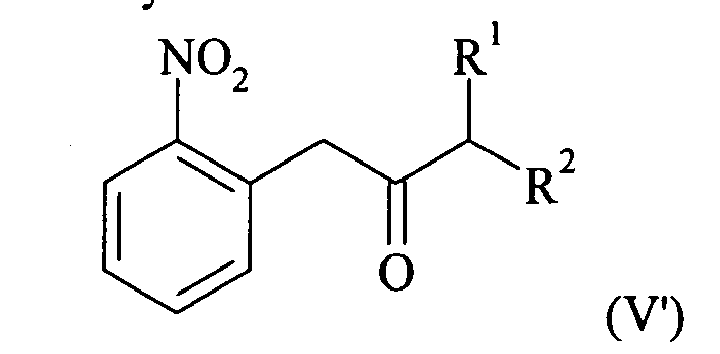
to provide a nitrophenyl ketone derivative of general formula (V);
or - 2/ the methylation of a nitrophenyl ketoester derivative of formula (IV) obtained in step one by adding methylating agent, in a methylating agent /compound (IV) molar ratio of from 0.5 to 2; in a solvent and in the presence of a base, in a base / compound (IV) molar ratio of from 0.5 to 2;
which is then completed by the decarboxylation of the intermediate of general formula (V") previously obtained
to provide a nitrophenyl ketone derivative of general formula (V);
- 1/ the decarboxylation of a nitrophenyl ketoester derivative of formula (IV) obtained in step one in the presence of an agent R4X, in a (R4X) /compound (III) molar ratio of from 0.1 to 50; in a solvent and at a temperature of from 20°C to 180°C;
- (C)- a third step according to reaction scheme 3 :

comprising the reduction of a nitrophenyl ketone of general formula (V) obtained in step two by adding to it from 0.5 to 10 molar equivalent of a reduction agent, in a polar protic solvent and at a temperature of from -20°C to 80°C;
to provide a nitrophenyl alcohol derivative of general formula (VI); - (D)- a fourth step according to reaction scheme 4 :

comprising the reduction by H2 of a nitrophenyl alcohol of general formula (VI) obtained in step three in the presence of a metal catalyst, in a solvent and under a pressure of from 1 to 10 Bar;
to provide an aminophenyl alcohol derivative of general formula (VII); - (E)- a fifth step according to reaction scheme 5 :

- A, R1 and R2 are as defined above; and
- Hal represents a halogen atom;
to provide a hydroxycarboxamide derivative of general formula (IX); - (F)- a sixth step according to reaction scheme 6 :

- A, R1 and R2 are as defined above;
- p and q are independently chosen as being 1, 2 or 3;
- R represents a phosphorous atom, -P=O, -S=O, a mesyl group or a tosyl group;
- X represents a halogen atom;
to provide a carboxamide derivative of general formula (X), (XI), (XII), (XIII), (XIV), (XV), (XVI), (XVII) or (XVIII), or a mixture thereof; - (G)- a seventh step according to reaction scheme 7 :

- For the purposes of the present invention :
- a halogen atom may be a bromine atom, a chlorine atom, an iodine atom or a fluorine atom. Preferably, halogen atom means chlorine atom;
- carboxy means -C(=O)OH ; carbonyl means -C(=O)- ; carbamoyl means - C(=O)NH2 ; - an alkyl group as well as moieties containing this term, can be linear or branched;
- a heteroatom may be a sulphur, a nitrogen or an oxygen atom; and
- a "metal specie" means alkali metal or alkaline earth metal. Preferably, a "metal specie" means a specie chosen from Li, Na or K;
- DMA means dimethylacetamide;
- DME means 1,2-dimethoxyethane;
- DMF means dimethylformamide;
- DMSO means dimethylsulfoxide;
- MTBE means methyl tert-butyl ether;
- NMP means 1-methyl-2-pyrrolidinone; and
- THF means tetrahydrofuran.
- Process according to the present invention allows production of a compound of formula (I) starting from a nitro derivative in good yields. This process can be used at an industrial scale.
- According to the present invention, substituent R1 of the compound of general formula (I) is defined as being a methyl group, an ethyl group or a C1-C4-haloalkyl group substituted with 1 to 9 halogen atoms chosen from fluorine, chlorine and bromine. Preferably, R1 is chosen as being methyl, ethyl, trifluoromethyl, difluoromethyl, fluoromethyl, trichloromethyl, dichloromethyl, chloromethyl, chlorofluoromethyl, fluorodichloromethyl, difluorochloromethyl, pentafluoroethyl, 1-fluoroethyl, 2-fluoroethyl, 2,2-difluoroethyl, 2,2,2-trifluoroethyl, 2-chloro-2-fluoroethyl, 2-chloro-2,2-difluoroethyl, 2-chloro-2,2-difluoroethyl, 2,2-dichloro-2-fluoroethyl, 2,2,2-trichloroethyl, 1-chlorobutyl, heptafluoro-n-propyl or heptafluoroisopropyl. More preferably, R1 is chosen as being methyl, ethyl or trifluoromethyl.
- According to the present invention, substituent R2 of the compound of general formula (I) is defined as being a halogen atom, a C1-C4-alkyl group or a C1-C4-haloalkyl group substituted with 1 to 9 halogen atoms chosen from fluorine, chlorine and bromine. Preferably, R2 is chosen as being methyl, ethyl, fluorine, chlorine, bromine, trifluoromethyl, difluoromethyl, fluoromethyl, trichloromethyl, dichloromethyl, chloromethyl, chlorofluoromethyl, fluorodichloromethyl, difluorochloromethyl, pentafluoroethyl, 1-fluoroethyl, 2-fluoroethyl, 2,2-difluoroethyl, 2,2,2-trifluoroethyl, 2-chloro-2-fluoroethyl, 2-chloro-2,2-difluoroethyl, 2-chloro-2,2-difluoroethyl, 2,2-dichloro-2-fluoroethyl, 2,2,2-trichloroethyl, 1-chlorobutyl, heptafluoro-n-propyl or heptafluoroisopropyl. More preferably, R2 is chosen as being methyl, ethyl, chlorine or trifluoromethyl.
- According to the present invention, the "A" group of the compound of general formula (I) may be a five, six or seven membered ring non-fused heterocycle. Preferably :
- * A represents a heterocycle of general formula (A1)

- R5
- represents hydrogen, cyano, halogen, nitro, C1-C4-alkyl, C1-C4-alkoxy, C1-C4-alkylthio, C3-C6-cycloalkyl, C1-C4-halogenoalkyl, C1-C4-halogenoalkoxy or C1-C4-halogenoalkylthio having in each case 1 to 5 halogen atoms, aminocarbonyl or aminocarbonyl-C1-C4-alkyl;
- R6
- represents hydrogen, halogen, cyano, C1-C4-alkyl, C1-C4-alkoxy or C1-C4-alkylthio;
- R7
- represents hydrogen, C1-C4-alkyl, hydroxy-C1-C4-alkyl, C2-C6-alkenyl, C3-C6-cycloalkyl, C1-C4-alkylthio-C1-C4-alkyl, C1-C4-alkoxy-C1-C4-alkyl, C1-C4-halogenoalkyl, C1-C4-halogenoalkylthio-C1-C4-alkyl, C1-C4-halogenoalkoxy-C1-C4-alkyl having in each case 1 to 5 halogen atoms, or phenyl;
- * A represents a heterocycle of general formula (A2)

- R8 and R9
- independently each represents hydrogen, halogen, C1-C4-alkyl or C1-C4-halogenoalkyl having 1 to 5 halogen atoms;
- R10
- represents halogen, cyano or C1-C4-alkyl, or C1-C4-halogenoalkyl or C1-C4-halogenoalkoxy having in each case 1 to 5 halogen atoms;
- * A represents a heterocycle of general formula (A3)

- R11 and R12
- independently each represents hydrogen, halogen, C1-C4-alkyl or C1-C4-halogenoalkyl having 1 to 5 halogen atoms;
- R 13
- represents hydrogen, halogen, C1-C4-alkyl or C1-C4-halogenoalkyl having 1 to 5 halogen atoms;
- * A represents a heterocycle of general formula (A4)

- R14
- represents hydrogen, halogen, hydroxy, cyano, C1-C6-alkyl, C1-C4-halo-genoalkyl, C1-C4-halogenoalkoxy or C1-C4-halogenoalkylthio having in each case 1 to 5 halogen atoms;
- * A represents a heterocycle of general formula (A5)

- R15
- represents halogen, hydroxy, cyano, C1-C4-alkyl, C1-C4-alkoxy, C1-C4-alkylthio, C1-C4-halogenoalkyl, C1-C4-halogenoalkylthio or C1-C4-halogenoalkoxy having in each case 1 to 5 halogen atoms;
- R16
- represents hydrogen, halogen, cyano, C1-C4-alkyl, C1-C4-alkoxy, C1-C4-alkylthio, C1-C4-halogenoalkyl, C1-C4-halogenoalkoxy having in each case 1 to 5 halogen atoms, C1-C4-alkylsulphinyl or C1-C4-alkylsulphonyl;
- * A represents a heterocycle of general formula (A6)

- R17
- represents C1-C4-alkyl or C1-C4-halogenoalkyl having 1 to 5 halogen atoms;
- R18
- represents C1-C4-alkyl,
- Q1
- represents S (sulphur), SO, SO2 or CH2;
- m
- represents 0, 1 or 2, where R16 represents identical or different radicals, when p represents 2;
- * A represents a heterocycle of general formula (A7)

- R19
- represents C1-C4-alkyl or C1-C4-halogenoalkyl having 1 to 5 halogen atoms;
- * A represents a heterocycle of general formula (A8)

- R20
- represents C1-C4-alkyl or C1-C4-halogenoalkyl having 1 to 5 halogen atoms;
- * A represents a heterocycle of general formula (A9)

- R21 and R22
- independently each represents hydrogen, halogen, amino, C1-C4-alkyl or C1-C4-halogenoalkyl having 1 to 5 halogen atoms;
- R23
- represents hydrogen, halogen, C1-C4-alkyl or C1-C4-halogenoalkyl having 1 to 5 halogen atoms;
- * A represents a heterocycle of general formula (A10)

- R24 and R25
- independently each represents hydrogen, halogen, amino, nitro, C1-C4-alkyl or C1-C4-halogenoalkyl having 1 to 5 halogen atoms;
- R26
- represents hydrogen, halogen, C1-C4-alkyl or C1-C4-halogenoalkyl having 1 to 5 halogen atoms;
- * A represents a heterocycle of general formula (A11)

- R27
- represents hydrogen, halogen, amino, C1-C4-alkylamino, di-(C1-C4-alkyl)amino, cyano, C1-C4-alkyl or C1-C4-halogenoalkyl having 1 to 5 halogen atoms;
- R28
- represents halogen, C1-C4-alkyl or C1-C4-halogenoalkyl having 1 to 5 halogen atoms;
- * A represents a heterocycle of general formula (A12)

- R29
- represents hydrogen, halogen, amino, C1-C4-alkylamino, di-(C1-C4-alkyl)amino, cyano, C1-C4-alkyl or C1-C4-halogenoalkyl having 1 to 5 halogen atoms;
- R30
- represents halogen, C1-C4-alkyl or C1-C4-halogenoalkyl having 1 to 5 halogen atoms;
- * A represents a heterocycle of general formula (A 13)

- R31
- represents halogen, C1-C4-alkyl or C1-C4-halogenoalkyl having 1 to 5 halogen atoms;
- * A represents a heterocycle of general formula (A14)

- R32
- represents hydrogen or C1-C4-alkyl;
- R33
- represents halogen or C1-C4-alkyl;
- * A represents a heterocycle of general formula (A15)

- R34
- represents C1-C4-alkyl or C1-C4-halogenoalkyl having 1 to 5 halogen atoms;
- * A represents a heterocycle of general formula (A16)

- R35
- represents hydrogen, halogen, C1-C4-alkyl or C1-C4-halogenoalkyl having 1 to 5 halogen atoms;
- * A represents a heterocycle of general formula (A 17)

- R36
- represents halogen, hydroxy, C1-C4-alkyl, C1-C4-alkoxy, C1-C4-alkylthio, C1-C4-halogenoalkyl, C1-C4-halogenoalkylthio or C1-C4-halogenoalkoxy having in each case 1 to 5 halogen atoms;
- * A represents a heterocycle of general formula (A18)

- R37
- represents hydrogen, cyano, C1-C4-alkyl, C1-C4-halogenoalkyl having 1 to 5 halogen atoms, C1-C4-alkoxy-C1-C4-alkyl, hydroxy-C1-C4-alkyl, C1-C4-alkylsulfonyl, di(C1-C4-alkyl)aminosulfonyl, C1-C6-alkylcarbonyl or in each case optionally substituted phenylsulfonyl or benzoyl;
- R38
- represents hydrogen, halogen, C1-C4-alkyl or C1-C4-halogenoalkyl having 1 to 5 halogen atoms;
- R39
- represents hydrogen, halogen, cyano, C1-C4-alkyl or C1-C4-halogenoalkyl having 1 to 5 halogen atoms;
- R40
- represents hydrogen, halogen, C1-C4-alkyl or C1-C4-halogenoalkyl having 1 to 5 halogen atoms;
- * A represents a heterocycle of general formula (A19)

- R41
- represents C1-C4-alkyl.
- More preferably, A represents a heterocycle of general formula (A1).
- The first step (step A) of the process according to the present invention comprises the reaction of a nitrobenzene derivative of general formula (II) with a carbonyl ester derivative of general formula (III), in a compound (III) / compound (II) molar ratio of from 1 to 10, in a solvent and in the presence of a base, the base /compound (II) molar ratio being of from 0.5 to 5 to provide a nitrophenyl ketoester derivative of general formula (IV). Preferably, step A may be conducted in the following conditions, chosen alone or in combination :
- the compound (III) / compound (II) molar ratio is of from 1 to 5. More preferably, the compound (III) / compound (II) molar ratio is of from 1 to 2;
- the solvent is a polar solvent. Suitable polar solvent includes DMSO, DMF, NMP, DMA, acetonitrile and propionitrile. More preferably, the solvent is DMSO or DMA.
- the base is chosen as being hydride, alcolate or carbonate. Suitable hydrides includes NaHand KH. Suitable alcolate includes tBuOK, MeONa and EtON. Suitable carbonate includes K2CO3. More preferably, the base is K2CO3;
- the base / compound (II) molar ratio is of from 1 to 3. More preferably, the base /compound (II) molar ratio is of 2.
- Step A does not necessarily require specific temperature conditions. Preferably, step A is conducted at a temperature of from 0°C to 140°C. More preferably, step A is conducted at a temperature of from 10°C to 100°C. Even more preferably, step A is conducted at a temperature of from 20°C to 80°C.
- Step A does not necessarily require the use of a phase transfer agent. Preferably, step A is conducted in the presence of a phase transfer agent. Suitable phase transfer agent includes a halogeno ammoniuam salt such as tetraalkylammonium halide.
- The second step (step B) of the process according to the present invention comprises a decarboxylation reaction of a nitrophenyl ketoester derivative of formula (IV) obtained in step one or of an intermediate compound of formula (V") in the presence of an agent R4X, in a (R4X) / compound (IV) or (V") molar ratio of from 0.1 to 50; in a solvent and at a temperature of from 20°C to 180°C to provide a nitrophenyl ketone derivative of general formula (V). Preferably, the decarboxylation reaction may be conducted in the following conditions, chosen alone or in combination :
- R4X is chosen as being LiCl or HBr;
- the (R4X) / compound (IV) or (V") molar ratio is of from 0.5 to 30. More preferably, the (R4X) / compound (IV) molar ratio is of from 1 to 20.
- the solvent is a polar solvent. Suitable polar solvent includes AcOH, DMF, DMA, NMP and DMSO. More preferably, the solvent is wet polar aprotic when R4X is LiCl and is AcOH when R4X is HBr. More preferably, the solvent is wet DMSO or wet DMF when R4X is LiCl and is AcOH when R4X is HBr;
- the reaction is conducted at a temperature of from 100°C to 160°C. More preferably, the reaction is conducted at a temperature of form 110°C to 150°C.
- The second step (step B) of the process according to the present invention may also comprise a methylation reaction of a compound of formula (IV) or an intermediate compound of formula (V') by adding methylating agent, in a methylating agent / compound (IV) or (V') molar ratio of from 0.5 to 2; in a solvent and in the presence of a base, in a base / compound (IV) or (V') molar ratio of from 0.5 to 2; to provide a nitrophenyl ketone derivative of general formula (V). Preferably, the methylation reaction may be conducted in the following conditions, chosen alone or in combination :
- the methylating agent is a haloaklyl group or an alkylsulfate group. More preferably, the methylating agent is MeI or Me2SO4;
- the methylating agent / compound (IV) or (V') molar ratio is of from 0.9 to 1.2;
- the base is chosen as being NaH, tBuOK, K2CO3, Na2CO3. More preferably, the base is NaH or K2CO3;
- the solvent is chosen as being hexane, diethylether, MTBE, THF, dioxane, ethyl acetate or a polar solvent. Suitable polar solvent includes acetone, acétonitrile, NMP, DMF, DMA and DMSO. More preferably, the solvent is a polar solvent.
- The third step (step C) of the process according to the present invention comprises the reduction of a nitrophenyl ketone of general formula (V) obtained in step two by adding to it from 0.5 to 10 molar equivalent of a reduction agent, in a polar protic solvent and at a temperature of from -20°C to 80°C to provide a nitrophenyl alcohol derivative of general formula (VI). Preferably, step C may be conducted in the following conditions, chosen alone or in combination :
- the reduction agent is chosen as being BH3 or RBH4 in which R is chosen from Li, Na or K. More preferably, the reduction agent is NaBH4;
- the polar protic solvent is an alcohol. More preferably, the polar protic solvent is chosen as being MeOH or EtOH;
- the reaction is conducted at a temperature of from -10°C to 20°C. More preferably, the reaction is conducted at a temperature of 0°C.
- The fourth step (step D) of the process according to the present invention comprises the reduction by H2 of a nitrophenyl alcohol derivative of general formula (VI) obtained in step three in the presence of a metal catalyst, in a solvent and under a pressure of from 1 to 10 Bar to provide an aminophenyl alcohol derivative derivative of general formula (VII). Preferably, step D may be conducted in the following conditions, chosen alone or in combination :
- the catalyst is chosen as being palladium on charcoal (Pd-C), Raney-nickel or platinum (IV) oxide. More preferably, the catalyst is chosen as being Pd-C;
- the solvent is a polar protic solvent. More preferably, the solvent is an alcohol. Suitable alcohol solvent includes methanol and ethanol;
- the reaction is conducted under a pressure of from 2 to 5 Bar. More preferably the reaction is conducted under a pressure of 4 Bar.
- The fifth step (step E) of the process according to the present invention comprises the coupling reaction of an aminophenyl alcohol derivative of general formula (VII) obtained in step four with an acyl halide derivative of general formula (VIII), in a solvent and in the presence of a base in a base / compound (VII) molar ratio of 0.5 to 3 to provide a hydroxyl carboxamide derivative of general formula (IX). Preferably, step E may be conducted in the following conditions, chosen alone or in combination:
- the base is chosen as being pyridine, triethylamine, trimethylamine, sodium carbonate, potassium carbonate, potassium or sodium bicarbonate, sodium hydroxide or potassium hydroxide. More preferably, the base is pyridine or triethylamine;
- the base / compound (VII) molar ratio is of 1;
- the solvent is chosen as being dichloroethane, dichloromethane, acetonitrile or toluene.
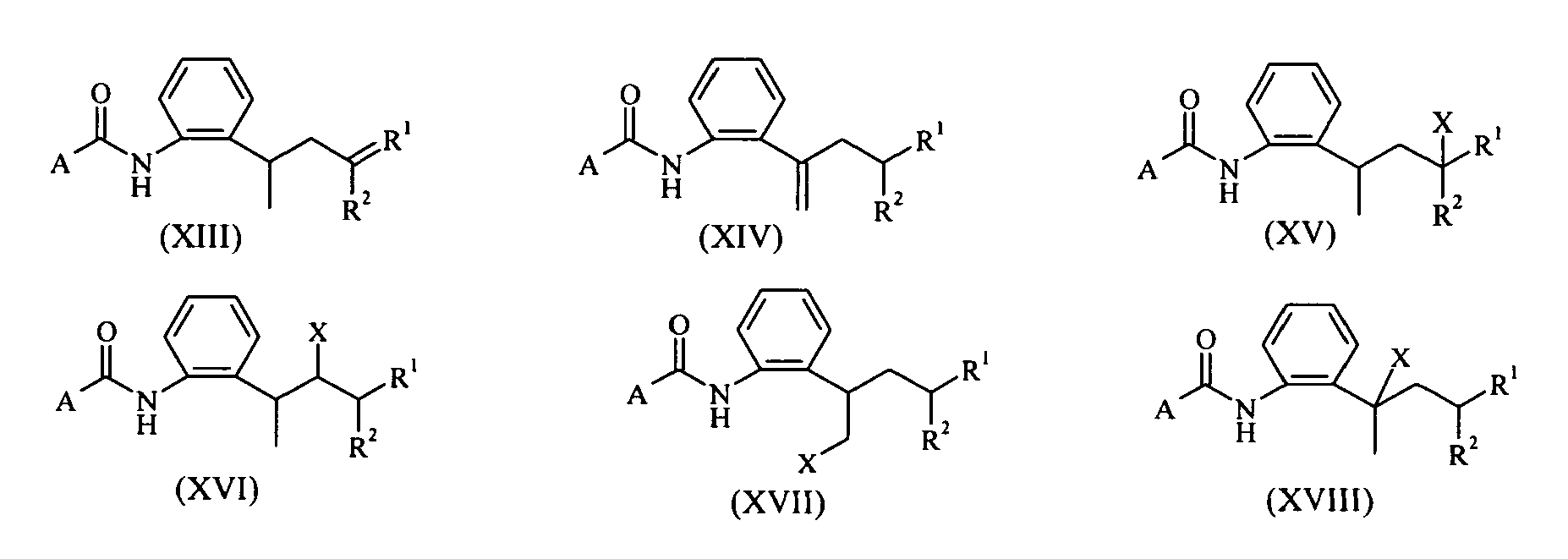
- The sixth step (step F) of the process according to the present invention comprises comprising the reaction of a hydroxyl carboxamide derivative of general formula (IX) obtained in step five with a compound of formula RpXq at a temperature of from 0°C to 100°C ;
to provide a carboxamide derivative of general formula (X), (XI), (XII), (XIV), (XV), (XVI), (XVII) or (XVIII) or a mixture thereof; - Preferably, step F may be conducted in the following conditions, chosen alone or in combination :
- X is a chlorine atom;
- RpXq is chosen as being phosphorus oxychloride, thionyl chloride, phosphorous trichloride, phosphorus pentachloride, mesylchloride, tosyl chloride, succinimide or phtalimide chloride;
- the reaction is conducted at a temperature of from 0°C to 80°C .
- The step F is not necessarily conducted in the presence of a solvent. Preferably, the step F is conducted in the presence of a solvent. Suitable solvent includes dichloromethane, dichloroethane, toluene, pyridine, DMF, DMA, NMP, DMSO. More preferably the solvent is pyridine;
- The step F is not necessarily conducted in the presence of an acid. Preferably the step F is conducted in the presence of an acid. Suitable acid includes phosphoric acid.
- The seventh step (step G) of the process according to the present invention comprising the reduction by H2 of all carboxamide derivatives of general formula (X) to (XVIII) obtained in step six, in the presence of a metal catalyst, in a solvent, at a temperature of from 10°C to 250°C and under a pressure of from 1 to 50 Bar;
to provide a carboxamide derivative of general formula (I). Preferably, step G may be conducted in the following conditions, chosen alone or in combination : - the metal catalyst is chosen as being palladium on charcoal (Pd/C), Raney nickel, PdCl2 or NiCl2;
- the solvent is a protic solvent. Suitable protic solvent includes C1-C10 alcohol and acetic acid. More preferably, the solvent is octanol;
- the reaction is conducted at a temperature of from 40°C to 200°C;
- the reaction is conducted under a pressure of from 1 to 30 Bar.
- The compound of general formula (I) according to the present invention can be prepared according to the above described process. It will nevertheless be understood that, on the basis of his general knowledge and of available publications, the skilled worker will be able to adapt this method according to the specifics of each of the compounds, which it is desired to synthesise.
- Certain of the intermediates used for the preparation of compound of general formula (I) are novel. Therefore, the present invention also relates to novel intermediate compounds useful for the preparation of compound of general formula (I). Thus, according to the present invention, there is provided a compound of general formula (IV)

- R1, R2, R3 are as defined above; and
- Alk represents a C1-C10 alkyl group.
- According to the present invention, there is also provided a compound of general formula (V), a compound of general formula (V') and a compound of general formula (V")

- R1 and R2 are as defined above; and
- Alk represents a C1-C10 alkyl group.
- According to the present invention, there is also provided a compound of formula (VI)

- According to the present invention, there is also provided a compound of formula (VII)

- According to the present invention, there is also provided a compound of formula (IX)

- According to the present invention, there are also provided compounds of formula (X) to (XVIII)

- The present invention will now be illustrated with reference to the following examples.
- To a solution of fluoronitrobenzene (10 g, 71 mmol) in DMSO (50 ml) were added methylisobutyrylacetate (11.4 ml, 71 mmol) and potassium carbonate (19 g, 138 mmol). The reaction mixture was stirred at 20°C for 25 hours. It was then cooled to 0°C and water (50 ml), then aqueous HCl were added to reach pH 7. Ethyl acetate was then added (150 ml). The two phases were separated. The aqueous phase was extracted with ethyl acetate (1*50 ml). The combined organic phase were washed two times with water (2*50 ml) and dried on magnesium sulfate. 12.6 g - yield 67% - of the expected product were obtained in a brown oil.
- Further purification by column chromatography may be performed in order to obtain a pure sample of the product as a bright yellow oil.
1H NMR (400 MHz, CDCl3, δ ppm) : ketone form/enol form 20/80 - ketone form : 8.00 (1H, dd, J=8Hz, J=1Hz), 7.62 (1H, dt, J=8Hz, J=1Hz), 7.49 (1H, dt, J=8Hz, J=1Hz), 5.61 (1H, s), 3.75 (3H, s), 2.83 (1H, m), 1.18 (3H, d, J=7Hz), 1.09 (3H, d, J=7Hz) - enol form : 13.0 (1H, d, J=1Hz), 7.97 (1H, dd, J=8Hz, J=1Hz), 7.58 (1H, dt, J=8Hz, J=1Hz), 7.47 (1H, dt, J=8Hz, J=1Hz), 7.27 (1H, dd, J=8Hz, J=1Hz), 3.61 (3H, s), 2.28 (1H, m), 1.09 (3H, d, J=7Hz), 1.00 (3H, d, J=7Hz) - To a solution of 2-(2-nitro-phenyl)-3-oxy-4-methyl-pentanoic acid methyl ester (72%, 5g, 26 mmol) in DMSO (30 ml) under nitrogen was added potassium carbonate (4.34 g, 31 mmol) and methyliodide (2 ml, 31 mmol). The reaction mixture was then stirred at room temperature for two hours. It was diluted with water (50 ml), and extracted with ethyl acetate (100 ml). The organic phase was then washed with water (5*50ml), brine, and dried with magnesium sulfate. The crude product was then purified by flash chromatography on biotage apparatus. 3.4 g (yield 90%) of 2,4-dimethyl-2-(2-nitro-phenyl)-3-oxypentanoic acid methyl ester was collected as a yellow solid. Melting point was 57.4°C.
1H NMR (400 MHz, CDCl3, δ ppm) : 8.02 (1H, dd, J=8Hz, J=1Hz), 7.59 (1H, dt, J=8Hz, J=1Hz), 7.46 (1H, dt, J=8Hz, J=1Hz), 7.21 (1H, dd, J=8Hz, J=1Hz), 3.67 (3H, s), 3.36 (1H, m), 1.93 (3H, s), 1.08 (3H, d, J=7Hz), 1.06 (3H, d, J=7Hz). - To a solution of 2,4-dimethyl-2-(2-nitro-phenyl)-3-oxypentanoic acid methyl ester (92%, 3.4g, 11 mmol) in DMSO (30ml) was added LiCl (516 mg, 12 mmol) and water (438 mg, 24 mmol). The reaction mixture was heated at 140°C (bath temperature 150°C) for 2h. The total conversion was evaluated by HPLC. It was diluted with water (50 ml), and extracted with ethyl acetate (100 ml). The organic phase was then washed with water (5*50 ml), brine, and dried on magnesium sulfate. The crude product was then purified by flash chromatography on biotage apparatus. (2-methyl-4-(2-nitro-phenyl)-pentan-3-one (1.46 g, isolated yield 59%) was collected as a yellow oil.
1H NMR (400 MHz, CDCl3, δ ppm) : 7.85 (1H, dd, J=8Hz, J=1Hz), 7.55 (1H, dt, J=8Hz, J=1Hz), 7.38 (2H, m, J=8Hz, J=1Hz), 4.52 (1H, q, J=7Hz), 2.68 (1H, m), 1.44 (3H, d, J=7Hz), 1.08 (3H, d, J=7Hz), 0.97 (3H, d, J=7Hz) - A solution of 2,4-dimethyl-2-(2-nitro-phenyl)-3-oxypentanoic acid methyl ester (92%, 1.20 g, 4.1 mmol) in acetic acid (38.6 ml) and aqueous bromhydric acid (47%, 13.6 ml) was quickly heated to reflux (internal temperature 108-110°C) and stirred for 2h30. The reaction mixture was cooled to room temperature and then slowly added to a cold (0°C) solution of aqueous sodium carbonate. Dichloromethane was added (100 ml). The organic phase was washed with water (2*50 ml), aqueous sodium carbonate (50 ml) water (50 ml), brine (50 ml) and dried with MgSO4. Purification by flash chromatography afforded 2-methyl-4-(2-nitrophenyl)-pentan-3-one (528 mg - yield 60%) as a yellow oil.
1H NMR (400 MHz, CDCl3, δ ppm) : 7.85 (1H, dd, J=8Hz, J=1Hz), 7.55 (1H, dt, J=8Hz, J=1Hz), 7.38 (2H, m, J=8Hz, J=1Hz), 4.52 (1H, q, J=7Hz), 2.68 (1H, m), 1.44 (3H, d, J=7Hz), 1.08 (3H, d, J=7Hz), 0.97 (3H, d, J=7Hz). - To a solution of 2-(2-nitro-phenyl)-3-oxy-4-methyl-pentanoic acid methyl ester (77%, 3.70 g, 21 mmol) in acetic acid was added aqueous bromhydric acid (47%, 50 ml). It was quickly heated to reflux (110°C) and stirred for 1h. The reaction mixture was cooled to room temperature, diluted with water (100 ml) and extracted with MTBE (2*50 ml). The combined organic layers were washed with water (2*50 ml), aqueous bicarbonate (2*50 ml), water (2*50 ml) and dried with MgSO4. Light compounds were removed by distillation. The expected product was obtained in a black oil.
- Further purification by column chromatography may be performed in order to obtain a pure sample of the product as a yellow oil.
1H NMR (400 MHz, CDCl3, δ ppm) : 8.08 (1H, dd, J=8Hz, J=1Hz), 7.55 (1H, dt, J=8Hz, J=1Hz), 7.42 (1H, dt, J=8Hz, J=1Hz), 7.24 (1H, m), 4.18 (2H, s), 2.80 (1H, m), 1.19 (6H, d, J=7Hz). - The compound thus obtained was diluted in wet. NaH (60%, 1.18g, 29.4 mmol) was then added. After gas evolution, MeI (1.83 ml, 29.4 mmol) was added and the reaction stirred at room temperature for 2h. The reaction was quenched by adding water (50 ml). The aqueous phase was extracted with MTBE (2*150 ml). The organic phase was washed with water (2*150 ml) and dried with MgSO4. Filtration through silica afforded pure 2-methyl-4-(2-nitro-phenyl)-pentan-3-one (1.83g - yield 77%) as a yellow oil.
1H NMR (400 MHz, CDCl3, δ ppm) : 7.85 (1H, dd, J=8Hz, J=1Hz), 7.55 (1H, dt, J=8Hz, J=1Hz), 7.38 (2H, m, J=8Hz, J=1Hz), 4.52 (1H, q, J=7Hz), 2.68 (1H, m), 1.44 (3H, d, J=7Hz), 1.08 (3H, d, J=7Hz), 0.97 (3H, d, J=7Hz). - In a 25 ml flask was prepared a solution of 2-methyl-4-(2-nitro-phenyl)-pentan-3-one (390 mg, 1.8 mmol) in dry methanol (9 ml). It is cooled with an ice-water bath. The temperature in the reaction mixture was 4°C. Sodium borohydride (73 mg, 1.9 mmol) was added, spoon by spoon. It was stirred one hour at 0°C. The cooled mixture was added to HCl 1N (7ml). This addition was exothermic. Methanol was evaporated. The aqueous phase was extracted with ethyl acetate (50 ml). The organic phase was washed with water (1*25 ml), brine (1*25 ml) and dried with magnesium sulfate. 2-methyl-4-(2-nitro-phenyl)-pentan-3-ol (380 mg - yield 97%) was then obtained as a pale yellow oil.
1H NMR (400 MHz, CDCl3, δ ppm): 7.70 (1H, dd, J=8Hz, J=1Hz), 7.60 (1H, dd, J=8Hz, J=1Hz), 7.56 (1H, ddd, J=8Hz, J=7Hz, J=1Hz), 7.34 (1H, ddd, J=8Hz, J=7Hz, J=1Hz), 3.49 (1H, m), 3.45 (1H, m), 1.90 (1H, m), 1.77 (1H, s), 1.29 (3H, d, J=7Hz), 0.99 (3H, d, J=7Hz), 0.92 (3H, d, J=7Hz). - In a 15 ml hydrogenation reactor was charged a solution of 2-methyl-4-(2-nitro-phenyl)-pentan-3-ol (370 mg, 1.7 mmol) in EtOH (12 ml). Pd/C 5% was added. The reaction mixture was stirred under hydrogen (4 bars) at room temperature for 2 hours. Filtration through celite and evaporation of ethanol afforded 2-methyl-4-(2-amino-phenyl)-pentan-3-ol as a white solid (320 mg - quantitative yield).
1H NMR (400 MHz, CDCl3, δ ppm) : 7.14 (1H, dd, J=8Hz, J=1Hz), 7.03 (1H, dt, J=8Hz, J=1Hz), 6.81 (1H, dt, J=8Hz, J=1Hz), 6.69 (1H, dd, J=8Hz, J=1Hz), 3.69 (1H, q, J=7Hz), 3.44 (1H, dd, J=9Hz, J=3Hz), 3.02 (1H, m), 1.77 (1H, s), 1.29 (3H, d, J=7Hz), 0.99 (3H, d, J=7Hz), 0.92 (3H, d, J=7Hz).
MS (EI) Found [M+H]+ : 194.1537. C12H20NO requires 194.1545 - To a cold (0°C) solution of 2-methyl-4-(2-amino-phenyl)-pentan-3-ol (230 mg, 1.2 mmol) in toluene (10 ml) were added triethylamine (0.2 ml, 1.4 mmol) and a solution of 1,3-dimethyl-1H-pyrazole-4-carbonyl chloride in toluene (4.75M, 0.3 ml, 1.4 mmol). The reaction was stirred one hour at room temperature. Water (10 ml) was then added. The aqueous phase was washed with dichloromethane. The combined organic phases were washed with HCl 1N (10 ml), water (10 ml) and brine (10 ml), then dried with magnesium sulfate. Washing the solid residue with toluene afforded 5-fluoro-1,3-dimethyl-N-[2-(1,3-dimethyl-2-hydroxybutyl)phenyl]-1H-pyrazole-4-carboxamide (315 mg - yield 79%) as a white solide. Melting point was 117.8°C.
1H NMR (400 MHz, CDCl3, δ ppm) : 1H NMR (400 MHz, CDCl3, δ ppm): 8.61 (1H,s), 7.66 (1H, dd, J=8Hz, J=1Hz), 7.26 (1H, dd, J=8Hz, J=1Hz), 7.19 (1H, m), 7.15 (1H, m), 3.65 (3H, d, J=1Hz), 3.36 (1H, ddd, J=10Hz, J=4Hz, J=2Hz), 3.10 (1H, m), 2.43 (3H, s), 2.33 (1H,d, J=4Hz), 1.95 (1H, m), 1.19 (3H, d, J=7Hz), 0.98 (3H, d, J=7Hz), 0.92 (3H, d, J=7Hz)
MS (EI) Found [M+Na]+ : 356.1742. C18H24N3O2FNa requires 356.1750 - To a solution of 5-fluoro-1,3-dimethyl-N-[2-(1,3-dimethyl-2-hydroxy)-butyl]-1H-pyrazole-4-carboxamide (307 mg, 0.9 mmol) in pyridine were added H3PO4 (aq. 85%, 0.08 ml) and phosphorous oxychloride (1.52 ml, 16 mmol). The reaction mixture was stirred for 3h. It was then added onto cooled water and extracted with ethyl acetate. The organic phase was washed with 1N HCl, brine, and dried with MgSO4. The mixture of compounds (280 mg, yield 95%) was obtained as a white solid.
- These compounds are fully characterised in mixture (HPLC-MS and 1H NMR, 13C NMR, 19F NMR).
1H NMR (400 MHz, CDCl3, δ ppm): 5-fluoro-1,3-dimethyl-N-[2-(1,3-dimethylbuten-1-yl)phenyl]-1H-pyrazole-4-carboxamide : 8.42 (1H,d, J=8Hz), 7.76 (1H, m), 7.27 (1H, m), 7.02 (1H, m), 7.01 (1H, m), 5.53 (1H, d, J=10Hz), 3.71 (3H, m), 2.45 (3H, s), 2.02 (1H,m), 1.92 (3H, s), 0.84 (6H,m) - 5-fluoro-1,3-dimethyl-N-[2-(1,3-dimethylbuten-2-yl)phenyl]-1H-pyrazole-4-carboxamide : 7.72 (1H,dd, J=8Hz, J=1Hz), 7.45 (1H, s), 7.20-7.14 (3H, m), 5.18 (1H, d, J=9Hz), 3.71 (4H, m), 2.45 (3H, s), 1.70 (3H,s), 1.60 (3H, s), 1.30 (3H,d, J=7Hz) - 5-fluoro-1,3-dimethyl-N-[2-(2-chloro-1,3-dimethylbutyl)phenyl]-1H-pyrazole-4-carboxamide : 7.28-7.02 (4H,m), 4.04 (1H, dd, J=9Hz, J=1Hz), 3.71 (3H, m), 3.25 (1H, dq, J=9Hz, J=1Hz), 2.47 (3H, m), 1.75 (1H, m), 1.41 (3H, d, J=7Hz), 0.92 (3H, d, J=7Hz), 0.87 (3H, d, J=7Hz). - To the mixture obtained in the above step 6 in octanol, activated 5% Pd/C catalyst was added and stirred at 185°C in a hydrogen atmosphere (20 bars). Octanol was removed by azeotropic distillation with water. The resulting suspension was dissolved with MTBE. The organic phase was dried with MgSO4. Thus obtained 5-fluoro-1,3-dimethyl-N-[2-(1,3-dimethylbutyl)phenyl]-1H-pyrazole-4-carboxamide as a white solid (95%, 246 mg, yield 81%).
1H NMR (400 MHz, CDCl3, δ ppm): 5-fluoro-1,3-dimethyl-N-[2-(1,3-dimethyl)-butyl]-1H-pyrazole-4-carboxamide : 7.79 (1H,dd, J=8Hz, J=1Hz), 7.27 (1H, s), 7.25 (1H, m), 7.18 (1H, m), 7.16 (1H, m), 3.74 (3H, d, J=1Hz), 2.97 (1H, m), 2.48 (3H,s), 1.54 (2H, m), 1.42 (1H,m), 1.21 (3H, d, J=7Hz), 0.85 (6H, d, J=6Hz).
to provide a carboxamide derivative of general formula (I).
Claims (16)
- A process for the preparation of a carboxamide derivative of general formula (I) or a salt thereof
 - R1 represents a methyl group, an ethyl group or a C1-C4-haloalkyl group substituted with 1 to 9 halogen atoms chosen from fluorine, chlorine and bromine;- R2 represents a halogen atom, a C1-C4-alkyl group or a C1-C4-haloalkyl group substituted with 1 to 9 halogen atoms chosen from fluorine, chlorine and bromine; and- A represents an optionally substituted 5-, 6- or 7-membered non-fused heterocycle with one, two or three heteroatoms which may be the same or different, the heterocycle being linked by a carbon atom;said process comprising :(A)- a first step according to reaction scheme 1 :
 - R1 and R2 are as defined above; and- R3 represents a hydrogen atom or a methyl group;- Hal represents a halogen atom; and- Alk represents a C1-C10 alkyl group;comprising the reaction of a nitrobenzene derivative of general formula (II) with a ketoester derivative of general formula (III), in a compound (III) / compound (II) molar ratio of from 1 to 10, in a solvent and in the presence of a base, the base /compound (II) molar ratio being of from 0.5 to 5;
to provide a nitrophenyl ketoester derivative of general formula (IV);(B)- a second step according to reaction scheme 2 : - R1 and R2 are as defined above; and- R3 represents a hydrogen atom or a methyl group;- Alk represents a C1-C10 alkyl group;- R4 represents a hydrogen atom or a metal specie; and- X represents a halogen atom;comprising :a) in the case R3 is a methyl group, the decarboxylation reaction of a nitrophenyl ketoester derivative of formula (IV) obtained in step one in the presence of an agent R4X, in a (R4X) / compound (IV) molar ratio of from 0.1 to 50; in a solvent and at a temperature of from 20°C to 180°C; orb) in the case R3 is a hydrogen atom,1/ the decarboxylation of a nitrophenyl ketoester derivative of formula (IV) obtained in step one in the presence of an agent R4X, in a (R4X) /compound (III) molar ratio of from 0.1 to 50; in a solvent and at a temperature of from 20°C to 180°C;
which is then completed by the methylation of the intermediate of general formula (V') previously obtained
to provide a nitrophenyl ketone derivative of general formula (V);
or2/ the methylation of a nitrophenyl ketoester derivative of formula (IV) obtained in step one by adding methylating agent, in a methylating agent /compound (IV) molar ratio of from 0.5 to 2; in a solvent and in the presence of a base, in a base / compound (IV) molar ratio of from 0.5 to 2;
which is then completed by the decarboxylation of the intermediate of general formula (V") previously obtained
to provide a nitrophenyl ketone derivative of general formula (V);(C)- a third step according to reaction scheme 3 :
comprising the reduction of a nitrophenyl ketone of general formula (V) obtained in step two by adding to it from 0.5 to 10 molar equivalent of a reduction agent, in a polar protic solvent and at a temperature of from -20°C to 80°C;
to provide a nitrophenyl alcohol derivative of general formula (VI);(D)- a fourth step according to reaction scheme 4 :
comprising the reduction by H2 of a nitrophenyl alcohol of general formula (VI) obtained in step three in the presence of a metal catalyst, in a solvent and under a pressure of from 1 to 10 Bar;
to provide an aminophenyl alcohol derivative of general formula (VII);(E)- a fifth step according to reaction scheme 5 : - R1 and R2 are as defined above; and- Hal represents a halogen atom;comprising the coupling reaction of an aminophenyl alcohol derivative of general formula (VII) obtained in step four with an acyl halide derivative of general formula (VIII), in a solvent and in the presence of a base in a base / compound (VII) molar ratio of 0.5 to 3;
to provide a hydroxycarboxamide derivative of general formula (IX);(F)- a sixth step according to reaction scheme 6 : - A, R1 and R2 are as defined above;- p and q are independently chosen as being 1, 2 or 3;- R represents a phosphorous atom, -P=O, -S=O, a mesyl group or a tosyl group;- X represents a halogen atom;comprising the reaction of a hydroxycarboxamide derivative of general formula (IX) obtained in step five with a compound of formula RpXq at a temperature of from 0°C to 100°C ;
to provide a carboxamide derivative of general formula (X), (XI), (XII), (XIII), (XIV), (XV), (XVI), (XVII) or (XVIII), or a mixture thereof;(G)- a seventh step according to reaction scheme 7 :
comprising the reduction by H2 of all carboxamide derivatives of general formula (X) to (XVIII) obtained in step six, in the presence of a metal catalyst, in a solvent, at a temperature of from 10°C to 250°C and under a pressure of from 1 to 50 Bar; to provide a carboxamide derivative of general formula (I). - A process according to claim 1, characterised in that R1 is chosen as being methyl, ethyl, trifluoromethyl, difluoromethyl, fluoromethyl, trichloromethyl, dichloromethyl, chloromethyl, chlorofluoromethyl, fluorodichloromethyl, difluorochloromethyl, pentafluoroethyl, 1-fluoroethyl, 2-fluoroethyl, 2,2-difluoroethyl, 2,2,2-trifluoroethyl, 2-chloro-2-fluoroethyl, 2-chloro-2,2-difluoroethyl, 2-chloro-2,2-difluoroethyl, 2,2-dichloro-2-fluoroethyl, 2,2,2-trichloroethyl, 1-chlorobutyl, heptafluoro-n-propyl or heptafluoroisopropyl.
- A process according to claim 1 or 2, characterised in that R2 is chosen as being methyl, ethyl, fluorine, chlorine, bromine, trifluoromethyl, difluoromethyl, fluoromethyl, trichloromethyl, dichloromethyl, chloromethyl, chlorofluoromethyl, fluorodichloromethyl, difluorochloromethyl, pentafluoroethyl, 1-fluoroethyl, 2-fluoroethyl, 2,2-difluoroethyl, 2,2,2-trifluoroethyl, 2-chloro-2-fluoroethyl, 2-chloro-2,2-difluoroethyl, 2-chloro-2,2-difluoroethyl, 2,2-dichloro-2-fluoroethyl, 2,2,2-trichloroethyl, 1-chlorobutyl, heptafluoro-n-propyl or heptafluoroisopropyl.
- A process according to any of the claims 1 to 3, characterised in that A represents a heterocycle of general formula (A1)
 - R5 represents hydrogen, cyano, halogen, nitro, C1-C4-alkyl, C1-C4-alkoxy, C1-C4-alkylthio, C3-C6-cycloalkyl, C1-C4-halogenoalkyl, C1-C4-halogenoalkoxy or C1-C4-halogenoalkylthio having in each case 1 to 5 halogen atoms, aminocarbonyl or aminocarbonyl-C1-C4-alkyl;- R6 represents hydrogen, halogen, cyano, C1-C4-alkyl, C1-C4-alkoxy or C1-C4-alkylthio; and- R7 represents hydrogen, C1-C4-alkyl, hydroxy-C1-C4-alkyl, C2-C6-alkenyl, C3-C6-cycloalkyl, C1-C4-alkylthio-C1-C4-alkyl, C1-C4-alkoxy-C1-C4-alkyl, C1-C4-halogenoalkyl, C1-C4-halogenoalkylthio-C1-C4-alkyl, C1-C4-halogenoalkoxy-C1-C4-alkyl having in each case 1 to 5 halogen atoms, or phenyl.
 - A process according to any of the claims 1 to 4, characterised in that step A is conducted at a temperature of from 0°C to 140°C.
- A process according to any of the claims 1 to 5, characterised in that step A is conducted in the presence of a phase transfer agent.
- A process according to any of the claims 1 to 6, characterised in that step F is conducted in the presence of a solvent.
- A process according to any of the claims 1 to 7, characterised in that step F is conducted in the presence of an acid.
- A compound of formula (IV)
 - R1, R2, R3 are as in claim 1; and- Alk represents a C1-C10 alkyl group.
 - A compound of formula (V)
 - R1 and R2 are as defined in claim 1; and- Alk represents a C1-C10 alkyl group.
 - A compound of formula (V')
 - R1 and R2 are as defined in claim 1; and- Alk represents a C1-C10 alkyl group.
 - A compound of formula (V")
 - R1 and R2 are as defined in claim 1; and- Alk represents a C1-C10 alkyl group.
 - A compound of formula (VI)

- A compound of formula (VII)

- A compound of formula (IX)

- Compounds of formula (X) to (XVIII)


Priority Applications (12)
| Application Number | Priority Date | Filing Date | Title |
|---|---|---|---|
| EP05356080A EP1721899A1 (en) | 2005-05-13 | 2005-05-13 | Process for the preparation of a carboxamide derivative |
| EP06724818A EP1881963B1 (en) | 2005-05-13 | 2006-05-06 | Process for the preparation of a carboxamide derivative |
| CN2006800164804A CN101175728B (en) | 2005-05-13 | 2006-05-06 | Process for the preparation of a carboxamide derivative |
| DE602006015458T DE602006015458D1 (en) | 2005-05-13 | 2006-05-06 | PROCESS FOR PREPARING A CARBOXYLAMIDE DERIVATIVE |
| KR1020077027971A KR20080007394A (en) | 2005-05-13 | 2006-05-06 | Method for preparing a carboxamide derivative |
| BRPI0610809-1A BRPI0610809A2 (en) | 2005-05-13 | 2006-05-06 | process for the preparation of a carboxamide derivative |
| JP2008510514A JP2008545623A (en) | 2005-05-13 | 2006-05-06 | Method for preparing carboxamide derivatives |
| MX2007014228A MX2007014228A (en) | 2005-05-13 | 2006-05-06 | Process for the preparation of a carboxamide derivative. |
| PCT/EP2006/004566 WO2006120031A1 (en) | 2005-05-13 | 2006-05-06 | Process for the preparation of a carboxamide derivative |
| US11/913,151 US7872146B2 (en) | 2005-05-13 | 2006-05-06 | Process for the preparation of a carboxamide derivative |
| AT06724818T ATE473966T1 (en) | 2005-05-13 | 2006-05-06 | METHOD FOR PRODUCING A CARBOXYLIC AMIDE DERIVATIVE |
| IL186832A IL186832A0 (en) | 2005-05-13 | 2007-10-22 | Process for the preparation of a carboxamide derivatives |
Applications Claiming Priority (1)
| Application Number | Priority Date | Filing Date | Title |
|---|---|---|---|
| EP05356080A EP1721899A1 (en) | 2005-05-13 | 2005-05-13 | Process for the preparation of a carboxamide derivative |
Publications (1)
| Publication Number | Publication Date |
|---|---|
| EP1721899A1 true EP1721899A1 (en) | 2006-11-15 |
Family
ID=35058643
Family Applications (2)
| Application Number | Title | Priority Date | Filing Date |
|---|---|---|---|
| EP05356080A Withdrawn EP1721899A1 (en) | 2005-05-13 | 2005-05-13 | Process for the preparation of a carboxamide derivative |
| EP06724818A Expired - Lifetime EP1881963B1 (en) | 2005-05-13 | 2006-05-06 | Process for the preparation of a carboxamide derivative |
Family Applications After (1)
| Application Number | Title | Priority Date | Filing Date |
|---|---|---|---|
| EP06724818A Expired - Lifetime EP1881963B1 (en) | 2005-05-13 | 2006-05-06 | Process for the preparation of a carboxamide derivative |
Country Status (11)
| Country | Link |
|---|---|
| US (1) | US7872146B2 (en) |
| EP (2) | EP1721899A1 (en) |
| JP (1) | JP2008545623A (en) |
| KR (1) | KR20080007394A (en) |
| CN (1) | CN101175728B (en) |
| AT (1) | ATE473966T1 (en) |
| BR (1) | BRPI0610809A2 (en) |
| DE (1) | DE602006015458D1 (en) |
| IL (1) | IL186832A0 (en) |
| MX (1) | MX2007014228A (en) |
| WO (1) | WO2006120031A1 (en) |
Families Citing this family (5)
| Publication number | Priority date | Publication date | Assignee | Title |
|---|---|---|---|---|
| MX361770B (en) * | 2014-01-24 | 2018-12-17 | Bayer Cropscience Ag | Method for preparing 1-alkyl-3-difluoromethyl-5-fluor-1h-pyrazole -4-carbaldehydes and 1-alkyl-3-difluoromethyl-5-fluor-1h-pyrazole -4-carboxylates. |
| AR101820A1 (en) | 2014-06-25 | 2017-01-18 | Bayer Cropscience Ag | DIFLUOROMETIL-INDANIL-CARBOXAMIDAS NICOTÍNICAS |
| TW201738200A (en) | 2016-02-03 | 2017-11-01 | 拜耳作物科學股份有限公司 | Method for preparing substituted 4-aminoindane derivatives |
| BR112020023820A2 (en) | 2018-05-23 | 2021-04-13 | Bayer Aktiengesellschaft | PROCESS TO PRODUCE SUBSTITUTED 4-AMINOINDANE DERIVATIVES FROM 2- (HYDROXYALKYL) -ANILINES |
| CN112174891B (en) * | 2020-11-02 | 2022-02-01 | 浙江省农业科学院 | Preparation method of penflufen metabolite |
Citations (3)
| Publication number | Priority date | Publication date | Assignee | Title |
|---|---|---|---|---|
| EP0824099A1 (en) * | 1996-08-15 | 1998-02-18 | MITSUI TOATSU CHEMICALS, Inc. | Substituted carboxanilide derivative and plant disease control agent comprising same as active ingredient |
| WO2004072023A2 (en) * | 2003-02-14 | 2004-08-26 | Bayer Cropscience Aktiengesellschaft | Oxathiin carboxamide |
| WO2004103975A1 (en) * | 2003-05-21 | 2004-12-02 | Bayer Cropscience Aktiengesellschaft | Iodopyrazolyl carboxanilides |
Family Cites Families (1)
| Publication number | Priority date | Publication date | Assignee | Title |
|---|---|---|---|---|
| SE524371C2 (en) | 2002-07-10 | 2004-08-03 | Nolato Ab | Method and apparatus for applying a two-dimensional image to a three-dimensional surface |
-
2005
- 2005-05-13 EP EP05356080A patent/EP1721899A1/en not_active Withdrawn
-
2006
- 2006-05-06 KR KR1020077027971A patent/KR20080007394A/en not_active Withdrawn
- 2006-05-06 CN CN2006800164804A patent/CN101175728B/en not_active Expired - Fee Related
- 2006-05-06 DE DE602006015458T patent/DE602006015458D1/en not_active Expired - Lifetime
- 2006-05-06 US US11/913,151 patent/US7872146B2/en not_active Expired - Fee Related
- 2006-05-06 BR BRPI0610809-1A patent/BRPI0610809A2/en not_active IP Right Cessation
- 2006-05-06 AT AT06724818T patent/ATE473966T1/en not_active IP Right Cessation
- 2006-05-06 MX MX2007014228A patent/MX2007014228A/en not_active Application Discontinuation
- 2006-05-06 JP JP2008510514A patent/JP2008545623A/en not_active Withdrawn
- 2006-05-06 EP EP06724818A patent/EP1881963B1/en not_active Expired - Lifetime
- 2006-05-06 WO PCT/EP2006/004566 patent/WO2006120031A1/en not_active Ceased
-
2007
- 2007-10-22 IL IL186832A patent/IL186832A0/en unknown
Patent Citations (3)
| Publication number | Priority date | Publication date | Assignee | Title |
|---|---|---|---|---|
| EP0824099A1 (en) * | 1996-08-15 | 1998-02-18 | MITSUI TOATSU CHEMICALS, Inc. | Substituted carboxanilide derivative and plant disease control agent comprising same as active ingredient |
| WO2004072023A2 (en) * | 2003-02-14 | 2004-08-26 | Bayer Cropscience Aktiengesellschaft | Oxathiin carboxamide |
| WO2004103975A1 (en) * | 2003-05-21 | 2004-12-02 | Bayer Cropscience Aktiengesellschaft | Iodopyrazolyl carboxanilides |
Non-Patent Citations (1)
| Title |
|---|
| RUTHERFORD J L ET AL: "An annulative approach to highly substituted indoles: Unusual effect of phenolic additives on the success of the arylation of ketones enolates", J. AM. CHEM. SOC., vol. 124, no. 51, 2002, pages 15168 - 15169, XP002349614 * |
Also Published As
| Publication number | Publication date |
|---|---|
| JP2008545623A (en) | 2008-12-18 |
| ATE473966T1 (en) | 2010-07-15 |
| EP1881963B1 (en) | 2010-07-14 |
| CN101175728B (en) | 2011-05-18 |
| US7872146B2 (en) | 2011-01-18 |
| WO2006120031A1 (en) | 2006-11-16 |
| EP1881963A1 (en) | 2008-01-30 |
| KR20080007394A (en) | 2008-01-18 |
| IL186832A0 (en) | 2008-02-09 |
| BRPI0610809A2 (en) | 2010-07-27 |
| MX2007014228A (en) | 2008-02-05 |
| DE602006015458D1 (en) | 2010-08-26 |
| CN101175728A (en) | 2008-05-07 |
| US20090062552A1 (en) | 2009-03-05 |
Similar Documents
| Publication | Publication Date | Title |
|---|---|---|
| JPH0794420B2 (en) | Process for producing substituted phenoxyacetaldehyde oximes | |
| EP1881963B1 (en) | Process for the preparation of a carboxamide derivative | |
| US4803270A (en) | Process of producing fluoroaniline derivatives | |
| EP0990647B1 (en) | Process for producing quinolone derivatives | |
| CA2302381C (en) | Process for producing 3,4-dihydroxy-3-cyclobutene-1,2-dione | |
| JP2009242244A (en) | Method for producing pyrazine derivative and intermediate of the same | |
| EP0237899B1 (en) | Production of fluoroaniline derivatives | |
| JPH0378395B2 (en) | ||
| CN101489976B (en) | A method for preparing 1' unbranched alkenyl nitrobenzene derivatives | |
| EP0829472B1 (en) | Improved process for producing 4-hydroxy-2-pyrrolidone | |
| JP7545696B2 (en) | Pyrrolinone compounds and synthesis methods thereof | |
| TWI500596B (en) | Method for synthesizing 3,4-dimethoxybicyclo[4.2.0]oct-1,3,5-triene-7-carbonitrile, and synthesis of ivabradine (IVABRADINE) and its Acceptable acid addition salt application | |
| JP2804559B2 (en) | Method for producing 2-chloro-5-chloromethylpyridine | |
| JP4667589B2 (en) | Method for producing 2,4-dihydroxypyridine | |
| WO2026027562A1 (en) | Synthesis of 5-(1-cyanocyclopropyl)-3-ethylsulfanyl-pyridine-2-carbonitrile | |
| US5382682A (en) | Nitroanilides and their preparation | |
| KR101356454B1 (en) | Method for preparing unsaturated aldehyde compound | |
| KR20050081042A (en) | Process for preparing substituted benzopyran compounds | |
| JP3144921B2 (en) | Benzyl ester derivative and method for producing the same | |
| JP2009512661A (en) | Method for obtaining a valine derivative useful for obtaining a pharmaceutically active compound | |
| JP2015528458A (en) | Method for preparing 6-iodo-2-oxindole | |
| JP2017206453A (en) | Process for producing pyrazole derivatives and intermediates thereof | |
| KR20010103796A (en) | Process for producing 5-amino-8-alkylquinolonecarboxylic acid derivatives and intermediates in the production thereof | |
| JPH0124777B2 (en) | ||
| JPH09143178A (en) | Production of 4-butanolide derivative |
Legal Events
| Date | Code | Title | Description |
|---|---|---|---|
| PUAI | Public reference made under article 153(3) epc to a published international application that has entered the european phase |
Free format text: ORIGINAL CODE: 0009012 |
|
| AK | Designated contracting states |
Kind code of ref document: A1 Designated state(s): AT BE BG CH CY CZ DE DK EE ES FI FR GB GR HU IE IS IT LI LT LU MC NL PL PT RO SE SI SK TR |
|
| AX | Request for extension of the european patent |
Extension state: AL BA HR LV MK YU |
|
| AKX | Designation fees paid | ||
| REG | Reference to a national code |
Ref country code: DE Ref legal event code: 8566 |
|
| STAA | Information on the status of an ep patent application or granted ep patent |
Free format text: STATUS: THE APPLICATION IS DEEMED TO BE WITHDRAWN |
|
| 18D | Application deemed to be withdrawn |
Effective date: 20070516 |