EP1721531A2 - Frozen pasta product - Google Patents
Frozen pasta product Download PDFInfo
- Publication number
- EP1721531A2 EP1721531A2 EP06017613A EP06017613A EP1721531A2 EP 1721531 A2 EP1721531 A2 EP 1721531A2 EP 06017613 A EP06017613 A EP 06017613A EP 06017613 A EP06017613 A EP 06017613A EP 1721531 A2 EP1721531 A2 EP 1721531A2
- Authority
- EP
- European Patent Office
- Prior art keywords
- pasta
- frozen
- nest
- hydrated
- product
- Prior art date
- Legal status (The legal status is an assumption and is not a legal conclusion. Google has not performed a legal analysis and makes no representation as to the accuracy of the status listed.)
- Withdrawn
Links
Images

Classifications
-
- A—HUMAN NECESSITIES
- A23—FOODS OR FOODSTUFFS; TREATMENT THEREOF, NOT COVERED BY OTHER CLASSES
- A23B—PRESERVATION OF FOODS, FOODSTUFFS OR NON-ALCOHOLIC BEVERAGES; CHEMICAL RIPENING OF FRUIT OR VEGETABLES
- A23B2/00—Preservation of foods or foodstuffs, in general
- A23B2/80—Freezing; Subsequent thawing; Cooling
-
- A—HUMAN NECESSITIES
- A21—BAKING; EDIBLE DOUGHS
- A21C—MACHINES OR EQUIPMENT FOR MAKING OR PROCESSING DOUGHS; HANDLING BAKED ARTICLES MADE FROM DOUGH
- A21C9/00—Other apparatus for handling dough or dough pieces
- A21C9/02—Apparatus for hanging or distributing strings of dough, such as noodles, spaghetti or macaroni, on bars
-
- A—HUMAN NECESSITIES
- A23—FOODS OR FOODSTUFFS; TREATMENT THEREOF, NOT COVERED BY OTHER CLASSES
- A23L—FOODS, FOODSTUFFS OR NON-ALCOHOLIC BEVERAGES, NOT OTHERWISE PROVIDED FOR; PREPARATION OR TREATMENT THEREOF
- A23L7/00—Cereal-derived products; Malt products; Preparation or treatment thereof
- A23L7/10—Cereal-derived products
- A23L7/109—Types of pasta, e.g. macaroni or noodles
- A23L7/111—Semi-moist pasta, i.e. containing about 20% of moist; Moist packaged or frozen pasta; Pasta fried or pre-fried in a non-aqueous frying medium, e.g. oil; Packaged pasta to be cooked directly in the package
Definitions
- the invention relates to the field of re-heatable frozen pasta products and particularly to frozen nests of elongated pasta products, such as spaghetti, linguine tagliatelle, beideni.
- the prior art further describes frozen pasta formed by a process wherein a fresh pasta sheet is cut into strips and portioned by directly filling a mould. These bundles of pasta are subsequently cooked within the mould and may then be frozen.
- the portioning of fresh pasta prior to a cooking step overcomes the difficulties associated with later division, effectively removing the necessity for random cutting of the pasta.
- the flexible nature of fresh pasta lends itself well to portioning prior to cooking however it is not possible to achieve an 'al dente' texture from the fresh pasta and so the essence of a traditionally cooked Italian meal cannot be achieved by this route.
- JP 10/257,865 discloses frozen udon-type noodles having a short thawing time.
- IT 01 247939 discloses a process for preparing single servings of cooked and frozen long pasta.
- US 5 151 289 discloses a frozen instant cooking noodle product with a cross-sectional void space of 40-80% capable of uniformly thawing quickly comprising randomly arranged strings of noodle.
- US 4 579 746 discloses a method for preparing a cooked and frozen noodle product suitable for being re-cooked and restored to its original state by heating.
- US 4 693 900 discloses a frozen cooked pasta product prepared from, for example, dry spaghetti formed into circular, square or rectangular shapes.
- JP 09/313,121 discloses frozen pieces of boiled ramen (Chinese noodles).
- the Applicants have therefore identified a desire to introduce elongated re-hydrated pasta products which have undergone high temperature drying into instant cooking frozen pasta meals, wherein the length of the pasta is maintained in the prepared meal.
- the Applicants have identified an further consumer need for high quality frozen pasta meals that not only comprise substantially intact lengths of elongated pasta products but are instantly re-heatable in the home.
- the present invention is therefore directed towards a process for the manufacture of frozen instant cooking pasta from elongated dried pasta products that substantially retains the pre-processing length of the dried pasta. Further embodiments are directed to the apparatus that is necessary for the formation thereof and the product achieved.
- the Applicants have developed a process to produce instantly re-heatable frozen bundles of elongated pasta products which retain an 'al dente' texture by virtue of them being formed from dried pasta and also substantially retain the pre-processing length of the pasta by the avoidance of cutting as a means of dividing once re-hydrated.
- the invention in the first aspect therefore provides a process for the manufacture of instant cooking frozen pasta comprising the steps of;
- a high quality flour with a high gluten content for example Durham wheat derived semolina flour, is preferably used in the dough since this will give rise to a dense lattice structure when dried. Consequently yielding a higher quality product with better textural properties when re-hydrated.
- dried pasta dough made from softer wheat may also be used in the present invention, wherein the degree of re-hydration may be reduced to texturally compensate for poorer quality i.e. lower gluten containing ingredients.
- the instant cooking frozen pasta of the invention comprises one or more pasta products selected from the group comprising spaghetti, linguine, beideni and tagliatelle. Most preferred the pasta comprises spaghetti.
- dried pasta products are fed from a hopper to a portioning device, fig.2, which by a vibrating action arranges the pasta lengths into portions parallel to one another in grooves on the surface of said device, which can subsequently be weighed.
- Portions of dried pasta of any desirable size may be used in the process of the invention, depending on the size of the pasta nests that are sought.
- frozen food products are developed that can be reheated for consumption in an instant.
- the applicants have found that in order to maintain a short re-heating time for the frozen product of the invention it is necessary for the weight of the individual pasta nests to remain small, preferably produced from less than 50 grams dried pasta. More preferred the dried pasta weight is less than 30 grams.
- a most preferred embodiment is based on the finding that a frozen nest made from less than 15 grams of dried pasta can be reheated in less than 5 minutes cooking time, typically such a frozen nest will have a hydrated mass of less than around 30 grams.
- the dosing devices provide an important component of the apparatus of the invention and allow the portions of dried pasta to be individually re-hydrated and shaped to a nest, not only avoiding any post-re-hydration cutting step but also generating a form that once frozen will preserve the length of the pasta by reducing the likelihood of damage during subsequent processing.
- the dosing device may take the form of a single component comprising a perforated tube with an opening at one end which is extended to a cup-shaped base at the other.
- the perforated material allows for the entry and exit of the boiling water when submerged in a cooking blancher.
- the perforated tube and cup components of the dosing device may be reversibly attached to one another to facilitate both access to the pasta portion when hydrated or frozen and cleaning of the apparatus.
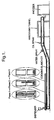
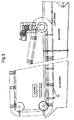
- the dosing device may comprise a separate perforated tube and cup component, as illustrated at (a) in fig.3, wherein these two components are each attached to separate rotating endless chains, which operate in a coordinated cycle that allows the positioning of the components so that dried pasta can be loaded into the tube from above, wherein it rests vertically supported by the cup component beneath, phase 1 of fig.1.
- the shape of the cup component of the dosing device may show some considerable variation depending on the desired shape of the pasta nest.
- the cup may for example take a convex almost hemispherical shape or have a flat base.
- the perforated cup component at the base of the dosing device has a concave cone-shape indentation as illustrated in fig. 1. This serves to facilitate the shaping of the pasta into an appealing toroidal shape.
- the cup has substantially cylindrical walls and a slightly convex perforated base which has the capacity to flex to an equally concave position. This flexing action is utilized to facilitate the emptying of the pasta nest when formed.
- the desired amount of pasta is positioned vertically in each dosing device which is then submerged in the boiling water of the cooking blancher to allow re-hydration. As re-hydration progresses the pasta softens and falls to the bottom of the device to be supported by the cup component where it forms a nest as illustrated by phases 1 to 3 of figure 1.
- the positioning of the dosing devices could be altered such that the portions of pasta are re-hydrated by sub-merging the devices in the water of the cooking blancher in a substantially horizontal dimension and subsequently moving vertically to allow the pasta to fall and be shaped by the cup component.
- portions of dried pasta may be quenched and frozen after re-hydration in a dosing device in a substantially horizontal dimension without the subsequent formation of a nest shape.
- re-hydrating the pasta to a ratio of between 170 and 195% provides good textural properties when reheated for consumption, preferably the pasta is re-hydrated to the range 180 to 190%. This takes between 5 and 10 minutes in the blancher with variation depending on the diameter of the pasta type being prepared.
- the degree to which re-hydration is achieved can be somewhat altered according to the quality of the pasta that is used in the invention. Where a high quality, high gluten content flour is used, the dried dough can be more thoroughly re-hydrated without loss of texture on re-heating for consumption, thereby preserving the desired 'al dente' characteristic by virtue of maintaining a dense stable protein matrix.
- the dosing device or simply the cup component thereof, depending on the set-up, containing the pasta can proceed to the next phase.
- the pasta may be frozen by any suitable means, however preferably a drum belt freezer is used.
- the pasta when subsequently removed retains the shape as predetermined by the shape of the cup to the dosing device and on re-heating provides long high quality 'al dente' texture pasta.
- the length of the individual pasta strands will be determined by that of the pre-hydrated pasta portioned into the dosing devices.
- the invention provides a method by which that pre-hydrated length is retained and shaped to a frozen nest in the absence of any intermediate cutting step.
- the product when reheated resembles pasta as prepared in a traditionally cooked Italian meal.
- pasta nests of invention will comprise elongated pasta in excess of 15cm, preferably exceeding 20cm, more preferred being in the range 25cm to 30cm.
- the maximum length of pasta that would be suitable for the purpose of the invention is dependent on the dimensions of the apparatus being used.
- Preferably greater than 75% of the individual pasta strands that make up each frozen pasta nest of the invention are greater than 15 cm in length, more preferably greater than 80% are over 15 cm, more preferably greater than 90%, still more preferred greater than 95% of the pasta strands are over 15 cm length. In a most preferred embodiment more than 95% of the pasta strands in each nest are in the range of 25 cm to 30 cm in length.
- the quenched re-hydrated pasta Prior to freezing the quenched re-hydrated pasta may optionally be enrobed with oil as a measure to reduce surface dehydration and damage during subsequent freezing steps, preferably this is achieved by spraying the pasta after quenching.
- the pasta portions may also optionally undergo an encrusting step (post-oiling where appropriate) wherein the pasta within the dosing device or cup component thereof is exposed to a cryogenic coolant or high-speed cold air.
- encrusting step post-oiling where appropriate
- This provides surface freezing of the pasta which can preserve a precise nest shape when removed from the dosing device or cup component thereof, and tipped onto a freezing belt for the final freezing step.
- a particular embodiment of the invention relates to instant cooking frozen pasta obtainable by the process as outlined in the above description.
- a further particular aspect of the invention resides in apparatus for the manufacture of frozen pasta according to the above description therein comprising:
- the invention comprises apparatus as described above wherein said dosing device comprises; a perforated tube component and perforated cup component which are positioned to form a retaining means within the blanching means by virtue of their attachment to separate rotating endless chains which operate in a co-ordinated cycle that allows positioning of the components so that pasta can be loaded into the tube from above and move through the blanching means.
- the dosing devices adopt a substantially vertical position within the boiling water of the blanching means in such way assisting in the formation of pasta nests within the cup component.
- the attachment of the dosing devices to the endless chains is reversible to facilitate their cleaning.
- the dosing device of the apparatus according to the invention may be constructed from any material that is resistant to temperature up to 100°C, thermic shock and exposure to high salt content. Obviously this material must also be suitable for use in the preparation of food.
- the dosing device is constructed from stainless steel with the cup component be formed from a stainless steel mesh material.
- Frozen pasta of the present invention may be put to a number of uses, frozen oiled pasta may be reheated in a pan without any addition ingredients or may be reheated in a pan of boiling water. The pasta can be added to any kind of dish at the desire of the consumer.
- the frozen pasta of the invention may be packaged with sauce pellets and may be reheated together by a number of suitable methods. Where the re-hydrated mass of pasta is less than around 30g it is possible to reheat in a pan from frozen with sauce pellets in less than about 5 minutes.
- a microwave oven or conventional gas fired/electric oven could also be used to firstly melt sauce pellets to which the frozen pasta can be added and reheated.
- the frozen pasta may also be packaged in a frozen sauce for re-heating in microwave or conventional oven.
- a further embodiment of the invention is therefore directed to a packaged frozen product comprising one or more instant cooking nests of a re-hydrated elongated dried pasta product according to the description above.
Landscapes
- Life Sciences & Earth Sciences (AREA)
- Engineering & Computer Science (AREA)
- Food Science & Technology (AREA)
- Chemical & Material Sciences (AREA)
- Polymers & Plastics (AREA)
- Wood Science & Technology (AREA)
- Zoology (AREA)
- Health & Medical Sciences (AREA)
- Nutrition Science (AREA)
- Noodles (AREA)
Abstract
(i) dividing an elongated dried pasta product into portions, each portion having a desired mass;
(ii) loading a portion of pasta into one of a plurality of separate dosing devices;
(iii) re-hydrating said portion of pasta within a dosing device;
(iv) quenching the re-hydrated pasta resulting from step (iii);
(v) and freezing,
wherein during step (iii) each portion of pasta is positioned vertically in a dosing device such that as re-hydration occurs said pasta softens and falls to the base of the device where it forms a nest.
Description
- The invention relates to the field of re-heatable frozen pasta products and particularly to frozen nests of elongated pasta products, such as spaghetti, linguine tagliatelle, bucatini.
- The technology for the formation of dried elongated pasta has long been available wherein fresh pasta strands are shaped commonly into a nest shape and exposed to high temperature drying conditions. The resultant dried nests are unsuitable for inclusion in re-heatable frozen meals as the shape is inevitably lost when the pasta is re-hydrated during pre-cooking. Consequently subsequent portioning steps prior to freezing necessitate the undesirable cutting of the pasta lengths.
- The prior art further describes frozen pasta formed by a process wherein a fresh pasta sheet is cut into strips and portioned by directly filling a mould. These bundles of pasta are subsequently cooked within the mould and may then be frozen.
- The portioning of fresh pasta prior to a cooking step overcomes the difficulties associated with later division, effectively removing the necessity for random cutting of the pasta. The flexible nature of fresh pasta lends itself well to portioning prior to cooking however it is not possible to achieve an 'al dente' texture from the fresh pasta and so the essence of a traditionally cooked Italian meal cannot be achieved by this route.
-
JP 10/257,865 IT 01 247939 US 5 151 289 discloses a frozen instant cooking noodle product with a cross-sectional void space of 40-80% capable of uniformly thawing quickly comprising randomly arranged strings of noodle.US 4 579 746 discloses a method for preparing a cooked and frozen noodle product suitable for being re-cooked and restored to its original state by heating.US 4 693 900 discloses a frozen cooked pasta product prepared from, for example, dry spaghetti formed into circular, square or rectangular shapes.JP 09/313,121 - In order to maintain an 'al dente' texture in the re-heated product it is desirable for a pasta that has undergone a high temperature drying process to be used as the starting material. Methods known in the prior art for the production of frozen pasta in which re-hydrated dried pasta has been used are predominantly limited to those wherein short pasta products such as penne, fuselli etc. undergo cooking and freezing.
- The Applicants have therefore identified a desire to introduce elongated re-hydrated pasta products which have undergone high temperature drying into instant cooking frozen pasta meals, wherein the length of the pasta is maintained in the prepared meal.
- The inflexible and fragile nature of elongated dried pasta products presents considerable technical difficulties. Such products are particularly difficult to portion on an industrial scale when re-hydrated and clearly cannot be molded into nests when in their dried form. Previous attempts to prepare frozen elongated pasta products have involved the horizontal cooking of pasta lengths in a large vessel then straining and portioning, however known techniques for portioning of the entangled lengths of pasta have not allowed the cutting of the pasta to be avoided. Consequently the product quality is considerably compromised by the presence of short pasta lengths.
- The Applicants have identified an further consumer need for high quality frozen pasta meals that not only comprise substantially intact lengths of elongated pasta products but are instantly re-heatable in the home.
- Reducing the mass of pasta in each portion to give a shorter re-heating time while providing a desirable nest shape has been found to present further technical problems. Using only a small amount of pasta it is particularly difficult to form and retain an appealing nest shape.
- Achieving a nest shape in the frozen pasta besides being attractive is also desirable as it make the pasta lengths less vulnerable to breakage during any subsequent processing.
- The Applicants by way of the present invention have devised a system which overcomes the problems outlined above, where frozen instant cooking pasta can be produced from elongated dried pasta products.
- The present invention is therefore directed towards a process for the manufacture of frozen instant cooking pasta from elongated dried pasta products that substantially retains the pre-processing length of the dried pasta. Further embodiments are directed to the apparatus that is necessary for the formation thereof and the product achieved.
- The Applicants have developed a process to produce instantly re-heatable frozen bundles of elongated pasta products which retain an 'al dente' texture by virtue of them being formed from dried pasta and also substantially retain the pre-processing length of the pasta by the avoidance of cutting as a means of dividing once re-hydrated.
- The invention in the first aspect therefore provides a process for the manufacture of instant cooking frozen pasta comprising the steps of;
- (i) dividing an elongated dried pasta product into one or more portions, each portion having a desired mass;
- (ii) loading each portion of pasta into one of a plurality of separate dosing devices;
- (iii) re-hydrating each portion of pasta within a dosing device;
- (iv) quenching the re-hydrated pasta resulting from step (iii);
- (v) freezing.
- These and other aspects of the invention will be described in further detail in the description that will follow hereinafter.
- The exposure of pasta dough to high temperatures during drying procedures has considerable effects on the compositional structure of the dough which serve to improve the perceived texture when cooked.
- Gluten denaturation occurs from 60 to 80°C and results in the formation of a protein lattice structure which entraps starch particles and helps to prevent starch loss to the cooking water during re-hydration. Although there are a number of techniques which would be suitable for the drying of pasta dough for the purpose of the invention, it is preferable that the pasta dough undergoes a High Temperature Short Time (HTST) drying procedure.
- A high quality flour with a high gluten content, for example Durham wheat derived semolina flour, is preferably used in the dough since this will give rise to a dense lattice structure when dried. Consequently yielding a higher quality product with better textural properties when re-hydrated.
- It must be appreciated however that dried pasta dough made from softer wheat may also be used in the present invention, wherein the degree of re-hydration may be reduced to texturally compensate for poorer quality i.e. lower gluten containing ingredients.
- For the purpose of the present invention any type of dried pasta which takes an elongated form may be used, these may have been extruded or cut from a dough sheet. Names of particular pasta products commonly differ on a regional basis and therefore it is believed that the skilled person would appreciate the range of dried pasta products that may suited to the invention. Preferably the instant cooking frozen pasta of the invention comprises one or more pasta products selected from the group comprising spaghetti, linguine, bucatini and tagliatelle. Most preferred the pasta comprises spaghetti.
- For the purpose of clarity and with no intention of limiting the scope of the invention further aspects shall be described with reference to the attached drawings, in which;
- Figure 1; shows a diagrammatic overview of a suitable production line for the manufacture of pasta according to the invention.
- Figure 2; represents the portioning step wherein strands of dried pasta are loaded into the labeled hopper from where they are dispensed onto a portioning device and subsequently weighed.
- Figure 3; represents the apparatus involved in the re-hydration of the pasta during a blanching step.
- In the embodiment described in the figures dried pasta products are fed from a hopper to a portioning device, fig.2, which by a vibrating action arranges the pasta lengths into portions parallel to one another in grooves on the surface of said device, which can subsequently be weighed.
- Portions of dried pasta of any desirable size may be used in the process of the invention, depending on the size of the pasta nests that are sought.
- It is desirable for the modern consumer that frozen food products are developed that can be reheated for consumption in an instant. The applicants have found that in order to maintain a short re-heating time for the frozen product of the invention it is necessary for the weight of the individual pasta nests to remain small, preferably produced from less than 50 grams dried pasta. More preferred the dried pasta weight is less than 30 grams. A most preferred embodiment is based on the finding that a frozen nest made from less than 15 grams of dried pasta can be reheated in less than 5 minutes cooking time, typically such a frozen nest will have a hydrated mass of less than around 30 grams.
- The problem of shaping such small quantities of pasta to a nest is solved by having a dosing device with appropriate dimensions. The desired amount of pasta for each nest is loaded into each dosing device.
- The dosing devices provide an important component of the apparatus of the invention and allow the portions of dried pasta to be individually re-hydrated and shaped to a nest, not only avoiding any post-re-hydration cutting step but also generating a form that once frozen will preserve the length of the pasta by reducing the likelihood of damage during subsequent processing.
- The dosing device may take the form of a single component comprising a perforated tube with an opening at one end which is extended to a cup-shaped base at the other. The perforated material allows for the entry and exit of the boiling water when submerged in a cooking blancher.
- In another embodiment the perforated tube and cup components of the dosing device may be reversibly attached to one another to facilitate both access to the pasta portion when hydrated or frozen and cleaning of the apparatus.
- Alternatively the dosing device may comprise a separate perforated tube and cup component, as illustrated at (a) in fig.3, wherein these two components are each attached to separate rotating endless chains, which operate in a coordinated cycle that allows the positioning of the components so that dried pasta can be loaded into the tube from above, wherein it rests vertically supported by the cup component beneath,
phase 1 of fig.1. - The shape of the cup component of the dosing device may show some considerable variation depending on the desired shape of the pasta nest. The cup may for example take a convex almost hemispherical shape or have a flat base.
- More preferably the perforated cup component at the base of the dosing device has a concave cone-shape indentation as illustrated in fig. 1. This serves to facilitate the shaping of the pasta into an appealing toroidal shape. In a most preferred embodiment the cup has substantially cylindrical walls and a slightly convex perforated base which has the capacity to flex to an equally concave position. This flexing action is utilized to facilitate the emptying of the pasta nest when formed.
- The desired amount of pasta is positioned vertically in each dosing device which is then submerged in the boiling water of the cooking blancher to allow re-hydration. As re-hydration progresses the pasta softens and falls to the bottom of the device to be supported by the cup component where it forms a nest as illustrated by
phases 1 to 3 of figure 1. - It is appreciated that the positioning of the dosing devices could be altered such that the portions of pasta are re-hydrated by sub-merging the devices in the water of the cooking blancher in a substantially horizontal dimension and subsequently moving vertically to allow the pasta to fall and be shaped by the cup component.
- In a further alternative, portions of dried pasta may be quenched and frozen after re-hydration in a dosing device in a substantially horizontal dimension without the subsequent formation of a nest shape.
- The Applicants have found that re-hydrating the pasta to a ratio of between 170 and 195% provides good textural properties when reheated for consumption, preferably the pasta is re-hydrated to the range 180 to 190%. This takes between 5 and 10 minutes in the blancher with variation depending on the diameter of the pasta type being prepared.
- The degree to which re-hydration is achieved can be somewhat altered according to the quality of the pasta that is used in the invention. Where a high quality, high gluten content flour is used, the dried dough can be more thoroughly re-hydrated without loss of texture on re-heating for consumption, thereby preserving the desired 'al dente' characteristic by virtue of maintaining a dense stable protein matrix.
- Where the quality of dough is lower with less and/or poor quality gluten present, re-hydrating to a lesser extent can be used to partially compensate for the textural loss that would otherwise occur.
- Once the re-hydration step is complete the dosing device, or simply the cup component thereof, depending on the set-up, containing the pasta can proceed to the next phase.
- It is important that after re-hydration the pasta undergoes a quenching step wherein cold water is used to rapidly cool the foodstuff and remove excess starch from the pasta surface. This reduces the sticking together of the pasta strands.
- Once quenched the pasta may be frozen by any suitable means, however preferably a drum belt freezer is used. The pasta when subsequently removed retains the shape as predetermined by the shape of the cup to the dosing device and on re-heating provides long high quality 'al dente' texture pasta.
- The length of the individual pasta strands will be determined by that of the pre-hydrated pasta portioned into the dosing devices. The invention provides a method by which that pre-hydrated length is retained and shaped to a frozen nest in the absence of any intermediate cutting step. Thus the product when reheated resembles pasta as prepared in a traditionally cooked Italian meal.
- Typically pasta nests of invention will comprise elongated pasta in excess of 15cm, preferably exceeding 20cm, more preferred being in the range 25cm to 30cm. The maximum length of pasta that would be suitable for the purpose of the invention is dependent on the dimensions of the apparatus being used.
- Preferably greater than 75% of the individual pasta strands that make up each frozen pasta nest of the invention are greater than 15 cm in length, more preferably greater than 80% are over 15 cm, more preferably greater than 90%, still more preferred greater than 95% of the pasta strands are over 15 cm length. In a most preferred embodiment more than 95% of the pasta strands in each nest are in the range of 25 cm to 30 cm in length.
- Prior to freezing the quenched re-hydrated pasta may optionally be enrobed with oil as a measure to reduce surface dehydration and damage during subsequent freezing steps, preferably this is achieved by spraying the pasta after quenching.
- The pasta portions may also optionally undergo an encrusting step (post-oiling where appropriate) wherein the pasta within the dosing device or cup component thereof is exposed to a cryogenic coolant or high-speed cold air. This provides surface freezing of the pasta which can preserve a precise nest shape when removed from the dosing device or cup component thereof, and tipped onto a freezing belt for the final freezing step.
- It is particularly appreciated that the steps of the process described herein for the preparation of frozen instant cooking pasta can be advantageously repeated as a continuous automated cycle of production.
- A particular embodiment of the invention relates to instant cooking frozen pasta obtainable by the process as outlined in the above description.
- A further particular aspect of the invention resides in apparatus for the manufacture of frozen pasta according to the above description therein comprising:
- (i) a weighing means;
- (ii) a plurality of dosing devices attached to an endless chain;
- (iii) a blanching means into which said dosing devices are submergible;
- (iv) a freezing means.
- Moreover the invention comprises apparatus as described above wherein said dosing device comprises; a perforated tube component and perforated cup component which are positioned to form a retaining means within the blanching means by virtue of their attachment to separate rotating endless chains which operate in a co-ordinated cycle that allows positioning of the components so that pasta can be loaded into the tube from above and move through the blanching means.
- In a preferred embodiment the dosing devices adopt a substantially vertical position within the boiling water of the blanching means in such way assisting in the formation of pasta nests within the cup component.
- Preferably the attachment of the dosing devices to the endless chains is reversible to facilitate their cleaning.
- The dosing device of the apparatus according to the invention may be constructed from any material that is resistant to temperature up to 100°C, thermic shock and exposure to high salt content. Obviously this material must also be suitable for use in the preparation of food. Preferably the dosing device is constructed from stainless steel with the cup component be formed from a stainless steel mesh material.
- Frozen pasta of the present invention may be put to a number of uses, frozen oiled pasta may be reheated in a pan without any addition ingredients or may be reheated in a pan of boiling water. The pasta can be added to any kind of dish at the desire of the consumer.
- Alternatively the frozen pasta of the invention may be packaged with sauce pellets and may be reheated together by a number of suitable methods. Where the re-hydrated mass of pasta is less than around 30g it is possible to reheat in a pan from frozen with sauce pellets in less than about 5 minutes.
- A microwave oven or conventional gas fired/electric oven could also be used to firstly melt sauce pellets to which the frozen pasta can be added and reheated. The frozen pasta may also be packaged in a frozen sauce for re-heating in microwave or conventional oven.
- A further embodiment of the invention is therefore directed to a packaged frozen product comprising one or more instant cooking nests of a re-hydrated elongated dried pasta product according to the description above.
Claims (12)
- An instant cooking frozen pasta nest obtainable by a process comprising the steps of:(i) dividing an elongated dried pasta product into portions, each portion having a desired mass;(ii) loading a portion of pasta into one of a plurality of separate dosing devices;(iii) re-hydrating said portion of pasta within a dosing device;(iv) quenching the re-hydrated pasta resulting from step (iii);(v) and freezing,wherein during step (iii) each portion of pasta is positioned vertically in a dosing device such that as re-hydration occurs said pasta softens and falls to the base of the device where it forms a nest.
- A frozen pasta nest according to claim 1 wherein each portion of pasta is re-hydrated in a cooking blancher.
- A frozen pasta nest according to claim 1 or claim 2 wherein the steps of said process occur as part of a continuous automated cycle of production.
- A frozen pasta nest according to any one of the preceding claims, wherein the desired mass of dried pasta product in each portion is less than 50 grams.
- A frozen pasta nest according to any one of the preceding claims, wherein the re-hydrated pasta is enrobed in oil prior to freezing.
- A frozen pasta nest according to any one of the preceding claims, wherein the re-hydrated pasta is encrusted by surface exposure to high speed cold air or a cryogenic coolant prior to freezing.
- A frozen pasta nest according to any one of the preceding claims comprising less than 15 grams of an elongated dried pasta product that has undergone re-hydration.
- A frozen pasta nest according to claim 7 wherein said frozen pasta nest is re-heatable in less than 5 minutes.
- A frozen pasta nest according to any one of the preceding claims, wherein said dried pasta product is selected from one or more of the group comprising spaghetti, linguine, tagliatelle and bucatini.
- A frozen pasta nest according to claim 9, wherein said dried pasta product is spaghetti.
- A frozen pasta nest according to any one of the preceding claims, wherein said frozen pasta nest is enrobed with oil.
- A packaged frozen product comprising one or more instant cooking nests of a re-hydrated elongated dried pasta product according to any one of the preceding claims.
Priority Applications (1)
| Application Number | Priority Date | Filing Date | Title |
|---|---|---|---|
| EP06017613A EP1721531A3 (en) | 1999-04-07 | 2000-03-20 | Frozen pasta product |
Applications Claiming Priority (4)
| Application Number | Priority Date | Filing Date | Title |
|---|---|---|---|
| EP99302712 | 1999-04-07 | ||
| EP04005798A EP1428439B1 (en) | 1999-04-07 | 2000-03-20 | Frozen pasta product |
| EP06017613A EP1721531A3 (en) | 1999-04-07 | 2000-03-20 | Frozen pasta product |
| EP00920525A EP1164869B1 (en) | 1999-04-07 | 2000-03-20 | Frozen pasta product |
Related Parent Applications (1)
| Application Number | Title | Priority Date | Filing Date |
|---|---|---|---|
| EP04005798A Division EP1428439B1 (en) | 1999-04-07 | 2000-03-20 | Frozen pasta product |
Publications (2)
| Publication Number | Publication Date |
|---|---|
| EP1721531A2 true EP1721531A2 (en) | 2006-11-15 |
| EP1721531A3 EP1721531A3 (en) | 2007-01-10 |
Family
ID=8241319
Family Applications (3)
| Application Number | Title | Priority Date | Filing Date |
|---|---|---|---|
| EP06017613A Withdrawn EP1721531A3 (en) | 1999-04-07 | 2000-03-20 | Frozen pasta product |
| EP00920525A Expired - Lifetime EP1164869B1 (en) | 1999-04-07 | 2000-03-20 | Frozen pasta product |
| EP04005798A Expired - Lifetime EP1428439B1 (en) | 1999-04-07 | 2000-03-20 | Frozen pasta product |
Family Applications After (2)
| Application Number | Title | Priority Date | Filing Date |
|---|---|---|---|
| EP00920525A Expired - Lifetime EP1164869B1 (en) | 1999-04-07 | 2000-03-20 | Frozen pasta product |
| EP04005798A Expired - Lifetime EP1428439B1 (en) | 1999-04-07 | 2000-03-20 | Frozen pasta product |
Country Status (8)
| Country | Link |
|---|---|
| US (3) | US7179498B1 (en) |
| EP (3) | EP1721531A3 (en) |
| AR (1) | AR023385A1 (en) |
| AT (2) | ATE355754T1 (en) |
| AU (1) | AU4107200A (en) |
| DE (2) | DE60033863T2 (en) |
| ES (1) | ES2282747T3 (en) |
| WO (1) | WO2000060955A1 (en) |
Families Citing this family (6)
| Publication number | Priority date | Publication date | Assignee | Title |
|---|---|---|---|---|
| EP1306015B1 (en) * | 2001-10-25 | 2005-07-20 | Unilever Plc | Process for preparing a frozen pasta meal with sauce |
| SI1726210T1 (en) * | 2005-05-23 | 2011-11-30 | Barilla Flli G & R | Apparatus for the production of frozen nests of cooked long pasta |
| BRPI0603527A (en) * | 2006-08-28 | 2008-04-15 | Antonio Malandrino Neto | pasta production and packaging process with sauce not incorporated into pasta |
| CN103169018A (en) * | 2011-12-22 | 2013-06-26 | 日清富滋株式会社 | Method for producing cooked and frozen pasta |
| ES2643869B1 (en) * | 2016-05-24 | 2018-06-08 | Francisco Javier PRIETO MARTIN | Procedure for the preparation of a dry hydrated paste and obtained paste |
| US20190075836A1 (en) * | 2017-09-14 | 2019-03-14 | Premium Costa Rica Products LLC | System and method for the preservation of coconut products |
Family Cites Families (24)
| Publication number | Priority date | Publication date | Assignee | Title |
|---|---|---|---|---|
| US1855540A (en) * | 1929-08-01 | 1932-04-26 | William L Baker | Washing and cooking machine |
| US2013906A (en) * | 1932-11-19 | 1935-09-10 | Chef Boiardi Food Products Com | Cooker |
| FR2351600A1 (en) * | 1976-05-19 | 1977-12-16 | Acecook Co Ltd | METHOD AND APPARATUS FOR FRYING FOOD PASTA OF THE NOODLE TYPE |
| US4321858A (en) * | 1980-10-09 | 1982-03-30 | Donna Williams | Crepe maker |
| JPS5852627B2 (en) * | 1981-06-02 | 1983-11-24 | 森井食品株式会社 | Harusame production method |
| FR2512645B1 (en) * | 1981-09-17 | 1985-06-21 | Caudry Produits Alimentaires | PROCESS FOR MANUFACTURING FROZEN FOOD PRODUCTS COMPRISING A SUPERIMPOSITION OF LAYERS OF PASTA AND SAUCES AND DERIVATIVES |
| JPS60137255A (en) * | 1983-12-26 | 1985-07-20 | Nisshin Flour Milling Co Ltd | Production of frozen noodle |
| EP0160584A1 (en) * | 1984-03-13 | 1985-11-06 | Jacques Bezon | Apparatus for automatically and continuously cooking or frying individual portions of food |
| IT8446866A0 (en) | 1984-09-28 | 1984-09-28 | Unimac Srl | LONG-LIFE DRY PASTA FIRST COURSE FORMELLAS |
| US5073393A (en) * | 1989-01-25 | 1991-12-17 | Defrancisci Machine Corp. | Automatic proportioning pasta system |
| JP2759195B2 (en) * | 1989-12-04 | 1998-05-28 | 株式会社キンレイ | Manufacturing method of frozen noodles |
| JP2799206B2 (en) * | 1989-12-28 | 1998-09-17 | 日清製粉株式会社 | Manufacturing method of instant frozen spaghetti |
| GB2247603A (en) | 1990-09-05 | 1992-03-11 | Jor Wing Fai | Method of and apparatus for forming noodle bundles |
| CH684339A5 (en) * | 1991-03-21 | 1994-08-31 | Electroplating Eng Eesa | Electrolysis cell for selectively plating chosen patterns on a continuously travelling metal strip |
| IT1247939B (en) * | 1991-05-16 | 1995-01-05 | Gilberto Cattaneo | Process and associated plant for preparing single servings of cooked and frozen long pasta on an industrial scale |
| US5139808A (en) | 1991-09-13 | 1992-08-18 | Nestec S.A. | Process of making frozen pasta |
| DK0533975T3 (en) | 1991-09-25 | 1994-08-22 | Barilla G E R F Ili Societ Per | Apparatus for forming nests of elongated pasta products such as noodles, fettuccine and the like |
| JPH07187278A (en) * | 1993-12-27 | 1995-07-25 | Nakari:Kk | Easily releasable food container |
| US5573804A (en) * | 1994-09-28 | 1996-11-12 | Nestec S.A. | Preparation of interwined pasta products |
| JPH09313121A (en) * | 1996-05-28 | 1997-12-09 | Shinji Kato | Frozen chinese noodle |
| JPH10257865A (en) * | 1997-03-19 | 1998-09-29 | Gooda Shoji:Kk | Frozen noodle |
| US6120828A (en) * | 1998-08-14 | 2000-09-19 | Howa Sangyo Co., Ltd. | Method for freezing boiled rice in separate small-lump form |
| US6235330B1 (en) * | 1998-09-18 | 2001-05-22 | Conagra, Inc. | Process for making free-flowing, coated, frozen food |
| WO2002015714A2 (en) * | 2000-08-23 | 2002-02-28 | Howden Food Equipment Corp. | Continuous cooking apparatus and method employing hydrostatic pressure |
-
2000
- 2000-03-20 DE DE60033863T patent/DE60033863T2/en not_active Expired - Lifetime
- 2000-03-20 WO PCT/EP2000/002480 patent/WO2000060955A1/en not_active Ceased
- 2000-03-20 EP EP06017613A patent/EP1721531A3/en not_active Withdrawn
- 2000-03-20 EP EP00920525A patent/EP1164869B1/en not_active Expired - Lifetime
- 2000-03-20 DE DE60015943T patent/DE60015943T2/en not_active Expired - Lifetime
- 2000-03-20 EP EP04005798A patent/EP1428439B1/en not_active Expired - Lifetime
- 2000-03-20 AT AT04005798T patent/ATE355754T1/en not_active IP Right Cessation
- 2000-03-20 ES ES04005798T patent/ES2282747T3/en not_active Expired - Lifetime
- 2000-03-20 AU AU41072/00A patent/AU4107200A/en not_active Abandoned
- 2000-03-20 AT AT00920525T patent/ATE282329T1/en not_active IP Right Cessation
- 2000-03-20 US US09/958,227 patent/US7179498B1/en not_active Expired - Fee Related
- 2000-04-05 AR ARP000101544A patent/AR023385A1/en unknown
-
2004
- 2004-06-29 US US10/879,931 patent/US8151700B2/en not_active Expired - Fee Related
-
2007
- 2007-01-16 US US11/623,492 patent/US20070212466A1/en not_active Abandoned
Also Published As
| Publication number | Publication date |
|---|---|
| EP1721531A3 (en) | 2007-01-10 |
| US20040247764A1 (en) | 2004-12-09 |
| WO2000060955A8 (en) | 2002-10-24 |
| AR023385A1 (en) | 2002-09-04 |
| US20070212466A1 (en) | 2007-09-13 |
| WO2000060955A1 (en) | 2000-10-19 |
| EP1428439B1 (en) | 2007-03-07 |
| EP1164869B1 (en) | 2004-11-17 |
| US7179498B1 (en) | 2007-02-20 |
| US8151700B2 (en) | 2012-04-10 |
| AU4107200A (en) | 2000-11-14 |
| EP1428439A2 (en) | 2004-06-16 |
| ATE355754T1 (en) | 2007-03-15 |
| DE60033863T2 (en) | 2007-07-05 |
| DE60015943D1 (en) | 2004-12-23 |
| ES2282747T3 (en) | 2007-10-16 |
| DE60015943T2 (en) | 2005-11-10 |
| ATE282329T1 (en) | 2004-12-15 |
| EP1428439A9 (en) | 2004-09-29 |
| EP1164869A1 (en) | 2002-01-02 |
| EP1428439A3 (en) | 2004-07-14 |
| DE60033863D1 (en) | 2007-04-19 |
Similar Documents
| Publication | Publication Date | Title |
|---|---|---|
| Hou et al. | Noodle processing technology | |
| US4749583A (en) | Method for making an edible container from corn | |
| US20070212466A1 (en) | Frozen Food Product | |
| ZA200303354B (en) | Instant pasta with improved cooking quality. | |
| EP0884000A2 (en) | Process for producing quickboiling pastas and noodles | |
| US6210735B1 (en) | Process for producing quick-boiling or instant cooking pastas and noodles | |
| JPH03164156A (en) | Frozen food and production thereof | |
| JP7372109B2 (en) | Method for producing fried vegetable food and fried vegetable food | |
| JP7260370B2 (en) | Method for producing frozen noodles | |
| RU2116732C1 (en) | Method for preparation of flour product | |
| KR102584985B1 (en) | Rice instant noodles manufacturing method | |
| JP7611175B2 (en) | Pre-cooked frozen short pasta food and its manufacturing method | |
| JP7516218B2 (en) | Microwave-cooked noodles for delivery | |
| JP4091535B2 (en) | Packaging frozen noodles | |
| JP2009165438A (en) | Mixed tempura fritter and method for producing the same | |
| JP4045171B2 (en) | Edible container and its manufacturing method | |
| KR19980023171A (en) | Fish cake manufacturing method and fish cake spreading device | |
| JP2002345424A (en) | Refrigerated/frozen noodle and method for producing the same | |
| JP3898802B2 (en) | Method for producing microwave noodles | |
| JPH03198756A (en) | Cooked rice food | |
| CN112352913A (en) | Coated noodles | |
| JP6575937B2 (en) | Instant noodles in a container and method for producing the noodle mass | |
| JPH11178528A (en) | Instant frozen foods | |
| JPH0329375B2 (en) | ||
| JPS6379577A (en) | 'odamakimushi' (noodle with poached eggs, meat and vegetable) storable at low temperature |
Legal Events
| Date | Code | Title | Description |
|---|---|---|---|
| PUAI | Public reference made under article 153(3) epc to a published international application that has entered the european phase |
Free format text: ORIGINAL CODE: 0009012 |
|
| AC | Divisional application: reference to earlier application |
Ref document number: 1428439 Country of ref document: EP Kind code of ref document: P Ref document number: 1164869 Country of ref document: EP Kind code of ref document: P |
|
| AK | Designated contracting states |
Kind code of ref document: A2 Designated state(s): AT BE CH CY DE DK ES FI FR GB GR IE IT LI LU MC NL PT SE |
|
| PUAL | Search report despatched |
Free format text: ORIGINAL CODE: 0009013 |
|
| AK | Designated contracting states |
Kind code of ref document: A3 Designated state(s): AT BE CH CY DE DK ES FI FR GB GR IE IT LI LU MC NL PT SE |
|
| AKX | Designation fees paid | ||
| REG | Reference to a national code |
Ref country code: DE Ref legal event code: 8566 |
|
| STAA | Information on the status of an ep patent application or granted ep patent |
Free format text: STATUS: THE APPLICATION IS DEEMED TO BE WITHDRAWN |
|
| 18D | Application deemed to be withdrawn |
Effective date: 20070612 |