EP1720366A2 - System für den Fernzugriff eines mobilen Gerätes zu mobilen Telefondiensten - Google Patents
System für den Fernzugriff eines mobilen Gerätes zu mobilen Telefondiensten Download PDFInfo
- Publication number
- EP1720366A2 EP1720366A2 EP06380095A EP06380095A EP1720366A2 EP 1720366 A2 EP1720366 A2 EP 1720366A2 EP 06380095 A EP06380095 A EP 06380095A EP 06380095 A EP06380095 A EP 06380095A EP 1720366 A2 EP1720366 A2 EP 1720366A2
- Authority
- EP
- European Patent Office
- Prior art keywords
- application
- subscriber
- command
- mobile
- mobile equipment
- Prior art date
- Legal status (The legal status is an assumption and is not a legal conclusion. Google has not performed a legal analysis and makes no representation as to the accuracy of the status listed.)
- Withdrawn
Links
Images



Classifications
-
- H—ELECTRICITY
- H04—ELECTRIC COMMUNICATION TECHNIQUE
- H04W—WIRELESS COMMUNICATION NETWORKS
- H04W92/00—Interfaces specially adapted for wireless communication networks
- H04W92/04—Interfaces between hierarchically different network devices
- H04W92/08—Interfaces between hierarchically different network devices between user and terminal device
-
- H—ELECTRICITY
- H04—ELECTRIC COMMUNICATION TECHNIQUE
- H04W—WIRELESS COMMUNICATION NETWORKS
- H04W4/00—Services specially adapted for wireless communication networks; Facilities therefor
-
- H—ELECTRICITY
- H04—ELECTRIC COMMUNICATION TECHNIQUE
- H04M—TELEPHONIC COMMUNICATION
- H04M1/00—Substation equipment, e.g. for use by subscribers
- H04M1/006—Call diverting means
-
- H—ELECTRICITY
- H04—ELECTRIC COMMUNICATION TECHNIQUE
- H04M—TELEPHONIC COMMUNICATION
- H04M1/00—Substation equipment, e.g. for use by subscribers
- H04M1/72—Mobile telephones; Cordless telephones, i.e. devices for establishing wireless links to base stations without route selection
- H04M1/724—User interfaces specially adapted for cordless or mobile telephones
- H04M1/72403—User interfaces specially adapted for cordless or mobile telephones with means for local support of applications that increase the functionality
- H04M1/72409—User interfaces specially adapted for cordless or mobile telephones with means for local support of applications that increase the functionality by interfacing with external accessories
- H04M1/72415—User interfaces specially adapted for cordless or mobile telephones with means for local support of applications that increase the functionality by interfacing with external accessories for remote control of appliances
-
- H—ELECTRICITY
- H04—ELECTRIC COMMUNICATION TECHNIQUE
- H04W—WIRELESS COMMUNICATION NETWORKS
- H04W8/00—Network data management
- H04W8/18—Processing of user or subscriber data, e.g. subscribed services, user preferences or user profiles; Transfer of user or subscriber data
- H04W8/20—Transfer of user or subscriber data
- H04W8/205—Transfer to or from user equipment or user record carrier
Definitions
- the present invention is comprised within the field of mobile telecommunications, and more specifically in sending commands to mobile equipment and receiving information related to the command.
- a subscriber "mobile equipment” can be referred to, comprising both in GSM (Global System for Mobile Communication) and in GPRS (General Packet Radio Service) and UMTS (Universal Mobile Telecommunications System - also called “Third Generation Mobile Telephony”) systems:
- a smart card comprises an electronic device similar to a PC with regard to its architecture, but inserted in a plastic card. Smart cards are based on an integrated circuit having the following elements embedded therein:
- Communication of the smart card with different external devices is based on 5-byte commands which indicate the action to be performed.
- the command is occasionally accompanied by the data required for performing the action, for example, updating a file in the card. Other times, it is the card that must return data to the device that requested the action, for example when the reading of a file is involved.
- the smart card used in a mobile telephone must also have a SIM application (in the case of GSM/GPRS), or a USIM application (in the case of UMTS) installed, or both.
- SIM in the case of GSM/GPRS
- USIM in the case of UMTS
- the SIM (Subscriber Identity Module) application is a module or application that authenticates the GSM/GPRS network subscriber in the network and stores personal subscriber information.
- the USIM (Universal Subscriber Identity Module in UMTS) application carries out the same functions as the SIM application, but for the UMTS network.
- SIM Application Toolkit applications existing in the card and capable of sending commands to the mobile terminal.
- USIM Application Toolkit applications existing in the card and capable of sending commands to the mobile terminal.
- U/SIM Application Toolkits are an optional feature both of SIM and USIM applications. High-level procedures, command contents and encoding are suitably specified in the 3GPP TS 51.014 standard for a SIM application or in the 3GPP TS 31.111 for a USIM application.
- SMS-PP Data Download It is also possible to send short messages which go directly to the U/SIM application when they reach the terminal without leaving any evidence therein, and without the subscriber being informed of the arrival thereof.
- This functionality belongs to the U/SIM Toolkit standard and is known as SMS-PP Data Download.
- a MIDIet is a small Java application executed on a virtual machine adapted to small devices, particularly mobile terminals. These MIDlets have remote connection abilities which the terminal puts at their service. They must at least support http connection.
- JSR-177 Standard "Security and Trust Services API for J2ME" specifies the way these MIDIets can communicate with U/SIM Application Toolkits.
- This U/SIM Toolkit mechanism allows a U/SIM Application Toolkit to establish a data channel with a remote server.
- This mechanism supports the use of a large number of different carriers such as: Bluetooth, IrDA, GPRS, CSD, RS-232, USB...
- Short Message and Cell Broadcast Message sending carriers there is also a standard that specifies security mechanisms which allow sending information to the card in a secure manner.
- Said standard is 3GPP TS 23.048.
- French patent application FR-2805912-A1 relates to a process of controlling a smart card through a mobile terminal, using a program stored in a remote server.
- the commands received by the smart card mainly result in executing a (U)SIM Toolkit command or they are supplementary to the execution of one of these commands; its main object is to replace the passive utility menus loaded in the smart card with dynamic utilities loaded by means of short messages.
- the invention relates to a system of remote access to mobile telephony services of a mobile telephone equipment according to claim 1, and to a method according to claim 8.
- Preferred embodiments of the system and of the method are defined in the dependent claims.
- the present invention provides a system allowing a mobile equipment subscriber to remotely access his or her mobile equipment, for example when physical access is impossible. That is, the main objective of the system of the invention is to provide a mobile equipment subscriber with a service that is similar to the one he or she would have if he or she had the equipment nearby. The problem of the defenselessness of those who forget their mobile in some place and depend on it to work, travel, etc., is thus aimed to be resolved.
- the invention relates to a system of remote access of a mobile equipment to mobile telephony services, said mobile equipment comprising at least a mobile terminal and a smart card, and comprising an application in said mobile equipment.
- the system comprises:
- the tasks to be performed by the smart card or by the mobile terminal have the purpose of keeping the owner of the mobile telephone connected despite the fact that he or she is not close to said telephone.
- the system is based on sending commands to the mobile equipment on the part of the subscriber. These commands can be processed by the smart card inserted in the mobile terminal or by the mobile terminal itself. At the time the corresponding command is received, the smart card or the terminal will perform the tasks needed to provide the subscriber with the required service.
- This mobile telephony service may be, for example:
- the system also comprises accessing and/or managing the subscriber data stored in said mobile equipment, such as, for example, obtaining information regarding contacts stored in the card.
- the system further comprises means of sending a result related to said processing.
- the system may also comprise means of sending information relating to said required mobile telephony service or means of sending information relating to said subscriber data.
- the resident application will return the information regarding such numbers.
- the system includes access adaptation means, said access adaptation means being configured so as to receive said at least one command, adapting said command to a pre-established single format and sending said at least one command adapted to said application. That is, in this embodiment any access means can be used to access the application; these access means can be:
- the adaptation means pick up the commands from the subscriber through the various means and make them reach the resident application through a means that it has access to and in a format that can be understood by the application.
- the system also can also include protocol adaptation means configured to implement a pre-established protocol.
- Some of the services offered by the system may require, in an asynchronous manner, the smart card or the mobile terminal to send a given type of information relating to the requested service. For example, in the case of received short message and call information services, the smart card or the mobile terminal must send information regarding the same.
- the invention relates to a method for remote access to telephony services of a mobile equipment, said mobile equipment comprising at least a mobile terminal and a smart card, and comprising a resident application in said mobile equipment.
- the method comprises:
- the method may also comprise accessing and/or managing subscriber data stored in said mobile equipment.
- the user is also sent the result of processing said command.
- the method preferably comprises sending information relating to said required mobile telephony service or sending information relating to said subscriber data if needed.
- the method may also include adapting said at least one command to a pre-established single format before sending it to said application.
- the method may further comprise implementing security mechanisms, such as those described in the 3GPP TS 23.048 standard (hereinafter referred to as Data Download 23.048).
- the system of the invention can also provide a solution to situations other than those in which the terminal is lost or forgotten somewhere, since the functionality provided by it is rather ample.
- a telesurveillance system based on the service of making video-calls could be considered; the terminal, located in the area to be monitored, would remotely be requested to set up a video-call to the Control Center such that it would be possible to remotely observe the area in which the mobile is located.
- access means which the application also has access to and a command format that the application is able to understand are used to access the application.
- the subscriber can send commands Pi to the application using short messages, and the application can return the result Ri of the commands and the information Inf associated to the requested services to the subscriber also using short messages.
- the commands can be encoded using the short message alphabet, for example using the "DL" chain to forward calls, "DM" to forward messages, etc.
- Another possible configuration is the one that allows using any access means Ai for accessing the application, as shown in Figure 2.
- Some examples are:
- the architecture of the system can be further complicated by adding other elements, as shown in Figure 3. For instance, if it is desirable to use the U/SIM Toolkit Data Download mechanism to access the card applying the security mechanisms described in the 3GPP TS 23.048 standard, it will be necessary to add an intermediate application to the architecture that is able to implement these security mechanisms.
- Figure 3 shows this Protocol Adaptor Application 30.
- a logic element can also be added to the system in order to increase its functionality. For instance, a table can be maintained containing all the services that the subscriber has activated, such that the subscriber can consult them at any time, or access can be secured such that it can be guaranteed that the subscriber is who he or she says they are and tries to access a terminal belonging to him or her. This gives rise to the configuration indicated in Figure 4, which shows element 40 that maintains the logic of the application.
- Short messages are always received in the original terminal of the subscriber (not shown) and forwarded to another MSISDN and/or to an Internet page, according to the subscriber's choice.
- the U/SIM card 7 After activating this service, the U/SIM card 7 sends a short message for each call received in the original terminal, reporting at least the calling MSISDN and the date and time of the call.
- the name corresponding to the calling MSISDN rather than its number can also be sent if this name were stored in the telephone book of the U/SIM card.
- the subscriber receives this information through a mobile terminal 2 (through short messages) and/or on Internet.
- the U/SIM card After activating this service, the U/SIM card sends a short message for each short message received in the original terminal, reporting at least the source MSISDN of the received message and the date and time at which the message was received.
- the name corresponding to the calling MSISDN rather than its number can also be sent if this name were stored in the telephone book of the U/SIM card.
- the subscriber 1 receives this information through a mobile terminal (through short messages) and/or on Internet.
- the subscriber provides a search pattern when this service is requested.
- the card performs a search of said pattern in the telephone book and the result of the search is sent through short messages.
- the subscriber receives this information through a mobile terminal (through short messages) and/or on Internet.
- the U/SIM card When this service is requested, the U/SIM card initiates a call to the MSISDN indicated by the subscriber. It is also possible to indicate the type of call that is to be desired to be initiated, for example, a multimedia call.
- the U/SIM card When requesting this service, the U/SIM card sends a short message with the contents indicated by the subscriber to the MSISDN also indicated by him or her.
- the subscriber receives the result of sending the short message through a mobile terminal (through short messages) and/or on Internet.
- the subscriber again receives calls on his or her terminal.
- the subscriber's short messages are no longer forwarded to another terminal.
- the subscriber When requesting this service, the subscriber no longer receives information on received calls.
- the subscriber When requesting this service, the subscriber no longer receives information on the received short messages.
- the subscriber 1 can access the system in order to send a command to his or her terminal using another mobile terminal 2 by means of sending short messages or through a Web interface.
- a U/SAT applet in the U/SIM card 7 is responsible for receiving the Pi commands from the subscriber and carrying out the appropriate steps.
- the system accesses the card using the U/SIM Toolkit Data Download mechanism and the security mechanisms specified in 3GPP TS 23.048 through short messages.
- RAT 8 Remote A ccess to T erminal
- Said application translates the commands of the subscriber received by means of short messages in requests to send secured Data Download messages (hereinafter OTA messages), containing the commands of the subscriber.
- OTA messages secured Data Download messages
- Said requests to send short messages are addressed to an application that is able to implement the Data Download and 3GPP TS 23.048 mechanisms and is called OTA 9 application.
- a Web application communicates with the RAT application through http in order to make the subscriber's request reach it.
- the RAT application again contacts the OTA application in order to make the subscriber's command reach it and request that they be sent through OTA messages.
- the U/SAT applet can send the result through a short message.
- some of the services offered by the system may require the U/SAT applet to send information to the system during the time that the service is activated. For instance, the received call information service would cause the U/SAT applet to send a short message every time a call was received in the terminal.
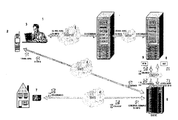
- Figure 5 shows this example architecture of the system and its operation in the three situations described:
- Figure 6 shows in further detail the operation of the RAT and OTA applications, explained below.
- the subscriber 1 sends to the system the command associated to the desired service through a short message [step 1.1], the SMSC 6 receives said short message and delivers it to the RAT application 8 [step 1.2].
- the RAT application 8 translates the received command in a request to send an OTA message and asks the OTA application 9 to send it.
- the OTA application sends the requested command [step 1.3] delivered by the SMSC 6 [step 1.4].
- the U/SAT application in the U/SIM card 7 processes the command and may return:
- the OTA response is delivered by the SMSC 6 to the OTA application [step 1.6] which in turn delivers the result data to the RAT application 8 and the result of the operations is delivered directly to the RAT application 8 [step 1.7].
- the subscriber 1 is informed of the result of the requested service through a short message sent by the RAT application 8 [step 1.8] and delivered by the SMSC 6 [step 1.9].
- the subscriber 1 selects the desired service on a Web page [step 2.1].
- the Web application asks the RAT application 8 to send the corresponding command through http [step 2.2].
- the RAT application 8 translates the received command into a request to send an OTA message and asks the OTA application 9 to send it.
- the OTA application 9 then sends the requested command [step 2.3] which is delivered by the SMSC 6 [step 2.4].
- the U/SAT application in the U/SIM card 7 processes the command and may return:
- the OTA response is delivered by the SMSC 6 to the OTA application 9 [step 2.6] which in turn delivers the result data to the RAT application 8 and the result of the operations is delivered directly to the RAT application 8 [step 2.7].
- the RAT application 8 sends the result of the requested service to the Web application through http [step 2.8].
- the subscriber 1 is informed of the results of the requested service on the Web page [step 2.9].
- the SMSC 6 delivers said short messages to the RAT application 8 [step 3.2].
- the RAT application 8 is responsible for forwarding this information to the mobile telephone 2 from which the subscriber 1 launched the request [step 3.3] (if this were the case), the SMSC 6 delivers it [step 3.4] and to the Web application [step 3.3].
- the subscriber 1 always has this information available through the Web page [step 3.4].
- Access to the system can be carried out through a mobile terminal 2.
- all the services offered can be activated and deactivated using a mobile terminal 2.
- the subscriber must send a short message with an identifier of the corresponding command.
- a possible example of the content of the messages to be sent so as to request each one of the services is shown below: Service Command Call forwarding AR DL [source MSISDN] [Key] [recipient MSISDN] Short message forwarding AR DM [source MSISDN] [Key] Information on calls AR IL [source MSISDN] [Key] Information on messages AR IM [source MSISDN] [Key] Telephone book consultation AR CC [source MSISDN] [Key] [Search pattern] Setting up a call AR LL [source MSISDN] [Key] [CCP] Sending short messages AR EM [source MSISDN] [Key] [recipient MSISDN][Text] Sending USSD chain AR EU [source MSISDN] [Key] [USSD chain] Card blocking AR BT [source MSISDN
- the "AR" tag can be used, for example, to distinguish messages requesting a service from the result or information messages sent by the U/SAT applet.
- Access to the system can also be carried out through Internet 5. Access through Internet can be achieved through a Web page in which the subscriber can indicate the desired service and the data required to carry out the service.
- the http connection with the RAT application 8 can furthermore be secured using a protocol for that purpose, such as SSL.
- a U/SAT application is responsible for processing the received commands.
- the commands are received through the U/SAT SMS-PP Data Download mechanism and formatted according to the secure transport protocol specified in the 3GPP TS 23.048 standard. Once the messages are processed form the point of view of this secure protocol, a response regarding the correct reception and format of these messages can be sent by the U/SIM card 7.
- the application can act in the following manner:
- All calls are unconditionally forwarded to another telephone number or to the answering service according to whether or not a recipient MSISDN is indicated as command data.
- the U/SAT applet can send a SEND USSD/SEND SS proactive command with the corresponding USSD/SS chain and return the result of performing this to the RAT application.
- the U/SAT applet can be registered to the EVENT_UNFORMATTED_SMS_PP_UPD event when receiving this command, such that it were informed every time a short message was going to be updated in the short message file of the U/SIM card.
- the U/SAT applet After receiving a message and provided that the terminal updates said massage in the short message file of the card, the U/SAT applet sends a short message to the RAT application using the SEND SHORT MESSAGE proactive command.
- the short message sent contains the same data field as the original message, as well as a reference text containing information on the source MSISDN of the message and the date and time of message reception. If the data field of the message exceeds the maximum size allowed for a short message when the reference text is added more than one short message must be sent.
- the value of the source MSISDN is obtained from the TP-OA field of the received short message.
- the U/SAT applet can send to the terminal a PROVIDE LOCAL INFORMATION command programmed with the option: "Obtain current date, time and time zone".
- the U/SAT applet can also search for the name corresponding to the source MSISDN, if it is stored in the telephone book of the U/SIM card, and return its value instead of the MSISDN.
- the U/SAT applet can be registered to the "EVENT_EVENT_DOWNLOAD_MT_CALL" event, such that it is notified by the terminal every time a call set-up request is received.
- the terminal After this moment, every time a call is received, the terminal notifies the applet further providing it with the calling MSISDN, if it is sent by the network.
- the U/SAT applet sends a short message to the RAT application indicating the calling MSISDN (if it is sent by the terminal) and the date and time of the call using the SEND SHORT MESSAGE proactive command.
- the U/SAT applet would use the PROVIDE LOCAL INFORMATION proactive command programmed with the option: "Obtain current date, time and time zone".
- the U/SAT applet can also search for the name corresponding to the source MSISDN, if it is stored in the telephone book of the U/SIM card, and return its value instead of the MSISDN.
- the U/SAT applet can be registered to the "EVENT_UNFORMATTED_SMS_PP_UPD" event when this command is received such that it is notified every time a short message is going to be updated in the short message file of the U/SIM card.
- the U/SAT applet After receiving a message and provided that the terminal updates the message in the short message file, the U/SAT applet sends a short message to the RAT application using the SEND SHORT MESSAGE proactive command.
- the short message sent contains information on the source MSISDN of the message and the date and time of message reception.
- the valor of the source MSISDN is obtained from the TP-OA field of the received short message.
- the U/SAT application sends to the terminal a PROVIDE LOCAL INFORMATION command programmed with the option: "Obtain current date, time and time zone".
- the U/SAT applet can also search for the name corresponding to the source MSISDN, if it is stored in the telephone book of the U/SIM card, and return its value instead of the MSISDN.
- the U/SAT application receives a search pattern as command data.
- the U/SAT application performs a search in the telephone book file.
- the U/SAT application finds coincidences, it sends the data relating to the found contacts through short messages to the RAT application. If it does not find any coincidence, the U/SAT application also sends a short message to the RAT application reporting this fact.
- the U/SAT application makes a call to the recipient MSISDN indicated in the command and with the configuration parameters received in the field [CCP].
- This field may contain values such as "Media” to indicate that the call that is to be set up is a multimedia call.
- the U/SAT applet uses the SETUP CALL proactive command to set up the call and reports the result of setting up the call to the RAT application sending a short message using the SEND SHORT MESSAGE proactive command.
- the U/SAT applet When this command is received, the U/SAT applet sends a short message to the indicated MSISDN and with the text indicated by the subscriber. To do so it uses the SEND SHORT MESSAGE proactive command and reports the result of sending the short message to the RAT application by sending a short message using the SEND SHORT MESSAGE proactive command.
- the U/SAT applet can send to the terminal the REFRESH proactive command with the option "SIM Reset", such that the terminal resets the U/SIM card, making it request the PIN code again, if it is enabled.
- the U/SAT applet can report the result of the operation to the RAT application.
- the U/SAT applet When this command is received, the U/SAT applet sends the USSD chain indicated by the subscriber using the SEND USSD proactive command. The result of sending it is sent to the RAT application using the SEND SHORT MESSAGE proactive command.
- the U/SAT application sends the appropriate USSD/SS chain to activate the forwarding. To do so it uses the SEND USSD/SEND SS proactive command and reports the result of performing the command to the RAT application by sending a short message.
- the U/SAT applet When this command is received, the U/SAT applet eliminates its registration to the "EVENT_UNFORMATTED_SMS_PP_UPD" event and reports this to the RAT application by sending a short message.
- the U/SAT application eliminates its registration to the "EVENT_EVENT_DOWNLOAD_MT_CALL" event and reports this to the RAT application by sending a short message.
- the U/SAT applet When this command is received, the U/SAT applet eliminates its registration to the "EVENT_UNFORMATTED_SMS_PP_UPD" event and reports this to the RAT application by sending a short message.
Landscapes
- Engineering & Computer Science (AREA)
- Computer Networks & Wireless Communication (AREA)
- Signal Processing (AREA)
- Mobile Radio Communication Systems (AREA)
- Telephone Function (AREA)
- Telephonic Communication Services (AREA)
Applications Claiming Priority (1)
| Application Number | Priority Date | Filing Date | Title |
|---|---|---|---|
| ES200501092A ES2299293B1 (es) | 2005-05-06 | 2005-05-06 | Sistema de acceso remoto a servici0s de telefonia movil de un equipo movil. |
Publications (2)
| Publication Number | Publication Date |
|---|---|
| EP1720366A2 true EP1720366A2 (de) | 2006-11-08 |
| EP1720366A3 EP1720366A3 (de) | 2008-11-26 |
Family
ID=36778262
Family Applications (1)
| Application Number | Title | Priority Date | Filing Date |
|---|---|---|---|
| EP06380095A Withdrawn EP1720366A3 (de) | 2005-05-06 | 2006-04-26 | System für den Fernzugriff eines mobilen Gerätes zu mobilen Telefondiensten |
Country Status (2)
| Country | Link |
|---|---|
| EP (1) | EP1720366A3 (de) |
| ES (1) | ES2299293B1 (de) |
Cited By (4)
| Publication number | Priority date | Publication date | Assignee | Title |
|---|---|---|---|---|
| ES2310123A1 (es) * | 2007-05-07 | 2008-12-16 | Vodafone España, S.A. | Acceso remoto desde una extension de un navegador web a la informacion de un terminal movil. |
| EP2648366A3 (de) * | 2012-04-05 | 2013-11-06 | Huawei Device Co., Ltd. | Web-basierte Verwaltung einer mobilen Breitbandvorrichtung |
| US9015282B2 (en) | 2007-05-07 | 2015-04-21 | Vodafone Group Plc | Access to information on a mobile terminal from a remote terminal |
| CN116367143A (zh) * | 2021-12-28 | 2023-06-30 | 中国移动通信有限公司研究院 | 来电显示方法、通信系统、网络设备及可读存储介质 |
Family Cites Families (8)
| Publication number | Priority date | Publication date | Assignee | Title |
|---|---|---|---|---|
| US5915225A (en) * | 1996-03-28 | 1999-06-22 | Ericsson Inc. | Remotely retrieving SIM stored data over a connection-less communications link |
| US6892067B1 (en) * | 1999-12-30 | 2005-05-10 | Nokia Corporation | Script based interfaces for mobile phones |
| FR2805912A1 (fr) * | 2000-03-01 | 2001-09-07 | Gemplus Card Int | Procede de commande d'une carte a puce |
| US20020147926A1 (en) * | 2001-04-04 | 2002-10-10 | Pecen Mark E. | Method and apparatus for authentication using remote multiple access SIM technology |
| ATE291807T1 (de) * | 2001-05-08 | 2005-04-15 | Ericsson Telefon Ab L M | Sicherer zugang zu einem entfernten teilnehmermodul |
| GB2380356B (en) * | 2001-09-26 | 2006-05-31 | Sendo Int Ltd | Disabling of mobile communication apparatus |
| FR2837298B1 (fr) * | 2002-03-14 | 2004-08-13 | Jean Charles Aubert | Procede de gestion d'informations stockees sur une carte a puce lisible par un telephone mobile |
| JP4504192B2 (ja) * | 2002-09-16 | 2010-07-14 | テレフオンアクチーボラゲット エル エム エリクソン(パブル) | 加入モジュールへのセキュアアクセス方法 |
-
2005
- 2005-05-06 ES ES200501092A patent/ES2299293B1/es not_active Expired - Fee Related
-
2006
- 2006-04-26 EP EP06380095A patent/EP1720366A3/de not_active Withdrawn
Cited By (6)
| Publication number | Priority date | Publication date | Assignee | Title |
|---|---|---|---|---|
| ES2310123A1 (es) * | 2007-05-07 | 2008-12-16 | Vodafone España, S.A. | Acceso remoto desde una extension de un navegador web a la informacion de un terminal movil. |
| ES2310123B1 (es) * | 2007-05-07 | 2009-11-05 | Vodafone España, S.A. | Acceso remoto desde una extension de un navegador web a la informacion de un terminal movil. |
| US9015282B2 (en) | 2007-05-07 | 2015-04-21 | Vodafone Group Plc | Access to information on a mobile terminal from a remote terminal |
| US9094370B2 (en) | 2007-05-07 | 2015-07-28 | Vodafone Group Plc | Remote access to information on a mobile terminal from a web browser extension |
| EP2648366A3 (de) * | 2012-04-05 | 2013-11-06 | Huawei Device Co., Ltd. | Web-basierte Verwaltung einer mobilen Breitbandvorrichtung |
| CN116367143A (zh) * | 2021-12-28 | 2023-06-30 | 中国移动通信有限公司研究院 | 来电显示方法、通信系统、网络设备及可读存储介质 |
Also Published As
| Publication number | Publication date |
|---|---|
| ES2299293B1 (es) | 2009-04-01 |
| ES2299293A1 (es) | 2008-05-16 |
| EP1720366A3 (de) | 2008-11-26 |
Similar Documents
| Publication | Publication Date | Title |
|---|---|---|
| US8761832B2 (en) | Method and apparatus for controlling the UICC application file | |
| KR101701668B1 (ko) | 서비스 액세스를 위한 방법, 대응하는 디바이스 및 시스템 | |
| KR101505763B1 (ko) | 자바 카드 애플리케이션의 데이터를 내보내고 가져오기 위한 방법 | |
| EP1542486B1 (de) | Mobiltelefongerät und datenverwaltungsverfahren | |
| US8676260B2 (en) | Method of managing information by a large capacity UICC | |
| US9043936B2 (en) | Communications device | |
| US20050239504A1 (en) | SIM-based automatic feature activation for mobile phones | |
| EP2887702B1 (de) | Verfahren und Vorrichtung zur Bereitstellung eines sicheren Elements mit einem Abonnentenprofil | |
| EP3023904B1 (de) | Implizit File Erzeugung im APDU Skripts | |
| KR101467365B1 (ko) | 이동 통신 시스템에서 심 어플리케이션 툴킷을 제공하는장치 및 방법 | |
| EP2200257A1 (de) | Verfahren und Vorrichtung zur Erzielung von örtlicher Information mithilfe einer Smartcard | |
| GB2380356A (en) | Disabling of mobile communication apparatus | |
| EP1937008B1 (de) | Verfahren und System zum Umladen eines Kommunikationsgerätes | |
| CN101442747A (zh) | 终端自动判断用户身份的方法及系统 | |
| EP2786525B1 (de) | Verfahren und vorrichtung zur verwaltung von benutzerseitig bereitgestellten zugangstoken | |
| US20060113379A1 (en) | Triggering a proactive session from an applet in a smart card | |
| KR20140033213A (ko) | 적어도 하나의 서비스에 액세스하기 위한 방법 및 대응하는 시스템 | |
| EP2819078A1 (de) | Verfahren, Vorrichtung und System zum Zugriff auf einen vertragsfreien Dienst | |
| EP2219340A1 (de) | Verfahren zur Übertragung von Daten zwischen einem System und einem mobilen Netzwerk über einen IP-Kanal, entsprechendes tragbares Objekt und System | |
| EP2293218B1 (de) | Chipkarte, elektronisches System, Verfahren, das mit der Chipkarte umgesetzt wird und Computerprogrammprodukt | |
| EP1434450A1 (de) | Telefon, System und Wechselwirkungsverfahren zwischen einem Telefon und einer entfernt liegenden Einheit | |
| CN104247479A (zh) | 智能卡的个性化 | |
| ES2299293B1 (es) | Sistema de acceso remoto a servici0s de telefonia movil de un equipo movil. | |
| EP1452964A1 (de) | Verfahren und Gerät zum Aktivieren einer Anwendung oder eines Applets | |
| EP2799982B1 (de) | Chipkartenanwendungen zur Abbildung von digitalem Text auf einem Mobilgerät |
Legal Events
| Date | Code | Title | Description |
|---|---|---|---|
| PUAI | Public reference made under article 153(3) epc to a published international application that has entered the european phase |
Free format text: ORIGINAL CODE: 0009012 |
|
| AK | Designated contracting states |
Kind code of ref document: A2 Designated state(s): AT BE BG CH CY CZ DE DK EE ES FI FR GB GR HU IE IS IT LI LT LU LV MC NL PL PT RO SE SI SK TR |
|
| AX | Request for extension of the european patent |
Extension state: AL BA HR MK YU |
|
| PUAL | Search report despatched |
Free format text: ORIGINAL CODE: 0009013 |
|
| AK | Designated contracting states |
Kind code of ref document: A3 Designated state(s): AT BE BG CH CY CZ DE DK EE ES FI FR GB GR HU IE IS IT LI LT LU LV MC NL PL PT RO SE SI SK TR |
|
| AX | Request for extension of the european patent |
Extension state: AL BA HR MK YU |
|
| 17P | Request for examination filed |
Effective date: 20090522 |
|
| AKX | Designation fees paid |
Designated state(s): AT BE BG CH CY CZ DE DK EE ES FI FR GB GR HU IE IS IT LI LT LU LV MC NL PL PT RO SE SI SK TR |
|
| 17Q | First examination report despatched |
Effective date: 20090709 |
|
| STAA | Information on the status of an ep patent application or granted ep patent |
Free format text: STATUS: THE APPLICATION IS DEEMED TO BE WITHDRAWN |
|
| 18D | Application deemed to be withdrawn |
Effective date: 20100120 |