EP1719878A2 - Gas turbine engine air valve assembly - Google Patents
Gas turbine engine air valve assembly Download PDFInfo
- Publication number
- EP1719878A2 EP1719878A2 EP06251067A EP06251067A EP1719878A2 EP 1719878 A2 EP1719878 A2 EP 1719878A2 EP 06251067 A EP06251067 A EP 06251067A EP 06251067 A EP06251067 A EP 06251067A EP 1719878 A2 EP1719878 A2 EP 1719878A2
- Authority
- EP
- European Patent Office
- Prior art keywords
- assembly
- valving element
- valve assembly
- engine
- air valve
- Prior art date
- Legal status (The legal status is an assumption and is not a legal conclusion. Google has not performed a legal analysis and makes no representation as to the accuracy of the status listed.)
- Granted
Links
Images


Classifications
-
- A—HUMAN NECESSITIES
- A01—AGRICULTURE; FORESTRY; ANIMAL HUSBANDRY; HUNTING; TRAPPING; FISHING
- A01K—ANIMAL HUSBANDRY; AVICULTURE; APICULTURE; PISCICULTURE; FISHING; REARING OR BREEDING ANIMALS, NOT OTHERWISE PROVIDED FOR; NEW BREEDS OF ANIMALS
- A01K93/00—Floats for angling, with or without signalling devices
-
- F—MECHANICAL ENGINEERING; LIGHTING; HEATING; WEAPONS; BLASTING
- F01—MACHINES OR ENGINES IN GENERAL; ENGINE PLANTS IN GENERAL; STEAM ENGINES
- F01D—NON-POSITIVE DISPLACEMENT MACHINES OR ENGINES, e.g. STEAM TURBINES
- F01D17/00—Regulating or controlling by varying flow
- F01D17/10—Final actuators
- F01D17/105—Final actuators by passing part of the fluid
-
- F—MECHANICAL ENGINEERING; LIGHTING; HEATING; WEAPONS; BLASTING
- F01—MACHINES OR ENGINES IN GENERAL; ENGINE PLANTS IN GENERAL; STEAM ENGINES
- F01D—NON-POSITIVE DISPLACEMENT MACHINES OR ENGINES, e.g. STEAM TURBINES
- F01D17/00—Regulating or controlling by varying flow
- F01D17/10—Final actuators
- F01D17/12—Final actuators arranged in stator parts
- F01D17/14—Final actuators arranged in stator parts varying effective cross-sectional area of nozzles or guide conduits
- F01D17/141—Final actuators arranged in stator parts varying effective cross-sectional area of nozzles or guide conduits by means of shiftable members or valves obturating part of the flow path
-
- F—MECHANICAL ENGINEERING; LIGHTING; HEATING; WEAPONS; BLASTING
- F02—COMBUSTION ENGINES; HOT-GAS OR COMBUSTION-PRODUCT ENGINE PLANTS
- F02C—GAS-TURBINE PLANTS; AIR INTAKES FOR JET-PROPULSION PLANTS; CONTROLLING FUEL SUPPLY IN AIR-BREATHING JET-PROPULSION PLANTS
- F02C7/00—Features, components parts, details or accessories, not provided for in, or of interest apart form groups F02C1/00 - F02C6/00; Air intakes for jet-propulsion plants
- F02C7/12—Cooling of plants
-
- F—MECHANICAL ENGINEERING; LIGHTING; HEATING; WEAPONS; BLASTING
- F05—INDEXING SCHEMES RELATING TO ENGINES OR PUMPS IN VARIOUS SUBCLASSES OF CLASSES F01-F04
- F05D—INDEXING SCHEME FOR ASPECTS RELATING TO NON-POSITIVE-DISPLACEMENT MACHINES OR ENGINES, GAS-TURBINES OR JET-PROPULSION PLANTS
- F05D2250/00—Geometry
- F05D2250/40—Movement of components
- F05D2250/41—Movement of components with one degree of freedom
- F05D2250/411—Movement of components with one degree of freedom in rotation
-
- F—MECHANICAL ENGINEERING; LIGHTING; HEATING; WEAPONS; BLASTING
- F05—INDEXING SCHEMES RELATING TO ENGINES OR PUMPS IN VARIOUS SUBCLASSES OF CLASSES F01-F04
- F05D—INDEXING SCHEME FOR ASPECTS RELATING TO NON-POSITIVE-DISPLACEMENT MACHINES OR ENGINES, GAS-TURBINES OR JET-PROPULSION PLANTS
- F05D2260/00—Function
- F05D2260/20—Heat transfer, e.g. cooling
-
- Y—GENERAL TAGGING OF NEW TECHNOLOGICAL DEVELOPMENTS; GENERAL TAGGING OF CROSS-SECTIONAL TECHNOLOGIES SPANNING OVER SEVERAL SECTIONS OF THE IPC; TECHNICAL SUBJECTS COVERED BY FORMER USPC CROSS-REFERENCE ART COLLECTIONS [XRACs] AND DIGESTS
- Y02—TECHNOLOGIES OR APPLICATIONS FOR MITIGATION OR ADAPTATION AGAINST CLIMATE CHANGE
- Y02T—CLIMATE CHANGE MITIGATION TECHNOLOGIES RELATED TO TRANSPORTATION
- Y02T50/00—Aeronautics or air transport
- Y02T50/60—Efficient propulsion technologies, e.g. for aircraft
Definitions
- This invention relates to a valve assembly for a gas turbine engine. Specifically, this invention relates to a valve assembly that controls the amount of cooling air supplied to a nozzle of a gas turbine engine.
- the major components of a typical gas turbine engine may include (beginning at the upstream end, or inlet) a compressor section, a burner (combustor) section, a turbine section, and a nozzle section.
- the engine may have an afterburner section between the turbine section and the nozzle section.
- the compressor section includes a fan section, typically at the upstream end. After passing the fan section, the turbofan engine separates the air into two flow paths.
- a primary flow also referred to as core engine flow
- enters the remainder of the compressor section mixes with fuel, and combusts in the burner section. The gases exit the burner section to power the turbine section.
- a secondary flow (also referred to as bypass flow) avoids the remainder of the compressor section, the burner section and the turbine section. Instead, the secondary flow travels through a duct to a location downstream of the turbine section. The secondary flow mixes with the primary flow downstream of the turbine section.
- the afterburner section may augment the thrust of the engine by igniting additional fuel downstream of the turbine section. The flow then exits the engine through the nozzle.
- the engine may supply cooling air to the nozzle in order to protect the nozzle components from the high temperature exhaust.
- the engine diverts secondary flow from the fan section to cool the nozzle section.
- CTOL take-off and landing
- Certain non-augmented operations of the engine also require cooling air.
- the amount of cooling air need is typically a reduced amount from augmented operations.
- STOVL short take-off vertical landing
- the non-augmented exhaust while still at an elevated temperature, typically exhibits a lower temperature than during augmented operations. Accordingly, the engine can accept a reduced supply of cooling air for the nozzle in STOVL operation.
- Flow of the cooling air may be controlled by one or more valves.
- Exemplary valve structures are shown in U.S. patent 6,694,723 , the disclosure of which is incorporated by reference herein as if set forth at length.
- a gas turbine engine air valve assembly has first and second valving elements.
- the second element is rotatable about a first axis relative to the first element. The rotation controls a flow of air through the first and second elements.
- An actuator is coupled by a linkage to the second element.
- a plurality of follower member assemblies each have an insertion portion extending through a corresponding first aperture in the first valving element and a corresponding second aperture in the second element. The insertion portion is circumferentially fixed relative to one of the first and second valving elements and circumferentially moveable relative to the other of the first and second valving elements.
- the insertion portion may be formed by portions of a bolt and a roller rotatable on the bolt.
- the roller may be on a large diameter proximal bolt portion extending within the second aperture.
- a smaller diameter intermediate bolt portion may be within the first aperture.
- a threaded distal bolt portion may carry a nut to secure the bolt to the first element.
- the assembly may be provided in a reengineering or remanufacturing situation.
- the assembly may replace a dissimilar assembly but may share some components or features therewith.
- FIGS. 1 and 2 show an exemplary engine 100 in two different configurations.
- FIG. 1 shows the engine 100 in a first configuration, such as a conventional take-off and landing (CTOL) configuration.
- FIG. 2 shows the engine 100 in a second configuration, such as a short take-off vertical landing (STOVL) configuration.
- FIG. 2 also shows, in phantom line, the engine 100 in transition between the CTOL and STOVL configurations.
- CTOL take-off and landing
- STOVL short take-off vertical landing
- the engine 100 has an inlet 101, a compressor section 103, a burner section 107, a turbine section 109, an afterburner section 111, and a nozzle section 113.
- the compressor section 103 includes a fan section 105 at the upstream end.
- the engine 100 also includes a bypass duct 115 for the secondary flow of air. The air flows through the engine 100 in the direction indicated by arrow F.
- the engine spools or rotors rotate about an axis 500 which may be at least partially coincident with an engine centerline 502. In the STOVL configuration, the centerline 502 departs from the axis 500 downstream of the rotors.
- the nozzle section 113 includes a three bearing swivel duct 116 secured to the afterburner section 111 and a nozzle downstream of the duct.
- the three bearing swivel duct has three sections 117, 119, 121.
- the first section 117 rotatably mounts to the afterburner section 111.
- the second section 119 rotatably mounts to the first section 117.
- the third section 121 rotatably mounts to the second section 119.
- Conventional motors (not shown) can rotate the sections 117, 119, 121 to any desired exhaust path between the first configuration shown in FIG. 1 and the second configuration shown in FIG. 2.
- the nozzle can be a conventional flap-type convergent-divergent nozzle 123 or any other suitable nozzle.
- the nozzle 123 is secured to the third section 121 of the swivel duct.
- the nozzle section 113 includes a liner (not shown).
- the liner separates the outer structure of the nozzle section 113 from the hot exhaust gases traveling through the nozzle section.
- the liner and the outer structure 126 of the nozzle section 113 form an annular chamber 127 (FIG. 3).
- the engine 100 distributes cooling air through the annular chamber to cool the liner. After cooling the liner, the cooling air continues downstream to cool the nozzle flaps.
- a bleed (not shown) from the bypass duct 115 supplies the cooling air to the nozzle section 113 using conventional techniques.
- a valve assembly 200 (FIG. 3) controls the amount of cooling air supplied to the nozzle flaps.
- the exemplary valve assembly includes an annular rotary gate 202 which may be rotated about the local engine centerline 502 (FIG. 2).
- the gate 202 has a circumferential array of apertures 204.
- the apertures 204 may have a degree of overlap with apertures 206 in a static element 208 abutting the gate 202.
- the rotation of the gate 202 between first and second orientations determines the degree of aperture overlap (and thus of non-occlusion) and thus the effective flow area through the valve between minimum and maximum values.
- the minimum value may be zero (e.g., fully closed) or some greater amount.
- the FIG. 3 condition is approximately half occluded and may represent a minimum flow area condition.
- FIG. 4 shows essentially no occlusion and thus a maximum flow area condition.
- Rotation of the gate between the first and second orientations may be achieved by means of an actuator 220 acting via a linkage 222.
- the exemplary linkage 222 includes a spindle 224 held for rotation about an axis 520 (e.g., a radial axis orthogonal to and intersecting the engine centerline).
- the actuator 220 may rotate the spindle 224 between first and second orientations associated with the first and second gate orientations/conditions.
- the actuator 220 may be pneumatic, hydraulic, electrical, electro-mechanical, or any other appropriate type.
- the actuator 220 may be constructed as in U.S. patent 6,694,723 (the '723 patent).
- FIGS. 3 and 4 show further details of the valve assembly 200.
- the static element 208 is shown unitarily-formed with and extending radially inboard from a proximal/upstream portion of the outer structure 126 of the nozzle 123.
- the exemplary gate 202 is immediately forward/upstream of the element 208 with the downstream face of the gate 202 facing the upstream face of the element 208.
- the gate 202 is held for its rotation by support means (not shown).
- Exemplary support means could comprise a rotary bearing structure permitting rotation of the gate 202 but preventing longitudinal translation and radial shifts.
- Alternative means could include fasteners secured to one of the gate 202 and element 208 and having a limited range of motion (e.g., along a circumferential slot) in the other. In such a system, the slot ends could act as stops.
- Yet further alternative means could include an idler crank array as in the '723 patent providing a path combining rotation with longitudinal translation.
- FIGS. 5 and 6 show further details of the linkage 222.
- a spindle 224 includes a spindle shaft 240.
- An intermediate portion of the shaft 240 is received within a bushing 242 (e.g., a two-piece bushing).
- the bushing 242 may be secured within an aperture in the engine static structure (e.g., the exemplary third duct section 121 of FIG. 4).
- the shaft 240 is thus held by the bushing 242 for rotation about the axis 520.
- An outboard portion of the spindle shaft 240 includes an input/driving clevis 244.
- the exemplary clevis 244 is formed by arms 246 and 248 secured (e.g., by welding) to the shaft outboard portion.
- An input/driving pin 250 spans the arms 246 and 248 and has an axis 522 parallel to and spaced apart from the axis 520.
- the pin 250 is engaged by the actuator to rotate the spindle 224 about the axis 520.
- An inboard end of the spindle includes an output/driven clevis 260.
- the exemplary clevis 260 includes a clevis body 262 separately formed from the spindle shaft and mounted thereon by means of complementary splines. Exemplary splines include external splines 264 (FIG. 6) along the spindle shaft inboard portion and internal splines 266 within the body 262.
- a bolt or other fastener 268 may extend through the body 262 spanning an expansion slot to secure the body 262 to the shaft 240 against translation.
- the body 262 includes arms 270 and 272.
- a driven/output clevis pin 274 spans the arms and has an axis 524 parallel to and spaced apart from the axis 520.
- Alternative implementations might include non-parallel axes 522 and/or 524 (e.g., axes intersecting the axis 520 or skew thereto).
- a spherical bearing 276 has an inner bore receiving the shaft of the pin 274 between the arms 270 and 272. In the exemplary embodiment, the bearing 276 and shaft cooperate to permit the bearing to have non-zero ranges of movement along the axis 524 and rotation about the axis 524.
- the bearing 276 is received within a slot 280 in a follower bracket 282.
- the exemplary bracket 282 includes a base 284 for mounting to the gate 202.
- a pair of arms 286 and 288 extend forward from the base 284 to define the slot 280 therebetween.
- Inboard surfaces 290 of the arms 286 and 288 have a concavity complementary to a convexity of the external surface of the bearing 276.
- the exemplary surfaces 290 are singularly concave to allow the bearing 276 to translate along the slot from a proximal root of the slot to a distal end of the slot.
- the base 284 is secured against a forward/upstream surface of a web 300 of the gate 202 between inboard and outboard flanges. The securing may be by means of fasteners 302 (e.g., rivets).
- the base may further include a registration protrusion (not shown) for interfitting with a complementary aperture or socket 304 in the web 300.
- movement of the actuator produces a rotation of the spindle 224 about the axis 520.
- This tends to rotate the axis 524 about the axis 520.
- Rotation of the axis 524 about the axis 520 causes the bearing 276 to transmit a tangential force and thus a torque (about the engine centerline) to the follower 282 and thus to the gate 202.
- This torque causes rotation of the gate about the engine centerline so as to control the degree of aperture overlap and thus the flow through the valve.
- the axis 524 will tend to shift longitudinally (e.g., toward or away from the gate). This shift is accommodated by the sliding interaction of the bearing 276 longitudinally within the slot 280 and radially along the pin 274. This sliding interaction decouples the longitudinal motion of the axis 524 from any longitudinal motion of the gate 202.
- the gate 202 may exclusively rotate.
- the gate 202 may have a relatively small translation (e.g., if mounted by idler cranks in such a way that the permitted translation breaks a seal between the gate and the ring 208) so as to avoid sliding friction between the gate and ring.
- FIGS. 7 and 8 show further details of an exemplary gate support means.
- the means includes a circumferential array of fasteners 400 (e.g., between five and twenty bolts) secured to the element 208.
- Each bolt 400 passes through and has a nonzero range of motion within an associated aperture 402 (FIG. 8) in the gate 202.
- Each exemplary aperture 402 is a circumferential slot having approximately semi-circular ends 404 and 406 joined by inboard and outboard circular cylindrical segment portions 408 and 410.
- the exemplary bolts 400 each have an upstream head (e.g., a hex head) 412.
- a first portion 414 extends distally/downstream thereof to a shoulder 416 separating it from a second portion 418 of smaller transverse sectional area.
- the exemplary portions 414 and 418 are circular cylindrical.
- a threaded downstream/distal end portion 420 carries a nut 422.
- the second portion 418 is accommodated within an associated aperture 424 in the element 208 (e.g., a clearance fit accommodating manufacturing tolerances).
- the nut upstream face 426 bears against the downstream face 428 of the element 208 and the shoulder 416 bears against the upstream face 429 of the element 208 to hold the bolt in place.
- An associated flanged roller/bushing 430 has a sleeve 432 accommodated between each bolt first portion 414 and the associated slot 402.
- a radially extending flange 434 extends outward at the sleeve upstream end.
- the radially extending flange 434 at the sleeve upstream end keeps the ring from falling forward during assembly and pressure reversals while running. It also controls the axial gap of the entire valve assembly.
- the roller inboard surface is in close sliding proximity to the outer surface of the first portion 414.
- the roller sleeve outboard surface is closely accommodated within the slot 402 to guide the gate 202 during rotation between the maximum and minimum flow conditions.
- roller flange downstream surface 436 slidingly engages the gate upstream surface 437 to limit friction during rotation of the gate.
- roller rim surface 438 may slidingly engage the upstream surface 429 of the element 208.
- Exemplary bolt, roller, and nut materials are nickel-based superalloys.
- the exemplary valve assembly 200 may be provided in the remanufacturing of a baseline engine or the reengineering of a baseline engine configuration.
- the baseline could lack such a valve assembly.
- the baseline could have a different valve assembly such as that of the '723 patent. This might be particularly relevant if the reengineering included elimination of the idler crank mounting means of the '723 patent in favor of a purely rotational gate movement.
Landscapes
- Engineering & Computer Science (AREA)
- Mechanical Engineering (AREA)
- General Engineering & Computer Science (AREA)
- Combustion & Propulsion (AREA)
- Chemical & Material Sciences (AREA)
- Environmental Sciences (AREA)
- Life Sciences & Earth Sciences (AREA)
- Animal Husbandry (AREA)
- Biodiversity & Conservation Biology (AREA)
- Control Of Turbines (AREA)
- Supercharger (AREA)
- Multiple-Way Valves (AREA)
- Sliding Valves (AREA)
- Structures Of Non-Positive Displacement Pumps (AREA)
- Mechanically-Actuated Valves (AREA)
Abstract
Description
- This invention relates to a valve assembly for a gas turbine engine. Specifically, this invention relates to a valve assembly that controls the amount of cooling air supplied to a nozzle of a gas turbine engine.
- The major components of a typical gas turbine engine may include (beginning at the upstream end, or inlet) a compressor section, a burner (combustor) section, a turbine section, and a nozzle section. The engine may have an afterburner section between the turbine section and the nozzle section.
- If the engine is a turbofan, then the compressor section includes a fan section, typically at the upstream end. After passing the fan section, the turbofan engine separates the air into two flow paths. A primary flow (also referred to as core engine flow) enters the remainder of the compressor section, mixes with fuel, and combusts in the burner section. The gases exit the burner section to power the turbine section.
- A secondary flow (also referred to as bypass flow) avoids the remainder of the compressor section, the burner section and the turbine section. Instead, the secondary flow travels through a duct to a location downstream of the turbine section. The secondary flow mixes with the primary flow downstream of the turbine section.
- The afterburner section may augment the thrust of the engine by igniting additional fuel downstream of the turbine section. The flow then exits the engine through the nozzle.
- The engine may supply cooling air to the nozzle in order to protect the nozzle components from the high temperature exhaust. Typically, the engine diverts secondary flow from the fan section to cool the nozzle section.
- The greatest demand for cooling air to the nozzle occurs when the afterburner operates. As an example, the pilot operates the engine at maximum thrust (with the afterburner operating) in a conventional take-off and landing (CTOL) operation. CTOL operation typically requires a large amount of cooling air for the nozzle.
- Certain non-augmented operations of the engine (i.e., without the afterburner operating) also require cooling air. However, the amount of cooling air need is typically a reduced amount from augmented operations. As an example, a short take-off vertical landing (STOVL) operation typically requires maximum non-augmented thrust from the engine. The non-augmented exhaust, while still at an elevated temperature, typically exhibits a lower temperature than during augmented operations. Accordingly, the engine can accept a reduced supply of cooling air for the nozzle in STOVL operation.
- Flow of the cooling air may be controlled by one or more valves. Exemplary valve structures are shown in
U.S. patent 6,694,723 , the disclosure of which is incorporated by reference herein as if set forth at length. - One aspect of the invention involves a gas turbine engine air valve assembly has first and second valving elements. The second element is rotatable about a first axis relative to the first element. The rotation controls a flow of air through the first and second elements. An actuator is coupled by a linkage to the second element. A plurality of follower member assemblies each have an insertion portion extending through a corresponding first aperture in the first valving element and a corresponding second aperture in the second element. The insertion portion is circumferentially fixed relative to one of the first and second valving elements and circumferentially moveable relative to the other of the first and second valving elements.
- The insertion portion may be formed by portions of a bolt and a roller rotatable on the bolt. The roller may be on a large diameter proximal bolt portion extending within the second aperture. A smaller diameter intermediate bolt portion may be within the first aperture. A threaded distal bolt portion may carry a nut to secure the bolt to the first element.
- The assembly may be provided in a reengineering or remanufacturing situation. The assembly may replace a dissimilar assembly but may share some components or features therewith.
- The details of one or more embodiments of the invention are set forth in the accompanying drawings and the description below. Other features of the invention will be apparent from the description and drawings, and from the claims.
-
- FIG. 1 is a partially schematic cut-away view of an exemplary gas turbine engine in a first condition/configuration.
- FIG. 2 is a view of the engine of FIG. 1 in a second condition/configuration.
- FIG. 3 is a partial longitudinal view of a nozzle cooling valve of the engine of FIG. 1 in a first orientation.
- FIG. 4 is a partial longitudinal view of the nozzle cooling valve of the engine of FIG. 1 in a second orientation.
- FIG. 5 is a view of a linkage of the valve of FIG. 3.
- FIG. 6 is an exploded view of the linkage of FIG. 5.
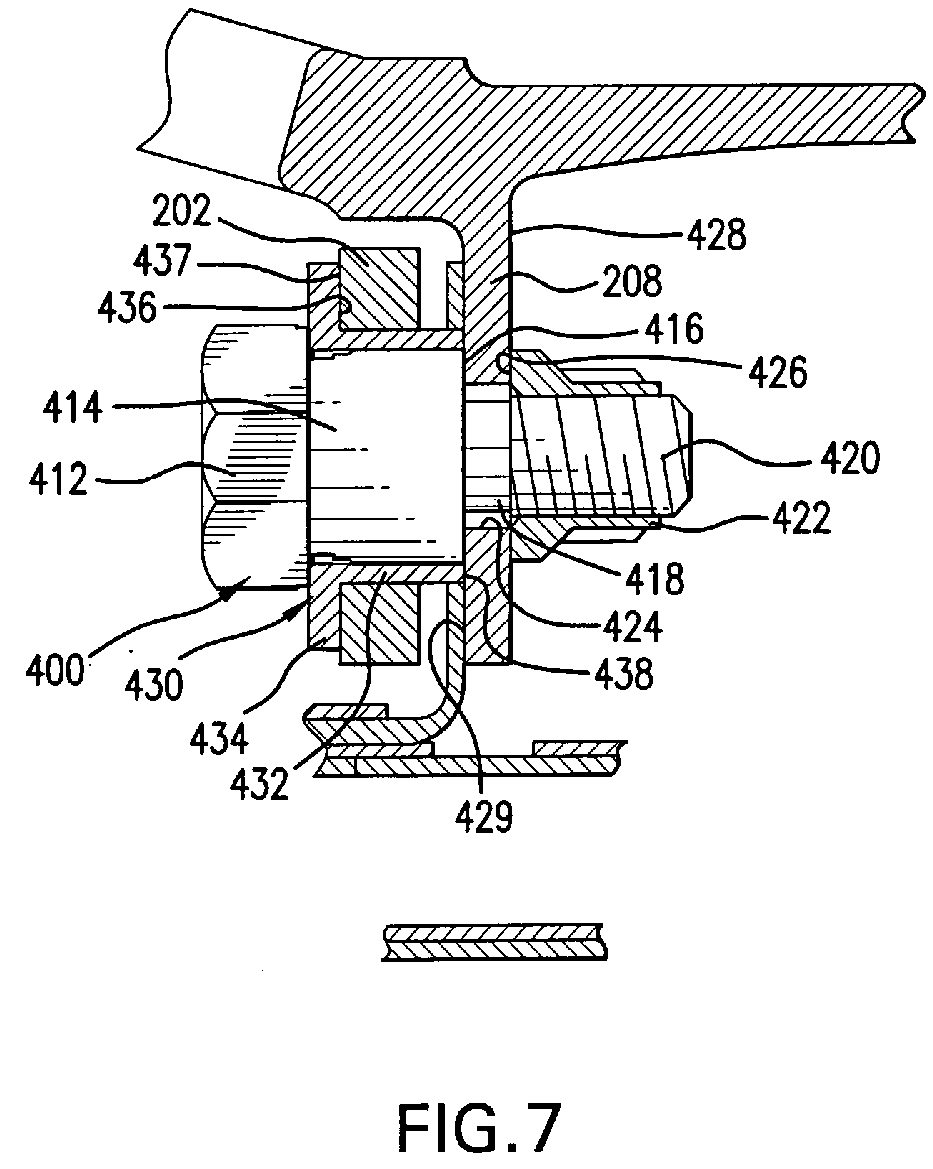
- FIG. 7 is a partial longitudinal sectional view of valving and gate elements of the valve of FIG. 3.
- FIG. 8 is an exploded partial view of a fastener and a gate element of the valve of FIG. 3.
- Like reference numbers and designations in the various drawings indicate like elements.
- FIGS. 1 and 2 show an
exemplary engine 100 in two different configurations. FIG. 1 shows theengine 100 in a first configuration, such as a conventional take-off and landing (CTOL) configuration. FIG. 2 shows theengine 100 in a second configuration, such as a short take-off vertical landing (STOVL) configuration. FIG. 2 also shows, in phantom line, theengine 100 in transition between the CTOL and STOVL configurations. - The
engine 100 has aninlet 101, acompressor section 103, aburner section 107, aturbine section 109, anafterburner section 111, and anozzle section 113. Thecompressor section 103 includes afan section 105 at the upstream end. Theengine 100 also includes abypass duct 115 for the secondary flow of air. The air flows through theengine 100 in the direction indicated by arrow F. The engine spools or rotors rotate about anaxis 500 which may be at least partially coincident with anengine centerline 502. In the STOVL configuration, thecenterline 502 departs from theaxis 500 downstream of the rotors. - The
nozzle section 113 includes a three bearingswivel duct 116 secured to theafterburner section 111 and a nozzle downstream of the duct. The three bearing swivel duct has threesections first section 117 rotatably mounts to theafterburner section 111. Thesecond section 119 rotatably mounts to thefirst section 117. Finally, thethird section 121 rotatably mounts to thesecond section 119. Conventional motors (not shown) can rotate thesections - The nozzle can be a conventional flap-type convergent-
divergent nozzle 123 or any other suitable nozzle. Thenozzle 123 is secured to thethird section 121 of the swivel duct. - The
nozzle section 113 includes a liner (not shown). The liner separates the outer structure of thenozzle section 113 from the hot exhaust gases traveling through the nozzle section. The liner and theouter structure 126 of thenozzle section 113 form an annular chamber 127 (FIG. 3). Theengine 100 distributes cooling air through the annular chamber to cool the liner. After cooling the liner, the cooling air continues downstream to cool the nozzle flaps. A bleed (not shown) from thebypass duct 115 supplies the cooling air to thenozzle section 113 using conventional techniques. - A valve assembly 200 (FIG. 3) controls the amount of cooling air supplied to the nozzle flaps. The exemplary valve assembly includes an annular
rotary gate 202 which may be rotated about the local engine centerline 502 (FIG. 2). Thegate 202 has a circumferential array ofapertures 204. Theapertures 204 may have a degree of overlap withapertures 206 in astatic element 208 abutting thegate 202. The rotation of thegate 202 between first and second orientations determines the degree of aperture overlap (and thus of non-occlusion) and thus the effective flow area through the valve between minimum and maximum values. The minimum value may be zero (e.g., fully closed) or some greater amount. For example, the FIG. 3 condition is approximately half occluded and may represent a minimum flow area condition. FIG. 4 shows essentially no occlusion and thus a maximum flow area condition. - Rotation of the gate between the first and second orientations may be achieved by means of an
actuator 220 acting via alinkage 222. Theexemplary linkage 222 includes aspindle 224 held for rotation about an axis 520 (e.g., a radial axis orthogonal to and intersecting the engine centerline). Theactuator 220 may rotate thespindle 224 between first and second orientations associated with the first and second gate orientations/conditions. Theactuator 220 may be pneumatic, hydraulic, electrical, electro-mechanical, or any other appropriate type. For example, theactuator 220 may be constructed as inU.S. patent 6,694,723 (the '723 patent). - FIGS. 3 and 4 show further details of the
valve assembly 200. Thestatic element 208 is shown unitarily-formed with and extending radially inboard from a proximal/upstream portion of theouter structure 126 of thenozzle 123. Theexemplary gate 202 is immediately forward/upstream of theelement 208 with the downstream face of thegate 202 facing the upstream face of theelement 208. Thegate 202 is held for its rotation by support means (not shown). Exemplary support means could comprise a rotary bearing structure permitting rotation of thegate 202 but preventing longitudinal translation and radial shifts. Alternative means could include fasteners secured to one of thegate 202 andelement 208 and having a limited range of motion (e.g., along a circumferential slot) in the other. In such a system, the slot ends could act as stops. Yet further alternative means could include an idler crank array as in the '723 patent providing a path combining rotation with longitudinal translation. - FIGS. 5 and 6 show further details of the
linkage 222. Aspindle 224 includes aspindle shaft 240. An intermediate portion of theshaft 240 is received within a bushing 242 (e.g., a two-piece bushing). Thebushing 242 may be secured within an aperture in the engine static structure (e.g., the exemplarythird duct section 121 of FIG. 4). Theshaft 240 is thus held by thebushing 242 for rotation about theaxis 520. An outboard portion of thespindle shaft 240 includes an input/driving clevis 244. Theexemplary clevis 244 is formed byarms driving pin 250 spans thearms axis 522 parallel to and spaced apart from theaxis 520. Thepin 250 is engaged by the actuator to rotate thespindle 224 about theaxis 520. An inboard end of the spindle includes an output/drivenclevis 260. Theexemplary clevis 260 includes aclevis body 262 separately formed from the spindle shaft and mounted thereon by means of complementary splines. Exemplary splines include external splines 264 (FIG. 6) along the spindle shaft inboard portion andinternal splines 266 within thebody 262. A bolt orother fastener 268 may extend through thebody 262 spanning an expansion slot to secure thebody 262 to theshaft 240 against translation. - The
body 262 includesarms output clevis pin 274 spans the arms and has anaxis 524 parallel to and spaced apart from theaxis 520. Alternative implementations might includenon-parallel axes 522 and/or 524 (e.g., axes intersecting theaxis 520 or skew thereto). Aspherical bearing 276 has an inner bore receiving the shaft of thepin 274 between thearms bearing 276 and shaft cooperate to permit the bearing to have non-zero ranges of movement along theaxis 524 and rotation about theaxis 524. - The
bearing 276 is received within aslot 280 in afollower bracket 282. Theexemplary bracket 282 includes abase 284 for mounting to thegate 202. A pair ofarms slot 280 therebetween.Inboard surfaces 290 of thearms bearing 276. Theexemplary surfaces 290 are singularly concave to allow thebearing 276 to translate along the slot from a proximal root of the slot to a distal end of the slot. In the exemplary embodiment, thebase 284 is secured against a forward/upstream surface of aweb 300 of thegate 202 between inboard and outboard flanges. The securing may be by means of fasteners 302 (e.g., rivets). The base may further include a registration protrusion (not shown) for interfitting with a complementary aperture orsocket 304 in theweb 300. - In operation, movement of the actuator produces a rotation of the
spindle 224 about theaxis 520. This, in turn, tends to rotate theaxis 524 about theaxis 520. Rotation of theaxis 524 about theaxis 520 causes thebearing 276 to transmit a tangential force and thus a torque (about the engine centerline) to thefollower 282 and thus to thegate 202. This torque causes rotation of the gate about the engine centerline so as to control the degree of aperture overlap and thus the flow through the valve. - During rotation of the gate, the
axis 524 will tend to shift longitudinally (e.g., toward or away from the gate). This shift is accommodated by the sliding interaction of thebearing 276 longitudinally within theslot 280 and radially along thepin 274. This sliding interaction decouples the longitudinal motion of theaxis 524 from any longitudinal motion of thegate 202. For example, thegate 202 may exclusively rotate. Alternatively, thegate 202 may have a relatively small translation (e.g., if mounted by idler cranks in such a way that the permitted translation breaks a seal between the gate and the ring 208) so as to avoid sliding friction between the gate and ring. - FIGS. 7 and 8 show further details of an exemplary gate support means. The means includes a circumferential array of fasteners 400 (e.g., between five and twenty bolts) secured to the
element 208. Eachbolt 400 passes through and has a nonzero range of motion within an associated aperture 402 (FIG. 8) in thegate 202. Eachexemplary aperture 402 is a circumferential slot having approximatelysemi-circular ends cylindrical segment portions - The
exemplary bolts 400 each have an upstream head (e.g., a hex head) 412. Afirst portion 414 extends distally/downstream thereof to ashoulder 416 separating it from asecond portion 418 of smaller transverse sectional area. Theexemplary portions distal end portion 420 carries anut 422. Thesecond portion 418 is accommodated within an associatedaperture 424 in the element 208 (e.g., a clearance fit accommodating manufacturing tolerances). The nutupstream face 426 bears against thedownstream face 428 of theelement 208 and theshoulder 416 bears against theupstream face 429 of theelement 208 to hold the bolt in place. - An associated flanged roller/
bushing 430 has asleeve 432 accommodated between each boltfirst portion 414 and the associatedslot 402. Aradially extending flange 434 extends outward at the sleeve upstream end. Theradially extending flange 434 at the sleeve upstream end keeps the ring from falling forward during assembly and pressure reversals while running. It also controls the axial gap of the entire valve assembly. The roller inboard surface is in close sliding proximity to the outer surface of thefirst portion 414. The roller sleeve outboard surface is closely accommodated within theslot 402 to guide thegate 202 during rotation between the maximum and minimum flow conditions. The roller flangedownstream surface 436 slidingly engages the gateupstream surface 437 to limit friction during rotation of the gate. Similarly, theroller rim surface 438 may slidingly engage theupstream surface 429 of theelement 208. Exemplary bolt, roller, and nut materials are nickel-based superalloys. - The
exemplary valve assembly 200 may be provided in the remanufacturing of a baseline engine or the reengineering of a baseline engine configuration. The baseline could lack such a valve assembly. For example, the baseline could have a different valve assembly such as that of the '723 patent. This might be particularly relevant if the reengineering included elimination of the idler crank mounting means of the '723 patent in favor of a purely rotational gate movement. - One or more embodiments of the present invention have been described. Nevertheless, it will be understood that various modifications may be made without departing from the scope of the invention. For example, when applied in a reengineering or remanufacturing of an existing engine or engine configuration, details of the existing engine or configuration may influence details of any particular implementation. Additionally, the valve could be otherwise located (e.g., relatively upstream at a bleed plenum). Accordingly, other embodiments are within the scope of the following claims.
Claims (18)
- An air valve assembly (200) for a gas turbine engine comprising:a first valving element (208);a second valving element (202) rotatable about a first axis (502) relative to the first valving element (208) to control a flow of air through the first and second elements (208,202);an actuator (220);a linkage (222) coupling the actuator (220) to the second valving element (202) to rotate the second valving element (202) between first and second orientations; anda plurality of follower member assemblies, each comprising:an insertion portion extending through a corresponding first aperture (424) in the first valving element (208) and a corresponding second aperture (402) in the second element (202), the insertion portion being circumferentially fixed relative to one of the first and second valving elements (202,208) and circumferentially moveable relative to the other of the first and second valving elements (202,208).
- The assembly of claim 1 wherein:each said second aperture (424) comprises a generally annular slot (402) having first and second ends (404,406) respectively engaged by the follower member when the second valving element (202) is respectively in the first and second orientations.
- The assembly of claim 1 or 2 wherein each of the follower member assemblies comprises:a bolt (400) having:a head (412);a first portion (414) within the associated second aperture (402);a second portion (418) within the associated first aperture (428), distally of and of smaller transverse section than the first portion (414); anda third portion (420), threaded and distally of the second portion;a nut (422) on the third portion (420); anda roller (430) on the first portion (414).
- The assembly of claim 3 wherein:the first portion (414) is substantially circular cylindrical; andthe second portion (418) is substantially circular cylindrical.
- The assembly of claim 3 or 4 wherein:each roller (430) has an upstream radially protruding flange (434) and a sleeve (432) extending downstream therefrom.
- The assembly of claim 3, 4 or 5 wherein:each roller (30) is formed of a nickel-based superalloy.
- The assembly of any of claims 3 to 6 wherein:each bolt (400) is formed of a nickel-based superalloy.
- The assembly of any preceding claim wherein:there are 5-20 such follower member assemblies.
- The assembly of any preceding claim wherein:the first axis (502) is at least locally parallel to an engine centerline (500).
- The assembly of any preceding claim wherein:the second valving element completely encircles the engine centerline.
- The assembly of any preceding claim wherein:the second valving element (202) includes a circumferential array of metering apertures.
- The assembly of any preceding claim wherein:said rotation of the second valving element (202) between the first and second orientations is essentially without translation.
- An air valve assembly (200) for a gas turbine engine comprising:a first valving element (208);a second valving element (202) rotatable about a first axis (502) relative to the first valving element (208) to control a flow of air through the first and second elements (202,208); andmeans for holding the second valving element (202) in an essentially constant longitudinal positional relationship relative to the first valving element (208) while permitting the rotation about the first axis (502) between first and second limits.
- The assembly of claim 13 wherein the means comprises a flanged bushing (30).
- The assembly of any preceding claim in combination with said gas turbine engine (100) and positioned so that the air flow cools a nozzle (113) of the engine (100).
- The assembly of any preceding claim in combination with said gas turbine engine (100) and positioned so that the air flow is a bypass airflow.
- A method for reengineering an engine configuration from a baseline configuration or remanufacturing an engine initially having said baseline configuration, the method comprising:at least partially removing a first air valve assembly; andinstalling a second valve assembly (200), optionally sharing one or more components with the first valve assembly,wherein the second air valve assembly (200) is an air valve assembly according to any preceding claim and the first air valve assembly is not an air valve assembly according to any preceding claim.
- The method of claim 17 wherein:the second air valve assembly second valving element (202) is a gate having a range of motion consisting essentially of rotation about said first axis (502); andthe first air valve assembly comprises a gate having a range of motion comprising a combined rotation and translation.
Applications Claiming Priority (1)
| Application Number | Priority Date | Filing Date | Title |
|---|---|---|---|
| US11/118,584 US7581382B2 (en) | 2005-04-28 | 2005-04-28 | Gas turbine engine air valve assembly |
Publications (3)
| Publication Number | Publication Date |
|---|---|
| EP1719878A2 true EP1719878A2 (en) | 2006-11-08 |
| EP1719878A3 EP1719878A3 (en) | 2009-09-16 |
| EP1719878B1 EP1719878B1 (en) | 2015-04-29 |
Family
ID=36698722
Family Applications (1)
| Application Number | Title | Priority Date | Filing Date |
|---|---|---|---|
| EP20060251067 Expired - Lifetime EP1719878B1 (en) | 2005-04-28 | 2006-02-28 | Gas turbine engine air valve assembly |
Country Status (10)
| Country | Link |
|---|---|
| US (1) | US7581382B2 (en) |
| EP (1) | EP1719878B1 (en) |
| JP (1) | JP2006307837A (en) |
| KR (1) | KR20060113380A (en) |
| AU (1) | AU2006200658A1 (en) |
| CA (1) | CA2537621A1 (en) |
| IL (1) | IL173839A0 (en) |
| NO (1) | NO20060939L (en) |
| SG (1) | SG126822A1 (en) |
| TW (1) | TW200641240A (en) |
Cited By (1)
| Publication number | Priority date | Publication date | Assignee | Title |
|---|---|---|---|---|
| FR3061739A1 (en) * | 2017-01-06 | 2018-07-13 | Safran Aircraft Engines | ASSEMBLY FOR TURBOMACHINE |
Families Citing this family (12)
| Publication number | Priority date | Publication date | Assignee | Title |
|---|---|---|---|---|
| ATE523682T1 (en) * | 2005-09-27 | 2011-09-15 | Volvo Aero Corp | ARRANGEMENT FOR DRIVING AN AIRCRAFT, AIRCRAFT AND EXHAUST NOZZLE FOR A JET ENGINE |
| US7854124B2 (en) * | 2006-10-27 | 2010-12-21 | United Technologies Corporation | Combined control for supplying cooling air and support air in a turbine engine nozzle |
| US20090217643A1 (en) * | 2008-02-29 | 2009-09-03 | Sokhey Jagdish S | Gas discharge device for a vehicle engine |
| US8235345B2 (en) * | 2008-04-30 | 2012-08-07 | United Technologies Corp. | Gas turbine engine systems and related methods involving thermally isolated retention |
| US20130042630A1 (en) * | 2011-08-19 | 2013-02-21 | United Technologies Corporation | Gas turbine engine accessory mount |
| US9057455B2 (en) | 2012-01-20 | 2015-06-16 | Hamilton Sundstrand Corporation | Crank |
| US20130232949A1 (en) * | 2012-03-09 | 2013-09-12 | Gary J. Dillard | Pressure balanced area control of high aspect ratio nozzle |
| US9328735B2 (en) | 2012-09-28 | 2016-05-03 | United Technologies Corporation | Split ring valve |
| US9366185B2 (en) * | 2012-09-28 | 2016-06-14 | United Technologies Corporation | Flexible connection between a wall and a case of a turbine engine |
| US11149653B2 (en) * | 2018-08-14 | 2021-10-19 | Raytheon Technologies Corporation | Bleed valve actuation system having split ring segments and splice bracket |
| CN114562380B (en) * | 2022-01-13 | 2023-05-05 | 中国航发沈阳发动机研究所 | Adjustable gas injection pipe of rotatable actuator cylinder long distance |
| FR3140406A1 (en) * | 2022-10-04 | 2024-04-05 | Safran | Non-axisymmetric housing treatment with piloted opening |
Family Cites Families (13)
| Publication number | Priority date | Publication date | Assignee | Title |
|---|---|---|---|---|
| JPS6385226A (en) | 1986-09-29 | 1988-04-15 | Nissan Motor Co Ltd | Gas turbine engine |
| DE3941715A1 (en) * | 1989-12-18 | 1991-06-20 | Porsche Ag | EXHAUST TURBOCHARGER FOR AN INTERNAL COMBUSTION ENGINE |
| US5127224A (en) * | 1991-03-25 | 1992-07-07 | United Technologies Corporation | Spray-ring mounting assembly |
| JP2841970B2 (en) * | 1991-10-24 | 1998-12-24 | 株式会社日立製作所 | Gas turbine and nozzle for gas turbine |
| US5404760A (en) | 1993-10-27 | 1995-04-11 | Westinghouse Electric Corporation | Blade path thermocouple and exhaust gas extraction probe for combustion turbines |
| US5592814A (en) * | 1994-12-21 | 1997-01-14 | United Technologies Corporation | Attaching brittle composite structures in gas turbine engines for resiliently accommodating thermal expansion |
| GB2319307B (en) * | 1996-11-12 | 2000-11-08 | Rolls Royce Plc | Gas turbine engine cooling air flow control |
| US5899058A (en) * | 1997-05-20 | 1999-05-04 | United Technologies Corporation | Bypass air valve for a gas turbine engine |
| US6226977B1 (en) * | 1998-01-26 | 2001-05-08 | Mitsubishi Heavy Industries, Ltd. | Bypass air volume control device for combustor used in gas turbine |
| JP2003004233A (en) * | 2001-06-26 | 2003-01-08 | Mitsubishi Heavy Ind Ltd | Bypass valve for compressed air and gas turbine |
| US6694723B2 (en) * | 2002-03-27 | 2004-02-24 | United Technologies Corporation | Valve assembly for gas turbine engine |
| US6805165B2 (en) * | 2002-05-02 | 2004-10-19 | Dai-You Lin | Adjustable air stream introducing device |
| FR2860045B1 (en) * | 2003-09-24 | 2006-01-06 | Snecma Moteurs | VENTILATION SYSTEM FOR A DIVERGENT CONVERGENT EJECTION TUBE |
-
2005
- 2005-04-28 US US11/118,584 patent/US7581382B2/en active Active
-
2006
- 2006-02-14 TW TW095104897A patent/TW200641240A/en unknown
- 2006-02-17 AU AU2006200658A patent/AU2006200658A1/en not_active Abandoned
- 2006-02-21 IL IL173839A patent/IL173839A0/en unknown
- 2006-02-23 CA CA002537621A patent/CA2537621A1/en not_active Abandoned
- 2006-02-24 SG SG200601223A patent/SG126822A1/en unknown
- 2006-02-27 JP JP2006049569A patent/JP2006307837A/en active Pending
- 2006-02-27 KR KR1020060018547A patent/KR20060113380A/en not_active Abandoned
- 2006-02-27 NO NO20060939A patent/NO20060939L/en not_active Application Discontinuation
- 2006-02-28 EP EP20060251067 patent/EP1719878B1/en not_active Expired - Lifetime
Non-Patent Citations (1)
| Title |
|---|
| None |
Cited By (1)
| Publication number | Priority date | Publication date | Assignee | Title |
|---|---|---|---|---|
| FR3061739A1 (en) * | 2017-01-06 | 2018-07-13 | Safran Aircraft Engines | ASSEMBLY FOR TURBOMACHINE |
Also Published As
| Publication number | Publication date |
|---|---|
| EP1719878A3 (en) | 2009-09-16 |
| EP1719878B1 (en) | 2015-04-29 |
| TW200641240A (en) | 2006-12-01 |
| US7581382B2 (en) | 2009-09-01 |
| CA2537621A1 (en) | 2006-10-28 |
| NO20060939L (en) | 2006-10-30 |
| SG126822A1 (en) | 2006-11-29 |
| AU2006200658A1 (en) | 2006-11-16 |
| KR20060113380A (en) | 2006-11-02 |
| JP2006307837A (en) | 2006-11-09 |
| US20090049837A1 (en) | 2009-02-26 |
| IL173839A0 (en) | 2006-07-05 |
Similar Documents
| Publication | Publication Date | Title |
|---|---|---|
| JP4471566B2 (en) | Passage liner support device for gas turbine engine frame | |
| EP1719878B1 (en) | Gas turbine engine air valve assembly | |
| US9932988B2 (en) | Bushing arranged between a body and a shaft, and connected to the shaft | |
| US9803559B2 (en) | Variable vane and seal arrangement | |
| US9328735B2 (en) | Split ring valve | |
| US10392969B2 (en) | Moment accommodating fastener assembly | |
| US20150369079A1 (en) | Multi-segment adjustable stator vane for a variable area vane arrangement | |
| US9046272B2 (en) | Combustion liner assembly having a mount stake coupled to an upstream support | |
| EP1722071B1 (en) | Gas turbine engine air valve assembly and a method for reengineering an engine configuration | |
| US20260078681A1 (en) | Hub assembly having a ptich lock system | |
| US20220049625A1 (en) | Scoop assembly for rotational equipment | |
| US7934901B2 (en) | Air directing assembly and method of assembling the same | |
| US12410916B2 (en) | Annular dome assembly for a combustor | |
| EP3680453B1 (en) | Shroud and shroud assembly process for variable vane assemblies | |
| US10520097B2 (en) | Multi-flowpath fluid control valve | |
| EP3967912B1 (en) | Valve assembly and lockout mechanism | |
| EP3677837B1 (en) | Combustor cooling panel with flow guide | |
| US12006834B1 (en) | Gas turbine engine having a tie rod | |
| EP3431770B1 (en) | Clutched compressor section for gas turbine engine |
Legal Events
| Date | Code | Title | Description |
|---|---|---|---|
| PUAI | Public reference made under article 153(3) epc to a published international application that has entered the european phase |
Free format text: ORIGINAL CODE: 0009012 |
|
| AK | Designated contracting states |
Kind code of ref document: A2 Designated state(s): AT BE BG CH CY CZ DE DK EE ES FI FR GB GR HU IE IS IT LI LT LU LV MC NL PL PT RO SE SI SK TR |
|
| AX | Request for extension of the european patent |
Extension state: AL BA HR MK YU |
|
| PUAL | Search report despatched |
Free format text: ORIGINAL CODE: 0009013 |
|
| AK | Designated contracting states |
Kind code of ref document: A3 Designated state(s): AT BE BG CH CY CZ DE DK EE ES FI FR GB GR HU IE IS IT LI LT LU LV MC NL PL PT RO SE SI SK TR |
|
| AX | Request for extension of the european patent |
Extension state: AL BA HR MK YU |
|
| 17P | Request for examination filed |
Effective date: 20100316 |
|
| AKX | Designation fees paid |
Designated state(s): DE GB |
|
| 17Q | First examination report despatched |
Effective date: 20121016 |
|
| GRAP | Despatch of communication of intention to grant a patent |
Free format text: ORIGINAL CODE: EPIDOSNIGR1 |
|
| INTG | Intention to grant announced |
Effective date: 20140814 |
|
| GRAP | Despatch of communication of intention to grant a patent |
Free format text: ORIGINAL CODE: EPIDOSNIGR1 |
|
| INTG | Intention to grant announced |
Effective date: 20150123 |
|
| GRAS | Grant fee paid |
Free format text: ORIGINAL CODE: EPIDOSNIGR3 |
|
| GRAA | (expected) grant |
Free format text: ORIGINAL CODE: 0009210 |
|
| AK | Designated contracting states |
Kind code of ref document: B1 Designated state(s): DE GB |
|
| REG | Reference to a national code |
Ref country code: GB Ref legal event code: FG4D Ref country code: DE Ref legal event code: R081 Ref document number: 602006045272 Country of ref document: DE Owner name: UNITED TECHNOLOGIES CORP. (N.D.GES.D. STAATES , US Free format text: FORMER OWNER: UNITED TECHNOLOGIES INC., HARTFORD, CONN., US |
|
| REG | Reference to a national code |
Ref country code: DE Ref legal event code: R096 Ref document number: 602006045272 Country of ref document: DE Effective date: 20150603 |
|
| REG | Reference to a national code |
Ref country code: DE Ref legal event code: R097 Ref document number: 602006045272 Country of ref document: DE |
|
| PLBE | No opposition filed within time limit |
Free format text: ORIGINAL CODE: 0009261 |
|
| STAA | Information on the status of an ep patent application or granted ep patent |
Free format text: STATUS: NO OPPOSITION FILED WITHIN TIME LIMIT |
|
| 26N | No opposition filed |
Effective date: 20160201 |
|
| REG | Reference to a national code |
Ref country code: DE Ref legal event code: R082 Ref document number: 602006045272 Country of ref document: DE Representative=s name: SCHMITT-NILSON SCHRAUD WAIBEL WOHLFROM PATENTA, DE |
|
| REG | Reference to a national code |
Ref country code: DE Ref legal event code: R082 Ref document number: 602006045272 Country of ref document: DE Representative=s name: SCHMITT-NILSON SCHRAUD WAIBEL WOHLFROM PATENTA, DE Ref country code: DE Ref legal event code: R081 Ref document number: 602006045272 Country of ref document: DE Owner name: UNITED TECHNOLOGIES CORP. (N.D.GES.D. STAATES , US Free format text: FORMER OWNER: UNITED TECHNOLOGIES CORPORATION, HARTFORD, CONN., US |
|
| REG | Reference to a national code |
Ref country code: DE Ref legal event code: R081 Ref document number: 602006045272 Country of ref document: DE Owner name: RAYTHEON TECHNOLOGIES CORPORATION (N.D.GES.D.S, US Free format text: FORMER OWNER: UNITED TECHNOLOGIES CORP. (N.D.GES.D. STAATES DELAWARE), FARMINGTON, CONN., US Ref country code: DE Ref legal event code: R081 Ref document number: 602006045272 Country of ref document: DE Owner name: RTX CORPORATION (N.D.GES.D. STAATES DELAWARE),, US Free format text: FORMER OWNER: UNITED TECHNOLOGIES CORP. (N.D.GES.D. STAATES DELAWARE), FARMINGTON, CONN., US |
|
| P01 | Opt-out of the competence of the unified patent court (upc) registered |
Effective date: 20230519 |
|
| PGFP | Annual fee paid to national office [announced via postgrant information from national office to epo] |
Ref country code: DE Payment date: 20250122 Year of fee payment: 20 |
|
| PGFP | Annual fee paid to national office [announced via postgrant information from national office to epo] |
Ref country code: GB Payment date: 20250123 Year of fee payment: 20 |
|
| REG | Reference to a national code |
Ref country code: DE Ref legal event code: R081 Ref document number: 602006045272 Country of ref document: DE Owner name: RTX CORPORATION (N.D.GES.D. STAATES DELAWARE),, US Free format text: FORMER OWNER: RAYTHEON TECHNOLOGIES CORPORATION (N.D.GES.D.STAATES DELAWARE), ARLINGTON, VA, US |
|
| REG | Reference to a national code |
Ref country code: DE Ref legal event code: R071 Ref document number: 602006045272 Country of ref document: DE |
|
| REG | Reference to a national code |
Ref country code: GB Ref legal event code: PE20 Expiry date: 20260227 |