EP1717221A1 - Processes for production of alpha-aminooxyketones and alpha-hydroxyketones - Google Patents
Processes for production of alpha-aminooxyketones and alpha-hydroxyketones Download PDFInfo
- Publication number
- EP1717221A1 EP1717221A1 EP05710165A EP05710165A EP1717221A1 EP 1717221 A1 EP1717221 A1 EP 1717221A1 EP 05710165 A EP05710165 A EP 05710165A EP 05710165 A EP05710165 A EP 05710165A EP 1717221 A1 EP1717221 A1 EP 1717221A1
- Authority
- EP
- European Patent Office
- Prior art keywords
- compound
- aminooxyketone
- substituted
- unsubstituted
- producing
- Prior art date
- Legal status (The legal status is an assumption and is not a legal conclusion. Google has not performed a legal analysis and makes no representation as to the accuracy of the status listed.)
- Withdrawn
Links
- XUHYQIQIENDJER-UHFFFAOYSA-N C(C1)CNC1c1nnn[nH]1 Chemical compound C(C1)CNC1c1nnn[nH]1 XUHYQIQIENDJER-UHFFFAOYSA-N 0.000 description 1
- 0 C(CC/C=C/*C1)C*C1c1nnn[n]1 Chemical compound C(CC/C=C/*C1)C*C1c1nnn[n]1 0.000 description 1
Classifications
-
- C—CHEMISTRY; METALLURGY
- C07—ORGANIC CHEMISTRY
- C07D—HETEROCYCLIC COMPOUNDS
- C07D401/00—Heterocyclic compounds containing two or more hetero rings, having nitrogen atoms as the only ring hetero atoms, at least one ring being a six-membered ring with only one nitrogen atom
- C07D401/02—Heterocyclic compounds containing two or more hetero rings, having nitrogen atoms as the only ring hetero atoms, at least one ring being a six-membered ring with only one nitrogen atom containing two hetero rings
- C07D401/04—Heterocyclic compounds containing two or more hetero rings, having nitrogen atoms as the only ring hetero atoms, at least one ring being a six-membered ring with only one nitrogen atom containing two hetero rings directly linked by a ring-member-to-ring-member bond
-
- B—PERFORMING OPERATIONS; TRANSPORTING
- B01—PHYSICAL OR CHEMICAL PROCESSES OR APPARATUS IN GENERAL
- B01J—CHEMICAL OR PHYSICAL PROCESSES, e.g. CATALYSIS OR COLLOID CHEMISTRY; THEIR RELEVANT APPARATUS
- B01J31/00—Catalysts comprising hydrides, coordination complexes or organic compounds
- B01J31/02—Catalysts comprising hydrides, coordination complexes or organic compounds containing organic compounds or metal hydrides
- B01J31/0234—Nitrogen-, phosphorus-, arsenic- or antimony-containing compounds
- B01J31/0235—Nitrogen containing compounds
- B01J31/0237—Amines
-
- B—PERFORMING OPERATIONS; TRANSPORTING
- B01—PHYSICAL OR CHEMICAL PROCESSES OR APPARATUS IN GENERAL
- B01J—CHEMICAL OR PHYSICAL PROCESSES, e.g. CATALYSIS OR COLLOID CHEMISTRY; THEIR RELEVANT APPARATUS
- B01J31/00—Catalysts comprising hydrides, coordination complexes or organic compounds
- B01J31/02—Catalysts comprising hydrides, coordination complexes or organic compounds containing organic compounds or metal hydrides
- B01J31/0234—Nitrogen-, phosphorus-, arsenic- or antimony-containing compounds
- B01J31/0235—Nitrogen containing compounds
- B01J31/0244—Nitrogen containing compounds with nitrogen contained as ring member in aromatic compounds or moieties, e.g. pyridine
-
- C—CHEMISTRY; METALLURGY
- C07—ORGANIC CHEMISTRY
- C07C—ACYCLIC OR CARBOCYCLIC COMPOUNDS
- C07C239/00—Compounds containing nitrogen-to-halogen bonds; Hydroxylamino compounds or ethers or esters thereof
- C07C239/08—Hydroxylamino compounds or their ethers or esters
- C07C239/20—Hydroxylamino compounds or their ethers or esters having oxygen atoms of hydroxylamino groups etherified
-
- C—CHEMISTRY; METALLURGY
- C07—ORGANIC CHEMISTRY
- C07C—ACYCLIC OR CARBOCYCLIC COMPOUNDS
- C07C45/00—Preparation of compounds having >C = O groups bound only to carbon or hydrogen atoms; Preparation of chelates of such compounds
- C07C45/61—Preparation of compounds having >C = O groups bound only to carbon or hydrogen atoms; Preparation of chelates of such compounds by reactions not involving the formation of >C = O groups
-
- C—CHEMISTRY; METALLURGY
- C07—ORGANIC CHEMISTRY
- C07C—ACYCLIC OR CARBOCYCLIC COMPOUNDS
- C07C47/00—Compounds having —CHO groups
- C07C47/02—Saturated compounds having —CHO groups bound to acyclic carbon atoms or to hydrogen
- C07C47/19—Saturated compounds having —CHO groups bound to acyclic carbon atoms or to hydrogen containing hydroxy groups
-
- C—CHEMISTRY; METALLURGY
- C07—ORGANIC CHEMISTRY
- C07C—ACYCLIC OR CARBOCYCLIC COMPOUNDS
- C07C47/00—Compounds having —CHO groups
- C07C47/20—Unsaturated compounds having —CHO groups bound to acyclic carbon atoms
- C07C47/26—Unsaturated compounds having —CHO groups bound to acyclic carbon atoms containing hydroxy groups
- C07C47/27—Unsaturated compounds having —CHO groups bound to acyclic carbon atoms containing hydroxy groups containing six-membered aromatic rings
-
- C—CHEMISTRY; METALLURGY
- C07—ORGANIC CHEMISTRY
- C07C—ACYCLIC OR CARBOCYCLIC COMPOUNDS
- C07C49/00—Ketones; Ketenes; Dimeric ketenes; Ketonic chelates
- C07C49/04—Saturated compounds containing keto groups bound to acyclic carbon atoms
- C07C49/17—Saturated compounds containing keto groups bound to acyclic carbon atoms containing hydroxy groups
-
- C—CHEMISTRY; METALLURGY
- C07—ORGANIC CHEMISTRY
- C07C—ACYCLIC OR CARBOCYCLIC COMPOUNDS
- C07C49/00—Ketones; Ketenes; Dimeric ketenes; Ketonic chelates
- C07C49/385—Saturated compounds containing a keto group being part of a ring
- C07C49/487—Saturated compounds containing a keto group being part of a ring containing hydroxy groups
- C07C49/497—Saturated compounds containing a keto group being part of a ring containing hydroxy groups a keto group being part of a six-membered ring
-
- C—CHEMISTRY; METALLURGY
- C07—ORGANIC CHEMISTRY
- C07D—HETEROCYCLIC COMPOUNDS
- C07D403/00—Heterocyclic compounds containing two or more hetero rings, having nitrogen atoms as the only ring hetero atoms, not provided for by group C07D401/00
- C07D403/02—Heterocyclic compounds containing two or more hetero rings, having nitrogen atoms as the only ring hetero atoms, not provided for by group C07D401/00 containing two hetero rings
- C07D403/04—Heterocyclic compounds containing two or more hetero rings, having nitrogen atoms as the only ring hetero atoms, not provided for by group C07D401/00 containing two hetero rings directly linked by a ring-member-to-ring-member bond
-
- C—CHEMISTRY; METALLURGY
- C07—ORGANIC CHEMISTRY
- C07D—HETEROCYCLIC COMPOUNDS
- C07D413/00—Heterocyclic compounds containing two or more hetero rings, at least one ring having nitrogen and oxygen atoms as the only ring hetero atoms
- C07D413/02—Heterocyclic compounds containing two or more hetero rings, at least one ring having nitrogen and oxygen atoms as the only ring hetero atoms containing two hetero rings
- C07D413/04—Heterocyclic compounds containing two or more hetero rings, at least one ring having nitrogen and oxygen atoms as the only ring hetero atoms containing two hetero rings directly linked by a ring-member-to-ring-member bond
-
- C—CHEMISTRY; METALLURGY
- C07—ORGANIC CHEMISTRY
- C07D—HETEROCYCLIC COMPOUNDS
- C07D417/00—Heterocyclic compounds containing two or more hetero rings, at least one ring having nitrogen and sulfur atoms as the only ring hetero atoms, not provided for by group C07D415/00
- C07D417/02—Heterocyclic compounds containing two or more hetero rings, at least one ring having nitrogen and sulfur atoms as the only ring hetero atoms, not provided for by group C07D415/00 containing two hetero rings
- C07D417/04—Heterocyclic compounds containing two or more hetero rings, at least one ring having nitrogen and sulfur atoms as the only ring hetero atoms, not provided for by group C07D415/00 containing two hetero rings directly linked by a ring-member-to-ring-member bond
-
- B—PERFORMING OPERATIONS; TRANSPORTING
- B01—PHYSICAL OR CHEMICAL PROCESSES OR APPARATUS IN GENERAL
- B01J—CHEMICAL OR PHYSICAL PROCESSES, e.g. CATALYSIS OR COLLOID CHEMISTRY; THEIR RELEVANT APPARATUS
- B01J2231/00—Catalytic reactions performed with catalysts classified in B01J31/00
- B01J2231/30—Addition reactions at carbon centres, i.e. to either C-C or C-X multiple bonds
- B01J2231/34—Other additions, e.g. Monsanto-type carbonylations, addition to 1,2-C=X or 1,2-C-X triplebonds, additions to 1,4-C=C-C=X or 1,4-C=-C-X triple bonds with X, e.g. O, S, NH/N
- B01J2231/341—1,2-additions, e.g. aldol or Knoevenagel condensations
Definitions
- the present invention relates to a medicine, an organic material having physiological activity, ⁇ -aminooxyketone compounds which are materials of liquid crystal and the like, and a process for producing ⁇ -hydroxyketone compounds induced therefrom; as to a catalyst used for producing ⁇ -aminooxyketone compounds, specifically ⁇ -aminooxyketone compounds which can give optical isomers with high purity, and a process for producing ⁇ -hydroxyketone compounds induced therefrom, and a catalyst used for producing ⁇ -aminooxyketone compounds.
- ⁇ -hydroxycarbonyl compounds are frequently found in natural organic compounds and the molecule skeletons of pharmaceuticals. They are synthetic equivalents for monosaccharides and pentoses, and are very important synthetic building blocks which can be led to various physiologically active materials, intermediates in the synthesis of medicines and liquid crystalline materials.
- the ⁇ -hydroxycarbonyl compounds easily lead to synthesis of optical isomers with high purity by asymmetric oxygenation of carbonyl compounds.
- asymmetric oxygenation at the ⁇ -position of the carbonyl group by the usual methods requires a two-step process: first, synthesizing and isolating of enolate intermediates from carbonyl compounds, and second, performing with the use of a relatively expensive oxygen-introducing reagent; therefore, the asymmetric oxygenation has problems of low atom efficiency and the like.
- asymmetric oxygenation is to obtain ⁇ -aminooxyketones using amino acid, proline as a catalyst and nitrosobenzene as an oxygen-introducing reagent (see e.g. non-patent documents 1-3).
- problems have so far not been elucidated in these systems, including low catalytic efficiency (10 to 20 mol % catalyst are needed), poor reproducibility and the like.
- double oxygenation by nitrosobenzene progresses a side reaction.
- ⁇ -aminooxyketone can be obtained in high yield from an alkylsilyl enol ether and nitrosobenzene with alkylsilyl triflate as a Lewis Acid catalyst (see e.g. Nonpatent document 4) and also from an alkyltin enolate and nitrosobenzene with Ag-BINAP complex as a catalyst (see e.g. Nonpatent document 5).
- other methods have been disclosed to produce aldol products from the condensation reaction of carbonyl compounds: by using a compound which has an ether and alcohol units within a certain molecule, in liquid CO 2 or supercritical CO 2 , in the presence of an acid catalyst (see e.g.
- Patent document 1 by performing the reaction in water, in the presence of boron acid, a surfactant or a Brönsted acid (see e.g. Patent document 2); by using a lanthanide trifluoromethanesulfonate and a chiral crown ether as a catalyst (see e.g. Patent document 3); and the like.
- Object of the present invention is to provide a method for easily obtaining ⁇ -aminooxyketone compound which is a synthetic equivalent for monosaccharide and pentoses, and a equivalent of ⁇ -hydroxyketone compound that can be a synthetic intermediates of various physiologically active materials, in high yield; to pave the way for the synthesis of monosaccharide and furthermore of oligosaccharide from the resulting ⁇ -hydroxyketone compound induced from ⁇ -aminooxyketone compound; and to open new possibilities for the synthesis of various sugar medicines such as anticancer agents, antithrombogenic agents, anti-HIV agents, inhibitors of cholesterol synthesis, verotoxin neutralizing agents.
- the present inventor in trying on an asymmetric nitroso aldol reaction between 3.0 equivalents of cyclohexanone (2a) and 1.0 equivalent of nitrosobenzene (3) using pyrrolidine tetrazole type catalyst (1) (5 mol%) induced from proline, in dimethyl sulfoxide (DMSO) at room temperature 25-30 °C, the reaction was almost completed in only one hour, and the desired product (4a) was obtained in 94% chemical yield and >99%ee optical purity.
- DMSO dimethyl sulfoxide
- the present invention relates to:
- the present invention also relates to:
- a catalyst for producing an ⁇ -aminooxyketone compound by which a carbonyl compound is reacted with a nitroso compound wherein the catalyst contains a heterocyclic compound shown in the general formula (I) (wherein: X1, X2 and X3 independently represent nitrogen, carbon, oxygen or sulfur; Z represents a substituted or unsubstituted 5- to 10-membered ring) ("11"); preferably relates to:
- heterocyclic compound shown in the general formula (I) as a catalyst, without isolating intermediates, at a stage in an asymmetric oxygenation of carbonyl compounds, the amount of catalyst was reduced, the efficiencies of catalyst, atom and the like were increased, and consequently ⁇ -aminooxyketone compounds can be obtained in high chemical yield and high optical purity.
- the present invention paves the way for artificially and freely producing oligosaccharides, hexose and pentose skeletons which can be found in unit structures in DNA and RNA; and gives possibilities to develop various sugar medicines such as anticancer agents, antithrombogenic agents, anti-HIV agents, inhibitors of cholesterol synthesis, and verotoxin neutralizing agents.
- a process for producing ⁇ -aminooxyketone compounds of the present invention is a process by using so-called nitroso aldol reaction which produces ⁇ -aminooxyketone compounds by an asymmetric oxygenation reaction of carbonyl compounds and nitroso compounds.
- a process for producing ⁇ -aminooxyketone compound of the present invention is not especially limited as long as it is a process for producing an ⁇ -aminooxyketone compound wherein a carbonyl compound is reacted with a nitroso compound by using a catalyst containing a heterocyclic compound, shown in the general formula (I) (wherein: X1, X2 and X3 independently represent nitrogen, carbon, oxygen or sulfur; Z represents a substituted or unsubstituted 5- to 10-membered ring).
- a carbonyl compound used for a process for producing ⁇ -aminooxyketone compounds of the present invention is not especially limited as long as it has a carbonyl group, and may be a compound in a soluble form or a compound easily forming hydrates.
- aldehyde compounds and ketone compounds, preferably carbonyl compounds shown in the general formula (IV) can be exemplified.
- R1 and R2 independently represent hydrogen, or a substituted or unsubstituted alkyl group, a substituted or unsubstituted alkenyl group, a substituted or unsubstituted alkoxy group, a substituted or unsubstituted amide group, or a substituted or unsubstituted aryl group; and R1 and R2 may bind to each other to form a ring.
- alkyl group represented by R1, R2 in the general formula (IV) it may be linear or cyclic, and alkyl groups with 1-30 carbons such as methyl, ethyl, n-propyl, n-butyl, n-pentyl, n-hexyl, n-heptyl, n-octyl, n-nonyl and n-decyl, and such as cyclobutyl, cyclopentyl, cyclohexyl, cycloheptyl, cyclooctyl, cyclononyl and cyclodecyl can be exemplified.
- alkenyl groups with 1-30 carbons such as vinyl, 1-propenyl, allyl, 1-butenyl, 2-butenyl, 1-pentenyl, and 1-hexynyl can be exemplified.
- alkoxy groups with 1-30 carbons such as methoxy, ethoxy, n-propoxy, n-butoxy, n-pentyloxy, n-hexyloxy, cyclohexyloxy and phenyloxy; alkoxycarbonyl group with 1-30 carbons such as methoxy carbonyl, ethoxy carbonyl, butoxy carbonyl and pentyloxy carbonyl; and aryl groups with 1-30 carbons such as phenyl, 1-naphtyl, 2-naphthyl, 1-anthryl, 2-anthryl, 9-anthryl, 1-phenanthryl, 2-phenanthryl, benzyl and phenethyl; can be exemplified respectively.
- alkyl groups such as methyl, ethyl, n-propyl, n-butyl, cyclopentyl, cyclohexyl and cycloheptyl; alkenyl groups such as vinyl, 1-propenyl, allyl, and 1-butenyl; aryl groups such as phenyl, 1-naphthyl, 2-naphthyl, 1-anthryl, 2-anthryl, 9-anthryl, 1-phenanthryl, 2-phenanthryl and benzyl; halogen atoms such as F, Cl and Br; alkoxy groups such as methoxy, ethoxy, propoxy and butoxy; and other ones such as hydroxyl, carboxyl, acyl, amino, thio and nitro groups can be exempl
- cyclic alkyl groups such as cyclopentane, cyclohexane, cycloheptane, cyclooctane, cyclononane and cyclodecane; aromatic rings such as benzene, naphthalene and anthracene; and heterocycles such as pyridine, pyrrolidine, piperidine, furan, pyran, tetrahydrofuran and tetrahydropyran can be exemplified.
- aldehydes such as acetaldehyde, propionaldehyde, butylaldehyde, isobutylaldehyde, valeraldehyde, isovaleraldehyde, caproicaldehyde, heptaldehyde, caprylaldehyde, pelargonicaldehyde, capricaldehyde, undecylaldehyde, lauraldehyde, tridecylaldehyde, myristaldehyde, pentadecylaldehyde, palmiticaldehyde, margaricaldehyde, stearicaldehyde, succindialdehyde, acrolein, crotonaldehyde, benzaldehyde, o-tolualdehyde, m-tolualdehyde, p-tolualdehy
- ketones such as acetone; ethylmethylketone; propylmethylketone; isopropylmethylketone; butylmethylketone; isobutylmethylketone; diethylketone; diisopropylketone; 2-undecanone; methylvinylketone; mesityloxide; fluoroacetone; chloroacetone; 2,4-pentanedione; cyclobutanone; cyclopentanone; cyclohexanone; 2-methylcyclohexanone; cyclodecanone; 2-norbornanone; 2-adamantanone; tetrahydropyrane-4-one; spiro[4,5]-1,4-dioxy-decane-8-one; 1-benzylcarbonylpyperidine-4-one; benzylacetone; 1-indanone; 2-indanone; ⁇ -tetralone; ⁇ -
- a nitroso compound used in a process for producing ⁇ -aminooxyketone compounds of the present invention may be either of an aliphatic nitroso compound or an aromatic nitroso compound as long as the compound contains a nitroso group.
- an aliphatic nitroso compound an alkyl nitroso compound which may contain substituents can be exemplified and those in which a nitroso group is attached to the tertiary carbon are preferred with specific examples being 2-nitroso-isobutane and 2-nitroso-2-methylpentane.
- aromatic nitroso compound nitroso benzene which may contain substituents
- 1-nitrosonaphthalene and 2-nitrosonaphthalene which may contain substituents can be exemplified.
- aromatic nitroso compound alkyl groups such as methyl, ethyl, propyl, isopropyl, n-butyl, isobutyl, s-butyl, and t-butyl; alkoxy groups such as methoxy, ethoxy, n-propoxy, isopropoxy, n-butoxy, s-butoxy, isobutoxy, t-butoxy, phenoxy, benzyloxy, and phenethyloxy; and halogen atoms such as F, Cl, Br, and I can be exemplified.
- nitrosobenzene containing substituent group specifically o-nitrosotoluene; m-nitrosotoluene; p-nitrosotoluene; 3,5-dimethylnitrosobenzene; o-nitrosoethylbenzene; o-nitrosostyrene; o-nitrosoanisole; m-nitrosoanisole; p-nitrosoanisole; o-nitrosophenetol; m-nitrosophenetol; p-nitrosophenetol; o-fluoronitrosobenzene; m-fluoronitrosobenzene; p-fluoronitrosobenzene; o-chrolonitrosobenzene; m-chrolonitrosobenzene; p-chloronitrosobenzene; o-bromonitrosobenzene; m-bromonitrosobenzene; p-bro
- a heterocyclic compound used in the process for producing ⁇ -aminooxyketone compounds of the present invention is shown in the general formula (I) wherein X1, X2 and X3 independently represent nitrogen, carbon, oxygen or sulfur; Z represents a substituted or unsubstituted 5- to 10-membered ring, and is a compound in which a 5-membered heterocycle and 5- to 10-membered heterocycle both having nitrogen atom at the respective ⁇ position are bound through carbons constituting the heterocycles.
- the heterocyclic compound is also called a N-H acid-N-H base combined catalyst where the NH functional group at the ⁇ position of the heterocycle acts as an acid and the NH functional group at the ⁇ position of the cycloalkyl heterocycle acts as a base.
- heterocyclic compound As a 5-membered heterocycle (acid ring) of the heterocyclic compound, tetrazole, 1,2,3-triazole, 1,2,4-triazole, pyrazole, pyrazoline, imidazole, indazoline, thiotriazoline and oxatriazoline can be exemplified, and 1H-tetrazole as shown in the genenral formula (II) is especially preferable as a heterocyclic compound.
- heterocycle As a 5-10 membered heterocycle (base ring), pyrrolidine, piperidine, hexamethyleneimine, heptamethyleneimine, oxazoline and oxazole can be exemplified; and as a substituent of these heterocycles, alkyl groups such as methyl, ethyl, n-propyl, isopropyl, n-butyl, isobutyl, sec-butyl, and t-butyl, alkoxy groups such as methoxy and ethoxy, phenyl groups, aryl groups such as condensed ring system condensed to heterocycle can be exemplified. Smaller substituents are preferable since a compound with a bulky heterocyclic moiety including substituents would lower the yield.
- heterocyclic compound specifically 5-(2'-pyrrolidinyl)-1H-1,2,3,4-tetrazole; 5-(4H,5H-2'-oxazolyl)-1H-1,2,3,4-tetrazole; 5-(2'-piperidinyl)-1H-1,2,3,4-tetrazole; 5-(benzo[c]-2'-piperidinyl)-1H-1,2,3,4-tetrazole; 5-2'-pyrolidinyl-1H-1,2,3-triazole; 5-2'-pyrolidinyl-1H-1,2,4-triazole; 2-2'-pyrolidinyl-1H-imidazole; 5-2'-pyrolidinyl-1H-imidazole; 5-2'-pyrolidinyl-1H,4H,5H-1,2,3,4-thiotriazoline; 5-2'-pyrolidinyl-4H,5H-1,2,3,4-oxatriazoline; and 5-2'-pyrolidin
- the heterocyclic compound can be prepared from natural or synthesized proline.
- the tetrazole derivative shown in the formula (III) can be prepared by a previous method ( Roczniki Chemii Ann. Soc. Chim. Polpnorum, 1971, 45, 967 ; J. Med. Chm. 1985, 28, 1067 ).
- N-(benzyloxycarbonyl)-L-proline which is commercially available as a carboxylic acid of proline having nitrogen atom protected by a benzyloxycarbonyl group, is converted to an amide via a reaction with ammonia and dehydrated with phosphoryl chloride to give nitrile.
- nitrile is reacted with sodium azide to give a tetrazole
- N-benzyloxycarbonyl group is deprotected with HBr/AcOH or Pd/C, H2 to give a tetrazole derivative shown in the formula (III).
- the tetrazole derivative can also be obtained according to the previous method from Organic Letters, 2001, Vol.3, No.25, 4091-4094 ; Organic Letters, 2002, Vol. 4 No. 15, 2525- 2527 ; and the like.
- a process for producing ⁇ -aminooxyketone compounds of the present invention is a method of performing the reaction of carbonyl compound and nitroso compound generally in solvent in the presence of the heterocyclic compound shown in the general formula (I) or preferably in the presence of the tetrazole derivative shown in the formula (III).
- the amount of nitroso compound can be in a range of 2-4 mol equivalents, preferably 2.5-3.5 mol equivalents for the carbonyl compound, and the amount of catalyst containing the heterocyclic compound shown in the formula (I) can be 1-30 mol%, preferably 2-20 mol% for carbonyl substrate.
- a solvent water; halogenated hydrocarbons such as dichloromethane, chloroform, dichloroethane, and chlorobenzene; aromatic hydrocarbons such as benzene, toluene, xylene; aliphatic hydrocarbons such as cyclohexane, n-hexane, and n-heptane; esters such as ethylacetate ; nitriles such as acetonitrile; dimethylsulfoxide; and the like can be exemplified; and among them dimethylsulfoxide and acetonitrile are preferable.
- the amount of solvent can be 15-30 equivalents but the reaction can be done without solvent.
- the reaction temperature can be 0-50° C, preferably 20-30°C and the reaction can be done at room temperature.
- the reaction time can be 30 minutes to 3 hours, for example, around 1 hour, and a method stirring in the open air can be exemplified. Strict conditions are not required for a reaction, furthermore, water does not suppress the reaction to proceed, so there is no need for dehydrating the material and catalyst, and the reaction is easy to be controlled.
- the resulting product was extracted with ethylacetate and the like, and dried and purified by known methods.
- carbonyl compounds such as methylisopropylketone and acetophenone
- aldehydes such as water-soluble aldehyde and aldehyde that forms hydrate easily, which could not be used for the materials in conventional methods, can be used as materials. Since there are not many limitations for carbonyl compounds used as a material, the resulting products, ⁇ -aminooxyketone compounds, range over a wide scope and have a high chemical yield and optical purity.
- ⁇ -aminooxyketone compound As an absolute configuration of asymmetric carbons of the resulting product, ⁇ -aminooxyketone compound; where aldehyde is used as a material, the resulting product has a R-configuration; where ketone is used as a material, the resulting product has a S-configuration.
- ⁇ -aminooxyalketone obtained from the present invention are as follows: (N-isobutylaminooxy)acetaldehyde; [N-(1,1-dimethylbutyl)]aminooxyacetaldehyde; (N-phenylaminooxy)acetaldehyde; 2-(N-isobutylaminooxy)propanal; 2-[N-(1,1-dimethylbutyl)aminooxy]propanal; 2-N-phenylaminooxypropanal; 2-(N-isobutylaminooxy)butanal; 2-[N-(1,1-dimethylbuthyl)aminooxy]butanal; 2-(N-phenylaminooxy)butanal; 2-(N-isobutylaminooxy)-2-methylpropanal; 2-[N-(1,1-dimethylbuthyl)aminooxy]-2-methylpropanal; 2-(N-phenylaminooxy)
- ⁇ -aminooxyketone compound obtained from the present invention are as follows: 2,3-bis(N-isobutylaminooxy)butanedial; 2,3-bis[N-(1,1-dimethylbutyl)aminooxy]butanedial; 2,3-bis[N-phenylaminooxy]butanedial; 2-N-isobutylaminooxy-2-propenal; 2-N-(1,1-dimethylbutyl)aminooxy-2-propenal; 2-N-phenylaminooxy-2-propenal; 2-N-isobutylaminooxy-2-butenal; 2-N-(1,1-dimethylbutyl)aminooxy-2-butenal; 2-N-phenylaminooxy-2-butenal; 3-phenyl-2-N-isobutylaminooxy-2-propenal; 3-phenyl-2-N-(1,1-dimethylbutyl)aminooxy-2-propenal;
- examples of the ⁇ -aminooxyketone obtained from the present invention are as follows: (N-isobutylaminooxy)acetone; [N-(1,1-dimethylbutyl)aminooxy]acetone; (N-phenylaminooxy)acetone; 3-(N-isobutylaminooxy)butane-2-one; 3-[N-(1,1-dimethylbutyl)aminooxy]butane-2-one; 3-(N-phenylaminooxy)butane-2-one; 3-(N-isobutylaminooxy)pentane-2-one; 3-[N-(1,1-dimethylbutyl)aminooxy]pentane-2-one; 3-(N-phenylaminooxy)pentane-2-one; 3-(N-isobutylaminooxy)-4-methylbutane-2-one; 3-[N-(1,1-dimethylbutyl)aminooxy]-4-methylbutane-2
- ⁇ -aminooxyketone compound obtained from the present invention are as follows: 3-N-isobutylaminooxy-3-butene-2-one; 3-N-(1,1-dimethylbutyl)aminooxy-3-butene-2-one; 3-N-phenylaminooxy-3-butene-2-one; 3-N-isobutylaminooxy-4-methyl-3-pentene-2-one; 3-N-(1,1-dimethylbutyl)aminooxy-4-methyl-3-pentene-2-one; 3-N-phenylaminooxy-4-methyl-3-pentene-2-one; 1-fluoro-1-(N-isobutylaminooxy)acetone; 1-fluoro-1-[N-(1,1-dimethylbutyl)aminooxy]acetone; 1-fluoro-1-(N-phenylaminooxy)acetone; 1-chloro-1-(N-isobutylaminooxy)acetone; 1-chloro-1-(
- the process for producing ⁇ -hydroxyketone compounds of the present invention is a process using an ⁇ -aminooxyketone compound obtained from the above mentioned process for producing ⁇ -aminooxyketone compounds of the present invention in a solvent with the use of CuSO 4 as a catalyst, and to which known methods can be applied to convert aminooxyketone compound to hydroxyketone compound.
- Alcohols like methanol and ethanol can be exemplified as a solvent to use.
- the reaction temperature can be about O-25 °C, and the reaction time can be about 3-10 hours.
- Pyrrolidine-2-tetrazole 1 was prepared from proline.
- DMSO dimethyl sulfoxide
- 1 mL DMSO solution in which 5 mol% Pyrrolidine-2-tetrazole and 1.5 mmol (3 equivalents) cyclohexanone was dissolved was added dropwise 1 mL DMSO solution with 0.5 mmol (1 equivalent) nitrosobenzene for 1 hour.
- the mixture was stirred at room temperature and allowed to react for 1 hour.
- the desired product (4), 2-(N-phenylaminooxy)-1-cyclohexanone was obtained.
- DMSO solution containing 1 mmol of the resulting products from Example 1 was directly cooled to 0°C, added 47.9 mg (0.3 mmol) CuSO 4 and 3.0 mL methanol, and stirred at 0°C for 10 hours.
- the reaction mixture was added 20 mL cooled saline solution as aftertreatment, and extracted 3 times with 10 mL ethyl acetate.
- the extracted organic phase was all collected and washed with saline solution, filtered after drying with Na 2 SO 4 , and distilled the resulting filtrate with evaporator under reduced pressure. After the residue was purified with silica gel chromatography (developing solvent: ethyl acetate/hexane), corresponding ⁇ -hydroxyketone was obtained.
- the yield was 90 %, and optical yield was 99 % or more.
Landscapes
- Chemical & Material Sciences (AREA)
- Organic Chemistry (AREA)
- Chemical Kinetics & Catalysis (AREA)
- Engineering & Computer Science (AREA)
- Materials Engineering (AREA)
- Organic Low-Molecular-Weight Compounds And Preparation Thereof (AREA)
- Pyrane Compounds (AREA)
- Plural Heterocyclic Compounds (AREA)
- Catalysts (AREA)
- Hydrogenated Pyridines (AREA)
- Low-Molecular Organic Synthesis Reactions Using Catalysts (AREA)
- Heterocyclic Compounds That Contain Two Or More Ring Oxygen Atoms (AREA)
- Steroid Compounds (AREA)
Abstract
The present invention is to provide a method for easily obtaining α-aminooxyketone compound which is a synthetic equivalent for monosaccharide and pentoses, and a equivalent of α-hydroxyketone compound that can be synthetic intermediates of various physiologically active materials, in high yield; to pave the way for the synthesis of monosaccharide and furthermore of oligosaccharide from the resulting α-hydroxyketone compound induced from α-aminooxyketone compound; and to open new possibilities for the synthesis of various sugar medicines such as anticancer agents, antithrombogenic agents, anti-HIV agents, inhibitors of cholesterol synthesis, verotoxin neutralizing agents. According to the invention, a carbonyl compound is allowed to react with a nitroso compound to produce an α-aminooxyketone compound using a catalyst containing a heterocyclic compound shown in the general formula (I) (wherein X1, X2 and X3 independently represent nitrogen, carbon, oxygen or sulfur; and Z represents a substituted or unsubstituted 5-to 10-membered ring).
Description
- The present invention relates to a medicine, an organic material having physiological activity, α-aminooxyketone compounds which are materials of liquid crystal and the like, and a process for producing α-hydroxyketone compounds induced therefrom; as to a catalyst used for producing α-aminooxyketone compounds, specifically α-aminooxyketone compounds which can give optical isomers with high purity, and a process for producing α-hydroxyketone compounds induced therefrom, and a catalyst used for producing α-aminooxyketone compounds.
- α-hydroxycarbonyl compounds are frequently found in natural organic compounds and the molecule skeletons of pharmaceuticals. They are synthetic equivalents for monosaccharides and pentoses, and are very important synthetic building blocks which can be led to various physiologically active materials, intermediates in the synthesis of medicines and liquid crystalline materials. The α-hydroxycarbonyl compounds easily lead to synthesis of optical isomers with high purity by asymmetric oxygenation of carbonyl compounds. However, asymmetric oxygenation at the α-position of the carbonyl group by the usual methods requires a two-step process: first, synthesizing and isolating of enolate intermediates from carbonyl compounds, and second, performing with the use of a relatively expensive oxygen-introducing reagent; therefore, the asymmetric oxygenation has problems of low atom efficiency and the like.
- In contrast, as a method for asymmetric oxygenation of ketones, methods for directly obtaining asymmetric oxygenation products of ketones without synthesizing and isolating of enolate intermediates have been reported. The asymmetric oxygenation is to obtain α-aminooxyketones using amino acid, proline as a catalyst and nitrosobenzene as an oxygen-introducing reagent (see e.g. non-patent documents 1-3). However, many problems have so far not been elucidated in these systems, including low catalytic efficiency (10 to 20 mol % catalyst are needed), poor reproducibility and the like. Moreover, it is known that double oxygenation by nitrosobenzene progresses a side reaction.
- Alternatively, it has been reported that α-aminooxyketone can be obtained in high yield from an alkylsilyl enol ether and nitrosobenzene with alkylsilyl triflate as a Lewis Acid catalyst (see e.g. Nonpatent document 4) and also from an alkyltin enolate and nitrosobenzene with Ag-BINAP complex as a catalyst (see e.g. Nonpatent document 5). Additionally, other methods have been disclosed to produce aldol products from the condensation reaction of carbonyl compounds: by using a compound which has an ether and alcohol units within a certain molecule, in liquid CO2 or supercritical CO2, in the presence of an acid catalyst (see e.g. Patent document 1); by performing the reaction in water, in the presence of boron acid, a surfactant or a Brönsted acid (see e.g. Patent document 2); by using a lanthanide trifluoromethanesulfonate and a chiral crown ether as a catalyst (see e.g. Patent document 3); and the like.
- Patent document 1:
Japanese Laid-Open Patent Application No. 2002-284729 - Patent document 2:
Japanese Laid-Open Patent Application No. 2002-275120 - Patent document 3:
Japanese Laid-Open Patent Application No. 2002-200428 - Nonpatent document 1: Brown, S. P., Brochu, M. P., Sinz, C. J., & MacMillan, D. W. C. (2003) J. Am. Chem. Soc. 125, 10808-10809
- Nonpatent document 2: Zhong, G. (2003) Angew. Chem. Int. Ed. 42, 4247-4250
- Nonpatent document 3: Hayashi, Y., Yamaguchi, J., Hibino, K., & Shoji, M. (2003) T etrahedron Lett. 44, 8293-8296
- Nonpatent document 4: Momiyama, N., Yamamoto, H. (2002) Angew. Chem. Int. Ed. 41, 2986-2987
- Nonpatent document 5: Momiyama, N., Yamamoto, H. (2003) J. Am. Chem. Soc. 125, 60 38-6039
- Object of the present invention is to provide a method for easily obtaining α-aminooxyketone compound which is a synthetic equivalent for monosaccharide and pentoses, and a equivalent of α-hydroxyketone compound that can be a synthetic intermediates of various physiologically active materials, in high yield; to pave the way for the synthesis of monosaccharide and furthermore of oligosaccharide from the resulting α-hydroxyketone compound induced from α-aminooxyketone compound; and to open new possibilities for the synthesis of various sugar medicines such as anticancer agents, antithrombogenic agents, anti-HIV agents, inhibitors of cholesterol synthesis, verotoxin neutralizing agents.
- The present inventor, as shown in the following formula, in trying on an asymmetric nitroso aldol reaction between 3.0 equivalents of cyclohexanone (2a) and 1.0 equivalent of nitrosobenzene (3) using pyrrolidine tetrazole type catalyst (1) (5 mol%) induced from proline, in dimethyl sulfoxide (DMSO) at room temperature 25-30 °C, the reaction was almost completed in only one hour, and the desired product (4a) was obtained in 94% chemical yield and >99%ee optical purity.
-


- That is, the present invention relates to:
- a process for producing an α-aminooxyketone compound wherein a carbonyl compound is reacted with a nitroso compound by using a catalyst containing a heterocyclic compound shown in the general formula (I) (wherein: X1, X2 and X3 independently represent nitrogen, carbon, oxygen or sulfur; Z represents a substituted or unsubstituted 5- to 10-membered ring) ("1");

- the process for producing an α-aminooxyketone compound according to "1", wherein the heterocyclic compound is a tetrazole derivative shown in the general formula (II) (wherein Z represents a substituted or unsubstituted 5- to 10-membered ring) ("2");

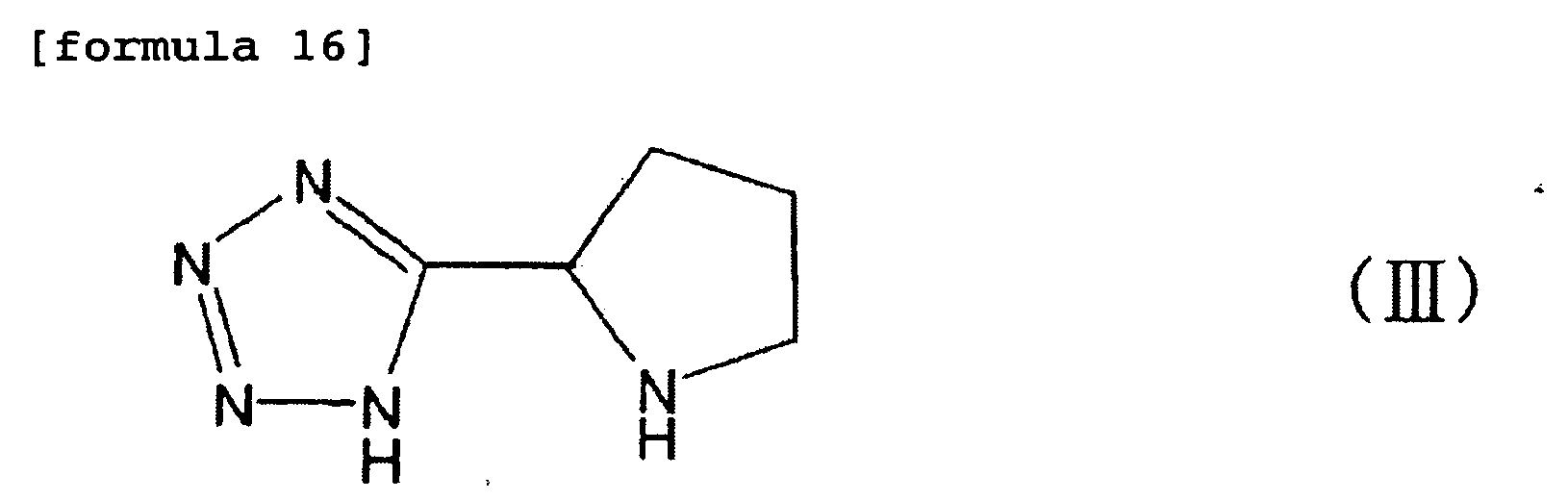
- the process for producing an α-aminooxyketone compound according to "2" , wherein the tetrazole derivative is a compound shown in the general formula (III) ("3");

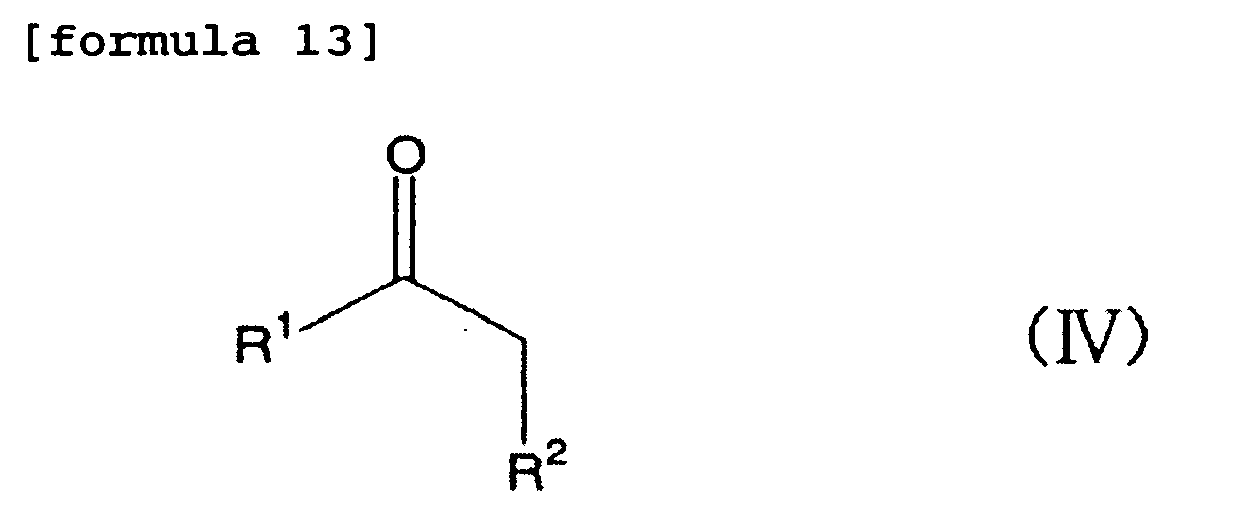
- the process for producing an α-aminooxyketone compound according to any one of "1" to "4", wherein the carbonyl compound is a compound shown in the general formula (IV) (wherein R1 and R2 independently represent hydrogen, or a substituted or unsubstituted alkyl group, a substituted or unsubstituted alkenyl group, a substituted or unsubstituted alkoxy group, a substituted or unsubstituted amide group, or a substituted or unsubstituted aryl group; and R1 and R2 may bind to each other to form a ring) ("5");
- The present invention also relates to:
- a catalyst for producing an α-aminooxyketone compound by which a carbonyl compound is reacted with a nitroso compound, wherein the catalyst contains a heterocyclic compound shown in the general formula (I) (wherein: X1, X2 and X3 independently represent nitrogen, carbon, oxygen or sulfur; Z represents a substituted or unsubstituted 5- to 10-membered ring) ("11");


- the catalyst for producing an α-aminooxyketone compound according to "11", wherein the heterocyclic compound is a tetrazole derivative shown in the general formula (II) (wherein Z represents a substituted or unsubstituted 5- to 10-membered ring) ("12"),

- the catalyst for producing an α-aminooxyketone compound according to "12", wherein the tetrazole derivative is a compound shown in the general formula (III) ("13"),
- the catalyst for producing an α-aminooxyketone compound according to any one of "11" to "14", wherein the carbonyl compound is a compound shown in the general formula (IV) (wherein R1 and R2 independently represent hydrogen, or a substituted or unsubstituted alkyl group, a substituted or unsubstituted alkenyl group, a substituted or unsubstituted alkoxy group, a substituted or unsubstituted amide group, or a substituted or unsubstituted aryl group; and R1 and R2 may bind to each other to form a ring) ("15"),

- By using heterocyclic compound shown in the general formula (I) as a catalyst, without isolating intermediates, at a stage in an asymmetric oxygenation of carbonyl compounds, the amount of catalyst was reduced, the efficiencies of catalyst, atom and the like were increased, and consequently α-aminooxyketone compounds can be obtained in high chemical yield and high optical purity. The present invention paves the way for artificially and freely producing oligosaccharides, hexose and pentose skeletons which can be found in unit structures in DNA and RNA; and gives possibilities to develop various sugar medicines such as anticancer agents, antithrombogenic agents, anti-HIV agents, inhibitors of cholesterol synthesis, and verotoxin neutralizing agents.
- A process for producing α-aminooxyketone compounds of the present invention is a process by using so-called nitroso aldol reaction which produces α-aminooxyketone compounds by an asymmetric oxygenation reaction of carbonyl compounds and nitroso compounds.
-


- A carbonyl compound used for a process for producing α-aminooxyketone compounds of the present invention is not especially limited as long as it has a carbonyl group, and may be a compound in a soluble form or a compound easily forming hydrates. Specifically, aldehyde compounds and ketone compounds, preferably carbonyl compounds shown in the general formula (IV) can be exemplified.
-

- Further, as an alkoxy group, an alkoxycarbonyl group and an aryl group represented by R1, R2 in the general formula (IV), alkoxy groups with 1-30 carbons such as methoxy, ethoxy, n-propoxy, n-butoxy, n-pentyloxy, n-hexyloxy, cyclohexyloxy and phenyloxy; alkoxycarbonyl group with 1-30 carbons such as methoxy carbonyl, ethoxy carbonyl, butoxy carbonyl and pentyloxy carbonyl; and aryl groups with 1-30 carbons such as phenyl, 1-naphtyl, 2-naphthyl, 1-anthryl, 2-anthryl, 9-anthryl, 1-phenanthryl, 2-phenanthryl, benzyl and phenethyl; can be exemplified respectively.
- As a substituent of alkyl group, alkenyl group, alkoxy group, alkoxy-carbonyl group and aryl group represented by R1, R2 in the general formula (IV), alkyl groups such as methyl, ethyl, n-propyl, n-butyl, cyclopentyl, cyclohexyl and cycloheptyl; alkenyl groups such as vinyl, 1-propenyl, allyl, and 1-butenyl; aryl groups such as phenyl, 1-naphthyl, 2-naphthyl, 1-anthryl, 2-anthryl, 9-anthryl, 1-phenanthryl, 2-phenanthryl and benzyl; halogen atoms such as F, Cl and Br; alkoxy groups such as methoxy, ethoxy, propoxy and butoxy; and other ones such as hydroxyl, carboxyl, acyl, amino, thio and nitro groups can be exemplified. Further, as a ring system which is formed by binding of R1 and R2, cyclic alkyl groups such as cyclopentane, cyclohexane, cycloheptane, cyclooctane, cyclononane and cyclodecane; aromatic rings such as benzene, naphthalene and anthracene; and heterocycles such as pyridine, pyrrolidine, piperidine, furan, pyran, tetrahydrofuran and tetrahydropyran can be exemplified.
- As a carbonyl compound represented in the general formula (IV), specifically aldehydes such as acetaldehyde, propionaldehyde, butylaldehyde, isobutylaldehyde, valeraldehyde, isovaleraldehyde, caproicaldehyde, heptaldehyde, caprylaldehyde, pelargonicaldehyde, capricaldehyde, undecylaldehyde, lauraldehyde, tridecylaldehyde, myristaldehyde, pentadecylaldehyde, palmiticaldehyde, margaricaldehyde, stearicaldehyde, succindialdehyde, acrolein, crotonaldehyde, benzaldehyde, o-tolualdehyde, m-tolualdehyde, p-tolualdehyde, salicylaldehyde, cinnamaldehyde, 1-naphthoaldehyde, 2-naphthoaldehyde and furfural can be exemplified.
- Further, as a carbonyl compound represented in the general formula (IV), specifically ketones such as acetone; ethylmethylketone; propylmethylketone; isopropylmethylketone; butylmethylketone; isobutylmethylketone; diethylketone; diisopropylketone; 2-undecanone; methylvinylketone; mesityloxide; fluoroacetone; chloroacetone; 2,4-pentanedione; cyclobutanone; cyclopentanone; cyclohexanone; 2-methylcyclohexanone; cyclodecanone; 2-norbornanone; 2-adamantanone; tetrahydropyrane-4-one; spiro[4,5]-1,4-dioxy-decane-8-one; 1-benzylcarbonylpyperidine-4-one; benzylacetone; 1-indanone; 2-indanone; α-tetralone; β-tetralone; 7- methoxy-2-tetralone; acetophenone; propiophenone; benzylphenone; dibenzylketone; 3,4-dimethylacetophenone; 2-acetonaphthone; and 2-choroloacetophenone can be exemplified.
- As a nitroso compound used in a process for producing α-aminooxyketone compounds of the present invention, it may be either of an aliphatic nitroso compound or an aromatic nitroso compound as long as the compound contains a nitroso group. As an aliphatic nitroso compound, an alkyl nitroso compound which may contain substituents can be exemplified and those in which a nitroso group is attached to the tertiary carbon are preferred with specific examples being 2-nitroso-isobutane and 2-nitroso-2-methylpentane. Further, as an aromatic nitroso compound, nitroso benzene which may contain substituents, and 1-nitrosonaphthalene and 2-nitrosonaphthalene which may contain substituents, can be exemplified. As a substituent of aromatic nitroso compound, alkyl groups such as methyl, ethyl, propyl, isopropyl, n-butyl, isobutyl, s-butyl, and t-butyl; alkoxy groups such as methoxy, ethoxy, n-propoxy, isopropoxy, n-butoxy, s-butoxy, isobutoxy, t-butoxy, phenoxy, benzyloxy, and phenethyloxy; and halogen atoms such as F, Cl, Br, and I can be exemplified. As a nitrosobenzene containing substituent group, specifically o-nitrosotoluene; m-nitrosotoluene; p-nitrosotoluene; 3,5-dimethylnitrosobenzene; o-nitrosoethylbenzene; o-nitrosostyrene; o-nitrosoanisole; m-nitrosoanisole; p-nitrosoanisole; o-nitrosophenetol; m-nitrosophenetol; p-nitrosophenetol; o-fluoronitrosobenzene; m-fluoronitrosobenzene; p-fluoronitrosobenzene; o-chrolonitrosobenzene; m-chrolonitrosobenzene; p-chloronitrosobenzene; o-bromonitrosobenzene; m-bromonitrosobenzene; p-bromonitrosobenzene; and the like can be exemplified.
- A heterocyclic compound used in the process for producing α-aminooxyketone compounds of the present invention is shown in the general formula (I) wherein X1, X2 and X3 independently represent nitrogen, carbon, oxygen or sulfur; Z represents a substituted or unsubstituted 5- to 10-membered ring, and is a compound in which a 5-membered heterocycle and 5- to 10-membered heterocycle both having nitrogen atom at the respective α position are bound through carbons constituting the heterocycles. The heterocyclic compound is also called a N-H acid-N-H base combined catalyst where the NH functional group at the α position of the heterocycle acts as an acid and the NH functional group at the α position of the cycloalkyl heterocycle acts as a base. As a 5-membered heterocycle (acid ring) of the heterocyclic compound, tetrazole, 1,2,3-triazole, 1,2,4-triazole, pyrazole, pyrazoline, imidazole, indazoline, thiotriazoline and oxatriazoline can be exemplified, and 1H-tetrazole as shown in the genenral formula (II) is especially preferable as a heterocyclic compound. As a 5-10 membered heterocycle (base ring), pyrrolidine, piperidine, hexamethyleneimine, heptamethyleneimine, oxazoline and oxazole can be exemplified; and as a substituent of these heterocycles, alkyl groups such as methyl, ethyl, n-propyl, isopropyl, n-butyl, isobutyl, sec-butyl, and t-butyl, alkoxy groups such as methoxy and ethoxy, phenyl groups, aryl groups such as condensed ring system condensed to heterocycle can be exemplified. Smaller substituents are preferable since a compound with a bulky heterocyclic moiety including substituents would lower the yield.
- As the above heterocyclic compound, specifically 5-(2'-pyrrolidinyl)-1H-1,2,3,4-tetrazole; 5-(4H,5H-2'-oxazolyl)-1H-1,2,3,4-tetrazole;
5-(2'-piperidinyl)-1H-1,2,3,4-tetrazole;
5-(benzo[c]-2'-piperidinyl)-1H-1,2,3,4-tetrazole;
5-2'-pyrolidinyl-1H-1,2,3-triazole;
5-2'-pyrolidinyl-1H-1,2,4-triazole;
2-2'-pyrolidinyl-1H-imidazole;
5-2'-pyrolidinyl-1H-imidazole;
5-2'-pyrolidinyl-1H,4H,5H-1,2,3,4-thiotriazoline;
5-2'-pyrolidinyl-4H,5H-1,2,3,4-oxatriazoline; and 5-2'-pyrolidinyl-4H,5H-pyrazoline; can be exemplified. Particularly, 5-(2'-pyrolidinyl)-1H-1,2,3,4-tetrazole as shown in the formura (III) can be preferably exemplified. - The heterocyclic compound can be prepared from natural or synthesized proline. The tetrazole derivative shown in the formula (III) can be prepared by a previous method (Roczniki Chemii Ann. Soc. Chim. Polpnorum, 1971, 45, 967; J. Med. Chm. 1985, 28, 1067). Thus, N-(benzyloxycarbonyl)-L-proline, which is commercially available as a carboxylic acid of proline having nitrogen atom protected by a benzyloxycarbonyl group, is converted to an amide via a reaction with ammonia and dehydrated with phosphoryl chloride to give nitrile. The obtained nitrile is reacted with sodium azide to give a tetrazole, and finally the N-benzyloxycarbonyl group is deprotected with HBr/AcOH or Pd/C, H2 to give a tetrazole derivative shown in the formula (III). The tetrazole derivative can also be obtained according to the previous method from Organic Letters, 2001, Vol.3, No.25, 4091-4094; Organic Letters, 2002, Vol. 4 No. 15, 2525- 2527; and the like.
- A process for producing α-aminooxyketone compounds of the present invention is a method of performing the reaction of carbonyl compound and nitroso compound generally in solvent in the presence of the heterocyclic compound shown in the general formula (I) or preferably in the presence of the tetrazole derivative shown in the formula (III). The amount of nitroso compound can be in a range of 2-4 mol equivalents, preferably 2.5-3.5 mol equivalents for the carbonyl compound, and the amount of catalyst containing the heterocyclic compound shown in the formula (I) can be 1-30 mol%, preferably 2-20 mol% for carbonyl substrate. As a solvent, water; halogenated hydrocarbons such as dichloromethane, chloroform, dichloroethane, and chlorobenzene; aromatic hydrocarbons such as benzene, toluene, xylene; aliphatic hydrocarbons such as cyclohexane, n-hexane, and n-heptane; esters such as ethylacetate ; nitriles such as acetonitrile; dimethylsulfoxide; and the like can be exemplified; and among them dimethylsulfoxide and acetonitrile are preferable. The amount of solvent can be 15-30 equivalents but the reaction can be done without solvent.
- The reaction temperature can be 0-50° C, preferably 20-30°C and the reaction can be done at room temperature. The reaction time can be 30 minutes to 3 hours, for example, around 1 hour, and a method stirring in the open air can be exemplified. Strict conditions are not required for a reaction, furthermore, water does not suppress the reaction to proceed, so there is no need for dehydrating the material and catalyst, and the reaction is easy to be controlled. After the reaction is complete, the resulting product was extracted with ethylacetate and the like, and dried and purified by known methods.
- In a process for producing α-aminooxyketone compounds of the present invention, carbonyl compounds such as methylisopropylketone and acetophenone, and aldehydes such as water-soluble aldehyde and aldehyde that forms hydrate easily, which could not be used for the materials in conventional methods, can be used as materials. Since there are not many limitations for carbonyl compounds used as a material, the resulting products, α-aminooxyketone compounds, range over a wide scope and have a high chemical yield and optical purity. As an absolute configuration of asymmetric carbons of the resulting product, α-aminooxyketone compound; where aldehyde is used as a material, the resulting product has a R-configuration; where ketone is used as a material, the resulting product has a S-configuration.
- Specific examples of the α-aminooxyalketone obtained from the present invention are as follows:
(N-isobutylaminooxy)acetaldehyde;
[N-(1,1-dimethylbutyl)]aminooxyacetaldehyde;
(N-phenylaminooxy)acetaldehyde;
2-(N-isobutylaminooxy)propanal;
2-[N-(1,1-dimethylbutyl)aminooxy]propanal;
2-N-phenylaminooxypropanal; 2-(N-isobutylaminooxy)butanal;
2-[N-(1,1-dimethylbuthyl)aminooxy]butanal;
2-(N-phenylaminooxy)butanal;
2-(N-isobutylaminooxy)-2-methylpropanal;
2-[N-(1,1-dimethylbuthyl)aminooxy]-2-methylpropanal;
2-(N-phenylaminooxy)-2-methylpropanal;
2-(N-isobutylaminooxy)-4-methylbutanal;
2-[N-(1,1-dimethylbutyl)aminooxy]-4-methylbutanal;
2-(N-phenylaminooxy)-4-methylbutanal;
2-(N-isobutylaminooxy)hexanal;
2-[N-(1,1-dimethylbutyl)aminooxy]hexanal;
2-(N-phenylaminooxy)hexanal;
2-(N-isobutylaminooxy)heptanal;
2-[N-(1,1-dimethylbutyl)aminooxy]heptanal;
2-(N-phenylaminooxy)heptanal;
2-(N-isobutylaminooxy)octanal;
2-[N-(1,1-dimethylbutyl)aminooxy]octanal;
2-(N-phenylaminooxy)octanal; 2-(N-isobutylaminooxy)nonanal;
2-[N-(1,1-dimethylbutyl)aminooxy]nonanal;
2-(N-phenylaminooxy)nonanal; 2-(N-isobutylaminooxy)decanal; 2-[N-(1,1-dimethylbutyl)aminooxy]decanal;
2-(N-phenylaminooxy)decanal;
2-(N-isobutylaminooxy)undecanal;
2-[N-(1,1-dimethylbutyl)aminooxy]undecanal;
2-(N-phenylaminooxy)propanal;
2-(N-isobutylaminooxy)dodecanal;
2-[N-(1,1-dimethylbutyl)aminooxy]dodecanal;
2-(N-phenylaminooxy)dodecanal;
2-(N-isobutylaminooxy)tridecanal; 2-[N-(1,1-dimethylbutyl)aminooxy]tridecanal; and 2-(N-phenylaminooxy)tridecanal. - Further specific examples of the α-aminooxyketone compound obtained from the present invention are as follows:
2,3-bis(N-isobutylaminooxy)butanedial;
2,3-bis[N-(1,1-dimethylbutyl)aminooxy]butanedial;
2,3-bis[N-phenylaminooxy]butanedial;
2-N-isobutylaminooxy-2-propenal;
2-N-(1,1-dimethylbutyl)aminooxy-2-propenal;
2-N-phenylaminooxy-2-propenal;
2-N-isobutylaminooxy-2-butenal;
2-N-(1,1-dimethylbutyl)aminooxy-2-butenal;
2-N-phenylaminooxy-2-butenal;
3-phenyl-2-N-isobutylaminooxy-2-propenal;
3-phenyl-2-N-(1,1-dimethylbutyl)aminooxy-2-propenal; and
3-phenyl-2-N-phenylaminooxy-2-propenal. - Furthermore, examples of the α-aminooxyketone obtained from the present invention are as follows:
(N-isobutylaminooxy)acetone;
[N-(1,1-dimethylbutyl)aminooxy]acetone;
(N-phenylaminooxy)acetone;
3-(N-isobutylaminooxy)butane-2-one;
3-[N-(1,1-dimethylbutyl)aminooxy]butane-2-one;
3-(N-phenylaminooxy)butane-2-one;
3-(N-isobutylaminooxy)pentane-2-one;
3-[N-(1,1-dimethylbutyl)aminooxy]pentane-2-one;
3-(N-phenylaminooxy)pentane-2-one;
3-(N-isobutylaminooxy)-4-methylbutane-2-one;
3-[N-(1,1-dimethylbutyl)aminooxy]-4-methylbutane-2-one;
3-(N-phenylaminooxy)-4-methylbutane-2-one;
3-(N-isobutylaminooxy)hexane-2-one;
3-[N-(1,1-dimethylbutyl)aminooxy]hexane-2-one;
3-(N-phenylaminooxy)hexane-2-one;
3-(N-isobutylaminooxy)-4-methylpentane-2-one;
3-[N-(1,1-dimethylbutyl)aminooxy]-4-methylpentane-2-one;
3-(N-phenylaminooxy)-4-methylpentane-2-one;
2-(N-isobutylaminooxy)pentane-3-one;
2-[N-(1,1-dimethylbutyl)aminooxy]pentane-3-one;
2-(N-phenylaminooxy)pentane-3-one;
2-(N-isobutylaminooxy)-2,4-dimethylpentane-3-one;
2-[N-(1,1-dimethylbutyl)aminooxy]-2,4-dimethylpentane-3-one;
2-(N-phenylaminooxy)-2,4-dimethylpentane-3-one;
3-(N-isobutylaminooxy)undecane-2-one;
3-[N-(1,1-dimethylbutyl)aminooxy]undecane-2-one; and
3-(N-phenylaminooxy)undecane-2-one. - Further examples of the α-aminooxyketone compound obtained from the present invention are as follows:
3-N-isobutylaminooxy-3-butene-2-one;
3-N-(1,1-dimethylbutyl)aminooxy-3-butene-2-one;
3-N-phenylaminooxy-3-butene-2-one;
3-N-isobutylaminooxy-4-methyl-3-pentene-2-one;
3-N-(1,1-dimethylbutyl)aminooxy-4-methyl-3-pentene-2-one;
3-N-phenylaminooxy-4-methyl-3-pentene-2-one;
1-fluoro-1-(N-isobutylaminooxy)acetone;
1-fluoro-1-[N-(1,1-dimethylbutyl)aminooxy]acetone;
1-fluoro-1-(N-phenylaminooxy)acetone;
1-chloro-1-(N-isobutylaminooxy)acetone;
1-chloro-1-[N-(1,1-dimethylbutyl)aminooxy]acetone;
1-chloro-1-(N-phenylaminooxy)acetone;
3-(N-isobutylaminooxy)-2,4-pentanedione;
3-[N-(1,1-dimethylbutyl)aminooxy]-2,4-pentanedione;
3-(N-phenylaminooxy)-2,4-pentanedione;
2-(N-isobutylaminooxy)cyclobutanone;
2-[N-(1,1-dimethylbutyl)aminooxy]cyclobutanone;
2-(N-phenylaminooxy)cyclobutanone;
2-(N-isobutylaminooxy)cyclopentanone;
2-[N-(1,1-dimethylbutyl)aminooxy]cyclopentanone;
2-(N-phenylaminooxy)cyclopentanone;
2-(N-isobutylaminooxy)cyclohexanone;
2-[N-(1,1-dimethylbutyl)aminooxy]cyclohexanone;
2-(N-phenylaminooxy)cyclohexanone;
2-(N-isobutylaminooxy)-2-methylcyclohexanone;
2-[N-(1,1-dimethylbutyl)aminooxy]-2-methylcyclohexanone;
2-(N-phenylaminooxy)-2-methylcyclohexanone;
2-(N-isobutylaminooxy)cyclodecanone;
2-[N-(1,1-dimethylbutyl)aminooxy]cyclodecanone;
2-(N-phenylaminooxy)cyclodecanone;
1-(N-isobutylaminooxy)-2-norbornanone;
1-[N-(1,1-dimethylbutyl)aminooxy]-2-norbornanone;
1-(N-phenylaminooxy)-2-norbornanone;
1-(N-isobutylaminooxy)-2-adamantanone;
1-[N-(1,1-dimethylbutyl)aminooxy]-2-adamantanone; and
1-(N-phenylaminooxy)-2-adamantanone. - And more examples are as follows:
2-(N-isobutylaminooxy)-4-tetrahydropyranone;
2-[N-(1,1-dimethylbutyl)aminooxy]-4-tetrahydropyranone;
2-(N-phenylaminooxy)-4-tetrahydropyranone;
7-(N-isobutylaminooxy)-spiro[4.5]-1,4-dioxy-decane-8-one;
7-[N-(1,1-dimethylbutyl)aminooxy]-spiro[4.5]-1,4-dioxy-deca ne-8-one;
7-(N-phenylaminooxy)-spiro[4.5]-1,4-dioxy-decane-8-one;
3-(N-isobutylaminooxy)-1-benzylcarbonylpiperidine-4-one;
3-[N-(1,1-dimethylbutyl)aminooxy]-1-benzylcarbonylpiperidin e-4-one;
3-(N-phenylaminooxy)-1-benzylcarbonylpiperidine-4-one;
3-(N-isobutylaminooxy)-4-phenylbutane-2-one;
3-[N-(1,1-dimethylbutyl)aminooxy-4-phenylbutane-2-one;
3-(N-phenylaminooxy)-4-phenylbutane-2-one;
2-(N-isobutylaminooxy)-1-indanone;
2-[N-(1,1-dimethylbutyl)aminooxy]-1-indanone;
2-(N-phenylaminooxy)-1-indanone:
1-(N-isobutylaminooxy)-2-indanone;
1-[N-(1,1-dimethylbutyl)aminooxy-2-indanone;
1-(N-phenylaminooxy)-2-indanone;
2-(N-isobutylaminooxy)-1-ketotetrahydronaphthalene;
2-[N-(1,1-dimethylbutyl)aminooxy-1-ketotetrahydronaphthalen e; 2-(N-phenylaminooxy)-1-ketotetrahydronaphthalene;
1-(N-isobutylaminooxy)-2-ketotetrahydronaphthalene;
1-[N-(1,1-dimethylbutyl)aminooxy]-2-ketotetrahydronaphthale ne; 1-(N-phenylaminooxy)-2-ketotetrahydronaphthalene;
1-(N-isobutylaminooxy)-7-methoxy-2-ketotetrahydronaphthalen e;
1-[N-(1,1-dimethylbutyl)aminooxy-7-methoxy-2-ketotetrahydro naphthalene;
1-(N-phenylaminooxy)-7-methoxy-2-ketotetrahydronaphthalene;
2'-(N-isobutylaminooxy)-1'-acetophenone;
2'-[N-(1,1-dimethylbutyl)aminooxy]-1'-acetophenone;
2'-(N-phenylaminooxy)-1'-acetophenone;
2'-(N-isobutylaminooxy)-1'-propiophenone;
2'-[N-(1,1-dimethylbutyl)aminooxy]-1'-propiophenone;
2'-(N-phenylaminooxy)-1'-propiophenone;
2-(N-isobutylaminooxy)-1,2-bisphenylethane-1-one;
2-[N-(1,1-dimethylbutyl)aminooxy]-1,2-bisphenylethane-1-one;
2-(N-phenylaminooxy)-1,2-bisphenylethane-1-one;
1-(N-isobutylaminooxy)-1,3-bisphenylpropane-2-one;
1-[N-(1,1-dimethylbutyl)aminooxy]-1,3-bisphenylpropane-2-on e; 1-(N-phenylaminooxy)-1,3-bisphenylpropane-2-one;
6-(N-isobutylaminooxy)-3,4-dimethylacetophenone;
6-[N-(1,1-dimethylbutyl)aminooxy]-3,4-dimethylacetophenone;
6-(N-phenylaminooxy)-3,4-dimethylacetophenone;
3'-(N-isobutylaminooxy)-2'-acetonaphthone,
3'-[N-(1,1-dimethylbutyl)aminooxy]-2'-acetonaphthone;
3'-(N-phenylaminooxy)-2'-acetonaphthone;
3'-(N-isobutylaminooxy)-2'-chloroacetonaphthone;
3'-[N-(1,1-dimethylbutyl)aminooxy]-2'-acetonaphtone; and
3'-(N-phenylaminooxy)-2'-acetonaphtone. - Further, the process for producing α-hydroxyketone compounds of the present invention is a process using an α-aminooxyketone compound obtained from the above mentioned process for producing α-aminooxyketone compounds of the present invention in a solvent with the use of CuSO4 as a catalyst, and to which known methods can be applied to convert aminooxyketone compound to hydroxyketone compound. Alcohols like methanol and ethanol can be exemplified as a solvent to use. The reaction temperature can be about O-25 °C, and the reaction time can be about 3-10 hours.
- The present invention will be explained in detail in the following by referring to the examples, but the technical scope of the present invention will not be limited to these.
- Pyrrolidine-2-tetrazole 1 was prepared from proline. One mL dimethyl sulfoxide (DMSO) solution at room temperature (25-30 °C) in which 5 mol% Pyrrolidine-2-tetrazole and 1.5 mmol (3 equivalents) cyclohexanone was dissolved was added dropwise 1 mL DMSO solution with 0.5 mmol (1 equivalent) nitrosobenzene for 1 hour. The mixture was stirred at room temperature and allowed to react for 1 hour. The nitrosobenzene was completely consumed, as determined by TLC (hexane/ethyl acetate = 3/1). The desired product (4), 2-(N-phenylaminooxy)-1-cyclohexanone was obtained. It was 94% chemical yield and >99%ee optical purity. The results are shown in Table 1. In Table 1, chemical yield ratio (4/6) shows the yield ratio of isolated isomer, optical purity (ee%) of the desired product shows the measurement of HPLC, and absolute configuration (R/S) of asymmetric carbon of the desired products shows the yield of diol converted from the desired products. Even where the amount of catalyst 1 to be used was changed to 3 mol% and 2 mol% , the reactions progressed. The chemical yield of the desired products was 72% and 50% respectively, but the optical purities were >99%ee.
- Reaction was performed in the same manner as Example 1 with the exception of using proline as a catalyst. The chemical yield of the resulting desired product stayed at 35%, and the production of double additional product (5a) of about 2% of 2,6-bis(N-phenylaminooxy)-1-cyclohexanone was identified.
- Reaction was performed in the same manner as Example 1 with the exception of using tetrahydropyrane-4-one as a carbonyl compound. Chemical yield and optical purity of the desired products are shown in Table 1.
- Reaction was performed in the same manner as Example 1 with the exception of using spiro[4.5]-1,4-dioxy-decane-8-one as a carbonyl compound. Chemical yield and optical purity of the desired products are shown in Table 1.
- Reaction was performed in the same manner as Example 1 with the exception of using 1-benzylcarbonylpiperidine-4-one as a carbonyl compound. Chemical yield and optical purity of the desired products are shown in Table 1.
- Reaction was performed in the same manner as Example 1 with the exception of using methylethylketone as a carbonyl compound and the amount of 20 mol% catalyst. Chemical yield and optical purity of the desired products are shown in Table 1.
- Reaction was performed in the same manner as Example 1 with the exception of using phenylpropionaldehyde as a carbonyl compound, acetonitrile as a solvent, and the amount of 10 mol% catalyst. Chemical yield and optical purity of the desired products are shown in Table 1. In the Table, chemical yield of the desired products shows the yield of primary alcohol obtained by reduction of the desired products.
- Reaction was performed in the same manner as Example 6 with the exception of using isobutyraldehyde as a carbonyl compound and the amount of 20 mol% catalyst. Chemical yield and optical purity of the desired products are shown in Table 1.
- Reaction was performed in the same manner as Example 6 with the exception of using caproicaldehyde as a carbonyl compound. Chemical yield and optical purity of the desired products are shown in Table 1.
-
[Table 1] 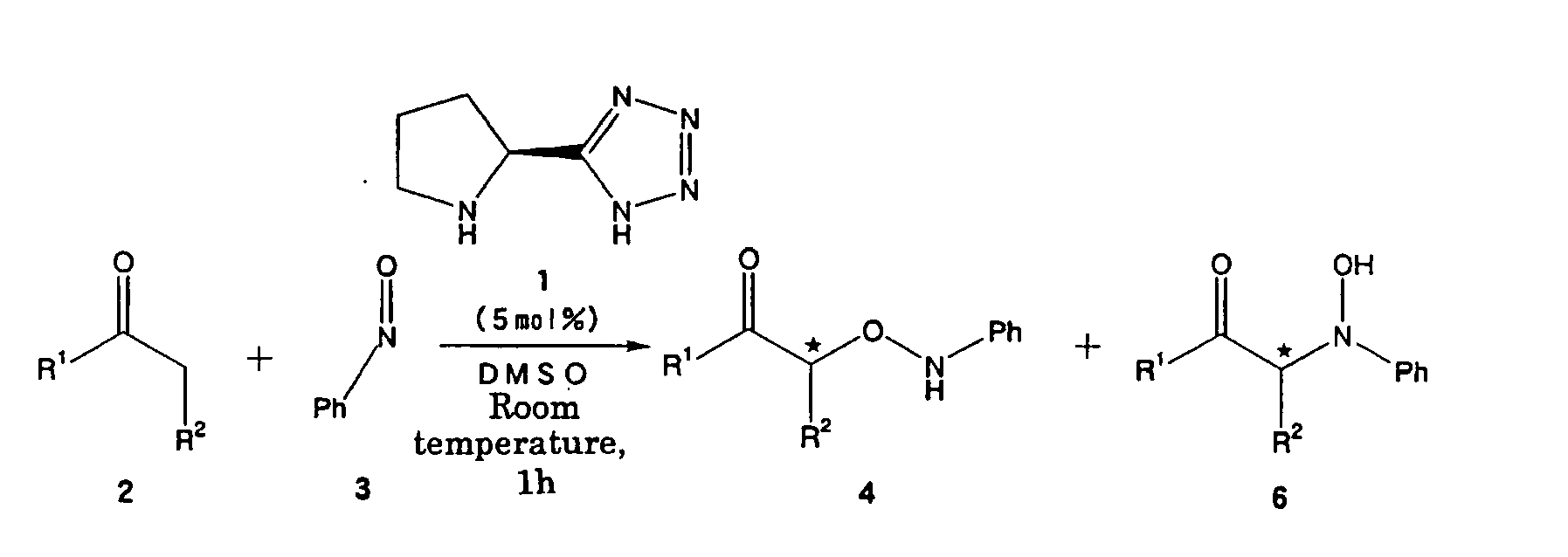
Example 2 1 (mol%) Solvent Yield (%) Yield ratio4/6 Optical purity4 (ee%) R/Sconfiguration 1 
5 DMSO 94 >99 / - >99 S 2 
5 DMSO 87 >99 / - >99 S 3 
5 DMSO 97 >99/- 99 S 4 
5 DMSO 95 >99/- >99 S 5 
20 DMSO 75 72 / 28 >99 S 6 
10 MeCN 67 >99 / - 98 R 7 
20 MeCN 65 >99 / - 98 R 8 
10 MeCN 69 >99 / - 98 R - DMSO solution containing 1 mmol of the resulting products from Example 1 was directly cooled to 0°C, added 47.9 mg (0.3 mmol) CuSO4 and 3.0 mL methanol, and stirred at 0°C for 10 hours. The reaction mixture was added 20 mL cooled saline solution as aftertreatment, and extracted 3 times with 10 mL ethyl acetate. The extracted organic phase was all collected and washed with saline solution, filtered after drying with Na2SO4, and distilled the resulting filtrate with evaporator under reduced pressure. After the residue was purified with silica gel chromatography (developing solvent: ethyl acetate/hexane), corresponding α-hydroxyketone was obtained. The yield was 90 %, and optical yield was 99 % or more.
Claims (17)
- A process for producing an α-aminooxyketone compound wherein a carbonyl compound is reacted with a nitroso compound by using a catalyst containing a heterocyclic compound shown in the general formula (I) (wherein: X1, X2 and X3 independently represent nitrogen, carbon, oxygen or sulfur; Z represents a substituted or unsubstituted 5- to 10-membered ring).

- The process for producing an α-aminooxyketone compound according to claim 1, wherein the heterocyclic compound is a tetrazole derivative shown in the general formula (II) (wherein Z represents a substituted or unsubstituted 5- to 10-membered ring).

- The process for producing an α-aminooxyketone compound according to claim 2, wherein the tetrazole derivative is a compound shown in the general formula (III).

- The process for producing an α-aminooxyketone compound according to any one of claims 1-3, wherein the nitroso compound is nitrosobenzene.
- The process for producing an α-aminooxyketone compound according to any one of claims 1-4, wherein the carbonyl compound is a compound shown in the general formula (IV) (wherein R1 and R2 independently represent hydrogen, or a substituted or unsubstituted alkyl group, a substituted or unsubstituted alkenyl group, a substituted or unsubstituted alkoxy group, a substituted or unsubstituted amide group, or a substituted or unsubstituted aryl group; and R1 and R2 may bind to each other to form a ring).

- The process for producing an α-aminooxyketone compound according to claims 5, wherein the α-aminooxyketone compound contains R asymmetric carbon, where R1 represents hydrogen in the general formula (IV).
- The process for producing an α-aminooxyketone compound according to claims 5, wherein the α-aminooxyketone compound contains S asymmetric carbon; where R1 represents a substituted or unsubstituted alkyl group, a substituted or unsubstituted alkenyl group, a substituted or unsubstituted alkoxy group, a substituted or unsubstituted amide group, or a substituted or unsubstituted aryl group, and either one of these groups bind to R2 to form a ring in the general formula (IV).
- The process for producing an α-aminooxyketone compound according to any one of claims 1-7, wherein a solvent containing dimethyl sulfoxide or methyl nitrile, or both of them is used.
- The process for producing an α-aminooxyketone compound according to any one of claims 1-8, wherein reaction is performed at room temperature (20-30 °C).
- A process for producing an α-hydroxyketone compound wherein an α-aminooxyketone compound obtained from the process according to any one of claims 1-9 is reacted in a solvent by using CuSO4 as a catalyst.
- A catalyst for producing an α-aminooxyketone compound by which a carbonyl compound is reacted with a nitroso compound, wherein the catalyst contains a heterocyclic compound shown in the general formula (I) (wherein: X1, X2 and X3 independently represent nitrogen, carbon, oxygen or sulfur; Z represents a substituted or unsubstituted 5- to 10-membered ring).

- The catalyst for producing an α-aminooxyketone compound according to claim 11, wherein the heterocyclic compound is a tetrazole derivative shown in the general formula (II) (wherein Z represents a substituted or unsubstituted 5- to 10-membered ring).

- The catalyst for producing an α-aminooxyketone compound according to claim 12, wherein the tetrazole derivative is a compound shown in the general formula (III).

- The catalyst for producing an α-aminooxyketone compound according to any one of claims 11-13, wherein the nitroso compound is nitrosobenzene.
- The catalyst for producing an α-aminooxyketone compound according to any one of claims 11-14, wherein the carbonyl compound is a compound shown in the general formula (IV) (wherein R1 and R2 independently represent hydrogen, or a substituted or unsubstituted alkyl group, a substituted or unsubstituted alkenyl group, a substituted or unsubstituted alkoxy group, a substituted or unsubstituted amide group, or a substituted or unsubstituted aryl group; and R1 and R2 may bind to each other to form a ring).

- The catalyst for producing an α-aminooxyketone compound according to claim 15, wherein the α-aminooxyketone compound contains R asymmetric carbon, where R1 represents hydrogen in the general formula (IV).
- The catalyst for producing an α-aminooxyketone compound according to claim 15, wherein the α-aminooxyketone compound contains S asymmetric carbon, where R1 represents a substituted or unsubstituted alkyl group, a substituted or unsubstituted alkenyl group, a substituted or unsubstituted alkoxy group, a substituted or unsubstituted amide group, or a substituted or unsubstituted aryl group, or where either one of these groups bind to R2 to form a ring in the general formula (IV).
Applications Claiming Priority (2)
| Application Number | Priority Date | Filing Date | Title |
|---|---|---|---|
| JP2004044540A JP4362388B2 (en) | 2004-02-20 | 2004-02-20 | α-Aminooxyketone compound and method for producing α-hydroxyketone compound |
| PCT/JP2005/002163 WO2005080318A1 (en) | 2004-02-20 | 2005-02-14 | PROCESSES FOR PRODUCTION OF α-AMINOOXYKETONES AND α-HYDROXYKETONES |
Publications (2)
| Publication Number | Publication Date |
|---|---|
| EP1717221A1 true EP1717221A1 (en) | 2006-11-02 |
| EP1717221A4 EP1717221A4 (en) | 2007-10-17 |
Family
ID=34879349
Family Applications (1)
| Application Number | Title | Priority Date | Filing Date |
|---|---|---|---|
| EP05710165A Withdrawn EP1717221A4 (en) | 2004-02-20 | 2005-02-14 | PROCESSES FOR THE PRODUCTION OF ALPHA-AMINOCETONES AND ALPHA-HYDROXYCETONES |
Country Status (4)
| Country | Link |
|---|---|
| US (1) | US20070055081A1 (en) |
| EP (1) | EP1717221A4 (en) |
| JP (1) | JP4362388B2 (en) |
| WO (1) | WO2005080318A1 (en) |
Families Citing this family (2)
| Publication number | Priority date | Publication date | Assignee | Title |
|---|---|---|---|---|
| EP2316926B1 (en) | 2009-11-02 | 2016-04-13 | Rheinische Friedrich-Wilhelms-Universität Bonn | Enantioselective production of alpha-hydroxy carbonyl compounds |
| CN118440041B (en) * | 2024-07-02 | 2024-09-27 | 苏州凯瑞医药科技有限公司 | Preparation method of chiral 4-amino-3-hydroxytetrahydropyran |
Family Cites Families (1)
| Publication number | Priority date | Publication date | Assignee | Title |
|---|---|---|---|---|
| JP4390424B2 (en) * | 2002-04-23 | 2009-12-24 | 独立行政法人科学技術振興機構 | Method for producing hydroxyamino compound and / or aminooxy compound |
-
2004
- 2004-02-20 JP JP2004044540A patent/JP4362388B2/en not_active Expired - Fee Related
-
2005
- 2005-02-14 WO PCT/JP2005/002163 patent/WO2005080318A1/en not_active Ceased
- 2005-02-14 EP EP05710165A patent/EP1717221A4/en not_active Withdrawn
-
2006
- 2006-08-18 US US11/506,573 patent/US20070055081A1/en not_active Abandoned
Non-Patent Citations (2)
| Title |
|---|
| N. MOMIYAMA ET AL.: "o-nitroso aldol synthesis:catalytic enantioselective route to alfa-aminooxy carbonylcompounds" PROCEEDINGS OF THE NATIONAL ACADEMY OF SCIENCE OF THE USA, vol. 101, no. 15, 13 April 2004 (2004-04-13), pages 5374-5378, XP002449131 us * |
| See also references of WO2005080318A1 * |
Also Published As
| Publication number | Publication date |
|---|---|
| US20070055081A1 (en) | 2007-03-08 |
| JP2005232100A (en) | 2005-09-02 |
| WO2005080318A1 (en) | 2005-09-01 |
| JP4362388B2 (en) | 2009-11-11 |
| EP1717221A4 (en) | 2007-10-17 |
Similar Documents
| Publication | Publication Date | Title |
|---|---|---|
| KR20090052398A (en) | Method for preparing medetomydin and its salts | |
| Wang et al. | A novel and efficient direct aldol condensation from ketones and aromatic aldehydes catalyzed by proline–TEA through a new pathway | |
| Pini et al. | Addition of diethylzinc to aryl aldehydes catalyzed by (1S, 3S)-N, N1-bis [benzyl]-1, 3-diphenyl-1, 3-propanediamine and its dilithium salt: a mechanistic rationale investigation. | |
| Abbastabar Ahangar et al. | A one-pot synthesis of 1, 2-Dihydro-1-arylnaphtho [1, 2-e][1, 3] oxazine-3-one derivatives catalyzed by perchloric acid supported on silica (HClO4/SiO2) in the absence of solvent | |
| Fleming et al. | Two new stereochemically complementary oxindole synthesis | |
| US8252941B2 (en) | Process of making alpha-aminooxyketone/alpha-aminooxyaldehyde and alpha-hydroxyketone/alpha-hydroxyaldehyde compounds and a process making reaction products from cyclic alpha, beta-unsaturated ketone substrates and nitroso substrates | |
| JP4362388B2 (en) | α-Aminooxyketone compound and method for producing α-hydroxyketone compound | |
| US3979408A (en) | 2-(Pyrrol-1-yl)amino-4,5-dihydro-1H-imidazole derivatives | |
| EP2152656B1 (en) | A process for the preparation of 1,4-dialkyl-2,3-diol-1,4-butanedione | |
| CN114315609B (en) | Technological method for preparing cis-2-aminocyclohexanol | |
| EP1731509B1 (en) | Process for producing nitrogenous 5-membered cyclic compound | |
| JP3883972B2 (en) | Process for producing hydroxyketone compound | |
| KR102720819B1 (en) | PROLINE ISOTHIOURONIUM SALT COMPOUND AND PREPARATION METHOD OF β-HYDROXY CARBONYL COMPOUND USING THE SAME | |
| JP2003261490A (en) | Novel chiral zirconium catalyst and method for producing optically active anti-α-methyl-β-aminocarbonyl compound using the same | |
| US7847107B2 (en) | Asymmetric reduction method | |
| JP4613276B2 (en) | Optically active pyrrolidine derivative | |
| KR100941173B1 (en) | Dihydrofuran derivative and preparation method thereof using gold catalyst | |
| JP2003335780A (en) | Quaternary ammonium salts having spirochirality and uses thereof | |
| JP2002053572A (en) | Method for producing optically active pyran analog | |
| CN108912077A (en) | A kind of preparation method of chiral phthalide derivative | |
| Yadav et al. | Iodine/EtOH: A Novel and Versatile Catalyst for the Synthesis of β-Amino Ketones via Three Component Reaction | |
| CN108546244B (en) | A kind of synthetic method of 3,3'-diindoleethane compounds | |
| KR100417624B1 (en) | Novel Decursin Derivatives | |
| JP4842842B2 (en) | Method for producing α-aminooxyketone / α-aminooxyaldehyde and α-hydroxyketone / α-hydroxyaldehyde compound, and method for producing reaction product from cyclic α, β-unsaturated ketone substrate and nitroso substrate | |
| RU2310653C1 (en) | METHOD FOR PREPARING DERIVATIVES OF 2-METHYL-5-(5-METHYL-2-FURYL)-4,10-DIHYDRO-3H-PYRIDAZINO[1,6-b]ISOQUINOLINE-10-ONE (VARIANTS) |
Legal Events
| Date | Code | Title | Description |
|---|---|---|---|
| PUAI | Public reference made under article 153(3) epc to a published international application that has entered the european phase |
Free format text: ORIGINAL CODE: 0009012 |
|
| 17P | Request for examination filed |
Effective date: 20060906 |
|
| AK | Designated contracting states |
Kind code of ref document: A1 Designated state(s): DE FR GB |
|
| DAX | Request for extension of the european patent (deleted) | ||
| RBV | Designated contracting states (corrected) |
Designated state(s): DE FR GB |
|
| A4 | Supplementary search report drawn up and despatched |
Effective date: 20070918 |
|
| STAA | Information on the status of an ep patent application or granted ep patent |
Free format text: STATUS: THE APPLICATION IS DEEMED TO BE WITHDRAWN |
|
| 18D | Application deemed to be withdrawn |
Effective date: 20110901 |