EP1714989A1 - Polyurethane foams made with blowing catalyst compositions containing primary hydroxyl groups and high ethylenediamine backbones - Google Patents
Polyurethane foams made with blowing catalyst compositions containing primary hydroxyl groups and high ethylenediamine backbones Download PDFInfo
- Publication number
- EP1714989A1 EP1714989A1 EP06008012A EP06008012A EP1714989A1 EP 1714989 A1 EP1714989 A1 EP 1714989A1 EP 06008012 A EP06008012 A EP 06008012A EP 06008012 A EP06008012 A EP 06008012A EP 1714989 A1 EP1714989 A1 EP 1714989A1
- Authority
- EP
- European Patent Office
- Prior art keywords
- combination
- polyol
- catalyst
- hydroxyethyl
- glycol
- Prior art date
- Legal status (The legal status is an assumption and is not a legal conclusion. Google has not performed a legal analysis and makes no representation as to the accuracy of the status listed.)
- Granted
Links
- 239000003054 catalyst Substances 0.000 title claims abstract description 84
- 239000000203 mixture Substances 0.000 title claims abstract description 65
- 125000002887 hydroxy group Chemical group [H]O* 0.000 title claims description 33
- 238000007664 blowing Methods 0.000 title claims description 15
- 229920005830 Polyurethane Foam Polymers 0.000 title abstract description 30
- 239000011496 polyurethane foam Substances 0.000 title abstract description 30
- 125000003916 ethylene diamine group Chemical group 0.000 title description 2
- 229920005862 polyol Polymers 0.000 claims abstract description 62
- 150000003077 polyols Chemical class 0.000 claims abstract description 52
- -1 isocyanate compound Chemical class 0.000 claims abstract description 37
- 239000012948 isocyanate Substances 0.000 claims abstract description 35
- 238000006243 chemical reaction Methods 0.000 claims abstract description 34
- 238000000034 method Methods 0.000 claims abstract description 33
- 239000004604 Blowing Agent Substances 0.000 claims abstract description 22
- 150000001875 compounds Chemical class 0.000 claims abstract description 17
- 239000001257 hydrogen Substances 0.000 claims abstract description 16
- 229910052739 hydrogen Inorganic materials 0.000 claims abstract description 16
- UFHFLCQGNIYNRP-UHFFFAOYSA-N Hydrogen Chemical compound [H][H] UFHFLCQGNIYNRP-UHFFFAOYSA-N 0.000 claims abstract description 15
- 239000012970 tertiary amine catalyst Substances 0.000 claims abstract description 15
- 125000000217 alkyl group Chemical group 0.000 claims abstract description 5
- 125000004432 carbon atom Chemical group C* 0.000 claims abstract description 5
- LYCAIKOWRPUZTN-UHFFFAOYSA-N Ethylene glycol Chemical compound OCCO LYCAIKOWRPUZTN-UHFFFAOYSA-N 0.000 claims description 25
- DNIAPMSPPWPWGF-UHFFFAOYSA-N Propylene glycol Chemical compound CC(O)CO DNIAPMSPPWPWGF-UHFFFAOYSA-N 0.000 claims description 24
- 150000001412 amines Chemical class 0.000 claims description 20
- XLYOFNOQVPJJNP-UHFFFAOYSA-N water Substances O XLYOFNOQVPJJNP-UHFFFAOYSA-N 0.000 claims description 20
- 229920002635 polyurethane Polymers 0.000 claims description 17
- 239000004814 polyurethane Substances 0.000 claims description 17
- PEDCQBHIVMGVHV-UHFFFAOYSA-N Glycerine Chemical compound OCC(O)CO PEDCQBHIVMGVHV-UHFFFAOYSA-N 0.000 claims description 16
- IMNIMPAHZVJRPE-UHFFFAOYSA-N triethylenediamine Chemical compound C1CN2CCN1CC2 IMNIMPAHZVJRPE-UHFFFAOYSA-N 0.000 claims description 16
- 239000012973 diazabicyclooctane Substances 0.000 claims description 15
- WERYXYBDKMZEQL-UHFFFAOYSA-N butane-1,4-diol Chemical compound OCCCCO WERYXYBDKMZEQL-UHFFFAOYSA-N 0.000 claims description 14
- 229910052757 nitrogen Inorganic materials 0.000 claims description 13
- MTHSVFCYNBDYFN-UHFFFAOYSA-N diethylene glycol Chemical compound OCCOCCO MTHSVFCYNBDYFN-UHFFFAOYSA-N 0.000 claims description 12
- 229920000642 polymer Polymers 0.000 claims description 11
- PUPZLCDOIYMWBV-UHFFFAOYSA-N (+/-)-1,3-Butanediol Chemical compound CC(O)CCO PUPZLCDOIYMWBV-UHFFFAOYSA-N 0.000 claims description 10
- RTZKZFJDLAIYFH-UHFFFAOYSA-N ether Substances CCOCC RTZKZFJDLAIYFH-UHFFFAOYSA-N 0.000 claims description 10
- 229920000768 polyamine Polymers 0.000 claims description 8
- XXMIOPMDWAUFGU-UHFFFAOYSA-N hexane-1,6-diol Chemical compound OCCCCCCO XXMIOPMDWAUFGU-UHFFFAOYSA-N 0.000 claims description 7
- ABXWNEPQBUZRMJ-UHFFFAOYSA-N 2-[2-[2-[2-(dimethylamino)ethyl-methylamino]ethyl-methylamino]ethyl-methylamino]ethanol Chemical compound CN(C)CCN(C)CCN(C)CCN(C)CCO ABXWNEPQBUZRMJ-UHFFFAOYSA-N 0.000 claims description 6
- 239000004970 Chain extender Substances 0.000 claims description 6
- XUIMIQQOPSSXEZ-UHFFFAOYSA-N Silicon Chemical group [Si] XUIMIQQOPSSXEZ-UHFFFAOYSA-N 0.000 claims description 6
- ZJCCRDAZUWHFQH-UHFFFAOYSA-N Trimethylolpropane Chemical compound CCC(CO)(CO)CO ZJCCRDAZUWHFQH-UHFFFAOYSA-N 0.000 claims description 6
- 239000003431 cross linking reagent Substances 0.000 claims description 6
- 150000002009 diols Chemical class 0.000 claims description 6
- 229920001281 polyalkylene Polymers 0.000 claims description 6
- 229920005906 polyester polyol Polymers 0.000 claims description 6
- 150000003839 salts Chemical group 0.000 claims description 6
- 229910052710 silicon Inorganic materials 0.000 claims description 6
- 239000010703 silicon Substances 0.000 claims description 6
- 239000004094 surface-active agent Substances 0.000 claims description 6
- DVKJHBMWWAPEIU-UHFFFAOYSA-N toluene 2,4-diisocyanate Chemical compound CC1=CC=C(N=C=O)C=C1N=C=O DVKJHBMWWAPEIU-UHFFFAOYSA-N 0.000 claims description 6
- UPMLOUAZCHDJJD-UHFFFAOYSA-N 4,4'-Diphenylmethane Diisocyanate Chemical compound C1=CC(N=C=O)=CC=C1CC1=CC=C(N=C=O)C=C1 UPMLOUAZCHDJJD-UHFFFAOYSA-N 0.000 claims description 5
- 235000019437 butane-1,3-diol Nutrition 0.000 claims description 5
- SLCVBVWXLSEKPL-UHFFFAOYSA-N neopentyl glycol Chemical compound OCC(C)(C)CO SLCVBVWXLSEKPL-UHFFFAOYSA-N 0.000 claims description 5
- 239000003945 anionic surfactant Substances 0.000 claims description 4
- 239000004205 dimethyl polysiloxane Substances 0.000 claims description 4
- 235000013870 dimethyl polysiloxane Nutrition 0.000 claims description 4
- SZXQTJUDPRGNJN-UHFFFAOYSA-N dipropylene glycol Chemical compound OCCCOCCCO SZXQTJUDPRGNJN-UHFFFAOYSA-N 0.000 claims description 4
- GHLKSLMMWAKNBM-UHFFFAOYSA-N dodecane-1,12-diol Chemical compound OCCCCCCCCCCCCO GHLKSLMMWAKNBM-UHFFFAOYSA-N 0.000 claims description 4
- 239000000945 filler Substances 0.000 claims description 4
- 239000003063 flame retardant Substances 0.000 claims description 4
- 125000002496 methyl group Chemical group [H]C([H])([H])* 0.000 claims description 4
- 239000000049 pigment Substances 0.000 claims description 4
- 229920000435 poly(dimethylsiloxane) Polymers 0.000 claims description 4
- 125000002924 primary amino group Chemical group [H]N([H])* 0.000 claims description 4
- 239000003381 stabilizer Substances 0.000 claims description 4
- 150000005846 sugar alcohols Polymers 0.000 claims description 4
- MTZUIIAIAKMWLI-UHFFFAOYSA-N 1,2-diisocyanatobenzene Chemical compound O=C=NC1=CC=CC=C1N=C=O MTZUIIAIAKMWLI-UHFFFAOYSA-N 0.000 claims description 3
- JHDOQSUCSAEWPR-UHFFFAOYSA-N 2-[2-(dimethylamino)ethyl-[2-[2-[2-(dimethylamino)ethyl-methylamino]ethyl-methylamino]ethyl]amino]ethanol Chemical compound OCCN(CCN(CCN(CCN(C)C)C)C)CCN(C)C JHDOQSUCSAEWPR-UHFFFAOYSA-N 0.000 claims description 3
- LKQXPKGLUCDJCW-UHFFFAOYSA-N 2-n-[2-[2-(2-aminoethylamino)ethylamino]ethyl]-3-n,3-n,2,3-tetramethylbutane-2,3-diamine Chemical compound CN(C)C(C)(C)C(C)(C)NCCNCCNCCN LKQXPKGLUCDJCW-UHFFFAOYSA-N 0.000 claims description 3
- 239000005057 Hexamethylene diisocyanate Substances 0.000 claims description 3
- 229920001577 copolymer Polymers 0.000 claims description 3
- RRAMGCGOFNQTLD-UHFFFAOYSA-N hexamethylene diisocyanate Chemical compound O=C=NCCCCCCN=C=O RRAMGCGOFNQTLD-UHFFFAOYSA-N 0.000 claims description 3
- 150000003014 phosphoric acid esters Chemical class 0.000 claims description 3
- 229920001451 polypropylene glycol Polymers 0.000 claims description 3
- 229910052723 transition metal Inorganic materials 0.000 claims description 3
- 150000003624 transition metals Chemical class 0.000 claims description 3
- NFDXQGNDWIPXQL-UHFFFAOYSA-N 1-cyclooctyldiazocane Chemical group C1CCCCCCC1N1NCCCCCC1 NFDXQGNDWIPXQL-UHFFFAOYSA-N 0.000 claims description 2
- VOZKAJLKRJDJLL-UHFFFAOYSA-N 2,4-diaminotoluene Chemical compound CC1=CC=C(N)C=C1N VOZKAJLKRJDJLL-UHFFFAOYSA-N 0.000 claims description 2
- PISLZQACAJMAIO-UHFFFAOYSA-N 2,4-diethyl-6-methylbenzene-1,3-diamine Chemical group CCC1=CC(C)=C(N)C(CC)=C1N PISLZQACAJMAIO-UHFFFAOYSA-N 0.000 claims description 2
- AQZABFSNDJQNDC-UHFFFAOYSA-N 2-[2,2-bis(dimethylamino)ethoxy]-1-n,1-n,1-n',1-n'-tetramethylethane-1,1-diamine Chemical group CN(C)C(N(C)C)COCC(N(C)C)N(C)C AQZABFSNDJQNDC-UHFFFAOYSA-N 0.000 claims description 2
- PBMSKKLNDZFKTO-UHFFFAOYSA-N 2-[2-(dimethylamino)ethyl-[2-[2-(dimethylamino)ethyl-methylamino]ethyl]amino]ethanol Chemical compound OCCN(CCN(C)C)CCN(CCN(C)C)C PBMSKKLNDZFKTO-UHFFFAOYSA-N 0.000 claims description 2
- NCUPDIHWMQEDPR-UHFFFAOYSA-N 2-[2-[2-(dimethylamino)ethoxy]ethyl-methylamino]ethanol Chemical compound CN(C)CCOCCN(C)CCO NCUPDIHWMQEDPR-UHFFFAOYSA-N 0.000 claims description 2
- PBFYTMMJUXLCIW-UHFFFAOYSA-N 2-[2-[2-[2-(dimethylamino)ethyl-(2-hydroxyethyl)amino]ethyl-methylamino]ethyl-methylamino]ethanol Chemical compound OCCN(CCN(CCN(CCN(C)C)CCO)C)C PBFYTMMJUXLCIW-UHFFFAOYSA-N 0.000 claims description 2
- DVEMFEYTIJINJB-UHFFFAOYSA-N 2-[2-[2-[2-(dimethylamino)ethyl-methylamino]ethyl-(2-hydroxyethyl)amino]ethyl-methylamino]ethanol Chemical compound OCCN(CCN(CCN(CCN(C)C)C)CCO)C DVEMFEYTIJINJB-UHFFFAOYSA-N 0.000 claims description 2
- BVLKCNBACRWKDO-UHFFFAOYSA-N 2-[2-[2-[2-[2-(dimethylamino)ethyl-methylamino]ethyl-methylamino]ethyl-methylamino]ethyl-methylamino]ethanol Chemical compound CN(C)CCN(C)CCN(C)CCN(C)CCN(C)CCO BVLKCNBACRWKDO-UHFFFAOYSA-N 0.000 claims description 2
- TWKIPOOXGPQWAI-UHFFFAOYSA-N 2-[2-[2-[2-[2-hydroxyethyl(methyl)amino]ethyl-methylamino]ethyl-methylamino]ethyl-methylamino]ethanol Chemical compound OCCN(C)CCN(C)CCN(C)CCN(C)CCO TWKIPOOXGPQWAI-UHFFFAOYSA-N 0.000 claims description 2
- SAIXZIVDXDTYCH-UHFFFAOYSA-N 3-chlorobenzene-1,2-diamine Chemical compound NC1=CC=CC(Cl)=C1N SAIXZIVDXDTYCH-UHFFFAOYSA-N 0.000 claims description 2
- IMLXLGZJLAOKJN-UHFFFAOYSA-N 4-aminocyclohexan-1-ol Chemical compound NC1CCC(O)CC1 IMLXLGZJLAOKJN-UHFFFAOYSA-N 0.000 claims description 2
- LFQSCWFLJHTTHZ-UHFFFAOYSA-N Ethanol Chemical compound CCO LFQSCWFLJHTTHZ-UHFFFAOYSA-N 0.000 claims description 2
- PIICEJLVQHRZGT-UHFFFAOYSA-N Ethylenediamine Chemical compound NCCN PIICEJLVQHRZGT-UHFFFAOYSA-N 0.000 claims description 2
- OPKOKAMJFNKNAS-UHFFFAOYSA-N N-methylethanolamine Chemical compound CNCCO OPKOKAMJFNKNAS-UHFFFAOYSA-N 0.000 claims description 2
- ALQSHHUCVQOPAS-UHFFFAOYSA-N Pentane-1,5-diol Chemical compound OCCCCCO ALQSHHUCVQOPAS-UHFFFAOYSA-N 0.000 claims description 2
- 229920003171 Poly (ethylene oxide) Polymers 0.000 claims description 2
- GSEJCLTVZPLZKY-UHFFFAOYSA-N Triethanolamine Chemical compound OCCN(CCO)CCO GSEJCLTVZPLZKY-UHFFFAOYSA-N 0.000 claims description 2
- 125000002947 alkylene group Chemical group 0.000 claims description 2
- ZKHNOHWHSQEUFZ-UHFFFAOYSA-N boron;1h-imidazole Chemical compound [B].C1=CNC=N1 ZKHNOHWHSQEUFZ-UHFFFAOYSA-N 0.000 claims description 2
- PMMYEEVYMWASQN-IMJSIDKUSA-N cis-4-Hydroxy-L-proline Chemical compound O[C@@H]1CN[C@H](C(O)=O)C1 PMMYEEVYMWASQN-IMJSIDKUSA-N 0.000 claims description 2
- FOTKYAAJKYLFFN-UHFFFAOYSA-N decane-1,10-diol Chemical compound OCCCCCCCCCCO FOTKYAAJKYLFFN-UHFFFAOYSA-N 0.000 claims description 2
- 235000014113 dietary fatty acids Nutrition 0.000 claims description 2
- ZBCBWPMODOFKDW-UHFFFAOYSA-N diethanolamine Chemical compound OCCNCCO ZBCBWPMODOFKDW-UHFFFAOYSA-N 0.000 claims description 2
- GPLRAVKSCUXZTP-UHFFFAOYSA-N diglycerol Chemical compound OCC(O)COCC(O)CO GPLRAVKSCUXZTP-UHFFFAOYSA-N 0.000 claims description 2
- LVTYICIALWPMFW-UHFFFAOYSA-N diisopropanolamine Chemical compound CC(O)CNCC(C)O LVTYICIALWPMFW-UHFFFAOYSA-N 0.000 claims description 2
- 229940043276 diisopropanolamine Drugs 0.000 claims description 2
- 239000000194 fatty acid Substances 0.000 claims description 2
- 229930195729 fatty acid Natural products 0.000 claims description 2
- 150000004665 fatty acids Chemical class 0.000 claims description 2
- NAQMVNRVTILPCV-UHFFFAOYSA-N hexane-1,6-diamine Chemical compound NCCCCCCN NAQMVNRVTILPCV-UHFFFAOYSA-N 0.000 claims description 2
- 125000000687 hydroquinonyl group Chemical class C1(O)=C(C=C(O)C=C1)* 0.000 claims description 2
- WXZMFSXDPGVJKK-UHFFFAOYSA-N pentaerythritol Chemical compound OCC(CO)(CO)CO WXZMFSXDPGVJKK-UHFFFAOYSA-N 0.000 claims description 2
- UKODFQOELJFMII-UHFFFAOYSA-N pentamethyldiethylenetriamine Chemical compound CN(C)CCN(C)CCN(C)C UKODFQOELJFMII-UHFFFAOYSA-N 0.000 claims description 2
- 150000003235 pyrrolidines Chemical class 0.000 claims description 2
- ADRDEXBBJTUCND-UHFFFAOYSA-N pyrrolizidine Chemical class C1CCN2CCCC21 ADRDEXBBJTUCND-UHFFFAOYSA-N 0.000 claims description 2
- SBYHFKPVCBCYGV-UHFFFAOYSA-N quinuclidine Chemical compound C1CC2CCN1CC2 SBYHFKPVCBCYGV-UHFFFAOYSA-N 0.000 claims description 2
- 150000008584 quinuclidines Chemical class 0.000 claims description 2
- QAOWNCQODCNURD-UHFFFAOYSA-N sulfuric acid Substances OS(O)(=O)=O QAOWNCQODCNURD-UHFFFAOYSA-N 0.000 claims description 2
- RUELTTOHQODFPA-UHFFFAOYSA-N toluene 2,6-diisocyanate Chemical compound CC1=C(N=C=O)C=CC=C1N=C=O RUELTTOHQODFPA-UHFFFAOYSA-N 0.000 claims description 2
- RWRDLPDLKQPQOW-UHFFFAOYSA-N tetrahydropyrrole Natural products C1CCNC1 RWRDLPDLKQPQOW-UHFFFAOYSA-N 0.000 claims 2
- RNFJDJUURJAICM-UHFFFAOYSA-N 2,2,4,4,6,6-hexaphenoxy-1,3,5-triaza-2$l^{5},4$l^{5},6$l^{5}-triphosphacyclohexa-1,3,5-triene Chemical compound N=1P(OC=2C=CC=CC=2)(OC=2C=CC=CC=2)=NP(OC=2C=CC=CC=2)(OC=2C=CC=CC=2)=NP=1(OC=1C=CC=CC=1)OC1=CC=CC=C1 RNFJDJUURJAICM-UHFFFAOYSA-N 0.000 claims 1
- XSQUKJJJFZCRTK-UHFFFAOYSA-N Urea Chemical compound NC(N)=O XSQUKJJJFZCRTK-UHFFFAOYSA-N 0.000 claims 1
- 239000004202 carbamide Substances 0.000 claims 1
- 125000003827 glycol group Chemical group 0.000 claims 1
- WGCNASOHLSPBMP-UHFFFAOYSA-N hydroxyacetaldehyde Natural products OCC=O WGCNASOHLSPBMP-UHFFFAOYSA-N 0.000 claims 1
- BDHFUVZGWQCTTF-UHFFFAOYSA-M sulfonate Chemical compound [O-]S(=O)=O BDHFUVZGWQCTTF-UHFFFAOYSA-M 0.000 claims 1
- 239000006260 foam Substances 0.000 description 54
- 150000002513 isocyanates Chemical class 0.000 description 17
- WSFSSNUMVMOOMR-UHFFFAOYSA-N Formaldehyde Chemical compound O=C WSFSSNUMVMOOMR-UHFFFAOYSA-N 0.000 description 13
- 150000003512 tertiary amines Chemical class 0.000 description 13
- 238000006116 polymerization reaction Methods 0.000 description 12
- CURLTUGMZLYLDI-UHFFFAOYSA-N Carbon dioxide Chemical compound O=C=O CURLTUGMZLYLDI-UHFFFAOYSA-N 0.000 description 11
- 229910002092 carbon dioxide Inorganic materials 0.000 description 8
- 239000011159 matrix material Substances 0.000 description 7
- OKKJLVBELUTLKV-UHFFFAOYSA-N Methanol Chemical compound OC OKKJLVBELUTLKV-UHFFFAOYSA-N 0.000 description 6
- KDLHZDBZIXYQEI-UHFFFAOYSA-N Palladium Chemical compound [Pd] KDLHZDBZIXYQEI-UHFFFAOYSA-N 0.000 description 6
- 239000004721 Polyphenylene oxide Substances 0.000 description 6
- 229920000570 polyether Polymers 0.000 description 6
- 239000005056 polyisocyanate Substances 0.000 description 6
- 229920001228 polyisocyanate Polymers 0.000 description 6
- 239000000126 substance Substances 0.000 description 6
- CFGNKDWNLQHKLZ-UHFFFAOYSA-N 1-[2-[2-[2-(dimethylamino)ethyl-methylamino]ethyl-methylamino]ethyl-methylamino]propan-2-ol Chemical compound CC(O)CN(C)CCN(C)CCN(C)CCN(C)C CFGNKDWNLQHKLZ-UHFFFAOYSA-N 0.000 description 5
- 239000002585 base Substances 0.000 description 5
- 229940093476 ethylene glycol Drugs 0.000 description 5
- 238000009472 formulation Methods 0.000 description 5
- 238000004519 manufacturing process Methods 0.000 description 5
- 229960004063 propylene glycol Drugs 0.000 description 5
- 235000013772 propylene glycol Nutrition 0.000 description 5
- 150000004072 triols Chemical class 0.000 description 5
- 125000000391 vinyl group Chemical group [H]C([*])=C([H])[H] 0.000 description 5
- 229920002554 vinyl polymer Polymers 0.000 description 5
- VILCJCGEZXAXTO-UHFFFAOYSA-N 2,2,2-tetramine Chemical compound NCCNCCNCCN VILCJCGEZXAXTO-UHFFFAOYSA-N 0.000 description 4
- IJGRMHOSHXDMSA-UHFFFAOYSA-N Atomic nitrogen Chemical compound N#N IJGRMHOSHXDMSA-UHFFFAOYSA-N 0.000 description 4
- 239000004971 Cross linker Substances 0.000 description 4
- KFZMGEQAYNKOFK-UHFFFAOYSA-N Isopropanol Chemical compound CC(C)O KFZMGEQAYNKOFK-UHFFFAOYSA-N 0.000 description 4
- 229920002396 Polyurea Polymers 0.000 description 4
- 235000011187 glycerol Nutrition 0.000 description 4
- 239000000654 additive Substances 0.000 description 3
- 230000015572 biosynthetic process Effects 0.000 description 3
- 239000001569 carbon dioxide Substances 0.000 description 3
- 230000003197 catalytic effect Effects 0.000 description 3
- 238000004821 distillation Methods 0.000 description 3
- 238000003756 stirring Methods 0.000 description 3
- 101100327917 Caenorhabditis elegans chup-1 gene Proteins 0.000 description 2
- VTYYLEPIZMXCLO-UHFFFAOYSA-L Calcium carbonate Chemical compound [Ca+2].[O-]C([O-])=O VTYYLEPIZMXCLO-UHFFFAOYSA-L 0.000 description 2
- OKTJSMMVPCPJKN-UHFFFAOYSA-N Carbon Chemical compound [C] OKTJSMMVPCPJKN-UHFFFAOYSA-N 0.000 description 2
- RGSFGYAAUTVSQA-UHFFFAOYSA-N Cyclopentane Chemical compound C1CCCC1 RGSFGYAAUTVSQA-UHFFFAOYSA-N 0.000 description 2
- IAYPIBMASNFSPL-UHFFFAOYSA-N Ethylene oxide Chemical compound C1CO1 IAYPIBMASNFSPL-UHFFFAOYSA-N 0.000 description 2
- 238000005033 Fourier transform infrared spectroscopy Methods 0.000 description 2
- OFBQJSOFQDEBGM-UHFFFAOYSA-N Pentane Chemical compound CCCCC OFBQJSOFQDEBGM-UHFFFAOYSA-N 0.000 description 2
- PPBRXRYQALVLMV-UHFFFAOYSA-N Styrene Chemical compound C=CC1=CC=CC=C1 PPBRXRYQALVLMV-UHFFFAOYSA-N 0.000 description 2
- GWEVSGVZZGPLCZ-UHFFFAOYSA-N Titan oxide Chemical compound O=[Ti]=O GWEVSGVZZGPLCZ-UHFFFAOYSA-N 0.000 description 2
- WNLRTRBMVRJNCN-UHFFFAOYSA-N adipic acid Chemical compound OC(=O)CCCCC(O)=O WNLRTRBMVRJNCN-UHFFFAOYSA-N 0.000 description 2
- TZCXTZWJZNENPQ-UHFFFAOYSA-L barium sulfate Chemical compound [Ba+2].[O-]S([O-])(=O)=O TZCXTZWJZNENPQ-UHFFFAOYSA-L 0.000 description 2
- 238000009835 boiling Methods 0.000 description 2
- 229910052799 carbon Inorganic materials 0.000 description 2
- 238000001816 cooling Methods 0.000 description 2
- 239000006071 cream Substances 0.000 description 2
- 125000005442 diisocyanate group Chemical group 0.000 description 2
- 239000006185 dispersion Substances 0.000 description 2
- 238000010438 heat treatment Methods 0.000 description 2
- 239000001023 inorganic pigment Substances 0.000 description 2
- QWTDNUCVQCZILF-UHFFFAOYSA-N isopentane Chemical compound CCC(C)C QWTDNUCVQCZILF-UHFFFAOYSA-N 0.000 description 2
- 239000008204 material by function Substances 0.000 description 2
- 238000002156 mixing Methods 0.000 description 2
- 239000000178 monomer Substances 0.000 description 2
- LSHROXHEILXKHM-UHFFFAOYSA-N n'-[2-[2-[2-(2-aminoethylamino)ethylamino]ethylamino]ethyl]ethane-1,2-diamine Chemical compound NCCNCCNCCNCCNCCN LSHROXHEILXKHM-UHFFFAOYSA-N 0.000 description 2
- 239000012860 organic pigment Substances 0.000 description 2
- 150000003138 primary alcohols Chemical class 0.000 description 2
- 230000009257 reactivity Effects 0.000 description 2
- 229910001220 stainless steel Inorganic materials 0.000 description 2
- 239000010935 stainless steel Substances 0.000 description 2
- 238000003786 synthesis reaction Methods 0.000 description 2
- FAGUFWYHJQFNRV-UHFFFAOYSA-N tetraethylenepentamine Chemical compound NCCNCCNCCNCCN FAGUFWYHJQFNRV-UHFFFAOYSA-N 0.000 description 2
- 0 *N(*)CCN(*)* Chemical compound *N(*)CCN(*)* 0.000 description 1
- 125000000954 2-hydroxyethyl group Chemical group [H]C([*])([H])C([H])([H])O[H] 0.000 description 1
- VQWKFBPWMFELSM-UHFFFAOYSA-N 3-n-[2-(2-aminoethylamino)ethyl]-2-n,2-n,2-trimethylbutane-2,3-diamine Chemical compound CN(C)C(C)(C)C(C)NCCNCCN VQWKFBPWMFELSM-UHFFFAOYSA-N 0.000 description 1
- NLHHRLWOUZZQLW-UHFFFAOYSA-N Acrylonitrile Chemical compound C=CC#N NLHHRLWOUZZQLW-UHFFFAOYSA-N 0.000 description 1
- JOYRKODLDBILNP-UHFFFAOYSA-N Ethyl urethane Chemical compound CCOC(N)=O JOYRKODLDBILNP-UHFFFAOYSA-N 0.000 description 1
- OWIKHYCFFJSOEH-UHFFFAOYSA-N Isocyanic acid Chemical compound N=C=O OWIKHYCFFJSOEH-UHFFFAOYSA-N 0.000 description 1
- OFOBLEOULBTSOW-UHFFFAOYSA-N Malonic acid Chemical compound OC(=O)CC(O)=O OFOBLEOULBTSOW-UHFFFAOYSA-N 0.000 description 1
- 229920000877 Melamine resin Polymers 0.000 description 1
- CBENFWSGALASAD-UHFFFAOYSA-N Ozone Chemical compound [O-][O+]=O CBENFWSGALASAD-UHFFFAOYSA-N 0.000 description 1
- 239000002202 Polyethylene glycol Substances 0.000 description 1
- GOOHAUXETOMSMM-UHFFFAOYSA-N Propylene oxide Chemical compound CC1CO1 GOOHAUXETOMSMM-UHFFFAOYSA-N 0.000 description 1
- XSTXAVWGXDQKEL-UHFFFAOYSA-N Trichloroethylene Chemical compound ClC=C(Cl)Cl XSTXAVWGXDQKEL-UHFFFAOYSA-N 0.000 description 1
- WGLPBDUCMAPZCE-UHFFFAOYSA-N Trioxochromium Chemical compound O=[Cr](=O)=O WGLPBDUCMAPZCE-UHFFFAOYSA-N 0.000 description 1
- 230000000996 additive effect Effects 0.000 description 1
- 239000002318 adhesion promoter Substances 0.000 description 1
- 239000001361 adipic acid Substances 0.000 description 1
- 235000011037 adipic acid Nutrition 0.000 description 1
- 150000001408 amides Chemical group 0.000 description 1
- CDQSJQSWAWPGKG-UHFFFAOYSA-N butane-1,1-diol Chemical compound CCCC(O)O CDQSJQSWAWPGKG-UHFFFAOYSA-N 0.000 description 1
- 229910000019 calcium carbonate Inorganic materials 0.000 description 1
- 235000013877 carbamide Nutrition 0.000 description 1
- 239000006229 carbon black Substances 0.000 description 1
- KYKAJFCTULSVSH-UHFFFAOYSA-N chloro(fluoro)methane Chemical compound F[C]Cl KYKAJFCTULSVSH-UHFFFAOYSA-N 0.000 description 1
- 229910000423 chromium oxide Inorganic materials 0.000 description 1
- 239000003086 colorant Substances 0.000 description 1
- 239000002131 composite material Substances 0.000 description 1
- 230000003247 decreasing effect Effects 0.000 description 1
- 150000004985 diamines Chemical class 0.000 description 1
- 125000000664 diazo group Chemical group [N-]=[N+]=[*] 0.000 description 1
- AFABGHUZZDYHJO-UHFFFAOYSA-N dimethyl butane Natural products CCCC(C)C AFABGHUZZDYHJO-UHFFFAOYSA-N 0.000 description 1
- 230000003292 diminished effect Effects 0.000 description 1
- 230000003467 diminishing effect Effects 0.000 description 1
- 150000005125 dioxazines Chemical class 0.000 description 1
- 238000002845 discoloration Methods 0.000 description 1
- 239000000975 dye Substances 0.000 description 1
- 238000005187 foaming Methods 0.000 description 1
- 125000000524 functional group Chemical group 0.000 description 1
- 239000007789 gas Substances 0.000 description 1
- 150000002334 glycols Chemical class 0.000 description 1
- DMEGYFMYUHOHGS-UHFFFAOYSA-N heptamethylene Natural products C1CCCCCC1 DMEGYFMYUHOHGS-UHFFFAOYSA-N 0.000 description 1
- 229930195733 hydrocarbon Natural products 0.000 description 1
- 150000002430 hydrocarbons Chemical class 0.000 description 1
- 150000002431 hydrogen Chemical class 0.000 description 1
- 238000011065 in-situ storage Methods 0.000 description 1
- 238000009413 insulation Methods 0.000 description 1
- UQSXHKLRYXJYBZ-UHFFFAOYSA-N iron oxide Inorganic materials [Fe]=O UQSXHKLRYXJYBZ-UHFFFAOYSA-N 0.000 description 1
- 235000013980 iron oxide Nutrition 0.000 description 1
- VBMVTYDPPZVILR-UHFFFAOYSA-N iron(2+);oxygen(2-) Chemical class [O-2].[Fe+2] VBMVTYDPPZVILR-UHFFFAOYSA-N 0.000 description 1
- IQPQWNKOIGAROB-UHFFFAOYSA-N isocyanate group Chemical group [N-]=C=O IQPQWNKOIGAROB-UHFFFAOYSA-N 0.000 description 1
- ZFSLODLOARCGLH-UHFFFAOYSA-N isocyanuric acid Chemical compound OC1=NC(O)=NC(O)=N1 ZFSLODLOARCGLH-UHFFFAOYSA-N 0.000 description 1
- 150000002596 lactones Chemical class 0.000 description 1
- 238000003475 lamination Methods 0.000 description 1
- JDSHMPZPIAZGSV-UHFFFAOYSA-N melamine Chemical compound NC1=NC(N)=NC(N)=N1 JDSHMPZPIAZGSV-UHFFFAOYSA-N 0.000 description 1
- 229910052751 metal Inorganic materials 0.000 description 1
- 239000002184 metal Substances 0.000 description 1
- 239000013518 molded foam Substances 0.000 description 1
- 229910052763 palladium Inorganic materials 0.000 description 1
- 230000000704 physical effect Effects 0.000 description 1
- 229920000233 poly(alkylene oxides) Polymers 0.000 description 1
- 229920001223 polyethylene glycol Polymers 0.000 description 1
- 230000000379 polymerizing effect Effects 0.000 description 1
- 239000000843 powder Substances 0.000 description 1
- 150000003333 secondary alcohols Chemical class 0.000 description 1
- 125000000467 secondary amino group Chemical group [H]N([*:1])[*:2] 0.000 description 1
- 239000005437 stratosphere Substances 0.000 description 1
- 150000003871 sulfonates Chemical class 0.000 description 1
- 239000004408 titanium dioxide Substances 0.000 description 1
- 230000001988 toxicity Effects 0.000 description 1
- 231100000419 toxicity Toxicity 0.000 description 1
- 150000003672 ureas Chemical class 0.000 description 1
- 238000009834 vaporization Methods 0.000 description 1
- 230000008016 vaporization Effects 0.000 description 1
- 238000004383 yellowing Methods 0.000 description 1
- PAPBSGBWRJIAAV-UHFFFAOYSA-N ε-Caprolactone Chemical compound O=C1CCCCCO1 PAPBSGBWRJIAAV-UHFFFAOYSA-N 0.000 description 1
Classifications
-
- C—CHEMISTRY; METALLURGY
- C08—ORGANIC MACROMOLECULAR COMPOUNDS; THEIR PREPARATION OR CHEMICAL WORKING-UP; COMPOSITIONS BASED THEREON
- C08G—MACROMOLECULAR COMPOUNDS OBTAINED OTHERWISE THAN BY REACTIONS ONLY INVOLVING UNSATURATED CARBON-TO-CARBON BONDS
- C08G18/00—Polymeric products of isocyanates or isothiocyanates
- C08G18/06—Polymeric products of isocyanates or isothiocyanates with compounds having active hydrogen
- C08G18/08—Processes
- C08G18/16—Catalysts
- C08G18/18—Catalysts containing secondary or tertiary amines or salts thereof
-
- C—CHEMISTRY; METALLURGY
- C08—ORGANIC MACROMOLECULAR COMPOUNDS; THEIR PREPARATION OR CHEMICAL WORKING-UP; COMPOSITIONS BASED THEREON
- C08G—MACROMOLECULAR COMPOUNDS OBTAINED OTHERWISE THAN BY REACTIONS ONLY INVOLVING UNSATURATED CARBON-TO-CARBON BONDS
- C08G18/00—Polymeric products of isocyanates or isothiocyanates
- C08G18/06—Polymeric products of isocyanates or isothiocyanates with compounds having active hydrogen
- C08G18/08—Processes
- C08G18/16—Catalysts
- C08G18/18—Catalysts containing secondary or tertiary amines or salts thereof
- C08G18/1825—Catalysts containing secondary or tertiary amines or salts thereof having hydroxy or primary amino groups
-
- C—CHEMISTRY; METALLURGY
- C08—ORGANIC MACROMOLECULAR COMPOUNDS; THEIR PREPARATION OR CHEMICAL WORKING-UP; COMPOSITIONS BASED THEREON
- C08G—MACROMOLECULAR COMPOUNDS OBTAINED OTHERWISE THAN BY REACTIONS ONLY INVOLVING UNSATURATED CARBON-TO-CARBON BONDS
- C08G18/00—Polymeric products of isocyanates or isothiocyanates
- C08G18/06—Polymeric products of isocyanates or isothiocyanates with compounds having active hydrogen
- C08G18/28—Polymeric products of isocyanates or isothiocyanates with compounds having active hydrogen characterised by the compounds used containing active hydrogen
-
- C—CHEMISTRY; METALLURGY
- C08—ORGANIC MACROMOLECULAR COMPOUNDS; THEIR PREPARATION OR CHEMICAL WORKING-UP; COMPOSITIONS BASED THEREON
- C08G—MACROMOLECULAR COMPOUNDS OBTAINED OTHERWISE THAN BY REACTIONS ONLY INVOLVING UNSATURATED CARBON-TO-CARBON BONDS
- C08G18/00—Polymeric products of isocyanates or isothiocyanates
- C08G18/06—Polymeric products of isocyanates or isothiocyanates with compounds having active hydrogen
- C08G18/28—Polymeric products of isocyanates or isothiocyanates with compounds having active hydrogen characterised by the compounds used containing active hydrogen
- C08G18/40—High-molecular-weight compounds
- C08G18/42—Polycondensates having carboxylic or carbonic ester groups in the main chain
- C08G18/4244—Polycondensates having carboxylic or carbonic ester groups in the main chain containing oxygen in the form of ether groups
- C08G18/4247—Polycondensates having carboxylic or carbonic ester groups in the main chain containing oxygen in the form of ether groups derived from polyols containing at least one ether group and polycarboxylic acids
- C08G18/4252—Polycondensates having carboxylic or carbonic ester groups in the main chain containing oxygen in the form of ether groups derived from polyols containing at least one ether group and polycarboxylic acids derived from polyols containing polyether groups and polycarboxylic acids
-
- C—CHEMISTRY; METALLURGY
- C08—ORGANIC MACROMOLECULAR COMPOUNDS; THEIR PREPARATION OR CHEMICAL WORKING-UP; COMPOSITIONS BASED THEREON
- C08G—MACROMOLECULAR COMPOUNDS OBTAINED OTHERWISE THAN BY REACTIONS ONLY INVOLVING UNSATURATED CARBON-TO-CARBON BONDS
- C08G18/00—Polymeric products of isocyanates or isothiocyanates
- C08G18/06—Polymeric products of isocyanates or isothiocyanates with compounds having active hydrogen
- C08G18/28—Polymeric products of isocyanates or isothiocyanates with compounds having active hydrogen characterised by the compounds used containing active hydrogen
- C08G18/40—High-molecular-weight compounds
- C08G18/42—Polycondensates having carboxylic or carbonic ester groups in the main chain
- C08G18/4244—Polycondensates having carboxylic or carbonic ester groups in the main chain containing oxygen in the form of ether groups
- C08G18/4261—Polycondensates having carboxylic or carbonic ester groups in the main chain containing oxygen in the form of ether groups prepared by oxyalkylation of polyesterpolyols
-
- C—CHEMISTRY; METALLURGY
- C08—ORGANIC MACROMOLECULAR COMPOUNDS; THEIR PREPARATION OR CHEMICAL WORKING-UP; COMPOSITIONS BASED THEREON
- C08J—WORKING-UP; GENERAL PROCESSES OF COMPOUNDING; AFTER-TREATMENT NOT COVERED BY SUBCLASSES C08B, C08C, C08F, C08G or C08H
- C08J9/00—Working-up of macromolecular substances to porous or cellular articles or materials; After-treatment thereof
- C08J9/04—Working-up of macromolecular substances to porous or cellular articles or materials; After-treatment thereof using blowing gases generated by a previously added blowing agent
- C08J9/06—Working-up of macromolecular substances to porous or cellular articles or materials; After-treatment thereof using blowing gases generated by a previously added blowing agent by a chemical blowing agent
- C08J9/08—Working-up of macromolecular substances to porous or cellular articles or materials; After-treatment thereof using blowing gases generated by a previously added blowing agent by a chemical blowing agent developing carbon dioxide
-
- C—CHEMISTRY; METALLURGY
- C08—ORGANIC MACROMOLECULAR COMPOUNDS; THEIR PREPARATION OR CHEMICAL WORKING-UP; COMPOSITIONS BASED THEREON
- C08G—MACROMOLECULAR COMPOUNDS OBTAINED OTHERWISE THAN BY REACTIONS ONLY INVOLVING UNSATURATED CARBON-TO-CARBON BONDS
- C08G2110/00—Foam properties
- C08G2110/0008—Foam properties flexible
-
- C—CHEMISTRY; METALLURGY
- C08—ORGANIC MACROMOLECULAR COMPOUNDS; THEIR PREPARATION OR CHEMICAL WORKING-UP; COMPOSITIONS BASED THEREON
- C08G—MACROMOLECULAR COMPOUNDS OBTAINED OTHERWISE THAN BY REACTIONS ONLY INVOLVING UNSATURATED CARBON-TO-CARBON BONDS
- C08G2110/00—Foam properties
- C08G2110/0083—Foam properties prepared using water as the sole blowing agent
-
- C—CHEMISTRY; METALLURGY
- C08—ORGANIC MACROMOLECULAR COMPOUNDS; THEIR PREPARATION OR CHEMICAL WORKING-UP; COMPOSITIONS BASED THEREON
- C08J—WORKING-UP; GENERAL PROCESSES OF COMPOUNDING; AFTER-TREATMENT NOT COVERED BY SUBCLASSES C08B, C08C, C08F, C08G or C08H
- C08J2203/00—Foams characterized by the expanding agent
- C08J2203/10—Water or water-releasing compounds
-
- C—CHEMISTRY; METALLURGY
- C08—ORGANIC MACROMOLECULAR COMPOUNDS; THEIR PREPARATION OR CHEMICAL WORKING-UP; COMPOSITIONS BASED THEREON
- C08J—WORKING-UP; GENERAL PROCESSES OF COMPOUNDING; AFTER-TREATMENT NOT COVERED BY SUBCLASSES C08B, C08C, C08F, C08G or C08H
- C08J2205/00—Foams characterised by their properties
- C08J2205/06—Flexible foams
Definitions
- the present invention relates to the use of hydroxyl-containing tertiary amines as catalysts for producing polyurethanes.
- Polyurethane foams are widely known and used in the automotive, housing, and other industries. Such foams are produced by reaction of a polyisocyanate with a polyol in the presence of various additives.
- One such additive is a chlorofluorocarbon (CFC) blowing agent which vaporizes as a result of the reaction exotherm causing the polymerizing mass to form a foam.
- CFC chlorofluorocarbon
- the discovery that CFCs deplete ozone in the stratosphere has resulted in mandates diminishing CFC use.
- Production of water blown foams, in which blowing is performed with CO 2 generated by the reaction of water with the polyisocyanate has therefore become increasingly important.
- Tertiary amine catalysts are typically used to accelerate blowing, for example, the reaction of water with polyisocyanate to generate CO 2 , and gelling, for example, the reaction of a polyol with isocyanate.
- the ability of the tertiary amine catalyst to selectively promote either blowing or gelling is an important consideration in selecting a catalyst for the production of a particular polyurethane foam. If a catalyst promotes the blowing reaction to an excessive degree, much of the CO 2 will be evolved before sufficient reaction of isocyanate with polyol has occurred, and the CO 2 will bubble out of the formulation, resulting in a collapse of the polymerization mass and yielding foam of poor quality. In contrast, if a catalyst too strongly promotes the gelling reaction, a substantial portion of the CO 2 will be evolved after a significant degree of polymerization has occurred. Again, poor quality foams which are characterized by high density, broken or poorly defined cells, or other undesirable features will be produced.
- Tertiary amine catalysts generally are malodorous and offensive and many have high volatility due to their low molecular weight. Release of tertiary amines during foam processing may present significant safety and toxicity problems, and release of residual amines from customer products is generally undesirable. On the other hand, low vapor pressure/high molecular weight amine catalysts are expected to require very high catalyst usage due to their low nitrogen/carbon ratio, making the manufacturing cost too high.
- Tertiary amine catalysts containing hydroxyl functionality can chemically bind into the urethane matrix during the polymerization reaction, thus limiting their release from the finish product.
- amine catalysts which contain primary and/or secondary hydroxyl functionality typically have limited volatility and low odor when compared to related structures without hydroxyl functionality.
- the most effective hydroxyl-containing amine catalysts are the ones containing secondary alcohols in their structures because these catalysts exhibit a desirable balance between their promotion of the active hydrogen-isocyanate reaction (gelling and blowing) and their own reactivity with isocyanates.
- the primary alcohols described in the prior art are highly reactive with isocyanates, they tend to lose their catalytic activity too early in the polymerization process.
- polyurethane foams produced using the primary alcohols described in the art have large voids and exhibit decreased demoldability.
- large amounts of the catalyst compositions containing primary hydroxyl functionality are required to effectively catalyze the blowing reaction. See for example, U.S. Patent Nos.
- tertiary amine catalysts containing primary hydroxyl functionality are advantageous because they are more efficiently immobilized into the polyurethane matrix before and after polymerization.
- tertiary amines containing primary hydroxyl groups are characterized by lower odor and vapor pressure than their secondary hydroxyl counterparts. It is therefore desirable to produce a tertiary amine catalyst having primary hydroxyl functionality which more effectively promotes the blowing and gelling reactions while retaining their catalytic activity during the polymerization process.
- the present invention relates to a method for preparing polyurethane foams, which comprises contacting at least one organic isocyanate compound, at least one polyol, at least one blowing agent, and a tertiary amine catalyst composition.
- the catalyst composition has the general formula wherein R 1 , R 2 , and Y are, independently, an alkyl group having from one to three carbon atoms or ⁇ CH 2 CH 2 OH; Z is ⁇ CH 2 CH 2 OH; and n is an integer from 3 to 7, inclusive.
- the present invention also provides a method for catalyzing the reaction between at least one isocyanate compound and at least one active hydrogen-containing compound, such as a polyol and/or a blowing agent.
- the present invention provides a method for making polyurethane foams using tertiary amine catalyst compositions containing primary hydroxyl functionality.
- One aspect of the present invention encompasses producing polyurethane foams by contacting at least one isocyanate compound, at least one polyol compound, at least one blowing agent, and at least one tertiary amine catalyst composition.
- Another aspect of the present invention comprises a method for catalyzing the reaction between at least one isocyanate compound and at least one active hydrogen-containing compound, such as a polyol and/or a blowing agent.
- Catalyst compositions in accordance with the present invention catalyze the reaction between an isocyanate and an active hydrogen-containing compound.
- the active hydrogen-containing compound can be, for example, an alcohol, a polyol, an amine, or water.
- the catalyst composition can promote, among other reactions, the gelling reaction of polyols with isocyanate to produce polyurethane, the blowing reaction of water with isocyanate to release carbon dioxide, or both reactions.
- the catalyst compositions of the present invention effectively promote the blowing reaction of water with isocyanate.
- the tertiary amine catalyst composition has the general formula wherein R 1 , R 2 , and Y are, independently, an alkyl group having from one to three carbon atoms or ⁇ CH 2 CH 2 OH; Z is ⁇ CH 2 CH 2 OH; and n is an integer from 3 to 7, inclusive.
- R 1 and R 2 are methyl groups, Y is a methyl group or ⁇ CH 2 CH 2 OH, and n is an integer from 3 to 7, inclusive.
- Catalyst compositions in accordance with the present invention can be prepared by methods generally known in the art, for example, by reacting ethylene oxide with an amine such as triethylenetetramine (TETA), tetraethylenepentamine (TEPA), or pentaethylenehexamine (PEHA).
- TETA triethylenetetramine
- TEPA tetraethylenepentamine
- PEHA pentaethylenehexamine
- the unreacted amine may be removed by distillation.
- the distilled product is reacted with formaldehyde and pressurized hydrogen at approximately 60-120 °C in the presence of a metal catalyst such as 5% palladium on carbon.
- tertiary amine catalyst compositions of this invention include, but are not limited to N-(2-hydroxyethyl)-N, N',N",N"', N''' pentamethyltriethylenetetramine; N'-(2-hydroxyethyl)-N, N, N",N"', N'" pentamethyltriethylenetetramine; N,N'-bis-(2-hydroxyethyl)-N,N",N"', N''' tetramethyltriethylenetetramine; N,N"-bis-(2-hydroxyethyl)-N, N', N''',N''' tetramethyltriethylenetetramine; N,N'''-bis-(2-hydroxyethyl)-N,N',N",N''' tetramethyltriethylenetetramine; N-(2-hydroxyethyl)-N,N',N",N'''', N''' hex
- a catalytically effective amount of the catalyst composition may be used in the polyurethane formulation.
- suitable amounts of the catalyst composition may range from about 0.01 to about 10 parts catalyst composition per 100 parts polyol by weight (pphp) in the polyurethane formulation, or from about 0.05 to about 2 pphp.
- the ratio of the polyol to the catalyst composition ranges from about 10:1 to about 200:1.
- the ratio of the blowing agent to the catalyst composition ranges from about 1:1 to about 9:1.
- catalyst compositions of the present invention more effectively promote the isocyanate gelling and blowing reactions, are better immobilized in the polyurethane matrix, and have lower vapor pressures.
- the hydroxyl functionality of the catalyst composition enables the catalyst compositions to react with, and be immobilized into, the polyurethane matrix during and after polymerization.
- the prior art discusses tertiary amine catalysts containing primary hydroxyl functionality where n ⁇ 3, but discloses that such catalysts are characterized by lower catalytic activity and higher amine emissions than structurally related catalysts containing secondary hydroxyl functionality.
- the improved properties of the catalysts of the present invention may be attributable to the ability of the higher ethylenediamine backbone (n ⁇ 3) amine catalyst to form a chemical adduct with water.
- Polyurethanes are produced from the polymerization reaction of organic isocyanate compounds with polyol hydroxyl groups.
- Polyols suitable for use in the present invention include, but are not limited to, polyalkylene ether polyols and polyester polyols.
- Polyalkylene ether polyols include poly(alkylene oxide) polymers such as poly(ethylene oxide) and poly(propylene oxide) polymers and copolymers with terminal hydroxyl groups derived from polyhydric compounds, including diols and triols; for example, ethylene glycol, propylene glycol, 1,3-butane diol, 1,4-butane diol, 1,6-hexane diol, neopentyl glycol, diethylene glycol, dipropylene glycol, pentaerythritol, glycerol, diglycerol, trimethylol propane, and similar low molecular weight polyols.
- poly(alkylene oxide) polymers such as poly(ethylene oxide) and poly(propylene oxide) polymers and copolymers with terminal hydroxyl groups derived from polyhydric compounds, including diols and triols; for example, ethylene glycol, propylene glycol, 1,3-butane diol, 1,
- a single high molecular weight polyether polyol may be used.
- a mixture of high molecular weight polyether polyols for example, mixtures of di- and tri-functional materials and/or different molecular weight or different chemical composition materials may be used.
- Such di- and tri-functional materials include, but are not limited to, ethyleneglycol, polyethyleneglycol, propyleneglycol, polypropyleneglycol, glycerine, glycerine-based polyether triols, trimethylolpropane, trimethylolpropane-based polyether triols, 1,3-butane diol, 1,4-butane diol, 1,6-hexane diol, neopentyl glycol, or any combination thereof.
- Useful polyester polyols include, but are not limited to, those produced by reacting a dicarboxylic acid with an excess of a diol, for example, adipic acid with ethylene glycol or butanediol, or reaction of a lactone with an excess of a diol such as caprolactone with propylene glycol.
- polymer polyols are also suitable for use in the present invention.
- Polymer polyols are used in polyurethane foams to increase the foam's resistance to deformation, for example, to improve the load-bearing properties of the foam.
- Examples of polymer polyols include, but are not limited to, graft polyols or polyurea modified polyols (Polyharnstoff Dispersion polyols).
- Graft polyols comprise a triol in which vinyl monomers are graft copolymerized. Suitable vinyl monomers include, for example, styrene, or acrylonitrile.
- a polyurea modified polyol is a polyol containing a polyurea dispersion formed by the reaction of a diamine and a diisocyanate in the presence of a polyol.
- a variant of polyurea modified polyols are polyisocyanate poly addition (PIPA) polyols, which are formed by the in situ reaction of an isocyanate and an alkanolamine in a polyol.
- PIPA polyisocyanate poly addition
- polymer polyols may comprise from about 20 to about 80 percent by weight of the total polyol content.
- Polyurethane foams are typically produced from the reaction of isocyanates with a polyol in the presence of a blowing agent to produce voids in the polyurethane matrix during polymerization.
- Suitable blowing agents include, for example, inert compounds with low boiling points which are vaporized during the exothermic polymerization reaction. Such blowing agents are generally inert compounds that do not decompose or react during the polymerization reaction.
- the reaction exotherm is generally sufficient to vaporize the blowing agent, which then becomes entrapped in the polyurethane matrix, resulting in the formation of voids or cells.
- additional heat can be added during the reaction to promote vaporization of the blowing agent.
- blowing agents include, but are not limited to, chlorofluorocarbons, hydrogenated fluorocarbons, hydrogenated chlorofluorocarbons, and low-boiling hydrocarbons such as cyclopentane, isopentane, or n-pentane, or any combination thereof.
- a preferred blowing agent is water.
- Catalyst compositions of the present invention are useful for catalyzing the reaction of isocyanates with water to produce carbon dioxide. As the carbon dioxide gas is produced, it becomes trapped in the polyurethane matrix, forming voids or cells.
- this invention encompasses a method for producing a polyurethane foam comprising reacting at least one isocyanate compound, at least one polyol compound, at least one blowing agent, at least one tertiary amine catalyst composition, and optionally, at least one auxiliary component.
- the present invention provides a method for catalyzing the reaction between at least one isocyanate compound, at least one active hydrogen-containing compound, and optionally, at least one auxiliary component.
- auxiliary components include, but are not limited to, cell stabilizers, crosslinking agents, chain extenders, pigments, fillers, flame retardants, auxiliary gelling catalysts, auxiliary blowing catalysts, transition metal catalysts, or any combination thereof.
- Cell stabilizers may include, for example, silicon surfactants or anionic surfactants.
- suitable silicon surfactants include, but are not limited to, polyalkylsiloxane, polyoxyalkylene polyol-modified dimethylpolysiloxane, alkylene glycol-modified dimethylpolysiloxane, or any combination thereof.
- Suitable anionic surfactants include, but are not limited to, salts of fatty acids, salts of sulfuric acid esters, salts of phosphoric acid esters, sulfonates, or any combination thereof.
- Suitable crosslinking agents include, but are not limited to, low-molecular compounds having at least two groups selected from a hydroxyl group, a primary amino group, a secondary amino group, or other active hydrogen-containing groups which are reactive with an isocyanate group.
- Crosslinking agents include, for example, polyhydric alcohols, polyamines, or any combination thereof.
- suitable polyhydric alcohols include ethylene glycol, diethylene glycol, propylene glycol, dipropylene glycol, 1,4-butanediol, 1,6-hexanediol, neopentyl glycol, glycerol, trimethylolpropane, or any combination thereof.
- Non-limiting examples of polyamine crosslinking agents include diethyltoluenediamine, chlorodiaminobenzene, diethanolamine, diisopropanolamine, triethanolamine, tripropanolamine, 1,6-hexanediamine, or any combination thereof.
- chain extenders include, but are not limited to, compounds having hydroxyl or amino functional group, such as glycols, amines, diols, and water. Further non-limiting examples of chain extenders include ethylene glycol, propylene glycol, 1,4-butanediol, 1,3-butanediol, 1,5-pentanediol, 1,6-hexanediol, 1,10-decanediol, 1,12-dodecanediol, ethoxylated hydroquinone, 1,4-cyclohexanediol, N-methylethanolamine, N-methylisopropanolamine, 4-aminocyclo-hexanol, 1,2-diaminoethane, 2,4-toluenediamine, or any mixture thereof.
- Pigments may be used to color code the polyurethane foams during manufacture, to identify product grade, or to conceal yellowing.
- Pigments may include any suitable organic or inorganic pigments.
- organic pigments or colorants include, but are not limited to, azo/diazo dyes, phthalocyanines, dioxazines, or carbon black.
- inorganic pigments include, but are not limited to, titanium dioxide, iron oxides, or chromium oxide.
- Fillers may be used to increase the density and load bearing properties of polyurethane foams. Suitable fillers include, but are not limited to, barium sulfate or calcium carbonate.
- Flame retardants can be used to reduce the flammability of polyurethane foams.
- suitable flame retardants include, but are not limited to, chlorinated phosphate esters, chlorinated paraffins, or melamine powders.
- Auxiliary gelling catalysts may include, but are not limited to, diazabicyclooctane (triethylenediamine), supplied commercially as DABCO 33-LV® catalyst by Air Products and Chemicals, Inc.; quinuclidine and substituted quinuclidines; substituted pyrrolidines or pyrrolizidines; or N,N-dimethylaminoalkyl ureas and similar blends, supplied commercially, for example, as DABCO® NE1070, DABCO® NE1060, DABCO® NE200, DABCO® NE400, DABCO® NE500, and DABCO® NE600.
- diazabicyclooctane triethylenediamine
- DABCO 33-LV® catalyst supplied commercially as DABCO 33-LV® catalyst by Air Products and Chemicals, Inc.
- quinuclidine and substituted quinuclidines substituted pyrrolidines or pyrrolizidines
- auxiliary blowing catalysts include, bis-dimethylaminoethyl ether, commercially supplied as DABCO® BL-11 catalyst by Air Products and Chemicals, Inc.; pentamethyl-diethylenetriamine and related compositions; higher permethylated polyamines; 2-[N-(dimethylaminoethoxyethyl)-N-methylamino]ethanol and related structures; alkoxylated polyamines; imidazole-boron compositions; or amino propyl-bis(amino-ethyl)ether compositions.
- Catalysts compositions in accordance with the present invention may also be used in combination with transition metal catalysts, such as organotin catalysts.
- Polyurethane foams produced in accordance with the present invention are prepared by reacting any suitable organic isocyanate compounds with any suitable polyol compounds in the presence of one or more suitable blowing agents, as described in the art.
- Organic isocyanate compounds include, but are not limited to, hexamethylene diisocyanate (HDI), phenylene diisocyanate (PDI), toluene diisocyanate (TDI), and 4,4'-diphenylmethane diisocyanate (MDI).
- HDI hexamethylene diisocyanate
- PDI phenylene diisocyanate
- TDI toluene diisocyanate
- MDI 4,4'-diphenylmethane diisocyanate
- 2,4-TDI, 2,6-TDI, or any mixture thereof is used to produce polyurethane foams.
- isocyanate compounds are mixtures of diisocyanates known commercially as “crude MDI”, marketed as PAPI by Dow Chemical Company, which contains about 60% of 4,4'-diphenylmethane diisocyanate along with other isomeric and analogous higher polyisocyanates.
- prepolymers of these isocyanate compounds, comprising a partially prereacted mixture of a polyisocyanate and a polyether or polyester polyol.
- Polyurethane foams produced using prior art tertiary amine catalysts containing primary hydroxyl functionality have poor physical properties as compared to foams produced with structurally related catalysts containing secondary hydroxyl functionality.
- polyurethane foams produced using catalyst compositions of the present invention are comparable or superior to foams produced using structurally related catalysts containing secondary hydroxyl functionality.
- polyurethane foams produced with a catalyst composition in accordance with the present invention have reduced odor and no amine emissions as compared to foams produced by structurally-related catalysts containing secondary hydroxyl functionality.
- a polyurethane foam produced in accordance with one aspect of the present invention has an isocyanate index between about 70 and about 115 and comprises the following components by weight: TABLE 1: Polyurethane Components Component Percent by Weight Polyol 20-100 Polymer polyol 0-80 Silicon surfactant 1-2.5 Blowing agent 2-4.5 Crosslinker 0.5-2 Catalyst composition 0.25-2
- isocyanate index (also commonly referred to as NCO index), is defined herein as the number of equivalents of isocyanate, divided by the total number of equivalents of active hydrogen, multiplied by 100.
- Rigid polyurethane foams can be distinguished from flexible polyurethane foams by the presence of higher isocyanurate levels in the rigid foam.
- Flexible foams typically use polymer polyol as part of the overall polyol content in the foam composition, along with conventional triols of about 4000-5000 weight average molecular weight (M w ) and hydroxyl number (OH#) of about 28-35.
- rigid polyurethane foam compositions use about 500-1000 M w polyol with about 3-8 hydroxyl functionalities and OH# of about 160-700.
- Rigid foams can also be distinguished from the flexible foams by the isocyanate (NCO) index of the foam composition.
- Rigid foam compositions typically use a 100-300 NCO index whereas flexible foam compositions typically require a 70-115 NCO index.
- the NCO index is typically from about 100 to about 300.
- the NCO index is typically from about 100 to about 120, and the foam is usually all water blown.
- Semiflexible molded foams have been utilized for many applications in the automotive area. The major applications are instrument panels and interior trims.
- the two main components are the base polyol and copolymer polyol (CPP).
- the base polyol is utilized at levels between about 70-100 pphp.
- the molecular weight of base polyols ranges from about 4500 to about 6000 for triols and from about 2000 to about 4000 for diols.
- Ethylene-oxide-capped polyether polyols have replaced most polyester polyols as the base polyol.
- the primary hydroxyl content is usually greater than about 75 wt% and the capping range is typically about 10-20 wt%.
- the other major component is CPP, which is used at levels up to about 20 wt%.
- the base polyol and CPP are blended with low molecular weight cross-linkers to build hardness and promote faster demolding.
- the level of cross-linker varies depending on the hardness requirement of the finished part. Water levels are chosen to give free rise densities from about 3 to about 6 pounds.
- Cell openers are also utilized in semiflexible foams to reduce the internal foam pressure during the cure cycle and thus reduce pressure-relief voids and "parting lines".
- Adhesion promoters can be added, depending upon the quality of the vinyl skin, to improve the adhesion between the polyurethane foam and the vinyl skin.
- the use of the catalyst composition of the present invention can reduce the discoloration of the vinyl skin typically observed with conventional amine catalysts because the N ⁇ H group of the amide functionality can react with the isocyanate to form a covalent bond with the polyurethane polymer.
- the foams made with the reactive catalyst composition are of the same or superior quality as the foams made with the industry standard.
- catalyst composition in accordance with the present invention provide the following advantages: low amine emissions in the finished polyurethane product; low tertiary amine catalyst vapor pressure, low odor of the finished polyurethane product, effective immobilization of the tertiary amine catalyst during and after polymerization, lower amine concentration in the finished polyurethane product, and optimum physical polyurethane foam properties.
- a sample of about 519 grams of commercially available triethylenetetramine (about 67 wt%) was charged into a one-liter stainless steel reactor equipped with a cooling and heating jacket, a stirrer, a syringe pump and FTIR.
- the amine was heated to about 50°C and pressurized with approximately 50 psig nitrogen.
- Ethylene oxide about 170 g was slowly added to the mixture and the product was allowed to stir for approximately one hour after addition, until the reaction was finished.
- the product was collected (about 639 g) and distilled under vacuum (20 mm Hg) to remove any unreacted amine.
- the crude ethoxylated product was dissolved in isopropanol and placed in the reactor together with 5% palladium on a carbon catalyst.
- the reactor was pressurized with hydrogen and heated up to about 90°C.
- Formalin (37% formaldehyde in water) was slowly added while the hydrogen pressure was monitored. At the end of the addition the reaction was kept at about 90°C for approximately one hour.
- the product was filtered and isopropanol and water were removed from the product by distillation to yield a mixture containing NN-[2-hydroxyethyl]-N, N', N",N''',N''' pentamethyltriethylenetetramine.
- a sample of about 500 grams of commercially available triethylenetetramine (about 67 wt%) was charged into a one-liter stainless steel reactor equipped with a cooling and heating jacket, a stirrer, a syringe pump and FTIR.
- the amine was heated to about 80°C and propylene oxide (about 187 g) was slowly added to the mixture.
- the product was allowed to stir for approximately one hour after addition, until the reaction was completed.
- the product was collected and distilled under vacuum (20 mm Hg) to remove any unreacted amine.
- the product mixture was dissolved in methanol and placed in the reactor together with 5 % palladium on carbon catalyst. The reactor was pressurize with hydrogen and heated up to about 90°C.
- Foam A was prepared using the catalyst of Example 1 (a mixture comprising, in major part, N-[2-hydroxyethyl]-N,N',N",N''',N''' pentamethyltriethylenetetramine) and Foam B was prepared using the catalyst of Example 2 (a mixture comprising, in major part, N-[2-hydroxypropyl]-N,N',N",N''',N'' pentamethyltriethylenetetramine).
- the catalyst was added to about 192 g of the premix (described in Table 2) in a 32 oz (951 mL) paper cup.
- the formulation was mixed for about 10 seconds at about 6,000 RPM using an overhead stirrer fitted with a 2 inch (5.1 cm) diameter stirring paddle.
- Table 2 Premix Components (Example 3) Component Percent by Weight Polyol 1 50 Polyol 2 50 Water 2.34 Silicon surfactant 0.75 DABCO 33-LV® 0.25 DABCO® BL-11 0.10 Crosslinker 1.76
- Toluene diisocyanate was added in an amount sufficient to produce a foam with an NCO index of approximately 100.
- the formulation was mixed well for about 6 seconds at about 6,000 RPM using the same stirrer.
- the 32 oz cup was dropped through a hole in the bottom of a 128 oz (3804 mL) paper cup on a stand. The hole was sized to catch the lip of the 32 oz cup.
- the total combined volume of the paper cups was about 160 oz (4755 ml). Foams approximated this volume at the end of the foaming process. Maximum foam height was recorded.
- a comparison of the properties of Foam A and Foam B is presented below in Tables 3 and 4.
- Table 3 Foam Comparison (Example 3) PARAMETER FOAM A FOAM B Amount of catalyst (pphp) 0.20 0.20 Amount of DABCO® NE1060 1 (pphp) 0.70 0.70 Cream (sec) 8.10 8.20 Cup 1 (sec) 14.90 14.30 String gel (sec) 66.40 66.50 Full rise (mm) 124 127 Full height (mm) 274.7 272.3 1 DABCO® NE1060 is a commercially available catalyst supplied by Air Products & Chemicals, Inc.
- N-[2-hydroxyethyl]-N,N',N",N''',N'' pentamethyltriethylenetetramine (a tertiary amine containing primary hydroxyl functionality) and N-[2-hydroxypropyl]-N,N',N",N''',N''' pentamethyltriethylenetetramine (a tertiary amine containing secondary hydroxyl functionality) produce foams with comparable properties when the catalysts are used in comparable amounts.
- foam appearance and percent shrinkage were essentially identical, showing that catalyst compositions of the present invention do not exhibit either diminished reactivity as compared to a structurally-related catalyst containing secondary hydroxyl functionality or dimished foam quality as compared to a foam produced by a structurally-related catalyst containing secondary hydroxyl functionality.
- Foam A' and Foam B' were prepared as in Example 4, but with higher levels of catalyst composition.
- the foams produced using N-[2-hydroxyethyl]-N,N',N",N''',N'' pentamethyltriethylenetetramine (a tertiary amine containing primary hydroxyl functionality) and N-[2-hydroxypropyl]-N,N',N",N''',N''' pentamethyltriethylenetetramine (a tertiary amine containing secondary hydroxyl functionality) exhibited similar properties. See Tables 5 and 6.
Landscapes
- Chemical & Material Sciences (AREA)
- Health & Medical Sciences (AREA)
- Chemical Kinetics & Catalysis (AREA)
- Medicinal Chemistry (AREA)
- Polymers & Plastics (AREA)
- Organic Chemistry (AREA)
- General Chemical & Material Sciences (AREA)
- Engineering & Computer Science (AREA)
- Materials Engineering (AREA)
- Polyurethanes Or Polyureas (AREA)
Abstract

R1, R2, and Y are, independently, an alkyl group having from one to three carbon atoms or -CH2CH2OH;
Z is -CH2CH2OH; and
n is an integer from 3 to 7, inclusive.
Also provided is a method for catalyzing the reaction between at least one isocyanate compound and at least one active hydrogen-containing compound, such as a polyol and/or a blowing agent.
Description
- The present invention relates to the use of hydroxyl-containing tertiary amines as catalysts for producing polyurethanes.
- Polyurethane foams are widely known and used in the automotive, housing, and other industries. Such foams are produced by reaction of a polyisocyanate with a polyol in the presence of various additives. One such additive is a chlorofluorocarbon (CFC) blowing agent which vaporizes as a result of the reaction exotherm causing the polymerizing mass to form a foam. The discovery that CFCs deplete ozone in the stratosphere has resulted in mandates diminishing CFC use. Production of water blown foams, in which blowing is performed with CO2 generated by the reaction of water with the polyisocyanate, has therefore become increasingly important. Tertiary amine catalysts are typically used to accelerate blowing, for example, the reaction of water with polyisocyanate to generate CO2, and gelling, for example, the reaction of a polyol with isocyanate.
- The ability of the tertiary amine catalyst to selectively promote either blowing or gelling is an important consideration in selecting a catalyst for the production of a particular polyurethane foam. If a catalyst promotes the blowing reaction to an excessive degree, much of the CO2 will be evolved before sufficient reaction of isocyanate with polyol has occurred, and the CO2 will bubble out of the formulation, resulting in a collapse of the polymerization mass and yielding foam of poor quality. In contrast, if a catalyst too strongly promotes the gelling reaction, a substantial portion of the CO2 will be evolved after a significant degree of polymerization has occurred. Again, poor quality foams which are characterized by high density, broken or poorly defined cells, or other undesirable features will be produced.
- Tertiary amine catalysts generally are malodorous and offensive and many have high volatility due to their low molecular weight. Release of tertiary amines during foam processing may present significant safety and toxicity problems, and release of residual amines from customer products is generally undesirable. On the other hand, low vapor pressure/high molecular weight amine catalysts are expected to require very high catalyst usage due to their low nitrogen/carbon ratio, making the manufacturing cost too high.
- Tertiary amine catalysts containing hydroxyl functionality can chemically bind into the urethane matrix during the polymerization reaction, thus limiting their release from the finish product. For example, amine catalysts which contain primary and/or secondary hydroxyl functionality typically have limited volatility and low odor when compared to related structures without hydroxyl functionality.
- The most effective hydroxyl-containing amine catalysts are the ones containing secondary alcohols in their structures because these catalysts exhibit a desirable balance between their promotion of the active hydrogen-isocyanate reaction (gelling and blowing) and their own reactivity with isocyanates. In addition, because the primary alcohols described in the prior art are highly reactive with isocyanates, they tend to lose their catalytic activity too early in the polymerization process. As a result, polyurethane foams produced using the primary alcohols described in the art have large voids and exhibit decreased demoldability. Furthermore, large amounts of the catalyst compositions containing primary hydroxyl functionality are required to effectively catalyze the blowing reaction. See for example,
U.S. Patent Nos. 4,026,840 ,5,508,314 ;5,559,161 ; and5,633,293 . However, tertiary amine catalysts containing primary hydroxyl functionality are advantageous because they are more efficiently immobilized into the polyurethane matrix before and after polymerization. In addition, tertiary amines containing primary hydroxyl groups are characterized by lower odor and vapor pressure than their secondary hydroxyl counterparts. It is therefore desirable to produce a tertiary amine catalyst having primary hydroxyl functionality which more effectively promotes the blowing and gelling reactions while retaining their catalytic activity during the polymerization process. - The present invention relates to a method for preparing polyurethane foams, which comprises contacting at least one organic isocyanate compound, at least one polyol, at least one blowing agent, and a tertiary amine catalyst composition. The catalyst composition has the general formula
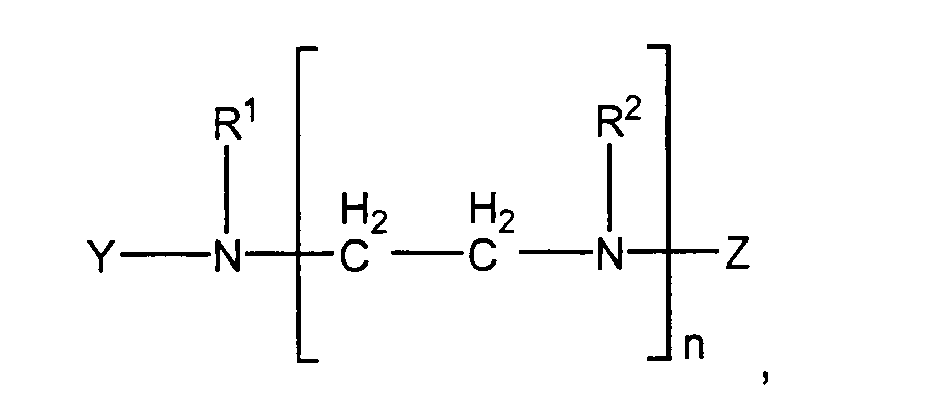
R1, R2, and Y are, independently, an alkyl group having from one to three carbon atoms or ―CH2CH2OH;
Z is ―CH2CH2OH; and
n is an integer from 3 to 7, inclusive.
The present invention also provides a method for catalyzing the reaction between at least one isocyanate compound and at least one active hydrogen-containing compound, such as a polyol and/or a blowing agent. - The present invention provides a method for making polyurethane foams using tertiary amine catalyst compositions containing primary hydroxyl functionality. One aspect of the present invention encompasses producing polyurethane foams by contacting at least one isocyanate compound, at least one polyol compound, at least one blowing agent, and at least one tertiary amine catalyst composition. Another aspect of the present invention comprises a method for catalyzing the reaction between at least one isocyanate compound and at least one active hydrogen-containing compound, such as a polyol and/or a blowing agent.
- Catalyst compositions in accordance with the present invention catalyze the reaction between an isocyanate and an active hydrogen-containing compound. The active hydrogen-containing compound can be, for example, an alcohol, a polyol, an amine, or water. Accordingly, the catalyst composition can promote, among other reactions, the gelling reaction of polyols with isocyanate to produce polyurethane, the blowing reaction of water with isocyanate to release carbon dioxide, or both reactions. In one aspect of the present invention, the catalyst compositions of the present invention effectively promote the blowing reaction of water with isocyanate.
- In one aspect of the present invention, the tertiary amine catalyst composition has the general formula

R1, R2, and Y are, independently, an alkyl group having from one to three carbon atoms or ―CH2CH2OH;
Z is ―CH2CH2OH; and
n is an integer from 3 to 7, inclusive.
In another aspect of the present invention, R1 and R2 are methyl groups, Y is a methyl group or ―CH2CH2OH, and n is an integer from 3 to 7, inclusive. - Catalyst compositions in accordance with the present invention can be prepared by methods generally known in the art, for example, by reacting ethylene oxide with an amine such as triethylenetetramine (TETA), tetraethylenepentamine (TEPA), or pentaethylenehexamine (PEHA). The unreacted amine may be removed by distillation. The distilled product is reacted with formaldehyde and pressurized hydrogen at approximately 60-120 °C in the presence of a metal catalyst such as 5% palladium on carbon.
- Examples of tertiary amine catalyst compositions of this invention include, but are not limited to
N-(2-hydroxyethyl)-N, N',N",N"', N''' pentamethyltriethylenetetramine;
N'-(2-hydroxyethyl)-N, N, N",N"', N'" pentamethyltriethylenetetramine;
N,N'-bis-(2-hydroxyethyl)-N,N",N"', N''' tetramethyltriethylenetetramine;
N,N"-bis-(2-hydroxyethyl)-N, N', N''',N''' tetramethyltriethylenetetramine;
N,N'''-bis-(2-hydroxyethyl)-N,N',N",N''' tetramethyltriethylenetetramine;
N-(2-hydroxyethyl)-N,N',N",N''',N'''', N'''' hexamethyltetraethylenepentamine;
N'-(2-hydroxyethyl)-N, N, N",N"',N"", N'''' hexamethyltetraethylenepentamine;
N"-(2-hydroxyethyl)-N, N, N',N''',N'''', N'''' hexamethyltetraethylenepentamine;
N'''-(2-hydroxyethyl)-N, N, N',N",N'''', N'''' hexamethyltetraethylenepentamine;
or any combination thereof.
A catalytically effective amount of the catalyst composition may be used in the polyurethane formulation. In one aspect, suitable amounts of the catalyst composition may range from about 0.01 to about 10 parts catalyst composition per 100 parts polyol by weight (pphp) in the polyurethane formulation, or from about 0.05 to about 2 pphp. In another aspect, the ratio of the polyol to the catalyst composition ranges from about 10:1 to about 200:1. In yet another aspect, the ratio of the blowing agent to the catalyst composition ranges from about 1:1 to about 9:1. - As compared to structurally-related catalysts containing secondary hydroxyl functionality, catalyst compositions of the present invention more effectively promote the isocyanate gelling and blowing reactions, are better immobilized in the polyurethane matrix, and have lower vapor pressures. The hydroxyl functionality of the catalyst composition enables the catalyst compositions to react with, and be immobilized into, the polyurethane matrix during and after polymerization.
- The prior art discusses tertiary amine catalysts containing primary hydroxyl functionality where n < 3, but discloses that such catalysts are characterized by lower catalytic activity and higher amine emissions than structurally related catalysts containing secondary hydroxyl functionality. Though not wishing to be bound by theory, the improved properties of the catalysts of the present invention may be attributable to the ability of the higher ethylenediamine backbone (n ≥ 3) amine catalyst to form a chemical adduct with water.
- Polyurethanes are produced from the polymerization reaction of organic isocyanate compounds with polyol hydroxyl groups. Polyols suitable for use in the present invention include, but are not limited to, polyalkylene ether polyols and polyester polyols. Polyalkylene ether polyols include poly(alkylene oxide) polymers such as poly(ethylene oxide) and poly(propylene oxide) polymers and copolymers with terminal hydroxyl groups derived from polyhydric compounds, including diols and triols; for example, ethylene glycol, propylene glycol, 1,3-butane diol, 1,4-butane diol, 1,6-hexane diol, neopentyl glycol, diethylene glycol, dipropylene glycol, pentaerythritol, glycerol, diglycerol, trimethylol propane, and similar low molecular weight polyols.
- In one aspect of the present invention, a single high molecular weight polyether polyol may be used. Alternatively, a mixture of high molecular weight polyether polyols, for example, mixtures of di- and tri-functional materials and/or different molecular weight or different chemical composition materials may be used. Such di- and tri-functional materials include, but are not limited to, ethyleneglycol, polyethyleneglycol, propyleneglycol, polypropyleneglycol, glycerine, glycerine-based polyether triols, trimethylolpropane, trimethylolpropane-based polyether triols, 1,3-butane diol, 1,4-butane diol, 1,6-hexane diol, neopentyl glycol, or any combination thereof.
- Useful polyester polyols include, but are not limited to, those produced by reacting a dicarboxylic acid with an excess of a diol, for example, adipic acid with ethylene glycol or butanediol, or reaction of a lactone with an excess of a diol such as caprolactone with propylene glycol.
- In addition to polyalkylene ether polyols and polyester polyols, polymer polyols are also suitable for use in the present invention. Polymer polyols are used in polyurethane foams to increase the foam's resistance to deformation, for example, to improve the load-bearing properties of the foam. Examples of polymer polyols include, but are not limited to, graft polyols or polyurea modified polyols (Polyharnstoff Dispersion polyols). Graft polyols comprise a triol in which vinyl monomers are graft copolymerized. Suitable vinyl monomers include, for example, styrene, or acrylonitrile. A polyurea modified polyol, is a polyol containing a polyurea dispersion formed by the reaction of a diamine and a diisocyanate in the presence of a polyol. A variant of polyurea modified polyols are polyisocyanate poly addition (PIPA) polyols, which are formed by the in situ reaction of an isocyanate and an alkanolamine in a polyol. Depending upon the load-bearing requirements, polymer polyols may comprise from about 20 to about 80 percent by weight of the total polyol content.
- Polyurethane foams are typically produced from the reaction of isocyanates with a polyol in the presence of a blowing agent to produce voids in the polyurethane matrix during polymerization. Suitable blowing agents include, for example, inert compounds with low boiling points which are vaporized during the exothermic polymerization reaction. Such blowing agents are generally inert compounds that do not decompose or react during the polymerization reaction. The reaction exotherm is generally sufficient to vaporize the blowing agent, which then becomes entrapped in the polyurethane matrix, resulting in the formation of voids or cells. Optionally, additional heat can be added during the reaction to promote vaporization of the blowing agent. Examples of such blowing agents include, but are not limited to, chlorofluorocarbons, hydrogenated fluorocarbons, hydrogenated chlorofluorocarbons, and low-boiling hydrocarbons such as cyclopentane, isopentane, or n-pentane, or any combination thereof.
- A preferred blowing agent is water. Catalyst compositions of the present invention are useful for catalyzing the reaction of isocyanates with water to produce carbon dioxide. As the carbon dioxide gas is produced, it becomes trapped in the polyurethane matrix, forming voids or cells.
- In one aspect, this invention encompasses a method for producing a polyurethane foam comprising reacting at least one isocyanate compound, at least one polyol compound, at least one blowing agent, at least one tertiary amine catalyst composition, and optionally, at least one auxiliary component. In another aspect, the present invention provides a method for catalyzing the reaction between at least one isocyanate compound, at least one active hydrogen-containing compound, and optionally, at least one auxiliary component.
- Examples of auxiliary components include, but are not limited to, cell stabilizers, crosslinking agents, chain extenders, pigments, fillers, flame retardants, auxiliary gelling catalysts, auxiliary blowing catalysts, transition metal catalysts, or any combination thereof.
- Cell stabilizers may include, for example, silicon surfactants or anionic surfactants. Examples of suitable silicon surfactants include, but are not limited to, polyalkylsiloxane, polyoxyalkylene polyol-modified dimethylpolysiloxane, alkylene glycol-modified dimethylpolysiloxane, or any combination thereof. Suitable anionic surfactants include, but are not limited to, salts of fatty acids, salts of sulfuric acid esters, salts of phosphoric acid esters, sulfonates, or any combination thereof.
- Suitable crosslinking agents include, but are not limited to, low-molecular compounds having at least two groups selected from a hydroxyl group, a primary amino group, a secondary amino group, or other active hydrogen-containing groups which are reactive with an isocyanate group. Crosslinking agents include, for example, polyhydric alcohols, polyamines, or any combination thereof. Non-limiting examples of suitable polyhydric alcohols include ethylene glycol, diethylene glycol, propylene glycol, dipropylene glycol, 1,4-butanediol, 1,6-hexanediol, neopentyl glycol, glycerol, trimethylolpropane, or any combination thereof. Non-limiting examples of polyamine crosslinking agents include diethyltoluenediamine, chlorodiaminobenzene, diethanolamine, diisopropanolamine, triethanolamine, tripropanolamine, 1,6-hexanediamine, or any combination thereof.
- Examples of chain extenders include, but are not limited to, compounds having hydroxyl or amino functional group, such as glycols, amines, diols, and water. Further non-limiting examples of chain extenders include ethylene glycol, propylene glycol, 1,4-butanediol, 1,3-butanediol, 1,5-pentanediol, 1,6-hexanediol, 1,10-decanediol, 1,12-dodecanediol, ethoxylated hydroquinone, 1,4-cyclohexanediol, N-methylethanolamine, N-methylisopropanolamine, 4-aminocyclo-hexanol, 1,2-diaminoethane, 2,4-toluenediamine, or any mixture thereof.
- Pigments may be used to color code the polyurethane foams during manufacture, to identify product grade, or to conceal yellowing. Pigments may include any suitable organic or inorganic pigments. For example, organic pigments or colorants include, but are not limited to, azo/diazo dyes, phthalocyanines, dioxazines, or carbon black. Examples of inorganic pigments include, but are not limited to, titanium dioxide, iron oxides, or chromium oxide. Fillers may be used to increase the density and load bearing properties of polyurethane foams. Suitable fillers include, but are not limited to, barium sulfate or calcium carbonate. Flame retardants can be used to reduce the flammability of polyurethane foams. For example, suitable flame retardants include, but are not limited to, chlorinated phosphate esters, chlorinated paraffins, or melamine powders.
- Auxiliary gelling catalysts may include, but are not limited to, diazabicyclooctane (triethylenediamine), supplied commercially as DABCO 33-LV® catalyst by Air Products and Chemicals, Inc.; quinuclidine and substituted quinuclidines; substituted pyrrolidines or pyrrolizidines; or N,N-dimethylaminoalkyl ureas and similar blends, supplied commercially, for example, as DABCO® NE1070, DABCO® NE1060, DABCO® NE200, DABCO® NE400, DABCO® NE500, and DABCO® NE600.
- Non-limiting examples of suitable auxiliary blowing catalysts include, bis-dimethylaminoethyl ether, commercially supplied as DABCO® BL-11 catalyst by Air Products and Chemicals, Inc.; pentamethyl-diethylenetriamine and related compositions; higher permethylated polyamines; 2-[N-(dimethylaminoethoxyethyl)-N-methylamino]ethanol and related structures; alkoxylated polyamines; imidazole-boron compositions; or amino propyl-bis(amino-ethyl)ether compositions. Catalysts compositions in accordance with the present invention may also be used in combination with transition metal catalysts, such as organotin catalysts.
- Polyurethane foams produced in accordance with the present invention are prepared by reacting any suitable organic isocyanate compounds with any suitable polyol compounds in the presence of one or more suitable blowing agents, as described in the art. Organic isocyanate compounds include, but are not limited to, hexamethylene diisocyanate (HDI), phenylene diisocyanate (PDI), toluene diisocyanate (TDI), and 4,4'-diphenylmethane diisocyanate (MDI). In one aspect of the invention, 2,4-TDI, 2,6-TDI, or any mixture thereof is used to produce polyurethane foams. Other suitable isocyanate compounds are mixtures of diisocyanates known commercially as "crude MDI", marketed as PAPI by Dow Chemical Company, which contains about 60% of 4,4'-diphenylmethane diisocyanate along with other isomeric and analogous higher polyisocyanates. Also suitable are "prepolymers" of these isocyanate compounds, comprising a partially prereacted mixture of a polyisocyanate and a polyether or polyester polyol.
- Polyurethane foams produced using prior art tertiary amine catalysts containing primary hydroxyl functionality have poor physical properties as compared to foams produced with structurally related catalysts containing secondary hydroxyl functionality. In contrast, polyurethane foams produced using catalyst compositions of the present invention are comparable or superior to foams produced using structurally related catalysts containing secondary hydroxyl functionality. For example, polyurethane foams produced with a catalyst composition in accordance with the present invention have reduced odor and no amine emissions as compared to foams produced by structurally-related catalysts containing secondary hydroxyl functionality.
- A polyurethane foam produced in accordance with one aspect of the present invention, has an isocyanate index between about 70 and about 115 and comprises the following components by weight:
TABLE 1: Polyurethane Components Component Percent by Weight Polyol 20-100 Polymer polyol 0-80 Silicon surfactant 1-2.5 Blowing agent 2-4.5 Crosslinker 0.5-2 Catalyst composition 0.25-2 
- Although the present invention has been described as useful for preparing flexible polyurethane foams, the invention may also be employed to prepare semi-flexible and rigid polyurethane foams. Rigid polyurethane foams can be distinguished from flexible polyurethane foams by the presence of higher isocyanurate levels in the rigid foam. Flexible foams typically use polymer polyol as part of the overall polyol content in the foam composition, along with conventional triols of about 4000-5000 weight average molecular weight (Mw) and hydroxyl number (OH#) of about 28-35. In contrast, rigid polyurethane foam compositions use about 500-1000 Mw polyol with about 3-8 hydroxyl functionalities and OH# of about 160-700. Rigid foams can also be distinguished from the flexible foams by the isocyanate (NCO) index of the foam composition. Rigid foam compositions typically use a 100-300 NCO index whereas flexible foam compositions typically require a 70-115 NCO index.
- For making lamination (insulation board) and appliance foams, the NCO index is typically from about 100 to about 300. For making open cell foam, the NCO index is typically from about 100 to about 120, and the foam is usually all water blown. Semiflexible molded foams have been utilized for many applications in the automotive area. The major applications are instrument panels and interior trims. The two main components are the base polyol and copolymer polyol (CPP). The base polyol is utilized at levels between about 70-100 pphp. The molecular weight of base polyols ranges from about 4500 to about 6000 for triols and from about 2000 to about 4000 for diols. Ethylene-oxide-capped polyether polyols have replaced most polyester polyols as the base polyol. The primary hydroxyl content is usually greater than about 75 wt% and the capping range is typically about 10-20 wt%. The other major component is CPP, which is used at levels up to about 20 wt%. The base polyol and CPP are blended with low molecular weight cross-linkers to build hardness and promote faster demolding. The level of cross-linker varies depending on the hardness requirement of the finished part. Water levels are chosen to give free rise densities from about 3 to about 6 pounds. Cell openers are also utilized in semiflexible foams to reduce the internal foam pressure during the cure cycle and thus reduce pressure-relief voids and "parting lines". Adhesion promoters can be added, depending upon the quality of the vinyl skin, to improve the adhesion between the polyurethane foam and the vinyl skin. The use of the catalyst composition of the present invention can reduce the discoloration of the vinyl skin typically observed with conventional amine catalysts because the N―H group of the amide functionality can react with the isocyanate to form a covalent bond with the polyurethane polymer.
- As described in the examples below, the foams made with the reactive catalyst composition are of the same or superior quality as the foams made with the industry standard. Also, catalyst composition in accordance with the present invention provide the following advantages: low amine emissions in the finished polyurethane product; low tertiary amine catalyst vapor pressure, low odor of the finished polyurethane product, effective immobilization of the tertiary amine catalyst during and after polymerization, lower amine concentration in the finished polyurethane product, and optimum physical polyurethane foam properties.
- A sample of about 519 grams of commercially available triethylenetetramine (about 67 wt%) was charged into a one-liter stainless steel reactor equipped with a cooling and heating jacket, a stirrer, a syringe pump and FTIR. The amine was heated to about 50°C and pressurized with approximately 50 psig nitrogen. Ethylene oxide (about 170 g) was slowly added to the mixture and the product was allowed to stir for approximately one hour after addition, until the reaction was finished. The product was collected (about 639 g) and distilled under vacuum (20 mm Hg) to remove any unreacted amine. The crude ethoxylated product was dissolved in isopropanol and placed in the reactor together with 5% palladium on a carbon catalyst. The reactor was pressurized with hydrogen and heated up to about 90°C. Formalin (37% formaldehyde in water) was slowly added while the hydrogen pressure was monitored. At the end of the addition the reaction was kept at about 90°C for approximately one hour. The product was filtered and isopropanol and water were removed from the product by distillation to yield a mixture containing NN-[2-hydroxyethyl]-N, N', N",N''',N''' pentamethyltriethylenetetramine.
- A sample of about 500 grams of commercially available triethylenetetramine (about 67 wt%) was charged into a one-liter stainless steel reactor equipped with a cooling and heating jacket, a stirrer, a syringe pump and FTIR. The amine was heated to about 80°C and propylene oxide (about 187 g) was slowly added to the mixture. The product was allowed to stir for approximately one hour after addition, until the reaction was completed. The product was collected and distilled under vacuum (20 mm Hg) to remove any unreacted amine. The product mixture was dissolved in methanol and placed in the reactor together with 5 % palladium on carbon catalyst. The reactor was pressurize with hydrogen and heated up to about 90°C. Formalin (37% formaldehyde in water) was slowly added while the hydrogen pressure was monitored. At the end of the addition the reaction was kept at about 90°C for approximately one hour. The product was filtered and methanol and water were removed from the product by distillation to yield a mixture containing N-[2-hydroxypropyl]-N,N',N",N''',N''' pentamethyltriethylenetetramine.
- Two foams were prepared. Foam A was prepared using the catalyst of Example 1 (a mixture comprising, in major part, N-[2-hydroxyethyl]-N,N',N",N''',N''' pentamethyltriethylenetetramine) and Foam B was prepared using the catalyst of Example 2 (a mixture comprising, in major part, N-[2-hydroxypropyl]-N,N',N",N''',N''' pentamethyltriethylenetetramine).
- For each foam, the catalyst was added to about 192 g of the premix (described in Table 2) in a 32 oz (951 mL) paper cup. The formulation was mixed for about 10 seconds at about 6,000 RPM using an overhead stirrer fitted with a 2 inch (5.1 cm) diameter stirring paddle.
Table 2: Premix Components (Example 3) Component Percent by Weight Polyol 1 50 Polyol 2 50 Water 2.34 Silicon surfactant 0.75 DABCO 33-LV® 0.25 DABCO® BL-11 0.10 Crosslinker 1.76 - Toluene diisocyanate was added in an amount sufficient to produce a foam with an NCO index of approximately 100. The formulation was mixed well for about 6 seconds at about 6,000 RPM using the same stirrer. The 32 oz cup was dropped through a hole in the bottom of a 128 oz (3804 mL) paper cup on a stand. The hole was sized to catch the lip of the 32 oz cup. The total combined volume of the paper cups was about 160 oz (4755 ml). Foams approximated this volume at the end of the foaming process. Maximum foam height was recorded. A comparison of the properties of Foam A and Foam B is presented below in Tables 3 and 4.
Table 3: Foam Comparison (Example 3) PARAMETER FOAM A FOAM B Amount of catalyst (pphp) 0.20 0.20 Amount of DABCO® NE10601 (pphp) 0.70 0.70 Cream (sec) 8.10 8.20 Cup 1 (sec) 14.90 14.30 String gel (sec) 66.40 66.50 Full rise (mm) 124 127 Full height (mm) 274.7 272.3 1DABCO® NE1060 is a commercially available catalyst supplied by Air Products & Chemicals, Inc. Table 4: Foam Comparison (Example 3) PARAMETER FOAM A FOAM B Amount of catalyst (pphp) 0.20 0.20 Amount of catalyst (moles x 103) 0.76 0.73 Catalyst molecular weight (M w ) 260 274 Mixing time (sec) 4 4 Test time (sec) 180 180 Rise height (mm) 269.3 266.9 Rise time (sec) 85.10 88.30 Maximum height (mm) 274.8 272.4 Final height (mm) 271.3 269.4 Shrinkage (%) 1.30 1.10 - As shown in Tables 3 and 4, N-[2-hydroxyethyl]-N,N',N",N''',N''' pentamethyltriethylenetetramine (a tertiary amine containing primary hydroxyl functionality) and N-[2-hydroxypropyl]-N,N',N",N''',N''' pentamethyltriethylenetetramine (a tertiary amine containing secondary hydroxyl functionality) produce foams with comparable properties when the catalysts are used in comparable amounts. Furthermore, foam appearance and percent shrinkage were essentially identical, showing that catalyst compositions of the present invention do not exhibit either diminished reactivity as compared to a structurally-related catalyst containing secondary hydroxyl functionality or dimished foam quality as compared to a foam produced by a structurally-related catalyst containing secondary hydroxyl functionality.
- Foam A' and Foam B' were prepared as in Example 4, but with higher levels of catalyst composition. As in Example 3, the foams produced using N-[2-hydroxyethyl]-N,N',N",N''',N''' pentamethyltriethylenetetramine (a tertiary amine containing primary hydroxyl functionality) and N-[2-hydroxypropyl]-N,N',N",N''',N''' pentamethyltriethylenetetramine (a tertiary amine containing secondary hydroxyl functionality) exhibited similar properties. See Tables 5 and 6.
Table 5: Foam Comparison (Example 4) PARAMETER FOAM A' FOAM B' Amount of catalyst (pphp) 0.25 0.25 Amount of DABCO® NE1060 (pphp) 0.70 0.70 Cream (sec) 8.30 8.20 Cup 1 (sec) 13.90 14.30 String gel (sec) 65.70 66.30 Full rise (mm) 111.0 116.0 Full height (mm) 279.1 276.0 Table 6: Foam Comparison (Example 4) PARAMETER FOAM A' FOAM B' Amount of catalyst (pphp) 0.25 0.25 Amount of catalyst (moles x 103) 0.95 0.91 Catalyst molecular weight (M w ) 260 274 Mixing time (sec) 4 4 Test time (sec) 180 180 Rise height (mm) 273.6 270.6 Rise time (sec) 82.4 86.0 Maximum height (mm) 279.2 276.1 Final height (mm) 275.6 273.4 Shrinkage (%) 1.30 1.00
Claims (24)
- A method to produce a foamed polyurethane comprising contacting(a) at least one organic isocyanate compound;(b) at least one polyol;(c) at least one blowing agent; and(d) at least one tertiary amine catalyst compound having the general formula
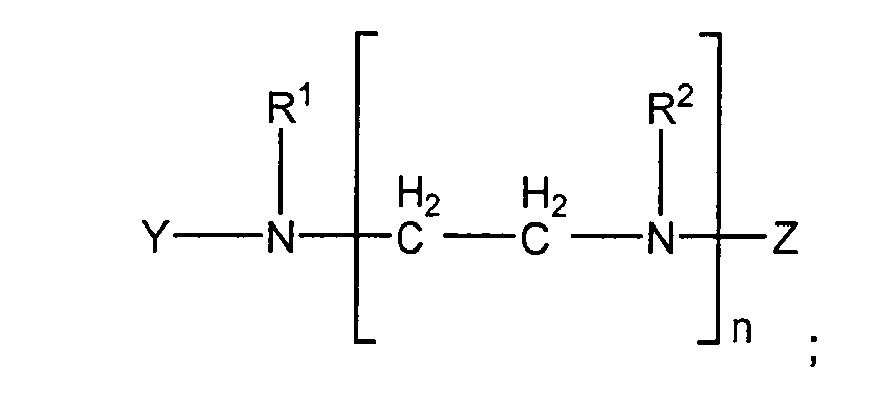
R1, R2, and Y are, independently, an alkyl group having from one to three carbon atoms or ―CH2CH2OH;
Z is ―CH2CH2OH; and
n is an integer from 3 to 7, inclusive. - A method according to Claim 1, wherein R1 and R2 are methyl groups, Y is a methyl group or ―CH2CH2OH, and n is an integer from 3 to 7, inclusive.
- A method according to Claim 1, wherein the organic isocyanate compound is hexamethylene diisocyanate, phenylene diisocyanate, toluene diisocyanate, 4,4'-diphenylmethane diisocyanate, or any combination thereof.
- A method according to Claim 3, wherein the organic isocyanate compound is 2,4-toluene diisocyanate, 2,6-toluene diisocyanate, or any combination thereof.
- A method according to Claim 1, wherein the polyol is selected from at least one polyalkylene ether polyol, at least one polyester polyol, at least one polymer polyol, or any combination thereof.
- A method according to Claim 5, wherein the polyalkylene ether polyol is a poly(ethylene oxide) or poly(propylene oxide) polymer or copolymer with a terminal hydroxyl group.
- A method according to Claim 6, wherein the polyalkylene ether polyol is ethylene glycol, propylene glycol, 1,3-butane diol, 1,4-butane diol, 1,6-hexane diol, neopentyl glycol, diethylene glycol, dipropylene glycol, pentaerythritol, glycerol, diglycerol, trimethylol propane, or any combination thereof.
- A method according to Claim 1, wherein the ratio of the polyol to the catalyst composition ranges from about 10:1 1 to about 200:1.
- A method according to Claim 1, wherein the ratio of the blowing agent to the catalyst composition ranges from about 1:1 to about 9:1.
- A method according to Claim 1, wherein the blowing agent is water.
- A method according to Claim 1, wherein the tertiary amine catalyst compound is
N-(2-hydroxyethyl)-N, N',N",N''',N''' pentamethyltriethylenetetramine;
N'-(2-hydroxyethyl)-N, N, N",N''',N''' pentamethyltriethylenetetramine;
N,N'-bis-(2-hydroxyethyl)-N,N",N''',N''' tetramethyltriethylenetetramine;
N,N"-bis-(2-hydroxyethyl)-N, N', N''',N''' tetramethyltriethylenetetramine;
N,N'''-bis-(2-hydroxyethyl)-N,N',N",N''' tetramethyltriethylenetetramine;
N-(2-hydroxyethyl)-N,N',N",N"',N"", N"" hexamethyltetraethylenepentamine;
N'-(2-hydroxyethyl)-N, N, N",N''',N'''',N'''' hexamethyltetraethylenepentamine;
N"-(2-hydroxyethyl)-N, N, N',N''',N'''',N'''' hexamethyltetraethylenepentamine;
N"'-(2-hydroxyethyl)-N, N, N',N",N'''',N'''' hexamethyltetraethylenepentamine; or any combination thereof. - A method according to Claim 1, further comprising contacting (a), (b), (c), and (d) with at least one cell stabilizer, at least one crosslinking agent, at least one chain extender, at least one pigment, at least one filler, at least one flame retardant, at least one auxiliary gelling catalyst, at least one auxiliary blowing catalyst, at least one transition metal catalyst, or any combination thereof.
- A method according to Claim 12, wherein the cell stabilizer is a silicon surfactant, an anionic surfactant, or any combination thereof.
- A method according to Claim 13, wherein the silicon surfactant is polyalkylsiloxane, polyoxyalkylene polyol-modified dimethylpolysiloxane, alkylene glycol-modified dimethylpolysiloxane, or any combination thereof.
- A method according to Claim 13, wherein the anionic surfactant is a salt of a fatty acid, a salt of a sulfuric acid ester, a salt of a phosphoric acid ester, a sulfonate, or any combination thereof.
- A method according to Claim 12, wherein the crosslinking agent is a polyhydric alcohol, a polyamine, or any combination thereof.
- A method according to Claim 16, wherein the polyhydric alcohol is ethylene glycol, diethylene glycol, propylene glycol, dipropylene glycol, 1,4-butanediol, 1,6-hexanediol, neopentyl glycol, glycerol, trimethylolpropane, or any combination thereof.
- A method according to Claim 16, wherein the polyamine is diethyltoluenediamine, chlorodiaminobenzene, diethanolamine, diisopropanolamine, triethanolamine, tripropanolamine, 1,6-hexanediamine, or any combination thereof.
- A method according to Claim 12, wherein the chain extender is a glycol, an amine, a diol, water, or any combination thereof.
- A method according to Claim 19, wherein the chain extender is ethylene glycol, propylene glycol, 1,4-butanediol, 1,3-butanediol, 1,5-pentanediol, 1,6-hexanediol, 1,10-decanediol, 1,12-dodecanediol, ethoxylated hydroquinone, 1,4-cyclohexanediol, N-methylethanolamine, N-methylisopropanolamine, 4-aminocyclo-hexanol, 1,2-diaminoethane, 2,4-toluenediamine, or any combination thereof.
- A method according to Claim 12, wherein the auxiliary gelling catalyst is diazabicyclooctane (triethylenediamine), quinuclidine, a substituted quinuclidine, a substituted pyrrolidine, a substituted pyrrolizidine, an N,N-dimethylaminoalkyl urea, or any combination thereof.
- A method according to Claim 12, wherein the auxiliary blowing catalyst is bis-dimethylaminoethyl ether, pentamethyl-diethylenetriamine, a higher permethylated polyamine, 2-[N-(dimethylaminoethoxyethyl)-N-methylamino]ethanol, an alkoxylated polyamine, an imidazole-boron composition, an amino propyl-bis(amino-ethyl)ether composition, or any combination thereof.
- A method to catalyze the reaction between an organic isocyanate compound and an active hydrogen-containing compound comprising contacting(a) at least one organic isocyanate compound;(b) at least one active hydrogen-containing compound; and(c) at least one tertiary amine catalyst compound having the general formula

R1, R2, and Y are, independently, an alkyl group having from one to three carbon atoms or -CH2CH2OH;
Z is -CH2CH2OH; and
n is an integer from 3 to 7, inclusive. - A method according to Claim 23, wherein the active hydrogen-containing compound is an alcohol, a polyol, an amine, or water.
Applications Claiming Priority (1)
| Application Number | Priority Date | Filing Date | Title |
|---|---|---|---|
| US11/108,958 US20060235098A1 (en) | 2005-04-19 | 2005-04-19 | Polyurethane foams made with blowing catalyst compositions containing primary hydroxyl groups and high ethylenediamine backbones |
Publications (2)
| Publication Number | Publication Date |
|---|---|
| EP1714989A1 true EP1714989A1 (en) | 2006-10-25 |
| EP1714989B1 EP1714989B1 (en) | 2008-09-03 |
Family
ID=36686098
Family Applications (1)
| Application Number | Title | Priority Date | Filing Date |
|---|---|---|---|
| EP06008012A Expired - Lifetime EP1714989B1 (en) | 2005-04-19 | 2006-04-18 | Polyurethane foams made with blowing catalyst compositions containing primary hydroxyl groups and high ethylenediamine backbones |
Country Status (8)
| Country | Link |
|---|---|
| US (2) | US20060235098A1 (en) |
| EP (1) | EP1714989B1 (en) |
| JP (1) | JP4291336B2 (en) |
| KR (1) | KR100699299B1 (en) |
| CN (1) | CN1854163B (en) |
| AT (1) | ATE407160T1 (en) |
| BR (1) | BRPI0601355A (en) |
| DE (1) | DE602006002539D1 (en) |
Families Citing this family (12)
| Publication number | Priority date | Publication date | Assignee | Title |
|---|---|---|---|---|
| DE102008019017B3 (en) * | 2008-04-15 | 2009-12-31 | Mankiewicz Gebr. & Co. Gmbh & Co Kg | Curable compositions containing color indicators for indicating the curing progress and methods for indicating the curing progress of these curable compositions |
| JP5561951B2 (en) * | 2009-04-16 | 2014-07-30 | アキレス株式会社 | Packing material for lighting equipment made of flexible polyurethane foam |
| US9725555B2 (en) * | 2010-09-09 | 2017-08-08 | Innovative Urethane, Llc | Sugar-based polyurethanes, methods for their preparation, and methods of use thereof |
| US9676896B2 (en) | 2010-09-09 | 2017-06-13 | Innovative Urethane, Llc | Sugar-based polyurethanes, methods for their preparation, and methods of use thereof |
| EP2646489B1 (en) * | 2010-11-29 | 2018-07-04 | Huntsman Corporation Hungary ZRt. | Blowing catalyst |
| US9447223B2 (en) * | 2011-07-07 | 2016-09-20 | Air Products And Chemicals, Inc. | Additives for improving natural oil based polyurethane foam performance |
| US10266635B2 (en) * | 2012-07-27 | 2019-04-23 | Basf Se | Polyurethane foams comprising phosphorus compounds |
| US10323116B2 (en) * | 2013-03-15 | 2019-06-18 | Imperial Sugar Company | Polyurethanes, polyurethane foams and methods for their manufacture |
| CN106164117B (en) * | 2014-06-27 | 2020-01-17 | 亨斯迈石油化学有限责任公司 | Pyrrolidine-based catalysts for polyurethane materials |
| BR112017025328A2 (en) * | 2015-06-19 | 2018-07-31 | Dow Global Technologies Llc | autocatalytic polyol useful for making polyurethane foam |
| US10279515B2 (en) * | 2016-02-18 | 2019-05-07 | Covestro Llc | Processes for producing flexible polyurethane foam laminates and laminates produced thereby |
| CA3190397A1 (en) * | 2020-08-27 | 2022-03-03 | Nicholas David Orf | Materials, methods, devices and systems for insulating cavities of buildings with foam insulation |
Citations (3)
| Publication number | Priority date | Publication date | Assignee | Title |
|---|---|---|---|---|
| US4026840A (en) * | 1975-06-09 | 1977-05-31 | Air Products And Chemicals, Inc. | Hydroxyalkyl tertiary amine catalysts for isocyanate reactions |
| US5508314A (en) * | 1994-02-18 | 1996-04-16 | Air Products And Chemicals, Inc. | Hydroxyl group-containing blowing catalyst compositions for the production of polyurethanes |
| US20020016376A1 (en) * | 2000-06-20 | 2002-02-07 | Oliver Eyrisch | Use of reactive amines for the preparation of polyurethane foams |
Family Cites Families (14)
| Publication number | Priority date | Publication date | Assignee | Title |
|---|---|---|---|---|
| US4246360A (en) * | 1977-07-22 | 1981-01-20 | Monsanto Company | Fire retardant, non-dripping flexible polyurethane foam |
| US4338408A (en) * | 1981-07-20 | 1982-07-06 | Texaco Inc. | Polyurethanes using bis(aminoethyl)ether derivatives as catalysts |
| JP2876018B2 (en) * | 1988-12-28 | 1999-03-31 | 三井化学株式会社 | Method for producing urethane foam |
| JPH0739456B2 (en) | 1991-07-03 | 1995-05-01 | 東ソー株式会社 | Amine catalyst composition for producing polyurethane and method for producing polyurethane |
| JPH0747619B2 (en) * | 1990-07-30 | 1995-05-24 | 東ソー株式会社 | Amine catalyst for producing polyurethane and method for producing polyurethane |
| US5229430A (en) * | 1990-07-30 | 1993-07-20 | Tosoh Corporation | Amine catalyst for producing polyurethane and process for producing polyurethane |
| US5559161A (en) * | 1994-02-18 | 1996-09-24 | Air Products And Chemicals, Inc. | Hydroxy-functional triamine catalyst compositions for the production of polyurethanes |
| US5633293A (en) * | 1995-11-30 | 1997-05-27 | Air Products And Chemicals, Inc. | Hydroxy-functional triamine catalyst compositions for polyurethane production |
| DE19859776B4 (en) * | 1998-12-23 | 2008-06-19 | Basf Se | Process for the preparation of amines |
| DE19962911C2 (en) * | 1999-12-23 | 2002-11-21 | Bayer Ag | Flame-retardant HR cold molded foam with reduced flue gas intensity and toxicity |
| EP1262500B1 (en) * | 2001-05-22 | 2015-12-30 | Tosoh Corporation | Catalyst for production of a polyurethane resin and method for producing a polyurethane resin |
| DE60220591T2 (en) * | 2001-07-02 | 2008-02-14 | Tosoh Corp., Shinnanyo | Process for producing a rigid polyurethane foam |
| EP1312630B1 (en) * | 2001-10-31 | 2012-12-12 | Tosoh Corporation | Process for the production of flexible polyurethane foams |
| US6710096B2 (en) * | 2002-07-22 | 2004-03-23 | Basf Corporation | Polyether polyol for foam applications |
-
2005
- 2005-04-19 US US11/108,958 patent/US20060235098A1/en not_active Abandoned
-
2006
- 2006-04-12 BR BRPI0601355-4A patent/BRPI0601355A/en not_active IP Right Cessation
- 2006-04-14 KR KR1020060034121A patent/KR100699299B1/en not_active Expired - Fee Related
- 2006-04-18 EP EP06008012A patent/EP1714989B1/en not_active Expired - Lifetime
- 2006-04-18 JP JP2006114371A patent/JP4291336B2/en not_active Expired - Lifetime
- 2006-04-18 AT AT06008012T patent/ATE407160T1/en not_active IP Right Cessation
- 2006-04-18 DE DE602006002539T patent/DE602006002539D1/en not_active Expired - Lifetime
- 2006-04-19 CN CN2006100737920A patent/CN1854163B/en not_active Expired - Fee Related
-
2010
- 2010-05-27 US US12/788,667 patent/US9309346B2/en not_active Expired - Fee Related
Patent Citations (3)
| Publication number | Priority date | Publication date | Assignee | Title |
|---|---|---|---|---|
| US4026840A (en) * | 1975-06-09 | 1977-05-31 | Air Products And Chemicals, Inc. | Hydroxyalkyl tertiary amine catalysts for isocyanate reactions |
| US5508314A (en) * | 1994-02-18 | 1996-04-16 | Air Products And Chemicals, Inc. | Hydroxyl group-containing blowing catalyst compositions for the production of polyurethanes |
| US20020016376A1 (en) * | 2000-06-20 | 2002-02-07 | Oliver Eyrisch | Use of reactive amines for the preparation of polyurethane foams |
Also Published As
| Publication number | Publication date |
|---|---|
| CN1854163A (en) | 2006-11-01 |
| EP1714989B1 (en) | 2008-09-03 |
| KR100699299B1 (en) | 2007-03-26 |
| DE602006002539D1 (en) | 2008-10-16 |
| CN1854163B (en) | 2010-06-16 |
| JP4291336B2 (en) | 2009-07-08 |
| BRPI0601355A (en) | 2006-12-26 |
| US9309346B2 (en) | 2016-04-12 |
| US20100240783A1 (en) | 2010-09-23 |
| JP2006299262A (en) | 2006-11-02 |
| KR20060110779A (en) | 2006-10-25 |
| US20060235098A1 (en) | 2006-10-19 |
| ATE407160T1 (en) | 2008-09-15 |
Similar Documents
| Publication | Publication Date | Title |
|---|---|---|
| US9309346B2 (en) | Polyurethane foams made with blowing catalyst compositions containing primary hydroxyl groups and high ethylenediamine backbones | |
| US6201033B1 (en) | Reactive catalyst compositions for improving water blown polyurethane foam performance | |
| EP1534766B1 (en) | Process for preparing polyurethane foam | |
| EP1702913B1 (en) | Blowing catalyst compositions containing hydroxyl and surface active groups for the production of polyurethane foams | |
| US6737446B1 (en) | Tertiary amino alkyl amide catalysts for improving the physical properties of polyurethane foams | |
| US6998508B2 (en) | Tertiary alkanolamines containing surface active alkyl groups | |
| EP1038896A2 (en) | Amido functional amine catalysts for the production of polyurethanes | |
| US7169823B2 (en) | Tertiary alkanolamine polyurethane catalysts derived from long chain alkyl and fatty carboxylic acids | |
| EP1435364A2 (en) | Tertiary amino alkyl amide polyurethane catalysts derived from long chain alkyl or fatty carboxylic acids | |
| US5756557A (en) | Aminomethyl pyrrolidine urea compositions for the production of polyurethanes | |
| US6762211B1 (en) | Tertiary amino alkyl amide polyurethane catalysts derived from long chain alkyl and fatty carboxylic acids | |
| US6747069B1 (en) | Tertiary alkanolamine polyurethane catalysts derived from long chain alkyl and fatty carboxylic acids | |
| EP1435365B1 (en) | Tertiary amino alkyl amide catalysts for improving the physical properties of polyurethane foams | |
| EP1457480B1 (en) | Tertiary alkanolamines containing surface active alkyl groups | |
| MXPA06004207A (en) | Polyurethane foams made with blowing catalyst compositions containing primary hydroxyl groups and high ethylenediamine backbones | |
| MXPA98003525A (en) | Compositions of aminometil pyrrolidine urea parala polyurette production |
Legal Events
| Date | Code | Title | Description |
|---|---|---|---|
| PUAI | Public reference made under article 153(3) epc to a published international application that has entered the european phase |
Free format text: ORIGINAL CODE: 0009012 |
|
| AK | Designated contracting states |
Kind code of ref document: A1 Designated state(s): AT BE BG CH CY CZ DE DK EE ES FI FR GB GR HU IE IS IT LI LT LU LV MC NL PL PT RO SE SI SK TR |
|
| AX | Request for extension of the european patent |
Extension state: AL BA HR MK YU |
|
| 17P | Request for examination filed |
Effective date: 20061113 |
|
| 17Q | First examination report despatched |
Effective date: 20070205 |
|
| AKX | Designation fees paid |
Designated state(s): AT BE BG CH CY CZ DE DK EE ES FI FR GB GR HU IE IS IT LI LT LU LV MC NL PL PT RO SE SI SK TR |
|
| GRAP | Despatch of communication of intention to grant a patent |
Free format text: ORIGINAL CODE: EPIDOSNIGR1 |
|
| GRAS | Grant fee paid |
Free format text: ORIGINAL CODE: EPIDOSNIGR3 |
|
| GRAA | (expected) grant |
Free format text: ORIGINAL CODE: 0009210 |
|
| AK | Designated contracting states |
Kind code of ref document: B1 Designated state(s): AT BE BG CH CY CZ DE DK EE ES FI FR GB GR HU IE IS IT LI LT LU LV MC NL PL PT RO SE SI SK TR |
|
| REG | Reference to a national code |
Ref country code: GB Ref legal event code: FG4D |
|
| REG | Reference to a national code |
Ref country code: CH Ref legal event code: EP |
|
| REG | Reference to a national code |
Ref country code: IE Ref legal event code: FG4D |
|
| REF | Corresponds to: |
Ref document number: 602006002539 Country of ref document: DE Date of ref document: 20081016 Kind code of ref document: P |
|
| PG25 | Lapsed in a contracting state [announced via postgrant information from national office to epo] |
Ref country code: LT Free format text: LAPSE BECAUSE OF FAILURE TO SUBMIT A TRANSLATION OF THE DESCRIPTION OR TO PAY THE FEE WITHIN THE PRESCRIBED TIME-LIMIT Effective date: 20080903 Ref country code: NL Free format text: LAPSE BECAUSE OF FAILURE TO SUBMIT A TRANSLATION OF THE DESCRIPTION OR TO PAY THE FEE WITHIN THE PRESCRIBED TIME-LIMIT Effective date: 20080903 |
|
| PG25 | Lapsed in a contracting state [announced via postgrant information from national office to epo] |
Ref country code: FI Free format text: LAPSE BECAUSE OF FAILURE TO SUBMIT A TRANSLATION OF THE DESCRIPTION OR TO PAY THE FEE WITHIN THE PRESCRIBED TIME-LIMIT Effective date: 20080903 Ref country code: SI Free format text: LAPSE BECAUSE OF FAILURE TO SUBMIT A TRANSLATION OF THE DESCRIPTION OR TO PAY THE FEE WITHIN THE PRESCRIBED TIME-LIMIT Effective date: 20080903 Ref country code: ES Free format text: LAPSE BECAUSE OF FAILURE TO SUBMIT A TRANSLATION OF THE DESCRIPTION OR TO PAY THE FEE WITHIN THE PRESCRIBED TIME-LIMIT Effective date: 20081214 Ref country code: AT Free format text: LAPSE BECAUSE OF FAILURE TO SUBMIT A TRANSLATION OF THE DESCRIPTION OR TO PAY THE FEE WITHIN THE PRESCRIBED TIME-LIMIT Effective date: 20080903 Ref country code: LV Free format text: LAPSE BECAUSE OF FAILURE TO SUBMIT A TRANSLATION OF THE DESCRIPTION OR TO PAY THE FEE WITHIN THE PRESCRIBED TIME-LIMIT Effective date: 20080903 |
|
| NLV1 | Nl: lapsed or annulled due to failure to fulfill the requirements of art. 29p and 29m of the patents act | ||
| PG25 | Lapsed in a contracting state [announced via postgrant information from national office to epo] |
Ref country code: BE Free format text: LAPSE BECAUSE OF FAILURE TO SUBMIT A TRANSLATION OF THE DESCRIPTION OR TO PAY THE FEE WITHIN THE PRESCRIBED TIME-LIMIT Effective date: 20080903 |
|
| PG25 | Lapsed in a contracting state [announced via postgrant information from national office to epo] |
Ref country code: BG Free format text: LAPSE BECAUSE OF FAILURE TO SUBMIT A TRANSLATION OF THE DESCRIPTION OR TO PAY THE FEE WITHIN THE PRESCRIBED TIME-LIMIT Effective date: 20081203 |
|
| PG25 | Lapsed in a contracting state [announced via postgrant information from national office to epo] |
Ref country code: PT Free format text: LAPSE BECAUSE OF FAILURE TO SUBMIT A TRANSLATION OF THE DESCRIPTION OR TO PAY THE FEE WITHIN THE PRESCRIBED TIME-LIMIT Effective date: 20090203 Ref country code: SK Free format text: LAPSE BECAUSE OF FAILURE TO SUBMIT A TRANSLATION OF THE DESCRIPTION OR TO PAY THE FEE WITHIN THE PRESCRIBED TIME-LIMIT Effective date: 20080903 Ref country code: RO Free format text: LAPSE BECAUSE OF FAILURE TO SUBMIT A TRANSLATION OF THE DESCRIPTION OR TO PAY THE FEE WITHIN THE PRESCRIBED TIME-LIMIT Effective date: 20080903 Ref country code: CZ Free format text: LAPSE BECAUSE OF FAILURE TO SUBMIT A TRANSLATION OF THE DESCRIPTION OR TO PAY THE FEE WITHIN THE PRESCRIBED TIME-LIMIT Effective date: 20080903 Ref country code: IS Free format text: LAPSE BECAUSE OF FAILURE TO SUBMIT A TRANSLATION OF THE DESCRIPTION OR TO PAY THE FEE WITHIN THE PRESCRIBED TIME-LIMIT Effective date: 20090103 |
|
| PLBE | No opposition filed within time limit |
Free format text: ORIGINAL CODE: 0009261 |
|
| STAA | Information on the status of an ep patent application or granted ep patent |
Free format text: STATUS: NO OPPOSITION FILED WITHIN TIME LIMIT |
|
| PG25 | Lapsed in a contracting state [announced via postgrant information from national office to epo] |
Ref country code: DK Free format text: LAPSE BECAUSE OF FAILURE TO SUBMIT A TRANSLATION OF THE DESCRIPTION OR TO PAY THE FEE WITHIN THE PRESCRIBED TIME-LIMIT Effective date: 20080903 Ref country code: EE Free format text: LAPSE BECAUSE OF FAILURE TO SUBMIT A TRANSLATION OF THE DESCRIPTION OR TO PAY THE FEE WITHIN THE PRESCRIBED TIME-LIMIT Effective date: 20080903 |
|
| 26N | No opposition filed |
Effective date: 20090604 |
|
| PG25 | Lapsed in a contracting state [announced via postgrant information from national office to epo] |
Ref country code: SE Free format text: LAPSE BECAUSE OF FAILURE TO SUBMIT A TRANSLATION OF THE DESCRIPTION OR TO PAY THE FEE WITHIN THE PRESCRIBED TIME-LIMIT Effective date: 20081203 |
|
| REG | Reference to a national code |
Ref country code: IE Ref legal event code: MM4A |
|
| PG25 | Lapsed in a contracting state [announced via postgrant information from national office to epo] |
Ref country code: MC Free format text: LAPSE BECAUSE OF NON-PAYMENT OF DUE FEES Effective date: 20090430 Ref country code: IE Free format text: LAPSE BECAUSE OF NON-PAYMENT OF DUE FEES Effective date: 20090418 |
|
| PG25 | Lapsed in a contracting state [announced via postgrant information from national office to epo] |
Ref country code: PL Free format text: LAPSE BECAUSE OF FAILURE TO SUBMIT A TRANSLATION OF THE DESCRIPTION OR TO PAY THE FEE WITHIN THE PRESCRIBED TIME-LIMIT Effective date: 20080903 |
|
| PG25 | Lapsed in a contracting state [announced via postgrant information from national office to epo] |
Ref country code: GR Free format text: LAPSE BECAUSE OF FAILURE TO SUBMIT A TRANSLATION OF THE DESCRIPTION OR TO PAY THE FEE WITHIN THE PRESCRIBED TIME-LIMIT Effective date: 20081204 |
|
| REG | Reference to a national code |
Ref country code: CH Ref legal event code: PL |
|
| PG25 | Lapsed in a contracting state [announced via postgrant information from national office to epo] |
Ref country code: CH Free format text: LAPSE BECAUSE OF NON-PAYMENT OF DUE FEES Effective date: 20100430 Ref country code: LI Free format text: LAPSE BECAUSE OF NON-PAYMENT OF DUE FEES Effective date: 20100430 |
|
| PG25 | Lapsed in a contracting state [announced via postgrant information from national office to epo] |
Ref country code: LU Free format text: LAPSE BECAUSE OF NON-PAYMENT OF DUE FEES Effective date: 20090418 |
|
| PG25 | Lapsed in a contracting state [announced via postgrant information from national office to epo] |
Ref country code: HU Free format text: LAPSE BECAUSE OF FAILURE TO SUBMIT A TRANSLATION OF THE DESCRIPTION OR TO PAY THE FEE WITHIN THE PRESCRIBED TIME-LIMIT Effective date: 20090304 |
|
| PG25 | Lapsed in a contracting state [announced via postgrant information from national office to epo] |
Ref country code: TR Free format text: LAPSE BECAUSE OF FAILURE TO SUBMIT A TRANSLATION OF THE DESCRIPTION OR TO PAY THE FEE WITHIN THE PRESCRIBED TIME-LIMIT Effective date: 20080903 |
|
| PG25 | Lapsed in a contracting state [announced via postgrant information from national office to epo] |
Ref country code: CY Free format text: LAPSE BECAUSE OF FAILURE TO SUBMIT A TRANSLATION OF THE DESCRIPTION OR TO PAY THE FEE WITHIN THE PRESCRIBED TIME-LIMIT Effective date: 20080903 |
|
| REG | Reference to a national code |
Ref country code: FR Ref legal event code: PLFP Year of fee payment: 11 |
|
| REG | Reference to a national code |
Ref country code: FR Ref legal event code: PLFP Year of fee payment: 12 |
|
| REG | Reference to a national code |
Ref country code: FR Ref legal event code: PLFP Year of fee payment: 13 |
|
| REG | Reference to a national code |
Ref country code: GB Ref legal event code: 732E Free format text: REGISTERED BETWEEN 20181018 AND 20181024 |
|
| PGFP | Annual fee paid to national office [announced via postgrant information from national office to epo] |
Ref country code: IT Payment date: 20190429 Year of fee payment: 14 Ref country code: DE Payment date: 20190418 Year of fee payment: 14 |
|
| PGFP | Annual fee paid to national office [announced via postgrant information from national office to epo] |
Ref country code: FR Payment date: 20190418 Year of fee payment: 14 |
|
| PGFP | Annual fee paid to national office [announced via postgrant information from national office to epo] |
Ref country code: GB Payment date: 20190418 Year of fee payment: 14 |
|
| REG | Reference to a national code |
Ref country code: DE Ref legal event code: R119 Ref document number: 602006002539 Country of ref document: DE |
|
| PG25 | Lapsed in a contracting state [announced via postgrant information from national office to epo] |
Ref country code: DE Free format text: LAPSE BECAUSE OF NON-PAYMENT OF DUE FEES Effective date: 20201103 Ref country code: FR Free format text: LAPSE BECAUSE OF NON-PAYMENT OF DUE FEES Effective date: 20200430 |
|
| GBPC | Gb: european patent ceased through non-payment of renewal fee |
Effective date: 20200418 |
|
| PG25 | Lapsed in a contracting state [announced via postgrant information from national office to epo] |
Ref country code: GB Free format text: LAPSE BECAUSE OF NON-PAYMENT OF DUE FEES Effective date: 20200418 |
|
| PG25 | Lapsed in a contracting state [announced via postgrant information from national office to epo] |
Ref country code: IT Free format text: LAPSE BECAUSE OF NON-PAYMENT OF DUE FEES Effective date: 20200418 |