EP1712899A2 - Vorrichtung zur Analyse der Zusammensetzung des Inhalts eines Behälters - Google Patents
Vorrichtung zur Analyse der Zusammensetzung des Inhalts eines Behälters Download PDFInfo
- Publication number
- EP1712899A2 EP1712899A2 EP06112454A EP06112454A EP1712899A2 EP 1712899 A2 EP1712899 A2 EP 1712899A2 EP 06112454 A EP06112454 A EP 06112454A EP 06112454 A EP06112454 A EP 06112454A EP 1712899 A2 EP1712899 A2 EP 1712899A2
- Authority
- EP
- European Patent Office
- Prior art keywords
- container
- channel
- complex impedance
- contents
- receivers
- Prior art date
- Legal status (The legal status is an assumption and is not a legal conclusion. Google has not performed a legal analysis and makes no representation as to the accuracy of the status listed.)
- Granted
Links
Images


Classifications
-
- G—PHYSICS
- G01—MEASURING; TESTING
- G01N—INVESTIGATING OR ANALYSING MATERIALS BY DETERMINING THEIR CHEMICAL OR PHYSICAL PROPERTIES
- G01N27/00—Investigating or analysing materials by the use of electric, electrochemical, or magnetic means
- G01N27/02—Investigating or analysing materials by the use of electric, electrochemical, or magnetic means by investigating impedance
- G01N27/023—Investigating or analysing materials by the use of electric, electrochemical, or magnetic means by investigating impedance where the material is placed in the field of a coil
- G01N27/025—Investigating or analysing materials by the use of electric, electrochemical, or magnetic means by investigating impedance where the material is placed in the field of a coil a current being generated within the material by induction
Definitions
- the present invention relates to the field of analyzing the composition of the contents of containers such as bottles.
- the present invention can find many applications. It may apply in particular to the control of manufacture in bottling plants to avoid any malfeasance on the contents of containers subsequently provided to the general public.
- the invention can also be applied to the control of luggage carried by passengers, in particular hand luggage held by passengers at airports.
- sealed glass or plastic bottles do not allow sampling of their contents and therefore do not allow the latter to be analyzed unless forced to open.
- the use of a reception channel defined by generatrices inclined downwardly away from the open front of the channel through which a container is introduced allows a very good positioning. accurate and very fast containers relative to the detection means. It suffices to let the container slide against a channel bottom, opposite its open front to automatically position the container.
- the present invention thus ensures both reliable detection and fast control flow.
- the term "at least several frequencies” means a number of frequencies greater than 1.
- the means capable of supplying information related to the measured complex impedance and consequently to the nature of the contents of said container comprise means able to compare the measured complex impedance with values of predetermined reference for the same frequency range and to generate an alarm when the measured complex impedance deviates from the reference values.
- the means capable of supplying information related to the measured complex impedance comprise means capable of indicating the nature thus detected the contents of the container or at least the family of this content.
- the measurement means implemented in the context of the preferred embodiment of the present invention are essentially based on the following approach.
- the dielectric materials have four basic polarizations: electronic, ionic, dipole and migratory.
- Each type of polarization is characterized by a set-up time, called rise time. If the electromagnetic field excitation has a higher pulsation than the inverse of the rise time, the polarization can not be realized. Therefore, the polarization is present only at frequencies lower than those of cutoff and is absent at higher frequencies. In the transition zone, there is a phenomenon of loss of energy in the dielectric due to the rotation of the molecules out of phase with respect to the excitation field.
- the rise times for the electronic polarization are from 10 -14 to 10 -15 s, that is to say in the optical domain. Such a range of frequencies is difficult to exploit on an industrial scale because the bottles to be examined can be frequently partially or completely opaque.
- Ion polarization has rise times between 10 -13 and 10 -14 s, very close to electronic relaxation times. It is therefore also difficult to exploit.
- the dipole polarization is characteristic of polar dielectrics (such as water).
- the dipole polarization unlike the electronic and ionic polarizations, which are without inertia, persists for a certain time after the extinction of an excitation.
- the dipole polarization decreases with an exponential law and a time constant, called relaxation time, between 10 -6 and 10 -11 s, ie in the radio frequency range.
- Electromagnetic waves having these frequencies can pass through glass, plastic and other dielectric materials. The Applicant has thus determined that the electromagnetic waves can be used to examine the contents of bottles or equivalent containers.
- Migrational polarization is present in some dielectrics, particularly in heterogeneous materials, which contain impurities. In this case, the charges move very slowly and the rise time can be several seconds, minutes or even hours. This type of polarization is therefore measurable only at very low frequency.
- the measurement of the complex dielectric constant at a lower frequency than that of relaxation shows a high real part and limited losses (distilled water) as illustrated in the appended FIG.
- the saturated hydrocarbons CnH (2n + 2) are non-polar molecules or with a very low electric dipole moment, therefore, they do not exhibit a dipole polarization phenomenon and the value of the real part of the dielectric constant is low (relative dielectric constant of the order of 2). Losses in hydrocarbons are negligible up to very high frequencies. If a hydrocarbon molecule loses its symmetry as, for example, in the case of ethyl or methyl alcohol, there is the appearance of an electric dipole moment and, consequently, a constant greater than that obtained in the case of hydrocarbons, and a phenomenon of resonance at the dipolar relaxation frequency.
- FIG. 1 shows the housing of an analysis device according to the present invention.
- this housing comprises a metal housing 10 to form a shield around the electromagnetic sensor according to the present invention with respect to the external environment.
- this housing defines a cavity or channel 20 whose lower portion 22 has an upward concavity designed to receive a container to be analyzed and to guarantee a precise positioning of the latter with respect to the electromagnetic field emitter / receiver means according to the invention.
- the aforementioned cavity 20 is formed of a channel of constant cross section whose generatrices are inclined downwardly away from the open front face 12 through which a container is introduced.
- This cavity or channel 20 is closed to prevent the analyzed container from slipping on the bottom 22.
- FIG. 1 shows a first variant according to which the channel 20 has a keyhole-shaped cross-section comprising a cylindrical central portion extended by two diametrically opposite protuberances of generally rectangular outline.
- FIG. 4 shows an alternative embodiment in which the channel 20 has a circular cross section.
- FIG. 5 shows another embodiment according to which the channel 20 has a square, even rectangular, cross-section whose diagonals are respectively vertical and horizontal so that an edge coincides with the lowest point of the channel 20.
- the housing 10 also preferably comprises a control panel 30 equipped with an input and / or programming keyboard, a display and signaling means ( light and / or sound) network presence and alarm.
- a control panel 30 equipped with an input and / or programming keyboard, a display and signaling means ( light and / or sound) network presence and alarm.
- the invention is of course not limited to the particular embodiments shown in the accompanying figures.
- the cavity 20 is coated with a plastic protective coating.
- FIG. 2 On which is shown schematically under the reference R a container to be analyzed and on which we find the bottom 22 of the cavity 20, preferably the sensor or electromagnetic sensors for measuring the complex dielectric characteristics of the bottle R and its contents are placed around the cavity 20.
- These electromagnetic field emitter / receiver means are preferably formed by one or more transducers (antennas) connected via a connection network 54, an electromagnetic measuring network 56 and bus 57, 58, to a generator 50, adapted to emit an electromagnetic wave.
- the generator 50 is adapted to cover the frequency range from a few Hz, for example 5Hz to qqs GHz, for example 20 or 50 GHz.
- the generator 50 is implemented, either manually by an operator when it introduces a container R in the channel 20, or automatically under the effect of a sensor 52 designed to detect the presence of a container R in the channel 20.
- the means 50 are furthermore designed to measure the complex impedance of the emitter means 40 influenced by the load constituted by the container R and its content, representative of the complex dielectric characteristics of this container R and its contents. More specifically, the means 50 are designed to measure this complex impedance at several frequencies sampled over the aforementioned excitation range from a few Hz to several GHz. Typically, the means 50 and operate on a number of frequencies between 10 and 50, preferably about thirty frequencies.
- the means 50 are adapted to provide information related to the measured complex impedance and the nature of the contents of the detected container accordingly.
- these means 50 are adapted to compare the complex impedance thus measured with predetermined reference values for the same frequency range and to generate an alarm when the measured complex impedance deviates from the reference values.
- FIG. 2 shows a memory 60 coupled to the analysis means 50 via a communication bus 62, and in which the predetermined reference values over the working frequency range can be stored.
- FIG. 70 also shows alarm means, preferably present on the control panel 30, connected to the means 50 by a communication bus 72 and adapted to generate an audible alarm and / or or visual, when the measured complex impedance deviates from the reference values.
- the reference values can be calculated by the means 50 and not contained in a memory 60.
- the means 70 may be adapted to directly indicate the nature of the contents of the container R or at least the family of this content in place of or in addition to the aforementioned alarm means.
- the electromagnetic field emitter / receiver means 40 can be the subject of many embodiments.
- FIG. 6 illustrates a first embodiment in which these means 40 are formed of a single coil 42 forming a transmitter and receiver connected by a two-wire network 54 to the means 56.
- FIG. 7 illustrates a second embodiment in which the means 40 are formed of two windings 43, 44 respectively forming, and where appropriate alternately, transmitter and receiver, connected by a four-wire network 54 to the means 56.
- FIG. 8 illustrates a third embodiment in which the means 40 are formed of two armatures 45, 46 of a capacity surrounding the cavity 20 intended to receive the container R and connected by a two-wire network 54 to the means 56.
- FIG. 9 illustrates a variant of FIG. 8 in which the means 40 comprise two capacitors composed of four armatures 45, 46, 47, 48, connected by a four-wire network 54 to means 56 and respectively forming, and if necessary alternately, transmitter and receiver.
- Figures 10a, 10b, 10c show another alternative embodiment in which the means 40 are formed of transmission lines.
- these transmission lines operate in the microwave field. They may be formed of two-wire lines or slotted waveguides.
- FIGS. 11a and 11b it is possible to use sensors that simultaneously implement an inductive transducer 42 and a capacitive transducer 45, 46.
- This arrangement makes it possible to detect that the growth of the real part of the complex dielectric constant is due to a metal reinforcement internal to the container and not to a liquid or liquids having particular properties. This arrangement thus makes it possible to detect the presence of metal screens capable of forming shielding disturbing the measurement.
- the inductive sensor 42 powered by an alternating current source will produce, in this case, eddy currents in the metal part. These currents will be measured by the processing device. And comparing the signals from the electric field transducer 45, 46 and the magnetic field transducer 42 provides satisfactory detection.
- the present invention thus provides a high frequency scanning electromagnetic sensor which makes it possible to measure the dielectric characteristics of the bottle R and its contents.
- the generator 50 is activated, either manually or automatically, and the complex impedance of the network formed by the circuit transmission / reception 40 influenced by the container R and its contents is measured.
- the measured impedance depends on the transmission / reception circuit and the load, represented by the examined cylinder.
- This complex impedance is composed of a real part, related to the losses (conductivity) in the object R analyzed and an imaginary part, related to the dielectric characteristics.
- the measurement of the impedance is carried out at different frequencies in the determined range.
- the cross-section of channel 20 can be varied in many ways.
- the cross-section may be in the form of a keyhole as shown in FIG. 1, the cross-section may also be circular in shape as illustrated in FIG. 4, or square-shaped or even rectangular (with vertical and horizontal diagonals) as shown in Figure 5.
- the measured complex impedance may vary depending on the volume of the container in which the same analyzed liquid is contained.
- the measured complex impedance Z measured for a 50-cent container containing water (FIG. 12a) will be different from the measured complex impedance Zmesured for a 2 liter container R containing water ( Figure 12b).
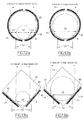
- FIGS. 12a and 12b illustrate a device comprising a channel 20 of circular cross-section specially adapted for measuring the complex impedance of the contents of a cylindrical 2-liter bottle, that is to say a channel 20 whose diameter of the cross section is slightly greater than the diameter of a cylindrical bottle of 2 liters.
- the measured complex impedance Z.sub.measure is equal to the sum of the complex impedance of the water Z2 contained in the container R and the complex impedances Z1 and Z3 of the air situated between the walls of the container R and the plates 45, 46.
- the complex impedances Z1 and Z3 of the air located between the walls of the container R and the plates 45, 46 are considered parasitic impedances which must be minimized so that the measured complex impedance is substantially equal to the complex impedance. of the liquid contained in the container to be analyzed.
- the measured complex impedance Z measured is substantially equal to the complex impedance of the water Z 2 contained in the container R.
- parasitic impedances Z1 and Z3 become negligible because the distances between the walls of the container R and the plates 45, 46 are small.
- the square (or rectangular) and keyhole geometries of the cross-section have the advantage of making the measurement of the complex impedance independent of the volume of the container in which the liquid to be analyzed is contained.
- FIGS. 13a and 13b illustrate a device according to the present invention comprising a channel 20 of square cross-section whose diagonals are respectively vertical and horizontal so that an edge coincides with the lowest point of the channel 20.
- the distance between the walls of the container and the plates 45, 46 (which are very close to the partitions 86, 87 of the channel 20) is almost zero whatever the diameter of the container containing the liquid to be analyzed, so that the parasitic impedances Z1 and Z3 of the air located between the walls of the container R and the reinforcements are negligible.
- the measured impedance Z measured is substantially equal to the complex impedance of the liquid contained in the container R whatever the volume of the container R used.
- a cross-section geometry in the form of a key lock makes it possible to minimize the distance between the walls of the container containing the liquid to be analyzed and the reinforcements of the device whatever the volume of the container R used, so that the measurement of the complex impedance is independent of the volume of the container in which the liquid to be analyzed is contained.
- a cylindrical container of 50 cl it is positioned between the lower protuberances of the cross section in the form of a lock key (the distance between these protuberances can be provided slightly greater than the diameter of a bottle cylindrical 50 centilitres standard type).
- a 2 liter container it is positioned at the central cylindrical portion of the channel in the form of a lock key.
- the channel 20 of the device preferably defines a concavity 22 directed upwards.
- the convergence of the partitions 86, 87 of the channel 20 is determined so that not only the distance between the lowest point of the channel 20 and the center of gravity of the container R increases as a function of the volume of the container R, but the greater the point of contact of the container R on the walls of the channel 20 rises and the height of the base of the container relative to the lowest point of the channel 20, also increases depending on the volume of the container R.
- the concavity 22 directed upwards is obtained by means of two rectilinear sections so as to minimize the effect of the parasitic impedances Z1 and Z3 of the air situated between the walls of the container R and the partitions 86, 87 of the channel 20.
- the sensors 40 are preferably adapted to cover at least a substantial part of the containers, or all of them. This ensures a high level of security in the analysis, since this makes it possible to analyze the entire contents of the containers and not just a part of them.
- transducer When only one transducer is provided, it is simultaneously or successively transmitter and receiver.
- transducers When several transducers are provided, all combinations are possible, that is to say that these transducers can be simultaneously or successively transmitter and / or receiver.
- the analysis device further comprises an ionizing or radioactive radiation detector assembly.
- This set is intended to detect the possible presence of traces of radioactive products in the container analyzed.
- the ionizing or radioactive radiation detector assembly may be the subject of numerous embodiments. It may be formed of any structures known to those skilled in the art, in particular any structure capable of converting a detected ionizing ray into an exploitable electrical signal. It may be for example and not limited to a Geiger type detector comprising a tube or chamber which houses a gas whose composition is chosen to generate an ionizing discharge during the detection of active radiation, and hence a electric pulse. It may also be a scintillator detector capable of converting the detected energy into light scintillations subsequently converted into an electrical signal by a network of photomultipliers. Many scintillators have been proposed for this purpose, for example based on sodium iodide, cesium iodide or bismuth germanate.
- the ionizing radiation detector assembly is placed in any suitable place and preferably in close proximity to the walls of the cavity 20, on the outside thereof.
- the ionizing radiation detector assembly 100, 110 is adapted to work in masked time, in parallel with the complex impedance measuring device previously described.
- the ionizing radiation detector assembly 100, 110 is controlled and put into service by any appropriate means detecting the presence of a container in the cavity.
- the ionizing radiation detector assembly is thus initiated by a signal taken from the complex impedance measurement chain and representative of the presence of such a receptacle in the channel 20.
- electromagnetic field emitter / receiver means 40 it is preferably provided means for changing the configuration of the means forming transmitters and receiver means, in order to enrich the available information, for example on the volume of the container analyzed.
- FIG. 9 illustrates in particular an alternative embodiment in which the means 40 comprise four capacitive armatures 45, 46, 47 and 48 respectively disposed on the outside of each of the four faces of a square section of the channel 20.
- switching means are preferably provided within the measuring network 56, to modify the configuration of the means 40 so that in a first configuration one of the two lower armatures 46 or 48 forms a transmitter while the another lower armature 48 or 46 forms a receiver, and a second configuration in which the two lower armatures 46 and 48 form emitters while the two upper armatures 45 and 47 form receivers, or vice versa.
Landscapes
- Chemical & Material Sciences (AREA)
- Chemical Kinetics & Catalysis (AREA)
- Electrochemistry (AREA)
- Physics & Mathematics (AREA)
- Health & Medical Sciences (AREA)
- Life Sciences & Earth Sciences (AREA)
- Analytical Chemistry (AREA)
- Biochemistry (AREA)
- General Health & Medical Sciences (AREA)
- General Physics & Mathematics (AREA)
- Immunology (AREA)
- Pathology (AREA)
- Investigating Or Analyzing Materials By The Use Of Electric Means (AREA)
- Automatic Analysis And Handling Materials Therefor (AREA)
Applications Claiming Priority (2)
| Application Number | Priority Date | Filing Date | Title |
|---|---|---|---|
| FR0503774A FR2884612B1 (fr) | 2005-04-15 | 2005-04-15 | Dispositif d'analyse de la composition du contenu d'un recipient |
| FR0507643A FR2884613A1 (fr) | 2005-04-15 | 2005-07-19 | Dispositif d'analyse de la composition du contenu d'un recipient |
Publications (3)
| Publication Number | Publication Date |
|---|---|
| EP1712899A2 true EP1712899A2 (de) | 2006-10-18 |
| EP1712899A3 EP1712899A3 (de) | 2006-11-22 |
| EP1712899B1 EP1712899B1 (de) | 2012-03-14 |
Family
ID=36298447
Family Applications (2)
| Application Number | Title | Priority Date | Filing Date |
|---|---|---|---|
| EP06112454A Expired - Lifetime EP1712899B1 (de) | 2005-04-15 | 2006-04-11 | Vorrichtung zur Analyse der Zusammensetzung des Inhalts eines Behälters |
| EP06112456.6A Expired - Lifetime EP1712900B1 (de) | 2005-04-15 | 2006-04-11 | Vorrichtung zur Analyse der Zusammensetzung des Inhalts eines Behälters |
Family Applications After (1)
| Application Number | Title | Priority Date | Filing Date |
|---|---|---|---|
| EP06112456.6A Expired - Lifetime EP1712900B1 (de) | 2005-04-15 | 2006-04-11 | Vorrichtung zur Analyse der Zusammensetzung des Inhalts eines Behälters |
Country Status (3)
| Country | Link |
|---|---|
| US (2) | US7394262B2 (de) |
| EP (2) | EP1712899B1 (de) |
| CA (2) | CA2543196C (de) |
Cited By (1)
| Publication number | Priority date | Publication date | Assignee | Title |
|---|---|---|---|---|
| US8030948B2 (en) * | 2007-04-12 | 2011-10-04 | Manneschi Alessandro M | Device for analyzing the composition of the contents of a container comprising means for obtaining at least one additional physical datum relating to the container |
Families Citing this family (14)
| Publication number | Priority date | Publication date | Assignee | Title |
|---|---|---|---|---|
| FR2914997B1 (fr) * | 2007-04-12 | 2017-04-07 | Alessandro Manneschi | Dispositif d'analyse de la composition du contenu d'un recipient comprenant un recipient d'analyse |
| FR2924806B1 (fr) * | 2007-12-05 | 2012-04-27 | Alessandro Manneschi | Dispositif d'analyse de la composition du contenu d'un recipient par mesure d'absorption. |
| US9080962B1 (en) | 2007-12-05 | 2015-07-14 | Alessandro Manneschi | Device for analysing composition of contents of a container by measuring absorption |
| FR2924807B1 (fr) * | 2007-12-05 | 2010-09-17 | Alessandro Manneschi | Dispositif d'analyse de la composition du contenu d'un recipient ameliore. |
| FR2939968B1 (fr) * | 2008-12-17 | 2013-06-07 | Eads Europ Aeronautic Defence | Generateur electrique excite par rayonnements cosmiques. |
| US9488599B2 (en) * | 2009-11-13 | 2016-11-08 | The Regents Of The University Of California | Authentication device for full intact wine bottles |
| US8969615B2 (en) | 2011-03-31 | 2015-03-03 | Basf Se | Process for preparing isocyanates |
| HUE025025T2 (en) | 2011-03-31 | 2016-04-28 | Basf Se | Process for the preparation of isocyanates |
| US9557307B2 (en) | 2013-05-07 | 2017-01-31 | Sommatic, Llc | Beverage diagnostic and preservation devices and methods |
| GB2514114A (en) * | 2013-05-13 | 2014-11-19 | Univ Bath | Apparatus and method for measuring electromagnetic properties |
| US9752998B1 (en) | 2013-09-05 | 2017-09-05 | Owens Brockway Glass Container Inc. | Detecting anomalies in glass articles using NMR imaging |
| WO2015107455A1 (en) | 2014-01-15 | 2015-07-23 | Alma Mater Studiorum - Università di Bologna | Analyzer of materials by microwawe spectroscopy |
| EP3102929B1 (de) * | 2014-02-05 | 2018-09-26 | Vayyar Imaging Ltd. | System zum charaketerisieren von nicht-festen substanzen |
| US11300536B1 (en) * | 2020-12-18 | 2022-04-12 | Cypress Semiconductor Corporation | Non-contact liquid sensing technologies |
Citations (2)
| Publication number | Priority date | Publication date | Assignee | Title |
|---|---|---|---|---|
| DD156400A1 (de) | 1981-02-18 | 1982-08-18 | Gerhard Poppei | Messung des feuchtegehalts feinkoerniger oder pulverisierter dielektrischer stoffe |
| FR2661084A1 (fr) | 1990-04-20 | 1991-10-25 | Ladriere Serge | Appareil pour maintenir, a une temperature sensiblement constante predeterminee, du vin en bouteille au cours de sa consommation. |
Family Cites Families (22)
| Publication number | Priority date | Publication date | Assignee | Title |
|---|---|---|---|---|
| GB283650A (en) * | 1926-10-15 | 1928-01-16 | Martin Ephraim Simon | Electrical method and apparatus for identifying chemical elements and compounds and biological organisms |
| US3609526A (en) * | 1969-06-24 | 1971-09-28 | Aleksander Z Chaberski | Contactless method and apparatus for determining electrical resistivity |
| SU554490A1 (ru) * | 1975-05-13 | 1977-04-15 | Научно-Исследовательский И Опытноконструкторский Институт Автоматизации Черной Металлургии | Способ измерени содержани магнетита в руде |
| US4220915A (en) * | 1978-06-28 | 1980-09-02 | Rca Corporation | Resistivity measurement system |
| JPS56114748A (en) * | 1980-02-14 | 1981-09-09 | Satake Eng Co Ltd | Grain moisture measuring device |
| US4496907A (en) * | 1982-05-06 | 1985-01-29 | Dickey-John Corporation | Method and apparatus for non-destructively determining ingredients of a sample |
| IE65900B1 (en) * | 1988-10-15 | 1995-11-29 | Satake Eng Co Ltd | Apparatus for evaluating quality of raw coffee beans |
| US5350999A (en) * | 1992-03-27 | 1994-09-27 | Brunda Daniel D | Measurement system and method for determining the amount of electromagnetic radiation energy being absorbed by living beings |
| US5514337A (en) * | 1994-01-11 | 1996-05-07 | American Research Corporation Of Virginia | Chemical sensor using eddy current or resonant electromagnetic circuit detection |
| US5510621A (en) * | 1994-10-03 | 1996-04-23 | Optical Solutions, Inc. | Apparatus and method for measuring components in a bag |
| US5818045A (en) * | 1996-07-19 | 1998-10-06 | Mark; Howard L. | Spectroscopic system for quantifying constituents in natural products |
| JP2001525059A (ja) * | 1997-04-16 | 2001-12-04 | カイク・リミテッド | 液体組成の評価 |
| US6028433A (en) * | 1997-05-14 | 2000-02-22 | Reid Asset Management Company | Portable fluid screening device and method |
| GB2328016B (en) * | 1997-08-08 | 2001-04-25 | Pfizer Ltd | Spectrophotometric analysis |
| DE19808936A1 (de) * | 1998-03-03 | 1999-09-16 | Aventis Res & Tech Gmbh & Co | Photodetektor und seine Verwendung |
| US6199603B1 (en) * | 1998-08-14 | 2001-03-13 | Baxter International Inc. | Compounding assembly for nutritional fluids |
| DE10027228B4 (de) * | 2000-05-31 | 2007-05-16 | Endress & Hauser Gmbh & Co Kg | Vorrichtung zur Bestimmung und/oder Überwachung des Füllstandes eines Füllguts in einem Behälter |
| FR2815718B1 (fr) * | 2000-10-20 | 2002-12-06 | Inst Francais Du Petrole | Methode d'evaluation de la temperature de transition vitreuse d'une piece en polymere en cours d'utilisation |
| JP2005523460A (ja) * | 2002-04-19 | 2005-08-04 | ワブバンク インコーポレイテッド | 低周波数スペクトル成分に基づくサンプル検出の方法、装置、並びに、そのシステム |
| US6906530B2 (en) * | 2002-05-30 | 2005-06-14 | D.J. Geisel Technology, Inc. | Apparatus and method to detect moisture |
| WO2004008104A2 (en) * | 2002-07-17 | 2004-01-22 | The Regents Of The University Of California | Methods and devices for analysis of sealed containers |
| US7204960B2 (en) * | 2003-03-03 | 2007-04-17 | Asm Assembly Automation Ltd. | Apparatus and method for calibration of a dispensing system |
-
2006
- 2006-04-11 EP EP06112454A patent/EP1712899B1/de not_active Expired - Lifetime
- 2006-04-11 EP EP06112456.6A patent/EP1712900B1/de not_active Expired - Lifetime
- 2006-04-12 CA CA2543196A patent/CA2543196C/fr not_active Expired - Lifetime
- 2006-04-12 CA CA2543225A patent/CA2543225C/fr not_active Expired - Lifetime
- 2006-04-12 US US11/403,796 patent/US7394262B2/en not_active Expired - Lifetime
- 2006-04-14 US US11/404,214 patent/US7442935B2/en not_active Expired - Lifetime
Patent Citations (2)
| Publication number | Priority date | Publication date | Assignee | Title |
|---|---|---|---|---|
| DD156400A1 (de) | 1981-02-18 | 1982-08-18 | Gerhard Poppei | Messung des feuchtegehalts feinkoerniger oder pulverisierter dielektrischer stoffe |
| FR2661084A1 (fr) | 1990-04-20 | 1991-10-25 | Ladriere Serge | Appareil pour maintenir, a une temperature sensiblement constante predeterminee, du vin en bouteille au cours de sa consommation. |
Cited By (1)
| Publication number | Priority date | Publication date | Assignee | Title |
|---|---|---|---|---|
| US8030948B2 (en) * | 2007-04-12 | 2011-10-04 | Manneschi Alessandro M | Device for analyzing the composition of the contents of a container comprising means for obtaining at least one additional physical datum relating to the container |
Also Published As
| Publication number | Publication date |
|---|---|
| EP1712900A1 (de) | 2006-10-18 |
| EP1712900B1 (de) | 2016-05-11 |
| CA2543225C (fr) | 2016-03-22 |
| US20060255276A1 (en) | 2006-11-16 |
| EP1712899A3 (de) | 2006-11-22 |
| US20060250140A1 (en) | 2006-11-09 |
| US7394262B2 (en) | 2008-07-01 |
| EP1712899B1 (de) | 2012-03-14 |
| CA2543196A1 (fr) | 2006-10-15 |
| US7442935B2 (en) | 2008-10-28 |
| CA2543225A1 (fr) | 2006-10-15 |
| CA2543196C (fr) | 2015-12-22 |
Similar Documents
| Publication | Publication Date | Title |
|---|---|---|
| EP2071320B1 (de) | Vorrichtung zur Analyse der Zusammensetzung des Inhalts eines Gefäßes | |
| EP1712900B1 (de) | Vorrichtung zur Analyse der Zusammensetzung des Inhalts eines Behälters | |
| CA2964406C (fr) | Detecteur d'objets ou de matieres non autorisees dissimules dans une chaussure | |
| FR2911212A1 (fr) | Detecteur de produits non autorises dans une zone a acces protege | |
| EP0868131B1 (de) | Vorrichtung zum fühlen der anwesenheit eines objektes in einem aufbewahrfach, insbesondere einer minibar und ferndatenerfassungssystem hierfür | |
| EP1980844B1 (de) | Analyse der Zusammensetzung eines Gefäßinhalts durch Messen komplexer dielektrischer Eigenschaften bei mehreren Frequenzen im Bereich von einigen Hz bis mehreren GHz und durch Messen der Masse des Gefässes samt Inhalt | |
| FR2716006A1 (fr) | Détection et cartographie de réservoirs d'hydrocarbures à l'aide d'un radar. | |
| EP1752794B1 (de) | Detektor von nicht erlaubten Objekten in einer Zone mit geschütztem Zugang | |
| FR2914997A1 (fr) | Dispositif d'analyse de la composition du contenu d'un recipient comprenant un recipient d'analyse | |
| FR2924806A1 (fr) | Dispositif d'analyse de la composition du contenu d'un recipient par mesure d'absorption. | |
| FR2884612A1 (fr) | Dispositif d'analyse de la composition du contenu d'un recipient | |
| FR2932567A1 (fr) | Cellule de mesure pour appareil de detection de la presence d'un gaz dans une atmosphere | |
| WO2008006825A1 (fr) | Detecteur d'objets par analyse d'echos hyperfrequences dans une enceinte a chaos variable | |
| FR2693797A1 (fr) | Système de contrôle de canalisations, notamment de canalisations en acier nu ou enrobé. | |
| BE1009125A3 (fr) | Procede et dispositif de detection selective d'intrusion. | |
| WO1998053281A1 (fr) | Dispositif de mesure du niveau de liquide dans un reservoir | |
| FR3050529B1 (fr) | Dispositif et procede pour estimer ou mesurer la stabilite d'un melange par la variation dans la duree d'un signal electrique radiofrequence | |
| FR2886492A1 (fr) | Detecteur d'objets par analyse d'echos hyperfrequences | |
| EP0817146A1 (de) | Eindringungsdetektionsvorrichtung mit strahlenden Leitungen | |
| FR3092188A1 (fr) | Détecteur pour bagages |
Legal Events
| Date | Code | Title | Description |
|---|---|---|---|
| PUAI | Public reference made under article 153(3) epc to a published international application that has entered the european phase |
Free format text: ORIGINAL CODE: 0009012 |
|
| AK | Designated contracting states |
Kind code of ref document: A2 Designated state(s): AT BE BG CH CY CZ DE DK EE ES FI FR GB GR HU IE IS IT LI LT LU LV MC NL PL PT RO SE SI SK TR |
|
| AX | Request for extension of the european patent |
Extension state: AL BA HR MK YU |
|
| PUAL | Search report despatched |
Free format text: ORIGINAL CODE: 0009013 |
|
| AK | Designated contracting states |
Kind code of ref document: A3 Designated state(s): AT BE BG CH CY CZ DE DK EE ES FI FR GB GR HU IE IS IT LI LT LU LV MC NL PL PT RO SE SI SK TR |
|
| AX | Request for extension of the european patent |
Extension state: AL BA HR MK YU |
|
| 17P | Request for examination filed |
Effective date: 20070514 |
|
| 17Q | First examination report despatched |
Effective date: 20070614 |
|
| AKX | Designation fees paid |
Designated state(s): DE ES FR GB IT |
|
| GRAP | Despatch of communication of intention to grant a patent |
Free format text: ORIGINAL CODE: EPIDOSNIGR1 |
|
| GRAS | Grant fee paid |
Free format text: ORIGINAL CODE: EPIDOSNIGR3 |
|
| GRAA | (expected) grant |
Free format text: ORIGINAL CODE: 0009210 |
|
| AK | Designated contracting states |
Kind code of ref document: B1 Designated state(s): DE ES FR GB IT |
|
| REG | Reference to a national code |
Ref country code: GB Ref legal event code: FG4D Free format text: NOT ENGLISH |
|
| REG | Reference to a national code |
Ref country code: DE Ref legal event code: R096 Ref document number: 602006028138 Country of ref document: DE Effective date: 20120510 |
|
| REG | Reference to a national code |
Ref country code: ES Ref legal event code: FG2A Ref document number: 2382002 Country of ref document: ES Kind code of ref document: T3 Effective date: 20120604 |
|
| PLBE | No opposition filed within time limit |
Free format text: ORIGINAL CODE: 0009261 |
|
| STAA | Information on the status of an ep patent application or granted ep patent |
Free format text: STATUS: NO OPPOSITION FILED WITHIN TIME LIMIT |
|
| REG | Reference to a national code |
Ref country code: DE Ref legal event code: R082 Ref document number: 602006028138 Country of ref document: DE Representative=s name: KILIAN KILIAN & PARTNER, DE Ref country code: DE Ref legal event code: R082 Ref document number: 602006028138 Country of ref document: DE Representative=s name: KILIAN KILIAN & PARTNER MBB PATENTANWAELTE, DE |
|
| 26N | No opposition filed |
Effective date: 20121217 |
|
| REG | Reference to a national code |
Ref country code: DE Ref legal event code: R097 Ref document number: 602006028138 Country of ref document: DE Effective date: 20121217 |
|
| REG | Reference to a national code |
Ref country code: FR Ref legal event code: PLFP Year of fee payment: 11 |
|
| REG | Reference to a national code |
Ref country code: FR Ref legal event code: PLFP Year of fee payment: 12 |
|
| REG | Reference to a national code |
Ref country code: FR Ref legal event code: PLFP Year of fee payment: 13 |
|
| PGFP | Annual fee paid to national office [announced via postgrant information from national office to epo] |
Ref country code: FR Payment date: 20250312 Year of fee payment: 20 |
|
| PGFP | Annual fee paid to national office [announced via postgrant information from national office to epo] |
Ref country code: DE Payment date: 20250411 Year of fee payment: 20 |
|
| PGFP | Annual fee paid to national office [announced via postgrant information from national office to epo] |
Ref country code: GB Payment date: 20250417 Year of fee payment: 20 Ref country code: ES Payment date: 20250512 Year of fee payment: 20 |
|
| PGFP | Annual fee paid to national office [announced via postgrant information from national office to epo] |
Ref country code: IT Payment date: 20250409 Year of fee payment: 20 |
|
| REG | Reference to a national code |
Ref country code: DE Ref legal event code: R071 Ref document number: 602006028138 Country of ref document: DE |
|
| REG | Reference to a national code |
Ref country code: ES Ref legal event code: FD2A Effective date: 20260429 |