EP1711469B1 - Verfahren zur herstellung von terrylen-3,4:11,12-tetracarbonsäurediimiden durch direktsynthese - Google Patents
Verfahren zur herstellung von terrylen-3,4:11,12-tetracarbonsäurediimiden durch direktsynthese Download PDFInfo
- Publication number
- EP1711469B1 EP1711469B1 EP05700962A EP05700962A EP1711469B1 EP 1711469 B1 EP1711469 B1 EP 1711469B1 EP 05700962 A EP05700962 A EP 05700962A EP 05700962 A EP05700962 A EP 05700962A EP 1711469 B1 EP1711469 B1 EP 1711469B1
- Authority
- EP
- European Patent Office
- Prior art keywords
- und
- alkyl
- organic solvent
- process according
- base
- Prior art date
- Legal status (The legal status is an assumption and is not a legal conclusion. Google has not performed a legal analysis and makes no representation as to the accuracy of the status listed.)
- Expired - Lifetime
Links
- 0 *N(C(c(cc1)c(c2ccc3-c4ccc5-c(cc6)c7c8c6C(N6*)=O)c3c1-c(cc1)c4c5c1-c7ccc8C6=O)=O)C2=O Chemical compound *N(C(c(cc1)c(c2ccc3-c4ccc5-c(cc6)c7c8c6C(N6*)=O)c3c1-c(cc1)c4c5c1-c7ccc8C6=O)=O)C2=O 0.000 description 2
Classifications
-
- C—CHEMISTRY; METALLURGY
- C07—ORGANIC CHEMISTRY
- C07D—HETEROCYCLIC COMPOUNDS
- C07D221/00—Heterocyclic compounds containing six-membered rings having one nitrogen atom as the only ring hetero atom, not provided for by groups C07D211/00 - C07D219/00
- C07D221/02—Heterocyclic compounds containing six-membered rings having one nitrogen atom as the only ring hetero atom, not provided for by groups C07D211/00 - C07D219/00 condensed with carbocyclic rings or ring systems
- C07D221/04—Ortho- or peri-condensed ring systems
- C07D221/18—Ring systems of four or more rings
-
- C—CHEMISTRY; METALLURGY
- C07—ORGANIC CHEMISTRY
- C07D—HETEROCYCLIC COMPOUNDS
- C07D221/00—Heterocyclic compounds containing six-membered rings having one nitrogen atom as the only ring hetero atom, not provided for by groups C07D211/00 - C07D219/00
- C07D221/02—Heterocyclic compounds containing six-membered rings having one nitrogen atom as the only ring hetero atom, not provided for by groups C07D211/00 - C07D219/00 condensed with carbocyclic rings or ring systems
- C07D221/04—Ortho- or peri-condensed ring systems
- C07D221/06—Ring systems of three rings
- C07D221/14—Aza-phenalenes, e.g. 1,8-naphthalimide
-
- C—CHEMISTRY; METALLURGY
- C07—ORGANIC CHEMISTRY
- C07D—HETEROCYCLIC COMPOUNDS
- C07D471/00—Heterocyclic compounds containing nitrogen atoms as the only ring hetero atoms in the condensed system, at least one ring being a six-membered ring with one nitrogen atom, not provided for by groups C07D451/00 - C07D463/00
- C07D471/02—Heterocyclic compounds containing nitrogen atoms as the only ring hetero atoms in the condensed system, at least one ring being a six-membered ring with one nitrogen atom, not provided for by groups C07D451/00 - C07D463/00 in which the condensed system contains two hetero rings
- C07D471/06—Peri-condensed systems
Definitions
- Terrylene-3,4: 11,12-tetracarboxylic diimides are known to be suitable as pigments and fluorescent dyes with absorption in the long-wave red and fluorescence emission in the long-wave red to near-infrared region of the electromagnetic spectrum.
- N, N'-dialkyl-substituted terrylene-3,4: 11,12-tetracarboxylic diimides are according to Heterocycles 56, p. 331-340 (2002 ) by reacting an N-alkyl-9-bromo-perylene-3,4-dicarboxylic acid imide to the 9-tributyltin derivative, which is then reacted with an N-alkyl-4-halonaphthalene-1,8-dicarboximide to give the corresponding 9- (4-naphthalene -1,8-dicarboximide) perylene-3,4-dicarboximide is coupled, from which in turn by cyclodehydration the Terrylen-3,4: 11,12-tetracarboxylic diimide is produced.
- the known production processes have a number of disadvantages: toxic tin compounds and / or strong bases are used in large quantities, the reaction times are very long, and / or the overall yield is less than 50%.
- the invention was therefore based on the object to remedy these disadvantages and to provide a process which enables the production of terrylene-3,4: 11,12-tetracarboxylic diimides in an advantageous, economical manner.
- a process for the preparation of terrylene-3,4: 11,12 tetracarboxylic diimides of the general formula I in which the variables have the meaning indicated above which is characterized in that a perylene-3,4-dicarboximide of the general formula II in the presence of a base-stable, high-boiling, organic solvent and an alkali metal or alkaline earth metal-containing base with a naphthalene-1,8-dicarboximide of the general formula III in which X is hydrogen, bromine or chlorine, is reacted.
- alkyl groups occurring in the formulas I to III can be straight-chain or branched. When the alkyl groups are substituted, they usually carry 1 or 2 substituents.
- Cycloalkyl groups and aromatic radicals which are substituted may generally have up to 3, preferably 1 or 2, of said substituents.
- the terrylene-3,4: 11,12-tetracarboxylic diimides I can be prepared in one step by reacting a perylene-3,4-dicarboximide II with a naphthalene-1,8-dicarboximide III.
- the reaction according to the invention is carried out in the presence of a base-stable, high-boiling, organic solvent and an alkali metal base.
- the starting material used may be naphthalene-1,8-dicarboximide III halogenated both in the 4-position, ie chlorinated or brominated, and non-halogenated.
- naphthalene-1,8-dicarboximide III it is generally advisable to carry out the reaction under more severe reaction conditions, ie. larger excesses of naphthalene-1,8-dicarboximide III and in addition to a strong alkali metal-containing base to use a nitrogen-containing auxiliary base and polar aprotic solvents.
- the molar ratio of naphthalene-1,8-dicarboximide III to perylene-3,4-dicarboximide II when using halogenated educt III is usually 4 to 1: 1 and preferably 2 to 1: 1, while it is generally 8 to 1: 1 and preferably 6 to 2: 1 for non-halogenated educt III.
- Suitable solvents are in principle all stable under the reaction conditions against bases, high boiling (boiling point> 100 ° C and above the selected reaction temperature) solvents in which the perylene-3,4-dicarboximides II and the naphthalene-1,8-dicarboximides III completely at the reaction temperature and at least partially dissolve the bases used, so that substantially homogeneous reaction conditions are present.
- Particularly suitable are non-polar aprotic and polar aprotic solvents, nonpolar-aprotic solvents and aprotic solvents based on ethers being preferred when using halogenated educts III and the polar aprotic solvents when using non-halogenated educts III.
- protic solvents preferably those which have amino and hydroxyl functions.
- solvent mixtures can also be used.
- non-polar aprotic solvents are solvents boiling at> 100 ° C. from the following groups: aliphatics (in particular C 8 -C 18 -alkanes), unsubstituted, alkyl-substituted and condensed cycloaliphates (in particular unsubstituted C 7 -C 10 -cycloalkanes, C 6 -C 8 -cycloalkanes which are substituted by one to three C 1 -C 6 -alkyl groups, polycyclic saturated hydrocarbons having 10 to 18 C-atoms), alkyl- and cycloalkyl-substituted aromatics (in particular benzene, which is substituted by one to three C C 1 -C 6 -alkyl groups or a C 5 -C 8 -cycloalkyl radical is substituted) and fused aromatics which may be alkyl-substituted and / or partially hydrogenated (in particular naphthalene which is substitute
- nonpolar aprotic solvents are: octane, isooctane, nonane, isononane, decane, isodecane, undecane, dodecane, hexadecane and octadecane; Cycloheptane, cyclooctane, methylcyclohexane, dimethylcyclohexane, trimethylcyclohexane, ethylcyclohexane, diethylcyclohexane, propylcyclohexane, isopropylcyclohexane, dipropylcyclohexane, butylcyclohexane, tert-butylcyclohexane, methylcycloheptane and methylcyclooctane; Toluene, o-, m- and p-xylene, 1,3,5-trimethylbenzene (Mesitylene), 1,
- nonpolar aprotic solvents are xylene (all isomers), mesitylene, and especially toluene and decalin.
- polar aprotic solvents are N, N-disubstituted aliphatic carboxylic acid amides (in particular N, N-di-C 1 -C 4 -alkyl-C 1 -C 4 -carboxamides), nitrogen-containing heterocycles, trialkylamines (in particular tri (C C 3 -C 6 -alkyl) amines) and aprotic ethers (in particular cyclic ethers, diaryl ethers and di-C 1 -C 6 -alkyl ethers of monomeric and oligomeric C 2 -C 3 -alkylene glycols which may contain up to 6 alkylene oxide units, especially Diethylene glycol di-C 1 -C 4 alkyl ether).
- N, N-disubstituted aliphatic carboxylic acid amides in particular N, N-di-C 1 -C 4 -alkyl-C 1 -C 4 -carboxamides
- preferred polar aprotic solvents are: N, N-dimethylformamide, N, N-diethylformamide, N, N-dimethylacetamide and N, N-dimethylbutyramide; N-methyl-2-pyrrolidone, quinoline, isoquinoline, quinaldine, pyrimidine, N-methylpiperidine and pyridine; Tripropyl and tributylamine; Di- and tetramethyltetrahydrofuran, dioxane, diphenyl ether, diethylene glycol dimethyl, diethyl, dipropyl, diisopropyl, di-n-butyl, di-sec-butyl and di-tert-butyl ether, diethylene glycol methyl ethyl ether Triethylene glycol dimethyl and diethyl ether and triethylene glycol methyl ethyl ether, wherein diethylene glycol diethyl ether, diphenyl ether and especially diethylene
- protic solvents contain amino and hydroxy functions.
- preferred protic solvents are alcohol amines, in particular mono-, di- and tri-C 2 -C 4 -alcoholamines, such as mono-, di- and triethanolamine, with ethanolamine being particularly preferred.
- the amount of solvent is generally 50 to 250 ml of nonpolar aprotic solvent, 10 to 50 ml of polar aprotic solvent or 3 to 50 ml of protic solvent per g of perylene-3,4-dicarboxylic acid imide II.
- strong inorganic and organic alkali or alkaline earth metal-containing bases are suitable, wherein the alkali metal-containing bases are particularly suitable.
- Preferred inorganic bases are alkali and alkaline earth metal hydroxides and amides
- preferred organic bases are alkali metal and alkaline earth metal alcoholates (in particular the C 1 -C 10 -alcoholates, especially tert-C 4 -C 6 -alcoholates), alkali metal and alkaline earth metal (phenyl) alkylamides (especially the bis (C 1 -C 4 alkyl) amides) and triphenylmethyl metallates.
- Particularly preferred are the alkali metal alcoholates.
- Preferred alkali metals are lithium, sodium and potassium, with potassium being most preferred.
- Particularly suitable alkaline earth metals are magnesium and calcium.
- particularly preferred bases include: lithium hydroxide, sodium hydroxide and potassium hydroxide; Lithium amide, sodium amide and potassium amide; Lithium methylate, sodium methylate, potassium methylate, lithium ethylate, sodium ethylate, potassium ethylate, sodium isopropylate, potassium isopropylate, sodium tert-butylate, potassium tert-butylate, lithium (1,1-dimethyl) octylate, sodium (1,1-dimethyl) octylate and potassium (1,1-dimethyl) octylate; Lithium dimethylamide, lithium diethylamide, lithium diisopropylamide, sodium diisopropylamide, triphenylmethyllithium, triphenylmethylsodium and triphenylmethylpotassium.
- mixtures of different bases can be used.
- Very particularly preferred bases are lithium diisopropylamide, sodium methoxide, sodium tert-butoxide, especially potassium methoxide and potassium hydroxide and in particular potassium tert-butoxide.
- Suitable bases are alkylamines which are liquid at the reaction temperatures, in particular tri-C 3 -C 6 -alkylamines, such as tripropylamine and tributylamine, alcoholamines, in particular mono-, di- and tri-C 2 -C 4 -alcoholamines, such as mono-, di- and triethanolamine, and in particular heterocyclic bases such as pyridine, N-methylpiperidine, N-methylpiperidone, N-methylmorpholine, N-methyl-2-pyrrolidone, pyrimidine, quinoline, isoquinoline, quinaldine and especially diazabicyclononene (DBN) and diazabicycloundecene (DBU) , Of course, mixtures of these auxiliary bases can also be used.
- DBN diazabicyclononene
- DBU diazabicycloundecene
- Suitable amounts for the auxiliary base are in the case of halogenated Edukte III generally from 1 to 15 g, preferably 1 to 5 g, per g perylene-3,4-dicarboximide II and in the case of non-halogenated reactants III usually at 1 to 60 g, preferably from 5 to 30 g, per g of perylene-3,4-dicarboximide II.
- halogenated Edukten III usually 2 to 10 mol, in particular 2 to 4 mol per mole of perylene-3,4-dicarboximide II and non-halogenated Edukten III generally 2 to 20 mol, preferably 8 to 20 mol, per mole of perylene-3,4-dicarboximide II used.
- the alkali metal base can be used in solid or in dissolved form.
- the alkali metal base can be used in combination with a non-polar aprotic reaction solvent in which it is not sufficiently soluble, it can be used in an alcohol which a higher base strength than the alkali metal base has to be solved.
- tertiary aliphatic alcohols which may contain aryl substituents and have a total of four to twelve C atoms, for example tert-butanol, 2-methyl-2-butanol (tert-amyl alcohol), 3-methyl-3-pentanol, 3-ethyl-3-pentanol, 2-phenyl-2-pentanol, 2,3-dimethyl-3-pentanol, 2,4,4-trimethyl-2-pentanol and 2,2,3,4,4-pentamethyl 3-pentanol.
- tert-butanol 2-methyl-2-butanol (tert-amyl alcohol)
- 3-methyl-3-pentanol 3-ethyl-3-pentanol
- 2-phenyl-2-pentanol 2,3-dimethyl-3-pentanol
- 2,4,4-trimethyl-2-pentanol 2,2,3,4,4-pentamethyl 3-pentanol.
- the reaction temperature is usually 50 to 210 ° C, preferably 70 to 180 ° C.
- naphthalene-1,8-dicarboximides III with base-labile substituents (for example cyclohexyl) on the imide nitrogen atom.
- the reaction time is usually 1 to 3 h for halogenated educts III and 2 to 8 h for non-halogenated reactants III.
- Perylene-3,4-dicarboximide II, naphthalene-1,8-dicarboximide III and base are added, solvent and optionally auxiliary base are added under protective gas and the mixture is heated to the desired reaction temperature with stirring and under protective gas for the desired time.
- the terrylene-3,4: 11,12-tetracarboxylic diimides I are precipitated by adding a protic solvent which dissolves the other components, for example C 1 -C 3 -alcohols and in particular water. It is filtered off and washed with one of the solvents mentioned, in particular with one of the alcohols.
- halogenated Edukte III When using halogenated Edukte III can proceed analogously. However, it is also possible at first to heat only a mixture of perylene-3,4-dicarboximide II, base, optionally auxiliary base and solvent with stirring and protective gas to a temperature in the range from 120 to 210 ° C. (deprotonation) and naphthalene-1,8 -dicarboximide III then, optionally after lowering the temperature to 50 to 120 ° C, add.
- reaction product may be desirable to subject the reaction product to oxidation. This can most easily be done by blowing atmospheric oxygen into the still warm reaction mixture.
- oxidizing agents as preferably hydrogen peroxide, but also aldehyd phenomenon Anlagen sugars, for example glucose, in particular after the reaction admit.
- the products I e.g. from a mixture of halogenated solvents such as chloroform and methylene chloride, and alcohols such as methanol, ethanol and isopropanol, or from a carboxylic acid such as N-methylpyrrolidone recrystallize.
- halogenated solvents such as chloroform and methylene chloride
- alcohols such as methanol, ethanol and isopropanol
- carboxylic acid such as N-methylpyrrolidone
- the terrylene-3,4: 11,12-tetracarboxylic diimides I can be obtained in good yields (generally from 50 to 80% when using halogenated reactants III and from 25 to 70% when using non-halogenated reactants III) and high purities (Usually 95 to 99%) are produced in an economical manner in one step.
- Both symmetrically and asymmetrically substituted terrylene-3,4: 11,12-tetracarboxylic diimides I are accessible to the imide nitrogen atoms in an advantageous manner.
Landscapes
- Chemical & Material Sciences (AREA)
- Organic Chemistry (AREA)
- Organic Low-Molecular-Weight Compounds And Preparation Thereof (AREA)
- Nitrogen Condensed Heterocyclic Rings (AREA)
Abstract
Description
- Die vorliegende Erfindung betrifft ein neues Verfahren zur Herstellung von Terrylen-3,4:11,12-tetracarbonsäurediimiden der allgemeinen Formel I

- R, R'
- unabhängig voneinander Wasserstoff; C1-C30-Alkyl, dessen Kohlenstoffkette durch eine oder mehrere Gruppierungen -O-, -S-, -NR1-, -CO- und/oder -SO2- unterbrochen sein kann und das durch Cyano, C1-C6-Alkoxy, Aryl, das durch C1-C18-Alkyl oder C1-C6-Alkoxy substitu- iert sein kann, und/oder einen über ein Stickstoffatom gebundenen 5- bis 7- gliedrigen heterocyclischen Rest, der weitere Heteroatome enthalten und a- romatisch sein kann, ein- oder mehrfach substituiert sein kann; C5-C8-Cycloalkyl, dessen Kohlenstoffgerüst durch eine oder mehrere Gruppie- rungen -O-, -S- und/oder -NR1- unterbrochen und/oder das durch C1-C6-Alkyl ein- oder mehrfach substituiert sein kann; Aryl oder Hetaryl, das durch C1-C18-Alkyl, C1-C6-Alkoxy, Cyano, Halogen, -CONHR2 und/oder Aryl- oder Hetarylazo, das jeweils durch C1-C10-Alkyl, C1-C6-Alkoxy oder Cyano substituiert sein kann, ein- oder mehrfach substitu- iert sein kann;
- R1
- Wasserstoff oder C1-C6-Alkyl;
- R2
- Wasserstoff; C1-C18-Alkyl; Aryl oder Hetaryl, das jeweils durch C1-C6-Alkyl, C1-C6-Alkoxy, Halogen, Hydroxy, Carboxy oder Cyano substituiert sein kann.
- Terrylen-3,4:11,12-tetracarbonsäurediimide eignen sich bekanntermaßen als Pigmente und Fluoreszenzfarbstoffe mit Absorption im langwellig roten und Fluoreszenzemission im langwellig roten bis nahinfraroten Bereich des elektromagnetischen Spektrums.
- In Chem. Eur. J. 3, S. 219 - 225 (1997) ist ein Verfahren zu ihrer Herstellung beschrieben, das von 5-Bromacenaphthenchinon ausgeht und eine Vielzahl von Reaktionsschritten umfaßt: Ketalisierung, Überführung in eine Boronsäure, Umsetzung mit einem 9-Bromperylen-3,4-dicarbonsäureimid in einer Suzuki-Kupplungsreaktion zu einem 9-(4-Acenaphthochinonyl)perylen-3,4-dicarbonsäureimid, Oxidation zum Tetracarbonsäureimidanhydrid, Imidierung zum Diimid und Cyclodehydrierung zum Terrylen-3,4:11,12-tetracarbonsäurediimid.
- N,N'-Dialkylsubstituierte Terrylen-3,4:11,12-tetracarbonsäurediimide sind gemäß Heterocycles 56, S. 331 - 340 (2002) zugänglich, indem ein N-Alkyl-9-bromperylen-3,4-dicarbonsäureimid zum 9-Tributylzinnderivat umgesetzt wird, das dann mit einem N-Alkyl-4-Halogennaphthalin-1,8-dicarbonsäureimid zum entsprechenden 9-(4-Naphthalin-1,8-dicarbonsäureimid)perylen-3,4-dicarbonsäureimid gekuppelt wird, aus dem wiederum durch Cyclodehydrierung das Terrylen-3,4:11,12-tetracarbonsäurediimid hergestellt wird.
- Die bekannten Herstellungsverfahren haben eine Reihe von Nachteilen: Es werden toxische Zinnverbindungen und/oder starke Basen in großen Mengen eingesetzt, die Reaktionszeiten sind sehr lang, und/oder die Gesamtausbeute liegt bei unter 50%.
- Der Erfindung lag daher die Aufgabe zugrunde, diesen Nachteilen abzuhelfen und ein Verfahren bereitzustellen, das die Herstellung von Terrylen-3,4:11,12-tetracarbonsäurediimiden auf vorteilhafte, wirtschaftliche Weise ermöglicht.
- Demgemäß wurde ein Verfahren zur Herstellung von Terrylen-3,4:11,12 tetracarbonsäurediimiden der allgemeinen Formel I


- Alle in den Formeln I bis III auftretenden Alkylgruppen können geradkettig oder verzweigt sein. Wenn die Alkylgruppen substituiert sind, tragen sie in der Regel 1 oder 2 Substituenten.
- Cycloalkylgruppen und aromatische Reste, die substituiert sind, können im allgemeinen bis zu 3, bevorzugt 1 oder 2, der genannten Substituenten aufweisen.
- Als Beispiele für geeignete Reste R, R', R1, R2 und R3 (bzw. für deren Substituenten) seien im einzelnen genannt:
- Methyl, Ethyl, Propyl, Isopropyl, Butyl, Isobutyl, tert.-Butyl, Pentyl, Isopentyl, Neopentyl, tert.-Pentyl, Hexyl, 2-Methylpentyl, Heptyl, 1-Ethylpentyl, Octyl, 2-Ethylhexyl, Isooctyl, Nonyl, Isononyl, Decyl, Isodecyl, Undecyl, Dodecyl, Tridecyl, Isotridecyl, Tetradecyl, Pentadecyl, Hexadecyl, Heptadecyl, Octadecyl, Nonadecyl und Eicosyl (die obigen Bezeichnungen Isooctyl, Isononyl, Isodecyl und Isotridecyl sind Trivialbezeichnungen und stammen von den nach der Oxosynthese erhaltenen Alkoholen);
- Methoxymethyl, 2-Methoxyethyl, 2-Ethoxyethyl, 2-Propoxyethyl, 2-Isopropoxyethyl, 2-Butoxyethyl, 2- und 3-Methoxypropyl, 2- und 3-Ethoxypropyl, 2- und 3-Propoxypropyl, 2- und 3-Butoxypropyl, 2- und 4-Methoxybutyl, 2- und 4-Ethoxybutyl, 2- und 4-Propoxybutyl, 3,6-Dioxaheptyl, 3,6-Dioxaoctyl, 4,8-Dioxanonyl, 3,7-Dioxaoctyl, 3,7-Dioxanonyl, 4,7-Dioxaoctyl, 4,7-Dioxanonyl, 2- und 4-Butoxybutyl, 4,8-Dioxadecyl, 3,6,9-Trioxadecyl, 3,6,9-Trioxaundecyl, 3,6,9-Trioxadodecyl, 3,6,9,12-Tetraoxatridecyl und 3,6,9,12-Tetraoxatetradecyl;
- Methylthiomethyl, 2-Methylthioethyl, 2-Ethylthioethyl, 2-Propylthioethyl, 2-Isopropylthioethyl, 2-Butylthioethyl, 2- und 3-Methylthiopropyl, 2- und 3-Ethylthiopropyl, 2- und 3-Propylthiopropyl, 2- und 3-Butylthiopropyl, 2- und 4-Methylthiobutyl, 2- und 4-Ethylthiobutyl, 2- und 4-Propylthiobutyl, 3,6-Dithiaheptyl, 3,6-Dithiaoctyl, 4,8-Dithianonyl, 3,7-Dithiaoctyl, 3,7-Dithianonyl, 2- und 4-Butylthiobutyl, 4,8-Dithiadecyl, 3,6,9-Trithiadecyl, 3,6,9-Trithiaundecyl, 3,6,9-Trithiadodecyl, 3,8,9,12-Tetrathiatridecyl und 3,6,9,12-Tetrathiatetradecyl;
- 2-Monomethyl- und 2-Monoethylaminoethyl, 2-Dimethylaminoethyl, 2- und 3- Dimethylaminopropyl, 3-Monoisopropylaminopropyl, 2- und 4-Monopropylaminobutyl, 2- und 4-Dimethylaminobutyl, 6-Methyl-3,6-diazaheptyl, 3,6-Dimethyl-3,6-diazaheptyl, 3,6-Diazaoctyl, 3,6-Dimethyl-3,6-diazaoctyl, 9-Methyl-3,6,9-triazadecyl, 3,6,9-Trimethyl-3,6,9-triazadecyl, 3,6,9-Triazaundecyl, 3,6,9-Trimethyl-3,6,9-triazaundecyl, 12-Methyl-3,6,9,12-tetraazatridecyl und 3,6,9,12-Tetramethyl-3,6,9,12-tetraazatridecyl;
- Propan-2-on-1-yl, Butan-3-on-1-yl, Butan-3-on-2-yl und 2-Ethylpentan-3-on-1-yl;
- 2-Methylsulfonylethyl, 2-Ethylsulfonylethyl, 2-Propylsulfonylethyl, 2-Isopropylsulfonylethyl, 2-Butylsulfonylethyl, 2- und 3-Methylsulfonylpropyl, 2- und 3-Ethylsulfonylpropyl, 2- und 3-Propylsulfonylpropyl, 2- und 3-Butylsulfonylpropyl, 2- und 4-Methylsulfonylbutyl, 2- und 4-Ethylsulfonylbutyl, 2- und 4-Propylsulfonylbutyl und 4-Butylsulfonylbutyl;
- Cyanomethyl, 2-Cyanoethyl, 3-Cyanopropyl, 2-Methyl-3-ethyl-3-cyanopropyl, 7-Cyano-7-ethylheptyl und 4,7-Dimethyl-7-cyanoheptyl;
- Methoxy, Ethoxy, Propoxy, Isopropoxy, Butoxy, Isobutoxy, sec.-Butoxy, tert.-Butoxy, Pentoxy, Isopentoxy, Neopentoxy, tert.-Pentoxy und Hexoxy;
- Carbamoyl, Methylaminocarbonyl, Ethylaminocarbonyl, Propylaminocarbonyl, Butylaminocarbonyl, Pentylaminocarbonyl, Hexylaminocarbonyl, Heptylaminocarbonyl, Octylaminocarbonyl, Nonylaminocarbonyl, Decylaminocarbonyl und Phenylaminocarbonyl;
- Chlor, Brom und lod;
- Phenylazo, 2-Napthylazo, 2-Pyridylazo und 2-Pyrimidylazo;
- Phenyl, 1- und 2-Naphthyl, 2- und 3-Pyrryl, 2-, 3- und 4-Pyridyl, 2-, 4- und 5-Pyrimidyl, 3-, 4- und 5-Pyrazolyl, 2-, 4- und 5-Imidazolyl, 2-, 4- und 5-Thiazolyl, 3-(1,2,4-Triazyl), 2-(1,3,5-Triazyl), 6-Chinaldyl, 3-, 5-, 6- und 8-Chinolinyl, 2-Benzoxazolyl, 2-Benzothiazolyl, 5-Benzothiadiazolyl, 2- und 5-Benzimidazolyl und 1- und 5- Isochinolyl;
- 2-, 3- und 4-Methylphenyl, 2,3-, 2,4-, 2,5-, 3,5- und 2,6-Dimethylphenyl, 2,4,6-Trimethylphenyl, 2-, 3- und 4-Ethylphenyl, 2,3-, 2,4-, 2,5-, 3,5- und 2,6-Diethylphenyl, 2,4,6-Triethylphenyl, 2-, 3- und 4-Propylphenyl, 2,3-, 2,4-, 2,5-, 3,5- und 2,6-Dipropylphenyl, 2,4,6-Tripropylphenyl, 2-, 3- und 4-Isopropylphenyl, 2,3-, 2,4-, 2,5-, 3,5- und 2,6-Diisopropylphenyl, 2,4,6-Triisopropylphenyl, 2-, 3- und 4-Butylphenyl, 2,3-, 2,4-, 2,5-, 3,5- und 2,6-Dibutylphenyl, 2,4,6-Tributylphenyl, 2-, 3- und 4-Isobutylphenyl, 2,3-, 2,4-, 2,5-, 3,5- und 2,6-Diisobutylphenyl, 2,4,6-Triisobutylphenyl, 2-, 3- und 4-sec.-Butylphenyl, 2,3-, 2,4-, 2,5-, 3,5- und 2,6-Di-sec.-butylphenyl und 2,4,6-Tri-sec.-butylphenyl, 2-, 3- und 4-tert.-Butylphenyl, 2,3-, 2,4-, 2,5-, 3,5- und 2,6-Di-tert.-butylphenyl, 2,4,6-Tri-tert.-butylphenyl; 2-, 3- und 4-Methoxyphenyl, 2,3-, 2,4-, 2,5-, 3,5- und 2,6-Dimethoxyphenyl, 2,4,6-Trimethoxyphenyl, 2-, 3- und 4-Ethoxyphenyl, 2,3-, 2,4-, 2,5-, 3,5- und 2,6-Diethoxyphenyl, 2,4,6-Triethoxyphenyl, 2-, 3- und 4-Propoxyphenyl, 2,3-, 2,4-, 2,5-, 3,5- und 2,6-Dipropoxyphenyl, 2-, 3- und 4-Isopropoxyphenyl, 2,3-, 2,4-, 2,5-, 3,5- und 2,6-Diisopropoxyphenyl und 2-, 3- und 4-Butoxyphenyl; 2-, 3- und 4-Chlorphenyl, und 2,3-, 2,4-, 2,5-, 3,5- und 2,6-Dichlorphenyl; 2-, 3- und 4-Hydroxyphenyl und 2,3-, 2,4-, 2,5-, 3,5- und 2,6-Dihydroxyphenyl; 2-, 3- und 4-Cyanophenyl; 3- und 4-Carboxyphenyl; 3- und 4-Carboxamidophenyl, 3- und 4-N-Methylcarboxamidophenyl und 3- und 4-N-Ethylcarboxamidophenyl; 3- und 4-Acetylaminophenyl, 3- und 4-Propionylaminophenyl und 3- und 4-Butyrylaminophenyl; 3- und 4-N-Phenylaminophenyl, 3-und 4-N-(o-Tolyl)aminophenyl, 3- und 4-N-(m-Tolyl)aminophenyl und 3- und 4-N-(p-Tolyl)aminophenyl; 3- und 4-(2-Pyridyl)aminophenyl, 3- und 4-(3-Pyridyl)aminophenyl, 3-und 4-(4-Pyridyl)aminophenyl, 3- und 4-(2-Pyrimidyl)aminophenyl und 4-(4-Pyrimidyl)-aminophenyl;
- 4-Phenylazophenyl, 4-(1-Naphthylazo)phenyl, 4-(2-Naphthylazo)phenyl, 4-(4-Naphthylazo)phenyl, 4-(2-Pyridylazo)phenyl, 4-(3-Pyridylazo)phenyl, 4-(4-Pyridylazo)phenyl, 4-(2-Pyrimidylazo)phenyl, 4-(4-Pyrimidylazo)phenyl und 4-(5-Pyrimidylazo)phenyl;
- Cyclopentyl, 2- und 3-Methylcyclopentyl, 2- und 3-Ethylcyclopentyl, Cyclohexyl, 2-, 3-und 4-Methylcyclohexyl, 2-, 3- und 4-Ethylcyclohexyl, 3- und 4-Propylcyclohexyl, 3- und 4-Isopropylcyclohexyl, 3- und 4-Butylcyclohexyl, 3- und 4-sec.-Butylcyclohexyl, 3- und 4-tert.-Butylcyclohexyl, Cycloheptyl, 2-, 3- und 4-Methylcycloheptyl, 2-, 3- und 4-Ethylcycloheptyl, 3- und 4-Propylcycloheptyl, 3- und 4-Isopropylcycloheptyl, 3- und 4-Butylcycloheptyl, 3- und 4-sec.-Butylcycloheptyl, 3- und 4-tert.-Butylcycloheptyl, Cyclooctyl, 2-, 3-, 4- und 5-Methylcyclooctyl, 2-, 3-, 4- und 5-Ethyicyclooctyl, 3-, 4- und 5-Propylcyclooctyl, 2-Dioxanyl, 4-Morpholinyl, 2- und 3-Tetrahydrofuryl, 1-, 2- und 3-Pyrrolidinyl und 1-, 2-, 3- und 4-Piperidyl.
- Mit Hilfe des erfindungsgemäßen Verfahrens können die Terrylen-3,4:11,12-tetracarbonsäurediimide I durch Umsetzung eines Perylen-3,4-dicarbonsäureimids II mit einem Naphthalin-1,8-dicabonsäureimid III in einem Schritt hergestellt werden.
- Die erfindungsgemäße Umsetzung wird in Gegenwart eines basenstabilen, hochsiedenden, organischen Lösungsmittels und einer Alkalimetallbase durchgeführt.
- Als Edukt kann dabei sowohl in 4-Position halogeniertes, also chloriertes oder bromiertes, als auch nichthalogeniertes Naphthalin-1,8-dicarbonsäureimid III eingesetzt werden.
- Wird nichthalogeniertes Naphthalin-1,8-dicarbonsäureimid III verwendet, so empfiehlt es sich in der Regel, die Umsetzung bei verschärften Reaktionsbedingungen vorzunehmen, d.h. größere Überschüsse an Naphthalin-1,8-dicarbonsäureimid III und zusätzlich zu einer starken alkalimetallhaltigen Base eine stickstoffhaltige Hilfsbase sowie polar-aprotische Lösungsmittel einzusetzen.
- Dementsprechend beträgt das Molverhältnis von Naphthalin-1,8-dicarbonsäureimid III zu Perylen-3,4-dicarbonsäureimid II bei Verwendung von halogeniertem Edukt III (X: Chlor oder Brom) üblicherweise 4 bis 1 : 1 und bevorzugt 2 bis 1 : 1, während es bei nichthalogeniertem Edukt III im allgemeinen bei 8 bis 1 : 1 und vorzugsweise bei 6 bis 2 : 1 liegt.
- Als Lösungsmittel sind grundsätzlich alle unter den Reaktionsbedingungen gegen Basen stabilen, hochsiedenden (Siedepunkt > 100°C und oberhalb der gewählten Reaktionstemperatur) Lösungsmittel geeignet, in denen sich die Perylen-3,4-dicarbonsäureimide II und die Naphthalin-1,8-dicarbonsäureimide III bei Reaktionstemperatur vollständig und die verwendeten Basen zumindest partiell lösen, so daß weitgehend homogene Reaktionsbedingungen vorliegen. Besonders geeignet sind unpolar-aprotische und polar-aprotische Lösungsmittel, wobei unpolar-aprotische Lösungsmittel und auf Ethern basierende aprotische Lösungsmittel bei Einsatz von halogenierten Edukten III und die polar-aprotischen Lösungsmittel bei Einsatz von nichthalogenierten Edukten III bevorzugt sind. Es können aber auch protische Lösungsmittel, vorzugsweise solche, die Amino- und Hydroxyfunktionen aufweisen, eingesetzt werden. Selbstverständlich können auch Lösungsmittelgemische verwendet werden.
- Beispiele für besonders geeignete unpolar-aprotische Lösungsmittel sind bei > 100°C siedende Lösungsmittel aus den folgenden Gruppen: Aliphaten (insbesondere C8-C18-Alkane), unsubstituierte, alkylsubstituierte und kondensierte Cycloaliphaten (insbesondere unsubstituierte C7-C10-Cycloalkane, C6-C8-Cycloalkane, die durch ein bis drei C1-C6-Alkylgruppen substituiert sind, polycyclische gesättigte Kohlenwasserstoffe mit 10 bis 18 C-Atomen), alkyl- und cycloalkylsubstituierte Aromaten (insbesondere Benzol, das durch ein bis drei C1-C6-Alkylgruppen oder einen C5-C8-Cycloalkylrest substituiert ist) und kondensierte Aromaten, die alkylsubstituiert und/oder teilhydriert sein können (insbesondere Naphthalin, das durch ein bis vier C1-C6-Alkylgruppen substituiert ist) sowie Mischungen dieser Lösungsmittel.
- Als Beispiele für bevorzugte unpolar-aprotische Lösungsmittel seien im einzelnen genannt: Octan, Isooctan, Nonan, Isononan, Decan, Isodecan, Undecan, Dodecan, Hexadecan und Octadecan; Cycloheptan, Cyclooctan, Methylcyclohexan, Dimethylcyclohexan, Trimethylcyclohexan, Ethylcyclohexan, Diethylcyclohexan, Propylcyclohexan, Isopropylcyclohexan, Dipropylcyclohexan, Butylcyclohexan, tert.-Butylcyclohexan, Methylcycloheptan und Methylcyclooctan; Toluol, o-, m- und p-Xylol, 1,3,5-Trimethylbenzol (Mesitylen), 1,2,4- und 1,2,3-Trimethylbenzol, Ethylbenzol, Propylbenzol, Isopropylbenzol, Butylbenzol, Isobutylbenzol, tert.-Butylbenzol und Cyclohexylbenzol; Naphthalin, Decahydronaphthalin (Dekalin), 1- und 2-Methylnaphthalin, 1- und 2-Ethylnaphthalin; Kombinationen aus den zuvor genannten Lösungsmitteln, wie sie aus den hochsiedenden, teil- oder durchhydrierten Fraktionen thermischer und katalytischer Crackprozesse bei der Rohöl- oder Naphthaverarbeitung gewonnen werden können, z.B. Gemische vom Exsol® Typ und Alkylbenzolgemische vom Solvesso® Typ.
- Besonders bevorzugte unpolar-aprotische Lösungsmittel sind Xylol (alle Isomere), Mesitylen und vor allem Toluol und Dekalin.
- Beispiele für besonders geeignete polar-aprotische Lösungsmittel sind N,N-disubstituierte aliphatische Carbonsäureamide (insbesondere N,N-Di-C1-C4-alkyl-C1-C4-carbonsäureamide), stickstoffhaltige Heterocyclen, Trialkylamine (insbesondere Tri(C3-C6-alkyl)amine) und aprotische Ether (insbesondere cyclische Ether, Diarylether und Di-C1-C6-alkylether von monomeren und oligomeren C2-C3-Alkylenglykolen, die bis zu 6 Alkylenoxideinheiten enthalten können, vor allem Diethylenglykoldi-C1-C4-alkylether).
- Als Beispiele für bevorzugte polar-aprotische Lösungsmittel seien im einzelnen genannt: N,N-Dimethylformamid, N,N-Diethylformamid, N,N-Dimethylacetamid und N,N-Dimethylbutyramid; N-Methyl-2-pyrrolidon, Chinolin, Isochinolin, Chinaldin, Pyrimidin, N-Methylpiperidin und Pyridin; Tripropyl- und Tributylamin; Di- und Tetramethyltetrahydrofuran, Dioxan, Diphenylether, Diethylenglykoldimethyl-, -diethyl-, -dipropyl-, -diisopropyl-, -di-n-butyl-, -di-sec.-butyl- und -di-tert.-butylether, Diethylenglykolmethylethylether, Triethylenglykoldimethyl- und -diethylether und Triethylenglykolmethylethylether, wobei Diethylenglykoldiethylether, Diphenylether und vor allem Diethylenglykoldimethylether besonders bevorzugt sind.
- Besonders geeignete protische Lösungsmittel enthalten Amino- und Hydroxyfunktionen. Beispiele für bevorzugte protische Lösungsmittel sind Alkoholamine, insbesondere Mono-, Di- und Tri-C2-C4-alkoholamine, wie Mono-, Di- und Triethanolamin, wobei Ethanolamin besonders bevorzugt ist.
- Die Lösungsmittelmenge beträgt in der Regel 50 bis 250 ml unpolar-aprotisches Lösungsmittel, 10 bis 50 ml polar-aprotisches Lösungsmittel bzw. 3 bis 50 ml protisches Lösungsmittel je g Perylen-3,4-dicar-bonsäureimid II.
- Als Base sind starke anorganische und organische alkali- oder erdalkalimetallhaltige Basen geeignet, wobei die alkalimetallhaltigen Basen besonders geeignet sind. Bevorzugte anorganische Basen sind Alkali- und Erdalkalimetallhydroxide und -amide, bevorzugte organische Basen sind Alkali- und Erdalkalimetallalkoholate (insbesondere die C1-C10-Alkoholate, vor allem tert.-C4-C6-Alkoholate), Alkali- und Erdalkalimetall-(phenyl)alkylamide (insbesondere die Bis(C1-C4-alkyl)amide) und Triphenylmethylmetallate. Besonders bevorzugt sind die Alkalimetallalkoholate. Bevorzugte Alkalimetalle sind Lithium, Natrium und Kalium, wobei Kalium ganz besonders bevorzugt ist. Besonders geeignete Erdalkalimetalle sind Magnesium und Calcium.
- Als Beispiele für besonders bevorzugte Basen seien im einzelnen genannt: Lithiumhydroxid, Natriumhydroxid und Kaliumhydroxid; Lithiumamid, Natriumamid und Kaliumamid; Lithiummethylat, Natriummethylat, Kaliummethylat, Lithiumethylat, Natriumethylat, Kaliumethylat, Natriumisopropylat, Kaliumisopropylat, Natrium-tert.-butylat, Kalium-tert.-butylat, Lithium-(1,1-dimethyl)octylat, Natrium-(1,1-dimethyl)octylat und Kalium-(1,1-dimethyl)octylat; Lithiumdimethylamid, Lithiumdiethylamid, Lithiumdiisopropylamid, Natriumdiisopropylamid, Triphenylmethyllithium, Triphenylmethylnatrium und Triphenylmethylkalium. Selbstverständlich können auch Mischungen verschiedener Basen eingesetzt werden.
- Ganz besonders bevorzugte Basen sind Lithiumdiisopropylamid, Natriummethylat, Natrium-tert.-butylat, vor allem Kaliummethylat und Kaliumhydroxid und insbesondere Kalium-tert.-butylat.
- Bei Verwendung der Methylate und der Hydroxide sowie generell bei Verwendung von nichthalogenierten Edukten III empfiehlt sich zur Erhöhung der Reaktivität der Zusatz einer stickstoffhaltigen Hilfsbase mit geringer nucleophiler Wirkung. Geeignete Basen sind bei den Reaktionstemperaturen flüssige Alkylamine, insbesondere Tri-C3-C6-alkylamine, wie Tripropylamin und Tributylamin, Alkoholamine, insbesondere Mono-, Di- und Tri-C2-C4-alkoholamine, wie Mono-, Di- und Triethanolamin, und insbesondere heterocyclische Basen, wie Pyridin, N-Methylpiperidin, N-Methylpiperidon, N-Methylmorpholin, N-Methyl-2-pyrrolidon, Pyrimidin, Chinolin, Isochinolin, Chinaldin und vor allem Diazabicyclononen (DBN) und Diazabicycloundecen (DBU). Selbstverständlich können auch Mischungen dieser Hilfsbasen verwendet werden.
- Geeignete Einsatzmengen für die Hilfsbase liegen im Fall der halogenierten Edukte III im allgemeinen bei 1 bis 15 g, vorzugsweise bei 1 bis 5 g, je g Perylen-3,4-dicarbonsäureimid II und im Fall der nichthalogenierten Edukte III in der Regel bei 1 bis 60 g, bevorzugt bei 5 bis 30 g, je g Perylen-3,4-dicarbonsäureimid II. Von der Alkalimetallbase werden bei halogenierten Edukten III üblicherweise 2 bis 10 mol, insbesondere 2 bis 4 mol, je mol Perylen-3,4-dicarbonsäureimid II und bei nichthalogenierten Edukten III im allgemeinen 2 bis 20 mol, vorzugsweise 8 bis 20 mol, je mol Perylen-3,4-dicarbonsäureimid II, eingesetzt.
- Die Alkalimetallbase kann in fester oder in gelöster Form eingesetzt werden. Wenn die Alkalimetallbase in Kombination mit einem unpolar-aprotischen Reaktionslösungsmittel verwendet wird, in dem sie nicht ausreichend löslich ist, kann sie in einem Alkohol, der eine höhere Basenstärke als die Alkalimetallbase hat, gelöst werden. Geeignet sind vor allem tertiäre aliphatische Alkohole, die Arylsubstituenten enthalten können und insgesamt vier bis zwölf C-Atome aufweisen, z.B. tert.-Butanol, 2-Methyl-2-butanol (tert.-Amylalkohol), 3-Methyl-3-pentanol, 3-Ethyl-3-pentanol, 2-Phenyl-2-pentanol, 2,3-Dimethyl-3-pentanol, 2,4,4-Trimethyl-2-pentanol und 2,2,3,4,4-Pentamethyl-3-pentanol.
- Die Reaktionstemperatur liegt üblicherweise bei 50 bis 210°C, bevorzugt bei 70 bis 180°C.
- Insbesondere bei Abwesenheit eine Hilfsbase kann es vorteilhaft sein, zunächst eine Reaktionstemperatur im oberen Bereich zu wählen, um das Perylen-3,4-dicarbonsäureimid II in 9-Stellung zu deprotonieren. Die anschließende Kupplungsreaktion mit dem Naphthalin-1,8-dicarbonsäureimid III kann dann in der Regel bei niedrigerer Temperatur durchgeführt werden, was sich insbesondere bei Naphthalin-1,8-dicarbonsäureimiden III mit basenlabilen Substituenten (z.B. Cyclohexyl) am Imidstickstoffatom empfiehlt.
- Die Reaktionszeit beträgt in der Regel 1 bis 3 h bei halogenierten Edukten III und 2 bis 8 h bei nichthalogenierten Edukten III.
- Verfahrenstechnisch geht man beim Einsatz nichthalogenierter Edukte III zweckmäßigerweise wie folgt vor:
- Man legt Perylen-3,4-dicarbonsäureimid II, Naphthalin-1,8-dicarbonsäureimid III und Base vor, gibt Lösungsmittel und gegebenenfalls Hilfsbase unter Schutzgas zu und erhitzt die Mischung die gewünschte Zeit unter Rühren und unter Schutzgas auf die gewünschte Reaktionstemperatur. Nach Abkühlen auf Raumtemperatur fällt man die Terrylen-3,4:11,12-tetracarbonsäurediimide I durch Zugabe von einem protischen Lösungsmittel, das die anderen Komponenten löst, z.B. von C1-C3-Alkoholen und insbesondere Wasser, aus. Man filtriert ab und wäscht mit einem der genannten Lösungsmittel, insbesondere mit einem der Alkohole.
- Bei Verwendung halogenierter Edukte III kann man analog vorgehen. Man kann jedoch auch zunächst nur ein Gemisch von Perylen-3,4-dicarbonsäureimid II, Base, gegebenenfalls Hilfsbase sowie Lösungsmittel unter Rühren und Schutzgas auf eine Temperatur im Bereich von 120 bis 210°C erhitzen (Deprotonierung) und das Naphthalin-1,8-dicarbonsäureimid III anschließend, gegebenenfalls nach Absenken der Temperatur auf 50 bis 120°C, zugeben.
- Gelegentlich kann es zweckmäßig sein, das Reaktionsprodukt einer Oxidation zu unterziehen. Dies kann am einfachsten durch Einblasen von Luftsauerstoff in die noch warme Reaktionsmischung geschehen. Es ist jedoch auch möglich, Oxidationsmittel, wie vorzugsweise Wasserstoffperoxid, aber auch aldehydgruppenhaltige Zucker, z.B. Glukose, insbesondere nach der Reaktion zuzugeben.
- Zur weiteren Reinigung kann man die Produkte I z.B. aus einem Gemisch von halogenierten Lösungsmitteln, wie Chloroform und Methylenchlorid, und Alkoholen, wie Methanol, Ethanol und Isopropanol, oder aus einem Carbonsäureamid, wie N-Methylpyrrolidon, umkristallisieren. Alternativ kann man auch eine Säulenchromatographie an Kieselgel unter Verwendung von Methylenchlorid oder Aceton als Eluens vornehmen.
- Mit Hilfe des erfindungsgemäßen Verfahrens können die Terrylen-3,4:11,12-tetracarbonsäurediimide I in guten Ausbeuten (in der Regel von 50 bis 80% bei Einsatz halogenierter Edukte III und 25 bis 70% bei Einsatz nichthalogenierter Edukte III) und hohen Reinheiten (üblicherweise 95 bis 99%) auf wirtschaftliche Weise in einem Schritt hergestellt werden. Sowohl an den Imidstickstoffatomen symmetrisch als auch unsymmetrisch substituierte Terrylen-3,4:11,12-tetracarbonsäurediimide I sind auf vorteilhafte Weise zugänglich.
- Eine Mischung aus 10 mmol des Perylen-3,4-dicarbonsäureimids II, x ml des Lösungsmittels L und gegebenenfalls b g Diazabicycloundecen (DBU) als Hilfsbase wurde unter Rühren in einer Stickstoffatmosphäre auf T1°C erwärmt, in 30 min mit insgesamt m mmol der Base B (Beispiel 1 bis 6: B gelöst in 100 ml 2-Methylbutanol; Beispiel 7: B als Feststoff) versetzt. Nach einer Nachrührzeit von t1 h bei T1°C und Abkühlen auf T2°C wurden bei dieser Temperatur portionsweise in 30 min insgesamt 150 ml einer Lösung von 15 mmol (Beispiel 5: 18 mmol) des 4-Bromnaphthalimids III im Lösungsmittel L zugegeben.
- Nach einer Nachrührzeit von t2 h bei T2°C unter Luft, Abkühlen auf Raumtemperatur und gegebenenfalls Zugabe von 300 ml Methanol zur vollständigen Ausfällung wurde der gebildete Niederschlag abfiltriert, nacheinander mit kaltem Lösungsmittel L, Petrolether und Methanol bis zum farblosen Ablauf gewaschen und bei 100°C im Vakuum getrocknet. Zur weiteren Reinigung wurde das Rohprodukt aus Beispiel 1 bis 4 sowie 6 und 7 einer Säulenchromatographie an Kieselgel mit Methylenchlorid als Eluens und das Rohprodukt aus Beispiel 5 einer fraktionierten Kristallisation aus Schwefelsäure unterzogen.
- Weitere Einzelheiten zu diesen Versuchen sowie deren Ergebnisse sind in der folgenden Tabelle zusammengestellt.
- Dabei bedeuten:
- IIa:
- N-(2,6-Diisopropylphenyl)perylen-3,4-dicarbonsäureimid
- IIb:
- N-Methylperylen-3,4-dicarbonsäureimid
- IIc:
- N-Cyclohexylperylen-3,4-dicarbonsäureimid
- IIIa:
- 4-Brom-N-(2,6-diiisopropylphenyl)naphthalin-1,8-dicarbonsäureimid
- IIIb:
- 4-Brom-N-cyclohexylnapthalin-1,8-dicarbonsäureimid
- IIIc:
- 4-Brom-N-methylnaphthalin-1,8-dicarbonsäureimid
- B1:
- Kalium-tert.-butylat
- B2:
- Kaliummethylat
- B3:
- Kaliumhydroxid
- DGDME:
- Diethylenglykoldimethylether
- 10 mmol N-(2,6-Diisopropylphenyl)perylen-3,4-dicarbonsäureimid, 40 mmol N-(2,6-Diisopropylphenyl)naphthalin-1,8-dicarbonsäureimid und 0,2 mol Natrium-tert.-butylat wurden unter Stickstoff in 30 ml Diazabicyclononen (DBN) und 25 ml Diethylenglykoldimethylether gelöst und auf 130°C erwärmt.
- Nach dreistündigem Rühren bei dieser Temperatur und Abkühlen auf Raumtemperatur wurde das Reaktionsgemisch auf 100 ml Wasser gegeben. Der Niederschlag wurde abfiltriert und solange mit Ethanol gewaschen, bis das Filtrat rötlich ablief. Nach Umkristallisieren in einem Chloroform/Ethanol-Gemisch wurden 3,5 g blaues Produkt erhalten, was einer Ausbeute von 42% entspricht.
- Es wurde analog zu Beispiel 8 vorgegangen, jedoch wurden 0,4 mol Natrium-tert.-butylat und 60 ml DBU sowie anstelle von Diethylenglykoldimethylether 50 ml Ethanolamin eingesetzt, und die Reaktionszeit betrug 6h.
- Es wurden 2,3 g Produkt erhalten, was einer Ausbeute von 28% entspricht.
| Bsp. | Edukt II | x [ml] | Lsgm. L | DBU b [g] | T1 [°C] | m [mmol] | Base B | t1 [h] | T2 [°C] | Edukt III | t2 [h] | Ausbeute [g] / [%] | Reinheit [%] | Smp. [°C] | Aussehen |
| 1 | IIa | 800 | Dekalin | - | 160 | 40 | B1 | 0,5 | 100 | IIIa | 1 | 4,9/58 | >98 | >300 | schwarzblau, kristallin |
| 2 | IIa | 800 | Dekalin | - | 160 | 40 | B1 | - | 90 | IIIb | 0,5 | 4,9/64 | >98 | >300 | dunkelblau, mikrokristallin |
| 3 | IIa | 800 | Dekalin | 15 | 165 | 25 | B1 | 0,25 | 100 | IIIc | 1 | 4,9/71 | >95 | >300 | schwarzblau, kristallin |
| 4 | IIb | 100 | Diphenyl-ether | 10 | 180 | 30 | B2 | 0,5 | 80 | IIIb | 0,5 | 4,2/68 | >95 | >300 | dunkelblau, amorph |
| 5 | IIb | 75 | DGDME | 10 | 180 | 30 | B1 | 0,25 | 100 | IIIc | 2 | 4,0/73 | >90 | >300 | schwarz, kristallin |
| 6 | IIc | 700 | Dekalin | - | 160 | 40 | B1 | 0,25 | 80 | IIIb | 0,5 | 3,7/55 | >98 | >300 | dunkelblau, amorph |
| 7 | IIc | 50 | DGDME | 12 | 150 | 40 | B3 | 0,5 | 80 | IIIc | 1 | 3,8/62 | >95 | >300 | schwarzblau, mikrokristallin |
Claims (10)
- Verfahren zur Herstellung von Terrylen-3,4:11,12-tetracarbonsäurediimiden der allgemeinen Formel I
 R, R' unabhängig voneinander Wasserstoff; C1-C30-Alkyl, dessen Kohlenstoffkette durch eine oder mehrere Gruppie- rungen -O-, -S-, -NR1-, -CO- und/oder -SO2- unterbrochen sein kann und das durch Cyano, C1-C6-Alkoxy, Aryl, das durch C1-C18-Alkyl oder C1-C6- Alkoxy substituiert sein kann, und/oder einen über ein Stickstoffatom gebundenen 5- bis 7-gliedrigen heterocyclischen Rest, der weitere Hete- roatome enthalten und aromatisch sein kann, ein- oder mehrfach substituiert sein kann; C5-C8-Cycloalkyl, dessen Kohlenstoffgerüst durch eine oder mehrere Gruppierungen -O-, -S- und/oder -NR1- unterbrochen und/oder das durch C1-C6-Alkyl ein- oder mehrfach substituiert sein kann; Aryl oder Hetaryl, das durch C1-C18-Alkyl, C1-C6-Alkoxy, Cyano, Halo- gen, -CONHR2 und/oder Aryl- oder Hetarylazo, das jeweils durch C1-C10- Alkyl, C1-C6-Alkoxy oder Cyano substituiert sein kann, ein- oder mehr- fach substituiert sein kann;R1 Wasserstoff oder C1-C6-Alkyl;R2 Wasserstoff; C1-C18-Alkyl; Aryl oder Hetaryl, das jeweils durch C1-C6- Alkyl, C1-C6-Alkoxy, Halogen, Hydroxy, Carboxy oder Cyano substituiert sein kann,dadurch gekennzeichnet, daß man ein Perylen-3,4-dicarbonsäureimid der allgemeinen Formel II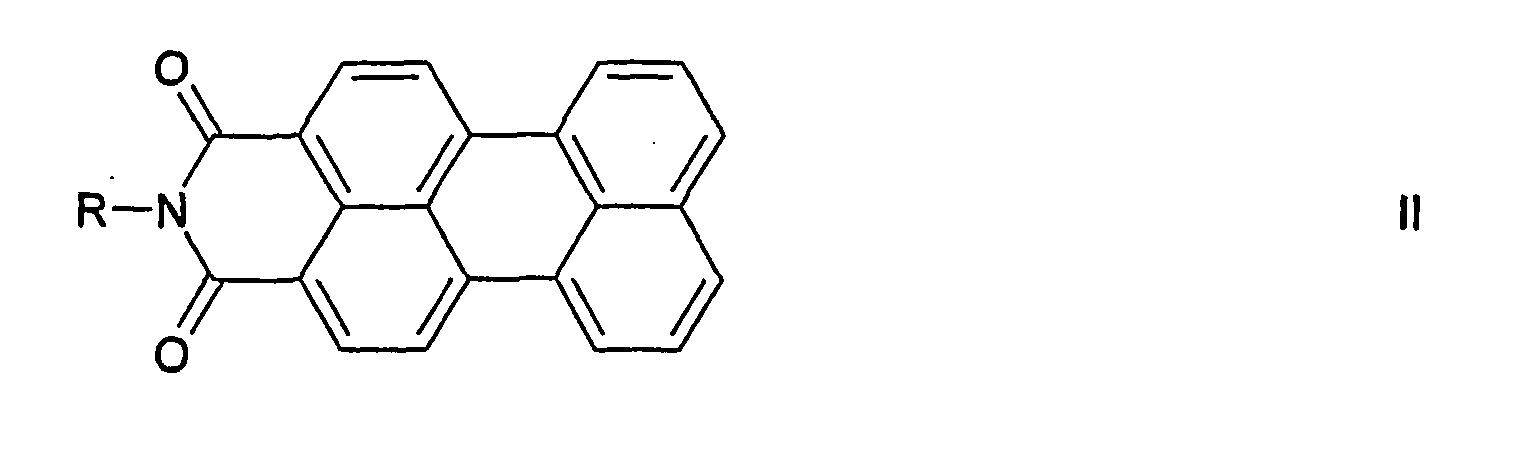

- Verfahren nach Anspruch 1, dadurch gekennzeichnet, daß man als organisches Lösungsmittel ein aprotisches organisches Lösungsmittel einsetzt.
- Verfahren nach Anspruch 1, dadurch gekennzeichnet, daß man als organisches Lösungsmittel ein polar-aprotisches organisches Lösungsmittel einsetzt.
- Verfahren nach Anspruch 1, dadurch gekennzeichnet, daß man als organisches Lösungsmittel ein unpolar-aprotisches Lösungsmittel einsetzt.
- Verfahren nach Anspruch 1, dadurch gekennzeichnet, daß man als organisches Lösungsmittel ein protisches Lösungsmittel einsetzt.
- Verfahren nach Anspruch 1, dadurch gekennzeichnet, daß man als organisches Lösungsmittel ein Amino- und Hydroxyfunktionen enthaltendes Lösungsmittel einsetzt.
- Verfahren nach den Ansprüchen 1 bis 6, dadurch gekennzeichnet, daß man als Base eine starke anorganische oder organische alkalimetallhaltige Base einsetzt.
- Verfahren nach den Ansprüchen 1 bis 7, dadurch gekennzeichnet, daß man als Base ein Alkalimetallalkoholat einsetzt.
- Verfahren nach den Ansprüchen 1 bis 8, dadurch gekennzeichnet, daß man eine stickstoffhaltige Base mit geringer nucleophiler Wirkung zusätzlich als Hilfsbase einsetzt.
- Verfahren nach den Ansprüchen 1 bis 9, dadurch gekennzeichnet, daß man die Umsetzung bei 50 bis 210°C vornimmt.
Applications Claiming Priority (2)
| Application Number | Priority Date | Filing Date | Title |
|---|---|---|---|
| DE102004003734A DE102004003734A1 (de) | 2004-01-23 | 2004-01-23 | Verfahren zur Herstellung von Terrylen-3,4:11,12-tetracarbonsäurediimiden durch Di-rektsynthese |
| PCT/EP2005/000378 WO2005070895A1 (de) | 2004-01-23 | 2005-01-15 | Verfahren zur herstellung von terrylen-3,4:11,12-tetracarbonsäurediimiden durch direktsynthese |
Publications (2)
| Publication Number | Publication Date |
|---|---|
| EP1711469A1 EP1711469A1 (de) | 2006-10-18 |
| EP1711469B1 true EP1711469B1 (de) | 2009-07-15 |
Family
ID=34745092
Family Applications (1)
| Application Number | Title | Priority Date | Filing Date |
|---|---|---|---|
| EP05700962A Expired - Lifetime EP1711469B1 (de) | 2004-01-23 | 2005-01-15 | Verfahren zur herstellung von terrylen-3,4:11,12-tetracarbonsäurediimiden durch direktsynthese |
Country Status (8)
| Country | Link |
|---|---|
| US (1) | US7358362B2 (de) |
| EP (1) | EP1711469B1 (de) |
| JP (1) | JP2007522121A (de) |
| KR (1) | KR20060124711A (de) |
| CN (1) | CN100519534C (de) |
| DE (2) | DE102004003734A1 (de) |
| TW (1) | TW200533718A (de) |
| WO (1) | WO2005070895A1 (de) |
Families Citing this family (10)
| Publication number | Priority date | Publication date | Assignee | Title |
|---|---|---|---|---|
| WO2005076815A2 (en) | 2004-01-26 | 2005-08-25 | Northwestern University | PERYLENE n-TYPE SEMICONDUCTORS AND RELATED DEVICES |
| EP1843407A1 (de) * | 2006-04-07 | 2007-10-10 | Basf Aktiengesellschaft | Flüssig-kristalline Rylentetracarbonsäurederivate und deren Verwendung |
| WO2007146250A2 (en) | 2006-06-12 | 2007-12-21 | Northwestern University | Naphthalene-based semiconductor materials and methods of preparing and use thereof |
| US7947837B2 (en) | 2006-10-25 | 2011-05-24 | Polyera Corporation | Organic semiconductor materials and methods of preparing and use thereof |
| EP2086974B1 (de) | 2006-11-17 | 2013-07-24 | Polyera Corporation | Halbleitermaterialien auf diimidbasis und verfahren zu deren herstellung und anwendung |
| EP2104676A2 (de) | 2007-01-08 | 2009-09-30 | Polyera Corporation | Verfahren zur herstellung aren-bi-(dicarboximid)-basierter halbleitermaterialien und entsprechende zwischenprodukte zu ihrer herstellung |
| WO2008091670A2 (en) | 2007-01-24 | 2008-07-31 | Polyera Corporation | Organic semiconductor materials and precursors thereof |
| US8618297B2 (en) * | 2008-07-25 | 2013-12-31 | Basf Se | Azide substituted naphthylene or rylene imide derivatives and their use as reagents in click-reactions |
| KR102957439B1 (ko) | 2019-03-22 | 2026-04-27 | 바스프 에스이 | 식물 재배 방법 |
| CN111646943A (zh) * | 2020-06-18 | 2020-09-11 | 福州大学 | 联萘酚二酰亚胺衍生物及其制备方法 |
Family Cites Families (1)
| Publication number | Priority date | Publication date | Assignee | Title |
|---|---|---|---|---|
| DE19512773A1 (de) * | 1995-04-05 | 1996-10-10 | Langhals Heinz | Quaterrylenbisimide und ihre Verwendung als Fluoreszenzfarbstoffe |
-
2004
- 2004-01-23 DE DE102004003734A patent/DE102004003734A1/de not_active Withdrawn
-
2005
- 2005-01-15 EP EP05700962A patent/EP1711469B1/de not_active Expired - Lifetime
- 2005-01-15 KR KR1020067016609A patent/KR20060124711A/ko not_active Ceased
- 2005-01-15 US US10/586,133 patent/US7358362B2/en not_active Expired - Fee Related
- 2005-01-15 JP JP2006549994A patent/JP2007522121A/ja not_active Ceased
- 2005-01-15 DE DE502005007702T patent/DE502005007702D1/de not_active Expired - Lifetime
- 2005-01-15 CN CNB2005800029174A patent/CN100519534C/zh not_active Expired - Fee Related
- 2005-01-15 WO PCT/EP2005/000378 patent/WO2005070895A1/de not_active Ceased
- 2005-01-21 TW TW094101868A patent/TW200533718A/zh unknown
Also Published As
| Publication number | Publication date |
|---|---|
| DE102004003734A1 (de) | 2005-08-11 |
| EP1711469A1 (de) | 2006-10-18 |
| WO2005070895A1 (de) | 2005-08-04 |
| KR20060124711A (ko) | 2006-12-05 |
| US20070155968A1 (en) | 2007-07-05 |
| DE502005007702D1 (de) | 2009-08-27 |
| CN100519534C (zh) | 2009-07-29 |
| TW200533718A (en) | 2005-10-16 |
| JP2007522121A (ja) | 2007-08-09 |
| US7358362B2 (en) | 2008-04-15 |
| CN1910155A (zh) | 2007-02-07 |
Similar Documents
| Publication | Publication Date | Title |
|---|---|---|
| EP1879847B1 (de) | Terrylen- und quaterrylenderivate | |
| EP1513841B1 (de) | 1,6,9,14-tetrasubstituierte terrylentetracarbons urediimide | |
| EP1532210B1 (de) | Rylenfarbstoffe | |
| EP1874773B1 (de) | Hexarylen- und pentarylentetracarbonsäurediimide | |
| EP1373214B1 (de) | Rylenderivate und deren verwendung als farbstoffe | |
| DE10243906A1 (de) | 9-Cyanosubstituierte Perylen-3,4-dicarbonsäuremonoimide | |
| US7799920B2 (en) | Method for producing perylene-3,4-dicarboxylic acid imides | |
| EP2089390B1 (de) | Heptarylen-und octarylentetracarbonsäurediimide und deren herstellung | |
| US7358362B2 (en) | Method for the production of terylene-3,4:11,12-tetracarboxydiimides by direct synthesis | |
| EP1789415B1 (de) | Verfahren zur herstellung von quaterrylen-3,4:13,14-tetracarbonsäurediimiden durch direktsynthese | |
| DE102005037115A1 (de) | Mehrfachchromophore | |
| WO2005070894A1 (de) | Verfahren zur herstellung von terrylen-3,4:11,12-tetracarbonsäurediimiden | |
| EP2285806B1 (de) | Dreifach und vierfach substituierte pentarylentetracarbonsäurediimide |
Legal Events
| Date | Code | Title | Description |
|---|---|---|---|
| PUAI | Public reference made under article 153(3) epc to a published international application that has entered the european phase |
Free format text: ORIGINAL CODE: 0009012 |
|
| 17P | Request for examination filed |
Effective date: 20060823 |
|
| AK | Designated contracting states |
Kind code of ref document: A1 Designated state(s): AT BE BG CH CY CZ DE DK EE ES FI FR GB GR HU IE IS IT LI LT LU MC NL PL PT RO SE SI SK TR |
|
| DAX | Request for extension of the european patent (deleted) | ||
| RAP1 | Party data changed (applicant data changed or rights of an application transferred) |
Owner name: MAX-PLANCK-GESELLSCHAFT ZUR FOERDERUNG DER WISSENS Owner name: BASF SE |
|
| RAP3 | Party data changed (applicant data changed or rights of an application transferred) |
Owner name: BASF SE Owner name: MAX-PLANCK-GESELLSCHAFT ZUR FOERDERUNG DER WISSENS |
|
| GRAP | Despatch of communication of intention to grant a patent |
Free format text: ORIGINAL CODE: EPIDOSNIGR1 |
|
| GRAC | Information related to communication of intention to grant a patent modified |
Free format text: ORIGINAL CODE: EPIDOSCIGR1 |
|
| GRAS | Grant fee paid |
Free format text: ORIGINAL CODE: EPIDOSNIGR3 |
|
| GRAA | (expected) grant |
Free format text: ORIGINAL CODE: 0009210 |
|
| AK | Designated contracting states |
Kind code of ref document: B1 Designated state(s): AT BE BG CH CY CZ DE DK EE ES FI FR GB GR HU IE IS IT LI LT LU MC NL PL PT RO SE SI SK TR |
|
| REG | Reference to a national code |
Ref country code: CH Ref legal event code: EP Ref country code: GB Ref legal event code: FG4D Free format text: NOT ENGLISH |
|
| REG | Reference to a national code |
Ref country code: IE Ref legal event code: FG4D |
|
| REF | Corresponds to: |
Ref document number: 502005007702 Country of ref document: DE Date of ref document: 20090827 Kind code of ref document: P |
|
| PG25 | Lapsed in a contracting state [announced via postgrant information from national office to epo] |
Ref country code: LT Free format text: LAPSE BECAUSE OF FAILURE TO SUBMIT A TRANSLATION OF THE DESCRIPTION OR TO PAY THE FEE WITHIN THE PRESCRIBED TIME-LIMIT Effective date: 20090715 Ref country code: IS Free format text: LAPSE BECAUSE OF FAILURE TO SUBMIT A TRANSLATION OF THE DESCRIPTION OR TO PAY THE FEE WITHIN THE PRESCRIBED TIME-LIMIT Effective date: 20091115 Ref country code: SE Free format text: LAPSE BECAUSE OF FAILURE TO SUBMIT A TRANSLATION OF THE DESCRIPTION OR TO PAY THE FEE WITHIN THE PRESCRIBED TIME-LIMIT Effective date: 20090715 Ref country code: FI Free format text: LAPSE BECAUSE OF FAILURE TO SUBMIT A TRANSLATION OF THE DESCRIPTION OR TO PAY THE FEE WITHIN THE PRESCRIBED TIME-LIMIT Effective date: 20090715 Ref country code: ES Free format text: LAPSE BECAUSE OF FAILURE TO SUBMIT A TRANSLATION OF THE DESCRIPTION OR TO PAY THE FEE WITHIN THE PRESCRIBED TIME-LIMIT Effective date: 20091026 |
|
| REG | Reference to a national code |
Ref country code: IE Ref legal event code: FD4D |
|
| PG25 | Lapsed in a contracting state [announced via postgrant information from national office to epo] |
Ref country code: SI Free format text: LAPSE BECAUSE OF FAILURE TO SUBMIT A TRANSLATION OF THE DESCRIPTION OR TO PAY THE FEE WITHIN THE PRESCRIBED TIME-LIMIT Effective date: 20090715 Ref country code: PL Free format text: LAPSE BECAUSE OF FAILURE TO SUBMIT A TRANSLATION OF THE DESCRIPTION OR TO PAY THE FEE WITHIN THE PRESCRIBED TIME-LIMIT Effective date: 20090715 |
|
| PG25 | Lapsed in a contracting state [announced via postgrant information from national office to epo] |
Ref country code: BG Free format text: LAPSE BECAUSE OF FAILURE TO SUBMIT A TRANSLATION OF THE DESCRIPTION OR TO PAY THE FEE WITHIN THE PRESCRIBED TIME-LIMIT Effective date: 20091015 Ref country code: PT Free format text: LAPSE BECAUSE OF FAILURE TO SUBMIT A TRANSLATION OF THE DESCRIPTION OR TO PAY THE FEE WITHIN THE PRESCRIBED TIME-LIMIT Effective date: 20091115 |
|
| PG25 | Lapsed in a contracting state [announced via postgrant information from national office to epo] |
Ref country code: EE Free format text: LAPSE BECAUSE OF FAILURE TO SUBMIT A TRANSLATION OF THE DESCRIPTION OR TO PAY THE FEE WITHIN THE PRESCRIBED TIME-LIMIT Effective date: 20090715 Ref country code: IE Free format text: LAPSE BECAUSE OF FAILURE TO SUBMIT A TRANSLATION OF THE DESCRIPTION OR TO PAY THE FEE WITHIN THE PRESCRIBED TIME-LIMIT Effective date: 20090715 Ref country code: RO Free format text: LAPSE BECAUSE OF FAILURE TO SUBMIT A TRANSLATION OF THE DESCRIPTION OR TO PAY THE FEE WITHIN THE PRESCRIBED TIME-LIMIT Effective date: 20090715 Ref country code: DK Free format text: LAPSE BECAUSE OF FAILURE TO SUBMIT A TRANSLATION OF THE DESCRIPTION OR TO PAY THE FEE WITHIN THE PRESCRIBED TIME-LIMIT Effective date: 20090715 Ref country code: CZ Free format text: LAPSE BECAUSE OF FAILURE TO SUBMIT A TRANSLATION OF THE DESCRIPTION OR TO PAY THE FEE WITHIN THE PRESCRIBED TIME-LIMIT Effective date: 20090715 |
|
| PLBE | No opposition filed within time limit |
Free format text: ORIGINAL CODE: 0009261 |
|
| STAA | Information on the status of an ep patent application or granted ep patent |
Free format text: STATUS: NO OPPOSITION FILED WITHIN TIME LIMIT |
|
| PG25 | Lapsed in a contracting state [announced via postgrant information from national office to epo] |
Ref country code: SK Free format text: LAPSE BECAUSE OF FAILURE TO SUBMIT A TRANSLATION OF THE DESCRIPTION OR TO PAY THE FEE WITHIN THE PRESCRIBED TIME-LIMIT Effective date: 20090715 |
|
| 26N | No opposition filed |
Effective date: 20100416 |
|
| BERE | Be: lapsed |
Owner name: BASF SE Effective date: 20100131 Owner name: MAX-PLANCK-GESELLSCHAFT ZUR FORDERUNG DER WISSENS Effective date: 20100131 |
|
| PG25 | Lapsed in a contracting state [announced via postgrant information from national office to epo] |
Ref country code: MC Free format text: LAPSE BECAUSE OF NON-PAYMENT OF DUE FEES Effective date: 20100131 |
|
| PG25 | Lapsed in a contracting state [announced via postgrant information from national office to epo] |
Ref country code: GR Free format text: LAPSE BECAUSE OF FAILURE TO SUBMIT A TRANSLATION OF THE DESCRIPTION OR TO PAY THE FEE WITHIN THE PRESCRIBED TIME-LIMIT Effective date: 20091016 |
|
| PG25 | Lapsed in a contracting state [announced via postgrant information from national office to epo] |
Ref country code: BE Free format text: LAPSE BECAUSE OF NON-PAYMENT OF DUE FEES Effective date: 20100131 |
|
| PG25 | Lapsed in a contracting state [announced via postgrant information from national office to epo] |
Ref country code: IT Free format text: LAPSE BECAUSE OF FAILURE TO SUBMIT A TRANSLATION OF THE DESCRIPTION OR TO PAY THE FEE WITHIN THE PRESCRIBED TIME-LIMIT Effective date: 20090715 |
|
| PG25 | Lapsed in a contracting state [announced via postgrant information from national office to epo] |
Ref country code: AT Free format text: LAPSE BECAUSE OF NON-PAYMENT OF DUE FEES Effective date: 20100115 |
|
| PGFP | Annual fee paid to national office [announced via postgrant information from national office to epo] |
Ref country code: NL Payment date: 20110126 Year of fee payment: 7 Ref country code: FR Payment date: 20110215 Year of fee payment: 7 Ref country code: CH Payment date: 20110131 Year of fee payment: 7 |
|
| PGFP | Annual fee paid to national office [announced via postgrant information from national office to epo] |
Ref country code: DE Payment date: 20110328 Year of fee payment: 7 Ref country code: GB Payment date: 20110131 Year of fee payment: 7 |
|
| REG | Reference to a national code |
Ref country code: NL Ref legal event code: V1 Effective date: 20120801 |
|
| PG25 | Lapsed in a contracting state [announced via postgrant information from national office to epo] |
Ref country code: CY Free format text: LAPSE BECAUSE OF FAILURE TO SUBMIT A TRANSLATION OF THE DESCRIPTION OR TO PAY THE FEE WITHIN THE PRESCRIBED TIME-LIMIT Effective date: 20090715 |
|
| REG | Reference to a national code |
Ref country code: CH Ref legal event code: PL |
|
| GBPC | Gb: european patent ceased through non-payment of renewal fee |
Effective date: 20120115 |
|
| PG25 | Lapsed in a contracting state [announced via postgrant information from national office to epo] |
Ref country code: LU Free format text: LAPSE BECAUSE OF NON-PAYMENT OF DUE FEES Effective date: 20100115 Ref country code: HU Free format text: LAPSE BECAUSE OF FAILURE TO SUBMIT A TRANSLATION OF THE DESCRIPTION OR TO PAY THE FEE WITHIN THE PRESCRIBED TIME-LIMIT Effective date: 20100116 |
|
| REG | Reference to a national code |
Ref country code: FR Ref legal event code: ST Effective date: 20120928 |
|
| PG25 | Lapsed in a contracting state [announced via postgrant information from national office to epo] |
Ref country code: TR Free format text: LAPSE BECAUSE OF FAILURE TO SUBMIT A TRANSLATION OF THE DESCRIPTION OR TO PAY THE FEE WITHIN THE PRESCRIBED TIME-LIMIT Effective date: 20090715 Ref country code: GB Free format text: LAPSE BECAUSE OF NON-PAYMENT OF DUE FEES Effective date: 20120115 Ref country code: CH Free format text: LAPSE BECAUSE OF NON-PAYMENT OF DUE FEES Effective date: 20120131 Ref country code: DE Free format text: LAPSE BECAUSE OF NON-PAYMENT OF DUE FEES Effective date: 20120801 Ref country code: LI Free format text: LAPSE BECAUSE OF NON-PAYMENT OF DUE FEES Effective date: 20120131 |
|
| REG | Reference to a national code |
Ref country code: DE Ref legal event code: R119 Ref document number: 502005007702 Country of ref document: DE Effective date: 20120801 |
|
| PG25 | Lapsed in a contracting state [announced via postgrant information from national office to epo] |
Ref country code: FR Free format text: LAPSE BECAUSE OF NON-PAYMENT OF DUE FEES Effective date: 20120131 |
|
| PG25 | Lapsed in a contracting state [announced via postgrant information from national office to epo] |
Ref country code: NL Free format text: LAPSE BECAUSE OF NON-PAYMENT OF DUE FEES Effective date: 20120801 |