EP1710783A1 - Trommelkarre - Google Patents
Trommelkarre Download PDFInfo
- Publication number
- EP1710783A1 EP1710783A1 EP05007846A EP05007846A EP1710783A1 EP 1710783 A1 EP1710783 A1 EP 1710783A1 EP 05007846 A EP05007846 A EP 05007846A EP 05007846 A EP05007846 A EP 05007846A EP 1710783 A1 EP1710783 A1 EP 1710783A1
- Authority
- EP
- European Patent Office
- Prior art keywords
- drum
- player
- frame
- support
- truck
- Prior art date
- Legal status (The legal status is an assumption and is not a legal conclusion. Google has not performed a legal analysis and makes no representation as to the accuracy of the status listed.)
- Granted
Links
- 210000001015 abdomen Anatomy 0.000 claims abstract description 6
- 230000033764 rhythmic process Effects 0.000 claims abstract description 4
- 230000005855 radiation Effects 0.000 claims description 8
- 239000000872 buffer Substances 0.000 claims description 7
- 230000000284 resting effect Effects 0.000 claims 1
- 230000008901 benefit Effects 0.000 description 6
- 238000000034 method Methods 0.000 description 5
- ZYXYTGQFPZEUFX-UHFFFAOYSA-N benzpyrimoxan Chemical compound O1C(OCCC1)C=1C(=NC=NC=1)OCC1=CC=C(C=C1)C(F)(F)F ZYXYTGQFPZEUFX-UHFFFAOYSA-N 0.000 description 4
- 241000208967 Polygala cruciata Species 0.000 description 2
- 230000006872 improvement Effects 0.000 description 2
- 230000003993 interaction Effects 0.000 description 2
- 230000001020 rhythmical effect Effects 0.000 description 2
- 238000003756 stirring Methods 0.000 description 2
- 230000000007 visual effect Effects 0.000 description 2
- 241001077262 Conga Species 0.000 description 1
- 241000333074 Eucalyptus occidentalis Species 0.000 description 1
- 235000004443 Ricinus communis Nutrition 0.000 description 1
- 206010039740 Screaming Diseases 0.000 description 1
- 210000003489 abdominal muscle Anatomy 0.000 description 1
- 230000000386 athletic effect Effects 0.000 description 1
- 238000010009 beating Methods 0.000 description 1
- 238000005452 bending Methods 0.000 description 1
- 210000003710 cerebral cortex Anatomy 0.000 description 1
- 238000010276 construction Methods 0.000 description 1
- 230000007812 deficiency Effects 0.000 description 1
- 230000005484 gravity Effects 0.000 description 1
- 239000010985 leather Substances 0.000 description 1
- 239000002184 metal Substances 0.000 description 1
- 230000007659 motor function Effects 0.000 description 1
- 210000003205 muscle Anatomy 0.000 description 1
- 238000009527 percussion Methods 0.000 description 1
- 230000002787 reinforcement Effects 0.000 description 1
- 230000002040 relaxant effect Effects 0.000 description 1
- 238000000527 sonication Methods 0.000 description 1
- 210000002784 stomach Anatomy 0.000 description 1
- 230000009466 transformation Effects 0.000 description 1
Images

Classifications
-
- G—PHYSICS
- G10—MUSICAL INSTRUMENTS; ACOUSTICS
- G10G—REPRESENTATION OF MUSIC; RECORDING MUSIC IN NOTATION FORM; ACCESSORIES FOR MUSIC OR MUSICAL INSTRUMENTS NOT OTHERWISE PROVIDED FOR, e.g. SUPPORTS
- G10G5/00—Supports for musical instruments
- G10G5/005—Supports for musical instruments while playing, e.g. cord, strap or harness
Definitions
- the invention relates to a drum cart for holding and moving a big drum from the player himself according to the claims.
- the well-known large drum has a diameter of about 65 cm and a frame height of about 55 cm.
- the drum is covered with cowhide, leather or synthetic, which are covered with a cable, such as the stirring drums or with tires and tensioning screws.
- the big drum is of Ottoman origin and has been used since the 17th century for military training, the ceremony, but above all for marching to battles to intimidate the enemy and raise the morale of their own troops, a privilege of the Janissaries (an elite). la Llauton Étrangère, educated by the abducted Christian children of the enemy).
- the big drum of the jazz orchestra underwent a transformation in which it became the drums and the center of the orchestra.
- a related circular disc of the big drum in a tight group of percussion instruments, a small drum, several tom-toms, and various simple and a double basin, is surrounded.
- the big drum with the resonant skin covering serves not only for the direct effective sonication of the audience, but at the same time as an eye-catcher and name bearer of the orchestra.
- a distant relative of the unilaterally fogged bass drum is the instrument of the kettle-drum tune, which has come from Asia via Central Europe in the 18th century and is now a classical instrument of the military, opera and symphony orchestras of music.
- the big drum is stationary and mobile used for making music for parades, folk festivals and parades of any kind.
- the marching is carried about 10 kg heavy with two straps around the shoulders of the player's big drum by the player's stomach, which because of the projection of the center of gravity forces the player to stand as if standing while standing.
- the drum limits the player's vision to the front and back makes it impossible to observe the ground, which is an indispensable prerequisite for safe running.
- the standing big drum is rotated about its axis of rotation first 90 ° and then pivoted by about 25 ° to the player and by telescoping the cart frame, the height of the batter so adjustable that all players with the beating technique of above are familiar with the playing of the big drum immediately right.
- rhythm instruments that are recorded with the stroke technique from above, are as follows timpani, like the kettle drums, Fellmembraphone, like the little drum and the stirring drum, Tom-Tom, Bongo, Conga, Timbale, Tabla, Surdo and Darabukka. Wooden stick games, like xylophone and marimba, Metal, like vibraphone and metallophone, Schlagdiophone, like hanging baskets and hi-hat.
- the musical advantages of the invention are that it reduces the high requirements for recording the big traditional drum to the usual measure of the rhythm instruments with the striking technique from above.
- the recorded beats do not radiate the player directly, but only through the reflection of the surroundings, for street music, for example, from the front of the houses.
- the player receives feedback only after a delay and with some distortion, depending on the environment.
- Learning to compensate for these deficiencies requires a lot of practice and remains an individual quality characteristic of traditional games, which, because of the instrument's rhythmic guiding role, shapes the music quality of the whole orchestra.
- the player enjoys the direct acoustic feedback and thus the direct sound itself with the blow from above.
- the drum truck of the invention can be converted from mobile to stationary configuration with a few handles and with a swing-out support, with a pivoting roller or with a support buffer, which is of considerable advantage because the player, depending on the occasion of carrying the drum cart and thus freed from hip belt play, the mobility of this configuration to avail or limit the use of the parking brake of the castor decides.
- the rigidity of the stationary use configuration can be increased by switching to the use of the support pads as the wheels are removed.
- the possibility of integrating a plug-in seat should be mentioned as a further advantage.
- An additional advantage of the invention is that it consists of foldable and dismountable elements which, with the exception of the drum, are suitable for being supplied to a transport crate and thus for up-to-date logistics.
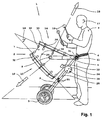
- FIG. 1 shows the drum cart 1 with the big drum 2, which is supported on the frame 3 by the Zargensattel 12 and the bracket 6 is held with the joints 8.
- the covering of the drum is with the hidden impact 14 and Resonanzfoll 15 by means of the tire 32 and the clamping screws 36 and on the frame 7th covered sitting clamps.
- the frame rests on the wheels 5 and is held by the player 9 with the support plate 11 and the waist belt 4. Because the frame 3 is telescopic, the required position of the tummy plate can be adjusted depending on the body size of the player 9 and held with the bolt 21. Thanks to this construction, the two hands of the player 9 are free, so that he can play standing or walking with two mallets 10 on the drum 2.
- the player 9 immediately hears what he is playing, because he is directly irradiated by the batter 14 according to the resultant 18. Because the frame 7 of the drum 2 is segmented or curved so that instead of the otherwise conventional plan parallel arrangement of the impact cases 14 of the large drum 2 are inclined according to the angle 16, the radiation 19 is reflected obliquely in the direction of travel.
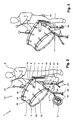
- the player 9 with a cable that ends between the drum 2 and the belly plate 11 (and therefore not visible) solve the grid 30, so that the support 25 in the in the Figure 2 and 3 shown position, is pivoted thanks to a relaxing torsion spring in the joint 24, so that the player 9 can disconnect without help from the drum car 1 and the buckle 34 of the waist belt 4 can solve.
- the support 25 can be equipped as needed with a foot with support buffers 23 'or a swivel caster 26 with integrated holding brake. To close the extended support 25, according to the figure 1, the player must pack the drum cart 1 on the bracket 6 and pull against the usual direction against him until the support 25 buckles and placed the drum cart 1 on the support 25 on the ground becomes. Subsequently, the support 25 is pulled against the frame 3 until the latch 30 clicks and holds the tensioned support 25 in the closed position.
- Figure 3 shows the rigid configuration of the drum cart 1, corresponding to the stationary use without wheels 5, in which case the frame 3 instead of the wheels 5 on the support buffers 23 of the fork 22 cf. 2) and the roller 26 is supported, and the player 9 (see Fig.2) on a saddle 28, which can be stuck with the bracket 27 in the support joint 24, sits.
Landscapes
- Physics & Mathematics (AREA)
- Engineering & Computer Science (AREA)
- Acoustics & Sound (AREA)
- Multimedia (AREA)
- Auxiliary Devices For Music (AREA)
Abstract
Description
- Die Erfindung betrifft eine Trommelkarre für das Halten und Bewegen einer grossen Trommel vom Spieler selbst gemäss den Patentansprüchen.
- Die wohl bekannte grosse Trommel hat einen Durchmesser von etwa 65 cm und eine Zargenhöhe von etwa 55 cm. Zur Bespannung der Trommel dient Rinderfell, Leder oder Synthetic, das mit einem Seilzug, wie die Rührtrommeln oder mit Reifen und Spannschrauben bespannt sind. Die grosse Trommel ist osmanischen Ursprungs und diente seit dem 17. Jahrhundert der militärischen Ausbildung, der Zeremonie, vor allem aber zum Aufmarsch zu Schlachten für die Einschüchterung des Feindes und zur Hebung der Moral der eigenen Truppen, ein Privileg der Janitscharen (eine Elite à-la Légion Étrangère, von verschleppten christlichen Kindern des Feindes erzogen). Bald eroberte die aufregende orientalische Musik mit dem dröhnenden Klang der grossen Trommel, den schreienden Blasinstrumenten und klingenden Beckenpaare die Fürstenhöfe Europas, belebte die Marschmusik und ist mit den Partituren von Mozart (Entführung aus dem Serail) und Haydns (Militärsymphonie) ins Pantheon der klassische Musik erhoben worden.
In den Südstaaten der vereiniqten Staaten von Amerika, wo die Nachkommen der einst deportierten Afrikaner ihre rhythmikbetonte Volksmusik zur Blute brachten, entwickelte sich die afrikanische Trommelmusik im 19. Jahrhundert, in der Wechselwirkung der Marsch- und Tanzmusik der europäischen Einwanderer, in den Strassen New Orleans zum eigenständigen Jazz. Die herumziehende Strassenmusik wechselte später zur Saal- und Tanzmusik und entpuppte sich als Bühnenattraktion. Dabei erfuhr die grosse Trommel der Jazzorchester eine Wandlung, in dem sie zum Schlagzeug und zum Zentrum des Orchesters wurde. Im Mittelpunkt des Schlagzeuges steht das auf die Bühne gestellte, dem Publikum zugewandte Resonanzfell, eine bezogene kreisrunde Scheibe der grossen Trommel, das in einer fest gefügten Gruppe von Schlaginstrumenten, einer kleinen Trommel, mehreren Tom-Toms, sowie diverse einfache und einem zweifachen Becken, umgeben ist. Dabei dient die grosse Trommel mit der Resonanzfellbespannung nicht nur zur unmittelbaren effektvollen Beschallung der Zuhörer, sondern zugleich als Blickfang und Namensträger des Orchesters. Vom Spieler wird die grosse Trommel des Schlagzeuges einseitig am Schlagfell mit Fusstritten Ober ein als Fussmaschine bezeichnetes Pedal geschlagen, um die Hände zum Erklingen der übrigen Instrumente des Schlagzeuges frei zu halten.
Eine ferne Verwandte der einseitig beschlagenen grossen Trommel ist das einseitig bespannte, aus Asien über Mitteleuropa im 18. Jahrhundert gelangte Instrument der Kesselpauke, ein inzwischen klassisches Instrument der Militär- sowie Oper- und Symphonieorchester der Musik. - Entsprechend der obigen Schilderung wird die grosse Trommel stationär wie mobil zum Musizieren verwendet zu Umzügen, Volksfesten und Paraden jeglicher Art. Dabei wird zum Marschieren die etwa 10 kg schwere mit zwei Gurten um die Schultern des Spielers gehängte grosse Trommel vom Spieler am Bauch getragen, was wegen der Ausladung des Schwerpunktes den Spieler beim Laufen wie Stehen zum Zurücklehnen zwingt. Nebst erheblicher Belastung der Wirbelsäule, der Rücken- und Bauchmuskulatur durch Druck und Biegung beschränkt die Trommel die Sicht des Spielers nach vorne und verunmöglicht die Beobachtung des Bodens, was zum sicheren Laufen eine unverzichtbare Voraussetzung ist.
- Um diese Nachteile zu reduzieren und den Zugang für konstitutionell weniger athletische Personen zu ermöglichen, ist von der Firma Musikhaus Gasser in 6280 Hochdorf in der Schweiz ein Fahrgestell für das Halten und Bewegen einer grossen Trommel mit zwei Rädern und zwei Rollen, sowie eine Bauchplatte und ein Hüftgurt für die Anbindung des Spielers an das Gestell vorgeschlagen worden.
- Der Nachteil dieser Lösung des Standes der Technik ist, dass sie zwar die Belastung des Spielers reduziert aber in Sachen Sichtbehinderung keinerlei Besserung bringt.
- Aufgabe der vorliegenden Erfindung ist, der Nachteil des vorliegenden Lösungsversuchs zu vermeiden und somit
- einwandfreie Sichtbedingung dem Spieler zu sichern,
- das Konzept der Beschallung für Strassenumzüge, s0wie für den Bühnenauftritt zu optimieren und zugleich
- mit der traditionellen beidseitigen Schlagtechnik, zugunsten des Anschlages von oben zu brechen.
- Um die Verbesserungsziele der Erfindung zu erreichen wird die stehende grosse Trommel um seine Drehachse zuerst 90° gedreht und anschliessend um etwa 25° zum Spieler geschwenkt und durch Teleskopisierung des Karrengerüstes die Höhe des Schlagfells so einstellbar macht, dass alle Spieler, die mit der Schlagtechnik von oben vertraut sind, sich mit dem Bespielen der grossen Trommel sich sofort zu recht finden.
- Eine unvollständige Auswahl der Rhythmus-Instrumente die mit der Schlagtechnik von oben bespielt sind, sind wie folgt
Pauken, wie die Kesselpauken, Fellmembraphone, wie die kleine Trommel und die Rührtrommel, Tom-Tom, Bongo, Conga, Timbale, Tabla, Surdo und Darabukka. Stabspiele aus Holz, wie Xylophon und Marimbaphon, Metall, wie Vibraphon und Metallophon, Schlagdiophone, wie Hängebecken und Hi-Hat. - Die musikalischen Vorteile der Erfindung sind, dass sie die hohen Anforderungen zum Bespielen der grossen traditionellen Trommel auf das übliche Mass der Rhythmus-Instrumente mit der Schlagtechnik von oben reduziert. Bei den seitlichen Schlägen der traditionellen grossen Trommel strahlen nämlich die bespielten Schlagfelle den Spieler nicht unmittelbar, sondern erst durch die Reflektion der Umgebung an, bei der Strassenmusik beispielsweise von der Front der Häuser. Das hat zur Folge, dass der Spieler erst mit Verzögerung und mit irgendwelchen Verzerrungen, je nach Umgebung, die Rückmeldung erhält. Die Kompensation dieser Mängel zu erlernen, verlangt viel Übung und bleibt ein individuelles Qualitätsmerkmal von traditionellem Spielen, das wegen der rhythmischen Leitrolle des Instrumentes die Musikqualität des ganzen Orchesters prägt.
Im Gegensatz zur traditionellen Grossen Trommel geniesst der Spieler mit dem Schlag von oben die direkte akustische Rückkuppelung und somit die unmittelbare Beschallung selbst. Diese direkte verzögerungs- und verzerrungsfreie akustische Information macht für den Spieler der Instrumente mit Schlag von oben den problemlosen Zugang zu der erfindungsgemässen Anordnung der grossen Trommel, nicht zuletzt darum, weil die Technik des Anschlages identisch ist, womit das durch Üben geschliffene komplexe Zusammenspiel der Hirnrinde mit der Motorik der Muskeln und der Gelenke (Articulationes!) zur massvollen Bewegen der Hand und der Arme angesprochen sind. - Weil die ursprünglich senkrechten plan parallele Schlagfelle der grossen Trommel mit der Erfindung annähernd waagrecht gerichtet und zum Spieler geneigt sind, würde der Schall des Resonanzfells in steilem Winkel zum Untergrund strahlen. Mit Drehung des Resonanzfells wird jedoch die Beschallung des Bodens flacher und somit die Abstrahlung des Schalls in die Marschrichtung oder beim Bühnenauftritt analog dem Jazz-Schlagzeug auf das Publikum gerichtet, was gegenüber der senkrecht gestellten grossen Trommel der Standes der Technik von erheblichem Vorteil ist.
- Die Trommelkarre der Erfindung lässt sich mit wenigen Griffen und mit einer aus-schwenkbaren Stütze, mit einer schwenkbaren Rolle oder mit einem Stützpuffer vom mobilen zur stationären Konfiguration wandeln, was von erheblichem Vorteil ist, weil der Spieler, je nach Gelegenheit vom Tragen der Trommelkarre und somit auch vom Hüftgurt befreit spielen kann, wobei die Mobilität dieser Konfiguration zu nützen oder einzuschränken die Benützung der Feststellbremse der Schwenkrolle entscheidet.
- Zum weiteren Vorteil der Erfindung lässt sich die Steifigkeit der Konfiguration für den stationären Gebrauch erhöhen, indem mit Entfernung der Räder auf die Benützung der Stützpuffer umgestellt wird. In diesem Zusammenhang soll die Möglichkeit der Integration eines Stecksitzes als weiterer Vorteil erwähnt sein.
- Ein zusätzlicher Vorteil der Erfindung ist, dass sie aus faltbaren und zerlegbaren Elementen besteht, die mit Ausnahme der Trommel sich für die Versorgung in eine Transportkiste und somit für zeitgemässe Logistik eignen.
- Zum Vergleich der Merkmale der Erfindung mit dem besprochenen Standes der Technik wird auf die Figur 4 verwiesen.
- Nachfolgend wird die Erfindung gemäss einem Ausführungsbeispiel in mobilem und stationiertem Gebrauch mit ihren wesentlichsten Teilen dargestellt. Die Zeichnungen zeigen:
- Fig.1
- die Trommelkarre in mobilem Gebrauch,
- Fig.2
- die Trommelkarre in provisorisch stationären Gebrauch,
- Fig.3
- die Trommelkarre in stationärem Gebrauch.
- Die Figur 1 zeigt die Trommelkarre 1 mit der grossen Trommel 2, die auf dem Gestell 3 vom Zargensattel 12 gestützt und den Bügel 6 mit den Gelenken 8 gehalten wird. Die Bespannung der Trommel ist mit den verdeckten Schlag- 14 und Resonanzfoll 15 mit Hilfe dcr Reifen 32 und den Spannschrauben 36 und den auf der Zarge 7 sitzenden Spannböcken bespannt. Das Gestell ruht auf den Rädern 5 und wird vom Spieler 9 mit der Stützplatte 11 und der Hüftgurt 4 gehalten. Weil das Gestell 3 teleskopisierbar ist lässt sich die erforderliche Position der Bauchplatte je nach der Körpergrösse des Spielers 9 einstellen und mit dem Bolzen 21 festhalten. Dank dieser Konstruktion sind die beiden Hände des Spielers 9 frei, so dass er im Stehen oder Gehen mit beiden Schlegeln 10 auf der Trommel 2 spielen kann. Dabei hört der Spieler 9 unmittelbar was er spielt, denn er wird vom Schlagfell 14 entsprechend der Resultierenden 18 direkt bestrahlt. Weil die Zarge 7 der Trommel 2 so segmentiert oder gewölbt ist, dass an Stelle der ansonsten üblichen plan parallelen Anordnung der Schlagfälle 14 der grossen Trommel 2 entsprechend des Winkels 16 geneigt sind, wird die Abstrahlung 19 schräg in die Marschrichtung reflektiert.
- Wird für eine Weile Halt gemacht, so kann der Spieler 9 mit einem Seilzug, der zwischen der Trommel 2 und der Bauchplatte 11 endet (und darum nicht ersichtlich ist) den Raster 30 lösen, so dass die Stütze 25 in die in der Figur 2 und 3 gezeigten Lage, dank einer sich entspannenden Drehbiegefeder im Gelenk 24 geschwenkt wird, so dass der Spieler 9 sich ohne fremde Hilfe vom Trommelkarren 1 trennen und die schnalle 34 des Hüftgurtes 4 lösen kann.
Die Stütze 25 kann je nach Bedarf mit einem Fuss mit Stützpuffern 23' oder einer Schwenkrolle 26 mit integrierter Haltebremse bestückt sein.
Zum Schliessen der ausgefahrenen Stütze 25, gemäss der Figur 1, muss der Spieler die Trommelkarre 1 am Bügel 6 packen und entgegen der üblichen Fahrtrichtung gegen sich ziehen, bis die Stütze 25 einknickt und die Trommelkarre 1 über die Stütze 25 auf den Boden gelegt wird. Anschliessend wird die Stütze 25 so an das Gestell 3 gezogen, bis der Einraster 30 klickt und die gespannte Stütze 25 in der geschlossenen Position hält. - Die Figur 3 zeigt die steife Konfiguration der Trommelkarre 1, entsprechend dem stationären Gebrauch ohne Räder 5, wobei dann das Gestell 3 an Stelle der Räder 5 sich auf den Stützpuffern 23 der Gabel 22 vgl. Fig.2) und der Rolle 26 stützt, und der Spieler 9 (vgl. Fig.2) auf einen Sattel 28, der sich mit der Konsole 27 in das Stützengelenk 24 stecken lässt, sitzt.
-
- 1
- Trommelkarren
- 2
- Trommel
- 3
- Gestell
- 4
- Hüftgurt
- 5
- Rad
- 6
- Bügel
- 7
- Zarge
- 8
- Gelenk
- 9
- Spieler
- 10
- Schlegel
- 11
- Bauchplatte
- 12
- Zargensattel
- 13
- 14
- Schlagfell
- 15
- Resonanzfell
- 16
- Neigungswinkel der Abstrahlung von 14/15
- 17
- Ohrmuscheln von 9
- 18
- Abstrahlung des 14
- 19
- Abstrahlung des 15
- 20
- Winkel zwischen 18/19
- 21
- Bolzen
- 22
- Gabel
- 23
- Stützpuffer (an der 22)
- 23'
- Stützpuffer (an der 25)
- 24
- Stützengelenk
- 25
- Stütze
- 26
- Schwenkrolle
- 27
- Konsole
- 28
- Sattel
- 29
- Achsenstummel
- 30
- Einraster
- 31
- Gurtbefestigung
- 32
- Reifen
- 33
- Reifengreifer
- 34
- Schnalle
- 35
- Spannböckchen
- 36
- Spannschraube
Claims (10)
- Trommelkarre (1) für das Halten und Bewegen einer grossen Trommel (2) vom Spieler (9) selbst, wobei die Trommel auf einem Gestell (3) mit zwei Rädern (5) ruht und der Spieler (9) mit dem Gestell durch eine Bauchplatte (11) und einem Hüftgurt (4) verbunden ist dadurch gekennzeichnet, dass die Trommel (2) von mindestens einem Bügel (6) um die Zarge (7) gefasst wird und vorzugsweise mit zwei Gelenken (8) mit dem Bügel (6) verbunden ist und der Bügel (6) vorzugsweise in ihre Mitte mit dem Gestell (3) so befestigt wird, dass der Spieler (9) mit beiden Schlegeln (10) das selbe Schlagfell (14) von oben, wie bei allen anderen Rhythmus-Instrumenten üblich, beim Laufen, Stehen oder beim Sitzen trifft.
- Trommelkarre (1) nach Anspruch 1 dadurch gekennzeichnet, dass die Ebene des Schlagfells (14) mit der Ebene des Resonanzfells (15) nicht plan parallel ist, sondern einen Winkel (16) bildet.
- Trommelkarre (1) nach Anspruch 1 dadurch gekennzeichnet, dass die Ohrenmuscheln (17) des Spielers (9) im direkten Abstrahlung (18) des Schlagfells (14) sich befinden.
- Trommelkarre (1) nach Anspruch 1 dadurch gekennzeichnet, dass der Winkel (20) zwischen der Abstrahlung des Schlagfells (14) und der Abstrahlung des Resonanzfells (15) kleiner als 180° ist.
- Trommelkarre (1) nach Anspruch 1 dadurch gekennzeichnet, dass das Gestell (3) teleskopisch verstellbar und mit einem Bolzen (21) arretierbar ist und vorzugsweise in eine Gabel (22) und in eine Bauchplattc (11) endet.
- Trommelkarre (1) nach Anspruch 1 dadurch gekennzeichnet, dass die Räder (5) an die Gabel (22) steckbar sind.
- Trommelkarre (1) nach Anspruch 1 dadurch gekennzeichnet, dass die Gabel (22) in Stützpuffern (23) endet.
- Trommelkarre (1) nach Anspruch 1 dadurch gekennzeichnet, dass an das Gestell (3) eine schwenkbare und teleskopierbare Stütze (25) durch ein Stützengelenk (24) verbunden ist.
- Trommelkarre (1) nach Anspruch 1 dadurch gekennzeichnet, dass die Stütze (25) des Gestells (3) in eine Schwenkrolle (26) oder in einen Stützpuffer (23') endet.
- Trommelkarre (1) nach Anspruch 1 dadurch gekennzeichnet, dass am Stützgelenk (24) eine schwenkbare und arretierbare Konsole (27) mit einem Sattel (28) verbunden ist.
Priority Applications (2)
| Application Number | Priority Date | Filing Date | Title |
|---|---|---|---|
| EP05007846A EP1710783B1 (de) | 2005-04-09 | 2005-04-09 | Trommelkarre |
| US11/278,728 US7378584B2 (en) | 2005-04-09 | 2006-04-05 | Drum |
Applications Claiming Priority (1)
| Application Number | Priority Date | Filing Date | Title |
|---|---|---|---|
| EP05007846A EP1710783B1 (de) | 2005-04-09 | 2005-04-09 | Trommelkarre |
Publications (2)
| Publication Number | Publication Date |
|---|---|
| EP1710783A1 true EP1710783A1 (de) | 2006-10-11 |
| EP1710783B1 EP1710783B1 (de) | 2012-12-05 |
Family
ID=34980408
Family Applications (1)
| Application Number | Title | Priority Date | Filing Date |
|---|---|---|---|
| EP05007846A Expired - Lifetime EP1710783B1 (de) | 2005-04-09 | 2005-04-09 | Trommelkarre |
Country Status (2)
| Country | Link |
|---|---|
| US (1) | US7378584B2 (de) |
| EP (1) | EP1710783B1 (de) |
Cited By (2)
| Publication number | Priority date | Publication date | Assignee | Title |
|---|---|---|---|---|
| NL1034170C2 (nl) * | 2007-07-20 | 2009-01-21 | K H S Musical Instr Co | Keteltrom met een opvouwbaar stel poten. |
| CN106463103A (zh) * | 2014-06-23 | 2017-02-22 | 康能普视株式会社 | 前方和下方可见的行进鼓 |
Families Citing this family (8)
| Publication number | Priority date | Publication date | Assignee | Title |
|---|---|---|---|---|
| US7385126B1 (en) * | 2006-07-27 | 2008-06-10 | Drum Workshop, Inc. | Drum support pads |
| DE202008005880U1 (de) * | 2008-04-28 | 2008-08-14 | Abdul-Salam, Bassam | Ständer für eine Trommel sowie diesbezügliche Trommel |
| US7960634B2 (en) * | 2008-09-26 | 2011-06-14 | Gauger Gary L | Support system for percussion instruments |
| US9437175B2 (en) * | 2012-11-14 | 2016-09-06 | Auburn University | Anterior load carriage stability and mobility support system |
| US20150020677A1 (en) * | 2013-04-20 | 2015-01-22 | Eugene Joseph Perry | Collapsible Transportable Live Electric Music Station For The Solo Performer |
| US9754567B1 (en) | 2016-09-15 | 2017-09-05 | Paul William Griffin | System and method for transportation and performance of musical drums |
| US20180268790A1 (en) * | 2017-03-20 | 2018-09-20 | Kevin Rhue | Drum rack |
| US20230024791A1 (en) * | 2021-07-20 | 2023-01-26 | Donn Roberts | Monitor Speaker Assembly |
Citations (3)
| Publication number | Priority date | Publication date | Assignee | Title |
|---|---|---|---|---|
| US2588830A (en) * | 1950-02-28 | 1952-03-11 | Engval J Haanstad | Drum buoy |
| US4102237A (en) * | 1977-03-03 | 1978-07-25 | Richard R. Suess | Stand for an assembly of musical drums |
| DE10011114A1 (de) | 2000-03-10 | 2001-10-04 | Lothar Baechle | Vorrichtung zum Halten und Spielen von Musikinstrumenten, insbesondere beim Marschieren, Gehen und/oder Stehen |
Family Cites Families (1)
| Publication number | Priority date | Publication date | Assignee | Title |
|---|---|---|---|---|
| US4634032A (en) * | 1982-06-04 | 1987-01-06 | Laflame Thomas R | Carrier for a percussion instrument or other object |
-
2005
- 2005-04-09 EP EP05007846A patent/EP1710783B1/de not_active Expired - Lifetime
-
2006
- 2006-04-05 US US11/278,728 patent/US7378584B2/en not_active Expired - Lifetime
Patent Citations (3)
| Publication number | Priority date | Publication date | Assignee | Title |
|---|---|---|---|---|
| US2588830A (en) * | 1950-02-28 | 1952-03-11 | Engval J Haanstad | Drum buoy |
| US4102237A (en) * | 1977-03-03 | 1978-07-25 | Richard R. Suess | Stand for an assembly of musical drums |
| DE10011114A1 (de) | 2000-03-10 | 2001-10-04 | Lothar Baechle | Vorrichtung zum Halten und Spielen von Musikinstrumenten, insbesondere beim Marschieren, Gehen und/oder Stehen |
Cited By (3)
| Publication number | Priority date | Publication date | Assignee | Title |
|---|---|---|---|---|
| NL1034170C2 (nl) * | 2007-07-20 | 2009-01-21 | K H S Musical Instr Co | Keteltrom met een opvouwbaar stel poten. |
| CN106463103A (zh) * | 2014-06-23 | 2017-02-22 | 康能普视株式会社 | 前方和下方可见的行进鼓 |
| CN106463103B (zh) * | 2014-06-23 | 2021-05-25 | 康能普视株式会社 | 前方和下方可见的行进鼓 |
Also Published As
| Publication number | Publication date |
|---|---|
| EP1710783B1 (de) | 2012-12-05 |
| US20060225559A1 (en) | 2006-10-12 |
| US7378584B2 (en) | 2008-05-27 |
Similar Documents
| Publication | Publication Date | Title |
|---|---|---|
| EP1710783B1 (de) | Trommelkarre | |
| JP3543622B2 (ja) | ドラムセット | |
| CA2215611C (en) | Carrier assembly for percussion instruments | |
| US7928302B2 (en) | Compact drum set and methods of using, setting up, and compacting same | |
| US9082375B2 (en) | Percussion instrument and stand for the same | |
| US3974732A (en) | Multiple musical instrument holder for marching | |
| US6471078B2 (en) | Mobile percussion instrument field rack system | |
| JP2610007B2 (ja) | ドラムの支持構造 | |
| US4479414A (en) | Drum support assembly | |
| US6091011A (en) | Multiple musical instrument holder | |
| US5744738A (en) | Frame structure for musical drums | |
| US7399916B1 (en) | Percussion cow-bell holder apparatus | |
| JPH09512468A (ja) | 非回転式ガット張り装置および方法 | |
| US4616551A (en) | Nada drum and assembly | |
| US7056237B2 (en) | Portable basketball rebound apparatus and method | |
| US7094959B2 (en) | Alternating cymbals | |
| US7148412B2 (en) | Drum-mounted striker-type percussion attachment | |
| US4831912A (en) | Kettledrum | |
| US2525623A (en) | Support means for drums and drum accessories | |
| US4377964A (en) | Bass drum modulator | |
| DE69821696T2 (de) | Den Spieler weniger hindernder Ständer für ein Musikinstrument | |
| US4674390A (en) | Kettledrum | |
| US9779707B2 (en) | Thigh drum | |
| US4211143A (en) | Musical instrument | |
| DE102015114909B3 (de) | Schlagzeugsystem |
Legal Events
| Date | Code | Title | Description |
|---|---|---|---|
| PUAI | Public reference made under article 153(3) epc to a published international application that has entered the european phase |
Free format text: ORIGINAL CODE: 0009012 |
|
| AK | Designated contracting states |
Kind code of ref document: A1 Designated state(s): AT BE BG CH CY CZ DE DK EE ES FI FR GB GR HU IE IS IT LI LT LU MC NL PL PT RO SE SI SK TR |
|
| AX | Request for extension of the european patent |
Extension state: AL BA HR LV MK YU |
|
| 17P | Request for examination filed |
Effective date: 20061228 |
|
| AKX | Designation fees paid |
Designated state(s): AT BE BG CH CY CZ DE DK EE ES FI FR GB GR HU IE IS IT LI LT LU MC NL PL PT RO SE SI SK TR |
|
| 17Q | First examination report despatched |
Effective date: 20081017 |
|
| GRAP | Despatch of communication of intention to grant a patent |
Free format text: ORIGINAL CODE: EPIDOSNIGR1 |
|
| GRAC | Information related to communication of intention to grant a patent modified |
Free format text: ORIGINAL CODE: EPIDOSCIGR1 |
|
| GRAL | Information related to payment of fee for publishing/printing deleted |
Free format text: ORIGINAL CODE: EPIDOSDIGR3 |
|
| GRAS | Grant fee paid |
Free format text: ORIGINAL CODE: EPIDOSNIGR3 |
|
| GRAP | Despatch of communication of intention to grant a patent |
Free format text: ORIGINAL CODE: EPIDOSNIGR1 |
|
| GRAA | (expected) grant |
Free format text: ORIGINAL CODE: 0009210 |
|
| AK | Designated contracting states |
Kind code of ref document: B1 Designated state(s): AT BE BG CH CY CZ DE DK EE ES FI FR GB GR HU IE IS IT LI LT LU MC NL PL PT RO SE SI SK TR |
|
| RAP1 | Party data changed (applicant data changed or rights of an application transferred) |
Owner name: BEAT, FRANK Owner name: ROEOESLI, STEFAN |
|
| REG | Reference to a national code |
Ref country code: GB Ref legal event code: FG4D Free format text: NOT ENGLISH |
|
| RIN1 | Information on inventor provided before grant (corrected) |
Inventor name: ROEOESLI, STEFAN Inventor name: BEAT, FRANK |
|
| REG | Reference to a national code |
Ref country code: CH Ref legal event code: EP |
|
| REG | Reference to a national code |
Ref country code: AT Ref legal event code: REF Ref document number: 587638 Country of ref document: AT Kind code of ref document: T Effective date: 20121215 |
|
| REG | Reference to a national code |
Ref country code: IE Ref legal event code: FG4D Free format text: LANGUAGE OF EP DOCUMENT: GERMAN |
|
| REG | Reference to a national code |
Ref country code: DE Ref legal event code: R096 Ref document number: 502005013311 Country of ref document: DE Effective date: 20130131 |
|
| REG | Reference to a national code |
Ref country code: NL Ref legal event code: T3 |
|
| PG25 | Lapsed in a contracting state [announced via postgrant information from national office to epo] |
Ref country code: ES Free format text: LAPSE BECAUSE OF FAILURE TO SUBMIT A TRANSLATION OF THE DESCRIPTION OR TO PAY THE FEE WITHIN THE PRESCRIBED TIME-LIMIT Effective date: 20130316 Ref country code: FI Free format text: LAPSE BECAUSE OF FAILURE TO SUBMIT A TRANSLATION OF THE DESCRIPTION OR TO PAY THE FEE WITHIN THE PRESCRIBED TIME-LIMIT Effective date: 20121205 Ref country code: LT Free format text: LAPSE BECAUSE OF FAILURE TO SUBMIT A TRANSLATION OF THE DESCRIPTION OR TO PAY THE FEE WITHIN THE PRESCRIBED TIME-LIMIT Effective date: 20121205 Ref country code: SE Free format text: LAPSE BECAUSE OF FAILURE TO SUBMIT A TRANSLATION OF THE DESCRIPTION OR TO PAY THE FEE WITHIN THE PRESCRIBED TIME-LIMIT Effective date: 20121205 |
|
| REG | Reference to a national code |
Ref country code: LT Ref legal event code: MG4D |
|
| PG25 | Lapsed in a contracting state [announced via postgrant information from national office to epo] |
Ref country code: SI Free format text: LAPSE BECAUSE OF FAILURE TO SUBMIT A TRANSLATION OF THE DESCRIPTION OR TO PAY THE FEE WITHIN THE PRESCRIBED TIME-LIMIT Effective date: 20121205 Ref country code: GR Free format text: LAPSE BECAUSE OF FAILURE TO SUBMIT A TRANSLATION OF THE DESCRIPTION OR TO PAY THE FEE WITHIN THE PRESCRIBED TIME-LIMIT Effective date: 20130306 Ref country code: PL Free format text: LAPSE BECAUSE OF FAILURE TO SUBMIT A TRANSLATION OF THE DESCRIPTION OR TO PAY THE FEE WITHIN THE PRESCRIBED TIME-LIMIT Effective date: 20121205 |
|
| PG25 | Lapsed in a contracting state [announced via postgrant information from national office to epo] |
Ref country code: EE Free format text: LAPSE BECAUSE OF FAILURE TO SUBMIT A TRANSLATION OF THE DESCRIPTION OR TO PAY THE FEE WITHIN THE PRESCRIBED TIME-LIMIT Effective date: 20121205 Ref country code: SK Free format text: LAPSE BECAUSE OF FAILURE TO SUBMIT A TRANSLATION OF THE DESCRIPTION OR TO PAY THE FEE WITHIN THE PRESCRIBED TIME-LIMIT Effective date: 20121205 Ref country code: BG Free format text: LAPSE BECAUSE OF FAILURE TO SUBMIT A TRANSLATION OF THE DESCRIPTION OR TO PAY THE FEE WITHIN THE PRESCRIBED TIME-LIMIT Effective date: 20130305 Ref country code: IS Free format text: LAPSE BECAUSE OF FAILURE TO SUBMIT A TRANSLATION OF THE DESCRIPTION OR TO PAY THE FEE WITHIN THE PRESCRIBED TIME-LIMIT Effective date: 20130405 Ref country code: CY Free format text: LAPSE BECAUSE OF FAILURE TO SUBMIT A TRANSLATION OF THE DESCRIPTION OR TO PAY THE FEE WITHIN THE PRESCRIBED TIME-LIMIT Effective date: 20121205 |
|
| PG25 | Lapsed in a contracting state [announced via postgrant information from national office to epo] |
Ref country code: PT Free format text: LAPSE BECAUSE OF FAILURE TO SUBMIT A TRANSLATION OF THE DESCRIPTION OR TO PAY THE FEE WITHIN THE PRESCRIBED TIME-LIMIT Effective date: 20130405 Ref country code: RO Free format text: LAPSE BECAUSE OF FAILURE TO SUBMIT A TRANSLATION OF THE DESCRIPTION OR TO PAY THE FEE WITHIN THE PRESCRIBED TIME-LIMIT Effective date: 20121205 |
|
| PLBE | No opposition filed within time limit |
Free format text: ORIGINAL CODE: 0009261 |
|
| STAA | Information on the status of an ep patent application or granted ep patent |
Free format text: STATUS: NO OPPOSITION FILED WITHIN TIME LIMIT |
|
| PG25 | Lapsed in a contracting state [announced via postgrant information from national office to epo] |
Ref country code: DK Free format text: LAPSE BECAUSE OF FAILURE TO SUBMIT A TRANSLATION OF THE DESCRIPTION OR TO PAY THE FEE WITHIN THE PRESCRIBED TIME-LIMIT Effective date: 20121205 |
|
| 26N | No opposition filed |
Effective date: 20130906 |
|
| PG25 | Lapsed in a contracting state [announced via postgrant information from national office to epo] |
Ref country code: MC Free format text: LAPSE BECAUSE OF FAILURE TO SUBMIT A TRANSLATION OF THE DESCRIPTION OR TO PAY THE FEE WITHIN THE PRESCRIBED TIME-LIMIT Effective date: 20121205 |
|
| PG25 | Lapsed in a contracting state [announced via postgrant information from national office to epo] |
Ref country code: IT Free format text: LAPSE BECAUSE OF FAILURE TO SUBMIT A TRANSLATION OF THE DESCRIPTION OR TO PAY THE FEE WITHIN THE PRESCRIBED TIME-LIMIT Effective date: 20121205 |
|
| REG | Reference to a national code |
Ref country code: DE Ref legal event code: R097 Ref document number: 502005013311 Country of ref document: DE Effective date: 20130906 |
|
| REG | Reference to a national code |
Ref country code: IE Ref legal event code: MM4A |
|
| PG25 | Lapsed in a contracting state [announced via postgrant information from national office to epo] |
Ref country code: IE Free format text: LAPSE BECAUSE OF NON-PAYMENT OF DUE FEES Effective date: 20130409 |
|
| PG25 | Lapsed in a contracting state [announced via postgrant information from national office to epo] |
Ref country code: TR Free format text: LAPSE BECAUSE OF FAILURE TO SUBMIT A TRANSLATION OF THE DESCRIPTION OR TO PAY THE FEE WITHIN THE PRESCRIBED TIME-LIMIT Effective date: 20121205 |
|
| PG25 | Lapsed in a contracting state [announced via postgrant information from national office to epo] |
Ref country code: HU Free format text: LAPSE BECAUSE OF FAILURE TO SUBMIT A TRANSLATION OF THE DESCRIPTION OR TO PAY THE FEE WITHIN THE PRESCRIBED TIME-LIMIT; INVALID AB INITIO Effective date: 20050409 |
|
| REG | Reference to a national code |
Ref country code: FR Ref legal event code: PLFP Year of fee payment: 12 |
|
| REG | Reference to a national code |
Ref country code: FR Ref legal event code: PLFP Year of fee payment: 13 |
|
| REG | Reference to a national code |
Ref country code: FR Ref legal event code: PLFP Year of fee payment: 14 |
|
| PGFP | Annual fee paid to national office [announced via postgrant information from national office to epo] |
Ref country code: LU Payment date: 20180406 Year of fee payment: 14 Ref country code: NL Payment date: 20180419 Year of fee payment: 14 |
|
| PGFP | Annual fee paid to national office [announced via postgrant information from national office to epo] |
Ref country code: CZ Payment date: 20180406 Year of fee payment: 14 Ref country code: DE Payment date: 20180406 Year of fee payment: 14 |
|
| PGFP | Annual fee paid to national office [announced via postgrant information from national office to epo] |
Ref country code: FR Payment date: 20180405 Year of fee payment: 14 Ref country code: BE Payment date: 20180406 Year of fee payment: 14 Ref country code: AT Payment date: 20180426 Year of fee payment: 14 |
|
| PGFP | Annual fee paid to national office [announced via postgrant information from national office to epo] |
Ref country code: GB Payment date: 20180405 Year of fee payment: 14 |
|
| REG | Reference to a national code |
Ref country code: DE Ref legal event code: R119 Ref document number: 502005013311 Country of ref document: DE |
|
| REG | Reference to a national code |
Ref country code: NL Ref legal event code: MM Effective date: 20190501 |
|
| REG | Reference to a national code |
Ref country code: AT Ref legal event code: MM01 Ref document number: 587638 Country of ref document: AT Kind code of ref document: T Effective date: 20190409 |
|
| REG | Reference to a national code |
Ref country code: BE Ref legal event code: MM Effective date: 20190430 |
|
| GBPC | Gb: european patent ceased through non-payment of renewal fee |
Effective date: 20190409 |
|
| PG25 | Lapsed in a contracting state [announced via postgrant information from national office to epo] |
Ref country code: LU Free format text: LAPSE BECAUSE OF NON-PAYMENT OF DUE FEES Effective date: 20190409 |
|
| PG25 | Lapsed in a contracting state [announced via postgrant information from national office to epo] |
Ref country code: NL Free format text: LAPSE BECAUSE OF NON-PAYMENT OF DUE FEES Effective date: 20190501 Ref country code: DE Free format text: LAPSE BECAUSE OF NON-PAYMENT OF DUE FEES Effective date: 20191101 Ref country code: AT Free format text: LAPSE BECAUSE OF NON-PAYMENT OF DUE FEES Effective date: 20190409 Ref country code: CZ Free format text: LAPSE BECAUSE OF NON-PAYMENT OF DUE FEES Effective date: 20190409 Ref country code: GB Free format text: LAPSE BECAUSE OF NON-PAYMENT OF DUE FEES Effective date: 20190409 |
|
| PG25 | Lapsed in a contracting state [announced via postgrant information from national office to epo] |
Ref country code: BE Free format text: LAPSE BECAUSE OF NON-PAYMENT OF DUE FEES Effective date: 20190430 |
|
| PG25 | Lapsed in a contracting state [announced via postgrant information from national office to epo] |
Ref country code: FR Free format text: LAPSE BECAUSE OF NON-PAYMENT OF DUE FEES Effective date: 20190430 |
|
| REG | Reference to a national code |
Ref country code: CH Ref legal event code: PCOW Free format text: NEW ADDRESS: STANSERSTRASSE 6, 6362 STANSSTAD (CH) $ BEAT FRANK, HALTEN 3, 6373 ENNETBUERGEN (CH) |
|
| PGFP | Annual fee paid to national office [announced via postgrant information from national office to epo] |
Ref country code: CH Payment date: 20210607 Year of fee payment: 17 |
|
| REG | Reference to a national code |
Ref country code: CH Ref legal event code: PL |
|
| PG25 | Lapsed in a contracting state [announced via postgrant information from national office to epo] |
Ref country code: LI Free format text: LAPSE BECAUSE OF NON-PAYMENT OF DUE FEES Effective date: 20220430 Ref country code: CH Free format text: LAPSE BECAUSE OF NON-PAYMENT OF DUE FEES Effective date: 20220430 |