EP1708384A1 - Method of detecting mobile stations not following power control commands - Google Patents
Method of detecting mobile stations not following power control commands Download PDFInfo
- Publication number
- EP1708384A1 EP1708384A1 EP06251056A EP06251056A EP1708384A1 EP 1708384 A1 EP1708384 A1 EP 1708384A1 EP 06251056 A EP06251056 A EP 06251056A EP 06251056 A EP06251056 A EP 06251056A EP 1708384 A1 EP1708384 A1 EP 1708384A1
- Authority
- EP
- European Patent Office
- Prior art keywords
- mobile
- given
- power control
- sir
- average
- Prior art date
- Legal status (The legal status is an assumption and is not a legal conclusion. Google has not performed a legal analysis and makes no representation as to the accuracy of the status listed.)
- Withdrawn
Links
- 238000000034 method Methods 0.000 title claims abstract description 39
- 238000001514 detection method Methods 0.000 claims description 9
- 238000012935 Averaging Methods 0.000 claims description 3
- 238000004891 communication Methods 0.000 description 29
- 238000004088 simulation Methods 0.000 description 11
- 238000005516 engineering process Methods 0.000 description 6
- 238000005259 measurement Methods 0.000 description 5
- 238000013459 approach Methods 0.000 description 4
- 238000005562 fading Methods 0.000 description 4
- 230000008901 benefit Effects 0.000 description 2
- 230000008859 change Effects 0.000 description 2
- 238000012790 confirmation Methods 0.000 description 2
- 238000011161 development Methods 0.000 description 2
- 238000012986 modification Methods 0.000 description 2
- 230000004048 modification Effects 0.000 description 2
- SLVOKEOPLJCHCQ-SEYXRHQNSA-N [(z)-octadec-9-enyl] 2-(trimethylazaniumyl)ethyl phosphate Chemical compound CCCCCCCC\C=C/CCCCCCCCOP([O-])(=O)OCC[N+](C)(C)C SLVOKEOPLJCHCQ-SEYXRHQNSA-N 0.000 description 1
- 230000005540 biological transmission Effects 0.000 description 1
- 238000007796 conventional method Methods 0.000 description 1
- 230000001419 dependent effect Effects 0.000 description 1
- 230000010354 integration Effects 0.000 description 1
- 230000000737 periodic effect Effects 0.000 description 1
- 229920001690 polydopamine Polymers 0.000 description 1
- 230000008569 process Effects 0.000 description 1
- 238000012545 processing Methods 0.000 description 1
- 238000013442 quality metrics Methods 0.000 description 1
- 230000009467 reduction Effects 0.000 description 1
- 230000011664 signaling Effects 0.000 description 1
- 238000001228 spectrum Methods 0.000 description 1
Images


Classifications
-
- H—ELECTRICITY
- H04—ELECTRIC COMMUNICATION TECHNIQUE
- H04W—WIRELESS COMMUNICATION NETWORKS
- H04W52/00—Power management, e.g. Transmission Power Control [TPC] or power classes
- H04W52/04—Transmission power control [TPC]
- H04W52/18—TPC being performed according to specific parameters
- H04W52/24—TPC being performed according to specific parameters using SIR [Signal to Interference Ratio] or other wireless path parameters
- H04W52/241—TPC being performed according to specific parameters using SIR [Signal to Interference Ratio] or other wireless path parameters taking into account channel quality metrics, e.g. SIR, SNR, CIR or Eb/lo
-
- H—ELECTRICITY
- H04—ELECTRIC COMMUNICATION TECHNIQUE
- H04W—WIRELESS COMMUNICATION NETWORKS
- H04W24/00—Supervisory, monitoring or testing arrangements
- H04W24/04—Arrangements for maintaining operational condition
-
- H—ELECTRICITY
- H04—ELECTRIC COMMUNICATION TECHNIQUE
- H04W—WIRELESS COMMUNICATION NETWORKS
- H04W52/00—Power management, e.g. Transmission Power Control [TPC] or power classes
- H04W52/04—Transmission power control [TPC]
- H04W52/18—TPC being performed according to specific parameters
- H04W52/26—TPC being performed according to specific parameters using transmission rate or quality of service QoS [Quality of Service]
- H04W52/265—TPC being performed according to specific parameters using transmission rate or quality of service QoS [Quality of Service] taking into account the quality of service QoS
Definitions
- the present invention relates generally to methods of detecting mobile stations not following received power control commands in wireless communication systems or networks.
- Wireless communication systems typically include a plurality of base stations, where one or more base stations may serve a geographic area commonly referred to as a cell. Users of the wireless communication system may communicate with each other and/or with the communication system.
- the physical equipment at the base stations may be referred to as system equipment.
- communication can occur between two mobile stations (e.g., two cell phones, wireless computers, PDAs, etc.) and/or between mobiles and system equipment.
- the communication system typically may operate in accordance with established rules promulgated by governmental and/or industry groups. These rules are typically established as standards by which wireless communication systems are to be in compliance with.
- the standards may contain various protocols that dictate the operation of the wireless communication systems.
- a protocol may be understood as a set of rules that may specify how communication (voice and/or data) within a given communication system may be initiated, maintained and/or terminated.
- a mobile located in a particular cell being served by a base station communicates with other mobiles and/or with other communication systems via the base station.
- the signals from the mobile may be transmitted to a receiving mobile or to another communication system via the base station of the cell within which the mobile is located.
- communication from the mobile may be handled by different base stations.
- communication for a mobile moving from one cell to another cell may be transferred from one base station to another base station of the cell.
- the process in which communication for a mobile is transferred from one base station (i.e., the 'original' base station) to another base station (i.e., the 'target' base station) is known as "handoff."
- a mobile located at the edge of a serving cell and in the vicinity or near a target cell typically will request a handoff to the target cell, depending on the relative strength of communication signals of neighboring base stations.
- the base stations typically may transmit pilot signals periodically.
- the mobiles receive these pilot signals and may be configured so as to measure the strength of these pilot signals.
- a mobile may request a handoff to one or more base stations based on the relative measured strengths of the pilot signals of the base stations.
- the network may also trigger a handoff procedure based on periodic measurement reports received from a given mobile, or for other reasons such as congestion in a cell that a given mobile is connected to.
- a soft hand off One type of handoff used in several spread spectrum-based wireless communication systems such as Code Division Multiple Access (CDMA) systems is referred to as a soft hand off.
- CDMA Code Division Multiple Access
- a soft handoff communication with the target base station may be established prior to communication with the original base station is terminated.
- the mobile may typically be in simultaneous communication with greater than one base station. In this manner, no interruption of communication to and from the mobile occurs.
- the soft handoff Eventually, when the soft handoff has terminated, the mobile communicates with another mobile or another communication system via the target base station.
- Power control is used in both the downlink (base station to mobile) and uplink (mobile to base station) of CDMA systems to reduce interference and/or to ensure a desired target block error rate.
- the mobile measures received signal to interference ratio (SIR) and may issue an up power command in the uplink if the measured SIR is below a given threshold. Otherwise, the mobile issues a down power command in the uplink to the base station where measured SIR exceeds the threshold.
- This power control command may be transmitted periodically to the base station(s) to which mobile is connected. The period of TPC may be referred to as a slot or power control group. If a mobile is in soft handoff, all base stations in communication with the mobile receive the TPC command that is transmitted in the uplink.
- each base station measures received SIR of a given mobile and may issue an up power command on the downlink to the mobile, if the measured SIR is below a given threshold. This threshold may be referred to as 'SIR target'. If the measured SIR exceeds SIR target, the base station issues a down power command.
- the SIR target itself may be adjusted based on the number of errors in the received blocks from the mobile. If a received block is erroneous the SIR target is raised, otherwise the SIR target is lowered where the received block is not erroneous.
- more than one base station may send TPC commands to the mobile.
- TPC commands may change its power due to different TPC commands received from each base station.
- the mobile will reduce its transmit power, ignoring the other commands. This is done since it is typically sufficient that only one base station decodes the data properly, while reducing interference for other users.
- the mobile will raise its transmit power if all reliably received TPC commands are up power commands.
- a mobile ignores the TPC commands from some of the base stations.
- a first reason may be where the received TPC command is not reliable.
- a mobile may ignore the TPC command if the received command is not reliable.
- the reliability criterion may be specified at the mobile, for example. This situation is typically common during handoff, when the received signal from some base stations is weak and the received TPC commands are not reliable.
- the receiving mobile may employ a quality metric and compares that metric to a given threshold to decide whether to use the TPC command, or ignore it. This comparison is applicable in a simplex mode (non-handoff mode) of operation or when the mobile is in handoff mode.
- Another situation where a mobile might ignore TPC commands from one or more base stations is when a new leg (new base station) is added to the active set (of base stations in communication with a given mobile) on the network side.
- the radio network controller (RNC) at the network sends a message to the mobile to update its active set.
- RNC radio network controller
- the signaling procedure for dropping a leg may be generally explained as follows.
- the RNC decides to drop a leg, a message is sent on the downlink to the mobile. After dropping that leg from its active set, the mobile sends a confirmation message on the uplink to the network.
- the RNC updates the active set when the confirmation is received from mobile. During the period from when the mobile updates its active set until the base station (leg) being dropped stops its transmission to the mobile, the TPC commands from the leg to be dropped are ignored by the mobile.
- the mobile must follow the commands received from the base station(s). Therefore, if the mobile ignores the downlink TPC commands due to any other reason, the RNC should be able to identify and drop that mobile. Otherwise, the mobile might transmit at an unnecessary high transmit power, which may increase uplink interference and cause a reduction in the system or network capacity.
- An example embodiment of the present invention is directed to a method of detecting a mobile station that is not following a power control command.
- a received signal-to-interference ratio (SIR) value of the mobile as measured by a given base station is compared with a given average SIR target value.
- An error metric may be generated for each slot based on a difference between the measured SIR and average SIR target values.
- the generated error metrics may be averaged over a given time duration to determine at least one (or more) average error value(s), and the mobile station is determined as violating a power control command if the at least one (or more) average error value(s) exceed a given threshold.
- Another example embodiment of the present invention is directed to a method of determining whether to drop a call associated with a mobile station that is not following a power control command.
- an error metric may be generated on a slot-by-slot basis based on a difference between a measured SIR value of the mobile at a given base station and a given, average SIR target value.
- the generated error metrics may be averaged over a given time duration to determine at least one (or more) average error value(s). If the at least one (or more) average error value(s) exceeds a given threshold, the call associated with the mobile is dropped.
- CDMA IS95, cdma2000 and various technology variations
- UMTS release 99, R4, R5, R6 and above
- GSM Global System for Mobile communications
- 802.11 802.11 and/or related technologies
- mobile or mobile station may be synonymous to a mobile user, user equipment (UE), user, subscriber, wireless terminal and/or remote station, and may describe a remote user of wireless resources in a wireless communication network.
- base station is synonymous with base transceiver station or Node-B and may describe equipment that provides voice and/or data connectivity between a communicafion network and one or more mobile stations.
- the example embodiments of the present invention are directed to a methodology which may facilitate identifying or detecting one or more mobiles that are not following downlink TPC commands.
- the example embodiments also introduce a methodology that may drop a call associated with a given mobile if the mobile does not listen to TPC commands from the network, due to some problems which may be unknown to the network.
- the proposed methodologies may be adapted so as to reduce the probability of false alarm (detecting mobiles in the three scenarios described above) and to maximize the probability of detection (mobiles ignoring the TPC commands that do not fit in any of the thee above-mentioned scenarios).
- each time slot (smallest duration over which certain control information including a TPC command is being transmitted) contains an up command or a down command. Therefore, the absolute value of summation of up and down commands, over a window that is large enough relative to a time slot duration, should approach zero.
- FIG. 1 is a flowchart describing a method of detecting a mobile station that is not following a power control command, in accordance with an example embodiment of the present invention.
- a received SIR value SIR actual
- SIR target_ave the average SIR target value
- the SIR err may be averaged (130) over a given period or duration of time, referred to as 'Avg_Time', to determine an average SIR err value, which may be referred to as SIR err_ ave.
- the SIR err_ave value may then be stored (140) in a First In First Out (FIFO) buffer that has a given buffer length, referred to as 'Buffer_Len'. If at least one, several (or all) stored average SIR error (SiR err_ave ) values in the FIFO buffer exceed a given threshold, referred to herein as 'Err_Threshold', it is determined (150) that the mobile is violating power control commands due to some unknown problems at the network.
- the number of SIR err_ave values exceeding the Err_Threshold in the buffer needed to report a power control violation may be referred to as N_Err_SIR.
- N_Err_SIR may be set to any value between 1 and Buffer_Len, for example.
- the mobile determined as violating a power control command may thus be violating the power control command for a reason other than the three scenarios described above, i.e., the mobile has determined that the power control command is not reliable, or the mobile is adding a leg to its active set of base stations, or the mobile is dropping a leg from its active set of base stations.
- Err_Threshold, Avg_Time, N_Err_SIR and Buffer_Len may be set in advance to given values, as desired. In selecting these parameters, Err_Threshold, Avg_Time, N_Err_SIR and Buffer_Len should be chosen so as to minimize or reduce the probability of false alarm while maximizing the probability of detection for a mobile that is not listening to TPC commands due to unknown problems at the network.
- FIG. 2 is a flowchart describing a method of determining whether to drop a call associated with a mobile station that is not following a power control command, in accordance with an example embodiment of the present invention.
- the functions in FIG. 2 are somewhat similar to FIG. 1, thus a detailed explanation is omitted for purposes of brevity.
- an error metric SIR err may be generated (210) on a slot-by-slot basis based on a difference between a measured SIR value of the mobile at a given base station (SIR actual )and a given, average SIR target value (SIR target_ave ).
- the generated SlR err metrics may be averaged (220) over a given time duration to determine at least one average error value ( SIR err_ave ), and stored (230) in the FIFO buffer with a Buffer_Len size, as described above. If the at least one (some, or all) of the stored average error value(s) exceeds a given threshold, the call associated with the mobile is dropped (230).
- the number of SIR err_ave values exceeding the Err_Threshold in the Buffer needed to report a power control violation is known as N_Err_SIR. It is straightforward that N_Err_SIR can be set to any value between 1 and Buffer_Len.
- average error value(s) i.e., N_Err-SIR number of StR err_ave values
- Buffer_Len ⁇ 1 Buffer_Len ⁇ 1
- the methods may be immune to fading channel variations.
- the received SIR might jump up or down by a substantial amount. This could cause several up or down power commands in a row.
- the proposed methodologies are immune to these jumps.
- the metrics used in this approach are averages over a desired, given time duration to average out the instantaneous jumps in the received signal at the base station.
- the conventional approach is to count the number of consecutive down power commands sent by a base station to the mobile. The number is then compared to a threshold. If the number of consecutive down power commands exceeds the threshold, the mobile is declared in violation. Since there are an innumerable variety of scenarios that could lead to multiple down power commands being consecutively transmitted (an obvious one being that the mobile is transmitting at its minimum power and is close geographically to the base station), the threshold must be set to a substantially large number in order to achieve a low probability of false alarm.
- the conventional method has a substantially low probability of detection, since any deep fading, even for a short period of time, can lead to a generation of an up power command (due to low received SIR measurement) by the base station. This leads to an unnecessary resetting of the counter.
- Benefits of the proposed methods include parameters (Err_Threshold, Avg_Time, N_Err_SIR and Buffer_Len) which can be adjusted so as to detect any mobile violation of a downlink power control command with a high probability.
- the proposed methodologies may help to reduce the probability of false alarm when a mobile ignores the TPC commands from base station(s) due to normal behavior i.e., when mobile is in simplex or non-handoff mode). This may be due in part to the fact that the proposed methods are immune to channel variations (fading environments).
- the parameters Err_Threshold, Avg_Time, N_Err_SIR and Buffer_Len can be chosen to have a duration larger than any of the duration of the false alarm scenarios described above. For example, in a UMTS network, the duration should not exceed 4 * 80 ms, thus reducing the probability of false alarm (P FA ) to be practically zero. In a simulation by the inventors to be described hereafter, for 20 minutes or 120 thousand frames, the observed P FA was equal to 0, which suggests a probability of false alarm below 8.33*e-6).
- one scenario in an example system (such as a UMTS network) where the mobile might be ignoring a power control command is when its active set is updated at the UMTS Terrestrial Radio Access Network (UTRAN) side.
- the RNC sends an update message such as "L3_ACTIVE_SET_UPDATE" to the UE (mobile) to update its active set.
- a new leg Before uplink (UL) synchronization, a new leg (new Node B) sends all up power commands. After UL synchronization, TPC commands in the downlink (DL) will be ignored until the time at which the UE updates its active set.
- SIR err S I R actual ⁇ S I R target_ave
- SIR err and SIR target_ave are averaged over the same, given time duration.
- the given time duration may be referred to as a measurement period or window.
- the window for averaging may be set to 80 msec, for example, although the example embodiments are not limited to an 80 millisecond window.
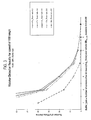
- FIGS. 3 and 4 are graphs illustrating results from a simulation of the detection methodology in accordance with the example embodiments of the present invention.
- the following Table 1 lists the parameters set for the example simulation(s) of a given mobile and Node B in a UMTS network.
- Table 1 Parameters for Simulation Set parameters 12.2 kbps DL and UL Denver pathloss file
- Mobile speed 100, 300 kmph Pilot power: 33 dBm UE max Tx power: 21 dBm UE Min Tx power: -50 dBm Node B Max Tx power: 33 dBm Node B Min Tx power: -13 dB/Pilot
- the simulation was run for 20 minutes at mobile speeds of 100 and 300 kmph.
- the 20 minute time exemplified a typical time for a call.
- the range of values evaluated for Err_Threshold was between 0 and 2 dB in steps of 0.5 dB.
- the range of values evaluated for Buffer_Len was between 1 and 16.
- N_Err_SIR was always set to be equal to Buffer_Len.
- the number of false alarms may be more sensitive to Buffer_Len, i.e., the number of consecutive 80 msec windows or measurement periods over which SIR err_ave exceeds Err_Threshold to count a false alarm.
- the threshold does not change the results much as far as Err_Threshold is greater than 0.5 dB.
- a recommended value for Buffer_Len is shown as at least 7.
- Buffer_Len may be selected to be at least 12.
- the above methodology may be employed for any network based on one or more of CDMA (IS95, cdma2000 and various technology variations), UMTS (release 99, R4, R5, R6 and above), GSM, 802.11 and/or related technologies, including communication systems or networks based on technologies other than the above, which may be in various stages of development and intended for future replacement of, or use with, the above networks or systems.
- CDMA IS95, cdma2000 and various technology variations
- UMTS release 99, R4, R5, R6 and above
- GSM Global System for Mobile communications
- 802.11 802.11 and/or related technologies, including communication systems or networks based on technologies other than the above, which may be in various stages of development and intended for future replacement of, or use with, the above networks or systems.
- the parameters Err_Threshold, Avg_Time, N_Err_SIR and Buffer_Len used in the example methodologies are available at the base station receiver, and thus do not depend on a specific mobile. Therefore the example approach described herein may be substantially efficient so as to avoid any capacity loss, while being substantially cost effective.
Landscapes
- Engineering & Computer Science (AREA)
- Quality & Reliability (AREA)
- Computer Networks & Wireless Communication (AREA)
- Signal Processing (AREA)
- Mobile Radio Communication Systems (AREA)
Abstract
Description
- The present invention relates generally to methods of detecting mobile stations not following received power control commands in wireless communication systems or networks.
- Wireless communication systems typically include a plurality of base stations, where one or more base stations may serve a geographic area commonly referred to as a cell. Users of the wireless communication system may communicate with each other and/or with the communication system. The physical equipment at the base stations may be referred to as system equipment. In wireless communication systems, communication can occur between two mobile stations (e.g., two cell phones, wireless computers, PDAs, etc.) and/or between mobiles and system equipment.
- The communication system typically may operate in accordance with established rules promulgated by governmental and/or industry groups. These rules are typically established as standards by which wireless communication systems are to be in compliance with. The standards may contain various protocols that dictate the operation of the wireless communication systems. Generally, a protocol may be understood as a set of rules that may specify how communication (voice and/or data) within a given communication system may be initiated, maintained and/or terminated.
- A mobile located in a particular cell being served by a base station communicates with other mobiles and/or with other communication systems via the base station. The signals from the mobile may be transmitted to a receiving mobile or to another communication system via the base station of the cell within which the mobile is located.
- As a mobile move through cells being served by different base stations, communication from the mobile may be handled by different base stations. For example, communication for a mobile moving from one cell to another cell may be transferred from one base station to another base station of the cell. The process in which communication for a mobile is transferred from one base station (i.e., the 'original' base station) to another base station (i.e., the 'target' base station) is known as "handoff." A mobile located at the edge of a serving cell and in the vicinity or near a target cell typically will request a handoff to the target cell, depending on the relative strength of communication signals of neighboring base stations.
- In wireless communication systems or networks, the base stations typically may transmit pilot signals periodically. The mobiles receive these pilot signals and may be configured so as to measure the strength of these pilot signals. A mobile may request a handoff to one or more base stations based on the relative measured strengths of the pilot signals of the base stations. The network may also trigger a handoff procedure based on periodic measurement reports received from a given mobile, or for other reasons such as congestion in a cell that a given mobile is connected to.
- One type of handoff used in several spread spectrum-based wireless communication systems such as Code Division Multiple Access (CDMA) systems is referred to as a soft hand off. In a soft handoff, communication with the target base station may be established prior to communication with the original base station is terminated. Also during soft handoff, the mobile may typically be in simultaneous communication with greater than one base station. In this manner, no interruption of communication to and from the mobile occurs. Eventually, when the soft handoff has terminated, the mobile communicates with another mobile or another communication system via the target base station.
- Power control is used in both the downlink (base station to mobile) and uplink (mobile to base station) of CDMA systems to reduce interference and/or to ensure a desired target block error rate. For each dedicated channel, there is a closed loop to control transmitter power. This is commonly known as inner loop power control.
- For downlink power control, the mobile measures received signal to interference ratio (SIR) and may issue an up power command in the uplink if the measured SIR is below a given threshold. Otherwise, the mobile issues a down power command in the uplink to the base station where measured SIR exceeds the threshold. This power control command (TPC) may be transmitted periodically to the base station(s) to which mobile is connected. The period of TPC may be referred to as a slot or power control group. If a mobile is in soft handoff, all base stations in communication with the mobile receive the TPC command that is transmitted in the uplink.
- For uplink power control, each base station measures received SIR of a given mobile and may issue an up power command on the downlink to the mobile, if the measured SIR is below a given threshold. This threshold may be referred to as 'SIR target'. If the measured SIR exceeds SIR target, the base station issues a down power command. The SIR target itself may be adjusted based on the number of errors in the received blocks from the mobile. If a received block is erroneous the SIR target is raised, otherwise the SIR target is lowered where the received block is not erroneous.
- During soft handover, more than one base station may send TPC commands to the mobile. There are several ways in which a mobile may change its power due to different TPC commands received from each base station. As a general rule, if one base station sends a down power command, and that command was reliably received at the mobile, the mobile will reduce its transmit power, ignoring the other commands. This is done since it is typically sufficient that only one base station decodes the data properly, while reducing interference for other users. For the same reasons, as a general rule, the mobile will raise its transmit power if all reliably received TPC commands are up power commands.
- However there may be situations where a mobile ignores the TPC commands from some of the base stations. A first reason may be where the received TPC command is not reliable. A mobile may ignore the TPC command if the received command is not reliable. The reliability criterion may be specified at the mobile, for example. This situation is typically common during handoff, when the received signal from some base stations is weak and the received TPC commands are not reliable. The receiving mobile may employ a quality metric and compares that metric to a given threshold to decide whether to use the TPC command, or ignore it. This comparison is applicable in a simplex mode (non-handoff mode) of operation or when the mobile is in handoff mode.
- Another situation where a mobile might ignore TPC commands from one or more base stations is when a new leg (new base station) is added to the active set (of base stations in communication with a given mobile) on the network side. In this situation, the radio network controller (RNC) at the network sends a message to the mobile to update its active set. During the time that the new leg is added to the active set on network side, until the mobile updates its active set, any TPC commands sent from the new leg are ignored at the mobile.
- Another situation where a mobile might ignore TPC commands from one or more base stations is when a mobile drops a leg. The signaling procedure for dropping a leg may be generally explained as follows. When the RNC decides to drop a leg, a message is sent on the downlink to the mobile. After dropping that leg from its active set, the mobile sends a confirmation message on the uplink to the network. The RNC updates the active set when the confirmation is received from mobile. During the period from when the mobile updates its active set until the base station (leg) being dropped stops its transmission to the mobile, the TPC commands from the leg to be dropped are ignored by the mobile.
- If a situation arises which is not applicable to any of the above cases, i.e., the TPC command is not reliable or the mobile is adding or dropping a leg, the mobile must follow the commands received from the base station(s). Therefore, if the mobile ignores the downlink TPC commands due to any other reason, the RNC should be able to identify and drop that mobile. Otherwise, the mobile might transmit at an unnecessary high transmit power, which may increase uplink interference and cause a reduction in the system or network capacity.
- An example embodiment of the present invention is directed to a method of detecting a mobile station that is not following a power control command. In the method, and for each time slot, a received signal-to-interference ratio (SIR) value of the mobile as measured by a given base station is compared with a given average SIR target value. An error metric may be generated for each slot based on a difference between the measured SIR and average SIR target values. The generated error metrics may be averaged over a given time duration to determine at least one (or more) average error value(s), and the mobile station is determined as violating a power control command if the at least one (or more) average error value(s) exceed a given threshold.
- Another example embodiment of the present invention is directed to a method of determining whether to drop a call associated with a mobile station that is not following a power control command. In the method, an error metric may be generated on a slot-by-slot basis based on a difference between a measured SIR value of the mobile at a given base station and a given, average SIR target value. The generated error metrics may be averaged over a given time duration to determine at least one (or more) average error value(s). If the at least one (or more) average error value(s) exceeds a given threshold, the call associated with the mobile is dropped.
- Example embodiments of the present invention will become more fully understood from the detailed description given herein below and the accompanying drawings, wherein like elements are represented by like reference numerals, which are given by way of illustration only and thus are not limitative of the example embodiments of the present invention.
- FIG. 1 is a flowchart describing a method of detecting a mobile station that is not following a power control command, in accordance with an example embodiment of the present invention.
- FIG. 2 is a flowchart describing a method of determining whether to drop a call associated with a mobile station that is not following a power control command, in accordance with an example embodiment of the present invention.
- FIGS. 3 and 4 are graphs illustrating results from a simulation of the detection methodology in accordance with the example embodiments of the present invention.
- Although the following description relates to a network based on one or more of CDMA (IS95, cdma2000 and various technology variations), UMTS (release 99, R4, R5, R6 and above), GSM, 802.11 and/or related technologies, and will be described in this example context, it should be noted that the example embodiments shown and described herein are meant to be illustrative only and not limiting in any way. As such, various modifications will be apparent to those skilled in the art for application to communication systems or networks based on technologies other than the above, which may be in various stages of development and intended for future replacement of, or use with, the above networks or systems.
- As used herein, the terms mobile or mobile station may be synonymous to a mobile user, user equipment (UE), user, subscriber, wireless terminal and/or remote station, and may describe a remote user of wireless resources in a wireless communication network. Where used below, the term base station is synonymous with base transceiver station or Node-B and may describe equipment that provides voice and/or data connectivity between a communicafion network and one or more mobile stations.
- In general, the example embodiments of the present invention are directed to a methodology which may facilitate identifying or detecting one or more mobiles that are not following downlink TPC commands. The example embodiments also introduce a methodology that may drop a call associated with a given mobile if the mobile does not listen to TPC commands from the network, due to some problems which may be unknown to the network.
- As in any detection problem, the proposed methodologies may be adapted so as to reduce the probability of false alarm (detecting mobiles in the three scenarios described above) and to maximize the probability of detection (mobiles ignoring the TPC commands that do not fit in any of the thee above-mentioned scenarios).
- In general, for normal mobile behavior during closed loop power control, there should be a mix of up and down power commands. Usually, each time slot (smallest duration over which certain control information including a TPC command is being transmitted) contains an up command or a down command. Therefore, the absolute value of summation of up and down commands, over a window that is large enough relative to a time slot duration, should approach zero.
- FIG. 1 is a flowchart describing a method of detecting a mobile station that is not following a power control command, in accordance with an example embodiment of the present invention. As shown in FIG. 1, in a
method 100, a received SIR value (SIR actual ), measured in every slot (slot-by-slot basis) by a base station receiver serving the mobile is compared (110) with the average SIR target value (SIR target_ave ). The difference between these two metrics may be used to generate an error metric, referred to as SIR err , (120). The SIR err may be averaged (130) over a given period or duration of time, referred to as 'Avg_Time', to determine an average SIR err value, which may be referred to as SIR err_ ave. - The SIRerr_ave value may then be stored (140) in a First In First Out (FIFO) buffer that has a given buffer length, referred to as 'Buffer_Len'. If at least one, several (or all) stored average SIR error (SiRerr_ave) values in the FIFO buffer exceed a given threshold, referred to herein as 'Err_Threshold', it is determined (150) that the mobile is violating power control commands due to some unknown problems at the network. The number of SIRerr_ave values exceeding the Err_Threshold in the buffer needed to report a power control violation may be referred to as N_Err_SIR. N_Err_SIR may be set to any value between 1 and Buffer_Len, for example.
- The mobile determined as violating a power control command may thus be violating the power control command for a reason other than the three scenarios described above, i.e., the mobile has determined that the power control command is not reliable, or the mobile is adding a leg to its active set of base stations, or the mobile is dropping a leg from its active set of base stations.
- The parameters Err_Threshold, Avg_Time, N_Err_SIR and Buffer_Len may be set in advance to given values, as desired. In selecting these parameters, Err_Threshold, Avg_Time, N_Err_SIR and Buffer_Len should be chosen so as to minimize or reduce the probability of false alarm while maximizing the probability of detection for a mobile that is not listening to TPC commands due to unknown problems at the network.
- In general, if choosing substantially small values for these four parameters (i.e., Avg_Time=1 slot, N_Err_SIR=1, Buffer_Len=1, Err_Threshold=0, it is relatively easy to discern that there may always be a given slot that the mobile exceeds the target SIR. Therefore, all mobiles will be seen as violating, which may increase the probability of false alarms (i.e., rejecting good mobiles in the three above-described scenarios (unreliable TPC command, adding leg, dropping leg). On the other hand, selecting substantially large values of Err_Threshold, Avg_Time, N_Err_SIR and Buffer_Len (i.e., in an example where Avg_Time*Buffer_Len is equal to 1 minute, N_Err_SIR = Buffer_Len and the Err_Threshold exceeds the maximum SIR target possible such that no mobiles will be detected) may decrease the probability of detection, potentially resulting in capacity loss. Accordingly, selection of the above-noted parameters should account for the above factors.
- FIG. 2 is a flowchart describing a method of determining whether to drop a call associated with a mobile station that is not following a power control command, in accordance with an example embodiment of the present invention. The functions in FIG. 2 are somewhat similar to FIG. 1, thus a detailed explanation is omitted for purposes of brevity. In the
method 200 shown in FIG. 2, an error metric SIR err may be generated (210) on a slot-by-slot basis based on a difference between a measured SIR value of the mobile at a given base station (SIR actual )and a given, average SIR target value (SIR target_ave ). The generated SlR err metrics may be averaged (220) over a given time duration to determine at least one average error value (SIR err_ave ), and stored (230) in the FIFO buffer with a Buffer_Len size, as described above. If the at least one (some, or all) of the stored average error value(s) exceeds a given threshold, the call associated with the mobile is dropped (230). The number of SIRerr_ave values exceeding the Err_Threshold in the Buffer needed to report a power control violation is known as N_Err_SIR. It is straightforward that N_Err_SIR can be set to any value between 1 and Buffer_Len. In another example, if at least N_Err_SIR (N_Err_SIR=1,... Buffer_Len) average error value(s) (i.e., N_Err-SIR number of StR err_ave values) out of the last Buffer_Len (Buffer_Len ≥1) calculated StR err_ave values) exceed Err_Threshold, the mobile is determined as a violator and the call is dropped. - One of the advantages of the proposed methodologies is that the methods may be immune to fading channel variations. In fading channels, the received SIR might jump up or down by a substantial amount. This could cause several up or down power commands in a row. The proposed methodologies are immune to these jumps. The metrics used in this approach are averages over a desired, given time duration to average out the instantaneous jumps in the received signal at the base station.
- For example, the conventional approach is to count the number of consecutive down power commands sent by a base station to the mobile. The number is then compared to a threshold. If the number of consecutive down power commands exceeds the threshold, the mobile is declared in violation. Since there are an innumerable variety of scenarios that could lead to multiple down power commands being consecutively transmitted (an obvious one being that the mobile is transmitting at its minimum power and is close geographically to the base station), the threshold must be set to a substantially large number in order to achieve a low probability of false alarm. The conventional method has a substantially low probability of detection, since any deep fading, even for a short period of time, can lead to a generation of an up power command (due to low received SIR measurement) by the base station. This leads to an unnecessary resetting of the counter.
- Benefits of the proposed methods include parameters (Err_Threshold, Avg_Time, N_Err_SIR and Buffer_Len) which can be adjusted so as to detect any mobile violation of a downlink power control command with a high probability. The proposed methodologies may help to reduce the probability of false alarm when a mobile ignores the TPC commands from base station(s) due to normal behavior i.e., when mobile is in simplex or non-handoff mode). This may be due in part to the fact that the proposed methods are immune to channel variations (fading environments).
- Additionally, the parameters Err_Threshold, Avg_Time, N_Err_SIR and Buffer_Len can be chosen to have a duration larger than any of the duration of the false alarm scenarios described above. For example, in a UMTS network, the duration should not exceed 4 * 80 ms, thus reducing the probability of false alarm (PFA) to be practically zero. In a simulation by the inventors to be described hereafter, for 20 minutes or 120 thousand frames, the observed PFA was equal to 0, which suggests a probability of false alarm below 8.33*e-6).
- As discussed in general above, one scenario in an example system (such as a UMTS network) where the mobile might be ignoring a power control command is when its active set is updated at the UMTS Terrestrial Radio Access Network (UTRAN) side. In this scenario, the RNC sends an update message such as "L3_ACTIVE_SET_UPDATE" to the UE (mobile) to update its active set. There may be a delay of 80 msec or more, during which the new Node B (base station) that is being updated in the UE's active set is transmitting and the UE does not listen to TPC commands from that Node B (only for adding or swapping). This delay could increase where there are poor radio link conditions, due to retransmission delay, for example.
- Before uplink (UL) synchronization, a new leg (new Node B) sends all up power commands. After UL synchronization, TPC commands in the downlink (DL) will be ignored until the time at which the UE updates its active set.
- Another scenario generally described above is when the UE drops a leg and the UTRAN is waiting for an update message to drop the leg such as a command "L3_ACTIVE_SET_UPDATE-CNF" from the UE. During this period, the UE ignores the TPC commands from that leg. As discussed above, the difference between the SIR measured by the Node B and the average target SIR can be observed to determine SIR err , as shown by the following expression.

- In the above expression, SIR err and SIR target_ave are averaged over the same, given time duration. The given time duration may be referred to as a measurement period or window. The window for averaging may be set to 80 msec, for example, although the example embodiments are not limited to an 80 millisecond window. In an example, if the average SIR error value (SIR err_ave ) is greater than the threshold Err_Threshold for the given time duration, i.e., up to
N_Err_SIR=Buffer_Lenconsecutive measurement periods, a violation is detected (i.e., the UE is detected as ignoring a TPC command). As SIR err_ave _is readily available as a parameter in the current one-chip ASIC solutions for system integration every Avg_Time = 80 msec, the determination can be made with minimal computational complexity at desired processing speeds. - FIGS. 3 and 4 are graphs illustrating results from a simulation of the detection methodology in accordance with the example embodiments of the present invention.
- The graphs in FIGS. 3 and 4 illustrate the number (n=N_Err_SIR-Buffer_Len) of consecutive 80 millisecond windows over which SIR err_ave exceeds Err_Threshold, as a function of the number of false alarms. The following Table 1 lists the parameters set for the example simulation(s) of a given mobile and Node B in a UMTS network.
Table 1: Parameters for Simulation Set parameters 12.2 kbps DL and UL Denver pathloss file Mobile speed: 100, 300 kmph Pilot power: 33 dBm UE max Tx power: 21 dBm UE Min Tx power: -50 dBm Node B Max Tx power: 33 dBm Node B Min Tx power: -13 dB/Pilot Inner loop power control step size: 1 Db DL and UL target BLER: 1% OLPC step up: 0.5 dB Total NodeB Tx power: 43 dBm DL orthogonal factor: 0.2 DL loading: 50% (pilot Ec/lo = -7 dB) - The simulation was run for 20 minutes at mobile speeds of 100 and 300 kmph. The 20 minute time exemplified a typical time for a call. The simulation parameters varied included Err_Threshold and Buffer_Len. The range of values evaluated for Err_Threshold was between 0 and 2 dB in steps of 0.5 dB. The range of values evaluated for Buffer_Len was between 1 and 16. For the simulation, the number of false alarms were counted over the duration of a the 20 minute call and plotted as a function of Buffer_Len. N_Err_SIR was always set to be equal to Buffer_Len.
- As can be seen from the example simulation(s), the number of false alarms may be more sensitive to Buffer_Len, i.e., the number of consecutive 80 msec windows or measurement periods over which SIR err_ave exceeds Err_Threshold to count a false alarm. As show in the example graphs, the threshold does not change the results much as far as Err_Threshold is greater than 0.5 dB. For mobile speeds up to 100 kmph in these particular simulations, a recommended value for Buffer_Len is shown as at least 7. For mobile speeds of 300 kmph Buffer_Len may be selected to be at least 12.
- However, the selection of Buffer_Len, N_Err_SIR Err_Threshold and Avg_time is network-dependent. Accordingly, the above methodology may be employed for any network based on one or more of CDMA (IS95, cdma2000 and various technology variations), UMTS (release 99, R4, R5, R6 and above), GSM, 802.11 and/or related technologies, including communication systems or networks based on technologies other than the above, which may be in various stages of development and intended for future replacement of, or use with, the above networks or systems.
- Accordingly, the parameters Err_Threshold, Avg_Time, N_Err_SIR and Buffer_Len used in the example methodologies are available at the base station receiver, and thus do not depend on a specific mobile. Therefore the example approach described herein may be substantially efficient so as to avoid any capacity loss, while being substantially cost effective.
- The example embodiments of the present invention being thus described, it will be obvious that the same may be varied in many ways. Such variations are not to be regarded as departure from the spirit and scope of the example embodiments of the present invention, and all such modifications as would be obvious to one skilled in the art are intended to be included within the scope of the following claims.
Claims (10)
- A method of detecting a mobile station that is not following a power control command, comprising:comparing, each time slot, a received signal-to-interference ratio (SIR) value of the mobile as measured by a given base station with a given average SIR target value (110);generating an error metric for each slot based on a difference between the measured SIR and average SIR target values (120);averaging the generated error metrics over a given time duration to determine at least one or more average error value(s) (130); anddetermining that the mobile station is violating a power control command if the at least one or more average error value(s) exceed a given threshold (150).
- The method of claim 1, further comprising:storing the at least one average error value in a buffer having a given buffer length (140),wherein a plurality of average SIR error values are stored in the buffer, and determining includes determining that the mobile station is violating a power control command if N stored average SIR error values in the buffer, N=1 up to a given buffer length, exceed the given threshold.
- The method of claim 1, wherein the mobile determined as violating a power control command is violating the power control command for a reason other than
the mobile has determined that the power control command is not reliable, or
the mobile is adding a leg to its active set of base stations, or
the mobile is dropping a leg from its active set of base stations. - The method of claim 2, further comprising:selecting values for the given time duration, given threshold and given buffer length so as to reduce the probability of false alarm while maximizing the probability of detection for the mobile that is not listening to power control commands, due to problems unknown at a network serving the mobile.
- A method of determining whether to drop a call associated with a mobile station that is not following a power control command, comprising:generating an error metric on a slot-by-slot basis based on a difference between a measured SIR value of the mobile at a given base station and a given, average SIR target value (210);averaging the generated error metrics over a given time duration to determine at least one or more average error value(s) (220);dropping a call associated with the mobile, if the at least one or more average error value(s) exceed a given threshold (240).
- The method of claim 5, wherein dropping includes determining that the mobile station is violating a power control command if the at least one (or more) average error value(s) exceeds a given threshold.
- The method of claim 6, wherein the mobile determined as violating a power control commend is violating the power control command for a reason other than
the mobile has determined that the power control command is not reliable, or
the mobile is adding a leg to its active set of base stations, or
the mobile is dropping a leg from its active set of base stations. - The method of claim 5, further comprising:storing the at least one average error value in a buffer having a given buffer length (230).
- The method of claim 8, wherein
a plurality of average SIR error values are stored in the buffer, and
dropping includes determining that the mobile station is violating a power control command if N stored average SIR error values, N= 1 up to a given buffer length, exceed the given threshold. - The method of claim 8, further comprising:selecting values for the given time duration, threshold, buffer length and the number of errors exceeding threshold inside that buffer so as to reduce the probability of false alarm while maximizing the probability of detection for the mobile that is not listening to power control commands, due to problems unknown at a network serving the mobile.
Applications Claiming Priority (1)
| Application Number | Priority Date | Filing Date | Title |
|---|---|---|---|
| US11/091,754 US20060223446A1 (en) | 2005-03-29 | 2005-03-29 | Methods of detecting mobile stations not following power control commands |
Publications (1)
| Publication Number | Publication Date |
|---|---|
| EP1708384A1 true EP1708384A1 (en) | 2006-10-04 |
Family
ID=36155444
Family Applications (1)
| Application Number | Title | Priority Date | Filing Date |
|---|---|---|---|
| EP06251056A Withdrawn EP1708384A1 (en) | 2005-03-29 | 2006-02-28 | Method of detecting mobile stations not following power control commands |
Country Status (5)
| Country | Link |
|---|---|
| US (1) | US20060223446A1 (en) |
| EP (1) | EP1708384A1 (en) |
| JP (1) | JP2006279966A (en) |
| KR (1) | KR20060105485A (en) |
| CN (1) | CN1842219A (en) |
Cited By (2)
| Publication number | Priority date | Publication date | Assignee | Title |
|---|---|---|---|---|
| EP2147506A4 (en) * | 2007-05-11 | 2013-12-18 | Ericsson Telefon Ab L M | Signal to interference ratio error as a load instability indicator for load control in cellular systems |
| CN109802731A (en) * | 2017-11-17 | 2019-05-24 | 维沃移动通信有限公司 | A kind of wireless link monitoring method, mobile communication terminal and network side equipment |
Families Citing this family (9)
| Publication number | Priority date | Publication date | Assignee | Title |
|---|---|---|---|---|
| JP4378676B2 (en) * | 2003-06-03 | 2009-12-09 | 日本電気株式会社 | Power control method and power control circuit |
| EP2550828B1 (en) * | 2010-03-23 | 2016-03-23 | Telefonaktiebolaget LM Ericsson (publ) | Uplink load prediction using kalman filters |
| US9356725B2 (en) * | 2010-10-08 | 2016-05-31 | Qualcomm Incorporated | Method and apparatus for managing inter-cell interference coordination actions for time-domain partitioned cells |
| CN102546132B (en) * | 2010-12-30 | 2014-09-03 | 华为技术有限公司 | Method and device for feeding back channel signal-to-noise ratio (SNR) |
| US9681449B2 (en) * | 2012-10-19 | 2017-06-13 | Telefonaktiebolaget Lm Ericsson (Publ) | Method and apparatus for power control in wireless communication network |
| US20140247733A1 (en) * | 2013-03-04 | 2014-09-04 | Qualcomm Incorporated | Buffer size reporting for irat measurements in high speed data networks |
| WO2016089259A1 (en) * | 2014-12-01 | 2016-06-09 | Telefonaktiebolaget Lm Ericsson (Publ) | Method and network node for managing transmit power of a wireless device |
| CN106550444B (en) * | 2015-09-21 | 2020-03-13 | 富士通株式会社 | Method, device and system for detecting transmission power control error |
| WO2018218518A1 (en) * | 2017-05-31 | 2018-12-06 | Apple Inc. | Fake base station detection |
Citations (2)
| Publication number | Priority date | Publication date | Assignee | Title |
|---|---|---|---|---|
| US6185431B1 (en) * | 1997-06-18 | 2001-02-06 | Oki Telecom, Inc. | Mobile station closed loop output power stability system for weak signal conditions |
| EP1503516A2 (en) * | 2003-07-30 | 2005-02-02 | Nec Corporation | Mobile communication system, mobile communication terminal, power control method used therefor, and program therefor |
Family Cites Families (13)
| Publication number | Priority date | Publication date | Assignee | Title |
|---|---|---|---|---|
| US5706333A (en) * | 1995-02-24 | 1998-01-06 | Teradyne, Inc. | Method and apparatus for analyzing cellular telephone network |
| FR2735639B1 (en) * | 1995-06-16 | 1997-08-14 | Moreau Christophe | METHOD FOR CONTROLLING AUTOMATIC INTERCELL HANDOVER IN A MULTI-CELL RADIO COMMUNICATION NETWORK, AND RELATED SPEED ESTIMATION METHODS |
| CA2224271C (en) * | 1996-04-12 | 2002-06-11 | Ntt Mobile Communications Network Inc. | Method and instrument for measuring receiving sir and transmission power controller |
| JPH11112366A (en) * | 1997-10-07 | 1999-04-23 | Fujitsu Ltd | Automatic transmission power control circuit |
| US6223032B1 (en) * | 1998-02-27 | 2001-04-24 | Telefonaktiebolaget Lm Ericsson (Publ) | Misbehaving mobile station identification system and method, and a mobile station for use therewith |
| JP3968190B2 (en) * | 1999-03-06 | 2007-08-29 | 松下電器産業株式会社 | Transceiver |
| GB0008021D0 (en) * | 2000-03-31 | 2000-05-17 | Koninkl Philips Electronics Nv | Radio communication system |
| FR2810177B1 (en) * | 2000-06-13 | 2005-05-06 | Cit Alcatel | METHOD FOR CONTROLLING TRANSMISSION POWER IN A MOBILE RADIOCOMMUNICATION SYSTEM |
| JP2002185398A (en) * | 2000-12-18 | 2002-06-28 | Sony Corp | Transmission power control method and system |
| JP3543959B2 (en) * | 2001-02-16 | 2004-07-21 | 日本電気株式会社 | base station |
| JP3714406B2 (en) * | 2001-04-27 | 2005-11-09 | 日本電気株式会社 | Transmission power control circuit using W-CDMA system |
| US7149538B2 (en) * | 2003-02-13 | 2006-12-12 | Telefonaktiebolaget Lm Ericsson (Publ) | Wireless transceivers, methods, and computer program products for restricting transmission power based on signal-to-interference ratios |
| JP3800222B2 (en) * | 2004-02-19 | 2006-07-26 | 日本電気株式会社 | Target value control system and method for transmission power control, base station and portable communication terminal |
-
2005
- 2005-03-29 US US11/091,754 patent/US20060223446A1/en not_active Abandoned
-
2006
- 2006-02-28 EP EP06251056A patent/EP1708384A1/en not_active Withdrawn
- 2006-03-28 KR KR1020060027856A patent/KR20060105485A/en not_active Withdrawn
- 2006-03-28 CN CNA200610071684XA patent/CN1842219A/en active Pending
- 2006-03-29 JP JP2006090847A patent/JP2006279966A/en active Pending
Patent Citations (2)
| Publication number | Priority date | Publication date | Assignee | Title |
|---|---|---|---|---|
| US6185431B1 (en) * | 1997-06-18 | 2001-02-06 | Oki Telecom, Inc. | Mobile station closed loop output power stability system for weak signal conditions |
| EP1503516A2 (en) * | 2003-07-30 | 2005-02-02 | Nec Corporation | Mobile communication system, mobile communication terminal, power control method used therefor, and program therefor |
Cited By (2)
| Publication number | Priority date | Publication date | Assignee | Title |
|---|---|---|---|---|
| EP2147506A4 (en) * | 2007-05-11 | 2013-12-18 | Ericsson Telefon Ab L M | Signal to interference ratio error as a load instability indicator for load control in cellular systems |
| CN109802731A (en) * | 2017-11-17 | 2019-05-24 | 维沃移动通信有限公司 | A kind of wireless link monitoring method, mobile communication terminal and network side equipment |
Also Published As
| Publication number | Publication date |
|---|---|
| KR20060105485A (en) | 2006-10-11 |
| JP2006279966A (en) | 2006-10-12 |
| CN1842219A (en) | 2006-10-04 |
| US20060223446A1 (en) | 2006-10-05 |
Similar Documents
| Publication | Publication Date | Title |
|---|---|---|
| EP1847074B1 (en) | Methods and arrangements for handling unreliable scheduling grants in a telecommunication network | |
| US6070085A (en) | Method and apparatus for controlling transmit power thresholds based on classification of wireless communication subscribers | |
| US6456826B1 (en) | User equipment and procedure for handling possible out-of-synchronization condition in UMTS terrestrial radio access network for time division duplexing mode | |
| EP1332567B1 (en) | Congestion control in a cdma mobile radio communications system | |
| US6654922B1 (en) | Method and apparatus for declaring correctness of reception of channels for use in a mobile telecommunications system | |
| US7634288B2 (en) | Mobile communication system, mobile communication terminal, power control method used therefor, and program therefor | |
| US7769391B2 (en) | Method and apparatus in a telecommunication system | |
| US12425902B2 (en) | Mobile terminal, network node, system and methods | |
| US9078216B2 (en) | Methods and arrangements in a wireless communication system | |
| US20100087197A1 (en) | User apparatus, base station apparatus and method used in mobile communication system | |
| US20060079264A1 (en) | Outer loop power control of user equipment in wireless communication | |
| CN100492934C (en) | Quality indicator bit (QIB) generation in wireless communication systems | |
| JP2006509449A (en) | Method and apparatus for discontinuous transmission (DTX) detection in a communication system | |
| US7047003B2 (en) | Mobile communication system, mobile unit and network host processor | |
| CN1274247A (en) | Open-loop power control of radio mobile station | |
| US7647050B2 (en) | Method of adjusting a power level of communications over a channel in a wirelss communications network | |
| US20060223446A1 (en) | Methods of detecting mobile stations not following power control commands | |
| US8155687B2 (en) | Dynamic adjustment of power offset for UE/BS based on error event of NACK to ACK | |
| US8201040B2 (en) | Communication device, radio communication terminal, radio base station and communication method | |
| US20070253450A1 (en) | Pilot Signal Transmission Method and Radio Communication System for Enabling Measurement of Reception Quality with High Accurancy | |
| US7519382B2 (en) | Method of power control for call migration | |
| CN1703834B (en) | Network Control with Selective Reverse Shift Frame Offset | |
| EP1830480A2 (en) | Downlink power control with limit to dynamic range using detection of downlink transmit power | |
| KR20060135906A (en) | Method, user station and network device for wireless communication related to HSDPA service |
Legal Events
| Date | Code | Title | Description |
|---|---|---|---|
| PUAI | Public reference made under article 153(3) epc to a published international application that has entered the european phase |
Free format text: ORIGINAL CODE: 0009012 |
|
| 17P | Request for examination filed |
Effective date: 20060315 |
|
| AK | Designated contracting states |
Kind code of ref document: A1 Designated state(s): AT BE BG CH CY CZ DE DK EE ES FI FR GB GR HU IE IS IT LI LT LU LV MC NL PL PT RO SE SI SK TR |
|
| AX | Request for extension of the european patent |
Extension state: AL BA HR MK YU |
|
| STAA | Information on the status of an ep patent application or granted ep patent |
Free format text: STATUS: THE APPLICATION IS DEEMED TO BE WITHDRAWN |
|
| 18D | Application deemed to be withdrawn |
Effective date: 20061201 |
|
| AKX | Designation fees paid | ||
| REG | Reference to a national code |
Ref country code: DE Ref legal event code: 8566 |