EP1707571A1 - Nucleoside derivatives as inhibitors of RNA-dependent RNA viral polymerase - Google Patents
Nucleoside derivatives as inhibitors of RNA-dependent RNA viral polymerase Download PDFInfo
- Publication number
- EP1707571A1 EP1707571A1 EP06076021A EP06076021A EP1707571A1 EP 1707571 A1 EP1707571 A1 EP 1707571A1 EP 06076021 A EP06076021 A EP 06076021A EP 06076021 A EP06076021 A EP 06076021A EP 1707571 A1 EP1707571 A1 EP 1707571A1
- Authority
- EP
- European Patent Office
- Prior art keywords
- pyrrolo
- amino
- methyl
- mmol
- pyrimidine
- Prior art date
- Legal status (The legal status is an assumption and is not a legal conclusion. Google has not performed a legal analysis and makes no representation as to the accuracy of the status listed.)
- Granted
Links
- 0 Cc([n]1[C@]2(*)O[C@](*)(CO)C(**)*2)c(*)c2c1nc(*)nc2* Chemical compound Cc([n]1[C@]2(*)O[C@](*)(CO)C(**)*2)c(*)c2c1nc(*)nc2* 0.000 description 4
- CNNUGLQBNAVBEY-LHAYLDHOSA-N C[C@@]1([C@H]([n](cc2)c3c2C(N)=NC(N)N3C)O[C@H](CO)[C@H]1O)O Chemical compound C[C@@]1([C@H]([n](cc2)c3c2C(N)=NC(N)N3C)O[C@H](CO)[C@H]1O)O CNNUGLQBNAVBEY-LHAYLDHOSA-N 0.000 description 1
- UVONPTYDGJLRPH-GAJNKVMBSA-N C[C@@]1([C@H]([n](cc2)c3c2c(N)ncn3)O[C@H](COP(O)(O)=O)[C@H]1O)O Chemical compound C[C@@]1([C@H]([n](cc2)c3c2c(N)ncn3)O[C@H](COP(O)(O)=O)[C@H]1O)O UVONPTYDGJLRPH-GAJNKVMBSA-N 0.000 description 1
- KFTHWKFWOTUZDL-CZTVAOSCSA-N C[C@@]1([C@H]([n](cc2C(O)=O)c3c2c(N)ncn3)O[C@H](CO)[C@H]1O)O Chemical compound C[C@@]1([C@H]([n](cc2C(O)=O)c3c2c(N)ncn3)O[C@H](CO)[C@H]1O)O KFTHWKFWOTUZDL-CZTVAOSCSA-N 0.000 description 1
Classifications
-
- C—CHEMISTRY; METALLURGY
- C07—ORGANIC CHEMISTRY
- C07H—SUGARS; DERIVATIVES THEREOF; NUCLEOSIDES; NUCLEOTIDES; NUCLEIC ACIDS
- C07H19/00—Compounds containing a hetero ring sharing one ring hetero atom with a saccharide radical; Nucleosides; Mononucleotides; Anhydro-derivatives thereof
- C07H19/02—Compounds containing a hetero ring sharing one ring hetero atom with a saccharide radical; Nucleosides; Mononucleotides; Anhydro-derivatives thereof sharing nitrogen
- C07H19/04—Heterocyclic radicals containing only nitrogen atoms as ring hetero atom
- C07H19/16—Purine radicals
-
- A—HUMAN NECESSITIES
- A61—MEDICAL OR VETERINARY SCIENCE; HYGIENE
- A61K—PREPARATIONS FOR MEDICAL, DENTAL OR TOILETRY PURPOSES
- A61K31/00—Medicinal preparations containing organic active ingredients
- A61K31/70—Carbohydrates; Sugars; Derivatives thereof
- A61K31/7042—Compounds having saccharide radicals and heterocyclic rings
- A61K31/7052—Compounds having saccharide radicals and heterocyclic rings having nitrogen as a ring hetero atom, e.g. nucleosides, nucleotides
- A61K31/7056—Compounds having saccharide radicals and heterocyclic rings having nitrogen as a ring hetero atom, e.g. nucleosides, nucleotides containing five-membered rings with nitrogen as a ring hetero atom
-
- A—HUMAN NECESSITIES
- A61—MEDICAL OR VETERINARY SCIENCE; HYGIENE
- A61K—PREPARATIONS FOR MEDICAL, DENTAL OR TOILETRY PURPOSES
- A61K31/00—Medicinal preparations containing organic active ingredients
- A61K31/70—Carbohydrates; Sugars; Derivatives thereof
- A61K31/7042—Compounds having saccharide radicals and heterocyclic rings
- A61K31/7052—Compounds having saccharide radicals and heterocyclic rings having nitrogen as a ring hetero atom, e.g. nucleosides, nucleotides
- A61K31/706—Compounds having saccharide radicals and heterocyclic rings having nitrogen as a ring hetero atom, e.g. nucleosides, nucleotides containing six-membered rings with nitrogen as a ring hetero atom
- A61K31/7064—Compounds having saccharide radicals and heterocyclic rings having nitrogen as a ring hetero atom, e.g. nucleosides, nucleotides containing six-membered rings with nitrogen as a ring hetero atom containing condensed or non-condensed pyrimidines
-
- A—HUMAN NECESSITIES
- A61—MEDICAL OR VETERINARY SCIENCE; HYGIENE
- A61K—PREPARATIONS FOR MEDICAL, DENTAL OR TOILETRY PURPOSES
- A61K31/00—Medicinal preparations containing organic active ingredients
- A61K31/70—Carbohydrates; Sugars; Derivatives thereof
- A61K31/7042—Compounds having saccharide radicals and heterocyclic rings
- A61K31/7052—Compounds having saccharide radicals and heterocyclic rings having nitrogen as a ring hetero atom, e.g. nucleosides, nucleotides
- A61K31/706—Compounds having saccharide radicals and heterocyclic rings having nitrogen as a ring hetero atom, e.g. nucleosides, nucleotides containing six-membered rings with nitrogen as a ring hetero atom
- A61K31/7064—Compounds having saccharide radicals and heterocyclic rings having nitrogen as a ring hetero atom, e.g. nucleosides, nucleotides containing six-membered rings with nitrogen as a ring hetero atom containing condensed or non-condensed pyrimidines
- A61K31/7076—Compounds having saccharide radicals and heterocyclic rings having nitrogen as a ring hetero atom, e.g. nucleosides, nucleotides containing six-membered rings with nitrogen as a ring hetero atom containing condensed or non-condensed pyrimidines containing purines, e.g. adenosine, adenylic acid
-
- A—HUMAN NECESSITIES
- A61—MEDICAL OR VETERINARY SCIENCE; HYGIENE
- A61K—PREPARATIONS FOR MEDICAL, DENTAL OR TOILETRY PURPOSES
- A61K38/00—Medicinal preparations containing peptides
- A61K38/16—Peptides having more than 20 amino acids; Gastrins; Somatostatins; Melanotropins; Derivatives thereof
- A61K38/17—Peptides having more than 20 amino acids; Gastrins; Somatostatins; Melanotropins; Derivatives thereof from animals; from humans
- A61K38/19—Cytokines; Lymphokines; Interferons
- A61K38/21—Interferons [IFN]
-
- A—HUMAN NECESSITIES
- A61—MEDICAL OR VETERINARY SCIENCE; HYGIENE
- A61K—PREPARATIONS FOR MEDICAL, DENTAL OR TOILETRY PURPOSES
- A61K45/00—Medicinal preparations containing active ingredients not provided for in groups A61K31/00 - A61K41/00
- A61K45/06—Mixtures of active ingredients without chemical characterisation, e.g. antiphlogistics and cardiaca
-
- A—HUMAN NECESSITIES
- A61—MEDICAL OR VETERINARY SCIENCE; HYGIENE
- A61K—PREPARATIONS FOR MEDICAL, DENTAL OR TOILETRY PURPOSES
- A61K9/00—Medicinal preparations characterised by special physical form
- A61K9/48—Preparations in capsules, e.g. of gelatin, of chocolate
- A61K9/4841—Filling excipients; Inactive ingredients
- A61K9/4858—Organic compounds
-
- A—HUMAN NECESSITIES
- A61—MEDICAL OR VETERINARY SCIENCE; HYGIENE
- A61P—SPECIFIC THERAPEUTIC ACTIVITY OF CHEMICAL COMPOUNDS OR MEDICINAL PREPARATIONS
- A61P1/00—Drugs for disorders of the alimentary tract or the digestive system
- A61P1/16—Drugs for disorders of the alimentary tract or the digestive system for liver or gallbladder disorders, e.g. hepatoprotective agents, cholagogues, litholytics
-
- A—HUMAN NECESSITIES
- A61—MEDICAL OR VETERINARY SCIENCE; HYGIENE
- A61P—SPECIFIC THERAPEUTIC ACTIVITY OF CHEMICAL COMPOUNDS OR MEDICINAL PREPARATIONS
- A61P31/00—Antiinfectives, i.e. antibiotics, antiseptics, chemotherapeutics
-
- A—HUMAN NECESSITIES
- A61—MEDICAL OR VETERINARY SCIENCE; HYGIENE
- A61P—SPECIFIC THERAPEUTIC ACTIVITY OF CHEMICAL COMPOUNDS OR MEDICINAL PREPARATIONS
- A61P31/00—Antiinfectives, i.e. antibiotics, antiseptics, chemotherapeutics
- A61P31/12—Antivirals
- A61P31/14—Antivirals for RNA viruses
-
- A—HUMAN NECESSITIES
- A61—MEDICAL OR VETERINARY SCIENCE; HYGIENE
- A61P—SPECIFIC THERAPEUTIC ACTIVITY OF CHEMICAL COMPOUNDS OR MEDICINAL PREPARATIONS
- A61P43/00—Drugs for specific purposes, not provided for in groups A61P1/00-A61P41/00
-
- C—CHEMISTRY; METALLURGY
- C07—ORGANIC CHEMISTRY
- C07D—HETEROCYCLIC COMPOUNDS
- C07D473/00—Heterocyclic compounds containing purine ring systems
-
- C—CHEMISTRY; METALLURGY
- C07—ORGANIC CHEMISTRY
- C07D—HETEROCYCLIC COMPOUNDS
- C07D487/00—Heterocyclic compounds containing nitrogen atoms as the only ring hetero atoms in the condensed system, not provided for by groups C07D451/00 - C07D477/00
- C07D487/02—Heterocyclic compounds containing nitrogen atoms as the only ring hetero atoms in the condensed system, not provided for by groups C07D451/00 - C07D477/00 in which the condensed system contains two hetero rings
- C07D487/04—Ortho-condensed systems
-
- C—CHEMISTRY; METALLURGY
- C07—ORGANIC CHEMISTRY
- C07H—SUGARS; DERIVATIVES THEREOF; NUCLEOSIDES; NUCLEOTIDES; NUCLEIC ACIDS
- C07H19/00—Compounds containing a hetero ring sharing one ring hetero atom with a saccharide radical; Nucleosides; Mononucleotides; Anhydro-derivatives thereof
-
- C—CHEMISTRY; METALLURGY
- C07—ORGANIC CHEMISTRY
- C07H—SUGARS; DERIVATIVES THEREOF; NUCLEOSIDES; NUCLEOTIDES; NUCLEIC ACIDS
- C07H19/00—Compounds containing a hetero ring sharing one ring hetero atom with a saccharide radical; Nucleosides; Mononucleotides; Anhydro-derivatives thereof
- C07H19/02—Compounds containing a hetero ring sharing one ring hetero atom with a saccharide radical; Nucleosides; Mononucleotides; Anhydro-derivatives thereof sharing nitrogen
- C07H19/04—Heterocyclic radicals containing only nitrogen atoms as ring hetero atom
- C07H19/06—Pyrimidine radicals
-
- C—CHEMISTRY; METALLURGY
- C07—ORGANIC CHEMISTRY
- C07H—SUGARS; DERIVATIVES THEREOF; NUCLEOSIDES; NUCLEOTIDES; NUCLEIC ACIDS
- C07H19/00—Compounds containing a hetero ring sharing one ring hetero atom with a saccharide radical; Nucleosides; Mononucleotides; Anhydro-derivatives thereof
- C07H19/02—Compounds containing a hetero ring sharing one ring hetero atom with a saccharide radical; Nucleosides; Mononucleotides; Anhydro-derivatives thereof sharing nitrogen
- C07H19/04—Heterocyclic radicals containing only nitrogen atoms as ring hetero atom
- C07H19/06—Pyrimidine radicals
- C07H19/10—Pyrimidine radicals with the saccharide radical esterified by phosphoric or polyphosphoric acids
-
- C—CHEMISTRY; METALLURGY
- C07—ORGANIC CHEMISTRY
- C07H—SUGARS; DERIVATIVES THEREOF; NUCLEOSIDES; NUCLEOTIDES; NUCLEIC ACIDS
- C07H19/00—Compounds containing a hetero ring sharing one ring hetero atom with a saccharide radical; Nucleosides; Mononucleotides; Anhydro-derivatives thereof
- C07H19/02—Compounds containing a hetero ring sharing one ring hetero atom with a saccharide radical; Nucleosides; Mononucleotides; Anhydro-derivatives thereof sharing nitrogen
- C07H19/04—Heterocyclic radicals containing only nitrogen atoms as ring hetero atom
- C07H19/12—Triazine radicals
-
- C—CHEMISTRY; METALLURGY
- C07—ORGANIC CHEMISTRY
- C07H—SUGARS; DERIVATIVES THEREOF; NUCLEOSIDES; NUCLEOTIDES; NUCLEIC ACIDS
- C07H19/00—Compounds containing a hetero ring sharing one ring hetero atom with a saccharide radical; Nucleosides; Mononucleotides; Anhydro-derivatives thereof
- C07H19/02—Compounds containing a hetero ring sharing one ring hetero atom with a saccharide radical; Nucleosides; Mononucleotides; Anhydro-derivatives thereof sharing nitrogen
- C07H19/04—Heterocyclic radicals containing only nitrogen atoms as ring hetero atom
- C07H19/14—Pyrrolo-pyrimidine radicals
-
- C—CHEMISTRY; METALLURGY
- C07—ORGANIC CHEMISTRY
- C07H—SUGARS; DERIVATIVES THEREOF; NUCLEOSIDES; NUCLEOTIDES; NUCLEIC ACIDS
- C07H19/00—Compounds containing a hetero ring sharing one ring hetero atom with a saccharide radical; Nucleosides; Mononucleotides; Anhydro-derivatives thereof
- C07H19/02—Compounds containing a hetero ring sharing one ring hetero atom with a saccharide radical; Nucleosides; Mononucleotides; Anhydro-derivatives thereof sharing nitrogen
- C07H19/04—Heterocyclic radicals containing only nitrogen atoms as ring hetero atom
- C07H19/16—Purine radicals
- C07H19/20—Purine radicals with the saccharide radical esterified by phosphoric or polyphosphoric acids
-
- Y—GENERAL TAGGING OF NEW TECHNOLOGICAL DEVELOPMENTS; GENERAL TAGGING OF CROSS-SECTIONAL TECHNOLOGIES SPANNING OVER SEVERAL SECTIONS OF THE IPC; TECHNICAL SUBJECTS COVERED BY FORMER USPC CROSS-REFERENCE ART COLLECTIONS [XRACs] AND DIGESTS
- Y02—TECHNOLOGIES OR APPLICATIONS FOR MITIGATION OR ADAPTATION AGAINST CLIMATE CHANGE
- Y02P—CLIMATE CHANGE MITIGATION TECHNOLOGIES IN THE PRODUCTION OR PROCESSING OF GOODS
- Y02P20/00—Technologies relating to chemical industry
- Y02P20/50—Improvements relating to the production of bulk chemicals
- Y02P20/582—Recycling of unreacted starting or intermediate materials
Definitions
- the present invention is concerned with nucleoside compounds and certain derivatives thereof, their synthesis, and their use as inhibitors of RNA-dependent RNA viral polymerase.
- the compounds of the present invention are inhibitors of RNA-dependent RNA viral replication and are useful for the treatment of RNA-dependent RNA viral infection. They are particularly useful as inhibitors of hepatitis C virus (HCV) NS5B polymerase, as inhibitors of HCV replication, and for the treatment of hepatitis C infection.
- HCV hepatitis C virus
- Hepatitis C virus (HCV) infection is a major health problem that leads to chronic liver disease, such as cirrhosis and hepatocellular carcinoma, in a substantial number of infected individuals, estimated to be 2-15% of the world's population.
- chronic liver disease such as cirrhosis and hepatocellular carcinoma
- According to the World Health Organization there are more than 200 million infected individuals worldwide, with at least 3 to 4 million people being infected each year. Once infected, about 20% of people clear the virus, but the rest harbor HCV the rest of their lives.
- Ten to twenty percent of chronically infected individuals eventually develop liver-destroying cirrhosis or cancer.
- the viral disease is transmitted parenterally by contaminated blood and blood products, contaminated needles, or sexually and vertically from infected mothers or carrier mothers to their off-spring.
- Current treatments for HCV infection which are restricted to immunotherapy with recombinant interferon- ⁇ alone or in combination with the nucleoside analog ribavirin, are of limited clinical benefit.
- the state of the art in the treatment of HCV infection has been reviewed, and reference is made to the following publications: B.
- RNA-dependent RNA polymerase RNA-dependent RNA polymerase
- the HCV virion is an enveloped positive-strand RNA virus with a single oligoribonucleotide genomic sequence of about 9600 bases which encodes a polyprotein of about 3,010 amino acids.
- the protein products of the HCV gene consist of the structural proteins C, E1, and E2, and the non-structural proteins NS2, NS3, NS4A and NS4B, and NS5A and NS5B.
- the nonstructural (NS) proteins are believed to provide the catalytic machinery for viral replication.
- the NS3 protease releases NS5B, the RNA-dependent RNA polymerase from the polyprotein chain.
- HCV NS5B polymerase is required for the synthesis of a double-stranded RNA from a single-stranded viral RNA that serves as a template in the replication cycle of HCV.
- NS5B polymerase is therefore considered to be an essential component in the HCV replication complex [see K. Ishi, et al., "Expression of Hepatitis C Virus NS5B Protein: Characterization of Its RNA Polymerase Activity and RNA Binding," Hepatology, 29: 1227-1235 (1999) and V.
- nucleoside compounds of the present invention and certain derivatives thereof are potent inhibitors of RNA-dependent RNA viral replication and in particular HCV replication.
- the 5'-triphosphate derivatives of these nucleoside compounds are inhibitors of RNA-dependent RNA viral polymerase and in particular HCV NS5B polymerase.
- the instant nucleoside compounds and derivatives thereof are useful to treat RNA-dependent RNA viral infection and in particular HCV infection.
- nucleoside compounds and certain derivatives thereof which are useful as inhibitors of RNA-dependent RNA viral polymerase and in particular as inhibitors of HCV NS5B polymerase.
- compositions comprising the nucleoside compounds and derivatives thereof of the present invention for use as inhibitors of RNA-dependent RNA viral polymerase and in particular as inhibitors of HCV NS5B polymerase.
- compositions comprising the nucleoside compounds and derivatives thereof of the present invention for use as inhibitors of RNA-dependent RNA viral replication and in particular as inhibitors of HCV replication.
- compositions comprising the nucleoside compounds and derivatives thereof of the present invention in combination with other agents active against an RNA-dependent RNA virus and in particular against HCV.
- nucleoside compounds and certain derivatives thereof and their pharmaceutical compositions for use as a medicament for the inhibition of RNA-dependent RNA viral replication and/or the treatment of RNA-dependent RNA viral infection and in particular for the inhibition of HCV replication and/or the treatment of HCV infection.
- the present invention relates to compounds of structural formula I of the indicated stereochemical configuration: or a pharmaceutically acceptable salt thereof; wherein R 1 is C 2-4 alkenyl, C 2-4 alkynyl, or C 1-4 alkyl, wherein alkyl is unsubstituted or substituted with hydroxy, amino, C 1-4 alkoxy, C 1-4 alkylthio, or one to three fluorine atoms; R 2 is hydrogen, fluorine, hydroxy, mercapto, C 1-4 alkoxy, or C 1-4 alkyl; or R 1 and R 2 together with the carbon atom to which they are attached form a 3- to 6-membered saturated monocyclic ring system optionally containing a heteroatom selected from O, S, and NC 0-4 alkyl; R 3 and R 4 are each independently selected from the group consisting of hydrogen, cyano, azido, halogen, hydroxy, mercapto, amino, C 1-4 alkoxy, C 2-4 alkenyl, C 2-4 alkyny
- the compounds of formula I are useful as inhibitors of RNA-dependent RNA viral polymerase and in particular of HCV NS5B polymerase. They are also inhibitors of RNA-dependent RNA viral replication and in particular of HCV replication and are useful for the treatment of RNA-dependent RNA viral infection and in particular for the treatment of HCV infection.
- compositions containing the compounds alone or in combination with other agents active against RNA-dependent RNA virus and in particular against HCV as well as methods for the inhibition of RNA-dependent RNA viral replication and for the treatment of RNA-dependent RNA viral infection.
- the present invention relates to compounds of structural formula I of the indicated stereochemical configuration: or a pharmaceutically acceptable salt thereof; wherein R 1 is C 2-4 alkenyl, C 2-4 alkynyl, or C 1-4 alkyl, wherein alkyl is unsubstituted or substituted with hydroxy, amino, C 1-4 alkoxy, C 1-4 alkylthio, or one to three fluorine atoms; R 2 is hydrogen, fluorine, hydroxy, mercapto, C 1-4 alkoxy, or C 1-4 alkyl; or R 1 and R 2 together with the carbon atom to which they are attached form a 3- to 6-membered saturated monocyclic ring system optionally containing a heteroatom selected from O, S, and NC 0-4 alkyl; R 3 and R 4 are each independently selected from the group consisting of hydrogen, cyano, azido, halogen, hydroxy, mercapto, amino, C 1-4 alkoxy, C 2-4 alkenyl, C 2-4 alkyny
- the compounds of formula I are useful as inhibitors of RNA-dependent RNA viral polymerase. They are also inhibitors of RNA-dependent RNA viral replication and are useful for the treatment of RNA-dependent RNA viral infection.
- R 1 is C 1-3 alkyl, wherein alkyl is unsubstituted or substituted with hydroxy, amino, C 1-3 alkoxy, C 1-3 alkylthio, or one to three fluorine atoms
- R 2 is hydroxy, fluoro, or C 1-3 alkoxy
- R3 is hydrogen, halogen, hydroxy, amino, or C 1-3 alkoxy
- R 5 is hydrogen, P 3 O 9 H 4 , P 2 O 6 H 3 , or PO 3 H 2
- R 8 is hydrogen, amino, or C 1-4 alkylamino
- R9 is hydrogen, cyano, methyl, halogen, or CONH 2
- R 10 and R 11 are each independently hydrogen, halogen, hydroxy, amino, C 1-4 alkylamino, di(C 1-4 alkyl)amino, or C 3-6 cycloalkylamino; with the proviso that
- RNA-dependent RNA viral polymerase Illustrative but nonlimiting examples of compounds of the present invention of structural formula I which are useful as inhibitors of RNA-dependent RNA viral polymerase are the following:
- the nucleoside compounds of the present invention are useful as inhibitors of positive-sense single-stranded RNA-dependent RNA viral polymerase, inhibitors of positive-sense single-stranded RNA-dependent RNA viral replication, and/or for the treatment of positive-sense single-stranded RNA-dependent RNA viral infection.
- the positive-sense single-stranded RNA-dependent RNA virus is a Flaviviridae virus or a Picornaviridae virus.
- the Picornaviridae virus is a rhinovirus, a poliovirus, or a hepatitis A virus.
- the Flaviviridae virus is selected from the group consisting of hepatitis C virus, yellow fever virus, dengue virus, West Nile virus, Japanese encephalitis virus, Banzi virus, and bovine viral diarrhea virus (BVDV).
- the Flaviviridae virus is hepatitis C virus.
- Another aspect of the present invention is concerned with a method for inhibiting RNA-dependent RNA viral polymerase, a method for inhibiting RNA-dependent RNA viral replication, and/or a method for treating RNA-dependent RNA viral infection in a mammal in need thereof comprising administering to the mammal a therapeutically effective amount of a compound of structural formula I.
- the RNA-dependent RNA viral polymerase is a positive-sense single-stranded RNA-dependent RNA viral polymerase.
- the positive-sense single-stranded RNA-dependent RNA viral polymerase is a Flaviviridae viral polymerase or a Picornaviridae viral polymerase.
- the Picornaviridae viral polymerase is rhinovirus polymerase, poliovirus polymerase, or hepatitis A virus polymerase.
- the Flaviviridae viral polymerase is selected from the group consisting of hepatitis C virus polymerase, yellow fever virus polymerase, dengue virus polymerase, West Nile virus polymerase, Japanese encephalitis virus polymerase, Banzi virus polymerase, and bovine viral diarrhea virus (BVDV) polymerase.
- the Flaviviridae viral polymerase is hepatitis C virus polymerase.
- the RNA-dependent RNA viral replication is a positive-sense single-stranded RNA-dependent RNA viral replication.
- the positive-sense single-stranded RNA-dependent RNA viral replication is Flaviviridae viral replication or Picornaviridae viral replication.
- the Picornaviridae viral replication is rhinovirus replication, poliovirus replication, or hepatitis A virus replication.
- the Flaviviridae viral replication is selected from the group consisting of hepatitis C virus replication, yellow fever virus replication, dengue virus replication, West Nile virus replication, Japanese encephalitis virus replication, Banzi virus replication, and bovine viral diarrhea virus replication.
- the Flaviviridae viral replication is hepatitis C virus replication.
- the RNA-dependent RNA viral infection is a positive-sense single-stranded RNA-dependent viral infection.
- the positive-sense single-stranded RNA-dependent RNA viral infection is Flaviviridae viral infection or Picornaviridae viral infection.
- the Picornaviridae viral infection is rhinovirus infection, poliovirus infection, or hepatitis A virus infection.
- the Flaviviridae viral infection is selected from the group consisting of hepatitis C virus infection, yellow fever virus infection, dengue virus infection, West Nile virus infection, Japanese encephalitis virus infection, Banzi virus infection, and bovine viral diarrhea virus infection.
- the Flaviviridae viral infection is hepatitis C virus infection.
- alkyl groups specified above are intended to include those alkyl groups of the designated length in either a straight or branched configuration.
- exemplary of such alkyl groups are methyl, ethyl, propyl, isopropyl, butyl, sec-butyl, tertiary butyl, pentyl, isopentyl, hexyl, isohexyl, and the like.
- alkenyl shall mean straight or branched chain alkenes of two to six total carbon atoms, or any number within this range (e.g., ethenyl, propenyl, butenyl, pentenyl, etc.).
- alkynyl shall mean straight or branched chain alkynes of two to six total carbon atoms, or any number within this range (e.g., ethynyl, propynyl, butynyl, pentynyl, etc.).
- cycloalkyl shall mean cyclic rings of alkanes of three to eight total carbon atoms, or any number within this range (i.e., cyclopropyl, cyclobutyl, cyclopentyl, cyclohexyl, cycloheptyl, or cyclooctyl).
- cycloheteroalkyl is intended to include non-aromatic heterocycles containing one or two heteroatoms selected from nitrogen, oxygen and sulfur.
- 4-6-membered cycloheteroalkyl include azetidinyl, pyrrolidinyl, piperidinyl, morpholinyl, thiamorpholinyl, imidazolidinyl, tetrahydrofuranyl, tetrahydropyranyl, tetrahydrothiophenyl, piperazinyl, and the like.
- alkoxy refers to straight or branched chain alkoxides of the number of carbon atoms specified (e.g., C 1-4 alkoxy), or any number within this range [i.e., methoxy (MeO-), ethoxy, isopropoxy, etc.].
- alkylthio refers to straight or branched chain alkylsulfides of the number of carbon atoms specified (e.g., C 1-4 alkylthio), or any number within this range [i.e., methylthio (MeS-), ethylthio, isopropylthio, etc.].
- alkylamino refers to straight or branched alkylamines of the number of carbon atoms specified (e.g., C 1-4 alkylamino), or any number within this range [i.e., methylamino, ethylamino, isopropylamino, t-butylamino, etc.].
- alkylsulfonyl refers to straight or branched chain alkylsulfones of the number of carbon atoms specified (e.g., C 1-6 alkylsulfonyl), or any number within this range [i.e., methylsulfonyl (MeSO 2 -), ethylsulfonyl, isopropylsulfonyl, etc.].
- alkyloxycarbonyl refers to straight or branched chain esters of a carboxylic acid derivative of the present invention of the number of carbon atoms specified (e.g., C 1-4 alkyloxycarbonyl), or any number within this range [i.e., methyloxycarbonyl (MeOCO-), ethyloxycarbonyl, or butyloxycarbonyl].
- aryl includes both phenyl, naphthyl, and pyridyl.
- the aryl group is optionally substituted with one to three groups independently selected from C 1-4 alkyl, halogen, cyano, nitro, trifluoromethyl, C 1-4 alkoxy, and C 1-4 alkylthio.
- halogen is intended to include the halogen atoms fluorine, chlorine, bromine and iodine.
- substituted shall be deemed to include multiple degrees of substitution by a named substituent. Where multiple substituent moieties are disclosed or claimed, the substituted compound can be independently substituted by one or more of the disclosed or claimed substituent moieties, singly or plurally.
- 5'-triphosphate refers to a triphosphoric acid ester derivative of the 5'-hydroxyl group of a nucleoside compound of the present invention having the following general structural formula III: wherein R 1 -R 11 are as defined above.
- the compounds of the present invention are also intended to include pharmaceutically acceptable salts of the triphosphate ester as well as pharmaceutically acceptable salts of 5'-monophosphate and 5'-diphosphate ester derivatives of the structural formulae IV and V, respectively,
- 5'-(S-acyl-2-thioethyl)phosphate or "SATE” refers to a mono- or diester derivative of a 5'-monophosphate nucleoside derivative of the present invention of structural formulae VI and VII, respectively, as well as pharmaceutically acceptable salts of the mono-ester,
- composition as in “pharmaceutical composition,” is intended to encompass a product comprising the active ingredient(s) and the inert ingredient(s) that make up the carrier, as well as any product which results, directly or indirectly, from combination, complexation or aggregation of any two or more of the ingredients, or from dissociation of one or more of the ingredients, or from other types of reactions or interactions of one or more of the ingredients.
- pharmaceutical compositions of the present invention encompass any composition made by admixing a compound of the present invention and a pharmaceutically acceptable carrier.
- administering a should be understood to mean providing a compound of the invention or a prodrug of a compound of the invention to the individual in need.
- Another aspect of the present invention is concerned with a method of inhibiting HCV NS5B polymerase, inhibiting HCV replication, or treating HCV infection with a compound of the present invention in combination with one or more agents useful for treating HCV infection.
- agents active against HCV include, but are not limited to, ribavirin, levovirin, viramidine, thymosin alpha-1, interferon- ⁇ , pegylated interferon- ⁇ (peginterferon- ⁇ ), a combination of interferon- ⁇ and ribavirin, a combination of peginterferon- ⁇ and ribavirin, a combination of interferon- ⁇ and levovirin, and a combination of peginterferon- ⁇ and levovirin.
- Interferon- ⁇ includes, but is not limited to, recombinant interferon- ⁇ 2a (such as Roferon interferon available from Hoffmann-LaRoche, Nutley, NJ), pegylated interferon- ⁇ 2a (PegasysTM), interferon- ⁇ 2b (such as Intron-A interferon available from Schering Corp., Kenilworth, NJ), pegylated interferon- ⁇ 2b (PegIntronTM), a recombinant consensus interferon (such as interferon alphacon-1), and a purified interferon- ⁇ product.
- Amgen's recombinant consensus interferon has the brand name Infergen®.
- Levovirin is the L-enantiomer of ribavirin which has shown immunomodulatory activity similar to ribavirin.
- Viramidine represents an analog of ribavirin disclosed in WO 01/60379 (assigned to ICN Pharmaceuticals).
- the individual components of the combination can be administered separately at different times during the course of therapy or concurrently in divided or single combination forms.
- the instant invention is therefore to be understood as embracing all such regimes of simultaneous or alternating treatment, and the term “administering" is to be interpreted accordingly.
- the scope of combinations of the compounds of this invention with other agents useful for treating HCV infection includes in principle any combination with any pharmaceutical composition for treating HCV infection.
- the dose of each compound may be either the same as or different from the dose when the compound is used alone.
- the compounds of the present invention may also be administered in combination with an agent that is an inhibitor of HCV NS3 serine protease.
- HCV NS3 serine protease is an essential viral enzyme and has been described to be an excellent target for inhibition of HCV replication.
- Both substrate and non-substrate based inhibitors of HCV NS3 protease inhibitors are disclosed in WO 98/22496 , WO 98/46630 , WO 99/07733 , WO 99/07734 , WO 99/38888 , WO 99/50230 , WO 99/64442 , WO 00/09543 , WO 00/59929 , and GB-2337262 .
- HCV NS3 protease as a target for the development of inhibitors of HCV replication and for the treatment of HCV infection is discussed in B.W. Dymock, "Emerging therapies for hepatitis C virus infection,” Emerging Drugs, 6: 13-42 (2001) .
- Ribavirin, levovirin, and viramidine may exert their anti-HCV effects by modulating intracellular pools of guanine nucleotides via inhibition of the intracellular enzyme inosine monophosphate dehydrogenase (IMPDH).
- IMPDH inosine monophosphate dehydrogenase
- Ribavirin is readily phosphorylated intracellularly and the monophosphate derivative is an inhibitor of IMPDH.
- inhibition of IMPDH represents another useful target for the discovery of inhibitors of HCV replication.
- the compounds of the present invention may also be administered in combination with an inhibitor of IMPDH, such as VX-497, which is disclosed in WO 97/41211 and WO 01/00622 (assigned to Vertex); another IMPDH inhibitor, such as that disclosed in WO 00/25780 (assigned to Bristol-Myers Squibb); or mycophenolate mofetil [see A.C. Allison and E.M. Eugui, Agents Action, 44 (Suppl.): 165 (1993 )].
- an inhibitor of IMPDH such as VX-497, which is disclosed in WO 97/41211 and WO 01/00622 (assigned to Vertex)
- another IMPDH inhibitor such as that disclosed in WO 00/25780 (assigned to Bristol-Myers Squibb)
- mycophenolate mofetil see A.C. Allison and E.M. Eugui, Agents Action, 44 (Suppl.): 165 (1993 )].
- the compounds of the present invention may also be administered in combination with the antiviral agent amantadine (1-aminoadamantane) [for a comprehensive description of this agent, see J. Kirschbaum, Anal. Profiles Drug Subs. 12: 1-36 (1983) ].
- pharmaceutically acceptable is meant that the carrier, diluent, or excipient must be compatible with the other ingredients of the formulation and not deleterious to the recipient thereof.
- compositions comprising the nucleoside compounds and derivatives thereof of the present invention in association with a pharmaceutically acceptable carrier.
- a pharmaceutical composition made by combining any of the compounds described above and a pharmaceutically acceptable carrier.
- Another illustration of the invention is a process for making a pharmaceutical composition comprising combining any of the compounds described above and a pharmaceutically acceptable carrier.
- compositions useful for inhibiting RNA-dependent RNA viral polymerase in particular HCV NS5B polymerase comprising an effective amount of a compound of the present invention and a pharmaceutically acceptable carrier.
- Pharmaceutical compositions useful for treating RNA-dependent RNA viral infection in particular HCV infection are also encompassed by the present invention as well as a method of inhibiting RNA-dependent RNA viral polymerase in particular HCV NS5B polymerase and a method of treating RNA-dependent viral replication and in particular HCV replication.
- the present invention is directed to a pharmaceutical composition comprising a therapeutically effective amount of a compound of the present invention in combination with a therapeutically effective amount of another agent active against RNA-dependent RNA virus and in particular against HCV.
- Agents active against HCV include, but are not limited to, ribavirin, levovirin, viramidine, thymosin alpha-1, an inhibitor of HCV NS3 serine protease, interferon- ⁇ , pegylated interferon- ⁇ (peginterferon- ⁇ ), a combination of interferon- ⁇ and ribavirin, a combination of peginterferon- ⁇ and ribavirin, a combination of interferon- ⁇ and levovirin, and a combination of peginterferon- ⁇ and levovirin.
- Interferon- ⁇ includes, but is not limited to, recombinant interferon- ⁇ 2a (such as Roferon interferon available from Hoffmann-LaRoche, Nutley, NJ), interferon- ⁇ 2b (such as Intron-A interferon available from Schering Corp., Kenilworth, NJ), a consensus interferon, and a purified interferon- ⁇ product.
- interferon- ⁇ 2a such as Roferon interferon available from Hoffmann-LaRoche, Nutley, NJ
- interferon- ⁇ 2b such as Intron-A interferon available from Schering Corp., Kenilworth, NJ
- a consensus interferon such as Intron-A interferon available from Schering Corp., Kenilworth, NJ
- a purified interferon- ⁇ product for a discussion of ribavirin and its activity against HCV, see J.O. Saunders and S.A. Raybuck, "Inosine Monophosphate Dehydrogenase: Consideration of Structure, Kinetic
- nucleoside compounds and derivatives thereof and their pharmaceutical compositions for the manufacture of a medicament for the inhibition of RNA-dependent RNA viral replication, in particular HCV replication, and/or the treatment of RNA-dependent RNA viral infection, in particular HCV infection.
- nucleoside compounds and derivatives thereof and their pharmaceutical compositions for use as a medicament for the inhibition of RNA-dependent RNA viral replication, in particular HCV replication, and/or for the treatment of RNA-dependent RNA viral infection, in particular HCV infection.
- compositions of the present invention comprise a compound of structural formula I as an active ingredient or a pharmaceutically acceptable salt thereof, and may also contain a pharmaceutically acceptable carrier and optionally other therapeutic ingredients.
- the compounds of structural formula I can be combined as the active ingredient in intimate admixture with a pharmaceutical carrier according to conventional pharmaceutical compounding techniques.
- the carrier may take a wide variety of forms depending on the form of preparation desired for administration, e.g., oral or parenteral (including intravenous).
- any of the usual pharmaceutical media may be employed, such as, for example, water, glycols, oils, alcohols, flavoring agents, preservatives, coloring agents and the like in the case of oral liquid preparations, such as, for example, suspensions, elixirs and solutions; or carriers such as starches, sugars, microcrystalline cellulose, diluents, granulating agents, lubricants, binders, disintegrating agents and the like in the case of oral solid preparations such as, for example, powders, hard and soft capsules and tablets, with the solid oral preparations being preferred over the liquid preparations.
- oral liquid preparations such as, for example, suspensions, elixirs and solutions
- carriers such as starches, sugars, microcrystalline cellulose, diluents, granulating agents, lubricants, binders, disintegrating agents and the like in the case of oral solid preparations such as, for example, powders, hard and soft capsules and tablets, with the solid oral preparations being preferred over the liquid preparation
- tablets and capsules represent the most advantageous oral dosage unit form in which case solid pharmaceutical carriers are obviously employed. If desired, tablets may be coated by standard aqueous or nonaqueous techniques. Such compositions and preparations should contain at least 0.1 percent of active compound. The percentage of active compound in these compositions may, of course, be varied and may conveniently be between about 2 percent to about 60 percent of the weight of the unit. The amount of active compound in such therapeutically useful compositions is such that an effective dosage will be obtained.
- the active compounds can also be administered intranasally as, for example, liquid drops or spray.
- the tablets, pills, capsules, and the like may also contain a binder such as gum tragacanth, acacia, corn starch or gelatin; excipients such as dicalcium phosphate; a disintegrating agent such as corn starch, potato starch, alginic acid; a lubricant such as magnesium stearate; and a sweetening agent such as sucrose, lactose or saccharin.
- a dosage unit form is a capsule, it may contain, in addition to materials of the above type, a liquid carrier such as a fatty oil.
- tablets may be coated with shellac, sugar or both.
- a syrup or elixir may contain, in addition to the active ingredient, sucrose as a sweetening agent, methyl and propylparabens as preservatives, a dye and a flavoring such as cherry or orange flavor.
- Compounds of structural formula I may also be administered parenterally. Solutions or suspensions of these active compounds can be prepared in water suitably mixed with a surfactant such as hydroxy-propylcellulose. Dispersions can also be prepared in glycerol, liquid polyethylene glycols and mixtures thereof in oils. Under ordinary conditions of storage and use, these preparations contain a preservative to prevent the growth of microorganisms.
- the pharmaceutical forms suitable for injectable use include sterile aqueous solutions or dispersions and sterile powders for the extemporaneous preparation of sterile injectable solutions or dispersions.
- the form must be sterile and must be fluid to the extent that easy syringability exists. It must be stable under the conditions of manufacture and storage and must be preserved against the contaminating action of microorganisms such as bacteria and fungi.
- the carrier can be a solvent or dispersion medium containing, for example, water, ethanol, polyol (e.g. glycerol, propylene glycol and liquid polyethylene glycol), suitable mixtures thereof, and vegetable oils.
- Any suitable route of administration may be employed for providing a mammal, especially a human with an effective dosage of a compound of the present invention.
- oral, rectal, topical, parenteral, ocular, pulmonary, nasal, and the like may be employed.
- Dosage forms include tablets, troches, dispersions, suspensions, solutions, capsules, creams, ointments, aerosols, and the like.
- compounds of structural formula I are administered orally.
- the dosage range is 0.01 to 1000 mg/kg body weight in divided doses. In one embodiment the dosage range is 0.1 to 100 mg/kg body weight in divided doses. In another embodiment the dosage range is 0.5 to 20 mg/kg body weight in divided doses.
- the compositions are preferably provided in the form of tablets or capsules containing 1.0 to 1000 milligrams of the active ingredient, particularly, 1, 5, 10, 15, 20, 25, 50, 75, 100, 150, 200, 250, 300, 400, 500, 600, 750, 800, 900, and 1000 milligrams of the active ingredient for the symptomatic adjustment of the dosage to the patient to be treated.
- the effective dosage of active ingredient employed may vary depending on the particular compound employed, the mode of administration, the condition being treated and the severity of the condition being treated. Such dosage may be ascertained readily by a person skilled in the art. This dosage regimen may be adjusted to provide the optimal therapeutic response.
- the compounds of the present invention contain one or more asymmetric centers and can thus occur as racemates and racemic mixtures, single enantiomers, diastereomeric mixtures and individual diastereomers.
- the present invention is meant to comprehend nucleoside compounds having the ⁇ -D stereochemical configuration for the five-membered furanose ring as depicted in the structural formula below, that is, nucleoside compounds in which the substituents at C-1 and C-4 of the five-membered furanose ring have the ⁇ -stereochemical configuration ("up" orientation as denoted by a bold line).
- keto-enol tautomers Some of the compounds described herein may exist as tautomers such as keto-enol tautomers.
- the individual tautomers as well as mixtures thereof are encompassed with compounds of structural formula I.
- An example of keto-enol tautomers which are intended to be encompassed within the compounds of the present invention is illustrated below:
- Compounds of structural formula I may be separated into their individual diastereoisomers by, for example, fractional crystallization from a suitable solvent, for example methanol or ethyl acetate or a mixture thereof, or via chiral chromatography using an optically active stationary phase.
- a suitable solvent for example methanol or ethyl acetate or a mixture thereof
- any stereoisomer of a compound of the structural formula I may be obtained by stereospecific synthesis using optically pure starting materials or reagents of known configuration.
- the compounds of the present invention may be administered in the form of a pharmaceutically acceptable salt.
- pharmaceutically acceptable salt refers to salts prepared from pharmaceutically acceptable non-toxic bases or acids including inorganic or organic bases and inorganic or organic acids. Salts of basic compounds encompassed within the term “pharmaceutically acceptable salt” refer to non-toxic salts of the compounds of this invention which are generally prepared by reacting the free base with a suitable organic or inorganic acid.
- Representative salts of basic compounds of the present invention include, but are not limited to, the following: acetate, benzenesulfonate, benzoate, bicarbonate, bisulfate, bitartrate, borate, bromide, camsylate, carbonate, chloride, clavulanate, citrate, dihydrochloride, edetate, edisylate, estolate, esylate, fumarate, gluceptate, gluconate, glutamate, glycollylarsanilate, hexylresorcinate, hydrabamine, hydrobromide, hydrochloride, hydroxynaphthoate, iodide, isothionate, lactate, lactobionate, laurate, malate, maleate, mandelate, mesylate, methylbromide, methylnitrate, methylsulfate, mucate, napsylate, nitrate, N-methylglucamine ammonium salt,
- suitable pharmaceutically acceptable salts thereof include, but are not limited to, salts derived from inorganic bases including aluminum, ammonium, calcium, copper, ferric, ferrous, lithium, magnesium, manganic, mangamous, potassium, sodium, zinc, and the like. Particularly preferred are the ammonium, calcium, magnesium, potassium, and sodium salts.
- Salts derived from pharmaceutically acceptable organic non-toxic bases include salts of primary, secondary, and tertiary amines, cyclic amines, and basic ion-exchange resins, such as arginine, betaine, caffeine, choline, N,N-dibenzylethylenediamine, diethylamine, 2-diethylaminoethanol, 2-dimethylaminoethanol, ethanolamine, ethylenediamine, N-ethylmorpholine, N-ethylpiperidine, glucamine, glucosamine, histidine, hydrabamine, isopropylamine, lysine, methylglucamine, morpholine, piperazine, piperidine, polyamine resins, procaine, purines, theobromine, triethylamine, trimethylamine, tripropylamine, tromethamine, and the like.
- basic ion-exchange resins such as arginine, betaine, caffeine, cho
- esters of carboxylic acid derivatives such as methyl, ethyl, or pivaloyloxymethyl, or acyl derivatives of alcohols, such as acetate or maleate, can be employed. Included are those esters and acyl groups known in the art for modifying the solubility or hydrolysis characteristics for use as sustained-release or prodrug formulations.
- nucleoside compounds and derivatives thereof of the present invention can be prepared following synthetic methodologies well-established in the practice of nucleoside and nucleotide chemistry. Reference is made to the following text for a description of synthetic methods used in the preparation of the compounds of the present invention: " Chemistry of Nucleosides and Nucleotides,” L.B. Townsend, ed., Vols. 1-3, Plenum Press, 1988 , which is incorporated by reference herein in its entirety.
- a representative general method for the preparation of compounds of the present invention is outlined in Scheme 1 below.
- This scheme illustrates the synthesis of compounds of the present invention of structural formula 1-7 wherein the furanose ring has the ⁇ -D-ribo configuration.
- the starting material is a 3,5-bis-O-protected alkyl furanoside, such as methyl furanoside, of structural formula 1-1 .
- the C-2 hydroxyl group is then oxidized with a suitable oxidizing agent, such as a chromium trioxide or chromate reagent, Dess-Martin periodinane, or by Swern oxidation, to afford a C-2 ketone of structural formula 1-2 .
- Grignard reagent such as an alkyl, alkenyl, or alkynyl magnesium halide (for example, MeMgBr, EtMgBr, vinylMgBr, allylMgBr, and ethynylMgBr) or an alkyl, alkenyl, or alkynyl lithium, such as MeLi, across the carbonyl double bond of 1-2 in a suitable organic solvent, such as tetrahydrofuran, diethyl ether, and the like, affords the C-2 tertiary alcohol of structural formula 1-3 .
- a Grignard reagent such as an alkyl, alkenyl, or alkynyl magnesium halide (for example, MeMgBr, EtMgBr, vinylMgBr, allylMgBr, and ethynylMgBr) or an alkyl, alkenyl, or alkynyl lithium, such as MeLi, across
- a good leaving group (such as Cl, Br, and I) is next introduced at the C-1 (anomeric) position of the furanose sugar derivative by treatment of the furanoside of formula 1-3 with a hydrogen halide in a suitable organic solvent, such as hydrogen bromide in acetic acid, to afford the intermediate furanosyl halide 1-4 .
- a C-1 sulfonate such methanesulfonate (MeSO 2 O-), trifluoromethanesulfonate (CF 3 SO 2 O-), or p-toluenesulfonate (-OTs), may also serve as a useful leaving group in the subsequent reaction to generate the glycosidic (nucleosidic) linkage.
- the nucleosidic linkage is constructed by treatment of the intermediate of structural formula 1-4 with the metal salt (such as lithium, sodium, or potassium) of an appropriately substituted 1 H -pyrrolo[2,3-d]pyrimidine 1-5 , such as an appropriately substituted 4-halo-1 H -pyrrolo[2,3-d]pyrimidine, which can be generated in situ by treatment with an alkali hydride (such as sodium hydride), an alkali hydroxide (such as potassium hydroxide), an alkali carbonate (such as potassium carbonate), or an alkali hexamethyldisilazide (such as NaHMDS) in a suitable anhydrous organic solvent, such as acetonitrile, tetrahydrofuran, 1-methyl-2-pyrrolidinone, or N,N-dimethylformamide (DMF).
- an alkali hydride such as sodium hydride
- an alkali hydroxide such as potassium hydroxide
- an alkali carbonate such as potassium
- the displacement reaction can be catalyzed by using a phase-transfer catalyst, such as TDA-1 or triethylbenzyl-ammonium chloride, in a two-phase system (solid-liquid or liquid-liquid).
- a phase-transfer catalyst such as TDA-1 or triethylbenzyl-ammonium chloride
- TDA-1 or triethylbenzyl-ammonium chloride in a two-phase system (solid-liquid or liquid-liquid).
- solid-liquid or liquid-liquid solid-liquid or liquid-liquid.
- Optional introduction of an amino group at the 4-position of the pyrrolo[2,3-d]pyrimidine nucleus is effected by treatment of the 4-halo intermediate 1-6 with the appropriate amine, such as alcoholic ammonia or liquid ammonia, to generate a primary amine at the C-4 position (-NH 2 ), an alkylamine to generate a secondary amine (-NHR), or a dialkylamine to generate a tertiary amine (-NRR').
- a 7H-pyrrolo[2,3-d]pyrimidin-4(3H)one compound may be derived by hydrolysis of 1-6 with aqueous base, such as aqueous sodium hydroxide.
- Alcoholysis (such as methanolysis) of 1-6 affords a C-4 alkoxide (-OR), whereas treatment with an alkyl mercaptide affords a C-4 alkylthio (-SR) derivative.
- -OR C-4 alkoxide
- -SR C-4 alkylthio
- nucleoside compounds of the present invention were prepared according to procedures detailed in the following examples. The examples are not intended to be limitations on the scope of the instant invention in any way, and they should not be so construed. Those skilled in the art of nucleoside and nucleotide synthesis will readily appreciate that known variations of the conditions and processes of the following preparative procedures can be used to prepare these and other compounds of the present invention. All temperatures are degrees Celsius unless otherwise noted.
- Step A 3,5-Bis- O -(2,4-dichlorophenylmethyl)-1- O -methyl- ⁇ -D-ribofuranose
- Step B 3,5-Bis- O -(2,4-dichlorophenylmethyl)-1- O -methyl- ⁇ -D- erythro -pentofuranos-2-ulose
- Step C 3,5-Bis- O -(2,4-dichlorophenylmethyl)-2- C -methyl-1- O -methyl- ⁇ -D-ribofuranose
- Step D 4-Chloro-7-[3,5-bis- O -(2,4-dichlorophenylmethyl)-2- C -methyl- ⁇ -D-ribofuranosyl]-7 H -pyrrolo[2,3- d ]pyrimidine
- Step E 4-Chloro-7-(2- C -methyl- ⁇ -D-ribofuranosyl)-7 H -pyrrolo[2,3- d ]pyrimidine
- Step F 4-Amino-7-(2- C -methyl- ⁇ -D-ribofuranosyl)-7 H -pyrrolo[2,3- d ]pyrimidine
- Step E To the compound from Step E (1.54 g, 5.1 mmol) was added methanolic ammonia (saturated at 0°C; 150 mL). The mixture was heated in a stainless steel autoclave at 85°C for 14 h, then cooled and evaporated in vacuo . The crude mixture was purified on a silica gel column with CH 2 Cl 2 /MeOH (9/1) as eluent to give the title compound as a colorless foam (0.8 g), which separated as an amorphous solid after treatment with MeCN. The amorphous solid was recrystallized from methanol/acetonitrile; m.p. 222°C.
- Step A 3,5-Bis- O -(2,4-dichlorophenylmethyl)-2- C -ethyl-1- O -methyl- ⁇ -D-ribofuranose
- Step B 4-Chloro-7-[3,5-bis- O -(2,4-dichlorophenylmethyl)-2- C -ethyl- ⁇ -D-ribofuranosyl]-7 H -pyrrolo[2,3- d ]pyrimidine
- Step C 4-Chloro-7-(2- C -ethyl- ⁇ -D-ribofuranosyl)-7 H -pyrrolo[2,3- d ]pyrimidine
- Step D 4-Amino-7-(2- C -ethyl- ⁇ -D-ribofuranosyl)-7 H -pyrrolo[2,3- d ]pyrimidine
- Step A 2-Amino-4-chloro-7-[3,5-bis- O -(2,4-dichlorophenylmethyl)-2- C -methyl- ⁇ -D-ribofuranosyl)-7 H -pyrrolo[2,3- d ]pyrimidine
- Step B 2-Amino-4-chloro-7-(2- C -methyl- ⁇ -D-ribofuranosyl)-7 H -pyrrolo[2,3- d ]pyrimidine
- Step C 2-Amino-7-(2- C -methyl- ⁇ -D-ribofuranosyl)-7 H -pyrrolo[2,3- d ]pyrimidin-4(3 H )-one
- S-Acyl-2-thioethyl (SATE) pronucleotides are discussed in C.R. Wagner, V.V. Iyer, and E.J. McIntee, "Pronucleotides: Toward the In Vivo Delivery of Antiviral and Anticancer Nucleotides," Med. Res. Rev., 20: 1-35 (2000) , which is incorporated by reference herein in its entirety.
- SATE derivatives of nucleosides are also disclosed U.S. Patent Nos. 5,770,725 ; 5,849,905 ; and 6,020,482 , the contents of each of which are incorporated by reference herein in their entirety.
- 2-Mercaptoethanol (5 g, 64 mmol) was dissolved in CH 2 Cl 2 (50 mL). To this solution was added triethylamine (7.67 mL, 57.6 mmol), and the reaction mixture was cooled in an ice bath to 0 °C. Acetic anhydride (4.54 mL, 48 mmol) was added dropwise in 10 min., and the reaction mixture was stirred for 1 h at 0 °C. The reaction mixture was then allowed to come to room temperature over a period of 2 h. The reaction mixture was diluted with CH 2 Cl 2 (50 mL), washed with water (75 mL), 5% aqueous NaHCO 3 (75 mL) and brine (75 mL).
- the filtrate was concentrated to one fourth of the volume, purified by loaded silica gel column chromatography and eluted with hexane containing 3 % triethylamine and incremental amount of ethyl acetate (0 to 7 %) to give the title compound as an oil (2.36 g).
- nucleoside 5'-triphosphates of the present invention were prepared following general procedures described in Chem. Rev. 100: 2047 (2000 ).
- the triphosphate derivatives were purified by anion exchange (AX) chromatography using a 30 ⁇ 100 mm Mono Q column (Pharmacia) with a buffer system of 50 mM Tris, pH 8. Elution gradients were typically from 40 mM NaCl to 0.8 M NaCl in two column volumes at 6.5 mL/min. Appropriate fractions from anion exchange chromatography were collected and desalted by reverse-phase (RP) chromatography using a Luna C18 250 ⁇ 21 mm column (Phenomenex) with a flow rate of 10 mL/min. Elution gradients were generally from 1% to 95% methanol in 14 min at a constant concentration of 5 mM triethylammonium acetate (TEAA).
- AX anion exchange
- RP reverse-phase
- Mass spectra of the purified triphosphates were determined using on-line HPLC mass spectrometry on a Hewlett-Packard (Palo Alto, CA) MSD 1100.
- a Phenomenex Luna (C18(2)), 150 ⁇ 2 mm, plus 30 ⁇ 2 mm guard column, 3- ⁇ m particle size was used for RP HPLC.
- a 0 to 50% linear gradient (15 min) of acetonitrile in 20 mM TEAA (triethylammonium acetate) pH 7 was performed in series with mass spectral detection in the negative ionization mode. Nitrogen gas and a pneumatic nebulizer were used to generate the electrospray. The mass range of 150-900 was sampled. Molecular masses were determined using the HP Chemstation analysis package.
- the purity of the purified triphosphates was determined by analytical RP and AX HPLC.
- AX HPLC was performed on a 1.6 x ⁇ 5 mm Mono Q column (Pharmacia).
- Triphosphates were eluted with a gradient of 0 to 0.4 M NaCl at constant concentration of 50 mM Tris, pH 8. The purity of the triphosphates was generally >80%.
- nucleoside 5'-monophosphates of the present invention were prepared following the general procedures described in Tetrahedron Lett. 50: 5065 (1967 ).
- Step A 2-Amino-4-chloro-7-[3,5-bis- O -(2,4-dichlorophenylmethyl)-2- C -methyl- ⁇ -D-ribofuranosyl]-5-methyl-7 H -pyrrolo[2,3- d ]pyrimidine
- Step B 2-Amino-4-chloro-7-[3,5-bis- O -(2,4-dichlorophenylmethyl)-2- C ,2- O -dimethyl- ⁇ -D-ribofuranosyl]-5-methyl-7 H -pyrrolo[2,3- d ]pyrimidine
- Step C 2-Amino-7-[3,5-bis- O -(2,4-dichlorophenylmethyl)-2- C ,2- O -dimethyl- ⁇ -D-ribofuranosyl]-5-methyl-7 H -pyrrolo[2,3- d ]pyrimidine-4(3 H )-one
- Step D 2-Amino-5-methyl-7-(2- C ,2- O -dimethyl- ⁇ -D-ribofuranosyl)-7 H -pyrrolo[2,3- d ]pyrimidin-4(3 H )-one
- Step A 4-Chloro-7-[3,5-bis- O -(2,4-dichlorophenylmethyl)-2- C -methyl- ⁇ -D-ribofuranosyl]-5-methyl-7 H -pyrrolo[2,3- d ]pyrimidine
- Step B 4-Chloro-5-methyl-7-(2- C -methyl- ⁇ -D-ribofuranosyl)-7 H -pyrrolo[2,3- d ]pyrimidine
- Step C 4-Amino-5-methyl-7-(2- C -methyl- ⁇ -D-ribofuranosyl)-7 H -pyrrolo[2,3- d ]pyrimidine
- Step A 3,5-Bis- O -(2,4-dichlorophenylmethyl)-2- C -vinyl-1- O -methyl- ⁇ -D-ribofuranose
- Cerium chloride heptahydrate (50 g, 134.2 mmol) was finely crushed in a pre-heated mortar and transferred to a round-bottom flask equipped with a mechanical stirrer. The flask was heated under high vacuum overnight at 160°C. The vacuum was released under argon and the flask was cooled to room temperature. Anhydrous THF (300 mL) was cannulated into the flask. The resulting suspension was stirred at room temperature for 4 h and then cooled to -78 °C. Vinylmagnesium bromide (1M in THF, 120 mL, 120 mmol) was added and stirring continued at - 78 °C for 2 h.
- Step B 4-Chloro-7-[3,5-bis- O -(2,4-dichlorophenylmethyl)-2- C -vinyl- ⁇ -D-ribofuranosyl]-7 H -pyrrolo[2,3- d ]pyrimidine
- Step C 4-Amino-7-[3,5-bis- O -(2,4-dichlorophenylmethyl)-2- C -vinyl- ⁇ -D-ribofuranosyl]-7 H -pyrrolo[2,3- d ]pyrimidine
- the compound from Step B (80, mg) was dissolved in the minimum amount of 1,4-dioxane and placed in a stainless steel bomb. The bomb was cooled to -78°C and liquid ammonia was added. The bomb was sealed and heated at 90°C for 24 h. The ammonia was allowed to evaporate and the residue concentrated to a white solid which was used in the next step without further purification.
- Step D 4-Amino-7-(2- C -vinyl- ⁇ -D-ribofuranosyl)-7 H -pyrrolo[2,3- d ]pyrimidine
- Step A 4-Chloro-7-[3,5-bis- O -(2,4-dichlorophenylmethyl)-2- C -hydroxymethyl- ⁇ -D-ribofuranosyl]-7 H -pyrrolo[2,3- d ]pyrimidine
- Step B To a solution of the compound from Example 23, Step B (300 mg, 0.48 mmol) in 1,4-dioxane (5 mL) were added N-methylmorpholine-N-oxide (300 mg, 2.56 mmol) and osmium tetroxide (4% solution in water, 0.3 mL). The mixture was stirred in the dark for 14 h. The precipitate was removed by filtration through a celite plug, diluted with water (3 x), and extracted with EtOAc. The EtOAc layer was dried over Na 2 SO 4 and concentrated in vacuo. The oily residue was taken up in dichloromethane (5 mL) and stirred over NaIO 4 on silica gel (3 g, 10% NaIO 4 ) for 12 h.
- Step B 4-Amino-7-[3,5-bis- O -(2,4-dichlorophenylmethyl)-2- C -hydroxymethyl- ⁇ -D-ribofuranosyl]-7 H -pyrrolo[2,3- d ]pyrimidine
- the compound from Step A (150 mg, 0.23 mmol) was dissolved in the minimum amount of 1,4-dioxane (10 mL) and placed in a stainless steel bomb. The bomb was cooled to -78 °C and liquid ammonia was added. The bomb was sealed and heated at 90°C for 24 h. The ammonia was allowed to evaporate and the residue concentrated to a white solid which was used in the next step without further purification.
- Step C 4-Amino-7-(2- C -hydroxymethyl- ⁇ -D-ribofuranosyl)-7 H -pyrrolo[2,3- d ]pyrimidine
- Step A 4-Chloro-7-[3,5-bis- O -(2,4-dichlorophenylmethyl)-2- C -fluoromethyl- ⁇ -D-ribofuranosyl]-7 H -pyrrolo[2,3- d ]pyrimidine
- Step B 4-Amino-7-[3,5-bis- O -(2,4-dichlorophenylmethyl)-2- C -fluoromethyl- ⁇ -D-ribofuranosyl]-7 H -pyrrolo[2,3- d ]pyrimidine
- the compound from Step A (18 mg, 0.03 mmol) was dissolved in the minimum amount of 1,4-dioxane and placed in a stainless steel bomb. The bomb was cooled to -78 °C and liquid ammonia was added. The bomb was sealed and heated at 90 °C for 24 h. The ammonia was allowed to evaporate and the residue concentrated to a white solid which was used in the next step without further purification.
- Step C 4-Amino-7-(2- C -fluoromethyl- ⁇ -D-ribofuranosyl)-7 H -pyrrolo[2,3- d ]pyrimidine
- Step A 7-[2,5-Bis- O -( tert -butyldimethylsilyl)- ⁇ -D-ribofuranosyl]-7 H -pyrrolo[2,3- d ]pyrimidine and 7-[3,5-Bis- O -( tert -butyldimethylsilyl)- ⁇ -D-ribofuranosyl]-7 H -pyrrolo[2,3- d ] pyrimidine
- tubercidin 5.0 g, 18.7 mmol
- DMF 18.5 mL
- silver nitrate 6.36 g, 38.8 mmol
- THF 37.4 mL
- tert -butyldimethylsilyl chloride 5.6 g, 37 mmol
- Step B 7-[2,5-Bis- O -( tert -butyldimethylsilyl)- ⁇ -D-ribofuranosyl)]-4-[di-(4-methoxyphenyl)phenylmethyl]amino-7 H -pyrrolo[2,3- d ]pyrimidine and 7-[3,5-bis- O- ( tert -butyldimethylsilyl)- ⁇ -D-ribofuranosyl]-4-[di-(4-methoxyphenyl)phenylmethyl]amino-7 H -pyrrolo[2,3- d ]pyrimidine
- Step C 7-[2,5-Bis- O -( tert -butyldimethylsilyl)-3- O -tosyl- ⁇ -D-ribofuranosyl)]-4-[di-(4-methoxyphenyl)phenylmethyl]amino-7 H -pyrrolo[2,3- d ]pyrimidine
- Step D 4-[di-(4-methoxyphenyl)phenylmethyl]amino-7-[3- O -tosyl- ⁇ -D-ribofuranosyl-7H-pyrrolo[2,3- d ]pyrimidine
- Step E 4-Amino-7-(3-deoxy-2- C -methyl- ⁇ -D-ribofuranosyl)-7 H -pyrrolo[2,3- d ]-pyrimidine and 4-amino-7-(3-deoxy-2- C -methyl- ⁇ -D-arabinofuranosyl)-7 H -pyrrolo-[2,3- d ]pyrimidine
- Step A 5-Deoxy-1,2- O -isopropylidene-D-xylofuranose
- 1,2- O -Isopropylidene-D-xylofuranose 38.4 g, 0.2 mol
- 4-dimethylaminopyridine 5 g
- triethylamine 55.7 mL, 0.4 mol
- dichloromethane 300 mL
- p-Toluenesulfonyl chloride 38.13 g, 0.2 mol
- the reaction mixture was stirred at room temperature for 2 h.
- the reaction mixture was then poured into saturated aqueous sodium bicarbonate (500 mL) and the two layers were separated.
- Step B 3,5-Bis- O -(2,4-dichlorophenylmethyl)-1- O -methyl-4-methyl- ⁇ -D-ribofuranose
- Step C 3,5-Bis- O -(2,4-dichlorophenylmethyl)-2,4-di- C -methyl-1- O -methyl- ⁇ -D-ribofuranose
- reaction mixture was allowed to warm to -30°C and stirred at -30°C to -15°C for 5 h, then poured into saturated aqueous ammonium chloride (50 mL). The two layers were separated and the organic layer was dried (MgSO 4 ), filtered and concentrated. The residue was chromatographed on silica gel (EtOAc/hexane: 1/9) to afford the title compound as a syrup (1.40 g).
- Step D 4-Chloro-7-[3,5-bis- O -(2,4-dichlorophenylmethyl)-2,4-di- C -methyl- ⁇ -D-ribofuranosyl]-7 H -pyrrolo[2,3- d ]pyrimidine
- Step E 4-Amino-7-(2,4- C -dimethyl- ⁇ -D-ribofuranosyl)-7 H -pyrrolo[2,3- d ]pyrimidine
- Step A 3-Deoxy-3-fluoro-1- O -methyl-5- O -toluoyl- ⁇ -D-ribofuranose
- 1,2- O -Isopropylidene-D-xylofuranose (9.0 g, 50 mmol) and p -toluoyl chloride (7.0 mL, 50 mmol) in pyridine (50 mL) were stirred for 30 min.
- Water (10 mL) was added and the mixture was concentrated under reduced pressure.
- the residue was dissolved in toluene (500 mL) and the solution was washed with water (200 mL) and saturated aqueous sodium bicarbonate (200 mL). The two layers were separated and the organic layer was evaporated.
- the residue was dissolved in methanol (100 mL) and HCl in dioxane (4 M, 10 mL) was added.
- Step B 3-Deoxy-3-fluoro-2- C -methyl-1- O -methyl-5- O -toluoyl- ⁇ -D-ribofuranose
- Step C 4-Amino-7-(3-deoxy-3-fluoro-2- C -methyl- ⁇ -D-ribofuranosyl)-7 H -pyrrolo[2,3- d ]pyrimidine
- Step A 4-chloro-7-[3,5-bis- O -(2,4-dichlorophenylmethyl)-2- C ,2- O -dimethyl- ⁇ -D-ribofuranosyl]-7 H -pyrrolo[2,3- d ]pyrimidine
- Step D To a pre-cooled (0°C) solution of the compound from Example 2, Step D (618 mg, 1.0 mmol) in THF (8 mL) was added methyl iodide (709 mg, 5.0 mmol) and NaH (60% in mineral oil) (44 mg, 1.1 mmol). The resulting mixture was stirred overnight at rt and then poured into a stirred mixture of saturated aqueous ammonium chloride (50 mL) and dichloromethane (50 mL). The organic layer was washed with water (50 mL), dried (MgSO 4 ) and evaporated in vacuo. The resulting crude product was purified on silica gel using ethyl acetate/hexane as the eluent. Fractions containing the product were pooled and evaporated in vacuo to give the desired product (735 mg) as a colorless foam.
- Step B 4-amino-7-[3,5-bis- O -(2,4-dichlorophenylmethyl)-2- C ,2- O -dimethyl- ⁇ -D-ribofuranosyl]-7 H -pyrrolo[2,3- d ]pyrimidine
- Step C 4-amino-7-(2- C ,2- O -dimethyl- ⁇ -D-ribofuranosyl)-7 H -pyrrolo[2,3- d ]pyrimidine
- Step A 7-[2,5-Bis- O -( tert -butyldimethylsilyl)- ⁇ -D-ribofuranosyl)]-4-[(4-methoxyphenyl)diphenylmethyl]amino-7 H -pyrrolo[2,3- d ]pyrimidine and 7-[3,5-bis- O -( tert -butyldimethylsilyl)- ⁇ -D-ribofuranosyl]-4-[(4-methoxyphenyl)diphenylmethyl]amino-7 H -pyrrolo[2,3- d ]pyrimidine
- Step B 7-[2,5-Bis- O -( tert -butyldimethylsilyl)- ⁇ -D- erythro -pentofuranos-3-ulosyl]-4-[(4-methoxyphenyl)diphenylmethyl]amino-7 H -pyrrolo[2,3- d ]pyrimidine
- Step C 7-[2,5-Bis- O -( tert -butyldimethylsilyl)-3- C -methyl- ⁇ -D-ribofuranosyl)-4-[(4-methoxyphenyl)diphenylmethyl]amino-7 H -pyrrolo[2,3- d ]pyrimidine and 7-[2,5-Bis- O -( tert -butyldimethylsilyl)-3- C -methyl- ⁇ -D-xylofuranosyl)-4-[(4-methoxyphenyl)diphenylmethyl]amino-7 H -pyrrolo[2,3- d ]pyrimidine
- Step D 4-Amino-7-(3- C -methyl- ⁇ -D-xylofuranosyl)-7 H -pyrrolo[2,3- d ]pyrimidine
- Step A 4-Acetylamino-7-(2,3,5-tri- O -acetyl-2- C -methyl- ⁇ -D-ribofuranosyl)-7 H- pyrrolo[2,3- d ]pyrimidine
- Step B 4-Acetylamino-5-bromo-7-(2,3,5-tri- O -acetyl-2- C -methyl- ⁇ -D-ribofuranosyl)-7 H- pyrrolo[2,3- d ]pyrimidine
- Step C 4-Amino-5-fluoro-7-(2- C -methyl- ⁇ -D-ribofuranosyl)-7 H -pyrrolo[2,3- d ]pyrimidine
- This assay was used to measure the ability of the nucleoside derivatives of the present invention to inhibit the enzymatic activity of the RNA-dependent RNA polymerase (NS5B) of the hepatitis C virus (HCV) on a heteromeric RNA template.
- NS5B RNA-dependent RNA polymerase
- HCV hepatitis C virus
- the compounds were tested at various concentrations up to 100 ⁇ M final concentration.
- reaction buffer including enzyme and template t500.
- Nucleoside derivatives of the present invention were pipetted into the wells of a 96-well plate.
- the reaction was initiated by addition of the enzyme-template reaction solution and allowed to proceed at room temperature for 1-2 h.
- reaction was quenched by addition of 20 ⁇ L 0.5M EDTA, pH 8.0. Blank reactions in which the quench solution was added to the NTPs prior to the addition of the reaction buffer were included.
- %Inhibition [1-(cpm in test reaction - cpm in blank) / (cpm in control reaction - cpm in blank)] x 100.
- Representative compounds tested in the HCV NS5B polymerase assay exhibited IC 50 's less than 100 micromolar.
- the compounds of the present invention were also evaluated for their ability to affect the replication of Hepatitis C Virus RNA in cultured hepatoma (HuH-7) cells containing a subgenomic HCV Replicon.
- the details of the assay are described below.
- This Replicon assay is a modification of that described in V. Lohmann, F. Korner, J-O. Koch, U. Herian, L. Theilmann, and R. Bartenschlager, "Replication of a Sub-genomic Hepatitis C Virus RNAs in a Hepatoma Cell Line," Science 285:110 (1999 ).
- the assay was an in situ Ribonuclease protection, Scintillation Proximity based-plate assay (SPA). 10,000 - 40,000 cells were plated in 100-200 ⁇ L of media containing 0.8mg/mL G418 in 96-well cytostar plates (Amersham). Compounds were added to cells at various concentrations up to 100 ⁇ M in 1% DMSO at time 0 to 18 h and then cultured for 24-96 h.
- SPA Ribonuclease protection, Scintillation Proximity based-plate assay
- RNA probe complementary to the (+) strand NS5B (or other genes) contained in the RNA viral genome were washed, treated with RNAse, washed, heated to 65°C and counted in a Top-Count. Inhibition of replication was read as a decrease in counts per minute (cpm).
- Human HuH-7 hepatoma cells which were selected to contain a subgenomic replicon, carry a cytoplasmic RNA consisting of an HCV 5' non-translated region (NTR), a neomycin selectable marker, an EMCV IRES (internal ribosome entry site), and HCV non-structural proteins NS3 through NS5B, followed by the 3' NTR.
- NTR non-translated region
- EMCV IRES internal ribosome entry site
- HCV non-structural proteins NS3 through NS5B followed by the 3' NTR.
- Representative compounds tested in the replication assay exhibited EC 50 's less than 100 micromolar.
- nucleoside derivatives of the present invention were also evaluated for cellular toxicity and anti-viral specificity in the counterscreens described below.
- nucleoside derivatives of the present invention to inhibit human DNA polymerases was measured in the following assays.
- the DNA template was diluted into an appropriate volume of 20 mM Tris-HCl, pH 7.5 and the enzyme was diluted into an appropriate volume of 20 mM Tris-HCl, containing 2 mM ⁇ -mercaptoethanol, and 100 mM KCl.
- Template and enzyme were pipetted into microcentrifuge tubes or a 96 well plate. Blank reactions excluding enzyme and control reactions excluding test compound were also prepared using enzyme dilution buffer and test compound solvent, respectively.
- the reaction was initiated with reaction buffer with components as listed above. The reaction was incubated for 1 hour at 37°C. The reaction was quenched by the addition of 20 ⁇ L 0.5M EDTA. 50 ⁇ L of the quenched reaction was spotted onto Whatman DE81 filter disks and air dried.
- the filter disks were repeatedly washed with 150 mL 0.3M ammonium formate, pH 8 until 1 mL of wash is ⁇ 100 cpm.
- the disks were washed twice with 150 mL absolute ethanol and once with 150 mL anhydrous ether, dried and counted in 5 mL scintillation fluid.
- % inhibition [1-(cpm in test reaction - cpm in blank)/(cpm in control reaction - cpm in blank)] x 100.
- the potential for inhibition of human DNA polymerase gamma was measured in reactions that included 0.5 ng/ ⁇ L enzyme; 10 ⁇ M dATP, dGTP, dCTP, and TTP; 2 ⁇ Ci/reaction [ ⁇ - 33 P]-dATP, and 0.4 ⁇ g/ ⁇ L activated fish sperm DNA (purchased from US Biochemical) in a buffer containing 20 mM Tris pH8, 2 mM ⁇ -mercaptoethanol, 50 mM KCl, 10 mM MgCl 2 , and 0.1 ⁇ g/ ⁇ L BSA. Reactions were allowed to proceed for 1 h at 37°C and were quenched by addition of 0.5 M EDTA to a final concentration of 142 mM. Product formation was quantified by anion exchange filter binding and scintillation counting. Compounds were tested at up to 50 ⁇ M.
- % inhibition [1-(cpm in test reaction - cpm in blank)/(cpm in control reaction - cpm in blank)] x 100.
- nucleoside derivatives of the present invention to inhibit HIV infectivity and HIV spread was measured in the following assays.
- Assays were performed with a variant of HeLa Magi cells expressing both CXCR4 and CCR5 selected for low background ⁇ -galactosidase ( ⁇ -gal) expression.
- Cells were infected for 48 h, and ⁇ -gal production from the integrated HIV-1 LTR promoter was quantified with a chemiluminescent substrate (Galactolight Plus, Tropix, Bedford, MA).
- Inhibitors were titrated (in duplicate) in twofold serial dilutions starting at 100 ⁇ M; percent inhibition at each concentration was calculated in relation to the control infection.
- the nucleoside derivatives of the present invention were also screened for cytotoxicity against cultured hepatoma (HuH-7) cells containing a subgenomic HCV Replicon in an MTS cell-based assay as described in the assay below.
- HuH-7 cell line is described in H. Nakabayashi, et al., Cancer Res., 42: 3858 (1982 ).
- Cell cultures were prepared in appropriate media at concentrations of approximately 1.5 x 10 5 cells/mL for suspension cultures in 3 day incubations and 5.0 x 10 4 cells/mL for adherent cultures in 3 day incubations. 99 ⁇ L of cell culture was transferred to wells of a 96-well tissue culture treated plate, and 1 ⁇ L of 100-times final concentration of the test compound in DMSO was added. The plates were incubated at 37°C and 5% CO 2 for a specified period of time.
- Rhinovirus type 2 (RV-2), strain HGP, was used with KB cells and media (0.1% NaHCO 3 , no antibiotics) as stated in the Sidwell and Huffman reference.
- the virus obtained from the ATCC, was from a throat swab of an adult male with a mild acute febrile upper respiratory illness.
- Rhinovirus type 9 (RV-9), strain 211, and rhinovirus type 14 (RV-14), strain Tow, were also obtained from the American Type Culture Collection (ATCC) in Rockville, MD. RV-9 was from human throat washings and RV-14 was from a throat swab of a young adult with upper respiratory illness. Both of these viruses were used with HeLa Ohio-1 cells (Dr. Fred Hayden, Univ.
- VA human cervical epitheloid carcinoma cells.
- MEM Fetal Bovine serum
- Antiviral test medium for all three virus types was MEM with 5% FBS, 0.1% NaHCO 3 , 50 ⁇ g gentamicin/mL, and 10 mM MgCl 2 .
- Dengue virus type 2 New Guinea strain, was obtained from the Center for Disease Control. Two lines of African green monkey kidney cells were used to culture the virus (Vero) and to perform antiviral testing (MA-104). Both Yellow fever virus, 17D strain, prepared from infected mouse brain, and Banzi virus, H 336 strain, isolated from the serum of a febrile boy in South Africa, were obtained from ATCC. Vero cells were used with both of these viruses and for assay.
- MA-104 cells BioWhittaker, Inc., Walkersville, MD
- Vero cells ATCC
- Assay medium for dengue, yellow fever, and Banzi viruses was MEM, 2% FBS, 0.18% NaHCO 3 and 50 ⁇ g gentamicin/mL.
- Antiviral testing of the compounds of the present invention was performed according to the Sidwell and Huffman reference and similar to the above rhinovirus antiviral testing. Adequate cytopathic effect (CPE) readings were achieved after 5-6 days for each of these viruses.
- CPE cytopathic effect
- test medium was MEM, 1% FBS, 0.1% NaHCO 3 and 50 ⁇ g gentamicin/mL.
- Antiviral testing of the compounds of the present invention was performed following the methods of Sidwell and Huffman which are similar to those used to assay for rhinovirus activity. Adequate cytopathic effect (CPE) readings were achieved after 5-6 days.
- CPE cytopathic effect
- an oral composition of a compound of the present invention 50 mg of the compound of Example 1 or Example 2 is formulated with sufficient finely divided lactose to provide a total amount of 580 to 590 mg to fill a size O hard gelatin capsule.
Landscapes
- Chemical & Material Sciences (AREA)
- Health & Medical Sciences (AREA)
- Organic Chemistry (AREA)
- Life Sciences & Earth Sciences (AREA)
- General Health & Medical Sciences (AREA)
- Molecular Biology (AREA)
- Engineering & Computer Science (AREA)
- Pharmacology & Pharmacy (AREA)
- Medicinal Chemistry (AREA)
- Veterinary Medicine (AREA)
- Animal Behavior & Ethology (AREA)
- Public Health (AREA)
- Biochemistry (AREA)
- Biotechnology (AREA)
- Genetics & Genomics (AREA)
- Epidemiology (AREA)
- General Chemical & Material Sciences (AREA)
- Nuclear Medicine, Radiotherapy & Molecular Imaging (AREA)
- Bioinformatics & Cheminformatics (AREA)
- Chemical Kinetics & Catalysis (AREA)
- Gastroenterology & Hepatology (AREA)
- Virology (AREA)
- Communicable Diseases (AREA)
- Oncology (AREA)
- Zoology (AREA)
- Immunology (AREA)
- Proteomics, Peptides & Aminoacids (AREA)
- Pharmaceuticals Containing Other Organic And Inorganic Compounds (AREA)
- Saccharide Compounds (AREA)
- Medicines That Contain Protein Lipid Enzymes And Other Medicines (AREA)
- Low-Molecular Organic Synthesis Reactions Using Catalysts (AREA)
- Nitrogen Condensed Heterocyclic Rings (AREA)
Abstract
Description
- The present invention is concerned with nucleoside compounds and certain derivatives thereof, their synthesis, and their use as inhibitors of RNA-dependent RNA viral polymerase. The compounds of the present invention are inhibitors of RNA-dependent RNA viral replication and are useful for the treatment of RNA-dependent RNA viral infection. They are particularly useful as inhibitors of hepatitis C virus (HCV) NS5B polymerase, as inhibitors of HCV replication, and for the treatment of hepatitis C infection.
- Hepatitis C virus (HCV) infection is a major health problem that leads to chronic liver disease, such as cirrhosis and hepatocellular carcinoma, in a substantial number of infected individuals, estimated to be 2-15% of the world's population. There are an estimated 4.5 million infected people in the United States alone, according to the U.S. Center for Disease Control. According to the World Health Organization, there are more than 200 million infected individuals worldwide, with at least 3 to 4 million people being infected each year. Once infected, about 20% of people clear the virus, but the rest harbor HCV the rest of their lives. Ten to twenty percent of chronically infected individuals eventually develop liver-destroying cirrhosis or cancer. The viral disease is transmitted parenterally by contaminated blood and blood products, contaminated needles, or sexually and vertically from infected mothers or carrier mothers to their off-spring. Current treatments for HCV infection, which are restricted to immunotherapy with recombinant interferon-α alone or in combination with the nucleoside analog ribavirin, are of limited clinical benefit. Moreover, there is no established vaccine for HCV. Consequently, there is an urgent need for improved therapeutic agents that effectively combat chronic HCV infection. The state of the art in the treatment of HCV infection has been reviewed, and reference is made to the following publications: B. Dymock, et al., "Novel approaches to the treatment of hepatitis C virus infection," Antiviral Chemistry & Chemotherapy, 11: 79-96 (2000); H. Rosen, et al., "Hepatitis C virus: current understanding and prospects for future therapies," Molecular Medicine Today, 5: 393-399 (1999); D. Moradpour, et al., "Current and evolving therapies for hepatitis C," European J. Gastroenterol. Hepatol., 11: 1189-1202 (1999); R. Bartenschlager, "Candidate Targets for Hepatitis C Virus-Specific Antiviral Therapy," Interviroloey, 40: 378-393 (1997); G.M. Lauer and B.D. Walker, "Hepatitis C Virus Infection," N. Engl. J. Med., 345: 41-52 (2001); B.W. Dymock, "Emerging therapies for hepatitis C virus infection," Emerging Drugs, 6: 13-42 (2001); and C. Crabb, "Hard-Won Advances Spark Excitement about Hepatitis C," Science: 506-507 (2001); the contents of all of which are incorporated by reference herein in their entirety.
- Different approaches to HCV therapy have been taken, which include the inhibition of viral serine proteinase (NS3 protease), helicase, and RNA-dependent RNA polymerase (NS5B), and the development of a vaccine.
- The HCV virion is an enveloped positive-strand RNA virus with a single oligoribonucleotide genomic sequence of about 9600 bases which encodes a polyprotein of about 3,010 amino acids. The protein products of the HCV gene consist of the structural proteins C, E1, and E2, and the non-structural proteins NS2, NS3, NS4A and NS4B, and NS5A and NS5B. The nonstructural (NS) proteins are believed to provide the catalytic machinery for viral replication. The NS3 protease releases NS5B, the RNA-dependent RNA polymerase from the polyprotein chain. HCV NS5B polymerase is required for the synthesis of a double-stranded RNA from a single-stranded viral RNA that serves as a template in the replication cycle of HCV. NS5B polymerase is therefore considered to be an essential component in the HCV replication complex [see K. Ishi, et al., "Expression of Hepatitis C Virus NS5B Protein: Characterization of Its RNA Polymerase Activity and RNA Binding," Hepatology, 29: 1227-1235 (1999) and V. Lohmann, et al., "Biochemical and Kinetic Analyses of NS5B RNA-Dependent RNA Polymerase of the Hepatitis C Virus," Virology, 249: 108-118 (1998)]. Inhibition of HCV NS5B polymerase prevents formation of the double-stranded HCV RNA and therefore constitutes an attractive approach to the development of HCV-specific antiviral therapies.
- It has now been found that nucleoside compounds of the present invention and certain derivatives thereof are potent inhibitors of RNA-dependent RNA viral replication and in particular HCV replication. The 5'-triphosphate derivatives of these nucleoside compounds are inhibitors of RNA-dependent RNA viral polymerase and in particular HCV NS5B polymerase. The instant nucleoside compounds and derivatives thereof are useful to treat RNA-dependent RNA viral infection and in particular HCV infection.
- It is therefore an object of the present invention to provide nucleoside compounds and certain derivatives thereof which are useful as inhibitors of RNA-dependent RNA viral polymerase and in particular as inhibitors of HCV NS5B polymerase.
- It is another object of the present invention to provide nucleoside compounds and certain derivatives thereof which are useful as inhibitors of the replication of an RNA-dependent RNA virus and in particular as inhibitors of the replication of hepatitis C virus.
- It is another object of the present invention to provide nucleoside compounds and certain derivatives thereof which are useful in the treatment of RNA-dependent RNA viral infection and in particular in the treatment of HCV infection.
- It is another object of the present invention to provide pharmaceutical compositions comprising the nucleoside compounds of the present invention in association with a pharmaceutically acceptable carrier.
- It is another object of the present invention to provide pharmaceutical compositions comprising the nucleoside compounds and derivatives thereof of the present invention for use as inhibitors of RNA-dependent RNA viral polymerase and in particular as inhibitors of HCV NS5B polymerase.
- It is another object of the present invention to provide pharmaceutical compositions comprising the nucleoside compounds and derivatives thereof of the present invention for use as inhibitors of RNA-dependent RNA viral replication and in particular as inhibitors of HCV replication.
- It is another object of the present invention to provide pharmaceutical compositions comprising the nucleoside compounds and derivatives thereof of the present invention for use in the treatment of RNA-dependent RNA viral infection and in particular in the treatment of HCV infection.
- It is another object of the present invention to provide pharmaceutical compositions comprising the nucleoside compounds and derivatives thereof of the present invention in combination with other agents active against an RNA-dependent RNA virus and in particular against HCV.
- It is another object of the present invention to provide methods for the inhibition of RNA-dependent RNA viral polymerase and in particular for the inhibition of HCV NS5B polymerase.
- It is another object of the present invention to provide methods for the inhibition of RNA-dependent RNA viral replication and in particular for the inhibition of HCV replication.
- It is another object of the present invention to provide methods for the treatment of RNA-dependent RNA viral infection and in particular for the treatment of HCV infection.
- It is another object of the present invention to provide methods for the treatment of RNA-dependent RNA viral infection in combination with other agents active against RNA-dependent RNA virus and in particular for the treatment of HCV infection in combination with other agents active against HCV.
- It is another object of the present invention to provide nucleoside compounds and certain derivatives thereof and their pharmaceutical compositions for use as a medicament for the inhibition of RNA-dependent RNA viral replication and/or the treatment of RNA-dependent RNA viral infection and in particular for the inhibition of HCV replication and/or the treatment of HCV infection.
- It is another object of the present invention to provide for the use of the nucleoside compounds and certain derivatives thereof of the present invention and their pharmaceutical compositions for the manufacture of a medicament for the inhibition of RNA-dependent RNA viral replication and/or the treatment of RNA-dependent RNA viral infection and in particular for the inhibition of HCV replication and/or the treatment of HCV infection.
- These and other objects will become readily apparent from the detailed description which follows.
- The present invention relates to compounds of structural formula I of the indicated stereochemical configuration:

wherein R1 is C2-4 alkenyl, C2-4 alkynyl, or C1-4 alkyl, wherein alkyl is unsubstituted or substituted with hydroxy, amino, C1-4 alkoxy, C1-4 alkylthio, or one to three fluorine atoms;
R2 is hydrogen, fluorine, hydroxy, mercapto, C1-4 alkoxy, or C1-4 alkyl; or R1 and R2 together with the carbon atom to which they are attached form a 3- to 6-membered saturated monocyclic ring system optionally containing a heteroatom selected from O, S, and NC0-4 alkyl;
R3 and R4 are each independently selected from the group consisting of hydrogen, cyano, azido, halogen, hydroxy, mercapto, amino, C1-4 alkoxy, C2-4 alkenyl, C2-4 alkynyl, and C1-4 alkyl,
wherein alkyl is unsubstituted or substituted with hydroxy, amino, C1-4 alkoxy, C1-4 alkylthio, or one to three fluorine atoms;
R5 is hydrogen, C1-10 alkylcarbonyl, P3O9H4, P2O6H3, or P(O)R13R14;
R6 and R7 are each independently hydrogen, methyl, hydroxymethyl, or fluoromethyl;
R8 is hydrogen, C1-4 alkyl, C2-4 alkynyl, halogen, cyano, carboxy, C1-4 alkyloxycarbonyl, azido, amino, C1-4 alkylamino, di(C1-4 alkyl)amino, hydroxy,
C1-6 alkoxy, C1-6 alkylthio, C1-6 alkylsulfonyl, (C1-4 alkyl)0-2 aminomethyl, or
C4-6 cycloheteroalkyl, unsubstituted or substituted with one to two groups independently selected from halogen, hydroxy, amino, C1-4 alkyl, and C1-4 alkoxy;
R9 is hydrogen, cyano, nitro, C1-3 alkyl, NHCONH2, CONR12R12, CSNR12R12, COOR12, C(=NH)NH2, hydroxy, C1-3 alkoxy, amino, C1-4 alkylamino, di(C1-4 alkyl)amino, halogen, (1,3-oxazol-2-yl), (1,3-thiazol-2-yl), or (imidazol-2-yl); wherein alkyl is unsubstituted or substituted with one to three groups independently selected from halogen, amino, hydroxy, carboxy, and C1-3 alkoxy;
R10 and R11 are each independently hydrogen, hydroxy, halogen, C1-4 alkoxy, amino, C1-4 alkylamino, di(C1-4 alkyl)amino, C3-6 cycloalkylamino, di(C3-6 cycloalkyl)amino, or C4-6 cycloheteroalkyl, unsubstituted or substituted with one to two groups independently selected from halogen, hydroxy, amino, C1-4 alkyl, and
C1-4 alkoxy;
each R12 is independently hydrogen or C1-6 alkyl; and
R13 and R14 are each independently hydroxy, OCH2CH2SC(=O)C1-4 alkyl, OCH2O(C=O)OC1-4 alkyl, NHCHMeCO2Me, OCH(C1-4 alkyl)O(C=O)C1-4 alkyl,
- The compounds of formula I are useful as inhibitors of RNA-dependent RNA viral polymerase and in particular of HCV NS5B polymerase. They are also inhibitors of RNA-dependent RNA viral replication and in particular of HCV replication and are useful for the treatment of RNA-dependent RNA viral infection and in particular for the treatment of HCV infection.
- Also encompassed within the present invention are pharmaceutical compositions containing the compounds alone or in combination with other agents active against RNA-dependent RNA virus and in particular against HCV as well as methods for the inhibition of RNA-dependent RNA viral replication and for the treatment of RNA-dependent RNA viral infection.
- The present invention relates to compounds of structural formula I of the indicated stereochemical configuration:

wherein R1 is C2-4 alkenyl, C2-4 alkynyl, or C1-4 alkyl, wherein alkyl is unsubstituted or substituted with hydroxy, amino, C1-4 alkoxy, C1-4 alkylthio, or one to three fluorine atoms;
R2 is hydrogen, fluorine, hydroxy, mercapto, C1-4 alkoxy, or C1-4 alkyl; or R1 and R2 together with the carbon atom to which they are attached form a 3- to 6-membered saturated monocyclic ring system optionally containing a heteroatom selected from O, S, and NC0-4 alkyl;
R3 and R4 are each independently selected from the group consisting of hydrogen, cyano, azido, halogen, hydroxy, mercapto, amino, C1-4 alkoxy, C2-4 alkenyl, C2-4 alkynyl, and C1-4 alkyl,
wherein alkyl is unsubstituted or substituted with hydroxy, amino, C1-4 alkoxy, C1-4 alkylthio, or one to three fluorine atoms;
R5 is hydrogen, C1-10 alkylcarbonyl, P3O9H4, P2O6H3, or P(O)R13R14;
R6 and R7 are each independently hydrogen, methyl, hydroxymethyl, or fluoromethyl;
R8 is hydrogen, C1-4 alkyl, C2-4 alkynyl, halogen, cyano, carboxy, C1-4 alkyloxycarbonyl, azido, amino, C1-4 alkylamino, di(C1-4 alkyl)amino, hydroxy,
C1-6 alkoxy, C1-6 alkylthio, C1-6 alkylsulfonyl, (C1-4 alkyl)0-2 aminomethyl, or
C4-6 cycloheteroalkyl, unsubstituted or substituted with one to two groups independently selected from halogen, hydroxy, amino, C1-4 alkyl, and C1-4 alkoxy;
R9 is hydrogen, cyano, nitro, C1-3 alkyl, NHCONH2, CONR12R12, CSNR12R12, COOR12, C(=NH)NH2, hydroxy, C1-3 alkoxy, amino, C1-4 alkylamino, di(C1-4 alkyl)amino, halogen, (1,3-oxazol-2-yl), (1,3-thiazol-2-yl), or (imidazol-2-yl); wherein alkyl is unsubstituted or substituted with one to three groups independently selected from halogen, amino, hydroxy, carboxy, and C1-3 alkoxy;
R10 and R11 are each independently hydrogen, hydroxy, halogen, C1-4 alkoxy, amino, C1-4 alkylamino, di(C1-4 alkyl)amino, C3-6 cycloalkylamino, di(C3-6 cycloalkyl)amino, or C4-6 cycloheteroalkyl, unsubstituted or substituted with one to two groups independently selected from halogen, hydroxy, amino, C1-4 alkyl, and
C1-4 alkoxy;
each R12 is independently hydrogen or C1-6 alkyl; and
R13 and R14 are each independently hydroxy, OCH2CH2SC(=O)C1-4 alkyl, OCH2O(C=O)OC1-4 alkyl, NHCHMeCO2Me, OCH(C1-4 alkyl)O(C=O)C1-4 alkyl,
- The compounds of formula I are useful as inhibitors of RNA-dependent RNA viral polymerase. They are also inhibitors of RNA-dependent
RNA viral replication and are useful for the treatment of RNA-dependent RNA viral infection. - In one embodiment of the compounds of structural formula I are the compounds of structural formula II:

wherein
R1 is C1-3 alkyl, wherein alkyl is unsubstituted or substituted with hydroxy, amino, C1-3 alkoxy, C1-3 alkylthio, or one to three fluorine atoms;
R2 is hydroxy, fluoro, or C1-3 alkoxy;
R3 is hydrogen, halogen, hydroxy, amino, or C1-3 alkoxy;
R5 is hydrogen, P3O9H4, P2O6H3, or PO3H2;
R8 is hydrogen, amino, or C1-4 alkylamino;
R9 is hydrogen, cyano, methyl, halogen, or CONH2; and
R10 and R11 are each independently hydrogen, halogen, hydroxy, amino,
C1-4 alkylamino, di(C1-4 alkyl)amino, or C3-6 cycloalkylamino;
with the proviso that when R1 is β-methyl, R2 and R3 are α-hydroxy, R10 is amino, and R5, R8, and R11 are hydrogen, then R9 is not cyano or CONH2. - In a second embodiment of the compounds of structural formula I are the compounds of structural formula II wherein:
- R1 is methyl, fluoromethyl, hydroxymethyl, difluoromethyl, trifluoromethyl, or aminomethyl;
- R2 is hydroxy, fluoro, or methoxy;
- R3 is hydrogen, fluoro, hydroxy, amino, or methoxy;
- R5 is hydrogen or P3O9H4;
- R8 is hydrogen or amino;
- R9 is hydrogen, cyano, methyl, halogen, or CONH2; and
- R10 and R11 are each independently hydrogen, fluoro, hydroxy, or amino;
- with the proviso that when R1 is β-methyl, R2 and R3 are α-hydroxy, R10 is amino, and R5, R8, and R11 are hydrogen, then R9 is not cyano or CONH2.
- Illustrative but nonlimiting examples of compounds of the present invention of structural formula I which are useful as inhibitors of RNA-dependent RNA viral polymerase are the following:
- 4-amino-7-(2-C-methyl-β-D-arabinofuranosyl)-7H-pyrrolo[2,3-d]pyrimidine,
- 4-amino-7-(2-C-methyl-β-D-ribofuranosyl)-7H-pyrrolo[2,3-d]pyrimidine,
- 4-methylamino-7-(2-C-methyl-β-D-ribofuranosyl)-7H-pyrrolo[2,3-d]pyrimidine,
- 4-dimethylamino-7-(2-C-methyl-β-D-ribofuranosyl)-7H-pyrrolo[2,3-d]pyrimidine,
- 4-cyclopropylamino-7-(2-C-methyl-β-D-ribofuranosyl)-7H-pyrrolo[2,3-d]pyrimidine,
- 4-amino-7-(2-C-vinyl-β-D-ribofuranosyl)-7H-pyrrolo[2,3-d]pyrimidine,
- 4-amino-7-(2-C-hydroxymethyl-β-D-ribofuranosyl)-7H-pyrrolo[2,3-d]pyrimidine,
- 4-amino-7-(2-C-fluoromethyl-β-D-ribofuranosyl)-7H-pyrrolo[2,3-d]pyrimidine,
- 4-amino-5-methyl-7-(2-C-methyl-β-D-ribofuranosyl)-7H-pyrrolo[2,3-d]pyrimidine,
- 4-amino-7-(2-C-methyl-β-D-ribofuranosyl)-7H-pyrrolo[2,3-d]pyrimidine-5-carboxylic acid,
- 4-amino-5-bromo-7-(2-C-methyl-β-D-ribofuranosyl)-7H-pyrrolo[2,3-d]pyrimidine,
- 4-amino-5-chloro-7-(2-C-methyl-β-D-ribofuranosyl)-7H-pyrrolo[2,3-d]pyrimidine,
- 4-amino-5-fluoro-7-(2-C-methyl-β-D-ribofuranosyl)-7H-pyrrolo[2,3-d]pyrimidine,
- 2,4-diamino-7-(2-C-methyl-β-D-ribofuranosyl)-7H-pyrrolo[2,3-d]pyrimidine,
- 2-amino-7-(2-C-methyl-β-D-ribofuranosyl)-7H-pyrrolo[2,3-d]pyrimidine,
- 2-amino-4-cyclopropylamino-7-(2-C-methyl-β-D-ribofuranosyl)-7H-pyrrolo[2,3-d]pyrimidine,
- 2-amino-7-(2-C-methyl-β-D-ribofuranosyl)-7H-pyrrolo[2,3-d]pyrimidin-4(3H)-one,
- 4-amino-7-(2-C-ethyl-β-D-ribofuranosyl)-7H-pyrrolo[2,3-d]pyrimidine,
- 4-amino-7-(2-C,2-O-dimethyl-β-D-ribofuranosyl)-7H-pyrrolo[2,3-d]pyrimidine,
- 7-(2-C-methyl-β-D-ribofuranosyl)-7H-pyrrolo[2,3-d]pyrimidin-4(3H)-one,
- 2-amino-5-methyl-7-(2-C,2-O-dimethyl-β-D-ribofuranosyl)-7H-pyrrolo[2,3-d]pyrimidin-4(3H)-one,
- 4-amino-7-(3-deoxy-2-C-methyl-β-D-ribofuranosyl)-7H-pyrrolo[2,3-d] pyrimidine,
- 4-amino-7-(3-deoxy-2-C-methyl-β-D-arabinofuranosyl)-7H-pyrrolo[2,3-d]- pyrimidine,
- 4-amino-2-fluoro-7-(2-C-methyl-β-D-ribofuranosyl)-7H-pyrrolo[2,3-d]pyrimidine,
- 4-amino-7-(3-C-methyl-β-D-ribofuranosyl)-7H-pyrrolo[2,3-d]pyrimidine,
- 4-amino-7-(3-C-methyl-β-D-xylofuranosyl)-7H-pyrrolo[2,3-d]pyrimidine,
- 4-amino-7-(2,4-di-C-methyl-β-D-ribofuranosyl)-7H-pyrrolo[2,3-d]pyrimidine, and
- 4-amino-7-(3-deoxy-3-fluoro-2-C-methyl-β-D-ribofuranosyl)-7H-pyrrolo[2,3-d]pyrimidine; and the corresponding 5'-triphosphates;
- or a pharmaceutically acceptable salt thereof.
- Further illustrative of the present invention are the compounds selected from the group consisting of:
- 4-amino-7-(2-C-methyl-β-D-arabinofuranosyl)-7H-pyrrolo[2,3-d]pyrimidine,
- 4-amino-7-(2-C-methyl-β-D-ribofuranosyl)-7H-pyrrolo[2,3-d]pyrimidine,
- 4-amino-7-(2-C-fluoromethyl-β-D-ribofuranosyl)-7H-pyrrolo[2,3-d]pyrimidine,
- 4-amino-5-methyl-7-(2-C-methyl-β-D-ribofuranosyl)-7H-pyrrolo[2,3-d]pyrimidine,
- 4-amino-5-bromo-7-(2-C-methyl-β-D-ribofuranosyl)-7H-pyrrolo[2,3-d]pyrimidine,
- 4-amino-5-chloro-7-(2-C-methyl-β-D-ribofuranosyl)-7H-pyrrolo[2,3-d]pyrimidine,
- 4-amino-5-fluoro-7-(2-C-methyl-β-D-ribofuranosyl)-7H-pyrrolo[2,3-d]pyrimidine, and
- 4-amino-7-(2-C,2-O-dimethyl-β-D-ribofuranosyl)-7H-pyrrolo[2,3-d]pyrimidine, and the corresponding 5'-triphosphates;
- or a pharmaceutically acceptable salt thereof.
- In one embodiment of the present invention, the nucleoside compounds of the present invention are useful as inhibitors of positive-sense single-stranded RNA-dependent RNA viral polymerase, inhibitors of positive-sense single-stranded RNA-dependent RNA viral replication, and/or for the treatment of positive-sense single-stranded RNA-dependent RNA viral infection. In a class of this embodiment, the positive-sense single-stranded RNA-dependent RNA virus is a Flaviviridae virus or a Picornaviridae virus. In a subclass of this class, the Picornaviridae virus is a rhinovirus, a poliovirus, or a hepatitis A virus. In a second subclass of this class, the Flaviviridae virus is selected from the group consisting of hepatitis C virus, yellow fever virus, dengue virus, West Nile virus, Japanese encephalitis virus, Banzi virus, and bovine viral diarrhea virus (BVDV). In a subclass of this subclass, the Flaviviridae virus is hepatitis C virus.
- Another aspect of the present invention is concerned with a method for inhibiting RNA-dependent RNA viral polymerase, a method for inhibiting RNA-dependent RNA viral replication, and/or a method for treating RNA-dependent RNA viral infection in a mammal in need thereof comprising administering to the mammal a therapeutically effective amount of a compound of structural formula I.
- In one embodiment of this aspect of the present invention, the RNA-dependent RNA viral polymerase is a positive-sense single-stranded RNA-dependent RNA viral polymerase. In a class of this embodiment, the positive-sense single-stranded RNA-dependent RNA viral polymerase is a Flaviviridae viral polymerase or a Picornaviridae viral polymerase. In a subclass of this class, the Picornaviridae viral polymerase is rhinovirus polymerase, poliovirus polymerase, or hepatitis A virus polymerase. In a second subclass of this class, the Flaviviridae viral polymerase is selected from the group consisting of hepatitis C virus polymerase, yellow fever virus polymerase, dengue virus polymerase, West Nile virus polymerase, Japanese encephalitis virus polymerase, Banzi virus polymerase, and bovine viral diarrhea virus (BVDV) polymerase. In a subclass of this subclass, the Flaviviridae viral polymerase is hepatitis C virus polymerase.
- In a second embodiment of this aspect of the present invention, the RNA-dependent RNA viral replication is a positive-sense single-stranded RNA-dependent RNA viral replication. In a class of this embodiment, the positive-sense single-stranded RNA-dependent RNA viral replication is Flaviviridae viral replication or Picornaviridae viral replication. In a subclass of this class, the Picornaviridae viral replication is rhinovirus replication, poliovirus replication, or hepatitis A virus replication. In a second subclass of this class, the Flaviviridae viral replication is selected from the group consisting of hepatitis C virus replication, yellow fever virus replication, dengue virus replication, West Nile virus replication, Japanese encephalitis virus replication, Banzi virus replication, and bovine viral diarrhea virus replication. In a subclass of this subclass, the Flaviviridae viral replication is hepatitis C virus replication.
- In a third embodiment of this aspect of the present invention, the RNA-dependent RNA viral infection is a positive-sense single-stranded RNA-dependent viral infection. In a class of this embodiment, the positive-sense single-stranded RNA-dependent RNA viral infection is Flaviviridae viral infection or Picornaviridae viral infection. In a subclass of this class, the Picornaviridae viral infection is rhinovirus infection, poliovirus infection, or hepatitis A virus infection. In a second subclass of this class, the Flaviviridae viral infection is selected from the group consisting of hepatitis C virus infection, yellow fever virus infection, dengue virus infection, West Nile virus infection, Japanese encephalitis virus infection, Banzi virus infection, and bovine viral diarrhea virus infection. In a subclass of this subclass, the Flaviviridae viral infection is hepatitis C virus infection.
- Throughout the instant application, the following terms have the indicated meanings:
- The alkyl groups specified above are intended to include those alkyl groups of the designated length in either a straight or branched configuration. Exemplary of such alkyl groups are methyl, ethyl, propyl, isopropyl, butyl, sec-butyl, tertiary butyl, pentyl, isopentyl, hexyl, isohexyl, and the like.
- The term "alkenyl" shall mean straight or branched chain alkenes of two to six total carbon atoms, or any number within this range (e.g., ethenyl, propenyl, butenyl, pentenyl, etc.).
- The term "alkynyl" shall mean straight or branched chain alkynes of two to six total carbon atoms, or any number within this range (e.g., ethynyl, propynyl, butynyl, pentynyl, etc.).
- The term "cycloalkyl" shall mean cyclic rings of alkanes of three to eight total carbon atoms, or any number within this range (i.e., cyclopropyl, cyclobutyl, cyclopentyl, cyclohexyl, cycloheptyl, or cyclooctyl).
- The term "cycloheteroalkyl" is intended to include non-aromatic heterocycles containing one or two heteroatoms selected from nitrogen, oxygen and sulfur. Examples of 4-6-membered cycloheteroalkyl include azetidinyl, pyrrolidinyl, piperidinyl, morpholinyl, thiamorpholinyl, imidazolidinyl, tetrahydrofuranyl, tetrahydropyranyl, tetrahydrothiophenyl, piperazinyl, and the like.
- The term "alkoxy" refers to straight or branched chain alkoxides of the number of carbon atoms specified (e.g., C1-4 alkoxy), or any number within this range [i.e., methoxy (MeO-), ethoxy, isopropoxy, etc.].
- The term "alkylthio" refers to straight or branched chain alkylsulfides of the number of carbon atoms specified (e.g., C1-4 alkylthio), or any number within this range [i.e., methylthio (MeS-), ethylthio, isopropylthio, etc.].
- The term "alkylamino" refers to straight or branched alkylamines of the number of carbon atoms specified (e.g., C1-4 alkylamino), or any number within this range [i.e., methylamino, ethylamino, isopropylamino, t-butylamino, etc.].
- The term "alkylsulfonyl" refers to straight or branched chain alkylsulfones of the number of carbon atoms specified (e.g., C1-6 alkylsulfonyl), or any number within this range [i.e., methylsulfonyl (MeSO2-), ethylsulfonyl, isopropylsulfonyl, etc.].
- The term "alkyloxycarbonyl" refers to straight or branched chain esters of a carboxylic acid derivative of the present invention of the number of carbon atoms specified (e.g., C1-4 alkyloxycarbonyl), or any number within this range [i.e., methyloxycarbonyl (MeOCO-), ethyloxycarbonyl, or butyloxycarbonyl].
- The term "aryl" includes both phenyl, naphthyl, and pyridyl. The aryl group is optionally substituted with one to three groups independently selected from C1-4 alkyl, halogen, cyano, nitro, trifluoromethyl, C1-4 alkoxy, and C1-4 alkylthio.
- The term "halogen" is intended to include the halogen atoms fluorine, chlorine, bromine and iodine.
- The term "substituted" shall be deemed to include multiple degrees of substitution by a named substituent. Where multiple substituent moieties are disclosed or claimed, the substituted compound can be independently substituted by one or more of the disclosed or claimed substituent moieties, singly or plurally.
- The term "5'-triphosphate" refers to a triphosphoric acid ester derivative of the 5'-hydroxyl group of a nucleoside compound of the present invention having the following general structural formula III:


- The term "5'-(S-acyl-2-thioethyl)phosphate" or "SATE" refers to a mono- or diester derivative of a 5'-monophosphate nucleoside derivative of the present invention of structural formulae VI and VII, respectively, as well as pharmaceutically acceptable salts of the mono-ester,


- The term "composition", as in "pharmaceutical composition," is intended to encompass a product comprising the active ingredient(s) and the inert ingredient(s) that make up the carrier, as well as any product which results, directly or indirectly, from combination, complexation or aggregation of any two or more of the ingredients, or from dissociation of one or more of the ingredients, or from other types of reactions or interactions of one or more of the ingredients. Accordingly, the pharmaceutical compositions of the present invention encompass any composition made by admixing a compound of the present invention and a pharmaceutically acceptable carrier.
- The terms "administration of' and "administering a" compound should be understood to mean providing a compound of the invention or a prodrug of a compound of the invention to the individual in need.
- Another aspect of the present invention is concerned with a method of inhibiting HCV NS5B polymerase, inhibiting HCV replication, or treating HCV infection with a compound of the present invention in combination with one or more agents useful for treating HCV infection. Such agents active against HCV include, but are not limited to, ribavirin, levovirin, viramidine, thymosin alpha-1, interferon-α, pegylated interferon-α (peginterferon-α), a combination of interferon-α and ribavirin, a combination of peginterferon-α and ribavirin, a combination of interferon-α and levovirin, and a combination of peginterferon-α and levovirin. Interferon-α includes, but is not limited to, recombinant interferon-α2a (such as Roferon interferon available from Hoffmann-LaRoche, Nutley, NJ), pegylated interferon-α2a (Pegasys™), interferon-α2b (such as Intron-A interferon available from Schering Corp., Kenilworth, NJ), pegylated interferon-α2b (PegIntron™), a recombinant consensus interferon (such as interferon alphacon-1), and a purified interferon-α product. Amgen's recombinant consensus interferon has the brand name Infergen®. Levovirin is the L-enantiomer of ribavirin which has shown immunomodulatory activity similar to ribavirin. Viramidine represents an analog of ribavirin disclosed in
WO 01/60379 - For the treatment of HCV infection, the compounds of the present invention may also be administered in combination with an agent that is an inhibitor of HCV NS3 serine protease. HCV NS3 serine protease is an essential viral enzyme and has been described to be an excellent target for inhibition of HCV replication. Both substrate and non-substrate based inhibitors of HCV NS3 protease inhibitors are disclosed in
WO 98/22496 WO 98/46630 WO 99/07733 WO 99/07734 WO 99/38888 WO 99/50230 WO 99/64442 WO 00/09543 WO 00/59929 GB-2337262 - Ribavirin, levovirin, and viramidine may exert their anti-HCV effects by modulating intracellular pools of guanine nucleotides via inhibition of the intracellular enzyme inosine monophosphate dehydrogenase (IMPDH). IMPDH is the rate-limiting enzyme on the biosynthetic route in de novo guanine nucleotide biosynthesis. Ribavirin is readily phosphorylated intracellularly and the monophosphate derivative is an inhibitor of IMPDH. Thus, inhibition of IMPDH represents another useful target for the discovery of inhibitors of HCV replication. Therefore, the compounds of the present invention may also be administered in combination with an inhibitor of IMPDH, such as VX-497, which is disclosed in
WO 97/41211 WO 01/00622 WO 00/25780 - For the treatment of HCV infection, the compounds of the present invention may also be administered in combination with the antiviral agent amantadine (1-aminoadamantane) [for a comprehensive description of this agent, see J. Kirschbaum, Anal. Profiles Drug Subs. 12: 1-36 (1983)].
- By "pharmaceutically acceptable" is meant that the carrier, diluent, or excipient must be compatible with the other ingredients of the formulation and not deleterious to the recipient thereof.
- Also included within the present invention are pharmaceutical compositions comprising the nucleoside compounds and derivatives thereof of the present invention in association with a pharmaceutically acceptable carrier. Another example of the invention is a pharmaceutical composition made by combining any of the compounds described above and a pharmaceutically acceptable carrier. Another illustration of the invention is a process for making a pharmaceutical composition comprising combining any of the compounds described above and a pharmaceutically acceptable carrier.
- Also included within the present invention are pharmaceutical compositions useful for inhibiting RNA-dependent RNA viral polymerase in particular HCV NS5B polymerase comprising an effective amount of a compound of the present invention and a pharmaceutically acceptable carrier. Pharmaceutical compositions useful for treating RNA-dependent RNA viral infection in particular HCV infection are also encompassed by the present invention as well as a method of inhibiting RNA-dependent RNA viral polymerase in particular HCV NS5B polymerase and a method of treating RNA-dependent viral replication and in particular HCV replication. Additionally, the present invention is directed to a pharmaceutical composition comprising a therapeutically effective amount of a compound of the present invention in combination with a therapeutically effective amount of another agent active against RNA-dependent RNA virus and in particular against HCV. Agents active against HCV include, but are not limited to, ribavirin, levovirin, viramidine, thymosin alpha-1, an inhibitor of HCV NS3 serine protease, interferon-α, pegylated interferon-α (peginterferon-α), a combination of interferon-α and ribavirin, a combination of peginterferon-α and ribavirin, a combination of interferon-α and levovirin, and a combination of peginterferon-α and levovirin. Interferon-α includes, but is not limited to, recombinant interferon-α2a (such as Roferon interferon available from Hoffmann-LaRoche, Nutley, NJ), interferon-α2b (such as Intron-A interferon available from Schering Corp., Kenilworth, NJ), a consensus interferon, and a purified interferon-α product. For a discussion of ribavirin and its activity against HCV, see J.O. Saunders and S.A. Raybuck, "Inosine Monophosphate Dehydrogenase: Consideration of Structure, Kinetics, and Therapeutic Potential," Ann. Rep. Med. Chem., 35: 201-210 (2000).
- Another aspect of the present invention provides for the use of the nucleoside compounds and derivatives thereof and their pharmaceutical compositions for the manufacture of a medicament for the inhibition of RNA-dependent RNA viral replication, in particular HCV replication, and/or the treatment of RNA-dependent RNA viral infection, in particular HCV infection. Yet a further aspect of the present invention provides for the nucleoside compounds and derivatives thereof and their pharmaceutical compositions for use as a medicament for the inhibition of RNA-dependent RNA viral replication, in particular HCV replication, and/or for the treatment of RNA-dependent RNA viral infection, in particular HCV infection.
- The pharmaceutical compositions of the present invention comprise a compound of structural formula I as an active ingredient or a pharmaceutically acceptable salt thereof, and may also contain a pharmaceutically acceptable carrier and optionally other therapeutic ingredients.
- The compositions include compositions suitable for oral, rectal, topical, parenteral (including subcutaneous, intramuscular, and intravenous), ocular (ophthalmic), pulmonary (nasal or buccal inhalation), or nasal administration, although the most suitable route in any given case will depend on the nature and severity of the conditions being treated and on the nature of the active ingredient. They may be conveniently presented in unit dosage form and prepared by any of the methods well-known in the art of pharmacy.
- In practical use, the compounds of structural formula I can be combined as the active ingredient in intimate admixture with a pharmaceutical carrier according to conventional pharmaceutical compounding techniques. The carrier may take a wide variety of forms depending on the form of preparation desired for administration, e.g., oral or parenteral (including intravenous). In preparing the compositions for oral dosage form, any of the usual pharmaceutical media may be employed, such as, for example, water, glycols, oils, alcohols, flavoring agents, preservatives, coloring agents and the like in the case of oral liquid preparations, such as, for example, suspensions, elixirs and solutions; or carriers such as starches, sugars, microcrystalline cellulose, diluents, granulating agents, lubricants, binders, disintegrating agents and the like in the case of oral solid preparations such as, for example, powders, hard and soft capsules and tablets, with the solid oral preparations being preferred over the liquid preparations.
- Because of their ease of administration, tablets and capsules represent the most advantageous oral dosage unit form in which case solid pharmaceutical carriers are obviously employed. If desired, tablets may be coated by standard aqueous or nonaqueous techniques. Such compositions and preparations should contain at least 0.1 percent of active compound. The percentage of active compound in these compositions may, of course, be varied and may conveniently be between about 2 percent to about 60 percent of the weight of the unit. The amount of active compound in such therapeutically useful compositions is such that an effective dosage will be obtained. The active compounds can also be administered intranasally as, for example, liquid drops or spray.
- The tablets, pills, capsules, and the like may also contain a binder such as gum tragacanth, acacia, corn starch or gelatin; excipients such as dicalcium phosphate; a disintegrating agent such as corn starch, potato starch, alginic acid; a lubricant such as magnesium stearate; and a sweetening agent such as sucrose, lactose or saccharin. When a dosage unit form is a capsule, it may contain, in addition to materials of the above type, a liquid carrier such as a fatty oil.
- Various other materials may be present as coatings or to modify the physical form of the dosage unit. For instance, tablets may be coated with shellac, sugar or both. A syrup or elixir may contain, in addition to the active ingredient, sucrose as a sweetening agent, methyl and propylparabens as preservatives, a dye and a flavoring such as cherry or orange flavor.
- Compounds of structural formula I may also be administered parenterally. Solutions or suspensions of these active compounds can be prepared in water suitably mixed with a surfactant such as hydroxy-propylcellulose. Dispersions can also be prepared in glycerol, liquid polyethylene glycols and mixtures thereof in oils. Under ordinary conditions of storage and use, these preparations contain a preservative to prevent the growth of microorganisms.
- The pharmaceutical forms suitable for injectable use include sterile aqueous solutions or dispersions and sterile powders for the extemporaneous preparation of sterile injectable solutions or dispersions. In all cases, the form must be sterile and must be fluid to the extent that easy syringability exists. It must be stable under the conditions of manufacture and storage and must be preserved against the contaminating action of microorganisms such as bacteria and fungi. The carrier can be a solvent or dispersion medium containing, for example, water, ethanol, polyol (e.g. glycerol, propylene glycol and liquid polyethylene glycol), suitable mixtures thereof, and vegetable oils.
- Any suitable route of administration may be employed for providing a mammal, especially a human with an effective dosage of a compound of the present invention. For example, oral, rectal, topical, parenteral, ocular, pulmonary, nasal, and the like may be employed. Dosage forms include tablets, troches, dispersions, suspensions, solutions, capsules, creams, ointments, aerosols, and the like. Preferably compounds of structural formula I are administered orally.
- For oral administration to humans, the dosage range is 0.01 to 1000 mg/kg body weight in divided doses. In one embodiment the dosage range is 0.1 to 100 mg/kg body weight in divided doses. In another embodiment the dosage range is 0.5 to 20 mg/kg body weight in divided doses. For oral administration, the compositions are preferably provided in the form of tablets or capsules containing 1.0 to 1000 milligrams of the active ingredient, particularly, 1, 5, 10, 15, 20, 25, 50, 75, 100, 150, 200, 250, 300, 400, 500, 600, 750, 800, 900, and 1000 milligrams of the active ingredient for the symptomatic adjustment of the dosage to the patient to be treated.
- The effective dosage of active ingredient employed may vary depending on the particular compound employed, the mode of administration, the condition being treated and the severity of the condition being treated. Such dosage may be ascertained readily by a person skilled in the art. This dosage regimen may be adjusted to provide the optimal therapeutic response.
- The compounds of the present invention contain one or more asymmetric centers and can thus occur as racemates and racemic mixtures, single enantiomers, diastereomeric mixtures and individual diastereomers. The present invention is meant to comprehend nucleoside compounds having the β-D stereochemical configuration for the five-membered furanose ring as depicted in the structural formula below, that is, nucleoside compounds in which the substituents at C-1 and C-4 of the five-membered furanose ring have the β-stereochemical configuration ("up" orientation as denoted by a bold line).
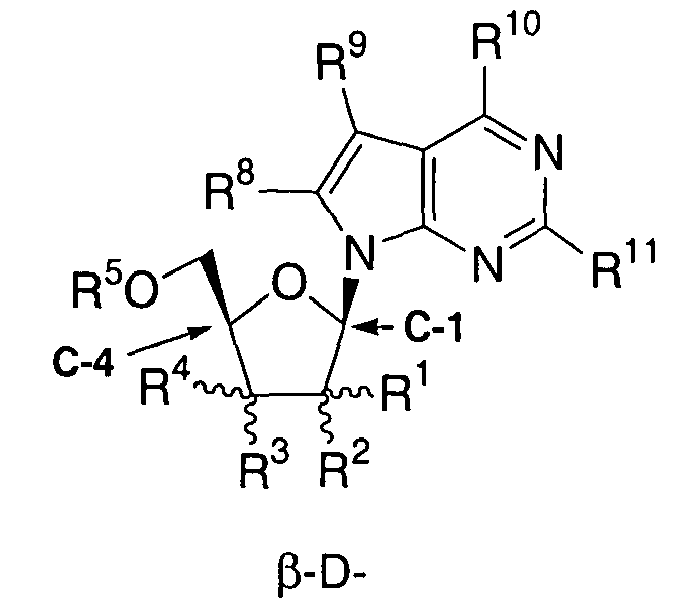
- Some of the compounds described herein contain olefinic double bonds, and unless specified otherwise, are meant to include both E and Z geometric isomers.
- Some of the compounds described herein may exist as tautomers such as keto-enol tautomers. The individual tautomers as well as mixtures thereof are encompassed with compounds of structural formula I. An example of keto-enol tautomers which are intended to be encompassed within the compounds of the present invention is illustrated below:

- Compounds of structural formula I may be separated into their individual diastereoisomers by, for example, fractional crystallization from a suitable solvent, for example methanol or ethyl acetate or a mixture thereof, or via chiral chromatography using an optically active stationary phase.
- Alternatively, any stereoisomer of a compound of the structural formula I may be obtained by stereospecific synthesis using optically pure starting materials or reagents of known configuration.
- The stereochemistry of the substituents at the C-2 and C-3 positions of the furanose ring of the compounds of the present invention of structural formula I is denoted by squiggly lines which signifies that substituents R1, R2, R3 and R4 can have either the I (substituent "down") or ϑ (substituent "up") configuration independently of one another. Notation of stereochemistry by a bold line as at C-1 and C-4 of the furanose ring signifies that the substituent has the β-configuration (substituent "up").

- The compounds of the present invention may be administered in the form of a pharmaceutically acceptable salt. The term "pharmaceutically acceptable salt" refers to salts prepared from pharmaceutically acceptable non-toxic bases or acids including inorganic or organic bases and inorganic or organic acids. Salts of basic compounds encompassed within the term "pharmaceutically acceptable salt" refer to non-toxic salts of the compounds of this invention which are generally prepared by reacting the free base with a suitable organic or inorganic acid. Representative salts of basic compounds of the present invention include, but are not limited to, the following: acetate, benzenesulfonate, benzoate, bicarbonate, bisulfate, bitartrate, borate, bromide, camsylate, carbonate, chloride, clavulanate, citrate, dihydrochloride, edetate, edisylate, estolate, esylate, fumarate, gluceptate, gluconate, glutamate, glycollylarsanilate, hexylresorcinate, hydrabamine, hydrobromide, hydrochloride, hydroxynaphthoate, iodide, isothionate, lactate, lactobionate, laurate, malate, maleate, mandelate, mesylate, methylbromide, methylnitrate, methylsulfate, mucate, napsylate, nitrate, N-methylglucamine ammonium salt, oleate, oxalate, pamoate (embonate), palmitate, pantothenate, phosphate/diphosphate, polygalacturonate, salicylate, stearate, sulfate, subacetate, succinate, tannate, tartrate, teoclate, tosylate, triethiodide and valerate. Furthermore, where the compounds of the invention carry an acidic moiety, suitable pharmaceutically acceptable salts thereof include, but are not limited to, salts derived from inorganic bases including aluminum, ammonium, calcium, copper, ferric, ferrous, lithium, magnesium, manganic, mangamous, potassium, sodium, zinc, and the like. Particularly preferred are the ammonium, calcium, magnesium, potassium, and sodium salts. Salts derived from pharmaceutically acceptable organic non-toxic bases include salts of primary, secondary, and tertiary amines, cyclic amines, and basic ion-exchange resins, such as arginine, betaine, caffeine, choline, N,N-dibenzylethylenediamine, diethylamine, 2-diethylaminoethanol, 2-dimethylaminoethanol, ethanolamine, ethylenediamine, N-ethylmorpholine, N-ethylpiperidine, glucamine, glucosamine, histidine, hydrabamine, isopropylamine, lysine, methylglucamine, morpholine, piperazine, piperidine, polyamine resins, procaine, purines, theobromine, triethylamine, trimethylamine, tripropylamine, tromethamine, and the like.
- Also, in the case of a carboxylic acid (-COOH) or alcohol group being present in the compounds of the present invention, pharmaceutically acceptable esters of carboxylic acid derivatives, such as methyl, ethyl, or pivaloyloxymethyl, or acyl derivatives of alcohols, such as acetate or maleate, can be employed. Included are those esters and acyl groups known in the art for modifying the solubility or hydrolysis characteristics for use as sustained-release or prodrug formulations.
- The nucleoside compounds and derivatives thereof of the present invention can be prepared following synthetic methodologies well-established in the practice of nucleoside and nucleotide chemistry. Reference is made to the following text for a description of synthetic methods used in the preparation of the compounds of the present invention: "Chemistry of Nucleosides and Nucleotides," L.B. Townsend, ed., Vols. 1-3, Plenum Press, 1988, which is incorporated by reference herein in its entirety.
- A representative general method for the preparation of compounds of the present invention is outlined in Scheme 1 below. This scheme illustrates the synthesis of compounds of the present invention of structural formula 1-7 wherein the furanose ring has the β-D-ribo configuration. The starting material is a 3,5-bis-O-protected alkyl furanoside, such as methyl furanoside, of structural formula 1-1. The C-2 hydroxyl group is then oxidized with a suitable oxidizing agent, such as a chromium trioxide or chromate reagent, Dess-Martin periodinane, or by Swern oxidation, to afford a C-2 ketone of structural formula 1-2. Addition of a Grignard reagent, such as an alkyl, alkenyl, or alkynyl magnesium halide (for example, MeMgBr, EtMgBr, vinylMgBr, allylMgBr, and ethynylMgBr) or an alkyl, alkenyl, or alkynyl lithium, such as MeLi, across the carbonyl double bond of 1-2 in a suitable organic solvent, such as tetrahydrofuran, diethyl ether, and the like, affords the C-2 tertiary alcohol of structural formula 1-3. A good leaving group (such as Cl, Br, and I) is next introduced at the C-1 (anomeric) position of the furanose sugar derivative by treatment of the furanoside of formula 1-3 with a hydrogen halide in a suitable organic solvent, such as hydrogen bromide in acetic acid, to afford the intermediate furanosyl halide 1-4. A C-1 sulfonate, such methanesulfonate (MeSO2O-), trifluoromethanesulfonate (CF3SO2O-), or p-toluenesulfonate (-OTs), may also serve as a useful leaving group in the subsequent reaction to generate the glycosidic (nucleosidic) linkage. The nucleosidic linkage is constructed by treatment of the intermediate of structural formula 1-4 with the metal salt (such as lithium, sodium, or potassium) of an appropriately substituted 1H-pyrrolo[2,3-d]pyrimidine 1-5, such as an appropriately substituted 4-halo-1H-pyrrolo[2,3-d]pyrimidine, which can be generated in situ by treatment with an alkali hydride (such as sodium hydride), an alkali hydroxide (such as potassium hydroxide), an alkali carbonate (such as potassium carbonate), or an alkali hexamethyldisilazide (such as NaHMDS) in a suitable anhydrous organic solvent, such as acetonitrile, tetrahydrofuran, 1-methyl-2-pyrrolidinone, or N,N-dimethylformamide (DMF). The displacement reaction can be catalyzed by using a phase-transfer catalyst, such as TDA-1 or triethylbenzyl-ammonium chloride, in a two-phase system (solid-liquid or liquid-liquid). The optional protecting groups in the protected nucleoside of structural formula 1-6 are then cleaved following established deprotection methodologies, such as those described in T.W. Greene and P.G.M. Wuts, "Protective Groups in Organic Synthesis," 3rd ed., John Wiley & Sons, 1999. Optional introduction of an amino group at the 4-position of the pyrrolo[2,3-d]pyrimidine nucleus is effected by treatment of the 4-halo intermediate 1-6 with the appropriate amine, such as alcoholic ammonia or liquid ammonia, to generate a primary amine at the C-4 position (-NH2), an alkylamine to generate a secondary amine (-NHR), or a dialkylamine to generate a tertiary amine (-NRR'). A 7H-pyrrolo[2,3-d]pyrimidin-4(3H)one compound may be derived by hydrolysis of 1-6 with aqueous base, such as aqueous sodium hydroxide. Alcoholysis (such as methanolysis) of 1-6 affords a C-4 alkoxide (-OR), whereas treatment with an alkyl mercaptide affords a C-4 alkylthio (-SR) derivative. Subsequent chemical manipulations well-known to practitioners of ordinary skill in the art of organic/medicinal chemistry may be required to attain the desired compounds of the present invention.


- The examples below provide citations to literature publications, which contain details for the preparation of final compounds or intermediates employed in the preparation of final compounds of the present invention. The nucleoside compounds of the present invention were prepared according to procedures detailed in the following examples. The examples are not intended to be limitations on the scope of the instant invention in any way, and they should not be so construed. Those skilled in the art of nucleoside and nucleotide synthesis will readily appreciate that known variations of the conditions and processes of the following preparative procedures can be used to prepare these and other compounds of the present invention. All temperatures are degrees Celsius unless otherwise noted.
-

-

- A mixture of 2-O-acetyl-3,5-bis-O-(2,4-dichlorophenylmethyl)-1-O-methyl-α-D-ribofuranose [for preparation, see: Helv. Chim. Acta 78: 486 (1995)] (52.4 g, 0.10 mol) in methanolic K2CO3 (500 mL, saturated at rt) was stirred at room temperature for 45 min. and then concentrated under reduced pressure. The oily residue was suspended in CH2Cl2 (500 mL), washed with water (300 mL + 5 x 200 mL) and brine (200 mL), dried (Na2SO4), filtered, and concentrated to give the title compound (49.0 g) as colorless oil, which was used without further purification in Step B below. 1H NMR (DMSO-d 6 ): δ 3.28 (s, 3H, OCH3), 3.53 (d, 2H, J 5,4 = 4.5 Hz, H-5a, H-5b), 3.72 (dd, 1H, J 3,4 = 3.6 Hz, J 3,2 = 6.6 Hz, H-3), 3.99 (ddd, 1H, J 2,1 = 4.5 Hz, J 2,OH-2 = 9.6 Hz, H-2), 4.07 (m, 1H, H-4), 4.50 (s, 2H, CH 2 Ph), 4.52, 4.60 (2d, 2H, J gem = 13.6 Hz, CH 2 Ph), 4.54 (d, 1H, OH-2), 4.75 (d, 1H, H-1), 7.32-7.45, 7.52-7.57 (2m, 10H, 2Ph). 13C NMR (DMSO-d 6 ): δ 55.40, 69.05, 69.74, 71.29, 72.02, 78.41, 81.45, 103.44, 127.83, 127.95, 129.05, 129.28, 131.27, 131.30, 133.22, 133.26, 133.55, 133.67, 135.45, 135.92.
- To an ice-cold suspension of Dess-Martin periodinane (50.0 g, 118 mmol) in anhydrous CH2Cl2 (350 mL) under argon (Ar) was added a solution of the compound from Step A (36.2 g, 75 mmol) in anhydrous CH2Cl2 (200 mL) dropwise over 0.5 h. The reaction mixture was stirred at 0°C for 0.5 h and then at room temperature for 3 days. The mixture was diluted with anhydrous Et2O (600 mL) and poured into an ice-cold mixture of Na2S2O3.5H2O (180 g) in saturated aqueous NaHCO3 (1400 mL). The layers were separated, and the organic layer was washed with saturated aqueous NaHCO3 (600 mL), water (800 mL) and brine (600 mL), dried (MgSO4), filtered and evaporated to give the title compound (34.2 g) as a colorless oil, which was used without further purification in Step C below. 1H NMR (CDCl3): δ 3.50 (s, 3H, OCH3), 3.79 (dd, 1H, J 5a,5b = 11.3.Hz, J 5a,4 = 3.5 Hz, H-5a), 3.94 (dd, 1H, J 5b,4 = 2.3 Hz, H-5b), 4.20 (dd, 1H, J 3,1 = 1.3 Hz, J 3,4 = 8.4 Hz, H-3), 4.37 (ddd, 1H, H-4), 4.58, 4.69 (2d, 2H, J gem = 13.0 Hz, CH 2Ph), 4.87 (d, 1H, H-1), 4.78, 5.03 (2d, 2H, J gem = 12.5 Hz, CH 2Ph), 7.19-7.26, 7.31-7.42 (2m, 10H, 2Ph). 13C NMR (DMSO-d 6 ): δ 55.72, 69.41, 69.81, 69.98, 77.49, 78.00, 98.54, 127.99, 128.06, 129.33, 129.38, 131.36, 131.72, 133.61, 133.63, 133.85, 133.97, 134.72, 135.32, 208.21.
- To a solution of MeMgBr in anhydrous Et2O (0.48 M, 300 mL) at -55 °C was added dropwise a solution of the compound from Step B (17.40 g, 36.2 mmol) in anhydrous Et2O (125 mL). The reaction mixture was allowed to warm to -30°C and stirred for 7 h at -30°C to -15°C, then poured into ice-cold water (500 mL) and the mixture vigorously stirred at room temperature for 0.5 h. The mixture was filtered through a Celite pad (10 x 5 cm) which was thoroughly washed with Et2O. The organic layer was dried (MgSO4), filtered and concentrated. The residue was dissolved in hexanes (-30 mL), applied onto a silica gel column (10 x 7 cm, prepacked in hexanes) and eluted with hexanes and hexanes/EtOAc (9/1) to give the title compound (16.7 g) as a colorless syrup.
1H NMR (CDCl3): δ 1.36 (d, 3H, J Me,OH = 0.9 Hz, 2C-Me), 3.33 (q, 1H, OH), 3.41 (d, 1H, J 3,4 = 3.3 Hz), 3.46 (s, 3H, OCH3), 3.66 (d, 2H, J 5,4 = 3.7 Hz, H-5a, H-5b), 4.18 (apparent q, 1H, H-4), 4.52 (s, 1H, H-1), 4.60 (s, 2H, CH 2Ph), 4.63, 4.81 (2d, 2H, J gem = 13.2 Hz, CH 2Ph), 7.19-7.26, 7.34-7.43 (2m, 10H, 2Ph). 13C NMR (CDCl3): δ 24.88, 55.45, 69.95, 70.24, 70.88, 77.06, 82.18, 83.01, 107.63, 127.32, 129.36, 130.01, 130.32, 133.68, 133.78, 134.13, 134.18, 134.45, 134.58. - To a solution of the compound from Step C (9.42 g, 19 mmol) in anhydrous dichloromethane (285 mL) at 0°C was added HBr (5.7 M in acetic acid, 20 mL, 114 mmol) dropwise. The resulting solution was stirred at 0°C for 1 h and then at rt for 3 h, evaporated in vacuo and co-evaporated with anhydrous toluene (3 x 40 mL). The oily residue was dissolved in anhydrous acetonitrile (50 mL) and added to a solution of the sodium salt of 4-chloro-1H-pyrrolo[2,3-d]pyrimidine in acetonitrile [generated in situ from 4-chloro-1H-pyrrolo[2,3-d]pyrimidine [for preparation, see: J. Chem. Soc.: 131 (1960)] (8.76 g, 57 mmol) in anhydrous acetonitrile (1000 mL), and NaH (60% in mineral oil, 2.28 g, 57 mmol), after 4 h of vigorous stirring at rt]. The combined mixture was stirred at rt for 24 h, and then evaporated to dryness. The residue was suspended in water (250 mL) and extracted with EtOAc (2 x 500 mL). The combined extracts were washed with brine (300 mL, dried over Na2SO4, filtered and evaporated. The crude product was purified on a silica gel column (10 cm x 10 cm) using ethyl acetate/hexane (1:3 and 1:2) as the eluent. Fractions containing the product were combined and evaporated in vacuo to give the desired product (5.05 g) as a colorless foam.
1H NMR (CDCl3): δ 0.93 (s, 3H, CH3), 3.09 (s, 1H, OH), 3.78 (dd, 1H, J 5',5" = 10.9 Hz, J 5',4 = 2.5 Hz, H-5'), 3.99 (dd, 1H, J 5",4 = 2.2 Hz, H-5"), 4.23-4.34 (m, 2H, H-3', H-4'), 4.63, 4.70 (2d, 2H, J gem = 12.7 Hz, CH 2Ph), 4.71, 4.80 (2d, 2H, J gem = 12.1 Hz,CH 2Ph), 6.54 (d, 1H, , J 5,6 = 3.8 Hz, H-5), 7.23-7.44 (m, 10H, 2Ph). 13C NMR (CDCl3): δ 21.31, 69.10, 70.41, 70.77, 79.56, 80.41, 81.05, 91.11, 100.57, 118.21, 127.04, 127.46, 127.57, 129.73, 129.77, 130.57, 130.99, 133.51, 133.99, 134.33, 134.38, 134.74, 135.21, 151.07, 151.15 152.47. - To a solution of the compound from Step D (5.42 g, 8.8 mmol) in dichloromethane (175 mL) at - 78°C was added boron trichloride (1M in dichloromethane, 88 mL, 88 mmol) dropwise. The mixture was stirred at -78°C for 2.5 h, then at -30°C to -20°C for 3h. The reaction was quenched by addition of methanol/dichloromethane (1:1) (90 mL) and the resulting mixture stirred at -15°C for 30 min., then neutralized with aqueous ammonia at 0°C and stirred at rt for 15 min. The solid was filtered and washed with CH2Cl2/MeOH (1/1, 250 mL). The combined filtrate was evaporated, and the residue was purified by flash chromatography over silica gel using CH2Cl2 and CH2Cl2:MeOH (99:1, 98:2, 95:5 and 90:10) gradient as the eluent to furnish desired compound (1.73 g) as a colorless foam, which turned into an amorphous solid after treatment with MeCN.
1H NMR (DMSO-d 6 ): δ 0.64 (s, 3H, CH3), 3.61-3.71 (m, 1H, H-5'), 3.79-3.88 (m, 1H, H-5"), 3.89-4.01 (m, 2H, H-3', H-4'), 5.15-5.23 (m, 3H, 2'-OH, 3'-OH, 5'-OH), 6.24 (s, 1H, H-1'), 6.72 (d, 1H, J 5,6 = 3.8 Hz, H-5), 8.13 (d, 1H, H-6), 8.65 (s, 1H, H-2). 13C NMR (DMSO-d 6 ): δ 20.20, 59.95, 72.29, 79.37, 83.16, 91.53, 100.17, 117.63, 128.86, 151.13, 151.19, 151.45. - To the compound from Step E (1.54 g, 5.1 mmol) was added methanolic ammonia (saturated at 0°C; 150 mL). The mixture was heated in a stainless steel autoclave at 85°C for 14 h, then cooled and evaporated in vacuo. The crude mixture was purified on a silica gel column with CH2Cl2/MeOH (9/1) as eluent to give the title compound as a colorless foam (0.8 g), which separated as an amorphous solid after treatment with MeCN. The amorphous solid was recrystallized from methanol/acetonitrile; m.p. 222°C. 1H NMR (DMSO-d 6 ) δ 0.62 (s, 3H, CH3), 3.57-3.67 (m, 1H, H-5'), 3.75-3.97 (m, 3H, H-5", H-4', H-3'), 5.00 (s, 1H, 2'-OH), 5.04 (d, 1H, J 3'OH,3' = 6.8 Hz, 3'-OH), 5.06 (t, 1H, J 5'OH,5',5" = 5.1 Hz, 5'-OH), 6.11 (s, 1H, H-1'), 6.54 (d, 1H, J 5,6 = 3.6 Hz, H-5), 6.97 (br s, 2H, NH2), 7.44 (d, 1H, H-6), 8.02 (s, 1H, H-2). 13C NMR (DMSO-d 6 ) δ 20.26, 60.42, 72.72, 79.30, 82.75, 91.20, 100.13, 103.08, 121.96, 150.37, 152.33, 158.15. LC-MS: Found: 279.10 (M-H+); calc. for C12H16N4O4+H+: 279.11.
-

- To diethyl ether (300 mL) at -78°C was slowly added EtMgBr (3.0 M, 16.6 mL) and then dropwise the compound from Step B of Example 2 (4.80 g, 10.0 mmol) in anhydrous Et2O (100 mL). The reaction mixture was stirred at -78 °C for 15 min, allowed to warm to -15°C and stirred for another 2 h, and then poured into a stirred mixture of water (300 mL) and Et2O (600 mL). The organic phase was separated, dried (MgSO4), and evaporated in vacuo. The crude product was purified on silica gel using ethyl acetate/hexane (1:2) as eluent. Fractions containing the product were pooled and evaporated in vacuo to give the desired product (3.87 g) as a colorless oil.
- To a solution of the compound from Step A (1.02 mg, 2.0 mmol) in dichloromethane (40 mL) was added HBr (5.7 M in acetic acid) (1.75 mL, 10.0 mmol) dropwise at 0°C. The resulting solution was stirred at room temperature for 2 h, evaporated in vacuo and co-evaporated twice from toluene (10 mL). The oily residue was dissolved in acetonitrile (10 mL) and added to a vigorously stirred mixture of 4-chloro-1H-pyrrolo[2,3-d]pyrimidine (307 mg, 2.0 mmol), potassium hydroxide (337 mg, 6.0 mmol) and tris[2-(2-methoxyethoxy)ethyl]amine (130 mg, 0.4 mmol) in acetonitrile (10 mL). The resulting mixture was stirred at rt overnight, and then poured into a stirred mixture of saturated ammonium chloride (100 mL) and ethyl acetate (100 mL). The organic layer was separated, washed with brine (100 mL), dried over MgSO4, filtered and evaporated in vacuo. The crude product was purified on silica gel using ethyl acetate/hexane (1:2) as eluent to give the desired product (307 mg) as a colorless foam.
- To a solution of the compound from Step B (307 mg, 0.45 mmol) in dichloromethane (8 mL) was added boron trichloride (1M in dichloromethane) (4.50 mL, 4.50 mmol) at -78°C. The mixture was stirred at -78°C for 1h, then at -10°C for 3h. The reaction was quenched by addition of methanol/dichloromethane (1:1) (10 mL), stirred at -15°C for 30 min, and neutralized by addition of aqueous ammonium hydroxide. The mixture was evaporated under diminished pressure and the resulting oil purified on silica gel using methanol/dichloromethane (1:9) as eluent. Fractions containing the product were pooled and evaporated in vacuo to give the desired product (112 mg) as a colorless foam.
- To the compound from Step C (50 mg, 0.16 mmol) was added saturated ammonia in methanol (4 mL). The mixture was stirred at 75°C for 72 h in a closed container, cooled and evaporated in vacuo. The crude mixture was purified on silica gel using methanol/dichloromethane (1:9) as eluent. Fractions containing the product were pooled and evaporated in vacuo to give the desired product (29 mg) as a colorless powder. 1H NMR (200 MHz, DMSO-d 6 ): δ 0.52 (t, 3H), 1.02 (m, 2H), 4.01-3.24 (m, 6H), 5.06 (m, 1H), 6.01 (s, 1H), 6.51 (d, 1H), 6.95 (s br, 2H), 6.70 (d, 1H), 7.99 (s, 1H). LC-MS: Found: 295.2 (M+H+); calc. for C13H18N4O4+H+: 295.14.
-

- To an ice-cold solution of the product from Step C of Example 2 (1.27 g, 2.57 mmol) in CH2Cl2 (30 mL) was added HBr (5.7 M in acetic acid; 3 mL) dropwise. The reaction mixture was stirred at room temperature for 2 h, concentrated under diminished pressure and coevaporated with toluene (2 x 15 mL). The resulting oil was dissolved in acetonitrile (MeCN) (15 mL) and added dropwise into a well-stirred mixture of 2-amino-4-chloro-7H-pyrrolo[2,3-d]pyrimidine [for preparation, see Heterocycles 35: 825 (1993)] (433 mg, 2.57 mmol), KOH (85%, powdered) (0.51 g, 7.7 mmol), tris-[2-(2-methoxyethoxy)ethyl]amine (165 µL, 0.51 mmol) in acetonitrile (30 mL). The resulting mixture was stirred at rt for 1h, filtered and evaporated. The residue was purified on a silica gel column using hexanes/EtOAc, 5/1, 3/1 and 2/1, as eluent to give the title compound as a colorless foam (0.65 g).
- To a solution of the product from Step A (630 mg, 1.0 mmol) in CH2Cl2 (20 mL) at -78°C was added boron trichloride (1M in CH2Cl2) (10 mL, 10 mmol). The mixture was stirred at -78°C for 2 h, then at -20°C for 2.5 h. The reaction was quenched with CH2Cl2/MeOH (1:1) (10 mL), stirred at -20°C for 0.5 h, and neutralized at 0°C with aqueous ammonia. The solid was filtered, washed with CH2Cl2/MeOH (1:1) and the combined filtrate evaporated in vacuo. The residue was purified on a silica gel column with CH2Cl2/MeOH, 50/1 and 20/1, as eluent to give the title compound as a colorless foam (250 mg).
- A mixture of the product from Step B (90 mg, 0.3 mmol) in aqueous NaOH (2N, 9 mL) was heated at reflux temperature for 5 h, then neutralized at 0°C with 2 N aqueous HCl and evaporated to dryness. Purification on a silica gel column with CH2Cl2/MeOH, 5/1, as eluent afforded the title compound as a white solid (70 mg). 1H NMR (200 MHz, CD3OD): δ 0.86 (s, 3H), 3.79 (m 1H), 3.90-4.05 (m, 3H), 6.06 (s, 1H), 6.42 (d, J = 3.7 Hz, 1H), 7.05 (d, J = 3.7 Hz, 1H).
-

- A solution of 2-amino-4-chloro-7-(2-C-methyl-ϑ-D-ribofuranosyl)-7H-pyrrolo[2,3-d]pyrimidine (Example 4, Step B) (21 mg, 0.07 mmol) in cyclopropylamine (0.5 mL) was heated at 70°C for two days, then evaporated to an oily residue and purified on a silica gel column with CH2Cl2/MeOH, 20/1, as eluent to give the title compound as a white solid (17 mg). 1H NMR (200 MHz, CD3CN): δ 0.61 (m, 2H), 0.81 (m, 2H), 0.85 (s, 3H), 2.83 (m, 1H), 3.74-3.86 (m, 1H), 3.93-4.03 (m, 2H), 4.11 (d, J = 8.9 Hz, 1H), 6.02 (s, 1H), 6.49 (d, J = 3.7 Hz, 1H), 7.00 (d, J = 3.7 Hz, 1H).
-

- This compound was prepared following procedures described by Y. Murai et al. in Heterocycles 33: 391-404 (1992).
-

- This compound was prepared following procedures described by Y. Murai et al. in Heterocycles 33: 391-404 (1992).
- S-Acyl-2-thioethyl (SATE) pronucleotides are discussed in C.R. Wagner, V.V. Iyer, and E.J. McIntee, "Pronucleotides: Toward the In Vivo Delivery of Antiviral and Anticancer Nucleotides," Med. Res. Rev., 20: 1-35 (2000), which is incorporated by reference herein in its entirety. SATE derivatives of nucleosides are also disclosed
U.S. Patent Nos. 5,770,725 ;5,849,905 ; and6,020,482 , the contents of each of which are incorporated by reference herein in their entirety. - 2-Mercaptoethanol (5 g, 64 mmol) was dissolved in CH2Cl2 (50 mL). To this solution was added triethylamine (7.67 mL, 57.6 mmol), and the reaction mixture was cooled in an ice bath to 0 °C. Acetic anhydride (4.54 mL, 48 mmol) was added dropwise in 10 min., and the reaction mixture was stirred for 1 h at 0 °C. The reaction mixture was then allowed to come to room temperature over a period of 2 h. The reaction mixture was diluted with CH2Cl2 (50 mL), washed with water (75 mL), 5% aqueous NaHCO3 (75 mL) and brine (75 mL). The organic phase was dried over anhydrous Na2SO4 and concentrated in vacuo to give an oil. The oil was then dissolved in anhydrous THF (40 mL) and anhydrous triethylamine (7.76 mL) was added. To this mixture was added activated molecular sieves (4Å) and was kept at room temperature for 10 min. The reaction mixture was cooled in an ice bath to 0°C and diisopropylphosphoramidous dichloride (6.47 g, 32.03 mmol) was added. The reaction mixture was stirred at 0 °C for 2 h under inert atmosphere. Hexane (40 mL) was added to the reaction mixture and the precipitate formed was filtered. The filtrate was concentrated to one fourth of the volume, purified by loaded silica gel column chromatography and eluted with hexane containing 3 % triethylamine and incremental amount of ethyl acetate (0 to 7 %) to give the title compound as an oil (2.36 g). 1H NMR (CDCl3): δ 1.17 (s, 6H), 1.21 (s, 6H), 2.36 (s, 6H), 3.14 (t, J = 6.44 Hz), 3.51-3.84 (m, 6H); 13C NMR (CDCl3): δ 24.47, 24.61, 30.48, 42.85, 43.1, 61.88, 62.23, 195.26; 13P NMR (CDCl3): δ 146.96.
- The nucleoside 5'-triphosphates of the present invention were prepared following general procedures described in Chem. Rev. 100: 2047 (2000).
- The triphosphate derivatives were purified by anion exchange (AX) chromatography using a 30 × 100 mm Mono Q column (Pharmacia) with a buffer system of 50 mM Tris, pH 8. Elution gradients were typically from 40 mM NaCl to 0.8 M NaCl in two column volumes at 6.5 mL/min. Appropriate fractions from anion exchange chromatography were collected and desalted by reverse-phase (RP) chromatography using a Luna C18 250 × 21 mm column (Phenomenex) with a flow rate of 10 mL/min. Elution gradients were generally from 1% to 95% methanol in 14 min at a constant concentration of 5 mM triethylammonium acetate (TEAA).
- Mass spectra of the purified triphosphates were determined using on-line HPLC mass spectrometry on a Hewlett-Packard (Palo Alto, CA) MSD 1100. A Phenomenex Luna (C18(2)), 150 × 2 mm, plus 30 × 2 mm guard column, 3-µm particle size was used for RP HPLC. A 0 to 50% linear gradient (15 min) of acetonitrile in 20 mM TEAA (triethylammonium acetate) pH 7 was performed in series with mass spectral detection in the negative ionization mode. Nitrogen gas and a pneumatic nebulizer were used to generate the electrospray. The mass range of 150-900 was sampled. Molecular masses were determined using the HP Chemstation analysis package.
- The purity of the purified triphosphates was determined by analytical RP and AX HPLC. RP HPLC with a Phenomonex Luna or Jupiter column (250 x 4.6 mm), 5-µm particle size was typically run with a 2-70% acetonitrile gradient in 15 min in 100 mM TEAA, pH 7. AX HPLC was performed on a 1.6 x× 5 mm Mono Q column (Pharmacia). Triphosphates were eluted with a gradient of 0 to 0.4 M NaCl at constant concentration of 50 mM Tris, pH 8. The purity of the triphosphates was generally >80%.
- The nucleoside 5'-monophosphates of the present invention were prepared following the general procedures described in Tetrahedron Lett. 50: 5065 (1967).
- Mass spectra of 5'-triphosphates of the compounds of the present invention were determined as described in Example 10. Listed in the following table are the calculated and experimental masses for representative 5'-triphosphates prepared according to the procedures of Example 9. The example numbers correspond to the parent compound of the 5'-triphosphate.
Example Calculated Found 1 520.0 519.9 2 520.0 520.0 3 534.0 534.0 4 536.0 536.0 -

- To the compound from Step F of Example 2 (14 mg, 0.05 mmol) (dried by coevaporation with pyridine and several times with toluene) was added trimethyl phosphate (0.5 mL). The mixture was stirred overnight in a sealed container. It was then cooled to 0°C and phosphorous oxychloride (0.0070 mL, 0.075 mmol) was added via a syringe. The mixture was stirred for 3 h at 0°C, then the reaction was quenched by addition of tetraethylammonium bicarbonate (TEAB) (1M) (0.5 mL) and water (5 mL). The reaction mixture was purified and analyzed according to the procedure described in Example 10. Electron spray mass spectrum (ES-MS): Found: 359.2 (M-H+), calc. for
C12H17N4O7P - H+: 359.1. -

- To the compound from Step F of Example 2 (56 mg, 0.20 mmol) (dried by coevaporation with pyridine and several times with toluene) was added trimethyl phosphate (stored over sieves) (1.0 mL). The mixture was stirred overnight in a sealed container. It was then cooled to 0°C and phosphorous oxychloride (0.023 mL, 0.25 mmol) was added via a syringe. The mixture was stirred for 2 h at 0°C, then tributylamine (0.238 mL, 1.00 mmol) and tributylammonium phosphate (generated from phosphoric acid and tributylamine in pyridine, followed by repeated azeotropic evaporation with pyridine and acetonitrile) (1.0 mmol in 3.30 mL acetonitrile) was added. The mixture was stirred for an additional 30 min at 0°C, the sealed vial was then opened and the reaction quenched by addition of TEAB (1M) (1.0 mL) and water (5 mL). The reaction mixture was purified and analyzed according to the procedure described in Example 10.
ES-MS: Found: 439.0 (M-H+), calc. for C12H18N4O10P2- H+: 439.04. -

- To the compound from Step F of Example 2 (20 mg, 0.07 mmol) (dried by coevaporation with pyridine and several times with toluene) was added trimethyl phosphate (stored over sieves) (0.4 mL). The mixture was stirred overnight in a sealed container. It was then cooled to 0°C and phosphorous oxychloride (0.0070 mL, 0.075 mmol) was added via syringe. The mixture was stirred for 3 h at 0°C, then tributylamine (0.083 mL, 0.35 mmol), tributylammonium pyrophosphate (127 mg, 0.35 mmol) and acetonitrile (stored over sieves) (0.25 mL) were added. The mixture was stirred for an additional 30 min at 0°C, the sealed vial was then opened and the reaction quenched by addition of TEAB (1M) (0.5 mL) and water (5 mL). The reaction mixture was purified and analyzed according to the procedure described in Example 10. ES-MS: Found: 519.0 (M-H+), calc. for C12H19N4O13P3- H+: 519.01.
-

- To the compound from Step E of Example 2 (59 mg, 0.18 mmol) was added aqueous sodium hydroxide (1M). The mixture was heated to reflux for 1hr, cooled, neutralized with aqueous HCl (2M) and evaporated in vacuo. The residue was purified on silica gel using dichloromethane/methanol (4:1) as eluent. Fractions containing the product were pooled and evaporated in vacuo to give the desired product (53 mg) as a colorless oil. 1H NMR (CD3CN): δ 0.70 (s, 3H), 3.34-4.15 (overlapping m, 7H), 6.16 (s, 1H), 6.57 (d, 3.6 Hz, 1H), 7.37 (d, 3.6 Hz, 1H), 8.83 (s, 1H).
-

- To a pre-cooled solution (0°C) of the compound from Step F of Example 2 (140 mg, 0.50 mmol) in DMF (2.5 mL) was added N-chlorosuccinimide (0.075 g, 0.55 mmol) in DMF (0.5 mL) dropwise. The solution was stirred at rt for 1h and the reaction quenched by addition of methanol (4 mL) and evaporated in vacuo. The crude product was purified on silica gel using methanol/dichloromethane (1:9) as eluent. Fractions containing the product were pooled and evaporated in vacuo to give the desired product (55 mg) as a colorless solid. 1H NMR (CD3CN): δ 0.80 (s, 3H), 3.65-4.14 (overlapping m, 7H), 5.97 (s br, 2H), 6.17 (s, 1H), 7.51 (s, 1H), 8.16 (s, 1H). ES-MS: Found: 315.0 (M+H+), calc.for C12H15ClN4O4 + H+: 315.09.
-

- To a pre-cooled solution (0°C) of the compound from Step F of Example 2 (28 mg, 0.10 mmol) in DMF (0.5 mL) was added N-bromosuccinimide (0.018 g, 0.10 mmol) in DMF (0.5 mL) dropwise. The solution was stirred at 0°C for 20 min, then at rt for 10 min. The reaction was quenched by addition of methanol (4 mL) and evaporated in vacuo. The crude product was purified on silica gel using methanol/dichloromethane (1:9) as eluent. Fractions containing the product were pooled and evaporated in vacuo to give the desired product (13.0 mg) as a colorless solid. 1H NMR (CD3CN): δ 0.69 (s, 3H), 3.46-4.00 (overlapping m, 7H), 5.83 (s br, 2H), 6.06 (s, 1H), 7.45 (s, 1H), 8.05 (s, 1H). ES-MS: Found: 359.1 (M+H+), calc.for C12H15BrN4O4 + H+: 359.04.
-

- A mixture of 2-amino-4-chloro-7-(2-C-methyl-β-D-ribofuranosyl)-7H-pyrrolo[2,3-d]pyrimidine (Example 4, Step B) (20 mg, 0.07 mmol) in EtOH (1.0 mL), pyridine (0.1 mL) and 10% Pd/C (6 mg) under H2 (atmospheric pressure) was stirred overnight at room temperature. The mixture was filtered through a Celite pad which was thorougly washed with EtOH. The combined filtrate was evaporated and purified on a silica gel column with CH2Cl2/MeOH, 20/1 and 10/1, as eluent to give the title compound as a white solid (16 mg). 1H NMR (200 MHz, CD3OD): δ 0.86 (s, 3H, 2'C-Me), 3.82 (dd, J 5'4'= 3.6 Hz, J 5',5" = 12.7 Hz, 1H, H-5'), 3.94-4.03 (m, 2H, H-5', H-4'), 4.10 (d, J 3'4' = 8.8 Hz, 1H, H-3'), 6.02 (s, 1H, H-1'), 6.41 (d, J 5,6 = 3.8 Hz, 1H, H-5), 7.39 (d, 1H, H-6), 8.43 (s, 1H, H-4). ES MS: 281.4 (MH+).
-

- To an ice-cold solution of the product from Step C of Example 2 (1.57 g, 3.16 mmol) in CH2Cl2 (50 mL) was added HBr (5.7 M in acetic acid; 3.3 mL) dropwise. The reaction mixture was stirred at 0°C for 1 h and then at room temperature for 2 h, concentrated in vacuo and co-evaporated with toluene (2 x 20 mL). The resulting oil was dissolved in MeCN (20 mL) and added dropwise to a solution of the sodium salt of 2-amino-4-chloro-5-methyl-1H-pyrrolo[2,3-d]pyrimidine in acetonitrile [generated in situ from 2-amino-4-chloro-5-methyl-1H-pyrrolo[2,3-d]pyrimidine [for preparation, see Liebigs Ann. Chem. 1984: 708-721] (1.13 g, 6.2 mmol) in anhydrous acetonitrile (150 mL), and NaH (60% in mineral oil, 248 mg, 6.2 mmol), after 2 h of vigorous stirring at rt]. The combined mixture was stirred at rt for 24 h and then evaporated to dryness. The residue was suspended in water (100 mL) and extracted with EtOAc (300 + 150 mL). The combined extracts were washed with brine (100 mL), dried over Na2SO4, filtered and evaporated. The crude product was purified on a silica gel column (5 x 7 cm) using ethyl acetate/hexane (0 to 30% EtOAc in 5% step gradient) as the eluent. Fractions containing the product were combined and evaporated in vacuo to give the desired product (0.96 g) as a colorless foam.
- To an ice-cold mixture of the product from Step A (475 mg, 0.7 mmol) in THF (7 mL) was added NaH (60% in mineral oil, 29 mg) and stirred at 0 °C for 0.5 h. Then MeI (48 µL) was added and reaction mixture stirred at rt for 24 h. The reaction was quenched with MeOH and the mixture evaporated. The crude product was purified on a silica gel column (5 x 3.5 cm) using hexane/ethyl acetate (9/1, 7/1, 5/1 and 3/1) as eluent. Fractions containing the product were combined and evaporated to give the desired compound (200 mg) as a colorless foam.
- A mixture of the product from Step B (200 mg, 0.3 mmol) in 1,4-dioxane (15 mL) and aqueous NaOH (2N, 15 mL) in a pressure bottle was heated overnight at 135 °C. The mixture was then cooled to 0 °C, neutralized with 2N aqueous HCl and evaporated to dryness. The crude product was suspended in MeOH, filtered, and the solid thoroughly washed with MeOH. The combined filtrate was concentrated, and the residue purified on a silica gel column (5 x 5 cm) using CH2Cl2/MeOH (40/1, 30/1 and 20/1) as eluent to give the desired compound (150 mg) as a colorless foam.
- A mixture of the product from Step C (64 mg, 0.1 mmol) in MeOH (5 mL) and Et3N (0.2 mL) and 10% Pd/C (24 mg) was hydrogenated on a Parr hydrogenator at 50 psi at r.t. for 1.5 days, then filtered through a Celite pad which was thoroughly washed with MeOH. The combined filtrate was evaporated and the residue purified on a silica gel column (3 x 4 cm) with CH2Cl2/MeOH (30/1, 20/1) as eluent to yield 2-amino-5-methyl-7-(5-O-benzyl-2-C,2-O-dimethyl-β-D-ribofuranosyl)-7H-pyrrolo[2,3-d]pyrimidin-4(3H)-one. The compound (37 mg) was further hydrogenated in EtOH (2 mL) with 10% Pd/C and under atmospheric pressure of hydrogen. After stirring 2 days at r.t., the reaction mixture was filtered through Celite, the filtrate evaporated and the crude product purified on a silica gel column (1 × 7 cm) with CH2Cl2/MeOH (30/1, 20/1 and 10/1) as eluent to yield the title compound (12 mg) after freeze-drying. 1H NMR (200 MHz, CD3OD): δ 0.81 (s, 3H, 2'C-Me), 2.16 (d, J H-6,C5-Me = 1.3 Hz, 3H, C5-Me), 3.41 (s, 3H, 2'-OMe), 3.67 (dd, J 5'4'= 3.4 Hz, J 5',5" = 12.6 Hz, 1H, H-5'), 3.81-3.91 (m, 3H, H-5", H-4', H-3'), 6.10 (s, 1H, H-1'), 6.66 (d, 1H, H-6). ES MS: 323.3 (M-H)+.
-

- To an ice-cold solution of the product from Step C of Example 2 (1.06 g, 2.1 mmol) in CH2Cl2 (30 mL) was added HBr (5.7 M in acetic acid; 2.2 mL) dropwise. The reaction mixture was stirred at 0 °C for 1 h and then at room temperature for 2 h, concentrated in vacuo and co-evaporated with toluene (2 × 15 mL). The resulting oil was dissolved in MeCN (10 mL) and added dropwise into a solution of the sodium salt of 4-chloro-5-methyl-1H-pyrrolo[2,3-d]pyrimidine in acetonitrile [generated in situ from 4-chloro-5-methyl-1H-pyrrolo[2,3-d]pyrimidine [for preparation, see J. Med. Chem. 33: 1984 (1990)] (0.62 g, 3.7 mmol) in anhydrous acetonitrile (70 mL), and NaH (60% in mineral oil, 148 mg, 3.7 mmol), after 2 h of vigorous stirring at rt]. The combined mixture was stirred at rt for 24 h and then evaporated to dryness. The residue was suspended in water (100 mL) and extracted with EtOAc (250 + 100 mL). The combined extracts were washed with brine (50 mL), dried over Na2SO4, filtered and evaporated. The crude product was purified on a silica gel column (5 × 5 cm) using hexane/ethyl acetate (9/1, 5/1, 3/1) gradient as the eluent. Fractions containing the product were combined and evaporated in vacuo to give the desired product (0.87 g) as a colorless foam.
- To a solution of the compound from Step A (0.87 g, 0.9 mmol) in dichloromethane (30 mL) at - 78°C was added boron trichloride (1M in dichloromethane, 9.0 mL, 9.0 mmol) dropwise. The mixture was stirred at -78°C for 2.5 h, then at -30°C to -20°C for 3 h. The reaction was quenched by addition of methanol/dichloromethane (1:1) (9 mL) and the resulting mixture stirred at -15°C for 30 min., then neutralized with aqueous ammonia at 0°C and stirred at rt for 15 min. The solid was filtered and washed with CH2Cl2/MeOH (1/1, 50 mL). The combined filtrate was evaporated, and the residue was purified on a silica gel column (5 x 5 cm) using CH2Cl2 and CH2Cl2/MeOH (40/1 and 30/1) gradient as the eluent to furnish the desired compound (0.22 g) as a colorless foam.
- To the compound from Step B (0.2 g, 0.64 mmol) was added methanolic ammonia (saturated at 0°C; 40 mL). The mixture was heated in a stainless steel autoclave at 100°C for 14 h, then cooled and evaporated in vacuo. The crude mixture was purified on a silica gel column (5 x 5 cm) with CH2Cl2/MeOH (50/1, 30/1, 20/1) gradient as eluent to give the title compound as a white solid (0.12 g). 1H NMR (DMSO-d 6 ): δ 0.60 (s, 3H, 2'C-Me), 2.26 (s, 3H, 5C-Me), 3.52-3.61 (m, 1H, H-5'), 3.70-3.88 (m, 3H, H-5", H-4', H-3'), 5.00 (s, 1H, 2'-OH), 4.91-4.99 (m, 3H, 2'-OH, 3'-OH, 5'-OH), 6.04 (s, 1H, H-1'), 6.48 (br s, 2H, NH2), 7.12 (s, 1H, H-6), 7.94 (s, 1H, H-2). ES MS: 295.2 (MH+).
-

- The compound of Example 6 (0.035 g, 0.11 mmol) was dissolved in a mixture of aqueous ammonia (4 mL, 30 wt %) and saturated methanolic ammonia (2 mL), and a solution of H2O2 in water (2 mL, 35 wt %) was added. The reaction mixture was stirred at room temperature for 18 h. Solvent was removed under reduced pressure, and the residue obtained was purified by HPLC on a reverse phase column (Altech Altima C-18, 10x 299 mm, A = water, B = acetonitrile, 10 to 60 % B in 50 min, flow 2 mL/min) to yield the title compound (0.015 g, 41 %) as a white solid. 1H NMR (CD3OD): δ 0.85 (s, 3H, Me), 3.61 (m, 1H), 3.82 (m, 1H) 3.99-4.86 (m, 2H), 6.26 (s, 1H), 8.10 (s, 2H) 8.22(s, 1H); 13C NMR (CD3OD): 20.13, 61.37, 73.79, 80.42, 84.01, 93.00, 102.66, 112.07, 130.07, 151.40, 152.74, 159.12, 169.30. HRMS (FAB) Calcd for C13H17N4O6 + 325.1148, found 325.1143.
-

- Cerium chloride heptahydrate (50 g, 134.2 mmol) was finely crushed in a pre-heated mortar and transferred to a round-bottom flask equipped with a mechanical stirrer. The flask was heated under high vacuum overnight at 160°C. The vacuum was released under argon and the flask was cooled to room temperature. Anhydrous THF (300 mL) was cannulated into the flask. The resulting suspension was stirred at room temperature for 4 h and then cooled to -78 °C. Vinylmagnesium bromide (1M in THF, 120 mL, 120 mmol) was added and stirring continued at - 78 °C for 2 h. To this suspension was added a solution of 3,5-bis-O-(2,4-dichlorophenylmethyl)-1-O-methyl-α-D-erythro-pentofuranose-2-ulose (14 g, 30 mmol) [from Example 2, Step B] in anhydrous THF (100 mL), dropwise with constant stirring. The reaction was stirred at -78 °C for 4 h. The reaction was quenched with saturated ammonium chloride solution and allowed to come to room temperature. The mixture was filtered through a celite pad and the residue washed with Et2O (2 x 500 mL). The organic layer was separated and the aqueous layer extracted with Et2O (2 x 200 mL). The combined organic layers were dried over anhydrous Na2SO4 and concentrated to a viscous yellow oil. The oil was purified by flash chromatography (SiO2, 10% EtOAc in hexanes). The title compound (6.7 g, 13.2 mmol) was obtained as a pale yellow oil.
- To a solution of the compound from Step A (6.4 g, 12.6 mmol) in anhydrous dichloromethane (150 mL) at -20 °C was added HBr (30% solution in AcOH, 20 mL, 75.6 mmol) dropwise. The resulting solution was stirred between -10°C and 0°C for 4 h, evaporated in vacuo and co-evaporated with anhydrous toluene (3 x 40 mL). The oily residue was dissolved in anhydrous acetonitrile (100 mL) and added to a solution of the sodium salt of 4-chloro-1H-pyrrolo[2,3-d]pyrimidine (5.8 g, 37.8 mmol) in acetonitrile (generated in situ as described in Example 2) at - 20 °C. The resulting mixture was allowed to come to room temperature and stirred at room temperature for 24 h. The mixture was then evaporated to dryness, taken up in water and extracted with EtOAc (2 x 300 mL). The combined extracts were dried over Na2SO4, filtered and evaporated. The crude mixture was purified by flash chromatography (SiO2, 10% EtOAc in hexanes) and the title compound (1.75 g) isolated as a white foam.
- The compound from Step B (80, mg) was dissolved in the minimum amount of 1,4-dioxane and placed in a stainless steel bomb. The bomb was cooled to -78°C and liquid ammonia was added. The bomb was sealed and heated at 90°C for 24 h. The ammonia was allowed to evaporate and the residue concentrated to a white solid which was used in the next step without further purification.
- To a solution of the compound from Step C (60 mg) in dichloromethane at -78 °C was added boron trichloride (1M in dichloromethane) dropwise. The mixture was stirred at-78 °C for 2.5 h, then at -30 °C to -20 °C for 3h. The reaction was quenched by addition of methanol/dichloromethane (1:1) and the resulting mixture stirred at -15 °C for 0.5 h, then neutralized with aqueous ammonia at 0°C and stirred at room temperature for 15 min. The solid was filtered and washed with methanol/dichloromethane (1:1). The combined filtrate was evaporated and the residue purified by flash chromatography (SiO2, 10% methanol in EtOAc containing 0.1 % triethylamine). The fractions containing the product were evaporated to give the title compound as a white solid (10 mg). 1H NMR (DMSO-d6): δ 3.6 (m, 1H, H-5'), 3.8 (m, 1H, H-5"), 3.9 (m d, 1-H, H-4'), 4.3 (t, 1H, H-3'), 4.8-5.3(m, 6H, CH=CH2, 2'-OH, 3'-OH, 5'-OH) 6.12 (s, 1H, H-1'), 6.59 (d, 1H, H-5), 7.1 (br s, 1H, NH2), 7.43 (d, 1H, H-6), 8.01 (s, 1H, H-2). ES-MS: Found: 291.1 (M-H-); calc. for C13H16N4O4 - H-: 291.2.
-

- To a solution of the compound from Example 23, Step B (300 mg, 0.48 mmol) in 1,4-dioxane (5 mL) were added N-methylmorpholine-N-oxide (300 mg, 2.56 mmol) and osmium tetroxide (4% solution in water, 0.3 mL). The mixture was stirred in the dark for 14 h. The precipitate was removed by filtration through a celite plug, diluted with water (3 x), and extracted with EtOAc. The EtOAc layer was dried over Na2SO4 and concentrated in vacuo. The oily residue was taken up in dichloromethane (5 mL) and stirred over NaIO4 on silica gel (3 g, 10% NaIO4) for 12 h. The silica gel was removed by filtration and the residue was evaporated and taken up in absolute ethanol (5 mL). The solution was cooled in an ice bath and sodium borohydride (300 mg, 8 mmol) was added in small portions. The resulting mixture was stirred at room temperature for 4 h and then diluted with EtOAc. The organic layer was washed with water (2 x 20 mL), brine (20 mL) and dried over Na2SO4. The solvent was evaporated and the residue purified by flash chromatography (SiO2, 2:1 hexanes/EtOAc) to give the title compound (160 mg, 0.25 mmol) as white flakes.
- The compound from Step A (150 mg, 0.23 mmol) was dissolved in the minimum amount of 1,4-dioxane (10 mL) and placed in a stainless steel bomb. The bomb was cooled to -78 °C and liquid ammonia was added. The bomb was sealed and heated at 90°C for 24 h. The ammonia was allowed to evaporate and the residue concentrated to a white solid which was used in the next step without further purification.
- The compound from Step B (120 mg, 0.2 mmol) was dissolved in 1:1 methanol/dichloromethane, 10% Pd-C was added, and the suspension stirred under an H2 atmosphere for 12 h. The catalyst was removed by filtration through a celite pad and washed with copious amounts of methanol. The combined filtrate was evaporated in vacuo and the residue was purified by flash chromatography (SiO2, 10% methanol in EtOAc containing 0.1% triethylamine) to give the title compound (50 mg) as a white powder. 1H NMR (CD3OD): δ 3.12 (d, 1H, CH2'), 3.33 (d, 1H, CH2"), 3.82 (m, 1H, H-5'), 3.99-4.1(m, 2H, H-4', H-5"), 4.3 (d, 1H, H-3'), 6.2 (s, 1H, H-1'), 6.58 (d, 1H, H-5), 7.45 (d, 1H, H-6), 8.05 (s, 1H, H-2). LC-MS: Found: 297.2 (M+H+); calc. for C12H16N4O5 + H+: 297.3.
-

- To a solution of the compound from Example 24, Step A (63 mg, 0.1 mmol) in anhydrous dichloromethane (5 mL) under argon, were added 4-dimethylaminopyridine (DMAP) (2 mg, 0.015 mmol) and triethylamine (62 µL, 0.45 mmol). The solution was cooled in an ice bath and p-toluenesulfonyl chloride (30 mg, 0.15 mmol) was added. The reaction was stirred at room temperature overnight, washed with NaHCO3 (2 x 10 mL), water (10 mL), brine (10 mL), dried over Na2SO4 and concentrated to a pink solid in vacuo. The solid was dissolved in anhydrous THF (5 mL) and cooled in an icebath. Tetrabutylammonium fluoride (1M solution in THF, 1 mL, 1 mmol) was added and the mixture stirred at room temperature for 4 h. The solvent was removed in vacuo, the residue taken up in dichloromethane, and washed with NaHCO3 (2 x 10 mL), water (10 mL) and brine (10 mL). The dichloromethane layer was dried over anhydrous Na2SO4, concentrated in vacuo, and purified by flash chromatography (SiO2, 2:1 hexanes/EtOAc) to afford the title compound (20 mg) as a white solid.
- The compound from Step A (18 mg, 0.03 mmol) was dissolved in the minimum amount of 1,4-dioxane and placed in a stainless steel bomb. The bomb was cooled to -78 °C and liquid ammonia was added. The bomb was sealed and heated at 90 °C for 24 h. The ammonia was allowed to evaporate and the residue concentrated to a white solid which was used in the next step without further purification.
- The compound from Step B (16 mg) was dissolved in 1:1 methanol/dichloromethane, 10% Pd-C was added, and the suspension stirred under an H2 atmosphere for 12 h. The catalyst was removed by filtration through a celite pad and washed with copious amounts of methanol. The combined filtrate was evaporated in vacuo and the residue was purified by flash chromatography (SiO2, 10% methanol in EtOAc containing 0.1 % triethylamine) to give the title compound (8 mg) as a white powder. 1H NMR (DMSO-d6): δ 3.6-3.7 (m, 1H, H-5'), 3.8 - 4.3 (m, 5H, H-5", H-4', H-3', CH2) 5.12 (t, 1H, 5'-OH), 5.35 (d, 1H, 3'-OH), 5.48 (s, 1H, 2'-OH), 6.21 (s, 1H, H-1'), 6.52 (d, 1H, H-5), 6.98 (br s, 2H, NH2), 7.44 (d, 1 H, H-6), 8.02 (s, 1H, H-2). 19F NMR (DMSO-d6): δ -230.2 (t). ES-MS: Found: 299.1 (M+H+), calc.for C12H15FN4O4 + H+: 299.27.
-

- To a stirred solution of tubercidin (5.0 g, 18.7 mmol) in a mixture of pyridine (7.5 mL) and DMF (18.5 mL) was added silver nitrate (6.36 g, 38.8 mmol). This mixture was stirred at room temperature for 2 h. It was cooled in an ice bath and THF (37.4 mL) and tert-butyldimethylsilyl chloride (5.6 g, 37 mmol) was added and the mixture was stirred at room temperature for 2 h. The mixture was then filtered through a pad of celite and washed with THF. The filtrate and washings were diluted with ether containing a small amount of chloroform. The organic layer was washed successively with sodium bicarbonate and water (3 x 50 mL), dried over anhydrous sodium sulfate and concentrated. The pyridine was removed by coevaporation with toluene and the residue was purified by flash chromatography on silica gel using 5-7% MeOH in CH2Cl2 as the eluent; yield 3.0 g.
- To a solution of mixture of the compounds from Step A (3.0 g, 6.0 mmol) in anhydrous pyridine (30 mL) was added 4,4'-dimethoxytrityl chloride (2.8 g, 8.2 mmol) and the reaction mixture was stirred at room temperature overnight. The mixture was then triturated with aqueous pyridine and extracted with ether. The organic layer was washed with water, dried over anhydrous sodium sulfate and concentrated to a yellow foam (5.6 g). The residue was purified by flash chromatography over silica gel using 20-25% EtOAc in hexanes as the eluent. The appropriate fractions were collected and concentrated to furnish 2',5'-bis-O-(tert-butyldimethylsilyl)- and 3',5'-bis-O-(tert-butyldimethylsilyl) protected nucleosides as colorless foams (2.2 g and 1.0 g, respectively).
- To an ice-cooled solution of 2',5'-bis-O-(tert-butyldimethylsilyl)-protected nucleoside from Step B (2.0 g, 2.5 mmol) in pyridine (22 mL) was added p-toluenesulfonyl chloride (1.9 g, 9.8 mmol). The reaction mixture was stirred at room temperature for four days. It was then triturated with aqueous pyridine (50%, 10 mL) and extracted with ether (3 x 50 mL) containing a small amount of CH2Cl2 (10 mL). The organic layer was washed with sodium bicarbonate and water (3 x 30 mL). The organic layer was dried over anhydrous Na2SO4 and concentrated. Pyridine was removed by co-evaporation with toluene (3 x 25 mL). The residual oil was filtered through a pad of silica gel using hexane:ethyl acetate (70:30) as eluent; yield 1.4 g.
- A solution of the compound from Step C (1.0 g, 1.1 mmol) and THF (10 mL) was stirred with tetrabutylammonium fluoride (1M solution in THF, 2.5 mL) for 0.5h. The mixture was cooled and diluted with ether (50 mL). The solution was washed with water (3 x 50 mL), dried over anhydrous Na2SO4, and concentrated to an oil. The residue was purified by passing through a pad of silica gel using hexane: ethyl acetate (1:1) as eluent; yield 780 mg.
- A solution of CH3MgI (3.0 M solution in ether, 3.0 mL) in anhydrous toluene (3.75 mL) was cooled in an ice bath. To this was added a solution of the compound from Step D (500 mg, 0.8 mmol) in anhydrous toluene (3.7 mL). The resulting mixture was stirred at room temperature for 3.5 h. It was cooled and treated with aqueous NH4Cl solution and extracted with ether (50 mL containing 10 mL of CH2Cl2). The organic layer was separated and washed with brine (2 x 30 mL) and water (2 x 25 mL), dried over anhydrous Na2SO4 and concentrated to an oil which was purified by flash chromatography on silica gel using 4% MeOH in CH2Cl2 to furnish the 2-C-α-methyl compound (149 mg) and the 2-C-β-methyl compound (34 mg). These derivatives were separately treated with 80% acetic acid and the reaction mixture stirred at room temperature for 2.5 h. The acetic acid was removed by repeated co-evaporation with ethanol and toluene. The residue was partitioned between chloroform and water. The aqueous layer was washed with chloroform and concentrated. The evaporated residue was purified on silica gel using 5-10% MeOH in CH2Cl2 as the eluent to furnish the desired compounds as white solids.
4-Amino-7-(3-deoxy-2-C-methyl-β-D-ribofuranosyl)-7H-pyrrolo[2,3-d]pyrimidine (9.0 mg):
1H NMR (DMSO-d6): δ 0.74 (s, 3H, CH3), 1.77 (dd, 1H, H-3'), 2.08 (t, 1H, H-3"), 3.59 (m, 1H, H-5'), 3.73 (m, 1H, H-5"), 4.15 (m, 1H, H-4'), 5.02 (t, 1H, OH-5'), 5.33 (s, 1H, OH-2'), 6.00 (s, 1H, H-1'), 6.54 (d, 1H, H-7), 6.95 (br s, 2H, NH2), 7.47 (d, 1H, H-8), 8.00 (s, 1H, H-2); ES-MS: 263.1 [M-H].
4-Amino-7-(3-deoxy-2-C-methyl-β-D-arabinofuranosyl)-7H-pyrrolo[2,3-d]pyrimidine (15 mg):
1H NMR (DMSO-d6): δ 1.23 (s, 3H, CH3), 2.08 (ddd, 2H, H-3'and 3"), 3.57 (m, 2H, H-5'and 5"), 4.06 (m, 1H, H-4), 5.10 (s, 1H, OH-2'), 5.24 (t, 1H, OH-5'), 6.01 (s, 1H, H-1'), 6.49 (d, 1H, H-7),6.89 (br s, 2H, NH2), 7.35 (d, 1H, H-8), 8.01 (s,1H,H-2).
ES-MS: 265.2[M+H]. -

- 1,2-O-Isopropylidene-D-xylofuranose (38.4 g, 0.2 mol), 4-dimethylaminopyridine (5 g), triethylamine (55.7 mL, 0.4 mol) were dissolved in dichloromethane (300 mL). p-Toluenesulfonyl chloride (38.13 g, 0.2 mol) was added and the reaction mixture was stirred at room temperature for 2 h. The reaction mixture was then poured into saturated aqueous sodium bicarbonate (500 mL) and the two layers were separated. The organic layer was washed with aqueous citric acid solution (20%, 200 mL), dried (Na2SO4) and evaporated to give a solid (70.0 g). The solid was dissolved in dry THF (300 mL) and LiAlH4 (16.0 g, 0.42 mol) was added in portions over 30 min. The mixture was stirred at room temperature for 15. Ethyl acetate (100 mL) was added dropwise over 30 min and the mixture was filtered through a silica gel bed. The filtrate was concentrated and the resulting oil was chromatographed on silica gel (EtOAc/hexane 1/4) to afford the product as a solid (32.5 g).
- Chromium oxide (50 g, 0.5 mol), acetic anhydride (50 mL, 0.53 mol) and pyridine (100 mL, 1.24 mol) were added to dichloromethane (1 L) in an ice-water bath and the mixture was stirred for 15 min. 5-Deoxy-1,2-O-isopropylidene-D-xylofuranose (32 g, 0.18 mol) in dichloromethane (200 mL) was added, and the mixture was stirred at the same temperature for 30 min. The reaction solution was diluted with ethyl acetate (1 L) and filtered through a silica gel bed. The filtrate was concentrated to give a yellow oil. The oil was dissolved in 1,4-dioxane (1 L) and formaldehyde (37%, 200 mL). The solution was cooled to 0°C and solid KOH (50 g) was added. The mixture was stirred at room temperature overnight and was then extracted with ethyl acetate (6 x 200 mL). After concentration, the residue was chromatographed on silica gel (EtOAc) to afford the product as an oil (1.5 g). The oil was dissolved in 1-methyl-2-pyrrolidinone (20 mL) and 2,4-dichlorophenylmethyl chloride (4 g, 20.5 mmol) and NaH (60%, 0.8 g) were added. The mixture was stirred overnight and diluted with toluene (100 mL). The mixture was then washed with saturated aqueous sodium bicarbonate (3 x 50 mL), dried (Na2SO4) and evaporated. The residue was dissolved in methanol (50 mL) and HCl in dioxane (4 M, 2 mL) was added. The solution was stirred overnight and evaporated. The residue was chromatographed on silica gel (EtOAc/hexane:1/4) to afford the desired product as an oil (2.01 g).
- The product (2.0 g, 4.0 mmol) from Step B and Dess-Martin periodinane (2.0 g) in dichloromethane (30 mL) were stirred overnight at room temperature and then concentrated under reduced pressure. The residue was triturated with ether ether (50 mL) and filtered. The filtrate was washed with a solution of Na2S2O3.5H2O (2.5 g) in saturated aqueous sodium bicarbonate solution (50 mL), dried (MgSO4), filtered and evaporated. The residue was dissolved in anhydrous Et2O (20 mL) and was added dropwise to a solution of MeMgBr in Et2O (3 M, 10 mL) at -78 °C. The reaction mixture was allowed to warm to -30°C and stirred at -30°C to -15°C for 5 h, then poured into saturated aqueous ammonium chloride (50 mL). The two layers were separated and the organic layer was dried (MgSO4), filtered and concentrated. The residue was chromatographed on silica gel (EtOAc/hexane: 1/9) to afford the title compound as a syrup (1.40 g).
- To the compound from Step C (0.70 g, 1.3 mmol) was added HBr (5.7 M in acetic acid, 2 mL). The resulting solution was stirred at room temperature for 1 h, evaporated in vacuo and co-evaporated with anhydrous toluene (3 x 10 mL). 4-Chloro-1H-pyrrolo[2,3-d]pyrimidine (0.5 g, 3.3 mmol) and powdered KOH (85%, 150 mg, 2.3 mmol) were stirred in 1-methyl-2-pyrrolidinone (5 mL) for 30 min and the mixture was co-evaporated with toluene (10 mL). The resulting solution was poured into the above bromo sugar residue and the mixture was stirred overnight. The mixture was diluted with toluene (50 mL), washed with water (3 x 50 mL) and concentrated under reduced pressure. The residue was chromatographed on silica gel eluting with EtOAc/ Hexane (15/85) to afford a solid (270 mg).
- The compound from Step D (270 mg) was dissolved in dioxane (2 mL) and liquid ammonia (20 g) was added in a stainless steel autoclave. The mixture was heated at 100°C for 15, then cooled and evaporated. The residue was chromatographed on silica gel (EtOAc) to afford a solid (200 mg). The solid (150 mg) and Pd/C (10% 150 mg) in methanol (20 mL) were shaken under H2 (30 psi) for 3 h, filtered and evaporated. The residue was chromatographed on silica gel (MeOH/CH2Cl2: 1/9) to afford the desired product as a solid (35 mg). 1H NMR (DMSO-d 6 ): δ 0.65 (s, 3H), 1.18 (s, 3H), 3.43 (m, 2H), 4.06 (d, 1H, J 6.3 Hz), 4.87 (s, 1H), 5.26 (br, 1H), 5.08 (d, 1H, J 6.3 Hz), 5.25 (t, 1H, J 3.0 Hz), 6.17 (s, 1H), 6.54 (d, 1H, J 3.5 Hz), 6.97 (s, br, 2H), 7.54 (d, 1H, J 3.4 Hz), 8.02 (s, 1H). 13C NMR (DMSO-d 6 ): δ 18.19, 21.32, 65.38, 73.00, 79.33, 84.80, 90.66, 99.09, 102.41, 121.90, 149.58, 151.48, 157.38. LC-MS: Found: 295.1 (M+H+); calculated for C13H18N4O4+H+: 295.1.
-

- 1,2-O-Isopropylidene-D-xylofuranose (9.0 g, 50 mmol) and p-toluoyl chloride (7.0 mL, 50 mmol) in pyridine (50 mL) were stirred for 30 min. Water (10 mL) was added and the mixture was concentrated under reduced pressure. The residue was dissolved in toluene (500 mL) and the solution was washed with water (200 mL) and saturated aqueous sodium bicarbonate (200 mL). The two layers were separated and the organic layer was evaporated. The residue was dissolved in methanol (100 mL) and HCl in dioxane (4 M, 10 mL) was added. The mixture was stirred at room temperature overnight and was then evaporated under reduced pressure. The resulting oil was chromatographed on silica gel (EtOAc/hexane: 1/1) to afford an oil (10.1 g). The oil was dissolved in dichloromethane (100 mL) and diethylaminosulfur trifluoride (DAST) (5.7 mL) was added. The mixture was stirred overnight and was then poured into saturated aqueous sodium bicarbonate solution (100 mL). The mixture was extracted with toluene (2 x 50 mL) and the combined organic layers were concentrated. The residue was chromatographed on silica gel (EtOAc/hexane: 15/85) to afford the title compound as an oil (1.50 g).
- The product from Step A (1.0 g, 3.5 mmol) and Dess-Martin periodinane (2.5 g) in dichloromethane (20 mL) were stirred overnight at room temperature and was then concentrated under reduced pressure. The residue was triturated with diethyl ether (50 mL) and filtered. The filtrate was washed with a solution of Na2S2O3.5H2O (12.5 g) in saturated aqueous sodium bicarbonate (100 mL), dried (MgSO4), filtered and evaporated. The residue was dissolved in anhydrous THF (50 mL). TiCl4 (3 mL) and methyl magnesium bromide in ethyl ether (3 M, 10 mL) were added at -78°C and the mixture was stirred at -50 to -30°C for 2 h. The mixture was poured into saturated aqueous sodium bicarbonate solution (100 mL) and filtered through Celite. The filtrate was extracted with toluene (100 mL) and evaporated. The residue was chromatographed on silica gel (EtOAc/hexane: 15/85) to afford the title compound as an oil (150 mg).
- The product from Step B (150 mg, 0.5 mmol) was dissolved in HBr (30%) in acetic acid (2 mL). After one hour, the mixture was evaporated under reduced pressure and co-evaporated with toluene (10 mL). 4-Chloro-1H-pyrrolo[2,3-d]pyrimidine (0.5 g, 3.3 mmol) and powdered KOH (85%, 150 mg, 2.3 mmol) were stirred in DMF (3 mL) for 30 min and the mixture was co-evaporated with toluene (2 mL). The resulting solution was poured into the above bromo sugar and the mixture was stirred overnight. The mixture was diluted with toluene (50 mL), washed with water (3 x 50 mL) and concentrated under reduced pressure. The residue was chromatographed on silica gel (EtOAc/hexane: 15/85) to afford an oil (60 mg). The oil was dissolved in dioxane (2 mL) and liquid ammonia (20 g) was added in a stainless steel autoclave. The mixture was heated at 85°C for 18 h, then cooled and evaporated. The residue was chromatographed on silica gel (methanol/dichloromethane: 1/9) to afford the title compound as a solid (29 mg). 1H NMR (DMSO-d 6 ): δ 0.81 (s, 3H), 3.75 (m, 2H), 4.16 (m, 1H), 5.09 (dd, 1H, J 53.2, 7.8 Hz), 5.26 (br, 1H), 5.77 (s, 1H), 6.15 (d, 1H, J 2.9 Hz), 6.59 (d, 1H, J 3.4 Hz), 7.02 (s br, 2H), 7.39 (d, 1H, J 3.4 Hz), 8.06 (s, 1H). 13C NMR (DMSO-d 6 ): 19.40, 59.56, 77.24, 79.29, 90.15, 91.92, 99.88, 102.39, 121.17, 149.80, 151.77, 157.47. 19F NMR (DMSO-d 6 ): δ 14.66 (m). ES-MS: Found: 283.1 (M+H+); calculated for C12H15FN4O3+H+: 283.1.
-

- To a pre-cooled (0°C) solution of the compound from Example 2, Step D (618 mg, 1.0 mmol) in THF (8 mL) was added methyl iodide (709 mg, 5.0 mmol) and NaH (60% in mineral oil) (44 mg, 1.1 mmol). The resulting mixture was stirred overnight at rt and then poured into a stirred mixture of saturated aqueous ammonium chloride (50 mL) and dichloromethane (50 mL). The organic layer was washed with water (50 mL), dried (MgSO4) and evaporated in vacuo. The resulting crude product was purified on silica gel using ethyl acetate/hexane as the eluent. Fractions containing the product were pooled and evaporated in vacuo to give the desired product (735 mg) as a colorless foam.
- To the compound from Step A (735 mg, 1.16 mmol) was added methanolic ammonia (saturated at 0°C) (20 mL). The mixture was heated in a stainless steel autoclave at 80°C overnight, then cooled and the content evaporated in vacuo. The crude mixture was purified on silica gel using ethyl acetate/hexane as the eluent. Fractions containing the product were pooled and evaporated in vacuo to give the desired product (504 mg) as colorless foam.
- A mixture of the product from Step C (64 mg, 0.1 mmol), MeOH (5 mL), Et3N (0.2 mL) and 10% Pd/C (61 mg) was hydrogenated on a Parr hydrogenator at 50 psi at room temperature overnight. The mixture was filtered throught celite, evaporated in vacuo and filtered through a pad of silica gel using 2% methanol in dichloromethane as eluent. The desired product was collected and evaporated in vacuo. The compound was redissolved in methanol (10 mL) and 10% Pd/C (61 mg) was added. The mixture was hydrogenated on a Parr hydrogenator at 55 psi at room temperature for two weeks. The mixture was filtered through celite, evaporated in vacuo and purified on silica gel using 10% methanol in dichloromethane as eluent. Fractions containing the product were pooled and evaporated in vacuo to give the desired product (110 mg) as a colorless foam. 1H NMR (DMSO-d 6 ): δ 0.68 (s, 3H,), 3.40 (s, 3H), 3.52-3.99 (overlapping m, 4H), 4.92 (d, 1H), 5.07 (t, 1H), 6.26 (s, 1H), 6.55 (d, 1H), 7.00s br, 2H), 7.46 (d, 1H), 8.05 (s, 1H). LC-MS: Found: 293.1 (M-H+); calc. for C12H16N4O4-H+: 293.12.
-

- The compound from Step E of Example 2 (200 mg, 0.67 mmol) was added to methylamine (5 mL condensed in a small stainless steel autoclave) and warmed at 85°C for 48 h, then cooled and evaporated in vacuo. The crude mixture was purified on a silica gel with ethanol as the eluent to give the title compound which separated as an amorphous solid after treatment with MeCN. The amorphous solid was dissolved in water and lyophilized to give a colorless powder (144 mg).
1H NMR (DMSO-d 6 ): δ 0.63 (s, 3H, CH3), 3.32 (s, 3H, N CH3), 3.58-3.67 (m, 1H, H-5'), 3.79-3.39 (m, 3H, H-5", H-4', H-3'), 5.03 (s, 1H, 2'-OH), 5.04-5.11 (1H,3'-OH, 1H, 5'-OH), 6.14 (s, 1H, H-1'), 6.58 (d, 1H, J 5,6 = 3.6 Hz, H-5), 7.46 (d, 1H, H-6), 7.70 (br s, 1H, NH), 8.14 (s, 1H, H-2). LC-MS: Found: 295.1 (M-H+); calc. for C13H18N4O4+H+: 294.3. -

- The compound from Step E of Example 2 (200 mg, 0.67 mmol) was added to dimethylamine (5 mL condensed in a small stainless steel autoclave) and warmed at 85°C for 48 h, then cooled and evaporated in vacuo. The crude mixture was purified on a silica gel with ethanol as the eluent to give the title compound which separated as an amorphous solid after treatment with MeCN. The amorphous solid was dissolved in water and lyophilized to give a colorless powder (164 mg).
1H NMR (DMSO-d 6 ): δ 0.64 (s, 3H, CH3), 3.29 (s, 3H, N CH3), 3.32 (s, 3H, N CH3), 3.60-3.66 (m, 1H, H-5'), 3.77-3.97 (m, 3H, H-5", H-4', H-3'), 5.04 (s, 1H, 2'-OH), 5.06-5.11 (1H, 3'-OH, 1H, 5'-OH), 6.21 (s, 1H, H-1'), 6.69 (d, 1H, J 5,6 = 3.6 Hz, H-5), 7.55 (d, 1H, H-6), 8.13 (s, 1H, H-2). LC-MS: Found: 309.3 (M-H+); calc. for C14H20N4O4+H+: 308.33. -

- The compound from Step E of Example 2 (200 mg, 0.67 mmol) was added to cyclopropylamine (5 mL condensed in a small stainless steel autoclave) and warmed at 85°C for 48 h, then cooled and evaporated in vacuo. The crude mixture was purified on a silica gel with ethanol as the eluent to give the title compound which separated as an amorphous solid after treatment with MeCN. The amorphous solid was dissolved in water and lyophilized to give a colorless powder (148 mg).
1H NMR (DMSO-d 6 ): δ 0.51- 0.58 (m, 2H), 0.64 (s, 3H, CH3), 0.74- 0.076 (m, 2H), 3.62-3.67 (m, 1H, H-5'), 3.79-3.82 (m, 3H, H-5"), 3.92-3.96 (m, H-4', H-3'), 5.03 (s, 1H, 2'-OH), 5.05-5.10 (1H, 3'-OH, 1H, 5'-OH), 6.15 (s, 1H, H-1'), 7.48 (d, 1H, J 5,6 = 3.6 Hz, H-5), 7.59 (d, 1H, H-6), 8.13 (s, 1H, H-2). LC-MS: Found: 321.1 (M-H+); calc. for C15H20N4O4+H+: 320.3. -
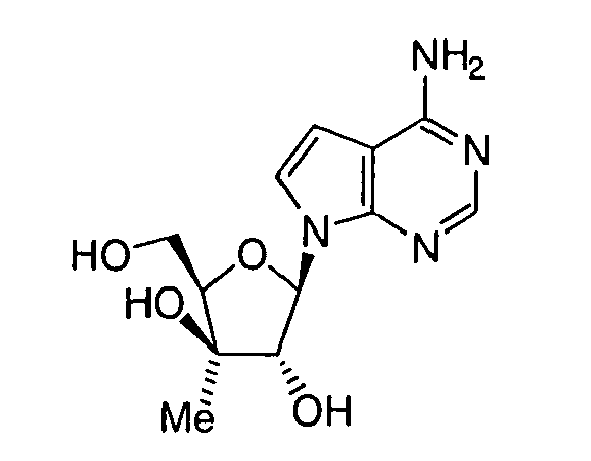
- To a solution of mixture of the compounds from Step A of Examples 26 and 27 (0.32 g, 0.65 mmol) in anhydrous pyridine (6 mL) was added monomethoxytrityl chloride (0.30 g, 0.98 mmol) and the reaction mixture was stirred at room temperature overnight. The mixture was then concentrated and the residue was partitioned between CH2Cl2 (70 mL) and water (20 mL). The organic layer was washed with water and brine, dried (Na2SO4) and concentrated. The residue was purified on silica gel column using 5-13% EtOAc in hexanes as the eluent. The appropriate fractions were collected and concentrated to furnish 2',5'-bis-O-(tert-butyldimethylsilyl)- and 3',5'-bis-O-(tert-butyldimethylsilyl) protected nucleosides as colorless foams (343 mg and 84 mg, respectively).
- To a well-stirred suspension of chromium trioxide (91 mg, 0.91 mmol) in CH2Cl2 (4 mL) at 0°C were added pyridine (147 µL, 1.82 mmol) and then acetic anhydride (86 µL, 0.91 mmol). The mixture was stirred at room temperature for 0.5 h. Then the 2',5'-bis-O-(tert-butyldimethylsilyl) protected nucleoside from step A (343 mg 0.45 mmol) in CH2Cl2 (2.5 mL) was added and the mixture stirred at room temperature 2 h. The mixture was then poured into ice-cold EtOAc (10 mL) and filtered through a short silica gel column using EtOAc as the eluent. The filtrate was evaporated and the residue purified on a silica gel column with hexanes and hexanes/EtOAc (7/1) as the eluent to give the title compound (180 mg).
- To a mixture of MeMgBr (3.0 M solution in ether; 0.17 mL, 0.5 mmol) in anhydrous hexanes (1.5 mL) at room temperature was added dropwise a solution of the compound from Step B (78 mg, 0.1 mmol) in anhydrous hexanes (0.5 mL). After 2 h stirring at room temperature, the reaction mixture was poured into ice-cold water (10 mL) and diluted with EtOAc (20 mL), then filtered through Celite which was then thoroughly washed with EtOAc. The layers were separated and the organic layer was washed with brine, dried (Na2SO4) and concentrated. The residue was purified on a silica gel column using 8 to 25% EtOAc in hexanes as eluent to give the 3-C-methyl xylo- (60 mg) and the 3-C-methyl ribo-isomer (20 mg).
- To an ice-cold solution of 3-C-methyl-xylo isomer from Step C (60 mg, 0.08 mmol) in THF (2 mL) was added TBAF (1 M in THF; 0.32 mL, 0.32 mmol). The reaction mixture was stirred at room temperature for 5 h, then diluted with CH2Cl2 (50 mL), washed with water (3 x 15 mL), dried,and evaporated. The residue was dissolved in dioxane (0.3 mL) and 80% acetic acid (3 mL) was added. The reaction mixture was stirred at room temperature for 1 d and then evaporated. The residue was co-evaporated with dioxane, taken up in water (50 mL) and washed with CH2Cl2 (2 x 10 mL). The aqueous layer was concentrated and then freeze-dried. The residue was purified on silica gel column with CH2Cl2/MeOH (20/1 and 10/1) as the eluent to give the title compound as a white fluffy compound after freeze drying (10 mg). 1H NMR (CD3CN): δ 1.28 (s, 3H, CH3), 3.56 (br s, 1H, OH), 3.78 (m, 3H, H-4', H-5', H-5"), 4.10 (br s, 1H, OH), 4.44 (d, 1H, J 2'1' = 3.9 Hz, H-2'), 5.58 (d, 1H, H-1'), 5.85 (br s, 2H, NH2), 6.15 (br s, 1H, OH), 6.48 (d, 1H, J 5,6 = 3.7 Hz, H-5), 7.23 (d, 1H, H-6), 8.11 (s, 1H, H-2). ES-MS: 281 [MH]+.
-

- The ribo-isomer (20 mg) from Step C of Example 32 was deprotected using the procedure described in Step D of Example 32 to yield the title compound (4 mg). 1H NMR (CD3CN): δ 1.43 (s, 3H, CH3), 3.28 (br s, 1H, OH), 3.58 (m, 2H, H-5', H-5"), 3.99 (m, 1H, H-4'), 4.10 (br s, 1H, OH), 4.62 (d, 1H, J 2'1' = 8.1 Hz, H-2'), 5.69 (d, 1H, H-1'), 5.88 (br s, 3H, OH, NH2), 6.45 (br s, 1H, OH), 6.51 (d, 1H, J 5,6 = 3.7 Hz, H-5), 7.19 (d, 1H, H-6), 8.12 (s, 1H, H-2). ES-MS: 281 [MH]+.
-

- A mixture of the product from Step B of Example 4 (24 mg) in aqueous ammonia (30%, 10 mL) was heated in a stainless steel autoclave at 100 °C overnight, then cooled and evaporated. The residue was purified on a silica gel column with CH2Cl2/MeOH (10/1 and 5/1) as the eluent to afford the title compound (15 mg). 1H NMR (DMSO-d 6 ): δ 0.68 (s, 3H, CH3), 3.48-3.58 (m 1H, H-5'), 3.68-3.73 (m, 2H, H-5", H-4'), 3.84 (m, 1H, H-3'), 4.72 (s, 1H, 2'-OH), 4.97-5.03 (m, 2H, 3'-OH, 5'-OH), 5.45 (br s, 2H, NH2), 6.00 (s, 1H, H-1'), 6.28 (d, 1H, J = 3.7 Hz, H-5), 6.44 (br s, 2H, NH2) 6.92 (d, 1H J = 3.7 Hz, H-6). ES MS: 294.1 (M-H+).
-

- To a solution of HF/pyridine (70%, 2 mL) diluted with pyridine (1 mL) at -30 °C is added the compound of Example 36 (60 mg, 0.2 mmol) in 0.5 mL pyridine followed by tert-butyl nitrite (36 µL, 0.3 mmol). Stirring is continued for 5 min -25 °C. Then the solution is poured into ice-water (5 mL), neutralized with 2 N aqueous NaOH, and evaporated to dryness. The residue is purified on a silica gel column with CH2Cl2/MeOH (20/1 and 10/1) as the eluent to afford the title compound.
-

- To a solution of the compound from step F of Example 2 (280 mg, 1.00 mmol) in pyridine is added acetic anhydride (613 mg, 6.0 mmol). The resulting solution is stirred overnight at ambient temperature evaporated in vacuo and the resulting crude mixture is purified on silica gel using ethyl acetate/hexane as the eluent. Fractions containing the desired product are pooled and evaporated in vacuo to give the desired product.
- To a pre-cooled (0°C) solution of the compound from Step A (460 mg, 1.00 mmol) in DMF is added N-bromosuccinimide (178 mg, 1.0 mmol) in DMF. The resulting solution is stirred at 0°C for 30 min then at room temperature for another 30 min. The reaction is quenched by addition of methanol and evaporated in vacuo. The resulting crude mixture is purified on silica gel using ethyl acetate/hexane as the eluent. Fractions containing the desired product are pooled and evaporated in vacuo to give the desired product.
- To a pre-cooled (-78°C) solution of the compound from Step B (529 mg, 1.00 mmol) in THF is added butyl lithium (2M in hexanes) (0.5 mL, 1.00 mmol). The resulting solution is stirred at - 78°C for 30 min and then quenched with N-fluorobenzensulfonimide (315 mg, 1.00 mmol) in THF. The resulting solution is very slowly allowed to come to ambient temperature and then poured into a stirred mixture of saturated aqueous ammonium chloride and dichloromethane. The organic phase is evaporated in vacuo and treated with ammonium hydroxide at 55°C in a closed container overnight. The resulting crude mixture is purified on silica gel using dichloromethane/methanol as the eluent. Fractions containing the desired product are pooled and evaporated in vacuo to give the desired product.
- The assays employed to measure the inhibition of HCV NS5B polymerase and HCV replication are described below.
- The effectiveness of the compounds of the present invention as inhibitors of HCV NS5B RNA-dependent RNA polymerase (RdRp) was measured in the following assay.
- This assay was used to measure the ability of the nucleoside derivatives of the present invention to inhibit the enzymatic activity of the RNA-dependent RNA polymerase (NS5B) of the hepatitis C virus (HCV) on a heteromeric RNA template.
- Assay Buffer Conditions: (50 µL -total/reaction)
- 20 mM Tris, pH 7.5
- 50 µM EDTA
- 5 mM DTT
- 2 mM MgCl2
- 80 mM KCl
- 0.4 U/µL RNAsin (Promega, stock is 40 units/µL)
- 0.75 µg t500 (a 500-nt RNA made using T7 runoff transcription with a sequence from the NS2/3 region of the hepatitis C genome)
- 1.6 µg purified hepatitis C NS5B (form with 21 amino acids C-terminally truncated)
- 1 µM A,C,U,GTP (Nucleoside triphosphate mix)
- [alpha-32P]-GTP or [alpha-33P]-GTP
- The compounds were tested at various concentrations up to 100 µM final concentration.
- An appropriate volume of reaction buffer was made including enzyme and template t500. Nucleoside derivatives of the present invention were pipetted into the wells of a 96-well plate. A mixture of nucleoside triphosphates (NTP's), including the radiolabeled GTP, was made and pipetted into the wells of a 96-well plate. The reaction was initiated by addition of the enzyme-template reaction solution and allowed to proceed at room temperature for 1-2 h.
- The reaction was quenched by addition of 20 µL 0.5M EDTA, pH 8.0. Blank reactions in which the quench solution was added to the NTPs prior to the addition of the reaction buffer were included.
- 50 µL of the quenched reaction were spotted onto DE81 filter disks (Whatman) and allowed to dry for 30 min. The filters were washed with 0.3 M ammonium formate, pH 8 (150 mL/wash until the cpm in 1 mL wash is less than 100, usually 6 washes). The filters were counted in 5-mL scintillation fluid in a scintillation counter.
- The percentage of inhibition was calculated according to the following equation: %Inhibition = [1-(cpm in test reaction - cpm in blank) / (cpm in control reaction - cpm in blank)] x 100.
- Representative compounds tested in the HCV NS5B polymerase assay exhibited IC50's less than 100 micromolar.
- The compounds of the present invention were also evaluated for their ability to affect the replication of Hepatitis C Virus RNA in cultured hepatoma (HuH-7) cells containing a subgenomic HCV Replicon. The details of the assay are described below. This Replicon assay is a modification of that described in V. Lohmann, F. Korner, J-O. Koch, U. Herian, L. Theilmann, and R. Bartenschlager, "Replication of a Sub-genomic Hepatitis C Virus RNAs in a Hepatoma Cell Line," Science 285:110 (1999).
- The assay was an in situ Ribonuclease protection, Scintillation Proximity based-plate assay (SPA). 10,000 - 40,000 cells were plated in 100-200 µL of media containing 0.8mg/mL G418 in 96-well cytostar plates (Amersham). Compounds were added to cells at various concentrations up to 100 µM in 1% DMSO at time 0 to 18 h and then cultured for 24-96 h. Cells were fixed (20 min, 10% formalin), permeabilized (20 min, 0.25% Triton X-100/PBS) and hybridized (overnight, 50°C) with a single-stranded 33P RNA probe complementary to the (+) strand NS5B (or other genes) contained in the RNA viral genome. Cells were washed, treated with RNAse, washed, heated to 65°C and counted in a Top-Count. Inhibition of replication was read as a decrease in counts per minute (cpm).
- Human HuH-7 hepatoma cells, which were selected to contain a subgenomic replicon, carry a cytoplasmic RNA consisting of an HCV 5' non-translated region (NTR), a neomycin selectable marker, an EMCV IRES (internal ribosome entry site), and HCV non-structural proteins NS3 through NS5B, followed by the 3' NTR.
- Representative compounds tested in the replication assay exhibited EC50's less than 100 micromolar.
- The nucleoside derivatives of the present invention were also evaluated for cellular toxicity and anti-viral specificity in the counterscreens described below.
- The ability of the nucleoside derivatives of the present invention to inhibit human DNA polymerases was measured in the following assays.
-
- 50 µL reaction volume
-
- 20 mM Tris-HCl, pH 7.5
- 200 µg/mL bovine serum albumin
- 100 mM KCl
- 2 mM β-mercaptoethanol
- 10 mM MgCl2
- 1.6 µM dA, dG, dC, dTTP
- α-33P-dATP
-
- 0.05 mg/mL gapped fish sperm DNA template
- 0.01 U/µL DNA polymerase α or β
-
- Add 5 µL 1M MgCl2 to 500 µL activated fish sperm DNA (USB 70076);
- Warm to 37°C and add 30 µL of 65 U/µL of exonuclease III (GibcoBRL 18013-011); Incubate 5 min at 37°C;
- Terminate reaction by heating to 65 °C for 10 min;
- Load 50-100 µL aliquots onto Bio-spin 6 chromatography columns (Bio-Rad 732-6002) equilibrated with 20 mM Tris-HCl, pH 7.5;
- Elute by centrifugation at 1,000Xg for 4 min;
- Pool eluate and measure absorbance at 260 nm to determine concentration.
- The DNA template was diluted into an appropriate volume of 20 mM Tris-HCl, pH 7.5 and the enzyme was diluted into an appropriate volume of 20 mM Tris-HCl, containing 2 mM β-mercaptoethanol, and 100 mM KCl. Template and enzyme were pipetted into microcentrifuge tubes or a 96 well plate. Blank reactions excluding enzyme and control reactions excluding test compound were also prepared using enzyme dilution buffer and test compound solvent, respectively. The reaction was initiated with reaction buffer with components as listed above. The reaction was incubated for 1 hour at 37°C. The reaction was quenched by the addition of 20 µL 0.5M EDTA. 50 µL of the quenched reaction was spotted onto Whatman DE81 filter disks and air dried. The filter disks were repeatedly washed with 150 mL 0.3M ammonium formate, pH 8 until 1 mL of wash is < 100 cpm. The disks were washed twice with 150 mL absolute ethanol and once with 150 mL anhydrous ether, dried and counted in 5 mL scintillation fluid.
- The percentage of inhibition was calculated according to the following equation: % inhibition = [1-(cpm in test reaction - cpm in blank)/(cpm in control reaction - cpm in blank)] x 100.
- The potential for inhibition of human DNA polymerase gamma was measured in reactions that included 0.5 ng/ µL enzyme; 10 µM dATP, dGTP, dCTP, and TTP; 2 µCi/reaction [α-33P]-dATP, and 0.4 µg/µL activated fish sperm DNA (purchased from US Biochemical) in a buffer containing 20 mM Tris pH8, 2 mM β-mercaptoethanol, 50 mM KCl, 10 mM MgCl2, and 0.1 µg/µL BSA. Reactions were allowed to proceed for 1 h at 37°C and were quenched by addition of 0.5 M EDTA to a final concentration of 142 mM. Product formation was quantified by anion exchange filter binding and scintillation counting. Compounds were tested at up to 50 µM.
- The percentage of inhibition was calculated according to the following equation: % inhibition = [1-(cpm in test reaction - cpm in blank)/(cpm in control reaction - cpm in blank)] x 100.
- The ability of the nucleoside derivatives of the present invention to inhibit HIV infectivity and HIV spread was measured in the following assays.
- Assays were performed with a variant of HeLa Magi cells expressing both CXCR4 and CCR5 selected for low background β-galactosidase (β-gal) expression. Cells were infected for 48 h, and β-gal production from the integrated HIV-1 LTR promoter was quantified with a chemiluminescent substrate (Galactolight Plus, Tropix, Bedford, MA). Inhibitors were titrated (in duplicate) in twofold serial dilutions starting at 100 µM; percent inhibition at each concentration was calculated in relation to the control infection.
- The ability of the compounds of the present invention to inhibit the spread of the human immunedeficiency virus (HIV) was measured by the method described in
U.S. Patent No. 5,413,999 (May 9, 1995 ), and J.P.Vacca, et al., Proc. Natl. Acad. Sci., 91: 4096-4100 (1994), which are incorporated by reference herein in their entirety. - The nucleoside derivatives of the present invention were also screened for cytotoxicity against cultured hepatoma (HuH-7) cells containing a subgenomic HCV Replicon in an MTS cell-based assay as described in the assay below. The HuH-7 cell line is described in H. Nakabayashi, et al., Cancer Res., 42: 3858 (1982).
- Cell cultures were prepared in appropriate media at concentrations of approximately 1.5 x 10⁵ cells/mL for suspension cultures in 3 day incubations and 5.0 x 10⁴ cells/mL for adherent cultures in 3 day incubations. 99 µL of cell culture was transferred to wells of a 96-well tissue culture treated plate, and 1 µL of 100-times final concentration of the test compound in DMSO was added. The plates were incubated at 37°C and 5% CO2 for a specified period of time. After the incubation period, 20 µL of CellTiter 96 Aqueous One Solution Cell Proliferation Assay reagent (MTS) (Promega) was added to each well and the plates were incubated at 37°C and 5% CO2 for an additional period of time up to 3 h. The plates were agitated to mix well and absorbance at 490 nm was read using a plate reader. A standard curve of suspension culture cells was prepared with known cell numbers just prior to the addition of MTS reagent. Metabolically active cells reduce MTS to formazan. Formazan absorbs at 490 nm. The absorbance at 490 nm in the presence of compound was compared to absorbance in cells without any compound added.
Reference: Cory, A. H. et al., "Use of an aqueous soluble tetrazolium/formazan assay for cell growth assays in culture," Cancer Commun. 3: 207 (1991). - The following assays were employed to measure the activity of the compounds of the present invention against other RNA-dependent RNA viruses:
- Assay conditions are described in the article by Sidwell and Huffman, "Use of disposable microtissue culture plates for antiviral and interferon induction studies," Appl. Microbiol. 22: 797-801 (1971).
- Rhinovirus type 2 (RV-2), strain HGP, was used with KB cells and media (0.1% NaHCO3, no antibiotics) as stated in the Sidwell and Huffman reference. The virus, obtained from the ATCC, was from a throat swab of an adult male with a mild acute febrile upper respiratory illness. Rhinovirus type 9 (RV-9), strain 211, and rhinovirus type 14 (RV-14), strain Tow, were also obtained from the American Type Culture Collection (ATCC) in Rockville, MD. RV-9 was from human throat washings and RV-14 was from a throat swab of a young adult with upper respiratory illness. Both of these viruses were used with HeLa Ohio-1 cells (Dr. Fred Hayden, Univ. of VA) which were human cervical epitheloid carcinoma cells. MEM (Eagle's minimum essential medium) with 5% Fetal Bovine serum (FBS) and 0.1% NaHCO3 was used as the growth medium. Antiviral test medium for all three virus types was MEM with 5% FBS, 0.1% NaHCO3, 50 µg gentamicin/mL, and 10 mM MgCl2.
- 2000 µg/mL was the highest concentration used to assay the compounds of the present invention. Virus was added to the assay plate approximately 5 min after the test compound. Proper controls were also run. Assay plates were incubated with humidified air and 5% CO2 at 37°C. Cytotoxicity was monitored in the control cells microscopically for morphologic changes. Regression analysis of the virus CPE data and the toxicity control data gave the ED50 (50% effective dose) and CC50 (50% cytotoxic concentration). The selectivity index (SI) was calculated by the formula: SI = CC50 ÷ ED50.
- Assay details are provided in the Sidwell and Huffman reference above.
- Dengue virus type 2, New Guinea strain, was obtained from the Center for Disease Control. Two lines of African green monkey kidney cells were used to culture the virus (Vero) and to perform antiviral testing (MA-104). Both Yellow fever virus, 17D strain, prepared from infected mouse brain, and Banzi virus, H 336 strain, isolated from the serum of a febrile boy in South Africa, were obtained from ATCC. Vero cells were used with both of these viruses and for assay.
- MA-104 cells (BioWhittaker, Inc., Walkersville, MD) and Vero cells (ATCC) were used in Medium 199 with 5% FBS and 0.1% NaHCO3 and without antibiotics.
- Assay medium for dengue, yellow fever, and Banzi viruses was MEM, 2% FBS, 0.18% NaHCO3 and 50 µg gentamicin/mL.
- Antiviral testing of the compounds of the present invention was performed according to the Sidwell and Huffman reference and similar to the above rhinovirus antiviral testing. Adequate cytopathic effect (CPE) readings were achieved after 5-6 days for each of these viruses.
- Assay details are provided in the Sidwell and Huffman reference cited above. West Nile virus, New York isolate derived from crow brain, was obtained from the Center for Disease Control. Vero cells were grown and used as described above. Test medium was MEM, 1% FBS, 0.1% NaHCO3 and 50 µg gentamicin/mL.
- Antiviral testing of the compounds of the present invention was performed following the methods of Sidwell and Huffman which are similar to those used to assay for rhinovirus activity. Adequate cytopathic effect (CPE) readings were achieved after 5-6 days.
- After performing the CPE inhibition assays above, an additional cytopathic detection method was used which is described in "Microtiter Assay for Interferon: Microspectrophotometric Quantitation of Cytopathic Effect," Appl. Environ. Microbiol. 31: 35-38 (1976). A Model EL309 microplate reader (Bio-Tek Instruments Inc.) was used to read the assay plate. ED50's and CD50's were calculated as above.
- As a specific embodiment of an oral composition of a compound of the present invention, 50 mg of the compound of Example 1 or Example 2 is formulated with sufficient finely divided lactose to provide a total amount of 580 to 590 mg to fill a size O hard gelatin capsule.
- While the invention has been described and illustrated in reference to specific embodiments thereof, those skilled in the art will appreciate that various changes, modifications, and substitutions can be made therein without departing from the spirit and scope of the invention. For example, effective dosages other than the preferred doses as set forth heeinabove may be applicable as a consequence of variations in the responsiveness of the human being treated for severity of the HCV infection. Likewise, the pharmacologic response observed may vary according to and depending upon the particular active compound selected or whether there are present pharmaceutical carriers, as well as the type of formulation and mode of administration employed, and such expected variations or differences in the results are contemplated in accordance with the objects and practices of the present invention. It is intended therefore that the invention be limited only by the scope of the claims which follow and that such claims be interpreted as broadly as is reasonable.
Claims (2)
- A combination of 4-amino-7-(2-C-methyl-β-D-ribofuranosyl)-7H-pyrrolo[2,3-d]pyrimidine or a pharmaceutically acceptable salt thereof and a therapeutically effective amount of an inhibitor of NS3 serine protease for simultaneous, separate or sequential administration.
- Use of the combination according to Claim 1 for the manufacture of a medicament for the treatment of HCV infection.
Applications Claiming Priority (5)
| Application Number | Priority Date | Filing Date | Title |
|---|---|---|---|
| US26331301P | 2001-01-22 | 2001-01-22 | |
| US28206901P | 2001-04-06 | 2001-04-06 | |
| US29932001P | 2001-06-19 | 2001-06-19 | |
| US34452801P | 2001-10-25 | 2001-10-25 | |
| EP02709299A EP1355916B1 (en) | 2001-01-22 | 2002-01-18 | Nucleoside derivatives as inhibitors of rna-dependent rna viral polymerase |
Related Parent Applications (2)
| Application Number | Title | Priority Date | Filing Date |
|---|---|---|---|
| EP02709299.8 Division | 2002-01-18 | ||
| EP02709299A Division EP1355916B1 (en) | 2001-01-22 | 2002-01-18 | Nucleoside derivatives as inhibitors of rna-dependent rna viral polymerase |
Publications (2)
| Publication Number | Publication Date |
|---|---|
| EP1707571A1 true EP1707571A1 (en) | 2006-10-04 |
| EP1707571B1 EP1707571B1 (en) | 2011-09-28 |
Family
ID=27500770
Family Applications (5)
| Application Number | Title | Priority Date | Filing Date |
|---|---|---|---|
| EP02709299A Expired - Lifetime EP1355916B1 (en) | 2001-01-22 | 2002-01-18 | Nucleoside derivatives as inhibitors of rna-dependent rna viral polymerase |
| EP11151449A Withdrawn EP2360166A1 (en) | 2001-01-22 | 2002-01-18 | Nucleoside derivatives as inhibitors of RNA-dependent RNA viral polymerase |
| EP06076021A Expired - Lifetime EP1707571B1 (en) | 2001-01-22 | 2002-01-18 | Nucleoside derivatives as inhibitors of RNA-dependent RNA viral polymerase |
| EP11178613.3A Revoked EP2399588B1 (en) | 2001-01-22 | 2002-01-18 | Nucleoside derivatives as inhibitors of rna-dependent rna viral polymerase |
| EP02709095.0A Expired - Lifetime EP1539188B1 (en) | 2001-01-22 | 2002-01-18 | Nucleoside derivatives as inhibitors of rna-dependent rna viral polymerase |
Family Applications Before (2)
| Application Number | Title | Priority Date | Filing Date |
|---|---|---|---|
| EP02709299A Expired - Lifetime EP1355916B1 (en) | 2001-01-22 | 2002-01-18 | Nucleoside derivatives as inhibitors of rna-dependent rna viral polymerase |
| EP11151449A Withdrawn EP2360166A1 (en) | 2001-01-22 | 2002-01-18 | Nucleoside derivatives as inhibitors of RNA-dependent RNA viral polymerase |
Family Applications After (2)
| Application Number | Title | Priority Date | Filing Date |
|---|---|---|---|
| EP11178613.3A Revoked EP2399588B1 (en) | 2001-01-22 | 2002-01-18 | Nucleoside derivatives as inhibitors of rna-dependent rna viral polymerase |
| EP02709095.0A Expired - Lifetime EP1539188B1 (en) | 2001-01-22 | 2002-01-18 | Nucleoside derivatives as inhibitors of rna-dependent rna viral polymerase |
Country Status (37)
| Country | Link |
|---|---|
| US (7) | US6777395B2 (en) |
| EP (5) | EP1355916B1 (en) |
| JP (3) | JP2004532184A (en) |
| KR (1) | KR100828453B1 (en) |
| CN (1) | CN1267446C (en) |
| AT (1) | ATE526339T1 (en) |
| AU (2) | AU2002243600B2 (en) |
| BG (1) | BG66207B1 (en) |
| BR (1) | BR0206614A (en) |
| CA (2) | CA2434386C (en) |
| CY (1) | CY1109012T1 (en) |
| CZ (1) | CZ20032005A3 (en) |
| DE (1) | DE60217465T2 (en) |
| DK (1) | DK1355916T3 (en) |
| DZ (1) | DZ3487A1 (en) |
| EA (1) | EA007491B1 (en) |
| EE (1) | EE05709B1 (en) |
| EG (1) | EG24465A (en) |
| ES (2) | ES2532836T3 (en) |
| GE (1) | GEP20053601B (en) |
| HR (1) | HRP20030565B1 (en) |
| HU (1) | HUP0400726A3 (en) |
| IL (1) | IL156641A0 (en) |
| IS (1) | IS2449B (en) |
| JO (1) | JO2318B1 (en) |
| MX (1) | MXPA03006514A (en) |
| MY (1) | MY134070A (en) |
| NO (1) | NO326431B1 (en) |
| NZ (1) | NZ526703A (en) |
| PE (1) | PE20020823A1 (en) |
| PL (1) | PL207405B1 (en) |
| PT (1) | PT1355916E (en) |
| RS (1) | RS50236B (en) |
| SI (1) | SI1355916T1 (en) |
| SK (1) | SK286630B6 (en) |
| TW (1) | TWI261056B (en) |
| WO (2) | WO2002057287A2 (en) |
Cited By (1)
| Publication number | Priority date | Publication date | Assignee | Title |
|---|---|---|---|---|
| EP2308514A2 (en) | 2007-03-23 | 2011-04-13 | to-BBB Holding B.V. | Conjugates for targeted drug delivery across the blood-brain barrier |
Families Citing this family (483)
| Publication number | Priority date | Publication date | Assignee | Title |
|---|---|---|---|---|
| CZ298749B6 (en) | 1996-10-18 | 2008-01-16 | Vertex Pharmaceuticals Incorporated | Inhibitors of serine proteases and pharmaceutical compositions in which the inhibitors are comprised |
| EP1964569A3 (en) | 2000-04-13 | 2009-07-22 | Pharmasset, Inc. | 3'-or 2'-hydroxymethyl substituted nucleoside derivatives for treatment of viral infections |
| PY0111577A (en) | 2000-05-23 | 2017-01-02 | Idenix Cayman Ltd | METHODS AND COMPOSITIONS FOR THE TREATMENT OF HEPATITIS C VIRUS |
| AP2006003708A0 (en) | 2000-05-26 | 2006-08-31 | Idenix Cayman Ltd | Methods and compositions for treating flavivirusesand pestiviruses |
| SV2003000617A (en) | 2000-08-31 | 2003-01-13 | Lilly Co Eli | INHIBITORS OF PROTEASA PEPTIDOMIMETICA REF. X-14912M |
| US8481712B2 (en) * | 2001-01-22 | 2013-07-09 | Merck Sharp & Dohme Corp. | Nucleoside derivatives as inhibitors of RNA-dependent RNA viral polymerase |
| SI1355916T1 (en) * | 2001-01-22 | 2007-04-30 | Merck & Co Inc | Nucleoside derivatives as inhibitors of rna-dependent rna viral polymerase |
| EP2050822B1 (en) | 2001-01-23 | 2013-07-31 | Istituto Di Ricerche Di Biologia Molecolare P. Angeletti S.P.A. | Hepatitis C virus replicons and replicon enhanced cells |
| US6905669B2 (en) | 2001-04-24 | 2005-06-14 | Supergen, Inc. | Compositions and methods for reestablishing gene transcription through inhibition of DNA methylation and histone deacetylase |
| GB0114286D0 (en) | 2001-06-12 | 2001-08-01 | Hoffmann La Roche | Nucleoside Derivatives |
| EP2335700A1 (en) | 2001-07-25 | 2011-06-22 | Boehringer Ingelheim (Canada) Ltd. | Hepatitis C virus polymerase inhibitors with a heterobicylic structure |
| AU2002330154A1 (en) | 2001-09-28 | 2003-04-07 | Centre National De La Recherche Scientifique | Methods and compositions for treating hepatitis c virus using 4'-modified nucleosides |
| AU2002353164A1 (en) * | 2001-12-17 | 2003-06-30 | Ribapharm Inc. | Unusual nucleoside libraries, compounds, and preferred uses as antiviral and anticancer agents |
| EP1572705A2 (en) * | 2002-01-17 | 2005-09-14 | Ribapharm, Inc. | Sugar modified nucleosides as viral replication inhibitors |
| WO2003062256A1 (en) * | 2002-01-17 | 2003-07-31 | Ribapharm Inc. | 2'-beta-modified-6-substituted adenosine analogs and their use as antiviral agents |
| WO2003068244A1 (en) * | 2002-02-13 | 2003-08-21 | Merck & Co., Inc. | Methods of inhibiting orthopoxvirus replication with nucleoside compounds |
| WO2003085375A2 (en) * | 2002-04-04 | 2003-10-16 | Achillion Pharmaceuticals, Inc. | Hcv antiviral and cytotoxicity drug screening assay |
| KR20050005442A (en) * | 2002-04-12 | 2005-01-13 | 아칠리온 파르마세우티칼스 인코포레이티드 | METHOD FOR SYNTHESIZING β-L-FLUORO-2',3'-DIDEHYDROCYTIDINE(β-L-FD4C) |
| AU2003231765B9 (en) | 2002-04-26 | 2010-01-28 | Gilead Sciences, Inc. | Cellular accumulation of phosphonate analogs of HIV protease inhibitor compounds and the compounds as such |
| US7247621B2 (en) | 2002-04-30 | 2007-07-24 | Valeant Research & Development | Antiviral phosphonate compounds and methods therefor |
| KR20050006221A (en) * | 2002-05-06 | 2005-01-15 | 제네랩스 테크놀로지스, 인코포레이티드 | Nucleoside derivatives for treating hepatitis c virus infection |
| US6982253B2 (en) | 2002-06-05 | 2006-01-03 | Supergen, Inc. | Liquid formulation of decitabine and use of the same |
| JP2005530843A (en) * | 2002-06-21 | 2005-10-13 | メルク エンド カムパニー インコーポレーテッド | Nucleoside derivatives as RNA-dependent RNA viral polymerase inhibitors |
| AU2003269892A1 (en) * | 2002-06-27 | 2004-01-19 | Isis Pharmaceuticals, Inc. | Nucleoside derivatives as inhibitors of rna-dependent rna viral polymerase |
| US7608600B2 (en) | 2002-06-28 | 2009-10-27 | Idenix Pharmaceuticals, Inc. | Modified 2′ and 3′-nucleoside prodrugs for treating Flaviviridae infections |
| CN101172993A (en) | 2002-06-28 | 2008-05-07 | 埃迪尼克斯(开曼)有限公司 | 2'-c-methyl-3'-o-l-valine ester ribofuranosyl cytidine for treatment of flaviviridae infections |
| PT1523489E (en) * | 2002-06-28 | 2014-06-24 | Centre Nat Rech Scient | MODIFIED 2 'AND 3' NUCLEOUS PROPERTIES FOR THE TREATMENT OF FLAVIRIDAE INFECTIONS |
| CN1678326A (en) | 2002-06-28 | 2005-10-05 | 埃迪尼克斯(开曼)有限公司 | 2'-C-methyl-3'-O-L-valine ester ribofuranocytidine for the treatment of flavivirus infection |
| GB0215293D0 (en) | 2002-07-03 | 2002-08-14 | Rega Foundation | Viral inhibitors |
| AU2003269902A1 (en) * | 2002-07-16 | 2004-02-02 | Isis Pharmaceuticals, Inc. | Nucleoside derivatives as inhibitors of rna-dependent rna viral polymerase |
| US7323449B2 (en) | 2002-07-24 | 2008-01-29 | Merck & Co., Inc. | Thionucleoside derivatives as inhibitors of RNA-dependent RNA viral polymerase |
| EP1527082A2 (en) * | 2002-07-25 | 2005-05-04 | Micrologix Biotech, Inc. | Anti-viral 7-deaza d-nucleosides and uses thereof |
| EP1532248B1 (en) * | 2002-07-26 | 2009-04-01 | Novartis Vaccines and Diagnostics, Inc. | Modified small interfering rna molecules and methods of use |
| US20040067877A1 (en) | 2002-08-01 | 2004-04-08 | Schinazi Raymond F. | 2', 3'-Dideoxynucleoside analogues for the treatment or prevention of Flaviviridae infections |
| JP2006507235A (en) * | 2002-08-01 | 2006-03-02 | フアーマセツト・インコーポレイテツド | Compounds having bicyclo [4.2.1] nonane system for the treatment of Flaviviridae virus infection |
| DE10238722A1 (en) | 2002-08-23 | 2004-03-11 | Bayer Ag | Improving attention, concentration, cognition, learning and/or memory performance, using selective phosphodiesterase 9A inhibitors, preferably 4H-pyrazolo-(3,4-d)-pyrimidin-4-one derivatives |
| US7094768B2 (en) | 2002-09-30 | 2006-08-22 | Genelabs Technologies, Inc. | Nucleoside derivatives for treating hepatitis C virus infection |
| US7425547B2 (en) * | 2002-09-30 | 2008-09-16 | Genelabs Technologies, Inc. | Nucleoside derivatives for treating hepatitis C virus infection |
| US20050075279A1 (en) | 2002-10-25 | 2005-04-07 | Boehringer Ingelheim International Gmbh | Macrocyclic peptides active against the hepatitis C virus |
| EP1556398B1 (en) * | 2002-10-31 | 2009-09-09 | Metabasis Therapeutics, Inc. | Novel cytarabine monophosphate prodrugs |
| RU2005118421A (en) | 2002-11-15 | 2006-01-20 | Айденикс (Кайман) Лимитед (Ky) | 2'-BRANCHED NUCLEOSIDES AND MUTATION FLAVIVIRIDAE |
| TWI332507B (en) * | 2002-11-19 | 2010-11-01 | Hoffmann La Roche | Antiviral nucleoside derivatives |
| US7034167B2 (en) | 2002-12-06 | 2006-04-25 | Merck & Co., Inc. | Process to ribofuranose sugar derivatives as intermediates to branched-chain nucleosides |
| TWI294882B (en) * | 2002-12-09 | 2008-03-21 | Hoffmann La Roche | Anhydrous crystalline azido cytosine hemisulfate derivative |
| PL377287A1 (en) | 2002-12-12 | 2006-01-23 | Idenix (Cayman) Limited | Process for the production of 2'-branched nucleosides |
| RU2005123395A (en) * | 2002-12-23 | 2006-01-27 | Айденикс (Кайман) Лимитед (Ky) | METHOD FOR PRODUCING 3-NUCLEOSIDE PROCEDURES |
| US20040225077A1 (en) | 2002-12-30 | 2004-11-11 | Angiotech International Ag | Drug delivery from rapid gelling polymer composition |
| US7223785B2 (en) | 2003-01-22 | 2007-05-29 | Boehringer Ingelheim International Gmbh | Viral polymerase inhibitors |
| AR043006A1 (en) * | 2003-02-12 | 2005-07-13 | Merck & Co Inc | PROCESS TO PREPARE RAMIFIED RIBONUCLEOSIDS |
| WO2004084796A2 (en) * | 2003-03-28 | 2004-10-07 | Pharmasset Ltd. | Compounds for the treatment of flaviviridae infections |
| GB0307891D0 (en) * | 2003-04-04 | 2003-05-14 | Angeletti P Ist Richerche Bio | Chemical compounds,compositions and uses |
| WO2004096287A2 (en) | 2003-04-25 | 2004-11-11 | Gilead Sciences, Inc. | Inosine monophosphate dehydrogenase inhibitory phosphonate compounds |
| JP2006524710A (en) | 2003-04-25 | 2006-11-02 | ギリアード サイエンシーズ, インコーポレイテッド | Kinase inhibitor phosphonate conjugates |
| US7300924B2 (en) | 2003-04-25 | 2007-11-27 | Gilead Sciences, Inc. | Anti-infective phosphonate analogs |
| US7432261B2 (en) | 2003-04-25 | 2008-10-07 | Gilead Sciences, Inc. | Anti-inflammatory phosphonate compounds |
| US7470724B2 (en) | 2003-04-25 | 2008-12-30 | Gilead Sciences, Inc. | Phosphonate compounds having immuno-modulatory activity |
| PL1628685T3 (en) | 2003-04-25 | 2011-05-31 | Gilead Sciences Inc | Antiviral phosphonate analogs |
| US7452901B2 (en) | 2003-04-25 | 2008-11-18 | Gilead Sciences, Inc. | Anti-cancer phosphonate analogs |
| WO2005002626A2 (en) | 2003-04-25 | 2005-01-13 | Gilead Sciences, Inc. | Therapeutic phosphonate compounds |
| US7407965B2 (en) | 2003-04-25 | 2008-08-05 | Gilead Sciences, Inc. | Phosphonate analogs for treating metabolic diseases |
| US20040259934A1 (en) * | 2003-05-01 | 2004-12-23 | Olsen David B. | Inhibiting Coronaviridae viral replication and treating Coronaviridae viral infection with nucleoside compounds |
| BRPI0419345B8 (en) * | 2003-05-30 | 2021-05-25 | Gilead Pharmasset Llc | use of (2'r)-2'-deoxy-2'-fluor-2'-c-methyl nucleoside and a pharmaceutical composition comprising it |
| ZA200509590B (en) | 2003-06-04 | 2007-04-25 | Genelabs Tech Inc | Nitrogen-containing heteroaryl derivatives for the treatment of HCV-infection |
| US7429596B2 (en) * | 2003-06-20 | 2008-09-30 | The Regents Of The University Of California | 1H-pyrrolo [2,3-D] pyrimidine derivatives and methods of use thereof |
| US7572581B2 (en) | 2003-06-30 | 2009-08-11 | Roche Molecular Systems, Inc. | 2′-terminator nucleotide-related methods and systems |
| RU2361875C2 (en) * | 2003-06-30 | 2009-07-20 | Айденикс (Кайман) Лимитед | SYNTHESIS OF β-L-2'-DESOXYNUCLEOSIDES |
| US7947817B2 (en) | 2003-06-30 | 2011-05-24 | Roche Molecular Systems, Inc. | Synthesis and compositions of 2'-terminator nucleotides |
| DK1658302T3 (en) | 2003-07-25 | 2010-11-22 | Idenix Pharmaceuticals Inc | Purine nucleoside analogues for the treatment of diseases caused by Flavirividae, including hepatitis C |
| CA2534649A1 (en) | 2003-08-01 | 2005-02-10 | Genelabs Technologies, Inc. | Bicyclic imidazol derivatives against flaviviridae |
| WO2005018330A1 (en) * | 2003-08-18 | 2005-03-03 | Pharmasset, Inc. | Dosing regimen for flaviviridae therapy |
| KR20060123707A (en) | 2003-08-27 | 2006-12-04 | 바이오타, 인코포레이티드 | New Tricyclic Nucleosides or Nucleotides as Therapeutic Agents |
| PE20050374A1 (en) | 2003-09-05 | 2005-05-30 | Vertex Pharma | SERINE PROTEASE INHIBITORS, IN PARTICULAR HCV PROTEASE NS3-NS4A |
| RS20060197A (en) | 2003-09-22 | 2008-09-29 | Boehringer Ingelheim International Gmbh., | Macrocyclic peptides active against the hepatitis c virus |
| TW201245229A (en) | 2003-10-14 | 2012-11-16 | Hoffmann La Roche | Macrocyclic carboxylic acids and acylsulfonamides as inhibitors of HCV replication |
| US7144868B2 (en) * | 2003-10-27 | 2006-12-05 | Genelabs Technologies, Inc. | Nucleoside compounds for treating viral infections |
| WO2005044308A1 (en) | 2003-10-24 | 2005-05-19 | Gilead Sciences, Inc. | Phosphonate analogs of antimetabolites |
| AU2004286239A1 (en) | 2003-10-24 | 2005-05-12 | Gilead Sciences, Inc. | Methods and compositions for identifying therapeutic compounds |
| US7427624B2 (en) | 2003-10-24 | 2008-09-23 | Gilead Sciences, Inc. | Purine nucleoside phosphorylase inhibitory phosphonate compounds |
| WO2005044835A1 (en) * | 2003-10-27 | 2005-05-19 | Genelabs Technologies, Inc. | METHODS FOR PREPARING 7-(2'-SUBSTITUTED-ß-D-RIBOFURANOSYL)-4-(NR2R3)-5-(SUBSTITUTED ETHYN-1-YL)-PYRROLO[2,3-D]PYRIMIDINE DERIVATIVES |
| US7202223B2 (en) | 2003-10-27 | 2007-04-10 | Genelabs Technologies, Inc. | Nucleoside compounds for treating viral infections |
| EP1687321A1 (en) | 2003-10-27 | 2006-08-09 | Genelabs Technologies, Inc. | Nucleoside compounds for treating viral infections |
| EP1680436A1 (en) | 2003-10-27 | 2006-07-19 | Genelabs Technologies, Inc. | Nucleoside compounds for treating viral infections |
| DE602004019815D1 (en) | 2003-12-22 | 2009-04-16 | Gilead Sciences Inc | 4'-SUBSTITUTED CARBOVIR AND ABACAVIR DERIVATIVES AND RELATED COMPOUNDS WITH HIV AND HCV ANTIVIRAL EFFECT |
| WO2005067454A2 (en) * | 2003-12-23 | 2005-07-28 | Valeant Pharmaceuticals North America | Combination therapy for treating hepatitis c virus infection |
| WO2005062949A2 (en) * | 2003-12-23 | 2005-07-14 | Intermune, Inc. | Method for treating hepatitis virus infection |
| GB0500020D0 (en) | 2005-01-04 | 2005-02-09 | Novartis Ag | Organic compounds |
| ATE495185T1 (en) | 2004-01-21 | 2011-01-15 | Boehringer Ingelheim Int | MACROCYCLIC PEPTIDES ACTIVE AGAINST HEPATITIS C VIRUS |
| US20050182252A1 (en) * | 2004-02-13 | 2005-08-18 | Reddy K. R. | Novel 2'-C-methyl nucleoside derivatives |
| UY28758A1 (en) | 2004-02-20 | 2005-09-30 | Boehringer Ingelheim Int | VIRAL POLYMERASE INHIBITORS |
| US7754718B2 (en) | 2004-05-05 | 2010-07-13 | Yale University | Antiviral helioxanthin analogs |
| US7534767B2 (en) | 2004-06-15 | 2009-05-19 | Merck & Co., Inc. | C-purine nucleoside analogs as inhibitors of RNA-dependent RNA viral polymerase |
| WO2006000922A2 (en) * | 2004-06-23 | 2006-01-05 | Idenix (Cayman) Limited | 5-aza-7-deazapurine derivatives for treating infections with flaviviridae |
| CA2571079A1 (en) * | 2004-06-24 | 2006-02-02 | Merck & Co., Inc. | Nucleoside aryl phosphoramidates for the treatment of rna-dependent rna viral infection |
| US7745125B2 (en) | 2004-06-28 | 2010-06-29 | Roche Molecular Systems, Inc. | 2′-terminator related pyrophosphorolysis activated polymerization |
| JP4283738B2 (en) * | 2004-07-08 | 2009-06-24 | 浜松ホトニクス株式会社 | Semiconductor laser device |
| PT1773856E (en) * | 2004-07-21 | 2012-05-14 | Gilead Pharmasset Llc | Preparation of alkyl-substituted 2-deoxy-2-fluoro-d-ribofuranosyl pyrimidines and purines and their derivatives |
| CN101023094B (en) * | 2004-07-21 | 2011-05-18 | 法莫赛特股份有限公司 | Preparation of alkyl-substituted 2-deoxy-2-fluoro-d-ribofuranosyl pyrimidines and purines and their derivatives |
| EP1778251B1 (en) | 2004-07-27 | 2011-04-13 | Gilead Sciences, Inc. | Nucleoside phosphonate conjugates as anti hiv agents |
| US7597884B2 (en) | 2004-08-09 | 2009-10-06 | Alios Biopharma, Inc. | Hyperglycosylated polypeptide variants and methods of use |
| JP2006077004A (en) * | 2004-08-11 | 2006-03-23 | Chugai Pharmaceut Co Ltd | Compound having anti-HCV action and pharmaceutical composition containing the same |
| DE602005015466D1 (en) * | 2004-08-23 | 2009-08-27 | Hoffmann La Roche | ANTIVIRAL 4'-AZIDONUCLEOSIDE |
| MX2007003085A (en) | 2004-09-14 | 2007-08-02 | Pharmasset Inc | Preparation of 2' ifluoro-2'- alkyl- substituted or other optionally substituted ribofuranosyl pyrimidines and purines and their derivatives. |
| CA2583472A1 (en) * | 2004-10-01 | 2006-04-13 | Chao Lin | Hcv ns3-ns4a protease inhibition |
| AU2005317081A1 (en) * | 2004-10-21 | 2006-06-22 | Merck & Co., Inc. | Fluorinated pyrrolo[2,3-d]pyrimidine nucleosides for the treatment of RNA-dependent RNA viral infection |
| MY141025A (en) | 2004-10-29 | 2010-02-25 | Vertex Pharma | Dose forms |
| US8133870B2 (en) | 2004-10-29 | 2012-03-13 | Biocryst Pharmaceuticals, Inc. | Therapeutic furopyrimidines and thienopyrimidines |
| EP1831225A2 (en) | 2004-11-19 | 2007-09-12 | The Regents of the University of California | Anti-inflammatory pyrazolopyrimidines |
| WO2006121468A1 (en) * | 2004-11-22 | 2006-11-16 | Genelabs Technologies, Inc. | 5-nitro-nucleoside compounds for treating viral infections |
| BRPI0607770A2 (en) | 2005-02-28 | 2009-06-13 | Genelabs Tech Inc | tricyclic nucleoside compounds for treatment of viral infections |
| US7524831B2 (en) * | 2005-03-02 | 2009-04-28 | Schering Corporation | Treatments for Flaviviridae virus infection |
| EP1858889A1 (en) | 2005-03-08 | 2007-11-28 | Biota Scientific Management Pty. Ltd. | Bicyclic nucleosides and nucleotides as therapeutic agents |
| WO2007144686A1 (en) * | 2005-03-09 | 2007-12-21 | Idenix (Cayman) Limited | Nucleosides with non-natural bases as anti-viral agents |
| US7250416B2 (en) | 2005-03-11 | 2007-07-31 | Supergen, Inc. | Azacytosine analogs and derivatives |
| JP4516863B2 (en) * | 2005-03-11 | 2010-08-04 | 株式会社ケンウッド | Speech synthesis apparatus, speech synthesis method and program |
| US8114847B2 (en) | 2005-03-16 | 2012-02-14 | Case Western Reserve University | Selective inhibitors of translesion DNA replication |
| WO2008147454A1 (en) * | 2006-11-16 | 2008-12-04 | Case Western Reserve University | Selective inhibitors of translesion dna replication |
| WO2006102594A1 (en) * | 2005-03-23 | 2006-09-28 | Genelabs Technologies, Inc. | Nucleoside prodrugs for treating viral infections |
| WO2007084157A2 (en) * | 2005-03-23 | 2007-07-26 | Genelabs Technologies, Inc. | Nucleoside prodrugs for treating viral infections |
| EP2537520A1 (en) | 2005-03-29 | 2012-12-26 | Biocryst Pharmaceuticals, Inc. | Hepatics C therapies |
| US20090156545A1 (en) * | 2005-04-01 | 2009-06-18 | Hostetler Karl Y | Substituted Phosphate Esters of Nucleoside Phosphonates |
| TW200720285A (en) * | 2005-04-25 | 2007-06-01 | Genelabs Tech Inc | Nucleoside compounds for treating viral infections |
| WO2006119061A2 (en) | 2005-05-02 | 2006-11-09 | Merck & Co., Inc. | Hcv ns3 protease inhibitors |
| WO2006122207A1 (en) * | 2005-05-10 | 2006-11-16 | Valeant Research & Development | 6-hydrazinopurine 2'-methyl ribonucleosides and nucleotides for treatment of hcv |
| CN101218224B (en) | 2005-05-13 | 2013-05-08 | Viro化学制药公司 | Compositions and methods for treating or preventing flavivirus infection |
| CN100478349C (en) * | 2005-06-20 | 2009-04-15 | 河南省凯特化学实业总公司 | Nucleoside fluoride compound, its production and use |
| TWI387603B (en) | 2005-07-20 | 2013-03-01 | Merck Sharp & Dohme | Hcv ns3 protease inhibitors |
| KR20080036598A (en) * | 2005-08-01 | 2008-04-28 | 머크 앤드 캄파니 인코포레이티드 | Macrocyclic Peptides as HCV NS3 Protease Inhibitors |
| CA2617679A1 (en) * | 2005-08-02 | 2007-02-08 | Steve Lyons | Inhibitors of serine proteases |
| AR055395A1 (en) | 2005-08-26 | 2007-08-22 | Vertex Pharma | INHIBITING COMPOUNDS OF THE ACTIVITY OF SERINA PROTEASA NS3-NS4A OF HEPATITIS C VIRUS |
| US7964624B1 (en) | 2005-08-26 | 2011-06-21 | Vertex Pharmaceuticals Incorporated | Inhibitors of serine proteases |
| US7700567B2 (en) | 2005-09-29 | 2010-04-20 | Supergen, Inc. | Oligonucleotide analogues incorporating 5-aza-cytosine therein |
| AU2006324098C1 (en) | 2005-12-09 | 2011-12-08 | F. Hoffmann-La Roche Ag | Antiviral nucleosides |
| JP5254033B2 (en) | 2005-12-23 | 2013-08-07 | イデニク プハルマセウティカルス,インコーポレイテッド | Process for the production of synthetic intermediates for the preparation of branched nucleosides |
| US20070274951A1 (en) * | 2006-02-09 | 2007-11-29 | Xiao Tong | Combinations comprising HCV protease inhibitor(s) and HCV polymerase inhibitor(s), and methods of treatment related thereto |
| CA2643688A1 (en) | 2006-02-27 | 2007-08-30 | Vertex Pharmaceuticals Incorporated | Co-crystals and pharmaceutical compositions comprising the same |
| WO2007109080A2 (en) | 2006-03-16 | 2007-09-27 | Vertex Pharmaceuticals Incorporated | Deuterated hepatitis c protease inhibitors |
| EA200870409A1 (en) | 2006-04-04 | 2009-04-28 | Дзе Риджентс Оф Дзе Юниверсити Оф Калифорния | ANTAGONISTS OF KINASE PI3 |
| CA2647276A1 (en) * | 2006-04-04 | 2007-10-11 | F. Hoffmann-La Roche Ag | 3',5'-di-o-acylated nucleosides for hcv treatment |
| CA2643680A1 (en) | 2006-04-11 | 2007-11-22 | Novartis Ag | Hcv/hiv inhibitors and their uses |
| GB0609492D0 (en) * | 2006-05-15 | 2006-06-21 | Angeletti P Ist Richerche Bio | Therapeutic agents |
| GB0612423D0 (en) | 2006-06-23 | 2006-08-02 | Angeletti P Ist Richerche Bio | Therapeutic agents |
| WO2008005542A2 (en) * | 2006-07-07 | 2008-01-10 | Gilead Sciences, Inc., | Antiviral phosphinate compounds |
| US7655419B2 (en) * | 2006-08-25 | 2010-02-02 | The Board Of Trustees Of The Leland Stanford Junior University | Methods and compositions for identifying anti-HCV agents |
| MX2009003452A (en) | 2006-10-10 | 2009-04-14 | Medivir Ab | Hcv nucleoside inhibitor. |
| PL2084174T3 (en) | 2006-10-10 | 2013-12-31 | Gilead Pharmasset Llc | Preparation of nucleosides ribofuranosyl pyrimidines |
| AU2007309488B2 (en) * | 2006-10-24 | 2012-10-11 | Merck Sharp & Dohme Corp. | HCV NS3 protease inhibitors |
| AU2007309546A1 (en) | 2006-10-24 | 2008-05-02 | Istituto Di Ricerche Di Biologia Molecolare P. Angeletti S.P.A. | HCV NS3 protease inhibitors |
| EP2079479B1 (en) | 2006-10-24 | 2014-11-26 | Merck Sharp & Dohme Corp. | Hcv ns3 protease inhibitors |
| CN101568346B (en) | 2006-10-27 | 2015-11-25 | 默沙东公司 | HCV NS3 protease inhibitor |
| CA2667031C (en) * | 2006-10-27 | 2013-01-22 | Merck & Co., Inc. | Hcv ns3 protease inhibitors |
| AU2007316681B2 (en) | 2006-11-09 | 2013-01-24 | F. Hoffmann-La Roche Ag | Thiazole and oxazole-substituted arylamides |
| PT2104674E (en) | 2006-11-15 | 2013-07-26 | Virochem Pharma Inc | Thiophene analogues for the treatment or prevention of flavivirus infections |
| GB0623493D0 (en) | 2006-11-24 | 2007-01-03 | Univ Cardiff | Chemical compounds |
| GB0625349D0 (en) | 2006-12-20 | 2007-01-31 | Angeletti P Ist Richerche Bio | Therapeutic compounds |
| CA2672250C (en) | 2006-12-20 | 2013-04-30 | Ian Stansfield | Antiviral indoles |
| GB0625345D0 (en) * | 2006-12-20 | 2007-01-31 | Angeletti P Ist Richerche Bio | Therapeutic compounds |
| US7951789B2 (en) | 2006-12-28 | 2011-05-31 | Idenix Pharmaceuticals, Inc. | Compounds and pharmaceutical compositions for the treatment of viral infections |
| US8071568B2 (en) | 2007-01-05 | 2011-12-06 | Merck Sharp & Dohme Corp. | Nucleoside aryl phosphoramidates for the treatment of RNA-dependent RNA viral infection |
| TW200838550A (en) * | 2007-02-09 | 2008-10-01 | Novartis Ag | Organic compounds |
| GEP20125645B (en) | 2007-02-27 | 2012-09-25 | Vertex Pharma | Co-crystals and pharmaceutical compositions comprising the same |
| WO2008106058A2 (en) | 2007-02-27 | 2008-09-04 | Vertex Pharmaceuticals Incorporated | Inhibitors of serine proteases |
| BRPI0808089A2 (en) * | 2007-02-28 | 2014-07-15 | Conatus Pharmaceuticals Inc | METHOD TO TREAT LIVER DISEASE, TO REDUCE A HIGH LEVEL OF A LIVER ENZYME, TO INHIBIT A TNF-ALPHA SIGNALING RULE, TO REDUCE A LIVER DAMAGE TO APPLY EXCESSIVE IN A LIVER CELL, AND TO INHIBIT HEPATITE C VIRUS REPLICATION. |
| WO2008106167A1 (en) * | 2007-02-28 | 2008-09-04 | Conatus Pharmaceuticals, Inc. | Combination therapy comprising matrix metalloproteinase inhibitors and caspase inhibitors for the treatment of liver diseases |
| US7964580B2 (en) * | 2007-03-30 | 2011-06-21 | Pharmasset, Inc. | Nucleoside phosphoramidate prodrugs |
| AU2008251555B2 (en) * | 2007-05-10 | 2012-08-30 | Biocryst Pharmaceuticals, Inc. | Tetrahydrofuro [3 4-D] dioxolane compounds for use in the treatment of viral infections and cancer |
| GB0709791D0 (en) * | 2007-05-22 | 2007-06-27 | Angeletti P Ist Richerche Bio | Antiviral agents |
| WO2009005615A1 (en) * | 2007-06-27 | 2009-01-08 | The Board Of Trustees Of The Leland Stanford Junior University | Methods and compositions for identifying agents that inhibit an ns4b-mediated neoplastic cellular phenotype of hcv infected cells |
| CN100532388C (en) * | 2007-07-16 | 2009-08-26 | 郑州大学 | 2 '-fluoro-4' -substituted-nucleoside analogue, preparation method and application thereof |
| JP2010533699A (en) | 2007-07-17 | 2010-10-28 | イステイチユート・デイ・リチエルケ・デイ・ビオロジア・モレコラーレ・ピ・アンジエレツテイ・エツセ・ピー・アー | Macrocyclic indole derivatives for the treatment of hepatitis C infection |
| AU2008277377B2 (en) | 2007-07-19 | 2013-08-01 | Msd Italia S.R.L. | Macrocyclic compounds as antiviral agents |
| WO2009032198A1 (en) | 2007-08-30 | 2009-03-12 | Vertex Pharmaceuticals Incorporated | Co-crystals and pharmaceutical compositions comprising the same |
| GB0718575D0 (en) | 2007-09-24 | 2007-10-31 | Angeletti P Ist Richerche Bio | Nucleoside derivatives as inhibitors of viral polymerases |
| GB2467670B (en) * | 2007-10-04 | 2012-08-01 | Intellikine Inc | Chemical entities and therapeutic uses thereof |
| US20090318380A1 (en) | 2007-11-20 | 2009-12-24 | Pharmasset, Inc. | 2',4'-substituted nucleosides as antiviral agents |
| JP5498392B2 (en) | 2007-11-30 | 2014-05-21 | ベーリンガー インゲルハイム インターナショナル ゲゼルシャフト ミット ベシュレンクテル ハフツング | 1,5-Dihydro-pyrazolo [3,4-D] pyrimidin-4-one derivatives and their use as PDE9A modulators for the treatment of CNS disorders |
| WO2009077365A1 (en) | 2007-12-17 | 2009-06-25 | F. Hoffmann-La Roche Ag | Novel imidazole-substituted arylamides |
| AU2008337660B2 (en) | 2007-12-17 | 2014-02-06 | F. Hoffmann-La Roche Ag | Triazole-substituted arylamide derivatives and their use as P2X3 and /or P2X2/3 purinergic receptor antagonists |
| WO2009077367A1 (en) | 2007-12-17 | 2009-06-25 | F. Hoffmann-La Roche Ag | Novel pyrazole-substituted arylamides |
| JP5456691B2 (en) | 2007-12-17 | 2014-04-02 | エフ.ホフマン−ラ ロシュ アーゲー | Tetrazole-substituted arylamide derivatives and their use as P2X3 and / or P2X2 / 3 purinergic receptor antagonists |
| US8193182B2 (en) | 2008-01-04 | 2012-06-05 | Intellikine, Inc. | Substituted isoquinolin-1(2H)-ones, and methods of use thereof |
| CA2711558C (en) | 2008-01-04 | 2016-12-13 | Intellikine, Inc. | Phosphatidyl inositol-3 kinase inhibiting compounds |
| JP5547099B2 (en) | 2008-03-14 | 2014-07-09 | インテリカイン, エルエルシー | Kinase inhibitors and methods of use |
| US8993580B2 (en) | 2008-03-14 | 2015-03-31 | Intellikine Llc | Benzothiazole kinase inhibitors and methods of use |
| US8227431B2 (en) * | 2008-03-17 | 2012-07-24 | Hetero Drugs Limited | Nucleoside derivatives |
| TW200946541A (en) | 2008-03-27 | 2009-11-16 | Idenix Pharmaceuticals Inc | Solid forms of an anti-HIV phosphoindole compound |
| UA105362C2 (en) | 2008-04-02 | 2014-05-12 | Бьорингер Ингельхайм Интернациональ Гмбх | 1-heterocyclyl-1, 5-dihydro-pyrazolo [3, 4-d] pyrimidin-4-one derivatives and their use as pde9a modulators |
| WO2009129120A2 (en) | 2008-04-15 | 2009-10-22 | Rfs Pharma, Llc | Nucleoside derivatives for treatment of caliciviridae infections, including norovirus infections |
| HRP20130048T1 (en) * | 2008-04-23 | 2013-02-28 | Gilead Sciences, Inc. | CARBA-NUCLEOSIDE ANALYSIS FOR ANTI-VIRUS THERAPY |
| AU2013216595B2 (en) * | 2008-04-23 | 2016-07-28 | Gilead Sciences, Inc. | 1' -substituted carba-nucleoside analogs for antiviral treatment |
| EP2271345B1 (en) | 2008-04-28 | 2015-05-20 | Merck Sharp & Dohme Corp. | Hcv ns3 protease inhibitors |
| US9090671B2 (en) | 2008-06-06 | 2015-07-28 | Scynexis, Inc. | Macrocyclic peptides |
| US8173621B2 (en) | 2008-06-11 | 2012-05-08 | Gilead Pharmasset Llc | Nucleoside cyclicphosphates |
| WO2009150156A1 (en) * | 2008-06-13 | 2009-12-17 | Riboxx Gmbh | Method for enzymatic synthesis of chemically modified rna |
| WO2010014134A1 (en) * | 2008-07-02 | 2010-02-04 | Idenix Pharamaceuticals, Inc. | Compounds and pharmaceutical compositions for the treatment of viral infections |
| EP2313102A2 (en) | 2008-07-03 | 2011-04-27 | Biota Scientific Management | Bycyclic nucleosides and nucleotides as therapeutic agents |
| AU2009268611B2 (en) | 2008-07-08 | 2015-04-09 | Intellikine, Llc | Kinase inhibitors and methods of use |
| WO2010006072A2 (en) | 2008-07-08 | 2010-01-14 | The Regents Of The University Of California | Mtor modulators and uses thereof |
| AU2009268681B2 (en) | 2008-07-08 | 2014-10-02 | Gilead Sciences, Inc. | Salts of HIV inhibitor compounds |
| ME02024B (en) * | 2008-07-22 | 2015-05-20 | Merck Sharp & Dohme | Macrocyclic quinoxaline compounds as hcv ns3 protease inhibitors |
| JP5146785B2 (en) * | 2008-07-24 | 2013-02-20 | 国立大学法人九州大学 | Enzyme substrate modified nucleoside triphosphate derivatives |
| JP4621926B2 (en) | 2008-07-24 | 2011-02-02 | 国立大学法人九州大学 | Enzyme substrate-modified nucleoside triphosphate, nucleic acid probe, multilabeled nucleic acid probe, method for producing multilabeled nucleic acid probe, and method for detecting target nucleic acid |
| WO2010015637A1 (en) * | 2008-08-06 | 2010-02-11 | Novartis Ag | New antiviral modified nucleosides |
| WO2010018131A1 (en) | 2008-08-11 | 2010-02-18 | Smithkline Beecham Corporation | Purine derivatives for use in the treatment of allergic, inflammatory and infectious diseases |
| WO2010018134A1 (en) | 2008-08-11 | 2010-02-18 | Smithkline Beecham Corporation | Novel adenine derivatives |
| UA103195C2 (en) | 2008-08-11 | 2013-09-25 | Глаксосмитклайн Ллк | PURCHASE DERIVATIVES FOR THE APPLICATION IN THE TREATMENT OF ALLERGIES, INFLAMMATORY AND INFECTIOUS DISEASES |
| CN102143965A (en) | 2008-09-08 | 2011-08-03 | 贝林格尔.英格海姆国际有限公司 | Pyrazolopyrimidines and their use for the treatment of CNS disorders |
| JP5731978B2 (en) | 2008-09-26 | 2015-06-10 | インテリカイン, エルエルシー | Heterocyclic kinase inhibitor |
| WO2010039801A2 (en) | 2008-10-02 | 2010-04-08 | The J. David Gladstone Institutes | Methods of treating hepatitis c virus infection |
| CA2740885C (en) | 2008-10-16 | 2018-04-03 | The Regents Of The University Of California | Fused ring heteroaryl kinase inhibitors |
| US8476282B2 (en) | 2008-11-03 | 2013-07-02 | Intellikine Llc | Benzoxazole kinase inhibitors and methods of use |
| SG171914A1 (en) | 2008-12-02 | 2011-07-28 | Chiralgen Ltd | Method for the synthesis of phosphorus atom modified nucleic acids |
| TW201026715A (en) | 2008-12-23 | 2010-07-16 | Pharmasset Inc | Nucleoside phosphoramidates |
| JP6104504B2 (en) | 2008-12-23 | 2017-03-29 | ギリアド ファーマセット エルエルシー | Nucleoside analogues |
| CL2009002206A1 (en) | 2008-12-23 | 2011-08-26 | Gilead Pharmasset Llc | Compounds derived from pyrrolo - (2-3-d] -pyrimidin-7 (6h) -tetrahydrofuran-2-yl phosphonamidate, pharmaceutical composition; and its use in the treatment of viral diseases. |
| WO2010082050A1 (en) | 2009-01-16 | 2010-07-22 | Istituto Di Ricerche Di Biologia Molecolare P. Angeletti S.P.A. | Macrocyclic and 7-aminoalkyl-substituted benzoxazocines for treatment of hepatitis c infections |
| GB0900914D0 (en) | 2009-01-20 | 2009-03-04 | Angeletti P Ist Richerche Bio | Antiviral agents |
| ES2513415T3 (en) * | 2009-01-21 | 2014-10-27 | F. Hoffmann-La Roche Ag | Pharmaceutical compositions comprising an HCV polymerase inhibitor prodrug |
| CA2751277C (en) | 2009-02-10 | 2018-10-30 | Gilead Sciences, Inc. | Carba-nucleoside analogs for antiviral treatment |
| EP2396028A2 (en) | 2009-02-12 | 2011-12-21 | Vertex Pharmceuticals Incorporated | Hcv combination therapies comprising pegylated interferon, ribavirin and telaprevir |
| JP5690286B2 (en) | 2009-03-04 | 2015-03-25 | イデニク プハルマセウティカルス,インコーポレイテッド | Phosphothiophene and phosphothiazole HCV polymerase inhibitors |
| US8975247B2 (en) | 2009-03-18 | 2015-03-10 | The Board Of Trustees Of The Leland Stanford Junion University | Methods and compositions of treating a flaviviridae family viral infection |
| AU2010226466A1 (en) * | 2009-03-20 | 2011-10-20 | Alios Biopharma, Inc. | Substituted nucleoside and nucleotide analogs |
| PT2414363E (en) | 2009-03-31 | 2014-02-26 | Boehringer Ingelheim Int | 1-heterocyclyl-1,5-dihydro-pyrazolo[3,4-d]pyrimidin-4-one derivatives and their use as pde9a modulators |
| US8512690B2 (en) | 2009-04-10 | 2013-08-20 | Novartis Ag | Derivatised proline containing peptide compounds as protease inhibitors |
| US20110182850A1 (en) | 2009-04-10 | 2011-07-28 | Trixi Brandl | Organic compounds and their uses |
| PT2421879E (en) * | 2009-04-22 | 2013-12-09 | Acad Of Science Czech Republic | Novel 7-deazapurine nucleosides for therapeutic uses |
| EP2427195B1 (en) | 2009-05-07 | 2019-05-01 | Intellikine, LLC | Heterocyclic compounds and uses thereof |
| JO3027B1 (en) * | 2009-05-14 | 2016-09-05 | Janssen Products Lp | Uracyl Spirooxetane Nucleosides |
| TWI583692B (en) | 2009-05-20 | 2017-05-21 | 基利法瑪席特有限責任公司 | Nucleoside phosphoramidates |
| TW201107342A (en) * | 2009-05-20 | 2011-03-01 | Chimerix Inc | Compounds, compositions and methods for treating viral infection |
| US8618076B2 (en) | 2009-05-20 | 2013-12-31 | Gilead Pharmasset Llc | Nucleoside phosphoramidates |
| WO2010149541A1 (en) | 2009-06-22 | 2010-12-29 | F. Hoffmann-La Roche Ag | Novel oxazolone and pyrrolidinone-substituted arylamides |
| US8476457B2 (en) | 2009-06-22 | 2013-07-02 | Roche Palo Alto Llc | Indole, indazole and benzimidazole arylamides as P2X3 and P2X2/3 antagonists |
| SG177308A1 (en) | 2009-06-22 | 2012-02-28 | Hoffmann La Roche | Novel biphenyl and phenyl-pyridine amides |
| EP2451461A4 (en) | 2009-07-06 | 2013-05-29 | Ontorii Inc | NOVEL NUCLEIC ACID PRECURSORS AND THEIR METHODS OF USE |
| WO2011014487A1 (en) | 2009-07-30 | 2011-02-03 | Merck Sharp & Dohme Corp. | Hepatitis c virus ns3 protease inhibitors |
| US9284307B2 (en) | 2009-08-05 | 2016-03-15 | Idenix Pharmaceuticals Llc | Macrocyclic serine protease inhibitors |
| AR077859A1 (en) | 2009-08-12 | 2011-09-28 | Boehringer Ingelheim Int | COMPOUNDS FOR THE TREATMENT OF CNS DISORDERS |
| US8796394B2 (en) * | 2009-08-27 | 2014-08-05 | Northwestern University | Antifouling hydrogels, coatings, and methods of synthesis and use thereof |
| US7973013B2 (en) | 2009-09-21 | 2011-07-05 | Gilead Sciences, Inc. | 2'-fluoro substituted carba-nucleoside analogs for antiviral treatment |
| WO2011035250A1 (en) | 2009-09-21 | 2011-03-24 | Gilead Sciences, Inc. | Processes and intermediates for the preparation of 1'-substituted carba-nucleoside analogs |
| AU2010295373B2 (en) * | 2009-09-21 | 2016-09-29 | Gilead Sciences, Inc. | 2' -fluoro substituted carba-nucleoside analogs for antiviral treatment |
| US8455451B2 (en) | 2009-09-21 | 2013-06-04 | Gilead Sciences, Inc. | 2'-fluoro substituted carba-nucleoside analogs for antiviral treatment |
| WO2011047384A2 (en) | 2009-10-16 | 2011-04-21 | The Regents Of The University Of California | Methods of inhibiting ire1 |
| CA2778949C (en) | 2009-10-30 | 2018-02-27 | Janssen Pharmaceutica Nv | Imidazo[1,2-b]pyridazine derivatives and their use as pde10 inhibitors |
| BR112012011221A2 (en) | 2009-11-14 | 2016-04-05 | Hoffmann La Roche | biomarkers to predict rapid response to hcv treatment |
| WO2011060408A2 (en) * | 2009-11-16 | 2011-05-19 | University Of Georgia Research Foundation, Inc. | 2'-fluoro-6'-methylene carbocyclic nucleosides and methods of treating viral infections |
| US20110117055A1 (en) | 2009-11-19 | 2011-05-19 | Macdonald James E | Methods of Treating Hepatitis C Virus with Oxoacetamide Compounds |
| JP2013512247A (en) | 2009-11-25 | 2013-04-11 | バーテックス ファーマシューティカルズ インコーポレイテッド | 5-Alkynyl-thiophene-2-carboxylic acid derivatives and their use for the treatment or prevention of flavivirus infections |
| CN102656459A (en) | 2009-12-02 | 2012-09-05 | 弗·哈夫曼-拉罗切有限公司 | Biomarkers for predicting sustained response to HCV treatment |
| SG181797A1 (en) | 2009-12-18 | 2012-07-30 | Idenix Pharmaceuticals Inc | 5,5-fused arylene or heteroarylene hepatitis c virus inhibitors |
| US20130072523A1 (en) | 2009-12-24 | 2013-03-21 | Vertex Pharmaceuticals Incorporated | Analogues for the treatment or prevention of flavivirus infections |
| JP5704481B2 (en) * | 2010-01-22 | 2015-04-22 | 国立大学法人九州大学 | Nucleic acid detection kit |
| KR101384389B1 (en) * | 2010-01-28 | 2014-04-10 | 에프. 호프만-라 로슈 아게 | 4'-azido-nucleosides as anti-hcv compunds |
| CN102844030A (en) | 2010-01-29 | 2012-12-26 | 沃泰克斯药物股份有限公司 | Therapies for treating hepatitis c virus infection |
| ES2525826T3 (en) | 2010-02-10 | 2014-12-30 | Glaxosmithkline Llc | 6-Amino-2 - {[(1s) -1-methylbutyl] -oxy} -9- [5- (1-piperidinyl) pentyl] -7,9-dihydro-8H-purin-8-one maleate |
| WO2011098451A1 (en) | 2010-02-10 | 2011-08-18 | Glaxosmithkline Llc | Purine derivatives and their pharmaceutical uses |
| AR080754A1 (en) | 2010-03-09 | 2012-05-09 | Janssen Pharmaceutica Nv | IMIDAZO DERIVATIVES (1,2-A) PIRAZINA AND ITS USE AS PDE10 INHIBITORS |
| WO2011119870A1 (en) | 2010-03-24 | 2011-09-29 | Vertex Pharmaceuticals Incorporated | Analogues for the treatment or prevention of flavivirus infections |
| MX2012010918A (en) | 2010-03-24 | 2013-01-18 | Vertex Pharma | Analogues for the treatment or prevention of flavivirus infections. |
| TW201141857A (en) | 2010-03-24 | 2011-12-01 | Vertex Pharma | Analogues for the treatment or prevention of flavivirus infections |
| TW201139438A (en) | 2010-03-24 | 2011-11-16 | Vertex Pharma | Analogues for the treatment or prevention of flavivirus infections |
| PL3290428T3 (en) | 2010-03-31 | 2022-02-07 | Gilead Pharmasset Llc | Tablet comprising crystalline (s)-isopropyl 2-(((s)-(((2r,3r,4r,5r)-5-(2,4-dioxo-3,4-dihydropyrimidin-1 (2h)-yl)-4-fluoro-3-hydroxy-4-methyltetrahydrofuran-2-yl)methoxy)(phenoxy)phosphoryl)amino)propanoate |
| CL2011000716A1 (en) | 2010-03-31 | 2012-04-20 | Gilead Pharmasset Llc | Crystalline forms 1 6 of (s) -isopropyl-2 - (((s) - (((2r.3r.4r.5r) -5- (2,4-dioxo-3,4-dihydropyrimidin-1 (2h) -yl) -4-fluoro-3-hydroxy-4-methyl tetrahydrofuran-2-yl) methoxy) (phenoxy) phosphoryl) amino) propanoate; pharmaceutical composition and combination; and its use to treat a hepatitis c virus infection. |
| UY33312A (en) | 2010-03-31 | 2011-10-31 | Pharmasset Inc | PURINE NUCLEOSIDE PHOSPHORAMIDATE |
| TWI515000B (en) | 2010-04-01 | 2016-01-01 | 伊迪尼克製藥公司 | Compounds and pharmaceutical compositions for the treatment of viral infections |
| AU2011255218B2 (en) | 2010-05-21 | 2015-03-12 | Infinity Pharmaceuticals, Inc. | Chemical compounds, compositions and methods for kinase modulation |
| TW201201815A (en) * | 2010-05-28 | 2012-01-16 | Gilead Sciences Inc | 1'-substituted-carba-nucleoside prodrugs for antiviral treatment |
| WO2011156545A1 (en) | 2010-06-09 | 2011-12-15 | Vertex Pharmaceuticals Incorporated | Viral dynamic model for hcv combination therapy |
| WO2011159826A2 (en) | 2010-06-15 | 2011-12-22 | Vertex Pharmaceuticals Incorporated | Hcv ns5b protease mutants |
| EP2585447A2 (en) | 2010-06-28 | 2013-05-01 | Vertex Pharmaceuticals Incorporated | Compounds and methods for the treatment or prevention of flavivirus infections |
| JP2013531011A (en) | 2010-06-28 | 2013-08-01 | バーテックス ファーマシューティカルズ インコーポレイテッド | Compounds and methods for the treatment or prevention of flavivirus infections |
| WO2012006070A1 (en) | 2010-06-28 | 2012-01-12 | Vertex Pharmaceuticals Incorporated | Compounds and methods for the treatment or prevention of flavivirus infections |
| EP2593105A1 (en) | 2010-07-14 | 2013-05-22 | Vertex Pharmaceuticals Incorporated | Palatable pharmaceutical composition comprising vx-950 |
| EA025311B1 (en) | 2010-07-19 | 2016-12-30 | Гайлид Сайэнсиз, Инк. | Methods for the preparation of diasteromerically pure phosphoramidate prodrugs |
| ES2524356T3 (en) | 2010-07-22 | 2014-12-05 | Gilead Sciences, Inc. | Methods and compounds to treat infections caused by Paramyxoviridae virus |
| UA110347C2 (en) | 2010-08-12 | 2015-12-25 | Бьорінгер Інгельхайм Інтернаціональ Гмбх | DERIVATIVES OF 6-CYCLOALKYL-1,5-DIHYDROPYRAZOLE $ 3,4-d] PYRIMIDIN-4-ONE AND THEIR USE AS PDE9A INHIBITORS |
| MX2013001869A (en) | 2010-08-17 | 2013-06-28 | Vertex Pharma | Compounds and methods for the treatment or prevention of flaviviridae viral infections. |
| PE20131165A1 (en) * | 2010-09-20 | 2013-10-14 | Gilead Sciences Inc | 2'-FLUORINE SUBSTITUTED CARBA-NUCLEOSID ANALOGS FOR ANTIVIRAL TREATMENT |
| EP2619215B1 (en) | 2010-09-22 | 2018-09-05 | Alios Biopharma, Inc. | Azido nucleosides and nucleotide analogs |
| GEP20156313B (en) | 2010-09-22 | 2015-07-10 | Alios Biopharma Inc | Substituted nucleotide analogs |
| DK2620428T3 (en) | 2010-09-24 | 2019-07-01 | Wave Life Sciences Ltd | Asymmetric help group |
| EP2624826B1 (en) | 2010-10-08 | 2018-07-18 | Novartis AG | Vitamin e formulations of sulfamide ns3 inhibitors |
| JP2013545749A (en) | 2010-11-10 | 2013-12-26 | インフィニティー ファーマシューティカルズ, インコーポレイテッド | Heterocyclic compounds and uses thereof |
| WO2012075140A1 (en) * | 2010-11-30 | 2012-06-07 | Pharmasset, Inc. | Compounds |
| WO2012080050A1 (en) | 2010-12-14 | 2012-06-21 | F. Hoffmann-La Roche Ag | Solid forms of a phenoxybenzenesulfonyl compound |
| EP2655392B1 (en) | 2010-12-22 | 2018-04-18 | Alios Biopharma, Inc. | Cyclic nucleotide analogs |
| AU2012205669B2 (en) | 2011-01-10 | 2015-08-20 | Infinity Pharmaceuticals Inc. | Processes for preparing isoquinolinones and solid forms of isoquinolinones |
| US9353100B2 (en) | 2011-02-10 | 2016-05-31 | Idenix Pharmaceuticals Llc | Macrocyclic serine protease inhibitors, pharmaceutical compositions thereof, and their use for treating HCV infections |
| WO2012109646A1 (en) | 2011-02-11 | 2012-08-16 | Vertex Pharmaceuticals Incorporated | Treatment of hcv in hiv infection patients |
| US20130040971A1 (en) | 2011-02-14 | 2013-02-14 | Boehringer Ingelheim International Gmbh | 6-cycloalkyl-pyrazolopyrimidinones for the treatment of cns disorders |
| US8809345B2 (en) | 2011-02-15 | 2014-08-19 | Boehringer Ingelheim International Gmbh | 6-cycloalkyl-pyrazolopyrimidinones for the treatment of CNS disorders |
| JP6130305B2 (en) | 2011-02-23 | 2017-05-17 | インテリカイン, エルエルシー | Combinations of kinase inhibitors and their use |
| US20120252721A1 (en) | 2011-03-31 | 2012-10-04 | Idenix Pharmaceuticals, Inc. | Methods for treating drug-resistant hepatitis c virus infection with a 5,5-fused arylene or heteroarylene hepatitis c virus inhibitor |
| CN103842369A (en) | 2011-03-31 | 2014-06-04 | 埃迪尼克斯医药公司 | Compounds and pharmaceutical compositions for the treatment of viral infections |
| ES2744587T3 (en) | 2011-04-13 | 2020-02-25 | Gilead Sciences Inc | 1-Substituted pyrimidine N-nucleoside analogs for antiviral treatment |
| EP2696681B1 (en) | 2011-04-13 | 2018-10-03 | Merck Sharp & Dohme Corp. | 2'-substituted nucleoside derivatives and methods of use thereof for the treatment of viral diseases |
| JP2014511875A (en) | 2011-04-13 | 2014-05-19 | メルク・シャープ・アンド・ドーム・コーポレーション | 2'-cyano-substituted nucleoside derivatives and methods of use thereof for the treatment of viral diseases |
| US9156872B2 (en) | 2011-04-13 | 2015-10-13 | Merck Sharp & Dohme Corp. | 2′-azido substituted nucleoside derivatives and methods of use thereof for the treatment of viral diseases |
| BR112013033375B1 (en) | 2011-06-27 | 2022-05-10 | Janssen Pharmaceutica N.V | Derivatives of 1-aryl-4-methyl-[1,2,4]triazolo[4,3-a]quinoxaline, their use, pharmaceutical composition that comprises them, process of preparation thereof, sterile solution and intermediate compound |
| US9416154B2 (en) | 2011-07-13 | 2016-08-16 | Merck Sharp & Dohme Corp. | 5′-substituted nucleoside derivatives and methods of use thereof for the treatment of viral diseases |
| WO2013009737A1 (en) | 2011-07-13 | 2013-01-17 | Merck Sharp & Dohme Corp. | 5'-substituted nucleoside analogs and methods of use thereof for the treatment of viral diseases |
| US9605019B2 (en) | 2011-07-19 | 2017-03-28 | Wave Life Sciences Ltd. | Methods for the synthesis of functionalized nucleic acids |
| US9056877B2 (en) | 2011-07-19 | 2015-06-16 | Infinity Pharmaceuticals, Inc. | Heterocyclic compounds and uses thereof |
| JP6027610B2 (en) | 2011-07-19 | 2016-11-16 | インフィニティー ファーマシューティカルズ, インコーポレイテッド | Heterocyclic compounds and uses thereof |
| AU2012286853A1 (en) | 2011-07-26 | 2013-05-02 | Vertex Pharmaceuticals Incorporated | Thiophene compounds |
| WO2013016499A1 (en) | 2011-07-26 | 2013-01-31 | Vertex Pharmaceuticals Incorporated | Methods for preparation of thiophene compounds |
| EP2751093A1 (en) | 2011-08-29 | 2014-07-09 | Infinity Pharmaceuticals, Inc. | Heterocyclic compounds and uses thereof |
| PH12018501678B1 (en) | 2011-08-30 | 2022-08-10 | Astex Pharmaceuticals Inc | Decitabine derivative formulations |
| WO2013033705A2 (en) | 2011-09-01 | 2013-03-07 | Case Western Reserve University | Non-natural nucleosides as theranostic agents |
| MX370814B (en) | 2011-09-02 | 2020-01-08 | Univ California | Substituted pyrazolo[3,4-d]pyrimidines and uses thereof. |
| AR088441A1 (en) | 2011-09-12 | 2014-06-11 | Idenix Pharmaceuticals Inc | SUBSTITUTED CARBONYLOXYMETHYLPHOSPHORAMIDATE COMPOUNDS AND PHARMACEUTICAL COMPOSITIONS FOR THE TREATMENT OF VIRAL INFECTIONS |
| WO2013039855A1 (en) | 2011-09-12 | 2013-03-21 | Idenix Pharmaceuticals, Inc. | Compounds and pharmaceutical compositions for the treatment of viral infections |
| SI2709613T2 (en) | 2011-09-16 | 2020-12-31 | Gilead Pharmasset LLC c/o Gilead Sciences, Inc. | Methods for treating hcv |
| TW201331221A (en) | 2011-10-14 | 2013-08-01 | Idenix Pharmaceuticals Inc | Substituted 3',5'-cyclic phosphates of purine nucleotide compounds and pharmaceutical compositions for the treatment of viral infections |
| US8466159B2 (en) | 2011-10-21 | 2013-06-18 | Abbvie Inc. | Methods for treating HCV |
| US8492386B2 (en) | 2011-10-21 | 2013-07-23 | Abbvie Inc. | Methods for treating HCV |
| CA2811203C (en) | 2011-10-21 | 2015-05-05 | Abbvie Inc. | Methods for treating hcv |
| CN104023726A (en) | 2011-10-21 | 2014-09-03 | 艾伯维公司 | Combination therapy with one or more DAAs used to treat HCV (eg, with ABT-072 or ABT-333) |
| US20140286903A1 (en) * | 2011-11-10 | 2014-09-25 | Inhibitex, Inc. | Substituted Purine Nucleosides, Phosphoramidate and Phosphordiamidate Derivatives for Treatment if Viral Infections |
| WO2013074386A2 (en) | 2011-11-15 | 2013-05-23 | Merck Sharp & Dohme Corp. | Hcv ns3 protease inhibitors |
| US8889159B2 (en) | 2011-11-29 | 2014-11-18 | Gilead Pharmasset Llc | Compositions and methods for treating hepatitis C virus |
| CA3131037A1 (en) | 2011-11-30 | 2013-06-06 | Emory University | Antiviral jak inhibitors useful in treating or preventing retroviral and other viral infections |
| WO2013084165A1 (en) * | 2011-12-05 | 2013-06-13 | Medivir Ab | Hcv polymerase inhibitors |
| AU2012347785B2 (en) | 2011-12-06 | 2017-03-16 | The Board Of Trustees Of The Leland Stanford Junior University | Methods and compositions for treating viral diseases |
| US8980865B2 (en) | 2011-12-22 | 2015-03-17 | Alios Biopharma, Inc. | Substituted nucleotide analogs |
| SG10201610936RA (en) | 2011-12-22 | 2017-02-27 | Alios Biopharma Inc | Substituted nucleosides, nucleotides and analogs thereof |
| US20140356325A1 (en) | 2012-01-12 | 2014-12-04 | Ligand Pharmaceuticals Incorporated | Novel 2'-c-methyl nucleoside derivative compounds |
| US20130195797A1 (en) | 2012-01-31 | 2013-08-01 | Vertex Pharmaceuticals Incorporated | High potency formulations of vx-950 |
| WO2013133927A1 (en) | 2012-02-13 | 2013-09-12 | Idenix Pharmaceuticals, Inc. | Pharmaceutical compositions of 2'-c-methyl-guanosine, 5'-[2-[(3-hydroxy-2,2-dimethyl-1-oxopropyl)thio]ethyl n-(phenylmethyl)phosphoramidate] |
| AU2013221571A1 (en) | 2012-02-14 | 2014-08-28 | University Of Georgia Research Foundation, Inc. | Spiro [2.4] heptanes for treatment of Flaviviridae infections |
| KR102068856B1 (en) * | 2012-03-13 | 2020-01-21 | 길리애드 사이언시즈, 인코포레이티드 | 2'- substituted carba-nucleoside analogs for antiviral treatment |
| RS58437B1 (en) | 2012-03-21 | 2019-04-30 | Alios Biopharma Inc | Substituted nucleosides, nucleotides and analogs thereof |
| US9441007B2 (en) | 2012-03-21 | 2016-09-13 | Alios Biopharma, Inc. | Substituted nucleosides, nucleotides and analogs thereof |
| US8916538B2 (en) | 2012-03-21 | 2014-12-23 | Vertex Pharmaceuticals Incorporated | Solid forms of a thiophosphoramidate nucleotide prodrug |
| USRE48171E1 (en) | 2012-03-21 | 2020-08-25 | Janssen Biopharma, Inc. | Substituted nucleosides, nucleotides and analogs thereof |
| EP2827876A4 (en) | 2012-03-22 | 2015-10-28 | Alios Biopharma Inc | Pharmaceutical combinations comprising a thionucleotide analog |
| US8940742B2 (en) | 2012-04-10 | 2015-01-27 | Infinity Pharmaceuticals, Inc. | Heterocyclic compounds and uses thereof |
| EP2852604B1 (en) | 2012-05-22 | 2017-04-12 | Idenix Pharmaceuticals LLC | 3',5'-cyclic phosphoramidate prodrugs for hcv infection |
| US9296778B2 (en) | 2012-05-22 | 2016-03-29 | Idenix Pharmaceuticals, Inc. | 3′,5′-cyclic phosphate prodrugs for HCV infection |
| AP3913A (en) | 2012-05-22 | 2016-11-26 | Idenix Pharamaceuticals Inc | D-amino acid compounds for liver disease |
| HUE029038T2 (en) | 2012-05-25 | 2017-01-30 | Janssen Sciences Ireland Uc | Uracyl spirooxetane nucleosides |
| US9206412B2 (en) * | 2012-05-31 | 2015-12-08 | Colorado State University Research Foundation | Thioxothiazolidine inhibitors |
| US8828998B2 (en) | 2012-06-25 | 2014-09-09 | Infinity Pharmaceuticals, Inc. | Treatment of lupus, fibrotic conditions, and inflammatory myopathies and other disorders using PI3 kinase inhibitors |
| RU2657540C2 (en) | 2012-06-26 | 2018-06-14 | Янссен Фармацевтика Нв | Combinations comprising pde 2 inhibitors such as 1-aryl-4-methyl- [1,2,4]triazolo[4,3-a]quinoxaline compounds and pde 10 inhibitors for use in treatment of neurological or metabolic disorders |
| EP2869822B1 (en) | 2012-07-09 | 2016-09-14 | Janssen Pharmaceutica, N.V. | Inhibitors of phosphodiesterase 10 enzyme |
| DK2872485T3 (en) | 2012-07-13 | 2021-03-08 | Wave Life Sciences Ltd | ASYMMETRIC ASSISTANCE GROUP |
| JP6246121B2 (en) | 2012-07-13 | 2017-12-13 | 株式会社新日本科学 | Chiral nucleic acid adjuvant |
| CN112007045B (en) | 2012-07-13 | 2026-01-06 | 波涛生命科学有限公司 | Chiral control |
| US9556216B2 (en) | 2012-08-31 | 2017-01-31 | Novartis Ag | 2′-Ethynyl nucleoside derivatives for treatment of viral infections |
| MX2015003874A (en) | 2012-09-26 | 2015-12-16 | Univ California | Modulation of ire1. |
| WO2014052638A1 (en) | 2012-09-27 | 2014-04-03 | Idenix Pharmaceuticals, Inc. | Esters and malonates of sate prodrugs |
| SG11201502750UA (en) | 2012-10-08 | 2015-06-29 | Idenix Pharmaceuticals Inc | 2'-chloro nucleoside analogs for hcv infection |
| AR092959A1 (en) | 2012-10-17 | 2015-05-06 | Merck Sharp & Dohme | DERIVATIVES OF NUCLEOSIDS 2-METHYL SUBSTITUTED AND METHODS OF USE OF THE SAME FOR THE TREATMENT OF VIRAL DISEASES |
| WO2014059901A1 (en) | 2012-10-17 | 2014-04-24 | Merck Sharp & Dohme Corp. | 2'-cyano substituted nucleoside derivatives and methods of use thereof for treatment of viral diseases |
| EP2909210A4 (en) | 2012-10-17 | 2016-04-06 | Merck Sharp & Dohme | 2'-DISUBSTITUTED SUBSTITUTED NUCLEOSIDE DERIVATIVES AND METHODS OF USE FOR THE TREATMENT OF VIRAL DISEASES |
| US20140112886A1 (en) | 2012-10-19 | 2014-04-24 | Idenix Pharmaceuticals, Inc. | Dinucleotide compounds for hcv infection |
| EP2909222B1 (en) | 2012-10-22 | 2021-05-26 | Idenix Pharmaceuticals LLC | 2',4'-bridged nucleosides for hcv infection |
| KR102229478B1 (en) | 2012-11-01 | 2021-03-18 | 인피니티 파마슈티칼스, 인코포레이티드 | Treatment of cancers using pi3 kinase isoform modulators |
| EP2920195A1 (en) | 2012-11-14 | 2015-09-23 | IDENIX Pharmaceuticals, Inc. | D-alanine ester of rp-nucleoside analog |
| US20140140952A1 (en) | 2012-11-14 | 2014-05-22 | Idenix Pharmaceuticals, Inc. | D-Alanine Ester of Sp-Nucleoside Analog |
| WO2014078463A1 (en) | 2012-11-19 | 2014-05-22 | Merck Sharp & Dohme Corp. | 2 -alkynyl substituted nucleoside derivatives for treating viral diseases |
| EP2935304A1 (en) | 2012-12-19 | 2015-10-28 | IDENIX Pharmaceuticals, Inc. | 4'-fluoro nucleosides for the treatment of hcv |
| GEP201706757B (en) | 2012-12-21 | 2017-10-25 | Alios Biopharma Inc | Substituted nucleosides, nucleotides and analogs thereof |
| US9598457B2 (en) | 2012-12-21 | 2017-03-21 | Alios Biopharma, Inc. | Substituted nucleosides, nucleotides and analogs thereof |
| NZ729172A (en) | 2013-01-31 | 2018-06-29 | Gilead Pharmasset Llc | Combination formulation of two antiviral compounds |
| WO2014121418A1 (en) | 2013-02-07 | 2014-08-14 | Merck Sharp & Dohme Corp. | Tetracyclic heterocycle compounds and methods of use thereof for the treatment of hepatitis c |
| WO2014121417A1 (en) | 2013-02-07 | 2014-08-14 | Merck Sharp & Dohme Corp. | Tetracyclic heterocycle compounds and methods of use thereof for the treatment of hepatitis c |
| WO2014121416A1 (en) | 2013-02-07 | 2014-08-14 | Merck Sharp & Dohme Corp. | Tetracyclic heterocycle compounds and methods of use thereof for the treatment of hepatitis c |
| US9821173B2 (en) * | 2013-02-08 | 2017-11-21 | Case Western Reserve University | Anti-cancer agents and methods of use |
| TW201526899A (en) | 2013-02-28 | 2015-07-16 | Alios Biopharma Inc | Pharmaceutical compositions |
| US9309275B2 (en) | 2013-03-04 | 2016-04-12 | Idenix Pharmaceuticals Llc | 3′-deoxy nucleosides for the treatment of HCV |
| WO2014137930A1 (en) | 2013-03-04 | 2014-09-12 | Idenix Pharmaceuticals, Inc. | Thiophosphate nucleosides for the treatment of hcv |
| EP2970357B1 (en) | 2013-03-13 | 2025-01-01 | Idenix Pharmaceuticals LLC | Amino acid phosphoramidate pronucleotides of 2'-cyano, azido and amino nucleosides for the treatment of hcv |
| US9481667B2 (en) | 2013-03-15 | 2016-11-01 | Infinity Pharmaceuticals, Inc. | Salts and solid forms of isoquinolinones and composition comprising and methods of using the same |
| RU2534613C2 (en) | 2013-03-22 | 2014-11-27 | Александр Васильевич Иващенко | Alkyl2-{[(2r,3s,5r)-5-(4-amino-2-oxo-2h-pyrimidine-1-yl)- -hydroxy- tetrahydro-furan-2-ylmethoxy]-phenoxy-phosphorylamino}-proptonates, nucleoside inhibitors of rna-polymerase hcv ns5b, methods for producing and using them |
| EP2981542B1 (en) | 2013-04-01 | 2021-09-15 | Idenix Pharmaceuticals LLC | 2',4'-fluoro nucleosides for the treatment of hcv |
| BR112015025766A2 (en) | 2013-04-12 | 2017-10-17 | Achillion Pharmaceuticals Inc | highly active nucleoside derivative for the treatment of hcv |
| US10005779B2 (en) | 2013-06-05 | 2018-06-26 | Idenix Pharmaceuticals Llc | 1′,4′-thio nucleosides for the treatment of HCV |
| HK1224229A1 (en) | 2013-06-26 | 2017-08-18 | Alios Biopharma, Inc. | Substituted nucleosides, nucleotides and analogs thereof |
| EP3424938B1 (en) | 2013-06-26 | 2020-07-22 | Janssen BioPharma, Inc. | 4'-azidoalkyl-substituted nucleosides, nucleotides and analogs thereof |
| WO2015017713A1 (en) | 2013-08-01 | 2015-02-05 | Idenix Pharmaceuticals, Inc. | D-amino acid phosphoramidate pronucleotides of halogeno pyrimidine compounds for liver disease |
| JP2016529293A (en) | 2013-08-27 | 2016-09-23 | ギリアド ファーマセット エルエルシー | Combination preparation of two antiviral compounds |
| US9943604B2 (en) | 2013-09-20 | 2018-04-17 | Ionis Pharmaceuticals, Inc. | Targeted therapeutic nucleosides and their use |
| WO2015042375A1 (en) | 2013-09-20 | 2015-03-26 | Idenix Pharmaceuticals, Inc. | Hepatitis c virus inhibitors |
| US9751888B2 (en) | 2013-10-04 | 2017-09-05 | Infinity Pharmaceuticals, Inc. | Heterocyclic compounds and uses thereof |
| PE20160685A1 (en) | 2013-10-04 | 2016-07-23 | Infinity Pharmaceuticals Inc | HETEROCYCLIC COMPOUNDS AND USES OF THEM |
| JP6562908B2 (en) * | 2013-10-11 | 2019-08-21 | ヤンセン バイオファーマ インク. | Substituted nucleosides, substituted nucleotides and analogs thereof |
| WO2015061683A1 (en) | 2013-10-25 | 2015-04-30 | Idenix Pharmaceuticals, Inc. | D-amino acid phosphoramidate and d-alanine thiophosphoramidate pronucleotides of nucleoside compounds useful for the treatment of hcv |
| WO2015066370A1 (en) | 2013-11-01 | 2015-05-07 | Idenix Pharmaceuticals, Inc. | D-alanine phosphoramidate pronucleotides of 2'-methyl 2'-fluoro guanosine nucleoside compounds for the treatment of hcv |
| CZ305466B6 (en) * | 2013-11-04 | 2015-10-14 | Ústav organické chemie a biochemie Akademie věd České republiky, v. v. i. | Substituted 7-deazapurine ribonucleosides for therapeutic use |
| EP3074399A1 (en) | 2013-11-27 | 2016-10-05 | Idenix Pharmaceuticals LLC | 2'-dichloro and 2'-fluoro-2'-chloro nucleoside analogues for hcv infection |
| EP3083654A1 (en) | 2013-12-18 | 2016-10-26 | Idenix Pharmaceuticals LLC | 4'-or nucleosides for the treatment of hcv |
| US10322173B2 (en) | 2014-01-15 | 2019-06-18 | Shin Nippon Biomedical Laboratories, Ltd. | Chiral nucleic acid adjuvant having anti-allergic activity, and anti-allergic agent |
| EP3095461A4 (en) | 2014-01-15 | 2017-08-23 | Shin Nippon Biomedical Laboratories, Ltd. | Chiral nucleic acid adjuvant having immunity induction activity, and immunity induction activator |
| WO2015108048A1 (en) | 2014-01-15 | 2015-07-23 | 株式会社新日本科学 | Chiral nucleic acid adjuvant having antitumor effect and antitumor agent |
| KR102423317B1 (en) | 2014-01-16 | 2022-07-22 | 웨이브 라이프 사이언시스 리미티드 | Chiral design |
| US10449210B2 (en) | 2014-02-13 | 2019-10-22 | Ligand Pharmaceuticals Inc. | Prodrug compounds and their uses |
| WO2015124591A1 (en) | 2014-02-20 | 2015-08-27 | Glaxosmithkline Intellectual Property (No.2) Limited | Pyrrolo[3,2] pyrimidine derivatives as inducers of human interferon |
| US20170066779A1 (en) | 2014-03-05 | 2017-03-09 | Idenix Pharmaceuticals Llc | Solid forms of a flaviviridae virus inhibitor compound and salts thereof |
| WO2015134561A1 (en) | 2014-03-05 | 2015-09-11 | Idenix Pharmaceuticals, Inc. | Pharmaceutical compositions comprising a 5,5-fused heteroarylene flaviviridae inhibitor and their use for treating or preventing flaviviridae infection |
| SG10201808053XA (en) | 2014-03-19 | 2018-10-30 | Infinity Pharmaceuticals Inc | Heterocyclic compounds for use in the treatment of pi3k-gamma mediated disorders |
| US20150320755A1 (en) | 2014-04-16 | 2015-11-12 | Infinity Pharmaceuticals, Inc. | Combination therapies |
| WO2015161137A1 (en) | 2014-04-16 | 2015-10-22 | Idenix Pharmaceuticals, Inc. | 3'-substituted methyl or alkynyl nucleosides for the treatment of hcv |
| WO2015191303A2 (en) * | 2014-06-10 | 2015-12-17 | Agilent Technologies, Inc. | Protecting groups for "z nucleotide" and methods thereof |
| HUE051986T2 (en) | 2014-06-24 | 2021-04-28 | Janssen Biopharma Inc | Substituted nucleosides, nucleotides and analogs thereof for use in the treatment of viral infection |
| TN2016000566A1 (en) | 2014-06-24 | 2018-04-04 | Alios Biopharma Inc | Substituted nucleosides, nucleotides and analogs thereof |
| CN106687118A (en) | 2014-07-02 | 2017-05-17 | 配体药物公司 | Prodrug compounds and uses thereof |
| US9708348B2 (en) | 2014-10-03 | 2017-07-18 | Infinity Pharmaceuticals, Inc. | Trisubstituted bicyclic heterocyclic compounds with kinase activities and uses thereof |
| TWI740546B (en) | 2014-10-29 | 2021-09-21 | 美商基利科學股份有限公司 | Methods for the preparation of ribosides |
| MX2017006302A (en) | 2014-11-13 | 2018-02-16 | Glaxosmithkline Biologicals Sa | Adenine derivatives which are useful in the treatment of allergic diseases or other inflammatory conditions. |
| MA41213A (en) | 2014-12-19 | 2017-10-24 | Alios Biopharma Inc | SUBSTITUTED NUCLEOSIDES, NUCLEOTIDES AND ANALOGUES OF THEM |
| MA41441A (en) | 2014-12-19 | 2017-12-12 | Alios Biopharma Inc | SUBSTITUTED NUCLEOSIDES, NUCLEOTIDES AND ANALOGUES OF THEM |
| GEP20217282B (en) | 2015-03-06 | 2021-08-10 | Atea Pharmaceuticals Inc | β-D-2'-DEOXY-2'α-FLUORO-2'-β-C-SUBSTITUTED-2-MODIFIED-N6-SUBSTITUTED PURINE NUCLEOTIDES FOR HCV TREATMENT |
| WO2016196735A2 (en) | 2015-06-03 | 2016-12-08 | Teva Pharmaceuticals International Gmbh | Improved processes for the preparation of sofosbuvir and intermediates thereof |
| EP3316685A4 (en) | 2015-07-02 | 2019-03-13 | Otsuka Pharmaceutical Co., Ltd. | LYOPHILIZED PHARMACEUTICAL COMPOSITIONS |
| WO2017024310A1 (en) | 2015-08-06 | 2017-02-09 | Chimerix, Inc. | Pyrrolopyrimidine nucleosides and analogs thereof useful as antiviral agents |
| MX2018001814A (en) | 2015-08-13 | 2018-05-07 | Merck Sharp & Dohme | CYCLIC DINUCLEOTID COMPOUNDS AS AGONISTS OF THE INTERFERON GENE STIMULATOR. |
| MX2018002707A (en) | 2015-09-02 | 2018-08-01 | Abbvie Inc | Anti-viral tetrahydrofurane derivatives. |
| US10160761B2 (en) | 2015-09-14 | 2018-12-25 | Infinity Pharmaceuticals, Inc. | Solid forms of isoquinolinones, and process of making, composition comprising, and methods of using the same |
| HRP20220355T1 (en) | 2015-09-16 | 2022-05-13 | Gilead Sciences, Inc. | Methods for treating coronaviridae infections |
| MX391226B (en) * | 2015-09-23 | 2025-03-21 | Merck Sharp & Dohme Llc | 4'-SUBSTITUTED NUCLEOSIDE REVERSE TRANSCRIPTASE INHIBITORS AND PREPARATIONS THEREOF. |
| JP6411676B2 (en) | 2015-12-03 | 2018-10-24 | グラクソスミスクライン、インテレクチュアル、プロパティー、ディベロップメント、リミテッドGlaxosmithkline Intellectual Property Development Limited | Cyclic purine dinucleotides as regulators of STING |
| AU2017231824B2 (en) | 2016-03-09 | 2021-07-01 | Alios Biopharma, Inc. | Acyclic antivirals |
| WO2017161116A1 (en) | 2016-03-17 | 2017-09-21 | Infinity Pharmaceuticals, Inc. | Isotopologues of isoquinolinone and quinazolinone compounds and uses thereof as pi3k kinase inhibitors |
| CN109311885A (en) | 2016-03-24 | 2019-02-05 | 诺华股份有限公司 | Alkynyl nucleoside analogs as inhibitors of human rhinovirus |
| KR20180132783A (en) | 2016-04-07 | 2018-12-12 | 글락소스미스클라인 인털렉츄얼 프로퍼티 디벨로프먼트 리미티드 | Heterocyclic amides useful as protein modulators |
| CN113549110B (en) | 2016-04-07 | 2024-08-16 | 葛兰素史密斯克莱知识产权发展有限公司 | Heterocyclic amides as protein modulators |
| JP7129703B2 (en) | 2016-04-28 | 2022-09-02 | エモリー ユニバーシティー | Alkyne-Containing Nucleotide and Nucleoside Therapeutic Compositions and Uses Associated Therewith |
| US10919914B2 (en) | 2016-06-08 | 2021-02-16 | Infinity Pharmaceuticals, Inc. | Heterocyclic compounds and uses thereof |
| MX391135B (en) | 2016-06-24 | 2025-03-21 | Infinity Pharmaceuticals Inc | COMBINATION THERAPIES. |
| US10202412B2 (en) | 2016-07-08 | 2019-02-12 | Atea Pharmaceuticals, Inc. | β-D-2′-deoxy-2′-substituted-4′-substituted-2-substituted-N6-substituted-6-aminopurinenucleotides for the treatment of paramyxovirus and orthomyxovirus infections |
| WO2018013937A1 (en) | 2016-07-14 | 2018-01-18 | Atea Pharmaceuticals, Inc. | Beta-d-2'-deoxy-2'-alpha-fluoro-2'-beta-c-substituted-4'-fluoro-n6-substituted-6-amino-2-substituted purine nucleotides for the treatment of hepatitis c virus infection |
| US20190169221A1 (en) * | 2016-08-12 | 2019-06-06 | Janssen Biopharma, Inc. | Substituted nucleosides, nucleotides and analogs thereof |
| PT3512863T (en) | 2016-09-07 | 2022-03-09 | Atea Pharmaceuticals Inc | 2'-substituted-n6-substituted purine nucleotides for rna virus treatment |
| US11617753B2 (en) | 2016-11-10 | 2023-04-04 | Oyagen, Inc. | Methods of treating and inhibiting Ebola virus infection |
| AU2017368050A1 (en) | 2016-11-29 | 2019-06-20 | Puretech Lyt, Inc. | Exosomes for delivery of therapeutic agents |
| JP6983814B2 (en) * | 2016-12-14 | 2021-12-17 | ヤマサ醤油株式会社 | Nucleoside derivative showing antiviral activity |
| CN110248951B (en) | 2017-02-01 | 2022-10-28 | 阿堤亚制药公司 | Nucleotide hemisulfate salt for treating hepatitis C virus |
| CN116036112A (en) | 2017-03-14 | 2023-05-02 | 吉利德科学公司 | Methods of Treating Feline Coronavirus Infection |
| WO2018204198A1 (en) | 2017-05-01 | 2018-11-08 | Gilead Sciences, Inc. | Crystalline forms of (s) 2 ethylbutyl 2 (((s) (((2r,3s,4r,5r) 5 (4 aminopyrrolo[2,1-f] [1,2,4]triazin-7-yl)-5-cyano-3,4-dihydroxytetrahydrofuran-2 yl)methoxy)(phenoxy) phosphoryl)amino)propanoate |
| EP4512475A3 (en) | 2017-07-11 | 2025-05-14 | Gilead Sciences, Inc. | Compositions comprising an rna polymerase inhibitor and cyclodextrin for treating viral infections |
| EP3661937B1 (en) | 2017-08-01 | 2021-07-28 | Gilead Sciences, Inc. | Crystalline forms of ethyl ((s)-((((2r,5r)-5-(6-amino-9h-purin-9-yl)-4-fluoro-2,5-dihydrofuran-2-yl)oxy)methyl)(phenoxy)phosphoryl)-l-alaninate (gs-9131) for treating viral infections |
| EP3661522A2 (en) | 2017-08-03 | 2020-06-10 | Otsuka Pharmaceutical Co., Ltd. | Drug compound and purification methods thereof |
| CA3075950A1 (en) | 2017-09-18 | 2019-03-21 | Janssen Biopharma, Inc. | Substituted nucleosides, nucleotides and analogs thereof |
| WO2019060692A1 (en) | 2017-09-21 | 2019-03-28 | Chimerix, Inc. | MORPHIC FORMS OF 4-AMINO-7-(3,4-DIHYDROXY-5-(HYDROXYMETHYL)TETRAHYDROFURAN-2-YL)-2-METHYL-7H-PYRROLO[2,3-d]PYRIMIDINE-5-CARBOXAMIDE AND USES THEREOF |
| WO2019069270A1 (en) | 2017-10-05 | 2019-04-11 | Glaxosmithkline Intellectual Property Development Limited | Modulators of stimulator of interferon genes (sting) |
| EP3692033A1 (en) | 2017-10-05 | 2020-08-12 | GlaxoSmithKline Intellectual Property Development Limited | Modulators of stimulator of interferon genes (sting) useful in treating hiv |
| CN111788196A (en) | 2018-01-09 | 2020-10-16 | 配体药物公司 | Acetal compounds and their therapeutic uses |
| WO2019170731A1 (en) | 2018-03-07 | 2019-09-12 | Sanofi | Nucleotide precursors, nucleotide analogs and oligomeric compounds containing the same |
| WO2019200005A1 (en) | 2018-04-10 | 2019-10-17 | Atea Pharmaceuticals, Inc. | Treatment of hcv infected patients with cirrhosis |
| AU2019253023B2 (en) | 2018-04-12 | 2025-01-23 | Ucb Biosciences, Inc. | Prodrugs of deoxynucleosides for treatment of diseases cased by unbalanced nucleotide pools |
| GB201807924D0 (en) | 2018-05-16 | 2018-06-27 | Ctxt Pty Ltd | Compounds |
| CA3122470A1 (en) | 2018-12-12 | 2020-06-18 | Janssen Biopharma, Inc. | Cyclobutyl nucleoside analogs as anti-virals |
| AU2019398792A1 (en) | 2018-12-12 | 2021-06-10 | Janssen Biopharma, Inc. | Cyclopentyl nucleoside analogs as anti-virals |
| JP2022533390A (en) | 2019-05-16 | 2022-07-22 | スティングセラ インコーポレイテッド | Oxoacridinyl acetic acid derivative and method of use |
| WO2020232378A1 (en) | 2019-05-16 | 2020-11-19 | Silicon Swat, Inc. | Benzo[b][1,8]naphthyridine acetic acid derivatives and methods of use |
| GB201910305D0 (en) | 2019-07-18 | 2019-09-04 | Ctxt Pty Ltd | Compounds |
| GB201910304D0 (en) | 2019-07-18 | 2019-09-04 | Ctxt Pty Ltd | Compounds |
| JP7667775B2 (en) | 2019-09-05 | 2025-04-23 | サノフイ | Oligonucleotides Containing Nucleotide Analogues |
| WO2021119753A1 (en) | 2019-12-18 | 2021-06-24 | Ctxt Pty Limited | Compounds |
| AU2021214911A1 (en) | 2020-01-27 | 2022-07-21 | Gilead Sciences, Inc. | Methods for treating SARS CoV-2 infections |
| US11738025B2 (en) | 2020-02-04 | 2023-08-29 | Oyagen, Inc. | Method for treating coronavirus infections |
| US10874687B1 (en) | 2020-02-27 | 2020-12-29 | Atea Pharmaceuticals, Inc. | Highly active compounds against COVID-19 |
| CN118994170A (en) | 2020-03-12 | 2024-11-22 | 吉利德科学公司 | Process for preparing 1' -cyanonucleosides |
| EP4132651B1 (en) | 2020-04-06 | 2026-03-18 | Gilead Sciences, Inc. | Inhalation formulations of 1'-cyano substituted carbanucleoside analogs |
| US20230285434A1 (en) * | 2020-04-14 | 2023-09-14 | Oyagen, Inc. | Method for treating arenaviridae infections |
| ES3041698T3 (en) | 2020-05-29 | 2025-11-13 | Gilead Sciences Inc | Remdesivir for the treatment of viral infections |
| CA3187821A1 (en) | 2020-06-24 | 2021-12-30 | Gilead Sciences, Inc. | 1'-cyano nucleoside analogs and uses thereof |
| WO2022047065A2 (en) | 2020-08-27 | 2022-03-03 | Gilead Sciences, Inc. | Compounds and methods for treatment of viral infections |
| CN116368146A (en) | 2020-10-20 | 2023-06-30 | 赛诺菲 | Novel Ligands for Asialoglycoprotein Receptors |
| US12274700B1 (en) | 2020-10-30 | 2025-04-15 | Accencio LLC | Methods of treating symptoms of coronavirus infection with RNA polymerase inhibitors |
| CN112979735B (en) * | 2021-04-25 | 2021-09-17 | 南京颐媛生物医学研究院有限公司 | Anti-hepatitis virus compound and preparation method and application thereof |
| BR112023026356A2 (en) | 2021-06-17 | 2024-03-05 | Atea Pharmaceuticals Inc | METHOD FOR TREATING HEPATITIS C VIRUS OR A CONDITION RESULTING FROM A HEPATITIS C INFECTION, COMBINATION, USE OF THE COMBINATION, PHARMACEUTICAL COMPOSITION, AND, KIT FOR TREATMENT OF HEPATITIS C VIRUS |
| CN113278041B (en) * | 2021-07-16 | 2021-10-19 | 南京颐媛生物医学研究院有限公司 | Nucleoside phosphate and its synthesis method and application in preparing medicine for anti hepatitis virus |
| WO2023018985A1 (en) * | 2021-08-13 | 2023-02-16 | City Of Hope | Novel small molecule inhibitors of pus7 and uses thereof |
| TW202525810A (en) | 2022-03-02 | 2025-07-01 | 美商基利科學股份有限公司 | Compounds and methods for treatment of viral infections |
| US12357577B1 (en) | 2024-02-02 | 2025-07-15 | Gilead Sciences, Inc. | Pharmaceutical formulations and uses thereof |
| CN115651047B (en) * | 2022-11-14 | 2023-03-17 | 天津奥瑞芙生物医药有限公司 | Process for preparing 2' -O-methyl nucleosides |
| WO2025049569A2 (en) * | 2023-08-29 | 2025-03-06 | University Of Maryland, Baltimore County | Extended purine tricyclic and bicyclic nucleosides and nucleotides for use as antiviral therapeutics |
| CN117417387A (en) * | 2023-09-13 | 2024-01-19 | 苏州翔实医药发展有限公司 | A kind of synthesis method of nucleoside analogs |
| CN117362369B (en) * | 2023-10-09 | 2024-04-19 | 长沙晨辰医药科技有限公司 | One-pot synthesis of nucleoside diphosphate |
| CN119143827B (en) * | 2024-11-14 | 2025-03-11 | 上海柯君医药科技有限公司 | Antitumor drug and application thereof |
Citations (1)
| Publication number | Priority date | Publication date | Assignee | Title |
|---|---|---|---|---|
| WO1994005687A1 (en) * | 1992-09-04 | 1994-03-17 | University Of Birmingham | Antiviral pyrimidine nucleosides |
Family Cites Families (68)
| Publication number | Priority date | Publication date | Assignee | Title |
|---|---|---|---|---|
| DE408366C (en) | 1924-04-17 | 1925-01-15 | Ernst Otto Baum | Pneumatic locomotive |
| US3480613A (en) | 1967-07-03 | 1969-11-25 | Merck & Co Inc | 2-c or 3-c-alkylribofuranosyl - 1-substituted compounds and the nucleosides thereof |
| US3654262A (en) | 1969-08-21 | 1972-04-04 | Merck & Co Inc | 3-deoxy-3-c-lower alkyl glycosides and nucleosides |
| US4315000A (en) | 1980-07-07 | 1982-02-09 | Warner-Lambert Company | β-D-Arabinofuranosylimidazo(4,5-c)pyridine compounds and methods for their production |
| US4439604A (en) | 1981-01-29 | 1984-03-27 | Warner-Lambert Company | 7-β-D-Arabinofuranosyl-7H-pyrrolo[2,3-d]pyrimidine compounds and methods for their production |
| US6110901A (en) * | 1990-07-03 | 2000-08-29 | American Cyanamid Company | Method for treating RNA viral infections by using RNA chain terminators |
| US5413999A (en) | 1991-11-08 | 1995-05-09 | Merck & Co., Inc. | HIV protease inhibitors useful for the treatment of AIDS |
| FR2685331A1 (en) | 1991-12-12 | 1993-06-25 | Centre Nat Rech Scient | PHOSPHOTRIESTERS OF DDU, THEIR PREPARATION AND THEIR THERAPEUTIC USE. |
| WO1993018051A1 (en) | 1992-03-11 | 1993-09-16 | Japan Tobacco Inc. | Process for producing nucleoside derivative |
| US6020482A (en) | 1992-05-25 | 2000-02-01 | Gosselin; Gilles | Phosphotriester type biologically active compounds |
| US5770725A (en) | 1992-05-25 | 1998-06-23 | Gosselin; Gilles | Phosphotriester type biologically active compounds |
| US5849905A (en) * | 1994-11-23 | 1998-12-15 | Centre National De La Recherche Scientifique | Biologically active phosphotriester-type nucleosides and methods for preparing same |
| US5672594A (en) * | 1994-10-24 | 1997-09-30 | Genencor International, Inc. | L-erythrosyl nucleosides |
| US5977061A (en) * | 1995-04-21 | 1999-11-02 | Institute Of Organic Chemistry And Biochemistry Of The Academy Of Sciences Of The Czech Republic | N6 - substituted nucleotide analagues and their use |
| US5916791A (en) * | 1995-11-24 | 1999-06-29 | Hirschberg; Joseph | Polynucleotide molecule from Haematococcus pluvialis encoding a polypeptide having a β--C--4--oxygenase activity for biotechnological production of (3S,3S)astaxanthin |
| US6128582A (en) | 1996-04-30 | 2000-10-03 | Vertex Pharmaceuticals Incorporated | Molecules comprising an IMPDH-like binding pocket and encoded data storage medium capable of graphically displaying them |
| US5922695A (en) | 1996-07-26 | 1999-07-13 | Gilead Sciences, Inc. | Antiviral phosphonomethyoxy nucleotide analogs having increased oral bioavarilability |
| CZ298749B6 (en) | 1996-10-18 | 2008-01-16 | Vertex Pharmaceuticals Incorporated | Inhibitors of serine proteases and pharmaceutical compositions in which the inhibitors are comprised |
| WO1998018324A1 (en) * | 1996-10-28 | 1998-05-07 | The University Of Washington | Induction of viral mutation by incorporation of miscoding ribonucleoside analogs into viral rna |
| GB9623908D0 (en) | 1996-11-18 | 1997-01-08 | Hoffmann La Roche | Amino acid derivatives |
| GB2323357B (en) | 1997-03-20 | 1999-09-29 | Amersham Pharm Biotech Inc | Derivatives of 7-deaza-2-deoxy-guanosine-5'-triphosphate, preparation and use thereof |
| GB9707659D0 (en) | 1997-04-16 | 1997-06-04 | Peptide Therapeutics Ltd | Hepatitis C NS3 Protease inhibitors |
| DE69813231T2 (en) * | 1997-06-03 | 2003-12-04 | Itochu Techno-Chemical Inc., Tokio/Tokyo | NATURAL ANTITUMOR OR ANTIVIRAL SUBSTANCES AND THEIR USE |
| DE69829381T2 (en) | 1997-08-11 | 2006-04-13 | Boehringer Ingelheim (Canada) Ltd., Laval | HEPATITIS C INHIBITOR PEPTIDE |
| EP1012180B1 (en) | 1997-08-11 | 2004-12-01 | Boehringer Ingelheim (Canada) Ltd. | Hepatitis c inhibitor peptide analogues |
| IT1299134B1 (en) | 1998-02-02 | 2000-02-29 | Angeletti P Ist Richerche Bio | PROCEDURE FOR THE PRODUCTION OF PEPTIDES WITH PROTEAS INHIBITING THE NS3 PROTEASIS OF THE HCV VIRUS, PEPTIDES SO OBTAINABLE AND PEPTIDES |
| EP1058686B1 (en) | 1998-02-25 | 2006-11-02 | Emory University | 2'-fluoronucleosides |
| GB9806815D0 (en) | 1998-03-30 | 1998-05-27 | Hoffmann La Roche | Amino acid derivatives |
| DK1066247T3 (en) | 1998-03-31 | 2007-04-02 | Vertex Pharma | Inhibitors of serine proteases, especially hepatitis C virus NS3 protease |
| GB9812523D0 (en) | 1998-06-10 | 1998-08-05 | Angeletti P Ist Richerche Bio | Peptide inhibitors of hepatitis c virus ns3 protease |
| US6323180B1 (en) | 1998-08-10 | 2001-11-27 | Boehringer Ingelheim (Canada) Ltd | Hepatitis C inhibitor tri-peptides |
| JP2002528499A (en) | 1998-10-29 | 2002-09-03 | ブリストル−マイヤーズ スクイブ カンパニー | Amino nucleus-derived compounds that are inhibitors of the IMPDH enzyme |
| UA74546C2 (en) | 1999-04-06 | 2006-01-16 | Boehringer Ingelheim Ca Ltd | Macrocyclic peptides having activity relative to hepatitis c virus, a pharmaceutical composition and use of the pharmaceutical composition |
| DK1196414T3 (en) | 1999-06-25 | 2003-11-24 | Vertex Pharma | Carbamate inhibitor prodrug for IMPDH |
| US6831069B2 (en) | 1999-08-27 | 2004-12-14 | Ribapharm Inc. | Pyrrolo[2,3-d]pyrimidine nucleoside analogs |
| AU1262001A (en) | 1999-11-04 | 2001-05-14 | Biochem Pharma Inc. | Method for the treatment or prevention of flaviviridae viral infection using nucleoside analogues |
| EP1162196A4 (en) * | 1999-12-27 | 2003-04-16 | Japan Tobacco Inc | Fused-ring compounds and use thereof as drugs |
| US6455508B1 (en) | 2000-02-15 | 2002-09-24 | Kanda S. Ramasamy | Methods for treating diseases with tirazole and pyrrolo-pyrimidine ribofuranosyl nucleosides |
| CN1427722A (en) | 2000-02-18 | 2003-07-02 | 希拉生物化学股份有限公司 | Method for treatment or prevention of flavivirus infections using nucleoside analogues |
| JP4806154B2 (en) | 2000-04-03 | 2011-11-02 | バーテックス ファーマシューティカルズ インコーポレイテッド | Inhibitors of serine proteases, especially hepatitis C virus NS3 protease |
| EP1964569A3 (en) | 2000-04-13 | 2009-07-22 | Pharmasset, Inc. | 3'-or 2'-hydroxymethyl substituted nucleoside derivatives for treatment of viral infections |
| NZ521456A (en) | 2000-04-19 | 2004-07-30 | Schering Corp | Macrocyclic NS3-Serine protease inhibitors of hepatitis C virus comprising alkyl and aryl alanine P2 moieties |
| PY0111577A (en) | 2000-05-23 | 2017-01-02 | Idenix Cayman Ltd | METHODS AND COMPOSITIONS FOR THE TREATMENT OF HEPATITIS C VIRUS |
| AP2006003708A0 (en) * | 2000-05-26 | 2006-08-31 | Idenix Cayman Ltd | Methods and compositions for treating flavivirusesand pestiviruses |
| US20030008841A1 (en) * | 2000-08-30 | 2003-01-09 | Rene Devos | Anti-HCV nucleoside derivatives |
| JP2004533406A (en) * | 2000-10-18 | 2004-11-04 | フアーマセツト・リミテツド | Modified nucleosides for treating viral infections and abnormal cell proliferation |
| AU2002232660A1 (en) * | 2000-12-15 | 2002-06-24 | Pharmasset Ltd. | Antiviral agents for treatment of flaviviridae infections |
| US7105499B2 (en) * | 2001-01-22 | 2006-09-12 | Merck & Co., Inc. | Nucleoside derivatives as inhibitors of RNA-dependent RNA viral polymerase |
| SI1355916T1 (en) * | 2001-01-22 | 2007-04-30 | Merck & Co Inc | Nucleoside derivatives as inhibitors of rna-dependent rna viral polymerase |
| WO2002069903A2 (en) * | 2001-03-06 | 2002-09-12 | Biocryst Pharmaceuticals, Inc. | Nucleosides, preparation thereof and use as inhibitors of rna viral polymerases |
| JP3707394B2 (en) * | 2001-04-06 | 2005-10-19 | ソニー株式会社 | Electroless plating method |
| GB0112617D0 (en) | 2001-05-23 | 2001-07-18 | Hoffmann La Roche | Antiviral nucleoside derivatives |
| GB0114286D0 (en) | 2001-06-12 | 2001-08-01 | Hoffmann La Roche | Nucleoside Derivatives |
| EP1404694A1 (en) | 2001-06-21 | 2004-04-07 | Glaxo Group Limited | Nucleoside compounds in hcv |
| US6949522B2 (en) | 2001-06-22 | 2005-09-27 | Pharmasset, Inc. | β-2′- or 3′-halonucleosides |
| US6887690B2 (en) * | 2001-06-22 | 2005-05-03 | Pe Corporation | Dye-labeled ribonucleotide triphosphates |
| US6585967B2 (en) * | 2001-07-05 | 2003-07-01 | Closure Medical Corporation | Adhesive treatment for tinea cruris |
| JP4370164B2 (en) | 2001-08-14 | 2009-11-25 | 富山化学工業株式会社 | Novel virus growth inhibition and virucidal methods and novel pyrazine nucleotide pyrazine nucleoside analogues |
| AU2002330154A1 (en) | 2001-09-28 | 2003-04-07 | Centre National De La Recherche Scientifique | Methods and compositions for treating hepatitis c virus using 4'-modified nucleosides |
| EP1438054A4 (en) | 2001-09-28 | 2006-07-26 | Idenix Cayman Ltd | METHOD AND COMPOSITIONS FOR THE TREATMENT OF FLAVIVIRES AND PESTIVERS WITH 4'-MODIFIED NUCLEOSIDE |
| AU2002357876A1 (en) | 2001-12-17 | 2003-06-30 | Ribapharm Inc. | Nucleoside analog libraries and compounds |
| WO2003051896A1 (en) | 2001-12-17 | 2003-06-26 | Ribapharm Inc. | Cytidine libraries and compounds synthesized by solid-phase combinatorial strategies |
| AU2002353164A1 (en) | 2001-12-17 | 2003-06-30 | Ribapharm Inc. | Unusual nucleoside libraries, compounds, and preferred uses as antiviral and anticancer agents |
| AU2002353165A1 (en) | 2001-12-17 | 2003-06-30 | Ribapharm Inc. | Deazapurine nucleoside libraries and compounds |
| WO2003051881A1 (en) | 2001-12-17 | 2003-06-26 | Ribapharm Inc. | Substituted purine nucleoside libraries and compounds by solid-phase combinatorial strategies |
| EP1572705A2 (en) | 2002-01-17 | 2005-09-14 | Ribapharm, Inc. | Sugar modified nucleosides as viral replication inhibitors |
| KR20050006221A (en) | 2002-05-06 | 2005-01-15 | 제네랩스 테크놀로지스, 인코포레이티드 | Nucleoside derivatives for treating hepatitis c virus infection |
| US7964580B2 (en) | 2007-03-30 | 2011-06-21 | Pharmasset, Inc. | Nucleoside phosphoramidate prodrugs |
-
2002
- 2002-01-18 SI SI200230476T patent/SI1355916T1/en unknown
- 2002-01-18 AU AU2002243600A patent/AU2002243600B2/en not_active Ceased
- 2002-01-18 CZ CZ20032005A patent/CZ20032005A3/en unknown
- 2002-01-18 CA CA002434386A patent/CA2434386C/en not_active Expired - Fee Related
- 2002-01-18 EA EA200300819A patent/EA007491B1/en not_active IP Right Cessation
- 2002-01-18 ES ES02709095.0T patent/ES2532836T3/en not_active Expired - Lifetime
- 2002-01-18 EP EP02709299A patent/EP1355916B1/en not_active Expired - Lifetime
- 2002-01-18 JP JP2002558479A patent/JP2004532184A/en active Pending
- 2002-01-18 EP EP11151449A patent/EP2360166A1/en not_active Withdrawn
- 2002-01-18 EP EP06076021A patent/EP1707571B1/en not_active Expired - Lifetime
- 2002-01-18 WO PCT/US2002/003086 patent/WO2002057287A2/en not_active Ceased
- 2002-01-18 HU HU0400726A patent/HUP0400726A3/en unknown
- 2002-01-18 AU AU2002243791A patent/AU2002243791B2/en not_active Ceased
- 2002-01-18 CA CA002433878A patent/CA2433878C/en not_active Expired - Fee Related
- 2002-01-18 EE EEP200300338A patent/EE05709B1/en not_active IP Right Cessation
- 2002-01-18 EP EP11178613.3A patent/EP2399588B1/en not_active Revoked
- 2002-01-18 ES ES02709299T patent/ES2278009T3/en not_active Expired - Lifetime
- 2002-01-18 NZ NZ526703A patent/NZ526703A/en not_active IP Right Cessation
- 2002-01-18 PT PT02709299T patent/PT1355916E/en unknown
- 2002-01-18 MX MXPA03006514A patent/MXPA03006514A/en active IP Right Grant
- 2002-01-18 DK DK02709299T patent/DK1355916T3/en active
- 2002-01-18 DE DE60217465T patent/DE60217465T2/en not_active Expired - Lifetime
- 2002-01-18 HR HR20030565A patent/HRP20030565B1/en not_active IP Right Cessation
- 2002-01-18 WO PCT/US2002/001531 patent/WO2002057425A2/en not_active Ceased
- 2002-01-18 RS YU56903A patent/RS50236B/en unknown
- 2002-01-18 SK SK932-2003A patent/SK286630B6/en not_active IP Right Cessation
- 2002-01-18 CN CNB028069773A patent/CN1267446C/en not_active Expired - Fee Related
- 2002-01-18 GE GE5296A patent/GEP20053601B/en unknown
- 2002-01-18 US US10/052,318 patent/US6777395B2/en not_active Expired - Lifetime
- 2002-01-18 IL IL15664102A patent/IL156641A0/en not_active IP Right Cessation
- 2002-01-18 KR KR1020037009698A patent/KR100828453B1/en not_active Expired - Fee Related
- 2002-01-18 MY MYPI20020211A patent/MY134070A/en unknown
- 2002-01-18 DZ DZ023487A patent/DZ3487A1/en active
- 2002-01-18 AT AT06076021T patent/ATE526339T1/en not_active IP Right Cessation
- 2002-01-18 EP EP02709095.0A patent/EP1539188B1/en not_active Expired - Lifetime
- 2002-01-18 JP JP2002557963A patent/JP3914156B2/en not_active Expired - Fee Related
- 2002-01-18 BR BR0206614-9A patent/BR0206614A/en active Search and Examination
- 2002-01-18 PL PL363216A patent/PL207405B1/en unknown
- 2002-01-20 JO JO20025A patent/JO2318B1/en active
- 2002-01-21 TW TW091100893A patent/TWI261056B/en not_active IP Right Cessation
- 2002-01-21 PE PE2002000043A patent/PE20020823A1/en not_active Application Discontinuation
- 2002-01-21 EG EG20020072A patent/EG24465A/en active
-
2003
- 2003-05-07 US US10/431,657 patent/US20040072788A1/en not_active Abandoned
- 2003-06-25 IS IS6860A patent/IS2449B/en unknown
- 2003-07-17 BG BG108000A patent/BG66207B1/en unknown
- 2003-07-21 NO NO20033289A patent/NO326431B1/en not_active IP Right Cessation
- 2003-10-17 US US10/688,691 patent/US7125855B2/en not_active Expired - Lifetime
-
2005
- 2005-08-09 US US11/200,499 patent/US20050272676A1/en not_active Abandoned
- 2005-09-27 US US11/236,224 patent/US20060205686A1/en not_active Abandoned
-
2006
- 2006-07-31 US US11/496,338 patent/US7202224B2/en not_active Expired - Lifetime
- 2006-12-21 US US11/643,464 patent/US20070275912A1/en not_active Abandoned
-
2007
- 2007-02-13 CY CY20071100194T patent/CY1109012T1/en unknown
- 2007-04-25 JP JP2007115345A patent/JP4931683B2/en not_active Expired - Fee Related
Patent Citations (1)
| Publication number | Priority date | Publication date | Assignee | Title |
|---|---|---|---|---|
| WO1994005687A1 (en) * | 1992-09-04 | 1994-03-17 | University Of Birmingham | Antiviral pyrimidine nucleosides |
Non-Patent Citations (1)
| Title |
|---|
| MURAL Y ET AL: "A SYNTHESIS AND AN X-RAY ANALYSIS OF 2'-C-, 3'-C- AND 5'-C-METHYLSANGIVAMYCINS", HETEROCYCLES, vol. 1, no. 33, 1992, pages 391 - 404, XP008004758, ISSN: 0385-5414 * |
Cited By (1)
| Publication number | Priority date | Publication date | Assignee | Title |
|---|---|---|---|---|
| EP2308514A2 (en) | 2007-03-23 | 2011-04-13 | to-BBB Holding B.V. | Conjugates for targeted drug delivery across the blood-brain barrier |
Also Published As
Similar Documents
| Publication | Publication Date | Title |
|---|---|---|
| EP1355916B1 (en) | Nucleoside derivatives as inhibitors of rna-dependent rna viral polymerase | |
| US7105499B2 (en) | Nucleoside derivatives as inhibitors of RNA-dependent RNA viral polymerase | |
| US8481712B2 (en) | Nucleoside derivatives as inhibitors of RNA-dependent RNA viral polymerase | |
| US7323449B2 (en) | Thionucleoside derivatives as inhibitors of RNA-dependent RNA viral polymerase | |
| US20060264389A1 (en) | Nucleoside derivatives as inhibitors of rna-dependent rna viral polymerase | |
| AU2002243791A1 (en) | Nucleoside derivatives as inhibitors of RNA-dependent RNA viral polymerase | |
| WO2006065335A2 (en) | Fluorinated pyrrolo[2,3-d]pyrimidine nucleosides for the treatment of rna-dependent rna viral infection |
Legal Events
| Date | Code | Title | Description |
|---|---|---|---|
| PUAI | Public reference made under article 153(3) epc to a published international application that has entered the european phase |
Free format text: ORIGINAL CODE: 0009012 |
|
| AC | Divisional application: reference to earlier application |
Ref document number: 1355916 Country of ref document: EP Kind code of ref document: P |
|
| AK | Designated contracting states |
Kind code of ref document: A1 Designated state(s): AT BE CH CY DE DK ES FI FR GB GR IE IT LI LU MC NL PT SE TR |
|
| AX | Request for extension of the european patent |
Extension state: AL LT LV MK RO SI |
|
| 17P | Request for examination filed |
Effective date: 20070404 |
|
| AKX | Designation fees paid |
Designated state(s): AT BE CH CY DE DK ES FI FR GB GR IE IT LI LU MC NL PT SE TR |
|
| AXX | Extension fees paid |
Extension state: RO Payment date: 20070404 Extension state: SI Payment date: 20070404 Extension state: MK Payment date: 20070404 Extension state: LV Payment date: 20070404 Extension state: LT Payment date: 20070404 Extension state: AL Payment date: 20070404 |
|
| 17Q | First examination report despatched |
Effective date: 20070518 |
|
| RAP1 | Party data changed (applicant data changed or rights of an application transferred) |
Owner name: ISIS PHARMACEUTICALS, INC. Owner name: MERCK SHARP & DOHME CORP. |
|
| GRAP | Despatch of communication of intention to grant a patent |
Free format text: ORIGINAL CODE: EPIDOSNIGR1 |
|
| GRAS | Grant fee paid |
Free format text: ORIGINAL CODE: EPIDOSNIGR3 |
|
| GRAA | (expected) grant |
Free format text: ORIGINAL CODE: 0009210 |
|
| AC | Divisional application: reference to earlier application |
Ref document number: 1355916 Country of ref document: EP Kind code of ref document: P |
|
| AK | Designated contracting states |
Kind code of ref document: B1 Designated state(s): AT BE CH CY DE DK ES FI FR GB GR IE IT LI LU MC NL PT SE TR |
|
| AX | Request for extension of the european patent |
Extension state: AL LT LV MK RO SI |
|
| REG | Reference to a national code |
Ref country code: GB Ref legal event code: FG4D |
|
| REG | Reference to a national code |
Ref country code: CH Ref legal event code: EP |
|
| REG | Reference to a national code |
Ref country code: IE Ref legal event code: FG4D |
|
| REG | Reference to a national code |
Ref country code: CH Ref legal event code: NV Representative=s name: SERVOPATENT GMBH |
|
| REG | Reference to a national code |
Ref country code: DE Ref legal event code: R096 Ref document number: 60241185 Country of ref document: DE Effective date: 20111201 |
|
| REG | Reference to a national code |
Ref country code: NL Ref legal event code: T3 |
|
| PG25 | Lapsed in a contracting state [announced via postgrant information from national office to epo] |
Ref country code: SE Free format text: LAPSE BECAUSE OF FAILURE TO SUBMIT A TRANSLATION OF THE DESCRIPTION OR TO PAY THE FEE WITHIN THE PRESCRIBED TIME-LIMIT Effective date: 20110928 Ref country code: FI Free format text: LAPSE BECAUSE OF FAILURE TO SUBMIT A TRANSLATION OF THE DESCRIPTION OR TO PAY THE FEE WITHIN THE PRESCRIBED TIME-LIMIT Effective date: 20110928 |
|
| LTIE | Lt: invalidation of european patent or patent extension |
Effective date: 20110928 |
|
| PG25 | Lapsed in a contracting state [announced via postgrant information from national office to epo] |
Ref country code: CY Free format text: LAPSE BECAUSE OF FAILURE TO SUBMIT A TRANSLATION OF THE DESCRIPTION OR TO PAY THE FEE WITHIN THE PRESCRIBED TIME-LIMIT Effective date: 20110928 Ref country code: AT Free format text: LAPSE BECAUSE OF FAILURE TO SUBMIT A TRANSLATION OF THE DESCRIPTION OR TO PAY THE FEE WITHIN THE PRESCRIBED TIME-LIMIT Effective date: 20110928 Ref country code: GR Free format text: LAPSE BECAUSE OF FAILURE TO SUBMIT A TRANSLATION OF THE DESCRIPTION OR TO PAY THE FEE WITHIN THE PRESCRIBED TIME-LIMIT Effective date: 20111229 |
|
| REG | Reference to a national code |
Ref country code: AT Ref legal event code: MK05 Ref document number: 526339 Country of ref document: AT Kind code of ref document: T Effective date: 20110928 |
|
| PG25 | Lapsed in a contracting state [announced via postgrant information from national office to epo] |
Ref country code: BE Free format text: LAPSE BECAUSE OF FAILURE TO SUBMIT A TRANSLATION OF THE DESCRIPTION OR TO PAY THE FEE WITHIN THE PRESCRIBED TIME-LIMIT Effective date: 20110928 |
|
| PG25 | Lapsed in a contracting state [announced via postgrant information from national office to epo] |
Ref country code: PT Free format text: LAPSE BECAUSE OF FAILURE TO SUBMIT A TRANSLATION OF THE DESCRIPTION OR TO PAY THE FEE WITHIN THE PRESCRIBED TIME-LIMIT Effective date: 20120130 Ref country code: IT Free format text: LAPSE BECAUSE OF FAILURE TO SUBMIT A TRANSLATION OF THE DESCRIPTION OR TO PAY THE FEE WITHIN THE PRESCRIBED TIME-LIMIT Effective date: 20110928 |
|
| REG | Reference to a national code |
Ref country code: CH Ref legal event code: PFA Owner name: ISIS PHARMACEUTICALS, INC. Free format text: SCHERING CORPORATION#2000 GALLOPING HILL ROAD#KENILWORTH, NJ 07033 (US) $ ISIS PHARMACEUTICALS, INC.#2855 GAZELLE COURT#CARLSBAD, CA 92010 (US) -TRANSFER TO- ISIS PHARMACEUTICALS, INC.#2855 GAZELLE COURT#CARLSBAD, CA 92010 (US) $ MERCK SHARP & DOHME CORP.#126 EAST LINCOLN AVENUE#RAHWAY, NEW JERSEY 07065 (US) Ref country code: CH Ref legal event code: PFUS Owner name: SCHERING CORPORATION, US; ISIS PHARMACEUTICALS, INC., US Free format text: FORMER OWNER: MERCK SHARP + DOHME CORP., US; ISIS PHARMACEUTICALS, INC., US |
|
| PG25 | Lapsed in a contracting state [announced via postgrant information from national office to epo] |
Ref country code: DK Free format text: LAPSE BECAUSE OF FAILURE TO SUBMIT A TRANSLATION OF THE DESCRIPTION OR TO PAY THE FEE WITHIN THE PRESCRIBED TIME-LIMIT Effective date: 20110928 |
|
| PLBE | No opposition filed within time limit |
Free format text: ORIGINAL CODE: 0009261 |
|
| STAA | Information on the status of an ep patent application or granted ep patent |
Free format text: STATUS: NO OPPOSITION FILED WITHIN TIME LIMIT |
|
| RAP2 | Party data changed (patent owner data changed or rights of a patent transferred) |
Owner name: ISIS PHARMACEUTICALS, INC. Owner name: SCHERING CORPORATION |
|
| RAP2 | Party data changed (patent owner data changed or rights of a patent transferred) |
Owner name: ISIS PHARMACEUTICALS, INC. Owner name: MERCK SHARP & DOHME CORP. |
|
| REG | Reference to a national code |
Ref country code: GB Ref legal event code: 732E Free format text: REGISTERED BETWEEN 20120802 AND 20120808 |
|
| PG25 | Lapsed in a contracting state [announced via postgrant information from national office to epo] |
Ref country code: MC Free format text: LAPSE BECAUSE OF NON-PAYMENT OF DUE FEES Effective date: 20120131 |
|
| 26N | No opposition filed |
Effective date: 20120629 |
|
| REG | Reference to a national code |
Ref country code: NL Ref legal event code: SD Effective date: 20120828 |
|
| REG | Reference to a national code |
Ref country code: NL Ref legal event code: TD Effective date: 20120924 |
|
| REG | Reference to a national code |
Ref country code: IE Ref legal event code: MM4A |
|
| REG | Reference to a national code |
Ref country code: DE Ref legal event code: R097 Ref document number: 60241185 Country of ref document: DE Effective date: 20120629 |
|
| PG25 | Lapsed in a contracting state [announced via postgrant information from national office to epo] |
Ref country code: IE Free format text: LAPSE BECAUSE OF NON-PAYMENT OF DUE FEES Effective date: 20120118 |
|
| REG | Reference to a national code |
Ref country code: DE Ref legal event code: R081 Ref document number: 60241185 Country of ref document: DE Owner name: ISIS PHARMACEUTICALS, INC., CARLSBAD, US Free format text: FORMER OWNERS: ISIS PHARMACEUTICALS, INC., CARLSBAD, CALIF., US; MERCK SHARP & DOHME CORP., RAHWAY, N.J., US Effective date: 20121213 Ref country code: DE Ref legal event code: R081 Ref document number: 60241185 Country of ref document: DE Owner name: MERCK SHARP & DOHME CORP., RAHWAY, US Free format text: FORMER OWNERS: ISIS PHARMACEUTICALS, INC., CARLSBAD, CALIF., US; MERCK SHARP & DOHME CORP., RAHWAY, N.J., US Effective date: 20121213 Ref country code: DE Ref legal event code: R081 Ref document number: 60241185 Country of ref document: DE Owner name: ISIS PHARMACEUTICALS, INC., US Free format text: FORMER OWNER: ISIS PHARMACEUTICALS, INC., MERCK SHARP & DOHME CORP., , US Effective date: 20121213 Ref country code: DE Ref legal event code: R081 Ref document number: 60241185 Country of ref document: DE Owner name: MERCK SHARP & DOHME CORP., US Free format text: FORMER OWNER: MERCK & CO., INC., ISIS PHARMACEUTICALS, INC., , US Effective date: 20111007 Ref country code: DE Ref legal event code: R082 Ref document number: 60241185 Country of ref document: DE Representative=s name: ABITZ & PARTNER, DE Effective date: 20121213 Ref country code: DE Ref legal event code: R081 Ref document number: 60241185 Country of ref document: DE Owner name: MERCK SHARP & DOHME CORP., US Free format text: FORMER OWNER: ISIS PHARMACEUTICALS, INC., MERCK SHARP & DOHME CORP., , US Effective date: 20121213 Ref country code: DE Ref legal event code: R081 Ref document number: 60241185 Country of ref document: DE Owner name: ISIS PHARMACEUTICALS, INC., US Free format text: FORMER OWNER: MERCK & CO., INC., ISIS PHARMACEUTICALS, INC., , US Effective date: 20111007 Ref country code: DE Ref legal event code: R081 Ref document number: 60241185 Country of ref document: DE Owner name: SCHERING CORPORATION, US Free format text: FORMER OWNER: MERCK & CO., INC., ISIS PHARMACEUTICALS, INC., , US Effective date: 20111007 Ref country code: DE Ref legal event code: R081 Ref document number: 60241185 Country of ref document: DE Owner name: SCHERING CORPORATION, US Free format text: FORMER OWNER: ISIS PHARMACEUTICALS, INC., MERCK SHARP & DOHME CORP., , US Effective date: 20121213 Ref country code: DE Ref legal event code: R081 Ref document number: 60241185 Country of ref document: DE Owner name: ISIS PHARMACEUTICALS, INC., CARLSBAD, US Free format text: FORMER OWNER: MERCK & CO., INC., ISIS PHARMACEUTICALS, INC., , US Effective date: 20111007 Ref country code: DE Ref legal event code: R081 Ref document number: 60241185 Country of ref document: DE Owner name: MERCK SHARP & DOHME CORP., RAHWAY, US Free format text: FORMER OWNER: ISIS PHARMACEUTICALS, INC., MERCK SHARP & DOHME CORP., , US Effective date: 20121213 Ref country code: DE Ref legal event code: R081 Ref document number: 60241185 Country of ref document: DE Owner name: MERCK SHARP & DOHME CORP., RAHWAY, US Free format text: FORMER OWNER: MERCK & CO., INC., ISIS PHARMACEUTICALS, INC., , US Effective date: 20111007 Ref country code: DE Ref legal event code: R081 Ref document number: 60241185 Country of ref document: DE Owner name: ISIS PHARMACEUTICALS, INC., CARLSBAD, US Free format text: FORMER OWNER: ISIS PHARMACEUTICALS, INC., MERCK SHARP & DOHME CORP., , US Effective date: 20121213 Ref country code: DE Ref legal event code: R082 Ref document number: 60241185 Country of ref document: DE Representative=s name: ABITZ & PARTNER PATENTANWAELTE MBB, DE Effective date: 20121213 Ref country code: DE Ref legal event code: R081 Ref document number: 60241185 Country of ref document: DE Owner name: MERCK SHARP & DOHME CORP., RAHWAY, US Free format text: FORMER OWNERS: MERCK & CO., INC., WHITEHOUSE STATION, N.J., US; ISIS PHARMACEUTICALS, INC., CARLSBAD, CALIF., US Effective date: 20111007 Ref country code: DE Ref legal event code: R081 Ref document number: 60241185 Country of ref document: DE Owner name: ISIS PHARMACEUTICALS, INC., CARLSBAD, US Free format text: FORMER OWNERS: MERCK & CO., INC., WHITEHOUSE STATION, N.J., US; ISIS PHARMACEUTICALS, INC., CARLSBAD, CALIF., US Effective date: 20111007 |
|
| REG | Reference to a national code |
Ref country code: FR Ref legal event code: CD Owner name: SCHERING CORPORATION, US Effective date: 20130319 Ref country code: FR Ref legal event code: TQ Owner name: SCHERING CORPORATION, US Effective date: 20130318 Ref country code: FR Ref legal event code: TQ Owner name: ISIS PHARMACEUTICALS, INC., US Effective date: 20130318 Ref country code: FR Ref legal event code: CD Owner name: ISIS PHARMACEUTICALS, INC., US Effective date: 20130319 |
|
| PG25 | Lapsed in a contracting state [announced via postgrant information from national office to epo] |
Ref country code: ES Free format text: LAPSE BECAUSE OF FAILURE TO SUBMIT A TRANSLATION OF THE DESCRIPTION OR TO PAY THE FEE WITHIN THE PRESCRIBED TIME-LIMIT Effective date: 20120108 |
|
| REG | Reference to a national code |
Ref country code: DE Ref legal event code: R082 Ref document number: 60241185 Country of ref document: DE Representative=s name: ABITZ & PARTNER, DE |
|
| REG | Reference to a national code |
Ref country code: DE Ref legal event code: R081 Ref document number: 60241185 Country of ref document: DE Owner name: ISIS PHARMACEUTICALS, INC., US Free format text: FORMER OWNER: ISIS PHARMACEUTICALS, INC., SCHERING CORPORATION, , US Effective date: 20130515 Ref country code: DE Ref legal event code: R082 Ref document number: 60241185 Country of ref document: DE Representative=s name: ABITZ & PARTNER, DE Effective date: 20130515 Ref country code: DE Ref legal event code: R081 Ref document number: 60241185 Country of ref document: DE Owner name: MERCK SHARP & DOHME CORP., US Free format text: FORMER OWNER: ISIS PHARMACEUTICALS, INC., SCHERING CORPORATION, , US Effective date: 20130515 Ref country code: DE Ref legal event code: R081 Ref document number: 60241185 Country of ref document: DE Owner name: ISIS PHARMACEUTICALS, INC., CARLSBAD, US Free format text: FORMER OWNER: ISIS PHARMACEUTICALS, INC., SCHERING CORPORATION, , US Effective date: 20130515 Ref country code: DE Ref legal event code: R081 Ref document number: 60241185 Country of ref document: DE Owner name: MERCK SHARP & DOHME CORP., RAHWAY, US Free format text: FORMER OWNER: ISIS PHARMACEUTICALS, INC., SCHERING CORPORATION, , US Effective date: 20130515 Ref country code: DE Ref legal event code: R082 Ref document number: 60241185 Country of ref document: DE Representative=s name: ABITZ & PARTNER PATENTANWAELTE MBB, DE Effective date: 20130515 Ref country code: DE Ref legal event code: R081 Ref document number: 60241185 Country of ref document: DE Owner name: ISIS PHARMACEUTICALS, INC., CARLSBAD, US Free format text: FORMER OWNERS: ISIS PHARMACEUTICALS, INC., CARLSBAD, CALIF., US; SCHERING CORPORATION, RAHWAY, US Effective date: 20130515 Ref country code: DE Ref legal event code: R081 Ref document number: 60241185 Country of ref document: DE Owner name: MERCK SHARP & DOHME CORP., RAHWAY, US Free format text: FORMER OWNERS: ISIS PHARMACEUTICALS, INC., CARLSBAD, CALIF., US; SCHERING CORPORATION, RAHWAY, US Effective date: 20130515 |
|
| PG25 | Lapsed in a contracting state [announced via postgrant information from national office to epo] |
Ref country code: TR Free format text: LAPSE BECAUSE OF FAILURE TO SUBMIT A TRANSLATION OF THE DESCRIPTION OR TO PAY THE FEE WITHIN THE PRESCRIBED TIME-LIMIT Effective date: 20110928 |
|
| PGFP | Annual fee paid to national office [announced via postgrant information from national office to epo] |
Ref country code: CH Payment date: 20140127 Year of fee payment: 13 Ref country code: NL Payment date: 20140108 Year of fee payment: 13 |
|
| PG25 | Lapsed in a contracting state [announced via postgrant information from national office to epo] |
Ref country code: LU Free format text: LAPSE BECAUSE OF NON-PAYMENT OF DUE FEES Effective date: 20120118 |
|
| REG | Reference to a national code |
Ref country code: NL Ref legal event code: V1 Effective date: 20150801 |
|
| REG | Reference to a national code |
Ref country code: CH Ref legal event code: PL |
|
| PG25 | Lapsed in a contracting state [announced via postgrant information from national office to epo] |
Ref country code: NL Free format text: LAPSE BECAUSE OF NON-PAYMENT OF DUE FEES Effective date: 20150801 |
|
| PG25 | Lapsed in a contracting state [announced via postgrant information from national office to epo] |
Ref country code: CH Free format text: LAPSE BECAUSE OF NON-PAYMENT OF DUE FEES Effective date: 20150131 Ref country code: LI Free format text: LAPSE BECAUSE OF NON-PAYMENT OF DUE FEES Effective date: 20150131 |
|
| REG | Reference to a national code |
Ref country code: FR Ref legal event code: PLFP Year of fee payment: 15 |
|
| REG | Reference to a national code |
Ref country code: FR Ref legal event code: PLFP Year of fee payment: 16 |
|
| REG | Reference to a national code |
Ref country code: FR Ref legal event code: PLFP Year of fee payment: 17 |
|
| PGFP | Annual fee paid to national office [announced via postgrant information from national office to epo] |
Ref country code: GB Payment date: 20201231 Year of fee payment: 20 Ref country code: FR Payment date: 20201223 Year of fee payment: 20 |
|
| PGFP | Annual fee paid to national office [announced via postgrant information from national office to epo] |
Ref country code: DE Payment date: 20201218 Year of fee payment: 20 |
|
| REG | Reference to a national code |
Ref country code: DE Ref legal event code: R071 Ref document number: 60241185 Country of ref document: DE |
|
| REG | Reference to a national code |
Ref country code: GB Ref legal event code: PE20 Expiry date: 20220117 |
|
| PG25 | Lapsed in a contracting state [announced via postgrant information from national office to epo] |
Ref country code: GB Free format text: LAPSE BECAUSE OF EXPIRATION OF PROTECTION Effective date: 20220117 |