EP1707556A1 - Method of enantiometrically selective nucleophilic addition reaction to carbonyl of enamide and method of synthesizing optically active alpha-hydroxy-gamma-keto acid ester and hydroxydiketone - Google Patents
Method of enantiometrically selective nucleophilic addition reaction to carbonyl of enamide and method of synthesizing optically active alpha-hydroxy-gamma-keto acid ester and hydroxydiketone Download PDFInfo
- Publication number
- EP1707556A1 EP1707556A1 EP05704278A EP05704278A EP1707556A1 EP 1707556 A1 EP1707556 A1 EP 1707556A1 EP 05704278 A EP05704278 A EP 05704278A EP 05704278 A EP05704278 A EP 05704278A EP 1707556 A1 EP1707556 A1 EP 1707556A1
- Authority
- EP
- European Patent Office
- Prior art keywords
- compound
- enamide
- addition reaction
- nucleophilic addition
- substituent
- Prior art date
- Legal status (The legal status is an assumption and is not a legal conclusion. Google has not performed a legal analysis and makes no representation as to the accuracy of the status listed.)
- Granted
Links
- 0 CC(C(*)*)NCC(C)=O Chemical compound CC(C(*)*)NCC(C)=O 0.000 description 3
- XYXMCEPUQZVHCZ-IVNRZZHDSA-N CC([C@@H]1O)[C@@H](c2ccccc2)OC1=O Chemical compound CC([C@@H]1O)[C@@H](c2ccccc2)OC1=O XYXMCEPUQZVHCZ-IVNRZZHDSA-N 0.000 description 1
Classifications
-
- C—CHEMISTRY; METALLURGY
- C07—ORGANIC CHEMISTRY
- C07D—HETEROCYCLIC COMPOUNDS
- C07D207/00—Heterocyclic compounds containing five-membered rings not condensed with other rings, with one nitrogen atom as the only ring hetero atom
- C07D207/02—Heterocyclic compounds containing five-membered rings not condensed with other rings, with one nitrogen atom as the only ring hetero atom with only hydrogen or carbon atoms directly attached to the ring nitrogen atom
- C07D207/18—Heterocyclic compounds containing five-membered rings not condensed with other rings, with one nitrogen atom as the only ring hetero atom with only hydrogen or carbon atoms directly attached to the ring nitrogen atom having one double bond between ring members or between a ring member and a non-ring member
-
- C—CHEMISTRY; METALLURGY
- C07—ORGANIC CHEMISTRY
- C07C—ACYCLIC OR CARBOCYCLIC COMPOUNDS
- C07C269/00—Preparation of derivatives of carbamic acid, i.e. compounds containing any of the groups, the nitrogen atom not being part of nitro or nitroso groups
- C07C269/04—Preparation of derivatives of carbamic acid, i.e. compounds containing any of the groups, the nitrogen atom not being part of nitro or nitroso groups from amines with formation of carbamate groups
-
- C—CHEMISTRY; METALLURGY
- C07—ORGANIC CHEMISTRY
- C07C—ACYCLIC OR CARBOCYCLIC COMPOUNDS
- C07C67/00—Preparation of carboxylic acid esters
- C07C67/30—Preparation of carboxylic acid esters by modifying the acid moiety of the ester, such modification not being an introduction of an ester group
- C07C67/333—Preparation of carboxylic acid esters by modifying the acid moiety of the ester, such modification not being an introduction of an ester group by isomerisation; by change of size of the carbon skeleton
- C07C67/343—Preparation of carboxylic acid esters by modifying the acid moiety of the ester, such modification not being an introduction of an ester group by isomerisation; by change of size of the carbon skeleton by increase in the number of carbon atoms
-
- C—CHEMISTRY; METALLURGY
- C07—ORGANIC CHEMISTRY
- C07B—GENERAL METHODS OF ORGANIC CHEMISTRY; APPARATUS THEREFOR
- C07B2200/00—Indexing scheme relating to specific properties of organic compounds
- C07B2200/07—Optical isomers
Definitions
- the present invention relates to a method of an enantioselective nucleophilic addition reaction of enamide to a carbonyl group which enables an asymmetric synthesis of an optically active compound which is useful as a raw material or a synthesis intermediate for producing a pharmaceutical preparation, an agricultural chemical, a fragrance, a functional polymer or the like and, as an application thereof, a synthesis method of an optically active ⁇ -hydroxy- ⁇ -keto acid ester, hydroxydiketone or the like.
- the present inventors have developed and disclosed a method for synthesizing an N-acylated amino acid derivative by a nucleophilic addition reaction to an N-acylimino ester compound by using a polymer-carrying catalyst ( Journal of Combinatorial Chemistry, 2001, Vol. 3, No. 5, 401 to 403 ) and, further, a method for enantioselectively synthesizing these compounds by using a chiral copper catalyst ( Org. Lett. Vol. 4, No. 1, 2002, 143 to 145 ; J. Am. Chem. Soc. Vol. 125, No. 9, 2003, 2507 to 2515 ).
- nucleophilic addition reaction on which the present inventors have studied is limited to such nucleophilic reactants as a silyl enol ether and an alkyl vinyl ether and, accordingly, a subject to which the nucleophilic addition reaction is applied and such application thereof have inevitably been restricted.
- the present invention has an object of providing a method of an enantioselective nucleophilic addition reaction to a carbonyl group which enables an asymmetric synthesis of an ⁇ -hydroxy- ⁇ -keto acid compound, an ⁇ -hydroxy- ⁇ -amino acid compound or the like which is useful as a raw material or a synthesis intermediate for producing a pharmaceutical preparation, an agricultural chemical, a fragrance, a functional polymer or the like and, further, as an application thereof, a novel synthesis method of the ⁇ -hydroxy- ⁇ -keto acid ester or the like.
- a method of an enantioselective nucleophilic addition reaction of enamide which is a method of a nucleophilic addition reaction of an enamide compound accompanied by generation of a hydroxyl group (-OH) to a carbonyl group and which is characterized by allowing the reaction to be performed in the presence of a chiral catalyst containing copper or nickel.
- the method of the enantioselective nucleophilic addition reaction of enamide which is characterized in that the chiral catalyst is constituted by a copper compound or a nickel compound which is a salt of an organic or inorganic acid or a complex or composite of the salt, and a chiral diamine ligand and, according to a third aspect of the invention, there is provided the method of the enantioselective nucleophilic addition reaction of enamide which is characterized in that the chiral diamine ligand has an ethylene diamine structure as a portion thereof.
- the method of the enantioselective nucleophilic addition reaction of enamide which is characterized in that a nucleophilic addition reaction of an enamide compound accompanied by generation of a hydroxyl group (-OH) to a carbonyl group is performed on a compound having a carbonyl group represented by the following formula: (wherein Ra represents a hydrocarbon group which may have a substituent, R 0 -CO- or R 0 ⁇ O-CO-, wherein R 0 represents a hydrocarbon group which may have a substituent; and Rb represents a hydrogen atom or a hydrocarbon group which may have a substituent).
- the method of the enantioselective nucleophilic addition reaction of enamide which is characterized in that the compound having the carbonyl group is a glyoxylic acid ester and, according to a sixth aspect of the invention, there is provided the method which is characterized in that an aldehyde compound is a glyoxylic acid ester represented by the following formula (1): (wherein R 1 represents a hydrocarbon group which may have a substituent; and the enamide compound is represented by the following formula (2): (wherein R 2 represents a hydrocarbon group which may have a substituent or a hydrocarbon group which may have a substituent to be bonded via an oxygen atom; R 3 represents a hydrocarbon group which may have a substituent; R 4 and R 5 may be same with or different from each other and each represent a hydrogen atom or a hydrocarbon group which may have a substituent, wherein at least one of them represents a hydrogen atom; and R 3 may form a
- a method for synthesizing an optically active ⁇ -hydroxy- ⁇ -keto acid ester which is characterized in that, after the above-described nucleophilic addition reaction, an acid treatment is performed, to thereby generate a compound represented by at least one of the following formulae (3): (wherein R 1 , R 3 , R 4 and R 5 each represent same article as described above) and, according to an eighth aspect of the invention, there is provided a method for synthesizing an optically active ⁇ -hydroxy- ⁇ -amino acid ester which is characterized in that, after the above-described nucleophilic addition reaction, a reduction treatment is performed, to thereby generate a compound represented by at least one of the following formulae (4): (wherein R 1 , R 2 , R 3 , R 4 and R 5 each represent same article as described above) and, further, according to a ninth aspect of the invention, there is provided a method for synthesizing any one of optically active ⁇ -hydroxy
- a method for synthesizing any one of optically active ⁇ -hydroxy- ⁇ -lactones which is characterized in that the optically active ⁇ -hydroxy- ⁇ -keto acid ester synthesized by the above-described seventh aspect of the invention is subjected to a reduction reaction and, subsequently, to a cyclization reaction, to thereby generate a compound represented by at least one of the following formulae (6): (wherein R 3 , R 4 and R 5 each represent same article as described above).
- a method of an enantioselective nucleophilic addition reaction of enamide which is the enantioselective nucleophilic addition reaction of enamide according to the fourth aspect of the invention and which is characterized in that the compound having the carbonyl group is a diketone compound represented by the following formulae (7): (wherein R 6 and R 7 are same with or different from each other and each represent a hydrocarbon group which may have a substituent); and the enamide compound is represented by the following formula (2): (wherein R 2 represents a hydrocarbon group which may have a substituent or a hydrocarbon group which may have a substituent to be bonded via an oxygen atom; R 3 represents a hydrocarbon group which may have a substituent; R 4 and R 5 may be same with or different from each other and each represent a hydrogen atom or a hydrocarbon group which may have a substituent, wherein at least one of them represents a hydrogen atom; and R
- a method for synthesizing an optically active hydroxydiketone compound which is characterized in that, after this nucleophilic addition reaction, an acid treatment is performed, to thereby generate an optical active compound represented by the following formula (8): (wherein R 6 , R 7 , R 3 , R 4 and R 5 each represent same article as described above).
- the present invention has characteristics as described above and is, further, described with reference to embodiments thereof.
- a chiral copper catalyst or a chiral nickel catalyst is used as a catalyst.
- the chiral catalyst on this occasion, various types of such chiral catalysts in each of which a copper (Cu) or nickel (Ni) atom is indispensable for a constitution thereof and to each of which a chiral organic molecular structure is attached are considered.
- the chiral catalyst is constituted by a copper compound or nickel compound and a chiral organic compound and, more practically, from the standpoint of reaction yield and enantioselectivity, the chiral catalyst constituted by a copper compound or nickel compound and a chiral diamine ligand compound is favorably considered.
- the copper compound or nickel compound may be selected from among various types of salts, complex salts, organic metal compounds and the like as a monovalent or bivalent compound and, among other things, a salt with an organic or inorganic acid, a complex or organic composite of the salt is favorably mentioned.
- a salt with a strong acid for example, a salt of (per)fluoroalkyl sulfonic acid, perchloric acid or sulfonic acid, a complex or an organic composite of the salt is favorably illustrated.
- a salt with a strong acid for example, a salt of (per)fluoroalkyl sulfonic acid, perchloric acid or sulfonic acid, a complex or an organic composite of the salt is favorably illustrated.
- an article having an ethylene diamine structure in a molecular constitution as a portion thereof is favorably used.
- an amino group may contain an imine bond.
- various types represented by the following formulae are illustrated:
- R in the formulae represents a hydrocarbon group which may have a substituent.
- the hydrocarbon group may be any one of various types in a chain state or a cyclic state and may have, as a substituent, a halogen atom, a hydrocarbon group of an alkyl group or the like, an alkoxy group or the like.
- Ph (phenyl group) and a cyclohexyl group in the formulae may each have a substituent.
- a complex may previously be prepared by using a copper compound or a nickel compound and a chiral organic molecule and, then, used as a catalyst, or the copper compound or the nickel compound and the chiral organic molecule may be mixed with each other in a reaction system and, then, used.
- the copper compound or nickel compound or the complex of the copper compound or nickel compound and the chiral organic molecule is used at a rate of ordinarily from about 0.5 to about 30 % by mol against the carbonyl compound.
- the carbonyl compound to be used in the reaction may have any type of structure of an aliphatic, alicyclic, aromatic or a heterocyclic carbonyl compound or the like which may have a substituent, so long as it does not interfere with the nucleophilic addition reaction according to the present invention.
- such carbonyl compound as described above may be the compound having the carbonyl group represented by the following formula as described above: (wherein Ra represents a hydrocarbon group which may have a substituent, R 0 -CO- or R 0 ⁇ O-CO-, wherein R 0 represents a hydrocarbon group which may have a substituent; and Rb represents a hydrogen atom or a hydrocarbon group which may have a substituent).
- a glyoxylic acid ester represented by the formula (1) is illustrated.
- This article has an ester bond portion and reference mark R 1 in the formula represents a hydrocarbon group which may have a substituent.
- the hydrocarbon group may be any one of various types of hydrocarbon groups, for example, a chain or an alicyclic hydrocarbon group, an aromatic hydrocarbon group and mixtures thereof.
- the hydrocarbon group may appropriately have any one of various types of substituents such as a hydrocarbon group such as an alkyl group, an alkoxy group, a sulfide group, a cyano group, a nitro group, and an ester group.
- a hydrocarbon group such as an alkyl group, an alkoxy group, a sulfide group, a cyano group, a nitro group, and an ester group.
- the enamide compound as a counterpart can, for example, be represented by the above-described formula (2). As for characteristics thereof, it has an amide bond or a carbamate bond.
- R 2 represents a hydrocarbon group which may have a substituent or a hydrocarbon group which may have a substituent to be bonded via an oxygen atom;
- R 3 represents a hydrocarbon group which may have a substituent;
- R 4 and R 5 may be same with or different from each other and each represent a hydrogen atom or a hydrocarbon group which may have a substituent, in which at least one of them represents a hydrogen atom.
- the hydrocarbon group may be any one of various types of hydrocarbon groups in a same manner as described above, for example, an aliphatic hydrocarbon group, an alicyclic hydrocarbon group, an aromatic hydrocarbon group and mixtures thereof.
- substituents various types of substituents such as a hydrocarbon group such as an alkyl group, a halogen atom, an alkoxy group, a sulfide group, a cyano group, a nitro group, and an ester group are appropriately be considered.
- a hydrocarbon group which is bonded via an oxygen atom such as -OEt, -O t Bu, or -OBn is appropriately illustrated.
- an article having a substituent such as a phenyl group, a naphthyl group, or any one of these groups each having a substituent such as a halogen atom, an alkyl group, or an alkoxy group is favorably illustrated.
- an appropriate organic solvent for example, a halogenated hydrocarbon, any one of nitriles such as acetonitrile, or any one of ethers such as THF may be used and, in a reaction temperature, a range of from about -20°C to about 40°C can appropriately be adopted.
- a ratio of the aldehyde compound to the enamide compound to be used in an atmosphere of the air or in an inert atmosphere can appropriately be set to be in the range of from about 0.1 to about 10 in terms of a molar ratio.
- a syn-adduct and an anti-adduct can be obtained from a Z-body and an E-body at high diastereoselectivity and high enantioselectivity, respectively.
- an acid treatment for example, an acid treatment by using an aqueous solution of HCl, HBr or the like is performed, to thereby obtain the optically active ⁇ -hydroxy- ⁇ -keto acid ester represented by the above-described formula (3) at high yield and with excellent enantioselectivity.
- the optically active ⁇ -hydroxy- ⁇ -amino acid ester represented by the above-described formula (4) can be obtained at high yield and with excellent enantioselectivity in a same manner as described above.
- the reduction treatment on this occasion can use, for example, a boron reducing agent compound such as Et 2 BOMe-NaBH 4 , any one of other metal hydrides or a metallic hydrogen complex compound.
- the thus-generated optically active ⁇ -hydroxy- ⁇ -amino acid ester is subjected to a cyclization reaction to remove an acyl group on a ⁇ -amino group therefrom (freeig from protection), to thereby being favorably converted into any one of optically active ⁇ -hydroxy- ⁇ -lactams represented by the formula (5).
- a cyclization reaction to remove an acyl group on a ⁇ -amino group therefrom (freeig from protection), to thereby being favorably converted into any one of optically active ⁇ -hydroxy- ⁇ -lactams represented by the formula (5).
- the acyl group is a benzyloxycarbonyl group
- protection freeing-cyclization reaction can be performed by catalytic hydrogen reduction.
- optically active ⁇ -hydroxy- ⁇ -lactams as represented by the above-described formula (6) by subject the optically active ⁇ -hydroxy- ⁇ -keto acid ester as described above firstly to a reduction reaction and, then, to a cyclization reaction.
- a compound having a carbonyl group is a diketone compound as is represented by the above-described formula (7).
- Reference marks R 6 and R 7 in the formula (7) may be various types of hydrocarbon groups in a same manner as described above. It is possible to synthesize an optically active hydroxydiketone compound as shown in the formula (8) by performing the nucleophilic addition reaction of the enamide compound of the formula (2) on this diketone compound.
- the resultant reaction mixed solution was stirred for one hour at 0°C and, then, added with a saturated aqueous solution of NaHCO 3 , to thereby terminate a reaction. Thereafter, the resultant reaction mixed solution was allowed to have room temperature and, then, subjected to extraction by using CH 2 Cl 2 . The resultant organic phase was rinsed and, then, dried. After a solvent was evaporated, a residue was dissolved in EtOH (3.0 ml), added with a 48% aqueous HBr solution (0.3 ml) and, then, stirred for 1.5 minute at room temperature.
- the resultant reaction mixture was subjected to extraction by using CH 2 Cl 2 .
- the resultant organic phase was rinsed and, then, dried. After a solvent was evaporated, a crude product was obtained. This crude product was purified by using silica gel chromatography.
- An nucleophilic addition reaction of enamide was performed by various types of chiral diamine ligands and CuClO 4 ⁇ 4CH 3 CN, while using No. 1-1 enamide and ethyl glyoxylate in Example 1 and, to thereby synthesize an ⁇ -hydroxy- ⁇ -imino acid ester.
- a reaction was performed in a same manner as in Example 2 except that Cu(OTf) 2 or the like was used in place of the copper compound.
- a treatment as described below was performed in place of the acid treatment by using the aqueous HBr solution in Example 1-1.
- the residue was added with a mixed solution of THF (2.0 ml) and MeOH (0.5 ml) and, then, cooled to -78°C and, thereafter, added with Et 2 BOMe (79 ⁇ l, 0.6 mmol) and, subsequently, stirred for 15 minutes.
- the resultant mixed solution was added with NaBH 4 (22.7 mg, 0.6 mmol) and, then, cooled to -78°C and stirred for 2 hours at this temperature.
- a reaction was performed in a same manner as in Example 1 except that various types of enecarbamates shown in Table 10 as enamides represented by the above-described formula (2), were used.
- yield (%), a syn/anti ratio, and ee (%) of a reaction product are shown.
- Identification values of 7-1/7-2, 7-3/7-4, 7-5/7-6 and 7-7/7-8 of the reaction products are also shown.
- a reaction was performed in a same manner as in Example 7 except that various types of enecarbamates as shown in Table 6 were used.
- yield (%), a syn/anti ratio, and ee (%) of a reaction product are shown.
- Identification values of 8-1/8-2 and 8-3/8-4 of the reaction products are also shown.
- the resultant mixture was subjected to extraction by using CH 2 Cl 2 , dried and, then, a solvent was evaporated. Thereafter, the resultant CH 2 Cl 2 solution (1 ml) was added with TsOH ⁇ H 2 O and, then, stirred for 13.5 hours at room temperature.
- the resultant reaction product was added with a saturated aqueous solution of NaHCO 3 , subjected to extraction by using CH 2 Cl 2 , dried and, then, subjected to a solvent-evaporation treatment.
- the resultant crude product was purified by using silica gel chromatography.
- the lactone compound as shown in the above-described reaction formulae and an epi-body thereof were obtained as a diastereomer mixture in an amount of 19.8 mg at a yield of 53%.
- a dichloromethane solution (2 ml) of Ni (OTf) 2 was added with a dichloromethane solution (3 ml) of chiral diamine (0.15 mmol) represented by the formula shown below in an argon atmosphere at room temperature and, then, stirred for 8 hours. After being cooled to 0°C, the resultant solution was added with a dichloromethane solution (2.5 ml) of diketone (1.5 mmol) and a dichloromethane solution (2.5 ml) of enamide (1.0 mmol) in succession.
- the resultant mixture was added with a 48% hydrobromic acid solution (0.5 ml) in drops, stirred for 5 minutes and, then, added with a saturated aqueous solution of sodium hydrogen carbonate.
- the resultant reaction solution was subjected to extraction using dichloromethane and the resultant organic phase was rinsed with water and, then, a saturated saline solution and, thereafter, dried on sodium sulfate anhydride and, then, concentrated under a reduced pressure, to thereby obtain a product of constitution.
- the thus-obtained product of constitution was purified by using silica gel chromatography, to thereby obtain hydroxydiketone at a yield of 77% with an optical purity of 59 % ee.
- Example 12 A reaction was performed in a same manner as in Example 12, except for using a chiral catalyst system constituted by using Ni(OTf) 2 or Cu(OTf) 2 and various types of chiral diamine ligands (A, B, C, D, E). The results are shown in Table 8. Table 8 entry I iganal metal yield (%) e e (%) 1 A N i 30 83 2 A Cu 70 40 3 B Ni 23 70 4 B Cu 61 58 5 C N i 24 81 6 C Cu 62 33 7 D Ni 67 75 8 D Cu 70 49 9 E Ni 37 80 10 E Cu 6 1 6 2
- a reaction was performed in a same manner as in Example 12, except that NiCl 2 and AgOTf of two equivalents thereof were used in place of Ni(OTf) 2 .
- a method of an enantioselective nucleophilic addition reaction to an aldehyde group which enables an asymmetric synthesis of an optically active ⁇ -hydroxy- ⁇ -keto acid ester, an optically active ⁇ -hydroxy- ⁇ -amino acid ester, an optically active hydroxydiketone or the like which is useful as a raw material or a synthesis intermediate for producing a pharmaceutical preparation, an agricultural chemical, a fragrance, a functional polymer or the like.
Landscapes
- Chemical & Material Sciences (AREA)
- Organic Chemistry (AREA)
- Organic Low-Molecular-Weight Compounds And Preparation Thereof (AREA)
- Low-Molecular Organic Synthesis Reactions Using Catalysts (AREA)
- Furan Compounds (AREA)
- Pyrrole Compounds (AREA)
Abstract
Description
- The present invention relates to a method of an enantioselective nucleophilic addition reaction of enamide to a carbonyl group which enables an asymmetric synthesis of an optically active compound which is useful as a raw material or a synthesis intermediate for producing a pharmaceutical preparation, an agricultural chemical, a fragrance, a functional polymer or the like and, as an application thereof, a synthesis method of an optically active α-hydroxy-γ-keto acid ester, hydroxydiketone or the like.
- Conventionally, a method of a nucleophilic addition reaction to an aldehyde group of an aldehyde compound or an imino group of an imine compound derived from the aldehyde compound has been studied and, in recent years, this nucleophilic addition reaction has drawn attention as a measure for efficiently and asymmetrically synthesizing an amino acid derivative, a hydroxycarboxylic acid or the like as a raw material or a synthesis intermediate for producing a pharmaceutical preparation, an agricultural chemical, a fragrance, a functional polymer or the like.
- Under these circumstances, the present inventors have developed and disclosed a method for synthesizing an N-acylated amino acid derivative by a nucleophilic addition reaction to an N-acylimino ester compound by using a polymer-carrying catalyst (Journal of Combinatorial Chemistry, 2001, Vol. 3, No. 5, 401 to 403) and, further, a method for enantioselectively synthesizing these compounds by using a chiral copper catalyst (Org. Lett. Vol. 4, No. 1, 2002, 143 to 145; J. Am. Chem. Soc. Vol. 125, No. 9, 2003, 2507 to 2515).
- However, the nucleophilic addition reaction on which the present inventors have studied is limited to such nucleophilic reactants as a silyl enol ether and an alkyl vinyl ether and, accordingly, a subject to which the nucleophilic addition reaction is applied and such application thereof have inevitably been restricted.
- Then, under these circumstances, the present invention has an object of providing a method of an enantioselective nucleophilic addition reaction to a carbonyl group which enables an asymmetric synthesis of an α-hydroxy-γ-keto acid compound, an α-hydroxy-γ-amino acid compound or the like which is useful as a raw material or a synthesis intermediate for producing a pharmaceutical preparation, an agricultural chemical, a fragrance, a functional polymer or the like and, further, as an application thereof, a novel synthesis method of the α-hydroxy-γ-keto acid ester or the like.
- In order to solve these problems, according to a first aspect of the present invention, there is provided a method of an enantioselective nucleophilic addition reaction of enamide which is a method of a nucleophilic addition reaction of an enamide compound accompanied by generation of a hydroxyl group (-OH) to a carbonyl group and which is characterized by allowing the reaction to be performed in the presence of a chiral catalyst containing copper or nickel.
- Then, with reference to the above-described method, according to a second aspect of the invention, there is provided the method of the enantioselective nucleophilic addition reaction of enamide which is characterized in that the chiral catalyst is constituted by a copper compound or a nickel compound which is a salt of an organic or inorganic acid or a complex or composite of the salt, and a chiral diamine ligand and, according to a third aspect of the invention, there is provided the method of the enantioselective nucleophilic addition reaction of enamide which is characterized in that the chiral diamine ligand has an ethylene diamine structure as a portion thereof.
- Further, according to a fourth aspect of the invention, with reference to the above-described method, there is provided the method of the enantioselective nucleophilic addition reaction of enamide which is characterized in that a nucleophilic addition reaction of an enamide compound accompanied by generation of a hydroxyl group (-OH) to a carbonyl group is performed on a compound having a carbonyl group represented by the following formula:

Rb represents a hydrogen atom or a hydrocarbon group which may have a substituent). - According to a fifth aspect of the invention, there is provided the method of the enantioselective nucleophilic addition reaction of enamide which is characterized in that the compound having the carbonyl group is a glyoxylic acid ester and, according to a sixth aspect of the invention, there is provided the method which is characterized in that an aldehyde compound is a glyoxylic acid ester represented by the following formula (1):


R3 represents a hydrocarbon group which may have a substituent;
R4 and R5 may be same with or different from each other and each represent a hydrogen atom or a hydrocarbon group which may have a substituent, wherein at least one of them represents a hydrogen atom; and
R3 may form a ring by being bonded with R4 or R5). - According to a seventh aspect of the invention, there is provided a method for synthesizing an optically active α-hydroxy-γ-keto acid ester which is characterized in that, after the above-described nucleophilic addition reaction, an acid treatment is performed, to thereby generate a compound represented by at least one of the following formulae (3):


- Still further, according to a tenth aspect of the invention, there is provided a method for synthesizing any one of optically active α-hydroxy-γ-lactones which is characterized in that the optically active α-hydroxy-γ-keto acid ester synthesized by the above-described seventh aspect of the invention is subjected to a reduction reaction and, subsequently, to a cyclization reaction, to thereby generate a compound represented by at least one of the following formulae (6):

- Then, according to an eleventh aspect of the invention, there is provided a method of an enantioselective nucleophilic addition reaction of enamide which is the enantioselective nucleophilic addition reaction of enamide according to the fourth aspect of the invention and which is characterized in that the compound having the carbonyl group is a diketone compound represented by the following formulae (7):

the enamide compound is represented by the following formula (2):
R3 represents a hydrocarbon group which may have a substituent;
R4 and R5 may be same with or different from each other and each represent a hydrogen atom or a hydrocarbon group which may have a substituent, wherein at least one of them represents a hydrogen atom; and
R3 may form a ring by being bonded with R4 or R5). - According to a twelfth aspect of the invention, there is provided a method for synthesizing an optically active hydroxydiketone compound which is characterized in that, after this nucleophilic addition reaction, an acid treatment is performed, to thereby generate an optical active compound represented by the following formula (8):

- The present invention has characteristics as described above and is, further, described with reference to embodiments thereof.
- In a method of an enantioselective nucleophilic addition reaction of enamide to a carbonyl group according to the invention, a chiral copper catalyst or a chiral nickel catalyst is used as a catalyst. As for the chiral catalyst on this occasion, various types of such chiral catalysts in each of which a copper (Cu) or nickel (Ni) atom is indispensable for a constitution thereof and to each of which a chiral organic molecular structure is attached are considered. Ordinarily, the chiral catalyst is constituted by a copper compound or nickel compound and a chiral organic compound and, more practically, from the standpoint of reaction yield and enantioselectivity, the chiral catalyst constituted by a copper compound or nickel compound and a chiral diamine ligand compound is favorably considered. The copper compound or nickel compound may be selected from among various types of salts, complex salts, organic metal compounds and the like as a monovalent or bivalent compound and, among other things, a salt with an organic or inorganic acid, a complex or organic composite of the salt is favorably mentioned. Among these compounds, a salt with a strong acid, for example, a salt of (per)fluoroalkyl sulfonic acid, perchloric acid or sulfonic acid, a complex or an organic composite of the salt is favorably illustrated. For example, Cu(OTf)2, CuClO4, CuClO4·4CH3CN, Cu(ClO4)2·6H2O, Ni(OTf)2, and NiX2+AgOTf (X being a halogen atom) are mentioned.
- As for the chiral diamine ligand as a counterpart, an article having an ethylene diamine structure in a molecular constitution as a portion thereof is favorably used. On this occasion, an amino group may contain an imine bond. For example, as representatives, various types represented by the following formulae are illustrated:


- On this occasion, R in the formulae represents a hydrocarbon group which may have a substituent. The hydrocarbon group may be any one of various types in a chain state or a cyclic state and may have, as a substituent, a halogen atom, a hydrocarbon group of an alkyl group or the like, an alkoxy group or the like. Further, Ph (phenyl group) and a cyclohexyl group in the formulae may each have a substituent.
- With reference to the chiral catalyst containing copper or nickel as described above according to the invention, a complex may previously be prepared by using a copper compound or a nickel compound and a chiral organic molecule and, then, used as a catalyst, or the copper compound or the nickel compound and the chiral organic molecule may be mixed with each other in a reaction system and, then, used. As far as a ratio in use as a catalyst is concerned, the copper compound or nickel compound or the complex of the copper compound or nickel compound and the chiral organic molecule is used at a rate of ordinarily from about 0.5 to about 30 % by mol against the carbonyl compound.
- The carbonyl compound to be used in the reaction may have any type of structure of an aliphatic, alicyclic, aromatic or a heterocyclic carbonyl compound or the like which may have a substituent, so long as it does not interfere with the nucleophilic addition reaction according to the present invention. For example, such carbonyl compound as described above may be the compound having the carbonyl group represented by the following formula as described above:

Rb represents a hydrogen atom or a hydrocarbon group which may have a substituent). - For example, as for the compound having a carbonyl group, a glyoxylic acid ester represented by the formula (1) is illustrated. This article has an ester bond portion and reference mark R1 in the formula represents a hydrocarbon group which may have a substituent. The hydrocarbon group may be any one of various types of hydrocarbon groups, for example, a chain or an alicyclic hydrocarbon group, an aromatic hydrocarbon group and mixtures thereof. As for such substituents, so long as they do not interfere with the nucleophilic addition reaction, the hydrocarbon group may appropriately have any one of various types of substituents such as a hydrocarbon group such as an alkyl group, an alkoxy group, a sulfide group, a cyano group, a nitro group, and an ester group.
- The enamide compound as a counterpart can, for example, be represented by the above-described formula (2). As for characteristics thereof, it has an amide bond or a carbamate bond. As for reference marks in the formula, R2 represents a hydrocarbon group which may have a substituent or a hydrocarbon group which may have a substituent to be bonded via an oxygen atom; R3 represents a hydrocarbon group which may have a substituent; and R4 and R5 may be same with or different from each other and each represent a hydrogen atom or a hydrocarbon group which may have a substituent, in which at least one of them represents a hydrogen atom.
- The hydrocarbon group may be any one of various types of hydrocarbon groups in a same manner as described above, for example, an aliphatic hydrocarbon group, an alicyclic hydrocarbon group, an aromatic hydrocarbon group and mixtures thereof. As for such substituents, various types of substituents such as a hydrocarbon group such as an alkyl group, a halogen atom, an alkoxy group, a sulfide group, a cyano group, a nitro group, and an ester group are appropriately be considered.
- Further, as for reference mark R2, a hydrocarbon group which is bonded via an oxygen atom such as -OEt, -OtBu, or -OBn is appropriately illustrated. As for reference mark R3, an article having a substituent such as a phenyl group, a naphthyl group, or any one of these groups each having a substituent such as a halogen atom, an alkyl group, or an alkoxy group is favorably illustrated. In the nucleophilic addition reaction of the enamide compound to the aldehyde group (-CHO) of the glyoxylic acid ester, an appropriate organic solvent, for example, a halogenated hydrocarbon, any one of nitriles such as acetonitrile, or any one of ethers such as THF may be used and, in a reaction temperature, a range of from about -20°C to about 40°C can appropriately be adopted. A ratio of the aldehyde compound to the enamide compound to be used in an atmosphere of the air or in an inert atmosphere can appropriately be set to be in the range of from about 0.1 to about 10 in terms of a molar ratio.
- In the nucleophilic addition reaction of the enamide compound, when a reaction between the glyoxylic acid ester represented by the above-described formula (1) and the enamide compound represented by the above-described formula (2) is taken as an example, an optically active α-hydroxy-γ-imino acid ester represented by at least one of the following formulae is enantioselectively generated:

- Then, particularly, when enecarbamate is used as a type of the enamide compound, a high stereoselectivity can also be realized. A syn-adduct and an anti-adduct can be obtained from a Z-body and an E-body at high diastereoselectivity and high enantioselectivity, respectively. By either without isolating or isolating the above-described imino acid ester compound, an acid treatment, for example, an acid treatment by using an aqueous solution of HCl, HBr or the like is performed, to thereby obtain the optically active α-hydroxy-γ-keto acid ester represented by the above-described formula (3) at high yield and with excellent enantioselectivity.
- Further, on the other hand, without performing the acid treatment but performing a reduction treatment, the optically active α-hydroxy-γ-amino acid ester represented by the above-described formula (4) can be obtained at high yield and with excellent enantioselectivity in a same manner as described above. The reduction treatment on this occasion can use, for example, a boron reducing agent compound such as Et2BOMe-NaBH4, any one of other metal hydrides or a metallic hydrogen complex compound. Then, the thus-generated optically active α-hydroxy-γ-amino acid ester is subjected to a cyclization reaction to remove an acyl group on a γ-amino group therefrom (freeig from protection), to thereby being favorably converted into any one of optically active α-hydroxy-γ-lactams represented by the formula (5). For example, when the acyl group is a benzyloxycarbonyl group, protection freeing-cyclization reaction can be performed by catalytic hydrogen reduction.
- Further, in the present invention, it is possible to synthesize the optically active α-hydroxy-γ-lactams as represented by the above-described formula (6) by subject the optically active α-hydroxy-γ-keto acid ester as described above firstly to a reduction reaction and, then, to a cyclization reaction.
- Then, in the present invention, it is illustrated as a favorable example that a compound having a carbonyl group is a diketone compound as is represented by the above-described formula (7). Reference marks R6 and R7 in the formula (7) may be various types of hydrocarbon groups in a same manner as described above. It is possible to synthesize an optically active hydroxydiketone compound as shown in the formula (8) by performing the nucleophilic addition reaction of the enamide compound of the formula (2) on this diketone compound.
- Hereinafter, the present invention is described in detail with reference to embodiments. It goes without saying that the present invention is not limited to these embodiments.
- In Examples described below, unless stated otherwise, reference numerals and marks of chiral diamine ligands are denoted as follows:

- In the formula described below, a CH2Cl2 (1.5 ml) solution of chiral diamine ligand (9.9 mg, 0.022 mmol) in which R represents 4-BrC6H4 is added to CuClO4·4CH3CN (6.5 mg, 0.020 mmol) in an argon atmosphere and the resultant excellent yellow solution was stirred for 8 hours or more and, then, cooled to 0°C.

- Next, into the resultant mixed solution, a CH2Cl2 (0.8 ml) solution of ethyl glyoxylate (100 µl, 0.40 mmol) represented by the formula described below was added and, further, a CH2Cl2 (0.8 ml) solution of enamide (0.20 mmol) represented by the formula (2) as shown in Table 1 was added.

- The resultant reaction mixed solution was stirred for one hour at 0°C and, then, added with a saturated aqueous solution of NaHCO3, to thereby terminate a reaction. Thereafter, the resultant reaction mixed solution was allowed to have room temperature and, then, subjected to extraction by using CH2Cl2. The resultant organic phase was rinsed and, then, dried. After a solvent was evaporated, a residue was dissolved in EtOH (3.0 ml), added with a 48% aqueous HBr solution (0.3 ml) and, then, stirred for 1.5 minute at room temperature.
- The resultant reaction mixture was subjected to extraction by using CH2Cl2. The resultant organic phase was rinsed and, then, dried. After a solvent was evaporated, a crude product was obtained. This crude product was purified by using silica gel chromatography.
- In Table 1, the reaction yield and ee (%) in accordance with the type of enamide are shown. On this occasion, the ee (%) was determined by an HPLC analysis.
Table 1 No. R 2 R 3 R 4 , R 5 Yield (%) ee (%) 1-1 BnO Ph H, H 93 97 1-2 BnO 4-MeO-Ph H, H , 94 93 1-3 BnO 4-Cl-Ph H, H 97 97 1-4 BnO 4-Me-Ph H, H quantum 96 1-5 BnO 2-naphthyl H, H 91 96 - Identification values of products in the case of Nos. 1-1 to 1-5 are shown below.


- An nucleophilic addition reaction of enamide was performed by various types of chiral diamine ligands and CuClO4·4CH3CN, while using No. 1-1 enamide and ethyl glyoxylate in Example 1 and, to thereby synthesize an α-hydroxy-γ-imino acid ester.
- The results are shown in Table 2.
Table 2 
entry metal ligand yield (%) ee (%) a 1 CuClO 4 ·4CH 3 CN 3a 90 35 a 2 CuClO 4 ·4CH 3 CN 3i 94 93 3 CuPF 6 ·4CH 3 CN 3i 94 82 4 CuOTf·0.5C 6 H 5 CH 3 3i 66 78 5 CuClO 4 ·4CH 3 CN 3j 92 73 6 CuClO 4 ·4CH 3 CN 3k 52 68 7 b CuClO 4 ·4CH 3 CN 3i 48 91 8 c CuClO 4 ·4CH 3 CN 3i 97 93 9 d CuClO 4 ·4CH 3 CN 3i quant 94 10 d CuClO 4 ·4CH 3 CN 3m 97 81 11 d CuClO 4 ·4CH 3 CN 3n quant 86 12 d CuClO 4 ·4CH 3 CN 3o 98 95 13 d, CuClO 4 ·4CH 3 CN 3p 87 94 14 d, CuClO 4 ·4CH 3 CN 3q 93 94 15 d CuClO 4 ·4CH 3 CN 3r 97 96 16 d CuClO 4 ·4CH 3 CN 3s 93 96.5 17 d CuClO 4 ·4CH 3 CN 3t 93 97.0 a The absolute configuration is S except in entry 1 (R). b -78
°C. c Ethyl glyoxylate (1.5 equiv) was used. d Ethyl glyoxylate (2.0 equiv) was used. - A reaction was performed in a same manner as in Example 2 except that various types of enamides were used and an amount of CuClO4-4CH3CN to be used was changed. The results are shown in Table 3. It is found that results of high yield and high ee % can be obtained even with a low concentration of a chiral copper catalyst.
Table 3 
entry 2 × (mol%) yield (%) ee (%) 1 2a (R=Ph) 10 93 97 2 2a 5 94 96 3 2a 2 96 95 4 2a 1 90 94 5 2b (R = PMP) 10 94 93 6 2c (R = PCP) 10 97 97 7 2d (R = PMeP) 10 quant 96 8 2e (R = 2-Nap) 10 91 96 Cbz = Benzyloxycarbonyl. PMP = p-Methoxyphenyl.
PCP = p-Chlorophenyl. PMeP = p-Methylphenyl. 2-Nap = 2-Naphthyl. - A reaction was performed in a same manner as in Example 2 except that Cu(OTf)2 or the like was used in place of the copper compound.
- The results are shown in Table 4. An absolute configuration of the product was R.
Table 4 
entry metal Ilgand yield (%) ee (%) d 1 Cu(OTf) 2 3a 93 55 2 a Cu(OTf) 2 3a 91 54 3 b Cu(OTf) 2 3a 89 58 4 Cu(OTf) 2 3b 74 59 5 Cu(OTf) 2 3c 58 57 6 Cu(OTf) 2 3d 96 46 7 Cu(OTf) 2 3e 97 37 8 Cu(OTf) 2 3h 70 73 9 Cu(OTf) 2 31 65 70 10 Cu(OTf) 2 3j 66 28 11 Cu(OTf) 2 3k 71 52 12 Cu(OTf) 2 31 68 17 13 Cu(OTf) 2 3v 89 51 14 Cu(OTf) 2 3w 91 50 15 Cu(OTf) 2 3x quant 62 16 Cu(SbF 6 ) 2 3b 77 44 a Catalyst (30 mol%) was used. b -20 °C. - A treatment as described below was performed in place of the acid treatment by using the aqueous HBr solution in Example 1-1.
- Namely, the residue was added with a mixed solution of THF (2.0 ml) and MeOH (0.5 ml) and, then, cooled to -78°C and, thereafter, added with Et2BOMe (79 µl, 0.6 mmol) and, subsequently, stirred for 15 minutes. The resultant mixed solution was added with NaBH4 (22.7 mg, 0.6 mmol) and, then, cooled to -78°C and stirred for 2 hours at this temperature.
- Then, a reaction was terminated by being added with AcOH (0.3 µl) and, then, allowed to have room temperature.
- The compound described below was obtained in an amount of 46.5 mg at a yield of 65 %. A ratio of syn/anti was 94/6.

- In the same manner as described above, when a reaction was performed for 3 hours in the solvent of Et2O by using Zn(BH4)2 (one equivalent), the results in which the yield was 66% and a ratio of syn/anti was 78/22 were obtained.
- In accordance with the following reaction formulae, γ-lactams (12) were synthesized from the product obtained in Example 5:

- 1) A CH2Cl2 (0.6 ml) solution of the above-described product (10) (31.3 mg, 0.08 mmol) was added with a CH2Cl2 (0.2 ml) solution of 2.6-lutidine (12.0 mg, 0.114 mmol) and a CH2Cl2 solution of tert-butyl dimethyl silyl trifluoromethane sulfonate: TBDMSOTf (27.8 mg, 0.105 mmol) at a temperature of 0°C.
A reaction mixture was stirred for 10 hours at room temperature.
After the resultant reaction mixture was added with water, it was subjected to extraction by using CH2Cl2 and, then, the resultant organic phase was rinsed and, then, dried and, thereafter, a solvent therein was evaporated. The resultant crude product was purified by using silica gel chromatography, to thereby obtain 37.9 mg (with a yield of 92 %) of a next compound (11).
- 2) An AcOEt (2.0 ml) solution of the above-described product (11) (21.4 mg, 0.454 mmol) was added with AcOH (16.8 mg, 0.0272 mmol) and a 5% Pd/C (9.7 mg, 10% by mol) at room temperature. After an argon gas in the atmosphere of the resultant mixture was replaced with an H2 gas, the mixture was stirred for 11 hours, to thereby obtain a next compound (12) (13.4 mg, quantitative yield). A diastereomer (12) can be separated by using silica gel chromatography.


- A reaction was performed in a same manner as in Example 1 except that various types of enecarbamates shown in Table 10 as enamides represented by the above-described formula (2), were used. In Table 5, yield (%), a syn/anti ratio, and ee (%) of a reaction product are shown. Identification values of 7-1/7-2, 7-3/7-4, 7-5/7-6 and 7-7/7-8 of the reaction products are also shown.
- From the results of this reaction, it was confirmed that an anti-adduct and a syn-adduct were obtained from an E-body and a Z-body at high diastereoselectivity and high enantioselectivity, respectively.
Table 5 No. R 2 R 3 R 4 ·R 5 Yield (%) Syn/anti ee (%) 7-1 BnO Ph Me, H (E) 83 1/99 98 7-2 BnO Ph H, Me (Z) 82 98/2 98 7-3 BnO 4-MeO-Ph Me, H (E) 96 2/98 98 7-4 BnO 4-MeO-Ph H, Me (Z) 97 98/2 98 7-5 EtO 4-MeO-Ph Me, H (E) 82 3/97 96 7-6 EtO 4-MeO-Ph H, Me (Z) 96 99/1 98 7-7 BnO 4-Cl-C 6 H 4 Me, H (E) 85 2/98 98 7-8 BnO 4-Cl-C 6 H 4 H, Me (Z) 79 99/1 98 


- A reaction was performed in a same manner as in Example 7 except that various types of enecarbamates as shown in Table 6 were used. In Table 6, yield (%), a syn/anti ratio, and ee (%) of a reaction product are shown. Identification values of 8-1/8-2 and 8-3/8-4 of the reaction products are also shown.
- It was confirmed that, in a same manner as in Example 7, an anti-adduct and a syn-adduct were obtained from an E-body and a Z-body at high diastereoselectivity and high enantioselectivity, respectively.
Table 6 No. R 2 R 3 R 4 ·R 5 Yield (%) Syn/anti ee (%) 8-1 BnO Ph Et, H (E) 90 1/99 98 8-2 BnO Ph H, Et (Z) 92 99/1 98 8-3 BnO Et Me, H (E) 83 3/97 97 8-4 BnO Et H, Me (Z) 89 92/8 98 

- A reaction was performed in a same manner as in Example 7 except that an enecarbamate represented by the following formula as an enamide:


- A reaction was performed in a same manner as in Example 7 except that an enamide (2) having an α-substituent as shown in Table 7 was used. The results are also shown in Table 7.
Table 7 
entry 2 product yield (%) a syn/anti b ee (%) c 1 2fE 7f 83 1/99 98 2 d 2fE e 7f 93 1/99 97 3 d 2fE f 7f 95 1/99 98 4 2fZ 7f 82 98/2 98 5 2fZ e 7f 93 98/2 98 6 2fZ f 7f 96 98/2 98 7 2gE 7g 96 2/93 98 8 2gZ 7g 97 98/2 98 9 2hE 7g 82 3/97 96 10 2hZ 7g 96 99/1 98 11 2iE 7i 85 2/98 98 12 2iZ 7i 79 99/1 98 13 2jE g 7j 58 1/99 98 14 2jZ 7j 92 99/1 98 d 15 d 2kE 7k 83 3/97 h 97 16 d 2kZ 7k 89 92/8 h 98 17 2i 7i 85 16/84 h 94 a Isolated yield of ketone product. b Determined by HPLC. c Ee of the major diastereomer, determined by HPLC. d -20 °C. e 1 mol% of catalyst was used. 0.1 mol% of catalyst was used, g 1 (1.0 eq.) and 2 (2.0 eg.) were used. h Determined by NMR analysis. 
- From the reaction product obtained in Example 7, an optically active α-hydroxy-γ-lactone was synthesized in accordance with the following reaction formulae:

- Namely, MeOH (1.0 ml) of the anti-body (45.6 mg, 0.193 mmol) of the reaction product was added with NaBH4 (14.6 mg, 0.39 mmol) at 0°C, stirred for 10 minutes, added with acetone, stirred further for 5 minutes and, then, added with a saturated aqueous solution of NH4Cl.
- The resultant mixture was subjected to extraction by using CH2Cl2, dried and, then, a solvent was evaporated. Thereafter, the resultant CH2Cl2 solution (1 ml) was added with TsOH·H2O and, then, stirred for 13.5 hours at room temperature.
- The resultant reaction product was added with a saturated aqueous solution of NaHCO3, subjected to extraction by using CH2Cl2, dried and, then, subjected to a solvent-evaporation treatment. The resultant crude product was purified by using silica gel chromatography. As a product, the lactone compound as shown in the above-described reaction formulae and an epi-body thereof (ratio: 55/45) were obtained as a diastereomer mixture in an amount of 19.8 mg at a yield of 53%.
- Identification values of the products are shown below.

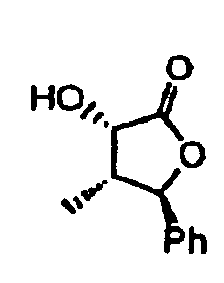
- In a same manner as described above, by using the syn-body of the product in Example 7 as a raw material, a lactone compound and an epi-body thereof (ratio: 86/14) were obtained at a yield of 84 %.
- Identification values of the products are shown below.


- A dichloromethane solution (2 ml) of Ni (OTf)2 was added with a dichloromethane solution (3 ml) of chiral diamine (0.15 mmol) represented by the formula shown below in an argon atmosphere at room temperature and, then, stirred for 8 hours. After being cooled to 0°C, the resultant solution was added with a dichloromethane solution (2.5 ml) of diketone (1.5 mmol) and a dichloromethane solution (2.5 ml) of enamide (1.0 mmol) in succession. After being stirred for 48 hours, the resultant mixture was added with a 48% hydrobromic acid solution (0.5 ml) in drops, stirred for 5 minutes and, then, added with a saturated aqueous solution of sodium hydrogen carbonate. The resultant reaction solution was subjected to extraction using dichloromethane and the resultant organic phase was rinsed with water and, then, a saturated saline solution and, thereafter, dried on sodium sulfate anhydride and, then, concentrated under a reduced pressure, to thereby obtain a product of constitution. The thus-obtained product of constitution was purified by using silica gel chromatography, to thereby obtain hydroxydiketone at a yield of 77% with an optical purity of 59 % ee.
- When a reaction was performed under same conditions as described above except that Cu(OTf)2 was used in place of Ni(OTf)2, hydroxydiketone was obtained at a yield of 52 % with an optical purity of 72% ee.

- A reaction was performed in a same manner as in Example 12, except for using a chiral catalyst system constituted by using Ni(OTf)2 or Cu(OTf)2 and various types of chiral diamine ligands (A, B, C, D, E). The results are shown in Table 8.
Table 8 entry I iganal metal yield (%) e e (%) 1 A N i 30 83 2 A Cu 70 40 3 B Ni 23 70 4 B Cu 61 58 5 C N i 24 81 6 C Cu 62 33 7 D Ni 67 75 8 D Cu 70 49 9 E Ni 37 80 10 E Cu 6 1 6 2 - 10 % by mol was used in DCM. Reaction at 0°C.


- A reaction was performed in a same manner as in Example 12, except that NiCl2 and AgOTf of two equivalents thereof were used in place of Ni(OTf)2.
- As a result, a hydroxydiketone was obtained at a yield of 85% and an optical purity of 57% ee. Further, when AgOTf of three equivalents thereof was used, the yield was 56 % and the optical purity was 81% ee.
- As has been described above in detail, according to the present invention, there is provided a method of an enantioselective nucleophilic addition reaction to an aldehyde group which enables an asymmetric synthesis of an optically active α-hydroxy-γ-keto acid ester, an optically active α-hydroxy-γ-amino acid ester, an optically active hydroxydiketone or the like which is useful as a raw material or a synthesis intermediate for producing a pharmaceutical preparation, an agricultural chemical, a fragrance, a functional polymer or the like. Then, according to the invention, high stereoselective reaction is made possible and, particularly in the case of an enecarbamate having an α-1 substitution, high diastereoselectivity and enantioselectivity are realized. Further, there is provided a novel method for synthesizing an optically active γ-lactam or any one of γ-lactones.
Claims (12)
- A method of an enantioselective nucleophilic addition reaction of enamide, which is a method of a nucleophilic addition reaction of an enamide compound accompanied by generation of a hydroxyl group (-OH) to a carbonyl group, being characterized by allowing the reaction to be performed in the presence of a chiral catalyst comprising copper or nickel.
- The method of the enantioselective nucleophilic addition reaction of enamide according to Claim 1, being characterized in that the chiral catalyst is constituted by a copper compound or a nickel compound which is a salt of an organic or inorganic acid or a complex or composite of the salt, and a chiral diamine ligand.
- The method of the enantioselective nucleophilic addition reaction of enamide according to Claim 2, being characterized in that the chiral diamine ligand has an ethylene diamine structure as a portion thereof.
- A method of an enantioselective nucleophilic addition reaction of enamide, which is the method of the enantioselective nucleophilic addition reaction of enamide according to any one of Claims 1 to 3, being characterized in that a nucleophilic addition reaction of an enamide compound accompanied by generation of a hydroxyl group (-OH) to a carbonyl group is performed on a compound having a carbonyl group represented by the following formula:

Rb represents a hydrogen atom or a hydrocarbon group which may have a substituent). - The method of the enantioselective nucleophilic addition reaction of enamide according to Claim 4, being characterized in that the compound having the carbonyl group is a glyoxylic acid ester.
- The method of the enantioselective nucleophilic addition reaction of enamide according to Claim 5, being characterized in that the compound having a carbonyl group is a glyoxylic acid ester represented by the following formula (1):

the enamide compound is represented by the following formula (2):
R3 represents a hydrocarbon group which may have a substituent;
R4 and R5 may be same with or different from each other and each represent a hydrogen atom or a hydrocarbon group which may have a substituent, wherein at least one of them represents a hydrogen atom; and
R3 may form a ring by being bonded with R4 or R5). - A method for synthesizing an optically active α-hydroxy-γ-keto acid ester, being characterized in that, after the nucleophilic addition reaction according to Claim 6, an acid treatment is performed, to thereby generate a compound represented by at least one of the following formulae (3):

- A method for synthesizing an optically active α-hydroxy-γ-amino acid ester, being characterized in that, after the nucleophilic addition reaction according to Claim 6, a reduction treatment is performed, to thereby generate a compound represented by at least one of the following formulae (4):

- A method for synthesizing optically active α-hydroxy-γ-lactams, being characterized in that, after a substituent (R2CO-) on a γ-amino group of the optically active α-hydroxy-γ-amino acid ester synthesized by the method according to Claim 8 is removed, a cyclization reaction is performed, to thereby generate a compound represented by at least one of the following formulae (5):

- A method for synthesizing any one of optically active α-hydroxy-γ-lactones, being characterized in that the optically active α-hydroxy-γ-keto acid ester synthesized by the method according to Claim 7 is subjected to a reduction reaction and, subsequently, to a cyclization reaction, to thereby generate a compound represented by at least one of the following formulae (6):

- A method of an enantioselective nucleophilic addition reaction of enamide, which is the enantioselective nucleophilic addition reaction of enamide according to Claim 4, being characterized in that the compound having the carbonyl group is a diketone compound represented by the following formulae (7):

the enamide compound is represented by the following formula (2):
R3 represents a hydrocarbon group which may have a substituent;
R4 and R5 may be same with or different from each other and each represent a hydrogen atom or a hydrocarbon group which may have a substituent, wherein at least one of them represents a hydrogen atom; and
R3 may form a ring by being bonded with R4 or R5). - A method for synthesizing an optically active hydroxydiketone compound, being characterized in that, after the nucleophilic addition reaction according to Claim 11, a reduction treatment is performed, to thereby generate an optical active compound represented by the following formula (8):

Applications Claiming Priority (3)
| Application Number | Priority Date | Filing Date | Title |
|---|---|---|---|
| JP2004016408 | 2004-01-23 | ||
| JP2004249251 | 2004-08-27 | ||
| PCT/JP2005/001281 WO2005070864A1 (en) | 2004-01-23 | 2005-01-24 | METHOD OF ENANTIOMETRICALLY SELECTIVE NUCLEOPHILIC ADDITION REACTION TO CARBONYL OF ENAMIDE AND METHOD OF SYNTHESIZING OPTICALLY ACTIVE α-HYDROXY-Ϝ-KETO ACID ESTER AND HYDROXYDIKETONE |
Publications (3)
| Publication Number | Publication Date |
|---|---|
| EP1707556A1 true EP1707556A1 (en) | 2006-10-04 |
| EP1707556A4 EP1707556A4 (en) | 2007-11-21 |
| EP1707556B1 EP1707556B1 (en) | 2013-05-08 |
Family
ID=34810133
Family Applications (1)
| Application Number | Title | Priority Date | Filing Date |
|---|---|---|---|
| EP05704278.0A Expired - Lifetime EP1707556B1 (en) | 2004-01-23 | 2005-01-24 | Method of enantioselective nucleophilic addition reaction of an enamide to a glyoxylic acid ester |
Country Status (4)
| Country | Link |
|---|---|
| US (1) | US7414145B2 (en) |
| EP (1) | EP1707556B1 (en) |
| JP (1) | JP4822844B2 (en) |
| WO (1) | WO2005070864A1 (en) |
Families Citing this family (5)
| Publication number | Priority date | Publication date | Assignee | Title |
|---|---|---|---|---|
| JP4732180B2 (en) * | 2006-02-14 | 2011-07-27 | 独立行政法人科学技術振興機構 | Stereoselective production method of 1,3-aminoalcohol derivatives |
| JP4647521B2 (en) * | 2006-03-09 | 2011-03-09 | 独立行政法人科学技術振興機構 | Process for producing optically active β-hydroxyimine compound |
| JP4943185B2 (en) * | 2007-03-03 | 2012-05-30 | 独立行政法人科学技術振興機構 | Process for producing optically active sulfonylimine compound |
| JP5053895B2 (en) * | 2008-03-11 | 2012-10-24 | 独立行政法人科学技術振興機構 | Method for producing nitrogen-containing heterocyclic compound |
| CN113121338B (en) * | 2021-03-31 | 2022-10-28 | 浙江工业大学 | Synthetic method of alpha-hydroxy-beta-keto acid ester compound |
Family Cites Families (2)
| Publication number | Priority date | Publication date | Assignee | Title |
|---|---|---|---|---|
| JP3738225B2 (en) | 2002-03-11 | 2006-01-25 | 独立行政法人科学技術振興機構 | Novel chiral copper catalyst and method for producing N-acylated amino acid derivative using the same |
| JP3780218B2 (en) | 2002-03-11 | 2006-05-31 | 独立行政法人科学技術振興機構 | Novel chiral copper catalyst and method for producing N-acylated amino acid derivative using the same |
-
2005
- 2005-01-24 JP JP2005517333A patent/JP4822844B2/en not_active Expired - Fee Related
- 2005-01-24 WO PCT/JP2005/001281 patent/WO2005070864A1/en not_active Ceased
- 2005-01-24 US US10/587,078 patent/US7414145B2/en not_active Expired - Fee Related
- 2005-01-24 EP EP05704278.0A patent/EP1707556B1/en not_active Expired - Lifetime
Non-Patent Citations (5)
| Title |
|---|
| A. SUTHERLAND, C. L. WILLIS: "Chemoenzymatic Synthesis of 4-Amino-2-hydroxy Acids: A Comparison of Mutant and Wild-Type Oxidoreductases", JOURNAL OF ORGANIC CHEMISTRY, vol. 63, no. 22, 9 October 1998 (1998-10-09), pages 7764-7769, DOI: 10.1021/jo980821a * |
| D. A. EVANS, J. WU, C. E. MASSE, D. W. C. MACMILLAN: "A General Method for the Enantioselective Synthesis of Pantolactone Derivatives", ORGANIC LETTERS, vol. 4, no. 20, 7 September 2002 (2002-09-07), pages 3379-3382, DOI: 10.1021/ol026489d * |
| MATSUBARA, RYOSUKE ET AL: "Highly diastereo- and enantioselective reactions of ene carbamates with ethyl glyoxylate to give optically active syn and anti .alpha.-alkyl-.beta.-hydroxy imines and ketones" ANGEWANDTE CHEMIE, INTERNATIONAL EDITION , 43(25), 3258-3260 CODEN: ACIEF5; ISSN: 1433-7851, 2004, XP002454033 * |
| MATSUBARA, RYOSUKE ET AL: "Highly diastereo- and enantioselective reactions of enecarbamates with an aldehyde" TETRAHEDRON , 60(43), 9769-9784 CODEN: TETRAB; ISSN: 0040-4020, 2004, XP004573973 * |
| See also references of WO2005070864A1 * |
Also Published As
| Publication number | Publication date |
|---|---|
| WO2005070864A1 (en) | 2005-08-04 |
| US20070073087A1 (en) | 2007-03-29 |
| US7414145B2 (en) | 2008-08-19 |
| EP1707556B1 (en) | 2013-05-08 |
| JPWO2005070864A1 (en) | 2007-09-13 |
| JP4822844B2 (en) | 2011-11-24 |
| EP1707556A4 (en) | 2007-11-21 |
Similar Documents
| Publication | Publication Date | Title |
|---|---|---|
| Hett et al. | Enantioselective synthesis of salmeterol via asymmetric borane reduction | |
| CN103080072B (en) | New method for preparing intermediates useful in the production of NEP inhibitors | |
| CA2620243C (en) | 4-substituted pyrrolidin-2-ones and their use | |
| de Vries et al. | (+)-Camphor-derived tri-and tetradentate amino alcohols; synthesis and application as ligands in the nickel catalyzed enantioselective conjugate addition of diethylzinc | |
| US20240308966A1 (en) | Chiral amine-squaramide compound based on spirobiindane skeleton, preparation method and use thereof | |
| EP1707556B1 (en) | Method of enantioselective nucleophilic addition reaction of an enamide to a glyoxylic acid ester | |
| JP5569938B2 (en) | Pyrrolidine derivative and method for producing the same | |
| CN108440307B (en) | Preparation method of chiral amine compound | |
| EP1707559B1 (en) | Method of enantioselective nucleophilic addition reaction of an enamide to an imine and method of synthesizing alpha-amino-gamma-keto acid ester | |
| KR102590897B1 (en) | Method for producing chiral gamma-lactam compound and metal complex therefor | |
| JPS6360977A (en) | Oxazolinecarboxylic acid derivative and production thereof | |
| EP2065371A1 (en) | Chiral organic catalysts for the stereoselective reduction of carbon-nitrogen double bonds for the preparation of enantiomerically enriched amines | |
| JP5471069B2 (en) | Tetrahydropyridine derivative and method for producing the same | |
| US6054065A (en) | Chiral ligand and method for preparing cyanohydrins from aldehydes | |
| JP2008514554A (en) | Hydrogenation of α, β-unsaturated carbonyl compounds. | |
| US7348290B2 (en) | Arene-ruthenium complexes immobilized on polymers, catalysts consisting of the complexes, and processes for organic syntheses with the same | |
| KR102823284B1 (en) | Method for preparing chiral aldol reaction product of nitroso compounds using chiral catalyst compounds | |
| KR101057304B1 (en) | Method for preparing aspartic acid derivative using chiral catalyst | |
| CN114426564B (en) | Chiral ferrocene phosphine-1, 2-diphenyl ethylenediamine ligand and preparation method and application thereof | |
| WO2012040853A1 (en) | Group 5 metal complexes useful for amine functionalization and synthetic process for manufacture thereof | |
| Ritter et al. | Synthesis of 4-benzyliden-2-oxazolidinone derivatives via gold-catalyzed intramolecular hydroamination | |
| EP1731509A1 (en) | Process for producing nitrogenous 5-membered cyclic compound | |
| CN107474090A (en) | Carbohydrate diazaheterocyclic carbene precursor salt and its preparation method and use | |
| Wojaczyńska et al. | Chiral pyrrolidine thioethers and 2-azanorbornane derivatives bearing additional nitrogen functions. Enantiopure ligands for palladium-catalyzed Tsuji-Trost reaction. | |
| KR20160008873A (en) | Novel beta-sulfinamino malonate derivatives and process for preparing the same, and process for preparing sitagliptin using the same |
Legal Events
| Date | Code | Title | Description |
|---|---|---|---|
| PUAI | Public reference made under article 153(3) epc to a published international application that has entered the european phase |
Free format text: ORIGINAL CODE: 0009012 |
|
| 17P | Request for examination filed |
Effective date: 20060803 |
|
| AK | Designated contracting states |
Kind code of ref document: A1 Designated state(s): DE FR GB |
|
| DAX | Request for extension of the european patent (deleted) | ||
| RBV | Designated contracting states (corrected) |
Designated state(s): DE FR GB |
|
| A4 | Supplementary search report drawn up and despatched |
Effective date: 20071024 |
|
| 17Q | First examination report despatched |
Effective date: 20110316 |
|
| GRAP | Despatch of communication of intention to grant a patent |
Free format text: ORIGINAL CODE: EPIDOSNIGR1 |
|
| GRAS | Grant fee paid |
Free format text: ORIGINAL CODE: EPIDOSNIGR3 |
|
| GRAA | (expected) grant |
Free format text: ORIGINAL CODE: 0009210 |
|
| AK | Designated contracting states |
Kind code of ref document: B1 Designated state(s): DE FR GB |
|
| REG | Reference to a national code |
Ref country code: GB Ref legal event code: FG4D |
|
| REG | Reference to a national code |
Ref country code: DE Ref legal event code: R096 Ref document number: 602005039471 Country of ref document: DE Effective date: 20130704 |
|
| PLBE | No opposition filed within time limit |
Free format text: ORIGINAL CODE: 0009261 |
|
| STAA | Information on the status of an ep patent application or granted ep patent |
Free format text: STATUS: NO OPPOSITION FILED WITHIN TIME LIMIT |
|
| 26N | No opposition filed |
Effective date: 20140211 |
|
| REG | Reference to a national code |
Ref country code: DE Ref legal event code: R097 Ref document number: 602005039471 Country of ref document: DE Effective date: 20140211 |
|
| REG | Reference to a national code |
Ref country code: FR Ref legal event code: PLFP Year of fee payment: 12 |
|
| PGFP | Annual fee paid to national office [announced via postgrant information from national office to epo] |
Ref country code: GB Payment date: 20151214 Year of fee payment: 12 |
|
| PGFP | Annual fee paid to national office [announced via postgrant information from national office to epo] |
Ref country code: FR Payment date: 20151214 Year of fee payment: 12 |
|
| PGFP | Annual fee paid to national office [announced via postgrant information from national office to epo] |
Ref country code: DE Payment date: 20151211 Year of fee payment: 12 |
|
| REG | Reference to a national code |
Ref country code: DE Ref legal event code: R119 Ref document number: 602005039471 Country of ref document: DE |
|
| GBPC | Gb: european patent ceased through non-payment of renewal fee |
Effective date: 20170124 |
|
| REG | Reference to a national code |
Ref country code: FR Ref legal event code: ST Effective date: 20170929 |
|
| PG25 | Lapsed in a contracting state [announced via postgrant information from national office to epo] |
Ref country code: FR Free format text: LAPSE BECAUSE OF NON-PAYMENT OF DUE FEES Effective date: 20170131 |
|
| PG25 | Lapsed in a contracting state [announced via postgrant information from national office to epo] |
Ref country code: GB Free format text: LAPSE BECAUSE OF NON-PAYMENT OF DUE FEES Effective date: 20170124 Ref country code: DE Free format text: LAPSE BECAUSE OF NON-PAYMENT OF DUE FEES Effective date: 20170801 |