EP1707446A2 - Communication control apparatus and communication control method - Google Patents
Communication control apparatus and communication control method Download PDFInfo
- Publication number
- EP1707446A2 EP1707446A2 EP06251852A EP06251852A EP1707446A2 EP 1707446 A2 EP1707446 A2 EP 1707446A2 EP 06251852 A EP06251852 A EP 06251852A EP 06251852 A EP06251852 A EP 06251852A EP 1707446 A2 EP1707446 A2 EP 1707446A2
- Authority
- EP
- European Patent Office
- Prior art keywords
- data
- sensor
- detection
- communication control
- detection data
- Prior art date
- Legal status (The legal status is an assumption and is not a legal conclusion. Google has not performed a legal analysis and makes no representation as to the accuracy of the status listed.)
- Withdrawn
Links
Images



Classifications
-
- B—PERFORMING OPERATIONS; TRANSPORTING
- B60—VEHICLES IN GENERAL
- B60R—VEHICLES, VEHICLE FITTINGS, OR VEHICLE PARTS, NOT OTHERWISE PROVIDED FOR
- B60R21/00—Arrangements or fittings on vehicles for protecting or preventing injuries to occupants or pedestrians in case of accidents or other traffic risks
- B60R21/01—Electrical circuits for triggering passive safety arrangements, e.g. airbags, safety belt tighteners, in case of vehicle accidents or impending vehicle accidents
-
- B—PERFORMING OPERATIONS; TRANSPORTING
- B60—VEHICLES IN GENERAL
- B60R—VEHICLES, VEHICLE FITTINGS, OR VEHICLE PARTS, NOT OTHERWISE PROVIDED FOR
- B60R21/00—Arrangements or fittings on vehicles for protecting or preventing injuries to occupants or pedestrians in case of accidents or other traffic risks
- B60R21/01—Electrical circuits for triggering passive safety arrangements, e.g. airbags, safety belt tighteners, in case of vehicle accidents or impending vehicle accidents
- B60R2021/0104—Communication circuits for data transmission
- B60R2021/01047—Architecture
- B60R2021/01054—Bus
- B60R2021/01068—Bus between different sensors and airbag control unit
-
- B—PERFORMING OPERATIONS; TRANSPORTING
- B60—VEHICLES IN GENERAL
- B60R—VEHICLES, VEHICLE FITTINGS, OR VEHICLE PARTS, NOT OTHERWISE PROVIDED FOR
- B60R21/00—Arrangements or fittings on vehicles for protecting or preventing injuries to occupants or pedestrians in case of accidents or other traffic risks
- B60R21/01—Electrical circuits for triggering passive safety arrangements, e.g. airbags, safety belt tighteners, in case of vehicle accidents or impending vehicle accidents
- B60R2021/0104—Communication circuits for data transmission
- B60R2021/01102—Transmission method
- B60R2021/01115—Transmission method specific data frames
-
- B—PERFORMING OPERATIONS; TRANSPORTING
- B60—VEHICLES IN GENERAL
- B60W—CONJOINT CONTROL OF VEHICLE SUB-UNITS OF DIFFERENT TYPE OR DIFFERENT FUNCTION; CONTROL SYSTEMS SPECIALLY ADAPTED FOR HYBRID VEHICLES; ROAD VEHICLE DRIVE CONTROL SYSTEMS FOR PURPOSES NOT RELATED TO THE CONTROL OF A PARTICULAR SUB-UNIT
- B60W50/00—Details of control systems for road vehicle drive control not related to the control of a particular sub-unit, e.g. process diagnostic or vehicle driver interfaces
- B60W50/0098—Details of control systems ensuring comfort, safety or stability not otherwise provided for
Definitions
- the present invention relates to a communication control apparatus, and more particularly to a communication control apparatus and a communication control method for a vehicular hood control apparatus.
- a vehicular hood control apparatus which controls a vehicular hood of a vehicle in order to protect a pedestrian when the vehicle collides with the pedestrian.
- a vehicular hood control apparatus disclosed in Japanese Laid-open Patent Application No. H09-315266 includes a communication control apparatus, which consists of a collision detection sensor attached to the front bumper of a vehicle, and a controller (information processing unit such as ECU) connected to the collision detection sensor through a single signal line.
- This communication control apparatus operates, when the controller determines that the vehicle collides with a pedestrian, to uplift the vehicular hood for a certain amount and to keep the hood at the uplifted position. Uplifting the hood allows to increase the amount of deformation of the hood toward the downward direction, and hence a collision energy can be absorbed by a deformation of the hood when the pedestrian collides with the hood.
- Japanese Laid-open Patent Application No. H08-216826 (see paragraphs [0010] to [0022] and FIG. 1) also discloses a vehicular hood control apparatus.
- This vehicular hood control apparatus includes a communication control apparatus, which consists of a bumper sensor for detecting an impact from the front side of the vehicle, a hood sensor for detecting an impact from the upper side of the hood, and a controller connected to these sensors through two signal lines for transmitting the output signal of each sensor.
- This vehicular hood control apparatus inflates an airbag on the hood when impacts from front and upper sides are detected, however, it does not inflate the airbag when an impact is detected from the front side only.
- Bumpers and other vehicular parts around the bumper are made of relatively soft materials. Therefore, if a bumper of the vehicle is deformed because of a light collision at a parking lot and the like, an attachment plate for the collision detection sensor attached to the bumper may be deformed or changed in shape. Under such circumstance, in the vehicular hood control apparatuses disclosed in Japanese Laid-open Patent Application Nos.H09-315266 and 08-216826 , the collision detection sensor may not detect a collision in an accurate and reliable manner.
- an attachment angle sensor separately for detecting the attachment angle of the collision detection sensor so that if the attachment angle is changed to an extent that would affect the accuracy of the collision detection sensor, the change of the attachment angle can be informed to the passengers.
- two sensors such as the collision detection sensor and the attachment angle sensor are employed, which requires two signal lines between the collision detection sensor and the controller as with the communication control apparatus disclosed in Japanese Laid-open Patent Application No. H08-216826 .
- Using two signal lines requires a large installation space in the vicinity of the hood, and further causes the following disadvantages.
- the present invention seeks to provide a communication control apparatus and a communication control method which can establish in a simple configuration and a cheap manner a communication between a plurality of sensors and an information processing unit for processing data detected by each sensor.
- It is a first aspect of the present invention to provide a communication control apparatus comprising a sensing device and an information processing device connected to the sensing device through a signal line and processing detection data detected by the sensing device, wherein the sensing device includes: a plurality of sensors each for detecting predetermined detection data; a transmitter for transmitting the detection data detected by the sensors to the information processing device through a common signal line; and a switching device for switching a transmission cycle of the detection data transmitted by the transmitter in accordance with types of the sensors, and wherein the information processing device includes data discrimination means which discriminates received data from the sensing device based on a reception cycle of the received data, the data discrimination means discriminating by which sensor the received data has been detected as the detection data.
- the switching device of the sensing device switches and selects the detection data detected by the sensors, determines whether a predetermined transmission timing has been reached, and then transmits , in accordance with the type of the sensor whose detection data is on the transmission timing, the selected detection data to the information processing device by using a plurality of transmission modes having different transmission cycle.
- the criterion for determining the predetermined transmission timing may be a comparison result, for example, between the value of the detection data to be transmitted by the most frequent timing, that is the detection data to be transmitted by the shortest cycle, and at least one threshold value.
- the data discrimination means of the information processing device may read out the received data at a predetermined time interval from received data storage means which temporarily stores data received from the sensing device, add a predetermined value if no received data is stored in the received data storage means, and discriminate by which sensor the received data has been detected as the detection data based on an accumulated value.
- the data discrimination means of the information processing device accumulates the predetermined value, it is possible to recognize the reception cycle of the received data. Therefore, if a threshold value is previously provided based on the transmission cycles in accordance with types of the sensors of the sensing device, it is possible to discriminate by which sensor the received data has been detected as the detection data based on the reception cycle of the received data.
- Timing at which the data discrimination means reads out the received data from the received data storage means, that is the predetermined time interval is substantially same as the transmission cycle of the detection data to be transmitted by the most frequent timing, that is the transmission cycle of the detection data to be transmitted at the shortest cycle, and is preferably longer to a slight extent in the range from 1 to 10%. This can decrease invitation of errors upon receipt of the detection data to be transmitted at the shortest cycle.
- the data discrimination means of the information processing device may abandon the received data that has been temporarily stored in the received data storage means if the accumulated value is not in a predetermined range.
- the data discrimination means of the information processing device can discriminate the detection data without error. Meanwhile, if the information processing device receives the detection data, which is to be received at the short cycle, subsequently to the detection data to be received at the long cycle, the accumulated value deviates from the predetermined range at a boundary of these two different detection data. In this instance, this received data cannot be determined if it is received at the short cycle or at the long cycle. For this reason, only this received data is abandoned, thereby allowing an accurate data discrimination by the data discrimination means.
- the plurality of sensors of the sensing device may include: a collision detection sensor for detecting collision detection information as the detection data at a time when a vehicle on which is mounted the communication control apparatus collides with a pedestrian; and an attachment angle sensor for detecting attachment angle information as the detection data at a time when an attachment angle of the collision detection sensor is changed, wherein the transmission cycle of the detection data from the collision detection sensor may be shorter than the transmission cycle of the detection data from the attachment angle sensor.
- the sensing device uses a relatively long transmission cycle for the attachment angle information and a relatively short transmission cycle for the collision detection information. Therefore, the collision detection information can be transmitted to the information processing device in a relatively short period of time. As a result, because of the information processing device, the communication control apparatus enables to swiftly utilize the received collision detection information for the purpose of collision detection of the vehicle.
- the detection data detected by the sensors can be switched and selected, and if a predetermined transmission timing has been reached, the selected detection data is transmitted to the information processing device, in the transmitting step at the sensing device, with a plurality of different transmission modes having different transmission cycles in accordance with types of the sensors which detects the detection data. Further, based on the reception cycle of the received data to be received in the receiving step at the information processing device, the communication control apparatus discriminates by which sensor the received data has been detected as the detection data in the data discriminating step at the information processing device.
- the present invention because plural kinds of detection data detected by the sensing device can be transmitted to the information processing device through a single signal line, it is not necessary to provide dedicated IC and harness for communication. This can contribute to efficient reduction of the installation space, and saving of the manufacturing cost, and further to noise reduction from the outside.
- a communication control apparatus 1 is provided in a vehicle such as automobile. As best seen in FIG. 1, the communication control apparatus 1 includes a satellite sensor 20 and ECU 30, which are connected to each other through a single signal line 10.
- the satellite sensor (sensing device) 20 is arranged at a predetermined position of a front part of the vehicle.
- the satellite sensor 20 transmits an impact received by the vehicle to ECU 30.
- the satellite sensor 20 mainly consists of a collision detection sensor 21, an attachment angle sensor 22, a communication interface 23, a RAM 24, and a CPU 25.
- the collision detection sensor 21 is an acceleration sensor for detecting an impact, etc.
- the detection range of the collision detection sensor 21 is, for example, in the range of ⁇ 50-100 G. Analog signal outputted from this sensor is inputted to IN1 of the CPU 25.
- the attachment angle sensor 22 is an acceleration sensor for detecting gravity.
- the detection range of the attachment angle sensor 22 is sufficiently smaller than that of the collision detection sensor 21, and is, for example, in the range of ⁇ 1 G. Analog signal outputted from this sensor is inputted to IN2 of the CPU 25. To be described later on, gravity detected by the attachment angle sensor 22 is utilized to determine at the ECU 30 whether or not a change in the attachment angle (change in the sensor attachment angle) of the collision detection sensor 21 occurs.
- the communication interface 23 transmits data stored in a transmission buffer 26 with a predetermined transmission mode to the ECU 30 through the signal line 10 based on the control of the CPU 25.
- the transmission mode includes an intermittent transmission mode Ms having a longer cycle T 1 (e.g. 10-100 ms) and a continuous transmission mode Mc having a shorter cycle T 2 (e.g. 0.5-1 ms).
- RAM (Random Access Memory) 24 is a rewritable storage means such as a semiconductor memory and a magnetoresistive random access memory, and is used for the calculation process and the like of the CPU 25 to be described later.
- CPU (Central Processing Unit) 25 creates transmission data based on an input signal to IN1 or IN2, and switches the transmission mode between the intermittent transmission mode Ms and the continuous transmission mode Mc in response to the kind of the created transmission data.
- T 3 time
- the CPU 25 converts (analog-to-digital conversion) an analog signal to be inputted to IN1 to a digital signal (hereinafter referred to as collision data Dc), and transmits this collision data (collision detection information) Dc with the continuous transmission mode Mc.
- the CPU 25 converts (analog-to-digital conversion) an analog signal to be inputted to IN2 to a digital signal (hereinafter referred to as attachment angle data Ds), and transmits this attachment angle data (attachment angle information) Ds with the intermittent transmission mode Ms.
- the ECU 30 determines whether or not a collision of the vehicle occurs or a change in the sensor attachment angle occurs based on an output data from the satellite sensor 20, and executes a predetermined process in accordance with the collision or the change in the sensor attachment angle.
- the ECU 30 mainly consists of a collision dealing means 31, a communication interface 32, and a CPU 33.
- the collision dealing means 31 executes a process in accordance with a collision of the vehicle or a change in the sensor attachment angle based on a signal outputted from the CPU 33.
- the collision dealing means 31 executes an inflation operation for expanding a passive safety device (not shown) such as an air bag, based on the collision detection signal to be outputted from a collision determination controller 35.
- the collision dealing means 31 also informs passengers of the state where the collision detection sensor 21 is unable to perform a normal detection operation, by means of a warning display unit (not shown) or voice guidance, based on an attachment angle abnormal signal to be outputted from an attachment angle detection controller 36.
- the communication interface 32 stores the received data in a reception buffer 34 based on the control of the CPU 33.
- CPU 33 mainly consists of the collision determination controller 35, the attachment angle detection controller 36, and a data discrimination unit (data discrimination means) 37.
- the collision determination controller 35 detects whether or not a collision of the vehicle occurs on the basis of the collision data Dc. If a collision is detected, the collision determination controller 35 outputs a collision detection signal indicating the collision to the collision dealing means 31.
- the attachment angle detection controller 36 detects whether or not the attachment angle of the collision detection sensor 21 changes on the basis of the attachment angle data Ds. If a change in the attachment angle of the collision detection sensor 21 is detected, the attachment angle detection controller 36 outputs an attachment angle abnormal signal indicating the change of the attachment angle to the collision dealing means 31.
- the data discrimination unit 37 discriminates that the data (received data) received by the communication interface 32 is the collision data Dc or the attachment angle data Ds, and outputs the received data to the collision determination controller 35 or the attachment angle detection controller 36 in accordance with the kind of the data.
- the data discrimination unit 37 executes an interrupt handling for determining whether or not received data is in the reception buffer 34 at every predetermined time T 4 which is slightly longer than T 2 (e.g. 0.5-1 ms). In this interrupt handling, the data discrimination unit 37 accumulates a value T N of a timer (empty timer) if no received data is in the reception buffer 34. If there is received data in the reception buffer 34, the data discrimination unit 37 discriminates which one of the collision data Dc or the attachment angle data Ds is the received data, based on the value T N of the empty timer.
- CPU 25 switches the input to be read in the CPU 25 between IN1 and IN2 (step S1). To be more specific, if the previous input was for IN2, the CPU 25 switches such that an input for IN1 is read in this time to carry out an alternate switching between IN1 and IN2.
- step S2 determines whether or not the input has been switched over to IN1 this time (step S2). If the input has been switched to IN1 (step S2 : Yes), the CPU 25 then converts (analog-to-digital conversion) the input analog signal to the collision data Dc (step S3). Subsequently, the CPU 25 determines whether or not the absolute value of the collision data Dc is equal to or greater than a predetermined threshold value ⁇ (e.g. 6 G) (step S4).
- ⁇ e.g. 6 G
- step S4 determines whether the absolute value of the collision data Dc is smaller than the threshold value ⁇ (step S4: No). If the absolute value of the collision data Dc is smaller than the threshold value ⁇ (step S4: No), the CPU 25 subtracts the value T C of the collision detection timer (step S7), and determines whether the value T C of the collision detection timer is "0" (step S8). If the value T C of the collision detection timer is "0" (step S8: Yes), the CPU 25 sets the flag F to "0" (step S9), and completes the process.
- step S8 No
- the CPU 25 proceeds to step S6 where the CPU 25 sets the flag F to "1", and then completes the process.
- step S2 the CPU 25 converts (analog-to-digital conversion) the input analog signal to the attachment angle data Ds (step S10), and determines whether the flag is "1" (step S11). If the flag is "1" (step S11: Yes), the CPU 25 stores the collision data Dc in the transmission buffer 26 (step S12), and switches the transmission mode to the continuous transmission mode Mc (step S13). This can permit continuous transmission of the collision data Dc (transmitting step). On the contrary, if the flag is "0" (step S11: No), the CPU 25 stores the attachment angle data Ds to the transmission buffer 26 (step S14), and switches the transmission mode to the intermittent transmission mode Ms (step S15). This can permit intermittent transmission of the attachment angle data Ds (transmission step). In this preferred embodiment, the processes performed in the above steps S11 through S15 correspond to the switching step defined in the claims.
- the CPU 25 reads in an input signal for IN2, and creates the attachment angle data Ds (Ds creation) .
- the CPU 25 transmits the attachment angle data Ds with the intermittent transmission mode Ms (Dstransmission).
- the transmission cycle is the long period T 1 which is much longer than the short period T 2 .
- the CPU 25 creates the attachment angle data Ds in the same manner as in the case of the time point t 1 (Ds creation), and thereafter transmits the collision data Dc with the continuous transmission mode Mc (Dc transmission) as shown in the previous steps S12 and S13.
- the CPU 25 operates in a manner same as in the case of the time point t 0
- the CPU 25 operates in the same manner as in the case of the time point t 3 .
- acceleration detected by the collision detection sensor 21 firstly exceeds the threshold value ⁇ at the time point t 11 , and further exceeds the absolute value of the threshold value ⁇ for several times before the time point t 12 . After the time point t 12 , the acceleration gradually reduces the amplitude, and at the time point t 13 , the acceleration converges to the range of ⁇ G.
- the value T C of the collision detection timer firstly becomes the timer set value X at the time point t 11 , and keeps the count of the timer set value X in the range where the acceleration detected by the collision detection sensor 21 exceeds the absolute value of the threshold value ⁇ .
- the value T C of the collision detection timer decreases at a constant rate in the range where the acceleration is within the absolute value of the threshold value ⁇ .
- the value T C of the collision detection timer decreases at the constant rate from the time point t 12 , and becomes "0" at the time point t 13 . If a time interval from the time point t 12 to the time point t 13 is T 5 , the time interval T 5 (e.g. 50-100 ms) can be given by the product of the short cycle T 2 and the timer set value X.
- the data discrimination unit 37 determines if there is any received data in the reception buffer 34 (step S21). If there is no received data in the reception buffer 34 (step S21: No), the data discrimination unit 37 increases the value T N (adds a predetermined value to the value T N ) of an empty timer (step S22), and completes the process.
- the empty timer is a timer for measuring the total (accumulated) time period during which no received data is in the reception buffer 34.
- the data discrimination unit 37 determines whether or not the value T N of the empty timer is "0".
- step S23: Yes If the value T N of the empty timer is "0" (step S23: Yes), the data discrimination unit 37 outputs the received data to the collision determination controller 35 (step S24), and completes the process. Meanwhile, if the value T N of the empty timer is not "0" (step S23: No), the data discrimination unit 37 determines whether the value T N is in a predetermined range ( ⁇ ⁇ T N ⁇ ⁇ ) (step S25). In order to discriminate the long cycle T 1 , the predetermined values ⁇ , ⁇ are defined in advance to take values, for example, corresponding to 10-100 ms.
- step S25 If the value T N of the empty timer is in the predetermined range ( ⁇ ⁇ T N ⁇ ⁇ ) (step S25: Yes), the data discrimination unit 37 outputs the received data to the attachment angle detection controller 36 (step S26), and sets the value T N of the empty timer to "0" (step S27), and then completes the process.
- step S25 If the value T N of the empty timer is not in the predetermined range ( ⁇ ⁇ T N ⁇ ⁇ ) (step S25: No), the data discrimination unit 37 deletes the received data from the reception buffer 34 (step S28), and proceeds to step S27. Namely, the data discrimination unit 37 sets the value T N of the empty timer to "0" and completes the process.
- the processes performed in the above steps S23 and S25 correspond to the data discriminating step defined in the claims.
- the satellite sensor 20 transmits data d 1 to data d 13 in order with a predetermined cycle.
- CPU 25 of the satellite sensor 20 transmits data d 1 through data d 4 and data d 8 through data d 13 with the continuous transmission mode Mc, and transmits data d 5 through data d 7 with the intermittent transmission mode Ms.
- data d 5 through data d 7 is transmitted at every long cycle T 1 following the previously transmitted data.
- Data d 2 through d 4 and data d 9 through d 13 is transmitted at every shot cycle T 2 following the previously transmitted data.
- data d 8 is transmitted after the transmission of data d 7 with a predetermined time interval.
- ECU 30 receives the data d 1 through data d 13 with a predetermined time difference (data d 13 is omitted in this figure). This is because the cycle (T 4 ; e.g. 0.55 ms) by which the data discrimination unit 37 of the ECU 30 executes the interrupt handling for referring to the reception buffer 34 is slightly longer than the cycle (T 2 ; e.g. 0.5 ms) by which the CPU 25 of the satellite sensor 20 executes the transmission process in the continuous transmission mode Mc.
- broken lines between the data d 4 and d 5 received indicate that there is no received data in the reception buffer 34. Also, there is no received data between data d 5 and data d 6 , between data d 6 and data d 7 , and between data d 7 and data d 8 . Further, the data discrimination unit 37 abandons or deletes the data d 8 by the following reason.
- the value T N of the empty timer is "0" until the reception of the data d 4 is completed. This is because while the cycle T 2 for the continuous transmission mode Mc is set, for example, to 0.5 ms as previously described, the cycle T 4 by which the data discrimination unit 37 refers to the reception buffer 34 is set, for example, to 0.55 ms, so that whenever the data discrimination unit 37 refers to the reception buffer 34, received data is in the reception buffer 34. For this reason, the value T N of the empty timer always takes "0", which enables the data discrimination unit 37 to discriminate the data d 1 through data d 4 as data having been transmitted with the continuous transmission mode Mc, that is, the collision data Dc.
- the value T N of the empty timer increases at a constant rate from when the reception of the data d 4 is completed to when the reception of the data d 5 is initiated as seen in FIG. 6 (c) . This is because no received data is in the reception buffer 34.
- the value T N of the empty timer takes the predetermined value ⁇ at a time when the reception of the data d 5 is initiated. Therefore, the data discrimination unit 37 discriminates the data d 5 as data having been transmitted with the intermittent transmission mode Ms, that is, the attachment angle data Ds.
- the value T N of the empty timer takes "0" until the reception of the data d 5 is completed.
- the reception of the data d 6 and d 7 can be explained as with the case of the data d 5 .
- the value T N of the empty timer increases at a constant rate until the reception of the data d 8 is initiated.
- the value T N takes a value smaller than the predetermined value ⁇ at a time when the reception of the data d 8 is initiated. Therefore, the data discrimination unit 37 is unable to discriminate with which transmission mode the data d 8 has been transmitted, that is, what is the data d 8 . For this reason, the data discrimination unit 37 abandons the data d 8 .
- the collision data and the attachment angle data can be transmitted from the satellite sensor 20 to ECU 30 through a single signal line 10, and the ECU 30 discriminates the received data to execute a predetermined process in accordance with the received data.
- the satellite sensor 20 and the ECU 30 are connected through a single signal line 10, it is possible to simplify the configuration required for the communication control apparatus 1 and to save the installation space in the vicinity of the vehicular hood comparing with the conventional arrangement in which two signal lines associated with the two sensors 21, 22 are provided. Further, such configuration of the communication control apparatus 1 contributes to decrease in the manufacturing cost as well as noise reduction from the outside.
- the present invention has been described with reference to a preferred embodiment thereof, it is to be understood that various changes and modifications may be made without departing from the scope of the invention.
- the preferred embodiment has been described for one example of the communication control apparatus 1 including one satellite sensor 20.
- the number of satellite sensors 20 is arbitrary and a plurality of satellite sensors 20 may be employed.
- the present invention may be used for a communication control apparatus for other than the vehicular hood control apparatus.
Landscapes
- Engineering & Computer Science (AREA)
- Mechanical Engineering (AREA)
- Arrangements For Transmission Of Measured Signals (AREA)
- Mobile Radio Communication Systems (AREA)
Abstract
Description
- The present invention relates to a communication control apparatus, and more particularly to a communication control apparatus and a communication control method for a vehicular hood control apparatus.
- Conventionally, vehicular hood control apparatus has been known, which controls a vehicular hood of a vehicle in order to protect a pedestrian when the vehicle collides with the pedestrian. For example, a vehicular hood control apparatus disclosed in
Japanese Laid-open Patent Application No. H09-315266 -
Japanese Laid-open Patent Application No. H08-216826 - Bumpers and other vehicular parts around the bumper are made of relatively soft materials. Therefore, if a bumper of the vehicle is deformed because of a light collision at a parking lot and the like, an attachment plate for the collision detection sensor attached to the bumper may be deformed or changed in shape. Under such circumstance, in the vehicular hood control apparatuses disclosed in
Japanese Laid-open Patent Application Nos.H09-315266 08-216826 - In order to overcome the above disadvantage, it is considered to provide an attachment angle sensor separately for detecting the attachment angle of the collision detection sensor so that if the attachment angle is changed to an extent that would affect the accuracy of the collision detection sensor, the change of the attachment angle can be informed to the passengers. In this instance, two sensors such as the collision detection sensor and the attachment angle sensor are employed, which requires two signal lines between the collision detection sensor and the controller as with the communication control apparatus disclosed in
Japanese Laid-open Patent Application No. H08-216826 - (1) Because collision detection information is always transmitted from the collision detection sensor to the controller, communication load to the controller becomes increased. Further, it is necessary to transmit a large amount of data as the collision detection information at an early timing of the collision.
- (2) It is necessary to provide a communication interface and a signal line for the attachment angle sensor, separately from a communication interface and a signal line for the collision detection sensor.
- (3) Controller requires a costly CPU with high-performance throughput capacity and the like because the software for executing a data reception process for the data detected by the sensors is subject to a large load.
- (4) The collision detection sensor is readily subject to an influence from the outside when compared with the case where only one signal line is employed, and therefore, the number of operations for fault diagnosis for the collision detection sensor inevitably increases.
- In view of the above, the present invention seeks to provide a communication control apparatus and a communication control method which can establish in a simple configuration and a cheap manner a communication between a plurality of sensors and an information processing unit for processing data detected by each sensor.
- It is a first aspect of the present invention to provide a communication control apparatus comprising a sensing device and an information processing device connected to the sensing device through a signal line and processing detection data detected by the sensing device, wherein the sensing device includes: a plurality of sensors each for detecting predetermined detection data; a transmitter for transmitting the detection data detected by the sensors to the information processing device through a common signal line; and a switching device for switching a transmission cycle of the detection data transmitted by the transmitter in accordance with types of the sensors, and wherein the information processing device includes data discrimination means which discriminates received data from the sensing device based on a reception cycle of the received data, the data discrimination means discriminating by which sensor the received data has been detected as the detection data.
- According to the above communication control apparatus, the switching device of the sensing device switches and selects the detection data detected by the sensors, determines whether a predetermined transmission timing has been reached, and then transmits , in accordance with the type of the sensor whose detection data is on the transmission timing, the selected detection data to the information processing device by using a plurality of transmission modes having different transmission cycle. The criterion for determining the predetermined transmission timing may be a comparison result, for example, between the value of the detection data to be transmitted by the most frequent timing, that is the detection data to be transmitted by the shortest cycle, and at least one threshold value.
- In the aforementioned communication control apparatus, the data discrimination means of the information processing device may read out the received data at a predetermined time interval from received data storage means which temporarily stores data received from the sensing device, add a predetermined value if no received data is stored in the received data storage means, and discriminate by which sensor the received data has been detected as the detection data based on an accumulated value.
- According to this communication control apparatus, because the data discrimination means of the information processing device accumulates the predetermined value, it is possible to recognize the reception cycle of the received data. Therefore, if a threshold value is previously provided based on the transmission cycles in accordance with types of the sensors of the sensing device, it is possible to discriminate by which sensor the received data has been detected as the detection data based on the reception cycle of the received data. Timing at which the data discrimination means reads out the received data from the received data storage means, that is the predetermined time interval, is substantially same as the transmission cycle of the detection data to be transmitted by the most frequent timing, that is the transmission cycle of the detection data to be transmitted at the shortest cycle, and is preferably longer to a slight extent in the range from 1 to 10%. This can decrease invitation of errors upon receipt of the detection data to be transmitted at the shortest cycle.
- In the aforementioned communication control apparatus, the data discrimination means of the information processing device may abandon the received data that has been temporarily stored in the received data storage means if the accumulated value is not in a predetermined range.
- According to this communication control apparatus, if the predetermined range for the accumulated value is determined in advance so as to be adapted to the reception cycle of the detection data, the data discrimination means of the information processing device can discriminate the detection data without error. Meanwhile, if the information processing device receives the detection data, which is to be received at the short cycle, subsequently to the detection data to be received at the long cycle, the accumulated value deviates from the predetermined range at a boundary of these two different detection data. In this instance, this received data cannot be determined if it is received at the short cycle or at the long cycle. For this reason, only this received data is abandoned, thereby allowing an accurate data discrimination by the data discrimination means.
- In the aforementioned communication control apparatus, the plurality of sensors of the sensing device may include: a collision detection sensor for detecting collision detection information as the detection data at a time when a vehicle on which is mounted the communication control apparatus collides with a pedestrian; and an attachment angle sensor for detecting attachment angle information as the detection data at a time when an attachment angle of the collision detection sensor is changed, wherein the transmission cycle of the detection data from the collision detection sensor may be shorter than the transmission cycle of the detection data from the attachment angle sensor.
- According to this communication control apparatus, the sensing device uses a relatively long transmission cycle for the attachment angle information and a relatively short transmission cycle for the collision detection information. Therefore, the collision detection information can be transmitted to the information processing device in a relatively short period of time. As a result, because of the information processing device, the communication control apparatus enables to swiftly utilize the received collision detection information for the purpose of collision detection of the vehicle.
- It is another aspect of the present invention to provide a communication control method for a communication control apparatus, which comprises a sensing device and an information processing device connected to the sensing device through a signal line and processing detection data detected by the sensing device, the method including:
- the steps executed by the sensing device comprising:
- a transmitting step for transmitting detection data that is detected by a plurality of sensors each for detecting predetermined detection data to the information processing device through a common signal line, and
- a switching step for switching a transmission cycle of the detection data transmitted in the transmitting step in accordance with types of the sensors, and
- the steps executed by the information processing device comprising:
- a receiving step for receiving detection data from the sensing device; and
- a data discriminating step for discriminating by which sensor the received data has been detected as the detection data based on a reception cycle of the received data.
- According to this communication control method, in the switching step at the sensing device, the detection data detected by the sensors can be switched and selected, and if a predetermined transmission timing has been reached, the selected detection data is transmitted to the information processing device, in the transmitting step at the sensing device, with a plurality of different transmission modes having different transmission cycles in accordance with types of the sensors which detects the detection data. Further, based on the reception cycle of the received data to be received in the receiving step at the information processing device, the communication control apparatus discriminates by which sensor the received data has been detected as the detection data in the data discriminating step at the information processing device.
- According to the present invention, because plural kinds of detection data detected by the sensing device can be transmitted to the information processing device through a single signal line, it is not necessary to provide dedicated IC and harness for communication. This can contribute to efficient reduction of the installation space, and saving of the manufacturing cost, and further to noise reduction from the outside.
- Other features and advantages of the present invention will be apparent from the following description.
- A preferred embodiment of the present invention will now be described by way of example only with reference to the accompany drawings, in which:
- FIG. 1 is a block diagram illustrating the configuration of a communication control apparatus according to one embodiment of the present invention;
- FIG. 2 is a flow chart explaining operations of CPU of the satellite sensor shown in FIG. 1;
- FIG. 3 is a diagram explaining operations of CPU as shown in FIG. 2;
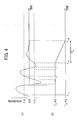
- FIG. 4 is a diagram explaining the operation for completing a continuous transmission mode at CPU of the satellite sensor shown in FIG. 1, in which (a) indicates acceleration detected by the collision detection sensor, and (b) indicates count of a collision detection timer;
- FIG. 5 is a flow chart explaining operations of the data discrimination unit of ECU shown in FIG. 1; and
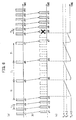
- FIG. 6 is a diagram explaining operations of the data discrimination unit of ECU shown in FIG. 1, in which (a) indicates transmission data of the satellite sensor, (b) indicates received data of ECU, and (c) indicates count of an empty timer measured by the data discrimination unit of ECU.
- With reference to FIG. 1, a communication control apparatus according to one embodiment of the present invention will be described below.
- A
communication control apparatus 1 is provided in a vehicle such as automobile. As best seen in FIG. 1, thecommunication control apparatus 1 includes asatellite sensor 20 and ECU 30, which are connected to each other through asingle signal line 10. - The satellite sensor (sensing device) 20 is arranged at a predetermined position of a front part of the vehicle. The
satellite sensor 20 transmits an impact received by the vehicle toECU 30. As shown in FIG. 1, thesatellite sensor 20 mainly consists of acollision detection sensor 21, anattachment angle sensor 22, acommunication interface 23, aRAM 24, and aCPU 25. - The
collision detection sensor 21 is an acceleration sensor for detecting an impact, etc. The detection range of thecollision detection sensor 21 is, for example, in the range of ±50-100 G. Analog signal outputted from this sensor is inputted to IN1 of theCPU 25. - The
attachment angle sensor 22 is an acceleration sensor for detecting gravity. The detection range of theattachment angle sensor 22 is sufficiently smaller than that of thecollision detection sensor 21, and is, for example, in the range of ±1 G. Analog signal outputted from this sensor is inputted to IN2 of theCPU 25. To be described later on, gravity detected by theattachment angle sensor 22 is utilized to determine at theECU 30 whether or not a change in the attachment angle (change in the sensor attachment angle) of thecollision detection sensor 21 occurs. - The
communication interface 23 transmits data stored in atransmission buffer 26 with a predetermined transmission mode to theECU 30 through thesignal line 10 based on the control of theCPU 25. The transmission mode includes an intermittent transmission mode Ms having a longer cycle T1 (e.g. 10-100 ms) and a continuous transmission mode Mc having a shorter cycle T2 (e.g. 0.5-1 ms). - RAM (Random Access Memory) 24 is a rewritable storage means such as a semiconductor memory and a magnetoresistive random access memory, and is used for the calculation process and the like of the
CPU 25 to be described later. - CPU (Central Processing Unit) 25 creates transmission data based on an input signal to IN1 or IN2, and switches the transmission mode between the intermittent transmission mode Ms and the continuous transmission mode Mc in response to the kind of the created transmission data. The
CPU 25 executes an interrupt handling for switching the input to be read in theCPU 25 between IN1 and IN2 at every predetermined time T3 (= T2/2; e.g. 0.25-0.5 ms). In this interrupt handling, theCPU 25 converts (analog-to-digital conversion) an analog signal to be inputted to IN1 to a digital signal (hereinafter referred to as collision data Dc), and transmits this collision data (collision detection information) Dc with the continuous transmission mode Mc. Further, in this interrupt handling, theCPU 25 converts (analog-to-digital conversion) an analog signal to be inputted to IN2 to a digital signal (hereinafter referred to as attachment angle data Ds), and transmits this attachment angle data (attachment angle information) Ds with the intermittent transmission mode Ms. - ECU (Electronic Control Unit: information processing device) 30 determines whether or not a collision of the vehicle occurs or a change in the sensor attachment angle occurs based on an output data from the
satellite sensor 20, and executes a predetermined process in accordance with the collision or the change in the sensor attachment angle. As best seen in FIG. 1, theECU 30 mainly consists of a collision dealing means 31, acommunication interface 32, and aCPU 33. - The collision dealing means 31 executes a process in accordance with a collision of the vehicle or a change in the sensor attachment angle based on a signal outputted from the
CPU 33. The collision dealing means 31 executes an inflation operation for expanding a passive safety device (not shown) such as an air bag, based on the collision detection signal to be outputted from acollision determination controller 35. The collision dealing means 31 also informs passengers of the state where thecollision detection sensor 21 is unable to perform a normal detection operation, by means of a warning display unit (not shown) or voice guidance, based on an attachment angle abnormal signal to be outputted from an attachmentangle detection controller 36. - The
communication interface 32 stores the received data in areception buffer 34 based on the control of theCPU 33. -
CPU 33 mainly consists of thecollision determination controller 35, the attachmentangle detection controller 36, and a data discrimination unit (data discrimination means) 37. - The
collision determination controller 35 detects whether or not a collision of the vehicle occurs on the basis of the collision data Dc. If a collision is detected, thecollision determination controller 35 outputs a collision detection signal indicating the collision to the collision dealing means 31. - The attachment
angle detection controller 36 detects whether or not the attachment angle of thecollision detection sensor 21 changes on the basis of the attachment angle data Ds. If a change in the attachment angle of thecollision detection sensor 21 is detected, the attachmentangle detection controller 36 outputs an attachment angle abnormal signal indicating the change of the attachment angle to the collision dealing means 31. - The
data discrimination unit 37 discriminates that the data (received data) received by thecommunication interface 32 is the collision data Dc or the attachment angle data Ds, and outputs the received data to thecollision determination controller 35 or the attachmentangle detection controller 36 in accordance with the kind of the data. Thedata discrimination unit 37 executes an interrupt handling for determining whether or not received data is in thereception buffer 34 at every predetermined time T4 which is slightly longer than T2 (e.g. 0.5-1 ms). In this interrupt handling, thedata discrimination unit 37 accumulates a value TN of a timer (empty timer) if no received data is in thereception buffer 34. If there is received data in thereception buffer 34, thedata discrimination unit 37 discriminates which one of the collision data Dc or the attachment angle data Ds is the received data, based on the value TN of the empty timer. - Turning now to FIG. 2 and if necessary to FIG. 1, an interrupt handling which is carried out by
CPU 25 of thesatellite sensor 20 at every predetermined time T3 will be described in detail. - At first,
CPU 25 switches the input to be read in theCPU 25 between IN1 and IN2 (step S1). To be more specific, if the previous input was for IN2, theCPU 25 switches such that an input for IN1 is read in this time to carry out an alternate switching between IN1 and IN2. -
CPU 25 determines whether or not the input has been switched over to IN1 this time (step S2). If the input has been switched to IN1 (step S2 : Yes), theCPU 25 then converts (analog-to-digital conversion) the input analog signal to the collision data Dc (step S3). Subsequently, theCPU 25 determines whether or not the absolute value of the collision data Dc is equal to or greater than a predetermined threshold value α (e.g. 6 G) (step S4). If the absolute value of the collision data Dc is equal to or greater than the threshold value α (step S4: Yes), theCPU 25 sets the value TC of a collision detection timer for a predetermined value X (hereinafter referred to as a timer set value X; e.g. X=100) (step S5), and sets a flag F to "1" (step S6), and then completes the process. Flag "F=1" indicates that a relatively large impact exceeding an allowable range of acceleration (e.g. substantially as large as the gravity; ±G) relative to the vehicle has been detected. - If the absolute value of the collision data Dc is smaller than the threshold value α (step S4: No), the
CPU 25 subtracts the value TC of the collision detection timer (step S7), and determines whether the value TC of the collision detection timer is "0" (step S8). If the value TC of the collision detection timer is "0" (step S8: Yes), theCPU 25 sets the flag F to "0" (step S9), and completes the process. Flag "F=0" indicates that an acceleration within the allowable range (e.g. substantially as large as the gravity; ±G) relative to the vehicle has been detected. - On the contrary, if the value TC of the collision detection timer is not "0" (step S8: No), the
CPU 25 proceeds to step S6 where theCPU 25 sets the flag F to "1", and then completes the process. - Meanwhile, if the input has been switched for IN2 this time (step S2: No), the
CPU 25 converts (analog-to-digital conversion) the input analog signal to the attachment angle data Ds (step S10), and determines whether the flag is "1" (step S11). If the flag is "1" (step S11: Yes), theCPU 25 stores the collision data Dc in the transmission buffer 26 (step S12), and switches the transmission mode to the continuous transmission mode Mc (step S13). This can permit continuous transmission of the collision data Dc (transmitting step). On the contrary, if the flag is "0" (step S11: No), theCPU 25 stores the attachment angle data Ds to the transmission buffer 26 (step S14), and switches the transmission mode to the intermittent transmission mode Ms (step S15). This can permit intermittent transmission of the attachment angle data Ds (transmission step). In this preferred embodiment, the processes performed in the above steps S11 through S15 correspond to the switching step defined in the claims. - Turning now to FIG. 3 and if necessary to FIG. 2, time-series operations of
CPU 25 of thesatellite sensor 20 will be described in detail. - In FIG. 3, it is supposed that time points t0 to t6 having a predetermined time interval of a predetermined time T3 elapse, and
CPU 25 reads in an input signal for IN1 at the time point to and creates the collision data Dc based on the signal read in the CPU 25 (Dc creation). In this instance, as previously shown in step S4, theCPU 25 compares and determines the magnitude between the collision data Dc and the threshold value α (collision determination). In this point of time, it is supposed that a collision of the vehicle has not occurred yet (flag F=0). - At time point t1, the
CPU 25 reads in an input signal for IN2, and creates the attachment angle data Ds (Ds creation) . In this instance, as previously shown in steps S14 and S15, theCPU 25 transmits the attachment angle data Ds with the intermittent transmission mode Ms (Dstransmission). Namely, the transmission cycle is the long period T1 which is much longer than the short period T2. - At time point t2, the
CPU 25 operates in the manner same as in the case of the time point t0. However, it is supposed that an impact exceeding the allowable range occurs (flag F=1) at this time point. - At time point t3, the
CPU 25 creates the attachment angle data Ds in the same manner as in the case of the time point t1 (Ds creation), and thereafter transmits the collision data Dc with the continuous transmission mode Mc (Dc transmission) as shown in the previous steps S12 and S13. Next, at time point t4, theCPU 25 operates in a manner same as in the case of the time point t0, and at time point t5, theCPU 25 operates in the same manner as in the case of the time point t3. Namely, the transmission cycle is the shot period T2 (=2T3). After time point t6, theCPU 25 repeats the same operations until the impact is determined within the allowable range (flag F=0) by the collision determination. - Turning now to FIG. 4 and if necessary to FIGS. 2 and 3, operation of
CPU 25 will be described for the case where an impact exceeding the allowable range converges to the allowable range (instance where the continuous transmission mode Mc is completed). - As best seen in FIG. 4(a), acceleration detected by the
collision detection sensor 21 firstly exceeds the threshold value α at the time point t11, and further exceeds the absolute value of the threshold value α for several times before the time point t12. After the time point t12, the acceleration gradually reduces the amplitude, and at the time point t13, the acceleration converges to the range of ±G. - As seen in FIG. 4(b), the value TC of the collision detection timer firstly becomes the timer set value X at the time point t11, and keeps the count of the timer set value X in the range where the acceleration detected by the
collision detection sensor 21 exceeds the absolute value of the threshold value α. The value TC of the collision detection timer decreases at a constant rate in the range where the acceleration is within the absolute value of the threshold value α. To be more specific, the value TC of the collision detection timer decreases at the constant rate from the time point t12, and becomes "0" at the time point t13. If a time interval from the time point t12 to the time point t13 is T5, the time interval T5 (e.g. 50-100 ms) can be given by the product of the short cycle T2 and the timer set value X. - Previously setting the timer set value X as described above enables
CPU 25 to confirm whether the impact has been sufficiently smaller, thereby allowing the switching from the continuous transmission mode Mc to the intermittent transmission mode Ms without error. - Turning now to FIG. 5 and if necessary to FIG. 1, an interrupt handling which is carried out by the
data discrimination unit 37 ofECU 30 at every predetermined time T4 will be described in detail. - At first, the
data discrimination unit 37 determines if there is any received data in the reception buffer 34 (step S21). If there is no received data in the reception buffer 34 (step S21: No), thedata discrimination unit 37 increases the value TN (adds a predetermined value to the value TN) of an empty timer (step S22), and completes the process. The empty timer is a timer for measuring the total (accumulated) time period during which no received data is in thereception buffer 34. - If there is received data in the reception buffer 34 (step S21: Yes) (receiving step), the
data discrimination unit 37 determines whether or not the value TN of the empty timer is "0". - If the value TN of the empty timer is "0" (step S23: Yes), the
data discrimination unit 37 outputs the received data to the collision determination controller 35 (step S24), and completes the process. Meanwhile, if the value TN of the empty timer is not "0" (step S23: No), thedata discrimination unit 37 determines whether the value TN is in a predetermined range (β ≤ TN ≤ γ) (step S25). In order to discriminate the long cycle T1, the predetermined values β, γ are defined in advance to take values, for example, corresponding to 10-100 ms. - If the value TN of the empty timer is in the predetermined range (β ≤ TN ≤ γ) (step S25: Yes), the
data discrimination unit 37 outputs the received data to the attachment angle detection controller 36 (step S26), and sets the value TN of the empty timer to "0" (step S27), and then completes the process. - If the value TN of the empty timer is not in the predetermined range (β ≤ TN ≤ γ) (step S25: No), the
data discrimination unit 37 deletes the received data from the reception buffer 34 (step S28), and proceeds to step S27. Namely, thedata discrimination unit 37 sets the value TN of the empty timer to "0" and completes the process. In this preferred embodiment, the processes performed in the above steps S23 and S25 correspond to the data discriminating step defined in the claims. - Turning now to FIG. 6 and if necessary to FIG. 5, time-series operations of the
data discrimination unit 37 will be described in detail. - As best seen in FIG. 6(a), the
satellite sensor 20 transmits data d1 to data d13 in order with a predetermined cycle.CPU 25 of thesatellite sensor 20 transmits data d1 through data d4 and data d8 through data d13 with the continuous transmission mode Mc, and transmits data d5 through data d7 with the intermittent transmission mode Ms. In other words, data d5 through data d7 is transmitted at every long cycle T1 following the previously transmitted data. Data d2 through d4 and data d9 through d13 is transmitted at every shot cycle T2 following the previously transmitted data. Further, data d8 is transmitted after the transmission of data d7 with a predetermined time interval. - As best seen in FIG. 6(b),
ECU 30 receives the data d1 through data d13 with a predetermined time difference (data d13 is omitted in this figure). This is because the cycle (T4; e.g. 0.55 ms) by which thedata discrimination unit 37 of theECU 30 executes the interrupt handling for referring to thereception buffer 34 is slightly longer than the cycle (T2; e.g. 0.5 ms) by which theCPU 25 of thesatellite sensor 20 executes the transmission process in the continuous transmission mode Mc. - Broken lines between the data d4 and d5 received indicate that there is no received data in the
reception buffer 34. Also, there is no received data between data d5 and data d6, between data d6 and data d7, and between data d7 and data d8. Further, thedata discrimination unit 37 abandons or deletes the data d8 by the following reason. - As best seen in FIG. 6(c), the value TN of the empty timer is "0" until the reception of the data d4 is completed. This is because while the cycle T2 for the continuous transmission mode Mc is set, for example, to 0.5 ms as previously described, the cycle T4 by which the
data discrimination unit 37 refers to thereception buffer 34 is set, for example, to 0.55 ms, so that whenever thedata discrimination unit 37 refers to thereception buffer 34, received data is in thereception buffer 34. For this reason, the value TN of the empty timer always takes "0", which enables thedata discrimination unit 37 to discriminate the data d1 through data d4 as data having been transmitted with the continuous transmission mode Mc, that is, the collision data Dc. - The value TN of the empty timer increases at a constant rate from when the reception of the data d4 is completed to when the reception of the data d5 is initiated as seen in FIG. 6 (c) . This is because no received data is in the
reception buffer 34. In this figure, the value TN of the empty timer takes the predetermined value γ at a time when the reception of the data d5 is initiated. Therefore, thedata discrimination unit 37 discriminates the data d5 as data having been transmitted with the intermittent transmission mode Ms, that is, the attachment angle data Ds. The value TN of the empty timer takes "0" until the reception of the data d5 is completed. The reception of the data d6 and d7 can be explained as with the case of the data d5. - Next, the value TN of the empty timer increases at a constant rate until the reception of the data d8 is initiated. However, in this instance, the value TN takes a value smaller than the predetermined value β at a time when the reception of the data d8 is initiated. Therefore, the
data discrimination unit 37 is unable to discriminate with which transmission mode the data d8 has been transmitted, that is, what is the data d8. For this reason, thedata discrimination unit 37 abandons the data d8. - According to the
communication control apparatus 1 in this preferred embodiment, the collision data and the attachment angle data can be transmitted from thesatellite sensor 20 toECU 30 through asingle signal line 10, and theECU 30 discriminates the received data to execute a predetermined process in accordance with the received data. As described above, because thesatellite sensor 20 and theECU 30 are connected through asingle signal line 10, it is possible to simplify the configuration required for thecommunication control apparatus 1 and to save the installation space in the vicinity of the vehicular hood comparing with the conventional arrangement in which two signal lines associated with the twosensors communication control apparatus 1 contributes to decrease in the manufacturing cost as well as noise reduction from the outside. - While the present invention has been described with reference to a preferred embodiment thereof, it is to be understood that various changes and modifications may be made without departing from the scope of the invention. For example, the preferred embodiment has been described for one example of the
communication control apparatus 1 including onesatellite sensor 20. However, the number ofsatellite sensors 20 is arbitrary and a plurality ofsatellite sensors 20 may be employed. - Although the preferred embodiment has been described for the
communication control apparatus 1 used in a vehicular hood control apparatus, the present invention may be used for a communication control apparatus for other than the vehicular hood control apparatus.
Claims (5)
- A communication control apparatus comprising a sensing device and an information processing device connected to the sensing device through a signal line and processing detection data detected by the sensing device,
wherein the sensing device includes:a plurality of sensors each for detecting predetermined detection data;a transmitter for transmitting the detection data detected by the sensors to the information processing device through a common signal line; anda switching device for switching a transmission cycle of the detection data transmitted by the transmitter in accordance with types of the sensors, andwherein the information processing device includes data discrimination means which discriminates received data from the sensing device based on a reception cycle of the received data, the data discrimination means discriminating by which sensor the received data has been detected as the detection data. - A communication control apparatus according to claim 1, wherein the data discrimination means of the information processing device reads out the received data at a predetermined time interval from received data storage means which temporarily stores data received from the sensing device, adds a predetermined value if no received data is stored in the received data storage means, and discriminates by which sensor the received data has been detected as the detection data based on an accumulated value.
- A communication control apparatus according to claim 2, wherein the data discrimination means of the information processing device abandons the received data that has been temporarily stored in the received data storage means if the accumulated value is not in a predetermined range.
- A communication control apparatus according to any one of claims 1 to 3, wherein the plurality of sensors of the sensing device include:a collision detection sensor for detecting collision detection information as the detection data at a time when a vehicle on which is mounted the communication control apparatus collides with a pedestrian; andan attachment angle sensor for detecting attachment angle information as the detection data at a time when an attachment angle of the collision detection sensor is changed,wherein the transmission cycle of the detection data from the collision detection sensor is shorter than the transmission cycle of the detection data from the attachment angle sensor.
- A communication control method for a communication control apparatus, which comprises a sensing device and an information processing device connected to the sensing device through a signal line and processing detection data detected by the sensing device, the method including:the steps executed by the sensing device comprising:a transmitting step for transmitting detection data that is detected by a plurality of sensors each for detecting predetermined detection data to the information processing device through a common signal line, anda switching step for switching a transmission cycle of the detection data transmitted in the transmitting step in accordance with types of the sensors, andthe steps executed by the information processing device comprising:a receiving step for receiving detection data from the sensing device; anda data discriminating step for discriminating by which sensor the received data has been detected as the detection data based on a reception cycle of the received data.
Applications Claiming Priority (1)
| Application Number | Priority Date | Filing Date | Title |
|---|---|---|---|
| JP2005106396A JP4787527B2 (en) | 2005-04-01 | 2005-04-01 | Communication control device and communication control method |
Publications (2)
| Publication Number | Publication Date |
|---|---|
| EP1707446A2 true EP1707446A2 (en) | 2006-10-04 |
| EP1707446A3 EP1707446A3 (en) | 2010-12-01 |
Family
ID=36694160
Family Applications (1)
| Application Number | Title | Priority Date | Filing Date |
|---|---|---|---|
| EP06251852A Withdrawn EP1707446A3 (en) | 2005-04-01 | 2006-03-31 | Communication control apparatus and communication control method |
Country Status (2)
| Country | Link |
|---|---|
| EP (1) | EP1707446A3 (en) |
| JP (1) | JP4787527B2 (en) |
Cited By (1)
| Publication number | Priority date | Publication date | Assignee | Title |
|---|---|---|---|---|
| US11386767B2 (en) | 2017-06-16 | 2022-07-12 | Makita Corporation | Communicator, electric working machine, and communication method |
Citations (2)
| Publication number | Priority date | Publication date | Assignee | Title |
|---|---|---|---|---|
| US5325082A (en) | 1992-11-19 | 1994-06-28 | Rodriguez Juan C | Comprehensive vehicle information storage system |
| WO2000041527A2 (en) | 1999-01-12 | 2000-07-20 | Nokia Internet Communications Inc. | Method and apparatus for providing efficient multiplexing between gateways using dynamic timers |
Family Cites Families (6)
| Publication number | Priority date | Publication date | Assignee | Title |
|---|---|---|---|---|
| JPH05213150A (en) * | 1992-01-31 | 1993-08-24 | Suzuki Motor Corp | Airbag control monitoring device |
| JP2871982B2 (en) * | 1992-11-27 | 1999-03-17 | 日本精機株式会社 | Multiplex transmission equipment for vehicles |
| JP3517951B2 (en) * | 1994-05-18 | 2004-04-12 | 株式会社デンソー | Control device for internal combustion engine for vehicle |
| JPH08216826A (en) * | 1995-02-15 | 1996-08-27 | Toyota Motor Corp | Hood airbag sensor system |
| JPH09315266A (en) * | 1996-05-31 | 1997-12-09 | Mitsubishi Motors Corp | Vehicle hood device |
| JP4306229B2 (en) * | 2002-04-03 | 2009-07-29 | タカタ株式会社 | Collision detection device and safety device |
-
2005
- 2005-04-01 JP JP2005106396A patent/JP4787527B2/en not_active Expired - Fee Related
-
2006
- 2006-03-31 EP EP06251852A patent/EP1707446A3/en not_active Withdrawn
Patent Citations (2)
| Publication number | Priority date | Publication date | Assignee | Title |
|---|---|---|---|---|
| US5325082A (en) | 1992-11-19 | 1994-06-28 | Rodriguez Juan C | Comprehensive vehicle information storage system |
| WO2000041527A2 (en) | 1999-01-12 | 2000-07-20 | Nokia Internet Communications Inc. | Method and apparatus for providing efficient multiplexing between gateways using dynamic timers |
Cited By (2)
| Publication number | Priority date | Publication date | Assignee | Title |
|---|---|---|---|---|
| US11386767B2 (en) | 2017-06-16 | 2022-07-12 | Makita Corporation | Communicator, electric working machine, and communication method |
| US11763658B2 (en) | 2017-06-16 | 2023-09-19 | Makita Corporation | Communicator, electric working machine, and communication method |
Also Published As
| Publication number | Publication date |
|---|---|
| JP2006282053A (en) | 2006-10-19 |
| EP1707446A3 (en) | 2010-12-01 |
| JP4787527B2 (en) | 2011-10-05 |
Similar Documents
| Publication | Publication Date | Title |
|---|---|---|
| US6678599B2 (en) | Device for impact detection in a vehicle | |
| US6327527B1 (en) | Activation control apparatus of occupant safety system | |
| US6438475B1 (en) | Crash detection system | |
| US7616101B2 (en) | Device for monitoring the surroundings of a vehicle | |
| KR100725735B1 (en) | Vehicle passenger restraint system with distributed sensors | |
| EP2151359B1 (en) | Collision determination system for vehicle | |
| JP6333283B2 (en) | Method and apparatus for controlling actuatable restraint devices using multi-region enhanced identification | |
| EP1026052B1 (en) | Activating control of a vehicle passenger restraint system | |
| JP2006525917A (en) | Vehicle occupant protection system | |
| US7519460B2 (en) | Device for recognition of a pole crash | |
| US7120525B2 (en) | Activation control device for airbag device | |
| US7831357B2 (en) | Apparatus for triggering restraint devices | |
| US7526382B2 (en) | Side collision plausibility with lateral velocity | |
| US6559763B2 (en) | Frontal impact characterization apparatus for a motor vehicle restraint system | |
| EP1707446A2 (en) | Communication control apparatus and communication control method | |
| JP4662137B2 (en) | Vehicle collision detection method | |
| JP4569114B2 (en) | Occupant protection system and determination device | |
| US20080185825A1 (en) | Device For Triggering a Second Airbag Stage | |
| JP5229140B2 (en) | Vehicle collision discrimination device | |
| JPH11321548A (en) | Side impact judging method and side impact judging device for vehicle | |
| KR102136398B1 (en) | Control method for the front of passenger protecting apparatus and apparatus for the same | |
| KR20060033824A (en) | Air-bag's control method | |
| KR100999673B1 (en) | Vehicle collision detection system | |
| KR20160002035A (en) | Small overlap sensing system for air bag controlling | |
| JP2006213076A (en) | Vehicle occupant protection device |
Legal Events
| Date | Code | Title | Description |
|---|---|---|---|
| PUAI | Public reference made under article 153(3) epc to a published international application that has entered the european phase |
Free format text: ORIGINAL CODE: 0009012 |
|
| AK | Designated contracting states |
Kind code of ref document: A2 Designated state(s): AT BE BG CH CY CZ DE DK EE ES FI FR GB GR HU IE IS IT LI LT LU LV MC NL PL PT RO SE SI SK TR |
|
| AX | Request for extension of the european patent |
Extension state: AL BA HR MK YU |
|
| RIC1 | Information provided on ipc code assigned before grant |
Ipc: H04L 12/40 20060101ALI20100621BHEP Ipc: B60R 21/00 20060101AFI20060801BHEP |
|
| PUAL | Search report despatched |
Free format text: ORIGINAL CODE: 0009013 |
|
| AK | Designated contracting states |
Kind code of ref document: A3 Designated state(s): AT BE BG CH CY CZ DE DK EE ES FI FR GB GR HU IE IS IT LI LT LU LV MC NL PL PT RO SE SI SK TR |
|
| AX | Request for extension of the european patent |
Extension state: AL BA HR MK YU |
|
| 17P | Request for examination filed |
Effective date: 20110601 |
|
| AKX | Designation fees paid |
Designated state(s): DE GB |
|
| 17Q | First examination report despatched |
Effective date: 20150202 |
|
| GRAP | Despatch of communication of intention to grant a patent |
Free format text: ORIGINAL CODE: EPIDOSNIGR1 |
|
| RIC1 | Information provided on ipc code assigned before grant |
Ipc: H04L 12/40 20060101AFI20160301BHEP Ipc: B60R 21/01 20060101ALI20160301BHEP Ipc: B60W 50/00 20060101ALI20160301BHEP |
|
| INTG | Intention to grant announced |
Effective date: 20160316 |
|
| RIN1 | Information on inventor provided before grant (corrected) |
Inventor name: NISHIMURA, JUNICHI, C/O HONDA R&D CO. , LTD. Inventor name: TAKAHASHI, MASAAKI, C/O KEIHIN CORPORATION Inventor name: MATSUDA, KAZUOI, C/O HONDA R&D CO. , LTD. Inventor name: ISHIZAKI, TATSUYA, C/O HONDA R&D CO. , LTD. |
|
| STAA | Information on the status of an ep patent application or granted ep patent |
Free format text: STATUS: THE APPLICATION IS DEEMED TO BE WITHDRAWN |
|
| 18D | Application deemed to be withdrawn |
Effective date: 20160727 |