EP1703770A1 - A hearing aid fitting system with a camera - Google Patents
A hearing aid fitting system with a camera Download PDFInfo
- Publication number
- EP1703770A1 EP1703770A1 EP06075611A EP06075611A EP1703770A1 EP 1703770 A1 EP1703770 A1 EP 1703770A1 EP 06075611 A EP06075611 A EP 06075611A EP 06075611 A EP06075611 A EP 06075611A EP 1703770 A1 EP1703770 A1 EP 1703770A1
- Authority
- EP
- European Patent Office
- Prior art keywords
- hearing aid
- wearer
- fitting system
- images
- camera
- Prior art date
- Legal status (The legal status is an assumption and is not a legal conclusion. Google has not performed a legal analysis and makes no representation as to the accuracy of the status listed.)
- Granted
Links
Images


Classifications
-
- H—ELECTRICITY
- H04—ELECTRIC COMMUNICATION TECHNIQUE
- H04R—LOUDSPEAKERS, MICROPHONES, GRAMOPHONE PICK-UPS OR LIKE ACOUSTIC ELECTROMECHANICAL TRANSDUCERS; ELECTRIC HEARING AIDS; PUBLIC ADDRESS SYSTEMS
- H04R25/00—Electric hearing aids
- H04R25/70—Adaptation of deaf aid to hearing loss, e.g. initial electronic fitting
-
- H—ELECTRICITY
- H04—ELECTRIC COMMUNICATION TECHNIQUE
- H04R—LOUDSPEAKERS, MICROPHONES, GRAMOPHONE PICK-UPS OR LIKE ACOUSTIC ELECTROMECHANICAL TRANSDUCERS; ELECTRIC HEARING AIDS; PUBLIC ADDRESS SYSTEMS
- H04R2225/00—Details of deaf aids covered by H04R25/00, not provided for in any of its subgroups
- H04R2225/55—Communication between hearing aids and external devices via a network for data exchange
Definitions
- the present invention relates to a hearing aid fitting system for a programmable hearing aid device.
- Hearing aid fitting systems are well known in the art, e.g. cf. US 5,835,611 . Such systems have proven adequate for adjusting signal processing parameters so that the hearing aid accurately compensates the actual hearing loss of the hearing aid wearer.
- the fitting process typically involves measuring the auditory characteristics of an individual's hearing, estimating the acoustic characteristics needed to compensate for the particular auditory deficiency measured, adjusting the auditory characteristics of the acoustic hearing aid so that the appropriate acoustic characteristics may be delivered, and verifying that these particular auditory characteristics do compensate for the hearing deficiency found by operating the acoustic hearing aid in conjunction with the individual.
- Standard techniques are known for these fittings which are typically performed by an audiologist, hearing aid dispenser, otologist, otolaryngologist, or other doctor or medical specialist.
- the threshold of the individual's hearing is typically measured using an audiometer, i.e. a calibrated sound stimulus producing device and calibrated headphones.
- the measurement of the threshold of hearing takes place in a room with very little audible noise.
- the audiometer generates pure tones at various frequencies between 125 Hz and 8,000 Hz. These tones are transmitted to the individual being tested, e.g. through headphones of the audiometer. Normally, the tones are presented in step of an octave or half an octave. The intensity or volume of the pure tones is varied and reduced until the individual can just barely detect the presence of the tone. This intensity threshold is often defined and found as the intensity of which the individual can detect 50% of the tones presented. For each pure tone, this intensity threshold is known as the individual's air conduction threshold of hearing. Although the threshold of hearing is only one element among several that characterizes an individual's hearing loss, it is the predominant measure traditionally used to acoustically fit a hearing aid.
- this threshold is used to estimate the amount of amplification, compression, and/or other adjustment that will be employed to compensate for the individual's loss of hearing.
- the implementation of the amplification, compression, and/or other adjustments and the hearing compensation achieved thereby depends upon the hearing aid being employed.
- the wearer is very concerned with his or her appearance wearing a hearing aid, and often to a degree that the wearer finds it hard to concentrate on the above-mentioned audiological measurements and adjustments performed.
- a hearing aid fitting system that allows the wearer of the hearing aid to check his or her appearance while wearing the hearing aid.
- a hearing aid fitting system comprising a computer with fitting software and having a display for displaying parameter settings of the hearing aid and input means for adjustment of the parameters, characterized in that the system further comprises a camera that is positioned so that its field of view includes the wearer of the hearing aid for recording images of the wearer's ear with the hearing aid.
- the hearing aid fitting system is further adapted for displaying images received from the camera.
- the images may be displayed as a live video stream from the camera, or a selected frame may be displayed in a window, or a video may be recorded and displayed in the window, e.g. in an endless loop.
- the operator of the system may change the displayed colour of the hearing aid in the wearer's ear allowing the hearing aid wearer to evaluate and compare his or her appearance with differently coloured hearing aids without actually wearing the hearing aid with the displayed colour.
- Images of the hearing aid wearer with hearing aids of various colours may be stored for simultaneous display for easy comparison and possible selection by the hearing aid wearer.
- the camera may be positioned in a fixed position with the intended position of the hearing aid wearer's ear with the hearing aid in the field of view of the camera.
- the hearing aid wearer may turn his or her head or change his or her position to obtain images of the head with the hearing aid from different angles.
- the camera may be mounted on a movable support allowing recording images of the wearer's head from selectable angles.
- the position of the support may be adjustable in three dimensions, e.g. the support may be movable in a horizontal plane, and its height may be adjustable.
- the hearing aid fitting system may comprise two cameras positioned to obtain images of the left and the right ear, respectively, of the hearing aid wearer. Both cameras may be mounted on a movable support as mentioned above.
- the hearing aid fitting system may be adapted for simultaneous display of an image of the right ear and the left ear.
- the movable support may be controlled by the computer for easy adjustment of the position of the camera and thereby the field of view and angle of view of each or both ears of the hearing aid wearer.
- the hearing aid fitting system may further be adapted for storage of recorded images of the hearing aid wearer.
- the hearing aid fitting system may further be adapted for password protected access to stored images.
- the hearing aid fitting system may further comprise a communication port for connection with a hearing aid supplier for communication of images of the wearer's ear and of the hearing aid housing.
- the system may for example communicate with suppliers of hearing aids through the Internet.
- the camera may be used for recording of close-up images of the outer ear and the entrance to the ear canal of the hearing aid wearer, and also close-ups of a hearing aid housing intended for the hearing aid wearer in question for transmission to the manufacturer of a specific hearing aid. This may for example allow the hearing aid manufacturer to make corrections to a custom made hearing aid housing without the need to make a new impression of the ear canal and the outer ear of a hearing aid wearer, or this feature may facilitate communication with the hearing aid supplier about other problems or possibilities.
- the hearing aid fitting system may further comprise a communication port for connection with a camera that is positioned at a remote location, e.g. at the home of a hearing aid wearer.
- the communication may for example be carried out through the Internet, and may for example take place through a home page of the operator of the hearing aid system.
- the hearing aid fitting system may further be adapted for recording and storing images from the remote camera. This allows transmission of images of a hearing aid wearer's ear from the remote location to the hearing aid fitting system.
- the hearing aid fitting system may further be adapted for password protected access to stored images from a remote location and displaying images of various hearing aids for selection and insertion into a selected stored image allowing appearance evaluation from the remote location.
- the hearing aid fitting system may further be adapted for displaying images of various hearing aids and for inserting an image of a selected hearing aid into an image of the wearer's ear allowing the wearer to evaluate his appearance with the selected hearing aid without actually wearing the hearing aid.
- the hearing aid fitting system may further be connected to a remote display unit, e.g. through the Internet, for displaying recorded images of the hearing aid wearer and for displaying images of various hearing aids and for inserting an image of a selected hearing aid into an image of the wearer's ear allowing the wearer to evaluate his appearance with the selected hearing aid without actually wearing the hearing aid.
- a remote display unit e.g. through the Internet
- the hearing aid wearer's selection of a hearing aid may be communicated from the remote location to the hearing aid fitting system, e.g. so that the selected hearing aid may be made available when the hearing aid wearer visits the operator of the hearing aid fitting system to try out the selected hearing aid.
- Fig. 1 is a photo showing utilization of a hearing aid fitting system 10 comprising a computer (located under the table) with fitting software and having a display 12 for displaying parameter settings of the hearing aid, e.g. the parameter setting is displayed using plots 14, and input means 16 for adjustment of the parameters.
- the system 10 further comprises a camera 18 that is positioned so that its field of view includes the wearer 20 of the hearing aid for recording images 22 of the wearer's ear 24 with the hearing aid.
- the hearing aid fitting system 10 is further adapted for displaying a window 26 with images received from the camera.
- the images may be displayed as a live video stream from the camera, or a selected frame may be displayed in the window 26, or a video may be recorded and displayed in the window 26, e.g. in an endless loop.
- this allows the hearing aid wearer 20 to evaluate his or her appearance with a selected hearing aid inserted in the ear.
- the operator of the system may change the displayed colour of the hearing aid in the wearer 20's ear allowing the hearing aid wearer 20 to evaluate and compare his or her appearance with differently coloured hearing aids without actually wearing the hearing aid with the displayed colour.
- Images of the hearing aid wearer 20 with hearing aids of various colours may be stored for simultaneous display for easy comparison and possible selection by the hearing aid wearer 20.
- the camera 18 is positioned on a table and may be moved around as desired in order to obtain images of the hearing aid wearer 20's ear with the hearing aid in the field of view of the camera 18.
- the hearing aid wearer 20 may also turn his or her head or change his or her position to obtain images of the head with the hearing aid from different angles.
- the camera 18 is mounted on a movable support allowing recording images of the wearer 20's head from selectable angles.
- the illustrated support is rotatable in the horizontal plane around a point proximate to the hearing aid wearer 20, and its height is adjustable.
- the hearing aid fitting system may comprise two cameras 18, 28 positioned to obtain images of the left and the right ear, respectively, of the hearing aid wearer 20. Both cameras 18, 28 may be mounted on a movable support as mentioned above.
- the hearing aid fitting system may be adapted for simultaneous display of an image of the right ear and the left ear.
- the movable supports are controlled by the computer for positioning of the camera 18, 28 in a desired position for easy adjustment of the field of view and angle of view of each or both ears of the hearing aid wearer 20.
- the hearing aid fitting system is further adapted for storage of recorded images of the hearing aid wearer 20 providing password protected access to stored images.
- the computer of the illustrated hearing aid fitting system is connected to the Intemet for communication of images of the wearer 20's ear and of the hearing aid housing to the appropriate hearing aid manufacturer.
- the camera 18 may be used for recording of close-up images of the outer ear and the entrance to the ear canal of the hearing aid wearer 20, and also close-ups of a hearing aid housing intended for the hearing aid wearer 20 in question for transmission to the manufacturer. This may for example allow the hearing aid manufacturer to make corrections to a custom made hearing aid housing without the need to make a new impression of the ear canal and the outer ear of a hearing aid wearer 20, or this feature may facilitate communication with the hearing aid supplier about other problems or possibilities.
- the hearing aid wearer may also have a camera, such as a web camera, connected with a computer that is connected to the Intemet so that the hearing aid wearer may communicate with the hearing aid fitting system, for example using a home page of the operator of the hearing aid system.
- the hearing aid fitting system is adapted for recording and storing images from the remote camera at the location of the hearing aid wearer. This allows transmission of images of a hearing aid wearer 20's ear from the remote location to the hearing aid fitting system. The transmitted images may be stored in the hearing aid fitting system.
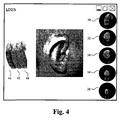
- the hearing aid wearer may obtain password protected access to stored images 22 from a remote location, e.g. using a computer with an Internet connection. Further, the system displays images 30, 32, 34, 36, 38 of various hearing aids for selection and insertion into a selected stored image allowing appearance evaluation from the remote location without the hearing aid wearer actually wearing the selected types of hearing aids 30, 32, 34, 36, 38.
- the selected hearing aid in the illustrated example, a BTE (Behind The Ear) hearing aid, is displayed in different colours 40, 42, 44 for selection of the colour of the hearing aid that is virtually inserted in the image of the ear of the hearing aid wearer.
- a professional may also gain access to the stored images.
- Useful information for the adjustment of a hearing aid may hereby be gained.
- a custom made hearing aid may be adjusted based on the image information, when needed.
- the images may hereby also enable the professional to optimize the process as such as valuable information and knowledge may be gained from a number of cases over time.
- the hearing aid fitting system may further be adapted for displaying images of various hearing aids and for inserting an image of a selected hearing aid into an image of the wearer 20's ear allowing the wearer 20 to evaluate his appearance with the selected hearing aid without actually wearing the hearing aid.
- the hearing aid fitting system may further be connected to a remote display unit, e.g. through the Internet, for displaying recorded images of the hearing aid wearer 20 and for displaying images of various hearing aids and for inserting an image of a selected hearing aid into an image of the wearer 20's ear allowing the wearer 20 to evaluate his appearance with the selected hearing aid without actually wearing the hearing aid.
- a remote display unit e.g. through the Internet
- the hearing aid wearer 20's selection of a hearing aid may be communicated from the remote location to the hearing aid fitting system so that the selected hearing aid may be made available when the hearing aid wearer 20 visits the operator of the hearing aid fitting system to try out the selected hearing aid.
Landscapes
- Health & Medical Sciences (AREA)
- General Health & Medical Sciences (AREA)
- Neurosurgery (AREA)
- Otolaryngology (AREA)
- Physics & Mathematics (AREA)
- Engineering & Computer Science (AREA)
- Acoustics & Sound (AREA)
- Signal Processing (AREA)
- Studio Devices (AREA)
- Testing, Inspecting, Measuring Of Stereoscopic Televisions And Televisions (AREA)
- Stereophonic System (AREA)
Abstract
Description
- The present invention relates to a hearing aid fitting system for a programmable hearing aid device.
- Hearing aid fitting systems are well known in the art, e.g. cf.
US 5,835,611 . Such systems have proven adequate for adjusting signal processing parameters so that the hearing aid accurately compensates the actual hearing loss of the hearing aid wearer. - The fitting process typically involves measuring the auditory characteristics of an individual's hearing, estimating the acoustic characteristics needed to compensate for the particular auditory deficiency measured, adjusting the auditory characteristics of the acoustic hearing aid so that the appropriate acoustic characteristics may be delivered, and verifying that these particular auditory characteristics do compensate for the hearing deficiency found by operating the acoustic hearing aid in conjunction with the individual.
- Standard techniques are known for these fittings which are typically performed by an audiologist, hearing aid dispenser, otologist, otolaryngologist, or other doctor or medical specialist.
- In the well-known methods of acoustically fitting a hearing aid to an individual, the threshold of the individual's hearing is typically measured using an audiometer, i.e. a calibrated sound stimulus producing device and calibrated headphones. The measurement of the threshold of hearing takes place in a room with very little audible noise.
- Generally, the audiometer generates pure tones at various frequencies between 125 Hz and 8,000 Hz. These tones are transmitted to the individual being tested, e.g. through headphones of the audiometer. Normally, the tones are presented in step of an octave or half an octave. The intensity or volume of the pure tones is varied and reduced until the individual can just barely detect the presence of the tone. This intensity threshold is often defined and found as the intensity of which the individual can detect 50% of the tones presented. For each pure tone, this intensity threshold is known as the individual's air conduction threshold of hearing. Although the threshold of hearing is only one element among several that characterizes an individual's hearing loss, it is the predominant measure traditionally used to acoustically fit a hearing aid.
- Once the threshold of hearing in each frequency band has been determined, this threshold is used to estimate the amount of amplification, compression, and/or other adjustment that will be employed to compensate for the individual's loss of hearing. The implementation of the amplification, compression, and/or other adjustments and the hearing compensation achieved thereby depends upon the hearing aid being employed. There are various formulas known in the art which have been used to estimate the acoustic parameters based upon the observed threshold of hearing. These include generic rules, such as NAL and POGO, which may be used when fitting hearing aid from most hearing aid manufactures. There are also various proprietary methods used by various hearing aid manufacturers. Additionally, based upon the experience of the person performing the testing and the fitting of the hearing aid to the individual, these various formulas may be adjusted.
- Typically, however, the wearer is very concerned with his or her appearance wearing a hearing aid, and often to a degree that the wearer finds it hard to concentrate on the above-mentioned audiological measurements and adjustments performed. Thus, there is a need for a hearing aid fitting system that allows the wearer of the hearing aid to check his or her appearance while wearing the hearing aid.
- According to the invention, the above-mentioned and other objects are fulfilled by provision of a hearing aid fitting system comprising a computer with fitting software and having a display for displaying parameter settings of the hearing aid and input means for adjustment of the parameters, characterized in that the system further comprises a camera that is positioned so that its field of view includes the wearer of the hearing aid for recording images of the wearer's ear with the hearing aid.
- The hearing aid fitting system is further adapted for displaying images received from the camera. The images may be displayed as a live video stream from the camera, or a selected frame may be displayed in a window, or a video may be recorded and displayed in the window, e.g. in an endless loop.
- This allows the hearing aid wearer to evaluate his or her appearance with a selected hearing aid inserted in the ear or positioned behind the ear.
- In a preferred embodiment of the hearing aid fitting system, the operator of the system may change the displayed colour of the hearing aid in the wearer's ear allowing the hearing aid wearer to evaluate and compare his or her appearance with differently coloured hearing aids without actually wearing the hearing aid with the displayed colour.
- Images of the hearing aid wearer with hearing aids of various colours may be stored for simultaneous display for easy comparison and possible selection by the hearing aid wearer.
- The camera may be positioned in a fixed position with the intended position of the hearing aid wearer's ear with the hearing aid in the field of view of the camera. The hearing aid wearer may turn his or her head or change his or her position to obtain images of the head with the hearing aid from different angles. Alternatively, the camera may be mounted on a movable support allowing recording images of the wearer's head from selectable angles. The position of the support may be adjustable in three dimensions, e.g. the support may be movable in a horizontal plane, and its height may be adjustable.
- Further, the hearing aid fitting system may comprise two cameras positioned to obtain images of the left and the right ear, respectively, of the hearing aid wearer. Both cameras may be mounted on a movable support as mentioned above.
- The hearing aid fitting system may be adapted for simultaneous display of an image of the right ear and the left ear.
- The movable support may be controlled by the computer for easy adjustment of the position of the camera and thereby the field of view and angle of view of each or both ears of the hearing aid wearer.
- The hearing aid fitting system may further be adapted for storage of recorded images of the hearing aid wearer.
- The hearing aid fitting system may further be adapted for password protected access to stored images.
- The hearing aid fitting system may further comprise a communication port for connection with a hearing aid supplier for communication of images of the wearer's ear and of the hearing aid housing. The system may for example communicate with suppliers of hearing aids through the Internet. Further, the camera may be used for recording of close-up images of the outer ear and the entrance to the ear canal of the hearing aid wearer, and also close-ups of a hearing aid housing intended for the hearing aid wearer in question for transmission to the manufacturer of a specific hearing aid. This may for example allow the hearing aid manufacturer to make corrections to a custom made hearing aid housing without the need to make a new impression of the ear canal and the outer ear of a hearing aid wearer, or this feature may facilitate communication with the hearing aid supplier about other problems or possibilities.
- The hearing aid fitting system may further comprise a communication port for connection with a camera that is positioned at a remote location, e.g. at the home of a hearing aid wearer. The communication may for example be carried out through the Internet, and may for example take place through a home page of the operator of the hearing aid system. The hearing aid fitting system may further be adapted for recording and storing images from the remote camera. This allows transmission of images of a hearing aid wearer's ear from the remote location to the hearing aid fitting system.
- The hearing aid fitting system may further be adapted for password protected access to stored images from a remote location and displaying images of various hearing aids for selection and insertion into a selected stored image allowing appearance evaluation from the remote location.
- The hearing aid fitting system may further be adapted for displaying images of various hearing aids and for inserting an image of a selected hearing aid into an image of the wearer's ear allowing the wearer to evaluate his appearance with the selected hearing aid without actually wearing the hearing aid.
- The hearing aid fitting system may further be connected to a remote display unit, e.g. through the Internet, for displaying recorded images of the hearing aid wearer and for displaying images of various hearing aids and for inserting an image of a selected hearing aid into an image of the wearer's ear allowing the wearer to evaluate his appearance with the selected hearing aid without actually wearing the hearing aid.
- The hearing aid wearer's selection of a hearing aid may be communicated from the remote location to the hearing aid fitting system, e.g. so that the selected hearing aid may be made available when the hearing aid wearer visits the operator of the hearing aid fitting system to try out the selected hearing aid.
- The invention will be explained more detailed in the following description of preferred embodiments with reference to the drawing, wherein
- Fig. 1
- is a photo of a hearing aid wearer and a hearing aid fitting system with a camera,
- Fig. 2
- is a photo of the display of the hearing aid fitting system of Fig. 1,
- Fig. 3
- illustrates schematically the positioning of cameras of a hearing aid fitting system in relation to the hearing aid wearer, and
- Fig. 4
- is one of the windows displayed by the hearing aid fitting system.
- Fig. 1 is a photo showing utilization of a hearing aid fitting system 10 comprising a computer (located under the table) with fitting software and having a
display 12 for displaying parameter settings of the hearing aid, e.g. the parameter setting is displayed using plots 14, and input means 16 for adjustment of the parameters. The system 10 further comprises acamera 18 that is positioned so that its field of view includes thewearer 20 of the hearing aid forrecording images 22 of the wearer's ear 24 with the hearing aid. - The hearing aid fitting system 10 is further adapted for displaying a
window 26 with images received from the camera. The images may be displayed as a live video stream from the camera, or a selected frame may be displayed in thewindow 26, or a video may be recorded and displayed in thewindow 26, e.g. in an endless loop. - As clearly illustrated in fig. 1, this allows the
hearing aid wearer 20 to evaluate his or her appearance with a selected hearing aid inserted in the ear. - In a preferred embodiment of the hearing aid fitting system, the operator of the system may change the displayed colour of the hearing aid in the
wearer 20's ear allowing thehearing aid wearer 20 to evaluate and compare his or her appearance with differently coloured hearing aids without actually wearing the hearing aid with the displayed colour. - Images of the
hearing aid wearer 20 with hearing aids of various colours may be stored for simultaneous display for easy comparison and possible selection by thehearing aid wearer 20. - In the illustrated embodiment, the
camera 18 is positioned on a table and may be moved around as desired in order to obtain images of thehearing aid wearer 20's ear with the hearing aid in the field of view of thecamera 18. Thehearing aid wearer 20 may also turn his or her head or change his or her position to obtain images of the head with the hearing aid from different angles. - In another embodiment of the invention schematically illustrated in Fig. 3, the
camera 18 is mounted on a movable support allowing recording images of thewearer 20's head from selectable angles. The illustrated support is rotatable in the horizontal plane around a point proximate to thehearing aid wearer 20, and its height is adjustable. - As also illustrated in Fig. 3, the hearing aid fitting system may comprise two
cameras hearing aid wearer 20. Bothcameras - The hearing aid fitting system may be adapted for simultaneous display of an image of the right ear and the left ear.
- The movable supports are controlled by the computer for positioning of the
camera hearing aid wearer 20. - The hearing aid fitting system is further adapted for storage of recorded images of the
hearing aid wearer 20 providing password protected access to stored images. - The computer of the illustrated hearing aid fitting system is connected to the Intemet for communication of images of the
wearer 20's ear and of the hearing aid housing to the appropriate hearing aid manufacturer. Further, thecamera 18 may be used for recording of close-up images of the outer ear and the entrance to the ear canal of thehearing aid wearer 20, and also close-ups of a hearing aid housing intended for thehearing aid wearer 20 in question for transmission to the manufacturer. This may for example allow the hearing aid manufacturer to make corrections to a custom made hearing aid housing without the need to make a new impression of the ear canal and the outer ear of ahearing aid wearer 20, or this feature may facilitate communication with the hearing aid supplier about other problems or possibilities. - The hearing aid wearer may also have a camera, such as a web camera, connected with a computer that is connected to the Intemet so that the hearing aid wearer may communicate with the hearing aid fitting system, for example using a home page of the operator of the hearing aid system. The hearing aid fitting system is adapted for recording and storing images from the remote camera at the location of the hearing aid wearer. This allows transmission of images of a
hearing aid wearer 20's ear from the remote location to the hearing aid fitting system. The transmitted images may be stored in the hearing aid fitting system. - As shown in Fig. 4, the hearing aid wearer may obtain password protected access to stored
images 22 from a remote location, e.g. using a computer with an Internet connection. Further, the system displaysimages different colours - The hearing aid fitting system may further be adapted for displaying images of various hearing aids and for inserting an image of a selected hearing aid into an image of the
wearer 20's ear allowing thewearer 20 to evaluate his appearance with the selected hearing aid without actually wearing the hearing aid. - The hearing aid fitting system may further be connected to a remote display unit, e.g. through the Internet, for displaying recorded images of the
hearing aid wearer 20 and for displaying images of various hearing aids and for inserting an image of a selected hearing aid into an image of thewearer 20's ear allowing thewearer 20 to evaluate his appearance with the selected hearing aid without actually wearing the hearing aid. - The
hearing aid wearer 20's selection of a hearing aid may be communicated from the remote location to the hearing aid fitting system so that the selected hearing aid may be made available when thehearing aid wearer 20 visits the operator of the hearing aid fitting system to try out the selected hearing aid.
Claims (11)
- A hearing aid fitting system comprising a computer with fitting software and having a display for displaying parameter settings of -a hearing aid and input means for adjustment of the parameters,
characterized in that the system further comprises a camera for recording images of the wearer's head including the ear with the hearing aid, and a display for displaying at least one image received from the camera. - A hearing aid fitting system according to claim 1, further comprising a movable support for the camera allowing recording images of the wearer's head from selectable angles.
- A hearing aid fitting system according to claim 2, wherein the position of the movable support is controlled by the computer.
- A hearing aid fitting system according to any of the previous claims, further comprising a communication port for connection with a hearing aid supplier for communication of images of the wearer's ear and of the hearing aid housing.
- A hearing aid fitting system according to any of the previous claims, further adapted for changing the displayed colour of the hearing aid in the wearer's ear allowing the hearing aid wearer to evaluate appearance with the displayed colour without actually wearing a hearing aid with the displayed colour.
- A hearing aid fitting system according to any of the previous claims, further adapted for displaying images of various hearing aids and for inserting an image of a selected hearing aid into an image of the wearer's ear allowing the wearer to evaluate his appearance with the selected hearing aid without actually wearing the hearing aid.
- A hearing aid fitting system according to any of the previous claims, further adapted for storage of recorded images of the hearing aid wearer.
- A hearing aid fitting system according to claim 7, further adapted for password protected access to stored images from a remote location and displaying images of various hearing aids for selection and insertion into a selected stored image allowing appearance evaluation from the remote location.
- A hearing aid fitting system according to claim 8, further adapted for communication of a hearing aid selection from the remote location to the hearing aid fitting system.
- A hearing aid fitting system according to claims 8 or 9, further adapted for communication with a second camera at the remote location allowing transmission of images of a hearing aid wearer's ear from the remote location to the hearing aid fitting system.
- Fitting software for a hearing aid fitting system comprising a computer, a display, and input means, wherein the fitting software is adapted for displaying on the display parameter settings of a hearing aid and for adjusting the parameters based on input from the input means,
characterized in that fitting software is further adapted for receiving from a camera images of the wearer's head including the ear with the hearing aid, and for displaying on the display means at least one image received from the camera.
Applications Claiming Priority (1)
| Application Number | Priority Date | Filing Date | Title |
|---|---|---|---|
| US66138105P | 2005-03-14 | 2005-03-14 |
Publications (2)
| Publication Number | Publication Date |
|---|---|
| EP1703770A1 true EP1703770A1 (en) | 2006-09-20 |
| EP1703770B1 EP1703770B1 (en) | 2017-05-03 |
Family
ID=36407932
Family Applications (1)
| Application Number | Title | Priority Date | Filing Date |
|---|---|---|---|
| EP06075611.1A Expired - Lifetime EP1703770B1 (en) | 2005-03-14 | 2006-03-14 | A hearing aid fitting system with a camera |
Country Status (3)
| Country | Link |
|---|---|
| US (1) | US7660426B2 (en) |
| EP (1) | EP1703770B1 (en) |
| DK (1) | DK1703770T3 (en) |
Cited By (4)
| Publication number | Priority date | Publication date | Assignee | Title |
|---|---|---|---|---|
| WO2012010199A1 (en) * | 2010-07-19 | 2012-01-26 | Phonak Ag | Visually-based fitting of hearing devices |
| US10758177B2 (en) | 2013-05-31 | 2020-09-01 | Cochlear Limited | Clinical fitting assistance using software analysis of stimuli |
| EP3796673A1 (en) * | 2019-09-20 | 2021-03-24 | GN Hearing A/S | An application for assisting a hearing device wearer |
| DE102019219908B4 (en) | 2019-12-17 | 2023-12-07 | Sivantos Pte. Ltd. | Method for photographically recording an ear |
Families Citing this family (25)
| Publication number | Priority date | Publication date | Assignee | Title |
|---|---|---|---|---|
| WO2007045696A2 (en) * | 2006-01-06 | 2007-04-26 | Phonak Ag | Method and system for reconstructing the three-dimensional shape of the surface of at least a portion of an ear canal and/or of a concha |
| EP2183928B1 (en) * | 2007-09-05 | 2011-01-19 | Phonak AG | Method of individually fitting a hearing device or hearing aid |
| US9706282B2 (en) * | 2009-02-23 | 2017-07-11 | Harman International Industries, Incorporated | Earpiece system |
| US8553897B2 (en) | 2009-06-09 | 2013-10-08 | Dean Robert Gary Anderson | Method and apparatus for directional acoustic fitting of hearing aids |
| US9101299B2 (en) | 2009-07-23 | 2015-08-11 | Dean Robert Gary Anderson As Trustee Of The D/L Anderson Family Trust | Hearing aids configured for directional acoustic fitting |
| US8879745B2 (en) | 2009-07-23 | 2014-11-04 | Dean Robert Gary Anderson As Trustee Of The D/L Anderson Family Trust | Method of deriving individualized gain compensation curves for hearing aid fitting |
| EP2468015B1 (en) * | 2009-08-17 | 2019-01-16 | Harman International Industries, Inc. | Ear sizing system and method |
| US20110044483A1 (en) * | 2009-08-18 | 2011-02-24 | Starkey Laboratories, Inc. | Method and apparatus for specialized gesture sensing for fitting hearing aids |
| US9050029B2 (en) | 2010-01-06 | 2015-06-09 | Harman International Industries, Inc. | Image capture and earpiece sizing system and method |
| US8942397B2 (en) | 2011-11-16 | 2015-01-27 | Dean Robert Gary Anderson | Method and apparatus for adding audible noise with time varying volume to audio devices |
| US9030545B2 (en) * | 2011-12-30 | 2015-05-12 | GNR Resound A/S | Systems and methods for determining head related transfer functions |
| WO2014049148A1 (en) | 2012-09-27 | 2014-04-03 | Jacoti Bvba | Method for adjusting parameters of a hearing aid functionality provided in a consumer electronics device |
| US10142743B2 (en) | 2016-01-01 | 2018-11-27 | Dean Robert Gary Anderson | Parametrically formulated noise and audio systems, devices, and methods thereof |
| US20180132044A1 (en) * | 2016-11-04 | 2018-05-10 | Bragi GmbH | Hearing aid with camera |
| US10841724B1 (en) | 2017-01-24 | 2020-11-17 | Ha Tran | Enhanced hearing system |
| US11166115B2 (en) * | 2018-10-18 | 2021-11-02 | Gn Hearing A/S | Device and method for hearing device customization |
| WO2021101845A1 (en) * | 2019-11-19 | 2021-05-27 | Starkey Laboratories, Inc. | Automatic selection of hearing instrument component size |
| EP4085654A1 (en) | 2019-12-31 | 2022-11-09 | Starkey Laboratories, Inc. | Methods and systems for assessing insertion position of an in-ear assembly of a hearing instrument |
| US12389166B2 (en) | 2020-07-31 | 2025-08-12 | Starkey Laboratories, Inc. | Sensor based ear-worn electronic device fit assessment |
| WO2022066307A2 (en) | 2020-09-28 | 2022-03-31 | Starkey Laboratories, Inc. | Temperature sensor based ear-worn electronic device fit assessment |
| US12101606B2 (en) * | 2021-05-28 | 2024-09-24 | Starkey Laboratories, Inc. | Methods and systems for assessing insertion position of hearing instrument |
| EP4367897A1 (en) | 2021-07-06 | 2024-05-15 | Starkey Laboratories, Inc. | Context-based user availability for notifications |
| EP4140401B1 (en) | 2021-08-31 | 2025-09-17 | Starkey Laboratories, Inc. | Ear-wearable electronic device including in-canal temperature sensor |
| US12444076B2 (en) * | 2021-09-24 | 2025-10-14 | Gn Hearing A/S | Triggering a head-pose dependent action |
| US12483843B2 (en) | 2022-06-07 | 2025-11-25 | Starkey Laboratories, Inc. | Context-based situational awareness for hearing instruments |
Citations (3)
| Publication number | Priority date | Publication date | Assignee | Title |
|---|---|---|---|---|
| WO1990009760A1 (en) * | 1989-03-02 | 1990-09-07 | Ensoniq Corporation | Apparatus and a method for fitting a hearing aid |
| WO2001008443A2 (en) | 1999-07-23 | 2001-02-01 | Sarnoff Corporation | One-size-fits-all uni-ear hearing instrument |
| US20030223083A1 (en) | 2000-01-28 | 2003-12-04 | Geng Z Jason | Method and apparatus for generating structural pattern illumination |
Family Cites Families (12)
| Publication number | Priority date | Publication date | Assignee | Title |
|---|---|---|---|---|
| US5574342A (en) * | 1994-04-14 | 1996-11-12 | Nidec Corporation | Brushless motor |
| DE4418203C2 (en) * | 1994-05-25 | 1997-09-11 | Siemens Audiologische Technik | Method for adapting the transmission characteristic of a hearing aid |
| WO1998056209A2 (en) | 1997-06-02 | 1998-12-10 | Marie Lapalme | Video-assisted apparatus for hearing impaired persons |
| EP0917397A1 (en) * | 1997-10-14 | 1999-05-19 | Siemens Audiologische Technik GmbH | Method of determining a set of parameters of a hearing aid |
| US6366863B1 (en) * | 1998-01-09 | 2002-04-02 | Micro Ear Technology Inc. | Portable hearing-related analysis system |
| US6201875B1 (en) | 1998-03-17 | 2001-03-13 | Sonic Innovations, Inc. | Hearing aid fitting system |
| EP0915639A1 (en) * | 1999-01-05 | 1999-05-12 | Phonak Ag | Method for binaural adjusting of hearing aids |
| AU2571900A (en) | 1999-02-16 | 2000-09-04 | Yugen Kaisha Gm&M | Speech converting device and method |
| US6920358B2 (en) * | 2000-05-26 | 2005-07-19 | Second Sight Medical Products, Inc. | Video processing methods for improving visual acuity and/or perceived image resolution |
| AU2000276782A1 (en) * | 2000-10-11 | 2002-04-22 | Concepcionlicence Ag | Spray-spin coating method |
| DE10147812B4 (en) | 2001-09-27 | 2007-01-11 | Siemens Audiologische Technik Gmbh | Hearing aid with non-acoustic control support |
| US7209177B2 (en) * | 2002-09-03 | 2007-04-24 | Audisoft | Headset for camera |
-
2006
- 2006-03-14 DK DK06075611.1T patent/DK1703770T3/en active
- 2006-03-14 EP EP06075611.1A patent/EP1703770B1/en not_active Expired - Lifetime
- 2006-03-14 US US11/375,972 patent/US7660426B2/en active Active
Patent Citations (3)
| Publication number | Priority date | Publication date | Assignee | Title |
|---|---|---|---|---|
| WO1990009760A1 (en) * | 1989-03-02 | 1990-09-07 | Ensoniq Corporation | Apparatus and a method for fitting a hearing aid |
| WO2001008443A2 (en) | 1999-07-23 | 2001-02-01 | Sarnoff Corporation | One-size-fits-all uni-ear hearing instrument |
| US20030223083A1 (en) | 2000-01-28 | 2003-12-04 | Geng Z Jason | Method and apparatus for generating structural pattern illumination |
Cited By (10)
| Publication number | Priority date | Publication date | Assignee | Title |
|---|---|---|---|---|
| WO2012010199A1 (en) * | 2010-07-19 | 2012-01-26 | Phonak Ag | Visually-based fitting of hearing devices |
| CN103081513A (en) * | 2010-07-19 | 2013-05-01 | 福纳克有限公司 | Visually-based fitting of hearing devices |
| CN103081513B (en) * | 2010-07-19 | 2015-11-25 | 索诺瓦股份公司 | Vision-Based Fitting of Hearing Devices |
| US9288593B2 (en) | 2010-07-19 | 2016-03-15 | Sonova Ag | Visually-based fitting of hearing devices |
| EP2596646B1 (en) | 2010-07-19 | 2017-11-08 | Sonova AG | Visually-based fitting of hearing devices |
| US10758177B2 (en) | 2013-05-31 | 2020-09-01 | Cochlear Limited | Clinical fitting assistance using software analysis of stimuli |
| US11944453B2 (en) | 2013-05-31 | 2024-04-02 | Cochlear Limited | Clinical fitting assistance using software analysis of stimuli |
| EP3796673A1 (en) * | 2019-09-20 | 2021-03-24 | GN Hearing A/S | An application for assisting a hearing device wearer |
| US12236680B2 (en) | 2019-09-20 | 2025-02-25 | Gn Hearing A/S | Application for assisting a hearing device wearer |
| DE102019219908B4 (en) | 2019-12-17 | 2023-12-07 | Sivantos Pte. Ltd. | Method for photographically recording an ear |
Also Published As
| Publication number | Publication date |
|---|---|
| US20060204013A1 (en) | 2006-09-14 |
| EP1703770B1 (en) | 2017-05-03 |
| US7660426B2 (en) | 2010-02-09 |
| DK1703770T3 (en) | 2017-06-12 |
Similar Documents
| Publication | Publication Date | Title |
|---|---|---|
| US7660426B2 (en) | Hearing aid fitting system with a camera | |
| US7016504B1 (en) | Personal hearing evaluator | |
| EP1488618B1 (en) | Multifunctional mobile phone for medical diagnosis and rehabilitation | |
| US8298155B2 (en) | Pure tone audiometer with automated masking | |
| US10341790B2 (en) | Self-fitting of a hearing device | |
| DK2870779T3 (en) | METHOD AND SYSTEM FOR THE ASSEMBLY OF HEARING AID, FOR SELECTING INDIVIDUALS IN CONSULTATION WITH HEARING AID AND / OR FOR DIAGNOSTIC HEARING TESTS OF HEARING AID | |
| US12101604B2 (en) | Systems, devices and methods for fitting hearing assistance devices | |
| US20110009770A1 (en) | Audiometric Testing and Calibration Devices and Methods | |
| AU2018315630B2 (en) | Hearing evaluation system | |
| CA2876251C (en) | System and method for hearing aid appraisal and selection | |
| US20130121496A1 (en) | Visually-based fitting of hearing devices | |
| Gengel et al. | A frequency-response procedure for evaluating and selecting hearing aids for severely hearing-impaired children | |
| JP2008109594A (en) | Method and system for adjusting hearing aid performance | |
| US20250030992A1 (en) | Electronic hearing device and method | |
| Harford | The use of a miniature microphone in the ear canal for the verification of hearing aid performance | |
| Harford | A new clinical technique for verification of hearing aid response | |
| Kuk et al. | Using digital hearing aids to visualize real-life effects of signal processing | |
| EP1303165A1 (en) | Hearing aid | |
| Putterman et al. | Difference between the default telecoil (t-coil) and programmed microphone frequency response in behind-the-ear (BTE) hearing aids | |
| Bisitz et al. | Automated pure-tone audiometry software tool with extended frequency range | |
| Schmidt et al. | Match to target: how to get accurate first fits | |
| WO2025126918A1 (en) | Acoustic device, acoustic method, and acoustic program | |
| Yanz et al. | Integrating Real Ear Measurement into Destiny™ and Z� n™ Hearing Instruments | |
| Coverstone | The effect of using averaged versus custom real-ear to coupler difference values in the desired sensation level approach to prescribing hearing instrument gain | |
| Jaderholm | Comparison of Generic Prescriptive Targets Between Hearing Aid Manufacturers and a Real-Ear Analyzer |
Legal Events
| Date | Code | Title | Description |
|---|---|---|---|
| PUAI | Public reference made under article 153(3) epc to a published international application that has entered the european phase |
Free format text: ORIGINAL CODE: 0009012 |
|
| AK | Designated contracting states |
Kind code of ref document: A1 Designated state(s): AT BE BG CH CY CZ DE DK EE ES FI FR GB GR HU IE IS IT LI LT LU LV MC NL PL PT RO SE SI SK TR |
|
| AX | Request for extension of the european patent |
Extension state: AL BA HR MK YU |
|
| 17P | Request for examination filed |
Effective date: 20070320 |
|
| 17Q | First examination report despatched |
Effective date: 20070425 |
|
| AKX | Designation fees paid |
Designated state(s): AT BE BG CH CY CZ DE DK EE ES FI FR GB GR HU IE IS IT LI LT LU LV MC NL PL PT RO SE SI SK TR |
|
| GRAP | Despatch of communication of intention to grant a patent |
Free format text: ORIGINAL CODE: EPIDOSNIGR1 |
|
| INTG | Intention to grant announced |
Effective date: 20161021 |
|
| GRAS | Grant fee paid |
Free format text: ORIGINAL CODE: EPIDOSNIGR3 |
|
| GRAA | (expected) grant |
Free format text: ORIGINAL CODE: 0009210 |
|
| AK | Designated contracting states |
Kind code of ref document: B1 Designated state(s): AT BE BG CH CY CZ DE DK EE ES FI FR GB GR HU IE IS IT LI LT LU LV MC NL PL PT RO SE SI SK TR |
|
| REG | Reference to a national code |
Ref country code: GB Ref legal event code: FG4D |
|
| REG | Reference to a national code |
Ref country code: AT Ref legal event code: REF Ref document number: 891201 Country of ref document: AT Kind code of ref document: T Effective date: 20170515 Ref country code: CH Ref legal event code: EP |
|
| REG | Reference to a national code |
Ref country code: IE Ref legal event code: FG4D |
|
| REG | Reference to a national code |
Ref country code: DK Ref legal event code: T3 Effective date: 20170607 |
|
| REG | Reference to a national code |
Ref country code: DE Ref legal event code: R096 Ref document number: 602006052414 Country of ref document: DE |
|
| REG | Reference to a national code |
Ref country code: NL Ref legal event code: MP Effective date: 20170503 |
|
| REG | Reference to a national code |
Ref country code: AT Ref legal event code: MK05 Ref document number: 891201 Country of ref document: AT Kind code of ref document: T Effective date: 20170503 |
|
| REG | Reference to a national code |
Ref country code: LT Ref legal event code: MG4D |
|
| PG25 | Lapsed in a contracting state [announced via postgrant information from national office to epo] |
Ref country code: LT Free format text: LAPSE BECAUSE OF FAILURE TO SUBMIT A TRANSLATION OF THE DESCRIPTION OR TO PAY THE FEE WITHIN THE PRESCRIBED TIME-LIMIT Effective date: 20170503 Ref country code: GR Free format text: LAPSE BECAUSE OF FAILURE TO SUBMIT A TRANSLATION OF THE DESCRIPTION OR TO PAY THE FEE WITHIN THE PRESCRIBED TIME-LIMIT Effective date: 20170804 Ref country code: AT Free format text: LAPSE BECAUSE OF FAILURE TO SUBMIT A TRANSLATION OF THE DESCRIPTION OR TO PAY THE FEE WITHIN THE PRESCRIBED TIME-LIMIT Effective date: 20170503 Ref country code: FI Free format text: LAPSE BECAUSE OF FAILURE TO SUBMIT A TRANSLATION OF THE DESCRIPTION OR TO PAY THE FEE WITHIN THE PRESCRIBED TIME-LIMIT Effective date: 20170503 Ref country code: ES Free format text: LAPSE BECAUSE OF FAILURE TO SUBMIT A TRANSLATION OF THE DESCRIPTION OR TO PAY THE FEE WITHIN THE PRESCRIBED TIME-LIMIT Effective date: 20170503 |
|
| PG25 | Lapsed in a contracting state [announced via postgrant information from national office to epo] |
Ref country code: LV Free format text: LAPSE BECAUSE OF FAILURE TO SUBMIT A TRANSLATION OF THE DESCRIPTION OR TO PAY THE FEE WITHIN THE PRESCRIBED TIME-LIMIT Effective date: 20170503 Ref country code: IS Free format text: LAPSE BECAUSE OF FAILURE TO SUBMIT A TRANSLATION OF THE DESCRIPTION OR TO PAY THE FEE WITHIN THE PRESCRIBED TIME-LIMIT Effective date: 20170903 Ref country code: BG Free format text: LAPSE BECAUSE OF FAILURE TO SUBMIT A TRANSLATION OF THE DESCRIPTION OR TO PAY THE FEE WITHIN THE PRESCRIBED TIME-LIMIT Effective date: 20170803 Ref country code: SE Free format text: LAPSE BECAUSE OF FAILURE TO SUBMIT A TRANSLATION OF THE DESCRIPTION OR TO PAY THE FEE WITHIN THE PRESCRIBED TIME-LIMIT Effective date: 20170503 Ref country code: PL Free format text: LAPSE BECAUSE OF FAILURE TO SUBMIT A TRANSLATION OF THE DESCRIPTION OR TO PAY THE FEE WITHIN THE PRESCRIBED TIME-LIMIT Effective date: 20170503 Ref country code: NL Free format text: LAPSE BECAUSE OF FAILURE TO SUBMIT A TRANSLATION OF THE DESCRIPTION OR TO PAY THE FEE WITHIN THE PRESCRIBED TIME-LIMIT Effective date: 20170503 |
|
| PG25 | Lapsed in a contracting state [announced via postgrant information from national office to epo] |
Ref country code: CZ Free format text: LAPSE BECAUSE OF FAILURE TO SUBMIT A TRANSLATION OF THE DESCRIPTION OR TO PAY THE FEE WITHIN THE PRESCRIBED TIME-LIMIT Effective date: 20170503 Ref country code: SK Free format text: LAPSE BECAUSE OF FAILURE TO SUBMIT A TRANSLATION OF THE DESCRIPTION OR TO PAY THE FEE WITHIN THE PRESCRIBED TIME-LIMIT Effective date: 20170503 Ref country code: RO Free format text: LAPSE BECAUSE OF FAILURE TO SUBMIT A TRANSLATION OF THE DESCRIPTION OR TO PAY THE FEE WITHIN THE PRESCRIBED TIME-LIMIT Effective date: 20170503 Ref country code: EE Free format text: LAPSE BECAUSE OF FAILURE TO SUBMIT A TRANSLATION OF THE DESCRIPTION OR TO PAY THE FEE WITHIN THE PRESCRIBED TIME-LIMIT Effective date: 20170503 |
|
| REG | Reference to a national code |
Ref country code: DE Ref legal event code: R097 Ref document number: 602006052414 Country of ref document: DE |
|
| PG25 | Lapsed in a contracting state [announced via postgrant information from national office to epo] |
Ref country code: IT Free format text: LAPSE BECAUSE OF FAILURE TO SUBMIT A TRANSLATION OF THE DESCRIPTION OR TO PAY THE FEE WITHIN THE PRESCRIBED TIME-LIMIT Effective date: 20170503 |
|
| PLBE | No opposition filed within time limit |
Free format text: ORIGINAL CODE: 0009261 |
|
| STAA | Information on the status of an ep patent application or granted ep patent |
Free format text: STATUS: NO OPPOSITION FILED WITHIN TIME LIMIT |
|
| REG | Reference to a national code |
Ref country code: FR Ref legal event code: PLFP Year of fee payment: 13 |
|
| 26N | No opposition filed |
Effective date: 20180206 |
|
| PG25 | Lapsed in a contracting state [announced via postgrant information from national office to epo] |
Ref country code: SI Free format text: LAPSE BECAUSE OF FAILURE TO SUBMIT A TRANSLATION OF THE DESCRIPTION OR TO PAY THE FEE WITHIN THE PRESCRIBED TIME-LIMIT Effective date: 20170503 |
|
| PG25 | Lapsed in a contracting state [announced via postgrant information from national office to epo] |
Ref country code: MC Free format text: LAPSE BECAUSE OF FAILURE TO SUBMIT A TRANSLATION OF THE DESCRIPTION OR TO PAY THE FEE WITHIN THE PRESCRIBED TIME-LIMIT Effective date: 20170503 |
|
| REG | Reference to a national code |
Ref country code: BE Ref legal event code: MM Effective date: 20180331 |
|
| REG | Reference to a national code |
Ref country code: IE Ref legal event code: MM4A |
|
| PG25 | Lapsed in a contracting state [announced via postgrant information from national office to epo] |
Ref country code: LU Free format text: LAPSE BECAUSE OF NON-PAYMENT OF DUE FEES Effective date: 20180314 |
|
| PG25 | Lapsed in a contracting state [announced via postgrant information from national office to epo] |
Ref country code: IE Free format text: LAPSE BECAUSE OF NON-PAYMENT OF DUE FEES Effective date: 20180314 |
|
| PG25 | Lapsed in a contracting state [announced via postgrant information from national office to epo] |
Ref country code: BE Free format text: LAPSE BECAUSE OF NON-PAYMENT OF DUE FEES Effective date: 20180331 |
|
| PG25 | Lapsed in a contracting state [announced via postgrant information from national office to epo] |
Ref country code: TR Free format text: LAPSE BECAUSE OF FAILURE TO SUBMIT A TRANSLATION OF THE DESCRIPTION OR TO PAY THE FEE WITHIN THE PRESCRIBED TIME-LIMIT Effective date: 20170503 |
|
| PG25 | Lapsed in a contracting state [announced via postgrant information from national office to epo] |
Ref country code: PT Free format text: LAPSE BECAUSE OF FAILURE TO SUBMIT A TRANSLATION OF THE DESCRIPTION OR TO PAY THE FEE WITHIN THE PRESCRIBED TIME-LIMIT Effective date: 20170503 Ref country code: HU Free format text: LAPSE BECAUSE OF FAILURE TO SUBMIT A TRANSLATION OF THE DESCRIPTION OR TO PAY THE FEE WITHIN THE PRESCRIBED TIME-LIMIT; INVALID AB INITIO Effective date: 20060314 |
|
| PG25 | Lapsed in a contracting state [announced via postgrant information from national office to epo] |
Ref country code: CY Free format text: LAPSE BECAUSE OF FAILURE TO SUBMIT A TRANSLATION OF THE DESCRIPTION OR TO PAY THE FEE WITHIN THE PRESCRIBED TIME-LIMIT Effective date: 20170503 |
|
| PGFP | Annual fee paid to national office [announced via postgrant information from national office to epo] |
Ref country code: GB Payment date: 20220321 Year of fee payment: 17 Ref country code: DK Payment date: 20220318 Year of fee payment: 17 Ref country code: CH Payment date: 20220310 Year of fee payment: 17 |
|
| PGFP | Annual fee paid to national office [announced via postgrant information from national office to epo] |
Ref country code: FR Payment date: 20220317 Year of fee payment: 17 |
|
| P01 | Opt-out of the competence of the unified patent court (upc) registered |
Effective date: 20230524 |
|
| REG | Reference to a national code |
Ref country code: CH Ref legal event code: PL |
|
| REG | Reference to a national code |
Ref country code: DK Ref legal event code: EBP Effective date: 20230331 |
|
| GBPC | Gb: european patent ceased through non-payment of renewal fee |
Effective date: 20230314 |
|
| PG25 | Lapsed in a contracting state [announced via postgrant information from national office to epo] |
Ref country code: GB Free format text: LAPSE BECAUSE OF NON-PAYMENT OF DUE FEES Effective date: 20230314 |
|
| PG25 | Lapsed in a contracting state [announced via postgrant information from national office to epo] |
Ref country code: LI Free format text: LAPSE BECAUSE OF NON-PAYMENT OF DUE FEES Effective date: 20230331 Ref country code: GB Free format text: LAPSE BECAUSE OF NON-PAYMENT OF DUE FEES Effective date: 20230314 Ref country code: FR Free format text: LAPSE BECAUSE OF NON-PAYMENT OF DUE FEES Effective date: 20230331 Ref country code: CH Free format text: LAPSE BECAUSE OF NON-PAYMENT OF DUE FEES Effective date: 20230331 |
|
| PG25 | Lapsed in a contracting state [announced via postgrant information from national office to epo] |
Ref country code: DK Free format text: LAPSE BECAUSE OF NON-PAYMENT OF DUE FEES Effective date: 20230331 |
|
| PGFP | Annual fee paid to national office [announced via postgrant information from national office to epo] |
Ref country code: DE Payment date: 20250318 Year of fee payment: 20 |
|
| REG | Reference to a national code |
Ref country code: DE Ref legal event code: R071 Ref document number: 602006052414 Country of ref document: DE |