EP1703518A1 - Accessing a mixed-mode storage medium - Google Patents
Accessing a mixed-mode storage medium Download PDFInfo
- Publication number
- EP1703518A1 EP1703518A1 EP20060075495 EP06075495A EP1703518A1 EP 1703518 A1 EP1703518 A1 EP 1703518A1 EP 20060075495 EP20060075495 EP 20060075495 EP 06075495 A EP06075495 A EP 06075495A EP 1703518 A1 EP1703518 A1 EP 1703518A1
- Authority
- EP
- European Patent Office
- Prior art keywords
- audio
- format
- data
- files
- compact disc
- Prior art date
- Legal status (The legal status is an assumption and is not a legal conclusion. Google has not performed a legal analysis and makes no representation as to the accuracy of the status listed.)
- Ceased
Links
- 238000000034 method Methods 0.000 claims abstract description 27
- 230000008859 change Effects 0.000 abstract description 14
- 230000006835 compression Effects 0.000 description 4
- 238000007906 compression Methods 0.000 description 4
- 230000007246 mechanism Effects 0.000 description 2
- 238000012986 modification Methods 0.000 description 2
- 230000004048 modification Effects 0.000 description 2
- 230000006870 function Effects 0.000 description 1
- 239000002184 metal Substances 0.000 description 1
- 230000003287 optical effect Effects 0.000 description 1
- 230000000704 physical effect Effects 0.000 description 1
- 229920000515 polycarbonate Polymers 0.000 description 1
- 239000004417 polycarbonate Substances 0.000 description 1
- 238000009987 spinning Methods 0.000 description 1
Images


Classifications
-
- G—PHYSICS
- G11—INFORMATION STORAGE
- G11B—INFORMATION STORAGE BASED ON RELATIVE MOVEMENT BETWEEN RECORD CARRIER AND TRANSDUCER
- G11B20/00—Signal processing not specific to the method of recording or reproducing; Circuits therefor
- G11B20/10—Digital recording or reproducing
- G11B20/10527—Audio or video recording; Data buffering arrangements
-
- G—PHYSICS
- G11—INFORMATION STORAGE
- G11B—INFORMATION STORAGE BASED ON RELATIVE MOVEMENT BETWEEN RECORD CARRIER AND TRANSDUCER
- G11B20/00—Signal processing not specific to the method of recording or reproducing; Circuits therefor
- G11B20/00007—Time or data compression or expansion
-
- G—PHYSICS
- G11—INFORMATION STORAGE
- G11B—INFORMATION STORAGE BASED ON RELATIVE MOVEMENT BETWEEN RECORD CARRIER AND TRANSDUCER
- G11B27/00—Editing; Indexing; Addressing; Timing or synchronising; Monitoring; Measuring tape travel
- G11B27/10—Indexing; Addressing; Timing or synchronising; Measuring tape travel
- G11B27/34—Indicating arrangements
-
- G—PHYSICS
- G11—INFORMATION STORAGE
- G11B—INFORMATION STORAGE BASED ON RELATIVE MOVEMENT BETWEEN RECORD CARRIER AND TRANSDUCER
- G11B2220/00—Record carriers by type
- G11B2220/20—Disc-shaped record carriers
- G11B2220/25—Disc-shaped record carriers characterised in that the disc is based on a specific recording technology
- G11B2220/2537—Optical discs
- G11B2220/2545—CDs
-
- G—PHYSICS
- G11—INFORMATION STORAGE
- G11B—INFORMATION STORAGE BASED ON RELATIVE MOVEMENT BETWEEN RECORD CARRIER AND TRANSDUCER
- G11B2220/00—Record carriers by type
- G11B2220/20—Disc-shaped record carriers
- G11B2220/25—Disc-shaped record carriers characterised in that the disc is based on a specific recording technology
- G11B2220/2537—Optical discs
- G11B2220/2583—Optical discs wherein two standards are used on a single disc, e.g. one DVD section and one CD section
Definitions
- the invention relates generally to accessing a digital storage medium, and more particularly to structuring and accessing a compact disc having both audio and data file formats.
- Compact discs made available to the public in early 1980, are widely used today and have proven to be a versatile carrier of information.
- a compact disc (CD) is a polycarbonate with one or more metal layers capable of storing digital information.
- the compact disc is read by an optical scanning mechanism that uses a high-intensity light source, such as a laser, and mirrors.
- the most prevalent types of compact discs are those used by the music industry to store digital recordings and CD-ROMs used to store computer data.
- the CD-ROM market currently embraces internal, external and portable drives, caddy and tray loading mechanisms, single-disc and multi-disc changer units, SCSI and EIDE interfaces, and a plethora of standards.
- Compact disc players are now capable of playing CDs that contain both audio (CD-DA) files and MP3 files that were recorded on a single CD.
- the recording is accomplished by one of several methods.
- a conventional single session mixed-mode CD may be created using mixed-mode CD recording software. Data is typically written in a CD-ROM or CD-ROM XA format to a CD track. The data track is typically recorded as the first track, while the audio tracks follow and are recorded as tracks 2-xx, where xx is a number up to 99.
- the disc may be created during multiple sessions using conventional CD recording software that allows only one format to be recorded in a given recording session. This is known as a multi-session disc.
- audio tracks and data tracks can be recorded in any order as long as the number of total sessions and number of total tracks do not exceed CD standards specifications such as directed by the Red Book or Yellow Book.
- an enhanced CD format can be used.
- Enhanced CDs contain a number of audio tracks followed by a single data track.
- a mixed-mode CD player can access files and tracks having different formats, an operator of a CD player is not required to change discs for songs having different file formats.
- an operator of a CD player must manually switch modes between MP3 and CD-DA formats. For example, with a Pioneer DEH-P4500MP player or a Phillips EX401, an operator of a CD player must press the Band button to switch between the two formats. This type of interface makes song track navigation cumbersome because an operator of a CD player must first recall the recording format of song file/track (audio or data), identify the current mode of the CD player, and then switch to the correct mode should the CD player be in a different mode.
- mode switching is cumbersome and distracts a driver's attention away from operating a vehicle. Additionally, when switching between a CD-DA mode and a compressed audio mode, a CD player must reinitialize, which can cause a significant delay of five to fifteen seconds or more in audio output.
- a system and method is provided to access a mixed-mode storage medium, having both audio and data formats.
- Applicable storage media include a compact disc, DVD, hard drive, mini disc, and a digital tape.
- the present invention provides a seamless interface between audio files and data files on a single compact disc. Audio time delay, which is a consequence of a CD having to reinitialize when switching format modes, is essentially eliminated by the present invention when switching between audio and data formats.
- audio track and data file information is concurrently obtained and can be displayed including number of tracks, location of a track and length of a track.
- the present invention facilitates making a CD unambiguous to read and navigate. Both the audio contents and the data contents of a disc are located and can be displayed upfront without having to perform a mode change.
- a mode change button is often used by current systems to change from audio tracks to data files.
- an operator of a CD player can switch between audio format and MP3 format modes (or another compressed audio format) when playing mixed-mode CDs, without having to manually engage a mode change button. Further, the present invention enables an operator of a CD player to randomize the play of both the audio tracks and data files on a single CD.
- the media player is initialized to prepare it to sequentially access and play audio format and data format (in either order), without having to reinitialize the media player when changing between the audio and data formats.
- audio tracks are incorporated into a folder structure for display purposes.
- the audio tracks can be incorporated into an existing folder, a newly-created folder, a folder with data files, a folder without data files, or a combination thereof.
- an operator of a CD player is presented with a display of folders having both audio track and data file information, eliminating the necessity of having to initialize the CD player for a different file format when viewing different file formats.
- a system and method is described herein to provide access to a mixed-mode storage medium, having both audio and data formats, using a media player.
- the present invention is discussed with reference to a compact disc and a compact disc player. However, it is to be appreciated the present invention has applications beyond this example, and can be employed with other storage media and media players.
- Applicable storage media that can be employed with the present invention include a compact disc, DVD, hard drive, mini disc, and a digital tape.
- An applicable media player that can be employed with the present invention includes a compact disc player, DVD player, computer having a hard drive, mini disc player, and a computer having a digital tape. It is to be appreciated that a media player also includes a media device that can perform additional or other functions in addition to playing, including copying, editing and recording.
- the audio files as discussed herein include CD-DA, and the data files are a compressed audio format including MP3, MP3Pro, WMA, AAC, ATRAC, and Ogg-Vorbis. It is to be appreciated that other audio and data files exist and can be similarly utilized with the present invention.
- data files are typically written in a CD-ROM or CD-ROM XA format to a CD track.
- MP3 files are used as an example herein for simplicity since it is a well-known compressed audio format.
- MP3 denotes MPEG-1 layer 3 compression codec
- MPEG denotes Motion Picture Expert Group
- Codec denotes encoder/decoder.
- CD-DA Compact Digital Audio-Dear Only Memory
- compressed audio files require fewer bits to encode as compared to standard CD-DA audio, as defined in the CD Red Book specification. Given the typical compression rate for most of the commonly used compressed audio encoders, compressed audio files result in storage for about ten hours of music on a single compact disc as compared with about one hour for a standard music CD (CD-DA). Thus, compressed audio files are employed with CDs.
- the CD Red Book is a widely known CD standard that describes the physical properties of a compact disc and digital audio encoding.
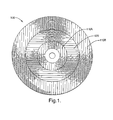
- FIG. 1 is a perspective view of a mixed-mode compact disc.
- This illustration shows one of the many possible disc storage configurations as described above, including both audio tracks and data tracks on a single CD. That is, the audio files and data files may be stored on a single CD in any order or stored in a number of ways.
- CD 100 includes, on the physical disc, audio tracks sector 110A, data files sector 120 and audio tracks sector 110B. It is to be appreciated that audio tracks can be split up in the disc as illustrated in FIG. 1.
- the audio tracks are CD-DA format and the data files are MP3 format.
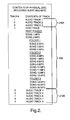
- FIG. 2 is a diagrammatic view illustrating the contents of the audio tracks 210 and data files 220 on the physical disc of FIG. 1.
- audio track 1, audio track 2 and audio track 3 are denoted as audio tracks 210A.
- These audio tracks 210A are written in CD-DA format and are recorded on audio tracks sector 110A of FIG. 1.
- Data track 4 including root folder, folder 1, folder 2 and folder 3 are denoted as data tracks 220.
- Root folder includes song 1 and song 2
- folder 1 includes songs 3-5
- folder 2 includes songs 6-13
- folder 3 includes songs 14-16.
- These data tracks 220 are written in MP3 format and are recorded on data files sector 120 of FIG. 1.
- audio track 4, audio track 5, audio track 6, audio track 7 and audio track 8 are denoted as audio tracks 210B.
- These tracks 210B are written in CD-DA format and are recorded on audio tracks sector 110B of FIG. 1.
- FIG. 3A a prior art example is presented of a CD player set to an audio track playing mode of the contents of the CD of FIG. 2.
- all CD contents of FIG. 2 are physically present on the CD but the CD player is initialized to access and display only the audio tracks to an operator of the CD player. While audio tracks 1-3 denoted as audio tracks 310A (assigned to disc tracks 1-3) and audio tracks 4-8 denoted as audio tracks 310B (assigned to disc track 5-9) are displayed, data track 4 (assigned to disc track 4) is absent from the display, as can be observed.
- FIG. 3B shows a prior art example of a CD player set to a data file playing mode of the contents of the CD of FIG. 2.
- all CD contents of FIG. 2 are physically present on the CD but the CD player is initialized to access and display only the data files to an operator of the CD player.
- data track 4 denoted as data track 320 including root folder, folder 1, folder 2 and folder 3 (containing songs 1-16) are displayed, audio tracks 1-3 and audio tracks 4-8 are absent from the display, as can be observed.
- FIG. 4 is a diagrammatic view illustrating the CD contents of FIG. 2 as displayed to an operator of a CD player, in an embodiment of the present invention.
- the file structures of the CD and the CD contents are read including audio track information and data file information, following disc presentation to a CD player.
- disc presentation to a CD player means the moment when a CD player is directed to read a disc (not merely held and positioned within a CD player).
- the CD player is initialized to prepare it to sequentially access, and optionally play audio format and data format (in either order), without having to reinitialize the CD player when changing between the audio and data formats.
- audio track information 410A/410B and data file information 420 is concurrently obtained and displayed including track format, location of a track, length of a track and number of tracks.
- Information about a CD-DA track can further be displayed and includes folder name, track number, elapsed playing time, remaining time of the current track, number of tracks left, time remaining on the CD, album name, and artist name.
- Information about an MP3 data file can further be displayed and includes ID3 tag information, folder name, file name, file number, total number of files, elapsed playing time, artist name, CODEC information, and remaining time of the current file. The CD is therefore unambiguous to read and navigate as compared to present systems.
- Both the audio contents and the data contents of the disc are located, accessed and displayed upfront without having to perform a mode change.
- a seamless interface is provided between audio files 410A/410B and data files 420 stored on the compact disc of FIG. 1.
- a mode change button is often used by current systems to change from audio tracks to data files. Additionally, some CD players are not equipped with a mode change button and thus only read one of MP3 files or audio files, leaving no choice to the operator of the CD player.
- an operator of a CD player can switch between audio format and MP3 format modes (or another compressed audio format) when playing mixed-mode CDs, without having to manually engage a mode change button. Further, audio time delay, which is a consequence of a CD having to reinitialize when switching format modes, is essentially eliminated when switching between audio and data formats.
- a CD player plays audio tracks prior to playing data files.
- the CD player is allotted additional time to read and display additional or optional ID3 tag information (i.e., releasing year, cover art, etc.) associated with the data files, thereby minimizing any delay in beginning the play of audio files. That is, numerous CD players are capable of spinning CDs faster than required to read and play audio tracks for improved data transfer rate, and therefore the CD player can proceed ahead to read the additional or optional ID3 tag information while playing audio files.
- Sufficient buffer memory should be employed such that the CD player can read the ID3 tags while music continues to play from the buffer memory.
- the present invention additionally enables an operator of a CD player to direct the CD player to randomize the order of play of both the audio tracks 410A/410B and the data files 420 on the single CD.
- Folders containing data files and audio files can be randomized with one entry, rather than having to change modes and reinitialize between audio and data files.
- Audio tracks and data files are randomized in various orders including having all contents on a CD played once in random order and having all contents in a selected folder played in random order.
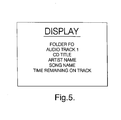
- audio tracks are incorporated into a folder structure for display purposes of audio file information, comparable to data files.
- the audio tracks can be incorporated into an existing folder, a root folder, a newly-created folder, a folder with data files, a folder without data files, or a combination thereof.
- Fig. 4 shows audio tracks 410A and 410B incorporated into audio tracks folder FO.
- an operator of a CD player when wishing to manually change between audio and data formats, is only required to switch folders, rather than having to engage a mode change button and reinitialize for a different file structure.
- a file is analogous to a track on an audio CD
- a group is a bundle of files and is analogous to an album or folder.
Landscapes
- Engineering & Computer Science (AREA)
- Signal Processing (AREA)
- Multimedia (AREA)
- Signal Processing For Digital Recording And Reproducing (AREA)
- Management Or Editing Of Information On Record Carriers (AREA)
Abstract
Description
- The invention relates generally to accessing a digital storage medium, and more particularly to structuring and accessing a compact disc having both audio and data file formats.
- Compact discs, made available to the public in early 1980, are widely used today and have proven to be a versatile carrier of information. A compact disc (CD) is a polycarbonate with one or more metal layers capable of storing digital information. The compact disc is read by an optical scanning mechanism that uses a high-intensity light source, such as a laser, and mirrors. The most prevalent types of compact discs are those used by the music industry to store digital recordings and CD-ROMs used to store computer data. The CD-ROM market currently embraces internal, external and portable drives, caddy and tray loading mechanisms, single-disc and multi-disc changer units, SCSI and EIDE interfaces, and a plethora of standards.
- Compact disc players are now capable of playing CDs that contain both audio (CD-DA) files and MP3 files that were recorded on a single CD. The recording is accomplished by one of several methods. A conventional single session mixed-mode CD may be created using mixed-mode CD recording software. Data is typically written in a CD-ROM or CD-ROM XA format to a CD track. The data track is typically recorded as the first track, while the audio tracks follow and are recorded as tracks 2-xx, where xx is a number up to 99. Alternatively, the disc may be created during multiple sessions using conventional CD recording software that allows only one format to be recorded in a given recording session. This is known as a multi-session disc. On a multi-session mixed-mode CD, audio tracks and data tracks can be recorded in any order as long as the number of total sessions and number of total tracks do not exceed CD standards specifications such as directed by the Red Book or Yellow Book. As a further alternative, an enhanced CD format can be used. Enhanced CDs contain a number of audio tracks followed by a single data track. Finally, other methods to record both audio tracks and data tracks on a single CD additionally exist.
- Since a mixed-mode CD player can access files and tracks having different formats, an operator of a CD player is not required to change discs for songs having different file formats. However, while a mixed-mode CD player can read both file formats, an operator of a CD player must manually switch modes between MP3 and CD-DA formats. For example, with a Pioneer DEH-P4500MP player or a Phillips EX401, an operator of a CD player must press the Band button to switch between the two formats. This type of interface makes song track navigation cumbersome because an operator of a CD player must first recall the recording format of song file/track (audio or data), identify the current mode of the CD player, and then switch to the correct mode should the CD player be in a different mode. For in-vehicle CD players, mode switching is cumbersome and distracts a driver's attention away from operating a vehicle. Additionally, when switching between a CD-DA mode and a compressed audio mode, a CD player must reinitialize, which can cause a significant delay of five to fifteen seconds or more in audio output.
- A system and method is provided to access a mixed-mode storage medium, having both audio and data formats. Applicable storage media include a compact disc, DVD, hard drive, mini disc, and a digital tape. In an embodiment, the present invention provides a seamless interface between audio files and data files on a single compact disc. Audio time delay, which is a consequence of a CD having to reinitialize when switching format modes, is essentially eliminated by the present invention when switching between audio and data formats.
- After reading a CD, audio track and data file information is concurrently obtained and can be displayed including number of tracks, location of a track and length of a track. The present invention facilitates making a CD unambiguous to read and navigate. Both the audio contents and the data contents of a disc are located and can be displayed upfront without having to perform a mode change. A mode change button is often used by current systems to change from audio tracks to data files. As provided by the present invention, an operator of a CD player can switch between audio format and MP3 format modes (or another compressed audio format) when playing mixed-mode CDs, without having to manually engage a mode change button. Further, the present invention enables an operator of a CD player to randomize the play of both the audio tracks and data files on a single CD.
- Features of the invention are achieved in part by reading the file structures of the storage medium and the medium contents including audio track information and data file information following disc presentation to a media player. The media player is initialized to prepare it to sequentially access and play audio format and data format (in either order), without having to reinitialize the media player when changing between the audio and data formats.
- Further, comparable to data files, audio tracks are incorporated into a folder structure for display purposes. The audio tracks can be incorporated into an existing folder, a newly-created folder, a folder with data files, a folder without data files, or a combination thereof. As an example, an operator of a CD player is presented with a display of folders having both audio track and data file information, eliminating the necessity of having to initialize the CD player for a different file format when viewing different file formats.
- Other features and advantages of this invention will be apparent to a person of skill in the art who studies the invention disclosure. Therefore, the scope of the invention will be better understood by reference to an example of an embodiment, given with respect to the following figures.
- The foregoing aspects and many of the attendant advantages of this invention will become more readily appreciated by reference to the following detailed description, when taken in conjunction with the accompanying drawings, wherein:
- FIG. 1 is a perspective view of a compact disc including both audio tracks and data files thereon, in which the present invention can be useful;
- FIG. 2 is a diagrammatic view illustrating the contents of the audio tracks and data files on the physical disc, as in FIG. 1;
- FIG. 3A is a diagrammatic view illustrating the CD contents of FIG. 2 as shown to an operator of a CD player when the CD player is in an audio track playing mode, in a prior art example;
- FIG. 3B is a diagrammatic view illustrating the CD contents of FIG. 2 as shown to an operator of a CD player when the CD player is in a data file playing mode, in a prior art example;
- FIG. 4 is a diagrammatic view illustrating the CD contents of FIG. 2 as shown to an operator of a CD player, in accordance with an embodiment of the present invention; and
- FIG. 5 is a diagrammatic view of an example CD display showing an audio track that is situated into a folder structure presenting audio file information, in accordance with an embodiment of the present invention.
- Exemplary embodiments are described with reference to specific configurations. Those of ordinary skill in the art will appreciate that various changes and modifications can be made while remaining within the scope of the appended claims. Additionally, well-known elements, devices, components, methods, process steps and the like may not be set forth in detail in order to avoid obscuring the present invention.
- A system and method is described herein to provide access to a mixed-mode storage medium, having both audio and data formats, using a media player. The present invention is discussed with reference to a compact disc and a compact disc player. However, it is to be appreciated the present invention has applications beyond this example, and can be employed with other storage media and media players. Applicable storage media that can be employed with the present invention include a compact disc, DVD, hard drive, mini disc, and a digital tape. An applicable media player that can be employed with the present invention includes a compact disc player, DVD player, computer having a hard drive, mini disc player, and a computer having a digital tape. It is to be appreciated that a media player also includes a media device that can perform additional or other functions in addition to playing, including copying, editing and recording.
- Further, the present invention is discussed with reference to audio tracks and data files. The audio files as discussed herein include CD-DA, and the data files are a compressed audio format including MP3, MP3Pro, WMA, AAC, ATRAC, and Ogg-Vorbis. It is to be appreciated that other audio and data files exist and can be similarly utilized with the present invention. For a mixed-mode CD, data files are typically written in a CD-ROM or CD-ROM XA format to a CD track. MP3 files are used as an example herein for simplicity since it is a well-known compressed audio format. MP3 denotes MPEG-1
layer 3 compression codec, MPEG denotes Motion Picture Expert Group, and Codec denotes encoder/decoder. Research for this code was initially for video compression but it also applies to audio compression. Compressed audio files require fewer bits to encode as compared to standard CD-DA audio, as defined in the CD Red Book specification. Given the typical compression rate for most of the commonly used compressed audio encoders, compressed audio files result in storage for about ten hours of music on a single compact disc as compared with about one hour for a standard music CD (CD-DA). Thus, compressed audio files are employed with CDs. The CD Red Book is a widely known CD standard that describes the physical properties of a compact disc and digital audio encoding. There are other colored books (i.e., yellow, orange, green, etc.) that describe CD ROM format discs, multi-session discs, enhanced CDs, etc. These CD specifications were created by the CD consortium including Sony, Philips and others and are widely known in the compact disc industry. - Referring to the drawings wherein identical reference numerals denote the same elements throughout the various views, FIG. 1 is a perspective view of a mixed-mode compact disc. This illustration shows one of the many possible disc storage configurations as described above, including both audio tracks and data tracks on a single CD. That is, the audio files and data files may be stored on a single CD in any order or stored in a number of ways.
CD 100 includes, on the physical disc,audio tracks sector 110A,data files sector 120 andaudio tracks sector 110B. It is to be appreciated that audio tracks can be split up in the disc as illustrated in FIG. 1. In this example, the audio tracks are CD-DA format and the data files are MP3 format. As previously discussed, many compact disc players are capable of playing CDs that contain both audio (CD-DA) files and MP3 files. However, while a mixed-mode CD player can read both file formats, an operator of a CD player must manually switch modes between the MP3 and CD-DA formats to access a particular format. Additionally, when switching between a CD-DA mode and a compressed audio mode, a CD player must reinitialize, which can cause a significant delay in audio output. Initializing a media player as used herein is defined as preparing the media player for data in a certain file system format. - FIG. 2 is a diagrammatic view illustrating the contents of the audio tracks 210 and data files 220 on the physical disc of FIG. 1. In this example,
audio track 1,audio track 2 andaudio track 3 are denoted asaudio tracks 210A. Theseaudio tracks 210A are written in CD-DA format and are recorded onaudio tracks sector 110A of FIG. 1.Data track 4 including root folder,folder 1,folder 2 andfolder 3 are denoted as data tracks 220. Root folder includessong 1 andsong 2,folder 1 includes songs 3-5,folder 2 includes songs 6-13 andfolder 3 includes songs 14-16. These data tracks 220 are written in MP3 format and are recorded ondata files sector 120 of FIG. 1. Finally,audio track 4,audio track 5,audio track 6,audio track 7 andaudio track 8 are denoted asaudio tracks 210B. Thesetracks 210B are written in CD-DA format and are recorded onaudio tracks sector 110B of FIG. 1. - Referring to FIG. 3A, a prior art example is presented of a CD player set to an audio track playing mode of the contents of the CD of FIG. 2. In this example, typical of a current system, all CD contents of FIG. 2 are physically present on the CD but the CD player is initialized to access and display only the audio tracks to an operator of the CD player. While audio tracks 1-3 denoted as
audio tracks 310A (assigned to disc tracks 1-3) and audio tracks 4-8 denoted asaudio tracks 310B (assigned to disc track 5-9) are displayed, data track 4 (assigned to disc track 4) is absent from the display, as can be observed. - FIG. 3B shows a prior art example of a CD player set to a data file playing mode of the contents of the CD of FIG. 2. In this example, typical of a current system, all CD contents of FIG. 2 are physically present on the CD but the CD player is initialized to access and display only the data files to an operator of the CD player. While
data track 4 denoted asdata track 320 including root folder,folder 1,folder 2 and folder 3 (containing songs 1-16) are displayed, audio tracks 1-3 and audio tracks 4-8 are absent from the display, as can be observed. - FIG. 4 is a diagrammatic view illustrating the CD contents of FIG. 2 as displayed to an operator of a CD player, in an embodiment of the present invention. The file structures of the CD and the CD contents are read including audio track information and data file information, following disc presentation to a CD player. As used herein, disc presentation to a CD player means the moment when a CD player is directed to read a disc (not merely held and positioned within a CD player). The CD player is initialized to prepare it to sequentially access, and optionally play audio format and data format (in either order), without having to reinitialize the CD player when changing between the audio and data formats.
- Upon reading the CD and initializing,
audio track information 410A/410B and data fileinformation 420 is concurrently obtained and displayed including track format, location of a track, length of a track and number of tracks. Information about a CD-DA track can further be displayed and includes folder name, track number, elapsed playing time, remaining time of the current track, number of tracks left, time remaining on the CD, album name, and artist name. Information about an MP3 data file can further be displayed and includes ID3 tag information, folder name, file name, file number, total number of files, elapsed playing time, artist name, CODEC information, and remaining time of the current file. The CD is therefore unambiguous to read and navigate as compared to present systems. - Both the audio contents and the data contents of the disc are located, accessed and displayed upfront without having to perform a mode change. A seamless interface is provided between
audio files 410A/410B anddata files 420 stored on the compact disc of FIG. 1. A mode change button is often used by current systems to change from audio tracks to data files. Additionally, some CD players are not equipped with a mode change button and thus only read one of MP3 files or audio files, leaving no choice to the operator of the CD player. As provided by the present invention, an operator of a CD player can switch between audio format and MP3 format modes (or another compressed audio format) when playing mixed-mode CDs, without having to manually engage a mode change button. Further, audio time delay, which is a consequence of a CD having to reinitialize when switching format modes, is essentially eliminated when switching between audio and data formats. - In an embodiment, by default setting, a CD player plays audio tracks prior to playing data files. By employing such a default, the CD player is allotted additional time to read and display additional or optional ID3 tag information (i.e., releasing year, cover art, etc.) associated with the data files, thereby minimizing any delay in beginning the play of audio files. That is, numerous CD players are capable of spinning CDs faster than required to read and play audio tracks for improved data transfer rate, and therefore the CD player can proceed ahead to read the additional or optional ID3 tag information while playing audio files. Sufficient buffer memory should be employed such that the CD player can read the ID3 tags while music continues to play from the buffer memory.
- The present invention additionally enables an operator of a CD player to direct the CD player to randomize the order of play of both the
audio tracks 410A/410B and the data files 420 on the single CD. Folders containing data files and audio files can be randomized with one entry, rather than having to change modes and reinitialize between audio and data files. Audio tracks and data files are randomized in various orders including having all contents on a CD played once in random order and having all contents in a selected folder played in random order. - As illustrated in FIG. 5, in an embodiment of the present invention, audio tracks are incorporated into a folder structure for display purposes of audio file information, comparable to data files. The audio tracks can be incorporated into an existing folder, a root folder, a newly-created folder, a folder with data files, a folder without data files, or a combination thereof. As an example, Fig. 4 shows
audio tracks - Other features and advantages of this invention will be apparent to a person of skill in the art who studies this disclosure. Thus, exemplary embodiments, modifications and variations may be made to the disclosed embodiments while remaining within the spirit and scope of the invention as defined by the appended claims.
Claims (20)
- A method of accessing a mixed mode storage medium (100) having both audio format (210) and data format (220) comprising:reading medium contents including audio file format (210) and data file format (220) following disc presentation to a media player; andinitializing the media player to prepare the media player to sequentially access one of audio format (210) followed by data format (220) and data format (220) followed by audio format (210), without having to reinitialize the media player when changing between the audio format (210) and the data format (220).
- The method of accessing a mixed mode storage medium (100) as in claim 1, wherein reading medium contents comprises determining the track format, location of a track, length of a track and number of tracks for the audio file format (210) and the data file format (220).
- The method of accessing a mixed mode storage medium (100) as in claim 2, wherein reading medium contents further includes reading ID3 tag information associated with the data file format (220), and reading audio file information associated with the audio file format (210).
- The method of accessing a mixed mode storage medium (100) as in claim 1, further comprising situating audio track files (210) and data files (220) into a folder structure to display audio track file information and data file information to an operator of the media player.
- The method of accessing a mixed mode storage medium (100) as in claim 4, further comprising situating a first set of audio track files (210) into a folder with data files (220), and situating a second set of audio track files (210) into a folder without data files (220).
- The method of accessing a mixed mode storage medium (100) as in claim 4, further comprising directing the media player to randomize the order of play of the audio tracks (210) and data files (220).
- The method of accessing a mixed mode storage medium (100) as in claim 1, wherein the audio files (210) include CD-DA, wherein the data files (220) comprise a compressed audio format including one of MP3, MP3Pro, WMA, AAC, ATRAC, and Ogg-Vorbis, and wherein the medium is one of a CD, DVD, hard drive, mini disc, and digital tape.
- The method of accessing a mixed mode storage medium (100) as in claim 1, wherein the media player is one of a compact disc player, a DVD player and a personal computer.
- A method of accessing a mixed mode compact disc (100) having both audio format (210) and data format (220) comprising:reading compact disc contents including audio file format (210) and data file format (220) following disc presentation to a compact disc player; andinitializing the compact disc player to prepare the compact disc player to sequentially access one of audio format (210) followed by data format (220) and data format (220) followed by audio format (210), without having to reinitialize the compact disc player when changing between the audio format (210) and the data format (220).
- The method of accessing a mixed mode compact disc (100) as in claim 9, wherein reading compact disc contents comprises determining the track format, location of a track, length of a track and number of tracks for the audio file format (210) and the data file format (220).
- The method of accessing a mixed mode compact disc (100) as in claim 10, wherein reading compact disc contents further includes reading ID3 tag information associated with the data file format (220), and reading audio file information associated with the audio file format (210).
- The method of accessing a mixed mode compact disc (100) as in claim 9, further comprising situating audio track files (210) and data files (220) into a folder structure to display audio track file information and data file information to an operator of the compact disc player.
- The method of accessing a mixed mode compact disc (100) as in claim 12, further comprising situating a first set of audio track files (210) into a folder with data files (220), and situating a second set of audio track files (210) into a folder without data files (220).
- The method of accessing a mixed mode compact disc (100) as in claim 12, further comprising directing the compact disc player to randomize the order of play of the audio tracks (210) and data files (220).
- The method of accessing a mixed mode compact disc (100) as in claim 9, wherein the audio files (210) include CD-DA, and wherein the data files (220) comprise a compressed audio format including one of MP3, MP3Pro, WMA, AAC, ATRAC, and Ogg-Vorbis.
- A method of arranging files having different formats on a mixed mode medium (100) comprising situating audio track files (210) and data files (220) into a folder structure to display audio track file information and data file information to an operator of a media player, without having to reinitialize the media player.
- The method of arranging files as in claim 16, further comprising situating a first set of audio track files (210) into a folder with data files (220), and situating a second set of audio track files (210) into a folder without data files (220).
- The method of arranging files as in claim 16, further comprising directing the media player to randomize the order of play of the audio tracks (210) and data files (220).
- The method of arranging files as in claim 16, wherein the audio files (210) include CD-DA, wherein the data files (220) comprise a compressed audio format including one of MP3, WMA, AAC, MP3Pro, ATRAC, and Ogg-Vorbis, and wherein the medium is one of a CD, DVD, hard drive, mini disc, and digital tape.
- The method of arranging files as in claim 16, wherein the media player is one of a compact disc player, a DVD player and a personal computer.
Applications Claiming Priority (1)
| Application Number | Priority Date | Filing Date | Title |
|---|---|---|---|
| US11/081,113 US20060209652A1 (en) | 2005-03-16 | 2005-03-16 | Accessing a mixed-mode storage medium |
Publications (1)
| Publication Number | Publication Date |
|---|---|
| EP1703518A1 true EP1703518A1 (en) | 2006-09-20 |
Family
ID=36589197
Family Applications (1)
| Application Number | Title | Priority Date | Filing Date |
|---|---|---|---|
| EP20060075495 Ceased EP1703518A1 (en) | 2005-03-16 | 2006-03-03 | Accessing a mixed-mode storage medium |
Country Status (2)
| Country | Link |
|---|---|
| US (1) | US20060209652A1 (en) |
| EP (1) | EP1703518A1 (en) |
Families Citing this family (3)
| Publication number | Priority date | Publication date | Assignee | Title |
|---|---|---|---|---|
| KR101070748B1 (en) * | 2005-05-19 | 2011-10-10 | 엘지전자 주식회사 | Method for providing file information of MP3 player |
| JP6459006B2 (en) * | 2014-05-30 | 2019-01-30 | ソニー株式会社 | Information processing apparatus and information processing method |
| US10349196B2 (en) * | 2016-10-03 | 2019-07-09 | Nokia Technologies Oy | Method of editing audio signals using separated objects and associated apparatus |
Citations (4)
| Publication number | Priority date | Publication date | Assignee | Title |
|---|---|---|---|---|
| US20020031071A1 (en) * | 2000-09-11 | 2002-03-14 | Han Yong Hee | Optical disc player and method for reproducing thereof |
| EP1345222A1 (en) * | 2000-12-20 | 2003-09-17 | Sony Corporation | Reproducing device, reproducing method and audio data storage medium |
| US20040032771A1 (en) * | 2002-03-22 | 2004-02-19 | Manabu Kusano | Method and apparatus for playing back a multisession disc |
| US20040236568A1 (en) * | 2001-09-10 | 2004-11-25 | Guillen Newton Galileo | Extension of m3u file format to support user interface and navigation tasks in a digital audio player |
Family Cites Families (9)
| Publication number | Priority date | Publication date | Assignee | Title |
|---|---|---|---|---|
| US5119507A (en) * | 1991-02-19 | 1992-06-02 | Mankovitz Roy J | Receiver apparatus and methods for identifying broadcast audio program selections in a radio broadcast system |
| US6283764B2 (en) * | 1996-09-30 | 2001-09-04 | Fujitsu Limited | Storage medium playback system and method |
| JP4110679B2 (en) * | 1999-06-30 | 2008-07-02 | ソニー株式会社 | Recording device |
| US7092340B2 (en) * | 2000-07-13 | 2006-08-15 | Micronas Gmbh | Playback apparatus |
| US7184380B2 (en) * | 2000-12-20 | 2007-02-27 | Sony Corporation | Reproducing device, reproducing method and audio data storage medium |
| JP3780480B2 (en) * | 2002-02-12 | 2006-05-31 | 株式会社ディーアンドエムホールディングス | Information recording medium playback device |
| JP2003281858A (en) * | 2002-03-22 | 2003-10-03 | Alpine Electronics Inc | Disc playback device |
| US6973451B2 (en) * | 2003-02-21 | 2005-12-06 | Sony Corporation | Medium content identification |
| JP2005122809A (en) * | 2003-10-16 | 2005-05-12 | Alpine Electronics Inc | Device and method for reproducing disk |
-
2005
- 2005-03-16 US US11/081,113 patent/US20060209652A1/en not_active Abandoned
-
2006
- 2006-03-03 EP EP20060075495 patent/EP1703518A1/en not_active Ceased
Patent Citations (4)
| Publication number | Priority date | Publication date | Assignee | Title |
|---|---|---|---|---|
| US20020031071A1 (en) * | 2000-09-11 | 2002-03-14 | Han Yong Hee | Optical disc player and method for reproducing thereof |
| EP1345222A1 (en) * | 2000-12-20 | 2003-09-17 | Sony Corporation | Reproducing device, reproducing method and audio data storage medium |
| US20040236568A1 (en) * | 2001-09-10 | 2004-11-25 | Guillen Newton Galileo | Extension of m3u file format to support user interface and navigation tasks in a digital audio player |
| US20040032771A1 (en) * | 2002-03-22 | 2004-02-19 | Manabu Kusano | Method and apparatus for playing back a multisession disc |
Also Published As
| Publication number | Publication date |
|---|---|
| US20060209652A1 (en) | 2006-09-21 |
Similar Documents
| Publication | Publication Date | Title |
|---|---|---|
| US6421305B1 (en) | Personal music device with a graphical display for contextual information | |
| WO2001033569A1 (en) | Portable audio playback device and removable disk drive | |
| JP2005531256A5 (en) | ||
| US7317666B2 (en) | Method of playing optical recording media | |
| US20050068876A1 (en) | Disk for audio data, reproduction apparatus, and method of recording/reproducing audio data | |
| US20060209652A1 (en) | Accessing a mixed-mode storage medium | |
| JP3373719B2 (en) | Audio signal recording method and medium, reproducing apparatus and method | |
| US7184380B2 (en) | Reproducing device, reproducing method and audio data storage medium | |
| EP1345222A1 (en) | Reproducing device, reproducing method and audio data storage medium | |
| JP2002538567A (en) | Data storage medium having audio and video data in a plurality of different formats and recording apparatus and recording method associated therewith | |
| JP3327463B2 (en) | Information recording disk, reproducing apparatus and reproducing method | |
| JP3529542B2 (en) | Signal transmission / recording / receiving / reproducing method and apparatus, and recording medium | |
| JP2000268542A (en) | Music information reproducing apparatus and reproducing method | |
| JP3724477B2 (en) | Playback apparatus and display control method | |
| US20060004471A1 (en) | Audio reproducing apparatus and music selection method | |
| KR100331305B1 (en) | Disc having record producer information recorded therein and system for recording and reproducing record producer information | |
| US7532559B2 (en) | Audio player | |
| JP2006114148A (en) | Sound recording medium, sound reproducing apparatus, sound recording medium preparing apparatus, and program | |
| JP4312178B2 (en) | Management information acquisition apparatus and management information acquisition program | |
| JP3407858B2 (en) | Audio disc | |
| RU88185U1 (en) | RECORDING ENVIRONMENT AS A CD | |
| KR0170973B1 (en) | Video compact disc with guidance function and its playback control device | |
| JP2004095015A (en) | Audio device | |
| JP3956852B2 (en) | Audio disc | |
| US20060285825A1 (en) | Recording device and method, reproduction device and method, and recording medium |
Legal Events
| Date | Code | Title | Description |
|---|---|---|---|
| PUAI | Public reference made under article 153(3) epc to a published international application that has entered the european phase |
Free format text: ORIGINAL CODE: 0009012 |
|
| AK | Designated contracting states |
Kind code of ref document: A1 Designated state(s): AT BE BG CH CY CZ DE DK EE ES FI FR GB GR HU IE IS IT LI LT LU LV MC NL PL PT RO SE SI SK TR |
|
| AX | Request for extension of the european patent |
Extension state: AL BA HR MK YU |
|
| 17P | Request for examination filed |
Effective date: 20070320 |
|
| 17Q | First examination report despatched |
Effective date: 20070419 |
|
| AKX | Designation fees paid |
Designated state(s): AT BE BG CH CY CZ DE DK EE ES FI FR GB GR HU IE IS IT LI LT LU LV MC NL PL PT RO SE SI SK TR |
|
| STAA | Information on the status of an ep patent application or granted ep patent |
Free format text: STATUS: THE APPLICATION HAS BEEN REFUSED |
|
| 18R | Application refused |
Effective date: 20150713 |