EP1702942A1 - Polybenzimidazole based polymer and method for preparing the same - Google Patents
Polybenzimidazole based polymer and method for preparing the same Download PDFInfo
- Publication number
- EP1702942A1 EP1702942A1 EP05292170A EP05292170A EP1702942A1 EP 1702942 A1 EP1702942 A1 EP 1702942A1 EP 05292170 A EP05292170 A EP 05292170A EP 05292170 A EP05292170 A EP 05292170A EP 1702942 A1 EP1702942 A1 EP 1702942A1
- Authority
- EP
- European Patent Office
- Prior art keywords
- preparing
- polybenzimidazole based
- polybenzimidazole
- based polymer
- acid
- Prior art date
- Legal status (The legal status is an assumption and is not a legal conclusion. Google has not performed a legal analysis and makes no representation as to the accuracy of the status listed.)
- Withdrawn
Links
Classifications
-
- H—ELECTRICITY
- H04—ELECTRIC COMMUNICATION TECHNIQUE
- H04M—TELEPHONIC COMMUNICATION
- H04M1/00—Substation equipment, e.g. for use by subscribers
- H04M1/02—Constructional features of telephone sets
- H04M1/0202—Portable telephone sets, e.g. cordless phones, mobile phones or bar type handsets
- H04M1/0206—Portable telephones comprising a plurality of mechanically joined movable body parts, e.g. hinged housings
- H04M1/0208—Portable telephones comprising a plurality of mechanically joined movable body parts, e.g. hinged housings characterized by the relative motions of the body parts
- H04M1/0214—Foldable telephones, i.e. with body parts pivoting to an open position around an axis parallel to the plane they define in closed position
- H04M1/0216—Foldable in one direction, i.e. using a one degree of freedom hinge
-
- C—CHEMISTRY; METALLURGY
- C08—ORGANIC MACROMOLECULAR COMPOUNDS; THEIR PREPARATION OR CHEMICAL WORKING-UP; COMPOSITIONS BASED THEREON
- C08J—WORKING-UP; GENERAL PROCESSES OF COMPOUNDING; AFTER-TREATMENT NOT COVERED BY SUBCLASSES C08B, C08C, C08F, C08G or C08H
- C08J5/00—Manufacture of articles or shaped materials containing macromolecular substances
- C08J5/20—Manufacture of shaped structures of ion-exchange resins
- C08J5/22—Films, membranes or diaphragms
- C08J5/2206—Films, membranes or diaphragms based on organic and/or inorganic macromolecular compounds
- C08J5/2218—Synthetic macromolecular compounds
- C08J5/2256—Synthetic macromolecular compounds based on macromolecular compounds obtained by reactions other than those involving carbon-to-carbon bonds, e.g. obtained by polycondensation
-
- C—CHEMISTRY; METALLURGY
- C08—ORGANIC MACROMOLECULAR COMPOUNDS; THEIR PREPARATION OR CHEMICAL WORKING-UP; COMPOSITIONS BASED THEREON
- C08G—MACROMOLECULAR COMPOUNDS OBTAINED OTHERWISE THAN BY REACTIONS ONLY INVOLVING UNSATURATED CARBON-TO-CARBON BONDS
- C08G73/00—Macromolecular compounds obtained by reactions forming a linkage containing nitrogen with or without oxygen or carbon in the main chain of the macromolecule, not provided for in groups C08G12/00 - C08G71/00
- C08G73/06—Polycondensates having nitrogen-containing heterocyclic rings in the main chain of the macromolecule
- C08G73/0666—Polycondensates containing five-membered rings, condensed with other rings, with nitrogen atoms as the only ring hetero atoms
- C08G73/0672—Polycondensates containing five-membered rings, condensed with other rings, with nitrogen atoms as the only ring hetero atoms with only one nitrogen atom in the ring
-
- C—CHEMISTRY; METALLURGY
- C08—ORGANIC MACROMOLECULAR COMPOUNDS; THEIR PREPARATION OR CHEMICAL WORKING-UP; COMPOSITIONS BASED THEREON
- C08G—MACROMOLECULAR COMPOUNDS OBTAINED OTHERWISE THAN BY REACTIONS ONLY INVOLVING UNSATURATED CARBON-TO-CARBON BONDS
- C08G73/00—Macromolecular compounds obtained by reactions forming a linkage containing nitrogen with or without oxygen or carbon in the main chain of the macromolecule, not provided for in groups C08G12/00 - C08G71/00
- C08G73/06—Polycondensates having nitrogen-containing heterocyclic rings in the main chain of the macromolecule
- C08G73/18—Polybenzimidazoles
-
- H—ELECTRICITY
- H01—ELECTRIC ELEMENTS
- H01M—PROCESSES OR MEANS, e.g. BATTERIES, FOR THE DIRECT CONVERSION OF CHEMICAL ENERGY INTO ELECTRICAL ENERGY
- H01M8/00—Fuel cells; Manufacture thereof
- H01M8/10—Fuel cells with solid electrolytes
- H01M8/1016—Fuel cells with solid electrolytes characterised by the electrolyte material
- H01M8/1018—Polymeric electrolyte materials
- H01M8/102—Polymeric electrolyte materials characterised by the chemical structure of the main chain of the ion-conducting polymer
- H01M8/1027—Polymeric electrolyte materials characterised by the chemical structure of the main chain of the ion-conducting polymer having carbon, oxygen and other atoms, e.g. sulfonated polyethersulfones [S-PES]
-
- H—ELECTRICITY
- H01—ELECTRIC ELEMENTS
- H01M—PROCESSES OR MEANS, e.g. BATTERIES, FOR THE DIRECT CONVERSION OF CHEMICAL ENERGY INTO ELECTRICAL ENERGY
- H01M8/00—Fuel cells; Manufacture thereof
- H01M8/10—Fuel cells with solid electrolytes
- H01M8/1016—Fuel cells with solid electrolytes characterised by the electrolyte material
- H01M8/1018—Polymeric electrolyte materials
- H01M8/102—Polymeric electrolyte materials characterised by the chemical structure of the main chain of the ion-conducting polymer
- H01M8/103—Polymeric electrolyte materials characterised by the chemical structure of the main chain of the ion-conducting polymer having nitrogen, e.g. sulfonated polybenzimidazoles [S-PBI], polybenzimidazoles with phosphoric acid, sulfonated polyamides [S-PA] or sulfonated polyphosphazenes [S-PPh]
-
- H—ELECTRICITY
- H01—ELECTRIC ELEMENTS
- H01M—PROCESSES OR MEANS, e.g. BATTERIES, FOR THE DIRECT CONVERSION OF CHEMICAL ENERGY INTO ELECTRICAL ENERGY
- H01M8/00—Fuel cells; Manufacture thereof
- H01M8/10—Fuel cells with solid electrolytes
- H01M8/1016—Fuel cells with solid electrolytes characterised by the electrolyte material
- H01M8/1018—Polymeric electrolyte materials
- H01M8/1041—Polymer electrolyte composites, mixtures or blends
- H01M8/1046—Mixtures of at least one polymer and at least one additive
- H01M8/1048—Ion-conducting additives, e.g. ion-conducting particles, heteropolyacids, metal phosphate or polybenzimidazole with phosphoric acid
-
- C—CHEMISTRY; METALLURGY
- C08—ORGANIC MACROMOLECULAR COMPOUNDS; THEIR PREPARATION OR CHEMICAL WORKING-UP; COMPOSITIONS BASED THEREON
- C08J—WORKING-UP; GENERAL PROCESSES OF COMPOUNDING; AFTER-TREATMENT NOT COVERED BY SUBCLASSES C08B, C08C, C08F, C08G or C08H
- C08J2379/00—Characterised by the use of macromolecular compounds obtained by reactions forming in the main chain of the macromolecule a linkage containing nitrogen with or without oxygen, or carbon only, not provided for in groups C08J2361/00 - C08J2377/00
- C08J2379/04—Polycondensates having nitrogen-containing heterocyclic rings in the main chain; Polyhydrazides; Polyamide acids or similar polyimide precursors
-
- H—ELECTRICITY
- H01—ELECTRIC ELEMENTS
- H01M—PROCESSES OR MEANS, e.g. BATTERIES, FOR THE DIRECT CONVERSION OF CHEMICAL ENERGY INTO ELECTRICAL ENERGY
- H01M2300/00—Electrolytes
- H01M2300/0017—Non-aqueous electrolytes
- H01M2300/0065—Solid electrolytes
- H01M2300/0082—Organic polymers
-
- Y—GENERAL TAGGING OF NEW TECHNOLOGICAL DEVELOPMENTS; GENERAL TAGGING OF CROSS-SECTIONAL TECHNOLOGIES SPANNING OVER SEVERAL SECTIONS OF THE IPC; TECHNICAL SUBJECTS COVERED BY FORMER USPC CROSS-REFERENCE ART COLLECTIONS [XRACs] AND DIGESTS
- Y02—TECHNOLOGIES OR APPLICATIONS FOR MITIGATION OR ADAPTATION AGAINST CLIMATE CHANGE
- Y02E—REDUCTION OF GREENHOUSE GAS [GHG] EMISSIONS, RELATED TO ENERGY GENERATION, TRANSMISSION OR DISTRIBUTION
- Y02E60/00—Enabling technologies; Technologies with a potential or indirect contribution to GHG emissions mitigation
- Y02E60/30—Hydrogen technology
- Y02E60/50—Fuel cells
Definitions
- the invention relates to a polybenzimidazole-based-polymer for preparing a fuel cell, in particular, a fuel cell membrane and a method for preparing the polybenzimidazole based polymer.
- Poly[2,2-(m-phenylene)-5,5-bibenzimidazole] (polybenzimidazole : PBI) and poly[2,5-benzimidazole] (ABPBI) can be used at high temperature under non-humidification conditions in a fuel cell.
- a monomer for the PBI is expensive and a mechanical strength of the polymer is low especially under a doped state.
- the ABPBI exhibits an excellent mechanical strength and can be prepared at low costs.
- the ABPBI is not dissolved well in an organic solvent, it is difficult to prepare a membrane.
- the ABPBI is dissolved well in the inorganic acid, so it is very difficult to increase a doping level with the ABPBI.
- the PBI or ABPBI was used separately for preparing a fuel cell, in particular, a fuel cell membrane. Therefore, it was not possible to easily increase the doping level while obtaining the high mechanical strength.
- the present invention has been made to solve the above-mentioned problems occurring in the prior arts.
- the object of the present invention is to provide a polybenzimidazole based polymer, which can be used at high temperature under no-humidification conditions for preparing a fuel cell, in particular, a fuel cell membrane which has high doping level and excellent mechanical properties and is inexpensive.
- Another object of the present invention is to provide a method for preparing the polybenzimidazole based polymer.
- a polybenzimidazole based polymer being a copolymer having a repeating unit expressed as the following chemical formula 1. (n is a repeating unit number, and X and Y are percentages constituting the repeating unit)
- a method for preparing a polybenzimidazole based polymer comprising a step of copolymerizing monomers consisting of 3,3'-diaminobenzidine, isophthalic acid (or terephthalic acid), and 3,4-diaminobenzoic acid.
- the copolymerization is performed after mixing the monomers with a polyphosphoric acid; or with a mixture of P 2 O 5 and one or two of CH 3 SO 3 H and CF 3 SO 3 H.
- the copolymerization is performed at 150 ⁇ 200°C.
- the PBI and the ABPBI are copolymerized so as to prepare such a polybenzimidazole based polymer having advantages of the PBI and the ABPBI without the disadvantages of each polymer.
- 3,3'-Diaminobenzidine and isophthalic acid are used as monomers. Further, 3,4-diaminobenzoic acid is used as a monomer.
- Each of the monomers is mixed with a polyphosphoric acid, or with a mixture of P 2 O 5 and CH 3 SO 3 H (or P 2 O 5 and CF 3 SO 3 H, or P 2 O 5 and CH 3 SO 3 H and CF 3 SO 3 H), and then copolymerized at 150 ⁇ 200°C by the following reaction formula1.
- n is a repeating unit number
- X and Y are percentages constituting the repeating unit. For example, when a summation of X and Y is 1, Y is 0.9 ⁇ 0.1 if X is 0.1 ⁇ 0.9)
- the polybenzimidazole based copolymer having the repeating unit expressed in the chemical formula 1 prepared by the reaction formula 1. Also, the polybenzimidazole based copolymer exhibits an excellent mechanical strength. In addition, the cost for preparing the polybenzimidazole based copolymer is relatively inexpensive.
- the polybenzimidazole based copolymer in this example by the present invention was obtained as follows:
- a membrane consisting of the polybenzimidazole based copolymer was prepared as follows:
- 3,4-Diaminobenzoic acid (2.60g, 17.08 mmol, available from Acros), 3,3'-diaminobenzidine (1.83g, 8.54 mmol, available from Aldrich) and terephthalic acid (1.42g, 8.85 mmol) were mixed in a mixture of P 2 O 5 (8g), CF 3 SO 3 H (25 ml) and CH 3 SO 3 H (25 ml), and then reacted at 160°C for 1 hour.
- the polymer solution prepared as described above was uniformly applied on a glass plate using a doctor blade and then the glass plate having the polymer solution applied thereon was immersed in water in order to detach a membrane from the glass plate, thereby preparing the polybenzimidazole based copolymer membrane.
- the prepared membrane was immersed in 85% H 3 PO 4 for 48 hours, so that a polybenzimidazole based copolymer membrane having the phosphoric acid doped thereon was obtained.
- 3,4-Diaminobenzoic acid (4g, 26.3 mmol, available from Acros) was mixed in a mixture of P 2 O 5 (8g) and CH 3 SO 3 H (40 ml), and then reacted at 160°C for 1 hour.
- the polymer solution prepared as described above was uniformly applied on a glass plate using a doctor blade and then the glass plate having the polymer solution applied thereon was immersed in water to detach a membrane from the glass plate, thereby preparing a ABPBI membrane.
- the membrane was immersed in 60% H 3 PO 4 for 48 hours, so that the phosphoric acid doped ABPBI was obtained.
- 3,3'-Diaminobenzidine (3.66g, 17.1 mmol, available from Aldrich) and terephthalic acid (2.84g, 17.1 mmol) were mixed in a mixture of P 2 O 5 (8g), CF 3 SO 3 H (25 ml) and CH 3 SO 3 H (25 ml) and then reacted at 160°C for 1 hour.
- the polymer solution prepared as described above was uniformly applied on a glass plate using a doctor blade and then the glass plate having the polymer solution applied thereon was immersed in water to detach a membrane from the glass plate, thereby preparing a PBI membrane.
- the membrane was immersed in 60% H 3 PO 4 for 48 hours, so that the phosphoric acid doped PBI thereon was obtained.
- Table 1 shows properties of the ABPBI of the comparative example 1, the PBI of the comparative example 2, and the polybenzimidazole based copolymer of example.
- Comparative example 1 Comparative example 2 polybenzimidazole based copolymer of example Mechanical strength* 100 Mpa 55 Mpa 79 MPa Solubility** Dissolved Not dissolved Not dissolved Conductivity(S/cm)*** 0.07 0.06 0.06 * Young's modulus ** Solubility of each polymer in H 3 PO 4 (85%) *** The doping levels of each polymer are approximately same (test temperature: 150 °C).
- the polybenzimidazole based copolymer exhibited 75 MPa, compared to the mechanical strength of the PBI of the comparative example 2 (i.e., 55 Mpa).
- polybenzimidazole based copolymer by the present invention was also very useful in the economic viewpoint since it was possible to make the polymer with inexpensive monomer.
Landscapes
- Chemical & Material Sciences (AREA)
- Chemical Kinetics & Catalysis (AREA)
- Engineering & Computer Science (AREA)
- Manufacturing & Machinery (AREA)
- Medicinal Chemistry (AREA)
- General Chemical & Material Sciences (AREA)
- Polymers & Plastics (AREA)
- Organic Chemistry (AREA)
- Health & Medical Sciences (AREA)
- Life Sciences & Earth Sciences (AREA)
- Electrochemistry (AREA)
- Sustainable Development (AREA)
- Sustainable Energy (AREA)
- Crystallography & Structural Chemistry (AREA)
- Inorganic Chemistry (AREA)
- Materials Engineering (AREA)
- Composite Materials (AREA)
- Signal Processing (AREA)
- Macromolecular Compounds Obtained By Forming Nitrogen-Containing Linkages In General (AREA)
- Fuel Cell (AREA)
Abstract
Description
- The invention relates to a polybenzimidazole-based-polymer for preparing a fuel cell, in particular, a fuel cell membrane and a method for preparing the polybenzimidazole based polymer.
- Poly[2,2-(m-phenylene)-5,5-bibenzimidazole] (polybenzimidazole : PBI) and poly[2,5-benzimidazole] (ABPBI) can be used at high temperature under non-humidification conditions in a fuel cell.
- Since the PBI are strongly resistant to an inorganic acid, it is possible to increase a doping level with the PBI. However, there are some disadvantages. A monomer for the PBI is expensive and a mechanical strength of the polymer is low especially under a doped state.
- Contrary to the PBI, the ABPBI exhibits an excellent mechanical strength and can be prepared at low costs. However, since the ABPBI is not dissolved well in an organic solvent, it is difficult to prepare a membrane. Also, the ABPBI is dissolved well in the inorganic acid, so it is very difficult to increase a doping level with the ABPBI.
- In the prior art, the PBI or ABPBI was used separately for preparing a fuel cell, in particular, a fuel cell membrane. Therefore, it was not possible to easily increase the doping level while obtaining the high mechanical strength.
- Accordingly, the present invention has been made to solve the above-mentioned problems occurring in the prior arts.
- The object of the present invention is to provide a polybenzimidazole based polymer, which can be used at high temperature under no-humidification conditions for preparing a fuel cell, in particular, a fuel cell membrane which has high doping level and excellent mechanical properties and is inexpensive.
- Another object of the present invention is to provide a method for preparing the polybenzimidazole based polymer.
- In order to accomplish the objects, there is provided a polybenzimidazole based polymer being a copolymer having a repeating unit expressed as the following chemical formula 1.
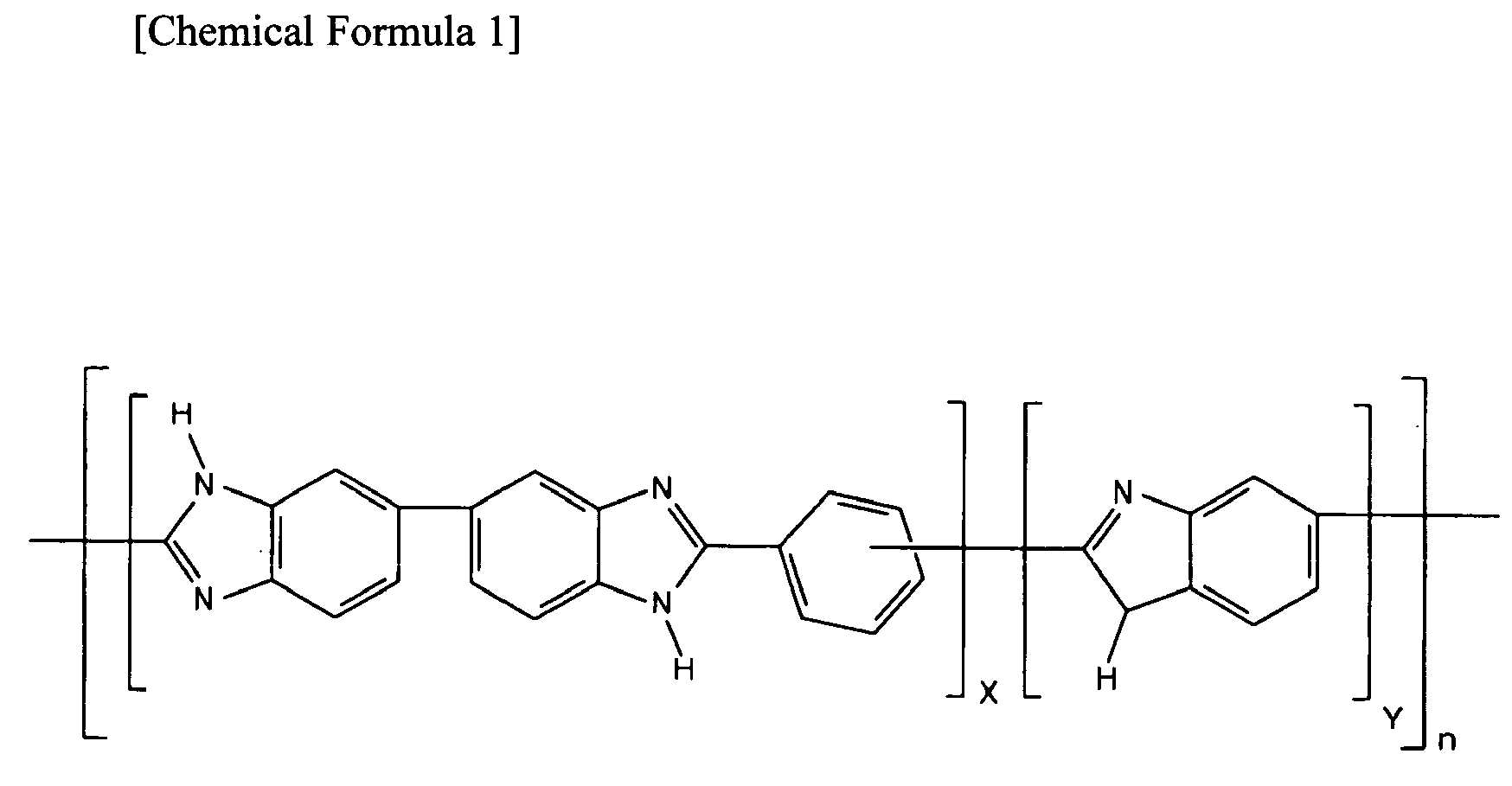
- In order to accomplish the above objects, there is a method for preparing a polybenzimidazole based polymer comprising a step of copolymerizing monomers consisting of 3,3'-diaminobenzidine, isophthalic acid (or terephthalic acid), and 3,4-diaminobenzoic acid.
- According to the present invention, the copolymerization is performed after mixing the monomers with a polyphosphoric acid; or with a mixture of P2O5 and one or two of CH3SO3H and CF3SO3H.
- According to the present invention, the copolymerization is performed at 150 ~ 200°C.
- Hereinafter, the present invention will be described in detail by describing preferred embodiments.
- According to the present invention, the PBI and the ABPBI are copolymerized so as to prepare such a polybenzimidazole based polymer having advantages of the PBI and the ABPBI without the disadvantages of each polymer.
- 3,3'-Diaminobenzidine and isophthalic acid (or terephthalic acid) are used as monomers. Further, 3,4-diaminobenzoic acid is used as a monomer.
- Each of the monomers is mixed with a polyphosphoric acid, or with a mixture of P2O5 and CH3SO3H (or P2O5 and CF3SO3H, or P2O5 and CH3SO3H and CF3SO3H), and then copolymerized at 150 ~ 200°C by the following reaction formula1.

- It is easy to increase a doping level using the polybenzimidazole based copolymer having the repeating unit expressed in the chemical formula 1 prepared by the reaction formula 1. Also, the polybenzimidazole based copolymer exhibits an excellent mechanical strength. In addition, the cost for preparing the polybenzimidazole based copolymer is relatively inexpensive.
- The polybenzimidazole based copolymer in this example by the present invention was obtained as follows:
- 3,4-Diaminobenzoic acid (2.60g, 17.08 mmol, available from Acros), 3,3'-diaminobenzidine (1.83g, 8.54 mmol, available from Aldrich) and isophthalic acid (1.42g, 8.85 mmol) were mixed in polyphosphoric acid (35g) and then reacted at 200°C for 3 hours.
- Then, the thus-produced polymer solution was deposited in water and a polybenzimidazole based copolymer was obtained.
- A membrane consisting of the polybenzimidazole based copolymer was prepared as follows:
- 3,4-Diaminobenzoic acid (2.60g, 17.08 mmol, available from Acros), 3,3'-diaminobenzidine (1.83g, 8.54 mmol, available from Aldrich) and terephthalic acid (1.42g, 8.85 mmol) were mixed in a mixture of P2O5 (8g), CF3SO3H (25 ml) and CH3SO3H (25 ml), and then reacted at 160°C for 1 hour.
- The polymer solution prepared as described above was uniformly applied on a glass plate using a doctor blade and then the glass plate having the polymer solution applied thereon was immersed in water in order to detach a membrane from the glass plate, thereby preparing the polybenzimidazole based copolymer membrane.
- The prepared membrane was immersed in 85% H3PO4 for 48 hours, so that a polybenzimidazole based copolymer membrane having the phosphoric acid doped thereon was obtained.
- 3,4-Diaminobenzoic acid (4g, 26.3 mmol, available from Acros) was mixed in a mixture of P2O5 (8g) and CH3SO3H (40 ml), and then reacted at 160°C for 1 hour.
- The polymer solution prepared as described above was uniformly applied on a glass plate using a doctor blade and then the glass plate having the polymer solution applied thereon was immersed in water to detach a membrane from the glass plate, thereby preparing a ABPBI membrane. The membrane was immersed in 60% H3PO4 for 48 hours, so that the phosphoric acid doped ABPBI was obtained.
- 3,3'-Diaminobenzidine (3.66g, 17.1 mmol, available from Aldrich) and terephthalic acid (2.84g, 17.1 mmol) were mixed in a mixture of P2O5 (8g), CF3SO3H (25 ml) and CH3SO3H (25 ml) and then reacted at 160°C for 1 hour.
- The polymer solution prepared as described above was uniformly applied on a glass plate using a doctor blade and then the glass plate having the polymer solution applied thereon was immersed in water to detach a membrane from the glass plate, thereby preparing a PBI membrane. The membrane was immersed in 60% H3PO4 for 48 hours, so that the phosphoric acid doped PBI thereon was obtained.
- Table 1 shows properties of the ABPBI of the comparative example 1, the PBI of the comparative example 2, and the polybenzimidazole based copolymer of example.
[Table 1] Comparative example 1 Comparative example 2 polybenzimidazole based copolymer of example Mechanical strength* 100 Mpa 55 Mpa 79 MPa Solubility** Dissolved Not dissolved Not dissolved Conductivity(S/cm)*** 0.07 0.06 0.06 * Young's modulus ** Solubility of each polymer in H3PO4 (85%) *** The doping levels of each polymer are approximately same (test temperature: 150 °C). - As can be seen from Table 1, it was possible to easily increase the doping level of the polybenzimidazole based copolymer of the example, because the copolymer was not dissolved in the inorganic acid (H3PO4).
- In addition, regarding the mechanical strength, the polybenzimidazole based copolymer exhibited 75 MPa, compared to the mechanical strength of the PBI of the comparative example 2 (i.e., 55 Mpa).
- Furthermore, the polybenzimidazole based copolymer by the present invention was also very useful in the economic viewpoint since it was possible to make the polymer with inexpensive monomer.
- Many alterations and modifications may be made by those having ordinary skill in the art without departing from the spirit and scope of the invention. Therefore, it must be understood that the embodiment and example described above should not be taken as limiting the invention as defined by the following claims. The claims are thus to be understood to include what is specifically described above, what is conceptionally equivalent, what can be obviously substituted and also what essentially incorporates the essential idea of the invention.
Claims (4)
- A polybenzimidazole based polymer being a copolymer having a repeating unit expressed as the following chemical formula 1.

- A method for preparing a polybenzimidazole based polymer comprising a step of copolymerizing monomers consisting of 3,3'-diaminobenzidine; isophthalic acid or terephthalic acid; and 3,4-diaminobenzoic acid.
- The method according to claim 2, wherein the copolymerization is performed after mixing the monomers with a polyphosphoric acid; or with a mixture of P2O5 and one or two of CH3SO3H and CF3SO3H.
- The method according to claim 2, wherein the copolymerization is performed at 150~ 200°C.
Applications Claiming Priority (1)
| Application Number | Priority Date | Filing Date | Title |
|---|---|---|---|
| KR1020050022416A KR100644856B1 (en) | 2005-03-17 | 2005-03-17 | Fuel cell membrane and its manufacturing method |
Publications (1)
| Publication Number | Publication Date |
|---|---|
| EP1702942A1 true EP1702942A1 (en) | 2006-09-20 |
Family
ID=36384449
Family Applications (1)
| Application Number | Title | Priority Date | Filing Date |
|---|---|---|---|
| EP05292170A Withdrawn EP1702942A1 (en) | 2005-03-17 | 2005-10-14 | Polybenzimidazole based polymer and method for preparing the same |
Country Status (4)
| Country | Link |
|---|---|
| US (1) | US20060211844A1 (en) |
| EP (1) | EP1702942A1 (en) |
| JP (1) | JP2006257390A (en) |
| KR (1) | KR100644856B1 (en) |
Cited By (4)
| Publication number | Priority date | Publication date | Assignee | Title |
|---|---|---|---|---|
| EP2253654A1 (en) * | 2009-04-24 | 2010-11-24 | Samsung Electronics Co., Ltd. | Cross-linked polyazole, method of preparing the polyazole, electrode for fuel cell including the cross-linked polyazole, electrolyte membrane for fuel cell including the cross-linked polyazole, method of manufacturing the electrolyte membrane, and fuel cell including the cross-linked polyazole |
| WO2012127311A1 (en) * | 2011-03-24 | 2012-09-27 | Basf Se | Method for mechanical stabilization of nitrogen-containing polymers |
| WO2020079713A1 (en) * | 2018-10-20 | 2020-04-23 | Council Of Scientific & Industrial Research | A poymer layered hollow fiber membrane based on poly(2,5-benzimidazole), copolymers and substituted polybenzimidazole |
| CN112803052A (en) * | 2021-04-07 | 2021-05-14 | 常州创氢能源科技有限公司 | Preparation method of crosslinked polybenzimidazole proton exchange membrane |
Families Citing this family (14)
| Publication number | Priority date | Publication date | Assignee | Title |
|---|---|---|---|---|
| KR101093281B1 (en) * | 2007-07-27 | 2011-12-14 | 재단법인서울대학교산학협력재단 | Polybenzimidazole-based polymer and electrolyte membrane comprising same |
| KR101144398B1 (en) | 2009-01-15 | 2012-05-10 | 서울대학교산학협력단 | Polybenzimidazole-based polymer with basic substituent and electrolyte membrane comprising the same |
| KR101747860B1 (en) * | 2009-11-14 | 2017-06-28 | 삼성전자주식회사 | Method for mechanically stabilizing nitrogen-containing polymers |
| US9051433B2 (en) | 2010-02-04 | 2015-06-09 | Samsung Electronics Co., Ltd. | Polymer and cross-linked polymer composition, electrode and electrolyte membrane including cross-linked polymer, and fuel cell including electrode and electrolyte membrane |
| US20110189581A1 (en) * | 2010-02-04 | 2011-08-04 | Samsung Electronics Co., Ltd. | Compound, cross-linked material thereof, double cross-linked polymer thereof, and electrolyte membrane, electrode for fuel cell and fuel cell including same |
| KR101791936B1 (en) | 2010-02-04 | 2017-11-02 | 삼성전자 주식회사 | Compound, cross-linking material thereof, double crosslinked polymer thereof, electrolyte membrane for fuel cell including the same,electrode for fuel cell including the same, and fuel cell employing the same |
| US9112232B2 (en) | 2010-02-05 | 2015-08-18 | Samsung Electronics Co., Ltd. | Composition, polymer thereof, electrode and electrolyte membrane for fuel cell, and fuel cell including the same |
| KR101670966B1 (en) | 2010-02-09 | 2016-11-09 | 삼성전자주식회사 | Hyperbranched polymer, electrode for fuel cell comprising the hyperbranched polymer, electrolyte membrane for fuel cell comprising the hyperbranched polymer, and fuel cell using at least one of the electrode and the electrolyte membrane |
| JP5728252B2 (en) | 2010-03-03 | 2015-06-03 | 三星電子株式会社Samsung Electronics Co.,Ltd. | Composition, method for producing the same, electrode using the composition, and fuel cell employing the electrode |
| EP2363820B1 (en) * | 2010-03-04 | 2019-07-03 | Karlsruher Institut für Technologie | Method and system for determining the solvent accessible surface and its derivates of a molecule |
| KR101411464B1 (en) * | 2013-02-12 | 2014-06-27 | 한국과학기술연구원 | Cardo Copolybenzimidazoles, Gas Separation Membranes and preparation method thereof |
| US10023705B2 (en) * | 2013-08-30 | 2018-07-17 | Council Of Scientific & Industrial Research | Co-ABPBI membranes and process for the preparation thereof |
| CN114957657A (en) * | 2022-06-08 | 2022-08-30 | 上海交通大学 | Method for preparing polybenzimidazole based on domestic cheap raw materials |
| CN121355309A (en) * | 2025-07-11 | 2026-01-16 | 山东东岳未来氢能材料股份有限公司 | A composite proton exchange membrane and its preparation method |
Citations (5)
| Publication number | Priority date | Publication date | Assignee | Title |
|---|---|---|---|---|
| US3174947A (en) * | 1962-02-14 | 1965-03-23 | Univ Illinois | Polybenzimidazoles and their preparation |
| GB1141542A (en) * | 1965-07-07 | 1969-01-29 | Kurt Herberts And Company Dr | Polycondensates containing benzimidazole groups |
| US20030013817A1 (en) * | 2001-06-26 | 2003-01-16 | Kelly Lu | High temperature ionic polymers and membranes made therefrom |
| US20040028976A1 (en) * | 2002-08-07 | 2004-02-12 | Israel Cabasso | Modified polybenzimidazole (PBI) membranes for enhanced polymer electrochemical cells |
| US20040096734A1 (en) * | 2001-04-09 | 2004-05-20 | Gordon Calundann | Proton-comducting membrane and the use thereof |
Family Cites Families (8)
| Publication number | Priority date | Publication date | Assignee | Title |
|---|---|---|---|---|
| US3987015A (en) | 1974-11-18 | 1976-10-19 | Celanese Corporation | Process for the production of particulate polymeric material having an unusually high surface area |
| US4020142A (en) * | 1975-08-21 | 1977-04-26 | Celanese Corporation | Chemical modification of polybenzimidazole semipermeable |
| US4394500A (en) | 1981-08-07 | 1983-07-19 | E. I. Du Pont De Nemours And Company | Bead polymerization process for preparing polybenzimidazole |
| US4842740A (en) * | 1988-08-05 | 1989-06-27 | Hoechst Celanese Corporation | Membranes prepared from blend of polybenzimidazole with polyarylates |
| US5599639A (en) * | 1995-08-31 | 1997-02-04 | Hoechst Celanese Corporation | Acid-modified polybenzimidazole fuel cell elements |
| US5773197A (en) | 1996-10-28 | 1998-06-30 | International Business Machines Corporation | Integrated circuit device and process for its manufacture |
| DE10133739A1 (en) * | 2001-07-11 | 2003-01-30 | Mewa Textil Service Ag & Co Man Ohg | transport container |
| US7704422B2 (en) * | 2004-08-16 | 2010-04-27 | Electromaterials, Inc. | Process for producing monolithic porous carbon disks from aromatic organic precursors |
-
2005
- 2005-03-17 KR KR1020050022416A patent/KR100644856B1/en not_active Expired - Fee Related
- 2005-10-14 EP EP05292170A patent/EP1702942A1/en not_active Withdrawn
- 2005-10-14 US US11/250,934 patent/US20060211844A1/en not_active Abandoned
- 2005-10-28 JP JP2005314812A patent/JP2006257390A/en active Pending
Patent Citations (5)
| Publication number | Priority date | Publication date | Assignee | Title |
|---|---|---|---|---|
| US3174947A (en) * | 1962-02-14 | 1965-03-23 | Univ Illinois | Polybenzimidazoles and their preparation |
| GB1141542A (en) * | 1965-07-07 | 1969-01-29 | Kurt Herberts And Company Dr | Polycondensates containing benzimidazole groups |
| US20040096734A1 (en) * | 2001-04-09 | 2004-05-20 | Gordon Calundann | Proton-comducting membrane and the use thereof |
| US20030013817A1 (en) * | 2001-06-26 | 2003-01-16 | Kelly Lu | High temperature ionic polymers and membranes made therefrom |
| US20040028976A1 (en) * | 2002-08-07 | 2004-02-12 | Israel Cabasso | Modified polybenzimidazole (PBI) membranes for enhanced polymer electrochemical cells |
Cited By (9)
| Publication number | Priority date | Publication date | Assignee | Title |
|---|---|---|---|---|
| EP2253654A1 (en) * | 2009-04-24 | 2010-11-24 | Samsung Electronics Co., Ltd. | Cross-linked polyazole, method of preparing the polyazole, electrode for fuel cell including the cross-linked polyazole, electrolyte membrane for fuel cell including the cross-linked polyazole, method of manufacturing the electrolyte membrane, and fuel cell including the cross-linked polyazole |
| CN101942194A (en) * | 2009-04-24 | 2011-01-12 | 三星电子株式会社 | Crosslinked poly-azoles, its method for making, electrode, dielectric film and method for making and fuel cell |
| EP2366729A1 (en) * | 2009-04-24 | 2011-09-21 | Samsung Electronics Co., Ltd. | Cross-linked polyazole, method of preparing the polyazole, electrode for fuel cell including the cross-linked polyazole, electrolyte membrane for fuel cell including the cross-linked polyazole, method of manufacturing the electrolyte membrane, and fuel cell including the cross-linked polyazole |
| CN101942194B (en) * | 2009-04-24 | 2014-11-26 | 三星电子株式会社 | Crosslinked polyazoles, manufacturing method thereof, electrode, electrolyte film and manufacturing method thereof, and fuel battery |
| US9096725B2 (en) | 2009-04-24 | 2015-08-04 | Samsung Electronics Co., Ltd. | Cross-linked polyazole, method of preparing the polyazole, electrode for fuel cell including the cross-linked polyazole, electrolyte membrane for fuel cell including the cross-linked polyazole, method of manufacturing the electrolyte membrane, and fuel cell including the cross-linked polyazole |
| WO2012127311A1 (en) * | 2011-03-24 | 2012-09-27 | Basf Se | Method for mechanical stabilization of nitrogen-containing polymers |
| WO2020079713A1 (en) * | 2018-10-20 | 2020-04-23 | Council Of Scientific & Industrial Research | A poymer layered hollow fiber membrane based on poly(2,5-benzimidazole), copolymers and substituted polybenzimidazole |
| CN112803052A (en) * | 2021-04-07 | 2021-05-14 | 常州创氢能源科技有限公司 | Preparation method of crosslinked polybenzimidazole proton exchange membrane |
| CN112803052B (en) * | 2021-04-07 | 2021-06-25 | 常州创氢能源科技有限公司 | Preparation method of crosslinked polybenzimidazole proton exchange membrane |
Also Published As
| Publication number | Publication date |
|---|---|
| KR100644856B1 (en) | 2006-11-24 |
| US20060211844A1 (en) | 2006-09-21 |
| KR20060100689A (en) | 2006-09-21 |
| JP2006257390A (en) | 2006-09-28 |
Similar Documents
| Publication | Publication Date | Title |
|---|---|---|
| US20060211844A1 (en) | Polybenzimidazole based polymer and method for preparing the same | |
| EP3221912B1 (en) | Novel polymers and methods for their manufacture | |
| KR101366808B1 (en) | Polybenzimidazole-base complex, crosslinked material of polybenzoxazines formed thereof, and fuel cell using the same | |
| CN110684190B (en) | Preparation method of bio-based high-temperature nylon | |
| CA2457608A1 (en) | Method for producing a membrane from a crosslinked polymer blend, and corresponding fuel cell | |
| US20080221325A1 (en) | Exchange membrane containing modified maleimide oligomers | |
| KR20090087835A (en) | Synthesis method of polyoxadiazole polymer | |
| KR20080071935A (en) | Preparation of Functional Polytriazole Polymers | |
| KR102485779B1 (en) | Carboxy functional polyether and adhesive composition including the same | |
| KR101517011B1 (en) | Tetrasulfonated poly(arylene biphenyl sulfone) copolymers, Manufacturing Method thereof and Proton Exchange Membrane for Fuel Cells comprising thereof | |
| KR100902411B1 (en) | Polybenziimidazole partially introduced with sulfonic acid, method for preparing the same, fuel cell membrane electrode assembly using the polybenzimidazole, and method for preparing same | |
| JP4051955B2 (en) | Process for producing polyphenylene sulfonic acids | |
| KR20190142569A (en) | Composition for polylactic acid toughening agents, toughening polylactic acid copolymer using the same and method for manufacturing thereof | |
| US20060004182A1 (en) | Process for a two stage melt polymerization for the production of polybenzimidazole having an improved solid state polymerization | |
| KR20190026132A (en) | Anion-exchange membrane based on polyether ether ketone copolymer and manufacturing method thereof | |
| US20080171798A1 (en) | Benzimidazole-Substituted Polybezimidazoles as Initial Material For Producing Proton-Conducting Membranes | |
| KR101816188B1 (en) | Anion-exchange membrane based on polyether ether ketone copolymer and manufacturing method thereof | |
| EP1819751B1 (en) | Polybenzimidazole-benzamide copolymer, process for preparing the same, electrolyte membrane prepared therefrom and process for preparing the same | |
| EP3039062B1 (en) | Process for the preparation of co-abpbi membranes | |
| US20230059862A1 (en) | Resin composition | |
| KR101728839B1 (en) | Polymer electrolyte compound and method for preparing the same, polymer electrolyte membrane using the same and electrochemical device including the membrane | |
| JP3534575B2 (en) | Organic insulating film material and manufacturing method thereof | |
| EP4640725A1 (en) | Polymer and method for synthesis thereof | |
| JP4546854B2 (en) | Rigid heterocyclic polymer and method for producing the same | |
| US8299202B2 (en) | Phenol compounds and (co)polymers thereof |
Legal Events
| Date | Code | Title | Description |
|---|---|---|---|
| PUAI | Public reference made under article 153(3) epc to a published international application that has entered the european phase |
Free format text: ORIGINAL CODE: 0009012 |
|
| 17P | Request for examination filed |
Effective date: 20051109 |
|
| AK | Designated contracting states |
Kind code of ref document: A1 Designated state(s): AT BE BG CH CY CZ DE DK EE ES FI FR GB GR HU IE IS IT LI LT LU LV MC NL PL PT RO SE SI SK TR |
|
| AX | Request for extension of the european patent |
Extension state: AL BA HR MK YU |
|
| AKX | Designation fees paid |
Designated state(s): AT BE BG CH CY CZ DE DK EE ES FI FR GB GR HU IE IS IT LI LT LU LV MC NL PL PT RO SE SI SK TR |
|
| STAA | Information on the status of an ep patent application or granted ep patent |
Free format text: STATUS: THE APPLICATION IS DEEMED TO BE WITHDRAWN |
|
| 18D | Application deemed to be withdrawn |
Effective date: 20070321 |