EP1702790A1 - Infant carrier with adjustable harness system - Google Patents
Infant carrier with adjustable harness system Download PDFInfo
- Publication number
- EP1702790A1 EP1702790A1 EP06251382A EP06251382A EP1702790A1 EP 1702790 A1 EP1702790 A1 EP 1702790A1 EP 06251382 A EP06251382 A EP 06251382A EP 06251382 A EP06251382 A EP 06251382A EP 1702790 A1 EP1702790 A1 EP 1702790A1
- Authority
- EP
- European Patent Office
- Prior art keywords
- strap
- lap
- configuration
- infant carrier
- lap strap
- Prior art date
- Legal status (The legal status is an assumption and is not a legal conclusion. Google has not performed a legal analysis and makes no representation as to the accuracy of the status listed.)
- Granted
Links
- IJJWOSAXNHWBPR-HUBLWGQQSA-N 5-[(3as,4s,6ar)-2-oxo-1,3,3a,4,6,6a-hexahydrothieno[3,4-d]imidazol-4-yl]-n-(6-hydrazinyl-6-oxohexyl)pentanamide Chemical compound N1C(=O)N[C@@H]2[C@H](CCCCC(=O)NCCCCCC(=O)NN)SC[C@@H]21 IJJWOSAXNHWBPR-HUBLWGQQSA-N 0.000 claims 1
- 239000000969 carrier Substances 0.000 description 4
- 206010028980 Neoplasm Diseases 0.000 description 2
- 201000011510 cancer Diseases 0.000 description 2
- 238000005303 weighing Methods 0.000 description 2
- 230000006978 adaptation Effects 0.000 description 1
- 230000004048 modification Effects 0.000 description 1
- 238000012986 modification Methods 0.000 description 1
- 230000037361 pathway Effects 0.000 description 1
- 238000004904 shortening Methods 0.000 description 1
- 210000000689 upper leg Anatomy 0.000 description 1
Images

Classifications
-
- B—PERFORMING OPERATIONS; TRANSPORTING
- B60—VEHICLES IN GENERAL
- B60N—SEATS SPECIALLY ADAPTED FOR VEHICLES; VEHICLE PASSENGER ACCOMMODATION NOT OTHERWISE PROVIDED FOR
- B60N2/00—Seats specially adapted for vehicles; Arrangement or mounting of seats in vehicles
- B60N2/24—Seats specially adapted for vehicles; Arrangement or mounting of seats in vehicles for particular purposes or particular vehicles
- B60N2/26—Seats specially adapted for vehicles; Arrangement or mounting of seats in vehicles for particular purposes or particular vehicles for children
- B60N2/28—Seats readily mountable on, and dismountable from, existing seats or other parts of the vehicle
- B60N2/2803—Adaptations for seat belts
- B60N2/2812—Adaptations for seat belts for securing the child to the child seat
Definitions
- This invention relates to an infant carrier with an adjstable harness system. More specifically, this invention relates to an Infant carrier with an adjustable harness system that can accommodate a relatively large child.
- Infant car seats typically include a base and an infant carrier that can attach to and be detached from the base.
- the base can remain in the vehicle, secured to the vehicle seat by latch system or by the vehicle belt system, and the infant carrier can be removed from the base to transport the child.
- Infant car seats in the market today are popular because of the convenience they offer to parents. For example, the infant carrier allows the parent to carry a sleeping child from car to home or other destination without disturbing the child.
- the infant carrier also can be anapped onto a stroller to make a travel system.
- infant carriers Deapite the many benefits of infant car seats, the usage of infant carriers generally is limited only to the infant's first six to eight months of life. Most infant carriers are rated by manufacturers for use from birth to 22 pounds. The infant carriers also are rated for use by children only up to a certain height. Infants younger than one year may outgrow rated weight and height limits established by manufacturers. Parents see first signs of this outgrowth when they notice that the child's regs and feet extend past the car seat and kick against the vehicle seat back. Parents perceive that this outgrowth makes the child uncomfortable.
- An aspect of the present invention relates to an infant carrier that includes a carrier shell and a harness system.
- the carrier shell includes a first set of shoulder strap slots, a second set of corresponding shoulder strap slots laterally spaced from the first set of shoulder strap slots, and first and second lap strap sots.
- the harness system is adapted to be connected to the carrier shell and adapted to be adjustable between a first configuration for a smaller child and a second configuration for a larger child.
- the harness system include a first strap adapted to be threaded through one of the shoulder strap slots and the first lap strap slot, a second strap adapted to be threaded through one of the corresponding shoulder strap slots and the second lap strap slot, wherein each of the first and second straps includes a shoulder strap end having first and second looped portions and a lap strap end having first and second looped portions, a junction clip to couple the first and second straps together, the junction clip being receivable in the ,first looped portions of the first and second shoulder strap ends in the first configuration, the junction clip being receivable in the second looped portions of the first and second shoulder strap ends in the second configuration, a first lap strap clip being receivable in the first looped portion of the first lap strap in the first configuration and being receivable in the second looped portion of the first lap strap in the second configuration, and a second lap strap clip being receivable in the first looped portion of the second lap strap in the first configuration and being receivable in the second
- Another aspect of the invention rebates to an infant carrier that includes a carrier shell including a seating area for a child; and a harness system adapted to connect to the canter sho and adapted to be adjusted between a first configuration for a smaller child and a second configuration for a larger child.
- the harness system includes first and second straps, each of the first and second straps having a shoulder strap end and a tap sttfapendt a shoulder strap adjuster associated with the shoulder strap ends of each of the first and second straps to enable adtustmentofthe shoulder strap endS between the first configuration and the second configuratlon, and a tap strap adjuster associated with the tap strap ends of each of the trot and second straps to enable adjustment of the lap strap ends between the first configuration and the second configuration.
- an infant carrier that includes a carrier shell including first and second lap strap slots; and a harness system adapted to be connected to the carrier shell and adapted to be adjustable between a configuration for a smaller child and a second configuration for a larger child.
- the harness system includes a first strap adapted to be threaded through the first lap strap slot, a second strap adapted to be treaded through the second lap strap slot, wherein each of the first and second straps includes a lap strap and having first and second looped portions, a first lap strap clip being receivable in the first looped portion of the first lap strap in the first configuration and being receivable in the second looped portion of the first lap strap in the second configuration, and a second lap strap clip being receivable in the first looped portion of the second lap strap in the first configuration and being receivable in the second looped portion of the second lap strap in the second configuration.
- an infant carrier that include a carrier shell and a harness system.
- the carrier shell includes first and second lap strap slots and first and second adjuster slots.
- the harness system is adapted to be connected to the carrier shell and is adapted to be adjusted between a first configuration for a smaller child and a second configuration for a larger child.
- the harness system includes a first strap adapted to be threaded through the first lap strap slot and through the first adjuster slot, the first strap having a first tap strap end, and a second strap adapted to be threaded through the second lap strap slot and the second adjuster slot, the second strap having a second lap strap end, first and second lap strap clips associated with the first and second lap strap ends, respectively, wherein, in the first configuration, the first and second lap strap ends can be threaded through both the respective lap strap slot and the respective adjuster slot and secured at the respective adjuster slot by the respective lap strap clip and, wherein, in the second conjuration, the first and second lap strap ends can be threaded through the respective lap strap slot only and secured at the respective lap strap slot by the respective lap strap clip.
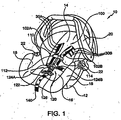
- FIG. 1 is a front perspective view of an infraint carrier including a harness system.
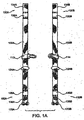
- FIG. 1A is a top plan view of a harness system in accordance with the invention.
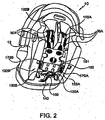
- FIG. 2 is a rear perspective view of the infant carrier and the harness system.
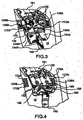
- FIG. 3 is a detail perspective view of the shoulder strap ends and lap strap ends of the harness system in a first configuration suitable for a smaller child.
- FIG. 4 is a detail perspective view of the shoulder strap ends and the lap strap ends of the harness system in a second configuration suitable for a larger child.
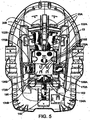
- FIG. 5 is a bottom plan view of the infant carrier and the harness system with the lap strap ends removed from a harness cover in a first configuration suitable for a smaller child.
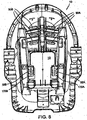
- FIG. 6 is a bottom plan view of the infant carrier and the harness system in a second configuration suitable for a larger child.
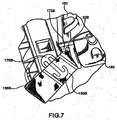
- FIG. 7 is an enlarged view of a lap strap securement area of the infant carrier and illustrates first and second looped portions of the lap strap end and a lap strap clip eultable for seouremont to either of the loops.
- FIG. 8 is a bottom plan view of to infant carrier and illustrates the location of the lap strap slots.
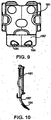
- FIG. 2 is a front plan view of an alternative harness cover.
- FIG. 10 is a side elevation view of the harness cover of FIG. 9.
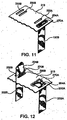
- FIGS. 11-12 are schematics illustrating an alternative lap strap adjuster, in which FIG. 12 illustrates lap strip ends in a first configuration suitable for a smaller child, and FIG. 11 illustrates a lap strap end in a second configuration suitable for a larger, child.
- FIGS. 1-7 illustrate an infant carrier 10 induding a harness system 100 according to an embodiment of the invention.
- the harness system 100 is designed enable a caregiver to secure a relatively large child in the infant carrier 10, such as a child weighing up to 30 pounds, as compared to conventional harness systems typically designed to secure children up to 22 pounds.
- the harness system 100 provides increased strap length without compromising the ability of the straps to be repeatedly adjusted as occurs, for example, when the child is taken-out of the infant carrier, which generally requires loosening of the strapa, and when the child is placed in the infant carrier, which generally requires tightening of the straps.
- the harness system 100 provides a tohger strap length than conventional harness systems and includes features to store the extra strap length and also to deploy the extra strap length when the child's size warrants.
- FIGS. 1 and 2 illustrate an infant carrier 10 equipped with straps of webbing that form a five-point harness system 100 to secure a child in the infant carrier 10.
- the infant carrier 10 generally includes a shell 12 and soft goods that substantially cover an upper surface (hildden by the soft goods) of the shell 12 to provide a comfortable seating area for the child.
- the shell 12 also has a lower surface 13 that is contoured to rest on a support surface or to detachably couple to a base of an infant car seat.
- the upper surface of the infant carrier 10 (that is, the shell 12 and soft goods) generally includes a seat back 14, a seat bottom 16, and sidewalls 18 to define the seating area.
- the infant carrier 10 can include a handle 20 to facilitate transport of the infant carrier 10.
- Seat belt guides 22 can be formed in the shell 12 of the infant cancer 10 to create a belt pathway across the infant carrier 10 to enable a caregiver to secure the infant carrier 10 directly to a vehicle seat, such as an airplane seat.
- the harness system 100 of the infant carrier 10 is adjustable between a first configuration to accommodate a smaller child, such as a newbom, for example, a newborn up to 10 pounds, and a second configuration to accommodate a larger child, such as a child weighing above 18 pounds.
- the harness system 100 generally includes first and second straps 102A,102B that are adapted to be threaded through slots in the carrier shell 12 and soft goods.
- the carrier shell 12 and soft goods can include a first set of shoulder strap slots 30A, a second set af corresponding shoulder strap slots 300 laterally spaced from the first set of shoulder strap slots 30A, and first and second lop strap slots 32A, 32B (seen best in FIG. 8).
- the lap strap slots 32A, 32B can be positioned in or near the seat bight area or the infant carrier 10, which is the area where the seat back 14 and the seat bottom 16 of the infant carrier 10 meet.
- the first strap 102A is adapted to be threaded through one of the shoulder strap slots 30A and the first lap strap slot 32A, and a second strap 102B adapted to be threaded through one of the corresponding shoulder strap slots 30B and the second lap strap slot 32B.
- the first and second straps 102A, 102B can be positioned in any of the shoulder strap slots 30A, 30B, depending on the height of the child.
- Each of the first and second straps 102A, 102B includes a shoulder strap end 130A, 130B. and each includes a lap strap end 132A, 132B.
- the shoulder strap ends 130A. 130B and the lap strap ends 132A, 132B are located at a lower surface of the infant carrier, as can be seen in FIG. 2.
- the harness system 100 of the infant carrier includes a shoulder, strap adjuster associated with the shoulder strap ends 130A, 130B of each strap 102A, 102B to enable adjustment of the shoulder strap ends 130A, 130B between a first configuration to accomadate a smaller child and a second configuration to accommodate a larger child.
- the harness system 100 includes a lap strap adjuster associated with the lap strap ends 132A, 132B of each strap 102A, 102B to enable adjustment of the lap strap ends 132A, 132B between the first configuration and the second configuration to accommodate a larger child.
- the shoulder strap adjusters and lap strap adjusters will be explained in more detail below.
- the harness system 100 can include a cheat clip 110, a buckle assembly 120, and a harness adjuster strap 140.
- the chest clip 110 has a first member 112 slidably coupled to the shoulder strap area of the first strap 102A and a second member 114 slidably coupled to the shoulder strap area of the second strap 102B.
- the buckle assembly 120 generally includes a buckle 122, a crotch strap 126 coupled at one end to the carrier shell 12 and at the other end to the buckle 122, and first and second latches 124A, 124B.
- the first and second latches 124A, 124B are slidably coupled to the lap strap area of the first and second straps 102A, 102B, respectively.
- the latches 124A, 124B can releasably connect to the buckle 122.
- the chest clip 110 is positionable at the child's ampit level
- the buckle assembly 120 is positionable between the child's thighs.
- the harness adjuster strap 140 which is visible at a front, lower edge of the infant carrier 10, can be pulled to tighten the straps 102A, 102B against a child seated in the infant carrier 10.
- the first and second straps 102A, 102B each generally include a lap strap segment and a shoulder strap segment.
- the lap strap segment generally extends from the buckle 122, through the respective tap strap slot, to the lower surface 13 of the infant carrier 10.
- the shoulder strap segment generally extends from the buckle 122 through the respective shoulder strap slot, to the lower surface of the infant carrier 10.
- the lap strap segment and the shoulder strap segment comprise a single, continuous strap, as seen in FIG. 1A.
- the lap strap segment and the shoulder strap segment can comprise two separate straps; that is, the first and second straps 102A, 102B, in an alternative embodiment, each can be formed by two separate straps, one representing the lap strap segment and the other representing the shoulder strap segment.
- each strap 102A, 102B can be formed as a single, continuous strap, as show in FIG. 1A, or each can be formed as two separate straps joined at the buckle 130.
- the harness system 10 can include a junction clip 150, a harness cover 160, and first and second lap strap clips 170A, 170B at a lower surface 13 of the carrier 10, as seen in FIG. 2.
- the function clip 150 can couple the shoulder strap ends 130A, 130B of the first and second straps 102A, 102B together and also can couple the harness strap 140 to the first and second straps 102A, 102B.
- the harness strap 140 pulls on function clip 150 at the lower surface of the carrier 10, which in turn pulls more length of the first and second straps 102A, 102B to the lower side of the carrier 10.
- the harness strap 140 can tighten the harness system 100 against a child in the infant carrier 10.
- the first and second lap strap clips 170A, 170B can be coupled to the lap strap ends 132A, 132B of the first and second straps 102A, 102B.
- the harness cover 160 is central mounted to the lower surface 13 of the infant carrier 10.
- the harness cover 160 can be located general between the lap strap slots 32A, 32B and can attach to a larger harness cover 161.
- the harness covers 160, 161 can furiction to retain the straps 102A, 102B in a centrally located region of the lower surface 13 of the infant carrier 10.
- the harness cover 160 also can function to prevent interference of the lap strap ends 132A, 132B with the shoulder strap ends 130A, 130B when the straps 102A, 102B are in the first configuration to accommodate a smaller child.
- the harness system 100 includes a sloulder strap adjuster and a lap strap adjuster.
- the shoulder strap adjuster and the stop adjuster enable lengthening or shortening, as appropriate, of the operative (or avallable) strap length to secure a child in the intant carrier 10. A longer strap length is desirable when the child is large, and the straps must be threaded through shoulder strap slots 30A, 30B that are higher up the seat back 14.
- the strap tangth can be shorter. Also, the larger the child, the longer the strap needs to be to account for the child's increased girth.
- the shoulder strap adjuster oompnses first and second looped portions at the shoulder strap ends 130A, 130B and also arms of the Junction clip 150 to which these looped portions can be attached.
- the shoulder strap end 130A of the first strap 102 has two hoped pontons 133A, 134A
- the ahoutdef strap end 1MB of the second strap 102B has two looped portions 133B, 134B.
- Arms 152 of the junction clip 150 can be inserted in the first looped por0ons 133A.
- 150 can be inserted in the second looped portions 134A, 134B of the first and second shoulder strap ends 130A, 130B in the second configuration to accommodate a larger child (see FIG. 4):
- the lap strap adjuster comprises first and second looped portions at the lap strap ends 132A, 132B of the straps 102A, 102B and the first and second tap strap clips 170A, 170B. Similar to the shoulder strap ends 130A, 130B, the lap strap end 132A of the first shap 102A has two looped portions 135A, 138A, and the lap strap end 132B of the second strap 102B has two looped portions 135B, 136B.
- the first and second clips 170A, 170B can be inserted in the first looped portions 135A, 135B of the first and second lap strap ends 132A, 132B in the first configuration to accommodate a smaller child (see FIG.
- FIG. 7 illustrate how lap strap clip 170B can be positioned in either looped portion 135B or in looped portion 136B in lap strap end 132B.
- the looped portions 133A, 133B and 134A, 134B and the looped portions 135A, 135B and 136A, 136B can be separated from each other by seam lines, as shown in FIGS. 1A and 7.
- First looped portions 133A, 133B and 135A, 135B correspond to a shortened operative strap length and second looped portions 134A, 134B and 136A, 136B correspond to a lengthened operative strap length.
- the operative (or available) strap length for securing a child to the infant carrier 10 is shorter than when the function clip 150 is positioned in the second looped portions 134A, 134B.
- the operative (or available) strap length for securing a child to the infant carrier 10 is shorter than when the clips 170A, 170B are positioned in the second looped portions 136A, 136B.
- the harness system 100 contemplates the first configuration for a smaller child, the second configuration for a larger child, and two additional, intermediate configurations.
- a first intermediate configuration the arms 152 of the junciton clip 150 can be inserted in the first looped portions 133A, 133B of the first and second shoulder strap ends 130A, 130B, and the first second clips 170A, 170B can be inserted in the second looped portions 136A, 136B of the first and second lap strap ends .132A, 132.
- the anns 152 of the juction clip 150 can be inserted in the second looped portions 134A,134B of the first and second shoulder strap ends 130A,130B.
- each strap end 130A,130B,132A, 132B is described above as including two looped portions, It will be understood that the strap ends 130A,130B,132A, 132B can include more than two looped portions to provide longer operative (or available) strap lengths.
- FIG. 5 is a bottom plan view of the infant carrier 10 with the hernesse system 100 in the first configuration suitable for a smaller child.
- the lap strap ends 132A, 132B have been removed from the harness cover 160.
- FIG. 6 is a bottom plan view of the infant carrier 10 and the harness system 100 in the second configurationn suitable for larger child.
- the first and second lap strap clips 170A, 170B can be held in cavities 172A, 172B formed on opposite sides of the lower surface 13 of the infant carrier 10. These cavities are shown best in FIG. 8.
- the cavities 172A. 172B can be aligned with lap strap slots 32A. 32B.
- the harness cover 160 can include tabs 162 between which the second looped portions 136A, 138B can be secured.
- FIG. 3 shows the location of the tabs 162 in one embodiment of the harness cover 160. The tabs 162 are arranged in two pairs, one tab opposite another, to secure therebetween the respective second looped portion 136A, 136B of the lap strap ends 132A, 132B.
- the harness cover 160 or the cancer shell 12 can include clips, hooks, slots, or other securement structures to secure the second looped portions 136A, 136B of the lap strap ends 132A. 132B.
- FIGS. 9 and 10 illustrate an alternative harness cover 160 suitable for use in the present invention.
- the harness cover 160' has one tab 164 per side, or one tab per looped portion 136A, 136B.
- tabs 164 are placed to ensure that looped portions 136A, 136B will not interfere with the connection of the shoulder strap ends 130A, 130B to the junction clip 150.
- FIGS. 11 and 12 illustrate an alternative lap strap adjuster.
- FIG. 12 illustrates lap strap ends in a first configuration suitable for a smaller child
- FIG. 11 illustrates a lap strap end in a second configuration suitable for a larger child.
- a lap strap clip 270A, 270B is attached to the lap strap ends 204A. 2048 of respective straps 202A, 202B.
- the lap strap adjuster of the lap strap ends 204A, 204B includes the lap strap clips 270A. 270B and an adjuster slot 233A, 233B through the carrier shell, adjacent a respective lap strap slot 232A, 2328. As can be seen in FIG.
- the lap strap ends 204A, 2048 can be threaded through both the respective lap strap slots 232A, 232B and the respective adjuster slots 233A, 2338.
- the lap strap ends 204A, 204B then can be secured to the respective adjuster slots 233A, 233B by the lap strap clips 270A, 270B. With the clips 270A, 270B positioned through the adjuster slots 233A, 232B, the straps 202A, 202B are shorter for a smaller child.
- the lap strap ends 204A, 2048 can be threaded through the respective lap strap slots 232A, 232B only and secured at the respective lap strap slots 232A, 2328 by the lap strap clips 270A, 270B. With the clips 270A, 2708 positioned through the lap strap slots 232A, 232B only, the straps 202A, 202B are longer for a larger child.
Landscapes
- Engineering & Computer Science (AREA)
- Health & Medical Sciences (AREA)
- Child & Adolescent Psychology (AREA)
- General Health & Medical Sciences (AREA)
- Aviation & Aerospace Engineering (AREA)
- Transportation (AREA)
- Mechanical Engineering (AREA)
- Seats For Vehicles (AREA)
- Undergarments, Swaddling Clothes, Handkerchiefs Or Underwear Materials (AREA)
- Carriages For Children, Sleds, And Other Hand-Operated Vehicles (AREA)
- Prostheses (AREA)
- Handcart (AREA)
Abstract
Description
- This invention relates to an infant carrier with an adjstable harness system. More specifically, this invention relates to an Infant carrier with an adjustable harness system that can accommodate a relatively large child.
- Infant car seats typically include a base and an infant carrier that can attach to and be detached from the base. The base can remain in the vehicle, secured to the vehicle seat by latch system or by the vehicle belt system, and the infant carrier can be removed from the base to transport the child. Infant car seats in the market today are popular because of the convenience they offer to parents. For example, the infant carrier allows the parent to carry a sleeping child from car to home or other destination without disturbing the child. The infant carrier also can be anapped onto a stroller to make a travel system.
- Deapite the many benefits of infant car seats, the usage of infant carriers generally is limited only to the infant's first six to eight months of life. Most infant carriers are rated by manufacturers for use from birth to 22 pounds. The infant carriers also are rated for use by children only up to a certain height. Infants younger than one year may outgrow rated weight and height limits established by manufacturers. Parents see first signs of this outgrowth when they notice that the child's regs and feet extend past the car seat and kick against the vehicle seat back. Parents perceive that this outgrowth makes the child uncomfortable.
- Efforts are being made to increase the weight and height capability of infant carriers. One consideration in these efforts Is that the harness system for the infant carrier must be able to secure a larger child in the infant carrier.
- Thus, there is a need for a harness system for an infant car seat that can accommodate a larger child than can fit in a conventional infant car seat.
- An aspect of the present invention relates to an infant carrier that includes a carrier shell and a harness system. The carrier shell includes a first set of shoulder strap slots, a second set of corresponding shoulder strap slots laterally spaced from the first set of shoulder strap slots, and first and second lap strap sots. The harness system is adapted to be connected to the carrier shell and adapted to be adjustable between a first configuration for a smaller child and a second configuration for a larger child. The harness system include a first strap adapted to be threaded through one of the shoulder strap slots and the first lap strap slot, a second strap adapted to be threaded through one of the corresponding shoulder strap slots and the second lap strap slot, wherein each of the first and second straps includes a shoulder strap end having first and second looped portions and a lap strap end having first and second looped portions, a junction clip to couple the first and second straps together, the junction clip being receivable in the ,first looped portions of the first and second shoulder strap ends in the first configuration, the junction clip being receivable in the second looped portions of the first and second shoulder strap ends in the second configuration, a first lap strap clip being receivable in the first looped portion of the first lap strap in the first configuration and being receivable in the second looped portion of the first lap strap in the second configuration, and a second lap strap clip being receivable in the first looped portion of the second lap strap in the first configuration and being receivable in the second looped portion of the second lap strap in the second configuration.
- Another aspect of the invention rebates to an infant carrier that includes a carrier shell including a seating area for a child; and a harness system adapted to connect to the canter sho and adapted to be adjusted between a first configuration for a smaller child and a second configuration for a larger child. The harness system includes first and second straps, each of the first and second straps having a shoulder strap end and a tap sttfapendt a shoulder strap adjuster associated with the shoulder strap ends of each of the first and second straps to enable adtustmentofthe shoulder strap endS between the first configuration and the second configuratlon, and a tap strap adjuster associated with the tap strap ends of each of the trot and second straps to enable adjustment of the lap strap ends between the first configuration and the second configuration.
- Another aspect of the invention relates to an infant carrier that includes a carrier shell including first and second lap strap slots; and a harness system adapted to be connected to the carrier shell and adapted to be adjustable between a configuration for a smaller child and a second configuration for a larger child. The harness system includes a first strap adapted to be threaded through the first lap strap slot, a second strap adapted to be treaded through the second lap strap slot, wherein each of the first and second straps includes a lap strap and having first and second looped portions, a first lap strap clip being receivable in the first looped portion of the first lap strap in the first configuration and being receivable in the second looped portion of the first lap strap in the second configuration, and a second lap strap clip being receivable in the first looped portion of the second lap strap in the first configuration and being receivable in the second looped portion of the second lap strap in the second configuration.
- Another aspect of the invention relates to an infant carrier that include a carrier shell and a harness system. The carrier shell includes first and second lap strap slots and first and second adjuster slots. The harness system is adapted to be connected to the carrier shell and is adapted to be adjusted between a first configuration for a smaller child and a second configuration for a larger child. The harness system includes a first strap adapted to be threaded through the first lap strap slot and through the first adjuster slot, the first strap having a first tap strap end, and a second strap adapted to be threaded through the second lap strap slot and the second adjuster slot, the second strap having a second lap strap end, first and second lap strap clips associated with the first and second lap strap ends, respectively, wherein, in the first configuration, the first and second lap strap ends can be threaded through both the respective lap strap slot and the respective adjuster slot and secured at the respective adjuster slot by the respective lap strap clip and, wherein, in the second conjuration, the first and second lap strap ends can be threaded through the respective lap strap slot only and secured at the respective lap strap slot by the respective lap strap clip.
- It is to be understood that both the foregoing general dewouon and the following detailed description are examplary and explanatory only and are not restrictive of the invention, as claimed.
- The accompanying drawings, which are incorporated in and constitute a part of this specification, illustrate several embodiments of the invention and, together with the description, serve to explain the principles of the invention.
- FIG. 1 is a front perspective view of an infraint carrier including a harness system.
- FIG. 1A is a top plan view of a harness system in accordance with the invention.
- FIG. 2 is a rear perspective view of the infant carrier and the harness system.
- FIG. 3 is a detail perspective view of the shoulder strap ends and lap strap ends of the harness system in a first configuration suitable for a smaller child.
- FIG. 4 is a detail perspective view of the shoulder strap ends and the lap strap ends of the harness system in a second configuration suitable for a larger child.
- FIG. 5 is a bottom plan view of the infant carrier and the harness system with the lap strap ends removed from a harness cover in a first configuration suitable for a smaller child.
- FIG. 6 is a bottom plan view of the infant carrier and the harness system in a second configuration suitable for a larger child.
- FIG. 7 is an enlarged view of a lap strap securement area of the infant carrier and illustrates first and second looped portions of the lap strap end and a lap strap clip eultable for seouremont to either of the loops.
- FIG. 8 is a bottom plan view of to infant carrier and illustrates the location of the lap strap slots.
- FIG. 2 is a front plan view of an alternative harness cover.
- FIG. 10 is a side elevation view of the harness cover of FIG. 9.
- FIGS. 11-12 are schematics illustrating an alternative lap strap adjuster, in which FIG. 12 illustrates lap strip ends in a first configuration suitable for a smaller child, and FIG. 11 illustrates a lap strap end in a second configuration suitable for a larger, child.
- Reference will now be made in detail to presently preferred embodiments of the invention, examples of which are illustrated in the accompanying drawings. An effort has been made to use the same reference numbers throughout the drawings to refer to the same or like parts.
- FIGS. 1-7 illustrate an
infant carrier 10 induding aharness system 100 according to an embodiment of the invention. Theharness system 100 is designed enable a caregiver to secure a relatively large child in theinfant carrier 10, such as a child weighing up to 30 pounds, as compared to conventional harness systems typically designed to secure children up to 22 pounds. Theharness system 100 provides increased strap length without compromising the ability of the straps to be repeatedly adjusted as occurs, for example, when the child is taken-out of the infant carrier, which generally requires loosening of the strapa, and when the child is placed in the infant carrier, which generally requires tightening of the straps. In this regard, theharness system 100 provides a tohger strap length than conventional harness systems and includes features to store the extra strap length and also to deploy the extra strap length when the child's size warrants. - FIGS. 1 and 2 illustrate an
infant carrier 10 equipped with straps of webbing that form a five-point harness system 100 to secure a child in theinfant carrier 10. Theinfant carrier 10 generally includes ashell 12 and soft goods that substantially cover an upper surface (hildden by the soft goods) of theshell 12 to provide a confortable seating area for the child. Theshell 12 also has alower surface 13 that is contoured to rest on a support surface or to detachably couple to a base of an infant car seat. The upper surface of the infant carrier 10 (that is, theshell 12 and soft goods) generally includes aseat back 14, aseat bottom 16, andsidewalls 18 to define the seating area. Theinfant carrier 10 can include a handle 20 to facilitate transport of theinfant carrier 10.Seat belt guides 22 can be formed in theshell 12 of theinfant cancer 10 to create a belt pathway across theinfant carrier 10 to enable a caregiver to secure theinfant carrier 10 directly to a vehicle seat, such as an airplane seat. - The
harness system 100 of theinfant carrier 10 is adjustable between a first configuration to accommodate a smaller child, such as a newbom, for example, a newborn up to 10 pounds, and a second configuration to accommodate a larger child, such as a child weighing above 18 pounds. Theharness system 100 generally includes first andsecond straps carrier shell 12 and soft goods. In this regard, thecarrier shell 12 and soft goods can include a first set ofshoulder strap slots 30A, a second set af corresponding shoulder strap slots 300 laterally spaced from the first set ofshoulder strap slots 30A, and first and secondlop strap slots lap strap slots infant carrier 10, which is the area where the seat back 14 and theseat bottom 16 of theinfant carrier 10 meet. - The
first strap 102A is adapted to be threaded through one of theshoulder strap slots 30A and the firstlap strap slot 32A, and asecond strap 102B adapted to be threaded through one of the correspondingshoulder strap slots 30B and the secondlap strap slot 32B. The first andsecond straps shoulder strap slots second straps straps - The
harness system 100 of the infant carrier includes a shoulder, strap adjuster associated with the shoulder strap ends 130A, 130B of eachstrap harness system 100 includes a lap strap adjuster associated with the lap strap ends 132A, 132B of eachstrap - The remaining components of the
harness system 100 will be explained with reference to FIGS.1,1A, and 2. FIG. 1A illustrates the two. Straps Theharness system 100 can include acheat clip 110, abuckle assembly 120, and aharness adjuster strap 140. Thechest clip 110 has afirst member 112 slidably coupled to the shoulder strap area of thefirst strap 102A and asecond member 114 slidably coupled to the shoulder strap area of thesecond strap 102B. Thebuckle assembly 120 generally includes abuckle 122, a crotch strap 126 coupled at one end to thecarrier shell 12 and at the other end to thebuckle 122, and first andsecond latches second latches second straps latches buckle 122. As seen in FIG. 1, thechest clip 110 is positionable at the child's ampit level, and thebuckle assembly 120 is positionable between the child's thighs. Theharness adjuster strap 140, which is visible at a front, lower edge of theinfant carrier 10, can be pulled to tighten thestraps infant carrier 10. - The first and
second straps buckle 122, through the respective tap strap slot, to thelower surface 13 of theinfant carrier 10. The shoulder strap segment generally extends from thebuckle 122 through the respective shoulder strap slot, to the lower surface of theinfant carrier 10. In the illustrated embodiment, the lap strap segment and the shoulder strap segment comprise a single, continuous strap, as seen in FIG. 1A. It is contemplated, however, that the lap strap segment and the shoulder strap segment can comprise two separate straps; that is, the first andsecond straps strap - In addition to the components described above, which are generally visible on the upper surface of the
infant carrier 10, theharness system 10 can include ajunction clip 150, aharness cover 160, and first and second lap strap clips 170A, 170B at alower surface 13 of thecarrier 10, as seen in FIG. 2. Thefunction clip 150 can couple the shoulder strap ends 130A, 130B of the first andsecond straps harness strap 140 to the first andsecond straps harness strap 140 from a front edge of thecarrier 10. theharness strap 140 pulls onfunction clip 150 at the lower surface of thecarrier 10, which in turn pulls more length of the first andsecond straps carrier 10. in this manner, theharness strap 140 can tighten theharness system 100 against a child in theinfant carrier 10. The first and second lap strap clips 170A, 170B can be coupled to the lap strap ends 132A, 132B of the first andsecond straps harness cover 160 is central mounted to thelower surface 13 of theinfant carrier 10. Theharness cover 160 can be located general between thelap strap slots larger harness cover 161. The harness covers 160, 161 can furiction to retain thestraps lower surface 13 of theinfant carrier 10. Theharness cover 160 also can function to prevent interference of the lap strap ends 132A, 132B with the shoulder strap ends 130A, 130B when thestraps - Adjustment of the
harness system 100 between the first configuration suitable for a smaller child, as shown in FIG. 3, and the second configuration suitable for a large child now, as shown in FIG. 4, will be described, As mentioned above, theharness system 100 includes a sloulder strap adjuster and a lap strap adjuster. The shoulder strap adjuster and the stop adjuster enable lengthening or shortening, as appropriate, of the operative (or avallable) strap length to secure a child in theintant carrier 10. A longer strap length is desirable when the child is large, and the straps must be threaded throughshoulder strap slots shoulder strap slob - In one embodiment the shoulder strap adjuster oompnses first and second looped portions at the shoulder strap ends 130A, 130B and also arms of the
Junction clip 150 to which these looped portions can be attached. As can be seen in FIG. 1A, theshoulder strap end 130A of the first strap 102 has two hoped pontons 133A, 134A, and the ahoutdef strap end 1MB of thesecond strap 102B has two loopedportions Arms 152 of thejunction clip 150 can be inserted in the first loopedpor0ons 133A. 133B of the first and second shoulder strap ends 130A, 130B in the first configuration to accommodate a smaller child (see FIG. 3), andarms 152 of the junction clip. 150 can be inserted in the second loopedportions - In the embodiment of FIGS. 3 and 4, the lap strap adjuster comprises first and second looped portions at the lap strap ends 132A, 132B of the
straps lap strap end 132A of thefirst shap 102A has two loopedportions 135A, 138A, and thelap strap end 132B of thesecond strap 102B has two loopedportions second clips portions clips portions lap strap clip 170B can be positioned in either loopedportion 135B or in loopedportion 136B inlap strap end 132B. The loopedportions portions - First looped
portions portions portions infant carrier 10 is shorter than when thefunction clip 150 is positioned in the second loopedportions clips portions infant carrier 10 is shorter than when theclips portions - It will be understood that the
harness system 100 contemplates the first configuration for a smaller child, the second configuration for a larger child, and two additional, intermediate configurations. In a first intermediate configuration, thearms 152 of thejunciton clip 150 can be inserted in the first loopedportions second clips portions anns 152 of thejuction clip 150 can be inserted in the second loopedportions second clips portions - FIG. 5 is a bottom plan view of the
infant carrier 10 with thehernesse system 100 in the first configuration suitable for a smaller child. The lap strap ends 132A, 132B have been removed from theharness cover 160. FIG. 6 is a bottom plan view of theinfant carrier 10 and theharness system 100 in the second configurationn suitable for larger child. - The first and second lap strap clips 170A, 170B can be held in
cavities lower surface 13 of theinfant carrier 10. these cavities are shown best in FIG. 8. Thecavities 172A. 172B can be aligned withlap strap slots 32A. 32B. - As can be seen in FIG. 3, when the first and second lap strap clips 170A, 170B are in the first looped
portions portions harness cover 160. In this regard theharness cover 160 can includetabs 162 between which the second loopedportions 136A, 138B can be secured. FIG. 3 shows the location of thetabs 162 in one embodiment of theharness cover 160. Thetabs 162 are arranged in two pairs, one tab opposite another, to secure therebetween the respective second loopedportion portions tabs 162 ensures that the loopedportions function clip 150. As an alternative totabs 162, theharness cover 160 or thecancer shell 12 can include clips, hooks, slots, or other securement structures to secure the second loopedportions - FIGS. 9 and 10 illustrate an
alternative harness cover 160 suitable for use in the present invention. Rather than four tabs, as present onharness cover 160, the harness cover 160' has onetab 164 per side, or one tab per loopedportion tabs 162,tabs 164 are placed to ensure that loopedportions junction clip 150. - FIGS. 11 and 12 illustrate an alternative lap strap adjuster. FIG. 12 illustrates lap strap ends in a first configuration suitable for a smaller child, and FIG. 11 illustrates a lap strap end in a second configuration suitable for a larger child. In this embodiment, a
lap strap clip respective straps 202A, 202B. The lap strap adjuster of the lap strap ends 204A, 204B includes the lap strap clips 270A. 270B and anadjuster slot lap strap slots 232A, 232B and therespective adjuster slots 233A, 2338. The lap strap ends 204A, 204B then can be secured to therespective adjuster slots clips adjuster slots straps 202A, 202B are shorter for a smaller child. In the second configuration for a larger child, requiring more strap length, the lap strap ends 204A, 2048 can be threaded through the respectivelap strap slots 232A, 232B only and secured at the respective lap strap slots 232A, 2328 by the lap strap clips 270A, 270B. With theclips 270A, 2708 positioned through thelap strap slots 232A, 232B only, thestraps 202A, 202B are longer for a larger child. - The preferred embodiments have been set forth herein for the purpose of illustration. This description, however, should not be deemed to be a limitation on the scope of the invention. Various modifications, adaptations, and alternatives may occur to one skilled in the art without departing from the claimed inventive concept. The true scope and spirit of the invention are indicated by the following claims.
Claims (36)
- An infant carrier,comprising:a carrier shell including a first set of shoulder strap slots a second set of corresponding shoulder strap slots laterally spaced from the first set of shoulder strap slots, and first and second lap strap slots; anda harness system adapted to be connected to the carrier shell and adapted to be adjustable between a first configuration for a smaller child and a second configuration for a larger child, the harness system includinga first strap adapted to be threaded through one of the shoulder strap slots and the first lap strap slot,a second strap adapted to' be threaded through one of the corresponding shoulder strap slots and the second lap strap slot, wherein each of the first and second straps includes a shoulder strap and having first and second looped portions and a lap strap and having first and second looped portions.a junction clip to couple the first and second straps together, the junction clip being receivable in the first looped portions of the first and second shoulder strap ends in the first configuration, the junction clip being receivable in the second looped portions of the first and second shoulder strap ends in the second configuration,a first lap strap clip being receivable in the first looped portion of the first lap strap in the first configuration and being receivable in the second looped portion of the first lop Strap in the second configuration, anda second lap strap clip being receivable in the first looped portion of the second lap strap in the first configuration and being receivable in the second looped portion of the second lap strap in the second configuration.
- The Infant carrier of claim 1, wherein the first and second straps Bach include a lap strap segment and a shoulder strap segment.
- The infant carrier of claim 2, wherein the lap strap segment and the shoulder strap segment comprise a single, continuous strap.
- The infant carrier of claim 2, wherein the lap strap segment and the shoulder strap segment comprise two separate straps.
- The infant carrier of claim 1, wherein the harness system includes a harness adjuster strap, and the junction clip is adapted to couple the first and second straps to the harness adjuster strap.
- An infant carrier, comprising:a carrier shell including a seating area for a child; anda harness system adapted to connect to the carrier shell and adapted to be adjusted between a first configuration for a smaller child and a second configuration for a larger child, the harness system including
first and second straps, each of the first and second straps having a shoulder strap end and of lap strap end,
a shoulder strap adjuster associated with the shoulder-strap ends of each of the first and second straps to enable adjustment of the shoulder strap ends between the first configuration and the second configuration, and
a lap strap adjuster associated with the lap strap ends of each of the first and second straps to enable adjustment of the lap strap ends between the first configuration and the second configuration. - The infant carrier of claim 6, wherein the first and second straps each include a lap strap segment and a shoulder strap segment.
- The infant carrier of claim 7, wherein the lap strap segment and the shoulder strap segment comprise a single, continuous strap.
- The infant Carrier of claim 7, wherein the lap strap segment and the shoulder strap segment comprise two separate straps.
- The infant carrier of claim 7, wherein the harness system includes a chest clip having a first member slidably coupled to the shoulder strap of the first strap and a second member slidably coupled to the shoulder strap of the second strap.
- The Infant carrier of claim 7. Wherein the harness system includes a crotch Strap and a buckle coupled to the crotch strap.
- The infant carrier of claim 11, wherein the harness system includes a first latch slidably coupled to the lap strap of the first strap and a second latch , slidably coupled to the tap strap of the second strap, and wherein the first and second latches releasably connect to the buckle.
- The infant carrier of claim 8, wherein the lap strap adjuster of each of the lap strap ends comprises first and second looped portions at the respective lap strap end, and a lap strap clip receivable in the first looped portion in the first configuration and receivable in the second looped portion in the second configuration.
- The infant carrier of claim 13, wherein the carrier shell includes a pair of cavities to receive the respective lap strap clips.
- The infant carrier of claim 6, wherein the carrier shell includes first and second lap strap slots; the first strap is adapted to be threaded through the first lap strap slot; and the second strap is adapted to be threaded through the. second lap strap slot such that the lap strap ends of the first and second straps are located at a lower surface of the infant carrier.
- The infant carrier of claim 15, wherein the lap strap adjuster of each of the lap strap ends comprises first and second looped portions at the respective lap strap end, and a lap strap clip receivable in the first looped portion in the first configuration and receivable in the second looped portion in the second configuration,
- The infant carrier of claim 16, wherein the carrier shall includes first and second cavities to receive the respective lap strap clips.
- The infant carrier of claim 17, wherein the first and second cavities are formed on opposite sides of the lower surface of the carrier shell,
- The infant carrier of claim 17, wherein the first and second cavities are aligned with the first and second lap strap slots, respectively.
- The infant carrier of claim 16, wherein the first and second looped portions correspond to a shortened operative strap length and a lengthened operative strap length, respectively.
- The infant carrier of claim 16, wherein the harness system includes a harness cover mountable to the lower surface of the infant carrier to secure the second looped portions of the first and second tap strap ends when the first and second lap strap clips are received in the first looped portions of the first and second lap strap ends, respectively.
- The infant carrier of claim 16, wherein the harness system includes a harness cover mountable to a lower surface of the infant carrier, the hamess cover having tabs to secure the lap strap ends of the first and second straps to the harness cover.
- The infant carrier of claim 6, wherein the shoulder strap adjuster of each of the shoulder strap ends comprises first and second looped persons at the respective shoulder strap end and an arm of a junction clip, the junction clip adapted to couple the first and second shoulder strap ends of the first and second straps together.
- The infant car seat of claim 23, wherein the arms of the junction clip are configured to receive the first looped portions of the shoulder strap ends in the first configuration and to receive the second looped portions of the shoulder strap ends in the second configuration.
- The infant carrier of claim 23, wherein the carrier shell includes a first set of shoulder strap slots and a second set of corresponding shoulder strap slots, the first strap is adapted to be threaded through one of the shoulder strap slota, and the second strap is adapted to be threaded through one of the corresponding shoulder strap slots.
- The infant carrier of claim 23, wherein the harness system includes a harness adjuster strap, and the junction clip couples the first and second straps to the harness adjuster strap.
- The infant carrier of claim 15, wherein the lap stop adjuster of the lap strap end of each of the first and second straps comprises an adjuster slot in the carrier shell, adjacent a respective one of the first and second lap strap slots, and a lap strap clip, wherein, in the first configuration, the lap strap end can be threaded through both the respective lap strap slot and the respective adjuster slot and secured at the respective adjuster slot by the lap strap clip, and, wherein, in the second configuration, the lap strap end can be threaded through the respective lap strap slot only and secured at the respective lap strap slot by the lap strap clip.
- An infant carrier, comprising:a carrier shell induding first and second lap strap slots; anda harness system adapted to be connected to the carrier shell and adapted to be adjustable between a first configuration for a smaller child and a second configuration for a larger child, the harness system including
a first strap adapted to be threaded through the first lap strap slot,
a second strap adapted to be threaded through the second lap strap slot, wherein each of the first and second straps includes a lap strap end having first and , second looped portions,
a first lap strap clip being receivable in the first looped portion of the first lop strap in the first configuration and being receivable in the second looped portion of the first lap strap in the second configuration, and
a second lap strap clip being receivable in the first looped portion of the second lop strap in the first configuration and being receivable in the second looped portion of the second lap strap in the second configuration. - The infant carrier of claim 28, Wherein the carrier shell includes a pair of cavities to hold the respective lap strap clips associated with the tap strap ends of the first and second straps.
- The infant carrier of claim 29, wherein the carrier shell includes a lower surface, and the cavities are formed on opposite sides of the lower surface of the carrier shell.
- The infant carrier of claim 30, wherein the carrier shell includes first and second lap strap slots to receive the first and second straps, respectively, and the cavities each are aligned with the respective lap strap slot
- The infant carrier of claim 28, wherein the carrier shell includes first and second lap strap slots, the first strap is adapted to be threaded through the first lap strep slot, and the second strap is adapted to be threaded through the second lap strap slot such that the lap strap ends of the first and second straps are located at a lower surface of the infant carrier.
- The infant carrier of claim 32, wherein the first and second looped portions correspond to a shortened operative length and a lengthened operative length, respectively.
- The infant carrier of claim 33, wherein the harness system includes a harness cover mountabta to a lower surface of the infant canter to secure the second looped portions of the first and second Mp strap ends when the first and second lap strap clips are received in the first looped portions of the first and second lip strap ends.
- The infant carrier of claim 28, wherein the harness system includes a harness cover rnountabte to a tower surface of the infant carrier, the harness cower having tabs to secure the lap strap ends of the first and second straps to the harness cover.
- An infant carrier, comprising:a carrier shell including first and second tap strap slots and first and second adjuster slots; anda harness system adapted to be connected to the carrier shell and adapted to be adjusted between a first configuration for a smaller child and a second configuration for a larger child, the harness system includingwherein, in the first configuration, the first and second lap strap ends can be threaded though both the respective lap strap slot and the respective adjuster slot and secured at the respective adjuster slot by the respective lap strap clip, and, wherein. in the second configuration, the first and second lap strap ends can be threaded through the respective lap strap slot only and secured at the respective lap strap slot by the respective lap strap clip.
a first strap adapted to be threaded through the first lap strap slot and through the first adjuster slot, the first strap having a first lap strap end.
a second strap adapted to be threaded through the second lap strap slot and the second adjuster slot, the second strap having a second lap strap end, and
first and second lap strap clips associated with the first and second lap strap ends, respectively,
Applications Claiming Priority (1)
| Application Number | Priority Date | Filing Date | Title |
|---|---|---|---|
| US11/079,516 US7188897B2 (en) | 2005-03-15 | 2005-03-15 | Infant carrier with adjustable harness system |
Publications (2)
| Publication Number | Publication Date |
|---|---|
| EP1702790A1 true EP1702790A1 (en) | 2006-09-20 |
| EP1702790B1 EP1702790B1 (en) | 2008-05-14 |
Family
ID=36597704
Family Applications (1)
| Application Number | Title | Priority Date | Filing Date |
|---|---|---|---|
| EP06251382A Expired - Lifetime EP1702790B1 (en) | 2005-03-15 | 2006-03-15 | Infant carrier with adjustable harness system |
Country Status (5)
| Country | Link |
|---|---|
| US (1) | US7188897B2 (en) |
| EP (1) | EP1702790B1 (en) |
| CN (1) | CN100563517C (en) |
| AT (1) | ATE395212T1 (en) |
| DE (1) | DE602006001132D1 (en) |
Families Citing this family (25)
| Publication number | Priority date | Publication date | Assignee | Title |
|---|---|---|---|---|
| US7770971B2 (en) * | 2005-11-03 | 2010-08-10 | Graco Children's Products Inc. | Seat support structure for a child motion device |
| US20080012401A1 (en) * | 2006-05-09 | 2008-01-17 | Britax Child Safety, Inc. | Energy absorbing tether for child safety seat |
| GB2482807B8 (en) * | 2006-12-12 | 2012-04-04 | Wonderland Nursery Goods | Head rest and harness adjustment for child car seat |
| DE202007006204U1 (en) * | 2007-04-27 | 2008-09-04 | Schachtner, Petra | carrying device |
| US20090127902A1 (en) * | 2007-11-19 | 2009-05-21 | Meeker R&D, Inc. | Child's Car Seat Harness Storage System |
| US20090267325A1 (en) * | 2008-04-25 | 2009-10-29 | Michael Cavins | Collapsible stroller |
| JP5121604B2 (en) * | 2008-07-04 | 2013-01-16 | ピジョン株式会社 | Folding stroller |
| US8123294B2 (en) | 2008-09-10 | 2012-02-28 | Wonderland Nurserygoods Co., Ltd | Harness storage system for child car seats |
| US20100244543A1 (en) * | 2009-03-26 | 2010-09-30 | Graco Children's Products Inc. | Harness Buckle and Chest Clip Release |
| US8464919B1 (en) | 2009-06-22 | 2013-06-18 | Lee M. Goozdich | Infant carrier |
| US8550555B2 (en) * | 2010-05-04 | 2013-10-08 | Cosco Management, Inc. | Child restraint for vehicle |
| US8622478B2 (en) * | 2011-01-05 | 2014-01-07 | Graco Children's Products Inc. | Child car seat with adjustable harness system |
| US9113721B2 (en) | 2011-06-20 | 2015-08-25 | Mattel, Inc. | Restraint system for child support |
| EP2634038B1 (en) * | 2012-03-01 | 2017-11-22 | Britax Römer Kindersicherheit GmbH | Adjustable lap strap system |
| US9371017B2 (en) | 2012-07-03 | 2016-06-21 | Kids Ii, Inc. | Pivotal handle lock/release mechanism for child car seat |
| US9420833B2 (en) * | 2012-11-14 | 2016-08-23 | CJ's Kids LLC | Garment, system and method for using the same |
| US10220734B2 (en) | 2013-03-05 | 2019-03-05 | Pidyon Controls Inc. | Car seat |
| US8911015B2 (en) | 2013-03-05 | 2014-12-16 | Yochanan Cohen | Car seat |
| US9487110B2 (en) | 2014-03-05 | 2016-11-08 | Pidyon Controls Inc. | Car seat |
| JP1526184S (en) * | 2013-12-20 | 2015-06-15 | ||
| US9616782B2 (en) | 2014-08-29 | 2017-04-11 | Pidyon Controls Inc. | Car seat vehicle connection system, apparatus, and method |
| CN104856373B (en) * | 2015-04-29 | 2018-04-13 | 联扬塑胶(深圳)有限公司 | Chest button |
| EP3294590A4 (en) | 2015-05-12 | 2019-01-23 | Pidyon Controls Inc. | CAR SEAT AND CONNECTION SYSTEM |
| CN108116281A (en) * | 2017-12-21 | 2018-06-05 | 陈泽楠 | A kind of children of automobile protective device |
| CN214524029U (en) * | 2021-01-07 | 2021-10-29 | 明门瑞士股份有限公司 | Shoulder strap assembly and stroller |
Citations (5)
| Publication number | Priority date | Publication date | Assignee | Title |
|---|---|---|---|---|
| US3910634A (en) * | 1973-05-08 | 1975-10-07 | Universal Oil Prod Co | Child{3 s safety seat |
| EP0094211A2 (en) * | 1982-05-06 | 1983-11-16 | Ase (Uk) Limited | Safety harness buckle |
| US5082325A (en) * | 1990-07-20 | 1992-01-21 | Century Products Company | Harness adjustment mechanism |
| JP2001206114A (en) * | 2000-01-25 | 2001-07-31 | Araco Corp | Seat both for adult and for child |
| US20020195867A1 (en) * | 2001-06-20 | 2002-12-26 | Barger Jeffery A. | Car seat with adjustable harness |
Family Cites Families (10)
| Publication number | Priority date | Publication date | Assignee | Title |
|---|---|---|---|---|
| EP0035338B1 (en) * | 1980-02-27 | 1984-04-25 | Britax Overseas Limited | Safety seats for vehicles |
| US6030047A (en) * | 1998-04-06 | 2000-02-29 | Cosco, Inc. | Child vehicle seat with child-restraint harness adjustment mechanism |
| GB0003170D0 (en) * | 2000-02-12 | 2000-04-05 | Britax Excelsior | Child safety seat |
| US6457774B2 (en) * | 2000-06-06 | 2002-10-01 | Britax Child Safety Inc. | Child safety seat |
| US6698841B1 (en) * | 2000-06-13 | 2004-03-02 | Cosco Management, Inc. | Strap adjuster for juvenile vehicle seat |
| US6543847B2 (en) * | 2000-09-22 | 2003-04-08 | Cosco Management, Inc. | Juvenile seat assembly having harness strap retainer apparatus |
| US6626493B2 (en) * | 2000-09-22 | 2003-09-30 | Cosco Management, Inc. | Juvenile carrier with juvenile-restraint harness adjustment mechanism |
| US6619753B2 (en) * | 2000-10-11 | 2003-09-16 | Evenflo Company, Inc. | Car seat having buckle with visual feedback |
| CN2500532Y (en) * | 2001-06-15 | 2002-07-17 | 宁波均胜塑料儿童用品有限公司 | Safe child seat with adjustable angle incidence for vehicle |
| US20030071511A1 (en) | 2001-10-11 | 2003-04-17 | Stafford Daniel G. | Belt tensioning mechanism |
-
2005
- 2005-03-15 US US11/079,516 patent/US7188897B2/en not_active Expired - Fee Related
-
2006
- 2006-03-15 EP EP06251382A patent/EP1702790B1/en not_active Expired - Lifetime
- 2006-03-15 AT AT06251382T patent/ATE395212T1/en not_active IP Right Cessation
- 2006-03-15 CN CNB2006100840014A patent/CN100563517C/en not_active Expired - Fee Related
- 2006-03-15 DE DE602006001132T patent/DE602006001132D1/en not_active Expired - Lifetime
Patent Citations (5)
| Publication number | Priority date | Publication date | Assignee | Title |
|---|---|---|---|---|
| US3910634A (en) * | 1973-05-08 | 1975-10-07 | Universal Oil Prod Co | Child{3 s safety seat |
| EP0094211A2 (en) * | 1982-05-06 | 1983-11-16 | Ase (Uk) Limited | Safety harness buckle |
| US5082325A (en) * | 1990-07-20 | 1992-01-21 | Century Products Company | Harness adjustment mechanism |
| JP2001206114A (en) * | 2000-01-25 | 2001-07-31 | Araco Corp | Seat both for adult and for child |
| US20020195867A1 (en) * | 2001-06-20 | 2002-12-26 | Barger Jeffery A. | Car seat with adjustable harness |
Non-Patent Citations (1)
| Title |
|---|
| PATENT ABSTRACTS OF JAPAN vol. 2000, no. 24 11 May 2001 (2001-05-11) * |
Also Published As
| Publication number | Publication date |
|---|---|
| ATE395212T1 (en) | 2008-05-15 |
| EP1702790B1 (en) | 2008-05-14 |
| CN1899163A (en) | 2007-01-24 |
| DE602006001132D1 (en) | 2008-06-26 |
| US7188897B2 (en) | 2007-03-13 |
| US20060220427A1 (en) | 2006-10-05 |
| CN100563517C (en) | 2009-12-02 |
Similar Documents
| Publication | Publication Date | Title |
|---|---|---|
| EP1702790A1 (en) | Infant carrier with adjustable harness system | |
| US8210617B2 (en) | Child restraint system | |
| US7552969B2 (en) | Child safety seat, shell and harness | |
| US5957531A (en) | Child car seat | |
| US6048028A (en) | Seat belt lock-off clip for child car seat | |
| US6363558B1 (en) | Infant support with an improved securement device | |
| US6247755B1 (en) | Child carrier harness | |
| US5076598A (en) | Belt support system for vehicle passengers | |
| US6688701B1 (en) | Seatbelt routing and restraint system | |
| US7699402B2 (en) | Four point seat restraint system | |
| US20090212549A1 (en) | Passenger safety restraint, seat height adjustment assembly and method of restraining a passenger | |
| US11014526B1 (en) | Child safety harness | |
| US11498460B1 (en) | Child carrier restraint | |
| US20250082115A1 (en) | Child carrier | |
| US20260077798A1 (en) | Shoulder belt assembly and baby carrier | |
| US4787677A (en) | Infant vehicle safety restraint | |
| US20020109320A1 (en) | Holder, such as a stroller assembly, and method for attaching an infant seat | |
| TWI906765B (en) | Carrier | |
| US5785382A (en) | Infant car seats | |
| US20220410960A1 (en) | Removable Double Child Seat | |
| WO2022231565A1 (en) | A child safety harness | |
| AU2009100837B4 (en) | Means of tethering a child safety seat and child safety harness to a single anchor point in a motor vehicle | |
| KR19980087270A (en) | Child safety seat | |
| JPH0567533U (en) | Child seat | |
| AU2005251826A1 (en) | Child safety seat, shell and harness |
Legal Events
| Date | Code | Title | Description |
|---|---|---|---|
| PUAI | Public reference made under article 153(3) epc to a published international application that has entered the european phase |
Free format text: ORIGINAL CODE: 0009012 |
|
| AK | Designated contracting states |
Kind code of ref document: A1 Designated state(s): AT BE BG CH CY CZ DE DK EE ES FI FR GB GR HU IE IS IT LI LT LU LV MC NL PL PT RO SE SI SK TR |
|
| AX | Request for extension of the european patent |
Extension state: AL BA HR MK YU |
|
| 17P | Request for examination filed |
Effective date: 20070316 |
|
| 17Q | First examination report despatched |
Effective date: 20070417 |
|
| AKX | Designation fees paid |
Designated state(s): AT BE BG CH CY CZ DE DK EE ES FI FR GB GR HU IE IS IT LI LT LU LV MC NL PL PT RO SE SI SK TR |
|
| GRAP | Despatch of communication of intention to grant a patent |
Free format text: ORIGINAL CODE: EPIDOSNIGR1 |
|
| GRAS | Grant fee paid |
Free format text: ORIGINAL CODE: EPIDOSNIGR3 |
|
| GRAA | (expected) grant |
Free format text: ORIGINAL CODE: 0009210 |
|
| RIN1 | Information on inventor provided before grant (corrected) |
Inventor name: CRANE, CHARLES E. Inventor name: PATRIZI, TIMOTHY |
|
| RAP1 | Party data changed (applicant data changed or rights of an application transferred) |
Owner name: GRACO CHILDREN'S PRODUCTS INC. |
|
| AK | Designated contracting states |
Kind code of ref document: B1 Designated state(s): AT BE BG CH CY CZ DE DK EE ES FI FR GB GR HU IE IS IT LI LT LU LV MC NL PL PT RO SE SI SK TR |
|
| REG | Reference to a national code |
Ref country code: GB Ref legal event code: FG4D |
|
| REG | Reference to a national code |
Ref country code: CH Ref legal event code: EP |
|
| REG | Reference to a national code |
Ref country code: IE Ref legal event code: FG4D Free format text: LANGUAGE OF EP DOCUMENT: FRENCH |
|
| REF | Corresponds to: |
Ref document number: 602006001132 Country of ref document: DE Date of ref document: 20080626 Kind code of ref document: P |
|
| PG25 | Lapsed in a contracting state [announced via postgrant information from national office to epo] |
Ref country code: SI Free format text: LAPSE BECAUSE OF FAILURE TO SUBMIT A TRANSLATION OF THE DESCRIPTION OR TO PAY THE FEE WITHIN THE PRESCRIBED TIME-LIMIT Effective date: 20080514 |
|
| PG25 | Lapsed in a contracting state [announced via postgrant information from national office to epo] |
Ref country code: ES Free format text: LAPSE BECAUSE OF FAILURE TO SUBMIT A TRANSLATION OF THE DESCRIPTION OR TO PAY THE FEE WITHIN THE PRESCRIBED TIME-LIMIT Effective date: 20080825 Ref country code: FI Free format text: LAPSE BECAUSE OF FAILURE TO SUBMIT A TRANSLATION OF THE DESCRIPTION OR TO PAY THE FEE WITHIN THE PRESCRIBED TIME-LIMIT Effective date: 20080514 |
|
| NLV1 | Nl: lapsed or annulled due to failure to fulfill the requirements of art. 29p and 29m of the patents act | ||
| PG25 | Lapsed in a contracting state [announced via postgrant information from national office to epo] |
Ref country code: NL Free format text: LAPSE BECAUSE OF FAILURE TO SUBMIT A TRANSLATION OF THE DESCRIPTION OR TO PAY THE FEE WITHIN THE PRESCRIBED TIME-LIMIT Effective date: 20080514 Ref country code: PL Free format text: LAPSE BECAUSE OF FAILURE TO SUBMIT A TRANSLATION OF THE DESCRIPTION OR TO PAY THE FEE WITHIN THE PRESCRIBED TIME-LIMIT Effective date: 20080514 Ref country code: AT Free format text: LAPSE BECAUSE OF FAILURE TO SUBMIT A TRANSLATION OF THE DESCRIPTION OR TO PAY THE FEE WITHIN THE PRESCRIBED TIME-LIMIT Effective date: 20080514 Ref country code: LV Free format text: LAPSE BECAUSE OF FAILURE TO SUBMIT A TRANSLATION OF THE DESCRIPTION OR TO PAY THE FEE WITHIN THE PRESCRIBED TIME-LIMIT Effective date: 20080514 |
|
| PG25 | Lapsed in a contracting state [announced via postgrant information from national office to epo] |
Ref country code: IS Free format text: LAPSE BECAUSE OF FAILURE TO SUBMIT A TRANSLATION OF THE DESCRIPTION OR TO PAY THE FEE WITHIN THE PRESCRIBED TIME-LIMIT Effective date: 20080914 |
|
| PG25 | Lapsed in a contracting state [announced via postgrant information from national office to epo] |
Ref country code: SE Free format text: LAPSE BECAUSE OF FAILURE TO SUBMIT A TRANSLATION OF THE DESCRIPTION OR TO PAY THE FEE WITHIN THE PRESCRIBED TIME-LIMIT Effective date: 20080814 Ref country code: CZ Free format text: LAPSE BECAUSE OF FAILURE TO SUBMIT A TRANSLATION OF THE DESCRIPTION OR TO PAY THE FEE WITHIN THE PRESCRIBED TIME-LIMIT Effective date: 20080514 Ref country code: DK Free format text: LAPSE BECAUSE OF FAILURE TO SUBMIT A TRANSLATION OF THE DESCRIPTION OR TO PAY THE FEE WITHIN THE PRESCRIBED TIME-LIMIT Effective date: 20080514 Ref country code: LT Free format text: LAPSE BECAUSE OF FAILURE TO SUBMIT A TRANSLATION OF THE DESCRIPTION OR TO PAY THE FEE WITHIN THE PRESCRIBED TIME-LIMIT Effective date: 20080514 |
|
| PG25 | Lapsed in a contracting state [announced via postgrant information from national office to epo] |
Ref country code: BE Free format text: LAPSE BECAUSE OF FAILURE TO SUBMIT A TRANSLATION OF THE DESCRIPTION OR TO PAY THE FEE WITHIN THE PRESCRIBED TIME-LIMIT Effective date: 20080514 Ref country code: SK Free format text: LAPSE BECAUSE OF FAILURE TO SUBMIT A TRANSLATION OF THE DESCRIPTION OR TO PAY THE FEE WITHIN THE PRESCRIBED TIME-LIMIT Effective date: 20080514 Ref country code: PT Free format text: LAPSE BECAUSE OF FAILURE TO SUBMIT A TRANSLATION OF THE DESCRIPTION OR TO PAY THE FEE WITHIN THE PRESCRIBED TIME-LIMIT Effective date: 20081014 Ref country code: RO Free format text: LAPSE BECAUSE OF FAILURE TO SUBMIT A TRANSLATION OF THE DESCRIPTION OR TO PAY THE FEE WITHIN THE PRESCRIBED TIME-LIMIT Effective date: 20080514 |
|
| PLBE | No opposition filed within time limit |
Free format text: ORIGINAL CODE: 0009261 |
|
| STAA | Information on the status of an ep patent application or granted ep patent |
Free format text: STATUS: NO OPPOSITION FILED WITHIN TIME LIMIT |
|
| 26N | No opposition filed |
Effective date: 20090217 |
|
| PG25 | Lapsed in a contracting state [announced via postgrant information from national office to epo] |
Ref country code: BG Free format text: LAPSE BECAUSE OF FAILURE TO SUBMIT A TRANSLATION OF THE DESCRIPTION OR TO PAY THE FEE WITHIN THE PRESCRIBED TIME-LIMIT Effective date: 20080814 Ref country code: EE Free format text: LAPSE BECAUSE OF FAILURE TO SUBMIT A TRANSLATION OF THE DESCRIPTION OR TO PAY THE FEE WITHIN THE PRESCRIBED TIME-LIMIT Effective date: 20080514 |
|
| PG25 | Lapsed in a contracting state [announced via postgrant information from national office to epo] |
Ref country code: IT Free format text: LAPSE BECAUSE OF FAILURE TO SUBMIT A TRANSLATION OF THE DESCRIPTION OR TO PAY THE FEE WITHIN THE PRESCRIBED TIME-LIMIT Effective date: 20080514 |
|
| PG25 | Lapsed in a contracting state [announced via postgrant information from national office to epo] |
Ref country code: MC Free format text: LAPSE BECAUSE OF NON-PAYMENT OF DUE FEES Effective date: 20090331 |
|
| REG | Reference to a national code |
Ref country code: IE Ref legal event code: MM4A |
|
| PG25 | Lapsed in a contracting state [announced via postgrant information from national office to epo] |
Ref country code: IE Free format text: LAPSE BECAUSE OF NON-PAYMENT OF DUE FEES Effective date: 20090315 |
|
| PGFP | Annual fee paid to national office [announced via postgrant information from national office to epo] |
Ref country code: FR Payment date: 20100406 Year of fee payment: 5 |
|
| PGFP | Annual fee paid to national office [announced via postgrant information from national office to epo] |
Ref country code: DE Payment date: 20100329 Year of fee payment: 5 |
|
| PG25 | Lapsed in a contracting state [announced via postgrant information from national office to epo] |
Ref country code: GR Free format text: LAPSE BECAUSE OF FAILURE TO SUBMIT A TRANSLATION OF THE DESCRIPTION OR TO PAY THE FEE WITHIN THE PRESCRIBED TIME-LIMIT Effective date: 20080815 |
|
| REG | Reference to a national code |
Ref country code: CH Ref legal event code: PL |
|
| GBPC | Gb: european patent ceased through non-payment of renewal fee |
Effective date: 20100315 |
|
| PG25 | Lapsed in a contracting state [announced via postgrant information from national office to epo] |
Ref country code: LI Free format text: LAPSE BECAUSE OF NON-PAYMENT OF DUE FEES Effective date: 20100331 Ref country code: CH Free format text: LAPSE BECAUSE OF NON-PAYMENT OF DUE FEES Effective date: 20100331 |
|
| PG25 | Lapsed in a contracting state [announced via postgrant information from national office to epo] |
Ref country code: GB Free format text: LAPSE BECAUSE OF NON-PAYMENT OF DUE FEES Effective date: 20100315 |
|
| PG25 | Lapsed in a contracting state [announced via postgrant information from national office to epo] |
Ref country code: LU Free format text: LAPSE BECAUSE OF NON-PAYMENT OF DUE FEES Effective date: 20090315 |
|
| PG25 | Lapsed in a contracting state [announced via postgrant information from national office to epo] |
Ref country code: HU Free format text: LAPSE BECAUSE OF FAILURE TO SUBMIT A TRANSLATION OF THE DESCRIPTION OR TO PAY THE FEE WITHIN THE PRESCRIBED TIME-LIMIT Effective date: 20081115 |
|
| PG25 | Lapsed in a contracting state [announced via postgrant information from national office to epo] |
Ref country code: TR Free format text: LAPSE BECAUSE OF FAILURE TO SUBMIT A TRANSLATION OF THE DESCRIPTION OR TO PAY THE FEE WITHIN THE PRESCRIBED TIME-LIMIT Effective date: 20080514 |
|
| PG25 | Lapsed in a contracting state [announced via postgrant information from national office to epo] |
Ref country code: CY Free format text: LAPSE BECAUSE OF FAILURE TO SUBMIT A TRANSLATION OF THE DESCRIPTION OR TO PAY THE FEE WITHIN THE PRESCRIBED TIME-LIMIT Effective date: 20080514 |
|
| REG | Reference to a national code |
Ref country code: FR Ref legal event code: ST Effective date: 20111130 |
|
| PG25 | Lapsed in a contracting state [announced via postgrant information from national office to epo] |
Ref country code: FR Free format text: LAPSE BECAUSE OF NON-PAYMENT OF DUE FEES Effective date: 20110331 Ref country code: DE Free format text: LAPSE BECAUSE OF NON-PAYMENT OF DUE FEES Effective date: 20111001 |
|
| REG | Reference to a national code |
Ref country code: DE Ref legal event code: R119 Ref document number: 602006001132 Country of ref document: DE Effective date: 20111001 |