EP1702762A1 - Heat-sensitive recording material - Google Patents
Heat-sensitive recording material Download PDFInfo
- Publication number
- EP1702762A1 EP1702762A1 EP06005079A EP06005079A EP1702762A1 EP 1702762 A1 EP1702762 A1 EP 1702762A1 EP 06005079 A EP06005079 A EP 06005079A EP 06005079 A EP06005079 A EP 06005079A EP 1702762 A1 EP1702762 A1 EP 1702762A1
- Authority
- EP
- European Patent Office
- Prior art keywords
- heat
- layer
- sensitive recording
- recording material
- sensitive
- Prior art date
- Legal status (The legal status is an assumption and is not a legal conclusion. Google has not performed a legal analysis and makes no representation as to the accuracy of the status listed.)
- Granted
Links
- 239000000463 material Substances 0.000 title claims abstract description 107
- 239000010410 layer Substances 0.000 claims abstract description 189
- PPBRXRYQALVLMV-UHFFFAOYSA-N Styrene Chemical compound C=CC1=CC=CC=C1 PPBRXRYQALVLMV-UHFFFAOYSA-N 0.000 claims abstract description 93
- 229920001577 copolymer Polymers 0.000 claims abstract description 60
- 238000004040 coloring Methods 0.000 claims abstract description 58
- 150000003839 salts Chemical class 0.000 claims abstract description 49
- 239000000758 substrate Substances 0.000 claims abstract description 44
- 239000011241 protective layer Substances 0.000 claims abstract description 28
- 229920005989 resin Polymers 0.000 claims description 56
- 239000011347 resin Substances 0.000 claims description 56
- XLYOFNOQVPJJNP-UHFFFAOYSA-N water Substances O XLYOFNOQVPJJNP-UHFFFAOYSA-N 0.000 claims description 49
- 239000002245 particle Substances 0.000 claims description 24
- 229920002451 polyvinyl alcohol Polymers 0.000 claims description 19
- 239000011230 binding agent Substances 0.000 claims description 17
- 239000004372 Polyvinyl alcohol Substances 0.000 claims description 15
- 239000012790 adhesive layer Substances 0.000 claims description 10
- 239000003431 cross linking reagent Substances 0.000 claims description 9
- 229920003023 plastic Polymers 0.000 claims description 8
- 239000004033 plastic Substances 0.000 claims description 8
- 239000000945 filler Substances 0.000 claims description 6
- JAHNSTQSQJOJLO-UHFFFAOYSA-N 2-(3-fluorophenyl)-1h-imidazole Chemical compound FC1=CC=CC(C=2NC=CN=2)=C1 JAHNSTQSQJOJLO-UHFFFAOYSA-N 0.000 claims description 5
- BRLQWZUYTZBJKN-UHFFFAOYSA-N Epichlorohydrin Chemical compound ClCC1CO1 BRLQWZUYTZBJKN-UHFFFAOYSA-N 0.000 claims description 5
- 239000004952 Polyamide Substances 0.000 claims description 5
- LVHBHZANLOWSRM-UHFFFAOYSA-N methylenebutanedioic acid Natural products OC(=O)CC(=C)C(O)=O LVHBHZANLOWSRM-UHFFFAOYSA-N 0.000 claims description 5
- 229920002647 polyamide Polymers 0.000 claims description 5
- SWXVUIWOUIDPGS-UHFFFAOYSA-N diacetone alcohol Chemical compound CC(=O)CC(C)(C)O SWXVUIWOUIDPGS-UHFFFAOYSA-N 0.000 claims description 4
- 239000002985 plastic film Substances 0.000 claims description 4
- 229920006255 plastic film Polymers 0.000 claims description 4
- IBVAQQYNSHJXBV-UHFFFAOYSA-N adipic acid dihydrazide Chemical group NNC(=O)CCCCC(=O)NN IBVAQQYNSHJXBV-UHFFFAOYSA-N 0.000 claims description 3
- 125000004435 hydrogen atom Chemical group [H]* 0.000 claims description 2
- VEXZGXHMUGYJMC-UHFFFAOYSA-M Chloride anion Chemical compound [Cl-] VEXZGXHMUGYJMC-UHFFFAOYSA-M 0.000 claims 1
- 239000000243 solution Substances 0.000 description 122
- 238000000576 coating method Methods 0.000 description 58
- 239000011248 coating agent Substances 0.000 description 31
- 238000001035 drying Methods 0.000 description 30
- 238000000034 method Methods 0.000 description 30
- -1 sodium chloride Chemical class 0.000 description 27
- VYPSYNLAJGMNEJ-UHFFFAOYSA-N Silicium dioxide Chemical compound O=[Si]=O VYPSYNLAJGMNEJ-UHFFFAOYSA-N 0.000 description 22
- 229920000642 polymer Polymers 0.000 description 18
- 235000019422 polyvinyl alcohol Nutrition 0.000 description 17
- 230000000052 comparative effect Effects 0.000 description 15
- 238000004519 manufacturing process Methods 0.000 description 14
- 239000000203 mixture Substances 0.000 description 14
- 239000000975 dye Substances 0.000 description 13
- 239000004743 Polypropylene Substances 0.000 description 12
- 230000015556 catabolic process Effects 0.000 description 12
- 238000006731 degradation reaction Methods 0.000 description 12
- FWQHNLCNFPYBCA-UHFFFAOYSA-N fluoran Chemical compound C12=CC=CC=C2OC2=CC=CC=C2C11OC(=O)C2=CC=CC=C21 FWQHNLCNFPYBCA-UHFFFAOYSA-N 0.000 description 12
- 229920001155 polypropylene Polymers 0.000 description 12
- 239000000126 substance Substances 0.000 description 12
- 239000007864 aqueous solution Substances 0.000 description 10
- 238000002360 preparation method Methods 0.000 description 10
- 229920002472 Starch Polymers 0.000 description 9
- 235000014113 dietary fatty acids Nutrition 0.000 description 9
- 239000006185 dispersion Substances 0.000 description 9
- 239000000194 fatty acid Substances 0.000 description 9
- 229930195729 fatty acid Natural products 0.000 description 9
- 229920005996 polystyrene-poly(ethylene-butylene)-polystyrene Polymers 0.000 description 9
- 239000000377 silicon dioxide Substances 0.000 description 9
- 239000008107 starch Substances 0.000 description 9
- 235000019698 starch Nutrition 0.000 description 9
- XLOMVQKBTHCTTD-UHFFFAOYSA-N Zinc monoxide Chemical compound [Zn]=O XLOMVQKBTHCTTD-UHFFFAOYSA-N 0.000 description 8
- 150000001447 alkali salts Chemical class 0.000 description 8
- 229920002678 cellulose Polymers 0.000 description 8
- 239000001913 cellulose Substances 0.000 description 8
- 235000010980 cellulose Nutrition 0.000 description 8
- 150000001875 compounds Chemical class 0.000 description 8
- 239000000470 constituent Substances 0.000 description 8
- RRHXZLALVWBDKH-UHFFFAOYSA-M trimethyl-[2-(2-methylprop-2-enoyloxy)ethyl]azanium;chloride Chemical compound [Cl-].CC(=C)C(=O)OCC[N+](C)(C)C RRHXZLALVWBDKH-UHFFFAOYSA-M 0.000 description 8
- 239000003795 chemical substances by application Substances 0.000 description 7
- 239000000839 emulsion Substances 0.000 description 7
- 150000004665 fatty acids Chemical class 0.000 description 7
- 235000013305 food Nutrition 0.000 description 7
- 239000012943 hotmelt Substances 0.000 description 7
- WNZQDUSMALZDQF-UHFFFAOYSA-N 2-benzofuran-1(3H)-one Chemical compound C1=CC=C2C(=O)OCC2=C1 WNZQDUSMALZDQF-UHFFFAOYSA-N 0.000 description 6
- VTYYLEPIZMXCLO-UHFFFAOYSA-L Calcium carbonate Chemical compound [Ca+2].[O-]C([O-])=O VTYYLEPIZMXCLO-UHFFFAOYSA-L 0.000 description 6
- TZCXTZWJZNENPQ-UHFFFAOYSA-L barium sulfate Chemical compound [Ba+2].[O-]S([O-])(=O)=O TZCXTZWJZNENPQ-UHFFFAOYSA-L 0.000 description 6
- 229910052751 metal Chemical class 0.000 description 6
- 239000002184 metal Chemical class 0.000 description 6
- WNROFYMDJYEPJX-UHFFFAOYSA-K aluminium hydroxide Chemical compound [OH-].[OH-].[OH-].[Al+3] WNROFYMDJYEPJX-UHFFFAOYSA-K 0.000 description 5
- 230000000694 effects Effects 0.000 description 5
- 238000007756 gravure coating Methods 0.000 description 5
- 238000011068 loading method Methods 0.000 description 5
- 239000000314 lubricant Substances 0.000 description 5
- 229920002401 polyacrylamide Polymers 0.000 description 5
- 238000007639 printing Methods 0.000 description 5
- 229920003048 styrene butadiene rubber Polymers 0.000 description 5
- LNAZSHAWQACDHT-XIYTZBAFSA-N (2r,3r,4s,5r,6s)-4,5-dimethoxy-2-(methoxymethyl)-3-[(2s,3r,4s,5r,6r)-3,4,5-trimethoxy-6-(methoxymethyl)oxan-2-yl]oxy-6-[(2r,3r,4s,5r,6r)-4,5,6-trimethoxy-2-(methoxymethyl)oxan-3-yl]oxyoxane Chemical compound CO[C@@H]1[C@@H](OC)[C@H](OC)[C@@H](COC)O[C@H]1O[C@H]1[C@H](OC)[C@@H](OC)[C@H](O[C@H]2[C@@H]([C@@H](OC)[C@H](OC)O[C@@H]2COC)OC)O[C@@H]1COC LNAZSHAWQACDHT-XIYTZBAFSA-N 0.000 description 4
- IXPNQXFRVYWDDI-UHFFFAOYSA-N 1-methyl-2,4-dioxo-1,3-diazinane-5-carboximidamide Chemical compound CN1CC(C(N)=N)C(=O)NC1=O IXPNQXFRVYWDDI-UHFFFAOYSA-N 0.000 description 4
- NLXLAEXVIDQMFP-UHFFFAOYSA-N Ammonia chloride Chemical compound [NH4+].[Cl-] NLXLAEXVIDQMFP-UHFFFAOYSA-N 0.000 description 4
- 229920002134 Carboxymethyl cellulose Polymers 0.000 description 4
- 239000001856 Ethyl cellulose Substances 0.000 description 4
- ZZSNKZQZMQGXPY-UHFFFAOYSA-N Ethyl cellulose Chemical compound CCOCC1OC(OC)C(OCC)C(OCC)C1OC1C(O)C(O)C(OC)C(CO)O1 ZZSNKZQZMQGXPY-UHFFFAOYSA-N 0.000 description 4
- 108010010803 Gelatin Proteins 0.000 description 4
- 229920000663 Hydroxyethyl cellulose Polymers 0.000 description 4
- 239000004354 Hydroxyethyl cellulose Substances 0.000 description 4
- ISWSIDIOOBJBQZ-UHFFFAOYSA-N Phenol Chemical compound OC1=CC=CC=C1 ISWSIDIOOBJBQZ-UHFFFAOYSA-N 0.000 description 4
- FAPWRFPIFSIZLT-UHFFFAOYSA-M Sodium chloride Chemical compound [Na+].[Cl-] FAPWRFPIFSIZLT-UHFFFAOYSA-M 0.000 description 4
- GWEVSGVZZGPLCZ-UHFFFAOYSA-N Titan oxide Chemical compound O=[Ti]=O GWEVSGVZZGPLCZ-UHFFFAOYSA-N 0.000 description 4
- 229920006243 acrylic copolymer Polymers 0.000 description 4
- 239000001768 carboxy methyl cellulose Substances 0.000 description 4
- 235000010948 carboxy methyl cellulose Nutrition 0.000 description 4
- 239000008112 carboxymethyl-cellulose Substances 0.000 description 4
- 239000005018 casein Substances 0.000 description 4
- BECPQYXYKAMYBN-UHFFFAOYSA-N casein, tech. Chemical compound NCCCCC(C(O)=O)N=C(O)C(CC(O)=O)N=C(O)C(CCC(O)=N)N=C(O)C(CC(C)C)N=C(O)C(CCC(O)=O)N=C(O)C(CC(O)=O)N=C(O)C(CCC(O)=O)N=C(O)C(C(C)O)N=C(O)C(CCC(O)=N)N=C(O)C(CCC(O)=N)N=C(O)C(CCC(O)=N)N=C(O)C(CCC(O)=O)N=C(O)C(CCC(O)=O)N=C(O)C(COP(O)(O)=O)N=C(O)C(CCC(O)=N)N=C(O)C(N)CC1=CC=CC=C1 BECPQYXYKAMYBN-UHFFFAOYSA-N 0.000 description 4
- 235000021240 caseins Nutrition 0.000 description 4
- 239000011247 coating layer Substances 0.000 description 4
- 229920000159 gelatin Polymers 0.000 description 4
- 239000008273 gelatin Substances 0.000 description 4
- 235000019322 gelatine Nutrition 0.000 description 4
- 235000011852 gelatine desserts Nutrition 0.000 description 4
- 235000019447 hydroxyethyl cellulose Nutrition 0.000 description 4
- 125000000956 methoxy group Chemical group [H]C([H])([H])O* 0.000 description 4
- 229920000609 methyl cellulose Polymers 0.000 description 4
- 239000001923 methylcellulose Substances 0.000 description 4
- 235000010981 methylcellulose Nutrition 0.000 description 4
- 229920001495 poly(sodium acrylate) polymer Polymers 0.000 description 4
- 229920002689 polyvinyl acetate Polymers 0.000 description 4
- 239000011118 polyvinyl acetate Substances 0.000 description 4
- 229920006316 polyvinylpyrrolidine Polymers 0.000 description 4
- 239000000843 powder Substances 0.000 description 4
- 239000000661 sodium alginate Substances 0.000 description 4
- 235000010413 sodium alginate Nutrition 0.000 description 4
- 229940005550 sodium alginate Drugs 0.000 description 4
- NNMHYFLPFNGQFZ-UHFFFAOYSA-M sodium polyacrylate Chemical compound [Na+].[O-]C(=O)C=C NNMHYFLPFNGQFZ-UHFFFAOYSA-M 0.000 description 4
- 230000003068 static effect Effects 0.000 description 4
- 229920001897 terpolymer Polymers 0.000 description 4
- 229920005992 thermoplastic resin Polymers 0.000 description 4
- 239000011787 zinc oxide Substances 0.000 description 4
- OEPOKWHJYJXUGD-UHFFFAOYSA-N 2-(3-phenylmethoxyphenyl)-1,3-thiazole-4-carbaldehyde Chemical compound O=CC1=CSC(C=2C=C(OCC=3C=CC=CC=3)C=CC=2)=N1 OEPOKWHJYJXUGD-UHFFFAOYSA-N 0.000 description 3
- WPYMKLBDIGXBTP-UHFFFAOYSA-N Benzoic acid Natural products OC(=O)C1=CC=CC=C1 WPYMKLBDIGXBTP-UHFFFAOYSA-N 0.000 description 3
- OYPRJOBELJOOCE-UHFFFAOYSA-N Calcium Chemical compound [Ca] OYPRJOBELJOOCE-UHFFFAOYSA-N 0.000 description 3
- 229920000877 Melamine resin Polymers 0.000 description 3
- 239000002216 antistatic agent Substances 0.000 description 3
- 229910052791 calcium Inorganic materials 0.000 description 3
- 239000011575 calcium Substances 0.000 description 3
- 229910000019 calcium carbonate Inorganic materials 0.000 description 3
- 238000003490 calendering Methods 0.000 description 3
- 239000004927 clay Substances 0.000 description 3
- 229910052570 clay Inorganic materials 0.000 description 3
- 238000007766 curtain coating Methods 0.000 description 3
- 238000007607 die coating method Methods 0.000 description 3
- 238000003618 dip coating Methods 0.000 description 3
- 230000005611 electricity Effects 0.000 description 3
- 150000002148 esters Chemical class 0.000 description 3
- LEQAOMBKQFMDFZ-UHFFFAOYSA-N glyoxal Chemical compound O=CC=O LEQAOMBKQFMDFZ-UHFFFAOYSA-N 0.000 description 3
- 238000009499 grossing Methods 0.000 description 3
- 230000006872 improvement Effects 0.000 description 3
- 235000012054 meals Nutrition 0.000 description 3
- 229920001467 poly(styrenesulfonates) Polymers 0.000 description 3
- 229920005990 polystyrene resin Polymers 0.000 description 3
- 229920005749 polyurethane resin Polymers 0.000 description 3
- 238000004321 preservation Methods 0.000 description 3
- 125000002924 primary amino group Chemical group [H]N([H])* 0.000 description 3
- 238000007763 reverse roll coating Methods 0.000 description 3
- 239000004576 sand Substances 0.000 description 3
- 230000035945 sensitivity Effects 0.000 description 3
- 238000007767 slide coating Methods 0.000 description 3
- 239000004094 surface-active agent Substances 0.000 description 3
- 239000000454 talc Substances 0.000 description 3
- 229910052623 talc Inorganic materials 0.000 description 3
- FZGFBJMPSHGTRQ-UHFFFAOYSA-M trimethyl(2-prop-2-enoyloxyethyl)azanium;chloride Chemical compound [Cl-].C[N+](C)(C)CCOC(=O)C=C FZGFBJMPSHGTRQ-UHFFFAOYSA-M 0.000 description 3
- LUBJCRLGQSPQNN-UHFFFAOYSA-N 1-Phenylurea Chemical compound NC(=O)NC1=CC=CC=C1 LUBJCRLGQSPQNN-UHFFFAOYSA-N 0.000 description 2
- DZIMWCTUBBVQON-UHFFFAOYSA-N 1-methoxy-4-[2-(4-methoxyphenyl)sulfanylethylsulfanyl]benzene Chemical compound C1=CC(OC)=CC=C1SCCSC1=CC=C(OC)C=C1 DZIMWCTUBBVQON-UHFFFAOYSA-N 0.000 description 2
- XAAILNNJDMIMON-UHFFFAOYSA-N 2'-anilino-6'-(dibutylamino)-3'-methylspiro[2-benzofuran-3,9'-xanthene]-1-one Chemical compound C=1C(N(CCCC)CCCC)=CC=C(C2(C3=CC=CC=C3C(=O)O2)C2=C3)C=1OC2=CC(C)=C3NC1=CC=CC=C1 XAAILNNJDMIMON-UHFFFAOYSA-N 0.000 description 2
- UPHOPMSGKZNELG-UHFFFAOYSA-N 2-hydroxynaphthalene-1-carboxylic acid Chemical class C1=CC=C2C(C(=O)O)=C(O)C=CC2=C1 UPHOPMSGKZNELG-UHFFFAOYSA-N 0.000 description 2
- GPNYZBKIGXGYNU-UHFFFAOYSA-N 2-tert-butyl-6-[(3-tert-butyl-5-ethyl-2-hydroxyphenyl)methyl]-4-ethylphenol Chemical compound CC(C)(C)C1=CC(CC)=CC(CC=2C(=C(C=C(CC)C=2)C(C)(C)C)O)=C1O GPNYZBKIGXGYNU-UHFFFAOYSA-N 0.000 description 2
- 229940090248 4-hydroxybenzoic acid Drugs 0.000 description 2
- 229920002126 Acrylic acid copolymer Polymers 0.000 description 2
- 239000005995 Aluminium silicate Substances 0.000 description 2
- ROSDSFDQCJNGOL-UHFFFAOYSA-N Dimethylamine Chemical compound CNC ROSDSFDQCJNGOL-UHFFFAOYSA-N 0.000 description 2
- WSFSSNUMVMOOMR-UHFFFAOYSA-N Formaldehyde Chemical compound O=C WSFSSNUMVMOOMR-UHFFFAOYSA-N 0.000 description 2
- UQSXHKLRYXJYBZ-UHFFFAOYSA-N Iron oxide Chemical compound [Fe]=O UQSXHKLRYXJYBZ-UHFFFAOYSA-N 0.000 description 2
- OKKJLVBELUTLKV-UHFFFAOYSA-N Methanol Chemical class OC OKKJLVBELUTLKV-UHFFFAOYSA-N 0.000 description 2
- 239000004677 Nylon Substances 0.000 description 2
- 229920001807 Urea-formaldehyde Polymers 0.000 description 2
- 239000000853 adhesive Substances 0.000 description 2
- 230000001070 adhesive effect Effects 0.000 description 2
- 238000007754 air knife coating Methods 0.000 description 2
- 125000001931 aliphatic group Chemical group 0.000 description 2
- 235000012211 aluminium silicate Nutrition 0.000 description 2
- 235000019270 ammonium chloride Nutrition 0.000 description 2
- 239000012164 animal wax Substances 0.000 description 2
- 229920001448 anionic polyelectrolyte Polymers 0.000 description 2
- VEQOALNAAJBPNY-UHFFFAOYSA-N antipyrine Chemical class CN1C(C)=CC(=O)N1C1=CC=CC=C1 VEQOALNAAJBPNY-UHFFFAOYSA-N 0.000 description 2
- 238000007611 bar coating method Methods 0.000 description 2
- 229920001400 block copolymer Polymers 0.000 description 2
- 229920006026 co-polymeric resin Polymers 0.000 description 2
- 238000004891 communication Methods 0.000 description 2
- 230000007547 defect Effects 0.000 description 2
- 238000011161 development Methods 0.000 description 2
- WOZVHXUHUFLZGK-UHFFFAOYSA-N dimethyl terephthalate Chemical compound COC(=O)C1=CC=C(C(=O)OC)C=C1 WOZVHXUHUFLZGK-UHFFFAOYSA-N 0.000 description 2
- UKMSUNONTOPOIO-UHFFFAOYSA-N docosanoic acid Chemical compound CCCCCCCCCCCCCCCCCCCCCC(O)=O UKMSUNONTOPOIO-UHFFFAOYSA-N 0.000 description 2
- 229920001249 ethyl cellulose Polymers 0.000 description 2
- 235000019325 ethyl cellulose Nutrition 0.000 description 2
- 235000010944 ethyl methyl cellulose Nutrition 0.000 description 2
- 238000011156 evaluation Methods 0.000 description 2
- 238000005187 foaming Methods 0.000 description 2
- 238000010438 heat treatment Methods 0.000 description 2
- WVDDGKGOMKODPV-UHFFFAOYSA-N hydroxymethyl benzene Natural products OCC1=CC=CC=C1 WVDDGKGOMKODPV-UHFFFAOYSA-N 0.000 description 2
- NLYAJNPCOHFWQQ-UHFFFAOYSA-N kaolin Chemical compound O.O.O=[Al]O[Si](=O)O[Si](=O)O[Al]=O NLYAJNPCOHFWQQ-UHFFFAOYSA-N 0.000 description 2
- 239000004816 latex Substances 0.000 description 2
- 229920000126 latex Polymers 0.000 description 2
- 125000002496 methyl group Chemical group [H]C([H])([H])* 0.000 description 2
- 229920003087 methylethyl cellulose Polymers 0.000 description 2
- 239000012184 mineral wax Substances 0.000 description 2
- 229920001778 nylon Polymers 0.000 description 2
- 150000007524 organic acids Chemical class 0.000 description 2
- 235000005985 organic acids Nutrition 0.000 description 2
- FJKROLUGYXJWQN-UHFFFAOYSA-N papa-hydroxy-benzoic acid Natural products OC(=O)C1=CC=C(O)C=C1 FJKROLUGYXJWQN-UHFFFAOYSA-N 0.000 description 2
- 239000012169 petroleum derived wax Substances 0.000 description 2
- 235000019381 petroleum wax Nutrition 0.000 description 2
- 229920001200 poly(ethylene-vinyl acetate) Polymers 0.000 description 2
- 230000008569 process Effects 0.000 description 2
- 238000010298 pulverizing process Methods 0.000 description 2
- 230000009467 reduction Effects 0.000 description 2
- 239000011780 sodium chloride Substances 0.000 description 2
- 229940006186 sodium polystyrene sulfonate Drugs 0.000 description 2
- 229920000468 styrene butadiene styrene block copolymer Polymers 0.000 description 2
- 125000003011 styrenyl group Chemical group [H]\C(*)=C(/[H])C1=C([H])C([H])=C([H])C([H])=C1[H] 0.000 description 2
- 238000004381 surface treatment Methods 0.000 description 2
- 238000010345 tape casting Methods 0.000 description 2
- OGIDPMRJRNCKJF-UHFFFAOYSA-N titanium oxide Inorganic materials [Ti]=O OGIDPMRJRNCKJF-UHFFFAOYSA-N 0.000 description 2
- AAAQKTZKLRYKHR-UHFFFAOYSA-N triphenylmethane Chemical compound C1=CC=CC=C1C(C=1C=CC=CC=1)C1=CC=CC=C1 AAAQKTZKLRYKHR-UHFFFAOYSA-N 0.000 description 2
- 239000012178 vegetable wax Substances 0.000 description 2
- 229920002554 vinyl polymer Polymers 0.000 description 2
- UGZADUVQMDAIAO-UHFFFAOYSA-L zinc hydroxide Chemical compound [OH-].[OH-].[Zn+2] UGZADUVQMDAIAO-UHFFFAOYSA-L 0.000 description 2
- 229940007718 zinc hydroxide Drugs 0.000 description 2
- 229910021511 zinc hydroxide Inorganic materials 0.000 description 2
- LIZLYZVAYZQVPG-UHFFFAOYSA-N (3-bromo-2-fluorophenyl)methanol Chemical compound OCC1=CC=CC(Br)=C1F LIZLYZVAYZQVPG-UHFFFAOYSA-N 0.000 description 1
- GIMDPFBLSKQRNP-UHFFFAOYSA-N 1,1-diphenylethanol Chemical compound C=1C=CC=CC=1C(O)(C)C1=CC=CC=C1 GIMDPFBLSKQRNP-UHFFFAOYSA-N 0.000 description 1
- OIYMUIUXMYAXIX-UHFFFAOYSA-N 1,1-diphenylpropan-1-ol Chemical compound C=1C=CC=CC=1C(O)(CC)C1=CC=CC=C1 OIYMUIUXMYAXIX-UHFFFAOYSA-N 0.000 description 1
- YJTKZCDBKVTVBY-UHFFFAOYSA-N 1,3-Diphenylbenzene Chemical group C1=CC=CC=C1C1=CC=CC(C=2C=CC=CC=2)=C1 YJTKZCDBKVTVBY-UHFFFAOYSA-N 0.000 description 1
- QFGQQQYBIDSQDV-UHFFFAOYSA-N 1,3-bis(2-ethenoxyethoxy)benzene Chemical compound C=COCCOC1=CC=CC(OCCOC=C)=C1 QFGQQQYBIDSQDV-UHFFFAOYSA-N 0.000 description 1
- DDMUCNBBNKTNCX-UHFFFAOYSA-N 1,3-bis(3-chlorophenyl)thiourea Chemical compound ClC1=CC=CC(NC(=S)NC=2C=C(Cl)C=CC=2)=C1 DDMUCNBBNKTNCX-UHFFFAOYSA-N 0.000 description 1
- NKCVHIPHZCIEFC-UHFFFAOYSA-N 1,3-diphenoxypropan-2-ol Chemical compound C=1C=CC=CC=1OCC(O)COC1=CC=CC=C1 NKCVHIPHZCIEFC-UHFFFAOYSA-N 0.000 description 1
- USUVZXVXRBAIEE-UHFFFAOYSA-N 1,4-bis(2-ethenoxyethoxy)benzene Chemical compound C=COCCOC1=CC=C(OCCOC=C)C=C1 USUVZXVXRBAIEE-UHFFFAOYSA-N 0.000 description 1
- IBAQDKCEVPEJDU-UHFFFAOYSA-N 1,4-bis(phenylmethoxy)naphthalene Chemical compound C=1C=CC=CC=1COC(C1=CC=CC=C11)=CC=C1OCC1=CC=CC=C1 IBAQDKCEVPEJDU-UHFFFAOYSA-N 0.000 description 1
- LJSLYKNKVQMIJY-UHFFFAOYSA-N 1,4-diethoxynaphthalene Chemical compound C1=CC=C2C(OCC)=CC=C(OCC)C2=C1 LJSLYKNKVQMIJY-UHFFFAOYSA-N 0.000 description 1
- FWWRTYBQQDXLDD-UHFFFAOYSA-N 1,4-dimethoxynaphthalene Chemical compound C1=CC=C2C(OC)=CC=C(OC)C2=C1 FWWRTYBQQDXLDD-UHFFFAOYSA-N 0.000 description 1
- APQSQLNWAIULLK-UHFFFAOYSA-N 1,4-dimethoxynaphthalene Natural products C1=CC=C2C(C)=CC=C(C)C2=C1 APQSQLNWAIULLK-UHFFFAOYSA-N 0.000 description 1
- HDRRUNJJFKSXKE-UHFFFAOYSA-N 1-(2-ethenoxyethoxy)-4-phenylbenzene Chemical group C1=CC(OCCOC=C)=CC=C1C1=CC=CC=C1 HDRRUNJJFKSXKE-UHFFFAOYSA-N 0.000 description 1
- BBQLCKFJEDETJU-UHFFFAOYSA-N 1-(4-methylphenyl)sulfonyl-3-phenylurea Chemical compound C1=CC(C)=CC=C1S(=O)(=O)NC(=O)NC1=CC=CC=C1 BBQLCKFJEDETJU-UHFFFAOYSA-N 0.000 description 1
- AGPLQTQFIZBOLI-UHFFFAOYSA-N 1-benzyl-4-phenylbenzene Chemical group C=1C=C(C=2C=CC=CC=2)C=CC=1CC1=CC=CC=C1 AGPLQTQFIZBOLI-UHFFFAOYSA-N 0.000 description 1
- SJJCQDRGABAVBB-UHFFFAOYSA-N 1-hydroxy-2-naphthoic acid Chemical class C1=CC=CC2=C(O)C(C(=O)O)=CC=C21 SJJCQDRGABAVBB-UHFFFAOYSA-N 0.000 description 1
- AJXHXSKQHBJNPB-UHFFFAOYSA-N 1-methoxy-4-[2-[2-(4-methoxyphenoxy)ethoxy]ethoxy]benzene Chemical compound C1=CC(OC)=CC=C1OCCOCCOC1=CC=C(OC)C=C1 AJXHXSKQHBJNPB-UHFFFAOYSA-N 0.000 description 1
- OAGNKYSIOSDNIG-UHFFFAOYSA-N 1-methyl-3-[2-(3-methylphenoxy)ethoxy]benzene Chemical compound CC1=CC=CC(OCCOC=2C=C(C)C=CC=2)=C1 OAGNKYSIOSDNIG-UHFFFAOYSA-N 0.000 description 1
- UIFAEJQCFLEWCF-UHFFFAOYSA-N 1-methyl-4-[2-(4-methylphenoxy)ethoxy]benzene Chemical compound C1=CC(C)=CC=C1OCCOC1=CC=C(C)C=C1 UIFAEJQCFLEWCF-UHFFFAOYSA-N 0.000 description 1
- FNINXXHWYIAAPW-UHFFFAOYSA-N 1-phenyl-4-prop-2-ynoxybenzene Chemical group C1=CC(OCC#C)=CC=C1C1=CC=CC=C1 FNINXXHWYIAAPW-UHFFFAOYSA-N 0.000 description 1
- WJFKNYWRSNBZNX-UHFFFAOYSA-N 10H-phenothiazine Chemical compound C1=CC=C2NC3=CC=CC=C3SC2=C1 WJFKNYWRSNBZNX-UHFFFAOYSA-N 0.000 description 1
- JFNWGAYGVJGNBG-UHFFFAOYSA-N 2'-anilino-3'-methyl-6'-pyrrolidin-1-ylspiro[2-benzofuran-3,9'-xanthene]-1-one Chemical compound CC1=CC=2OC3=CC(N4CCCC4)=CC=C3C3(C4=CC=CC=C4C(=O)O3)C=2C=C1NC1=CC=CC=C1 JFNWGAYGVJGNBG-UHFFFAOYSA-N 0.000 description 1
- HUOKHAMXPNSWBJ-UHFFFAOYSA-N 2'-chloro-6'-(diethylamino)-3'-methylspiro[2-benzofuran-3,9'-xanthene]-1-one Chemical compound O1C(=O)C2=CC=CC=C2C21C1=CC(Cl)=C(C)C=C1OC1=CC(N(CC)CC)=CC=C21 HUOKHAMXPNSWBJ-UHFFFAOYSA-N 0.000 description 1
- GSCLSACFHWKTQU-UHFFFAOYSA-N 2'-chloro-6'-(diethylamino)spiro[2-benzofuran-3,9'-xanthene]-1-one Chemical compound O1C(=O)C2=CC=CC=C2C21C1=CC(Cl)=CC=C1OC1=CC(N(CC)CC)=CC=C21 GSCLSACFHWKTQU-UHFFFAOYSA-N 0.000 description 1
- KGRVJHAUYBGFFP-UHFFFAOYSA-N 2,2'-Methylenebis(4-methyl-6-tert-butylphenol) Chemical compound CC(C)(C)C1=CC(C)=CC(CC=2C(=C(C=C(C)C=2)C(C)(C)C)O)=C1O KGRVJHAUYBGFFP-UHFFFAOYSA-N 0.000 description 1
- JHJUYGMZIWDHMO-UHFFFAOYSA-N 2,6-dibromo-4-(3,5-dibromo-4-hydroxyphenyl)sulfonylphenol Chemical compound C1=C(Br)C(O)=C(Br)C=C1S(=O)(=O)C1=CC(Br)=C(O)C(Br)=C1 JHJUYGMZIWDHMO-UHFFFAOYSA-N 0.000 description 1
- BAYSHFQWTRUCAD-UHFFFAOYSA-N 2-chloro-4-(3-chloro-4-hydroxyphenyl)sulfanylphenol Chemical compound C1=C(Cl)C(O)=CC=C1SC1=CC=C(O)C(Cl)=C1 BAYSHFQWTRUCAD-UHFFFAOYSA-N 0.000 description 1
- XBQRPFBBTWXIFI-UHFFFAOYSA-N 2-chloro-4-[2-(3-chloro-4-hydroxyphenyl)propan-2-yl]phenol Chemical compound C=1C=C(O)C(Cl)=CC=1C(C)(C)C1=CC=C(O)C(Cl)=C1 XBQRPFBBTWXIFI-UHFFFAOYSA-N 0.000 description 1
- MDTCOHCLYIIHEY-UHFFFAOYSA-N 2-hydroxy-4-[2-(4-methoxyphenoxy)ethoxy]benzoic acid Chemical compound C1=CC(OC)=CC=C1OCCOC1=CC=C(C(O)=O)C(O)=C1 MDTCOHCLYIIHEY-UHFFFAOYSA-N 0.000 description 1
- XCSGHNKDXGYELG-UHFFFAOYSA-N 2-phenoxyethoxybenzene Chemical compound C=1C=CC=CC=1OCCOC1=CC=CC=C1 XCSGHNKDXGYELG-UHFFFAOYSA-N 0.000 description 1
- WLTCCDHHWYAMCG-UHFFFAOYSA-N 2-phenylmethoxynaphthalene Chemical compound C=1C=C2C=CC=CC2=CC=1OCC1=CC=CC=C1 WLTCCDHHWYAMCG-UHFFFAOYSA-N 0.000 description 1
- ZDRSNHRWLQQICP-UHFFFAOYSA-N 2-tert-butyl-4-[2-(3-tert-butyl-4-hydroxyphenyl)propan-2-yl]phenol Chemical compound C1=C(O)C(C(C)(C)C)=CC(C(C)(C)C=2C=C(C(O)=CC=2)C(C)(C)C)=C1 ZDRSNHRWLQQICP-UHFFFAOYSA-N 0.000 description 1
- MPKIZIGHGVKHDY-UHFFFAOYSA-N 2-tert-butyl-5-methylbenzene-1,4-diol Chemical compound CC1=CC(O)=C(C(C)(C)C)C=C1O MPKIZIGHGVKHDY-UHFFFAOYSA-N 0.000 description 1
- VEORPZCZECFIRK-UHFFFAOYSA-N 3,3',5,5'-tetrabromobisphenol A Chemical compound C=1C(Br)=C(O)C(Br)=CC=1C(C)(C)C1=CC(Br)=C(O)C(Br)=C1 VEORPZCZECFIRK-UHFFFAOYSA-N 0.000 description 1
- YMTYZTXUZLQUSF-UHFFFAOYSA-N 3,3'-Dimethylbisphenol A Chemical compound C1=C(O)C(C)=CC(C(C)(C)C=2C=C(C)C(O)=CC=2)=C1 YMTYZTXUZLQUSF-UHFFFAOYSA-N 0.000 description 1
- ABJAMKKUHBSXDS-UHFFFAOYSA-N 3,3-bis(6-amino-1,4-dimethylcyclohexa-2,4-dien-1-yl)-2-benzofuran-1-one Chemical compound C1=CC(C)=CC(N)C1(C)C1(C2(C)C(C=C(C)C=C2)N)C2=CC=CC=C2C(=O)O1 ABJAMKKUHBSXDS-UHFFFAOYSA-N 0.000 description 1
- DJRJYWNDMBCUSJ-UHFFFAOYSA-N 3,3-bis[4-(dibutylamino)phenyl]-2-benzofuran-1-one Chemical compound C1=CC(N(CCCC)CCCC)=CC=C1C1(C=2C=CC(=CC=2)N(CCCC)CCCC)C2=CC=CC=C2C(=O)O1 DJRJYWNDMBCUSJ-UHFFFAOYSA-N 0.000 description 1
- PGAAZCXJMPDCHO-UHFFFAOYSA-N 3-(4-chloro-2-hydroxy-5-methylphenyl)-3-[4-(dimethylamino)-2-methoxyphenyl]-2-benzofuran-1-one Chemical compound COC1=CC(N(C)C)=CC=C1C1(C=2C(=CC(Cl)=C(C)C=2)O)C2=CC=CC=C2C(=O)O1 PGAAZCXJMPDCHO-UHFFFAOYSA-N 0.000 description 1
- RHWGUGLTKRIMRC-UHFFFAOYSA-N 3-(5-chloro-2-methoxyphenyl)-3-[4-(dimethylamino)-2-hydroxyphenyl]-2-benzofuran-1-one Chemical compound COC1=CC=C(Cl)C=C1C1(C=2C(=CC(=CC=2)N(C)C)O)C2=CC=CC=C2C(=O)O1 RHWGUGLTKRIMRC-UHFFFAOYSA-N 0.000 description 1
- ALKYHXVLJMQRLQ-UHFFFAOYSA-N 3-Hydroxy-2-naphthoate Chemical compound C1=CC=C2C=C(O)C(C(=O)O)=CC2=C1 ALKYHXVLJMQRLQ-UHFFFAOYSA-N 0.000 description 1
- ZFXDUWYVZMVVQT-UHFFFAOYSA-N 3-[2-(4-hydroxyphenyl)propan-2-yl]phenol Chemical compound C=1C=CC(O)=CC=1C(C)(C)C1=CC=C(O)C=C1 ZFXDUWYVZMVVQT-UHFFFAOYSA-N 0.000 description 1
- WMOULUHRMJQPDK-UHFFFAOYSA-N 3-[4-(diethylamino)-2-hydroxyphenyl]-3-(2-methoxy-5-methylphenyl)-2-benzofuran-1-one Chemical compound OC1=CC(N(CC)CC)=CC=C1C1(C=2C(=CC=C(C)C=2)OC)C2=CC=CC=C2C(=O)O1 WMOULUHRMJQPDK-UHFFFAOYSA-N 0.000 description 1
- LSYHVTSZEQZQNJ-UHFFFAOYSA-N 3-[4-(dimethylamino)-2-hydroxyphenyl]-3-(2-methoxy-5-nitrophenyl)-2-benzofuran-1-one Chemical compound COC1=CC=C([N+]([O-])=O)C=C1C1(C=2C(=CC(=CC=2)N(C)C)O)C2=CC=CC=C2C(=O)O1 LSYHVTSZEQZQNJ-UHFFFAOYSA-N 0.000 description 1
- DXBBERBOYNPPLM-UHFFFAOYSA-N 3-acetyloxynaphthalene-2-carboxylic acid Chemical class C1=CC=C2C=C(C(O)=O)C(OC(=O)C)=CC2=C1 DXBBERBOYNPPLM-UHFFFAOYSA-N 0.000 description 1
- SSEOOCRUUJYCKA-UHFFFAOYSA-N 3-benzoyloxypropyl benzoate Chemical compound C=1C=CC=CC=1C(=O)OCCCOC(=O)C1=CC=CC=C1 SSEOOCRUUJYCKA-UHFFFAOYSA-N 0.000 description 1
- NYMQRLJHQHVCAD-UHFFFAOYSA-N 4,5,6,7-tetrachloro-3,3-bis[2-[4-(dimethylamino)phenyl]-2-(4-methoxyphenyl)ethenyl]-2-benzofuran-1-one Chemical compound C1=CC(OC)=CC=C1C(C=1C=CC(=CC=1)N(C)C)=CC1(C=C(C=2C=CC(OC)=CC=2)C=2C=CC(=CC=2)N(C)C)C(C(Cl)=C(Cl)C(Cl)=C2Cl)=C2C(=O)O1 NYMQRLJHQHVCAD-UHFFFAOYSA-N 0.000 description 1
- IBNFPRMKLZDANU-UHFFFAOYSA-N 4-(4-hydroxy-3-methylphenyl)sulfanyl-2-methylphenol Chemical compound C1=C(O)C(C)=CC(SC=2C=C(C)C(O)=CC=2)=C1 IBNFPRMKLZDANU-UHFFFAOYSA-N 0.000 description 1
- UWPJWCBDMZHMTN-UHFFFAOYSA-N 4-(4-phenylmethoxyphenyl)sulfonylphenol Chemical compound C1=CC(O)=CC=C1S(=O)(=O)C(C=C1)=CC=C1OCC1=CC=CC=C1 UWPJWCBDMZHMTN-UHFFFAOYSA-N 0.000 description 1
- MAGWIQVVZZSCMI-UHFFFAOYSA-N 4-[2-[2-(4-hydroxyphenyl)sulfanylbutoxy]ethylsulfanyl]phenol Chemical compound C=1C=C(O)C=CC=1SC(CC)COCCSC1=CC=C(O)C=C1 MAGWIQVVZZSCMI-UHFFFAOYSA-N 0.000 description 1
- QBZPUSKHVURBGP-UHFFFAOYSA-N 4-[2-[2-(4-hydroxyphenyl)sulfanylethoxymethoxy]ethylsulfanyl]phenol Chemical compound C1=CC(O)=CC=C1SCCOCOCCSC1=CC=C(O)C=C1 QBZPUSKHVURBGP-UHFFFAOYSA-N 0.000 description 1
- PVFQHGDIOXNKIC-UHFFFAOYSA-N 4-[2-[3-[2-(4-hydroxyphenyl)propan-2-yl]phenyl]propan-2-yl]phenol Chemical compound C=1C=CC(C(C)(C)C=2C=CC(O)=CC=2)=CC=1C(C)(C)C1=CC=C(O)C=C1 PVFQHGDIOXNKIC-UHFFFAOYSA-N 0.000 description 1
- LKWGELSXCONAIO-UHFFFAOYSA-N 4-[2-hydroxy-3-(4-hydroxyphenyl)sulfanylpropyl]sulfanylphenol Chemical compound C=1C=C(O)C=CC=1SCC(O)CSC1=CC=C(O)C=C1 LKWGELSXCONAIO-UHFFFAOYSA-N 0.000 description 1
- FBEZGURIIDZGTJ-UHFFFAOYSA-N 4-[3-(4-hydroxyphenyl)sulfanylpropylsulfanyl]phenol Chemical compound C1=CC(O)=CC=C1SCCCSC1=CC=C(O)C=C1 FBEZGURIIDZGTJ-UHFFFAOYSA-N 0.000 description 1
- PRMDDINQJXOMDC-UHFFFAOYSA-N 4-[4,4-bis(5-cyclohexyl-4-hydroxy-2-methylphenyl)butan-2-yl]-2-cyclohexyl-5-methylphenol Chemical compound C=1C(C2CCCCC2)=C(O)C=C(C)C=1C(C)CC(C=1C(=CC(O)=C(C2CCCCC2)C=1)C)C(C(=CC=1O)C)=CC=1C1CCCCC1 PRMDDINQJXOMDC-UHFFFAOYSA-N 0.000 description 1
- BJRCVRAOOWXXBB-UHFFFAOYSA-N 4-[5-[4-(dimethylamino)phenyl]-3-(4-methylphenyl)sulfonylpenta-1,4-dienyl]-n,n-dimethylaniline Chemical compound C1=CC(N(C)C)=CC=C1C=CC(S(=O)(=O)C=1C=CC(C)=CC=1)C=CC1=CC=C(N(C)C)C=C1 BJRCVRAOOWXXBB-UHFFFAOYSA-N 0.000 description 1
- JYAILDIIEZUWIC-UHFFFAOYSA-N 4-[5-[4-(dimethylamino)phenyl]-3-naphthalen-1-ylsulfonylpenta-1,4-dienyl]-n,n-dimethylaniline Chemical compound C1=CC(N(C)C)=CC=C1C=CC(S(=O)(=O)C=1C2=CC=CC=C2C=CC=1)C=CC1=CC=C(N(C)C)C=C1 JYAILDIIEZUWIC-UHFFFAOYSA-N 0.000 description 1
- 125000004203 4-hydroxyphenyl group Chemical group [H]OC1=C([H])C([H])=C(*)C([H])=C1[H] 0.000 description 1
- GAYRSXIEXCUIOZ-UHFFFAOYSA-N 4-phenoxybut-2-enoxybenzene Chemical compound C=1C=CC=CC=1OCC=CCOC1=CC=CC=C1 GAYRSXIEXCUIOZ-UHFFFAOYSA-N 0.000 description 1
- PMVVWYMWJBCMMI-UHFFFAOYSA-N 4-phenoxybutoxybenzene Chemical compound C=1C=CC=CC=1OCCCCOC1=CC=CC=C1 PMVVWYMWJBCMMI-UHFFFAOYSA-N 0.000 description 1
- PRYWJRJCDPRFBO-UHFFFAOYSA-N 4-phenylsulfanylbutylsulfanylbenzene Chemical compound C=1C=CC=CC=1SCCCCSC1=CC=CC=C1 PRYWJRJCDPRFBO-UHFFFAOYSA-N 0.000 description 1
- KGYNGVVNFRUOOZ-UHFFFAOYSA-N 5-chloro-2-hydroxy-n-phenylbenzamide Chemical compound OC1=CC=C(Cl)C=C1C(=O)NC1=CC=CC=C1 KGYNGVVNFRUOOZ-UHFFFAOYSA-N 0.000 description 1
- GFGSEGIRJFDXFP-UHFFFAOYSA-N 6'-(diethylamino)-2'-(2,4-dimethylanilino)-3'-methylspiro[2-benzofuran-3,9'-xanthene]-1-one Chemical compound C=1C(N(CC)CC)=CC=C(C2(C3=CC=CC=C3C(=O)O2)C2=C3)C=1OC2=CC(C)=C3NC1=CC=C(C)C=C1C GFGSEGIRJFDXFP-UHFFFAOYSA-N 0.000 description 1
- LYCCNHVQBSOODL-UHFFFAOYSA-N 6-(diethylamino)-3,3-bis[4-(dimethylamino)phenyl]-2-benzofuran-1-one Chemical compound C=1C(N(CC)CC)=CC=C2C=1C(=O)OC2(C=1C=CC(=CC=1)N(C)C)C1=CC=C(N(C)C)C=C1 LYCCNHVQBSOODL-UHFFFAOYSA-N 0.000 description 1
- CLGWKWDAQBVGFJ-UHFFFAOYSA-N 6-(dimethylamino)-3,3-bis[2-(dimethylamino)phenyl]-2-benzofuran-1-one Chemical compound C=1C(N(C)C)=CC=C2C=1C(=O)OC2(C=1C(=CC=CC=1)N(C)C)C1=CC=CC=C1N(C)C CLGWKWDAQBVGFJ-UHFFFAOYSA-N 0.000 description 1
- KCBLOCLSUSTAMW-UHFFFAOYSA-N 6-chloro-3,3-bis[4-(dimethylamino)phenyl]-2-benzofuran-1-one Chemical compound C1=CC(N(C)C)=CC=C1C1(C=2C=CC(=CC=2)N(C)C)C2=CC=C(Cl)C=C2C(=O)O1 KCBLOCLSUSTAMW-UHFFFAOYSA-N 0.000 description 1
- QTBSBXVTEAMEQO-UHFFFAOYSA-M Acetate Chemical compound CC([O-])=O QTBSBXVTEAMEQO-UHFFFAOYSA-M 0.000 description 1
- HRPVXLWXLXDGHG-UHFFFAOYSA-N Acrylamide Chemical compound NC(=O)C=C HRPVXLWXLXDGHG-UHFFFAOYSA-N 0.000 description 1
- 229920000178 Acrylic resin Polymers 0.000 description 1
- 239000004925 Acrylic resin Substances 0.000 description 1
- QGZKDVFQNNGYKY-UHFFFAOYSA-O Ammonium Chemical compound [NH4+] QGZKDVFQNNGYKY-UHFFFAOYSA-O 0.000 description 1
- 235000021357 Behenic acid Nutrition 0.000 description 1
- 239000005711 Benzoic acid Substances 0.000 description 1
- HTVITOHKHWFJKO-UHFFFAOYSA-N Bisphenol B Chemical compound C=1C=C(O)C=CC=1C(C)(CC)C1=CC=C(O)C=C1 HTVITOHKHWFJKO-UHFFFAOYSA-N 0.000 description 1
- GIXXQTYGFOHYPT-UHFFFAOYSA-N Bisphenol P Chemical compound C=1C=C(C(C)(C)C=2C=CC(O)=CC=2)C=CC=1C(C)(C)C1=CC=C(O)C=C1 GIXXQTYGFOHYPT-UHFFFAOYSA-N 0.000 description 1
- SDDLEVPIDBLVHC-UHFFFAOYSA-N Bisphenol Z Chemical compound C1=CC(O)=CC=C1C1(C=2C=CC(O)=CC=2)CCCCC1 SDDLEVPIDBLVHC-UHFFFAOYSA-N 0.000 description 1
- 229920001651 Cyanoacrylate Polymers 0.000 description 1
- RPWFJAMTCNSJKK-UHFFFAOYSA-N Dodecyl gallate Chemical compound CCCCCCCCCCCCOC(=O)C1=CC(O)=C(O)C(O)=C1 RPWFJAMTCNSJKK-UHFFFAOYSA-N 0.000 description 1
- 239000004593 Epoxy Chemical class 0.000 description 1
- 244000043261 Hevea brasiliensis Species 0.000 description 1
- VQTUBCCKSQIDNK-UHFFFAOYSA-N Isobutene Chemical group CC(C)=C VQTUBCCKSQIDNK-UHFFFAOYSA-N 0.000 description 1
- CERQOIWHTDAKMF-UHFFFAOYSA-N Methacrylic acid Chemical compound CC(=C)C(O)=O CERQOIWHTDAKMF-UHFFFAOYSA-N 0.000 description 1
- MWCLLHOVUTZFKS-UHFFFAOYSA-N Methyl cyanoacrylate Chemical compound COC(=O)C(=C)C#N MWCLLHOVUTZFKS-UHFFFAOYSA-N 0.000 description 1
- FCSHMCFRCYZTRQ-UHFFFAOYSA-N N,N'-diphenylthiourea Chemical compound C=1C=CC=CC=1NC(=S)NC1=CC=CC=C1 FCSHMCFRCYZTRQ-UHFFFAOYSA-N 0.000 description 1
- 239000005062 Polybutadiene Substances 0.000 description 1
- 239000004698 Polyethylene Substances 0.000 description 1
- 239000004793 Polystyrene Substances 0.000 description 1
- 229920001328 Polyvinylidene chloride Polymers 0.000 description 1
- 229920002125 Sokalan® Polymers 0.000 description 1
- 235000021355 Stearic acid Nutrition 0.000 description 1
- 239000007983 Tris buffer Substances 0.000 description 1
- XTXRWKRVRITETP-UHFFFAOYSA-N Vinyl acetate Chemical compound CC(=O)OC=C XTXRWKRVRITETP-UHFFFAOYSA-N 0.000 description 1
- BZHJMEDXRYGGRV-UHFFFAOYSA-N Vinyl chloride Chemical compound ClC=C BZHJMEDXRYGGRV-UHFFFAOYSA-N 0.000 description 1
- 229920002433 Vinyl chloride-vinyl acetate copolymer Polymers 0.000 description 1
- HCHKCACWOHOZIP-UHFFFAOYSA-N Zinc Chemical compound [Zn] HCHKCACWOHOZIP-UHFFFAOYSA-N 0.000 description 1
- 239000004110 Zinc silicate Substances 0.000 description 1
- FJZPSPBGUQSOQX-BQYQJAHWSA-N [(e)-4-phenylsulfanylbut-2-enyl]sulfanylbenzene Chemical compound C=1C=CC=CC=1SC/C=C/CSC1=CC=CC=C1 FJZPSPBGUQSOQX-BQYQJAHWSA-N 0.000 description 1
- ZKURGBYDCVNWKH-UHFFFAOYSA-N [3,7-bis(dimethylamino)phenothiazin-10-yl]-phenylmethanone Chemical compound C12=CC=C(N(C)C)C=C2SC2=CC(N(C)C)=CC=C2N1C(=O)C1=CC=CC=C1 ZKURGBYDCVNWKH-UHFFFAOYSA-N 0.000 description 1
- YKTSYUJCYHOUJP-UHFFFAOYSA-N [O--].[Al+3].[Al+3].[O-][Si]([O-])([O-])[O-] Chemical compound [O--].[Al+3].[Al+3].[O-][Si]([O-])([O-])[O-] YKTSYUJCYHOUJP-UHFFFAOYSA-N 0.000 description 1
- 239000002253 acid Substances 0.000 description 1
- 150000003926 acrylamides Chemical class 0.000 description 1
- 239000000654 additive Substances 0.000 description 1
- 230000000996 additive effect Effects 0.000 description 1
- 229910052782 aluminium Inorganic materials 0.000 description 1
- XAGFODPZIPBFFR-UHFFFAOYSA-N aluminium Chemical compound [Al] XAGFODPZIPBFFR-UHFFFAOYSA-N 0.000 description 1
- CEGOLXSVJUTHNZ-UHFFFAOYSA-K aluminium tristearate Chemical compound [Al+3].CCCCCCCCCCCCCCCCCC([O-])=O.CCCCCCCCCCCCCCCCCC([O-])=O.CCCCCCCCCCCCCCCCCC([O-])=O CEGOLXSVJUTHNZ-UHFFFAOYSA-K 0.000 description 1
- 229940063655 aluminum stearate Drugs 0.000 description 1
- JPIYZTWMUGTEHX-UHFFFAOYSA-N auramine O free base Chemical compound C1=CC(N(C)C)=CC=C1C(=N)C1=CC=C(N(C)C)C=C1 JPIYZTWMUGTEHX-UHFFFAOYSA-N 0.000 description 1
- 239000002585 base Substances 0.000 description 1
- 229940116226 behenic acid Drugs 0.000 description 1
- 238000005452 bending Methods 0.000 description 1
- 235000010233 benzoic acid Nutrition 0.000 description 1
- BDDYZHKLKHFEBJ-UHFFFAOYSA-N benzoyloxymethyl benzoate Chemical compound C=1C=CC=CC=1C(=O)OCOC(=O)C1=CC=CC=C1 BDDYZHKLKHFEBJ-UHFFFAOYSA-N 0.000 description 1
- 235000019445 benzyl alcohol Nutrition 0.000 description 1
- IISBACLAFKSPIT-UHFFFAOYSA-N bisphenol A Chemical compound C=1C=C(O)C=CC=1C(C)(C)C1=CC=C(O)C=C1 IISBACLAFKSPIT-UHFFFAOYSA-N 0.000 description 1
- 239000007767 bonding agent Substances 0.000 description 1
- DQXBYHZEEUGOBF-UHFFFAOYSA-N but-3-enoic acid;ethene Chemical compound C=C.OC(=O)CC=C DQXBYHZEEUGOBF-UHFFFAOYSA-N 0.000 description 1
- MTAZNLWOLGHBHU-UHFFFAOYSA-N butadiene-styrene rubber Chemical compound C=CC=C.C=CC1=CC=CC=C1 MTAZNLWOLGHBHU-UHFFFAOYSA-N 0.000 description 1
- 239000001273 butane Substances 0.000 description 1
- 239000000378 calcium silicate Substances 0.000 description 1
- 229910052918 calcium silicate Inorganic materials 0.000 description 1
- CJZGTCYPCWQAJB-UHFFFAOYSA-L calcium stearate Chemical compound [Ca+2].CCCCCCCCCCCCCCCCCC([O-])=O.CCCCCCCCCCCCCCCCCC([O-])=O CJZGTCYPCWQAJB-UHFFFAOYSA-L 0.000 description 1
- 239000008116 calcium stearate Substances 0.000 description 1
- 235000013539 calcium stearate Nutrition 0.000 description 1
- 229940078456 calcium stearate Drugs 0.000 description 1
- OYACROKNLOSFPA-UHFFFAOYSA-N calcium;dioxido(oxo)silane Chemical compound [Ca+2].[O-][Si]([O-])=O OYACROKNLOSFPA-UHFFFAOYSA-N 0.000 description 1
- 125000003178 carboxy group Chemical group [H]OC(*)=O 0.000 description 1
- 238000005234 chemical deposition Methods 0.000 description 1
- HGAZMNJKRQFZKS-UHFFFAOYSA-N chloroethene;ethenyl acetate Chemical compound ClC=C.CC(=O)OC=C HGAZMNJKRQFZKS-UHFFFAOYSA-N 0.000 description 1
- OIDPCXKPHYRNKH-UHFFFAOYSA-J chrome alum Chemical compound [K]OS(=O)(=O)O[Cr]1OS(=O)(=O)O1 OIDPCXKPHYRNKH-UHFFFAOYSA-J 0.000 description 1
- 239000003086 colorant Substances 0.000 description 1
- 238000000151 deposition Methods 0.000 description 1
- 230000008021 deposition Effects 0.000 description 1
- NZZIMKJIVMHWJC-UHFFFAOYSA-N dibenzoylmethane Chemical compound C=1C=CC=CC=1C(=O)CC(=O)C1=CC=CC=C1 NZZIMKJIVMHWJC-UHFFFAOYSA-N 0.000 description 1
- IWGFEQWCMAADJZ-UHFFFAOYSA-N dibenzyl benzene-1,4-dicarboxylate Chemical compound C=1C=C(C(=O)OCC=2C=CC=CC=2)C=CC=1C(=O)OCC1=CC=CC=C1 IWGFEQWCMAADJZ-UHFFFAOYSA-N 0.000 description 1
- ZYZXGWGQYNTGAU-UHFFFAOYSA-N dibenzyl oxalate Chemical compound C=1C=CC=CC=1COC(=O)C(=O)OCC1=CC=CC=C1 ZYZXGWGQYNTGAU-UHFFFAOYSA-N 0.000 description 1
- ROORDVPLFPIABK-UHFFFAOYSA-N diphenyl carbonate Chemical compound C=1C=CC=CC=1OC(=O)OC1=CC=CC=C1 ROORDVPLFPIABK-UHFFFAOYSA-N 0.000 description 1
- KZTYYGOKRVBIMI-UHFFFAOYSA-N diphenyl sulfone Chemical class C=1C=CC=CC=1S(=O)(=O)C1=CC=CC=C1 KZTYYGOKRVBIMI-UHFFFAOYSA-N 0.000 description 1
- 239000002270 dispersing agent Substances 0.000 description 1
- 238000009826 distribution Methods 0.000 description 1
- ZOIVSVWBENBHNT-UHFFFAOYSA-N dizinc;silicate Chemical compound [Zn+2].[Zn+2].[O-][Si]([O-])([O-])[O-] ZOIVSVWBENBHNT-UHFFFAOYSA-N 0.000 description 1
- 235000010386 dodecyl gallate Nutrition 0.000 description 1
- 230000007613 environmental effect Effects 0.000 description 1
- 239000003822 epoxy resin Substances 0.000 description 1
- CYKDLUMZOVATFT-UHFFFAOYSA-N ethenyl acetate;prop-2-enoic acid Chemical compound OC(=O)C=C.CC(=O)OC=C CYKDLUMZOVATFT-UHFFFAOYSA-N 0.000 description 1
- 125000001495 ethyl group Chemical group [H]C([H])([H])C([H])([H])* 0.000 description 1
- 239000005038 ethylene vinyl acetate Substances 0.000 description 1
- 238000004299 exfoliation Methods 0.000 description 1
- IVJISJACKSSFGE-UHFFFAOYSA-N formaldehyde;1,3,5-triazine-2,4,6-triamine Chemical compound O=C.NC1=NC(N)=NC(N)=N1 IVJISJACKSSFGE-UHFFFAOYSA-N 0.000 description 1
- 229940015043 glyoxal Drugs 0.000 description 1
- LNEPOXFFQSENCJ-UHFFFAOYSA-N haloperidol Chemical compound C1CC(O)(C=2C=CC(Cl)=CC=2)CCN1CCCC(=O)C1=CC=C(F)C=C1 LNEPOXFFQSENCJ-UHFFFAOYSA-N 0.000 description 1
- HSEMFIZWXHQJAE-UHFFFAOYSA-N hexadecanamide Chemical class CCCCCCCCCCCCCCCC(N)=O HSEMFIZWXHQJAE-UHFFFAOYSA-N 0.000 description 1
- 235000021268 hot food Nutrition 0.000 description 1
- OAKJQQAXSVQMHS-UHFFFAOYSA-N hydrazine Substances NN OAKJQQAXSVQMHS-UHFFFAOYSA-N 0.000 description 1
- 150000002429 hydrazines Chemical class 0.000 description 1
- 239000011256 inorganic filler Substances 0.000 description 1
- 229910003475 inorganic filler Inorganic materials 0.000 description 1
- 239000001023 inorganic pigment Substances 0.000 description 1
- 238000004093 laser heating Methods 0.000 description 1
- ZLNQQNXFFQJAID-UHFFFAOYSA-L magnesium carbonate Chemical compound [Mg+2].[O-]C([O-])=O ZLNQQNXFFQJAID-UHFFFAOYSA-L 0.000 description 1
- 239000001095 magnesium carbonate Substances 0.000 description 1
- 229910000021 magnesium carbonate Inorganic materials 0.000 description 1
- VTHJTEIRLNZDEV-UHFFFAOYSA-L magnesium dihydroxide Chemical compound [OH-].[OH-].[Mg+2] VTHJTEIRLNZDEV-UHFFFAOYSA-L 0.000 description 1
- 239000000347 magnesium hydroxide Substances 0.000 description 1
- 229910001862 magnesium hydroxide Inorganic materials 0.000 description 1
- HCWCAKKEBCNQJP-UHFFFAOYSA-N magnesium orthosilicate Chemical compound [Mg+2].[Mg+2].[O-][Si]([O-])([O-])[O-] HCWCAKKEBCNQJP-UHFFFAOYSA-N 0.000 description 1
- 239000000395 magnesium oxide Substances 0.000 description 1
- CPLXHLVBOLITMK-UHFFFAOYSA-N magnesium oxide Inorganic materials [Mg]=O CPLXHLVBOLITMK-UHFFFAOYSA-N 0.000 description 1
- 239000000391 magnesium silicate Substances 0.000 description 1
- 229910052919 magnesium silicate Inorganic materials 0.000 description 1
- 235000019792 magnesium silicate Nutrition 0.000 description 1
- AXZKOIWUVFPNLO-UHFFFAOYSA-N magnesium;oxygen(2-) Chemical compound [O-2].[Mg+2] AXZKOIWUVFPNLO-UHFFFAOYSA-N 0.000 description 1
- 230000007246 mechanism Effects 0.000 description 1
- 150000002739 metals Chemical class 0.000 description 1
- 229920003146 methacrylic ester copolymer Polymers 0.000 description 1
- HMIBDRSTVGFJPB-UHFFFAOYSA-N methyl 1-hydroxynaphthalene-2-carboxylate Chemical compound C1=CC=CC2=C(O)C(C(=O)OC)=CC=C21 HMIBDRSTVGFJPB-UHFFFAOYSA-N 0.000 description 1
- 238000002156 mixing Methods 0.000 description 1
- IJDNQMDRQITEOD-UHFFFAOYSA-N n-butane Chemical compound CCCC IJDNQMDRQITEOD-UHFFFAOYSA-N 0.000 description 1
- OFBQJSOFQDEBGM-UHFFFAOYSA-N n-pentane Natural products CCCCC OFBQJSOFQDEBGM-UHFFFAOYSA-N 0.000 description 1
- 229920003052 natural elastomer Polymers 0.000 description 1
- 229920001194 natural rubber Polymers 0.000 description 1
- 150000002825 nitriles Chemical class 0.000 description 1
- LYRFLYHAGKPMFH-UHFFFAOYSA-N octadecanamide Chemical class CCCCCCCCCCCCCCCCCC(N)=O LYRFLYHAGKPMFH-UHFFFAOYSA-N 0.000 description 1
- QIQXTHQIDYTFRH-UHFFFAOYSA-N octadecanoic acid Chemical compound CCCCCCCCCCCCCCCCCC(O)=O QIQXTHQIDYTFRH-UHFFFAOYSA-N 0.000 description 1
- OQCDKBAXFALNLD-UHFFFAOYSA-N octadecanoic acid Natural products CCCCCCCC(C)CCCCCCCCC(O)=O OQCDKBAXFALNLD-UHFFFAOYSA-N 0.000 description 1
- BRNPAEUKZMBRLQ-UHFFFAOYSA-N octadecyl 3,4,5-trihydroxybenzoate Chemical compound CCCCCCCCCCCCCCCCCCOC(=O)C1=CC(O)=C(O)C(O)=C1 BRNPAEUKZMBRLQ-UHFFFAOYSA-N 0.000 description 1
- NRPKURNSADTHLJ-UHFFFAOYSA-N octyl gallate Chemical compound CCCCCCCCOC(=O)C1=CC(O)=C(O)C(O)=C1 NRPKURNSADTHLJ-UHFFFAOYSA-N 0.000 description 1
- 235000010387 octyl gallate Nutrition 0.000 description 1
- 239000000574 octyl gallate Substances 0.000 description 1
- 239000012766 organic filler Substances 0.000 description 1
- 239000012860 organic pigment Substances 0.000 description 1
- TWNQGVIAIRXVLR-UHFFFAOYSA-N oxo(oxoalumanyloxy)alumane Chemical compound O=[Al]O[Al]=O TWNQGVIAIRXVLR-UHFFFAOYSA-N 0.000 description 1
- AJCDFVKYMIUXCR-UHFFFAOYSA-N oxobarium;oxo(oxoferriooxy)iron Chemical compound [Ba]=O.O=[Fe]O[Fe]=O.O=[Fe]O[Fe]=O.O=[Fe]O[Fe]=O.O=[Fe]O[Fe]=O.O=[Fe]O[Fe]=O.O=[Fe]O[Fe]=O AJCDFVKYMIUXCR-UHFFFAOYSA-N 0.000 description 1
- 229920001568 phenolic resin Polymers 0.000 description 1
- 239000005011 phenolic resin Substances 0.000 description 1
- 150000002989 phenols Chemical class 0.000 description 1
- 229950000688 phenothiazine Drugs 0.000 description 1
- QHDYIMWKSCJTIM-UHFFFAOYSA-N phenyl 1-hydroxynaphthalene-2-carboxylate Chemical compound C1=CC2=CC=CC=C2C(O)=C1C(=O)OC1=CC=CC=C1 QHDYIMWKSCJTIM-UHFFFAOYSA-N 0.000 description 1
- XBDNVPPAQQNVBW-UHFFFAOYSA-N phenyl naphthalene-2-carboxylate Chemical compound C=1C=C2C=CC=CC2=CC=1C(=O)OC1=CC=CC=C1 XBDNVPPAQQNVBW-UHFFFAOYSA-N 0.000 description 1
- 229920001490 poly(butyl methacrylate) polymer Polymers 0.000 description 1
- 229920002037 poly(vinyl butyral) polymer Polymers 0.000 description 1
- 239000004584 polyacrylic acid Substances 0.000 description 1
- 229920006122 polyamide resin Polymers 0.000 description 1
- 229920002857 polybutadiene Polymers 0.000 description 1
- 229920000647 polyepoxide Polymers 0.000 description 1
- 229920001225 polyester resin Polymers 0.000 description 1
- 239000004645 polyester resin Substances 0.000 description 1
- 229920000573 polyethylene Polymers 0.000 description 1
- 229920005672 polyolefin resin Polymers 0.000 description 1
- 229920002223 polystyrene Polymers 0.000 description 1
- 229960002796 polystyrene sulfonate Drugs 0.000 description 1
- 239000011970 polystyrene sulfonate Substances 0.000 description 1
- 229920002635 polyurethane Polymers 0.000 description 1
- 239000004814 polyurethane Substances 0.000 description 1
- 239000004800 polyvinyl chloride Substances 0.000 description 1
- 229920000915 polyvinyl chloride Polymers 0.000 description 1
- 229920001289 polyvinyl ether Polymers 0.000 description 1
- 239000005033 polyvinylidene chloride Substances 0.000 description 1
- 125000001453 quaternary ammonium group Chemical group 0.000 description 1
- 238000011160 research Methods 0.000 description 1
- WKEDVNSFRWHDNR-UHFFFAOYSA-N salicylanilide Chemical compound OC1=CC=CC=C1C(=O)NC1=CC=CC=C1 WKEDVNSFRWHDNR-UHFFFAOYSA-N 0.000 description 1
- 229950000975 salicylanilide Drugs 0.000 description 1
- 150000004760 silicates Chemical class 0.000 description 1
- 229920002050 silicone resin Polymers 0.000 description 1
- 238000002791 soaking Methods 0.000 description 1
- 239000007787 solid Substances 0.000 description 1
- 238000004544 sputter deposition Methods 0.000 description 1
- 239000008117 stearic acid Substances 0.000 description 1
- 229920001909 styrene-acrylic polymer Polymers 0.000 description 1
- 238000012360 testing method Methods 0.000 description 1
- 229920002803 thermoplastic polyurethane Polymers 0.000 description 1
- 150000003585 thioureas Chemical class 0.000 description 1
- XOLBLPGZBRYERU-UHFFFAOYSA-N tin dioxide Chemical compound O=[Sn]=O XOLBLPGZBRYERU-UHFFFAOYSA-N 0.000 description 1
- 229910001887 tin oxide Inorganic materials 0.000 description 1
- 239000004408 titanium dioxide Substances 0.000 description 1
- 238000012546 transfer Methods 0.000 description 1
- HUWYWFNRJQXEHI-UHFFFAOYSA-M trimethyl-[1-(2-methylprop-2-enoyloxy)propan-2-yl]azanium;chloride Chemical compound [Cl-].C[N+](C)(C)C(C)COC(=O)C(C)=C HUWYWFNRJQXEHI-UHFFFAOYSA-M 0.000 description 1
- 238000009827 uniform distribution Methods 0.000 description 1
- 125000000391 vinyl group Chemical group [H]C([*])=C([H])[H] 0.000 description 1
- 150000003751 zinc Chemical class 0.000 description 1
- 229910052725 zinc Inorganic materials 0.000 description 1
- 239000011701 zinc Substances 0.000 description 1
- 229940012185 zinc palmitate Drugs 0.000 description 1
- 235000019352 zinc silicate Nutrition 0.000 description 1
- XOOUIPVCVHRTMJ-UHFFFAOYSA-L zinc stearate Chemical compound [Zn+2].CCCCCCCCCCCCCCCCCC([O-])=O.CCCCCCCCCCCCCCCCCC([O-])=O XOOUIPVCVHRTMJ-UHFFFAOYSA-L 0.000 description 1
- 229940057977 zinc stearate Drugs 0.000 description 1
- MLVWCBYTEFCFSG-UHFFFAOYSA-L zinc;dithiocyanate Chemical compound [Zn+2].[S-]C#N.[S-]C#N MLVWCBYTEFCFSG-UHFFFAOYSA-L 0.000 description 1
- IJQXGKBNDNQWAT-UHFFFAOYSA-L zinc;docosanoate Chemical compound [Zn+2].CCCCCCCCCCCCCCCCCCCCCC([O-])=O.CCCCCCCCCCCCCCCCCCCCCC([O-])=O IJQXGKBNDNQWAT-UHFFFAOYSA-L 0.000 description 1
- GJAPSKMAVXDBIU-UHFFFAOYSA-L zinc;hexadecanoate Chemical compound [Zn+2].CCCCCCCCCCCCCCCC([O-])=O.CCCCCCCCCCCCCCCC([O-])=O GJAPSKMAVXDBIU-UHFFFAOYSA-L 0.000 description 1
Classifications
-
- B—PERFORMING OPERATIONS; TRANSPORTING
- B41—PRINTING; LINING MACHINES; TYPEWRITERS; STAMPS
- B41M—PRINTING, DUPLICATING, MARKING, OR COPYING PROCESSES; COLOUR PRINTING
- B41M5/00—Duplicating or marking methods; Sheet materials for use therein
- B41M5/26—Thermography ; Marking by high energetic means, e.g. laser otherwise than by burning, and characterised by the material used
- B41M5/40—Thermography ; Marking by high energetic means, e.g. laser otherwise than by burning, and characterised by the material used characterised by the base backcoat, intermediate, or covering layers, e.g. for thermal transfer dye-donor or dye-receiver sheets; Heat, radiation filtering or absorbing means or layers; combined with other image registration layers or compositions; Special originals for reproduction by thermography
- B41M5/42—Intermediate, backcoat, or covering layers
- B41M5/44—Intermediate, backcoat, or covering layers characterised by the macromolecular compounds
-
- B—PERFORMING OPERATIONS; TRANSPORTING
- B41—PRINTING; LINING MACHINES; TYPEWRITERS; STAMPS
- B41M—PRINTING, DUPLICATING, MARKING, OR COPYING PROCESSES; COLOUR PRINTING
- B41M5/00—Duplicating or marking methods; Sheet materials for use therein
- B41M5/26—Thermography ; Marking by high energetic means, e.g. laser otherwise than by burning, and characterised by the material used
- B41M5/30—Thermography ; Marking by high energetic means, e.g. laser otherwise than by burning, and characterised by the material used using chemical colour formers
- B41M5/337—Additives; Binders
- B41M5/3372—Macromolecular compounds
-
- B—PERFORMING OPERATIONS; TRANSPORTING
- B41—PRINTING; LINING MACHINES; TYPEWRITERS; STAMPS
- B41M—PRINTING, DUPLICATING, MARKING, OR COPYING PROCESSES; COLOUR PRINTING
- B41M2205/00—Printing methods or features related to printing methods; Location or type of the layers
- B41M2205/04—Direct thermal recording [DTR]
-
- B—PERFORMING OPERATIONS; TRANSPORTING
- B41—PRINTING; LINING MACHINES; TYPEWRITERS; STAMPS
- B41M—PRINTING, DUPLICATING, MARKING, OR COPYING PROCESSES; COLOUR PRINTING
- B41M2205/00—Printing methods or features related to printing methods; Location or type of the layers
- B41M2205/36—Backcoats; Back layers
-
- B—PERFORMING OPERATIONS; TRANSPORTING
- B41—PRINTING; LINING MACHINES; TYPEWRITERS; STAMPS
- B41M—PRINTING, DUPLICATING, MARKING, OR COPYING PROCESSES; COLOUR PRINTING
- B41M2205/00—Printing methods or features related to printing methods; Location or type of the layers
- B41M2205/38—Intermediate layers; Layers between substrate and imaging layer
-
- B—PERFORMING OPERATIONS; TRANSPORTING
- B41—PRINTING; LINING MACHINES; TYPEWRITERS; STAMPS
- B41M—PRINTING, DUPLICATING, MARKING, OR COPYING PROCESSES; COLOUR PRINTING
- B41M2205/00—Printing methods or features related to printing methods; Location or type of the layers
- B41M2205/40—Cover layers; Layers separated from substrate by imaging layer; Protective layers; Layers applied before imaging
Definitions
- the present invention relates to a heat-sensitive recording material which has an excellent anti-frictional charge property as well as an excellent water resistance and an ability to suppress image-color degradation.
- a heat-sensitive recording material is a recording material having a structure in which a heat-sensitive coloring layer (hereinafter, also called as 'heat-sensitive recording layer'), where a color is developed by heating, is formed on a substrate such as paper, synthetic paper, and resin film.
- a thermal printer having a built-in thermal head is used for heating, for the color development.
- a method for recording on the heat-sensitive recording material has advantages that it is able to record in a short time by using a comparatively simple apparatus without having a need to perform processes such as developing and fixing as well as its low cost, as compared with other methods for recording.
- the method for recording on the heat-sensitive recording material is used in many fields: POS field such as perishable foods, boxed meals, and prepared food; copying field such as books and documents; communication field such as facsimile;, ticketing field such as ticket vending machines and receipts; and aviation industry such as baggage tags.
- the method for recording on the heat-sensitive recording material has been used at a rapid pace particularly in POS field for products such as boxed meals and prepared food where hot food is a main selling point as well as for products such as ham which is served cold, and perishable food which is prone to get wet at a low temperature.
- a film substrate such as synthetic paper has an higher electrical resistance as compared to that of paper, and therefore, static electricity tend to be produced easily due to the friction with components such as a platen roll and a thermal head while running the synthetic paper in a printer during printing. As a result, defects during running such as jamming of the paper and a trouble such as damage of the thermal head tend to occur easily.
- Such static electricity is produced mainly by a frictional charge between the platen roll and the heat-sensitive recording material. Therefore, measures such as applying an antistatic agent on a rear surface of the heat-sensitive recording material, which comes in contact with the platen roll, have been taken.
- antistatic agent include: (1) inorganic salts such as sodium chloride, (2) anionic polyelectrolytes such as sodium polystyrenesulfonate, and (3) conductive metallic compounds such as conductive zinc oxide and tin oxide.
- the inorganic salts such as sodium chloride in (1) and the anionic polyelectrolytes such as sodium polystyrenesulfonate in (2) have a low antistatic effect corresponding to the used amount.
- these agents have shortcomings such as being sticky in high humidity and easily dissolved in water.
- the conductive metallic compounds in (3) although they do not have temperature dependence and show an effect with a minute amount, they have a drawback in terms of chemical safety being used as a heat-sensitive recording material.
- various properties such as physical strength against bending and tearing, dimensional stability, and insolubility in water are sought to be satisfied at the same time because of the object of application.
- the above-mentioned compounds are not capable of satisfying sufficiently all these properties.
- JP-A Nos. 06-234270 , 2000-263935 and 2002-248864 propose heat-sensitive recording materials in which the trouble during paper delivery and the stickiness are dealt with by providing at least one of the back layer and an under layer which includes one of a polymer of a quaternary salt and an acrylic ester copolymer, and a polymer of a quaternary salt, a water soluble resin, and a water resisting agent as a main component, and further which has excellent water resistance are proposed.
- quaternary salt styrene based polymer (a block copolymer of styrene having an aliphatic quaternary ammonium group with a styrene monomer) is used as a quaternary salt polymer.
- This quaternary salt styrene based polymer has a shortcoming that the density of a print image is degraded during preservation (particularly under high temperature conditions) after printing.
- the quaternary salt styrene based copolymer as described in JP-A No. 02-155688 , was considered to be a material with which the color degradation cannot occur easily than with other antistatic agents.
- JP-A No. 02-155688 JP-A No. 02-155688
- An object of the present invention is to provide a heat-sensitive recording material which suppresses image color degradation, has an excellent anti-frictional charge property and a water resistance, and for which an occurrence of a defect during running and a damage of a thermal head is less.
- the inventors of the present invention performed studies to solve the issues mentioned above and to obtain a heat-sensitive recording material in which image color degradation does not occur easily even in a severe preservation environment without lowering the anti-frictional charge property and the water resistance. They found that, for achieving the object mentioned above, it was effective the heat-sensitive recording material comprised a layer comprising a copolymer of (meth)acryloyloxyalkylammonium salt and styrene.
- the heat-sensitive recording material according to the present invention has a substrate and a heat-sensitive coloring layer which includes a leuco dye and a color developer on one surface of the substrate, and the heat-sensitive recording material has a layer which includes a copolymer of (meth)acryloyloxyalkylammonium salt and styrene.
- a heat-sensitive recording material has a substrate, a heat-sensitive coloring layer on one surface of the substrate, and a layer which includes a copolymer of styrene and (meth)acryloyloxyalkylammonium salt and additionally other layers, according to the requirement.
- the layer including a copolymer of (meth)acryloyloxyalkylammonium salt and styrene includes at least a copolymer of (meth)acryloyloxyalkylammonium salt and styrene, and it further includes additionally other constituents according to the requirement.
- Examples of (meth)acryloyloxyalkylammonium salt in the copolymer of (meth)acryloyloxyalkylammonium salt and styrene include: methacryloyloxyethyltrimethylammonium chloride, acryloyloxyethyltrimethylammonium chloride, methacryloyloxypropylenetrimethylammonium chloride, methacryloyloxyethylene(methyldiethyl)ammonium chloride, methacryloyloxypropylene(methyldiisopropyl)ammonium chloride.
- methacryloyloxyethyltrimethylammonium chloride and acryloyloxyethyltrimethylammonium chloride are particularly preferable.
- a chemical compound represented by General Formula (1) below is suitable as the copolymer of the (meth)acryloyloxyalkylammonium salt and styrene: where R 1 represents one of hydrogen atom and CH 3 .
- R 2 , R 3 , and R 4 may be mutually identical or may be different, and they represent any one of CH 3 and C 2 H 5 .
- A represents -(CH 2 ) n - where n is one to three.
- Each of 1 and m represents an integer from one to 100.
- the content of the copolymer of the (meth)acryloyloxyalkylammonium salt and styrene in the layer which includes the copolymer is 5 % by mass to 40 % by mass, and 15 % by mass to 30 % by mass is more preferable.
- the content is less than 5 % by mass, there is a possibility that the antistatic performance is insufficient.
- the content is more than 40 % by mass, there is a possibility that the stability as a coating solution reduces.
- the heat-sensitive recording material has at least one layer including a copolymer of the (meth)acryloyloxyalkylammonium salt and styrene.
- the layer is preferably at least any one of a back layer on the surface of a substrate opposite to the side having a heat-sensitive coloring layer, an under layer between the substrate and the heat-sensitive coloring layer, and a protective layer on the heat-sensitive coloring layer. It is particularly preferable that all of the back layer, the under layer, and the protective layer include the copolymer of the (meth)acryloyloxyalkylammonium salt and styrene.
- At least one of the back layer and the under layer includes the copolymer of the (meth)acryloyloxyalkylammonium salt and styrene and that at least the back layer includes the copolymer of the (meth)acryloyloxyalkylammonium salt and styrene.
- the back layer includes, apart from the copolymer of the (meth)acryloyloxyalkylammonium salt and styrene, a binder resin, and other constituents according to the requirement.
- any of a water dispersible resin and a water soluble resin can be used as the binder resin.
- Hitherto known water soluble high polymers and aqueous high polymer emulsions are specific examples.
- water soluble high polymer examples include: polyvinyl alcohols, starch and derivatives of starch, cellulose derivatives such as methoxy cellulose, hydroxyethyl cellulose, carboxymethyl cellulose, methyl cellulose, ethyl cellulose, sodium polyacrylate, polyvinyl pyrrolidine, copolymers of acrylamide/acrylic esters, terpolymers of acrylamide/acrylic ester/methacrylic acid, styrene/anhydrous maleic copolymer alkali salts, isobutylene/anhydrous maleic copolymer alkali salts, polyacrylamides, sodium alginate, gelatin, and casein. Each of these water soluble high polymers may be used alone or in combination.
- aqueous high polymer emulsion examples include latexes such as acrylic ester copolymers, styrene/butadiene copolymers, and emulsions such as polyvinyl acetate resins of styrene/butadiene/acrylic copolymers, polyvinyl acetate/acrylic acid copolymers, styrene/acrylic ester copolymers, acrylic ester resins, and polyurethane resins. These aqueous high polymers may be used alone or in combination.
- acrylic ester copolymers and polyvinyl alcohol are particularly preferable.
- the back layer additionally includes a water resisting agent according to the requirement.
- a water resisting agent examples include formalin, glyoxal, chrome alum, melamine resins, melamine-formalin resins, polyamides, polyamide-epichlorohydrin resins, and hydrazine hydrozide compounds.
- the back layer may also include a filler such as inorganic filler and organic filler, surfactant, hot-melt substance, lubricant and other auxiliaries according to the requirement in the back layer.
- a filler such as inorganic filler and organic filler, surfactant, hot-melt substance, lubricant and other auxiliaries according to the requirement in the back layer.
- the method of forming the back layer is not restricted and can be selected appropriately according to the object. However, a method for forming the back layer by applying a back layer coating solution on a substrate is suitable.
- the coating method is not restricted and can be selected appropriately according to the object, and examples of the method for applying include a blade coating method, a gravure coating method, a gravure offset coating method, a bar coating method, a roll coating method, a knife coating method, an air knife coating method, a comma coating method, a U-comma coating method, an AKKU coating method, a smoothing coating method, a micro gravure coating method, a reverse roll coating method, a 4-roll or 5-roll coating method, a dip coating method, a curtain coating method, a slide coating method and a die coating method.
- the back layer After applying the back layer coating solution, the back layer may be allowed to dry.
- the temperature for drying the back layer is not restricted and can be selected appropriately according to the requirement. However, the temperature is preferably 30 °C to 250 °C.
- the amount deposited on the back layer after drying is preferably 0.1 g/m 2 to 4.0 g/m 2 , and more preferably 0.2 g/m 2 to 3.0 g/m 2 .
- an antistatic effect is low.
- the amount deposited is more, the antistatic effect is high.
- problems occur such as reduction in binding capability as well as solubility with respect to water and background fog in the heat-sensitive coloring layer.
- the under layer may be formed with materials, a means and a coating method similar to those given as a forming method of the back layer.
- the under layer may also include, apart from the copolymer of the (meth)acryloyloxyalkylammonium salt and styrene, plastic hollow particles having a hollow ratio of 50 % or more, and it further includes a binder resin and other constituents according to the requirement.
- the copolymer of the (meth)acryloyloxyalkylammonium salt and styrene and the plastic hollow particles having a hollow ratio of 50 % or more are used in a single under layer; and (2) a first under layer includes the plastic hollow particles having a hollow ratio of 50 % and more is provided on the substrate and then a second under layer including the copolymer of the (meth)acryloyloxyalkylammonium salt and styrene is provided on the first under layer.
- the plastic hollow particles are particles which have thermoplastic resin as a shell
- thermoplastic resin examples include polystyrene, polyvinyl chloride, polyvinylidene chloride, polyvinyl acetate, polyacrylic ester, polyacrylic nitrile, and polybutadiene, and copolymer resins thereof.
- the copolymer resins which have vinylidene chloride and acrylic nitrile as main constituent are particularly preferable.
- the average particle diameter of the plastic hollow particles is preferably 0.4 ⁇ m to 10 ⁇ m, and more preferably 1.0 ⁇ m to 5.0 ⁇ m.
- the average diameter of the particles (outer diameter of the particles) is less than 0.4 ⁇ m, there are problems in manufacturing that it is difficult to obtain hollow particles with desired hollow ratio.
- the average diameter is more than 10 ⁇ m, there is degradation in terms of the adhesive strength with the thermal head, an effect of improvement in sensitivity and definition due to the reduction in the smoothness of a surface after applying the layer.
- a particle distribution has the particle size in the range mentioned above as well as a uniform distribution peak with less variation.
- the binder resin is not restricted and can be selected appropriately from hitherto known water soluble high polymers and aqueous high polymer emulsions.
- examples thereof include polyvinyl alcohols, starch and derivatives of starch, the cellulose derivatives such as methoxy cellulose, hydroxyethyl cellulose, carboxymethyl cellulose, methyl cellulose, and ethyl cellulose, sodium polyacrylate, polyvinyl pyrrolidine, copolymers of acrylamide-acrylic ester, terpolymers of acrylamide-acrylic ester-methacrylic acid, styrene-anhydrous maleic copolymer alkali salts, isobutylene-anhydrous maleic copolymer alkali salts, polyacrylamide, sodium alginate, gelatin, and casein.
- examples of the aqueous high polymer emulsion include latexes such as styrene-butadiene copolymers and styrene-butadiene-acrylic copolymers; and emulsions such as vinyl acetate resins, vinyl acetate-acrylic acid copolymers, styrene-acrylic ester copolymers, acrylic ester resins, and polyurethane resins.
- a method of forming the under layer is not restricted and can be selected appropriately according to the object, and a suitable method of forming the under layer is by applying an under layer coating solution on a substrate.
- the coating method is not restricted and can be selected appropriately according to the object, and examples thereof include a blade coating method, a gravure coating method, a gravure offset coating method, a bar coating method, a roll coating method, a knife coating method, an air knife coating method, a comma coating method, a U-comma coating method, an AKKU coating method, a smoothing coating method, a micro gravure coating method, a reverse roll coating method, a 4-roll or 5-roll coating method, a dip coating method, a curtain coating method, a slide coating method and a die coating method.
- the under layer After applying the under layer coating solution, the under layer may be allowed to dry.
- the temperature for drying the under layer is not restricted and can be selected appropriately according to the requirement. However, the temperature is preferably 30 °C to 250 °C.
- the deposited amount of the under layer after drying is preferably in a range of 0.2 g/m 2 to 10 g/m 2 , and more preferably a range of 0.4 g/m 2 to 5 g/m 2 .
- the protective layer comprises, apart from the copolymer of the (meth)acryloyloxyalkylammonium salt and styrene, a binder resin, a cross-linking agent and a filler.
- the binder resin is not restricted and can be selected appropriately according to the object.
- a water soluble resin is preferable.
- the water soluble resin include polyvinyl alcohols, starch and derivatives of starch, the cellulose derivatives such as methoxy cellulose, hydroxyethyl cellulose, carboxymethyl cellulose, methyl cellulose, and ethyl cellulose, sodium polyacrylate, polyvinyl pyrrolidine, copolymers of acrylamide-acrylic ester, terpolymers of acrylamide-acrylic ester-methacrylic acid, styrene-anhydrous maleic copolymer alkali salts, isobutylene-anhydrous maleic copolymer alkali salts, polyacrylamide, modified polyacrylamides, methylvinylether-anhydrous maleic copolymers, carboxy modified polyethylene, polyvinyl alcohol-acrylamide block copolymers, melamine-formaldehyde resins, urea-formalde
- cross-linking agent or hardening agent
- any cross-linking agent which reduces the solubility of the water soluble resin in water can be used appropriately according to the object.
- the cross-linking agent include glyoxal derivatives, methylol derivatives, epichlorohydrin derivatives, epoxy compounds, azilidine compounds, hydrazines, and hydrazide derivatives.
- the preferable aspects are as follows: an aspect in which the water soluble resin is an itaconic acid modified polyvinyl alcohol and the cross-linking agent is a polyamide epichlorohydrin resin; and an aspect in which the water soluble resin is diacetone modified polyvinyl alcohol and the cross-linking agent is an adipic acid dihydrazide.
- the filler examples include silicates such as silica, calcium silicate, magnesium silicate, aluminum silicate, zinc silicate, and amorphous silica, inorganic pigments such as zinc oxide, aluminum oxide, titanium dioxide, aluminum hydroxide, barium sulfate, talc, clay, magnesium oxide, magnesium hydroxide, calcium carbonate, and magnesium carbonate, and organic pigments such as nylon resin filler, urea-formalin resin filler, and raw starch particles.
- silicates such as silica, calcium silicate, magnesium silicate, aluminum silicate, zinc silicate, and amorphous silica
- inorganic pigments such as zinc oxide, aluminum oxide, titanium dioxide, aluminum hydroxide, barium sulfate, talc, clay, magnesium oxide, magnesium hydroxide, calcium carbonate, and magnesium carbonate
- organic pigments such as nylon resin filler, urea-formalin resin filler, and raw starch particles.
- the protective layer may include, apart from the constituents mentioned above, a surfactant, a lubricant, and a loading material in combination.
- a surfactant include higher fatty acids and metal salts thereof, higher fatty acid amides, higher fatty acid esters, animal wax, vegetable wax, mineral wax, and petroleum wax.
- the loading material examples include inorganic fine powders such as calcium carbonate, silica, zinc oxide, titanium oxide, aluminum hydroxide, zinc hydroxide, barium sulfate, clay, kaolin, talc, and calcium and silica subjected to surface treatment, and moreover, organic fine powders such as urea-formalin resins, styrene/methacrylic copolymers, polystyrene resins, and vinylidene chloride resins.
- inorganic fine powders such as calcium carbonate, silica, zinc oxide, titanium oxide, aluminum hydroxide, zinc hydroxide, barium sulfate, clay, kaolin, talc, and calcium and silica subjected to surface treatment
- organic fine powders such as urea-formalin resins, styrene/methacrylic copolymers, polystyrene resins, and vinylidene chloride resins.
- a method of forming the protective layer is not restricted and can be formed by any hitherto known coating method.
- the coating method include a blade coating method, a comma coating method, a U-comma coating method, an AKKU coating method, a smoothing coating method, a micro gravure coating method, a reverse roll coating method, a 4-roll or 5-roll coating method, a dip coating method, a curtain coating method, a slide coating method, and a die-coating method.
- the amount of the protective layer deposited is 5 g/m 2 or less. When the amount deposited is more than 5 g/m 2 , it causes a degradation of color-developing sensitivity.
- the heat-sensitive coloring layer includes a leuco dye and a color developer.
- the heat-sensitive coloring layer further includes a binder resin and other constituents according to the requirement.
- the leuco dye is not restricted and can be selected appropriately according to the requirement from dyes which are normally used for heat-sensitive recording materials.
- the leuco dye include dyes such as triphenylmethane, fluoran, phenothiazine, auramine, spiropyrane and indolinophthalide.
- the leuco dye examples include 2-anilino-3-methyl-6-dibutylaminoffuoran, 2-anilino-3-methyl-6-dipentylaminofluoran, 2-anilino-3-methyl-6-[ethyl(4-methylphenyl)amino]fluoran, 3,3-bis(p-dimethylaminophenyl)-phthalide, 3,3-bis(dimethylaminophenyl)-6-dimethylaminophthalide (also known as Crystal Violet lactone), 3,3-bis(p-dimethylaminophenyl)-6-diethylaminophthalide, 3,3-bis(p-dimethylaminophenyl)-6-chlorophthalide, 3,3-bis(p-dibutylaminophenyl)phthalide, 3-cyclohexylamino-6-chlorofluoran, 3-dimethylamino-5,7-dimethylfluoran, 3-(N-methyl-N-is
- the amount of the leuco dye in the heat-sensitive coloring layer is preferably 5 % by mass to 30 % by mass, and more preferably 8 % by mass to 20 % by mass.
- the color developer is not restricted and can be selected appropriately according to the requirement from any hitherto known electron accepting compounds, and example of the color developer are phenolic compounds, thiophenolic compounds, thiourea derivatives, organic acids, and metal salts of organic acids.
- the color developer examples include 4,4'-isopropylidenebisphenol, 3,4'-isopropylidenebisphenol, 4,4'-isopropylidenebis(o-methylphenol), 4,4'-secondary-butylidenebisphenol, 4,4'-isopropylidenebis(o-tertiary-butylphenol), 4,4'-cyclohexylidenediphenol, 4,4'-isopropylidenebis(2-chlorophenol), 2,2'-methylenebis(4-methyl-6-tertiary-butylphenol), 2,2'-methylenebis(4-ethyl-6-tertiary-butylphenol), 4,4'-butylidenebis(6-tertiarybutyl-2-methy)phenol, 1,1,3-tris(2-methyl-4-hydroxy-5-tertiary-butylphenol)butane, 1,1,3-tris(2-methyl-4-hydroxy-5-cyclohexylphenyl)
- the amount of the color developer to be added to the heat-sensitive coloring layer is not restricted and can be selected appropriately according to the requirement.
- the amount of the color developer to be added to the heat-sensitive coloring layer is preferably one part by mass to 20 parts by mass for one part by mass of a coloring agent, and more preferably two parts by mass to 10 parts by mass.
- the binder resin is not restricted and can be selected appropriately from hitherto known resins according to the requirement.
- the binder resin include water soluble high polymers such as polyvinyl alcohols, starch and derivatives of starch, cellulose derivatives such as methoxy cellulose, hydroxyethyl cellulose, carboxymethyl cellulose, methyl cellulose, ethyl cellulose, sodium polyacrylate, polyvinyl pyrrolidine, copolymers of acrylamide-acrylic ester, terpolymers of acrylamide-acrylic ester-methacrylic acid, styrene-anhydrous maleic copolymer alkali salts, isobutyl-anhydrous maleic copolymer alkali salts, polyacrylamides, sodium alginate, gelatin, and casein, and apart from such water soluble high polymer, examples further include emulsions such as polyvinyl alcohol, polyurethane, polyacrylic acid, polyacrylic ester, polymethacrylic ester
- hot-melt substances can be used as a sensitivity improving agent in the heat-sensitive coloring layer.
- the hot-melt substance include fatty acids such as stearic acid and behenic acid, fatty acid amides such as stearic acid amide and palmitic acid amide, metal salts of fatty acid such as zinc stearate, aluminum stearate, calcium stearate, zinc palmitate, and zinc behenate, p-benzylbiphenyl, terphenyl, triphenylmethane, p-benzyloxybenzoic acid benzyl, ⁇ -benzyloxynaphthalene, ⁇ -naphthoic acid phenylester, 1-hydroxy-2-naphthoic acid phenylester, 1-hydroxy-2-naphthoic acid methylester, diphenylcarbonate, terephthalic acid dibenzylester, terephthalic acid dimethylester, 1,4-dimethoxyn
- the heat-sensitive coloring layer may include various auxiliary additive constituents such as surfactant, lubricant and loading material according to the requirement.
- auxiliary additive constituents such as surfactant, lubricant and loading material according to the requirement.
- the lubricant include higher fatty acids or metal salts thereof, higher fatty acid amides, higher fatty acid esters, animal wax, vegetable wax, mineral wax, and petroleum wax.
- the loading material examples include inorganic fine powders such as calcium carbonate, silica, zinc oxide, titanium oxide, aluminum hydroxide, zinc hydroxide, barium sulfate, clay, kaolin, talc, and calcium and silica subjected to surface treatment, and moreover, include organic fine powders such as urea-formalin resins, styrene/methacrylic copolymers, polystyrene resins, and vinylidene chloride resins.
- inorganic fine powders such as calcium carbonate, silica, zinc oxide, titanium oxide, aluminum hydroxide, zinc hydroxide, barium sulfate, clay, kaolin, talc, and calcium and silica subjected to surface treatment
- organic fine powders such as urea-formalin resins, styrene/methacrylic copolymers, polystyrene resins, and vinylidene chloride resins.
- a method of forming the heat-sensitive coloring layer is not restricted and can be formed by any normally known method.
- the heat-sensitive coloring layer can be formed, for example, by the following procedure: a leuco dye and a color developer are pulverized and dispersed separately with a bonding agent and other constituents in a disperser such as ball mill, attritor mill and sand mill until the diameter of the dispersed particles is 0.1 ⁇ m to 3 ⁇ m; a heat-sensitive coloring layer coating solution is prepared by mixing the mixture according to a prescribed recipe with a dispersant of a loading material, a hot-melt substance (sensitizer) dispersion; the heat-sensitive coloring layer is formed by applying the heat-sensitive coloring coating solution on the substrate.
- a disperser such as ball mill, attritor mill and sand mill until the diameter of the dispersed particles is 0.1 ⁇ m to 3 ⁇ m
- a heat-sensitive coloring layer coating solution is prepared by mixing the mixture according to a prescribed recipe
- the deposited amount of the heat-sensitive coloring layer varies depending on the composition of the heat-sensitive coloring layer and the application of the heat-sensitive adhesive material and cannot be stipulated categorically.
- the deposited amount of the heat-sensitive coloring layer is preferably 1 g/m 2 to 20 g/m 2 , and more preferably 3 g/m 2 to 10 g/m 2 .
- the heat-sensitive recording material according to the present invention shows remarkable improvement in terms of adhesion to a thermal head by means of calendering, and it is extremely preferable that the calendering process is performed on the under layer, the heat-sensitive coloring layer, or the protective layer. Controlling the smoothness of the surface through the magnitude of the calendering pressure on the under layer, the heat-sensitive coloring layer or the protective layer eliminates the background fog and furthermore provides a heat-sensitive recording material with higher definition than conventional equivalents.
- the form there is no restriction on the form, the structure, and the size of the substrate; the shape, the structure, and the size of the substrate can be selected appropriately according to the requirement.
- the form include a sheet form, a roll form and a flat plate form, the structure may be one of a single layered structure and a laminated layered structure, and the size of the substrate can be selected appropriately according to the size of the heat-sensitive recording material.
- the present invention in particular, is produced for the purpose of preventing the static charge which is developed when a plastic film and a synthetic paper film are used for the substrate.
- the substrate used in the present invention is not restricted to the synthetic paper film and the plastic film; high-quality paper, recycled paper, single-sided glazed paper, oil-resistant paper, coated paper, art paper, cast-coated paper, light-weight coated paper and resin-laminated paper can be used for the substrate.
- the thickness of the substrate is not restricted and can be selected appropriately according to the object.
- the thickness is preferably 30 ⁇ m to 2,000 ⁇ m, and more preferably 50 ⁇ m to 1,000 ⁇ m.
- a heat-sensitive recording label as the heat-sensitive recording material according to the first aspect includes an adhesive layer on the rear surface of the substrate on a side opposite to the heat-sensitive coloring layer, a release paper on the surface of the adhesive layer, and other composition according to the requirement. Further, the heat-sensitive recording label includes a back layer surface on the rear surface.
- a material of the adhesive layer is not restricted and can be selected appropriately according to the object.
- examples thereof include urea resins, melamine resins, phenolic resins, epoxy resins, polyvinyl acetate resins, vinyl acetate-acrylic copolymers, ethylene-vinyl acetate copolymers, acrylic resins, polyvinyl ether resins, vinyl chloride-vinyl acetate copolymers, polystyrene resins, polyester resins, polyurethane resins, polyamide resins, chlorinated polyolefin resins, polyvinyl butyral resins, acrylic ester copolymers, methacrylic ester copolymers, natural rubbers, cyanoacrylate resins, and silicone resins. These resins and copolymers can be used alone or in combination.
- the heat-sensitive recording label according to the second aspect includes a heat-sensitive adhesive layer, which develops adhesion when heated, on the rear surface of the substrate on a side opposite to the heat-sensitive coloring layer and other composition according to the requirement. Further, the heat-sensitive recording label includes a back layer surface on the rear surface.
- the heat-sensitive adhesive layer includes a thermoplastic resin and a hot-melt substance.
- the heat-sensitive adhesive layer further includes a tackifier according to the requirement.
- the thermoplastic resin imparts tackiness and adhesion to the heat-sensitive adhesive layer.
- the hot-melt substance does not impart thermoplasticity to resins since it is solid at a room temperature. However, the hot-melt substance is fused by heating, and the resin is allowed to be swollen or be softened so as to impart tackiness.
- the tackifier has a function of improving the tackiness.
- a heat-sensitive recording magnetic paper as the heat-sensitive recording material includes a magnetic recording layer on the rear surface of the substrate on the side opposite to the heat-sensitive coloring layer and other composition according to the requirement. Further, the heat-sensitive recording magnetic paper includes a back layer surface on the rear surface.
- the magnetic recording layer is formed by coating on the substrate with materials such as iron oxide and barium ferrite and a resin such as vinyl chloride, urethane resin and nylon resin, or it is formed by chemical deposition or sputtering without using a resin.
- materials such as iron oxide and barium ferrite and a resin such as vinyl chloride, urethane resin and nylon resin, or it is formed by chemical deposition or sputtering without using a resin.
- the magnetic recording layer is provided on the surface of the substrate on the side opposite to the heat-sensitive coloring layer.
- the magnetic recording layer may also be provided on a part of the heat-sensitive coloring layer between the substrate and the heat-sensitive coloring layer.
- the form of the heat-sensitive recording material according to the present invention is not restricted and can be selected appropriately according to the requirement.
- Examples of the appropriate form include a label, a sheet, and a roll.
- a recording method using the heat-sensitive recording material according to the present invention is not restricted, and a recording can be performed by a hot pen, a thermal head, and a laser heating, according to the object.
- the heat-sensitive recording material according to the present invention can be used favorably in various fields: POS field such as perishable food, boxed meals and prepared food; copying field such as books and documents; communication field such as facsimile; ticketing field such as ticket vending machines and receipts; baggage tags in aviation industry.
- a leuco dye dispersion was prepare by pulverization followed by dispersion of the following composition with a sand mill such that the average particle diameter was 0.6 ⁇ m.
- a color developer dispersion was prepared by pulverization followed by dispersion of the following composition with a sand mill such that the average particle diameter was 0.5 ⁇ m.
- An under layer was provided by applying followed by drying the solution D1 on a polypropylene film (PEARL FILM P-4257 manufactured by Toyobo Co., Ltd.) having a thickness of 85 ⁇ m such that the deposited amount of the solution D1 after drying was 1 g/m 2 .
- a polypropylene film PEARL FILM P-4257 manufactured by Toyobo Co., Ltd.
- the heat-sensitive coloring layer was formed by applying followed by drying the solution C on the under layer such that the deposited amount of the solution C after drying was 5 g/m 2 .
- the protective layer was formed by applying followed by drying the solution E1 on the heat-sensitive coloring layer such that the amount upon deposition was 3 g/m 2 .
- the back layer was formed by applying followed by drying the solution D1 on the surface of the polypropylene film that did not have the heat-sensitive coloring layer such that the deposited amount of the solution D1 after drying was 1.5 g/m 2 .
- the heat-sensitive recording material in Example 1 was manufactured.
- the layer structure of the heat-sensitive recording material in Example 1 is shown in Table 1.
- a heat-sensitive recording material in Example 2 was manufactured similarly to the heat-sensitive recording material in Example 1 except that the 40-% solution of the copolymer of methacryloyloxyethyltrimethylammonium chloride and styrene was replaced by 40-% solution of copolymer of acryloyloxyethyltrimethylammonium chloride.
- a heat-sensitive recording material in Example 3 was manufactured similarly to the heat-sensitive recording material in Example 1 except that the under layer was not formed.
- the layer structure of the heat-sensitive recording material in Example 3 is shown in Table 2.
- a heat-sensitive recording material in Example 4 was manufactured similarly to the heat-sensitive recording material in Example 1 except that the solution D1 was replaced by the solution D2.
- the layer structure of the heat-sensitive recording material in Example 4 is shown in Table 3.
- Table 3 Coating Solution Amount Deposited After Drying Protective layer Solution E 1 3 g/m 2 Heat-sensitive coloring layer Solution C 5 g/m 2 Under layer Solution D2 1 g/m 2 Polypropylene film (substrate) Back layer Solution D2 1.5 g/m 2
- a heat-sensitive recording material in Example 5 was manufactured similarly to the heat-sensitive recording material in Example 1 except that the solution D1 in the under layer was replaced by the solution F1 and that the deposited amount of the solution F1 after drying was changed to 2.5 g/m 2 .
- the layer structure of the heat-sensitive recording material in Example 5 is shown in Table 4.
- Table 4 Coating Solution Amount Deposited Upon Drying Protective layer Solution E1 3 g/m 2 Heat-sensitive coloring layer Solution C 5 g/m 2 Under layer Solution F1 2.5 g/m 2 Polypropylene film (substrate) - - Back layer Solution D1 1.5 g/m 2
- a first under layer was provided by applying followed by drying the solution F2 on the polypropylene film (PEARL FILM P-4257 manufactured by Toyobo Co., Ltd) having a thickness of 85 ⁇ m such that the deposited amount of the solution F2 after drying was 2.5 g(m 2 .
- a second under layer was formed by applying followed by drying the solution D1 on the first under layer such that the deposited amount of the solution D1 after drying was 1 g/m 2 .
- a heat-sensitive coloring layer was formed by applying followed by drying the solution C on the second under layer such that the deposited amount of the solution C after drying was 5 g/m 2 .
- a protective layer was formed by applying followed by drying the solution E1 on the heat-sensitive coloring layer such that the deposited amount of the solution E1 after drying was 3 g/m 2 .
- Example 6 a back layer was formed by applying followed by drying the solution D1 on the surface of the polypropylene film that did not have the heat-sensitive coloring layer such that the deposited amount of the solution D1 after drying was 1.5 g/m 2 .
- the heat-sensitive recording material in Example 6 was manufactured.
- the layer structure of the heat-sensitive recording material in Example 6 is shown in Table 5.
- Table 5 Coating Solution Amount Deposited After Drying Protective layer Solution E1 3 g/m 2 Heat-sensitive coloring layer Solution C 5 g/m 2 Second under layer Solution D 1 1 g/m 2 First under layer Solution F2 2.5 g/m 2 Polypropylene film (substrate) - - Back layer Solution D1 1.5 g/m 2
- a heat-sensitive recording material in Example 7 was manufactured similarly to the heat-sensitive recording material in Example 1 except that five parts of 40-% solution of the copolymer of methacryloyloxyethyltrimethylammonium chloride and styrene was added while preparing the solution E1.
- a heat-sensitive recording material in Example 8 was manufactured similarly to the heat-sensitive recording material in Example 1 except that the solution D1 for the back layer was replaced by the solution D3.
- the layer structure of the heat-sensitive recording material in Example 8 is shown in Table 6.
- Table 6 Coating Solution Amount Deposited Upon Drying Protective layer Solution E 1 3 g/m 2 Heat-sensitive coloring layer Solution C 5 g/m 2 Under layer Solution D1 1 g/m 2 Polypropylene film (substrate) - - Back layer Solution D3 1.5 g/m 2
- a heat-sensitive recording material in Example 9 was manufactured similarly to the heat-sensitive recording material in Example 1 except that the solution E1 was replaced by the solution E2.
- the layer structure of the heat-sensitive recording material in Example 9 is shown in Table 7.
- a heat-sensitive recording material in Comparative Example 1 was manufactured similarly to the heat-sensitive recording material in Example 1 except that the solution D1 was replaced by the solution D3.
- the layer structure of the heat-sensitive recording material in Comparative Example 1 is shown in Table 8.
- Table 8 Coating Solution Amount Deposited Upon Drying Protective layer Solution E 1 3 g/m 2 Heat-sensitive coloring layer Solution C 5 g(m 2 Under layer Solution D3 1 g/m 2 Polypropylene film (substrate) - - Back layer Solution D3 1.5 g/m 2
- a heat-sensitive recording material in Comparative Example 2 was manufactured similarly to the heat-sensitive recording material in Comparative Example 1 except that a 30-% solution of ammonium polystyrene sulfonate (CHEMISTAT SA-101 manufactured by Sanyo Chemical Industries Ltd.) was used instead of the 33-% solution of quaternary styrene polymer while preparing the solution D3.
- CHEMISTAT SA-101 manufactured by Sanyo Chemical Industries Ltd.
- a heat-sensitive recording material in Comparative Example 3 was manufactured similarly to the heat-sensitive recording material in Example 1 except that the 40-% solution of the copolymer of methacryloyloxyethyltrimethylammonium chloride and styrene was excluded from the solution D1.
- Printing was performed on each of the heat-sensitive recording materials by a print simulator manufactured by Okura Electric Co., Ltd. with a pulse width ranging from 0.2 ms to 1.2 ms under the following conditions: head electric power: 0.45 w/dot; recording time per line: 20 ms/l; and scanning density: 8 ⁇ 3.85 dots/mm.
- the print density and the density of the base surface at 0.4 ms, 0.6 ms, and 1.0 ms were measured by a MACBETH REFLECTION DENSITOMETER RD-914.
- the heat-sensitive recording material was kept in a dry environment with a temperature of 70 °C for 15 hours, and then the density of a print portion was measured by a MACBETH REFLECTION DENSITOMETER RD-914. The result was evaluated based on the following criteria.
- the surface resistance of the front surface and the rear surface of each of the heat-sensitive recording material was measured by using a HIGH RESISTANCE METER (4339A manufactured by Hewlett-Packard Japan, Ltd.)
- Printing was performed with a printer I-4308, manufactured by Datamax Co., Ltd., at a temperature of 10 °C and a relative humidity of 15 %, and feeding was checked.
Landscapes
- Physics & Mathematics (AREA)
- Optics & Photonics (AREA)
- Chemical & Material Sciences (AREA)
- Chemical Kinetics & Catalysis (AREA)
- General Chemical & Material Sciences (AREA)
- Heat Sensitive Colour Forming Recording (AREA)
Abstract
wherein the heat-sensitive recording material comprises a layer which comprises a copolymer of a (meth)acryloyloxyalkylammonium salt and styrene; and the layer which comprises the _ copolymer of the (meth)acryloyloxyalkylammonium salt and styrene is at least any one of a back layer, an under layer and a protective layer.
Description
- The present invention relates to a heat-sensitive recording material which has an excellent anti-frictional charge property as well as an excellent water resistance and an ability to suppress image-color degradation.
- A heat-sensitive recording material is a recording material having a structure in which a heat-sensitive coloring layer (hereinafter, also called as 'heat-sensitive recording layer'), where a color is developed by heating, is formed on a substrate such as paper, synthetic paper, and resin film. A thermal printer having a built-in thermal head is used for heating, for the color development.
- A method for recording on the heat-sensitive recording material has advantages that it is able to record in a short time by using a comparatively simple apparatus without having a need to perform processes such as developing and fixing as well as its low cost, as compared with other methods for recording. The method for recording on the heat-sensitive recording material is used in many fields: POS field such as perishable foods, boxed meals, and prepared food; copying field such as books and documents; communication field such as facsimile;, ticketing field such as ticket vending machines and receipts; and aviation industry such as baggage tags. Among these fields, the method for recording on the heat-sensitive recording material has been used at a rapid pace particularly in POS field for products such as boxed meals and prepared food where hot food is a main selling point as well as for products such as ham which is served cold, and perishable food which is prone to get wet at a low temperature.
- In such heat-sensitive recording material, from a view point of properties as recording paper such as dimensional stability, physical strength, and insolubility in water, synthetic paper and plastic film are largely used as a substrate. Particularly, film substrates such as synthetic paper are largely used for applications such as labels for food which is served cold, and baggage tags, and special applications such as labels for sticking on test tubes and beakers used in research laboratories.
- However, a film substrate such as synthetic paper has an higher electrical resistance as compared to that of paper, and therefore, static electricity tend to be produced easily due to the friction with components such as a platen roll and a thermal head while running the synthetic paper in a printer during printing. As a result, defects during running such as jamming of the paper and a trouble such as damage of the thermal head tend to occur easily.
- Such static electricity is produced mainly by a frictional charge between the platen roll and the heat-sensitive recording material. Therefore, measures such as applying an antistatic agent on a rear surface of the heat-sensitive recording material, which comes in contact with the platen roll, have been taken. Examples of such antistatic agent include: (1) inorganic salts such as sodium chloride, (2) anionic polyelectrolytes such as sodium polystyrenesulfonate, and (3) conductive metallic compounds such as conductive zinc oxide and tin oxide.
- However, the inorganic salts such as sodium chloride in (1) and the anionic polyelectrolytes such as sodium polystyrenesulfonate in (2) have a low antistatic effect corresponding to the used amount. In addition, these agents have shortcomings such as being sticky in high humidity and easily dissolved in water.
- Moreover, regarding the conductive metallic compounds in (3), although they do not have temperature dependence and show an effect with a minute amount, they have a drawback in terms of chemical safety being used as a heat-sensitive recording material. Particularly, in the fields of POS labels, tags and CAD, various properties such as physical strength against bending and tearing, dimensional stability, and insolubility in water are sought to be satisfied at the same time because of the object of application. However, the above-mentioned compounds are not capable of satisfying sufficiently all these properties.
- As a means to solve these problems, heat-sensitive films in which delivery problems of feeding multiple sheets due to static electricity and paper jamming are solved by using a styrene copolymer of an aliphatic quaternary salt in an under layer and a back layer, and which have strong paper-quality strength are proposed (Japanese Patent Application Laid-Open (
JP-A) Nos. 62-032080 01-097679 01-291981 - Moreover,
JP-A Nos. 06-234270 2000-263935 2002-248864 - However, in these related arts, a quaternary salt styrene based polymer (a block copolymer of styrene having an aliphatic quaternary ammonium group with a styrene monomer) is used as a quaternary salt polymer. This quaternary salt styrene based polymer has a shortcoming that the density of a print image is degraded during preservation (particularly under high temperature conditions) after printing. The mechanism of this image color degradation has not been clearly known, but it is considered that the quaternary salt styrene based copolymer which is used in the under layer is scattered up to a heat-sensitive coloring layer in a high-temperature environment with easy mass-transfer conditions where a bonding of a leuco dye and a developer is inhibited in some way
- Moreover, such type of color degradation is observed even when the quaternary salt styrene based copolymer is used in the back layer. For example, when the back layer and a front layer (protective layer) come in contact in a rolled form and when samples after printing are stored in piles, the quaternary salt styrene based copolymer comprised in the back layer scatters to the front layer (protective layer) with which the quaternary salt styrene based copolymer is in contact and gives rise to a similar phenomenon of color degradation.
- To deal with such image color degradation, the quaternary salt styrene based copolymer, as described in
JP-A No. 02-155688 - An object of the present invention is to provide a heat-sensitive recording material which suppresses image color degradation, has an excellent anti-frictional charge property and a water resistance, and for which an occurrence of a defect during running and a damage of a thermal head is less.
- The inventors of the present invention performed studies to solve the issues mentioned above and to obtain a heat-sensitive recording material in which image color degradation does not occur easily even in a severe preservation environment without lowering the anti-frictional charge property and the water resistance. They found that, for achieving the object mentioned above, it was effective the heat-sensitive recording material comprised a layer comprising a copolymer of (meth)acryloyloxyalkylammonium salt and styrene.
- The heat-sensitive recording material according to the present invention has a substrate and a heat-sensitive coloring layer which includes a leuco dye and a color developer on one surface of the substrate, and the heat-sensitive recording material has a layer which includes a copolymer of (meth)acryloyloxyalkylammonium salt and styrene.
- A heat-sensitive recording material according to the present invention has a substrate, a heat-sensitive coloring layer on one surface of the substrate, and a layer which includes a copolymer of styrene and (meth)acryloyloxyalkylammonium salt and additionally other layers, according to the requirement.
- The layer including a copolymer of (meth)acryloyloxyalkylammonium salt and styrene includes at least a copolymer of (meth)acryloyloxyalkylammonium salt and styrene, and it further includes additionally other constituents according to the requirement.
- Examples of (meth)acryloyloxyalkylammonium salt in the copolymer of (meth)acryloyloxyalkylammonium salt and styrene include: methacryloyloxyethyltrimethylammonium chloride, acryloyloxyethyltrimethylammonium chloride, methacryloyloxypropylenetrimethylammonium chloride, methacryloyloxyethylene(methyldiethyl)ammonium chloride, methacryloyloxypropylene(methyldiisopropyl)ammonium chloride. Among these acryloyloxyalkylammonium salts, methacryloyloxyethyltrimethylammonium chloride and acryloyloxyethyltrimethylammonium chloride are particularly preferable.
- A chemical compound represented by General Formula (1) below is suitable as the copolymer of the (meth)acryloyloxyalkylammonium salt and styrene:

- It is preferable that the content of the copolymer of the (meth)acryloyloxyalkylammonium salt and styrene in the layer which includes the copolymer is 5 % by mass to 40 % by mass, and 15 % by mass to 30 % by mass is more preferable. When the content is less than 5 % by mass, there is a possibility that the antistatic performance is insufficient. When the content is more than 40 % by mass, there is a possibility that the stability as a coating solution reduces.
- It is necessary that the heat-sensitive recording material has at least one layer including a copolymer of the (meth)acryloyloxyalkylammonium salt and styrene. For example, the layer is preferably at least any one of a back layer on the surface of a substrate opposite to the side having a heat-sensitive coloring layer, an under layer between the substrate and the heat-sensitive coloring layer, and a protective layer on the heat-sensitive coloring layer. It is particularly preferable that all of the back layer, the under layer, and the protective layer include the copolymer of the (meth)acryloyloxyalkylammonium salt and styrene.
- Moreover, from a practical aspect, it is preferable that at least one of the back layer and the under layer includes the copolymer of the (meth)acryloyloxyalkylammonium salt and styrene and that at least the back layer includes the copolymer of the (meth)acryloyloxyalkylammonium salt and styrene.
- The back layer includes, apart from the copolymer of the (meth)acryloyloxyalkylammonium salt and styrene, a binder resin, and other constituents according to the requirement.
- Any of a water dispersible resin and a water soluble resin can be used as the binder resin. Hitherto known water soluble high polymers and aqueous high polymer emulsions are specific examples.
- Examples of the water soluble high polymer include: polyvinyl alcohols, starch and derivatives of starch, cellulose derivatives such as methoxy cellulose, hydroxyethyl cellulose, carboxymethyl cellulose, methyl cellulose, ethyl cellulose, sodium polyacrylate, polyvinyl pyrrolidine, copolymers of acrylamide/acrylic esters, terpolymers of acrylamide/acrylic ester/methacrylic acid, styrene/anhydrous maleic copolymer alkali salts, isobutylene/anhydrous maleic copolymer alkali salts, polyacrylamides, sodium alginate, gelatin, and casein. Each of these water soluble high polymers may be used alone or in combination.
- Examples of the aqueous high polymer emulsion include latexes such as acrylic ester copolymers, styrene/butadiene copolymers, and emulsions such as polyvinyl acetate resins of styrene/butadiene/acrylic copolymers, polyvinyl acetate/acrylic acid copolymers, styrene/acrylic ester copolymers, acrylic ester resins, and polyurethane resins. These aqueous high polymers may be used alone or in combination.
- Among these binder resins, acrylic ester copolymers and polyvinyl alcohol are particularly preferable.
- It is preferable that the back layer additionally includes a water resisting agent according to the requirement. Examples of the water resisting agent include formalin, glyoxal, chrome alum, melamine resins, melamine-formalin resins, polyamides, polyamide-epichlorohydrin resins, and hydrazine hydrozide compounds.
- Moreover, the back layer may also include a filler such as inorganic filler and organic filler, surfactant, hot-melt substance, lubricant and other auxiliaries according to the requirement in the back layer.
- The method of forming the back layer is not restricted and can be selected appropriately according to the object. However, a method for forming the back layer by applying a back layer coating solution on a substrate is suitable.
- The coating method is not restricted and can be selected appropriately according to the object, and examples of the method for applying include a blade coating method, a gravure coating method, a gravure offset coating method, a bar coating method, a roll coating method, a knife coating method, an air knife coating method, a comma coating method, a U-comma coating method, an AKKU coating method, a smoothing coating method, a micro gravure coating method, a reverse roll coating method, a 4-roll or 5-roll coating method, a dip coating method, a curtain coating method, a slide coating method and a die coating method.
- After applying the back layer coating solution, the back layer may be allowed to dry. The temperature for drying the back layer is not restricted and can be selected appropriately according to the requirement. However, the temperature is preferably 30 °C to 250 °C.
- The amount deposited on the back layer after drying is preferably 0.1 g/m2 to 4.0 g/m2, and more preferably 0.2 g/m2 to 3.0 g/m2. When the amount deposited is less, an antistatic effect is low. On the other hand, when the amount deposited is more, the antistatic effect is high. However, problems occur such as reduction in binding capability as well as solubility with respect to water and background fog in the heat-sensitive coloring layer.
- The under layer may be formed with materials, a means and a coating method similar to those given as a forming method of the back layer. In addition, the under layer may also include, apart from the copolymer of the (meth)acryloyloxyalkylammonium salt and styrene, plastic hollow particles having a hollow ratio of 50 % or more, and it further includes a binder resin and other constituents according to the requirement.
- Moreover, the following aspects are preferable: (1) the copolymer of the (meth)acryloyloxyalkylammonium salt and styrene and the plastic hollow particles having a hollow ratio of 50 % or more are used in a single under layer; and (2) a first under layer includes the plastic hollow particles having a hollow ratio of 50 % and more is provided on the substrate and then a second under layer including the copolymer of the (meth)acryloyloxyalkylammonium salt and styrene is provided on the first under layer.
- In this case, the hollow ratio means a ratio of the outer diameter and the inner diameter of a hollow particle and is represented by the following Formula (1):

- The plastic hollow particles are particles which have thermoplastic resin as a shell, and examples of the thermoplastic resin include polystyrene, polyvinyl chloride, polyvinylidene chloride, polyvinyl acetate, polyacrylic ester, polyacrylic nitrile, and polybutadiene, and copolymer resins thereof. Among these resins, the copolymer resins which have vinylidene chloride and acrylic nitrile as main constituent are particularly preferable.
- Moreover, the average particle diameter of the plastic hollow particles is preferably 0.4 µm to 10 µm, and more preferably 1.0 µm to 5.0 µm.
- When the average diameter of the particles (outer diameter of the particles) is less than 0.4 µm, there are problems in manufacturing that it is difficult to obtain hollow particles with desired hollow ratio. When the average diameter is more than 10 µm, there is degradation in terms of the adhesive strength with the thermal head, an effect of improvement in sensitivity and definition due to the reduction in the smoothness of a surface after applying the layer.
- Therefore, it is preferable that a particle distribution has the particle size in the range mentioned above as well as a uniform distribution peak with less variation.
- The binder resin is not restricted and can be selected appropriately from hitherto known water soluble high polymers and aqueous high polymer emulsions. Examples thereof include polyvinyl alcohols, starch and derivatives of starch, the cellulose derivatives such as methoxy cellulose, hydroxyethyl cellulose, carboxymethyl cellulose, methyl cellulose, and ethyl cellulose, sodium polyacrylate, polyvinyl pyrrolidine, copolymers of acrylamide-acrylic ester, terpolymers of acrylamide-acrylic ester-methacrylic acid, styrene-anhydrous maleic copolymer alkali salts, isobutylene-anhydrous maleic copolymer alkali salts, polyacrylamide, sodium alginate, gelatin, and casein.
- Moreover, examples of the aqueous high polymer emulsion include latexes such as styrene-butadiene copolymers and styrene-butadiene-acrylic copolymers; and emulsions such as vinyl acetate resins, vinyl acetate-acrylic acid copolymers, styrene-acrylic ester copolymers, acrylic ester resins, and polyurethane resins.
- A method of forming the under layer is not restricted and can be selected appropriately according to the object, and a suitable method of forming the under layer is by applying an under layer coating solution on a substrate.
- The coating method is not restricted and can be selected appropriately according to the object, and examples thereof include a blade coating method, a gravure coating method, a gravure offset coating method, a bar coating method, a roll coating method, a knife coating method, an air knife coating method, a comma coating method, a U-comma coating method, an AKKU coating method, a smoothing coating method, a micro gravure coating method, a reverse roll coating method, a 4-roll or 5-roll coating method, a dip coating method, a curtain coating method, a slide coating method and a die coating method.
- After applying the under layer coating solution, the under layer may be allowed to dry. The temperature for drying the under layer is not restricted and can be selected appropriately according to the requirement. However, the temperature is preferably 30 °C to 250 °C.
- The deposited amount of the under layer after drying is preferably in a range of 0.2 g/m2 to 10 g/m2, and more preferably a range of 0.4 g/m2 to 5 g/m2.
- The protective layer comprises, apart from the copolymer of the (meth)acryloyloxyalkylammonium salt and styrene, a binder resin, a cross-linking agent and a filler.
- The binder resin is not restricted and can be selected appropriately according to the object. However, a water soluble resin is preferable. Examples of the water soluble resin include polyvinyl alcohols, starch and derivatives of starch, the cellulose derivatives such as methoxy cellulose, hydroxyethyl cellulose, carboxymethyl cellulose, methyl cellulose, and ethyl cellulose, sodium polyacrylate, polyvinyl pyrrolidine, copolymers of acrylamide-acrylic ester, terpolymers of acrylamide-acrylic ester-methacrylic acid, styrene-anhydrous maleic copolymer alkali salts, isobutylene-anhydrous maleic copolymer alkali salts, polyacrylamide, modified polyacrylamides, methylvinylether-anhydrous maleic copolymers, carboxy modified polyethylene, polyvinyl alcohol-acrylamide block copolymers, melamine-formaldehyde resins, urea-formaldehyde resins, sodium alginate, gelatin, and casein. Among these water soluble resins, polyvinyl alcohol is preferable, and diacetone polyvinyl alcohol is particularly preferable.
- Regarding the cross-linking agent (or hardening agent), it is not restricted as long as it reacts with the water soluble resin, and any cross-linking agent which reduces the solubility of the water soluble resin in water can be used appropriately according to the object. Examples of the cross-linking agent include glyoxal derivatives, methylol derivatives, epichlorohydrin derivatives, epoxy compounds, azilidine compounds, hydrazines, and hydrazide derivatives.
- As a combination of the water soluble resin and the cross-linhng agent, the preferable aspects are as follows: an aspect in which the water soluble resin is an itaconic acid modified polyvinyl alcohol and the cross-linking agent is a polyamide epichlorohydrin resin; and an aspect in which the water soluble resin is diacetone modified polyvinyl alcohol and the cross-linking agent is an adipic acid dihydrazide.
- Examples of the filler include silicates such as silica, calcium silicate, magnesium silicate, aluminum silicate, zinc silicate, and amorphous silica, inorganic pigments such as zinc oxide, aluminum oxide, titanium dioxide, aluminum hydroxide, barium sulfate, talc, clay, magnesium oxide, magnesium hydroxide, calcium carbonate, and magnesium carbonate, and organic pigments such as nylon resin filler, urea-formalin resin filler, and raw starch particles.
- The protective layer may include, apart from the constituents mentioned above, a surfactant, a lubricant, and a loading material in combination. Examples of the lubricant include higher fatty acids and metal salts thereof, higher fatty acid amides, higher fatty acid esters, animal wax, vegetable wax, mineral wax, and petroleum wax.
- Examples of the loading material include inorganic fine powders such as calcium carbonate, silica, zinc oxide, titanium oxide, aluminum hydroxide, zinc hydroxide, barium sulfate, clay, kaolin, talc, and calcium and silica subjected to surface treatment, and moreover, organic fine powders such as urea-formalin resins, styrene/methacrylic copolymers, polystyrene resins, and vinylidene chloride resins.
- A method of forming the protective layer is not restricted and can be formed by any hitherto known coating method. Examples of the coating method include a blade coating method, a comma coating method, a U-comma coating method, an AKKU coating method, a smoothing coating method, a micro gravure coating method, a reverse roll coating method, a 4-roll or 5-roll coating method, a dip coating method, a curtain coating method, a slide coating method, and a die-coating method.
- The amount of the protective layer deposited is 5 g/m2 or less. When the amount deposited is more than 5 g/m2, it causes a degradation of color-developing sensitivity.
- The heat-sensitive coloring layer includes a leuco dye and a color developer. The heat-sensitive coloring layer further includes a binder resin and other constituents according to the requirement.
- The leuco dye is not restricted and can be selected appropriately according to the requirement from dyes which are normally used for heat-sensitive recording materials. Examples of the leuco dye include dyes such as triphenylmethane, fluoran, phenothiazine, auramine, spiropyrane and indolinophthalide.
- Specific examples of the leuco dye include 2-anilino-3-methyl-6-dibutylaminoffuoran, 2-anilino-3-methyl-6-dipentylaminofluoran, 2-anilino-3-methyl-6-[ethyl(4-methylphenyl)amino]fluoran, 3,3-bis(p-dimethylaminophenyl)-phthalide, 3,3-bis(dimethylaminophenyl)-6-dimethylaminophthalide (also known as Crystal Violet lactone), 3,3-bis(p-dimethylaminophenyl)-6-diethylaminophthalide, 3,3-bis(p-dimethylaminophenyl)-6-chlorophthalide, 3,3-bis(p-dibutylaminophenyl)phthalide, 3-cyclohexylamino-6-chlorofluoran, 3-dimethylamino-5,7-dimethylfluoran, 3-(N-methyl-N-isobutyl)-6-methyl-7-anilinofluoran, 3-(N-ethyl-N-isoamyl)-6-methyl-7-anilinofluoran, 3-diethylamino-7-chlorofluoran, 3-diethylamino-7-methylfluoran, 3-diethylamino-7,8-benzofluoran, 3-diethylamino-6-methyl-7-chlorofluoran, 3-(N-p-tolyl-N-ethylamino)-6-methyl-7-anilinofluoran, 3-pyrrolidino-6-methyl-7-anilinofluoran, 2-{N-(3'-trifluoromethylpheny)amino}6-diethylaimnofluoran,2-{3,6-bis(diethylamino)-9-(o-chloroanilino)xanthyl benzoic acid lactam, 3-diethylamino-6-methyl-7-(o-chloroanilino)fluoran, 3-dibutylamino-7-(o-chloroanilino)fluoran, 3-(N-methyl-N-amylamino)-6-methyl-7-anilinofluoran, 3-(N-methyl-N-cyclohexylamino)-6-methyl-7-anilinofluoran,3-diethylamino-6-methyl-7-anilinofluoran, 3-diethylamino-6-methyl-7-(2',4'-dimethylanilino)fluoran, 3-(N,N-diethylamino)-5-methyl-7-(NN-dibenzylamino)fluoran, benzoyl leuco methylene blue, 6'-chloro-8'methoxy-benzoindolino-spiropyran, 6'-bromo-3'-methoxy-benzoindolino-spiropyran, 3-(2'-hydroxy-4'-dimethylaminophenyl)-3-(2'-methoxy-5'-chlorophenyl)phthalide, 3-(2'-hydroxy-4'-dimethylaminophenyl)-3-(2'-methoxy-5'-nitrophenyl)phthalide, 3-(2'-hydroxy-4'-diethylaminophenyl)-3-(2'-methoxy-5'-methylphenyl)phthalide, 3-(2'-methoxy-4'-dimethylaminophenyl)-3-(2'-hydroxy-4'-chloro-5'-methylphenyl)phthalide, 3-morpholino-7-(N-propyl-trifluoromethylanilino)fluoran, 3-pyrrolidino-7 -trifluoromethylanilinofluoran, 3-diethylamino-5-chloro-7-(N-benzyl-trifluoromethylanilino)fluoran, 3-pyrrolidino-7-(di-p-chlorophenyl)methylaminofluoran, 3-diethylamino-5-chloro-7-(α-phenylethylamino)fluoran, 3-(N-ethyl-p-toluidino)-7-(α-phenylethylamino)fluoran, 3-diethylamino-7-(0-methoxycarbonylphenylamino)fluoran, 3-diethylamino-5-methyl-7-(α-phenylethylamino)fluoran, 3-diethylamino-7-piperidinoffuoran, 2-chloro-3-(N-methyltoluidino)-7 -(p-n-butylanilino)fluoran, 3-(N-methyl-N-isopropylamino)-6-methyl-7-anilinofluoran,3-dibutylamino-6-methyl-7-anilinofluoran, 3,6-bis(dimethylamine)fluorenespiro(9,3')-6'-dimethylaminophthalide, 3-(N-benzyl-N-cyclohexylamino)-5,6-benzo-7-α-naphthylamino-4'-bromofluoran, 3-diethylamino-6-chloro-7-anilinoffuoran, 3-{N-ethyl-N-(2-ethoxypropyl)amino}-6-methyl-7-anilinofluoran, 3-{N-ethyl-N-tetrahydrofinfurylamino}-6-methyl-7-anilinoffuoran, 3-diethylamino-6-methyl-7-mesidiono-4',5'-benzofluoran, 3-(p-dimethylaminophenyl)-3-{1,1-bis(p-dimethylaminophenyl)ethylene-2-yl)phthalide, 3-(p-dimethylaminophenyl)-3-{1,1-bis(p-dimethylaminophenyl)ethylene-2-yl}-6-dimethylaminophthalide, 3-(p-dimethylaminophenyl)-3-(1-p-dimethylaminophenyl-1-phenylethylene-2-yl)phthalide, 3-(p-dimethylaminophenyl)-3-(1-p-dimethylaminophenyl-1-p-chlorophenylethylene-2-yl)-6-dimethylaminophthalide, 3-(4'-dimethylamino-2'-methoxy)-3-(1"-p-dimethylaminophenyl-1"-p-chlorophenyl-1",3"-butadiene-4"-yl)benzophthalide, 3-(4'-dimethylamino-2'-benzyloxy)-3-(1"-p-dimethylaminophenyl-1"-phenyl-1",3"-butadiene-4"-yl)benzophthalide, 3-dimethylamino-6-dimethylamino-ffuorene-9-spiro-3'(6'-dimethylamino)phthalide, 3,3-bis{2-(p-dimethylaminophenyl)-2-(p-methoxyphenyl)ethenyl}-4,5,6,7-tetrachlorophthalide, 3-bis{1,1-bis(4-pyrrolidinophenyl)ethylene-2-yl}-5,6-dichloro-4,7-dibromophthalide, bis(p-dimethylaminostyryl)-1-naphthalenesulfonylmethane, and bis(p-dimethylaminostyryl)-1-p-tolylsulfonylmethane. These may be used alone or in combination.
- The amount of the leuco dye in the heat-sensitive coloring layer is preferably 5 % by mass to 30 % by mass, and more preferably 8 % by mass to 20 % by mass.
- The color developer is not restricted and can be selected appropriately according to the requirement from any hitherto known electron accepting compounds, and example of the color developer are phenolic compounds, thiophenolic compounds, thiourea derivatives, organic acids, and metal salts of organic acids.
- Specific examples of the color developer include 4,4'-isopropylidenebisphenol, 3,4'-isopropylidenebisphenol, 4,4'-isopropylidenebis(o-methylphenol), 4,4'-secondary-butylidenebisphenol, 4,4'-isopropylidenebis(o-tertiary-butylphenol), 4,4'-cyclohexylidenediphenol, 4,4'-isopropylidenebis(2-chlorophenol), 2,2'-methylenebis(4-methyl-6-tertiary-butylphenol), 2,2'-methylenebis(4-ethyl-6-tertiary-butylphenol), 4,4'-butylidenebis(6-tertiarybutyl-2-methy)phenol, 1,1,3-tris(2-methyl-4-hydroxy-5-tertiary-butylphenol)butane, 1,1,3-tris(2-methyl-4-hydroxy-5-cyclohexylphenyl)butane, 4,4'-thiobis(6-tertiary-butyl-2-methyl)phenol, 4,4'-diphenolsulfone, 4,2'-diphenolsulfone, 4-isopropoxy-4'-hydroxydiphenylsulfone, 4-hydroxy-4'-allyloxydiphenylsulfone, 4-benzyloxy-4'-hydroxydiphenylsulfone, 4,4'-diphenolsulfoxide, P-hydroxybenzoic acid isopropyl, P-hydroxybenzoic acid benzyl, benzyl protocatechuate, stearyl gallate, lauryl gallate, octyl gallate, 1,7-bis(4-hydroxyphenylthio)-3,5-dioxaheptane, 1,5-bis(4-hydroxyphenylthio)-3-oxaheptane, 1,3-bis(4-hydroxyphenylthio)-propane, 2,2'-methylenebis(4-ethyl-6-tertiarybutylphenol), 1,3-bis(4-hydroxyphenylthio)-2-hydroxypropane, N,N'-diphenylthiourea, N,N'-di(m-chlorophenyl)thiourea, salicylanilide, 5-chlorosalicylanilide, salicyl-o-chloroanilide, 2-hydroxy-3-naphthoic acid, antipyrine complexes of zinc thiocyanate, zinc salt of 2-acetyloxy-3-naphthoic acid, 2-hydroxy-1-naphthoic acid, 1-hydroxy-2-naphthoic acid, metal salts of hydroxy naphthoic acid with metals such as zinc, aluminum, a calcium, bis-(4-hydroxyphenyl)methylester acetate, bis-(4-hydroxyphenyl)benzylester acetate, 4-{β-(p-methoxyphenoxy)ethoxy}salicylic acid, 1,3-bis(4-hydroxycumyl)benzene, 1,4-bis(4-hydroxycumyl)benzene, 2,4'-diphenolsulfone, 3,3'-diallyl-4,4'-diphenolsulfone, antipyrine complexes of α,α-bis(4-hydroxyphenyl)-α-methyltoluenethiocyanic acid, tetrabromobisphenol A, tetrabromobisphenol S, 4,4'-thiobis(2-methylphenol), 3,4-hydroxy-4'-methyl-diphenylsulfone, and 4,4'-thiobis(2-chlorophenol), N-p-tolylsulfonyl-N'phenylurea, N-p-toluenesulfonyl-N'-3-(p-toluenesulfonyloxy)phenylurea, a diphenyl sulfone derivative represented by General Formula (2) below, and a urea-urethane compound derivative represented by General Formula (3) below. These color developers can be used alone or in combination.

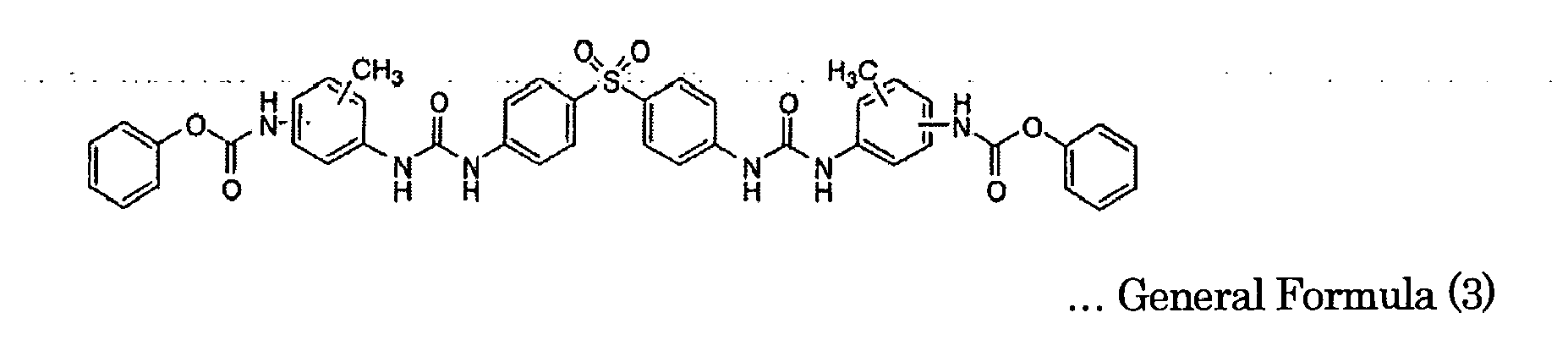
- The amount of the color developer to be added to the heat-sensitive coloring layer is not restricted and can be selected appropriately according to the requirement. The amount of the color developer to be added to the heat-sensitive coloring layer is preferably one part by mass to 20 parts by mass for one part by mass of a coloring agent, and more preferably two parts by mass to 10 parts by mass.
- The binder resin is not restricted and can be selected appropriately from hitherto known resins according to the requirement. Examples of the binder resin include water soluble high polymers such as polyvinyl alcohols, starch and derivatives of starch, cellulose derivatives such as methoxy cellulose, hydroxyethyl cellulose, carboxymethyl cellulose, methyl cellulose, ethyl cellulose, sodium polyacrylate, polyvinyl pyrrolidine, copolymers of acrylamide-acrylic ester, terpolymers of acrylamide-acrylic ester-methacrylic acid, styrene-anhydrous maleic copolymer alkali salts, isobutyl-anhydrous maleic copolymer alkali salts, polyacrylamides, sodium alginate, gelatin, and casein, and apart from such water soluble high polymer, examples further include emulsions such as polyvinyl alcohol, polyurethane, polyacrylic acid, polyacrylic ester, polymethacrylic ester, polybutyl methacrylate, copolymers of vinyl chloride-vinyl acetate, and copolymers of ethylenevinyl acetate, and latexes such as styrene-butadiene copolymers and styrene-butadiene-acrylic copolymers. These may be used alone or in combination.
- Various hot-melt substances can be used as a sensitivity improving agent in the heat-sensitive coloring layer. Examples of the hot-melt substance include fatty acids such as stearic acid and behenic acid, fatty acid amides such as stearic acid amide and palmitic acid amide, metal salts of fatty acid such as zinc stearate, aluminum stearate, calcium stearate, zinc palmitate, and zinc behenate, p-benzylbiphenyl, terphenyl, triphenylmethane, p-benzyloxybenzoic acid benzyl, β-benzyloxynaphthalene, β-naphthoic acid phenylester, 1-hydroxy-2-naphthoic acid phenylester, 1-hydroxy-2-naphthoic acid methylester, diphenylcarbonate, terephthalic acid dibenzylester, terephthalic acid dimethylester, 1,4-dimethoxynaphthalene, 1,4-diethoxynaphthalene, 1,4-dibenzyloxynaphthalene, 1,2-bis(phenoxy)ethane, 1,2-bis(3-methylphenoxy)ethane, 1,2-bis(4-methylphenoxy)ethane, 1,4-bis(phenoxy)butane, 1,4-bis(phenoxy)-2-butene, 1,2-bis(4-methoxyphenylthio)ethane, dibenzoylmethane, 1,4-bis(phenylthio)butane, 1,4-bis(phenylthio)-2-butene, 1,2-bis(4-methoxyphenylthio)ethane, 1,3-bis(2-vinyloxyethoxy)benzene, 1,4-bis(2-vinyloxyethoxy)benzene, p-(2-vinyloxyethoxy)biphenyl, p-aryloxybiphenyl, p-propargyloxybiphenyl, dibenzoyloxymethane, 1,3-dibenzoyloxypropane, dibezyldisulfide, 1,1-diphenylethanol, 1,1-diphenylpropanol, p-(benzyloxy)benzyl alcohol, 1,3-diphenoxy-2-propanol, N-octadecylcarbamoyl-p-methoxycarbonylbenzene, N-octadecylcarbamoylbenzene, oxalic acid dibenzyl ester, and 1,5-bis(p-methoxyphenyloxy)-3-oxapentane. These can be used alone or in combination.
- The heat-sensitive coloring layer may include various auxiliary additive constituents such as surfactant, lubricant and loading material according to the requirement. Examples of the lubricant include higher fatty acids or metal salts thereof, higher fatty acid amides, higher fatty acid esters, animal wax, vegetable wax, mineral wax, and petroleum wax.
- Examples of the loading material include inorganic fine powders such as calcium carbonate, silica, zinc oxide, titanium oxide, aluminum hydroxide, zinc hydroxide, barium sulfate, clay, kaolin, talc, and calcium and silica subjected to surface treatment, and moreover, include organic fine powders such as urea-formalin resins, styrene/methacrylic copolymers, polystyrene resins, and vinylidene chloride resins.
- A method of forming the heat-sensitive coloring layer is not restricted and can be formed by any normally known method. The heat-sensitive coloring layer can be formed, for example, by the following procedure: a leuco dye and a color developer are pulverized and dispersed separately with a bonding agent and other constituents in a disperser such as ball mill, attritor mill and sand mill until the diameter of the dispersed particles is 0.1 µm to 3 µm; a heat-sensitive coloring layer coating solution is prepared by mixing the mixture according to a prescribed recipe with a dispersant of a loading material, a hot-melt substance (sensitizer) dispersion; the heat-sensitive coloring layer is formed by applying the heat-sensitive coloring coating solution on the substrate.
- The deposited amount of the heat-sensitive coloring layer varies depending on the composition of the heat-sensitive coloring layer and the application of the heat-sensitive adhesive material and cannot be stipulated categorically. The deposited amount of the heat-sensitive coloring layer is preferably 1 g/m2 to 20 g/m2, and more preferably 3 g/m2 to 10 g/m2.
- The heat-sensitive recording material according to the present invention shows remarkable improvement in terms of adhesion to a thermal head by means of calendering, and it is extremely preferable that the calendering process is performed on the under layer, the heat-sensitive coloring layer, or the protective layer. Controlling the smoothness of the surface through the magnitude of the calendering pressure on the under layer, the heat-sensitive coloring layer or the protective layer eliminates the background fog and furthermore provides a heat-sensitive recording material with higher definition than conventional equivalents.
- There is no restriction on the form, the structure, and the size of the substrate; the shape, the structure, and the size of the substrate can be selected appropriately according to the requirement. Examples of the form include a sheet form, a roll form and a flat plate form, the structure may be one of a single layered structure and a laminated layered structure, and the size of the substrate can be selected appropriately according to the size of the heat-sensitive recording material.
- The present invention, in particular, is produced for the purpose of preventing the static charge which is developed when a plastic film and a synthetic paper film are used for the substrate. However, the substrate used in the present invention is not restricted to the synthetic paper film and the plastic film; high-quality paper, recycled paper, single-sided glazed paper, oil-resistant paper, coated paper, art paper, cast-coated paper, light-weight coated paper and resin-laminated paper can be used for the substrate.
- The thickness of the substrate is not restricted and can be selected appropriately according to the object. The thickness is preferably 30 µm to 2,000 µm, and more preferably 50 µm to 1,000 µm.
- A heat-sensitive recording label as the heat-sensitive recording material according to the first aspect includes an adhesive layer on the rear surface of the substrate on a side opposite to the heat-sensitive coloring layer, a release paper on the surface of the adhesive layer, and other composition according to the requirement. Further, the heat-sensitive recording label includes a back layer surface on the rear surface.
- A material of the adhesive layer is not restricted and can be selected appropriately according to the object. Examples thereof include urea resins, melamine resins, phenolic resins, epoxy resins, polyvinyl acetate resins, vinyl acetate-acrylic copolymers, ethylene-vinyl acetate copolymers, acrylic resins, polyvinyl ether resins, vinyl chloride-vinyl acetate copolymers, polystyrene resins, polyester resins, polyurethane resins, polyamide resins, chlorinated polyolefin resins, polyvinyl butyral resins, acrylic ester copolymers, methacrylic ester copolymers, natural rubbers, cyanoacrylate resins, and silicone resins. These resins and copolymers can be used alone or in combination.
- The heat-sensitive recording label according to the second aspect includes a heat-sensitive adhesive layer, which develops adhesion when heated, on the rear surface of the substrate on a side opposite to the heat-sensitive coloring layer and other composition according to the requirement. Further, the heat-sensitive recording label includes a back layer surface on the rear surface.
- The heat-sensitive adhesive layer includes a thermoplastic resin and a hot-melt substance. The heat-sensitive adhesive layer further includes a tackifier according to the requirement. The thermoplastic resin imparts tackiness and adhesion to the heat-sensitive adhesive layer. The hot-melt substance does not impart thermoplasticity to resins since it is solid at a room temperature. However, the hot-melt substance is fused by heating, and the resin is allowed to be swollen or be softened so as to impart tackiness. Moreover, the tackifier has a function of improving the tackiness.
- A heat-sensitive recording magnetic paper as the heat-sensitive recording material includes a magnetic recording layer on the rear surface of the substrate on the side opposite to the heat-sensitive coloring layer and other composition according to the requirement. Further, the heat-sensitive recording magnetic paper includes a back layer surface on the rear surface.
- The magnetic recording layer is formed by coating on the substrate with materials such as iron oxide and barium ferrite and a resin such as vinyl chloride, urethane resin and nylon resin, or it is formed by chemical deposition or sputtering without using a resin.
- It is preferable that the magnetic recording layer is provided on the surface of the substrate on the side opposite to the heat-sensitive coloring layer. However, the magnetic recording layer may also be provided on a part of the heat-sensitive coloring layer between the substrate and the heat-sensitive coloring layer.
- The form of the heat-sensitive recording material according to the present invention is not restricted and can be selected appropriately according to the requirement. Examples of the appropriate form include a label, a sheet, and a roll.
- A recording method using the heat-sensitive recording material according to the present invention is not restricted, and a recording can be performed by a hot pen, a thermal head, and a laser heating, according to the object.
- The heat-sensitive recording material according to the present invention can be used favorably in various fields: POS field such as perishable food, boxed meals and prepared food; copying field such as books and documents; communication field such as facsimile; ticketing field such as ticket vending machines and receipts; baggage tags in aviation industry.
- The present invention will be described below further specifically with Examples and Comparative Examples. However, the present invention is not restricted to Examples and Comparative Examples described below. Parts and percentage shown below are mass based.
- A leuco dye dispersion was prepare by pulverization followed by dispersion of the following composition with a sand mill such that the average particle diameter was 0.6 µm.
- 3-dibutylamino-6-methyl-7-anilinofluoran ··· 20 parts
- 10-% aqueous solution of polyvinyl alcohol ··· 20 parts
- water ... 60 parts
- A color developer dispersion was prepared by pulverization followed by dispersion of the following composition with a sand mill such that the average particle diameter was 0.5 µm.
- 4-isopropoxy-4'-hydroxyphenylsulfone --- 20 parts
- 10-% aqueous solution of polyvinyl alcohol ··· 20 parts
- Silica ··· 10 parts
- water ... 50 parts
- The following composition was mixed then stirred, and a heat-sensitive coloring layer coating solution was prepared.
- solution A (leuco dye dispersion) --- 20 parts
- solution B (color developer dispersion) --- 60 parts
- water ··· 30 parts
- The following composition was mixed and then stirred, and a back layer and under layer coating solution (i) was prepared.
- 40-% solution of acrylic ester copolymer (DICNAL RS-308 manufacture by Dai Nippon Ink And Chemical Industries Ltd.) ··· 10 parts
- 10-% aqueous solution of an itaconic acid modified polyvinyl alcohol ··· 5 parts
- 10-% solution of water dispersed silica ··· 30 parts
- 40-% solution of copolymer of methacryloyloxyethyltrimethylammonium chloride and styrene --- 10 parts
- water - 45 parts
- The following composition was mixed and then stirred, and a back layer and under layer coating solution (ii) was prepared.
- 10-% aqueous solution of polyvinyl alcohol - 20 parts
- 10-% solution of water dispersed silica ··· 10 parts
- 40-% solution of copolymer of methacryloyloxyethyltrimethylammonium chloride and styrene ... 5 parts
- 25-% aqueous solution of polyamide epichlorohydrin resin ··· 5 parts
- water ··· 60 parts.
- The following composition was mixed and then stirred, and a back layer and under layer coating solution (iii) was prepared.
- 40-% solution of acrylic ester copolymer (DICNAL RS-308, manufactured by Dai Nippon Ink And Chemical Industries Ltd.) ··· 10 parts
- 10-% aqueous solution of itaconic acid modified polyvinyl alcohol ··· 5 parts
- 10-% solution of water dispersed silica ··· 30 parts
- 33-% solution of quaternary salt styrene polymer (CHEMISTAT 6300 manufactured by Sanyo Chemical Industries Ltd.)··· 12 parts
- water ··· 47 parts
- The following composition was mixed and then stirred, and a protective layer coating solution was prepared.
- 10% aqueous solution of itaconic acid modified polyvinyl alcohol··· 35 parts
- 10-% solution of water dispersed aluminum hydroxide ··· 15 parts
- 25-% aqueous solution of polyamide epichlorohydrin resin ··· 5 parts
- water ··· 45 parts
-
- 10-% aqueous solution of diacetone modified polyvinyl alcohol ··· 35 parts
- 10-% solution of water dispersed aluminum hydroxide ··· 20 parts
- 10-% aqueous solution of adipic acid dihydrazide ··· 7 parts
- water ··· 38 parts
- The following composition was mixed and then stirred, and an under layer coating solution (i) was prepared.
- micro-hollow particles of non-foaming plastic (hollow ratio: 90 %; average particle diameter: 3 µm) ··· 55 parts
- styrene-butadiene copolymer latex (bulk density: 47.5 %) ··· 30 parts
- 40-% solution of copolymer of methacryloyloxyethyltrimethylammonium chloride and styrene ··· 5 parts
- water ··· 10 parts
- The following composition was mixed and then stirred, and an under layer coating solution (ii) was prepared.
- micro-hollow particles of non-foaming plastic (hollow ratio: 90 %; average particle diameter: 3 µm) ··· 60 parts
- styrene-butadiene copolymer latex (bulk density: 47.5 %) ... 30 parts
- water ... 10 parts
- An under layer was provided by applying followed by drying the solution D1 on a polypropylene film (PEARL FILM P-4257 manufactured by Toyobo Co., Ltd.) having a thickness of 85 µm such that the deposited amount of the solution D1 after drying was 1 g/m2.
- Next, the heat-sensitive coloring layer was formed by applying followed by drying the solution C on the under layer such that the deposited amount of the solution C after drying was 5 g/m2.
- Next, the protective layer was formed by applying followed by drying the solution E1 on the heat-sensitive coloring layer such that the amount upon deposition was 3 g/m2.
- Next, the back layer was formed by applying followed by drying the solution D1 on the surface of the polypropylene film that did not have the heat-sensitive coloring layer such that the deposited amount of the solution D1 after drying was 1.5 g/m2. Thus, the heat-sensitive recording material in Example 1 was manufactured. The layer structure of the heat-sensitive recording material in Example 1 is shown in Table 1.
Table 1 Coating Solution Amount Deposited After Drying Protective layer Solution E 1 3 g/m2 Heat-sensitive coloring layer Solution C 5 g/m2 Under layer Solution D1 1 g/m2 Polypropylene film (substrate) Back layer Solution D1 1.5 g/m2 - A heat-sensitive recording material in Example 2 was manufactured similarly to the heat-sensitive recording material in Example 1 except that the 40-% solution of the copolymer of methacryloyloxyethyltrimethylammonium chloride and styrene was replaced by 40-% solution of copolymer of acryloyloxyethyltrimethylammonium chloride.
- A heat-sensitive recording material in Example 3 was manufactured similarly to the heat-sensitive recording material in Example 1 except that the under layer was not formed. The layer structure of the heat-sensitive recording material in Example 3 is shown in Table 2.
Table 2 Coating Solution Amount Deposited After Drying Protective layer Solution E 1 3 g/m2 Heat-sensitive coloring layer Solution C 5 g/m2 Polypropylene film (substrate) - - Back layer Solution D 1 1.5 g/m2 - A heat-sensitive recording material in Example 4 was manufactured similarly to the heat-sensitive recording material in Example 1 except that the solution D1 was replaced by the solution D2. The layer structure of the heat-sensitive recording material in Example 4 is shown in Table 3.
Table 3 Coating Solution Amount Deposited After Drying Protective layer Solution E 1 3 g/m2 Heat-sensitive coloring layer Solution C 5 g/m2 Under layer Solution D2 1 g/m2 Polypropylene film (substrate) Back layer Solution D2 1.5 g/m2 - A heat-sensitive recording material in Example 5 was manufactured similarly to the heat-sensitive recording material in Example 1 except that the solution D1 in the under layer was replaced by the solution F1 and that the deposited amount of the solution F1 after drying was changed to 2.5 g/m2. The layer structure of the heat-sensitive recording material in Example 5 is shown in Table 4.
Table 4 Coating Solution Amount Deposited Upon Drying Protective layer Solution E1 3 g/m2 Heat-sensitive coloring layer Solution C 5 g/m2 Under layer Solution F1 2.5 g/m2 Polypropylene film (substrate) - - Back layer Solution D1 1.5 g/m2 - A first under layer was provided by applying followed by drying the solution F2 on the polypropylene film (PEARL FILM P-4257 manufactured by Toyobo Co., Ltd) having a thickness of 85 µm such that the deposited amount of the solution F2 after drying was 2.5 g(m2.
- Next, a second under layer was formed by applying followed by drying the solution D1 on the first under layer such that the deposited amount of the solution D1 after drying was 1 g/m2.
- Next, a heat-sensitive coloring layer was formed by applying followed by drying the solution C on the second under layer such that the deposited amount of the solution C after drying was 5 g/m2.
- Next, a protective layer was formed by applying followed by drying the solution E1 on the heat-sensitive coloring layer such that the deposited amount of the solution E1 after drying was 3 g/m2.
- Next, a back layer was formed by applying followed by drying the solution D1 on the surface of the polypropylene film that did not have the heat-sensitive coloring layer such that the deposited amount of the solution D1 after drying was 1.5 g/m2. Thus, the heat-sensitive recording material in Example 6 was manufactured. The layer structure of the heat-sensitive recording material in Example 6 is shown in Table 5.
Table 5 Coating Solution Amount Deposited After Drying Protective layer Solution E1 3 g/m2 Heat-sensitive coloring layer Solution C 5 g/m2 Second under layer Solution D 1 1 g/m2 First under layer Solution F2 2.5 g/m2 Polypropylene film (substrate) - - Back layer Solution D1 1.5 g/m2 - A heat-sensitive recording material in Example 7 was manufactured similarly to the heat-sensitive recording material in Example 1 except that five parts of 40-% solution of the copolymer of methacryloyloxyethyltrimethylammonium chloride and styrene was added while preparing the solution E1.
- A heat-sensitive recording material in Example 8 was manufactured similarly to the heat-sensitive recording material in Example 1 except that the solution D1 for the back layer was replaced by the solution D3. The layer structure of the heat-sensitive recording material in Example 8 is shown in Table 6.
Table 6 Coating Solution Amount Deposited Upon Drying Protective layer Solution E 1 3 g/m2 Heat-sensitive coloring layer Solution C 5 g/m2 Under layer Solution D1 1 g/m2 Polypropylene film (substrate) - - Back layer Solution D3 1.5 g/m2 - A heat-sensitive recording material in Example 9 was manufactured similarly to the heat-sensitive recording material in Example 1 except that the solution E1 was replaced by the solution E2. The layer structure of the heat-sensitive recording material in Example 9 is shown in Table 7.
-
Table 7 Coating Solution Amount Deposited Upon Drying Protective layer Solution E2 3 g/m2 Heat-sensitive coloring layer Solution C 5 g/m2 Under layer Solution D1 1 g/m2 Polypropylene film (substrate) - - Back layer Solution D 1 1.5 g/m2 - A heat-sensitive recording material in Comparative Example 1 was manufactured similarly to the heat-sensitive recording material in Example 1 except that the solution D1 was replaced by the solution D3. The layer structure of the heat-sensitive recording material in Comparative Example 1 is shown in Table 8.
Table 8 Coating Solution Amount Deposited Upon Drying Protective layer Solution E 1 3 g/m2 Heat-sensitive coloring layer Solution C 5 g(m2 Under layer Solution D3 1 g/m2 Polypropylene film (substrate) - - Back layer Solution D3 1.5 g/m2 - A heat-sensitive recording material in Comparative Example 2 was manufactured similarly to the heat-sensitive recording material in Comparative Example 1 except that a 30-% solution of ammonium polystyrene sulfonate (CHEMISTAT SA-101 manufactured by Sanyo Chemical Industries Ltd.) was used instead of the 33-% solution of quaternary styrene polymer while preparing the solution D3.
- A heat-sensitive recording material in Comparative Example 3 was manufactured similarly to the heat-sensitive recording material in Example 1 except that the 40-% solution of the copolymer of methacryloyloxyethyltrimethylammonium chloride and styrene was excluded from the solution D1.
- Next, various properties of the heat-sensitive recording materials obtained in Example 1 to Example 9 and in Comparative Example 1 to Comparative Example 3 were evaluated as follows. The results are shown in Table 9.
- Printing was performed on each of the heat-sensitive recording materials by a print simulator manufactured by Okura Electric Co., Ltd. with a pulse width ranging from 0.2 ms to 1.2 ms under the following conditions: head electric power: 0.45 w/dot; recording time per line: 20 ms/l; and scanning density: 8×3.85 dots/mm. The print density and the density of the base surface at 0.4 ms, 0.6 ms, and 1.0 ms were measured by a MACBETH REFLECTION DENSITOMETER RD-914.
- The heat-sensitive recording material was kept in a dry environment with a temperature of 70 °C for 15 hours, and then the density of a print portion was measured by a MACBETH REFLECTION DENSITOMETER RD-914. The result was evaluated based on the following criteria.
-
- A: print density of 1.30 or more
- B: print density of 1.15 or more and less than 1.30
- C: print density of less than 1.15
- After soaking each of the heat-sensitive recording materials in water for 15 hours in an environment of 20 °C, the front surface and the rear surface were rubbed ten times with a finger, and exfoliation of the coating layer was checked visually.
- A --- coating layer was not exfoliated
- B --- coating layer was exfoliated (with resistance)
- C ··· coating layer was exfoliated (with no resistance)
- The surface resistance of the front surface and the rear surface of each of the heat-sensitive recording material was measured by using a HIGH RESISTANCE METER (4339A manufactured by Hewlett-Packard Japan, Ltd.)
- Printing was performed with a printer I-4308, manufactured by Datamax Co., Ltd., at a temperature of 10 °C and a relative humidity of 15 %, and feeding was checked.
- A ··· fed normally (feeding was normal)
- B ··· not fed (feeding was not proper)
| Coloring Property | 70-°C Image Color Degradation Resistance | Water Resistance | Surface Resistance (Ω) | Low-Temperature Feeding Property | |||||
| 0.4 ms | 0.6 ms | 1.0 ms | Print Density | Evaluation | Front Surface | Rear Surface | |||
| Example 1 | 0.57 | 1.28 | 1.37 | 1.31 | A | A | 3x10¹⁰ | 5x10⁸ | A |
| Example 2 | 0.56 | 1.27 | 1.37 | 1.30 | A | A | 2x10¹⁰ | 3x10⁸ | A |
| Example 3 | 0.58 | 1.30 | 1.37 | 1.33 | A | A | 2x10¹¹ | 5x10⁸ | A |
| Example 4 | 0.57 | 1.27 | 1.37 | 1.32 | A | A | 2x10¹¹ | 6x10⁸ | A |
| Example 5 | 0.68 | 1.35 | 1.37 | 1.32 | A | A | 5x10¹⁰ | 5x10⁸ | A |
| Example 6 | 0.63 | 1.34 | 1.37 | 1.32 | A | A | 4x10¹⁰ | 5x10⁸ | A |
| Example 7 | 0.54 | 1.25 | 1.36 | 1.29 | B | A | 5x10⁹ | 4x10⁸ | A |
| Example 8 | 0.57 | 1.27 | 1.37 | 1.31 | A | A | 5×10¹⁰ | ∞ | A |
| Example 9 | 0.55 | 1.27 | 1.37 | 1.29 | B | A | 9×10⁹ | 4×10⁸ | A |
| Comparative Example 1 | 0.55 | 1.26 | 1.37 | 1.10 | C | A | 1×10¹⁰ | 2×10⁸ | A |
| Comparative Example 2 | 0.59 | 1.29 | 1.37 | 1.29 | B | C | 4×10¹⁰ | 7×10⁸ | A |
| Comparative Example 3 | 0.59 | 1.30 | 1.37 | 1.34 | A | A | ∞ | ∞ | B |
Claims (18)
- A heat-sensitive recording material comprising on one surface of a substrate a heat-sensitive coloring layer comprising a leuco dye and a color developer,
wherein the heat-sensitive recording material comprises a layer which comprises a copolymer of a (meth)acryloyloxyalkylammonium salt and styrene. - The heat-sensitive recording material according to claim 1,
wherein the (meth)acryloyloxyalkylammonium salt is (meth)alkyloyloxyethyltrimethylammonium chloride. - The heat-sensitive recording material according to any one of claims 1 to 2, wherein the copolymer of the (meth)acryloyloxyalkylammonium salt and styrene is represented by General Formula (1):

- The heat-sensitive recording material according to any one of claims 1 to 3, wherein a content of the copolymer of the (meth)acryloyloxyalkylammonium salt and styrene in the layer comprising the copolymer is in a range of 5 % by mass to 40 % by mass.
- The heat-sensitive recording material according to any one of claims 1 to 4, wherein the layer comprising the copolymer of the (meth)acryloyloxyalkylammonium salt and styrene is at least any one of a back layer on the surface of the substrate opposite to the side comprising the heat-sensitive coloring layer; an under layer between the substrate and the heat-sensitive coloring layer; and a protective layer on the heat-sensitive coloring layer.
- The heat-sensitive recording material according to claim 5,
wherein the layers comprise the copolymer of the (meth)acryloyloxyalkylammonium salt and styrene are the back layer, the under layer and the protective layer. - The heat-sensitive recording material according to claim 5,
wherein the layer comprising the copolymer of the (meth)acryloyloxyalkylammonium salt and styrene is at least one of the back layer and the under layer. - The heat-sensitive recording material according to any one of claims 5 to 8, wherein the back layer and the under layer comprise a binder resin, and the binder resin is one of a water dispersible resin and a water soluble resin.
- The heat-sensitive recording material according to claim 8,
wherein the binder resin comprises an acrylic ester copolymer - The heat-sensitive recording material according to any one of claims 5 to 9, wherein the under layer comprises plastic hollow particles having a hollow ratio of 50 % or more.
- The heat-sensitive recording material according to any one of claims 5 to 10, wherein the protective layer comprises a binder resin, a cross-linking agent and a filler.
- The heat-sensitive recording material according to claim 11,
wherein the binder resin is an itaconic acid modified polyvinyl alcohol, and the cross-linking agent is a polyamide epichlorohydrin resin. - The heat-sensitive recording material according to claim 11,
wherein the binder resin is a diacetone modified polyvinyl alcohol, and the cross-linking agent is an adipic acid dihydrazide. - The heat-sensitive recording material according to any one of claims 1 to 11, wherein the substrate is one of a plastic film and synthetic paper.
- The heat-sensitive recording material according to any one of claims 1 to 14, wherein the heat-sensitive recording material is a heat-sensitive recording label which comprises: an adhesive layer on the rear surface of the substrate opposite to the heat-sensitive coloring layer, and release paper on the adhesive layer.
- The heat-sensitive recording material according to any one of claims 1 to 14, wherein the heat-sensitive recording material is a heat-sensitive recording label comprising a heat-sensitive adhesive layer, which develops adhesion when heated, on the rear surface of the substrate on the side opposite to the heat-sensitive coloring layer.
- The heat-sensitive recording material according to any one of claims 1 to 14, wherein the heat-sensitive recording material is a heat-sensitive recording magnetic paper comprising a magnetic recording layer on the rear surface of the substrate on the side opposite to the heat-sensitive coloring layer.
- The heat-sensitive recording material according to any one of claims 1 to 17, wherein the heat-sensitive recording material is in a form of any one of a label, a sheet and a roll.
Applications Claiming Priority (1)
| Application Number | Priority Date | Filing Date | Title |
|---|---|---|---|
| JP2005071346 | 2005-03-14 |
Publications (2)
| Publication Number | Publication Date |
|---|---|
| EP1702762A1 true EP1702762A1 (en) | 2006-09-20 |
| EP1702762B1 EP1702762B1 (en) | 2007-12-05 |
Family
ID=36406580
Family Applications (1)
| Application Number | Title | Priority Date | Filing Date |
|---|---|---|---|
| EP06005079A Ceased EP1702762B1 (en) | 2005-03-14 | 2006-03-13 | Heat-sensitive recording material |
Country Status (4)
| Country | Link |
|---|---|
| US (1) | US7419935B2 (en) |
| EP (1) | EP1702762B1 (en) |
| CN (1) | CN100471686C (en) |
| DE (1) | DE602006000282T2 (en) |
Cited By (4)
| Publication number | Priority date | Publication date | Assignee | Title |
|---|---|---|---|---|
| EP1816003A1 (en) * | 2006-02-03 | 2007-08-08 | Ricoh Company, Ltd. | Thermosensitive recording material and method for producing the same |
| EP1900543A1 (en) | 2006-09-15 | 2008-03-19 | Ricoh Company, Ltd. | Thermosensitive recording material |
| EP2281694B2 (en) † | 2009-08-05 | 2016-03-23 | Ricoh Company, Ltd. | Thermosensitive recording material |
| EP4046813A4 (en) * | 2019-10-17 | 2024-03-27 | Oji Holdings Corporation | HEAT SENSITIVE RECORDING BODY AND PROCESS FOR PRODUCTION THEREOF |
Families Citing this family (17)
| Publication number | Priority date | Publication date | Assignee | Title |
|---|---|---|---|---|
| GB0423107D0 (en) * | 2004-10-18 | 2004-11-17 | Arjo Wiggins Ltd | Sheet product for thermal printing |
| US7425522B2 (en) * | 2006-01-18 | 2008-09-16 | Ricoh Company, Ltd. | Thermosensitive recording material |
| US20070225164A1 (en) * | 2006-03-16 | 2007-09-27 | Takeshi Kajikawa | Fluid dispersion, and thermosensitive recording material and method for preparing the same |
| JP2008254436A (en) * | 2007-03-13 | 2008-10-23 | Ricoh Co Ltd | Thermal recording material |
| JP5186962B2 (en) * | 2007-03-19 | 2013-04-24 | 株式会社リコー | Thermal recording material |
| JP4986779B2 (en) * | 2007-09-13 | 2012-07-25 | 株式会社リコー | Thermal recording material |
| US8298653B2 (en) * | 2008-09-17 | 2012-10-30 | Ricoh Company, Ltd. | Recording medium |
| US8871678B2 (en) * | 2010-03-15 | 2014-10-28 | Nippon Paper Industries Co., Ltd. | Thermosensitive recording medium |
| US8623785B2 (en) * | 2010-03-30 | 2014-01-07 | Mitsubishi Paper Mills Limited | Thermal recording material and method for producing the same |
| JP6003340B2 (en) * | 2011-07-29 | 2016-10-05 | 株式会社リコー | Thermal recording material |
| CN104553433B (en) * | 2013-10-16 | 2018-08-03 | 理光感热技术(无锡)有限公司 | Thermal recording medium |
| EP3312018B1 (en) * | 2015-06-16 | 2023-08-09 | Nippon Paper Industries Co., Ltd. | Thermal recording material |
| KR20170069335A (en) * | 2015-12-10 | 2017-06-21 | 안정옥 | Thermal recording materials |
| CN107128095B (en) * | 2017-04-26 | 2019-08-09 | 顾涛 | Temperature-sensitive draws pyrography material |
| JP6953623B2 (en) | 2018-03-30 | 2021-10-27 | 株式会社ユポ・コーポレーション | Laminates, in-mold labels, labeled molded bodies, roll-shaped in-mold labels and in-mold label stacks |
| EP4227107A1 (en) * | 2022-02-10 | 2023-08-16 | Ricoh Company, Ltd. | Thermosensitive recording medium |
| KR20240157101A (en) * | 2022-03-30 | 2024-10-31 | 닛폰세이시가부시키가이샤 | Thermal recorder |
Citations (13)
| Publication number | Priority date | Publication date | Assignee | Title |
|---|---|---|---|---|
| JPS6232080A (en) | 1985-08-02 | 1987-02-12 | Ricoh Co Ltd | Thermal recording material |
| US4812438A (en) * | 1986-05-29 | 1989-03-14 | Kanzaki Paper Mfg. Co., Ltd. | Heat-sensitive recording material |
| JPH0197679A (en) | 1987-10-09 | 1989-04-17 | Ricoh Co Ltd | Thermosensitive recording medium |
| JPH01291981A (en) | 1988-05-19 | 1989-11-24 | Ricoh Co Ltd | heat sensitive recording material |
| JPH02155688A (en) | 1988-12-08 | 1990-06-14 | Ricoh Co Ltd | heat sensitive recording material |
| EP0463400A1 (en) * | 1990-06-27 | 1992-01-02 | Xerox Corporation | Transparencies |
| EP0559525A2 (en) * | 1992-02-28 | 1993-09-08 | Tomoegawa Paper Co. Ltd. | Thermal printing medium and method for preparing the same |
| US5260252A (en) * | 1990-07-24 | 1993-11-09 | Nashua Corporation | Thermal latent image material and method of producing and developing the same |
| JPH06234270A (en) | 1992-12-14 | 1994-08-23 | Ricoh Co Ltd | Thermal recording material |
| JP2000263935A (en) | 1999-03-12 | 2000-09-26 | Ricoh Co Ltd | Thermal recording material |
| EP1114734A1 (en) * | 1999-06-04 | 2001-07-11 | DAICEL CHEMICAL INDUSTRIES, Ltd. | Resin composition for ink-jet recording sheet and recording sheet made with the same |
| JP2002248864A (en) | 2001-02-26 | 2002-09-03 | Ricoh Co Ltd | Thermal recording material |
| EP1637324A2 (en) * | 2004-08-26 | 2006-03-22 | Fuji Photo Film Co., Ltd. | Color image-forming material and lithographic printing plate precursor |
Family Cites Families (17)
| Publication number | Priority date | Publication date | Assignee | Title |
|---|---|---|---|---|
| CN1009722B (en) * | 1987-06-10 | 1990-09-26 | 国营第七五四厂 | Thermo-ribbon for typewriting |
| JP2530538B2 (en) | 1991-12-24 | 1996-09-04 | 三洋化成工業株式会社 | Sheet or film molded from resin composite |
| US5409881A (en) * | 1991-12-27 | 1995-04-25 | Ricoh Company, Ltd. | Thermosensitive recording material |
| JP3458252B2 (en) * | 1993-12-16 | 2003-10-20 | 株式会社リコー | Thermal recording material |
| US5703006A (en) * | 1995-01-12 | 1997-12-30 | Ricoh Company, Ltd. | Thermosensitive recording medium |
| JPH08199156A (en) | 1995-01-19 | 1996-08-06 | Sanyo Chem Ind Ltd | Antistatic agent and resin composition |
| US5646088A (en) * | 1995-02-16 | 1997-07-08 | Ricoh Co., Ltd. | Thermosensitive recording material and production process thereof |
| FR2742380B1 (en) * | 1995-12-15 | 1999-01-29 | Ricoh Kk | THERMOSENSITIVE RECORDING MEDIUM WITH PROTECTIVE LAYER |
| JP3660054B2 (en) | 1996-05-27 | 2005-06-15 | 株式会社ユポ・コーポレーション | Synthetic paper with excellent printability |
| US5972836A (en) * | 1996-07-18 | 1999-10-26 | Ricoh Company, Ltd. | Thermosensitive recording medium |
| JPH11170456A (en) | 1997-12-08 | 1999-06-29 | Nippon Polychem Kk | Polyolefin resin laminated stretched film with excellent transparency |
| JP3891463B2 (en) * | 1999-12-09 | 2007-03-14 | 株式会社リコー | Thermal recording composition and thermal recording material |
| US6660688B2 (en) * | 2000-05-31 | 2003-12-09 | Ricoh Company Ltd. | Thermosensitive recording medium |
| JP3962267B2 (en) | 2001-02-21 | 2007-08-22 | 三洋化成工業株式会社 | Antistatic resin film |
| DE60201934T2 (en) * | 2001-03-23 | 2005-11-10 | Ricoh Co., Ltd. | Leuco dye dispersion and thermosensitive recording material using this dispersion |
| JP2003341229A (en) * | 2002-05-30 | 2003-12-03 | Fuji Photo Film Co Ltd | Thermal recording material |
| JP4070712B2 (en) * | 2003-02-28 | 2008-04-02 | 株式会社リコー | Thermal recording material |
-
2006
- 2006-03-13 EP EP06005079A patent/EP1702762B1/en not_active Ceased
- 2006-03-13 US US11/375,668 patent/US7419935B2/en not_active Expired - Fee Related
- 2006-03-13 DE DE602006000282T patent/DE602006000282T2/en not_active Expired - Lifetime
- 2006-03-14 CN CNB2006100591219A patent/CN100471686C/en not_active Expired - Fee Related
Patent Citations (13)
| Publication number | Priority date | Publication date | Assignee | Title |
|---|---|---|---|---|
| JPS6232080A (en) | 1985-08-02 | 1987-02-12 | Ricoh Co Ltd | Thermal recording material |
| US4812438A (en) * | 1986-05-29 | 1989-03-14 | Kanzaki Paper Mfg. Co., Ltd. | Heat-sensitive recording material |
| JPH0197679A (en) | 1987-10-09 | 1989-04-17 | Ricoh Co Ltd | Thermosensitive recording medium |
| JPH01291981A (en) | 1988-05-19 | 1989-11-24 | Ricoh Co Ltd | heat sensitive recording material |
| JPH02155688A (en) | 1988-12-08 | 1990-06-14 | Ricoh Co Ltd | heat sensitive recording material |
| EP0463400A1 (en) * | 1990-06-27 | 1992-01-02 | Xerox Corporation | Transparencies |
| US5260252A (en) * | 1990-07-24 | 1993-11-09 | Nashua Corporation | Thermal latent image material and method of producing and developing the same |
| EP0559525A2 (en) * | 1992-02-28 | 1993-09-08 | Tomoegawa Paper Co. Ltd. | Thermal printing medium and method for preparing the same |
| JPH06234270A (en) | 1992-12-14 | 1994-08-23 | Ricoh Co Ltd | Thermal recording material |
| JP2000263935A (en) | 1999-03-12 | 2000-09-26 | Ricoh Co Ltd | Thermal recording material |
| EP1114734A1 (en) * | 1999-06-04 | 2001-07-11 | DAICEL CHEMICAL INDUSTRIES, Ltd. | Resin composition for ink-jet recording sheet and recording sheet made with the same |
| JP2002248864A (en) | 2001-02-26 | 2002-09-03 | Ricoh Co Ltd | Thermal recording material |
| EP1637324A2 (en) * | 2004-08-26 | 2006-03-22 | Fuji Photo Film Co., Ltd. | Color image-forming material and lithographic printing plate precursor |
Cited By (5)
| Publication number | Priority date | Publication date | Assignee | Title |
|---|---|---|---|---|
| EP1816003A1 (en) * | 2006-02-03 | 2007-08-08 | Ricoh Company, Ltd. | Thermosensitive recording material and method for producing the same |
| EP1900543A1 (en) | 2006-09-15 | 2008-03-19 | Ricoh Company, Ltd. | Thermosensitive recording material |
| US8003568B2 (en) | 2006-09-15 | 2011-08-23 | Ricoh Company, Ltd. | Thermosensitive recording material |
| EP2281694B2 (en) † | 2009-08-05 | 2016-03-23 | Ricoh Company, Ltd. | Thermosensitive recording material |
| EP4046813A4 (en) * | 2019-10-17 | 2024-03-27 | Oji Holdings Corporation | HEAT SENSITIVE RECORDING BODY AND PROCESS FOR PRODUCTION THEREOF |
Also Published As
| Publication number | Publication date |
|---|---|
| US20060205593A1 (en) | 2006-09-14 |
| US7419935B2 (en) | 2008-09-02 |
| EP1702762B1 (en) | 2007-12-05 |
| DE602006000282T2 (en) | 2008-11-06 |
| CN100471686C (en) | 2009-03-25 |
| DE602006000282D1 (en) | 2008-01-17 |
| CN1833876A (en) | 2006-09-20 |
Similar Documents
| Publication | Publication Date | Title |
|---|---|---|
| EP1702762B1 (en) | Heat-sensitive recording material | |
| EP2281694B2 (en) | Thermosensitive recording material | |
| EP3290218B1 (en) | Thermosensitive recording material | |
| EP1452334B1 (en) | Thermosensitive recording material | |
| EP1810835B1 (en) | Thermosensitive recording material | |
| US7906458B2 (en) | Heat-sensitive recording material and production method thereof | |
| EP1834800B1 (en) | Fluid dispersion, and thermosensitive recording material and method for preparing the same | |
| US20070184978A1 (en) | Thermosensitive recording material and method of producing the same | |
| JP5157287B2 (en) | Thermal recording material and recording method using the same | |
| EP1900543B1 (en) | Thermosensitive recording material | |
| EP2103444A1 (en) | Thermosensitive recording material | |
| JP4719036B2 (en) | Thermal recording material | |
| EP3475095B1 (en) | Thermosensitive recording medium and article | |
| US4985394A (en) | Thermosensitive recording material | |
| JP5032924B2 (en) | Thermal recording material | |
| JP3750786B2 (en) | Thermal recording material | |
| JP2008254436A (en) | Thermal recording material | |
| EP1788014A1 (en) | Thermosensitive adhesive composition, method of manufacturing the same and thermosensitive adhesive article | |
| JP5315734B2 (en) | Thermal recording material | |
| JP5022156B2 (en) | Thermal recording material and method for producing the same | |
| JP2011056804A (en) | Thermal recording material | |
| JPH08310131A (en) | Thermal recording material | |
| JPH1086521A (en) | Thermal recording material |
Legal Events
| Date | Code | Title | Description |
|---|---|---|---|
| PUAI | Public reference made under article 153(3) epc to a published international application that has entered the european phase |
Free format text: ORIGINAL CODE: 0009012 |
|
| AK | Designated contracting states |
Kind code of ref document: A1 Designated state(s): AT BE BG CH CY CZ DE DK EE ES FI FR GB GR HU IE IS IT LI LT LU LV MC NL PL PT RO SE SI SK TR |
|
| AX | Request for extension of the european patent |
Extension state: AL BA HR MK YU |
|
| 17P | Request for examination filed |
Effective date: 20070125 |
|
| GRAP | Despatch of communication of intention to grant a patent |
Free format text: ORIGINAL CODE: EPIDOSNIGR1 |
|
| AKX | Designation fees paid |
Designated state(s): DE FR GB |
|
| GRAS | Grant fee paid |
Free format text: ORIGINAL CODE: EPIDOSNIGR3 |
|
| GRAA | (expected) grant |
Free format text: ORIGINAL CODE: 0009210 |
|
| AK | Designated contracting states |
Kind code of ref document: B1 Designated state(s): DE FR GB |
|
| REG | Reference to a national code |
Ref country code: GB Ref legal event code: FG4D |
|
| REF | Corresponds to: |
Ref document number: 602006000282 Country of ref document: DE Date of ref document: 20080117 Kind code of ref document: P |
|
| ET | Fr: translation filed | ||
| PLBE | No opposition filed within time limit |
Free format text: ORIGINAL CODE: 0009261 |
|
| STAA | Information on the status of an ep patent application or granted ep patent |
Free format text: STATUS: NO OPPOSITION FILED WITHIN TIME LIMIT |
|
| 26N | No opposition filed |
Effective date: 20080908 |
|
| REG | Reference to a national code |
Ref country code: DE Ref legal event code: R082 Ref document number: 602006000282 Country of ref document: DE Representative=s name: MEISSNER, BOLTE & PARTNER GBR, DE Ref country code: DE Ref legal event code: R082 Ref document number: 602006000282 Country of ref document: DE Representative=s name: MEISSNER BOLTE PATENTANWAELTE RECHTSANWAELTE P, DE |
|
| REG | Reference to a national code |
Ref country code: DE Ref legal event code: R082 Ref document number: 602006000282 Country of ref document: DE Representative=s name: MEISSNER, BOLTE & PARTNER GBR, DE |
|
| REG | Reference to a national code |
Ref country code: FR Ref legal event code: PLFP Year of fee payment: 11 |
|
| REG | Reference to a national code |
Ref country code: FR Ref legal event code: PLFP Year of fee payment: 12 |
|
| REG | Reference to a national code |
Ref country code: FR Ref legal event code: PLFP Year of fee payment: 13 |
|
| PGFP | Annual fee paid to national office [announced via postgrant information from national office to epo] |
Ref country code: DE Payment date: 20200320 Year of fee payment: 15 Ref country code: GB Payment date: 20200323 Year of fee payment: 15 |
|
| PGFP | Annual fee paid to national office [announced via postgrant information from national office to epo] |
Ref country code: FR Payment date: 20200319 Year of fee payment: 15 |
|
| REG | Reference to a national code |
Ref country code: DE Ref legal event code: R119 Ref document number: 602006000282 Country of ref document: DE |
|
| GBPC | Gb: european patent ceased through non-payment of renewal fee |
Effective date: 20210313 |
|
| PG25 | Lapsed in a contracting state [announced via postgrant information from national office to epo] |
Ref country code: DE Free format text: LAPSE BECAUSE OF NON-PAYMENT OF DUE FEES Effective date: 20211001 Ref country code: GB Free format text: LAPSE BECAUSE OF NON-PAYMENT OF DUE FEES Effective date: 20210313 Ref country code: FR Free format text: LAPSE BECAUSE OF NON-PAYMENT OF DUE FEES Effective date: 20210331 |