EP1702683A1 - Metal oxynitride electrode catalyst - Google Patents
Metal oxynitride electrode catalyst Download PDFInfo
- Publication number
- EP1702683A1 EP1702683A1 EP04819836A EP04819836A EP1702683A1 EP 1702683 A1 EP1702683 A1 EP 1702683A1 EP 04819836 A EP04819836 A EP 04819836A EP 04819836 A EP04819836 A EP 04819836A EP 1702683 A1 EP1702683 A1 EP 1702683A1
- Authority
- EP
- European Patent Office
- Prior art keywords
- electrode catalyst
- electrode
- potential
- oxynitride
- metal
- Prior art date
- Legal status (The legal status is an assumption and is not a legal conclusion. Google has not performed a legal analysis and makes no representation as to the accuracy of the status listed.)
- Granted
Links
Images

Classifications
-
- B—PERFORMING OPERATIONS; TRANSPORTING
- B01—PHYSICAL OR CHEMICAL PROCESSES OR APPARATUS IN GENERAL
- B01J—CHEMICAL OR PHYSICAL PROCESSES, e.g. CATALYSIS OR COLLOID CHEMISTRY; THEIR RELEVANT APPARATUS
- B01J27/00—Catalysts comprising the elements or compounds of halogens, sulfur, selenium, tellurium, phosphorus or nitrogen; Catalysts comprising carbon compounds
- B01J27/24—Nitrogen compounds
-
- B—PERFORMING OPERATIONS; TRANSPORTING
- B01—PHYSICAL OR CHEMICAL PROCESSES OR APPARATUS IN GENERAL
- B01J—CHEMICAL OR PHYSICAL PROCESSES, e.g. CATALYSIS OR COLLOID CHEMISTRY; THEIR RELEVANT APPARATUS
- B01J21/00—Catalysts comprising the elements, oxides, or hydroxides of magnesium, boron, aluminium, carbon, silicon, titanium, zirconium, or hafnium
- B01J21/06—Silicon, titanium, zirconium or hafnium; Oxides or hydroxides thereof
- B01J21/063—Titanium; Oxides or hydroxides thereof
-
- B—PERFORMING OPERATIONS; TRANSPORTING
- B01—PHYSICAL OR CHEMICAL PROCESSES OR APPARATUS IN GENERAL
- B01J—CHEMICAL OR PHYSICAL PROCESSES, e.g. CATALYSIS OR COLLOID CHEMISTRY; THEIR RELEVANT APPARATUS
- B01J21/00—Catalysts comprising the elements, oxides, or hydroxides of magnesium, boron, aluminium, carbon, silicon, titanium, zirconium, or hafnium
- B01J21/06—Silicon, titanium, zirconium or hafnium; Oxides or hydroxides thereof
- B01J21/066—Zirconium or hafnium; Oxides or hydroxides thereof
-
- B—PERFORMING OPERATIONS; TRANSPORTING
- B01—PHYSICAL OR CHEMICAL PROCESSES OR APPARATUS IN GENERAL
- B01J—CHEMICAL OR PHYSICAL PROCESSES, e.g. CATALYSIS OR COLLOID CHEMISTRY; THEIR RELEVANT APPARATUS
- B01J23/00—Catalysts comprising metals or metal oxides or hydroxides, not provided for in group B01J21/00
- B01J23/16—Catalysts comprising metals or metal oxides or hydroxides, not provided for in group B01J21/00 of arsenic, antimony, bismuth, vanadium, niobium, tantalum, polonium, chromium, molybdenum, tungsten, manganese, technetium or rhenium
- B01J23/20—Vanadium, niobium or tantalum
-
- C—CHEMISTRY; METALLURGY
- C25—ELECTROLYTIC OR ELECTROPHORETIC PROCESSES; APPARATUS THEREFOR
- C25B—ELECTROLYTIC OR ELECTROPHORETIC PROCESSES FOR THE PRODUCTION OF COMPOUNDS OR NON-METALS; APPARATUS THEREFOR
- C25B11/00—Electrodes; Manufacture thereof not otherwise provided for
- C25B11/02—Electrodes; Manufacture thereof not otherwise provided for characterised by shape or form
- C25B11/037—Electrodes made of particles
-
- C—CHEMISTRY; METALLURGY
- C25—ELECTROLYTIC OR ELECTROPHORETIC PROCESSES; APPARATUS THEREFOR
- C25B—ELECTROLYTIC OR ELECTROPHORETIC PROCESSES FOR THE PRODUCTION OF COMPOUNDS OR NON-METALS; APPARATUS THEREFOR
- C25B11/00—Electrodes; Manufacture thereof not otherwise provided for
- C25B11/04—Electrodes; Manufacture thereof not otherwise provided for characterised by the material
-
- C—CHEMISTRY; METALLURGY
- C25—ELECTROLYTIC OR ELECTROPHORETIC PROCESSES; APPARATUS THEREFOR
- C25B—ELECTROLYTIC OR ELECTROPHORETIC PROCESSES FOR THE PRODUCTION OF COMPOUNDS OR NON-METALS; APPARATUS THEREFOR
- C25B11/00—Electrodes; Manufacture thereof not otherwise provided for
- C25B11/04—Electrodes; Manufacture thereof not otherwise provided for characterised by the material
- C25B11/051—Electrodes formed of electrocatalysts on a substrate or carrier
- C25B11/073—Electrodes formed of electrocatalysts on a substrate or carrier characterised by the electrocatalyst material
-
- H—ELECTRICITY
- H01—ELECTRIC ELEMENTS
- H01M—PROCESSES OR MEANS, e.g. BATTERIES, FOR THE DIRECT CONVERSION OF CHEMICAL ENERGY INTO ELECTRICAL ENERGY
- H01M4/00—Electrodes
- H01M4/86—Inert electrodes with catalytic activity, e.g. for fuel cells
- H01M4/90—Selection of catalytic material
-
- H—ELECTRICITY
- H01—ELECTRIC ELEMENTS
- H01M—PROCESSES OR MEANS, e.g. BATTERIES, FOR THE DIRECT CONVERSION OF CHEMICAL ENERGY INTO ELECTRICAL ENERGY
- H01M4/00—Electrodes
- H01M4/86—Inert electrodes with catalytic activity, e.g. for fuel cells
- H01M4/90—Selection of catalytic material
- H01M4/9016—Oxides, hydroxides or oxygenated metallic salts
-
- H—ELECTRICITY
- H01—ELECTRIC ELEMENTS
- H01M—PROCESSES OR MEANS, e.g. BATTERIES, FOR THE DIRECT CONVERSION OF CHEMICAL ENERGY INTO ELECTRICAL ENERGY
- H01M8/00—Fuel cells; Manufacture thereof
- H01M8/08—Fuel cells with aqueous electrolytes
- H01M8/086—Phosphoric acid fuel cells [PAFC]
-
- Y—GENERAL TAGGING OF NEW TECHNOLOGICAL DEVELOPMENTS; GENERAL TAGGING OF CROSS-SECTIONAL TECHNOLOGIES SPANNING OVER SEVERAL SECTIONS OF THE IPC; TECHNICAL SUBJECTS COVERED BY FORMER USPC CROSS-REFERENCE ART COLLECTIONS [XRACs] AND DIGESTS
- Y02—TECHNOLOGIES OR APPLICATIONS FOR MITIGATION OR ADAPTATION AGAINST CLIMATE CHANGE
- Y02E—REDUCTION OF GREENHOUSE GAS [GHG] EMISSIONS, RELATED TO ENERGY GENERATION, TRANSMISSION OR DISTRIBUTION
- Y02E60/00—Enabling technologies; Technologies with a potential or indirect contribution to GHG emissions mitigation
- Y02E60/30—Hydrogen technology
- Y02E60/50—Fuel cells
Definitions
- the present invention relates to electrode catalysts for electrochemical systems used in acidic electrolytes in the fields of water electrolysis, organic electrolysis, fuel cells, etc.
- Noble metals in particular, platinum are stable at high electrical potentials and have high catalytic activity for various reactions, and thus are used as electrode catalysts for various electrochemical systems.
- electrode catalysts having higher activity are required for fuel cells, alternative materials to platinum catalysts have been desired.
- Metal oxynitrides have been developed as photocatalysts that decompose water under visible light (e.g., Non-Patent Document 1 and Patent Document 1). However, there have been no attempts to use metal oxynitrides as electrode catalysts.
- Non-Patent Document 1 M. Hara et al., Catal. Today., 78,555 (2003 )
- Patent Document 1 Japanese Unexamined Patent Application Publication No. 2001-205104
- Patent Document 2 Japanese Unexamined Patent Application Publication No. 2002-66333
- Patent Document 3 Japanese Unexamined Patent Application Publication No. 2002-154823
- Patent Document 4 Japanese Unexamined Patent Application Publication No. 2002-321907
- the present invention provides an electrode catalyst composed of an oxynitride containing at least one transition metal selected from the group consisting of La, Ta, Nb, Ti, and Zr.
- the present inventors have found that the metal oxynitrides can exhibit corrosion resistance such that they are not dissolved even if used at a potential of 0.4 V or higher relative to the reversible hydrogen electrode potential in an acidic electrolyte.
- a metal oxynitride electrode catalyst includes an oxynitride containing at least one transition metal element selected from the group consisting of La, Ta, Nb, Ti, and Zr and is used at a potential of 0.4 V or higher relative to the reversible hydrogen electrode potential in an acidic electrolyte.
- the metal oxynitride electrode catalyst is dispersed as fine particles on a catalyst carrier which is an electronically conductive powder.
- the metal oxynitride electrode catalyst is used as an electrode catalyst for fuel cells using an acidic electrolyte.
- a metal oxynitride electrode catalyst of the present invention exhibits high corrosion resistance in an acidic electrolyte at a high electrode potential and also has oxygen reduction catalytic activity.
- An electrode catalyst of the present invention is composed of an oxynitride containing at least one transition metal element selected from the group consisting of La, Ta, Nb, Ti, and Zr and can be used at a potential of 0.4 V or higher relative to the reversible hydrogen electrode potential in an acidic electrolyte, and thus the electrode catalyst is useful as an oxygen reduction catalyst.
- the upper limit of the potential depends on the stability of the electrode, and the electrode catalyst can be used at a potential of up to about 1.6 V relative to the potential at which oxygen is generated. If the potential exceeds 1.6 V, simultaneously with the generation of oxygen from the surface of the oxynitride, the oxynitride is gradually oxidized to an oxide. If the potential is less than 0.4 V, although there is no problem from the standpoint of stability of the oxynitride, usefulness of the oxynitride is low from the standpoint of it being used as an oxygen reduction catalyst.
- Each of the transition metals La, Ta, Nb, Ti, and Zr is not eroded and is stable in an acidic electrolyte at high potentials, and since an oxide thereof constitutes the surface of the catalyst, the catalyst itself can be stably present. However, such an oxide does not have oxygen reduction catalytic activity. By partially nitriding the oxide to form an oxynitride, the electronic state continuously changes, and at a certain degree of nitriding, catalytic activity is believed to be exhibited. In general, catalytic activity at a transition metal:oxygen:nitrogen atomic ratio of about 1 ⁇ 0.1:1 ⁇ 0.1:1 ⁇ 0.1 is desirable.
- the metal oxynitride electrode catalyst of the present invention may be used by being dispersed as fine particles on a catalyst carrier which is an electronically conductive powder of carbon, a conductive oxide such as tungsten oxide or iridium oxide, or the like.
- At least one metal oxide is used as a starting metal compound and a single metal compound or a mixture of metal compounds is allowed to react with ammonia, an ammonium salt, hydrazine, nitrogen, a metal nitride, a metal amide, a metal amine complex, or the like to perform synthesis.
- the reaction may be carried out using an appropriate method, for example, a method in which a powdered mixture of a starting metal compound and a nitrogen-containing compound is heated, or a method in which the surface of a starting metal plate is oxidized to form a starting metal oxide, and only the surface thereof is partially nitrided with nitrogen or a nitrogen-containing compound.
- a metal oxide is formed as a precursor, for example, by a method in which the starting material is dissolved in an organic solvent, such as an alcohol, and subjected to heat treatment at a temperature of 923 K in air for 2 hours.
- the reaction temperature is in a range of 673 K to 1,473 K. If the temperature is lower than 673 K, the reaction rate is low and the reaction does not proceed. Although the reaction proceeds if a long time is taken, nitriding of the inner portion does not easily proceed compared with the degree of nitriding of the peripheral portion that is easily brought into contact with the nitrogen-containing compound of the starting metal oxide. Thus, the degree of nitriding differs depending on the location and it is difficult to obtain a uniformly nitrided product. If the temperature is higher than 1,473 K, decomposition occurs and an oxynitride is not formed.
- nitriding nitriding is allowed to proceed completely, a complete nitride is formed.
- the complete nitride is stable, but has low oxygen reduction catalytic activity.
- An oxynitride containing both oxygen and nitrogen in the middle of nitriding using a metal compound as a starting material only exhibits oxygen reduction catalytic activity.
- the nitrogen content of starting tantalum oxide is 0 percent by weight
- the nitrogen content of completely nitrided tantalum nitride is 11 percent by weight
- the nitrogen content of tantalum oxynitride having oxygen reduction catalytic activity is about 6 to 9 percent by weight.
- reaction between a metal oxide and ammonia is advantageous as the synthesis method of the electrode catalyst of the present invention.
- oxygen is liberated.
- ammonia serves as both a reducing agent and a nitriding agent.
- a tantalum oxide Ta 2 O 5 powder (manufactured by KOJUNDO CHEMICAL LABORATORY CO., LTD., purity 99.9%, average particle size 0.5 ⁇ m) was used as a starting material, enveloped in quartz wool so as to readily pass ammonia gas, and retained in a reaction tube.
- a mixed gas of ammonia (purity 99.999%), water vapor, and nitrogen was introduced into the reaction tube and left to stand until the gas flow became substantially steady (for about 60 minutes). Subsequently, nitriding was performed at 850°C (heating rate: 10°C/min), and the introduction of the mixed gas was stopped before nitriding completely proceeded.
- a tantalum oxynitride powder with a size of several hundred nanometers was obtained.
- a Ta 2 O 5 powder which was not nitrided was used as a sample. Comparative Example 2 A Ta 2 O 5 powder was used as a starting material as in Example 1, and a Ta 3 N 5 power in which nitriding was allowed to completely proceed was prepared.
- the tantalum oxynitride powder prepared in Example 1, the Ta 2 O 5 powder of Comparative Example 1, and the Ta 3 N 5 power prepared in Comparative Example 2 were each applied to a glassy carbon electrode (diameter: 5.2 mm), and Nafion (Registered Trademark) coating was performed.
- 0.1 g of the catalyst was mixed in 5 ml of water so as to enable equivalent coating.
- stirring and suspending were performed by ultrasonic waves to prepare a solution, and 30 ⁇ l of the solution was applied so that the catalyst was uniformly dispersed.
- the glassy carbon electrode applied with the catalyst was immersed in 0.1 mol/dm 3 of a sulfuric acid solution, and an experiment was conducted at 30°C at atmospheric pressure. The experiment was conducted both in a nitrogen gas atmosphere and in an oxygen gas atmosphere.
- a reference electrode a reversible hydrogen electrode was used in a sulfuric acid solution with the same concentration. The current density was measured in terms of geometric area.
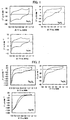
- Fig. 1 shows a current-potential curve of the resulting tantalum oxynitride at a reaction temperature of 30°C in a nitrogen atmosphere when scanning was performed at 50 mV/s at a potential in a range of 0.05 to 1.2 V.
- the results in Comparative Examples 1 and 2 are also shown. As is evident from Fig. 1, in each case, even if scanning of potential is repeated, the shape of the curve is not changed and the stable presence in the sulfuric acid solution is confirmed.
- Fig. 2 shows current-potential curves in an oxygen atmosphere under similar conditions.
- an oxygen reduction current is observed at 0.2 V or less.
- the oxygen reduction catalytic activity thereof is considered to be significantly low.
- reduction current is observed in the vicinity of 0.8 V or less, which means the presence of oxygen reduction catalytic activity.
- Fig. 3 shows current-potential curves when the potential was scanned from 1.2 V in the negative direction at a scanning rate of 5 mV/s at a reaction temperature of 30°C in an oxygen atmosphere.
- the oxygen reduction current is observed in the vicinity of 0.3 V or less.
- the oxygen reduction current is observed at 0.8 V or less, indicating the presence of excellent oxygen reduction catalytic activity.
- Fig. 4 shows the relationship between the logarithm of the oxygen reduction current density of TaON obtained by the method of Example 1 and the electrode potential. It is possible to obtain the number of reaction electrons in the rate-determining step of the reaction from the slope of the inclined line in Fig. 4.
- Fig. 4 shows that the slope of the inclined line is -130 mV/decade, on the basis of which the number of reaction electrons is estimated to be one. That is, the rate-determining step involves one electron reaction.
- the metal oxynitride electrode catalysts of the present invention are useful as electrode catalysts for electrochemical systems used in acidic electrolytes in the fields of water electrolysis, organic electrolysis, fuel cells, etc.
Landscapes
- Chemical & Material Sciences (AREA)
- Engineering & Computer Science (AREA)
- Chemical Kinetics & Catalysis (AREA)
- Materials Engineering (AREA)
- Electrochemistry (AREA)
- General Chemical & Material Sciences (AREA)
- Organic Chemistry (AREA)
- Sustainable Energy (AREA)
- Sustainable Development (AREA)
- Manufacturing & Machinery (AREA)
- Life Sciences & Earth Sciences (AREA)
- Metallurgy (AREA)
- Catalysts (AREA)
- Electrodes For Compound Or Non-Metal Manufacture (AREA)
- Inert Electrodes (AREA)
Abstract
Description
- The present invention relates to electrode catalysts for electrochemical systems used in acidic electrolytes in the fields of water electrolysis, organic electrolysis, fuel cells, etc.
- Noble metals, in particular, platinum, are stable at high electrical potentials and have high catalytic activity for various reactions, and thus are used as electrode catalysts for various electrochemical systems. However, because of the high cost and limited reserves of platinum and since electrode catalysts having higher activity are required for fuel cells, alternative materials to platinum catalysts have been desired.
- Metal oxynitrides have been developed as photocatalysts that decompose water under visible light (e.g., Non-Patent
Document 1 and Patent Document 1). However, there have been no attempts to use metal oxynitrides as electrode catalysts. - Non-Patent Document 1: M. Hara et al., Catal. Today., 78,555 (2003)
Patent Document 1:Japanese Unexamined Patent Application Publication No. 2001-205104
Patent Document 2:Japanese Unexamined Patent Application Publication No. 2002-66333
Patent Document 3:Japanese Unexamined Patent Application Publication No. 2002-154823
Patent Document 4:Japanese Unexamined Patent Application Publication No. 2002-321907 - It has been reported that, in general, carbides and many other non-platinum-based compounds are activated and dissolved and cannot be stably present in an acidic electrolyte under conditions of an electrode potential as high as 0.4 V or above (Hiroshi Yoneyama et al., Denkikagaku, 41,719 (1973)). Thus, the application range of these compounds as an electrode catalyst is limited to low electrode potentials. There has been need for development of an electrode catalyst that maintains catalytic activity under these conditions and exhibits improved stability.
- The present invention provides an electrode catalyst composed of an oxynitride containing at least one transition metal selected from the group consisting of La, Ta, Nb, Ti, and Zr. The present inventors have found that the metal oxynitrides can exhibit corrosion resistance such that they are not dissolved even if used at a potential of 0.4 V or higher relative to the reversible hydrogen electrode potential in an acidic electrolyte.
- That is, according to the present invention, (1) a metal oxynitride electrode catalyst includes an oxynitride containing at least one transition metal element selected from the group consisting of La, Ta, Nb, Ti, and Zr and is used at a potential of 0.4 V or higher relative to the reversible hydrogen electrode potential in an acidic electrolyte.
- Furthermore, according to the present invention, (2) the metal oxynitride electrode catalyst is dispersed as fine particles on a catalyst carrier which is an electronically conductive powder.
- Furthermore, according to the present invention, (3) the metal oxynitride electrode catalyst is used as an electrode catalyst for fuel cells using an acidic electrolyte.
- A metal oxynitride electrode catalyst of the present invention exhibits high corrosion resistance in an acidic electrolyte at a high electrode potential and also has oxygen reduction catalytic activity.
- An electrode catalyst of the present invention is composed of an oxynitride containing at least one transition metal element selected from the group consisting of La, Ta, Nb, Ti, and Zr and can be used at a potential of 0.4 V or higher relative to the reversible hydrogen electrode potential in an acidic electrolyte, and thus the electrode catalyst is useful as an oxygen reduction catalyst. The upper limit of the potential depends on the stability of the electrode, and the electrode catalyst can be used at a potential of up to about 1.6 V relative to the potential at which oxygen is generated. If the potential exceeds 1.6 V, simultaneously with the generation of oxygen from the surface of the oxynitride, the oxynitride is gradually oxidized to an oxide. If the potential is less than 0.4 V, although there is no problem from the standpoint of stability of the oxynitride, usefulness of the oxynitride is low from the standpoint of it being used as an oxygen reduction catalyst.
- Each of the transition metals La, Ta, Nb, Ti, and Zr is not eroded and is stable in an acidic electrolyte at high potentials, and since an oxide thereof constitutes the surface of the catalyst, the catalyst itself can be stably present. However, such an oxide does not have oxygen reduction catalytic activity. By partially nitriding the oxide to form an oxynitride, the electronic state continuously changes, and at a certain degree of nitriding, catalytic activity is believed to be exhibited. In general, catalytic activity at a transition metal:oxygen:nitrogen atomic ratio of about 1±0.1:1±0.1:1±0.1 is desirable.
- The metal oxynitride electrode catalyst of the present invention may be used by being dispersed as fine particles on a catalyst carrier which is an electronically conductive powder of carbon, a conductive oxide such as tungsten oxide or iridium oxide, or the like.
- In order to produce the metal oxynitride electrode catalyst of the present invention, at least one metal oxide is used as a starting metal compound and a single metal compound or a mixture of metal compounds is allowed to react with ammonia, an ammonium salt, hydrazine, nitrogen, a metal nitride, a metal amide, a metal amine complex, or the like to perform synthesis. The reaction may be carried out using an appropriate method, for example, a method in which a powdered mixture of a starting metal compound and a nitrogen-containing compound is heated, or a method in which the surface of a starting metal plate is oxidized to form a starting metal oxide, and only the surface thereof is partially nitrided with nitrogen or a nitrogen-containing compound.
- When a metal salt or a metal complex is used as a starting material, preferably, prior to nitriding, a metal oxide is formed as a precursor, for example, by a method in which the starting material is dissolved in an organic solvent, such as an alcohol, and subjected to heat treatment at a temperature of 923 K in air for 2 hours.
- When a powdery metal compound is used as a starting material, since the size of the resulting metal oxynitride fine particles substantially depends on the size of the starting material powder, by adjusting the size of the starting material powder, fine particles with a desired size can be obtained.
- The reaction temperature is in a range of 673 K to 1,473 K. If the temperature is lower than 673 K, the reaction rate is low and the reaction does not proceed. Although the reaction proceeds if a long time is taken, nitriding of the inner portion does not easily proceed compared with the degree of nitriding of the peripheral portion that is easily brought into contact with the nitrogen-containing compound of the starting metal oxide. Thus, the degree of nitriding differs depending on the location and it is difficult to obtain a uniformly nitrided product. If the temperature is higher than 1,473 K, decomposition occurs and an oxynitride is not formed.
- During the reaction, if nitriding is allowed to proceed completely, a complete nitride is formed. The complete nitride is stable, but has low oxygen reduction catalytic activity. An oxynitride containing both oxygen and nitrogen in the middle of nitriding using a metal compound as a starting material only exhibits oxygen reduction catalytic activity. For example, in the case of Ta (tantalum), the nitrogen content of starting tantalum oxide is 0 percent by weight, the nitrogen content of completely nitrided tantalum nitride is 11 percent by weight, and the nitrogen content of tantalum oxynitride having oxygen reduction catalytic activity is about 6 to 9 percent by weight.
- In particular, reaction between a metal oxide and ammonia is advantageous as the synthesis method of the electrode catalyst of the present invention. In the reaction, as nitriding proceeds, oxygen is liberated. Thus, ammonia serves as both a reducing agent and a nitriding agent. By changing the feed rate of ammonia and the reaction temperature, the degree of nitriding can be controlled.
- During the reaction, by using a mixed gas of water vapor and nitrogen in addition to ammonia to change the partial pressure of ammonia and decrease the nitriding rate, it is possible to easily obtain a uniformly nitrided oxynitride in which the difference in the degree of nitriding depending on the location is small.
- A tantalum oxide Ta2O5 powder (manufactured by KOJUNDO CHEMICAL LABORATORY CO., LTD., purity 99.9%, average particle size 0.5 µm) was used as a starting material, enveloped in quartz wool so as to readily pass ammonia gas, and retained in a reaction tube. A mixed gas of ammonia (purity 99.999%), water vapor, and nitrogen was introduced into the reaction tube and left to stand until the gas flow became substantially steady (for about 60 minutes). Subsequently, nitriding was performed at 850°C (heating rate: 10°C/min), and the introduction of the mixed gas was stopped before nitriding completely proceeded. A tantalum oxynitride powder with a size of several hundred nanometers was obtained.
- A Ta2O5 powder which was not nitrided was used as a sample.
Comparative Example 2
A Ta2O5 powder was used as a starting material as in Example 1, and a Ta3N5 power in which nitriding was allowed to completely proceed was prepared. - The tantalum oxynitride powder prepared in Example 1, the Ta2O5 powder of Comparative Example 1, and the Ta3N5 power prepared in Comparative Example 2 were each applied to a glassy carbon electrode (diameter: 5.2 mm), and Nafion (Registered Trademark) coating was performed. When the catalyst was applied, 0.1 g of the catalyst was mixed in 5 ml of water so as to enable equivalent coating. Then, stirring and suspending were performed by ultrasonic waves to prepare a solution, and 30 µl of the solution was applied so that the catalyst was uniformly dispersed. The glassy carbon electrode applied with the catalyst was immersed in 0.1 mol/dm3 of a sulfuric acid solution, and an experiment was conducted at 30°C at atmospheric pressure. The experiment was conducted both in a nitrogen gas atmosphere and in an oxygen gas atmosphere. As a reference electrode, a reversible hydrogen electrode was used in a sulfuric acid solution with the same concentration. The current density was measured in terms of geometric area.
- Fig. 1 shows a current-potential curve of the resulting tantalum oxynitride at a reaction temperature of 30°C in a nitrogen atmosphere when scanning was performed at 50 mV/s at a potential in a range of 0.05 to 1.2 V. The results in Comparative Examples 1 and 2 are also shown. As is evident from Fig. 1, in each case, even if scanning of potential is repeated, the shape of the curve is not changed and the stable presence in the sulfuric acid solution is confirmed.
- Fig. 2 shows current-potential curves in an oxygen atmosphere under similar conditions. In each of Comparative Examples 1 and 2, an oxygen reduction current is observed at 0.2 V or less. Thus, the oxygen reduction catalytic activity thereof is considered to be significantly low. In contrast, in Example 1, reduction current is observed in the vicinity of 0.8 V or less, which means the presence of oxygen reduction catalytic activity.
- Fig. 3 shows current-potential curves when the potential was scanned from 1.2 V in the negative direction at a scanning rate of 5 mV/s at a reaction temperature of 30°C in an oxygen atmosphere. In Comparative Examples 1 and 2, the oxygen reduction current is observed in the vicinity of 0.3 V or less. In contrast, in Example 1, the oxygen reduction current is observed at 0.8 V or less, indicating the presence of excellent oxygen reduction catalytic activity.
- Fig. 4 shows the relationship between the logarithm of the oxygen reduction current density of TaON obtained by the method of Example 1 and the electrode potential. It is possible to obtain the number of reaction electrons in the rate-determining step of the reaction from the slope of the inclined line in Fig. 4. Fig. 4 shows that the slope of the inclined line is -130 mV/decade, on the basis of which the number of reaction electrons is estimated to be one. That is, the rate-determining step involves one electron reaction. Industrial Applicability
- The metal oxynitride electrode catalysts of the present invention are useful as electrode catalysts for electrochemical systems used in acidic electrolytes in the fields of water electrolysis, organic electrolysis, fuel cells, etc.
-
- [Fig. 1] Fig. 1 includes graphs showing current-potential curves in a nitrogen atmosphere with respect to the electrode catalysts of Comparative Examples 1 and 2 and Example 1.
- [Fig. 2] Fig. 2 includes graphs evaluating the catalytic activity of oxygen reduction reaction of the electrode catalysts of Comparative Examples 1 and 2 and Example 1.
- [Fig. 3] Fig. 3 is a graph evaluating the catalytic activity of oxygen reduction reaction of the electrode catalyst of Example 1.
- [Fig. 4] Fig. 4 is a graph estimating the number of reaction electrons in the rate-determining step in the oxygen reduction reaction of Example 1.
Claims (3)
- A metal oxynitride electrode catalyst comprising an oxynitride containing at least one transition metal element selected from the group consisting of La, Ta, Nb, Ti, and Zr, the metal oxynitride electrode catalyst being used at a potential of 0.4 V or higher relative to the reversible hydrogen electrode potential in an acidic electrolyte.
- The metal oxynitride electrode catalyst according to Claim 1, wherein the metal oxynitride electrode catalyst is dispersed as fine particles on a catalyst carrier which is an electronically conductive powder.
- The metal oxynitride electrode catalyst according to Claim 1, wherein the metal oxynitride electrode catalyst is used as an electrode catalyst for fuel cells using an acidic electrolyte.
Applications Claiming Priority (2)
| Application Number | Priority Date | Filing Date | Title |
|---|---|---|---|
| JP2003403653A JP4198582B2 (en) | 2003-12-02 | 2003-12-02 | Tantalum oxynitride oxygen reduction electrocatalyst |
| PCT/JP2004/017801 WO2005053840A1 (en) | 2003-12-02 | 2004-11-30 | Metal oxynitride electrode catalyst |
Publications (4)
| Publication Number | Publication Date |
|---|---|
| EP1702683A1 true EP1702683A1 (en) | 2006-09-20 |
| EP1702683A4 EP1702683A4 (en) | 2010-09-22 |
| EP1702683B1 EP1702683B1 (en) | 2014-03-26 |
| EP1702683B8 EP1702683B8 (en) | 2014-05-21 |
Family
ID=34650079
Family Applications (1)
| Application Number | Title | Priority Date | Filing Date |
|---|---|---|---|
| EP04819836.0A Expired - Lifetime EP1702683B8 (en) | 2003-12-02 | 2004-11-30 | Metal oxynitride electrode catalyst |
Country Status (6)
| Country | Link |
|---|---|
| US (1) | US7670712B2 (en) |
| EP (1) | EP1702683B8 (en) |
| JP (1) | JP4198582B2 (en) |
| KR (1) | KR100769707B1 (en) |
| CA (1) | CA2547524C (en) |
| WO (1) | WO2005053840A1 (en) |
Cited By (1)
| Publication number | Priority date | Publication date | Assignee | Title |
|---|---|---|---|---|
| EP2378596A1 (en) * | 2010-04-12 | 2011-10-19 | Belenos Clean Power Holding AG | Transition metal oxidenitrides and nitrogen-doped transition metal oxides |
Families Citing this family (26)
| Publication number | Priority date | Publication date | Assignee | Title |
|---|---|---|---|---|
| US7919215B2 (en) | 2004-08-19 | 2011-04-05 | Japan Science And Technology Agency | Corrosion resistant metal oxide electrode catalyst for oxygen reduction |
| KR100648632B1 (en) * | 2005-01-25 | 2006-11-23 | 삼성전자주식회사 | Method for manufacturing a dielectric structure having a high dielectric constant and method for manufacturing a semiconductor device comprising the same |
| JP2007031781A (en) * | 2005-07-27 | 2007-02-08 | Yokohama National Univ | Oxygen reduction electrode |
| US7481914B2 (en) * | 2006-03-31 | 2009-01-27 | General Electric Company | Photoelectrolysis cells, and related devices and processes |
| EP2523243A1 (en) | 2007-03-09 | 2012-11-14 | Sumitomo Chemical Company, Limited | Membrane-electrode assembly and fuel battery using the same |
| JP5578849B2 (en) * | 2007-09-07 | 2014-08-27 | 昭和電工株式会社 | Catalyst, method for producing the same and use thereof |
| JP5207461B2 (en) * | 2007-09-13 | 2013-06-12 | 国立大学法人横浜国立大学 | Electrocatalyst and electrode using the same |
| JP2009208070A (en) * | 2008-02-05 | 2009-09-17 | Univ Of Tokyo | Electrode catalyst for fuel cells, method for producing the same, and electrode for fuel cells |
| JP5353287B2 (en) * | 2008-03-21 | 2013-11-27 | 住友化学株式会社 | Electrocatalyst production method and electrode catalyst |
| JP5475245B2 (en) * | 2008-03-24 | 2014-04-16 | 昭和電工株式会社 | Catalyst, method for producing the same and use thereof |
| JP2009298601A (en) * | 2008-06-10 | 2009-12-24 | Sumitomo Chemical Co Ltd | Method for producing metal oxynitride |
| US8906581B2 (en) | 2008-10-06 | 2014-12-09 | Showa Denko K.K. | Process for producing fuel cell electrode by applying a sugar to a precursor supporting a metal oxide and conductive substance and carbonizing the sugar |
| JP5273655B2 (en) * | 2008-11-28 | 2013-08-28 | 独立行政法人産業技術総合研究所 | Particles for three-component electrode material for lithium battery or hybrid capacitor and method for producing the same |
| JP5526424B2 (en) * | 2009-02-27 | 2014-06-18 | 独立行政法人産業技術総合研究所 | Tantalum (V) oxynitride-containing powder having TaON structure, method for producing the same, and pigment |
| JP5606431B2 (en) | 2009-03-18 | 2014-10-15 | 昭和電工株式会社 | Air battery catalyst and air battery using the same |
| JP4798306B2 (en) * | 2009-09-29 | 2011-10-19 | 凸版印刷株式会社 | Electrocatalyst layer production method, electrode catalyst layer, membrane electrode assembly, and polymer electrolyte fuel cell |
| JP4947243B2 (en) * | 2010-03-16 | 2012-06-06 | 凸版印刷株式会社 | Method for producing cathode catalyst layer for fuel cell, cathode catalyst layer, and membrane electrode assembly for polymer electrolyte fuel cell |
| KR101246424B1 (en) | 2010-08-13 | 2013-03-21 | 숭실대학교산학협력단 | Synthesis Method for Mesoporous Transition metal Nitrides |
| EP2659969B1 (en) | 2010-12-28 | 2018-03-14 | Panasonic Intellectual Property Management Co., Ltd. | Optical semiconductor and production method therefor, as well as optical semiconductor device, photocatalyst, hydrogen-generating device and energy system |
| US9353449B2 (en) | 2011-08-02 | 2016-05-31 | Panasonic Intellectual Property Management Co., Ltd. | Method for producing NbON film |
| KR102014984B1 (en) * | 2011-12-02 | 2019-08-28 | 삼성전자주식회사 | Anode active material for lithium rechargeable battery, its preparation and lithium battery using same |
| US9114379B2 (en) | 2011-12-07 | 2015-08-25 | Panasonic Intellectual Property Management Co., Ltd. | Niobium nitride and method for producing same, niobium nitride-containing film and method for producing same, semiconductor, semiconductor device, photocatalyst, hydrogen generation device, and energy system |
| WO2015146490A1 (en) * | 2014-03-25 | 2015-10-01 | 国立大学法人横浜国立大学 | Oxygen reduction catalyst and production method therefor |
| JP5928554B2 (en) * | 2014-10-21 | 2016-06-01 | 凸版印刷株式会社 | Method for producing catalyst ink |
| JP6270884B2 (en) * | 2016-02-26 | 2018-01-31 | 三菱ケミカル株式会社 | Method for producing electrode for photohydrolysis reaction |
| CA3174572A1 (en) * | 2020-03-06 | 2021-09-10 | Denovo Biopharma Llc | Compositions and methods for assessing the efficacy of inhibitors of neurotransmitter transporters |
Family Cites Families (25)
| Publication number | Priority date | Publication date | Assignee | Title |
|---|---|---|---|---|
| US4399008A (en) * | 1980-11-10 | 1983-08-16 | Aluminum Company Of America | Composition for inert electrodes |
| US4582585A (en) * | 1982-09-27 | 1986-04-15 | Aluminum Company Of America | Inert electrode composition having agent for controlling oxide growth on electrode made therefrom |
| US4584172A (en) * | 1982-09-27 | 1986-04-22 | Aluminum Company Of America | Method of making composition suitable for use as inert electrode having good electrical conductivity and mechanical properties |
| US4454015A (en) * | 1982-09-27 | 1984-06-12 | Aluminum Company Of America | Composition suitable for use as inert electrode having good electrical conductivity and mechanical properties |
| US4677092A (en) * | 1983-01-17 | 1987-06-30 | International Fuel Cells Corporation | Ordered ternary fuel cell catalysts containing platinum and cobalt and method for making the catalysts |
| US4455211A (en) * | 1983-04-11 | 1984-06-19 | Aluminum Company Of America | Composition suitable for inert electrode |
| JPH0697615B2 (en) * | 1989-03-09 | 1994-11-30 | エヌ・イーケムキャット株式会社 | Platinum alloy electrode catalyst |
| US5183713A (en) * | 1991-01-17 | 1993-02-02 | International Fuel Cells Corporation | Carbon monoxide tolerant platinum-tantalum alloyed catalyst |
| WO1994020650A2 (en) * | 1993-03-09 | 1994-09-15 | Moltech Invent S.A. | Treated carbon cathodes for aluminium production |
| US5364522A (en) * | 1993-03-22 | 1994-11-15 | Liang Wang | Boride, carbide, nitride, oxynitride, and silicide infiltrated electrochemical ceramic films and coatings and the method of forming such |
| US5397450A (en) * | 1993-03-22 | 1995-03-14 | Moltech Invent S.A. | Carbon-based bodies in particular for use in aluminium production cells |
| US5374342A (en) * | 1993-03-22 | 1994-12-20 | Moltech Invent S.A. | Production of carbon-based composite materials as components of aluminium production cells |
| US7683098B2 (en) * | 1996-09-03 | 2010-03-23 | Ppg Industries Ohio, Inc. | Manufacturing methods for nanomaterial dispersions and products thereof |
| US5980977A (en) * | 1996-12-09 | 1999-11-09 | Pinnacle Research Institute, Inc. | Method of producing high surface area metal oxynitrides as substrates in electrical energy storage |
| US6297185B1 (en) * | 1998-02-23 | 2001-10-02 | T/J Technologies, Inc. | Catalyst |
| US6190802B1 (en) * | 1998-05-22 | 2001-02-20 | T/J Technologies, Inc. | Transition metal based ceramic material and electrodes fabricated therefrom |
| JP2000048833A (en) * | 1998-07-29 | 2000-02-18 | Toyota Motor Corp | Fuel cell |
| US6531704B2 (en) * | 1998-09-14 | 2003-03-11 | Nanoproducts Corporation | Nanotechnology for engineering the performance of substances |
| JP4487362B2 (en) | 2000-01-27 | 2010-06-23 | 株式会社豊田中央研究所 | Photocatalytic substance |
| JP4107792B2 (en) | 2000-08-28 | 2008-06-25 | 独立行政法人科学技術振興機構 | Photocatalyst composed of metal oxynitride having visible light response |
| JP3589177B2 (en) | 2000-11-10 | 2004-11-17 | 株式会社豊田中央研究所 | Method for producing inorganic oxynitride |
| JP3587178B2 (en) | 2001-04-24 | 2004-11-10 | 株式会社豊田中央研究所 | Surface-modified inorganic oxides and inorganic oxynitrides |
| US6939640B2 (en) * | 2001-09-21 | 2005-09-06 | E. I. Dupont De Nemours And Company | Anode electrocatalysts for coated substrates used in fuel cells |
| KR100462950B1 (en) * | 2002-03-27 | 2004-12-23 | 요업기술원 | Solid oxide fuel cell |
| JP4463490B2 (en) * | 2003-03-31 | 2010-05-19 | 独立行政法人科学技術振興機構 | Electrocatalyst made of transition metal carbide |
-
2003
- 2003-12-02 JP JP2003403653A patent/JP4198582B2/en not_active Expired - Fee Related
-
2004
- 2004-11-30 WO PCT/JP2004/017801 patent/WO2005053840A1/en not_active Ceased
- 2004-11-30 KR KR1020067008650A patent/KR100769707B1/en not_active Expired - Fee Related
- 2004-11-30 US US10/581,210 patent/US7670712B2/en not_active Expired - Fee Related
- 2004-11-30 EP EP04819836.0A patent/EP1702683B8/en not_active Expired - Lifetime
- 2004-11-30 CA CA2547524A patent/CA2547524C/en not_active Expired - Fee Related
Non-Patent Citations (3)
| Title |
|---|
| GO HITOKI ET AL: "AN OXYNITRIDE, TaON, AS AN EFFICIENT WATER OXIDATION PHOTOCATALYST UNDER VISIBLE LIGHT IRRADIATION" CHEM. COMMUN., 10 July 2002 (2002-07-10), pages 1698-1699, XP002595972 * |
| See also references of WO2005053840A1 * |
| WANG-JAE CHUN ET AL.: "CONDUCTION AND VALENCE BAND POSITIONS OF Ta2O5, TaON and Ta3N5 by UPS AND ELECTROCHEMICAL METHODS." J. PHYS. CHEM., vol. 107, 25 January 2003 (2003-01-25), pages 1798-1803, XP002595971 * |
Cited By (3)
| Publication number | Priority date | Publication date | Assignee | Title |
|---|---|---|---|---|
| EP2378596A1 (en) * | 2010-04-12 | 2011-10-19 | Belenos Clean Power Holding AG | Transition metal oxidenitrides and nitrogen-doped transition metal oxides |
| CN102263228A (en) * | 2010-04-12 | 2011-11-30 | 贝伦诺斯清洁电力控股有限公司 | Transition metal oxidenitirdes and transition metal oxide with nitrogen impurity |
| US9929405B2 (en) | 2010-04-12 | 2018-03-27 | Belenos Clean Power Holding Ag | Electrode comprising a transition metal oxidenitride or a nitrogen-doped transition metal oxide as electronically active material |
Also Published As
| Publication number | Publication date |
|---|---|
| JP4198582B2 (en) | 2008-12-17 |
| EP1702683B1 (en) | 2014-03-26 |
| WO2005053840A1 (en) | 2005-06-16 |
| CA2547524C (en) | 2012-05-01 |
| US20070128884A1 (en) | 2007-06-07 |
| EP1702683A4 (en) | 2010-09-22 |
| JP2005161203A (en) | 2005-06-23 |
| KR20060085931A (en) | 2006-07-28 |
| US7670712B2 (en) | 2010-03-02 |
| CA2547524A1 (en) | 2005-06-16 |
| KR100769707B1 (en) | 2007-10-23 |
| EP1702683B8 (en) | 2014-05-21 |
Similar Documents
| Publication | Publication Date | Title |
|---|---|---|
| US7670712B2 (en) | Metal oxynitride electrode catalyst | |
| CA1161824A (en) | Noble metal-chromium alloy catalysts | |
| Ishihara et al. | Tantalum oxynitride for a novel cathode of PEFC | |
| EP0501930B1 (en) | Electrocatalyst for anode | |
| EP2441108B1 (en) | Method for producing electrode catalyst for fuel cell | |
| US20080145733A1 (en) | Fuel Cell | |
| Hu et al. | Mechanistic insights into the synthesis of platinum–rare earth metal nanoalloys by a solid-state chemical route | |
| Alia et al. | Palladium coated copper nanowires as a hydrogen oxidation electrocatalyst in base | |
| Sasaki et al. | Monolayer-level Ru-and NbO2-supported platinum electrocatalysts for methanol oxidation | |
| US20210008535A1 (en) | Method for producing catalysts with nanoparticles of platinum and its alloys with metals | |
| EP1341603A4 (en) | METHOD AND DEVICE FOR THE OXIDATION OF GLUCOSE MOLECULES | |
| JP2007031781A (en) | Oxygen reduction electrode | |
| Hiltrop et al. | Pd deposited on functionalized carbon nanotubes for the electrooxidation of ethanol in alkaline media | |
| EP1806798A1 (en) | Metal oxide electrode catalyst | |
| EP2482975A2 (en) | Synthesis of stable and durable catalyst composition for fuel cell | |
| Wang et al. | Energy and Resource Generation via Electrochemical Ammonia Oxidation: From Materials Design to System Integration | |
| US7422994B2 (en) | Platinum-copper-tungsten fuel cell catalyst | |
| US4373014A (en) | Process using noble metal-chromium alloy catalysts in an electrochemical cell | |
| Wang et al. | Nanoporous bismuth for the electrocatalytic reduction of CO 2 to formate | |
| KR20170088145A (en) | Method of preparing non-platinum catalyst for fuel cell | |
| WO2010138690A1 (en) | Ternary alloy catalysts for fuel cells | |
| JP4448792B2 (en) | Metal oxynitride oxygen reduction electrode catalyst and method for producing the same | |
| KOÇAK et al. | Highly improved electrocatalytic oxidation of dimethylamine borane on silvernanoparticles modified polymer composite electrode | |
| JP2008155111A (en) | Acid-resistant electrocatalyst | |
| JP2004283774A (en) | Fuel cell catalyst and method for producing the same |
Legal Events
| Date | Code | Title | Description |
|---|---|---|---|
| PUAI | Public reference made under article 153(3) epc to a published international application that has entered the european phase |
Free format text: ORIGINAL CODE: 0009012 |
|
| 17P | Request for examination filed |
Effective date: 20060623 |
|
| AK | Designated contracting states |
Kind code of ref document: A1 Designated state(s): DE |
|
| DAX | Request for extension of the european patent (deleted) | ||
| RBV | Designated contracting states (corrected) |
Designated state(s): DE |
|
| A4 | Supplementary search report drawn up and despatched |
Effective date: 20100823 |
|
| RIC1 | Information provided on ipc code assigned before grant |
Ipc: C25B 11/06 20060101ALI20110308BHEP Ipc: H01M 4/90 20060101ALI20110308BHEP Ipc: B01J 27/24 20060101AFI20110308BHEP |
|
| 17Q | First examination report despatched |
Effective date: 20110318 |
|
| GRAP | Despatch of communication of intention to grant a patent |
Free format text: ORIGINAL CODE: EPIDOSNIGR1 |
|
| INTG | Intention to grant announced |
Effective date: 20131015 |
|
| GRAS | Grant fee paid |
Free format text: ORIGINAL CODE: EPIDOSNIGR3 |
|
| GRAA | (expected) grant |
Free format text: ORIGINAL CODE: 0009210 |
|
| RAP1 | Party data changed (applicant data changed or rights of an application transferred) |
Owner name: JAPAN SCIENCE AND TECHNOLOGY AGENCY |
|
| RIN1 | Information on inventor provided before grant (corrected) |
Inventor name: DOUMEN, KAZUNARI Inventor name: OTA, KENICHIRO Inventor name: HARA, MICHIKAZU Inventor name: MITTSUSHIMA, SHIGENORI Inventor name: KAMIYA, NOBUYUKI Inventor name: ISHIHARA, AKIMITSU |
|
| AK | Designated contracting states |
Kind code of ref document: B1 Designated state(s): DE |
|
| RIN2 | Information on inventor provided after grant (corrected) |
Inventor name: ISHIHARA, AKIMITSU Inventor name: HARA, MICHIKAZU Inventor name: KAMIYA, NOBUYUKI Inventor name: OTA, KENICHIRO Inventor name: DOUMEN, KAZUNARI Inventor name: MITSUSHIMA, SHIGENORI |
|
| REG | Reference to a national code |
Ref country code: DE Ref legal event code: R096 Ref document number: 602004044706 Country of ref document: DE Effective date: 20140508 |
|
| REG | Reference to a national code |
Ref country code: DE Ref legal event code: R097 Ref document number: 602004044706 Country of ref document: DE |
|
| PLBE | No opposition filed within time limit |
Free format text: ORIGINAL CODE: 0009261 |
|
| STAA | Information on the status of an ep patent application or granted ep patent |
Free format text: STATUS: NO OPPOSITION FILED WITHIN TIME LIMIT |
|
| 26N | No opposition filed |
Effective date: 20150106 |
|
| REG | Reference to a national code |
Ref country code: DE Ref legal event code: R097 Ref document number: 602004044706 Country of ref document: DE Effective date: 20150106 |
|
| PGFP | Annual fee paid to national office [announced via postgrant information from national office to epo] |
Ref country code: DE Payment date: 20181120 Year of fee payment: 15 |
|
| REG | Reference to a national code |
Ref country code: DE Ref legal event code: R119 Ref document number: 602004044706 Country of ref document: DE |
|
| PG25 | Lapsed in a contracting state [announced via postgrant information from national office to epo] |
Ref country code: DE Free format text: LAPSE BECAUSE OF NON-PAYMENT OF DUE FEES Effective date: 20200603 |