EP1701193A1 - Telephoto lens having three lens groups - Google Patents
Telephoto lens having three lens groups Download PDFInfo
- Publication number
- EP1701193A1 EP1701193A1 EP06004479A EP06004479A EP1701193A1 EP 1701193 A1 EP1701193 A1 EP 1701193A1 EP 06004479 A EP06004479 A EP 06004479A EP 06004479 A EP06004479 A EP 06004479A EP 1701193 A1 EP1701193 A1 EP 1701193A1
- Authority
- EP
- European Patent Office
- Prior art keywords
- lens
- positive
- telephoto
- lens group
- negative
- Prior art date
- Legal status (The legal status is an assumption and is not a legal conclusion. Google has not performed a legal analysis and makes no representation as to the accuracy of the status listed.)
- Granted
Links
- 230000005499 meniscus Effects 0.000 claims abstract description 7
- 230000004075 alteration Effects 0.000 description 51
- 239000011521 glass Substances 0.000 description 36
- 239000006185 dispersion Substances 0.000 description 25
- 239000000463 material Substances 0.000 description 21
- 230000002547 anomalous effect Effects 0.000 description 19
- 238000012937 correction Methods 0.000 description 16
- 230000003287 optical effect Effects 0.000 description 10
- 238000010586 diagram Methods 0.000 description 8
- 201000009310 astigmatism Diseases 0.000 description 5
- 230000000452 restraining effect Effects 0.000 description 5
- 230000000052 comparative effect Effects 0.000 description 3
- 230000015572 biosynthetic process Effects 0.000 description 2
- 239000000470 constituent Substances 0.000 description 2
- 238000007429 general method Methods 0.000 description 2
- 238000003384 imaging method Methods 0.000 description 2
- 238000000034 method Methods 0.000 description 2
- 238000012986 modification Methods 0.000 description 2
- 230000004048 modification Effects 0.000 description 2
- 230000011514 reflex Effects 0.000 description 2
- 239000006059 cover glass Substances 0.000 description 1
- 230000000694 effects Effects 0.000 description 1
- 239000005304 optical glass Substances 0.000 description 1
Images


Classifications
-
- G—PHYSICS
- G02—OPTICS
- G02B—OPTICAL ELEMENTS, SYSTEMS OR APPARATUS
- G02B9/00—Optical objectives characterised both by the number of the components and their arrangements according to their sign, i.e. + or -
- G02B9/12—Optical objectives characterised both by the number of the components and their arrangements according to their sign, i.e. + or - having three components only
- G02B9/14—Optical objectives characterised both by the number of the components and their arrangements according to their sign, i.e. + or - having three components only arranged + - +
- G02B9/30—Optical objectives characterised both by the number of the components and their arrangements according to their sign, i.e. + or - having three components only arranged + - + the middle component being a - compound meniscus having a + lens
-
- G—PHYSICS
- G02—OPTICS
- G02B—OPTICAL ELEMENTS, SYSTEMS OR APPARATUS
- G02B13/00—Optical objectives specially designed for the purposes specified below
- G02B13/02—Telephoto objectives, i.e. systems of the type + - in which the distance from the front vertex to the image plane is less than the equivalent focal length
Definitions
- the present invention relates to a telephoto lens used in, for example, a single-lens reflex camera or a video camera, constituted by, for example, an inner focus type and having an angle of view of about 6° through 20°.
- a focusing system of an imaging lens there are a system of moving a total of a lens system and a system of moving a portion of a lens system.
- a lens system becomes large-sized and also a weight thereof becomes heavy and therefore, the system of moving a portion of a lens system is frequently adopted.
- JP-A-2002-55275 discloses a telephoto lens having a half-field angle of about 4° through 8° (a focal length of about 150mm through 300mm in a 35mm film) of an inner focus type constituted by three lens groups having a positive, a negative, a positive refracting power successively from an object side, in which the focusing is performed by moving the second lens group having the negative refracting power.
- the first lens group is constituted by 3 lenses of a positive first lens, a positive second lens and a negative third lens successively from the object side.
- the second lens group is constituted by 2 lenses of a negative fourth lens and a positive fifth lens successively from the object side.
- a glass material having a large v value (Abbe number) is adopted for the positive first and second lenses, and a glass material having a small v value is adopted for the negative third and fourth lenses.
- the telephoto lens disclosed in JP-A-2002-55275 is constituted by an optical system of the inner focus type which is comparatively excellent in an optical function from an infinite object point over to a close range and is advantageous in small-sized formation.
- a general method of correcting chromatic aberration similar to the telephoto lens disclosed in JP-A-2002-55275 , glass having a large v value is used for a positive lens and glass having a small v value is adopted for a negative lens.
- An amount of secondary chromatic aberration which remains at this occasion is determined by a magnitude of anomalous dispersion of the glass adopted for the positive lens.
- An object of an illustrative, non-limiting embodiment of the invention is to provide a telephoto lens excellent in correcting chromatic aberration while restraining a number of elements of anomalous dispersion glass used. Also, the invention is not required to provide the advantages described above, and an illustrative, non-limiting embodiment of the invention may provide different advantages.
- An exemplary embodiment of the telephoto lens of the invention includes, in order from an object side of the telephoto lens: a first lens group having a positive refracting power; a second lens group having a negative refracting power; and a third lens group including an aperture diaphragm.
- the first lens group includes: a first positive lens having a meniscus shape and having a convex surface on the object side thereof; a negative lens arranged on an image side of the first positive lens and having a concave surface on the image side thereof; and a second positive lens arranged on the image side of the negative lens and having a convex surface on the object side thereof (The first lens group include, in order from the object side: a first positive lens; a negative lens; and a second positive lens.) Further, the telephoto lens is constituted to satisfy the following Condition Equations.
- ⁇ 11 designates an Abbe number of the first positive lens in the first lens group
- ⁇ 1 2 designates an Abbe number of the negative lens in the first lens group
- ⁇ 13 designates an Abbe number of the second positive lens in the first lens group.
- a telephoto lens of the invention by specifying shapes of the respective lenses as described above and satisfying the respective Condition Equations, correction of on-axis chromatic aberration and correction of lateral color necessary for the high function telephoto lens can be carried out and a high optical function can be achieved.
- a glass material having a small v value satisfying Condition Equation (1) for the first positive lens on the object side and pertinently setting glass materials of the other lenses secondary chromatic aberration is corrected while restraining a number of elements of anomalous dispersion glass used.
- the second lens group is constituted by at least one positive lens and at least one negative lens, and the second lens group is moved to the image side when a focus is adjusted from infinite to a close range.
- f designates a focal length of an entire system of the telephoto lens
- f11 designates a focal length of the first positive lens in the first lens group 0.5 ⁇ f 11 / f ⁇ 1.2
- the lens is constituted by three groups as a whole, shapes and glass materials of the respective lenses are made to be pertinent, particularly, the glass material having a small ⁇ value satisfying Condition Equation (1) is positively adopted for the first positive lens on the object side, the glass materials of the other lenses are pertinently set and therefore, the lens can realize an excellent function in correcting chromatic aberration while restraining a number of sheets of anomalous dispersion glass used.
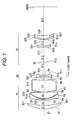
- Fig. 1 shows a first constituting example of a telephoto lens according to an exemplary embodiment of the invention.
- the constitutional example corresponds to a lens constitution of a first numerical value example (Table 1), mentioned later.
- Fig.2 shows a second constitutional example.
- the constitutional example corresponds to a lens constitution of a second numerical value example (Table 2), mentioned later.
- Figs. 1 and 2 show lens arrangements in a state of being focused to an infinite object point.
- notation Ri designates a radius of curvature of an i-th surface the notation of which is attached to successively increase as proceeding to an image side (focusing side) by defining a surface of a constituent element on an object side the most as a first surface.
- Notation Di designates a surface distance on an optical axis Z1 between an i-th surface and an (i+1)-th surface.
- Notation Simg designates a focusing surface (imaging surface). Further, a basic constitution stays the same in both of the respective constitutional examples and therefore, an explanation will be given based on the first constitutional example shown in Fig. 1 as follows.
- a telephoto lens is preferably mounted to, for example, a single-lens reflex camera or a video camera.
- a telephoto lens is provided with a first lens group 10 having a positive refracting power, a second lens group 20 having a negative refracting power, a third lens group 30 including an aperture diaphragm St and having a weak positive refracting power along the optical axis Z1 successively from the object side.
- the second lens group 20 as a focusing group to the image side along the optical axis Z1
- focus can be adjusted from an infinite object point to a close range.
- various optical members of an optical filter, a cover glass or the like may be arranged between the third lens group 30 and the focusing surface Simg in accordance with a constitution of a camera side mounted with the lenses.
- the first lens group 10 includes at least a first positive lens having a meniscus shape and having a convex surface on the object side, a negative lens arranged on the image side of the first positive lens and having a concave surface on the image side, and a second positive lens arranged on the image side of the negative lens and having a convex surface on the object side.
- the first lens group 10 includes a positive lens G11 having a meniscus shape and having a convex surface on the object side, a negative lens G12 having a meniscus shape and having a concave surface on the image side, a positive lens G13 having a bi-convex shape, and a positive lens G14 having a meniscus shape and having a convex surface on the object side.
- the positive lens G11 corresponds to the 'first positive lens'
- the negative lens G12 corresponds to the 'negative lens'
- the positive lens G13 corresponds to the 'second positive lens'.
- the second lens group 20 includes at least one positive lens and at least one negative lens. Further specifically, for example, the second lens group 20 includes a cemented lens comprising a positive lens G21 and a negative lens G22 successively from the object side.
- the third lens group 30 includes, for example, an aperture diaphragm St, a lens G31 and a cemented lens comprising a negative lens G32 and a positive lens G33, successively from the object side.
- the telephoto lens satisfies Condition Equations (1) through (4), shown below.
- ⁇ 11 designates an Abbe number of the first positive lens (positive lens G11) in the first lens group
- ⁇ 12 designates an Abbe number of the negative lens (negative lens G12) in the first lens group
- ⁇ 13 designates an Abbe number of the second positive lens (positive lens G13) in the first lens group 10.
- f designates a focal length of an entire lens system
- f11 designates a focal length of the first positive lens (positive lens G11) in the first lens group 10. 0.5 ⁇ f 11 / f ⁇ 1.2
- the telephoto lens in the lens type constituted by three lens groups as a whole, focus is adjusted by moving the second lens group 20 having the negative refracting power.
- the constitution becomes advantageous for small-size formation.
- correction of on-axis chromatic aberration and lateral color necessary for the telephoto lens having a high function can be carried out and a high optical function can be achieved.
- Condition Equation (1) is a condition necessary mainly for correcting on-axis chromatic aberration and lateral color in correcting chromatic aberration.
- a glass material having a large v value (Abbe number) is adopted for a positive lens and a glass material having a small v value is adopted for a negative lens
- an amount of secondary chromatic aberration which remains at this occasion is determined by a magnitude of anomalous dispersion of glass adopted in the positive lens.
- much of anomalous dispersion glass may be adopted for the positive lens in the lenses, according to the method, a number of elements of the anomalous dispersion glass is increased, which becomes disadvantageous in view of cost.
- a glass material having a small ⁇ value satisfying Condition Equation (1) is positively adopted for the first positive lens (positive lens G11).
- correction of chromatic aberration of a total of the lenses is not sufficient and in order to suffciently correct the chromatic aberration, achromatism by strong power is requested.
- anomalous dispersion glass for the achromatizing lens mainly, positive lens G13
- anomalous dispersion shares a large rate in a total of the lenses and secondary chromatic aberration on the axis is reduced.
- the reference line is a straight line provided by connecting respective coordinate points of two glass materials constituting a reference on a graph constituting, for example, the ordinate by the partial dispersion ratio ⁇ g, F and constituting abscissa by Abbe number vd (Abbe number with respect to d line).
- a graph of ⁇ versus ⁇ is drawn by constituting the abscissa by Abbe number ⁇ , and constituting the ordinate by a partial dispersion ratio ⁇
- a number of glass materials are provided with a characteristic of being distributed along a reference line.
- the more anomalous dispersion is provided to the glass material.
- a reference line L is constituted by selecting two glass materials K7 and F2 of SCHOTT AG as normal optical glass and connecting coordinate points of the two glass materials K7 and F2 on a graph of vd versus ⁇ g, F.
- a value constituted by subtracting partial dispersion ratio ⁇ L in correspondence with Abbe number vd on the reference line L from partial dispersion ratio ⁇ g, F of an arbitrary glass material is made to constitute a deviation of partial dispersion ratio, that is, a value ⁇ g, F showing anomalous dispersion of the arbitrary glass material.
- Anomalous dispersions ⁇ g, F designate numerical values described in catalogs or the like of respective glass material makers and values inherent to respective glass materials.
- Condition Equations (1) through (4) are also necessary for improving correction of secondary chromatic aberration of magnification.
- the positive power is arranged on the object side and the negative power is arranged on the image side and therefore, asymmetricity is increased and correction of secondary chromatic aberration of magnification becomes difficult
- the embodiment by arranging the positive lens G11 of glass having a small ⁇ value on the object side, it is succeeded to correct secondary chromatic aberration of magnification.
- the shapes and the glass materials of the respective lenses are pertinently set and therefore, a function excellent in correcting chromatic aberration can be realized while restraining a number of sheets of anomalous dispersion glass used.
- the small-sized and high function telephoto lens having the angle of view of, for example, about 6° through 20° can be realized.
- Table 1 shows specific lens data (Example 1) in correspondence with the constitution of the telephoto lens shown in Fig.1. Further, Table 2 shows specific lens data (Example 2) in correspondence with the constitution of the telephoto lens shown in Fig.2.
- a column of radius of curvature Ri shows a value of a radius of curvature of the i-th surface from the object side in correspondence with notation Ri attached in Figs.1 and 2.
- a column of surface interval Di similarly shows an interval on the optical axis between the i-th surface Si and the (i+1)-th surface Si +1 of the object side. Units of radius of curvature Ri and surface interval Di are millimeters (mm).
- a column of Ndi shows a value of a refractive index with respect to d line (587.6nm) of an i-th lens element from the object side.
- ⁇ d1, ⁇ d2, ⁇ d3 correspond to ⁇ 11, ⁇ 12, ⁇ 13 in the above-described Condition Equations.
- Tables 1 and 2 also show a value of a focal length f when an object point distance is at infinity (mm) and a value of F number (FNO.) and an angle of view 2 ⁇ ( ⁇ is a semi angle of view).
- Table 3 shows values with regard to Condition Equations (1) through (5) summarized for the respective examples. As is known therefrom, the values of the respective examples satisfy conditions of Condition Equations (1) through (5). Further, the values also satisfy the numerical value ranges of Condition Equations (1A), (2A), (3A) and (5A). Table 3 Values Concerning Condition Equations Condition Equation Example 1 Example 2 (1) ⁇ 11 41.1 41.1 (2) ⁇ 12 33.3 33.3 (3) ⁇ 13 95.0 81.6 (5) f11 206.54 mm 180.54 mm f 291.95 mm 292.09 mm f11/f 0.707 0.618
- anomalous dispersion data ⁇ g, F of the positive lens G13 satisfy the following condition: ⁇ g , F ⁇ 0.18
- Figs.3 (A) through (D) respectively show spherical aberration, astigmatism, distortion (distortion aberration), and lateral color when an infinite object point is focused in the telephoto lens according to Example 1.
- respective aberration diagrams show aberrations constituting a reference wavelength by d line
- the spherical aberration diagram and the lateral color diagram also show aberrations with respect to g line (wavelength 435.8nm), C line (wavelength 656.3nm).
- a bold line indicates the aberration in a sagittal direction and a broken line indicates the aberration in a tangential direction.
- FNO. designates the F value
- ⁇ designates semi angle of view.
- respective aberrations of Example 2 at an infinite object point are shown in Figs.4 (A) through (D).
- a comparative example respective aberrations of the telephoto lens described in JP-A-2002-55275 ( JP-A-2002-55275 ) are shown in Figs. 5 (A) through (D).
- the telephoto lens of the comparative example in comparison with the telephoto lenses according to the examples, particularly, on-axis chromatic aberration and lateral color are increased.
- the telephoto lenses of the examples particularly, on-axis chromatic aberration and lateral color are excellently corrected.
- the respective examples can realize the high function telephoto lens in which on-axis chromatic aberration and lateral color are excellently corrected while restraining a number of sheets of anomalous dispersion glass used.
- the invention is not limited to the embodiment and the respective examples but can variously be modified to embody.
- the values of the radii of curvature, the surface intervals and the refractive indices of the respective lens components are not limited to the values shown in the respective numerical value examples but can take other values.
Landscapes
- Physics & Mathematics (AREA)
- General Physics & Mathematics (AREA)
- Optics & Photonics (AREA)
- Lenses (AREA)
Abstract
35 < v11 < 50 (1)
v12 < 45 (2)
75 < v13 (3)
v12 < v11 (4)
Description
- The present invention relates to a telephoto lens used in, for example, a single-lens reflex camera or a video camera, constituted by, for example, an inner focus type and having an angle of view of about 6° through 20°.
- In a focusing system of an imaging lens, there are a system of moving a total of a lens system and a system of moving a portion of a lens system. In the case of a telephoto lens, in comparison with a standard lens, a lens system becomes large-sized and also a weight thereof becomes heavy and therefore, the system of moving a portion of a lens system is frequently adopted.
- For example,
JP-A-2002-55275 - The telephoto lens disclosed in
JP-A-2002-55275 JP-A-2002-55275 - An object of an illustrative, non-limiting embodiment of the invention is to provide a telephoto lens excellent in correcting chromatic aberration while restraining a number of elements of anomalous dispersion glass used. Also, the invention is not required to provide the advantages described above, and an illustrative, non-limiting embodiment of the invention may provide different advantages.
- An exemplary embodiment of the telephoto lens of the invention includes, in order from an object side of the telephoto lens: a first lens group having a positive refracting power; a second lens group having a negative refracting power; and a third lens group including an aperture diaphragm. The first lens group includes: a first positive lens having a meniscus shape and having a convex surface on the object side thereof; a negative lens arranged on an image side of the first positive lens and having a concave surface on the image side thereof; and a second positive lens arranged on the image side of the negative lens and having a convex surface on the object side thereof (The first lens group include, in order from the object side: a first positive lens; a negative lens; and a second positive lens.) Further, the telephoto lens is constituted to satisfy the following Condition Equations. In the equations, ν11 designates an Abbe number of the first positive lens in the first lens group, ν12 designates an Abbe number of the negative lens in the first lens group, and ν13 designates an Abbe number of the second positive lens in the first lens group.


- According to an exemplary embodiment of a telephoto lens of the invention, by specifying shapes of the respective lenses as described above and satisfying the respective Condition Equations, correction of on-axis chromatic aberration and correction of lateral color necessary for the high function telephoto lens can be carried out and a high optical function can be achieved. Particularly, by positively adopting a glass material having a small v value satisfying Condition Equation (1) for the first positive lens on the object side and pertinently setting glass materials of the other lenses, secondary chromatic aberration is corrected while restraining a number of elements of anomalous dispersion glass used.
- In an exemplary embodiment of a telephoto lens of the invention, it is preferable that the second lens group is constituted by at least one positive lens and at least one negative lens, and the second lens group is moved to the image side when a focus is adjusted from infinite to a close range.
- It is preferable to constitute an exemplary embodiment of a telephoto lens of the invention to satisfy Condition Equation (5) shown below. In the equation, f designates a focal length of an entire system of the telephoto lens, and f11 designates a focal length of the first positive lens in the first lens group

- According to a telephoto lens of the invention, the lens is constituted by three groups as a whole, shapes and glass materials of the respective lenses are made to be pertinent, particularly, the glass material having a small ν value satisfying Condition Equation (1) is positively adopted for the first positive lens on the object side, the glass materials of the other lenses are pertinently set and therefore, the lens can realize an excellent function in correcting chromatic aberration while restraining a number of sheets of anomalous dispersion glass used.
-
- Fig. 1 shows a first constitutional example of a telephoto lens according to an illustrative, non-limiting embodiment of the invention and is a lens sectional view in correspondence with Example 1.
- Fig.2 shows a second constitutional example of a telephoto lens according to an illustrative, non-limiting embodiment of the invention and is a lens sectional view in correspondence with Example 2.
- Fig.3 illustrates aberration diagrams showing various aberrations when an infinite object lens is focused in the telephoto lens according to example 1, (A) shows spherical aberration, (B) shows astigmatism, (C) shows distortion, (D) shows lateral color.
- Fig.4 illustrates aberration diagrams showing respective aberrations when an infinite object point is focused in the telephoto lens according to Example 2, (A) shows spherical aberration, (B) shows astigmatism, (C) shows distortion, (D) shows lateral color.
- Fig. 5 illustrates aberration diagrams showing various aberrations of a telephoto lens of a background art as a comparative example, (A) shows spherical aberration, (B) shows astigmatism, (C) shows distortion, (D) shows lateral color.
- Exemplary embodiments of the invention will be explained in details in reference to the drawings as follows.
- Fig. 1 shows a first constituting example of a telephoto lens according to an exemplary embodiment of the invention. The constitutional example corresponds to a lens constitution of a first numerical value example (Table 1), mentioned later. Further, Fig.2 shows a second constitutional example. The constitutional example corresponds to a lens constitution of a second numerical value example (Table 2), mentioned later. Further, Figs. 1 and 2 show lens arrangements in a state of being focused to an infinite object point. In Figs. 1 and 2, notation Ri designates a radius of curvature of an i-th surface the notation of which is attached to successively increase as proceeding to an image side (focusing side) by defining a surface of a constituent element on an object side the most as a first surface. Notation Di designates a surface distance on an optical axis Z1 between an i-th surface and an (i+1)-th surface. Notation Simg designates a focusing surface (imaging surface). Further, a basic constitution stays the same in both of the respective constitutional examples and therefore, an explanation will be given based on the first constitutional example shown in Fig. 1 as follows.
- A telephoto lens is preferably mounted to, for example, a single-lens reflex camera or a video camera. A telephoto lens is provided with a
first lens group 10 having a positive refracting power, asecond lens group 20 having a negative refracting power, athird lens group 30 including an aperture diaphragm St and having a weak positive refracting power along the optical axis Z1 successively from the object side. According to the telephoto lens, as illustrated, by moving thesecond lens group 20 as a focusing group to the image side along the optical axis Z1, focus can be adjusted from an infinite object point to a close range. Further, various optical members of an optical filter, a cover glass or the like may be arranged between thethird lens group 30 and the focusing surface Simg in accordance with a constitution of a camera side mounted with the lenses. - The
first lens group 10 includes at least a first positive lens having a meniscus shape and having a convex surface on the object side, a negative lens arranged on the image side of the first positive lens and having a concave surface on the image side, and a second positive lens arranged on the image side of the negative lens and having a convex surface on the object side. Further specifically, for example, thefirst lens group 10 includes a positive lens G11 having a meniscus shape and having a convex surface on the object side, a negative lens G12 having a meniscus shape and having a concave surface on the image side, a positive lens G13 having a bi-convex shape, and a positive lens G14 having a meniscus shape and having a convex surface on the object side. - Here, the positive lens G11 corresponds to the 'first positive lens', the negative lens G12 corresponds to the 'negative lens' and the positive lens G13 corresponds to the 'second positive lens'.
- The
second lens group 20 includes at least one positive lens and at least one negative lens. Further specifically, for example, thesecond lens group 20 includes a cemented lens comprising a positive lens G21 and a negative lens G22 successively from the object side. Thethird lens group 30 includes, for example, an aperture diaphragm St, a lens G31 and a cemented lens comprising a negative lens G32 and a positive lens G33, successively from the object side. - The telephoto lens satisfies Condition Equations (1) through (4), shown below. In the equations, ν11 designates an Abbe number of the first positive lens (positive lens G11) in the
first lens group 10, ν12 designates an Abbe number of the negative lens (negative lens G12) in thefirst lens group 10, ν13 designates an Abbe number of the second positive lens (positive lens G13) in thefirst lens group 10.


- It is preferable for the telephoto lens to further satisfy Condition Equation (5) shown below. In the equation, f designates a focal length of an entire lens system, f11 designates a focal length of the first positive lens (positive lens G11) in the
first lens group 10.
- Further, with regard to conditions of Condition Equations (1), (2), (3), (5), it is further preferable to further satisfy numerical ranges shown below. Thereby, aberration can be corrected further excellently.


- Next, operation and effect of the telephoto lens constituted as described above will be explained.
- According to the telephoto lens, in the lens type constituted by three lens groups as a whole, focus is adjusted by moving the
second lens group 20 having the negative refracting power. By constituting the inner focus type, the constitution becomes advantageous for small-size formation. Further, by specifying the shapes of the respective lenses as described above and satisfying the respective Condition Equations, as explained below, correction of on-axis chromatic aberration and lateral color necessary for the telephoto lens having a high function can be carried out and a high optical function can be achieved. - Condition Equation (1) is a condition necessary mainly for correcting on-axis chromatic aberration and lateral color in correcting chromatic aberration. Although in a general method of correcting chromatic aberration, a glass material having a large v value (Abbe number) is adopted for a positive lens and a glass material having a small v value is adopted for a negative lens, an amount of secondary chromatic aberration which remains at this occasion is determined by a magnitude of anomalous dispersion of glass adopted in the positive lens. Although in order to reduce the secondary chromatic aberration, much of anomalous dispersion glass may be adopted for the positive lens in the lenses, according to the method, a number of elements of the anomalous dispersion glass is increased, which becomes disadvantageous in view of cost. Hence, according to the embodiment, a glass material having a small ν value satisfying Condition Equation (1) is positively adopted for the first positive lens (positive lens G11). In this case, correction of chromatic aberration of a total of the lenses is not sufficient and in order to suffciently correct the chromatic aberration, achromatism by strong power is requested. By adopting anomalous dispersion glass for the achromatizing lens (mainly, positive lens G13), anomalous dispersion shares a large rate in a total of the lenses and secondary chromatic aberration on the axis is reduced.
- Here, it is preferable that the positive lens G13 satisfies the following condition with regard to the anomalous dispersion δθg, F.


- Generally, when, for example, a graph of ν versus θ is drawn by constituting the abscissa by Abbe number ν, and constituting the ordinate by a partial dispersion ratio θ, it is known that a number of glass materials are provided with a characteristic of being distributed along a reference line. Further, at the more remote position from the reference line the glass material is distributed, the more anomalous dispersion is provided to the glass material. Specifically, a reference line L is constituted by selecting two glass materials K7 and F2 of SCHOTT AG as normal optical glass and connecting coordinate points of the two glass materials K7 and F2 on a graph of vd versus θg, F. A value constituted by subtracting partial dispersion ratio θL in correspondence with Abbe number vd on the reference line L from partial dispersion ratio θg, F of an arbitrary glass material is made to constitute a deviation of partial dispersion ratio, that is, a value δθg, F showing anomalous dispersion of the arbitrary glass material. Anomalous dispersions δθg, F designate numerical values described in catalogs or the like of respective glass material makers and values inherent to respective glass materials.
- When ν11 is below the lower limit of Condition Equation (1), correction of chromatic aberration of the total is not sufficient and the correction becomes difficult. When ν11 exceeds the upper limit of Condition Equation (1), the rate of anomalous dispersion of the achromatizing lens shared in the total of the lenses is reduced and secondary chromatic aberration on the axis is increased. When ν12 exceeds the upper limit of Condition Equation (2), correction of on-axis chromatic aberration of the total is not sufficient and the correction becomes difficult. When ν13 is below the lower limit of Condition Equation (3), correction of the on-axis chromatic aberration of the total is not sufficient and the correction becomes difficult. When Condition Equation (4) is not satisfied, correction of the on-axis chromatic aberration of the total is not sufficient and the correction becomes difficult.
- Condition Equations (1) through (4) are also necessary for improving correction of secondary chromatic aberration of magnification. Although according to the telephoto lens, the positive power is arranged on the object side and the negative power is arranged on the image side and therefore, asymmetricity is increased and correction of secondary chromatic aberration of magnification becomes difficult, according to the embodiment, by arranging the positive lens G11 of glass having a small ν value on the object side, it is succeeded to correct secondary chromatic aberration of magnification.
- When f11/f is blow the upper limit of Condition Equation (5), correction of secondary chromatic aberration can be effectively performed. When f11/f exceeds the lower limit of Condition Equation (5), correction can be effectively performed.
- As has been explained above, the shapes and the glass materials of the respective lenses are pertinently set and therefore, a function excellent in correcting chromatic aberration can be realized while restraining a number of sheets of anomalous dispersion glass used. Thereby, the small-sized and high function telephoto lens having the angle of view of, for example, about 6° through 20° can be realized.
- Next, an explanation will be given of specific numerical value examples of the telephoto lens according to the embodiment. In the following, a summarizing explanation will be given of a first and a second numerical value example (Examples 1, 2).
- Table 1 shows specific lens data (Example 1) in correspondence with the constitution of the telephoto lens shown in Fig.1. Further, Table 2 shows specific lens data (Example 2) in correspondence with the constitution of the telephoto lens shown in Fig.2. A column of a surface No. Si in the lens data shown in Tables 1 and 2 shows a number of an i-th (i=1 through 17) surface attached with a notation to successively increase as proceeding to the image side by constituting a surface of a constituent element on the object side the most as a first surface with regard to the telephoto lenses according to the respective examples. A column of radius of curvature Ri shows a value of a radius of curvature of the i-th surface from the object side in correspondence with notation Ri attached in Figs.1 and 2. Also a column of surface interval Di similarly shows an interval on the optical axis between the i-th surface Si and the (i+1)-th surface Si +1 of the object side. Units of radius of curvature Ri and surface interval Di are millimeters (mm). A column of Ndi shows a value of a refractive index with respect to d line (587.6nm) of an i-th lens element from the object side. A column of vdj shows a value of Abbe number of a j-th (j=1 through 9) lens element from the object side. Further, νd1, νd2, νd3 correspond to ν11, ν12, ν13 in the above-described Condition Equations. Tables 1 and 2 also show a value of a focal length f when an object point distance is at infinity (mm) and a value of F number (FNO.) and an angle of view 2ω (ω is a semi angle of view).
Table 3 Lens Date of Example 1 Si (Surface No.) Ri (Radius of Curvature) Di (Surface Distance) Ndj (Refractive Index) vdi (Abbe Number) 10 1 76.668 8.94 1.70154 41.1(ν11) 2 154.990 13.27 3 127.540 2.90 1.80610 33.3 (ν12) 4 48.901 0.48 5 48.803 16.36 1.43875 95.0(ν13) 6 -1650.800 0.25 7 81.457 30.00 1.62041 60.4 8 227.580 5.55 20 9 1463.500 4.20 1.80518 25.5 10 -88.987 2.80 1.74400 44.8 11 69.551 32.87 30 12 (aperture diaphragm) 37.08 13 147.600 3.00 1.74320 49.3 14 59.167 16.37 15 73.260 2.10 1.80518 25.5 16 42.110 8.54 1.80610 33.3 17 205.070 (f = 291.95 mm, FNO = 4.66, 2ω = 13.4°) Table 2 Lens Date of Example 2 Si (Surface No.) Ri (Radius of Curvature) Di (Surface Distance) Ndj (Refractive Index) vdi (Abbe Number) 10 1 78.443 8.95 1.70154 41.1 (ν11) 2 196.376 11.23 3 162.421 2.90 1.80610 33.3 (ν12) 4 48.890 0.40 5 48.983 15.23 1.49700 81.6 (ν13) 6 -980.690 0.20 7 83.853 22.88 1.62041 60.4 8 198.667 5.55 20 9 3014.020 4.20 1.80518 25.5 10 -89.782 2.80 1.74400 44.8 11 76.243 32.87 30 12 (aperture diaphragm) 38.15 13 279.180 3.00 1.74320 49.3 14 62.493 19.14 15 82.985 2.10 1.80518 25.5 16 40.408 9.85 1.80610 33.3 17 701.151 (f = 292.09 mm, FNO = 5.06, 2ω = 13.4°) - Table 3 shows values with regard to Condition Equations (1) through (5) summarized for the respective examples. As is known therefrom, the values of the respective examples satisfy conditions of Condition Equations (1) through (5). Further, the values also satisfy the numerical value ranges of Condition Equations (1A), (2A), (3A) and (5A).
Table 3 Values Concerning Condition Equations Condition Equation Example 1 Example 2 (1) ν11 41.1 41.1 (2) ν12 33.3 33.3 (3) ν13 95.0 81.6 (5) f11 206.54 mm 180.54 mm f 291.95 mm 292.09 mm f11/f 0.707 0.618 - Further, although not shown particularly as data, with regard to respective examples, anomalous dispersion data θg, F of the positive lens G13 satisfy the following condition:

- Figs.3 (A) through (D) respectively show spherical aberration, astigmatism, distortion (distortion aberration), and lateral color when an infinite object point is focused in the telephoto lens according to Example 1. Although respective aberration diagrams show aberrations constituting a reference wavelength by d line, the spherical aberration diagram and the lateral color diagram also show aberrations with respect to g line (wavelength 435.8nm), C line (wavelength 656.3nm). In the astigmatism aberration diagram, a bold line indicates the aberration in a sagittal direction and a broken line indicates the aberration in a tangential direction. FNO. designates the F value, ω designates semi angle of view. Similarly, respective aberrations of Example 2 at an infinite object point are shown in Figs.4 (A) through (D).
- Here, as a comparative example, respective aberrations of the telephoto lens described in
JP-A-2002-55275 JP-A-2002-55275 - As is known from the respective numerical value data and the respective aberration diagrams, the respective examples can realize the high function telephoto lens in which on-axis chromatic aberration and lateral color are excellently corrected while restraining a number of sheets of anomalous dispersion glass used.
- Further, the invention is not limited to the embodiment and the respective examples but can variously be modified to embody. For example, the values of the radii of curvature, the surface intervals and the refractive indices of the respective lens components are not limited to the values shown in the respective numerical value examples but can take other values.
- It will be apparent to those skilled in the art that various modifications and variations can be made to the described embodiments of the invention without departing from the spirit or scope of the invention. Thus, it is intended that the invention cover all modifications and variations of this invention consistent with the scope of the appended claims and their equivalents.
- The present application claims foreign priority based on
Japanese Patent Application No. JP2005-62459
Claims (5)
- A telephoto lens comprising, in order from an object side of the telephoto lens:a first lens group having a positive refracting power;a second lens group having a negative refracting power; anda third lens group comprising an aperture diaphragm,wherein the first lens group comprises: a first positive lens having a meniscus shape and having a convex surface on the object side thereof; a negative lens arranged on an image side of the first positive lens, the negative lens having a concave surface on the image side thereof; and a second positive lens arranged on the image side of the negative lens, the second positive lens having a convex surface on the object side thereof, andthe first lens group satisfies Condition Equations:


 ν11 represents an Abbe number of the first positive lens in the first lens group;ν12 represents an Abbe number of the negative lens in the first lens group; andν13 represents an Abbe number of the second positive lens in the first lens group.
 - The telephoto lens according to Claim 1, wherein the second lens group comprises a positive lens and a negative lens, and the second lens group is moved to the image side when a focus is adjusted from infinite to a close range.
- The telephoto lens according to Claim 1, which satisfies Condition Equation:

f represents a focal length of an entire system of the telephoto lens; and
f11 represents a focal length of the first positive lens in the first lens group. - The telephoto lens according to Claim 1, wherein the first lens group satisfies Condition Equations:


- The telephoto lens according to Claim 3, which satisfies Condition Equation:

Applications Claiming Priority (1)
| Application Number | Priority Date | Filing Date | Title |
|---|---|---|---|
| JP2005062459A JP4717477B2 (en) | 2005-03-07 | 2005-03-07 | telescope lens |
Publications (2)
| Publication Number | Publication Date |
|---|---|
| EP1701193A1 true EP1701193A1 (en) | 2006-09-13 |
| EP1701193B1 EP1701193B1 (en) | 2008-09-10 |
Family
ID=36035822
Family Applications (1)
| Application Number | Title | Priority Date | Filing Date |
|---|---|---|---|
| EP06004479A Expired - Lifetime EP1701193B1 (en) | 2005-03-07 | 2006-03-06 | Telephoto lens having three lens groups |
Country Status (5)
| Country | Link |
|---|---|
| US (1) | US7239455B2 (en) |
| EP (1) | EP1701193B1 (en) |
| JP (1) | JP4717477B2 (en) |
| AT (1) | ATE408168T1 (en) |
| DE (1) | DE602006002627D1 (en) |
Cited By (2)
| Publication number | Priority date | Publication date | Assignee | Title |
|---|---|---|---|---|
| CN101162289B (en) * | 2006-10-11 | 2010-04-14 | 佳能株式会社 | Photographing optical system and image pickup apparatus including the same |
| CN102033297A (en) * | 2009-10-05 | 2011-04-27 | 佳能株式会社 | Optical system and optical device including the same |
Families Citing this family (11)
| Publication number | Priority date | Publication date | Assignee | Title |
|---|---|---|---|---|
| US8149519B2 (en) * | 2010-07-26 | 2012-04-03 | Panavision International, L.P. | High-speed zoom lens |
| JP6186830B2 (en) * | 2013-04-17 | 2017-08-30 | 株式会社ニコン | PHOTOGRAPHIC LENS, OPTICAL DEVICE, AND MANUFACTURING METHOD |
| JP6392148B2 (en) * | 2015-03-16 | 2018-09-19 | 富士フイルム株式会社 | Imaging lens and imaging apparatus |
| JP6452645B2 (en) * | 2016-06-01 | 2019-01-16 | キヤノン株式会社 | Optical system and imaging apparatus having the same |
| JP6452646B2 (en) | 2016-06-01 | 2019-01-16 | キヤノン株式会社 | Optical system and imaging apparatus having the same |
| JP6670690B2 (en) * | 2016-06-17 | 2020-03-25 | 株式会社タムロン | Optical system and imaging device |
| KR101956706B1 (en) * | 2017-08-18 | 2019-03-11 | 삼성전기주식회사 | Imaging Lens System |
| CN110554478A (en) | 2018-05-31 | 2019-12-10 | 光芒光学股份有限公司 | lens and manufacturing method thereof |
| CN111812817B (en) * | 2020-09-08 | 2020-12-04 | 常州市瑞泰光电有限公司 | Image pickup optical lens |
| JP2022155139A (en) * | 2021-03-30 | 2022-10-13 | キヤノン株式会社 | Optical system, imaging device |
| CN119165633A (en) * | 2023-10-31 | 2024-12-20 | 常州联影智融医疗科技有限公司 | Optical lens and camera module |
Citations (4)
| Publication number | Priority date | Publication date | Assignee | Title |
|---|---|---|---|---|
| US4534626A (en) * | 1982-08-24 | 1985-08-13 | Olympus Optical Co., Ltd. | Large relative aperture telephoto lens system |
| JP2002055275A (en) | 2000-08-09 | 2002-02-20 | Asahi Optical Co Ltd | telescope lens |
| JP2004226648A (en) * | 2003-01-22 | 2004-08-12 | Nikon Corp | Rear converter lens |
| JP2005062459A (en) | 2003-08-12 | 2005-03-10 | Olympus Corp | Lens interchangeable type camera and camera system |
-
2005
- 2005-03-07 JP JP2005062459A patent/JP4717477B2/en not_active Expired - Lifetime
-
2006
- 2006-03-06 AT AT06004479T patent/ATE408168T1/en not_active IP Right Cessation
- 2006-03-06 US US11/367,393 patent/US7239455B2/en not_active Expired - Lifetime
- 2006-03-06 EP EP06004479A patent/EP1701193B1/en not_active Expired - Lifetime
- 2006-03-06 DE DE602006002627T patent/DE602006002627D1/en not_active Expired - Lifetime
Patent Citations (4)
| Publication number | Priority date | Publication date | Assignee | Title |
|---|---|---|---|---|
| US4534626A (en) * | 1982-08-24 | 1985-08-13 | Olympus Optical Co., Ltd. | Large relative aperture telephoto lens system |
| JP2002055275A (en) | 2000-08-09 | 2002-02-20 | Asahi Optical Co Ltd | telescope lens |
| JP2004226648A (en) * | 2003-01-22 | 2004-08-12 | Nikon Corp | Rear converter lens |
| JP2005062459A (en) | 2003-08-12 | 2005-03-10 | Olympus Corp | Lens interchangeable type camera and camera system |
Non-Patent Citations (2)
| Title |
|---|
| PATENT ABSTRACTS OF JAPAN vol. 2002, no. 06 4 June 2002 (2002-06-04) * |
| PATENT ABSTRACTS OF JAPAN vol. 2003, no. 12 5 December 2003 (2003-12-05) * |
Cited By (4)
| Publication number | Priority date | Publication date | Assignee | Title |
|---|---|---|---|---|
| CN101162289B (en) * | 2006-10-11 | 2010-04-14 | 佳能株式会社 | Photographing optical system and image pickup apparatus including the same |
| CN102033297A (en) * | 2009-10-05 | 2011-04-27 | 佳能株式会社 | Optical system and optical device including the same |
| CN102033297B (en) * | 2009-10-05 | 2012-07-25 | 佳能株式会社 | Optical system and optical device including the same |
| EP2309308B1 (en) * | 2009-10-05 | 2019-01-09 | Canon Kabushiki Kaisha | Optical system and optical device including the same |
Also Published As
| Publication number | Publication date |
|---|---|
| ATE408168T1 (en) | 2008-09-15 |
| JP4717477B2 (en) | 2011-07-06 |
| US20060209426A1 (en) | 2006-09-21 |
| DE602006002627D1 (en) | 2008-10-23 |
| US7239455B2 (en) | 2007-07-03 |
| JP2006243631A (en) | 2006-09-14 |
| EP1701193B1 (en) | 2008-09-10 |
Similar Documents
| Publication | Publication Date | Title |
|---|---|---|
| US11520127B2 (en) | Variable magnification optical system, optical apparatus, and method for manufacturing variable magnification optical system | |
| US7768718B2 (en) | Zoom lens | |
| JP4657624B2 (en) | Zoom lens | |
| US7551367B2 (en) | Wide-angle lens, optical apparatus and method for focusing | |
| US7227700B2 (en) | Wide zoom lens system | |
| EP3176622B1 (en) | Variable-power optical system, optical device, and method for manufacturing variable-power optical system | |
| EP2128676A1 (en) | Vibration-proof telephoto zoom lens having four lens groups | |
| US9122040B2 (en) | Superwide-angle lens system | |
| EP2112542A2 (en) | Optical system, method for focusing, and imaging apparatus equipped therewith | |
| EP1870760A1 (en) | Retrofocus type of zoom lens having four lens groups | |
| EP2407810A2 (en) | Zoom lens and image pickup apparatus | |
| JP7178796B2 (en) | INNER FOCUS IMAGING LENS AND IMAGING DEVICE | |
| CN104865685A (en) | Zoom lens and imaging apparatus | |
| EP1701193B1 (en) | Telephoto lens having three lens groups | |
| CN104570303A (en) | Zoom lens | |
| US7274519B2 (en) | Zoom lens system | |
| US20260016669A1 (en) | Zoom optical system, optical apparatus and method for manufacturing the zoom optical system | |
| US20250085518A1 (en) | Zoom optical system, optical apparatus and method for manufacturing the zoom optical system | |
| CN108700729A (en) | Zoom lens and photographic device | |
| US20020041452A1 (en) | Telephoto lens system | |
| US11294158B2 (en) | Zoom lens and imaging apparatus | |
| JPWO2017158899A1 (en) | Zoom lens and imaging device | |
| CN108474927A (en) | Zoom lens and photographic device | |
| JP3029148B2 (en) | Rear focus zoom lens | |
| EP1959287B1 (en) | Zoom lens of the retrofocus type having two lens groups |
Legal Events
| Date | Code | Title | Description |
|---|---|---|---|
| PUAI | Public reference made under article 153(3) epc to a published international application that has entered the european phase |
Free format text: ORIGINAL CODE: 0009012 |
|
| 17P | Request for examination filed |
Effective date: 20060306 |
|
| AK | Designated contracting states |
Kind code of ref document: A1 Designated state(s): AT BE BG CH CY CZ DE DK EE ES FI FR GB GR HU IE IS IT LI LT LU LV MC NL PL PT RO SE SI SK TR |
|
| AX | Request for extension of the european patent |
Extension state: AL BA HR MK YU |
|
| 17Q | First examination report despatched |
Effective date: 20070111 |
|
| AKX | Designation fees paid |
Designated state(s): AT BE BG CH CY CZ DE DK EE ES FI FR GB GR HU IE IS IT LI LT LU LV MC NL PL PT RO SE SI SK TR |
|
| GRAP | Despatch of communication of intention to grant a patent |
Free format text: ORIGINAL CODE: EPIDOSNIGR1 |
|
| GRAS | Grant fee paid |
Free format text: ORIGINAL CODE: EPIDOSNIGR3 |
|
| GRAA | (expected) grant |
Free format text: ORIGINAL CODE: 0009210 |
|
| AK | Designated contracting states |
Kind code of ref document: B1 Designated state(s): AT BE BG CH CY CZ DE DK EE ES FI FR GB GR HU IE IS IT LI LT LU LV MC NL PL PT RO SE SI SK TR |
|
| REG | Reference to a national code |
Ref country code: GB Ref legal event code: FG4D |
|
| REG | Reference to a national code |
Ref country code: CH Ref legal event code: EP |
|
| REG | Reference to a national code |
Ref country code: IE Ref legal event code: FG4D |
|
| REF | Corresponds to: |
Ref document number: 602006002627 Country of ref document: DE Date of ref document: 20081023 Kind code of ref document: P |
|
| PG25 | Lapsed in a contracting state [announced via postgrant information from national office to epo] |
Ref country code: LT Free format text: LAPSE BECAUSE OF FAILURE TO SUBMIT A TRANSLATION OF THE DESCRIPTION OR TO PAY THE FEE WITHIN THE PRESCRIBED TIME-LIMIT Effective date: 20080910 |
|
| PG25 | Lapsed in a contracting state [announced via postgrant information from national office to epo] |
Ref country code: AT Free format text: LAPSE BECAUSE OF FAILURE TO SUBMIT A TRANSLATION OF THE DESCRIPTION OR TO PAY THE FEE WITHIN THE PRESCRIBED TIME-LIMIT Effective date: 20080910 Ref country code: FI Free format text: LAPSE BECAUSE OF FAILURE TO SUBMIT A TRANSLATION OF THE DESCRIPTION OR TO PAY THE FEE WITHIN THE PRESCRIBED TIME-LIMIT Effective date: 20080910 Ref country code: SI Free format text: LAPSE BECAUSE OF FAILURE TO SUBMIT A TRANSLATION OF THE DESCRIPTION OR TO PAY THE FEE WITHIN THE PRESCRIBED TIME-LIMIT Effective date: 20080910 Ref country code: LV Free format text: LAPSE BECAUSE OF FAILURE TO SUBMIT A TRANSLATION OF THE DESCRIPTION OR TO PAY THE FEE WITHIN THE PRESCRIBED TIME-LIMIT Effective date: 20080910 |
|
| NLV1 | Nl: lapsed or annulled due to failure to fulfill the requirements of art. 29p and 29m of the patents act | ||
| PG25 | Lapsed in a contracting state [announced via postgrant information from national office to epo] |
Ref country code: BE Free format text: LAPSE BECAUSE OF FAILURE TO SUBMIT A TRANSLATION OF THE DESCRIPTION OR TO PAY THE FEE WITHIN THE PRESCRIBED TIME-LIMIT Effective date: 20080910 |
|
| PG25 | Lapsed in a contracting state [announced via postgrant information from national office to epo] |
Ref country code: BG Free format text: LAPSE BECAUSE OF FAILURE TO SUBMIT A TRANSLATION OF THE DESCRIPTION OR TO PAY THE FEE WITHIN THE PRESCRIBED TIME-LIMIT Effective date: 20081210 Ref country code: ES Free format text: LAPSE BECAUSE OF FAILURE TO SUBMIT A TRANSLATION OF THE DESCRIPTION OR TO PAY THE FEE WITHIN THE PRESCRIBED TIME-LIMIT Effective date: 20081221 |
|
| PG25 | Lapsed in a contracting state [announced via postgrant information from national office to epo] |
Ref country code: PT Free format text: LAPSE BECAUSE OF FAILURE TO SUBMIT A TRANSLATION OF THE DESCRIPTION OR TO PAY THE FEE WITHIN THE PRESCRIBED TIME-LIMIT Effective date: 20090210 Ref country code: SK Free format text: LAPSE BECAUSE OF FAILURE TO SUBMIT A TRANSLATION OF THE DESCRIPTION OR TO PAY THE FEE WITHIN THE PRESCRIBED TIME-LIMIT Effective date: 20080910 Ref country code: IS Free format text: LAPSE BECAUSE OF FAILURE TO SUBMIT A TRANSLATION OF THE DESCRIPTION OR TO PAY THE FEE WITHIN THE PRESCRIBED TIME-LIMIT Effective date: 20090110 Ref country code: CZ Free format text: LAPSE BECAUSE OF FAILURE TO SUBMIT A TRANSLATION OF THE DESCRIPTION OR TO PAY THE FEE WITHIN THE PRESCRIBED TIME-LIMIT Effective date: 20080910 Ref country code: RO Free format text: LAPSE BECAUSE OF FAILURE TO SUBMIT A TRANSLATION OF THE DESCRIPTION OR TO PAY THE FEE WITHIN THE PRESCRIBED TIME-LIMIT Effective date: 20080910 Ref country code: NL Free format text: LAPSE BECAUSE OF FAILURE TO SUBMIT A TRANSLATION OF THE DESCRIPTION OR TO PAY THE FEE WITHIN THE PRESCRIBED TIME-LIMIT Effective date: 20080910 |
|
| PLBE | No opposition filed within time limit |
Free format text: ORIGINAL CODE: 0009261 |
|
| STAA | Information on the status of an ep patent application or granted ep patent |
Free format text: STATUS: NO OPPOSITION FILED WITHIN TIME LIMIT |
|
| PG25 | Lapsed in a contracting state [announced via postgrant information from national office to epo] |
Ref country code: EE Free format text: LAPSE BECAUSE OF FAILURE TO SUBMIT A TRANSLATION OF THE DESCRIPTION OR TO PAY THE FEE WITHIN THE PRESCRIBED TIME-LIMIT Effective date: 20080910 Ref country code: DK Free format text: LAPSE BECAUSE OF FAILURE TO SUBMIT A TRANSLATION OF THE DESCRIPTION OR TO PAY THE FEE WITHIN THE PRESCRIBED TIME-LIMIT Effective date: 20080910 |
|
| 26N | No opposition filed |
Effective date: 20090611 |
|
| PG25 | Lapsed in a contracting state [announced via postgrant information from national office to epo] |
Ref country code: IT Free format text: LAPSE BECAUSE OF FAILURE TO SUBMIT A TRANSLATION OF THE DESCRIPTION OR TO PAY THE FEE WITHIN THE PRESCRIBED TIME-LIMIT Effective date: 20080910 |
|
| PG25 | Lapsed in a contracting state [announced via postgrant information from national office to epo] |
Ref country code: MC Free format text: LAPSE BECAUSE OF NON-PAYMENT OF DUE FEES Effective date: 20090331 |
|
| REG | Reference to a national code |
Ref country code: FR Ref legal event code: ST Effective date: 20091130 |
|
| REG | Reference to a national code |
Ref country code: IE Ref legal event code: MM4A |
|
| PG25 | Lapsed in a contracting state [announced via postgrant information from national office to epo] |
Ref country code: SE Free format text: LAPSE BECAUSE OF FAILURE TO SUBMIT A TRANSLATION OF THE DESCRIPTION OR TO PAY THE FEE WITHIN THE PRESCRIBED TIME-LIMIT Effective date: 20081210 Ref country code: IE Free format text: LAPSE BECAUSE OF NON-PAYMENT OF DUE FEES Effective date: 20090306 |
|
| PG25 | Lapsed in a contracting state [announced via postgrant information from national office to epo] |
Ref country code: FR Free format text: LAPSE BECAUSE OF NON-PAYMENT OF DUE FEES Effective date: 20091123 |
|
| PG25 | Lapsed in a contracting state [announced via postgrant information from national office to epo] |
Ref country code: PL Free format text: LAPSE BECAUSE OF FAILURE TO SUBMIT A TRANSLATION OF THE DESCRIPTION OR TO PAY THE FEE WITHIN THE PRESCRIBED TIME-LIMIT Effective date: 20080910 |
|
| PG25 | Lapsed in a contracting state [announced via postgrant information from national office to epo] |
Ref country code: GR Free format text: LAPSE BECAUSE OF FAILURE TO SUBMIT A TRANSLATION OF THE DESCRIPTION OR TO PAY THE FEE WITHIN THE PRESCRIBED TIME-LIMIT Effective date: 20081211 |
|
| REG | Reference to a national code |
Ref country code: CH Ref legal event code: PL |
|
| GBPC | Gb: european patent ceased through non-payment of renewal fee |
Effective date: 20100306 |
|
| PG25 | Lapsed in a contracting state [announced via postgrant information from national office to epo] |
Ref country code: LI Free format text: LAPSE BECAUSE OF NON-PAYMENT OF DUE FEES Effective date: 20100331 Ref country code: CH Free format text: LAPSE BECAUSE OF NON-PAYMENT OF DUE FEES Effective date: 20100331 |
|
| PG25 | Lapsed in a contracting state [announced via postgrant information from national office to epo] |
Ref country code: GB Free format text: LAPSE BECAUSE OF NON-PAYMENT OF DUE FEES Effective date: 20100306 |
|
| PG25 | Lapsed in a contracting state [announced via postgrant information from national office to epo] |
Ref country code: LU Free format text: LAPSE BECAUSE OF NON-PAYMENT OF DUE FEES Effective date: 20090306 |
|
| PG25 | Lapsed in a contracting state [announced via postgrant information from national office to epo] |
Ref country code: HU Free format text: LAPSE BECAUSE OF FAILURE TO SUBMIT A TRANSLATION OF THE DESCRIPTION OR TO PAY THE FEE WITHIN THE PRESCRIBED TIME-LIMIT Effective date: 20090311 |
|
| PG25 | Lapsed in a contracting state [announced via postgrant information from national office to epo] |
Ref country code: TR Free format text: LAPSE BECAUSE OF FAILURE TO SUBMIT A TRANSLATION OF THE DESCRIPTION OR TO PAY THE FEE WITHIN THE PRESCRIBED TIME-LIMIT Effective date: 20080910 |
|
| PG25 | Lapsed in a contracting state [announced via postgrant information from national office to epo] |
Ref country code: CY Free format text: LAPSE BECAUSE OF FAILURE TO SUBMIT A TRANSLATION OF THE DESCRIPTION OR TO PAY THE FEE WITHIN THE PRESCRIBED TIME-LIMIT Effective date: 20080910 |
|
| REG | Reference to a national code |
Ref country code: DE Ref legal event code: R082 Ref document number: 602006002627 Country of ref document: DE Representative=s name: KLUNKER IP PATENTANWAELTE PARTG MBB, DE |
|
| PGFP | Annual fee paid to national office [announced via postgrant information from national office to epo] |
Ref country code: DE Payment date: 20200225 Year of fee payment: 15 |
|
| REG | Reference to a national code |
Ref country code: DE Ref legal event code: R119 Ref document number: 602006002627 Country of ref document: DE |
|
| PG25 | Lapsed in a contracting state [announced via postgrant information from national office to epo] |
Ref country code: DE Free format text: LAPSE BECAUSE OF NON-PAYMENT OF DUE FEES Effective date: 20211001 |