EP1700733A1 - In-wheel motor system - Google Patents
In-wheel motor system Download PDFInfo
- Publication number
- EP1700733A1 EP1700733A1 EP04820688A EP04820688A EP1700733A1 EP 1700733 A1 EP1700733 A1 EP 1700733A1 EP 04820688 A EP04820688 A EP 04820688A EP 04820688 A EP04820688 A EP 04820688A EP 1700733 A1 EP1700733 A1 EP 1700733A1
- Authority
- EP
- European Patent Office
- Prior art keywords
- wheel
- motor
- side plate
- members
- connection
- Prior art date
- Legal status (The legal status is an assumption and is not a legal conclusion. Google has not performed a legal analysis and makes no representation as to the accuracy of the status listed.)
- Withdrawn
Links
Images




Classifications
-
- B—PERFORMING OPERATIONS; TRANSPORTING
- B60—VEHICLES IN GENERAL
- B60K—ARRANGEMENT OR MOUNTING OF PROPULSION UNITS OR OF TRANSMISSIONS IN VEHICLES; ARRANGEMENT OR MOUNTING OF PLURAL DIVERSE PRIME-MOVERS IN VEHICLES; AUXILIARY DRIVES FOR VEHICLES; INSTRUMENTATION OR DASHBOARDS FOR VEHICLES; ARRANGEMENTS IN CONNECTION WITH COOLING, AIR INTAKE, GAS EXHAUST OR FUEL SUPPLY OF PROPULSION UNITS IN VEHICLES
- B60K17/00—Arrangement or mounting of transmissions in vehicles
- B60K17/02—Arrangement or mounting of transmissions in vehicles characterised by arrangement, location, or kind of clutch
-
- F—MECHANICAL ENGINEERING; LIGHTING; HEATING; WEAPONS; BLASTING
- F16—ENGINEERING ELEMENTS AND UNITS; GENERAL MEASURES FOR PRODUCING AND MAINTAINING EFFECTIVE FUNCTIONING OF MACHINES OR INSTALLATIONS; THERMAL INSULATION IN GENERAL
- F16D—COUPLINGS FOR TRANSMITTING ROTATION; CLUTCHES; BRAKES
- F16D3/00—Yielding couplings, i.e. with means permitting movement between the connected parts during the drive
- F16D3/50—Yielding couplings, i.e. with means permitting movement between the connected parts during the drive with the coupling parts connected by one or more intermediate members
- F16D3/60—Yielding couplings, i.e. with means permitting movement between the connected parts during the drive with the coupling parts connected by one or more intermediate members comprising pushing or pulling links attached to both parts
- F16D3/62—Yielding couplings, i.e. with means permitting movement between the connected parts during the drive with the coupling parts connected by one or more intermediate members comprising pushing or pulling links attached to both parts the links or their attachments being elastic
-
- F—MECHANICAL ENGINEERING; LIGHTING; HEATING; WEAPONS; BLASTING
- F16—ENGINEERING ELEMENTS AND UNITS; GENERAL MEASURES FOR PRODUCING AND MAINTAINING EFFECTIVE FUNCTIONING OF MACHINES OR INSTALLATIONS; THERMAL INSULATION IN GENERAL
- F16D—COUPLINGS FOR TRANSMITTING ROTATION; CLUTCHES; BRAKES
- F16D3/00—Yielding couplings, i.e. with means permitting movement between the connected parts during the drive
- F16D3/50—Yielding couplings, i.e. with means permitting movement between the connected parts during the drive with the coupling parts connected by one or more intermediate members
- F16D3/78—Yielding couplings, i.e. with means permitting movement between the connected parts during the drive with the coupling parts connected by one or more intermediate members shaped as an elastic disc or flat ring, arranged perpendicular to the axis of the coupling parts, different sets of spots of the disc or ring being attached to each coupling part, e.g. Hardy couplings
-
- F—MECHANICAL ENGINEERING; LIGHTING; HEATING; WEAPONS; BLASTING
- F16—ENGINEERING ELEMENTS AND UNITS; GENERAL MEASURES FOR PRODUCING AND MAINTAINING EFFECTIVE FUNCTIONING OF MACHINES OR INSTALLATIONS; THERMAL INSULATION IN GENERAL
- F16F—SPRINGS; SHOCK-ABSORBERS; MEANS FOR DAMPING VIBRATION
- F16F1/00—Springs
- F16F1/36—Springs made of rubber or other material having high internal friction, e.g. thermoplastic elastomers
- F16F1/373—Springs made of rubber or other material having high internal friction, e.g. thermoplastic elastomers characterised by having a particular shape
-
- B—PERFORMING OPERATIONS; TRANSPORTING
- B60—VEHICLES IN GENERAL
- B60K—ARRANGEMENT OR MOUNTING OF PROPULSION UNITS OR OF TRANSMISSIONS IN VEHICLES; ARRANGEMENT OR MOUNTING OF PLURAL DIVERSE PRIME-MOVERS IN VEHICLES; AUXILIARY DRIVES FOR VEHICLES; INSTRUMENTATION OR DASHBOARDS FOR VEHICLES; ARRANGEMENTS IN CONNECTION WITH COOLING, AIR INTAKE, GAS EXHAUST OR FUEL SUPPLY OF PROPULSION UNITS IN VEHICLES
- B60K7/00—Disposition of motor in, or adjacent to, traction wheel
- B60K7/0007—Disposition of motor in, or adjacent to, traction wheel the motor being electric
Definitions
- the present invention relates to an in-wheel motor system for use in a vehicle having direct drive wheels as drive wheels.
- a non-rotating side case 3a supporting a stator 3S is elastically supported to a knuckle 5 as a part around the wheel of a vehicle by a buffer mechanism 50 having two plates 54 and 55 whose moving directions are limited to the vertical direction of the vehicle by direct-acting guides 51 and which are interconnected by springs 52 and a damper 53 moving in the vertical direction of the vehicle and a rotating side case 3b supporting a rotor 3R and a wheel 2 are interconnected by a flexible coupling 60 as a drive force transmission mechanism which can become eccentric in the radical direction of the wheel 2 (refer to patent document 4, for example).
- the above flexible coupling 60 comprises a plurality of hollow disk-like plates 61A to 61C and direct-acting guides 62A and 62B for interconnecting between the adjacent plates 61A and 61B and between the adjacent plates 61B and 61C and guiding the above adjacent plates 61A and 61B and the adjacent plates 61B and 61C in the radial direction of the disk.
- the above flexible coupling 60 comprises a plurality of hollow disk-like plates 61A to 61C and direct-acting guides 62A and 62B for interconnecting between the adjacent plates 61A and 61B and between the adjacent plates 61B and 61C and guiding the above adjacent plates 61A and 61B and the adjacent plates 61B and 61C in the radial direction of the disk.
- direct-acting guides 62A and 62B for interconnecting between the adjacent plates 61A and 61B and between the adjacent plates 61B and 61C and guiding the above adjacent plates 61A and 61
- each of the above direct-acting guides 62A and 62B comprises a guide rail 62x having a projection extending in the radial direction of the above plates 61A to 61C, a guide member 62y having a recess extending in the radial direction of the above plates 61A to 61C to be engaged with the above guide rail 62x, and a plurality of steel balls 62m interposed between the projection of the above guide rail 62x and the recess of the guide member 62y to smoothly slide the above guide rail 62x and the guide member 62y.
- the in-wheel motor 3 can move in the working direction of the above direct-acting guides 62A and 62B, that is, the radial direction of the disk but not in the rotation direction. Therefore, by connecting the rotating side case 3b of the motor 3 to the wheel 2 by the above flexible coupling 60, drive torque can be transmitted from the motor 3 to the wheel 2 efficiently.
- the in-wheel motor 3 is float mounted to a part around the wheel of the vehicle by the buffer mechanism 50 so that the motor 3 itself can be used as the weight of a dynamic damper, thereby making it possible to improve ground holding performance and riding comfort when running on a bad road. Since the motor shaft and the wheel shaft are interconnected by the above flexible coupling 60 in such a manner that they can become eccentric to each other in any direction, torque can be transmitted from the motor 3 to the wheel 2 efficiently.
- Patent document 1 Japanese Patent No. 2676025
- Patent document 2 Japanese Examined Patent Publication No. 9-506236
- Patent document 3 Japanese Unexamined Patent Application No. 10-305735
- Patent document 4 WO 02/083446 A1
- the above flexible coupling 60 can transmit the drive torque of the motor 3 to the wheel 2 efficiently, as it has a large number of parts and comprises direct-acting guides 62A and 62B which require high assembly accuracy, it takes long to mount the above direct-acting guides 62A and 62B to the above plates 61A to 61C, thereby reducing productivity. Further, since the above direct-acting guides 62A and 62B are expensive, the whole system costs dear.
- an in-wheel motor system having a hollow direct drive motor which is provided in a wheel and whose stator side is supported to a part around the wheel of a vehicle by elastic bodies and/or an attenuation mechanism, wherein a motor rotor and a wheel or a hub are interconnected by a coupling mechanism which comprises a motor-side plate connected to a rotating side case of the motor, a wheel-side plate connected to the wheel or hub, an intermediate plate interposed between the two plates, and first and second connection members for interconnecting the motor-side plate and the intermediate plate and interconnecting the intermediate plate and the wheel-side plate in such a manner that the interconnected plates can move relative to each other in a direction where the stiffness of the connection members themselves is low, the first and second connection members being arranged such that the directions where their stiffness is low become orthogonal to each other.
- an in-wheel motor system wherein at least one pair of either one or both of the first and second connection members are provided, and the paired connection members are arranged at positions where they become symmetrical to the center line of the plane of the plates.
- connection direction refers to a direction for interconnecting a connection portion between the above motor-side plate and the above first connection member and a connection portion between the intermediate plate connected to the motor-side plate by the first connection member and the above first connection member in the above first connection member and a direction for interconnecting a connection portion between the intermediate plate and the second connection member and a connection portion between the wheel-side plate connected to the intermediate plate by the second connection member and the above second connection member in the second connection member.
- an in-wheel motor system wherein pin members are provided on the opposed surfaces of the motor-side plate and the intermediate plate and on the opposed surfaces of the intermediate plate and the wheel-side plate and interconnected by a steel cord or steel wire.
- an in-wheel motor system wherein the first and second connection members are attached to the respective plates through a bearing or rubber bush.
- an in-wheel motor system wherein the first and second connection members are attached to the respective plates while they are compressed in the connection direction.
- the motor rotor and the wheel or hub are interconnected by a coupling mechanism which comprises a motor-side plate, wheel-side plate, intermediate plate, and first and second connection members for interconnecting the motor-side plate and the intermediate plate and interconnecting the intermediate plate and the wheel-side plate in such a manner that the connected plates can move relative to each other in a direction where the stiffness of the connection members themselves is low, for example, rubber members whose length is large in the connection direction, therefore, whose stiffness is high in the connection direction and low in the direction orthogonal to the connection direction, the first and second connection members being arranged such that the directions where their stiffness is low become orthogonal to each other and which is simple in structure and has a small number of parts. Therefore, the coupling mechanism is easily assembled, thereby making it possible to improve work efficiency.
- Fig. 1 shows the constitution of an in-wheel motor system according to a preferred embodiment of the present invention.
- reference numeral 1 denotes a tire, 2 a wheel consisting of a rim 2a and a wheel disk 2b, and 3 an outer rotor type in-wheel motor which comprises a stator 3S fixed to a non-rotating side case 3a arranged on the inner side in the radial direction and a rotor 3R fixed to a rotating side case 3b rotatably connected to the above non-rotating side case 3a through a bearing 3j and arranged on the outer side in the radial direction.
- Numeral 4 denotes a hub connected to the wheel 2 at its rotary shaft, 5 a knuckle connected to an axle 6, 7 a suspension member composed of a shock absorber, 8 a brake unit composed of a brake disk mounted to the above hub 4, 10 a rubber flexible coupling of the present invention for connecting the rotating side case 3b supporting the rotor 3R to the wheel 2, which comprises a motor-side plate 11A connected to the above rotating side case 3b, a wheel-side plate 11C connected to the wheel 2, an intermediate plate 11B interposed between the two plates 11A and 11C, and first and second rubber members 12a and 12b as first and second connection members for connecting the above motor-side plate 11A to the intermediate plate 11B and the above intermediate plate 11B to the wheel-side plate 11C, and 50 a buffer mechanism for elastically supporting the non-rotating side case 3a supporting the stator 3 to the knuckle 5 as a part around the wheel of the vehicle, comprising two plates 54 and 55 whose moving directions are limited to the vertical direction of
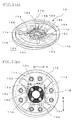
- Figs. 2 (a) and 2 (b) show the details of the above flexible coupling 10.
- the motor-side plate 11A is provided with four pin members 13a projecting toward the intermediate plate 11B
- the above intermediate plate 11B is provided with four pin members 13b projecting toward the above motor-side plate 11A
- both end portions of the first rubber members 12a having a substantially rectangular shape in plan view which are first connection members are mated with the above pin members 13a and 13b to connect the motor-side plate 11A to the intermediate plate 11B.
- the above four rubber members 12a are arranged in such a manner that two out of the above four rubber members 12a become symmetrical to the other two in the horizontal direction and the above pin members 13a and 13b are positioned to ensure that all of the lengthwise directions of the rubber members 12a become parallel to the direction A when the lengthwise directions of the four rubber members 12a are parallel to the direction A in Figs. 2(a) and 2(b).
- the rear surface opposite to the above pin members 13b of the above intermediate plate 11B is provided with four pin members 14b projecting toward the wheel-side plate 11C
- the wheel-side plate 11C is provided with four pin members 14c projecting toward the above intermediate plate 11B
- both end portions of the second rubber members 12b having a substantially rectangular shape in plan view which are second connection members are mated with the above pin members 14b and 14c to connect the intermediate plate 11B to the wheel-side plate 11C.
- the above four rubber members 12b are arranged in such a manner that two out of the above rubber members 12b become symmetrical to the other two in the vertical direction and the above pin members 14b and 14c are positioned to ensure that all of the lengthwise directions of the rubber members 12b become parallel to the direction B when the lengthwise directions of the four rubber members 12a are parallel to the direction B orthogonal to the direction A in these figures.
- the motor-side plate 11A and the intermediate plate 11B are connected to each other in the direction of connecting the above pin members 13a and 13b, that is, the lengthwise direction (direction A) of the first rubber members 12a
- the above intermediate plate 11B and the wheel-side plate 11C are connected to each other in the direction of connecting the above pin members 14b and 14c, that is, the lengthwise direction (direction B) of the second rubber members 12b which is the direction orthogonal to the lengthwise direction of the above first rubber members 12a.
- the rubber members 12a and 12b are fixed in their lengthwise direction (direction A or B) by mounting them as described above, they have high stiffness and hardly expands. However, as they are not fixed in the cross direction, they have low stiffness. Therefore, as shown in Fig. 2(b),the motor-side plate 11A and the intermediate plate 11B interconnected by the first rubber members 12a can move relative to each other in the direction B orthogonal to the lengthwise direction of the above first rubber members 12a whereas the wheel-side plate 11C and the intermediate plate 11B can move relative to each other in the direction A orthogonal to the lengthwise direction of the above second rubber members 12b.
- the motor-side plate 11A and the wheel-side plate 11C can move parallel to each other in all the directions. Therefore, even when the motor shaft and the wheel shaft become eccentric to each other, this eccentricity can be absorbed by the transformation in the cross direction of the above rubber members 12a and 12b, thereby making it possible to transmit the torque of the motor 3 to the wheel 2 smoothly.
- the above plates 11A to 11C may have the same shape, the diameter of the intermediate plate 11B may be made small and the ring widths of the motor-side plate 11A and the wheel-side plate 11C may be made small as shown in Figs. 2 (a) and 2 (b).
- projections 11m and 11n projecting toward the pin members 13b on the intermediate plate 11B from the peripheries of the above plates 11A and 11C may be provided, and the above pin members 13a and 14c may be mated with the projections 11m and 11n, respectively.
- the above flexible coupling 10 can be further made lighter. It is needless to say that the above projections 11m and 11n project in directions orthogonal to each other.
- the motor 3 is connected to the wheel 2 by the flexible coupling 10 constituted such that the motor-side plate 11A and the intermediate plate 11B are connected to each other by the first rubber members 12a having a substantially rectangular shape in plan view in such a manner that they can move relative to each other in the direction (direction B) orthogonal to the connection direction, and the above intermediate plate 11B and the wheel-side plate 11C are connected to each other by the second rubber members 12b like the above first rubber member 12a in such a manner that they can move relative to each other in the direction (direction A) orthogonal to the above direction B, even when the motor shaft and the wheel shaft become eccentric to each other, the drive torque of the motor 3 can be transmitted to the wheel 2 without fail. Since this flexible coupling 10 is simple in structure and has a small number of parts, it can be easily assembled, thereby making it possible to enhance work efficiency and improve productivity.
- wheel-side plate 11C is directly connected to the wheel 2 in the above embodiment, even when the wheel-side plate 11C is connected to the hub 4 connected to the wheel 2 at its rotary shaft, the same effect can be obtained.
- the motor-side plate 11A and the intermediate plate 11B are interconnected by the above rubber members 12a having a substantially rectangular shape in plan view and the intermediate plate 11B and the wheel-side plate 11C are interconnected by the rubbers members 12b having a substantially rectangular shape in plan view in such a manner that they can move in the cross direction of the above rubber members 12a and 12b.
- the above rubber members 12a having a substantially rectangular shape in plan view
- the intermediate plate 11B and the wheel-side plate 11C are interconnected by the rubbers members 12b having a substantially rectangular shape in plan view in such a manner that they can move in the cross direction of the above rubber members 12a and 12b.
- an elastic member 20 molded out of a molding material 23 such as rubber or resin after a wire 22 such as thread, nylon cord or steel cord are wound between metal fittings 21a and 21b may be mated with the pin members 24a and 24b of the unshown motor-side plate 11A, intermediate plate 11B and wheel-side plate 11C. Since the above elastic member 20 has high stiffness in the direction (direction A) of connecting the above pin members 24a and 24b but low stiffness in the direction B orthogonal to the direction A as shown in Figs.
- the drive torque of the motor 3 can be transmitted to the wheel 2 without fail.
- the wound portion of the above wire material 22 may be molded out of rubber or resin.
- Resin members may be used in place of the above rubber members 12a and 12b and a wire material having stiffness such as a steel cord or steel wire may be wound between the above pin members 13a and 13b and between the pin members 14b and 14c.
- connection members 12 such as the above rubber members 12a and 12b or the above elastic members 20 are mated with the pin members 13 through a bearing such as a dry bearing (slide bush) 15a or a ball bearing 15b as shown in Figs. 4(a) and 4(b) or through a rubber bush 16 as shown in Figs. 5 (a) and 5 (b)
- a bearing such as a dry bearing (slide bush) 15a or a ball bearing 15b as shown in Figs. 4(a) and 4(b) or through a rubber bush 16 as shown in Figs. 5 (a) and 5 (b)
- the rotations of the above connection members 12 and the above pin members 13 as fixed shafts become smooth during the stroke of the flexible coupling 10, whereby the movement of the above flexible coupling 10 becomes smooth, thereby making it possible to further improve power transmission efficiency.
- reference numeral 17 denotes a holding metal fitting for fixing the above bearings 15a and 15b or the above rubber bush 16 in the above connection member 12.
- connection member 12 When the above connection member 12 is attached to the above plates 11A to 11C while it is compressed in the lengthwise direction which is the connection direction, the movements of the plates 11A and 11B and the plates 11B and 11C can be made smoother and the stroke can be made long, which makes it possible to cope with the input of large vibration.
- Tension force T ( ⁇ L) is applied to the above connection members 12 and 12 according to this elongation ⁇ L. Since the resultant force of this tension balances with force F for vibrating the plates in the vertical direction as shown in Fig.
- T( ⁇ L) and ⁇ L have the same relationship as the general relationship between the amount of distortion and tension as shown in Fig. 7(c)
- the motor rotor and the wheel or the hub are interconnected by a flexible coupling which has a small number of parts and can be easily assembled, productivity can be improved and an in-wheel motor can be manufactured at a low cost.
Landscapes
- Engineering & Computer Science (AREA)
- General Engineering & Computer Science (AREA)
- Mechanical Engineering (AREA)
- Chemical & Material Sciences (AREA)
- Combustion & Propulsion (AREA)
- Transportation (AREA)
- Arrangement Or Mounting Of Propulsion Units For Vehicles (AREA)
- Connection Of Motors, Electrical Generators, Mechanical Devices, And The Like (AREA)
Abstract

Description
- The present invention relates to an in-wheel motor system for use in a vehicle having direct drive wheels as drive wheels.
- It is generally known that, in a vehicle having a suspension mechanism such as a spring around a wheel, as the mass of parts under the spring such as a wheel, knuckle and suspension arm, so-called "unsprung mass" increases, changes in the ground holding force of a tire when running on an uneven road become larger, thereby deteriorating road holding properties.
- In a vehicle driven by a motor such as an electric car, an in-wheel motor system incorporating a motor in a wheel is being employed. However, in a conventional in-wheel motor whose non-rotating part is fixed to a spindle shaft connected to a part such as an upright or knuckle which is one of the parts around a wheel of the vehicle and whose rotor as a rotating part can rotate together with the wheel, the above unsprung mass increases by the weight of the in-wheel motor, whereby changes in the ground holding force of the tire become large, thereby deteriorating road holding properties (refer to
patent documents 1 to 3, for example). - To solve the above problem, there is proposed an in-wheel motor system as shown in Fig. 6 in which a non-rotating side case 3a supporting a stator 3S is elastically supported to a
knuckle 5 as a part around the wheel of a vehicle by abuffer mechanism 50 having twoplates 54 and 55 whose moving directions are limited to the vertical direction of the vehicle by direct-acting guides 51 and which are interconnected by springs 52 and a damper 53 moving in the vertical direction of the vehicle and a rotating side case 3b supporting a rotor 3R and awheel 2 are interconnected by aflexible coupling 60 as a drive force transmission mechanism which can become eccentric in the radical direction of the wheel 2 (refer topatent document 4, for example). - More specifically, as shown in Fig. 9, the above
flexible coupling 60 comprises a plurality of hollow disk-like plates 61A to 61C and direct-acting guides 62A and 62B for interconnecting between the adjacent plates 61A and 61B and between the adjacent plates 61B and 61C and guiding the above adjacent plates 61A and 61B and the adjacent plates 61B and 61C in the radial direction of the disk. As shown in Fig. 10, each of the above direct-acting guides 62A and 62B comprises a guide rail 62x having a projection extending in the radial direction of the above plates 61A to 61C, a guide member 62y having a recess extending in the radial direction of the above plates 61A to 61C to be engaged with the above guide rail 62x, and a plurality ofsteel balls 62m interposed between the projection of the above guide rail 62x and the recess of the guide member 62y to smoothly slide the above guide rail 62x and the guide member 62y. - Since the above guide rail 62x and the guide member 62y slide so as to guide the above adjacent plates 61A and 61B and the adjacent plates 61B and 61C in the radial direction of the disk, the in-
wheel motor 3 can move in the working direction of the above direct-acting guides 62A and 62B, that is, the radial direction of the disk but not in the rotation direction. Therefore, by connecting the rotating side case 3b of themotor 3 to thewheel 2 by the aboveflexible coupling 60, drive torque can be transmitted from themotor 3 to thewheel 2 efficiently. - In the in-wheel motor system constituted as described above, the in-
wheel motor 3 is float mounted to a part around the wheel of the vehicle by thebuffer mechanism 50 so that themotor 3 itself can be used as the weight of a dynamic damper, thereby making it possible to improve ground holding performance and riding comfort when running on a bad road. Since the motor shaft and the wheel shaft are interconnected by the aboveflexible coupling 60 in such a manner that they can become eccentric to each other in any direction, torque can be transmitted from themotor 3 to thewheel 2 efficiently.
Patent document 1:Japanese Patent No. 2676025
Patent document 2:Japanese Examined Patent Publication No. 9-506236
Patent document 3:Japanese Unexamined Patent Application No. 10-305735
Patent document 4:WO 02/083446 A1 - Although the above
flexible coupling 60 can transmit the drive torque of themotor 3 to thewheel 2 efficiently, as it has a large number of parts and comprises direct-acting guides 62A and 62B which require high assembly accuracy, it takes long to mount the above direct-acting guides 62A and 62B to the above plates 61A to 61C, thereby reducing productivity. Further, since the above direct-acting guides 62A and 62B are expensive, the whole system costs dear. - It is an object of the present invention which has been made in view of the above problem to provide an in-wheel motor system capable of transmitting the drive torque of a motor to a wheel very efficiently with simple constitution and comprising a flexible coupling which can be assembled easily.
- According to a first aspect of the present invention, here is provided an in-wheel motor system having a hollow direct drive motor which is provided in a wheel and whose stator side is supported to a part around the wheel of a vehicle by elastic bodies and/or an attenuation mechanism, wherein
a motor rotor and a wheel or a hub are interconnected by a coupling mechanism which comprises a motor-side plate connected to a rotating side case of the motor, a wheel-side plate connected to the wheel or hub, an intermediate plate interposed between the two plates, and first and second connection members for interconnecting the motor-side plate and the intermediate plate and interconnecting the intermediate plate and the wheel-side plate in such a manner that the interconnected plates can move relative to each other in a direction where the stiffness of the connection members themselves is low, the first and second connection members being arranged such that the directions where their stiffness is low become orthogonal to each other. - According to a second aspect of the present invention, there is provided an in-wheel motor system wherein at least one pair of either one or both of the first and second connection members are provided, and the paired connection members are arranged at positions where they become symmetrical to the center line of the plane of the plates.
- According to a third aspect of the present invention, there is provided an in-wheel motor system wherein the first and second connection members are made of rubber or resin whose length in the connection direction is larger than the length in the direction orthogonal to the connection direction. The above "connection direction" refers to a direction for interconnecting a connection portion between the above motor-side plate and the above first connection member and a connection portion between the intermediate plate connected to the motor-side plate by the first connection member and the above first connection member in the above first connection member and a direction for interconnecting a connection portion between the intermediate plate and the second connection member and a connection portion between the wheel-side plate connected to the intermediate plate by the second connection member and the above second connection member in the second connection member.
- According to a fourth aspect of the present invention, there is provided an in-wheel motor system wherein pin members are provided on the opposed surfaces of the motor-side plate and the intermediate plate and on the opposed surfaces of the intermediate plate and the wheel-side plate and interconnected by a steel cord or steel wire.
- According to a fifth aspect of the present invention, there is provided an in-wheel motor system wherein the first and second connection members are attached to the respective plates through a bearing or rubber bush.
- According to a sixth aspect of the present invention, there is provided an in-wheel motor system wherein the first and second connection members are attached to the respective plates while they are compressed in the connection direction.
- According to the present invention, the motor rotor and the wheel or hub are interconnected by a coupling mechanism which comprises a motor-side plate, wheel-side plate, intermediate plate, and first and second connection members for interconnecting the motor-side plate and the intermediate plate and interconnecting the intermediate plate and the wheel-side plate in such a manner that the connected plates can move relative to each other in a direction where the stiffness of the connection members themselves is low, for example, rubber members whose length is large in the connection direction, therefore, whose stiffness is high in the connection direction and low in the direction orthogonal to the connection direction, the first and second connection members being arranged such that the directions where their stiffness is low become orthogonal to each other and which is simple in structure and has a small number of parts. Therefore, the coupling mechanism is easily assembled, thereby making it possible to improve work efficiency.
- At this point, when at least one pair of either one or both of the above first and second connection members are provided and the paired connection members are arranged at positions where they become symmetrical to the center line of the plane of the plates, unrequired twist can be prevented, thereby making it possible to transmit the torque of the motor without fail.
- When the above first and second connection members are attached to the respective plates through a bearing or a rubber bush, the movement of the coupling mechanism becomes smooth, thereby making it possible to further improve power transmission efficiency.
- When the above first and second connection members are attached to the respective plate while they are compressed in the connection direction, the stroke between the plates can be made long, thereby making it possible to handle input of large vibration.
-
- Fig. 1 is a longitudinal sectional view showing the constitution of an in-wheel motor system according to an embodiment of the present invention;
- Figs. 2(a) and 2(b) are diagrams showing the constitution of a flexible coupling in the embodiment;
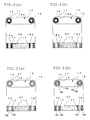
- Figs. 3(a) to 3(c) are diagrams showing the constitution of another plate connection member according to the present invention;
- Figs. 4(a) and 4(b) are diagrams showing the constitution of still another plate connection member according to the present invention;
- Figs. 5(a) and 5(b) are diagrams showing the constitution of a further plate connection member according to the present invention;
- Fig. 6 is a diagram showing the movements of plate connection members having a bearing;
- Figs. 7 (a) to 7(d) are diagrams for explaining the operation of the plate connection members when they are mounted in the connection direction while they are compressed;
- Fig. 8 is a diagram showing the constitution of a conventional in-wheel motor of the prior art;
- Fig. 9 is a diagram showing the constitution of a conventional flexible coupling of the prior art; and
- Fig. 10 is a diagram showing an example of a direct-acting guide.
- Preferred embodiments of the present invention will be described hereinunder with reference to the accompanying drawings.
- Fig. 1 shows the constitution of an in-wheel motor system according to a preferred embodiment of the present invention. In Fig. 1,
reference numeral 1 denotes a tire, 2 a wheel consisting of a rim 2a and awheel disk 2b, and 3 an outer rotor type in-wheel motor which comprises a stator 3S fixed to a non-rotating side case 3a arranged on the inner side in the radial direction and a rotor 3R fixed to a rotating side case 3b rotatably connected to the above non-rotating side case 3a through a bearing 3j and arranged on the outer side in the radial direction. - Numeral 4 denotes a hub connected to the
wheel 2 at its rotary shaft, 5 a knuckle connected to anaxle 6, 7 a suspension member composed of a shock absorber, 8 a brake unit composed of a brake disk mounted to theabove hub 4, 10 a rubber flexible coupling of the present invention for connecting the rotating side case 3b supporting the rotor 3R to thewheel 2, which comprises a motor-side plate 11A connected to the above rotating side case 3b, a wheel-side plate 11C connected to thewheel 2, an intermediate plate 11B interposed between the two plates 11A and 11C, and first and second rubber members 12a and 12b as first and second connection members for connecting the above motor-side plate 11A to the intermediate plate 11B and the above intermediate plate 11B to the wheel-side plate 11C, and 50 a buffer mechanism for elastically supporting the non-rotating side case 3a supporting thestator 3 to theknuckle 5 as a part around the wheel of the vehicle, comprising twoplates 54 and 55 whose moving directions are limited to the vertical direction of the vehicle by direct-acting guides 51 and which are interconnected by springs 52 and a damper 53 moving in the vertical direction of the vehicle. - Figs. 2 (a) and 2 (b) show the details of the above
flexible coupling 10. The motor-side plate 11A is provided with four pin members 13a projecting toward the intermediate plate 11B, the above intermediate plate 11B is provided with four pin members 13b projecting toward the above motor-side plate 11A, and both end portions of the first rubber members 12a having a substantially rectangular shape in plan view which are first connection members are mated with the above pin members 13a and 13b to connect the motor-side plate 11A to the intermediate plate 11B. At this point, the above four rubber members 12a are arranged in such a manner that two out of the above four rubber members 12a become symmetrical to the other two in the horizontal direction and the above pin members 13a and 13b are positioned to ensure that all of the lengthwise directions of the rubber members 12a become parallel to the direction A when the lengthwise directions of the four rubber members 12a are parallel to the direction A in Figs. 2(a) and 2(b). - The rear surface opposite to the above pin members 13b of the above intermediate plate 11B is provided with four pin members 14b projecting toward the wheel-side plate 11C, the wheel-side plate 11C is provided with four pin members 14c projecting toward the above intermediate plate 11B, both end portions of the second rubber members 12b having a substantially rectangular shape in plan view which are second connection members are mated with the above pin members 14b and 14c to connect the intermediate plate 11B to the wheel-side plate 11C. At this point, the above four rubber members 12b are arranged in such a manner that two out of the above rubber members 12b become symmetrical to the other two in the vertical direction and the above pin members 14b and 14c are positioned to ensure that all of the lengthwise directions of the rubber members 12b become parallel to the direction B when the lengthwise directions of the four rubber members 12a are parallel to the direction B orthogonal to the direction A in these figures.
- Thereby, the motor-side plate 11A and the intermediate plate 11B are connected to each other in the direction of connecting the above pin members 13a and 13b, that is, the lengthwise direction (direction A) of the first rubber members 12a, and the above intermediate plate 11B and the wheel-side plate 11C are connected to each other in the direction of connecting the above pin members 14b and 14c, that is, the lengthwise direction (direction B) of the second rubber members 12b which is the direction orthogonal to the lengthwise direction of the above first rubber members 12a.
- Since the rubber members 12a and 12b are fixed in their lengthwise direction (direction A or B) by mounting them as described above, they have high stiffness and hardly expands. However, as they are not fixed in the cross direction, they have low stiffness. Therefore, as shown in Fig. 2(b),the motor-side plate 11A and the intermediate plate 11B interconnected by the first rubber members 12a can move relative to each other in the direction B orthogonal to the lengthwise direction of the above first rubber members 12a whereas the wheel-side plate 11C and the intermediate plate 11B can move relative to each other in the direction A orthogonal to the lengthwise direction of the above second rubber members 12b. Meanwhile, as the above rubber members 12a and 12b have high stiffness and hardly expand in the rotational direction of the above plates 11A to 11C, the motor-side plate 11A and the wheel-side plate 11C can move parallel to each other in all the directions. Therefore, even when the motor shaft and the wheel shaft become eccentric to each other, this eccentricity can be absorbed by the transformation in the cross direction of the above rubber members 12a and 12b, thereby making it possible to transmit the torque of the
motor 3 to thewheel 2 smoothly. - Although the above plates 11A to 11C may have the same shape, the diameter of the intermediate plate 11B may be made small and the ring widths of the motor-side plate 11A and the wheel-side plate 11C may be made small as shown in Figs. 2 (a) and 2 (b). In this case,
projections 11m and 11n projecting toward the pin members 13b on the intermediate plate 11B from the peripheries of the above plates 11A and 11C may be provided, and the above pin members 13a and 14c may be mated with theprojections 11m and 11n, respectively. Thereby, the aboveflexible coupling 10 can be further made lighter. It is needless to say that theabove projections 11m and 11n project in directions orthogonal to each other. - According to this embodiment, since the
motor 3 is connected to thewheel 2 by theflexible coupling 10 constituted such that the motor-side plate 11A and the intermediate plate 11B are connected to each other by the first rubber members 12a having a substantially rectangular shape in plan view in such a manner that they can move relative to each other in the direction (direction B) orthogonal to the connection direction, and the above intermediate plate 11B and the wheel-side plate 11C are connected to each other by the second rubber members 12b like the above first rubber member 12a in such a manner that they can move relative to each other in the direction (direction A) orthogonal to the above direction B, even when the motor shaft and the wheel shaft become eccentric to each other, the drive torque of themotor 3 can be transmitted to thewheel 2 without fail. Since thisflexible coupling 10 is simple in structure and has a small number of parts, it can be easily assembled, thereby making it possible to enhance work efficiency and improve productivity. - Although the wheel-side plate 11C is directly connected to the
wheel 2 in the above embodiment, even when the wheel-side plate 11C is connected to thehub 4 connected to thewheel 2 at its rotary shaft, the same effect can be obtained. - In the above embodiment, the motor-side plate 11A and the intermediate plate 11B are interconnected by the above rubber members 12a having a substantially rectangular shape in plan view and the intermediate plate 11B and the wheel-side plate 11C are interconnected by the rubbers members 12b having a substantially rectangular shape in plan view in such a manner that they can move in the cross direction of the above rubber members 12a and 12b. As shown in Fig. 3 (a), in place of the above rubber members 12a and 12b, an
elastic member 20 molded out of amolding material 23 such as rubber or resin after awire 22 such as thread, nylon cord or steel cord are wound between metal fittings 21a and 21b may be mated with the pin members 24a and 24b of the unshown motor-side plate 11A, intermediate plate 11B and wheel-side plate 11C. Since the aboveelastic member 20 has high stiffness in the direction (direction A) of connecting the above pin members 24a and 24b but low stiffness in the direction B orthogonal to the direction A as shown in Figs. 3 (b) and 3(c), like the above rubber members 12a and 12b, even when the motor shaft and the wheel shaft become eccentric to each other, the drive torque of themotor 3 can be transmitted to thewheel 2 without fail. After thewire material 22 is wound round the pin members 24a and 24b by omitting the above metal fittings 21a and 21b, the wound portion of theabove wire material 22 may be molded out of rubber or resin. - Resin members may be used in place of the above rubber members 12a and 12b and a wire material having stiffness such as a steel cord or steel wire may be wound between the above pin members 13a and 13b and between the pin members 14b and 14c.
- Further, when
connection members 12 such as the above rubber members 12a and 12b or the aboveelastic members 20 are mated with thepin members 13 through a bearing such as a dry bearing (slide bush) 15a or a ball bearing 15b as shown in Figs. 4(a) and 4(b) or through arubber bush 16 as shown in Figs. 5 (a) and 5 (b), the rotations of theabove connection members 12 and theabove pin members 13 as fixed shafts become smooth during the stroke of theflexible coupling 10, whereby the movement of the aboveflexible coupling 10 becomes smooth, thereby making it possible to further improve power transmission efficiency. - When
grease 16g is made existent between theabove pin member 13 and therubber bush 16 as shown in Fig. 5(a) or aninner cylinder 16m is provided as shown in Fig. 5(b) to set therubber bush 16, the rotations of theabove pin members 13 and theabove connection members 12 can be made smoother. When acavity 16g is formed in theabove rubber bush 16 at this point, the rotations become much smoother. - In Figs. 4(a) and 4(b) and Figs. 5(a) and 5(b),
reference numeral 17 denotes a holding metal fitting for fixing the above bearings 15a and 15b or theabove rubber bush 16 in theabove connection member 12. - When the
above connection member 12 is attached to the above plates 11A to 11C while it is compressed in the lengthwise direction which is the connection direction, the movements of the plates 11A and 11B and the plates 11B and 11C can be made smoother and the stroke can be made long, which makes it possible to cope with the input of large vibration. - That is, when the natural length of the
connection member 12 is represented by L0, the set length of theconnection member 12 is represented by Ls, and the interconnected plates are displaced by X in the direction (vertical direction in the figures) orthogonal to the lengthwise direction of theabove rubber members 12, the lengths L of the right and leftconnection members above connection members above connection members connection member 12 is not compressed. - Thereby, when a large displacement is input, it can be handled, and the
above connection members - As having been described above, according to the present invention, since the motor rotor and the wheel or the hub are interconnected by a flexible coupling which has a small number of parts and can be easily assembled, productivity can be improved and an in-wheel motor can be manufactured at a low cost.
Claims (6)
- An in-wheel motor system having a hollow direct drive motor which is provided in a wheel and whose stator side is supported to a part around the wheel of a vehicle by elastic bodies and/or an attenuation mechanism, wherein
a motor rotor and a wheel or a hub are interconnected by a coupling mechanism which comprises a motor-side plate connected to a rotating side case of the motor, a wheel-side plate connected to the wheel or hub, an intermediate plate interposed between the two plates, and first and second connection members for interconnecting the motor-side plate and the intermediate plate and interconnecting the intermediate plate and the wheel-side plate in such a manner that the interconnected plates can move relative to each other in a direction where the stiffness of the connection members themselves is low, the first and second connection members being arranged such that the directions where they have low stiffness become orthogonal to each other. - The in-wheel motor system according to claim 1, wherein at least one pair of either one or both of the first and second connection members are provided, and the paired connection members are arranged at positions where they become symmetrical to the center line of the plane of the plates.
- The in-wheel motor system according to claim 1 or 2, wherein the first and second connection members are made of rubber or resin whose length in the connection direction is larger than the length in the direction orthogonal to the connection direction.
- The in-wheel motor system according to claim 1 or 2, wherein pin members are provided on the opposed surfaces of the motor-side plate and the intermediate plate on the opposed surfaces of the intermediate plate and the wheel-side plate interconnected by a steel cord or steel wire.
- The in-wheel motor system according to any one of claims 1 to 4, wherein the first and second connection members are attached to the respective plates through a bearing or rubber bush.
- The in-wheel motor system according to any one of claims 1 to 5, wherein the first and second connection members are attached to the respective plates while they are compressed in the connection direction.
Applications Claiming Priority (3)
| Application Number | Priority Date | Filing Date | Title |
|---|---|---|---|
| JP2003427557 | 2003-12-24 | ||
| JP2004266559A JP2005206140A (en) | 2003-12-24 | 2004-09-14 | In-wheel motor system |
| PCT/JP2004/018396 WO2005061255A1 (en) | 2003-12-24 | 2004-12-09 | In-wheel motor system |
Publications (2)
| Publication Number | Publication Date |
|---|---|
| EP1700733A1 true EP1700733A1 (en) | 2006-09-13 |
| EP1700733A4 EP1700733A4 (en) | 2010-01-06 |
Family
ID=34712982
Family Applications (1)
| Application Number | Title | Priority Date | Filing Date |
|---|---|---|---|
| EP04820688A Withdrawn EP1700733A4 (en) | 2003-12-24 | 2004-12-09 | In-wheel motor system |
Country Status (4)
| Country | Link |
|---|---|
| US (1) | US7422080B2 (en) |
| EP (1) | EP1700733A4 (en) |
| JP (1) | JP2005206140A (en) |
| WO (1) | WO2005061255A1 (en) |
Families Citing this family (31)
| Publication number | Priority date | Publication date | Assignee | Title |
|---|---|---|---|---|
| JP2005295773A (en) * | 2004-04-05 | 2005-10-20 | Bridgestone Corp | Installation method of in-wheel motor |
| WO2007026199A1 (en) * | 2005-08-31 | 2007-03-08 | Toyota Jidosha Kabushiki Kaisha | In-wheel suspension |
| US20080257620A1 (en) * | 2007-03-20 | 2008-10-23 | Peder Ulrik Poulsen | Hybrid Vehicle Drive System |
| US20110011656A1 (en) * | 2007-03-20 | 2011-01-20 | Peder Ulrik Poulsen | Hybrid vehicle system with indirect drive |
| KR20110014208A (en) * | 2008-05-16 | 2011-02-10 | 아메리칸 액슬 앤드 매뉴팩쳐링, 인코포레이티드 | Wheel casing with embedded rotor for hub motor |
| US20100096911A1 (en) * | 2008-10-17 | 2010-04-22 | Sherif Fahmy Eldeeb | Energy Wheel |
| JP2010269665A (en) * | 2009-05-20 | 2010-12-02 | Aisin Seiki Co Ltd | Wheel support device |
| US7931509B2 (en) * | 2009-09-25 | 2011-04-26 | Glen David Shaw | Coaxial fitting contact tube construction |
| KR101163108B1 (en) * | 2010-07-23 | 2012-07-06 | 박계정 | An Electromotor for an Electric Automobile |
| US20120103119A1 (en) * | 2010-11-02 | 2012-05-03 | Lin cheng-da | Electrically controlable transmission for controlling the stiffness of a vehicle shock absorber |
| JP5872360B2 (en) * | 2012-03-30 | 2016-03-01 | 本田技研工業株式会社 | Electric vehicle |
| GB2487872B (en) * | 2012-05-09 | 2012-12-26 | Protean Electric Ltd | An electric motor or generator system |
| US10300760B1 (en) | 2015-03-18 | 2019-05-28 | Apple Inc. | Fully-actuated suspension system |
| US10814690B1 (en) | 2017-04-18 | 2020-10-27 | Apple Inc. | Active suspension system with energy storage device |
| CN110997362B (en) | 2017-05-08 | 2023-07-28 | 苹果公司 | active suspension system |
| US10899340B1 (en) | 2017-06-21 | 2021-01-26 | Apple Inc. | Vehicle with automated subsystems |
| US11173766B1 (en) | 2017-09-07 | 2021-11-16 | Apple Inc. | Suspension system with locking structure |
| US11065931B1 (en) | 2017-09-15 | 2021-07-20 | Apple Inc. | Active suspension system |
| US11124035B1 (en) | 2017-09-25 | 2021-09-21 | Apple Inc. | Multi-stage active suspension actuator |
| US10960723B1 (en) | 2017-09-26 | 2021-03-30 | Apple Inc. | Wheel-mounted suspension actuators |
| US11285773B1 (en) | 2018-09-12 | 2022-03-29 | Apple Inc. | Control system |
| US11634167B1 (en) | 2018-09-14 | 2023-04-25 | Apple Inc. | Transmitting axial and rotational movement to a hub |
| US11345209B1 (en) | 2019-06-03 | 2022-05-31 | Apple Inc. | Suspension systems |
| US11938922B1 (en) | 2019-09-23 | 2024-03-26 | Apple Inc. | Motion control system |
| US11179991B1 (en) | 2019-09-23 | 2021-11-23 | Apple Inc. | Suspension systems |
| US11707961B1 (en) | 2020-04-28 | 2023-07-25 | Apple Inc. | Actuator with reinforcing structure for torsion resistance |
| US11828339B1 (en) | 2020-07-07 | 2023-11-28 | Apple Inc. | Vibration control system |
| CN117396339A (en) | 2021-06-07 | 2024-01-12 | 苹果公司 | mass damper system |
| CN113806676B (en) * | 2021-08-25 | 2023-11-24 | 明阳智慧能源集团股份公司 | Method and system for correcting and checking flexible pin planetary transmission gear of wind power gear box |
| US12251973B2 (en) | 2022-06-10 | 2025-03-18 | Apple Inc. | Vibration absorber |
| US12168375B1 (en) | 2023-01-26 | 2024-12-17 | Apple Inc. | Motion control system |
Family Cites Families (21)
| Publication number | Priority date | Publication date | Assignee | Title |
|---|---|---|---|---|
| US2537479A (en) * | 1946-02-12 | 1951-01-09 | Motte Charles Marius | Combined suspension hub and shock absorber for vehicle wheels |
| JPS5020954U (en) * | 1973-06-22 | 1975-03-10 | ||
| DE3233736A1 (en) * | 1982-09-11 | 1984-03-15 | Schmidt-Kupplung GmbH, 3340 Wolfenbüttel | Linking bearing for linking transmission |
| US4991698A (en) * | 1988-05-16 | 1991-02-12 | Bose Corporation | Damping with damping mass inside wheel |
| JP2676025B2 (en) | 1989-06-28 | 1997-11-12 | 株式会社東京アールアンドデー | Electric vehicle |
| JPH0384422U (en) * | 1989-12-20 | 1991-08-27 | ||
| JPH04219526A (en) | 1990-04-03 | 1992-08-10 | Nippon Piston Ring Co Ltd | link type shaft joint |
| JPH0488210A (en) | 1990-07-31 | 1992-03-23 | Nippon Piston Ring Co Ltd | Shaft coupling |
| JPH04151019A (en) | 1990-10-15 | 1992-05-25 | Ricoh Co Ltd | Coupling |
| JPH0564537U (en) * | 1992-02-07 | 1993-08-27 | 東洋ゴム工業株式会社 | Flexible coupling |
| FR2705418B1 (en) * | 1993-05-14 | 1995-08-04 | Hutchinson | Vehicle noise attenuation device. |
| WO1995016300A1 (en) | 1993-12-06 | 1995-06-15 | Hydro-Quebec | Electric motor-wheel with a rotor having a housing enabling an efficient exchange of heat |
| JP3288527B2 (en) | 1994-04-06 | 2002-06-04 | 日本ピストンリング株式会社 | Double link type shaft coupling |
| JPH08145068A (en) | 1994-11-17 | 1996-06-04 | Nippon Piston Ring Co Ltd | Shaft coupling |
| JP3524640B2 (en) * | 1995-07-31 | 2004-05-10 | 三洋電機株式会社 | wheelchair |
| JPH10305735A (en) | 1997-05-07 | 1998-11-17 | Toyota Motor Corp | Wheel-in motor |
| US6364078B1 (en) * | 1998-08-27 | 2002-04-02 | Bose Corporation | Wheel damping |
| JP3638586B2 (en) | 2001-04-16 | 2005-04-13 | 株式会社ブリヂストン | In-wheel motor mounting method and in-wheel motor system |
| CN1684851B (en) * | 2002-08-29 | 2010-05-05 | 株式会社普利司通 | In-wheel motor system |
| US7703780B2 (en) * | 2003-09-30 | 2010-04-27 | Toyota Jidosha Kabushiki Kaisha | Wheel supporting apparatus improving ride comfort of vehicle |
| JP2006188153A (en) * | 2005-01-06 | 2006-07-20 | Toyota Motor Corp | In-wheel motor |
-
2004
- 2004-09-14 JP JP2004266559A patent/JP2005206140A/en not_active Withdrawn
- 2004-12-09 US US10/584,153 patent/US7422080B2/en not_active Expired - Fee Related
- 2004-12-09 WO PCT/JP2004/018396 patent/WO2005061255A1/en not_active Ceased
- 2004-12-09 EP EP04820688A patent/EP1700733A4/en not_active Withdrawn
Also Published As
| Publication number | Publication date |
|---|---|
| EP1700733A4 (en) | 2010-01-06 |
| JP2005206140A (en) | 2005-08-04 |
| US20070107959A1 (en) | 2007-05-17 |
| WO2005061255A1 (en) | 2005-07-07 |
| US7422080B2 (en) | 2008-09-09 |
Similar Documents
| Publication | Publication Date | Title |
|---|---|---|
| US7422080B2 (en) | In-wheel motor system | |
| US7571784B2 (en) | Flexible coupling and in-wheel motor system | |
| US8453774B2 (en) | In-wheel motor system for a steering wheel | |
| US7766110B2 (en) | Vehicle having in-wheel motors | |
| EP1733911B1 (en) | In-wheel motor system | |
| KR100529481B1 (en) | Vehicle Wheel Assembly | |
| US20090133944A1 (en) | In-wheel motor system | |
| US7621357B2 (en) | In-wheel motor system and method of installing the same | |
| EP1977924A1 (en) | In-wheel motor system | |
| US20040099455A1 (en) | Fixing method of in-wheel motor and in-wheel motor system | |
| EP1961602A1 (en) | In-wheel motor system | |
| MX2013002285A (en) | Hybrid cross axis ball joint bushing. | |
| EP1702784B1 (en) | In-wheel motor system | |
| CN117719324A (en) | A two-stage suspension active cooling hub motor drive assembly | |
| EP1700732B1 (en) | In-wheel motor system | |
| JP2005329910A (en) | In-wheel motor system | |
| JP3463259B2 (en) | Vehicle drive | |
| JP4795764B2 (en) | In-wheel motor system |
Legal Events
| Date | Code | Title | Description |
|---|---|---|---|
| PUAI | Public reference made under article 153(3) epc to a published international application that has entered the european phase |
Free format text: ORIGINAL CODE: 0009012 |
|
| 17P | Request for examination filed |
Effective date: 20060717 |
|
| AK | Designated contracting states |
Kind code of ref document: A1 Designated state(s): DE FR |
|
| DAX | Request for extension of the european patent (deleted) | ||
| RBV | Designated contracting states (corrected) |
Designated state(s): DE FR |
|
| A4 | Supplementary search report drawn up and despatched |
Effective date: 20091204 |
|
| RIC1 | Information provided on ipc code assigned before grant |
Ipc: F16D 3/04 20060101ALI20091130BHEP Ipc: B60K 7/00 20060101AFI20050711BHEP |
|
| 17Q | First examination report despatched |
Effective date: 20100525 |
|
| STAA | Information on the status of an ep patent application or granted ep patent |
Free format text: STATUS: THE APPLICATION IS DEEMED TO BE WITHDRAWN |
|
| 18D | Application deemed to be withdrawn |
Effective date: 20101005 |