EP1698648A1 - Hydroxy-aromatic compound, process for the preparation thereof, and use of the compound - Google Patents
Hydroxy-aromatic compound, process for the preparation thereof, and use of the compound Download PDFInfo
- Publication number
- EP1698648A1 EP1698648A1 EP05075496A EP05075496A EP1698648A1 EP 1698648 A1 EP1698648 A1 EP 1698648A1 EP 05075496 A EP05075496 A EP 05075496A EP 05075496 A EP05075496 A EP 05075496A EP 1698648 A1 EP1698648 A1 EP 1698648A1
- Authority
- EP
- European Patent Office
- Prior art keywords
- formula
- hydroxy
- group
- aromatic
- resin
- Prior art date
- Legal status (The legal status is an assumption and is not a legal conclusion. Google has not performed a legal analysis and makes no representation as to the accuracy of the status listed.)
- Withdrawn
Links
- 0 *c(c(*)c1*)c(*)c(*)c1O Chemical compound *c(c(*)c1*)c(*)c(*)c1O 0.000 description 1
Classifications
-
- C—CHEMISTRY; METALLURGY
- C07—ORGANIC CHEMISTRY
- C07C—ACYCLIC OR CARBOCYCLIC COMPOUNDS
- C07C69/00—Esters of carboxylic acids; Esters of carbonic or haloformic acids
- C07C69/66—Esters of carboxylic acids having esterified carboxylic groups bound to acyclic carbon atoms and having any of the groups OH, O—metal, —CHO, keto, ether, acyloxy, groups, groups, or in the acid moiety
- C07C69/73—Esters of carboxylic acids having esterified carboxylic groups bound to acyclic carbon atoms and having any of the groups OH, O—metal, —CHO, keto, ether, acyloxy, groups, groups, or in the acid moiety of unsaturated acids
- C07C69/732—Esters of carboxylic acids having esterified carboxylic groups bound to acyclic carbon atoms and having any of the groups OH, O—metal, —CHO, keto, ether, acyloxy, groups, groups, or in the acid moiety of unsaturated acids of unsaturated hydroxy carboxylic acids
-
- C—CHEMISTRY; METALLURGY
- C08—ORGANIC MACROMOLECULAR COMPOUNDS; THEIR PREPARATION OR CHEMICAL WORKING-UP; COMPOSITIONS BASED THEREON
- C08G—MACROMOLECULAR COMPOUNDS OBTAINED OTHERWISE THAN BY REACTIONS ONLY INVOLVING UNSATURATED CARBON-TO-CARBON BONDS
- C08G14/00—Condensation polymers of aldehydes or ketones with two or more other monomers covered by at least two of the groups C08G8/00 - C08G12/00
- C08G14/02—Condensation polymers of aldehydes or ketones with two or more other monomers covered by at least two of the groups C08G8/00 - C08G12/00 of aldehydes
- C08G14/04—Condensation polymers of aldehydes or ketones with two or more other monomers covered by at least two of the groups C08G8/00 - C08G12/00 of aldehydes with phenols
-
- C—CHEMISTRY; METALLURGY
- C08—ORGANIC MACROMOLECULAR COMPOUNDS; THEIR PREPARATION OR CHEMICAL WORKING-UP; COMPOSITIONS BASED THEREON
- C08G—MACROMOLECULAR COMPOUNDS OBTAINED OTHERWISE THAN BY REACTIONS ONLY INVOLVING UNSATURATED CARBON-TO-CARBON BONDS
- C08G8/00—Condensation polymers of aldehydes or ketones with phenols only
- C08G8/04—Condensation polymers of aldehydes or ketones with phenols only of aldehydes
- C08G8/08—Condensation polymers of aldehydes or ketones with phenols only of aldehydes of formaldehyde, e.g. of formaldehyde formed in situ
- C08G8/18—Condensation polymers of aldehydes or ketones with phenols only of aldehydes of formaldehyde, e.g. of formaldehyde formed in situ with phenols substituted by carboxylic or sulfonic acid groups
-
- C—CHEMISTRY; METALLURGY
- C08—ORGANIC MACROMOLECULAR COMPOUNDS; THEIR PREPARATION OR CHEMICAL WORKING-UP; COMPOSITIONS BASED THEREON
- C08G—MACROMOLECULAR COMPOUNDS OBTAINED OTHERWISE THAN BY REACTIONS ONLY INVOLVING UNSATURATED CARBON-TO-CARBON BONDS
- C08G8/00—Condensation polymers of aldehydes or ketones with phenols only
- C08G8/28—Chemically modified polycondensates
Definitions
- the invention relates to a hydroxy-aromatic compound.
- Hydroxy-aromatic compounds as such are known, and are defined as compounds having an aromatic ring with at least one -OH group attached directly to it.
- An example of such a compound is phenol.
- Another example of such a compound is the known adduct of phenol and formaldehyde; this hydroxy-aromatic compound is used in the preparation of phenol-formaldehyde resins.
- These resins are known from for example A. Knop, L.A. Pilato, Phenolic Resins, Springer Verlag Berlin 1990. These resins have many known uses, such as for example the use of these resins in adhesives for the preparation of particle boards.
- hydroxy-aromatic compound is a compound of formula (I) wherein:
- hydroxy-aromatic-based resins can be made that suffer less, or even not at all, from the health risks associated with the use of formaldehyde.
- resins prepared with the compound according to the present invention are in particular suitable for use in many applications such as adhesives, coatings, laminates, and shaped articles.
- At least one of the groups in the set consisting of R 1 , R 3 , and R 6 is given by formula (II); the other one or two groups in the said set - in case not all three of the said set is given by formula (II) - is/are H, OH, or C 1 -C 12 alkyl group, preferably H, OH, a C 1 -C 9 alkyl group, or an oligomeric or polymeric system. If there are two groups not according to formula (II) then they may be the same or may be different.
- the oligomeric or polymeric system may be a hydroxy-aromatic resin, either of the resol or of the novolac type, preferably of the novolac type; or it may be a different type of thermosetting or thermoplastic system.
- R 1 is a group according to formula (II), R 3 is H, and R 5 is H;
- R 1 is a group according to formula (II), R 3 is H, and R 5 is CH 3 ;
- R 1 is H, R 3 is a group according to formula (II), and R 5 is H;
- R 1 and R 3 are a group according to formula (II), R 6 is H;
- R 1 , R 3 , and R 5 are all a group according to formula (II).
- R 2 and R 4 are H, OH, a C 1 -C 12 alkyl group, or an oligomeric or polymeric system; preferably R 2 and R 4 are H, OH or a C 1 -C 9 alkyl group.
- R 2 and R 4 may be the same or may be different.
- Some preferred embodiments of R 2 and R 4 are: R 2 is OH and R 4 is H; R 2 is CH 3 and R 4 is H; R 2 is CH 3 and R 4 is CH 3 ; R 2 is H and R 4 is C 4 H 9 .
- R 1 and R 2 may be part of a multicyclic compound: the same holds mutatis mutandis for R 2 and R 3 , R 3 and R 4 , or R 4 and R 5 .
- the group according to formula (II) is an integral part of the compound according to the invention; it is either R 1 , R 3 , or R 5 in formula (I), or two of those, or all three.
- EWG is an electron-withdrawing group.
- EWG's are as such known to the skilled person. Examples of an EWG are acid-, ester-, cyano-, di-alkylacetal-, aldehyde-, substituted phenyl-, or trihalomethyl groups. Hydrogen is not an EWG.
- the group of formula (II) is a group according to formula (III): wherein R 6 is a C 1 -C 12 alkyl group, aryl group, aralkyl group or cycloalkyl group.
- R 6 is a C 1 -C 12 alkyl group; examples hereof are methyl, ethyl, propyl, butyl, pentyl, hexyl; more preferably, R 6 is a methyl group or an ethyl group.
- At least one of the set consisting of R 1 , R 3 , and R 5 is H.
- two of the set consisting of R 1 , R 3 , and R 5 are H.
- the invention further relates to a process for the preparation of the hydroxy-aromatic compound as described above.
- the process according to the invention comprises a reaction step wherein a hydroxy-aromatic compound of formula (IV) is brought into contact with a compound according to formula (V), optionally in the presence of a catalyst, whereby formula (IV) is: wherein R 7 , R 6 , R 9 , R 10 and R 11 are H, OH, a C 1 -C 12 alkyl group or an oligomeric or polymeric system, whereby at least one and preferably two or even three of the set consisting of R 7 , R 9 , and R 11 is or are H; and formula (V) is: wherein EWH is an electron-withdrawing group and wherein R 12 is H, a C 1 -C 12 alKyl group, aryl group, aralkyl group or cycloalkyl group.
- the compound according to formula (V) is an alkanol hemacetal according to formula (VI): wherein R 6 is a C 1 -C 12 alkyl group, aryl group, aralkyl group or cycloalkyl group and wherein R 12 is H, a C 1 -C 12 alkyl group, aryl group, aralkyl group or cycloalkyl group.
- R 6 and R 12 are C 1 -C 12 alkyl groups. Examples thereof are methyl, ethyl, propyl, butyl, pentyl, hexyl, and heptyl.
- R 6 and R 12 are in particular a methyl group or an ethyl group.
- the process according to the invention comprises a reaction step.
- the purpose of the reaction step is to let a hydroxy-aromatic compound of formula (IV) react with a compound of formula (V).
- the compound according to either formula (IV) or formula (V) may be one single compound or a mixture of two or more compounds falling within the scope of the formulas as defined above.
- Examples of preferred compounds according to formula (IV) are phenol, (2, 3, or 4-)cresol, resorcinol, (2, 3, or 4-)tert-butylphenol, (2, 3, or 4-)nonylphenol, (2,3- 2,4- 2,5- 2,6- or 3,4-)dimethylphenol, and (2, 3, or 4-)ethylphenol.
- Examples of compounds according to formula (V), in particular of the preferred alkanol hemiacetals according to formula (VI), are methylglyoxylate methanol hemiacetal (GMHATM, DSM Fine Chemicals, Linz); ethylglyoxylate ethanol hemiacetal (GEHATM, DSM Fine Chemicals, Linz); ethylglyoxylate methanol hemiacetal; butylglyoxylate butanol hemiacetal; butylglyoxylate methanol hemiacetal; butylglyoxylate ethanol hemiacetal; isopropylglyoxylate isopropanol hemiacetal; propylglyoxylate propanol hemiacetal; cyclohexylglyoxylate methanol hemiacetal and 2-ethylhexylglyoxylate methanol hemiacetal.
- Further examples of compounds according to formula V are glyoxylic acid hydrate
- solvents those compounds are suitable in which the reactants dissolve sufficiently to let the reaction take place.
- examples of such solvents are water and various organic solvents.
- many of the compounds according to formula (V) and in particular according to formula (VI) are a liquid at temperatures between 10°C and 100°C and can act as dispersant/solvent as well as reactant.
- reaction step may proceed spontaneously once the respective compounds have been brought together, it may be useful to bring the compounds together in the presence of a catalyst in order to accelerate the reaction.
- a catalyst preferably an acid or a base is used; in particular, a Lewis or a Bronsted type of acid is preferred - such as for example sulphuric acid - whereby the pH is reduced to between 0 and 5, preferably to between 1 and 4, in particular to between 2 and 3.
- Suitable examples of acid catalysts are sulphuric acid, nitric acid, hydrochloric acid, phosphoric acid, boric acid, tetrafluoroboric acid, paratoluene sulphonic acid, formic acid, ammonium sulphate, ammonium chloride, ammonium nitrate.
- Suitable examples of basic catalysts are ammonia, trimethyl amine, triethyl amine, DABCO (diaza-bicyclo-octane), DBU (diaza-bicyclo-undecene), DMAP (4-dimethylaminopyridine), sodium hydroxide, potassium hydroxide.
- the temperature in the reaction step of present process can vary within wide limits, and preferably lies between 10°C and 100°C. More preferably the process is carried out at between 40°C and 90°C.
- the pressure in the present process preferably is between 0.005 MPa and 1.0 MPa, preferably between 0.02 MPa and 0.2 MPa; most preferably, the pressure is atmospheric.
- a compound according to formula (I) is formed; additionally, the compound R 12 OH is released as by-product.
- the molar ratio between the EWG-containing compound according to formula (V) (E) and the hydroxy-aromatic compound according to formula (IV) (H), herein referred to as E/H ratio may vary between wide limits.
- the E/H ratio lies between about 0.1 and about 10, more preferably between about 0.5 and about 3. If the E/H ratio is about 0.5 or lower, the resulting hydroxy-aromatic compound according to the invention can be a mixture having a significant amount of a compound according to formula (I) in which one of the set consisting of R 1 , R 3 , and R 5 is a group of formula (II).
- the resulting hydroxy-aromatic compound according to the invention can be a mixture having a significant amount of a compound according to formula (I) in which all three of the set consisting of R 1 , R 3 , and R 5 are a group of formula (II). If the E/H ratio is about 1 or 2, the resulting hydroxy-aromatic compound according to the invention can be a mixture in which compounds according to formula (I) in which one, two or all three of the set consisting of R 1 , R 3 , and R 5 are a group of formula (II) are ail clearly represented.
- the invention further relates to a process for the preparation of a hydroxy-aromatic resin.
- processes are as such known and comprise condensation reactions between a hydroxy-aromatic compound and a compound such as an aldehyde, and typically also subsequent condensation reactions; an example of such a process is the process for preparation of a phenol-formaldehyde resin.
- a compound according to formula (I) is used in the (subsequent) condensation reactions.
- the (subsequent) condensation reactions may be executed in the same fashion and under similar conditions as described above for the preparation of the compound according to formula (I).
- the compound falling within the scope of formula (V) and in particular formula (VI) may be - aside from the hydroxy-aromatic compound according to formula (I) and/or the already formed oligomeric or polymeric structures - the sole other compound participating in the condensation reactions in the resin; it may also be possible to use other compounds such as aldehdyes like formaldehyde or furfural (C 5 H 4 O 2 ) in combination with the compound according to formula (V).
- At least 5 or 10 mol.% of the compounds participating in the condensation reactions with a hydroxy-aromatic moiety in the resin are one or more compounds according to formula (V); more preferably, this is at least 20 or 30%: in particular, this is at least 40 or 50%, with strong preference, at least 60 or 70 mol.% of the compounds reacting with a hydroxy-aromatic moiety in the resin are one or more compounds according to formula (V); most preferably, this is at least 80 or 90% or even essentially 100%.
- the resin comprises hydroxy-aromatic compounds (H) - i.e. the compound as well as its condensation product.
- the resin also comprises EWG-containing compounds and possibly aldehyde compounds - i.e. the compound as well as its condensation product - together referred to as A.
- the resin thus has a molar A/H ratio.
- the molar A/H ratio in the resin preferably lies between 0.5 and 3, more preferably between 0.75 and 2. If the molar A/H ratio lies above 1, resol-type of resins can be formed whereby reactive 'A'-derived hydroxy groups are available. If the molar A/H ratio lies below 1, novolac-type of resins can be formed, in which essentially all 'A'-derived hydroxyl functionality has reacted away to form C-C and C-O ether bonds.
- the invention also relates to hydroxy-aromatic resins thus obtainable.
- a hydroxy-aromatic resin can be prepared directly from raw materials comprising a compound according to formula (IV) as hydroxy-aromatic compound, and a compound according to formula (V).
- the conditions for achieving this are similar to those given above for the process or preparing the compound according to formula (I), and can be established by the skilled person via simple routine experimentation and using also his knowfedge of the preparation of phenol-formaldehyde resins.
- the invention moreover relates to the use of the hydroxy-aromatic aldehyde resin according to the invention for the preparation of coatings or shaped articles such as particle boards, laminates, or mineral wool such as stone wool or glass wool.
- the resins may be used by methods and under conditions similar to those known per se from the use of known hydroxy-aromatic aldehyde resins like phenol-formaldehyde resins.
- a catalyst and other additives may be added to the resin before the resin is used for processing in its final application.
- customary additives are mould release agents, antistatic agents, adhesion promoters, plasticizers, colour enhancing agents, flame retardants, fillers, flow promoters, colorants, diluents, polymerization initiators, UV-stabilizers and heat stabilizers.
- fillers are glass fibres, mica, carbon fibres, metal fibres, clay, aramide fibres and strong polyethylene fibres.
- the resin according to the invention may be used as such; however, it is also possible to subject the resin to a modification step; this is a reaction step designed to alter or enhance its functionality in a specific way.
- An example of an altered functionality is the solubility of the resin in water.
- An example of an enhanced functionality is the addition of a reactive group.
- An example of a modification step is the bringing of the resin in contact with compounds that react with the -OH groups; an example of such a compound is epichlorohydin.
- Another example of a modification step is the bringing of the resin in contact with compounds that react with the -OR 6 groups; an example of such a compound is water; the hydrolysis of the -OR 6 group into a -COOH group increases the solubility of the resin in water.
- the modification step may be achieved through a transesterefication reaction between the -OR 6 groups and suitable compounds such as amines.
- the present invention can be carried out in a variety of ways, as illustrated by the following non-limiting illustrative embodiments.
- phenol and formaldehyde are used as raw materials to prepare - in a known fashion - a novolac-type of resin at a pH of 2.
- the phenol-formaldehyde novolac resin is then brought together with methylglyoxylate methanol hemiacetal (GMHA); this is done in an aqueous environment, at a temperature below 50°C and with an acidic catalyst at a pH of 2.
- GMHA methylglyoxylate methanol hemiacetal
- the reaction is continued for 30 minutes, methanol being released and a resin according to the invention is formed.
- the resin according to the invention is then either used as adhesive in the production of a particle board or in the preparation of mineral wool.
- the resulting particle board will have a greatly reduced emission of formaldehyde compared to a particle board prepared by using only a standard phenol-formaldehyde resin.
- the resin is mixed with water so that a mixture having about 98% water content is formed. This mixture is then sprayed on stone wool as it is just formed and has a temperature of about 1900°C. The mixture acts as coolant, and at the same time the resin is cured thereby forming the end product; this all takes place in about 3 seconds.
- phenol and GMHA are brought together in an aqueous solution.
- the molar ratio between phenol and GMHA is 1:2.
- a slightly elevated temperature (below 50°C) and at pH of 2 a resol-type of resin will be formed in about 30 minutes.
- the pH is raised to 5 by using NaOH and the temperature brought to room temperature so that a stable resin is obtained.
- the resin is brought ready for use by reducing the pH to 1.
- the resin is then used to prepare stone wool in the same fashion as in the previous illustrative embodiment.
- cresol and GMHA are brought together in an aqueous solution.
- the molar ratio between cresol and GMHA is 4:3.
- a novolac-type of resin will be formed.
- This resin can be converted into a water-born coating by adding a hardener such as adipic acid dihydrazide (ADH). If ADH is used as hardener, the coating will cure quickly (within 30 minutes) and at room temperature.
- ADH adipic acid dihydrazide
- cresol and GMHA are brought together in an aqueous solution.
- the molar ratio between cresol and GMHA is 4:3.
- a novolac-type of resin will be formed.
- the ester functionalities of the resin are then saponified by raising the pH to 10.
- a reduction of pH to about 2 and evaporation of the water will yield a acid-functional solid resin.
- This resin is then mixed with an epoxy resin such as EpikoteTM 828 (a liquid epoxy resin produced from bisphenol A and epichlorohydrin).
- EpikoteTM 828 a liquid epoxy resin produced from bisphenol A and epichlorohydrin
Landscapes
- Chemical & Material Sciences (AREA)
- Organic Chemistry (AREA)
- Health & Medical Sciences (AREA)
- Chemical Kinetics & Catalysis (AREA)
- Medicinal Chemistry (AREA)
- Polymers & Plastics (AREA)
- General Chemical & Material Sciences (AREA)
- Organic Low-Molecular-Weight Compounds And Preparation Thereof (AREA)
Abstract
The invention relates to a hydroxy-aromatic compound of formula (I)-

wherein:
- ■ at least one of the set consisting of R1, R3, and R5 is a group of formula (II); any remaining one or two of the set consisting of R1, R3, and R5 being H, OH, a C1-C12 alkyl group or an oligomeric or polymeric system;
- ■ R2 and R4 are H, OH, a C1-C12 alkyl group or an oligomeric or polymeric system;
- ■ formula (II) is the following group:
Description
- The invention relates to a hydroxy-aromatic compound.
- Hydroxy-aromatic compounds as such are known, and are defined as compounds having an aromatic ring with at least one -OH group attached directly to it. An example of such a compound is phenol. Another example of such a compound is the known adduct of phenol and formaldehyde; this hydroxy-aromatic compound is used in the preparation of phenol-formaldehyde resins. These resins are known from for example A. Knop, L.A. Pilato, Phenolic Resins, Springer Verlag Berlin 1990. These resins have many known uses, such as for example the use of these resins in adhesives for the preparation of particle boards.
- A disadvantage of the known hydroxy-aromatic compounds, and in particular of their formaldehyde adducts, is that their use is associated with health risks, relating to the emission of formaldehyde during resin preparation, resin curing and in end products.
- It is the objective of the present invention to reduce or even eliminate the said disadvantage while still providing a compound suitable for the preparation of hydroxy-aromatic resins.
- The objective is achieved in that the hydroxy-aromatic compound is a compound of formula (I)

- at least one of the set consisting of R1, R3, and R5 is a group of formula (II); any remaining one or two of the set consisting of R1, R3, and R5 being H, OH, a C1-C12 alkyl group or an oligomeric or polymeric system;
- R2 and R4 are H, OH, a C1-C12 alkyl group, or an oligomeric or polymeric system;
- formula (II) is the following group:

- The advantage of the compound according to the invention is that hydroxy-aromatic-based resins can be made that suffer less, or even not at all, from the health risks associated with the use of formaldehyde. Thus, resins prepared with the compound according to the present invention are in particular suitable for use in many applications such as adhesives, coatings, laminates, and shaped articles.
- As is known in hydroxy-aromatic chemistry, the positions on the aromatic ring adjacent to and opposite the hydroxy group (i.e., ortho and para) have a different reactivity than the remaining two meta-positions. In formula (I), therefore, the groups R1, R3, and R5 should be regarded within a similar context and are herein referred to as a set.
- In the compound according to the invention, at least one of the groups in the set consisting of R1, R3, and R6 is given by formula (II); the other one or two groups in the said set - in case not all three of the said set is given by formula (II) - is/are H, OH, or C1-C12 alkyl group, preferably H, OH, a C1-C9 alkyl group, or an oligomeric or polymeric system. If there are two groups not according to formula (II) then they may be the same or may be different. The oligomeric or polymeric system may be a hydroxy-aromatic resin, either of the resol or of the novolac type, preferably of the novolac type; or it may be a different type of thermosetting or thermoplastic system. Some examples of how the set according to the invention can be shaped are: R1 is a group according to formula (II), R3 is H, and R5 is H; R1 is a group according to formula (II), R3 is H, and R5 is CH3; R1 is H, R3 is a group according to formula (II), and R5 is H; R1 and R3 are a group according to formula (II), R6 is H; R1, R3, and R5 are all a group according to formula (II).
- In the compound according to the invention, R2 and R4 are H, OH, a C1-C12 alkyl group, or an oligomeric or polymeric system; preferably R2 and R4 are H, OH or a C1-C9 alkyl group. R2 and R4 may be the same or may be different. Some preferred embodiments of R2 and R4 are: R2 is OH and R4 is H; R2 is CH3 and R4 is H; R2 is CH3 and R4 is CH3; R2 is H and R4 is C4H9. R1 and R2 may be part of a multicyclic compound: the same holds mutatis mutandis for R2 and R3, R3 and R4, or R4 and R5.
- The group according to formula (II) is an integral part of the compound according to the invention; it is either R1, R3, or R5 in formula (I), or two of those, or all three. In formula (II), EWG is an electron-withdrawing group. EWG's are as such known to the skilled person. Examples of an EWG are acid-, ester-, cyano-, di-alkylacetal-, aldehyde-, substituted phenyl-, or trihalomethyl groups. Hydrogen is not an EWG. In a preferred embodiment, the group of formula (II) is a group according to formula (III):

- In a preferred embodiment of the hydroxy-aromatic compound according to the invention, at least one of the set consisting of R1, R3, and R5 is H. This has the advantage that the hydroxy-aromatic compound is better suitable for the preparation of the oligomeric or polymeric structures typical for hydroxy-aromatic resins. In another preferred embodiment, two of the set consisting of R1, R3, and R5 are H. This has the advantage that such a hydroxy-aromatic compound can be used to create three-dimensional networks, an ability often desired in hydroxy-aromatic resins. The same ability of the hydroxy-aromatic compound to create three-dimensional networks is present in those embodiments where all of R1, R3, and R5 are either H or a group according to formula (II).
- The invention further relates to a process for the preparation of the hydroxy-aromatic compound as described above. The process according to the invention comprises a reaction step wherein a hydroxy-aromatic compound of formula (IV) is brought into contact with a compound according to formula (V), optionally in the presence of a catalyst, whereby formula (IV) is:


- Preferably, the compound according to formula (V) is an alkanol hemacetal according to formula (VI):

- The process according to the invention comprises a reaction step. The purpose of the reaction step is to let a hydroxy-aromatic compound of formula (IV) react with a compound of formula (V). Thus these compounds must be brought together. The compound according to either formula (IV) or formula (V) may be one single compound or a mixture of two or more compounds falling within the scope of the formulas as defined above. Examples of preferred compounds according to formula (IV) are phenol, (2, 3, or 4-)cresol, resorcinol, (2, 3, or 4-)tert-butylphenol, (2, 3, or 4-)nonylphenol, (2,3- 2,4- 2,5- 2,6- or 3,4-)dimethylphenol, and (2, 3, or 4-)ethylphenol. Examples of compounds according to formula (V), in particular of the preferred alkanol hemiacetals according to formula (VI), are methylglyoxylate methanol hemiacetal (GMHA™, DSM Fine Chemicals, Linz); ethylglyoxylate ethanol hemiacetal (GEHA™, DSM Fine Chemicals, Linz); ethylglyoxylate methanol hemiacetal; butylglyoxylate butanol hemiacetal; butylglyoxylate methanol hemiacetal; butylglyoxylate ethanol hemiacetal; isopropylglyoxylate isopropanol hemiacetal; propylglyoxylate propanol hemiacetal; cyclohexylglyoxylate methanol hemiacetal and 2-ethylhexylglyoxylate methanol hemiacetal. Further examples of compounds according to formula V are glyoxylic acid hydrate, methylglyoxylate hydrate and ethylglyoxylate hydrate.
- It may be beneficial to execute the reaction step according to the invention in a solvent or dispersant. As solvents, those compounds are suitable in which the reactants dissolve sufficiently to let the reaction take place. Examples of such solvents are water and various organic solvents. Depending on the specific compound or compounds of formula (IV) and (V), it may well be possible to use one or more of the reactants as solvent; in such a case, it can be possible to forego on the use of a solvent that is essentially a non-reactant and to execute the reaction step in bulk. In particular, many of the compounds according to formula (V) and in particular according to formula (VI) are a liquid at temperatures between 10°C and 100°C and can act as dispersant/solvent as well as reactant.
- Although the reaction step may proceed spontaneously once the respective compounds have been brought together, it may be useful to bring the compounds together in the presence of a catalyst in order to accelerate the reaction. As catalyst, preferably an acid or a base is used; in particular, a Lewis or a Bronsted type of acid is preferred - such as for example sulphuric acid - whereby the pH is reduced to between 0 and 5, preferably to between 1 and 4, in particular to between 2 and 3. Suitable examples of acid catalysts are sulphuric acid, nitric acid, hydrochloric acid, phosphoric acid, boric acid, tetrafluoroboric acid, paratoluene sulphonic acid, formic acid, ammonium sulphate, ammonium chloride, ammonium nitrate. Suitable examples of basic catalysts are ammonia, trimethyl amine, triethyl amine, DABCO (diaza-bicyclo-octane), DBU (diaza-bicyclo-undecene), DMAP (4-dimethylaminopyridine), sodium hydroxide, potassium hydroxide.
- The temperature in the reaction step of present process can vary within wide limits, and preferably lies between 10°C and 100°C. More preferably the process is carried out at between 40°C and 90°C. The pressure in the present process preferably is between 0.005 MPa and 1.0 MPa, preferably between 0.02 MPa and 0.2 MPa; most preferably, the pressure is atmospheric.
- As consequence of the reaction step, a compound according to formula (I) is formed; additionally, the compound R12OH is released as by-product. It may be desirable to isolate the compound according to formula (I); this may be achieved through techniques that are as such known, such as for example a combination of pH change, solvent exchange, evaporation and/or precipitation. If the compound according to formula (I) is not isolated, it may still be desirable to remove R12OH; this may be achieved through techniques that are as such known, such as for example distillation. It may, however, also be acceptable or even desirable to let R12OH remain in the presence of the compound according to formula (I).
- In the process for the preparation of the hydroxy-aromatic compound according to the invention, the molar ratio between the EWG-containing compound according to formula (V) (E) and the hydroxy-aromatic compound according to formula (IV) (H), herein referred to as E/H ratio, may vary between wide limits. Preferably, the E/H ratio lies between about 0.1 and about 10, more preferably between about 0.5 and about 3. If the E/H ratio is about 0.5 or lower, the resulting hydroxy-aromatic compound according to the invention can be a mixture having a significant amount of a compound according to formula (I) in which one of the set consisting of R1, R3, and R5 is a group of formula (II). If the E/H ratio is about 3 or higher, the resulting hydroxy-aromatic compound according to the invention can be a mixture having a significant amount of a compound according to formula (I) in which all three of the set consisting of R1, R3, and R5 are a group of formula (II). If the E/H ratio is about 1 or 2, the resulting hydroxy-aromatic compound according to the invention can be a mixture in which compounds according to formula (I) in which one, two or all three of the set consisting of R1, R3, and R5 are a group of formula (II) are ail clearly represented.
- The invention further relates to a process for the preparation of a hydroxy-aromatic resin. Such processes are as such known and comprise condensation reactions between a hydroxy-aromatic compound and a compound such as an aldehyde, and typically also subsequent condensation reactions; an example of such a process is the process for preparation of a phenol-formaldehyde resin. In the process according to the invention, a compound according to formula (I) is used in the (subsequent) condensation reactions. The (subsequent) condensation reactions may be executed in the same fashion and under similar conditions as described above for the preparation of the compound according to formula (I). The compound falling within the scope of formula (V) and in particular formula (VI) may be - aside from the hydroxy-aromatic compound according to formula (I) and/or the already formed oligomeric or polymeric structures - the sole other compound participating in the condensation reactions in the resin; it may also be possible to use other compounds such as aldehdyes like formaldehyde or furfural (C5H4O2) in combination with the compound according to formula (V). Preferably, however, at least 5 or 10 mol.% of the compounds participating in the condensation reactions with a hydroxy-aromatic moiety in the resin are one or more compounds according to formula (V); more preferably, this is at least 20 or 30%: in particular, this is at least 40 or 50%, with strong preference, at least 60 or 70 mol.% of the compounds reacting with a hydroxy-aromatic moiety in the resin are one or more compounds according to formula (V); most preferably, this is at least 80 or 90% or even essentially 100%.
- The resin comprises hydroxy-aromatic compounds (H) - i.e. the compound as well as its condensation product. The resin also comprises EWG-containing compounds and possibly aldehyde compounds - i.e. the compound as well as its condensation product - together referred to as A. The resin thus has a molar A/H ratio. The molar A/H ratio in the resin preferably lies between 0.5 and 3, more preferably between 0.75 and 2. If the molar A/H ratio lies above 1, resol-type of resins can be formed whereby reactive 'A'-derived hydroxy groups are available. If the molar A/H ratio lies below 1, novolac-type of resins can be formed, in which essentially all 'A'-derived hydroxyl functionality has reacted away to form C-C and C-O ether bonds.
- Resulting from the process as described above, the invention also relates to hydroxy-aromatic resins thus obtainable.
- According to an embodiment of the invention, a hydroxy-aromatic resin can be prepared directly from raw materials comprising a compound according to formula (IV) as hydroxy-aromatic compound, and a compound according to formula (V). The conditions for achieving this are similar to those given above for the process or preparing the compound according to formula (I), and can be established by the skilled person via simple routine experimentation and using also his knowfedge of the preparation of phenol-formaldehyde resins.
- The invention moreover relates to the use of the hydroxy-aromatic aldehyde resin according to the invention for the preparation of coatings or shaped articles such as particle boards, laminates, or mineral wool such as stone wool or glass wool. To this end, the resins may be used by methods and under conditions similar to those known per se from the use of known hydroxy-aromatic aldehyde resins like phenol-formaldehyde resins. A catalyst and other additives may be added to the resin before the resin is used for processing in its final application. Examples of customary additives are mould release agents, antistatic agents, adhesion promoters, plasticizers, colour enhancing agents, flame retardants, fillers, flow promoters, colorants, diluents, polymerization initiators, UV-stabilizers and heat stabilizers. Examples of fillers are glass fibres, mica, carbon fibres, metal fibres, clay, aramide fibres and strong polyethylene fibres.
- The resin according to the invention may be used as such; however, it is also possible to subject the resin to a modification step; this is a reaction step designed to alter or enhance its functionality in a specific way. An example of an altered functionality is the solubility of the resin in water. An example of an enhanced functionality is the addition of a reactive group. An example of a modification step is the bringing of the resin in contact with compounds that react with the -OH groups; an example of such a compound is epichlorohydin. Another example of a modification step is the bringing of the resin in contact with compounds that react with the -OR6 groups; an example of such a compound is water; the hydrolysis of the -OR6 group into a -COOH group increases the solubility of the resin in water. Also, the modification step may be achieved through a transesterefication reaction between the -OR6 groups and suitable compounds such as amines.
- The present invention can be carried out in a variety of ways, as illustrated by the following non-limiting illustrative embodiments.
- In a first illustrative embodiment, phenol and formaldehyde are used as raw materials to prepare - in a known fashion - a novolac-type of resin at a pH of 2. The phenol-formaldehyde novolac resin is then brought together with methylglyoxylate methanol hemiacetal (GMHA); this is done in an aqueous environment, at a temperature below 50°C and with an acidic catalyst at a pH of 2. The reaction is continued for 30 minutes, methanol being released and a resin according to the invention is formed. The resin according to the invention is then either used as adhesive in the production of a particle board or in the preparation of mineral wool. For the production of particle board, dosing, press factors and other circumstances are normal (eg a temperature of about 140°C). The resulting particle board will have a greatly reduced emission of formaldehyde compared to a particle board prepared by using only a standard phenol-formaldehyde resin. For the production of mineral wool such as stone wool, the resin is mixed with water so that a mixture having about 98% water content is formed. This mixture is then sprayed on stone wool as it is just formed and has a temperature of about 1900°C. The mixture acts as coolant, and at the same time the resin is cured thereby forming the end product; this all takes place in about 3 seconds.
- In a second illustrative embodiment, phenol and GMHA are brought together in an aqueous solution. The molar ratio between phenol and GMHA is 1:2. At a slightly elevated temperature (below 50°C) and at pH of 2, a resol-type of resin will be formed in about 30 minutes. Then, the pH is raised to 5 by using NaOH and the temperature brought to room temperature so that a stable resin is obtained. Afterwards, the resin is brought ready for use by reducing the pH to 1. The resin is then used to prepare stone wool in the same fashion as in the previous illustrative embodiment.
- In a third illustrative embodiment, cresol and GMHA are brought together in an aqueous solution. The molar ratio between cresol and GMHA is 4:3. Under conditions of elevated temperature (90°C) and reduced pH (2), a novolac-type of resin will be formed. This resin can be converted into a water-born coating by adding a hardener such as adipic acid dihydrazide (ADH). If ADH is used as hardener, the coating will cure quickly (within 30 minutes) and at room temperature.
- In a fourth illustrative embodiment, cresol and GMHA are brought together in an aqueous solution. The molar ratio between cresol and GMHA is 4:3. Under conditions of elevated temperature (90°C) and reduced pH (2), a novolac-type of resin will be formed. The ester functionalities of the resin are then saponified by raising the pH to 10. Subsequently, a reduction of pH to about 2 and evaporation of the water will yield a acid-functional solid resin. This resin is then mixed with an epoxy resin such as Epikote™ 828 (a liquid epoxy resin produced from bisphenol A and epichlorohydrin). The resulting mixture is then moulded and pressed to cure in the form of a shaped article.
Claims (10)
- Hydroxy-aromatic compound of formula (I):
 • at least one of the set consisting of R1, R3, and R5 is a group of formula (II); any remaining one or two of the set consisting of R1, R3, and R5 being H, OH, a C1-C12 alkyl group or an oligomeric or polymeric system;• R2 and R4 are H, OH, a C1-C12 alkyl group or an oligomeric or polymeric system;• formula (II) is the following group:wherein EWG is an electron-withdrawing group.
- Hydroxy-aromatic compound according to claim 1, wherein formula (II) is a group according to formula (III):

- Hydroxy-aromatic compound according to claim 1 or 2, wherein one or two of the set consisting of R1, R3, and R5 is/are a group of formula (II) and wherein at least one of the said remaining one or two of the set consisting of R1, R3, and R5 is H.
- Process for the preparation of a hydroxy-aromatic compound according any one of claims 1-3, comprising a reaction step wherein a hydroxy-aromatic compound of formula (IV) is brought into contact with a compound according to formula (V), optionally in the presence of a catalyst, whereby formula (IV) is:
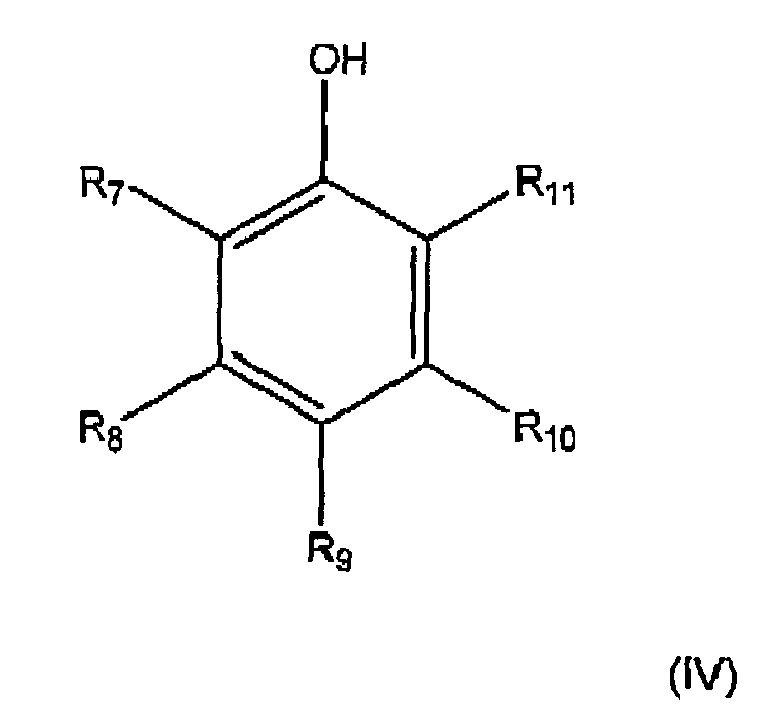
and formula (V) is:
- Process according to claim 4, wherein the compound according to formula (V) is an alkanol hemiacetal according to formula (VI):

- Process according to claim 4 or 5, wherein the reaction step is carried out in water as solvent and wherein an acid is used as catalyst.
- Process for the preparation of a hydroxy-aromatic resin, characterized in that a compound according to any one of claims 1-3 is used as a raw material.
- Process for the preparation of a hydroxy-aromatic resin, characterized in that the raw materials comprise a compound according to formula (IV) as hydroxy-aromatic compound, and a compound according to formula (V).
- Hydroxy-aromatic resin, obtainable by the process of claim 7 or 8
- Use of the hydroxy-aromatic resin according to claim 9 in coatings or in the manufacture of shaped articles.
Priority Applications (12)
| Application Number | Priority Date | Filing Date | Title |
|---|---|---|---|
| EP05075496A EP1698648A1 (en) | 2005-03-01 | 2005-03-01 | Hydroxy-aromatic compound, process for the preparation thereof, and use of the compound |
| CA002588121A CA2588121A1 (en) | 2004-12-02 | 2005-12-01 | Hydroxy-aromatic compound, process for the preparation thereof, and use of the compound |
| BRPI0518808-3A BRPI0518808A2 (en) | 2004-12-02 | 2005-12-01 | hydroxy-aromatic compound, process for its preparation, and use of the compound |
| RU2007124591/04A RU2447057C2 (en) | 2004-12-02 | 2005-12-01 | Hydroxy-aromatic compound, synthesis method thereof and use of said compound |
| KR1020077012127A KR20070085539A (en) | 2004-12-02 | 2005-12-01 | Hydroxy-Aromatic Compounds, Methods of Making and Uses thereof |
| PCT/NL2005/000826 WO2006059903A1 (en) | 2004-12-02 | 2005-12-01 | Hydroxy-aromatic compound, process for the preparation thereof, and use of the compound |
| JP2007544291A JP2008521889A (en) | 2004-12-02 | 2005-12-01 | Hydroxyaromatic compound, process for its production and use of the compound |
| US11/791,847 US7678876B2 (en) | 2004-12-02 | 2005-12-01 | Hydroxy-aromatic compound, process for the preparation thereof, and use of the compound |
| AU2005310347A AU2005310347A1 (en) | 2004-12-02 | 2005-12-01 | Hydroxy-aromatic compound, process for the preparation thereof, and use of the compound |
| EP05813548A EP1817354A1 (en) | 2004-12-02 | 2005-12-01 | Hydroxy-aromatic compound, process for the preparation thereof, and use of the compound |
| TW094142475A TW200626533A (en) | 2004-12-02 | 2005-12-02 | Hydroxy-aromatic compound, process for the preparation thereof, and use of the compound |
| RU2011107206/04A RU2011107206A (en) | 2004-12-02 | 2011-02-25 | HYDROXYAROMATIC COMPOUND, METHOD FOR ITS PRODUCTION AND APPLICATION |
Applications Claiming Priority (1)
| Application Number | Priority Date | Filing Date | Title |
|---|---|---|---|
| EP05075496A EP1698648A1 (en) | 2005-03-01 | 2005-03-01 | Hydroxy-aromatic compound, process for the preparation thereof, and use of the compound |
Publications (1)
| Publication Number | Publication Date |
|---|---|
| EP1698648A1 true EP1698648A1 (en) | 2006-09-06 |
Family
ID=35457719
Family Applications (1)
| Application Number | Title | Priority Date | Filing Date |
|---|---|---|---|
| EP05075496A Withdrawn EP1698648A1 (en) | 2004-12-02 | 2005-03-01 | Hydroxy-aromatic compound, process for the preparation thereof, and use of the compound |
Country Status (1)
| Country | Link |
|---|---|
| EP (1) | EP1698648A1 (en) |
Citations (6)
| Publication number | Priority date | Publication date | Assignee | Title |
|---|---|---|---|---|
| DE193634C (en) * | ||||
| AT141159B (en) * | 1933-07-29 | 1935-03-25 | Hermann Dr Haakh | Process for the preparation of trichloromethyloxyarylcarbinols and their corresponding oxyaldehydes. |
| DE872045C (en) * | 1941-01-15 | 1953-03-30 | Schering Ag | Process for the production of clusters of 4-oxypiperidine |
| US5674482A (en) * | 1989-08-14 | 1997-10-07 | Rhone-Poulenc Rorer Pharmaceuticals, Inc. | Polymers with alkyl- or heteroalkyl -aryl backbone and pharmaceutical compositions incorporating same |
| EP1125908A1 (en) * | 2000-02-07 | 2001-08-22 | Clariant (France) S.A. | New phenolic compounds derived from dialkoxyethanals, their preparation process and their application |
| WO2004026807A1 (en) * | 2002-09-05 | 2004-04-01 | Kissei Pharmaceutical Co., Ltd. | Intermediates in producing phenoxyacetic acid derivatives and method of using the same |
-
2005
- 2005-03-01 EP EP05075496A patent/EP1698648A1/en not_active Withdrawn
Patent Citations (7)
| Publication number | Priority date | Publication date | Assignee | Title |
|---|---|---|---|---|
| DE193634C (en) * | ||||
| AT141159B (en) * | 1933-07-29 | 1935-03-25 | Hermann Dr Haakh | Process for the preparation of trichloromethyloxyarylcarbinols and their corresponding oxyaldehydes. |
| DE872045C (en) * | 1941-01-15 | 1953-03-30 | Schering Ag | Process for the production of clusters of 4-oxypiperidine |
| US5674482A (en) * | 1989-08-14 | 1997-10-07 | Rhone-Poulenc Rorer Pharmaceuticals, Inc. | Polymers with alkyl- or heteroalkyl -aryl backbone and pharmaceutical compositions incorporating same |
| EP1125908A1 (en) * | 2000-02-07 | 2001-08-22 | Clariant (France) S.A. | New phenolic compounds derived from dialkoxyethanals, their preparation process and their application |
| WO2004026807A1 (en) * | 2002-09-05 | 2004-04-01 | Kissei Pharmaceutical Co., Ltd. | Intermediates in producing phenoxyacetic acid derivatives and method of using the same |
| EP1535897A1 (en) * | 2002-09-05 | 2005-06-01 | Kissei Pharmaceutical Co., Ltd. | Intermediates in producing phenoxyacetic acid derivatives and method of using the same |
Non-Patent Citations (81)
| Title |
|---|
| ADV. SYNTH. CATAL., vol. 343, no. 4, 2001, pages 343 - 350 * |
| ANGEW. CHEM., vol. 116, no. 13, 2004, pages 1707 - 1710 * |
| ARCH. PHARM., vol. 288, 1955, pages 234 - 245 * |
| BIOORG. MED. CHEM. LETT., vol. 13, no. 10, 2003, pages 1801 - 1804 * |
| BULL. CHEM. SOC. JPN., vol. 43, 1970, pages 3891 - 3894 * |
| BULL. SOC. CHIM. FR., 1979, pages 583 - 591 * |
| BULL. SOC. CHIM. FR., vol. 134, no. 1, 1997, pages 101 - 104 * |
| CAN. J. BIOCHEM., vol. 53, 1975, pages 920 * |
| CAN. J. CHEM., vol. 69, no. 5, 1991, pages 772 - 778 * |
| CATIVIELA C ET AL: "The replacement of mineral acids by sulfonic resins in the synthesis of rac-5-(4-hydroxyphenyl)hydantoin from p-hydroxymandelic acid and urea - Comparison of alternative methods", 28 October 2004, APPLIED CATALYSIS A: GENERAL, ELSEVIER SCIENCE, AMSTERDAM, NL, PAGE(S) 9-14, ISSN: 0926-860X, XP004558594 * |
| CHEM. BER., vol. 55, 1922, pages 2365 * |
| CHEM. COMMUN., vol. 17, 2002, pages 1914 - 1915 * |
| DATABASE BEILSTEIN Beilstein Institut zur Förderung der Chemischen Wissenschaft, Frankfurt am Main, DE; XP002360790, retrieved from XFIRE Database accession no. 5033436, 5029530 * |
| DATABASE BEILSTEIN Beilstein Institut zur Förderung der Chemischen Wissenschaft, Frankfurt am Main, DE; XP002360791, retrieved from XFIRE Database accession no. 2114830, 2108470, 2109370, 2109441 * |
| DATABASE BEILSTEIN Beilstein Institut zur Förderung der Chemischen Wissenschaft, Frankfurt am Main, DE; XP002360792, retrieved from XFIRE Database accession no. 9196198, 9196197 * |
| DATABASE BEILSTEIN Beilstein Institut zur Förderung der Chemischen Wissenschaft, Frankfurt am Main, DE; XP002360793, retrieved from XFIRE Database accession no. 9208211, 2104039 * |
| DATABASE BEILSTEIN Beilstein Institut zur Förderung der Chemischen Wissenschaft, Frankfurt am Main, DE; XP002360794, retrieved from XFIRE Database accession no. 3242862 * |
| DATABASE BEILSTEIN Beilstein Institut zur Förderung der Chemischen Wissenschaft, Frankfurt am Main, DE; XP002360795, retrieved from XFIRE Database accession no. 2086319 * |
| DATABASE BEILSTEIN Beilstein Institut zur Förderung der Chemischen Wissenschaft, Frankfurt am Main, DE; XP002360796, retrieved from XFIRE Database accession no. 2092210 * |
| DATABASE BEILSTEIN Beilstein Institut zur Förderung der Chemischen Wissenschaft, Frankfurt am Main, DE; XP002360797, retrieved from XFIRE Database accession no. 4746216, 4675177 * |
| DATABASE BEILSTEIN Beilstein Institut zur Förderung der Chemischen Wissenschaft, Frankfurt am Main, DE; XP002360798, retrieved from XFIRE Database accession no. 3135094 * |
| DATABASE BEILSTEIN Beilstein Institut zur Förderung der Chemischen Wissenschaft, Frankfurt am Main, DE; XP002360799, retrieved from XFIRE Database accession no. 4297381, 4297382, 4298426, 4298427, 4301572 * |
| DATABASE BEILSTEIN Beilstein Institut zur Förderung der Chemischen Wissenschaft, Frankfurt am Main, DE; XP002360800, retrieved from XFIRE Database accession no. 7583224, 7609440 * |
| DATABASE BEILSTEIN Beilstein Institut zur Förderung der Chemischen Wissenschaft, Frankfurt am Main, DE; XP002360801, retrieved from XFIRE Database accession no. 8311646, 7703199, 8321095, 8352346, 8352347 * |
| DATABASE BEILSTEIN Beilstein Institut zur Förderung der Chemischen Wissenschaft, Frankfurt am Main, DE; XP002360802, retrieved from XFIRE Database accession no. 8620733, 8622424, 8622550, 8622978, 8622400 * |
| DATABASE BEILSTEIN Beilstein Institut zur Förderung der Chemischen Wissenschaft, Frankfurt am Main, DE; XP002360803, retrieved from XFIRE Database accession no. 9391828, 9395718 * |
| DATABASE BEILSTEIN Beilstein Institut zur Förderung der Chemischen Wissenschaft, Frankfurt am Main, DE; XP002360804, retrieved from XFIRE Database accession no. 6521996, 6522016 * |
| DATABASE BEILSTEIN Beilstein Institut zur Förderung der Chemischen Wissenschaft, Frankfurt am Main, DE; XP002360805, retrieved from XFIRE Database accession no. 3421354, 3530609 * |
| DATABASE BEILSTEIN Beilstein Institut zur Förderung der Chemischen Wissenschaft, Frankfurt am Main, DE; XP002360806, retrieved from XFIRE Database accession no. 6768396, 6768397, 6768851 * |
| DATABASE BEILSTEIN Beilstein Institut zur Förderung der Chemischen Wissenschaft, Frankfurt am Main, DE; XP002360807, retrieved from XFIRE Database accession no. 9051746, 9049629 * |
| DATABASE BEILSTEIN Beilstein Institut zur Förderung der Chemischen Wissenschaft, Frankfurt am Main, DE; XP002360808, retrieved from XFIRE Database accession no. 7732037, 6272445 * |
| DATABASE BEILSTEIN Beilstein Institut zur Förderung der Chemischen Wissenschaft, Frankfurt am Main, DE; XP002360809, retrieved from XFIRE Database accession no. 8830206, 7514862 * |
| DATABASE BEILSTEIN Beilstein Institut zur Förderung der Chemischen Wissenschaft, Frankfurt am Main, DE; XP002360810, retrieved from XFIRE Database accession no. 3345196 * |
| DATABASE BEILSTEIN Beilstein Institut zur Förderung der Chemischen Wissenschaft, Frankfurt am Main, DE; XP002360811, retrieved from XFIRE Database accession no. 5975689 * |
| DATABASE BEILSTEIN Beilstein Institut zur Förderung der Chemischen Wissenschaft, Frankfurt am Main, DE; XP002360812, retrieved from XFIRE Database accession no. 5994591 * |
| DATABASE BEILSTEIN Beilstein Institut zur Förderung der Chemischen Wissenschaft, Frankfurt am Main, DE; XP002360813, retrieved from XFIRE Database accession no. 8915576 * |
| DATABASE BEILSTEIN Beilstein Institut zur Förderung der Chemischen Wissenschaft, Frankfurt am Main, DE; XP002360814, retrieved from XFIRE Database accession no. 2850087 * |
| DATABASE BEILSTEIN Beilstein Institut zur Förderung der Chemischen Wissenschaft, Frankfurt am Main, DE; XP002360827, retrieved from XFIRE Database accession no. 3296726 * |
| DATABASE BEILSTEIN Beilstein Institut zur Förderung der Chemischen Wissenschaft, Frankfurt am Main, DE; XP002360828, retrieved from XFIRE Database accession no. 9764266 * |
| DATABASE BEILSTEIN Beilstein Institut zur Förderung der Chemischen Wissenschaft, Frankfurt am Main, DE; XP002360829, retrieved from XFIRE Database accession no. 8681997 * |
| DATABASE BEILSTEIN Beilstein Institut zur Förderung der Chemischen Wissenschaft, Frankfurt am Main, DE; XP002360830, retrieved from XFIRE Database accession no. 2649874 * |
| DATABASE BEILSTEIN Beilstein Institut zur Förderung der Chemischen Wissenschaft, Frankfurt am Main, DE; XP002360831, retrieved from XFIRE Database accession no. 2168085 * |
| DATABASE BEILSTEIN Beilstein Institut zur Förderung der Chemischen Wissenschaft, Frankfurt am Main, DE; XP002360832, retrieved from XFIRE Database accession no. 2109829 * |
| DATABASE BEILSTEIN Beilstein Institut zur Förderung der Chemischen Wissenschaft, Frankfurt am Main, DE; XP002360833, retrieved from XFIRE Database accession no. 8784597 * |
| DATABASE BEILSTEIN Beilstein Institut zur Förderung der Chemischen Wissenschaft, Frankfurt am Main, DE; XP002360834, retrieved from XFIRE Database accession no. 6139284 * |
| DATABASE BEILSTEIN Beilstein Institut zur Förderung der Chemischen Wissenschaft, Frankfurt am Main, DE; XP002360835, retrieved from XFIRE Database accession no. 6814040 * |
| DATABASE BEILSTEIN Beilstein Institut zur Förderung der Chemischen Wissenschaft, Frankfurt am Main, DE; XP002360836, retrieved from XFIRE Database accession no. 6140829 * |
| DATABASE BEILSTEIN Beilstein Institut zur Förderung der Chemischen Wissenschaft, Frankfurt am Main, DE; XP002360837, retrieved from XFIRE Database accession no. 8318134 * |
| DATABASE BEILSTEIN Beilstein Institut zur Förderung der Chemischen Wissenschaft, Frankfurt am Main, DE; XP002360838, retrieved from XFIRE Database accession no. 8411569 * |
| EUR. J. ORG. CHEM., vol. 12, 2002, pages 1984 - 1988 * |
| GIOVANI CASIRAGHI ET AL: "Selectivity in Reactions between Metal Phenolates and Trichloroacetaldehyde; A Mild Synthesis of 2-(2,2,2-Trichloro-1-hydroxyethyl)-phenols", SYNTHESIS, 1979, pages 824 - 825, XP002360733 * |
| HOPPE-SEYLER'S Z. PHYSIOL. CHEM., vol. 52, 1907, pages 392 * |
| J. AGRIC. FOOD. CHEM., vol. 47, no. 1, 1999, pages 190 - 201 * |
| J. AM. CHEM. SOC., vol. 106, no. 5, 1984, pages 1476 - 1480 * |
| J. CHEM. SOC., 1959, pages 257 - 262 * |
| J. CHEM. SOC., vol. 95, 1909, pages 557 * |
| J. FLUORINE CHEM., vol. 111, no. 2, 2001, pages 153 - 160 * |
| J. MED. CHEM., vol. 30, no. 8, 1987, pages 1321 - 1327 * |
| J. MED. CHEM., vol. 36, no. 6, 1993, pages 771 - 777 * |
| J. ORG. CHEM., vol. 50, no. 25, 1985, pages 5018 - 5022 * |
| J. ORG. CHEM., vol. 64, no. 14, 1999, pages 5004 - 5009 * |
| J. ORG. CHEM., vol. 65, no. 15, 2000, pages 4732 - 4735 * |
| J. ORG. CHEM., vol. 65, no. 24, 2000, pages 8381 - 8383 * |
| J. UNIV. BOMBAY SCI., vol. 6/2, 1937, pages 116 - 119 * |
| KIMIHIRO SHIRAI ET AL: "Electrochemical oxidation of 2,2,2-trifluoroethanol to trifluoroacetaldehyde 2,2,2-trifluoroethyl hemiacetal", TETRAHEDRON LETTERS, vol. 41, 2000, pages 5873 - 5876, XP004209578 * |
| KURT LADENBURG ET AL: "The Synthesis of 3-Hydroxy-2-(3)-benzofuranone and of 4-Hydroxymandelic Acid", J. AM. CHEM. SOC., vol. 58, 1936, pages 1292 - 1294, XP002360734 * |
| LIEBIGS ANN. CHEM., vol. 313, 1900, pages 87 * |
| NAUNYN-SCHMIEDEBERG'S ARCH. PHARMACOL., vol. 351, no. 5, 1995, pages 491 - 499 * |
| ORG. LETT., vol. 5, no. 18, 2003, pages 3169 - 3172 * |
| RECL. TRAV. CHIM. PAYS-BAS, vol. 107, no. 3, 1988, pages 242 - 247 * |
| RECL. TRAV. CHIM. PAYS-BAS, vol. 115, no. 7-8, 1996, pages 353 - 356 * |
| TETRAHEDRON ASYMMETRY, vol. 1, no. 12, 1990, pages 861 - 864 * |
| TETRAHEDRON ASYMMETRY, vol. 12, no. 7, 2001, pages 971 - 974 * |
| TETRAHEDRON ASYMMETRY, vol. 4, no. 12, 1993, pages 2411 - 2414 * |
| TETRAHEDRON LETT., 1978, pages 2243 - 2246 * |
| TETRAHEDRON, vol. 39, no. 13, 1983, pages 2147 - 2150 * |
| TETRAHEDRON, vol. 49, no. 26, 1993, pages 5805 - 5816 * |
| TETRAHEDRON, vol. 57, no. 7, 2001, pages 1277 - 1282 * |
| TINAPP P: "Herstellung von Mandelaldehyden durch katalytische Hydrierung von Mandelsäurenitrilen mit Raney-Nickel in Gegenwart von Schwefelsäure", CHEMISCHE BERICHTE, VERLAG CHEMIE GMBH. WEINHEIM, DE, vol. 104, no. 7, 1971, pages 2266 - 2272, XP002240442, ISSN: 0009-2940 * |
| YUEFA GONG ET AL: "Facile Substitution of N,N-Dimethylanilines and Phenols with Trifluoroacetaldehyde Ethyl Hemiacetal", SYNLETT., no. 9, 1999, pages 1403 - 1404, XP002360732 * |
| YUEFA GONG ET AL: "Regioselective Substitution of Phenols with Trifluoroacetaldehyde Ethyl Hemiacetal", BULL. CHEM. SOC. JPN., vol. 74, 2001, pages 377 - 383, XP009059286 * |
Similar Documents
| Publication | Publication Date | Title |
|---|---|---|
| US20110112260A1 (en) | Composition comprising a blend of resins | |
| US20120022211A1 (en) | Process for the preparation of a hydroxy-aromatic resin; hydroxy-aromatic resin, and modification thereof | |
| US20110306735A1 (en) | Process for the preparation of a hydroxy-aromatic resin; hydroxy-aromatic resin, and modification thereof | |
| US7678876B2 (en) | Hydroxy-aromatic compound, process for the preparation thereof, and use of the compound | |
| JP5581046B2 (en) | Method for producing novolac resin and novolac resin | |
| US20110086988A1 (en) | Composition comprising polyols | |
| JP2024014036A (en) | Resin compositions, adhesives, and paints | |
| US20180118645A1 (en) | Multi-functional phenolic resins | |
| Robins | Phenolic resins | |
| HK1154394A (en) | Composition comprising a blend of resins | |
| JPH11279247A (en) | Production of melamine/phenol co-condensation resin | |
| CN101068841A (en) | Hydroxy-aromatic compound, process for the preparation thereof, and use of the compound | |
| KR820000604B1 (en) | Process for producing neutralized phenol resins | |
| JP2006316229A (en) | Phenolic resin with excellent storage stability | |
| JP2003212944A (en) | Manufacturing method of novolac type phenol resin |
Legal Events
| Date | Code | Title | Description |
|---|---|---|---|
| PUAI | Public reference made under article 153(3) epc to a published international application that has entered the european phase |
Free format text: ORIGINAL CODE: 0009012 |
|
| AK | Designated contracting states |
Kind code of ref document: A1 Designated state(s): AT BE BG CH CY CZ DE DK EE ES FI FR GB GR HU IE IS IT LI LT LU MC NL PL PT RO SE SI SK TR |
|
| AX | Request for extension of the european patent |
Extension state: AL BA HR LV MK YU |
|
| AKX | Designation fees paid | ||
| REG | Reference to a national code |
Ref country code: DE Ref legal event code: 8566 |
|
| STAA | Information on the status of an ep patent application or granted ep patent |
Free format text: STATUS: THE APPLICATION IS DEEMED TO BE WITHDRAWN |
|
| 18D | Application deemed to be withdrawn |
Effective date: 20070307 |