EP1698634A1 - Synthesis of core sugar chain structure of aspargine-linked glycoprotein - Google Patents
Synthesis of core sugar chain structure of aspargine-linked glycoprotein Download PDFInfo
- Publication number
- EP1698634A1 EP1698634A1 EP04807740A EP04807740A EP1698634A1 EP 1698634 A1 EP1698634 A1 EP 1698634A1 EP 04807740 A EP04807740 A EP 04807740A EP 04807740 A EP04807740 A EP 04807740A EP 1698634 A1 EP1698634 A1 EP 1698634A1
- Authority
- EP
- European Patent Office
- Prior art keywords
- compound
- linked
- mannose
- formula
- preparing
- Prior art date
- Legal status (The legal status is an assumption and is not a legal conclusion. Google has not performed a legal analysis and makes no representation as to the accuracy of the status listed.)
- Withdrawn
Links
- 235000000346 sugar Nutrition 0.000 title claims abstract description 47
- 102000003886 Glycoproteins Human genes 0.000 title claims abstract description 19
- 108090000288 Glycoproteins Proteins 0.000 title claims abstract description 19
- DCXYFEDJOCDNAF-REOHCLBHSA-N L-asparagine Chemical compound OC(=O)[C@@H](N)CC(N)=O DCXYFEDJOCDNAF-REOHCLBHSA-N 0.000 title claims description 16
- 238000003786 synthesis reaction Methods 0.000 title description 25
- 230000015572 biosynthetic process Effects 0.000 title description 13
- WQZGKKKJIJFFOK-QTVWNMPRSA-N D-mannopyranose Chemical compound OC[C@H]1OC(O)[C@@H](O)[C@@H](O)[C@@H]1O WQZGKKKJIJFFOK-QTVWNMPRSA-N 0.000 claims abstract description 35
- 235000009582 asparagine Nutrition 0.000 claims abstract description 22
- DCXYFEDJOCDNAF-UHFFFAOYSA-N Asparagine Natural products OC(=O)C(N)CC(N)=O DCXYFEDJOCDNAF-UHFFFAOYSA-N 0.000 claims abstract description 20
- 229960001230 asparagine Drugs 0.000 claims abstract description 20
- 150000004043 trisaccharides Chemical group 0.000 claims abstract description 16
- 150000004676 glycans Chemical class 0.000 claims abstract description 15
- 229920001282 polysaccharide Polymers 0.000 claims abstract description 15
- 239000005017 polysaccharide Substances 0.000 claims abstract description 15
- -1 mannose disaccharide compound Chemical class 0.000 claims description 55
- 238000000034 method Methods 0.000 claims description 45
- 230000008569 process Effects 0.000 claims description 27
- 150000001875 compounds Chemical class 0.000 claims description 22
- 239000000203 mixture Substances 0.000 claims description 21
- 239000000047 product Substances 0.000 claims description 19
- 101100071254 Mus musculus Hnrnpul2 gene Proteins 0.000 claims description 18
- 238000006243 chemical reaction Methods 0.000 claims description 18
- 125000000449 nitro group Chemical group [O-][N+](*)=O 0.000 claims description 12
- WQZGKKKJIJFFOK-GASJEMHNSA-N Glucose Chemical compound OC[C@H]1OC(O)[C@H](O)[C@@H](O)[C@@H]1O WQZGKKKJIJFFOK-GASJEMHNSA-N 0.000 claims description 7
- 150000001508 asparagines Chemical class 0.000 claims description 7
- 125000002887 hydroxy group Chemical group [H]O* 0.000 claims description 7
- UGJBHEZMOKVTIM-UHFFFAOYSA-N N-formylglycine Chemical compound OC(=O)CNC=O UGJBHEZMOKVTIM-UHFFFAOYSA-N 0.000 claims description 5
- 230000009467 reduction Effects 0.000 claims description 4
- 230000008878 coupling Effects 0.000 claims description 3
- 238000010168 coupling process Methods 0.000 claims description 3
- 238000005859 coupling reaction Methods 0.000 claims description 3
- 230000026030 halogenation Effects 0.000 claims description 3
- 238000005658 halogenation reaction Methods 0.000 claims description 3
- 230000003301 hydrolyzing effect Effects 0.000 claims description 3
- 150000001507 asparagine derivatives Chemical class 0.000 claims 2
- 239000000413 hydrolysate Substances 0.000 claims 2
- 125000000613 asparagine group Chemical class N[C@@H](CC(N)=O)C(=O)* 0.000 abstract description 2
- 239000007858 starting material Substances 0.000 abstract description 2
- YXFVVABEGXRONW-UHFFFAOYSA-N Toluene Chemical compound CC1=CC=CC=C1 YXFVVABEGXRONW-UHFFFAOYSA-N 0.000 description 60
- XEKOWRVHYACXOJ-UHFFFAOYSA-N Ethyl acetate Chemical compound CCOC(C)=O XEKOWRVHYACXOJ-UHFFFAOYSA-N 0.000 description 46
- LFQSCWFLJHTTHZ-UHFFFAOYSA-N Ethanol Chemical compound CCO LFQSCWFLJHTTHZ-UHFFFAOYSA-N 0.000 description 41
- OMDQUFIYNPYJFM-XKDAHURESA-N (2r,3r,4s,5r,6s)-2-(hydroxymethyl)-6-[[(2r,3s,4r,5s,6r)-4,5,6-trihydroxy-3-[(2s,3s,4s,5s,6r)-3,4,5-trihydroxy-6-(hydroxymethyl)oxan-2-yl]oxyoxan-2-yl]methoxy]oxane-3,4,5-triol Chemical compound O[C@@H]1[C@@H](O)[C@@H](O)[C@@H](CO)O[C@@H]1OC[C@@H]1[C@@H](O[C@H]2[C@H]([C@@H](O)[C@H](O)[C@@H](CO)O2)O)[C@H](O)[C@H](O)[C@H](O)O1 OMDQUFIYNPYJFM-XKDAHURESA-N 0.000 description 33
- CSNNHWWHGAXBCP-UHFFFAOYSA-L Magnesium sulfate Chemical compound [Mg+2].[O-][S+2]([O-])([O-])[O-] CSNNHWWHGAXBCP-UHFFFAOYSA-L 0.000 description 28
- HEDRZPFGACZZDS-MICDWDOJSA-N Trichloro(2H)methane Chemical compound [2H]C(Cl)(Cl)Cl HEDRZPFGACZZDS-MICDWDOJSA-N 0.000 description 22
- 229920000926 Galactomannan Polymers 0.000 description 19
- HEDRZPFGACZZDS-UHFFFAOYSA-N Chloroform Chemical compound ClC(Cl)Cl HEDRZPFGACZZDS-UHFFFAOYSA-N 0.000 description 16
- QTBSBXVTEAMEQO-UHFFFAOYSA-N Acetic acid Chemical compound CC(O)=O QTBSBXVTEAMEQO-UHFFFAOYSA-N 0.000 description 15
- FAPWRFPIFSIZLT-UHFFFAOYSA-M Sodium chloride Chemical compound [Na+].[Cl-] FAPWRFPIFSIZLT-UHFFFAOYSA-M 0.000 description 14
- 229910052943 magnesium sulfate Inorganic materials 0.000 description 14
- 239000011541 reaction mixture Substances 0.000 description 14
- 229920002907 Guar gum Polymers 0.000 description 13
- 239000000665 guar gum Substances 0.000 description 13
- 229960002154 guar gum Drugs 0.000 description 13
- 235000010417 guar gum Nutrition 0.000 description 13
- UIIMBOGNXHQVGW-UHFFFAOYSA-M Sodium bicarbonate Chemical compound [Na+].OC([O-])=O UIIMBOGNXHQVGW-UHFFFAOYSA-M 0.000 description 12
- 239000005457 ice water Substances 0.000 description 12
- 239000000706 filtrate Substances 0.000 description 11
- 238000001914 filtration Methods 0.000 description 11
- YMWUJEATGCHHMB-UHFFFAOYSA-N Dichloromethane Chemical compound ClCCl YMWUJEATGCHHMB-UHFFFAOYSA-N 0.000 description 9
- 229920000057 Mannan Polymers 0.000 description 9
- ZMANZCXQSJIPKH-UHFFFAOYSA-N Triethylamine Chemical compound CCN(CC)CC ZMANZCXQSJIPKH-UHFFFAOYSA-N 0.000 description 9
- 238000010828 elution Methods 0.000 description 9
- XLYOFNOQVPJJNP-UHFFFAOYSA-N water Substances O XLYOFNOQVPJJNP-UHFFFAOYSA-N 0.000 description 9
- 238000010898 silica gel chromatography Methods 0.000 description 8
- 239000011780 sodium chloride Substances 0.000 description 7
- 238000005160 1H NMR spectroscopy Methods 0.000 description 6
- WFDIJRYMOXRFFG-UHFFFAOYSA-N Acetic anhydride Chemical compound CC(=O)OC(C)=O WFDIJRYMOXRFFG-UHFFFAOYSA-N 0.000 description 6
- WEVYAHXRMPXWCK-UHFFFAOYSA-N Acetonitrile Chemical compound CC#N WEVYAHXRMPXWCK-UHFFFAOYSA-N 0.000 description 6
- JUJWROOIHBZHMG-UHFFFAOYSA-N Pyridine Chemical compound C1=CC=NC=C1 JUJWROOIHBZHMG-UHFFFAOYSA-N 0.000 description 6
- WYURNTSHIVDZCO-UHFFFAOYSA-N Tetrahydrofuran Chemical compound C1CCOC1 WYURNTSHIVDZCO-UHFFFAOYSA-N 0.000 description 6
- DTQVDTLACAAQTR-UHFFFAOYSA-N Trifluoroacetic acid Chemical compound OC(=O)C(F)(F)F DTQVDTLACAAQTR-UHFFFAOYSA-N 0.000 description 6
- 125000001797 benzyl group Chemical group [H]C1=C([H])C([H])=C(C([H])=C1[H])C([H])([H])* 0.000 description 6
- 229910000030 sodium bicarbonate Inorganic materials 0.000 description 6
- 238000001644 13C nuclear magnetic resonance spectroscopy Methods 0.000 description 5
- UPQQXPKAYZYUKO-UHFFFAOYSA-N 2,2,2-trichloroacetamide Chemical compound OC(=N)C(Cl)(Cl)Cl UPQQXPKAYZYUKO-UHFFFAOYSA-N 0.000 description 5
- 238000002000 high resolution fast-atom bombardment mass spectrometry Methods 0.000 description 5
- 230000007062 hydrolysis Effects 0.000 description 5
- 238000006460 hydrolysis reaction Methods 0.000 description 5
- 239000000126 substance Substances 0.000 description 5
- 230000002194 synthesizing effect Effects 0.000 description 5
- PXIPVTKHYLBLMZ-UHFFFAOYSA-N Sodium azide Chemical compound [Na+].[N-]=[N+]=[N-] PXIPVTKHYLBLMZ-UHFFFAOYSA-N 0.000 description 4
- QAOWNCQODCNURD-UHFFFAOYSA-N Sulfuric acid Chemical compound OS(O)(=O)=O QAOWNCQODCNURD-UHFFFAOYSA-N 0.000 description 4
- HCHKCACWOHOZIP-UHFFFAOYSA-N Zinc Chemical compound [Zn] HCHKCACWOHOZIP-UHFFFAOYSA-N 0.000 description 4
- 238000004458 analytical method Methods 0.000 description 4
- WGQKYBSKWIADBV-UHFFFAOYSA-N benzylamine Chemical compound NCC1=CC=CC=C1 WGQKYBSKWIADBV-UHFFFAOYSA-N 0.000 description 4
- 150000002016 disaccharides Chemical group 0.000 description 4
- 238000006116 polymerization reaction Methods 0.000 description 4
- 235000018102 proteins Nutrition 0.000 description 4
- 102000004169 proteins and genes Human genes 0.000 description 4
- 108090000623 proteins and genes Proteins 0.000 description 4
- 239000011734 sodium Substances 0.000 description 4
- GQHTUMJGOHRCHB-UHFFFAOYSA-N 2,3,4,6,7,8,9,10-octahydropyrimido[1,2-a]azepine Chemical compound C1CCCCN2CCCN=C21 GQHTUMJGOHRCHB-UHFFFAOYSA-N 0.000 description 3
- 125000003903 2-propenyl group Chemical group [H]C([*])([H])C([H])=C([H])[H] 0.000 description 3
- KZMGYPLQYOPHEL-UHFFFAOYSA-N Boron trifluoride etherate Chemical compound FB(F)F.CCOCC KZMGYPLQYOPHEL-UHFFFAOYSA-N 0.000 description 3
- 235000013912 Ceratonia siliqua Nutrition 0.000 description 3
- 240000008886 Ceratonia siliqua Species 0.000 description 3
- 244000303965 Cyamopsis psoralioides Species 0.000 description 3
- 241000196324 Embryophyta Species 0.000 description 3
- 102000051366 Glycosyltransferases Human genes 0.000 description 3
- 108700023372 Glycosyltransferases Proteins 0.000 description 3
- DRUIESSIVFYOMK-UHFFFAOYSA-N Trichloroacetonitrile Chemical compound ClC(Cl)(Cl)C#N DRUIESSIVFYOMK-UHFFFAOYSA-N 0.000 description 3
- MPECSCPZUUUPEU-DVKNGEFBSA-N [(2s,3r,4s,5s,6r)-3,4,5-trihydroxy-6-(hydroxymethyl)oxan-2-yl] nitrate Chemical compound OC[C@H]1O[C@@H](O[N+]([O-])=O)[C@H](O)[C@@H](O)[C@@H]1O MPECSCPZUUUPEU-DVKNGEFBSA-N 0.000 description 3
- RMRFFCXPLWYOOY-UHFFFAOYSA-N allyl radical Chemical compound [CH2]C=C RMRFFCXPLWYOOY-UHFFFAOYSA-N 0.000 description 3
- 230000031018 biological processes and functions Effects 0.000 description 3
- 229930182470 glycoside Natural products 0.000 description 3
- 238000002955 isolation Methods 0.000 description 3
- 239000000463 material Substances 0.000 description 3
- VLKZOEOYAKHREP-UHFFFAOYSA-N n-Hexane Chemical compound CCCCCC VLKZOEOYAKHREP-UHFFFAOYSA-N 0.000 description 3
- UMJSCPRVCHMLSP-UHFFFAOYSA-N pyridine Natural products COC1=CC=CN=C1 UMJSCPRVCHMLSP-UHFFFAOYSA-N 0.000 description 3
- 239000011701 zinc Substances 0.000 description 3
- 229910052725 zinc Inorganic materials 0.000 description 3
- MEKOFIRRDATTAG-UHFFFAOYSA-N 2,2,5,8-tetramethyl-3,4-dihydrochromen-6-ol Chemical compound C1CC(C)(C)OC2=C1C(C)=C(O)C=C2C MEKOFIRRDATTAG-UHFFFAOYSA-N 0.000 description 2
- 0 CO[C@](C(CO)O[C@](C1*)O[C@](*C*)C([C@@](*2)*2I)O)C1O Chemical compound CO[C@](C(CO)O[C@](C1*)O[C@](*C*)C([C@@](*2)*2I)O)C1O 0.000 description 2
- OVRNDRQMDRJTHS-UHFFFAOYSA-N N-acelyl-D-glucosamine Natural products CC(=O)NC1C(O)OC(CO)C(O)C1O OVRNDRQMDRJTHS-UHFFFAOYSA-N 0.000 description 2
- MBLBDJOUHNCFQT-LXGUWJNJSA-N N-acetylglucosamine Natural products CC(=O)N[C@@H](C=O)[C@@H](O)[C@H](O)[C@H](O)CO MBLBDJOUHNCFQT-LXGUWJNJSA-N 0.000 description 2
- VMHLLURERBWHNL-UHFFFAOYSA-M Sodium acetate Chemical compound [Na+].CC([O-])=O VMHLLURERBWHNL-UHFFFAOYSA-M 0.000 description 2
- MNZMECMQTYGSOI-UHFFFAOYSA-N acetic acid;hydron;bromide Chemical compound Br.CC(O)=O MNZMECMQTYGSOI-UHFFFAOYSA-N 0.000 description 2
- 125000002777 acetyl group Chemical group [H]C([H])([H])C(*)=O 0.000 description 2
- 238000005903 acid hydrolysis reaction Methods 0.000 description 2
- 125000005110 aryl thio group Chemical group 0.000 description 2
- 125000003236 benzoyl group Chemical group [H]C1=C([H])C([H])=C(C([H])=C1[H])C(*)=O 0.000 description 2
- 150000001720 carbohydrates Chemical class 0.000 description 2
- XMPZTFVPEKAKFH-UHFFFAOYSA-P ceric ammonium nitrate Chemical compound [NH4+].[NH4+].[Ce+4].[O-][N+]([O-])=O.[O-][N+]([O-])=O.[O-][N+]([O-])=O.[O-][N+]([O-])=O.[O-][N+]([O-])=O.[O-][N+]([O-])=O XMPZTFVPEKAKFH-UHFFFAOYSA-P 0.000 description 2
- 238000001816 cooling Methods 0.000 description 2
- 230000000694 effects Effects 0.000 description 2
- 238000002474 experimental method Methods 0.000 description 2
- 235000013305 food Nutrition 0.000 description 2
- 150000002338 glycosides Chemical group 0.000 description 2
- 238000004128 high performance liquid chromatography Methods 0.000 description 2
- 239000012433 hydrogen halide Substances 0.000 description 2
- 229910000039 hydrogen halide Inorganic materials 0.000 description 2
- 150000008146 mannosides Chemical class 0.000 description 2
- 238000006396 nitration reaction Methods 0.000 description 2
- 239000012299 nitrogen atmosphere Substances 0.000 description 2
- 238000001556 precipitation Methods 0.000 description 2
- 125000002924 primary amino group Chemical group [H]N([H])* 0.000 description 2
- 125000006239 protecting group Chemical group 0.000 description 2
- 230000009257 reactivity Effects 0.000 description 2
- 239000001632 sodium acetate Substances 0.000 description 2
- 235000017281 sodium acetate Nutrition 0.000 description 2
- 238000001269 time-of-flight mass spectrometry Methods 0.000 description 2
- ZBZJXHCVGLJWFG-UHFFFAOYSA-N trichloromethyl(.) Chemical compound Cl[C](Cl)Cl ZBZJXHCVGLJWFG-UHFFFAOYSA-N 0.000 description 2
- VZSRBBMJRBPUNF-UHFFFAOYSA-N 2-(2,3-dihydro-1H-inden-2-ylamino)-N-[3-oxo-3-(2,4,6,7-tetrahydrotriazolo[4,5-c]pyridin-5-yl)propyl]pyrimidine-5-carboxamide Chemical compound C1C(CC2=CC=CC=C12)NC1=NC=C(C=N1)C(=O)NCCC(N1CC2=C(CC1)NN=N2)=O VZSRBBMJRBPUNF-UHFFFAOYSA-N 0.000 description 1
- 125000004217 4-methoxybenzyl group Chemical group [H]C1=C([H])C(=C([H])C([H])=C1OC([H])([H])[H])C([H])([H])* 0.000 description 1
- WKBOTKDWSSQWDR-UHFFFAOYSA-N Bromine atom Chemical compound [Br] WKBOTKDWSSQWDR-UHFFFAOYSA-N 0.000 description 1
- ZAMOUSCENKQFHK-UHFFFAOYSA-N Chlorine atom Chemical compound [Cl] ZAMOUSCENKQFHK-UHFFFAOYSA-N 0.000 description 1
- 235000008222 Cyamopsis psoralioides Nutrition 0.000 description 1
- 125000003423 D-mannosyl group Chemical group C1([C@@H](O)[C@@H](O)[C@H](O)[C@H](O1)CO)* 0.000 description 1
- PXGOKWXKJXAPGV-UHFFFAOYSA-N Fluorine Chemical compound FF PXGOKWXKJXAPGV-UHFFFAOYSA-N 0.000 description 1
- 235000017367 Guainella Nutrition 0.000 description 1
- 108091006905 Human Serum Albumin Proteins 0.000 description 1
- CPELXLSAUQHCOX-UHFFFAOYSA-N Hydrogen bromide Chemical compound Br CPELXLSAUQHCOX-UHFFFAOYSA-N 0.000 description 1
- 240000004658 Medicago sativa Species 0.000 description 1
- 235000017587 Medicago sativa ssp. sativa Nutrition 0.000 description 1
- OVRNDRQMDRJTHS-RTRLPJTCSA-N N-acetyl-D-glucosamine Chemical compound CC(=O)N[C@H]1C(O)O[C@H](CO)[C@@H](O)[C@@H]1O OVRNDRQMDRJTHS-RTRLPJTCSA-N 0.000 description 1
- OVRNDRQMDRJTHS-FMDGEEDCSA-N N-acetyl-beta-D-glucosamine Chemical compound CC(=O)N[C@H]1[C@H](O)O[C@H](CO)[C@@H](O)[C@@H]1O OVRNDRQMDRJTHS-FMDGEEDCSA-N 0.000 description 1
- 108010058846 Ovalbumin Proteins 0.000 description 1
- VYPSYNLAJGMNEJ-UHFFFAOYSA-N Silicium dioxide Chemical compound O=[Si]=O VYPSYNLAJGMNEJ-UHFFFAOYSA-N 0.000 description 1
- NINIDFKCEFEMDL-UHFFFAOYSA-N Sulfur Chemical compound [S] NINIDFKCEFEMDL-UHFFFAOYSA-N 0.000 description 1
- 241000219793 Trifolium Species 0.000 description 1
- WOTQVEKSRLZRSX-HHZNOXSWSA-N [(2r,3r,4s,5r,6s)-4,5,6-triacetyloxy-3-[(2s,3r,4s,5s,6r)-3,4,5-triacetyloxy-6-(acetyloxymethyl)oxan-2-yl]oxyoxan-2-yl]methyl acetate Chemical compound CC(=O)OC[C@H]1O[C@@H](OC(C)=O)[C@H](OC(C)=O)[C@@H](OC(C)=O)[C@@H]1O[C@H]1[C@H](OC(C)=O)[C@@H](OC(C)=O)[C@@H](OC(C)=O)[C@@H](COC(C)=O)O1 WOTQVEKSRLZRSX-HHZNOXSWSA-N 0.000 description 1
- 239000000370 acceptor Substances 0.000 description 1
- PZAGQUOSOTUKEC-UHFFFAOYSA-N acetic acid;sulfuric acid Chemical compound CC(O)=O.OS(O)(=O)=O PZAGQUOSOTUKEC-UHFFFAOYSA-N 0.000 description 1
- 230000021736 acetylation Effects 0.000 description 1
- 238000006640 acetylation reaction Methods 0.000 description 1
- 239000002253 acid Substances 0.000 description 1
- 230000002378 acidificating effect Effects 0.000 description 1
- 239000000654 additive Substances 0.000 description 1
- 230000000996 additive effect Effects 0.000 description 1
- 125000004414 alkyl thio group Chemical group 0.000 description 1
- 239000012298 atmosphere Substances 0.000 description 1
- 150000001540 azides Chemical class 0.000 description 1
- 230000004888 barrier function Effects 0.000 description 1
- 125000001584 benzyloxycarbonyl group Chemical group C(=O)(OCC1=CC=CC=C1)* 0.000 description 1
- GDTBXPJZTBHREO-UHFFFAOYSA-N bromine Substances BrBr GDTBXPJZTBHREO-UHFFFAOYSA-N 0.000 description 1
- 229910052794 bromium Inorganic materials 0.000 description 1
- 235000014633 carbohydrates Nutrition 0.000 description 1
- 230000021164 cell adhesion Effects 0.000 description 1
- 230000005754 cellular signaling Effects 0.000 description 1
- 239000003795 chemical substances by application Substances 0.000 description 1
- 239000000460 chlorine Substances 0.000 description 1
- 229910052801 chlorine Inorganic materials 0.000 description 1
- WOMWKHFOIZKCAD-UHFFFAOYSA-N chloroform ethyl acetate toluene Chemical compound ClC(Cl)Cl.CCOC(C)=O.CC1=CC=CC=C1 WOMWKHFOIZKCAD-UHFFFAOYSA-N 0.000 description 1
- 238000004440 column chromatography Methods 0.000 description 1
- JZCCFEFSEZPSOG-UHFFFAOYSA-L copper(II) sulfate pentahydrate Chemical compound O.O.O.O.O.[Cu+2].[O-]S([O-])(=O)=O JZCCFEFSEZPSOG-UHFFFAOYSA-L 0.000 description 1
- OILMFPOPSSNOOW-UHFFFAOYSA-M disodium acetyl acetate 2,2,2-trifluoroacetic acid acetate azide Chemical compound [N-]=[N+]=[N-].[Na+].FC(C(=O)O)(F)F.C(C)(=O)OC(C)=O.C(C)(=O)[O-].[Na+] OILMFPOPSSNOOW-UHFFFAOYSA-M 0.000 description 1
- 239000011737 fluorine Substances 0.000 description 1
- 229910052731 fluorine Inorganic materials 0.000 description 1
- 235000013373 food additive Nutrition 0.000 description 1
- 239000002778 food additive Substances 0.000 description 1
- 229930182830 galactose Natural products 0.000 description 1
- 239000000937 glycosyl acceptor Substances 0.000 description 1
- 239000000348 glycosyl donor Substances 0.000 description 1
- 150000004820 halides Chemical class 0.000 description 1
- 230000002140 halogenating effect Effects 0.000 description 1
- 238000010438 heat treatment Methods 0.000 description 1
- 239000001307 helium Substances 0.000 description 1
- 229910052734 helium Inorganic materials 0.000 description 1
- SWQJXJOGLNCZEY-UHFFFAOYSA-N helium atom Chemical compound [He] SWQJXJOGLNCZEY-UHFFFAOYSA-N 0.000 description 1
- 239000003112 inhibitor Substances 0.000 description 1
- 235000021374 legumes Nutrition 0.000 description 1
- 150000002703 mannose derivatives Chemical class 0.000 description 1
- 125000000311 mannosyl group Chemical group C1([C@@H](O)[C@@H](O)[C@H](O)[C@H](O1)CO)* 0.000 description 1
- 238000004519 manufacturing process Methods 0.000 description 1
- 238000010907 mechanical stirring Methods 0.000 description 1
- 229910052751 metal Inorganic materials 0.000 description 1
- 239000002184 metal Substances 0.000 description 1
- 125000004184 methoxymethyl group Chemical group [H]C([H])([H])OC([H])([H])* 0.000 description 1
- 239000002808 molecular sieve Substances 0.000 description 1
- 229950006780 n-acetylglucosamine Drugs 0.000 description 1
- 229920001542 oligosaccharide Polymers 0.000 description 1
- 150000002482 oligosaccharides Chemical class 0.000 description 1
- 229940092253 ovalbumin Drugs 0.000 description 1
- UYWQUFXKFGHYNT-UHFFFAOYSA-N phenylmethyl ester of formic acid Natural products O=COCC1=CC=CC=C1 UYWQUFXKFGHYNT-UHFFFAOYSA-N 0.000 description 1
- XKJCHHZQLQNZHY-UHFFFAOYSA-N phthalimide Chemical compound C1=CC=C2C(=O)NC(=O)C2=C1 XKJCHHZQLQNZHY-UHFFFAOYSA-N 0.000 description 1
- 230000000704 physical effect Effects 0.000 description 1
- 239000000843 powder Substances 0.000 description 1
- 108090000765 processed proteins & peptides Proteins 0.000 description 1
- 239000012429 reaction media Substances 0.000 description 1
- URGAHOPLAPQHLN-UHFFFAOYSA-N sodium aluminosilicate Chemical compound [Na+].[Al+3].[O-][Si]([O-])=O.[O-][Si]([O-])=O URGAHOPLAPQHLN-UHFFFAOYSA-N 0.000 description 1
- 238000003756 stirring Methods 0.000 description 1
- 150000008163 sugars Chemical class 0.000 description 1
- 229910052717 sulfur Inorganic materials 0.000 description 1
- 239000011593 sulfur Substances 0.000 description 1
- KUNICNFETYAKKO-UHFFFAOYSA-N sulfuric acid;pentahydrate Chemical class O.O.O.O.O.OS(O)(=O)=O KUNICNFETYAKKO-UHFFFAOYSA-N 0.000 description 1
- 125000005931 tert-butyloxycarbonyl group Chemical group [H]C([H])([H])C(OC(*)=O)(C([H])([H])[H])C([H])([H])[H] 0.000 description 1
- YLQBMQCUIZJEEH-UHFFFAOYSA-N tetrahydrofuran Natural products C=1C=COC=1 YLQBMQCUIZJEEH-UHFFFAOYSA-N 0.000 description 1
- 239000002562 thickening agent Substances 0.000 description 1
Classifications
-
- C—CHEMISTRY; METALLURGY
- C07—ORGANIC CHEMISTRY
- C07H—SUGARS; DERIVATIVES THEREOF; NUCLEOSIDES; NUCLEOTIDES; NUCLEIC ACIDS
- C07H13/00—Compounds containing saccharide radicals esterified by carbonic acid or derivatives thereof, or by organic acids, e.g. phosphonic acids
- C07H13/02—Compounds containing saccharide radicals esterified by carbonic acid or derivatives thereof, or by organic acids, e.g. phosphonic acids by carboxylic acids
- C07H13/04—Compounds containing saccharide radicals esterified by carbonic acid or derivatives thereof, or by organic acids, e.g. phosphonic acids by carboxylic acids having the esterifying carboxyl radicals attached to acyclic carbon atoms
- C07H13/06—Fatty acids
-
- C—CHEMISTRY; METALLURGY
- C07—ORGANIC CHEMISTRY
- C07H—SUGARS; DERIVATIVES THEREOF; NUCLEOSIDES; NUCLEOTIDES; NUCLEIC ACIDS
- C07H1/00—Processes for the preparation of sugar derivatives
-
- C—CHEMISTRY; METALLURGY
- C07—ORGANIC CHEMISTRY
- C07H—SUGARS; DERIVATIVES THEREOF; NUCLEOSIDES; NUCLEOTIDES; NUCLEIC ACIDS
- C07H1/00—Processes for the preparation of sugar derivatives
- C07H1/06—Separation; Purification
- C07H1/08—Separation; Purification from natural products
Definitions
- the present invention relates to a field of chemical synthesis of sugar chain, and specifically, to a convenient method for chemically synthesizing sugar chains of glycoprotein and a synthetic intermediate thereof.
- Glycoprotein means a protein comprising a moiety of oligosaccharide referred to as a sugar chain.
- glycoprotein has been found to be closely involved with biological processes such as cell adhesion or signaling, and structures of sugar chains which trigger various biological processes have gradually emerged.
- biological processes such as cell adhesion or signaling
- glycoprotein only a small amount of glycoprotein is expressed in a living body for the sugar chain to mediate a biological process, and it is quite difficult to obtain pure glycoprotein in sufficient quantity to determine the chemical and physical properties of the sugar chain.
- An asparagine-linked glycoprotein is one of the glycoproteins and ubiquitously found in human serum or ovalbumin.
- the asparagine-linked glycoprotein is classified into a high mannose-type, a complex type and a mixed type according to characteristics of a branch of the sugar chain and/or constituting sugar. All of these types have a common core sugar chain structure of a penta-saccharide comprising three molecules of mannose and two molecules of N-acetyl glycosamine at the reducing terminal of the chain;
- the inventors of the present invention focused their attention to a natural polysaccharide having the structure of mannoside ⁇ 1 ⁇ 4 bonds, especially galactomannan, guar gum and mannan, which have mannoside ⁇ 1 ⁇ 4 bonds.
- the objective of the present invention is to break the primary barrier in the synthesis of the core sugar chain structure, specifically to form a ⁇ -manno-glycoside bond by using a disaccharide unit of Man ⁇ 1 ⁇ 4Man comprised in a structure of natural polysaccharides, and to establish an efficient method for synthesizing the structure of the core sugar chain.
- the present invention relates to a method comprising,
- the present invention relates to the azide disaccharide compound (a type of ManP 1 ⁇ 1 ⁇ 4ManP 1 ) of the formula (II) which is a useful synthetic intermediate in the methods of the present invention; wherein P 1 is an OH-protecting group, the wavy line means that -NO 2 is linked at an axial or equatorial position or mixture of both, and to the trisaccharide compound shown with the formula (III); wherein P 1 , P 2 and P 11 are OH-protecting groups and P 3 is an amino-protecting group.
- the trisaccharide moiety(Man ⁇ 1 ⁇ 4GlcN ⁇ 1 ⁇ 4GlcN) of the reducing terminal in the core sugar chain structure of the asparagine-linked glycoprotein sugar chain is easily synthesized and it is useful to clarify the function and structure-characteristics of the asparagine-linked glycoprotein which causes various life processes.
- the outline of the novel route for synthesizing the core sugar chain structure in the present invention is depicted as follows; wherein the wavy line means that the -OP 1 or nitro group is linked at an axial or equatorial position or mixture of both.
- the disaccharide compound (I), Man ⁇ 1 ⁇ 4Man is obtained after acid hydrolysis of a polysaccharide having mannose ⁇ -1,4-bonds and acetylation of the product. Next, it is converted to the glycal derivative wherein mannose of the reducing terminal was converted to glycal by a chemical method, and followed by azide nitration reaction to give the compound (II).
- the compound (II) which has the equatorial 2-azide group at the reducing terminal can be transformed to the moiety of Man ⁇ 1 ⁇ 4GlcNAc in the core sugar chain structure and is a useful key intermediate.
- the intermediate (II) is easily converted to the moiety of Man ⁇ 1 ⁇ 4GlcNAc which is difficult to prepare through other synthetic scheme, while the intermediate (II) can be easily prepared in a large scale at a reasonable cost from the compound (I), which is available from galactomannan, guar gum or mannan derivatives.
- the trisaccharide compound (III) which is ready to be converted to the trisaccharide (Man ⁇ 1 ⁇ 4GlcNAc ⁇ 1 ⁇ 4GlcNAc) of the reducing terminal in the core sugar chain structure, is synthesized when the intermediate (II) is used as a glycosyl donor.
- the inventors of the present invention succeeded to simplify the scheme for synthesizing the trisaccharide of the reducing terminal in the core structure by utilizing a natural polysaccharide available at a low cost.
- the compound (I) of mannose disaccharide (ManP 1 ⁇ 1 ⁇ 4ManP 1 ) is prepared from a polysaccharide having mannose ⁇ -1,4-bonds. At first, a polysaccharide having mannose ⁇ -1,4-bonds is hydrolyzed, the OH groups are protected and the desired disaccharide is isolated.
- a polysaccharide having mannose ⁇ -1,4-bonds preferably galactomannan, guar gum or mannan having mannose ⁇ -1,4-bonds, more preferably a galactomannan derivative of the formula (V); whrein n is an integer of 50 or more or a mannan derivative of the formula (VI); wherein n is an integer of 50 or more is used.
- Galactomannan derivatives are extensively present in seeds of legume family, e.g., alfalfa or clover.
- Galactomannan in the seeds of guar (Cyamopsis tetragonolobus) and carob or locust bean (Ceratonia siliqua) is available in the market as gum products derived from plants.
- Guar gum extracted from guar seeds is a natural polysaccharide having a straight sugar chain comprising a series of mannose ⁇ 1 ⁇ 4 bonds wherein galactose is linked through ⁇ 1 ⁇ 6bond to every mannose residue as a branch.
- food additives such as thickeners of various canned products, quality improving agent (inhibitor of shape-loosing) or taste-regulator of various foods and easily available at an extremely low cost.
- a mannan derivative is a generic name of polysaccharides comprised of D-mannose. Plant mannan derivatives contained in endosperm of ivory nut or bulbs of orchidaceous plant have straight chain structure in which D-mannose residues are linked through ⁇ 1 ⁇ 4 bonds and insoluble in water.
- acid hydrolysis is applied to hydrolyze polysaccharides having mannose ⁇ -1,4-bonds.
- sulfuric acid preferably 10-20% sulfuric acid, trifluoroacetic acid or sulfuric acid-acetic acid is used and the reaction temperature of 50-70°C is preferable.
- acetyl, benzyl, 4-methoxybenzyl, benzoyl, methoxymethyl, tetrahydropiranyl, torimethylsilyl, and triethylsilyl group etc. are usually used.
- Isolation of the disaccharide is achieved by silica gel chromatography and/or HPLC.
- a glycal compound is prepared from the mannose disaccharide compound (I) (a type of ManP 1 ⁇ 1 ⁇ 4ManP 1 ).
- the glycal compound is prepared from the disaccharide by halogenation and successive reduction of the position 1 in mannose of the reducing terminal.
- mannose is halogenated around r.t. using hydrogen halide or acid halide etc.
- Reduction is carried out by using a metal such as zinc etc., while avoiding a reaction at high temperature.
- the azide disaccharide compound (II), in which the 2-azide group of mannose in the reducing terminal is linked at the equatorial position, is prepared by azidenitration reaction of the glycal compound.
- the azidenitration reaction is carried out by simultaneous azidation and nitration.
- a mixture of equatorial and axial isomers is provided, and the compound having the 2-azide group of mannose in the reducing terminal at the equatorial position is isolated by purifying the mixture.
- nitro group in the azide disaccharide compound is substituted for a leaving group, which generally includes fluorine, bromine, chlorine, trichloroacetoimidate, 4-pentenyl, alkylthio (sulfur) and arylthio.
- the nitro group in the azide disaccharide compound is substituted for the -OP 10 group (P 10 is an OH-protecting group), and the trihaloimidate derivative is obtained by the reaction with trihaloacetonitrile after removal of the P 10 group or a halogenated derivative is obtained by the reaction with hydrogen halide.
- the -OP 10 derivative or P 10 -deprotected derivative may be converted to the derivatives having a leaving group such as a penteny, acetylthio or arylthio group.
- the amino-protected glucopyranoside may be prepared according to the following scheme.
- P 3 group which is an amino protecting group, phthalimide, tert-butyloxycarbonyl, benzyloxycarbonyl, acetyl, benzoyl or benzyl group etc. is usually used.
- the trisaccharide compound is coupled with asparagine.
- the coupling with asparagines is carried out according to the next scheme, for example.
- the trisaccharide prepared above may be coupled with an asparagine residue of the desired protein and the sugar chain may be elongated by adding a new sugar unit. Also a pre-elongated sugar chain prepared by adding a sugar unit to the trisaccharide may be introduced to the desired protein.
- a protein sequence may be elongated when standard peptide chemistry is applied to the asparagines residue in the asparagines-linked trisaccharide derivative.
- a sugar chain may be elongated when standard carbohydrate chemistry is applied to mannose in the reducing terminal.
- guar gum (1) 2.0g was dissolved in 16.6ml of 1N TFA and heated to 110°C in an oily bath with stirring for 90 min. The reaction mixture was poured into 40ml of 99% EtOH and placed at room temperature. The resulting white precipitation was removed by filtration using Buchner funnel and the filtrate was concentrated in vacuo. Toluene was added to the residue and azeotropically distilled several times to give 2.26g of galactomannan (2) soluble in 70% EtOH and 73mg of galactomannan (3) insoluble in 70% EtOH.
- guar gum (1) 200g was dissolved in 1660ml of 1N TFA and heated to 110°C in an oily bath with mechanical stirring for 35 min. When the guar gum was suspended, the mixture was sonicated for 15min and mechanically stirred at 110°C for 80min. The reaction mixture was cooled with an ice bath, poured into 4 liter of 99% EtOH and placed at room temperature. The resulting white precipitation was removed by filtration using Buchner funnel and the filtrate was concentrated in vacuo. Toluene was added to the residue and azeotropically distilled several times to give 200.3g of galactomannan (2) soluble in 70% EtOH and 9.9g of galactomannan (3) insoluble in 70% EtOH. Analysis of galactomannan (2) soluble in 70% EtOH using MALDI-TOFMS showed that its polymerization degree was reduced to 1-8.
- the mixture was dissolved in a small amount of EtOH with heating, and then cooled in ice water to give a crystalline. Thus, 201mg of the desired product was obtained.
- Amino-protected glucopyranoside (12) was synthesized according to the synthetic scheme shown below.
- Glycosyltransferase and an additive sugar unit are usually utilized in the automatic synthesizer of sugar chains since glycosyltransferase is convenient when a sugar chain is extended by adding a new saccharide.
- no glycosyltransferase is found to prepare the trisaccharide moiety (Man ⁇ 1 ⁇ 4GlcN ⁇ 1 ⁇ 4GlcN) of the reducing terminal in the core sugar chain structure of asparagine-linked glycoprotein and the chemical synthesis is the sole method for preparing it.
- the present invention provides a convenient method for preparing the trisaccharide moiety of the reducing terminal in the core sugar chain utilizing galactomannan, guar gum and/or mannan derivatives, which are natural polysaccharides easily available at a reasonable cost.
Landscapes
- Chemical & Material Sciences (AREA)
- Organic Chemistry (AREA)
- Health & Medical Sciences (AREA)
- Life Sciences & Earth Sciences (AREA)
- Engineering & Computer Science (AREA)
- Biochemistry (AREA)
- Biotechnology (AREA)
- General Health & Medical Sciences (AREA)
- Genetics & Genomics (AREA)
- Molecular Biology (AREA)
- Polysaccharides And Polysaccharide Derivatives (AREA)
- Saccharide Compounds (AREA)
Abstract
Description
- The present invention relates to a field of chemical synthesis of sugar chain, and specifically, to a convenient method for chemically synthesizing sugar chains of glycoprotein and a synthetic intermediate thereof.
- Glycoprotein means a protein comprising a moiety of oligosaccharide referred to as a sugar chain.
- Recently, glycoprotein has been found to be closely involved with biological processes such as cell adhesion or signaling, and structures of sugar chains which trigger various biological processes have gradually emerged. However, only a small amount of glycoprotein is expressed in a living body for the sugar chain to mediate a biological process, and it is quite difficult to obtain pure glycoprotein in sufficient quantity to determine the chemical and physical properties of the sugar chain.
- An asparagine-linked glycoprotein is one of the glycoproteins and ubiquitously found in human serum or ovalbumin. The asparagine-linked glycoprotein is classified into a high mannose-type, a complex type and a mixed type according to characteristics of a branch of the sugar chain and/or constituting sugar. All of these types have a common core sugar chain structure of a penta-saccharide comprising three molecules of mannose and two molecules of N-acetyl glycosamine at the reducing terminal of the chain;

- Accordingly, chemical synthesis of the core sugar chain structure shown in the formula above provides the basis for studying the function of asparagine-linked sugar chain.
- However, an efficient method for synthesizing the core sugar chain structure of the asparagine-linked sugar chain is not yet known. One of the reasons is that the core sugar chain structure contains a moiety chemical synthesis of which is quite difficult.
- In the chemical synthesis of the core sugar chain structure, it is extremely difficult to form a bond of mannose β-glycoside, that is a bond of β-manno-glycoside (Manβ1→4-GlcNAc). The reason comes from the facts that a neighboring group effect is not available since 2-OH group of mannose is linked at the axial position and the β-manno glycoside bond brought an electrically unstable structure against an anomer effect typically found in sugars. Kunz et al. discloses a chemical method for preparing a β-manno glycoside structure, which contains a complicated process and requires the time and cost of running (Kunz, H. and Gunther, W. (1988) Angew. Chem. Int. Ed. Engl. 27, 1086-1087).
- Other reasons why a bond of β-manno glycoside (Manβ1→4-GlcNAc) is difficult to be formed are that the acceptor of the glycosilation reaction is N-acetyl glucosamine of low solubility in the reaction medium and the reactivity of 4-OH group is low compared with the other OH groups (reactivities of OH groups; 1-OH>>6-OH>>2-OH>3-OH>4-OH).
- In addition, synthesis of a structure of GlcNAc β 1→4GlcNAc has some problems in the chemical synthesis of the core sugar chain structure of asparagine-linked sugar chain.
- As described above, synthesis of the trisaccharide (Man β 1→ 4GlcNAc β 1→4GlcNAc) at the reducing terminal especially remains as a big problem in the chemical synthesis of the core sugar chain structure of asparagine-linked sugar chain. In order to synthesize the core sugar chain structure, how to synthesize the β-manno glycoside bond effectively is especially an issue to be solved.
- The inventors of the present invention focused their attention to a natural polysaccharide having the structure of mannoside β 1→4 bonds, especially galactomannan, guar gum and mannan, which have mannoside β 1→4 bonds.
- The objective of the present invention is to break the primary barrier in the synthesis of the core sugar chain structure, specifically to form a β-manno-glycoside bond by using a disaccharide unit of Man β 1 →4Man comprised in a structure of natural polysaccharides, and to establish an efficient method for synthesizing the structure of the core sugar chain.
- As a result, the present invention relates to a method comprising,
- (1) a process of preparing a compound of mannose disaccharide(a type of ManP1β1→4ManP1)shown with a formula (I);


or a mannan derivative shown with a formula (VI);
and protecting hydroxyl groups of the resulted compound, - (2) each process for converting the obtained mannose disaccharide compound (a type of ManP1β1→4ManP1) into a glycal compound in which mannose at the reducing terminal of the mannose disaccharide compound is changed into a glycal, by halogenating and reducing the mannose disaccharide, and
- (3) preparing an azide disaccharide compound (a type of ManP1β1 →4ManP1) shown with a formula (II) in which the 2-azide group of mannose in the reducing terminal is linked at the equatorial position;

- (4) each process for substituting the nitro group of the azide disaccharide compound (a type of ManP1β 1→4ManP1) with a leaving group, preferably
- (4-1) substituting the nitro group of the azide disaccharide compound (a type of ManP1β1→4ManP1) with a -OP10 group (P10 is an OH-protecting group), and preparing a trihaloacetoimidate derivative by reacting with trihaloacetonitrile after removal of the P10 group, or
- (4-2) substituting the nitro group of the azide disaccharide compound (a type of ManP1β1→4ManP1) with a leaving group, and
- (5) preparing a trisaccharide compound (a type of Manβ1→ 4GlcNP1β1→4GlcNP2) shown with a formula (III);

by reacting the derivative above in which a leaving group was introduced with amino-protected glucopyranoside of the formula
- (6) a process for preparing an asparagine-linked trisaccharide compound (Manβ1→4GlcNP1β1→4GlcNP2) shown with a formula (IV);

- Furthermore, the present invention relates to the azide disaccharide compound (a type of ManP1β1→4ManP1) of the formula (II) which is a useful synthetic intermediate in the methods of the present invention;

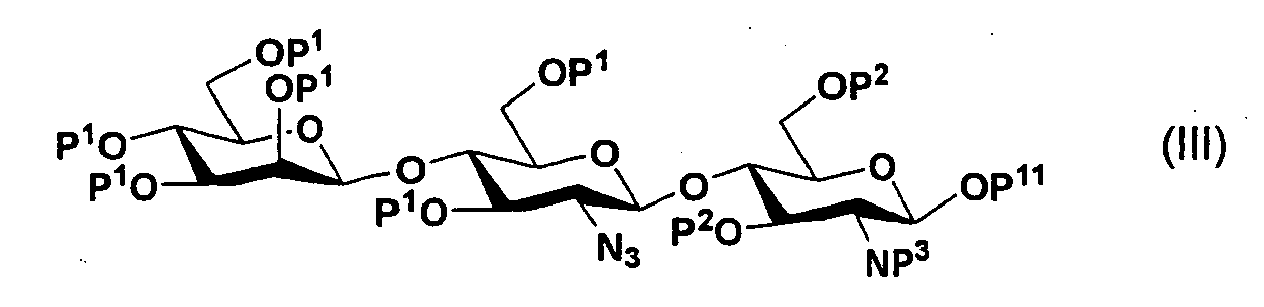
- According to the present invention, the trisaccharide moiety(Manβ1→4GlcNβ1→4GlcN) of the reducing terminal in the core sugar chain structure of the asparagine-linked glycoprotein sugar chain is easily synthesized and it is useful to clarify the function and structure-characteristics of the asparagine-linked glycoprotein which causes various life processes.
- The outline of the novel route for synthesizing the core sugar chain structure in the present invention is depicted as follows;

- At first, the disaccharide compound (I), Manβ1→4Man, is obtained after acid hydrolysis of a polysaccharide having mannose β-1,4-bonds and acetylation of the product. Next, it is converted to the glycal derivative wherein mannose of the reducing terminal was converted to glycal by a chemical method, and followed by azide nitration reaction to give the compound (II). The compound (II) which has the equatorial 2-azide group at the reducing terminal can be transformed to the moiety of Manβ1→4GlcNAc in the core sugar chain structure and is a useful key intermediate.
- Thus, the intermediate (II) is easily converted to the moiety of Manβ1→4GlcNAc which is difficult to prepare through other synthetic scheme, while the intermediate (II) can be easily prepared in a large scale at a reasonable cost from the compound (I), which is available from galactomannan, guar gum or mannan derivatives. Furthermore, the trisaccharide compound (III), which is ready to be converted to the trisaccharide (Manβ1→4GlcNAcβ1→4GlcNAc) of the reducing terminal in the core sugar chain structure, is synthesized when the intermediate (II) is used as a glycosyl donor.
- Thus, the inventors of the present invention succeeded to simplify the scheme for synthesizing the trisaccharide of the reducing terminal in the core structure by utilizing a natural polysaccharide available at a low cost.
- In the following description, each process of the present invention is explained in detail.
- In Process (1), the compound (I) of mannose disaccharide (ManP1β1→4ManP1) is prepared from a polysaccharide having mannoseβ-1,4-bonds. At first, a polysaccharide having mannoseβ-1,4-bonds is hydrolyzed, the OH groups are protected and the desired disaccharide is isolated.
- As a starting material, a polysaccharide having mannoseβ-1,4-bonds, preferably galactomannan, guar gum or mannan having mannoseβ-1,4-bonds, more preferably a galactomannan derivative of the formula (V);

or a mannan derivative of the formula (VI);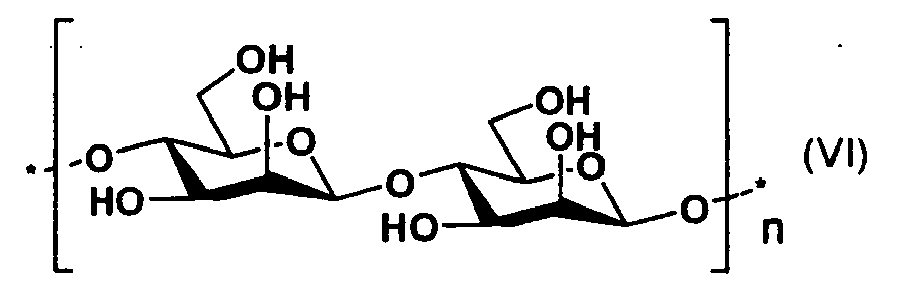
- Galactomannan derivatives (also referred to as galactomannoglycan) are extensively present in seeds of legume family, e.g., alfalfa or clover. Galactomannan in the seeds of guar (Cyamopsis tetragonolobus) and carob or locust bean (Ceratonia siliqua) is available in the market as gum products derived from plants.
- Guar gum extracted from guar seeds is a natural polysaccharide having a straight sugar chain comprising a series of mannose β 1→4 bonds wherein galactose is linked through α 1→6bond to every mannose residue as a branch. Almost uses of this material are food additives such as thickeners of various canned products, quality improving agent (inhibitor of shape-loosing) or taste-regulator of various foods and easily available at an extremely low cost.
- A mannan derivative is a generic name of polysaccharides comprised of D-mannose. Plant mannan derivatives contained in endosperm of ivory nut or bulbs of orchidaceous plant have straight chain structure in which D-mannose residues are linked through β 1→ 4 bonds and insoluble in water.
- In detail, these are described in "Comprehensive Dictionary for Utilization of Regional Biological Resources", Ed., Hiroshi Fujimaki, 1998, Rural Culture Association; Y. C. Lee, et al. (1977) Analytical Biochem., 79, 329-337; and Shiryo Yaga, et al. (1995) Mokuzai Gakkaishi, vo1.41, No 4, 440-443.
- Usually, acid hydrolysis is applied to hydrolyze polysaccharides having mannoseβ-1,4-bonds. For the purpose, sulfuric acid, preferably 10-20% sulfuric acid, trifluoroacetic acid or sulfuric acid-acetic acid is used and the reaction temperature of 50-70°C is preferable.
- Materials of which the polymerization degree is equal or more than 9 are removed by isolation of galactomannan soluble in 70%EtOH. In general, the polymerization revel is increased the more, the derivative remains in the insoluble residue.
- In order to protect the hydroxyl group, acetyl, benzyl, 4-methoxybenzyl, benzoyl, methoxymethyl, tetrahydropiranyl, torimethylsilyl, and triethylsilyl group etc., are usually used.
- Isolation of the disaccharide is achieved by silica gel chromatography and/or HPLC.
- In Process 2, a glycal compound is prepared from the mannose disaccharide compound (I) (a type of ManP1β1→4ManP1). At first, the glycal compound is prepared from the disaccharide by halogenation and successive reduction of the position 1 in mannose of the reducing terminal. Usually, mannose is halogenated around r.t. using hydrogen halide or acid halide etc. Reduction is carried out by using a metal such as zinc etc., while avoiding a reaction at high temperature. Process 3
- In Process 3, the azide disaccharide compound (II), in which the 2-azide group of mannose in the reducing terminal is linked at the equatorial position, is prepared by azidenitration reaction of the glycal compound.
- The azidenitration reaction is carried out by simultaneous azidation and nitration. A mixture of equatorial and axial isomers is provided, and the compound having the 2-azide group of mannose in the reducing terminal at the equatorial position is isolated by purifying the mixture.
- In Process 4 the nitro group in the azide disaccharide compound is substituted for a leaving group, which generally includes fluorine, bromine, chlorine, trichloroacetoimidate, 4-pentenyl, alkylthio (sulfur) and arylthio.
- Preferably, the nitro group in the azide disaccharide compound is substituted for the -OP10 group (P10 is an OH-protecting group), and the trihaloimidate derivative is obtained by the reaction with trihaloacetonitrile after removal of the P10 group or a halogenated derivative is obtained by the reaction with hydrogen halide. Alternatively, the -OP10 derivative or P10-deprotected derivative may be converted to the derivatives having a leaving group such as a penteny, acetylthio or arylthio group.
- In Process 5, the resulting derivative having a leaving group is reacted with amino-protected glucopyranoside to prepare the trisaccharide compound (a type of Manβ1→4GlcNP1β1→4GlcNP2).
- The amino-protected glucopyranoside may be prepared according to the following scheme.

- Next, this compound is reacted with the above derivative having a leaving group under acidic (Lewis-acidic) condition.
- In Process 6, the trisaccharide compound is coupled with asparagine. The coupling with asparagines is carried out according to the next scheme, for example.

- The trisaccharide prepared above may be coupled with an asparagine residue of the desired protein and the sugar chain may be elongated by adding a new sugar unit. Also a pre-elongated sugar chain prepared by adding a sugar unit to the trisaccharide may be introduced to the desired protein.
- Alternatively, a protein sequence may be elongated when standard peptide chemistry is applied to the asparagines residue in the asparagines-linked trisaccharide derivative. Also, a sugar chain may be elongated when standard carbohydrate chemistry is applied to mannose in the reducing terminal.
- The present invention is explained in more detail by the following experiments, but not limited to them.
- Materials used in the experiments are obtained from the commercial source described below.
- SANSHO Co., Ltd. (Food Division)
Guargum MEYPROGAT 120S - KANTO CHEMICAL CO., INC
Zinc Powder
Copper (II) Sulfate Pentahydrate (crystalline powder)
Diammonium Cerium(IV) Nitrate - Wako Pure Chemical Industries, Ltd.
Sodium Acetate
Acetic Anhydride
Trifluoroacetic Acid
Sodium Azide
DBU, 1,8-Diazabicyclo[5, 4, 0]undec-7-ene
CCl3CN, Trichloroacetonitrile
BF3OEt2, Boron Trifluoride Diethyl Ether Complex
Acetic Acid, For Organic Synthesis
Pyridine, For Organic Synthesis
Tetrahydrofuran, THF, For Organic Synthesis
CH2Cl2, Dichloromethane, For Organic Synthesis
Acetonitrile, For Organic Synthesis
Ethyl Acetate
Chloroform
Toluene
Anhydrous MgSO4
Triethylamine - Tokyo Chemical Industry Co., Ltd.
30% HBr-AcOH, 30% Hydrogen Bromide in Acetic Acid - Nacalai Tesque, Inc.
Benzylamine - Japan Alcohol Trading CO., LTD
99% Ethanol -

- 2.0g of guar gum (1) was dissolved in 16.6ml of 1N TFA and heated to 110°C in an oily bath with stirring for 90 min. The reaction mixture was poured into 40ml of 99% EtOH and placed at room temperature. The resulting white precipitation was removed by filtration using Buchner funnel and the filtrate was concentrated in vacuo. Toluene was added to the residue and azeotropically distilled several times to give 2.26g of galactomannan (2) soluble in 70% EtOH and 73mg of galactomannan (3) insoluble in 70% EtOH.
- Analysis of galactomannan (2) soluble in 70% EtOH using MALDI-TOFMS showed that its polymerization degree was reduced to 1-8. (B) Galactomannan soluble in 70% EtOH is acetylated to give O-(2,3,4,6-tetra-O-acetyl- β-D-mannopyranosyl)-(1→4)-1,2,3,6-tetra-O-acetyl- α-and β-D-mannopyranoside (4).
- 2.26g of galactomannan (2) soluble in 70% EtOH obtained above was dissolved in 23ml of pyridine, 23ml of acetic anhydride was added in the solution with cooling in an ice bath and stirred at 10°C for 22 hours. To the reaction mixture was added ice water and extracted with chloroform, washed with water, aq. solution of NaHCO3 and aq. solution of NaCl successively, and dried over anhydrous MgSO4. After MgSO4 was removed by Celite-filtration, the filtrate was concentrated in vacuo and the resulting residue was purified with silica-gel column chromatography (elution: toluene/ethyl acetate=2/ 1) to give 450mg of the desired product (4).
Sample; a mixture ofα:β = 2:1 ; [α]D-0.5 (c 0.012, chloroform); 1H NMR δ (CDCl3) 1.99~2.19 (all s, 24H, 8COCH3), 3.64 (m, 1H, H-5'), 3.77 (m, 1/3H, H-5β),3.95~4.13 (m, 2+2/3H, H-5α, H-4β, H-4α and H-6'b), 4.23~4.37 (m, 3H, H-6bβ, H-6aα, H-6bα, H-6a' and H-6aβ), 4.72 (d, 1/3H, Jβ 1',2'=1.1Hz, H-1β'), 4.75 (d, 2/3H, Jα 1', 2'=1.1 Hz, H-1α'), 5.04 (m, 1H, H-3'), 5.17∼5.25 (m, 2H, H-4', H-2α and H-3β), 5.39∼5.45 (m, 2H, H-2', H-2β and H-3α), 5.81 (d, 1/3H, Jβ 1, 2=1.1 Hz, H-1β), 6.03 (d, 2/3H, Jα 1, 2 = 2.0 Hz, H-1α).
Analysis calculated for C28H38O19: C, 49.56; H, 5.64; Found: C, 49.34; H, 5.67.
HR-FAB MS[M+Na]+Calculated for C28H38O19Na:701.191; Found 709.190.
t.l.c; Rf = 0.30 (toluene/ethyl acetate = 1:1)
1.2. Hydrolysis of Guar Gum (a large scale) - 200g of guar gum (1) was dissolved in 1660ml of 1N TFA and heated to 110°C in an oily bath with mechanical stirring for 35 min. When the guar gum was suspended, the mixture was sonicated for 15min and mechanically stirred at 110°C for 80min. The reaction mixture was cooled with an ice bath, poured into 4 liter of 99% EtOH and placed at room temperature. The resulting white precipitation was removed by filtration using Buchner funnel and the filtrate was concentrated in vacuo. Toluene was added to the residue and azeotropically distilled several times to give 200.3g of galactomannan (2) soluble in 70% EtOH and 9.9g of galactomannan (3) insoluble in 70% EtOH. Analysis of galactomannan (2) soluble in 70% EtOH using MALDI-TOFMS showed that its polymerization degree was reduced to 1-8.
- 200.3g of galactomannan (2) soluble in 70% EtOH obtained above was dissolved in 2100ml of pyridine, 2100ml of acetic anhydride was added in the solution with cooling in an ice bath and stirred at 10°C for 22 hours. To the reaction mixture was added ice water and extracted with chloroform, washed with water, aq. solution of NaHCO3 and aq. solution of NaCl successively, and dried over anhydrous MgSO4. After MgSO4 was removed by Celite-filtration, the filtrate was concentrated in vacuo and the resulting residue was partially purified with silica-gel column chromatography (elution: toluene/ethyl acetate=1/2), and then purified with the column chromatography of medium pressure (elution: toluene/ethyl acetate=2/1) to give 25.2g of the desired product (4).
-
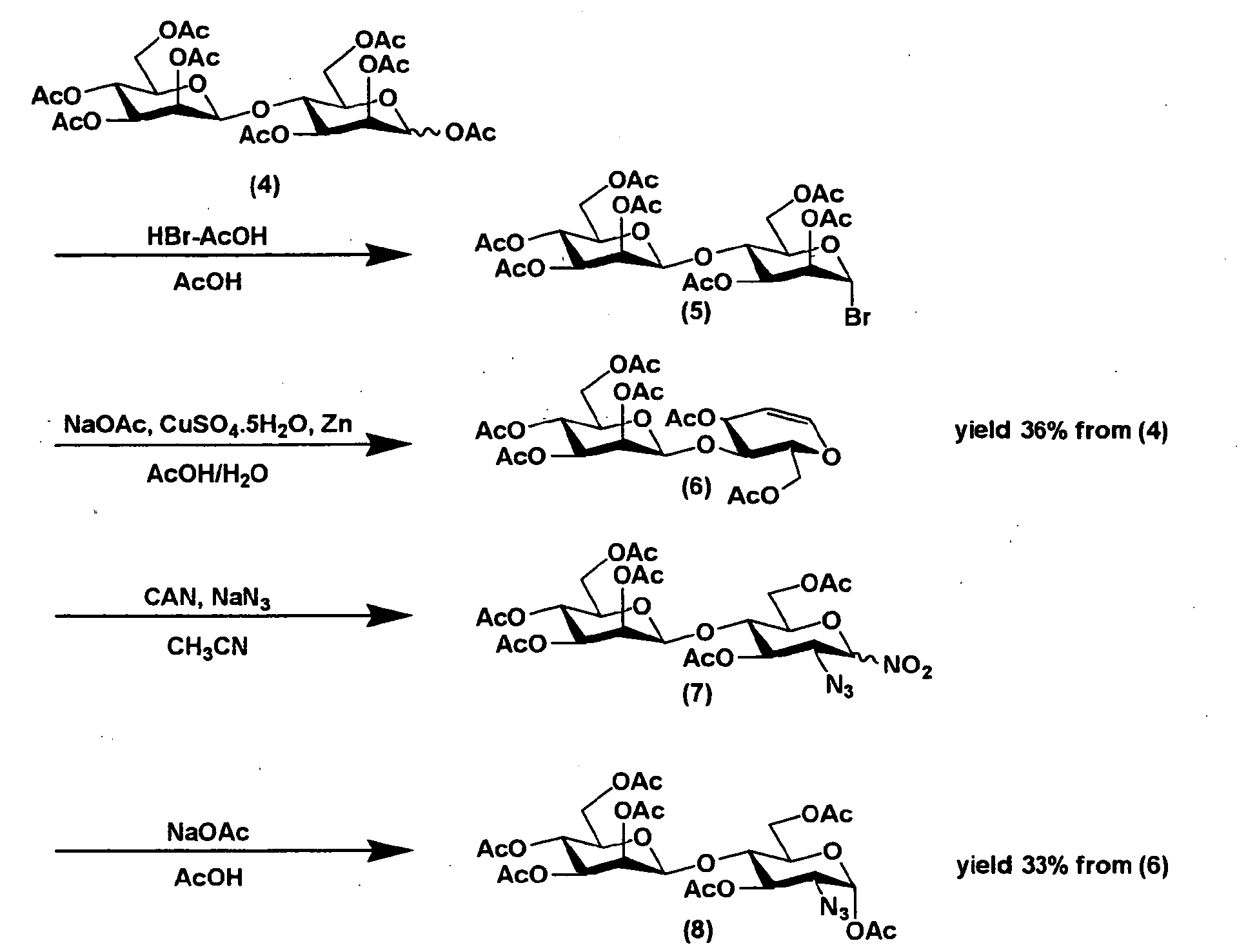
- 2.20g of the compound (4) was dissolved in 19ml of acetic acid, and to the solution was added 4.6ml of 30% HBr-AcOH and the mixture was stirred at r.t. for 150 min in a dark place. After termination of the reaction was confirmed on t.1.c., ice water was added to the reaction mixture and the product was extracted with chloroform, washed with water, aq. solution of NaHCO3 and aq. solution of NaCl successively, and dried over anhydrous MgSO4. After Mg SO4 was removed by celite-filtration, the filtrate was concentrated in vacuo to give 2.21g of the residual mixture containing the desired product (5).
t.l.c.; Rf = 0.35 (toluene/AcOEt = 1:1) - Into a three-neck flask cooled in ice water bath, were added 3.8ml of acetic acid, 7.6ml of water, 2.06g of sodium acetate, 0.20g of cupper sulfate pentahydrates and 1.65g of zinc successively while being stirred with a mechanistic stirrer. Next, the reaction mixture containing the compound (5) was dissolved in 7.6ml of acetic acid, and it was added to the reaction mixture above cooled in an ice water bath and the mixture was stirred at r.t. for 4 hours in a dark place. After termination of the reaction was confirmed on t.l.c., zinc was removed from the reaction mixture by celite-filtration and ice water was added to the filtrate. The product was extracted with chloroform, washed with water, aq. solution of NaHCO3 and aq. solution of NaCl successively, and dried over anhydrous MgSO4. After MgSO4 was removed by celite-filtration and the filtrate was concentrated in vacuo. The residue was purified with a flash silica gel chromatography (elution: toluene/ethyl acetate=2/ 1) to give 0.64g of the desired product (6).
Yield from the compound (4): 36%.
1H NMR δ(CDCl3) .200, 2.05, 2.08, 2.10, 2.12 and 2.17(all s, 18H, 6COCH3), 3.66(ddd, 1H, J4',5'=9.8Hz, J5',6a' = 5.8Hz, J5',6 b' =12.2Hz, H-5'), 4.05(dd, 1H, J3, 4=6.0Hz, J4, 5=8.1Hz, H-4), 4.12(dd, 1H, J5',6b'=2.6Hz, J6a', 6b'=12.2Hz, H-6b'), 4.13-4.17(m, 1H, H-5), 4.23(dd, 1H, J5,6b =5.3Hz, J6a,6b =12.2Hz, H-6b), 4.30(dd, 1H, J5',6a'=5.8Hz, J6a',6b' =12.2Hz, H-6a'), 4.42(dd, 1H, J5,6a =2.9Hz, J6a,6b = 12.2Hz, H-6a), 4.79(dd,1H,J1, 2=6.1Hz, J2,3 =3.1Hz, H-2), 4.86 (d, 1H, J1',2'=1.1Hz, H-1'), 5.05 (dd, 1H, J2', 3'=3.4Hz, J3',4' =10.1Hz, H-3'), 5.22 (t, 1H, J4',5' =9.8Hz,H-4'), 5.45 (dd, 1H, J1',2' =1.1Hz J2',3' = 3.4Hz, H-2'), 5.51 (m, 1H, H-3), 6.40 (dd, 1H, J1,2 =6.1 Hz, Jduble bond cis= 1.2Hz,H-1)
13C NMR δ(CDCl3) 20.5-21.0(m, 6COCH3), 61.8(C-6), 62.5(C-6'), 65.9(C-4'), 68.5(C-3 and C-2'), 70.8(C-3'), 72.6(C-5'), 74.0(C-4), 74.4(C-5), 97.9(C-1'), 99.0(C-2), 145.6(C-1), 169.5-170.6(m, 6COCH3)
t.l.c.; Rf = 0.40 (toluene/ethyl acetate = 1:1) - 510mg of the compound (6) was dissolved in 5.4ml of anhydrous acetonitrile and stirred at -20°C. To the solution, 89mg of sodium azide (NaN3) was added, and then 1.50g of cerium (IV) diammonium nitrate was added in four portions every 15 minutes. The reaction mixture was stirred under helium atmosphere at -20°C for 18 hours. After termination of the reaction was confirmed on t.l.c., ice water was added to the reaction mixture and the product was extracted with chloroform, washed with water, aq. solution of NaHCO3 and aq. solution of NaCl successively, and dried over anhydrous MgSO4. After MgSO4 was removed by celite-filtration, the filtrate was concentrated in vacuo to give 460mg of the residue containing the desired product (7).
t.l.c.; Rf = 0.50 (toluene/AcOEt = 1:1) - 460mg of the residue containing the compound (7) was dissolved in 2.0ml of acetic acid, and to the solution was added 170mg of sodium acetate and stirred in an oil bath at 80°C for 75 minutes. After termination of the reaction was confirmed on t.l.c., ice water was added to the reaction mixture and the product was extracted with chloroform, washed with water, aq. solution of NaHCO3 and aq. solution of NaCl successively, and dried over anhydrous MgSO4. After MgSO4 was removed by celite-filtration and the filtrate was concentrated in vacuo. The residue was purified with a flash silica gel chromatography (elution: toluene/ethyl acetate=3/2) to give 360mg of the residue containing the desired product (8) and O-(2,3,4,6-tetra-O-acetyl-β-D-mannopyranosyl)-(1→4)-1,3,6-tri-O-acetyl-2-azide-2-deoxy-α-D-mannopyranoside (9). The mixture was dissolved in a small amount of EtOH with heating, and then cooled in ice water to give a crystalline. Thus, 201mg of the desired product was obtained.
t.l.c.; Rf = 0.39 (toluene/AcOEt = 1:1)
Yield from the compound (6): 33%.
1H NMR δ(CDCl3) 1.99, 2.05, 2.10, 2.12, 2.17 and 2.20 (all s, 21H, 7COCH3), 3.51 (dd, 1H, J1, 2=3.8Hz J2,3 = 10.5Hz, H-2), 3.61 (ddd, 1H, J4',5' =9.9Hz, J5',6a' =5.0Hz, J5',6b'= 2.8Hz, H-5'), 3.83 (t, 1H, J4,5 =10.2Hz, H-4), 3.99 (m, 1H, H-5), 4.12 (dd, 1H, J5',6b'= 2.8Hz J6a',6b' = 12.3Hz, H-6b'), 4.24 (dd, 1 H, J5,6b= 3.7Hz J6a,6b = 12.5Hz, H-6b), 4.30(dd, 1H, J5, 6a=2.8Hz, J6a, 6b=12.5Hz, H-6a) 4.38(dd, 1H, J5, 6a=2.8Hz, J6a, 6b= 12.5Hz, H-6a), 4.66 (d, 1H, J1',2 '= 0.6Hz, H-1'), 5.03 (dd, 1H, J2', 3'=3.2Hz, J3',4' = 9.9Hz, H-3'), 5.23 (t, 1H, J 4',5' = 9.9Hz, H-4'), 5.42 (dd, 1H, J1'2'=0.6Hz, J2',3' = 3.2Hz, H-2'), 5.43 (dd, 1H, J2, 3= 10.5Hz, J3,4 = 9.3Hz, H-3), 6.24 (d, 1H, J1,2 = 3.8Hz, H-1)
13C NMR δ(CDCl3) 20.5-20.9(m, 6COCH3), 60.3(C-2), 61.9(C-6), 62.2(C-6'), 65.8(C-4'), 68.1(C-2'), 69.7(C-3), 70.4(C-5), 70.7(C-3'), 72.5(C-5'), 74.0(C-4), 89.9(C-1), 97.5(C-1'), 168.6-170.4(m, 6COCH3)
Analysis calculated for C26H35O17: C, 47.20; H, 5.33; N, 6.35; Found: C, 46.90; H, 5.32; N, 6.39.
HR-FAB MS[M+H]+ Calculated for C26H36N3O17 662.205, Found 662.202
mp+ 183.5-184.0°C(from EtOH),
t.l.c.; Rf = 0.39 (toluene/ethyl acetate = 1:1) -

- 300mg of the compound (8) was dissolved in 3.0ml of THF, and to the solution cooled in ice water was added 89µl of benzylamine and stirred at r.t. for 48 hours. After termination of the reaction was confirmed on t.l.c., ice water was added to the reaction mixture and the product was extracted with chloroform, washed with water, 1N HCl and aq. solution of NaCl successively, and dried over anhydrous MgSO4. After MgSO4 was removed by celite-filtration and the filtrate was concentrated in vacuo. The residue was purified with a flash silica gel chromatography (elution: toluene/ethyl acetate=3/2) to give 257mg of the desired product (10).
Yield from the compound (8): 92%.
HR-FAB MS[M+H]+ Calculated for C24H34N3O16 620.194; Found 620.192.
t.l.c; Rf = 0.26 (toluene/AcOEt = 1:1) - 85mg of the compound (10) was dissolved in CH2Cl2 (550µl) and CCl3CN (275µl), and to the solution cooled in ice water was added 10.2µl of DBU and stirred at r.t. for 2 hours. After termination of the reaction was confirmed on t.l.c., the reaction mixture was concentrated in vacuo. The resulting residue was purified with a flash silica gel chromatography (elution: toluene/ethyl acetate=3/2) to give 80mg of the desired product (11).
Yield from the compound (10): 76%.
1H NMR δ(CDCl3) 1.97, 2.02, 2.07, 2.08, 2.16 and 2.17(all s, 18H, 6COCH3), 3.56-3.60(m, 1H, H-5'), 3.60(dd, 1H, J1, 2=3.4Hz, J2, 3=10.5Hz, H-2), 3.88(t, 1H, J4, 5=9.8Hz, H-4), 4.09(dd, 1H, J5',6b'=2.7Hz, J6a', 6b'=12.5Hz, H-6b'), 4.09-4.14(m, 1H, H-5), 4.21(dd, 1 H, J5, 6b=3.9Hz, J6a, 6b=12.5Hz, H-6b), 4.33(dd, 1H, J5, 6a=2.2Hz, J6a, 6b=12.5Hz, H-6a), 4.33(dd, 1H, J5', 6a'=4.9Hz, J6a', 6b'=12.5Hz, H-6a'), 4.69(s, 1H, H-1'), 5.01(dd, 1H, J2', 3'=3.4Hz, J3', 4'=10.0Hz, H-3'), 5.20(t, 1H, J4', 5'=9.8Hz, H-4'), 5.38(d, 1H, J2',3'=3.4Hz, H-2'), 5.51(dd, 1H, J2, 3=10.5Hz, J3, 4=9.5Hz, H-3), 6.41(d, 1H, J1, 2=3.4Hz, H-1), 8.79(s, 1H, NH)
13C NMR δ(CDCl3) 20.5-20.7(m, 6COCH3), 60.8(C-2), 61.9(C-6), 62.3(C-6'), 65.8(C-4'), 68.2(C-2'), 69.3(C-3), 70.7(C-5 and C-3'), 72.6(C-5'), 74.1(C-4), 90.5(C(NH)CCl3), 94.1(C-1), 97.3(C-1'), 160.6(C(NH)CCl3), 169.5-170.4(m, 6COCH3)
t.l.c; Rf = 0.37 (toluene/ethyl acetate = 1:1) - 47mg of the compound (11) and 45mg of allyl-O-3,6-O-di-benzyl-2-deoxy-2-phthalimide-β-D-glucopyranoside (12) were dissolved in 700µl of CH2Cl2, and to the solution was added 70mg of MS4A (Molecular Sieves) and stirred under nitrogen atmosphere at -20°C for 30 minutes.
- Next, 2.3µl of BF3OEt2 was added and the mixture was stirred under nitrogen atmosphere at -20°C for 24 hours. After termination of the reaction was confirmed on t.l.c., the reaction mixture was neutralized by adding triethylamine (TEA), MS4A was removed by celite filtration and the filtrate was concentrated in vacuo. The resulting residue was partially purified with a flash silica gel chromatography (elution: toluene/ethyl acetate=5/2) to give 32mg of the residual mixture containing the desired compound (13) and allyl O-(2,3,4,6-tetra-O-acetyl-β-D-mannopyranosyl)-(1→4)-O-(3,6-di-O-acetyl-2-azide-2-deoxy-α-D-glucopyranosyl)-(1→4)-3,6-di-O-benzyl-2-deoxy-2-phthalimide- β-D-glucopyranoside (α:β=1:2). Furthermore, it was purified with HPLC (elution: hexane/ethanol=12/ 1) to give 21mg of the desired product (13).
Yield from the compound (11): 31%
1H NMR δ(CDCl3) 1.90, 1.92, 1.96, 2.00, 2.07, 2.15(all s, 18H, 6COCH3), 3.08(m, 1H, H-5'), 3.27(dd, 1H, J1', 2'=8.1Hz, J2', 3'=10.2Hz, H-2'), 3.46(ddd, 1H, J4", 5"=9.9Hz, J5", 6a"=4.8Hz, J5", 6b"=2.6Hz, H-5"), 3.51-3.56(m, 1H, H-5), 3.56(t, 1H, J4', 5'=9.8Hz, H-4'), 3.76(dd, 1H, J5, 6b=1.4Hz, J6a, 6b=10.9Hz, H-6b), 3.87(dd, 1H, J5, 6a=2.9Hz, J6a, 6b=10.9Hz, H-6a), 3.91(dd, 1H, J=6.3Hz, J=13.0Hz, CHH'CH=CH2), 3.98-4.20(m, 7H, H-6b", H-6b', H-4, H-2, H-6a', H-3, CHH'CH=CH2), 4.27(dd, 1H, J5", 6a"=4.8Hz, J6a", 6b"=12.3Hz, H-6a"), 4.27 and 4.66(ABq, 2H, J=12.5Hz, PhCH2), 4.30(d, 1H, J1', 2'=8.1Hz, H-1'), 4.42 and 4.73(ABq, 2H, J=12.0Hz, PhCH2), 4.45(s, 1H, H-1"), 4.76(dd, 1H, J2', 3'=3.4Hz, J3', 4'=9.9Hz, H-3'), 4.92(dd, 1H, J2", 3"=3.4Hz, J3", 4"=9.9Hz, H-3"), 4.93(dd, 1H, J=1.5Hz, Jtrans=10.4Hz, CH=CHtransH), 4.93(dd, 1H, J=1.5Hz, Jcis=17.2Hz, CH=CHHcis), 5.06(d, 1H, J1,2=8.4Hz, H-1), 5.14(t, 1H, J4", 5"=9.9Hz, H-4"), 5.30(d, 1H, J2", 3"=3.4Hz, H-2"), 5.60(m, 1H, CH=CH2), 6.70-7.58(m, 14H, Ar-H)
13C NMR δ(CDCl3) 20.5-20.6(m, 6COCH3), 55.5(C-2), 62.2(C-6' and C-6"), 64.5(C-2'), 65.9(C-4"), 67.8(C-6), 68.1(C-2"), 69.7(CH2CH=CH2), 70.7(C-3"), 71.9(C-3'), 72.0(C-5'), 72.5(C-5"), 73.5 and 74.3(2PhCH2), 74.6(C'-4 and C-5), 78.2(C-4), 97.3(C-1 and C-1"), 100.8(C-1'), 117.3(CH2CH=CH2), 127.0-133.7(m, 18Ar-C), 137.9(CH2CH=CH2), 169.6-170.4(m, 8C=O)
HR-FAB MS[M+Na]+Calculated for C55H62N4O22Na, 1153.375, Found 1153.374
t.l.c; Rf = 0.53 (toluene/ethyl acetate = 1:1) - Amino-protected glucopyranoside (12) was synthesized according to the synthetic scheme shown below.

13C NMR δ(CDCl3) 55.3(C-2), 69.7(C-C=C), 70.7(C-6), 73.5(C-5), 73.8 and 74.3(Ph-C), 74.5(C-4), 78.7(C-3), 97.4(C-1), 117.3(C-C=C), 127.4-128.5(m, Ar-C), 133.6(C-C=C), 137.6 and 138.2(C=O)
HR-FAB MS[M+H]+Calculated for C31H32NO7 530.218, Found 530.215
t.l.c; Rf = 0.72 (toluene/ethyl acetate = 1:1) - Glycosyltransferase and an additive sugar unit are usually utilized in the automatic synthesizer of sugar chains since glycosyltransferase is convenient when a sugar chain is extended by adding a new saccharide. However, no glycosyltransferase is found to prepare the trisaccharide moiety (Manβ1→4GlcNβ1→4GlcN) of the reducing terminal in the core sugar chain structure of asparagine-linked glycoprotein and the chemical synthesis is the sole method for preparing it.
- The present invention provides a convenient method for preparing the trisaccharide moiety of the reducing terminal in the core sugar chain utilizing galactomannan, guar gum and/or mannan derivatives, which are natural polysaccharides easily available at a reasonable cost.
Claims (10)
- A method for preparing a trisaccharide (Man β 1→4GlcN β 1→ 4GlcN) of the reducing terminal in the core sugar chain structure of an asparagine-linked glycoprotein, comprising(1) a process of preparing a mannose disaccharide compound (a type of ManP1 β 1→4ManP1) of the formula (I)

- The method for preparing a trisaccharide (Man β 1→4GlcN β 1→ 4GlcN) of the reducing terminal in the core sugar chain structure of an asparagine-linked glycoprotein of claim 1, further comprising each of(2) a process of preparing a glycal compound, in which mannose of the reducing terminal of the mannose disaccharide is converted to glycal, by halogenation and reduction of the mannose disaccharide (a type of ManP1 β 1→4ManP1), and(3) a process of preparing an azide disaccharide compound (a type of ManP1 β 1→4ManP1) shown with formula (II) in which the 2-azide group of mannose in the reducing terminal is linked at the equatorial position;

- The method for preparing a trisaccharide (Man β 1→4GlcN β 1→ 4GlcN) of the reducing terminal in the core sugar chain structure of an asparagine-linked glycoprotein of claim 2, further comprising(4) a process of substituting the nitro group of the azide disaccharide compound (a type of ManP1 β 1→4ManP1) with a leaving group, and(5) a process of preparing a trisaccharide compound (a type of Man β 1→4GlcNP1 β 1→4GlcNP2) shown with the formula (III);

by a reaction of the product having the leaving group with amino-protected glucopyranoside shown with the formula;
- The method for preparing a trisaccharide (Man β 1→4GlcN β 1→ 4GlcN) of the reducing terminal in the core sugar chain structure of an asparagine-linked glycoprotein of claim 3, further comprising(6) a process of preparing an asparagine-linked trisaccharide (Man β 1→4GlcNP1 β 1→4GlcNP2) compound shown with the formula (IV);wherein P1 and P2 are the same above, P4 and P6 are independently amino-protecting groups and P5 is a carboxyl-protecting group, by coupling of the reducing terminal of the trisaccharide compound above with the protected asparagine derivative.

- A method for preparing a mannose disaccharide compound (a type of ManP1 β 1→4ManP1) shown with the formula (I);

- A method for preparing the azide disaccharide (a type of ManP1 β 1→4ManP1) shown with the formula (II) in which the 2-azide group of mannose in the reducing terminal is linked at the equatorial position;


- A method for preparing the trisaccharide compound shown with the formula (III);

comprising a process of substituting the nitro group of the azide disaccharide compound (a type of ManP1 β 1→4ManP1) shown with the formula (II) with a leaving group;
and next, reacting the substituted compound having the leaving group with amino-protected glucopyranoside of the formula;
- A method for preparing an asparagine-linked trisaccharide compound (Man β 1→4GlcNP1 β 1→4GlcNP2) shown with the formula (IV)
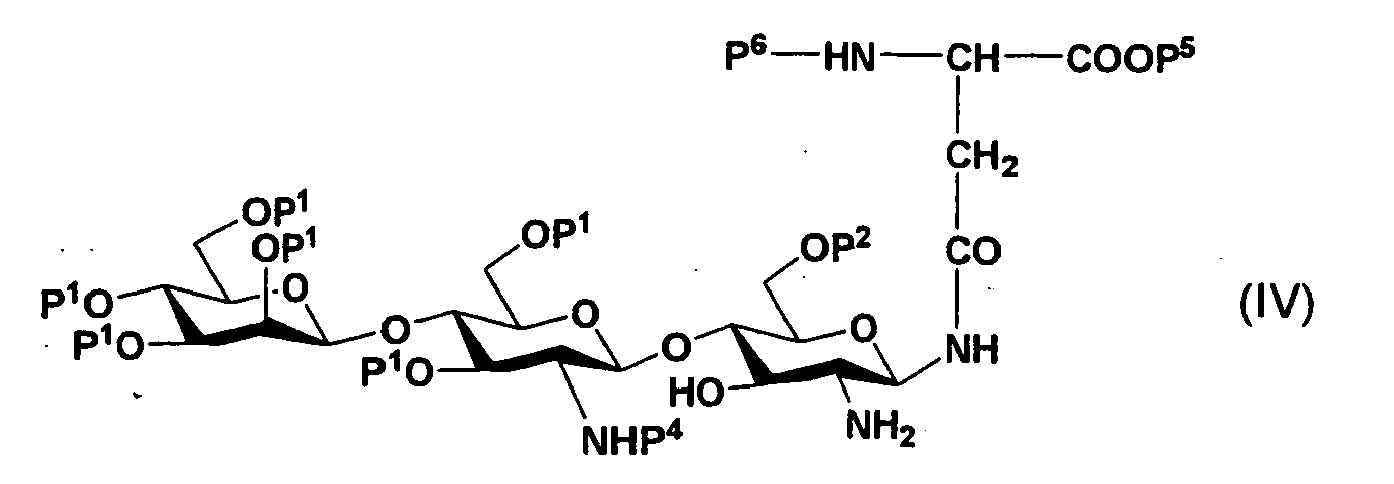
by coupling of the reducing terminal of the trisaccharide compound (III)
- The azide disaccharide (a type of ManP1 β 1→4ManP1) compound shown with the formula (II);

- The trisaccharide compound (a type of Man β 1→4GlcNP1 β 1→ 4GlcNP2) shown with the formula of (III);

Applications Claiming Priority (2)
| Application Number | Priority Date | Filing Date | Title |
|---|---|---|---|
| JP2003433717 | 2003-12-26 | ||
| PCT/JP2004/019384 WO2005063782A1 (en) | 2003-12-26 | 2004-12-24 | Synthesis of core sugar chain structure of aspargine-linked glycoprotein |
Publications (2)
| Publication Number | Publication Date |
|---|---|
| EP1698634A1 true EP1698634A1 (en) | 2006-09-06 |
| EP1698634A4 EP1698634A4 (en) | 2010-11-03 |
Family
ID=34736526
Family Applications (1)
| Application Number | Title | Priority Date | Filing Date |
|---|---|---|---|
| EP04807740A Withdrawn EP1698634A4 (en) | 2003-12-26 | 2004-12-24 | Synthesis of core sugar chain structure of aspargine-linked glycoprotein |
Country Status (5)
| Country | Link |
|---|---|
| US (1) | US7598372B2 (en) |
| EP (1) | EP1698634A4 (en) |
| JP (1) | JP4778315B2 (en) |
| CN (1) | CN1918174B (en) |
| WO (1) | WO2005063782A1 (en) |
Families Citing this family (1)
| Publication number | Priority date | Publication date | Assignee | Title |
|---|---|---|---|---|
| JP6000758B2 (en) * | 2012-08-30 | 2016-10-05 | 国立大学法人 新潟大学 | Oligosaccharide synthase and method for producing core sugar chain structure of asparagine-linked glycoprotein |
Family Cites Families (4)
| Publication number | Priority date | Publication date | Assignee | Title |
|---|---|---|---|---|
| JPH07224082A (en) * | 1994-02-14 | 1995-08-22 | Rikagaku Kenkyusho | Asparagine-linked sugar derivative and method for producing the same |
| US6114309A (en) * | 1997-11-21 | 2000-09-05 | Incara Research Laboratories | Combinatorial library of moenomycin analogs and methods of producing same |
| JPH11255807A (en) * | 1998-03-13 | 1999-09-21 | Noguchi Inst | Sugar chain asparagine active ester derivatives and their synthetic intermediates |
| EP2481746A1 (en) * | 2001-06-19 | 2012-08-01 | Otsuka Chemical Co., Ltd. | Process for producing sugar chain asparagine derivative |
-
2004
- 2004-12-24 EP EP04807740A patent/EP1698634A4/en not_active Withdrawn
- 2004-12-24 US US10/584,065 patent/US7598372B2/en not_active Expired - Fee Related
- 2004-12-24 JP JP2005516654A patent/JP4778315B2/en not_active Expired - Fee Related
- 2004-12-24 CN CN2004800419791A patent/CN1918174B/en not_active Expired - Fee Related
- 2004-12-24 WO PCT/JP2004/019384 patent/WO2005063782A1/en not_active Ceased
Non-Patent Citations (2)
| Title |
|---|
| HORST KUNZ, WOLFGANG GÜNTHER: "beta-Mannosides from beta-Glucosides by Intramolecular Nucleophilic Substitution with Inversion of Configuration" ANGEWANDTE CHEMIE INTERNATIONAL EDITION IN ENGLISH, vol. 27, no. 8, 1988, pages 1086-1087, XP002601429 * |
| See also references of WO2005063782A1 * |
Also Published As
| Publication number | Publication date |
|---|---|
| US20070166783A1 (en) | 2007-07-19 |
| WO2005063782A1 (en) | 2005-07-14 |
| JP4778315B2 (en) | 2011-09-21 |
| CN1918174A (en) | 2007-02-21 |
| CN1918174B (en) | 2011-09-07 |
| EP1698634A4 (en) | 2010-11-03 |
| US7598372B2 (en) | 2009-10-06 |
| JPWO2005063782A1 (en) | 2007-07-19 |
Similar Documents
| Publication | Publication Date | Title |
|---|---|---|
| US8049002B2 (en) | Processes for chemical synthesis of lipochitooligosaccharides | |
| US4841041A (en) | Pentasaccharides and tetrasaccharides having anti-thrombotic activity | |
| CN104245718B (en) | Prepare fondaparinux sodium method and synthesis in use intermediate | |
| CS219342B2 (en) | Method of preparation of the glycoside of the pleuromutiline | |
| US6462183B1 (en) | Protected aminosugars | |
| Du et al. | An efficient and concise regioselective synthesis of α-(1→ 5)-linked L-arabinofuranosyl oligosaccharides | |
| JP2016537349A (en) | Disaccharide intermediate and synthesis method thereof | |
| Tamura et al. | Synthesis of chondroitin sulfate E hexasaccharide in the repeating region by an effective elongation strategy toward longer chondroitin oligosaccharide | |
| Ueki et al. | Synthesis of biantennary LacNAc-linked O-glycan (core 4) and glycopeptide thioester by benzyl protection strategy: Rapid zinc reduction of GlcNTCA to GlcNAc by microwave irradiation | |
| US7598372B2 (en) | Synthesis of core sugar chain structure of asparagine-linked glycoprotein | |
| US6310200B1 (en) | Process for selective oxidation of primary alcohols of oligosaccharides | |
| Kanie et al. | Synthesis of a Precursor of β-D-GlcpNAc (1→ 2)-α-D-Manp-(1→ 3)-[β-D-Xylp-(1→ 2)]-β-D-Manp-(1→ 4)-β-D-Glcp | |
| Takatani et al. | Synthesis of N-linked pentasaccharides with isomeric glycosidic linkage | |
| Yang et al. | Synthesis of heptasaccharide and nonasaccharide analogues of the lentinan repeating unit | |
| van Dorst et al. | Synthesis of Hexp-(1→ 4)-β-d-GlcpNac-(1→ 2)-α-d-Manp-(1→ O)(CH2) 7CH3 probes for exploration of the substrate specificity of glycosyltransferases: Part II, Hex= 3-O-methyl-β-d-Gal, 3-deoxy-β-d-Gal, 3-deoxy-3-fluoro-β-d-Gal, 3-amino-3-deoxy-β-d-Gal, β-d-Gul, α-l-Alt, or β-l-Gal | |
| Miranda et al. | Ferric chloride: a mild and versatile reagent for the formation of 1, 6-anhydro glucopyranoses | |
| Zhao et al. | Synthesis of two heptasaccharide analogues of the lentinan repeating unit | |
| Koike et al. | Stereoselective total synthesis of wheat flour ceramide dihexoside | |
| Toepfer et al. | Muramic acid derivatives as glycosyl donors for the synthesis of muramyl-containing glycosphingolipids and fatty acids | |
| Takeo et al. | Synthesis of 8-Methoxycarbonyloctylβ-Glycosides of Tri-and Tetrasaccharides Related to Schizophyllan and Neoglycoproteins Therefrom | |
| JP5015505B2 (en) | O-linked glycoprotein sugar chain-related compound having core type 4 structure and method for producing the same | |
| CN1303857A (en) | Synthesis of lentinan core fragment trisaccharide, tetrasaccharide, hexasaccharide and heptasaccharide | |
| Issaree | Synthesis of hetero-chitooligosaccharides | |
| Garegg et al. | Synthesis of oligosaccharides corresponding to structures found in capsular polysaccharides of Cryptococcus neoformans—II | |
| Ma et al. | Convergent synthesis of a galactofuranosylated mannan, the repeating unit of Trichophyton mentagrophytes IFO 5466 and Trichophyton rubrum IFO 5467 |
Legal Events
| Date | Code | Title | Description |
|---|---|---|---|
| PUAI | Public reference made under article 153(3) epc to a published international application that has entered the european phase |
Free format text: ORIGINAL CODE: 0009012 |
|
| 17P | Request for examination filed |
Effective date: 20060626 |
|
| AK | Designated contracting states |
Kind code of ref document: A1 Designated state(s): AT BE BG CH CY CZ DE DK EE ES FI FR GB GR HU IE IS IT LI LT LU MC NL PL PT RO SE SI SK TR |
|
| DAX | Request for extension of the european patent (deleted) | ||
| A4 | Supplementary search report drawn up and despatched |
Effective date: 20101001 |
|
| 17Q | First examination report despatched |
Effective date: 20110131 |
|
| GRAP | Despatch of communication of intention to grant a patent |
Free format text: ORIGINAL CODE: EPIDOSNIGR1 |
|
| STAA | Information on the status of an ep patent application or granted ep patent |
Free format text: STATUS: THE APPLICATION IS DEEMED TO BE WITHDRAWN |
|
| 18D | Application deemed to be withdrawn |
Effective date: 20120620 |