EP1698492A1 - Pneumatic tire - Google Patents
Pneumatic tire Download PDFInfo
- Publication number
- EP1698492A1 EP1698492A1 EP04820234A EP04820234A EP1698492A1 EP 1698492 A1 EP1698492 A1 EP 1698492A1 EP 04820234 A EP04820234 A EP 04820234A EP 04820234 A EP04820234 A EP 04820234A EP 1698492 A1 EP1698492 A1 EP 1698492A1
- Authority
- EP
- European Patent Office
- Prior art keywords
- rubber
- toe
- innerliner
- chafer
- pneumatic tire
- Prior art date
- Legal status (The legal status is an assumption and is not a legal conclusion. Google has not performed a legal analysis and makes no representation as to the accuracy of the status listed.)
- Granted
Links
- 229920001971 elastomer Polymers 0.000 claims abstract description 188
- 239000005060 rubber Substances 0.000 claims abstract description 188
- 241000254043 Melolonthinae Species 0.000 claims abstract description 59
- 239000011324 bead Substances 0.000 claims abstract description 45
- 239000000203 mixture Substances 0.000 claims abstract description 34
- 229920005549 butyl rubber Polymers 0.000 claims abstract description 23
- 229920005555 halobutyl Polymers 0.000 claims abstract description 20
- 238000004073 vulcanization Methods 0.000 description 19
- QVGXLLKOCUKJST-UHFFFAOYSA-N atomic oxygen Chemical compound [O] QVGXLLKOCUKJST-UHFFFAOYSA-N 0.000 description 12
- 239000001301 oxygen Substances 0.000 description 12
- 229910052760 oxygen Inorganic materials 0.000 description 12
- 230000035515 penetration Effects 0.000 description 9
- 230000000052 comparative effect Effects 0.000 description 7
- 229920005557 bromobutyl Polymers 0.000 description 6
- XLOMVQKBTHCTTD-UHFFFAOYSA-N Zinc monoxide Chemical compound [Zn]=O XLOMVQKBTHCTTD-UHFFFAOYSA-N 0.000 description 4
- 239000006229 carbon black Substances 0.000 description 4
- 239000000654 additive Substances 0.000 description 3
- XKRFYHLGVUSROY-UHFFFAOYSA-N Argon Chemical compound [Ar] XKRFYHLGVUSROY-UHFFFAOYSA-N 0.000 description 2
- IJGRMHOSHXDMSA-UHFFFAOYSA-N Atomic nitrogen Chemical compound N#N IJGRMHOSHXDMSA-UHFFFAOYSA-N 0.000 description 2
- 244000043261 Hevea brasiliensis Species 0.000 description 2
- 235000021355 Stearic acid Nutrition 0.000 description 2
- 229920003211 cis-1,4-polyisoprene Polymers 0.000 description 2
- 238000013329 compounding Methods 0.000 description 2
- 238000007796 conventional method Methods 0.000 description 2
- 230000006866 deterioration Effects 0.000 description 2
- 238000006073 displacement reaction Methods 0.000 description 2
- 238000000034 method Methods 0.000 description 2
- 229920003052 natural elastomer Polymers 0.000 description 2
- 229920001194 natural rubber Polymers 0.000 description 2
- QIQXTHQIDYTFRH-UHFFFAOYSA-N octadecanoic acid Chemical compound CCCCCCCCCCCCCCCCCC(O)=O QIQXTHQIDYTFRH-UHFFFAOYSA-N 0.000 description 2
- OQCDKBAXFALNLD-UHFFFAOYSA-N octadecanoic acid Natural products CCCCCCCC(C)CCCCCCCCC(O)=O OQCDKBAXFALNLD-UHFFFAOYSA-N 0.000 description 2
- 229920002857 polybutadiene Polymers 0.000 description 2
- 238000007789 sealing Methods 0.000 description 2
- 239000008117 stearic acid Substances 0.000 description 2
- 239000004636 vulcanized rubber Substances 0.000 description 2
- 239000011787 zinc oxide Substances 0.000 description 2
- -1 BROMOBUTYL Chemical class 0.000 description 1
- 239000005062 Polybutadiene Substances 0.000 description 1
- NINIDFKCEFEMDL-UHFFFAOYSA-N Sulfur Chemical compound [S] NINIDFKCEFEMDL-UHFFFAOYSA-N 0.000 description 1
- 239000003963 antioxidant agent Substances 0.000 description 1
- 230000003078 antioxidant effect Effects 0.000 description 1
- 229910052786 argon Inorganic materials 0.000 description 1
- 239000003795 chemical substances by application Substances 0.000 description 1
- 229920005556 chlorobutyl Polymers 0.000 description 1
- 238000010276 construction Methods 0.000 description 1
- 230000001276 controlling effect Effects 0.000 description 1
- 238000011156 evaluation Methods 0.000 description 1
- 239000000945 filler Substances 0.000 description 1
- 238000009472 formulation Methods 0.000 description 1
- 239000007789 gas Substances 0.000 description 1
- 239000001307 helium Substances 0.000 description 1
- 229910052734 helium Inorganic materials 0.000 description 1
- SWQJXJOGLNCZEY-UHFFFAOYSA-N helium atom Chemical compound [He] SWQJXJOGLNCZEY-UHFFFAOYSA-N 0.000 description 1
- 239000011261 inert gas Substances 0.000 description 1
- 238000003801 milling Methods 0.000 description 1
- 229910052757 nitrogen Inorganic materials 0.000 description 1
- 239000010734 process oil Substances 0.000 description 1
- 230000001105 regulatory effect Effects 0.000 description 1
- 229910052717 sulfur Inorganic materials 0.000 description 1
- 239000011593 sulfur Substances 0.000 description 1
- 238000010792 warming Methods 0.000 description 1
Images


Classifications
-
- B—PERFORMING OPERATIONS; TRANSPORTING
- B60—VEHICLES IN GENERAL
- B60C—VEHICLE TYRES; TYRE INFLATION; TYRE CHANGING; CONNECTING VALVES TO INFLATABLE ELASTIC BODIES IN GENERAL; DEVICES OR ARRANGEMENTS RELATED TO TYRES
- B60C1/00—Tyres characterised by the chemical composition or the physical arrangement or mixture of the composition
-
- B—PERFORMING OPERATIONS; TRANSPORTING
- B60—VEHICLES IN GENERAL
- B60C—VEHICLE TYRES; TYRE INFLATION; TYRE CHANGING; CONNECTING VALVES TO INFLATABLE ELASTIC BODIES IN GENERAL; DEVICES OR ARRANGEMENTS RELATED TO TYRES
- B60C15/00—Tyre beads, e.g. ply turn-up or overlap
- B60C15/02—Seating or securing beads on rims
- B60C15/024—Bead contour, e.g. lips, grooves, or ribs
-
- B—PERFORMING OPERATIONS; TRANSPORTING
- B60—VEHICLES IN GENERAL
- B60C—VEHICLE TYRES; TYRE INFLATION; TYRE CHANGING; CONNECTING VALVES TO INFLATABLE ELASTIC BODIES IN GENERAL; DEVICES OR ARRANGEMENTS RELATED TO TYRES
- B60C15/00—Tyre beads, e.g. ply turn-up or overlap
- B60C15/06—Flipper strips, fillers, or chafing strips and reinforcing layers for the construction of the bead
- B60C2015/0614—Flipper strips, fillers, or chafing strips and reinforcing layers for the construction of the bead characterised by features of the chafer or clinch portion, i.e. the part of the bead contacting the rim
-
- Y—GENERAL TAGGING OF NEW TECHNOLOGICAL DEVELOPMENTS; GENERAL TAGGING OF CROSS-SECTIONAL TECHNOLOGIES SPANNING OVER SEVERAL SECTIONS OF THE IPC; TECHNICAL SUBJECTS COVERED BY FORMER USPC CROSS-REFERENCE ART COLLECTIONS [XRACs] AND DIGESTS
- Y10—TECHNICAL SUBJECTS COVERED BY FORMER USPC
- Y10T—TECHNICAL SUBJECTS COVERED BY FORMER US CLASSIFICATION
- Y10T152/00—Resilient tires and wheels
- Y10T152/10—Tires, resilient
- Y10T152/10495—Pneumatic tire or inner tube
- Y10T152/10819—Characterized by the structure of the bead portion of the tire
- Y10T152/10828—Chafer or sealing strips
-
- Y—GENERAL TAGGING OF NEW TECHNOLOGICAL DEVELOPMENTS; GENERAL TAGGING OF CROSS-SECTIONAL TECHNOLOGIES SPANNING OVER SEVERAL SECTIONS OF THE IPC; TECHNICAL SUBJECTS COVERED BY FORMER USPC CROSS-REFERENCE ART COLLECTIONS [XRACs] AND DIGESTS
- Y10—TECHNICAL SUBJECTS COVERED BY FORMER USPC
- Y10T—TECHNICAL SUBJECTS COVERED BY FORMER US CLASSIFICATION
- Y10T152/00—Resilient tires and wheels
- Y10T152/10—Tires, resilient
- Y10T152/10495—Pneumatic tire or inner tube
- Y10T152/10819—Characterized by the structure of the bead portion of the tire
- Y10T152/10846—Bead characterized by the chemical composition and or physical properties of elastomers or the like
Definitions
- This invention relates to a pneumatic tire, and more particularly to a pneumatic tire having excellent air-retaining property and bead portion durability and capable of being used over a long period.
- heavy duty tires such as a tire for truck and bus, a tire for construction vehicle and the like have been used under a very high load, so that it is generally and widely attempted to prevent settling of a bead portion, rim chafing and rim slippage and the like and to improve an air sealing property and the like by disposing a rubber chafer in at least a part of the bead portion contacting with a rim.
- an innerliner is arranged in the inner face of the tire for the purpose of improving the air sealing property of the tire, in which a end of the innerliner is usually located in the vicinity of a toe end of the bead portion and a part of the innerliner overlaps partially with the rubber chafer.
- the adhesiveness between the innerliner and the rubber chafer is poor, so that there is a problem that when a joint portion between the innerliner and the rubber chafer is particularly located in the vicinity of the toe end, cracks easily occur at an interface between the innerliner and the rubber chafer during the running on the market.
- the innerliner is comprised of plural layers and a end of an outermost layer in the innerliner extends to the part contacting with the rim over the toe end, the outermost layer of the innerliner may ride up due to the rubbing or the like by contacting with the rim.
- the end of the outermost layer in the innerliner is arranged so as not to arrive at the toe end, there is a problem that a rubber member of the bead portion is deteriorated by oxygen penetrated from the toe end.
- an object of the invention to solve the above-mentioned problems of the conventional techniques and to provide a pneumatic tire provided at its bead portion with a rubber chafer and covered at its inner surface with an innerliner, which hardly causes the rim chafing and is in the settling of the bead portion and prevents the occurrence of cracks at the interface between the rubber chafer and the innerliner and suppresses the penetration of oxygen from the toe end part.
- an additional rubber layer is further arranged on the toe end part of the bead portion so as to overlap with the rubber chafer and the innerliner and a rubber composition containing a predetermined amount of a butyl rubber and/or a halogenated butyl rubber and having excellent adhesion to both the rubber chafer and the innerliner and anti-settling property is used in such an additional rubber layer (hereinafter referred to as a toe rubber), whereby the occurrence of cracks at the interface between the rubber chafer and the innerliner can be prevented and further the penetration of oxygen from the toe end part can be suppressed while controlling the rim chafing and the settling of the bead portion, and as a result the invention has been accomplished.
- the pneumatic tire according to the invention is a pneumatic tire provided at its bead portion with a rubber chafer and covered at its inner surface with an innerliner, characterized in that a toe rubber is further arranged on a toe end part of the bead portion so as to overlap with the rubber chafer and the innerliner and locate at least outside the innerliner at the overlapped portion with the innerliner, and a rubber composition A containing at least one of butyl rubber and halogenated butyl rubber as 20-40 mass% of a rubber component is used in the toe rubber.
- the term "toe end part" used herein means a toe end and a neighborhood thereof.
- the toe rubber is arranged over at least a part of a region ranging from the toe end to not more than 30 mm in a direction along the inner surface of the tire and of a region ranging from the toe end to not more than 50 mm in a direction along a bead base line.
- the toe rubber has a maximum thickness of not more than 2.5 mm.
- the innerliner is arranged up to a position from the toe end to not more than 10 mm outward in a radial direction of the tire.
- the innerliner is turned back outward from the toe end in a widthwise direction of the tire. In this case, the penetration of oxygen from the toe end part into the inside of the bead portion can be prevented surely.
- a rubber composition B containing at least one of butyl rubber and halogenated butyl rubber as at least 80 mass% of a rubber component is used in the innerliner
- a rubber composition C containing at least one of butyl rubber and halogenated butyl rubber as at most 10 mass% of a rubber component is used in the rubber chafer.
- the adhesiveness between the toe rubber and the innerliner and between the toe rubber and the rubber chafer can be improved surely.
- a pneumatic tire provided at its bead portion with a rubber chafer and covered at its inner face with an innerliner, which hardly causes the rim chafing and is low in the settling of the bead portion and does not generate cracks at the interface between the rubber chafer and the innerliner and suppresses the penetration of oxygen from a toe end part, wherein the toe rubber is further arranged on the toe end part of the bead portion so as to overlap with the rubber chafer and the innerliner and the rubber composition containing the predetermined total amount of the butyl rubber and/or the halogenated butyl rubber and having excellent adhesion to both the rubber chafer and the innerliner and anti-settling property is used in the toe rubber.
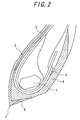
- FIG. 1, FIG. 2 and FIG. 3 show an embodiment of the bead portion in the pneumatic tire according to the invention, respectively.
- the tires shown in FIG. 1, FIG. 2 and FIG. 3 comprise a carcass 2 consisting of a main body portion toroidally extending between bead cores 1 embedded in the bead portions and a turnup portion wound around the bead core 1 from an inside to outside in the widthwise direction of the tire, a wire chafer 3 arranged along the outer surface of the carcass 2 so as to envelop the bead core 1, a rubber chafer 4 arranged from the outside of the wire chafer 3 in the widthwise direction of the tire toward the inside thereof in the radial direction, an innerliner 5 arranged inside the main body portion of the carcass 2 in the widthwise direction of the tire so as to cover the inner surface of the tire, and a toe rubber 6 arranged at a toe end part of the bead portion so as to overlap with the rubber
- the arrangement of the wire chafer 3 may be omitted, and the structure of the carcass 2 and the ply number thereof can be properly modified.
- the cross-sectional shape of the bead core 1 is hexagonal, but it is not limited thereto and may be other polygons and so on.
- the toe rubber 6 is located outside both the rubber chafer 4 and the innerliner 5 (on the outer surface of the tire), but may be located inside the rubber chafer 4 at the overlapped portion with the rubber chafer 4 as in the tire shown in FIG. 3.
- the innerliner 5 is composed of two layers, but it may be composed of one layer or three or more layers.
- the rubber composition A containing at least one of butyl rubber and halogenated butyl rubber as 20-40 mass% of the rubber component is used in the toe rubber 6.
- the rubber composition A for the toe rubber is sufficiently high in the adhesiveness to both the usual rubber composition for the innerliner and rubber composition for the rubber chafer because the total content of the butyl rubber and the halogenated butyl rubber in the rubber component is 20-40 mass%. Therefore, the crack at the interface between the rubber chafer and the innerliner can be surely prevented and the durability of the tire can be improved.
- the rubber composition A having the total content of the butyl rubber and the halogenated butyl rubber within the above-mentioned range is used in the toe rubber, the anti-setting property of the toe rubber is sufficiently high, and hence the tire according to the invention hardly causes the rim chafing and is small in the settling of the bead portion.
- the air impermeability of the toe rubber is higher than that of the usual rubber chafer, the penetration of oxygen from the toe end part can be suppressed as compared with the case that the toe rubber is not arranged, and the durability of the rubber member used in the bead portion and the internal pressure holding performance of the tire can be improved.
- the adhesiveness after vulcanization between the outermost layer of the innerliner and the toe rubber is insufficient though the adhesiveness after vulcanization between the rubber chafer and the toe rubber can be ensured sufficiently, while when it exceeds 40 mass%, the adhesiveness after vulcanization between the outermost layer of the innerliner and the toe rubber can be sufficiently ensured, but the adhesiveness after vulcanization between the rubber chafer and the toe rubber is insufficient and the settling amount of the toe rubber is further increased to easily cause the rim chafing.
- the halogenated butyl rubber are mentioned brominated butyl rubber, chlorinated butyl rubber and so on.
- the toe rubber 6 is arranged over at least a part of a region ranging from the toe end P to not more than 30 mm in a direction along the inner surface of the tire and of a region ranging from the toe end P to not more than 50 mm in a direction along a bead base line.
- the toe rubber 6 is arranged over at least a part of the region ranging from the toe end P to not more than 30 mm in the direction along the bead base line.
- the toe rubber 6 When the toe rubber 6 is arranged over the region of more than 30 mm from the toe end P in the direction along the inner surface of the tire, air (oxygen) penetrates from a portion not having the innerliner to deteriorate the air-retaining property of the tire and also deteriorate the inner member.
- the toe rubber 6 when the toe rubber 6 is arranged over the region of more than 50 mm from the toe end P in the direction along the bead base line L, the innerliner itself contacts with the rim and the anti-settling property is lacking.
- the maximum thickness is preferably not more than 2.5 mm, and more preferably 1.0 mm-2.0 mm.
- the width of the toe rubber is not particularly limited, but is preferably within a range of 10-100 mm.
- the innerliner 5 in the pneumatic tire of the invention is preferably arranged up to a position from the toe end P to not more than 10 mm outward in the radial direction of the tire.
- a shortest distance H between the innerliner 5 and the toe end P in the radial direction of the tire exceeds 10 mm, the internal pressure holding performance of the tire is deteriorated and further the penetration of oxygen from the toe end part cannot be suppressed sufficiently and hence the deterioration of the rubber member in the bead portion may not be suppressed sufficiently.
- the innerliner 5 in the pneumatic tire according to the invention is turned back outward from the toe end P in the widthwise direction of the tire.
- the innerliner covers a zone from the inner face of the tire through the toe end P to a part of the bead base line L, the internal pressure holding performance of the tire is further improved and the penetration of oxygen from the toe end part is further and surely suppressed, and hence the deterioration of the rubber member in the bead portion can be further suppressed.
- the rubber composition B containing at least one of the butyl rubber and the halogenated butyl rubber as at least 80 mass% of the rubber component is used in the innerliner
- the rubber composition C containing at least one of butyl rubber and halogenated butyl rubber as at most 10 mass% of the rubber component is used in the rubber chafer.
- the innerliner and the rubber chafer can be used a rubber component such as natural rubber, polybutadiene rubber or the like in addition to the above-mentioned butyl rubber and halogenated butyl rubber.
- These rubber compositions may be properly compounded with additives usually used in the rubber industry such as a filler, e.g. carbon black or the like, an antioxidant, a vulcanizing agent, a vulcanization accelerator, zinc oxide, stearic acid and so on within a scope of not damaging the object of the invention.
- additives can be preferably used commercially available ones.
- the rubber compositions can be produced by compounding the rubber component with the various additives properly selected if necessary and milling, warming, extruding and so on.
- the pneumatic tire of the invention is not particularly limited, but can be produced, for example, by properly stacking the toe rubber, the innerliner and the rubber chafer so as to provide a desired structure in a building step of a green tire and then vulcanizing as usual.
- the pneumatic tire of the invention is suitable for a use under a high load because it comprises the toe rubber and the rubber chafer, and is preferable as a heavy duty tire for a truck, a bus or the like.
- a gas filled into the pneumatic tire of the invention can be used usual air or air having a regulated partial oxygen pressure but also inert gases such as nitrogen, argon, helium and so on.
- Rubber compositions according to a compounding recipe shown in Table 1 are prepared and the settling amounts thereof are measured by the following method. Results are shown in Table 1. Moreover, the rubber composition is compounded with 2 parts by mass of stearic acid, 6 parts by mass of zinc oxide, 3 parts by mass of process oil, 0.8 part by mass of a vulcanization accelerator (CZ), 3 parts by mass of sulfur and so on in addition to the rubber component and the carbon black shown in Table 1.
- CZ vulcanization accelerator
- a tire for truck and bus (TBR) having a structure shown in FIG. 2 and a tire size of 11R225 14PR is prepared by using the above-described rubber composition in the toe rubber.
- the toe rubber is arranged over a region of 0-30 mm from the toe end in the direction along the bead base line and the maximum thickness of the toe rubber is 1.8 mm.
- the component of the rubber composition used in the innerliner contains 100 mass% of IIR (*2)
- the component of the rubber composition used in the rubber chafer contains 0 mass% of IIR (*2).
- a green tire is built and left to stand at 25°C for 48 hours, and then the adhesiveness before vulcanization between the outermost layer of the innerliner and the toe rubber is visually observed. Then, the green tire is vulcanized at 145°C for 40 minutes and left to stand for one day, and then the adhesiveness after vulcanization between the outermost layer of the innerliner and the toe rubber and between the rubber chafer and the toe rubber is visually observed.
- ⁇ shows that there is no problem
- ⁇ shows that there is a slight problem
- ⁇ shows that trouble is caused.
- ⁇ in the evaluation of the adhesiveness after vulcanization between the outermost layer of the innerliner and the toe rubber shows that the interface between the outermost layer of the innerliner and the toe rubber emerges after the vulcanized and the leaving.
- the rubber compositions of Examples 1-5 wherein the content of the bominated butyl rubber in the rubber component is within the range defined in the invention have sufficient anti-settling property. Also, the tires of Examples 1-5 using the above rubber composition in the toe rubber are excellent in the adhesiveness before and after vulcanization between the innerliner and the toe rubber and the adhesiveness after vulcanization between the rubber chafer and the toe rubber.
- the tire of Comparative Example 1 wherein the rubber composition having an excellent anti-settling property but not containing the brominated butyl rubber is used in the toe rubber is poor in the adhesiveness before and after vulcanization between the innerliner and the toe rubber.
- the tire of Comparative Example 2 wherein the rubber composition having the brominated butyl rubber content in the rubber component of less than 20 mass% is used in the toe rubber has somewhat a problem in the adhesiveness before and after vulcanization between the innerliner and the toe rubber.
- the tire of Comparative Example 3 wherein the rubber composition having the brominated butyl rubber content in the rubber component of more than 40 mass% is used in the toe rubber is poor in the adhesiveness after vulcanization between the rubber chafer and the toe rubber.
Landscapes
- Engineering & Computer Science (AREA)
- Mechanical Engineering (AREA)
- Tires In General (AREA)
- Compositions Of Macromolecular Compounds (AREA)
Abstract
Description
- This invention relates to a pneumatic tire, and more particularly to a pneumatic tire having excellent air-retaining property and bead portion durability and capable of being used over a long period.
- Heretofore, heavy duty tires such as a tire for truck and bus, a tire for construction vehicle and the like have been used under a very high load, so that it is generally and widely attempted to prevent settling of a bead portion, rim chafing and rim slippage and the like and to improve an air sealing property and the like by disposing a rubber chafer in at least a part of the bead portion contacting with a rim. In the tire provided with the rubber chafer, an innerliner is arranged in the inner face of the tire for the purpose of improving the air sealing property of the tire, in which a end of the innerliner is usually located in the vicinity of a toe end of the bead portion and a part of the innerliner overlaps partially with the rubber chafer. In this tire, however, the adhesiveness between the innerliner and the rubber chafer is poor, so that there is a problem that when a joint portion between the innerliner and the rubber chafer is particularly located in the vicinity of the toe end, cracks easily occur at an interface between the innerliner and the rubber chafer during the running on the market.
- Moreover, when the innerliner is comprised of plural layers and a end of an outermost layer in the innerliner extends to the part contacting with the rim over the toe end, the outermost layer of the innerliner may ride up due to the rubbing or the like by contacting with the rim. To the contrary, when the end of the outermost layer in the innerliner is arranged so as not to arrive at the toe end, there is a problem that a rubber member of the bead portion is deteriorated by oxygen penetrated from the toe end.
- On the other hand, there is proposed a tire in which the penetration of the oxygen from the toe end part is suppressed by using in the rubber chafer a rubber composition comprising 20-60 parts by weight in total of butyl rubber and/or halogenated butyl rubber and 80-40 parts by weight in total of cis-1,4-polyisoprene rubber and epoxidized cis-1,4-polyisoprene rubber as a rubber component (see JP-A-7-90125). In this case, however, there is a problem that the rubber chafer cannot play its original role sufficiently because a ratio of the butyl rubber and the halogenated butyl rubber in the rubber composition for the rubber chafer is higher than that in the conventional technique.
- As the tire provided at its bead portion with the rubber chafer, there is proposed a tire in which a rubber layer having a high air impermeability is arranged on the toe end part of the bead portion to suppress the penetration of oxygen from the toe end part (see JP-AH07-502471). In this case, however, it is necessary to use a rubber composition having a high ratio of a rubber component having a high air impermeability such as butyl rubber, halogenated butyl rubber or the like in the rubber layer for sufficiently increasing the air impermeability of the rubber layer arranged at the toe end part, so that it is difficult to assure the adhesiveness between the rubber layer and the rubber chafer.
- As the tire provided at its bead portion with the rubber chafer, there is further proposed a tire in which an innerliner is arranged so as to entangle the bead core to improve the air-retaining property of the tire (see JP-A-2001-233013). Even in this case, however, the adhesiveness between the innerliner and the rubber chafer is still low, so that it is impossible to overcome a problem that cracks are easily generated at the interface between the innerliner and the rubber chafer during the running on the market.
- It is, therefore, an object of the invention to solve the above-mentioned problems of the conventional techniques and to provide a pneumatic tire provided at its bead portion with a rubber chafer and covered at its inner surface with an innerliner, which hardly causes the rim chafing and is in the settling of the bead portion and prevents the occurrence of cracks at the interface between the rubber chafer and the innerliner and suppresses the penetration of oxygen from the toe end part.
- The inventors have made various studies in order to achieve the above object and discovered that in the pneumatic tire provided at its bead portion with the rubber chafer and covered at its inner surface with the innerliner, an additional rubber layer is further arranged on the toe end part of the bead portion so as to overlap with the rubber chafer and the innerliner and a rubber composition containing a predetermined amount of a butyl rubber and/or a halogenated butyl rubber and having excellent adhesion to both the rubber chafer and the innerliner and anti-settling property is used in such an additional rubber layer (hereinafter referred to as a toe rubber), whereby the occurrence of cracks at the interface between the rubber chafer and the innerliner can be prevented and further the penetration of oxygen from the toe end part can be suppressed while controlling the rim chafing and the settling of the bead portion, and as a result the invention has been accomplished.
- That is, the pneumatic tire according to the invention is a pneumatic tire provided at its bead portion with a rubber chafer and covered at its inner surface with an innerliner, characterized in that a toe rubber is further arranged on a toe end part of the bead portion so as to overlap with the rubber chafer and the innerliner and locate at least outside the innerliner at the overlapped portion with the innerliner, and a rubber composition A containing at least one of butyl rubber and halogenated butyl rubber as 20-40 mass% of a rubber component is used in the toe rubber. The term "toe end part" used herein means a toe end and a neighborhood thereof.
- In a preferable embodiment of the pneumatic tire according to the invention, the toe rubber is arranged over at least a part of a region ranging from the toe end to not more than 30 mm in a direction along the inner surface of the tire and of a region ranging from the toe end to not more than 50 mm in a direction along a bead base line.
- In another preferable embodiment of the pneumatic tire according to the invention, the toe rubber has a maximum thickness of not more than 2.5 mm.
- In the other preferable embodiment of the pneumatic tire according to the invention, the innerliner is arranged up to a position from the toe end to not more than 10 mm outward in a radial direction of the tire.
- In a further preferable embodiment of the pneumatic tire according to the invention, the innerliner is turned back outward from the toe end in a widthwise direction of the tire. In this case, the penetration of oxygen from the toe end part into the inside of the bead portion can be prevented surely.
- In a still further preferable embodiment of the pneumatic tire according to the invention, a rubber composition B containing at least one of butyl rubber and halogenated butyl rubber as at least 80 mass% of a rubber component is used in the innerliner, and a rubber composition C containing at least one of butyl rubber and halogenated butyl rubber as at most 10 mass% of a rubber component is used in the rubber chafer. In this case, the adhesiveness between the toe rubber and the innerliner and between the toe rubber and the rubber chafer can be improved surely.
- According to the invention, there can be provided a pneumatic tire provided at its bead portion with a rubber chafer and covered at its inner face with an innerliner, which hardly causes the rim chafing and is low in the settling of the bead portion and does not generate cracks at the interface between the rubber chafer and the innerliner and suppresses the penetration of oxygen from a toe end part, wherein the toe rubber is further arranged on the toe end part of the bead portion so as to overlap with the rubber chafer and the innerliner and the rubber composition containing the predetermined total amount of the butyl rubber and/or the halogenated butyl rubber and having excellent adhesion to both the rubber chafer and the innerliner and anti-settling property is used in the toe rubber.
-
- FIG. 1 shows an embodiment of the bead portion in the pneumatic tire according to the invention;
- FIG. 2 shows another embodiment of the bead portion in the pneumatic tire according to the invention; and
- FIG. 3 shows the other embodiment of the bead portion in the pneumatic tire according to the invention.
- The invention will be described in detail below with reference to the attached drawings. FIG. 1, FIG. 2 and FIG. 3 show an embodiment of the bead portion in the pneumatic tire according to the invention, respectively. The tires shown in FIG. 1, FIG. 2 and FIG. 3 comprise a
carcass 2 consisting of a main body portion toroidally extending betweenbead cores 1 embedded in the bead portions and a turnup portion wound around thebead core 1 from an inside to outside in the widthwise direction of the tire, awire chafer 3 arranged along the outer surface of thecarcass 2 so as to envelop thebead core 1, arubber chafer 4 arranged from the outside of thewire chafer 3 in the widthwise direction of the tire toward the inside thereof in the radial direction, aninnerliner 5 arranged inside the main body portion of thecarcass 2 in the widthwise direction of the tire so as to cover the inner surface of the tire, and atoe rubber 6 arranged at a toe end part of the bead portion so as to overlap with therubber chafer 4 and theinnerliner 5. In the tire of the invention, the arrangement of thewire chafer 3 may be omitted, and the structure of thecarcass 2 and the ply number thereof can be properly modified. In the illustrated tire, the cross-sectional shape of thebead core 1 is hexagonal, but it is not limited thereto and may be other polygons and so on. - In FIGS. 1 and 2, the
toe rubber 6 is located outside both therubber chafer 4 and the innerliner 5 (on the outer surface of the tire), but may be located inside therubber chafer 4 at the overlapped portion with therubber chafer 4 as in the tire shown in FIG. 3. In the tires shown in FIGS. 1, 2 and 3, theinnerliner 5 is composed of two layers, but it may be composed of one layer or three or more layers. - In the pneumatic tire according to the invention, the rubber composition A containing at least one of butyl rubber and halogenated butyl rubber as 20-40 mass% of the rubber component is used in the
toe rubber 6. The rubber composition A for the toe rubber is sufficiently high in the adhesiveness to both the usual rubber composition for the innerliner and rubber composition for the rubber chafer because the total content of the butyl rubber and the halogenated butyl rubber in the rubber component is 20-40 mass%. Therefore, the crack at the interface between the rubber chafer and the innerliner can be surely prevented and the durability of the tire can be improved. Furthermore, since the rubber composition A having the total content of the butyl rubber and the halogenated butyl rubber within the above-mentioned range is used in the toe rubber, the anti-setting property of the toe rubber is sufficiently high, and hence the tire according to the invention hardly causes the rim chafing and is small in the settling of the bead portion. Moreover, since the air impermeability of the toe rubber is higher than that of the usual rubber chafer, the penetration of oxygen from the toe end part can be suppressed as compared with the case that the toe rubber is not arranged, and the durability of the rubber member used in the bead portion and the internal pressure holding performance of the tire can be improved. - When the total content of the butyl rubber and the halogenated butyl rubber is less than 20 mass% in the rubber composition A used for the toe rubber of the pneumatic tire according to the invention, the adhesiveness after vulcanization between the outermost layer of the innerliner and the toe rubber is insufficient though the adhesiveness after vulcanization between the rubber chafer and the toe rubber can be ensured sufficiently, while when it exceeds 40 mass%, the adhesiveness after vulcanization between the outermost layer of the innerliner and the toe rubber can be sufficiently ensured, but the adhesiveness after vulcanization between the rubber chafer and the toe rubber is insufficient and the settling amount of the toe rubber is further increased to easily cause the rim chafing. As the halogenated butyl rubber are mentioned brominated butyl rubber, chlorinated butyl rubber and so on.
- In the pneumatic tire of the invention, as shown in FIG. 1, it is preferable that the
toe rubber 6 is arranged over at least a part of a region ranging from the toe end P to not more than 30 mm in a direction along the inner surface of the tire and of a region ranging from the toe end P to not more than 50 mm in a direction along a bead base line. As shown in FIG. 2, it is further preferable that thetoe rubber 6 is arranged over at least a part of the region ranging from the toe end P to not more than 30 mm in the direction along the bead base line. When thetoe rubber 6 is arranged over the region of more than 30 mm from the toe end P in the direction along the inner surface of the tire, air (oxygen) penetrates from a portion not having the innerliner to deteriorate the air-retaining property of the tire and also deteriorate the inner member. On the other hand, when thetoe rubber 6 is arranged over the region of more than 50 mm from the toe end P in the direction along the bead base line L, the innerliner itself contacts with the rim and the anti-settling property is lacking. - In the toe rubber, the maximum thickness is preferably not more than 2.5 mm, and more preferably 1.0 mm-2.0 mm. When the maximum thickness of the toe rubber exceeds 2.5 mm, the settling of the toe rubber is apprehended because the anti-settling property of the toe rubber is relatively excellent but is smaller than that of the rubber chafer. Furthermore, the width of the toe rubber is not particularly limited, but is preferably within a range of 10-100 mm.
- As shown in FIG. 1, the
innerliner 5 in the pneumatic tire of the invention is preferably arranged up to a position from the toe end P to not more than 10 mm outward in the radial direction of the tire. When a shortest distance H between theinnerliner 5 and the toe end P in the radial direction of the tire exceeds 10 mm, the internal pressure holding performance of the tire is deteriorated and further the penetration of oxygen from the toe end part cannot be suppressed sufficiently and hence the deterioration of the rubber member in the bead portion may not be suppressed sufficiently. - As shown in FIGS. 2 and 3, it is also preferable that the
innerliner 5 in the pneumatic tire according to the invention is turned back outward from the toe end P in the widthwise direction of the tire. When the innerliner covers a zone from the inner face of the tire through the toe end P to a part of the bead base line L, the internal pressure holding performance of the tire is further improved and the penetration of oxygen from the toe end part is further and surely suppressed, and hence the deterioration of the rubber member in the bead portion can be further suppressed. - In the pneumatic tire of the invention, it is preferable that the rubber composition B containing at least one of the butyl rubber and the halogenated butyl rubber as at least 80 mass% of the rubber component is used in the innerliner, and the rubber composition C containing at least one of butyl rubber and halogenated butyl rubber as at most 10 mass% of the rubber component is used in the rubber chafer. In this case, the adhesiveness between the innerliner and the toe rubber and between the rubber chafer and the toe rubber can be ensured sufficiently, and the crack at the interface between the rubber chafer and the innerliner can be more surely prevented.
- In the pneumatic tire of the invention, as the rubber component in the rubber compositions used for the toe rubber, the innerliner and the rubber chafer can be used a rubber component such as natural rubber, polybutadiene rubber or the like in addition to the above-mentioned butyl rubber and halogenated butyl rubber. These rubber compositions may be properly compounded with additives usually used in the rubber industry such as a filler, e.g. carbon black or the like, an antioxidant, a vulcanizing agent, a vulcanization accelerator, zinc oxide, stearic acid and so on within a scope of not damaging the object of the invention. As these additives can be preferably used commercially available ones. Moreover, the rubber compositions can be produced by compounding the rubber component with the various additives properly selected if necessary and milling, warming, extruding and so on.
- The pneumatic tire of the invention is not particularly limited, but can be produced, for example, by properly stacking the toe rubber, the innerliner and the rubber chafer so as to provide a desired structure in a building step of a green tire and then vulcanizing as usual. The pneumatic tire of the invention is suitable for a use under a high load because it comprises the toe rubber and the rubber chafer, and is preferable as a heavy duty tire for a truck, a bus or the like. Moreover, as a gas filled into the pneumatic tire of the invention can be used usual air or air having a regulated partial oxygen pressure but also inert gases such as nitrogen, argon, helium and so on.
- The following examples are given in illustration of the invention and are not intended as limitations thereof.
- Rubber compositions according to a compounding recipe shown in Table 1 are prepared and the settling amounts thereof are measured by the following method. Results are shown in Table 1. Moreover, the rubber composition is compounded with 2 parts by mass of stearic acid, 6 parts by mass of zinc oxide, 3 parts by mass of process oil, 0.8 part by mass of a vulcanization accelerator (CZ), 3 parts by mass of sulfur and so on in addition to the rubber component and the carbon black shown in Table 1.
- To the rubber vulcanized at 145°C for 30 minutes is input a force of 300-200 N at 20 Hz for 16 minutes, and then a load of 200 N is added to measure a displacement amount from the vulcanized rubber before the test. The result is shown by an index on the basis that the displacement amount of the vulcanized rubber in Comparative Example 2 is 100. The lager the index value, the smaller the settling amount and the better the result.
- Also, a tire for truck and bus (TBR) having a structure shown in FIG. 2 and a tire size of 11R225 14PR is prepared by using the above-described rubber composition in the toe rubber. In this tire, the toe rubber is arranged over a region of 0-30 mm from the toe end in the direction along the bead base line and the maximum thickness of the toe rubber is 1.8 mm. Furthermore, the component of the rubber composition used in the innerliner contains 100 mass% of IIR (*2), and the component of the rubber composition used in the rubber chafer contains 0 mass% of IIR (*2). With respect to the thus obtained tires, the adhesiveness before and after vulcanization between the innerliner and the toe rubber, and the adhesiveness after vulcanization between the rubber chafer and the toe rubber are evaluated by the following method. Results are shown in Table 1.
- A green tire is built and left to stand at 25°C for 48 hours, and then the adhesiveness before vulcanization between the outermost layer of the innerliner and the toe rubber is visually observed. Then, the green tire is vulcanized at 145°C for 40 minutes and left to stand for one day, and then the adhesiveness after vulcanization between the outermost layer of the innerliner and the toe rubber and between the rubber chafer and the toe rubber is visually observed. In the table, ○ shows that there is no problem, Δ shows that there is a slight problem, and × shows that trouble is caused. Moreover, × in the evaluation of the adhesiveness after vulcanization between the outermost layer of the innerliner and the toe rubber shows that the interface between the outermost layer of the innerliner and the toe rubber emerges after the vulcanized and the leaving.
-
Table 1 Comparative Example 1 Comparative Example 2 Comparative Example 3 Example 1 Example 2 Example 3 Example 4 Example 5 Formulation brief Natural rubber parts by mass 100 85 50 70 70 35 30 40 BR*1 - - - - - 35 30 40 IIR *2 - 15 50 30 30 30 40 20 Carbon black HAF 70 70 70 70 - 70 70 70 Carbon black GPF - - - - 70 - - - Property Settling Amount (Index) 115 100 80 100 100 100 100 105 Adhesiveness Adhesiveness before vulcanization between toe rubber and outermost layer of innerliner × Δ ○ ○ ○ ○ ○ ○ Adhesiveness after vulcanization between toe rubber and outermost layer of innerliner × Δ ○ ○ ○ ○ ○ ○ Adhesiveness after vulcanization between toe rubber and rubber chafer ○ ○ × ○ ○ ○ ○ ○ - *1 Polybutadiene rubber, BR01 made by JSR Corporation
*2 Brominated butyl rubber, BROMOBUTYL 2255 made by JSR Corporation - As seen from Table 1, the rubber compositions of Examples 1-5 wherein the content of the bominated butyl rubber in the rubber component is within the range defined in the invention have sufficient anti-settling property. Also, the tires of Examples 1-5 using the above rubber composition in the toe rubber are excellent in the adhesiveness before and after vulcanization between the innerliner and the toe rubber and the adhesiveness after vulcanization between the rubber chafer and the toe rubber.
- On the other hand, the tire of Comparative Example 1 wherein the rubber composition having an excellent anti-settling property but not containing the brominated butyl rubber is used in the toe rubber is poor in the adhesiveness before and after vulcanization between the innerliner and the toe rubber. Also, the tire of Comparative Example 2 wherein the rubber composition having the brominated butyl rubber content in the rubber component of less than 20 mass% is used in the toe rubber has somewhat a problem in the adhesiveness before and after vulcanization between the innerliner and the toe rubber. Furthermore, the tire of Comparative Example 3 wherein the rubber composition having the brominated butyl rubber content in the rubber component of more than 40 mass% is used in the toe rubber is poor in the adhesiveness after vulcanization between the rubber chafer and the toe rubber.
Claims (6)
- A pneumatic tire provided at its bead portion with a rubber chafer and covered at its inner surface with an innerliner, characterized in that a toe rubber is further arranged on a toe end part of the bead portion so as to overlap with the rubber chafer and the innerliner and locate at least outside the innerliner at the overlapped portion with the innerliner, and a rubber composition A containing at least one of butyl rubber and halogenated butyl rubber as 20-40 mass% of a rubber component is used in the toe rubber.
- A pneumatic tire according to claim 1, wherein the toe rubber is arranged over at least a part of a region ranging from the toe end to not more than 30 mm in a direction along the inner surface of the tire and of a region ranging from the toe end to not more than 50 mm in a direction along a bead base line.
- A pneumatic tire according to claim 1, wherein the toe rubber has a maximum thickness of not more than 2.5 mm.
- A pneumatic tire according to claim 1, wherein the innerliner is arranged up to a position from the toe end to not more than 10 mm outward in a radial direction of the tire.
- A pneumatic tire according to claim 1, wherein the innerliner is turned back outward from the toe end in a widthwise direction of the tire.
- A pneumatic tire according to claim 1, wherein a rubber composition B containing at least one of butyl rubber and halogenated butyl rubber as at least 80 mass% of a rubber component is used in the innerliner, and a rubber composition C containing at least one of butyl rubber and halogenated butyl rubber as at most 10 mass% of a rubber component is used in the rubber chafer.
Applications Claiming Priority (2)
| Application Number | Priority Date | Filing Date | Title |
|---|---|---|---|
| JP2003414333A JP4439251B2 (en) | 2003-12-12 | 2003-12-12 | Pneumatic tire |
| PCT/JP2004/018293 WO2005056310A1 (en) | 2003-12-12 | 2004-12-08 | Pneumatic tire |
Publications (3)
| Publication Number | Publication Date |
|---|---|
| EP1698492A1 true EP1698492A1 (en) | 2006-09-06 |
| EP1698492A4 EP1698492A4 (en) | 2010-04-28 |
| EP1698492B1 EP1698492B1 (en) | 2011-10-05 |
Family
ID=34675088
Family Applications (1)
| Application Number | Title | Priority Date | Filing Date |
|---|---|---|---|
| EP04820234A Expired - Lifetime EP1698492B1 (en) | 2003-12-12 | 2004-12-08 | Pneumatic tire |
Country Status (6)
| Country | Link |
|---|---|
| US (1) | US7793693B2 (en) |
| EP (1) | EP1698492B1 (en) |
| JP (1) | JP4439251B2 (en) |
| CN (1) | CN100503282C (en) |
| ES (1) | ES2372822T3 (en) |
| WO (1) | WO2005056310A1 (en) |
Families Citing this family (16)
| Publication number | Priority date | Publication date | Assignee | Title |
|---|---|---|---|---|
| JP4820591B2 (en) * | 2005-07-04 | 2011-11-24 | 株式会社ブリヂストン | Rubber composition for inner liner and pneumatic tire using the same |
| JP5094095B2 (en) * | 2006-11-17 | 2012-12-12 | 株式会社ブリヂストン | Pneumatic tire bead structure |
| US8033473B2 (en) * | 2007-04-20 | 2011-10-11 | Visa U.S.A. Inc. | Packaging for a portable consumer device |
| USD616297S1 (en) | 2007-04-20 | 2010-05-25 | Visa U.S.A. Inc. | Packaging for fraud detection in a portable device |
| ATE517769T1 (en) * | 2007-10-03 | 2011-08-15 | Pirelli | TIRES WITH AN IMPROVED BEAD STRUCTURE |
| JP2009202471A (en) * | 2008-02-28 | 2009-09-10 | Sumitomo Rubber Ind Ltd | Method of manufacturing tire for heavy loading |
| JP5262278B2 (en) * | 2008-05-13 | 2013-08-14 | 横浜ゴム株式会社 | Pneumatic tire |
| FR2942745B1 (en) * | 2009-03-04 | 2013-02-22 | Michelin Soc Tech | PNEUMATIC FOR HEAVY VEHICLE. |
| JP4709911B2 (en) * | 2009-03-13 | 2011-06-29 | 住友ゴム工業株式会社 | Heavy duty tire |
| KR101102561B1 (en) * | 2009-12-11 | 2012-01-04 | 한국타이어 주식회사 | Heavy duty radial tires with improved bead durability |
| CN110077172A (en) * | 2011-10-26 | 2019-08-02 | 横滨橡胶株式会社 | Pneumatic tire |
| JP6302181B2 (en) * | 2013-07-08 | 2018-03-28 | 住友ゴム工業株式会社 | Truck or bus tire |
| FR3041285B1 (en) * | 2015-09-18 | 2017-10-27 | Michelin & Cie | PNEUMATIC HAVING PASSIVE TRANSPONDER AND METHOD FOR COMMUNICATING SUCH PNEUMATIC |
| CN106945471A (en) * | 2017-04-24 | 2017-07-14 | 江苏通用科技股份有限公司 | Low-heat-generation high-performance tire bead structure |
| CN111491811A (en) | 2017-11-30 | 2020-08-04 | 米其林集团总公司 | Pneumatic tire |
| JP7272099B2 (en) * | 2019-05-10 | 2023-05-12 | 住友ゴム工業株式会社 | motorcycle tire |
Family Cites Families (17)
| Publication number | Priority date | Publication date | Assignee | Title |
|---|---|---|---|---|
| JPH0635241B2 (en) * | 1983-05-26 | 1994-05-11 | 株式会社ブリヂストン | Pneumatic tire |
| JPS6382802A (en) | 1986-09-26 | 1988-04-13 | Ohtsu Tire & Rubber Co Ltd | Pneumatic tire |
| JP2849110B2 (en) | 1989-03-02 | 1999-01-20 | 住友ゴム工業 株式会社 | Pneumatic tire |
| JPH07121646B2 (en) * | 1989-11-17 | 1995-12-25 | 住友ゴム工業株式会社 | Tire and rim assembly |
| CA2023190C (en) * | 1990-03-28 | 1998-09-29 | Paul Harry Sandstrom | Pneumatic tire having air retention toeguard |
| FR2685666A1 (en) * | 1991-12-31 | 1993-07-02 | Michelin & Cie | TIRES WITHOUT TUBES AND METHODS OF MAKING SAME. |
| JPH0781335A (en) * | 1993-09-13 | 1995-03-28 | Bridgestone Corp | Pneumatic tire for heavy load |
| JPH09267609A (en) | 1996-04-02 | 1997-10-14 | Yokohama Rubber Co Ltd:The | Pneumatic radial tire |
| DE19631731A1 (en) * | 1996-08-06 | 1998-02-12 | Bayer Ag | Halogenated butyl rubbers with a low halogen content |
| JPH10236115A (en) * | 1997-02-26 | 1998-09-08 | Yokohama Rubber Co Ltd:The | Pneumatic tire |
| JP4081182B2 (en) | 1998-07-08 | 2008-04-23 | 住友ゴム工業株式会社 | Rubber composition for reinforcing bead part |
| JP4132542B2 (en) | 2000-02-16 | 2008-08-13 | 住友ゴム工業株式会社 | Rubber composition for chafer and heavy duty pneumatic tire using the same |
| JP4477755B2 (en) * | 2000-08-11 | 2010-06-09 | 住友ゴム工業株式会社 | Heavy duty radial tire |
| DE10139208B4 (en) * | 2001-08-09 | 2004-12-23 | Continental Aktiengesellschaft | Pneumatic vehicle tires with bead profile |
| JP2003154806A (en) | 2001-11-19 | 2003-05-27 | Bridgestone Corp | Pneumatic tire and manufacturing method of the same |
| JP2004066980A (en) * | 2002-08-07 | 2004-03-04 | Bridgestone Corp | Pneumatic tire |
| JP2004168244A (en) * | 2002-11-22 | 2004-06-17 | Bridgestone Corp | Heavy load tire |
-
2003
- 2003-12-12 JP JP2003414333A patent/JP4439251B2/en not_active Expired - Fee Related
-
2004
- 2004-12-08 US US10/580,692 patent/US7793693B2/en not_active Expired - Fee Related
- 2004-12-08 CN CN200480034642.8A patent/CN100503282C/en not_active Expired - Fee Related
- 2004-12-08 ES ES04820234T patent/ES2372822T3/en not_active Expired - Lifetime
- 2004-12-08 WO PCT/JP2004/018293 patent/WO2005056310A1/en not_active Ceased
- 2004-12-08 EP EP04820234A patent/EP1698492B1/en not_active Expired - Lifetime
Non-Patent Citations (2)
| Title |
|---|
| No further relevant documents disclosed * |
| See also references of WO2005056310A1 * |
Also Published As
| Publication number | Publication date |
|---|---|
| CN1886274A (en) | 2006-12-27 |
| EP1698492B1 (en) | 2011-10-05 |
| JP4439251B2 (en) | 2010-03-24 |
| ES2372822T3 (en) | 2012-01-26 |
| EP1698492A4 (en) | 2010-04-28 |
| US20070074799A1 (en) | 2007-04-05 |
| US7793693B2 (en) | 2010-09-14 |
| JP2005170263A (en) | 2005-06-30 |
| CN100503282C (en) | 2009-06-24 |
| WO2005056310A1 (en) | 2005-06-23 |
Similar Documents
| Publication | Publication Date | Title |
|---|---|---|
| EP1698492B1 (en) | Pneumatic tire | |
| EP1195402B1 (en) | Rubber composition for inner liner | |
| EP1350639A1 (en) | Pneumatic tire | |
| EP2815893A2 (en) | Tire with reduced rolling resistance | |
| EP1859964B1 (en) | Pneumatic tire | |
| EP3231634B1 (en) | Pneumatic tire | |
| EP3321107A1 (en) | Pneumatic tire | |
| JP4502587B2 (en) | Pneumatic tire | |
| JP6369277B2 (en) | Pneumatic tire | |
| EP3378677B1 (en) | Pneumatic tire | |
| EP1955874B1 (en) | Run flat tire | |
| JP2016078510A (en) | Pneumatic tire | |
| JP3960669B2 (en) | Pneumatic tire | |
| JP2009024119A (en) | Rubber composition and pneumatic tire | |
| EP1491363B1 (en) | Pneumatic tire for heavy load | |
| JP2004284453A (en) | Pneumatic tire | |
| JP4966241B2 (en) | Rubber composition for inner liner joint tape and pneumatic tire | |
| JP5379367B2 (en) | tire | |
| JPH07237405A (en) | Pneumatic radial tire | |
| JP2009062014A (en) | Tire | |
| JP7263940B2 (en) | pneumatic tire | |
| JP4646587B2 (en) | Rubber composition and pneumatic radial tire for aircraft using the same | |
| EP1637359B1 (en) | Pneumatic tire | |
| EP4385759B1 (en) | Tire | |
| JP7302316B2 (en) | pneumatic tire |
Legal Events
| Date | Code | Title | Description |
|---|---|---|---|
| PUAI | Public reference made under article 153(3) epc to a published international application that has entered the european phase |
Free format text: ORIGINAL CODE: 0009012 |
|
| 17P | Request for examination filed |
Effective date: 20060501 |
|
| AK | Designated contracting states |
Kind code of ref document: A1 Designated state(s): DE ES FR GB IT |
|
| DAX | Request for extension of the european patent (deleted) | ||
| RBV | Designated contracting states (corrected) |
Designated state(s): DE ES FR GB IT |
|
| RBV | Designated contracting states (corrected) |
Designated state(s): DE ES FR GB IT |
|
| A4 | Supplementary search report drawn up and despatched |
Effective date: 20100326 |
|
| 17Q | First examination report despatched |
Effective date: 20100722 |
|
| RIC1 | Information provided on ipc code assigned before grant |
Ipc: B60C 5/14 20060101ALI20101227BHEP Ipc: B60C 15/06 20060101AFI20101227BHEP Ipc: B60C 1/00 20060101ALI20101227BHEP |
|
| GRAP | Despatch of communication of intention to grant a patent |
Free format text: ORIGINAL CODE: EPIDOSNIGR1 |
|
| GRAS | Grant fee paid |
Free format text: ORIGINAL CODE: EPIDOSNIGR3 |
|
| GRAA | (expected) grant |
Free format text: ORIGINAL CODE: 0009210 |
|
| AK | Designated contracting states |
Kind code of ref document: B1 Designated state(s): DE ES FR GB IT |
|
| REG | Reference to a national code |
Ref country code: GB Ref legal event code: FG4D |
|
| REG | Reference to a national code |
Ref country code: DE Ref legal event code: R096 Ref document number: 602004034758 Country of ref document: DE Effective date: 20111201 |
|
| REG | Reference to a national code |
Ref country code: ES Ref legal event code: FG2A Ref document number: 2372822 Country of ref document: ES Kind code of ref document: T3 Effective date: 20120126 |
|
| PLBE | No opposition filed within time limit |
Free format text: ORIGINAL CODE: 0009261 |
|
| STAA | Information on the status of an ep patent application or granted ep patent |
Free format text: STATUS: NO OPPOSITION FILED WITHIN TIME LIMIT |
|
| 26N | No opposition filed |
Effective date: 20120706 |
|
| REG | Reference to a national code |
Ref country code: DE Ref legal event code: R097 Ref document number: 602004034758 Country of ref document: DE Effective date: 20120706 |
|
| PGFP | Annual fee paid to national office [announced via postgrant information from national office to epo] |
Ref country code: GB Payment date: 20121205 Year of fee payment: 9 Ref country code: ES Payment date: 20121219 Year of fee payment: 9 |
|
| GBPC | Gb: european patent ceased through non-payment of renewal fee |
Effective date: 20131208 |
|
| REG | Reference to a national code |
Ref country code: FR Ref legal event code: CA Effective date: 20140812 |
|
| PG25 | Lapsed in a contracting state [announced via postgrant information from national office to epo] |
Ref country code: GB Free format text: LAPSE BECAUSE OF NON-PAYMENT OF DUE FEES Effective date: 20131208 |
|
| REG | Reference to a national code |
Ref country code: ES Ref legal event code: FD2A Effective date: 20150529 |
|
| PG25 | Lapsed in a contracting state [announced via postgrant information from national office to epo] |
Ref country code: ES Free format text: LAPSE BECAUSE OF NON-PAYMENT OF DUE FEES Effective date: 20131209 |
|
| REG | Reference to a national code |
Ref country code: FR Ref legal event code: PLFP Year of fee payment: 12 |
|
| REG | Reference to a national code |
Ref country code: FR Ref legal event code: PLFP Year of fee payment: 13 |
|
| REG | Reference to a national code |
Ref country code: FR Ref legal event code: PLFP Year of fee payment: 14 |
|
| PGFP | Annual fee paid to national office [announced via postgrant information from national office to epo] |
Ref country code: DE Payment date: 20191210 Year of fee payment: 16 |
|
| PGFP | Annual fee paid to national office [announced via postgrant information from national office to epo] |
Ref country code: IT Payment date: 20191230 Year of fee payment: 16 Ref country code: FR Payment date: 20191219 Year of fee payment: 16 |
|
| REG | Reference to a national code |
Ref country code: DE Ref legal event code: R119 Ref document number: 602004034758 Country of ref document: DE |
|
| PG25 | Lapsed in a contracting state [announced via postgrant information from national office to epo] |
Ref country code: IT Free format text: LAPSE BECAUSE OF NON-PAYMENT OF DUE FEES Effective date: 20201208 Ref country code: FR Free format text: LAPSE BECAUSE OF NON-PAYMENT OF DUE FEES Effective date: 20201231 |
|
| PG25 | Lapsed in a contracting state [announced via postgrant information from national office to epo] |
Ref country code: DE Free format text: LAPSE BECAUSE OF NON-PAYMENT OF DUE FEES Effective date: 20210701 |