EP1696394A1 - Self-service checkout system - Google Patents
Self-service checkout system Download PDFInfo
- Publication number
- EP1696394A1 EP1696394A1 EP06001867A EP06001867A EP1696394A1 EP 1696394 A1 EP1696394 A1 EP 1696394A1 EP 06001867 A EP06001867 A EP 06001867A EP 06001867 A EP06001867 A EP 06001867A EP 1696394 A1 EP1696394 A1 EP 1696394A1
- Authority
- EP
- European Patent Office
- Prior art keywords
- article
- self
- collecting base
- accounting unit
- shopping basket
- Prior art date
- Legal status (The legal status is an assumption and is not a legal conclusion. Google has not performed a legal analysis and makes no representation as to the accuracy of the status listed.)
- Withdrawn
Links
Images


Classifications
-
- A—HUMAN NECESSITIES
- A47—FURNITURE; DOMESTIC ARTICLES OR APPLIANCES; COFFEE MILLS; SPICE MILLS; SUCTION CLEANERS IN GENERAL
- A47F—SPECIAL FURNITURE, FITTINGS, OR ACCESSORIES FOR SHOPS, STOREHOUSES, BARS, RESTAURANTS OR THE LIKE; PAYING COUNTERS
- A47F9/00—Shop, bar, bank or like counters
- A47F9/02—Paying counters
- A47F9/04—Check-out counters, e.g. for self-service stores
- A47F9/046—Arrangement of recording means in or on check-out counters
- A47F9/047—Arrangement of recording means in or on check-out counters for recording self-service articles without cashier or assistant
-
- G—PHYSICS
- G07—CHECKING-DEVICES
- G07G—REGISTERING THE RECEIPT OF CASH, VALUABLES, OR TOKENS
- G07G1/00—Cash registers
- G07G1/0036—Checkout procedures
- G07G1/0045—Checkout procedures with a code reader for reading of an identifying code of the article to be registered, e.g. barcode reader or radio-frequency identity [RFID] reader
- G07G1/0054—Checkout procedures with a code reader for reading of an identifying code of the article to be registered, e.g. barcode reader or radio-frequency identity [RFID] reader with control of supplementary check-parameters, e.g. weight or number of articles
-
- G—PHYSICS
- G07—CHECKING-DEVICES
- G07G—REGISTERING THE RECEIPT OF CASH, VALUABLES, OR TOKENS
- G07G3/00—Alarm indicators, e.g. bells
- G07G3/003—Anti-theft control
Definitions
- the present invention relates to a self-checkout system which is utilized as a form of accounting system at a super market, and so on.
- a conventional self-checkout system comprises a weighing unit for weighing a total weight of a basket in which an article(s) is contained before scanning, an accounting unit having a scanner for reading a barcode affixed on the article and having a settlement (transaction) function for executing a settlement based on a scanned data read by the scanner, and a collection base having a plastic bag holder that holds a plastic bag used for collecting a scanned article(s), to constitute an integrated self-check out system.
- the self-checkout system requires verification as to whether the article is registered correctly. Therefore, as shown in Japanese Laid-Open Publication No. 2002-367030, the total weight is weighed at an upstream and a downstream of a flow of the article in an accounting process.
- a first weighing part for weighing the total weight of the basket in which the article(s) is contained before scanning, a scanner for reading the article information, and a second weighing part for weighing the total weight of a basket in which the scanned article(s) is contained are allocated on a large counter to constitute an integrated self-checkout system.
- each function is provided along the flow of the article in the accounting process.
- its usage is standardized, and the article needs to be transferred for a certain long distance, for example, a distance between an entry and an exit of the counter having a certain length along the flow of the article.
- the self-checkout system since the self-checkout system includes a large counter, its installation in a shop is limited, and it lacks the freedom of lay-out.
- an object of the present invention is to provide a self-checkout system expanding the degree of freedom of lay-out.
- a self-checkout system which includes: (i) an accounting unit which includes a scanner to scan at least one article to read data of the article, and which executes a transaction based on the read data of the article, and (ii) a collecting base which includes a loading surface for supporting the scanned article, and a weighing scale for weighing the article supported by the loading surface.
- the accounting unit and the collecting base are formed as separate units such that an arranging order and an arranging direction of the accounting unit and the collecting base are changeable.
- a shopping basket table 1, an accounting unit 2, and a collection base 3 are formed as separate block bodies 4, 5 and 6, respectively.
- the body 4 of the shopping basket table 1 and the body 6 of the collecting base 3 have trapezoidal shapes tapering forward (toward the customer) when seen from the top, and front faces 7 and 8 are inclined downward with bottoms of the front faces being recessed backward.
- a front face 9 of the accounting unit 2 is also inclined downward, and a bottom of the front face 9 is recessed backward.
- the shopping basket table 1, the accounting unit 2 and the collecting base 3 are arranged laterally in such a manner that adjacent side faces approximately contact each other.
- the front faces 7, 8 and 9 of the shopping basket table 1, the accounting unit 2 and the collecting base 3 are arranged along a circular arc.
- the shopping basket table 1 comprises a weighing scale 10 as a pre-weighing scale on the body 4.
- the weighing scale 10 has a loading surface 10a as a pre-loading surface, and a shopping basket 11, in which a customer puts articles he/she wants to buy, is placed on the loading surface 10a.
- the total weight of the shopping basket 11 is weighed.
- the accounting unit 2 comprises a settlement function part 12 on the body 5.
- a coin change machine 13 and a bill change machine 14 are provided below the settlement function part 12.
- a table 15 is provided above the coin change machine 13 and the bill change machine 14.
- a scanner 16, a password input machine 17 and a receipt printer 18 are provided above the table 15. Still above them, a touch panel 19 and a card reader 20 are provided.
- a lamp 21 is provided at a central back part of the body 5.
- the scanner 16 as a scanner block 22 is covered with a cover and is separable from the body 5.
- the collecting base 3 comprises a weighing scale 23 on the body 6, which is a different weighing scale from the weighing scale 10 as the pre-weighing scale.
- the weighing scale 23 has a loading surface 23a.
- an article placing table 25 is provided via a supporting column 24 standing upward.
- a pair of plastic bag hangers 27 for holding an opening of a plastic bag 26 for receiving articles protrude from the article placing table 25.
- a plastic bag holder 28 for holding layered unused plastic bags 26 is provided.
- the shopping basket table 1, the accounting unit 2 and the collecting base 3 are arranged in this order from left to right, and they are located in such a manner that adjacent side faces of the bodies approximately contact each other. Since the shopping basket table 1 and the collecting base 2 have trapezoidal shapes tapering forward when seen from the top, the front faces 7, 8 and 9 are arranged in a circular arc, that is, in a fan-like fashion.
- the shopping basket table 1, the accounting unit 2 and the collecting base 3 are connected with power supply and signal lines through electric wires (not shown). Further, if radio communication is equipped, which does not require hard-wiring, any arrangement of these bodies is possible for effective communication.
- a customer places the shopping basket 11, in which an article he/she wants to purchase is contained, on the loading surface 10a of the weighing scale 10. Then, a total weight is transmitted as data to the settlement function part 12, and the customer scans each article by the scanner 16 according to an instruction shown on the touch panel 19, and puts a scanned article into the plastic bag 26 which is hung on the plastic bag hangers 27 at the collecting base 3.
- the plastic bags 26 are layered and stocked at the plastic bag holder 28, and the customer picks up one of the plastic bags 26 and hangs it open on the plastic bag hangers 27. After all the articles are scanned and put in the plastic bag 26, the customer executes an accounting process on the touch panel 19.
- a payment method as to either by cash or by card is selected. If cash payment is selected, money is paid into the coin change machine 13 or the bill change machine 14, whereas if card payment is selected, a card is swiped through the card reader 20. On completion of the accounting process, a receipt is issued from the receipt printer 18. When there is change, change is given from the coin change machine 13 or the bill change machine 14, and then checkout is completed. During this process, the total weight including the shopping basket 11 has been weighed by the weighing scale 10 of the shopping basket table 1, and a total weight of the scanned articles is weighed by the weighing scale 23 of the collecting base 3.
- the accounting unit 2 includes a controller (POS), power supply, and so on to execute control of each machine.
- Some kinds of articles can be easily damaged by deformation, and by other reasons. Thus, they may need to be kept out of the plastic bag 26 until other articles are finished being scanned. In this case, such articles can be placed on the article placing table 25 temporarily, and then can be put in the plastic bag 26 later.
- the accounting unit 2 and the collecting base 3 are inclined downward with bottoms of the front faces being recessed backward, even a customer with a wheelchair can closely approach the shopping basket table 1, the accounting unit 2 and the collecting base 3, and thereby operability can be improved.
- This goes for a standing customer, whose toes can be accommodated in the spaces made under the inclined front faces so that he/she can closely approach the shopping basket table 1, the accounting unit 2 and the collecting base 3.
- the scanner block 22 can be detached from the accounting unit 2 and can be placed on the article placing table 25. Thereby, scanning of the articles can be performed on the collecting base 3, and therefore the customer's moving distance becomes shortened and operability can be improved.
- Fig. 4 is a perspective view showing another arrangement of the shopping basket table 1, the accounting unit 2 and the collecting base 3.
- Reference numerals used in Figs. 1 to 3 will be used to designate the same elements in Fig. 4 (and Fig. 5), and the overlapping explanations will be omitted.
- the accounting unit 2 is placed laterally on the right side of the shopping basket table 1, and the collecting base 3 is placed at a right angle position which faces a customer. Since the shopping basket table 1 and the collecting unit 2 are arranged in line and the collecting base 3 faces the customer at a right angle with respect to the other two units, the units as a whole are in L-shaped arrangement. With this arrangement, the moving distance from the shopping basket 11 to the plastic bag 26 is shortened and operability can be improved.
- Fig. 5 is a perspective view showing another arrangement of the shopping basket table 1, the accounting unit 2 and the collecting base 3.
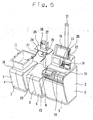
- the shopping basket table 1, the collecting base 3 and the accounting unit 2 are arranged in this order from left to right, and the scanning block 22 is detached from the accounting unit 2 and set on the article placing table 25 of the collecting base 3.
- a reading motion of an article can be performed only by an action of transferring the article a short distance between the shopping basket table 1 and the collecting base 3, thereby a burden to a customer can be reduced.
- the customer scans all the articles to input all the article data, and then executes an accounting process and completes self-checkout in front of the accounting unit 2.
- a lay-out of the shopping basket table 1, the accounting unit 2 and the collecting base 3 is freely changeable. Therefore, even if a certain lay-out is first adopted when the system is installed, another lay-out that is satisfactory to customers can be adopted.
Landscapes
- Physics & Mathematics (AREA)
- General Physics & Mathematics (AREA)
- Cash Registers Or Receiving Machines (AREA)
Abstract
Description
- The present invention relates to a self-checkout system which is utilized as a form of accounting system at a super market, and so on.
- A conventional self-checkout system comprises a weighing unit for weighing a total weight of a basket in which an article(s) is contained before scanning, an accounting unit having a scanner for reading a barcode affixed on the article and having a settlement (transaction) function for executing a settlement based on a scanned data read by the scanner, and a collection base having a plastic bag holder that holds a plastic bag used for collecting a scanned article(s), to constitute an integrated self-check out system. The self-checkout system requires verification as to whether the article is registered correctly. Therefore, as shown in Japanese Laid-Open Publication No. 2002-367030, the total weight is weighed at an upstream and a downstream of a flow of the article in an accounting process. That is, a first weighing part for weighing the total weight of the basket in which the article(s) is contained before scanning, a scanner for reading the article information, and a second weighing part for weighing the total weight of a basket in which the scanned article(s) is contained are allocated on a large counter to constitute an integrated self-checkout system.
- In the conventional self-checkout system, as explained above, each function is provided along the flow of the article in the accounting process. Thus, its usage is standardized, and the article needs to be transferred for a certain long distance, for example, a distance between an entry and an exit of the counter having a certain length along the flow of the article. Further, since the self-checkout system includes a large counter, its installation in a shop is limited, and it lacks the freedom of lay-out.
- Accordingly, an object of the present invention is to provide a self-checkout system expanding the degree of freedom of lay-out.
- To achieve the object of the present invention, a self-checkout system is provided which includes: (i) an accounting unit which includes a scanner to scan at least one article to read data of the article, and which executes a transaction based on the read data of the article, and (ii) a collecting base which includes a loading surface for supporting the scanned article, and a weighing scale for weighing the article supported by the loading surface. The accounting unit and the collecting base are formed as separate units such that an arranging order and an arranging direction of the accounting unit and the collecting base are changeable.
- A more complete appreciation of the present invention' and many of the attendant advantages thereof will be readily obtained as the same becomes better understood by reference to the following detailed description when considered in connection with the accompanying drawings, wherein:
- Fig. 1 is a perspective view showing an embodiment of the present invention;
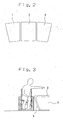
- Fig. 2 is a plane view conceptually showing a lay-out of the embodiment;
- Fig. 3 is a side view showing bodies of a shopping basket, an accounting unit and a collecting base of the embodiment;
- Fig. 4 is a perspective view showing another lay-out of the embodiment; and
- Fig. 5 is a perspective view showing another lay-out of the embodiment.
- An embodiment of the present invention will be explained with reference to Figs. 1 to 5. A shopping basket table 1, an
accounting unit 2, and acollection base 3 are formed asseparate block bodies body 6 of thecollecting base 3 have trapezoidal shapes tapering forward (toward the customer) when seen from the top, andfront faces front face 9 of theaccounting unit 2 is also inclined downward, and a bottom of thefront face 9 is recessed backward. The shopping basket table 1, theaccounting unit 2 and thecollecting base 3 are arranged laterally in such a manner that adjacent side faces approximately contact each other. Thus, the front faces 7, 8 and 9 of the shopping basket table 1, theaccounting unit 2 and thecollecting base 3 are arranged along a circular arc. - The shopping basket table 1 comprises a
weighing scale 10 as a pre-weighing scale on the body 4. Theweighing scale 10 has aloading surface 10a as a pre-loading surface, and ashopping basket 11, in which a customer puts articles he/she wants to buy, is placed on theloading surface 10a. The total weight of theshopping basket 11 is weighed. - Further, the
accounting unit 2 comprises asettlement function part 12 on thebody 5. Acoin change machine 13 and abill change machine 14 are provided below thesettlement function part 12. A table 15 is provided above thecoin change machine 13 and thebill change machine 14. Further, ascanner 16, apassword input machine 17 and areceipt printer 18 are provided above the table 15. Still above them, atouch panel 19 and acard reader 20 are provided. At a central back part of thebody 5, alamp 21 is provided. Thescanner 16 as ascanner block 22 is covered with a cover and is separable from thebody 5. - Further, the
collecting base 3 comprises aweighing scale 23 on thebody 6, which is a different weighing scale from theweighing scale 10 as the pre-weighing scale. Theweighing scale 23 has aloading surface 23a. At a back part of theweighing scale 23, an article placing table 25 is provided via a supportingcolumn 24 standing upward. At a front part of the article placing table 25, a pair ofplastic bag hangers 27 for holding an opening of aplastic bag 26 for receiving articles protrude from the article placing table 25. At a center part of the pair ofplastic bag hangers 27, aplastic bag holder 28 for holding layered unusedplastic bags 26 is provided. - According to the structure explained above, as shown in Fig. 2, the shopping basket table 1, the
accounting unit 2 and thecollecting base 3 are arranged in this order from left to right, and they are located in such a manner that adjacent side faces of the bodies approximately contact each other. Since the shopping basket table 1 and thecollecting base 2 have trapezoidal shapes tapering forward when seen from the top, the front faces 7, 8 and 9 are arranged in a circular arc, that is, in a fan-like fashion. The shopping basket table 1, theaccounting unit 2 and thecollecting base 3 are connected with power supply and signal lines through electric wires (not shown). Further, if radio communication is equipped, which does not require hard-wiring, any arrangement of these bodies is possible for effective communication. - A customer places the
shopping basket 11, in which an article he/she wants to purchase is contained, on theloading surface 10a of theweighing scale 10. Then, a total weight is transmitted as data to thesettlement function part 12, and the customer scans each article by thescanner 16 according to an instruction shown on thetouch panel 19, and puts a scanned article into theplastic bag 26 which is hung on theplastic bag hangers 27 at thecollecting base 3. Theplastic bags 26 are layered and stocked at theplastic bag holder 28, and the customer picks up one of theplastic bags 26 and hangs it open on theplastic bag hangers 27. After all the articles are scanned and put in theplastic bag 26, the customer executes an accounting process on thetouch panel 19. - In this accounting process, a payment method as to either by cash or by card is selected. If cash payment is selected, money is paid into the
coin change machine 13 or thebill change machine 14, whereas if card payment is selected, a card is swiped through thecard reader 20. On completion of the accounting process, a receipt is issued from thereceipt printer 18. When there is change, change is given from thecoin change machine 13 or thebill change machine 14, and then checkout is completed. During this process, the total weight including theshopping basket 11 has been weighed by the weighingscale 10 of the shopping basket table 1, and a total weight of the scanned articles is weighed by the weighingscale 23 of thecollecting base 3. By comparing the weight which is obtained by subtracting a weight of theshopping basket 11 from the weight data obtained by theweighing scale 10, and the weight obtained by theweighing scale 23, whether or not all the registered articles have been transferred to theplastic bag 26 can be confirmed. Thereby, dishonest acts can be prevented. Here, theaccounting unit 2 includes a controller (POS), power supply, and so on to execute control of each machine. - Some kinds of articles can be easily damaged by deformation, and by other reasons. Thus, they may need to be kept out of the
plastic bag 26 until other articles are finished being scanned. In this case, such articles can be placed on the article placing table 25 temporarily, and then can be put in theplastic bag 26 later. - As described above, by arranging the shopping basket table 1, the
accounting unit 2 and thecollecting base 3 in a fan-like fashion, a movement of scanning an article which is taken from theshopping basket 11 on the shopping basket table 1 and is put in theplastic bag 26 on thecollecting base 3 can be performed with a circular movement in such a way that the customer, who stands in front of theaccounting unit 2, turns around. Therefore, the customer can perform a self-checkout process standing at a certain single position. This improves workability. - Further, as shown in Fig. 3, since the front faces 7, 8 and 9 of the shopping basket table 1, the
accounting unit 2 and the collectingbase 3 are inclined downward with bottoms of the front faces being recessed backward, even a customer with a wheelchair can closely approach the shopping basket table 1, theaccounting unit 2 and the collectingbase 3, and thereby operability can be improved. This, to be sure, goes for a standing customer, whose toes can be accommodated in the spaces made under the inclined front faces so that he/she can closely approach the shopping basket table 1, theaccounting unit 2 and the collectingbase 3. This improves workability. Further, as shown in Fig. 1 with a dashed line, thescanner block 22 can be detached from theaccounting unit 2 and can be placed on the article placing table 25. Thereby, scanning of the articles can be performed on the collectingbase 3, and therefore the customer's moving distance becomes shortened and operability can be improved. - Fig. 4 is a perspective view showing another arrangement of the shopping basket table 1, the
accounting unit 2 and the collectingbase 3. Reference numerals used in Figs. 1 to 3 will be used to designate the same elements in Fig. 4 (and Fig. 5), and the overlapping explanations will be omitted. In this arrangement, theaccounting unit 2 is placed laterally on the right side of the shopping basket table 1, and the collectingbase 3 is placed at a right angle position which faces a customer. Since the shopping basket table 1 and the collectingunit 2 are arranged in line and the collectingbase 3 faces the customer at a right angle with respect to the other two units, the units as a whole are in L-shaped arrangement. With this arrangement, the moving distance from theshopping basket 11 to theplastic bag 26 is shortened and operability can be improved. - Fig. 5 is a perspective view showing another arrangement of the shopping basket table 1, the
accounting unit 2 and the collectingbase 3. In this arrangement, the shopping basket table 1, the collectingbase 3 and theaccounting unit 2 are arranged in this order from left to right, and thescanning block 22 is detached from theaccounting unit 2 and set on the article placing table 25 of the collectingbase 3. With this arrangement, a reading motion of an article can be performed only by an action of transferring the article a short distance between the shopping basket table 1 and the collectingbase 3, thereby a burden to a customer can be reduced. With this short distance to transfer the article, the customer scans all the articles to input all the article data, and then executes an accounting process and completes self-checkout in front of theaccounting unit 2. - In the present invention as described above, a lay-out of the shopping basket table 1, the
accounting unit 2 and the collectingbase 3 is freely changeable. Therefore, even if a certain lay-out is first adopted when the system is installed, another lay-out that is satisfactory to customers can be adopted. - It is explicitly stated that all features disclosed in the description and/or the claims are intended to be disclosed separately and independently from each other for the purpose of original disclosure as well as for the purpose of restricting the claimed invention independent of the composition of the features in the embodiments and/or the claims. It is explicitly stated that all value ranges or indications of groups of entities disclose every possible intermediate value or intermediate entity for the purpose of original disclosure as well as for the purpose of restricting the claimed invention, in particular as limits of value ranges.
- It is explicitly stated that all features disclosed in the description and/or the claims are intended to be disclosed separately and independently from each other for the purpose of original disclosure as well as for the purpose of restricting the claimed invention independent of the compositions of the features in the embodiments and/or the claims. It is explicitly stated that all value ranges or indications of groups of entities disclose every possible intermediate value or intermediate entity for the purpose of original disclosure as well as for the purpose of restricting the claimed invention, in particular as limits of value ranges.
Claims (9)
- A self-checkout system, comprising:an accounting unit (2) which includes a scanner (16) to scan at least one article to read data of the article, and which executes a transmission based on the read data of the article; anda collecting base (3) which includes a loading surface (23a) for supporting each scanned article and a weighing scale (23) for weighing the article supported by the loading surface;characterized in that the accounting unit and the collecting base are formed as physically separate units such that an arranging order and an arranging direction of the accounting unit and the collecting base are changeable.
- The self-checkout system according to claim 1, further comprising a shopping basket table (1) which comprises a pre-loading surface (10a) for supporting an article that has not yet been scanned.
- The self-checkout system according to claim 2, wherein the shopping basket table is formed as a separate unit from the accounting unit and the collecting base.
- The self-checkout system according to claim 2, wherein the shopping basket table comprises a pre-weighing scale (10) for weighing the article supported by the pre-loading surface.
- The self-checkout system according to claim 3, wherein the shopping basket table comprises a pre-weighing scale (10) for weighing the article supported by the pre-loading surface.
- The self-checkout system according to claim 1, wherein the scanner is detachable from the accounting unit, to be positioned on the collecting base.
- The self-checkout system according to claims 1 or 6, wherein front faces of bodies of the accounting unit and the collecting base are inclined downward such that bottoms of the front faces are recessed backward.
- The self-checkout system according to any of claims 2 to 5, wherein front faces of bodies of the accounting unit, the collecting base and the shopping basket table are inclined downward such that bottoms of the front faces are recessed backward..
- The self-checkout system according to claims 3 or 8, wherein the accounting unit, the collecting base and the shopping basket table are arranged in a fan-like fashion.
Applications Claiming Priority (1)
| Application Number | Priority Date | Filing Date | Title |
|---|---|---|---|
| JP2005047154A JP2006235816A (en) | 2005-02-23 | 2005-02-23 | Self-checkout system |
Publications (1)
| Publication Number | Publication Date |
|---|---|
| EP1696394A1 true EP1696394A1 (en) | 2006-08-30 |
Family
ID=36083136
Family Applications (1)
| Application Number | Title | Priority Date | Filing Date |
|---|---|---|---|
| EP06001867A Withdrawn EP1696394A1 (en) | 2005-02-23 | 2006-01-30 | Self-service checkout system |
Country Status (4)
| Country | Link |
|---|---|
| US (1) | US20060185936A1 (en) |
| EP (1) | EP1696394A1 (en) |
| JP (1) | JP2006235816A (en) |
| CN (2) | CN100533496C (en) |
Cited By (1)
| Publication number | Priority date | Publication date | Assignee | Title |
|---|---|---|---|---|
| EP3489876A1 (en) * | 2017-11-27 | 2019-05-29 | Toshiba TEC Kabushiki Kaisha | Commodity registration apparatus, checkout apparatus, and information processing method |
Families Citing this family (20)
| Publication number | Priority date | Publication date | Assignee | Title |
|---|---|---|---|---|
| JP4302650B2 (en) * | 2005-02-23 | 2009-07-29 | 東芝テック株式会社 | Self-checkout system |
| US7841522B2 (en) * | 2006-11-28 | 2010-11-30 | International Business Machines Corporation | Apparatus, system, and method for measuring light-weight purchase items |
| JP4918073B2 (en) * | 2008-07-29 | 2012-04-18 | 東芝テック株式会社 | Self-checkout terminal |
| JP5741784B2 (en) * | 2009-03-31 | 2015-07-01 | 株式会社寺岡精工 | Self-checkout system |
| CN102147946A (en) * | 2010-02-05 | 2011-08-10 | 东芝泰格有限公司 | Reading apparatus |
| JP2011191930A (en) * | 2010-03-12 | 2011-09-29 | Toshiba Tec Corp | Checkout processor and checkout processing program |
| JP5038450B2 (en) * | 2010-03-12 | 2012-10-03 | 東芝テック株式会社 | Checkout terminal device and guidance notification program |
| CN102637328A (en) * | 2012-03-27 | 2012-08-15 | 潘晓亮 | Self-service checkout system and method for commodities in supermarket |
| JP5692443B2 (en) * | 2014-05-20 | 2015-04-01 | 株式会社寺岡精工 | Settlement device |
| CN104103135A (en) * | 2014-07-17 | 2014-10-15 | 张国铭 | Radio frequency identification based goods automatic clearing error correction system and method |
| JP6240110B2 (en) * | 2015-03-02 | 2017-11-29 | 東芝テック株式会社 | Sales data processor |
| JP2016162192A (en) * | 2015-03-02 | 2016-09-05 | 東芝テック株式会社 | Sales data processing device |
| JP6036907B2 (en) * | 2015-04-21 | 2016-11-30 | 株式会社寺岡精工 | Payment apparatus and program |
| JP7034615B2 (en) * | 2017-07-07 | 2022-03-14 | 東芝テック株式会社 | Checkout equipment and programs |
| JP7212125B2 (en) * | 2017-11-27 | 2023-01-24 | 東芝テック株式会社 | Checkout device and information processing program |
| USD1014159S1 (en) * | 2020-04-10 | 2024-02-13 | Walmart Apollo, Llc | Dogleg modular bagging area extension device |
| JP2022043795A (en) * | 2020-09-04 | 2022-03-16 | 東芝テック株式会社 | Self-checkout device |
| USD1027519S1 (en) * | 2021-08-04 | 2024-05-21 | Target Brands, Inc. | Self-checkout station |
| USD1116567S1 (en) | 2022-09-19 | 2026-03-10 | Target Brands, Inc. | Self-checkout system |
| US12635816B2 (en) * | 2023-02-01 | 2026-05-26 | Toshiba Global Commerce Solutions, Inc. | Modifiable bagging structure |
Citations (8)
| Publication number | Priority date | Publication date | Assignee | Title |
|---|---|---|---|---|
| US5967263A (en) * | 1997-07-01 | 1999-10-19 | Fujitsu Limited | Check-out counter accessible to disabled persons |
| EP0953948A2 (en) * | 1998-05-01 | 1999-11-03 | Ncr International Inc. | Method of monitoring item shuffling in a post-scan area of a self-service checkout terminal |
| EP1220176A2 (en) * | 2000-12-27 | 2002-07-03 | Ncr International Inc. | Method and apparatus for operating a self-service checkout terminal to access a customer account |
| JP2002367030A (en) | 2001-06-05 | 2002-12-20 | Teraoka Seiko Co Ltd | Self-checkout method and self-checkout system |
| US6540137B1 (en) * | 1999-11-02 | 2003-04-01 | Ncr Corporation | Apparatus and method for operating a checkout system which has a number of payment devices for tendering payment during an assisted checkout transaction |
| US6550583B1 (en) * | 2000-08-21 | 2003-04-22 | Optimal Robotics Corp. | Apparatus for self-serve checkout of large order purchases |
| US20030120547A1 (en) * | 2001-12-26 | 2003-06-26 | Ncr Corporation | Self-checkout system |
| US20040041021A1 (en) * | 2002-08-27 | 2004-03-04 | Ncr Corporation | Modular self checkout system |
Family Cites Families (13)
| Publication number | Priority date | Publication date | Assignee | Title |
|---|---|---|---|---|
| US720543A (en) * | 1902-01-27 | 1903-02-10 | Henry Todd Wiley | Bag holder and filler. |
| US4512540A (en) * | 1983-04-18 | 1985-04-23 | Mcmillin Wire And Plating, Inc. | Plastic bag rack for checkstand |
| US5149947A (en) * | 1989-03-27 | 1992-09-22 | Ncr Corporation | Portable checkout system |
| US5178234A (en) * | 1990-03-15 | 1993-01-12 | Tokyo Electric Co., Ltd. | Checkout apparatus |
| US5115888A (en) * | 1991-02-04 | 1992-05-26 | Howard Schneider | Self-serve checkout system |
| US5543607A (en) * | 1991-02-16 | 1996-08-06 | Hitachi, Ltd. | Self check-out system and POS system |
| US6325290B1 (en) * | 1998-12-04 | 2001-12-04 | Ncr Corporation | Method and apparatus for checking out large items with a self-service checkout terminal |
| US6363355B1 (en) * | 1998-12-21 | 2002-03-26 | Ncr Corporation | Method and apparatus for operating a self-service checkout system having a number of retail terminals associated therewith |
| SE522484C2 (en) * | 2000-09-28 | 2004-02-10 | Xcounter Ab | Collimation of radiation from linear sources for ionizing radiation and related detection of flat beams |
| US20020095343A1 (en) * | 2001-01-12 | 2002-07-18 | Barton Steven P. | Apparatus and method for providing point of purchase products |
| US6491170B1 (en) * | 2001-06-01 | 2002-12-10 | Florendo Madela | Drying and organizing rack for kitchen utensils, flatware and china |
| JP3626738B2 (en) * | 2002-03-22 | 2005-03-09 | 東芝テック株式会社 | Product data reader |
| JP4302650B2 (en) * | 2005-02-23 | 2009-07-29 | 東芝テック株式会社 | Self-checkout system |
-
2005
- 2005-02-23 JP JP2005047154A patent/JP2006235816A/en active Pending
-
2006
- 2006-01-30 EP EP06001867A patent/EP1696394A1/en not_active Withdrawn
- 2006-02-15 US US11/354,451 patent/US20060185936A1/en not_active Abandoned
- 2006-02-23 CN CNB2006100094945A patent/CN100533496C/en not_active Expired - Fee Related
- 2006-02-23 CN CN200910139686A patent/CN101615321A/en active Pending
Patent Citations (8)
| Publication number | Priority date | Publication date | Assignee | Title |
|---|---|---|---|---|
| US5967263A (en) * | 1997-07-01 | 1999-10-19 | Fujitsu Limited | Check-out counter accessible to disabled persons |
| EP0953948A2 (en) * | 1998-05-01 | 1999-11-03 | Ncr International Inc. | Method of monitoring item shuffling in a post-scan area of a self-service checkout terminal |
| US6540137B1 (en) * | 1999-11-02 | 2003-04-01 | Ncr Corporation | Apparatus and method for operating a checkout system which has a number of payment devices for tendering payment during an assisted checkout transaction |
| US6550583B1 (en) * | 2000-08-21 | 2003-04-22 | Optimal Robotics Corp. | Apparatus for self-serve checkout of large order purchases |
| EP1220176A2 (en) * | 2000-12-27 | 2002-07-03 | Ncr International Inc. | Method and apparatus for operating a self-service checkout terminal to access a customer account |
| JP2002367030A (en) | 2001-06-05 | 2002-12-20 | Teraoka Seiko Co Ltd | Self-checkout method and self-checkout system |
| US20030120547A1 (en) * | 2001-12-26 | 2003-06-26 | Ncr Corporation | Self-checkout system |
| US20040041021A1 (en) * | 2002-08-27 | 2004-03-04 | Ncr Corporation | Modular self checkout system |
Cited By (1)
| Publication number | Priority date | Publication date | Assignee | Title |
|---|---|---|---|---|
| EP3489876A1 (en) * | 2017-11-27 | 2019-05-29 | Toshiba TEC Kabushiki Kaisha | Commodity registration apparatus, checkout apparatus, and information processing method |
Also Published As
| Publication number | Publication date |
|---|---|
| CN100533496C (en) | 2009-08-26 |
| CN1825367A (en) | 2006-08-30 |
| US20060185936A1 (en) | 2006-08-24 |
| JP2006235816A (en) | 2006-09-07 |
| CN101615321A (en) | 2009-12-30 |
Similar Documents
| Publication | Publication Date | Title |
|---|---|---|
| US20060185936A1 (en) | Self-checkout system | |
| EP1696395A1 (en) | Self-service checkout system | |
| JP6551474B2 (en) | Product sales data processing device | |
| JP4222054B2 (en) | Product sales data processing device | |
| EP0525546B1 (en) | Check-out device | |
| EP2668878B1 (en) | Checkout stand | |
| US5492199A (en) | Checkout device | |
| JP6606872B2 (en) | Product sales processing device and program | |
| JP2013218437A (en) | Pos system | |
| US6857505B1 (en) | Apparatus and method for utilizing an existing software application during operation of a convertible checkout terminal | |
| CN106781107A (en) | Checkout apparatus | |
| JP3578868B2 (en) | Checkout system | |
| JP5463247B2 (en) | Self-checkout terminal and program | |
| JP2005242728A (en) | POS system | |
| JP6240110B2 (en) | Sales data processor | |
| JP2004227424A (en) | Payment device | |
| JP2020071549A (en) | Shopping support system and shopping support method | |
| JP6759585B2 (en) | POS system and registration counter | |
| JP2018018554A (en) | Sales data processing device | |
| JP5620431B2 (en) | Product sales data processing apparatus and control program | |
| JP5428655B2 (en) | Accounting equipment | |
| JP2017138891A (en) | Housing, and adjustment office with the same | |
| JP2006235906A (en) | Self-checkout system | |
| JP4302714B2 (en) | Self-checkout system and integration stand | |
| JP6782028B2 (en) | Product sales data processing equipment, programs and product sales data processing methods |
Legal Events
| Date | Code | Title | Description |
|---|---|---|---|
| PUAI | Public reference made under article 153(3) epc to a published international application that has entered the european phase |
Free format text: ORIGINAL CODE: 0009012 |
|
| 17P | Request for examination filed |
Effective date: 20060130 |
|
| AK | Designated contracting states |
Kind code of ref document: A1 Designated state(s): AT BE BG CH CY CZ DE DK EE ES FI FR GB GR HU IE IS IT LI LT LU LV MC NL PL PT RO SE SI SK TR |
|
| AX | Request for extension of the european patent |
Extension state: AL BA HR MK YU |
|
| 17Q | First examination report despatched |
Effective date: 20061018 |
|
| AKX | Designation fees paid |
Designated state(s): DE FR GB |
|
| GRAP | Despatch of communication of intention to grant a patent |
Free format text: ORIGINAL CODE: EPIDOSNIGR1 |
|
| STAA | Information on the status of an ep patent application or granted ep patent |
Free format text: STATUS: THE APPLICATION IS DEEMED TO BE WITHDRAWN |
|
| 18D | Application deemed to be withdrawn |
Effective date: 20090728 |