EP1696330B1 - Discoverability and enumeration mechanisms in a hierarchically secure storage system - Google Patents
Discoverability and enumeration mechanisms in a hierarchically secure storage system Download PDFInfo
- Publication number
- EP1696330B1 EP1696330B1 EP06101144.1A EP06101144A EP1696330B1 EP 1696330 B1 EP1696330 B1 EP 1696330B1 EP 06101144 A EP06101144 A EP 06101144A EP 1696330 B1 EP1696330 B1 EP 1696330B1
- Authority
- EP
- European Patent Office
- Prior art keywords
- security
- data
- row
- descriptor
- component
- Prior art date
- Legal status (The legal status is an assumption and is not a legal conclusion. Google has not performed a legal analysis and makes no representation as to the accuracy of the status listed.)
- Not-in-force
Links
Images


Classifications
-
- G—PHYSICS
- G06—COMPUTING OR CALCULATING; COUNTING
- G06F—ELECTRIC DIGITAL DATA PROCESSING
- G06F21/00—Security arrangements for protecting computers, components thereof, programs or data against unauthorised activity
- G06F21/60—Protecting data
- G06F21/62—Protecting access to data via a platform, e.g. using keys or access control rules
- G06F21/6218—Protecting access to data via a platform, e.g. using keys or access control rules to a system of files or objects, e.g. local or distributed file system or database
- G06F21/6227—Protecting access to data via a platform, e.g. using keys or access control rules to a system of files or objects, e.g. local or distributed file system or database where protection concerns the structure of data, e.g. records, types, queries
-
- G—PHYSICS
- G06—COMPUTING OR CALCULATING; COUNTING
- G06F—ELECTRIC DIGITAL DATA PROCESSING
- G06F3/00—Input arrangements for transferring data to be processed into a form capable of being handled by the computer; Output arrangements for transferring data from processing unit to output unit, e.g. interface arrangements
- G06F3/14—Digital output to display device ; Cooperation and interconnection of the display device with other functional units
-
- G—PHYSICS
- G06—COMPUTING OR CALCULATING; COUNTING
- G06F—ELECTRIC DIGITAL DATA PROCESSING
- G06F8/00—Arrangements for software engineering
- G06F8/40—Transformation of program code
- G06F8/52—Binary to binary
-
- Y—GENERAL TAGGING OF NEW TECHNOLOGICAL DEVELOPMENTS; GENERAL TAGGING OF CROSS-SECTIONAL TECHNOLOGIES SPANNING OVER SEVERAL SECTIONS OF THE IPC; TECHNICAL SUBJECTS COVERED BY FORMER USPC CROSS-REFERENCE ART COLLECTIONS [XRACs] AND DIGESTS
- Y10—TECHNICAL SUBJECTS COVERED BY FORMER USPC
- Y10S—TECHNICAL SUBJECTS COVERED BY FORMER USPC CROSS-REFERENCE ART COLLECTIONS [XRACs] AND DIGESTS
- Y10S707/00—Data processing: database and file management or data structures
- Y10S707/99931—Database or file accessing
- Y10S707/99933—Query processing, i.e. searching
-
- Y—GENERAL TAGGING OF NEW TECHNOLOGICAL DEVELOPMENTS; GENERAL TAGGING OF CROSS-SECTIONAL TECHNOLOGIES SPANNING OVER SEVERAL SECTIONS OF THE IPC; TECHNICAL SUBJECTS COVERED BY FORMER USPC CROSS-REFERENCE ART COLLECTIONS [XRACs] AND DIGESTS
- Y10—TECHNICAL SUBJECTS COVERED BY FORMER USPC
- Y10S—TECHNICAL SUBJECTS COVERED BY FORMER USPC CROSS-REFERENCE ART COLLECTIONS [XRACs] AND DIGESTS
- Y10S707/00—Data processing: database and file management or data structures
- Y10S707/99931—Database or file accessing
- Y10S707/99939—Privileged access
Definitions
- Storage systems traditionally use a containment hierarchy to organize units of storage.
- a container and therefore, inherently the units of data maintained within the container, are independently securable to facilitate the provisioning of access to the principals.
- Conventional systems offer discoverability through traversal that could limit access to data upon encountering a container that is not accessible to the principal.
- One limitation is that a principal cannot visualize the global set of data for which they have access. In other words, upon rendering a global set of data, if a container is encountered whereby a user does not have access, the contents (e.g ., units of data) of this container could not be rendered.
- the principal could not visualize (e.g ., discover) or access the contents of the sub-folder even if adequate permissions are in place. This restrictive discoverablity is due to lack of adequate permissions to access the parent folder.
- Yet another limitation of some conventional systems is that accessing data requires adequate permissions in place for all of the containers from the point of connection to the immediate parent of the unit of data in addition to access permissions on the unit of storage.
- permission to access the data may be restricted if access permissions do not exist from the point of connection to the immediate parent where the data is stored.
- Still another limitation is that, for effective enumeration on the existing file system model, traditional storage systems distinguish between data and metadata. For rich end-user types, this separation creates difficulty to recognize the distinction between metadata and data.
- US 6 158 007 A discloses a method and a system allowing to enforce access control based on an authenticated identity of users when accessing data in a database. Furthermore, when storing messages with particular protections, the subject may be easily organized into hierarchical structures to form subject trees, so that the characteristics of a subject are inherited by some or all of its descendent subjects. By the use of such subject trees, it becomes unnecessary to explicitly associate a security policy with each and every subject. A child subject may simply inherit the security policy, and hence the access control list (ACL) and the quality of protection (QOP) of a parent subject.
- ACL access control list
- QOP quality of protection
- US 2003/188198 A1 provides methods, apparatus and computer programs for applying access controls to control operations on hierarchically organized data processing system resources.
- a number of different scopes of applicability can be set in association with an access control, such as an ACL, and this will determine the inheritability, non-inheritability or limited inheritability of the access control for resources in the hierarchy.
- an access control such as an ACL
- the access controls for the relevant branch of the hierarchy are processed to determine an applicable access control-taking account of inheritance attributes which have been set for individual access controls.
- One aspect of the present invention is an apparatus as defined in independent claim 1. Another aspect of the invention is a method as defined in independent claim 14. Still another aspect of the invention is directed to a storage medium storing a program implementing the method as defined in claim 18. Further embodiments of the invention are specified in the respective appended dependent claims.
- a component can be, but is not limited to being, a process running on a processor, a processor, an object, an executable, a thread of execution, a program, and/or a computer.
- an application running on a server and the server can be a component.
- One or more components can reside within a process and/or thread of execution, and a component can be localized on one computer and/or distributed between two or more computers.
- the term to "infer” or “inference” refer generally to the process of reasoning about or inferring states of the system, environment, and/or user from a set of observations as captured via events and/or data. Inference can be employed to identify a specific context or action, or can generate a probability distribution over states, for example. The inference can be probabilistic-that is, the computation of a probability distribution over states of interest based on a consideration of data and events. Inference can also refer to techniques employed for composing higher-level events from a set of events and/or data. Such inference results in the construction of new events or actions from a set of observed events and/or stored event data, whether or not the events are correlated in close temporal proximity, and whether the events and data come from one or several event and data sources.
- aspects of this invention are related to computer systems and more particularly to the discoverability of data maintained in a hierarchically secure storage system(s).
- traditional storage systems have limitations with regard to security-related discoverability mechanisms.
- emerging database-oriented file systems can support rich querying and provide schematized end user types for common data units (e.g ., contacts). These schematized end-user types facilitate and can enhance the interoperability of applications with respect to data.
- the subject invention takes into account a hierarchical representation of data. More particularly, this invention takes into account that data can be "bucketized” into different folders and thereafter placed into different containers. Users can employ these containers to organize their data. For example, data can be organized ( e.g., bucketized) into categories such as pictures, music, documents, etc. Additionally, these categories can be further organized into containers thereby establishing a hierarchical representation of the data. By way of example, within pictures, there could be pictures of "my family", “my vacation”, “my wedding”, etc. As well, sub-categories can exist in accordance with the hierarchy.
- the invention can facilitate associating a security policy (e.g ., security descriptor) with each object.
- a security policy e.g ., security descriptor
- an object can be any data element contained within a container as well as the container itself.
- each object can be represented in an individual row of a table. This row-based representation will be better understood upon a discussion of the figures that follow.
- the security descriptor can enable the provisioning of these objects for data access.
- a security policy can facilitate setting a "my vacations" folder to permit access by anyone in a group, "my family.” As well, within “my vacations” a user can further limit access to certain members of "my family” to access a subfolder (e.g ., "my trip to Seattle”).
- Traditional file systems employ two access modes to retrieve files. First, these systems facilitate a limited discovery method whereby a user can discover data elements for which adequate security permissions exist. The other is a direct access mechanism whereby a user can access a file if the full path is known and permission to access is in place.
- the subject invention can employ a third mode which is a query mode (e.g ., data store filtering) that allows access and discovery based upon security credentials.
- a query mode e.g ., data store filtering
- the subject invention can provide a mechanism to query all data based upon a defined specified property as well as to operate on that data. With this invention, so long as access credentials are in place, the data can be discovered and operated on as desired.
- the subject invention can enable a security policy (e.g., security descriptor) that can be set in the root of a tree-like structure (e.g., hierarchical data organization) and propagated through the tree-like structure to all of the children in the structure.
- a security policy e.g., security descriptor
- the propagated security descriptor can be based upon the parent security policy, child security policy, and/or the type of the object.
- Logic can be employed that effects generating and propagating a security policy throughout a tree-like structure.
- rules-based logic and/or artificial intelligence can be employed to propagate a security policy.
- a user creates a new item.
- security policies e.g ., descriptors
- a user can have a folder (e.g ., container) with permissions and when an object is created, the permissions for the object can be assumed to be the same.
- the permissions propagated to the newly created object can be intelligently determined based on both the permissions for the folder as well as permissions for the object.
- the subject invention can propagate permissions in the "system's context.” Therefore, even if a user does not have permission to an intervening folder, if permissions are in place for a sub, sub-sub, etc. tree-like structure, these permissions can be propagated in accordance with the invention. This aspect will be better understood by considering the aforementioned F1, F2 and F3 example.
- the invention can facilitate a user to view an abstraction of all of the data for which permissions are in place.
- These views can be defined over the entire store and subsequently rendered to a user.
- the view can be defined as an intersection of the items visible from a connection point and the set of security permissions allowed.
- a user can view and/or access items below a connection point for which the user has security permissions to view and/or access.
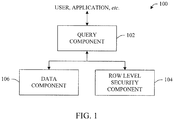
- system 100 can include a query component 102 and a row-level security component 104.
- the query component 102 together with the row-level security component 104 can identify items within a data component 106 that satisfy a security policy or permission.
- the resultant set of data can be rendered to a user and/or application.
- the invention can render the resultant set via a display to a user.
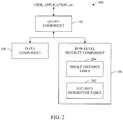
- the row-level security component 104 can include a security descriptor table 202 and a single instance table 204. Each of these tables will be described in greater detail infra.
- the security component 104 can provide a realization of row level security.
- a share e.g ., data component 106
- implicit view definitions for each of the data types can be defined within the scope the connection.
- a view definition for a "Contact" type is an exemplary view definition for a "Contact" type.
- Each item is stored as a row in the entity tables (202, 204).
- the above exemplary expression can effect filtering out the Contact types from the global scope of items in the store. Implicit to this filtering is the dimension of access control where a user would see only those items that are readable according to the security descriptors in the corresponding row.
- a view definition can include the above-identified "WHERE” clause that restricts a view to items that are Contacts. The remainder of the example can restrict access to items from the connection point. It is to be understood that the view definition above does not include the security definition.
- the security mechanism is a function of the row level security stored in tables (202, 204). This mechanism is applied at the underlying table level of the view and has propagating effects on the view.
- security is enabled on a per row basis, the rows for which a user does not have read access do not appear in the resultant set provided by the query component 102.
- each "item" is in a row, and each row has security associated with it.
- the row level security mechanism 104 restricts the rows from appearing in the results for those rows that a user does not have read access.
- the view given a definition conveyed to the query component 102, (as in the above example) can restrict the rendering ( e.g ., viewing) based at least in part upon the connection point. Therefore, the resultant set, can be the intersection of these two restrictions. It will be appreciated that these security mechanisms can occur implicit to the query definition. As a result, the user can be shielded from any of the operations.
- the subject invention employs a single instancing mechanism that checks the security descriptor of each row in the table (e.g., 204).
- This single instancing mechanism makes it possible to appear that the system is performing a check across each row.
- a single instancing of security descriptors across rows can make the check of this mechanism efficient.
- security policies e.g ., access control lists
- ACLs are mentioned above, it is to be understood that other aspects exist that employ disparate security policies. These disparate security policies are intended to fall within the scope of this invention as claimed.
- two tables are maintained - a table of security descriptors 202 and a single instance table of mapping between the hash (e.g ., SHA-1) of the security descriptor and a security descriptor identification (SDID).
- SDID security descriptor identification
- single instancing refers to a mechanism where, for each unique security descriptor in the store, the system maintains a map between the SDID and a hash of the security descriptor.
- the SDID that corresponds to it is stored.
- the user when a user creates an item, the user has a choice to provide a security descriptor or leave it empty. If left empty, the security descriptor can be inherited from the parent from the item being created.
- the system can merge the explicitly defined descriptor with the security descriptor of the parent to create one.
- the invention references the single instance table 204 that includes a mapping of the security descriptor to a hash (e.g., SHA-1 hash) of the security descriptor. Therefore, in order to determine if there exists another item with the same security descriptor, a hash is computed of the subject security descriptor. The system then queries the single instancing table 204 for a row to see if any rows contain the same hash (e.g., SHA-1) of security descriptor. If a match is found, there is a high probability that it exists.
- SHA-1 hash e.g., SHA-1 hash
- a comparison the actual security descriptor is made to verify if the security descriptor exists. If the actual security descriptor is not the same, the system stores the security descriptor independently. It is to be appreciated that the system only relies upon the hash algorithm (e.g ., SHA-1) to guarantee non-uniqueness. In other words, if the hashed value does not match a hashed value in the single instance table 204, a determination can be made that the security descriptor does not exist.
- the hash algorithm e.g ., SHA-1
- the system stores the ID of that particular row for which the security descriptor is relevant.
- the system maps between the hash (e.g., SHA-1) and the SDID.
- the security descriptor table 202 maps between SDID and binary.
- the single instance table 204 and the security descriptor table 202 together give a complete mapping from a SHA-1 hash to SDID to binary. Effectively, these two tables (202,204) can be used to perform a single instancing check.
- a security descriptor can have the following logical form:
- DACL Discretionary Access Control List
- SACL System Access Control List
- a given principal can be granted or denied access to specific items. Accordingly, the denied items can be implicitly filtered out from the user views.
- a filtering engine or query component 102 can scan all the items in the store agnostic to any container semantics and produce a uniform set thereby circumventing the limitations of the traversals in the traditional file systems.
- the two internal tables (202, 204) can be used to facilitate the storage and access control in the system.
- the system can employ a [System.Storage.Store].[Table!SecurityDescriptorSingleInstance] table 204 (e.g., instance table) and a Sys.security_descriptors table 202 (e.g., security descriptor table).
- the Sys.security_descriptors table 202 is a catalog view of security descriptors. These descriptors can be created or deleted using data definition language (DDL) primitives provided by SQL Server.
- the single instance table 204 can key to a central processing unit (CPU) and memory optimizations in the system.
- each unique security descriptor can be stored in the Sys.security_descriptors table 202 and a mapping between the descriptor and its SHA-1 hash can be maintained in the single instance table 204.
- a SHA-1 has does not guarantee uniqueness of outputs, but a collision is extremely improbable given its large output range ( e.g., 2 ⁇ 160). Since the instance table 204 can have a self-healing nature, it can guarantee that the system can auto recover from corruption or inconsistencies.
- Item/Extension/Fragment/Link tables have an entry for the SDID that can be marked with SECURITY attribute. This can ensure that all read access to these tables and any views built on top of these views are subject to an access check requesting (FILE_READ_DATA
- the mechanism described supra can be considered to be at the core of an authorization model in the read path for emerging file systems. Any authorization model can inherently rely on an authentication model.
- the user when a user connects to the store, the user can be authenticated ( e.g ., deemed trustworthy) using the preferred operating system authentication mechanisms (e.g. , NTLM (NT LAN Manager), Kerberos).
- the net result of authentication can be a security token representing the user that is accessing the file system. This token can be used subsequently for making authorization decisions for the principal.
- items secured using row or record level security can be protected from the storage service account as well.
- the service account can be considered like any other NT-brand account. While this can particularly guarantee uniform security semantics, it brings out interesting problems in the update path. For example, consider a user trying to create an item with a given Namespace name. Namespace names in emerging file systems are guaranteed to be unique in their containing folder, providing an unambiguous naming system. During create operations, the system guarantees this uniqueness by ensuring the non-existence of other items in the same folder with the same namespace name.
- Update primitives that require global access to the store can be signed with certificates that are granted "exempt RLS" privilege. From within the context of such a primitive, the system can query the store and row level security will be bypassed in this case.
- data can be organized in a store as an "item” which can refer to the smallest unit of consistency in file system.
- An “item” can be independently secured, serialized, synchronized, copied, backed-up/restored, etc.
- a file system item can be described as an instance of a type whose ancestor is the type System.
- Storage.Item which is an entity type. All items in file system can be stored in a single global extent of items. As well, each item can have a unique identifier which is guaranteed to be unique for all items in a given file system store.
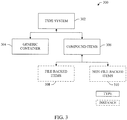
- System 300 is in accordance with the context of this security discussion whereas items in a type system 302 can be classified as instances of generic container types 304 and compound item types 306.
- Generic containers 304 can be used to model folders and any other hierarchical data collection buckets.
- Compound item types 306 can be used to model a single logical unit of data for an application. Instances of this type can give all or nothing semantics for typical data operations like copy, move, sync etc. Examples of the latter include, but are not limited to, mail messages, pictures, contacts, etc.
- Instances (denoted by dashed lines) of compound item types 306 can be further classified as file backed items 308 (FBIs) and non-file backed items 310 (nFBIs). It will be appreciated that a Win32-brand access is semantically limited to FBIs and generic containers.
- Generic containers 304 and compound items 306 can contain any other item types including generic containers. Items within these additional generic containers can also be independently secured. FBIs 308 can not contain other items and hence form leaf nodes in the hierarchy.
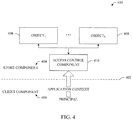
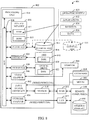
- a file system 400 can include two major components on opposite sides of a trust boundary 402 - a store component 404 and a client component 406.
- store component 404 can include 1 to N object components, where N is an integer.
- Object components 1 to N can be referred to individually or collectively as object components 408.
- the store component 404 that deals with storage and retrieval of the object 408 can form a trusted file system subsystem between the store component 404 and the client component 406.
- the client component 406 which can provide programming semantics to the platform usually runs in the user processes. It will be understood that the users can be authenticated at connection time. Retrieved objects 408 (e.g., items) can be materialized in the client space. In one aspect, no security checks or access constraints are enforced by the client on these objects 408. In accordance with the invention, the store component 404 can enforce access control ( via access control component 410) when the programming context is persisted to the store component 404. Following is a discussion of user authentication.
- File system 400 can expose the notion of a security principal that can perform actions against the items 408 contained in a file system store 404.
- a security principal could be a user or a security group. Accordingly, the security principal can be represented by a security identifier (SID).
- SID security identifier
- file system authentication (e.g., via access control component 410) can be a derivative of the operating system authentication mechanism.
- a file system authentication can be a derivative of a Windows-brand authentication available in the SQL (structured query language) security model.
- SQL offers another built-in authentication mechanism called SQL authentication which may not be supported in file system 400.
- an attempted connection by a Windows-brand user can be authenticated by the file system 400 while leveraging Windows-brand provided authentication services such as Kerberos, NTLM, etc.
- an authenticated user is mapped to a "public" role in SQL which is used for authorization decisions in the store 404.
- a built-in administrator (BA) will be mapped to SQL administrators granting SQL administrative privileges to the BA.
- file system administration can be solely built using file system primitives. As such, BA would not be a member of the SQL administrators in the alternative aspect.
- the net result of the authentication is a security token that represents the principal that accesses the file system 400.
- This data structure can include the SID of the incoming principal as well as the SID's of all the groups for which the principal is a member.
- all privileges held by the user can be, by default, enabled while connecting to file system 400.
- this token can be subsequently used to make authorization decisions.
- a "share” can refer to an alias to an item 408 in the store 410.
- a default share is created aliased to the root item.
- Users with sufficient privilege can create shares aliased to any generic container ( e.g ., item 408) in the store 410.
- the file system can use universal naming convention paths to expose namespace locally and remotely. Hence file system clients connect to a share whereby the connection point together with the relative hierarchy of names constitutes the addressing mechanism to file system objects 408.
- the effective permission on the item can be a function of the security descriptor on the connected share and the item. It is to be understood that the former defines a share level security and the latter defines an item level security. Details on each of these security mechanisms as well as rules for composing the effective security descriptors are described infra.
- file system shares in accordance with the invention are somewhat akin to Windows-brand shares.
- a mirroring share can be created as well.
- Shares can be stored as items in a catalog store and can be securable using item security which is the topic that follows. Permissions on these items and on the shares can be the same granting uniform access semantics on both local and remote access.
- Default permissions can be granted as desired with respect to items. For example, disparate items in a share can have different default permissions applied with respect to user characteristics (e.g ., local system built-in administrator, authenticated, interactive).
- the default values for the share security descriptor are configurable using the registry setting at LanManServer ⁇ DefaultSecurity ⁇ SrvsvcDefaultShareInfo.
- Item security mechanisms can employ security descriptors to effect access control.
- a security descriptor can be communicated by APIs (application program interfaces) in a security descriptor definition language string format and stored in the database in a packed binary format under the VARBINARY column of Sys.Security_Descriptors, the security descriptor table (202 of FIG. 2 ).
- SDID unique ID
- a security descriptor table can appear as follows: SDID SecurityDescriptor VARBINARY 55 XXXXXXXXX 56 XXXXXXXXXXX
- the invention employs two internal tables that can hold security descriptor related information - a security descriptor table (e.g., sys.security_descriptors and a single instance table (e.g., [System.Storage.Store].[Table!SecurityDescriptorSingleInstance]).
- a security descriptor table e.g., sys.security_descriptors
- a single instance table e.g., [System.Storage.Store].[Table!SecurityDescriptorSingleInstance]
- Sys.security_descriptors is a catalog view maintained by SQL. This binary is stored in a corresponding row with the SDID.
- the single instance table can be maintained by the file system. It contains a map of a hash of the binary security descriptor to the SDID identified in the aforementioned Sys.security_descriptors view or table. In one example, a SHA-1 hash can be employed. In one aspect, if multiple items with the same security descriptors are created, a single entry can exist in both the tables.
- another novel feature of the invention is that if the single instance table is ever corrupted, it can be destroyed as it is a self-healing table. In other words, if a corruption were to occur, a new table can be created merely by generating new hash values and associating them to the appropriate SDID.
- Item/Extension/Fragment/Link tables can have an entry for the SDID that is marked with "security" attribute. It will be understood that this can ensure that any read access to these tables and any views built on top of these views could be subject to an access check asking for (FILE_READ_DATA
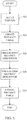
- FIG. 5 illustrates a methodology of initialization in accordance with an aspect of the invention. While, for purposes of simplicity of explanation, the one or more methodologies shown herein, e.g ., in the form of a flow chart, are shown and described as a series of acts, it is to be understood and appreciated that the subject invention is not limited by the order of acts, as some acts may, in accordance with the invention, occur in a different order and/or concurrently with other acts from that shown and described herein. For example, those skilled in the art will understand and appreciate that a methodology could alternatively be represented as a series of interrelated states or events, such as in a state diagram. Moreover, not all illustrated acts may be required to implement a methodology in accordance with the invention.
- While building a model database during the build process security data structures are initialized.
- tables are set up.
- setting up tables can include setting up Sys.server_principals, Sys.database_principals, Sys.server_role_members and Sys.database_role_members.
- a single instance table is created.
- [System.Storage.Store].[Table!SecurityDescriptorSingleInstance] can be created at 504.
- a root security descriptor is created. This root security descriptor corresponds to the root of the store (e.g ., administrators have full control).
- item level security descriptors are created. For example, at 508, security descriptors for tombstone items can be created such that administrators have full control and authenticated users have read access. At 510, these entries are added to the single instance table.
- the file system can support inheritance of ACLs. For example, from the time of item creation (e.g ., CreateItem or CreateComplexItems), the security descriptor for the item can be computed using the supplied security descriptor (if any), the parent security descriptor, the type of item and the token (e.g ., NT-brand token) of the caller.
- the security descriptor for the item can be computed using the supplied security descriptor (if any), the parent security descriptor, the type of item and the token (e.g ., NT-brand token) of the caller.
- ACL propagation throughout the tree-like structure can be performed when SetItemSecurity (with a new DACL or SACL) or MoveItem with a new parent is called. After the appropriate access checks are performed to ensure that the caller is allowed to perform the operation, ACL propagation can be effected in the context of File system. No access checks are done on the subtree-like structure for which ACLs are updated.
- the invention can employ asynchronous and/or synchronous propagation. Following is a discussion of synchronous propagation. It is to be understood that the root of the subtree-like structure has nothing to do with Compound items. Rather, the root of the subtree-like structure is a generic term to describe the node on which SetItemSecurity or MoveItem is called.
- the new security descriptor for the root item is computed. If DACL or SACL are not updated, the SDID if updated for the item, extension, fragment and link tables and the system returns. The entire item subtree-like structure is locked starting at the item. In the example, it is not necessary to lock any other table (Extension, Fragment, Link).
- the temporary table can have the following characteristics.
- the temporary table can have ContainerId, ItemId, and NewSdId.
- NewSdId can be NULL for all but the root of the subtree-like structure.
- the new SD can be computed using the new parent SD, the type of the item and the existing item SD.
- SEF_AVOID_OWNER_CHECK) can be used. Accordingly, the temporary table can be traversed level by level each time processing those rows whose new parent SD has been computed and the new SDID for the item is NULL. In accordance with the example, this walks the table one level at a time.
- the number of iterations is O (e.g., depth of the tree-like structure).
- Two issues can be considered. First, computation of new security descriptors can be considered. Second, update of security descriptors on all children can be considered. In the second scenario, the theoretical limit is O (e.g ., number of children). In the first scenario, although not necessary, it is usually O (depth of the tree). If needed, a new Security Descriptor can be created (e.g ., in the single instance and Sys.security_descriptors tables). Next, the temporary SDID table is updated in the temporary table. Finally, Item, Extension, Link and Fragment table can be updated using the data computed in temporary table.
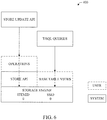
- FIG. 6 illustrates that T/SQL Operations which query the Master Table Views operate in the User Context where Access Control for SELECT statements is enforced by Row Level Security. Additionally, calls to the File system Store Update API are made in the User Context but executed in the System Context. The implementation can therefore enforce permission checks for the caller.
- FIG. 7 illustrates a system 700 that employs artificial intelligence (AI) which facilitates automating one or more features in accordance with the subject invention.
- AI artificial intelligence
- the subject invention e.g ., in connection with implementing security policies
- the classifier can be employed to determine which location will be selected for comparison.
- Such classification can employ a probabilistic and/or statistical-based analysis (e.g ., factoring into the analysis utilities and costs) to prognose or infer an action that a user desires to be automatically performed.
- a support vector machine is an example of a classifier that can be employed.
- the SVM operates by finding a hypersurface in the space of possible inputs, which hypersurface attempts to split the triggering criteria from the non-triggering events. Intuitively, this makes the classification correct for testing data that is near, but not identical to training data.
- Other directed and undirected model classification approaches include, e.g ., naive Bayes, Bayesian networks, decision trees, neural networks, fuzzy logic models, and probabilistic classification models providing different patterns of independence can be employed. Classification as used herein also is inclusive of statistical regression that is utilized to develop models of priority.
- the subject invention can employ classifiers that are explicitly trained (e.g., via a generic training data) as well as implicitly trained (e.g., via observing user behavior, receiving extrinsic information).
- SVM's are configured via a learning or training phase within a classifier constructor and feature selection module.
- the classifier(s) can be used to automatically learn and perform a number of functions, including but not limited to determining according to a predetermined criteria.
- FIG. 8 there is illustrated a block diagram of a computer operable to execute the disclosed architecture.
- FIG. 8 and the following discussion are intended to provide a brief, general description of a suitable computing environment 800 in which the various aspects of the invention can be implemented. While the invention has been described above in the general context of computer-executable instructions that may run on one or more computers, those skilled in the art will recognize that the invention also can be implemented in combination with other program modules and/or as a combination of hardware and software.
- program modules include routines, programs, components, data structures, etc., that perform particular tasks or implement particular abstract data types.
- inventive methods can be practiced with other computer system configurations, including single-processor or multiprocessor computer systems, minicomputers, mainframe computers, as well as personal computers, hand-held computing devices, microprocessor-based or programmable consumer electronics, and the like, each of which can be operatively coupled to one or more associated devices.
- the illustrated aspects of the invention may also be practiced in distributed computing environments where certain tasks are performed by remote processing devices that are linked through a communications network.
- program modules can be located in both local and remote memory storage devices.
- Computer-readable media can be any available media that can be accessed by the computer and includes both volatile and nonvolatile media, removable and non-removable media.
- Computer-readable media can comprise computer storage media and communication media.
- Computer storage media includes both volatile and nonvolatile, removable and non-removable media implemented in any method or technology for storage of information such as computer-readable instructions, data structures, program modules or other data.
- Computer storage media includes, but is not limited to, RAM, ROM, EEPROM, flash memory or other memory technology, CD-ROM, digital video disk (DVD) or other optical disk storage, magnetic cassettes, magnetic tape, magnetic disk storage or other magnetic storage devices, or any other medium which can be used to store the desired information and which can be accessed by the computer.
- Communication media typically embodies computer-readable instructions, data structures, program modules or other data in a modulated data signal such as a carrier wave or other transport mechanism, and includes any information delivery media.
- modulated data signal means a signal that has one or more of its characteristics set or changed in such a manner as to encode information in the signal.
- communication media includes wired media such as a wired network or direct-wired connection, and wireless media such as acoustic, RF, infrared and other wireless media. Combinations of the any of the above should also be included within the scope of computer-readable media.
- the exemplary environment 800 for implementing various aspects of the invention includes a computer 802, the computer 802 including a processing unit 804, a system memory 806 and a system bus 808.
- the system bus 808 couples system components including, but not limited to, the system memory 806 to the processing unit 804.
- the processing unit 804 can be any of various commercially available processors. Dual microprocessors and other multi-processor architectures may also be employed as the processing unit 804.
- the system bus 808 can be any of several types of bus structure that may further interconnect to a memory bus (with or without a memory controller), a peripheral bus, and a local bus using any of a variety of commercially available bus architectures.
- the system memory 806 includes read-only memory (ROM) 810 and random access memory (RAM) 812.
- ROM read-only memory
- RAM random access memory
- a basic input/output system (BIOS) is stored in a non-volatile memory 810 such as ROM, EPROM, EEPROM, which BIOS contains the basic routines that help to transfer information between elements within the computer 802, such as during start-up.
- the RAM 812 can also include a high-speed RAM such as static RAM for caching data.
- the computer 802 further includes an internal hard disk drive (HDD) 814 (e.g., EIDE, SAT A), which internal hard disk drive 814 may also be configured for external use in a suitable chassis (not shown), a magnetic floppy disk drive (FDD) 816, ( e.g., to read from or write to a removable diskette 818) and an optical disk drive 820, ( e.g., reading a CD-ROM disk 822 or, to read from or write to other high capacity optical media such as the DVD).
- the hard disk drive 814, magnetic disk drive 816 and optical disk drive 820 can be connected to the system bus 808 by a hard disk drive interface 824, a magnetic disk drive interface 826 and an optical drive interface 828, respectively.
- the interface 824 for external drive implementations includes at least one or both of Universal Serial Bus (USB) and IEEE 1394 interface technologies. Other external drive connection technologies are within contemplation of the subject invention.
- the drives and their associated computer-readable media provide nonvolatile storage of data, data structures, computer-executable instructions, and so forth.
- the drives and media accommodate the storage of any data in a suitable digital format.
- computer-readable media refers to a HDD, a removable magnetic diskette, and a removable optical media such as a CD or DVD, it should be appreciated by those skilled in the art that other types of media which are readable by a computer, such as zip drives, magnetic cassettes, flash memory cards, cartridges, and the like, may also be used in the exemplary operating environment, and further, that any such media may contain computer-executable instructions for performing the methods of the invention.
- a number of program modules can be stored in the drives and RAM 812, including an operating system 830, one or more application programs 832, other program modules 834 and program data 836. All or portions of the operating system, applications, modules, and/or data can also be cached in the RAM 812. It is appreciated that the invention can be implemented with various commercially available operating systems or combinations of operating systems.
- a user can enter commands and information into the computer 802 through one or more wired/wireless input devices, e.g ., a keyboard 838 and a pointing device, such as a mouse 840.
- Other input devices may include a microphone, an IR remote control, a joystick, a game pad, a stylus pen, touch screen, or the like.
- These and other input devices are often connected to the processing unit 804 through an input device interface 842 that is coupled to the system bus 808, but can be connected by other interfaces, such as a parallel port, an IEEE 1394 serial port, a game port, a USB port, an IR interface, etc.
- a monitor 844 or other type of display device is also connected to the system bus 808 via an interface, such as a video adapter 846.
- a computer typically includes other peripheral output devices (not shown), such as speakers, printers, etc.
- the computer 802 may operate in a networked environment using logical connections via wired and/or wireless communications to one or more remote computers, such as a remote computer(s) 848.
- the remote computer(s) 848 can be a workstation, a server computer, a router, a personal computer, portable computer, microprocessor-based entertainment appliance, a peer device or other common network node, and typically includes many or all of the elements described relative to the computer 802, although, for purposes of brevity, only a memory/storage device 850 is illustrated.
- the logical connections depicted include wired/wireless connectivity to a local area network (LAN) 852 and/or larger networks, e.g., a wide area network (WAN) 854.
- LAN and WAN networking environments are commonplace in offices and companies, and facilitate enterprise-wide computer networks, such as intranets, all of which may connect to a global communications network, e.g ., the Internet.
- the computer 802 When used in a LAN networking environment, the computer 802 is connected to the local network 852 through a wired and/or wireless communication network interface or adapter 856.
- the adaptor 856 may facilitate wired or wireless communication to the LAN 852, which may also include a wireless access point disposed thereon for communicating with the wireless adaptor 856.
- the computer 802 can include a modem 858, or is connected to a communications server on the WAN 854, or has other means for establishing communications over the WAN 854, such as by way of the Internet.
- the modem 858 which can be internal or external and a wired or wireless device, is connected to the system bus 808 via the serial port interface 842.
- program modules depicted relative to the computer 802, or portions thereof can be stored in the remote memory/storage device 850. It will be appreciated that the network connections shown are exemplary and other means of establishing a communications link between the computers can be used.
- the computer 802 is operable to communicate with any wireless devices or entities operatively disposed in wireless communication, e.g ., a printer, scanner, desktop and/or portable computer, portable data assistant, communications satellite, any piece of equipment or location associated with a wirelessly detectable tag (e.g., a kiosk, news stand, restroom), and telephone.
- any wireless devices or entities operatively disposed in wireless communication e.g ., a printer, scanner, desktop and/or portable computer, portable data assistant, communications satellite, any piece of equipment or location associated with a wirelessly detectable tag (e.g., a kiosk, news stand, restroom), and telephone.
- the communication can be a predefined structure as with a conventional network or simply an ad hoc communication between at least two devices.
- Wi-Fi Wireless Fidelity
- Wi-Fi is a wireless technology similar to that used in a cell phone that enables such devices, e.g ., computers, to send and receive data indoors and out; anywhere within the range of a base station.
- Wi-Fi networks use radio technologies called IEEE 802.11 (a, b, g, etc .) to provide secure, reliable, fast wireless connectivity.
- IEEE 802.11 a, b, g, etc .
- a Wi-Fi network can be used to connect computers to each other, to the Internet, and to wired networks (which use IEEE 802.3 or Ethernet).
- Wi-Fi networks operate in the unlicensed 2.4 and 5 GHz radio bands, at an 11 Mbps (802.1 la) or 54 Mbps (802.11b) data rate, for example, or with products that contain both bands (dual band), so the networks can provide real-world performance similar to the basic 10BaseT wired Ethernet networks used in many offices.
- the system 900 includes one or more client(s) 902.
- the client(s) 902 can be hardware and/or software (e.g ., threads, processes, computing devices).
- the client(s) 902 can house cookie(s) and/or associated contextual information by employing the invention, for example.
- the system 900 also includes one or more server(s) 904.
- the server(s) 904 can also be hardware and/or software (e.g , threads, processes, computing devices).
- the servers 904 can house threads to perform transformations by employing the invention, for example.
- One possible communication between a client 902 and a server 904 can be in the form of a data packet adapted to be transmitted between two or more computer processes.
- the data packet may include a cookie and/or associated contextual information, for example.
- the system 900 includes a communication framework 906 (e.g., a global communication network such as the Internet) that can be employed to facilitate communications between the client(s) 902 and the server(s) 904.
- a communication framework 906 e.g., a global communication network such as the Internet
- Communications can be facilitated via a wired (including optical fiber) and/or wireless technology.
- the client(s) 902 are operatively connected to one or more client data store(s) 908 that can be employed to store information local to the client(s) 902 ( e.g ., cookie(s) and/or associated contextual information).
- the server(s) 904 are operatively connected to one or more server data store(s) 910 that can be employed to store information local to the servers 904.
Landscapes
- Engineering & Computer Science (AREA)
- Theoretical Computer Science (AREA)
- General Engineering & Computer Science (AREA)
- General Physics & Mathematics (AREA)
- Physics & Mathematics (AREA)
- Software Systems (AREA)
- Bioethics (AREA)
- Computer Security & Cryptography (AREA)
- Computer Hardware Design (AREA)
- General Health & Medical Sciences (AREA)
- Health & Medical Sciences (AREA)
- Databases & Information Systems (AREA)
- Human Computer Interaction (AREA)
- Storage Device Security (AREA)
- Information Retrieval, Db Structures And Fs Structures Therefor (AREA)
Applications Claiming Priority (2)
| Application Number | Priority Date | Filing Date | Title |
|---|---|---|---|
| US65753605P | 2005-02-28 | 2005-02-28 | |
| US11/168,589 US7370050B2 (en) | 2005-02-28 | 2005-06-28 | Discoverability and enumeration mechanisms in a hierarchically secure storage system |
Publications (3)
| Publication Number | Publication Date |
|---|---|
| EP1696330A2 EP1696330A2 (en) | 2006-08-30 |
| EP1696330A3 EP1696330A3 (en) | 2012-08-15 |
| EP1696330B1 true EP1696330B1 (en) | 2017-03-22 |
Family
ID=36579947
Family Applications (1)
| Application Number | Title | Priority Date | Filing Date |
|---|---|---|---|
| EP06101144.1A Not-in-force EP1696330B1 (en) | 2005-02-28 | 2006-02-01 | Discoverability and enumeration mechanisms in a hierarchically secure storage system |
Country Status (9)
| Country | Link |
|---|---|
| US (1) | US7370050B2 (enExample) |
| EP (1) | EP1696330B1 (enExample) |
| JP (1) | JP4896541B2 (enExample) |
| KR (1) | KR101224703B1 (enExample) |
| AU (1) | AU2006200199B2 (enExample) |
| BR (1) | BRPI0600129A (enExample) |
| CA (1) | CA2533864C (enExample) |
| ES (1) | ES2627855T3 (enExample) |
| RU (1) | RU2408070C2 (enExample) |
Families Citing this family (59)
| Publication number | Priority date | Publication date | Assignee | Title |
|---|---|---|---|---|
| US7831795B2 (en) | 2005-11-28 | 2010-11-09 | Commvault Systems, Inc. | Systems and methods for classifying and transferring information in a storage network |
| US20200257596A1 (en) | 2005-12-19 | 2020-08-13 | Commvault Systems, Inc. | Systems and methods of unified reconstruction in storage systems |
| US8930496B2 (en) | 2005-12-19 | 2015-01-06 | Commvault Systems, Inc. | Systems and methods of unified reconstruction in storage systems |
| US7693851B2 (en) * | 2005-12-30 | 2010-04-06 | Sap Ag | Systems and methods for implementing a shared space in a provider-tenant environment |
| US20070156849A1 (en) * | 2005-12-30 | 2007-07-05 | Wolfgang Becker | Systems and methods for delivering software upgrades in a provider-tenant environment |
| US7917607B2 (en) * | 2005-12-30 | 2011-03-29 | Sap Ag | Software management systems and methods, including use of such systems and methods in a provider-tenant environment |
| US7680825B2 (en) | 2005-12-30 | 2010-03-16 | Sap Ag | Systems and methods for generating tenant-specific properties for use in a provider-tenant environment |
| US20070156901A1 (en) * | 2005-12-30 | 2007-07-05 | Wolfgang Becker | Generation and use of table links in a provider-tenant environment |
| US7698284B2 (en) * | 2005-12-30 | 2010-04-13 | Sap Ag | Systems and methods for deploying a tenant in a provider-tenant environment |
| US7689593B2 (en) | 2005-12-30 | 2010-03-30 | Sap Ag | Systems and methods for accessing a shared space in a provider-tenant environment |
| US20070162969A1 (en) * | 2005-12-30 | 2007-07-12 | Becker Wolfgang A | Provider-tenant systems, and methods for using the same |
| US20070156902A1 (en) * | 2005-12-30 | 2007-07-05 | Becker Wolfgang A | Systems and methods for implementing a tenant space in a provider-tenant environment |
| US7756821B2 (en) * | 2006-11-02 | 2010-07-13 | Microsoft Corporation | Virtual deletion in merged file system directories |
| US8027993B2 (en) * | 2006-12-28 | 2011-09-27 | Teradota Us, Inc. | Techniques for establishing and enforcing row level database security |
| US20080162587A1 (en) * | 2006-12-29 | 2008-07-03 | Ulrich Auer | Server synchronization for maintenance activities |
| US7933869B2 (en) * | 2006-12-29 | 2011-04-26 | Sap Ag | Method and system for cloning a tenant database in a multi-tenant system |
| US20080162483A1 (en) * | 2006-12-29 | 2008-07-03 | Becker Wolfgang A | Methods and systems for protecting shared tables against unauthorized overwriting from a tenant space in a mega-tenancy environment |
| US20080162536A1 (en) * | 2006-12-29 | 2008-07-03 | Becker Wolfgang A | Systems and methods for extending shared data structures with tenant content in a provider-tenant environment |
| US8069184B2 (en) | 2006-12-29 | 2011-11-29 | Sap Ag | Systems and methods to implement extensibility of tenant content in a provider-tenant environment |
| US20080162490A1 (en) * | 2006-12-29 | 2008-07-03 | Becker Wolfgang A | Methods and systems for automatic registration during deployment of a tenant |
| US7739348B2 (en) * | 2006-12-29 | 2010-06-15 | Sap Ag | Systems and methods for accessing a shared space in a provider-tenant environment by using middleware |
| US9286385B2 (en) * | 2007-04-25 | 2016-03-15 | Samsung Electronics Co., Ltd. | Method and system for providing access to information of potential interest to a user |
| US8315999B2 (en) | 2007-08-29 | 2012-11-20 | Nirvanix, Inc. | Policy-based file management for a storage delivery network |
| US20090144183A1 (en) * | 2007-08-29 | 2009-06-04 | Nirvanix, Inc. | Managing user accounts for storage delivery network |
| US9900347B2 (en) * | 2007-09-14 | 2018-02-20 | Telefonaktiebolaget Lm Ericsson (Publ) | Handling trust in an IP multimedia subsystem communication network |
| US8316442B2 (en) * | 2008-01-15 | 2012-11-20 | Microsoft Corporation | Preventing secure data from leaving the network perimeter |
| US8296820B2 (en) * | 2008-01-18 | 2012-10-23 | International Business Machines Corporation | Applying security policies to multiple systems and controlling policy propagation |
| US8296301B2 (en) | 2008-01-30 | 2012-10-23 | Commvault Systems, Inc. | Systems and methods for probabilistic data classification |
| US7836174B2 (en) | 2008-01-30 | 2010-11-16 | Commvault Systems, Inc. | Systems and methods for grid-based data scanning |
| US20090282043A1 (en) * | 2008-05-07 | 2009-11-12 | Srinivas Ganesh Dharmavaram | System And Method For Concurrency Control Of Logically Grouped Shared Objects In A Multi-User Environment |
| US9047277B2 (en) * | 2008-12-18 | 2015-06-02 | Adobe Systems Incorporated | Systems and methods for synchronizing hierarchical repositories |
| US8224828B2 (en) | 2009-12-22 | 2012-07-17 | Sap Ag | Multi-client generic persistence for extension fields |
| US8572760B2 (en) * | 2010-08-10 | 2013-10-29 | Benefitfocus.Com, Inc. | Systems and methods for secure agent information |
| US8892523B2 (en) | 2012-06-08 | 2014-11-18 | Commvault Systems, Inc. | Auto summarization of content |
| US9069817B2 (en) | 2012-11-28 | 2015-06-30 | International Business Machines Corporation | Database row access control |
| US8959595B2 (en) | 2013-03-15 | 2015-02-17 | Bullaproof, Inc. | Methods and systems for providing secure transactions |
| US10038550B2 (en) | 2013-08-08 | 2018-07-31 | Intel Corporation | Instruction and logic to provide a secure cipher hash round functionality |
| US9456335B2 (en) | 2013-09-21 | 2016-09-27 | Oracle International Corporation | Method and system for defining an offlinable model graph |
| US9848330B2 (en) * | 2014-04-09 | 2017-12-19 | Microsoft Technology Licensing, Llc | Device policy manager |
| CN106155298B (zh) | 2015-04-21 | 2019-11-08 | 阿里巴巴集团控股有限公司 | 人机识别方法及装置、行为特征数据的采集方法及装置 |
| US10055471B2 (en) | 2015-11-18 | 2018-08-21 | American Express Travel Related Services Company, Inc. | Integrated big data interface for multiple storage types |
| US10445324B2 (en) | 2015-11-18 | 2019-10-15 | American Express Travel Related Services Company, Inc. | Systems and methods for tracking sensitive data in a big data environment |
| US10169601B2 (en) | 2015-11-18 | 2019-01-01 | American Express Travel Related Services Company, Inc. | System and method for reading and writing to big data storage formats |
| US10037329B2 (en) | 2015-11-18 | 2018-07-31 | American Express Travel Related Services Company, Inc. | System and method for automatically capturing and recording lineage data for big data records |
| US10055444B2 (en) * | 2015-12-16 | 2018-08-21 | American Express Travel Related Services Company, Inc. | Systems and methods for access control over changing big data structures |
| US10540516B2 (en) | 2016-10-13 | 2020-01-21 | Commvault Systems, Inc. | Data protection within an unsecured storage environment |
| US10389810B2 (en) | 2016-11-02 | 2019-08-20 | Commvault Systems, Inc. | Multi-threaded scanning of distributed file systems |
| US10922189B2 (en) | 2016-11-02 | 2021-02-16 | Commvault Systems, Inc. | Historical network data-based scanning thread generation |
| US11295326B2 (en) | 2017-01-31 | 2022-04-05 | American Express Travel Related Services Company, Inc. | Insights on a data platform |
| US20190181901A1 (en) * | 2017-12-08 | 2019-06-13 | T-Mobile Usa, Inc. | Local profile assistant and application programming interface |
| US20190251204A1 (en) | 2018-02-14 | 2019-08-15 | Commvault Systems, Inc. | Targeted search of backup data using calendar event data |
| US10642886B2 (en) | 2018-02-14 | 2020-05-05 | Commvault Systems, Inc. | Targeted search of backup data using facial recognition |
| US11695777B2 (en) * | 2019-02-26 | 2023-07-04 | Vmware, Inc. | Hybrid access control model in computer systems |
| US12118106B2 (en) * | 2019-02-27 | 2024-10-15 | K2 Software, Inc. | Methods and systems for extending row-level security policies |
| RU2718233C1 (ru) * | 2019-10-01 | 2020-03-31 | Общество с ограниченной ответственностью «ПИРФ» (ООО «ПИРФ») | Способ построения файловой системы на базе иерархии узлов |
| US11397826B2 (en) | 2020-10-29 | 2022-07-26 | Snowflake Inc. | Row-level security |
| EP4092556A1 (en) * | 2021-05-20 | 2022-11-23 | Nordic Semiconductor ASA | Bus decoder |
| US20250199826A1 (en) * | 2023-12-14 | 2025-06-19 | Notion Labs, Inc. | Workspace content search based on access permissions |
| CN120528713B (zh) * | 2025-07-24 | 2025-10-24 | 安徽华之邦信息科技有限公司 | 一种云安全管理系统及其方法 |
Family Cites Families (16)
| Publication number | Priority date | Publication date | Assignee | Title |
|---|---|---|---|---|
| US5701400A (en) * | 1995-03-08 | 1997-12-23 | Amado; Carlos Armando | Method and apparatus for applying if-then-else rules to data sets in a relational data base and generating from the results of application of said rules a database of diagnostics linked to said data sets to aid executive analysis of financial data |
| US6158007A (en) * | 1997-09-17 | 2000-12-05 | Jahanshah Moreh | Security system for event based middleware |
| US6457130B2 (en) * | 1998-03-03 | 2002-09-24 | Network Appliance, Inc. | File access control in a multi-protocol file server |
| US6308181B1 (en) * | 1998-12-19 | 2001-10-23 | Novell, Inc. | Access control with delayed binding of object identifiers |
| US7111321B1 (en) * | 1999-01-25 | 2006-09-19 | Dell Products L.P. | Portable computer system with hierarchical and token-based security policies |
| US7117376B2 (en) * | 2000-12-28 | 2006-10-03 | Intel Corporation | Platform and method of creating a secure boot that enforces proper user authentication and enforces hardware configurations |
| RU2207618C2 (ru) * | 2001-08-27 | 2003-06-27 | Щеглов Андрей Юрьевич | Система контроля доступа к информационным ресурсам |
| US7509356B2 (en) * | 2001-09-06 | 2009-03-24 | Iron Mountain Incorporated | Data backup |
| GB0207354D0 (en) * | 2002-03-28 | 2002-05-08 | Ibm | Inheritance of access controls within a hierarchy of data processing system resources |
| US7240046B2 (en) * | 2002-09-04 | 2007-07-03 | International Business Machines Corporation | Row-level security in a relational database management system |
| JP3982623B2 (ja) * | 2003-03-25 | 2007-09-26 | インターナショナル・ビジネス・マシーンズ・コーポレーション | 情報処理装置、データベース検索システム及びプログラム |
| US20050070276A1 (en) * | 2003-09-26 | 2005-03-31 | Mcgarry Rob | Systems and methods that provide modes of access for a phone |
| KR100553273B1 (ko) * | 2003-11-14 | 2006-02-22 | 주식회사 넷츠 | 엑스트라넷 액세스제어 장치 및 방법 |
| US20050138393A1 (en) * | 2003-12-22 | 2005-06-23 | Challener David C. | Determining user security level using trusted hardware device |
| US8990254B2 (en) * | 2004-07-02 | 2015-03-24 | Ellie Mae, Inc. | Loan origination software system for processing mortgage loans over a distributed network |
| US7549158B2 (en) * | 2004-08-31 | 2009-06-16 | Microsoft Corporation | Method and system for customizing a security policy |
-
2005
- 2005-06-28 US US11/168,589 patent/US7370050B2/en not_active Expired - Fee Related
-
2006
- 2006-01-09 KR KR1020060002250A patent/KR101224703B1/ko not_active Expired - Fee Related
- 2006-01-17 AU AU2006200199A patent/AU2006200199B2/en not_active Ceased
- 2006-01-23 RU RU2006101820/08A patent/RU2408070C2/ru not_active IP Right Cessation
- 2006-01-24 BR BRPI0600129-7A patent/BRPI0600129A/pt not_active IP Right Cessation
- 2006-01-24 CA CA2533864A patent/CA2533864C/en not_active Expired - Fee Related
- 2006-02-01 ES ES06101144.1T patent/ES2627855T3/es active Active
- 2006-02-01 EP EP06101144.1A patent/EP1696330B1/en not_active Not-in-force
- 2006-02-21 JP JP2006044459A patent/JP4896541B2/ja not_active Expired - Fee Related
Non-Patent Citations (1)
| Title |
|---|
| None * |
Also Published As
| Publication number | Publication date |
|---|---|
| RU2006101820A (ru) | 2007-08-10 |
| AU2006200199B2 (en) | 2010-11-25 |
| BRPI0600129A (pt) | 2006-10-24 |
| KR20060095451A (ko) | 2006-08-31 |
| EP1696330A3 (en) | 2012-08-15 |
| EP1696330A2 (en) | 2006-08-30 |
| US20060195449A1 (en) | 2006-08-31 |
| CA2533864C (en) | 2013-12-24 |
| ES2627855T3 (es) | 2017-07-31 |
| RU2408070C2 (ru) | 2010-12-27 |
| JP4896541B2 (ja) | 2012-03-14 |
| KR101224703B1 (ko) | 2013-01-21 |
| US7370050B2 (en) | 2008-05-06 |
| AU2006200199A1 (en) | 2006-09-14 |
| CA2533864A1 (en) | 2006-08-28 |
| JP2006244485A (ja) | 2006-09-14 |
Similar Documents
| Publication | Publication Date | Title |
|---|---|---|
| EP1696330B1 (en) | Discoverability and enumeration mechanisms in a hierarchically secure storage system | |
| US6308181B1 (en) | Access control with delayed binding of object identifiers | |
| US11574070B2 (en) | Application specific schema extensions for a hierarchical data structure | |
| KR101265815B1 (ko) | 강화된 보안 모델을 제공하는 시스템 및 방법 | |
| KR100959473B1 (ko) | 저장 플랫폼과 애플리케이션 프로그램 사이의 애플리케이션프로그래밍 인터페이스 | |
| CA2538506C (en) | A directory system | |
| KR101024730B1 (ko) | 항목 기반 저장 플랫폼 내에서 데이터 모델링하기 위한시스템 및 방법 | |
| US8180812B2 (en) | Templates for configuring file shares | |
| US5878415A (en) | Controlling access to objects in a hierarchical database | |
| US20070100830A1 (en) | Method and apparatus for access control list (ACL) binding in a data processing system | |
| US7779265B2 (en) | Access control list inheritance thru object(s) | |
| US20050050537A1 (en) | Systems and method for representing relationships between units of information manageable by a hardware/software interface system | |
| US20050055380A1 (en) | Systems and methods for separating units of information manageable by a hardware/software interface system from their physical organization | |
| US20050049993A1 (en) | Systems and methods for data modeling in an item-based storage platform | |
| US20050050053A1 (en) | Systems and methods for the implementation of a core schema for providing a top-level structure for organizing units of information manageable by a hardware/software interface system | |
| MX2007014551A (es) | Autorizacion unificada para aplicaciones heterogeneas. | |
| JP2005050335A (ja) | データ項目のためのゾーンベースのセキュリティ管理 | |
| US11100129B1 (en) | Providing a consistent view of associations between independently replicated data objects | |
| MXPA06001884A (en) | Discoverability and enumeration mechanisms in a hierarchically secure storage system |
Legal Events
| Date | Code | Title | Description |
|---|---|---|---|
| PUAI | Public reference made under article 153(3) epc to a published international application that has entered the european phase |
Free format text: ORIGINAL CODE: 0009012 |
|
| AK | Designated contracting states |
Kind code of ref document: A2 Designated state(s): AT BE BG CH CY CZ DE DK EE ES FI FR GB GR HU IE IS IT LI LT LU LV MC NL PL PT RO SE SI SK TR |
|
| AX | Request for extension of the european patent |
Extension state: AL BA HR MK YU |
|
| 17P | Request for examination filed |
Effective date: 20070226 |
|
| PUAL | Search report despatched |
Free format text: ORIGINAL CODE: 0009013 |
|
| AK | Designated contracting states |
Kind code of ref document: A3 Designated state(s): AT BE BG CH CY CZ DE DK EE ES FI FR GB GR HU IE IS IT LI LT LU LV MC NL PL PT RO SE SI SK TR |
|
| AX | Request for extension of the european patent |
Extension state: AL BA HR MK YU |
|
| RIC1 | Information provided on ipc code assigned before grant |
Ipc: G06F 21/24 20060101AFI20120712BHEP Ipc: G06F 12/00 20060101ALI20120712BHEP |
|
| AKX | Designation fees paid |
Designated state(s): AT BE BG CH CY CZ DE DK EE ES FI FR GB GR HU IE IS IT LI LT LU LV MC NL PL PT RO SE SI SK TR |
|
| RAP1 | Party data changed (applicant data changed or rights of an application transferred) |
Owner name: MICROSOFT TECHNOLOGY LICENSING, LLC |
|
| REG | Reference to a national code |
Ref country code: DE Ref legal event code: R079 Ref document number: 602006052026 Country of ref document: DE Free format text: PREVIOUS MAIN CLASS: G06F0012000000 Ipc: G06F0021140000 |
|
| GRAP | Despatch of communication of intention to grant a patent |
Free format text: ORIGINAL CODE: EPIDOSNIGR1 |
|
| RIC1 | Information provided on ipc code assigned before grant |
Ipc: G06F 21/62 20130101ALI20160915BHEP Ipc: G06F 21/14 20130101AFI20160915BHEP |
|
| INTG | Intention to grant announced |
Effective date: 20160928 |
|
| GRAS | Grant fee paid |
Free format text: ORIGINAL CODE: EPIDOSNIGR3 |
|
| GRAA | (expected) grant |
Free format text: ORIGINAL CODE: 0009210 |
|
| AK | Designated contracting states |
Kind code of ref document: B1 Designated state(s): AT BE BG CH CY CZ DE DK EE ES FI FR GB GR HU IE IS IT LI LT LU LV MC NL PL PT RO SE SI SK TR |
|
| REG | Reference to a national code |
Ref country code: GB Ref legal event code: FG4D |
|
| REG | Reference to a national code |
Ref country code: CH Ref legal event code: EP |
|
| REG | Reference to a national code |
Ref country code: AT Ref legal event code: REF Ref document number: 878424 Country of ref document: AT Kind code of ref document: T Effective date: 20170415 |
|
| REG | Reference to a national code |
Ref country code: IE Ref legal event code: FG4D |
|
| REG | Reference to a national code |
Ref country code: DE Ref legal event code: R096 Ref document number: 602006052026 Country of ref document: DE |
|
| REG | Reference to a national code |
Ref country code: NL Ref legal event code: FP |
|
| PG25 | Lapsed in a contracting state [announced via postgrant information from national office to epo] |
Ref country code: FI Free format text: LAPSE BECAUSE OF FAILURE TO SUBMIT A TRANSLATION OF THE DESCRIPTION OR TO PAY THE FEE WITHIN THE PRESCRIBED TIME-LIMIT Effective date: 20170322 Ref country code: LT Free format text: LAPSE BECAUSE OF FAILURE TO SUBMIT A TRANSLATION OF THE DESCRIPTION OR TO PAY THE FEE WITHIN THE PRESCRIBED TIME-LIMIT Effective date: 20170322 Ref country code: GR Free format text: LAPSE BECAUSE OF FAILURE TO SUBMIT A TRANSLATION OF THE DESCRIPTION OR TO PAY THE FEE WITHIN THE PRESCRIBED TIME-LIMIT Effective date: 20170623 |
|
| REG | Reference to a national code |
Ref country code: ES Ref legal event code: FG2A Ref document number: 2627855 Country of ref document: ES Kind code of ref document: T3 Effective date: 20170731 |
|
| REG | Reference to a national code |
Ref country code: LT Ref legal event code: MG4D |
|
| REG | Reference to a national code |
Ref country code: AT Ref legal event code: MK05 Ref document number: 878424 Country of ref document: AT Kind code of ref document: T Effective date: 20170322 |
|
| PG25 | Lapsed in a contracting state [announced via postgrant information from national office to epo] |
Ref country code: BG Free format text: LAPSE BECAUSE OF FAILURE TO SUBMIT A TRANSLATION OF THE DESCRIPTION OR TO PAY THE FEE WITHIN THE PRESCRIBED TIME-LIMIT Effective date: 20170622 Ref country code: SE Free format text: LAPSE BECAUSE OF FAILURE TO SUBMIT A TRANSLATION OF THE DESCRIPTION OR TO PAY THE FEE WITHIN THE PRESCRIBED TIME-LIMIT Effective date: 20170322 Ref country code: LV Free format text: LAPSE BECAUSE OF FAILURE TO SUBMIT A TRANSLATION OF THE DESCRIPTION OR TO PAY THE FEE WITHIN THE PRESCRIBED TIME-LIMIT Effective date: 20170322 |
|
| PG25 | Lapsed in a contracting state [announced via postgrant information from national office to epo] |
Ref country code: EE Free format text: LAPSE BECAUSE OF FAILURE TO SUBMIT A TRANSLATION OF THE DESCRIPTION OR TO PAY THE FEE WITHIN THE PRESCRIBED TIME-LIMIT Effective date: 20170322 Ref country code: AT Free format text: LAPSE BECAUSE OF FAILURE TO SUBMIT A TRANSLATION OF THE DESCRIPTION OR TO PAY THE FEE WITHIN THE PRESCRIBED TIME-LIMIT Effective date: 20170322 Ref country code: RO Free format text: LAPSE BECAUSE OF FAILURE TO SUBMIT A TRANSLATION OF THE DESCRIPTION OR TO PAY THE FEE WITHIN THE PRESCRIBED TIME-LIMIT Effective date: 20170322 Ref country code: SK Free format text: LAPSE BECAUSE OF FAILURE TO SUBMIT A TRANSLATION OF THE DESCRIPTION OR TO PAY THE FEE WITHIN THE PRESCRIBED TIME-LIMIT Effective date: 20170322 Ref country code: CZ Free format text: LAPSE BECAUSE OF FAILURE TO SUBMIT A TRANSLATION OF THE DESCRIPTION OR TO PAY THE FEE WITHIN THE PRESCRIBED TIME-LIMIT Effective date: 20170322 |
|
| PG25 | Lapsed in a contracting state [announced via postgrant information from national office to epo] |
Ref country code: IS Free format text: LAPSE BECAUSE OF FAILURE TO SUBMIT A TRANSLATION OF THE DESCRIPTION OR TO PAY THE FEE WITHIN THE PRESCRIBED TIME-LIMIT Effective date: 20170722 Ref country code: PT Free format text: LAPSE BECAUSE OF FAILURE TO SUBMIT A TRANSLATION OF THE DESCRIPTION OR TO PAY THE FEE WITHIN THE PRESCRIBED TIME-LIMIT Effective date: 20170724 Ref country code: PL Free format text: LAPSE BECAUSE OF FAILURE TO SUBMIT A TRANSLATION OF THE DESCRIPTION OR TO PAY THE FEE WITHIN THE PRESCRIBED TIME-LIMIT Effective date: 20170322 |
|
| REG | Reference to a national code |
Ref country code: DE Ref legal event code: R097 Ref document number: 602006052026 Country of ref document: DE |
|
| REG | Reference to a national code |
Ref country code: FR Ref legal event code: PLFP Year of fee payment: 13 |
|
| PLBE | No opposition filed within time limit |
Free format text: ORIGINAL CODE: 0009261 |
|
| STAA | Information on the status of an ep patent application or granted ep patent |
Free format text: STATUS: NO OPPOSITION FILED WITHIN TIME LIMIT |
|
| PG25 | Lapsed in a contracting state [announced via postgrant information from national office to epo] |
Ref country code: DK Free format text: LAPSE BECAUSE OF FAILURE TO SUBMIT A TRANSLATION OF THE DESCRIPTION OR TO PAY THE FEE WITHIN THE PRESCRIBED TIME-LIMIT Effective date: 20170322 |
|
| 26N | No opposition filed |
Effective date: 20180102 |
|
| PG25 | Lapsed in a contracting state [announced via postgrant information from national office to epo] |
Ref country code: SI Free format text: LAPSE BECAUSE OF FAILURE TO SUBMIT A TRANSLATION OF THE DESCRIPTION OR TO PAY THE FEE WITHIN THE PRESCRIBED TIME-LIMIT Effective date: 20170322 |
|
| REG | Reference to a national code |
Ref country code: CH Ref legal event code: PL |
|
| PG25 | Lapsed in a contracting state [announced via postgrant information from national office to epo] |
Ref country code: MC Free format text: LAPSE BECAUSE OF FAILURE TO SUBMIT A TRANSLATION OF THE DESCRIPTION OR TO PAY THE FEE WITHIN THE PRESCRIBED TIME-LIMIT Effective date: 20170322 |
|
| REG | Reference to a national code |
Ref country code: IE Ref legal event code: MM4A |
|
| REG | Reference to a national code |
Ref country code: BE Ref legal event code: MM Effective date: 20180228 |
|
| PG25 | Lapsed in a contracting state [announced via postgrant information from national office to epo] |
Ref country code: LI Free format text: LAPSE BECAUSE OF NON-PAYMENT OF DUE FEES Effective date: 20180228 Ref country code: CH Free format text: LAPSE BECAUSE OF NON-PAYMENT OF DUE FEES Effective date: 20180228 Ref country code: LU Free format text: LAPSE BECAUSE OF NON-PAYMENT OF DUE FEES Effective date: 20180201 |
|
| PG25 | Lapsed in a contracting state [announced via postgrant information from national office to epo] |
Ref country code: IE Free format text: LAPSE BECAUSE OF NON-PAYMENT OF DUE FEES Effective date: 20180201 |
|
| PG25 | Lapsed in a contracting state [announced via postgrant information from national office to epo] |
Ref country code: BE Free format text: LAPSE BECAUSE OF NON-PAYMENT OF DUE FEES Effective date: 20180228 |
|
| PG25 | Lapsed in a contracting state [announced via postgrant information from national office to epo] |
Ref country code: TR Free format text: LAPSE BECAUSE OF FAILURE TO SUBMIT A TRANSLATION OF THE DESCRIPTION OR TO PAY THE FEE WITHIN THE PRESCRIBED TIME-LIMIT Effective date: 20170322 |
|
| PGFP | Annual fee paid to national office [announced via postgrant information from national office to epo] |
Ref country code: GB Payment date: 20200122 Year of fee payment: 15 Ref country code: ES Payment date: 20200302 Year of fee payment: 15 Ref country code: DE Payment date: 20200121 Year of fee payment: 15 Ref country code: IT Payment date: 20200128 Year of fee payment: 15 |
|
| PG25 | Lapsed in a contracting state [announced via postgrant information from national office to epo] |
Ref country code: HU Free format text: LAPSE BECAUSE OF FAILURE TO SUBMIT A TRANSLATION OF THE DESCRIPTION OR TO PAY THE FEE WITHIN THE PRESCRIBED TIME-LIMIT; INVALID AB INITIO Effective date: 20060201 |
|
| PG25 | Lapsed in a contracting state [announced via postgrant information from national office to epo] |
Ref country code: CY Free format text: LAPSE BECAUSE OF FAILURE TO SUBMIT A TRANSLATION OF THE DESCRIPTION OR TO PAY THE FEE WITHIN THE PRESCRIBED TIME-LIMIT Effective date: 20170322 |
|
| PGFP | Annual fee paid to national office [announced via postgrant information from national office to epo] |
Ref country code: FR Payment date: 20200113 Year of fee payment: 15 |
|
| REG | Reference to a national code |
Ref country code: DE Ref legal event code: R119 Ref document number: 602006052026 Country of ref document: DE |
|
| GBPC | Gb: european patent ceased through non-payment of renewal fee |
Effective date: 20210201 |
|
| PG25 | Lapsed in a contracting state [announced via postgrant information from national office to epo] |
Ref country code: GB Free format text: LAPSE BECAUSE OF NON-PAYMENT OF DUE FEES Effective date: 20210201 Ref country code: FR Free format text: LAPSE BECAUSE OF NON-PAYMENT OF DUE FEES Effective date: 20210228 Ref country code: DE Free format text: LAPSE BECAUSE OF NON-PAYMENT OF DUE FEES Effective date: 20210901 |
|
| PG25 | Lapsed in a contracting state [announced via postgrant information from national office to epo] |
Ref country code: IT Free format text: LAPSE BECAUSE OF NON-PAYMENT OF DUE FEES Effective date: 20210201 |
|
| REG | Reference to a national code |
Ref country code: ES Ref legal event code: FD2A Effective date: 20220504 |
|
| PGFP | Annual fee paid to national office [announced via postgrant information from national office to epo] |
Ref country code: NL Payment date: 20220118 Year of fee payment: 17 |
|
| PG25 | Lapsed in a contracting state [announced via postgrant information from national office to epo] |
Ref country code: ES Free format text: LAPSE BECAUSE OF NON-PAYMENT OF DUE FEES Effective date: 20210202 |
|
| P01 | Opt-out of the competence of the unified patent court (upc) registered |
Effective date: 20230505 |
|
| REG | Reference to a national code |
Ref country code: NL Ref legal event code: MM Effective date: 20230301 |
|
| PG25 | Lapsed in a contracting state [announced via postgrant information from national office to epo] |
Ref country code: NL Free format text: LAPSE BECAUSE OF NON-PAYMENT OF DUE FEES Effective date: 20230301 |