EP1693226B1 - Method and system for characterizing blocks of signatures in a bookbinding plant using a transpondeur - Google Patents
Method and system for characterizing blocks of signatures in a bookbinding plant using a transpondeur Download PDFInfo
- Publication number
- EP1693226B1 EP1693226B1 EP20050101322 EP05101322A EP1693226B1 EP 1693226 B1 EP1693226 B1 EP 1693226B1 EP 20050101322 EP20050101322 EP 20050101322 EP 05101322 A EP05101322 A EP 05101322A EP 1693226 B1 EP1693226 B1 EP 1693226B1
- Authority
- EP
- European Patent Office
- Prior art keywords
- signatures
- binding machine
- block
- blocks
- transponder
- Prior art date
- Legal status (The legal status is an assumption and is not a legal conclusion. Google has not performed a legal analysis and makes no representation as to the accuracy of the status listed.)
- Ceased
Links
Images


Classifications
-
- B—PERFORMING OPERATIONS; TRANSPORTING
- B42—BOOKBINDING; ALBUMS; FILES; SPECIAL PRINTED MATTER
- B42C—BOOKBINDING
- B42C19/00—Multi-step processes for making books
-
- B—PERFORMING OPERATIONS; TRANSPORTING
- B42—BOOKBINDING; ALBUMS; FILES; SPECIAL PRINTED MATTER
- B42B—PERMANENTLY ATTACHING TOGETHER SHEETS, QUIRES OR SIGNATURES OR PERMANENTLY ATTACHING OBJECTS THERETO
- B42B2/00—Permanently attaching together sheets, quires or signatures by stitching with filamentary material, e.g. textile threads
- B42B2/02—Machines for stitching with thread
-
- B—PERFORMING OPERATIONS; TRANSPORTING
- B65—CONVEYING; PACKING; STORING; HANDLING THIN OR FILAMENTARY MATERIAL
- B65H—HANDLING THIN OR FILAMENTARY MATERIAL, e.g. SHEETS, WEBS, CABLES
- B65H2511/00—Dimensions; Position; Numbers; Identification; Occurrences
- B65H2511/40—Identification
-
- B—PERFORMING OPERATIONS; TRANSPORTING
- B65—CONVEYING; PACKING; STORING; HANDLING THIN OR FILAMENTARY MATERIAL
- B65H—HANDLING THIN OR FILAMENTARY MATERIAL, e.g. SHEETS, WEBS, CABLES
- B65H2557/00—Means for control not provided for in groups B65H2551/00 - B65H2555/00
- B65H2557/10—Means for control not provided for in groups B65H2551/00 - B65H2555/00 for signal transmission
- B65H2557/13—Data carrier, e.g. chip, transponder, magnetic strip
Definitions
- the present invention relates to the bookbinding field. Particularly, the present invention relates to the production of books in a bookbinding system, and more specifically to the characterization of corresponding blocks of signatures.
- the production of books involves a series of well-defined operations that are performed by corresponding machines of a bookbinding system.
- large printed sheets are provided to a folding machine, where they are folded to obtain corresponding signatures.
- the signatures of the same type are then loaded into respective hoppers of a gathering machine.
- the gathering machine groups the signatures in the correct order, so as to obtain blocks each one defining a book.
- the blocks of signatures are conveyed to a stacking machine that places several blocks of signatures on top of each other.
- the signatures are then distributed to further machines, which complete the corresponding books.
- the blocks of signatures can be either glued or sewn to each other, and the books can be finished with either a soft or a hard cover; every combination of these characteristics involves different operations.
- the production of glued books with soft covers requires a perfect-binding machine that mills the signatures of each block, glues them, and at the end attaches the desired cover; the item so obtained is then passed to a three-knife trimmer machine, which cuts the signatures and the cover along each edge different from the spine (so as to open all the pages of the book).
- the perfect-binding machine mills the signatures of each block and attaches a fastening lining to their spines; the signatures of the book blocks so obtained are cut in the three-knife trimmer machine.
- the book blocks are then passed to a case-in machine for the application of the desired hard covers.
- the production of sewn books with soft covers requires a sewing machine, where the signatures of each block are sewn together by means of continuous threads.
- the book blocks so obtained are passed to the perfect-binding machine, which attaches the desired covers; these items are then cut in the three-knife trimmer machine.
- the book blocks provided by the sewing machine are passed to a back-gluing machine, which attaches the linings to the spines of the signatures.
- the signatures of the book blocks are cut in the three-knife trimmer machine, and are then passed to the case-in machine for the application of the desired hard covers.
- each sewing machine (as well as each perfect-binding machine) may experience a number of error conditions (such as the breaking of a thread, the wrong position of the signature being currently sewn, an error in the sequence of the signatures of the block, and the like).
- error conditions such as the breaking of a thread, the wrong position of the signature being currently sewn, an error in the sequence of the signatures of the block, and the like.
- the occurrence of every error condition causes the sewing machine to stop automatically, with a warning message that is provided to a corresponding operator.
- the operator then opens the sewing machine in order to verify the nature of the error condition. Once the correct operation of the sewing machine has been restored, the operator closes and restarts it manually.
- the book block that was obtained with the sewing machine in the error condition may be defective.
- this book block can loose its compactness and integrity during the next operations (with the signatures that can slide and even detach).
- a signature projecting from the corresponding book block is generally not acceptable.
- Other problems arise when the projecting signature must be removed by the operator (so as to avoid any jamming in the sewing machine), or when the signatures of the book block have been sewn together in the wrong order.
- the defective book blocks should be discarded from a production line implemented by the above-described bookbinding system.
- the identification of these book blocks is quite difficult.
- Another attempted solution is of attaching a label so as to have it project from the signature; in this way, the label remains visible even when further signatures are sewn to form the desired book block.
- a drawback of this solution is that the projecting label can cause a jamming in the sewing machine (or in the following machines of the bookbinding system).
- transponders for characterizing the blocks of signatures.
- an aspect of the present invention proposes a method for producing books in a bookbinding system.
- the method starts with the step of binding blocks of signatures in succession by means of one or more binding machines.
- a transponder is associated with at least one selected of the blocks of signatures inside each binding machine.
- the method continues by emitting an interrogation signal outside the binding machines.
- One or more characteristics of each selected block of signatures can now be sensed according to a response signal, which is returned by the corresponding transponder in response to the interrogation signal.
- the proposed solution allows determining any desired characteristic of the blocks of signatures.
- transponder it is possible to apply the transponder to the block of signatures so as not to interfere with operation of the bookbinding system (thereby preventing any jamming).
- the transponder consists of an acoustic-magnetic tag that is attached to each selected block of signatures.
- This implementation is very simple and cost effective; moreover, it ensures a high level of reliability, thanks to its noise-immunity (for example, to background magnetic fields) and its low sensitivity to the presence of metal objects (as it is typical of industrial environments).
- the transponder is associated with a block of signatures being currently bound in response to the detection of an error condition of the binding machine; it is then possible to identify each selected block of signatures as defective in response to the receipt of the response signal (which is returned by the corresponding transponder).
- This implementation efficiently solves the problem of identifying the blocks of signatures that are defective.
- each defective block of signatures is discarded during its transport to a further machine (for completing corresponding books).
- the transponder is selected so as to return a response signal that is indicative of a category of the error condition; it is then possible to unload each defective block of signatures into a collector associated with the category of the error condition (indicated by the corresponding response signal).
- This additional feature adds more flexibility to the proposed solution (for example, it allows sorting the blocks of signatures for different defects).
- a way to further improve the solution is to stop operation of the binding machine only when the error condition belongs to a first set of categories jeopardizing its operation (while the binding machine continues working when the error condition belongs to a second set of categories that do not jeopardize its operation).
- the response signal returned by each transponder is indicative of one or more attributes of the binding machine.
- the proposed feature provides additional information; for example, this allows analyzing the error conditions that have occurred and strongly facilitates their fixing.
- those attributes include an identifier of the binding machine, an identifier of a setting of the binding machine, an identifier of an operative condition of the binding machine, or a combination thereof.
- the system includes one or more binding machines for binding blocks of signatures in succession. Each binding machine is suitable to allow associating a transponder with at least one selected of the blocks of signatures inside the binding machine.
- the system further includes means for emitting an interrogation signal outside the binding machines. Means is then provided for sensing one or more characteristics of each selected block of signatures according to a response signal, which is returned by the corresponding transponder in response to the interrogation signal.
- a further aspect of the present invention proposes a computer program for performing the above-described method.
- a still further aspect of the invention proposes a product embodying the program.
- a portion of a bookbinding system 100 is illustrated; the system 100 is used to produce sewn books from signatures 105.
- the signatures 105 are supplied to multiple sewing machines 110 (only one shown in the figure). Each machine 110 sews the signatures 105 together by means of continuous threads, so as to obtain a sequence of book blocks 115.
- the book blocks 115 exit the sewing machine 110 on an unloading conveyor 120; in the example at issue, the book blocks 115 are placed side by side with their layers extending transversally to the unloading conveyor 120 (i.e., vertically).
- the unloading conveyor 120 ends with an obstacle bar 125; when the book blocks 115 reach the obstacle bar 125, they fall onto an (independent) decoupling conveyor 130 with their layers parallel thereto (i.e., horizontal).
- the decoupling conveyor 130 has the book blocks 115 pass through a selection station 132; as it will be apparent in the following, the selection station 132 discards any defective book blocks 115.
- the other book blocks 115 are instead unloaded into a box 135 (where they stack on top of each other). Once the box 135 is filled with a predetermined number of book blocks 115 (for example, 5-10), the box 135 lifts and then pivots so as to lay down a resulting stack of book blocks 137 onto a connection conveyor 140.
- connection conveyor 140 feeds the stacks of book blocks 137 to further machines (denoted as a whole with 150), which complete the production of the books (for example, including a back-gluing machine, a three-knife trimmer machine, and a case-in machine).
- the books 155 so obtained are then ready to be delivered to corresponding suppliers.
- the metal strip When the metal strip receives an interrogation signal consisting of a series of pulses at its resonance frequency (for example, with a duration of 1-2 ms at 10-20 ms intervals), it begins oscillating. The metal strip continues oscillating even after receiving the pulses (typically, for 3-10 ms). The presence of the acoustic-magnetic label can then be detected when a corresponding response signal (for example, consisting of a predefined number of pulses generated by the oscillating metal strip) is sensed after the end of each pulse of the interrogation signal.
- a corresponding response signal for example, consisting of a predefined number of pulses generated by the oscillating metal strip
- the acoustic-magnetic labels are substantially insensitive to any background magnetic field that is generated by the machines of the bookbinding system (since they respond to signals having a definite frequency only). Moreover, other metal structures of the bookbinding system do not respond after the end of the pulses of the interrogation signal, and then cannot generate any false response signal.
- the acoustic-magnetic technology is widely used in anti-theft systems; in this case, the acoustic-magnetic label attached to each product on sale can be deactivated at a cash register by demagnetizing it after the product has been bought.
- the labels 205 i of each reservoir 203 i differ in their resonance frequencies, which are slightly offset around the characterizing value of 58 kHz.
- Pliers 210 extract a desired label 205 i from the corresponding reservoir 203 i .
- This label (generically denoted with 205) is then provided to an applier 215, which sticks the label 205 onto the desired block of signatures; particularly, the label 205 is attached to a free layer of a signature 105 of the block being currently sewn; as it will be apparent in the following, this signature 105 can be either a last signature of the block or an internal one (to which further signatures are sewn later on).
- Operation of the sewing machine 110 is managed by a Programmable Logic Controller (PLC) 220.
- PLC Programmable Logic Controller
- a sniffer 255 is arranged below the decoupling conveyor 130.
- the sniffer 255 senses the labels (if any) of each book block 115 passing over it.
- the sniffer 255 continually broadcasts the interrogation signal (for example, whenever the passage of a book block 115 is detected by a corresponding sensor, not shown in the figure); the effective distance of the interrogation signal corresponds to the area just above the sniffer 255, so as to ensure that only the label of the passing book block 115 is activated (and not the ones of the book blocks that are downstream or upstream).
- the sniffer 255 listens for any response signal from the activated label.
- Each discarding section 260 j includes a sloping-down track formed by a pair of idle roller segments 270 j .
- the segments 270 j are controlled by a corresponding actuator 275 j (for example, including a pair of pneumatic pistons). Normally (see discarding section 260 1 ), the segments 270 j are close to each other so as to have the passing book block 115 slide on them.
- the segments 270 j can be spaced apart so as to have the arriving book block 115 fall into a corresponding collection basket 280 j (which is arranged below the decoupling conveyor 130). Operation of the selection station 132 is likewise managed by a further PLC 285.
- the main software components that run on the PLC 220 (of the sewing machine) and on the PLC 285 (of the selection station) are denoted as a whole with the reference 300.
- the information is typically stored on non-volatile memories of the PLCs 220,285 and loaded (at least partially) into corresponding working memories when the programs are running.
- a series of drives 305 control corresponding sensors of the sewing machine; these sensors are used to detect different error conditions of the sewing machine, such as the breaking of a thread, the wrong position of the signature being currently sewn, an error in the sequence of the signatures of the block, and the like.
- Corresponding error signals are passed by the sensor drives 305 to an analyzer 310.
- the analyzer 310 accesses a repository 315 of predefined categories of error conditions (that may occur in the sewing machine). For each possible error condition, the repository 315 stores an identification code of its category.
- Each error code is associated with a corresponding severity flag; the severity flag is deasserted for categories relating to minor error conditions that should not jeopardize operation of the sewing machine (for example, when the signatures are not in the correct sequence), whereas it is asserted for categories relating to critical error conditions that do not allow the sewing machine to continue working properly (for example, when a thread breaks or a signature significantly projects from its block).
- the analyzer 310 drives a controller 320 (which manages operation of the sewing machine) by means of a stop signal. Moreover, the analyzer 310 transmits the error code corresponding to the detected error condition to a selector 325.
- the selector 325 accesses a file 330, which stores configuration information of the sewing machine; for example, the configuration file 330 identifies the sewing machine, the job currently in execution, different characteristics of the jobs (such as whether it is a pre-release), and the like.
- the selector 325 chooses the desired type of labels (among the available ones) according to the error code (received from the analyzer 310) and the configuration information (extracted from the file 330).
- a corresponding label code (identifying the selected type of labels) is then passed to a drive 345 for the pliers.
- the pliers drive 345 controls a further drive 350 for the applier of the labels by means of an enabling signal.
- a drive 355 controls the sniffer of the selection station; the sniffer drive 355 provides the response signal returned by a current label to a decoder 360.
- the decoder 360 determines the error code and the configuration information corresponding to the specific frequency of the response signal received. This information is passed to a sorter 365.
- the sorter 365 accesses a look-up table 375, which associates each error code and/or configuration information item with a corresponding discarding section.
- the PLC 285 also includes a drive 380 j for the actuator of each discarding section; each actuator drive 380 j receives a corresponding enabling signal from the sorter 365.
- the logic flow of a process illustrating operation of the above-described bookbinding system is represented with a method 400.
- the method begins at the black start circle 403 in the swim-lane of the sewing machine, and then passes to block 406 wherein a new job is submitted.
- the signatures are continually extracted from a hopper and supplied in succession to an opening station; the signatures are opened in the middle and placed astride a fixed saddle. Each signature is conveyed to a movable saddle (in an open position); the movable saddle is then closed and the signature is sewn to a previous one.
- a test is made at block 412 to determine whether the desired block is complete (i.e., its last signature has been sewn). If not, the method returns to block 409 for reiterating the same operations.
- the flow of activity then branches at decision block 418 according to the operative mode of the sewing machine. If the sewing machine is set to attach the labels to every book block, the configuration information of the sewing machine is extracted from the corresponding repository at block 421. Descending to block 424, the label representing this configuration information (identified by the corresponding label code) is selected. The desired label is attached at block 427 onto the free layer of the last signature of the book block. The flow of activity then proceeds to block 430; the same point is also reached from block 418 directly when the sewing machine is set to attach the labels to defective book blocks only. In this phase, the book block is placed onto the unloading conveyor of the sewing machine. The method then returns to block 409 for repeating the same operations described above.
- the flow of activity passes from block 409 to block 433 as soon as an error condition is detected in the sewing machine (with the corresponding error signal that is asserted); in response thereto, the error code representing the category of the error condition is determined.
- the configuration information of the sewing machine is extracted from the respective repository. The corresponding label (identified by the label code representing the error condition category and the configuration information) is selected at block 439.
- the flow of activity then branches at block 442 according to the severity flag associated with the error code. If the severity flag is asserted to indicate a critical error condition, the sewing machine is stopped at block 445 (by asserting the stop signal that is provided to its controller).
- the sewing machine is inspected to verify and solve the problem; for example, the operator can reinsert a thread that has broken into the corresponding needle, or s/he can unstitch a signature projecting from the respective book block. Passing to block 451, the operator closes the sewing machine and restarts it manually.
- the method then returns to the swim-lane of the sewing machine at block 454; the same point is also reached from block 442 directly when the severity flag is deasserted (to indicate a minor error condition).
- the label is attached onto the free layer of the available signature of the block (generally, an internal one). The standard flow of activity is then rejoined by going back to block 409.
- the sniffer of the selection station at block 457 broadcasts the interrogation signal in response to a synchronization signal (which is asserted whenever the passage of a book block is detected).
- the flow of activity then branches at decision block 460. Particularly, if a response signal is received it is decoded at block 463.
- a test is now made at block 466 to determine whether the frequency of the response signal is indicative of an error code. If so, the method descends into block 472; in this phase, the book block is classified according to the error code and the configuration information (represented by the response signal), and it is then associated with a corresponding discarding section.
- the actuator of this discarding section is enabled at block 475 (so as to open the corresponding idle roller segments).
- the operation is performed with a delay equal to the time required by the book block to reach the discarding section (depending on its distance from the sniffer and on the speed of the connection conveyor); in this way, when the defective book block reaches the discarding section it falls into the corresponding collection basket.
- the flow of activity then returns to block 457 to reiterate the same operations as soon as a further synchronization signal is received; the same point is also reached directly from block 460 (when no response signal is received) or from block 466 (when the response signal is not representative of any error code).
- the discarded book blocks are collected periodically from the baskets (for example, at the end of the day). In this way, it is possible to put the book blocks that can be reused into a specific basket; for example, the book blocks being sewn in the wrong order or with a projecting signature are unstitched and returned to the beginning of the above-described production line. In any case, it is possible to analyze the defective book blocks for identifying the error conditions that have occurred; in this respect, the information associated with each defective book block is very useful for determining the cause of the corresponding error conditions. Moreover, this information can be collected automatically for obtaining statistical reports about the operation of the different sewing machines in the bookbinding system.
- FIG. 5a-5b An exemplary application of the above-described process is illustrated in Figures 5a-5b.
- a number of signatures 105 have already been sewn together by means of threads 505a and 505b (each one defining a row of plain stitches and a row of looped stitches).
- threads 505a and 505b each one defining a row of plain stitches and a row of looped stitches.
- the corresponding error signal is asserted and the sewing machine is stopped.
- the operator can then recover the problem by re-inserting the broken thread 505b into the eye of the corresponding needle (not shown in the figure).
- the sewing machine is then restarted.
- a label 205 is attached to the free layer of the last signature 105.
- the sewing of the block continues with further signatures 105 that are sewn to the preceding ones (leaving the stitches of the thread 505b interrupted).
- the label 205 is covered by the further signatures 105, so that it is not visible to the outside of the block any longer; in any case, the label 205 can be sensed by the sniffer of the selection station.
- the bookbinding system has a different architecture or includes other components.
- the system can have any number of sewing machines (down to a single one); moreover, it is possible to have additional sewing machines where the proposed solution is not implemented.
- the principles of the invention also apply to equivalent interrogation signals and/or response signals (for example, with multiple selection stations each one for a corresponding sewing machine).
- the labels can work at different frequencies, or they can be replaced with any other acoustic-magnetic tag suitable to the attached to the blocks of signatures.
- the book blocks can be transported (from the sewing machine to the other machines of the bookbinding system) with equivalent elements (such as belts, roller beds, and the like); likewise, the defective book blocks can be discarded with pivoting sections (which divert the defective book blocks towards other conveyors), or with push plates (which moves transversely to the decoupling conveyor).
- the operation of discarding the defective book blocks might be performed along the connection conveyor (even if this would involve the waste of additional book blocks).
- the sniffer whenever the sniffer detects a defective book block it drives the box (being used to stack the book blocks) to lay down the available book blocks onto the connection conveyor (with a delay required for receiving all the book blocks preceding the defective one).
- the box Once the defective book block is unloaded into the (empty) box, the box is driven again to lay down the defective book block alone onto the connection conveyor. The operation of the box can then restart as usual. In this way, the defective book block is isolated and can be discarded later on at any desired point.
- the operations for isolating the defective book block sometimes require a transient slowdown of the production line (so as to allow the box to complete the above-described additional strokes).
- the discarded book blocks can also be collected onto dedicated conveyors that automatically transport them to corresponding handling stations.
- the error conditions can be managed in a similar manner (for example, slowing down operation of the sewing machine if it is necessary).
- the encoding of different attributes of the sewing machine into the response signals is within the scope of the invention (for example, specifying the name of the corresponding operator). Moreover, it is also possible to provide a printer downstream the sniffer (for printing information provided by the response signal returned by each label onto a top layer of the corresponding book block).
- the solution of the invention lends itself to be implemented with programs that are structured in a different way, or with additional modules or functions; likewise, the different memory structures can be of other types, or can be replaced with equivalent entities (not necessarily consisting of physical storage media). Likewise, the proposed solution can implement equivalent methods (for example, with similar or additional steps).
- the proposed solution can also be implemented with electromagnetic labels, harmonic labels, Radio Frequency Identification (RFID) labels (even directly printed on the book blocks), or more generally with any other transponder (which detects and automatically responds to a corresponding interrogation signal); particularly, in the case of the RFID labels, it is possible to configure them in the sewing machine directly (so as to return real-time information, such as when the error condition occurred).
- RFID Radio Frequency Identification
- An implementation wherein the labels are attached to different selected blocks of signatures is within the scope of the invention; for example, it is possible to attach the labels to book blocks relating to a pre-release, or to a first book block of different series (such as relating to books printed in different languages, in order to allow verifying the correct association of the corresponding covers into the perfect-binding machine or the case-in machine).
- another implementation wherein the labels are attached to every book block is also contemplated; for example, this feature can be used to automatically sort the resulting books (such as according to their destination), to identify the blocks of signatures that are currently processed in a machine (where they are not visible from the outside), or to find books with desired characteristics by means of portable sniffers.
- the discarding of the defective book blocks at any point in the production line is contemplated.
- all the labels emit the same response signal; in this case, the system can only determine the defective book blocks (without the possibility of discriminating different error conditions).
- the solution of the invention is suitable to provide information about whatever characteristics of the book blocks (or at least of some of them), such as a code of the corresponding books, their titles, and so on.
- the labels can also be applied manually by the operator (when the sewing machine stops following the detection of an error condition).
- the operator is also free to decide whether the error condition actually makes the current block of signatures defective and then the label must be attached; for example, when a thread breaks the operator can avoid applying the label if the interrupted stitch is inside the book block (and not at its boundaries).
- the method according to the present invention lends itself to be carried out with a hardware structure (for example, integrated in chips of semiconductor material), or with a combination of software and hardware.
Landscapes
- Sewing Machines And Sewing (AREA)
- Folding Of Thin Sheet-Like Materials, Special Discharging Devices, And Others (AREA)
Description
- The present invention relates to the bookbinding field. Particularly, the present invention relates to the production of books in a bookbinding system, and more specifically to the characterization of corresponding blocks of signatures.
- Bookbinding systems are disclosed in
EP-A-0386357 andWO-A-96/23664 - The production of books involves a series of well-defined operations that are performed by corresponding machines of a bookbinding system. Typically, large printed sheets are provided to a folding machine, where they are folded to obtain corresponding signatures. The signatures of the same type are then loaded into respective hoppers of a gathering machine. The gathering machine groups the signatures in the correct order, so as to obtain blocks each one defining a book. In some cases, the blocks of signatures are conveyed to a stacking machine that places several blocks of signatures on top of each other. In any case, the signatures are then distributed to further machines, which complete the corresponding books. For this purpose, the blocks of signatures can be either glued or sewn to each other, and the books can be finished with either a soft or a hard cover; every combination of these characteristics involves different operations.
- For example, the production of glued books with soft covers requires a perfect-binding machine that mills the signatures of each block, glues them, and at the end attaches the desired cover; the item so obtained is then passed to a three-knife trimmer machine, which cuts the signatures and the cover along each edge different from the spine (so as to open all the pages of the book). On the other hand, during the production of glued books with hard covers the perfect-binding machine mills the signatures of each block and attaches a fastening lining to their spines; the signatures of the book blocks so obtained are cut in the three-knife trimmer machine. The book blocks are then passed to a case-in machine for the application of the desired hard covers. Conversely, the production of sewn books with soft covers requires a sewing machine, where the signatures of each block are sewn together by means of continuous threads. The book blocks so obtained are passed to the perfect-binding machine, which attaches the desired covers; these items are then cut in the three-knife trimmer machine. At the end, during the production of sewn books with hard covers the book blocks provided by the sewing machine are passed to a back-gluing machine, which attaches the linings to the spines of the signatures. As in the preceding case, the signatures of the book blocks are cut in the three-knife trimmer machine, and are then passed to the case-in machine for the application of the desired hard covers.
- Operation of the above-described bookbinding system is subjected to problems of different kind. Particularly, each sewing machine (as well as each perfect-binding machine) may experience a number of error conditions (such as the breaking of a thread, the wrong position of the signature being currently sewn, an error in the sequence of the signatures of the block, and the like). The occurrence of every error condition causes the sewing machine to stop automatically, with a warning message that is provided to a corresponding operator. The operator then opens the sewing machine in order to verify the nature of the error condition. Once the correct operation of the sewing machine has been restored, the operator closes and restarts it manually.
- However, the book block that was obtained with the sewing machine in the error condition may be defective. For example, if a broken thread is arranged at a boundary of the book block, this book block can loose its compactness and integrity during the next operations (with the signatures that can slide and even detach). Moreover, a signature projecting from the corresponding book block is generally not acceptable. Other problems arise when the projecting signature must be removed by the operator (so as to avoid any jamming in the sewing machine), or when the signatures of the book block have been sewn together in the wrong order.
- In any case, the defective book blocks should be discarded from a production line implemented by the above-described bookbinding system. However, the identification of these book blocks is quite difficult.
- For example, it is not possible to attach a label to the last signature that is accessible in the sewing machine when the error condition occurs. Indeed, this label would be covered by the next signatures that are sewn later on when the machine is restarted. Therefore, it would be impossible to discriminate the defective book block from the other ones visually.
- A solution that is sometimes applied by the operator is of manually tearing an edge of the signatures when an error condition occurs. However, even in this case the identification of the defective book blocks is quite difficult.
- Another attempted solution is of attaching a label so as to have it project from the signature; in this way, the label remains visible even when further signatures are sewn to form the desired book block. A drawback of this solution is that the projecting label can cause a jamming in the sewing machine (or in the following machines of the bookbinding system).
- In any case, the solutions known in the art always require the stop of the sewing machine, which is followed by a manual intervention of the operator. All of the above has a detrimental impact on the yield of the sewing machine and then of the whole bookbinding system. Moreover, the identification of the defective book blocks (outside the sewing machine) must be entrusted to further operators, which inspect the book blocks visually along the production line (for example, to detect the torn signatures or the projecting labels). However, this operation is time consuming and is strongly dependent on the skill and attention of the operators (with the risk of missing some defecting book blocks).
- According to the present invention, the use of transponders for characterizing the blocks of signatures is suggested.
- Particularly, an aspect of the present invention proposes a method for producing books in a bookbinding system. The method starts with the step of binding blocks of signatures in succession by means of one or more binding machines. A transponder is associated with at least one selected of the blocks of signatures inside each binding machine. The method continues by emitting an interrogation signal outside the binding machines. One or more characteristics of each selected block of signatures can now be sensed according to a response signal, which is returned by the corresponding transponder in response to the interrogation signal.
- The proposed solution allows determining any desired characteristic of the blocks of signatures.
- This result is achieved irrespectively of the position of the transponder; particularly, the characteristics of the blocks of signatures can be detected even if further signatures of the block cover the transponder.
- On the other hand, it is possible to apply the transponder to the block of signatures so as not to interfere with operation of the bookbinding system (thereby preventing any jamming).
- Moreover, the devised solution is very effective and reliable.
- The above-described operations (either inside or outside the binding machines) can be automated in full or in part, with a beneficial impact on the yield of the whole bookbinding system; moreover, in this way it is also possible to reduce any manual intervention to the minimum (thereby reducing the costs and increasing the quality of the production process).
- In a preferred embodiment of the invention, the transponder consists of an acoustic-magnetic tag that is attached to each selected block of signatures.
- This implementation is very simple and cost effective; moreover, it ensures a high level of reliability, thanks to its noise-immunity (for example, to background magnetic fields) and its low sensitivity to the presence of metal objects (as it is typical of industrial environments).
- Without detracting from its general applicability, the proposed solution has been specifically designed for sewing machines.
- In a preferred embodiment of the invention, the transponder is associated with a block of signatures being currently bound in response to the detection of an error condition of the binding machine; it is then possible to identify each selected block of signatures as defective in response to the receipt of the response signal (which is returned by the corresponding transponder).
- This implementation efficiently solves the problem of identifying the blocks of signatures that are defective.
- Advantageously, each defective block of signatures is discarded during its transport to a further machine (for completing corresponding books).
- Therefore, the defective blocks of signatures are automatically removed from the production line.
- As a further enhancement, the transponder is selected so as to return a response signal that is indicative of a category of the error condition; it is then possible to unload each defective block of signatures into a collector associated with the category of the error condition (indicated by the corresponding response signal).
- This additional feature adds more flexibility to the proposed solution (for example, it allows sorting the blocks of signatures for different defects).
- A way to further improve the solution is to stop operation of the binding machine only when the error condition belongs to a first set of categories jeopardizing its operation (while the binding machine continues working when the error condition belongs to a second set of categories that do not jeopardize its operation).
- In this way, the manual interventions on the binding machine are reduced to the minimum, with a dramatic increase of its yield.
- In addition or in alternative, the response signal returned by each transponder is indicative of one or more attributes of the binding machine.
- The proposed feature provides additional information; for example, this allows analyzing the error conditions that have occurred and strongly facilitates their fixing.
- Preferably, those attributes include an identifier of the binding machine, an identifier of a setting of the binding machine, an identifier of an operative condition of the binding machine, or a combination thereof.
- Another aspect of the present invention proposes a bookbinding system for producing books. The system includes one or more binding machines for binding blocks of signatures in succession. Each binding machine is suitable to allow associating a transponder with at least one selected of the blocks of signatures inside the binding machine. The system further includes means for emitting an interrogation signal outside the binding machines. Means is then provided for sensing one or more characteristics of each selected block of signatures according to a response signal, which is returned by the corresponding transponder in response to the interrogation signal.
- A further aspect of the present invention proposes a computer program for performing the above-described method.
- A still further aspect of the invention proposes a product embodying the program.
- The characterizing features of the present invention are set forth in the appended claims. The invention itself, however, as well as further features and advantages thereof will be best understood by reference to the following detailed description, given purely by way of a non-restrictive indication, to be read in conjunction with the accompanying drawings. In this respect, it is expressly intended that the figures are not necessary drawn to scale and that, unless otherwise indicated, they are merely intended to conceptually illustrate the structures and procedures described herein.
-
- Figure 1 is a schematic representation of a bookbinding system in which the solution according to an embodiment of the invention can be used;
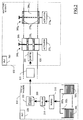
- Figure 2 is a functional representation of some components of the bookbinding system;
- Figure 3 shows the main software components that can be used for practicing the solution according to an embodiment of the invention;
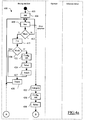
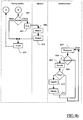
- Figures 4a-4b depict an activity diagram describing a method for producing books according to an embodiment of the invention, and
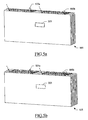
- Figures 5a-5b illustrate different phases of an exemplary application of the solution according to an embodiment of the invention.
- With reference in particular to Figure 1, a portion of a
bookbinding system 100 is illustrated; thesystem 100 is used to produce sewn books fromsignatures 105. For this purpose, thesignatures 105 are supplied to multiple sewing machines 110 (only one shown in the figure). Eachmachine 110 sews thesignatures 105 together by means of continuous threads, so as to obtain a sequence of book blocks 115. - The book blocks 115 exit the
sewing machine 110 on anunloading conveyor 120; in the example at issue, the book blocks 115 are placed side by side with their layers extending transversally to the unloading conveyor 120 (i.e., vertically). The unloadingconveyor 120 ends with anobstacle bar 125; when the book blocks 115 reach theobstacle bar 125, they fall onto an (independent)decoupling conveyor 130 with their layers parallel thereto (i.e., horizontal). - The
decoupling conveyor 130 has the book blocks 115 pass through aselection station 132; as it will be apparent in the following, theselection station 132 discards any defective book blocks 115. The other book blocks 115 are instead unloaded into a box 135 (where they stack on top of each other). Once thebox 135 is filled with a predetermined number of book blocks 115 (for example, 5-10), thebox 135 lifts and then pivots so as to lay down a resulting stack of book blocks 137 onto aconnection conveyor 140. - The
connection conveyor 140 feeds the stacks of book blocks 137 to further machines (denoted as a whole with 150), which complete the production of the books (for example, including a back-gluing machine, a three-knife trimmer machine, and a case-in machine). Thebooks 155 so obtained are then ready to be delivered to corresponding suppliers. - More in detail, as shown in Figure 2, the
sewing machine 110 includes multiple reservoirs 203i (with i=1...N, for example, N=2-5). Each reservoir 203i is filled with correspondinglabels 205i based on the acoustic-magnetic technology. Eachlabel 205i consists of a very thin plastic box (typically, with a thickness lower than 1 mm). The box houses a metal strip and a magnet; the metal strip is mounted so as to move freely and then act as a resonator (with a resonance frequency of around 58 kHz). When the metal strip receives an interrogation signal consisting of a series of pulses at its resonance frequency (for example, with a duration of 1-2 ms at 10-20 ms intervals), it begins oscillating. The metal strip continues oscillating even after receiving the pulses (typically, for 3-10 ms). The presence of the acoustic-magnetic label can then be detected when a corresponding response signal (for example, consisting of a predefined number of pulses generated by the oscillating metal strip) is sensed after the end of each pulse of the interrogation signal. It should be noted that the acoustic-magnetic labels are substantially insensitive to any background magnetic field that is generated by the machines of the bookbinding system (since they respond to signals having a definite frequency only). Moreover, other metal structures of the bookbinding system do not respond after the end of the pulses of the interrogation signal, and then cannot generate any false response signal. The acoustic-magnetic technology is widely used in anti-theft systems; in this case, the acoustic-magnetic label attached to each product on sale can be deactivated at a cash register by demagnetizing it after the product has been bought. - The
labels 205i of each reservoir 203i differ in their resonance frequencies, which are slightly offset around the characterizing value of 58 kHz.Pliers 210 extract a desiredlabel 205i from the corresponding reservoir 203i. This label (generically denoted with 205) is then provided to anapplier 215, which sticks thelabel 205 onto the desired block of signatures; particularly, thelabel 205 is attached to a free layer of asignature 105 of the block being currently sewn; as it will be apparent in the following, thissignature 105 can be either a last signature of the block or an internal one (to which further signatures are sewn later on). Operation of thesewing machine 110 is managed by a Programmable Logic Controller (PLC) 220. - Moving now to the
selection station 132, asniffer 255 is arranged below thedecoupling conveyor 130. Thesniffer 255 senses the labels (if any) of each book block 115 passing over it. For this purpose, thesniffer 255 continually broadcasts the interrogation signal (for example, whenever the passage of abook block 115 is detected by a corresponding sensor, not shown in the figure); the effective distance of the interrogation signal corresponds to the area just above thesniffer 255, so as to ensure that only the label of the passingbook block 115 is activated (and not the ones of the book blocks that are downstream or upstream). At the same time, thesniffer 255 listens for any response signal from the activated label. - The
sniffer 255 is followed by a series of discarding sections 260j (with j=1...M, for example, M=2-10) . Each discarding section 260j includes a sloping-down track formed by a pair of idle roller segments 270j. The segments 270j are controlled by a corresponding actuator 275j (for example, including a pair of pneumatic pistons). Normally (see discarding section 2601), the segments 270j are close to each other so as to have the passingbook block 115 slide on them. However (see discarding section 260M), the segments 270j can be spaced apart so as to have the arrivingbook block 115 fall into a corresponding collection basket 280j (which is arranged below the decoupling conveyor 130). Operation of theselection station 132 is likewise managed by afurther PLC 285. - With reference to Figure 3, the main software components that run on the PLC 220 (of the sewing machine) and on the PLC 285 (of the selection station) are denoted as a whole with the
reference 300. The information (programs and data) is typically stored on non-volatile memories of the PLCs 220,285 and loaded (at least partially) into corresponding working memories when the programs are running. - As far as the
PLC 220 is concerned, a series ofdrives 305 control corresponding sensors of the sewing machine; these sensors are used to detect different error conditions of the sewing machine, such as the breaking of a thread, the wrong position of the signature being currently sewn, an error in the sequence of the signatures of the block, and the like. Corresponding error signals are passed by the sensor drives 305 to ananalyzer 310. Theanalyzer 310 accesses arepository 315 of predefined categories of error conditions (that may occur in the sewing machine). For each possible error condition, therepository 315 stores an identification code of its category. Each error code is associated with a corresponding severity flag; the severity flag is deasserted for categories relating to minor error conditions that should not jeopardize operation of the sewing machine (for example, when the signatures are not in the correct sequence), whereas it is asserted for categories relating to critical error conditions that do not allow the sewing machine to continue working properly (for example, when a thread breaks or a signature significantly projects from its block). - The
analyzer 310 drives a controller 320 (which manages operation of the sewing machine) by means of a stop signal. Moreover, theanalyzer 310 transmits the error code corresponding to the detected error condition to aselector 325. Theselector 325 accesses afile 330, which stores configuration information of the sewing machine; for example, theconfiguration file 330 identifies the sewing machine, the job currently in execution, different characteristics of the jobs (such as whether it is a pre-release), and the like. Theselector 325 chooses the desired type of labels (among the available ones) according to the error code (received from the analyzer 310) and the configuration information (extracted from the file 330). A corresponding label code (identifying the selected type of labels) is then passed to adrive 345 for the pliers. The pliers drive 345 controls afurther drive 350 for the applier of the labels by means of an enabling signal. - Considering now the
PLC 285, adrive 355 controls the sniffer of the selection station; thesniffer drive 355 provides the response signal returned by a current label to adecoder 360. Thedecoder 360 determines the error code and the configuration information corresponding to the specific frequency of the response signal received. This information is passed to asorter 365. Thesorter 365 accesses a look-up table 375, which associates each error code and/or configuration information item with a corresponding discarding section. ThePLC 285 also includes a drive 380j for the actuator of each discarding section; each actuator drive 380j receives a corresponding enabling signal from thesorter 365. - As shown in Figures 4a-4b, the logic flow of a process illustrating operation of the above-described bookbinding system is represented with a
method 400. The method begins at theblack start circle 403 in the swim-lane of the sewing machine, and then passes to block 406 wherein a new job is submitted. Continuing to block 409, the signatures are continually extracted from a hopper and supplied in succession to an opening station; the signatures are opened in the middle and placed astride a fixed saddle. Each signature is conveyed to a movable saddle (in an open position); the movable saddle is then closed and the signature is sewn to a previous one. Once the current signature has been processed, a test is made atblock 412 to determine whether the desired block is complete (i.e., its last signature has been sewn). If not, the method returns to block 409 for reiterating the same operations. - Conversely, when the book block is complete the threads are cut at
block 415. The flow of activity then branches atdecision block 418 according to the operative mode of the sewing machine. If the sewing machine is set to attach the labels to every book block, the configuration information of the sewing machine is extracted from the corresponding repository atblock 421. Descending to block 424, the label representing this configuration information (identified by the corresponding label code) is selected. The desired label is attached atblock 427 onto the free layer of the last signature of the book block. The flow of activity then proceeds to block 430; the same point is also reached fromblock 418 directly when the sewing machine is set to attach the labels to defective book blocks only. In this phase, the book block is placed onto the unloading conveyor of the sewing machine. The method then returns to block 409 for repeating the same operations described above. - In a completely asynchronous manner, the flow of activity passes from
block 409 to block 433 as soon as an error condition is detected in the sewing machine (with the corresponding error signal that is asserted); in response thereto, the error code representing the category of the error condition is determined. Continuing to block 436, the configuration information of the sewing machine is extracted from the respective repository. The corresponding label (identified by the label code representing the error condition category and the configuration information) is selected atblock 439. - The flow of activity then branches at
block 442 according to the severity flag associated with the error code. If the severity flag is asserted to indicate a critical error condition, the sewing machine is stopped at block 445 (by asserting the stop signal that is provided to its controller). Moving now to block 448 in the swim-lane of the operator, the sewing machine is inspected to verify and solve the problem; for example, the operator can reinsert a thread that has broken into the corresponding needle, or s/he can unstitch a signature projecting from the respective book block. Passing to block 451, the operator closes the sewing machine and restarts it manually. - The method then returns to the swim-lane of the sewing machine at
block 454; the same point is also reached fromblock 442 directly when the severity flag is deasserted (to indicate a minor error condition). In any case, the label is attached onto the free layer of the available signature of the block (generally, an internal one). The standard flow of activity is then rejoined by going back to block 409. - At the same time, the sniffer of the selection station at
block 457 broadcasts the interrogation signal in response to a synchronization signal (which is asserted whenever the passage of a book block is detected). The flow of activity then branches atdecision block 460. Particularly, if a response signal is received it is decoded atblock 463. A test is now made atblock 466 to determine whether the frequency of the response signal is indicative of an error code. If so, the method descends intoblock 472; in this phase, the book block is classified according to the error code and the configuration information (represented by the response signal), and it is then associated with a corresponding discarding section. The actuator of this discarding section is enabled at block 475 (so as to open the corresponding idle roller segments). The operation is performed with a delay equal to the time required by the book block to reach the discarding section (depending on its distance from the sniffer and on the speed of the connection conveyor); in this way, when the defective book block reaches the discarding section it falls into the corresponding collection basket. The flow of activity then returns to block 457 to reiterate the same operations as soon as a further synchronization signal is received; the same point is also reached directly from block 460 (when no response signal is received) or from block 466 (when the response signal is not representative of any error code). - Typically, the discarded book blocks are collected periodically from the baskets (for example, at the end of the day). In this way, it is possible to put the book blocks that can be reused into a specific basket; for example, the book blocks being sewn in the wrong order or with a projecting signature are unstitched and returned to the beginning of the above-described production line. In any case, it is possible to analyze the defective book blocks for identifying the error conditions that have occurred; in this respect, the information associated with each defective book block is very useful for determining the cause of the corresponding error conditions. Moreover, this information can be collected automatically for obtaining statistical reports about the operation of the different sewing machines in the bookbinding system.
- An exemplary application of the above-described process is illustrated in Figures 5a-5b. Considering in particular Figure 5a, a number of
signatures 105 have already been sewn together by means ofthreads thread 505b) breaks. In this condition, the corresponding error signal is asserted and the sewing machine is stopped. The operator can then recover the problem by re-inserting thebroken thread 505b into the eye of the corresponding needle (not shown in the figure). The sewing machine is then restarted. In this case, a label 205 (selected according to the error condition and to the configuration information of the sewing machine) is attached to the free layer of thelast signature 105. - Moving to Figure 5b, the sewing of the block continues with
further signatures 105 that are sewn to the preceding ones (leaving the stitches of thethread 505b interrupted). As can be seen, thelabel 205 is covered by thefurther signatures 105, so that it is not visible to the outside of the block any longer; in any case, thelabel 205 can be sensed by the sniffer of the selection station. - Naturally, in order to satisfy local and specific requirements, a person skilled in the art may apply to the solution described above many modifications and alterations.
- Particularly, similar considerations apply if the bookbinding system has a different architecture or includes other components. For example, the system can have any number of sewing machines (down to a single one); moreover, it is possible to have additional sewing machines where the proposed solution is not implemented. Likewise, the principles of the invention also apply to equivalent interrogation signals and/or response signals (for example, with multiple selection stations each one for a corresponding sewing machine).
- Alternatively, the labels can work at different frequencies, or they can be replaced with any other acoustic-magnetic tag suitable to the attached to the blocks of signatures.
- Similar considerations apply if the sewing machine has another structure or includes equivalent elements.
- Moreover, the principles of the invention should not be limited to the described error conditions.
- Alternatively, the book blocks can be transported (from the sewing machine to the other machines of the bookbinding system) with equivalent elements (such as belts, roller beds, and the like); likewise, the defective book blocks can be discarded with pivoting sections (which divert the defective book blocks towards other conveyors), or with push plates (which moves transversely to the decoupling conveyor).
- In any case, the operation of discarding the defective book blocks might be performed along the connection conveyor (even if this would involve the waste of additional book blocks). In a different embodiment of the invention, whenever the sniffer detects a defective book block it drives the box (being used to stack the book blocks) to lay down the available book blocks onto the connection conveyor (with a delay required for receiving all the book blocks preceding the defective one). Once the defective book block is unloaded into the (empty) box, the box is driven again to lay down the defective book block alone onto the connection conveyor. The operation of the box can then restart as usual. In this way, the defective book block is isolated and can be discarded later on at any desired point. It should be noted that the operations for isolating the defective book block sometimes require a transient slowdown of the production line (so as to allow the box to complete the above-described additional strokes).
- It is also possible to define any other number and/or type of categories for the error conditions. In addition, the discarded book blocks can also be collected onto dedicated conveyors that automatically transport them to corresponding handling stations.
- Moreover, the error conditions can be managed in a similar manner (for example, slowing down operation of the sewing machine if it is necessary).
- The encoding of different attributes of the sewing machine into the response signals is within the scope of the invention (for example, specifying the name of the corresponding operator). Moreover, it is also possible to provide a printer downstream the sniffer (for printing information provided by the response signal returned by each label onto a top layer of the corresponding book block).
- In addition, the solution of the invention lends itself to be implemented with programs that are structured in a different way, or with additional modules or functions; likewise, the different memory structures can be of other types, or can be replaced with equivalent entities (not necessarily consisting of physical storage media). Likewise, the proposed solution can implement equivalent methods (for example, with similar or additional steps).
- In any case, it is possible to distribute the programs in any suitable computer readable medium (such as a floppy-disk).
- Moreover, it will be apparent to those skilled in the art that the additional features providing further advantages are not essential for carrying out the invention, and may be omitted or replaced with different features.
- For example, the proposed solution can also be implemented with electromagnetic labels, harmonic labels, Radio Frequency Identification (RFID) labels (even directly printed on the book blocks), or more generally with any other transponder (which detects and automatically responds to a corresponding interrogation signal); particularly, in the case of the RFID labels, it is possible to configure them in the sewing machine directly (so as to return real-time information, such as when the error condition occurred).
- Even though in the preceding description reference has been made to sewing machines, this is not to be intended as a limitation; for example, the same solution can also be applied to perfect-binding machines for producing glued books, to saddle-stitcher machines (also known as wire-stitcher machines) for producing books based on staple-stitches, or to any other machine for binding (or assembling) the blocks of signatures.
- An implementation wherein the labels are attached to different selected blocks of signatures is within the scope of the invention; for example, it is possible to attach the labels to book blocks relating to a pre-release, or to a first book block of different series (such as relating to books printed in different languages, in order to allow verifying the correct association of the corresponding covers into the perfect-binding machine or the case-in machine). Likewise, another implementation wherein the labels are attached to every book block is also contemplated; for example, this feature can be used to automatically sort the resulting books (such as according to their destination), to identify the blocks of signatures that are currently processed in a machine (where they are not visible from the outside), or to find books with desired characteristics by means of portable sniffers.
- In any case, the discarding of the defective book blocks at any point in the production line is contemplated. Moreover, it is also possible simply to signal the defective book blocks to an operator (for example, by means of a buzzer), so as to allow her/him to remove them manually.
- In a simplified embodiment of the invention, all the labels emit the same response signal; in this case, the system can only determine the defective book blocks (without the possibility of discriminating different error conditions).
- Moreover, an implementation wherein the sewing machine is always stopped when an error condition occurs is not excluded.
- Without departing from the principles of the invention, it is also possible to use labels that return a response signal being indicative of the error condition only (without any additional information about the attributes of the sewing machine).
- In any case, the solution of the invention is suitable to provide information about whatever characteristics of the book blocks (or at least of some of them), such as a code of the corresponding books, their titles, and so on.
- Alternatively, the labels can also be applied manually by the operator (when the sewing machine stops following the detection of an error condition). In this case, the operator is also free to decide whether the error condition actually makes the current block of signatures defective and then the label must be attached; for example, when a thread breaks the operator can avoid applying the label if the interrupted stitch is inside the book block (and not at its boundaries).
- Similar considerations apply if the programs controlling the different PLCs are provided in any other form directly loadable into their working memories (for example, through a network connection).
- At the end, the method according to the present invention lends itself to be carried out with a hardware structure (for example, integrated in chips of semiconductor material), or with a combination of software and hardware.
Claims (11)
- A method (400) for producing books in a bookbinding system, the method including the steps of:binding (409) blocks of signatures in succession by means of at least one binding machine,characterized by the steps of
associating (421-427;436-454) a transponder with at least one selected of the blocks of signatures inside each binding machine,
emitting (457) an interrogation signal outside the at least one binding machine, and
sensing (460-475) at least one characteristic of each selected block of signatures according to a response signal being returned by the corresponding transponder in response to the interrogation signal. - The method (400) according to claim 1, wherein the step of associating (421-427;436-454) the transponder includes:attaching (427;454) an acoustic-magnetic tag to each selected block of signatures.
- The method (400) according to claim 1 or 2, wherein the step of binding (409) includes:sewing the blocks of signatures in succession by means of at least one sewing machine.
- The method (400) according to any claim from 1 to 3, further including the step of:detecting (433) an error condition of each binding machine, the transponder being associated (436-454) with the block of signatures being currently bound in response to the detection of the error condition,wherein the step of sensing (460-475) the at least one characteristic includes:identifying (460-472) each selected block of signatures as defective in response to the receipt of the response signal being returned by the corresponding transponder.
- The method (400) according to claim 4, further including the step of:transporting (430) the blocks of signatures from each binding machine to a further machine of the bookbinding system for completing corresponding books, anddiscarding (475) each defective block of signatures during the transport.
- The method (400) according to claim 5, wherein:the step of detecting (433) the error condition includes determining a category of the error condition among a plurality of predefined categories for possible error conditions,the step of associating (436-454) the transponder includes selecting one among a plurality of transponders being suitable to return a response signal indicative of the category of the error condition, andthe step of discarding (475) includes unloading each defective block of signatures into a collector associated with the category of the error condition indicated by the corresponding response signal.
- The method (400) according to claim 6, wherein the predefined categories include a first set of categories for possible error conditions jeopardizing operation of the binding machine and a second set of categories for possible error conditions non-jeopardizing operation of the binding machine, the method further including the step in response to the detection of the error condition of:stopping (445) operation of the binding machine when the error condition belongs to the first set of categories, the operation of the binding machine continuing when the error condition belongs to the second set of categories.
- The method (400) according to any claim from 1 to 7, wherein the response signal returned by each transponder is indicative of at least one attribute of the corresponding binding machine.
- The method (400) according to claim 8, wherein the at least one attribute of the binding machine includes an identifier of the binding machine, an identifier of a setting of the binding machine, an identifier of an operative condition of the binding machine, or a combination thereof.
- A bookbinding system (100) for producing books, including at least one binding machine (110) for binding blocks of signatures (115) in succession,
characterized in that
each binding machine is suitable to allow associating a transponder (205) with at least one selected of the blocks of signatures inside the binding machine, the system further including means (255) for emitting an interrogation signal outside the at least one binding machine, and means (285) for sensing at least one characteristic of each selected block of signatures according to a response signal being returned by the corresponding transponder in response to the interrogation signal. - A computer program (300) for performing the method (400) of any claim from 1 to 9 when the computer program is executed on a data processing system (220;285).
Priority Applications (2)
| Application Number | Priority Date | Filing Date | Title |
|---|---|---|---|
| DE200560002924 DE602005002924T2 (en) | 2005-02-22 | 2005-02-22 | Method and system for characterizing groups of signatures in a bookbinding machine by means of transponders |
| EP20050101322 EP1693226B1 (en) | 2005-02-22 | 2005-02-22 | Method and system for characterizing blocks of signatures in a bookbinding plant using a transpondeur |
Applications Claiming Priority (1)
| Application Number | Priority Date | Filing Date | Title |
|---|---|---|---|
| EP20050101322 EP1693226B1 (en) | 2005-02-22 | 2005-02-22 | Method and system for characterizing blocks of signatures in a bookbinding plant using a transpondeur |
Publications (2)
| Publication Number | Publication Date |
|---|---|
| EP1693226A1 EP1693226A1 (en) | 2006-08-23 |
| EP1693226B1 true EP1693226B1 (en) | 2007-10-17 |
Family
ID=35431878
Family Applications (1)
| Application Number | Title | Priority Date | Filing Date |
|---|---|---|---|
| EP20050101322 Ceased EP1693226B1 (en) | 2005-02-22 | 2005-02-22 | Method and system for characterizing blocks of signatures in a bookbinding plant using a transpondeur |
Country Status (2)
| Country | Link |
|---|---|
| EP (1) | EP1693226B1 (en) |
| DE (1) | DE602005002924T2 (en) |
Families Citing this family (4)
| Publication number | Priority date | Publication date | Assignee | Title |
|---|---|---|---|---|
| CH705647B1 (en) * | 2006-10-13 | 2013-04-30 | Ferag Ag | RFID printing product identification. |
| IT202200005018A1 (en) * | 2022-03-15 | 2023-09-15 | Meccanotecnica Spa | PRODUCTION OF BOOKS WITH PRINTING OF IDENTIFICATION INFORMATION ON SEALING GAUGE |
| DE102022111433A1 (en) | 2022-05-09 | 2023-11-09 | Müller Martini Holding AG | Method and system for producing different book blocks in a print processing system |
| DE102022115485B3 (en) | 2022-06-22 | 2023-12-28 | Kay Hedrich | METHOD FOR PRODUCING BOOKBINDING PRODUCTS AND BOOKBINDING PRODUCT |
Family Cites Families (4)
| Publication number | Priority date | Publication date | Assignee | Title |
|---|---|---|---|---|
| FR2630046B1 (en) * | 1988-04-14 | 1990-08-31 | Ordibel | METHOD AND DEVICE FOR CONTROLLING A MACHINE FOR BINDING BUNDLES OF SHEETS BY PINING |
| US4986521A (en) * | 1989-03-06 | 1991-01-22 | Mccain Manufacturing Corp. | Reject device for a signature gathering machine |
| AUPN078895A0 (en) * | 1995-01-30 | 1995-02-23 | Abn Security Pty Ltd | Perfect binding control system |
| DE10213459A1 (en) * | 2002-03-26 | 2003-10-30 | Koenig & Bauer Ag | Goods transport system with a rail network and a method for operating this goods transport system |
-
2005
- 2005-02-22 EP EP20050101322 patent/EP1693226B1/en not_active Ceased
- 2005-02-22 DE DE200560002924 patent/DE602005002924T2/en not_active Expired - Lifetime
Also Published As
| Publication number | Publication date |
|---|---|
| DE602005002924D1 (en) | 2007-11-29 |
| DE602005002924T2 (en) | 2008-08-07 |
| EP1693226A1 (en) | 2006-08-23 |
Similar Documents
| Publication | Publication Date | Title |
|---|---|---|
| CA2396327C (en) | Radio frequency labels on reusable containers | |
| US9073092B2 (en) | Sheet reinspection apparatus, sheet inspection system, and sheet inspection method | |
| CN102459746A (en) | Method and device for identifying and marking defect locations in fabrics | |
| US20100032476A1 (en) | Printed product rfid | |
| EP1693226A1 (en) | Method and system for characterizing blocks of signatures in a bookbinding plant using a transpondeur | |
| US10065830B2 (en) | Control apparatus and method for controlling a printed-product processing system | |
| US12570424B2 (en) | Device and method for loading transport containers | |
| JP3186889U (en) | Combined goods inspection device | |
| KR100943593B1 (en) | Control method of paper sheet separator and paper sheet separator | |
| EP1060119B1 (en) | Method and assembly for marking paper, board and cellulose web rolls | |
| WO2006040835A1 (en) | Bill identifying/counting machine | |
| JP4271542B2 (en) | Product box management system in agricultural product sorting and packaging facility | |
| JP2513897B2 (en) | Spinning plant production management system | |
| US7307532B2 (en) | Multiple sheets feeding detection apparatus, sorter, and method of detecting multiple sheets feeding | |
| JPH0957211A (en) | Agricultural product selection method and device | |
| JP7713333B2 (en) | Sorting device and sorting method | |
| CN107025720B (en) | banknote handling device | |
| US20070144677A1 (en) | Splicing tape | |
| JPH08119491A (en) | Band shear line | |
| JP3026450B2 (en) | Paper transport device | |
| MX2012010291A (en) | Security system tag having combined clamp and antenna. | |
| JP4583806B2 (en) | Defective book discharging method and apparatus for bookbinding line | |
| JP4680371B2 (en) | Sorting method and sorting system | |
| CN103366448B (en) | Paper processing apparatus | |
| JP3854663B2 (en) | Method for controlling merging of articles |
Legal Events
| Date | Code | Title | Description |
|---|---|---|---|
| PUAI | Public reference made under article 153(3) epc to a published international application that has entered the european phase |
Free format text: ORIGINAL CODE: 0009012 |
|
| AK | Designated contracting states |
Kind code of ref document: A1 Designated state(s): AT BE BG CH CY CZ DE DK EE ES FI FR GB GR HU IE IS IT LI LT LU MC NL PL PT RO SE SI SK TR |
|
| AX | Request for extension of the european patent |
Extension state: AL BA HR LV MK YU |
|
| 17P | Request for examination filed |
Effective date: 20061023 |
|
| GRAP | Despatch of communication of intention to grant a patent |
Free format text: ORIGINAL CODE: EPIDOSNIGR1 |
|
| AKX | Designation fees paid |
Designated state(s): CH DE IT LI |
|
| GRAS | Grant fee paid |
Free format text: ORIGINAL CODE: EPIDOSNIGR3 |
|
| GRAA | (expected) grant |
Free format text: ORIGINAL CODE: 0009210 |
|
| AK | Designated contracting states |
Kind code of ref document: B1 Designated state(s): CH DE IT LI |
|
| REG | Reference to a national code |
Ref country code: CH Ref legal event code: EP |
|
| REF | Corresponds to: |
Ref document number: 602005002924 Country of ref document: DE Date of ref document: 20071129 Kind code of ref document: P |
|
| REG | Reference to a national code |
Ref country code: DE Ref legal event code: R096 Ref document number: 602005002924 Country of ref document: DE Effective date: 20071129 |
|
| REG | Reference to a national code |
Ref country code: CH Ref legal event code: NV Representative=s name: OK PAT AG PATENTE MARKEN LIZENZEN |
|
| PLBE | No opposition filed within time limit |
Free format text: ORIGINAL CODE: 0009261 |
|
| STAA | Information on the status of an ep patent application or granted ep patent |
Free format text: STATUS: NO OPPOSITION FILED WITHIN TIME LIMIT |
|
| 26N | No opposition filed |
Effective date: 20080718 |
|
| REG | Reference to a national code |
Ref country code: DE Ref legal event code: R097 Ref document number: 602005002924 Country of ref document: DE Effective date: 20080718 |
|
| PGFP | Annual fee paid to national office [announced via postgrant information from national office to epo] |
Ref country code: DE Payment date: 20131204 Year of fee payment: 10 Ref country code: CH Payment date: 20140221 Year of fee payment: 10 |
|
| PGFP | Annual fee paid to national office [announced via postgrant information from national office to epo] |
Ref country code: IT Payment date: 20140226 Year of fee payment: 10 |
|
| REG | Reference to a national code |
Ref country code: DE Ref legal event code: R119 Ref document number: 602005002924 Country of ref document: DE |
|
| REG | Reference to a national code |
Ref country code: CH Ref legal event code: PL |
|
| PG25 | Lapsed in a contracting state [announced via postgrant information from national office to epo] |
Ref country code: CH Free format text: LAPSE BECAUSE OF NON-PAYMENT OF DUE FEES Effective date: 20150228 Ref country code: LI Free format text: LAPSE BECAUSE OF NON-PAYMENT OF DUE FEES Effective date: 20150228 |
|
| PG25 | Lapsed in a contracting state [announced via postgrant information from national office to epo] |
Ref country code: IT Free format text: LAPSE BECAUSE OF NON-PAYMENT OF DUE FEES Effective date: 20150222 |
|
| PG25 | Lapsed in a contracting state [announced via postgrant information from national office to epo] |
Ref country code: DE Free format text: LAPSE BECAUSE OF NON-PAYMENT OF DUE FEES Effective date: 20150901 |
|
| P01 | Opt-out of the competence of the unified patent court (upc) registered |
Effective date: 20230513 |