EP1690754A1 - Vehicle seat belt attachment - Google Patents
Vehicle seat belt attachment Download PDFInfo
- Publication number
- EP1690754A1 EP1690754A1 EP06250694A EP06250694A EP1690754A1 EP 1690754 A1 EP1690754 A1 EP 1690754A1 EP 06250694 A EP06250694 A EP 06250694A EP 06250694 A EP06250694 A EP 06250694A EP 1690754 A1 EP1690754 A1 EP 1690754A1
- Authority
- EP
- European Patent Office
- Prior art keywords
- belt
- harness
- wearer
- seat belt
- vehicle seat
- Prior art date
- Legal status (The legal status is an assumption and is not a legal conclusion. Google has not performed a legal analysis and makes no representation as to the accuracy of the status listed.)
- Granted
Links
- 230000000452 restraining effect Effects 0.000 claims description 2
- 239000000463 material Substances 0.000 description 12
- 210000000038 chest Anatomy 0.000 description 10
- 210000002784 stomach Anatomy 0.000 description 5
- 239000004033 plastic Substances 0.000 description 4
- 229920003023 plastic Polymers 0.000 description 4
- 239000002184 metal Substances 0.000 description 3
- 239000000853 adhesive Substances 0.000 description 1
- 230000001070 adhesive effect Effects 0.000 description 1
- 230000015572 biosynthetic process Effects 0.000 description 1
- 210000000481 breast Anatomy 0.000 description 1
- 230000001010 compromised effect Effects 0.000 description 1
- 229920001971 elastomer Polymers 0.000 description 1
- 238000004519 manufacturing process Methods 0.000 description 1
- 229920000642 polymer Polymers 0.000 description 1
- 230000000717 retained effect Effects 0.000 description 1
- 239000005060 rubber Substances 0.000 description 1
- 210000002832 shoulder Anatomy 0.000 description 1
- 229920003051 synthetic elastomer Polymers 0.000 description 1
- 239000005061 synthetic rubber Substances 0.000 description 1
- 239000004753 textile Substances 0.000 description 1
- 210000000689 upper leg Anatomy 0.000 description 1
Images
Classifications
-
- B—PERFORMING OPERATIONS; TRANSPORTING
- B60—VEHICLES IN GENERAL
- B60R—VEHICLES, VEHICLE FITTINGS, OR VEHICLE PARTS, NOT OTHERWISE PROVIDED FOR
- B60R22/00—Safety belts or body harnesses in vehicles
- B60R22/02—Semi-passive restraint systems, e.g. systems applied or removed automatically but not both ; Manual restraint systems
-
- B—PERFORMING OPERATIONS; TRANSPORTING
- B60—VEHICLES IN GENERAL
- B60R—VEHICLES, VEHICLE FITTINGS, OR VEHICLE PARTS, NOT OTHERWISE PROVIDED FOR
- B60R22/00—Safety belts or body harnesses in vehicles
- B60R22/10—Safety belts or body harnesses in vehicles specially adapted for children or animals
- B60R22/105—Safety belts or body harnesses in vehicles specially adapted for children or animals for children
-
- B—PERFORMING OPERATIONS; TRANSPORTING
- B60—VEHICLES IN GENERAL
- B60R—VEHICLES, VEHICLE FITTINGS, OR VEHICLE PARTS, NOT OTHERWISE PROVIDED FOR
- B60R22/00—Safety belts or body harnesses in vehicles
- B60R22/12—Construction of belts or harnesses
-
- B—PERFORMING OPERATIONS; TRANSPORTING
- B60—VEHICLES IN GENERAL
- B60R—VEHICLES, VEHICLE FITTINGS, OR VEHICLE PARTS, NOT OTHERWISE PROVIDED FOR
- B60R22/00—Safety belts or body harnesses in vehicles
- B60R2022/008—Belts; Fixing thereof specially adapted for pregnant users
-
- B—PERFORMING OPERATIONS; TRANSPORTING
- B60—VEHICLES IN GENERAL
- B60R—VEHICLES, VEHICLE FITTINGS, OR VEHICLE PARTS, NOT OTHERWISE PROVIDED FOR
- B60R22/00—Safety belts or body harnesses in vehicles
- B60R22/02—Semi-passive restraint systems, e.g. systems applied or removed automatically but not both ; Manual restraint systems
- B60R22/023—Three-point seat belt systems comprising two side lower and one side upper anchoring devices
-
- B—PERFORMING OPERATIONS; TRANSPORTING
- B60—VEHICLES IN GENERAL
- B60R—VEHICLES, VEHICLE FITTINGS, OR VEHICLE PARTS, NOT OTHERWISE PROVIDED FOR
- B60R22/00—Safety belts or body harnesses in vehicles
- B60R22/02—Semi-passive restraint systems, e.g. systems applied or removed automatically but not both ; Manual restraint systems
- B60R22/023—Three-point seat belt systems comprising two side lower and one side upper anchoring devices
- B60R22/024—Adaptations for use by small passengers, e.g. children
-
- B—PERFORMING OPERATIONS; TRANSPORTING
- B60—VEHICLES IN GENERAL
- B60R—VEHICLES, VEHICLE FITTINGS, OR VEHICLE PARTS, NOT OTHERWISE PROVIDED FOR
- B60R22/00—Safety belts or body harnesses in vehicles
- B60R22/12—Construction of belts or harnesses
- B60R22/14—Construction of belts or harnesses incorporating enlarged restraint areas, e.g. vests, nets, crash pads, optionally for children
Definitions
- the invention relates to a vehicle seat belt assembly which eliminates the need for a seat belt oblique portion (also referred to as a diagonal section) to fit across the chest and stomach of a wearer, whilst still affording the same or similar level of protection as standard seat belts in the instance of rapid deceleration.
- a seat belt oblique portion also referred to as a diagonal section
- the wearing of seat belts whilst travelling in a car is compulsory in many countries and advised in almost all.
- This type of seat belt gives some upper body freedom of movement when the inertia reel mechanism is not engaged and has generally proved very effective in reducing the severity of accidents in cars to the wearer, as opposed to when no belt is worn.
- the fact that the upper oblique (or diagonal) part of the seat belt, which restrains the upper body of the wearer, crosses the stomach and chest of the wearer can cause discomfort, particularly to pregnant women or people with chest complaints. In severe incidents the belt can harm unborn foetuses during rapid deceleration.
- a vehicle seat belt assembly comprising a belt extending between upper and lower fixed points at one side of a vehicle seat and a fastener mounted on the belt for attachment to a further fixed point at the opposite side of the vehicle seat so as to define, in the belt, a lap portion and an upper oblique portion, and a harness having a main strap for fitting around the back and chest of a wearer and shoulder straps for fitting over shoulder regions of a wearer, is characterised in that the harness is attached only to the upper oblique portion of the belt in such a manner that a back portion of the harness passes behind the oblique portion of the belt while the lap portion of the belt remains available for fitting across and restraining the body of the wearer in customary manner.
- back portion means any portion of the harness which is intended, in use, to extend around and overlie the back of a wearer of the harness.
- the harness consists of a main strap that passes, substantially horizontally, around the back of a wearer and chest, and is closed by a metal plate fixedly mounted on one end of the strap engaging into a quick release clasp of known design that is fixedly mounted on the other end of the strap together with two additional straps that are mounted either at separate spaced apart points or from a common central location on the back portion of the main strap. These additional straps are designed to be worn over respective shoulders of the wearer. Each additional strap has a metal plate fixedly mounted on its free end which is securable into the same quick release clasp of known design that fastens the main strap at the front of the wearer's chest.
- Adjustment buckles of known design may be fitted on each of the shoulder straps and on the main strap, allowing for tensioning of the harness when the front clasp is fastened, and to enable the harness to be adjusted to suit the wearer for optimum comfort and efficacy.
- the harness is fitted only to the upper portion of the inertia reel seat belt which in conventional use of the seat belt extends obliquely across the wearer from the upper of the two fixed points to the quick release clasp at the other side of the seat.
- the inside face of the back portion of the main strap of the harness carries a connector for this purpose, i.e. for attachment of the oblique seat belt portion.
- the conventional seat belt 20 is illustrated in a position where its clasp 21 is pulled across to fasten at the other side of a seat, thereby defining an upper oblique portion 22 and a lap portion 24.
- the exemplary harness in accordance with the invention comprises a main strap 1 having at its one end a metal plate 4 and at its other end a quick release clasp 5, of any suitable known design, with which the plate 4 is engageable.
- a pair of shoulder straps 2a, 2b are attached to and extend from a central location of the main strap 1. These shoulder straps 2a, 2b also have respective plates 4, 4 at their free ends which are engageable with the clasp 5. Accordingly, there is a common attachment point for the straps 1, 2a, 2b at the clasp 5.
- the main strap 1 is preferably formed by webbing which is encapsulated in a pre-formed pliable polymer, e.g. foamed plastics material, which is fabricated so as to have inherent curvature.
- a pre-formed pliable polymer e.g. foamed plastics material
- the main strap 1 may comprise the pre-formed curved foamed material to which additional padding or webbing is connected.
- the shoulder straps 2a, 2b are also preferably formed as a single piece of foamed plastics material such that each of the branches forming the portions which extend over the shoulders have appropriate inherent curvature.
- Additional webbing straps 8, as shown, may be secured to the foamed plastics material of the shoulder straps 2 by adhesive or stitching 3 or both, or may even be encapsulated within the foamed material.
- a pliable web connector 6 is mounted at the back of the harness, i.e. it is mounted on the inner face of the harness which will lie against the back of the wearer with the main strap 1 and the shoulder straps 2a, 2b curling around the wearer's body.
- the connector 6 is mounted at a central position at the back of the main strap 1, where the shoulder straps 2 join the main strap 1.
- the connector 6 is preferably of a high friction rubber or synthetic rubber material which is sufficiently hard to retain its shape yet soft enough to deform under impact or strain without harming the wearer and which is comfortable against the wearer's back.
- An elongate tab in the manner of a finger 16 is cut or punched from the connector web 6 and is of sufficient length to extend across the width of a conventional seat belt 20. As shown, the connector web 6 is substantially square and the finger 16 is formed diagonally across it.
- a wearer sits in a vehicle seat and puts on his/her standard inertia reel seat belt 20 in the approved manner.
- the wearer then take the harness and passes the main strap 1 behind the diagonal section 22 of the inertia reel seat belt 20 and also engages the diagonal section 22 behind the finger 16 of the connector 6, as shown in the drawing.
- the finger 16 should prevent any substantial sideways movement of the belt, the belt section 22 should be readily slidable behind the finger 16 in the direction of the belt so that the wearer can adjust the level of the harness, for example so that the main strap 1 is at a height that lies under the wearer's breasts and above the stomach.
- the wearer then passes both the diagonal section 22 of the seat belt 20 and the harness behind his/her back and puts on the harness.
- the straps 1, 2a, 2b will tend if naturally to curl around the wearer's body so that the three fastener plates 4 are brought together at a central point at the front of the wearer's chest and secured there by engagement into the quick release clasp 5, thus forming a closed harness structure.
- Adjustment buckles may be provided on the shoulder straps 2a and 2b and the main strap 1. These can be pulled comfortably tight to make sure the straps pass correctly around the shoulders and chest of the wearer.
- the wearer is now in a position where the standard car seat belt 20 is correctly fastened in its designed geometry, with the lap strap section 24 functioning as normal.
- the slack in the diagonal section 22 is taken up as normal by the inertia reel and the inertia reel functionality is not compromised.
- the wearer is then wearing a snug fitting shoulder harness connected to the diagonal section 22 of the car seat belt 20, without the encumbrance of the diagonal strap 22 across his/her stomach, chest and shoulder.
- the inertia reel locks the seat belt 20 in the normal manner, the lap strap section 24 restrains the wearer by the thighs and the upper body is restrained by the shoulder harness being held securely by the diagonal section 22 of the seat belt 20.
- the deceleration force will be spread across the lap strap section 24 via the seat belt and across the shoulders and upper chest via the harness. No force is transmitted to the wearer's stomach by the diagonal of the seat belt.
- the means of attachment of the back portion of the harness to the oblique section of the conventional seat belt may also vary.
- the connector 6 could be modified to include a T-shaped enlargement or inverted flap at the end of the finger 16 to retain the oblique portion 22 of the seat belt 20 more securely, yet still slidably.
- a press stud formation could be provided near the free end of the finger 16 for the same purpose.
- the connector 6 could be replaced by a flap of flexible material, such as webbing or textile material, which could be secured across the belt section by hook and loop fastener material.
- the connector 6 could be replaced by a semi-rigid pad formed of a suitable foamed plastics material and provided with a shallow groove or channel cut into its face towards the wearer to receive the diagonal section 22 of the inertial reel seat belt 20.
- a flap retained by patches of hook and loop material could again be provided to extend across the channel to hold the belt 20 therein.
- harness and harness assembly of the invention are specifically envisaged as being attractive for use by pregnant women, they are also suitable for use by any vehicle driver or passenger who finds the diagonal section of a conventional seat belt causes discomfort. They may be particularly useful for child passengers whether or not they are sitting on booster seats or cushions.
Landscapes
- Engineering & Computer Science (AREA)
- Mechanical Engineering (AREA)
- Textile Engineering (AREA)
- Automotive Seat Belt Assembly (AREA)
Abstract
Description
- The invention relates to a vehicle seat belt assembly which eliminates the need for a seat belt oblique portion (also referred to as a diagonal section) to fit across the chest and stomach of a wearer, whilst still affording the same or similar level of protection as standard seat belts in the instance of rapid deceleration.
- The wearing of seat belts whilst travelling in a car is compulsory in many countries and advised in almost all. There are several types approved, with the standard, in terms of type and numbers used, being the inertia reel seat belt, which generally has two fixed points to the side of the wearer and a quick release clasp on the opposite side so as to define, when the belt it is fastened to the clasp, a lap portion and an upper oblique portion. This type of seat belt gives some upper body freedom of movement when the inertia reel mechanism is not engaged and has generally proved very effective in reducing the severity of accidents in cars to the wearer, as opposed to when no belt is worn.
- However, the fact that the upper oblique (or diagonal) part of the seat belt, which restrains the upper body of the wearer, crosses the stomach and chest of the wearer can cause discomfort, particularly to pregnant women or people with chest complaints. In severe incidents the belt can harm unborn foetuses during rapid deceleration.
- There have been several prior proposals, for example as disclosed in JP 20000302005, JP2000335365 and EP 1138560 A, for child safety harnesses which are intended to be secured to a conventional inertia reel seat belt by passing both sections of the seat belt, namely both the upper oblique (or diagonal) section and the lap section, through the back of the harness behind the wearer. These would not provide adequate restraint for an adult vehicle driver or vehicle passenger.
- According to the present invention a vehicle seat belt assembly comprising a belt extending between upper and lower fixed points at one side of a vehicle seat and a fastener mounted on the belt for attachment to a further fixed point at the opposite side of the vehicle seat so as to define, in the belt, a lap portion and an upper oblique portion, and a harness having a main strap for fitting around the back and chest of a wearer and shoulder straps for fitting over shoulder regions of a wearer, is characterised in that the harness is attached only to the upper oblique portion of the belt in such a manner that a back portion of the harness passes behind the oblique portion of the belt while the lap portion of the belt remains available for fitting across and restraining the body of the wearer in customary manner.
- As used in this specification, the term "back portion" means any portion of the harness which is intended, in use, to extend around and overlie the back of a wearer of the harness.
- In a preferred practical embodiment the harness consists of a main strap that passes, substantially horizontally, around the back of a wearer and chest, and is closed by a metal plate fixedly mounted on one end of the strap engaging into a quick release clasp of known design that is fixedly mounted on the other end of the strap together with two additional straps that are mounted either at separate spaced apart points or from a common central location on the back portion of the main strap. These additional straps are designed to be worn over respective shoulders of the wearer. Each additional strap has a metal plate fixedly mounted on its free end which is securable into the same quick release clasp of known design that fastens the main strap at the front of the wearer's chest. Thus the four ends of the harness straps are brought together and fastened at a single point by the quick release clasp of known design. Adjustment buckles of known design (such as those sold under the trade name "Ladderlock") may be fitted on each of the shoulder straps and on the main strap, allowing for tensioning of the harness when the front clasp is fastened, and to enable the harness to be adjusted to suit the wearer for optimum comfort and efficacy.
- The harness is fitted only to the upper portion of the inertia reel seat belt which in conventional use of the seat belt extends obliquely across the wearer from the upper of the two fixed points to the quick release clasp at the other side of the seat. The inside face of the back portion of the main strap of the harness carries a connector for this purpose, i.e. for attachment of the oblique seat belt portion.
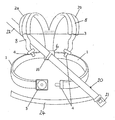
- A specific embodiment of the invention will now be described, by way of example, with reference to the accompany drawing in which the single figure is a schematic perspective view showing how a practical embodiment of the harness of the invention is attached to a conventional inertia reel vehicle seat belt.
- Firstly, the
conventional seat belt 20 is illustrated in a position where itsclasp 21 is pulled across to fasten at the other side of a seat, thereby defining an upperoblique portion 22 and alap portion 24. - The exemplary harness in accordance with the invention comprises a
main strap 1 having at its one end ametal plate 4 and at its other end aquick release clasp 5, of any suitable known design, with which theplate 4 is engageable. A pair ofshoulder straps main strap 1. Theseshoulder straps respective plates clasp 5. Accordingly, there is a common attachment point for thestraps clasp 5. - The
main strap 1 is preferably formed by webbing which is encapsulated in a pre-formed pliable polymer, e.g. foamed plastics material, which is fabricated so as to have inherent curvature. Alternatively, themain strap 1 may comprise the pre-formed curved foamed material to which additional padding or webbing is connected. Similarly, theshoulder straps Additional webbing straps 8, as shown, may be secured to the foamed plastics material of the shoulder straps 2 by adhesive or stitching 3 or both, or may even be encapsulated within the foamed material. The curvature of the foamed material of thestraps 1, 2 ensures that in use, once the harness is attached to theseat belt 20 and placed behind the wearer, thesestraps plates 4 at their respective ends are brought to a convenient position for securing into theclasp 5. - A
pliable web connector 6 is mounted at the back of the harness, i.e. it is mounted on the inner face of the harness which will lie against the back of the wearer with themain strap 1 and theshoulder straps connector 6 is mounted at a central position at the back of themain strap 1, where the shoulder straps 2 join themain strap 1. Theconnector 6 is preferably of a high friction rubber or synthetic rubber material which is sufficiently hard to retain its shape yet soft enough to deform under impact or strain without harming the wearer and which is comfortable against the wearer's back. An elongate tab in the manner of afinger 16 is cut or punched from theconnector web 6 and is of sufficient length to extend across the width of aconventional seat belt 20. As shown, theconnector web 6 is substantially square and thefinger 16 is formed diagonally across it. - In use, a wearer sits in a vehicle seat and puts on his/her standard inertia
reel seat belt 20 in the approved manner. The wearer then take the harness and passes themain strap 1 behind thediagonal section 22 of the inertiareel seat belt 20 and also engages thediagonal section 22 behind thefinger 16 of theconnector 6, as shown in the drawing. Although thefinger 16 should prevent any substantial sideways movement of the belt, thebelt section 22 should be readily slidable behind thefinger 16 in the direction of the belt so that the wearer can adjust the level of the harness, for example so that themain strap 1 is at a height that lies under the wearer's breasts and above the stomach. The wearer then passes both thediagonal section 22 of theseat belt 20 and the harness behind his/her back and puts on the harness. In this respect, it has already been mentioned that thestraps fastener plates 4 are brought together at a central point at the front of the wearer's chest and secured there by engagement into thequick release clasp 5, thus forming a closed harness structure. - Adjustment buckles (not shown) may be provided on the
shoulder straps main strap 1. These can be pulled comfortably tight to make sure the straps pass correctly around the shoulders and chest of the wearer. - The wearer is now in a position where the standard
car seat belt 20 is correctly fastened in its designed geometry, with thelap strap section 24 functioning as normal. The slack in thediagonal section 22 is taken up as normal by the inertia reel and the inertia reel functionality is not compromised. The wearer is then wearing a snug fitting shoulder harness connected to thediagonal section 22 of thecar seat belt 20, without the encumbrance of thediagonal strap 22 across his/her stomach, chest and shoulder. In the event of rapid deceleration, the inertia reel locks theseat belt 20 in the normal manner, thelap strap section 24 restrains the wearer by the thighs and the upper body is restrained by the shoulder harness being held securely by thediagonal section 22 of theseat belt 20. Thus the deceleration force will be spread across thelap strap section 24 via the seat belt and across the shoulders and upper chest via the harness. No force is transmitted to the wearer's stomach by the diagonal of the seat belt. - The foregoing is illustrative and not limitative of the scope of the invention and many other variations in the detail of the harness are possible in other embodiments. In particular the type or style of fasteners or clasps used for securing the ends of the main strap or front straps at the front of the wearer and for securing any shoulder straps are not critical to the invention. These can be selected from any commercially available style in order to meet safety and aesthetic requirements.
- The means of attachment of the back portion of the harness to the oblique section of the conventional seat belt may also vary. For example, the
connector 6 could be modified to include a T-shaped enlargement or inverted flap at the end of thefinger 16 to retain theoblique portion 22 of theseat belt 20 more securely, yet still slidably. Also, a press stud formation could be provided near the free end of thefinger 16 for the same purpose. - In other embodiments the
connector 6 could be replaced by a flap of flexible material, such as webbing or textile material, which could be secured across the belt section by hook and loop fastener material. Alternatively, theconnector 6 could be replaced by a semi-rigid pad formed of a suitable foamed plastics material and provided with a shallow groove or channel cut into its face towards the wearer to receive thediagonal section 22 of the inertialreel seat belt 20. A flap retained by patches of hook and loop material could again be provided to extend across the channel to hold thebelt 20 therein. - Simplicity of manufacture, ease of use and comfort are the primary considerations and the overall style and configuration of the harness may vary from that shown in the illustrated example.
- Although the harness and harness assembly of the invention are specifically envisaged as being attractive for use by pregnant women, they are also suitable for use by any vehicle driver or passenger who finds the diagonal section of a conventional seat belt causes discomfort. They may be particularly useful for child passengers whether or not they are sitting on booster seats or cushions.
Claims (6)
- A vehicle seat belt assembly comprising a belt extending between upper and lower fixed points at one side of a vehicle seat and a fastener mounted on the belt for attachment to a further fixed point at the opposite side of the vehicle seat so as to define, in the belt, a lap portion and an upper oblique portion, and a harness having a main strap for fitting around the back and chest of a wearer and shoulder straps for fitting over shoulder regions of a wearer, characterised in that the harness is attached only to the upper oblique portion of the belt in such a manner that a back portion of the harness passes behind the oblique portion of the belt while the lap portion of the belt remains available for fitting across and restraining the body of the wearer in customary manner.
- An assembly according to claim 1 wherein the harness is attached to the belt by means of a pliable web connector which is mounted on the back portion of the harness and incorporates a finger, beneath which the belt is slidingly entrained.
- An assembly according to claim 1 or 2 wherein the shoulder straps of the harness have an inherent curving configuration.
- An assembly according to any of claims 1, 2 or 3 wherein the main strap has an inherent curving configuration.
- An assembly according to any preceding claim wherein a releasable fastener device is provided at one end of the main strap and the opposing free end of the main strap and free ends of the respective shoulder straps are all connectable to said fastener device.
- A harness adapted for attachment to a vehicle seat belt to provide an assembly as claimed in any preceding claim.
Applications Claiming Priority (1)
| Application Number | Priority Date | Filing Date | Title |
|---|---|---|---|
| GBGB0502709.9A GB0502709D0 (en) | 2005-02-10 | 2005-02-10 | Vehicle seat belt attachment for, eg Pregnant Women |
Publications (3)
| Publication Number | Publication Date |
|---|---|
| EP1690754A1 true EP1690754A1 (en) | 2006-08-16 |
| EP1690754B1 EP1690754B1 (en) | 2010-12-15 |
| EP1690754B8 EP1690754B8 (en) | 2011-05-04 |
Family
ID=34356056
Family Applications (1)
| Application Number | Title | Priority Date | Filing Date |
|---|---|---|---|
| EP06250694A Expired - Lifetime EP1690754B8 (en) | 2005-02-10 | 2006-02-09 | Vehicle seat belt attachment |
Country Status (6)
| Country | Link |
|---|---|
| EP (1) | EP1690754B8 (en) |
| AT (1) | ATE491606T1 (en) |
| DE (1) | DE602006018811D1 (en) |
| ES (1) | ES2360129T3 (en) |
| GB (2) | GB0502709D0 (en) |
| PT (1) | PT1690754E (en) |
Cited By (3)
| Publication number | Priority date | Publication date | Assignee | Title |
|---|---|---|---|---|
| CN105774744A (en) * | 2016-05-24 | 2016-07-20 | 颜帆 | Automobile safety belt for pregnant woman |
| CN110154975A (en) * | 2018-02-13 | 2019-08-23 | 深圳市行安科技有限公司 | A kind of wearable fixed device |
| EP3713796A4 (en) * | 2017-11-22 | 2021-03-17 | Turjeman, Danniel | VEHICLE OCCUPANT RESTRAINT SYSTEM |
Families Citing this family (2)
| Publication number | Priority date | Publication date | Assignee | Title |
|---|---|---|---|---|
| WO2011157863A1 (en) | 2010-11-22 | 2011-12-22 | Fundación Cidaut | Vehicle seat belt positioning device |
| RU191932U1 (en) * | 2019-05-27 | 2019-08-28 | Сергей Антонович Брода | Maternity restraint with side impact protection |
Citations (6)
| Publication number | Priority date | Publication date | Assignee | Title |
|---|---|---|---|---|
| US3321247A (en) * | 1965-10-11 | 1967-05-23 | Irving Air Chute Co Inc | Child's safety harness |
| DE4236055A1 (en) * | 1992-10-26 | 1994-04-28 | W Markus Dr Med Schmitt | Seat belt restraint system for vehicle - in which occupant wears sleeveless garment to which vehicle seat belts are attached |
| JP2000302005A (en) | 1999-04-21 | 2000-10-31 | Hatsuki Shishido | Auxiliary seat belt for child |
| JP2000335365A (en) | 1999-05-24 | 2000-12-05 | Hiroka Kunimi | Auxiliary safety belt for child |
| EP1138560A1 (en) | 1998-12-09 | 2001-10-04 | Hideteru Shimizu | Seat belt auxiliary device |
| US6309024B1 (en) * | 2000-03-03 | 2001-10-30 | Trw Vehicle Safety Systems Inc. | Seat belt apparatus |
Family Cites Families (1)
| Publication number | Priority date | Publication date | Assignee | Title |
|---|---|---|---|---|
| US5042838A (en) * | 1990-03-15 | 1991-08-27 | Carter Richard E | Attachment for belt restraining apparatus |
-
2005
- 2005-02-10 GB GBGB0502709.9A patent/GB0502709D0/en not_active Ceased
-
2006
- 2006-02-09 ES ES06250694T patent/ES2360129T3/en not_active Expired - Lifetime
- 2006-02-09 PT PT06250694T patent/PT1690754E/en unknown
- 2006-02-09 GB GB0602579A patent/GB2423057B/en not_active Expired - Fee Related
- 2006-02-09 DE DE602006018811T patent/DE602006018811D1/en not_active Expired - Lifetime
- 2006-02-09 AT AT06250694T patent/ATE491606T1/en not_active IP Right Cessation
- 2006-02-09 EP EP06250694A patent/EP1690754B8/en not_active Expired - Lifetime
Patent Citations (6)
| Publication number | Priority date | Publication date | Assignee | Title |
|---|---|---|---|---|
| US3321247A (en) * | 1965-10-11 | 1967-05-23 | Irving Air Chute Co Inc | Child's safety harness |
| DE4236055A1 (en) * | 1992-10-26 | 1994-04-28 | W Markus Dr Med Schmitt | Seat belt restraint system for vehicle - in which occupant wears sleeveless garment to which vehicle seat belts are attached |
| EP1138560A1 (en) | 1998-12-09 | 2001-10-04 | Hideteru Shimizu | Seat belt auxiliary device |
| JP2000302005A (en) | 1999-04-21 | 2000-10-31 | Hatsuki Shishido | Auxiliary seat belt for child |
| JP2000335365A (en) | 1999-05-24 | 2000-12-05 | Hiroka Kunimi | Auxiliary safety belt for child |
| US6309024B1 (en) * | 2000-03-03 | 2001-10-30 | Trw Vehicle Safety Systems Inc. | Seat belt apparatus |
Cited By (3)
| Publication number | Priority date | Publication date | Assignee | Title |
|---|---|---|---|---|
| CN105774744A (en) * | 2016-05-24 | 2016-07-20 | 颜帆 | Automobile safety belt for pregnant woman |
| EP3713796A4 (en) * | 2017-11-22 | 2021-03-17 | Turjeman, Danniel | VEHICLE OCCUPANT RESTRAINT SYSTEM |
| CN110154975A (en) * | 2018-02-13 | 2019-08-23 | 深圳市行安科技有限公司 | A kind of wearable fixed device |
Also Published As
| Publication number | Publication date |
|---|---|
| GB0502709D0 (en) | 2005-03-16 |
| EP1690754B8 (en) | 2011-05-04 |
| GB2423057B (en) | 2008-07-30 |
| PT1690754E (en) | 2011-04-19 |
| GB2423057A (en) | 2006-08-16 |
| ES2360129T3 (en) | 2011-06-01 |
| GB0602579D0 (en) | 2006-03-22 |
| ATE491606T1 (en) | 2011-01-15 |
| DE602006018811D1 (en) | 2011-01-27 |
| EP1690754B1 (en) | 2010-12-15 |
Similar Documents
| Publication | Publication Date | Title |
|---|---|---|
| US4951965A (en) | Vehicle seat belt retainer for a child | |
| US5178439A (en) | Child safety belt sleeve | |
| CN105531158A (en) | An improved supplemental restraint system with six restraint points | |
| US5156436A (en) | Vehicle safety restraint | |
| US7316451B2 (en) | Wearable side impact protector | |
| US5624136A (en) | Safety system attached to seat belt in a motor vehicle | |
| US8696027B2 (en) | Positioner of safety belt for vehicles | |
| US20120274056A1 (en) | Safety seatbelt system for pregnant women | |
| EP2895358B1 (en) | Safety belt retention device | |
| EP1737710B1 (en) | Shoulder pad for vehicle seat belt | |
| US6935700B1 (en) | Pregnancy seat belt | |
| EP1690754B1 (en) | Vehicle seat belt attachment | |
| US7513532B1 (en) | Device to adjust tension in a shoulder belt | |
| US10640078B1 (en) | Portable restraining passenger safety harness | |
| CN106458145B (en) | Seat belt restraints for motor vehicles | |
| US10099651B2 (en) | Ergonomic restraint harness | |
| CN101421136A (en) | A seatbelt restraint | |
| US7270347B1 (en) | Seatbelt attachment for use by pregnant women | |
| JPH07291092A (en) | Auxiliary seat belt | |
| US20040051294A1 (en) | Seat belt restraint system | |
| US7658449B2 (en) | Safety restraint for a vehicle | |
| AU715321B2 (en) | Harness and booster seat | |
| KR102668214B1 (en) | Portable seat belts | |
| RU216386U1 (en) | Maternity restraint with side impact protection | |
| KR200254070Y1 (en) | Child Auxiliary Seat for Vehicle |
Legal Events
| Date | Code | Title | Description |
|---|---|---|---|
| PUAI | Public reference made under article 153(3) epc to a published international application that has entered the european phase |
Free format text: ORIGINAL CODE: 0009012 |
|
| AK | Designated contracting states |
Kind code of ref document: A1 Designated state(s): AT BE BG CH CY CZ DE DK EE ES FI FR GB GR HU IE IS IT LI LT LU LV MC NL PL PT RO SE SI SK TR |
|
| AX | Request for extension of the european patent |
Extension state: AL BA HR MK YU |
|
| 17P | Request for examination filed |
Effective date: 20070206 |
|
| 17Q | First examination report despatched |
Effective date: 20070314 |
|
| AKX | Designation fees paid |
Designated state(s): AT BE BG CH CY CZ DE DK EE ES FI FR GB GR HU IE IS IT LI LT LU LV MC NL PL PT RO SE SI SK TR |
|
| GRAP | Despatch of communication of intention to grant a patent |
Free format text: ORIGINAL CODE: EPIDOSNIGR1 |
|
| GRAS | Grant fee paid |
Free format text: ORIGINAL CODE: EPIDOSNIGR3 |
|
| GRAA | (expected) grant |
Free format text: ORIGINAL CODE: 0009210 |
|
| AK | Designated contracting states |
Kind code of ref document: B1 Designated state(s): AT BE BG CH CY CZ DE DK EE ES FI FR GB GR HU IE IS IT LI LT LU LV MC NL PL PT RO SE SI SK TR |
|
| REG | Reference to a national code |
Ref country code: CH Ref legal event code: EP Ref country code: GB Ref legal event code: FG4D |
|
| REG | Reference to a national code |
Ref country code: IE Ref legal event code: FG4D |
|
| REF | Corresponds to: |
Ref document number: 602006018811 Country of ref document: DE Date of ref document: 20110127 Kind code of ref document: P |
|
| RBV | Designated contracting states (corrected) |
Designated state(s): AT BE BG CH CY CZ DE DK EE ES FI FR GR HU IE IS IT LI LT LU LV MC NL PL PT RO SE SI SK TR |
|
| REG | Reference to a national code |
Ref country code: NL Ref legal event code: T3 |
|
| REG | Reference to a national code |
Ref country code: PT Ref legal event code: SC4A Free format text: AVAILABILITY OF NATIONAL TRANSLATION Effective date: 20110412 |
|
| PG25 | Lapsed in a contracting state [announced via postgrant information from national office to epo] |
Ref country code: LT Free format text: LAPSE BECAUSE OF FAILURE TO SUBMIT A TRANSLATION OF THE DESCRIPTION OR TO PAY THE FEE WITHIN THE PRESCRIBED TIME-LIMIT Effective date: 20101215 |
|
| REG | Reference to a national code |
Ref country code: GR Ref legal event code: EP Ref document number: 20110400642 Country of ref document: GR Effective date: 20110412 |
|
| LTIE | Lt: invalidation of european patent or patent extension |
Effective date: 20101215 |
|
| PG25 | Lapsed in a contracting state [announced via postgrant information from national office to epo] |
Ref country code: CY Free format text: LAPSE BECAUSE OF FAILURE TO SUBMIT A TRANSLATION OF THE DESCRIPTION OR TO PAY THE FEE WITHIN THE PRESCRIBED TIME-LIMIT Effective date: 20101215 Ref country code: LV Free format text: LAPSE BECAUSE OF FAILURE TO SUBMIT A TRANSLATION OF THE DESCRIPTION OR TO PAY THE FEE WITHIN THE PRESCRIBED TIME-LIMIT Effective date: 20101215 Ref country code: SE Free format text: LAPSE BECAUSE OF FAILURE TO SUBMIT A TRANSLATION OF THE DESCRIPTION OR TO PAY THE FEE WITHIN THE PRESCRIBED TIME-LIMIT Effective date: 20101215 Ref country code: FI Free format text: LAPSE BECAUSE OF FAILURE TO SUBMIT A TRANSLATION OF THE DESCRIPTION OR TO PAY THE FEE WITHIN THE PRESCRIBED TIME-LIMIT Effective date: 20101215 Ref country code: SI Free format text: LAPSE BECAUSE OF FAILURE TO SUBMIT A TRANSLATION OF THE DESCRIPTION OR TO PAY THE FEE WITHIN THE PRESCRIBED TIME-LIMIT Effective date: 20101215 Ref country code: AT Free format text: LAPSE BECAUSE OF FAILURE TO SUBMIT A TRANSLATION OF THE DESCRIPTION OR TO PAY THE FEE WITHIN THE PRESCRIBED TIME-LIMIT Effective date: 20101215 Ref country code: BG Free format text: LAPSE BECAUSE OF FAILURE TO SUBMIT A TRANSLATION OF THE DESCRIPTION OR TO PAY THE FEE WITHIN THE PRESCRIBED TIME-LIMIT Effective date: 20110315 |
|
| REG | Reference to a national code |
Ref country code: ES Ref legal event code: FG2A Ref document number: 2360129 Country of ref document: ES Kind code of ref document: T3 Effective date: 20110601 |
|
| PG25 | Lapsed in a contracting state [announced via postgrant information from national office to epo] |
Ref country code: CZ Free format text: LAPSE BECAUSE OF FAILURE TO SUBMIT A TRANSLATION OF THE DESCRIPTION OR TO PAY THE FEE WITHIN THE PRESCRIBED TIME-LIMIT Effective date: 20101215 Ref country code: EE Free format text: LAPSE BECAUSE OF FAILURE TO SUBMIT A TRANSLATION OF THE DESCRIPTION OR TO PAY THE FEE WITHIN THE PRESCRIBED TIME-LIMIT Effective date: 20101215 Ref country code: IS Free format text: LAPSE BECAUSE OF FAILURE TO SUBMIT A TRANSLATION OF THE DESCRIPTION OR TO PAY THE FEE WITHIN THE PRESCRIBED TIME-LIMIT Effective date: 20110415 |
|
| PG25 | Lapsed in a contracting state [announced via postgrant information from national office to epo] |
Ref country code: PL Free format text: LAPSE BECAUSE OF FAILURE TO SUBMIT A TRANSLATION OF THE DESCRIPTION OR TO PAY THE FEE WITHIN THE PRESCRIBED TIME-LIMIT Effective date: 20101215 Ref country code: SK Free format text: LAPSE BECAUSE OF FAILURE TO SUBMIT A TRANSLATION OF THE DESCRIPTION OR TO PAY THE FEE WITHIN THE PRESCRIBED TIME-LIMIT Effective date: 20101215 Ref country code: RO Free format text: LAPSE BECAUSE OF FAILURE TO SUBMIT A TRANSLATION OF THE DESCRIPTION OR TO PAY THE FEE WITHIN THE PRESCRIBED TIME-LIMIT Effective date: 20101215 |
|
| PG25 | Lapsed in a contracting state [announced via postgrant information from national office to epo] |
Ref country code: MC Free format text: LAPSE BECAUSE OF NON-PAYMENT OF DUE FEES Effective date: 20110228 |
|
| REG | Reference to a national code |
Ref country code: CH Ref legal event code: PL |
|
| PLBE | No opposition filed within time limit |
Free format text: ORIGINAL CODE: 0009261 |
|
| STAA | Information on the status of an ep patent application or granted ep patent |
Free format text: STATUS: NO OPPOSITION FILED WITHIN TIME LIMIT |
|
| PG25 | Lapsed in a contracting state [announced via postgrant information from national office to epo] |
Ref country code: LI Free format text: LAPSE BECAUSE OF NON-PAYMENT OF DUE FEES Effective date: 20110228 Ref country code: CH Free format text: LAPSE BECAUSE OF NON-PAYMENT OF DUE FEES Effective date: 20110228 Ref country code: DK Free format text: LAPSE BECAUSE OF FAILURE TO SUBMIT A TRANSLATION OF THE DESCRIPTION OR TO PAY THE FEE WITHIN THE PRESCRIBED TIME-LIMIT Effective date: 20101215 |
|
| 26N | No opposition filed |
Effective date: 20110916 |
|
| REG | Reference to a national code |
Ref country code: IE Ref legal event code: MM4A |
|
| REG | Reference to a national code |
Ref country code: DE Ref legal event code: R097 Ref document number: 602006018811 Country of ref document: DE Effective date: 20110916 |
|
| PG25 | Lapsed in a contracting state [announced via postgrant information from national office to epo] |
Ref country code: IE Free format text: LAPSE BECAUSE OF NON-PAYMENT OF DUE FEES Effective date: 20110209 |
|
| PGFP | Annual fee paid to national office [announced via postgrant information from national office to epo] |
Ref country code: PT Payment date: 20120509 Year of fee payment: 7 |
|
| PG25 | Lapsed in a contracting state [announced via postgrant information from national office to epo] |
Ref country code: LU Free format text: LAPSE BECAUSE OF NON-PAYMENT OF DUE FEES Effective date: 20110209 |
|
| REG | Reference to a national code |
Ref country code: PT Ref legal event code: MM4A Free format text: LAPSE DUE TO NON-PAYMENT OF FEES Effective date: 20130809 |
|
| PG25 | Lapsed in a contracting state [announced via postgrant information from national office to epo] |
Ref country code: PT Free format text: LAPSE BECAUSE OF NON-PAYMENT OF DUE FEES Effective date: 20130809 Ref country code: HU Free format text: LAPSE BECAUSE OF FAILURE TO SUBMIT A TRANSLATION OF THE DESCRIPTION OR TO PAY THE FEE WITHIN THE PRESCRIBED TIME-LIMIT Effective date: 20101215 |
|
| PG25 | Lapsed in a contracting state [announced via postgrant information from national office to epo] |
Ref country code: NL Free format text: LAPSE BECAUSE OF NON-PAYMENT OF DUE FEES Effective date: 20140901 |
|
| PGFP | Annual fee paid to national office [announced via postgrant information from national office to epo] |
Ref country code: NL Payment date: 20140821 Year of fee payment: 9 Ref country code: DE Payment date: 20140813 Year of fee payment: 9 Ref country code: GR Payment date: 20140822 Year of fee payment: 9 |
|
| PGFP | Annual fee paid to national office [announced via postgrant information from national office to epo] |
Ref country code: ES Payment date: 20140811 Year of fee payment: 9 Ref country code: TR Payment date: 20140808 Year of fee payment: 9 Ref country code: FR Payment date: 20140814 Year of fee payment: 9 |
|
| PGFP | Annual fee paid to national office [announced via postgrant information from national office to epo] |
Ref country code: IT Payment date: 20140820 Year of fee payment: 9 |
|
| PGFP | Annual fee paid to national office [announced via postgrant information from national office to epo] |
Ref country code: BE Payment date: 20140819 Year of fee payment: 9 |
|
| PG25 | Lapsed in a contracting state [announced via postgrant information from national office to epo] |
Ref country code: BE Free format text: LAPSE BECAUSE OF NON-PAYMENT OF DUE FEES Effective date: 20150228 |
|
| REG | Reference to a national code |
Ref country code: DE Ref legal event code: R119 Ref document number: 602006018811 Country of ref document: DE |
|
| REG | Reference to a national code |
Ref country code: NL Ref legal event code: V1 Effective date: 20150901 |
|
| PG25 | Lapsed in a contracting state [announced via postgrant information from national office to epo] |
Ref country code: NL Free format text: LAPSE BECAUSE OF NON-PAYMENT OF DUE FEES Effective date: 20150901 |
|
| REG | Reference to a national code |
Ref country code: GR Ref legal event code: ML Ref document number: 20110400642 Country of ref document: GR Effective date: 20150902 |
|
| REG | Reference to a national code |
Ref country code: FR Ref legal event code: ST Effective date: 20151030 |
|
| PG25 | Lapsed in a contracting state [announced via postgrant information from national office to epo] |
Ref country code: GR Free format text: LAPSE BECAUSE OF NON-PAYMENT OF DUE FEES Effective date: 20150902 |
|
| PG25 | Lapsed in a contracting state [announced via postgrant information from national office to epo] |
Ref country code: IT Free format text: LAPSE BECAUSE OF NON-PAYMENT OF DUE FEES Effective date: 20150209 |
|
| PG25 | Lapsed in a contracting state [announced via postgrant information from national office to epo] |
Ref country code: DE Free format text: LAPSE BECAUSE OF NON-PAYMENT OF DUE FEES Effective date: 20150901 |
|
| PG25 | Lapsed in a contracting state [announced via postgrant information from national office to epo] |
Ref country code: FR Free format text: LAPSE BECAUSE OF NON-PAYMENT OF DUE FEES Effective date: 20150302 |
|
| REG | Reference to a national code |
Ref country code: ES Ref legal event code: FD2A Effective date: 20160329 |
|
| PG25 | Lapsed in a contracting state [announced via postgrant information from national office to epo] |
Ref country code: ES Free format text: LAPSE BECAUSE OF NON-PAYMENT OF DUE FEES Effective date: 20150210 |
|
| PG25 | Lapsed in a contracting state [announced via postgrant information from national office to epo] |
Ref country code: TR Free format text: LAPSE BECAUSE OF NON-PAYMENT OF DUE FEES Effective date: 20150209 |