EP1689820B1 - Polymeric colored dispersants and colorant dispersions containing same - Google Patents
Polymeric colored dispersants and colorant dispersions containing same Download PDFInfo
- Publication number
- EP1689820B1 EP1689820B1 EP04812471A EP04812471A EP1689820B1 EP 1689820 B1 EP1689820 B1 EP 1689820B1 EP 04812471 A EP04812471 A EP 04812471A EP 04812471 A EP04812471 A EP 04812471A EP 1689820 B1 EP1689820 B1 EP 1689820B1
- Authority
- EP
- European Patent Office
- Prior art keywords
- pigment
- dispersion
- pigments
- organic
- dispersant
- Prior art date
- Legal status (The legal status is an assumption and is not a legal conclusion. Google has not performed a legal analysis and makes no representation as to the accuracy of the status listed.)
- Expired - Lifetime
Links
Classifications
-
- C—CHEMISTRY; METALLURGY
- C09—DYES; PAINTS; POLISHES; NATURAL RESINS; ADHESIVES; COMPOSITIONS NOT OTHERWISE PROVIDED FOR; APPLICATIONS OF MATERIALS NOT OTHERWISE PROVIDED FOR
- C09B—ORGANIC DYES OR CLOSELY-RELATED COMPOUNDS FOR PRODUCING DYES, e.g. PIGMENTS; MORDANTS; LAKES
- C09B68/00—Organic pigments surface-modified by grafting, e.g. by establishing covalent or complex bonds, in order to improve the pigment properties, e.g. dispersibility or rheology
- C09B68/20—Organic pigments surface-modified by grafting, e.g. by establishing covalent or complex bonds, in order to improve the pigment properties, e.g. dispersibility or rheology characterised by the process features
-
- C—CHEMISTRY; METALLURGY
- C09—DYES; PAINTS; POLISHES; NATURAL RESINS; ADHESIVES; COMPOSITIONS NOT OTHERWISE PROVIDED FOR; APPLICATIONS OF MATERIALS NOT OTHERWISE PROVIDED FOR
- C09B—ORGANIC DYES OR CLOSELY-RELATED COMPOUNDS FOR PRODUCING DYES, e.g. PIGMENTS; MORDANTS; LAKES
- C09B67/00—Influencing the physical, e.g. the dyeing or printing properties of dyestuffs without chemical reactions, e.g. by treating with solvents grinding or grinding assistants, coating of pigments or dyes; Process features in the making of dyestuff preparations; Dyestuff preparations of a special physical nature, e.g. tablets, films
- C09B67/0071—Process features in the making of dyestuff preparations; Dehydrating agents; Dispersing agents; Dustfree compositions
- C09B67/0084—Dispersions of dyes
- C09B67/0085—Non common dispersing agents
-
- C—CHEMISTRY; METALLURGY
- C09—DYES; PAINTS; POLISHES; NATURAL RESINS; ADHESIVES; COMPOSITIONS NOT OTHERWISE PROVIDED FOR; APPLICATIONS OF MATERIALS NOT OTHERWISE PROVIDED FOR
- C09B—ORGANIC DYES OR CLOSELY-RELATED COMPOUNDS FOR PRODUCING DYES, e.g. PIGMENTS; MORDANTS; LAKES
- C09B68/00—Organic pigments surface-modified by grafting, e.g. by establishing covalent or complex bonds, in order to improve the pigment properties, e.g. dispersibility or rheology
- C09B68/40—Organic pigments surface-modified by grafting, e.g. by establishing covalent or complex bonds, in order to improve the pigment properties, e.g. dispersibility or rheology characterised by the chemical nature of the attached groups
- C09B68/41—Polymers attached to the pigment surface
-
- C—CHEMISTRY; METALLURGY
- C09—DYES; PAINTS; POLISHES; NATURAL RESINS; ADHESIVES; COMPOSITIONS NOT OTHERWISE PROVIDED FOR; APPLICATIONS OF MATERIALS NOT OTHERWISE PROVIDED FOR
- C09B—ORGANIC DYES OR CLOSELY-RELATED COMPOUNDS FOR PRODUCING DYES, e.g. PIGMENTS; MORDANTS; LAKES
- C09B68/00—Organic pigments surface-modified by grafting, e.g. by establishing covalent or complex bonds, in order to improve the pigment properties, e.g. dispersibility or rheology
- C09B68/40—Organic pigments surface-modified by grafting, e.g. by establishing covalent or complex bonds, in order to improve the pigment properties, e.g. dispersibility or rheology characterised by the chemical nature of the attached groups
- C09B68/44—Non-ionic groups, e.g. halogen, OH or SH
- C09B68/446—Amines or polyamines, e.g. aminopropyl, 1,3,4,-triamino-pentyl or polyethylene imine
-
- C—CHEMISTRY; METALLURGY
- C09—DYES; PAINTS; POLISHES; NATURAL RESINS; ADHESIVES; COMPOSITIONS NOT OTHERWISE PROVIDED FOR; APPLICATIONS OF MATERIALS NOT OTHERWISE PROVIDED FOR
- C09B—ORGANIC DYES OR CLOSELY-RELATED COMPOUNDS FOR PRODUCING DYES, e.g. PIGMENTS; MORDANTS; LAKES
- C09B69/00—Dyes not provided for by a single group of this subclass
- C09B69/10—Polymeric dyes; Reaction products of dyes with monomers or with macromolecular compounds
Definitions
- This invention relates to polymeric colored dispersants and colorant dispersions for use in formulating printing inks and other hydrocarbon systems.
- Polymeric colored materials generally exhibit a high degree of solubility and excellent colorability when employed in hydrocarbon compositions such as mineral oils, fuels and the like, and in wax compositions, such as candles, crayons and the like.
- colored polymers are not disclosed in the prior art as dispersing agents for use hydrocarbon compositions or printing inks.
- U.S. Patent 6,187,085 B1 describes a printing ink composition made of carbon black and an alkali metal hydroxide in combination with an alkenyl succinimide for dispersing the carbon black. It also discloses a method of dispersing carbon black in a mineral oil and metal salts, which exhibit poor lithographic printing performance.
- Patent 6,508,873 B1 discloses phthalocyanine polymeric amides and esters with a polymeric tail of up to C 30 for use as colorants in ink-jet printing inks.
- U.S. Patents 6,451,071 and 6,287,348 disclose colored materials of the structure A-B-X wherein A is an organic chromophore, B is an electrophilic linking group bonded to A, and X is selected from the group of C 12 -C 24 primary or secondary amines.
- U.S. Patent 6,486,248 82 discloses a hydrocarbon soluble liquid polymeric colorant comprised of a chromophore and oleophilic binder and an alcohol including a carbon chain between C 3 -C 30 .
- Patent 6,452,020 B1 discloses xanthene colorants that exhibit improved wax or oil solubillity made with polyoxyalkylene polymers.
- U.S. Patent 6,106,597 discloses a polymeric colorant with the formula R ⁇ A[(B) n R 1 ] m ⁇ x wherein R is an organic chromophore, A is a linking group, B is a C 2 -C 4 alkyleneoxy constituent, n is an integer from 2-100, m is 1 when A is O, S, CO 2 or 2 when A is N or SO 2 N, x is an integer from 1-5 and R 1 is a C 8 -C 20 fatty acid.
- R is an organic chromophore
- A is a linking group
- B is a C 2 -C 4 alkyleneoxy constituent
- n is an integer from 2-100
- m is 1 when A is O, S, CO 2 or 2 when A is N or SO 2 N
- x is an integer from 1-5
- Patent 6,034,158 discloses a colorant wax composition
- a colorant wax composition comprising a colorant of the formula R ⁇ A-[(alkyleneoxy constituent)nN ⁇ m ⁇ x wherein R is an organic chromophore, A is a linking group, B is a C 2 -C 4 alkyleneoxy constituent, n is an integer from 2-100, m is 1 when A is O, S, CO 2 or 2 when A is N or SO 2 N, x is an integer from 1-5 and a surfactant selected from the group consisting of a derivative of sorbitan monooleate.
- R is an organic chromophore
- A is a linking group
- B is a C 2 -C 4 alkyleneoxy constituent
- n is an integer from 2-100
- m is 1 when A is O, S, CO 2 or 2 when A is N or SO 2 N
- x is an integer from 1-5
- Patent 6,022,944 discloses a polymeric colorant of the structure A[SO 2 N(R1)-(Y)]1-6 where A is an anthraquinone chromophoric radical, Y is a polymeric substituent having from 4-200 repeat groups and R1 is selected from H, Y, C1-12, or alkyl, aryl or cycloalkyl.
- Patent 5,789,515 discloses a colorant with the structure ABXYZ in which A is an organic chromophore, B is an electrophilic reactive group covalently bonded to A, X is a nucleophilic linking group covalently bonded to B, Y is a poly(oxyalkylene)-polysiloxane copolymer, and Z is a terminal group for Y.
- A is an organic chromophore
- B is an electrophilic reactive group covalently bonded to A
- X is a nucleophilic linking group covalently bonded to B
- Y is a poly(oxyalkylene)-polysiloxane copolymer
- Z is a terminal group for Y.
- Patent 5,766,268 discloses a colorant compatible with polar solvent colorants with the structure ABXYZ in which A is an organic chromophore, B is an electrophilic reactive group covalently bonded to A, X is a nucleophilic linking group covalently bonded to B, Y is a poly(oxyalkylene) polymer, and Z is a terminal group for Y.
- A is an organic chromophore
- B is an electrophilic reactive group covalently bonded to A
- X is a nucleophilic linking group covalently bonded to B
- Y is a poly(oxyalkylene) polymer
- Z is a terminal group for Y.
- U.S. Patent 5,270,363 discloses a phthalocyanine colorant that contains polyoxyalkylene polymeric tails.
- 5,177,200 discloses a colorant of the formula A-(SO 2 -N(R 2 )-Y n wherein A is a non-ionic metalophthalocyanine chromophore of Cu, Ni, or Al, R 2 is a hydrogen C 1 -C 6 alkyl or cycloalkyl, phenyl, benzyl, or Y, Y is a poly(oxyalkylene) moiety comprising 3 units, and n is an integer between 1-4.
- U.S. Patent 5,419,800 and 5,135,972 both disclose phthalocyanine colorants that contain polyoxyalkylene polymeric tails.
- Patent 4,141,684 discloses a colorant that is a chromophore covalently bonded to polyalkylene oxides of a molecular weight of at least 500 amu.
- U.S. Patent 4,137,243 discloses anthraquinone polymeric colorants that contain polyoxyalkylene polymeric tails.
- U.S. Patent 5,100,471 discloses an aqueous ink jet composition comprised of a solvent and colored particles having a polymeric core and a silica shell onto which dyes are covalently bonded.
- U.S. Patent 4,468,255 claims diazo and azo linkage Schiff's bases reacted with polyoxyalkane polymeric chains which can be used as a rheological modifier for pigment dispersions.
- polymeric colored materials that either have no more than C 24 a polyalkene chain or contain a polyoxyalkylene polymer.
- these polymeric colored materials are not suitable for use as pigment dispersants in non-polar systems and would not decrease the viscosity of a pigment dispersion when employed in a relatively small amount (i.e., 1-15% w/w pigment).
- A is an organic chromophore
- B is a covalently bonded linking moiety containing N
- X is a branched or linear C 50 -C 200 covalently linked polyalkylene
- n is an integer from 1 to 4.
- the present invention is also an improved color strength colorant dispersion comprising a polymeric colored dispersant having the structure A-(B-X) n , wherein A, B, X, and n are as described above.
- the present invention is also a colorant of at least about 45 wt.% colorant, based on the total weight of the dispersion, containing a polymeric colored dispersant of the structure A-(B-X) n , wherein A, B, X, and n are as described above.
- the present invention also provides an organic pigment dispersion of at least 45 wt.% organic pigment and a dispersant, having a viscosity less than about 150 Pa.s.
- the present invention also provides a method of lowering the viscosity of an organic pigment dispersion to less than about 150 Pa.s. containing a pigment and a polymeric colored dispersant, wherein said dispersant has the structure A-(B-X) n , wherein A, B, X, and n are as described above.
- the present invention further provides a printing ink composition having an organic pigment dispersion containing a polymeric colored dispersant of the structure A-(B-X) n , wherein A, B, X, and n are as described above.
- the present invention is a polymeric colored dispersant of the structure A-(B-X) n , where A is an organic chromophore; B is a covalently bonded linking moiety containing N between A and X; X is a branched or linear C 50 -C 200 covalently linked polyalkylene, and n is an integer from 1 to 4.
- suitable organic chromophores include, but are not limited to, mono and diazo pigments, phthalocyanine pigments, quinacridone pigments, rhodamine dyes and pigments, perylene pigments, diketopyroles pigments, anthraquinone dyes and pigments, indanthrene dyes, lake pigments, dioxazine pigments, isoindolinone pigments, and dioxazine pigments.
- the organic chromophore be red, yellow, violet or blue organic pigments or dyes, selected from but not limited to Carbon Black, Pigment Yellow 12, Pigment Yellow 13, Pigment Yellow 14, Pigment Yellow 74, Pigment Yellow 150, Pigment Orange 5, Pigment Orange 13, Pigment Orange 16, Pigment Orange 64, Pigment Red 2, Pigment Red 81:2, Pigment Red 122, Pigment Red 144, Pigment Red 166, Pigment Red 179, Pigment Red 184, Pigment Red 202, Pigment Red 254, Pigment Red 264, Pigment Violet 1, Pigment Violet 2, Pigment Violet 3, Pigment Violet 19, Pigment Violet 23, Pigment Blue 15:3, and Blue 15:4.
- organic pigments or dyes selected from but not limited to Carbon Black, Pigment Yellow 12, Pigment Yellow 13, Pigment Yellow 14, Pigment Yellow 74, Pigment Yellow 150, Pigment Orange 5, Pigment Orange 13, Pigment Orange 16, Pigment Orange 64, Pigment Red 2, Pigment Red 81:2, Pigment Red 122, Pigment Red 144, Pigment Red 166, Pigment Red 179, Pig
- linking moieties contain the element N. It is preferred that the linking moiety contain an amino group.
- suitable covalently linked polyalkylenes are selected from but not limited to either branched or linear polyalkylenes.
- the polyalkylene is a C 50 -C 200 polyalkylene, preferably a C 100 -C 150 polyalkylene.
- the polyalkylene preferably is polyisobutylene.
- the n value may be from 1 to 4, preferably either 1 or 2.
- the polymeric colored dispersant of the present invention has a viscosity of less than about 150 Pa.s.
- the dispersant is to be contained in a colorant dispersion which may further contain between about 40 wt.% to about 90 wt.%, based on the total weight of the colorant dispersion, of an organic pigment, carbon black or dye. It is preferred that the pigment be present from about 45 wt.% to about 65 wt.%.
- Suitable organic pigments and dyes include, but are not limited to mono and diazo pigments, phthalocyanine pigments, quinacridone pigments, rhodamine dyes and pigments, perylene pigments, diketopyrroles pigments, anthraquinone dyes and pigments, indanthrene dyes, lake pigments, dioxazine pigments, isoindolinone pigments, and dioxazine pigments.
- the pigment be selected from carbon black or a red, yellow, violet or blue organic pigments, including but not limited to Pigment Yellow 12, Pigment Yellow 13, Pigment Yellow 14, Pigment Yellow 74, Pigment Yellow 150, Pigment Orange 5, Pigment Orange 13, Pigment Orange 16, Pigment Orange 64, Pigment Red 2, Pigment Red 81:2, Pigment Red 122, Pigment Red 144, Pigment Red 166, Pigment Red 179, Pigment Red 184, Pigment Red 202, Pigment Red 254, Pigment Red 264, Pigment Violet 1, Pigment Violet 2, Pigment Violet 3, Pigment Violet 19, Pigment Violet 23, Pigment Blue 15:3, and Pigment Blue 15:4.
- organic pigments including but not limited to Pigment Yellow 12, Pigment Yellow 13, Pigment Yellow 14, Pigment Yellow 74, Pigment Yellow 150, Pigment Orange 5, Pigment Orange 13, Pigment Orange 16, Pigment Orange 64, Pigment Red 2, Pigment Red 81:2, Pigment Red 122, Pigment Red 144, Pigment Red 166, Pigment Red 179, Pigment Red 184, Pigment Red 202,
- the dispersant of the present invention significantly reduces viscosity of highly pigmented dispersions when employed in relatively small amounts.
- the dispersant is effective when used in amounts of about 1 wt.% to about 15 wt.% based on the weight of the pigment, and more preferably about 10 wt.%.
- the polymeric colored dispersant and colorant dispersions containing same of the present invention are particularly suitable for preparing high performance lithographic and/or gravure printing inks.
- the polymeric colored dispersant of the present invention is also useful for formulating hydrocarbon compositions, such as mineral oils, fuels, wax compositions, including candles, crayons, and the like.
- polymeric colored dispersant of the present invention for formulating hydrocarbon composition or waxes, including, but not limited to, significantly decreasing the viscosity of colorant dispersion incorporating such dispersant when employed in relatively small amounts and lowering the viscosity of the colorant dispersions.
- This permits the inclusion of more colorant and results in highly colored concentrations that can be satisfactorily handled and dispersed in lithographic printing inks, for example.
- the polymeric colored dispersant of the present invention also improves the stability of a dispersion and increases the color strength of the colored dispersion due to its colored nature and increases the stability of the dispersion at the higher colorant loading.
- the colored polymeric dispersant of the present invention has a minimal effect on the oil-water (O/W) interfacial tension of highly colored dispersions or concentrates. This preserves the lithographic quality (none or reduced scumming, feedback and over-emulsification) of the neat colorant concentrate and affords a low-relative-O/W interface tension.
- Use of the colored polymeric dispersant of the present invention helps to avoid known lithographic problems such as over-emulsification which is when excessive fountain solution emulsification causes poor ink transfer, blanket piling, high dot gain, and misting. It also helps avoid scumming which is a condition where small amounts of ink are transferred onto the substrate from the non-image area of the plate.
- Scumming results from the inability of fountain solution to keep the non-image area of the printing plate ink-free or when ink floats on or is emulsified into the fountain solution (i.e. dampening system feedback). If not corrected by the press operators, scumming can result in rejection of the final printed product.
- polymeric colored dispersant and colorant dispersions of the present invention are further illustrated by the following non-limiting examples in which all parts and percentages are by weight, unless otherwise indicated.
- Polyisobutylamine 200 grams; FD-100, available from BASF, Wyandotte, MI.
- 2-chlorotoluene 200 grams; available from Aldrich Chemical Co. of Milwaukee, WI
- Pigment Yellow 12 26.5 grams; available from Sun Chemical Corp., of Ft. Lee, NJ
- the reaction mixture was slowly cooled to room temperature, producing a very dark red viscous liquid.
- Rhodamine B (10 grams) and o-chlorotoluene (100 grams; both available from the Aldrich Chemical Co., Milwaukee WI), were mixed under a nitrogen purge and warmed to 35°C.
- Thionyl chloride (3.1 grams) was added to the reaction mixture and the mixture was slowly warmed to 50°C for 1 hour, then warmed further to 100°C for an additional hour.
- the reaction mixture was cooled to 50°C and polyisobutylamine (29.75 grams; FD-100, available from BASF, Wyandotte, MI.) was added and the entire reaction mixture was allowed to react for 3 hours.
- the reaction mixture was then heated under vacuum to 140°C to remove both oil, from the polyisobutylamine, and the o-chlorotoluene, then slowly cooled to room temperature, to produce a very bright red viscous liquid.
- Polyisobutylamine 200 parts; FD-100, available from BASF, Wyandotte, MI. was mixed under nitrogen purge with 3,4,9,10-Perylene tetracarboxycilic acid dianhydride (3.5 parts; available from Aldrich Chemical Co., Milwaukee WI,) and heated to 220°C. Over the next 8 hours a total of 10 additional grams of the 3,4,9,10-perylene tetracarboxycilic acid dianhydride was added to the stirring reaction and then allowed to react for an additional 11 hours. The reaction mixture was cooled to 25°C and heptane (213.5 grams) was added and allowed to stir for half an hour. The reaction mixture was filtered and the heptane was then removed, producing a viscous red liquid.
- Each pigment dispersion composition was prepared in the following manner: 25 parts of a varnish (16.75 parts of a hydrocarbon resin (LX 1082-280; available from Neville Chemical of Pittsburgh, PA) and 8.25 parts of 47 oil (available from Magie Bros., Franklin Park, IL)), 20 parts of 47 Oil (available from Magie Bros., Franklin Park, IL.), 50 parts of pigment, and 5 parts dispersant (if present) were combined together and mixed on a Hoover Muller Mixer at 3 x 50 revolutions. The viscosities of the resulting pigment dispersions were measured along with their effect on the relative interfacial tension of an oil-water ink system.
- Each pigment concentrate sample in the form of a paste was loaded on a lower stationary plate with a spatula. All samples were of virgin materials and no preshearing was carried out on the sample to emulate the actual bulking process.
- the lower stationary plate was then raised slowly to compress the sample against an upper plate (the cone) to reach a measurement position.
- the gap width was set to be 1 mm in all cases.
- Both upper and lower plates were pre-equilibrated to 25°C before starting the measurement.
- the sample was subjected to a linear stress sweep at a shear rate ranging from 10 to 100 S -1 . For a more viscous sample, the experiment was terminated before reaching 100 S -1 to avoid torque overloading of the machine.
- the data collection mode was logarithmic to emphasize the lower shear rate range. Both shear stress and shear rate data were collected to obtain viscosity information on the sample. Each pigment dispersion was run 2-3 times and an average viscosity was calculated.
- Table 1 and Graphs 1 and 2 show the results of the rheological testing and interfacial tension measurements in numerical and graphical display. The results indicate that the pigment dispersion compositions containing the dispersants of the present invention have significantly lower relative interfacial tension drop than pigment dispersion compositions containing no dispersant or dispersants known in the prior art. Further, the pigment dispersion composition containing the present invention dispersant has lower viscosity than that of either the pigment dispersion containing no dispersant, or dispersants known in the prior art.
- Table 1 Pigment Type Wt. % Varnish Wt. % Synergist wt. % Dispersant wt. % Oil wt.
Landscapes
- Chemical & Material Sciences (AREA)
- Organic Chemistry (AREA)
- Dispersion Chemistry (AREA)
- Chemical Kinetics & Catalysis (AREA)
- Pigments, Carbon Blacks, Or Wood Stains (AREA)
- Compositions Of Macromolecular Compounds (AREA)
- Inks, Pencil-Leads, Or Crayons (AREA)
Abstract
Description
- This invention relates to polymeric colored dispersants and colorant dispersions for use in formulating printing inks and other hydrocarbon systems.
- Polymeric colored materials generally exhibit a high degree of solubility and excellent colorability when employed in hydrocarbon compositions such as mineral oils, fuels and the like, and in wax compositions, such as candles, crayons and the like. However, colored polymers are not disclosed in the prior art as dispersing agents for use hydrocarbon compositions or printing inks. For example,
U.S. Patent 6,187,085 B1 describes a printing ink composition made of carbon black and an alkali metal hydroxide in combination with an alkenyl succinimide for dispersing the carbon black. It also discloses a method of dispersing carbon black in a mineral oil and metal salts, which exhibit poor lithographic printing performance.U.S. Patent 6,508,873 B1 discloses phthalocyanine polymeric amides and esters with a polymeric tail of up to C30 for use as colorants in ink-jet printing inks.U.S. Patents 6,451,071 and6,287,348 disclose colored materials of the structure A-B-X wherein A is an organic chromophore, B is an electrophilic linking group bonded to A, and X is selected from the group of C12-C24 primary or secondary amines.U.S. Patent 6,486,248 82 discloses a hydrocarbon soluble liquid polymeric colorant comprised of a chromophore and oleophilic binder and an alcohol including a carbon chain between C3-C30.U.S. Patent 6,452,020 B1 discloses xanthene colorants that exhibit improved wax or oil solubillity made with polyoxyalkylene polymers.U.S. Patent 6,106,597 discloses a polymeric colorant with the formula R{A[(B)nR1]m}x wherein R is an organic chromophore, A is a linking group, B is a C2-C4 alkyleneoxy constituent, n is an integer from 2-100, m is 1 when A is O, S, CO2 or 2 when A is N or SO2N, x is an integer from 1-5 and R1 is a C8-C20 fatty acid.U.S. Patent 6,034,158 discloses a colorant wax composition comprising a colorant of the formula R{A-[(alkyleneoxy constituent)nN}m}x wherein R is an organic chromophore, A is a linking group, B is a C2-C4 alkyleneoxy constituent, n is an integer from 2-100, m is 1 when A is O, S, CO2 or 2 when A is N or SO2N, x is an integer from 1-5 and a surfactant selected from the group consisting of a derivative of sorbitan monooleate.U.S. Patent 6,022,944 discloses a polymeric colorant of the structure A[SO2N(R1)-(Y)]1-6 where A is an anthraquinone chromophoric radical, Y is a polymeric substituent having from 4-200 repeat groups and R1 is selected from H, Y, C1-12, or alkyl, aryl or cycloalkyl.U.S. Patent 5,789,515 discloses a colorant with the structure ABXYZ in which A is an organic chromophore, B is an electrophilic reactive group covalently bonded to A, X is a nucleophilic linking group covalently bonded to B, Y is a poly(oxyalkylene)-polysiloxane copolymer, and Z is a terminal group for Y.U.S. Patent 5,766,268 discloses a colorant compatible with polar solvent colorants with the structure ABXYZ in which A is an organic chromophore, B is an electrophilic reactive group covalently bonded to A, X is a nucleophilic linking group covalently bonded to B, Y is a poly(oxyalkylene) polymer, and Z is a terminal group for Y.U.S. Patent 5,270,363 discloses a phthalocyanine colorant that contains polyoxyalkylene polymeric tails.U.S. Patent No. 5,177,200 discloses a colorant of the formula A-(SO2-N(R2)-Yn wherein A is a non-ionic metalophthalocyanine chromophore of Cu, Ni, or Al, R2 is a hydrogen C1-C6 alkyl or cycloalkyl, phenyl, benzyl, or Y, Y is a poly(oxyalkylene) moiety comprising 3 units, and n is an integer between 1-4.U.S. Patent 5,419,800 and5,135,972 both disclose phthalocyanine colorants that contain polyoxyalkylene polymeric tails.U.S. Patent 4,141,684 discloses a colorant that is a chromophore covalently bonded to polyalkylene oxides of a molecular weight of at least 500 amu.U.S. Patent 4,137,243 discloses anthraquinone polymeric colorants that contain polyoxyalkylene polymeric tails.U.S. Patent 5,100,471 discloses an aqueous ink jet composition comprised of a solvent and colored particles having a polymeric core and a silica shell onto which dyes are covalently bonded.U.S. Patent 4,468,255 claims diazo and azo linkage Schiff's bases reacted with polyoxyalkane polymeric chains which can be used as a rheological modifier for pigment dispersions. - From the
GB patent 1424517 - As indicated hereinabove, the prior art discloses polymeric colored materials that either have no more than C24 a polyalkene chain or contain a polyoxyalkylene polymer. However these polymeric colored materials are not suitable for use as pigment dispersants in non-polar systems and would not decrease the viscosity of a pigment dispersion when employed in a relatively small amount (i.e., 1-15% w/w pigment).
- Thus there exists a need for a dispersant which lowers the viscosity of a pigment dispersion yet permits a higher pigment loading resulting in highly pigmented concentrations capable of being satisfactorily handled and dispersed in lithographic printing inks. Moreover, there exists a need to improve the stability of pigment dispersions used to pigment hydrocarbon compositions. There also exists a need for a dispersant that lowers the viscosity of highly concentrated non-polar pigment dispersions. At a high pigment load offering good lithographic and gravure printing performance while reducing the tendency towards scumming, feedback and over-emulsification.
- It has now been found that the above objectives can be realized by a polymeric colored dispersant having the structure A-(B-X)n, wherein: A is an organic chromophore; B is a covalently bonded linking moiety containing N; X is a branched or linear C50-C200 covalently linked polyalkylene ; and n is an integer from 1 to 4.
- The present invention is also an improved color strength colorant dispersion comprising a polymeric colored dispersant having the structure A-(B-X)n, wherein A, B, X, and n are as described above.
- The present invention is also a colorant of at least about 45 wt.% colorant, based on the total weight of the dispersion, containing a polymeric colored dispersant of the structure A-(B-X)n, wherein A, B, X, and n are as described above.
- The present invention also provides an organic pigment dispersion of at least 45 wt.% organic pigment and a dispersant, having a viscosity less than about 150 Pa.s.
- The present invention also provides a method of lowering the viscosity of an organic pigment dispersion to less than about 150 Pa.s. containing a pigment and a polymeric colored dispersant, wherein said dispersant has the structure A-(B-X)n, wherein A, B, X, and n are as described above.
- The present invention further provides a printing ink composition having an organic pigment dispersion containing a polymeric colored dispersant of the structure A-(B-X)n, wherein A, B, X, and n are as described above.
- Other objects and advantages of the present invention will become apparent from the following description and appended claims.
- The present invention is a polymeric colored dispersant of the structure A-(B-X)n, where A is an organic chromophore; B is a covalently bonded linking moiety containing N between A and X; X is a branched or linear C50-C200 covalently linked polyalkylene, and n is an integer from 1 to 4.
- As for the organic chromophore (A), suitable organic chromophores include, but are not limited to, mono and diazo pigments, phthalocyanine pigments, quinacridone pigments, rhodamine dyes and pigments, perylene pigments, diketopyroles pigments, anthraquinone dyes and pigments, indanthrene dyes, lake pigments, dioxazine pigments, isoindolinone pigments, and dioxazine pigments. It is preferred that the organic chromophore be red, yellow, violet or blue organic pigments or dyes, selected from but not limited to Carbon Black, Pigment Yellow 12, Pigment Yellow 13, Pigment Yellow 14, Pigment Yellow 74, Pigment Yellow 150, Pigment Orange 5, Pigment Orange 13, Pigment Orange 16, Pigment Orange 64, Pigment Red 2, Pigment Red 81:2, Pigment Red 122, Pigment Red 144, Pigment Red 166, Pigment Red 179, Pigment Red 184, Pigment Red 202, Pigment Red 254, Pigment Red 264, Pigment Violet 1, Pigment Violet 2, Pigment Violet 3, Pigment Violet 19, Pigment Violet 23, Pigment Blue 15:3, and Blue 15:4.
- As for the linking moiety (B), suitable linking moieties contain the element N. It is preferred that the linking moiety contain an amino group.
- As for polymeric covalently linked polyalkylenes (X), suitable covalently linked polyalkylenes are selected from but not limited to either branched or linear polyalkylenes. The polyalkylene is a C50-C200 polyalkylene, preferably a C100-C150 polyalkylene. The polyalkylene preferably is polyisobutylene.
- The n value may be from 1 to 4, preferably either 1 or 2.
- Preferably, the polymeric colored dispersant of the present invention has a viscosity of less than about 150 Pa.s.
- The dispersant is to be contained in a colorant dispersion which may further contain between about 40 wt.% to about 90 wt.%, based on the total weight of the colorant dispersion, of an organic pigment, carbon black or dye. It is preferred that the pigment be present from about 45 wt.% to about 65 wt.%. Suitable organic pigments and dyes include, but are not limited to mono and diazo pigments, phthalocyanine pigments, quinacridone pigments, rhodamine dyes and pigments, perylene pigments, diketopyrroles pigments, anthraquinone dyes and pigments, indanthrene dyes, lake pigments, dioxazine pigments, isoindolinone pigments, and dioxazine pigments. It is preferred that the pigment be selected from carbon black or a red, yellow, violet or blue organic pigments, including but not limited to Pigment Yellow 12, Pigment Yellow 13, Pigment Yellow 14, Pigment Yellow 74, Pigment Yellow 150, Pigment Orange 5, Pigment Orange 13, Pigment Orange 16, Pigment Orange 64, Pigment Red 2, Pigment Red 81:2, Pigment Red 122, Pigment Red 144, Pigment Red 166, Pigment Red 179, Pigment Red 184, Pigment Red 202, Pigment Red 254, Pigment Red 264, Pigment Violet 1, Pigment Violet 2, Pigment Violet 3, Pigment Violet 19, Pigment Violet 23, Pigment Blue 15:3, and Pigment Blue 15:4.
- The dispersant of the present invention significantly reduces viscosity of highly pigmented dispersions when employed in relatively small amounts. For example, the dispersant is effective when used in amounts of about 1 wt.% to about 15 wt.% based on the weight of the pigment, and more preferably about 10 wt.%.
- The polymeric colored dispersant and colorant dispersions containing same of the present invention are particularly suitable for preparing high performance lithographic and/or gravure printing inks. The polymeric colored dispersant of the present invention is also useful for formulating hydrocarbon compositions, such as mineral oils, fuels, wax compositions, including candles, crayons, and the like.
- There are a number of advantages in using the polymeric colored dispersant of the present invention for formulating hydrocarbon composition or waxes, including, but not limited to, significantly decreasing the viscosity of colorant dispersion incorporating such dispersant when employed in relatively small amounts and lowering the viscosity of the colorant dispersions. This permits the inclusion of more colorant and results in highly colored concentrations that can be satisfactorily handled and dispersed in lithographic printing inks, for example. The polymeric colored dispersant of the present invention also improves the stability of a dispersion and increases the color strength of the colored dispersion due to its colored nature and increases the stability of the dispersion at the higher colorant loading.
- The colored polymeric dispersant of the present invention has a minimal effect on the oil-water (O/W) interfacial tension of highly colored dispersions or concentrates. This preserves the lithographic quality (none or reduced scumming, feedback and over-emulsification) of the neat colorant concentrate and affords a low-relative-O/W interface tension. Use of the colored polymeric dispersant of the present invention helps to avoid known lithographic problems such as over-emulsification which is when excessive fountain solution emulsification causes poor ink transfer, blanket piling, high dot gain, and misting. It also helps avoid scumming which is a condition where small amounts of ink are transferred onto the substrate from the non-image area of the plate. Scumming results from the inability of fountain solution to keep the non-image area of the printing plate ink-free or when ink floats on or is emulsified into the fountain solution (i.e. dampening system feedback). If not corrected by the press operators, scumming can result in rejection of the final printed product.
- The polymeric colored dispersant and colorant dispersions of the present invention are further illustrated by the following non-limiting examples in which all parts and percentages are by weight, unless otherwise indicated.
- Polyisobutylamine (200 grams; FD-100, available from BASF, Wyandotte, MI.) from which the oil had been removed, was added to 2-chlorotoluene (200 grams; available from Aldrich Chemical Co. of Milwaukee, WI), and to Pigment Yellow 12 (26.5 grams; available from Sun Chemical Corp., of Ft. Lee, NJ) under a nitrogen purge and heated at reflux for 24 hours producing a dark red solution. After the 2-chlorotoluene was removed, the reaction mixture was slowly cooled to room temperature, producing a very dark red viscous liquid.
- 2-(4-carboxyphenylazo) acetoacetanilide (43 grams) and 2-chlorotoluene (238 grams) were added under stirring and nitrogen purge. After purging with nitrogen for 10 minutes, thionyl chloride (20 grams) and dimethylformamide (1.5 grams) were added. The reaction mixture was heated to 90°C over 3 hours and then maintained at this temperature for one additional hour. Polyisobutylamine (385 grams; FD-100, available from BASF, Wyandotte, MI.) was added and a vacuum applied to the mixture while stirring at 90°C for 3 hours. At this stage the mixture temperature was raised to 120°C and maintained for an additional 5 hours. On subsequent cooling to room temperature, the reaction product obtained was a viscous yellow liquid.
- Copper phthalocyanine sulfonyl chloride (100 grams; 38.24% in water) and polyisobutylamine (113 grams; FD-100, available from BASF, Wyandotte, MI.) were thoroughly mixed for 10 minutes. Sodium carbonate (15 grams) was added to the stirring mixture. After 3 hours of mixing, a vacuum was applied at 90-120°C for a period of 3 hours to remove reaction water. On subsequent cooling, the reaction product obtained was a very viscous blue liquid.
- Rhodamine B (10 grams) and o-chlorotoluene (100 grams; both available from the Aldrich Chemical Co., Milwaukee WI), were mixed under a nitrogen purge and warmed to 35°C. Thionyl chloride (3.1 grams) was added to the reaction mixture and the mixture was slowly warmed to 50°C for 1 hour, then warmed further to 100°C for an additional hour. The reaction mixture was cooled to 50°C and polyisobutylamine (29.75 grams; FD-100, available from BASF, Wyandotte, MI.) was added and the entire reaction mixture was allowed to react for 3 hours. The reaction mixture was then heated under vacuum to 140°C to remove both oil, from the polyisobutylamine, and the o-chlorotoluene, then slowly cooled to room temperature, to produce a very bright red viscous liquid.
- 3-Hydroxy-4-(2,5-dichlorophenylazo)naphthalene-2-carboxylic acid (48 grams; available from Anza Chemicals of Mumbai, India) and 2-chlorotoluene (238 grams) were mixed under a nitrogen purge. After a 10 minute purge with nitrogen, dimethylformamide (1.5 grams) and thionyl chloride (20 grams; both available from Aldrich Chemical Co. of Milwaukee, WI) were added to the mixture. The reaction mixture was heated to 90°C during 3 hours and then the reaction product was maintained at this temperature for one additional hour. Polyisobutylamine (385 grams; FD-100, available from BASF, Wyandotte, MI.) was added and a vacuum applied while stirring at 90°C for 3 hours. The reaction mixture was heated to 120°C and maintained for an additional 5 hours. On subsequent cooling to room temperature, the reaction product was a viscous dark red liquid.
- Polyisobutylamine (200 parts; FD-100, available from BASF, Wyandotte, MI.) was mixed under nitrogen purge with 3,4,9,10-Perylene tetracarboxycilic acid dianhydride (3.5 parts; available from Aldrich Chemical Co., Milwaukee WI,) and heated to 220°C. Over the next 8 hours a total of 10 additional grams of the 3,4,9,10-perylene tetracarboxycilic acid dianhydride was added to the stirring reaction and then allowed to react for an additional 11 hours. The reaction mixture was cooled to 25°C and heptane (213.5 grams) was added and allowed to stir for half an hour. The reaction mixture was filtered and the heptane was then removed, producing a viscous red liquid.
- A solution (48% in isopropyl alcohol) of polyisobutylene amide of 4-aminobenzoic acid (88 grams), dimethyl-succinyl succinate (4 grams), and HCl (37% solution; 0.07 grams) was mixed under nitrogen purge. The reaction mixture was heated to 120°C over 1 hour with an applied vacuum to remove the isopropyl alcohol and a viscous orange liquid formed. The vacuum was discontinued and, after purging with nitrogen for 10 minutes, the reaction mixture was heated to 200°C for 1½ hrs. On subsequent cooling to room temperature, the reaction product obtained was a viscous orange-red liquid.
- Seven different pigment dispersion compositions containing different types of pigments and dispersants were prepared and their rheological properties were tested. Each pigment dispersion composition was prepared in the following manner: 25 parts of a varnish (16.75 parts of a hydrocarbon resin (LX 1082-280; available from Neville Chemical of Pittsburgh, PA) and 8.25 parts of 47 oil (available from Magie Bros., Franklin Park, IL)), 20 parts of 47 Oil (available from Magie Bros., Franklin Park, IL.), 50 parts of pigment, and 5 parts dispersant (if present) were combined together and mixed on a Hoover Muller Mixer at 3 x 50 revolutions. The viscosities of the resulting pigment dispersions were measured along with their effect on the relative interfacial tension of an oil-water ink system.
- Rheological measurements were carried out using the following instruments and under the following conditions:
- Rheometer: Haake RS100 controlled stress rheometer with cone and plate geometry.
- Measuring Geometry: Haake PP35H, parallel plate with a diameter of 35 mm.
- Temperature Control: Haake TC-501 electrical heater with temperature control to both cone and plate. Measurement mode: linear sweep from 10-1 to 100 S-1 in 600 S.
- Measurement temperature: 25°C (both cone and plate temperatures are controlled).
- Each pigment concentrate sample in the form of a paste was loaded on a lower stationary plate with a spatula. All samples were of virgin materials and no preshearing was carried out on the sample to emulate the actual bulking process. The lower stationary plate was then raised slowly to compress the sample against an upper plate (the cone) to reach a measurement position. The gap width was set to be 1 mm in all cases. Both upper and lower plates were pre-equilibrated to 25°C before starting the measurement. The sample was subjected to a linear stress sweep at a shear rate ranging from 10 to 100 S-1. For a more viscous sample, the experiment was terminated before reaching 100 S-1 to avoid torque overloading of the machine. The data collection mode was logarithmic to emphasize the lower shear rate range. Both shear stress and shear rate data were collected to obtain viscosity information on the sample. Each pigment dispersion was run 2-3 times and an average viscosity was calculated.
- A glass jar (2 ounces) used to prepare the sample dispersion was tared on a balance and 50 grams of stainless steel shot was added. The balance was again tared and Magiesol (32.3 grams, available from Magie Bros., Franklin Park, IL.) was added with the sample concentrate (1 gram). The jar was placed on a Harbil shaker for 15 minutes to disperse the sample concentrate in the oil. The shot was strained from the dispersion. The shaker was calibrated with a ball bearing of known size. A cuvette and syringe used during the measurement of the interfacial tension was cleaned with an industrial detergent followed by washing with copious amounts of de-ionized water and finally placed in an ultrasonic bath cleaner in the presence of de-ionized water. The sample was analyzed for interfacial tension versus a citric acid buffer continuous phase at pH = 3.1 for 600 seconds.
- The relative interfacial tension drop (RIFTD) was calculated from the following equation:

where γi and γr represent the initial and final interfacial tension respectively of the sample. - Table 1 and Graphs 1 and 2 show the results of the rheological testing and interfacial tension measurements in numerical and graphical display. The results indicate that the pigment dispersion compositions containing the dispersants of the present invention have significantly lower relative interfacial tension drop than pigment dispersion compositions containing no dispersant or dispersants known in the prior art. Further, the pigment dispersion composition containing the present invention dispersant has lower viscosity than that of either the pigment dispersion containing no dispersant, or dispersants known in the prior art.
Table 1 Pigment Type Wt. % Varnish Wt. % Synergist wt. % Dispersant wt. % Oil wt. % RIFTD Average Pa.s @ 1/s None Yellow 12 50 25 0 0 25 0.41 >8000 Comparative Example ( U.S. Patents 4057436 &3996059 )Yellow 12 50 25 2.51 2.53 20 1.93 23 Example 1 Yellow 12 50 25 0 5 20 0.41 33 Example 2 Yellow 12 50 25 0 5 20 1.18 23 None Blue 15:3 50 25 0 0 25 0.24 >8000 Comparative Example ( U.S. Patent 4057436 &3996059 Blue 15:3 50 25 2.52 2.53 20 0.73 2816 Example 3 Blue 15:3 50 25 0 5 20 0.18 104 1 - Solsperse 22000, available from Avecia of Charlotte, NC.
2 - Solsperse 500, available from Avecia of Charlotte, NC.
3 - Solsperse 17000, available from Avecia of Charlotte, NC.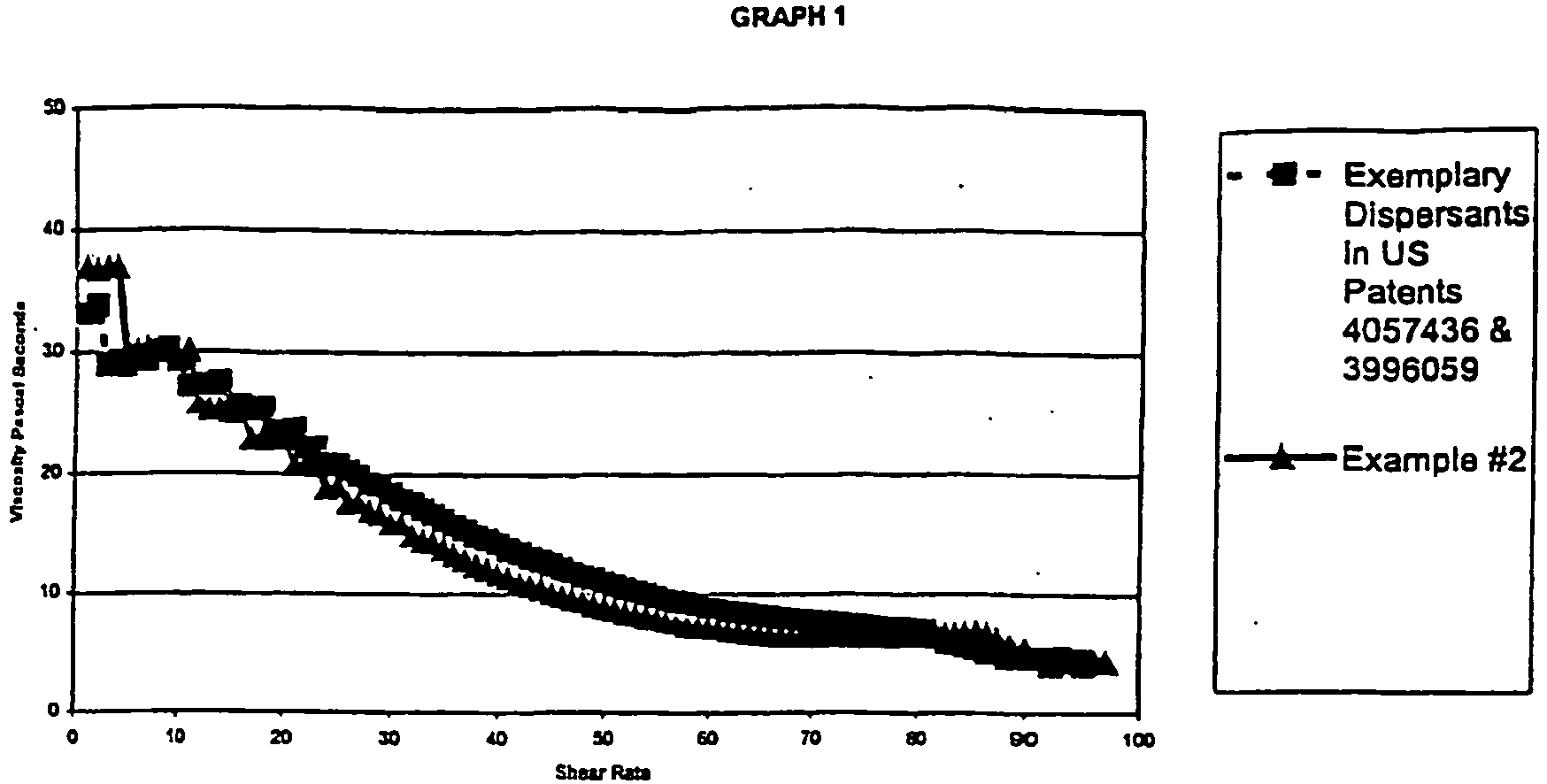

- The invention has been described in terms of preferred embodiments thereof, but is more broadly applicable as will be understood by those skilled in the art. The scope of the invention is only limited by the following claims.
Claims (23)
- A polymeric colored dispersant comprising the structure A-(B-X)n, wherein: A is an organic chromophore; B is a covalently bonded linking moiety containing N; X is a branched or linear C50-C200 covalently linked polyalkylene; and n is an integer from 1 to 4.
- A highly dispersed colorant dispersion comprising a polymeric colored dispersant having the structure A-(B-X)n, wherein: A is an organic chromophore; B is a covalently bonded linking moiety containing N; X is a branched or linear C50-C200 covalently linked polyalkylene; and n is an integer from 1 to 4.
- A colorant dispersion having improved color strength comprising a polymeric colored dispersant having the structure A-(B-X)n, wherein: A is an organic chromophore; B is a covalently bonded linking moiety containing N; X is a branched or linear C50-C200 covalently linked polyalkylene; and n is an integer from 1 to 4.
- The dispersion of claim 3 wherein A is selected from the group consisting of organic pigments or dyes.
- A colorant dispersion comprising: (a) at least about 45 wt.% of a pigment; and (b) a polymeric colored dispersant having the structure A-(B-X)n, wherein: A is an organic chromophore; B is a covalently bonded linking moiety containing N; X is a branched or linear C50-C200 covalently linked polyalkylene; and n is an integer from 1 to 4.
- The dispersion of claim 5 having a viscosity of less than about 150 Pa·s.
- The dispersion of claim 5 wherein the colorant is selected from the group consisting of organic pigments, dyes and carbon black.
- The dispersion of claim 7 wherein the colorant is an organic pigment.
- The dispersion of claim 8 wherein the organic pigment is selected from the group consisting of mono and diazo pigments, phthalocyanine pigments, quinacridone pigments, rhodamine dyes and pigments, perylene pigments, diketopyrroles pigments, carbon black, anthraquinone dyes and pigments, indanthrene dyes, lake pigments, dioxazine pigments, isoindolinone pigments, and dioxazine pigments.
- The dispersion of claim 9 wherein the organic pigment is selected from the group consisting of Pigment Yellow 12, Pigment Yellow 13, Pigment Yellow 14, Pigment Yellow 74, Pigment Yellow 150, Pigment Orange 5, Pigment Orange 13, Pigment Orange 16, Pigment Orange 64, Pigment Red 2, Pigment Red 81:2, Pigment Red 122, Pigment Red 144, Pigment Red 166, Pigment Red 179, Pigment Red 184, Pigment Red 202, Pigment Red 254, Pigment Red 264, Pigment Violet 1, Pigment Violet 2, Pigment Violet 3, Pigment Violet 19, Pigment Violet 23, Pigment Blue 15:3, and Blue 15:4.
- The dispersion of claim 5 having 65 wt.% colorant.
- The dispersion of claim 5 wherein the dispersant is present in 1 wt.% to 15 wt.% based on the weight of colorant.
- The pigment dispersion of claim 12, wherein said dispersant is present in about 10 wt.% of the pigment.
- The dispersant of claim 1 or the dispersion of claims 2 or 5 wherein A is selected from the group consisting of organic pigments, dyes and carbon black.
- The dispersion of claims 2, 3 or 5 wherein X is Cso to C150.
- The dispersant of claim 1 or the dispersion of claims 2, 3 or 5 wherein n is selected from the group consisting of 1 and 2.
- A printing ink composition comprising a colorant dispersion composition containing a polymeric colored dispersant having the structure A-(B-X)n, wherein: A is an organic chromophore; B is a covalently bonded linking moiety containing N; X is a branched or linear C50-C200 covalently linked polyalkylene; and n is an integer from 1 to 4.
- The ink composition of claim 17 wherein the printing ink is a lithographic printing ink.
- The ink composition of claim 17 wherein the printing ink is a gravure printing ink.
- The ink composition of claim 17 wherein A is selected from the group consisting of organic pigments, dyes and carbon black.
- The ink composition of claim 17, wherein X is C50 to C150.
- The ink composition of claim 17 wherein n is selected from 1 and 2.
- The ink composition of claim 17, wherein the printing ink is a lithographic or gravure printing ink, A is selected from the group consisting of organic pigments, dyes and carbon black, X is a branched or linear C50 to C150 covalently linked polyalkylene and n is selected from 1 and 2.
Applications Claiming Priority (2)
| Application Number | Priority Date | Filing Date | Title |
|---|---|---|---|
| US10/730,223 US7576146B2 (en) | 2003-12-05 | 2003-12-05 | Polymeric colored dispersants and colorant dispersions containing same |
| PCT/US2004/039948 WO2005056692A2 (en) | 2003-12-05 | 2004-11-30 | Polymeric colored dispersants and colorant dispersions containing same |
Publications (2)
| Publication Number | Publication Date |
|---|---|
| EP1689820A2 EP1689820A2 (en) | 2006-08-16 |
| EP1689820B1 true EP1689820B1 (en) | 2012-08-08 |
Family
ID=34634111
Family Applications (1)
| Application Number | Title | Priority Date | Filing Date |
|---|---|---|---|
| EP04812471A Expired - Lifetime EP1689820B1 (en) | 2003-12-05 | 2004-11-30 | Polymeric colored dispersants and colorant dispersions containing same |
Country Status (4)
| Country | Link |
|---|---|
| US (1) | US7576146B2 (en) |
| EP (1) | EP1689820B1 (en) |
| CA (1) | CA2548244A1 (en) |
| WO (1) | WO2005056692A2 (en) |
Families Citing this family (18)
| Publication number | Priority date | Publication date | Assignee | Title |
|---|---|---|---|---|
| CN101223247B (en) * | 2005-07-14 | 2015-04-29 | 爱克发印艺公司 | Pigment dispersions containing polymeric dispersants with pendant chromophores |
| US20080207803A1 (en) * | 2005-07-14 | 2008-08-28 | Agfa Graphics Nv | Pigment Dispersions with Polymeric Dispersants Having Pending Chromophore Groups |
| JP2009501249A (en) * | 2005-07-14 | 2009-01-15 | アグファ・グラフィクス・エヌヴィ | Pigment dispersion with a polymeric dispersant having a hanging chromophore |
| US7812113B2 (en) | 2005-07-14 | 2010-10-12 | Agfa Graphics Nv | Phenylazo-acetoacetanilide derivatives with a polymerizable functional group and related compounds as monomers for preparing polymeric pigment dispersants for inkjet inks |
| EP1904583B1 (en) * | 2005-07-14 | 2012-03-21 | Agfa Graphics N.V. | Pigment dispersions with polymeric dispersants having pending chromophore groups. |
| US7846992B2 (en) | 2005-07-14 | 2010-12-07 | Agfa Graphics Nv | Pigment dispersions with polymeric dispersants having pending chromophore groups |
| JP2009501253A (en) * | 2005-07-14 | 2009-01-15 | アグファ・グラフィクス・エヌヴィ | Pigment dispersion with a polymeric dispersant having a hanging chromophore |
| US20070179214A1 (en) * | 2006-01-31 | 2007-08-02 | Shakhnovich Alexander I | Inkjet ink compositions comprising polymeric dispersants having attached chromophore groups |
| US7407544B2 (en) * | 2006-10-17 | 2008-08-05 | Sun Chemical Corporation | Polymeric dispersants based on addition of amines to dialkylsuccinyl succinate or its derivatives |
| US7819968B2 (en) * | 2007-03-14 | 2010-10-26 | Sun Chemical Corporation | Stir-in pigment preparations for coloration of energy curable systems |
| KR20130131394A (en) | 2010-12-16 | 2013-12-03 | 썬 케미칼 코포레이션 | Colored metalorganic fluids for electrowetting, electrofluidic, and electrophoretic technologies |
| KR20140091045A (en) | 2011-11-10 | 2014-07-18 | 캐논 가부시끼가이샤 | Novel compound having bisazo dye skeleton, pigment composition containing the same, pigment dispersion, ink, and color filter resist composition |
| WO2013069816A1 (en) * | 2011-11-10 | 2013-05-16 | Canon Kabushiki Kaisha | Toner and method for manufacturing toner particles |
| CN104955902B (en) * | 2012-10-23 | 2018-07-13 | 法国巴黎市立高等工业物理化学学院 | Include the particle for the reversible covalent bonds that repeatedly can be sequentially formed and disconnect |
| EP3039084B1 (en) * | 2013-08-30 | 2018-04-18 | Sun Chemical Corporation | Colored fluids for display devices |
| US9903069B2 (en) * | 2014-04-22 | 2018-02-27 | Milliken & Company | Colored coatings and artificial leathers |
| US10689801B2 (en) | 2014-04-22 | 2020-06-23 | Millikan & Company | Colored coatings and artificial leathers containing colorant complexes |
| JP2021523285A (en) * | 2018-05-04 | 2021-09-02 | ベクトン・ディキンソン・アンド・カンパニーBecton, Dickinson And Company | Polymer dyes and their use |
Family Cites Families (28)
| Publication number | Priority date | Publication date | Assignee | Title |
|---|---|---|---|---|
| GB1108261A (en) * | 1963-08-01 | 1968-04-03 | Ici Ltd | Novel dispersants for use in organic media |
| US4014844A (en) * | 1970-06-26 | 1977-03-29 | Agence Nationale De Valorisation De La Recherche (Anvar) | Process for grafting polymers on carbon black through free radical mechanism |
| US3996059A (en) * | 1971-12-30 | 1976-12-07 | Imperial Chemical Industries Limited | Dispersing agents |
| GB1424517A (en) | 1972-08-01 | 1976-02-11 | Ici Ltd | Dispersions of organic pigments |
| US4057436A (en) * | 1974-09-17 | 1977-11-08 | Imperial Chemical Industries Limited | Dispersion of solids in organic solvents |
| US4137243A (en) * | 1976-08-24 | 1979-01-30 | Milliken Research Corporation | Polymeric anthraquinone derived colorants |
| US4091034A (en) * | 1976-10-01 | 1978-05-23 | Milliken Research Corporation | Liquid, water-insoluble polymeric triphenylmethane colorants and aqueous dispersions containing same |
| US4375357A (en) * | 1981-06-09 | 1983-03-01 | Dynapol | Water-soluble fast polymeric black colorant, its preparation and use in dyes and inks |
| US4468255A (en) * | 1983-08-10 | 1984-08-28 | Sun Chemical Corporation | Rheology modifiers for arylide yellow pigment dispersions and pigment dispersions containing same |
| US4859247A (en) * | 1987-11-02 | 1989-08-22 | Basf Corporation | Low viscosity, highly concentrated pigment dispersions and method of making same |
| US5177200A (en) * | 1989-05-19 | 1993-01-05 | Milliken Research Corporation | Poly(oxyalkylene) modified phthalocyanine colorants |
| US5270363A (en) * | 1989-05-19 | 1993-12-14 | Milliken Research Corporation | Poly(oxyalkylene) modified phthalocyanine colorants |
| US5135972A (en) * | 1989-09-18 | 1992-08-04 | Milliken Research Corporation | Poly(oxyalkylene) modified phthalocyanine colorants |
| US5262269A (en) * | 1990-03-30 | 1993-11-16 | Eastman Kodak Company | Process for making toner particles wherein the pigment is dispersed in the toner |
| US5100471A (en) * | 1990-06-27 | 1992-03-31 | Xerox Corporation | Liquid ink compositions |
| US6022944A (en) * | 1990-09-05 | 2000-02-08 | Milliken & Company | Anthraquinone and condensed anthraquinone colorants having sulfonamide linked poly(oxyalkylene) moieties and their preparation |
| US5419800A (en) * | 1994-01-27 | 1995-05-30 | The United States Of America As Represented By The Secretary Of The Navy | Split gasket attachment strip |
| US5569407A (en) * | 1994-03-25 | 1996-10-29 | Mobil Oil Corporation | Additives for fuels and lubricants |
| US5766268A (en) * | 1997-03-13 | 1998-06-16 | Milliken Research Corporation | Poly(oxyalkylene)-substituted colorant |
| US5789515A (en) * | 1997-03-13 | 1998-08-04 | Milliken Research Corporation | Polysiloxane-poly(oxyalkylene) copolymer-substituted colorant |
| EP1066352B2 (en) * | 1998-04-03 | 2008-10-01 | Cabot Corporation | Modified pigments having improved dispersing properties |
| US6034158A (en) * | 1998-07-07 | 2000-03-07 | Milliken & Company | Emulsified poly(oxyalkylenated) colorants for wax compositions |
| GB9817236D0 (en) * | 1998-08-08 | 1998-10-07 | Zeneca Ltd | Compound,composition and use |
| US6287348B1 (en) * | 1998-12-15 | 2001-09-11 | Milliken & Company | Colorants made from reactive dyes and fatty amines |
| US6106597A (en) * | 1998-12-18 | 2000-08-22 | Milliken & Company | Wax compositions comprising fatty ester poly(oxyalkylenated) colorants |
| US6187085B1 (en) * | 1999-07-26 | 2001-02-13 | Sun Chemical Corporation | Carbon black concentrates for news ink |
| US6486248B2 (en) * | 2001-01-08 | 2002-11-26 | Milliken & Company | Liquid colorant and method |
| US6452020B1 (en) * | 2001-04-10 | 2002-09-17 | Milliken & Company | Methods of making magenta colorants for ink systems |
-
2003
- 2003-12-05 US US10/730,223 patent/US7576146B2/en not_active Expired - Lifetime
-
2004
- 2004-11-30 CA CA002548244A patent/CA2548244A1/en not_active Abandoned
- 2004-11-30 EP EP04812471A patent/EP1689820B1/en not_active Expired - Lifetime
- 2004-11-30 WO PCT/US2004/039948 patent/WO2005056692A2/en not_active Ceased
Also Published As
| Publication number | Publication date |
|---|---|
| US7576146B2 (en) | 2009-08-18 |
| WO2005056692A3 (en) | 2005-08-04 |
| EP1689820A2 (en) | 2006-08-16 |
| WO2005056692A2 (en) | 2005-06-23 |
| CA2548244A1 (en) | 2005-06-23 |
| WO2005056692A8 (en) | 2005-09-15 |
| US20050124727A1 (en) | 2005-06-09 |
Similar Documents
| Publication | Publication Date | Title |
|---|---|---|
| US7576146B2 (en) | Polymeric colored dispersants and colorant dispersions containing same | |
| EP0882771B1 (en) | Aqueous ink compositions | |
| US5589522A (en) | Ink composition | |
| EP2182035B1 (en) | Aqueous ink for inkjet recording | |
| EP0819738A2 (en) | Aqueous ink jet ink compositions | |
| US5897695A (en) | Ink compositions | |
| KR20100070369A (en) | Ink composition | |
| EP2495290A1 (en) | Aqueous dispersion for inkjet printing | |
| EP1854853B1 (en) | Aqueous pigment dispersion liquid and ink composition for inkjet recording | |
| KR100597477B1 (en) | Wet-rub resistant ink compositions | |
| EP0918077B1 (en) | High performance ink compositions with non-benzidine based colorants | |
| US6077338A (en) | Printing ink | |
| JPH10219160A (en) | Ink jet ink containing long-chain alcohol | |
| US6814793B2 (en) | Bleed control using cationic dyes as dispersant in pigment dispersions | |
| EP1270690B1 (en) | Pigment dispersion, inkjet ink composition using the pigment dispersion, method of manufacturing the inkjet ink composition and image forming method using the inkjet ink composition | |
| KR20080032210A (en) | Method of preparing pigment compositions | |
| EP1904567B1 (en) | Low viscosity, highly pigmented oil based dispersions exhibiting a low relative interfacial tension drop | |
| EP1694746B1 (en) | Polymeric dispersants and dispersions containing same | |
| DE102014221984A1 (en) | EMULSIFIED ELECTRORHEOLOGICAL INKS FOR INDIRECT PRINTING | |
| JP2004155867A (en) | Aqueous ink and inkjet recording method | |
| US20160168401A1 (en) | Aqueous inkjet inks containing polymeric binders with components to interact with cellulose | |
| US9090788B2 (en) | Aqueous inkjet inks containing polymeric binders with components to interact with cellulose | |
| JP3933489B2 (en) | Oil-based ink composition for ink-jet recording and method for producing printed matter using the same | |
| DE102013220878A1 (en) | Formulations for red solid ink | |
| HK1106786B (en) | Aqueous pigment dispersion liquid and ink composition for inkjet recording |
Legal Events
| Date | Code | Title | Description |
|---|---|---|---|
| PUAI | Public reference made under article 153(3) epc to a published international application that has entered the european phase |
Free format text: ORIGINAL CODE: 0009012 |
|
| 17P | Request for examination filed |
Effective date: 20060613 |
|
| AK | Designated contracting states |
Kind code of ref document: A2 Designated state(s): AT BE BG CH CY CZ DE DK EE ES FI FR GB GR HU IE IS IT LI LU MC NL PL PT RO SE SI SK TR |
|
| DAX | Request for extension of the european patent (deleted) | ||
| 17Q | First examination report despatched |
Effective date: 20070223 |
|
| R17C | First examination report despatched (corrected) |
Effective date: 20070423 |
|
| R17C | First examination report despatched (corrected) |
Effective date: 20080603 |
|
| R17C | First examination report despatched (corrected) |
Effective date: 20090825 |
|
| GRAP | Despatch of communication of intention to grant a patent |
Free format text: ORIGINAL CODE: EPIDOSNIGR1 |
|
| GRAS | Grant fee paid |
Free format text: ORIGINAL CODE: EPIDOSNIGR3 |
|
| GRAA | (expected) grant |
Free format text: ORIGINAL CODE: 0009210 |
|
| AK | Designated contracting states |
Kind code of ref document: B1 Designated state(s): AT BE BG CH CY CZ DE DK EE ES FI FR GB GR HU IE IS IT LI LU MC NL PL PT RO SE SI SK TR |
|
| REG | Reference to a national code |
Ref country code: GB Ref legal event code: FG4D |
|
| REG | Reference to a national code |
Ref country code: AT Ref legal event code: REF Ref document number: 569783 Country of ref document: AT Kind code of ref document: T Effective date: 20120815 Ref country code: CH Ref legal event code: EP |
|
| REG | Reference to a national code |
Ref country code: IE Ref legal event code: FG4D |
|
| REG | Reference to a national code |
Ref country code: DE Ref legal event code: R096 Ref document number: 602004038869 Country of ref document: DE Effective date: 20121011 |
|
| REG | Reference to a national code |
Ref country code: NL Ref legal event code: VDEP Effective date: 20120808 |
|
| REG | Reference to a national code |
Ref country code: AT Ref legal event code: MK05 Ref document number: 569783 Country of ref document: AT Kind code of ref document: T Effective date: 20120808 |
|
| PG25 | Lapsed in a contracting state [announced via postgrant information from national office to epo] |
Ref country code: AT Free format text: LAPSE BECAUSE OF FAILURE TO SUBMIT A TRANSLATION OF THE DESCRIPTION OR TO PAY THE FEE WITHIN THE PRESCRIBED TIME-LIMIT Effective date: 20120808 Ref country code: IS Free format text: LAPSE BECAUSE OF FAILURE TO SUBMIT A TRANSLATION OF THE DESCRIPTION OR TO PAY THE FEE WITHIN THE PRESCRIBED TIME-LIMIT Effective date: 20121208 Ref country code: FI Free format text: LAPSE BECAUSE OF FAILURE TO SUBMIT A TRANSLATION OF THE DESCRIPTION OR TO PAY THE FEE WITHIN THE PRESCRIBED TIME-LIMIT Effective date: 20120808 Ref country code: CY Free format text: LAPSE BECAUSE OF FAILURE TO SUBMIT A TRANSLATION OF THE DESCRIPTION OR TO PAY THE FEE WITHIN THE PRESCRIBED TIME-LIMIT Effective date: 20120808 |
|
| PG25 | Lapsed in a contracting state [announced via postgrant information from national office to epo] |
Ref country code: PT Free format text: LAPSE BECAUSE OF FAILURE TO SUBMIT A TRANSLATION OF THE DESCRIPTION OR TO PAY THE FEE WITHIN THE PRESCRIBED TIME-LIMIT Effective date: 20121210 Ref country code: GR Free format text: LAPSE BECAUSE OF FAILURE TO SUBMIT A TRANSLATION OF THE DESCRIPTION OR TO PAY THE FEE WITHIN THE PRESCRIBED TIME-LIMIT Effective date: 20121109 Ref country code: BE Free format text: LAPSE BECAUSE OF FAILURE TO SUBMIT A TRANSLATION OF THE DESCRIPTION OR TO PAY THE FEE WITHIN THE PRESCRIBED TIME-LIMIT Effective date: 20120808 Ref country code: SI Free format text: LAPSE BECAUSE OF FAILURE TO SUBMIT A TRANSLATION OF THE DESCRIPTION OR TO PAY THE FEE WITHIN THE PRESCRIBED TIME-LIMIT Effective date: 20120808 Ref country code: SE Free format text: LAPSE BECAUSE OF FAILURE TO SUBMIT A TRANSLATION OF THE DESCRIPTION OR TO PAY THE FEE WITHIN THE PRESCRIBED TIME-LIMIT Effective date: 20120808 Ref country code: PL Free format text: LAPSE BECAUSE OF FAILURE TO SUBMIT A TRANSLATION OF THE DESCRIPTION OR TO PAY THE FEE WITHIN THE PRESCRIBED TIME-LIMIT Effective date: 20120808 |
|
| PG25 | Lapsed in a contracting state [announced via postgrant information from national office to epo] |
Ref country code: NL Free format text: LAPSE BECAUSE OF FAILURE TO SUBMIT A TRANSLATION OF THE DESCRIPTION OR TO PAY THE FEE WITHIN THE PRESCRIBED TIME-LIMIT Effective date: 20120808 |
|
| PG25 | Lapsed in a contracting state [announced via postgrant information from national office to epo] |
Ref country code: CZ Free format text: LAPSE BECAUSE OF FAILURE TO SUBMIT A TRANSLATION OF THE DESCRIPTION OR TO PAY THE FEE WITHIN THE PRESCRIBED TIME-LIMIT Effective date: 20120808 Ref country code: EE Free format text: LAPSE BECAUSE OF FAILURE TO SUBMIT A TRANSLATION OF THE DESCRIPTION OR TO PAY THE FEE WITHIN THE PRESCRIBED TIME-LIMIT Effective date: 20120808 Ref country code: ES Free format text: LAPSE BECAUSE OF FAILURE TO SUBMIT A TRANSLATION OF THE DESCRIPTION OR TO PAY THE FEE WITHIN THE PRESCRIBED TIME-LIMIT Effective date: 20121119 Ref country code: RO Free format text: LAPSE BECAUSE OF FAILURE TO SUBMIT A TRANSLATION OF THE DESCRIPTION OR TO PAY THE FEE WITHIN THE PRESCRIBED TIME-LIMIT Effective date: 20120808 Ref country code: DK Free format text: LAPSE BECAUSE OF FAILURE TO SUBMIT A TRANSLATION OF THE DESCRIPTION OR TO PAY THE FEE WITHIN THE PRESCRIBED TIME-LIMIT Effective date: 20120808 |
|
| PG25 | Lapsed in a contracting state [announced via postgrant information from national office to epo] |
Ref country code: SK Free format text: LAPSE BECAUSE OF FAILURE TO SUBMIT A TRANSLATION OF THE DESCRIPTION OR TO PAY THE FEE WITHIN THE PRESCRIBED TIME-LIMIT Effective date: 20120808 Ref country code: IT Free format text: LAPSE BECAUSE OF FAILURE TO SUBMIT A TRANSLATION OF THE DESCRIPTION OR TO PAY THE FEE WITHIN THE PRESCRIBED TIME-LIMIT Effective date: 20120808 |
|
| PLBE | No opposition filed within time limit |
Free format text: ORIGINAL CODE: 0009261 |
|
| STAA | Information on the status of an ep patent application or granted ep patent |
Free format text: STATUS: NO OPPOSITION FILED WITHIN TIME LIMIT |
|
| REG | Reference to a national code |
Ref country code: CH Ref legal event code: PL |
|
| 26N | No opposition filed |
Effective date: 20130510 |
|
| PG25 | Lapsed in a contracting state [announced via postgrant information from national office to epo] |
Ref country code: LI Free format text: LAPSE BECAUSE OF NON-PAYMENT OF DUE FEES Effective date: 20121130 Ref country code: CH Free format text: LAPSE BECAUSE OF NON-PAYMENT OF DUE FEES Effective date: 20121130 Ref country code: BG Free format text: LAPSE BECAUSE OF FAILURE TO SUBMIT A TRANSLATION OF THE DESCRIPTION OR TO PAY THE FEE WITHIN THE PRESCRIBED TIME-LIMIT Effective date: 20121108 |
|
| REG | Reference to a national code |
Ref country code: IE Ref legal event code: MM4A |
|
| REG | Reference to a national code |
Ref country code: DE Ref legal event code: R097 Ref document number: 602004038869 Country of ref document: DE Effective date: 20130510 |
|
| PG25 | Lapsed in a contracting state [announced via postgrant information from national office to epo] |
Ref country code: IE Free format text: LAPSE BECAUSE OF NON-PAYMENT OF DUE FEES Effective date: 20121130 |
|
| PG25 | Lapsed in a contracting state [announced via postgrant information from national office to epo] |
Ref country code: MC Free format text: LAPSE BECAUSE OF NON-PAYMENT OF DUE FEES Effective date: 20121130 Ref country code: TR Free format text: LAPSE BECAUSE OF FAILURE TO SUBMIT A TRANSLATION OF THE DESCRIPTION OR TO PAY THE FEE WITHIN THE PRESCRIBED TIME-LIMIT Effective date: 20120808 |
|
| PG25 | Lapsed in a contracting state [announced via postgrant information from national office to epo] |
Ref country code: LU Free format text: LAPSE BECAUSE OF NON-PAYMENT OF DUE FEES Effective date: 20121130 |
|
| PG25 | Lapsed in a contracting state [announced via postgrant information from national office to epo] |
Ref country code: HU Free format text: LAPSE BECAUSE OF FAILURE TO SUBMIT A TRANSLATION OF THE DESCRIPTION OR TO PAY THE FEE WITHIN THE PRESCRIBED TIME-LIMIT Effective date: 20041130 |
|
| REG | Reference to a national code |
Ref country code: FR Ref legal event code: PLFP Year of fee payment: 12 |
|
| REG | Reference to a national code |
Ref country code: FR Ref legal event code: PLFP Year of fee payment: 13 |
|
| REG | Reference to a national code |
Ref country code: FR Ref legal event code: PLFP Year of fee payment: 14 |
|
| REG | Reference to a national code |
Ref country code: DE Ref legal event code: R082 Ref document number: 602004038869 Country of ref document: DE Representative=s name: VOSSIUS & PARTNER PATENTANWAELTE RECHTSANWAELT, DE |
|
| P01 | Opt-out of the competence of the unified patent court (upc) registered |
Effective date: 20230511 |
|
| PGFP | Annual fee paid to national office [announced via postgrant information from national office to epo] |
Ref country code: GB Payment date: 20231019 Year of fee payment: 20 |
|
| PGFP | Annual fee paid to national office [announced via postgrant information from national office to epo] |
Ref country code: FR Payment date: 20231019 Year of fee payment: 20 Ref country code: DE Payment date: 20231019 Year of fee payment: 20 |
|
| REG | Reference to a national code |
Ref country code: DE Ref legal event code: R071 Ref document number: 602004038869 Country of ref document: DE |
|
| REG | Reference to a national code |
Ref country code: GB Ref legal event code: PE20 Expiry date: 20241129 |
|
| PG25 | Lapsed in a contracting state [announced via postgrant information from national office to epo] |
Ref country code: GB Free format text: LAPSE BECAUSE OF EXPIRATION OF PROTECTION Effective date: 20241129 |
|
| PG25 | Lapsed in a contracting state [announced via postgrant information from national office to epo] |
Ref country code: GB Free format text: LAPSE BECAUSE OF EXPIRATION OF PROTECTION Effective date: 20241129 |