EP1689253B1 - Iron powder, use as additive for foods, food additive and method of making iron powder. - Google Patents
Iron powder, use as additive for foods, food additive and method of making iron powder. Download PDFInfo
- Publication number
- EP1689253B1 EP1689253B1 EP04800392A EP04800392A EP1689253B1 EP 1689253 B1 EP1689253 B1 EP 1689253B1 EP 04800392 A EP04800392 A EP 04800392A EP 04800392 A EP04800392 A EP 04800392A EP 1689253 B1 EP1689253 B1 EP 1689253B1
- Authority
- EP
- European Patent Office
- Prior art keywords
- powder
- iron
- iron powder
- particle size
- less
- Prior art date
- Legal status (The legal status is an assumption and is not a legal conclusion. Google has not performed a legal analysis and makes no representation as to the accuracy of the status listed.)
- Expired - Lifetime
Links
- XEEYBQQBJWHFJM-UHFFFAOYSA-N Iron Chemical compound [Fe] XEEYBQQBJWHFJM-UHFFFAOYSA-N 0.000 title claims abstract description 124
- 238000004519 manufacturing process Methods 0.000 title claims description 6
- 235000013305 food Nutrition 0.000 title description 13
- 239000002778 food additive Substances 0.000 title description 3
- 235000013373 food additive Nutrition 0.000 title description 2
- 239000000654 additive Substances 0.000 title 1
- 230000000996 additive effect Effects 0.000 title 1
- 239000000843 powder Substances 0.000 claims abstract description 48
- 239000002245 particle Substances 0.000 claims abstract description 42
- 238000004438 BET method Methods 0.000 claims abstract description 3
- UQSXHKLRYXJYBZ-UHFFFAOYSA-N Iron oxide Chemical compound [Fe]=O UQSXHKLRYXJYBZ-UHFFFAOYSA-N 0.000 claims description 25
- 235000013980 iron oxide Nutrition 0.000 claims description 17
- 238000000034 method Methods 0.000 claims description 15
- UFHFLCQGNIYNRP-UHFFFAOYSA-N Hydrogen Chemical compound [H][H] UFHFLCQGNIYNRP-UHFFFAOYSA-N 0.000 claims description 11
- 238000004090 dissolution Methods 0.000 claims description 11
- 239000007858 starting material Substances 0.000 claims description 8
- OKTJSMMVPCPJKN-UHFFFAOYSA-N Carbon Chemical compound [C] OKTJSMMVPCPJKN-UHFFFAOYSA-N 0.000 claims description 6
- VEXZGXHMUGYJMC-UHFFFAOYSA-N Hydrochloric acid Chemical compound Cl VEXZGXHMUGYJMC-UHFFFAOYSA-N 0.000 claims description 6
- 229910052799 carbon Inorganic materials 0.000 claims description 6
- 239000002253 acid Substances 0.000 claims description 3
- 239000006227 byproduct Substances 0.000 claims description 3
- 239000000203 mixture Substances 0.000 claims description 3
- 230000008929 regeneration Effects 0.000 claims description 3
- 238000011069 regeneration method Methods 0.000 claims description 3
- VBMVTYDPPZVILR-UHFFFAOYSA-N iron(2+);oxygen(2-) Chemical class [O-2].[Fe+2] VBMVTYDPPZVILR-UHFFFAOYSA-N 0.000 claims description 2
- YOBAEOGBNPPUQV-UHFFFAOYSA-N iron;trihydrate Chemical compound O.O.O.[Fe].[Fe] YOBAEOGBNPPUQV-UHFFFAOYSA-N 0.000 claims description 2
- 239000000463 material Substances 0.000 claims description 2
- 235000013361 beverage Nutrition 0.000 claims 2
- 238000007873 sieving Methods 0.000 claims 1
- 229910052742 iron Inorganic materials 0.000 description 38
- 230000001788 irregular Effects 0.000 description 11
- 241000209140 Triticum Species 0.000 description 6
- 235000021307 Triticum Nutrition 0.000 description 6
- 235000013339 cereals Nutrition 0.000 description 6
- 235000013312 flour Nutrition 0.000 description 6
- 239000000047 product Substances 0.000 description 6
- 125000002915 carbonyl group Chemical group [*:2]C([*:1])=O 0.000 description 4
- 229910052739 hydrogen Inorganic materials 0.000 description 4
- 239000001257 hydrogen Substances 0.000 description 4
- UGFAIRIUMAVXCW-UHFFFAOYSA-N Carbon monoxide Chemical compound [O+]#[C-] UGFAIRIUMAVXCW-UHFFFAOYSA-N 0.000 description 3
- 229910002091 carbon monoxide Inorganic materials 0.000 description 3
- 239000012530 fluid Substances 0.000 description 3
- 239000012535 impurity Substances 0.000 description 3
- 239000011148 porous material Substances 0.000 description 3
- LFQSCWFLJHTTHZ-UHFFFAOYSA-N Ethanol Chemical compound CCO LFQSCWFLJHTTHZ-UHFFFAOYSA-N 0.000 description 2
- 239000005569 Iron sulphate Substances 0.000 description 2
- 241001465754 Metazoa Species 0.000 description 2
- PXHVJJICTQNCMI-UHFFFAOYSA-N Nickel Chemical compound [Ni] PXHVJJICTQNCMI-UHFFFAOYSA-N 0.000 description 2
- 241000209149 Zea Species 0.000 description 2
- 235000005824 Zea mays ssp. parviglumis Nutrition 0.000 description 2
- 235000002017 Zea mays subsp mays Nutrition 0.000 description 2
- QVGXLLKOCUKJST-UHFFFAOYSA-N atomic oxygen Chemical compound [O] QVGXLLKOCUKJST-UHFFFAOYSA-N 0.000 description 2
- 239000003638 chemical reducing agent Substances 0.000 description 2
- 239000003245 coal Substances 0.000 description 2
- 235000005822 corn Nutrition 0.000 description 2
- 235000005911 diet Nutrition 0.000 description 2
- 230000037213 diet Effects 0.000 description 2
- 229910052595 hematite Inorganic materials 0.000 description 2
- 239000011019 hematite Substances 0.000 description 2
- BAUYGSIQEAFULO-UHFFFAOYSA-L iron(2+) sulfate (anhydrous) Chemical compound [Fe+2].[O-]S([O-])(=O)=O BAUYGSIQEAFULO-UHFFFAOYSA-L 0.000 description 2
- LIKBJVNGSGBSGK-UHFFFAOYSA-N iron(3+);oxygen(2-) Chemical compound [O-2].[O-2].[O-2].[Fe+3].[Fe+3] LIKBJVNGSGBSGK-UHFFFAOYSA-N 0.000 description 2
- 239000007788 liquid Substances 0.000 description 2
- 238000001000 micrograph Methods 0.000 description 2
- 238000003801 milling Methods 0.000 description 2
- 229910052760 oxygen Inorganic materials 0.000 description 2
- 239000001301 oxygen Substances 0.000 description 2
- 230000035515 penetration Effects 0.000 description 2
- 238000002360 preparation method Methods 0.000 description 2
- 238000011946 reduction process Methods 0.000 description 2
- 150000003839 salts Chemical class 0.000 description 2
- IMWCPTKSESEZCL-SPSNFJOYSA-H (e)-but-2-enedioate;iron(3+) Chemical compound [Fe+3].[Fe+3].[O-]C(=O)\C=C\C([O-])=O.[O-]C(=O)\C=C\C([O-])=O.[O-]C(=O)\C=C\C([O-])=O IMWCPTKSESEZCL-SPSNFJOYSA-H 0.000 description 1
- VYZAMTAEIAYCRO-UHFFFAOYSA-N Chromium Chemical compound [Cr] VYZAMTAEIAYCRO-UHFFFAOYSA-N 0.000 description 1
- RYGMFSIKBFXOCR-UHFFFAOYSA-N Copper Chemical compound [Cu] RYGMFSIKBFXOCR-UHFFFAOYSA-N 0.000 description 1
- 102000018832 Cytochromes Human genes 0.000 description 1
- 108010052832 Cytochromes Proteins 0.000 description 1
- 102000004190 Enzymes Human genes 0.000 description 1
- 108090000790 Enzymes Proteins 0.000 description 1
- 102000001554 Hemoglobins Human genes 0.000 description 1
- 108010054147 Hemoglobins Proteins 0.000 description 1
- 206010022971 Iron Deficiencies Diseases 0.000 description 1
- FYYHWMGAXLPEAU-UHFFFAOYSA-N Magnesium Chemical compound [Mg] FYYHWMGAXLPEAU-UHFFFAOYSA-N 0.000 description 1
- 208000002720 Malnutrition Diseases 0.000 description 1
- 102000036675 Myoglobin Human genes 0.000 description 1
- 108010062374 Myoglobin Proteins 0.000 description 1
- OAICVXFJPJFONN-UHFFFAOYSA-N Phosphorus Chemical compound [P] OAICVXFJPJFONN-UHFFFAOYSA-N 0.000 description 1
- XUIMIQQOPSSXEZ-UHFFFAOYSA-N Silicon Chemical compound [Si] XUIMIQQOPSSXEZ-UHFFFAOYSA-N 0.000 description 1
- NINIDFKCEFEMDL-UHFFFAOYSA-N Sulfur Chemical compound [S] NINIDFKCEFEMDL-UHFFFAOYSA-N 0.000 description 1
- 239000005864 Sulphur Substances 0.000 description 1
- 239000004411 aluminium Substances 0.000 description 1
- 229910052782 aluminium Inorganic materials 0.000 description 1
- XAGFODPZIPBFFR-UHFFFAOYSA-N aluminium Chemical compound [Al] XAGFODPZIPBFFR-UHFFFAOYSA-N 0.000 description 1
- 239000003674 animal food additive Substances 0.000 description 1
- 229910052785 arsenic Inorganic materials 0.000 description 1
- 235000004251 balanced diet Nutrition 0.000 description 1
- 238000012512 characterization method Methods 0.000 description 1
- 239000003610 charcoal Substances 0.000 description 1
- 229910052804 chromium Inorganic materials 0.000 description 1
- 239000011651 chromium Substances 0.000 description 1
- 239000011362 coarse particle Substances 0.000 description 1
- 230000008133 cognitive development Effects 0.000 description 1
- 150000001875 compounds Chemical class 0.000 description 1
- 239000012141 concentrate Substances 0.000 description 1
- 238000001816 cooling Methods 0.000 description 1
- 229910052802 copper Inorganic materials 0.000 description 1
- 239000010949 copper Substances 0.000 description 1
- 230000008021 deposition Effects 0.000 description 1
- 239000000428 dust Substances 0.000 description 1
- 230000000694 effects Effects 0.000 description 1
- 238000004880 explosion Methods 0.000 description 1
- 239000012467 final product Substances 0.000 description 1
- 239000010419 fine particle Substances 0.000 description 1
- 239000007789 gas Substances 0.000 description 1
- 210000004051 gastric juice Anatomy 0.000 description 1
- 235000011868 grain product Nutrition 0.000 description 1
- 238000000227 grinding Methods 0.000 description 1
- 150000003278 haem Chemical class 0.000 description 1
- 238000010438 heat treatment Methods 0.000 description 1
- 238000000338 in vitro Methods 0.000 description 1
- 238000001746 injection moulding Methods 0.000 description 1
- 150000002506 iron compounds Chemical class 0.000 description 1
- -1 iron sulphate Chemical class 0.000 description 1
- SZVJSHCCFOBDDC-UHFFFAOYSA-N iron(II,III) oxide Inorganic materials O=[Fe]O[Fe]O[Fe]=O SZVJSHCCFOBDDC-UHFFFAOYSA-N 0.000 description 1
- JEIPFZHSYJVQDO-UHFFFAOYSA-N iron(III) oxide Inorganic materials O=[Fe]O[Fe]=O JEIPFZHSYJVQDO-UHFFFAOYSA-N 0.000 description 1
- VRIVJOXICYMTAG-IYEMJOQQSA-L iron(ii) gluconate Chemical compound [Fe+2].OC[C@@H](O)[C@@H](O)[C@H](O)[C@@H](O)C([O-])=O.OC[C@@H](O)[C@@H](O)[C@H](O)[C@@H](O)C([O-])=O VRIVJOXICYMTAG-IYEMJOQQSA-L 0.000 description 1
- 229910052745 lead Inorganic materials 0.000 description 1
- 208000018773 low birth weight Diseases 0.000 description 1
- 231100000533 low birth weight Toxicity 0.000 description 1
- 229910052749 magnesium Inorganic materials 0.000 description 1
- 239000011777 magnesium Substances 0.000 description 1
- 230000001071 malnutrition Effects 0.000 description 1
- 235000000824 malnutrition Nutrition 0.000 description 1
- WPBNNNQJVZRUHP-UHFFFAOYSA-L manganese(2+);methyl n-[[2-(methoxycarbonylcarbamothioylamino)phenyl]carbamothioyl]carbamate;n-[2-(sulfidocarbothioylamino)ethyl]carbamodithioate Chemical compound [Mn+2].[S-]C(=S)NCCNC([S-])=S.COC(=O)NC(=S)NC1=CC=CC=C1NC(=S)NC(=O)OC WPBNNNQJVZRUHP-UHFFFAOYSA-L 0.000 description 1
- 235000013372 meat Nutrition 0.000 description 1
- 229910052753 mercury Inorganic materials 0.000 description 1
- 229910052751 metal Inorganic materials 0.000 description 1
- 239000002184 metal Substances 0.000 description 1
- 229910052759 nickel Inorganic materials 0.000 description 1
- 235000016709 nutrition Nutrition 0.000 description 1
- 230000035764 nutrition Effects 0.000 description 1
- 208000015380 nutritional deficiency disease Diseases 0.000 description 1
- 230000000149 penetrating effect Effects 0.000 description 1
- 229910052698 phosphorus Inorganic materials 0.000 description 1
- 239000011574 phosphorus Substances 0.000 description 1
- 239000010703 silicon Substances 0.000 description 1
- 229910052710 silicon Inorganic materials 0.000 description 1
- 239000007787 solid Substances 0.000 description 1
- 239000000243 solution Substances 0.000 description 1
- 238000003860 storage Methods 0.000 description 1
- 239000010409 thin film Substances 0.000 description 1
- 239000011573 trace mineral Substances 0.000 description 1
- 235000013619 trace mineral Nutrition 0.000 description 1
- 235000013311 vegetables Nutrition 0.000 description 1
Images
Classifications
-
- B—PERFORMING OPERATIONS; TRANSPORTING
- B22—CASTING; POWDER METALLURGY
- B22F—WORKING METALLIC POWDER; MANUFACTURE OF ARTICLES FROM METALLIC POWDER; MAKING METALLIC POWDER; APPARATUS OR DEVICES SPECIALLY ADAPTED FOR METALLIC POWDER
- B22F9/00—Making metallic powder or suspensions thereof
- B22F9/16—Making metallic powder or suspensions thereof using chemical processes
- B22F9/18—Making metallic powder or suspensions thereof using chemical processes with reduction of metal compounds
- B22F9/20—Making metallic powder or suspensions thereof using chemical processes with reduction of metal compounds starting from solid metal compounds
- B22F9/22—Making metallic powder or suspensions thereof using chemical processes with reduction of metal compounds starting from solid metal compounds using gaseous reductors
-
- A—HUMAN NECESSITIES
- A23—FOODS OR FOODSTUFFS; TREATMENT THEREOF, NOT COVERED BY OTHER CLASSES
- A23L—FOODS, FOODSTUFFS OR NON-ALCOHOLIC BEVERAGES, NOT OTHERWISE PROVIDED FOR; PREPARATION OR TREATMENT THEREOF
- A23L33/00—Modifying nutritive qualities of foods; Dietetic products; Preparation or treatment thereof
- A23L33/10—Modifying nutritive qualities of foods; Dietetic products; Preparation or treatment thereof using additives
- A23L33/16—Inorganic salts, minerals or trace elements
-
- B—PERFORMING OPERATIONS; TRANSPORTING
- B22—CASTING; POWDER METALLURGY
- B22F—WORKING METALLIC POWDER; MANUFACTURE OF ARTICLES FROM METALLIC POWDER; MAKING METALLIC POWDER; APPARATUS OR DEVICES SPECIALLY ADAPTED FOR METALLIC POWDER
- B22F1/00—Metallic powder; Treatment of metallic powder, e.g. to facilitate working or to improve properties
- B22F1/05—Metallic powder characterised by the size or surface area of the particles
-
- B—PERFORMING OPERATIONS; TRANSPORTING
- B22—CASTING; POWDER METALLURGY
- B22F—WORKING METALLIC POWDER; MANUFACTURE OF ARTICLES FROM METALLIC POWDER; MAKING METALLIC POWDER; APPARATUS OR DEVICES SPECIALLY ADAPTED FOR METALLIC POWDER
- B22F2998/00—Supplementary information concerning processes or compositions relating to powder metallurgy
- B22F2998/10—Processes characterised by the sequence of their steps
-
- B—PERFORMING OPERATIONS; TRANSPORTING
- B22—CASTING; POWDER METALLURGY
- B22F—WORKING METALLIC POWDER; MANUFACTURE OF ARTICLES FROM METALLIC POWDER; MAKING METALLIC POWDER; APPARATUS OR DEVICES SPECIALLY ADAPTED FOR METALLIC POWDER
- B22F2999/00—Aspects linked to processes or compositions used in powder metallurgy
Definitions
- the present invention concerns food and feed fortification. More specifically the invention concerns an iron powder, which is suitable as food and feed additive and which can be cost effectively produced.
- Iron is an essential trace element in animal and human nutrition. It is a component of heme in hemoglobin and of myoglobin, cytochromes and several enzymes. The main role of iron is its participation in the transport, storage and utilization of oxygen. A balanced diet will normally cover the need of iron through intake of iron rich food stuff such as vegetables, meat and cereals. An important iron source is cereals such as wheat flour. However in modern methods of producing wheat flour the iron rich shell of the wheat grain is eliminated. This results in that the iron content of wheat flour of today is lower than that of wheat flour produced before. Iron deficiency is also a consequence of the malnutrition which is prevailing especially in the developing countries.
- Iron can be added to food and feed in many different forms.
- Metallic iron can be used as well as inorganic salts of iron, such as iron sulphate, and organic salts, such as iron gluconate or iron fumarate.
- inorganic salts of iron such as iron sulphate
- organic salts such as iron gluconate or iron fumarate.
- elemental iron for food fortification namely reduced iron or sponge iron, carbonyl iron and electrolytic iron.
- the reduced iron is produced by a reduction of ground iron oxide with hydrogen or carbon monoxide at elevated temperature followed by grinding and milling of the reduced iron cake. Reduced iron is produced from either iron ore or mill scale. The purity of the product is dictated by the purity of the iron oxide. These products have the lowest purity of the food grade iron powders when compared with electrolytic or carbonyl powders.
- the most common impurity in iron powder produced by any reduction process is oxygen, most of which occurs as a thin film of surface oxide.
- Basic impurities include carbon, magnesium, aluminium, silicon, phosphorus, sulphur, chromium, manganese, nickel and copper, many of which are present as oxides.
- the particle size is irregular and porous and it consists of a number of small equiaxed grains.
- Carbonyl iron powders consist of particles, which are much finer than particles of other iron powders. These powders are produced by treating reduced iron with carbon monoxide under heat and pressure. The resulting iron pentacarbonyl is later decomposed under controlled conditions yielding an iron powder and carbon monoxide gas. At this point the major impurity is carbon and further reduction in wet hydrogen is necessary to remove most of the carbon.
- the powder has particles ranging in size from 0.5 to 10 ⁇ m in diameter and is of high purity. The particles are close to spherical in shape and very dense and smooth. The structure of the particles is characterized by concentric shells arranged in onion-skin fashion. The carbonyl process is costly.
- Electrolytic iron is produced by electrolytic deposition of a hard brittle metal that is mechanically comminuted.
- the particle shape of electrolytic iron powder is irregular, dendritic of fernlike, from which it receives its high surface factor.
- An important feature for the iron containing compounds used as food additive is the bioavailability of the iron i.e. how efficiently the iron is absorbed by the body.
- the carbonyl and electrolytic powders have the highest bioavailability but the production costs of these powders are high compared with the production costs for reduced iron powders.
- a pure reduced iron powder, which has high bioavailability and which can be cost effectively produced would therefore be attractive and is the object of the present invention.
- bioavailability may be performed in different ways such as in vitro studies, animal studies or human studies. Bioavailability of iron powders as well as other iron compounds are usually measured relative to iron sulphate.
- the iron powder has a ratio AD:PD less than 0.3, wherein AD is the apparent density in g/cm 3 and wherein PD is the particle density in g/cm 3 .
- the specific surface area of the powder particles should be above 300, preferably above 400 m 2 /kg as measured by the BET method, and the average particle size should be between 5 and 45, preferably between 5 and 25 ⁇ m.
- a fortifying amount (about 1 to 200 ppm) of such a powder should be included in a foodstuff or feedstuff.
- the iron oxide used as starting material may be natural hematite (Fe 2 O 3 ). Another alternative is to use the type of iron oxides which are obtained as by-products from acid regeneration processes. In order to obtain a product having the desired properties the particle size of the starting material should preferably not exceed 55 ⁇ m
- the reduction of the starting material is performed with hydrogen gas or a mixture of carbon and hydrogen gas.
- the reduction is performed in a belt furnace at temperatures up to 1100°C.
- An important feature is that the reduction is performed in such a way that the resulting product is in the form of a powder or a slightly sintered cake which can easily be milled without any impact or with only slight impact on the particle shape and other properties.
- a process for the production of a sponge iron powder for metallurgical purposes is disclosed in the GB patent 704026 .
- This patent teaches that in order to obtain such a powder the particle size of the starting material should be below about 150 ⁇ m (100 mesh) and not exceed that of the final product.
- the starting material could be reduced with solid or gaseous reducing agent at such temperature that sintered sponge iron cakes are formed. After cooling the sintered cakes are comminuted to the desired size.
- a magnetite concentrate is reduced with charcoal at a temperature of 1000°C.
- the iron particles obtained after the reduction should have an irregular shape.
- the critical feature can be obtained by performing the reduction of the iron oxide powder at somewhat higher temperature and/or somewhat longer heating times than what is disclosed in the US patent.
- a combination of carbon and hydrogen gas can be used as the reducing agents at a temperature of about 1000° C.
- the exact conditions for the preparation of iron powders having the irregularly shaped particles can be determined by the man skilled in the art.
- AD apparent density
- the pores of the powder should be open, facilitating the penetration of the gastric juice into the iron particles giving a sufficient high dissolution rate of the iron.
- a low degree of open porosity is manifested in a value of particle density close to the value of the true density of iron, which is about 7.86 g/cm 3 . It has then be found that the relation between AD and PD should be less than 0.3.
- the particle density, PD is measured by using a pycnometer apparatus, which allows liquid to flow into open pores of the iron particles in a container of definite volume under controlled conditions.
- the particle density is defined as the particle mass divided by the particle volume, including the inside closed pores.
- As the liquid fluid 5 % of a 99.5 % ethanol solution was used.
- the weight of the pycnometer, the pycnometer including the iron powder sample, and the pycnometer including the iron powder sample filled with the penetration fluid up to the definite volume were measured.
- the particle density of the pycnometer and the density of the penetrating fluid is known the particle density can then be calculated.
- the particle size of the iron powder particles is also a parameter influencing the dissolution rate.
- a too coarse particle size will negatively influence the dissolution rate and a too fine particle size of the iron powder increase the risk for dust explosions during handling.
- a sufficiently high dissolution rate is obtained when the average particle size is between 5 and 45 preferably between 5 and 25 ⁇ m.
- the iron powder As method for assessing the bioavailability of the iron powder we have used a method including the steps of dissolving the 50 g iron powder in hydrochloric acid at pH 1 and 37°C. The amount of dissolved iron is measured after 30 minutes and is reported as dissolution rate in table 2 below. According to the present invention it has been found that the iron powder should have a dissolution rate in hydrochloric acid at 37°C and pH 1 of at least 40 % by weight after 30 minutes.
- iron powder according to the present invention can be used also within other fields where rapid dissolution is required.
- This example discloses a process for the preparation of an iron powder, which has high bioavailability as measured by the dissolution rate and which can be used as food or feed fortification.
- Hematite with a grain size of 5-20 ⁇ m was mixed with coal having a grain size less than 1 mm.
- the amount of added coal was 12% by weight.
- the obtained mixture was reduced in an furnace at about 1000°C. Hydrogen gas was added at the end of the furnace and forced to flow in a direction counter the flow of the hematite material.
- the added amount of hydrogen gas was 610 m 3 /ton of reduced iron.
- the obtained cake of sponge iron was gently crushed in a standard milling device and sieved on a 325 mesh screen.
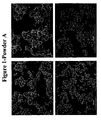
- Figure 1 is a micro photograph of the iron powder produced.
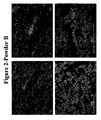
- Figure 2 is a micro photograph of the iron powder produced according to this example.
- Table 1 lists the type of powders and Table 2 the properties of these powders.
- Table 1 Powder Type of powder Particle shape A Reduced iron oxide irregular According to the invention B reduced iron oxide irregular According to the invention C Reduced iron oxide irregular Commercially available D Reduced iron oxide spherical According to US patent 6589667 E Reduced iron oxide irregular Commercially available F Reduced iron oxide irregular Commercially available G Reduced iron oxide irregular Commercially available H electrolytic irregular Commercially available I carbonyl spherical Commercially available Table 2 Powder type Apparent density (AD) g/cm3 Particle Density (PD) g/cm3 AD/PD Specific surface area BET m 2 /kg Dissolution rate % A 1.37 7.31 0.19 560 69-79 B 1.7 7.47 0.23 550 49.3 C 2.39 6.76 0.35 280 37-39 D 2.22 7.2 0.31 260 35
Landscapes
- Chemical & Material Sciences (AREA)
- Life Sciences & Earth Sciences (AREA)
- General Chemical & Material Sciences (AREA)
- Mycology (AREA)
- Health & Medical Sciences (AREA)
- Nutrition Science (AREA)
- Engineering & Computer Science (AREA)
- Food Science & Technology (AREA)
- Polymers & Plastics (AREA)
- Chemical Kinetics & Catalysis (AREA)
- Inorganic Chemistry (AREA)
- Coloring Foods And Improving Nutritive Qualities (AREA)
- Fodder In General (AREA)
- General Preparation And Processing Of Foods (AREA)
- Powder Metallurgy (AREA)
- Manufacture Of Metal Powder And Suspensions Thereof (AREA)
- Compounds Of Iron (AREA)
- Seeds, Soups, And Other Foods (AREA)
- Pharmaceuticals Containing Other Organic And Inorganic Compounds (AREA)
- Food Preservation Except Freezing, Refrigeration, And Drying (AREA)
Abstract
Description
- The present invention concerns food and feed fortification. More specifically the invention concerns an iron powder, which is suitable as food and feed additive and which can be cost effectively produced.
- Iron is an essential trace element in animal and human nutrition. It is a component of heme in hemoglobin and of myoglobin, cytochromes and several enzymes. The main role of iron is its participation in the transport, storage and utilization of oxygen. A balanced diet will normally cover the need of iron through intake of iron rich food stuff such as vegetables, meat and cereals. An important iron source is cereals such as wheat flour. However in modern methods of producing wheat flour the iron rich shell of the wheat grain is eliminated. This results in that the iron content of wheat flour of today is lower than that of wheat flour produced before. Iron deficiency is also a consequence of the malnutrition which is prevailing especially in the developing countries. As a diet with too low iron content contributes to low birth weight, impairs growth and cognitive development in children and causes fatigue among adults there is a need of adding iron to the diet. The greatest effect of an iron fortification programme will of course be reached when iron is added to food that most people eat daily.
- The most widespread method is iron fortification of cereal products such as wheat flour, corn flour, corn flakes etc but many other products are also fortified.
- Iron can be added to food and feed in many different forms. Metallic iron can be used as well as inorganic salts of iron, such as iron sulphate, and organic salts, such as iron gluconate or iron fumarate. There are basically three different types of elemental iron for food fortification, namely reduced iron or sponge iron, carbonyl iron and electrolytic iron.
- The reduced iron is produced by a reduction of ground iron oxide with hydrogen or carbon monoxide at elevated temperature followed by grinding and milling of the reduced iron cake. Reduced iron is produced from either iron ore or mill scale. The purity of the product is dictated by the purity of the iron oxide. These products have the lowest purity of the food grade iron powders when compared with electrolytic or carbonyl powders. The most common impurity in iron powder produced by any reduction process is oxygen, most of which occurs as a thin film of surface oxide. Basic impurities include carbon, magnesium, aluminium, silicon, phosphorus, sulphur, chromium, manganese, nickel and copper, many of which are present as oxides. The particle size is irregular and porous and it consists of a number of small equiaxed grains.
- Carbonyl iron powders consist of particles, which are much finer than particles of other iron powders. These powders are produced by treating reduced iron with carbon monoxide under heat and pressure. The resulting iron pentacarbonyl is later decomposed under controlled conditions yielding an iron powder and carbon monoxide gas. At this point the major impurity is carbon and further reduction in wet hydrogen is necessary to remove most of the carbon. The powder has particles ranging in size from 0.5 to 10 µm in diameter and is of high purity. The particles are close to spherical in shape and very dense and smooth. The structure of the particles is characterized by concentric shells arranged in onion-skin fashion. The carbonyl process is costly.
- Electrolytic iron is produced by electrolytic deposition of a hard brittle metal that is mechanically comminuted. The particle shape of electrolytic iron powder is irregular, dendritic of fernlike, from which it receives its high surface factor.
- An important feature for the iron containing compounds used as food additive is the bioavailability of the iron i.e. how efficiently the iron is absorbed by the body. Of the iron powders used for food and feed enrichment today, the carbonyl and electrolytic powders have the highest bioavailability but the production costs of these powders are high compared with the production costs for reduced iron powders. A pure reduced iron powder, which has high bioavailability and which can be cost effectively produced would therefore be attractive and is the object of the present invention.
- The assessment of bioavailability may be performed in different ways such as in vitro studies, animal studies or human studies. Bioavailability of iron powders as well as other iron compounds are usually measured relative to iron sulphate.
- According to the invention it has now been found that satisfactory bioavailability of iron can be obtained with a reduced iron powder having irregularly shaped particles, wherein the iron powder has a ratio AD:PD less than 0.3, wherein AD is the apparent density in g/cm3 and wherein PD is the particle density in g/cm3. Additionally the specific surface area of the powder particles should be above 300, preferably above 400 m2/kg as measured by the BET method, and the average particle size should be between 5 and 45, preferably between 5 and 25 µm.
- A fortifying amount (about 1 to 200 ppm) of such a powder should be included in a foodstuff or feedstuff.
- The iron oxide used as starting material may be natural hematite (Fe2O3). Another alternative is to use the type of iron oxides which are obtained as by-products from acid regeneration processes. In order to obtain a product having the desired properties the particle size of the starting material should preferably not exceed 55 µm
- The reduction of the starting material is performed with hydrogen gas or a mixture of carbon and hydrogen gas. Preferably the reduction is performed in a belt furnace at temperatures up to 1100°C. An important feature is that the reduction is performed in such a way that the resulting product is in the form of a powder or a slightly sintered cake which can easily be milled without any impact or with only slight impact on the particle shape and other properties.
- A process for the production of a sponge iron powder for metallurgical purposes is disclosed in the
GB patent 704026 - Another reduction process is disclosed in the
US . This process is preferably performed in such a way that the iron oxide powder is incrementally heated to approximately 1200°F (649°C), then to approximately 1400°F (760°C) and finally to approximately 1500°F (816°C) in a reducing atmosphere. Hydrogen is preferably used as reducing atmosphere. According to this known process, an iron powder, the particles of which are rounded, are obtained. This known powder is stated to be useful for injection moulding processes.patent 5 713 982 - According to the present invention it has been found that, in order to obtain a satisfactory dissolution rate and bioavailability, the iron particles obtained after the reduction should have an irregular shape. It has been found that the critical feature can be obtained by performing the reduction of the iron oxide powder at somewhat higher temperature and/or somewhat longer heating times than what is disclosed in the US patent. As an example a combination of carbon and hydrogen gas can be used as the reducing agents at a temperature of about 1000° C. The exact conditions for the preparation of iron powders having the irregularly shaped particles can be determined by the man skilled in the art.
- An important and critical feature of the powder is the porous and irregular shape and consequently the low apparent density, AD, which has been found to be preferably less than 2 g/cm3. Furthermore, the pores of the powder should be open, facilitating the penetration of the gastric juice into the iron particles giving a sufficient high dissolution rate of the iron. A low degree of open porosity is manifested in a value of particle density close to the value of the true density of iron, which is about 7.86 g/cm3. It has then be found that the relation between AD and PD should be less than 0.3.
- As used herein the particle density, PD, is measured by using a pycnometer apparatus, which allows liquid to flow into open pores of the iron particles in a container of definite volume under controlled conditions. The particle density is defined as the particle mass divided by the particle volume, including the inside closed pores. As the
liquid fluid 5 % of a 99.5 % ethanol solution was used. The weight of the pycnometer, the pycnometer including the iron powder sample, and the pycnometer including the iron powder sample filled with the penetration fluid up to the definite volume were measured. As the definite volume of the pycnometer and the density of the penetrating fluid is known the particle density can then be calculated. - The particle size of the iron powder particles is also a parameter influencing the dissolution rate. A too coarse particle size will negatively influence the dissolution rate and a too fine particle size of the iron powder increase the risk for dust explosions during handling. A sufficiently high dissolution rate is obtained when the average particle size is between 5 and 45 preferably between 5 and 25 µm.
- As method for assessing the bioavailability of the iron powder we have used a method including the steps of dissolving the 50 g iron powder in hydrochloric acid at pH 1 and 37°C. The amount of dissolved iron is measured after 30 minutes and is reported as dissolution rate in table 2 below. According to the present invention it has been found that the iron powder should have a dissolution rate in hydrochloric acid at 37°C and pH 1 of at least 40 % by weight after 30 minutes.
- Although described particularly with reference to food applications it is obvious that the iron powder according to the present invention can be used also within other fields where rapid dissolution is required.
- The invention is further illustrated by the following non-limiting examples.
- This example discloses a process for the preparation of an iron powder, which has high bioavailability as measured by the dissolution rate and which can be used as food or feed fortification.
- Hematite with a grain size of 5-20 µm was mixed with coal having a grain size less than 1 mm. The amount of added coal was 12% by weight. The obtained mixture was reduced in an furnace at about 1000°C. Hydrogen gas was added at the end of the furnace and forced to flow in a direction counter the flow of the hematite material. The added amount of hydrogen gas was 610 m3 /ton of reduced iron. The obtained cake of sponge iron was gently crushed in a standard milling device and sieved on a 325 mesh screen.
-
Figure 1 is a micro photograph of the iron powder produced. - The process according to example 1 was repeated but the reduction was performed with hydrogen only and the starting material used was an iron oxide which had been obtained as a by product from acid regeneration.
-
Figure 2 is a micro photograph of the iron powder produced according to this example. - A comparison between the new powders A and B according to the above examples 1 and 2, respectively, and presently used iron powders for food fortification is disclosed in the following, wherein Table 1 lists the type of powders and Table 2 the properties of these powders.
Table 1 Powder Type of powder Particle shape A Reduced iron oxide irregular According to the invention B reduced iron oxide irregular According to the invention C Reduced iron oxide irregular Commercially available D Reduced iron oxide spherical According to US patent 6589667 E Reduced iron oxide irregular Commercially available F Reduced iron oxide irregular Commercially available G Reduced iron oxide irregular Commercially available H electrolytic irregular Commercially available I carbonyl spherical Commercially available Table 2 Powder type Apparent density (AD) g/cm3 Particle Density (PD) g/cm3 AD/PD Specific surface area BET m2/kg Dissolution rate % A 1.37 7.31 0.19 560 69-79 B 1.7 7.47 0.23 550 49.3 C 2.39 6.76 0.35 280 37-39 D 2.22 7.2 0.31 260 35-40 E 3.07 7.67 0.4 110 30-35 F 2.57 7.6 0.34 80 28-30 G 2.42 7.31 0.33 230 35-36 H 2.27 7.28 0.31 350 71-74 I 2.35 7.82 0.30 490 94-95 - The contents of As, Hg and Pb in the powders according to the invention were all below the critical limits accepted in iron powders for food fortification.
Claims (10)
- Iron powder essentially consisting of a reduced iron powder having irregularly shaped particles, wherein the iron powder has a ratio AD:PD less than 0.3, wherein AD is the apparent density in g/cm3, and PD is the particle density in g/cm3, the specific surface area of the powder particles is above 300 m2/kg as measured by the BET method and wherein the average particle size is between 5-45 µm.
- Powder according to claim 1, wherein the specific surface area of the powder particles is above 400, preferably above 450 and most preferably above 500 m2/kg and the average particle size is 5-25 µm.
- Powder according to claim 1 or 2, wherein the ratio AD:PD less than 0.27, preferably less than 0.25.
- Powder according to any one of the claims 1-3, wherein the iron powder has a dissolution rate in hydrochloric acid at 37°C and pH 1 of at least 40 % by weight after 30 minutes.
- Use of a powder according to any one of the claims 1-4 in foodstuff, feedstuff or beverages.
- A fortified material comprising a foodstuff or beverage and a fortifying amount of a reduced iron powder according to any one of the claims 1-4.
- Method for producing a reduced iron powder as defined in any one of the claims 1-4 comprising the steps of- providing a starting material of an iron oxide powder having a particle size less than 55 µm- reducing said powder at a temperature less than 1100°C to a porous sintered cake- crushing and sieving the obtained cake to a powder having the desired particle size.
- Method according to claim 7, wherein the iron oxide is selected from the group consisting of natural hematite (Fe2O3) and iron oxides which are obtained as by-products from acid regeneration processes.
- Method according to any one of the claims 7 or 8 wherein the reduction is performed with hydrogen gas or a mixture of carbon and hydrogen gas.
- Method according to any one of the claims 7-9, wherein the reduction is performed in a belt furnace.
Priority Applications (2)
| Application Number | Priority Date | Filing Date | Title |
|---|---|---|---|
| SI200430781T SI1689253T1 (en) | 2003-11-26 | 2004-11-25 | Iron powder, use as additive for foods, food additive and method of making iron powder. |
| PL04800392T PL1689253T3 (en) | 2003-11-26 | 2004-11-25 | Iron powder, use as additive for foods, food additive and method of making iron powder. |
Applications Claiming Priority (2)
| Application Number | Priority Date | Filing Date | Title |
|---|---|---|---|
| SE0303187A SE0303187D0 (en) | 2003-11-26 | 2003-11-26 | Food additive |
| PCT/SE2004/001731 WO2005051105A1 (en) | 2003-11-26 | 2004-11-25 | Iron powder, use as additive for foods, food additive and method of making iron powder. |
Publications (2)
| Publication Number | Publication Date |
|---|---|
| EP1689253A1 EP1689253A1 (en) | 2006-08-16 |
| EP1689253B1 true EP1689253B1 (en) | 2008-04-16 |
Family
ID=29729196
Family Applications (1)
| Application Number | Title | Priority Date | Filing Date |
|---|---|---|---|
| EP04800392A Expired - Lifetime EP1689253B1 (en) | 2003-11-26 | 2004-11-25 | Iron powder, use as additive for foods, food additive and method of making iron powder. |
Country Status (19)
| Country | Link |
|---|---|
| US (1) | US7407526B2 (en) |
| EP (1) | EP1689253B1 (en) |
| JP (2) | JP4885728B2 (en) |
| CN (1) | CN1886065B (en) |
| AT (1) | ATE392154T1 (en) |
| AU (1) | AU2004292928B2 (en) |
| BR (1) | BRPI0416903B1 (en) |
| CA (1) | CA2546851C (en) |
| DE (1) | DE602004013182T2 (en) |
| DK (1) | DK1689253T3 (en) |
| ES (1) | ES2304164T3 (en) |
| PL (1) | PL1689253T3 (en) |
| RU (1) | RU2325077C2 (en) |
| SE (1) | SE0303187D0 (en) |
| SI (1) | SI1689253T1 (en) |
| TW (1) | TW200529768A (en) |
| UA (1) | UA82576C2 (en) |
| WO (1) | WO2005051105A1 (en) |
| ZA (1) | ZA200603465B (en) |
Families Citing this family (14)
| Publication number | Priority date | Publication date | Assignee | Title |
|---|---|---|---|---|
| WO2009068378A1 (en) * | 2007-11-27 | 2009-06-04 | Unilever Nv | Fortified bouillon cube |
| DE102008009133B4 (en) * | 2008-02-06 | 2012-04-12 | Fraunhofer-Gesellschaft zur Förderung der angewandten Forschung e.V. | Process for the production of metal powders and metal powder produced in this way |
| WO2011001282A2 (en) | 2009-06-29 | 2011-01-06 | Bairong Li | Metal reduction processes, metallurgical processes and products and apparatus |
| JP5445032B2 (en) * | 2009-10-28 | 2014-03-19 | Jfeスチール株式会社 | Method for producing reduced iron powder |
| JP2011153353A (en) * | 2010-01-27 | 2011-08-11 | Nakagawa Special Steel Co Inc | Iron powder mixture, method for using iron powder mixture, and method for producing iron powder mixture |
| US8333821B2 (en) | 2010-02-05 | 2012-12-18 | Innova Powders, Inc. | Environmentally friendly system and method for manufacturing iron powder |
| RU2472347C1 (en) * | 2011-07-21 | 2013-01-20 | Закрытое Акционерное Общество "Валетек Продимпэкс" | Dough production method |
| CN104757322A (en) * | 2015-04-09 | 2015-07-08 | 五河县鸿鹤大雁养殖专业合作社 | Fattening food for wild gooses |
| KR20190065344A (en) * | 2016-10-03 | 2019-06-11 | 회가내스 아베 (피유비엘) | White iron food additive |
| CN108651711B (en) * | 2018-05-21 | 2021-11-16 | 福建干山山里红农业发展有限公司 | Preparation method of silage taking bamboo shoot shells as raw materials |
| KR102175428B1 (en) * | 2018-11-05 | 2020-11-06 | 주식회사 포스코 | Manufacturing method of cylindrical porous iron powder |
| WO2020172744A1 (en) * | 2019-02-25 | 2020-09-03 | Rio Tinto Iron And Titanium Canada Inc. | Metallic iron powder |
| DE102019207824A1 (en) * | 2019-05-28 | 2020-12-03 | Thyssenkrupp Steel Europe Ag | Process for the production of iron powder |
| WO2022101840A1 (en) * | 2020-11-13 | 2022-05-19 | Tata Steel Limited | An elemental iron powder, methods and products thereof |
Family Cites Families (16)
| Publication number | Priority date | Publication date | Assignee | Title |
|---|---|---|---|---|
| US2310383A (en) * | 1941-04-16 | 1943-02-09 | Gen Mills Inc | Mineral fortification of foodstuffs and medicinal products |
| GB704026A (en) | 1951-09-07 | 1954-02-17 | Hoeganaes Ab | A method for the production of iron powder of suitable grain size for powder metallurgical purposes |
| DE1171623B (en) * | 1961-11-24 | 1964-06-04 | Huettenwerk Oberhausen Ag | Process for the production of dense, little porous or non-porous iron powder from sponge iron |
| US3419383A (en) * | 1966-04-19 | 1968-12-31 | Scm Corp | Producing pulverulent iron for powder metallurgy by multistage reduction |
| US4054443A (en) * | 1975-12-22 | 1977-10-18 | Midrex Corporation | Method of preparing iron powder |
| US4752479A (en) | 1986-05-27 | 1988-06-21 | Ciba-Geigy Corporaton | Multi vitamin and mineral dietary supplement with controlled release bioavailable iron |
| US5248492A (en) * | 1986-07-03 | 1993-09-28 | Advanced Magnetics, Inc. | Low molecular weight carbohydrates as additives to stabilize metal oxide compositions |
| US5713982A (en) * | 1995-12-13 | 1998-02-03 | Clark; Donald W. | Iron powder and method of producing such |
| US5972066A (en) * | 1997-04-22 | 1999-10-26 | Iron Dynamics, Inc. | Mixed bed iron reduction process |
| BR9811068A (en) * | 1997-08-04 | 2000-08-15 | Bechtel Group Inc | Method for obtaining an iron concentrate from an iron ore charge |
| US6521247B1 (en) | 1999-08-13 | 2003-02-18 | Warner Chilcott Laboratories Ireland Limited | Dual iron containing nutritional supplement |
| RU2158098C1 (en) * | 2000-01-24 | 2000-10-27 | Дьяков Валерий Михайлович | Biologically-active food additive |
| US6589667B1 (en) | 2000-09-26 | 2003-07-08 | Höganäs Ab | Spherical porous iron powder and method for producing the same |
| JP2002105501A (en) * | 2000-09-26 | 2002-04-10 | Hoganas Ab | Spherical porous iron powder and method for producing the same |
| WO2002064844A1 (en) * | 2001-02-14 | 2002-08-22 | Kawasaki Steel Corporation | Method for producing sponge iron, and reduced iron powder and method for production thereof |
| JP3561724B2 (en) * | 2001-03-30 | 2004-09-02 | パウダーテック株式会社 | Reduced iron powder for oxygen scavenger and method for producing the same |
-
2003
- 2003-11-26 SE SE0303187A patent/SE0303187D0/en unknown
-
2004
- 2004-11-24 US US10/995,471 patent/US7407526B2/en not_active Expired - Lifetime
- 2004-11-25 DK DK04800392T patent/DK1689253T3/en active
- 2004-11-25 ES ES04800392T patent/ES2304164T3/en not_active Expired - Lifetime
- 2004-11-25 DE DE602004013182T patent/DE602004013182T2/en not_active Expired - Lifetime
- 2004-11-25 JP JP2006541098A patent/JP4885728B2/en not_active Expired - Fee Related
- 2004-11-25 AT AT04800392T patent/ATE392154T1/en not_active IP Right Cessation
- 2004-11-25 AU AU2004292928A patent/AU2004292928B2/en not_active Ceased
- 2004-11-25 CN CN2004800348349A patent/CN1886065B/en not_active Expired - Fee Related
- 2004-11-25 WO PCT/SE2004/001731 patent/WO2005051105A1/en not_active Ceased
- 2004-11-25 CA CA2546851A patent/CA2546851C/en not_active Expired - Fee Related
- 2004-11-25 BR BRPI0416903-4A patent/BRPI0416903B1/en not_active IP Right Cessation
- 2004-11-25 SI SI200430781T patent/SI1689253T1/en unknown
- 2004-11-25 ZA ZA200603465A patent/ZA200603465B/en unknown
- 2004-11-25 UA UAA200606991A patent/UA82576C2/en unknown
- 2004-11-25 RU RU2006122536/13A patent/RU2325077C2/en not_active IP Right Cessation
- 2004-11-25 PL PL04800392T patent/PL1689253T3/en unknown
- 2004-11-25 EP EP04800392A patent/EP1689253B1/en not_active Expired - Lifetime
- 2004-11-26 TW TW093136602A patent/TW200529768A/en unknown
-
2010
- 2010-03-17 JP JP2010060442A patent/JP2010156057A/en active Pending
Also Published As
| Publication number | Publication date |
|---|---|
| JP2010156057A (en) | 2010-07-15 |
| DE602004013182T2 (en) | 2009-07-16 |
| RU2325077C2 (en) | 2008-05-27 |
| DE602004013182D1 (en) | 2008-05-29 |
| CA2546851A1 (en) | 2005-06-09 |
| ATE392154T1 (en) | 2008-05-15 |
| BRPI0416903A (en) | 2007-01-16 |
| BRPI0416903B1 (en) | 2014-09-30 |
| AU2004292928B2 (en) | 2007-05-24 |
| ES2304164T3 (en) | 2008-09-16 |
| CN1886065A (en) | 2006-12-27 |
| CA2546851C (en) | 2010-01-26 |
| US7407526B2 (en) | 2008-08-05 |
| JP4885728B2 (en) | 2012-02-29 |
| UA82576C2 (en) | 2008-04-25 |
| PL1689253T3 (en) | 2008-11-28 |
| ZA200603465B (en) | 2007-07-25 |
| DK1689253T3 (en) | 2008-07-21 |
| US20050145068A1 (en) | 2005-07-07 |
| RU2006122536A (en) | 2008-01-10 |
| SE0303187D0 (en) | 2003-11-26 |
| TW200529768A (en) | 2005-09-16 |
| EP1689253A1 (en) | 2006-08-16 |
| CN1886065B (en) | 2010-06-23 |
| JP2007522337A (en) | 2007-08-09 |
| SI1689253T1 (en) | 2008-10-31 |
| WO2005051105A1 (en) | 2005-06-09 |
| AU2004292928A1 (en) | 2005-06-09 |
Similar Documents
| Publication | Publication Date | Title |
|---|---|---|
| JP2010156057A (en) | Iron powder, use as additive for food, food additive and method of making iron powder | |
| Dabhade et al. | Nanocrystalline titanium powders by high energy attrition milling | |
| CN101283692B (en) | Flour processing method for improving flour quality and flour-made food quality | |
| US3832156A (en) | Powdered metal process | |
| CN113308624B (en) | Zinc alloy additive and preparation method thereof | |
| CN108637264B (en) | Ball mill, method for improving flowability of metal powder for 3D printing and metal powder for 3D printing | |
| US4053578A (en) | Process for oxidizing primarily nickel powders | |
| CN106424716B (en) | Improve the method for copper-manganese damping sintered alloy performance with ferrous oxalate | |
| US4054443A (en) | Method of preparing iron powder | |
| CN109128207A (en) | A kind of purification ultrafine titanium powder and preparation method thereof | |
| WO2022101840A1 (en) | An elemental iron powder, methods and products thereof | |
| US3481714A (en) | Flowable metal powders | |
| CA1233678A (en) | Wrought p/m processing for master alloy powder | |
| DE69636580T2 (en) | PROCESS FOR PREPARING ALUMINUM NITRIDE | |
| CN114711311A (en) | Hydrogen-rich tea and preparation method thereof | |
| JP2002292276A (en) | Reduced iron powder for deoxidizer and method for manufacturing the same | |
| JPS5959810A (en) | Steel powder for powder metallurgy and its manufacture | |
| Shaimerdenova et al. | Instant cereals enriched with carboxylates | |
| JPWO1998029334A1 (en) | Aluminum nitride manufacturing method | |
| JP3317593B2 (en) | Flat reduced iron powder for oxygen scavenger and production method thereof | |
| JPH0225401B2 (en) | ||
| JP2006213614A (en) | Gluconate powder and method for producing the same | |
| RU2073982C1 (en) | Method for producing fatty half-finished product for confectionery | |
| CN118699379A (en) | A process for producing low bulk density water-atomized copper-tin alloy powder | |
| KR900009094B1 (en) | Manufacturing method of high density reduced iron powder |
Legal Events
| Date | Code | Title | Description |
|---|---|---|---|
| PUAI | Public reference made under article 153(3) epc to a published international application that has entered the european phase |
Free format text: ORIGINAL CODE: 0009012 |
|
| 17P | Request for examination filed |
Effective date: 20060519 |
|
| AK | Designated contracting states |
Kind code of ref document: A1 Designated state(s): AT BE BG CH CY CZ DE DK EE ES FI FR GB GR HU IE IS IT LI LU MC NL PL PT RO SE SI SK TR |
|
| DAX | Request for extension of the european patent (deleted) | ||
| GRAP | Despatch of communication of intention to grant a patent |
Free format text: ORIGINAL CODE: EPIDOSNIGR1 |
|
| GRAS | Grant fee paid |
Free format text: ORIGINAL CODE: EPIDOSNIGR3 |
|
| GRAA | (expected) grant |
Free format text: ORIGINAL CODE: 0009210 |
|
| AK | Designated contracting states |
Kind code of ref document: B1 Designated state(s): AT BE BG CH CY CZ DE DK EE ES FI FR GB GR HU IE IS IT LI LU MC NL PL PT RO SE SI SK TR |
|
| REG | Reference to a national code |
Ref country code: CH Ref legal event code: EP |
|
| REG | Reference to a national code |
Ref country code: IE Ref legal event code: FG4D |
|
| REF | Corresponds to: |
Ref document number: 602004013182 Country of ref document: DE Date of ref document: 20080529 Kind code of ref document: P |
|
| REG | Reference to a national code |
Ref country code: SE Ref legal event code: TRGR |
|
| REG | Reference to a national code |
Ref country code: DK Ref legal event code: T3 |
|
| REG | Reference to a national code |
Ref country code: ES Ref legal event code: FG2A Ref document number: 2304164 Country of ref document: ES Kind code of ref document: T3 |
|
| PG25 | Lapsed in a contracting state [announced via postgrant information from national office to epo] |
Ref country code: PT Free format text: LAPSE BECAUSE OF FAILURE TO SUBMIT A TRANSLATION OF THE DESCRIPTION OR TO PAY THE FEE WITHIN THE PRESCRIBED TIME-LIMIT Effective date: 20080916 Ref country code: FI Free format text: LAPSE BECAUSE OF FAILURE TO SUBMIT A TRANSLATION OF THE DESCRIPTION OR TO PAY THE FEE WITHIN THE PRESCRIBED TIME-LIMIT Effective date: 20080416 |
|
| PG25 | Lapsed in a contracting state [announced via postgrant information from national office to epo] |
Ref country code: AT Free format text: LAPSE BECAUSE OF FAILURE TO SUBMIT A TRANSLATION OF THE DESCRIPTION OR TO PAY THE FEE WITHIN THE PRESCRIBED TIME-LIMIT Effective date: 20080416 |
|
| REG | Reference to a national code |
Ref country code: PL Ref legal event code: T3 |
|
| REG | Reference to a national code |
Ref country code: HU Ref legal event code: AG4A Ref document number: E003775 Country of ref document: HU |
|
| PG25 | Lapsed in a contracting state [announced via postgrant information from national office to epo] |
Ref country code: IS Free format text: LAPSE BECAUSE OF FAILURE TO SUBMIT A TRANSLATION OF THE DESCRIPTION OR TO PAY THE FEE WITHIN THE PRESCRIBED TIME-LIMIT Effective date: 20080816 |
|
| ET | Fr: translation filed | ||
| PLBE | No opposition filed within time limit |
Free format text: ORIGINAL CODE: 0009261 |
|
| STAA | Information on the status of an ep patent application or granted ep patent |
Free format text: STATUS: NO OPPOSITION FILED WITHIN TIME LIMIT |
|
| PG25 | Lapsed in a contracting state [announced via postgrant information from national office to epo] |
Ref country code: BE Free format text: LAPSE BECAUSE OF FAILURE TO SUBMIT A TRANSLATION OF THE DESCRIPTION OR TO PAY THE FEE WITHIN THE PRESCRIBED TIME-LIMIT Effective date: 20080416 |
|
| 26N | No opposition filed |
Effective date: 20090119 |
|
| PG25 | Lapsed in a contracting state [announced via postgrant information from national office to epo] |
Ref country code: EE Free format text: LAPSE BECAUSE OF FAILURE TO SUBMIT A TRANSLATION OF THE DESCRIPTION OR TO PAY THE FEE WITHIN THE PRESCRIBED TIME-LIMIT Effective date: 20080416 |
|
| REG | Reference to a national code |
Ref country code: RO Ref legal event code: EPE |
|
| PG25 | Lapsed in a contracting state [announced via postgrant information from national office to epo] |
Ref country code: MC Free format text: LAPSE BECAUSE OF NON-PAYMENT OF DUE FEES Effective date: 20081130 |
|
| PG25 | Lapsed in a contracting state [announced via postgrant information from national office to epo] |
Ref country code: CY Free format text: LAPSE BECAUSE OF FAILURE TO SUBMIT A TRANSLATION OF THE DESCRIPTION OR TO PAY THE FEE WITHIN THE PRESCRIBED TIME-LIMIT Effective date: 20080416 |
|
| PG25 | Lapsed in a contracting state [announced via postgrant information from national office to epo] |
Ref country code: LU Free format text: LAPSE BECAUSE OF NON-PAYMENT OF DUE FEES Effective date: 20081125 |
|
| PG25 | Lapsed in a contracting state [announced via postgrant information from national office to epo] |
Ref country code: GR Free format text: LAPSE BECAUSE OF FAILURE TO SUBMIT A TRANSLATION OF THE DESCRIPTION OR TO PAY THE FEE WITHIN THE PRESCRIBED TIME-LIMIT Effective date: 20080717 |
|
| PGFP | Annual fee paid to national office [announced via postgrant information from national office to epo] |
Ref country code: PL Payment date: 20120928 Year of fee payment: 9 |
|
| PGFP | Annual fee paid to national office [announced via postgrant information from national office to epo] |
Ref country code: DK Payment date: 20121112 Year of fee payment: 9 |
|
| PGFP | Annual fee paid to national office [announced via postgrant information from national office to epo] |
Ref country code: IE Payment date: 20121112 Year of fee payment: 9 Ref country code: BG Payment date: 20121018 Year of fee payment: 9 Ref country code: CZ Payment date: 20121026 Year of fee payment: 9 Ref country code: HU Payment date: 20121112 Year of fee payment: 9 Ref country code: CH Payment date: 20121113 Year of fee payment: 9 |
|
| PGFP | Annual fee paid to national office [announced via postgrant information from national office to epo] |
Ref country code: TR Payment date: 20121023 Year of fee payment: 9 Ref country code: SK Payment date: 20121102 Year of fee payment: 9 Ref country code: SI Payment date: 20121022 Year of fee payment: 9 |
|
| PGFP | Annual fee paid to national office [announced via postgrant information from national office to epo] |
Ref country code: NL Payment date: 20121110 Year of fee payment: 9 |
|
| REG | Reference to a national code |
Ref country code: NL Ref legal event code: V1 Effective date: 20140601 |
|
| REG | Reference to a national code |
Ref country code: DK Ref legal event code: EBP Effective date: 20131130 |
|
| REG | Reference to a national code |
Ref country code: CH Ref legal event code: PL |
|
| PG25 | Lapsed in a contracting state [announced via postgrant information from national office to epo] |
Ref country code: CH Free format text: LAPSE BECAUSE OF NON-PAYMENT OF DUE FEES Effective date: 20131130 Ref country code: LI Free format text: LAPSE BECAUSE OF NON-PAYMENT OF DUE FEES Effective date: 20131130 |
|
| REG | Reference to a national code |
Ref country code: SK Ref legal event code: MM4A Ref document number: E 3957 Country of ref document: SK Effective date: 20131125 |
|
| REG | Reference to a national code |
Ref country code: IE Ref legal event code: MM4A |
|
| PG25 | Lapsed in a contracting state [announced via postgrant information from national office to epo] |
Ref country code: SK Free format text: LAPSE BECAUSE OF NON-PAYMENT OF DUE FEES Effective date: 20131125 Ref country code: BG Free format text: LAPSE BECAUSE OF NON-PAYMENT OF DUE FEES Effective date: 20140630 Ref country code: CZ Free format text: LAPSE BECAUSE OF NON-PAYMENT OF DUE FEES Effective date: 20131125 Ref country code: SI Free format text: LAPSE BECAUSE OF NON-PAYMENT OF DUE FEES Effective date: 20131126 Ref country code: NL Free format text: LAPSE BECAUSE OF NON-PAYMENT OF DUE FEES Effective date: 20140601 |
|
| REG | Reference to a national code |
Ref country code: SI Ref legal event code: KO00 Effective date: 20140710 |
|
| PG25 | Lapsed in a contracting state [announced via postgrant information from national office to epo] |
Ref country code: BG Free format text: LAPSE BECAUSE OF NON-PAYMENT OF DUE FEES Effective date: 20131130 Ref country code: HU Free format text: LAPSE BECAUSE OF NON-PAYMENT OF DUE FEES Effective date: 20131126 |
|
| PG25 | Lapsed in a contracting state [announced via postgrant information from national office to epo] |
Ref country code: DK Free format text: LAPSE BECAUSE OF NON-PAYMENT OF DUE FEES Effective date: 20131130 Ref country code: BG Free format text: LAPSE BECAUSE OF NON-PAYMENT OF DUE FEES Effective date: 20140930 Ref country code: IE Free format text: LAPSE BECAUSE OF NON-PAYMENT OF DUE FEES Effective date: 20131125 |
|
| PG25 | Lapsed in a contracting state [announced via postgrant information from national office to epo] |
Ref country code: PL Free format text: LAPSE BECAUSE OF NON-PAYMENT OF DUE FEES Effective date: 20131125 |
|
| REG | Reference to a national code |
Ref country code: PL Ref legal event code: LAPE |
|
| PG25 | Lapsed in a contracting state [announced via postgrant information from national office to epo] |
Ref country code: TR Free format text: LAPSE BECAUSE OF NON-PAYMENT OF DUE FEES Effective date: 20131125 |
|
| REG | Reference to a national code |
Ref country code: FR Ref legal event code: PLFP Year of fee payment: 12 |
|
| PGFP | Annual fee paid to national office [announced via postgrant information from national office to epo] |
Ref country code: IT Payment date: 20151124 Year of fee payment: 12 Ref country code: GB Payment date: 20151125 Year of fee payment: 12 |
|
| PGFP | Annual fee paid to national office [announced via postgrant information from national office to epo] |
Ref country code: RO Payment date: 20151016 Year of fee payment: 12 Ref country code: FR Payment date: 20151008 Year of fee payment: 12 Ref country code: ES Payment date: 20151014 Year of fee payment: 12 Ref country code: SE Payment date: 20151111 Year of fee payment: 12 |
|
| REG | Reference to a national code |
Ref country code: SE Ref legal event code: EUG |
|
| GBPC | Gb: european patent ceased through non-payment of renewal fee |
Effective date: 20161125 |
|
| PG25 | Lapsed in a contracting state [announced via postgrant information from national office to epo] |
Ref country code: RO Free format text: LAPSE BECAUSE OF NON-PAYMENT OF DUE FEES Effective date: 20161125 |
|
| REG | Reference to a national code |
Ref country code: FR Ref legal event code: ST Effective date: 20170731 |
|
| PG25 | Lapsed in a contracting state [announced via postgrant information from national office to epo] |
Ref country code: SE Free format text: LAPSE BECAUSE OF NON-PAYMENT OF DUE FEES Effective date: 20161126 |
|
| PG25 | Lapsed in a contracting state [announced via postgrant information from national office to epo] |
Ref country code: FR Free format text: LAPSE BECAUSE OF NON-PAYMENT OF DUE FEES Effective date: 20161130 Ref country code: IT Free format text: LAPSE BECAUSE OF NON-PAYMENT OF DUE FEES Effective date: 20161125 |
|
| PG25 | Lapsed in a contracting state [announced via postgrant information from national office to epo] |
Ref country code: GB Free format text: LAPSE BECAUSE OF NON-PAYMENT OF DUE FEES Effective date: 20161125 |
|
| PG25 | Lapsed in a contracting state [announced via postgrant information from national office to epo] |
Ref country code: ES Free format text: LAPSE BECAUSE OF NON-PAYMENT OF DUE FEES Effective date: 20161126 |
|
| REG | Reference to a national code |
Ref country code: ES Ref legal event code: FD2A Effective date: 20180626 |
|
| PGFP | Annual fee paid to national office [announced via postgrant information from national office to epo] |
Ref country code: DE Payment date: 20221004 Year of fee payment: 19 |
|
| REG | Reference to a national code |
Ref country code: DE Ref legal event code: R119 Ref document number: 602004013182 Country of ref document: DE |
|
| PG25 | Lapsed in a contracting state [announced via postgrant information from national office to epo] |
Ref country code: DE Free format text: LAPSE BECAUSE OF NON-PAYMENT OF DUE FEES Effective date: 20240601 |
|
| PG25 | Lapsed in a contracting state [announced via postgrant information from national office to epo] |
Ref country code: DE Free format text: LAPSE BECAUSE OF NON-PAYMENT OF DUE FEES Effective date: 20240601 |