EP1686470B1 - Effizienter Datenzugriff mit Typ-Inferenz zur Laufzeit - Google Patents
Effizienter Datenzugriff mit Typ-Inferenz zur Laufzeit Download PDFInfo
- Publication number
- EP1686470B1 EP1686470B1 EP05112942A EP05112942A EP1686470B1 EP 1686470 B1 EP1686470 B1 EP 1686470B1 EP 05112942 A EP05112942 A EP 05112942A EP 05112942 A EP05112942 A EP 05112942A EP 1686470 B1 EP1686470 B1 EP 1686470B1
- Authority
- EP
- European Patent Office
- Prior art keywords
- schema
- input data
- inferred
- computer
- data
- Prior art date
- Legal status (The legal status is an assumption and is not a legal conclusion. Google has not performed a legal analysis and makes no representation as to the accuracy of the status listed.)
- Ceased
Links
Images




Classifications
-
- G—PHYSICS
- G06—COMPUTING OR CALCULATING; COUNTING
- G06F—ELECTRIC DIGITAL DATA PROCESSING
- G06F8/00—Arrangements for software engineering
- G06F8/30—Creation or generation of source code
Definitions
- This invention is related to data processing techniques, and more specifically, to type inferencing based on input data sets.
- Type inference is the process whereby a compiler tries to determine the types of expressions and variables, given an inevitable lack of complete type information.
- a related source of difficulty is a "sharp" notation for records. Absent information from the context, the type of a function that uses these notations cannot be determined. Therefore this function will be rejected as ambiguous because there is insufficient information to determine the domain type of the function.
- XML extensible Markup Language
- schema or type of a value If the schema or type of a value is known, it is desired to provide more efficient access to parts of the value, that is, it would be desirable to compile access patterns assuming type information. Without assuming schema information, values have to be represented using some form of universal representation, and access is necessarily interpretative.
- schema information values have to be represented using some form of universal representation, and access is necessarily interpretative.
- a set of classes can be generated that correspond to the schema, the document can be deserialized into an object graph, and programmed against the document in a concise, strongly typed, and computationally efficient manner, as represented by the following code.
- a method and a system for automatically generating source code based on a mark-up language message definition is disclosed in US 2003/0167444 .
- a first and a second application communicate by using messages wherein each application includes an application module and a conversion module.
- a mark-up language message definition is received.
- a first in-memory representation of the message definition is generated, which can be, for example, an XML schema definition object tree.
- a second in-memory representation of definition of source code is automatically generated based on the first in-memory representation.
- the second in-memory representation of the source code is converted to a file (e.g. a Java class source file).
- the compiler may be integrated with a client application that can employ the compiler to generate a required communication library on-the-fly based on a received XML message and its XML Schema definition.
- This invention bridges the gap between purely dynamically and purely statically typed languages by using a schema inference on actual values at runtime, and to use that schema to create a specialized representation of the data that can be accessed efficiently and conveniently. Assuming late-bound access to objects (e.g., in Visual Basic, and scripting languages such as ECMAScript, Python, and Perl), this invention combines the efficiency of early bound access via object serialization with the flexibility of untyped document access.
- objects e.g., in Visual Basic, and scripting languages such as ECMAScript, Python, and Perl
- the invention disclosed and claimed herein in one aspect thereof, comprises a system that includes an inference component which receives as an input an input data stream.
- the inference component processes the input data stream at runtime to develop a schema based on actual values thereof.
- the inferred schema is then used to create an inferred output data that is a specialized representation of the input stream data, which can then be accessed efficiently and conveniently.
- a methodology of optimizing a runtime inference process by employing caching at all or selected points of the process includes a cache manager that provides caching at all or selected points during the runtime process by caching the input data and/or interim data and/or code in a cache memory.
- the methodology provides validation of the next document against the previously inferred schema and, if validation succeeds, a new schema need not be inferred. For example, after the first schema inferred at runtime, and the second data set is received, a metric is employed that compares the success (or failure) of the schema against the second data set. If the success falls below the criteria, a new schema is inferred from the second data set, and so on. Otherwise, the first schema continues to be applied against the second data set.
- an artificial intelligence component employs a probabilistic and/or statistical-based analysis to prognose or infer an action that a user desires to be automatically performed.
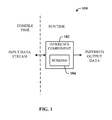
- FIG. 1 illustrates a type inference system that infers a schema at runtime in accordance with the subject invention.
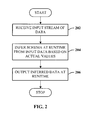
- FIG. 2 illustrates a methodology of providing runtime type inference in accordance with the invention.
- FIG. 3 illustrates a generalized methodology of runtime type inference in accordance with the invention.
- FIG. 4 illustrates a methodology of processing a runtime type inference of an XML document in accordance with the invention.
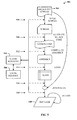
- FIG. 5 illustrates a methodology of optimizing a runtime inference process by employing caching all or selected points of the process, in accordance with the invention.
- FIG. 6 illustrates a methodology of optimizing the processing of similar input data at runtime in accordance with the invention.
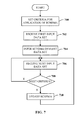
- FIG. 7 illustrates a methodology of optimizing a runtime inference process by refining an inferred schema over time in accordance with the invention.
- FIG. 8 illustrates a system that employs an artificial intelligence component which facilitates automating one or more features in accordance with the subject invention.
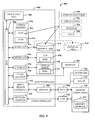
- FIG. 9 illustrates a block diagram of a computer operable to execute the disclosed architecture.
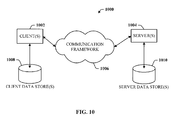
- FIG. 10 illustrates a schematic block diagram of an exemplary computing environment in accordance with the subject invention.
- a component can be, but is not limited to being, a process running on a processor, a processor, an object, an executable, a thread of execution, a program, and/or a computer.
- an application running on a server and the server can be a component.
- One or more components can reside within a process and/or thread of execution, and a component can be localized on one computer and/or distributed between two or more computers.
- the term to "infer” or “inference” refer generally to the process of reasoning about or inferring states of the system, environment, and/or user from a set of observations as captured via events and/or data. Inference can be employed to identify a specific context or action, or can generate a probability distribution over states, for example. The inference can be probabilistic-that is, the computation of a probability distribution over states of interest based on a consideration of data and events. Inference can also refer to techniques employed for composing higher-level events from a set of events and/or data. Such inference results in the construction of new events or actions from a set of observed events and/or stored event data, whether or not the events are correlated in close temporal proximity, and whether the events and data come from one or several event and data sources.
- FIG. 1 illustrates a type inference system 100 that infers a schema at runtime in accordance with the subject invention.
- the main aspect of the invention is to use schema inference on actual values at runtime, and use that schema to create a specialized representation of the data that can be accessed efficiently and conveniently.
- the actual document instance b can be used to generate a runtime type T that is then used to deserialize the document d into an object graph of dynamic type T. Since T is not known statically, the document can be programmed against only in a late-bound fashion (assuming that it has static type obj ect). Here, it is much more efficient to load the document (XmlDocument b) into an object representation, and then access the title because of the capability of doing normal object processing.
- the type Book does not need to be defined until runtime.
- the system 100 which includes an inference component 102 that receives as an input a data stream.
- the inference component 102 processes the input data stream to infer a schema 104 at runtime based on actual values of the input data.
- the schema 104 is then used to create an inferred output data that is a specialized representation of the input stream data, and which can then be accessed efficiently and conveniently.
- FIG. 2 illustrates a methodology of providing runtime type inference in accordance with the invention. While, for purposes of simplicity of explanation, the one or more methodologies shown herein, e.g., in the form of a flow chart, are shown and described as a series of acts, it is to be understood and appreciated that the subject invention is not limited by the order of acts, as some acts may, in accordance with the invention, occur in a different order and/or concurrently with other acts from that shown and described herein. For example, those skilled in the art will understand and appreciate that a methodology could alternatively be represented as a series of interrelated states or events, such as in a state diagram. Moreover, not all illustrated acts may be required to implement a methodology in accordance with the invention.
- the system receives an input data stream.
- This input data can be in the form of XML (extensible Markup Language) documents, data that is compatible with languages described by context-free grammars, and data in the form of relational tables that are described by relational schemas, to name just a few.
- the inference component processes the input data stream to infer a schema therefrom at runtime.
- the schema is utilized to generate the inferred output data based on actual values of the input data stream.
- An input stream of data 300 is received as input to the runtime process.
- a schema is inferred for the input data at runtime.
- source code is generated from the inferred schema.
- the source code is compiled into assembly code, which can be executable code.
- the assembly code is processed against the types of the input data 300, and the generated classes are loaded into memory.
- the classes are used in deserialization of the original data input stream 300 to generate an instance 312 of the newly-created and loaded class. The instance 312 can then be accessed efficiently and conveniently.
- FIG. 4 illustrates a methodology 400 of processing a runtime type inference of an XML document 402 in accordance with the invention.
- the schema can be used to generate source code using, for example, an existing xsd.exe tool in the NET-brand framework by Microsoft Corporation, compile the source code using the C# compiler, load the assembly into memory, and deserialize the original document as an instance of the just created and loaded class.
- classes from the inferred schema, such as Re f 1 ect i on . Emit, or a more lightweight form of runtime code generation.
- the .NET-brand Framework's Reflection namespace facilitates viewing assembly metadata and creating assemblies at runtime. Reflection allows the code to do type discovery, view assembly metadata, and invoke assembly code dynamically at runtime, for example.
- the methodology such that the XML document 402 is received as input data to the runtime process 400.
- the schema is inferred at runtime based on actual values of the XML document 402.
- source code is generated from the inferred schema.
- the source code is compiled into assembly code using, for example, a C# compiler, which can be executable code.
- the XML document 402 types are processed using the assembly code to generate classes that are loaded into memory.
- the classes are used in deserialization of the original data input stream to create an instance 414 of the newly-created and loaded classes. The instance 414 can then be accessed efficiently and conveniently.
- the generic XML serializer does not have to be used to deserialize the XML document into an object graph. Instead, type-specific code can be generated for serialization and deserialization as well, for example, by providing custom implementations of the ISerializable interface.
- the mechanisms described in this invention apply equally well to generating any representation that is specialized using schema information (for instance a schema-specific DOM (document object model) or parse-tree).
- schema information for instance a schema-specific DOM (document object model) or parse-tree.
- the XML DOM is a programming interface for XML documents, and defines the way an XML document can be accessed and manipulated.
- a program called an XML parser can be used to load an XML document into the memory of a computer. When the document is loaded, its information can be retrieved and manipulated by accessing the DOM.
- the DOM represents a tree view of the XML document.
- FIG. 5 illustrates a methodology of optimizing a runtime inference process 500 by employing caching at all or selected points of the process 500, in accordance with the invention.
- the methodology includes a cache manager 502 that provides caching at all or selected points during the runtime process 500 by caching the input data 504 and/or interim data and/or code in a cache memory 506.
- an input stream of data 504 can be cached as it is received as input to the runtime process to provide faster access for generating the runtime schema.
- the schema can be cached for faster access and processing in order to generate the source code.
- the source code is compiled into assembly code, which can be executable code. The source code can be cached for faster access.
- the executable assembly code can be cached for faster access and processing against the input data types to generate classes that are loaded into the process memory.
- the class types can be cached in preparation for the deserialization process against the original data input stream.
- the output of the deserialization process which is an instance 520 of the newly-created and loaded class, can be cached. This provides more efficient and convenient access to the instance 520.
- FIG. 6 there is illustrated a methodology of optimizing the processing of similar input data at runtime in accordance with the invention.
- a metric is employed that compares the success (or failure) of the schema against the second data set. If the success falls below the criteria, a new schema is inferred from the second data set, and so on. Otherwise, the first schema continues to be applied against the second data set.
- a first set of input data is received.
- a first schema is inferred at runtime from the first data set.
- a second data set is received.
- a validation process is employed at runtime against the second data set using the first inferred schema. If validation is not successful, as checked at 610, flow is to 612 where a new schema is inferred from the second data set.
- the second data set is processed according to the second inferred schema, and in accordance with developing source code, compiling, deserialization, etc ., of the previously described processes.
- the validation is successful, the first inferred schema is applied against the second data set, as indicated at 616. Progress is then back to 600 to process the next data set.
- This process is not limited to two iterations.
- a third inferred schema can be derived if the first two schemas were not used, and so on.
- FIG. 7 illustrates a methodology of optimizing a runtime inference process by refining an inferred schema over time in accordance with the invention.
- the inferred schema can be refined over time whenever another document is loaded. Having a more precise type allows for more efficient access.
- criteria are set for application of the inferred schema to derive classes from input data types. For example, if the criteria were set relatively high, and the inferred schema, as processed against the input data, yielded an output that underperformed the criteria, the inferencing algorithm can be refined such that eventually, the inferred schema that is output would achieve the desired criteria. At that point, no more refinement would be processed.
- a first input data set is received for inference processing at runtime.
- a schema is derived by an inferencing process based on the input data.
- the next input data set is received for processing.
- a check is made to determine if the inferred schema is performing according to the predetermined criteria. If yes, progress is back to 706 to receive the next data set. If performance is not meeting the desired criteria, flow is from 708 to 710 to update or refine the existing schema at runtime. Flow is then back to 706 to receive the next input data set for processing.
- the same input data set that caused the inferred schema to fail the criteria can be reprocessed using the updated schema to ensure that the optimal output is utilized at runtime.
- FIG. 8 illustrates a system 800 that employs an artificial intelligence (AI) component 802 which facilitates automating one or more features in accordance with the subject invention.
- AI artificial intelligence
- the subject invention e.g., in connection with inferring
- Such classification can employ a probabilistic and/or statistical-based analysis (e.g., factoring into the analysis utilities and costs) to prognose or infer an action that a user desires to be automatically performed.
- a support vector machine is an example of a classifier that can be employed.
- the SVM operates by finding a hypersurface in the space of possible inputs, which hypersurface attempts to split the triggering criteria from the non-triggering events. Intuitively, this makes the classification correct for testing data that is near, but not identical to training data.
- Other directed and undirected model classification approaches include, e.g., naive Bayes, Bayesian networks, decision trees, neural networks, fuzzy logic models, and probabilistic classification models providing different patterns of independence can be employed. Classification as used herein also is inclusive of statistical regression that is utilized to develop models of priority.
- the subject invention can employ classifiers that are explicitly trained (e.g., via a generic training data) as well as implicitly trained (e.g., via observing user behavior, receiving extrinsic information).
- SVM's are configured via a learning or training phase within a classifier constructor and feature selection module.
- the classifier(s) can be used to automatically learn and perform a number of functions, including but not limited to determining according to a predetermined criteria when to update or refine the previously inferred schema, tighten the criteria on the inferring algorithm based upon the kind of data being processed (e.g., financial versus non-financial, personal versus non-personal,...), and at what time of day to implement tighter criteria controls (e.g., in the evening when system performance would be less impacted).
- a predetermined criteria when to update or refine the previously inferred schema
- tighten the criteria on the inferring algorithm based upon the kind of data being processed (e.g., financial versus non-financial, personal versus non-personal,...), and at what time of day to implement tighter criteria controls (e.g., in the evening when system performance would be less impacted).
- FIG. 9 there is illustrated a block diagram of a computer operable to execute the disclosed architecture.
- FIG. 9 and the following discussion are intended to provide a brief, general description of a suitable computing environment 900 in which the various aspects of the invention can be implemented. While the invention has been described above in the general context of computer-executable instructions that may run on one or more computers, those skilled in the art will recognize that the invention also can be implemented in combination with other program modules and/or as a combination of hardware and software.
- program modules include routines, programs, components, data structures, etc., that perform particular tasks or implement particular abstract data types.
- inventive methods can be practiced with other computer system configurations, including single-processor or multiprocessor computer systems, minicomputers, mainframe computers, as well as personal computers, hand-held computing devices, microprocessor-based or programmable consumer electronics, and the like, each of which can be operatively coupled to one or more associated devices.
- the illustrated aspects of the invention may also be practiced in distributed computing environments where certain tasks are performed by remote processing devices that are linked through a communications network.
- program modules can be located in both local and remote memory storage devices.
- a computer typically includes a variety of computer-readable media.
- Computer-readable media can be any available media that can be accessed by the computer and includes both volatile and nonvolatile media, removable and non-removable media.
- Computer readable media can comprise computer storage media and communication media.
- Computer storage media includes both volatile and nonvolatile, removable and non-removable media implemented in any method or technology for storage of information such as computer readable instructions, data structures, program modules or other data.
- Computer storage media includes, but is not limited to, RAM, ROM, EEPROM, flash memory or other memory technology, CD-ROM, digital video disk (DVD) or other optical disk storage, magnetic cassettes, magnetic tape, magnetic disk storage or other magnetic storage devices, or any other medium which can be used to store the desired information and which can be accessed by the computer.
- Communication media typically embodies computer-readable instructions, data structures, program modules or other data in a modulated data signal such as a carrier wave or other transport mechanism, and includes any information delivery media.
- modulated data signal means a signal that has one or more of its characteristics set or changed in such a manner as to encode information in the signal.
- communication media includes wired media such as a wired network or direct-wired connection, and wireless media such as acoustic, RF, infrared and other wireless media. Combinations of the any of the above should also be included within the scope of computer-readable media.
- FIG. 9 there is illustrated an exemplary environment 900 for implementing various aspects of the invention that includes a computer 902, the computer 902 including a processing unit 904, a system memory 906 and a system bus 908.
- the system bus 908 couples system components including, but not limited to, the system memory 906 to the processing unit 904.
- the processing unit 904 can be any of various commercially available processors. Dual microprocessors and other multi-processor architectures may also be employed as the processing unit 904.
- the system bus 908 can be any of several types of bus structure that may further interconnect to a memory bus (with or without a memory controller), a peripheral bus, and a local bus using any of a variety of commercially available bus architectures.
- the system memory 906 includes read only memory (ROM) 910 and random access memory (RAM) 912.
- ROM read only memory
- RAM random access memory
- a basic input/output system (BIOS) is stored in a non-volatile memory 910 such as ROM, EPROM, EEPROM, which BIOS contains the basic routines that help to transfer information between elements within the computer 902, such as during start-up.
- the RAM 912 can also include a high-speed RAM such as static RAM for caching data.
- the computer 902 further includes an internal hard disk drive (HDD) 914 (e.g., EIDE, SATA), which internal hard disk drive 914 may also be configured for external use in a suitable chassis (not shown), a magnetic floppy disk drive (FDD) 916, (e.g., to read from or write to a removable diskette 918) and an optical disk drive 920, (e.g., reading a CD-ROM disk 922 or, to read from or write to other high capacity optical media such as the DVD).
- the hard disk drive 914, magnetic disk drive 916 and optical disk drive 920 can be connected to the system bus 908 by a hard disk drive interface 924, a magnetic disk drive interface 926 and an optical drive interface 928, respectively.
- the interface 924 for external drive implementations includes at least one or both of Universal Serial Bus (USB) and IEEE 1394 interface technologies.
- the drives and their associated computer-readable media provide nonvolatile storage of data, data structures, computer-executable instructions, and so forth.
- the drives and media accommodate the storage of any data in a suitable digital format.
- computer-readable media refers to a HDD, a removable magnetic diskette, and a removable optical media such as a CD or DVD, it should be appreciated by those skilled in the art that other types of media which are readable by a computer, such as zip drives, magnetic cassettes, flash memory cards, cartridges, and the like, may also be used in the exemplary operating environment, and further, that any such media may contain computer-executable instructions for performing the methods of the invention.
- a number of program modules can be stored in the drives and RAM 912, including an operating system 930, one or more application programs 932, other program modules 934 and program data 936. All or portions of the operating system, applications, modules, and/or data can also be cached in the RAM 912. It is appreciated that the invention can be implemented with various commercially available operating systems or combinations of operating systems.
- a user can enter commands and information into the computer 902 through one or more wired/wireless input devices, e.g., a keyboard 938 and a pointing device, such as a mouse 940.
- Other input devices may include a microphone, an IR remote control, a joystick, a game pad, a stylus pen, touch screen, or the like.
- These and other input devices are often connected to the processing unit 904 through an input device interface 942 that is coupled to the system bus 908, but can be connected by other interfaces, such as a parallel port, an IEEE 1394 serial port, a game port, a USB port, an IR interface, etc.
- a monitor 944 or other type of display device is also connected to the system bus 908 via an interface, such as a video adapter 946.
- a computer typically includes other peripheral output devices (not shown), such as speakers, printers, etc.
- the computer 902 may operate in a networked environment using logical connections via wired and/or wireless communications to one or more remote computers, such as a remote computer(s) 948.
- the remote computer(s) 948 can be a workstation, a server computer, a router, a personal computer, portable computer, microprocessor-based entertainment appliance, a peer device or other common network node, and typically includes many or all of the elements described relative to the computer 902, although, for purposes of brevity, only a memory storage device 950 is illustrated.
- the logical connections depicted include wired/wireless connectivity to a local area network (LAN) 952 and/or larger networks, e.g., a wide area network (WAN) 954.
- LAN and WAN networking environments are commonplace in offices, and companies, and facilitate enterprise-wide computer networks, such as intranets, all of which may connect to a global communication network, e.g., the Internet.
- the computer 902 When used in a LAN networking environment, the computer 902 is connected to the local network 952 through a wired and/or wireless communication network interface or adapter 956.
- the adaptor 956 may facilitate wired or wireless communication to the LAN 952, which may also include a wireless access point disposed thereon for communicating with the wireless adaptor 956.
- the computer 902 can include a modem 958, or is connected to a communications server on the WAN 954, or has other means for establishing communications over the WAN 954, such as by way of the Internet.
- the modem 958 which can be internal or external and a wired or wireless device, is connected to the system bus 908 via the serial port interface 942.
- program modules depicted relative to the computer 902, or portions thereof can be stored in the remote memory/storage device 950. It will be appreciated that the network connections shown are exemplary and other means of establishing a communications link between the computers can be used.
- the computer 902 is operable to communicate with any wireless devices or entities operatively disposed in wireless communication, e.g., a printer, scanner, desktop and/or portable computer, portable data assistant, communications satellite, any piece of equipment or location associated with a wirelessly detectable tag (e.g., a kiosk, news stand, restroom), and telephone.
- any wireless devices or entities operatively disposed in wireless communication e.g., a printer, scanner, desktop and/or portable computer, portable data assistant, communications satellite, any piece of equipment or location associated with a wirelessly detectable tag (e.g., a kiosk, news stand, restroom), and telephone.
- the communication can be a predefined structure as with a conventional network or simply an ad hoc communication between at least two devices.
- Wi-Fi Wireless Fidelity
- Wi-Fi is a wireless technology similar to that used in a cell phone that enables such devices, e.g., computers, to send and receive data indoors and out; anywhere within the range of a base station.
- Wi-Fi networks use radio technologies called IEEE 802.11 (a, b, g, etc.) to provide secure, reliable, fast wireless connectivity.
- IEEE 802.11 a, b, g, etc.
- a Wi-Fi network can be used to connect computers to each other, to the Internet, and to wired networks (which use IEEE 802.3 or Ethemet).
- Wi-Fi networks operate in the unlicensed 2.4 and 5 GHz radio bands, at an 11 Mbps (802.11 a) or 54 Mbps (802.11 b) data rate, for example, or with products that contain both bands (dual band), so the networks can provide real-world performance similar to the basic 10BaseT wired Ethernet networks used in many offices.
- the system 1000 includes one or more client(s) 1002.
- the client(s) 1002 can be hardware and/or software (e.g., threads, processes, computing devices).
- the client(s) 1002 can house cookie(s) and/or associated contextual information by employing the invention, for example.
- the system 1000 also includes one or more server(s) 1004.
- the server(s) 1004 can also be hardware and/or software (e.g., threads, processes, computing devices).
- the servers 1004 can house threads to perform transformations by employing the invention, for example.
- One possible communication between a client 1002 and a server 1004 can be in the form of a data packet adapted to be transmitted between two or more computer processes.
- the data packet may include a cookie and/or associated contextual information, for example.
- the system 1000 includes a communication framework 1006 (e.g., a global communication network such as the Internet) that can be employed to facilitate communications between the client(s) 1002 and the server(s) 1004.
- a communication framework 1006 e.g., a global communication network such as the Internet
- Communications can be facilitated via a wired (including optical fiber) and/or wireless technology.
- the client(s) 1002 are operatively connected to one or more client data store(s) 1008 that can be employed to store information local to the client(s) 1002 (e.g., cookie(s) and/or associated contextual information).
- the server(s) 1004 are operatively connected to one or more server data store(s) 1010 that can be employed to store information local to the servers 1004.
Landscapes
- Engineering & Computer Science (AREA)
- Software Systems (AREA)
- General Engineering & Computer Science (AREA)
- Theoretical Computer Science (AREA)
- Physics & Mathematics (AREA)
- General Physics & Mathematics (AREA)
- Information Retrieval, Db Structures And Fs Structures Therefor (AREA)
- Devices For Executing Special Programs (AREA)
Claims (11)
- Ein System (100), das einen Datenzugriff ermöglicht, umfassend:einen Strom an Eingangsdaten (300);eine Inferenzkomponente (102), die adaptiert ist, während der Laufzeit ein Schema (104) aus den Eingangsdaten abzuleiten, das dann verwendet wird, um abgeleitete Ausgangsdaten zu erzeugen, die eine spezialisierte Repräsentation der Eingangsdaten sind;wobei die Inferenzkomponente adaptiert ist, das Schema basierend auf tatsächlichen Werten der Eingangsdaten während der Laufzeit abzuleiten;
wobei die Inferenzkomponente adaptiert ist, ein Aktualisieren des Schemas mit der Zeit zu ermöglichen; und
wobei die Inferenzkomponente adaptiert ist, ein Validieren eines abgeleiteten Schemas gegenüber neuen Eingangsdaten zu ermöglichen, wobei eine Metrik verwendet wird, die den Erfolg des abgeleiteten Schemas gegenüber den neuen Eingangsdaten misst, und, wenn der Erfolg unter ein Kriterium fällt, ein neues Schema aus den neuen Eingangsdaten abgeleitet wird. - Das System nach Anspruch 1, wobei die Eingangsdaten ein XML-Dokument umfassen.
- Das System nach Anspruch 1, wobei die Eingangsdaten mit einer kontextfreien Sprache kompatibel sind.
- Das System nach Anspruch 1, wobei die Eingangsdaten relational sind.
- Das System nach Anspruch 1, außerdem umfassend eine Caching-Komponente, die adaptiert ist, ein Cachen von Dokumenten während der Laufzeit zu ermöglichen.
- Das System nach Anspruch 1, außerdem umfassend eine Künstliche-Intelligenz-Komponente, die adaptiert ist, eine wahrscheinlichkeitstheoretische und/oder eine statistikbasierte Analyse zu verwenden, um eine Handlung zu prognostizieren oder abzuleiten, von der ein Benutzer wünscht, dass sie automatisch ausgeführt wird.
- Ein computerlesbares Medium mit computer-ausführbaren Instruktionen zum Ausführen eines Verfahrens zum Ermöglichen eines Datenzugriffs, das Verfahren umfassend:Empfangen eines Stroms an Eingangsdaten;Bearbeiten der Eingangsdaten mit einer Inferenzkomponente, die adaptiert ist, während eines Laufzeitprozesses basierend auf tatsächlichen Werten der Eingangsdaten ein Typen-Schema davon abzuleiten, wobei das Schema dann verwendet wird, um abgeleitete Ausgangsdaten zu erzeugen, die eine spezialisierte Repräsentation der Eingangsdaten sind;wobei die Inferenzkomponente adaptiert ist, ein Aktualisieren des Schemas mit der Zeit zu ermöglichen; und
wobei die Inferenzkomponente adaptiert ist, ein Validieren eines abgeleiteten Schemas gegenüber neuen Eingangsdaten zu ermöglichen, wobei eine Metrik verwendet wird, die den Erfolg des abgeleiteten Schemas gegenüber den neuen Eingangsdaten misst, und, wenn der Erfolg unter ein Kriterium fällt, ein neues Schema aus den neuen Eingangsdaten abgeleitet wird. - Das computerlesbare Medium nach Anspruch 7, außerdem umfassend computerausführbare Instruktionen zum Ausführen eines Caching Vorgangs zur Erzeugung des Schemas während des Laufzeitprozesses.
- Das computerlesbare Medium nach Anspruch 7, außerdem umfassend computerausführbare Instruktionen zum Aktualisieren des abgeleiteten Schemas mit der Zeit basierend auf Änderungen in vorherbestimmten Kriterien in Bezug auf die Eingangsdaten.
- Das computerlesbare Medium nach Anspruch 7, außerdem umfassend computerausführbare Instruktionen zum Cachen der Eingangsdaten, des abgeleiteten Schemas, von erzeugtem Quellcode, von Assembler-Code und/oder Deserialisierungsinformation während des Laufzeitprozesses.
- Das computerlesbare Medium nach Anspruch 7, wobei die Eingangsdaten ein XML-Dokument, eine kontextfreie Sprache und/oder relational sind.
Applications Claiming Priority (1)
| Application Number | Priority Date | Filing Date | Title |
|---|---|---|---|
| US11/044,100 US7970730B2 (en) | 2005-01-27 | 2005-01-27 | Efficient data access via runtime type inference |
Publications (2)
| Publication Number | Publication Date |
|---|---|
| EP1686470A1 EP1686470A1 (de) | 2006-08-02 |
| EP1686470B1 true EP1686470B1 (de) | 2010-04-28 |
Family
ID=36200611
Family Applications (1)
| Application Number | Title | Priority Date | Filing Date |
|---|---|---|---|
| EP05112942A Ceased EP1686470B1 (de) | 2005-01-27 | 2005-12-23 | Effizienter Datenzugriff mit Typ-Inferenz zur Laufzeit |
Country Status (7)
| Country | Link |
|---|---|
| US (1) | US7970730B2 (de) |
| EP (1) | EP1686470B1 (de) |
| JP (1) | JP4912678B2 (de) |
| KR (1) | KR101213884B1 (de) |
| CN (1) | CN1811712B (de) |
| AT (1) | ATE466335T1 (de) |
| DE (1) | DE602005020897D1 (de) |
Families Citing this family (31)
| Publication number | Priority date | Publication date | Assignee | Title |
|---|---|---|---|---|
| US7565365B2 (en) * | 2005-08-31 | 2009-07-21 | Sap Ag | Object storage and synchronization hooks for occasionally-connected devices |
| US8255883B2 (en) * | 2007-04-20 | 2012-08-28 | Microsoft Corporation | Translating late bound LINQ expressions into database queries |
| US8037039B2 (en) * | 2007-04-20 | 2011-10-11 | Microsoft Corporation | Runtime class database operation |
| US7873592B2 (en) * | 2007-04-20 | 2011-01-18 | Microsoft Corporation | Type inference for object-oriented languages |
| US8156149B2 (en) | 2007-07-24 | 2012-04-10 | Microsoft Corporation | Composite nested streams |
| US7979566B2 (en) * | 2008-01-25 | 2011-07-12 | Microsoft Corporation | Streaming object instantiation using bookmarks |
| US20090328001A1 (en) * | 2008-06-27 | 2009-12-31 | Microsoft Corporation | Unloadable managed code |
| US20120158958A1 (en) * | 2010-12-17 | 2012-06-21 | Jeffords Jason P | In-place object model analysis and traversal system and method thereof |
| US20130007027A1 (en) * | 2011-01-05 | 2013-01-03 | Hazel Thomas M | In-situ serialization system using meta object models and methods thereof |
| US8719305B1 (en) * | 2011-06-30 | 2014-05-06 | Emc Corporation | Object type definitions |
| US8819077B1 (en) | 2011-06-30 | 2014-08-26 | Emc Corporation | Dynamic data structures |
| US9092466B1 (en) * | 2011-06-30 | 2015-07-28 | Emc Corporation | Trait definitions |
| US8732213B2 (en) * | 2011-12-23 | 2014-05-20 | Amiato, Inc. | Scalable analysis platform for semi-structured data |
| CN103197951B (zh) * | 2012-01-04 | 2017-11-03 | 腾讯科技(深圳)有限公司 | 一种搭建应用运行环境的方法及装置 |
| US9323793B2 (en) | 2013-03-13 | 2016-04-26 | International Business Machines Corporation | Control data driven modifications and generation of new schema during runtime operations |
| US9892134B2 (en) | 2013-03-13 | 2018-02-13 | International Business Machines Corporation | Output driven generation of a combined schema from a plurality of input data schemas |
| CN105122243B (zh) | 2013-03-15 | 2019-02-12 | 亚马逊科技公司 | 用于半结构化数据的可扩展分析平台 |
| US10754830B2 (en) * | 2014-08-07 | 2020-08-25 | Netflix, Inc. | Activity information schema discovery and schema change detection and notification |
| US9710742B2 (en) * | 2015-12-02 | 2017-07-18 | Microsoft Technology Licensing, Llc | Copy and paste with scannable code |
| US10031766B2 (en) | 2016-03-08 | 2018-07-24 | Mastercard International Incorporated | Systems and methods for processing extensible markup language data during runtime |
| US11048673B2 (en) | 2017-06-28 | 2021-06-29 | StreamSets, Inc. | Automatic drift detection and handling |
| US10887235B2 (en) | 2017-08-24 | 2021-01-05 | Google Llc | Method of executing a tuple graph program across a network |
| US10599482B2 (en) | 2017-08-24 | 2020-03-24 | Google Llc | Method for intra-subgraph optimization in tuple graph programs |
| US10642582B2 (en) | 2017-08-24 | 2020-05-05 | Google Llc | System of type inference for tuple graph programs method of executing a tuple graph program across a network |
| US10223176B1 (en) * | 2017-10-13 | 2019-03-05 | Amazon Technologies, Inc. | Event handler nodes for visual scripting |
| US10884719B2 (en) * | 2017-10-27 | 2021-01-05 | Synchrony Bank | Dynamic model reflection |
| US11694094B2 (en) | 2018-03-21 | 2023-07-04 | Swim.IT Inc | Inferring digital twins from captured data |
| CN109117142B (zh) * | 2018-07-19 | 2020-11-24 | 北京理工大学 | 一种基于变量关联树的基本类型重构方法 |
| US10911379B1 (en) | 2019-06-12 | 2021-02-02 | Amazon Technologies, Inc. | Message schema management service for heterogeneous event-driven computing environments |
| KR102185379B1 (ko) * | 2020-01-21 | 2020-12-01 | 한국과학기술원 | 호환되지 않는 IoT 프로토콜 업데이트를 위한 런타임 메시지 추론 장치 및 방법 |
| US11740875B2 (en) * | 2021-07-21 | 2023-08-29 | International Business Machines Corporation | Type inference in dynamic languages |
Family Cites Families (7)
| Publication number | Priority date | Publication date | Assignee | Title |
|---|---|---|---|---|
| US7016910B2 (en) * | 1999-12-30 | 2006-03-21 | Decode Genetics Ehf. | Indexing, rewriting and efficient querying of relations referencing semistructured data |
| US6662177B1 (en) * | 2000-03-29 | 2003-12-09 | Koninklijke Philips Electronics N.V. | Search user interface providing mechanism for manipulation of explicit and implicit criteria |
| US6631519B1 (en) * | 2000-03-30 | 2003-10-07 | Microsoft Corporation | Automated schema and interface generation |
| US6968538B2 (en) * | 2001-06-01 | 2005-11-22 | Symyx Technologies, Inc. | System and methods for integration of custom classes into pre-existing objects models |
| JP3972323B2 (ja) * | 2001-09-04 | 2007-09-05 | インターナショナル・ビジネス・マシーンズ・コーポレーション | スキーマ生成装置、データ処理装置及びその方法並びにプログラム |
| US7249345B2 (en) * | 2002-02-28 | 2007-07-24 | Hewlett-Packard Development Company, L.P. | Method and system for automatically generating source code based on a mark-up language message definition |
| US7530015B2 (en) * | 2003-06-25 | 2009-05-05 | Microsoft Corporation | XSD inference |
-
2005
- 2005-01-27 US US11/044,100 patent/US7970730B2/en not_active Expired - Lifetime
- 2005-12-08 KR KR1020050119239A patent/KR101213884B1/ko not_active Expired - Fee Related
- 2005-12-22 JP JP2005370931A patent/JP4912678B2/ja not_active Expired - Fee Related
- 2005-12-23 AT AT05112942T patent/ATE466335T1/de not_active IP Right Cessation
- 2005-12-23 EP EP05112942A patent/EP1686470B1/de not_active Ceased
- 2005-12-23 DE DE602005020897T patent/DE602005020897D1/de not_active Expired - Lifetime
- 2005-12-27 CN CN200510138154.8A patent/CN1811712B/zh not_active Expired - Fee Related
Also Published As
| Publication number | Publication date |
|---|---|
| EP1686470A1 (de) | 2006-08-02 |
| CN1811712B (zh) | 2011-01-05 |
| CN1811712A (zh) | 2006-08-02 |
| ATE466335T1 (de) | 2010-05-15 |
| KR101213884B1 (ko) | 2012-12-18 |
| JP2006209748A (ja) | 2006-08-10 |
| JP4912678B2 (ja) | 2012-04-11 |
| US7970730B2 (en) | 2011-06-28 |
| US20060167880A1 (en) | 2006-07-27 |
| DE602005020897D1 (de) | 2010-06-10 |
| KR20060086824A (ko) | 2006-08-01 |
Similar Documents
| Publication | Publication Date | Title |
|---|---|---|
| US7970730B2 (en) | Efficient data access via runtime type inference | |
| US11360976B2 (en) | Deployment of javascript and typescript stored procedures and user-defined functions into database management systems | |
| CN103180826B (zh) | 在代表计算机程序的数据流图中管理数据集对象 | |
| US8793240B2 (en) | Generation of machine code for a database statement by specialization of interpreter code | |
| CN1534456B (zh) | 一种可扩展序列化引擎的计算系统及方法 | |
| US9182980B2 (en) | Expansion and reduction of source code for code refactoring | |
| US8448132B2 (en) | Systems and methods for modifying code generation templates | |
| US7162502B2 (en) | Systems and methods that synchronize data with representations of the data | |
| US9740735B2 (en) | Programming language extensions in structured queries | |
| US7627541B2 (en) | Transformation of modular finite state transducers | |
| US8843920B2 (en) | Systems and methods for deferring software implementation decisions until load time | |
| JP2010503932A (ja) | モジュール式有限状態トランスデューサの変換 | |
| CN102187313A (zh) | 高速缓存运行时生成的代码 | |
| US9032378B2 (en) | Available symbol set generation using untyped variable | |
| US20090119640A1 (en) | Graphical application for building distributed applications | |
| JP2005327232A (ja) | 任意のデータモデル用のマッピングアーキテクチャ | |
| JP2009535730A (ja) | プログラミング言語における式ツリーの深い埋め込みのためのジェネリックインターフェイス | |
| JP2002525744A (ja) | テキスト・オブジェクトのコンパイル方法およびシステム | |
| US20040172637A1 (en) | Code morphing manager | |
| US7650346B2 (en) | User-defined type consistency checker | |
| US7409408B2 (en) | Using ViewTypes for accessing instance data structured by a base model | |
| Kolovos et al. | The epsilon pattern language | |
| Wouters | Manual for the µCRL tool set (version 2.8. 2) | |
| Bian et al. | Integrating ADTs in KeY and their application to history-based reasoning about collection | |
| US20070174823A1 (en) | Compile-time interpretable code error detection |
Legal Events
| Date | Code | Title | Description |
|---|---|---|---|
| PUAI | Public reference made under article 153(3) epc to a published international application that has entered the european phase |
Free format text: ORIGINAL CODE: 0009012 |
|
| AK | Designated contracting states |
Kind code of ref document: A1 Designated state(s): AT BE BG CH CY CZ DE DK EE ES FI FR GB GR HU IE IS IT LI LT LU LV MC NL PL PT RO SE SI SK TR |
|
| AX | Request for extension of the european patent |
Extension state: AL BA HR MK YU |
|
| 17P | Request for examination filed |
Effective date: 20070124 |
|
| 17Q | First examination report despatched |
Effective date: 20070222 |
|
| AKX | Designation fees paid |
Designated state(s): AT BE BG CH CY CZ DE DK EE ES FI FR GB GR HU IE IS IT LI LT LU LV MC NL PL PT RO SE SI SK TR |
|
| GRAP | Despatch of communication of intention to grant a patent |
Free format text: ORIGINAL CODE: EPIDOSNIGR1 |
|
| GRAS | Grant fee paid |
Free format text: ORIGINAL CODE: EPIDOSNIGR3 |
|
| GRAA | (expected) grant |
Free format text: ORIGINAL CODE: 0009210 |
|
| AK | Designated contracting states |
Kind code of ref document: B1 Designated state(s): AT BE BG CH CY CZ DE DK EE ES FI FR GB GR HU IE IS IT LI LT LU LV MC NL PL PT RO SE SI SK TR |
|
| REG | Reference to a national code |
Ref country code: GB Ref legal event code: FG4D |
|
| REG | Reference to a national code |
Ref country code: CH Ref legal event code: EP |
|
| REG | Reference to a national code |
Ref country code: IE Ref legal event code: FG4D |
|
| REF | Corresponds to: |
Ref document number: 602005020897 Country of ref document: DE Date of ref document: 20100610 Kind code of ref document: P |
|
| REG | Reference to a national code |
Ref country code: NL Ref legal event code: VDEP Effective date: 20100428 |
|
| LTIE | Lt: invalidation of european patent or patent extension |
Effective date: 20100428 |
|
| PG25 | Lapsed in a contracting state [announced via postgrant information from national office to epo] |
Ref country code: NL Free format text: LAPSE BECAUSE OF FAILURE TO SUBMIT A TRANSLATION OF THE DESCRIPTION OR TO PAY THE FEE WITHIN THE PRESCRIBED TIME-LIMIT Effective date: 20100428 Ref country code: ES Free format text: LAPSE BECAUSE OF FAILURE TO SUBMIT A TRANSLATION OF THE DESCRIPTION OR TO PAY THE FEE WITHIN THE PRESCRIBED TIME-LIMIT Effective date: 20100808 Ref country code: LT Free format text: LAPSE BECAUSE OF FAILURE TO SUBMIT A TRANSLATION OF THE DESCRIPTION OR TO PAY THE FEE WITHIN THE PRESCRIBED TIME-LIMIT Effective date: 20100428 Ref country code: SE Free format text: LAPSE BECAUSE OF FAILURE TO SUBMIT A TRANSLATION OF THE DESCRIPTION OR TO PAY THE FEE WITHIN THE PRESCRIBED TIME-LIMIT Effective date: 20100428 |
|
| PG25 | Lapsed in a contracting state [announced via postgrant information from national office to epo] |
Ref country code: AT Free format text: LAPSE BECAUSE OF FAILURE TO SUBMIT A TRANSLATION OF THE DESCRIPTION OR TO PAY THE FEE WITHIN THE PRESCRIBED TIME-LIMIT Effective date: 20100428 Ref country code: FI Free format text: LAPSE BECAUSE OF FAILURE TO SUBMIT A TRANSLATION OF THE DESCRIPTION OR TO PAY THE FEE WITHIN THE PRESCRIBED TIME-LIMIT Effective date: 20100428 Ref country code: IS Free format text: LAPSE BECAUSE OF FAILURE TO SUBMIT A TRANSLATION OF THE DESCRIPTION OR TO PAY THE FEE WITHIN THE PRESCRIBED TIME-LIMIT Effective date: 20100828 Ref country code: LV Free format text: LAPSE BECAUSE OF FAILURE TO SUBMIT A TRANSLATION OF THE DESCRIPTION OR TO PAY THE FEE WITHIN THE PRESCRIBED TIME-LIMIT Effective date: 20100428 Ref country code: SI Free format text: LAPSE BECAUSE OF FAILURE TO SUBMIT A TRANSLATION OF THE DESCRIPTION OR TO PAY THE FEE WITHIN THE PRESCRIBED TIME-LIMIT Effective date: 20100428 |
|
| PG25 | Lapsed in a contracting state [announced via postgrant information from national office to epo] |
Ref country code: PL Free format text: LAPSE BECAUSE OF FAILURE TO SUBMIT A TRANSLATION OF THE DESCRIPTION OR TO PAY THE FEE WITHIN THE PRESCRIBED TIME-LIMIT Effective date: 20100428 Ref country code: GR Free format text: LAPSE BECAUSE OF FAILURE TO SUBMIT A TRANSLATION OF THE DESCRIPTION OR TO PAY THE FEE WITHIN THE PRESCRIBED TIME-LIMIT Effective date: 20100729 Ref country code: CY Free format text: LAPSE BECAUSE OF FAILURE TO SUBMIT A TRANSLATION OF THE DESCRIPTION OR TO PAY THE FEE WITHIN THE PRESCRIBED TIME-LIMIT Effective date: 20100428 |
|
| PG25 | Lapsed in a contracting state [announced via postgrant information from national office to epo] |
Ref country code: DK Free format text: LAPSE BECAUSE OF FAILURE TO SUBMIT A TRANSLATION OF THE DESCRIPTION OR TO PAY THE FEE WITHIN THE PRESCRIBED TIME-LIMIT Effective date: 20100428 Ref country code: EE Free format text: LAPSE BECAUSE OF FAILURE TO SUBMIT A TRANSLATION OF THE DESCRIPTION OR TO PAY THE FEE WITHIN THE PRESCRIBED TIME-LIMIT Effective date: 20100428 Ref country code: PT Free format text: LAPSE BECAUSE OF FAILURE TO SUBMIT A TRANSLATION OF THE DESCRIPTION OR TO PAY THE FEE WITHIN THE PRESCRIBED TIME-LIMIT Effective date: 20100830 |
|
| PG25 | Lapsed in a contracting state [announced via postgrant information from national office to epo] |
Ref country code: SK Free format text: LAPSE BECAUSE OF FAILURE TO SUBMIT A TRANSLATION OF THE DESCRIPTION OR TO PAY THE FEE WITHIN THE PRESCRIBED TIME-LIMIT Effective date: 20100428 Ref country code: RO Free format text: LAPSE BECAUSE OF FAILURE TO SUBMIT A TRANSLATION OF THE DESCRIPTION OR TO PAY THE FEE WITHIN THE PRESCRIBED TIME-LIMIT Effective date: 20100428 Ref country code: CZ Free format text: LAPSE BECAUSE OF FAILURE TO SUBMIT A TRANSLATION OF THE DESCRIPTION OR TO PAY THE FEE WITHIN THE PRESCRIBED TIME-LIMIT Effective date: 20100428 Ref country code: BE Free format text: LAPSE BECAUSE OF FAILURE TO SUBMIT A TRANSLATION OF THE DESCRIPTION OR TO PAY THE FEE WITHIN THE PRESCRIBED TIME-LIMIT Effective date: 20100428 |
|
| PLBE | No opposition filed within time limit |
Free format text: ORIGINAL CODE: 0009261 |
|
| STAA | Information on the status of an ep patent application or granted ep patent |
Free format text: STATUS: NO OPPOSITION FILED WITHIN TIME LIMIT |
|
| 26N | No opposition filed |
Effective date: 20110131 |
|
| PG25 | Lapsed in a contracting state [announced via postgrant information from national office to epo] |
Ref country code: MC Free format text: LAPSE BECAUSE OF NON-PAYMENT OF DUE FEES Effective date: 20101231 |
|
| REG | Reference to a national code |
Ref country code: CH Ref legal event code: PL |
|
| PG25 | Lapsed in a contracting state [announced via postgrant information from national office to epo] |
Ref country code: IE Free format text: LAPSE BECAUSE OF NON-PAYMENT OF DUE FEES Effective date: 20101223 Ref country code: LI Free format text: LAPSE BECAUSE OF NON-PAYMENT OF DUE FEES Effective date: 20101231 Ref country code: CH Free format text: LAPSE BECAUSE OF NON-PAYMENT OF DUE FEES Effective date: 20101231 |
|
| PG25 | Lapsed in a contracting state [announced via postgrant information from national office to epo] |
Ref country code: BG Free format text: LAPSE BECAUSE OF FAILURE TO SUBMIT A TRANSLATION OF THE DESCRIPTION OR TO PAY THE FEE WITHIN THE PRESCRIBED TIME-LIMIT Effective date: 20100428 Ref country code: LU Free format text: LAPSE BECAUSE OF NON-PAYMENT OF DUE FEES Effective date: 20101223 Ref country code: HU Free format text: LAPSE BECAUSE OF FAILURE TO SUBMIT A TRANSLATION OF THE DESCRIPTION OR TO PAY THE FEE WITHIN THE PRESCRIBED TIME-LIMIT Effective date: 20101029 |
|
| PG25 | Lapsed in a contracting state [announced via postgrant information from national office to epo] |
Ref country code: TR Free format text: LAPSE BECAUSE OF FAILURE TO SUBMIT A TRANSLATION OF THE DESCRIPTION OR TO PAY THE FEE WITHIN THE PRESCRIBED TIME-LIMIT Effective date: 20100428 |
|
| PG25 | Lapsed in a contracting state [announced via postgrant information from national office to epo] |
Ref country code: BG Free format text: LAPSE BECAUSE OF FAILURE TO SUBMIT A TRANSLATION OF THE DESCRIPTION OR TO PAY THE FEE WITHIN THE PRESCRIBED TIME-LIMIT Effective date: 20100728 |
|
| REG | Reference to a national code |
Ref country code: DE Ref legal event code: R082 Ref document number: 602005020897 Country of ref document: DE Representative=s name: GRUENECKER, KINKELDEY, STOCKMAIR & SCHWANHAEUS, DE |
|
| REG | Reference to a national code |
Ref country code: GB Ref legal event code: 732E Free format text: REGISTERED BETWEEN 20150115 AND 20150121 |
|
| REG | Reference to a national code |
Ref country code: DE Ref legal event code: R081 Ref document number: 602005020897 Country of ref document: DE Owner name: MICROSOFT TECHNOLOGY LICENSING, LLC, REDMOND, US Free format text: FORMER OWNER: MICROSOFT CORP., REDMOND, WASH., US Effective date: 20150126 Ref country code: DE Ref legal event code: R082 Ref document number: 602005020897 Country of ref document: DE Representative=s name: GRUENECKER PATENT- UND RECHTSANWAELTE PARTG MB, DE Effective date: 20150126 |
|
| REG | Reference to a national code |
Ref country code: FR Ref legal event code: TP Owner name: MICROSOFT TECHNOLOGY LICENSING, LLC, US Effective date: 20150724 |
|
| REG | Reference to a national code |
Ref country code: FR Ref legal event code: PLFP Year of fee payment: 11 |
|
| REG | Reference to a national code |
Ref country code: FR Ref legal event code: PLFP Year of fee payment: 12 |
|
| REG | Reference to a national code |
Ref country code: FR Ref legal event code: PLFP Year of fee payment: 13 |
|
| REG | Reference to a national code |
Ref country code: DE Ref legal event code: R079 Ref document number: 602005020897 Country of ref document: DE Free format text: PREVIOUS MAIN CLASS: G06F0009450000 Ipc: G06F0009440000 |
|
| PGFP | Annual fee paid to national office [announced via postgrant information from national office to epo] |
Ref country code: IT Payment date: 20181220 Year of fee payment: 14 |
|
| PG25 | Lapsed in a contracting state [announced via postgrant information from national office to epo] |
Ref country code: IT Free format text: LAPSE BECAUSE OF NON-PAYMENT OF DUE FEES Effective date: 20191223 |
|
| PGFP | Annual fee paid to national office [announced via postgrant information from national office to epo] |
Ref country code: FR Payment date: 20211109 Year of fee payment: 17 |
|
| P01 | Opt-out of the competence of the unified patent court (upc) registered |
Effective date: 20230505 |
|
| PG25 | Lapsed in a contracting state [announced via postgrant information from national office to epo] |
Ref country code: FR Free format text: LAPSE BECAUSE OF NON-PAYMENT OF DUE FEES Effective date: 20221231 |
|
| PGFP | Annual fee paid to national office [announced via postgrant information from national office to epo] |
Ref country code: GB Payment date: 20231121 Year of fee payment: 19 |
|
| PGFP | Annual fee paid to national office [announced via postgrant information from national office to epo] |
Ref country code: DE Payment date: 20231121 Year of fee payment: 19 |
|
| REG | Reference to a national code |
Ref country code: DE Ref legal event code: R119 Ref document number: 602005020897 Country of ref document: DE |
|
| GBPC | Gb: european patent ceased through non-payment of renewal fee |
Effective date: 20241223 |
|
| PG25 | Lapsed in a contracting state [announced via postgrant information from national office to epo] |
Ref country code: DE Free format text: LAPSE BECAUSE OF NON-PAYMENT OF DUE FEES Effective date: 20250701 |
|
| PG25 | Lapsed in a contracting state [announced via postgrant information from national office to epo] |
Ref country code: GB Free format text: LAPSE BECAUSE OF NON-PAYMENT OF DUE FEES Effective date: 20241223 |