EP1686453A2 - Terminal apparatus - Google Patents
Terminal apparatus Download PDFInfo
- Publication number
- EP1686453A2 EP1686453A2 EP06001724A EP06001724A EP1686453A2 EP 1686453 A2 EP1686453 A2 EP 1686453A2 EP 06001724 A EP06001724 A EP 06001724A EP 06001724 A EP06001724 A EP 06001724A EP 1686453 A2 EP1686453 A2 EP 1686453A2
- Authority
- EP
- European Patent Office
- Prior art keywords
- output
- data
- history
- section
- terminal apparatus
- Prior art date
- Legal status (The legal status is an assumption and is not a legal conclusion. Google has not performed a legal analysis and makes no representation as to the accuracy of the status listed.)
- Withdrawn
Links
Images




Classifications
-
- G—PHYSICS
- G06—COMPUTING OR CALCULATING; COUNTING
- G06Q—INFORMATION AND COMMUNICATION TECHNOLOGY [ICT] SPECIALLY ADAPTED FOR ADMINISTRATIVE, COMMERCIAL, FINANCIAL, MANAGERIAL OR SUPERVISORY PURPOSES; SYSTEMS OR METHODS SPECIALLY ADAPTED FOR ADMINISTRATIVE, COMMERCIAL, FINANCIAL, MANAGERIAL OR SUPERVISORY PURPOSES, NOT OTHERWISE PROVIDED FOR
- G06Q10/00—Administration; Management
- G06Q10/10—Office automation; Time management
- G06Q10/107—Computer-aided management of electronic mailing [e-mailing]
-
- H—ELECTRICITY
- H04—ELECTRIC COMMUNICATION TECHNIQUE
- H04L—TRANSMISSION OF DIGITAL INFORMATION, e.g. TELEGRAPHIC COMMUNICATION
- H04L51/00—User-to-user messaging in packet-switching networks, transmitted according to store-and-forward or real-time protocols, e.g. e-mail
- H04L51/21—Monitoring or handling of messages
- H04L51/234—Monitoring or handling of messages for tracking messages
-
- H—ELECTRICITY
- H04—ELECTRIC COMMUNICATION TECHNIQUE
- H04M—TELEPHONIC COMMUNICATION
- H04M1/00—Substation equipment, e.g. for use by subscribers
- H04M1/72—Mobile telephones; Cordless telephones, i.e. devices for establishing wireless links to base stations without route selection
- H04M1/724—User interfaces specially adapted for cordless or mobile telephones
- H04M1/72403—User interfaces specially adapted for cordless or mobile telephones with means for local support of applications that increase the functionality
- H04M1/7243—User interfaces specially adapted for cordless or mobile telephones with means for local support of applications that increase the functionality with interactive means for internal management of messages
- H04M1/72439—User interfaces specially adapted for cordless or mobile telephones with means for local support of applications that increase the functionality with interactive means for internal management of messages for image or video messaging
-
- H—ELECTRICITY
- H04—ELECTRIC COMMUNICATION TECHNIQUE
- H04N—PICTORIAL COMMUNICATION, e.g. TELEVISION
- H04N1/00—Scanning, transmission or reproduction of documents or the like, e.g. facsimile transmission; Details thereof
- H04N1/32—Circuits or arrangements for control or supervision between transmitter and receiver or between image input and image output device, e.g. between a still-image camera and its memory or between a still-image camera and a printer device
- H04N1/32101—Display, printing, storage or transmission of additional information, e.g. ID code, date and time or title
-
- H—ELECTRICITY
- H04—ELECTRIC COMMUNICATION TECHNIQUE
- H04L—TRANSMISSION OF DIGITAL INFORMATION, e.g. TELEGRAPHIC COMMUNICATION
- H04L51/00—User-to-user messaging in packet-switching networks, transmitted according to store-and-forward or real-time protocols, e.g. e-mail
- H04L51/58—Message adaptation for wireless communication
-
- H—ELECTRICITY
- H04—ELECTRIC COMMUNICATION TECHNIQUE
- H04M—TELEPHONIC COMMUNICATION
- H04M1/00—Substation equipment, e.g. for use by subscribers
- H04M1/72—Mobile telephones; Cordless telephones, i.e. devices for establishing wireless links to base stations without route selection
- H04M1/724—User interfaces specially adapted for cordless or mobile telephones
- H04M1/72403—User interfaces specially adapted for cordless or mobile telephones with means for local support of applications that increase the functionality
- H04M1/72409—User interfaces specially adapted for cordless or mobile telephones with means for local support of applications that increase the functionality by interfacing with external accessories
- H04M1/72412—User interfaces specially adapted for cordless or mobile telephones with means for local support of applications that increase the functionality by interfacing with external accessories using two-way short-range wireless interfaces
-
- H—ELECTRICITY
- H04—ELECTRIC COMMUNICATION TECHNIQUE
- H04M—TELEPHONIC COMMUNICATION
- H04M1/00—Substation equipment, e.g. for use by subscribers
- H04M1/72—Mobile telephones; Cordless telephones, i.e. devices for establishing wireless links to base stations without route selection
- H04M1/724—User interfaces specially adapted for cordless or mobile telephones
- H04M1/72403—User interfaces specially adapted for cordless or mobile telephones with means for local support of applications that increase the functionality
- H04M1/7243—User interfaces specially adapted for cordless or mobile telephones with means for local support of applications that increase the functionality with interactive means for internal management of messages
- H04M1/72436—User interfaces specially adapted for cordless or mobile telephones with means for local support of applications that increase the functionality with interactive means for internal management of messages for text messaging, e.g. short messaging services [SMS] or e-mails
-
- H—ELECTRICITY
- H04—ELECTRIC COMMUNICATION TECHNIQUE
- H04M—TELEPHONIC COMMUNICATION
- H04M2250/00—Details of telephonic subscriber devices
- H04M2250/60—Details of telephonic subscriber devices logging of communication history, e.g. outgoing or incoming calls, missed calls, messages or URLs
-
- H—ELECTRICITY
- H04—ELECTRIC COMMUNICATION TECHNIQUE
- H04N—PICTORIAL COMMUNICATION, e.g. TELEVISION
- H04N1/00—Scanning, transmission or reproduction of documents or the like, e.g. facsimile transmission; Details thereof
- H04N1/00127—Connection or combination of a still picture apparatus with another apparatus, e.g. for storage, processing or transmission of still picture signals or of information associated with a still picture
- H04N1/00281—Connection or combination of a still picture apparatus with another apparatus, e.g. for storage, processing or transmission of still picture signals or of information associated with a still picture with a telecommunication apparatus, e.g. a switched network of teleprinters for the distribution of text-based information, a selective call terminal
- H04N1/00307—Connection or combination of a still picture apparatus with another apparatus, e.g. for storage, processing or transmission of still picture signals or of information associated with a still picture with a telecommunication apparatus, e.g. a switched network of teleprinters for the distribution of text-based information, a selective call terminal with a mobile telephone apparatus
-
- H—ELECTRICITY
- H04—ELECTRIC COMMUNICATION TECHNIQUE
- H04N—PICTORIAL COMMUNICATION, e.g. TELEVISION
- H04N2201/00—Indexing scheme relating to scanning, transmission or reproduction of documents or the like, and to details thereof
- H04N2201/0077—Types of the still picture apparatus
- H04N2201/0084—Digital still camera
-
- H—ELECTRICITY
- H04—ELECTRIC COMMUNICATION TECHNIQUE
- H04N—PICTORIAL COMMUNICATION, e.g. TELEVISION
- H04N2201/00—Indexing scheme relating to scanning, transmission or reproduction of documents or the like, and to details thereof
- H04N2201/21—Intermediate information storage
- H04N2201/218—Deletion of stored data; Preventing such deletion
-
- H—ELECTRICITY
- H04—ELECTRIC COMMUNICATION TECHNIQUE
- H04N—PICTORIAL COMMUNICATION, e.g. TELEVISION
- H04N2201/00—Indexing scheme relating to scanning, transmission or reproduction of documents or the like, and to details thereof
- H04N2201/32—Circuits or arrangements for control or supervision between transmitter and receiver or between image input and image output device, e.g. between a still-image camera and its memory or between a still-image camera and a printer device
- H04N2201/3201—Display, printing, storage or transmission of additional information, e.g. ID code, date and time or title
- H04N2201/3212—Display, printing, storage or transmission of additional information, e.g. ID code, date and time or title of data relating to a job, e.g. communication, capture or filing of an image
- H04N2201/3214—Display, printing, storage or transmission of additional information, e.g. ID code, date and time or title of data relating to a job, e.g. communication, capture or filing of an image of a date
-
- H—ELECTRICITY
- H04—ELECTRIC COMMUNICATION TECHNIQUE
- H04N—PICTORIAL COMMUNICATION, e.g. TELEVISION
- H04N2201/00—Indexing scheme relating to scanning, transmission or reproduction of documents or the like, and to details thereof
- H04N2201/32—Circuits or arrangements for control or supervision between transmitter and receiver or between image input and image output device, e.g. between a still-image camera and its memory or between a still-image camera and a printer device
- H04N2201/3201—Display, printing, storage or transmission of additional information, e.g. ID code, date and time or title
- H04N2201/3212—Display, printing, storage or transmission of additional information, e.g. ID code, date and time or title of data relating to a job, e.g. communication, capture or filing of an image
- H04N2201/3215—Display, printing, storage or transmission of additional information, e.g. ID code, date and time or title of data relating to a job, e.g. communication, capture or filing of an image of a time or duration
-
- H—ELECTRICITY
- H04—ELECTRIC COMMUNICATION TECHNIQUE
- H04N—PICTORIAL COMMUNICATION, e.g. TELEVISION
- H04N2201/00—Indexing scheme relating to scanning, transmission or reproduction of documents or the like, and to details thereof
- H04N2201/32—Circuits or arrangements for control or supervision between transmitter and receiver or between image input and image output device, e.g. between a still-image camera and its memory or between a still-image camera and a printer device
- H04N2201/3201—Display, printing, storage or transmission of additional information, e.g. ID code, date and time or title
- H04N2201/3212—Display, printing, storage or transmission of additional information, e.g. ID code, date and time or title of data relating to a job, e.g. communication, capture or filing of an image
- H04N2201/3222—Display, printing, storage or transmission of additional information, e.g. ID code, date and time or title of data relating to a job, e.g. communication, capture or filing of an image of processing required or performed, e.g. forwarding, urgent or confidential handling
-
- H—ELECTRICITY
- H04—ELECTRIC COMMUNICATION TECHNIQUE
- H04N—PICTORIAL COMMUNICATION, e.g. TELEVISION
- H04N2201/00—Indexing scheme relating to scanning, transmission or reproduction of documents or the like, and to details thereof
- H04N2201/32—Circuits or arrangements for control or supervision between transmitter and receiver or between image input and image output device, e.g. between a still-image camera and its memory or between a still-image camera and a printer device
- H04N2201/3201—Display, printing, storage or transmission of additional information, e.g. ID code, date and time or title
- H04N2201/3225—Display, printing, storage or transmission of additional information, e.g. ID code, date and time or title of data relating to an image, a page or a document
- H04N2201/3226—Display, printing, storage or transmission of additional information, e.g. ID code, date and time or title of data relating to an image, a page or a document of identification information or the like, e.g. ID code, index, title, part of an image, reduced-size image
-
- H—ELECTRICITY
- H04—ELECTRIC COMMUNICATION TECHNIQUE
- H04N—PICTORIAL COMMUNICATION, e.g. TELEVISION
- H04N2201/00—Indexing scheme relating to scanning, transmission or reproduction of documents or the like, and to details thereof
- H04N2201/32—Circuits or arrangements for control or supervision between transmitter and receiver or between image input and image output device, e.g. between a still-image camera and its memory or between a still-image camera and a printer device
- H04N2201/3201—Display, printing, storage or transmission of additional information, e.g. ID code, date and time or title
- H04N2201/3261—Display, printing, storage or transmission of additional information, e.g. ID code, date and time or title of multimedia information, e.g. a sound signal
- H04N2201/3266—Display, printing, storage or transmission of additional information, e.g. ID code, date and time or title of multimedia information, e.g. a sound signal of text or character information, e.g. text accompanying an image
-
- H—ELECTRICITY
- H04—ELECTRIC COMMUNICATION TECHNIQUE
- H04N—PICTORIAL COMMUNICATION, e.g. TELEVISION
- H04N2201/00—Indexing scheme relating to scanning, transmission or reproduction of documents or the like, and to details thereof
- H04N2201/32—Circuits or arrangements for control or supervision between transmitter and receiver or between image input and image output device, e.g. between a still-image camera and its memory or between a still-image camera and a printer device
- H04N2201/3201—Display, printing, storage or transmission of additional information, e.g. ID code, date and time or title
- H04N2201/3273—Display
Definitions
- the present disclosure relates to a terminal apparatus that outputs data to external equipments via wired or wireless communication.
- a terminal apparatus such as a cellular phone, a PDA (personal digital assistant) and a personal computer performs data communication with external equipments via wired or wireless communication.
- a terminal apparatus such as a cellular phone, a PDA (personal digital assistant) and a personal computer performs data communication with external equipments via wired or wireless communication.
- some technologies are proposed to enhance user' s convenience by saving a data transmission history (output history) of this data communication.
- JP-A-11-252165 a mail system is proposed.
- a transmission history is saved, and a delete request mail is prepared and transmitted based on information of the transmission history.
- a mail which is transmitted from the terminal side is deleted based on the delete request mail. Accordingly, a wrongly sent mail or the like can be deleted from the terminal side.
- JP-A-2004-110413 a contents distributing system is proposed.
- a content transmission history is saved for every user. Accordingly, an access performance to the subsequent content is enhanced.
- a server apparatus stores an output history of images for every user who is authorized to output the images
- a camera has a storage for automatically storing a transmission history when image data is transmitted via a network, and the like.
- terminal apparatuses including the above examples respectively have a storing section (memory) to save transmitted (output) data (file).
- a storing section memory
- a data capacity of this storing section is finite. Therefore, when a user recognizes that an available space in the storing section is low, the user needs to delete the data partially, which are already stored in the storing section, so that new data can be stored in the storing section.
- the present invention may provide a terminal apparatus by which a user can understand where data is output from the terminal apparatus.
- One or more embodiments of the invention provide a terminal apparatus which comprises: a plurality of output sections which respectively output data in different systems; and a display which displays an output history for each of the data, the output history indicating that the data is output from at least any one of the output section.
- one or more embodiments of the invention further comprises: a selecting section for selecting one of the data, wherein the display displays the output history of the selected data.
- the display displays the output history for each of the output sections.
- one or more embodiments of the invention further comprises: a first storing section for storing the data; and a deleting section which deletes one of the data from the first storing section, wherein the display displays the output history of the data to be deleted, before the data is deleted by the deleting section.
- the display displays both the output history of the data and information of the another data.
- information of the data means a data name of the data, contents of the data, and the like.
- one or more embodiments of the invention further comprises: a second storing section for storing output history data in which the data and the output history of the data are correlated with each other, wherein the display displays the output history based on the output history data.
- the output history data corresponding to the data is updated.
- the plurality of the output sections include at least any two of the systems via a wired communication, via a wireless communication, via an optical communication, via an infrared communication, via a universal serial bus, via a serial transmission, and via a parallel transmission.
- the output history includes at least any one of an output destination, an output day and time, and an indication to identify the output section, of the data being output.
- indication to identify the output section signifies an indication such as a system, a type, a classification and a specific name, of the output section, which are used to identify the individual output section.
- FIG. 1 is a view showing a system configuration of a cellular phone 1 as one embodiment of a terminal apparatus according to the present invention.
- FIG.2 is a view illustrating an example of an external appearance of the cellular phone 1 according to the embodiment.
- the cellular phone 1 includes a communication processing section 11 having a transmitting/receiving antenna 111, a memory 12, a sound processing section 13 having a speaker 131 and a microphone 132, a display 14, a key input section 15, an external interface 16, an imaging section 17, and a controller 18.
- the memory 12 is one embodiment of a first storing section and a second storing section of the present invention.
- the display 14 is one embodiment of a display of the present invention.
- the communication processing section 11 and the external interface 16 are embodiments of a plurality of output sections of the present invention.
- the communication processing section 11 executes a radio communication operation via a base station, e.g., a calling operation of a telephone number, transmitting/receiving operation of an e-mail, and the like.
- a base station e.g., a calling operation of a telephone number, transmitting/receiving operation of an e-mail, and the like.
- the communication processing section 11 is configured to include the transmitting/receiving antenna 111.
- the communication processing section 11 modulates various data such as sound information and e-mails, which are processed in the controller 18, and then transmits (outputs) the data to the base station (not shown) via the transmitting/ receiving antenna 111.
- the communication processing section 11 demodulates various data such as sound information and e-mails, which are transmitted from the base station by radio communication and received via the transmitting/receiving antenna 111, and then supplies the data to the controller 18.
- the communication processing section 11 performs communication that is adapted for a predetermined communication system such as CDMA 1x, for example .
- the communication processing section 11 can access and download data stored in a server apparatus (not shown) on a network.
- the memory 12 is configured to include a nonvolatile memory such as EEPROM (electrically erasable programmable read-only memory).
- the memory 12 stores (saves) various data such as control programs for telephone conversation and transmission/reception of the e-mails, an Internet browser, message data, an address book in which names and telephone numbers are registered, image data (image file), and various files.
- the memory 12 also stores (saves) output history data indicating histories of the above various data that are output from the cellular phone 1 via the communication processing section 11 or the external interface 16.
- the output history data are stored in association with the above various data.
- the output history data include information indicating output destination, output day and time, and output section (in the present embodiment, a way of the output performed by the communication processing section 11 or the external interface 16).
- the information included in the output history data are not limited to these data. Any information may be included in the output history data as long as, after the output of certain data, the user can check the output history of such data.
- the output history data may include at least any one of the output destination, the output day and time, and an indication to identify the output section, of certain data being output from the output section.
- the "indication to identify the output section” signifies an indication such as the system, a type, a classification and a specific name, of the output section, which are used to identify the individual output section.
- the sound processing section 13 has a sound processing circuit.
- the speaker 131 for a sound output in a phone call function, and the microphone 132 for a sound input are connected to the sound processing section 13.
- the sound processing section 13 applies a predetermined process such as a coding process to the sound collected by the microphone 132, and then supplies the coded sound to the controller 18.
- a predetermined process such as a coding process
- the sound processing section 13 applies a predetermined process such as a decoding process to sound information supplied from the controller 18, and then causes the speaker 131 to output the encoded sound information.
- a predetermined process such as a decoding process
- the display 14 includes a display device such as a liquid crystal display device (LCD) disposed on an upper portion of a casing of the cellular phone 1. Text data, image, or the like are displayed on the display device based on an instruction issued from the controller 18.
- LCD liquid crystal display device
- the key input section 15 is configured to have a plurality of input keys (referred simply to as "key” hereinafter) .
- the plurality of keys include a web key 15a used to connect to the Internet, a mail key 15b used to execute an e-mail function, a soft 1 key 15c and a soft 2 key 15f, an up/down/left/right key 15d, a decision key 15e used to determine a process, an off-hook key 15g used to start the phone call, a clear key 15h, an on-hook key 15i used to end the phone call, and a numeric keyboard 15j corresponding to numerals "0" to "9” , "*" and "#".
- the decision key 15e, the soft 1 key 15c and the soft 2 key 15f are keys whose actions in response to a user's operation are set different based on a display state of the display 14. Contents of the actions in response to the user's operation are displayed on a lowermost portion of a screen of the display 14.
- the up/down/left/right key 15d is a key available for a control in four directions of up, down, left and right. For example, in a case where the display 14 displays a plurality of selecting items as a list, the user can specify one selecting item from the plurality of selecting items by operating the up/down/left/right key 15d.
- the key input section 15 has an input circuit. When the user' s operation (pressing) is performed on the above keys, the key input section 15 transmits an electric signal to the controller 18 via the input circuit. The controller 18 detects this electric signal, and executes a process that corresponds to the operated key.
- the external interface 16 is configured to include an interface circuit which outputs various data such as image data (image file) acquired by the imaging section 17 to an external equipment such as a printer and an external memory, for example, via wired or wireless communication.
- image data image file
- an external equipment such as a printer and an external memory
- wired or wireless communication As a communication system of the external interface 16, there are a short distance radio communication, a communication via USB (universal serial bus), a serial communication such as RS232, an infrared communication, an optical communication, a parallel transmission and the like.
- the imaging section 17 is configured to include a condensing lens for forming an image of a subject, a CCD (charge coupled device) for converting the formed image into an electric signal, a signal processing circuit for generating image digital data (image data) by applying signal processing to the electric signal, and the like.
- a condensing lens for forming an image of a subject
- a CCD charge coupled device
- a signal processing circuit for generating image digital data (image data) by applying signal processing to the electric signal, and the like.
- the controller 18 is configured mainly with a microcomputer, and executes an overall control of the cellular phone 1. For example, the controller 18 executes a control of the transmission/reception of the various information over the radio in the communication processing section 11, a processing of the sound information for the sound processing section 13, a control of the display of the information in the display 14, the processing based on the input information from the key input section 15, an access control to the memory 12, and the like.
- the controller 18 detects the pressing of a predetermined key in the key input section 15, and sends out an imaging request signal to the imaging section 17. Also, the controller 18 stores the image data acquired by the imaging section 17 in the memory 12.
- the controller 18 manages the output history data stored in the memory 12. For example, the controller 18 generates and updates the output history data, and displays the contents of the output history data on the display 14.
- the controller 18 when the data stored in the memory 12 is output to the external equipment from the cellular phone 1 via the communication processing section 11 or the external interface 16, the controller 18 generates the output history data and then stores the output history data in association with the data. When the output history data corresponding to the data already exists in the memory 12, the controller 18 updates the output history data. Further, the controller 18 displays the contents of the specified output history data on the display 14 in response to the pressing of the key input section 15.
- FIG.3 is a flowchart showing the process executed when the data stored in the memory 12 such as image data (image file), for example, is output.
- step ST1 the output of the image data specified by the user is started through the external interface 16 via the infrared communication, for example, (step ST1) .
- step ST2 the controller 18 checks whether or not the output history data corresponding to the output image data exists (step ST3) .
- the controller 18 updates the output history data (step ST4) . That is, the output destination of the image data, the output day and time, and the system, which is the infrared communication in this case, are added to the output history data.
- the output history data corresponding to the output image data does not exist, the output history data including the output destination of the image data, the output day and time, and the system, which is the infrared communication in this case, is newly generated (step ST5) Then, the generated output history data is stored in the memory 12 in association with the output image data.
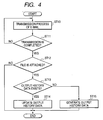
- FIG. 4 is a flowchart showing a process executed when the e-mail, for example, is transmitted (output).
- step ST10 in response to a predetermined user's operation to the key input section 15, the transmission (output) of the generated e-mail is started via the communication processing section 11 (step ST10). Then, when the transmission of the e-mail is completed (step ST11), the controller 18 ends the process when a file is not attached to the transmitted e-mail (step ST12).
- the controller 18 checks whether or not the output history data corresponding to the attached file exists (step ST13).
- the controller 18 updates the output history data (step ST14). That is, the output destination of the attached file, the output day and time, and the indication that the output is performed via the attachment to the e-mail in this case (i.e., via the communication processing section 11), are added to the output history data. At that time, the output history data is correlated with the transmitted e-mail, and the user can refer to a content of the e-mail based on the output history data.
- the output history data corresponding to the attached file does not exist in the memory 12
- the output history data including the output destination of the attached file, the output day and time, and the indication that the output is performed via the attachment to the e-mail in this case is newly generated (step ST15) .
- the generated output history data is stored in the memory 12 in association with the attached file.
- the output history data is also correlated with the transmitted e-mail.
- FIG.5 is a flowchart showing a process of displaying the output history corresponding to the data stored in the memory 12 such as the image data (image file), for example.
- FIGS. 6A to 6E are views showing display screens when the output history is displayed. In this case, the display screens shown in FIGS.6A to 6E give an example of the output history corresponding to the image data (photo data), as shown in FIG.6A.
- a list of the data is displayed on the display screen of the display 14 (step ST20). For example, in an example shown in FIG.6A, the image data (photo data) for three images are displayed.
- step ST21 when an invalid key such as the off-hook key 15g, for example, is pressed by the user in a screen condition as shown in FIG.6A (step ST21), the process is ended.
- step ST22 when any image data is selected from the image data for the three images by the up/down/left/right key 15d, for example, (step ST22), and then a function menu is selected by the soft 1 key 15c, a process corresponding to the selected function menu is executed (step ST23).
- FIG.6B an example of a display of the function menu is shown.
- the output history display is executed (step ST24). More concretely, the controller 18 accesses the memory 12 to search the output history data corresponding to the selected image data, and displays the result in a format shown in FIG.6C as an example. That is, the output day and time and the output section (mail attached, via serial, etc.) included in the output history data are displayed as a list.
- the output history is displayed in more detail as shown in FIG.6D. That is, the output destination (to Taro Yamada, etc.) in addition to the output day and time and the output section (attached to mail, via serial, etc.) included in the output history data are displayed as a list.
- the output destination the name and an e-mail address on the address book, a hardware name of the external memory, or a serial number may be displayed. Also, when the output destination is a personal computer, a software name to be a client, or its version number may be displayed. When the output destination is a terminal located outside, such as a so-called kiosk terminal, data about a terminal name or an installation location may be displayed.
- the selected image is transmitted (output) as the attached file of the e-mail
- the contents (body) of the e-mail may be referred to (FIG.6E) on the screen of the transmission history display as shown in FIG.6C or FIG.6D. Accordingly, it becomes much easier for the user to determine whether or not the image data can be deleted after the transmission (output).
- step ST23 when "delete" is selected from the function menu, the output history of the image data to be deleted may be displayed before a deleting process of the selected image data is executed. Accordingly, it can be prevented that the data that the user does not intend to delete is deleted inadvertently.
- step ST25 When the item other than the "transmission history display" is selected from the function menu, a process corresponding to the selection is executed (step ST25) . Also, when the "transmission history display” is selected, the output history display is executed (step ST24) until the end of the output history display is instructed by operating the key input section 15 (step ST26).
- an attachment history display to indicate that the data (file) is output (transmitted) by being attached to the e-mail may be selected from the function menu.
- FIG.7A and 7B are views explaining the attachment history display.
- the item, "attachment history display” is displayed in the function menu.
- a list of the data (e.g., image file) attached to the e-mail is displayed for every destination, as shown in FIG.7B.
- a list of the destinations names or e-mail addresses
- the controller 18 searches for the output history data including that destination (output destination), then specifies the transmitted data by being attached to the e-mail, and then displays the data including the transmitted day and time (output day and time) as a list.
- the user since the user can see the destination and the transmitted day and time simultaneously, the user can easily determine whether or not the image data can be deleted.
- the output history data including the output destination, the output day and time and the output section is generated/updated while being correlated with the data. Then, if required, an output history of the data can be displayed after the output. Therefore, following advantages can be achieved.
- the user can easily determine whether or not the data can be deleted, by referring to the contents (the output destination, the output day and time, and the output section) of the output history data being correlated with the data.
- the image data is already transmitted to a person who needs that image data, where the image data is already output to the external memory for back up, where the image data is already printed out by an external printer, and where the image data can be just deleted.
- the output history of the selected data can be checked immediately, the user can easily determine whether or not the current situation corresponds to one of the above cases.
- An embodiment of the present invention is not restricted to the above embodiment, and various variations and modifications can be applied within a range not changing a gist of the present invention.
- the output history data are stored in the memory 12 in the form of being corresponding to the various data respectively.
- all of the output destination, the output day and time, and the output section may not be stored in the memory 12 in a centralized manner as the output history data. Since the output destination, the output day and time, and the output section included in the above output history data are included in various peripheral data such as e-mail data, the necessary information may be acquired sequentially from these peripheral data at the time when the "transmission history display" is selected from the function menu in FIG.6B, for example, and then the transmission history may be displayed.
- the user can understand where the data is output from the terminal apparatus.
Landscapes
- Engineering & Computer Science (AREA)
- Business, Economics & Management (AREA)
- Signal Processing (AREA)
- Human Resources & Organizations (AREA)
- Computer Networks & Wireless Communication (AREA)
- Multimedia (AREA)
- General Business, Economics & Management (AREA)
- Entrepreneurship & Innovation (AREA)
- Strategic Management (AREA)
- Physics & Mathematics (AREA)
- Computer Hardware Design (AREA)
- Operations Research (AREA)
- Quality & Reliability (AREA)
- Tourism & Hospitality (AREA)
- Economics (AREA)
- Data Mining & Analysis (AREA)
- General Physics & Mathematics (AREA)
- Theoretical Computer Science (AREA)
- Marketing (AREA)
- Human Computer Interaction (AREA)
- Telephonic Communication Services (AREA)
- Telephone Function (AREA)
- Information Transfer Between Computers (AREA)
- Debugging And Monitoring (AREA)
- Digital Computer Display Output (AREA)
- Facsimiles In General (AREA)
- Information Retrieval, Db Structures And Fs Structures Therefor (AREA)
- User Interface Of Digital Computer (AREA)
Abstract
Description
- This application claims foreign priority based on Japanese Patent application No. 2005-020596, filed January 28, 2005, the contents of which is incorporated herein by reference in its entirety.
- The present disclosure relates to a terminal apparatus that outputs data to external equipments via wired or wireless communication.
- A terminal apparatus such as a cellular phone, a PDA (personal digital assistant) and a personal computer performs data communication with external equipments via wired or wireless communication. In relation to the terminal apparatus, some technologies are proposed to enhance user' s convenience by saving a data transmission history (output history) of this data communication.
- For example, in JP-A-11-252165, a mail system is proposed. In the mail system, on a terminal side, a transmission history is saved, and a delete request mail is prepared and transmitted based on information of the transmission history. Then, on a mail server side, a mail which is transmitted from the terminal side is deleted based on the delete request mail. Accordingly, a wrongly sent mail or the like can be deleted from the terminal side.
- In JP-A-2004-110413, a contents distributing system is proposed. In the contents distributing system, a content transmission history is saved for every user. Accordingly, an access performance to the subsequent content is enhanced.
- Another examples are known in which a server apparatus stores an output history of images for every user who is authorized to output the images, a camera has a storage for automatically storing a transmission history when image data is transmitted via a network, and the like.
- Generally, terminal apparatuses including the above examples respectively have a storing section (memory) to save transmitted (output) data (file). In this case, of course, a data capacity of this storing section is finite. Therefore, when a user recognizes that an available space in the storing section is low, the user needs to delete the data partially, which are already stored in the storing section, so that new data can be stored in the storing section.
- In case of partially deleting the data stored in the storing section, the user needs to check the contents of the data sequentially so as to determine whether or not the data can be deleted. As such checking and determining operations need to be applied to a lot of the data stored in the storing section, these operations are very troublesome to the user.
- In some implementations, the present invention may provide a terminal apparatus by which a user can understand where data is output from the terminal apparatus.
- One or more embodiments of the invention provide a terminal apparatus which comprises: a plurality of output sections which respectively output data in different systems; and a display which displays an output history for each of the data, the output history indicating that the data is output from at least any one of the output section.
- Preferably, one or more embodiments of the invention further comprises: a selecting section for selecting one of the data, wherein the display displays the output history of the selected data.
- Preferably, in one or more embodiments of the invention, the display displays the output history for each of the output sections.
- Preferably, one or more embodiments of the invention further comprises: a first storing section for storing the data; and a deleting section which deletes one of the data from the first storing section, wherein the display displays the output history of the data to be deleted, before the data is deleted by the deleting section.
- Here, "before the data is deleted" is exemplified with the case where the data is selected for the deleting process (operation), a case where a signal instructing to delete the selected data is output, and the like.
- Preferably, in one or more embodiments of the invention, when the data and another data which is different from the data are concurrently output from any one of the output sections, the display displays both the output history of the data and information of the another data.
- Here, "information of the data" means a data name of the data, contents of the data, and the like.
- Preferably, one or more embodiments of the invention further comprises: a second storing section for storing output history data in which the data and the output history of the data are correlated with each other, wherein the display displays the output history based on the output history data.
- Preferably, in one or more embodiments of the invention, in response to the output of the data from any one of the output sections, the output history data corresponding to the data is updated.
- Preferably, in one or more embodiments of the invention, the plurality of the output sections include at least any two of the systems via a wired communication, via a wireless communication, via an optical communication, via an infrared communication, via a universal serial bus, via a serial transmission, and via a parallel transmission.
- Preferably, in one or more embodiments of the invention, the output history includes at least any one of an output destination, an output day and time, and an indication to identify the output section, of the data being output.
- Here, "indication to identify the output section" signifies an indication such as a system, a type, a classification and a specific name, of the output section, which are used to identify the individual output section.
-
- FIG.1 is a view showing a system configuration of a cellular phone as one embodiment of a terminal apparatus according to the present invention.
- FIG.2 is a view illustrating an example of an external appearance of a cellular phone according to an embodiment.
- FIG.3 is a flowchart showing a process executed when data is output.
- FIG.4 is a flowchart showing a process executed when an e-mail is transmitted (output).
- FIG.5 is a flowchart showing a process of displaying an output history corresponding to data.
- FIGS. 6A to 6E are views showing display screens when an output history is displayed.
- FIGS.7A and 7B are views explaining an attachment history display.
- An embodiment of the present invention will be explained with reference to the accompanying drawings hereinafter.
- FIG. 1 is a view showing a system configuration of a
cellular phone 1 as one embodiment of a terminal apparatus according to the present invention. FIG.2 is a view illustrating an example of an external appearance of thecellular phone 1 according to the embodiment. - As shown in FIG. 1, the
cellular phone 1 includes acommunication processing section 11 having a transmitting/receivingantenna 111, amemory 12, asound processing section 13 having aspeaker 131 and amicrophone 132, adisplay 14, akey input section 15, anexternal interface 16, animaging section 17, and acontroller 18. - The
memory 12 is one embodiment of a first storing section and a second storing section of the present invention. - The
display 14 is one embodiment of a display of the present invention. - The
communication processing section 11 and theexternal interface 16 are embodiments of a plurality of output sections of the present invention. - The
communication processing section 11 executes a radio communication operation via a base station, e.g., a calling operation of a telephone number, transmitting/receiving operation of an e-mail, and the like. - The
communication processing section 11 is configured to include the transmitting/receivingantenna 111. In order to execute the radio communication via radio waves, thecommunication processing section 11 modulates various data such as sound information and e-mails, which are processed in thecontroller 18, and then transmits (outputs) the data to the base station (not shown) via the transmitting/ receivingantenna 111. - Also, the
communication processing section 11 demodulates various data such as sound information and e-mails, which are transmitted from the base station by radio communication and received via the transmitting/receivingantenna 111, and then supplies the data to thecontroller 18. - The
communication processing section 11 performs communication that is adapted for a predetermined communication system such as CDMA 1x, for example . Thus, thecommunication processing section 11 can access and download data stored in a server apparatus (not shown) on a network. - The
memory 12 is configured to include a nonvolatile memory such as EEPROM (electrically erasable programmable read-only memory). Thememory 12 stores (saves) various data such as control programs for telephone conversation and transmission/reception of the e-mails, an Internet browser, message data, an address book in which names and telephone numbers are registered, image data (image file), and various files. - The
memory 12 also stores (saves) output history data indicating histories of the above various data that are output from thecellular phone 1 via thecommunication processing section 11 or theexternal interface 16. The output history data are stored in association with the above various data. - The output history data include information indicating output destination, output day and time, and output section (in the present embodiment, a way of the output performed by the
communication processing section 11 or the external interface 16). The information included in the output history data are not limited to these data. Any information may be included in the output history data as long as, after the output of certain data, the user can check the output history of such data. - For example, the output history data may include at least any one of the output destination, the output day and time, and an indication to identify the output section, of certain data being output from the output section. Here, the "indication to identify the output section" signifies an indication such as the system, a type, a classification and a specific name, of the output section, which are used to identify the individual output section.
- The
sound processing section 13 has a sound processing circuit. Thespeaker 131 for a sound output in a phone call function, and themicrophone 132 for a sound input are connected to thesound processing section 13. - The
sound processing section 13 applies a predetermined process such as a coding process to the sound collected by themicrophone 132, and then supplies the coded sound to thecontroller 18. - Also, the
sound processing section 13 applies a predetermined process such as a decoding process to sound information supplied from thecontroller 18, and then causes thespeaker 131 to output the encoded sound information. - As shown in FIG.2, the
display 14 includes a display device such as a liquid crystal display device (LCD) disposed on an upper portion of a casing of thecellular phone 1. Text data, image, or the like are displayed on the display device based on an instruction issued from thecontroller 18. - The
key input section 15 is configured to have a plurality of input keys (referred simply to as "key" hereinafter) . As shown in FIG.2, the plurality of keys include aweb key 15a used to connect to the Internet, a mail key 15b used to execute an e-mail function, a soft 1 key 15c and a soft 2 key 15f, an up/down/left/right key 15d, a decision key 15e used to determine a process, an off-hook key 15g used to start the phone call, aclear key 15h, an on-hook key 15i used to end the phone call, and anumeric keyboard 15j corresponding to numerals "0" to "9" , "*" and "#". - The decision key 15e, the soft 1 key 15c and the soft 2 key 15f are keys whose actions in response to a user's operation are set different based on a display state of the
display 14. Contents of the actions in response to the user's operation are displayed on a lowermost portion of a screen of thedisplay 14. - The up/down/left/right key 15d is a key available for a control in four directions of up, down, left and right. For example, in a case where the
display 14 displays a plurality of selecting items as a list, the user can specify one selecting item from the plurality of selecting items by operating the up/down/left/right key 15d. - The
key input section 15 has an input circuit. When the user' s operation (pressing) is performed on the above keys, thekey input section 15 transmits an electric signal to thecontroller 18 via the input circuit. Thecontroller 18 detects this electric signal, and executes a process that corresponds to the operated key. - The
external interface 16 is configured to include an interface circuit which outputs various data such as image data (image file) acquired by theimaging section 17 to an external equipment such as a printer and an external memory, for example, via wired or wireless communication. As a communication system of theexternal interface 16, there are a short distance radio communication, a communication via USB (universal serial bus), a serial communication such as RS232, an infrared communication, an optical communication, a parallel transmission and the like. - The
imaging section 17 is configured to include a condensing lens for forming an image of a subject, a CCD (charge coupled device) for converting the formed image into an electric signal, a signal processing circuit for generating image digital data (image data) by applying signal processing to the electric signal, and the like. - The
controller 18 is configured mainly with a microcomputer, and executes an overall control of thecellular phone 1. For example, thecontroller 18 executes a control of the transmission/reception of the various information over the radio in thecommunication processing section 11, a processing of the sound information for thesound processing section 13, a control of the display of the information in thedisplay 14, the processing based on the input information from thekey input section 15, an access control to thememory 12, and the like. - The
controller 18 detects the pressing of a predetermined key in thekey input section 15, and sends out an imaging request signal to theimaging section 17. Also, thecontroller 18 stores the image data acquired by theimaging section 17 in thememory 12. - The
controller 18 manages the output history data stored in thememory 12. For example, thecontroller 18 generates and updates the output history data, and displays the contents of the output history data on thedisplay 14. - More particularly, when the data stored in the
memory 12 is output to the external equipment from thecellular phone 1 via thecommunication processing section 11 or theexternal interface 16, thecontroller 18 generates the output history data and then stores the output history data in association with the data. When the output history data corresponding to the data already exists in thememory 12, thecontroller 18 updates the output history data. Further, thecontroller 18 displays the contents of the specified output history data on thedisplay 14 in response to the pressing of thekey input section 15. - Next, an operation of the
cellular phone 1 will be explained hereunder. - First, a process executed when various data stored in the
memory 12 are output will be explained with reference to FIG.3 and FIG.4 hereunder. - FIG.3 is a flowchart showing the process executed when the data stored in the
memory 12 such as image data (image file), for example, is output. - In FIG.3, in response to a predetermined user's operation to the
key input section 15, the output of the image data specified by the user is started through theexternal interface 16 via the infrared communication, for example, (step ST1) . Then, when the data output of the image data is completed (step ST2), thecontroller 18 checks whether or not the output history data corresponding to the output image data exists (step ST3) . - As a result, when the output history data corresponding to the output image data exists in the
memory 12, thecontroller 18 updates the output history data (step ST4) . That is, the output destination of the image data, the output day and time, and the system, which is the infrared communication in this case, are added to the output history data. - When the output history data corresponding to the output image data does not exist, the output history data including the output destination of the image data, the output day and time, and the system, which is the infrared communication in this case, is newly generated (step ST5) Then, the generated output history data is stored in the
memory 12 in association with the output image data. - FIG. 4 is a flowchart showing a process executed when the e-mail, for example, is transmitted (output).
- In FIG.4, in response to a predetermined user's operation to the
key input section 15, the transmission (output) of the generated e-mail is started via the communication processing section 11 (step ST10). Then, when the transmission of the e-mail is completed (step ST11), thecontroller 18 ends the process when a file is not attached to the transmitted e-mail (step ST12). - When the file (data) is attached to the transmitted e-mail (step ST12), the
controller 18 checks whether or not the output history data corresponding to the attached file exists (step ST13). - As a result, when the output history data corresponding to the attached file exists in the
memory 12, thecontroller 18 updates the output history data (step ST14). That is, the output destination of the attached file, the output day and time, and the indication that the output is performed via the attachment to the e-mail in this case (i.e., via the communication processing section 11), are added to the output history data. At that time, the output history data is correlated with the transmitted e-mail, and the user can refer to a content of the e-mail based on the output history data. - When the output history data corresponding to the attached file does not exist in the
memory 12, the output history data including the output destination of the attached file, the output day and time, and the indication that the output is performed via the attachment to the e-mail in this case, is newly generated (step ST15) . Then, the generated output history data is stored in thememory 12 in association with the attached file. In this case, the output history data is also correlated with the transmitted e-mail. - Next, a process of displaying an output history corresponding to the various data stored in the
memory 12 will be explained with reference to FIGS.5 to 7B hereunder. - FIG.5 is a flowchart showing a process of displaying the output history corresponding to the data stored in the
memory 12 such as the image data (image file), for example. FIGS. 6A to 6E are views showing display screens when the output history is displayed. In this case, the display screens shown in FIGS.6A to 6E give an example of the output history corresponding to the image data (photo data), as shown in FIG.6A. - In FIG.5, first, in response to a predetermined user's operation to the
key input section 15, a list of the data is displayed on the display screen of the display 14 (step ST20). For example, in an example shown in FIG.6A, the image data (photo data) for three images are displayed. - In this state, when an invalid key such as the off-
hook key 15g, for example, is pressed by the user in a screen condition as shown in FIG.6A (step ST21), the process is ended. - On the contrary, when any image data is selected from the image data for the three images by the up/down/left/right key 15d, for example, (step ST22), and then a function menu is selected by the soft 1 key 15c, a process corresponding to the selected function menu is executed (step ST23). In FIG.6B, an example of a display of the function menu is shown.
- Here, when the user selects "transmission history display" among the function menu, the output history display is executed (step ST24). More concretely, the
controller 18 accesses thememory 12 to search the output history data corresponding to the selected image data, and displays the result in a format shown in FIG.6C as an example. That is, the output day and time and the output section (mail attached, via serial, etc.) included in the output history data are displayed as a list. - Also, as another display example, the output history is displayed in more detail as shown in FIG.6D. That is, the output destination (to Taro Yamada, etc.) in addition to the output day and time and the output section (attached to mail, via serial, etc.) included in the output history data are displayed as a list.
- In this case, as the output destination, the name and an e-mail address on the address book, a hardware name of the external memory, or a serial number may be displayed. Also, when the output destination is a personal computer, a software name to be a client, or its version number may be displayed. When the output destination is a terminal located outside, such as a so-called kiosk terminal, data about a terminal name or an installation location may be displayed.
- Also, when the selected image is transmitted (output) as the attached file of the e-mail, as the e-mail is correlated with the output history data, the contents (body) of the e-mail may be referred to (FIG.6E) on the screen of the transmission history display as shown in FIG.6C or FIG.6D. Accordingly, it becomes much easier for the user to determine whether or not the image data can be deleted after the transmission (output).
- In this manner, when other data (data name, the contents of the e-mail, etc.) which is different from the image data are output from the output section together with the image data, the output history of the image data is displayed and also information of the above other data are displayed. Accordingly, it becomes much easier for the user to determine whether or not the image data can be deleted.
- In step ST23, when "delete" is selected from the function menu, the output history of the image data to be deleted may be displayed before a deleting process of the selected image data is executed. Accordingly, it can be prevented that the data that the user does not intend to delete is deleted inadvertently.
- Here, "before the deleting process is executed" is exemplified with the case where the data is selected for the deleting process (operation), a case where a signal instructing to delete the selected data is output, and the like.
- The explanation goes back to the flowchart in FIG.5.
- When the item other than the "transmission history display" is selected from the function menu, a process corresponding to the selection is executed (step ST25) . Also, when the "transmission history display" is selected, the output history display is executed (step ST24) until the end of the output history display is instructed by operating the key input section 15 (step ST26).
- In this case, an attachment history display to indicate that the data (file) is output (transmitted) by being attached to the e-mail may be selected from the function menu. FIG.7A and 7B are views explaining the attachment history display.
- As shown in FIG.7A, the item, "attachment history display", is displayed in the function menu. When this "attachment history display" is selected, a list of the data (e.g., image file) attached to the e-mail is displayed for every destination, as shown in FIG.7B. Here, in response to the selection of the attachment history display, a list of the destinations (names or e-mail addresses) is displayed, and then a process of selecting one destination is executed. When the destination is selected, the
controller 18 searches for the output history data including that destination (output destination), then specifies the transmitted data by being attached to the e-mail, and then displays the data including the transmitted day and time (output day and time) as a list. - Accordingly, since the user can see the destination and the transmitted day and time simultaneously, the user can easily determine whether or not the image data can be deleted.
- As explained above, according to the
cellular phone 1 of the present embodiment, when various data included in thememory 12 is output to the outside, the output history data including the output destination, the output day and time and the output section is generated/updated while being correlated with the data. Then, if required, an output history of the data can be displayed after the output. Therefore, following advantages can be achieved. - That is, when an available space of the
memory 12 is low and a part of data in thememory 12 need to be deleted, the user can easily determine whether or not the data can be deleted, by referring to the contents (the output destination, the output day and time, and the output section) of the output history data being correlated with the data. - For instance, there are cases where the image data is already transmitted to a person who needs that image data, where the image data is already output to the external memory for back up, where the image data is already printed out by an external printer, and where the image data can be just deleted. According to the
cellular phone 1 of the present embodiment, since the output history of the selected data can be checked immediately, the user can easily determine whether or not the current situation corresponds to one of the above cases. - An embodiment of the present invention is not restricted to the above embodiment, and various variations and modifications can be applied within a range not changing a gist of the present invention.
- For example, in the above embodiment, the output history data are stored in the
memory 12 in the form of being corresponding to the various data respectively. However, all of the output destination, the output day and time, and the output section may not be stored in thememory 12 in a centralized manner as the output history data. Since the output destination, the output day and time, and the output section included in the above output history data are included in various peripheral data such as e-mail data, the necessary information may be acquired sequentially from these peripheral data at the time when the "transmission history display" is selected from the function menu in FIG.6B, for example, and then the transmission history may be displayed. - According to one or more embodiments of the invention, the user can understand where the data is output from the terminal apparatus.
- It will be apparent to those skilled in the art that various modifications and variations can be made to the described preferred embodiments of the present invention without departing from the spirit or scope of the invention. Thus, it is intended that the present invention cover all modifications and variations of this invention consistent with the scope of the appended claims and their equivalents.
Claims (9)
- A terminal apparatus, comprising:a plurality of output sections which respectively output data in different systems; anda display which displays an output history for each of the data, said output history indicating that the data is output from at least any one of the output sections.
- The terminal apparatus according to claim 1, further comprising:a selecting section for selecting one of the data,wherein the display displays the output history of the selected data.
- The terminal apparatus according to claim 1, wherein the display displays the output history for each of the output sections.
- The terminal apparatus according to claim 1, further comprising:a first storing section for storing the data; anda deleting section which deletes one of the data from the first storing section,wherein the display displays the output history of the data to be deleted, before the data is deleted by the deleting section.
- The terminal apparatus according to claim 1, wherein when the data and another data which is different from the data are concurrently output from any one of the output sections, the display displays both the output history of the data and information of the another data.
- The terminal apparatus according to claim 1, further comprising:a second storing section for storing output history data in which the data and the output history of the data are correlated with each other,wherein the display displays the output history based on the output history data.
- The terminal apparatus according to claim 6, wherein in response to the output of the data from any one of the output sections, the output history data corresponding to the data is updated.
- The terminal apparatus according to claim 1, wherein said plurality of the output sections include at least any two of the systems via a wired communication, via a wireless communication, via an optical communication, via an infrared communication, via a universal serial bus, via a serial transmission, and via a parallel transmission.
- The terminal apparatus according to claim 1, wherein the output history includes at least any one of an output destination, an output day and time, and an indication to identify the output section, of the data being output.
Applications Claiming Priority (1)
| Application Number | Priority Date | Filing Date | Title |
|---|---|---|---|
| JP2005020596A JP2006209462A (en) | 2005-01-28 | 2005-01-28 | Terminal device |
Publications (2)
| Publication Number | Publication Date |
|---|---|
| EP1686453A2 true EP1686453A2 (en) | 2006-08-02 |
| EP1686453A3 EP1686453A3 (en) | 2012-05-02 |
Family
ID=35884042
Family Applications (1)
| Application Number | Title | Priority Date | Filing Date |
|---|---|---|---|
| EP06001724A Withdrawn EP1686453A3 (en) | 2005-01-28 | 2006-01-27 | Terminal apparatus |
Country Status (4)
| Country | Link |
|---|---|
| US (1) | US8140124B2 (en) |
| EP (1) | EP1686453A3 (en) |
| JP (1) | JP2006209462A (en) |
| CN (1) | CN1812428A (en) |
Families Citing this family (5)
| Publication number | Priority date | Publication date | Assignee | Title |
|---|---|---|---|---|
| JP5026148B2 (en) * | 2006-09-19 | 2012-09-12 | 株式会社リコー | Image processing apparatus, method, and program |
| JP5218989B2 (en) * | 2009-08-07 | 2013-06-26 | Necカシオモバイルコミュニケーションズ株式会社 | Communication terminal device and program |
| CN103324616A (en) * | 2012-03-20 | 2013-09-25 | 国际商业机器公司 | Method and computer equipment for adding attachment to electronic message |
| KR20140031602A (en) * | 2012-09-05 | 2014-03-13 | 주식회사 팬택 | Management method for message context based on attached file |
| WO2017170464A1 (en) * | 2016-03-29 | 2017-10-05 | 京セラ株式会社 | Management system, management method, apparatus, and management device |
Family Cites Families (20)
| Publication number | Priority date | Publication date | Assignee | Title |
|---|---|---|---|---|
| EP0474555B1 (en) * | 1990-09-05 | 1997-12-29 | Canon Kabushiki Kaisha | Multi-media communication apparatus and method |
| JP4215286B2 (en) * | 1995-05-18 | 2009-01-28 | セイコーエプソン株式会社 | Storage device content organization system and storage device content organization method |
| JP3595073B2 (en) * | 1995-08-28 | 2004-12-02 | 株式会社東芝 | Computer system and file management method used in the system |
| JPH10269120A (en) * | 1997-03-27 | 1998-10-09 | Hitachi Ltd | File management method |
| JPH11252165A (en) | 1998-02-27 | 1999-09-17 | Nec Corp | Electronic mail system with mail delete function |
| JP3526248B2 (en) * | 1999-08-27 | 2004-05-10 | キヤノン株式会社 | Image processing apparatus, image processing method, and storage medium |
| JP2001125842A (en) * | 1999-10-25 | 2001-05-11 | Hitachi Ltd | Search result display method and apparatus |
| JP2001134474A (en) * | 1999-11-01 | 2001-05-18 | Hitachi Ltd | File recording device and recording method |
| JP2002171332A (en) * | 2000-11-30 | 2002-06-14 | Toshiba Corp | Communication terminal device |
| ATE518194T1 (en) * | 2001-01-19 | 2011-08-15 | Panasonic Corp | DEVICE AND PROGRAM FOR DISPLAYING HYPERTEXT INCLUDING A FUNCTION FOR PREVIOUS HISTORY |
| JP2002244902A (en) * | 2001-02-16 | 2002-08-30 | Tdk Corp | Data file management method, data file management program, and electronic terminal |
| JP3888100B2 (en) * | 2001-08-20 | 2007-02-28 | 株式会社日立情報システムズ | File relocation system and its processing program |
| CA2471831C (en) * | 2001-12-26 | 2011-07-19 | Research In Motion Limited | User interface and method of viewing unified communications events on a mobile device |
| GB0211644D0 (en) * | 2002-05-21 | 2002-07-03 | Wesby Philip B | System and method for remote asset management |
| JP2004110413A (en) | 2002-09-18 | 2004-04-08 | Toshiba Solutions Corp | Contents distribution system and server |
| US7391755B2 (en) * | 2002-09-30 | 2008-06-24 | Lucent Technologies Inc. | Signaling and control mechanisms in MIMO harq schemes for wireless communication systems |
| CN1723674B (en) * | 2002-11-08 | 2012-06-13 | 捷讯研究有限公司 | System and method for connection control of wireless mobile communication devices |
| JP2004266568A (en) * | 2003-02-28 | 2004-09-24 | Nec Corp | Name resolution server and packet transfer device |
| KR100716968B1 (en) * | 2003-06-19 | 2007-05-10 | 삼성전자주식회사 | Wired and wireless composite communication device and communication method |
| WO2005086365A1 (en) * | 2004-03-02 | 2005-09-15 | Spartak Buniatyan | Portable universal data storage device |
-
2005
- 2005-01-28 JP JP2005020596A patent/JP2006209462A/en active Pending
-
2006
- 2006-01-27 CN CNA2006100047554A patent/CN1812428A/en active Pending
- 2006-01-27 EP EP06001724A patent/EP1686453A3/en not_active Withdrawn
- 2006-01-27 US US11/342,069 patent/US8140124B2/en not_active Expired - Fee Related
Non-Patent Citations (1)
| Title |
|---|
| None * |
Also Published As
| Publication number | Publication date |
|---|---|
| EP1686453A3 (en) | 2012-05-02 |
| CN1812428A (en) | 2006-08-02 |
| US8140124B2 (en) | 2012-03-20 |
| JP2006209462A (en) | 2006-08-10 |
| US20060195535A1 (en) | 2006-08-31 |
Similar Documents
| Publication | Publication Date | Title |
|---|---|---|
| JP2010009213A (en) | Relay server for print service and control method thereof | |
| EP1641225A1 (en) | Apparatus and method for updating registered images in a phonebook of a portable wireless terminal | |
| JP2005045587A (en) | Mobile information terminal device and display control method therefor | |
| US20030074412A1 (en) | Electronic mail communication system and portable terminal for the same | |
| JP5287315B2 (en) | Communication terminal, telephone book registration method, communication terminal handling method, and programs thereof | |
| EP1686453A2 (en) | Terminal apparatus | |
| KR100633753B1 (en) | Apparatus and method for adding an image of a multimedia message to a phone book in a portable wireless terminal | |
| US20040176944A1 (en) | Composite apparatus having a multiple of functions | |
| KR20060040613A (en) | Terminal equipment | |
| KR101125452B1 (en) | Mail server, mail reception device, mail server program storage medium, mail reception program storage medium, mail mediation method, and mail reception method | |
| KR20080037508A (en) | Apparatus and method for registering an unregistered telephone number in a portable terminal | |
| JP2002218095A (en) | Telephone terminal device | |
| JP4147077B2 (en) | TERMINAL DEVICE, DATA COMMUNICATION SYSTEM, DATA COMMUNICATION CONTROL METHOD, DATA COMMUNICATION METHOD, COMPUTER-READABLE STORAGE MEDIUM, AND PROGRAM | |
| KR100430110B1 (en) | Method for store a data of wireless internet in mobile phone | |
| JP4361781B2 (en) | Receiving apparatus and program | |
| KR101093855B1 (en) | A system for storing data of a mobile communication terminal and a data storage method of a mobile communication terminal in the system | |
| JP2002318771A (en) | Terminal device and mail transfer method | |
| JP3055521B2 (en) | Internet facsimile machine | |
| JP4494116B2 (en) | Mobile terminal device, wireless communication system, and picture diary exchange method | |
| JP2006209559A (en) | Mobile terminal and display method in mobile terminal | |
| JP2004266644A (en) | Communication device and hands-free apparatus | |
| KR20090011153A (en) | Mobile communication terminal and data transmission method thereof | |
| JP2002297517A (en) | Wireless communication device, wireless communication method, and program | |
| JP2004104731A (en) | Mobile terminal device | |
| JP2002084376A (en) | Communication system |
Legal Events
| Date | Code | Title | Description |
|---|---|---|---|
| PUAI | Public reference made under article 153(3) epc to a published international application that has entered the european phase |
Free format text: ORIGINAL CODE: 0009012 |
|
| AK | Designated contracting states |
Kind code of ref document: A2 Designated state(s): AT BE BG CH CY CZ DE DK EE ES FI FR GB GR HU IE IS IT LI LT LU LV MC NL PL PT RO SE SI SK TR |
|
| AX | Request for extension of the european patent |
Extension state: AL BA HR MK YU |
|
| PUAL | Search report despatched |
Free format text: ORIGINAL CODE: 0009013 |
|
| AK | Designated contracting states |
Kind code of ref document: A3 Designated state(s): AT BE BG CH CY CZ DE DK EE ES FI FR GB GR HU IE IS IT LI LT LU LV MC NL PL PT RO SE SI SK TR |
|
| AX | Request for extension of the european patent |
Extension state: AL BA HR MK YU |
|
| RIC1 | Information provided on ipc code assigned before grant |
Ipc: G06F 3/048 20060101AFI20120326BHEP Ipc: H04M 1/2745 20060101ALI20120326BHEP |
|
| 17P | Request for examination filed |
Effective date: 20121102 |
|
| AKX | Designation fees paid |
Designated state(s): DE GB |
|
| 17Q | First examination report despatched |
Effective date: 20130107 |
|
| STAA | Information on the status of an ep patent application or granted ep patent |
Free format text: STATUS: THE APPLICATION IS DEEMED TO BE WITHDRAWN |
|
| 18D | Application deemed to be withdrawn |
Effective date: 20180410 |