EP1686145A1 - Process for producing aliphatic polyester - Google Patents
Process for producing aliphatic polyester Download PDFInfo
- Publication number
- EP1686145A1 EP1686145A1 EP04799600A EP04799600A EP1686145A1 EP 1686145 A1 EP1686145 A1 EP 1686145A1 EP 04799600 A EP04799600 A EP 04799600A EP 04799600 A EP04799600 A EP 04799600A EP 1686145 A1 EP1686145 A1 EP 1686145A1
- Authority
- EP
- European Patent Office
- Prior art keywords
- cyclic ester
- process according
- production process
- polymerization
- ester
- Prior art date
- Legal status (The legal status is an assumption and is not a legal conclusion. Google has not performed a legal analysis and makes no representation as to the accuracy of the status listed.)
- Withdrawn
Links
- 229920003232 aliphatic polyester Polymers 0.000 title claims abstract description 45
- 238000000034 method Methods 0.000 title claims description 41
- 230000008569 process Effects 0.000 title claims description 31
- -1 cyclic ester Chemical class 0.000 claims abstract description 121
- XLYOFNOQVPJJNP-UHFFFAOYSA-N water Substances O XLYOFNOQVPJJNP-UHFFFAOYSA-N 0.000 claims abstract description 88
- 238000007151 ring opening polymerisation reaction Methods 0.000 claims abstract description 41
- 150000001875 compounds Chemical class 0.000 claims abstract description 39
- LFQSCWFLJHTTHZ-UHFFFAOYSA-N Ethanol Chemical compound CCO LFQSCWFLJHTTHZ-UHFFFAOYSA-N 0.000 claims abstract description 24
- 125000003178 carboxy group Chemical group [H]OC(*)=O 0.000 claims abstract description 22
- 239000003795 chemical substances by application Substances 0.000 claims abstract description 22
- 150000001732 carboxylic acid derivatives Chemical class 0.000 claims abstract description 11
- 125000004453 alkoxycarbonyl group Chemical group 0.000 claims abstract description 10
- 150000002148 esters Chemical class 0.000 claims abstract description 10
- 239000003999 initiator Substances 0.000 claims abstract description 9
- RKDVKSZUMVYZHH-UHFFFAOYSA-N 1,4-dioxane-2,5-dione Chemical compound O=C1COC(=O)CO1 RKDVKSZUMVYZHH-UHFFFAOYSA-N 0.000 claims description 54
- 238000006116 polymerization reaction Methods 0.000 claims description 46
- 238000004519 manufacturing process Methods 0.000 claims description 31
- 239000000178 monomer Substances 0.000 claims description 25
- 229920000642 polymer Polymers 0.000 claims description 23
- 125000003262 carboxylic acid ester group Chemical group [H]C([H])([*:2])OC(=O)C([H])([H])[*:1] 0.000 claims description 17
- 238000006243 chemical reaction Methods 0.000 claims description 15
- 125000004122 cyclic group Chemical group 0.000 claims description 13
- 238000010438 heat treatment Methods 0.000 claims description 12
- 239000000203 mixture Substances 0.000 claims description 11
- 239000003054 catalyst Substances 0.000 claims description 9
- 238000002844 melting Methods 0.000 claims description 7
- 230000008018 melting Effects 0.000 claims description 5
- 239000003017 thermal stabilizer Substances 0.000 claims description 5
- 239000007790 solid phase Substances 0.000 claims description 3
- 239000004593 Epoxy Chemical class 0.000 claims description 2
- 150000004893 oxazines Chemical class 0.000 claims description 2
- 150000002918 oxazolines Chemical class 0.000 claims description 2
- 230000000977 initiatory effect Effects 0.000 abstract description 4
- AEMRFAOFKBGASW-UHFFFAOYSA-N Glycolic acid Chemical compound OCC(O)=O AEMRFAOFKBGASW-UHFFFAOYSA-N 0.000 description 57
- 239000012535 impurity Substances 0.000 description 32
- LQZZUXJYWNFBMV-UHFFFAOYSA-N dodecan-1-ol Chemical compound CCCCCCCCCCCCO LQZZUXJYWNFBMV-UHFFFAOYSA-N 0.000 description 24
- 239000000523 sample Substances 0.000 description 18
- 239000002904 solvent Substances 0.000 description 16
- 229920000954 Polyglycolide Polymers 0.000 description 13
- 239000000243 solution Substances 0.000 description 13
- 239000012298 atmosphere Substances 0.000 description 12
- 239000008188 pellet Substances 0.000 description 12
- 238000004090 dissolution Methods 0.000 description 10
- 238000009835 boiling Methods 0.000 description 8
- JVTAAEKCZFNVCJ-UHFFFAOYSA-N lactic acid Chemical compound CC(O)C(O)=O JVTAAEKCZFNVCJ-UHFFFAOYSA-N 0.000 description 8
- 239000004633 polyglycolic acid Substances 0.000 description 8
- 239000007788 liquid Substances 0.000 description 7
- 239000000155 melt Substances 0.000 description 7
- 238000000746 purification Methods 0.000 description 7
- 238000003786 synthesis reaction Methods 0.000 description 7
- KFZMGEQAYNKOFK-UHFFFAOYSA-N Isopropanol Chemical compound CC(C)O KFZMGEQAYNKOFK-UHFFFAOYSA-N 0.000 description 6
- DKGAVHZHDRPRBM-UHFFFAOYSA-N Tert-Butanol Chemical compound CC(C)(C)O DKGAVHZHDRPRBM-UHFFFAOYSA-N 0.000 description 6
- 150000001298 alcohols Chemical class 0.000 description 6
- 238000013329 compounding Methods 0.000 description 6
- LYCAIKOWRPUZTN-UHFFFAOYSA-N ethylene glycol Natural products OCCO LYCAIKOWRPUZTN-UHFFFAOYSA-N 0.000 description 6
- 239000002253 acid Substances 0.000 description 5
- 230000015572 biosynthetic process Effects 0.000 description 5
- 125000004432 carbon atom Chemical group C* 0.000 description 5
- 239000013078 crystal Substances 0.000 description 5
- 238000001035 drying Methods 0.000 description 5
- 238000001125 extrusion Methods 0.000 description 5
- JJTUDXZGHPGLLC-UHFFFAOYSA-N lactide Chemical compound CC1OC(=O)C(C)OC1=O JJTUDXZGHPGLLC-UHFFFAOYSA-N 0.000 description 5
- 239000003495 polar organic solvent Substances 0.000 description 5
- 238000012546 transfer Methods 0.000 description 5
- 239000006200 vaporizer Substances 0.000 description 5
- 150000007513 acids Chemical class 0.000 description 4
- 230000007423 decrease Effects 0.000 description 4
- 238000012691 depolymerization reaction Methods 0.000 description 4
- 230000000694 effects Effects 0.000 description 4
- 125000002887 hydroxy group Chemical group [H]O* 0.000 description 4
- 239000004310 lactic acid Substances 0.000 description 4
- 235000014655 lactic acid Nutrition 0.000 description 4
- 239000012071 phase Substances 0.000 description 4
- 229920001223 polyethylene glycol Polymers 0.000 description 4
- 241000894007 species Species 0.000 description 4
- 239000000126 substance Substances 0.000 description 4
- BYEAHWXPCBROCE-UHFFFAOYSA-N 1,1,1,3,3,3-hexafluoropropan-2-ol Chemical compound FC(F)(F)C(O)C(F)(F)F BYEAHWXPCBROCE-UHFFFAOYSA-N 0.000 description 3
- AZUYLZMQTIKGSC-UHFFFAOYSA-N 1-[6-[4-(5-chloro-6-methyl-1H-indazol-4-yl)-5-methyl-3-(1-methylindazol-5-yl)pyrazol-1-yl]-2-azaspiro[3.3]heptan-2-yl]prop-2-en-1-one Chemical compound ClC=1C(=C2C=NNC2=CC=1C)C=1C(=NN(C=1C)C1CC2(CN(C2)C(C=C)=O)C1)C=1C=C2C=NN(C2=CC=1)C AZUYLZMQTIKGSC-UHFFFAOYSA-N 0.000 description 3
- WVDDGKGOMKODPV-UHFFFAOYSA-N Benzyl alcohol Chemical compound OCC1=CC=CC=C1 WVDDGKGOMKODPV-UHFFFAOYSA-N 0.000 description 3
- 229920001634 Copolyester Polymers 0.000 description 3
- YXHKONLOYHBTNS-UHFFFAOYSA-N Diazomethane Chemical compound C=[N+]=[N-] YXHKONLOYHBTNS-UHFFFAOYSA-N 0.000 description 3
- 239000002202 Polyethylene glycol Substances 0.000 description 3
- 238000007664 blowing Methods 0.000 description 3
- 239000000539 dimer Substances 0.000 description 3
- 239000007789 gas Substances 0.000 description 3
- 238000005259 measurement Methods 0.000 description 3
- 230000000704 physical effect Effects 0.000 description 3
- 229920000747 poly(lactic acid) Polymers 0.000 description 3
- 239000004626 polylactic acid Substances 0.000 description 3
- 239000011541 reaction mixture Substances 0.000 description 3
- 238000001953 recrystallisation Methods 0.000 description 3
- YFHICDDUDORKJB-UHFFFAOYSA-N trimethylene carbonate Chemical compound O=C1OCCCO1 YFHICDDUDORKJB-UHFFFAOYSA-N 0.000 description 3
- VPVXHAANQNHFSF-UHFFFAOYSA-N 1,4-dioxan-2-one Chemical compound O=C1COCCO1 VPVXHAANQNHFSF-UHFFFAOYSA-N 0.000 description 2
- NXQMCAOPTPLPRL-UHFFFAOYSA-N 2-(2-benzoyloxyethoxy)ethyl benzoate Chemical compound C=1C=CC=CC=1C(=O)OCCOCCOC(=O)C1=CC=CC=C1 NXQMCAOPTPLPRL-UHFFFAOYSA-N 0.000 description 2
- GHPVDCPCKSNJDR-UHFFFAOYSA-N 2-hydroxydecanoic acid Chemical compound CCCCCCCCC(O)C(O)=O GHPVDCPCKSNJDR-UHFFFAOYSA-N 0.000 description 2
- JYZJYKOZGGEXSX-UHFFFAOYSA-N 2-hydroxymyristic acid Chemical compound CCCCCCCCCCCCC(O)C(O)=O JYZJYKOZGGEXSX-UHFFFAOYSA-N 0.000 description 2
- YEJRWHAVMIAJKC-UHFFFAOYSA-N 4-Butyrolactone Chemical compound O=C1CCCO1 YEJRWHAVMIAJKC-UHFFFAOYSA-N 0.000 description 2
- OZJPLYNZGCXSJM-UHFFFAOYSA-N 5-valerolactone Chemical compound O=C1CCCCO1 OZJPLYNZGCXSJM-UHFFFAOYSA-N 0.000 description 2
- CSCPPACGZOOCGX-UHFFFAOYSA-N Acetone Chemical compound CC(C)=O CSCPPACGZOOCGX-UHFFFAOYSA-N 0.000 description 2
- IRIAEXORFWYRCZ-UHFFFAOYSA-N Butylbenzyl phthalate Chemical compound CCCCOC(=O)C1=CC=CC=C1C(=O)OCC1=CC=CC=C1 IRIAEXORFWYRCZ-UHFFFAOYSA-N 0.000 description 2
- CURLTUGMZLYLDI-UHFFFAOYSA-N Carbon dioxide Chemical compound O=C=O CURLTUGMZLYLDI-UHFFFAOYSA-N 0.000 description 2
- 229930182843 D-Lactic acid Natural products 0.000 description 2
- JVTAAEKCZFNVCJ-UWTATZPHSA-N D-lactic acid Chemical compound C[C@@H](O)C(O)=O JVTAAEKCZFNVCJ-UWTATZPHSA-N 0.000 description 2
- RTZKZFJDLAIYFH-UHFFFAOYSA-N Diethyl ether Chemical compound CCOCC RTZKZFJDLAIYFH-UHFFFAOYSA-N 0.000 description 2
- IAZDPXIOMUYVGZ-UHFFFAOYSA-N Dimethylsulphoxide Chemical compound CS(C)=O IAZDPXIOMUYVGZ-UHFFFAOYSA-N 0.000 description 2
- PEDCQBHIVMGVHV-UHFFFAOYSA-N Glycerine Chemical compound OCC(O)CO PEDCQBHIVMGVHV-UHFFFAOYSA-N 0.000 description 2
- LRHPLDYGYMQRHN-UHFFFAOYSA-N N-Butanol Chemical compound CCCCO LRHPLDYGYMQRHN-UHFFFAOYSA-N 0.000 description 2
- MUBZPKHOEPUJKR-UHFFFAOYSA-N Oxalic acid Chemical compound OC(=O)C(O)=O MUBZPKHOEPUJKR-UHFFFAOYSA-N 0.000 description 2
- 230000002411 adverse Effects 0.000 description 2
- 229910052782 aluminium Inorganic materials 0.000 description 2
- XAGFODPZIPBFFR-UHFFFAOYSA-N aluminium Chemical compound [Al] XAGFODPZIPBFFR-UHFFFAOYSA-N 0.000 description 2
- 229910052787 antimony Inorganic materials 0.000 description 2
- 238000004364 calculation method Methods 0.000 description 2
- 230000008859 change Effects 0.000 description 2
- 238000004587 chromatography analysis Methods 0.000 description 2
- 238000001816 cooling Methods 0.000 description 2
- 229940022769 d- lactic acid Drugs 0.000 description 2
- DOIRQSBPFJWKBE-UHFFFAOYSA-N dibutyl phthalate Chemical compound CCCCOC(=O)C1=CC=CC=C1C(=O)OCCCC DOIRQSBPFJWKBE-UHFFFAOYSA-N 0.000 description 2
- 238000006460 hydrolysis reaction Methods 0.000 description 2
- WGCNASOHLSPBMP-UHFFFAOYSA-N hydroxyacetaldehyde Natural products OCC=O WGCNASOHLSPBMP-UHFFFAOYSA-N 0.000 description 2
- 238000001727 in vivo Methods 0.000 description 2
- 150000002596 lactones Chemical class 0.000 description 2
- 239000000463 material Substances 0.000 description 2
- 229910052751 metal Inorganic materials 0.000 description 2
- 239000002184 metal Substances 0.000 description 2
- 238000010298 pulverizing process Methods 0.000 description 2
- 238000000926 separation method Methods 0.000 description 2
- HEMHJVSKTPXQMS-UHFFFAOYSA-M sodium hydroxide Inorganic materials [OH-].[Na+] HEMHJVSKTPXQMS-UHFFFAOYSA-M 0.000 description 2
- UYCAUPASBSROMS-AWQJXPNKSA-M sodium;2,2,2-trifluoroacetate Chemical compound [Na+].[O-][13C](=O)[13C](F)(F)F UYCAUPASBSROMS-AWQJXPNKSA-M 0.000 description 2
- 238000003860 storage Methods 0.000 description 2
- HLZKNKRTKFSKGZ-UHFFFAOYSA-N tetradecan-1-ol Chemical compound CCCCCCCCCCCCCCO HLZKNKRTKFSKGZ-UHFFFAOYSA-N 0.000 description 2
- 239000010936 titanium Substances 0.000 description 2
- PAPBSGBWRJIAAV-UHFFFAOYSA-N ε-Caprolactone Chemical compound O=C1CCCCCO1 PAPBSGBWRJIAAV-UHFFFAOYSA-N 0.000 description 2
- LVRFTAZAXQPQHI-RXMQYKEDSA-N (R)-2-hydroxy-4-methylpentanoic acid Chemical compound CC(C)C[C@@H](O)C(O)=O LVRFTAZAXQPQHI-RXMQYKEDSA-N 0.000 description 1
- AFENDNXGAFYKQO-VKHMYHEASA-N (S)-2-hydroxybutyric acid Chemical compound CC[C@H](O)C(O)=O AFENDNXGAFYKQO-VKHMYHEASA-N 0.000 description 1
- KBPLFHHGFOOTCA-UHFFFAOYSA-N 1-Octanol Chemical compound CCCCCCCCO KBPLFHHGFOOTCA-UHFFFAOYSA-N 0.000 description 1
- HMOZDINWBHMBSQ-UHFFFAOYSA-N 2-[3-(4,5-dihydro-1,3-oxazol-2-yl)phenyl]-4,5-dihydro-1,3-oxazole Chemical compound O1CCN=C1C1=CC=CC(C=2OCCN=2)=C1 HMOZDINWBHMBSQ-UHFFFAOYSA-N 0.000 description 1
- ZDNUPMSZKVCETJ-UHFFFAOYSA-N 2-[4-(4,5-dihydro-1,3-oxazol-2-yl)phenyl]-4,5-dihydro-1,3-oxazole Chemical compound O1CCN=C1C1=CC=C(C=2OCCN=2)C=C1 ZDNUPMSZKVCETJ-UHFFFAOYSA-N 0.000 description 1
- RGMMREBHCYXQMA-UHFFFAOYSA-N 2-hydroxyheptanoic acid Chemical compound CCCCCC(O)C(O)=O RGMMREBHCYXQMA-UHFFFAOYSA-N 0.000 description 1
- NYHNVHGFPZAZGA-UHFFFAOYSA-N 2-hydroxyhexanoic acid Chemical compound CCCCC(O)C(O)=O NYHNVHGFPZAZGA-UHFFFAOYSA-N 0.000 description 1
- BWLBGMIXKSTLSX-UHFFFAOYSA-N 2-hydroxyisobutyric acid Chemical compound CC(C)(O)C(O)=O BWLBGMIXKSTLSX-UHFFFAOYSA-N 0.000 description 1
- KIHBGTRZFAVZRV-UHFFFAOYSA-N 2-hydroxyoctadecanoic acid Chemical compound CCCCCCCCCCCCCCCCC(O)C(O)=O KIHBGTRZFAVZRV-UHFFFAOYSA-N 0.000 description 1
- JKRDADVRIYVCCY-UHFFFAOYSA-N 2-hydroxyoctanoic acid Chemical compound CCCCCCC(O)C(O)=O JKRDADVRIYVCCY-UHFFFAOYSA-N 0.000 description 1
- JRHWHSJDIILJAT-UHFFFAOYSA-N 2-hydroxypentanoic acid Chemical compound CCCC(O)C(O)=O JRHWHSJDIILJAT-UHFFFAOYSA-N 0.000 description 1
- DJKLTPGKMXSIQQ-UHFFFAOYSA-N 2-methoxy-5,6-dihydro-4h-1,3-oxazine Chemical compound COC1=NCCCO1 DJKLTPGKMXSIQQ-UHFFFAOYSA-N 0.000 description 1
- CRWNQZTZTZWPOF-UHFFFAOYSA-N 2-methyl-4-phenylpyridine Chemical compound C1=NC(C)=CC(C=2C=CC=CC=2)=C1 CRWNQZTZTZWPOF-UHFFFAOYSA-N 0.000 description 1
- ZXTHWIZHGLNEPG-UHFFFAOYSA-N 2-phenyl-4,5-dihydro-1,3-oxazole Chemical compound O1CCN=C1C1=CC=CC=C1 ZXTHWIZHGLNEPG-UHFFFAOYSA-N 0.000 description 1
- CIZZWUZAQQELAQ-UHFFFAOYSA-N 2-prop-1-en-2-yl-4,5-dihydro-1,3-oxazole;styrene Chemical compound CC(=C)C1=NCCO1.C=CC1=CC=CC=C1 CIZZWUZAQQELAQ-UHFFFAOYSA-N 0.000 description 1
- ULKFLOVGORAZDI-UHFFFAOYSA-N 3,3-dimethyloxetan-2-one Chemical compound CC1(C)COC1=O ULKFLOVGORAZDI-UHFFFAOYSA-N 0.000 description 1
- ZPLCXHWYPWVJDL-UHFFFAOYSA-N 4-[(4-hydroxyphenyl)methyl]-1,3-oxazolidin-2-one Chemical compound C1=CC(O)=CC=C1CC1NC(=O)OC1 ZPLCXHWYPWVJDL-UHFFFAOYSA-N 0.000 description 1
- YHTLGFCVBKENTE-UHFFFAOYSA-N 4-methyloxan-2-one Chemical compound CC1CCOC(=O)C1 YHTLGFCVBKENTE-UHFFFAOYSA-N 0.000 description 1
- IJGRMHOSHXDMSA-UHFFFAOYSA-N Atomic nitrogen Chemical compound N#N IJGRMHOSHXDMSA-UHFFFAOYSA-N 0.000 description 1
- SNRUBQQJIBEYMU-UHFFFAOYSA-N Dodecane Natural products CCCCCCCCCCCC SNRUBQQJIBEYMU-UHFFFAOYSA-N 0.000 description 1
- 239000004129 EU approved improving agent Substances 0.000 description 1
- 102000004190 Enzymes Human genes 0.000 description 1
- 108090000790 Enzymes Proteins 0.000 description 1
- 239000004698 Polyethylene Substances 0.000 description 1
- YSMRWXYRXBRSND-UHFFFAOYSA-N TOTP Chemical compound CC1=CC=CC=C1OP(=O)(OC=1C(=CC=CC=1)C)OC1=CC=CC=C1C YSMRWXYRXBRSND-UHFFFAOYSA-N 0.000 description 1
- ATJFFYVFTNAWJD-UHFFFAOYSA-N Tin Chemical compound [Sn] ATJFFYVFTNAWJD-UHFFFAOYSA-N 0.000 description 1
- 229910021626 Tin(II) chloride Inorganic materials 0.000 description 1
- 229910021627 Tin(IV) chloride Inorganic materials 0.000 description 1
- RTAQQCXQSZGOHL-UHFFFAOYSA-N Titanium Chemical compound [Ti] RTAQQCXQSZGOHL-UHFFFAOYSA-N 0.000 description 1
- 238000013019 agitation Methods 0.000 description 1
- 125000001931 aliphatic group Chemical group 0.000 description 1
- 150000004703 alkoxides Chemical class 0.000 description 1
- 125000004183 alkoxy alkyl group Chemical group 0.000 description 1
- 125000005907 alkyl ester group Chemical group 0.000 description 1
- LVRFTAZAXQPQHI-UHFFFAOYSA-N alpha-hydroxyisocaproic acid Natural products CC(C)CC(O)C(O)=O LVRFTAZAXQPQHI-UHFFFAOYSA-N 0.000 description 1
- AZDRQVAHHNSJOQ-UHFFFAOYSA-N alumane Chemical class [AlH3] AZDRQVAHHNSJOQ-UHFFFAOYSA-N 0.000 description 1
- 229910000147 aluminium phosphate Inorganic materials 0.000 description 1
- 229920006125 amorphous polymer Polymers 0.000 description 1
- 238000004458 analytical method Methods 0.000 description 1
- WATWJIUSRGPENY-UHFFFAOYSA-N antimony atom Chemical compound [Sb] WATWJIUSRGPENY-UHFFFAOYSA-N 0.000 description 1
- 239000007864 aqueous solution Substances 0.000 description 1
- QVGXLLKOCUKJST-UHFFFAOYSA-N atomic oxygen Chemical compound [O] QVGXLLKOCUKJST-UHFFFAOYSA-N 0.000 description 1
- WPYMKLBDIGXBTP-UHFFFAOYSA-N benzoic acid Chemical class OC(=O)C1=CC=CC=C1 WPYMKLBDIGXBTP-UHFFFAOYSA-N 0.000 description 1
- 235000019445 benzyl alcohol Nutrition 0.000 description 1
- GSCLMSFRWBPUSK-UHFFFAOYSA-N beta-Butyrolactone Chemical compound CC1CC(=O)O1 GSCLMSFRWBPUSK-UHFFFAOYSA-N 0.000 description 1
- VEZXCJBBBCKRPI-UHFFFAOYSA-N beta-propiolactone Chemical compound O=C1CCO1 VEZXCJBBBCKRPI-UHFFFAOYSA-N 0.000 description 1
- 229920002988 biodegradable polymer Polymers 0.000 description 1
- 239000004621 biodegradable polymer Substances 0.000 description 1
- HSUIVCLOAAJSRE-UHFFFAOYSA-N bis(2-methoxyethyl) benzene-1,2-dicarboxylate Chemical compound COCCOC(=O)C1=CC=CC=C1C(=O)OCCOC HSUIVCLOAAJSRE-UHFFFAOYSA-N 0.000 description 1
- BTANRVKWQNVYAZ-UHFFFAOYSA-N butan-2-ol Chemical compound CCC(C)O BTANRVKWQNVYAZ-UHFFFAOYSA-N 0.000 description 1
- CDQSJQSWAWPGKG-UHFFFAOYSA-N butane-1,1-diol Chemical compound CCCC(O)O CDQSJQSWAWPGKG-UHFFFAOYSA-N 0.000 description 1
- 150000001720 carbohydrates Chemical class 0.000 description 1
- 229910052799 carbon Inorganic materials 0.000 description 1
- 239000001569 carbon dioxide Substances 0.000 description 1
- 229910002092 carbon dioxide Inorganic materials 0.000 description 1
- BVKZGUZCCUSVTD-UHFFFAOYSA-N carbonic acid Chemical class OC(O)=O BVKZGUZCCUSVTD-UHFFFAOYSA-N 0.000 description 1
- 150000007942 carboxylates Chemical class 0.000 description 1
- 239000012986 chain transfer agent Substances 0.000 description 1
- 150000001805 chlorine compounds Chemical class 0.000 description 1
- FOCAUTSVDIKZOP-UHFFFAOYSA-N chloroacetic acid Chemical class OC(=O)CCl FOCAUTSVDIKZOP-UHFFFAOYSA-N 0.000 description 1
- 238000004040 coloring Methods 0.000 description 1
- 230000000052 comparative effect Effects 0.000 description 1
- 239000002131 composite material Substances 0.000 description 1
- 238000009833 condensation Methods 0.000 description 1
- 230000005494 condensation Effects 0.000 description 1
- 238000006482 condensation reaction Methods 0.000 description 1
- 238000002425 crystallisation Methods 0.000 description 1
- 230000008025 crystallization Effects 0.000 description 1
- HPXRVTGHNJAIIH-UHFFFAOYSA-N cyclohexanol Chemical compound OC1CCCCC1 HPXRVTGHNJAIIH-UHFFFAOYSA-N 0.000 description 1
- ZWAJLVLEBYIOTI-UHFFFAOYSA-N cyclohexene oxide Chemical compound C1CCCC2OC21 ZWAJLVLEBYIOTI-UHFFFAOYSA-N 0.000 description 1
- FWFSEYBSWVRWGL-UHFFFAOYSA-N cyclohexene oxide Natural products O=C1CCCC=C1 FWFSEYBSWVRWGL-UHFFFAOYSA-N 0.000 description 1
- 230000003247 decreasing effect Effects 0.000 description 1
- 238000011161 development Methods 0.000 description 1
- 150000001983 dialkylethers Chemical class 0.000 description 1
- 229910001873 dinitrogen Inorganic materials 0.000 description 1
- 150000002009 diols Chemical class 0.000 description 1
- 238000004821 distillation Methods 0.000 description 1
- 238000009826 distribution Methods 0.000 description 1
- 125000003438 dodecyl group Chemical group [H]C([H])([H])C([H])([H])C([H])([H])C([H])([H])C([H])([H])C([H])([H])C([H])([H])C([H])([H])C([H])([H])C([H])([H])C([H])([H])C([H])([H])* 0.000 description 1
- 239000003480 eluent Substances 0.000 description 1
- 230000002708 enhancing effect Effects 0.000 description 1
- 238000011156 evaluation Methods 0.000 description 1
- 239000007792 gaseous phase Substances 0.000 description 1
- 235000011187 glycerol Nutrition 0.000 description 1
- ACCCMOQWYVYDOT-UHFFFAOYSA-N hexane-1,1-diol Chemical compound CCCCCC(O)O ACCCMOQWYVYDOT-UHFFFAOYSA-N 0.000 description 1
- 229920006158 high molecular weight polymer Polymers 0.000 description 1
- 230000007062 hydrolysis Effects 0.000 description 1
- 230000006872 improvement Effects 0.000 description 1
- 238000010128 melt processing Methods 0.000 description 1
- 239000012528 membrane Substances 0.000 description 1
- 244000005700 microbiome Species 0.000 description 1
- 229940043348 myristyl alcohol Drugs 0.000 description 1
- XZZXKVYTWCYOQX-UHFFFAOYSA-J octanoate;tin(4+) Chemical class [Sn+4].CCCCCCCC([O-])=O.CCCCCCCC([O-])=O.CCCCCCCC([O-])=O.CCCCCCCC([O-])=O XZZXKVYTWCYOQX-UHFFFAOYSA-J 0.000 description 1
- 239000001301 oxygen Substances 0.000 description 1
- 229910052760 oxygen Inorganic materials 0.000 description 1
- 239000005022 packaging material Substances 0.000 description 1
- 238000005453 pelletization Methods 0.000 description 1
- WXZMFSXDPGVJKK-UHFFFAOYSA-N pentaerythritol Chemical group OCC(CO)(CO)CO WXZMFSXDPGVJKK-UHFFFAOYSA-N 0.000 description 1
- SGNLDVYVSFANHW-UHFFFAOYSA-N pentane-2,4-dione;zirconium Chemical compound [Zr].CC(=O)CC(C)=O SGNLDVYVSFANHW-UHFFFAOYSA-N 0.000 description 1
- NBIIXXVUZAFLBC-UHFFFAOYSA-N phosphoric acid Substances OP(O)(O)=O NBIIXXVUZAFLBC-UHFFFAOYSA-N 0.000 description 1
- 150000003014 phosphoric acid esters Chemical class 0.000 description 1
- 125000005498 phthalate group Chemical class 0.000 description 1
- 229920003229 poly(methyl methacrylate) Polymers 0.000 description 1
- 229920001521 polyalkylene glycol ether Polymers 0.000 description 1
- 238000006068 polycondensation reaction Methods 0.000 description 1
- 229920000573 polyethylene Polymers 0.000 description 1
- 239000002861 polymer material Substances 0.000 description 1
- 239000002685 polymerization catalyst Substances 0.000 description 1
- 229920005862 polyol Polymers 0.000 description 1
- 150000003077 polyols Chemical class 0.000 description 1
- 229920001451 polypropylene glycol Polymers 0.000 description 1
- 230000001737 promoting effect Effects 0.000 description 1
- BDERNNFJNOPAEC-UHFFFAOYSA-N propan-1-ol Chemical compound CCCO BDERNNFJNOPAEC-UHFFFAOYSA-N 0.000 description 1
- 229960000380 propiolactone Drugs 0.000 description 1
- 238000004445 quantitative analysis Methods 0.000 description 1
- 239000002994 raw material Substances 0.000 description 1
- 230000009257 reactivity Effects 0.000 description 1
- 230000009467 reduction Effects 0.000 description 1
- 239000011347 resin Substances 0.000 description 1
- 229920005989 resin Polymers 0.000 description 1
- 230000000717 retained effect Effects 0.000 description 1
- 238000007142 ring opening reaction Methods 0.000 description 1
- 230000000630 rising effect Effects 0.000 description 1
- 239000012488 sample solution Substances 0.000 description 1
- 229920006395 saturated elastomer Polymers 0.000 description 1
- 239000013535 sea water Substances 0.000 description 1
- VSZWPYCFIRKVQL-UHFFFAOYSA-N selanylidenegallium;selenium Chemical compound [Se].[Se]=[Ga].[Se]=[Ga] VSZWPYCFIRKVQL-UHFFFAOYSA-N 0.000 description 1
- 239000002689 soil Substances 0.000 description 1
- 239000007787 solid Substances 0.000 description 1
- 239000003381 stabilizer Substances 0.000 description 1
- 235000011150 stannous chloride Nutrition 0.000 description 1
- 239000007858 starting material Substances 0.000 description 1
- 238000001356 surgical procedure Methods 0.000 description 1
- 230000002195 synergetic effect Effects 0.000 description 1
- 230000002194 synthesizing effect Effects 0.000 description 1
- 230000008685 targeting Effects 0.000 description 1
- JBQYATWDVHIOAR-UHFFFAOYSA-N tellanylidenegermanium Chemical compound [Te]=[Ge] JBQYATWDVHIOAR-UHFFFAOYSA-N 0.000 description 1
- UWHCKJMYHZGTIT-UHFFFAOYSA-N tetraethylene glycol Chemical compound OCCOCCOCCOCCO UWHCKJMYHZGTIT-UHFFFAOYSA-N 0.000 description 1
- 150000003606 tin compounds Chemical class 0.000 description 1
- AXZWODMDQAVCJE-UHFFFAOYSA-L tin(II) chloride (anhydrous) Chemical compound [Cl-].[Cl-].[Sn+2] AXZWODMDQAVCJE-UHFFFAOYSA-L 0.000 description 1
- FWPIDFUJEMBDLS-UHFFFAOYSA-L tin(II) chloride dihydrate Chemical compound O.O.Cl[Sn]Cl FWPIDFUJEMBDLS-UHFFFAOYSA-L 0.000 description 1
- KSBAEPSJVUENNK-UHFFFAOYSA-L tin(ii) 2-ethylhexanoate Chemical compound [Sn+2].CCCCC(CC)C([O-])=O.CCCCC(CC)C([O-])=O KSBAEPSJVUENNK-UHFFFAOYSA-L 0.000 description 1
- HPGGPRDJHPYFRM-UHFFFAOYSA-J tin(iv) chloride Chemical compound Cl[Sn](Cl)(Cl)Cl HPGGPRDJHPYFRM-UHFFFAOYSA-J 0.000 description 1
- 229910052719 titanium Inorganic materials 0.000 description 1
- 150000003609 titanium compounds Chemical class 0.000 description 1
- 150000004072 triols Chemical class 0.000 description 1
- 230000008016 vaporization Effects 0.000 description 1
- 150000003755 zirconium compounds Chemical class 0.000 description 1
Images

Classifications
-
- C—CHEMISTRY; METALLURGY
- C08—ORGANIC MACROMOLECULAR COMPOUNDS; THEIR PREPARATION OR CHEMICAL WORKING-UP; COMPOSITIONS BASED THEREON
- C08G—MACROMOLECULAR COMPOUNDS OBTAINED OTHERWISE THAN BY REACTIONS ONLY INVOLVING UNSATURATED CARBON-TO-CARBON BONDS
- C08G63/00—Macromolecular compounds obtained by reactions forming a carboxylic ester link in the main chain of the macromolecule
- C08G63/78—Preparation processes
-
- C—CHEMISTRY; METALLURGY
- C08—ORGANIC MACROMOLECULAR COMPOUNDS; THEIR PREPARATION OR CHEMICAL WORKING-UP; COMPOSITIONS BASED THEREON
- C08G—MACROMOLECULAR COMPOUNDS OBTAINED OTHERWISE THAN BY REACTIONS ONLY INVOLVING UNSATURATED CARBON-TO-CARBON BONDS
- C08G63/00—Macromolecular compounds obtained by reactions forming a carboxylic ester link in the main chain of the macromolecule
- C08G63/02—Polyesters derived from hydroxycarboxylic acids or from polycarboxylic acids and polyhydroxy compounds
- C08G63/06—Polyesters derived from hydroxycarboxylic acids or from polycarboxylic acids and polyhydroxy compounds derived from hydroxycarboxylic acids
Definitions
- the present invention relates to a process for producing an aliphatic polyester, such as polyglycolic acid, by ring-opening polymerization of a cyclic ester, such as glycolide, and more particularly to an improvement in process for producing an aliphatic polyester by subjecting a cyclic ester to ring-opening polymerization using water (or moisture) and alcohol positively as initiators or/ and molecular weight-adjusting agents.
- a cyclic ester such as glycolide
- Aliphatic polyesters such as polyglycolic acid and polylactic acid
- aliphatic polyesters are utilized as polymer materials for medical use, such as sutures for surgery or artificial skin, since they can be decomposed or absorbed in vivo.
- polyglycolic acid is excellent in gas-barrier properties, such as oxygen gas-barrier property, carbon dioxide gas-barrier property and water vapor-barrier property and also excellent in heat resistance and mechanical properties, and therefore the development of new use thereof is under way singly or in a composite state together with another resin material in the fields of packaging materials, etc.
- An aliphatic polyester can be synthesized by dehydro-polycondensation of an ⁇ -hydroxycarboxylic acid, such as glycolic acid or lactic acid, but in order to effectively synthesize an aliphatic polyester of a high molecular weight, there has been generally adopted a process of synthesizing a bimolecular cyclic ester of an ⁇ -hydroxycarboxylic acid and subjecting the cyclic ester to ring-opening polymerization. For example, by ring-opening polymerization of glycoide that is a bimolecular cyclic ester or cyclic diester of glycolic acid, polyglycolic acid is obtained. By ring-opening polymerization of lactide that is a bimolecular cyclic ester of lactic acid, polylactic acid is obtained.
- a cyclic ester generally contains impurities including free carboxylic acid compounds, such as an ⁇ -hydroxycarboxylic acid used as the starting material and linear ⁇ -hydroxycarboxylic acid oligomers, and water.
- impurities such as water, even in a minute amount, can adversely affect the ring-opening polymerization of a cyclic ester, it has been proposed to use a high-purity cyclic ester from which impurities have been removed as far as possible in the ring-opening polymerization.
- an alcohol such as a higher alcohol has been used as a molecular weight-adjusting agent in ring-opening polymerization of a cyclic ester in order to control the molecular weight of the aliphatic polyester.
- a method of determining an addition amount of the alcohol based on the amount of free carboxylic acid compounds contained in the cyclic ester.
- a purification method of removing impurities such as water from a cyclic ester e.g., Patent document 2 listed below.
- impurities such as water, ⁇ -hydroxycarboxylic acid and low-molecular weight oligomers thereof, contained in a cyclic ester, should be removed, since they exert various functions as an initiator, a chain transfer agent, a catalyst deactivator, etc., to obstruct the ring-opening polymerization.
- Patent document 3 contains a description to the effect that the reduction of water content in a cyclic ester accelerates the polymerization speed and allows the production of a high-molecular weight polymer, and the presence of an alcohol in the polymerization system suppresses the function of water content to allow the production of an aliphatic polyester of a good quality.
- Patent document 4 discloses ⁇ -hydroxycarboxylic acid used for production of the cyclic ester and linear oligomers of the ⁇ -hydroxycarboxylic acid as the free carboxylic acid compounds, and describes that monohydric linear saturated alcohols having 12 - 18 carbon atoms are preferred as the hydroxyl compound.
- the document points out that if impurities, such as water and free carboxylic acid compounds, are contained in a cyclic ester, they adversely affects the polymerization reaction and it becomes impossible to effect a targeting, i.e., production of a polymer with an objective molecular weight, even under identical polymerization conditions.
- the document describes that the control of a molecular weight of aliphatic polyester is liable to be difficult at a large water content and it is preferred to control the water or moisture content in the cyclic ester to at most 100 ppm in order to accurately control the molecular weight.
- the document further describes that water in a cyclic ester can be easily removed by purification and drying steps immediately before the polymerization, but free carboxylic acid compounds are difficult to remove and greatly affect the polymerization, and moreover, a cyclic ester is liable to cause ring-opening due to a minute amount of water during the storage to produce free carboxylic acid compounds anew.
- the document has proposed a process for producing an aliphatic polyester of a target molecular weight by determining the amount of free carboxylic acid compounds contained in a cyclic ester and adding an amount of hydroxyl compound (e.g., a higher alcohol) corresponding thereto.
- water has been recognized as an impurity obstructing the ring-opening polymerization of a cyclic ester and should be removed as far as possible.
- water is the most universal compound present in nature, and the removal thereof as an impurity is confronted with a certain limit.
- a principal object of the present invention is to provide a novel process for producing having advanced from the above-mentioned process for producing an aliphatic polyester.
- proton-source compounds including water and alcohol exhibit substantially identical functions and effects as initiators or/and molecular weight-adjusting agents
- carboxyl (carboxylic acid)-source compounds including water and alkoxy-carbonyl (ester)-source compounds exhibit different and contrary functions in that the former increases the hydrolyzability (i.e., decreases the moisture-resistance) and the latter decreases the hydrolyzability (i.e., increases the moisture resistance) of the resulting aliphatic polyester.
- the present invention provides a process for producing an aliphatic polyester, comprising: subjecting a cyclic ester containing water and an alcohol as initiators or/and molecular weight-adjusting agents to ring-opening polymerization based on a total proton concentration and a ratio (carboxylic acid/ester mol ratio) between a mol concentration of carboxyl (carboxylic acid)-source compound including water and a mol concentration of alkoxylcarbonyl (ester)-source compounds, as polymerization-controlling indexes.
- an aliphatic polyester having controlled initial property and controlled property changing with time is believed to be very significant for promoting the utilization of aliphatic polyesters for products requiring a harmonization between, e.g., initial strength and in vivo decomposability (or absorbability), such as sutures, artificial skins, films for agricultural use, and fishing lines.
- Preferred cyclic esters used in the present invention may include cyclic diesters of ⁇ -hydroxycarboxylic acids and lactones.
- the ⁇ -hydroxycarboxylic acids providing the cyclic diesters may include: glycolic acid, L-and/or D-lactic acid, ⁇ -hydroxybutanoic acid, ⁇ -hydroxyisobutanoic acid, ⁇ -hydroxyvaleric acid, ⁇ -hydroxycaproic acid, ⁇ -hydroxy-isocaproic acid, ⁇ -hydroxyheptanoic acid, ⁇ -hydroxy-octanoic acid, ⁇ -hydroxydecanoic acid, ⁇ -hydroxymyristic acid, ⁇ -hydroxystearic acid, and alkyl-substituted products thereof.
- lactones examples include ⁇ -propiolactone, ⁇ -butyrolactone, pivalolactone, ⁇ -butyrolactone, ⁇ -valerolactone, ⁇ -methyl- ⁇ -valerolactone and ⁇ -caprolactone.
- the cyclic etheresters may include dioxanone, for example.
- a cyclic ester having an asymmetric carbon atom may be any of a D-isomer, an L-isomer and a racemic mixture of these. These cyclic esters may be used either singly or in any combination thereof. When 2 or more cyclic esters are used in combination, an arbitrary aliphatic copolyester can be obtained.
- the cyclic ester may be copolymerized with another comonomer. Examples of such another comonomer include cyclic monomers such as trimethylene carbonate and 1,3-dioxanone.
- glycolide which is a cyclic diester of glycolic acid
- L- and/or D-lactide which is a cyclic diester of L- and/or D-lactic acid, and mixtures thereof are preferred, with glycolide being more preferred.
- Glycolide may be used alone. However, it may also be used in combination with another cyclic monomer to produce a polyglycolic acid copolymer (copolyester).
- a proportion of glycolide copolymerized is preferably at least 60% by weight, more preferably at least 70% by weight, particularly preferably at least 80% by weight from the viewpoint of physical properties of the copolyester formed, such as crystallinity and gas-barrier properties.
- the cyclic monomer copolymerized with glycolide include lactide, ⁇ -caprolactone, dioxanone and trimethylene carbonate.
- glycolide can be obtained by a process comprising depolymerizing a glycolic acid oligomer.
- the depolymerization process of the glycolic acid oligomer may be adopted, for example, a melt depolymerization process described in U.S. Patent No. 2,668,162, a solid-phase depolymerization process described in JP-A 2000-119269, or a solution-phase depolymerization process described in JP-A 328481/1997 and WO 02 /14303A 1.
- Glycolide obtained as a cyclic condensate of a chloroacetic acid salt which is reported in K. Chujo, et al., Die Makromolekulare Cheme, 100 (1967), 262 - 266, can also be used.
- the solution-phase depolymerization process is preferred for obtaining glycolide.
- a mixture containing a glycolic acid oligomer and at least one high-boiling polar organic solvent having a boiling point within a range of 230 - 450°C is heated to a temperature, at which the depolymerization of the oligomer takes place, under ordinary pressure or under reduced pressure;
- the oligomer is dissolved in the solvent until a residual rate (volume ratio) of a melt phase of the oligomer reaches 0.5 or lower, (3) the heating is further continued at the same temperature to depolymerize the oligomer, (4) a cyclic diester (i.e., glycolide) formed is distilled out together with the high-boiling polar organic solvent, and (5) glycolide is recovered from the distillate.
- a cyclic diester i.e., glycolide
- the high-boiling polar organic solvent may include aromatic carboxylic acid esters, such as bis(alkoxyalkyl) phthalates such as di(2-methoxyethyl) phthalate, alkylene glycol dibenzoates such as diethylene glycol dibenzoate, benzylbutyl phthalate, and dibutyl phthalate; aromatic phosphoric acid esters such as tricresyl phosphate; and polyalkylene glycol ethers such as polyethylene dialkyl ethers.
- aromatic carboxylic acid esters such as bis(alkoxyalkyl) phthalates such as di(2-methoxyethyl) phthalate, alkylene glycol dibenzoates such as diethylene glycol dibenzoate, benzylbutyl phthalate, and dibutyl phthalate
- aromatic phosphoric acid esters such as tricresyl phosphate
- polyalkylene glycol ethers such as polyethylene dialkyl ethers.
- Polypropylene glycol, polyethylene glycol, tetraethylene glycol or the like may be used as a solubilizing agent for the oligomer in combination with the high-boiling polar organic solvent as needed.
- the depolymerization temperature of the glycolic acid oligomer is generally 230°C or higher, preferably 230 to 320°C. Although the depolymerization is performed under atmospheric pressure or reduced pressure, it is preferable to heat the oligomer under a reduced pressure of 0.1 to 90.0 kPa (1 to 900 mbar) to depolymerize it.
- the content of hydroxycarboxylic compounds contained as impurities in the cyclic ester is preferably as low as possible.
- the content of an ⁇ -hydroxycarboxylic acid in the cyclic ester is preferably at most 200 ppm (by weight), more preferably at most 150 ppm, still more preferably at most 130 ppm, particularly preferably at most 100 ppm.
- Linear ⁇ -hydroxycarboxylic acid oligomers are generally contained in the cyclic ester. Most of these oligomers are linear ⁇ -hydroxycarboxylic acid dimmer.
- the content of the linear ⁇ -hydroxycarboxylic acid oligomers in the cyclic ester is preferably at most 2,000 ppm (by weight), more preferably at most 1,500 ppm, still more preferably at most 1,200 ppm, particularly preferably at most 1,000 ppm.
- Cyclic esters such as glycolide and lactide undergo hydrolysis reaction and polymerization reaction with a minute amount of water contained as impurities during their storage and thus show a tendency to increase the contents of ⁇ -hydroxycarboxylic acids and ⁇ -hydroxycarboxylic acid oligomers. Therefore, it is desirable that the water content in the cyclic ester just after purification is at most 50 ppm, the ⁇ -hydroxycarboxylic acid content is at most 100 ppm, and the linear ⁇ -hydroxycarboxylic acid oligomer content is at most 1,000 ppm.
- the purification of the cyclic ester may be performed by combining a recrystallization treatment, a drying treatment and the like with each other in accordance with a method known per se in the art.
- a process comprising heating the cyclic ester to cause ring-opening polymerization.
- This ring-opening polymerization process is performed substantially a bulk.
- the ring-opening polymerization is conducted at a temperature within a range of generally 100 to 270°C, preferably 120 to 260°C in the presence of a catalyst.
- catalysts include metallic compounds such as oxides, chlorides, carboxylates and alkoxides of tin (Sn), titanium (Ti), aluminum (Al), antimony (Sb), zirconium (Zr) and zinc (Zn).
- tin compounds such as tin halides (for example, tin dichloride, tin tetrachloride, etc.) and organic tin carboxylates (for example, tin octanoates such as tin 2-ethylhexanoate); titanium compounds such as alkoxytitanium; aluminum compounds such as alkoxyaluminum; zirconium compounds such as zirconium acetylacetone; and antimony halides.
- tin compounds such as tin halides (for example, tin dichloride, tin tetrachloride, etc.) and organic tin carboxylates (for example, tin octanoates such as tin 2-ethylhexanoate); titanium compounds such as alkoxytitanium; aluminum compounds such as alkoxyaluminum; zirconium compounds such as zirconium acetylacetone; and antimony halides.
- the amount of the catalyst used may be in a small amount relative to the cyclic ester and is selected from a range of generally 0.0001 to 0.5% by weight, preferably 0.001 to 0.1 wt.% based on the cyclic ester.
- the contents of water and hydroxycarboxylic compounds contained as impurities in the cyclic ester are determined prior to the ring-opening polymerization to calculate a total proton quantity in the in the impurities based on the respective contents, and setting the water content in the cyclic ester to a value exceeding 80 ppm, particularly a value exceeding 100 ppm.
- the water content in the cyclic ester may be measured by means of a Karl Fischer's aquameter.
- the ⁇ -hydroxycarboxylic acids and linear ⁇ -hydroxycarboxylic acid oligomers contained in the cyclic ester are determined by gas chromatographic analysis or the like after the respective carboxylic groups are converted into alkyl ester groups.
- the total proton concentration of the impurities contained in the cyclic ester is calculated on the basis of the total quantity of the hydroxycarboxylic compounds and water contained as impurities in the cyclic ester.
- impurities minute amounts of water and hydroxycarboxylic compounds composed of glycolic acid and linear glycolic acid oligomers are contained as the impurities.
- Most of the linear glycolic acid oligomers contained in purified glycolide are a dimer of glycolic acid.
- lactide water, lactic acid and linear lactic acid oligomers are contained as the impurities.
- the proton concentration (mol%) based on these hydroxycarboxylic compounds is calculated on the basis of the contents and molecular weights of the respective compounds and the number of hydroxyl groups (generally one hydroxyl group).
- the proton concentration (mol%) of water is calculated on the basis of the content and molecular weight of water.
- the proton concentration is calculated as mol% based on the total amount of the cyclic ester and impurities.
- the total proton concentration of the impurities contained in the cyclic ester is preferably 0.01 to 0.5 mol%, more preferably 0.02 to 0.4 mol%, particularly preferably 0.03 to 0.35 mol%. Since there is a certain limit to lowering of the contents of the hydroxycarboxylic compounds by purification, it is difficult to extremely lower the total proton concentration of the impurities. If the total proton concentration of the impurities is too high, it is difficult to precisely control the melt viscosity and molecular weight of the resulting polymer by addition of water and an alcohol.
- an alcohol and optional additional water are added to a cyclic ester purified down to a water content of preferably at most 60 ppm to adjust the total proton concentration and the ratio (hereinafter referred to as the "carboxylic acid/ester mol ratio") between a mol concentration of the carboxyl (carboxylic acid)-source compounds including water and a mol concentration of the alkoxycarbonyl (ester)-source compounds including alcohol in the cyclic ester, thereby controlling the molecular weight of an aliphatic polyester formed.
- the total proton concentration in the cyclic ester is controlled within a range of preferably higher than 0.09 mol%, but lower than 2.0 mol%, more preferably 0.1 to 1.0 mol% by adding an alcohol and optional additional water to the purified cyclic ester.
- a characteristic of the present invention is to use water in a range in excess of 80 ppm (ca. 0.052 mol% as a mol concentration in glycolide), further in excess of 100 ppm (ca. 0.064 mol% as a mol concentration in glycolide), in terms of a concentration in the cyclic ester, positively as an initiator or/ and a molecular weight-adjusting agent, and also as a carboxyl (carboxylic acid)-source compound, in this instance.
- the carboxylic acid/ester mol ratio is controlled at preferably 100 / 0 - 2/98, more preferably 99/1 - 5/95, further preferably 99/ 1 - 10/90.
- the carboxylic acid/ester mol ratio is below 2/98, the amount of alcohol species used in the polymerization becomes large and is liable to remain untreated to result in large fluctuation of molecular weight and melt-viscosity during melt-processing of the resultant polymer, thus making it difficult to provide a shaped product of desired properties (molecular weight, melt-viscosity, etc.). Further, the reaction with a stabilizer and a terminal capping agent added at the time of the melting to result in large fluctuations of physical properties and hydrolyzation rate of the shaped product.
- Examples of the alcohol added as a proton-source compound and an alkoxycarbonyl (ester)-source compound may include: lower and medium alcohols which are aliphatic alcohols having 1 - 5 carbon atoms, and higher alcohols which are aliphatic alcohols having 6 or more carbon atoms. These aliphatic alcohols can have a branched structure. Further, alicyclic alcohols, unsaturated alcohols, aromatic alcohols and polyols are also included. Further, it is also possible to use hydroxycarboxylic acids having a hydroxyl group and saccharides.
- medium or higher alcohols having at least 3 carbon atoms such as propanol, 2-propanol, butanol, 2-butane-ol, t-butyl alcohol, octyl alcohol, dodecyl alcohol (lauryl alcohol) and myristyl alcohol, alicyclic alcohols, such as cyclohexanol; diols, such as ethylene glycol, butane diol and hexane diol; and triols, such as glycerin, in view of the solubility in the monomer, in view of the solubility in the monomer, reactivity (initiator efficiency), boiling point and commercial availability.
- These alcohols can be used in two or more species in combination.
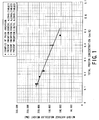
- Fig. 1 is a data plot showing a relationship between varying total proton concentrations by changing the addition amounts of water and alcohol otherwise under identical polymerization conditions (reaction vessel, polymerization temperature, species and purity of monomer, etc.) and the weight-average molecular weights (Mw) of the resultant aliphatic polyesters.
- Fig. 2 provides a data plot showing a correlation between the hydrolyzation rate constants of product aliphatic polyesters and the carboxylic acid/ester mol ratios in the cyclic ester. Also herein, a good correlation is found.
- the ring-opening polymerization of the cyclic ester may be optionally conducted by means of a polymerization vessel or in an extruder according to the kind of the monomer used.
- a polymerization reaction system whose polymerization temperature is lower than a crystallization temperature of a polymer formed, a polymer is precipitated in the course of the polymerization reaction, and a solid polymer is finally obtained.
- the polymerization time varies according to the method of the ring-opening polymerization, polymerization temperature, etc. However, it is generally 10 minutes to 100 hours, preferably 30 minutes to 50 hours, more preferably 1 to 30 hours.
- the conversion of polymerization is generally at least 95%, preferably at least 98%, more preferably at least 99%. It is however the most preferred that the monomer be fully converted from the viewpoints of decreasing the residual amount of unreacted monomer and enhancing production efficiency.
- a process of adding water to a purified cyclic ester to control the total proton concentration in the cyclic ester, heating and melting the cyclic ester in the presence of a catalyst and then subjecting the cyclic ester to ring-opening polymerization in the molten state is a bulk ring-opening polymerization process.
- the ring-opening polymerization of a cyclic ester in a moltent state may be performed by using a reaction vessel or a tubular, columnar or extruder-type reaction vessel in a batch or in a continuous manner.
- polyglycolic acid having a melt viscosity of preferably 50 to 6,000 Pa ⁇ s, more preferably 100 to 5,000 Pa ⁇ s as measured at a temperature of 240°C and a shear rate of 121 sec -1 can be provided by ring-opening polymerization of a cyclic ester (for example, glycolide or a cyclic ester comprising glycolide as a main component).
- a cyclic ester for example, glycolide or a cyclic ester comprising glycolide as a main component.
- a high-molecular weight aliphatic polyester having a weight-average molecular weight of preferably at least 50,000, more preferably 80,000, particularly preferably at least 100,000 can be produced.
- the upper limit of the weight-average molecular weight is about 500,000.
- a polymer having a yellowness index (YI) of 20 or below can be obtained by adjusting the molecular weight to at most 200,000, preferably, 80,000 or below.
- the aliphatic polyester produced in the above manner is compounded (i.e., formed into a compound) with a carboxyl group-capping agent.
- a carboxyl group-capping agent it is possible to use compounds generally known as moisture resistance-improving agents for aliphatic polyesters such as polylactic acid (refer to, e.g., JP-A 2001-261797).
- Examples thereof may include: carbodiimide compounds inclusive of monocarbodiimides and polycarbodiimides, such as N,N-2,6-diisopropylphenylcarbodiimides; oxazoline compounds, such as 2,2'-m-phenylene-bis(2-oxazoline), 2,2'-p-phenylenebis(2-oxazoline), 2,2-phenyl-2 oxazoline and styrene-isopropenyl-2-oxazoline; oxazine compounds, such as 2-methoxy-5,6-dihydro-4H-1,3-oxazine; and epoxy compounds, such as N-glycidyldiphthalimide and cyclohexene oxide.
- carbodiimide compounds inclusive of monocarbodiimides and polycarbodiimides, such as N,N-2,6-diisopropylphenylcarbodiimides
- oxazoline compounds such as 2,2'-m-
- carbodiimide compounds are preferred, and particularly those having a high purity can exhibit an excellent moisture resistance-stabilizing effect.
- carboxyl group-capping agents can be used in combination of two or more species, as desired, and may preferably be used in a proportion of 0.01 - 10 wt. parts, more preferably 0.05 - 5 wt. parts, particularly 0.1 - 3 wt. parts, per 100 wt. parts of the aliphatic polyester.
- the aliphatic polyester can be further compounded with 0.003 - 3 wt. parts, preferably 0.005 - 1 wt. part, of a thermal stabilizer per 100 wt. parts thereof in addition to the carboxyl group-capping agent.
- a thermal stabilizer phosphoric acid esters having a pentaerythritol skeleton and phosphoric acid alkyl esters may preferably be used singly or in combination.
- carboxyl group-capping agent (and optionally added thermal stabilizer) can be added during the polymerization, but may preferably be added at the time of formation of pellets of the aliphatic polyester produced by polymerization. They can also be added both in the course of pelletization and during polymerization.
- a precisely weighed amount (ca. 1 g) of glycolide and 25 mg of 4-cholorobenzophenone as an internal standard substance were added into 10 ml of high-purity acetone and sufficiently dissolved therein.
- Ca. 1 ml of the resultant solution was taken out, and an ethyl ether solution of diazomethane was added to the solution.
- the diazomethane solution was added in an amount of leaving a yellow color of diazomethane as an approximate measure.
- the yellow-colored solution (2 ⁇ l) was charged into a gas chromatograph to determine methyl-esterified glycolic acid and a glycolic acid dimmer on the basis of an area ratio of the internal standard substance and the amounts of the glycolide and internal standard substance added.
- Apparatus Hitachi G-3000, Column: TC-17 (0.25 mm in diameter ⁇ 30 m in length), Temperature of vaporizing chamber: 290°C, Column temperature: After retained at 50°C for 5 minutes, raising the temperature to 270°C at a heating rate of 20°C/min and holding at 270°C for 4 minutes, and Detector: FID (flame ionization detector), temperature: 300°C.
- a Karl Fischer's aquameter (“CA-100", made by Mitsubishi Kagaku K.K.) equipped with a vaporizer (VA-100”) was used, and a precisely weighed amount (ca. 2 g) of a polymer sample was placed in the vaporizer preset to 220°C and heated. A dry nitrogen gas was passed at a flow rate of 250 ml/min through the Karl Fischer's aquameter from the vaporizer. After the sample was introduced into the vaporizer, water vaporized was introduced into a Karl Fischer's solution. An end point was determined to be a point of time when an electric conductivity was lowered to +0.1 ⁇ g/S from the background. With respect to the determination of water in a monomer, the temperature of the vaporizer was preset to 140°C, and an end point was determined to be a point of time an electric conductivity was lowered to +0.05 ⁇ g/S from the background.
- Dry air was allowed to flow in the interior of a monomer-melting vessel in advance to find a relative humidity of its atmosphere by means of a hydrometer.
- An absolute temperature was calculated from a temperature of the atmosphere to calculate out an amount of water from this absolute temperature and the volume of the vessel.
- a total carboxyl concentration in a cyclic ester is calculated on the basis of the total amount of hydroxycarboxylic compounds and water contained in the cyclic ester.
- a proton concentration (mol%) based on the hydroxycarboxylic compounds is calculated on the basis of the contents and molecular weights of the respective compounds and the number of hydroxyl groups.
- a proton concentration (mol%) based on water is calculated on the basis of the total amount of water of impurities contained in the cyclic ester, water contained in the atmosphere of a treating vessel, etc., and water added and the molecular weight of water.
- a total proton concentration is determined as a sum of these, and a carboxylic acid/ester mol ratio is determined as a ratio between these.
- glycolide 116.07 glycolic acid: 76.05 glycolic acid dimer: 134.09 water: 18.02 dodecyl alcohol: 186.34
- the concentrations (weight basis) of impurities in the charged glycolide were 30 ppm of glycolic acid, 310 ppm of glycolic acid dimer and 20 ppm of water.
- molecular weight of glycolide is 116.07
- proton concentrations given by the respective impurities can be calculated in the following manner:
- a portion of the content in the monomer dissolution vessel was sampled after charging glycolide and adding water and heating to provide a uniform state for quantitative analysis of impurities (water, glycolic and glycolic acid dimer) to determine a total proton concentration after charging and dissolution of glycolide, which exhibited a good agreement with the calculated total proton concentration based on the impurities (moisture, glycolic acid and glycolic acid dimer) in the glycolide before charging and the amount of added water.
- impurities water, glycolic and glycolic acid dimer
- a polymer sample was placed in a drying oven heated to 120°C and brought into contact with dry air to reduce its water content to 100 ppm or lower. Thereafter, the sample was sufficiently dried in the drying oven.
- the melt viscosity was measured by means of a Capirograph 1-C (made by K.K. Toyo Seiki Seisakusho) equipped with a capillary (1mm in diameter ⁇ 10 mm in length). After ca. 20 g of the sample was placed in the apparatus heated to a presetting temperature of 240°C and held for 5 minutes, the melt viscosity was measured at a shear rate of 121 sec -1 .
- An amorphous polymer was provided and dissolved in a solvent for measurement of a molecular weight. More specifically, ca. 5 g of a sample fully dried was held between aluminum plates, placed on a hot press heated to 275°C, heated for 90 seconds and then pressed for 60 seconds under a pressure of 2 MPa. Thereafter, the polymer was immediately dipped in iced water to be quenched. Thus, a transparent amorphous pressed sheet was produced.
- a sample (10 mg) was cut out of the thus-prepared pressed sheet. This sample was dissolved in a solution with 5 mM of sodium trifluoroacetate dissolved in hexafluoroisopropanol (HFIP) to prepare a 10 ml of a solution. After the sample solution was filtered through a membrane filter, it was charged into a gel permeation chromatograph (GPC) to measure its molecular weight. Incidentally, the sample was charged into GPC within 30 minutes after the dissolution.
- GPC gel permeation chromatograph
- Apparatus Shimadzu LC-9A, Column: HFIP-806M, 2 columns and pre-column were connected in series, Column temperature: 40°C, Eluent: HFIP solution with 5 mM of sodium trifluoroacetate, Flow rate: 1 ml/min, Detector: Differential refractive index detector (RI), and Molecular weight calibration: Five standard PMMAs having different molecular weights were used.
- a pellet sample was sufficiently dried with dry air at 120°C, placed on a hot press at 250°C for 3 min. of heating and then subjected to application of a pressure of 8 MPa. Immediately thereafter, the sample was cooled by transferring to a press machine cooled with circulating water and pressed at 5 MPa for ca. 5 min., to provide a transparent amorphous pressed sheet.
- a sample in a prescribed size was cut out from the above-prepared pressed sheet and fixed on a frame to be placed in a drying oven for heating at 70°C for 1 min., followed by blow stretching at an areal ratio of 10 - 15 times by blowing air thereto.
- the film thus obtained was fixed on a frame and heat-treated for 1 min. at 200°C.
- Polymerization degrees were calculated from the thus-measured number-average molecular weights, and reciprocals thereof were plotted on a logarithmic scale verseus the standing periods to take a slope of an approximate straight line of the plots as a hydrolysis rate constant.
- a vessel also referred to as "reaction vessel" equipped with an agitator and a jacket was charged with a 70% by weight aqueous solution of glycolic acid. While agitating under atmospheric pressure, the solution within the vessel was heated to a temperature of 200°C by circulating a heat transfer oil into the jacket to conduct a condensation reaction while distilling off water formed out of the system. While reducing the pressure within the vessel stepwise to 3 kPa in a state that the reaction mixture within the vessel was kept at 200°C, low-boiling substances such as the water formed and an unreacted raw material were distilled off to obtain a glycolic acid oligomer.
- the glycolic acid oligomer prepared above was charged into a SUS304-made vessel equipped with an agitator and a jacket, diethylene glycol dibutyl ether as a solvent was added, and polyethylene glycol as a solubilizing agent was further added.
- a mixture of the glycolic acid oligomer and the solvent was subjected to a depolymerization reaction under heat and reduced pressure, and glycolide formed was distilled out together with the solvent.
- the distillate was condensed in a double-pipe condenser through which hot water was circulated. The condensate was received by a receiver at room temperature.
- the solvent in an amount corresponding to the amount of the solvent distilled out was continuously supplied to the reaction vessel for the purpose of keeping the amount of the solvent in the reaction mixture constant.
- the reaction was continued to distill out a mixture of glycolide and the solvent, and the distillate was condensed. Glycolide separated out from the condensate was subjected to solid-liquid separation and recrystallized with 2-propanol and then vacuum-dried. The purity of the resultant glycolide was 99.99% as determined by means of a differential scanning calorimeter (DSC).
- DSC differential scanning calorimeter
- a condensate was obtained in the same manner as in Synthesis Example 1 except that the solubilizing agent was changed from polyethylene glycol to octyltetratriethylene glycol.
- the condensate was received by a receiver having a jacket through which hot water was circulated.
- the condensate within the receiver was separated into 2 liquid layers, in which an upper layer was the solvent, and a lower layer was liquid glycolide. Even after the 2 layers were formed, the depolymerization reaction was continued, and the co-distillation was continued.
- glycolide cooled by the condenser was passed in the form of droplets through the solvent layer and merged by condensation within the lower glycolide layer.
- the upper solvent layer was continuously returned to the reaction vessel for the purpose of keeping the amount of the solvent in the reaction mixture constant.
- the pressure of the reaction system was temporally returned to atmospheric pressure to take out the liquid glycolide from a bottom of the receiver. The pressure was restored again to continue the depolymerization reaction. This process was repeated several times.
- the glycolide recovered from the depolymerization reaction system was purified by the recrystallization in Syntheses Example 1, whereas the glycolide was purified by means of a tower type purifier in this Example.
- crude glycolide crystals obtained by solid-liquid separation were continuously charged at a constant rate into a charging port for crude crystals provided at a lower part of the tower-type purifier.
- the glycolide was agitated by an agitator installed in the interior of the tower-type purifier wherein the crude glycolide was caused for purification by countercurrent contact between a falling melt of a purified crystal component with the rising crude glycolide crystals within the purifier.
- the crystals after the purification were continuously discharged at a fixed rate from a take-off port provided at an upper part of the purifier.
- the purity of the purified glycolide recovered was at least 99.99% as determined by means of DSC.
- the vessel was charged with 22500 g of the glycolide prepared in Synthesis Example 1 (containing 30 ppm of glycolic acid, 310 ppm of glycolic acid dimer and 20 ppm of water giving a total impurity proton concentration of 0.044 mol%), 0.68 g (30 ppm) of tin dichloride dihydrate and 28.2 g of 1-dodecyl alcohol determined so as to adjust a total proton concentration (a set proton concentration) to 0.13 mol% while taking the moisture (0.26 g) contained in the atmosphere of the dissolution vessel, and then the vessel was immediately closed hermetically.
- the mol concentration (proportion) of the 1-dodecyl alcohol in the charge with respect to the total (set) proton concentration was 60%, thus giving a carboxylic acid/ester mol ratio of 40/60.
- the vessel was closed, and steam was circulated in the jacket to heat the contents to 100°C under agitation.
- the contents became a uniform liquid in the course of the heating. While keeping the temperature of the contents at 100°C, they were transferred to an apparatus comprising tubes made of a metal (SUS304) and each having an inner diameter of 24 mm.
- the apparatus was composed of a body part, in which the tubes were provided, and upper and lower plates made of a metal (SUS304) and so constructed that all the body part and upper and lower plates were equipped with a jacket, and a heat transfer oil was circulated in the jacket.
- the contents were transferred to this apparatus, the contents were charged from an upper opening of each tube of which the lower opening had been closed with the lower plate fitted thereto.
- the upper plate was immediately fitted to close the upper opening.
- the heat transfer oil heated to 170°C was circulated in the jacket parts of the body part and upper and lower plates, and the contents were held for 7 hours. After the prescribed period of time, the heat transfer oil circulated in the jacket parts was cooled, thereby cooling the polymerization equipment to nearly room temperature. After the cooling, the lower plate was removed to take out the resultant polyglycolic acid in a bulk state from the lower opening. According to this polymerization system, the yield reached almost 100%.
- the bulk product was pulverized to obtain PGA Sample 1a.
- Example 2 The same operation as in Example 1 was repeated except that the water (moisture) contained in the atmosphere of the dissolution vessel was 0.35 g (22.5°C, 31%RH), and varying proportions of 1-dodecyl alcohol and water were changed so as to provide a total (set) proton concentration of 0.22 mol%.
- PGA Samples 2a, 2b, 2c and 2d were obtained, respectively.
- Example 2 The same operation as in Example 1 was repeated except that the water (moisture) contained in the atmosphere of the dissolution vessel was 0.35 g (22.5°C, 31%RH), 22500 g of the glycolide produced in Monomer Synthesis Example 2 (containing 40 ppm of glycolic acid, 400 ppm of glycolic acid dimer and 30ppm of water giving a total impurity proton concentration of 0.060 mol%) was used, and varying proportions of t-butyl alcohol and water were charged so as to provide a total (set) proton concentration of 0.40 mol%.
- the water (moisture) contained in the atmosphere of the dissolution vessel was 0.35 g (22.5°C, 31%RH)
- 22500 g of the glycolide produced in Monomer Synthesis Example 2 (containing 40 ppm of glycolic acid, 400 ppm of glycolic acid dimer and 30ppm of water giving a total impurity proton concentration of 0.060 mol%) was used, and varying proportions of t-but
- Example 1 The respective samples produced in Example 1 were sufficiently dried, 100 weight parts each thereof were blended with 0.03 wt part of mono- and di-stearyl acid phosphate ("ADEKASTAB AX-71") made by Asahi Denka Kogyo K.K.), and each blend was melt-kneaded and extruded through a twin-screw extruder ("LT-20", made by K.K. Toyo Seiki Seisakusho) with a set maximum cylinder temperature of 240°C to obtain pellets.
- ADKASTAB AX-71 mono- and di-stearyl acid phosphate
- LT-20 twin-screw extruder
- Example 2 The respective samples produced in Example 2 were sufficiently dried, 100 weight parts each thereof were blended with 0.03 wt part of mono- and di-stearyl acid phosphate ("ADEKASTAB AX-71") made by Asahi Denka Kogyo K.K.), and each blend was melt-kneaded and extruded through a twin-screw extruder ("LT-20", made by K.K. Toyo Seiki Seisakusho) with a set maximum cylinder temperature of 240°C to obtain pellets.
- ADKASTAB AX-71 mono- and di-stearyl acid phosphate
- LT-20 twin-screw extruder
- Example 1 The respective samples produced in Example 1 were sufficiently dried, 100 weight parts each thereof were blended with 0.03 wt part of mono- and di-stearyl acid phosphate ("ADEKASTAB AX-71") made by Asahi Denka Kogyo K.K.) and 0.5 or 1wt. part of high purity (94.8%)-N,N-2.6-diisopropylphenylcarbodiimide, and each blend was melt-kneaded and extruded through a twin-screw extruder ("LT-20", made by K.K. Toyo Seiki Seisakusho) with a set maximum cylinder temperature of 240°C to obtain pellets.
- LT-20 twin-screw extruder
- Example 2 The respective samples produced in Example 2 were sufficiently dried, 100 weight parts each thereof were blended with 0.03 wt part of mono- and di-stearyl acid phosphate ("ADEKASTAB AX-71") made by Asahi Denka Kogyo K.K.) and 0.5 or 1 wt. part of high purity (94.8%)-N,N-2.6-diisopropylphenylcarbodiimide, and each blend was melt-kneaded and extruded through a twin-screw extruder ("LT-20", made by K.K. Toyo Seiki Seisakusho) with a set maximum cylinder temperature of 240°C to obtain pellets.
- LT-20 twin-screw extruder
- Example 3 The respective samples produced in Example 3 were sufficiently dried, 100 weight parts each thereof were blended with 0.03 wt part of mono- and di-stearyl acid phosphate ("ADEKASTAB AX-71") made by Asahi Denka Kogyo K.K.) and 0.5 or 1wt. part of high purity (94.8%)-N,N-2.6-diisopropylphenylcarbodiimide, and each blend was melt-kneaded and extruded through a twin-screw extruder ("LT-20", made by K.K. Toyo Seiki Seisakusho) with a set maximum cylinder temperature of 240°C to obtain pellets.
- LT-20 twin-screw extruder
- the ring-opening polymerization of a cyclic ester is performed by using an alcohol and water positively as initiators or/and molecular weight-adjusting agents and by utilizing a total proton concentration and a carboxylic acid/ester mol ratio as polymerization-controlling indexes, to provide an aliphatic polyester having a controlled molecular weight governing initial properties and a controlled hydrolyzability governing properties changing with time.
Landscapes
- Chemical & Material Sciences (AREA)
- Health & Medical Sciences (AREA)
- Chemical Kinetics & Catalysis (AREA)
- Medicinal Chemistry (AREA)
- Polymers & Plastics (AREA)
- Organic Chemistry (AREA)
- Polyesters Or Polycarbonates (AREA)
Abstract
Description
- The present invention relates to a process for producing an aliphatic polyester, such as polyglycolic acid, by ring-opening polymerization of a cyclic ester, such as glycolide, and more particularly to an improvement in process for producing an aliphatic polyester by subjecting a cyclic ester to ring-opening polymerization using water (or moisture) and alcohol positively as initiators or/ and molecular weight-adjusting agents.
- Aliphatic polyesters, such as polyglycolic acid and polylactic acid, can be decomposed by microorganisms or enzymes present in nature, such as soil or sea water, so that they are noted as biodegradable polymer materials giving little load to the environment. Further, aliphatic polyesters are utilized as polymer materials for medical use, such as sutures for surgery or artificial skin, since they can be decomposed or absorbed in vivo.
- Among the aliphatic polyesters, polyglycolic acid is excellent in gas-barrier properties, such as oxygen gas-barrier property, carbon dioxide gas-barrier property and water vapor-barrier property and also excellent in heat resistance and mechanical properties, and therefore the development of new use thereof is under way singly or in a composite state together with another resin material in the fields of packaging materials, etc.
- An aliphatic polyester can be synthesized by dehydro-polycondensation of an α-hydroxycarboxylic acid, such as glycolic acid or lactic acid, but in order to effectively synthesize an aliphatic polyester of a high molecular weight, there has been generally adopted a process of synthesizing a bimolecular cyclic ester of an α-hydroxycarboxylic acid and subjecting the cyclic ester to ring-opening polymerization. For example, by ring-opening polymerization of glycoide that is a bimolecular cyclic ester or cyclic diester of glycolic acid, polyglycolic acid is obtained. By ring-opening polymerization of lactide that is a bimolecular cyclic ester of lactic acid, polylactic acid is obtained.
- A cyclic ester generally contains impurities including free carboxylic acid compounds, such as an α-hydroxycarboxylic acid used as the starting material and linear α-hydroxycarboxylic acid oligomers, and water. As impurities, such as water, even in a minute amount, can adversely affect the ring-opening polymerization of a cyclic ester, it has been proposed to use a high-purity cyclic ester from which impurities have been removed as far as possible in the ring-opening polymerization.
- On the other hand, an alcohol such as a higher alcohol has been used as a molecular weight-adjusting agent in ring-opening polymerization of a cyclic ester in order to control the molecular weight of the aliphatic polyester. There has been also proposed a method of determining an addition amount of the alcohol based on the amount of free carboxylic acid compounds contained in the cyclic ester.
- For example, in the ring-opening polymerization of glycolide, there has been proposed heretofore a method of using substantially pure glycolide purified by re-crystallization, etc. and also using a higher alcohol such as lauryl alcohol as a molecular weight-adjusting agent (e.g., Patent document 1b listed below).
- Further, a purification method of removing impurities such as water from a cyclic ester (e.g., Patent document 2 listed below). In this document, it is pointed out that impurities, such as water, α-hydroxycarboxylic acid and low-molecular weight oligomers thereof, contained in a cyclic ester, should be removed, since they exert various functions as an initiator, a chain transfer agent, a catalyst deactivator, etc., to obstruct the ring-opening polymerization.
- There has been proposed a process for producing an aliphatic polyester by ring-opening polymerization of a cyclic ester having a water content of at most 80 ppm and an acid value of at most 0.10 mg KOH/g (e.g.,
Patent document 3 listed below). This document contains a description to the effect that the reduction of water content in a cyclic ester accelerates the polymerization speed and allows the production of a high-molecular weight polymer, and the presence of an alcohol in the polymerization system suppresses the function of water content to allow the production of an aliphatic polyester of a good quality. - As a process for producing an aliphatic polyester by ring-opening polymerization of a cyclic ester, there has been proposed a production process characterized by determining the amount of a hydroxyl compound added to the reaction system based on the amount of free carboxylic acid compounds contained in the cyclic ester (e.g., Patent document 4 listed below). The document discloses α-hydroxycarboxylic acid used for production of the cyclic ester and linear oligomers of the α-hydroxycarboxylic acid as the free carboxylic acid compounds, and describes that monohydric linear saturated alcohols having 12 - 18 carbon atoms are preferred as the hydroxyl compound.
- The document points out that if impurities, such as water and free carboxylic acid compounds, are contained in a cyclic ester, they adversely affects the polymerization reaction and it becomes impossible to effect a targeting, i.e., production of a polymer with an objective molecular weight, even under identical polymerization conditions. The document describes that the control of a molecular weight of aliphatic polyester is liable to be difficult at a large water content and it is preferred to control the water or moisture content in the cyclic ester to at most 100 ppm in order to accurately control the molecular weight.
- The document further describes that water in a cyclic ester can be easily removed by purification and drying steps immediately before the polymerization, but free carboxylic acid compounds are difficult to remove and greatly affect the polymerization, and moreover, a cyclic ester is liable to cause ring-opening due to a minute amount of water during the storage to produce free carboxylic acid compounds anew. The document has proposed a process for producing an aliphatic polyester of a target molecular weight by determining the amount of free carboxylic acid compounds contained in a cyclic ester and adding an amount of hydroxyl compound (e.g., a higher alcohol) corresponding thereto.
- Patent document 1: U.S. Patent No. 3,442,871
- Patent document 2: JP-A 8-301864
- Patent document 3: JP-A 10-158371
- Patent document 4: JP-B 3075665
- As described above, water has been recognized as an impurity obstructing the ring-opening polymerization of a cyclic ester and should be removed as far as possible. However, water is the most universal compound present in nature, and the removal thereof as an impurity is confronted with a certain limit. The present inventors, et al, performed a detailed study about the function of water in the system of ring-opening polymerization of a cyclic ester and, as a result thereof, found it possible to control the molecular weight of a resultant aliphatic polyester by using a proton-source compound including water as a molecular weight-adjusting agent and controlling a total proton concentration in the cyclic ester to smoothly proceed with the ring-opening polymerization of a cyclic ester. Based on the knowledge, a process for producing an aliphatic polyester has been already proposed (WO2004/033527A).
- A principal object of the present invention is to provide a novel process for producing having advanced from the above-mentioned process for producing an aliphatic polyester.
- According to further study of the present inventors, it has been confirmed that proton-source compounds including water and alcohol exhibit substantially identical functions and effects as initiators or/and molecular weight-adjusting agents, whereas it has been found that carboxyl (carboxylic acid)-source compounds including water and alkoxy-carbonyl (ester)-source compounds exhibit different and contrary functions in that the former increases the hydrolyzability (i.e., decreases the moisture-resistance) and the latter decreases the hydrolyzability (i.e., increases the moisture resistance) of the resulting aliphatic polyester. Accordingly, it has been found possible to well regulate the molecular weight controlling the initial property and hydrolyzability (molecular weight decrease with time) controlling the property change with time of the resulting aliphatic polyester.
- Thus, based on the above findings, the present invention provides a process for producing an aliphatic polyester, comprising: subjecting a cyclic ester containing water and an alcohol as initiators or/and molecular weight-adjusting agents to ring-opening polymerization based on a total proton concentration and a ratio (carboxylic acid/ester mol ratio) between a mol concentration of carboxyl (carboxylic acid)-source compound including water and a mol concentration of alkoxylcarbonyl (ester)-source compounds, as polymerization-controlling indexes.
- The production of an aliphatic polyester having controlled initial property and controlled property changing with time according to the present invention is believed to be very significant for promoting the utilization of aliphatic polyesters for products requiring a harmonization between, e.g., initial strength and in vivo decomposability (or absorbability), such as sutures, artificial skins, films for agricultural use, and fishing lines.
-
- Fig. 1 is a data plot showing a correlation between weight-average molecular weights (Mw) of aliphatic polyesters obtained through the production process of the present invention and total proton concentrations in cyclic esters.
- Fig. 2 is a data plot showing a correlation between hydrolyzation rate constants of products aliphatic polyesters and carboxylic acid/ester mol ratios.
- Preferred cyclic esters used in the present invention may include cyclic diesters of α-hydroxycarboxylic acids and lactones. Examples of the α-hydroxycarboxylic acids providing the cyclic diesters may include: glycolic acid, L-and/or D-lactic acid, α-hydroxybutanoic acid, α-hydroxyisobutanoic acid, α-hydroxyvaleric acid, α-hydroxycaproic acid, α-hydroxy-isocaproic acid, α-hydroxyheptanoic acid, α-hydroxy-octanoic acid, α-hydroxydecanoic acid, α-hydroxymyristic acid, α-hydroxystearic acid, and alkyl-substituted products thereof.
- Examples of the lactones include β-propiolactone, β-butyrolactone, pivalolactone, γ-butyrolactone, δ-valerolactone, β-methyl-δ-valerolactone and ε-caprolactone. The cyclic etheresters may include dioxanone, for example.
- A cyclic ester having an asymmetric carbon atom may be any of a D-isomer, an L-isomer and a racemic mixture of these. These cyclic esters may be used either singly or in any combination thereof. When 2 or more cyclic esters are used in combination, an arbitrary aliphatic copolyester can be obtained. The cyclic ester may be copolymerized with another comonomer. Examples of such another comonomer include cyclic monomers such as trimethylene carbonate and 1,3-dioxanone.
- Among the cyclic esters, glycolide, which is a cyclic diester of glycolic acid, L- and/or D-lactide, which is a cyclic diester of L- and/or D-lactic acid, and mixtures thereof are preferred, with glycolide being more preferred. Glycolide may be used alone. However, it may also be used in combination with another cyclic monomer to produce a polyglycolic acid copolymer (copolyester). When the polyglycolic acid copolymer is produced, it is desirable that a proportion of glycolide copolymerized is preferably at least 60% by weight, more preferably at least 70% by weight, particularly preferably at least 80% by weight from the viewpoint of physical properties of the copolyester formed, such as crystallinity and gas-barrier properties. Preferable examples of the cyclic monomer copolymerized with glycolide include lactide, ε-caprolactone, dioxanone and trimethylene carbonate.
- No particular limitation is imposed on the production process of the cyclic ester. For example, glycolide can be obtained by a process comprising depolymerizing a glycolic acid oligomer. As the depolymerization process of the glycolic acid oligomer, may be adopted, for example, a melt depolymerization process described in U.S. Patent No. 2,668,162, a solid-phase depolymerization process described in JP-A 2000-119269, or a solution-phase depolymerization process described in JP-A 328481/1997 and WO 02 /14303A 1. Glycolide obtained as a cyclic condensate of a chloroacetic acid salt, which is reported in K. Chujo, et al., Die Makromolekulare Cheme, 100 (1967), 262 - 266, can also be used.
- Among the depolymerization processes described above, the solution-phase depolymerization process is preferred for obtaining glycolide. According to the solution-phase depolymerization process, (1) a mixture containing a glycolic acid oligomer and at least one high-boiling polar organic solvent having a boiling point within a range of 230 - 450°C is heated to a temperature, at which the depolymerization of the oligomer takes place, under ordinary pressure or under reduced pressure; (2) the oligomer is dissolved in the solvent until a residual rate (volume ratio) of a melt phase of the oligomer reaches 0.5 or lower, (3) the heating is further continued at the same temperature to depolymerize the oligomer, (4) a cyclic diester (i.e., glycolide) formed is distilled out together with the high-boiling polar organic solvent, and (5) glycolide is recovered from the distillate.
- Examples of the high-boiling polar organic solvent may include aromatic carboxylic acid esters, such as bis(alkoxyalkyl) phthalates such as di(2-methoxyethyl) phthalate, alkylene glycol dibenzoates such as diethylene glycol dibenzoate, benzylbutyl phthalate, and dibutyl phthalate; aromatic phosphoric acid esters such as tricresyl phosphate; and polyalkylene glycol ethers such as polyethylene dialkyl ethers. The high-boiling polar organic solvent is generally used in an amount of 0.3 to 50 times the weight of the oligomer. Polypropylene glycol, polyethylene glycol, tetraethylene glycol or the like may be used as a solubilizing agent for the oligomer in combination with the high-boiling polar organic solvent as needed. The depolymerization temperature of the glycolic acid oligomer is generally 230°C or higher, preferably 230 to 320°C. Although the depolymerization is performed under atmospheric pressure or reduced pressure, it is preferable to heat the oligomer under a reduced pressure of 0.1 to 90.0 kPa (1 to 900 mbar) to depolymerize it.
- A cyclic ester purified to a water content of at most 60 ppm (by weight), preferably at most 50ppm, more preferably at most 40 ppm, is preferably used as the cyclic ester. If the initial water content in the cyclic ester used is too high, the controllable range of melt viscosity and molecular weight of the resulting polymer are limited even when water is added as the molecular weight-adjusting agent.
- The content of hydroxycarboxylic compounds contained as impurities in the cyclic ester is preferably as low as possible. The content of an α-hydroxycarboxylic acid in the cyclic ester is preferably at most 200 ppm (by weight), more preferably at most 150 ppm, still more preferably at most 130 ppm, particularly preferably at most 100 ppm.
- Linear α-hydroxycarboxylic acid oligomers are generally contained in the cyclic ester. Most of these oligomers are linear α-hydroxycarboxylic acid dimmer. The content of the linear α-hydroxycarboxylic acid oligomers in the cyclic ester is preferably at most 2,000 ppm (by weight), more preferably at most 1,500 ppm, still more preferably at most 1,200 ppm, particularly preferably at most 1,000 ppm.
- Cyclic esters such as glycolide and lactide undergo hydrolysis reaction and polymerization reaction with a minute amount of water contained as impurities during their storage and thus show a tendency to increase the contents of α-hydroxycarboxylic acids and α-hydroxycarboxylic acid oligomers. Therefore, it is desirable that the water content in the cyclic ester just after purification is at most 50 ppm, the α-hydroxycarboxylic acid content is at most 100 ppm, and the linear α-hydroxycarboxylic acid oligomer content is at most 1,000 ppm. Incidentally, the purification of the cyclic ester may be performed by combining a recrystallization treatment, a drying treatment and the like with each other in accordance with a method known per se in the art.
- In order to produce an aliphatic polyester using the cyclic ester, it is preferred to adopt a process comprising heating the cyclic ester to cause ring-opening polymerization. This ring-opening polymerization process is performed substantially a bulk. The ring-opening polymerization is conducted at a temperature within a range of generally 100 to 270°C, preferably 120 to 260°C in the presence of a catalyst.
- No particular limitation is imposed on the catalyst so far as it may be used as a ring-opening polymerization catalyst for respective cyclic esters. Specific examples of such catalysts include metallic compounds such as oxides, chlorides, carboxylates and alkoxides of tin (Sn), titanium (Ti), aluminum (Al), antimony (Sb), zirconium (Zr) and zinc (Zn). More specifically, preferable examples thereof include tin compounds such as tin halides (for example, tin dichloride, tin tetrachloride, etc.) and organic tin carboxylates (for example, tin octanoates such as tin 2-ethylhexanoate); titanium compounds such as alkoxytitanium; aluminum compounds such as alkoxyaluminum; zirconium compounds such as zirconium acetylacetone; and antimony halides. However, these are not exhaustive.
- The amount of the catalyst used may be in a small amount relative to the cyclic ester and is selected from a range of generally 0.0001 to 0.5% by weight, preferably 0.001 to 0.1 wt.% based on the cyclic ester.
- In the preset invention, the contents of water and hydroxycarboxylic compounds contained as impurities in the cyclic ester are determined prior to the ring-opening polymerization to calculate a total proton quantity in the in the impurities based on the respective contents, and setting the water content in the cyclic ester to a value exceeding 80 ppm, particularly a value exceeding 100 ppm. The water content in the cyclic ester may be measured by means of a Karl Fischer's aquameter. The α-hydroxycarboxylic acids and linear α-hydroxycarboxylic acid oligomers contained in the cyclic ester are determined by gas chromatographic analysis or the like after the respective carboxylic groups are converted into alkyl ester groups.
- The total proton concentration of the impurities contained in the cyclic ester is calculated on the basis of the total quantity of the hydroxycarboxylic compounds and water contained as impurities in the cyclic ester. In the case of, for example, glycolide, minute amounts of water and hydroxycarboxylic compounds composed of glycolic acid and linear glycolic acid oligomers are contained as the impurities. Most of the linear glycolic acid oligomers contained in purified glycolide are a dimer of glycolic acid. In the case of lactide, water, lactic acid and linear lactic acid oligomers are contained as the impurities. The proton concentration (mol%) based on these hydroxycarboxylic compounds is calculated on the basis of the contents and molecular weights of the respective compounds and the number of hydroxyl groups (generally one hydroxyl group). The proton concentration (mol%) of water is calculated on the basis of the content and molecular weight of water. The proton concentration is calculated as mol% based on the total amount of the cyclic ester and impurities.
- The total proton concentration of the impurities contained in the cyclic ester is preferably 0.01 to 0.5 mol%, more preferably 0.02 to 0.4 mol%, particularly preferably 0.03 to 0.35 mol%. Since there is a certain limit to lowering of the contents of the hydroxycarboxylic compounds by purification, it is difficult to extremely lower the total proton concentration of the impurities. If the total proton concentration of the impurities is too high, it is difficult to precisely control the melt viscosity and molecular weight of the resulting polymer by addition of water and an alcohol.
- In the present invention, an alcohol and optional additional water are added to a cyclic ester purified down to a water content of preferably at most 60 ppm to adjust the total proton concentration and the ratio (hereinafter referred to as the "carboxylic acid/ester mol ratio") between a mol concentration of the carboxyl (carboxylic acid)-source compounds including water and a mol concentration of the alkoxycarbonyl (ester)-source compounds including alcohol in the cyclic ester, thereby controlling the molecular weight of an aliphatic polyester formed. The total proton concentration in the cyclic ester is controlled within a range of preferably higher than 0.09 mol%, but lower than 2.0 mol%, more preferably 0.1 to 1.0 mol% by adding an alcohol and optional additional water to the purified cyclic ester.
- A characteristic of the present invention is to use water in a range in excess of 80 ppm (ca. 0.052 mol% as a mol concentration in glycolide), further in excess of 100 ppm (ca. 0.064 mol% as a mol concentration in glycolide), in terms of a concentration in the cyclic ester, positively as an initiator or/ and a molecular weight-adjusting agent, and also as a carboxyl (carboxylic acid)-source compound, in this instance.
- Further, by controlling the amounts of the added alcohol and optional additional water, the carboxylic acid/ester mol ratio is controlled at preferably 100 / 0 - 2/98, more preferably 99/1 - 5/95, further preferably 99/ 1 - 10/90.
- If the carboxylic acid/ester mol ratio is below 2/98, the amount of alcohol species used in the polymerization becomes large and is liable to remain untreated to result in large fluctuation of molecular weight and melt-viscosity during melt-processing of the resultant polymer, thus making it difficult to provide a shaped product of desired properties (molecular weight, melt-viscosity, etc.). Further, the reaction with a stabilizer and a terminal capping agent added at the time of the melting to result in large fluctuations of physical properties and hydrolyzation rate of the shaped product.
- Examples of the alcohol added as a proton-source compound and an alkoxycarbonyl (ester)-source compound may include: lower and medium alcohols which are aliphatic alcohols having 1 - 5 carbon atoms, and higher alcohols which are aliphatic alcohols having 6 or more carbon atoms. These aliphatic alcohols can have a branched structure. Further, alicyclic alcohols, unsaturated alcohols, aromatic alcohols and polyols are also included. Further, it is also possible to use hydroxycarboxylic acids having a hydroxyl group and saccharides.
- Preferred among these are medium or higher alcohols having at least 3 carbon atoms, such as propanol, 2-propanol, butanol, 2-butane-ol, t-butyl alcohol, octyl alcohol, dodecyl alcohol (lauryl alcohol) and myristyl alcohol, alicyclic alcohols, such as cyclohexanol; diols, such as ethylene glycol, butane diol and hexane diol; and triols, such as glycerin, in view of the solubility in the monomer, in view of the solubility in the monomer, reactivity (initiator efficiency), boiling point and commercial availability. These alcohols can be used in two or more species in combination.
- There has been found a good correlation between a total proton concentration in the cyclic ester at the time of polymerization including water, alcohol and impurities in the starting monomer and a molecular weight of the resultant aliphatic polyester. For example, Fig. 1 is a data plot showing a relationship between varying total proton concentrations by changing the addition amounts of water and alcohol otherwise under identical polymerization conditions (reaction vessel, polymerization temperature, species and purity of monomer, etc.) and the weight-average molecular weights (Mw) of the resultant aliphatic polyesters.
- Further, Fig. 2 provides a data plot showing a correlation between the hydrolyzation rate constants of product aliphatic polyesters and the carboxylic acid/ester mol ratios in the cyclic ester. Also herein, a good correlation is found.
- The ring-opening polymerization of the cyclic ester may be optionally conducted by means of a polymerization vessel or in an extruder according to the kind of the monomer used. However, it is generally preferable to adopt a method of conducting bulk ring-opening polymerization in the polymerization vessel. For example, when glycolide is heated, it is melted in a liquid state, whereas a polymer is formed when the heating is continued to subject the melt to ring-opening polymerization. In a polymerization reaction system whose polymerization temperature is lower than a crystallization temperature of a polymer formed, a polymer is precipitated in the course of the polymerization reaction, and a solid polymer is finally obtained. The polymerization time varies according to the method of the ring-opening polymerization, polymerization temperature, etc. However, it is generally 10 minutes to 100 hours, preferably 30 minutes to 50 hours, more preferably 1 to 30 hours. The conversion of polymerization is generally at least 95%, preferably at least 98%, more preferably at least 99%. It is however the most preferred that the monomer be fully converted from the viewpoints of decreasing the residual amount of unreacted monomer and enhancing production efficiency.
- Accordingly, in the present invention, it is preferred to adopt a process of adding water to a purified cyclic ester to control the total proton concentration in the cyclic ester, heating and melting the cyclic ester in the presence of a catalyst and then subjecting the cyclic ester to ring-opening polymerization in the molten state. This polymerization process is a bulk ring-opening polymerization process. The ring-opening polymerization of a cyclic ester in a moltent state may be performed by using a reaction vessel or a tubular, columnar or extruder-type reaction vessel in a batch or in a continuous manner.
- In the present invention, it is preferred to adopt a process of transferring a cyclic ester in a molten state to a polymerization apparatus equipped with a plurality of tubes (including those having both ends capable of opening and closing as preferable embodiments) and effecting the ring-opening polymerization in each tube placed in a hermetic state to precipitate the resultant polymer. It is also preferred to adopt a process of proceeding with ring-opening polymerization of a molten cyclic ester in a reaction vessel equipped with a stirrer, taking up the resultant polymer to once cool and solidify the polymer and then further continuing solid-phase polymerization below the melting point of the polymer. These processes may be performed either batchwise or in a continuous manner. In any case, by adopting a method of controlling the polymerization temperature in a hermetic state (i.e., in a reaction system with no gaseous phase), it is possible to produce a polymer having target molecular weight and physical properties, such as melt viscosity, stably and at a good reproducibility.
- According to the process of the present invention, polyglycolic acid having a melt viscosity of preferably 50 to 6,000 Pa·s, more preferably 100 to 5,000 Pa·s as measured at a temperature of 240°C and a shear rate of 121 sec-1 can be provided by ring-opening polymerization of a cyclic ester (for example, glycolide or a cyclic ester comprising glycolide as a main component). According to the process of the present invention, a high-molecular weight aliphatic polyester having a weight-average molecular weight of preferably at least 50,000, more preferably 80,000, particularly preferably at least 100,000 can be produced. The upper limit of the weight-average molecular weight is about 500,000.
- Further, according to the process of the present invention, it is possible to obtain an aliphatic polyester having a yellowness index (YI) of ca. 4 - 30, and the yellowness index can be controlled by adjusting the molecular weight. For example, a polymer having a yellowness index (YI) of 20 or below can be obtained by adjusting the molecular weight to at most 200,000, preferably, 80,000 or below.
- Further, it is also preferred that the aliphatic polyester produced in the above manner is compounded (i.e., formed into a compound) with a carboxyl group-capping agent. As the carboxyl group-capping agent, it is possible to use compounds generally known as moisture resistance-improving agents for aliphatic polyesters such as polylactic acid (refer to, e.g., JP-A 2001-261797). Examples thereof may include: carbodiimide compounds inclusive of monocarbodiimides and polycarbodiimides, such as N,N-2,6-diisopropylphenylcarbodiimides; oxazoline compounds, such as 2,2'-m-phenylene-bis(2-oxazoline), 2,2'-p-phenylenebis(2-oxazoline), 2,2-phenyl-2 oxazoline and styrene-isopropenyl-2-oxazoline; oxazine compounds, such as 2-methoxy-5,6-dihydro-4H-1,3-oxazine; and epoxy compounds, such as N-glycidyldiphthalimide and cyclohexene oxide.
- Among these, carbodiimide compounds are preferred, and particularly those having a high purity can exhibit an excellent moisture resistance-stabilizing effect.
- These carboxyl group-capping agents can be used in combination of two or more species, as desired, and may preferably be used in a proportion of 0.01 - 10 wt. parts, more preferably 0.05 - 5 wt. parts, particularly 0.1 - 3 wt. parts, per 100 wt. parts of the aliphatic polyester.
- The aliphatic polyester can be further compounded with 0.003 - 3 wt. parts, preferably 0.005 - 1 wt. part, of a thermal stabilizer per 100 wt. parts thereof in addition to the carboxyl group-capping agent. As the thermal stabilizer, phosphoric acid esters having a pentaerythritol skeleton and phosphoric acid alkyl esters may preferably be used singly or in combination. By compounding the carboxyl group-capping agent and the thermal stabilizer, it is possible to obtain synergistic effects in suppressing the coloring and hydrolyzation of the resultant aliphatic polyester.
- The above-mentioned carboxyl group-capping agent (and optionally added thermal stabilizer) can be added during the polymerization, but may preferably be added at the time of formation of pellets of the aliphatic polyester produced by polymerization. They can also be added both in the course of pelletization and during polymerization.
- The present invention will hereinafter be described more specifically by the following Syntheses Examples, Examples and Comparative Examples. Analyzing methods, measuring methods, calculating methods, etc. are as follows:
- A precisely weighed amount (ca. 1 g) of glycolide and 25 mg of 4-cholorobenzophenone as an internal standard substance were added into 10 ml of high-purity acetone and sufficiently dissolved therein. Ca. 1 ml of the resultant solution was taken out, and an ethyl ether solution of diazomethane was added to the solution. The diazomethane solution was added in an amount of leaving a yellow color of diazomethane as an approximate measure. The yellow-colored solution (2 µl) was charged into a gas chromatograph to determine methyl-esterified glycolic acid and a glycolic acid dimmer on the basis of an area ratio of the internal standard substance and the amounts of the glycolide and internal standard substance added.
- Apparatus: Hitachi G-3000,
Column: TC-17 (0.25 mm in diameter × 30 m in length),
Temperature of vaporizing chamber: 290°C,
Column temperature: After retained at 50°C for 5 minutes, raising the temperature to 270°C at a heating rate of 20°C/min and holding at 270°C for 4 minutes, and
Detector: FID (flame ionization detector), temperature: 300°C. - With respect to lactide, impurities were determined in the same manner as in glycolide.
- A Karl Fischer's aquameter ("CA-100", made by Mitsubishi Kagaku K.K.) equipped with a vaporizer (VA-100") was used, and a precisely weighed amount (ca. 2 g) of a polymer sample was placed in the vaporizer preset to 220°C and heated. A dry nitrogen gas was passed at a flow rate of 250 ml/min through the Karl Fischer's aquameter from the vaporizer. After the sample was introduced into the vaporizer, water vaporized was introduced into a Karl Fischer's solution. An end point was determined to be a point of time when an electric conductivity was lowered to +0.1 µg/S from the background. With respect to the determination of water in a monomer, the temperature of the vaporizer was preset to 140°C, and an end point was determined to be a point of time an electric conductivity was lowered to +0.05 µg/S from the background.
- Dry air was allowed to flow in the interior of a monomer-melting vessel in advance to find a relative humidity of its atmosphere by means of a hydrometer. An absolute temperature was calculated from a temperature of the atmosphere to calculate out an amount of water from this absolute temperature and the volume of the vessel.
- A total carboxyl concentration in a cyclic ester is calculated on the basis of the total amount of hydroxycarboxylic compounds and water contained in the cyclic ester. A proton concentration (mol%) based on the hydroxycarboxylic compounds is calculated on the basis of the contents and molecular weights of the respective compounds and the number of hydroxyl groups. On the other hand, a proton concentration (mol%) based on water is calculated on the basis of the total amount of water of impurities contained in the cyclic ester, water contained in the atmosphere of a treating vessel, etc., and water added and the molecular weight of water.
- Calculated as a mol concentration of an alcohol added for the polymerization with respect to the monomer.
- From the concentration of carboxyl (carboxylic acid)-source compound and concentration of the alkoxycarbonyl (ester)-source compound determined in (4) and (5) above, a total proton concentration is determined as a sum of these, and a carboxylic acid/ester mol ratio is determined as a ratio between these.
- Details of the calculation method for Polymerization Example 1b described hereafter are as follows.
- The following values were used as molecular weights of respective components in the glycolide (cyclic ester) monomer.
glycolide: 116.07
glycolic acid: 76.05
glycolic acid dimer: 134.09
water: 18.02
dodecyl alcohol: 186.34 - The concentrations (weight basis) of impurities in the charged glycolide were 30 ppm of glycolic acid, 310 ppm of glycolic acid dimer and 20 ppm of water. As the molecular weight of glycolide is 116.07, proton concentrations given by the respective impurities can be calculated in the following manner:
- glycolic acid: 30 ppm

- glycolic acid dimer: 310 ppm

- water: 20 ppm

- Total carboxyl (carboxylic acid) - source compound concentration given by the impurities

- The atmosphere in the reaction vessel (volume: 56 liters) after removing the moisture as far as possible by blowing in dry air exhibited: temperature = 21°C and relative humidity = 25%. The atmosphere exhibited an absolute moisture of 5.0 g/m3 and gave a moisture in the inner volume of 56 liters of the monomer distribution vessel calculated as 5.0 × 0.056 = 0.28 g. This corresponds to a concentration in 22500 g (= 194.0 mol) of glycolide monomer later added of

- 1.1 g of water was added, giving a concentration with respect to 22500 g (= 194.0 mol) of glycolide monomer as follows:

-

- Incidentally, a portion of the content in the monomer dissolution vessel was sampled after charging glycolide and adding water and heating to provide a uniform state for quantitative analysis of impurities (water, glycolic and glycolic acid dimer) to determine a total proton concentration after charging and dissolution of glycolide, which exhibited a good agreement with the calculated total proton concentration based on the impurities (moisture, glycolic acid and glycolic acid dimer) in the glycolide before charging and the amount of added water.
-

-

-

- A polymer sample was placed in a drying oven heated to 120°C and brought into contact with dry air to reduce its water content to 100 ppm or lower. Thereafter, the sample was sufficiently dried in the drying oven. The melt viscosity was measured by means of a Capirograph 1-C (made by K.K. Toyo Seiki Seisakusho) equipped with a capillary (1mm in diameter × 10 mm in length). After ca. 20 g of the sample was placed in the apparatus heated to a presetting temperature of 240°C and held for 5 minutes, the melt viscosity was measured at a shear rate of 121 sec-1.
- An amorphous polymer was provided and dissolved in a solvent for measurement of a molecular weight. More specifically, ca. 5 g of a sample fully dried was held between aluminum plates, placed on a hot press heated to 275°C, heated for 90 seconds and then pressed for 60 seconds under a pressure of 2 MPa. Thereafter, the polymer was immediately dipped in iced water to be quenched. Thus, a transparent amorphous pressed sheet was produced.
- A sample (10 mg) was cut out of the thus-prepared pressed sheet. This sample was dissolved in a solution with 5 mM of sodium trifluoroacetate dissolved in hexafluoroisopropanol (HFIP) to prepare a 10 ml of a solution. After the sample solution was filtered through a membrane filter, it was charged into a gel permeation chromatograph (GPC) to measure its molecular weight. Incidentally, the sample was charged into GPC within 30 minutes after the dissolution.
- Apparatus: Shimadzu LC-9A,
Column: HFIP-806M, 2 columns and pre-column were connected in series,
Column temperature: 40°C,
Eluent: HFIP solution with 5 mM of sodium trifluoroacetate,
Flow rate: 1 ml/min,
Detector: Differential refractive index detector (RI), and
Molecular weight calibration: Five standard PMMAs having different molecular weights were used. - Ca. 0.3 g of sample was taken out and accurately weighed from a press sheet prepared in the same manner as the sample for molecular weight determination, and was completely dissolved in 10 ml of reagent-grade dimethyl sulfoxide in ca. 3 minutes on an oil bath at 150°C. To the resultant solution, 2 - 3 drops of an indicator (bromo-thymol blue dissolved in alcohol), and 0.02N-sodium hydroxide, benzyl alcohol solution was added until a termination point which was judged by observation with eyes as a point of color change of the solution from yellow to green. From the amount of addition until the termination point, a carboxyl group concentration was calculated.
- A pellet sample was sufficiently dried with dry air at 120°C, placed on a hot press at 250°C for 3 min. of heating and then subjected to application of a pressure of 8 MPa. Immediately thereafter, the sample was cooled by transferring to a press machine cooled with circulating water and pressed at 5 MPa for ca. 5 min., to provide a transparent amorphous pressed sheet.
- A sample in a prescribed size was cut out from the above-prepared pressed sheet and fixed on a frame to be placed in a drying oven for heating at 70°C for 1 min., followed by blow stretching at an areal ratio of 10 - 15 times by blowing air thereto. The film thus obtained was fixed on a frame and heat-treated for 1 min. at 200°C.
- Ca. 10 mg of samples were cut out from the above-prepared sample in a film state and left standing for prescribed periods in a vessel at constant temperature and humidity of 80°C and 95% RH. Then, the samples were taken out to measure molecular weights thereof by GPC.
- Polymerization degrees were calculated from the thus-measured number-average molecular weights, and reciprocals thereof were plotted on a logarithmic scale verseus the standing periods to take a slope of an approximate straight line of the plots as a hydrolysis rate constant.
- Further, a time for a number-average molecular weight (Mw) to reach (decrease) down to 20,000 was read from a graph.
- A vessel (also referred to as "reaction vessel") equipped with an agitator and a jacket was charged with a 70% by weight aqueous solution of glycolic acid. While agitating under atmospheric pressure, the solution within the vessel was heated to a temperature of 200°C by circulating a heat transfer oil into the jacket to conduct a condensation reaction while distilling off water formed out of the system. While reducing the pressure within the vessel stepwise to 3 kPa in a state that the reaction mixture within the vessel was kept at 200°C, low-boiling substances such as the water formed and an unreacted raw material were distilled off to obtain a glycolic acid oligomer.
- The glycolic acid oligomer prepared above was charged into a SUS304-made vessel equipped with an agitator and a jacket, diethylene glycol dibutyl ether as a solvent was added, and polyethylene glycol as a solubilizing agent was further added. A mixture of the glycolic acid oligomer and the solvent was subjected to a depolymerization reaction under heat and reduced pressure, and glycolide formed was distilled out together with the solvent. The distillate was condensed in a double-pipe condenser through which hot water was circulated. The condensate was received by a receiver at room temperature. The solvent in an amount corresponding to the amount of the solvent distilled out was continuously supplied to the reaction vessel for the purpose of keeping the amount of the solvent in the reaction mixture constant.
- The reaction was continued to distill out a mixture of glycolide and the solvent, and the distillate was condensed. Glycolide separated out from the condensate was subjected to solid-liquid separation and recrystallized with 2-propanol and then vacuum-dried. The purity of the resultant glycolide was 99.99% as determined by means of a differential scanning calorimeter (DSC).
- A condensate was obtained in the same manner as in Synthesis Example 1 except that the solubilizing agent was changed from polyethylene glycol to octyltetratriethylene glycol. The condensate was received by a receiver having a jacket through which hot water was circulated. The condensate within the receiver was separated into 2 liquid layers, in which an upper layer was the solvent, and a lower layer was liquid glycolide. Even after the 2 layers were formed, the depolymerization reaction was continued, and the co-distillation was continued. As a result, glycolide cooled by the condenser was passed in the form of droplets through the solvent layer and merged by condensation within the lower glycolide layer. The upper solvent layer was continuously returned to the reaction vessel for the purpose of keeping the amount of the solvent in the reaction mixture constant. The pressure of the reaction system was temporally returned to atmospheric pressure to take out the liquid glycolide from a bottom of the receiver. The pressure was restored again to continue the depolymerization reaction. This process was repeated several times.
- The glycolide recovered from the depolymerization reaction system was purified by the recrystallization in Syntheses Example 1, whereas the glycolide was purified by means of a tower type purifier in this Example. After the depolymerization, crude glycolide crystals obtained by solid-liquid separation were continuously charged at a constant rate into a charging port for crude crystals provided at a lower part of the tower-type purifier. The glycolide was agitated by an agitator installed in the interior of the tower-type purifier wherein the crude glycolide was caused for purification by countercurrent contact between a falling melt of a purified crystal component with the rising crude glycolide crystals within the purifier. The crystals after the purification were continuously discharged at a fixed rate from a take-off port provided at an upper part of the purifier. The purity of the purified glycolide recovered was at least 99.99% as determined by means of DSC.
- Moisture in a 56-liter SUS-made closable vessel (monomer dissolution vessel) equipped with a steam jacket structure and an agitator was removed as far as possible by blowing dry air thereinto. After a prescribed time (3 hours), the atmosphere in the vessel exhibited a temperature of 21.5°C and a relative humidity of 27%. The atmosphere exhibited an absolute moisture of 5.1 g/m3, from which a moisture in the vessel was calculated in view of the vessel inner volume to provide 0.26 g (= 5.1 g/m3 × 0.056 m3). The vessel was charged with 22500 g of the glycolide prepared in Synthesis Example 1 (containing 30 ppm of glycolic acid, 310 ppm of glycolic acid dimer and 20 ppm of water giving a total impurity proton concentration of 0.044 mol%), 0.68 g (30 ppm) of tin dichloride dihydrate and 28.2 g of 1-dodecyl alcohol determined so as to adjust a total proton concentration (a set proton concentration) to 0.13 mol% while taking the moisture (0.26 g) contained in the atmosphere of the dissolution vessel, and then the vessel was immediately closed hermetically. The mol concentration (proportion) of the 1-dodecyl alcohol in the charge with respect to the total (set) proton concentration was 60%, thus giving a carboxylic acid/ester mol ratio of 40/60.
- The vessel was closed, and steam was circulated in the jacket to heat the contents to 100°C under agitation. The contents became a uniform liquid in the course of the heating. While keeping the temperature of the contents at 100°C, they were transferred to an apparatus comprising tubes made of a metal (SUS304) and each having an inner diameter of 24 mm. The apparatus was composed of a body part, in which the tubes were provided, and upper and lower plates made of a metal (SUS304) and so constructed that all the body part and upper and lower plates were equipped with a jacket, and a heat transfer oil was circulated in the jacket. When the contents were transferred to this apparatus, the contents were charged from an upper opening of each tube of which the lower opening had been closed with the lower plate fitted thereto. After completion of the transfer, the upper plate was immediately fitted to close the upper opening. The heat transfer oil heated to 170°C was circulated in the jacket parts of the body part and upper and lower plates, and the contents were held for 7 hours. After the prescribed period of time, the heat transfer oil circulated in the jacket parts was cooled, thereby cooling the polymerization equipment to nearly room temperature. After the cooling, the lower plate was removed to take out the resultant polyglycolic acid in a bulk state from the lower opening. According to this polymerization system, the yield reached almost 100%. The bulk product was pulverized to obtain PGA Sample 1a.
- The same operation as in the above Polymerization Example 1a was repeated except that the water (moisture) contained in the atmosphere of the dissolution vessel was 0.28 g (21 °C, 25%RH), and 1.1 g of water and 17.0 g of 1-dodecyl alcohol were charged instead of the 28.2 g of 1-dodecyl alcohol. The mol concentration (proportion) of the 1-dodecyl alcohol with respect to the total (set) proton concentration was 42%, and the carboxylic acid/ester mol ratio was 58/42. After the polymerization and pulverization, PGA Sample 1b was obtained.
- The same operation as in the above Polymerization Example 1a was repeated except that the water (moisture) contained in the atmosphere of the dissolution vessel was 0.28 g (21°C, 27%RH), and 2.7 g of water was charged instead of the 28.2 g of 1-dodecyl alcohol. The mol concentration (proportion) of the 1-dodecyl alcohol with respect to the total (set) proton concentration was 0 %, and the carboxylic acid/ester mol ratio was 100/0. After the polymerization and pulverization, PGA Sample 1c was obtained.
- Polymerization conditions, the properties of the resultant polymers and the hydrolyzabilities of the films thereof are shown in Table 1.
- The same operation as in Example 1 was repeated except that the water (moisture) contained in the atmosphere of the dissolution vessel was 0.35 g (22.5°C, 31%RH), and varying proportions of 1-dodecyl alcohol and water were changed so as to provide a total (set) proton concentration of 0.22 mol%. At mol concentrations (proportions) of charged 1-dodecyl alcohol with respect to the total proton concentrations of 75%, 57%, 44% and 0% (25/75, 43/57, 56/44 and 100/0 as carboxylic acid/ester mol ratios), PGA Samples 2a, 2b, 2c and 2d were obtained, respectively.
- Polymerization conditions, the properties of the resultant polymers and the hydrolyzabilities of the films thereof are shown in Table 2.
- The same operation as in Example 1 was repeated except that the water (moisture) contained in the atmosphere of the dissolution vessel was 0.35 g (22.5°C, 31%RH), 22500 g of the glycolide produced in Monomer Synthesis Example 2 (containing 40 ppm of glycolic acid, 400 ppm of glycolic acid dimer and 30ppm of water giving a total impurity proton concentration of 0.060 mol%) was used, and varying proportions of t-butyl alcohol and water were charged so as to provide a total (set) proton concentration of 0.40 mol%. At mol concentrations (proportions) of charged t-butyl alcohol with respect to the total proton concentrations of 82%, 64%, 47% and 0% (82/1/, 36/64, 53/47 and 100/0 as carboxylic acid/ester mol ratios), PGA Samples 3a, 3b, 3c and 3d were obtained, respectively.
- Polymerization conditions, the properties of the resultant polymers and the hydrolyzabilities of the films thereof are shown in Table 3.
- The respective samples produced in Example 1 were sufficiently dried, 100 weight parts each thereof were blended with 0.03 wt part of mono- and di-stearyl acid phosphate ("ADEKASTAB AX-71") made by Asahi Denka Kogyo K.K.), and each blend was melt-kneaded and extruded through a twin-screw extruder ("LT-20", made by K.K. Toyo Seiki Seisakusho) with a set maximum cylinder temperature of 240°C to obtain pellets.
- Extrusion conditions, the properties of the resultant pellets and the hydrolyzabilities of the films thereof are shown in Table 4.
- The respective samples produced in Example 2 were sufficiently dried, 100 weight parts each thereof were blended with 0.03 wt part of mono- and di-stearyl acid phosphate ("ADEKASTAB AX-71") made by Asahi Denka Kogyo K.K.), and each blend was melt-kneaded and extruded through a twin-screw extruder ("LT-20", made by K.K. Toyo Seiki Seisakusho) with a set maximum cylinder temperature of 240°C to obtain pellets.
- Extrusion conditions, the properties of the resultant pellets and the hydrolyzabilities of the films thereof are shown in Table 5.
- The respective samples produced in Example 1 were sufficiently dried, 100 weight parts each thereof were blended with 0.03 wt part of mono- and di-stearyl acid phosphate ("ADEKASTAB AX-71") made by Asahi Denka Kogyo K.K.) and 0.5 or 1wt. part of high purity (94.8%)-N,N-2.6-diisopropylphenylcarbodiimide, and each blend was melt-kneaded and extruded through a twin-screw extruder ("LT-20", made by K.K. Toyo Seiki Seisakusho) with a set maximum cylinder temperature of 240°C to obtain pellets.
- Extrusion conditions, the properties of the resultant pellets and the hydrolyzabilities of the films thereof are shown in Table 6.
- The respective samples produced in Example 2 were sufficiently dried, 100 weight parts each thereof were blended with 0.03 wt part of mono- and di-stearyl acid phosphate ("ADEKASTAB AX-71") made by Asahi Denka Kogyo K.K.) and 0.5 or 1 wt. part of high purity (94.8%)-N,N-2.6-diisopropylphenylcarbodiimide, and each blend was melt-kneaded and extruded through a twin-screw extruder ("LT-20", made by K.K. Toyo Seiki Seisakusho) with a set maximum cylinder temperature of 240°C to obtain pellets.
- Extrusion conditions, the properties of the resultant pellets and the hydrolyzabilities of the films thereof are shown in Table 7.
- The respective samples produced in Example 3 were sufficiently dried, 100 weight parts each thereof were blended with 0.03 wt part of mono- and di-stearyl acid phosphate ("ADEKASTAB AX-71") made by Asahi Denka Kogyo K.K.) and 0.5 or 1wt. part of high purity (94.8%)-N,N-2.6-diisopropylphenylcarbodiimide, and each blend was melt-kneaded and extruded through a twin-screw extruder ("LT-20", made by K.K. Toyo Seiki Seisakusho) with a set maximum cylinder temperature of 240°C to obtain pellets.
- Extrusion conditions, the properties of the resultant pellets and the hydrolyzabilities of the films thereof are shown in Table 8.
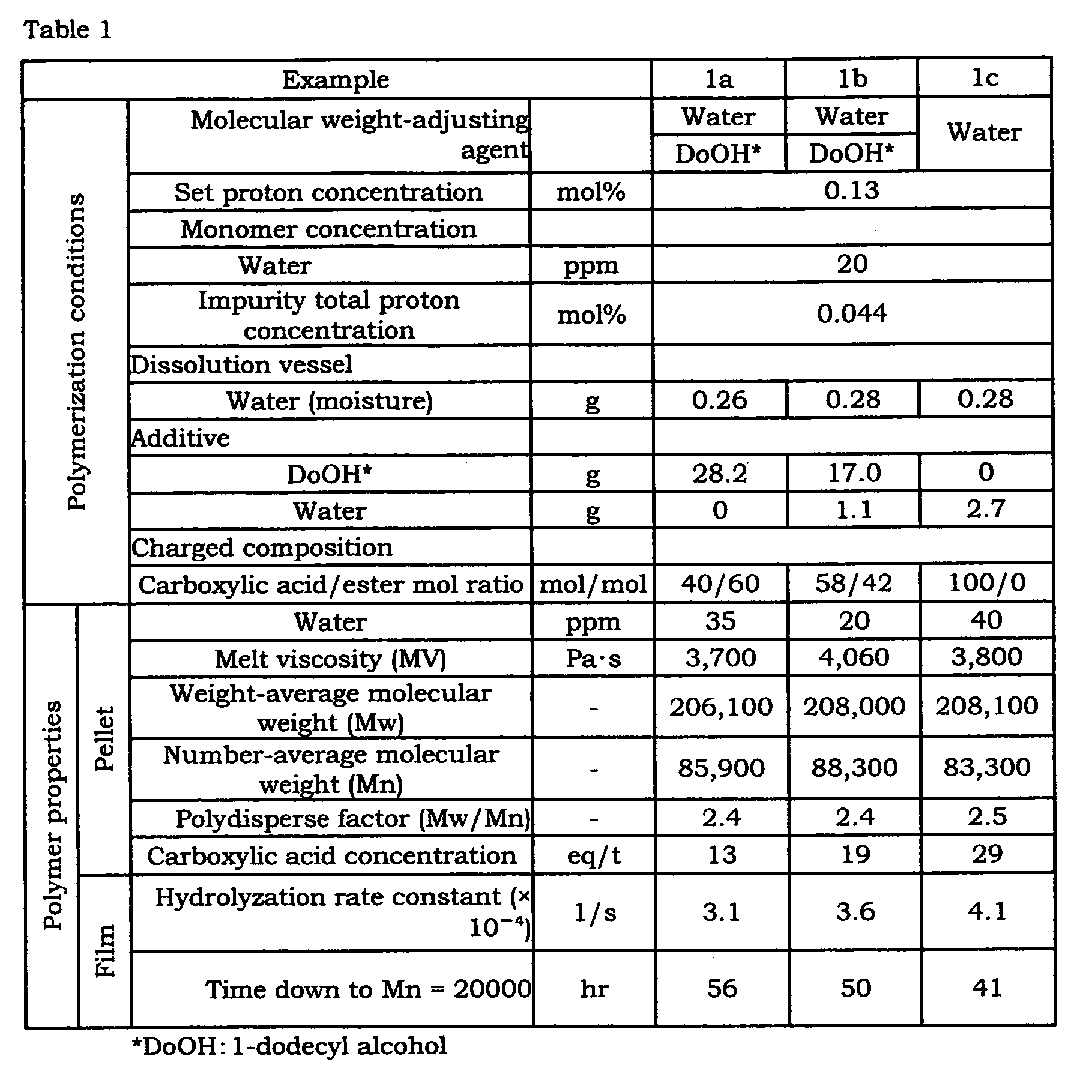


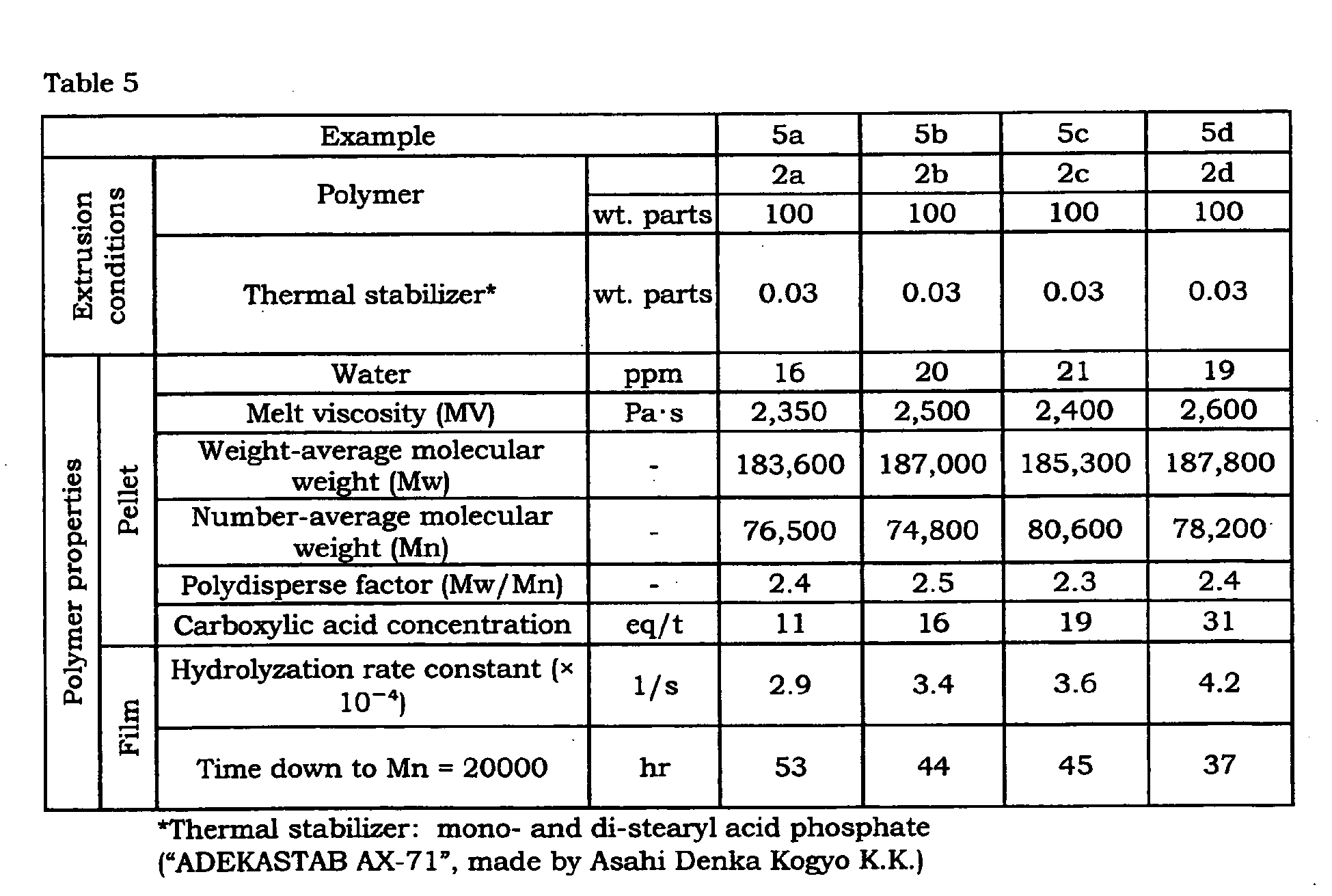


- As described above, according to the present invention, the ring-opening polymerization of a cyclic ester is performed by using an alcohol and water positively as initiators or/and molecular weight-adjusting agents and by utilizing a total proton concentration and a carboxylic acid/ester mol ratio as polymerization-controlling indexes, to provide an aliphatic polyester having a controlled molecular weight governing initial properties and a controlled hydrolyzability governing properties changing with time.
Claims (14)
- A process for producing an aliphatic polyester, comprising: subjecting a cyclic ester containing water and an alcohol as initiators or/and molecular weight-adjusting agents to ring-opening polymerization based on a total proton concentration and a ratio (carboxylic acid/ester mol ratio) between a mol concentration of carboxyl (carboxylic acid)-source compound including water and a mol concentration of alkoxylcarbonyl (ester)-source compounds, as polymerization-controlling indexes.
- A production process according to Claim 1, wherein the carboxylic acid/ester mol ratio is in a range of 100 / 0 - 2/98.
- A production process according to Claim 1, wherein the carboxylic acid/ester mol ratio is in a range of 99/1 - 5/95.
- A production process according to Claim 1, any one of Claims 1 - 3, wherein the total proton concentration in the cyclic ester is adjusted within a range of above 0.09 mol% and below 2.0 mol%.
- A production process according to any one of Claims 1 - 4, wherein the cyclic ester comprises glycolide alone or a mixture of at least 60 wt.% of glycolide and at most 40 wt.% of another cyclic monomer capable of ring-opening copolymerization with glycolide.
- A production process according to any one of Claims 1 - 5, wherein the cyclic ester after adjusting the total proton concentration therein is melted under heating in the presence of a catalyst and then the molten cyclic ester is subjected to ring-opening polymerization to precipitate a resultant polymer.
- A production process according to Claim 6, wherein the cyclic ester after adjusting the total proton concentration therein is melted under heating in the presence of a catalyst, then the molten cyclic ester is transferred to a polymerization apparatus equipped with a plurality of tubes, and the cyclic ester is subjected to ring-opening polymerization in an air-tight state within each tube.
- A production process according to Claim 7, wherein the plurality of tubes comprise tubes having both ends that can be open and closed.
- A production process according to Claim 6, wherein the cyclic ester after adjusting the total proton concentration therein is melted under heating in the presence of a catalyst in a melting vessel, then the molten cyclic ester is subjected to ring-opening polymerization in a reaction vessel equipped with a stirrer, and then a resultant polymer is once cooled to be solidified and subjected to solid phase polymerization below the melting point of the polymer.
- A production process according to any one of Claims 1 - 9, wherein the aliphatic polyester produced by the ring-opening polymerization is compounded with a carboxyl group-capping agent.
- A production process according to Claim 10, wherein 100 wt. parts of the aliphatic polyester is compounded with 0.1 - 1.8 wt. parts of the carboxyl group-capping agent.
- A production process according to Claim 10 or 11, wherein the carboxyl group-capping agent is selected from the group consisting of monocarbodiimides, polycarbodiimides, oxazolines, oxazines and epoxy compounds.
- A production process according to Claim 10 or 11, wherein the carboxyl group-capping agent is a monocarbodiimide.
- A production process according to any one of Claims 1 - 13, wherein 100 wt. parts of the aliphatic polyester produced by the ring-opening polymerization is compounded with at most 3 wt. parts of a thermal stabilizer.
Applications Claiming Priority (2)
| Application Number | Priority Date | Filing Date | Title |
|---|---|---|---|
| JP2003376221 | 2003-11-05 | ||
| PCT/JP2004/016706 WO2005044894A1 (en) | 2003-11-05 | 2004-11-04 | Process for producing aliphatic polyester |
Publications (2)
| Publication Number | Publication Date |
|---|---|
| EP1686145A1 true EP1686145A1 (en) | 2006-08-02 |
| EP1686145A4 EP1686145A4 (en) | 2007-03-14 |
Family
ID=34567105
Family Applications (1)
| Application Number | Title | Priority Date | Filing Date |
|---|---|---|---|
| EP04799600A Withdrawn EP1686145A4 (en) | 2003-11-05 | 2004-11-04 | Process for producing aliphatic polyester |
Country Status (5)
| Country | Link |
|---|---|
| EP (1) | EP1686145A4 (en) |
| JP (1) | JP4711828B2 (en) |
| CN (1) | CN1902253B (en) |
| TW (1) | TW200533693A (en) |
| WO (1) | WO2005044894A1 (en) |
Cited By (1)
| Publication number | Priority date | Publication date | Assignee | Title |
|---|---|---|---|---|
| EP1790677A1 (en) * | 2005-10-31 | 2007-05-30 | Kureha Corporation | Process for producing aliphatic polyester composition |
Families Citing this family (20)
| Publication number | Priority date | Publication date | Assignee | Title |
|---|---|---|---|---|
| US8010180B2 (en) | 2002-03-06 | 2011-08-30 | Mako Surgical Corp. | Haptic guidance system and method |
| CN101296994B (en) | 2005-10-28 | 2011-07-06 | 株式会社吴羽 | Polyglycolic acid resin particle composition and process for production thereof |
| US8318837B2 (en) | 2005-11-24 | 2012-11-27 | Kureha Corporation | Method for controlling water resistance of polyglycolic acid resin |
| JP5164576B2 (en) | 2005-12-02 | 2013-03-21 | 株式会社クレハ | Polyglycolic acid resin composition |
| JP5280007B2 (en) * | 2006-08-02 | 2013-09-04 | 株式会社クレハ | Method for purifying hydroxycarboxylic acid, method for producing cyclic ester, and method for producing polyhydroxycarboxylic acid |
| JP5235311B2 (en) | 2007-02-20 | 2013-07-10 | 株式会社クレハ | Method for purifying cyclic esters |
| US8899317B2 (en) | 2008-12-23 | 2014-12-02 | W. Lynn Frazier | Decomposable pumpdown ball for downhole plugs |
| US8079413B2 (en) | 2008-12-23 | 2011-12-20 | W. Lynn Frazier | Bottom set downhole plug |
| JP2012515837A (en) * | 2009-01-23 | 2012-07-12 | サーモディクス ファーマシューティカルズ, インコーポレイテッド | Polymer mixture comprising polymers having different non-repeating units and methods for making and using the same |
| US20120016101A1 (en) * | 2009-02-09 | 2012-01-19 | Lg Chem, Ltd. | Polylactide resin and preparation method thereof |
| US9109428B2 (en) | 2009-04-21 | 2015-08-18 | W. Lynn Frazier | Configurable bridge plugs and methods for using same |
| US9062522B2 (en) | 2009-04-21 | 2015-06-23 | W. Lynn Frazier | Configurable inserts for downhole plugs |
| US9163477B2 (en) | 2009-04-21 | 2015-10-20 | W. Lynn Frazier | Configurable downhole tools and methods for using same |
| US9127527B2 (en) | 2009-04-21 | 2015-09-08 | W. Lynn Frazier | Decomposable impediments for downhole tools and methods for using same |
| US9562415B2 (en) | 2009-04-21 | 2017-02-07 | Magnum Oil Tools International, Ltd. | Configurable inserts for downhole plugs |
| US9181772B2 (en) | 2009-04-21 | 2015-11-10 | W. Lynn Frazier | Decomposable impediments for downhole plugs |
| JP6144929B2 (en) * | 2013-03-01 | 2017-06-07 | ウィンテックポリマー株式会社 | Method for producing polybutylene terephthalate resin composition |
| KR101961540B1 (en) * | 2017-04-05 | 2019-03-22 | 강남제비스코 주식회사 | The polyester varnish for insulating electric wire with low viscosity, and its manufacturing method |
| WO2020087203A1 (en) * | 2018-10-29 | 2020-05-07 | Pujing Chemical Industry Co., Ltd | Heat and aging resistant polyglycolide copolymer and composition thereof |
| CN114518418B (en) * | 2022-01-17 | 2024-03-22 | 内蒙古久泰新材料有限公司 | Quantitative detection method for organic carboxylic acid content in cyclic lactide |
Family Cites Families (11)
| Publication number | Priority date | Publication date | Assignee | Title |
|---|---|---|---|---|
| US2945012A (en) * | 1958-01-08 | 1960-07-12 | Goodrich Co B F | Polymerizable polyesters and polymers thereof |
| US5412067A (en) * | 1993-05-10 | 1995-05-02 | Mitsui Toatsu Chemicals, Inc. | Preparation process of polyester |
| JP3988195B2 (en) * | 1996-07-12 | 2007-10-10 | トヨタ自動車株式会社 | Lactide purification and polymerization |
| JPH10109983A (en) * | 1996-10-04 | 1998-04-28 | Mitsubishi Gas Chem Co Inc | Method for producing cyclic ester and purification method |
| JP3547275B2 (en) * | 1996-12-02 | 2004-07-28 | ダイセル化学工業株式会社 | Method for producing aliphatic polyester |
| JP3681291B2 (en) * | 1998-10-29 | 2005-08-10 | 三井化学株式会社 | Method for producing polymer |
| EP1466933A3 (en) * | 1998-11-13 | 2005-02-16 | Daicel Chemical Industries, Ltd. | Aliphatic copolyester resin and method for preparing the same |
| JP2000159865A (en) * | 1998-12-01 | 2000-06-13 | Mitsui Chemicals Inc | Production of bioabsorbable polyester |
| JP3440915B2 (en) * | 2000-03-14 | 2003-08-25 | 東レ株式会社 | Polylactic acid resin and molded products |
| CN100340588C (en) * | 2002-10-08 | 2007-10-03 | 株式会社吴羽 | Process for producing aliphatic polyester |
| DE602004019443D1 (en) * | 2003-10-15 | 2009-03-26 | Kureha Corp | PROCESS FOR PREPARING ALIPHATIC POLYESTER |
-
2004
- 2004-11-04 TW TW93133694A patent/TW200533693A/en not_active IP Right Cessation
- 2004-11-04 EP EP04799600A patent/EP1686145A4/en not_active Withdrawn
- 2004-11-04 WO PCT/JP2004/016706 patent/WO2005044894A1/en not_active Ceased
- 2004-11-04 CN CN2004800397190A patent/CN1902253B/en not_active Expired - Lifetime
- 2004-11-04 JP JP2005515363A patent/JP4711828B2/en not_active Expired - Lifetime
Cited By (2)
| Publication number | Priority date | Publication date | Assignee | Title |
|---|---|---|---|---|
| EP1790677A1 (en) * | 2005-10-31 | 2007-05-30 | Kureha Corporation | Process for producing aliphatic polyester composition |
| US7501464B2 (en) | 2005-10-31 | 2009-03-10 | Kureha Corporation | Process for producing aliphatic polyester composition |
Also Published As
| Publication number | Publication date |
|---|---|
| WO2005044894A1 (en) | 2005-05-19 |
| TWI372155B (en) | 2012-09-11 |
| CN1902253B (en) | 2010-10-20 |
| CN1902253A (en) | 2007-01-24 |
| JPWO2005044894A1 (en) | 2007-05-17 |
| TW200533693A (en) | 2005-10-16 |
| JP4711828B2 (en) | 2011-06-29 |
| EP1686145A4 (en) | 2007-03-14 |
Similar Documents
| Publication | Publication Date | Title |
|---|---|---|
| EP1686146B1 (en) | Process for producing aliphatic polyester | |
| US7622546B2 (en) | Production process of aliphatic polyester | |
| US7538179B2 (en) | Process for producing aliphatic polyester | |
| US8658758B2 (en) | Process for producing aliphatic polyester reduced in residual cyclic ester content | |
| JP4711828B2 (en) | Method for producing aliphatic polyester | |
| US7067611B2 (en) | Polyhydroxycarboxylic acid and its production process | |
| US5508378A (en) | Method for producing polylactic acid | |
| EP0624613A2 (en) | Preparation process of polyester | |
| JPH07233246A (en) | Method for producing polyester | |
| JP3127770B2 (en) | Polylactic acid production method | |
| US9458287B2 (en) | Aliphatic polyester manufacturing method | |
| WO2022268899A1 (en) | Production of biopolymers | |
| JP3537542B2 (en) | Method for producing polylactic acid | |
| WO2021130128A1 (en) | Novel bioplastics |
Legal Events
| Date | Code | Title | Description |
|---|---|---|---|
| PUAI | Public reference made under article 153(3) epc to a published international application that has entered the european phase |
Free format text: ORIGINAL CODE: 0009012 |
|
| 17P | Request for examination filed |
Effective date: 20060529 |
|
| AK | Designated contracting states |
Kind code of ref document: A1 Designated state(s): AT BE BG CH CY CZ DE DK EE ES FI FR GB GR HU IE IS IT LI LU MC NL PL PT RO SE SI SK TR |
|
| DAX | Request for extension of the european patent (deleted) | ||
| A4 | Supplementary search report drawn up and despatched |
Effective date: 20070212 |
|
| RIC1 | Information provided on ipc code assigned before grant |
Ipc: C08G 63/06 20060101ALI20070206BHEP Ipc: C08G 63/78 20060101AFI20050525BHEP |
|
| 17Q | First examination report despatched |
Effective date: 20121102 |
|
| STAA | Information on the status of an ep patent application or granted ep patent |
Free format text: STATUS: THE APPLICATION IS DEEMED TO BE WITHDRAWN |
|
| 18D | Application deemed to be withdrawn |
Effective date: 20140603 |