EP1686139A1 - Novel (co)polymer, process for producing the same, and process for producing carboxylated (co)polymer - Google Patents
Novel (co)polymer, process for producing the same, and process for producing carboxylated (co)polymer Download PDFInfo
- Publication number
- EP1686139A1 EP1686139A1 EP04818882A EP04818882A EP1686139A1 EP 1686139 A1 EP1686139 A1 EP 1686139A1 EP 04818882 A EP04818882 A EP 04818882A EP 04818882 A EP04818882 A EP 04818882A EP 1686139 A1 EP1686139 A1 EP 1686139A1
- Authority
- EP
- European Patent Office
- Prior art keywords
- ene
- polymer
- structural unit
- general formula
- carboxylate
- Prior art date
- Legal status (The legal status is an assumption and is not a legal conclusion. Google has not performed a legal analysis and makes no representation as to the accuracy of the status listed.)
- Withdrawn
Links
- 229920001577 copolymer Polymers 0.000 title claims abstract description 180
- 238000000034 method Methods 0.000 title claims description 34
- VGGSQFUCUMXWEO-UHFFFAOYSA-N Ethene Chemical compound C=C VGGSQFUCUMXWEO-UHFFFAOYSA-N 0.000 claims abstract description 30
- 239000005977 Ethylene Substances 0.000 claims abstract description 30
- 125000004435 hydrogen atom Chemical group [H]* 0.000 claims abstract description 22
- 125000003178 carboxy group Chemical group [H]OC(*)=O 0.000 claims abstract description 21
- 125000005843 halogen group Chemical group 0.000 claims abstract description 16
- 125000000962 organic group Chemical group 0.000 claims abstract description 14
- 125000005678 ethenylene group Chemical group [H]C([*:1])=C([H])[*:2] 0.000 claims abstract description 6
- -1 cycloolefin compound Chemical class 0.000 claims description 99
- 150000001875 compounds Chemical class 0.000 claims description 68
- 239000000178 monomer Substances 0.000 claims description 33
- 239000004711 α-olefin Substances 0.000 claims description 24
- 125000004432 carbon atom Chemical group C* 0.000 claims description 20
- 239000000126 substance Substances 0.000 claims description 17
- 150000004291 polyenes Chemical class 0.000 claims description 13
- 150000002430 hydrocarbons Chemical group 0.000 claims description 12
- 230000003301 hydrolyzing effect Effects 0.000 claims description 8
- 125000002496 methyl group Chemical group [H]C([H])([H])* 0.000 claims description 6
- 125000004185 ester group Chemical group 0.000 claims description 3
- ACECBHHKGNTVPB-UHFFFAOYSA-N silylformic acid Chemical group OC([SiH3])=O ACECBHHKGNTVPB-UHFFFAOYSA-N 0.000 abstract description 14
- 238000004519 manufacturing process Methods 0.000 abstract description 10
- 239000002904 solvent Substances 0.000 description 46
- 239000003054 catalyst Substances 0.000 description 44
- YXFVVABEGXRONW-UHFFFAOYSA-N Toluene Chemical compound CC1=CC=CC=C1 YXFVVABEGXRONW-UHFFFAOYSA-N 0.000 description 36
- 239000000243 solution Substances 0.000 description 35
- 229920000642 polymer Polymers 0.000 description 31
- 229920001971 elastomer Polymers 0.000 description 24
- 238000006243 chemical reaction Methods 0.000 description 23
- VLKZOEOYAKHREP-UHFFFAOYSA-N n-Hexane Chemical compound CCCCCC VLKZOEOYAKHREP-UHFFFAOYSA-N 0.000 description 23
- 239000000806 elastomer Substances 0.000 description 22
- RFFLAFLAYFXFSW-UHFFFAOYSA-N 1,2-dichlorobenzene Chemical compound ClC1=CC=CC=C1Cl RFFLAFLAYFXFSW-UHFFFAOYSA-N 0.000 description 20
- 239000002685 polymerization catalyst Substances 0.000 description 19
- 238000005984 hydrogenation reaction Methods 0.000 description 16
- 229920005989 resin Polymers 0.000 description 16
- 239000011347 resin Substances 0.000 description 16
- XLYOFNOQVPJJNP-UHFFFAOYSA-N water Substances O XLYOFNOQVPJJNP-UHFFFAOYSA-N 0.000 description 16
- IJGRMHOSHXDMSA-UHFFFAOYSA-N Atomic nitrogen Chemical compound N#N IJGRMHOSHXDMSA-UHFFFAOYSA-N 0.000 description 14
- PXHVJJICTQNCMI-UHFFFAOYSA-N Nickel Chemical compound [Ni] PXHVJJICTQNCMI-UHFFFAOYSA-N 0.000 description 13
- 239000004793 Polystyrene Substances 0.000 description 13
- 238000005227 gel permeation chromatography Methods 0.000 description 13
- 229920002223 polystyrene Polymers 0.000 description 13
- UHOVQNZJYSORNB-UHFFFAOYSA-N Benzene Chemical compound C1=CC=CC=C1 UHOVQNZJYSORNB-UHFFFAOYSA-N 0.000 description 12
- JZICRSDJTAAPHT-UHFFFAOYSA-N C1C(C23)C=CC1C3C1CC2CC1(C)C(=O)O[Si](C)(C)C Chemical compound C1C(C23)C=CC1C3C1CC2CC1(C)C(=O)O[Si](C)(C)C JZICRSDJTAAPHT-UHFFFAOYSA-N 0.000 description 12
- 229920000089 Cyclic olefin copolymer Polymers 0.000 description 12
- OKKJLVBELUTLKV-UHFFFAOYSA-N Methanol Chemical compound OC OKKJLVBELUTLKV-UHFFFAOYSA-N 0.000 description 12
- KDLHZDBZIXYQEI-UHFFFAOYSA-N Palladium Chemical compound [Pd] KDLHZDBZIXYQEI-UHFFFAOYSA-N 0.000 description 12
- WYURNTSHIVDZCO-UHFFFAOYSA-N Tetrahydrofuran Chemical compound C1CCOC1 WYURNTSHIVDZCO-UHFFFAOYSA-N 0.000 description 12
- OJOWICOBYCXEKR-APPZFPTMSA-N (1S,4R)-5-ethylidenebicyclo[2.2.1]hept-2-ene Chemical compound CC=C1C[C@@H]2C[C@@H]1C=C2 OJOWICOBYCXEKR-APPZFPTMSA-N 0.000 description 11
- 239000000047 product Substances 0.000 description 11
- LIKMAJRDDDTEIG-UHFFFAOYSA-N 1-hexene Chemical compound CCCCC=C LIKMAJRDDDTEIG-UHFFFAOYSA-N 0.000 description 10
- LFQSCWFLJHTTHZ-UHFFFAOYSA-N Ethanol Chemical compound CCO LFQSCWFLJHTTHZ-UHFFFAOYSA-N 0.000 description 10
- VEXZGXHMUGYJMC-UHFFFAOYSA-N Hydrochloric acid Chemical compound Cl VEXZGXHMUGYJMC-UHFFFAOYSA-N 0.000 description 10
- 239000010408 film Substances 0.000 description 10
- 229910052757 nitrogen Inorganic materials 0.000 description 10
- AQZWEFBJYQSQEH-UHFFFAOYSA-N 2-methyloxaluminane Chemical compound C[Al]1CCCCO1 AQZWEFBJYQSQEH-UHFFFAOYSA-N 0.000 description 9
- 239000003607 modifier Substances 0.000 description 9
- QQONPFPTGQHPMA-UHFFFAOYSA-N propylene Natural products CC=C QQONPFPTGQHPMA-UHFFFAOYSA-N 0.000 description 9
- 125000004805 propylene group Chemical group [H]C([H])([H])C([H])([*:1])C([H])([H])[*:2] 0.000 description 9
- 238000004073 vulcanization Methods 0.000 description 9
- 239000004215 Carbon black (E152) Substances 0.000 description 8
- RTZKZFJDLAIYFH-UHFFFAOYSA-N Diethyl ether Chemical compound CCOCC RTZKZFJDLAIYFH-UHFFFAOYSA-N 0.000 description 8
- VYPSYNLAJGMNEJ-UHFFFAOYSA-N Silicium dioxide Chemical compound O=[Si]=O VYPSYNLAJGMNEJ-UHFFFAOYSA-N 0.000 description 8
- 125000000484 butyl group Chemical group [H]C([*])([H])C([H])([H])C([H])([H])C([H])([H])[H] 0.000 description 8
- IJOOHPMOJXWVHK-UHFFFAOYSA-N chlorotrimethylsilane Chemical compound C[Si](C)(C)Cl IJOOHPMOJXWVHK-UHFFFAOYSA-N 0.000 description 8
- 125000000524 functional group Chemical group 0.000 description 8
- 229930195733 hydrocarbon Natural products 0.000 description 8
- OFBQJSOFQDEBGM-UHFFFAOYSA-N Pentane Chemical compound CCCCC OFBQJSOFQDEBGM-UHFFFAOYSA-N 0.000 description 7
- NINIDFKCEFEMDL-UHFFFAOYSA-N Sulfur Chemical compound [S] NINIDFKCEFEMDL-UHFFFAOYSA-N 0.000 description 7
- 239000003795 chemical substances by application Substances 0.000 description 7
- 239000003085 diluting agent Substances 0.000 description 7
- 229910052751 metal Inorganic materials 0.000 description 7
- 239000002184 metal Substances 0.000 description 7
- 239000000203 mixture Substances 0.000 description 7
- 238000006116 polymerization reaction Methods 0.000 description 7
- RIOQSEWOXXDEQQ-UHFFFAOYSA-N triphenylphosphine Chemical compound C1=CC=CC=C1P(C=1C=CC=CC=1)C1=CC=CC=C1 RIOQSEWOXXDEQQ-UHFFFAOYSA-N 0.000 description 7
- WLTSXAIICPDFKI-FNORWQNLSA-N (E)-3-dodecene Chemical compound CCCCCCCC\C=C\CC WLTSXAIICPDFKI-FNORWQNLSA-N 0.000 description 6
- KWKAKUADMBZCLK-UHFFFAOYSA-N 1-octene Chemical compound CCCCCCC=C KWKAKUADMBZCLK-UHFFFAOYSA-N 0.000 description 6
- XKRFYHLGVUSROY-UHFFFAOYSA-N Argon Chemical compound [Ar] XKRFYHLGVUSROY-UHFFFAOYSA-N 0.000 description 6
- RGSFGYAAUTVSQA-UHFFFAOYSA-N Cyclopentane Chemical compound C1CCCC1 RGSFGYAAUTVSQA-UHFFFAOYSA-N 0.000 description 6
- YMWUJEATGCHHMB-UHFFFAOYSA-N Dichloromethane Chemical compound ClCCl YMWUJEATGCHHMB-UHFFFAOYSA-N 0.000 description 6
- IMNFDUFMRHMDMM-UHFFFAOYSA-N N-Heptane Chemical compound CCCCCCC IMNFDUFMRHMDMM-UHFFFAOYSA-N 0.000 description 6
- 238000007334 copolymerization reaction Methods 0.000 description 6
- 230000000694 effects Effects 0.000 description 6
- YWAKXRMUMFPDSH-UHFFFAOYSA-N pentene Chemical compound CCCC=C YWAKXRMUMFPDSH-UHFFFAOYSA-N 0.000 description 6
- 229910052717 sulfur Inorganic materials 0.000 description 6
- 239000011593 sulfur Substances 0.000 description 6
- YLQBMQCUIZJEEH-UHFFFAOYSA-N tetrahydrofuran Natural products C=1C=COC=1 YLQBMQCUIZJEEH-UHFFFAOYSA-N 0.000 description 6
- 229910052719 titanium Inorganic materials 0.000 description 6
- 239000010936 titanium Substances 0.000 description 6
- VYXHVRARDIDEHS-UHFFFAOYSA-N 1,5-cyclooctadiene Chemical compound C1CC=CCCC=C1 VYXHVRARDIDEHS-UHFFFAOYSA-N 0.000 description 5
- YKBVEMNSTCWBNI-UHFFFAOYSA-N 4-methyltetracyclo[6.2.1.13,6,02,7]dodec-9-ene-4-carboxylic acid Chemical compound C1C(C23)C=CC1C3C1CC2CC1(C)C(O)=O YKBVEMNSTCWBNI-UHFFFAOYSA-N 0.000 description 5
- 239000002250 absorbent Substances 0.000 description 5
- 230000002745 absorbent Effects 0.000 description 5
- 238000010521 absorption reaction Methods 0.000 description 5
- 239000000654 additive Substances 0.000 description 5
- 150000001412 amines Chemical class 0.000 description 5
- 239000003963 antioxidant agent Substances 0.000 description 5
- 150000004945 aromatic hydrocarbons Chemical class 0.000 description 5
- 230000015572 biosynthetic process Effects 0.000 description 5
- 239000000460 chlorine Substances 0.000 description 5
- 239000003431 cross linking reagent Substances 0.000 description 5
- 150000001993 dienes Chemical class 0.000 description 5
- 239000001257 hydrogen Substances 0.000 description 5
- 229910052739 hydrogen Inorganic materials 0.000 description 5
- 238000005649 metathesis reaction Methods 0.000 description 5
- TVMXDCGIABBOFY-UHFFFAOYSA-N n-Octanol Natural products CCCCCCCC TVMXDCGIABBOFY-UHFFFAOYSA-N 0.000 description 5
- JFNLZVQOOSMTJK-KNVOCYPGSA-N norbornene Chemical compound C1[C@@H]2CC[C@H]1C=C2 JFNLZVQOOSMTJK-KNVOCYPGSA-N 0.000 description 5
- 150000007524 organic acids Chemical class 0.000 description 5
- 125000001436 propyl group Chemical group [H]C([*])([H])C([H])([H])C([H])([H])[H] 0.000 description 5
- 239000011369 resultant mixture Substances 0.000 description 5
- 238000003756 stirring Methods 0.000 description 5
- 238000003786 synthesis reaction Methods 0.000 description 5
- VOITXYVAKOUIBA-UHFFFAOYSA-N triethylaluminium Chemical compound CC[Al](CC)CC VOITXYVAKOUIBA-UHFFFAOYSA-N 0.000 description 5
- RDJHJXUEEPXHRE-UHFFFAOYSA-N triethylsilyl 4-methyltetracyclo[6.2.1.13,6.02,7]dodec-9-ene-4-carboxylate Chemical compound CC[Si](CC)(CC)OC(=O)C1(C)CC2CC1C1C3CC(C=C3)C21 RDJHJXUEEPXHRE-UHFFFAOYSA-N 0.000 description 5
- ZGEGCLOFRBLKSE-UHFFFAOYSA-N 1-Heptene Chemical compound CCCCCC=C ZGEGCLOFRBLKSE-UHFFFAOYSA-N 0.000 description 4
- AFFLGGQVNFXPEV-UHFFFAOYSA-N 1-decene Chemical compound CCCCCCCCC=C AFFLGGQVNFXPEV-UHFFFAOYSA-N 0.000 description 4
- CRSBERNSMYQZNG-UHFFFAOYSA-N 1-dodecene Chemical compound CCCCCCCCCCC=C CRSBERNSMYQZNG-UHFFFAOYSA-N 0.000 description 4
- YBYIRNPNPLQARY-UHFFFAOYSA-N 1H-indene Natural products C1=CC=C2CC=CC2=C1 YBYIRNPNPLQARY-UHFFFAOYSA-N 0.000 description 4
- 239000004902 Softening Agent Substances 0.000 description 4
- PPBRXRYQALVLMV-UHFFFAOYSA-N Styrene Chemical compound C=CC1=CC=CC=C1 PPBRXRYQALVLMV-UHFFFAOYSA-N 0.000 description 4
- QAOWNCQODCNURD-UHFFFAOYSA-N Sulfuric acid Chemical compound OS(O)(=O)=O QAOWNCQODCNURD-UHFFFAOYSA-N 0.000 description 4
- XSQUKJJJFZCRTK-UHFFFAOYSA-N Urea Chemical compound NC(N)=O XSQUKJJJFZCRTK-UHFFFAOYSA-N 0.000 description 4
- 230000001133 acceleration Effects 0.000 description 4
- 239000002253 acid Substances 0.000 description 4
- 150000001338 aliphatic hydrocarbons Chemical class 0.000 description 4
- 230000003078 antioxidant effect Effects 0.000 description 4
- MVPPADPHJFYWMZ-UHFFFAOYSA-N chlorobenzene Chemical compound ClC1=CC=CC=C1 MVPPADPHJFYWMZ-UHFFFAOYSA-N 0.000 description 4
- 238000004132 cross linking Methods 0.000 description 4
- 150000002148 esters Chemical class 0.000 description 4
- 125000001495 ethyl group Chemical group [H]C([H])([H])C([H])([H])* 0.000 description 4
- 238000001704 evaporation Methods 0.000 description 4
- 239000000945 filler Substances 0.000 description 4
- 150000008282 halocarbons Chemical class 0.000 description 4
- OTTZHAVKAVGASB-UHFFFAOYSA-N hept-2-ene Chemical compound CCCCC=CC OTTZHAVKAVGASB-UHFFFAOYSA-N 0.000 description 4
- 150000002576 ketones Chemical class 0.000 description 4
- 239000004973 liquid crystal related substance Substances 0.000 description 4
- 239000000463 material Substances 0.000 description 4
- UMCSHTKHXAMMQM-UHFFFAOYSA-N methyl 4-methyltetracyclo[6.2.1.13,6.02,7]dodec-9-ene-4-carboxylate Chemical group C1C(C23)C=CC1C3C1CC2CC1(C)C(=O)OC UMCSHTKHXAMMQM-UHFFFAOYSA-N 0.000 description 4
- GDOPTJXRTPNYNR-UHFFFAOYSA-N methylcyclopentane Chemical compound CC1CCCC1 GDOPTJXRTPNYNR-UHFFFAOYSA-N 0.000 description 4
- JRZJOMJEPLMPRA-UHFFFAOYSA-N olefin Natural products CCCCCCCC=C JRZJOMJEPLMPRA-UHFFFAOYSA-N 0.000 description 4
- 229910052763 palladium Inorganic materials 0.000 description 4
- ILMRJRBKQSSXGY-UHFFFAOYSA-N tert-butyl(dimethyl)silicon Chemical group C[Si](C)C(C)(C)C ILMRJRBKQSSXGY-UHFFFAOYSA-N 0.000 description 4
- 239000010409 thin film Substances 0.000 description 4
- 150000003623 transition metal compounds Chemical class 0.000 description 4
- 239000005051 trimethylchlorosilane Substances 0.000 description 4
- 150000003682 vanadium compounds Chemical class 0.000 description 4
- 229910052726 zirconium Inorganic materials 0.000 description 4
- VPGLGRNSAYHXPY-UHFFFAOYSA-L zirconium(2+);dichloride Chemical compound Cl[Zr]Cl VPGLGRNSAYHXPY-UHFFFAOYSA-L 0.000 description 4
- FUDNBFMOXDUIIE-UHFFFAOYSA-N 3,7-dimethylocta-1,6-diene Chemical compound C=CC(C)CCC=C(C)C FUDNBFMOXDUIIE-UHFFFAOYSA-N 0.000 description 3
- WSSSPWUEQFSQQG-UHFFFAOYSA-N 4-methyl-1-pentene Chemical compound CC(C)CC=C WSSSPWUEQFSQQG-UHFFFAOYSA-N 0.000 description 3
- QTBSBXVTEAMEQO-UHFFFAOYSA-N Acetic acid Chemical compound CC(O)=O QTBSBXVTEAMEQO-UHFFFAOYSA-N 0.000 description 3
- 239000004925 Acrylic resin Substances 0.000 description 3
- 229920000178 Acrylic resin Polymers 0.000 description 3
- XDTMQSROBMDMFD-UHFFFAOYSA-N Cyclohexane Chemical compound C1CCCCC1 XDTMQSROBMDMFD-UHFFFAOYSA-N 0.000 description 3
- XEKOWRVHYACXOJ-UHFFFAOYSA-N Ethyl acetate Chemical compound CCOC(C)=O XEKOWRVHYACXOJ-UHFFFAOYSA-N 0.000 description 3
- UFHFLCQGNIYNRP-UHFFFAOYSA-N Hydrogen Chemical compound [H][H] UFHFLCQGNIYNRP-UHFFFAOYSA-N 0.000 description 3
- 238000004566 IR spectroscopy Methods 0.000 description 3
- CTQNGGLPUBDAKN-UHFFFAOYSA-N O-Xylene Chemical compound CC1=CC=CC=C1C CTQNGGLPUBDAKN-UHFFFAOYSA-N 0.000 description 3
- MUBZPKHOEPUJKR-UHFFFAOYSA-N Oxalic acid Chemical compound OC(=O)C(O)=O MUBZPKHOEPUJKR-UHFFFAOYSA-N 0.000 description 3
- XBDQKXXYIPTUBI-UHFFFAOYSA-M Propionate Chemical compound CCC([O-])=O XBDQKXXYIPTUBI-UHFFFAOYSA-M 0.000 description 3
- KJTLSVCANCCWHF-UHFFFAOYSA-N Ruthenium Chemical compound [Ru] KJTLSVCANCCWHF-UHFFFAOYSA-N 0.000 description 3
- 229910018557 Si O Inorganic materials 0.000 description 3
- 239000006236 Super Abrasion Furnace Substances 0.000 description 3
- 238000012644 addition polymerization Methods 0.000 description 3
- 230000000996 additive effect Effects 0.000 description 3
- 150000001336 alkenes Chemical class 0.000 description 3
- 125000000217 alkyl group Chemical group 0.000 description 3
- 229910052786 argon Inorganic materials 0.000 description 3
- 125000003118 aryl group Chemical group 0.000 description 3
- 239000012298 atmosphere Substances 0.000 description 3
- ZSWFCLXCOIISFI-UHFFFAOYSA-N endo-cyclopentadiene Natural products C1C=CC=C1 ZSWFCLXCOIISFI-UHFFFAOYSA-N 0.000 description 3
- 238000001125 extrusion Methods 0.000 description 3
- DMEGYFMYUHOHGS-UHFFFAOYSA-N heptamethylene Natural products C1CCCCCC1 DMEGYFMYUHOHGS-UHFFFAOYSA-N 0.000 description 3
- 239000011261 inert gas Substances 0.000 description 3
- 230000004048 modification Effects 0.000 description 3
- 238000012986 modification Methods 0.000 description 3
- 229910052759 nickel Inorganic materials 0.000 description 3
- 150000002848 norbornenes Chemical class 0.000 description 3
- 125000002347 octyl group Chemical group [H]C([*])([H])C([H])([H])C([H])([H])C([H])([H])C([H])([H])C([H])([H])C([H])([H])C([H])([H])[H] 0.000 description 3
- 239000003921 oil Substances 0.000 description 3
- 235000019198 oils Nutrition 0.000 description 3
- 230000000737 periodic effect Effects 0.000 description 3
- 229910052707 ruthenium Inorganic materials 0.000 description 3
- 239000000377 silicon dioxide Substances 0.000 description 3
- LIVNPJMFVYWSIS-UHFFFAOYSA-N silicon monoxide Inorganic materials [Si-]#[O+] LIVNPJMFVYWSIS-UHFFFAOYSA-N 0.000 description 3
- KPGXUAIFQMJJFB-UHFFFAOYSA-H tungsten hexachloride Chemical compound Cl[W](Cl)(Cl)(Cl)(Cl)Cl KPGXUAIFQMJJFB-UHFFFAOYSA-H 0.000 description 3
- 239000008096 xylene Substances 0.000 description 3
- NAWXUBYGYWOOIX-SFHVURJKSA-N (2s)-2-[[4-[2-(2,4-diaminoquinazolin-6-yl)ethyl]benzoyl]amino]-4-methylidenepentanedioic acid Chemical compound C1=CC2=NC(N)=NC(N)=C2C=C1CCC1=CC=C(C(=O)N[C@@H](CC(=C)C(O)=O)C(O)=O)C=C1 NAWXUBYGYWOOIX-SFHVURJKSA-N 0.000 description 2
- PRBHEGAFLDMLAL-GQCTYLIASA-N (4e)-hexa-1,4-diene Chemical compound C\C=C\CC=C PRBHEGAFLDMLAL-GQCTYLIASA-N 0.000 description 2
- SCYULBFZEHDVBN-UHFFFAOYSA-N 1,1-Dichloroethane Chemical compound CC(Cl)Cl SCYULBFZEHDVBN-UHFFFAOYSA-N 0.000 description 2
- MYRTYDVEIRVNKP-UHFFFAOYSA-N 1,2-Divinylbenzene Chemical compound C=CC1=CC=CC=C1C=C MYRTYDVEIRVNKP-UHFFFAOYSA-N 0.000 description 2
- YXIWHUQXZSMYRE-UHFFFAOYSA-N 1,3-benzothiazole-2-thiol Chemical compound C1=CC=C2SC(S)=NC2=C1 YXIWHUQXZSMYRE-UHFFFAOYSA-N 0.000 description 2
- UPXNBKIXKLFISK-UHFFFAOYSA-N 1-(5-bicyclo[2.2.1]hept-2-enyl)naphthalene Chemical compound C1=CC=C2C(C3CC4CC3C=C4)=CC=CC2=C1 UPXNBKIXKLFISK-UHFFFAOYSA-N 0.000 description 2
- VXNZUUAINFGPBY-UHFFFAOYSA-N 1-Butene Chemical compound CCC=C VXNZUUAINFGPBY-UHFFFAOYSA-N 0.000 description 2
- HECLRDQVFMWTQS-RGOKHQFPSA-N 1755-01-7 Chemical compound C1[C@H]2[C@@H]3CC=C[C@@H]3[C@@H]1C=C2 HECLRDQVFMWTQS-RGOKHQFPSA-N 0.000 description 2
- HPYNZHMRTTWQTB-UHFFFAOYSA-N 2,3-dimethylpyridine Chemical compound CC1=CC=CN=C1C HPYNZHMRTTWQTB-UHFFFAOYSA-N 0.000 description 2
- BKOOMYPCSUNDGP-UHFFFAOYSA-N 2-methylbut-2-ene Chemical compound CC=C(C)C BKOOMYPCSUNDGP-UHFFFAOYSA-N 0.000 description 2
- CPGFMWPQXUXQRX-UHFFFAOYSA-N 3-amino-3-(4-fluorophenyl)propanoic acid Chemical compound OC(=O)CC(N)C1=CC=C(F)C=C1 CPGFMWPQXUXQRX-UHFFFAOYSA-N 0.000 description 2
- JLBJTVDPSNHSKJ-UHFFFAOYSA-N 4-Methylstyrene Chemical compound CC1=CC=C(C=C)C=C1 JLBJTVDPSNHSKJ-UHFFFAOYSA-N 0.000 description 2
- HHKDWDAAEFGBAC-UHFFFAOYSA-N 5-bicyclo[2.2.1]hept-2-enyl(triethoxy)silane Chemical compound C1C2C([Si](OCC)(OCC)OCC)CC1C=C2 HHKDWDAAEFGBAC-UHFFFAOYSA-N 0.000 description 2
- DZWAQOSWSCOXEW-UHFFFAOYSA-N 5-bicyclo[2.2.1]hept-2-enyl(trimethoxy)silane Chemical compound C1C2C([Si](OC)(OC)OC)CC1C=C2 DZWAQOSWSCOXEW-UHFFFAOYSA-N 0.000 description 2
- IUASQOQVXRQXRL-UHFFFAOYSA-N 5-bicyclo[2.2.1]hept-2-enyl(tripropoxy)silane Chemical compound C1C2C([Si](OCCC)(OCCC)OCCC)CC1C=C2 IUASQOQVXRQXRL-UHFFFAOYSA-N 0.000 description 2
- VTWPBVSOSWNXAX-UHFFFAOYSA-N 5-decylbicyclo[2.2.1]hept-2-ene Chemical compound C1C2C(CCCCCCCCCC)CC1C=C2 VTWPBVSOSWNXAX-UHFFFAOYSA-N 0.000 description 2
- QHJIJNGGGLNBNJ-UHFFFAOYSA-N 5-ethylbicyclo[2.2.1]hept-2-ene Chemical compound C1C2C(CC)CC1C=C2 QHJIJNGGGLNBNJ-UHFFFAOYSA-N 0.000 description 2
- WMWDGZLDLRCDRG-UHFFFAOYSA-N 5-hexylbicyclo[2.2.1]hept-2-ene Chemical compound C1C2C(CCCCCC)CC1C=C2 WMWDGZLDLRCDRG-UHFFFAOYSA-N 0.000 description 2
- PCBPVYHMZBWMAZ-UHFFFAOYSA-N 5-methylbicyclo[2.2.1]hept-2-ene Chemical compound C1C2C(C)CC1C=C2 PCBPVYHMZBWMAZ-UHFFFAOYSA-N 0.000 description 2
- JIHFJSOMLKXSSQ-UHFFFAOYSA-N 5-methylbicyclo[2.2.1]hept-2-ene-5-carboxylic acid Chemical compound C1C2C(C)(C(O)=O)CC1C=C2 JIHFJSOMLKXSSQ-UHFFFAOYSA-N 0.000 description 2
- WTQBISBWKRKLIJ-UHFFFAOYSA-N 5-methylidenebicyclo[2.2.1]hept-2-ene Chemical compound C1C2C(=C)CC1C=C2 WTQBISBWKRKLIJ-UHFFFAOYSA-N 0.000 description 2
- PGNNHYNYFLXKDZ-UHFFFAOYSA-N 5-phenylbicyclo[2.2.1]hept-2-ene Chemical compound C1=CC2CC1CC2C1=CC=CC=C1 PGNNHYNYFLXKDZ-UHFFFAOYSA-N 0.000 description 2
- PZMNDDBVLSUSNR-UHFFFAOYSA-N 5-propan-2-ylbicyclo[2.2.1]hept-2-ene Chemical compound C1C2C(C(C)C)CC1C=C2 PZMNDDBVLSUSNR-UHFFFAOYSA-N 0.000 description 2
- UQEHLCCHNFQSDM-UHFFFAOYSA-N C1C(C23)C=CC1C3C1CC2CC1(C)C(=O)O[Si](C)(C)C(C)(C)C Chemical compound C1C(C23)C=CC1C3C1CC2CC1(C)C(=O)O[Si](C)(C)C(C)(C)C UQEHLCCHNFQSDM-UHFFFAOYSA-N 0.000 description 2
- VTYYLEPIZMXCLO-UHFFFAOYSA-L Calcium carbonate Chemical compound [Ca+2].[O-]C([O-])=O VTYYLEPIZMXCLO-UHFFFAOYSA-L 0.000 description 2
- CURLTUGMZLYLDI-UHFFFAOYSA-N Carbon dioxide Chemical compound O=C=O CURLTUGMZLYLDI-UHFFFAOYSA-N 0.000 description 2
- HEDRZPFGACZZDS-UHFFFAOYSA-N Chloroform Chemical compound ClC(Cl)Cl HEDRZPFGACZZDS-UHFFFAOYSA-N 0.000 description 2
- 239000005046 Chlorosilane Substances 0.000 description 2
- XTHFKEDIFFGKHM-UHFFFAOYSA-N Dimethoxyethane Chemical compound COCCOC XTHFKEDIFFGKHM-UHFFFAOYSA-N 0.000 description 2
- YNQLUTRBYVCPMQ-UHFFFAOYSA-N Ethylbenzene Chemical compound CCC1=CC=CC=C1 YNQLUTRBYVCPMQ-UHFFFAOYSA-N 0.000 description 2
- 239000006243 Fine Thermal Substances 0.000 description 2
- VZCYOOQTPOCHFL-OWOJBTEDSA-N Fumaric acid Chemical compound OC(=O)\C=C\C(O)=O VZCYOOQTPOCHFL-OWOJBTEDSA-N 0.000 description 2
- 239000006238 High Abrasion Furnace Substances 0.000 description 2
- QIGBRXMKCJKVMJ-UHFFFAOYSA-N Hydroquinone Chemical compound OC1=CC=C(O)C=C1 QIGBRXMKCJKVMJ-UHFFFAOYSA-N 0.000 description 2
- KFZMGEQAYNKOFK-UHFFFAOYSA-N Isopropanol Chemical compound CC(C)O KFZMGEQAYNKOFK-UHFFFAOYSA-N 0.000 description 2
- TWRXJAOTZQYOKJ-UHFFFAOYSA-L Magnesium chloride Chemical compound [Mg+2].[Cl-].[Cl-] TWRXJAOTZQYOKJ-UHFFFAOYSA-L 0.000 description 2
- 239000006244 Medium Thermal Substances 0.000 description 2
- MZRVEZGGRBJDDB-UHFFFAOYSA-N N-Butyllithium Chemical compound [Li]CCCC MZRVEZGGRBJDDB-UHFFFAOYSA-N 0.000 description 2
- 239000005662 Paraffin oil Substances 0.000 description 2
- 239000004698 Polyethylene Substances 0.000 description 2
- 239000004743 Polypropylene Substances 0.000 description 2
- JUJWROOIHBZHMG-UHFFFAOYSA-N Pyridine Chemical compound C1=CC=NC=C1 JUJWROOIHBZHMG-UHFFFAOYSA-N 0.000 description 2
- 239000006242 Semi-Reinforcing Furnace Substances 0.000 description 2
- 235000021355 Stearic acid Nutrition 0.000 description 2
- GWEVSGVZZGPLCZ-UHFFFAOYSA-N Titan oxide Chemical compound O=[Ti]=O GWEVSGVZZGPLCZ-UHFFFAOYSA-N 0.000 description 2
- RTAQQCXQSZGOHL-UHFFFAOYSA-N Titanium Chemical compound [Ti] RTAQQCXQSZGOHL-UHFFFAOYSA-N 0.000 description 2
- 239000007983 Tris buffer Substances 0.000 description 2
- XLOMVQKBTHCTTD-UHFFFAOYSA-N Zinc monoxide Chemical compound [Zn]=O XLOMVQKBTHCTTD-UHFFFAOYSA-N 0.000 description 2
- QCWXUUIWCKQGHC-UHFFFAOYSA-N Zirconium Chemical compound [Zr] QCWXUUIWCKQGHC-UHFFFAOYSA-N 0.000 description 2
- RDIIRVDCQVDFSU-UHFFFAOYSA-N [butyl(dimethyl)silyl] 5-methylbicyclo[2.2.1]hept-2-ene-5-carboxylate Chemical compound C1C2C(C(=O)O[Si](C)(C)CCCC)(C)CC1C=C2 RDIIRVDCQVDFSU-UHFFFAOYSA-N 0.000 description 2
- KPPXMNVQBXPNCO-UHFFFAOYSA-N [cyclohexyl(dimethyl)silyl] 5-methylbicyclo[2.2.1]hept-2-ene-5-carboxylate Chemical compound C1C(C=C2)CC2C1(C)C(=O)O[Si](C)(C)C1CCCCC1 KPPXMNVQBXPNCO-UHFFFAOYSA-N 0.000 description 2
- FDYJYXFFZZIVMQ-UHFFFAOYSA-N [tert-butyl(dimethyl)silyl] 5-methylbicyclo[2.2.1]hept-2-ene-5-carboxylate Chemical compound C1C2C(C(=O)O[Si](C)(C)C(C)(C)C)(C)CC1C=C2 FDYJYXFFZZIVMQ-UHFFFAOYSA-N 0.000 description 2
- 238000000862 absorption spectrum Methods 0.000 description 2
- YJOLYFYTSAVBML-UHFFFAOYSA-N ac1l4f97 Chemical compound C1C(C23)C=CC1C3C1CC2CC1CC YJOLYFYTSAVBML-UHFFFAOYSA-N 0.000 description 2
- 150000001299 aldehydes Chemical class 0.000 description 2
- 229910052783 alkali metal Inorganic materials 0.000 description 2
- 229910052782 aluminium Inorganic materials 0.000 description 2
- PNEYBMLMFCGWSK-UHFFFAOYSA-N aluminium oxide Inorganic materials [O-2].[O-2].[O-2].[Al+3].[Al+3] PNEYBMLMFCGWSK-UHFFFAOYSA-N 0.000 description 2
- 150000001408 amides Chemical class 0.000 description 2
- 238000000071 blow moulding Methods 0.000 description 2
- IAQRGUVFOMOMEM-UHFFFAOYSA-N but-2-ene Chemical compound CC=CC IAQRGUVFOMOMEM-UHFFFAOYSA-N 0.000 description 2
- DKPFZGUDAPQIHT-UHFFFAOYSA-N butyl acetate Chemical compound CCCCOC(C)=O DKPFZGUDAPQIHT-UHFFFAOYSA-N 0.000 description 2
- 239000004202 carbamide Substances 0.000 description 2
- 229910052799 carbon Inorganic materials 0.000 description 2
- 150000001733 carboxylic acid esters Chemical class 0.000 description 2
- 238000005266 casting Methods 0.000 description 2
- DCFKHNIGBAHNSS-UHFFFAOYSA-N chloro(triethyl)silane Chemical compound CC[Si](Cl)(CC)CC DCFKHNIGBAHNSS-UHFFFAOYSA-N 0.000 description 2
- KOPOQZFJUQMUML-UHFFFAOYSA-N chlorosilane Chemical compound Cl[SiH3] KOPOQZFJUQMUML-UHFFFAOYSA-N 0.000 description 2
- 239000012141 concentrate Substances 0.000 description 2
- RWGFKTVRMDUZSP-UHFFFAOYSA-N cumene Chemical compound CC(C)C1=CC=CC=C1 RWGFKTVRMDUZSP-UHFFFAOYSA-N 0.000 description 2
- 150000001925 cycloalkenes Chemical class 0.000 description 2
- NNBZCPXTIHJBJL-UHFFFAOYSA-N decalin Chemical compound C1CCCC2CCCCC21 NNBZCPXTIHJBJL-UHFFFAOYSA-N 0.000 description 2
- DIOQZVSQGTUSAI-UHFFFAOYSA-N decane Chemical compound CCCCCCCCCC DIOQZVSQGTUSAI-UHFFFAOYSA-N 0.000 description 2
- YNLAOSYQHBDIKW-UHFFFAOYSA-M diethylaluminium chloride Chemical compound CC[Al](Cl)CC YNLAOSYQHBDIKW-UHFFFAOYSA-M 0.000 description 2
- 238000004821 distillation Methods 0.000 description 2
- AUZONCFQVSMFAP-UHFFFAOYSA-N disulfiram Chemical compound CCN(CC)C(=S)SSC(=S)N(CC)CC AUZONCFQVSMFAP-UHFFFAOYSA-N 0.000 description 2
- 229940069096 dodecene Drugs 0.000 description 2
- 238000001035 drying Methods 0.000 description 2
- 150000002170 ethers Chemical class 0.000 description 2
- FCCGTJAGEHZPBF-UHFFFAOYSA-N ethyl bicyclo[2.2.1]hept-2-ene-5-carboxylate Chemical compound C1C2C(C(=O)OCC)CC1C=C2 FCCGTJAGEHZPBF-UHFFFAOYSA-N 0.000 description 2
- 239000000706 filtrate Substances 0.000 description 2
- 230000009477 glass transition Effects 0.000 description 2
- 239000002638 heterogeneous catalyst Substances 0.000 description 2
- FFUAGWLWBBFQJT-UHFFFAOYSA-N hexamethyldisilazane Chemical compound C[Si](C)(C)N[Si](C)(C)C FFUAGWLWBBFQJT-UHFFFAOYSA-N 0.000 description 2
- VKYKSIONXSXAKP-UHFFFAOYSA-N hexamethylenetetramine Chemical compound C1N(C2)CN3CN1CN2C3 VKYKSIONXSXAKP-UHFFFAOYSA-N 0.000 description 2
- 125000004051 hexyl group Chemical group [H]C([H])([H])C([H])([H])C([H])([H])C([H])([H])C([H])([H])C([H])([H])* 0.000 description 2
- 125000003454 indenyl group Chemical group C1(C=CC2=CC=CC=C12)* 0.000 description 2
- 238000001746 injection moulding Methods 0.000 description 2
- 239000003446 ligand Substances 0.000 description 2
- 239000000314 lubricant Substances 0.000 description 2
- 150000002739 metals Chemical class 0.000 description 2
- AEBDJCUTXUYLDC-UHFFFAOYSA-N methyl 5-methylbicyclo[2.2.1]hept-2-ene-5-carboxylate Chemical compound C1C2C(C(=O)OC)(C)CC1C=C2 AEBDJCUTXUYLDC-UHFFFAOYSA-N 0.000 description 2
- RMAZRAQKPTXZNL-UHFFFAOYSA-N methyl bicyclo[2.2.1]hept-2-ene-5-carboxylate Chemical compound C1C2C(C(=O)OC)CC1C=C2 RMAZRAQKPTXZNL-UHFFFAOYSA-N 0.000 description 2
- 150000007522 mineralic acids Chemical class 0.000 description 2
- 229910052750 molybdenum Inorganic materials 0.000 description 2
- 238000000465 moulding Methods 0.000 description 2
- BKIMMITUMNQMOS-UHFFFAOYSA-N nonane Chemical compound CCCCCCCCC BKIMMITUMNQMOS-UHFFFAOYSA-N 0.000 description 2
- QIQXTHQIDYTFRH-UHFFFAOYSA-N octadecanoic acid Chemical compound CCCCCCCCCCCCCCCCCC(O)=O QIQXTHQIDYTFRH-UHFFFAOYSA-N 0.000 description 2
- OQCDKBAXFALNLD-UHFFFAOYSA-N octadecanoic acid Natural products CCCCCCCC(C)CCCCCCCCC(O)=O OQCDKBAXFALNLD-UHFFFAOYSA-N 0.000 description 2
- 230000003287 optical effect Effects 0.000 description 2
- ISWSIDIOOBJBQZ-UHFFFAOYSA-N phenol group Chemical group C1(=CC=CC=C1)O ISWSIDIOOBJBQZ-UHFFFAOYSA-N 0.000 description 2
- XCZSPZZFNSHJKV-UHFFFAOYSA-N phenyl 4-methyltetracyclo[6.2.1.13,6.02,7]dodec-9-ene-4-carboxylate Chemical compound C1C(C2C3CC(C=C3)C22)CC2C1(C)C(=O)OC1=CC=CC=C1 XCZSPZZFNSHJKV-UHFFFAOYSA-N 0.000 description 2
- BASFCYQUMIYNBI-UHFFFAOYSA-N platinum Chemical compound [Pt] BASFCYQUMIYNBI-UHFFFAOYSA-N 0.000 description 2
- 239000002798 polar solvent Substances 0.000 description 2
- 229920005668 polycarbonate resin Polymers 0.000 description 2
- 239000004431 polycarbonate resin Substances 0.000 description 2
- 229920000573 polyethylene Polymers 0.000 description 2
- 229920001155 polypropylene Polymers 0.000 description 2
- 239000010734 process oil Substances 0.000 description 2
- 229910052702 rhenium Inorganic materials 0.000 description 2
- 238000007151 ring opening polymerisation reaction Methods 0.000 description 2
- 229920006395 saturated elastomer Polymers 0.000 description 2
- 238000007086 side reaction Methods 0.000 description 2
- FZHAPNGMFPVSLP-UHFFFAOYSA-N silanamine Chemical compound [SiH3]N FZHAPNGMFPVSLP-UHFFFAOYSA-N 0.000 description 2
- 229910001544 silver hexafluoroantimonate(V) Inorganic materials 0.000 description 2
- 229910001494 silver tetrafluoroborate Inorganic materials 0.000 description 2
- 238000000807 solvent casting Methods 0.000 description 2
- 238000001179 sorption measurement Methods 0.000 description 2
- 239000008117 stearic acid Substances 0.000 description 2
- 125000001424 substituent group Chemical group 0.000 description 2
- 239000000758 substrate Substances 0.000 description 2
- 230000008961 swelling Effects 0.000 description 2
- 229910052714 tellurium Inorganic materials 0.000 description 2
- PORWMNRCUJJQNO-UHFFFAOYSA-N tellurium atom Chemical compound [Te] PORWMNRCUJJQNO-UHFFFAOYSA-N 0.000 description 2
- BCNZYOJHNLTNEZ-UHFFFAOYSA-N tert-butyldimethylsilyl chloride Chemical compound CC(C)(C)[Si](C)(C)Cl BCNZYOJHNLTNEZ-UHFFFAOYSA-N 0.000 description 2
- XBFJAVXCNXDMBH-UHFFFAOYSA-N tetracyclo[6.2.1.1(3,6).0(2,7)]dodec-4-ene Chemical class C1C(C23)C=CC1C3C1CC2CC1 XBFJAVXCNXDMBH-UHFFFAOYSA-N 0.000 description 2
- 229920005992 thermoplastic resin Polymers 0.000 description 2
- 229960002447 thiram Drugs 0.000 description 2
- XJDNKRIXUMDJCW-UHFFFAOYSA-J titanium tetrachloride Chemical compound Cl[Ti](Cl)(Cl)Cl XJDNKRIXUMDJCW-UHFFFAOYSA-J 0.000 description 2
- ZWYDDDAMNQQZHD-UHFFFAOYSA-L titanium(ii) chloride Chemical compound [Cl-].[Cl-].[Ti+2] ZWYDDDAMNQQZHD-UHFFFAOYSA-L 0.000 description 2
- JOXIMZWYDAKGHI-UHFFFAOYSA-N toluene-4-sulfonic acid Chemical compound CC1=CC=C(S(O)(=O)=O)C=C1 JOXIMZWYDAKGHI-UHFFFAOYSA-N 0.000 description 2
- VZCYOOQTPOCHFL-UHFFFAOYSA-N trans-butenedioic acid Natural products OC(=O)C=CC(O)=O VZCYOOQTPOCHFL-UHFFFAOYSA-N 0.000 description 2
- CCCCGLMDLZJURR-UHFFFAOYSA-N tributylsilyl 5-methylbicyclo[2.2.1]hept-2-ene-5-carboxylate Chemical compound C1C2C(C(=O)O[Si](CCCC)(CCCC)CCCC)(C)CC1C=C2 CCCCGLMDLZJURR-UHFFFAOYSA-N 0.000 description 2
- MEGGYNKEFJGGRP-UHFFFAOYSA-N trimethylsilyl 5-methylbicyclo[2.2.1]hept-2-ene-5-carboxylate Chemical compound C1C2C(C)(C(=O)O[Si](C)(C)C)CC1C=C2 MEGGYNKEFJGGRP-UHFFFAOYSA-N 0.000 description 2
- 229910052721 tungsten Inorganic materials 0.000 description 2
- 229910052720 vanadium Inorganic materials 0.000 description 2
- 229910052725 zinc Inorganic materials 0.000 description 2
- 239000011701 zinc Substances 0.000 description 2
- 239000011787 zinc oxide Substances 0.000 description 2
- 235000014692 zinc oxide Nutrition 0.000 description 2
- VYXHVRARDIDEHS-QGTKBVGQSA-N (1z,5z)-cycloocta-1,5-diene Chemical compound C\1C\C=C/CC\C=C/1 VYXHVRARDIDEHS-QGTKBVGQSA-N 0.000 description 1
- IEOPZUMPHCZMCS-ZCFIWIBFSA-N (2r)-2-(methoxymethyl)oxolane Chemical compound COC[C@H]1CCCO1 IEOPZUMPHCZMCS-ZCFIWIBFSA-N 0.000 description 1
- RPAJSBKBKSSMLJ-DFWYDOINSA-N (2s)-2-aminopentanedioic acid;hydrochloride Chemical class Cl.OC(=O)[C@@H](N)CCC(O)=O RPAJSBKBKSSMLJ-DFWYDOINSA-N 0.000 description 1
- KHBCEJIYBVXXNN-UHFFFAOYSA-N (4-phenylphenyl) 4-methyltetracyclo[6.2.1.13,6.02,7]dodec-9-ene-4-carboxylate Chemical compound C1C(C2C3CC(C=C3)C22)CC2C1(C)C(=O)OC(C=C1)=CC=C1C1=CC=CC=C1 KHBCEJIYBVXXNN-UHFFFAOYSA-N 0.000 description 1
- XDSDHQKWUMNXHS-UHFFFAOYSA-N (5-chloro-1-bicyclo[2.2.1]hept-2-enyl)-diethoxysilane Chemical compound ClC1C2C=CC(C1)(C2)[SiH](OCC)OCC XDSDHQKWUMNXHS-UHFFFAOYSA-N 0.000 description 1
- HMDCKGFDYQKFBA-UHFFFAOYSA-N (5-chloro-2,3-dimethoxy-1-bicyclo[2.2.1]hept-2-enyl)silane Chemical compound ClC1C2C(=C(C(C1)(C2)[SiH3])OC)OC HMDCKGFDYQKFBA-UHFFFAOYSA-N 0.000 description 1
- DBAJHIZFXZOQFK-UHFFFAOYSA-N (5-ethoxy-1-bicyclo[2.2.1]hept-2-enyl)-diethylsilane Chemical compound C(C)OC1C2C=CC(C1)(C2)[SiH](CC)CC DBAJHIZFXZOQFK-UHFFFAOYSA-N 0.000 description 1
- WOOMIRZQDLPYIU-UHFFFAOYSA-N (5-ethoxy-1-bicyclo[2.2.1]hept-2-enyl)-dimethylsilane Chemical compound C(C)OC1C2C=CC(C1)(C2)[SiH](C)C WOOMIRZQDLPYIU-UHFFFAOYSA-N 0.000 description 1
- XDXPPSIJQNPMQN-UHFFFAOYSA-N (5-methoxy-1-bicyclo[2.2.1]hept-2-enyl)-dimethylsilane Chemical compound COC1C2C=CC(C1)(C2)[SiH](C)C XDXPPSIJQNPMQN-UHFFFAOYSA-N 0.000 description 1
- OJOWICOBYCXEKR-KRXBUXKQSA-N (5e)-5-ethylidenebicyclo[2.2.1]hept-2-ene Chemical compound C1C2C(=C/C)/CC1C=C2 OJOWICOBYCXEKR-KRXBUXKQSA-N 0.000 description 1
- RJUCIROUEDJQIB-GQCTYLIASA-N (6e)-octa-1,6-diene Chemical compound C\C=C\CCCC=C RJUCIROUEDJQIB-GQCTYLIASA-N 0.000 description 1
- WRIDQFICGBMAFQ-UHFFFAOYSA-N (E)-8-Octadecenoic acid Natural products CCCCCCCCCC=CCCCCCCC(O)=O WRIDQFICGBMAFQ-UHFFFAOYSA-N 0.000 description 1
- 229910018994 (KOHYO) No Inorganic materials 0.000 description 1
- AWMKVDKKEHGXPU-UHFFFAOYSA-N (tert-butyl-chloro-phenylsilyl) 4-methyltetracyclo[6.2.1.13,6.02,7]dodec-9-ene-4-carboxylate Chemical compound CC(C)(C)[Si](Cl)(OC(=O)C1(C)CC2CC1C1C3CC(C=C3)C21)c1ccccc1 AWMKVDKKEHGXPU-UHFFFAOYSA-N 0.000 description 1
- KLSXMRLWGDTAID-UHFFFAOYSA-N (tert-butyl-chloro-phenylsilyl) tetracyclo[6.2.1.13,6.02,7]dodec-9-ene-4-carboxylate Chemical compound C1C(C2C3CC(C=C3)C22)CC2C1C(=O)O[Si](Cl)(C(C)(C)C)C1=CC=CC=C1 KLSXMRLWGDTAID-UHFFFAOYSA-N 0.000 description 1
- FSJSYDFBTIVUFD-SUKNRPLKSA-N (z)-4-hydroxypent-3-en-2-one;oxovanadium Chemical compound [V]=O.C\C(O)=C\C(C)=O.C\C(O)=C\C(C)=O FSJSYDFBTIVUFD-SUKNRPLKSA-N 0.000 description 1
- MFWFDRBPQDXFRC-LNTINUHCSA-N (z)-4-hydroxypent-3-en-2-one;vanadium Chemical compound [V].C\C(O)=C\C(C)=O.C\C(O)=C\C(C)=O.C\C(O)=C\C(C)=O MFWFDRBPQDXFRC-LNTINUHCSA-N 0.000 description 1
- JAEZSIYNWDWMMN-UHFFFAOYSA-N 1,1,3-trimethylthiourea Chemical compound CNC(=S)N(C)C JAEZSIYNWDWMMN-UHFFFAOYSA-N 0.000 description 1
- FMZITCJWMYHQFG-UHFFFAOYSA-N 1,2,3,4,4a,5,8,8a-octahydro-2-methyl-1,4:5,8-dimethanonaphthalene Chemical compound C1C(C23)C=CC1C3C1CC2CC1C FMZITCJWMYHQFG-UHFFFAOYSA-N 0.000 description 1
- OPNUROKCUBTKLF-UHFFFAOYSA-N 1,2-bis(2-methylphenyl)guanidine Chemical compound CC1=CC=CC=C1N\C(N)=N\C1=CC=CC=C1C OPNUROKCUBTKLF-UHFFFAOYSA-N 0.000 description 1
- LFMQNMXVVXHZCC-UHFFFAOYSA-N 1,3-benzothiazol-2-yl n,n-diethylcarbamodithioate Chemical compound C1=CC=C2SC(SC(=S)N(CC)CC)=NC2=C1 LFMQNMXVVXHZCC-UHFFFAOYSA-N 0.000 description 1
- KWPNNZKRAQDVPZ-UHFFFAOYSA-N 1,3-bis(2-methylphenyl)thiourea Chemical compound CC1=CC=CC=C1NC(=S)NC1=CC=CC=C1C KWPNNZKRAQDVPZ-UHFFFAOYSA-N 0.000 description 1
- UBRWPVTUQDJKCC-UHFFFAOYSA-N 1,3-bis(2-tert-butylperoxypropan-2-yl)benzene Chemical compound CC(C)(C)OOC(C)(C)C1=CC=CC(C(C)(C)OOC(C)(C)C)=C1 UBRWPVTUQDJKCC-UHFFFAOYSA-N 0.000 description 1
- NWFVONWTBGQHGT-UHFFFAOYSA-N 1,3-didodecylthiourea Chemical compound CCCCCCCCCCCCNC(=S)NCCCCCCCCCCCC NWFVONWTBGQHGT-UHFFFAOYSA-N 0.000 description 1
- OWRCNXZUPFZXOS-UHFFFAOYSA-N 1,3-diphenylguanidine Chemical compound C=1C=CC=CC=1NC(=N)NC1=CC=CC=C1 OWRCNXZUPFZXOS-UHFFFAOYSA-N 0.000 description 1
- PRBHEGAFLDMLAL-UHFFFAOYSA-N 1,5-Hexadiene Natural products CC=CCC=C PRBHEGAFLDMLAL-UHFFFAOYSA-N 0.000 description 1
- NIMLCWCLVJRPFY-UHFFFAOYSA-N 1-(5-bicyclo[2.2.1]hept-2-enyl)ethanone Chemical compound C1C2C(C(=O)C)CC1C=C2 NIMLCWCLVJRPFY-UHFFFAOYSA-N 0.000 description 1
- IPJGAEWUPXWFPL-UHFFFAOYSA-N 1-[3-(2,5-dioxopyrrol-1-yl)phenyl]pyrrole-2,5-dione Chemical compound O=C1C=CC(=O)N1C1=CC=CC(N2C(C=CC2=O)=O)=C1 IPJGAEWUPXWFPL-UHFFFAOYSA-N 0.000 description 1
- MNDIARAMWBIKFW-UHFFFAOYSA-N 1-bromohexane Chemical compound CCCCCCBr MNDIARAMWBIKFW-UHFFFAOYSA-N 0.000 description 1
- DURPTKYDGMDSBL-UHFFFAOYSA-N 1-butoxybutane Chemical compound CCCCOCCCC DURPTKYDGMDSBL-UHFFFAOYSA-N 0.000 description 1
- VFWCMGCRMGJXDK-UHFFFAOYSA-N 1-chlorobutane Chemical compound CCCCCl VFWCMGCRMGJXDK-UHFFFAOYSA-N 0.000 description 1
- PPWUTZVGSFPZOC-UHFFFAOYSA-N 1-methyl-2,3,3a,4-tetrahydro-1h-indene Chemical compound C1C=CC=C2C(C)CCC21 PPWUTZVGSFPZOC-UHFFFAOYSA-N 0.000 description 1
- DCSRANNUZMQMBI-UHFFFAOYSA-N 2,2,3,3-tetrakis(trifluoromethyl)bicyclo[2.2.1]hept-5-ene Chemical compound C1C2C=CC1C(C(F)(F)F)(C(F)(F)F)C2(C(F)(F)F)C(F)(F)F DCSRANNUZMQMBI-UHFFFAOYSA-N 0.000 description 1
- VYZIEGKTECJOGF-UHFFFAOYSA-N 2,3,3-trifluoro-2-(trifluoromethoxy)bicyclo[2.2.1]hept-5-ene Chemical compound C1C2C=CC1C(OC(F)(F)F)(F)C2(F)F VYZIEGKTECJOGF-UHFFFAOYSA-N 0.000 description 1
- UOYKBJNWNACIRX-UHFFFAOYSA-N 2,3,3-trifluorobicyclo[2.2.1]hept-5-ene Chemical compound C1C2C=CC1C(F)C2(F)F UOYKBJNWNACIRX-UHFFFAOYSA-N 0.000 description 1
- BBZVRBFORXMYKR-UHFFFAOYSA-N 2,3,3-tris(fluoromethyl)bicyclo[2.2.1]hept-5-ene Chemical compound C1C2C=CC1C(CF)C2(CF)CF BBZVRBFORXMYKR-UHFFFAOYSA-N 0.000 description 1
- ZGNJHKOQQSEQRR-UHFFFAOYSA-N 2,3-bis(trifluoromethyl)bicyclo[2.2.1]hept-5-ene Chemical compound C1C2C=CC1C(C(F)(F)F)C2C(F)(F)F ZGNJHKOQQSEQRR-UHFFFAOYSA-N 0.000 description 1
- DKFVTFNJIYIYNV-UHFFFAOYSA-N 2,3-difluorobicyclo[2.2.1]hept-5-ene Chemical compound C1C2C(F)C(F)C1C=C2 DKFVTFNJIYIYNV-UHFFFAOYSA-N 0.000 description 1
- BJELTSYBAHKXRW-UHFFFAOYSA-N 2,4,6-triallyloxy-1,3,5-triazine Chemical compound C=CCOC1=NC(OCC=C)=NC(OCC=C)=N1 BJELTSYBAHKXRW-UHFFFAOYSA-N 0.000 description 1
- ZXDDPOHVAMWLBH-UHFFFAOYSA-N 2,4-Dihydroxybenzophenone Chemical compound OC1=CC(O)=CC=C1C(=O)C1=CC=CC=C1 ZXDDPOHVAMWLBH-UHFFFAOYSA-N 0.000 description 1
- DMWVYCCGCQPJEA-UHFFFAOYSA-N 2,5-bis(tert-butylperoxy)-2,5-dimethylhexane Chemical compound CC(C)(C)OOC(C)(C)CCC(C)(C)OOC(C)(C)C DMWVYCCGCQPJEA-UHFFFAOYSA-N 0.000 description 1
- JZODKRWQWUWGCD-UHFFFAOYSA-N 2,5-di-tert-butylbenzene-1,4-diol Chemical compound CC(C)(C)C1=CC(O)=C(C(C)(C)C)C=C1O JZODKRWQWUWGCD-UHFFFAOYSA-N 0.000 description 1
- LIDGFHXPUOJZMK-UHFFFAOYSA-N 2,6-dimethyl-1-oxidopyridin-1-ium Chemical compound CC1=CC=CC(C)=[N+]1[O-] LIDGFHXPUOJZMK-UHFFFAOYSA-N 0.000 description 1
- YXRZFCBXBJIBAP-UHFFFAOYSA-N 2,6-dimethylocta-1,7-diene Chemical compound C=CC(C)CCCC(C)=C YXRZFCBXBJIBAP-UHFFFAOYSA-N 0.000 description 1
- GSFSVEDCYBDIGW-UHFFFAOYSA-N 2-(1,3-benzothiazol-2-yl)-6-chlorophenol Chemical compound OC1=C(Cl)C=CC=C1C1=NC2=CC=CC=C2S1 GSFSVEDCYBDIGW-UHFFFAOYSA-N 0.000 description 1
- JDICEKWSLNPYSN-UHFFFAOYSA-N 2-(2,4-dinitrophenyl)-1,3-benzothiazole-4-thiol Chemical compound [O-][N+](=O)C1=CC([N+](=O)[O-])=CC=C1C1=NC2=C(S)C=CC=C2S1 JDICEKWSLNPYSN-UHFFFAOYSA-N 0.000 description 1
- XMNIXWIUMCBBBL-UHFFFAOYSA-N 2-(2-phenylpropan-2-ylperoxy)propan-2-ylbenzene Chemical compound C=1C=CC=CC=1C(C)(C)OOC(C)(C)C1=CC=CC=C1 XMNIXWIUMCBBBL-UHFFFAOYSA-N 0.000 description 1
- HWHFWPFOFITIAE-UHFFFAOYSA-N 2-(5-bicyclo[2.2.1]hept-2-enyl)naphthalene Chemical compound C1=CC=CC2=CC(C3CC4CC3C=C4)=CC=C21 HWHFWPFOFITIAE-UHFFFAOYSA-N 0.000 description 1
- ZCAIOHDMWSETCE-UHFFFAOYSA-N 2-(5-methyl-5-bicyclo[2.2.1]hept-2-enyl)naphthalene Chemical compound C1=CC=CC2=CC(C3(C4CC(C=C4)C3)C)=CC=C21 ZCAIOHDMWSETCE-UHFFFAOYSA-N 0.000 description 1
- GVNVAWHJIKLAGL-UHFFFAOYSA-N 2-(cyclohexen-1-yl)cyclohexan-1-one Chemical compound O=C1CCCCC1C1=CCCCC1 GVNVAWHJIKLAGL-UHFFFAOYSA-N 0.000 description 1
- LDACNAIRNQUFHR-UHFFFAOYSA-N 2-(trifluoromethyl)tetracyclo[6.2.1.13,6.02,7]dodec-4-ene Chemical compound FC(F)(F)C12C3C=CC(C2C2CCC1C2)C3 LDACNAIRNQUFHR-UHFFFAOYSA-N 0.000 description 1
- QSRJVOOOWGXUDY-UHFFFAOYSA-N 2-[2-[2-[3-(3-tert-butyl-4-hydroxy-5-methylphenyl)propanoyloxy]ethoxy]ethoxy]ethyl 3-(3-tert-butyl-4-hydroxy-5-methylphenyl)propanoate Chemical compound CC(C)(C)C1=C(O)C(C)=CC(CCC(=O)OCCOCCOCCOC(=O)CCC=2C=C(C(O)=C(C)C=2)C(C)(C)C)=C1 QSRJVOOOWGXUDY-UHFFFAOYSA-N 0.000 description 1
- IECDQKVBVXKBRG-UHFFFAOYSA-N 2-bicyclo[2.2.1]hept-5-enyl(2-chloroethoxymethyl)silane Chemical compound ClCCOC[SiH2]C1CC2CC1C=C2 IECDQKVBVXKBRG-UHFFFAOYSA-N 0.000 description 1
- LSISSVGRBYMMOU-UHFFFAOYSA-N 2-bicyclo[2.2.1]hept-5-enyl(chloromethoxymethyl)silane Chemical compound ClCOC[SiH2]C1CC2CC1C=C2 LSISSVGRBYMMOU-UHFFFAOYSA-N 0.000 description 1
- XZOHPVYNYRMVKV-UHFFFAOYSA-N 2-bicyclo[2.2.1]hept-5-enyl(dichloromethoxy)silane Chemical compound ClC(O[SiH2]C1C2C=CC(C1)C2)Cl XZOHPVYNYRMVKV-UHFFFAOYSA-N 0.000 description 1
- WXRLVFOURSCTRK-UHFFFAOYSA-N 2-bicyclo[2.2.1]hept-5-enyl(diphenoxymethyl)silane Chemical compound O(C1=CC=CC=C1)C(OC1=CC=CC=C1)[SiH2]C1C2C=CC(C1)C2 WXRLVFOURSCTRK-UHFFFAOYSA-N 0.000 description 1
- WXZYUEVSKZXZMY-UHFFFAOYSA-N 2-butyloxaluminane Chemical compound CCCC[Al]1CCCCO1 WXZYUEVSKZXZMY-UHFFFAOYSA-N 0.000 description 1
- YVSMQHYREUQGRX-UHFFFAOYSA-N 2-ethyloxaluminane Chemical compound CC[Al]1CCCCO1 YVSMQHYREUQGRX-UHFFFAOYSA-N 0.000 description 1
- JWUJQDFVADABEY-UHFFFAOYSA-N 2-methyltetrahydrofuran Chemical compound CC1CCCO1 JWUJQDFVADABEY-UHFFFAOYSA-N 0.000 description 1
- KUDUQBURMYMBIJ-UHFFFAOYSA-N 2-prop-2-enoyloxyethyl prop-2-enoate Chemical compound C=CC(=O)OCCOC(=O)C=C KUDUQBURMYMBIJ-UHFFFAOYSA-N 0.000 description 1
- 125000003903 2-propenyl group Chemical group [H]C([*])([H])C([H])=C([H])[H] 0.000 description 1
- HXIQYSLFEXIOAV-UHFFFAOYSA-N 2-tert-butyl-4-(5-tert-butyl-4-hydroxy-2-methylphenyl)sulfanyl-5-methylphenol Chemical compound CC1=CC(O)=C(C(C)(C)C)C=C1SC1=CC(C(C)(C)C)=C(O)C=C1C HXIQYSLFEXIOAV-UHFFFAOYSA-N 0.000 description 1
- GPNYZBKIGXGYNU-UHFFFAOYSA-N 2-tert-butyl-6-[(3-tert-butyl-5-ethyl-2-hydroxyphenyl)methyl]-4-ethylphenol Chemical compound CC(C)(C)C1=CC(CC)=CC(CC=2C(=C(C=C(CC)C=2)C(C)(C)C)O)=C1O GPNYZBKIGXGYNU-UHFFFAOYSA-N 0.000 description 1
- BIISIZOQPWZPPS-UHFFFAOYSA-N 2-tert-butylperoxypropan-2-ylbenzene Chemical compound CC(C)(C)OOC(C)(C)C1=CC=CC=C1 BIISIZOQPWZPPS-UHFFFAOYSA-N 0.000 description 1
- LQJBNNIYVWPHFW-UHFFFAOYSA-N 20:1omega9c fatty acid Natural products CCCCCCCCCCC=CCCCCCCCC(O)=O LQJBNNIYVWPHFW-UHFFFAOYSA-N 0.000 description 1
- SWAOPJBBOBPJCO-UHFFFAOYSA-N 3,3-difluoro-2,2-bis(trifluoromethyl)bicyclo[2.2.1]hept-5-ene Chemical compound C1C2C=CC1C(C(F)(F)F)(C(F)(F)F)C2(F)F SWAOPJBBOBPJCO-UHFFFAOYSA-N 0.000 description 1
- FJDLQLIRZFKEKJ-UHFFFAOYSA-N 3-(3,5-ditert-butyl-4-hydroxyphenyl)propanamide Chemical compound CC(C)(C)C1=CC(CCC(N)=O)=CC(C(C)(C)C)=C1O FJDLQLIRZFKEKJ-UHFFFAOYSA-N 0.000 description 1
- DABXCWRWQWPKQC-UHFFFAOYSA-N 3-(dimethoxymethylsilyl)propyl 2-methylbicyclo[2.2.1]hept-5-ene-2-carboxylate Chemical compound CC1(C2C=CC(C1)C2)C(=O)OCCC[SiH2]C(OC)OC DABXCWRWQWPKQC-UHFFFAOYSA-N 0.000 description 1
- FWOCZHRBCALOAT-UHFFFAOYSA-N 3-(dimethoxymethylsilyl)propyl bicyclo[2.2.1]hept-5-ene-2-carboxylate Chemical compound C12C(CC(C=C1)C2)C(=O)OCCC[SiH2]C(OC)OC FWOCZHRBCALOAT-UHFFFAOYSA-N 0.000 description 1
- BUZICZZQJDLXJN-UHFFFAOYSA-N 3-azaniumyl-4-hydroxybutanoate Chemical compound OCC(N)CC(O)=O BUZICZZQJDLXJN-UHFFFAOYSA-N 0.000 description 1
- BMCXXUMPWCKNTH-UHFFFAOYSA-N 3-chloro-2,2,3-trifluorobicyclo[2.2.1]hept-5-ene Chemical compound C1C2C=CC1C(F)(F)C2(F)Cl BMCXXUMPWCKNTH-UHFFFAOYSA-N 0.000 description 1
- BVPMPZWXPUEPCJ-UHFFFAOYSA-N 3-triethoxysilylpropyl 5-methylbicyclo[2.2.1]hept-2-ene-5-carboxylate Chemical compound C1C2C(C(=O)OCCC[Si](OCC)(OCC)OCC)(C)CC1C=C2 BVPMPZWXPUEPCJ-UHFFFAOYSA-N 0.000 description 1
- WMEVRHZPFCHGJO-UHFFFAOYSA-N 3-triethoxysilylpropyl bicyclo[2.2.1]hept-2-ene-5-carboxylate Chemical compound C1C2C(C(=O)OCCC[Si](OCC)(OCC)OCC)CC1C=C2 WMEVRHZPFCHGJO-UHFFFAOYSA-N 0.000 description 1
- VRDBRIXJAJQBFM-UHFFFAOYSA-N 3-trimethoxysilylpropyl 5-methylbicyclo[2.2.1]hept-2-ene-5-carboxylate Chemical compound C1C2C(C(=O)OCCC[Si](OC)(OC)OC)(C)CC1C=C2 VRDBRIXJAJQBFM-UHFFFAOYSA-N 0.000 description 1
- MJWKZZSLVYMIOQ-UHFFFAOYSA-N 3-trimethoxysilylpropyl bicyclo[2.2.1]hept-2-ene-5-carboxylate Chemical compound C1C2C(C(=O)OCCC[Si](OC)(OC)OC)CC1C=C2 MJWKZZSLVYMIOQ-UHFFFAOYSA-N 0.000 description 1
- UFERIGCCDYCZLN-UHFFFAOYSA-N 3a,4,7,7a-tetrahydro-1h-indene Chemical compound C1C=CCC2CC=CC21 UFERIGCCDYCZLN-UHFFFAOYSA-N 0.000 description 1
- XUFPYLQWLKKGDQ-UHFFFAOYSA-N 4,4a,9,9a-tetrahydro-1,4-methano-1h-fluorene Chemical compound C12CC3=CC=CC=C3C1C1C=CC2C1 XUFPYLQWLKKGDQ-UHFFFAOYSA-N 0.000 description 1
- QRLSTWVLSWCGBT-UHFFFAOYSA-N 4-((4,6-bis(octylthio)-1,3,5-triazin-2-yl)amino)-2,6-di-tert-butylphenol Chemical compound CCCCCCCCSC1=NC(SCCCCCCCC)=NC(NC=2C=C(C(O)=C(C=2)C(C)(C)C)C(C)(C)C)=N1 QRLSTWVLSWCGBT-UHFFFAOYSA-N 0.000 description 1
- MHKLKWCYGIBEQF-UHFFFAOYSA-N 4-(1,3-benzothiazol-2-ylsulfanyl)morpholine Chemical compound C1COCCN1SC1=NC2=CC=CC=C2S1 MHKLKWCYGIBEQF-UHFFFAOYSA-N 0.000 description 1
- HLBZWYXLQJQBKU-UHFFFAOYSA-N 4-(morpholin-4-yldisulfanyl)morpholine Chemical compound C1COCCN1SSN1CCOCC1 HLBZWYXLQJQBKU-UHFFFAOYSA-N 0.000 description 1
- VSAWBBYYMBQKIK-UHFFFAOYSA-N 4-[[3,5-bis[(3,5-ditert-butyl-4-hydroxyphenyl)methyl]-2,4,6-trimethylphenyl]methyl]-2,6-ditert-butylphenol Chemical compound CC1=C(CC=2C=C(C(O)=C(C=2)C(C)(C)C)C(C)(C)C)C(C)=C(CC=2C=C(C(O)=C(C=2)C(C)(C)C)C(C)(C)C)C(C)=C1CC1=CC(C(C)(C)C)=C(O)C(C(C)(C)C)=C1 VSAWBBYYMBQKIK-UHFFFAOYSA-N 0.000 description 1
- SJQUAKKVMGAVKS-UHFFFAOYSA-N 5,5-bis(trifluoromethyl)bicyclo[2.2.1]hept-2-ene Chemical compound C1C2C(C(F)(F)F)(C(F)(F)F)CC1C=C2 SJQUAKKVMGAVKS-UHFFFAOYSA-N 0.000 description 1
- UWQSIGZFGLPCHM-UHFFFAOYSA-N 5,5-difluorobicyclo[2.2.1]hept-2-ene Chemical compound C1C2C(F)(F)CC1C=C2 UWQSIGZFGLPCHM-UHFFFAOYSA-N 0.000 description 1
- FYZHLRMYDRUDES-UHFFFAOYSA-N 5,7-dimethylocta-1,6-diene Chemical compound CC(C)=CC(C)CCC=C FYZHLRMYDRUDES-UHFFFAOYSA-N 0.000 description 1
- RWRMFNVEDYUTDQ-UHFFFAOYSA-N 5-(1,1,2,2,2-pentafluoroethyl)bicyclo[2.2.1]hept-2-ene Chemical compound C1C2C(C(F)(F)C(F)(F)F)CC1C=C2 RWRMFNVEDYUTDQ-UHFFFAOYSA-N 0.000 description 1
- UVFFMASFIIKUOD-UHFFFAOYSA-N 5-(chloromethyl)bicyclo[2.2.1]hept-2-ene Chemical compound C1C2C(CCl)CC1C=C2 UVFFMASFIIKUOD-UHFFFAOYSA-N 0.000 description 1
- FEYUUIYEFBYGPR-UHFFFAOYSA-N 5-(fluoromethyl)bicyclo[2.2.1]hept-2-ene Chemical compound C1C2C(CF)CC1C=C2 FEYUUIYEFBYGPR-UHFFFAOYSA-N 0.000 description 1
- PBNBTJLQHASCPE-UHFFFAOYSA-N 5-(trifluoromethyl)bicyclo[2.2.1]hept-2-ene Chemical compound C1C2C(C(F)(F)F)CC1C=C2 PBNBTJLQHASCPE-UHFFFAOYSA-N 0.000 description 1
- UDOJACSDSIHAAT-UHFFFAOYSA-N 5-benzylbicyclo[2.2.1]hept-2-ene Chemical compound C1C(C=C2)CC2C1CC1=CC=CC=C1 UDOJACSDSIHAAT-UHFFFAOYSA-N 0.000 description 1
- DRWRVXAXXGJZIO-UHFFFAOYSA-N 5-bicyclo[2.2.1]hept-2-enyl acetate Chemical compound C1C2C(OC(=O)C)CC1C=C2 DRWRVXAXXGJZIO-UHFFFAOYSA-N 0.000 description 1
- ZBKKTZRULGVXRZ-UHFFFAOYSA-N 5-bicyclo[2.2.1]hept-2-enyl(tribromo)silane Chemical compound C1C2C([Si](Br)(Br)Br)CC1C=C2 ZBKKTZRULGVXRZ-UHFFFAOYSA-N 0.000 description 1
- UHSJKAJNNDVGHT-UHFFFAOYSA-N 5-bicyclo[2.2.1]hept-2-enyl(tributoxy)silane Chemical compound C1C2C([Si](OCCCC)(OCCCC)OCCCC)CC1C=C2 UHSJKAJNNDVGHT-UHFFFAOYSA-N 0.000 description 1
- RDAOXVBXDCANBV-UHFFFAOYSA-N 5-bicyclo[2.2.1]hept-2-enyl(trichloro)silane Chemical compound C1C2C([Si](Cl)(Cl)Cl)CC1C=C2 RDAOXVBXDCANBV-UHFFFAOYSA-N 0.000 description 1
- KAVMOGBCKRXUMG-UHFFFAOYSA-N 5-bicyclo[2.2.1]hept-2-enyl(trifluoro)silane Chemical compound C1C2C([Si](F)(F)F)CC1C=C2 KAVMOGBCKRXUMG-UHFFFAOYSA-N 0.000 description 1
- QFGDIMGJFQZSHV-UHFFFAOYSA-N 5-bicyclo[2.2.1]hept-2-enyl(triphenoxy)silane Chemical compound C1=CC2CC1CC2[Si](OC=1C=CC=CC=1)(OC=1C=CC=CC=1)OC1=CC=CC=C1 QFGDIMGJFQZSHV-UHFFFAOYSA-N 0.000 description 1
- IHBTZAJIFXRAKN-UHFFFAOYSA-N 5-bicyclo[2.2.1]hept-2-enyl-tri(propan-2-yloxy)silane Chemical compound C1C2C([Si](OC(C)C)(OC(C)C)OC(C)C)CC1C=C2 IHBTZAJIFXRAKN-UHFFFAOYSA-N 0.000 description 1
- XLBALIGLOMYEKN-UHFFFAOYSA-N 5-bicyclo[2.2.1]hept-2-enylmethanamine Chemical compound C1C2C(CN)CC1C=C2 XLBALIGLOMYEKN-UHFFFAOYSA-N 0.000 description 1
- LUMNWCHHXDUKFI-UHFFFAOYSA-N 5-bicyclo[2.2.1]hept-2-enylmethanol Chemical compound C1C2C(CO)CC1C=C2 LUMNWCHHXDUKFI-UHFFFAOYSA-N 0.000 description 1
- ZNWOWBRFEBRMKW-UHFFFAOYSA-N 5-bicyclo[2.2.1]hept-2-enylmethyl(triethoxy)silane Chemical compound C1C2C(C[Si](OCC)(OCC)OCC)CC1C=C2 ZNWOWBRFEBRMKW-UHFFFAOYSA-N 0.000 description 1
- YSWATWCBYRBYBO-UHFFFAOYSA-N 5-butylbicyclo[2.2.1]hept-2-ene Chemical compound C1C2C(CCCC)CC1C=C2 YSWATWCBYRBYBO-UHFFFAOYSA-N 0.000 description 1
- KKCXDWJDGRCIAB-UHFFFAOYSA-N 5-cyclohex-3-en-1-ylbicyclo[2.2.1]hept-2-ene Chemical compound C1=CC2CC1CC2C1CCC=CC1 KKCXDWJDGRCIAB-UHFFFAOYSA-N 0.000 description 1
- LVXDMUDXBUNBQY-UHFFFAOYSA-N 5-cyclohexylbicyclo[2.2.1]hept-2-ene Chemical compound C1=CC2CC1CC2C1CCCCC1 LVXDMUDXBUNBQY-UHFFFAOYSA-N 0.000 description 1
- IZLXZVWFPZWXMZ-UHFFFAOYSA-N 5-cyclohexylidenebicyclo[2.2.1]hept-2-ene Chemical compound C1=CC2CC1CC2=C1CCCCC1 IZLXZVWFPZWXMZ-UHFFFAOYSA-N 0.000 description 1
- INYHZQLKOKTDAI-UHFFFAOYSA-N 5-ethenylbicyclo[2.2.1]hept-2-ene Chemical compound C1C2C(C=C)CC1C=C2 INYHZQLKOKTDAI-UHFFFAOYSA-N 0.000 description 1
- AOAYPXDNINXAQH-UHFFFAOYSA-N 5-ethylbicyclo[2.2.1]hept-2-ene-5-carboxylic acid Chemical compound C1C2C(CC)(C(O)=O)CC1C=C2 AOAYPXDNINXAQH-UHFFFAOYSA-N 0.000 description 1
- SHNASKSCYMQZBU-UHFFFAOYSA-N 5-fluoro-5-(1,1,2,2,2-pentafluoroethyl)bicyclo[2.2.1]hept-2-ene Chemical compound C1C2C(C(F)(F)C(F)(F)F)(F)CC1C=C2 SHNASKSCYMQZBU-UHFFFAOYSA-N 0.000 description 1
- LFBHYIUTPVORTR-UHFFFAOYSA-N 5-fluorobicyclo[2.2.1]hept-2-ene Chemical compound C1C2C(F)CC1C=C2 LFBHYIUTPVORTR-UHFFFAOYSA-N 0.000 description 1
- RCDOWRWNYHNLLA-UHFFFAOYSA-N 5-methoxybicyclo[2.2.1]hept-2-ene Chemical compound C1C2C(OC)CC1C=C2 RCDOWRWNYHNLLA-UHFFFAOYSA-N 0.000 description 1
- OXGPYKJRQDQTQU-UHFFFAOYSA-N 5-methyl-5-(trifluoromethyl)bicyclo[2.2.1]hept-2-ene Chemical compound C1C2C(C)(C(F)(F)F)CC1C=C2 OXGPYKJRQDQTQU-UHFFFAOYSA-N 0.000 description 1
- SLLQHXBUQMCLGK-UHFFFAOYSA-N 5-methyl-5-phenylbicyclo[2.2.1]hept-2-ene Chemical compound C1C(C=C2)CC2C1(C)C1=CC=CC=C1 SLLQHXBUQMCLGK-UHFFFAOYSA-N 0.000 description 1
- YLSRLICOTNISRM-UHFFFAOYSA-N 5-methylbicyclo[2.2.1]hept-2-ene-5-carbonitrile Chemical compound C1C2C(C)(C#N)CC1C=C2 YLSRLICOTNISRM-UHFFFAOYSA-N 0.000 description 1
- VSQLAQKFRFTMNS-UHFFFAOYSA-N 5-methylhexa-1,4-diene Chemical compound CC(C)=CCC=C VSQLAQKFRFTMNS-UHFFFAOYSA-N 0.000 description 1
- GOLQZWYZZWIBCA-UHFFFAOYSA-N 5-octylbicyclo[2.2.1]hept-2-ene Chemical compound C1C2C(CCCCCCCC)CC1C=C2 GOLQZWYZZWIBCA-UHFFFAOYSA-N 0.000 description 1
- CJQNJRMLJAAXOS-UHFFFAOYSA-N 5-prop-1-enylbicyclo[2.2.1]hept-2-ene Chemical compound C1C2C(C=CC)CC1C=C2 CJQNJRMLJAAXOS-UHFFFAOYSA-N 0.000 description 1
- UGJBFMMPNVKBPX-UHFFFAOYSA-N 5-propan-2-ylidenebicyclo[2.2.1]hept-2-ene Chemical compound C1C2C(=C(C)C)CC1C=C2 UGJBFMMPNVKBPX-UHFFFAOYSA-N 0.000 description 1
- NLLNTYCWSHJBIT-UHFFFAOYSA-N 5-tert-butylbicyclo[2.2.1]hept-2-ene Chemical compound C1C2C(C(C)(C)C)CC1C=C2 NLLNTYCWSHJBIT-UHFFFAOYSA-N 0.000 description 1
- ZVVFVKJZNVSANF-UHFFFAOYSA-N 6-[3-(3,5-ditert-butyl-4-hydroxyphenyl)propanoyloxy]hexyl 3-(3,5-ditert-butyl-4-hydroxyphenyl)propanoate Chemical compound CC(C)(C)C1=C(O)C(C(C)(C)C)=CC(CCC(=O)OCCCCCCOC(=O)CCC=2C=C(C(O)=C(C=2)C(C)(C)C)C(C)(C)C)=C1 ZVVFVKJZNVSANF-UHFFFAOYSA-N 0.000 description 1
- UCKITPBQPGXDHV-UHFFFAOYSA-N 7-methylocta-1,6-diene Chemical compound CC(C)=CCCCC=C UCKITPBQPGXDHV-UHFFFAOYSA-N 0.000 description 1
- KNDQHSIWLOJIGP-UHFFFAOYSA-N 826-62-0 Chemical compound C1C2C3C(=O)OC(=O)C3C1C=C2 KNDQHSIWLOJIGP-UHFFFAOYSA-N 0.000 description 1
- HRAIKBXICFKQRO-UHFFFAOYSA-N 9,10-difluoro-9,10-bis(trifluoromethyl)tetracyclo[6.2.1.13,6.02,7]dodec-4-ene Chemical compound C1C(C23)C=CC1C3C1CC2C(C(F)(F)F)(F)C1(F)C(F)(F)F HRAIKBXICFKQRO-UHFFFAOYSA-N 0.000 description 1
- ZVVAFZLIJXQMPY-UHFFFAOYSA-N 9,10-difluorotetracyclo[6.2.1.13,6.02,7]dodec-4-ene Chemical compound C1C(C23)C=CC1C3C1CC2C(F)C1F ZVVAFZLIJXQMPY-UHFFFAOYSA-N 0.000 description 1
- NVQCIGFOMGXANF-UHFFFAOYSA-N 9,9,10,10-tetrafluorotetracyclo[6.2.1.13,6.02,7]dodec-4-ene Chemical compound C1C(C23)C=CC1C3C1CC2C(F)(F)C1(F)F NVQCIGFOMGXANF-UHFFFAOYSA-N 0.000 description 1
- NDXHBYZNTBRKEW-UHFFFAOYSA-N 9,9,10-trifluoro-10-(trifluoromethoxy)tetracyclo[6.2.1.13,6.02,7]dodec-4-ene Chemical compound C1C(C23)C=CC1C3C1CC2C(OC(F)(F)F)(F)C1(F)F NDXHBYZNTBRKEW-UHFFFAOYSA-N 0.000 description 1
- LBRVDIUBNUGRCI-UHFFFAOYSA-N 9,9,10-trifluorotetracyclo[6.2.1.13,6.02,7]dodec-4-ene Chemical compound C1C(C23)C=CC1C3C1CC2C(F)C1(F)F LBRVDIUBNUGRCI-UHFFFAOYSA-N 0.000 description 1
- YKMKGZWSYWUCPS-UHFFFAOYSA-N 9,9-difluoro-10,10-bis(trifluoromethyl)tetracyclo[6.2.1.13,6.02,7]dodec-4-ene Chemical compound C1C(C23)C=CC1C3C1CC2C(C(F)(F)F)(C(F)(F)F)C1(F)F YKMKGZWSYWUCPS-UHFFFAOYSA-N 0.000 description 1
- PBIDTCFSVFIAOT-UHFFFAOYSA-N 9,9-difluorotetracyclo[6.2.1.13,6.02,7]dodec-4-ene Chemical compound C1C(C23)C=CC1C3C1CC2CC1(F)F PBIDTCFSVFIAOT-UHFFFAOYSA-N 0.000 description 1
- GSCPQFDGDIPECG-UHFFFAOYSA-N 9-(1,1,2,2,2-pentafluoroethyl)tetracyclo[6.2.1.13,6.02,7]dodec-4-ene Chemical compound C1C(C23)C=CC1C3C1CC2CC1C(F)(F)C(F)(F)F GSCPQFDGDIPECG-UHFFFAOYSA-N 0.000 description 1
- LYNAXHUAVQITQG-UHFFFAOYSA-N 9-(trifluoromethyl)tetracyclo[6.2.1.13,6.02,7]dodec-4-ene Chemical compound C1C(C23)C=CC1C3C1CC2CC1C(F)(F)F LYNAXHUAVQITQG-UHFFFAOYSA-N 0.000 description 1
- QSBYPNXLFMSGKH-UHFFFAOYSA-N 9-Heptadecensaeure Natural products CCCCCCCC=CCCCCCCCC(O)=O QSBYPNXLFMSGKH-UHFFFAOYSA-N 0.000 description 1
- CSRQAJIMYJHHHQ-UHFFFAOYSA-N 9-ethylidenetetracyclo[6.2.1.13,6.02,7]dodec-4-ene Chemical compound C1C(C23)C=CC1C3C1CC2CC1=CC CSRQAJIMYJHHHQ-UHFFFAOYSA-N 0.000 description 1
- KDUJSXYOLBPKQW-UHFFFAOYSA-N 9-methyl-9-(trifluoromethyl)tetracyclo[6.2.1.13,6.02,7]dodec-4-ene Chemical compound C1C(C23)C=CC1C3C1CC2CC1(C)C(F)(F)F KDUJSXYOLBPKQW-UHFFFAOYSA-N 0.000 description 1
- LUZRCAIWLRPMQK-UHFFFAOYSA-N 9-phenyltetracyclo[6.2.1.13,6.02,7]dodec-4-ene Chemical compound C1C(C23)C=CC1C3C1CC2CC1C1=CC=CC=C1 LUZRCAIWLRPMQK-UHFFFAOYSA-N 0.000 description 1
- WEVYAHXRMPXWCK-UHFFFAOYSA-N Acetonitrile Chemical compound CC#N WEVYAHXRMPXWCK-UHFFFAOYSA-N 0.000 description 1
- NIXOWILDQLNWCW-UHFFFAOYSA-M Acrylate Chemical compound [O-]C(=O)C=C NIXOWILDQLNWCW-UHFFFAOYSA-M 0.000 description 1
- 239000005047 Allyltrichlorosilane Substances 0.000 description 1
- SDDLEVPIDBLVHC-UHFFFAOYSA-N Bisphenol Z Chemical compound C1=CC(O)=CC=C1C1(C=2C=CC(O)=CC=2)CCCCC1 SDDLEVPIDBLVHC-UHFFFAOYSA-N 0.000 description 1
- NLZUEZXRPGMBCV-UHFFFAOYSA-N Butylhydroxytoluene Chemical compound CC1=CC(C(C)(C)C)=C(O)C(C(C)(C)C)=C1 NLZUEZXRPGMBCV-UHFFFAOYSA-N 0.000 description 1
- NFLSLHOLLHTUNG-UHFFFAOYSA-N C12C3=C(C(CC1)C2)C=CC=C3.C32C=CC(C1=CC=CC=C31)C2 Chemical compound C12C3=C(C(CC1)C2)C=CC=C3.C32C=CC(C1=CC=CC=C31)C2 NFLSLHOLLHTUNG-UHFFFAOYSA-N 0.000 description 1
- BRHODLBZJKAKRN-UHFFFAOYSA-N C1=CC=CC1[Zr](C)(C)C1C=CC=C1 Chemical compound C1=CC=CC1[Zr](C)(C)C1C=CC=C1 BRHODLBZJKAKRN-UHFFFAOYSA-N 0.000 description 1
- JGVCAHXCAIKFAJ-UHFFFAOYSA-N C1=CC=CC1[Zr](CC)(CC)C1C=CC=C1 Chemical compound C1=CC=CC1[Zr](CC)(CC)C1C=CC=C1 JGVCAHXCAIKFAJ-UHFFFAOYSA-N 0.000 description 1
- GPKBWHIDABESCF-UHFFFAOYSA-N C1C(C23)C=CC1C3C1CC2CC1(C(F)(F)F)C(F)(F)F Chemical compound C1C(C23)C=CC1C3C1CC2CC1(C(F)(F)F)C(F)(F)F GPKBWHIDABESCF-UHFFFAOYSA-N 0.000 description 1
- RDAJDNVYMKZYST-UHFFFAOYSA-N C1C(C23)C=CC1C3C1CC2CC1C(=O)O[Si](C)(C)C Chemical compound C1C(C23)C=CC1C3C1CC2CC1C(=O)O[Si](C)(C)C RDAJDNVYMKZYST-UHFFFAOYSA-N 0.000 description 1
- GHCXPTSWFVMPBD-UHFFFAOYSA-N C1C(C23)C=CC1C3C1CC2CC1C(=O)O[Si](C)(C)C=C Chemical compound C1C(C23)C=CC1C3C1CC2CC1C(=O)O[Si](C)(C)C=C GHCXPTSWFVMPBD-UHFFFAOYSA-N 0.000 description 1
- OAYPGRVSYGVNLD-UHFFFAOYSA-N C1C(C23)C=CC1C3C1CC2CC1C(=O)O[Si](C)(C)CCCC Chemical compound C1C(C23)C=CC1C3C1CC2CC1C(=O)O[Si](C)(C)CCCC OAYPGRVSYGVNLD-UHFFFAOYSA-N 0.000 description 1
- PEMJSEWVUKBDMC-UHFFFAOYSA-N C1C(C23)C=CC1C3C1CC2CC1CF Chemical compound C1C(C23)C=CC1C3C1CC2CC1CF PEMJSEWVUKBDMC-UHFFFAOYSA-N 0.000 description 1
- SVUVSYOINDDSQU-UHFFFAOYSA-N C1C(C23)C=CC1C3C1CC2CC1F Chemical compound C1C(C23)C=CC1C3C1CC2CC1F SVUVSYOINDDSQU-UHFFFAOYSA-N 0.000 description 1
- UUWXZXQQDWGCFP-UHFFFAOYSA-L C[SiH](C)[Zr](Cl)(Cl)(C1C=C(C)C(C)=C1)C1C=C(C)C(C)=C1 Chemical compound C[SiH](C)[Zr](Cl)(Cl)(C1C=C(C)C(C)=C1)C1C=C(C)C(C)=C1 UUWXZXQQDWGCFP-UHFFFAOYSA-L 0.000 description 1
- VWOTWOPAYZNLIU-UHFFFAOYSA-L C[SiH]C.Cl[Zr](Cl)(C1C=CC=C1)C1C=CC=C1 Chemical compound C[SiH]C.Cl[Zr](Cl)(C1C=CC=C1)C1C=CC=C1 VWOTWOPAYZNLIU-UHFFFAOYSA-L 0.000 description 1
- KXDHJXZQYSOELW-UHFFFAOYSA-N Carbamic acid Chemical class NC(O)=O KXDHJXZQYSOELW-UHFFFAOYSA-N 0.000 description 1
- OKTJSMMVPCPJKN-UHFFFAOYSA-N Carbon Chemical compound [C] OKTJSMMVPCPJKN-UHFFFAOYSA-N 0.000 description 1
- VEXZGXHMUGYJMC-UHFFFAOYSA-M Chloride anion Chemical compound [Cl-] VEXZGXHMUGYJMC-UHFFFAOYSA-M 0.000 description 1
- 101150065749 Churc1 gene Proteins 0.000 description 1
- XMJOZDANMUQZMZ-UHFFFAOYSA-L Cl[Ti](Cl)(=C)(C1C=CC=C1)C1C=CC=C1 Chemical compound Cl[Ti](Cl)(=C)(C1C=CC=C1)C1C=CC=C1 XMJOZDANMUQZMZ-UHFFFAOYSA-L 0.000 description 1
- DIUQKLHAMCEMND-UHFFFAOYSA-M Cl[Ti].[CH](C1C=CC=C1)C1C=CC=C1 Chemical compound Cl[Ti].[CH](C1C=CC=C1)C1C=CC=C1 DIUQKLHAMCEMND-UHFFFAOYSA-M 0.000 description 1
- LDKQIYIAJNASMS-UHFFFAOYSA-L Cl[Zr](Cl)(=C)(C1C=CC=C1)C1C=CC=C1 Chemical compound Cl[Zr](Cl)(=C)(C1C=CC=C1)C1C=CC=C1 LDKQIYIAJNASMS-UHFFFAOYSA-L 0.000 description 1
- WYVQEGGRBOZJJU-UHFFFAOYSA-M Cl[Zr]C(C1C=CC=C1)C1C=CC=C1 Chemical compound Cl[Zr]C(C1C=CC=C1)C1C=CC=C1 WYVQEGGRBOZJJU-UHFFFAOYSA-M 0.000 description 1
- MQIUGAXCHLFZKX-UHFFFAOYSA-N Di-n-octyl phthalate Natural products CCCCCCCCOC(=O)C1=CC=CC=C1C(=O)OCCCCCCCC MQIUGAXCHLFZKX-UHFFFAOYSA-N 0.000 description 1
- 239000004641 Diallyl-phthalate Substances 0.000 description 1
- KRHYYFGTRYWZRS-UHFFFAOYSA-M Fluoride anion Chemical compound [F-] KRHYYFGTRYWZRS-UHFFFAOYSA-M 0.000 description 1
- NHTMVDHEPJAVLT-UHFFFAOYSA-N Isooctane Chemical compound CC(C)CC(C)(C)C NHTMVDHEPJAVLT-UHFFFAOYSA-N 0.000 description 1
- 239000005909 Kieselgur Substances 0.000 description 1
- 239000002841 Lewis acid Substances 0.000 description 1
- 239000002879 Lewis base Substances 0.000 description 1
- CERQOIWHTDAKMF-UHFFFAOYSA-M Methacrylate Chemical compound CC(=C)C([O-])=O CERQOIWHTDAKMF-UHFFFAOYSA-M 0.000 description 1
- RJUFJBKOKNCXHH-UHFFFAOYSA-N Methyl propionate Chemical compound CCC(=O)OC RJUFJBKOKNCXHH-UHFFFAOYSA-N 0.000 description 1
- 229910015221 MoCl5 Inorganic materials 0.000 description 1
- FLVIGYVXZHLUHP-UHFFFAOYSA-N N,N'-diethylthiourea Chemical compound CCNC(=S)NCC FLVIGYVXZHLUHP-UHFFFAOYSA-N 0.000 description 1
- JOOMLFKONHCLCJ-UHFFFAOYSA-N N-(trimethylsilyl)diethylamine Chemical compound CCN(CC)[Si](C)(C)C JOOMLFKONHCLCJ-UHFFFAOYSA-N 0.000 description 1
- GRYLNZFGIOXLOG-UHFFFAOYSA-N Nitric acid Chemical compound O[N+]([O-])=O GRYLNZFGIOXLOG-UHFFFAOYSA-N 0.000 description 1
- 239000005642 Oleic acid Substances 0.000 description 1
- ZQPPMHVWECSIRJ-UHFFFAOYSA-N Oleic acid Natural products CCCCCCCCC=CCCCCCCCC(O)=O ZQPPMHVWECSIRJ-UHFFFAOYSA-N 0.000 description 1
- 101150003085 Pdcl gene Proteins 0.000 description 1
- CYTYCFOTNPOANT-UHFFFAOYSA-N Perchloroethylene Chemical group ClC(Cl)=C(Cl)Cl CYTYCFOTNPOANT-UHFFFAOYSA-N 0.000 description 1
- JKIJEFPNVSHHEI-UHFFFAOYSA-N Phenol, 2,4-bis(1,1-dimethylethyl)-, phosphite (3:1) Chemical compound CC(C)(C)C1=CC(C(C)(C)C)=CC=C1OP(OC=1C(=CC(=CC=1)C(C)(C)C)C(C)(C)C)OC1=CC=C(C(C)(C)C)C=C1C(C)(C)C JKIJEFPNVSHHEI-UHFFFAOYSA-N 0.000 description 1
- ABLZXFCXXLZCGV-UHFFFAOYSA-N Phosphorous acid Chemical compound OP(O)=O ABLZXFCXXLZCGV-UHFFFAOYSA-N 0.000 description 1
- OAICVXFJPJFONN-UHFFFAOYSA-N Phosphorus Chemical compound [P] OAICVXFJPJFONN-UHFFFAOYSA-N 0.000 description 1
- 239000004952 Polyamide Substances 0.000 description 1
- OFOBLEOULBTSOW-UHFFFAOYSA-N Propanedioic acid Natural products OC(=O)CC(O)=O OFOBLEOULBTSOW-UHFFFAOYSA-N 0.000 description 1
- 102100038239 Protein Churchill Human genes 0.000 description 1
- BUGBHKTXTAQXES-UHFFFAOYSA-N Selenium Chemical compound [Se] BUGBHKTXTAQXES-UHFFFAOYSA-N 0.000 description 1
- MNOILHPDHOHILI-UHFFFAOYSA-N Tetramethylthiourea Chemical compound CN(C)C(=S)N(C)C MNOILHPDHOHILI-UHFFFAOYSA-N 0.000 description 1
- 229910003074 TiCl4 Inorganic materials 0.000 description 1
- 229910021551 Vanadium(III) chloride Inorganic materials 0.000 description 1
- 229910021552 Vanadium(IV) chloride Inorganic materials 0.000 description 1
- 229910003091 WCl6 Inorganic materials 0.000 description 1
- HCHKCACWOHOZIP-UHFFFAOYSA-N Zinc Chemical compound [Zn] HCHKCACWOHOZIP-UHFFFAOYSA-N 0.000 description 1
- GJWAPAVRQYYSTK-UHFFFAOYSA-N [(dimethyl-$l^{3}-silanyl)amino]-dimethylsilicon Chemical compound C[Si](C)N[Si](C)C GJWAPAVRQYYSTK-UHFFFAOYSA-N 0.000 description 1
- NXFSPKRQHGRAAL-UHFFFAOYSA-L [Cl-].[Cl-].C(C)(C)[Zr+2](C1=CC=CC=2C3=CC=CC=C3CC1=2)C1C=CC=C1 Chemical compound [Cl-].[Cl-].C(C)(C)[Zr+2](C1=CC=CC=2C3=CC=CC=C3CC1=2)C1C=CC=C1 NXFSPKRQHGRAAL-UHFFFAOYSA-L 0.000 description 1
- KEGIOUODMAANCM-UHFFFAOYSA-L [Cl-].[Cl-].C1(=CC=CC=C1)C(C1=CC=CC=C1)[Zr+2](C1=CC=CC=2C3=CC=CC=C3CC1=2)C1C=CC=C1 Chemical compound [Cl-].[Cl-].C1(=CC=CC=C1)C(C1=CC=CC=C1)[Zr+2](C1=CC=CC=2C3=CC=CC=C3CC1=2)C1C=CC=C1 KEGIOUODMAANCM-UHFFFAOYSA-L 0.000 description 1
- DHOIFLAXQKMNNF-UHFFFAOYSA-L [Cl-].[Cl-].C1=CC2=CC=CC=C2C1[Zr+2](C1C2=CC=CC=C2C=C1)[SiH](C=1C=CC=CC=1)C1=CC=CC=C1 Chemical compound [Cl-].[Cl-].C1=CC2=CC=CC=C2C1[Zr+2](C1C2=CC=CC=C2C=C1)[SiH](C=1C=CC=CC=1)C1=CC=CC=C1 DHOIFLAXQKMNNF-UHFFFAOYSA-L 0.000 description 1
- FJMJPZLXUXRLLD-UHFFFAOYSA-L [Cl-].[Cl-].C1=CC2=CC=CC=C2C1[Zr+2]([SiH](C)C)C1C2=CC=CC=C2C=C1 Chemical compound [Cl-].[Cl-].C1=CC2=CC=CC=C2C1[Zr+2]([SiH](C)C)C1C2=CC=CC=C2C=C1 FJMJPZLXUXRLLD-UHFFFAOYSA-L 0.000 description 1
- NDJMNNSJDIFFTH-UHFFFAOYSA-L [Cl-].[Cl-].CC1=CC(C(=CC=C2)C=3C=CC=CC=3)=C2C1[Zr+2]([SiH](C)C)C1C(C)=CC2=C1C=CC=C2C1=CC=CC=C1 Chemical compound [Cl-].[Cl-].CC1=CC(C(=CC=C2)C=3C=CC=CC=3)=C2C1[Zr+2]([SiH](C)C)C1C(C)=CC2=C1C=CC=C2C1=CC=CC=C1 NDJMNNSJDIFFTH-UHFFFAOYSA-L 0.000 description 1
- CVRIAGQLLMXVAP-UHFFFAOYSA-N [butyl(dimethyl)silyl] 5-ethylbicyclo[2.2.1]hept-2-ene-5-carboxylate Chemical compound C1C2C(C(=O)O[Si](C)(C)CCCC)(CC)CC1C=C2 CVRIAGQLLMXVAP-UHFFFAOYSA-N 0.000 description 1
- COBCQGHPMOXLIC-UHFFFAOYSA-N [butyl(dimethyl)silyl] bicyclo[2.2.1]hept-2-ene-5-carboxylate Chemical compound C1C2C(C(=O)O[Si](C)(C)CCCC)CC1C=C2 COBCQGHPMOXLIC-UHFFFAOYSA-N 0.000 description 1
- RSDSPYZQPLAMPW-UHFFFAOYSA-N [chloromethyl(dimethyl)silyl] 4-methyltetracyclo[6.2.1.13,6.02,7]dodec-9-ene-4-carboxylate Chemical compound CC1(CC2CC1C1C3CC(C=C3)C21)C(=O)O[Si](C)(C)CCl RSDSPYZQPLAMPW-UHFFFAOYSA-N 0.000 description 1
- VYJHYIIDYBYNIR-UHFFFAOYSA-N [chloromethyl(dimethyl)silyl] tetracyclo[6.2.1.13,6.02,7]dodec-9-ene-4-carboxylate Chemical compound C1C(C23)C=CC1C3C1CC2CC1C(=O)O[Si](C)(CCl)C VYJHYIIDYBYNIR-UHFFFAOYSA-N 0.000 description 1
- NAINSVWGYORGBP-UHFFFAOYSA-N [cyclohexyl(dimethyl)silyl] 5-ethylbicyclo[2.2.1]hept-2-ene-5-carboxylate Chemical compound C1C(C=C2)CC2C1(CC)C(=O)O[Si](C)(C)C1CCCCC1 NAINSVWGYORGBP-UHFFFAOYSA-N 0.000 description 1
- DODKGSODVMSTAO-UHFFFAOYSA-N [cyclohexyl(dimethyl)silyl] bicyclo[2.2.1]hept-2-ene-5-carboxylate Chemical compound C1C(C=C2)CC2C1C(=O)O[Si](C)(C)C1CCCCC1 DODKGSODVMSTAO-UHFFFAOYSA-N 0.000 description 1
- ASSVTUIEOKSFQB-UHFFFAOYSA-N [cyclohexyl(dimethyl)silyl] tetracyclo[6.2.1.13,6.02,7]dodec-9-ene-4-carboxylate Chemical compound C1C(C2C3CC(C=C3)C22)CC2C1C(=O)O[Si](C)(C)C1CCCCC1 ASSVTUIEOKSFQB-UHFFFAOYSA-N 0.000 description 1
- FFLHNTLOIPCNMC-UHFFFAOYSA-N [ethenyl(dimethyl)silyl] 4-methyltetracyclo[6.2.1.13,6.02,7]dodec-9-ene-4-carboxylate Chemical compound CC1(CC2CC1C1C3CC(C=C3)C21)C(=O)O[Si](C)(C)C=C FFLHNTLOIPCNMC-UHFFFAOYSA-N 0.000 description 1
- ONEMIZSRKRSUSS-UHFFFAOYSA-N [tert-butyl(dimethyl)silyl] 10-methyltetracyclo[6.2.1.13,6.01,7]dodec-4-ene-10-carboxylate Chemical compound CC1(C23CC4C=CC(C2C(C1)C3)C4)C(=O)O[Si](C)(C)C(C)(C)C ONEMIZSRKRSUSS-UHFFFAOYSA-N 0.000 description 1
- DXOKBXPTCSWLCW-UHFFFAOYSA-N [tert-butyl(dimethyl)silyl] 4-ethyltetracyclo[6.2.1.13,6.02,7]dodec-9-ene-4-carboxylate Chemical compound CCC1(CC2CC1C1C3CC(C=C3)C21)C(=O)O[Si](C)(C)C(C)(C)C DXOKBXPTCSWLCW-UHFFFAOYSA-N 0.000 description 1
- FBUNTWIBDAMVER-UHFFFAOYSA-N [tert-butyl(dimethyl)silyl] 4-methoxytetracyclo[6.2.1.13,6.02,7]dodec-9-ene-4-carboxylate Chemical compound COC1(CC2CC1C1C3CC(C=C3)C21)C(=O)O[Si](C)(C)C(C)(C)C FBUNTWIBDAMVER-UHFFFAOYSA-N 0.000 description 1
- HVMQNZULHKKJOA-UHFFFAOYSA-N [tert-butyl(dimethyl)silyl] 5-ethylbicyclo[2.2.1]hept-2-ene-5-carboxylate Chemical compound C1C2C(CC)(C(=O)O[Si](C)(C)C(C)(C)C)CC1C=C2 HVMQNZULHKKJOA-UHFFFAOYSA-N 0.000 description 1
- FVUCBKQTZWAHDZ-UHFFFAOYSA-N [tert-butyl(dimethyl)silyl] bicyclo[2.2.1]hept-2-ene-5-carboxylate Chemical compound C1C2C(C(=O)O[Si](C)(C)C(C)(C)C)CC1C=C2 FVUCBKQTZWAHDZ-UHFFFAOYSA-N 0.000 description 1
- POPHQPQAKJJXMD-UHFFFAOYSA-N [tert-butyl(dimethyl)silyl] tetracyclo[6.2.1.13,6.02,7]dodec-9-ene-4-carboxylate Chemical compound C1C(C23)C=CC1C3C1CC2CC1C(=O)O[Si](C)(C)C(C)(C)C POPHQPQAKJJXMD-UHFFFAOYSA-N 0.000 description 1
- CUJRVFIICFDLGR-UHFFFAOYSA-N acetylacetonate Chemical compound CC(=O)[CH-]C(C)=O CUJRVFIICFDLGR-UHFFFAOYSA-N 0.000 description 1
- 125000005595 acetylacetonate group Chemical group 0.000 description 1
- 239000003463 adsorbent Substances 0.000 description 1
- 150000001298 alcohols Chemical class 0.000 description 1
- 125000002723 alicyclic group Chemical group 0.000 description 1
- 125000001931 aliphatic group Chemical group 0.000 description 1
- 150000001340 alkali metals Chemical class 0.000 description 1
- 238000005865 alkene metathesis reaction Methods 0.000 description 1
- 125000005193 alkenylcarbonyloxy group Chemical group 0.000 description 1
- 125000004453 alkoxycarbonyl group Chemical group 0.000 description 1
- 125000005234 alkyl aluminium group Chemical group 0.000 description 1
- 150000004996 alkyl benzenes Chemical class 0.000 description 1
- 125000004448 alkyl carbonyl group Chemical group 0.000 description 1
- 125000005196 alkyl carbonyloxy group Chemical group 0.000 description 1
- 125000001118 alkylidene group Chemical group 0.000 description 1
- XAGFODPZIPBFFR-UHFFFAOYSA-N aluminium Chemical compound [Al] XAGFODPZIPBFFR-UHFFFAOYSA-N 0.000 description 1
- 125000003277 amino group Chemical group 0.000 description 1
- 125000002029 aromatic hydrocarbon group Chemical group 0.000 description 1
- 239000010692 aromatic oil Substances 0.000 description 1
- 125000003710 aryl alkyl group Chemical group 0.000 description 1
- 125000004429 atom Chemical group 0.000 description 1
- WPYMKLBDIGXBTP-UHFFFAOYSA-N benzoic acid Chemical compound OC(=O)C1=CC=CC=C1 WPYMKLBDIGXBTP-UHFFFAOYSA-N 0.000 description 1
- 125000001797 benzyl group Chemical group [H]C1=C([H])C([H])=C(C([H])=C1[H])C([H])([H])* 0.000 description 1
- 125000000649 benzylidene group Chemical group [H]C(=[*])C1=C([H])C([H])=C([H])C([H])=C1[H] 0.000 description 1
- MKOSBHNWXFSHSW-UHFFFAOYSA-N bicyclo[2.2.1]hept-2-en-5-ol Chemical compound C1C2C(O)CC1C=C2 MKOSBHNWXFSHSW-UHFFFAOYSA-N 0.000 description 1
- BMAXQTDMWYDIJX-UHFFFAOYSA-N bicyclo[2.2.1]hept-2-ene-5-carbonitrile Chemical compound C1C2C(C#N)CC1C=C2 BMAXQTDMWYDIJX-UHFFFAOYSA-N 0.000 description 1
- FYGUSUBEMUKACF-UHFFFAOYSA-N bicyclo[2.2.1]hept-2-ene-5-carboxylic acid Chemical compound C1C2C(C(=O)O)CC1C=C2 FYGUSUBEMUKACF-UHFFFAOYSA-N 0.000 description 1
- 239000004305 biphenyl Substances 0.000 description 1
- 235000010290 biphenyl Nutrition 0.000 description 1
- BJQHLKABXJIVAM-UHFFFAOYSA-N bis(2-ethylhexyl) phthalate Chemical compound CCCCC(CC)COC(=O)C1=CC=CC=C1C(=O)OCC(CC)CCCC BJQHLKABXJIVAM-UHFFFAOYSA-N 0.000 description 1
- SIPUZPBQZHNSDW-UHFFFAOYSA-N bis(2-methylpropyl)aluminum Chemical compound CC(C)C[Al]CC(C)C SIPUZPBQZHNSDW-UHFFFAOYSA-N 0.000 description 1
- QUDWYFHPNIMBFC-UHFFFAOYSA-N bis(prop-2-enyl) benzene-1,2-dicarboxylate Chemical compound C=CCOC(=O)C1=CC=CC=C1C(=O)OCC=C QUDWYFHPNIMBFC-UHFFFAOYSA-N 0.000 description 1
- 238000007664 blowing Methods 0.000 description 1
- 150000001639 boron compounds Chemical class 0.000 description 1
- 239000001273 butane Substances 0.000 description 1
- JVOCWUZGKVURAV-UHFFFAOYSA-N butyl 4-methyltetracyclo[6.2.1.13,6.02,7]dodec-9-ene-4-carboxylate Chemical compound C1C(C23)C=CC1C3C1CC2CC1(C)C(=O)OCCCC JVOCWUZGKVURAV-UHFFFAOYSA-N 0.000 description 1
- AJVSSYFQWYBQMV-UHFFFAOYSA-N butyl tetracyclo[6.2.1.13,6.02,7]dodec-9-ene-4-carboxylate Chemical compound C1C(C23)C=CC1C3C1CC2CC1C(=O)OCCCC AJVSSYFQWYBQMV-UHFFFAOYSA-N 0.000 description 1
- MXOSTENCGSDMRE-UHFFFAOYSA-N butyl-chloro-dimethylsilane Chemical compound CCCC[Si](C)(C)Cl MXOSTENCGSDMRE-UHFFFAOYSA-N 0.000 description 1
- 229910052793 cadmium Inorganic materials 0.000 description 1
- 239000011575 calcium Substances 0.000 description 1
- 229910052791 calcium Inorganic materials 0.000 description 1
- 229910000019 calcium carbonate Inorganic materials 0.000 description 1
- YNBJMIXWGPOBGE-UHFFFAOYSA-N carbanide;cyclopenta-1,3-diene;titanium(4+) Chemical compound [CH3-].[CH3-].[Ti+4].C=1C=C[CH-]C=1.C=1C=C[CH-]C=1 YNBJMIXWGPOBGE-UHFFFAOYSA-N 0.000 description 1
- 239000006229 carbon black Substances 0.000 description 1
- 239000001569 carbon dioxide Substances 0.000 description 1
- 229910002092 carbon dioxide Inorganic materials 0.000 description 1
- 150000001244 carboxylic acid anhydrides Chemical group 0.000 description 1
- 230000003197 catalytic effect Effects 0.000 description 1
- 229910052801 chlorine Inorganic materials 0.000 description 1
- 125000001309 chloro group Chemical group Cl* 0.000 description 1
- QABCGOSYZHCPGN-UHFFFAOYSA-N chloro(dimethyl)silicon Chemical compound C[Si](C)Cl QABCGOSYZHCPGN-UHFFFAOYSA-N 0.000 description 1
- SXSNZRHGAMVNJE-UHFFFAOYSA-N chloro-[[[chloromethyl(dimethyl)silyl]amino]-dimethylsilyl]methane Chemical compound ClC[Si](C)(C)N[Si](C)(C)CCl SXSNZRHGAMVNJE-UHFFFAOYSA-N 0.000 description 1
- XSDCTSITJJJDPY-UHFFFAOYSA-N chloro-ethenyl-dimethylsilane Chemical compound C[Si](C)(Cl)C=C XSDCTSITJJJDPY-UHFFFAOYSA-N 0.000 description 1
- JQYKSDDVPXVEOL-UHFFFAOYSA-N chloro-hexyl-dimethylsilane Chemical compound CCCCCC[Si](C)(C)Cl JQYKSDDVPXVEOL-UHFFFAOYSA-N 0.000 description 1
- 239000004927 clay Substances 0.000 description 1
- 229910052570 clay Inorganic materials 0.000 description 1
- 239000011248 coating agent Substances 0.000 description 1
- 238000000576 coating method Methods 0.000 description 1
- 229910017052 cobalt Inorganic materials 0.000 description 1
- 239000010941 cobalt Substances 0.000 description 1
- GUTLYIVDDKVIGB-UHFFFAOYSA-N cobalt atom Chemical compound [Co] GUTLYIVDDKVIGB-UHFFFAOYSA-N 0.000 description 1
- 150000001869 cobalt compounds Chemical class 0.000 description 1
- HWVKIRQMNIWOLT-UHFFFAOYSA-L cobalt(2+);octanoate Chemical compound [Co+2].CCCCCCCC([O-])=O.CCCCCCCC([O-])=O HWVKIRQMNIWOLT-UHFFFAOYSA-L 0.000 description 1
- 235000019864 coconut oil Nutrition 0.000 description 1
- 239000003240 coconut oil Substances 0.000 description 1
- 238000013329 compounding Methods 0.000 description 1
- 239000004035 construction material Substances 0.000 description 1
- ZOUQIAGHKFLHIA-UHFFFAOYSA-L copper;n,n-dimethylcarbamodithioate Chemical compound [Cu+2].CN(C)C([S-])=S.CN(C)C([S-])=S ZOUQIAGHKFLHIA-UHFFFAOYSA-L 0.000 description 1
- 125000004122 cyclic group Chemical group 0.000 description 1
- 125000000113 cyclohexyl group Chemical group [H]C1([H])C([H])([H])C([H])([H])C([H])(*)C([H])([H])C1([H])[H] 0.000 description 1
- WJTCGQSWYFHTAC-UHFFFAOYSA-N cyclooctane Chemical compound C1CCCCCCC1 WJTCGQSWYFHTAC-UHFFFAOYSA-N 0.000 description 1
- 239000004914 cyclooctane Substances 0.000 description 1
- MKNXBRLZBFVUPV-UHFFFAOYSA-L cyclopenta-1,3-diene;dichlorotitanium Chemical compound Cl[Ti]Cl.C=1C=C[CH-]C=1.C=1C=C[CH-]C=1 MKNXBRLZBFVUPV-UHFFFAOYSA-L 0.000 description 1
- 125000000058 cyclopentadienyl group Chemical group C1(=CC=CC1)* 0.000 description 1
- GVRWIAHBVAYKIZ-UHFFFAOYSA-N dec-3-ene Chemical compound CCCCCCC=CCC GVRWIAHBVAYKIZ-UHFFFAOYSA-N 0.000 description 1
- 230000006866 deterioration Effects 0.000 description 1
- LSXWFXONGKSEMY-UHFFFAOYSA-N di-tert-butyl peroxide Chemical compound CC(C)(C)OOC(C)(C)C LSXWFXONGKSEMY-UHFFFAOYSA-N 0.000 description 1
- AFZSMODLJJCVPP-UHFFFAOYSA-N dibenzothiazol-2-yl disulfide Chemical compound C1=CC=C2SC(SSC=3SC4=CC=CC=C4N=3)=NC2=C1 AFZSMODLJJCVPP-UHFFFAOYSA-N 0.000 description 1
- VTEHVUWHCBXMPI-UHFFFAOYSA-N dichloro-bis(prop-2-enyl)silane Chemical compound C=CC[Si](Cl)(Cl)CC=C VTEHVUWHCBXMPI-UHFFFAOYSA-N 0.000 description 1
- ZTHNOZQGTXKVNZ-UHFFFAOYSA-L dichloroaluminum Chemical compound Cl[Al]Cl ZTHNOZQGTXKVNZ-UHFFFAOYSA-L 0.000 description 1
- WIWBLJMBLGWSIN-UHFFFAOYSA-L dichlorotris(triphenylphosphine)ruthenium(ii) Chemical compound [Cl-].[Cl-].[Ru+2].C1=CC=CC=C1P(C=1C=CC=CC=1)C1=CC=CC=C1.C1=CC=CC=C1P(C=1C=CC=CC=1)C1=CC=CC=C1.C1=CC=CC=C1P(C=1C=CC=CC=1)C1=CC=CC=C1 WIWBLJMBLGWSIN-UHFFFAOYSA-L 0.000 description 1
- HQWPLXHWEZZGKY-UHFFFAOYSA-N diethylzinc Chemical compound CC[Zn]CC HQWPLXHWEZZGKY-UHFFFAOYSA-N 0.000 description 1
- AHUXYBVKTIBBJW-UHFFFAOYSA-N dimethoxy(diphenyl)silane Chemical compound C=1C=CC=CC=1[Si](OC)(OC)C1=CC=CC=C1 AHUXYBVKTIBBJW-UHFFFAOYSA-N 0.000 description 1
- VGQLNJWOULYVFV-WZENYGAOSA-N dimethyl (2r,3s)-bicyclo[2.2.1]hept-5-ene-2,3-dicarboxylate Chemical compound C1C2C=CC1[C@H](C(=O)OC)[C@@H]2C(=O)OC VGQLNJWOULYVFV-WZENYGAOSA-N 0.000 description 1
- JVSWJIKNEAIKJW-UHFFFAOYSA-N dimethyl-hexane Natural products CCCCCC(C)C JVSWJIKNEAIKJW-UHFFFAOYSA-N 0.000 description 1
- XNMQEEKYCVKGBD-UHFFFAOYSA-N dimethylacetylene Natural products CC#CC XNMQEEKYCVKGBD-UHFFFAOYSA-N 0.000 description 1
- ZXSBDSGRQIWJPM-UHFFFAOYSA-N dimethylcarbamothioic s-acid Chemical compound CN(C)C(S)=O ZXSBDSGRQIWJPM-UHFFFAOYSA-N 0.000 description 1
- LIKFHECYJZWXFJ-UHFFFAOYSA-N dimethyldichlorosilane Chemical compound C[Si](C)(Cl)Cl LIKFHECYJZWXFJ-UHFFFAOYSA-N 0.000 description 1
- YUXKCWBHIJJERB-UHFFFAOYSA-N dimethylsilyl 4-methyltetracyclo[6.2.1.13,6.02,7]dodec-9-ene-4-carboxylate Chemical compound C[SiH](C)OC(=O)C1(C)CC2CC1C1C3CC(C=C3)C21 YUXKCWBHIJJERB-UHFFFAOYSA-N 0.000 description 1
- WIICTEPITIEZLL-UHFFFAOYSA-N dimethylsilyl tetracyclo[6.2.1.13,6.02,7]dodec-9-ene-4-carboxylate Chemical compound C[SiH](C)OC(=O)C1CC2CC1C1C3CC(C=C3)C21 WIICTEPITIEZLL-UHFFFAOYSA-N 0.000 description 1
- 238000002845 discoloration Methods 0.000 description 1
- 150000002019 disulfides Chemical class 0.000 description 1
- PXJJSXABGXMUSU-UHFFFAOYSA-N disulfur dichloride Chemical compound ClSSCl PXJJSXABGXMUSU-UHFFFAOYSA-N 0.000 description 1
- 239000012990 dithiocarbamate Substances 0.000 description 1
- 150000004659 dithiocarbamates Chemical class 0.000 description 1
- 239000012776 electronic material Substances 0.000 description 1
- ZOOODBUHSVUZEM-UHFFFAOYSA-N ethoxymethanedithioic acid Chemical class CCOC(S)=S ZOOODBUHSVUZEM-UHFFFAOYSA-N 0.000 description 1
- HSYKJCVXJHCKEB-UHFFFAOYSA-N ethyl 4-methyltetracyclo[6.2.1.13,6.02,7]dodec-9-ene-4-carboxylate Chemical compound C1C(C23)C=CC1C3C1CC2CC1(C)C(=O)OCC HSYKJCVXJHCKEB-UHFFFAOYSA-N 0.000 description 1
- GNGHYFMQCBTLSA-UHFFFAOYSA-N ethyl 5-methylbicyclo[2.2.1]hept-2-ene-5-carboxylate Chemical compound C1C2C(C(=O)OCC)(C)CC1C=C2 GNGHYFMQCBTLSA-UHFFFAOYSA-N 0.000 description 1
- CGXYLLNYPIBZSE-UHFFFAOYSA-N ethyl tetracyclo[6.2.1.13,6.02,7]dodec-9-ene-4-carboxylate Chemical compound C1C(C23)C=CC1C3C1CC2CC1C(=O)OCC CGXYLLNYPIBZSE-UHFFFAOYSA-N 0.000 description 1
- STVZJERGLQHEKB-UHFFFAOYSA-N ethylene glycol dimethacrylate Chemical compound CC(=C)C(=O)OCCOC(=O)C(C)=C STVZJERGLQHEKB-UHFFFAOYSA-N 0.000 description 1
- 125000000816 ethylene group Chemical group [H]C([H])([*:1])C([H])([H])[*:2] 0.000 description 1
- 230000001747 exhibiting effect Effects 0.000 description 1
- 239000001530 fumaric acid Substances 0.000 description 1
- 239000007789 gas Substances 0.000 description 1
- 239000008246 gaseous mixture Substances 0.000 description 1
- 239000011521 glass Substances 0.000 description 1
- 150000002357 guanidines Chemical class 0.000 description 1
- 229910052735 hafnium Inorganic materials 0.000 description 1
- VBJZVLUMGGDVMO-UHFFFAOYSA-N hafnium atom Chemical compound [Hf] VBJZVLUMGGDVMO-UHFFFAOYSA-N 0.000 description 1
- 150000004820 halides Chemical class 0.000 description 1
- BETASKHAPYKWAR-UHFFFAOYSA-N heptacyclo[9.6.1.14,7.113,16.02,10.03,8.012,17]icos-5-ene Chemical compound C12CC3C(C=C4)CC4C3C1C(C13)CC2C3C2CC1CC2 BETASKHAPYKWAR-UHFFFAOYSA-N 0.000 description 1
- PYGSKMBEVAICCR-UHFFFAOYSA-N hexa-1,5-diene Chemical compound C=CCCC=C PYGSKMBEVAICCR-UHFFFAOYSA-N 0.000 description 1
- 125000004836 hexamethylene group Chemical group [H]C([H])([*:2])C([H])([H])C([H])([H])C([H])([H])C([H])([H])C([H])([H])[*:1] 0.000 description 1
- 239000004312 hexamethylene tetramine Substances 0.000 description 1
- 235000010299 hexamethylene tetramine Nutrition 0.000 description 1
- 239000011256 inorganic filler Substances 0.000 description 1
- 229910003475 inorganic filler Inorganic materials 0.000 description 1
- GJRQTCIYDGXPES-UHFFFAOYSA-N iso-butyl acetate Natural products CC(C)COC(C)=O GJRQTCIYDGXPES-UHFFFAOYSA-N 0.000 description 1
- FGKJLKRYENPLQH-UHFFFAOYSA-M isocaproate Chemical compound CC(C)CCC([O-])=O FGKJLKRYENPLQH-UHFFFAOYSA-M 0.000 description 1
- QXJSBBXBKPUZAA-UHFFFAOYSA-N isooleic acid Natural products CCCCCCCC=CCCCCCCCCC(O)=O QXJSBBXBKPUZAA-UHFFFAOYSA-N 0.000 description 1
- OQAGVSWESNCJJT-UHFFFAOYSA-N isovaleric acid methyl ester Natural products COC(=O)CC(C)C OQAGVSWESNCJJT-UHFFFAOYSA-N 0.000 description 1
- 229910052745 lead Inorganic materials 0.000 description 1
- HTUMBQDCCIXGCV-UHFFFAOYSA-N lead oxide Chemical compound [O-2].[Pb+2] HTUMBQDCCIXGCV-UHFFFAOYSA-N 0.000 description 1
- YEXPOXQUZXUXJW-UHFFFAOYSA-N lead(II) oxide Inorganic materials [Pb]=O YEXPOXQUZXUXJW-UHFFFAOYSA-N 0.000 description 1
- 150000007517 lewis acids Chemical class 0.000 description 1
- 150000007527 lewis bases Chemical class 0.000 description 1
- 229910052744 lithium Inorganic materials 0.000 description 1
- DLEDOFVPSDKWEF-UHFFFAOYSA-N lithium butane Chemical compound [Li+].CCC[CH2-] DLEDOFVPSDKWEF-UHFFFAOYSA-N 0.000 description 1
- SIAPCJWMELPYOE-UHFFFAOYSA-N lithium hydride Chemical compound [LiH] SIAPCJWMELPYOE-UHFFFAOYSA-N 0.000 description 1
- 239000011777 magnesium Substances 0.000 description 1
- 229910052749 magnesium Inorganic materials 0.000 description 1
- 229910001629 magnesium chloride Inorganic materials 0.000 description 1
- HCWCAKKEBCNQJP-UHFFFAOYSA-N magnesium orthosilicate Chemical compound [Mg+2].[Mg+2].[O-][Si]([O-])([O-])[O-] HCWCAKKEBCNQJP-UHFFFAOYSA-N 0.000 description 1
- 239000000395 magnesium oxide Substances 0.000 description 1
- CPLXHLVBOLITMK-UHFFFAOYSA-N magnesium oxide Inorganic materials [Mg]=O CPLXHLVBOLITMK-UHFFFAOYSA-N 0.000 description 1
- 239000000391 magnesium silicate Substances 0.000 description 1
- 229910052919 magnesium silicate Inorganic materials 0.000 description 1
- 235000019792 magnesium silicate Nutrition 0.000 description 1
- AXZKOIWUVFPNLO-UHFFFAOYSA-N magnesium;oxygen(2-) Chemical compound [O-2].[Mg+2] AXZKOIWUVFPNLO-UHFFFAOYSA-N 0.000 description 1
- VZCYOOQTPOCHFL-UPHRSURJSA-N maleic acid Chemical compound OC(=O)\C=C/C(O)=O VZCYOOQTPOCHFL-UPHRSURJSA-N 0.000 description 1
- 239000011976 maleic acid Substances 0.000 description 1
- AUHZEENZYGFFBQ-UHFFFAOYSA-N mesitylene Substances CC1=CC(C)=CC(C)=C1 AUHZEENZYGFFBQ-UHFFFAOYSA-N 0.000 description 1
- 125000001827 mesitylenyl group Chemical group [H]C1=C(C(*)=C(C([H])=C1C([H])([H])[H])C([H])([H])[H])C([H])([H])[H] 0.000 description 1
- 229910044991 metal oxide Inorganic materials 0.000 description 1
- 150000004706 metal oxides Chemical class 0.000 description 1
- UGHSGZIDZZRZKT-UHFFFAOYSA-N methane;zirconium Chemical compound C.[Zr] UGHSGZIDZZRZKT-UHFFFAOYSA-N 0.000 description 1
- HZVOZRGWRWCICA-UHFFFAOYSA-N methanediyl Chemical compound [CH2] HZVOZRGWRWCICA-UHFFFAOYSA-N 0.000 description 1
- RFUABQNZKSSKRX-UHFFFAOYSA-N methyl 4-(trifluoromethyl)pyridine-3-carboxylate Chemical compound COC(=O)C1=CN=CC=C1C(F)(F)F RFUABQNZKSSKRX-UHFFFAOYSA-N 0.000 description 1
- ZDFOSSPNFAQIOM-UHFFFAOYSA-N methyl 8-tetracyclo-[4.4.0.12,5.17,10]dodecene-3-carboxylate Chemical compound C1C(C23)C=CC1C3C1CC2CC1C(=O)OC ZDFOSSPNFAQIOM-UHFFFAOYSA-N 0.000 description 1
- 229940017219 methyl propionate Drugs 0.000 description 1
- GICWIDZXWJGTCI-UHFFFAOYSA-I molybdenum pentachloride Chemical compound Cl[Mo](Cl)(Cl)(Cl)Cl GICWIDZXWJGTCI-UHFFFAOYSA-I 0.000 description 1
- VKJILRXHHIMQNS-UHFFFAOYSA-L n,n-dimethylcarbamothioate;iron(2+) Chemical compound [Fe+2].CN(C)C([O-])=S.CN(C)C([O-])=S VKJILRXHHIMQNS-UHFFFAOYSA-L 0.000 description 1
- DEQZTKGFXNUBJL-UHFFFAOYSA-N n-(1,3-benzothiazol-2-ylsulfanyl)cyclohexanamine Chemical compound C1CCCCC1NSC1=NC2=CC=CC=C2S1 DEQZTKGFXNUBJL-UHFFFAOYSA-N 0.000 description 1
- DZCCLNYLUGNUKQ-UHFFFAOYSA-N n-(4-nitrosophenyl)hydroxylamine Chemical compound ONC1=CC=C(N=O)C=C1 DZCCLNYLUGNUKQ-UHFFFAOYSA-N 0.000 description 1
- IJDNQMDRQITEOD-UHFFFAOYSA-N n-butane Chemical compound CCCC IJDNQMDRQITEOD-UHFFFAOYSA-N 0.000 description 1
- KAHVZNKZQFSBFW-UHFFFAOYSA-N n-methyl-n-trimethylsilylmethanamine Chemical compound CN(C)[Si](C)(C)C KAHVZNKZQFSBFW-UHFFFAOYSA-N 0.000 description 1
- ITAIJOKDSGPPHZ-UHFFFAOYSA-N naphthalen-1-yl tetracyclo[6.2.1.13,6.02,7]dodec-9-ene-4-carboxylate Chemical compound C1=CC=C2C(OC(=O)C3C4CC(C5C6CC(C=C6)C54)C3)=CC=CC2=C1 ITAIJOKDSGPPHZ-UHFFFAOYSA-N 0.000 description 1
- JWIZPFGSMSOXGM-UHFFFAOYSA-N naphthalen-2-yl tetracyclo[6.2.1.13,6.02,7]dodec-9-ene-4-carboxylate Chemical compound C1=CC=CC2=CC(OC(=O)C3C4CC(C5C6CC(C=C6)C54)C3)=CC=C21 JWIZPFGSMSOXGM-UHFFFAOYSA-N 0.000 description 1
- UIEKYBOPAVTZKW-UHFFFAOYSA-L naphthalene-2-carboxylate;nickel(2+) Chemical compound [Ni+2].C1=CC=CC2=CC(C(=O)[O-])=CC=C21.C1=CC=CC2=CC(C(=O)[O-])=CC=C21 UIEKYBOPAVTZKW-UHFFFAOYSA-L 0.000 description 1
- 150000002816 nickel compounds Chemical class 0.000 description 1
- BMGNSKKZFQMGDH-FDGPNNRMSA-L nickel(2+);(z)-4-oxopent-2-en-2-olate Chemical compound [Ni+2].C\C([O-])=C\C(C)=O.C\C([O-])=C\C(C)=O BMGNSKKZFQMGDH-FDGPNNRMSA-L 0.000 description 1
- 229910017604 nitric acid Inorganic materials 0.000 description 1
- QJGQUHMNIGDVPM-UHFFFAOYSA-N nitrogen group Chemical group [N] QJGQUHMNIGDVPM-UHFFFAOYSA-N 0.000 description 1
- 229910000510 noble metal Inorganic materials 0.000 description 1
- SJYNFBVQFBRSIB-UHFFFAOYSA-N norbornadiene Chemical compound C1=CC2C=CC1C2 SJYNFBVQFBRSIB-UHFFFAOYSA-N 0.000 description 1
- UMRZSTCPUPJPOJ-KNVOCYPGSA-N norbornane Chemical compound C1C[C@H]2CC[C@@H]1C2 UMRZSTCPUPJPOJ-KNVOCYPGSA-N 0.000 description 1
- SSDSCDGVMJFTEQ-UHFFFAOYSA-N octadecyl 3-(3,5-ditert-butyl-4-hydroxyphenyl)propanoate Chemical compound CCCCCCCCCCCCCCCCCCOC(=O)CCC1=CC(C(C)(C)C)=C(O)C(C(C)(C)C)=C1 SSDSCDGVMJFTEQ-UHFFFAOYSA-N 0.000 description 1
- ZQPPMHVWECSIRJ-KTKRTIGZSA-N oleic acid Chemical compound CCCCCCCC\C=C/CCCCCCCC(O)=O ZQPPMHVWECSIRJ-KTKRTIGZSA-N 0.000 description 1
- 235000005985 organic acids Nutrition 0.000 description 1
- 150000002894 organic compounds Chemical class 0.000 description 1
- 150000001451 organic peroxides Chemical class 0.000 description 1
- 235000006408 oxalic acid Nutrition 0.000 description 1
- 230000003647 oxidation Effects 0.000 description 1
- 238000007254 oxidation reaction Methods 0.000 description 1
- 150000002923 oximes Chemical class 0.000 description 1
- DXGLGDHPHMLXJC-UHFFFAOYSA-N oxybenzone Chemical compound OC1=CC(OC)=CC=C1C(=O)C1=CC=CC=C1 DXGLGDHPHMLXJC-UHFFFAOYSA-N 0.000 description 1
- 238000004806 packaging method and process Methods 0.000 description 1
- 150000002941 palladium compounds Chemical class 0.000 description 1
- 239000002245 particle Substances 0.000 description 1
- SCGYFOYEXRDPPA-UHFFFAOYSA-N pentacyclo[9.2.1.14,7.02,10.03,8]pentadec-5-ene Chemical compound C1=CC2CC1C(C13)C2CC3C2CC1CC2 SCGYFOYEXRDPPA-UHFFFAOYSA-N 0.000 description 1
- 239000003208 petroleum Substances 0.000 description 1
- 125000001997 phenyl group Chemical group [H]C1=C([H])C([H])=C(*)C([H])=C1[H] 0.000 description 1
- ZUOUZKKEUPVFJK-UHFFFAOYSA-N phenylbenzene Natural products C1=CC=CC=C1C1=CC=CC=C1 ZUOUZKKEUPVFJK-UHFFFAOYSA-N 0.000 description 1
- 229910052698 phosphorus Inorganic materials 0.000 description 1
- 239000011574 phosphorus Substances 0.000 description 1
- DOIRQSBPFJWKBE-UHFFFAOYSA-N phthalic acid di-n-butyl ester Natural products CCCCOC(=O)C1=CC=CC=C1C(=O)OCCCC DOIRQSBPFJWKBE-UHFFFAOYSA-N 0.000 description 1
- 229910052697 platinum Inorganic materials 0.000 description 1
- 229920003192 poly(bis maleimide) Polymers 0.000 description 1
- 229920003229 poly(methyl methacrylate) Polymers 0.000 description 1
- 229920002647 polyamide Polymers 0.000 description 1
- 229920001230 polyarylate Polymers 0.000 description 1
- 229920000728 polyester Polymers 0.000 description 1
- 229920006393 polyether sulfone Polymers 0.000 description 1
- 239000002952 polymeric resin Substances 0.000 description 1
- 239000004926 polymethyl methacrylate Substances 0.000 description 1
- 229920000098 polyolefin Polymers 0.000 description 1
- 229910052700 potassium Inorganic materials 0.000 description 1
- 239000000843 powder Substances 0.000 description 1
- MDRSNFPBVFZYPI-UHFFFAOYSA-N propan-2-yl 4-methyltetracyclo[6.2.1.13,6.02,7]dodec-9-ene-4-carboxylate Chemical compound C1C(C23)C=CC1C3C1CC2CC1(C)C(=O)OC(C)C MDRSNFPBVFZYPI-UHFFFAOYSA-N 0.000 description 1
- RPUOIWGUZZSFBB-UHFFFAOYSA-N propan-2-yl tetracyclo[6.2.1.13,6.02,7]dodec-9-ene-4-carboxylate Chemical compound C1C(C23)C=CC1C3C1CC2CC1C(=O)OC(C)C RPUOIWGUZZSFBB-UHFFFAOYSA-N 0.000 description 1
- XPWCPKAPHLQSKF-UHFFFAOYSA-N propyl 4-methyltetracyclo[6.2.1.13,6.02,7]dodec-9-ene-4-carboxylate Chemical compound C1C(C23)C=CC1C3C1CC2CC1(C)C(=O)OCCC XPWCPKAPHLQSKF-UHFFFAOYSA-N 0.000 description 1
- IYJVDXMMWSPICZ-UHFFFAOYSA-N propyl tetracyclo[6.2.1.13,6.02,7]dodec-9-ene-4-carboxylate Chemical compound C1C(C23)C=CC1C3C1CC2CC1C(=O)OCCC IYJVDXMMWSPICZ-UHFFFAOYSA-N 0.000 description 1
- UMJSCPRVCHMLSP-UHFFFAOYSA-N pyridine Natural products COC1=CC=CN=C1 UMJSCPRVCHMLSP-UHFFFAOYSA-N 0.000 description 1
- 239000011541 reaction mixture Substances 0.000 description 1
- 230000003252 repetitive effect Effects 0.000 description 1
- 229910052703 rhodium Inorganic materials 0.000 description 1
- 239000010948 rhodium Substances 0.000 description 1
- MHOVAHRLVXNVSD-UHFFFAOYSA-N rhodium atom Chemical compound [Rh] MHOVAHRLVXNVSD-UHFFFAOYSA-N 0.000 description 1
- SVOOVMQUISJERI-UHFFFAOYSA-K rhodium(3+);triacetate Chemical compound [Rh+3].CC([O-])=O.CC([O-])=O.CC([O-])=O SVOOVMQUISJERI-UHFFFAOYSA-K 0.000 description 1
- QBERHIJABFXGRZ-UHFFFAOYSA-M rhodium;triphenylphosphane;chloride Chemical compound [Cl-].[Rh].C1=CC=CC=C1P(C=1C=CC=CC=1)C1=CC=CC=C1.C1=CC=CC=C1P(C=1C=CC=CC=1)C1=CC=CC=C1.C1=CC=CC=C1P(C=1C=CC=CC=1)C1=CC=CC=C1 QBERHIJABFXGRZ-UHFFFAOYSA-M 0.000 description 1
- 150000003839 salts Chemical class 0.000 description 1
- 229910052711 selenium Inorganic materials 0.000 description 1
- 239000011669 selenium Substances 0.000 description 1
- 229910052710 silicon Inorganic materials 0.000 description 1
- 125000003808 silyl group Chemical group [H][Si]([H])([H])[*] 0.000 description 1
- 239000002002 slurry Substances 0.000 description 1
- 229910052708 sodium Inorganic materials 0.000 description 1
- 239000011734 sodium Substances 0.000 description 1
- 239000007787 solid Substances 0.000 description 1
- 239000011949 solid catalyst Substances 0.000 description 1
- 125000003003 spiro group Chemical group 0.000 description 1
- 150000003464 sulfur compounds Chemical class 0.000 description 1
- 229940052367 sulfur,colloidal Drugs 0.000 description 1
- 239000000454 talc Substances 0.000 description 1
- 229910052623 talc Inorganic materials 0.000 description 1
- 229920001897 terpolymer Polymers 0.000 description 1
- CZBSGHGXZQOYHQ-UHFFFAOYSA-N tert-butyl 5-methylbicyclo[2.2.1]hept-2-ene-5-carboxylate Chemical compound C1C2C(C(=O)OC(C)(C)C)(C)CC1C=C2 CZBSGHGXZQOYHQ-UHFFFAOYSA-N 0.000 description 1
- BZBMBZJUNPMEBD-UHFFFAOYSA-N tert-butyl bicyclo[2.2.1]hept-2-ene-5-carboxylate Chemical compound C1C2C(C(=O)OC(C)(C)C)CC1C=C2 BZBMBZJUNPMEBD-UHFFFAOYSA-N 0.000 description 1
- MHYGQXWCZAYSLJ-UHFFFAOYSA-N tert-butyl-chloro-diphenylsilane Chemical compound C=1C=CC=CC=1[Si](Cl)(C(C)(C)C)C1=CC=CC=C1 MHYGQXWCZAYSLJ-UHFFFAOYSA-N 0.000 description 1
- OCXPCSGIIJESOA-UHFFFAOYSA-N tert-butyl-dichloro-phenylsilane Chemical compound CC(C)(C)[Si](Cl)(Cl)C1=CC=CC=C1 OCXPCSGIIJESOA-UHFFFAOYSA-N 0.000 description 1
- 229950011008 tetrachloroethylene Drugs 0.000 description 1
- 229920001169 thermoplastic Polymers 0.000 description 1
- 150000003557 thiazoles Chemical class 0.000 description 1
- 150000003585 thioureas Chemical class 0.000 description 1
- KUAZQDVKQLNFPE-UHFFFAOYSA-N thiram Chemical compound CN(C)C(=S)SSC(=S)N(C)C KUAZQDVKQLNFPE-UHFFFAOYSA-N 0.000 description 1
- 229910052718 tin Inorganic materials 0.000 description 1
- 150000003609 titanium compounds Chemical class 0.000 description 1
- UBZYKBZMAMTNKW-UHFFFAOYSA-J titanium tetrabromide Chemical compound Br[Ti](Br)(Br)Br UBZYKBZMAMTNKW-UHFFFAOYSA-J 0.000 description 1
- 229910052723 transition metal Inorganic materials 0.000 description 1
- 150000003624 transition metals Chemical class 0.000 description 1
- UTXPCJHKADAFBB-UHFFFAOYSA-N tribenzyl(chloro)silane Chemical compound C=1C=CC=CC=1C[Si](CC=1C=CC=CC=1)(Cl)CC1=CC=CC=C1 UTXPCJHKADAFBB-UHFFFAOYSA-N 0.000 description 1
- JSQJUDVTRRCSRU-UHFFFAOYSA-N tributyl(chloro)silane Chemical compound CCCC[Si](Cl)(CCCC)CCCC JSQJUDVTRRCSRU-UHFFFAOYSA-N 0.000 description 1
- XUCQAZDESXOLDE-UHFFFAOYSA-N tributylsilyl 5-ethylbicyclo[2.2.1]hept-2-ene-5-carboxylate Chemical compound C1C2C(C(=O)O[Si](CCCC)(CCCC)CCCC)(CC)CC1C=C2 XUCQAZDESXOLDE-UHFFFAOYSA-N 0.000 description 1
- NFHITOKDXYCMCI-UHFFFAOYSA-N tributylsilyl bicyclo[2.2.1]hept-2-ene-5-carboxylate Chemical compound C1C2C(C(=O)O[Si](CCCC)(CCCC)CCCC)CC1C=C2 NFHITOKDXYCMCI-UHFFFAOYSA-N 0.000 description 1
- HKFSBKQQYCMCKO-UHFFFAOYSA-N trichloro(prop-2-enyl)silane Chemical compound Cl[Si](Cl)(Cl)CC=C HKFSBKQQYCMCKO-UHFFFAOYSA-N 0.000 description 1
- WHNYVDJJCTVMGO-UHFFFAOYSA-N tricyclo[5.2.1.02,6]dec-8-ene Chemical compound C1=CC2CC1C1C2CCC1 WHNYVDJJCTVMGO-UHFFFAOYSA-N 0.000 description 1
- NIWUTJRXFWDWPZ-UHFFFAOYSA-N triethylsilyl 5-ethylbicyclo[2.2.1]hept-2-ene-5-carboxylate Chemical compound C1C2C(CC)(C(=O)O[Si](CC)(CC)CC)CC1C=C2 NIWUTJRXFWDWPZ-UHFFFAOYSA-N 0.000 description 1
- WHKUJMQLEMERPD-UHFFFAOYSA-N triethylsilyl 5-methylbicyclo[2.2.1]hept-2-ene-5-carboxylate Chemical compound C1C2C(C(=O)O[Si](CC)(CC)CC)(C)CC1C=C2 WHKUJMQLEMERPD-UHFFFAOYSA-N 0.000 description 1
- PAEMYAOPFRRKOG-UHFFFAOYSA-N triethylsilyl bicyclo[2.2.1]hept-2-ene-5-carboxylate Chemical compound C1C2C(C(=O)O[Si](CC)(CC)CC)CC1C=C2 PAEMYAOPFRRKOG-UHFFFAOYSA-N 0.000 description 1
- NVXZONNUKXXVKG-UHFFFAOYSA-N triethylsilyl tetracyclo[6.2.1.13,6.02,7]dodec-9-ene-4-carboxylate Chemical compound C1C(C23)C=CC1C3C1CC2CC1C(=O)O[Si](CC)(CC)CC NVXZONNUKXXVKG-UHFFFAOYSA-N 0.000 description 1
- ITMCEJHCFYSIIV-UHFFFAOYSA-N triflic acid Chemical compound OS(=O)(=O)C(F)(F)F ITMCEJHCFYSIIV-UHFFFAOYSA-N 0.000 description 1
- CDLPLVRECATIKU-UHFFFAOYSA-N trifluoromethyl 5-methylbicyclo[2.2.1]hept-2-ene-5-carboxylate Chemical compound C1C2C(C)(C(=O)OC(F)(F)F)CC1C=C2 CDLPLVRECATIKU-UHFFFAOYSA-N 0.000 description 1
- MCULRUJILOGHCJ-UHFFFAOYSA-N triisobutylaluminium Chemical compound CC(C)C[Al](CC(C)C)CC(C)C MCULRUJILOGHCJ-UHFFFAOYSA-N 0.000 description 1
- JLTRXTDYQLMHGR-UHFFFAOYSA-N trimethylaluminium Chemical compound C[Al](C)C JLTRXTDYQLMHGR-UHFFFAOYSA-N 0.000 description 1
- AHMJESQSSLVXIF-UHFFFAOYSA-N trimethylsilyl 4-chlorotetracyclo[6.2.1.13,6.02,7]dodec-9-ene-4-carboxylate Chemical compound C[Si](C)(C)OC(=O)C1(Cl)CC2CC1C1C3CC(C=C3)C21 AHMJESQSSLVXIF-UHFFFAOYSA-N 0.000 description 1
- OKYVKZKPSGCMKR-UHFFFAOYSA-N trimethylsilyl 4-ethyltetracyclo[6.2.1.13,6.02,7]dodec-9-ene-4-carboxylate Chemical compound CCC1(CC2CC1C1C3CC(C=C3)C21)C(=O)O[Si](C)(C)C OKYVKZKPSGCMKR-UHFFFAOYSA-N 0.000 description 1
- OJWVWMGDYZFPMN-UHFFFAOYSA-N trimethylsilyl 4-methoxytetracyclo[6.2.1.13,6.02,7]dodec-9-ene-4-carboxylate Chemical compound COC1(CC2CC1C1C3CC(C=C3)C21)C(=O)O[Si](C)(C)C OJWVWMGDYZFPMN-UHFFFAOYSA-N 0.000 description 1
- XQWHILFGSYSNOV-UHFFFAOYSA-N trimethylsilyl 5-ethylbicyclo[2.2.1]hept-2-ene-5-carboxylate Chemical compound C1C2C(CC)(C(=O)O[Si](C)(C)C)CC1C=C2 XQWHILFGSYSNOV-UHFFFAOYSA-N 0.000 description 1
- YDOFALGSXSUFFA-UHFFFAOYSA-N trimethylsilyl bicyclo[2.2.1]hept-2-ene-5-carboxylate Chemical compound C1C2C(C(=O)O[Si](C)(C)C)CC1C=C2 YDOFALGSXSUFFA-UHFFFAOYSA-N 0.000 description 1
- WGKLOLBTFWFKOD-UHFFFAOYSA-N tris(2-nonylphenyl) phosphite Chemical compound CCCCCCCCCC1=CC=CC=C1OP(OC=1C(=CC=CC=1)CCCCCCCCC)OC1=CC=CC=C1CCCCCCCCC WGKLOLBTFWFKOD-UHFFFAOYSA-N 0.000 description 1
- NVPYPLODXLUCNR-UHFFFAOYSA-N undec-3-ene Chemical compound [CH2]CCCCCCC=CCC NVPYPLODXLUCNR-UHFFFAOYSA-N 0.000 description 1
- JTJFQBNJBPPZRI-UHFFFAOYSA-J vanadium tetrachloride Chemical compound Cl[V](Cl)(Cl)Cl JTJFQBNJBPPZRI-UHFFFAOYSA-J 0.000 description 1
- HQYCOEXWFMFWLR-UHFFFAOYSA-K vanadium(iii) chloride Chemical compound [Cl-].[Cl-].[Cl-].[V+3] HQYCOEXWFMFWLR-UHFFFAOYSA-K 0.000 description 1
- 235000015112 vegetable and seed oil Nutrition 0.000 description 1
- 239000008158 vegetable oil Substances 0.000 description 1
- PXXNTAGJWPJAGM-UHFFFAOYSA-N vertaline Natural products C1C2C=3C=C(OC)C(OC)=CC=3OC(C=C3)=CC=C3CCC(=O)OC1CC1N2CCCC1 PXXNTAGJWPJAGM-UHFFFAOYSA-N 0.000 description 1
- 229920002554 vinyl polymer Polymers 0.000 description 1
- XOOUIPVCVHRTMJ-UHFFFAOYSA-L zinc stearate Chemical compound [Zn+2].CCCCCCCCCCCCCCCCCC([O-])=O.CCCCCCCCCCCCCCCCCC([O-])=O XOOUIPVCVHRTMJ-UHFFFAOYSA-L 0.000 description 1
- LVPSBELIABHESA-UHFFFAOYSA-L zinc;n,n-dibutylcarbamothioate Chemical compound [Zn+2].CCCCN(C([O-])=S)CCCC.CCCCN(C([O-])=S)CCCC LVPSBELIABHESA-UHFFFAOYSA-L 0.000 description 1
- PZKZVLYBWITYEF-UHFFFAOYSA-L zinc;n,n-diethylcarbamothioate Chemical compound [Zn+2].CCN(CC)C([O-])=S.CCN(CC)C([O-])=S PZKZVLYBWITYEF-UHFFFAOYSA-L 0.000 description 1
- LWHIYPYQKDPFBK-UHFFFAOYSA-L zinc;n,n-dimethylcarbamothioate Chemical compound [Zn+2].CN(C)C([O-])=S.CN(C)C([O-])=S LWHIYPYQKDPFBK-UHFFFAOYSA-L 0.000 description 1
- KMNUDJAXRXUZQS-UHFFFAOYSA-L zinc;n-ethyl-n-phenylcarbamodithioate Chemical compound [Zn+2].CCN(C([S-])=S)C1=CC=CC=C1.CCN(C([S-])=S)C1=CC=CC=C1 KMNUDJAXRXUZQS-UHFFFAOYSA-L 0.000 description 1
- 150000003755 zirconium compounds Chemical class 0.000 description 1
- DUNKXUFBGCUVQW-UHFFFAOYSA-J zirconium tetrachloride Chemical compound Cl[Zr](Cl)(Cl)Cl DUNKXUFBGCUVQW-UHFFFAOYSA-J 0.000 description 1
Images

Classifications
-
- C—CHEMISTRY; METALLURGY
- C08—ORGANIC MACROMOLECULAR COMPOUNDS; THEIR PREPARATION OR CHEMICAL WORKING-UP; COMPOSITIONS BASED THEREON
- C08F—MACROMOLECULAR COMPOUNDS OBTAINED BY REACTIONS ONLY INVOLVING CARBON-TO-CARBON UNSATURATED BONDS
- C08F32/00—Homopolymers and copolymers of cyclic compounds having no unsaturated aliphatic radicals in a side chain, and having one or more carbon-to-carbon double bonds in a carbocyclic ring system
-
- C—CHEMISTRY; METALLURGY
- C08—ORGANIC MACROMOLECULAR COMPOUNDS; THEIR PREPARATION OR CHEMICAL WORKING-UP; COMPOSITIONS BASED THEREON
- C08F—MACROMOLECULAR COMPOUNDS OBTAINED BY REACTIONS ONLY INVOLVING CARBON-TO-CARBON UNSATURATED BONDS
- C08F32/00—Homopolymers and copolymers of cyclic compounds having no unsaturated aliphatic radicals in a side chain, and having one or more carbon-to-carbon double bonds in a carbocyclic ring system
- C08F32/08—Homopolymers and copolymers of cyclic compounds having no unsaturated aliphatic radicals in a side chain, and having one or more carbon-to-carbon double bonds in a carbocyclic ring system having two condensed rings
-
- C—CHEMISTRY; METALLURGY
- C08—ORGANIC MACROMOLECULAR COMPOUNDS; THEIR PREPARATION OR CHEMICAL WORKING-UP; COMPOSITIONS BASED THEREON
- C08G—MACROMOLECULAR COMPOUNDS OBTAINED OTHERWISE THAN BY REACTIONS ONLY INVOLVING UNSATURATED CARBON-TO-CARBON BONDS
- C08G61/00—Macromolecular compounds obtained by reactions forming a carbon-to-carbon link in the main chain of the macromolecule
- C08G61/02—Macromolecular compounds containing only carbon atoms in the main chain of the macromolecule, e.g. polyxylylenes
- C08G61/04—Macromolecular compounds containing only carbon atoms in the main chain of the macromolecule, e.g. polyxylylenes only aliphatic carbon atoms
- C08G61/06—Macromolecular compounds containing only carbon atoms in the main chain of the macromolecule, e.g. polyxylylenes only aliphatic carbon atoms prepared by ring-opening of carbocyclic compounds
Definitions
- the present invention relates to a novel (co)polymer having a specific silyl carboxylate residue, a production process thereof and a production process of a carboxyl group-containing (co)polymer.
- Transparent resins have heretofore been used as materials for automobile parts, lighting equipments, electric parts, etc., of which ordinary transparency is required, and polycarbonate resins and acrylic resins are known as such transparent resins.
- a resin is required to be excellent in properties such as thermal stability, mechanical strength, moisture absorption resistance, dimensional stability and solvent resistance in addition to optical transparency.
- a resin substrate has come to be used in recent years for the purpose of saving weight lessening breakage upon falling.
- the resin used is required to have very high thermal stability from the viewpoint of the production process of the liquid crystal display device.
- the acrylic resins involve problems in points of thermal resistance and water resistance (low water absorption property) and the like though they are excellent in transparency.
- the polycarbonate resins involve such problems that the index of birefringence is great though they are superb in thermal resistance and water resistance to the acrylic resins.
- cycloolefin polymer reins have heretofore been proposed resins of various structures, such as addition (co)polymers and ring-opened (co)polymers of cycloolefin compounds, and hydrogenated products thereof (see, for example, Patent Art. 1 to Patent Art. 6).
- Olefin copolymer elastomers such as ethylene/ ⁇ -olefin copolymer elastomers and ethylene/ ⁇ -olefin/nonconjugated polyene terpolymer elastomers are widely used as materials for automotive parts, mechanical parts, civil engineering and construction materials, etc. because they are elastomeric materials excellent in thermal resistance and weather resistance.
- the olefin copolymer elastomers are also widely used as modifiers for resins such as polypropylene and polyethylene.
- Patent Art. 1 Japanese Patent Application Laid-Open No. 132625/1989;
- a first object of the present invention to provide a novel (co)polymer having a silyl carboxylate residue and a production process thereof.
- a second object of the present invention is to provide a process for producing a carboxyl group-containing (co)polymer from the above (co)polymer.
- a (co)polymer according to the present invention comprises a structural unit represented by the following general formula (1):
- n 0 or 1
- R 1 , R 2 , R 3 and R 4 mean, independently of one another, a hydrogen atom, halogen atom or monovalent organic group.
- a copolymer according to the present invention comprises the structural unit represented by the above general formula (1), a structural unit derived from ethylene and a structural unit derived from an ⁇ -olefin having 3 to 12 carbon atoms, and a structural unit derived from a nonconjugated polyene optionally used.
- the content of the structural unit represented by the general formula (1) be 0.01 to 30 mol%
- the content of the structural unit derived from ethylene be 40 to 90 mol%
- the content of the structural unit derived from the ⁇ -olefin having 3 to 12 carbon atoms be 5 to 60 mol%
- the content of the structural unit derived from the nonconjugated polyene be 0 to 12 mol%.
- Another (co)polymer according to the present invention comprises a structural unit represented by the following general formula (2):
- n 0 or 1
- R 1 , R 2 , R 3 and R 4 mean, independently of one another, a hydrogen atom, halogen atom or monovalent organic group
- X denotes an ethylene or vinylene group.
- Another copolymer according to the present invention comprises the structural unit represented by the above general formula (2) and a structural unit derived from any other cycloolefin compound.
- R 1 , R 2 and R 3 in the above general formula (1) or the general formula (2) may preferably be, independently of one another, a hydrogen atom or a hydrocarbon group having 1 to 20 carbon atoms.
- R 4 may preferably be a methyl group.
- n may preferably be 1.
- a process according to the present invention for producing a (co)polymer comprises the step of addition-polymerizing a monomer comprising at least a compound represented by the following general formula (3):
- n 0 or 1
- R 1 , R 2 , R 3 and R 4 mean, independently of one another, a hydrogen atom, halogen atom or monovalent organic group.
- a process according to the present invention for producing a copolymer comprises the step of addition-polymerizing the compound represented by the above general formula (3), ethylene and an ⁇ -olefin having 3 to 12 carbon atoms, and a nonconjugated polyene optionally used.
- a process according to the present invention for producing a (co)polymer comprises the step of ring-opening-polymerizing a monomer comprising at least the compound represented by the above general formula (3).
- a process according to the present invention for producing a copolymer comprises the step of ring-opening-polymerizing a monomer comprising the compound represented by the above general formula (3) and another cycloolefin compound copolymerizable with this compound.
- a process according to the present invention for producing a carboxyl group-containing (co)polymer comprises the step of subjecting an ester grievster group of the above-described (co)polymer to a hydrolyzing treatment.
- the silyl carboxylate residue is easily converted to a carboxyl group by subjecting the ester group thereof to a hydrolyzing treatment.
- carboxyl group-containing (co)polymers can be advantageously produced.
- Fig. 1 illustrates an infrared absorption spectrum of a copolymer obtained in Example 1.
- the (co)polymer according to the present invention comprises a structural unit (hereinafter referred to as "specific structural unit (1)”) represented by the above general formula (1) or a structural unit (hereinafter referred to as “specific structural unit (2)”) represented by the above general formula (2).
- a (co)polymer is obtained from a monomer comprising at least a compound (hereinafter also referred to as "specific cycloolefin compound”) represented by the above general formula (3).
- R 1 to R 3 are, independently of one another, a hydrogen atom, halogen atom or monovalent organic group, preferably a hydrogen atom or a hydrocarbon group having 1 to 20 carbon atoms.
- the hydrocarbon group having 1 to 20 carbon atoms include aliphatic hydrocarbon groups such as methyl, ethyl and butyl groups, alicyclic hydrocarbon groups such as a cyclohexyl group, and aromatic hydrocarbon groups such as a benzyl group.
- R 4 is a hydrogen atom, halogen atom or monovalent organic group, preferably a hydrocarbon group having 1 to 20 carbon atoms, more preferably a methyl group.
- the value of the repetitive number n is 0 or 1, preferably 1.
- X is an ethylene or vinylene group.
- those preferred from the viewpoints of polymerizability of the compounds and stability and the like of the resulting (co)polymers are trimethylsilyl 2-methylbicyclo[2.2.1]hept-5-ene-2-carboxylate, triethylsilyl 2-methylbicyclo[2.2.1]hept-5-ene-2-carboxylate, t-butyldimethylsilyl 2-methylbicyclo[2.2.1]hept-5-ene-2-carboxylate, tri-n-butylsilyl 2-methylbicyclo[2.2.1]hept-5-ene-2-carboxylate, n-butyldimethylsilyl 2-methylbicyclo[2.2.1]hept-5-ene-2-carboxylate, cyclohexyldimethylsilyl 2-methylbicyclo[2.2.1]hept-5-ene-2-carboxylate, tribenzylsilyl 2-methylbicyclo[2.2.1]hept-5-ene-2-carboxylate,
- Such a specific cycloolefin compound is obtained by, for example, reacting a cycloolefin compound represented by the following general formula (4) with a chlorosilane represented by the following general formula (5) or a silylamine represented by the following general formula (6):
- n is 0 or 1
- R 4 means a hydrogen atom, halogen atom or monovalent organic group
- R 5 denotes a hydrogen atom or alkali metal.
- R 1 , R 2 and R 3 mean, independently of one another, a hydrogen atom, halogen atom or monovalent organic group.
- R 6 , R 7 and R 8 mean, independently of one another, a hydrogen atom, an alkyl group having 1 to 20 carbon atoms or a group represented by the following general formula (7), with the proviso that at least one of R 6 to R 8 is the group represented by the following general formula (7).
- R 1 , R 2 and R 3 mean, independently of one another, a hydrogen atom, halogen atom or monovalent organic group.
- chlorosilane represented by the general formula (5) may be mentioned trimethyl- chlorosilane, t-butyldimethylchlorosilane, n-butyldimethyl- chlorosilane, t-butyldiphenylchlorosilane, t-butylphenyl- dichlorosilane, dimethylchlorosilane, dimethyldichloro- silane, diallyldichlorosilane, allyltrichlorosilane, vinyl- dimethylchlorosilane, tribenzylchlorosilane, hexyldimethyl- chlorosilane and tri-n-butylchlorosilane.
- silylamine represented by the general formula (6) may be mentioned hexamethyldisilazane, 1,3-bis(chloromethyl)tetramethyldisilazane, N,N-dimethylaminotrimethylsilane, N,N-diethylamino-trimethylsilane, nanomethyltrisilazane and 1,1,3,3-tetra-methyldisilazane.
- the (co)polymers according to the present invention are addition (co)polymers or ring-opened (co)polymers of a monomer comprising the specific cycloolefin compound, or hydrogenated products thereof. Specifically, the following forms may be mentioned.
- the specific addition polymer and specific addition copolymer (hereinafter referred to as "specific addition (co)polymer” generically) have the specific structural unit (1) and is obtained by subjecting a monomer comprising at least the specific cycloolefin compound, specifically a monomer composed of the specific cycloolefin compound alone or a monomer composed of the specific cycloolefin compound and the addition-copolymerizable compound to an addition-polymerizing treatment.
- another cycloolefin compound another cycloolefin compound than the specific cycloolefin compound and/or another addition-copolymerizable compound (hereinafter referred to as “another addition-copolymerizable compound”) than the cycloolefin compound, such as ethylene, propylene, 1-butene, 1-pentene, 4-methyl-pentene-1, 1-hexene, 1-heptene, 1-octene, 1-decene, 1-dodecene, styrene or p-methylstyrene, may be used as an addition-copolymerizable compound for obtaining the specific addition copolymer.
- another addition-copolymerizable compound such as ethylene, propylene, 1-butene, 1-pentene, 4-methyl-pentene-1, 1-hexene, 1-heptene, 1-octene, 1-decene, 1-dodecene, styrene
- cycloolefin compound may be used a polar cycloolefin compound having a halogen atom or polar group.
- a non-polar cycloolefin compound having neither halogen atom nor polar group may also be used. Both compounds may also be used in combination.
- polar cycloolefin compounds among other cycloolefin compounds include:
- norbornene derivatives each having a substituted or unsubstituted alkylcarbonyl group, alkyloxycarbonyl group, alkylcarbonyloxy group or alkenylcarbonyloxy group, such as 2-acetyl-5-norbornene, methyl 5-norbornene-2-carboxylate, ethyl 5-norbornene-2-carboxylate, t-butyl 5-norbornene-2-carboxylate, methyl 2-methyl-5-norbornene-2-carboxylate, ethyl 2-methyl-5-norbornene-2-carboxylate, t-butyl 2-methyl-5-norbornene-2-carboxylate, trifluoromethyl 2-methyl-5-norbornene-2-carboxylate, 5-norbornen-2-yl acetate, 2-methyl-5-norborne-2-yl acetate, 2-methyl-5-norborne-2-yl acrylate, 2-methyl-5-norborn
- nonpolar olefin compounds among other cycloolefin compounds include:
- the content of the specific structural unit (1) in the resinous specific addition copolymer is preferably at least 0.1 mol%, more preferably at least 1 mol%. If the content of the specific structural unit (1) is too low, the effect by having the silyl carboxylate residue may not be sufficiently brought about in some cases.
- the addition-polymerizing treatment for obtaining the resinous specific addition (co)polymer is preferably conducted by feeding a monomer comprising the specific cycloolefin compound and a polymerization catalyst to a reactor under an atmosphere of an inert gas such as nitrogen or argon under conditions that the temperature of the reaction system is -20°C to 100°C in the presence of a proper solvent or diluent.
- an inert gas such as nitrogen or argon
- respective components in the polymerization catalyst may be independently fed to the reactor, or the respective components may be mixed in advance and then fed to the reactor. No particular limitation is also imposed on the feeding order of the respective components.
- the solvent or diluent for conducting the addition-polymerizing treatment may be used a hydrocarbon, and specific examples thereof include alicyclic hydrocarbon solvents such as cyclohexane, cyclopentane and methylcyclopentane, aliphatic hydrocarbon solvents such as pentane, hexane, heptane and octane, and aromatic hydrocarbon solvents such as toluene, benzene and xylene. These compounds may be used either singly or in any combination thereof.
- a ratio of the solvent to the monomer is preferably 1 to 20 in terms of a weight ratio of the solvent/the monomer.
- a monomer composed only of cycloolefin compounds (specific cycloolefin compound and another cycloolefin compound) are used as the monomer
- an addition polymerization catalyst for conducting the addition-polymerizing treatment may be used a unicomponent complex catalyst or multicomponent catalyst comprising a metal such as palladium, nickel, cobalt, titanium or zirconium, which is shown in the following catalysts [1] to [3].
- the catalyst is not limited thereto.
- an addition polymerization catalyst for conducting the addition-polymerizing treatment may be used an olefin copolymerization catalyst for obtaining an elastomeric specific addition (co)polymer which will be described subsequently.
- the molecular weight modification of the specific addition (co)polymer obtained in the resinous addition-polymerizing treatment can be conducted by a method such as addition of a molecular weight modifier, control of the amount of a polymerization catalyst, control of a polymerization temperature or control of a conversion into a polymer.
- a molecular weight modifier may be used an ⁇ -olefin, hydrogen, a cyclic nonconjugated diene, an aromatic vinyl compound or the like.
- the termination of a polymerization reaction in the addition-polymerizing treatment can be conducted by adding a compound selected from water, an alcohol, an organic acid, carbon dioxide gas and the like.
- a reactor used for conducting the addition-polymerizing treatment may be of either a batch type or a continuous type.
- the continuous type reactor may be used a tube type reactor, a tower type reactor, a vessel type reactor or the like.
- the resinous specific addition (co)polymer is obtained by adding a polymer solution after the addition-polymerizing treatment to a poor solvent such as an alcohol, for example, methanol, ethanol or isopropanol to precipitate a formed product and drying the formed product under reduced pressure. In this process, an unreacted monomer remaining in the polymer solution is also removed.
- the polymer solution may also be subjected to a separating or removing treatment of a polymerization catalyst residue as needed. As a process for such a separating or removing treatment, may be suitably used any publicly known process.
- an inorganic acid such as hydrochloric acid, nitric acid or sulfuric acid, or an organic acid such as maleic acid or fumaric acid is added to the polymer solution, and the resultant mixture is then washed with water or an alcohol.
- An adsorption process making use of a proper adsorbent may also be used.
- its weight average molecular weight in terms of polystyrene equivalent as measured by gel permeation chromatography using, for example, o-dichloro- benzene as a solvent is preferably 5,000 to 1,500,000, more preferably 10,000 to 1,000,000. If the weight average molecular weight is lower than 5,000, the breaking strength of a film, thin film or sheet formed from such a specific addition (co)polymer may become insufficient in some cases, and its solvent resistance, liquid crystal resistance and the like may become low.
- the forming and processing ability of such a specific addition (co)polymer into a sheet or film may become low in some cases, or the solution viscosity of a resin solution upon production of a film from the specific addition (co)polymer by a solvent casting process may become high, and so its handling may become inconvenient.
- the resinous specific addition (co)polymer may be molded or formed into a molded or formed product by a method such as injection molding, blow molding, press molding or extrusion.
- the specific addition (co)polymer may also be formed into a thin film, film or sheet by dissolving it in a solvent selected from hydrocarbon solvents, halogenated hydrocarbon solvents, and polar solvents such as ketones, ethers, esters, amines, amides and urea and then going through a casting step and an evaporating step.
- the specific addition (co)polymer may also be formed and processed into a film or sheet by swelling it with any of these solvents and thereafter, evaporating the solvent by an extruder.
- such a specific addition copolymer is preferably a copolymer of ethylene, an ⁇ -olefin having 3 to 12 carbon atoms and the specific cycloolefin compound, and a conjugated polyene optionally used.
- a specific addition copolymer is preferably a copolymer of ethylene, an ⁇ -olefin having 3 to 12 carbon atoms and the specific cycloolefin compound, and a conjugated polyene optionally used.
- the ⁇ -olefin having 3 to 12 carbon atoms include propylene, 1-butene, 1-pentene, 4-methyl-1-pentene, 1-hexene, 1-heptene, 1-octene, 1-decene, 1-dodecene, styrene and p-methylstyrene. These compounds may be used either singly or in any combination thereof.
- nonconjugated polyene examples include linear acyclic dienes such as 1,4-hexadiene, 1,6-octadiene and 1,5-hexadiene, branched-chain acyclic dienes such as 5-methyl-1,4-hexadiene, 3,7-dimethyl-1,6-octadiene, 5,7-dimethyl-1,6-octadiene, 3,7-dimethyl-1,7-octadiene, 7-methyl-1,6-octadiene and dihydromyrcene, and alicyclic dienes such as tetrahydroindene, methyltetrahydroindene, dicyclopentadiene, bicyclo[2.2.1]hept-2,5-diene, 5-methylene-2-
- nonconjugated polyenes are preferred 1,4-hexadiene, 5-methylene-2-norbornene and 5-ethylidene-2-norbornene.
- the content of the specific structural unit (1) be 0.01 to 30 mol%, the content of the structural unit derived from ethylene be 40 to 90 mol%, the content of the structural unit derived from the ⁇ -olefin having 3 to 12 carbon atoms be 5 to 60 mol%, and the content of the structural unit derived from the nonconjugated polyene be 0 to 12 mol%. If the content of the specific structural unit (1) is too low, the effect by having the silyl carboxylate residue may not be sufficiently brought about in some cases. If the content of the specific structural unit (1) is too high on the other hand, it may be difficult to conduct copolymerization with other compounds.
- the content of the structural unit derived from the ⁇ -olefin is too low, it may be difficult in some cases to provide an elastomer having sufficient elasticity. If the content of the structural unit derived from the ⁇ -olefin is too high on the other hand, it may be difficult to provide an elastomer having good durability. If the content of the structural unit derived from the nonconjugated polyene is too high, it may be difficult in some cases to provide an elastomer having good durability.
- the addition-polymerizing treatment for obtaining the elastomeric specific addition copolymer is preferably conducted by feeding ethylene, the ⁇ -olefin having 3 to 12 carbon atoms and the specific cycloolefin compound, and the conjugated diene optionally used to a reactor under an atmosphere of an inert gas such as nitrogen or argon under conditions that the temperature of the reaction system is 0°C to 150°C, particularly 10°C to 100°C in the presence of a proper solvent or diluent.
- an olefin copolymerization catalyst capable of providing a copolymer, in which the respective structural units are arranged at comparatively random in a copolymerization reaction of the specific cycloolefin compound, ethylene and the ⁇ -olefin, and the nonconjugated polyene optionally used, is preferably used.
- an olefin copolymerization catalyst is preferably used a catalyst composed of a transition metal compound, preferably a compound of a metal selected from metals of Groups 4 and 5 of the periodic table, and an organoaluminum compound.
- Specific examples of the catalyst system include the following systems:
- a catalyst system composed of a hydrocarbon compound-soluble vanadium compound and an organoaluminum compound, in which at least one chlorine atom is contained in any one or both of the vanadium compound and the organoaluminum compound.
- the vanadium compound may be used a compound represented by the following general formula (8-1), VCl 4 , VO(acac) 2 , V(acac) 3 (in which "acac” means an acetylacetonato group), or a compound represented by the following general formula (8-2).
- organoaluminum compound may be used a trialkylaluminum compound represented by the following general formula (8-3), an alkylaluminum hydride represented by the following general formula (8-4) or (8-5), an alkylaluminum chloride represented by the following general formula (8-6), (8-7) or (8-8), an alkoxy- or phenoxy-substituted organoaluminum compound represented by the following general formula (8-9) or (8-10), or methylalumoxane (MAO), ethylalumoxane or butylalumoxane obtained by a reaction of water with the above-described trialkylaluminum compound.
- general formula (8-3 an alkylaluminum hydride represented by the following general formula (8-4) or (8-5
- R 12 means a hydrocarbon group such as a methyl, ethyl, propyl, butyl or hexyl group
- R 13 denotes a methyl, ethyl, propyl, butyl, octyl, phenyl, tolylxylyl, 2,6-di-t-butylphenyl, 4-methyl-2,6-di-t-butylphenyl, 2,6-dimethylphenyl or 4-methyl-2,6-dimethylphenyl group.
- an oxygen- or nitrogen-containing electron donor such as an ester of an organic acid or inorganic acid, ether, amine, ketone or alkoxysilane may be additionally added to the vanadium compound and organoaluminum compound.
- a catalyst system composed of a titanium halide or zirconium halide carried on a carrier composed of silica or magnesium chloride, and an organoaluminum compound.
- the titanium halide or zirconium halide may be used titanium tetrachloride, titanium tetrabromide, zirconium tetrachloride or the like.
- the organoaluminum compound may be used trimethylaluminum, triethylaluminum, triisobutylaluminum, methylalumoxane or the like.
- dioctyl phthalate, tetraalkoxysilane, diphenyldimethoxysilane or the like may be additionally added to the above-described compounds.
- a catalyst system composed of a transition metal compound comprising a metal selected from titanium, zirconium and hafnium, which has one or two cyclopentadienyl or indenyl groups as a ligand each having a substituent selected from hydrogen, an alkyl group and an allyl group, and an organoaluminum compound containing at least 50 mol% of methylalumoxane.
- transition metal compound may be mentioned bis(cyclopentadienyl)dimethylzirconium, bis(cyclopentadienyl)diethylzirconium, bis(cyclopentadienyl)methylzirconium monochloride, ethylenebis-(cyclopentadienyl)zirconium dichloride, ethylenebis-(cyclopentadienyl)methylzirconium monochloride, methylenebis(cyclopentadienyl)zirconium dichloride, ethylenebis(indenyl)zirconium dichloride, ethylenebis-(indenyl)dimethylzirconium, ethylenebis(indenyl)-diphenylzirconium, ethylenebis(4,5,6,7-tetrahydro-1-indenyl)dimethylzirconium, ethylenebis(4-methyl-1-indenyl)zirconium dichloride, ethylenebis(2,3-dimethyl
- the solvent or diluent for conducting the addition-polymerizing treatment may be used, for example, an aliphatic hydrocarbon, an alicyclic hydrocarbon, an aromatic hydrocarbon or a halide thereof. Specific examples thereof include butane, pentane, hexane, heptane, 2-butene, 2-methyl-2-butene , cyclopentane, methylcyclopentane, cyclohexane, isooctane, benzene, toluene, xylene, chlorobenzene, dichloromethane and dichloroethane. These solvents or diluents may preferably be used in a state that a water content has been lowered to 20 ppm or lower by a distilling treatment or adsorbing treatment.
- the molecular weight modification of the specific addition copolymer obtained in such an addition-polymerizing treatment can be conducted by a method such as addition of a molecular weight modifier, control of the amount of a polymerization catalyst, control of a polymerization temperature or control of a conversion into a polymer.
- a molecular weight modifier may be used hydrogen, diethylzinc, diisobutylaluminum hydride or the like.
- a reactor used for conducting the addition-polymerizing treatment may be any of the batch type and the continuous type.
- As the continuous type reactor may be used a tube type reactor, tower type reactor, vessel type reactor or the like.
- the elastomeric specific addition copolymer is obtained by blowing steam into a polymer solution, thereby conducting a removal treatment of the solvent, separating solids from the resulting slurry and then conducting dehydrating and drying by means of a screw type squeezer, extruder, heated roll or the like.
- the polymer solution is heated to concentrate it, and the concentrate is then dried by means of a vented extruder, thereby obtaining the specific addition copolymer.
- the polymer solution may be subjected to a separating or removing treatment of a polymerization catalyst residue as needed.
- a specific method for such a separating or removing treatment may be used a method in which the polymer solution is passed through an adsorption column packed with silica, alumina, diatomaceous earth or the like, or a method in which a great amount of water, alcohol or the like is added to the polymer solution to wash it.
- the elastomeric specific addition copolymer obtained in such a manner its weight average molecular weight in terms of polystyrene equivalent as measured by gel permeation chromatography using, for example, o-dichloro- benzene as a solvent is preferably 1,000 to 3,000,000, more preferably 3,000 to 1,000,000, particularly preferably 5,000 to 700,000.
- the glass transition temperature of the elastomeric specific addition copolymer is preferably -90 to 50°C, particularly preferably -70 to 10°C, thereby providing an elastomer having sufficient elasticity. In the present invention, the glass transition temperature can be measured by means of a differential scanning calorimeter (DSC).
- DSC differential scanning calorimeter
- the specific ring-opened polymer and specific ring-opened copolymer (hereinafter referred to as "specific ring-opened (co)polymer” generically) have, among the specific structural units (2), a structural unit that X in the general formula (2) is a vinylene group, and is obtained by subjecting a monomer comprising at least the specific cycloolefin compound, specifically a monomer composed of the specific cycloolefin compound alone or a monomer composed of the specific cycloolefin compound and the ring-opening-copolymerizable compound to a ring-opening-polymerizing treatment.
- Another cycloolefin compound may be used as the ring-opening-copolymerizable compound.
- another cycloolefin compound may be mentioned bicyclo[2.2.1]hept-2-ene, tricyclo[5.2.1.0 2,6 ]dec-8-ene, tetracyclo[4.4,0,1 2,5 .1 7,10 ]dodec-3-ene, pentacyclo[9.2.1.1 4,7 .0 2,10 .0 3,8 ]pentadec-5-ene, heptacyclo[13.2.1.1 3,13 .1 6,9 .0 2,14 .0 4,12 .0 5,10 ]icos-7-ene, 5-methylbicyclo[2.2.1]hept-2-ene, 5-ethylbicyclo[2.2.1]hept-2-ene, 5-n-hexylbicyclo[2.2.1]hept-2-ene, 5-isopropylbicyclo[2.2.1]hept-2
- the content of the specific structural unit (2) in the specific ring-opened copolymer is preferably at least 0.01 mol%, more preferably at least 0.1 mol%. If the content of the specific structural unit (2) is too low, the effect by having the silyl carboxylate residue may not be sufficiently brought about in some cases.
- the ring-opening-polymerizing treatment for obtaining the specific ring-opened (co)polymer is preferably conducted by feeding a monomer comprising the specific cycloolefin compound and a polymerization catalyst to a reactor under an atmosphere of an inert gas such as nitrogen or argon under conditions that the temperature of the reaction system is -20°C to 100°C in the presence of a proper solvent or diluent.
- an inert gas such as nitrogen or argon
- respective components in the polymerization catalyst may be independently fed to the reactor, or the respective components may be mixed in advance and then fed to the reactor. No particular limitation is also imposed on the feeding order of the respective components.
- ring-opening polymerization catalysts used for conducting the ring-opening-polymerizing treatment may be used catalysts described in Olefin Metathesis and Metathesis Polymerization (K. J. IVIN, J. C. MOL, Academic Press, 1997), and may be mentioned, for example, the following metathesis polymerization catalysts. More specifically, they are catalysts composed of a combination of a component (a) at least one compound selected from compounds of W, Mo, Re, V and Ti and a component (b) at least one compound selected from compounds of Li, Na, K, Mg, Ca, Zn, Cd, Hg, B, Al, Si, Sn, Pb and the like, which have at least one the element-carbon bond or the element-hydrogen bond.
- a component (c): additive, which will be described subsequently, may also be added.
- the compounds of W, Mo, Re, V and Ti which are suitable for use as the component (a)
- the compounds described in Japanese Patent Application Laid-Open No. 240517/1989 such as WCl 6 , MoCl 5 , ReOCl 3 , VOCl 3 and TiCl 4 .
- the compounds used as the component (b) may be mentioned the compounds described in Japanese Patent Application Laid-Open No.
- 240517/1989 such as n-C 4 H 9 Li, (C 2 H 5 ) 3 Al, (C 2 H 5 ) 2 AlCl, (C 2 H 5 ) 1.5 AlCl 1.5 , (C 2 H 5 )AlCl 2 , methyl alumoxane and LiH.
- the additive which is the component (c) may be suitably used alcohols, aldehydes, ketones and amines. Further, the compounds described in Japanese Patent Application Laid-Open No. 240517/1989 may also be used.
- the amount of the metathesis catalyst used is within a range that a proportion of the component (a) to the monomer subjected to the ring-opening-polymerizing treatment amounts to generally 1:500 to 1:500,000 in terms of a molar ratio, preferably 1:1,000 to 1:100,000.
- a proportion of the component (a) to the component (b) is within a range of 1:1 to 1:100 in terms of a metal atom ratio of "the component (a) to the component (b)", preferably 1:2 to 1:50.
- a proportion of the component (a) to the component (c) is within a range of 0.005:1 to 15:1 in terms of a molar ratio of "the component (c) to the component (a)", preferably 0.05:1 to 10:1.
- Examples of other catalysts include metathesis catalysts composed of a carbene complex, metallacyclobutene complex or the like of a metal of Group 4 to Group 8 of the periodic table using no promoter.
- the amount of this catalyst used is within a range that a proportion of the catalyst to the monomer subjected to the ring-opening-polymerizing treatment amounts to generally 1:30 to 1:50,000 in terms of a molar ratio, preferably 1:50 to 1:10,000.
- a solvent or diluent used for conducting the ring-opening-polymerizing treatment may be used an aliphatic hydrocarbon, alicyclic hydrocarbon, aromatic hydrocarbon, halogenated hydrocarbon, saturated carboxylic acid ester, ether or the like.
- Specific examples of the aliphatic hydrocarbon include pentane, hexane, heptane, octane, nonane and decane.
- Specific examples of the alicyclic hydrocarbon include cyclohexane, cyclopentane, cyclooctane, decalin and norbornane.
- aromatic hydrocarbon examples include such as benzene, toluene, xylene, ethylbenzene and cumene.
- halogenated hydrocarbon include chlorobutane, bromohexane, methylene chloride, dichloroethane, hexamethylene dibromdie, chlorobenzene, chloroform and tetrachloroethylene.
- saturated carboxylic acid ester examples include ethyl acetate, n-butyl acetate, isobutyl acetate, methyl propionate and dimethoxyethane.
- ether examples include dibutyl ether, tetrahydrofuran and dimethoxyethane. These compounds may be used either singly or in any combination thereof. Among these, the aromatic hydrocarbons are preferred.
- the amount of the solvent used is such that a weight ratio of "solvent to monomer" amounts to generally 1:1 to 30:1, preferably 1:1 to 20:1.
- the molecular weight modification of the specific addition (co)polymer obtained in the ring-opening-polymerizing treatment can be conducted by a method such as addition of a molecular weight modifier, control of the amount of a polymerization catalyst, control of a polymerization temperature or control of a conversion into a polymer.
- a molecular weight modifier may be mentioned ⁇ -olefins such as ethylene, propylene, 1-butene, 1-pentene, 1-hexene and 1-octene.
- the ring-opening polymerization reaction can be terminated by adding an alcohol, an organic acid, water, an alkali metal salt or the like to the reaction system.
- a reactor used for conducting the ring-opening-polymerizing treatment may be of either a batch type or a continuous type.
- the continuous type reactor may be used a tube type reactor, a tower type reactor, a vessel type reactor or the like.
- the resultant ring-opened polymer solution may be subjected to a treatment for removing the catalyst in the solution using water or an alcohol.
- the treatment for removing the solvent may not be conducted when, for example, a high-active metathesis polymerization catalyst is selected.
- the specific hydrogenated ring-opened (co)polymer is a (co)polymer having the specific structural unit (2), in which X in the general formula (2) in the whole or a part of the specific structural unit (2) is an ethylene group, and is obtained by hydrogenating the above-described specific ring-opened (co)polymer.
- catalysts used for conducting the hydrogenation may be used a heterogeneous catalyst and a homogenous catalyst that are used in an ordinary hydrogenation reaction of an olefinic compound.
- heterogeneous catalyst may be mentioned solid catalysts with a noble metal catalytic substance such as palladium, platinum, nickel, rhodium or ruthenium carried on a carrier such as carbon, silica, alumina or titania.
- a noble metal catalytic substance such as palladium, platinum, nickel, rhodium or ruthenium carried on a carrier such as carbon, silica, alumina or titania.
- the homogenous catalyst may be mentioned nickel naphthenate/triethylaluminum, nickel acetylacetonate/triethylaluminum, cobalt octanoate/n-butyllithium, titanocene dichloride/diethylaluminum monochloride, rhodium acetate, chlorotris(triphenylphosphine)rhodium, dichlorotris-(triphenylphosphine)ruthenium, chlorohydrocarbonyltris-(triphenylphosphine)ruthenium and dichlorocarbonyltris-(triphenylphosphine)ruthenium.
- the form of these catalysts may be either powder or particles.
- the hydrogenation catalyst is generally used in a proportion that a weight ratio of "the specific ring-opened (co)polymer to the hydrogenation catalyst" amounts to 1:(1 x 10 -6 ) to 1:2.
- the hydrogenation reaction is conducted by adding a hydrogenation catalyst to a solution of the specific ring-opened (co)polymer and causing hydrogen gas of normal pressure to 300 atm, preferably 3 to 200 atm to act on the solution at a temperature of 0 to 200°C, preferably 20 to 180°C.
- the hydrogenation rate of unsaturated bonds in all unsaturated bond-containing structural units is preferably at least 90 mol%, more preferably at least 95 mol%, still more preferably at least 98 mol%. Discoloration or deterioration by heat of the resulting specific hydrogenated ring-opened (co)polymer is more inhibited as the hydrogenation rate is higher. It is hence preferable that the hydrogenation rate be higher.
- the weight average molecular weights in terms of polystyrene equivalent as measured by gel permeation chromatography using, for example, tetrahydrofuran as a solvent is preferably 5,000 to 1,500,000, more preferably 10,000 to 1,000,000. If the weight average molecular weight is lower than 5,000, the breaking strength of a film, thin film or sheet formed from such a specific ring-opened (co)polymer or hydrogenated ring-opened (co)polymer may become insufficient in some cases, and its solvent resistance, liquid crystal resistance and the like may become low.
- the forming and processing ability of such a specific ring-opened (co)polymer or hydrogenated ring-opened (co)polymer into a sheet or film may become low in some cases, or the solution viscosity of a resin solution upon production of a film from the specific ring-opened (co)polymer or hydrogenated ring-opened (co)polymer by a solvent casting process may become high, and so its handling may become inconvenient.
- the specific ring-opened (co)polymer and hydrogenated ring-opened (co)polymer may be molded or formed into molded or formed products by a method such as injection molding, blow molding, press molding or extrusion.
- the specific ring-opened (co)polymer or hydrogenated ring-opened (co)polymer may also be formed into a thin film, film or sheet by dissolving it in a solvent selected from hydrocarbon solvents, halogenated hydrocarbon solvents, and polar solvents such as ketones, ethers, amines, amides and urea and then going through a casting step and an evaporating step.
- the specific ring-opened (co)polymer or hydrogenated ring-opened (co)polymer may also be formed and processed into a film or sheet by swelling it with any of these solvents and thereafter, evaporating the solvent by an extruder.
- antioxidants such as an antioxidant and an ultraviolet absorbent may be contained in the (co)polymers according to the present invention.
- an antioxidant may be used a phenolic or hydroquinone antioxidant such as 2,6-di-t-butyl-4-methylphenol, 4,4'-thiobis(6-t-butyl-3-methylphenol), 1,1'-bis(4-hydroxyphenyl)cyclohexane, 2,2'-methylenebis(4-ethyl-6-t-butylphenol), 2,5-di-t-butylhydroquinone, pentaerythrityltetrakis[3-(3,5-di-t-butyl-4-hydroxyphenyl) propionate], triethylene glycol-bis[3-(3-t-butyl-5-methyl-4-hydroxyphenyl)propionate], 1,6-hexanediol-bis[3-(3,5-dit- butyl-4-hydroxyphenyl) propionate],
- the oxidation stability of the resulting (co)polymer can be improved by adding these antioxidants singly or in combination.
- the ultraviolet absorbent may be used 2,4-dihydroxybenzophenone, 2-hydroxy-4-methoxybenzophenone, 2,2-methylenebis[4-(1,1,3,3-tetramethylbutyl)-6-[(2H-benzotriazol-2-yl)phenol]], a hindered amine type ultraviolet absorbent or a benzoate type ultraviolet absorbent.
- the light resistance of the resulting (co)polymer can be improved by adding these ultraviolet absorbent singly or in combination.
- a further additive may be used a lubricant.
- the processability of the resulting (co)polymer can be improved by adding the lubricant.
- the resinous specific addition (co)polymer, specific ring-opened (co)polymer and specific hydrogenated ring-opened (co)polymer may be combined with any other thermoplastic resin, for example, a thermoplastic resin selected from other cycloolefin addition (co)polymers and cycloolefin ring-opened (co)polymers than the (co)polymers according to the present invention, and hydrogenated products thereof, addition copolymers of another cycloolefin compound and ethylene and/or an ⁇ -olefin, polymethyl methacrylate, polyarylate, poly(ether sulfone), poly(allylene sulfide), polyethylene, polypropylene, polyester, polyamide, and petroleum resins to use them as thermoplastic polymer compositions.
- a thermoplastic resin selected from other cycloolefin addition (co)polymers and cycloolefin ring-opened (co)polymers than the (co)polymers according to the present invention,
- the elastomeric specific addition copolymer may be combined with a vulcanizing agent and/or a crosslinking agent and an olefin copolymer optionally used and having no functional group to use it as an elastomer composition.
- the vulcanizing agent No particular limitation is imposed on the vulcanizing agent, and specific examples thereof include sulfur such as sulfur powder, precipitated sulfur, colloidal sulfur and insoluble sulfur; inorganic vulcanizing agents such as sulfur chloride, selenium and tellurium; and sulfur-containing organic compounds such as morpholine disulfide, alkylphenol disulfides, thiuram disulfides and dithiocarbamates. These vulcanizing agents may be used either singly or in any combination thereof.
- the proportion of the vulcanizing agent used is generally 0.1 to 10 parts by weight, preferably 0.5 to 5 parts by weight of the specific addition copolymer.
- a vulcanization accelerator may be used in combination with the vulcanizing agent.
- aldehyde ammonias such as hexamethylenetetramine
- guanidines such as diphenylguanidine, di-(o-tolyl)guanidine and o-tolylpiguanide
- thioureas such as thiocarboanilide, di-(o-tolyl)thiourea, N,N'-diethylthiourea, tetramethylthiourea, trimethylthiourea and dilaurylthiourea
- thiazoles such as mercaptobenzothiazole, dibenzothiazole disulfide, 2-(4-morpholinothio)benzothiazole, 2-(2,4-dinitrophenyl)-mercaptobenzothiazole and (N,N'-diethylthio
- a vulcanization acceleration aid As needed, in addition to the vulcanizing agent and vulcanization accelerator.
- a vulcanization acceleration aid may be mentioned metal oxides such as magnesium oxide, zinc white, litharge, red lead and lead white; and organic acids or organic acid salts such as stearic acid, oleic acid and zinc stearate. Among these, zinc white and stearic acid are particularly preferred.
- These vulcanization acceleration aids may be used either singly or in any combination thereof.
- the proportion of the vulcanization acceleration aid used is generally 0.5 to 20 parts by weight per 100 parts by weight of the specific addition copolymer.
- crosslinking agent No particular limitation is imposed on the crosslinking agent.
- organic peroxides such as 1,1-di-t-butylperoxy-3,3,5-trimethylcyclohexane, di-t-butyl peroxide, dicumyl peroxide, t-butylcumyl peroxide, 2,5-dimethyl-2,5-di(t-butylperoxy)hexane and 1,3-bis(t-butylperoxyisopropyl)-benzene.
- These crosslinking agents may be used either singly or in any combination thereof.
- the proportion of the crosslinking agent used is generally 0.1 to 15 parts by weight, preferably 0.5 to 10 parts by weight per 100 parts by weight of the specific addition copolymer.
- a crosslinking aid may also be used in combination with the crosslinking agent.
- a crosslinking aid may be mentioned sulfur and sulfur compounds such as sulfur and dipentamethylenethiuram tetrasulfide; polyfunctional monomers such as ethylene diacrylate, ethylene dimethacrylate, polyethylene diacrylate, polyethylene dimethacrylate, divinylbenzene, diallyl phthalate, triallyl cyanurate, m-phenylene bismaleimide and toluylene bismaleimide; and oxime compounds such as p-quinone oxime and p,p'-dibenzoylquinone oxime.
- the proportion of the crosslinking aid used is generally 0.5 to 20 parts by weight per 100 parts by weight of the specific addition copolymer.
- olefin copolymer having no functional group so far as it is commonly used in elastomer compositions. It is however preferable to use a copolymer comprising a structural unit derived from ethylene and a structural unit derived from an ⁇ -olefin having 3 to 12 carbon atoms, or a copolymer comprising a structural unit derived from ethylene, a structural unit derived from an ⁇ -olefin having 3 to 12 carbon atoms and a structural unit derived from a nonconjugated diene.
- the ⁇ -olefin having 3 to 12 carbon atoms may be mentioned those mentioned as examples of the ⁇ -olefin for obtaining the specific addition copolymer.
- the nonconjugated diene may be mentioned those mentioned as examples of the nonconjugated diene for obtaining the specific addition copolymer.
- the olefin copolymer having no functional group preferably has a weight average molecular weight of 1,000 to 3,000,000, more preferably 3,000 to 2,500,000, particularly preferably 5,000 to 2,000,000 in terms of polystyrene equivalent as measured by gel permeation chromatography using o-dichlorobenzene as a solvent.
- the proportion used thereof is preferably 1:99 to 99:1, more preferably 1:99 to 50:50, still more preferably 3:97 to 30:70 in terms of a weight ratio of the specific addition copolymer to the olefin copolymer having no functional group.
- the elastomer composition may be further contained a filler or softening agent.
- a filler or softening agent may be mentioned carbon black such as SRF (semi-reinforcing furnace), FEF (fast extrusion furnace), HAF (high abrasion furnace), ISAF (intermediate super abrasion furnace), SAF (super abrasion furnace), FT (fine thermal) and MT (medium thermal); and inorganic fillers such as white carbon, finely particulate magnesium silicate, calcium carbonate, clay and talc. These fillers may be used either singly or in any combination thereof.
- the proportion of the filler used is generally 10 to 200 parts by weight, preferably 10 to 100 parts by weight per 100 parts by weight of the specific addition copolymer.
- the softening agent may be mentioned process oils such as aromatic oil, naphthenic oil and paraffin oil commonly used as compounding additives for rubber, vegetable oils such as coconut oil, and synthetic oils such as alkylbenzene oil. Among these, the process oils are preferred, with paraffin oil being particularly preferred.
- process oils are preferred, with paraffin oil being particularly preferred.
- paraffin oil being particularly preferred.
- the proportion of the softening agent used is generally 10 to 130 parts by weight, preferably 20 to 100 parts by weight per 100 parts by weight of the specific addition copolymer.
- the characteristic effects by having the silyl carboxylate residue are brought about.
- a part of the silyl carboxylate residue in the (co)polymers according to the present invention may be hydrolyzed in the course of their production into a carboxyl group.
- the ester group in the silyl carboxylate residue can be hydrolyzed, thereby obtaining carboxyl group-containing (co)polymers having a structural unit represented by the following general formula (9) or a structural unit represented by the following general formula (10).
- n is 0 or 1
- R 4 means a hydrogen atom, halogen atom or monovalent organic group.
- n is 0 or 1
- R 4 means a hydrogen atom, halogen atom or monovalent organic group
- X denotes an ethylene or vinylene group.
- the hydrolyzing treatment is conducted by contact with water.
- an alcohol, acid or fluoride ion R 4 NF or the like
- an acid such as hydrochloric acid, sulfuric acid, p-toluenesulfonic acid, trifluoromethanesulfonic acid or oxalic acid may also be used for the purpose of facilitating the reaction.
- Example 1 A 2L separable flask purged with nitrogen was charged with 1,000 mL of hexane as a solvent, 3.5 mL of a 1.0 mol/L hexane solution of trimethylsilyl 4-methyl-tetracyclo[6.2.1.1 3,6 .0 2,7 ]dodec-9-ene-4-carboxylate and 2 ml of 5-ethylidene-2-norbornene, and a gaseous mixture of ethylene (feed rate: 5.0 L/min)/propylene (feed rate: 4.5 L/min)/hydrogen (feed rate: 0.6 L/min) was continuously fed to the resultant mixture at 28°C.
- Example 2 A white copolymer was obtained in an amount of 30.8 g in the same manner as in Example 1 except that no 5-ethylidene-2-norbornene was added. This copolymer was analyzed. As a result, it was found that the content of the structural unit derived from ethylene was 67.5 mol%, the content of the structural unit derived from propylene was 32.14 mol%, and the content of the structural unit derived from trimethylsilyl 4-methyltetracyclo[6.2.1.1 3,6 .0 2,7 ]dodec-9-ene-4-carboxylate was 0.33 mol%. Its weight average molecular weight (Mw) in terms of polystyrene equivalent as measured by gel permeation chromatography using o-dichlorobenzene as a solvent was 31.6 x 10 4 .
- Mw weight average molecular weight
- Example 3 The copolymer obtained in Example 1 was subjected to a hydrolyzing treatment by dissolving 20 g of the copolymer in 1,000 mL of toluene, adding 40 mL of hydrochloric acid to this solution and stirring the solution for 3 hours. After the resultant reaction solution was then washed with 500 mL of water, it was poured into a great amount of methanol to precipitate the copolymer, and the copolymer was vacuum dried, thereby obtaining 19 g of a white copolymer. This copolymer was subjected to infrared absorption spectroscopy.
- Example 4 A reactor purged with nitrogen was charged with 12.5 g (43.2 mmol) of trimethylsilyl 4-methyl-tetracyclo[6.2.1.1 3,6 .0 2,7 ]dodec-9-ene-4-carboxylate as a specific monomer, 0.27 g of 1-hexene as a molecular weight modifier and 51.5 g of toluene as a solvent, and the reaction system was heated to 80°C.
- RuHCl(CO) [P(C 6 H 5 ) 3 ] 3 as a hydrogenation catalyst was then added to the reaction system in an amount of 2,500 ppm to the charged amount of the monomer to conduct a hydrogenation reaction under conditions that a hydrogen gas pressure was 9 to 10 MPa, a reaction temperature was 160 to 165°C, and the reaction conditions were 4 hours. After completion of the reaction, the resultant reaction solution was poured into a great amount of methanol, thereby obtaining a hydrogenated product of the ring-opened polymer.
- Example 5 A reactor purged with nitrogen was charged with 6.27 g (21.6 mmol) of trimethylsilyl 4-methyl-tetracyclo[6.2.1.1 3,6 .0 2,7 ]dodec-9-ene-4-carboxylate, 5.01 g (21.6 mmol) of methyl 4-methyltetracyclo[6.2.1.1 3,6 .0 2,7 ]-dodec-9-ene-4-carboxylate, 0.27 g of 1-hexene as a molecular weight modifier and 51.5 g of toluene as a solvent, and the reaction system was heated to 80°C.
- Example 6 A white copolymer was obtained in an amount of 21.1 g in the same manner as in Example 1 except that triethylsilyl 4-methyltetracyclo[6.2.1.1 3,6 .0 2,7 ]dodec-9-ene-4-carboxylate was used in place of trimethylsilyl 4-methyl-tetracyclo[6.2.1.1 3,6 .0 2,7 ]dodec-9-ene-4-carboxylate. This copolymer was analyzed.
- Example 7 A white copolymer was obtained in an amount of 17.7 g in the same manner as in Example 1 except that tert-butyldimethylsilyl 4-methyltetracyclo[6.2.1.1 3,6 .0 2,7 ]dodec-9-ene-4-carboxylate was used in place of trimethylsilyl 4-methyltetracyclo[6.2.1.1 3,6 .0 2,7 ]dodec-9-ene-4-carboxylate. This copolymer was analyzed.
- Example 8 A white copolymer was obtained in an amount of 9 g in the same manner as in Example 3 except that the 10 g of the copolymer obtained in Example 6 was used in place of 20 g of the copolymer obtained in Example 1. This copolymer was subjected to infrared absorption spectroscopy. As a result, it was confirmed that a peak due to Si-O at 850 cm -1 disappeared, and absorption due to a carboxyl group appeared at 1,700 cm -1 . This copolymer was analyzed.
- the content of the structural unit derived from ethylene was 73.20 mol%
- the content of the structural unit derived from propylene was 25.49 mol%
- the content of the structural unit derived from 5-ethylidene-2-norbornene was 0.93 mol%
- the content of the structural unit containing the carboxyl group was 0.38 mol%.
- Its weight average molecular weight (Mw) in terms of polystyrene equivalent as measured by gel permeation chromatography using o-dichlorobenzene as a solvent was 25.0 x 10 4 .
- Example 9 A white copolymer was obtained in an amount of 9 g in the same manner as in Example 3 except that the 10 g of the copolymer obtained in Example 7 was used in place of 20 g of the copolymer obtained in Example 1, and in the hydrolyzing treatment, a process comprising adding 40 mL of hydrochloric acid and stirring the resultant mixture for 2 hours was conducted 4 times in total (conducting the stirring for 8 hours in total) in place of the process comprising adding 40 mL of hydrochloric acid and stirring the resultant mixture for 3 hours.
- This copolymer was subjected to infrared absorption spectroscopy.
Landscapes
- Chemical & Material Sciences (AREA)
- Health & Medical Sciences (AREA)
- Chemical Kinetics & Catalysis (AREA)
- Medicinal Chemistry (AREA)
- Polymers & Plastics (AREA)
- Organic Chemistry (AREA)
- Addition Polymer Or Copolymer, Post-Treatments, Or Chemical Modifications (AREA)
- Transition And Organic Metals Composition Catalysts For Addition Polymerization (AREA)
Abstract
Disclosed herein are a novel (co)polymer having a silyl carboxylate residue, a production process thereof and a production process of a carboxyl group-containing (co)polymer.
A (co)polymer of the invention comprises a structural unit represented by the following general formula (1). Another (co)polymer of the invention comprises a structural unit represented by the following general formula (2).

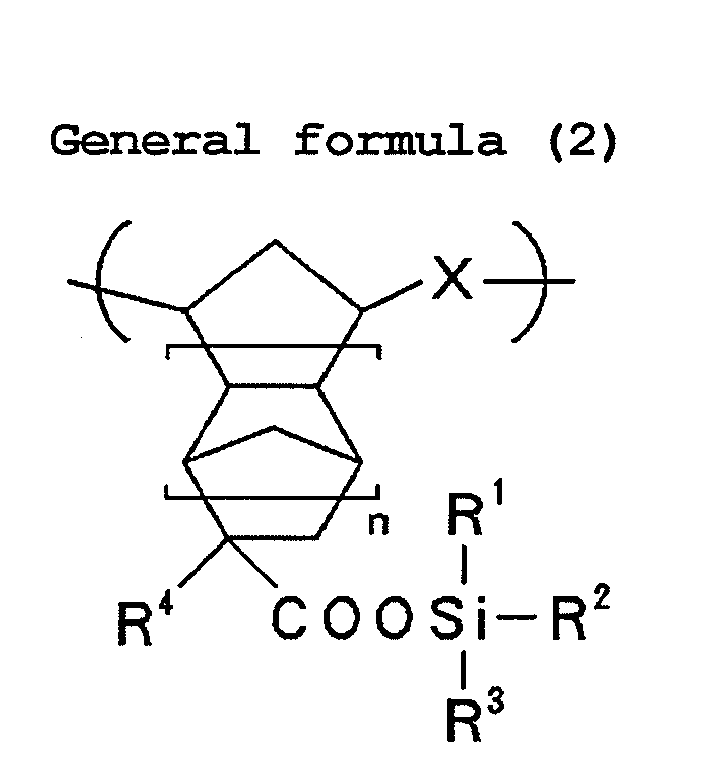
wherein n is 0 or 1, R1, R2, R3 and R4 mean, independently of one another, a hydrogen atom, halogen atom or monovalent organic group, and X denotes an ethylene or vinylene group.
Description
- The present invention relates to a novel (co)polymer having a specific silyl carboxylate residue, a production process thereof and a production process of a carboxyl group-containing (co)polymer.
- Transparent resins have heretofore been used as materials for automobile parts, lighting equipments, electric parts, etc., of which ordinary transparency is required, and polycarbonate resins and acrylic resins are known as such transparent resins.
With the demand for miniaturization, weight saving and high-density packaging of electronic apparatus in recent years, it is advanced to use a resin as an optical material, electronic material or the like. Such a resin is required to be excellent in properties such as thermal stability, mechanical strength, moisture absorption resistance, dimensional stability and solvent resistance in addition to optical transparency. In a liquid crystal display device, in which, for example, a glass substrate has heretofore been used, a resin substrate has come to be used in recent years for the purpose of saving weight lessening breakage upon falling. However, the resin used is required to have very high thermal stability from the viewpoint of the production process of the liquid crystal display device.
However, the acrylic resins involve problems in points of thermal resistance and water resistance (low water absorption property) and the like though they are excellent in transparency. On the other hand, the polycarbonate resins involve such problems that the index of birefringence is great though they are superb in thermal resistance and water resistance to the acrylic resins.
Recently, attention has been attracted to cycloolefin polymer resins as resins excellent in various properties such as transparency, water resistance, low birefringence and thermal resistance. As such cycloolefin polymer reins, have heretofore been proposed resins of various structures, such as addition (co)polymers and ring-opened (co)polymers of cycloolefin compounds, and hydrogenated products thereof (see, for example, Patent Art. 1 to Patent Art. 6). - On the other hand, Olefin copolymer elastomers such as ethylene/α-olefin copolymer elastomers and ethylene/α-olefin/nonconjugated polyene terpolymer elastomers are widely used as materials for automotive parts, mechanical parts, civil engineering and construction materials, etc. because they are elastomeric materials excellent in thermal resistance and weather resistance. The olefin copolymer elastomers are also widely used as modifiers for resins such as polypropylene and polyethylene.
However, such olefin copolymer elastomers involve problems that since they have neither polar group nor functional group in their molecular structures, their adhesiveness to metals, adhesiveness to and compatibility with other elastomers or resins than polyolefins are low, and so molded or formed products obtained from such elastomers are low in coating property and printability.
For such reasons, there have been proposed olefin copolymers with a functional group such as a carboxyl group or amino group introduced by using a cycloolefin compounds having such a functional group as a monomer (see, for example, Patent Art. 7 to Patent Art. 10). - However, no (co)polymer making use of a cycloolefin compound having a silyl carboxylate residue as a substituent group is known.
Since the silyl carboxylate residue is easily converted to a carboxyl group by subjecting the ester groupester group thereof to a hydrolyzing treatment, the cycloolefin compound having the silyl carboxylate residue is (co)polymerized, and the resultant (co)polymer is hydrolyzed, whereby a (co)polymer having a carboxyl group may be produced while avoiding side reactions. Therefore, such cycloolefin compound is advantageous. - Patent Art. 1: Japanese Patent Application Laid-Open No. 132625/1989;
- Patent Art. 2: Japanese Patent Application Laid-Open No. 132626/1989;
- Patent Art. 3: Japanese Patent Application Laid-Open No. 133413/1990;
- Patent Art. 4: Japanese Patent Application Laid-Open No. 120816/1986;
- Patent Art. 5: Japanese Patent Application Laid-Open No. 115912/1986;
- Patent Art. 6: Japanese Patent Application Laid-Open No. 218726/1988;
- Patent Art. 7: Japanese Patent Publication No. 43275/1974;
- Patent Art. 8: Japanese Patent Application Laid-Open No. 259012/1989;
- Patent Art. 9: Japanese Patent Application Laid-Open No. 54009/1989;
- Patent Art. 10: Japanese Patent Application Laid-Open (KOHYO) No. 503963/1992 (though PCT route).
- It is a first object of the present invention to provide a novel (co)polymer having a silyl carboxylate residue and a production process thereof.
A second object of the present invention is to provide a process for producing a carboxyl group-containing (co)polymer from the above (co)polymer. - A (co)polymer according to the present invention comprises a structural unit represented by the following general formula (1):
- [Chemical 1]

- wherein n is 0 or 1, and R1, R2, R3 and R4 mean, independently of one another, a hydrogen atom, halogen atom or monovalent organic group.
- A copolymer according to the present invention comprises the structural unit represented by the above general formula (1), a structural unit derived from ethylene and a structural unit derived from an α-olefin having 3 to 12 carbon atoms, and a structural unit derived from a nonconjugated polyene optionally used.
- In such a copolymer, it may be preferable that the content of the structural unit represented by the general formula (1) be 0.01 to 30 mol%, the content of the structural unit derived from ethylene be 40 to 90 mol%, the content of the structural unit derived from the α-olefin having 3 to 12 carbon atoms be 5 to 60 mol%, and the content of the structural unit derived from the nonconjugated polyene be 0 to 12 mol%.
- Another (co)polymer according to the present invention comprises a structural unit represented by the following general formula (2):
- [Chemical 2]

- wherein n is 0 or 1, R1, R2, R3 and R4 mean, independently of one another, a hydrogen atom, halogen atom or monovalent organic group, and X denotes an ethylene or vinylene group.
- Another copolymer according to the present invention comprises the structural unit represented by the above general formula (2) and a structural unit derived from any other cycloolefin compound.
- In the (co)polymers according to the present invention, R1, R2 and R3 in the above general formula (1) or the general formula (2) may preferably be, independently of one another, a hydrogen atom or a hydrocarbon group having 1 to 20 carbon atoms.
In the above general formula (1) or the general formula (2), R4 may preferably be a methyl group.
In the general formula (1) or the general formula (2), n may preferably be 1. - A process according to the present invention for producing a (co)polymer comprises the step of addition-polymerizing a monomer comprising at least a compound represented by the following general formula (3):
- [Chemical 3]

- wherein n is 0 or 1, and R1, R2, R3 and R4 mean, independently of one another, a hydrogen atom, halogen atom or monovalent organic group.
- A process according to the present invention for producing a copolymer comprises the step of addition-polymerizing the compound represented by the above general formula (3), ethylene and an α-olefin having 3 to 12 carbon atoms, and a nonconjugated polyene optionally used.
- A process according to the present invention for producing a (co)polymer comprises the step of ring-opening-polymerizing a monomer comprising at least the compound represented by the above general formula (3).
- A process according to the present invention for producing a copolymer comprises the step of ring-opening-polymerizing a monomer comprising the compound represented by the above general formula (3) and another cycloolefin compound copolymerizable with this compound.
- A process according to the present invention for producing a carboxyl group-containing (co)polymer comprises the step of subjecting an ester groupester group of the above-described (co)polymer to a hydrolyzing treatment.
- According to the (co)polymers of the present invention, effects characteristic of the silyl carboxylate residue that the (co)polymers have are brought about. For example, the silyl carboxylate residue is easily converted to a carboxyl group by subjecting the ester group thereof to a hydrolyzing treatment.
According to the (co)polymers of the present invention, carboxyl group-containing (co)polymers can be advantageously produced. - Fig. 1 illustrates an infrared absorption spectrum of a copolymer obtained in Example 1.
- The embodiments of the present invention will hereinafter be described in details.
The (co)polymer according to the present invention comprises a structural unit (hereinafter referred to as "specific structural unit (1)") represented by the above general formula (1) or a structural unit (hereinafter referred to as "specific structural unit (2)") represented by the above general formula (2). Such a (co)polymer is obtained from a monomer comprising at least a compound (hereinafter also referred to as "specific cycloolefin compound") represented by the above general formula (3). - In the general formulae (1) to (3), R1 to R3 are, independently of one another, a hydrogen atom, halogen atom or monovalent organic group, preferably a hydrogen atom or a hydrocarbon group having 1 to 20 carbon atoms. Specific examples of the hydrocarbon group having 1 to 20 carbon atoms include aliphatic hydrocarbon groups such as methyl, ethyl and butyl groups, alicyclic hydrocarbon groups such as a cyclohexyl group, and aromatic hydrocarbon groups such as a benzyl group.
R4 is a hydrogen atom, halogen atom or monovalent organic group, preferably a hydrocarbon group having 1 to 20 carbon atoms, more preferably a methyl group.
The value of the repetitive number n is 0 or 1, preferably 1.
In the general formula (2), X is an ethylene or vinylene group. - As specific examples of the specific cycloolefin compound, may be mentioned:
- trimethylsilyl 2-methylbicyclo[2.2.1]hept-5-ene-2-carboxylate,
- triethylsilyl 2-methylbicyclo[2.2.1.]hept-5-ene-2-carboxylate,
- t-butyldimethylsilyl 2-methylbicyclo[2.2.1]hept-5-ene-2-carboxylate,
- tri-n-butylsilyl 2-methylbicyclo[2.2.1]hept-5-ene-2-carboxylate,
- n-butyldimethylsilyl 2-methylbicyclo[2.2.1]hept-5-ene-2-carboxylate,
- cyclohexyldimethylsilyl 2-methylbicyclo[2.2.1]hept-5-ene-2-carboxylate,
- tribenzylsilyl 2-methylbicyclo[2.2.1]hept-5-ene-2-carboxylate,
- trimethylsilyl bicyclo[2.2.1]hept-5-ene-2-carboxylate,
- triethylsilyl bicyclo[2.2.1]hept-5-ene-2-carboxylate,
- t-butyldimethylsilyl bicyclo[2.2.1]hept-5-ene-2-carboxylate,
- tri-n-butylsilyl bicyclo[2.2.1]hept-5-ene-2-carboxylate,
- n-butyldimethylsilyl bicyclo[2.2.1]hept-5-ene-2-carboxylate,
- cyclohexyldimethylsilyl bicyclo[2.2.1]hept-5-ene-2-carboxylate,
- tribenzylsilyl bicyclo[2.2.1]hept-5-ene-2-carboxylate,
- trimethylsilyl 2-ethylbicyclo[2.2.1]hept-5-ene-2-carboxylate,
- triethylsilyl 2-ethylbicyclo[2.2.1]hept-5-ene-2-carboxylate,
- t-butyldimethylsilyl 2-ethylbicyclo[2.2.1]hept-5-ene-2-carboxylate,
- tri-n-butylsilyl 2-ethylbicyclo[2.2.1]hept-5-ene-2-carboxylate,
- n-butyldimethylsilyl 2-ethylbicyclo[2.2.1]hept-5-ene-2-carboxylate,
- cyclohexyldimethylsilyl 2-ethylbicyclo[2.2.1]hept-5-ene-2-carboxylate,
- tribenzylsilyl 2-ethylbicyclo[2.2.1]hept-5-ene-2-carboxylate,
- trimethylsilyl 4-methyltetracyclo[6.2.1.13,6.02,7]-dodec-9-ene-4-carboxylate,
triethylsilyl 4-methyltetracyclo[6.2.1.13,6.02,7]-dodec-9-ene-4-carboxylate,
t-butyldimethylsilyl 4-methyltetracyclo[6.2.1.13,6. 02,7]dodec-9-ene-4-carboxylate,
n-butyldimethylsilyl 4-methyltetracyclo[6.2.1.13,6. 02,7]dodec-9-ene-4-carboxylate,
cyclohexyldimethylsilyl 4-methyltetracyclo[6.2.1.13,6. 02,7]dodec-9-ene-4-carboxylate,
allyldichlorosilyl 4-methyltetracyclo[6.2.1.13,6.02,7]-dodec-9-ene-4-carboxylate,
diallylchlorosilyl 4-methyltetracyclo[6.2.1.13,6.02,7]-dodec-9-ene-4-carboxylate,
vinyldimethylsilyl 4-methyltetracyclo[6.2.1.13,6.02,7]-dodec-9-ene-4-carboxylate,
chloromethyldimethylsilyl 4-methyltetracyclo-[6.2.1.13,6.02,7]dodec-9-ene-4-carboxylate,
t-butylphenylchlorosilyl 4-methyltetracyclo-[6.2.1.13,6.02,7]dodec-9-ene-4-carboxylate,
tribenzylsilyl 4-methyltetracyclo[6.2.1.13,6.02,7]-dodec-9-ene-4-carboxylate,
dimethylsilyl 4-methyltetracyclo[6.2.1.13,6.02,7]-dodec-9-ene-4-carboxylate, - trimethylsilyl tetracyclo[6.2.1.13,6.02,7]dodec-9-ene- 4-carboxylate,
triethylsilyl tetracyclo[6.2.1.13,6.02,7]dodec-9-ene-4-carboxylate,
t-butyldimethylsilyl tetracyclo[6.2.1.13,6.02,7]dodec-9-ene-4-carboxylate,
n-butyldimethylsilyl tetracyclo[6.2.1.13,6.02,7] dodec-9-ene-4-carboxylate,
cyclohexyldimethylsilyl tetracyclo[6.2.1.13,6.02,7]-dodec-9-ene-4-carboxylate,
allyldichlosilyl tetracyclo[6.2.1.13,6.02,7]dodec-9-ene-4-carboxylate,
diallylchlorosilyl tetracyclo[6.2.1.13,6.02,7]dodec-9-ene-4-carboxylate,
vinyldimethylsilyl tetracyclo[6.2.1.13,6.02,7]dodec-9-ene-4-carboxylate,
chloromethyldimethylsilyl tetracyclo[6.2.1.13,6.02,7]-dodec-9-ene-4-carboxylate,
t-butylphenylchlorosilyl tetracyclo[6.2.1.13,6.02,7]-dodec-9-ene-4-carboxylate,
tribenzylsilyl tetracyclo[6.2.1.13,6.02,7]dodec-9-ene-4-carboxylate,
dimethylsilyl tetracyclo[6.2.1.13,6.02,7]dodec-9-ene-4-carboxylate,
trimethylsilyl 4-ethyltetracyclo[6.2.1.13,6.02,7]dodec-9-ene-4-carboxylate,
t-butyldimethylsilyl 4-ethyltetracyclo-[6.2.1.13,6.02,7]dodec-9-ene-4-carboxylate,
trimethylsilyl 4-chlorotetracyclo[6.2.1.13,6.02,7]-dodec-9-ene-4-carboxylate,
t-butyldimethylsilyl 4-chloroltetracyclo-[6.2.1.13,6.02,7]dodec-9-ene-4-carboxylate,
trimethylsilyl 4-methoxytetracyclo[6.2.1.13,6.02,7]-dodec-9-ene-4-carboxylate, and
t-butyldimethylsilyl 4-methoxytetracyclo-[6.2.1.13,6.02,7]dodec-9-ene-4-carboxylate.
These compounds may be used either singly or in any combination thereof. - Among these, those preferred from the viewpoints of polymerizability of the compounds and stability and the like of the resulting (co)polymers are
trimethylsilyl 2-methylbicyclo[2.2.1]hept-5-ene-2-carboxylate,
triethylsilyl 2-methylbicyclo[2.2.1]hept-5-ene-2-carboxylate,
t-butyldimethylsilyl 2-methylbicyclo[2.2.1]hept-5-ene-2-carboxylate,
tri-n-butylsilyl 2-methylbicyclo[2.2.1]hept-5-ene-2-carboxylate,
n-butyldimethylsilyl 2-methylbicyclo[2.2.1]hept-5-ene-2-carboxylate,
cyclohexyldimethylsilyl 2-methylbicyclo[2.2.1]hept-5-ene-2-carboxylate,
tribenzylsilyl 2-methylbicyclo[2.2.1]hept-5-ene-2-carboxylate,
trimethylsilyl 4-methyltetracyclo[6.2.1.13,6.02,7]-dodec-9-ene-4-carboxylate,
triethylsilyl 4-methyltetracyclo[6.2.1.13,6.02,7]-dodec-9-ene-4-carboxylate,
t-butyldimethylsilyl 4-methyltetracyclo[6.2.1.13,6. 02,7]dodec-9-ene-4-carboxylate,
n-butyldimethylsilyl 4-methyltetracyclo[6.2.1.13,6. 02,7]dodec-9-ene-4-carboxylate,
cyclohexyldimethylsilyl 4-methyltetracyclo[6.2.1.13,6. 02,7]dodec-9-ene-4-carboxylate, and
tribenzylsilyl 4-methyltetracyclo[6.2.1.13,6.02,7]-dodec-9-ene-4-carboxylate.
As particularly preferred compounds, may be mentioned: - trimethylsilyl 4-methyltetracyclo[6.2.1.13,6.02,7]-dodec-9-ene-4-carboxylate,
- triethylsilyl 4-methyltetracyclo[6.2.1.13,6.02,7]-dodec-9-ene-4-carboxylate,
- t-butyldimethylsilyl 4-methyltetracyclo[6.2.1.13,6. 02,7]dodec-9-ene-4-carboxylate,
- n-butyldimethylsilyl 4-methyltetracyclo[6.2.1.13,6. 02,7]dodec-9-ene-4-carboxylate, and
- cyclohexyldimethylsilyl 4-methyltetracyclo[6.2.1.13,6. 02,7]dodec-9-ene-4-carboxylate.
- Such a specific cycloolefin compound is obtained by, for example, reacting a cycloolefin compound represented by the following general formula (4) with a chlorosilane represented by the following general formula (5) or a silylamine represented by the following general formula (6):
- [Chemical 4]

- [In the general formula (4), n is 0 or 1, R4 means a hydrogen atom, halogen atom or monovalent organic group, and R5 denotes a hydrogen atom or alkali metal.]
- [Chemical 5]

- [In the general formula (5), R1, R2 and R3 mean, independently of one another, a hydrogen atom, halogen atom or monovalent organic group.]
- [Chemical 6]

- [In the general formula (6), R6, R7 and R8 mean, independently of one another, a hydrogen atom, an alkyl group having 1 to 20 carbon atoms or a group represented by the following general formula (7), with the proviso that at least one of R6 to R8 is the group represented by the following general formula (7).]
- [Chemical 7]

- [In the general formula (7), R1, R2 and R3 mean, independently of one another, a hydrogen atom, halogen atom or monovalent organic group.]
- As specific examples of the chlorosilane represented by the general formula (5), may be mentioned trimethyl- chlorosilane, t-butyldimethylchlorosilane, n-butyldimethyl- chlorosilane, t-butyldiphenylchlorosilane, t-butylphenyl- dichlorosilane, dimethylchlorosilane, dimethyldichloro- silane, diallyldichlorosilane, allyltrichlorosilane, vinyl- dimethylchlorosilane, tribenzylchlorosilane, hexyldimethyl- chlorosilane and tri-n-butylchlorosilane.
As specific examples of the silylamine represented by the general formula (6), may be mentioned hexamethyldisilazane, 1,3-bis(chloromethyl)tetramethyldisilazane, N,N-dimethylaminotrimethylsilane, N,N-diethylamino-trimethylsilane, nanomethyltrisilazane and 1,1,3,3-tetra-methyldisilazane. - The (co)polymers according to the present invention are addition (co)polymers or ring-opened (co)polymers of a monomer comprising the specific cycloolefin compound, or hydrogenated products thereof. Specifically, the following forms may be mentioned.
- (1) Addition polymer (hereinafter referred to as "specific addition polymer") of the specific cycloolefin compound alone.
- (2) Addition copolymer (hereinafter referred to as "specific addition copolymer") of the specific cycloolefin compound and a compound (hereinafter referred to as "addition-copolymerizable compound") addition-copolymerizable with this compound.
- (3) Ring-opened polymer (hereinafter referred to as "specific ring-opened polymer") of the specific cycloolefin compound alone.
- (4) Ring-opened copolymer (hereinafter referred to as "specific ring-opened copolymer") of the specific cycloolefin compound and a compound (hereinafter referred to as "ring-opening-copolymerizable compound") ring-opening-copolymerizable with this compound.
- (5) Hydrogenated product (hereinafter referred to as "specific hydrogenated ring-opened (co)polymer") of (3) the ring-opened polymer or (4) the ring-opened copolymer.
Of these, the specific addition polymer, specific ring-opened polymer, specific ring-opened copolymer and specific hydrogenated ring-opened (co)polymer are generally used as resins, and the specific addition copolymer is used as a resin or an elastomer according to the kind and proportion of the addition-copolymerizable compound used. - The specific addition polymer and specific addition copolymer (hereinafter referred to as "specific addition (co)polymer" generically) have the specific structural unit (1) and is obtained by subjecting a monomer comprising at least the specific cycloolefin compound, specifically a monomer composed of the specific cycloolefin compound alone or a monomer composed of the specific cycloolefin compound and the addition-copolymerizable compound to an addition-polymerizing treatment.
When the specific addition copolymer is used as a resin, another cycloolefin compound (hereinafter referred to as "another cycloolefin compound") than the specific cycloolefin compound and/or another addition-copolymerizable compound (hereinafter referred to as "another addition-copolymerizable compound") than the cycloolefin compound, such as ethylene, propylene, 1-butene, 1-pentene, 4-methyl-pentene-1, 1-hexene, 1-heptene, 1-octene, 1-decene, 1-dodecene, styrene or p-methylstyrene, may be used as an addition-copolymerizable compound for obtaining the specific addition copolymer. - As another cycloolefin compound, may be used a polar cycloolefin compound having a halogen atom or polar group. A non-polar cycloolefin compound having neither halogen atom nor polar group may also be used. Both compounds may also be used in combination.
- Specific examples of polar cycloolefin compounds among other cycloolefin compounds include:
- norbornene derivatives having substituted or unsubstituted silyl group such as 5-trimethoxysilyl-2-norbornene, 5-chlorodimethoxy- silyl-2-norbornene, 5-dichloromethoxysilyl-2-norbornene, 5-chloromethoxymethylsilyl-2-norbornene, 5-methoxymethylhydrosilyl-2-norbornene, 5-dimethoxyhydrosilyl-2-norbornene, 5-methoxydimethylsilyl-2-norbornene, 5-triethoxysilyl-2-norbornene, 5-chlorodiethoxysilyl-2-norbornene, 5-dichloro- ethoxysilyl-2-norbornene, 5-chloroethoxymethylsilyl-2- norbornene, 5-diethoxyhydrosilyl-2-norbornene, 5-ethoxy- dimethylsilyl-2-norbornene, 5-ethoxydiethylsilyl-2-norbornene, 5-tripropoxysilyl-2-norbornene, 5-triisopropoxysilyl-2-norbornene, 5-triphenoxysilyl-2-norbornene, 5-diphenoxymethylsilyl-2-norbornene, 5-trifluorosilyl-2-norbornene, 5-trichlorosilyl-2-norbornene, 5-tribromosilyl-2-norbornene, 5-(2',6',7'-trioxa-1'-silabicyclo[2.2.2]octyl)bicyclo[2.2.1]hept-2-ene, 5-(4'-methyl-2',6',7'-trioxa-1'-silabicyclo[2.2.2]octyl)-bicyclo[2.2.1]hept-2-ene, 5(1'-methyl-2',5'-dioxa-1'-silacyclopentyl)bicyclo[2.2.1]hept-2-ene, 5-trimethoxy-silylmethyl-2-norbornene, 5-(1-trimethoxysilyl)ethyl-2-norbornene, 5-(2-trimethoxysilyl)ethyl-2-norbornene, 5-(1-chlorodimethoxy- silyl)ethyl-2-norbornene, 5-(2-chlorodimethoxysilyl)ethyl- 2-norobornene, 5-triethoxysilylmethyl-2-norbornene, 5-(1-triethoxysilyl)ethyl-2-norbornene, 5-(2-triethoxysilyl)-ethyl-2-norbornene, 5-(1-chlorodiethoxysilyl)ethyl-2-norbornene, 5-(2-chlorodiethoxysilyl)ethyl-2-norbornene, 5-(2-trimethoxysilyl)propyl-2-norbornene, 5-(3-trimethoxysilyl)propyl-2-norbornene, 5-(2-triethoxysilyl)propyl-2-norbornene, 5-(3-triethoxysilyl)propyl-2-norbornene, trimethoxysilylpropyl 5-norbornene-2-carboxylate, triethoxysilylpropyl 5-norbornene-2-carboxylate, dimethoxymethylsilylpropyl 5-norbornene-2-carboxylate, trimethoxysilylpropyl 2-methyl-5-norbornene-2-carboxylate, dimethoxymethylsilylpropyl 2-methyl-5-norbornene-2-carboxylate and triethoxysilylpropyl 2-methyl-5-norbornene-2-carboxylate,
- norbornene derivatives each having a substituted or unsubstituted alkylcarbonyl group, alkyloxycarbonyl group, alkylcarbonyloxy group or alkenylcarbonyloxy group, such as 2-acetyl-5-norbornene, methyl 5-norbornene-2-carboxylate, ethyl 5-norbornene-2-carboxylate, t-butyl 5-norbornene-2-carboxylate, methyl 2-methyl-5-norbornene-2-carboxylate, ethyl 2-methyl-5-norbornene-2-carboxylate, t-butyl 2-methyl-5-norbornene-2-carboxylate, trifluoromethyl 2-methyl-5-norbornene-2-carboxylate, 5-norbornen-2-yl acetate, 2-methyl-5-norborne-2-yl acetate, 2-methyl-5-norborne-2-yl acrylate, 2-methyl-5-norborn-2-yl methacrylate and dimethyl 5-norbornene-2,3-dicarboxylate,
norbornene derivatives having carboxylic anhydride residue such as 5- norbornene-2,3-dicarboxylic anhydride,
tetracyclododecene derivatives having a polar group, such as methyl 4-methyltetracyclo[6.2.1.13,6.02,7]dodec-9-ene-4-carboxylate, and
spiro ring compounds represented by the following formula (i) or formula (ii).
These compounds may be used either singly or in any combination thereof. - [Chemical 8]

- Specific examples of nonpolar olefin compounds among other cycloolefin compounds include:
- unsubstituted or alkyl group-substituted cycloolefin compounds such as 2-norbornene, 5-methyl-2-norbornene, 5-ethyl-2-norbornene, 5-isopropyl-2-norbornene, 5-butyl-2-norbornene, 5-t-butyl-2-norbornene, 5-hexyl-2-norbornene, 5-decyl-2-norbornene, tricyclo[4.3.0.12,5]dec-3-ene, tetracyclo[4.4.0.12,5.17,10]dodec-3-ene, 8-methyltetracyclo-[4.4.0.12,5.17,10]dodec-3-ene, 8-ethyltetracyclo-[4.4.0.12,5.17,10]dodec-3-ene, tricyclo[4.4.0.12,5]undec-3-ene and tricyclo[4.3.0.12,5]dec-3,7-diene (dicyclopentadiene),
- aryl group- or aralkyl group-substituted cycloolefin compounds such as 5-phenyl-2-norbornene, 5-methyl-5-phenyl-2-norbornene, 5-benzylnorbornene, 5-naphthyl-2-norbornene, 5-biphenyl-2-norbornene, 1,4-methano-1,4-dihydronaphthalene (benzonorbornene) and 1,4-methano-1,4,4a,9a-tetrahydrofluorene, and
- alkylidene group-substituted cycloolefin compounds such as 5-ethylidene-2-norbornene.
- These compounds may be used either singly or in any combination thereof.
- The content of the specific structural unit (1) in the resinous specific addition copolymer is preferably at least 0.1 mol%, more preferably at least 1 mol%. If the content of the specific structural unit (1) is too low, the effect by having the silyl carboxylate residue may not be sufficiently brought about in some cases.
- The addition-polymerizing treatment for obtaining the resinous specific addition (co)polymer is preferably conducted by feeding a monomer comprising the specific cycloolefin compound and a polymerization catalyst to a reactor under an atmosphere of an inert gas such as nitrogen or argon under conditions that the temperature of the reaction system is -20°C to 100°C in the presence of a proper solvent or diluent.
When a multicomponent catalyst is used as a polymerization catalyst, respective components in the polymerization catalyst may be independently fed to the reactor, or the respective components may be mixed in advance and then fed to the reactor. No particular limitation is also imposed on the feeding order of the respective components. - As the solvent or diluent for conducting the addition-polymerizing treatment, may be used a hydrocarbon, and specific examples thereof include alicyclic hydrocarbon solvents such as cyclohexane, cyclopentane and methylcyclopentane, aliphatic hydrocarbon solvents such as pentane, hexane, heptane and octane, and aromatic hydrocarbon solvents such as toluene, benzene and xylene. These compounds may be used either singly or in any combination thereof. A ratio of the solvent to the monomer is preferably 1 to 20 in terms of a weight ratio of the solvent/the monomer.
- In the case where a monomer composed only of cycloolefin compounds (specific cycloolefin compound and another cycloolefin compound) are used as the monomer, as an addition polymerization catalyst for conducting the addition-polymerizing treatment, may be used a unicomponent complex catalyst or multicomponent catalyst comprising a metal such as palladium, nickel, cobalt, titanium or zirconium, which is shown in the following catalysts [1] to [3]. However, the catalyst is not limited thereto.
- [1] Unicomponent complex catalyst comprising Pd, Ni or the like:
- Examples of this kind of catalyst include:
- [Pd(CH3CN)4][BF4]2, [Pd(PhCN)4][SbF6],
- [(η3-crotyl)Pd(cyclo-oct-1,5-diene)][PF6],
- [(η3-crotyl)Ni(cyclooct-1,5-diene)]- [B(3,5-(CF3)2C6F3)4],
- [(η3-crotyl)Ni(cyclooct-1,5-diene)]- [PF6],
- [(η3-allyl)Ni(cyclooct-1,5-diene)]B(C6F5)4],
- [(η3-crotyl)Ni(cyclooct-1,5-diene)][SbF6],
- toluene·Ni(C6F5)2, benzene·Ni(C6F5)2,
- mesitylene·Ni(C6F5)2 and ethyl ether·Ni(C6F5)2.
- [2] Multicomponent catalyst composed of a combination of a palladium complex having a σ- or, σ- and π-bond and an organic aluminum or superstrong acid salt:
- Examples of this kind of catalyst include:
- a combination of di-µ-chloro-bis(6-methoxybicyclo[2.2.1]-hept-2-ene-endo-5σ,2π)Pd and a compound selected from methyl alumoxane (abbreviated as MAO), AgSbF6 and AgBF4, a combination of [(η3-allyl)PdCl]2 and AgSbF6 or AgBF4, and a combination of [1,5-COD]Pd(CH3)Cl], PPh3 and NaB[3,5-(CF3)2C6H3]4.
- Examples of this kind of catalyst include:
- [3] Multicomponent catalyst comprising 1) a transition metal compound selected from a nickel compound, a palladium compound, a cobalt compound, titanium compound and a zirconium compound, 2) a compound selected from a superstrong acid, a Lewis acid and an ionic boron compound or 3) an organoaluminum compound.
- In the case where a monomer composed of the cycloolefin compounds and another addition-copolymerizable compound are used as the monomer, as an addition polymerization catalyst for conducting the addition-polymerizing treatment, may be used an olefin copolymerization catalyst for obtaining an elastomeric specific addition (co)polymer which will be described subsequently.
- The molecular weight modification of the specific addition (co)polymer obtained in the resinous addition-polymerizing treatment can be conducted by a method such as addition of a molecular weight modifier, control of the amount of a polymerization catalyst, control of a polymerization temperature or control of a conversion into a polymer. As the molecular weight modifier, may be used an α-olefin, hydrogen, a cyclic nonconjugated diene, an aromatic vinyl compound or the like.
The termination of a polymerization reaction in the addition-polymerizing treatment can be conducted by adding a compound selected from water, an alcohol, an organic acid, carbon dioxide gas and the like.
A reactor used for conducting the addition-polymerizing treatment may be of either a batch type or a continuous type. As the continuous type reactor, may be used a tube type reactor, a tower type reactor, a vessel type reactor or the like. - The resinous specific addition (co)polymer is obtained by adding a polymer solution after the addition-polymerizing treatment to a poor solvent such as an alcohol, for example, methanol, ethanol or isopropanol to precipitate a formed product and drying the formed product under reduced pressure. In this process, an unreacted monomer remaining in the polymer solution is also removed.
The polymer solution may also be subjected to a separating or removing treatment of a polymerization catalyst residue as needed. As a process for such a separating or removing treatment, may be suitably used any publicly known process. As a specific process, may be used a process, in which an inorganic acid such as hydrochloric acid, nitric acid or sulfuric acid, or an organic acid such as maleic acid or fumaric acid is added to the polymer solution, and the resultant mixture is then washed with water or an alcohol. An adsorption process making use of a proper adsorbent may also be used. - In the resinous specific addition (co)polymer obtained in such a manner, its weight average molecular weight in terms of polystyrene equivalent as measured by gel permeation chromatography using, for example, o-dichloro- benzene as a solvent is preferably 5,000 to 1,500,000, more preferably 10,000 to 1,000,000.
If the weight average molecular weight is lower than 5,000, the breaking strength of a film, thin film or sheet formed from such a specific addition (co)polymer may become insufficient in some cases, and its solvent resistance, liquid crystal resistance and the like may become low. If the weight average molecular weight exceeds 1,500,000 on the other hand, the forming and processing ability of such a specific addition (co)polymer into a sheet or film may become low in some cases, or the solution viscosity of a resin solution upon production of a film from the specific addition (co)polymer by a solvent casting process may become high, and so its handling may become inconvenient. - The resinous specific addition (co)polymer may be molded or formed into a molded or formed product by a method such as injection molding, blow molding, press molding or extrusion. The specific addition (co)polymer may also be formed into a thin film, film or sheet by dissolving it in a solvent selected from hydrocarbon solvents, halogenated hydrocarbon solvents, and polar solvents such as ketones, ethers, esters, amines, amides and urea and then going through a casting step and an evaporating step. The specific addition (co)polymer may also be formed and processed into a film or sheet by swelling it with any of these solvents and thereafter, evaporating the solvent by an extruder.
- When the specific addition copolymer is used as an elastomer, such a specific addition copolymer is preferably a copolymer of ethylene, an α-olefin having 3 to 12 carbon atoms and the specific cycloolefin compound, and a conjugated polyene optionally used.
Specific examples of the α-olefin having 3 to 12 carbon atoms include propylene, 1-butene, 1-pentene, 4-methyl-1-pentene, 1-hexene, 1-heptene, 1-octene, 1-decene, 1-dodecene, styrene and p-methylstyrene. These compounds may be used either singly or in any combination thereof. When such an α-olefin having at most 12 carbon atoms is used, the copolymerizability of such an α-olefin with other compounds is liable to become satisfactory.
Specific examples of the nonconjugated polyene include linear acyclic dienes such as 1,4-hexadiene, 1,6-octadiene and 1,5-hexadiene, branched-chain acyclic dienes such as 5-methyl-1,4-hexadiene, 3,7-dimethyl-1,6-octadiene, 5,7-dimethyl-1,6-octadiene, 3,7-dimethyl-1,7-octadiene, 7-methyl-1,6-octadiene and dihydromyrcene, and alicyclic dienes such as tetrahydroindene, methyltetrahydroindene, dicyclopentadiene, bicyclo[2.2.1]hept-2,5-diene, 5-methylene-2-norbornene, 5-ethylidene-2-norbornene, 5-propenyl-2-norbornene, 5-isopropylidene-2-norbornene, 5-cyclohexylidene-2-norbornene and 5-vinyl-2-norbornene. These compounds may be used either singly or in any combination thereof.
Of the above-mentioned nonconjugated polyenes, are preferred 1,4-hexadiene, 5-methylene-2-norbornene and 5-ethylidene-2-norbornene. - In such an elastomeric specific addition copolymer, it may be preferable that the content of the specific structural unit (1) be 0.01 to 30 mol%, the content of the structural unit derived from ethylene be 40 to 90 mol%, the content of the structural unit derived from the α-olefin having 3 to 12 carbon atoms be 5 to 60 mol%, and the content of the structural unit derived from the nonconjugated polyene be 0 to 12 mol%.
If the content of the specific structural unit (1) is too low, the effect by having the silyl carboxylate residue may not be sufficiently brought about in some cases. If the content of the specific structural unit (1) is too high on the other hand, it may be difficult to conduct copolymerization with other compounds. In addition, it may be difficult to provide a copolymer having sufficient rubber elasticity as an elastomer. As a result that the amount of the polymerization catalyst used becomes great, it may be difficult to provide a copolymer having a high molecular weight.
If the content of the structural unit derived from ethylene is too low, it may be difficult in some cases to conduct copolymerization of the monomer. In addition, it may be difficult to provide an elastomer having excellent durability. If the content of the structural unit derived from ethylene is too high on the other hand, it may be difficult to provide a copolymer exhibiting behavior as an elastomer.
If the content of the structural unit derived from the α-olefin is too low, it may be difficult in some cases to provide an elastomer having sufficient elasticity. If the content of the structural unit derived from the α-olefin is too high on the other hand, it may be difficult to provide an elastomer having good durability.
If the content of the structural unit derived from the nonconjugated polyene is too high, it may be difficult in some cases to provide an elastomer having good durability. - The addition-polymerizing treatment for obtaining the elastomeric specific addition copolymer is preferably conducted by feeding ethylene, the α-olefin having 3 to 12 carbon atoms and the specific cycloolefin compound, and the conjugated diene optionally used to a reactor under an atmosphere of an inert gas such as nitrogen or argon under conditions that the temperature of the reaction system is 0°C to 150°C, particularly 10°C to 100°C in the presence of a proper solvent or diluent.
- As a catalyst for conducting the addition-polymerization treatment, an olefin copolymerization catalyst capable of providing a copolymer, in which the respective structural units are arranged at comparatively random in a copolymerization reaction of the specific cycloolefin compound, ethylene and the α-olefin, and the nonconjugated polyene optionally used, is preferably used. As such an olefin copolymerization catalyst, is preferably used a catalyst composed of a transition metal compound, preferably a compound of a metal selected from metals of Groups 4 and 5 of the periodic table, and an organoaluminum compound. Specific examples of the catalyst system include the following systems:
- (1) A catalyst system composed of a hydrocarbon compound-soluble vanadium compound and an organoaluminum compound, in which at least one chlorine atom is contained in any one or both of the vanadium compound and the organoaluminum compound.
In this catalyst system, as the vanadium compound, may be used a compound represented by the following general formula (8-1), VCl4, VO(acac)2, V(acac)3 (in which "acac" means an acetylacetonato group), or a compound represented by the following general formula (8-2). - General formula (8-1): O=VClk(OR11)3-k
wherein R11 means a hydrocarbon group such as an ethyl, propyl, butyl or hexyl group, and k denotes an integer of 0 to 3.
General formula (8-2): VCl3·mZ
wherein Z means a Lewis base capable of forming a complex soluble in hydrocarbon compounds, such as tetrahydrofuran, 2-methyltetrahydrofuran, 2-methoxymethyltetrahydrofuran or dimethylpyridine, and m denotes an integer of 2 or 3. - As the organoaluminum compound, may be used a trialkylaluminum compound represented by the following general formula (8-3), an alkylaluminum hydride represented by the following general formula (8-4) or (8-5), an alkylaluminum chloride represented by the following general formula (8-6), (8-7) or (8-8), an alkoxy- or phenoxy-substituted organoaluminum compound represented by the following general formula (8-9) or (8-10), or methylalumoxane (MAO), ethylalumoxane or butylalumoxane obtained by a reaction of water with the above-described trialkylaluminum compound.
- General formula (8-3): AlR12 3
General formula (8-4): HAlR12 2
General formula (8-5): H2AlR12
General formula (8-6): R12AlCl2
General formula (8-7): R12 3Al2Cl3
General formula (8-8): R12 2AlCl
General formula (8-9): R12 2Al(OR13)
General formula (8-10): R12Al(OR13)2.
(In the general formulae (8-3) to (8-10), R12 means a hydrocarbon group such as a methyl, ethyl, propyl, butyl or hexyl group, and R13 denotes a methyl, ethyl, propyl, butyl, octyl, phenyl, tolylxylyl, 2,6-di-t-butylphenyl, 4-methyl-2,6-di-t-butylphenyl, 2,6-dimethylphenyl or 4-methyl-2,6-dimethylphenyl group.) - In this catalyst system, an oxygen- or nitrogen-containing electron donor such as an ester of an organic acid or inorganic acid, ether, amine, ketone or alkoxysilane may be additionally added to the vanadium compound and organoaluminum compound.
- (2) A catalyst system composed of a titanium halide or zirconium halide carried on a carrier composed of silica or magnesium chloride, and an organoaluminum compound.
In this catalyst system, as the titanium halide or zirconium halide, may be used titanium tetrachloride, titanium tetrabromide, zirconium tetrachloride or the like.
As the organoaluminum compound, may be used trimethylaluminum, triethylaluminum, triisobutylaluminum, methylalumoxane or the like.
In this catalyst system, dioctyl phthalate, tetraalkoxysilane, diphenyldimethoxysilane or the like may be additionally added to the above-described compounds. - (3) A catalyst system composed of a transition metal compound comprising a metal selected from titanium, zirconium and hafnium, which has one or two cyclopentadienyl or indenyl groups as a ligand each having a substituent selected from hydrogen, an alkyl group and an allyl group, and an organoaluminum compound containing at least 50 mol% of methylalumoxane.
As specific examples of the transition metal compound, may be mentioned bis(cyclopentadienyl)dimethylzirconium, bis(cyclopentadienyl)diethylzirconium, bis(cyclopentadienyl)methylzirconium monochloride, ethylenebis-(cyclopentadienyl)zirconium dichloride, ethylenebis-(cyclopentadienyl)methylzirconium monochloride, methylenebis(cyclopentadienyl)zirconium dichloride, ethylenebis(indenyl)zirconium dichloride, ethylenebis-(indenyl)dimethylzirconium, ethylenebis(indenyl)-diphenylzirconium, ethylenebis(4,5,6,7-tetrahydro-1-indenyl)dimethylzirconium, ethylenebis(4-methyl-1-indenyl)zirconium dichloride, ethylenebis(2,3-dimethyl-1-indenyl)zirconium dichloride, dimethylsilylbis-(cyclopentadienyl)zirconium dichloride, dimethylsilyl-bis(indenyl)zirconium dichloride, dimethylsilylbis-(dimethylcyclopentadienyl)zirconium dichloride, dimethylmethyl(fluorenyl)(cyclopentadienyl)zirconium dichloride, diphenylmethyl(fluorenyl)(cyclopentadienyl)-zirconium dichloride, diphenylsilylbis(indenyl)zirconium dichloride, dimethylsilylbis(2-methyl-4-phenylindenyl)-zirconium dichloride, bis(cyclopentadienyl)dimethyl-titanium, bis(cyclopentadienyl)methyltitanium monochloride, ethylenebis(indenyl)titanium dichloride, ethylenebis(4,5,6,7-tetrahydro-1-indenyl)titanium dichloride, methylenebis(cyclopentadienyl)titanium dichloride and η1:η5-{[(tert-butyl-amido)dimethylsilyl]-(2,3,4,5-tetramethyl-1-cyclopentadienyl)}titanium dichloride. - (4) A catalyst system composed of a complex of a transition metal of Group 4 of the periodic table, which has a bisalkyl-substituted or N-alkyl-substituted salicylaldoimine as a ligand, and methylalumoxane (MAO).
- As the solvent or diluent for conducting the addition-polymerizing treatment, may be used, for example, an aliphatic hydrocarbon, an alicyclic hydrocarbon, an aromatic hydrocarbon or a halide thereof. Specific examples thereof include butane, pentane, hexane, heptane, 2-butene, 2-methyl-2-butene , cyclopentane, methylcyclopentane, cyclohexane, isooctane, benzene, toluene, xylene, chlorobenzene, dichloromethane and dichloroethane. These solvents or diluents may preferably be used in a state that a water content has been lowered to 20 ppm or lower by a distilling treatment or adsorbing treatment.
- The molecular weight modification of the specific addition copolymer obtained in such an addition-polymerizing treatment can be conducted by a method such as addition of a molecular weight modifier, control of the amount of a polymerization catalyst, control of a polymerization temperature or control of a conversion into a polymer. As the molecular weight modifier, may be used hydrogen, diethylzinc, diisobutylaluminum hydride or the like.
A reactor used for conducting the addition-polymerizing treatment may be any of the batch type and the continuous type. As the continuous type reactor, may be used a tube type reactor, tower type reactor, vessel type reactor or the like. - The elastomeric specific addition copolymer is obtained by blowing steam into a polymer solution, thereby conducting a removal treatment of the solvent, separating solids from the resulting slurry and then conducting dehydrating and drying by means of a screw type squeezer, extruder, heated roll or the like. Alternatively, the polymer solution is heated to concentrate it, and the concentrate is then dried by means of a vented extruder, thereby obtaining the specific addition copolymer.
Further, the polymer solution may be subjected to a separating or removing treatment of a polymerization catalyst residue as needed. As a specific method for such a separating or removing treatment, may be used a method in which the polymer solution is passed through an adsorption column packed with silica, alumina, diatomaceous earth or the like, or a method in which a great amount of water, alcohol or the like is added to the polymer solution to wash it. - In the elastomeric specific addition copolymer obtained in such a manner, its weight average molecular weight in terms of polystyrene equivalent as measured by gel permeation chromatography using, for example, o-dichloro- benzene as a solvent is preferably 1,000 to 3,000,000, more preferably 3,000 to 1,000,000, particularly preferably 5,000 to 700,000.
The glass transition temperature of the elastomeric specific addition copolymer is preferably -90 to 50°C, particularly preferably -70 to 10°C, thereby providing an elastomer having sufficient elasticity.
In the present invention, the glass transition temperature can be measured by means of a differential scanning calorimeter (DSC). - The specific ring-opened polymer and specific ring-opened copolymer (hereinafter referred to as "specific ring-opened (co)polymer" generically) have, among the specific structural units (2), a structural unit that X in the general formula (2) is a vinylene group, and is obtained by subjecting a monomer comprising at least the specific cycloolefin compound, specifically a monomer composed of the specific cycloolefin compound alone or a monomer composed of the specific cycloolefin compound and the ring-opening-copolymerizable compound to a ring-opening-polymerizing treatment.
- Another cycloolefin compound may be used as the ring-opening-copolymerizable compound.
As specific examples of such another cycloolefin compound, may be mentioned
bicyclo[2.2.1]hept-2-ene,
tricyclo[5.2.1.02,6]dec-8-ene,
tetracyclo[4.4,0,12,5.17,10]dodec-3-ene,
pentacyclo[9.2.1.14,7.02,10.03,8]pentadec-5-ene,
heptacyclo[13.2.1.13,13.16,9.02,14.04,12.05,10]icos-7-ene,
5-methylbicyclo[2.2.1]hept-2-ene,
5-ethylbicyclo[2.2.1]hept-2-ene,
5-n-hexylbicyclo[2.2.1]hept-2-ene,
5-isopropylbicyclo[2.2.1]hept-2-ene,
5-n-octylbicyclo[2.2.1]hept-2-ene,
5-n-decylbicyclo[2.2.1]hept-2-ene,
5-cyclohexylbicyclo[2.2.1]hept-2-ene,
5-(3-cyclohexenyl)bicyclo[2.2.1]hept-2-ene,
5-ethylidenebicyclo[2.2.1]hept-2-ene,
8-ethylidenetetracyclo[4.4.0.12,5.17,10]dodec-3-ene,
8-ethyltetracyclo[4.4.0.12,5.17,10]dodec-3-ene, - 5-cyanobicyclo[2.2.1]hept-2-ene,
5-cyano-5-methylbicyclo[2.2.1]hept-2-ene,
5-methoxycarbonylbicyclo[2.2.1]hept-2-ene,
5-methyl-5-methoxycarbonylbicyclo[2.2.1]hept-2-ene,
5-ethoxycarbonylbicyclo[2.2.1]hept-2-ene,
methyl tetracyclo[6.2.1.13,6.02,7]dodec-9-ene-4-carboxylate,
ethyl tetracyclo[6.2.1.13,6.02,7]dodec-9-ene-4-carboxylate,
isopropyl tetracyclo[6.2.1.13,6.02,7]dodec-9-ene-4-carboxylate,
n-propyl tetracyclo[6.2.1.13,6.02,7]dodec-9-ene-4-carboxylate,
n-butyl tetracyclo[6.2.1.13,6.02,7]dodec-9-ene-4-carboxylate,
methyl 4-methyltetracyclo[6.2.1.13,6.02,7]dodec-9-ene-4-carboxylate,
ethyl 4-methyltetracyclo[6.2.1.13,6.02,7]dodec-9-ene-4-carboxylate,
n-propyl 4-methyltetracyclo[6.2.1.13,6.02,7]dodec-9-ene-4-carboxylate,
isopropyl 4-methyltetracyclo[6.2.1.13,6.02,7]dodec-9-ene-4-carboxylate,
n-butyl 4-methyltetracyclo[6.2.1.13,6.02,7]dodec-9-ene-4-carboxylate,
phenyl 4-methyltetracyclo[6.2.1.13,6.02,7]dodec-9-ene-4-carboxylate,
8-(1-naphthoxy)carbonyltetracyclo[4.4.0.12,5.17,10]-dodec-3-ene,
8-(2-naphthoxy)carbonyltetracyclo[4.4.0.12,5.17,10]-dodec-3-ene,
8-(4-phenylphenoxy)carbonyltetracyclo[4.4.0.12,5. 17,10]dodec-3-ene,
8-methyl-8-phenoxycarbonyltetracyclo[4.4.0.12,5.17,10]-dodec-3-ene,
8-methyl-8-(1-naphthoxy)carbonyltetracyclo[4.4.0.12,5. 17,10]dodec-3-ene,
8-methyl-8-(2-naphthoxy)carbonyltetracyclo[4.4.0.12,5. 17,10]dodec-3-ene,
8-methyl-8-(4-phenylphenoxy)carbonyltetracyclo-[4.4.0.12,5.17,10]dodec-3-ene, - 5-phenylbicyclo[2.2.1]hept-2-ene,
5-(1-naphthyl)bicyclo[2.2.1]hept-2-ene,
5-(2-naphthyl)bicyclo[2.2.1]hept-2-ene,
5-(4-biphenyl)bicyclo[2.2.1]hept-2-ene,
5-(2-naphthyl)-5-methylbicyclo[2.2.1]hept-2-ene,
5-(4-biphenyl)-5-methylbicyclo[2.2.1.]hept-2-ene,
8-phenyltetracyclo[4.4.0.12,5.17,10]-3-dodecene,
5-hydroxybicyclo[2.2.1]hept-2-ene,
5-methoxybicyclo[2.2.1]hept-2-ene,
5-hydroxymethylbicyclo[2.2.1]hept-2-ene,
5-aminomethylbicyclo[2.2.1]hept-2-ene,
5-chloromethylbicyclo[2.2.1]hept-2-ene,
5-trimethoxysilylbicyclo[2.2.1]hept-2-ene,
5-triethoxysilylbicyclo[2.2.1]hept-2-ene,
5-tri-n-propoxysilylbicyclo[2.2.1]hept-2-ene,
5-tri-n-butoxysilylbicyclo[2.2.1]hept-2-ene,
5-fluorobicyclo[2.2.1]hept-2-ene,
5-fluoromethylbicyclo[2.2.1]hept-2-ene,
5-trifluoromethylbicyclo[2.2.1]hept-2-ene,
5-pentafluoroethylbicyclo[2.2.1]hept-2-ene, - 5,5-difluorobicyclo[2.2.1]hept-2-ene,
5,6-difluorobicyclo[2.2.1]hept-2-ene,
5,5-bis(trifluoromethyl)bicyclo[2.2.1]hept-2-ene,
5,6-bis(trifluoromethyl)bicyclo[2.2.1]hept-2-ene,
5-methyl-5-trifluoromethylbicyclo[2.2.1]hept-2-ene,
5,5,6-trifluorobicyclo[2.2.1]hept-2-ene,
5,5,6-tris(fluoromethyl)bicyclo[2.2.1]hept-2-ene,
5,5,6,6-tetrafluorobxcyclo[2.2.1]hept-2-ene,
5,5,6,6-tetrakis(trifluoromethyl)bicyclo[2.2.1]hept-2-ene,
5,5-difluoro-6,6-bis(trifluoromethyl)bicyclo[2.2.1]-hept-2-ene,
5-fluoro-5-pentafluoroethylbicyclo[2.2.1]-hept-2-ene,
5-chloro-5,6,6-trifluorobicyclo[2.2.1]hept-2-ene,
5,5,6-trifluoro-6-trifluoromethoxybicyclo[2.2.1]-hept-2-ene,
8-fluorotetracyclo[4.4.0.12,5.17,10]-3-dodecene,
8-fluoromethyltetracyclo[4.4.0.12,5.17,10]dodec-3-ene,
8-trifluoromethyltetracyclo[4.4.0.12,5.17,10]dodec-3-ene,
8-pentafluoroethyltetracyclo[4.4.0.12,5.17,10]dodec-3-ene,
8,8-difluorotetracyclo[4.4.0.12,5.17,10]dodec-3-ene,
8,9-difluorotetracyclo[4.4.0.12,5.17,10]dodec-3-ene,
8,8-bis(trifluoromethyl)tetracyclo[4.4.0.12,5.17,10]-dodec-3-ene,
(trifluoromethyl)tetracyclo[4.4.0.12,5.17,10]-dodec-3-ene, - 8-methyl-8-trifluoromethyltetracyclo[4.4.0,12,5.17,10]-dodec-3-ene,
8,8,9-trifluorotetracyclo[4.4.0.12,5.17,10]dodec-3-ene,
8,8,9-tris(trifluoromethyl)tetracyclo[4.4.0.12,5. 17,10]dodec-3-ene,
8,8,9,9-tetrafluorotetracyclo[4.4.0.12,5.17,10]dodec-3-ene,
8,8,9,9-tetrakis(trifluoromethyl)tetracyclo[4.4.0.12,5. 17,10]dodec-3-ene,
8,8-difluoro-9,9-bis(trifluoromethyl)tetracyclo-[4.4.0.12,5.17,10]dodec-3-ene,
8,9-difluoro-8,9-bis(trifluoromethyl)tetracyclo-[4.4.0.12,5.17,10]dodec-3-ene, and
8,8,9-trifluoro-9-trifluoromethoxytetracyclo-[4.4.0.12,5.17,10]dodec-3-ene.
These compounds may be used either singly or in any combination thereof. - The content of the specific structural unit (2) in the specific ring-opened copolymer is preferably at least 0.01 mol%, more preferably at least 0.1 mol%. If the content of the specific structural unit (2) is too low, the effect by having the silyl carboxylate residue may not be sufficiently brought about in some cases.
- The ring-opening-polymerizing treatment for obtaining the specific ring-opened (co)polymer is preferably conducted by feeding a monomer comprising the specific cycloolefin compound and a polymerization catalyst to a reactor under an atmosphere of an inert gas such as nitrogen or argon under conditions that the temperature of the reaction system is -20°C to 100°C in the presence of a proper solvent or diluent.
When a multicomponent catalyst is used as a polymerization catalyst, respective components in the polymerization catalyst may be independently fed to the reactor, or the respective components may be mixed in advance and then fed to the reactor. No particular limitation is also imposed on the feeding order of the respective components. - As ring-opening polymerization catalysts used for conducting the ring-opening-polymerizing treatment, may be used catalysts described in Olefin Metathesis and Metathesis Polymerization (K. J. IVIN, J. C. MOL, Academic Press, 1997), and may be mentioned, for example, the following metathesis polymerization catalysts.
More specifically, they are catalysts composed of a combination of a component (a) at least one compound selected from compounds of W, Mo, Re, V and Ti and a component (b) at least one compound selected from compounds of Li, Na, K, Mg, Ca, Zn, Cd, Hg, B, Al, Si, Sn, Pb and the like, which have at least one the element-carbon bond or the element-hydrogen bond. In order to enhance activity of the catalyst in this case, a component (c): additive, which will be described subsequently, may also be added.
As typical examples of the compounds of W, Mo, Re, V and Ti, which are suitable for use as the component (a), may be mentioned the compounds described in Japanese Patent Application Laid-Open No. 240517/1989, such as WCl6, MoCl5, ReOCl3, VOCl3 and TiCl4.
As specific examples of the compounds used as the component (b), may be mentioned the compounds described in Japanese Patent Application Laid-Open No. 240517/1989, such as n-C4H9Li, (C2H5)3Al, (C2H5)2AlCl, (C2H5)1.5AlCl1.5, (C2H5)AlCl2, methyl alumoxane and LiH.
As the additive, which is the component (c), may be suitably used alcohols, aldehydes, ketones and amines. Further, the compounds described in Japanese Patent Application Laid-Open No. 240517/1989 may also be used. - The amount of the metathesis catalyst used is within a range that a proportion of the component (a) to the monomer subjected to the ring-opening-polymerizing treatment amounts to generally 1:500 to 1:500,000 in terms of a molar ratio, preferably 1:1,000 to 1:100,000.
A proportion of the component (a) to the component (b) is within a range of 1:1 to 1:100 in terms of a metal atom ratio of "the component (a) to the component (b)", preferably 1:2 to 1:50. A proportion of the component (a) to the component (c) is within a range of 0.005:1 to 15:1 in terms of a molar ratio of "the component (c) to the component (a)", preferably 0.05:1 to 10:1. - Examples of other catalysts include metathesis catalysts composed of a carbene complex, metallacyclobutene complex or the like of a metal of Group 4 to Group 8 of the periodic table using no promoter.
Typical examples of such catalysts include
W[=N-2,6-C6H3-(i-C3H7)2][=CH-t-C4H9][O-t-C4H9]2,
Mo(=N-2,6-C6H3-(i-C3H7)2)[=CH-t-C4H9][O-t-C4H9]2,
Ru(=CHCH=CPh2)(PPh3)2Cl2 and
Ru (=CHPh) (PC6H11)2Cl2.
The amount of this catalyst used is within a range that a proportion of the catalyst to the monomer subjected to the ring-opening-polymerizing treatment amounts to generally 1:30 to 1:50,000 in terms of a molar ratio, preferably 1:50 to 1:10,000. - As the a solvent or diluent used for conducting the ring-opening-polymerizing treatment, may be used an aliphatic hydrocarbon, alicyclic hydrocarbon, aromatic hydrocarbon, halogenated hydrocarbon, saturated carboxylic acid ester, ether or the like.
Specific examples of the aliphatic hydrocarbon include pentane, hexane, heptane, octane, nonane and decane. Specific examples of the alicyclic hydrocarbon include cyclohexane, cyclopentane, cyclooctane, decalin and norbornane. Specific examples of the aromatic hydrocarbon include such as benzene, toluene, xylene, ethylbenzene and cumene. Specific examples of the halogenated hydrocarbon include chlorobutane, bromohexane, methylene chloride, dichloroethane, hexamethylene dibromdie, chlorobenzene, chloroform and tetrachloroethylene. Specific examples of the saturated carboxylic acid ester include ethyl acetate, n-butyl acetate, isobutyl acetate, methyl propionate and dimethoxyethane. Specific examples of the ether include dibutyl ether, tetrahydrofuran and dimethoxyethane. These compounds may be used either singly or in any combination thereof. Among these, the aromatic hydrocarbons are preferred.
The amount of the solvent used is such that a weight ratio of "solvent to monomer" amounts to generally 1:1 to 30:1, preferably 1:1 to 20:1. - The molecular weight modification of the specific addition (co)polymer obtained in the ring-opening-polymerizing treatment can be conducted by a method such as addition of a molecular weight modifier, control of the amount of a polymerization catalyst, control of a polymerization temperature or control of a conversion into a polymer. As examples of the molecular weight modifier, may be mentioned α-olefins such as ethylene, propylene, 1-butene, 1-pentene, 1-hexene and 1-octene.
The ring-opening polymerization reaction can be terminated by adding an alcohol, an organic acid, water, an alkali metal salt or the like to the reaction system.
A reactor used for conducting the ring-opening-polymerizing treatment may be of either a batch type or a continuous type. As the continuous type reactor, may be used a tube type reactor, a tower type reactor, a vessel type reactor or the like.
After completion of the ring-opening-polymerizing treatment, the resultant ring-opened polymer solution may be subjected to a treatment for removing the catalyst in the solution using water or an alcohol. However, the treatment for removing the solvent may not be conducted when, for example, a high-active metathesis polymerization catalyst is selected. - The specific hydrogenated ring-opened (co)polymer is a (co)polymer having the specific structural unit (2), in which X in the general formula (2) in the whole or a part of the specific structural unit (2) is an ethylene group, and is obtained by hydrogenating the above-described specific ring-opened (co)polymer.
As catalysts used for conducting the hydrogenation, may be used a heterogeneous catalyst and a homogenous catalyst that are used in an ordinary hydrogenation reaction of an olefinic compound.
As specific examples of the heterogeneous catalyst, may be mentioned solid catalysts with a noble metal catalytic substance such as palladium, platinum, nickel, rhodium or ruthenium carried on a carrier such as carbon, silica, alumina or titania. As specific examples of the homogenous catalyst, may be mentioned nickel naphthenate/triethylaluminum, nickel acetylacetonate/triethylaluminum, cobalt octanoate/n-butyllithium, titanocene dichloride/diethylaluminum monochloride, rhodium acetate, chlorotris(triphenylphosphine)rhodium, dichlorotris-(triphenylphosphine)ruthenium, chlorohydrocarbonyltris-(triphenylphosphine)ruthenium and dichlorocarbonyltris-(triphenylphosphine)ruthenium. The form of these catalysts may be either powder or particles.
In order to substantially prevent aromatic rings located at side chains in the specific ring-opened (co)polymer from being hydrogenated, it is necessary to control the amount of these hydrogenation catalysts added. However, the hydrogenation catalyst is generally used in a proportion that a weight ratio of "the specific ring-opened (co)polymer to the hydrogenation catalyst" amounts to 1:(1 x 10⁻⁶) to 1:2. - It is necessary to conduct the hydrogenation reaction under conditions that aromatic rings located at side chains in the specific ring-opened (co)polymer are substantially not hydrogenated. In general, the hydrogenation reaction is conducted by adding a hydrogenation catalyst to a solution of the specific ring-opened (co)polymer and causing hydrogen gas of normal pressure to 300 atm, preferably 3 to 200 atm to act on the solution at a temperature of 0 to 200°C, preferably 20 to 180°C.
The hydrogenation rate of unsaturated bonds in all unsaturated bond-containing structural units is preferably at least 90 mol%, more preferably at least 95 mol%, still more preferably at least 98 mol%. Discoloration or deterioration by heat of the resulting specific hydrogenated ring-opened (co)polymer is more inhibited as the hydrogenation rate is higher. It is hence preferable that the hydrogenation rate be higher. - In the specific ring-opened (co)polymer and specific hydrogenated ring-opened (co)polymer, their weight average molecular weights in terms of polystyrene equivalent as measured by gel permeation chromatography using, for example, tetrahydrofuran as a solvent is preferably 5,000 to 1,500,000, more preferably 10,000 to 1,000,000.
If the weight average molecular weight is lower than 5,000, the breaking strength of a film, thin film or sheet formed from such a specific ring-opened (co)polymer or hydrogenated ring-opened (co)polymer may become insufficient in some cases, and its solvent resistance, liquid crystal resistance and the like may become low. If the weight average molecular weight exceeds 1,500,000 on the other hand, the forming and processing ability of such a specific ring-opened (co)polymer or hydrogenated ring-opened (co)polymer into a sheet or film may become low in some cases, or the solution viscosity of a resin solution upon production of a film from the specific ring-opened (co)polymer or hydrogenated ring-opened (co)polymer by a solvent casting process may become high, and so its handling may become inconvenient. - The specific ring-opened (co)polymer and hydrogenated ring-opened (co)polymer may be molded or formed into molded or formed products by a method such as injection molding, blow molding, press molding or extrusion. The specific ring-opened (co)polymer or hydrogenated ring-opened (co)polymer may also be formed into a thin film, film or sheet by dissolving it in a solvent selected from hydrocarbon solvents, halogenated hydrocarbon solvents, and polar solvents such as ketones, ethers, amines, amides and urea and then going through a casting step and an evaporating step. The specific ring-opened (co)polymer or hydrogenated ring-opened (co)polymer may also be formed and processed into a film or sheet by swelling it with any of these solvents and thereafter, evaporating the solvent by an extruder.
- Various kinds of additives such as an antioxidant and an ultraviolet absorbent may be contained in the (co)polymers according to the present invention.
As the antioxidant, may be used a phenolic or hydroquinone antioxidant such as 2,6-di-t-butyl-4-methylphenol, 4,4'-thiobis(6-t-butyl-3-methylphenol), 1,1'-bis(4-hydroxyphenyl)cyclohexane, 2,2'-methylenebis(4-ethyl-6-t-butylphenol), 2,5-di-t-butylhydroquinone, pentaerythrityltetrakis[3-(3,5-di-t-butyl-4-hydroxyphenyl) propionate], triethylene glycol-bis[3-(3-t-butyl-5-methyl-4-hydroxyphenyl)propionate], 1,6-hexanediol-bis[3-(3,5-dit- butyl-4-hydroxyphenyl) propionate], 2,4-bis(n-octylthio)-6-(4-hydroxy-3,5-di-t-butylanilino)-1,3,5-triazine, pentaerythrityltetrakis[3-(3,5-di-t-butyl-4-hydroxyphenyl)propionate], 2,2-thio-diethylenebis[3-(3,5-di-t-butyl-4-hydroxyphenyl) propionate], octadecyl-3-(3,5-di-t-butyl-4-hydroxyphenyl) propionate, N,N'-hexamethylenebis(3,5-di-t-butyl-4-hydroxyhydrocinnamamide, 3,5-t-butyl-4-hydroxy-4- benzylphosphonate-diethyl ester or 1,3,5-trimethyl-2,4,6- tris(3,5-di-t-butyl-4-hydroxybenzyl)benzene, or a phosphorus antioxidant such as tris(4-methoxy-3,5- diphenyl)phosphite, tris(nonylphenyl)phosphite or tris(2,4- di-t-butylphenyl)phosphite. The oxidation stability of the resulting (co)polymer can be improved by adding these antioxidants singly or in combination.
As the ultraviolet absorbent, may be used 2,4-dihydroxybenzophenone, 2-hydroxy-4-methoxybenzophenone, 2,2-methylenebis[4-(1,1,3,3-tetramethylbutyl)-6-[(2H-benzotriazol-2-yl)phenol]], a hindered amine type ultraviolet absorbent or a benzoate type ultraviolet absorbent. The light resistance of the resulting (co)polymer can be improved by adding these ultraviolet absorbent singly or in combination.
As a further additive, may be used a lubricant. The processability of the resulting (co)polymer can be improved by adding the lubricant. - The resinous specific addition (co)polymer, specific ring-opened (co)polymer and specific hydrogenated ring-opened (co)polymer may be combined with any other thermoplastic resin, for example, a thermoplastic resin selected from other cycloolefin addition (co)polymers and cycloolefin ring-opened (co)polymers than the (co)polymers according to the present invention, and hydrogenated products thereof, addition copolymers of another cycloolefin compound and ethylene and/or an α-olefin, polymethyl methacrylate, polyarylate, poly(ether sulfone), poly(allylene sulfide), polyethylene, polypropylene, polyester, polyamide, and petroleum resins to use them as thermoplastic polymer compositions.
- The elastomeric specific addition copolymer may be combined with a vulcanizing agent and/or a crosslinking agent and an olefin copolymer optionally used and having no functional group to use it as an elastomer composition.
- No particular limitation is imposed on the vulcanizing agent, and specific examples thereof include sulfur such as sulfur powder, precipitated sulfur, colloidal sulfur and insoluble sulfur; inorganic vulcanizing agents such as sulfur chloride, selenium and tellurium; and sulfur-containing organic compounds such as morpholine disulfide, alkylphenol disulfides, thiuram disulfides and dithiocarbamates. These vulcanizing agents may be used either singly or in any combination thereof.
The proportion of the vulcanizing agent used is generally 0.1 to 10 parts by weight, preferably 0.5 to 5 parts by weight of the specific addition copolymer. - In the elastomer composition, a vulcanization accelerator may be used in combination with the vulcanizing agent.
As specific examples of such a vulcanization accelerator, may be mentioned aldehyde ammonias such as hexamethylenetetramine; guanidines such as diphenylguanidine, di-(o-tolyl)guanidine and o-tolylpiguanide; thioureas such as thiocarboanilide, di-(o-tolyl)thiourea, N,N'-diethylthiourea, tetramethylthiourea, trimethylthiourea and dilaurylthiourea; thiazoles such as mercaptobenzothiazole, dibenzothiazole disulfide, 2-(4-morpholinothio)benzothiazole, 2-(2,4-dinitrophenyl)-mercaptobenzothiazole and (N,N'-diethylthiocarbamoylthio)-benzothiazole; sulfenamides such as N-t-butyl-2-benzothiazyl sulfenamide, N,N'- dicyclohexyl-2-benzothiazyl sulfenamide, N,N'-diisopropyl- 2-benzothiazyl sulfenamide and N-cyclohexyl-2-benzothiazyl sulfenamide; thiurams such as tetramethylthiuram disulfide, tetraethylthiuram disulfide, tetra-n-butylthiuram disulfide, tetramethylthiuram monosulfide and dipentamethylenethiuram tetrasulfide; carbamic acid salts such as zinc dimethylthiocarbamate, zinc diethylthiocarbamate, zinc din-butylthiocarbamate, zinc ethylphenylthiocarbamate, sodium dimethyldithio- carbamate, copper dimethyldithiocarbamate, tellurium dimethylthiocarbamate and iron dimethylthiocarbamate; and xanthogenic acid salts such as zinc butylthioxanthogenate. These vulcanization accelerators may be used either singly or in any combination thereof.
The proportion of the vulcanization accelerator used is generally 0.1 to 20 parts by weight, preferably 0.2 to 10 parts by weight per 100 parts by weight of the specific addition copolymer. - To the elastomer composition, may be added a vulcanization acceleration aid, as needed, in addition to the vulcanizing agent and vulcanization accelerator.
As specific examples of such a vulcanization acceleration aid, may be mentioned metal oxides such as magnesium oxide, zinc white, litharge, red lead and lead white; and organic acids or organic acid salts such as stearic acid, oleic acid and zinc stearate. Among these, zinc white and stearic acid are particularly preferred. These vulcanization acceleration aids may be used either singly or in any combination thereof.
The proportion of the vulcanization acceleration aid used is generally 0.5 to 20 parts by weight per 100 parts by weight of the specific addition copolymer. - No particular limitation is imposed on the crosslinking agent. As specific examples thereof, may be mentioned organic peroxides such as 1,1-di-t-butylperoxy-3,3,5-trimethylcyclohexane, di-t-butyl peroxide, dicumyl peroxide, t-butylcumyl peroxide, 2,5-dimethyl-2,5-di(t-butylperoxy)hexane and 1,3-bis(t-butylperoxyisopropyl)-benzene. These crosslinking agents may be used either singly or in any combination thereof.
The proportion of the crosslinking agent used is generally 0.1 to 15 parts by weight, preferably 0.5 to 10 parts by weight per 100 parts by weight of the specific addition copolymer. - In the elastomer composition, a crosslinking aid may also be used in combination with the crosslinking agent.
As specific examples of such a crosslinking aid, may be mentioned sulfur and sulfur compounds such as sulfur and dipentamethylenethiuram tetrasulfide; polyfunctional monomers such as ethylene diacrylate, ethylene dimethacrylate, polyethylene diacrylate, polyethylene dimethacrylate, divinylbenzene, diallyl phthalate, triallyl cyanurate, m-phenylene bismaleimide and toluylene bismaleimide; and oxime compounds such as p-quinone oxime and p,p'-dibenzoylquinone oxime. These crosslinking aids may be used either singly or in any combination thereof.
The proportion of the crosslinking aid used is generally 0.5 to 20 parts by weight per 100 parts by weight of the specific addition copolymer. - No particular limitation is imposed on the olefin copolymer having no functional group so far as it is commonly used in elastomer compositions. It is however preferable to use a copolymer comprising a structural unit derived from ethylene and a structural unit derived from an α-olefin having 3 to 12 carbon atoms, or a copolymer comprising a structural unit derived from ethylene, a structural unit derived from an α-olefin having 3 to 12 carbon atoms and a structural unit derived from a nonconjugated diene.
As specific examples of the α-olefin having 3 to 12 carbon atoms, may be mentioned those mentioned as examples of the α-olefin for obtaining the specific addition copolymer.
As specific examples of the nonconjugated diene, may be mentioned those mentioned as examples of the nonconjugated diene for obtaining the specific addition copolymer.
The olefin copolymer having no functional group preferably has a weight average molecular weight of 1,000 to 3,000,000, more preferably 3,000 to 2,500,000, particularly preferably 5,000 to 2,000,000 in terms of polystyrene equivalent as measured by gel permeation chromatography using o-dichlorobenzene as a solvent.
When the olefin copolymer having no functional group is used, the proportion used thereof is preferably 1:99 to 99:1, more preferably 1:99 to 50:50, still more preferably 3:97 to 30:70 in terms of a weight ratio of the specific addition copolymer to the olefin copolymer having no functional group. - In the elastomer composition, may be further contained a filler or softening agent.
As specific examples of the filler, may be mentioned carbon black such as SRF (semi-reinforcing furnace), FEF (fast extrusion furnace), HAF (high abrasion furnace), ISAF (intermediate super abrasion furnace), SAF (super abrasion furnace), FT (fine thermal) and MT (medium thermal); and inorganic fillers such as white carbon, finely particulate magnesium silicate, calcium carbonate, clay and talc. These fillers may be used either singly or in any combination thereof.
The proportion of the filler used is generally 10 to 200 parts by weight, preferably 10 to 100 parts by weight per 100 parts by weight of the specific addition copolymer. - As specific examples of the softening agent, may be mentioned process oils such as aromatic oil, naphthenic oil and paraffin oil commonly used as compounding additives for rubber, vegetable oils such as coconut oil, and synthetic oils such as alkylbenzene oil. Among these, the process oils are preferred, with paraffin oil being particularly preferred. These softening agents may be used either singly or in any combination thereof.
The proportion of the softening agent used is generally 10 to 130 parts by weight, preferably 20 to 100 parts by weight per 100 parts by weight of the specific addition copolymer. - According to the (co)polymers of the present invention, the characteristic effects by having the silyl carboxylate residue are brought about.
A part of the silyl carboxylate residue in the (co)polymers according to the present invention may be hydrolyzed in the course of their production into a carboxyl group.
According to the (co)polymers of the present invention, the ester group in the silyl carboxylate residue can be hydrolyzed, thereby obtaining carboxyl group-containing (co)polymers having a structural unit represented by the following general formula (9) or a structural unit represented by the following general formula (10). - [Chemical 9]

- [In the general formula (9), n is 0 or 1, and R4 means a hydrogen atom, halogen atom or monovalent organic group.]
- [Chemical 10]

- [In the general formula (10), n is 0 or 1, R4 means a hydrogen atom, halogen atom or monovalent organic group, and X denotes an ethylene or vinylene group.]
- The hydrolyzing treatment is conducted by contact with water. However, an alcohol, acid or fluoride ion (R4NF or the like) may also be used in place of water. When the hydrolyzing treatment is conducted with water, an acid such as hydrochloric acid, sulfuric acid, p-toluenesulfonic acid, trifluoromethanesulfonic acid or oxalic acid may also be used for the purpose of facilitating the reaction.
- According to such a process, side reactions to a carboxyl group in the polymerization in the production of a (co)polymer having a carboxyl group can be avoided. Accordingly, the (co)polymer having a carboxyl group can be advantageously produced.
- The present invention will hereinafter be described specifically by the following Examples. However, the present invention is not limited to these examples.
- <Synthesis Example 1 of specific cycloolefin compound>
A 300-mL three-necked flask sufficiently purged with nitrogen was charged with 15.0 g (68.7 mmol) of 4-methyltetracyclo[6.2.1.13,6.02,7]dodec-9-ene-4-carboxylic acid, 100 mL of dry tetrahydrofuran and 5.98 g (75.6 mmol) of dry pyridine, and 8.21 g (75.6 mmol) of trimethylchlorosilane was slowly added dropwise to this reaction system at a temperature of 0°C. After completion of the drop-wise addition, the resultant mixture was stirred for 5 hours at room temperature. After the reaction mixture was then filtered, and the resultant filtrate was concentrated, 50 ml of n-hexane was added, followed by stirring for 1 hour. Thereafter, the resultant solution was filtered. The resultant filtrate was then concentrated and distilled under reduced pressure under conditions of 129 to 132°C and 3 mmHg, thereby obtaining trimethylsilyl 4-methyl-tetracyclo[6.2.1.13,6.02,7]dodec-9-ene-4-carboxylate represented by the following structural formula (a). - [Chemical 11]

- <Synthesis Example 2 of specific cycloolefin compound>
The same process as in Synthesis Example 1 of specific cycloolefin compound except that triethylchlorosilane was used in place of trimethylchlorosilane, and the conditions of the distillation under reduced pressure were changed to 143 to 147°C and 1.5 mmHg was performed, thereby obtaining triethylsilyl 4-methyltetracyclo[6.2.1.13,66. 00,7]- dodec-9-ene-4-carboxylate represented by the following structural formula (b). - [Chemical 12]

- <Synthesis Example 3 of specific cycloolefin compound>
The same process as in Synthesis Example 1 of specific cycloolefin compound except that tert-butyldimethylchlorosilane was used in place of trimethylchlorosilane, and the conditions of the distillation under reduced pressure were changed to 145 to 149°C and 2.5 mmHg was performed, thereby obtaining tert-butyldimethylsilyl 4-methyltetracyclo[6.2.1.13,6.03,7]-dodec-9-ene-4-carboxylate represented by the following structural formula (c). - [Chemical 13]

- <Example 1>
A 2L separable flask purged with nitrogen was charged with 1,000 mL of hexane as a solvent, 3.5 mL of a 1.0 mol/L hexane solution of trimethylsilyl 4-methyl-tetracyclo[6.2.1.13,6.02,7]dodec-9-ene-4-carboxylate and 2 ml of 5-ethylidene-2-norbornene, and a gaseous mixture of ethylene (feed rate: 5.0 L/min)/propylene (feed rate: 4.5 L/min)/hydrogen (feed rate: 0.6 L/min) was continuously fed to the resultant mixture at 28°C. After 5 minutes, 3.66 mL of a 0.32 mol/L hexane solution of VOCl3 was added into the 2L separable flask, and after additional 5 minutes, 20.7 mL of a 0.41 mol/L hexane solution of Al2(C2H5)3Cl3) was added into the 2L separable flask to start an addition-copolymerizing treatment of the monomers. After the addition- copolymerizing treatment was conducted under conditions of 25°C for 10 minutes, 4.8 mL of acetic acid was added to the reaction system to terminate the polymerization reaction.
After the resultant polymer solution was washed with 500 mL of water, it was poured into a great amount of methanol to precipitate a copolymer, and this copolymer was vacuum dried, thereby obtaining 24.1 g of a white copolymer.
This copolymer was analyzed. As a result, it was found that the content of the structural unit derived from ethylene was 72.45 mol%, the content of the structural unit derived from propylene was 26.16 mol%, the content of the structural unit derived from 5-ethylidene-2-norbornene was 1.02 mol%, and the content of the structural unit derived from trimethylsilyl 4-methyltetracyclo[6.2.1.13,6.02,7]dodec-9-ene-4-carboxylate was 0.37 mol%.
Its weight average molecular weight (Mw) in terms of polystyrene equivalent as measured by gel permeation chromatography using o-dichlorobenzene as a solvent was 29.0 x 10⁴.
An infrared absorption spectrum of the copolymer thus obtained is shown in Fig. 1. - <Example 2>
A white copolymer was obtained in an amount of 30.8 g in the same manner as in Example 1 except that no 5-ethylidene-2-norbornene was added.
This copolymer was analyzed. As a result, it was found that the content of the structural unit derived from ethylene was 67.5 mol%, the content of the structural unit derived from propylene was 32.14 mol%, and the content of the structural unit derived from trimethylsilyl 4-methyltetracyclo[6.2.1.13,6.02,7]dodec-9-ene-4-carboxylate was 0.33 mol%.
Its weight average molecular weight (Mw) in terms of polystyrene equivalent as measured by gel permeation chromatography using o-dichlorobenzene as a solvent was 31.6 x 10⁴. - <Example 3>
The copolymer obtained in Example 1 was subjected to a hydrolyzing treatment by dissolving 20 g of the copolymer in 1,000 mL of toluene, adding 40 mL of hydrochloric acid to this solution and stirring the solution for 3 hours. After the resultant reaction solution was then washed with 500 mL of water, it was poured into a great amount of methanol to precipitate the copolymer, and the copolymer was vacuum dried, thereby obtaining 19 g of a white copolymer. This copolymer was subjected to infrared absorption spectroscopy. As a result, it was confirmed that a peak due to Si-O at 850 cm-1 disappeared, and absorption due to a carboxyl group appeared at 1,700 cm-1.
In this copolymer, it was found that the content of the structural unit derived from ethylene was 72.45 mol%, the content of the structural unit derived from propylene was 26.16 mol%, the content of the structural unit derived from 5-ethylidene-2-norbornene was 1.02 mol%, and the content of the carboxyl group-containing structural unit was 0.37 mol%.
Its weight average molecular weight (Mw) in terms of polystyrene equivalent as measured by gel permeation chromatography using o-dichlorobenzene as a solvent was 29.0 x 10⁴. - <Example 4>
A reactor purged with nitrogen was charged with 12.5 g (43.2 mmol) of trimethylsilyl 4-methyl-tetracyclo[6.2.1.13,6.02,7]dodec-9-ene-4-carboxylate as a specific monomer, 0.27 g of 1-hexene as a molecular weight modifier and 51.5 g of toluene as a solvent, and the reaction system was heated to 80°C. To this reaction system, were added 0.13 mL of a toluene solution (0.6 mol/L) of triethylaluminum and 0.34 mL of a toluene solution (0.025 mol/L) of methanol-modified tungsten hexachloride as polymerization catalysts, and the monomer was subjected to a ring-opening-polymerizing treatment under conditions of 80°C for 4 hours, thereby obtaining a polymer solution containing a ring-opened polymer.
The resultant polymer solution was placed in an autoclave, and 300 g of toluene was additionally added to this polymer solution. RuHCl(CO) [P(C6H5)3]3 as a hydrogenation catalyst was then added to the reaction system in an amount of 2,500 ppm to the charged amount of the monomer to conduct a hydrogenation reaction under conditions that a hydrogen gas pressure was 9 to 10 MPa, a reaction temperature was 160 to 165°C, and the reaction conditions were 4 hours. After completion of the reaction, the resultant reaction solution was poured into a great amount of methanol, thereby obtaining a hydrogenated product of the ring-opened polymer.
As a result that the hydrogenated ring-opened polymer thus obtained was analyzed, it was found that the hydrogenation rate was 99%, and its weight average molecular weight (Mw) in terms of polystyrene equivalent as measured by gel permeation chromatography using tetrahydrofuran as a solvent was 13.5 x 10⁴. - <Example 5>
A reactor purged with nitrogen was charged with 6.27 g (21.6 mmol) of trimethylsilyl 4-methyl-tetracyclo[6.2.1.13,6.02,7]dodec-9-ene-4-carboxylate, 5.01 g (21.6 mmol) of methyl 4-methyltetracyclo[6.2.1.13,6.02,7]-dodec-9-ene-4-carboxylate, 0.27 g of 1-hexene as a molecular weight modifier and 51.5 g of toluene as a solvent, and the reaction system was heated to 80°C. To this reaction system, were added 0.13 mL of a toluene solution (0.6 mol/L) of triethylaluminum and 0.34 mL of a toluene solution (0.025 mol/L) of methanol-modified tungsten hexachloride as polymerization catalysts to conduct a reaction for 4 hours at 80°C, thereby obtaining a polymer solution containing a ring-opened copolymer.
The resultant polymer solution was subjected to a hydrogenation reaction in the same manner as in Example 4 to obtain a hydrogenated product of the ring-opened copolymer.
As a result that the hydrogenated ring-opened copolymer thus obtained was analyzed, it was found that the content of the structural unit derived from trimethylsilyl 4-methyl- tetracyclo[6.2.1.13,6.02,7]dodec-9-ene-4-carboxylate was 43 mol%, the content of the structural unit derived from methyl 4-methyltetracyclo[6.2.1.13,6.02,7]-dodec-9-ene-4-carboxylate was 57%, the hydrogenation rate was 99%, and its weight average molecular weight (Mw) in terms of polystyrene equivalent as measured by gel permeation chromatography using tetrahydrofuran as a solvent was 14.3 x 10⁴. - <Example 6>
A white copolymer was obtained in an amount of 21.1 g in the same manner as in Example 1 except that triethylsilyl 4-methyltetracyclo[6.2.1.13,6.02,7]dodec-9-ene-4-carboxylate was used in place of trimethylsilyl 4-methyl-tetracyclo[6.2.1.13,6.02,7]dodec-9-ene-4-carboxylate.
This copolymer was analyzed. As a result, it was found that the content of the structural unit derived from ethylene was 73.18 mol%, the content of the structural unit derived from propylene was 25.50 mol%, the content of the structural unit derived from 5-ethylidene-2-norbornene was 0.94 mol%, and the content of the structural unit derived from triethylsilyl 4-methyltetracyclo[6.2.1.13,6.02,7]dodec-9-ene-4-carboxylate was 0.38 mol%.
Its weight average molecular weight (Mw) in terms of polystyrene equivalent as measured by gel permeation chromatography using o-dichlorobenzene as a solvent was 25.5 x 10⁴. - <Example 7>
A white copolymer was obtained in an amount of 17.7 g in the same manner as in Example 1 except that tert-butyldimethylsilyl 4-methyltetracyclo[6.2.1.13,6.02,7]dodec-9-ene-4-carboxylate was used in place of trimethylsilyl 4-methyltetracyclo[6.2.1.13,6.02,7]dodec-9-ene-4-carboxylate.
This copolymer was analyzed. As a result, it was found that the content of the structural unit derived from ethylene was 74.36 mol%, the content of the structural unit derived from propylene was 22.95 mol%, the content of the structural unit derived from 5-ethylidene-2-norbornene was 2.30 mol%, and the content of the structural unit derived from tert-butyldimethylsilyl 4-methyltetracyclo-[6.2.1.13,6.02,7]dodec-9-ene-4-carboxylate was 0.39 mol%.
Its weight average molecular weight (Mw) in terms of polystyrene equivalent as measured by gel permeation chromatography using o-dichlorobenzene as a solvent was 22.2 x 10⁴. - <Example 8>
A white copolymer was obtained in an amount of 9 g in the same manner as in Example 3 except that the 10 g of the copolymer obtained in Example 6 was used in place of 20 g of the copolymer obtained in Example 1.
This copolymer was subjected to infrared absorption spectroscopy. As a result, it was confirmed that a peak due to Si-O at 850 cm-1 disappeared, and absorption due to a carboxyl group appeared at 1,700 cm-1.
This copolymer was analyzed. As a result, it was found that the content of the structural unit derived from ethylene was 73.20 mol%, the content of the structural unit derived from propylene was 25.49 mol%, the content of the structural unit derived from 5-ethylidene-2-norbornene was 0.93 mol%, and the content of the structural unit containing the carboxyl group was 0.38 mol%.
Its weight average molecular weight (Mw) in terms of polystyrene equivalent as measured by gel permeation chromatography using o-dichlorobenzene as a solvent was 25.0 x 10⁴. - <Example 9>
A white copolymer was obtained in an amount of 9 g in the same manner as in Example 3 except that the 10 g of the copolymer obtained in Example 7 was used in place of 20 g of the copolymer obtained in Example 1, and in the hydrolyzing treatment, a process comprising adding 40 mL of hydrochloric acid and stirring the resultant mixture for 2 hours was conducted 4 times in total (conducting the stirring for 8 hours in total) in place of the process comprising adding 40 mL of hydrochloric acid and stirring the resultant mixture for 3 hours.
This copolymer was subjected to infrared absorption spectroscopy. As a result, it was confirmed that a peak due to Si-O at 930 cm-1 disappeared, and absorption due to a carboxyl group appeared at 1,700 cm-1.
This copolymer was analyzed. As a result, it was found that the content of the structural unit derived from ethylene was 74.37 mol%, the content of the structural unit derived from propylene was 22.95 mol%, the content of the structural unit derived from 5-ethylidene-2-norbornene was 2.29 mol%, and the content of the structural unit containing carboxyl group was 0.39 mol%.
Its weight average molecular weight (Mw) in terms of polystyrene equivalent as measured by gel permeation chromatography using o-dichlorobenzene as a solvent was 22.0 x 10⁴.
Claims (13)
- A (co)polymer comprising a structural unit represented by the following general formula (1):
[Chemical 1]
- A copolymer comprising the structural unit represented by the general formula (1) according to claim 1, a structural unit derived from ethylene and a structural unit derived from an α-olefin having 3 to 12 carbon atoms, and a structural unit derived from a nonconjugated polyene optionally used.
- The copolymer according to claim 2, wherein the content of the structural unit represented by the general formula (1) is 0.01 to 30 mol%, the content of the structural unit derived from ethylene is 40 to 90 mol%, the content of the structural unit derived from the α-olefin having 3 to 12 carbon atoms is 5 to 60 mol%, and the content of the structural unit derived from the nonconjugated polyene is 0 to 12 mol%.
- A (co)polymer comprising a structural unit represented by the following general formula (2):
[Chemical 2]
- A copolymer comprising the structural unit represented by the general formula (2) according to claim 4 and a structural unit derived from any other cycloolefin compound.
- The (co)polymer according to any one of claims 1 to 5, wherein R1, R2 and R3 in the general formula (1) or the general formula (2) are, independently of one another, a hydrogen atom or a hydrocarbon group having 1 to 20 carbon atoms.
- The (co)polymer according to any one of claims 1 to 6, wherein R4 in the general formula (1) or the general formula (2) is a methyl group.
- The (co)polymer according to any one of claims 1 to 7, wherein n in the general formula (1) or the general formula (2) is 1.
- A process for producing a (co)polymer, which comprises the step of addition-polymerizing a monomer comprising at least a compound represented by the following general formula (3):
[Chemical 3]
- A process for producing a copolymer, which comprises the step of addition-polymerizing the compound represented by the general formula (3) according to claim 9, ethylene and an α-olefin having 3 to 12 carbon atoms, and a nonconjugated polyene optionally used.
- A process for producing a (co)polymer, which comprises the step of ring-opening-polymerizing a monomer comprising at least the compound represented by the general formula (3) according to claim 9.
- A process for producing a copolymer, which comprises the step of ring-opening-polymerizing a monomer comprising the compound represented by the general formula (3) according to claim 9 and another cycloolefin compound copolymerizable with this compound.
- A process for producing a carboxyl group-containing (co)polymer, which comprises the step of subjecting an ester group of the (co)polymer according to any one of claims 1 to 8 to a hydrolyzing treatment.
Applications Claiming Priority (2)
| Application Number | Priority Date | Filing Date | Title |
|---|---|---|---|
| JP2003387656 | 2003-11-18 | ||
| PCT/JP2004/016944 WO2005049668A1 (en) | 2003-11-18 | 2004-11-15 | Novel (co)polymer, process for producing the same, and process for producing carboxylated (co)polymer |
Publications (2)
| Publication Number | Publication Date |
|---|---|
| EP1686139A1 true EP1686139A1 (en) | 2006-08-02 |
| EP1686139A4 EP1686139A4 (en) | 2010-08-25 |
Family
ID=34616165
Family Applications (1)
| Application Number | Title | Priority Date | Filing Date |
|---|---|---|---|
| EP04818882A Withdrawn EP1686139A4 (en) | 2003-11-18 | 2004-11-15 | Novel (co)polymer, process for producing the same, and process for producing carboxylated (co)polymer |
Country Status (5)
| Country | Link |
|---|---|
| US (1) | US20070112158A1 (en) |
| EP (1) | EP1686139A4 (en) |
| KR (1) | KR20060120116A (en) |
| CN (1) | CN1882619A (en) |
| WO (1) | WO2005049668A1 (en) |
Families Citing this family (2)
| Publication number | Priority date | Publication date | Assignee | Title |
|---|---|---|---|---|
| GB201204715D0 (en) | 2012-03-18 | 2012-05-02 | Croda Int Plc | Metathesis of olefins using ruthenium-based catalytic complexes |
| JP7861692B2 (en) * | 2023-05-26 | 2026-05-19 | 信越化学工業株式会社 | Organoxysilane compounds having silyl-protected carboxyl groups and methods for producing the same |
Family Cites Families (4)
| Publication number | Priority date | Publication date | Assignee | Title |
|---|---|---|---|---|
| AU725653B2 (en) * | 1996-03-07 | 2000-10-19 | B.F. Goodrich Company, The | Photoresist compositions comprising polycyclic polymers with acid labile pendant groups |
| AU747516C (en) * | 1997-09-12 | 2003-07-24 | B.F. Goodrich Company, The | Photoresist compositions comprising polycyclic polymers with acid labile pendant groups |
| JP2002504577A (en) * | 1998-02-23 | 2002-02-12 | ザ ビー.エフ.グッドリッチ カンパニー | Modified polycyclic polymer |
| JP3883199B2 (en) * | 2001-12-28 | 2007-02-21 | 三井化学株式会社 | Silicon-containing olefin copolymer, its crosslinkable rubber composition and use thereof |
-
2004
- 2004-11-15 US US10/578,138 patent/US20070112158A1/en not_active Abandoned
- 2004-11-15 KR KR1020067009548A patent/KR20060120116A/en not_active Withdrawn
- 2004-11-15 EP EP04818882A patent/EP1686139A4/en not_active Withdrawn
- 2004-11-15 WO PCT/JP2004/016944 patent/WO2005049668A1/en not_active Ceased
- 2004-11-15 CN CNA2004800335809A patent/CN1882619A/en active Pending
Also Published As
| Publication number | Publication date |
|---|---|
| KR20060120116A (en) | 2006-11-24 |
| WO2005049668A1 (en) | 2005-06-02 |
| CN1882619A (en) | 2006-12-20 |
| EP1686139A4 (en) | 2010-08-25 |
| US20070112158A1 (en) | 2007-05-17 |
Similar Documents
| Publication | Publication Date | Title |
|---|---|---|
| KR100190428B1 (en) | Process for the preparation of ethylene-α-olefin-nonconjugated polyene random copolymers, the resulting copolymers, and the use of the copolymers | |
| US5756623A (en) | Cycloolefin copolymers and processes for their preparation | |
| KR100385786B1 (en) | Unsaturated Olefin Copolymer, Manufacturing Method and Use thereof | |
| WO1995030698A1 (en) | Process for the preparation of an elastomeric polymer from ethylene, alpha-olefin and optionally diene | |
| RU2192426C2 (en) | Catalytic component, method of its synthesis, method of homo- and copolymerization of alpha-olefins and method of suspension polymerization | |
| EP0608903A1 (en) | Cycloolefin polymer composition | |
| WO2017199980A1 (en) | Hydrogenated polymer, molding material and resin molded body | |
| EP0691354A1 (en) | Unsaturated copolymer of ethylene and process for preparing the same | |
| EP1113027B1 (en) | Olefin copolymer having functional group, production process thereof and rubber composition | |
| JP2003238624A (en) | Cyclic olefin-based (co) polymers, their compositions, and their crosslinked products | |
| WO1995016716A1 (en) | Process for producing elastomers with an indenyl metallocene catalyst system | |
| JPH09221577A (en) | Resin composition | |
| US20070112158A1 (en) | Novel (co)polymer, process for producing the same, and process for producing carboxylated (co)polymer | |
| EP0597119B1 (en) | Cycloolefin copolymer composition and production thereof | |
| JP4381898B2 (en) | Propylene polymer, method for producing propylene polymer, and paintable material | |
| JP5239180B2 (en) | Spirro ring-containing norbornene derivative, norbornene-based polymer, norbornene-based ring-opening polymer hydride, optical resin material and optical molded body | |
| JP2005171234A (en) | Novel (co) polymer, method for producing the same, and method for producing carboxyl group-containing (co) polymer | |
| JP2005145855A (en) | Cyclic olefin composition and method for producing cyclic olefin polymer | |
| KR100770291B1 (en) | Multinuclear transition metal compound catalyst and method for preparing polymer using same | |
| JP2000103806A (en) | Uncrosslinked monocyclopentadienyl metal complex catalyst for olefin polymerization by reaction of granular solid with functional group | |
| US6891007B2 (en) | Method for polymerizing polar substituted cycloalkenes | |
| Peucker et al. | Vinylic polymerization and copolymerization of norbornene and ethene by homogeneous chromium (III) catalysts | |
| JPH06206985A (en) | (Hydrogenated) norbornene-based polymer | |
| JPS63264626A (en) | Ring-opening polymer and method for producing the same | |
| EP0294998A1 (en) | Random copolymer and process for producing same |
Legal Events
| Date | Code | Title | Description |
|---|---|---|---|
| PUAI | Public reference made under article 153(3) epc to a published international application that has entered the european phase |
Free format text: ORIGINAL CODE: 0009012 |
|
| 17P | Request for examination filed |
Effective date: 20060411 |
|
| AK | Designated contracting states |
Kind code of ref document: A1 Designated state(s): BE DE FR GB IT NL |
|
| DAX | Request for extension of the european patent (deleted) | ||
| RBV | Designated contracting states (corrected) |
Designated state(s): BE DE FR GB IT NL |
|
| A4 | Supplementary search report drawn up and despatched |
Effective date: 20100723 |
|
| STAA | Information on the status of an ep patent application or granted ep patent |
Free format text: STATUS: THE APPLICATION IS DEEMED TO BE WITHDRAWN |
|
| 18D | Application deemed to be withdrawn |
Effective date: 20101021 |